Book of Armagh (Liber Ardmachanus, MS 52)
( 25% )
Introduction: A Book That Tells Us When It Was Made
Among the surviving manuscripts of the early Irish church there is one that behaves differently from all the others. The Cathach, the Codex Usserianus Primus, the Book of Durrow, the Lindisfarne Gospels, the Book of Kells — each of these is dated by scholars rather than by itself. Their chronologies are constructed out of script comparison, ornamental analogy, historical inference, and, increasingly, the physical sciences; and those chronologies remain arguable, sometimes violently so, as the long and unresolved quarrel over the date and provenance of the Book of Durrow demonstrates.
The Book of Armagh (Liber Ardmachanus, IE TCD MS 52) alone breaks this pattern. It carries within itself, in erased and half-legible letters, a statement of who wrote it, at whose command, and when. Because Torbach, the abbot at whose dictation the scribe Ferdomnach worked, held the abbacy of Armagh for scarcely more than a year before his death on 16 July 808, the manuscript can be anchored to the years 807–808 with a precision that no other Insular book of comparable age permits. It is, in the memorable formulation of the Dictionary of Irish Biography, the source of the first certain date in the history of Irish palaeography.
That single fact would be enough to secure the manuscript’s importance. But the Book of Armagh is remarkable in several further ways, and the accumulation of its peculiarities makes it one of the most densely informative objects to survive from early medieval Ireland.
-
It contains the only complete New Testament to come down to us from the early Irish church, in a Latin text of markedly mixed, “Celtic” character.
-
It preserves the earliest surviving witness to St Patrick’s Confessio, in an abbreviated recension whose omissions are themselves eloquent.
-
It transmits the seventh-century Patrician dossier — the Vita of Muirchú moccu Machtheni, the Collectanea of Tírechán, the Liber Angeli, the Additamenta, the Notulae — upon which virtually all subsequent understanding of the Patrick legend depends.
-
It closes with the works of Sulpicius Severus1 on Martin of Tours, thereby placing the Irish apostle in explicit typological relation to the great ascetic bishop of Gaul.
-
It contains some of the oldest continuous prose in the Irish language. And it functioned, for the better part of a millennium, not primarily as a book to be read but as a relic to be carried, an insignia of authority, and a legal instrument — the Canóin Phátraic, the Canon of Patrick, guarded by a hereditary lineage of stewards whose family name still marks a townland in County Armagh.
It is precisely this density that makes the manuscript so vulnerable to distortion. Few medieval Irish objects have accumulated so thick a sediment of popular misstatement. It is regularly described as having been written by St Patrick himself; it is confused, in guidebooks and on websites, with the Book of Kells, from which it differs in almost every material respect; its binding is misdated; its leather satchel is asserted, without argument, to be contemporary with its contents; the number of scribes who wrote it is stated with a confidence that no scholar who has actually examined the palaeography would endorse. An essay on this manuscript therefore has a double task: to describe, and to disentangle. What follows attempts both, proceeding thematically from the physical object through its texts to its afterlife, and flagging at each stage the difference between what is documented, what is inferred, and what is merely repeated.
A note on method is in order at the outset. The evidentiary base for the Book of Armagh is unusually concentrated. Two publications dominate: John Gwynn’s diplomatic edition, Liber Ardmachanus: The Book of Armagh (Dublin, 1913), which remains the only full edition of the whole codex; and Ludwig Bieler’s The Patrician Texts in the Book of Armagh (Scriptores Latini Hiberniae X, Dublin, 1979), which is the standard critical edition of the hagiographical material. To these must be added the Thesaurus Palaeohibernicus of Whitley Stokes and John Strachan (1903) for the Irish-language material, and, for palaeography, E. A. Lowe’s entry in Codices Latini Antiquiores and Richard Sharpe’s reassessment in Scriptorium (1982). Where the present essay states something as fact, it rests on that scholarly tradition or on the Library of Trinity College Dublin’s own cataloguing; where the evidence thins, this will be said explicitly rather than smoothed over.
The Object: Vellum, Quire, and Hand
The first thing to say about the Book of Armagh is that it is small. Measuring roughly 195 by 145 millimetres and standing some 75 millimetres thick, it is a compact, dense, almost pocketable volume — closer in scale to a portable “personal book” than to the great altar gospels with which it is habitually confused. The contrast with the Book of Kells, whose leaves are more than twice as large in area and whose every opening is designed for display, could hardly be sharper. The Book of Armagh was made to be carried, consulted, and — as we shall see — to travel on ecclesiastical business through the territories of Connacht in the saddlebag of an embattled abbot.
It was written on vellum, originally comprising 222 folios. Five of these are now lost: the opening leaf, which has taken with it the beginning of Muirchú’s Vita, and two bifolia from the second quire of Matthew. The foliation itself is a minor scholarly trap, and one worth pausing over, because it illustrates how even the most basic descriptive apparatus of a manuscript can become a source of confusion. The numbering now in the manuscript was supplied in the early modern period; Gwynn, in preparing his 1913 edition, silently “corrected” it, with the result that every folio after 41 in his edition exceeds the manuscript’s own figure by one. Any citation of a folio in the Book of Armagh is therefore ambiguous unless the enumeration is specified, and a good deal of apparent disagreement in the secondary literature dissolves once this is understood.
The layout is disciplined and economical: two columns to the page, occasionally three, of between thirty-four and forty lines, in a fine, compressed, pointed Irish minuscule. The quires are numbered. Gwynn’s analysis of the physical structure identified twenty-five gatherings of varying composition — quaternions, quinions, ternions, and larger units — and observed something of considerable interpretative importance: the three principal divisions of the book, the Patrician dossier, the New Testament, and the Martinian material, are structurally capable of independent existence, joined at their junctions by connecting single leaves or pairs of leaves. This is not a decorative detail. It suggests that the three parts were conceived as a set but produced as physically distinct units, and it opens the possibility that they circulated separately for some period before being bound together. Any argument about the manuscript’s original function must reckon with the fact that its maker built it in modules.
The script deserves closer attention than it usually receives, because it is here that the manuscript’s character as an artefact of learning rather than of display is most evident. The minuscule of the Book of Armagh is small, rapid, heavily abbreviated, and extraordinarily controlled. It is a scholar’s hand pushed to a high finish — the writing of a scriptorium that valued the compression of a great deal of text into a manageable volume. Whether that hand is one man’s or several is the central palaeographical question, and it is treated below. But it should be said at once that the visual variety within the manuscript — the script becomes markedly more formal in places, more cursive in others — is exactly the sort of variation that can be produced either by several scribes or by one scribe adjusting his register to the dignity of the text before him. The evidence is genuinely ambiguous, and the honest position acknowledges this.
Of the binding, something remarkable survives. The original oak boards are extant — a virtually unique survival among the many early Irish bindings that must once have existed, and which have otherwise perished entirely. They are lined with vellum, covered in pink-stained goatskin, and decorated with delicate blind lines and stamps; the technique by which they were laced to the textblock is technically sophisticated and of considerable interest to historians of bookbinding. These boards are now kept separately from the manuscript. They were rediscovered in 1961, inside the leather satchel long associated with the book — a discovery that both confirmed the satchel’s function and complicated the question of its date. The manuscript’s present binding, in modern vellum, is the work of Roger Powell, executed in 1957 as part of the same campaign in which he rebound Kells, Durrow, and Dimma during the mid-1950s. It is worth correcting here a persistent error: various popular sources assign the rebinding to a campaign of 1896–1900. Trinity College’s own catalogue is unambiguous that the present vellum binding is Powell’s work of 1957, and that is the date that should be cited.
The Satchel: A Cautionary Object
The leather satchel associated with the Book of Armagh is one of only three medieval Irish book-satchels known to survive, the others being the satchel of the Breac Maodhóg (the shrine of St Máedóc of Ferns) and the Corpus Christi satchel. It is a formidable object: made from a single piece of thick cowhide worked in the cuir-bouilli technique, its surfaces densely covered with interlace, zoomorphic ornament, and crosses. Its internal capacity, roughly 300 by 250 by 40 millimetres, comfortably accommodates the small codex; and it carries later additions in the form of a brass lock and loops.
The satchel matters because it makes visible a form of book-use that the codex alone does not. The Irish terms tíag and polaire denote precisely this kind of container, and the annalistic and hagiographical record makes clear that important books in Ireland were routinely transported slung from the shoulder, hung on pegs in the church, or carried on circuit. The satchel is thus material evidence for the itinerant life of the manuscript, and it corroborates what the annals tell us about the Book of Armagh being taken on the road.
But the satchel is also a cautionary object, because it is regularly and incorrectly presented as a ninth-century container made for this manuscript. Its date is genuinely contested. Proposals have ranged from the early ninth century to the fifteenth, and the attribution most commonly encountered in current scholarship is to the later medieval period, with the fifteenth century frequently cited. The ornament, with its interlace and zoomorphic vocabulary, looks archaic, but archaism is precisely what one expects in a late medieval Irish object made to house an ancient relic: the style is deliberately retrospective, an assertion of continuity rather than evidence of contemporaneity. Nor should it be assumed that the satchel was made for this particular book. It was long associated with it, and it certainly housed the original boards when they were rediscovered in 1961; that is a different claim from having been commissioned to contain it.
The methodological point generalises. Relic-objects accumulate accessories over centuries — shrines, satchels, covers, chains — and the tendency of both medieval veneration and modern description is to collapse these accretions into a single originating moment. The Book of Armagh had at least three distinct layers of physical enclosure across its history: the original ninth-century boards, a lost metalwork cumdach of the tenth century, and the leather satchel of uncertain but probably late medieval date. Conflating them produces a false picture of the object’s life.
Ferdomnach, Torbach, and the Erased Colophons
The dating of the Book of Armagh rests on a small number of inscriptions, and the story of their recovery is one of the more instructive episodes in nineteenth-century Irish scholarship — instructive both for what it achieved and for what it destroyed.
The relevant colophons stand at the end of Matthew, on the folio numbered 53 verso, column a in the corrected enumeration. They were written partly in a debased Greek uncial — a form of learned concealment not uncommon in Insular scriptoria, where Greek letters were sometimes used to give a note the status of a cipher — and they were subsequently erased. The erasure is itself a historical document. If, as seems overwhelmingly likely, the erasure was deliberate, its motive is not far to seek: the colophons named a ninth-century scribe and a ninth-century abbot, and in so doing they contradicted the belief, already forming when the book was made and firmly established later, that the volume was Patrick’s own. The community that venerated the book as the Canóin Phátraic had every incentive to remove the evidence that it was nothing of the kind. The manuscript thus preserves, in its own damaged surface, a record of the manufacture of its own legend.
The colophons were recovered in 1846 by Charles Graves, whose findings were reported to the Royal Irish Academy. Graves reconstructed the essential text as recording that Ferdomnach wrote the book at the dictation of Torbach, heir of Patrick — e dictante … bach herede Patricii scripsit — and identified a second note dating that portion of the work to the feast of St Matthew, 21 September 807. Since Torbach’s abbacy is independently datable to 807–808, and since he died on 16 July 808, the conjunction of the two pieces of evidence fixes the manuscript’s production within a window of a few months. This is why the Book of Armagh occupies the position it does in Irish palaeography: it provides the calibration point against which undated hands can be measured.
Graves’s method, however, exacted a price. He revived the erased writing by applying a weak solution of gallic acid in spirits of wine — a standard reagent of the period, and one whose long-term consequences were not then understood. The immediate effect was legibility; the long-term effect was near-total obliteration. The inscription today is effectively unreadable, and modern scholarship is dependent on Graves’s transcription for a text it cannot itself verify by direct inspection. This is a genuinely uncomfortable epistemic position. The dating of the Book of Armagh — and therefore, indirectly, a good deal of the relative chronology of Insular script — rests on a nineteenth-century reading of a passage that no one can now check. There is no reason to doubt Graves’s competence or good faith, and the reconstruction coheres perfectly with the independently known dates of Torbach’s abbacy; the coherence is itself strong corroboration. But the dependence should be stated rather than concealed. It is one of the ironies of the manuscript’s history that the same act which established its date also destroyed the evidence for it.
Of Ferdomnach himself, remarkably little is known. He was chief scribe of Armagh in the first half of the ninth century; the Dictionary of Irish Biography records that an unprinted genealogy tracing his descent through twenty-three generations survives in the Book of Lecan, but beyond this the man is visible almost entirely through his work. The annals record his death with a formula of high praise — sapiens et scriba optimus, a wise man and a most excellent scribe. Even the year of that death is unstable across the sources: Gwynn’s edition cites the Annals of Ulster at 845 and the Annals of the Four Masters at 844, while Trinity College’s catalogue and a number of modern accounts give 846, and 847 also appears in the literature. The discrepancy reflects the well-known chronological dislocations between the Irish annalistic compilations rather than any doubt about the man, but it is a useful reminder that even apparently hard dates in early Irish history require verification against the primary annalistic texts rather than acceptance from secondary summary.
Torbach, for his part, is a figure of only slightly greater visibility. Torbach mac Gormáin, also called Calbach, was comarba Pátraic, the heir or successor of Patrick — the title by which the abbots of Armagh asserted their descent in office from the founder. His abbacy was brief, and its brevity is the gift he unknowingly made to modern scholarship. That a man with perhaps a year in office should have commissioned so ambitious a compilation is itself suggestive: the production of the Book of Armagh looks less like the routine output of a scriptorium than like a deliberate act of institutional self-definition, undertaken with urgency.
Ferdomnach signed his work. The Dictionary of Irish Biography enumerates four subscriptions: at the ends of Mark and Luke, both now almost illegible; at the end of the second book of Muirchú’s Life; and at the end of the epistle of Sulpicius Severus. The last two read pro Ferdomnacho ores — “pray for Ferdomnach.” If one adds the dictation colophon at the end of Matthew, one arrives at the figure of five signed places that is commonly repeated; both counts are defensible depending on whether the Torbach colophon is classed as a scribal signature. And at the foot of one folio there survives a marginal note of a wholly different character: a record that the scribe completed the two preceding columns having dipped his quill only three times. It is a small thing, and it has nothing to do with dating or textual transmission, but it is one of the very few places in the early Irish record where a working scribe speaks in his own voice about the physical experience of his craft, and it should not be passed over in silence.
How Many Hands? A Case Study in Scholarly Caution
Popular accounts of the Book of Armagh state flatly that Ferdomnach was assisted by two other scribes. This is not established. The question of how many hands wrote the manuscript is one of the genuinely open problems in Insular palaeography, and the history of opinion on it is worth setting out, both for its own sake and because it exemplifies how easily a contested judgement hardens into a repeated “fact.”
Gwynn, in the 1913 edition, took the unitary view. His considered position was that the manuscript was substantially the work of a single scribe; he held that the Confessio was written in the same hand as the Gospel of Matthew and as the rest of the book. Gwynn had lived with the manuscript for years in the course of preparing a full diplomatic transcription, and his opinion carries the weight of that intimacy.
E. A. Lowe took the opposite view. In the entry for the manuscript in Codices Latini Antiquiores — the foundational modern survey of Latin manuscripts written before 800 and shortly after — Lowe judged that three contemporary hands were at work around 807. Lowe’s authority in matters of Latin palaeography is very great, and his judgement is the ultimate source of most subsequent assertions of a three-scribe team.
Bieler’s 1979 edition is generally associated with an intermediate position, in which Ferdomnach worked with assistants; the Patrician section in particular has been described as the work of two scribes. Bieler’s concern was primarily textual rather than palaeographical, and his remarks on the hands should be weighed accordingly.
Richard Sharpe returned to the problem directly in “Palaeographical considerations in the study of the Patrician documents in the Book of Armagh,” published in Scriptorium in 1982. Sharpe’s reassessment is characterised in the subsequent literature as arguing for essential unity — that the observable variation reflects a single scribe writing in different grades and registers rather than the intervention of distinct individuals. This is a familiar phenomenon in early medieval scriptoria, where a competent scribe commanded a range of scripts and deployed them hierarchically according to the status of the text.
The Dictionary of Irish Biography, weighing this tradition, offers the cautious verdict that Ferdomnach was the main and possibly the only scribe.
Two observations follow. The first is substantive: the safest formulation available to us is that the Book of Armagh is the work of Ferdomnach, possibly assisted by one or two collaborators, and that the number of hands cannot presently be determined. The second is methodological, and applies well beyond this manuscript. The identification of scribal hands is an interpretative act performed on evidence — letterforms, ligatures, abbreviation habits, pen angle, rhythm — that admits of more than one construction. Where a scribe’s competence is high and his repertoire wide, the distinction between “another hand” and “the same hand writing differently” can become genuinely undecidable on internal evidence alone. To assert three scribes, or two, as a bare fact is to conceal an argument. An essay that presents the Book of Armagh honestly must present the disagreement.
The Patrician Dossier: Constructing a Founder
The first of the manuscript’s three divisions, occupying folios 2 to 24, is the Patrician dossier — and it is the reason the Book of Armagh is indispensable to the historiography of early Christian Ireland. Nearly everything we can say about the seventh-century construction of the Patrick legend depends on texts that survive here, in several cases here alone or here first.
The dossier opens, imperfectly because the first leaf is lost, with the Vita sancti Patricii of Muirchú moccu Machtheni. Its preface and chapter-list are displaced, appearing later in the manuscript — a codicological accident that has its own interest, since it suggests the exemplar from which Ferdomnach worked was already disordered. Muirchú wrote in the later seventh century at the request of Aed, bishop of Sletty, a figure known to have visited Armagh before 688 in order to incorporate his church into the paruchia Patricii, the federation of churches claiming Patrick as founder. The circumstance of composition is not incidental: Muirchú’s Life was written within, and for, a process of ecclesiastical consolidation.
Muirchú’s Patrick is a figure of high drama and deliberate typology. The narrative of the confrontation at Tara, in which the saint kindles the paschal fire in defiance of the high king Lóegaire and defeats the royal magi, is constructed on an unmistakable Mosaic and Elijah-like pattern. It is not a chronicle. It is a foundation legend, shaped to establish that the conversion of Ireland proceeded from a single apostolic figure, and that this figure’s authority descended to a single see.
Following Muirchú come brief notes associated with Tírechán and the so-called Dicta Patricii, and then Tírechán’s Collectanea de vita sancti Patricii. Tírechán was a disciple of Bishop Ultán moccu Conchobair of Ardbraccan, under whom he studied around the middle of the seventh century. His work is of a quite different character from Muirchú’s: less a narrative Life than an itinerary, tracing Patrick’s progress through the northern half of Ireland and cataloguing the churches he is said to have founded and the persons he is said to have ordained. Modern historians have long recognised what this genre of writing actually is. Tírechán’s itinerary is a claim of jurisdiction, encoded as a memory of travel. To assert that Patrick founded a church is to assert that the church belongs to Patrick’s heir.
The Additamenta that follow are charter-like documents, written partly in Latin and partly in Irish, recording grants and agreements. They are among the earliest documentary materials of their kind from Ireland, and their bilingualism is itself a matter of great linguistic and legal interest. The Notulae are minute cursive notes on Patrick’s acts, compressed to the point of near-unintelligibility — a scholar’s aide-mémoire rather than a text for reading.
The dossier’s ideological centre, however, is the Liber Angeli, the “Book of the Angel.” Here an angel appears to Patrick and grants him — and by direct implication his successors at Armagh — a comprehensive set of primatial prerogatives over the churches of Ireland. The text is, in effect, a charter of supremacy given supernatural warrant. Its inclusion in the manuscript alongside the Lives and the New Testament is the single clearest indication of what the Book of Armagh was for.
For it is here that the manuscript’s structure becomes legible as an argument. The Patrician dossier asserts, through narrative, itinerary, charter, and angelic grant, that Armagh possesses primacy over the Irish church by the gift of its founder. The New Testament that follows sets that claim within the canonical text of the faith itself, in a physical continuity that a reader turning the leaves could not miss. And the Martinian material at the end aligns Patrick with the paradigmatic ascetic bishop of the Western tradition. The three parts are not a miscellany. They constitute a sustained case, made in the only medium that could carry authority across generations.
The Confessio and the Fabrication of an Autograph
The Patrician section closes with St Patrick’s own Confessio, and this is perhaps the most textually consequential item in the entire manuscript. The Book of Armagh preserves the earliest surviving witness to the text — a text that, together with the Epistola ad milites Corotici, constitutes the only writing we possess from a fifth-century inhabitant of Ireland, and the only direct access we have to Patrick’s own voice.
The Armagh version is abbreviated. Substantial passages are missing, and the Epistola is omitted altogether. The gaps have been catalogued in the scholarly literature — D. A. Binchy’s analysis in Studia Hibernica in 1962 set them out — and they fall in blocks: much of the middle and later portions of the work, corresponding to chapters 26 to 29, 32 to 34, 35 to 37, part of 40, 42 to 53, and 55 to 61 in the standard numeration.
What is striking is the tendency of the omissions. The passages that vanish are, characteristically, those in which Patrick is defensive, self-doubting, or explicitly answering accusations; those in which he confesses his lack of learning, his rusticitas, his sense of unworthiness; those in which he alludes to failure or to opposition from within the church. What remains is a leaner, more confident, more purely triumphant missionary. Whether or not the abbreviation was performed with this intention, its effect is precisely aligned with the interests of the community that produced the manuscript. The awkward, anxious, defensive Patrick of the full Confessio is a poor fit for the founder-figure whose angelic charter has just been transcribed twenty folios earlier. The Armagh recension gives us Patrick edited into consistency with Armagh’s Patrick.
Immediately after the Confessio stands the note that has done more than any other single sentence to shape the manuscript’s reputation:
Huc usque uolumen quod Patricius manu conscripsit sua. Septima decima Martii die translatus est Patricius ad caelos.
“Thus far the volume which Patrick wrote with his own hand. On the seventeenth day of March Patrick was taken up to heaven.”
The claim is unambiguous, and it is false. But its falsity is not the interesting thing about it. What matters is that the belief it records was already in place by the early ninth century — that the exemplar from which Ferdomnach was copying was, in Armagh at that date, taken to be Patrick’s autograph, an object of veneration nearly four centuries old.
Scholarly opinion has divided on the mechanics. J. B. Bury and Gwynn held that the Armagh scribe himself performed the abbreviation. Bieler argued the contrary: that the omissions were already present in Ferdomnach’s exemplar, which he characterised as a very old text that, though in reality a poor copy, had come to be regarded as Patrick’s autograph. Bieler further treated the Huc usque note not as Ferdomnach’s own composition but as a redactor’s note — an iambic line — copied along with the text from that exemplar. On this reading, the fabrication of the autograph is older than the Book of Armagh, and the manuscript preserves it rather than invents it.
Either way, the note is evidence of a specific kind, and it must be read for what it actually is. It is not testimony about the fifth century. It is testimony about the eighth and ninth — about how a community handled, imagined, and authenticated the relics of its founder, and about the degree to which the physical book had become inseparable from the saint. The name Canóin Phátraic, the Canon of Patrick, by which the manuscript was known for a millennium, is the same belief crystallised into a title. And the later erasure of Ferdomnach’s colophons, discussed above, is the same belief defending itself against contrary evidence.
There is a further irony worth registering. Because the Armagh text is the earliest surviving witness to the Confessio, it is indispensable to establishing what Patrick actually wrote; and because it is abbreviated in a tendentious direction, it must be used with constant reference to the fuller recensions preserved in continental and English manuscripts — among them Paris, Bibliothèque nationale de France, lat. 17626, and London, British Library, Cotton Nero E.I, alongside witnesses at Rouen, Salisbury, Arras, and Oxford. The earliest witness is not the best witness. The critical editor must set the oldest text against later ones that preserve, in this instance, a fuller and less manipulated tradition.
The New Testament: Contents and Character
The central and largest division of the manuscript, occupying folios 25 to 191, is a complete New Testament — the only one to survive from the early Irish church. The significance of this is easy to understate. Ireland has bequeathed us a considerable number of gospel books, some of them among the supreme achievements of medieval art. It has bequeathed us exactly one complete New Testament, and this is it.
The order of books is Gospels, Pauline epistles, Catholic epistles, Revelation, and Acts — a sequence that places Acts last, after the Apocalypse, which is unusual by later standards and reflects an early and regionally distinctive arrangement. The prefatory apparatus is substantial and characteristically Insular: Jerome’s letter to Pope Damasus, the Eusebian canon tables, the Breves causae and Argumenta, and the Interpretatio Ebreorum nominum, the standard glossary of Hebrew name-etymologies. Most of the prologues to the epistles are Pelagian in origin — a fact of some importance for understanding the intellectual inheritance of the Irish church, since the transmission of Pelagian materials in Insular biblical manuscripts is a well-attested and much-discussed phenomenon, and one that speaks to the antiquity and independence of the exemplars available in Ireland.
Several individual features deserve notice. The manuscript includes the apocryphal Epistle to the Laodiceans, which is prefaced by a warning that Jerome rejects it — a small but telling instance of a scribal culture that copied what it received while flagging its status, preserving rather than suppressing the doubtful. The conclusion of the Gospel of John is arranged in the shape of a lozenge, a cruciform or Christological figure, with marginal extracts from Gregory the Great’s Moralia in Iob; here the disposition of text on the page becomes itself a form of exegesis, and the presence of Gregory indicates the reading available at Armagh. And in Revelation there stands a rectangular diagram of the twelve-gated Jerusalem — a schematic image rather than a picture, and one that belongs to the tradition of diagrammatic exegesis rather than to narrative illustration.
The textual character of this New Testament is where its importance for biblical scholarship lies. The text is fundamentally Vulgate, but it is heavily affected by Old Latin — Vetus Latina — readings, particularly in Acts and in the Pauline epistles. The result is a conflated, mixed text-type, and it is precisely this mixture that defines what textual critics call the Irish or “Celtic” family. In the great Oxford edition of the Vulgate New Testament undertaken by John Wordsworth and Henry White, the Book of Armagh is cited under the siglum ar as the leading representative of a Vulgate of Celtic type. Gwynn’s 1913 edition located the text within its family by collating it against the Book of Durrow, the Book of Kells, the Codex Usserianus Primus, and the Book of Dimma, and drew on H. J. Lawlor’s work on the Book of Mulling for the Old Latin component; Robert M. Gwynn, Fellow of Trinity College, contributed a critical study of the Pauline text to the same edition.
In terms of individual variants, the manuscript is not sensational: it includes the Pericope Adulterae and the longer ending of Mark, and it lacks both the Comma Johanneum and the doxology appended to the Lord’s Prayer at Matthew 6:13. Its value lies not in unique readings but in what it demonstrates about the shape of the biblical text in a particular region at a particular date. The Book of Armagh was also drawn upon for other purposes: H. J. Vogels used the manuscript for the Ad Romanos portion of his edition of Ambrosiaster in the Vienna corpus in 1966.
Two comparative points are worth making. The first concerns exemplars. Scholars agree that the biblical text of the Book of Armagh descends from older Irish exemplars of mixed type, but no surviving manuscript can be identified as its parent. The most useful comparanda are the two Old Latin gospel books at Trinity College, the Codex Usserianus Primus — possibly the earliest surviving Irish codex of any kind — and the Garland of Howth, together with the Vulgate-with-Vetus-Latina gospel books represented by Durrow, Kells, Dimma, and Mulling. The picture that emerges is of an Irish biblical tradition that received the Vulgate but never displaced the older Latin versions, and in which conflation was normal rather than exceptional.
The second concerns contrast. The Codex Amiatinus, produced in Northumbria in the early eighth century and now the oldest surviving complete Latin Bible, represents an almost pure Vulgate derived from Italian exemplars — the deliberate importation of a Roman text into an Insular setting. Set beside Amiatinus, the Book of Armagh’s conflated text throws the difference between the two Insular cultures into relief. It also disposes of a common error: the Book of Armagh should not be described as a witness to the pure Vulgate. Its interest to textual critics is precisely its impurity.
Sulpicius Severus and the Martinian Frame
The manuscript’s third division, folios 192 to 222, is given over to the works of Sulpicius Severus on St Martin of Tours: the Vita sancti Martini, the Dialogi, and two letters, ad Eusebium and ad Aurelium. The section closes with a prayer beginning Te domine sancte pater omnipotens. Modern critical editors of Sulpicius, including Jacques Fontaine for the Sources chrétiennes series, treat the Book of Armagh as a textual witness.
Why is Martin here? The question is worth asking, because the answer illuminates the whole compilation.
Sulpicius Severus’s Life of Martin, written around the turn of the fifth century, is the foundational text of Western hagiography, the model upon which very nearly all subsequent Latin saints’ lives were built. Its subject is an ascetic who becomes a bishop without ceasing to be a monk; who works miracles, confronts pagan cult, destroys sacred trees and temples, and evangelises the countryside; who exercises episcopal authority while retaining the charisma of the desert. This is exactly the template on which Muirchú’s Patrick is constructed. To bind Sulpicius’s Martin into the same volume as Muirchú’s Patrick is to make the typological relationship explicit and permanent: Patrick is Ireland’s Martin, and Armagh is Ireland’s Tours.
There is a further dimension. Irish tradition asserted a direct connection between Patrick and Martin, and the presence of the Martinian corpus in the manuscript reinforces the claim of Patrick’s continental formation — his standing within the mainstream of Western Latin Christianity rather than at its periphery. This mattered a great deal to a church that was, in the seventh and eighth centuries, engaged in sometimes acrimonious negotiation with Rome and with the wider Latin world over questions of practice and authority. To place Patrick beside Martin is to assert that Irish Christianity is not marginal but continuous with the Gallic and Roman tradition at its most prestigious.
Seen in this light, the tripartite structure of the manuscript resolves into a single coherent statement. Part I establishes Patrick as founder and Armagh as heir. Part II sets that foundation within the canonical scripture of the church. Part III certifies Patrick’s place in the universal hagiographical tradition by juxtaposing him with its paradigm. Whether the arrangement was Torbach’s design or Ferdomnach’s, it is an argument in codex form — and it is the kind of argument that only a book can make, because only a book can hold three claims of different orders in physical continuity and pass them, undivided, to posterity.
Decoration: The Aesthetics of Restraint
Anyone who comes to the Book of Armagh expecting the Book of Kells will be disappointed, and the disappointment is instructive.
The manuscript’s decoration is sparing. It consists chiefly of fine pen-and-ink drawing and decorated initials deploying the standard Insular repertoire — interlace, spiral, zoomorphic terminal — with colour used sparingly and locally rather than as a governing principle. There are no carpet pages, no full-page evangelist portraits in the Northumbrian manner, no chrysography, no lavish incipits filling an opening.
The principal images are the evangelist symbols. There is a full-page arrangement of all four symbols in compartments, executed in ink, and there are symbols at the openings of the individual Gospels: the lion for Mark, the calf for Luke, the eagle for John. The eagle of John is stylistically close to the corresponding figure in the Book of Dimma, which situates the manuscript securely within the family of Irish books of the eighth and ninth centuries and suggests shared models or a shared workshop tradition. Colour is concentrated on a small number of decorated capitals — notably the P of Paulus opening the Pauline epistles and the initial that opens Revelation — using yellow, red, blue, green, and black.
Recent scientific analysis has clarified the materials. Non-destructive, in situ examination at Trinity College using micro-Raman spectroscopy and X-ray fluorescence, published by L. Burgio, S. Bioletti, and B. Meehan in the proceedings of the sixth International Conference on Insular Art, examined the Codex Usserianus Primus, the Book of Durrow, and the Book of Armagh together. The blue was identified as indigo and the yellow as orpiment, the arsenic sulphide that provided the Insular palette with its gold-substitute; the published study illustrates a notably vibrant blue in one of the manuscript’s capitals.
These are the same core colourants used in the Book of Kells. Green in Insular manuscripts was typically produced as vergaut, a mixture of indigo and orpiment. It should be said that not every individual colourant reported for the Book of Armagh could be independently confirmed for the present essay, and that the analytical techniques securely attested for this study are Raman spectroscopy and XRF; claims about multispectral imaging in connection with this particular manuscript should be treated with caution.
The interpretative question is what the restraint means. The temptation is to read it as poverty, haste, or decline — a lesser book made in a diminished age. This is almost certainly wrong. The pigments are the expensive ones; the scribal execution is of the highest quality; the parchment is competently prepared; the structure is sophisticated. What we are looking at is not a failed attempt at a Kells but a different kind of object made to a different specification.
That specification follows from function. The great gospel books were altar books, designed for display and for the ceremonial performance of the liturgy; their decoration is the visible correlate of the sacred text’s public dignity. The Book of Armagh is a compendium — a working library in a single portable volume, containing a complete New Testament, a documentary dossier of institutional claims, and a hagiographical corpus. It was made to be read, consulted, cited, and carried. To fill it with carpet pages would have been to misunderstand what it was.
There is also, one may reasonably suggest, an argument to be made about context. The Book of Armagh was produced in the milieu of the Céli Dé reform, the ascetic movement associated above all with Máel Ruain of Tallaght, which reacted against the accumulated wealth and secular entanglement of the great Irish churches. A deliberate austerity in a manuscript produced at Armagh in 807 is at least consonant with that current. This connection is suggestive rather than demonstrable, and it should be offered as a possibility rather than asserted; but it is a possibility worth entertaining, and it fits the object better than any narrative of decline.
The practical consequence for the historian of art is a warning about the criteria by which Insular manuscripts are ranked. Judged by the standards appropriate to Kells, the Book of Armagh is a minor book. Judged by what it set out to be, it is a triumph — and it is, by any measure, a far more informative document about the institution that made it than the Book of Kells will ever be about its own.
The Irish Language: A Linguistic Monument
For the historian of the Irish language, the Book of Armagh occupies a position of the first importance. It is among the very oldest monuments of Old Irish, and it contains what has long been recognised as the earliest surviving specimen of continuous narrative prose in the language, representing usage of around the year 700 — that is, roughly a century older than the manuscript that transmits it.
The Irish material is concentrated in the Additamenta and the Notulae, with further material in glosses to the Latin text. It was edited by Whitley Stokes and John Strachan in the second volume of the Thesaurus Palaeohibernicus (1903), which prints all the Irish in the manuscript and analyses its phonology; the Thesaurus remains the indispensable point of departure for anyone working on the language of these texts.
Two examples give the flavour of what is preserved. In the Acts of the Apostles, the Latin phrase contra stimulum is glossed in Old Irish as frisin tomaltid — an ordinary interlinear gloss of the kind that fills the great continental Irish glossed manuscripts at Würzburg, Milan, and St Gall, and evidence that the Latin text was actively construed and taught. And among the notes on Patrick’s foundations one finds passages such as Conngab Patricc iarnaidpuirt in Druimm Daro .i. Druim Lías — Patrick established, after his landing, in Druim Daro, that is, Druim Lías — clauses that record property and foundation in the vernacular, in a form that is among the earliest connected Irish prose in existence.
Three observations follow. First, the bilingualism is not casual but functional. Latin is the language of scripture, liturgy, and hagiography; Irish appears where the subject is land, boundary, foundation, and grant. This is the linguistic signature of a documentary culture in which the vernacular carried legal weight. The Additamenta are, in effect, charters, and charters in Ireland dealt with realities that were named in Irish.
Second, the manuscript preserves a linguistic stratum older than itself. The forms in the Additamenta and Notulae reflect the language of around 700, not of 807. Ferdomnach was copying, not composing, and he copied conservatively enough that the archaism of his exemplar survives. This is a valuable datum about scribal practice: it indicates a scriptorium that reproduced what it found rather than modernising it, which in turn increases our confidence in the fidelity of its transmission of the Latin texts.
Third, the very existence of these texts complicates any simple account of literacy in early Ireland. Vernacular writing here is not marginal, playful, or secondary; it is embedded in the most solemn compilation the church of Armagh produced, and it does work that Latin apparently could not do as well. Jane Stevenson’s study of the evidence of the Patrick dossier in the Book of Armagh, published in Rosamond McKitterick’s collection on the uses of literacy in early medieval Europe, addresses precisely this question and remains the natural starting point for it.
Imperator Scotorum: The Entry of Brian Bóruma
Two centuries after Ferdomnach laid down his pen, the manuscript acquired its most celebrated addition. On the folio numbered 16 verso stands a memorandum recording an agreement between Brian Bóruma — Brian Boru — and the church of Armagh, written by Brian’s ecclesiastic Máel Suthain, who latinised his own name as Calvus Perennis, “bald forever,” rendering the elements máel and suthain into Latin with a scholar’s playfulness.
The memorandum confirms Armagh’s ecclesiastical primacy and styles Brian imperator Scotorum — emperor of the Irish. It concludes:
ego scripsi id est Calvus Perennis in conspectu Briani imperatoris Scotorum et quod scripsi finiuit pro omnibus regibus Maceriae
“I have written, that is Calvus Perennis, in the sight of Brian, emperor of the Irish, and what I have written he has confirmed on behalf of all the kings of Cashel, Maceria being the latinisation of Cashel.”
This is the first recorded application of such an imperial title to an Irish king, and its significance is considerable. It is customarily dated to 1005 and connected with Brian’s visit to Armagh and his gift of twenty ounces of gold. But both elements of that reconstruction have been questioned, and the questioning is instructive. There are no internal dating criteria in the entry itself; the date derives from correlating it with annalistic notices of Brian’s circuit.
It may have been written somewhat later, perhaps around 1010, and the assumption that it was written at Armagh has also been challenged — it may have been composed elsewhere and the book brought to it, or the memorandum entered subsequently. R. I. Best observed that the entry may have been written in two stages or hands, with the first portion ending at macha. The most searching recent treatment is that of Denis Casey, following earlier work by Aubrey Gwynn.
The title itself has generated a small literature. Aubrey Gwynn argued that imperator Scotorum imitates the imperator Romanorum of the Ottonian emperors, and specifically of Otto III — an attractive suggestion that would place Brian’s propagandists in conscious dialogue with continental imperial ideology. Casey has noted a closer and more economical model: Muirchú’s own use of imperator barbarorum of the high king Lóegaire, a phrase that stands only a few folios away in the same manuscript. If Máel Suthain was looking for a formula, he had one at hand in the very book he was writing in. This is a fine instance of how the physical unity of a codex can shape the language of a document entered into it centuries later.
Whatever its precise date and origin, the entry demonstrates the manuscript’s continuing function. Two hundred years after its production, the Book of Armagh was still the place where the most powerful man in Ireland confirmed the rights of Ireland’s premier church. The memorandum works like a treaty ratification, and its location is the point: the agreement is entered into the Canóin Phátraic because that book is the authority of Patrick in tangible form. To write in it is to bind.
Relic, Insignia, Oath-Book
The Book of Armagh’s public career is documented well enough for us to reconstruct, in outline, what such a book actually did in early medieval Ireland — and the answer is that it did rather little reading and a great deal of governing.
It became, at an early date, a relic. Together with the Bachall Ísu, the Staff of Jesus, it constituted the insignia of the comarba Pátraic, the visible tokens by which the successor of Patrick was known and by which his authority was made present. The pairing is significant: a staff and a book, the pastoral and the textual, the two instruments through which the founder’s authority extended into the present.
The annals record the practical consequence. In 836, the abbot Diarmait — whose position at Armagh was contested and precarious — travelled into Connacht to collect the dues owed to his church, and he took with him the Bachall Ísu, the Book of Armagh, and the Bell of St Patrick. This is one of the most illuminating single notices in the whole record of Irish book-use. An abbot whose claim to office was disputed asserted it by carrying the relics on circuit; the objects authenticated the man. The book travelled not to be read but to be seen and to compel. The satchel, whatever its date, exists because journeys of this kind were routine.
In 937 the high king Donnchad Donn, son of Flann Sinna, provided a cumdach — a book-shrine — for the manuscript, an act recorded in the Annals of the Four Masters. The provision of a metalwork shrine by a king is itself a political act, a public investment in the cult of Patrick and, by extension, in Armagh’s primacy. The shrine is lost, and its loss is entirely typical: Irish cumdacha were made of precious metal over a wooden core, and they were the first things taken in a raid and the first things melted in a crisis. Their survival rate is dismal, and the few that remain — the Soiscél Molaise, the shrine of the Cathach, the Domhnach Airgid — are precious partly because they represent a class of object that has otherwise vanished.
Guardianship of the manuscript was institutionalised in a hereditary office: the steward, maor, of the Canon. The holders of this office were the Meic Maoir, anglicised Mac Moyre — the surname being simply “son of the steward” — and they held church lands, in the townlands of Ballymoyer in County Armagh, in return for their custody. The arrangement is documented from the fourteenth century and is very likely older. It exemplifies a characteristic feature of the medieval Irish church: the transformation of ecclesiastical function into heritable family property, with lineages holding offices and their attached lands across generations in a manner that horrified continental reformers and that the twelfth-century reform movement set itself to abolish.
Finally, the book served as an instrument of legal solemnity. Rights were confirmed upon it; oaths were sworn on it. The Brian memorandum is the best-documented instance, but the practice it reflects was general. In a society whose law was overwhelmingly customary and whose written records were sparse, an ancient book believed to be the founder’s autograph offered something close to an absolute guarantee. Perjury upon such an object was not merely a legal wrong but a sacrilege.
The Book of Armagh, then, spent most of its existence functioning as something between a charter, a crown, and a saint’s bone. Its texts mattered — but they mattered in part because their physical container had become the thing itself.
The Book of Armagh: Some informative folios
The Fourfold Gospel in Outline: The Evangelist Symbols Page
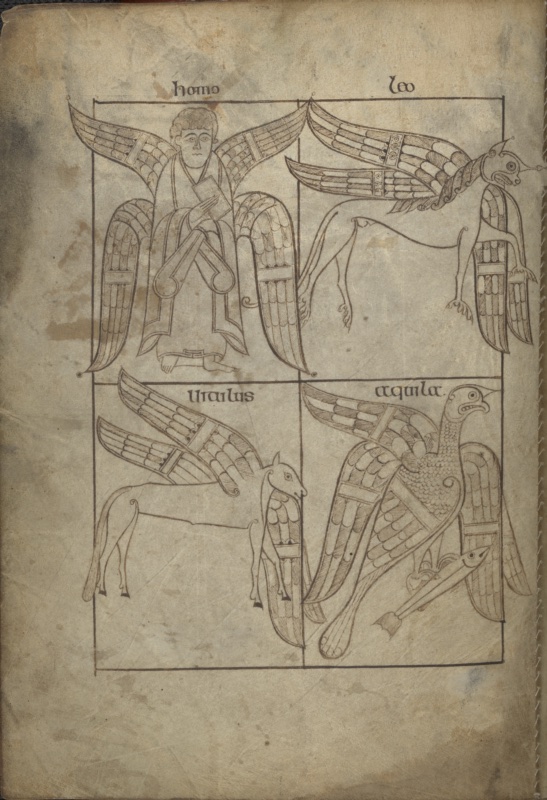
This is the most ambitious page in the Book of Armagh and the one on which its reputation as a work of art largely rests. A single ruled rectangle, its corners marked by small ringed terminals, is divided by a cross of ruled lines into four compartments, one for each of the evangelist symbols, and the whole is executed — like every other drawing in the codex — in brown ink alone, with no colour, no gold and no ground. The page stands immediately before the opening of Matthew, whose great display initial is visible at the right edge of the opening, the letters of LIBER generationis running down the facing recto. The reader thus meets the fourfold Gospel as a single conspectus before entering the first of its four texts.
Each compartment is labelled in a small, neat minuscule: homo and leo written above the upper frame, uitulus and aquila set within the lower two fields. The sequence is the Hieronymian one, read left to right and top to bottom in the order of the Gospels themselves — the man for Matthew, the lion for Mark, the calf for Luke, the eagle for John. This is worth stressing, because Insular practice was not uniform: an older tradition, descending from Irenaeus and current in Ireland, gave the lion to John and the eagle to Mark. Ferdomnach’s page aligns Armagh with Jerome, and does so explicitly, in writing.
The homo is the only symbol conceived frontally. A young man with a full, softly modelled face and short curling hair sits facing the viewer, holding a rectangular book or tablet against his chest; his drapery falls in flat vertical folds terminating in the sharp, tongue-like points characteristic of Insular figure drawing, and two small feet emerge below. He is given four wings, the upper pair extended horizontally to fill the width of the compartment, the lower pair sweeping down along either side — a seraphic formula that assimilates the evangelist symbol to the living creatures of Ezekiel and the Apocalypse. The wings are the most carefully worked passage of the whole page: rows of overlapping scale-shaped coverts, then long flight feathers filled with fine parallel hatching, interrupted by transverse banded straps that read almost like metalwork mounts.
The leo in the upper right is by contrast startlingly spare. Its wings are drawn with the same patient feather-work, and its head — turned back over the shoulder, with pointed ear, ringed eye, open jaws and a protruding curled tongue — anticipates precisely the head of the great lion drawn twenty folios later before Mark’s Gospel. But the body is reduced to a few long contour lines: an unfilled belly, thin looping limbs, clawed feet. The same is true of the uitulus below, a wingèd calf in pure profile with slender legs ending in solid inked hooves, a small head with a single visible horn, and a body left entirely blank. Whether this reflects deliberate variation of emphasis or a design abandoned before its patterning was completed is impossible to say with certainty, but the disparity is real and should be recorded rather than smoothed over.
The aquila is the most densely worked of the four: a bird seen in near profile with a fiercely hooked beak and a large ringed eye, its breast and throat covered with tight scale-like plumage, its wings multiplied and layered across the compartment, and, in the lower right corner, a further elongated form with its own eye and a fanned terminal — a second beast or a tail — overlapping the frame. This eagle has long been compared with the corresponding figure in the Book of Dimma, and the resemblance is close enough to place both within a shared repertoire of Irish pocket-gospel drawing.
Throughout, the artist works as a draughtsman rather than a painter: no modelling, no mass, no interest in space, but an extraordinary confidence of contour and an almost metalworker’s instinct for filling a field with pattern. The creatures repeatedly break their compartments — the lion’s head and forelimb cross into the gutter margin, the eagle’s tail overruns the lower frame — so that the ruled grid reads less as a cage than as a set of thresholds being pressed against.
The leaf is in sound condition, with cockling along the upper edge, brown staining in the upper left corner and scattered discolouration across the surface. The sewing of the binding is visible at the gutter.
Before the Lion: The Argumentum to Mark and a Glossary of Hebrew Names
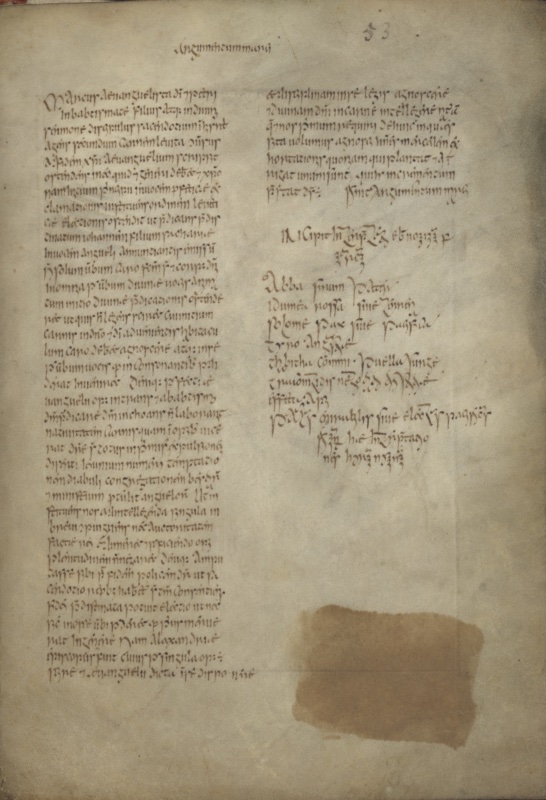
This is the page immediately preceding the great pen-drawn lion, and it shows how carefully Ferdomnach staged the passage from one Gospel to the next. Where the verso will be given over entirely to the symbol of the evangelist, the recto is dense with the scholarly apparatus that an Insular reader expected to find at a Gospel threshold: a prologue, an explicit, and a short lexicon. The layout is the manuscript’s standard two-column grid in fine Irish minuscule, but only the first column and the head of the second are filled; the lower half of the page is left blank, so that the eye is carried forward across the fold to the drawing.
The running header, in the hollow display hand used throughout the codex for titles, announces:
Argumentum secundum Marcum
Beneath it the left column carries the so-called Monarchian prologue to Mark, the text that circulated with the Vulgate from late antiquity onward and that Irish scribes transmitted with great fidelity. It opens in the familiar way — Mark the evangelist, chosen of God, Peter’s son in baptism and his disciple in the divine word, a Levite by descent exercising priesthood in Israel, converted to the faith of Christ — and goes on to describe the composition of his Gospel and the character of its beginning, which starts not with the Nativity but with the voice crying in the wilderness and the prophetic word.
Two of the prologue’s more arresting claims are legible toward the foot of the column: the tradition that after his conversion Mark cut off his own thumb so as to be judged unfit for the priesthood, the origin of his late-antique epithet colobodactylus, “stump-fingered”; and the reference to Alexandria, the see of which he was held to be the founder. Whatever their historical value — and it is nil — these details tell us a great deal about the biographical imagination that early medieval readers brought to the evangelists, and about the way a prologue functioned as a portrait in words, complementing the emblematic portrait in ink overleaf.
The prologue closes at the top of the second column with a brief formula of ending, followed by a display line in the mixed Graeco-Latin capitals that Ferdomnach reserves for headings:
Incipiunt nomina hebraica
What follows is a compact glossary of Hebrew and Aramaic names occurring in Mark, laid out as a two-part list in which each name is followed by its Latin interpretation — Abba rendered pater, Idumea as red or earthy, Salome as peace or peaceable, Tabitha with the gloss attached to the words spoken over the child, and, in a slightly larger hand, Pascha explained as immolation or election and, in the marginal continuation, as passage or transition. Glossaries of this kind, descended from Jerome’s Liber interpretationis hebraicorum nominum, were a standard Insular study aid; their presence here confirms that the Book of Armagh was made for reading and exegesis, not for ceremonial display. Small interlinear letters entered above the line at several points in the column are scribal corrections, another sign of a text checked against its exemplar.
Two later interventions complete the picture. A modern pencil foliation, 53, sits in the upper right margin. More significant is the broad rectangular brown stain in the lower right quadrant, which corresponds in position and tone to the staining on the facing verso: the two leaves lie in contact when the book is closed, and the discolouration has evidently transferred from one to the other. Given that damp of this kind on precisely these leaves coincides with the region where scribal subscriptions were entered, the marks are plausibly connected with the nineteenth-century application of chemical reagents to recover faded colophons. That attribution remains a hypothesis and should be verified against Trinity’s conservation documentation before it is repeated in print.
A Lion in Brown Ink: The Symbol of Saint Mark
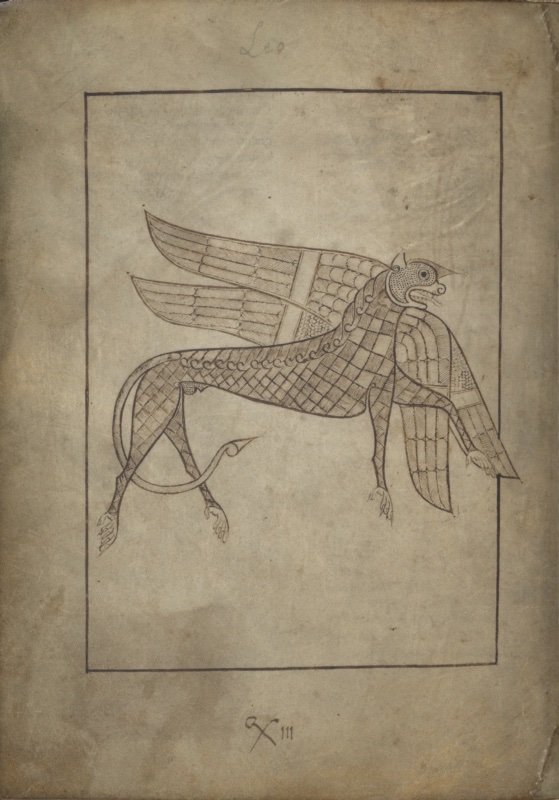
The page is given over entirely to a single drawn creature, set within a plain ruled rectangle and executed in nothing but brown iron-gall ink on the bare vellum. There is no gold, no colour, no ground: the animal floats in the reserve of the parchment, and the whole effect depends on line alone. This is the aesthetic economy of the Book of Armagh as a whole, a manuscript made at Armagh for the abbot Torbach — Patrick’s comarba — by the scribe Ferdomnach, whose colophon at the close of Matthew records precisely that commission. The book was not a shrine-object in the manner of Kells or Lindisfarne but a working codex, the earliest surviving Irish witness to a near-complete New Testament alongside the Patrician dossier; its ornament is correspondingly ascetic, and all the more telling for it.
The beast is a winged quadruped striding to the right, its head turned back over the shoulder in the sinuous reversal beloved of Insular animal art. Two wings rise steeply behind, one overlapping the other, their coverts rendered as rows of overlapping scale-shapes and their flight feathers as long parallel shafts filled with fine diagonal hatching. The body is divided into distinct zones of pattern: a lozenge diaper across the flank and haunch, hatched panels on the limbs, a chain of tight running spirals following the line of the spine like a decorated seam. The tail passes forward between the hind legs, loops beneath the belly and terminates in a lanceolate, leaf-like flourish. The feet are not the pads of a lion but splayed, clawed talons, and the head — with its pointed ear, staring ringed eye, and open jaws from which a curled tongue emerges — is closer to a raptor or a dragon than to any observed animal.
That the creature is nonetheless a lion is confirmed by its place in the codex and by a later reader, who wrote Leo in pencil in the upper margin. The drawing stands at the end of Matthew and immediately faces the decorated opening of the following Gospel, visible at the right edge of the opening: it is the leo of Mark, in the Hieronymian assignment already set out in the four-symbol page earlier in the manuscript (fol. 32v), where homo, leo, uitulus and aquila are ranged in compartments. The symbol thus functions architecturally as much as iconographically — a threshold image, marking the seam between one evangelist and the next for a reader turning the page.
Stylistically the artist works entirely within the vocabulary of the eighth- and ninth-century Insular workshop, but with a draughtsman’s rather than a painter’s temperament. There is no modelling and no interest in mass; the animal’s substance is entirely a matter of contour and infill, and the patterned zones read almost like the compartments of a metalwork plaque or the interlaced fields of a carved slab. The line itself is remarkably assured: long unbroken curves for the belly and the leading edges of the wings, then a dense, patient hatching that must have been laid in with a very fine nib. One detail betrays the freedom of the conception — the forelimb and one hind paw break out over the ruled frame at the right, so that the beast appears to step out of its own enclosure. Whether calculated or simply the result of a design too large for its box, the effect is one of contained energy.
The leaf survives in good condition: the vellum has darkened unevenly and shows some staining and cockling, but the ink remains crisp and the drawing has suffered no loss. The marginalia are later additions — the pencil Leo above and the foliation below, both belonging to the manuscript’s post-medieval and nineteenth-century curatorial history.
The Close of Matthew: Explicit, Collect, and a Vanished Signature
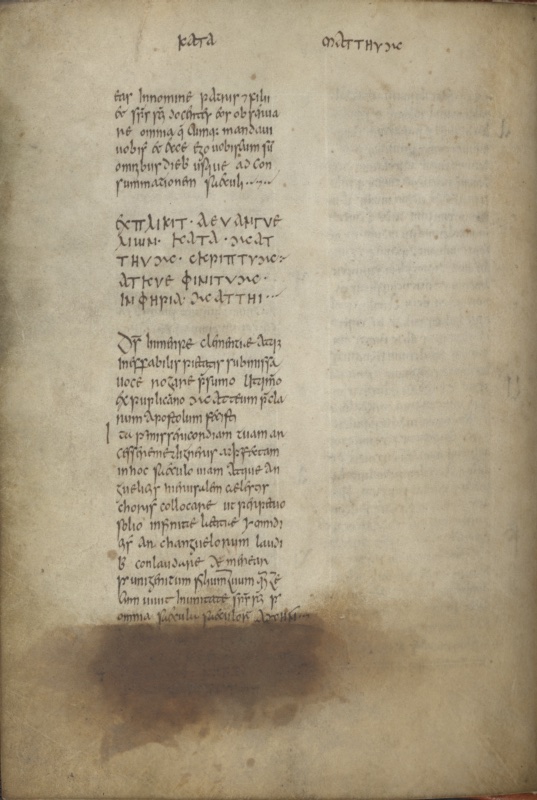
After the exuberance of the evangelist symbols, a page like this one shows the Book of Armagh in its working character: a scribe’s page, laid out for reading rather than display, where the ornament consists in the disposition of scripts alone. The leaf carries the end of the Gospel of Matthew, and Ferdomnach has organised the closing sequence with a clear sense of ceremony, moving from text to explicit to prayer in three descending registers separated by generous blank space.
The running header, spread across the upper margin in an elegant hollow display hand, reads KATA MATTHEUM — the Greek preposition κατά retained in a Latin gospel book, as was standard in the Vulgate tradition and much loved by Insular scribes for its learned resonance. The letterforms are worth pausing over: the scribe deliberately mixes Greek and Latin capitals, using Κ, Λ, Φ and a Greek-derived form for M, so that the heading and the explicit below it read as a kind of graphic erudition. This is display script as a claim to the authority of the original tongue.
The text column itself is written in the fine, compressed, sharply pointed Irish minuscule for which the manuscript is famous, heavily abbreviated by suspension and contraction, with the Tironian et and the characteristic punctuation flourishes closing each unit. The upper block gives the last verses of Matthew 28 — the baptismal command in the name of the Father, the Son and the Holy Spirit, the charge to teach the observance of all that Christ commanded, and the promise of his presence to the end of the age. The word consummationem saeculi is followed by a decorative point-and-flourish, and the Gospel is done.
There follows the explicit, set out in five lines of the same Graeco-Latin display capitals:
Explicit aevangelium kata Mattheum, scriptum atque finitum
and then a final line that appears to record in feria Matthei, that is, the completion of the copy on the evangelist’s own feast day. If the reading holds, it is a small but precious piece of scribal self-witness, tying the labour of the pen to the liturgical calendar of the Armagh community; it should nonetheless be checked against Gwynn’s transcription before being cited.
Below, in minuscule again, comes a prayer that has attracted the attention of liturgists: the collect beginning:
Deus inmensae clementiae atque ineffabilis pietatis, submissa voce rogare presumo
a text noted in the Trinity description of the manuscript and discussed by Warren in The Liturgy and Ritual of the Celtic Church. Its argument is beautifully apt to its position: as God made Matthew, a publican, into an apostle, so may he lead the suppliant along the way in this world and set him at last among the choirs of heaven, praising him with the archangels for ever. The prayer converts the act of copying into an act of petition, and places the scribe in the same economy of grace as his subject.
Two features of the page’s condition deserve comment. The second column stands empty, and through the vellum one can make out the ghostly reverse of the writing and of two large ornamented letters from the other side of the leaf — a reminder of how thin and finely prepared this parchment is. More striking is the broad brown stain that spreads across the foot of the column and into the lower margin.
Discolouration of exactly this kind was produced in the nineteenth century by the chemical reagents used to recover faded writing: Charles Graves, who in 1846 deciphered the partly erased colophons naming Ferdomnach and Torbach and so dated the manuscript, applied such a solution, with the result that the very lines he read are no longer legible. Whether this particular stain is the trace of that intervention would need confirmation from Trinity’s conservation record, but the coincidence of place — the foot of a page at the end of Matthew, precisely where scribal subscriptions were entered — is suggestive.
Paul’s Signature and a Decorated P: The Opening of Second Corinthians
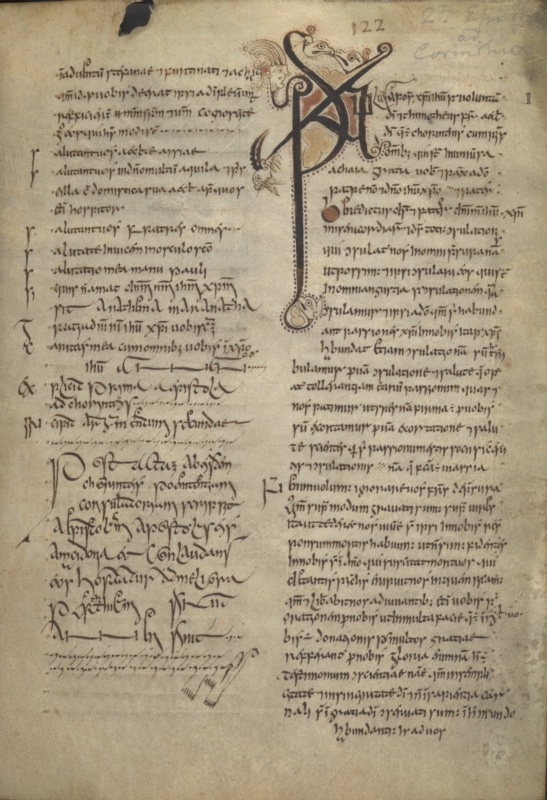
With the Pauline epistles the Book of Armagh changes register. The gospel section was punctuated by full-page pen drawings; here the ornament is concentrated into a single decorated initial, and the interest of the page lies as much in its editorial architecture — the way one letter is closed off and the next opened — as in its decoration. Three distinct textual units meet on this leaf: the end of First Corinthians, the explicit and prologue introducing the Second, and the beginning of the epistle itself.
The left column carries the closing salutations of 1 Corinthians 16, laid out per cola et commata so that each greeting occupies its own line, with small marginal letters flagging the divisions. The sequence is easily followed: the churches of Asia send greeting, then Aquila and Prisca with the church in their house, then all the brethren; the readers are told to greet one another with a holy kiss; and then comes the apostle’s own hand — salutatio mea manu Pauli — followed by the fierce clause:
si quis non amat Dominum nostrum Iesum Christum, sit anathema,
and, isolated on its own line in enlarged letters, the Aramaic maranatha. The letter ends with the grace and with:
caritas mea cum omnibus vobis in Christo Iesu.
Ferdomnach then marks the seam with two display lines in his mixed Graeco-Latin capitals:
Explicit prima epistola ad Chorinthios
and
Incipit argumentum in eandem secundae,
each followed by a run of fine pen squiggles filling the remainder of the ruled line — a modest but characteristic Insular horror of empty ruling.
Below, in the same display hand, stands the Monarchian prologue to Second Corinthians, the short prefatory notice that travelled with the Vulgate text throughout the early Middle Ages. It explains that after the Corinthians had done penance the apostle wrote them a letter of consolation from Troas, commending them and urging them toward better things, and it names Titus as the bearer. The prologue is followed by two further lines of ornamental pen-work, and then the column is left blank — a deliberate pause before the new book.
The decorated initial occupies the head of the second column and is the visual event of the page. It is a monogram rather than a single letter, the P and A of Paulus interlocked, with the bowl of the P thrown across the shaft in a long diagonal stroke and the shaft itself plunging the full depth of a column before turning into a lobed, spiralling terminal. Three animal heads inhabit it: one at the apex, jaws open and neck extended into a scrolled crest; a second biting into the shaft from the left, with pointed ears, ringed eye and a curling snout; a third absorbed into the foot. The interior fields are washed with orange-red and yellow ochre, the only substantial colour on the page, and the whole is outlined with a fringe of red dots — the technique of red dotting inherited from seventh-century Insular practice and used here with restraint rather than the encrusted density of Lindisfarne or Kells.
The text runs on from the initial without interruption:
Paulus apostolus Christi Iesu per voluntatem Dei et Timotheus frater, ecclesiae Dei quae est Corinthi cum sanctis omnibus qui sunt in universa Achaia: gratia vobis et pax a Deo Patre nostro et Domino Iesu Christo.
A smaller decorated B, filled with the same orange wash, opens the following verse:
Benedictus Deus et Pater Domini nostri Iesu Christi, Pater misericordiarum et Deus totius consolationis,
and the column then settles into the fine, laterally compressed Irish minuscule, heavily abbreviated, that Ferdomnach maintains with astonishing consistency across more than two hundred leaves.
The leaf is in good condition apart from an irregular loss in the upper margin, where the dark photographic ground shows through a hole in the vellum. Two later hands are visible above the text: a pencil foliation, 122, and a pencil identification, 2a Epistola ad Corinthios, in a nineteenth-century cursive. The discrepancy between that pencil number and the modern citation as fol. 123r reflects the manuscript’s competing foliations.
Dispersal: The Book, the Steward, and the Martyr
The manuscript’s later history is a study in institutional collapse, and it turns on one of the more melancholy episodes in Irish history.
Through the later Middle Ages the Mac Moyre stewards continued to hold the book, and it remained in the family into the seventeenth century. An entry on one of the folios, in Florence Mac Moyre’s own hand, shows the manuscript in his care on 29 June 1662.
Florence Mac Moyre — Finghin Mac an Mhaoir, who died in 1713 — was the last hereditary keeper, and his name is remembered for reasons unconnected with bibliography. In 1680 he pawned the Book of Armagh for five pounds in order to finance a journey to London. There he appeared as the first witness against Oliver Plunkett, Archbishop of Armagh, at Plunkett’s trial in 1681. Plunkett was convicted of high treason on evidence that has been universally regarded since as perjured, and was executed at Tyburn — the last Catholic to be put to death for his faith in England. He was canonised in 1975.
Mac Moyre never redeemed the manuscript. He died in obscurity and disgrace and was buried at Ballymoyer, on the lands his family had held in return for guarding the book he had pawned. The episode is well documented in the standard biographical dictionaries, both the Dictionary of Irish Biography and the older Dictionary of National Biography. A number of details that cluster around it, however, belong to tradition rather than to the documentary record: the story that Mac Moyre was cursed annually from the altar, and the claim that the family changed its name in shame, are folklore, and should be presented as such. It is worth adding that the accumulated moral weight of the story has a distorting effect: Mac Moyre’s treachery at Plunkett’s trial is what is remembered, and the pawning of the manuscript has been absorbed into the same narrative of betrayal. In strict terms these are two separate acts, and the pawning of a family heirloom for travel money by an impoverished man is not, in itself, remarkable.
What is remarkable is that the pawning was, in the event, the manuscript’s salvation. Detached from a family in decline and from a church under proscription, the book entered the world of collectors and antiquaries, where it was recognised, described, and ultimately preserved.
It passed to the Brownlow family of Lurgan; Arthur Brownlow, into whose hands it came in the early eighteenth century, was responsible for the foliation that the manuscript still carries. In the nineteenth century it came to the notice of Sir William Betham. It was offered at auction on 26 May 1831 but bought in at £390. In 1846 the Reverend Francis Brownlow deposited it in the Royal Irish Academy, where it was accessible to scholars — and where, in that same year, Charles Graves performed the decipherment that established its date.
In 1852 it was offered to Sir Thomas Phillipps, the most voracious manuscript collector of the century; had that sale gone through, the manuscript would have entered the Phillipps collection and its subsequent fate would have been very different. In 1853 it was displayed at the Dublin Exhibition, and in the same year it was purchased for £300 by William Reeves, later Bishop of Down, one of the outstanding Irish antiquarian scholars of the century. Reeves conveyed it to Archbishop Lord John George Beresford for the same sum, on the understanding that it would ultimately pass to Trinity College Dublin, with Reeves retaining a life interest that ended at his death in 1892.
The dates in this final sequence require care, since the secondary literature is inconsistent: the purchase by Reeves is placed in 1853, the presentation to Trinity College in 1853 or 1854, and at least one nineteenth-century compendium gives 1858. The reliable frame is purchase in 1853 and transfer to the College in 1853–54, subject to Reeves’s life interest.
It is worth pausing on the shape of this trajectory. A book made in 807 as the charter of an ecclesiastical primacy was, by 1680, worth five pounds to a desperate man; by 1831 it was worth £390 and did not sell; by 1853 it had become a national treasure whose acquisition for a Dublin institution was a matter of patriotic concern. The manuscript did not change. What changed was the framework of value within which it was seen — from relic, to encumbrance, to antiquarian curiosity, to monument of national heritage. The Book of Armagh has been at least four different kinds of object in its lifetime, and its present status as a conserved and digitised treasure of Trinity College Library is simply the most recent.
The Historiography: From Lhwyd to the Present
The scholarly engagement with the Book of Armagh spans three centuries, and its stages correspond closely to the successive phases of Irish historical scholarship generally.
The first description was given by Edward Lhwyd in 1699, in the course of the antiquarian and philological travels that produced the Archaeologia Britannica; his account was later printed by Charles O’Conor in the Scriptores Rerum Hibernicarum (1814–26). Lhwyd’s is the classic antiquarian encounter: a learned traveller identifies an object of importance in private hands and makes it known.
The decisive intervention came in 1846 with Charles Graves’s paper “On the date of the MS called the Book of Armagh,” in the Proceedings of the Royal Irish Academy. Graves’s decipherment transformed the manuscript from a venerable object of uncertain antiquity into a fixed point of Insular palaeography. Its cost, as discussed above, was the physical destruction of the evidence.
The turn of the twentieth century brought the great editorial enterprises. Whitley Stokes and John Strachan published the second volume of the Thesaurus Palaeohibernicus in 1903, printing and analysing the Irish material. N. J. D. White treated the Latin writings of St Patrick in the Proceedings of the Royal Irish Academy in 1905. And in 1913 John Gwynn published Liber Ardmachanus: The Book of Armagh for the Royal Irish Academy, in a de luxe edition limited to four hundred copies — a full diplomatic transcription of the entire codex, with an extensive introduction and appendices, and to this day the only edition of the whole manuscript. Gwynn’s edition is a monument of a kind that the modern academy rarely produces: the sustained labour of decades, dedicated to a single object.
The middle decades of the twentieth century saw consolidation and specialisation. Edward Gwynn edited the Patrician documents in collotype facsimile for the Irish Manuscripts Commission in 1937. E. A. Lowe catalogued the manuscript in Codices Latini Antiquiores. Paul Grosjean published an analysis of the codex in Analecta Bollandiana in 1944 — a reminder that the Bollandist tradition, working in French and Latin, has contributed substantially to the study of Irish hagiography. And D. A. Binchy’s long essay in Studia Hibernica in 1962 subjected the Patrician documents to the scrutiny of a scholar trained in early Irish law, with results that reshaped the field.
The second decisive edition appeared in 1979: Ludwig Bieler’s The Patrician Texts in the Book of Armagh, volume X of the Scriptores Latini Hiberniae series published by the Dublin Institute for Advanced Studies, with a contribution by Fergus Kelly. Bieler — an Austrian-born Latinist who spent his career in Ireland and who did more than any other individual to establish the critical study of Hiberno-Latin literature — produced the text of Muirchú, Tírechán, and the associated documents that remains standard. The dual national provenance of the two great editors, an Irish clergyman-scholar and a central European Latinist, is itself a fair emblem of how the field has developed.
Richard Sharpe’s work in the 1980s reopened questions that had appeared settled: the palaeographical study in Scriptorium in 1982, and studies of Patrick and the see of Armagh and of Armagh’s relations with Rome published in the same period, applied a sceptical and rigorous method to the manuscript’s texts as historical evidence. Marvin Colker’s descriptive catalogue of the medieval and Renaissance Latin manuscripts of Trinity College, published in 1991, provided the authoritative modern codicological description. Jane Stevenson’s essay on literacy, Bernard Meehan’s study of the manuscript’s art and calligraphy in the Irish Arts Review Yearbook in 1998, and William O’Sullivan’s survey of manuscripts and palaeography in the first volume of the New History of Ireland have each opened distinct lines of enquiry.
The most recent phase is technical and institutional. Conservation, scientific analysis, and digitisation at Trinity College have made the manuscript available in ways that Gwynn could not have imagined: the codex is fully digitised and freely accessible through Trinity’s digital collections, and the Confessio project of the Royal Irish Academy has assembled transcription and facsimile material for the Patrician texts. The pigment analysis of Burgio, Bioletti, and Meehan, published in 2013, brought the manuscript within the scope of modern materials science.
Two gaps in this record deserve mention. First, a comprehensive study of the manuscript’s physical make-up by Anthony Cains, long announced, appears never to have been published; its absence leaves the codicology less fully resolved than it might be. Second, there is no modern critical edition of the manuscript’s New Testament text. Gwynn’s diplomatic transcription of 1913, magnificent as it is, is more than a century old, and the tools available to textual criticism have changed beyond recognition since. Both of these are live opportunities.
A final caution about sources. Because the authoritative literature on this manuscript is concentrated in a small number of specialist publications, much of what circulates about it in accessible form derives at second or third hand from a handful of works, some of them very old — the article in the Catholic Encyclopedia of 1907–12 continues to be a silent source for a good deal of internet content. The errors documented in this essay — the misdated rebinding, the confidently asserted three scribes, the fifteenth-century satchel presented as ninth-century, the flat claim of Patrician authorship — all propagate in this way. The remedy is unglamorous and entirely traditional: consult Gwynn, Bieler, Stokes and Strachan, Sharpe, and Colker directly.
Armagh in 807: The Manuscript in Its Moment
To understand why the Book of Armagh was made, one must reconstruct the situation of the church that made it.
Armagh — Ard Macha, the height of Macha — lay adjacent to Emain Macha, the great prehistoric royal site of Ulster, and its foundation legend attached it directly to Patrick. By the eighth century it was the pre-eminent ecclesiastical centre of the north, bound closely to the Uí Néill and to the Airgialla, and it functioned as a monastic town: a substantial settlement with schools, craftsmen, tenants, and dependants, of a kind for which “monastery” is a misleadingly narrow term.
Its ambition was the primacy of the whole Irish church, and that ambition faced real competition. Other great churches — Kildare with its cult of Brigit, Iona with its Columban federation across Ireland and Scotland, and later Kells as the Columban centre in Ireland — advanced claims of their own. Primacy was not conferred; it had to be established, and in a society without a strong central authority it was established by the accumulation of documentation, precedent, alliance, and cult.
This is the context that makes sense of the Book of Armagh. The Liber Angeli asserts primacy by angelic grant. Tírechán’s itinerary asserts it by cataloguing the churches Patrick founded and which therefore owe dues to Patrick’s heir. Muirchú’s Vita asserts it by making Patrick the sole and triumphant apostle of the island. The Additamenta record particular acquisitions in the vernacular language of Irish property law. Binding these to a complete New Testament placed the claim within scripture; adding Sulpicius Severus placed it within the universal tradition. The manuscript is, in a precise sense, a dossier — the assembled documentation of a case.
Two further currents run through the moment of its production. The first is the Céli Dé reform, the ascetic movement associated with Máel Ruain of Tallaght, who died in 792, which reacted against the wealth and secularisation of the great churches and sought a return to rigour. A manuscript produced at Armagh in 807, austere in decoration and dense with text, is at least consonant with that atmosphere, though the connection cannot be demonstrated.
The second is the Vikings. The first raids on Irish coasts and islands fell in the 790s, and the annals record their intensification through the following decades; Armagh itself would be plundered repeatedly in the 830s. Whether the compilation of 807 was undertaken in conscious anticipation of danger cannot be established, and it would be irresponsible to claim it. But the observation may be permitted that the impulse to gather a church’s foundational documents into a single, portable, structurally modular volume is intelligible in a period when the security of ecclesiastical settlements was becoming a live question. The manuscript’s later history — carried into Connacht in 836 by an abbot asserting a contested claim — shows the utility of such an object under pressure.
The claims the manuscript advanced were eventually vindicated, though it took three centuries. The synod of Ráith Bressail in 1111 restructured the Irish church on a diocesan model and recognised Armagh’s primatial standing; the twelfth-century reform, associated above all with Malachy of Armagh, consolidated that settlement. By then the Book of Armagh had long since become a relic, and the arguments it contained had become simply the accepted history of the Irish church — which is, in the end, what a successful argument becomes.
Conclusion: What the Book of Armagh Is For
The Book of Armagh resists the categories with which we normally approach medieval manuscripts. It is not, in the ordinary sense, a work of art, though it contains fine drawing and expensive pigment. It is not simply a Bible, though it contains the only complete New Testament from early Christian Ireland. It is not merely a hagiographical collection, though it preserves the texts on which our whole understanding of Patrick depends. It is not a cartulary, though it contains charter-material in two languages. It is all of these at once, and it is more than their sum, because the combination is the point.
What the manuscript most fundamentally is, is an argument made durable. In 807 or thereabouts, a church with a claim to make gathered the evidence for that claim, set it within scripture and within the universal tradition of the saints, and committed it to vellum in a form compact enough to be carried and authoritative enough to compel. The argument worked. The Book of Armagh became the Canon of Patrick; the Canon of Patrick became a relic; the relic became the visible authority of Patrick’s successors; and the primacy the manuscript asserted was, in the end, conceded.
There is a lesson in this about how the past comes to us. The manuscript’s own colophons were erased because they told an inconvenient truth about its date. Its text of the Confessio was abbreviated in ways that made its subject more useful. Its exemplar was believed, wrongly, to be Patrick’s autograph, and the belief was recorded in the book and preserved for a thousand years. At every stage, the object was shaped by the needs of those who held it — and yet at every stage it also resisted that shaping, retaining under the erasures and abbreviations enough evidence for a nineteenth-century bishop with a bottle of gallic acid, and a twentieth-century Latinist with a critical apparatus, to recover what had been overwritten.
That resistance is the historian’s opportunity, and it defines the discipline’s proper attitude to such an object: neither credulity nor dismissal, but the patient separation of layers. The Huc usque note is worthless as testimony about the fifth century and invaluable as testimony about the ninth. Tírechán’s itinerary is unreliable as biography and indispensable as a map of seventh-century ecclesiastical claims. The erasures are damage, and they are also data.
The Book of Armagh has now entered a further phase of its long life. Digitised, analysed by Raman spectroscopy, rebound by Roger Powell, catalogued by Colker, it is available to more readers than at any point in its history, and available in ways its makers could not have conceived. Yet the fundamental questions remain open. How many hands wrote it. What exemplars stood behind its biblical text. When and where Máel Suthain entered Brian’s memorandum. Whether its austerity is a reformist statement or simply a functional one. These are answerable questions, and the tools to answer them exist. What is required is the return to the object itself, and to the small body of rigorous scholarship that has grown up around it — the recognition, in short, that after more than twelve hundred years the Book of Armagh has not finished telling us what it knows.