Codex Usserianus Primus (MS 55)
( 25% )
Introduction: A Ruined Book at the Head of a Tradition
Among the manuscripts preserved in the Library of Trinity College Dublin, the Codex Usserianus Primus (IE TCD MS 55) occupies a position that is at once marginal and foundational. It is not, by any ordinary aesthetic measure, a beautiful book. It has none of the chromatic exuberance of the Book of Kells, none of the disciplined geometric splendour of the Book of Durrow, none of the compact devotional charm of the small Irish pocket Gospels. What survives is a wreck: some one hundred and eighty leaves of parchment, stained brown and green by centuries of damp and decay, their outer edges entirely gone, their text in many places reduced to a shadow legible only under raking light or in high-resolution digital capture. A reader coming to the codex expecting the Insular sublime will be disappointed.
And yet this ruined object is among the most consequential manuscripts of the early medieval West, and it is consequential twice over, along two lines of enquiry that must be kept carefully distinct because they yield different conclusions and rest on different kinds of evidence.
The first line is textual. The Codex Usserianus Primus transmits the four Gospels in a Latin version that antedates Jerome1 — a Vetus Latina, or Old Latin, text, belonging to the body of translations that circulated in the Latin-speaking Church before the Vulgate progressively displaced them. It is the only substantial Irish witness to that pre-Vulgate tradition. Whatever we can say about the state of the Latin Bible in Ireland before the Vulgate’s arrival, and about the routes by which scripture reached the island, we say very largely on the strength of this codex.
The second line is art-historical. On a single page — folio 149v, at the junction where the Gospel of Luke ends and the Gospel of Mark begins — the manuscript preserves a cross, executed in red and outlined in black dots, flanked by the Greek letters alpha and omega and enclosed within a frame of dotted and rope-like patterning. This modest, damaged, entirely linear composition is regularly described as the earliest surviving decoration in an Insular manuscript, and thus as the point from which the whole subsequent development of Insular ornament — through the Cathach, Durrow, Lindisfarne, and Kells — may be traced. Carl Nordenfalk’s celebrated essay of 1947 took its title, “Before the Book of Durrow,” from precisely this claim.
Each of these two claims is strong; neither is uncontested; and the arguments that support them pull, in one important respect, in opposite directions. The palaeography of the codex has repeatedly invited comparison with manuscripts from Bobbio, the north Italian monastery founded by the Irish peregrinus Columbanus around 612–614, and has thereby fed a persistent narrative — particularly attractive to Italian regional scholarship — that would locate the book’s making, or at least its immediate milieu, in the Columbanian orbit in Italy. The text of the codex, by contrast, points elsewhere: its closest affiliations are Gallican, connected to the version used by Hilary of Poitiers2 and to a south-Gallican sacramentary of around 700, and thus to Gaul rather than to Lombardy. The manuscript therefore sits precisely on the fault line of one of the central questions in the study of early Irish book culture — the question of where, exactly, Ireland got its books, its scripts, and its decorative vocabulary from.
This essay attempts a synthetic account of the codex under all these headings. It proceeds from identification and physical description, through script and glossing, to the vexed questions of date and origin; it then treats the biblical text and its affiliations, the decorated page and its comparanda, and finally the provenance, conservation, editorial history, and historiographical significance of the manuscript. Throughout, the aim has been to distinguish rigorously between what is firmly attested, what represents scholarly consensus, what is contested, and what circulates in the literature without adequate support. Several widely repeated statements about this manuscript belong to the last category, and a separate section is devoted to identifying and correcting them, since silence about an error is less useful to a reader than its explicit refutation.
Names, Sigla, and the Apparatus of Identification
Few manuscripts of comparable importance carry so many overlapping designations, and because those designations belong to different scholarly systems, precision here is not pedantry but a precondition for using the literature at all.
The current and authoritative shelfmark is Dublin, Trinity College Library, MS 55. The former Trinity press-mark, still frequently cited in older and even in recent scholarship, is A.4.15, sometimes given in the equivalent form A.IV.15 — press A, shelf 4, item 15. The two notations denote the same object; the variation is orthographic, between arabic and roman numerals, and carries no substantive significance. A reader encountering either form in the bibliography should recognise it immediately.
Within biblical scholarship the codex is registered in the Beuron system of Old Latin manuscripts as VL 14. Its traditional siglum is r; because the second of the two Ussher Gospel books at Trinity — the Garland of Howth, MS 56, known as the Codex Usserianus Secundus — carries the siglum r², the present manuscript is conventionally written r¹ whenever the two must be distinguished, which in practice is almost always. In the Gregory–Aland style used for citing Latin witnesses to the New Testament it appears as it-r1.
In palaeography the decisive entry is in E. A. Lowe’s Codices Latini Antiquiores, where the manuscript is CLA II, no. 271. This number is corroborated consistently across the Beuron-derived literature, the standard Oxford guide to the Latin New Testament, the specialist descriptive catalogue of Trinity’s medieval and Renaissance Latin manuscripts published in 1991, and the Trismegistos record (TM 66357). An isolated citation of “CLA II, 267” appears in one bibliographic list and is simply an error, 267 designating a different item; it should not be propagated.
Beyond these, the codex is no. 84 in Patrick McGurk’s Latin Gospel Books from A.D. 400 to A.D. 800 — an older listing gives no. 83, and the discrepancy is worth flagging for anyone working from secondary citations rather than the printed volume — no. 1 in J. J. G. Alexander’s Insular Manuscripts, 6th to the 9th Century, and no. 453 in James Kenney’s Sources for the Early History of Ireland. That Alexander’s survey opens with this manuscript is itself an argument about its position: the codex stands first in the sequence of Insular illumination not by accident of arrangement but by editorial judgement about chronology.
The manuscript is held in the Manuscripts and Archives Research Library at Trinity College Dublin, and is periodically displayed in the Old Library exhibition alongside the Book of Kells, the Book of Durrow, and the Book of Armagh. It has been fully digitised, and the images are freely accessible through Trinity’s Digital Collections platform with IIIF delivery, permitting individual folios to be called at high resolution and compared with images held elsewhere. This last point deserves emphasis beyond the merely technical: for a manuscript whose physical fragility and near-illegibility make ordinary consultation impractical, the digital surrogate is not a convenience but the principal means of access. More scholars have now examined this codex in high-resolution capture than ever examined it on the desk.
The Physical Object: The Codicology of a Wreck
Any codicological description of the Codex Usserianus Primus must begin by acknowledging how much has been lost, because the losses determine the shape of every subsequent statement.
Standard reference works give the extent as approximately 180 folios. The conservators who remounted the book at Trinity between 2014 and 2016 counted 182 leaves. The discrepancy is small and should be reported rather than smoothed away; the figure of 182 carries greater authority because it derives from a physical intervention in which every leaf was individually handled, whereas the round figure of 180 descends through the reference literature.
The most consequential fact about the object is that no margins survive. The outer edges of every leaf have perished, which means that the original page dimensions cannot be recovered at all. What can be measured is the written area, and this is given as a single column of about twenty-two lines occupying roughly 17.5 × 13 cm; a specialist study of the manuscript’s glosses published in 1998 records the written space as 175 × 120–130 mm, in satisfactory agreement. From these figures one may infer, cautiously, that the book belonged by its proportions and its austerity to a late-antique type of Gospel book current in the Latin West between roughly 400 and 650 — a serviceable, single-column, unornamented codex of moderate size. It stands apart both from the diminutive Irish pocket Gospels such as the Book of Dimma and the Book of Mulling, and from the great decorated codices of the later Insular tradition. This was a book made to be read, not to be displayed.
The parchment was characterised by Lowe as being of a late-antique type — sheepskin rather than the calfskin that became normal in early Irish books. This observation has been deployed on both sides of the origin debate, and the appropriate caution has been stated clearly in the recent literature: parchment type can hardly be decisive, since other fragments of demonstrably Irish origin are written on comparable material. The observation is data, not proof.
The ink is black. In Matthew and John the first line of each chapter is picked out in colour, a modest hierarchical device that nonetheless indicates a scribe thinking about the visual articulation of his text. The leaves were ruled in dry-point, and the same stylus technique underlies the manuscript’s remarkable dry-point glosses, discussed below. Of prefatory matter and the apparatus that normally accompanies a Gospel book, almost nothing survives: there is a list of Hebrew names before Luke, and some chapter numbers are visible in the margins where margins remain, but no Eusebian canon tables, no prologues, no capitula in any complete form. Whether these were ever present cannot now be determined.
Two matters must be flagged explicitly as not securely recoverable. The first is the quire structure. Because the leaves were long ago separated and individually mounted, the gatherings cannot be reconstructed in the way a normally bound codex permits; the conjugacy of leaves, the collation formula, the position of hair and flesh sides within quires — all the ordinary evidence of how the book was physically assembled — is effectively irrecoverable, and any published collation formula should be treated with scepticism unless its basis is stated. The second is the division of the writing between hands. A division into two scribes has been proposed — one copying Matthew and John (fols 1r–78r), the other Luke and Mark (fols 78v–182r) — but this appears in a non-scholarly source and must be treated as a working hypothesis to be tested against the digital images, not as an established datum. It is a hypothesis worth testing: the proposed division falls precisely at the boundary between the two halves of the Gospel sequence, which would be a natural point for a change of stint, and the digital surrogate now makes such a test practicable in a way it was not a generation ago.
The Script: Between Late Antiquity and the Insular World
The script is the manuscript’s chief palaeographical claim on our attention, and Lowe’s description of it has framed every subsequent discussion. He characterised the hand as a peculiar angular type of Irish majuscule verging on minuscule — or, as he preferred to put it, an Irish adaptation of half-uncial. The formulation is worth dwelling on, because its hesitation is the whole point. The hand does not belong securely to any of the established categories. It sits transitionally between an inherited Late Antique half-uncial and the emerging Insular repertoire, and its angularity and lateral compression may be in part artefacts of the constrained writing space and the resistant parchment rather than pure stylistic choice. Palaeographical description here is unusually dependent on judgements about material conditions.
Several technical features anchor the codex firmly at the head of the Insular tradition, and they are worth setting out individually because each carries independent weight.
-
The omission signs — h.d. entered in the text with a corresponding h.s. in the margin, the latter now almost entirely lost with the margins themselves — represent the oldest type of Latin omission mark, irrespective of a manuscript’s place of origin. Their presence here indicates Irish dependence on late-antique exemplars at a stage before the developed Insular system of reference signs took shape over the course of the seventh century. This is an argument about relative chronology internal to Insular scribal practice, and it is among the stronger arguments for placing the manuscript early.
-
The nomina sacra are contracted in the traditional manner, with the familiar forms ds, dm, scs, sps, xps and their inflections. Beyond these, abbreviation is extremely sparing — another late-antique rather than developed-Insular characteristic, since the Insular scribal tradition would go on to elaborate one of the most extensive systems of abbreviation in the medieval West.
-
The main text is written in scriptio continua, and this point deserves emphasis because it is frequently glossed over. The codex does not exhibit the per cola et commata layout characteristic of the great Italian bibles, in which the text is disposed in sense-units to guide liturgical reading. Nor does it employ systematic word separation, which was becoming the norm in Insular books and which is often — rightly — described as one of the distinctive Irish contributions to Western literacy. On this measure the Usserianus Primus is conservative, or archaic, or simply early, depending on how one wishes to characterise it.
-
The comparative anchors invoked in the literature are consistently drawn from the earliest Insular horizon. The Cathach of St Columba (Dublin, Royal Irish Academy, MS 12 R 33) is the other principal claimant to the title of earliest surviving Irish manuscript, and the two books are inevitably discussed together. Two Bobbio manuscripts in the Biblioteca Ambrosiana in Milan — the Basilius, C.26 sup., and the Orosius, D.23 sup., commonly called the Bobbio Orosius — supply the resemblances that have generated the Italian hypothesis discussed below. The Rufinus–Eusebius fragment and the Antiphonary of Bangor belong to the same comparative field. Looking forward, the Book of Durrow and the Book of Kells stand at the far end of the development the codex is taken to initiate; and the manuscript is bound both textually and palaeographically to its own namesake, the Usserianus Secundus. A further connection has been drawn to the Springmount Bog wax tablets, on the argument that both script traditions derive from the Roman cursive half-uncial of Late Antiquity — a proposal that, if sustained, would situate the beginnings of Irish writing within a genuinely late-antique continuum rather than treating them as a local invention.
The Dry-Point Layer: The Earliest Vernacular Glossing in the West
One feature of the codex deserves separate treatment because it is at once the least known and among the most remarkable, and because it bears independently on the questions of milieu and date.
Into the manuscript a later reader — a scholar-glossator working, on the published assessment, in the seventh century — entered a series of glosses using a stylus rather than a pen, incising rather than inking the parchment. These dry-point glosses are in Latin and in Old Irish. The specialist study published in 1998, in a volume of essays honouring a former Keeper of Manuscripts at Trinity, reached two conclusions of considerable consequence. The first is that these are the earliest known example of dry-point glossing in the medieval West. The second, and the more far-reaching, is that their use of Old Irish words constitutes the first example of glossing in a Western vernacular.
The implications deserve to be spelled out. Dry-point glossing is a technique of annotation that leaves no pigment and therefore no immediate visual disturbance of the page; it is legible only under raking light, and it has been systematically recovered only in recent decades, principally in Insular and Anglo-Saxon manuscripts. That the technique should appear this early, and in this book, tells us that the codex was in active scholarly use — not merely venerated as an object, not merely read liturgically, but studied, construed, and annotated by someone working through the Latin with the aid of his own language.
That the glosses are partly in Old Irish is the more striking fact. The tradition of vernacular glossing on Latin scripture and grammar is one of the defining achievements of early Irish learning, familiar above all from the great continental glossed manuscripts at Würzburg, Milan, and St Gallen. Those are eighth- and ninth-century witnesses. To find the practice already in evidence in the seventh century, incised rather than written, is to push the documented history of vernacular exegesis in the West back substantially.
For the purposes of the present essay the dry-point layer functions as independent corroboration. It supports an Irish milieu — the glossator wrote Old Irish — and it supports a seventh-century horizon for the book’s use, which is consistent with, though not identical to, a seventh-century horizon for its production. A manuscript can of course be glossed long after it is made, and the glosses cannot by themselves date the writing. But they do establish that the codex was in Irish hands, being read with close attention, at a very early date, and this is not a trivial constraint on any hypothesis about where the book was made and how it travelled.
Dating and Origin: The State of the Question
No colophon, no dated subscription, no external documentary reference fixes the Codex Usserianus Primus in time. Every date assigned to it rests on palaeographical judgement, and the range proposed in the published literature is unusually wide — from the fifth century to the seventh. This is not a case where a consensus has quietly formed around a narrow bracket; it is a case where genuinely incompatible positions coexist, and honesty requires that they be set out as such.
The mainstream position follows Lowe: his entry in Codices Latini Antiquiores dated the script to saec. vii in. — the beginning of the seventh century — and was scrupulously cautious about origin. Lowe judged the book to have been written in an Irish centre, and explicitly not at Bobbio, notwithstanding four features that might have suggested otherwise: the Roman cursive influences discernible in the script, the manner of denoting an omission, the kind of parchment employed, and the similarity to the two Bobbio manuscripts in the Ambrosiana. That Lowe listed the counter-evidence and then set it aside is characteristic of his method and is one reason his judgement has proved durable. His early-seventh-century dating is described in the subsequent literature as generally accepted among palaeographers, and the various rounded formulations that circulate — “around 600,” “the first half of the seventh century,” “about 625” — are all descendants of it rather than independent assessments.
Against this stands a minority Continental hypothesis, advanced in a palaeographical review of the Insular system of scripts published in 1999, which concluded that there is little in the manuscript to inhibit a fifth-century date and a Continental origin. This is a serious position, not a curiosity: it would push the codex back by as much as a century and relocate its making outside Ireland altogether, with obvious consequences for every argument that depends on the manuscript as evidence for Irish practice. Its force derives from the genuinely late-antique character of much of what the codex displays — the parchment, the omission signs, the sparing abbreviation, the scriptura continua, the half-uncial substrate. Each of these is more at home in the Mediterranean fifth century than in the Irish seventh.
The methodological difficulty is real and should not be finessed. A manuscript that faithfully reproduces late-antique habits may be a late-antique manuscript, or it may be an early copy made in a milieu that had received late-antique models and had not yet developed its own conventions. The two hypotheses predict very similar evidence, and the discrimination between them depends on judgements of a kind that resist formalisation. What can be said is that the dry-point glosses in Old Irish attest Irish use at an early stage; that Lowe’s judgement was made with the counter-evidence explicitly in view; and that the balance of published opinion has not shifted decisively toward the fifth-century Continental proposal in the quarter-century since it was advanced.
On present evidence, the most defensible formulation is therefore this: an Irish origin, in the early seventh century, with a fifth-century Continental origin standing as a reasoned minority view that has not been refuted. Any statement more confident than this exceeds what the evidence supports.
Bobbio, Gaul, and the Italian Question
The possibility of a Bobbio origin hovers over the whole discussion, and because it bears directly on the larger question of contacts between early medieval Ireland and Italy it deserves separate and careful treatment.
The starting point is a genuine observation, not a fabrication: the script of the Usserianus Primus does resemble that of two seventh-century books associated with Bobbio, the Basilius (Ambrosiana C.26 sup.) and the Orosius (Ambrosiana D.23 sup.). Lowe recorded the resemblance himself. Bobbio was founded by Columbanus in the second decade of the seventh century, in the Trebbia valley south of Piacenza, and it rapidly became one of the great libraries of the early medieval West and a principal conduit between Irish and Italian book culture. A manuscript whose script resembles Bobbio products and whose date falls in the early seventh century is, on the face of it, a plausible candidate for Bobbio manufacture.
Popular and regional Italian accounts have accordingly seized on this, and one encounters the claim — particularly in writing produced in and around Piacenza and Bobbio, where local pride in the Columbanian inheritance is understandably strong — that the codex was produced in the scriptorium of San Colombano and only subsequently carried to Ireland. The claim is a conjecture. It rests on no medieval ex-libris, no inventory entry, no documentary trace whatever. It is built entirely on the palaeographical resemblance, and the resemblance admits a simpler and more economical explanation, which Lowe himself anticipated: the shared features reflect a common Irish scribal inheritance carried to Italy by Columbanus and his followers, rather than manufacture at any single house. On this reading the similarity between a book written in Ireland and books written at Bobbio is precisely what one should expect, given that Bobbio was an Irish foundation staffed initially by Irishmen writing in Irish ways. The resemblance is evidence of the two-way traffic between Ireland and Columbanian Italy — which is itself a finding of substance — but it is not evidence of a Bobbio origin.
More decisively, the textual evidence points away from Bobbio. The Old Latin text of the codex has been aligned by the standard Vetus Latina scholarship with the version used by Hilary of Poitiers: the prevailing view is that in Matthew the Old Latin text of this manuscript is identical with Hilary’s lemmata. It has been aligned further with a south-Gallican sacramentary of about 700. The conclusion drawn from this is that the manuscript’s affiliations are Gallican — that it transmits a biblical text different from that current at Bobbio, and that its presence in Ireland is best explained by Gallican influence, especially liturgical influence, on the Irish Church in the later sixth and earlier seventh centuries.
This is a satisfying result precisely because it complicates the picture rather than simplifying it. The manuscript is Mediterranean in the decorative idiom of its one ornamented page; Gallican in the affiliation of its biblical text; and cousin to the Columbanian foundations in the character of its script. It documents an Irish Church that was, by the threshold of the seventh century, already woven into several distinct Continental networks at once — receiving liturgical books from Gaul, decorative models from further south, and sending its own scribal habits eastward into Lombardy with Columbanus. No single point of origin accounts for it, and the attempt to find one distorts what the evidence actually shows.
The Text: An Old Latin Gospel Book
The biblical text is the heart of the manuscript’s importance to scholarship, and the claims that can be made for it are strong and reasonably secure.
The codex transmits an Old Latin (Vetus Latina) text of the four Gospels — that is, a text belonging to the Latin translations that circulated before Jerome’s revision, and which the Vulgate progressively but very unevenly displaced across the Latin West between the fifth and the ninth centuries. It is the only substantial Irish witness to that pre-Vulgate tradition. Ireland preserved, and in some respects preserved uniquely, textual material that had been superseded elsewhere; the Usserianus Primus is the principal document of that preservation.
The order of the Gospels is the so-called Western or Old Latin sequence: Matthew – John – Luke – Mark. This is not a conjecture imposed on the fragments but is recoverable from them directly. On folio 149v the surviving colophons explicit secundum lucanum and incipit secundum Marcum fix the Luke–Mark junction; the same sequence is found in the Book of Durrow, and the agreement between the two manuscripts on this point is one of several links between them. The Western order — placing the two apostolic evangelists first and the two disciples of apostles after — was widespread in Old Latin and Greek “Western” witnesses and was progressively replaced by the canonical Matthew–Mark–Luke–John order under Vulgate influence. Its presence here is one more index of the manuscript’s conservatism.
The surviving portions are limited by extensive lacunae, and these should be stated precisely, since they determine what the codex can and cannot be used to attest. Wholly wanting are Matthew 1:1–15:16, 15:31–16:13, 21:4–21, and 28:16–20; John 1:1–15; and the end of Mark, comprising Mark 14:58–15:8 and the stretch from roughly 15:29 or 15:32 to 16:20. Of the four Gospels, Matthew is the most worn. That the ending of Mark is lost is particularly regrettable, given the textual interest of that passage; the codex cannot be cited on the question of the longer ending.
It is worth pausing on what kind of witness this is. A fragmentary Old Latin Gospel book is not merely a damaged Vulgate; it is a survival from a phase of the Latin Bible’s history that is otherwise represented chiefly by citations in the Fathers and by a small number of often incomplete manuscripts. Each such witness carries disproportionate weight in reconstructing the pre-Vulgate text, and each is cited individually rather than absorbed into a family. This is why the sigla matter, and why an editor of the Vetus Latina reports the readings of r¹ leaf by leaf.
Textual Affiliations and Signature Readings
Within the European Old Latin family the text of the codex belongs to a group conventionally called Gallo-Irish (or Gallic-Irish), and its non-Vulgate readings connect it to a small, geographically suggestive cluster of witnesses. Several individual readings deserve notice, both because they are diagnostic and because they illustrate what an Old Latin text actually looks like in practice.
The signature reading is at Luke 2:11, where the Vulgate has saluator and the codex reads conseruator salutis. Recent philological work on the Latin renderings of the Greek σωτήρ has observed that this rendering appears to be connected with a biblical text circulating in Ireland: it is attested in VL 14 — described in that discussion as a seventh-century Old Latin manuscript copied in Ireland and belonging to the Gallo-Irish group — and in the Catechesis celtica, and the same rare rendering is shared with the fragmentary Kärnten witness b and with the Usserianus Secundus. The convergence of a manuscript reading, a Hiberno-Latin exegetical compilation, and a second Irish Gospel book on an unusual rendering is exactly the kind of evidence that establishes a regional textual tradition.
A second reading of interest concerns the naming of the two thieves crucified with Christ. At Luke 23:32 the codex supplies the name Capnatas for one of them; Italian accounts add a second name, Jonatas, though this second element should be treated with more caution than the first. The naming of otherwise anonymous figures is a characteristic apocryphal accretion, and its presence in the text of a Gospel manuscript — rather than in a marginal note — is a reminder that the boundary between canonical text and para-biblical tradition was more permeable in the Old Latin period than the Vulgate would later allow.
The manuscript also contains the Pericope Adulterae (John 7:53–8:11), as do many Old Latin witnesses, and it is therefore among the early Latin evidence for the acceptance of that passage — a matter of continuing interest given the passage’s contested status in the Greek tradition.
Internally, the codex is bound into the Irish network by several further threads. Its Old Latin chapter divisions relate it to the Book of Mulling; its chapter lists relate it to the Book of Durrow; a stretch of Mark running from roughly 2:12 to 6:6 is almost identical with the text of the Durham Gospel Fragment (Durham Cathedral Library A.II.10); and a text of the Lazarus episode preserved in an eighth-century Irish sacramentary is virtually identical with the codex’s version. Each of these agreements is individually modest; taken together they establish that the manuscript is not an isolated import but a member of a functioning textual family that persisted in Ireland for generations.
The codex is cited under the siglum r or r¹ in the Beuron Vetus Latina, in the Jülicher–Aland Itala, and in the Oxford Vulgate. A modern quantitative collation puts its agreement with the Vulgate at approximately 68 per cent, which is to say that roughly one variation unit in three departs from the Vulgate text. By the standards of Latin Gospel manuscripts this is a strongly non-Vulgate text; the figure gives a useful sense of scale to what “Old Latin” means in practice, since it is neither a wholly alien version nor a lightly modified Vulgate but something substantially distinct.
The cumulative significance is straightforward to state and difficult to overstate. The Codex Usserianus Primus is the best evidence we possess for the state of the Latin Bible in Ireland before the Vulgate, and for the routes — Gallican in the first instance, and ultimately Mediterranean — by which the scriptural text reached the island. Every reconstruction of early Irish biblical culture that does not begin here begins in the wrong place.
The Cross at the Turn of the Book
The Colophon Page
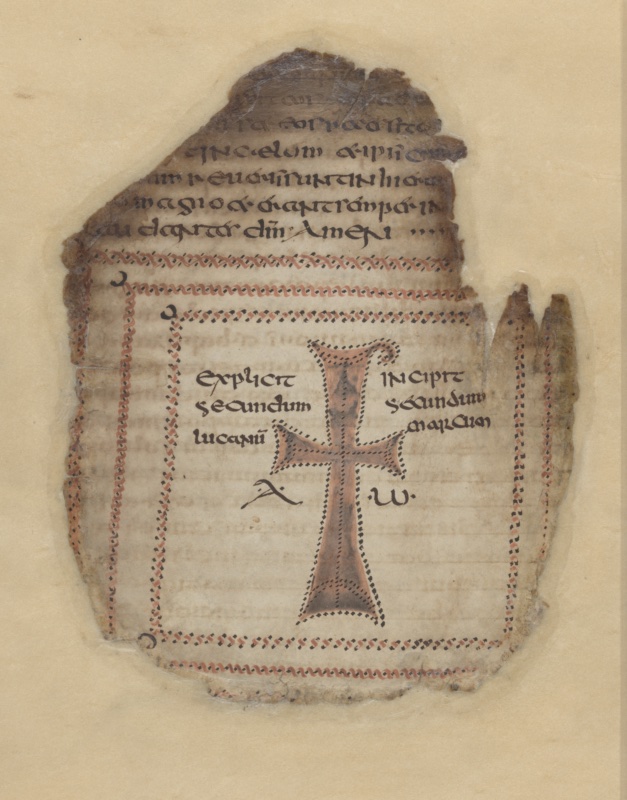
A small preliminary note: the file is labelled as the junction of John and Luke, but the colophons on the page read explicit secundum lucanum / incipit secundum marcum. The folio in fact marks the passage from Luke to Mark — which follows from the manuscript’s Western sequence of the Gospels (Matthew, John, Luke, Mark) rather than the later Vulgate order.
Folio 149v of the Codex Usserianus Primus is the single surviving decorated page of what is traditionally regarded as the earliest Irish book to come down to us: an Old Latin Gospel book (Vetus Latina r¹), written probably around the year 600 or in the first decades of the seventh century, either in Ireland itself or in the Columbanian orbit of Bobbio. The manuscript has survived only in ruins. Its roughly 180 vellum leaves are fragmentary, stained and shrunken, and are now mounted individually on paper supports — a condition the photograph records honestly, with the modern centimetre scale at the right and the irregular, torn silhouette of the leaf floating on its neutral ground. What we are looking at, then, is not a page but the remains of one, and part of its eloquence lies in that fact.
The upper portion of the fragment preserves the last five lines of Luke 24 in a compact Irish half-uncial: the Ascension, the disciples’ return to Jerusalem cum gaudio magno, and their continual presence in the Temple, laudantes Deum, closed by Amen and a short row of decorative points. The script is confident and economical, with the sharply wedged ascenders and the pronounced contrast between thick and thin strokes that would soon become the signature of Insular writing; the divine name appears in the abbreviated form of the nomina sacra, marked by a suspension stroke. Beneath the last line, two horizontal bands of red serpentine strokes and black dots draw a firm line under the Gospel and announce that something other than text is about to happen.
What follows is a framed panel — the earliest full compositional ornament to survive from an Insular scriptorium. A triple border of the same red zigzag and dotted patterning encloses a square field, with crescent motifs turning the corners. At the centre stands a Latin cross with flaring, slightly concave terminals, washed in a warm orange-red and outlined throughout by a fine contour of black dots. Suspended below the arms are the alpha and the omega, the alpha drawn in an angular, almost calligraphic Insular form and the omega in a rounded cursive shape. Flanking the shaft, in three short lines apiece, run the two colophons: explicit secundum lucanum on the left, incipit secundum marcum on the right. Ghostly traces of the text on the recto show through the thinned vellum, giving the whole page a faint palimpsest-like depth.
The technique itself is the historically consequential feature. This is, so far as surviving evidence permits us to judge, the first appearance of decoration by dotting around letters and forms in an Irish context — the device that would become one of the constitutive elements of Insular ornament, running from the Cathach through the Book of Durrow to its extravagant elaboration in the Book of Kells. In the developed Insular manner, red dots surround initials and fill the interstices of ornament, converting negative space into pattern; here the technique appears in its simplest and most legible form, as an outline.
The iconography is entirely Mediterranean in origin. A cross flanked by alpha and omega, framed and isolated as an object of contemplation, descends from the late antique crux gemmata — the jewelled, triumphant cross of Ravennate mosaic, of Italian and Coptic book decoration, of the apse and the reliquary. Comparable drawn crosses appear in the Bologna Lactantius and in related Italian manuscripts, and the resemblance has long been used to argue that an imported exemplar lay on the desk of the Irish artist. What is new here is not the motif but the handling: the dotted outline, executed with a pen rather than a brush, translates a monumental and essentially metallic form into a graphic idiom proper to the scribe. That red dotting — ornamenta punctata — would become one of the constitutive devices of Insular decoration, from the Cathach of St Columba and Durham MS A.II.10 to the mature achievements of Durrow, Lindisfarne and Kells.
Elsewhere in the manuscript the decorative repertoire is limited to red-dotted initials, which occur on folios 94, 101, and 107. These are modest, but they matter: they establish that the dotting technique visible on the colophon page was part of the scribe’s ordinary practice and not a single anomalous gesture.
The Cross: Iconography, Comparanda, and the Origins of Insular Ornament
The iconography of the page is Late Antique and Mediterranean, and it is not in any interesting sense Irish. The cross flanked by pendent alpha and omega is one of the most widely diffused Christian formulae of the fifth and sixth centuries, appearing in mosaic, on sarcophagi, in metalwork, and in books across the Mediterranean world. Its meaning is layered: the cross signifies Christ’s Passion, and the Greek letters, drawn from the Apocalypse, signify the eternity and infinitude of God — the first and the last. To these may be added a quasi-apotropaic function appropriate to the cross’s position at a junction in the book, guarding the seam between one Gospel and the next.
The comparanda cited in the literature are pointedly Continental and Mediterranean rather than Insular, which is precisely the point. They include the Bologna Lactantius, the so-called Paris St John, and the Valerianus Gospels (Munich, Bayerische Staatsbibliothek, Clm 6224). Beyond the immediate manuscript comparanda, the idiom of the dotted outline and of the cross with alpha and omega has a wider hinterland in Coptic book decoration — above all in the great crux ansata of the Glazier Codex, of around 500 — and in Italian and Gaulish book art, with a more distant kinship to the crux gemmata of Late Antique metalwork, the jewelled cross that stands behind so much early Christian imagery of the triumphant sign.
The decisive art-historical treatment remains Carl Nordenfalk’s essay “Before the Book of Durrow,” published in Acta Archaeologica 18 (1947), pp. 147 ff., which placed the page at the very beginning of the Insular decorative sequence and gave that placement its enduring formulation. Nordenfalk returned to the manuscript in Celtic and Anglo-Saxon Painting (1976). The title of the 1947 essay is itself the argument in compressed form: whatever the Book of Durrow represents, something came before it, and this page is the earliest surviving trace of that something.
The page is accordingly described in the standard literature as the earliest surviving example of an Insular artist copying a Mediterranean form of decoration, and as marking the beginning of the Insular illuminated tradition. Both descriptions are defensible, and both require qualification.
What the page does tell us is reasonably firm. An Insular scribe-artist, working at or near the threshold of the seventh century, had before him a Mediterranean decorative model and reproduced it — not in the pigments and modelling of his exemplar, which would have been beyond his materials and probably beyond his training, but in a linear technique of outlining in dots that translated the model into terms available to him. That act of translation is, in miniature, the whole subsequent history of Insular art: a Mediterranean vocabulary received, simplified, made linear and abstract, and then elaborated according to an internal logic that owes little to its source. To watch it happening on a single damaged page is genuinely remarkable.
What the page does not tell us must be stated with equal firmness. A single, damaged, entirely linear composition cannot by itself resolve the question of where Insular ornament came from. The claim that it is the outright first of its kind is an interpretive superlative wholly dependent on the accidents of survival: we know what has survived, not what existed. Given that the codex itself has come down to us in so ruinous a state, and that a lost leaf may have carried further decoration, the appropriate register is comparative and probabilistic — this is the earliest such decoration we have — rather than absolute.
Nor should the page be made to bear the weight of the old and unproductive debate over whether Insular ornament is fundamentally imported or fundamentally native. The honest reading of folio 149v is that the question is badly posed. The motif is imported; the technique of its execution is not the technique of its models; and what happened subsequently in Irish and Northumbrian workshops cannot be predicted from either fact. The page shows a beginning, but a beginning is not a cause.
Provenance: Ussher’s Name and Trinity’s Acquisition
The manuscript is named for James Ussher, Church of Ireland Archbishop of Armagh, one of the most formidable scholars and collectors of seventeenth-century Britain and Ireland. The name has generated a persistent and easily corrected error.
There is no evidence that Ussher ever owned this manuscript: the standard modern guide to the Latin New Testament states the position flatly: the codex is named after Ussher misleadingly, since there is no evidence that it was in his library. The name is therefore a library-historical label, recording the fact that the book reached Trinity as part of the collection that came to the College under Ussher’s name, and not a statement of documented ownership by the archbishop. Any account that presents Ussher as the manuscript’s owner, or that builds inferences about the codex’s earlier history from his known interests and acquisitions, is building on sand.
The transmission of the Ussher library to Trinity is, by contrast, well documented, and because it is frequently garbled in secondary accounts it is worth setting out in sequence. On Ussher’s death in 1656 his library — his principal remaining asset, his estates having been much reduced by the upheavals of the preceding decades — passed to his heirs under financial pressure. A sale was contemplated and offers were received from abroad. Cromwell forbade the collection to leave the country, and in 1657 the Army agreed to find £2,500 to purchase it and to establish a library in Dublin. The books were then stored in Dublin Castle from about 1658 to 1661, and some losses occurred during this period of storage. At the Restoration the library was granted to Trinity College in 1661, nominally as the gift of Charles II. Trinity’s own catalogue tradition preserves the more awkward truth beneath the royal gift: that the collection had been purchased for the College a few years before by the officers and soldiers of Cromwell’s army in Ireland. The acquisition date of 1661 is secure.
Of earlier, medieval provenance there is essentially no documentary evidence at all: no ex-libris, no inventory entry, no medieval note of ownership survives — unsurprisingly, given that the margins where such notes are normally entered have themselves perished. The association with Bobbio, discussed above, is a modern conjecture built on palaeographical resemblance and not on any documentary trace.
Two claims that circulate in accessible accounts should be actively excluded rather than passed over. The first is the notion that the codex was demonstrably at Bobbio and was carried thence to Ireland; this is unproven and, on the textual evidence, improbable. The second requires particular vigilance because it involves a confusion between manuscripts: the cumdach tradition — the enshrining of a Gospel book as a relic within a decorated metal book-shrine, one of the most distinctive practices of Irish book culture — belongs to the Book of Durrow and the Cathach, and not to the Usserianus Primus. There is no evidence that this codex ever possessed a cumdach, and statements to that effect should be recognised as erroneous transfers from the better-known books.
Conservation: The Nineteenth-Century Mounting and the 2014–2016 Campaign
The conservation history of the codex divides into two interventions separated by more than a century, with a common misattribution lodged between them.
In the nineteenth century the decayed leaves were mounted onto paper — individual vellum folios glued to paper panels and bound within a leather binding. The treatment has been described in the recent conservation literature as being in the manner of a late-nineteenth-century British Museum mounting, though the specific attribution to the British Museum is an inference drawn from a conservator’s comparison rather than an explicitly documented fact and should be reported as such.
The consequences of this intervention were serious and are precisely recorded. The 1998 study of the glosses notes that some marginal text was covered over on one side of each page when the leaves were mounted in the nineteenth century, and that most of the margins have been lost. The mounting is thus directly responsible for two of the codex’s present limitations: the loss of marginal text, including the omission signs that would have stood opposite the in-text marks, and the imposition of heavy, inflexible supports that constrained handling and obscured the parchment. It should be said in fairness that the intervention almost certainly saved the fragments from further disintegration; nineteenth-century conservators worked with the materials and the understanding available to them, and the alternative to mounting was very likely loss.
A common error must be corrected here: the celebrated conservation binder Roger Powell, who rebound the Book of Kells in 1953 and the Book of Durrow in 1954, and subsequently the Book of Armagh and the Book of Dimma in 1956–1957, did not work on the Codex Usserianus Primus. The manuscript is absent from every list of his commissions. The error appears to arise from the reasonable but incorrect assumption that Trinity’s early Irish manuscripts were treated as a group. A related confusion should also be noted: the “modern binding” referred to in the 1998 gloss study — bearing a pencil note by a former Keeper of Manuscripts — is the older, pre-2016 paper-mounted binding, “modern” only by comparison with a seventh-century book, and is not to be confused with the recent remounting.
The decisive modern intervention came with a grant from the Bank of America Merrill Lynch Art Conservation Project in 2014, under which Trinity’s Department of Preservation and Conservation, working with the Department of History of Art and Architecture, conserved, researched, and digitised four early Insular Gospel books: the Usserianus Primus (MS 55), the Garland of Howth (MS 56), the Book of Dimma (MS 59), and the Book of Mulling (MS 60).
For MS 55 the principal conservation work required was the remounting of the folios. All 182 leaves were remounted in Trinity’s conservation studio, replacing the heavy nineteenth-century mounts, which obscured parts of the text and did not allow the parchment sufficient flexibility, with a system designed to improve both preservation and legibility. Non-destructive pigment analysis by micro-Raman spectroscopy was carried out. The manuscript was fully re-photographed and published online in 2016; the three-year programme was unveiled with an exhibition in June 2017. The precise month of the images’ publication is not firmly documented — an October 2016 date circulates but is unverified — while the year itself is secure.
The net effect of two centuries of intervention is double-edged, and worth stating plainly. The nineteenth-century mounting preserved the fragments at the cost of the margins and of a measure of legibility. The 2014–2016 remounting has recovered as much flexibility and readability as the ruined state permits and, through digitisation, has made the codex consultable without any further handling of the original. For an object this fragile, the second of these is arguably the more significant conservation act: the best protection for the manuscript is that scholars no longer need to open it.
Editions, Facsimiles, and the Digital Surrogate
The editio princeps and the first full collation is that of T. K. Abbott, published in Dublin and London in 1884 in two volumes: Evangeliorum versio antehieronymiana ex codice Usseriano (Dublinensi): adjecta collatione codicis Usseriani alterius, with the Vulgate text according to the Codex Amiatinus and variants from the Book of Kells and the Book of Durrow. The title is transmitted with the spelling antehieronymiana; the variant antihieronymiana also circulates and should be recognised as an orthographic variant of the same work rather than a different publication.
Abbott’s edition retains a value beyond that of a superseded nineteenth-century collation, and for a specific and rather poignant reason: it records marginal text that the mounting subsequently covered. Where Abbott read a margin that is now inaccessible, his transcription is the only witness. This gives the edition a documentary status independent of its accuracy — it is, in effect, a partial record of a lost state of the object. That said, later editors working on the Vetus Latina John project found it necessary to consult the manuscript afresh, and reported both agreements with and divergences from Abbott; the edition is indispensable but not final.
The codex is described or collated in the principal apparatus and reference works of the field. The Jülicher–Aland Itala prints its readings under the siglum r¹. It is entered as CLA II, no. 271 in Lowe’s Codices Latini Antiquiores (Oxford, 1935; second edition 1972); as no. 84 in McGurk’s Latin Gospel Books from A.D. 400 to A.D. 800 (Paris and Brussels, 1961); at pp. 101–102 of the two-volume descriptive catalogue of Trinity’s medieval and Renaissance Latin manuscripts (Aldershot: Scolar Press, 1991); and in the standard Oxford guide to the Latin New Testament (2016). Abbott himself entered it as no. 7 in his Catalogue of the Manuscripts in the Library of Trinity College, Dublin (Dublin: Hodges, Figgis, 1900).
Reproductions of the decorated page appeared early: in the Palaeographical Society facsimiles (second series, plate 33) and in Gilbert’s Facsimiles of National Manuscripts of Ireland (1848). The dry-point glosses were edited in the 1998 study already cited.
There is no traditional full colour facsimile edition of the kind produced for Kells and for Durrow — an absence readily explained by the manuscript’s condition, since a facsimile of largely illegible brown fragments would serve little purpose and command no market. The digital facsimile published on Trinity’s Digital Collections platform in 2016 now performs that function, and performs it better: high-resolution capture with adjustable display recovers text that a printed plate could not convey, and IIIF delivery permits direct comparison with images of comparanda held in other institutions. For current work on this manuscript the digital surrogate is the single most important reproduction, and it should be cited by folio.
Four Persistent Errors
Because the Codex Usserianus Primus is frequently encountered first through accessible accounts, and because several of those accounts repeat mistakes, it is worth gathering the principal errors in one place and stating the correction plainly.
-
James Ussher owned the manuscript: he did not, so far as any evidence shows. The name records the collection through which the book entered Trinity, not a documented ownership. The standard guide to the Latin New Testament describes the name as misleading on precisely this ground.
-
The manuscript was made at Bobbio: the palaeographical resemblance to two Bobbio books in the Ambrosiana is real, and Lowe recorded it; but Lowe explicitly judged against Bobbio manufacture, and the textual affiliations of the codex are Gallican rather than Bobbio. The Bobbio hypothesis is a conjecture built on a resemblance that has a simpler explanation in the shared Irish inheritance of both traditions.
-
Roger Powell conserved the manuscript: he did not. Powell rebound Kells, Durrow, Armagh, and Dimma in the 1950s; the Usserianus Primus was mounted on paper in the nineteenth century and remounted at Trinity in 2014–2016. The attribution appears to arise from a general assumption about Trinity’s early Irish books.
-
The codex was enshrined in a cumdach. It was not, so far as any evidence shows. The cumdach tradition attaches to the Book of Durrow and to the Cathach; its transfer to this manuscript is an error of association.
To these four may be added a set of minor bibliographic discrepancies that should be resolved against printed originals rather than against aggregating websites: the McGurk number (84 against an older 83), the title spelling of Abbott’s edition, and the isolated citation of “CLA II, 267.” None is consequential in itself, but each will mislead a reader tracing a reference.
Two further items should be carried as explicitly unverified rather than as errors: the division of the writing between two hands at fols 78r/78v, and the suggestion of a lost decorated leaf between Matthew and John. Both are plausible; neither is established; both are now testable against the digital images.
Significance and Conclusion
The historiographical importance of the Codex Usserianus Primus runs along three axes, and it may be useful, in closing, to distinguish them once more.
The first is the origins of Insular art: because folio 149v preserves what is arguably the earliest surviving Insular ornament, the codex serves as the base of the developmental sequence that runs to Durrow and Kells. Nordenfalk’s framing — that Insular decoration begins here, with a Mediterranean model transposed into a technique of dotted outline — remains the point of departure, even as the accidents of survival counsel restraint about superlatives. For the student of Insular art, this is where the argument must begin, whatever conclusion it reaches.
The second is the textual culture of early Irish Christianity: as the only substantial Irish witness to the pre-Vulgate Gospels, the codex is the primary evidence for the Old Latin Bible in Ireland, and its Gallo-Irish affiliations, its shared readings with the Catechesis celtica and the Usserianus Secundus, and its links to Mulling, Durrow, and the Durham fragment together establish that it belonged to a functioning textual family rather than standing as an isolated survival.
The third, and the most delicate, concerns Ireland’s Continental relations, and here the codex is valuable precisely because it refuses to resolve into a single story. Its script has Continental affinities, and specifically Bobbio affinities, that have attracted an Italian scholarly and popular tradition eager to claim it for the orbit of San Colombano. Its text pulls toward Gaul, toward Hilary of Poitiers and a south-Gallican liturgical milieu. Its ornament looks toward the Mediterranean and, at a further remove, toward Coptic Egypt. Its glosses are in Old Irish. No one of these vectors can be privileged without doing violence to the others, and the most responsible synthesis is also the most interesting one: the manuscript documents an Irish Church that was, by the beginning of the seventh century, already embedded in several distinct Continental networks simultaneously, receiving its biblical text along one route, its decorative models along another, and exporting its scribal practice along a third.
There is a final observation worth making, which concerns method rather than content. Almost everything of importance that can be said about this manuscript is said under a qualification. Its date is a palaeographical estimate spanning two centuries, not a fact. Its origin is a judgement, contested in print within the last three decades. Its extent is given differently by different authorities. Its original dimensions are irrecoverable. Its ornament is the earliest of its kind only among what survives. Its name commemorates a man who probably never owned it. The temptation, when writing about an object of this importance, is to firm these qualifications into assertions, and the literature contains a good deal of evidence that the temptation has been yielded to.
The alternative is to treat the qualifications as themselves informative. That the codex resists confident placement is not a deficiency in the scholarship but a property of the period it comes from — a period in which Irish and Continental practice were not yet distinct enough to be told apart by inspection, in which late-antique habits persisted in places that had never been Roman, and in which books moved along routes we can infer but not trace. A manuscript that could be confidently assigned would tell us less about that world than one that cannot. The Codex Usserianus Primus is, in this sense, an unusually honest witness: ruined, ambiguous, and irreplaceable.