Book of Kells
( 25% )
Introduction
The Book of Kells (Dublin, Trinity College Library, MS 58; also catalogued historically as MS A. I. 58; Latin Codex Cenannensis; Irish Leabhar Cheanannais) is a late eighth- or early ninth-century Insular gospel book, generally dated to around the year 800. It contains the four Gospels in Latin, based on Jerome’s Vulgate (completed 384) but heavily interspersed with Old Latin (Vetus Latina) readings, together with the standard prefatory apparatus of an early medieval gospel book: the Eusebian canon tables, the breves causae (summaries of the gospel narratives), the argumenta (prefaces characterising the evangelists), and fragmentary lists of Hebrew names. It is written in a bold, disciplined Insular majuscule and is the most lavishly decorated manuscript to survive from the Insular world — the artistic tradition shared by Ireland, Anglo-Saxon England, Scotland and the Irish and English monastic foundations on the Continent between roughly the sixth and ninth centuries.
Its fame rests not on its text, which is in fact carelessly transcribed, but on the incomparable extent and refinement of its ornament. Trinity College Dublin, which has held the manuscript since the 1660s, describes the Chi Rho page (folio 34r) as “the single most famous page in medieval art,” and the Annals of Ulster called the book “the most precious object of the western world.”
It has become, over the last two centuries, the pre-eminent emblem of early medieval Irish civilisation and a touchstone of national identity. Trinity College Dublin records that the book “has been on display in the Old Library at Trinity College from the mid 19th century, and now attracts in excess of 500,000 visitors a year”; in 2018 the exhibition passed one million visitors in a single year for the first time. This essay surveys what can responsibly be said about the manuscript — its historical context, the vexed questions of its origin and date, its codicology, materials, script and decoration, its function and later history, and the shape of the scholarship — while flagging, throughout, the many points on which the evidence is genuinely contested and the several claims, some of them widespread, that do not survive scrutiny.
Historical and Cultural Context: Columba, Iona and the familia Columbae
The Book of Kells is a product of the Columban monastic world. Colum Cille (“dove of the church”), latinised as Columba, was an Irish aristocrat-monk (traditionally born 521, died 597) who around 563 founded a monastery on Iona, a small island of the Inner Hebrides off the western coast of Scotland. Iona became the principal house of a far-flung monastic confederation — the familia Columbae or paruchia of Columba — spanning Ireland and northern Britain, and it played a central role in the conversion of the Picts of Scotland and, via Lindisfarne, of Northumbria. Iona was a European centre of learning and artistic production; the community’s intellectual culture is embodied in the writings of Adomnán, its ninth abbot, whose Vita Columbae (Life of Columba) is among the great works of early medieval hagiography.
The manuscript’s association with Columba is explicit and ancient: in the Irish annals it is called “the great Gospel of Colum Cille,” and it was venerated at Kells as a relic of the saint. A tradition, already reported in the medieval period and repeated into the modern era, held that the book was the work of Columba’s own hand. This tradition cannot be sustained: the style of script and the fully developed decorative repertoire are datable on palaeographic and art-historical grounds to well over a century after Columba’s death, making his authorship impossible.
The move to Kells was precipitated by the Viking Age. Iona was raided in 795, again in 802, and in 806, when 68 members of the community were killed at the beach still called Martyrs’ Bay; the group is commemorated as the “Martyrs of Iona,” and the Irish annals record the killing of the community of Iona — 68 people — by the heathens. In response, the Columban monks began a new monastery at Kells (Irish Ceanannas / Cenannas, in County Meath); the Annals of Ulster record the “building of the new civitas of Colum Cille at Ceninnus,” construction proceeding from 807 to the consecration of the church in 814, the year in which Cellach, abbot of Iona, resigned. It is important to correct a widespread oversimplification: the raids did not lead to the immediate abandonment of Iona.
As recent archaeological synthesis puts it (Current Archaeology, “Iona in the Viking Age: laying a ‘zombie narrative’ to rest”), “these shocks did not lead to the abandonment of the monastery. An influential community of scholars remained on the island, suffering another Viking raid in 825.” In 825 the monk Blathmac was martyred at Iona by Vikings after refusing to reveal the hiding place of Columba’s shrine — an event that reached the Continent in a poem by Walahfrid Strabo of Reichenau. Only later in the ninth century (the principal relics were moved to Ireland in 878, per the annals) did Kells decisively supersede Iona as the head of the Columban community. A further Columban foundation, Dunkeld in eastern Scotland, was established around 818, and around 849 the relics of Columba were divided between the two new centres. This dispersed, mobile, cross-insular world — in which holy men, artists, relics, books and materials moved repeatedly between Ireland and Scotland — is precisely what makes the manuscript’s origin so difficult to fix.
The Question of Origin and Date
No colophon, contemporary notice or internal date survives to tell us where or exactly when the Book of Kells was made, and the question has generated more than a century of scholarly controversy. The competing hypotheses can be summarised as follows:
- the book was made entirely at Iona
- it was begun at Iona and completed (or continued) at Kells
- it was made entirely at Kells
- it was made in Northumbria or in a Pictish/eastern Scottish centre (Dunkeld has been named, and more recently Portmahomack); and
- a connection has been proposed with the 806 raid or, alternatively, with a commemoration of Columba.
The current majority academic opinion, and the position taken by Trinity College Dublin itself, attributes the book to the scriptorium of Iona, while frankly acknowledging that “there is no way of knowing if the book was produced wholly at Iona or at Kells, or partially at each location.” The Italian art-historical tradition reflects the same consensus: the Treccani Enciclopedia dell’Arte Medievale states that there is broad agreement (ampio accordo tra gli studiosi) that the book was made at Iona in the second half of the eighth century to honour the memory of Columba and reached Kells only about a century later. A commonly floated hypothesis links the book’s creation to the dedication of the new church at Kells (completed 814), the making of a magnificent gospel book being a fitting adornment for the altar of the new civitas; others have connected it to the bicentenary of Columba’s death (597), which would point to a date around 797. These associations are attractive and chronologically plausible but remain conjectural; they cannot be documented.
The dating range advanced in the literature runs from the late eighth to the early ninth century, clustering on “around 800.” The manuscript belongs at the culminating point of a sequence of Insular gospel books, and its place in that sequence is itself an argument for its late date. The relevant comparanda include the Cathach of St Columba (an early psalter, traditionally associated with Columba himself), the Book of Durrow (later seventh century), the Durham Gospels, the Echternach Gospels, the Lindisfarne Gospels (early eighth century), the Lichfield/St Chad Gospels, the Book of Armagh (early ninth century, also at Trinity College), the St Gall Gospels, and the Turin and Milan (Ambrosiana) fragments. The Book of Kells shares with these the standard Insular decorative programme — evangelist symbols, incipit pages with enlarged and ornamented initials, cross-carpet pages, canon tables — and its handling of these elements is manifestly the most elaborate and the most technically advanced, which places it at the end of the series rather than the beginning. Italian and broader Mediterranean connections in the Insular tradition — iconographic models, the transmission of Coptic and Byzantine motifs — bear on the sources of particular images (see §7) rather than on the place of manufacture.
Two important points of scholarly attribution must be handled carefully, because the popular literature frequently garbles them.
First, the eastern-Scottish/Pictish possibility in the origin debate does not originate with recent journalism; the palaeographer T. J. (Julian) Brown, in his influential 1972 paper “Northumbria and the Book of Kells,” set out the range of possibilities as including Northumbria, eastern Scotland and Iona.
Second, the most prominent recent argument for a Pictish origin is that of Dr Victoria Whitworth, in The Book of Kells: Unlocking the Enigma (2025), who has proposed the Pictish monastery of Portmahomack in Easter Ross (north-east Scotland) as the place of production. Her case rests in part on the archaeological excavation of Portmahomack (1994–2007, led by Martin Carver of the University of York), which is understood to have revealed the first-known evidence for the widescale manufacture of parchment in northern Europe, and on the close resemblance of Pictish carved stone ornament to the decoration of Kells.
This is a minority view and is contested: the intense cross-insular movement of people, objects and materials makes any single attribution difficult in the absence of a colophon or contemporary reference. It should be stressed — because the claim is often misattributed in the popular literature — that not every widely read modern account of the manuscript endorses a Pictish origin; several are persuaded, like the current majority, that it was created in the Columban monastery of Iona, while remaining candid about the limits of what can be known: really very little is known for certain about the book’s origin or date, and it may be Irish, Scottish or English.
Codicology and Material Construction
The Book of Kells today comprises 340 vellum folios (680 pages). The manuscript is incomplete: portions are missing at the beginning and end, and the Gospel of John terminates prematurely at John 17:13; around thirty folios are reckoned to have been lost in the medieval and early modern periods, and it is generally estimated that the book originally contained something closer to 370 leaves. Some of these losses — including the presumed portrait miniatures of Mark and Luke, which do not survive whereas those of Matthew and John do — are thought to reflect the loss of single decorated leaves that became detached over time. Others may never have been executed, since the manuscript was in several respects left unfinished, with some ornament surviving only in outline.
The support is vellum (prepared calfskin). The number of calves required has become one of the manuscript’s most-repeated “facts”: the standard figure, widely cited in the modern literature, is around 185 calfskins. This estimate deserves careful handling. It is a reasoned calculation, not a documented count, and it has real implications: as Medievalists.net summarises the point, “Researchers have determined that 185 calves were needed to make the original manuscript – and that would require having a herd of 1,200 animals.” Since only one or two bifolia could be obtained from a very young calf, that scale of herd both testifies to the wealth of the producing monastery and suggests that skins were gathered from more than one estate, or over a considerable period.
The user’s brief notes that some sources give figures up to 340; the responsible position is that ~185 is the current scholarly estimate most commonly cited, that it is an estimate carrying genuine uncertainty, and that higher figures circulate. Physical examination shows that most gatherings were cut so that the calf’s spine runs horizontally across the middle of the opening, following standard practice, while two gatherings use leaves cut with the spine running vertically, taken from calves killed at around two or three months; these slightly thicker skins were preferred for pages of major decoration.
The quire (gathering) structure follows the Insular norm of quires of eight to ten folios (four to five bifolia), with irregularities arising from losses and repairs. The text is written in iron-gall and coloured inks.
The book’s binding history is one of repeated intervention and, in the nineteenth century, damage. The manuscript was rebound by John Exshaw in 1742; it was rebound again in 1821, an operation in which the pages were heavily trimmed, so that parts of some illustrations and text were cut away and lost — the single most regrettable episode in its physical history. It was sent to London for rebinding later in the nineteenth century (an episode, around 1874, that caused public alarm that the national treasure had been removed from Ireland), but that binding deteriorated, and by the mid-twentieth century several leaves had come loose. In 1953 an eminent conservation binder rebound the manuscript into four volumes, one for each Gospel — the form in which it survives today, delicately easing out bulges that had developed in some leaves in the process. That treatment is still regarded as exemplary and continues to protect the book.
The manuscript now measures approximately 330 × 250–255 mm; it was substantially larger before the nineteenth-century trimming, and the edges were gilded in the course of that rebinding.
Pigments and Materials
The pigment palette of the Book of Kells has been the subject of important scientific work that has corrected long-standing assumptions. Older accounts, relying on visual inspection and comparison with medieval recipe books, produced descriptions that were, as researchers later put it, “incomplete and somewhat speculative.” Between 2004 and 2006 a team associated with the Library of Trinity College Dublin undertook a large-scale, non-invasive analysis using micro-Raman spectroscopy, examining 681 sites across the four volumes with two separate laser wavelengths (632.8 and 532 nm) — the most extensive Raman spectroscopic investigation of a single medieval manuscript undertaken to that point. A complementary, non-invasive MOLAB investigation using additional spectroscopic techniques was subsequently published, corroborating and extending the findings.
The palette identified by the 2009 study comprised “blue (indigo), red–orange (red lead), yellow (orpiment), green (vergaut), black (carbon and iron gall ink), and white (gypsum),” together with purple (orcein). The yellow, orpiment (arsenic sulphide), was known in the Middle Ages as auripigmentum (“gold colour”); the green, a copper compound, has — reacting with damp — actually perforated the vellum on a number of folios; the reds derive from red lead (minium) and from organic sources that are harder to identify precisely (older literature cites kermes among them).
The single most important corrective concerns blue. Older literature, some of it very influential, asserted that the Book of Kells used ultramarine derived from lapis lazuli — a mineral then obtainable only from Afghanistan — and this claim was often deployed to argue for the manuscript’s cosmopolitan reach and expense. The Raman analysis found no lapis lazuli: of the 106 blue sites examined, all but four were identified as containing indigo (the blue deriving from indigo or the related woad, native to northern Europe). Trinity College Dublin now states plainly that “blue from lapis lazuli was probably not used in the manuscript as had previously been thought.” This is a genuine and significant correction to the older scholarship, and it should be reported as such.
Equally important, and often misunderstood: the Book of Kells uses no gold leaf. The shimmering, metallic-gold passages that strike every viewer are produced by orpiment, the yellow arsenic sulphide, deployed as an economical and visually convincing substitute for gold. The artists built up their effects by layering — Trinity notes they “employed a technique of adding as many as three pigments on top of a base layer” — a method that contributes to the extraordinary richness and depth of the colour.
Script and Palaeography
The Book of Kells is written in Insular majuscule (also called Insular half-uncial), the most formal Insular book hand, here represented at its most accomplished. The script is characterised by rounded, broad letters, wedge-shaped or triangular serifs on the ascenders, generous use of ligatures and Insular abbreviations (including Tironian notae), and the decorative device — later called by Irish scribes “head-under-wing” or “turn-in-the-path” — whereby the end of a line of text is completed on the line above, tucked in to save space and to please the eye. The text is generally laid out in long lines (typically around seventeen to nineteen per page), and enlarged, red-dotted initials mark divisions, with letters characteristically diminishing in size after an enlarged opening initial.
The number of scribes is a genuinely contested question, and the popular accounts are frequently muddled; the matter must be stated carefully with the correct attributions. E. A. Lowe, in the Codices Latini Antiquiores, spoke of several scribes. An influential 1974 study identified three, naming them Hand A, Hand B and Hand C and distinguishing them by script and by their use of ink and colour: Hand A, conservative and restrained, using brown gall ink, responsible for much of the preliminary matter and for John; Hand B, an “extrovert” fond of coloured inks (notably purple) and inconsistent in the number of lines per page; and Hand C, to which the bulk of the text was assigned.
T. J. (Julian) Brown, by contrast, argued in 1972 for essentially a single “great scribe” who varied his style for different sections — a view shared by other palaeographers of the period. It is therefore an error, though a common one, to credit Brown with the addition of a fourth scribe: the four-scribe scheme, adding a Hand D, is due to later scholarship at Trinity College Dublin, which doubted that a single Hand C wrote the bulk of the text and identified a fourth hand by its more angular, elongated letter-forms and a distinctive serif on the letter s. That scholarship even floated the possibility of a fifth scribe (Scribe E) that “awaits identification,” and the resulting four-scribe scheme has become the generally accepted view. Most recently, a doctoral thesis and a subsequent book have argued, against the whole trend, that the entire manuscript is the work of only two individuals — a “Scribe-Artist” and a “Master-Artist” — and that the script is the work of a single person, produced over two campaigns.
The related question — whether scribes and artists were the same individuals — remains unresolved. Trinity College Dublin identifies “the extent to which there was an identity between scribe and artist” as “among the key unanswered questions about the manuscript.” One influential account distinguishes artistic roles (a “goldsmith,” a “portrait painter,” an “illustrator”), implying some specialisation, while a more recent model collapses the distinction by positing craftsmen who were both scribes and artists. The library’s own recent formulation is appropriately cautious: none of the scribes or artists recorded their names, “and indeed we don’t even know how many there were, such is the relative consistency of the script.”
Textually, the Book of Kells is a Vulgate gospel book with a substantial admixture of Old Latin readings — a mixed, “Irish” type of text. Its transcription is notoriously careless. Trinity College Dublin notes that the copying was “remarkably careless, in many cases due to eye-skip, with letters and whole words omitted.” The most striking example is the accidental repetition of a whole passage: text copied on folio 218v was copied again on folio 219r, and the redundant version on 218v was elegantly cancelled by the addition of small red crosses rather than being erased.
It has often been suggested — plausibly, though it cannot be proved — that the Irish-trained scribes sometimes relied on memory rather than closely following their exemplar. The Eusebian canon tables, designed as a practical concordance of parallel gospel passages within decorated arcades, are in Kells so thoroughly subordinated to decoration that they are effectively unusable as a reference tool: the arcades are treated as ornamental fields rather than functional architecture, and the last two tables are compressed into a grid (a form first seen in Insular manuscripts such as the Book of Durrow). The prefatory breves causae and argumenta likewise follow the Insular pattern.
The Decoration
Programme and structure
The decoration of the Book of Kells is both more extensive and more inventive than that of any other surviving Insular gospel book, and its colours are far more diverse than those of the Book of Durrow or the Lindisfarne Gospels. Each Gospel was introduced by a consistent programme: a page of the four evangelist symbols, an evangelist portrait, and an ornamented incipit. Ten full-page illuminations survive, including two evangelist portraits (Matthew and John), three pages of the four evangelist symbols together, a single carpet page, the Virgin and Child, a portrait of the enthroned Christ, and the narrative miniatures of the Arrest and the Temptation. There are thirteen surviving full pages of decorated text, and countless smaller decorated initials, interlinear figures and marginal creatures throughout.
The four evangelist symbols — the Man (Matthew), the Lion (Mark), the Calf/Ox (Luke) and the Eagle (John), derived from the vision of Ezekiel and the Apocalypse — recur throughout the manuscript, both singly and grouped in a single frame divided into quadrants, an arrangement that visually asserts the unity of the fourfold gospel. Portraits of Matthew (folio 28v) and John (folio 291v) survive, each shown enthroned holding his book; the portraits of Mark and Luke are lost. Christ himself is represented four times: as the infant in the Virgin’s lap (folio 7v), enthroned and flanked by angels and peacocks (folio 32v), arrested (folio 114r), and tempted (folio 202v).
Matthew the Evangelist
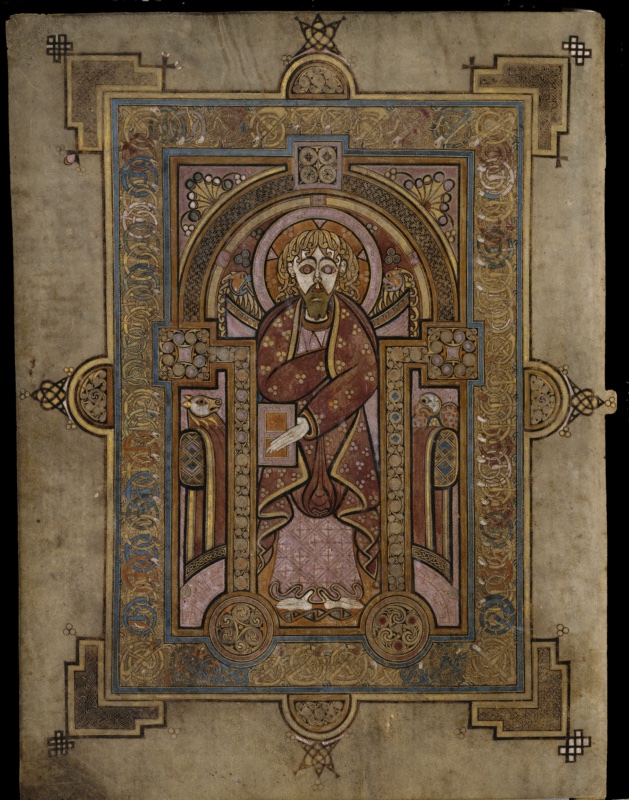
The portrait of Matthew occupies the recto-facing verso preceding the Liber generationis incipit, and belongs to the prefatory apparatus that the Kells master conceived for each Gospel: symbol page, evangelist portrait, decorated incipit. Only two of the four author portraits survive in the codex — Matthew here and John on fol. 291v — the leaves bearing Mark and Luke having been lost, a lacuna that gives the present folio disproportionate weight in any reconstruction of the manuscript’s original programme.
The evangelist is presented frontally and hieratically, seated within an architectural aedicule whose columns and arch have been almost entirely dissolved into ornament. He wears a deep purple-maroon mantle strewn with trefoil clusters of dots over a lilac-pink tunic; the drapery is articulated not by modelling but by heavy contour lines that channel the cloth into symmetrical, calligraphic folds falling in a broad lyre-shaped cascade over the knees. His left hand, rendered in unmodulated white, holds a small codex against the body — the attribute of authorship reduced to an emblematic rectangle of orange panels rather than an object of use. Below, the feet emerge splayed and flattened over a lozenge-diapered ground, entangled with a knot of serpentine forms at the base of the throne.
The head is the compositional and expressive focus: a mass of tightly spiralling blond curls, enormous frontal eyes with pinpoint pupils, a long straight nose, and a forked beard rendered in fine parallel strokes. The nimbus, banded in orange and pink and interrupted by triangular wedges, is framed by the inner arch, from whose springing points two beast heads project inward toward the halo. Two further zoomorphic heads — beaked, avian, with reptilian eyes — surmount the flanking columns at mid-height, a device familiar from Insular metalwork in which structural members terminate in animal protomes.
The frame is the most audacious element. Rather than a rectangle, the miniature is enclosed in a stepped cruciform surround: the rectilinear border is interrupted at the four sides by circular bosses and semicircular lobes filled with knotwork and interlaced hexagrams, while the corners resolve into stepped panels of dense fret and key pattern. The effect is to superimpose a cross-carpet structure upon an author portrait, so that the evangelist is simultaneously presented as writer and as inhabitant of a cross — an assimilation of image to sign entirely characteristic of Kells. The border compartments themselves rehearse the full Insular repertoire: interlaced ribbon animals with elongated jaws and lappets in the vertical bands, spiral-and-trumpet triskeles in the lower corner roundels, and step patterns and diaper fields in the panels flanking the throne.
Chromatically the page depends on a restricted but subtly varied palette — orpiment yellow standing in for gold (the Kells illuminators used no gold leaf), red lead, a plant- or insect-derived purple-lake, verdigris, and a blue whose identification has been contested: the traditional attribution to lapis lazuli has been challenged by more recent Raman analyses at Trinity favouring indigo or woad, a point worth flagging in any bibliography you assemble. Areas of the ground remain reserved vellum, whose warm tone functions as an active colour rather than as neutral support.
Typologically, the image descends from the late antique author portrait transmitted through Mediterranean exemplars — the lineage visible in the Ezra miniature of the Codex Amiatinus and, in Insular terms, in the Lindisfarne evangelists. But where Lindisfarne preserves a residual illusionism and the fiction of the scribe at work, the Kells Matthew has abandoned narrative pretext altogether. The figure does not write, does not turn, does not occupy space; he is an icon of the Gospel rather than its author caught in the act. This is the same aesthetic logic that governs the manuscript’s initial pages, and it situates fol. 28v firmly within the late phase of Insular illumination around or shortly after 800, whether one accepts an Iona origin, a Kells origin, or the compromise position of a workfrom begun in the Columban west and completed in Ireland.
John the Evangelist
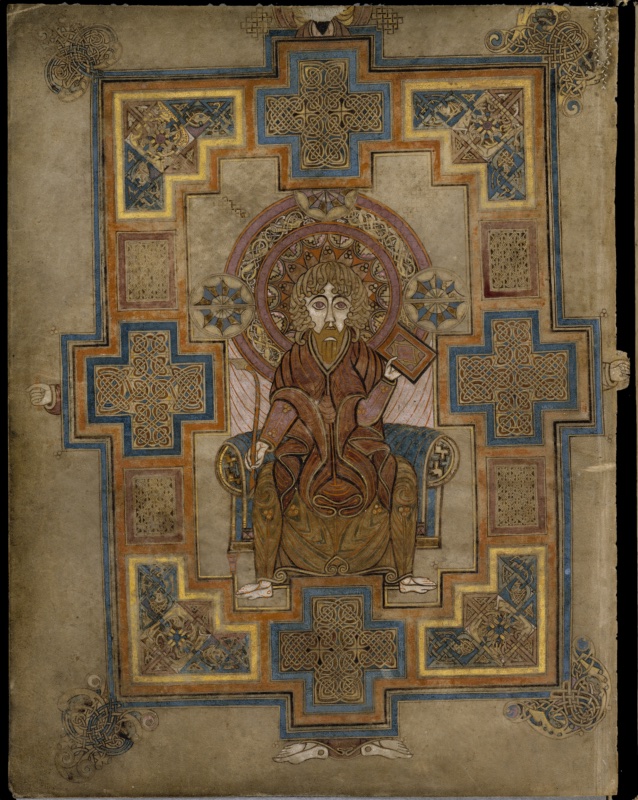
The portrait of John immediately precedes the In principio erat uerbum incipit on fol. 292r, and forms with it the culminating decorative statement of the codex. It is the second and last of the surviving evangelist portraits, its companion on fol. 28v representing Matthew; the corresponding leaves for Mark and Luke are lost. Of the two survivors, the John page is by some distance the more complex, both formally and iconographically, and it is the only image in the manuscript in which the frame is explicitly inhabited by a second figure.
John is seated frontally on a low throne whose lateral bolsters terminate in golden roundels bearing small crosses. He holds a quill in his right hand, lowered toward a vessel at his feet, and supports an open book — its cover set with lozenge-shaped ornament — with his raised left hand. He is therefore shown in the act of writing, a residual survival of the late antique author portrait that the Matthew miniature had abandoned entirely. Even here, however, the gesture is emblematic rather than practical: the pen does not touch the page, the arms are held in rigid heraldic symmetry, and the body is disposed without weight, the feet splayed outward beyond the throne on a rendered ground line rather than planted upon it.
The drapery is treated in three chromatic registers — a maroon-brown mantle over the shoulders, a purple-lilac undergarment visible at the arms, and a broad olive-green skirt across the knees — each articulated by ribbed contour lines that converge in a knotted, lyre-shaped fold at the centre and dissolve into spiral terminals over the thighs. The head repeats the physiognomic type of the Matthew portrait: a mass of tightly curled blond hair framing an oversized frontal face, enormous eyes with minute pupils, a long nose, and a forked beard rendered in fine parallel gold strokes. The nimbus is an elaborate concentric construction of orange rays, an inner band of stepped and dotted ornament, and an outer ring of animal interlace, flanked at either side by two circular medallions containing blue-and-white star patterns.
The frame is the page’s most audacious element and its principal iconographic argument. A stepped border in orange, blue and yellow expands at each of the four cardinal points into a large panel filled with a cross of dense interlace, so that the evangelist is enclosed within a structure that is simultaneously a rectangle and a cross. Between the arms, in the re-entrant corners, are square fields of key pattern, diaper and zoomorphic interlace; beyond the frame, at the four outer corners, ribbon-bodied beasts with elongated jaws and lappets uncoil across the bare vellum in a lighter, more sketch-like manner.
What distinguishes the folio from every other page in the manuscript is the presence of a second, far larger figure surrounding the first. A haloed head appears above the upper cross-arm, two hands emerge at the mid-points of the left and right borders, and two feet project below the lower arm. Nothing else of this body is shown; it exists only at the four extremities, cruciform in its very disposition, with the frame itself standing in for the torso. The identification remains debated — God the Father and Christ have both been proposed, as has a more general conception of the divine Word within which the evangelist of the Logos is enclosed — and the discussion is complicated by the fact that the outer margins were trimmed, most severely during the nineteenth-century rebinding, so that the head and hands are now partially cut away. Any reconstruction of the original proportions of that enveloping figure is therefore conjectural.
Technically the page depends on the same restricted palette as the rest of the codex: orpiment for the yellow that substitutes for gold leaf, which the Kells illuminators did not employ; red lead; a purple lake; verdigris and copper greens for the olive tones of the skirt; and a blue whose identification has been contested, with recent Raman analysis at Trinity favouring indigo over the lapis lazuli traditionally assumed. Large areas of reserved vellum function as an active tonal ground rather than as neutral support, and the deliberate thinning of ornament toward the outer corners suggests a designer working outward from a fully resolved centre.
The Virgin and Child
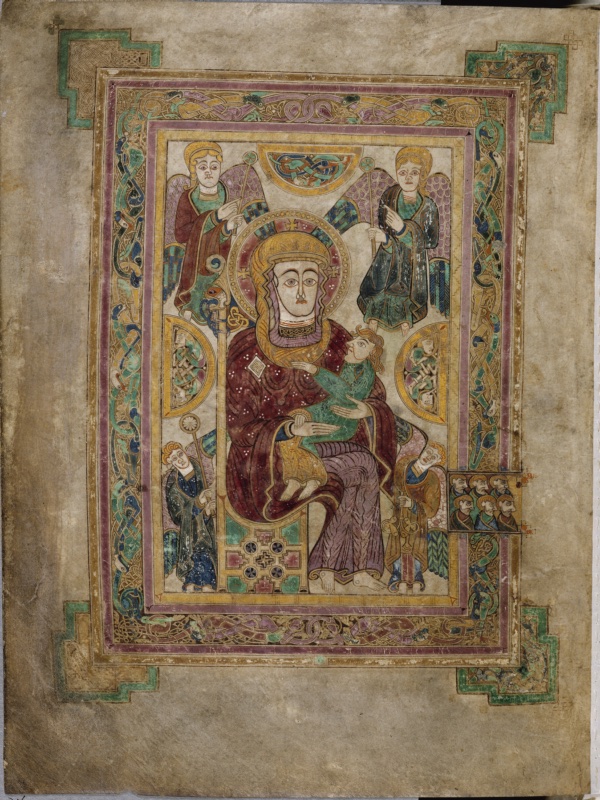
Positioned within the prefatory quires, facing the Breves causae of Matthew on fol. 8r, this miniature holds a singular place in the history of Western manuscript illumination: it is the earliest surviving representation of the Virgin and Child in a Western codex. Its presence in a Gospel book is anomalous — the page belongs to no established Insular prefatory scheme — and its function has been variously explained as a devotional image, as a statement of the Incarnation prefacing the genealogical opening of Matthew, or as a reflection of contemporary Marian cult within the Columban familia.
The Virgin is seated in three-quarter profile on a low throne with a stepped, cross-panelled footboard, her body turned toward the viewer’s right while her head remains frontal — a compositional torsion unique in the manuscript and difficult to reconcile with the rigidly frontal figures elsewhere in the codex. She wears a deep maroon-purple mantle over a lilac-violet undergarment, both articulated by fine ribbed contour lines and sprinkled with white dots; a lozenge-shaped brooch marks the breast. Her head is veiled beneath an elaborate golden crown or diadem set within a nimbus bearing three crosses. The face conforms to the Kells physiognomic type — enormous frontal eyes, long nose, small mouth — but is markedly narrower and more attenuated than that of the evangelists. The feet, oddly, are shown splayed and turned outward at the base in a manner that has troubled commentators, sometimes read as a misunderstood transposition from a metalwork or sculptural model.
The Child sits across her lap, held with both hands, his body in profile and his head turned back and upward toward her in a gesture of address that has no exact Insular precedent. He wears green and orange garments; his hair is rendered in loose golden curls. The asymmetry of the group — the Virgin’s left arm crossing the body to support him — introduces a degree of narrative interaction absent from the codex’s other figural pages.
Four winged angels attend the throne. The upper pair, in maroon and blue-green mantles with lilac and blue feathered wings, hold flabella; the lower pair, at either side of the throne, hold further liturgical implements, one bearing a flowering rod or fan. Their scale is markedly reduced relative to the central group, in the hierarchical manner familiar from Byzantine and Coptic prototypes. Two circular medallions filled with interlace and small human figures flank the Virgin’s shoulders, and a lunette of animal interlace crowns the composition above her head.
The most discussed feature lies at the right margin: a rectangular panel projecting outward from the frame containing six half-length male figures in three rows, turned in profile toward the Virgin. They are generally read as an audience of monks or of the faithful directing their gaze at the image, and the panel’s placement — breaking the frame rather than sitting inside it — has been taken as a deliberate device linking the depicted scene to the space of the beholder, or possibly to the text of the facing page.
The frame itself comprises multiple concentric registers: an inner gold band, a broad zone of ribbon-bodied serpentine interlace in green, blue and yellow at the sides, a band of bird-headed interlace above and below, and stepped corner panels in green filled with key pattern and zoomorphic ornament. The palette is notably richer in greens and copper tones than the evangelist portraits, and shows more extensive surface abrasion, particularly along the left border and the lower register.
Stylistically the page has long been associated with the hand conventionally designated the “Portrait Painter,” and its Mediterranean debts — the enthroned Theotokos type, the flanking angels with flabella, the frontal crowned Virgin — point to an eastern iconographic source transmitted through Rome, whether via a portable icon, an ivory, or an illuminated model. The related composition on the eighth-century St Cuthbert’s coffin at Durham confirms that such a prototype was circulating in the Insular world; the precise channel of transmission remains unresolved.
Christ Enthroned
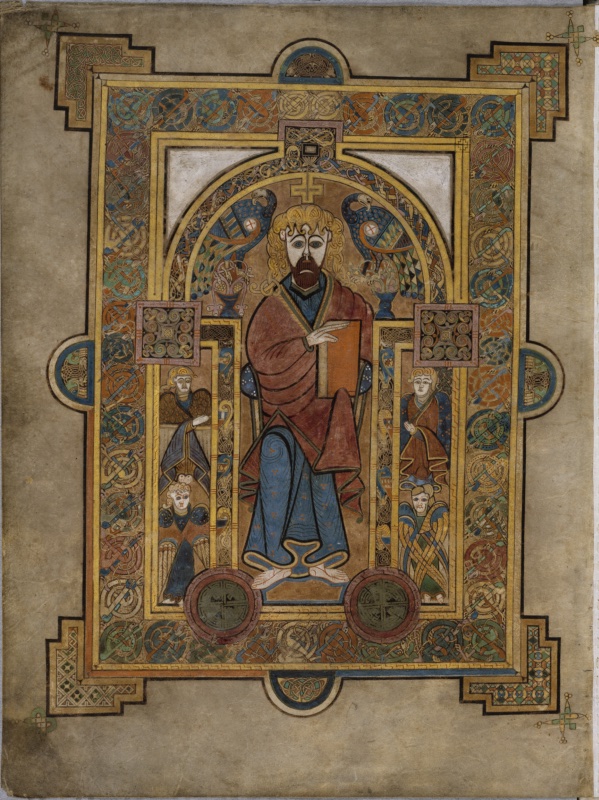
The Christ Enthroned page faces the Christi autem generatio monogram page at fol. 34r within the opening quire of Matthew.
The identification of the figure has itself been contested. Older scholarship read the page as a portrait of the evangelist Matthew or as a generic author portrait; the presence of the cross-inscribed nimbus, the attendant angels, and the placement of the page within the Nativity sequence of Matthew’s text have secured the now-standard reading of Christ enthroned in majesty. This makes fol. 32v the only surviving full-page image of the adult Christ in the manuscript, and the counterpart to the Virgin and Child of fol. 7v.
Christ is presented frontally, seated within an arched aedicule, holding a book with orange-red covers against his left side while the right hand — rendered in unmodulated white with elongated fingers — is brought across the chest in a gesture midway between blessing and support. He wears a maroon-brown mantle over a blue tunic strewn with small orange dots; the drapery falls in ribbed, symmetrical channels that resolve at the knees into a broad triangular cascade and, at the hem, into an interlaced knot from which the bare feet emerge splayed outward. The head, framed by a mass of loosely spiralling golden hair, bears the enormous frontal eyes and forked beard characteristic of the codex’s figural style; the nimbus is a plain arc surmounted by a stepped cross, its simplicity conspicuous against the density of everything around it.
The arch above springs from two elaborate vessels — chalice or amphora forms with lobed feet — from which issue confronted peacocks with blue-and-orange bodies and chequered wings, their necks entwined with vine tendrils. The motif is unmistakably Mediterranean in origin: the peacock as emblem of incorruptibility and the vine springing from the eucharistic vessel belong to the repertoire of Early Christian sarcophagi and mosaic, transmitted to the Insular world through imported models. Their appearance here, flanking the head of Christ, gives the page an explicitly eucharistic and resurrectional register absent from the evangelist portraits.
Four attendant figures occupy the flanking compartments, disposed in two vertical pairs. The upper pair, in blue and maroon mantles with feathered wings, hold their hands raised toward the central figure; the lower pair, more compressed and partly dissolved into the surrounding ornament, are winged likewise, their draperies rendered in green, blue and gold. Their diminished scale relative to Christ follows the hierarchical convention seen also on fol. 7v.
The frame is a stepped rectangle interrupted at the mid-points of the vertical borders by circular lobes containing knotwork, and at the upper and lower centre by semicircular projections. Its bands are filled with dense ribbon-animal interlace in blue, orange and green, while stepped corner panels carry key pattern and fret. Two large roundels sit at the base of the composition beneath the feet, filled with faint spiral and cross designs that appear unfinished or abraded — one of several passages on this folio where the decorative programme was left incomplete, notably also the two blank white fields in the spandrels above the arch, which were evidently reserved for ornament never executed.
That incompleteness is itself of interest. Together with the unfinished passages elsewhere in the codex, it supports the long-standing hypothesis that the manuscript’s decoration was interrupted — a circumstance frequently, though not conclusively, connected with the Viking raids on Iona at the beginning of the ninth century and the subsequent transfer of the Columban community to Kells.
The Arrest of Christ
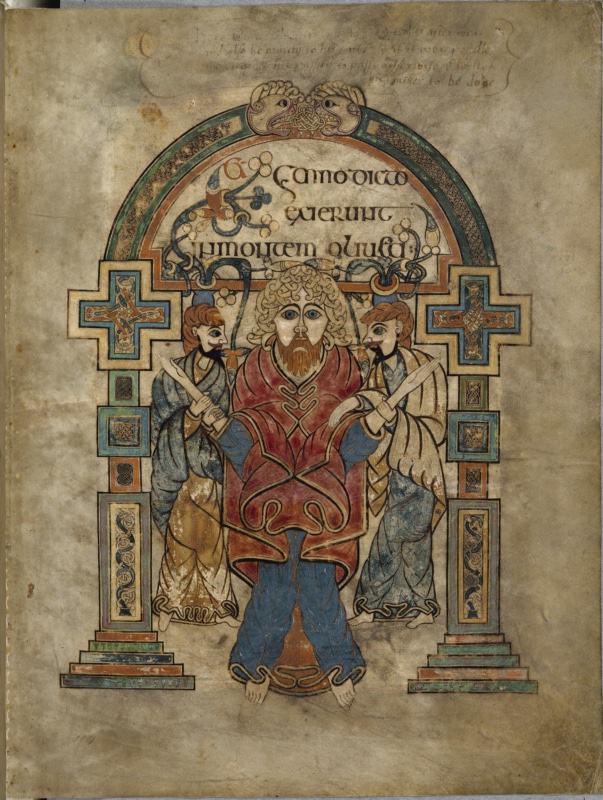
This is one of only two full-page narrative miniatures drawn from the Gospel text to survive in the codex, its counterpart being the Temptation of Christ on fol. 202v. Both belong to the Matthew Gospel and both interrupt the text at a point of doctrinal weight rather than following any regular decorative scheme, which has led to the reasonable inference that the manuscript’s original programme envisaged a fuller Christological cycle, either abandoned or lost.
The page is governed by an architectural framework: two columns on stepped, polychrome plinths support an arch of three concentric bands — outer green, a central register of fine interlace, and an inner orange moulding — whose apex is crowned by two confronted beast heads with curled snouts, their necks entwined in a knot. The capitals take the unusual form of stepped crosses filled with interlace, so that the structure enclosing the scene is doubly a cross. Within the tympanum stands the inscription in ornamental majuscule: Et ymno dicto exierunt in montem Oliueti (Matthew 26:30), “and when they had said a hymn, they went out unto Mount Olivet”. The verse names not the arrest itself but the departure that precedes it, and from the initial letters a vine bearing trefoil clusters uncoils downward across the field, terminating in tendrils that pass behind Christ’s shoulders.
Christ occupies the centre, frontal, taller than his companions, his head framed by tightly spiralling golden hair and a long forked beard. He wears a red-purple mantle over a blue tunic; the drapery is articulated by heavy contour lines that resolve, at the hem and at the cuffs, into open knotwork loops — the garment literally dissolving into ornament. His arms are drawn outward and slightly upward, and each is grasped at the wrist by one of the two flanking figures. These wear cloaks of blue-grey and ochre, are shown in profile with prominent noses and reddish hair, and are markedly smaller in scale.
The iconographic reading of the group has been much debated, and the ambiguity appears deliberate. The two men perform the act of seizure, yet their gesture is not violent: they hold rather than drag, their bodies incline toward Christ, and no weapons, torches, or crowd — the standard apparatus of Arrest imagery — are present. The resulting configuration, a frontal Christ with arms extended between two attendant figures beneath an arch, closely resembles both the Crucifixion between two thieves and the late antique type of Christ upheld by angels. Several commentators have therefore read the page as a compressed image in which Arrest, Passion and glorification are held simultaneously, the narrative moment functioning as a sign rather than as an event. The frontality and impassivity of the central figure — his gaze directed at the beholder, not at his captors — supports this.
Technically the folio is more sparely worked than the great decorated pages. Large areas of vellum are left reserved, the palette is restricted to blue, ochre, green, red lead and purple lake, and the modelling of the two subsidiary figures is thinner and more abraded, particularly in the lower left drapery. The columns and plinths show the loss of pigment common to the manuscript’s green passages.
One further feature deserves note: the faint English annotation across the upper margin, in a post-medieval hand, paraphrasing the Gethsemane narrative — Christ’s departure after supper and his prayer that the cup might pass. Such marginal glosses, added while the manuscript was at Kells and later in Dublin, belong to the codex’s early modern reception rather than to its original conception, but they document the continued use of the book as an object of reading and not merely of display.
The Temptation of Christ
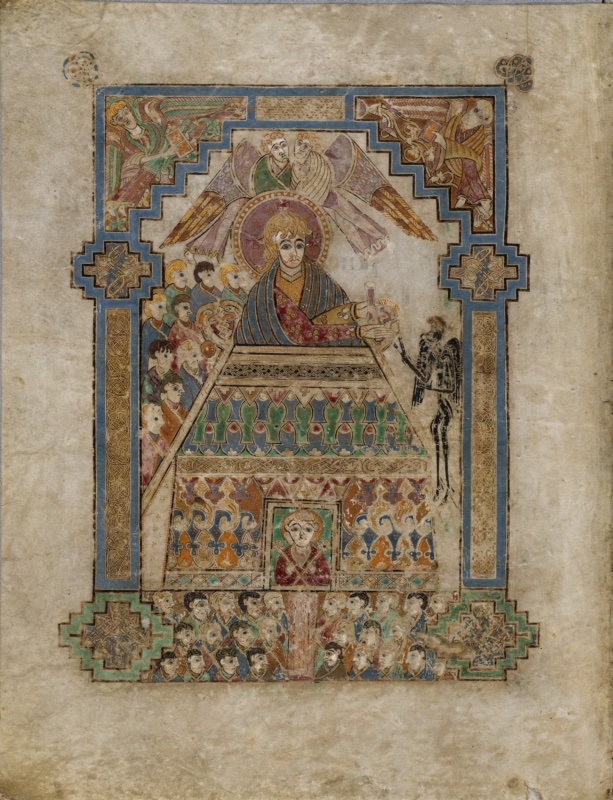
The second of the two surviving full-page narrative miniatures, this folio stands within the Gospel of Luke, facing the text of the third temptation (Luke 4:9–13), in which the devil sets Christ upon the pinnacle of the Temple and challenges him to cast himself down. It is by common consent the most intellectually complex image in the codex: densely populated, iconographically layered, and organised around a structure that is simultaneously architecture, ornament and ecclesiological argument.
The composition is dominated by the Temple, rendered not as a building in space but as a steeply pitched, wholly frontal gable seen as pure pattern. Its roof and walls are divided into horizontal registers filled with imbricated shingle motifs in green, blue, orange and red-brown, bands of interlace, and rows of lobed forms resembling stylised tiles or scales. The device is unmistakably that of an Insular reliquary shrine — the house-shaped cumdach familiar from surviving Irish metalwork — so that the Temple of Luke’s narrative is assimilated to the reliquary that houses a saint’s remains, and by extension to the Church itself.
Christ appears half-length at the apex, emerging from behind the roofline rather than standing upon it. He wears a blue-grey mantle over a maroon tunic ornamented with trefoil dot-clusters, and holds a small scroll or rod. His head, framed by curling golden hair, is set within a large nimbus banded in pink and orange and inscribed with crosses. Six winged angels attend him: two large pairs whose wings spread laterally behind the halo, and two further heads emerging directly above it, their bodies compressed into the space between wings.
To the right stands the devil, and this figure is among the most arresting inventions in early medieval art. He is drawn in black outline with almost no internal colour, emaciated, his ribs and limbs rendered as a skeletal armature, with ragged dark wings and wild pale hair. His raised hand gestures toward Christ. The contrast in technique is deliberate and total: everything else on the page is filled, patterned, coloured; the tempter alone is void, a negative presence within the ornamental field.
At the left, a crowd of some dozen figures presses toward the Temple in overlapping rows, heads only visible, one holding what appears to be a flowering rod or staff. Below, a second and larger crowd — twenty or more heads in five ranks — fills the lower register beneath the building, separated from the upper scene by the Temple’s base. In the doorway between them, framed in a rectangular opening, stands a single half-length figure, haloed, in a maroon garment with crossed bands. His identification is disputed; readings have included Christ himself, an ecclesiastical figure, or a personification of the Church, and the ambiguity is likely intentional given the reliquary-Temple conceit surrounding him.
The frame is a stepped rectangle interrupted at the mid-points of the vertical borders by cruciform projections filled with knotwork, and at the lower corners by green-ground panels of interlace. In the two upper corners, outside the stepped border, appear two further figures — winged, holding books, and set diagonally — generally read as evangelist symbols or attendant angels bearing the Gospel.
The theological reading most frequently advanced connects the page to the eucharistic and ecclesiological concerns visible elsewhere in the codex: Christ, tempted upon the Temple, is shown enthroned upon the Church, attended by the heavenly host above and the faithful below, while the adversary is expelled to the margin and denied substance. The abundant Insular parallels — the house-shrine, the shingled roof, the crowd of frontal heads — situate the invention firmly in an Irish visual culture rather than in any Mediterranean prototype, even where individual motifs derive from imported models.
The condition is generally good, though the pigments show localised abrasion, particularly across the lower crowd and along the right margin near the devil, where the vellum is stained.
The Chi Rho Monogram
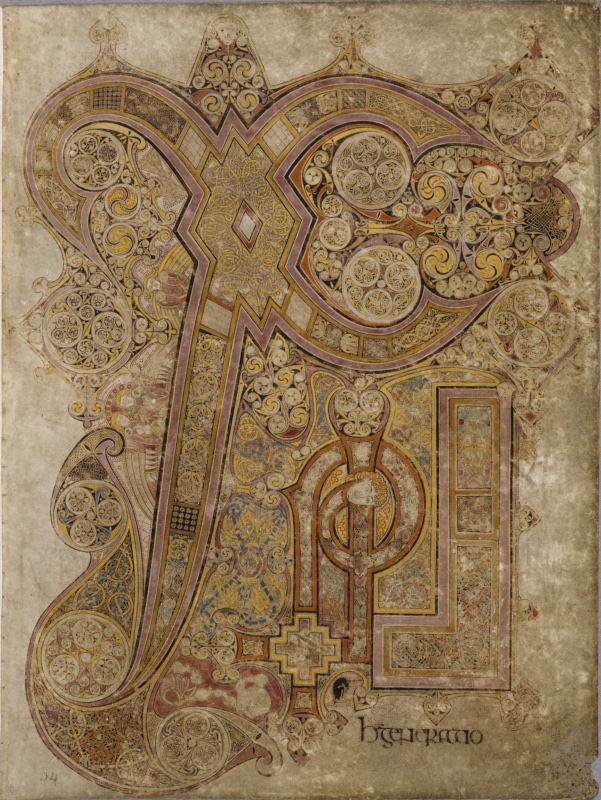
The Christi autem generatio page is the most celebrated single folio of the codex and, by wide agreement, the culminating achievement of Insular ornament. It marks the point in Matthew 1:18 where, after the genealogy, the narrative of the Incarnation properly begins: “Now the generation of Christ was in this wise.” The illuminator has responded by expanding the nomen sacrum XPI to fill almost the entire page, so that the remaining words — h generatio, in small ornamental majuscule at the lower right — are reduced to a residue at the foot of the design, and the sacred name becomes not a word to be read but an object to be contemplated.
The composition is governed by the great diagonal of the Chi, whose upper left arm sweeps across the page in a broad curve terminating in a lobed, spiral-filled expansion, while the lower left limb descends to a second terminal below. The shaft’s spine is drawn as a pink-lilac band edged in gold, and along its entire length is a lattice of compartments filled with tightly wound spiral-and-trumpet patterns, key fret, chequer, and interlaced ribbon. At the point where the arms cross, a diamond-shaped lozenge is inset within a stellate field of interlace — a form whose eucharistic and cosmological readings have been much discussed, the lozenge appearing elsewhere in Insular art as a sign of the Word or of the four quarters of the world.
To the right, the Rho descends as a vertical stem with a large looped bowl, its shaft rendered in orange and gold, terminating below in a bearded human head whose hair spirals into the surrounding ornament. Beside it the letter I is set within a rectangular field of interlace panels in blue, green and red, framed in pink and gold.
Within the ornament, at a scale that rewards only the closest inspection, the illuminator has embedded a series of living forms. Along the lower left arm of the Chi, three winged angels appear in profile, holding books, their bodies elongated to follow the curve of the letter. Near the base of the Chi’s descending limb, two cats crouch with their backs to one another while mice or rats nibble at a circular wafer held between them, a second pair of rodents perched upon the cats’ backs; the group has long been read as a eucharistic allusion, the host contested between the profane and its guardians, though a more playful reading as marginal invention is also defensible. Nearby, an otter grasps a fish in its jaws — the fish being among the oldest cryptograms for Christ — and a moth or butterfly appears within the interlace above.
The technique is of extraordinary refinement. The spiral fields are executed at a density approaching the limits of what the unaided eye can resolve, and the tiny triple-spiral roundels distributed across the Chi’s arms are constructed from lines drawn at a fineness that has repeatedly provoked comparison with metalwork — specifically with the chip-carved and filigree ornament of pieces such as the Tara Brooch and the Ardagh Chalice. The palette relies on orpiment yellow standing in for gold, since no gold leaf was employed anywhere in the manuscript, together with red lead, purple lake, verdigris, and a blue whose identification as indigo rather than lapis lazuli has been supported by recent Raman analysis at Trinity. Substantial areas of reserved vellum function as an active ground.
Beyond its technical accomplishment, the page performs a specific theological operation. By dissolving the name of Christ into ornament while seeding that ornament with animate life — angels above, beasts and insects below — the illuminator constructs an image of the Incarnation as the entry of the Word into creation, the whole hierarchy of being gathered within the letters of the divine name. This reading, developed most influentially in the scholarship of the later twentieth century, has largely displaced earlier accounts that treated the page as decorative exuberance without programme.
The Carpet Page
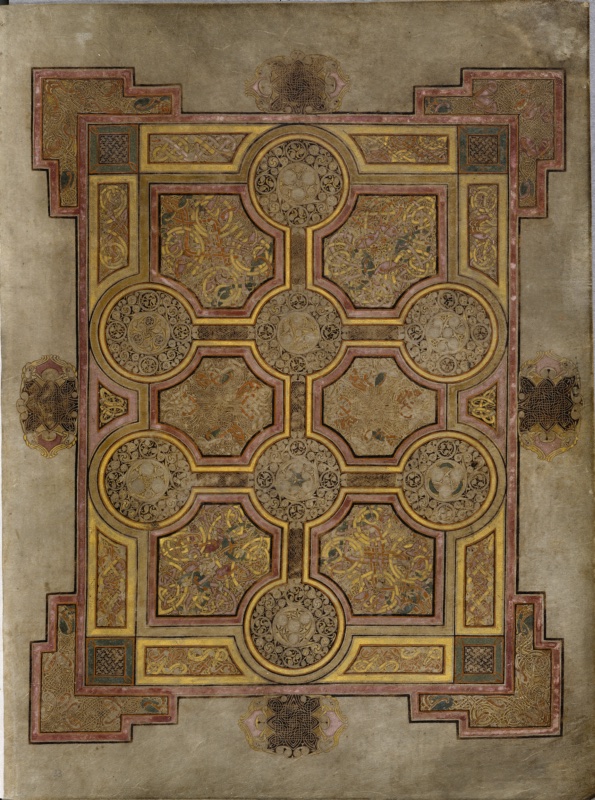
This is the only carpet page in the codex, and its uniqueness is one of the manuscript’s most persistent puzzles. In the Insular tradition established by the Lindisfarne Gospels and the Book of Durrow, the cross-carpet page is a recurrent structural element, placed before each Gospel as a threshold between text and text. In Kells the type appears once only, immediately preceding the Chi-Rho page on fol. 34r, and its solitary status has generated two competing explanations: either the decorative programme was left incomplete, consistent with the unfinished passages elsewhere in the codex, or the designer deliberately reserved the form for this single position, at the threshold of the Incarnation narrative.
The design is organised as a rectangular field enclosing eight octagonal panels arranged in four rows of two, separated by a lattice of broad interlaced bands in gold and pink-lilac. Where these bands intersect, at the centre of the field and along the vertical axis, they open into circular medallions filled with dense spiral-and-trumpet ornament; four larger roundels of the same kind occupy the mid-points of the left and right sides, and two more, of the greatest diameter, sit at the upper and lower ends of the central axis. The whole assembly reads simultaneously as a grid and as a cross, the vertical spine and lateral arms of gold banding constituting a cruciform armature over which the octagonal fields are distributed.
Within the octagons the ornament is exclusively zoomorphic: ribbon-bodied beasts with elongated jaws, lappets and attenuated limbs, interlaced into symmetrical knots so tightly that the individual creatures resolve only under sustained inspection. Their colouring — orange, green, lilac, yellow — is applied in short alternating passages along each body, a technique that further dissolves the animal into pattern. The circular medallions, by contrast, are given over to pure spiral work: triple-spiral triskeles and trumpet-shaped voids executed at a fineness comparable to the Chi-Rho page, and again inviting the standard comparison with contemporary Irish metalwork of the Tara Brooch and Ardagh Chalice class.
The outer border is a stepped rectangle with projecting corner panels containing further zoomorphic interlace and, at the four inner corners, small squares of dark chequer and fret. Beyond the frame, at the mid-points of all four sides, sit detached ornamental bosses: knotted panels flanked by beast heads, floating free upon the reserved vellum. These external accents recall the terminal fittings of a metal book-shrine, and reinforce the long-observed reading of the carpet page as a painted equivalent of a decorated cover or reliquary lid.
Chromatically the folio is restrained by comparison with the Chi-Rho: orpiment yellow substituting for gold, a soft purple lake for the framing bands, muted verdigris green, and red-orange, applied over substantial areas of reserved vellum which functions as the dominant ground. The surface shows notable abrasion, especially across the upper left and lower right octagons and along the outer border, where pigment loss has flattened the original contrasts.
Functionally, the page performs the work such images always perform in Insular Gospel books. It offers no narrative, no letter, no figure — nothing to be read — and thereby marks a caesura, a moment of enforced pause and contemplation before the eye turns the leaf to encounter the name of Christ unfolded across fol. 34r. The two pages should be understood as a designed pair.
Function and Audience
What was such a book for? The scholarly consensus is that the Book of Kells was not a working service book for daily use but a great ceremonial gospel book — a display and altar book, and effectively a relic-object. Two features point this way: the sumptuousness of the decoration, to which far more care was devoted than to the accuracy of the text; and the carelessness of the transcription, which would have been unacceptable in a book intended for constant liturgical reading. Trinity College Dublin concludes that it was “designed for ceremonial use on special liturgical occasions such as Easter rather than for daily services.” Its later medieval role as the venerated “great Gospel of Colum Cille,” and the theft of it for its precious cumdach (shrine), confirm its status as a treasure and relic.
The most sustained scholarly engagement with function and audience situates the book within early Western liturgy and argues for its performative and evangelical dimension — the physical splendour of the gospel serving as an instrument of conversion and devotion. This line of study offers detailed close readings of the Temptation and Arrest miniatures, connecting them to lectionary readings for particular occasions, including Quadragesima Sunday and Holy Thursday, and considers the book’s possible use in the divine office as well as at Mass, drawing on liturgists, palaeographers and exegetes — Bede, Augustine, Tyconius and Maximus of Turin among them. These arguments have been found valuable but demanding, and some of the specific liturgical correlations proposed remain debated rather than settled.
Complementary to this liturgical approach is an exegetical and theological reading pursued by other scholars. On this view the decorated pages are not illustrations but visual exegesis — condensed theological statements drawing on the Fathers (Jerome, Augustine, Gregory the Great, Isidore) and on Insular writers (Adomnán, Bede) — in which image and text together expound the meaning of Scripture. The relationship between the decorated pages and the liturgical year, and between image and patristic commentary, is on this reading the key to the book’s design.
Later History and Provenance
The Book of Kells is almost invisible in the historical record before the eleventh century. Its first secure notice is the entry in the Annals of Ulster (placed under 1006, and generally referred to the event of 1007) reporting that “the great Gospel of Colum Cille” — “the most precious object of the western world” — was stolen by night from the western sacristy of the great stone church at Cenannas (Kells) “on account of its wrought shrine,” and recovered “after two months and twenty nights, its gold having been taken off it, and with a sod over it.” The Old Irish word rendered “shrine” is cumdach (in the annal, comdaigh), the ornamented metal book-shrine or cover in which precious gospel books were kept; the theft was evidently for the gold cover, which was never recovered, and the loss of leaves at the beginning and end of the book is often attributed to the violence of its removal from that cover. This entry is also the first evidence placing the book at Kells.
The manuscript remained at Kells through the Middle Ages, venerated as a relic of Columba — a status confirmed by a fifteenth-century poem added to folio 289v. Its presence at Kells is documented from the late eleventh and twelfth centuries by the celebrated Kells charters: records of land transactions concerning the monastery, written in Irish into the blank spaces and margins of the manuscript (chiefly on folios 5v–7r and 27r). These charters — recording grants and purchases datable between roughly 1033 and 1161 — are primary evidence of the first importance: not only do they fix the book’s whereabouts, but they are among the earliest surviving specimens of written Irish and of legal deeds in the Irish language from before the Norman invasion, edited in the nineteenth century for the Irish Archaeological Society and studied since. The practice of copying transactions into a sacred book was a means of investing them with permanence and, as one scholar put it, “the permanency of divine sanction.” The Annals of Tigernach add that in 1090 relics of Columba, including “two gospels,” were brought to Kells from Donegal — one of the two probably being the Book of Kells and the other perhaps the Book of Durrow.
The famous medieval literary notice of a great Irish gospel book — Gerald of Wales (Giraldus Cambrensis), in his Topographia Hibernica (c. 1188), describing a manuscript so intricate that “you might believe it was the work of an angel, not of a man” — must be handled with care, because it is routinely and wrongly applied to the Book of Kells. Gerald explicitly locates the book he saw at Kildare, not Kells, and describes it as made in the time of St Brigid at angelic dictation. Whether Gerald was describing the Book of Kells, a lost “Book of Kildare,” or another manuscript altogether is genuinely uncertain and much debated; the honest position is that his phrase captures the reception of Insular illumination in general and cannot be securely attached to MS 58. Modern commentators (and the “work of an angel” framing itself) also underline that the description is rhetorical admiration, not a literal claim about the book’s manufacture.
Following the rebellion of 1641 and the ruin of the church at Kells, and with Cromwellian cavalry garrisoned in the town, the book was sent to Dublin around 1653–54 for safekeeping — by the governor of Kells (named in Trinity’s account as Charles Lambert, Earl of Cavan). A few years later it passed to Trinity College Dublin through Henry Jones, formerly scoutmaster-general to Cromwell’s army in Ireland and Vice-Chancellor of the University, who gave it (together with the Book of Durrow) when he became Bishop of Meath in 1661. It has remained at Trinity ever since, and has been on public display in the Old Library since the mid-nineteenth century.
The modern conservation history has already been sketched (§4): the damaging trim of 1821, the controversial London rebinding of the later nineteenth century, and the exemplary rebinding into four volumes in 1953. In 2000 the volume containing Mark was sent to Canberra for an exhibition of illuminated manuscripts — only the fourth time the book had gone abroad — and suffered what was described as “minor pigment damage,” attributed to vibration during the long flight; the episode reinforced the library’s caution about travel. Two of the four volumes are normally on display at any one time, one open at a major decorated page and one at pages of text, with the openings rotated periodically to limit light exposure. A full digital surrogate has been made freely available through Trinity College Dublin’s Digital Collections since 2012, allowing every page to be examined at high resolution online (with an iPad/Android version also produced).
Most recently, the manuscript’s setting has been transformed by the Old Library Redevelopment Project, a major conservation programme to modernise environmental control and fire protection in the eighteenth-century building. From 2023 the Long Room’s roughly 200,000 books were “decanted” — cleaned, measured, tagged and moved to climate-controlled storage — and a new immersive exhibition, the Book of Kells Experience, was launched (announced October 2023) with digital reconstructions and 360-degree presentations. Trinity has stated that the Old Library and Long Room will remain open to visitors until the end of 2027, when restoration and construction works are scheduled to begin; during that phase the Book of Kells is to be displayed in the restored eighteenth-century Printing House, before an eventual return. The exhibition’s revenues help underwrite the redevelopment.
Facsimiles, Reception and Scholarship
The Book of Kells has been reproduced and studied for well over a century. A landmark of modern reproduction is a major 1974 study, with a large body of colour reproductions. The definitive facsimile is the Faksimile Verlag Luzern edition of 1990 (The Book of Kells: MS 58, Trinity College Library Dublin), a strictly limited, full-colour reproduction accompanied by a scholarly commentary volume — the single most important modern scholarly apparatus for the manuscript. Later accessible introductory books by the Library’s former Keeper of Manuscripts remain the standard starting point, and a well-loved popular guide has also long been in circulation.
The manuscript’s afterlife as a cultural symbol is itself a substantial subject. From the nineteenth century, amid the movement for Irish cultural and political self-assertion, the Insular ornament of Kells was appropriated as a distinctively “Irish” or “Celtic” style — a process advanced by antiquarians of the period and by the Arts and Crafts movement (Elizabeth and Lily Yeats among them, whose Cuala Press and embroidery drew on Kells motifs, as in the Honan Chapel textiles in Cork) — and it became visual evidence of a pre-colonial “golden age.” Its motifs have since permeated coins, stamps, jewellery, typography, graphic design, tattoo art and Irish dance costume. In popular culture the manuscript inspired the acclaimed animated film The Secret of Kells (Cartoon Saloon, directed by Tomm Moore and Nora Twomey, 2009), which reimagines the book’s making as a fable of art, learning and the Viking threat, and which has itself become the object of academic analysis (on medievalism, race and Irish identity). The tourism dimension — the book as the anchor of one of Ireland’s most visited cultural attractions — is now inseparable from its scholarly and conservation life, as the funding model of the Old Library redevelopment makes explicit.
Historiography
Scholarship on the Book of Kells has moved through recognisable phases. Nineteenth- and early twentieth-century work, including an early Trinity catalogue tradition and a popular 1914 study, was preoccupied with description, with the antiquarian recovery of Insular art, and with the manuscript’s role in national self-image. The mid-twentieth century brought rigorous palaeography and codicology — E. A. Lowe’s Codices Latini Antiquiores and further technical study of the vellum and make-up — and a foundational strand of art history whose three-scribe scheme and division of the artists’ work set the terms of debate. T. J. Brown’s 1972 paper reframed the origin question and the count of scribes; further work placed the book within the developmental sequence of Insular gospel books.
The decisive event in modern Kells studies was the 1992 conference at Trinity College Dublin, whose published proceedings (1994) gathered the field’s leading figures and remain a reference point. From the 1980s onward the emphasis shifted decisively toward iconography, liturgy and exegesis — including the work of Michelle P. Brown — asking not merely how the book looks but what it means and how it functioned. Comparative work on Insular scriptoria, further study of the wider Irish artistic context, and analysis of the manuscript’s geometric construction have all enriched the picture. The twenty-first century has added scientific analysis (the 2004–2009 pigment studies) and renewed, sometimes provocative, debate on origin (the Pictish/Portmahomack hypothesis) and on the number of hands (the two-craftsmen model), alongside the accessible authority of the Library’s own scholarship and the discursive candour of other modern commentators.
The questions that remain genuinely open are substantial: where, precisely, the book was made and how the labour was divided between Iona, Kells and possibly other centres; how many scribes and artists worked on it, and whether scribes and artists were the same people; the exact original extent and the fate of the lost leaves; the intended programme of decoration and why it was left unfinished; and the precise meaning of its most enigmatic images. On none of these is the last word likely to be written soon.
Conclusion
The Book of Kells occupies a position in the history of Western art that few other single objects can claim: it is at once a working liturgical book, a national relic, a scientific specimen and a permanent subject of academic dispute, and it has been all four of these things, in shifting proportions, for well over a millennium. Any attempt to sum up what is securely known about it has to hold that plurality in view rather than resolve it, because the manuscript’s identity has never settled into a single, stable meaning. What can be said with confidence is comparatively modest — a date of around 800, a Columban milieu, an origin most probably though not certainly at Iona — and it is precisely the gap between that modest core of certainty and the manuscript’s vast cultural reputation that makes responsible discussion of it so difficult, and so necessary.
The debate over origin and date, surveyed above, is unlikely to be settled by any single new discovery, because the absence of a colophon means that every proposed answer — Iona, Kells, Northumbria, Pictish Scotland — is an inference from indirect evidence: script forms, decorative parallels, the movements of relics and communities in a genuinely mobile cross-insular world. The Portmahomack hypothesis has usefully complicated a consensus that had, for a time, hardened into something closer to received wisdom than the evidence warranted, and whatever its ultimate fate in the scholarship, it has performed the valuable service of reminding readers that the Iona attribution, however probable, remains an attribution and not a fact. The honest position, restated once more, is that the book could in principle have been produced wholly or partly in more than one of these places, by a community whose personnel and materials were themselves in motion.
The codicological and material findings are, by contrast, considerably more secure, because they rest on physical examination rather than stylistic argument. The reckoning of some 185 calfskins, the identification of the pigment palette through non-invasive spectroscopy, and above all the correction of two long-repeated errors — that the blue is lapis lazuli and that the shimmering passages are gold leaf — represent the clearest gains of the last generation of scholarship. These are not minor housekeeping details: they change how the book’s economics and ambition should be understood, substituting a picture of extraordinary skill exercised on regionally available materials for one of unlimited cosmopolitan expenditure, and they show how much of the traditional account of the manuscript was received rather than verified.
The question of the scribes and artists remains, deliberately, unresolved in this account, because it is unresolved in the scholarship. Three hands, four hands, two collaborating craftsmen: each scheme rests on a defensible reading of letterforms and ink, and none commands the kind of consensus that would let a general account simply adopt it. What can be said is that the manuscript’s script, for all its variation, maintains a consistency that has made the individual hands difficult to isolate with certainty — itself a testament to the coherence of the scriptorium’s training, whatever its precise personnel turned out to be. The related question of whether scribe and artist were ever the same person is, if anything, even further from resolution, and probably will remain so absent new physical or documentary evidence.
Of the decoration itself little more needs to be added beyond what the individual folios have already shown: the Chi Rho page as the single most sustained meditation on a name in the whole of medieval art; the evangelist portraits balancing hieratic stillness against the residual memory of a late antique author at work; the Virgin and Child anticipating, by any reasonable dating, every other surviving Western image of the subject; the Temptation page compressing architecture, ornament and ecclesiology into a single reliquary-shaped Temple. Across all of these the manuscript’s illuminators worked a narrow, regionally sourced palette — indigo, orpiment, red lead, verdigris, purple lake — into effects of a richness that rival and arguably exceed anything achieved elsewhere in the Insular world, and did so while leaving substantial passages unfinished, a fact that is itself evidence for the disruption, whether from the Viking raids or from more mundane constraints of time and personnel, that seems to have overtaken the project before its programme was complete.
On function, the surviving evidence points consistently away from a working service book and toward a ceremonial altar book and relic, its lavish ornament and careless text both explicable on that reading: a book made to be displayed and venerated on the great feasts of the liturgical year was under no obligation to be accurate in every line, only to be magnificent. Its subsequent history as an object of theft, of Irish charters copied into its margins for the protective sanctity a sacred book conferred, and of controversial early modern rebindings, confirms that later custodians related to the manuscript above all as a treasure and a relic rather than as a text to be read continuously. That the same object should, from the nineteenth century onward, have been pressed into service as the emblematic artefact of a national culture, and later still as the anchor of a major tourist attraction, is a natural extension of a status the book had already held for the better part of a thousand years before modern Ireland existed to claim it.
The historiography traced here shows a field that has moved, in barely more than a century, from antiquarian description through rigorous codicology and palaeography to iconographic, liturgical and exegetical interpretation, and most recently to scientific analysis capable of overturning assumptions that earlier generations had treated as settled. Each phase has corrected as much as it has added: the count of scribes has been revised more than once, the identification of the blue pigment has been reversed, and the very question of where the book was made has been reopened by archaeological work at a site that earlier scholarship had scarcely considered. There is no reason to think this pattern of revision has ended, and a responsible account of the manuscript should expect, rather than resist, further correction as new evidence and new techniques are brought to bear.
What endures through all of this revision is the object itself, and the plain fact that no amount of scholarly uncertainty about its origin, its makers or its precise meaning has ever diminished the force of encountering it. The Book of Kells asks to be read on two registers at once — as a monument whose grandeur is beyond serious dispute, and as a set of open historical problems that responsible study must keep visibly open rather than paper over with false certainty. Holding those two registers together, rather than collapsing one into the other, is the only honest way to write about a manuscript that has spent twelve centuries accumulating meanings its makers could not have anticipated, and that shows no sign of having finished doing so.