Endnotes
Biographical and contextual notes referenced across all entries
No notes match your search.
A
-
Abbot Victor
Abbot Victor was the patron abbot of the monastery of St. Michael de Escalada (San Miguel de Escalada), a Benedictine foundation near León. He is remembered above all as the commissioner of one of the most important illustrated Beatus commentaries on the Apocalypse. The manuscript, often called the San Miguel de Escalada Beatus, was produced by the scribe and artist Maius in the scriptorium of San Salvador de Tábara and was explicitly executed "for the monastery of St. Michael and at the command of Abbot Victor."
The monastery is generally identified with a Benedictine community founded or refounded in the early tenth century in the Leonese frontier zone, consecrated in 913, and connected to wider Astur-Leonese monastic networks patronized by rulers such as Alfonso III and his sons. Victor's name appears in the colophon of the Morgan Beatus (MS M.644), which records that Maius wrote and illuminated the work at Victor's request for the house of St. Michael, and that he later moved to San Salvador de Tábara, where he died in 968.
These details suggest that Victor served as abbot of Escalada in the mid tenth century, even if the surviving manuscript may have been started earlier and completed or revised under his patronage. As a monastic patron, Victor belongs to the Leonese and Castilian milieu that invested heavily in prestigious Apocalyptic cycles, using the Beatus commentary as both a spiritual and a political instrument.
-
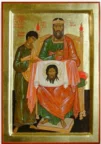
Abgar V of Edessa
Abgar V, surnamed Ukkama - a Syriac and Aramaic word meaning "the Black" - was an Arab king of Osroene who reigned from his capital at Edessa (modern Sanliurfa in southeastern Turkey) in two separate periods: from 4 BC to 7 AD and again from 13 AD to 50 AD. He is one of the most intriguing and contested figures of early Christian history, a king whose historical reality is well established but whose religious legend became one of the most widely circulated stories in the medieval Christian world.
Abgar V belonged to the Abgarid dynasty, rulers of the small but strategically important kingdom of Osroene, positioned between the Roman and Parthian empires. Though later Armenian tradition attempted to claim him as Armenian, Roman and Syriac sources consistently describe him as an Arab king - the Roman historian Tacitus specifically uses the designation "king of the Arabs" for the Abgarid rulers. His epithet Ukkama ("the Black") is generally interpreted as a reference to a severe skin condition - most likely leprosy or a similar disfiguring disease - which became the narrative engine of the famous legend that bears his name.
Abgar V navigated one of the most complex geopolitical environments of the ancient world. Osroene was a buffer state permanently caught between Roman imperial ambitions in the west and Parthian power in the east, and its survival depended on skillful diplomacy and opportunistic allegiance-shifting. His first reign (4 BC - 7 AD) ended when he was deposed, and according to Elia of Nisibis, during one particularly tumultuous moment around 25 AD, he was driven out by his own brother, "Abgar the White," who seized the throne for six years before Abgar V reclaimed it. Upon regaining power, Abgar V demonstrated a notably magnanimous style of governance: he remitted tax obligations for the citizens of Edessa and the surrounding villages, suspending taxation for five years until the city had recovered its population and been rebuilt with new structures.
The legend that immortalized Abgar V in Christian culture centers on an extraordinary epistolary exchange with Jesus of Nazareth. According to the tradition, Abgar, suffering from his debilitating illness and having heard reports of miraculous healings in Judaea, sent an ambassador named Ananias to Jesus bearing a letter. In this letter - preserved by Eusebius of Caesarea in his Ecclesiastical History and claimed to have been translated from Syriac documents in the royal archives of Edessa - Abgar acknowledges Jesus as a divine being, begs for healing, and invites him to Edessa as a safe refuge from Jewish persecution. Jesus, according to the legend, replied in a letter blessing Abgar, explaining that he must complete his earthly mission in Jerusalem, but promising to send one of his disciples afterward to heal him and preach to his people.
The story does not end with letters alone. When Ananias returned to Edessa, he brought with him a miraculous linen cloth - the Image of Edessa (Mandylion) - bearing the imprint of Christ's face, which Christ had pressed against his own features. Upon receiving the cloth, Abgar prostrated himself before the image in worship and was immediately cured of his illness, even before the promised disciple arrived. That disciple, Thaddeus of Edessa (also called Addai, one of the 72 disciples of Luke 10:1), subsequently came to Edessa, confirmed the conversion of the king, and founded the Christian community there. One remarkable variant of this story, preserved in the tenth-century Codex Vossiamus Latinus Q69, specifies that the cloth bore not only Christ's face but his entire body - an early attestation of what would later become the Shroud tradition.
Modern scholarship treats the Abgar correspondence as a pious invention, most probably composed in the early third century to endow the Edessene church with apostolic prestige and an impressively ancient lineage. Christianity appears to have actually taken hold in Edessa only toward the end of the second century, making a conversion under the historical Abgar V chronologically improbable. Eusebius, writing in the fourth century, was the legend's principal vector into mainstream Christian literature; his claim to have consulted authentic Syriac archives in Edessa gave the story documentary credibility it almost certainly did not deserve. The real first Christian king of Edessa was likely Abgar VIII (also numbered Abgar IX in some sources), who reigned around 200 AD and whose conversion is supported by considerably stronger historical evidence.
For the history of medieval art - and particularly for the tradition of illuminated manuscripts - the significance of Abgar V rests not in his political career but in what his legend generated iconographically. The Mandylion or Image of Edessa became one of the most venerated objects in Christendom, transferred to Constantinople in 944 AD where it was enshrined as an imperial treasure. It established the archetype of the acheiropoieton - the image "not made by human hands" - a theological concept that profoundly shaped Byzantine and Western Christian attitudes toward sacred images. This tradition fed directly into the Vera Icon (True Image) cult in Western medieval devotion, and representations of King Abgar receiving the miraculous cloth appear in Byzantine mosaics, Armenian frescoes (as in the Varaga St. Gevorg church chapel, where the image of Abgar holding the Mandylion survives to this day), and numerous illuminated manuscripts. The Abgar narrative was also reproduced textually in medieval manuscript compilations across the Latin, Greek, Armenian, and Syriac traditions, frequently accompanied by miniatures that depicted the royal court of Edessa and the moment of the miraculous healing - images that sit at the very intersection of apocryphal narrative, royal portraiture, and sacred icon-making.
Abgar V died around 50 AD, having spent the final decades of his life, according to the legendary tradition, as a faithful Christian patron of the nascent Edessene church. His son and successor, however, proved deeply hostile to the Christian community: he reportedly demanded that the priest Aggai - who had served under Addai - manufacture silk headbands for him, as Aggai had done for the king before his ordination. When Aggai refused to abandon the church for such a task, the son sent men who broke Aggai's legs, and he died from his injuries. This dark epilogue to Abgar V's reign serves as a literary reminder, within the Syriac tradition, that the Christianization of Edessa was not a smooth dynastic inheritance but a fragile achievement vulnerable to the whims of individual rulers - a fragility that would define the church's relationship with power for centuries to come.
-
Aethelwulf and the De abbatibus
The De abbatibus (also known as Carmen de abbatibus) is a Latin poem in hexameters of approximately 819 lines composed by an Anglo-Saxon monk named Aethelwulf (Aediluulf), who lived in the early 9th century and is thought to have belonged to a small monastery in Northumbria. The poem tells the history of the author's own community, describing its foundation and the names, deeds, and characters of its first six abbots; though structured as an abbatial chronicle, it is deeply imbued with classical and patristic rhetorical models typical of Anglo-Latin poetry of the 7th to 9th centuries. It can be dated between 803 and 821, and is addressed to Ecgberht, Bishop of Lindisfarne, which situates the author within a northern ecclesiastical milieu engaged with both Celtic and Anglo-Saxon traditions. The precise identity of the monastery remains debated: proposed locations include Bywell on the Tyne and Crayke near York, both situated in a region where Northern Irish missionary influence and Anglo-Saxon ecclesiastical organization overlapped. The poem is a significant source for the cultural and religious life of early 9th-century Northumbrian monasticism, and its mention of Eadfrith and the Lindisfarne community places it within the same devotional and intellectual network as the Lindisfarne Gospels.
-
Al-Idrisi (Muhammad al-Idrisi, Edrisi)
Abu Abdullah Muhammad al-Idrisi al-Qurtubi al-Hasani as-Sabti — known simply as al-Idrisi (Latinized as Dreses or Edrisi) — was the greatest Arab geographer and cartographer of the medieval world, whose life's work at the Norman court of Palermo produced a synthesis of Islamic, Greek, and Norman geographical knowledge that remained unsurpassed for three centuries after his death. His career is inseparable from the story of Roger II's Sicily, and he stands as the supreme intellectual embodiment of that kingdom's multicultural ambitions.
Al-Idrisi was born around 1100 in Ceuta (Arabic: Sabta), then a city of the Almoravid dynasty on the northern tip of Morocco, facing the Strait of Gibraltar. He was of noble Hammudid Berber origin and claimed descent — as his full name announces — from the Prophet Muhammad through the line of Idris I of Morocco, the founder of the first Arab dynasty of the Maghreb. His education took him to Córdoba in al-Andalus, still in the twelfth century one of the great intellectual capitals of the Islamic world, where he absorbed the Greek geographical tradition — above all the works of Claudius Ptolemy — alongside the flourishing Arab geographical literature of the Abbasid period. He began his travels at approximately sixteen years of age, journeying widely across the Mediterranean world: Asia Minor, the southern coast of France, England, and extensively through Spain and Morocco.
Sometime around 1138–1145, al-Idrisi received an invitation from King Roger II of Sicily to come to Palermo and undertake a project of unprecedented geographical ambition. The precise circumstances are unknown, but Roger's court was already a magnet for Arab scholars, physicians, and administrators, and Roger himself had a personal passion for geography and natural philosophy. Al-Idrisi settled in Palermo, where he remained for the rest of Roger's lifetime and beyond.
The intellectual collaboration between the Norman king and the Arab geographer was by all accounts genuinely close and sustained. Al-Idrisi describes how Roger took direct personal interest in the project — that hardly a day passed during the fifteen years of research without the king conferring personally with his geographers, examining astronomical coordinates, scrutinizing itineraries, and weighing divergent opinions. The method was systematic: Roger sent out trained observers to travel specific routes and report back on distances, populations, coastlines, and landmarks. Al-Idrisi and his team then compared these field reports with existing written sources — Ptolemy, the Arab geographical tradition, and the accounts of Islamic merchants and explorers — retaining only what multiple sources confirmed. The result, fifteen years in the making, was completed in the final weeks of Roger's life.
The centerpiece of the work for Roger II was a monumental silver planisphere — a world map engraved on a circular disc of pure silver weighing approximately 400 Roman pounds (roughly 150 kg) — depicting the entire known world with its countries, rivers, seas, mountains, roads, and distances between principal cities. This silver disc has not survived; it was almost certainly melted down during the political chaos following Roger's death in 1154. Its visual content is preserved in the manuscript copies of the accompanying geographical treatise.
The written work is known by two titles. Its full Arabic title is Kitāb nuzhat al-mushtāq fī ikhtirāq al-āfāq — translated most evocatively as "A Diversion for the Man Longing to Travel to Far-Off Places" — sometimes shortened to Nuzhat al-mushtāq. In Western scholarship it is most commonly referred to as the Tabula Rogeriana or Opus Geographicum, and in Arab tradition simply as Kitāb Rujjār — "The Book of Roger." It was completed in mid-January 1154 — only weeks before Roger II died on 26 February of that year.
The Tabula Rogeriana describes the known world from the equator to approximately the latitude of the Baltic Sea, and from the Atlantic to Siberia — encompassing Europe, North Africa, the Middle East, Central Asia, India, and parts of sub-Saharan Africa. Al-Idrisi organized the world according to Ptolemy's system of seven climatic zones, each subdivided into ten sections, producing seventy regional maps with accompanying descriptive text. When assembled in correct sequence these maps form a single rectangular world map approximately nine feet wide and five feet tall — the most detailed map of the world produced in the medieval period by any civilization, East or West. It incorporated the geographical knowledge of Africa and the Indian Ocean accumulated by Arab merchants over three centuries, combined with Norse and Norman knowledge of the Atlantic coast, creating a synthesis unavailable to any purely Islamic or purely European tradition working independently.
A critical feature that puzzles modern viewers is the map's orientation: al-Idrisi drew it — following a tradition inherited from his Persian geographical predecessors — with south at the top and north at the bottom. Mecca therefore appears near the center of the map, and Europe occupies the upper left quadrant. When reproduced in modern publications, the map is typically rotated 180 degrees to conform to modern geographical conventions.
The text is encyclopaedic in character, describing for each region not merely physical geography but also the customs, languages, religions, agricultural products, crafts, trade goods, and political structures of its inhabitants. Al-Idrisi's Sicily receives particular attention: he describes the island as "a pearl of the age," and his account of the Norman conquest provides one of the most important Arabic-language sources for the history of Roger I's campaigns.
His geographical achievement becomes even more remarkable when evaluated in scientific terms. His calculation of the Earth's circumference at the equator — approximately 22,900 miles — is about ten percent less than the actual figure of approximately 24,901 miles, a margin of error that compares favorably with any medieval estimate and many early modern ones. His delineation of the sources of the Nile, including the great lakes of equatorial Africa, was so accurate that when British explorers John Hanning Speke and Samuel Baker reached those lakes in the 1860s, the number and relative positions they found did not differ greatly from al-Idrisi's twelfth-century representation — a seven-hundred-year vindication.
His intellectual sources were threefold: from Ptolemy's Geography he inherited the framework of climatic zones and classical Mediterranean information; from the Islamic geographical tradition — al- Balkhi, al-Istakhri, Ibn Hawqal, and al-Masudi — an unparalleled body of knowledge accumulated over three centuries of Arab travel; and from the Norman court itself, access to the reports of Norse and Norman mariners whose knowledge of Atlantic coasts, the British Isles, and Scandinavia was entirely unavailable to any Arab geographer working outside of Sicily.
After Roger II's death in 1154, al-Idrisi remained for a time at the Sicilian court under William I, for whom he produced a shorter geographical work, the Uns al-muhaj wa rawdh al-furaj ("The Pleasure of Men and the Joy of Souls"), sometimes called the Kitāb al-Mamalik. The political turbulence following Roger's death — including the anti-Arab riots of 1161 in Palermo — made his situation increasingly precarious, and he is believed to have returned to Ceuta at some point before his death, conventionally placed around 1165.
His influence was immense and long-lasting. For three centuries after his death, European and Arab geographers reproduced his maps with minimal alteration, treating them as the authoritative representation of world geography. The printed rediscovery of his work in Europe began with a partial Latin translation in Rome in 1619; the full Arabic text was not edited and published until the nineteenth century. The German scholar Konrad Miller produced the first modern color reconstruction of the complete world map between 1928 and 1931.
-
Alberti Family (Florence)
The Alberti family of Florence rose as one of the city's most influential merchant-banking dynasties during the late medieval and Renaissance periods, originating from the castle of Catenaia in the Casentino valley, which inspired their coat of arms featuring crossed chains. By the 13th century, they had firmly established themselves in Florence near the Ponte alle Grazie, dividing into branches such as the Alberti del Giudice and building towers that symbolized their growing power amid Guelph politics. Their ascent intertwined commerce, papal finance, and cultural patronage, though bitter rivalries with the Albizzi often led to exile and political setbacks.
Niccolò di Iacopo di Alberti (d. 1377) propelled the family to prominence by directing their Avignon branch, securing near-exclusive papal banking rights from 1362, which swelled their wealth through loans, trade, and currency exchange across Europe. A staunch Guelph, he held key offices—prior (1355) and gonfalonier of justice (1363)—aided Florence's victory over Pisa in 1369 by negotiating port access, and constructed the lavish Villa del Paradiso as a hub for artists and scholars. His successors, including Benedetto (d. 1388), challenged the Albizzi oligarchy, backing the 1378 Ciompi revolt—a brief populist uprising of wool workers—but faced exile after its failure, with harsher bans in 1393, 1396, and 1401, including bounties on their heads.
Antonio Alberti (1358–1415), another prior (1384), sustained the villa's intellectual circle before his 1401 banishment, when all male Alberti were expelled for alleged conspiracy. Partial return came in 1428, full rights only after the Albizzi fell in 1434, aligning the family with rising Medici allies. This era of instability highlighted Florence's volatile factions: Guelphs like the Alberti navigated papal ties against Ghibelline-leaning rivals, using commerce to fund political maneuvers and public benefaction.
The 15th century shone brightest with Leon Battista Alberti (1404–1472), born illegitimate in Genoa to the exiled Lorenzo di Benedetto Alberti—a merchant who ensured his humanist education in Padua and Bologna. Returning after 1428, Leon Battista authored seminal treatises: Della famiglia (c. 1432–1443), analyzing bourgeois family dynamics, social mobility, and urban virtues; De pictura (1435), pioneering the theory of linear perspective; and De re aedificatoria (1452), the first printed architectural treatise, blending Vitruvian principles with practice. He designed the Rucellai Palace facade, the upper front of Santa Maria Novella (for Giovanni Rucellai, c. 1470), and other urban projects, embodying the Renaissance ideal of the "universal man."
Other notable figures included Cardinal Alberto Alberti and the writer Antonio Alberti, while the family's scriptoria and villas fostered Renaissance humanism. Their decline followed the Grand Duchy era, with the main line fading over subsequent centuries and properties passing to related families after legal disputes. Leon Battista Alberti's facade at Santa Maria Novella remains the emblematic monument of the family's cultural legacy: its geometric harmony and classical orders, commissioned by rivals of the Medici yet integrated seamlessly with Dominican symbolism, exemplify the synthesis of mercantile patronage and humanist design.
-
Alcuin of York
Alcuin of York (c. 735–804) was an English scholar, theologian, poet, and teacher who became one of the central figures of the Carolingian Renaissance at the court of Charlemagne. Born in Northumbria, he received his education and later taught at the Cathedral School of York, then one of the most prestigious centers of learning in northern Europe.
Alcuin entered the school of York Minster under Archbishop Egbert, who was transforming the cathedral community into a major intellectual hub dedicated to the seven liberal arts. After graduating in the 750s, he became master of the York school, overseeing its library and curriculum, and promoting the study of grammar, rhetoric, logic, arithmetic, geometry, music, and astronomy.
In 781, while traveling in Italy to represent the church of York, Alcuin met Charlemagne at Parma and was so impressed by the king's interest in learning that he accepted an invitation to join the Frankish court. He moved to Aachen in 782 and became master of the Palace School, where he trained the royal children and nobles in correct Latin and Christian doctrine, helping to shape the educational ideals of the Carolingian regime.
At Aachen, Alcuin became Charlemagne's chief advisor in ecclesiastical and educational matters and helped coordinate the revival of learning across the Frankish realm. He promoted the copying and preservation of classical and patristic texts, helped standardize biblical texts and liturgical practices, and contributed to the development of Carolingian minuscule, a clear, legible script that greatly aided manuscript transmission.
From 796, Alcuin was abbot of the monastery of St. Martin at Tours, where he turned the house into a major center of book production and study, while still advising Charlemagne by letter. He was a prolific writer, producing biblical commentaries, theological treatises against the Adoptionist heresy, grammatical and educational works, poetic histories of the Church of York, and a large body of correspondence that illuminates the intellectual and political life of his time.
-
Alessandro Da Morrona
Alessandro Da Morrona was a Pisan nobleman, erudite scholar, art historian, draughtsman, engraver, and collector — one of the most significant intellectual figures in late eighteenth- and early nineteenth-century Tuscany. His life's work was devoted to systematically documenting and celebrating the artistic and architectural heritage of Pisa, and his scholarship earned him lasting recognition as a foundational figure in Italian art historiography.
Born in Pisa in 1741 into a patrician family, Da Morrona inherited the cultural advantages of the Tuscan nobility and devoted himself from a young age to the study of the arts. He trained as a draughtsman and engraver under the Pisan painter Giovanni Battista Tempesti (1729–1804), acquiring both a refined aesthetic sensibility and practical technical skills that would later serve him in producing the rich iconographic apparatus of his major works. This dual formation — scholarly and artistic — made him unusual among the antiquarians of his day, as he was capable of personally drawing and engraving the monuments he described.
Da Morrona's magnum opus, Pisa illustrata nelle arti del disegno, is considered the first thorough and authoritative text on the history of Pisan art. The first edition appeared in three volumes, published in Pisa by Francesco Pieraccini between 1787 and 1793; a revised, expanded, and more richly illustrated second edition was published in Livorno by Giovanni Marenigh in 1812. The work was notable not only for its textual depth but for its extensive visual documentation: Da Morrona inserted illustrations of varying formats to compensate for the reader's inability to inspect the works in person, with a particular focus on the great art of the medieval period.
The erudite historian Girolamo Tiraboschi — one of the foremost literary historians of the era — cited Pisa illustrata in his monumental history of Italian literature as a reliable and authoritative source on the city's art and inscriptions, a mark of the work's academic prestige. The book set a standard for local art-historical writing and became the model for a tradition of Pisan tourist guides that flourished in the age of the Grand Tour, when Pisa was a favored stop on the Italian itinerary.
Perhaps Da Morrona's most consequential contribution to medieval art history was his identification and rehabilitation of the thirteenth-century painter Giunta Pisano. In 1793, during the final stages of completing his first edition, Da Morrona discovered in the monastery of Sant'Anna in Pisa a crucifix by Giunta — today known as the Crocifisso di San Ranierino and preserved in the Museo Nazionale di San Matteo — which had fallen into obscurity. Through his detailed scholarly treatment of this work and other attributions to Giunta, Da Morrona was largely responsible for securing the painter's place in the canon of Italian medieval art. Without his intervention, the reputation of one of the most important Dugento painters might have remained buried in anonymity well into the modern era.
Da Morrona paid particular attention to Pisa's extraordinary medieval civic monuments, devoting careful analysis to the Camposanto — the monumental cemetery adjacent to the Cathedral — tracing its foundation to Archbishop Ubaldo Lanfranchi's transport of holy earth from Jerusalem in 1188 and the construction of the great building in 1278 under the direction of Giovanni Pisano. His account drew on earlier chroniclers such as Roncioni, Tronci, and Ughelli, synthesizing the textual tradition with his own direct observation of inscriptions, frescoes, and sculptural decoration. He discussed at length the frescoes attributed to Orcagna, the sculptural pulpit of San Giovanni Battistero, and the celebrated Madonna di Sotto gli Organi in the Cathedral, producing some of the earliest systematic descriptions of these works.
In addition to his main work, Da Morrona produced a series of more accessible guides for travelers and educated citizens, adapting his scholarly research for a broader readership. These included the Compendio di Pisa illustrata… con varie aggiunte per servir di guida al forestiero (1798), the Pregi di Pisa… per l'utilità de' culti cittadini e forestieri (1816), and Pisa antica e moderna… volume solo per servir di guida (1821), the last published in the very year of his death. Each of these was not simply a condensation of the earlier work but contained new material, reflecting his lifelong commitment to updating and refining his knowledge of the city.
Alessandro Da Morrona died in 1821, leaving behind a body of work that remained an indispensable reference for scholars of Pisan history and medieval Italian art for generations. His combination of aristocratic connoisseurship, antiquarian rigour, and practical artistic skill made him a model of the Enlightenment erudito — a type of scholar-gentleman whose meticulous documentation of local heritage laid the groundwork for the professional art history that would emerge in the nineteenth century.
-
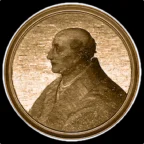
Pope Alexander IV
Pope Alexander IV (born Rinaldo di Jenne, also known as Rinaldo dei Conti di Segni, c. 1199 - Viterbo, 25 May 1261) reigned as pope from 12 December 1254 until his death in 1261. Born into the Conti di Segni family of Jenne, in the hill country east of Rome, he belonged by descent to the same lineage that had already produced Popes Innocent III and Gregory IX, the latter his uncle.
Gregory IX drew his nephew into the highest ranks of the curia early: he made Rinaldo cardinal deacon and Camerlengo of the Holy Roman Church in 1227, and in the same year named him Cardinal Protector of the Order of Friars Minor, an office that placed him at the institutional head of the entire Franciscan movement - friars and Poor Ladies alike - more than a quarter-century before his election as pope. He was promoted Cardinal-Bishop of Ostia in 1231 or 1232, a see he held for over two decades. His long tenure as protector brought him into direct and lasting contact with the community of San Damiano: he was present at Clare's deathbed in August 1253, receiving her last sacraments alongside Pope Innocent IV, and lent his authority to the approval of the Rule she had written for her sisters.
Elected at Naples on 12 December 1254 in the wake of Innocent IV's death, Alexander inherited the unresolved war against the Hohenstaufen in southern Italy. He continued his predecessor's excommunication of Manfred, Frederick II's illegitimate son, invested Edmund, the young son of Henry III of England, with the papal fief of Sicily in 1255 in exchange for military and financial support, and later found himself maneuvering against Manfred's nephew Conradin as well - a policy that achieved little beyond entangling the English crown in debts that helped provoke the Second Barons' War. Ghibelline ascendancy eventually forced him from Rome altogether; he spent much of his pontificate governing from Viterbo, Anagni, and other towns of the Papal State rather than the city itself.
Alexander was, above all, a patron of the mendicant orders. He renewed and extended Franciscan and Dominican privileges against the resistance of the secular masters of the University of Paris, defended the friars' right to teach and hear confession, and in 1255 issued the bull Benigna operatio, affirming in his own voice the reality of the stigmata received by Francis of Assisi. It was as pope, rather than merely as protector, that he brought his long relationship with the Poor Ladies to its most consequential act: barely two years after Clare's death, he canonized her at Anagni, issuing the bull Clara claris praeclara, and set in motion the translation of her body and the building of the memorial basilica that still bears her name in Assisi. He also confirmed, in March 1255, the exchange by which the community took possession of the church of San Giorgio, the site chosen for that new church. Elsewhere in ecclesiastical policy he condemned the apocalyptic theology drawn from Joachim of Fiore (1256) and, in the bull Quod super nonnullis (1258), drew an influential distinction between demonic heresy, which fell to the Inquisition, and mere divination or sorcery, which did not.
He died at Viterbo on 25 May 1261 and was buried in the city's cathedral; his tomb did not survive later renovations. Weakened by the unresolved Sicilian war and by his estrangement from Rome, his pontificate is remembered less for political success than for the consolidation it gave to the mendicant orders in general and, for the history of Assisi in particular, for the personal thread it drew between the dying Clare of San Damiano and the basilica raised in her name.
-
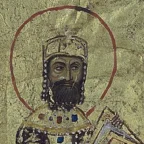
Alexios Angelos Komnenos
Alexios Angelos Komnenos is one of the most enigmatic figures of the 12th-century Byzantine aristocracy: almost entirely absent from literary sources, he owes his place in historical memory not to military or political exploits, but rather to the extraordinary foundation he chose to erect in Macedonia, the Church of Saint Panteleimon in Nerezi, considered one of the absolute pinnacles of medieval Byzantine art.
Alexios was presumably born around the mid-12th century to a union that reflected, in microcosm, the social tensions of the Komnenian Empire. His mother was Theodora, a porphyrogenita, that is, born in the Porphyry Chamber of the Imperial Palace, a privilege reserved for the offspring of reigning emperors, and daughter of Emperor Alexios I Komnenos (1081-1118), founder of the Komnenos dynasty. His father, Konstantinos Angelos, on the other hand, came from a family of modest rank originally from Philadelphia in Asia Minor, and obtained titles and recognition exclusively through his marriage to the imperial princess. This marriage was deemed imprudent by contemporaries and openly criticized by the imperial family, which considerably reduced subsidies and gifts to the couple.
From this father came the surname Angelos, destined to become, in the next generation, the name of a veritable imperial dynasty, while from his mother Alexios derived the illustrious surname Komnenos and with it his place in the Empire's social hierarchy. In the Komnenian era, proximity to the throne determined everything, and the use of the maternal surname was common practice among the aristocracy seeking to consolidate or improve their position. Alexios was the brother of John, Andronikos, and Isaac Angelos, all of whom were present at the Ecclesiastical Council of Constantinople in 1166, the only explicit mention of Alexios in extant literary sources.
The near-total absence of Alexios in Byzantine narrative sources constitutes a historiographical fact significant in itself. Unlike other members of the Angelos-Komnenos family who distinguished themselves in military or political fields, Alexios does not appear to have held prominent positions in the imperial administration nor participated in military campaigns worthy of note to the chroniclers of the time. The scholar Ida Sinkevic, who dedicated the seminal essay Alexios Angelos Komnenos, a Patron without History? (published in Gesta in 1996) to the figure, observed that it is precisely this historical obscurity that makes Alexios a rare case within a dynasty that is usually well-documented.
Yet the absence of a political "history" does not equate to the absence of an identity. By carefully examining the aesthetic and iconographic choices of his foundation, Sinkevic has reconstructed a coherent portrait: that of an aristocrat of refined taste, endowed with solid social aspirations and a keen interest in the political and ecclesiastical debates of his time.
The Foundation of Nerezi (1164)
The masterpiece that rescues Alexios from historical anonymity is the Church of Saint Panteleimon in Nerezi, in present-day North Macedonia, consecrated in September 1164. The dedicatory inscription, carved into the marble lintel above the church's main entrance, reads in Greek: "The church of the holy and renowned great martyr Panteleimon was splendidly built with the help of Lord Alexios Komnenos, son of the porphyrogenita Theodora, in the month of September, indiction 13, 1164, with the monk Ionnikos serving as igumen." The choice to sign his name as "Komnenos" rather than "Angelos", and to explicitly mention his porphyrogenita mother, reveals Alexios's deliberate strategy of self-representation: he defined himself as the grandson of Alexios I Komnenos and cousin of the reigning emperor Manuel I Komnenos (1143-1180).
The church has an inscribed Greek cross plan, a common type in Palaiologos sacred architecture, but its exceptional nature lies in the pictorial cycle that covers it entirely. The iconographic program displays a coherence and sophistication unusual for the era: the Christological scenes in the naos include some of the most intense and innovative representations in medieval painting, including a Threnos (Lamentation over the Dead Christ) of extraordinary emotional power and an Epitaphios Threnos that anticipates formal solutions found, centuries later, in the proto-Renaissance Italian painting of Cimabue and Giotto. It is no coincidence that Nerezi is one of the very few Byzantine monuments to be cited in Renaissance art history textbooks.
An analysis of the Nerezi pictorial cycle reveals much about the intellectual personality of the patron. The arrangement of the saints by category, warriors on the north and south walls, martyrs in courtly robes on the west wall, monastic saints in the arms of the cross, represents the first documented example of such a systematic organization in monumental painting. Of particular note is the area reserved for the hymnographers: five poet-saints, Cosmas the Melodist, John of Damascus, Theodore the Studite, Theophanes the Graptist, and Joseph the Hymnographer, are depicted holding scrolls bearing verses drawn from liturgical sources, correlated with the theological messages of the scenes above.
This celebration of the institution of the "intellectual saint" and of hymnography stands in deliberate tension with the policy of Manuel I, who instead expressed marked skepticism toward monasticism and heroic sanctity. By choosing to celebrate the great fathers of the monastic and liturgical tradition so visibly, Alexios demonstrated an autonomous theological and ecclesiastical stance, perhaps even engaging in critical dialogue with the imperial court.
Beyond its spiritual and artistic implications, the founding of Nerezi must be understood within its geopolitical context. In the 12th century, Macedonia was a region of primary strategic importance for the Byzantine Empire, and the Angelos-Komnenos family was building its own network of political and cultural influence there. By commissioning and financing a monastic foundation of such quality in this region, Alexios fulfilled a dynastic representative function: he physically brought, through art and architecture, the presence and prestige of the imperial house to a peripheral territory.
The success of the undertaking is also evidenced by the success of the painting workshop that Alexios engaged for Nerezi. After the church's completion, this workshop of painters exerted a decisive influence on other 12th-century Macedonian monuments, including the Church of the Virgin Eleousa in Veljusa and the Church of Saint Nicholas Kasnitzis in Kastoria. Alexios had thus carefully selected his artisans and contributed, even unwittingly, to the formation of a regional center of artistic production.
Paradoxically, Alexios Angelos Komnenos remains more vivid in art history than in political history. His name survives thanks to a single marble inscription, but that inscription introduces a building that, according to many historians, changed the trajectory of medieval Mediterranean painting. The Nerezi cycle is one of the very few Byzantine monuments to anticipate the revolution in figurative humanization that would characterize Italian art of the 13th and 14th centuries; for this reason, Alexios occupies, despite his historical obscurity, a prominent place in the history of medieval patronage.
-
Alfonso III "the Great", King of Asturias
King Alfonso III "the Great" (c. 848 – 20 December 910) was the last king of Asturias in the strict sense and the monarch who effectively laid the institutional and territorial foundations for the later kingdoms of León, Asturias, and Galicia. His long reign (866–910) is usually treated as the apogee of the early Reconquista phase, when a relatively small Christian polity in the north-west expanded dramatically at the expense of the Umayyad emirate of Córdoba. Alfonso III styled himself Imperator totius Hispaniae (emperor of all Spain) in some charters, echoing the Visigothic royal rhetoric and asserting a claim to legitimacy over the whole peninsula. He aggressively extended his realm, recovering León and pushing the frontier southward; Porto (Oporto) was secured in 868 and Coimbra in the 870s. He refounded towns like Burgos, Simancas, San Esteban de Gormaz, Osma, and Zamora, forming a defensive belt against Córdoban offensives. Alfonso patronized monasteries and bishoprics along the advancing frontier, including Oviedo, León, and Santiago de Compostela. His campaign successes were facilitated by the internal troubles of the Umayyad emirate under Emir ʿAbd Allāh. Despite his military successes, he faced serious internal opposition from powerful nobles and his own sons, and in 910 was forced to abdicate. His kingdom was then partitioned: García received León, Ordoño II was given Galicia, and Fruela kept Asturias — a division that marks the formal transition from the regnum Asturum to the separate realms of León, Asturias, and Galicia.
-
Ambrose of Milan
Aurelius Ambrosius — Saint Ambrose of Milan (c. 339/340 – 4 April 397) — was bishop of Milan for some twenty-two years, a Doctor of the Church, and, with Jerome, Augustine, and Gregory the Great, one of the four great Latin Fathers. He was born, most probably at Trier (Augusta Treverorum), into the governing aristocracy of the Western empire: his father held or served within the praetorian prefecture of the Gauls, the highest regional office in the West, and the son was raised in Rome for the cursus honorum, studying the Latin classics, law, and rhetoric, and acquiring a competence in Greek unusual in the fourth- century West. The family was Christian for generations and counted a martyr, the virgin Soteris, among its ancestors; his sister Marcellina had received the veil of consecrated virginity from Pope Liberius, and his brother Satyrus would later abandon his own governorship to manage the temporal affairs of the Milanese church. By the early 370s Ambrose was consularis of Aemilia et Liguria, the provincial governor resident at Milan. Nothing in this formation was ecclesiastical; it was a training for rule, and it shaped everything he afterwards did as a bishop.
In 374 the see of Milan fell vacant on the death of its Arian bishop Auxentius, and the succession threatened to set the Nicene and Arian parties against each other in the imperial capital. Ambrose went to the basilica in his capacity as civil magistrate, to keep order; he left it as bishop-elect, acclaimed by the assembly. He was at the time still an unbaptised catechumen, and within a single week he was baptised, advanced through the grades of the clergy, and consecrated — on 7 December 374, the day still kept as his feast — an elevation canonically anomalous enough to be cited long afterwards in debates over the promotion of laymen. Paulinus, his biographer, frames the acclamation as a miracle announced by a child's voice and follows it with the expected episode of the reluctant candidate attempting to flee; modern scholarship reads both as hagiographic convention laid over a political outcome that was genuine and remarkable without them. Aware of his want of theological preparation, Ambrose set himself to the study of Scripture under the priest Simplicianus, and as his first episcopal act gave his personal property to the poor and his estates to the Church.
His episcopate spanned the reigns of Valentinian I, Gratian, Valentinian II, and Theodosius I, and it is defined by a series of confrontations with the imperial power: the dispute of 384 over the Altar of Victory, in which he answered the pagan senator Symmachus's plea for its restoration to the senate house; the basilica crisis of 385–386, when he refused to surrender a Milanese basilica for Arian worship and occupied it with his congregation while imperial troops stood outside; the synagogue at Callinicum in 388, where he pressed Theodosius to rescind an order that a Christian community rebuild what it had burned; and the aftermath of the massacre at Thessalonica in 390. From these episodes the Latin West drew the principle for which Ambrose is invoked more than any other figure — that the emperor stands within the Church and not above it. Its most famous dramatisation, however, will not bear scrutiny: the scene of the bishop barring Theodosius from the cathedral door appears first in Theodoret's Ecclesiastical History, written some six decades later, and is now widely treated as a retrospective invention. Ambrose's own letter shows him urging a discreet penance rather than a public humiliation. He was, throughout, a superbly skilled curator of his own record, and his correspondence was arranged for publication; the modern reading of him turns on the gap between what happened and what he reported.
Ambrose's authority was also intellectual, and here his mediating role was decisive for the whole subsequent history of Latin theology. In exegesis he stood in the Alexandrian tradition, drawing on Philo and Origen for the allegorical method that read literal, moral, and mystical senses beneath the letter of the text; his Hexaemeron leans on Philo, Origen, and Basil of Caesarea, and his De Spiritu Sancto draws so heavily on Basil and Didymus the Blind that it functions as a conduit of Cappadocian pneumatology into the West. His method was frankly compilatory — Jerome mocked him for it — but it made the riches of Greek Christian and Neoplatonic thought available to Latin readers at the moment they were most needed. Sermons such as the De Isaac vel anima and the De bono mortis are saturated with Plotinus. It was this Neoplatonised Christianity, and above all the allegorical reading of the Old Testament that dissolved the Manichaean objections barring his way, that won over the young professor of rhetoric who came to Milan in 384 to admire his technique: Ambrose baptised Augustine, with his son Adeodatus and his friend Alypius, at the Easter vigil of 24–25 April 387.
To the worship of the Latin Church he gave the metrical hymn. The strophic form he favoured — four-line stanzas of iambic dimeter — became the standard of Latin hymnody for a thousand years and lent his name to the genre. The innovation had a political occasion: it was during the vigil of the basilica crisis that he introduced antiphonal psalmody and hymn-singing to sustain his besieged congregation, and Augustine, an eyewitness, recorded its emotional force in the Confessions. The authentic corpus is smaller than tradition allowed: Augustine names four hymns as certainly Ambrose's — Aeterne rerum conditor, Deus creator omnium, Iam surgit hora tertia, and Veni redemptor gentium — and modern editors accept between four and thirteen more. The Ambrosian Rite that survives in the archdiocese of Milan, and the chant that bears his name, are the product of centuries of development and cannot be credited to him in their detail. In the same years he became a pioneer of the Western cult of relics, discovering in June 386, at the height of the Arian challenge, the bodies he identified as the martyrs Gervasius and Protasius, and furnishing at a stroke with native patrons a city he had himself described as barren of martyrs.
He died at Milan in the night between 3 and 4 April 397, at the dawn of Holy Saturday, and was buried on Easter Day in the basilica that bears his name, where his body rests still between the two martyrs he had found. He was formally recognised as a Doctor of the Church in 1298 by Boniface VIII. For the medieval Latin tradition he became one of the standing authorities of the patristic chain, quarried by the compilers of commentaries for centuries after his death — among them Beatus of Liébana, whose eighth-century Commentary on the Apocalypse assembles Ambrose alongside Tyconius, Augustine, Irenaeus, Gregory the Great, and Isidore of Seville into the florilegium that the Beatus manuscripts would transmit and illustrate. In art he is shown in bishop's vestments, often with a scourge or beehive, and his feast is kept on 7 December, the day of his consecration. For a fuller treatment of his career and of the source-critical problems it raises, see Saint Ambrose of Milan.
-
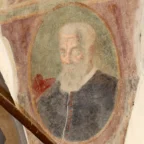
Cardinal Androin de la Roche
Cardinal Androin de la Roche (d. 27 October 1369) was a Burgundian Cluniac monk, abbot, papal diplomat, and cardinal active at the center of European and Italian politics during the Avignon Papacy. His career unfolded across two decisive arenas: the diplomatic management of the Hundred Years' War and the difficult restoration of papal authority in central and northern Italy. Though remembered as an able negotiator in Anglo-French affairs, his Italian legations were more uneven and often controversial.
He first emerged as a major ecclesiastical figure through monastic leadership: he became abbot of Saint-Seine in 1340 and then abbot of Cluny in 1351, one of the most prestigious Benedictine offices in Latin Christendom. From there he moved into curial diplomacy under Pope Innocent VI, who relied on him for high-risk missions requiring both political tact and institutional authority. In 1356 he was sent to the imperial court of Charles IV to seek support for papal peacemaking between France and England and to negotiate fiscal concessions for the papacy in the Empire; the mission had only limited success.
In 1357 Androin was dispatched to Italy in the context of the papacy's struggle to reassert control over territories fragmented by local signori, mercenary warfare, and competing urban powers. His first legation brought him into a tense relationship with Cardinal Egidio Albornoz, whose military and administrative strategy in the Papal States differed from Androin's more conciliatory posture with the Visconti sphere. When he took over command responsibilities in Romagna, his campaign against Francesco Ordelaffi and related operations proved difficult, and his tenure was widely judged disappointing. Nonetheless, he remained in papal service and continued to receive major assignments.
His greatest diplomatic success came in the Anglo-French theater. Beginning in 1360, as one of the papal envoys tasked with mediation, Androin played an important role in negotiations that led to the Treaty of Bretigny between Edward III of England and John II of France. His performance in these talks was sufficiently valued that both crowns supported his promotion, and in 1361 Innocent VI created him cardinal-priest of San Marcello al Corso. Even after his elevation, he continued to work on delicate peace efforts, including negotiations connected to the Breton succession conflict and the treatment of the captive French king.
Under Pope Urban V he returned to Italy for a second long legation (1363-1368), again succeeding Albornoz in key responsibilities. This period saw his negotiated settlement with the Visconti in 1364, criticized by some contemporaries as too favorable to Milan, but also his involvement in stabilizing inter-communal relations, including mediation between Florence and Pisa and coordination among Italian powers against roaming mercenary companies. His years in Italy reveal the structural paradox of Avignon diplomacy: peace agreements were often necessary for immediate stability, yet easily denounced as political concessions in a landscape where papal prestige depended on visible firmness.
Androin died at Viterbo in 1369 and was buried at Cluny, linking the end of his career to the monastic world from which he had risen. Beyond politics, he also left institutional and intellectual traces: in Avignon he endowed a college for Cluniac monks and students of canon law, reflecting his enduring commitment to learned ecclesiastical culture. His historical profile is therefore dual: not a triumphant conqueror like Albornoz, but a transregional church diplomat whose work connected monasteries, courts, and communes in one of the most unstable decades of fourteenth-century Europe.
-
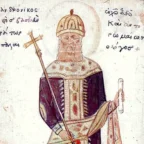
Andronikos II Palaiologos
Andronikos II Palaiologos was born on 25 March 1259 at Nicaea. He was the eldest surviving son of Michael VIII Palaiologos and Theodora Palaiologina, grandniece of John III Doukas Vatatzes. His full name in Byzantine Greek — Andronikos Doukas Angelos Komnenos Palaiologos — encapsulated the genealogical prestige of the dynasty, weaving together the greatest family names of Byzantine imperial history into a single person. He was born at a moment of extraordinary transformation: his father was in the process of recovering Constantinople from the Latin emperors who had held it since 1204, a reconquest that was completed in August 1261 and gave the restored empire its capital back after nearly sixty years of exile.
Andronikos was acclaimed co-emperor in 1261, after his father Michael VIII recovered Constantinople from the Latin Empire, but he was crowned only in 1272. His decade as co-emperor under his father's shadow was formative and, in some respects, tormenting: Michael VIII had struck the most controversial bargain of his reign by entering into union with the Roman Church at the Council of Lyon in 1274, subordinating the Ecumenical Patriarchate of Constantinople to papal authority in exchange for diplomatic protection against a Western crusade. During their joint rule, Andronikos was compelled to support his father's unpopular Church union with the Papacy. The cost to his personal standing among the Orthodox clergy and populace was considerable, and it shaped the religious policy he would pursue from the first day of his independent reign.
Andronikos became sole emperor on 11 December 1282 following the death of Michael VIII, and reigned until 24 May 1328. His first act as independent sovereign was also his most popular: he began his independent rule by reconciling the Church and organising Church affairs, which had been tangled by his father. He allowed all opponents of the union, who had suffered persecution under Michael, to return from exile. Patriarch John Bekkos, who had been most enthusiastic about the Church's union with Rome, voluntarily abdicated and secluded himself in a monastery.
The repudiation of the union of Lyon was received with jubilation by the Orthodox clergy and populace, but it created its own theological complications. The empire had to navigate not only the reconciliation with Rome's loss but also an internal ecclesiastical fracture that long predated the union controversy. Andronikos also faced the Arsenite Schism, caused when Patriarch Arsenios had protested the blinding and imprisonment of John IV Laskaris by Michael VIII and consequently excommunicated Michael. The Arsenites held that John IV was the rightful Byzantine Emperor and that several subsequent Patriarchs were illegitimate. He was unable to fully resolve the related schism within the Orthodox clergy until 1310 — twenty-eight years after his accession — a delay that illustrates the depth of the theological wounds his father had inflicted on the Byzantine Church.
The military and strategic decisions of the early years of Andronikos's reign would prove to be the most consequential and most damaging of his entire tenure. An intellectual and theologian rather than a statesman or soldier, Andronikos weakened Byzantium by reducing its land forces to a few thousand cavalry and infantry and eliminating the navy altogether, relying solely on a Genoese mercenary fleet.
The dissolution of the imperial navy, completed by 1285, was motivated primarily by fiscal crisis — the empire he inherited was burdened by debts accumulated during his father's reconquest of Constantinople and diplomatic campaigns — but its consequences were ruinous. He believed that the empire could rely on the naval power of Venice and Genoa. Instead, this move left the Aegean Sea open to pirates and deprived the empire of its primary defence against maritime invasion. The reduction of the land army was equally drastic. He greatly reduced the native army, making it a very small force. Henceforth, the empire's military capacity depended heavily on mercenaries and allied contingents — a reliance that would prove dangerously volatile.
The most geopolitically devastating consequence of Andronikos's military reductions was the accelerating Ottoman conquest of Byzantine Asia Minor. His lack of military initiative enabled the Ottoman Turks to gain control of nearly all of Anatolia. The Turks continued to penetrate Byzantine possessions, and Bursa fell in 1326. By the end of Andronikos II's reign, much of Bithynia was in the hands of the Ottoman Turks of Osman I and his son and heir Orhan. Other Turkish beylik principalities pressed simultaneously on different sectors of the Anatolian frontier: Karesi conquered the Mysia region after 1296, Germiyan conquered Simav in 1328, Saruhan captured Magnesia in 1313, and the Aydınoğlu captured Smyrna in 1310.
The loss of Anatolia was catastrophic in every sense: economically, it deprived the empire of its most fertile and populous provinces; strategically, it pushed the frontier west of the Bosphorus; demographically, it displaced enormous Greek-speaking communities who had formed the backbone of Byzantine civilisation for centuries. The empire that Andronikos would hand to his successor was, territorially, a shadow of what his father had reclaimed in 1261.
Faced with the Ottoman advance, and lacking the native forces to confront it, Andronikos took a desperate gamble. The Catalan Company arrived at Constantinople in January 1303, where it was received by the Emperor. Andronikos II arranged the wedding of their leader Roger de Flor to his niece, the 15-year-old princess Maria Asanina. Roger de Flor was named Megas Doux, Commander of the Imperial Forces.
The Catalans — a battle-hardened company of Aragonese and Catalan adventurers, veterans of the wars in Sicily — initially achieved real military successes against the Turks in Asia Minor. But the arrangement rapidly unravelled. The Catalans quarrelled with Michael IX, and eventually turned on their Byzantine employers after the murder of Roger de Flor in 1305, devastating Thrace, Macedonia, and Thessaly on their road to Latin Greece, where they conquered the Duchy of Athens and Thebes. When their wages failed to appear, they pillaged their way across the empire, causing widespread destruction and famine. The episode became one of the most traumatic episodes of Andronikos's reign, leaving the heartland of European Byzantium ravaged by the very mercenaries hired to defend it.
The crises on the eastern frontier were compounded by sustained pressure from the north and west. The empire's problems were exploited by Theodore Svetoslav of Bulgaria, who defeated Michael IX and conquered much of northeastern Thrace around 1305–1307. The conflict ended with yet another dynastic marriage, between Michael IX's daughter Theodora and the Bulgarian emperor.
On the western frontier, the rising Kingdom of Serbia under Stefan Milutin pressed relentlessly into Macedonia. Andronikos failed to contain the rising power of Serbia and had to accept the advancement of their border in Macedonia at the expense of Byzantium. Characteristically, the solution was diplomatic rather than military: Andronikos gave his own young daughter Simonis in marriage to the much older Stefan Milutin — a controversial arrangement that drew criticism even in his own time but secured a precarious peace on the Serbian frontier.
Michael IX Palaiologos, Andronikos's son and co-emperor, reigned in full imperial style from 21 May 1294 until his death on 12 October 1320. The co-reign was marked by repeated military failures and personal grief. In 1320, Michael IX's son Andronikos — the future Andronikos III — accidentally caused the death of his brother Manuel in a case of mistaken identity. The homicide and the general dissolute behaviour of Andronikos III and his coterie, mostly young scions of the great aristocratic clans of the empire, resulted in a deep rift in relations between the young Andronikos and his grandfather, still reigning as emperor. Michael IX died in October 1320, broken by grief over his son's death, leaving Andronikos II without his co-emperor and confronted by a rebellious and popular grandson who had become the focus of aristocratic opposition.
In 1310, Andronikos also became estranged from his wife Irene of Montferrat, who withdrew to Thessaloniki and, until her death in 1317, ran it as a virtually independent state.
Emperor Andronikos II disowned his grandson Andronikos, who fled the capital, rallied his supporters in Thrace and launched a civil war that would consume the final seven years of the reign. The conflict drew in Bulgaria — Michael Asen III of Bulgaria attempted to capture Andronikos II under the guise of sending him military support — and devastated whatever remained of Byzantine Thrace, already ravaged by the Catalans two decades earlier.
In 1328, Andronikos III entered Constantinople in triumph and Andronikos II was forced to abdicate. Andronikos III deported Andronikos II to a monastery named Antonios, where he remained until his death. He took monastic vows under the name Antonios, the ultimate retreat available to a defeated Byzantine emperor, and died on 13 February 1332, aged 72. He was buried in the Lips Monastery, now the Fenari Isa Mosque.
The paradox of Andronikos II is acute and historically significant: the reign that presided over the most catastrophic territorial losses in Byzantine history since the Arab conquests simultaneously produced one of the most remarkable flowerings of intellectual and artistic culture in all of Byzantium's eleven centuries. An intellectual and theologian rather than a statesman or soldier — Britannica's blunt summary — this characterisation, though damning in its political implications, points to the genuine reality of a court that was genuinely learned.
Andronikos II is credited with cultural patronage that contributed to what historians call the Palaiologan Renaissance. He supported scholars, theologians, and artists; his court attracted figures such as Theodore Metochites and the historian-astronomer Nikephoros Gregoras.
Theodore Metochites — statesman, philosopher, astronomer, and poet — served as Andronikos's chief minister and mesazōn from around 1305 to 1328. From around 1305 to 1328 he held the position of personal adviser to emperor Andronikos II Palaiologos. In 1312–1313, he began learning astronomy from Manuel Bryennios; later he himself became the teacher of Nikephoros Gregoras. He invested immense personal wealth into what became the supreme monument of the Palaiologan Renaissance: the renovation and decoration of the Chora Monastery. Between 1316 and 1321, Metochites sponsored an extensive rebuilding of the Chora Church. An artist, whose name is not preserved, was called away from a project in Thessaloniki to design Chora's frescoes and mosaics, which emerged as one of the foremost achievements of Palaiologan art. The art historian David Talbot Rice observed that, contemporaneously, Giotto was decorating the Arena Chapel at Padua — the Byzantine painter of Chora had different ideas and a different outlook, but was in his own way equally a great genius.
Maximos Planudes, born around 1260 at Nicomedia, spent the greater part of his life in Constantinople under Michael VIII and Andronikos II, where as a monk he devoted himself to study and teaching. He possessed a knowledge of Latin remarkable at a time when Rome and Italy were regarded with some hostility. His translations of Latin authors into Greek — including Ovid, Caesar, Cicero, and Boethius — and his edition of the Greek Anthology opened Byzantine scholarship to the classical Latin tradition in ways that would eventually feed into the intellectual exchanges preceding the Italian Renaissance.
The reign of Andronikos II saw literary works produced alongside larger themes of intellectual renewal, with key figures including Maximos Planudes, Demetrios Triklinios, Manuel Moschopulos, Thomas Magistros, Theodore Metochites, and Nikephoros Gregoras. These scholars engaged in philological scholarship, textual criticism, translations, higher education, rhetoric, philosophy, historiography, and science.
During Andronikos's reign, the Byzantine Empire declined to the status of a minor state, confined by the Ottoman Turks in Anatolia and the Serbs in the Balkans. Despite the disasters associated with his rule, Andronikos's reign saw a flowering of scholarly activity, art, and architecture. The judgement of history on Andronikos II is therefore irreducibly complex. His fiscal retrenchment — the dissolution of the fleet, the gutting of the land army — accelerated the disintegration of Byzantine Anatolia with consequences that proved irreversible. His diplomatic reflexes, reaching habitually for a dynastic marriage where a military campaign was required, solved immediate problems at the cost of deeper structural weaknesses. Yet the Chora Church mosaics, the philological work of Planudes, the encyclopaedic scholarship of Metochites, and the historiographical achievement of Gregoras all belong to his reign. He was, in the end, an emperor ideally suited to govern a great culture and chronically unsuited to defend a threatened state — and the long twilight of Byzantine history required both.
-
Arena Chapel (Scrovegni Chapel), Padua
The Scrovegni Chapel, known worldwide as the Arena Chapel, is one of the most extraordinary monuments of Western art, a seemingly modest building that houses the most revolutionary fresco cycle of the European Middle Ages, painted by Giotto di Bondone between 1303 and 1305.
The chapel was commissioned by Enrico degli Scrovegni, a wealthy Paduan banker and son of Rinaldo Scrovegni—the infamous usurer whom Dante placed among those violent against God in Inferno (Canto XVII). The act of commissioning a private chapel and endowing it with a sumptuous cycle of paintings was, in all likelihood, a gesture of public redemption: an act of atonement intended to wash away the family's dishonor and secure for the Scrovegnis the perpetual prayers of the neighboring Augustinian monks. In 1300, Enrico purchased the site of the ancient Roman arena in Padua—from which the alternative name "Arena Chapel" derives—and built his noble palace there, with the adjoining chapel dedicated to Santa Maria della Carità. The first consecration took place on 25 March 1303; Pope Benedict XI granted an indulgence to those who visited the chapel on 1 March 1304, and the final consecration was held on 25 March 1305.
The building is architecturally simple: a single rectangular nave covered by a barrel vault, without a transept or ambulatory. This structural simplicity was not a limitation but a strategic choice, as it offered Giotto the maximum continuous surface area for his narrative program. The frescoed surface totals approximately 700 square meters, of which about 180 belong to the vault, painted almost entirely in an intense ultramarine blue dotted with golden stars. The presbytery houses the sculptural group of the Madonna and Child between Two Angels by Giovanni Pisano, created in the early fourteenth century—a masterpiece of Gothic sculpture that engages in an ideal dialogue with Giotto's paintings.
Giotto structured the narrative cycle across three overlapping registers running down the side walls from top to bottom, in a continuous sequence that the visitor follows as if reading a book. The first register recounts the lives of Joachim and Anne, the Virgin's parents; the second opens with the life of Mary and continues with the ministry of Christ; the third narrates the Passion. The Annunciation stands on the large triumphal arch, a foundational scene referring to the chapel's dedication to the Virgin of the Annunciation. On the counter-façade—the entrance wall, opposite the altar—stretches the majestic Last Judgment, with Christ in glory at the center and Enrico Scrovegni himself portrayed offering the model of the chapel to the Virgin. In the lower band of the side walls, beneath the three narrative registers, Giotto painted fourteen monochrome allegorical figures—seven Virtues and seven Vices—facing each other symmetrically on the two walls, transforming the entire chapel into a moral journey from damnation to salvation. Their execution in grisaille, simulating sculptural reliefs, revealed an illusionistic awareness already fully mature.
What makes the Scrovegni cycle absolutely unique in the history of medieval art is the profound transformation of the figurative language that Giotto enacts there. Compared to the Byzantine tradition and thirteenth-century painting, Giotto's figures are corporeal, heavy, and rooted in space: they move with a new gravity, drapery follows the volume of the bodies, and faces express recognizable, individualized emotions. In the Lamentation over the Dead Christ—perhaps the most intense scene in the cycle—the anguished angels flying through the sky seem to cry out their pain, and Mary's gesture as she clutches her dead son's face possesses an emotional power unprecedented in medieval art. In the Kiss of Judas, dramatic tension is concentrated in the direct eye contact between Christ and the traitor, surrounded by a chaos of spears and torches that makes the scene suffocating. In the Adoration of the Magi, the comet crossing the blue sky is not merely decorative: Giotto drew inspiration from Halley's Comet, visible in 1301 and observed by him personally, depicting it with astronomical accuracy entirely unprecedented in medieval painting.
The frescoes of the Scrovegni Chapel are universally considered the starting point of the pictorial revolution that would lead, a century and a half later, to the Florentine Renaissance. In 2021, the chapel was declared a UNESCO World Heritage Site as part of the fourteenth-century fresco cycles of Padua.
-
Arianism
Arianism was the greatest doctrinal crisis in the history of early Christianity, a controversy that for nearly two centuries shook to its foundations not only the Church but the entire political structure of the Roman Empire. At the heart of the dispute lay a question that was seemingly technical but had cosmic consequences: Was Christ truly God, of the same substance as the Father, or was he a creature - albeit a most sublime one - generated by the divine will in time?
Arius was born in Libya around 256 and was educated in Antioch at the theological school of Lucian of Antioch, who had already developed a subordinational view of the Trinity - that is, a view in which the Son occupied a lower rank than the Father. Having become a presbyter in Alexandria, Egypt, and placed at the head of the church of Baukalis, Arius began around 318 to openly preach his doctrine: only the Father is the unbegotten and eternal God; the Son was created by the will of the Father, exists from the moment the Father willed him, and therefore - to use the most famous formula attributed to Arius - "there was a time when the Son was not" (ên pote hote ouk ên). The Son was the Logos, the Word, the firstborn of all creation, but he was a creature, and not God in the full sense.
The bishop of Alexandria, Alexander, reacted harshly. He immediately recognized that Arius's doctrine undermined the very foundation of the Christian faith: if Christ was not true God, the Incarnation lost its salvific meaning, because only a God made man could redeem humanity. In 318, Alexander convened a synod of about one hundred African bishops, which condemned Arius's positions. But Arius was not alone: he could count on an influential network of supporters among the Eastern clergy, among whom stood out Eusebius of Caesarea - the great Church historian - and Eusebius of Nicomedia, who enjoyed enormous prestige at the imperial court of Constantine. The dispute quickly spread until it became a scandal that swept across the entire East, and Emperor Constantine, who had just unified the empire and hoped for Christianity to serve as a unifying force, found himself facing a potentially destabilizing religious schism.
To put an end to the controversy, Constantine convened in 325 the first ecumenical council in Christian history, held at Nicaea in Bithynia. It was an unprecedented event: some three hundred bishops from across the empire gathered under imperial presidency to decide the faith of the universal Church. The central point of the debate was the Greek term homousios - "of the same substance" - proposed by the proponents of orthodoxy to define the relationship between the Father and the Son: not similar, not of analogous substance, but of the very same substance. Arius and his supporters categorically rejected the term, which did not appear in Scripture and seemed to them a dangerous Greek philosophical innovation. In the end, the council approved the homoousios and formulated the first Nicene Creed; Arius was condemned and sent into exile in Illyria, his writings burned.
The condemnation at Nicaea did not put an end to the heresy - indeed, for decades it seemed almost to produce the opposite effect. Constantine himself, toward the end of his life, drew closer to the Arian faction and recalled Arius from exile, although Arius died before being formally reinstated (336). Under Constantine's son, Constantius II, who remained the sole emperor from 350 onward, the tide turned radically: Constantius was personally convinced of Arianism and used the full weight of imperial authority to impose a compromise formula that avoided the term homousios. Orthodox bishops were exiled en masse; Athanasius of Alexandria, the great champion of the Nicene Creed, was sent into exile no fewer than five times. It was in this climate that Saint Hilary of Poitiers wrote bitterly that "the whole Church has become Arian."
The figure of Athanasius of Alexandria (c. 296-373) is inseparable from the history of Arianism: for forty years as bishop, he was the indestructible linchpin of Orthodox resistance, often standing alone against the full might of the empire. The motto Athanasius contra mundum - "Athanasius against the world" - effectively encapsulates this heroic solitude. Through theological works, pastoral letters, and his own physical perseverance, Athanasius kept the Nicene creed alive during the darkest decades, training the theologians who would later bring the controversy to its resolution. Among them were the Cappadocians - Basil of Caesarea, Gregory of Nazianzus, and Gregory of Nyssa - who formulated the definitive doctrine of the Trinity: one substance, three hypostases, clarifying the relationship between unity and distinction within the Trinity.
The definitive turning point came with Emperor Theodosius I. In 380 he promulgated the Edict of Thessalonica, declaring Nicene Christianity the official religion of the Roman Empire and criminalizing all forms of heresy. In 381 he convened the Second Ecumenical Council in Constantinople, which solemnly confirmed the Nicene Creed in the expanded form still recited today in the Catholic liturgy, and declared Arianism definitively condemned. Theodosius followed the council's condemnation with a series of edicts that prohibited Arian worship gatherings, deposed heretical bishops and priests, imposed heavy fines, and barred Arians from honorable professions.
Paradoxically, just as it was being suppressed in the Roman Empire, Arianism found new life among the Germanic peoples. The Gothic bishop Wulfila, in the 4th century, had evangelized the Goths by translating the Bible into the Gothic language and transmitting the Arian creed to them. Through the Goths, Arianism then spread among the Vandals, Burgundians, Lombards, and Ostrogoths. The Ostrogothic king Theodoric, who ruled Italy from the late 5th century, was an Arian, and in Ravenna he had the famous Arian Baptistery built, which can still be visited today, an architectural testament to this persistence. The coexistence of Arian Germanic rulers and Roman Catholic populations created lasting political and religious tensions; it was only in the 6th and 7th centuries that the Germanic kingdoms gradually converted to Nicene Catholicism, marking the historical end of Arianism as an organized political force.
The Arian controversy was much more than an abstract theological dispute: it forced the Church to develop a precise philosophical language to articulate the mystery of the Trinity, gave rise to the practice of ecumenical councils as an instrument of governance for the universal faith, and inextricably intertwined ecclesiastical and imperial politics in a way that would shape relations between the papacy and secular power for centuries to come. Its legacy lives on in the precision of the Nicene-Constantinopolitan Creed, which billions of Christians recite every Sunday without knowing that every word was forged in the fire of this extraordinary battle.
-
Ariberto da Intimiano, Archbishop of Milan
Ariberto da Intimiano is one of the most commanding figures in the ecclesiastical history of medieval Milan — a prelate of enormous political energy, theological resolve, and artistic vision who shaped the city's identity for the entire first half of the eleventh century. Born between 970 and 980 in Intimiano, a small locality near Cantù in Brianza, from a noble Lombard family of the capitanei, he rose to become the most prominent member of the Milanese clergy. On 28 March 1018, with the endorsement of Emperor Henry II and the city's great nobles, he was consecrated Archbishop of Milan, succeeding Arnulf II.
When Conrad II of Germany came to claim the Italian crown, Ariberto traveled to Konstanz in June 1025 to pay homage. On 26 March 1026 he personally placed the Iron Crown of Lombardy on Conrad's head at Milan. In 1028, having learned of a community holding dualist, proto-Cathar beliefs at the castle of Monforte d'Alba, he ordered the castle seized and had those who refused to abjure their beliefs burned at the stake — one of the earliest recorded episodes of organized repression of dualist heresy in northern Italy.
Ariberto's alliance with the imperial court eventually fractured. After defending the rights of his capitanei vassals against the lesser valvassori, he came into open conflict with Henry III. In defiance of his deposition, he raised the Carroccio, a great ox-drawn war-wagon bearing the civic banner and a crucifix, as the rallying symbol of Milan's resistance — an invention that spread rapidly across Lombard and Tuscan cities and became the defining emblem of the communal movement. He died in Milan on 16 January 1045.
As a patron of art, Ariberto commissioned the fresco cycle of San Vincenzo a Galliano (completed by 1007), the Evangeliario cover for Milan Cathedral (1018–1024), and the celebrated Croce di Ariberto (c. 1037–1039), now in the Museo del Duomo. His corpus of patronage places him among the most significant art commissioners in the pre-Romanesque and early Romanesque Lombard world.
-
Arnau Mir de Tost
Arnau Mir de Tost (c. 1000 – after 1072) was a Catalan nobleman from the County of Urgell, Lord of Llordà and Viscount of Àger, and a key figure in the Reconquista of the eleventh century. Born around 1000 in Tost, in Alto Urgell, he was orphaned at a young age and taken in by the court of Count Ermengol II. In 1031 he married Arsenda, with whom he purchased the rights to Llordà Castle. From Llordà he conquered the Conca Dellà, pushing the frontier of Urgell as far as Montsec, and in 1034 successfully stormed the alcazaba of Àger, a key point in the Andalusian defensive system (the Tagr); he definitively reconquered Àger in 1047, becoming viscount. At the height of his power he controlled over thirty castles and agricultural settlements. He also served the Count of Barcelona, Ramon Berenguer I, in the conquest of Camarasa and Cubells, and supported the Barbastro Crusade of 1064. Following the death of Ermengol III in 1066 while defending Barbastro, Arnau assumed the regency of Urgell for the young Ermengol IV. He managed a primitive chancellery, introduced the convenientia (contractual agreement) into western Catalonia, and negotiated successfully with the Holy See. He founded and fortified the collegiate church of Sant Pere d'Àger. His will of 1072 mentions ninety-six chess pieces of rock crystal in an abstract Islamic style — the oldest known in Europe — inherited from Arsenda in 1068, a testament to cross-border cultural exchange.
-
Arnolfo II, Archbishop of Milan
Arnolfo II was born into the noble Lombard family of the Arsagos, a distinguished lineage originating from the area north of Milan, near the Ticino River. He was appointed Archbishop of Milan in 998, succeeding Landolfo II of Carcano, and presided over the see for twenty years until his death in 1018. As archbishop, he held a position of immense prestige — Milan was the principal metropolitan see of northern Italy — and was consequently involved in the highest circles of imperial diplomacy.
In 1001, the Holy Roman Emperor Otto III entrusted Arnulf II with a diplomatic journey to Byzantium to negotiate the marriage of a Byzantine princess to the emperor. While returning to Rome, he received news of Otto III's sudden death in January 1002, which rendered the betrothal mission futile and plunged the empire into a succession crisis. Arnulf II then firmly sided with Henry of Saxony — the future Henry II — against Arduino of Ivrea, the Italian magnate who had been crowned King of Italy in Pavia. After Henry prevailed, Arnulf II traveled personally to Pavia to crown Henry as the new King of Italy on May 15, 1004. Arnulf II died in Milan on February 25, 1018, succeeded by Ariberto da Intimiano.
-
Artau I, Count of Pallars Sobirà
Artau I (Latin: Artallus or Artaldus; Catalan: Artau; d. 1081 or 1082) was Count of Pallars Sobirà from 1049 until his death, the second son of Count William II of Pallars Sobirà and Stephanie, daughter of Ermengol I of Urgell. He succeeded his older brother Bernard II, who died without heirs in 1049. Before September 1050 he married Constance, with whom he had Artau II (his heir), Ot (future Bishop of Urgell), and William. His reign was dominated by conflicts with his cousin Raymond IV of Pallars Jussà over control of castles and lands along the Noguera Pallaresa; to strengthen his defensive and offensive capacity he built the fortresses of Montcortés, Peramea, Bresca, and Baén. He also had tensions with Ermengol III of Urgell and Arnau Mir de Tost, resolved through agreements regarding Salás, Llimiana, and Mur between 1052 and 1054. As a patron of the monastery of Santa Maria de Gerri he made donations in 1050, 1059, 1068, and 1070, in which year he also founded the sacristy of Gerri with Abbot Arnau. He died between 1081 and 1082; Artau II assumed the title as early as 1080 and co-ruled with his mother Lucía until approximately 1115.
-
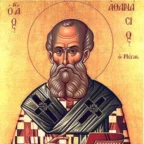
Athanasius the Great (c. 296–373)
Athanasius I of Alexandria (c. 296–298 – 2 May 373), also called Athanasius the Great, Athanasius the Confessor, or, among Coptic Christians, Athanasius the Apostolic, was a Christian theologian and the 20th Patriarch of Alexandria. His intermittent episcopacy spanned 45 years (c. 8 June 328 – 2 May 373), of which over 17 encompassed five exiles, when he was replaced on the order of four different Roman emperors.
He was born in Alexandria — the greatest intellectual city of the ancient world, a metropolis of perhaps half a million inhabitants where Greek philosophy, Jewish scripture, Egyptian religion, and the nascent Christian tradition met in perpetual creative and violent collision. Alexandria was the city of the Museum and the Library, of Philo and Clement and Origen, of the most sophisticated theological tradition in early Christianity; it was also a city of sectarian violence, imperial politics, and the particular intensity that characterizes communities living at the permanent intersection of mutually incompatible worldviews. Athanasius was formed by all of it. Of his family virtually nothing is known. The early sources — most importantly, the account that Gregory the Theologian gives in his celebrated Funeral Oration on Athanasius, delivered in Constantinople around 379–380 — are silent on his parentage. One ancient tradition preserves a story of his boyhood that, whether legendary or historical, captures something essential: the child Athanasius was seen by Bishop Alexander of Alexandria playing a game of baptism with other children on the seashore, performing the rite with such precision and reverence that the bishop summoned him, questioned him, and immediately recognized a vocation that could not be wasted. Deeply impressed by the boy's knowledge and devotion, the bishop recognized his potential for leadership within the Church, later mentoring him and introducing him to ecclesiastical affairs.
Bishop Alexander ordained Athanasius a deacon in 319. The relationship between the bishop and his deacon was one of the formative master-student bonds in the history of the Church: Alexander, the elderly patriarch whose theological reflexes had been sharpened by decades of Alexandrian controversy, and Athanasius, the young deacon of exceptional intelligence and tenacity, learning the art of episcopal governance while simultaneously absorbing the theological arguments that would occupy his entire career. When Arius — a popular presbyter of Alexandria, learned and personally ascetic — began teaching around 319 that the Son of God was a creature, produced by the Father before time but not coeternal with Him, not of the same substance but of a different substance, Athanasius was at Alexander's side as the controversy escalated from a local Alexandrian dispute into the defining crisis of the fourth-century Church. In 325, Athanasius served as Alexander's secretary at the First Council of Nicaea. The most recent scholarship has moderated the tradition, amplified by Gregory the Theologian's panegyric, of Athanasius as a leading actor at Nicaea: it is very unlikely that he took an active part in the council's deliberations. He was a young priest, and none of the reports composed by those in attendance assign Athanasius any role. But he was present — listening, watching, absorbing — as the assembled bishops of the Christian world decided, under Constantine's presidency, that the Son was homoousios — of one substance — with the Father. He understood, from that moment, that the battle was not primarily over a technical theological formula but over the entire shape of the Christian salvation: if the Son is not truly God, He cannot truly save; if the Mediator is merely a creature, however exalted, then the gap between the human and the divine remains unbridged.
Before or shortly after Nicaea, Athanasius composed the work that established his place in the history of Christian thought independently of the controversies that would dominate his episcopal career: the two-part treatise Against the Heathen and On the Incarnation (De Incarnatione Verbi Dei). The argument of On the Incarnation is deceptively simple in its structure and inexhaustible in its implications. God the Word — the divine Logos through whom the Father created the universe — took on human flesh and became the man Jesus Christ for one encompassing reason: to restore to humanity the image of God in which it had been created but which it had defaced through sin. The Incarnation is an act of re-creation: as God had originally created humanity by breathing His image into Adam, so He re-creates fallen humanity by taking that humanity into Himself. The treatise contains one of the most celebrated formulations in the entire patristic tradition: the axiom that "God became human so that human beings might become God" (αὐτὸς γὰρ ἐνηνθρώπησεν, ἵνα ἡμεῖς θεοποιηθῶμεν). This is the doctrine of theosis — the participation of the human person in the divine nature — stated with maximum compression and maximum ambition. Gregory the Theologian would elaborate this theology in the Theological Orations; Gregory of Nyssa would pursue it into the mystical ascent of the soul; Palamas would articulate it in terms of the distinction between divine essence and divine energies. All of them stand on the foundation that Athanasius laid in Alexandria at the beginning of his career.
Five months after the Council of Nicaea, Alexander died. Already a recognized theologian and ascetic, Athanasius was the obvious choice to replace his ageing mentor as Pope of Alexandria. He was elected bishop in June 328, at the age of approximately thirty — below the canonical minimum age and immediately contested by the remaining Arian and Meletian factions. During his first years as bishop, Athanasius visited the churches of his territory, which at that time included all of Egypt and Libya, and established contacts with the hermits and monks of the desert, including Pachomius. He recognized in the Egyptian desert fathers — who were proliferating at extraordinary speed in the decades after Anthony's withdrawal — a reservoir of spiritual authority and popular loyalty that no imperial court manipulation could easily reach. The monks of the Thebaid and Nitria would prove, through the decades of conflict, his most reliable supporters.
The story of Athanasius's episcopate is the story of five exiles imposed by four emperors across the full span of his forty-five years as bishop. The accumulating weight of those exiles produced the phrase that has summarized his career ever since: Athanasius contra mundum — Athanasius against the world. The first exile (335–337) followed his condemnation at the Council of Tyre, secured by the Eusebian faction through a series of charges he consistently and convincingly denied; he was banished to Trier by Constantine I and returned only on the emperor's death in 337. The second exile (340–346) came when Constantius II renewed anti-Athanasian policy: Athanasius fled to Rome, where he spent three years under the protection of Pope Julius I. From exile he continued to send his annual Festal Letters — composed every year to announce the date of Easter and to exhort the faithful — one of the most remarkable documents in the history of pastoral care: a bishop in hiding maintaining his sacramental relationship with his people across the distance imposed by imperial power. The Easter Letter of 367 contains the first extant canonical list to name precisely the twenty-seven books of the New Testament as we receive them today.
The third exile (356–361) was the most dramatic and the longest. On the night of 8 February 356, while Athanasius was presiding at a service in the Church of St. Thomas in Alexandria, imperial troops broke down the doors to arrest him. He escaped in the confusion and disappeared into the Egyptian desert, where he remained for the better part of five years, moving between communities of monks, hidden and protected by the network of loyalty he had spent years cultivating. From this hiding place he continued to write: the Apology for His Flight, the History of the Arians, and his Letters to Serapion on the divinity of the Holy Spirit — affirming against the Pneumatomachians that the Spirit is equally divine with the Father and the Son. By 355, there was not a bishop who had not subscribed to the deposition of Athanasius and the virtual repudiation of the Nicene Creed: truly the situation was Athanasius contra mundum. A fourth exile followed briefly under Julian the Apostate (362), who discovered that Athanasius was using his return to make converts and exiled him again; but Julian's death in 363 allowed his return, and the Council of Alexandria 362 — which Athanasius convened before his expulsion — laid crucial ecumenical ground for the Cappadocian synthesis that Gregory the Theologian would complete at Constantinople in 381. A fifth and final brief exile under the Arian emperor Valens (365–366) ended when popular loyalty in Alexandria made the expulsion politically impracticable.
Among the lasting contributions of the third exile in the Egyptian desert was Athanasius's composition of the Vita Antonii — the Life of Antony — the biography of the hermit Anthony the Great who had died in 356 after approximately eighty-five years in the Egyptian desert. The Vita Antonii is one of the most influential books ever written in the Christian tradition. It created a literary genre — the saint's life, shaped by the conventions of classical biography but inflected by the specific demands of hagiography — and it exported the idea of Egyptian desert monasticism to communities that had never encountered it. When Jerome translated the work into Latin before 376, the text entered the consciousness of the Latin-speaking West with immediate and permanent effect. Augustine of Hippo, in the Confessions, describes the moment when two imperial functionaries at Trier heard the story of Antony and were moved to immediate conversion to the monastic life — a moment that became a hinge event in his own spiritual journey. For Byzantine art history, Anthony became one of the most frequently depicted figures in Byzantine and post-Byzantine icon painting — the patriarch of the desert fathers, the exemplar of solitary prayer, the warrior against demons. His image in Byzantine fresco programmes, typically depicted in monastic habit holding a scroll inscribed with a saying from the desert tradition, appears in the church programmes studied by Pelekanidis at Kastoria and Papazotos at Veria: a chain of transmission from the Egyptian desert of the fourth century to the painted walls of medieval Macedonia.
The theological contribution of Athanasius to the later Byzantine defence of sacred images was structural rather than direct: he did not write about icons, but his theology of the Incarnation provided the doctrinal premise without which the defence of icons mounted by John of Damascus in the eighth century and by the Second Council of Nicaea in 787 would have been impossible. Athanasius had insisted that Christ is homoousios — of one substance — with the Father: truly divine, not a lesser being or a created intermediary. He had also insisted that Christ truly took on human flesh: the Incarnation is real, not apparent. The conjunction of these two insistences — full divinity and full humanity united in one Person — provides the logical foundation for icon theology. If Christ is truly human, His human form is genuinely visible and genuinely depictable. If that human form is also, in the Person who bears it, truly divine, then to depict Christ's human form is to make the divine accessible to the human eye. The icon is not the depiction of a creature, as Arian theology would have implied; it is the depiction of the humanized God, which is precisely what the Incarnation achieved. Theodore of Studion and the Patriarch Nikephoros I, the great defenders of icons after the second wave of iconoclasm, made this argument explicitly: the icon of Christ presupposes and expresses the Nicene Christology that Athanasius had defended through forty-five years of exile, controversy, and perseverance.
Athanasius died in Alexandria on 2 May 373, having occupied his see for forty-five years — a tenure interrupted, but never ended, by the collective weight of imperial authority directed against him. Gregory the Theologian, who composed the most celebrated tribute to Athanasius — Oration 21, delivered in Constantinople around 379–380 — gave him a formal designation that became the standard assessment of the man and his significance. The Second Ecumenical Council of Constantinople in 381, which confirmed the Nicene faith under Gregory's presidency and encoded it in the Nicene-Constantinopolitan Creed still recited at every Eucharist in both East and West, was the vindication of the position that Athanasius had maintained, alone among the bishops of the world, through the darkest decade of the 350s. He did not live to attend it, dying in 373. But the creed that the Council produced is his monument — more enduring than any stone, and more widely distributed than any fresco or manuscript.
-
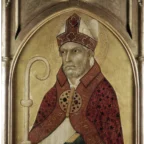
Augustine of Hippo
Aurelius Augustinus Hipponensis - known to history as Augustine of Hippo - stands as one of the most towering intellectual figures in the entire Western tradition. Born on November 13, 354, in Thagaste (modern-day Souk Ahras, Algeria), he rose from modest provincial origins to become Bishop of Hippo Regius, a prolific author, and arguably the most significant Christian thinker after St. Paul. His life bridged the classical Roman world and the emerging Christian civilization of the Middle Ages, and his ideas on grace, free will, original sin, and the nature of time and history shaped Catholic theology for over a millennium.
Augustine was born into a mixed household in the Roman province of Numidia. His mother Monica was a devout and deeply committed Christian, while his father Patricius was a pagan who converted to Christianity only on his deathbed. Scholars believe Augustine's ancestry blended Berber, Latin, and Phoenician roots, and he considered himself Punic - an identification with the deep North African cultural heritage of the region. His family name, Aurelius, suggests descent from freedmen granted full Roman citizenship under the Edict of Caracalla in 212 CE, meaning that legally, his family had been Roman for at least a century before his birth.
Augustine's parents, ambitious for their gifted son, invested heavily in his education despite their modest means. At age eleven he was sent to school at Madaurus, a Numidian town about 19 miles south of Thagaste, where he absorbed Latin rhetoric and literature. He later studied in Carthage, the great metropolitan center of Roman Africa, where he sharpened his rhetorical skills - and also, by his own later admission, pursued a restless, pleasure-seeking youth. He took a concubine (whose name he never recorded in his writings) and fathered a son, Adeodatus - whose name means "given by God" - a relationship he maintained for over a decade.
Although raised as a Christian catechumen, Augustine abandoned the faith of his mother during his student years and joined the Manichaean sect, a dualist religion of Persian origin that explained evil as a cosmic force in perpetual battle with the good. He remained a Manichaean adherent for roughly nine years, drawn by its intellectual pretensions and its seemingly rational explanation for the problem of evil - a question that would obsess him for his entire life. Monica, in anguish, reportedly received a vision reassuring her that her son would one day return to the faith; she never gave up her prayers or her presence near him.
Augustine's career as a rhetorician took him progressively further from home: first to Rome, and then to the imperial capital of Milan, where he secured a prestigious post as professor of rhetoric. In Milan he came under the influence of Bishop Ambrose, whose allegorical method of interpreting Scripture dismantled Augustine's objections to Christian teaching. The final, decisive moment came in the summer of 386 in a garden in Milan, when Augustine heard what seemed to him a child's voice chanting tolle, lege - "take up and read". He opened Paul's letter to the Romans and was immediately struck by a passage calling him to "put on Christ." He was baptized by Ambrose at the Easter Vigil of 387, at the age of 32 or 33.
After his conversion Augustine returned to North Africa, where he sold his property and established a small monastic community in Thagaste dedicated to prayer and contemplation. In 391, while visiting Hippo Regius - a port city roughly 50 miles from Thagaste - he was unexpectedly acclaimed by the local Christian congregation, who demanded he be ordained a priest. He joined the bishop Valerius, whom he succeeded as full Bishop of Hippo around 395-396, a position he would hold for the remaining thirty-five years of his life.
As bishop, Augustine was ceaselessly active. He traveled to church councils across North Africa forty to fifty times, made the nine-day journey to Carthage for episcopal meetings about thirty times, and simultaneously sustained one of the most extraordinary literary outputs in the ancient world. He wrote over 200 books and nearly 1,000 sermons, letters, and other works - more than five million words survive.
Two works above all others define Augustine's legacy. The Confessions (c. 397-400) is a stunning spiritual autobiography addressed directly to God, tracing his restless wandering through philosophy and sensuality toward Christian faith; it is widely considered the first great autobiography in Western literature. The City of God (De Civitate Dei, c. 413-426) was written in the aftermath of the Visigothic sack of Rome in 410 and offers a sweeping theological philosophy of history, contrasting the earthly city - built on the love of self - with the heavenly city built on the love of God. Both works remained foundational texts throughout the medieval period and were among the most copied and illuminated manuscripts in monastic scriptoria across Europe.
Augustine's episcopate was defined by three great controversies. Against the Manichaeans, he used his insider knowledge of the sect to dismantle its cosmology. Against the Donatists - a rigorist North African sect that refused to accept sacraments from clergy who had lapsed under persecution - he argued for the objective validity of sacraments regardless of the minister's moral state, a position that became Catholic orthodoxy. Most consequentially, his battle against Pelagianism - the teaching of the British monk Pelagius that humans could achieve salvation through their own free will - led Augustine to develop his profound and influential doctrine of grace: that human beings are entirely dependent on God's unmerited gift of grace for salvation, and that without it the will is in bondage to sin.
In 429, the Germanic Vandals crossed from Spain into North Africa, and by 430 they were besieging Hippo itself. Augustine fell gravely ill during the siege and, according to his biographer Possidius, spent his final days in bed praying the Penitential Psalms, which he had written out on the walls of his room. He died on August 28, 430 - a date still celebrated as his feast day in both Catholic and Protestant traditions. His remains were later transferred to Sardinia and ultimately to Pavia in northern Italy, where they now rest in the magnificent Arca di Sant'Agostino within the Basilica of San Pietro in Ciel d'Oro.
Augustine was recognized as a Doctor of the Church in 1298 by Pope Boniface VIII. His thought permeated the entire medieval intellectual tradition - from Anselm of Canterbury to Thomas Aquinas, from Franciscan theologians to the great Scholastics of the thirteenth century. His influence extended powerfully into the Reformation: both Martin Luther and John Calvin drew heavily on his doctrine of grace and predestination. In art, he became one of the most depicted of the Latin Fathers, shown in bishop's vestments, often holding a flaming heart (symbolizing his burning love for God) or a pen - a tradition visible in countless illuminated manuscripts, altarpieces, and frescoes from the twelfth century onward.
-
Augustinian Order
The Augustinian Order takes its name, its rule, and its intellectual character from one of the towering figures of Western civilization: Aurelius Augustinus Hipponensis, born in Thagaste, North Africa in 354 and died as bishop of Hippo Regius in 430, as the Vandals besieged the city. Augustine's spiritual biography — from Manichaean youth to pagan rhetor to Christian convert under the influence of Saint Ambrose of Milan, narrated with unprecedented psychological intimacy in the Confessiones — became one of the most widely read texts of the entire Middle Ages. His theological output, above all the De Trinitate, the De Civitate Dei, and the anti-Pelagian treatises on grace and free will, shaped the doctrinal landscape of Latin Christianity so pervasively that no subsequent medieval thinker — whether Franciscan, Dominican, or Augustinian friar — could avoid engaging with his legacy.
Central to the life of any Augustinian religious community is the Regula Sancti Augustini — the Rule of Saint Augustine — a short but foundational text that Augustine composed for communities of consecrated men and women under his pastoral care. The Order was founded by bringing together several eremitical groups in the Tuscany region who were following the Rule of Saint Augustine, written by Augustine of Hippo in the fifth century. The Rule's central axiom — Anima una et cor unum in Deum, "one mind and one heart intent upon God" — became the motto of the Order and its guiding principle of communal life, balancing contemplative interiority with active apostolic engagement.
The formal Order of Hermits of Saint Augustine that emerged in 1256 was the institutional crystallization of a scattered, older eremitical movement. Across central Italy — especially in Tuscany, Umbria, and the Marches — various communities of hermits had coalesced across the twelfth and early thirteenth centuries, each with its own rule, its own local patron, and its own spiritual identity, but sharing a common attraction to the contemplative life and, increasingly, to the Augustinian Rule.
The principal predecessor congregations were several. The Tuscan Hermits were united by papal directive with several other groups: the Williamites, who were followers of William of Malavalle (d. 1157); the Gianboniti, followers of Blessed John Bono (d. 1249); the hermits of Monte Favale; and the hermits of Brettino. The Williamites and the Bonites had relatively clear origins, while the origins of the Tuscan Hermits, the Brettini, and the Hermits of Monte Favale are more obscure.
These communities shared not only a rule but a characteristic landscape: numerous Augustinian settlements were erected on hills or mountains, including the hermitages on Monte Maggiore and Monte Cimino. Despite their relatively inaccessible locations, these convents occupied a liminal position between the wilderness and the civilised landscape. The eremitical vocation — withdrawal from the world, contemplative silence, manual labor in wild terrain — was the deep spiritual substrate from which the Order would grow, even as it later moved into the cities.
The political and ecclesiastical context for the Order's formal foundation was the papacy's deliberate strategy of expanding mendicant influence as a counterweight to the established power of the Franciscans and Dominicans. The Augustinians owed their formal existence to the policy of Popes Innocent IV (1241–1254) and Alexander IV (1254–1261), who wished to counterbalance the influence of the powerful Franciscans and Dominicans by means of a similar order under more direct papal authority and devoted to papal interests.
In 1244 in Italy, several communities of hermits living in the region of Tuscany came together to ask Pope Innocent IV that they be united under one common Rule of life and one Superior General. The Pope gave them the Rule of Saint Augustine and asked representatives of each of their houses, gathered in chapter, to elect a Prior General who would be the sign and principal promoter of their desired unity.
The definitive union came twelve years later. Pope Alexander IV — admonished, it was said, by an appearance of Saint Augustine himself — called a general assembly of the members of the new united order under the presidency of Cardinal Richard of Saint Angeli at the monastery of Santa Maria del Popolo in Rome in March 1256. The head of the John-Bonites, Lanfranc Septala of Milan, was chosen general prior of the united orders. Alexander's bull Licet ecclesiae catholicae confirmed this choice. The new order was thus finally constituted with Italian, Hungarian, French, English, Belgian, Spanish, Portuguese, Swiss, Austrian, and German Augustinian friars united into one international order.
Although the Williamites subsequently withdrew from the union, as did the hermits of Monte Favale, most of the Williamite houses in Germany and Hungary passed to the Augustinian Order. Within a century of the Grand Union, the Order's ranks swelled to 8,000 friars, demonstrating the profound impact of this consolidation.
The Magna Unio transformed a loose federation of hermitages into a disciplined mendicant order modeled on the institutional frameworks already proven by the Dominicans and Franciscans. Members of the Order are known as friars; they are governed by an elected prior-general, who resides in Rome, and are organized throughout the world into regions called provinces, each governed by an elected prior-provincial.
The strong eremitical emphasis which characterized the early groups gradually began to give way to a mixed life of contemplation and pastoral ministry as the Church called the Order to form part of the Mendicant Movement and engage in the work of preaching, theological education, and care of souls in growing urban centers. This tension between the contemplative and active vocations — between the desert and the city — was never fully resolved and remained a creative fault line throughout the Order's history, generating repeated cycles of reform and renewal.
Early in the Order's history, groups of women religious were aggregated to the Order as well, and many lay men and women shared the Order's spirituality and liturgical customs as members of Augustinian lay fraternities. The Order thus quickly became not simply a community of friars but a broad spiritual family encompassing cloistered nuns, canonesses regular, tertiaries, and confraternities — a structure that vastly extended its social reach.
The first assembly of the Augustinian Order, the Magna Unio of 1 March 1256, took place in the convent of Santa Maria del Popolo in Rome. This church consequently became not only the point of origin but also one of the first major intellectual and spiritual centers of the new institution. Santa Maria del Popolo is an Augustinian church located in Rome, in Augustinian care since 1250 AD, and the first Augustinian house in Rome. The Church of Santa Maria del Popolo in Rome is the birthplace of the Order of Saint Augustine.
Situated at the northern entrance to Rome along the Via Flaminia, the church occupied a strategically and symbolically vital position — the first major sacred building encountered by pilgrims and travelers arriving from northern Europe. During the fifteenth century, the friary of Santa Maria del Popolo became part of the observant reform movement in an effort to restore the purity of monastic life. In 1449, the general chapter of the Augustinian observants established five separate congregations for observant friars in Italy. In 1472, Pope Sixtus IV gave the friary to the Lombard Congregation, the largest and most influential Augustinian branch, making it their Roman headquarters. Under Sixtus IV and the della Rovere family, the church was entirely rebuilt as a Renaissance basilica, eventually housing works by Raphael, Caravaggio, Pinturicchio, Bramante, and Bernini — making it one of the supreme concentrations of art in Rome.
The Augustinian Order rapidly distinguished itself as a major force in the intellectual life of medieval Europe, establishing a studium generale system that placed theological education at the heart of its mission. Its most influential contribution to scholastic thought came through the figure of Giles of Rome (Aegidius Romanus, c. 1243–1316).
Giles of Rome was a Scholastic theologian, philosopher, logician, archbishop, and general and intellectual leader of the Order of the Hermit Friars of Saint Augustine. Giles joined the Augustinian Hermits in about 1257 and in 1260 went to Paris, where he was educated in the house of his order. While in Paris from 1269 to 1272, he probably studied under Saint Thomas Aquinas, whose philosophical doctrines he defended against ecclesiastical condemnation.
The general chapter of Florence decreed that Giles' works — even future ones — should be considered the official doctrine of the Order, to be defended by all Augustinian bachelors and masters. In 1292, at the General Chapter of Rome, he was elected prior general of his Order. He is famed as a logician who produced a commentary on the Organon by Aristotle, and as the author of two important works: De ecclesiastica potestate, a major text of early-fourteenth-century papalism, and De regimine principum, a guidebook for Christian temporal leadership.
The school flourished into the eighteenth century, with the teaching of Augustinian philosophy and theology at Salamanca, Coimbra, Alcalá, Padua, Pisa, Naples, Oxford, Paris, Vienna, Prague, Würzburg, Erfurt, Heidelberg, and other centers of learning.
The fourteenth century produced two further figures of European significance. Thomas of Strasbourg (c. 1275–c. 1357) taught at Strasbourg and obtained his doctorate in theology at the University of Paris, where he became famous as a teacher. In 1345 he was elected general of the Augustinian Order. During his tenure, he promoted religious discipline and revised the constitution of his order. During his generalate, the teachings of William of Ockham were condemned by general chapters of the Augustinians in 1345 and 1348.
His successor, Gregory of Rimini (c. 1300–1358), was an Italian Augustinian friar and one of the great scholastic philosophers and theologians of the Middle Ages. He was the first scholastic writer to unite the Oxonian and Parisian traditions in fourteenth-century philosophy, and his work had a lasting influence in the Late Middle Ages and Reformation. Gregory's brand of doctrinal Augustinianism, influenced rather by the Franciscan and Oxonian tradition than the more Dominican and Parisian variety of Giles of Rome, soon dominated Augustinian Hermits' philosophy and theology. Thus by the early sixteenth century, Aegidistae and Gregoriistae schools of thought existed, and a recognized via Gregorii was present in many universities, including Wittenberg — the university of Gregory's fellow Augustinian Hermit Martin Luther.
By the fourteenth century, the Augustinians were established in most parts of Europe. The spread was rapid and geographically comprehensive. In England, the Earl of Gloucester and Hertford offered Augustinian friars in Normandy land on which to establish their first foundation in England. Clare Priory thus became the first Augustinian foundation in the English-speaking world. Other houses were opened in quick succession. In 1253 they settled in London, where "Austin Friars" was to become the most important house of the Order in England.
Throughout the fourteenth century the Augustinians became closely identified with the communal culture of Italian cities, where their large churches served not only as liturgical spaces but as dynastic funerary chapels, locations for civic ceremony, and centers of devotional confraternity life. The patronage relationships they cultivated with ruling families — as seen so clearly with the Da Carrara in Padova — gave them both political influence and the resources to commission major artistic programs. The Eremitani were a mendicant order born in the mid-thirteenth century, and the church in Padova served as the home of the "fraglia dei fornai" (bakers' confraternity) in the Middle Ages, illustrating the order's deep insertion into the social fabric of urban life.
No chapter in Augustinian history is more dramatic — or more consequential — than the emergence within the Order's own ranks of the figure who would shatter the unity of Western Christianity. Martin Luther, born in Eisleben in 1483, presented himself for admission to the Augustinian order of friars in Erfurt on 17 July 1505. He flourished within the Order's intellectual tradition, teaching biblical studies at Wittenberg, and was deeply shaped by the Gregorian Augustinianism that pervaded the Order's German houses.
Soon after his return to Wittenberg in 1511, Luther received a doctorate in theology and became professor of biblical studies, a post which he held until his death. He also was appointed pastor at the town church and administrator of the Augustinian monasteries throughout Saxony.
Luther's journey to Rome in 1510–1511 brought him to the very heart of Augustinian institutional life. Luther's journey to Rome was part of his efforts to resolve a dispute between the Observant and Conventual branches of the Augustinian Order. Although details of his stay in Rome are scarce, it is believed that Luther may have lodged at Santa Maria del Popolo during his visit, as it was the only Augustinian monastery in Rome at the time. His disillusionment with what he witnessed in Rome deepened his theological radicalization.
Several general chapters in the thirteenth century (1287 and 1290) and toward the end of the sixteenth (1575 and 1580), after the severe crisis occasioned by Martin Luther's reforming initiative, set out to renew the Order from within. The Reformation crisis thus paradoxically strengthened the Order's commitment to internal discipline and theological rigor, contributing to the broader Catholic renewal of the Counter-Reformation.
The spiritual tensions within the Order produced, alongside external crisis, a series of internal reform movements aimed at recovering the eremitical and contemplative ideals of the original communities. The Order of the Augustinian Recollects came into being in the sixteenth century when a group of Augustinian religious discovered among themselves a collective charism by which they sought to live a life of renewed fervour and of new norms at the service of the Church. The Chapter of the Province of Castile celebrated in Toledo, Spain, in the year 1588, determined that in certain houses of the province, this new manner of life would be lived. After more than three centuries of existence, the Recollects were recognized by the Church as an autonomous religious order.
A parallel reform produced the Discalced Augustinians — "barefoot" Augustinians (excalceati) who wore sandals rather than shoes as a sign of radical poverty, forming yet another branch of the expanding Augustinian family.
The sixteenth and seventeenth centuries saw the Augustinians emerge as one of the most dynamic missionary forces in the Church's global expansion. Augustinians ventured throughout Europe, as well as to North and South America, Africa, Japan, Persia, India, and China. Augustinians were among the founding fathers of the first university of the New World, and were the first evangelizers of the Philippine Islands.
The Philippines mission holds a place of particular distinction. In 1571 Augustinians built the first San Agustin Church in Manila, a cornerstone of Spanish-era evangelization. In 1607 the completion of San Agustin Church in Intramuros was achieved, now a UNESCO World Heritage site. In 1991, San Agustin Church and other Augustinian churches — Santa Maria in Vigan, Ilocos Sur; San Agustin in Paoay, Ilocos Norte; and San Nicolas Tolentino in Miag-ao, Iloilo — were inscribed as the "Baroque Churches of the Philippines" in the UNESCO World Heritage List.
The Augustinian missionary model combined evangelization with architecture, education, and the study of indigenous languages. The life of the early missionaries generally revolved around the Rule of Saint Augustine and the Order's Constitutions. They spent much time giving catechism and building churches and convents, and studied the respective languages of the natives as a prerequisite before being assigned to the provinces.
The Order counts among its members a remarkable gallery of historical figures spanning theology, mysticism, science, literature, and politics. Prominent Augustinians throughout history include the only English Pope, Adrian IV; Italian Pope Eugene IV; the mystic Thomas à Kempis; the Dutch Christian humanist Desiderius Erasmus; the German Reformer Martin Luther; the Spanish navigator Andrés de Urdaneta; Italian composer Vittoria Aleotti; the German mystic Anne Catherine Emmerich; and the Austrian geneticist Gregor Mendel.
Thomas à Kempis, the author of the Imitatio Christi — one of the most widely read devotional texts in Christian history — exemplifies the mystical and affective spirituality that complemented the scholastic tradition within the Augustinian family. Gregor Mendel, the nineteenth-century Augustinian friar whose experiments with pea plants at the monastery of St. Thomas in Brno laid the foundations of modern genetics, stands as a monument to the order's tradition of combining intellectual inquiry with the contemplative life.
The Napoleonic era inflicted severe institutional damage on the Augustinians, as on all the religious orders in Europe. Across the French-occupied territories, the suppression decrees of the late eighteenth and early nineteenth centuries shuttered convents, dispersed communities, and secularized conventual buildings. The Augustinian convent in Padova — whose church, the Eremitani, had been one of the jewels of medieval Italy — was dissolved in 1806, its church reopened for secular worship, and its cloister converted into a military barracks. Across Europe, similar scenes were repeated.
Recovery was slow but sustained. Later, the Augustinians expanded into Africa, Asia, and America, within the extensive colonial empires of Portugal and Spain. In addition to preaching and missionary activity, they engaged in many types of ministry, including higher education, writing, and patristic studies. Today the Augustinian family maintains a global presence: the Order operates in 50 countries in Africa, the Americas, Asia, Europe, and Oceania, and as of 2022 counts 2,457 friars, of whom 1,804 are priests. Its headquarters remain in Rome, at the Basilica of Saint Augustine in the Campo Marzio, and the Augustinianum in Rome is supported by the entire order and is esteemed in the scholarly world for the quality of its conferences and publications in the field of patristic studies.
The history of the Augustinian Order is the history of a sustained creative tension: between solitude and community, between contemplation and action, between the eremitical desert of its origins and the urban piazzas where its great churches rose. From the hermitages of Tuscany to the convents of Oxford and Erfurt, from the frescoed chapels of Padova to the baroque churches of Manila, the Augustinians shaped the material, intellectual, and devotional culture of the Western world across eight centuries. For the student of medieval art and religious culture, the Order is indispensable: its churches were among the most ambitious patrons of painting and sculpture in fourteenth-century Italy, its theologians among the most rigorous thinkers of the scholastic age, and its spiritual ideal — anima una et cor unum in Deum — one of the most enduring expressions of the Christian monastic vision.
-
Arte di Calimala
The Arte di Calimala, formally the Guild of Merchants, was the oldest and most prestigious of Florence's seven Major Guilds, documented with certainty from at least 1182. It brought together merchants specialized in the international trade of foreign woolen cloth, especially fabrics imported from Flanders and England, then finished in Florence and redistributed across both western and eastern markets.
The name "Calimala" came from the street where these merchants concentrated their shops, along the ancient Roman urban axis that connected the area of today's Piazza della Repubblica with the Mercato Nuovo. Its etymology remains debated, often linked to Latin callis malus ("difficult" or "unhealthy" passage). Until 1237 the guild operated from a Cavalcanti-family tower overlooking the Mercato Nuovo, then moved to Calimaruzza at the Canto del Diamante, near the junction of Via de' Calzaioli and Via Porta Rossa.
Its economic model was highly specialized: Calimala companies purchased unfinished cloth in northern Europe and at the fairs of Champagne, then applied closely guarded Florentine finishing techniques - including carding, shearing, and dyeing - that greatly increased market value. Agents abroad marked cloth according to place of origin and purchase price, then shipped it in rolled bales known as torselli, the emblematic form that appears in the guild's heraldry with the eagle and cloth roll.
The guild's firms maintained branches and warehouses across Europe and North Africa and traded not only in cloth but also in high-value goods such as coral, pearls, gold, silver, and silk. Membership included leading Florentine mercantile dynasties, among them the Bardi and Peruzzi, whose activities in exchange, credit, and long-distance trade were foundational for early Italian capitalism. Giovanni Villani records that in the triennium 1336-1338, the approximately twenty Calimala outposts imported around 10,000 cloth pieces per year, with a combined value of 360,000 gold florins.
Calimala was also a political institution of first rank within the Florentine Republic. Like the other Major Guilds, it participated directly in urban governance and remained one of the most influential civic powers until the early fourteenth century, when the Arte della Lana progressively overtook it. In 1323 it demonstrated its autonomous military capacity by financing and arming a contingent of two hundred infantry under its own banner in the conflict against Castruccio Castracani. Its broader civic primacy declined only with the Medicean concentration of power in the fifteenth century.
The guild's most enduring legacy is artistic and monumental. From the twelfth century onward, the consuls of Calimala were entrusted with care and patronage of the Baptistery of San Giovanni. The guild financed the competition of 1401 for the Baptistery doors - the contest involving Lorenzo Ghiberti and Filippo Brunelleschi often treated as a symbolic beginning of the Florentine Renaissance - and later supported Ghiberti's great bronze programs, including the doors later called the "Gates of Paradise" (completed 1452). It also commissioned Ghiberti's bronze St. John the Baptist for Orsanmichele (1416) and maintained patronage ties with sites such as San Miniato al Monte and several Florentine hospitals.
The decline of Calimala followed broader transformations in European trade. As the Champagne fairs lost centrality after their late-thirteenth-century peak and northern textile industries became increasingly competitive, the guild's traditional model weakened. A statutory addition of 1348 already lamented that the corporation had been reduced to a small number of merchants. Like all Florentine guilds, it was ultimately suppressed under Grand Duke Pietro Leopoldo and absorbed into the Chamber of Commerce.
-
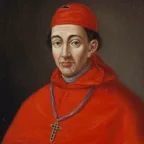
Cardinal Egidio Albornoz
Cardinal Egidio Albornoz (c. 1310-1367), born Gil Alvarez Carrillo de Albornoz in Cuenca in Castile, was one of the most formidable churchmen and statesmen of the fourteenth century: archbishop, cardinal, military commander, papal legate, and principal architect of the recovery of papal temporal power in central Italy during the Avignon Papacy. In a century marked by political fragmentation, mercenary violence, and contested sovereignties, he became the central figure through whom the papacy transformed from an absentee authority into an effective territorial government in much of the Papal States.
He was educated for an ecclesiastical career but first emerged in the world of high aristocratic and military politics in the service of King Alfonso XI of Castile. His dual formation in canon law and warfare proved decisive for everything that followed. In 1338 he was appointed Archbishop of Toledo, the most prestigious see in Castile and one of the richest ecclesiastical offices in Iberia. In this role he operated simultaneously as prelate, royal counselor, and political broker in a monarchy deeply entangled with frontier war and noble competition.
Albornoz's early reputation was forged in the long struggle between Christian and Muslim powers in the Iberian Peninsula. Sources connect him to major military campaigns of Alfonso XI, including operations in Andalusia and the wider context of the Castilian victories that culminated in the Battle of Rio Salado (1340). Whether at court or in campaign, he gained the reputation of an unusually energetic and disciplined commander among high clergy, a profile that would later make him indispensable to the Avignon popes, who required not only theologians and diplomats but men capable of governing with force in unstable territories.
The decisive turning point came under Pope Innocent VI, who in 1350 elevated Albornoz to the cardinalate and in 1353 appointed him papal legate to Italy with extraordinary powers. The Papal States were then in near disintegration: local signori, communes, and military captains had appropriated large parts of papal jurisdiction while the papacy remained resident at Avignon. Albornoz's mission was explicit and immense, to reimpose papal authority from Romagna through the Marches and Umbria to Lazio, restore fiscal and judicial control, and prepare the institutional conditions for a future papal return to Rome.
Between 1353 and 1367 he led a sustained program of military reconquest and negotiated submission, combining sieges, alliances, conditional pardons, and legal reintegration of rebellious cities. He confronted major powers including the Visconti network and a shifting constellation of local tyrants, employing papal troops and condottieri while carefully avoiding a purely destructive policy that would have left papal territory ungovernable. His method was characteristically pragmatic: defeat when necessary, reconciliation when useful, and immediate administrative normalization after each settlement. The result was not complete pacification, but a durable geopolitical reversal in favor of the papacy.
Albornoz's greatest institutional achievement was legislative and constitutional. In 1357 he promulgated at Fano the Constitutiones Sanctae Matris Ecclesiae, often called the Egidian Constitutions, a comprehensive legal-administrative framework for the Papal States. These statutes regularized provincial divisions, offices, fiscal obligations, and jurisdictional hierarchy, translating papal sovereignty into enforceable territorial governance. Revised but never fundamentally displaced for centuries, they became one of the foundational texts of papal statecraft and a key reason Albornoz is remembered not merely as a conqueror, but as a builder of institutions.
His role also intersected with the cultural and artistic life of Trecento Italy. As legate and patron, he sponsored projects that signaled both authority and piety, including fortification networks such as the Rocca Albornoziana in Spoleto and major ecclesiastical commissions linked to Franciscan and papal environments. His patronage network extended to artists and intellectuals active in Bologna, Assisi, and other centers under papal influence, where monumental programs, manuscripts, and funerary works helped stage the visual language of restored papal legitimacy.
Albornoz died at Viterbo in 1367, only a few years before Pope Gregory XI would finally return the papal court to Rome in 1377. By then, much of the territorial and administrative groundwork for that return had already been laid by Albornoz's campaigns and reforms. In accordance with his wishes, his remains were associated with the Spanish College in Bologna (the Collegio di Spagna), the institution he had founded in 1364 to support Iberian students at the university, one of the most enduring signs of his transnational vision linking Castile, curial politics, and Italian intellectual life.
The historical paradox of Egidio Albornoz is that a cardinal formed in Castilian aristocratic warfare became the principal restorer of papal governance in Italy. He has often been described as a "soldier cardinal," but this label is only partly adequate: his lasting significance lies in the fusion of military efficacy, legal intelligence, and administrative design. In the long history of the Papal States, few figures were as consequential in determining how papal authority could survive, and be made governable, in the violent political landscape of the fourteenth century.
-
Azzone Visconti (1302-1339)
Azzone Visconti was the ruler who turned the Visconti from one Ghibelline dynasty among several into the settled lords of Milan and much of Lombardy - and who, in a reign of barely a decade, remade the physical and visual fabric of his capital. If Castruccio Castracani embodied the brilliant, personal, and perishable signoria of the soldier, Azzone represents its opposite: the consolidation of family power into a durable state, expressed as much through architecture, sculpture, and painting as through arms and diplomacy. For a student of Trecento visual culture he is among the most rewarding of the early Lombard princes, because his court produced both a self-conscious program of princely magnificence and, in the Dominican Galvano Fiamma, a chronicler who described it in loving detail.
Family and the Visconti ascendancy
He was born in Milan on 7 December 1302, son of Galeazzo I Visconti and Beatrice d'Este, and grandson of the formidable Matteo I Visconti, the architect of Visconti power. The family were the great Ghibelline champions of Lombardy, and their rise had been shadowed throughout by conflict with the Avignon papacy: Matteo and Galeazzo were both hounded with excommunication and accusations of heresy, a taint that would hang over Azzone's own reign and that he worked hard to shed.
Imprisonment and the imperial reconciliation
Azzone's path to power ran through a spectacular reversal of fortune. When Louis IV of Bavaria (Ludwig the Bavarian) came into Italy on his imperial expedition, the Visconti - his supposed allies - fell under his suspicion. In 1327 Louis turned on them: Galeazzo I, Azzone, and other members of the family were arrested and imprisoned, held for a time at Monza. Galeazzo was eventually released but died in 1328, a broken man.
Azzone then did what the Visconti did best - he bought his way back. He reconciled with Louis IV through an enormous cash payment (the sums reported by the sources vary and should be treated with caution) and in 1329 was granted the imperial vicariate of Milan. In 1330 the Milanese acclaimed him dominus generalis. The exile's son was now, in effect, lord of the city.
The double game: Empire and Papacy
What distinguishes Azzone's statecraft is the deftness with which he balanced the two universal powers. Having secured legitimacy from the Empire, he did not remain chained to Louis IV, whose Italian adventure was already unravelling. As the emperor's fortunes declined, Azzone distanced himself and pursued reconciliation with the papacy, seeking absolution from the charges of heresy and excommunication that had dogged his house and angling for ecclesiastical recognition. Playing Empire and Church against one another - extracting legitimacy from each while committing wholly to neither - became the signature of mature Visconti diplomacy, and Azzone was its first accomplished practitioner.
Consolidation of the Lombard dominion
At home he built a state. Over the 1330s Azzone drew a broad swathe of Lombard cities under Visconti lordship - among them Bergamo, Como, Cremona, Lodi, Piacenza, Novara, and Vercelli - so that by his death Milan dominated much of the region and had become the pre-eminent power of the Po valley. He tightened Visconti control internally as well. His uncle Marco Visconti, a celebrated condottiero entangled in the intrigues of these years, died in 1329 in circumstances contemporaries found suspicious - a death later wrapped in romantic legend (a supposed fall or defenestration from the Visconti palace). Whatever the truth, it removed a rival and underlined that the signoria now had a single head.
Milan transformed: the artistic and building program
For the history of art, this is the heart of Azzone's reign. He undertook a deliberate, ideologically charged campaign to embellish Milan and to dignify the Visconti signoria with the visual language of princely, indeed imperial, magnificence. Our principal witness is Galvano Fiamma (Galvanus Flamma), the Dominican chronicler attached to the Visconti court, whose accounts (notably the Opusculum de rebus gestis ab Azone, Luchino et Johanne Vicecomitibus) describe the works in panegyric detail. He must be read as an interested celebrant, but he is indispensable.
The Visconti palace (the Corte). Azzone rebuilt and fortified the seat of Visconti power beside the old Broletto, raising it into a residence of calculated splendour with a great tower and lavishly decorated halls - the architectural assertion of a dynasty that intended to stay.
Giotto in Milan. Around 1335 Azzone summoned Giotto to his court. According to Fiamma, Giotto painted in the palace a celebrated image of worldly Glory - a personification of Gloria mundana enthroned amid the great rulers and heroes of history, with Azzone himself included among them. The program associated the parvenu Visconti with the sovereigns of antiquity and Christian empire, a piece of visual dynastic propaganda of real sophistication. The frescoes are lost, and Giotto's Milanese sojourn survives only in such textual traces, but it is a significant episode in the artist's late career and in the diffusion of the Giottesque manner into Lombardy.
San Gottardo in Corte. Azzone founded the ducal chapel of San Gottardo, begun around 1330 - a dedication with a poignant edge, since St Gotthard was invoked against gout, the affliction that would kill its patron. Its glory is the octagonal campanile in brick and terracotta (mid-1330s), one of the masterpieces of Lombard Gothic, traditionally attributed to Francesco Pecorari of Cremona (an attribution advanced by scholarship rather than firmly documented). The chapel preserves a Giottesque Crucifixion fresco associated with the artistic current Azzone had drawn to Milan.
Azzone's tomb. His marble funerary monument in San Gottardo is generally attributed to Giovanni di Balduccio and his workshop - the Pisan sculptor active in Milan in exactly these years, best known for the Arca di San Pietro Martire in Sant'Eustorgio (1339). As with the campanile, the attribution rests on stylistic argument and remains open to debate, but it places Azzone's commemoration squarely within the most advanced sculptural workshop then operating in Lombardy.
Taken together, these projects articulate a coherent program: to clothe a recently precarious, heresy-tainted signoria in the imagery of legitimate, magnificent, quasi-imperial rule - sacred kingship, antique heroism, and dynastic permanence, executed by the leading Tuscan painter and Pisan sculptor of the day.
Death and succession
Azzone died in Milan on 16 August 1339, aged only thirty-six, of gout complicated by dropsy - the very disease against whose patron he had raised his chapel. He left no legitimate heir. Power passed to his uncles, Luchino Visconti and Giovanni Visconti (Archbishop of Milan), who ruled jointly and carried forward both the territorial expansion and the cultural ambition he had set in motion - the foundation on which Gian Galeazzo Visconti would later build the duchy.
Sources and historiography
The documentary spine of Azzone's reign - the imprisonment and reconciliation with Louis IV, the imperial vicariate of 1329, the consolidation of Lombardy, the building of San Gottardo, and the death in 1339 - rests on solid ground. The vivid picture of his artistic patronage comes overwhelmingly from Galvano Fiamma, whose testimony is precious but partisan, and whose descriptions of lost works (above all Giotto's palace frescoes) can be checked against nothing. Modern scholarship on Giotto's Milanese period, on the San Gottardo campanile, and on Giovanni di Balduccio's Lombard activity continues to argue the attributions and to reconstruct, from Fiamma's words and scattered survivals, a court art that has largely perished.
B
-
Bede the Venerable
Bede (ca. 672–673 – 735) was born in the Kingdom of Northumbria and spent almost his entire life at the Benedictine monastery of Wearmouth–Jarrow, where he entered as a child, became a priest, and later served as a teacher. His contemporaries gave him the epitheton Venerabilis in recognition of his extraordinary erudition, his dedication to monastic life, and his strict adherence to Benedictine discipline. His output was prolific: exegetical commentaries on nearly every book of the Bible, theological treatises, historical works, and texts on chronology, astronomy, and grammar. His most celebrated work is the Historia ecclesiastica gentis Anglorum ("Ecclesiastical History of the English People"), composed between 730 and 731, which remains the primary source for the Christianization of England and for understanding early medieval Northumbria. For the study of illuminated manuscripts, Bede is significant because copies of his works circulated widely in British and continental Benedictine scriptoria, often richly decorated, and his computistic and chronological writings appeared in calendars and Easter tables throughout the medieval manuscript tradition. His texts were copied and annotated in Benedictine scriptoria until the 12th century, establishing him as a reference point for Western historiography and theology. He is venerated as a saint in the Catholic and Anglican Churches, with a feast day on 26 May, the date of his death in 735, and has been recognized as a Doctor of the Church — described by historians as the greatest scholar of the Early Middle Ages for the breadth of his knowledge and the clarity and method of his scholarly work.
-
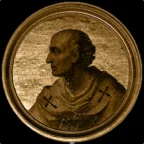
Pope Benedict XI
Pope Benedict XI (born Niccolo Boccasini, Treviso, 1240-Perugia, 7 July 1304) was pope for less than a year, from October 1303 to July 1304. His pontificate was brief but historically consequential, because he inherited the political and symbolic wreckage of the assault on Boniface VIII at Anagni and attempted to restore papal authority through measured de-escalation rather than renewed confrontation.
Before his election he rose within the Dominican Order from a modest background in Treviso, becoming Master General of the Order of Preachers in 1296 (the ninth successor of Saint Dominic). He was formed as a theologian and canonist more than as a court diplomat. Boniface VIII elevated him first to the cardinalate and then to the see of Ostia; Boccasini remained among Boniface's most loyal supporters, including during the Oltraggio di Anagni (September 1303), when Guillaume de Nogaret and Sciarra Colonna seized and humiliated the aged pope.
Elected on 22 October 1303 and consecrated on 30 October, Benedict XI governed in the immediate aftermath of that trauma. His central political task was to defend papal dignity while avoiding a new open rupture with Philip IV of France. He lifted several censures affecting the French crown and restored the Colonna cardinals to communion, yet he maintained a hard line against direct perpetrators of the Anagni outrage, excommunicating Nogaret and Sciarra Colonna and summoning them to answer before ecclesiastical justice.
His reign also unfolded amid unresolved tensions inherited from Boniface's final years, including conflicts tied to the Jubilee period and broader pressures within mendicant and curial circles. The brevity of his pontificate limited structural reform, but his choices reveal a coherent strategy: reduce immediate geopolitical pressure while preserving the juridical memory of violence against the papal office.
Benedict left Rome for Perugia and died there suddenly on 7 July 1304, reportedly of dysentery, though suspicions of poisoning circulated in later tradition. His death after only about eight months in office reopened the larger crisis that would soon culminate in the Avignon Papacy.
For the artistic and historical context of central Italy, Benedict XI is especially relevant because of his funerary monument in Perugia, one of the major Gothic papal tombs of the early Trecento and a key witness to the visual language of Dominican memory, papal legitimacy, and civic prestige.
-
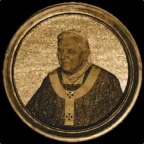
Benedict XVI (Joseph Aloisius Ratzinger, 1927-2022; pope 2005-2013)
Born on 16 April 1927 at Marktl am Inn, in Upper Bavaria - Holy Saturday, and baptised the same day with newly blessed Easter water, a coincidence he later invested with meaning. His father was a rural gendarme whose hostility to the Nazi party obliged the family to move repeatedly, settling finally at Traunstein. Like all boys of his cohort, Joseph was enrolled in the Hitler Youth once membership became compulsory in 1941; in 1943 he was conscripted as a Flakhelfer to an anti-aircraft battery near Munich, then into the Reich Labour Service and briefly the infantry. He deserted in the spring of 1945, was held for some weeks in an American prisoner-of-war camp at Neu-Ulm, and was released in June. He returned to the seminary at Freising with his elder brother Georg; both were ordained on 29 June 1951.
His doctorate (Munich, 1953) treated Augustine's ecclesiology, Volk und Haus Gottes; his Habilitation, on Bonaventure's theology of history, was initially contested by Michael Schmaus and passed only after revision - an episode that left its mark. He taught at Freising, Bonn, Munster, Tubingen and finally Regensburg from 1969. At Vatican II he served as peritus to Cardinal Frings of Cologne and was counted among the reformers; the student upheavals of 1968, experienced at Tubingen alongside a Marxist-inflected radicalism he found frightening, marked a decisive turn. In 1972 he broke with the journal Concilium to co-found Communio with Hans Urs von Balthasar and Henri de Lubac. Introduction to Christianity (1968), his most widely read book, dates from just before this shift. Whether the change constituted a conversion or merely a consistent man responding to changed circumstances is one of the durable disputes about him; he insisted on the latter.
Paul VI made him archbishop of Munich and Freising in 1977 and cardinal three months later, with the motto Cooperatores Veritatis. In 1981 John Paul II brought him to Rome as Prefect of the Congregation for the Doctrine of the Faith, where he remained for twenty-four years - the longest and most consequential such tenure of the modern era. He issued the two instructions on liberation theology (1984, 1986), oversaw the Catechism of the Catholic Church (1992), and signed Dominus Iesus (2000) on the uniqueness of Christ and the Church. Disciplinary proceedings against Leonardo Boff, Jacques Dupuis, Tissa Balasuriya and others earned him the tabloid epithet Panzerkardinal; his defenders regard the same record as the necessary work of doctrinal clarity under a pope who preferred not to do it himself.
Pontificate. Elected on 19 April 2005 after one of the shortest conclaves in modern memory, he explained the name as a double reference: to Benedict XV, the pope of the First World War and of peace, and to Benedict of Nursia, patron of Europe and father of the monasticism from which European culture grew. His three encyclicals moved deliberately from love (Deus caritas est, 2005) to hope (Spe salvi, 2007) to social doctrine (Caritas in veritate, 2009). Alongside them he published the three-volume Jesus of Nazareth (2007-2012) explicitly as a private theologian, stating that anyone was free to contradict him.
Four episodes shaped external perception:
- Regensburg, 12 September 2006. A lecture on faith and reason at his old university quoted a caustic remark of the Byzantine emperor Manuel II Palaiologos about Islam and violence. The resulting protests were severe. The lecture's actual argument - against the voluntarist separation of God from reason - was largely lost, though the episode indirectly produced the A Common Word letter of 138 Muslim scholars and a continuing Catholic-Muslim forum.
- Liturgy. Summorum Pontificum (2007) freed the use of the 1962 Missal, framed by his conviction that the two forms of the Roman rite should mutually enrich one another and by the "hermeneutic of reform in continuity" set out in his 2005 Christmas address to the Curia. Critics saw a retreat from Vatican II; supporters, a repair of a rupture. Francis substantially reversed the measure in 2021.
- The Lefebvrists. The 2009 remission of the excommunications of four SSPX bishops became a crisis when it emerged that one, Richard Williamson, was a Holocaust denier. Benedict wrote an unusually personal letter to the world's bishops admitting the Vatican's failure to check publicly available information.
- Sexual abuse. As Prefect he had centralised handling of clerical abuse cases at the CDF from 2001 and came to describe the accumulated evidence as filth within the Church. As pope he met victims on several journeys, laicised a large number of priests, and issued a penitential Letter to the Catholics of Ireland (2010). Critics regard the response as belated and structurally inadequate, and point to his own Munich years: a report commissioned by the archdiocese in January 2022 faulted his handling of four cases, including the transfer of the priest Peter Hullermann. Benedict denied wrongdoing, corrected an erroneous statement his collaborators had submitted about his presence at a 1980 meeting, and asked forgiveness of victims while rejecting the specific accusations. The assessment of his responsibility remains genuinely contested.
On 11 February 2013, at an ordinary consistory, he announced in Latin that failing strength no longer permitted him to exercise the Petrine ministry, and that he would resign on 28 February. It was the first free papal resignation since Celestine V in 1294 - whose tomb at L'Aquila he had visited in 2009, leaving his pallium on it - and the first of any kind since Gregory XII in 1415. He took the style Pope Emeritus, retained the white cassock, and lived in the Mater Ecclesiae monastery in the Vatican Gardens until his death on 31 December 2022, aged ninety-five. Francis celebrated his funeral in St Peter's Square on 5 January 2023; he was buried in the Vatican Grottoes, in the tomb formerly occupied by John Paul II.
The medieval and artistic dimension. This is the aspect of his record most directly relevant to medieval art history. His formation was Augustinian and Bonaventurian rather than Thomist, and his sense of history and of the aesthetic remained shaped by that. Between 2009 and 2011 he devoted a long series of Wednesday catecheses to medieval figures - Bernard of Clairvaux, Peter the Venerable, Hugh and Richard of Saint-Victor, Bonaventure, Hildegard of Bingen, the great women mystics - and one audience of 18 November 2009 compared Romanesque and Gothic architecture directly, reading each as the embodiment of a distinct theological sensibility. In 2012 he inscribed Hildegard of Bingen in the catalogue of saints and named her a Doctor of the Church. The Spirit of the Liturgy (2000) contains his fullest statement on sacred images, orientation and church space, arguing for the iconographic tradition against both iconoclasm and sentimental naturalism. For a researcher on the twelfth to fourteenth centuries these texts are usable as intelligent theological framing, though they are homiletic in genre and not intended as art-historical scholarship.
He is read, depending on the reader, as the last great theologian-pope who defended doctrinal substance against relativism, or as a restorationist whose intellectual seriousness did not translate into governance and who left the Curia in disorder. Both readings draw on the same well-documented record; the divergence is one of judgement rather than of fact.
-
Berengario di Donadio da Saint-Affrique
Berengario di Donadio da Saint-Affrique (Bérenger de Saint-Affrique; in the documents Berengarius de Sancto Africano), born at Saint-Affrique in the Rouergue, in the second half of the thirteenth century; died after 1333, place unknown. Di Donadio is a patronymic, not a family name — his father was called Donadeo (Clara Gennaro, DBI IX, 1967). Nothing whatever is known of him before 1308.
By August of that year he was in Umbria as vicarius in spiritualibus generalis of the bishop of Spoleto, who was resident at the papal curia in France; the diocese was in practice governed through his vicars. (That bishop was Pietro da Monticchiello. The “Pietro Trinci” named by Ughelli, Eubel, Gennaro and nearly the whole subsequent tradition never existed: Silvestro Nessi, in Montefalco XXXVI/2, 2022.)
Chiara da Montefalco, abbess of Santa Croce, died on 17 August 1308, and her nuns, opening her body to preserve it, reported finding the instruments of the Passion within her heart. Informed three days later by the Franciscan Pietro di Salomone, Berengario — by his own account accensus indignatione, suspecting fraud and intending to proceed against the sisters as severely as he could — rode to Montefalco to prosecute them. There he convened Friars Minor, judges, advocates and rectors of churches in the monastery oratory, examined the heart, and recorded the finding that the signs were made non per finctionem humanam. Returning to Spoleto, he took the counsel of the cathedral chapter and of experts in both laws and lectors in theology, and began receiving depositions ne in futurum memoria deperiret.
He remained the architect of the cause for a decade: opening the diocesan informative process on 18 June 1309; drafting, as Enrico Menestò argues, the interrogatory articles that shaped the testimony; continuing as delegated commissary after April 1310; carrying the dossier to John XXII at Avignon in person in the autumn of 1316; and appearing at the apostolic process of 6 September 1318 with proxies from the bishops of Spoleto, Foligno and Gubbio and from the communes of most of the Valle Spoletana. The process closed in July 1319 without result. Chiara was canonized only in 1881.
His Vita sancte Clare de Cruce de Montefalcone — 106 chapters in four surviving codices, probably composed c. 1310, though Faloci Pulignani argued for 1315–16 and Giulia Barone for a second redaction after 1316 — is the earliest and principal source for Chiara. Claudio Leonardi read its author's amateurism as a guarantee of documentary fidelity; Menestò, with the processual acts now in print, sees a more shaping hand at work.
He served as vicar of the bishop of Siena in 1314, excommunicating a group of Fraticelli on 28 May. Canon of Santa Maria in Trastevere, he was named bishop of Sutri on 16 November 1328, the appointment confirmed a week later notwithstanding his defectus in ordinibus: he was in minor orders only, and never a priest. Still episcopus electus in 1332, he resigned in March 1333, and is then styled clericus Vabrensis dioecesis. Menestò, following Nessi, holds that he received further commissions until at least 1337, under the patronage of Cardinal Giacomo Gaetano Stefaneschi. Critical edition: Menestò–Guglielmetti, Spoleto, CISAM, 2018.
-
Benedictine Order
The Benedictine Order is the oldest and most influential monastic tradition in Western Christianity, initiated in 529 AD by Benedict of Nursia and shaped by his Regula Monachorum — the Rule of Saint Benedict — into a form of communal religious life that would define European civilization for the better part of a thousand years. What began as a single monastery carved out of the rocky landscape of central Italy became, over six centuries, the primary vehicle through which literacy, agriculture, theology, music, and the arts were transmitted across a continent that was otherwise fragmented by invasion, political collapse, and cultural amnesia.
Benedict was born around 480 AD in Nursia (modern Norcia), a small town in the Apennine mountains of Umbria, to a family of sufficient means to send him to Rome for an education in rhetoric and law. He arrived in the city at precisely the moment when the Western Roman Empire had effectively ceased to exist — only four years after the deposition of the last emperor Romulus Augustulus in 476 — and found a city he described as morally degraded and spiritually adrift. Repelled by what he saw, he abandoned his studies before completing them and withdrew from Rome entirely, seeking solitude in the hills outside the city.
He settled at Subiaco, in the Sabine hills east of Rome, where he lived as a hermit in a cave for approximately three years, supported by a monk named Romanus who lowered bread down to him on a rope. His reputation for sanctity attracted disciples, and he organized them first into small communities of twelve, then — after conflicts with a jealous local priest — undertook the decisive journey southward, arriving on the summit of Monte Cassino around 529 AD. Here he demolished the last functioning pagan temple in the region (sacred to Apollo), established a new monastery, and devoted his remaining years to writing the document that would bear his name.
The Regula Sancti Benedicti — the Rule of Saint Benedict — was completed around 535–540 AD. Benedict himself called it a regula minima, a "little rule for beginners," written for ordinary men rather than the spiritual athletes imagined by earlier monastic theorists. In reality it is a document of extraordinary practical wisdom and psychological acuity: a comprehensive constitution for communal religious life, addressing everything from the structure of the daily office to the qualities required of an abbot, from the treatment of guests to the correction of faults, from the sleeping arrangements of the monks to the handling of monastery property. Its precursors include the Rule of St. Basil the Great, the Conferences of John Cassian, and the Rule of the Master — an anonymous earlier Latin text that Benedict both borrowed from and substantially modified — but it surpassed all of them in clarity, balance, and humaneness. Benedict died at Monte Cassino around 547 AD and was buried there alongside his sister Scholastica, who had led a parallel community of consecrated women.
The organizing principle of Benedictine life is famously condensed in the phrase Ora et Labora — "Pray and Work" — though Benedict himself never used these precise words. The structure of the day he prescribed revolves around the Divine Office (Opus Dei, the "Work of God"): eight daily liturgical prayer services at fixed hours — Vigils (before dawn), Lauds (dawn), Prime, Terce, Sext, None, Vespers, and Compline (before sleep) — which divide the day into a regular rhythm of communal worship. Between the offices, monks engaged in manual labor and sacred reading (lectio divina), a meditative practice of reading scripture and patristic texts slowly and prayerfully, absorbing the text rather than analyzing it.
Three fundamental vows define the Benedictine commitment: obedience to the abbot, stability (the promise to remain in a single community for life, unlike the wandering monks Benedict explicitly criticized), and conversio morum ("conversion of life" — a lifelong moral transformation). The stability vow is particularly distinctive and historically consequential: it bound the monk to a specific place and community, creating institutional continuity and the deep local rootedness that allowed Benedictine monasteries to accumulate libraries, cultivate lands, and train generations of craftsmen and scholars within a single location over centuries.
The abbot's role — from the Hebrew abba, "father" — is modeled explicitly on Christ's relationship to His disciples and Paul's image of the body of Christ. He holds complete authority over the community but is bound by the Rule to consult the entire community before major decisions, to temper justice with mercy, and to remember that he will answer to God for the souls entrusted to him. This combination of firm authority and institutional accountability created a model of leadership that influenced medieval governance well beyond the walls of monasteries.
Benedict himself never intended to found an order in the modern institutional sense — the Regula presupposes the autonomy of each monastic community, and there is no organizational structure linking one monastery to another. The earliest diffusion of the Rule occurred through catastrophe rather than deliberate missionary strategy. Around 580 AD, barely thirty years after Benedict's death, the monastery of Monte Cassino was sacked and burned by the Lombards, and its community fled to Rome. This disaster proved, paradoxically, to be the engine of the Rule's propagation: the monks brought their text and their tradition directly into the orbit of the papacy.
The decisive figure in the Rule's promotion was Pope Gregory I (590–604), Gregory the Great, himself a former monk who had converted his family villa on the Caelian Hill in Rome into a Benedictine monastery before being called to the papacy. Gregory wrote the only surviving biography of Benedict — the Dialogues, Book II — and used his immense papal authority to promote the Rule throughout the church. It was Gregory who in 596 AD dispatched the monk Augustine of Canterbury with a group of forty Benedictine companions to evangelize England, a mission that established the first English Benedictine monastery at Canterbury in 597 and initiated one of the most productive chapters in the Order's history.
The Irish and Anglo-Saxon churches proved to be the most zealous carriers of Benedictine monasticism back to the continent. English monks of the seventh and early eighth centuries — most notably Wilfrid of Hexham, Bede of Jarrow (the Venerable Bede, whose Historia Ecclesiastica is the primary source for early English Christianity), and above all Willibrord and Boniface — carried the Rule to the Frankish territories, Frisia, and Germany. By the early eighth century, Anglo-Saxon monks were proudly proclaiming themselves followers of the Rule of Benedict alone — the first genuine "Benedictines" in the sense of an exclusive institutional identity — and through their missionary activity across the Rhine they planted the seeds of a genuinely European Benedictine culture.
The political consolidation of this culture came at the Synod of Aachen in 816–817, when the emperor Louis the Pious, advised by the monastic reformer Benedict of Aniane, declared the Rule of Saint Benedict binding for all monks within the Carolingian empire. For the first time, hundreds of monasteries across modern France, Belgium, the Netherlands, Switzerland, Germany, and northern Italy were formally unified under a single observance. This Carolingian Benedictinism created, in practical terms, the infrastructure of medieval European civilization: it was the Benedictine monasteries that preserved the texts of classical antiquity, trained the scribes who produced the manuscripts, educated the clergy, maintained hospitals and pilgrim hospices, cleared forests, drained marshes, improved agricultural techniques, and provided the intellectual cadres who staffed episcopal chanceries and royal courts throughout the early medieval period.
By the ninth and tenth centuries, the tremendous worldly success of Benedictine monasticism had generated a profound spiritual crisis within it. The wealth and political power accumulated by the great abbeys had attracted secular interference, most damagingly in the practice of lay investiture, by which local lords and kings appointed abbots for political rather than religious reasons, turning monasteries into instruments of feudal patronage. The response came from Burgundy, with the foundation of the Abbey of Cluny in 910 AD by Duke William I of Aquitaine.
Cluny was established on an unusual legal basis: it was placed directly under papal authority, exempted from all episcopal oversight and from secular interference in its internal governance. This independence allowed it to maintain and propagate a reformed, stricter observance of the Rule, with particular emphasis on the liturgical splendor of the Divine Office — at Cluny, the hours of prayer were extended and elaborated into performances of extraordinary musical and ceremonial beauty, which critics argued came at the expense of manual labor and lectio divina, but which expressed the Cluniac conviction that the highest human activity was the liturgical glorification of God. Within two centuries, Cluny had become the center of a reform congregation encompassing approximately 314 affiliated monasteries across France, Italy, Spain, England, Scotland, and Poland — the first genuine Benedictine "order" in any meaningful organizational sense.
The twelfth century brought the founding of competing reform movements, most importantly the Cistercian Order, established at Cîteaux in Burgundy in 1098 by Robert of Molesme. The Cistercians accepted the Rule of Saint Benedict but rejected the Cluniac elaboration of the liturgy, advocating instead a stripped-down austerity in architecture, dress, diet, and worship that was intended to recover the simplicity of the original Rule. Their greatest spokesman, Bernard of Clairvaux (1090–1153), was one of the most powerful voices of the twelfth-century church, and under his leadership the Cistercians expanded with extraordinary speed, planting abbeys in the remotest corners of Europe and bringing vast tracts of wilderness under cultivation. Though technically distinct from the Benedictines, the Cistercians follow a reformed version of the same Rule, and their art and architecture — the austere white churches of Fontenay, Sénanque, and Fossanova — represent a specifically Cistercian interpretation of the Benedictine spiritual vision. At the moment of the Cistercian foundation, there were estimated to be approximately 3,000 Benedictine monasteries in Europe.
The relationship between the Benedictine Order and the Norman rulers of Sicily is of particular relevance because Roger I actively encouraged Benedictine foundations as part of his policy of consolidating Latin Christian authority on the island, and by the time of Roger II and William II, Benedictine abbeys had become one of the primary instruments of Norman cultural policy. The supreme expression of this relationship is William II's foundation of the Cathedral and Abbey of Monreale (c. 1174), a Benedictine monastery whose church — covered with approximately 6,340 square meters of Byzantine gold mosaic — remains the most visually spectacular monument of Norman Sicilian civilization. William explicitly chose a Benedictine community as the institutional vehicle for his greatest artistic commission, placing it under the jurisdiction of a new archbishopric in order to counterbalance the political power of the Archbishop of Palermo — a characteristically Sicilian use of ecclesiastical institutions as instruments of royal policy.
The Protestant Reformation of the sixteenth century inflicted devastating losses on Benedictine monasticism in northern Europe. In England, Henry VIII dissolved all monasteries between 1536 and 1541, destroying one of the densest networks of Benedictine foundations in Christendom. In Scandinavia, the Lutheran reforms of the 1550s obliterated the Order entirely. The French Revolution and its aftermath swept away the great French abbeys in the 1790s, and the secularization policies of Joseph II in Austria removed hundreds of monasteries from religious use in the preceding decade. By the early nineteenth century, the entire Order had been reduced to barely fifty functioning monasteries worldwide.
The revival came from Solesmes in France, where Dom Prosper Guéranger refounded the abbey in 1833 and inaugurated a Benedictine renaissance characterized by a passionate commitment to the restoration of Gregorian chant and the Roman liturgy. Solesmes's work of liturgical scholarship — the recovery, edition, and performance of medieval plainchant — had a direct and lasting impact on the musical culture of the Catholic Church and ultimately on the Second Vatican Council's liturgical reforms in the 1960s.
The extraordinary autonomy of individual Benedictine houses — each governed independently by its own abbot, each the product of its own particular history and tradition — remained the fundamental characteristic of the Order throughout its history and created significant organizational challenges as the nineteenth-century revival produced a proliferating variety of congregations. In 1893, Pope Leo XIII created the office of Abbot Primate to provide a symbolic center of unity for the worldwide Benedictine family, establishing the Confederation of Benedictine Congregations with its headquarters at the Collegio di Sant'Anselmo on the Aventine Hill in Rome. The Abbot Primate holds no direct authority over individual abbots — the Benedictine genius for autonomy remains structurally intact — but serves as a representative voice for the tradition as a whole and presides over the international community of Benedictine scholars assembled at Sant'Anselmo.
Today the Benedictine Confederation comprises approximately 400 abbeys and monasteries of monks, and a comparable number of communities of Benedictine nuns and sisters, distributed across every continent. It remains, fifteen centuries after Benedict sat in his cave at Subiaco, the oldest continuously functioning tradition of organized religious life in the Western church — a living monument to the quiet radicalism of a man who simply wanted to build a school for the service of the Lord, and succeeded in teaching an entire civilization.
-
Bentivenga da Gubbio (Bentivegna; fl. c. 1286 - d. between 1319 and 1332)
A Franciscan preacher from Gubbio, remembered as the leading voice of the Umbrian sect of the Spiritus libertatis ("Spirit of Liberty") in the early Trecento.
Before entering the Franciscan Order in the Umbrian province, he had probably been a follower of Gerardo Segarelli - a member of the "Apostles" - a notice reported solely by Angelo Clareno. Oliger accepted the testimony and placed his break with Segarelli and entry into the Order in 1286, the year Honorius IV suppressed the Apostles and invited its adherents to join an approved Order; Oliger also saw in that earlier phase the origin of the epithet "Apostolus" by which some sources call him, though the nickname also reflected his reputation for sanctity. Within the Order he gained considerable esteem, and by 1306 he was at Montefalco as a preacher. There he and his disciple Iacopo da Montefalco held conversations at the monastery of S. Croce with Clare of Montefalco, from which the sect's teachings can be reconstructed: the denial of hell, the soul's capacity to lose desire for this life, and above all man's freedom to do as he wills - including carnal relations absque excusatione matrimonii - since all is willed and worked by God.
Clare, after initial hesitation, denounced him in early 1307 to the inquisitor Andrea da Perugia, who replied that he could not pin the man down in argument and had no witnesses against him; she then denounced him to Cardinal Napoleone Orsini, papal legate for the duchy of Spoleto. Between spring and summer 1307 Bentivenga and his followers were arrested and taken most probably to Arezzo, where Ubertino da Casale - the cardinal's chaplain - secured the condemnation by feigning a wish to join the sect, thereby obtaining the friar's exposition of his doctrines before witnesses. Sentenced to life imprisonment, he was moved to the Inquisition's prison at S. Croce in Florence; he was still alive there on 22 June 1319, and was already dead by 1332, when Alvaro Pelagio wrote the De planctu Ecclesiae.
-
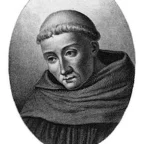
Bernard of Clairvaux
Bernard of Clairvaux was the most influential church figure in 12th-century Europe: a Cistercian abbot, mystical theologian, founder of monasteries, preacher of the Second Crusade, and arbiter of the doctrinal and political controversies of his time. Canonized in 1174 by Pope Alexander III and declared a Doctor of the Church in 1830, he is today venerated as a saint by both the Catholic and Anglican Churches, with a liturgical feast day on 20 August.
Bernard was born in 1090 at the castle of Fontaine-lès-Dijon, near Dijon in Burgundy, to Tescelin, Lord of Fontaine—a knight of minor nobility loyal to the French crown—and Aleth of Montbard, a woman of profound spirituality who would exert a decisive influence on her son’s upbringing. The third of seven children—six boys and one girl—Bernard received a solid classical education in Châtillon-sur-Seine, where he displayed an uncommon literary talent and a marked inclination toward contemplation. The death of his mother, which occurred when Bernard was about seventeen, was a profound spiritual shock that definitively oriented his life toward God; a few years later, he also lost his brother Girard in the Battle of Cîteaux.
In 1112, Bernard presented himself at the monastery of Cîteaux, the seat of the young Cistercian Order founded in 1098 by Robert of Molesme as a radical reform of the Benedictine Rule, under the guidance of the English abbot Stephen Harding. His calling was already so compelling that he brought with him, in a single group, thirty relatives and friends—including four brothers—who abandoned everything to follow him. The arrival of this group is considered the decisive turning point in the Order’s history, so much so that Bernard is traditionally called the “second founder” of the Cistercians. Three years later, in 1115, Abbot Harding commissioned him to found a new monastery in the diocese of Langres, in Champagne: Bernard chose an uncultivated and wild valley which he renamed Clara Vallis— Clairvaux, “the Luminous Valley”—and became its first abbot at the age of just twenty-five, holding that office for the rest of his life.
Under Bernard’s leadership, Clairvaux became the spiritual and intellectual center of Christian Europe. Within a few decades, the community grew to an impressive size—up to seven hundred monks—and founded monasteries in every corner of the continent. At the time of Bernard’s death in 1153, there were approximately 400 Cistercian monasteries in Europe, 163 of which had been founded directly by him or by his daughter communities. Cistercian discipline imposed a strict architectural simplicity, rejecting the rich Cluniac decorations: churches were to be devoid of ornamental sculptures, figurative paintings, and stained-glass windows, in accordance with the Benedictine Rule understood in its original purity.
Bernard was also a tireless defender of doctrine: his great intellectual adversary was Peter Abelard, the most brilliant logician of the 12th century, who applied the rational dialectical method to theology. Bernard believed that faith was not a problem to be solved by reason, but a gift to be received with humility, and that Abelard’s approach risked reducing the mystery of God to an object of academic debate. At the Council of Sens in 1140, he secured the condemnation of nineteen of Abelard’s theses as heretical, a ruling later confirmed by Pope Innocent II; the victory was total on an institutional level, but the price was the harshness with which he treated a man who was already elderly and ill. He showed equal intransigence toward Gilbert of Porrée and toward the movement of the monk Henry of Lausanne, against whom he preached in Languedoc.
In 1145, at the explicit behest of his disciple Pope Eugene III, who had just issued the bull Quantum praedecessores, Bernard undertook one of the most extensive preaching campaigns in medieval history to rally support for the Second Crusade. At Vézelay, on Easter 1146, he spoke before King Louis VII of France and a vast crowd: his eloquence was such that those present tore their cloaks to make crosses, exhausting the supplies prepared in advance within minutes. He then traveled through Germany, Flanders, and Burgundy, stirring up enthusiasm and calls to join the Crusade everywhere he went; in Speyer, he persuaded King Conrad III of Germany to take up the cross despite his initial resistance. The military disaster that followed—the crusade ended in the summer of 1148 with the shameful retreat from Damascus—left Bernard deeply troubled. In a memorable letter, he publicly acknowledged his moral responsibility for having urged men toward a failed expedition, and justified the negative outcome as divine punishment for the sins of the crusaders themselves.
Theologically, Bernard is classified as a “monastic theologian”: for him, truth is not attained through rational debate but through prayerful contemplation and inner transformation. His most famous work, the eighty-six Sermones super Cantica Canticorum—Sermons on the Song of Songs—develops an allegorical interpretation of the biblical text as a narrative of the human soul’s love for God, with a psychological richness and literary beauty that made it a model for subsequent medieval spirituality. The treatise De Consideratione, dedicated to Pope Eugene III, is instead a reflection on the risk that ecclesiastical governance might stifle the inner life: Bernard distinguishes in it between consideratio—the silent contemplation that nourishes the soul—and the empty agitation of administration; it is a text of extraordinary relevance today as a critique of the bureaucratization of religious power.
The two major interlocutors of Bernard’s final years were the two figures we have already encountered in this journey: Pope Eugene III, his direct disciple at Clairvaux, and Hildegard of Bingen, the Rhenish visionary. Hildegard wrote to him around 1146 asking for his opinion on her visions; Bernard replied with a brief but encouraging letter, and at the Synod of Trier in 1147 he publicly supported the approval of the Scivias, helping to legitimize Hildegard’s prophecies in the eyes of Rome. He died at Clairvaux on 20 August 1153, just three weeks after Eugene III, as if the spiritual bond that united them could not survive the loss of one without the other.
-
Biccherna (Republic of Siena)
The Biccherna was the principal financial authority of the Republic of Siena, operating continuously from the twelfth century until 1786, when it was abolished under Peter Leopold of Lorraine. The name is generally connected to the Blachernae treasury in Constantinople, a reminder of the cultural exchanges that linked medieval Italian institutions to the wider Greco-Eastern world.
The magistracy administered municipal revenues and expenditures. It was headed by a chamberlain, initially often a Franciscan or Dominican friar selected for probity, together with four provveditori elected by Siena's General Council. Its task was to supervise public spending, while the sister office of the Gabella managed indirect taxation. In the thirteenth century, the two spheres still partly overlapped, but they progressively differentiated over the fourteenth century.
In art history, the Biccherna is celebrated for a unique phenomenon: the painted wooden covers of its accounting registers. Beginning in 1257, officials commissioned leading Sienese painters to decorate the ledger covers with dated scenes representing chamberlains in office, heraldic devices of officials, and episodes of civic or religious significance. When ledgers began to be bound in leather in the fifteenth century, the tradition continued in the form of autonomous painted panels displayed on office walls. The surviving series in the Archivio di Stato di Siena includes 106 panels, spanning roughly from 1258 to 1682.
These works constitute one of the most continuous and valuable pictorial corpora in Italian medieval and Renaissance art. Major painters of the Sienese school, including Ambrogio Lorenzetti, contributed to the series, which therefore offers scholars a long chronological sample of stylistic development across several centuries.
The value of the Biccherna panels is not only artistic but also documentary. They record sieges, ceremonies, urban topography, miraculous episodes, natural calamities, and administrative rituals, making them a primary iconographic source for the social and political history of Siena. For historians of manuscripts and medieval art, they represent an exceptional intersection of bureaucratic practice, civic patronage, and high-level artistic production in one of Europe's most vibrant artistic centers.
-
Billfrith the Anchorite
Billfrith, also known as Bilfrith or Billfrið (active early 8th century), was a Northumbrian hermit and skilled goldsmith associated with the monastic community of Lindisfarne off the coast of Northumberland, England. Recognized as a saint in medieval hagiography, his name may derive from Old English meaning "peace of the two-edge sword." His primary historical significance stems from his contribution to the Lindisfarne Gospels, one of the finest surviving examples of Insular illuminated manuscripts created around 700 AD. According to the colophon added by Aldred (c. 950–970), Eadfrith, Bishop of Lindisfarne, wrote and illuminated the text for God, St. Cuthbert, and the island's saints; Æthelwald bound it in leather; and Billfrith, as anchorite, crafted the opulent outer metalwork cover, adorning it with gold, silver-gilding, gems, and pure silver ornaments — "a treasure without deceit." This binding, described in Symeon of Durham's Libellus de Exordio (early 12th century), highlighted Billfrith's expertise as a metalsmith working in a hermitic tradition. The jeweled cover did not survive, likely looted during Viking raids in the late 8th century or the Reformation. His name appears in the 9th-century Durham Liber Vitae alongside contemporaries like the Irish monk Echa (d. 767), confirming his 8th-century floruit. In the 11th century, the priest Ælfred collected Billfrith's relics, transporting them to Durham Cathedral for safekeeping amid regional instability, linking him to the broader Insular heritage of manuscript production and relic veneration.
-
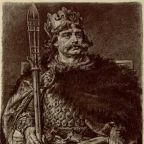
Boleslaw I the Brave (Boleslaw Chrobry)
Boleslaw I the Brave, also known as Boleslaw Chrobry, was the first king of Poland and one of the key founders of the early Polish state. He ruled first as Duke of Poland from 992 and was crowned king in 1025, shortly before his death.
Boleslaw was born around 967, the son of Mieszko I, the first historically documented ruler of Poland, and Dobrawa of Bohemia. When Mieszko I died in 992, Boleslaw took power and consolidated his rule by expelling rivals, including members of his stepfamily.
From the beginning of his reign, Boleslaw worked to strengthen the political and religious structure of his realm. He supported the Christian Church, especially through the cult of Saint Adalbert, whose martyrdom helped advance the creation of an independent Polish church organization centered in Gniezno. The Gniezno meeting with Emperor Otto III in 1000 marked an important moment in Poland's recognition among European powers.
Boleslaw was also a determined military ruler who expanded Polish influence through campaigns in several directions. He fought Emperor Henry II in a series of wars that ended favorably for Poland in 1018, securing territorial gains and enhancing his prestige. His campaigns extended Polish authority into areas such as Lusatia, Moravia, Bohemia, and parts of Red Ruthenia.
In 1025, Boleslaw obtained the right to be crowned and became the first King of Poland. He died later that same year on 17 June 1025. He was buried at Poznan Cathedral, where he is remembered as a major architect of Polish statehood.
Boleslaw's reign is remembered as a formative era in Polish history because it transformed the Piast realm into a kingdom recognized in the wider Christian world. His efforts in diplomacy, church organization, and conquest gave Poland a stronger political identity and a lasting dynastic foundation.
-
The Bollandists: A History of Critical Hagiography
Overview
The Bollandists — in Latin Societas Bollandistarum, in French the Société des Bollandistes — are a body of scholars, originally exclusively Jesuit and today including lay researchers, who since the early seventeenth century have devoted themselves to the critical study of the lives and cults of the Christian saints. Their name derives from the Flemish Jesuit Jean Bolland (1596-1665), who gave the enterprise its enduring shape, though the project's true progenitor was an earlier member of his order, Heribert Rosweyde. Their central and defining monument is the Acta Sanctorum, a vast critical collection of hagiographic documents arranged according to the liturgical calendar of feast days, whose sixty-eight folio volumes were published across three centuries, from 1643 to 1940. In the course of this labour the Bollandists created a new intellectual discipline — critical hagiography, the historical and philological study of the saints — and, almost incidentally, provoked the birth of the sciences of diplomatics and palaeography on which all modern medieval studies, including the study of illuminated manuscripts, continue to depend. Few scholarly undertakings of the early modern period have proved so durable, so consequential, or so faithful to a single governing ambition: to establish, against the accretions of legend, what could actually be known of the saints from the surviving evidence.
The conception of the enterprise belongs to Heribert Rosweyde (1569-1629), a Dutch Jesuit who taught at the Society's college in Douai and who devoted his leisure to gathering information about the saints from the manuscript collections of the Low Countries. Rosweyde recognised that the libraries of Belgium alone held roughly thirteen hundred manuscripts bearing on the lives of the saints, and he set himself to obtain copies of as many as he could, convinced that the authentic early texts, buried in these codices, had been overlaid and distorted by centuries of pious rewriting. In 1607 he announced his plan publicly in a slender volume issued by the celebrated Plantin press at Antwerp under the title Fasti Sanctorum quorum vitae in belgicis bibliothecis manuscriptae — an alphabetical inventory of the saints whose acts he had found or heard of in old manuscripts, prefaced by a statement of the character and arrangement of the work he envisaged. This prospectus, distributed as a kind of advertisement to attract support, outlined a collection that would run, by his reckoning, to some eighteen volumes, organised so as to present for each saint the oldest and most reliable documents rather than the embellished legends of later devotion.
Rosweyde's ambition ran ahead of his means, and his superiors were sceptical; the great Cardinal Bellarmine, consulted on the plan, is said to have doubted whether one man could ever complete so enormous a task. Rosweyde nonetheless pressed on, producing along the way editions of subsidiary texts — a Little Roman Martyrology, the martyrology of Ado of Vienne, and his influential Vitae Patrum of 1615, a collection of the lives of the desert fathers that became a foundation stone of the later enterprise. He did not live to bring the great project to fruition. Ministering to a dying man, he contracted a contagious disease and died at Antwerp on the fifth of October 1629, at the age of sixty, leaving behind a mass of copied manuscripts, notes, and correspondence but no published volume of the collection he had imagined. His achievement was to have conceived the plan, assembled the materials, and defined the critical spirit in which the work should be done; its execution would fall to another.
The task of sorting Rosweyde's papers was entrusted to a younger Jesuit, Jean Bolland, latinised as Bollandus (1596-1665), and it was Bolland who transformed the inheritance into an institution. Recognising the value of what Rosweyde had gathered, and grasping the scale of what remained to be done, Bolland reconceived the project on a far grander footing: no longer a collection limited to the manuscripts of the Low Countries, but a universal corpus that would gather, for every saint of the Christian calendar, all the relevant documents, critically edited from the manuscript sources and furnished with historical commentary. He formalised the undertaking in the early 1630s and, understanding that no single scholar could accomplish it, secured in 1635 the assistance of a gifted younger colleague, Godefroid Henschen (Henschenius, 1601-1681), who would prove one of the most capable members the society ever possessed. The two men worked toward the first instalment, and in 1643 the two folio volumes covering the saints whose feasts fall in January issued from the Antwerp press, inaugurating the Acta Sanctorum and, with it, the continuous scholarly tradition that has borne Bolland's name ever since.
The method established in these first volumes set the pattern for everything that followed. For each saint the Bollandists printed the surviving acta — lives, passions, accounts of miracles, and liturgical texts — drawn wherever possible from the oldest manuscripts, each preceded by a critical commentary that discussed the sources, weighed their reliability, and separated what could be historically affirmed from what belonged to legend or later tradition. This was an approach of startling modernity for its age, applying to the sacred subject of the saints the same scrutiny of sources that humanist scholarship had begun to bring to classical and legal texts, and it committed the enterprise from the outset to a principle that would repeatedly bring it into conflict with popular devotion and institutional interest. By the time Bolland died in 1665, the volumes for January and February had appeared and the work was firmly launched, its library growing, its network of correspondents across Europe established, and its method fixed. He had converted Rosweyde's project into a going concern with a future measured not in years but in centuries.
Henschen, Papebroch, and the Perfecting of Method
The generation after Bolland raised the critical apparatus of the Acta Sanctorum to its highest early pitch, above all through the labours of Henschen and of a second brilliant recruit, Daniel Papebroch — Daniel van Papenbroeck (1628-1714) — who joined the work in 1659. To equip themselves for the editing of texts whose originals lay scattered through the libraries of Europe, Henschen and Papebroch undertook a research journey of some two and a half years, travelling through Germany and into Italy as far as Rome, copying manuscripts, collating variants, and building the collection of transcriptions that made the Antwerp library a rival to any in Rome. This expedition, and the materials it brought home, account for the marked increase in the scale and sophistication of the volumes that followed, culminating in the seven volumes devoted to the saints of May, published between 1680 and 1688, which reflected the enormous accumulation of edited material. Later Bollandists regarded Papebroch as the very embodiment of their calling; one of them summarised the succession by observing that what Rosweyde had prepared and Bolland had begun and Henschen had shaped, Papebroch brought to completion.
Papebroch's rigour, however, carried him into the most consequential episode in the intellectual history of the society. Prefixed to the April volume of the Acta Sanctorum in 1675 was his Propylaeum antiquarium, an essay attempting to lay down rules for distinguishing genuine from spurious documents, in which he cast doubt on the authenticity of a range of early charters, including certain Merovingian diplomas of the Abbey of Saint-Denis. The challenge could not go unanswered, for the reputations of the French crown, the Benedictine order, and the royal abbey were bound up with the documents impugned, and the task of defending them fell to the greatest scholar the Benedictine congregation of Saint-Maur could field, Dom Jean Mabillon (1632-1707). Mabillon's reply, De re diplomatica libri sex, published at Paris in 1681, did far more than rebut Papebroch on the particular charters: by surveying every material and formal aspect of medieval documents — the parchment, the ink, the script, the formulas, the seals — and by comparing dated and authentic examples, it established the systematic principles by which the age and genuineness of a charter could be judged, and thereby founded the science of diplomatics.
The dispute is a model of what learned controversy at its best can achieve, and its outcome redounds to the credit of both parties. Mabillon's work was at once recognised as a masterpiece, and Papebroch, far from resenting the correction, entered into cordial correspondence with its author and generously acknowledged that his own attempt to condemn all the Merovingian charters as forgeries had been an excess of scepticism. From this exchange flowed consequences that reach directly into the modern study of medieval books: Mabillon's pupil Bernard de Montfaucon extended the method to Greek manuscripts in his Palaeographia Graeca of 1708, coining the very term "palaeography" and establishing the discipline by which scripts are dated and localised. That the two sciences underpinning the modern dating of manuscripts and charters — diplomatics and palaeography — were born from a Bollandist's over-zealous scepticism and a Benedictine's measured reply is one of the happier ironies of scholarly history, and it places the Bollandists at the very origin of the critical methods on which medieval studies still rest.
Papebroch's critical temper brought upon the society a graver trouble than the friendly quarrel with Mabillon. In the course of his work he came to examine the tradition, cherished by the Carmelite order, that their institute descended in unbroken succession from the prophet Elijah, held by the Carmelites to be their founder on Mount Carmel; and Papebroch, applying his usual scrutiny to the sources, concluded that this claim was insufficiently grounded in the historical evidence. To the Carmelites this was an intolerable assault on the antiquity and dignity of their order, and they pursued their defence through the tribunals of the Church with tenacity. The matter came before the Spanish Inquisition, whose jurisdiction extended over the Southern Netherlands where the Bollandists worked, and in 1695 that body condemned the volumes of the Acta Sanctorum in question, issuing a decree — promulgated in Spanish, Latin, French, and Dutch — that heaped upon the work a formidable catalogue of censures, branding its propositions as erroneous, rash, scandalous, and worse.
The condemnation placed the Bollandists in genuine peril, for it threatened not merely the reputation of the enterprise but its capacity to continue, and it exemplified the recurring hostility that critical history aroused when it touched the founding legends of venerable institutions. The Bollandists defended themselves, appealed to Rome, and endured a lengthy period of censure before the matter was resolved. In 1715 the Roman authorities lifted the condemnation, vindicating the society and allowing its work to proceed, though the episode left a lasting memory of the dangers that attended the honest examination of pious tradition. The affair is emblematic of the whole Bollandist vocation: to seek the truth about the saints was, more than once, to disturb the settled devotion of the faithful and the interests of powerful institutions, and the courage to persist in that seeking, even at the cost of censure, is precisely what distinguishes critical hagiography from mere compilation. That the Bollandists weathered the storm and continued undeterred is a measure of the seriousness with which they held their commitment to the evidence.
The gravest threat to the enterprise came not from any dispute over a particular saint but from the fate of the order that sustained it. In 1773 Pope Clement XIV, yielding to the pressure of the Catholic monarchies, suppressed the Society of Jesus throughout the world, and with the dissolution of the order the Bollandists lost the institutional framework that had carried their work for a century and a half. The labour did not stop at once: the former Jesuits continued at Antwerp until 1778, then removed to Brussels, where they worked in the monastery of Coudenberg, and afterwards found refuge at the Premonstratensian abbey of Tongerloo, north of Leuven, striving to keep the great collection alive through successive displacements. Political circumstance, however, pressed ever harder upon them; the Austrian government that ruled the Southern Netherlands proved unsympathetic, and the resources and stability that so vast a scholarly undertaking required steadily eroded. The fifty-third folio volume, carrying the collection through the middle of October, appeared in 1794, but by then the end was at hand.
In that same year the armies of the French Revolution invaded and overran Belgium, and in the upheaval the work of the Bollandists came to a halt, their library dispersed and the continuity of nearly two centuries broken. For more than four decades the enterprise lay dormant, its future in doubt, its accumulated treasures scattered, and it seemed possible that the Acta Sanctorum would remain forever unfinished, a monument abandoned midway through the calendar. This interruption is the great caesura in the history of the society, dividing the "old" Bollandists of the seventeenth and eighteenth centuries from the "new" Bollandists who would revive the work in the nineteenth. That the tradition survived the double catastrophe of the order's suppression and the Revolution's violence, rather than ending as so many learned undertakings of the Ancien Régime ended, is owed to the tenacity with which the memory of the enterprise was kept alive and to the determination of a later generation to resume it.
The restoration of the Society of Jesus in the early nineteenth century made possible the revival of its hagiographical enterprise, and after the re-establishment of the order in Belgium the Bollandists were reconstituted in 1837 at Brussels, under the patronage of the Belgian government, with a mandate to resume the Acta Sanctorum where their predecessors had been forced to abandon it. The first volume of the renewed series appeared in 1845, and in the following decades the society not only carried the collection forward but also brought its methods abreast of the rapid advances in historical scholarship that marked the age. The "new" Bollandists worked in a very different intellectual climate from the old, one in which the critical study of medieval sources had matured into a rigorous discipline with exacting standards of edition and analysis, and they proved fully equal to it, producing work that could stand alongside the best of contemporary German and French erudition. The revived society also broadened its horizons, extending its attention beyond the Latin, Greek, and Oriental traditions that had occupied its founders to the hagiographic literatures of the Slavic, Nordic, and other Christian peoples, and it developed the ancillary publications and reference tools that would define modern hagiographical scholarship.
The commanding figure of the modern Bollandists, and one of the greatest hagiographers of any age, was Hippolyte Delehaye (1859-1941), whose long career at the head of the society raised critical hagiography to its highest development. Delehaye's most celebrated book, Les légendes hagiographiques of 1905, translated into English as The Legends of the Saints, is at once a rigorous analysis of how saints' legends form and transform and a subtle defence of the critical enterprise against the charge that it destroys devotion. Against those who feared that to declare a saint's story legendary was to lose the saint himself, Delehaye argued that the saints have a real existence independent of the written texts, sustained in the living memory and worship of the Church, so that the critical scholar who strips away the legendary accretions does not diminish the saint but recovers the truth beneath the embroidery. This defence articulated the mature self-understanding of the Bollandist vocation: that reverence for the saints and rigour toward the sources are not opposed but complementary, and that the honest historian serves the cult of the saints best by refusing to confuse it with fable. Under Delehaye and his successors the society became, and has remained, the acknowledged centre of hagiographical scholarship in the Christian world.
The tangible achievement of the Bollandists is embodied above all in the Acta Sanctorum itself, which in its completed printed form comprises sixty-eight folio volumes totalling more than sixty thousand pages, published over three centuries and carrying the saints from the beginning of January through November, with the December volume, the last to appear, issued in 1940. It is by common reckoning among the largest and most ambitious scholarly and editorial enterprises ever undertaken, a critical encyclopaedia of the saints of East and West that aspires to universality in its coverage, exhaustiveness in the documents it gathers, and fidelity to the manuscript sources it edits. Alongside the great folios the society developed a family of subsidiary publications that together constitute the working apparatus of modern hagiography. Foremost among these is the journal Analecta Bollandiana, founded in 1882 and issued twice yearly, which publishes text editions, studies, and critical reviews and serves as the ongoing continuation and updating of the Acta; and the monograph series Subsidia Hagiographica, which has provided a home for many of the fundamental studies in the field.
Of particular and enduring practical value are the great reference catalogues by which the Bollandists imposed order on the immense and unwieldy corpus of hagiographic texts. The Bibliotheca Hagiographica Latina (BHL), published at the turn of the twentieth century, systematically inventories the Latin lives, passions, and related texts of the saints and assigns to each a standard reference number, so that a scholar may identify with precision exactly which text, and which recension of a text, is in question; the companion Bibliotheca Hagiographica Graeca (BHG) and Bibliotheca Hagiographica Orientalis (BHO) perform the same office for the Greek and Oriental traditions. These catalogues, with their now-canonical BHL, BHG, and BHO numbers, remain the indispensable citation tools of the discipline, permitting an unambiguous reference to a specific hagiographic text amid the confusion of multiple versions and titles. To these the modern society has added electronic resources, including a digital edition of the Acta Sanctorum and databases of the hagiographic manuscript tradition, extending into the present the founders' ambition to make the whole corpus of the saints' documents accessible and legible. Sustaining all of this is the Bollandist library at Brussels, one of the richest specialised collections in the world, together with a remarkable holding of some seven hundred engraved copper plates used to print the illustrations of the Acta Sanctorum, an archive whose exceptional importance has been recognised by its inscription on UNESCO's Memory of the World register.
The society that Bolland founded continues its work in Brussels into the present century, faithful after almost four hundred years to the discipline of critical hagiography that it created. Its character has evolved: where the Bollandists were once exclusively Jesuit priests, the modern team includes lay scholars alongside its Jesuit members, reflecting both the changing circumstances of the order and the increasingly collaborative and professional nature of the field. The society maintains its library, edits its journal, develops its databases, and organises the international conferences and collaborations through which hagiographical scholarship advances, remaining the recognised point of reference for research on the saints and their cults across all periods and languages. Its longevity is itself remarkable, spanning the transformation of Europe from the age of the Ancien Régime through revolution, suppression, and revival to the digital present, and few scholarly institutions can claim so continuous a devotion to a single enterprise across so many centuries.
That continuity is not, however, guaranteed. The Bollandists have in recent years been candid about the precariousness of their situation, for the Belgian province of the Society of Jesus that has sustained them since their inception is no longer able to provide the resources their work requires, and the society has been obliged to appeal beyond its usual reticence for support to secure its future. The difficulty is a poignant one: an enterprise of unequalled importance to the historical study of Christianity, and to medieval studies more broadly, finds its survival threatened not by any failure of scholarship or purpose but by the shifting fortunes of the religious order that gave it birth. Whatever the outcome, the achievement of nearly four centuries is secure — the sixty-eight folios of the Acta Sanctorum, the reference catalogues, the journal, and above all the method of critical hagiography itself are permanent contributions to learning that no future can undo. The Bollandists stand as one of the enduring monuments of European scholarship, a demonstration that patient, honest, collaborative inquiry, sustained across generations, can accomplish what no single lifetime could.
-
Bonagiunta Tignosini
Bonagiunta Tignosini was a prosperous merchant active in the city of Lucca during the second half of the thirteenth century. Although the historical record on his personal life is sparse, as is typical for lay figures of non-aristocratic origin in this period, he has become notable to art historians and medievalists primarily through the extraordinary funerary monument he commissioned for himself, which survives to this day in the second cloister of the church of San Francesco in Lucca, and through the dramatic ecclesiastical controversy his burial provoked.
Tignosini was a resident of the parish of San Frediano in Lucca, one of the city's oldest and most prominent parishes, and was counted among the wealthy merchant class. Lucca in the thirteenth century was one of the foremost commercial and banking cities of medieval Italy, renowned throughout Europe for its silk trade and its network of merchant bankers. The surname Tignosini, while not among the great noble families of the city, suggests solid bourgeois standing, the kind of prosperous urban merchant who would have been a significant figure in civic and ecclesiastical patronage without belonging to the formal oligarchy. His full name, Bonagiunta, was a common Tuscan compound name of Latin origin (bona + iuncta, meaning approximately "good assembly" or "blessed joining"), widely documented in notarial records of the period throughout Lucca, Perugia, and other central Italian cities.
In the second cloister of the church of San Francesco in Lucca, the wall tomb of the merchant Bonagiunta Tignosini stands decorated with a lunette by Deodato Orlandi, depicting the Madonna and Child, Saint Francis, and the patron himself.
The tomb bears an inscription dated 1274, making it one of the oldest, if not the oldest, fresco monuments still visible in Lucca.
The fresco itself is a work of considerable art-historical interest. At the center of the composition, the Virgin Mary holds the Christ Child in the typical thirteenth-century iconography of the Mater Sapientiae, the mother as "vessel" of divine wisdom. Unusually, however, both mother and child turn to their left, directing their benediction toward the kneeling figure of Tignosini himself, rather than facing the viewer with the hieratic frontal gaze typical of the period. Tignosini thus assumes the visual prominence of a true protagonist, foregrounded on a kind of pictorial stage.
The tomb inscription is written in four elaborate Latin verses arranged in a circle around the four sides of the monument, with the curious particularity that the name of the deceased appears at the bottom, written in reverse, as if intended to be read not by the passerby, but by the Madonna herself. This remarkable devotional conceit reveals a man of both religious sentiment and considerable self-consciousness about his place in the cosmic order.
Furthermore, the tomb of Bonagiunta Tignosini has been identified by modern scholars as one of the earliest reappearances in Western art of a donor depicted at a reduced ("child-sized") scale, a compositional device that would become more widespread in the following century. The increased scale of the donor relative to later practice also likely carried an ostentatious social dimension, signaling Tignosini's wealth and prestige.
The lunette fresco is attributed to Deodato Orlandi (c. 1260-c. 1330), a Lucchese painter who represents one of the key transitional figures between the Italo-Byzantine tradition and the new naturalistic currents introduced by Cimabue and Giotto. Among the earliest works attributable to Orlandi, and representing his intelligent interpretation of the flourishing local culture of the Berlinghieri workshop, is precisely this fresco of the Madonna and Child, Saint Francis, and the donor, in the lunette above the tomb of Bonagiunta Tignosini in the cloister of San Francesco in Lucca, executed after 1274.
According to the Treccani Dizionario Biografico, the fresco shows affinities with the mosaic of analogous subject matter by Pietro Cavallini in Santa Maria in Trastevere in Rome, situating Tignosini's funerary monument within the broader artistic dialogue of late Dugento Italy.
The fresco also preserves what may be a remarkably early portrait of Saint Francis of Assisi. Francis had died in 1226 and was canonized just two years later. If the fresco is contemporary with the tomb (1274), it predates the portrait of Saint Francis commonly attributed to Cimabue (c. 1290). It is not impossible that the painter relied on the descriptions of elderly Lucchese friars who may have seen Francis in person when he passed through Pescia and Pisa.
The most vividly documented episode connected to Bonagiunta Tignosini is the dispute over his burial, recorded in the seventeenth-century chronicles of the San Francesco convent. According to those chronicles, the rich merchant died in 1286, having declared in his will the wish to be buried at the church of San Francesco, and apparently leaving a substantial monetary legacy to the friars in accordance with custom.
At that time, the right to bury parishioners, particularly wealthy merchants and nobles, was jealously claimed as an exclusive privilege by their home parish. The powerful Augustinians of San Frediano, Tignosini's parish, insisted on this right, on pain of excommunication of the deceased.
The crisis came when a squad of young Augustinian friars forcibly entered the Franciscan convent, where the merchant's body lay surrounded by four candles and was being kept vigil by the Franciscans. The Augustinians broke the candles in a gesture of contempt and physically removed the body, carrying it back to San Frediano.
The scandal was enormous, reaching Rome and the ears of the pope himself. Papal emissaries were dispatched to Lucca to settle the matter, and ultimately it was decided that the body should be interred in the tomb we see today in the Franciscan cloister.
The discrepancy between the tomb's date (1274) and the chronicled year of death (1286) remains unresolved. Either the seventeenth-century chronicler erred in recording the date of death, or the prudent merchant had his tomb constructed a full twelve years before dying, a precautionary measure not entirely out of character for a careful Lucchese businessman.
Bonagiunta Tignosini occupies a modest but distinct place in the history of thirteenth-century Italian art patronage. As a lay merchant rather than an ecclesiastical or noble patron, he exemplifies the growing role of the bourgeois mercantile class in commissioning devotional art, a phenomenon that would transform European artistic production in the following century. His tomb complex survives as a document of Dugento aesthetic values, early Franciscan iconography, and the fierce jurisdictional conflicts over burial rights that animated the religious life of medieval Italian communes.
C
-
Camaldolese Order
The Camaldolese order is one of the most distinctive monastic institutions in Western Christianity, representing a bold synthesis of two ancient traditions — eremitic solitude and cenobitic community life — within the framework of the Benedictine Rule. Its story spans more than a millennium, from the visionary reform of a single wandering monk to a living institution with foundations across Europe and beyond.
The order owes its existence to Saint Romuald of Ravenna (c. 950–1025/27), a nobleman turned ascetic who became one of the most restless and charismatic monastic reformers of the early medieval period. Deeply dissatisfied with the laxity he observed in contemporary monasticism, Romuald spent decades traveling through central Italy, founding or reforming some thirty monasteries and hermitages. His spiritual vision was rooted in a desire to recover the radical solitude of the Desert Fathers of Egypt, while not abandoning the communal discipline that Saint Benedict had codified in his Rule in the sixth century.
Around 1012, Romuald arrived in the territory of Arezzo, in the Tuscan Apennines, where a man named Maldolus — a Ravennate count resident in Arezzo — donated a tract of mountain land to him. Romuald used this land, known as Campus Maldoli, to build a hermitage consisting of an oratory and individual cells. Shortly after, he received a second property at the foot of the same mountain, about two miles below the hermitage, where he established the monastery of Fonte Buono. This monastery was conceived as a support structure for the hermitage — serving as infirmary, guesthouse, and administrative center — so that the hermits above could remain undisturbed in their solitude. This dual arrangement, hermitage above and monastery below, became the defining architectural and spiritual trademark of the Camaldolese institution.
For the first decades of its existence, the community of Camaldoli governed itself according to the Rule of Saint Benedict and the oral teachings of Romuald himself. The monastery of Fonte Buono imposed the Benedictine Rule to prepare novices for the stricter eremitic life at the hermitage, where Romuald prescribed only the rule of silence, fasting, and remaining in one's cell. The monks also adopted the distinctive white habit that became the hallmark of the Camaldolese tradition.
The first formal written constitutions were produced in 1080 by Blessed Rudolph (Rodolfo), the fourth prior of Camaldoli, who codified the founder's teachings and established precise norms governing the relationship between the cenobium and the hermitage. These Constitutions of Blessed Rudolph clarified that the ultimate vocation of Camaldolese monasticism was eremitic in character, while the cenobitic dimension served as a necessary preparation and a practical support. The order received its first formal papal recognition in 1072, when Pope Alexander II officially approved it as a monastic order of the Catholic Church.
The period from the twelfth to the fourteenth century represented the golden age of Camaldolese history. The papacy repeatedly turned to Camaldoli as a bastion of monastic observance and a trusted instrument of ecclesiastical reform. Pope Callistus II entrusted the Camaldolese with the reform of the Abbey of San Salvatore in Sesto, and in 1203 Pope Innocent III gave them the mandate to convene and preside over a general chapter in Perugia for the reform of the Benedictine monasteries of central Italy.
During this period, the Camaldolese network grew significantly. New monasteries and hermitages joined the congregation, either founded directly by Camaldolese monks or by communities that voluntarily adopted the Camaldolese constitutions — including Sant'Apollinare in Classe (incorporated 1138), San Silvestro al Subasio (1153), and Santa Maria della Vangatezza (1213). The sister house of Fonte Avellana, though distinct in origin, became one of the two main poles of the Camaldolese world, particularly through the towering influence of Saint Peter Damian (San Pier Damiani), who as prior of Fonte Avellana undertook sweeping monastic reforms, and from whose community numerous monks were elevated to the episcopal dignity.
One of the most remarkable chapters in Camaldolese history is its contribution to Renaissance humanism. The prior general Ambrogio Traversari (1386–1439) was one of the foremost Greek scholars of his era, a central figure in the transmission of patristic literature and Byzantine learning to the Latin West. His translations of Greek church fathers and his correspondence with leading humanists like Poggio Bracciolini and Cosimo de' Medici made him a bridge between the monastic and the humanistic worlds. The Camaldolese library and scriptorium tradition thus played a significant role in the broader cultural flowering of the fifteenth century.
The later medieval and early modern periods brought internal tensions. Over time, two distinct branches of the order emerged with differing emphases: one more strongly eremitic, centred on the Sacred Hermitage of Camaldoli itself, and one more cenobitic in character, organized into a separate congregation of cenobite monks. This division, which hardened institutionally in the sixteenth and seventeenth centuries, weakened the order's coherence. The Congregation of Cenobite Camaldolese received its first formal apostolic recognition in 1419, and the two branches followed increasingly separate trajectories for several centuries.
The suppressions of the Napoleonic era (culminating around 1810) dealt a severe blow to the cenobitic congregation, dissolving the great majority of its monasteries. The broader upheavals of the nineteenth century — Italian unification, anti-clerical legislation, and the suppression of religious orders — further reduced the order's presence.
The decisive moment of modern Camaldolese history came on 9 July 1935, when Pope Pius XI promulgated the constitution Inter religiosos, which reunited the two long-separated branches into a single institution: the Congregation of Camaldolese Monk-Hermits of the Order of Saint Benedict (Congregazione dei Monaci-Eremiti Camaldolesi dell'Ordine di San Benedetto). The reunited congregation comprised four hermitages — Camaldoli, Monte Giove, Fonte Avellana, and Roquebrune — and five monasteries, including the mother house (the Archicenobio di Camaldoli), San Gregorio al Celio in Rome, and Santa Croce in Sassoferrato.
Today the Camaldolese order remains a living presence, with communities in Italy, the United States, Brazil, India, Tanzania, and elsewhere. The Sacred Hermitage and the Monastery of Camaldoli in the Casentino forest of Tuscany remain the spiritual heart of the institution, still inhabited by monks who follow the ancient dual rhythm of solitude and community. The order's motto — Ego vobis, vos mihi ("I to you, you to me") — and its emblem of two doves drinking from a single chalice continue to express the founding paradox that has defined Camaldolese life for over a thousand years: that the deepest solitude and the deepest communion are not opposites, but two paths toward the same encounter with God.
-
Arte del Cambio
The Arte del Cambio, the guild of money-changers and bankers, was one of the seven Arti Maggiori (Major Guilds) that governed Republican Florence. It is documented as an independent corporation from the early thirteenth century, with its formation conventionally dated to around 1202, when the money-changers are said to have separated from the merchants of the Arte di Calimala; by the second half of the century it stood alongside Calimala, the Arte della Lana, and the other Major Guilds among the city's ruling economic powers. Its members, the cambiatori, practiced currency exchange, deposit banking, and credit - activities that placed them at the center of Florence's rise as Europe's leading financial power.
The guild's earliest surviving statutes date from 1299 and were revised and expanded through 1316 (the Statuti dell'Arte del Cambio di Firenze). They describe a body governed by six consuls, elected to oversee the money-changers' benches distributed across the city's principal markets: two consuls for the Mercato Vecchio, two for the Mercato Nuovo, and one each for Oltrarno and Orsanmichele. Membership followed a strict hierarchy of full masters (magistri), apprentices bound for terms of five to ten years, and sensali, brokers who often worked the surrounding countryside. Guild justice was severe: the consuls convened every Monday and Friday to render judgment, and a changer found to have falsified his accounts or currency dealings could be subjected to the rack or the strappado at the guild's own headquarters.
Exchange itself - converting the many coinages then circulating between the Mercato Vecchio and the Mercato Nuovo - was the guild's most visible activity but, for most of its members, its least profitable one. Far greater returns came from interest-bearing loans and from the lettera di cambio, the guild-sanctioned letter of exchange that let a merchant draw funds in a distant city without physically transporting coin, an instrument that functioned, in essence, as a medieval bill of exchange and that underpinned the international operations of the great Florentine banking houses. The guild was also bound to the city's coinage: it supervised the Zecca, the mint that struck the fiorino d'oro from 1252 onward, and its zecchieri stamped coins with personal marks certifying the correct weight and purity of the gold, with the image of St. John the Baptist itself standing as public guarantee of the florin's value.
Membership brought both wealth and moral censure. Folco Portinari, father of Dante's Beatrice and founder of the hospital of Santa Maria Nuova, was a money-changer of the guild, as was Vieri de' Medici, elected console seven times in the later fourteenth century. Dante placed guild members among the usurers of the seventh circle of the Inferno (Canto XVII), naming the Gianfigliazzi and the Obriachi among the Florentines condemned for lending at interest - a reminder that the same activity underpinning the city's financial preeminence was, in the moral language of the age, branded a sin.
The guild's headquarters moved several times, tracing the shifting center of Florentine commerce: from a tower of the Cavalcanti family at the corner of Via Porta Rossa and Via Calimala, attested from 1324, to premises under the Loggia dei Pisani in Piazza della Signoria from 1352 - demolished in the nineteenth century to make way for the Palazzo delle Assicurazioni Generali - and finally, from 1429, to the Dado dei Lamberti, adjoining the seat of the Arte dei Medici e Speziali.
Like the other Major Guilds, the Cambio held a permanent civic patronage at Orsanmichele, where it was assigned one of the tabernacle niches on the church's exterior and chose St. Matthew - patron of bankers and tax collectors - as its protector. In 1367 the guild commissioned Andrea di Cione (Orcagna) to paint a full-length St. Matthew flanked by scenes from the saint's life for its pier at Orsanmichele, a triptych for forty florins that was completed, after Andrea fell ill, by his brother Jacopo di Cione. Half a century later, between 1419 and 1423, the guild commissioned Lorenzo Ghiberti to cast a bronze St. Matthew for the same niche, a deliberate response to the Arte di Calimala's earlier bronze St. John the Baptist by the same sculptor; among the operai overseeing the project was the young Cosimo de' Medici, and Ghiberti was ultimately paid 650 florins for a statue that required a costly second casting after the first attempt failed. Sibyls attributed to Michelozzo, originally set above the tabernacle's pilasters, are today in the Bargello.
The Cambio's fortunes declined with the broader crises of Florentine high finance. The failure of the Bardi and Peruzzi banking houses in the mid-1340s, precipitated by the default of Edward III of England on massive war loans, shook confidence across the guild's membership. The Republic's own needs eroded its independence further: after the Siege of Florence of 1529-30, the government confiscated guild assets to help finance the war and, later, the construction of the Uffizi under Cosimo I de' Medici. Like the other Arti, the Cambio survived in diminished, largely ceremonial form until Grand Duke Pietro Leopoldo suppressed the Florentine guild system outright in 1770.
-
Cardinal Guillaume de Braye
Cardinal Guillaume de Braye (also known as Guillaume de Bray), born around 1200 in Bray-sur-Seine, France, was a prominent 13th-century churchman renowned for his scholarly breadth and pivotal role in the tumultuous papal elections following the death of Clement IV. As a canon at Laon Cathedral and archdeacon at Reims, he distinguished himself as a mathematician, jurist, and poet before Pope Urban IV elevated him to cardinal-presbyter of San Marco in Viterbo on May 22, 1262, thrusting him into the heart of Guelph-papal politics allied with Charles I of Anjou. His diplomatic acumen shone through subscriptions to papal bulls from 1262 onward and his service as camerlengo of the College of Cardinals in 1272. He actively participated in five conclaves: the 1264–65 election of Clement IV, the protracted 1268–71 process yielding Gregory X, and the rapid 1276 succession of Innocent V, Adrian V, and John XXI, plus the 1280–81 choice of Martin IV, often mediating between French and Italian factions. His Orvieto tenure linked him to central Italy's papal court, where he supported Angevin interests against Hohenstaufen remnants. De Braye's death on April 29, 1282, in Orvieto prompted the commission of his mausoleum in San Domenico church, a masterpiece by Arnolfo di Cambio completed that year, marking a Gothic inflection in Italian funerary sculpture. The monument's architecture — featuring a recumbent effigy flanked by clerics holding curtains, topped by niches with a central Christ or Virgin and Child, and Virtues like Faith — contrasts serene death with lively attendants. Arnolfo's design, blending rigor and lightness, influenced subsequent tombs (e.g., those of Cardinal Annibaldi), elevating de Braye from diplomat to icon of proto-Renaissance memorial art.
-
Cardinal Napoleone Orsini (1263-1342)
Napoleone Orsini (1263 - 24 March 1342) was a Roman cardinal. His ecclesiastical career lasted 57 years, 54 of them as a cardinal, and included six conclaves. He was born into the most formidable dynasty in medieval Rome, a family that had already given the Church one pope (Celestine III) and was in the process of producing another (Nicholas III, his own great-uncle), and he deployed the full weight of that dynastic inheritance across six decades of political, diplomatic, and artistic activity that made him, in the assessment of art historians, one of the greatest patrons of the Trecento.
Born in Rome to Rinaldo Orsini, Lord of Monterotondo and of Marino, son of Matteo Rosso Orsini "il Grande"; and Ocilenda, perhaps the daughter of Stefano II Conti, perhaps of a member of the house of Boveschi. Rinaldo was a brother of Pope Nicholas III and of Cardinal Giordano Orsini. The genealogy places Napoleone at the heart of the Orsini enterprise: his great-uncle sat on the throne of St. Peter; his own father was lord of two of the most strategically significant territories in the orbit of Rome; and the family's centuries-long rivalry with the Colonna, the one great Ghibelline counterweight to the Orsini's Guelph dominance, structured the politics of Rome and the Papal State with the permanence of geological fact.
The Orsini and Colonna were not merely rival families but rival visions of the relationship between the papacy and the Italian nobility, the Church and the empire. In Rome, the Orsini were the hereditary enemies of the equally distinguished Colonna: in the great medieval conflict between papacy and empire, the latter were for the most part on the side of the emperor and the leaders of the Ghibelline party, while the Orsini were ordinarily champions of the papacy and leaders of the Guelph party. Napoleone Orsini was born into this inheritance and spent his entire life navigating its demands, sometimes with the consistency of a dynasty man, sometimes with the independence of a politician who understood that alliances must shift to serve power.
Napoleone studied in Paris, the intellectual capital of the Latin West, home of the University that had trained Thomas Aquinas, Bonaventure, and Albertus Magnus, and where the intersection of theology, philosophy, and canon law was pursued with the rigour of the scholastic method at its most demanding. The Parisian formation gave him the intellectual credentials appropriate to a prince of the Church, and the connections to the French royal and ecclesiastical establishment that would prove useful across the next half-century of his career.
Napoleone took holy orders in 1285 and was named a papal sub-chaplain by Honorius IV. He is attested as papal chaplain on February 18, 1286. He rose quickly in the ecclesiastical hierarchy, and in a consistory held by Pope Nicholas IV on 16 May 1288, he was appointed a cardinal deacon and assigned the Deaconry of S. Adriano. He was twenty-five years old at his elevation to the purple, a young cardinal in an institution where seniority was the primary currency of influence, but one whose family connections, his Parisian education, and the quality of his mind rapidly established his authority within the College.
The pontificate of Boniface VIII (1294-1303) gave Napoleone Orsini the diplomatic platform on which his talents could be most consequentially deployed. During the pontificate of Boniface VIII his gift for diplomacy was put to wide use and he was named legate to Spoleto and Ancona on 27 May 1300. In this capacity, in 1301, he retook the city of Gubbio, which had rebelled against the Papal State.
The legatine mission to Umbria and the Marches, which the Catholic Encyclopedia records as having extended over more than three years, terminating on 12 June 1309, placed Napoleone at the centre of the Church's most contested Italian territories, where the claims of the Papal State, the ambitions of the local communes, and the persistent influence of the Ghibelline noble families created a landscape of perpetual political negotiation. His successful recovery of Gubbio was a military as well as diplomatic achievement, demonstrating a capacity for forceful action that complemented his gifts as a negotiator. It was during this same legatine period that he initiated the canonisation process for St. Clare of Montefalco, whose mystical life in an Umbrian convent had generated a local reputation for sanctity that he was positioned to bring to the attention of the universal Church.
The Orsini family's initial alignment with Boniface VIII against the Colonna, who had challenged the validity of Boniface's election and been stripped of their cardinals' hats in retribution, gave way to a more complex positioning as the conflict between Boniface and Philip the Fair of France escalated toward its catastrophic resolution. Napoleone Cardinal Orsini, partly for family reasons, sided with the Colonna and the French. The attack on Boniface at Anagni in September 1303, in which Sciarra Colonna struck the aged pope in the face with his mailed fist, was the immediate consequence of the political coalition that Napoleone had helped to construct by shifting from papal loyalism to French alliance. His cousin Cardinal Matteo Rosso Orsini had remained faithful to Boniface; Napoleone had crossed to the other side. The fracture within the Orsini family over the Boniface-Philip dispute is a microcosm of the larger crisis that was tearing the institutional Church apart.
A cardinal for fifty-four years, he took part in the election of seven popes (Celestine V to Clement VI), on at least three of whom he placed the tiara. No other cardinal in the medieval period can claim a comparable record of conclave participation across so wide a chronological span.
The most consequential of his interventions was the election of 1305. It was he who promoted in 1305 the election of a French pope, Clement V, the first of the "popes of Avignon." The election of Clement V, the Gascon Bertrand de Got, Archbishop of Bordeaux, who had no presence in Rome and would never set foot there as pope, inaugurated the seventy-year period of the Avignon papacy that Dante condemned as the "Babylonian captivity" of the Church and that permanently altered the map of European culture by displacing the papal court from Rome to the valley of the Rhone. Napoleone Orsini was the architect of that displacement: the man who, through the precise exercise of his influence over the College of Cardinals, delivered the tiara to a French candidate and with it effectively transferred the centre of Latin Christendom across the Alps.
At the long conclave of 1314-1316, following the death of Clement V, Cardinal Napoleone Orsini participated prominently in the long conclave of 1 May 1314 to 5 September 1316. There was, to be sure, a long intermission in the proceedings, caused by multiple forces which began with dissensions among the retinues of the cardinals, included an attempt to set fire to the conclave, and the direct involvement of the royal family of France. The conclave finally elected a Gascon, Cardinal Jacques Duese, on 7 August 1316. The new pope took the name John XXII.
At the conclave of 1334, he participated as senior cardinal deacon, prior Diaconum. The conclave began on 13 December 1334 in the Apostolic Palace in Avignon with twenty-four cardinals in attendance. On the evening of 20 December 1334, they chose Cardinal Jacques Fournier, who adopted the name Benedict XII. On 8 January 1335, he was crowned by Cardinal Napoleone Orsini in the Dominican Church in Avignon. The act of placing the tiara on the new pope's head was the most intimate form of conclave authority, reserved for the senior cardinal deacon: in performing this rite for Benedict XII, Napoleone fulfilled for the last time a ceremonial role that had defined his place in the College for half a century.
The relationship between Napoleone Orsini and Pope John XXII, the pope whose election he had facilitated at the 1316 conclave, deteriorated into open antagonism, driven by a combination of doctrinal dispute and personal politics. He upheld the Franciscan Spirituals, and espoused the cause of King Louis of Bavaria against the pope.
The Franciscan Spirituals were the radical wing of the Franciscan Order who insisted on the absolute poverty of Christ and the Apostles and resisted the moderating tendencies of the mainstream Franciscans, who had come to terms with institutional ownership of property through legal fictions. John XXII attacked the Spirituals with doctrinal condemnations and personal persecution, declaring the doctrine of apostolic poverty heretical in 1323. Napoleone Orsini, as one of the Spirituals' most prominent protectors in the Curia, found himself in the increasingly untenable position of a cardinal openly at variance with a pope.
The scholarly study of the relationship between Napoleone and the Spirituals has been substantially advanced by recent research: the changeable politics of Cardinal Napoleone Orsini (c.1262/3-1342), negotiator and pope-maker, have been explained for over a century as the expression of his independent character and antagonistic relationships. Significant moments in his early career are interpreted as deliberate opposition to his own family's policies. This generalisation does his political acumen and familial loyalty a disservice. His connection to the group's spokesmen at the papal court at Avignon included the prolific author Angelo Clareno (c. 1250-c. 1337), one of the most important intellectual figures of the Spiritual movement, who enjoyed the cardinal's protection during the most dangerous years of John XXII's persecution.
The support for Louis of Bavaria against the pope, Louis having received the imperial crown from the Romans in 1328 without papal sanction, in direct defiance of John XXII's claims, placed Napoleone in the company of the most radical critics of the papacy's institutional claims, from Marsilius of Padua to the Spiritual Franciscans who had taken refuge at the Bavarian court. It was a remarkable political position for a man who had spent fifty years in the service of the Roman Church.
The most significant of Napoleone Orsini's Italian artistic commissions was the decoration of the Chapel of Saint Nicholas (Cappella di San Nicola) in the Lower Basilica of San Francesco at Assisi. The scholarship of Irene Hueck, whose 1983 article Il cardinale N. Orsini e la cappella di S. Nicola nella basilica francescana ad Assisi is the foundational study, documents the connection between Orsini's patronage and Giotto's frescoes in this lateral chapel of the most important Franciscan building in Christendom.
The Chapel of Saint Nicholas preserves a fresco cycle traditionally attributed to Giotto and his workshop, depicting scenes from the life of St. Nicholas alongside portraits of the members of the Orsini family who sponsored the chapel. Its position in the Lower Basilica, adjacent to the chapels that constitute the most consecrated artistic environment in Franciscan Italy, made the commission one of exceptional prestige. To commission Giotto at Assisi, in the basilica that already housed his own earlier masterworks in the Upper Church, was to insert the Orsini name into the central monument of Franciscan devotion and to place the family's memory in the company of the greatest pictorial achievement of the age.
The chapel frescoes, and the choice of Giotto to execute them, reflect Orsini's position as the leading Roman cardinal in the Franciscan world during the first decade of the fourteenth century, the period of his legateship in Umbria, his promotion of the canonisation of St. Clare of Montefalco, and his sustained engagement with the Franciscan Spirituals. The commission was not merely an act of aesthetic patronage but a statement of Franciscan devotion, dynastic piety, and the investment of Orsini prestige in the institutional fabric of the Order.
The supreme monument of Napoleone Orsini's artistic patronage, and one of the defining objects in the history of Trecento painting, was the small portable altarpiece now known as the Orsini Polyptych, painted by Simone Martini probably around 1333. The Orsini Polyptych is an altarpiece produced at an unknown location by Simone Martini for private devotion by a cardinal of the Orsini family. Its precise date is still under discussion. It was taken to France very early in its lifespan and formed a major influence on late medieval French artists. It is now split between the Louvre in Paris, the Royal Museum of Fine Arts in Antwerp and the Gemaldegalerie in Berlin. On the back of the Louvre panel (Christ Bearing the Cross) is the coat of arms of the Orsini family. It shows the man who commissioned the painting dressed as a cardinal at the foot of the Cross.
The Orsini Polyptych consists of four wooden tablets painted on both sides, measuring 29.5 by 20.5 centimeters, which had to be assembled "a concertina" by means of hinges, that is, all four tablets folded up to take the shape of a book. When open, the four scenes from the Passion, the Road to Calvary, the Crucifixion, the Descent from the Cross, and the Entombment, unfold across the interior surfaces in a concentrated narrative of divine suffering and redemption, each panel a jewel of Gothic pictorial intensity. When closed, the exterior surfaces show the Annunciation: Gabriel on one face, the Virgin on another. The Orsini coat of arms occupies the surfaces visible when the polyptych was completely folded, the work's first image, the owner's signature, asserting the patronage relationship before the devotional content is revealed.
Joel Brink has pointed to a number of factors that suggest that Simone painted it for Cardinal Napoleone Orsini at Avignon, and that it reflected his devotion to the Passion of Christ and to the cult of St. Clare of Montefalco. The devotional logic of the polyptych, its intimate scale suited to private prayer, its Passion subject matter connecting to Orsini's ownership of a relic of the True Cross, its portable structure enabling the cardinal to carry his principal devotional object across the journeys that an Avignon churchman's life imposed, reflects a sophisticated understanding of the intersection between theology, personal devotion, and material culture.
The polyptych's subsequent history mirrors the international reach of Napoleone's family connections. The polyptych is thought to have been given by a member of the Orsini family to the Chartreuse de Champmol, the great monastery outside Dijon, as two of the cardinal's nephews married women of the Burgundian nobility. From Champmol it entered the French and Netherlandish artistic orbit, where its influence on the visual culture of the International Gothic style was immediate and lasting.
A further commission from Simone Martini, now lost but documented by a Petrarchan inscription, linked the cardinal to the most celebrated lay intellectual of the Avignon court. An inscription by Petrarch on a now-lost portrait of Cardinal Napoleone Orsini recorded that Simone had painted the portrait and given it to his doctor, John of Arezzo, so that he could use it to commend himself to Pope Clement VI.
Simone Martini had followed Orsini to Avignon, where he spent the final years of his life, painting frescoes for the papal palace, befriending Petrarch, and producing some of the most refined works in the Italian Gothic tradition. The portrait of Napoleone, given to the physician John of Arezzo as an instrument of self-recommendation to the next pope, is documented only by Petrarch's inscription: a brief textual trace of an object that was simultaneously a work of art, an act of political patronage, and a devotional image of an old cardinal by the greatest Sienese painter of the age.
During his legateship in Umbria, Napoleone Orsini encountered the Clarissan mystic Clare of Montefalco (1268-1308), whose life of extraordinary asceticism in the convent of Santa Croce at Montefalco had generated a reputation for sanctity and miraculous gifts that extended throughout central Italy. As Papal Legate to Umbria, Cardinal Orsini had initiated the process for the canonisation of St Clare in 1308, but this had been suspended in 1333.
He is also known as an author, having written a biography of St. Clare of Montefalco. The biography, a hagiographic text produced by a cardinal-legate who had met the subject and examined the posthumous miracles attributed to her, is a document of unusual intimacy, combining the personal witness of an ecclesiastical superior with the conventional forms of medieval hagiography. The canonisation process that Orsini initiated would eventually succeed, but only in 1881, more than five centuries after his death.
The connection between Napoleone's devotion to St. Clare and the iconographic programme of the Orsini Polyptych has been argued by Joel Brink: the polyptych's Passion scenes, in Brink's reading, reflect the specifically Franciscan mystical theology that Clare embodied, the contemplation of Christ's suffering as the central act of spiritual life, the identification with the crucified body as the summit of religious experience. The cardinal who commissioned Giotto at Assisi, who protected the Franciscan Spirituals at Avignon, who initiated Clare's canonisation in Umbria, and who commissioned Simone Martini to paint the Passion in miniature for his private prayer, was constructing across his entire career a coherent programme of Franciscan devotion in which art, hagiography, and institutional politics were inseparable instruments.
Cardinal Napoleone wrote his Testament at Avignon on 13 April 1337, and revised it on 13 February 1342. He died at the age of seventy-nine in 1342, at Avignon, only one month before the death of Pope Benedict XII.
The coincidence of his death with that of Benedict XII, the pope whose coronation he had performed eight years earlier, closes the circle of his extraordinary career at the Avignon court. He had served seven popes and outlived them all; had placed the tiara on at least three heads and crossed swords with at least two of the men who wore it; had been one of the principal architects of the Avignon papacy while simultaneously being among the most prominent critics of one of its popes; had patronized the greatest painters of two successive generations in two different artistic capitals; and had written the life of a saint he had personally known.
Cardinal Napoleone Orsini, one of the greatest artistic patrons of the Trecento, commissioned a now-lost portrait from Simone, and was probably the owner of the portable Passion Polyptych (split between Antwerp, the Louvre and Berlin).
His patronage of Giotto at Assisi and Simone Martini at Avignon places him in a unique position in the history of Trecento art: the single most important individual patron of the two supreme painters of the fourteenth century, simultaneously. The Chapel of Saint Nicholas at Assisi inserts his name into the sacred space of Franciscan Italy at its most concentrated; the Orsini Polyptych carries his image, his arms, and his devotional program across the Alps into the heart of northern European Gothic art, where its influence on French and Flemish painting reverberates through the International Gothic style of the following generation.
The political career, the conclave manipulations, the papal elections, the alliance-shifting between Guelph loyalty and French patronage, the defence of the Spirituals against papal persecution, was the instrument through which his cultural ambitions were sustained: wealth, access, institutional authority, and the network of relationships that made commissions of this scale possible. In the persons of Giotto and Simone Martini, Napoleone Orsini encountered the two greatest pictorial imaginations of his age; that both responded to his patronage with works of the highest quality is the most eloquent testimony to the character of his understanding of what he was asking them to make.
-
Carmelite Confraternity (Our Lady of Mount Carmel and the Brown Scapular)
The Carmelite confraternity, more precisely the Confraternity of Our Lady of Mount Carmel centered on the devotion of the Brown Scapular, is one of the oldest and most widespread lay spiritual associations in the Catholic Church. Its origins reach back to the thirteenth century and to the encounter between the Carmelite friars and urban laity who sought stable participation in mendicant spirituality.
The background is the formation of the Carmelite Order itself. In the late twelfth and early thirteenth centuries, groups of Latin hermits gathered on Mount Carmel near the Fons Eliae in the Holy Land, adopting a life inspired by the prophet Elijah and dedicating their chapel to the Virgin Mary. Between 1206 and 1214 they received a written rule from Albert Avogadro, Latin Patriarch of Jerusalem, and in 1247 Pope Innocent IV gave definitive approval, integrating the Carmelites into the mendicant world of the Latin Church.
After the military losses of the crusader states, Carmelite communities moved to Europe from about 1235 onward, establishing houses in England, France, Italy, and the western Mediterranean. From this phase, relationships with lay supporters intensified, and local forms of confraternal aggregation began to emerge around Carmelite churches and convents.
According to Carmelite tradition, the devotional center of these associations is the vision of Simon Stock, dated to 1251 at Aylesford in England, in which the Virgin gave him the brown scapular with a promise of special Marian protection. Whether interpreted as a literal apparition or as the later theological crystallization of existing devotion, the narrative became the key legitimizing story for extending a Carmelite sign of belonging to lay men and women.
In practice, the small Brown Scapular developed as a reduced lay form of the Carmelite habit. This followed broader medieval patterns in which confraternity members associated with religious orders wore visible signs, such as cords or simplified garments, to express affiliation and participation in the order's prayers and merits.
Documentary traces of early Carmelite confraternities appear by the late thirteenth and early fourteenth centuries. Records mention a Florentine confraternity active between 1280 and 1296, a confraternal presence at Venice by 1300, and in 1361 the affiliation of the Confraternity of the Weavers at Valencia. These links were commonly formalized through letters of confraternity, issued by priors, provincials, or the prior general, granting participation in masses, suffrages, and spiritual benefits of the order.
Canonical consolidation came in the fifteenth century. In 1452, under Blessed John Soreth, Pope Nicholas V issued the bull Cum Nulla, opening a clearer juridical framework for female and lay participation in the Carmelite family and for third-order forms of life in the world. In 1476, Pope Sixtus IV gave further formal recognition to lay Carmelite structures and privileges, helping standardize confraternal status across regions.
During the sixteenth century and the Counter-Reformation, the scapular confraternity expanded dramatically. Carmelite leadership, including Prior General Giovanni Battista Rossi (1564-1578), actively promoted scapular devotion among laity. In the same period, the Teresian reform generated the Discalced Carmelites, formally distinct from 1592, and both Calced and Discalced branches maintained their own lay aggregates and scapular confraternities.
Local confraternities multiplied across Italy and Iberia, often through aggregation to major Roman Carmelite institutions that served as reference centers for indulgences, statutes, and canonical legitimacy. The confraternity of the Carmine at Orvieto, founded in 1559, is one of many examples of this post-Tridentine institutional growth.
Membership in the Scapular Confraternity is conferred by investiture: a priest places the scapular on the candidate, who undertakes to wear it and to follow associated devotional practices. Historically, these included recitation of the Little Office of the Blessed Virgin Mary, often later commuted to the Rosary through ecclesiastical concessions. Members share in the spiritual goods of the Carmelite family, including prayers, masses, and indulgenced practices.
Normative texts for tertiaries were repeatedly revised in the early modern period. A major update was prepared in 1635 by Theodor Stratius, Prior General of the Ancient Observance, with further revision in 1678. These redactions shaped tertiary discipline for both principal Carmelite branches over the long term.
In the twentieth century, scapular devotion received renewed global visibility through its association with the Fatima apparitions of 1917, especially through the testimony of Sister Lucia. Today, the Brown Scapular Confraternity remains one of the broadest lay Marian associations in Catholic life, present wherever Carmelite communities operate, and investiture can be conferred by any priest.
-
Caroline Minuscule
Caroline Minuscule (or Carolingian minuscule) is one of the most important scripts of the Latin Middle Ages: it is the large cursive "reform" minuscule that emerged between the late 8th and 9th centuries during the Carolingian Renaissance and became the standard for most European manuscript production until the 11th century. It emerged as part of the cultural and religious reforms promoted by Charlemagne, which aimed to standardize sacred texts and make liturgical and classical codices more legible. It likely developed in various scriptoria of the Frankish kingdom (Corbie, Tours, Fulda, Metz), but the most influential version was refined in Tours under the direction of Alcuin of York at the court of Aachen.
Caroline Minuscule is distinguished by letters of relatively small height compared to minims, with ample space between lines and words; it avoids scriptio continua by introducing the graphic separation of words. The forms are rounded and regular, with few abbreviations and well-controlled ascenders and descenders, resulting in a block of text that is orderly, open, and easily scanned. It is found extensively in Carolingian Bibles, patristic codices, editions of Latin classics, and legal and liturgical texts, to the extent that most ancient texts that have come down to us pass through Carolingian copies. From the 12th century onward, it began to be gradually replaced by Gothic Textualis in liturgical and official contexts. During the Renaissance, Carolingian minuscule became the direct model for humanist minuscule and, thus, the forerunner of our modern Roman minuscule.
-
Casa di Santa Maria della Misericordia (Siena)
The Casa della Misericordia in Siena, more precisely known as the Casa di Santa Maria della Misericordia, was one of the most important charitable institutions in medieval Siena. Founded around 1250, it remained active for more than a century and a half before being transformed into a university institution in 1408.
The house was founded by Blessed Andrea Gallerani, a Sienese nobleman of a wealthy family who, after converting to a life of penance and radical charity, placed his resources at the service of the city's poor and sick. Gallerani exemplifies thirteenth-century lay spirituality, that broad movement inspired by Franciscan and Dominican models in which men and women sought holiness while remaining in the world. His later beatification reflects the deep persistence of his memory in Sienese popular devotion.
The Casa served as the seat of a confraternity of oblates, lay men and women dedicated to lives of service, who organized assistance for the poor, the ill, pilgrims, and other vulnerable groups in the city. This model was characteristic of Italian confraternities of mercy in the thirteenth century: hybrid institutions between religious and civic life, fully embedded in the urban fabric and able to mobilize substantial resources for welfare. In this respect, the Sienese Casa participated in the same charitable culture that had also produced the nearby Spedale di Santa Maria della Scala, one of the most emblematic institutions of medieval Siena.
In the last decades of the fourteenth century, the institution entered a phase of irreversible decline, attributed in sources to mismanagement. The city government and bishop therefore intervened to suppress the house and redirect its buildings and accumulated revenues toward a broader public use.
In 1408, eight papal bulls issued by Pope Gregory XII formally sanctioned the transformation of the Casa della Misericordia into the Casa della Sapienza, which became the founding nucleus of the Sienese Studium and later University of Siena (active from 1416). This passage is emblematic of late medieval institutional change: a structure created for corporal works of mercy became the center of organized higher learning, preserving continuity in public service across distinct realms of charity and knowledge.
-
Catharism
Catharism was a Christian dualist and quasi-Gnostic religious movement that flourished in southern France and northern Italy between the 12th and 14th centuries, posing the most serious internal challenge to the authority of the Catholic Church in the entire medieval period. Denounced as heresy and ultimately exterminated through a combination of military crusade and systematic inquisition, the Cathars left behind a legacy that reverberated far beyond their physical destruction, prefiguring elements of the Protestant Reformation and reshaping the cultural landscape of medieval Europe.
The word Cathar derives from the Ancient Greek katharoí (καθαροί), meaning "the pure ones," though the movement's own members never used that term — they called themselves Bons Hommes ("Good Men"), Bonnes Femmes ("Good Women"), or simply Bons Chrétiens ("Good Christians"). The term Cathar was in fact coined by Catholic theologians and used exclusively by inquisitors and orthodox authors to label the heretics.
The ideological roots of Catharism trace back through a long chain of dualist religious traditions originating in the East. Scholars generally agree that the movement was influenced by the Bogomils of the First Bulgarian Empire — themselves heirs to the Paulicians of Armenia and eastern Anatolia — and, further back, to Manichaeism, which had traveled westward along the Silk Road from Persia into the Byzantine Empire. The Bogomils blended Manichaean cosmology with Christian symbols and narratives, and it was from this synthesis that Catharism essentially grew. The Council of Saint-Félix-Lauragais in 1167, a landmark assembly of Cathar communities, was presided over by the Bogomil cleric Nicetas, which firmly establishes the direct lineage between Bogomilism and Catharism.
Catharism is therefore best understood as a syncretic form of Zoroastrianism, Gnosticism, and Manichaeism reshaped within a Christian framework. The first confirmed mention of the movement appears in 1143, when the cleric Eberwin of Steinfeld reported a group espousing similar beliefs active at Cologne, and four years later the Catholic Church formally denounced Cathar practices.
At the heart of Cathar belief was a radical dualism: the conviction that the universe was governed not by one God, but by two — a good God who created the spiritual realm, identified with the New Testament, and an evil god (Rex Mundi, "the King of the World") who created the material, physical world and was identified with the God of the Old Testament. This evil god was often equated with Satan, and the entire material creation — including human bodies — was considered his corrupt prison.
Human souls, in the Cathar worldview, were the spirits of angels seduced by Satan and trapped in physical bodies. The famous passage from The Book of Two Principles — the movement's central religious text — relates how the devil slipped into heaven and tempted a host of divine spirits with promises of earthly pleasures, and when they fell, God sealed the breach. These fallen souls were then bound in flesh and condemned to a cycle of reincarnation (metempsychosis) until they renounced the material world entirely. This concept drew comparisons to Buddhist doctrine, and the scholar Zoé Oldenbourg even called the Cathars "Western Buddhists."
Their Christology was profoundly unorthodox. Cathars venerated Jesus Christ but denied his physical incarnation and Resurrection outright. They interpreted him as an angelic being whose body was only an illusion — a view resembling ancient Docetism — and they firmly rejected the cross as a symbol, viewing it as nothing more than an instrument of the evil material world. John the Baptist was regarded as an evil figure who had hindered Jesus's true teaching through the false sacrament of water baptism. They also rejected the Old Testament almost entirely, considering it the work of Satan, accepting only a few books such as Job, the Psalms, Isaiah, and Ezekiel. Their relationship to scripture was highly selective: they privileged the Gospel of John above all others and revered Mary Magdalene as a greater apostolic figure than Saint Peter, seeing her as a teacher whose authority the Church had suppressed.
Cathar society was organized around a strict internal hierarchy. The Perfecti (called bonhommes by the Cathars themselves) were the spiritual elite — ordained priests and bishops who had renounced the world completely. They lived lives of rigorous asceticism: celibacy, vegetarianism (though fish was permitted), manual labor, poverty, and constant pastoral service. They traveled in pairs, ministering to believers, and were profoundly respected by the broader communities in which they lived; they wore simple dark robes, went barefoot, and the men wore long beards. The Credentes ("believers") were ordinary lay followers who had not yet renounced the world fully — they lived normal lives, marrying, working, owning property — but worked toward eventual renunciation and looked to the Perfecti for spiritual guidance.
The central sacrament of Catharism was the consolamentum — a spiritual ceremony involving the laying on of hands, which simultaneously absolved sin and inducted the recipient into the rank of Perfectus. Because the obligations of a Perfectus were so demanding, many believers chose to receive the consolamentum only on their deathbed, after which some observed a ritual fast unto death known as the endura. The Cathars rejected every Catholic sacrament: baptism by water, the Eucharist, penance, marriage, and extreme unction were all dismissed as either corruptions of true spirituality or tools of Rex Mundi.
Catharism was remarkably progressive by medieval standards in its treatment of women. Because Cathar theology held that the soul was sexless and immaterial, women were considered equally capable of spiritual leadership. Women served as Perfecti in significant numbers, were able to administer the consolamentum, and managed community houses (ostals) where girls were educated in the faith. The movement's emphasis on Mary Magdalene as a teacher further legitimized female spiritual authority. Some scholars have suggested that the rise of the Cult of the Virgin Mary in medieval Europe was partly encouraged by the Cathars' elevated view of womanhood and the feminine principle in the divine — which they identified with Sophia, divine wisdom. Though later Cathar communities in France began to restrict women's participation somewhat, Italian Cathar communities continued to include women Perfecti until the end.
Catharism found its most fertile ground in Occitania (the Languedoc region of southern France) and in the cities of northern Italy. The south of France had historically weak institutional ties to Rome, and the local nobility — many of whom had Cathar relatives or were sympathizers themselves — provided the movement with crucial protection. By 1207, many towns in Provence and its vicinity were almost entirely Cathar-populated. The movement grew rapidly through all levels of medieval society: from peasants and artisans (notably weavers) to merchants, poets, clergy, and nobility. The appeal was partly theological — the Cathars offered a coherent explanation for the presence of evil in the world — and partly moral: Cathar Perfecti lived with a visible simplicity and genuine charity that made the wealth and corruption of the Catholic clergy look grotesque by comparison.
Some scholars have proposed a link between Catharism and the troubadour tradition of courtly love poetry, which flourished in the same region and period, celebrating the feminine principle, spiritual longing, and secret devotion — themes interpreted as allegories of Cathar belief, with the imprisoned lady representing Sophia captured by the Church, and the noble knight the devoted believer. Chrétien de Troyes, whose patroness was Marie de Champagne, may have been embedding Cathar themes in his tales of the Grail quest.
The Catholic Church's initial response was pastoral rather than military. Pope Eugene III sent a legate to the Cathar districts as early as 1147, and Bernard of Clairvaux preached against the heresy in Cologne in 1143. When Pope Innocent III came to power in 1198, he resolved on a more vigorous approach, facilitating among other efforts the mission of Diego of Osma and his canon — the future Saint Dominic — who from 1206 engaged the Cathars in public theological debates. Dominic concluded that only preachers of genuine ascetic sanctity could challenge the moral authority of the Perfecti, a conviction that eventually led to the founding of the Dominican Order in 1216.
The turning point came in January 1208, when the papal legate Pierre de Castelnau — who had excommunicated Raymond VI, Count of Toulouse, for protecting heretics — was murdered. Innocent III used the assassination as pretext to call for a full military crusade. The Albigensian Crusade — named after the city of Albi — was launched in 1209 and became one of the most brutal military campaigns of the medieval period. It opened with the Massacre of Béziers on 22 July 1209, in which the crusader forces massacred the entire population indiscriminately. The papal legate Arnaud Amalric wrote that "twenty thousand heretics were put to the sword, regardless of rank, age, or sex." According to the account recorded by Caesarius of Heisterbach, when asked how to distinguish Cathars from Catholics, Arnaud allegedly replied: "Caedite eos. Novit enim Dominus qui sunt eius" — "Kill them all, the Lord will recognise His own."
The crusade's military leadership was assumed by Simon de Montfort. His greatest triumph came at the Battle of Muret in 1213, where his forces defeated the combined armies of Raymond of Toulouse and Peter II of Aragon. De Montfort himself was killed during the siege of Toulouse in June 1218. The official war concluded with the Treaty of Paris in 1229, which stripped the House of Toulouse and the Trencavels of their fiefs and ended the political independence of the Languedoc. The rich, plural, and relatively tolerant Occitan civilization — which had nurtured troubadour culture, relatively peaceful Jewish communities, and open religious debate — was effectively destroyed and absorbed into the orbit of the French crown and the Roman Church.
The Treaty of Paris ended the military phase, but Catharism survived. In 1233, Pope Gregory IX established the Medieval Inquisition to root out remaining communities in Toulouse, Albi, Carcassonne, and elsewhere. Inquisitors — primarily Dominicans — interrogated suspects, collected denunciations, and built detailed registers of heretical networks; the surviving records of Bernard of Caux, Jean de St Pierre, and Geoffroy d'Ablis provide some of the richest documentation of the movement's final decades. Punishments ranged from wearing yellow crosses sewn onto outer garments as permanent social stigma to imprisonment, and for the unrepentant, death at the stake. On 13 May 1239, the inquisitor Robert le Bougre — himself a former Cathar Perfectus — had 183 men and women burned at the stake in a single day.
The most symbolically resonant final act of organized Cathar resistance was the fall of Montségur. From May 1243 to March 1244, the fortified mountain stronghold held out against royal forces. On 16 March 1244, more than 200 Cathar Perfecti who refused to recant were burned alive on an enormous pyre at the prat dels cremats ("field of the burned") at the foot of the mountain. The last known Cathar Perfectus in the Languedoc, Guillaume Bélibaste, was captured and executed in 1321. After 1330, Inquisition records contain virtually no further proceedings against Cathars as an organized movement.
The human cost of the Albigensian Crusade has led modern scholars to debate whether it constitutes the first genocide in Western European history. Raphael Lemkin, who coined the word "genocide," explicitly cited it as "one of the most conclusive cases of genocide in religious history." Mark Gregory Pegg argued that it "ushered genocide into the West by linking divine salvation to mass murder." Other scholars, like Robert E. Lerner, resist this classification, arguing that the crusade was "proclaimed against unbelievers, not against a 'genus' or people." A significant thread in modern scholarship further questions whether "Catharism" as a unified, organized religion ever truly existed, or whether it was largely a construct of the Catholic Inquisition — scholars like Mark Pegg and R.I. Moore arguing that the Church imposed coherent heretical identity onto a diverse range of local spiritual dissent. What is not in doubt is that a profound and widespread spiritual movement existed in 12th- and 13th-century southern France and northern Italy, one that challenged the Church's moral authority, offered women unprecedented spiritual roles, prefigured Protestant ideas about the vernacular Bible and the rejection of transubstantiation, and inspired some of the most enduring literary traditions of the medieval West.
-
Charlemagne (Charles the Great)
Charlemagne, also known as Charles the Great (Latin: Carolus Magnus), was King of the Franks from 768 and Emperor of the Romans from 800 until his death in 814. He is widely regarded as one of the most important rulers of early medieval Europe and is often seen as a foundational figure for both the French and German monarchies.
Born around 742, Charlemagne was the son of Pepin the Short, the first Carolingian king of the Franks, and grandson of Charles Martel, the victor of the Battle of Tours. He came of age in a violent and fragmented political landscape, inheriting the Frankish kingdom jointly with his younger brother Carloman in 768; after Carloman's death in 771, Charlemagne became sole ruler of the reunited realm.
Charlemagne expanded the Frankish kingdom into a vast empire through a series of prolonged military campaigns. He conquered the Lombard kingdom in northern Italy, subdued the Saxons in what is now northern Germany after a brutal, decades-long war, and extended his influence into parts of Spain, Bavaria, and the Balkans. These campaigns were often justified by the spread of Christianity and led to the enforced baptism of defeated peoples, most infamously in the Saxon massacres such as that at Verden.
On Christmas Day in 800, Pope Leo III crowned Charlemagne "Emperor of the Romans" in St. Peter's Basilica in Rome, reviving the idea of a Western Roman Empire after the collapse of imperial authority in the West centuries earlier. This act signified the close alliance between the Frankish monarchy and the papacy and laid the ideological groundwork for what later medieval theorists would call the Holy Roman Empire.
Charlemagne is also remembered for sponsoring the so-called Carolingian Renaissance, a revival of learning and Christian culture. He gathered scholars such as Alcuin of York at his court in Aachen, encouraged the copying and preservation of classical and religious texts, and promoted reforms in education, liturgy, and canon law. At the same time, he tightened royal administration through written capitularies, the use of royal envoys (missi dominici), and the standardization of coinage, which helped unify the diverse regions of his empire.
Charlemagne spent his final years consolidating his realm and arranging the succession, which he left to his son Louis the Pious; after his death on 28 January 814 in Aachen, the unity of the Carolingian Empire eroded, leading eventually to the Treaty of Verdun in 843 and the division into West, Middle, and East Frankish kingdoms. Despite this fragmentation, Charlemagne's reign left a lasting imprint on European political imagination, ecclesiastical organization, and the development of medieval art and manuscript culture.
-
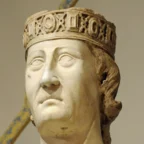
Charles I of Anjou
Charles I of Anjou, born around early 1226 or 1227 likely in Paris, emerged as one of the most ambitious and militarily adept rulers of 13th-century Europe, transforming the Mediterranean's political landscape through conquest and dynastic maneuvering. As the youngest son of King Louis VIII of France and Blanche of Castile, he belonged to the Capetian dynasty. Charles received the counties of Anjou and Maine as appanages from his brother, King Louis IX. In 1246, he married Beatrice of Provence, heiress to a strategic county bridging France and the Mediterranean. He joined Louis IX on the Seventh Crusade to Egypt (1248–1250), an experience that sharpened his tactical prowess and anti-Hohenstaufen alliances. Papal support from Urban IV and Clement IV propelled Charles into Italian politics as a Guelph champion against the Hohenstaufen. Crowned King of Sicily in Rome on 5 January 1266 by five cardinals, he invaded the Regno, annihilating Manfred of Sicily's army at Benevento that February, securing Naples and southern Italy. Victory over the youthful Conradin at Tagliacozzo in 1268 ended Hohenstaufen threats. Charles expanded ambitiously: proclaimed King of Albania in 1272, he bought a claim to Jerusalem in 1277 and became Prince of Achaea in 1278. The Sicilian Vespers uprising in 1282 — sparked by Angevin oppression — expelled him from the island, birthing the separate Kingdom of Sicily under Aragon while he retained Naples. Charles died on 7 January 1285 in Foggia, leaving the Angevin dynasty to his son Charles II. His legacy endures as founder of the Anjou-Sicily house, a master of power politics who redrew Europe's map through warfare, alliances, and statecraft.
-
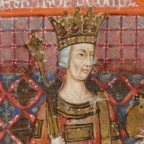
Charles II of Anjou
Charles II of Anjou - known in Italian as Carlo lo Zoppo ("Charles the Lame") and in French as Charles le Boiteux - was one of the most politically complex and diplomatically skilled rulers of late thirteenth- and early fourteenth-century Europe. Born around 1254, he reigned as King of Naples, Count of Provence and Forcalquier, and nominal claimant to the throne of Sicily until his death on 5 May 1309. His reign was defined not by military glory but by shrewd matrimonial diplomacy, deep religious piety, and the difficult inheritance of a kingdom torn apart by rebellion and war.
Charles was the eldest son and heir of Charles I of Anjou, the formidable French prince who had carved out a vast Mediterranean empire by defeating the Hohenstaufen dynasty in Italy. His mother was Beatrice of Provence, whose jewels had famously been pledged to finance Charles I's campaign to conquer Sicily. Growing up in a court that straddled the worlds of French chivalric culture and southern Italian governance, the young Charles was immersed early in affairs of state. In 1269, his father named him Prince of Salerno, and in 1270 he married Mary (Maria Arpad), daughter of King Stephen V of Hungary - a union that would prove crucial to the dynasty's long-term dynastic reach into central Europe.
The pivotal catastrophe that shaped Charles II's entire reign was the Sicilian Vespers of 1282 - a spontaneous, bloody uprising in which the Sicilian population massacred thousands of French soldiers and officials, effectively expelling the Angevins from the island. This insurrection, long fomented by forces loyal to the Hohenstaufen cause and arguably encouraged by Pope Nicholas III and the Byzantine Emperor Michael Palaeologus, shattered Charles I's Mediterranean empire. Peter III of Aragon, who had a dynastic claim to Sicily through his wife Constance, daughter of Manfred, swiftly accepted the Sicilian crown.
The situation worsened dramatically for the Angevin heir when, in 1284, Charles - acting as regent while his father fought to recover the island - engaged the Aragonese fleet in a naval battle off Naples and was captured. He remained a prisoner of Aragon for several years, unable to assume the throne even after his father died on 7 January 1285. To secure his freedom, he was forced to accept humiliating terms: the cession of Sicily to Aragonese control and the payment of a substantial ransom. This moment defined him in the eyes of contemporaries, and the epithet "the Lame" - originally a reference to a physical disability - took on a broader connotation of political weakness in the face of Aragon.
Pope Nicholas IV, a staunch Angevin supporter, took the bold step of crowning Charles II as King of Naples and Sicily in 1289, reinforcing the papacy's position that Sicily rightfully belonged to the Angevin house. This papal legitimization was crucial, as it gave Charles the moral and ecclesiastical authority to pursue his claims despite the military and political setbacks he had suffered. Backed by the Church, Charles embarked on years of complex negotiations aimed at restoring Angevin control over the island.
A major diplomatic breakthrough appeared to arrive in 1295 with the Treaty of Anagni, which seemed to settle the conflict. However, the Aragonese prince Frederick III, who held Sicily in practice, refused to abide by its terms. Backed by broad popular support among the Sicilians, who had no desire to return to Angevin rule, Frederick took the throne of Sicily for himself, defying both the papacy and Aragon. A military campaign led by Charles's son Robert and the papal legate Cardinal William of Macclesfield ultimately failed to dislodge him. The resulting Peace of Caltabellotta in 1302 acknowledged this bitter reality: Frederick III was confirmed as King of Sicily (though not of Naples), and to cement the peace, he was given Eleanor, a daughter of Charles II, in marriage. Charles had definitively lost the island his father had once ruled.
Despite the loss of Sicily, Charles II proved extraordinarily effective at expanding Angevin influence through the strategic deployment of his many children's marriages. He extended or reinforced his dynasty's grip over Piedmont, Provence, Hungary, Athens, and Albania through these alliances, weaving a web of political relationships that secured the House of Anjou's prominence across Europe for at least a generation. His grandson Charles Robert (Caroberto), for instance, would eventually become King of Hungary - a direct fruit of the Hungarian connection he himself had initiated through his marriage to Mary Arpad.
Charles was also a significant cultural patron. He transformed Naples into something of a European intellectual capital, fostering trade and the arts, supporting the university, and commissioning the construction of monasteries and churches. He reversed many of the harsher policies of his father's administration, cultivating a reputation for enlightened and merciful governance that stood in deliberate contrast to Charles I's severity. His court attracted scholars, theologians, and artists, making Naples a center of learning in the early Trecento.
Contemporaries consistently described Charles II as a man of exceptional piety, closely allied with the Church and personally devoted to religious observance. This was not merely political calculation - his relationship with the papacy went far deeper than convenience. He supported the mendicant orders, particularly the Dominicans and Franciscans, and was deeply involved in the veneration of saints. His son Louis of Toulouse, who had been held as a hostage in Aragon in place of his father, eventually renounced his dynastic rights and became a Franciscan friar, later canonized as Saint Louis of Toulouse - a remarkable testament to the intense religious atmosphere of the Angevin court.
Charles II died on 5 May 1309 in Naples and was buried in the Dominican church of the city. His reign, though marked by the irreversible loss of Sicily, nonetheless left a lasting imprint on the political map of Europe through his diplomatic tenacity, his cultivation of Naples as a royal capital, and the extraordinary dynastic network he constructed through the marriages of his children.
-
Chiara of Assisi (Saint Clare)
Chiara of Assisi (1194–1253) was the first woman to write a monastic rule for a religious order and one of the most original and courageous spiritual figures of the thirteenth century. Together with Francis of Assisi, she co-founded the branch of Franciscanism for women, an institution that today still counts over twenty thousand nuns worldwide.
Chiara Offreduccio was born in Assisi on 16 July 1194, into a family of the Umbrian high nobility, the daughter of Count Favarone di Offreduccio and Ortolana, herself a woman of marked religious devotion. She grew up in an environment of comfort and privilege, surrounded by the expectations typical of the medieval aristocracy: an advantageous marriage, the management of a family estate, the perpetuation of a lineage. Everything changed when, around the age of eighteen, she heard Francis of Assisi preach. The words of the Poverello struck her with such force that she became convinced God was calling her to a radically different life, founded on absolute poverty, prayer, and service.
On the night between 18 and 19 March 1212, Palm Sunday, Clare secretly fled her father's house and went to the small chapel of the Porziuncola, where Francis and his friars were waiting for her. In a simple yet solemn ceremony, Francis cut her hair and gave her the penitential habit, performing the symbolic act that definitively removed her from the secular world. Her family reacted violently: a dozen armed men went to the Benedictine monastery of Sant'Angelo in Panzo, where Clare had taken temporary refuge, in an attempt to bring her home by force. She resisted with determination, embracing the altar and revealing her shaved head—an unequivocal gesture of her definitive consecration to God.
Francis assigned the small convent of San Damiano, outside the walls of Assisi, which became her entire universe for forty years. She never left this place, choosing a life of total enclosure that was the mirror opposite of Francis's itinerancy, yet equally radical in its consistency. Soon other women joined her, including her sister Agnes and later her own mother, Ortolana. The community took the name Povere Dame—Pauperes Dominae—and in 1216 Clare became its abbess, a role she would hold until her death. Life at San Damiano was one of extreme austerity: the sisters slept on the bare floor, went barefoot, abstained from meat, and observed almost perpetual silence. Clare later moderated some of these penances with pragmatic realism, but the fundamental principle—absolute poverty, with no communal property or income—was never abandoned, not even in the face of pressure from popes who repeatedly tried to convince her to adopt the more lenient Benedictine Rule.
Clare's most revolutionary contribution was of a legal-spiritual nature: the drafting of her own Rule of Life, approved by Pope Innocent IV just two days before her death in 1253. It is the first text of monastic legislation in the history of the Christian Church written by a woman for women's communities—an absolute first, all the more extraordinary in an era when women were completely excluded from any legislative role in ecclesiastical life. Her Rule emphasized the principle of the privilegium paupertatis—the "privilege of poverty"—which Innocent III had granted her as early as 1215: the right, unique in medieval monastic history, to possess nothing.
Tradition attributes to Clare two miraculous episodes linked to the defense of Assisi. In 1241, when Saracens in the service of Emperor Frederick II scaled the walls of San Damiano, Clare had herself carried to the gates—gravely ill and unable to walk—and prayed before the Blessed Sacrament. According to the chronicles, the attackers were seized by sudden terror and retreated. On a second occasion, when General Vitale d'Aversa besieged Assisi with a larger army, the prayers of Clare and her sisters were accompanied by a sudden storm that scattered the enemy troops. The last seventeen years of her life were marked by chronic illness, yet this did not diminish her spiritual guidance of the community or her writing. On Christmas Eve 1252, unable to rise to attend Mass, she was said to have miraculously witnessed the liturgical celebration projected onto the wall of her cell—an episode for which Pope Pius XII proclaimed her the patroness of television in 1958. She died on 11 August 1253, surrounded by her sisters, and was canonized by Pope Alexander IV in 1255, just two years after her death.
For the study of medieval art, the figure of Saint Clare is indispensable. Her iconography—the gray-beige habit, the white veil, the pyx or lamp in hand—spread rapidly throughout Italy in the thirteenth and fourteenth centuries, inspiring pictorial cycles in Franciscan churches from Assisi to Florence, from Naples to Venice. Simone Martini depicted her in a panel now preserved in Toledo, where the solemnity of the gold background blends with a psychological delicacy characteristic of the early Trecento. The convent of San Damiano, with its frescoes and intact medieval atmosphere, remains one of the most evocative sites of medieval Italy.
-
Childeric I, King of the Salian Franks
Childeric I was a pivotal Frankish leader and the father of Clovis I, marking the early foundations of the Merovingian dynasty in the fading Roman world of late antiquity. Born around 436 CE, Childeric I succeeded his father, Merovech (or Meroveus), as king of the Salian Franks around 457–458 CE, ruling over territories in what is now northern France and Belgium, centered at Tournai. His reign unfolded amid the collapse of Roman authority in Gaul, where he navigated alliances and conflicts as a semi-Romanized barbarian leader, often described as a rex (king) on his seal ring found in his tomb. Sources like Gregory of Tours portray him as initially dissolute, leading to an eight-year exile in Thuringia due to his seduction of local women, during which the Gallo-Roman general Aegidius briefly claimed kingship over the Franks. Childeric served as a key ally to Roman commanders, fighting alongside Aegidius against the Visigoths at Orléans in 463 CE and later supporting Count Paulus against them in 469 CE near Angers. He also repelled Anglo-Saxon pirates and Saxons along the Loire River. Childeric married Basina, a Thuringian queen, and their son Clovis I (born c. 466) succeeded him, eventually unifying the Franks and expanding into much of Gaul. Childeric died in 481 CE at Tournai, where his lavish tomb was unearthed in 1653, yielding artifacts that confirm his royal prestige and connections to Roman elites.
-
Cistercian Order
The Cistercian Order was one of the most significant monastic reform movements in the history of Western Christianity. It emerged in 1098 from a determined effort to recover the strict observance of the Rule of Saint Benedict, and its early history is inseparable from three foundational abbots, a transformative charismatic leader, and a constitutional text that would shape medieval monastic life for centuries.
By the late eleventh century, many Benedictine monasteries had moved away from the austerity envisioned by Benedict. The Cluniac reform, though spiritually ambitious, had produced prosperous communities with elaborate liturgy, while manual labor and simplicity had often receded. For a growing minority of monks, authentic monastic life required a radical return to poverty, silence, and work. This conviction formed the background to Cistercian origins.
Robert of Molesme (c. 1029-1111) initiated the founding moment. Disturbed by what he regarded as lax observance at Molesme in Burgundy, he led twenty-one monks on 21 March 1098, the feast of Saint Benedict, to establish a new monastery at the remote site of Citeaux (Latin: Cistercium). The symbolic date signaled not innovation, but restoration of an older ideal. Robert soon returned to Molesme after papal intervention, leaving the new house in a fragile early phase.
Alberic of Citeaux (d. 1109), Robert's successor, stabilized the community. Under Alberic, the order adopted the undyed white habit that earned the Cistercians the name "White Monks," in contrast to black-habited Benedictines. He also secured support from Odo, Duke of Burgundy, and pursued papal recognition, ensuring institutional protection for the young foundation.
Stephen Harding (d. 1134), an English monk and third abbot of Citeaux, gave the order its durable constitutional form. His Carta Caritatis ("Charter of Charity") established a network of autonomous houses bound by common observance, customs, and liturgy. It required annual meetings of all abbots at Citeaux in a General Chapter, creating a legislative mechanism unprecedented in monastic governance. Stephen also oversaw textual and liturgical correction, including a revised Vulgate and chant tradition, reflecting Cistercian concern for fidelity and sobriety.
The Cistercians did not create a new rule. They followed the Rule of Saint Benedict (c. 530), but with unusual literalness and rigor. Their interpretation emphasized poverty, manual labor, liturgical simplicity, silence, enclosure, and sustained lectio divina. They rejected many feudal revenue structures common in wealthy monasteries and sought support through work, especially agriculture. Their architectural culture mirrored this theology: austere churches with restrained ornament, where proportion and light replaced displays of luxury.
No account of the order is complete without Bernard of Clairvaux (1090-1153), often called its "second founder." Entering Citeaux in 1112 with a large group of companions, Bernard propelled Cistercian expansion across Europe. From Clairvaux, founded in 1115, he directed new foundations, corresponded with popes and rulers, preached the Second Crusade, and authored major theological and mystical works. His authority gave the order a scale and public influence that far exceeded its modest beginnings.
The Cistercian constitutional system rested on three coordinated principles: uniform observance, annual General Chapter, and regular visitation of daughter houses by mother abbots. This model preserved coherence while retaining local autonomy and is often regarded by historians as one of the first fully articulated religious-order structures in Western Church history.
By the mid-twelfth century the order had spread from Ireland to the Latin East. Female Cistercian communities appeared early in the twelfth century, though formal integration developed later. In the thirteenth century, Cistercian influence also touched scholarship and manuscript culture, including important illuminated production that stood in creative tension with early Cistercian suspicion of visual excess.
Over the following centuries, wealth accumulation, plague, schism, and institutional adaptation weakened aspects of primitive observance. In 1664, Pope Alexander VII formally recognized distinct currents within the order, including the Strict Observance later associated with La Trappe and the Trappists (Order of Cistercians of the Strict Observance, OCSO). Through them, the austere ideals of the first generation continued into the modern period.
-
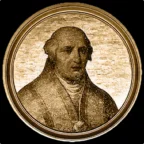
Clement IV, Pope
Pope Clement IV was the 181st pope of the Catholic Church, reigning from 1265 until his death in 1268. Born Gui Foucois (also rendered in Latin as Guido Falcodius and in French as Guy de Foulques) at Saint-Gilles on the Rhone in Languedoc, he was one of the most remarkable figures of the thirteenth-century papacy: a man who came to the throne of Saint Peter not through a lifetime of ecclesiastical ambition, but through a distinguished secular career as a jurist and royal counsellor.
Clement was born on 23 November, around 1190, into a prosperous legal family: his father, Pierre Foucois, was himself a lawyer. Following in his father's footsteps, Gui became an eminent jurist and entered royal service, working as legal consultant to the counts of Toulouse and later to King Louis IX of France (Saint Louis). He married, had two daughters, and built his first career outside formal ecclesiastical structures. His entry into Church life came only after his wife died around 1256; as a widower he was ordained priest at the Abbey of Saint-Magloire in Paris. This late vocation gave him a practical and political maturity that marked his pontificate.
His rise was exceptionally rapid. He became pastor of Saint-Gilles in 1255, bishop of Le Puy in 1257, and archbishop of Narbonne in 1259. In December 1261, Pope Urban IV created him cardinal-bishop of Sabina, the first cardinal appointed in that pontificate. Between 1262 and 1264 he served as papal legate to England, Wales, and Ireland. While returning from that mission, he received news that the cardinals in Perugia had elected him pope in absentia on 5 February 1265; he was crowned in Viterbo on 22 February and took the name Clement IV.
The central political issue of Clement's brief pontificate was the final destruction of the Hohenstaufen dynasty, long the papacy's principal rival in southern Italy. Continuing Urban IV's line, he invested Charles of Anjou with the Kingdom of Sicily and Naples in November 1265 and supported the Angevin campaign. Charles defeated Manfred at Benevento (1266), and after Tagliacozzo (1268) the young Conradin was captured and executed, effectively ending Hohenstaufen claims in the region. Clement, however, did not remain uncritical of Angevin government and repeatedly reproached Charles for excesses and for failing to respect the spirit of his coronation commitments.
In ecclesiastical governance, Clement strengthened papal centralization through the decretal Licet Ecclesiarum (1265), affirming Roman jurisdiction over appointments to western benefices at a time of frequent secular interference. He also supported major intellectual figures of the age, maintaining a close relationship with Thomas Aquinas and encouraging Roger Bacon's work on what became the Opus Majus. This patronage reflects a papacy open to advanced theological and scientific inquiry in the later thirteenth century.
Clement never resided in Rome, where conditions remained unstable and often hostile to papal residence. He governed primarily from Perugia and then Viterbo, where he died on 29 November 1268. He was buried in the Dominican convent of Santa Maria in Gradi. His death initiated one of the longest and most famous sede vacante periods of the medieval Church: the cardinals took nearly three years to elect Gregory X, a crisis that directly contributed to the later formalization of conclave procedures. The Registrum Clementis Papae IV, edited in modern scholarly form between 1893 and 1945, remains a foundational source for the political and ecclesiastical history of the mid-thirteenth century.
-
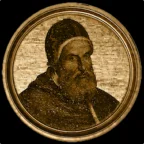
Pope Clement VIII (Ippolito Aldobrandini)
Pope Clement VIII, born Ippolito Aldobrandini on 24 February 1536 in Fano, in the Papal States, was the 231st pope of the Catholic Church, reigning from 30 January 1592 until his death on 3 March 1605. He is remembered as one of the most energetic and consequential popes of the late Counter-Reformation era, a pontiff whose pontificate touched virtually every corner of European politics, theology, and ecclesiastical reform.
Ippolito Aldobrandini came from an illustrious Florentine family of jurists and civic leaders. His father, Silvestro Aldobrandini, was a distinguished canon lawyer who had been exiled from Florence for his opposition to the Medici, and the young Ippolito followed his father's intellectual path by studying law at Padua, Perugia, and Bologna, where he earned his doctorate. This formation in canon law proved decisive: it gave him a precise, systematic mind and a deep familiarity with the institutional mechanisms of the Church that he would deploy throughout his long career.
Ippolito's advancement in the Roman Curia was steady and impressive. Under Pope Pius V, a family benefactor, he became a consistorial advocate in 1568 and auditor of the Roman Rota - the highest ecclesiastical court of the Holy See - in 1570. His ascent accelerated under Pope Sixtus V, who made him a Cardinal-Priest of San Pancrazio in December 1585, appointed him Major Penitentiary of the Apostolic Penitentiary in 1586, and sent him as papal legate to Poland in 1588.
One of the most striking facts about his pre-pontifical career is that despite his decades in curial service, he was not ordained a priest until 31 December 1580, at the age of 45 - a late ordination that reflected the common practice of the era whereby men could hold high ecclesiastical offices as laymen. This spiritual deepening was strongly influenced by his confessor for thirty years, the great reformer Saint Philip Neri, whose gentle but insistent spiritual direction left a permanent mark on Aldobrandini's piety and character.
His mission to Poland in 1588 was a remarkable success that significantly raised his profile within the College of Cardinals. He mediated the dispute over the Polish throne between King Sigismund III and Archduke Maximilian of Habsburg, who had been imprisoned after his failed bid to claim the crown. Aldobrandini secured Maximilian's release and brought both parties to an agreement that satisfied the Habsburgs, winning him their lasting gratitude and establishing his reputation as a brilliant and trustworthy diplomat.
After the deaths of Popes Sixtus V, Urban VII, Gregory XIV, and Innocent IX in quick succession between 1590 and 1591, the College of Cardinals elected Aldobrandini pope on 30 January 1592, following a conclave that was notably turbulent. His election came partly because the dominant influence of Philip II of Spain over papal elections had begun to wane, allowing the cardinals greater freedom of choice. He had received significant support in previous conclaves as well, making his eventual elevation feel almost inevitable. He was consecrated bishop only after his election, since he had previously held only the lower orders.
The single most celebrated political achievement of Clement's pontificate was his reconciliation of Henry IV of France - the Protestant king of the House of Bourbon - with the Catholic Church in 1595. Henry had converted to Catholicism in 1593, famously declaring "Paris is well worth a Mass," but his absolution required papal endorsement for political legitimacy. Clement granted Henry absolution, lifting the excommunication that had been imposed on him as a Huguenot, and in so doing helped end the devastating Wars of Religion that had torn France apart for decades. The Edict of Nantes followed in 1598, granting French Protestants significant freedoms, and the peace between France and Spain was sealed by the Treaty of Vervins in 1598 - a diplomatic triumph in which Clement played a crucial mediating role.
Clement was deeply committed to the idea of a unified Christian front against the Ottoman Empire, a preoccupation that shaped much of his foreign policy. He worked to build alliances of Christian princes to resist Ottoman expansion into Central Europe in the conflict known as the Long Turkish War (1593-1606), providing substantial financial and diplomatic support to the Habsburg Emperor Rudolf II. He also encouraged the Serb uprising of 1596-97, hoping to destabilize Ottoman power in the Balkans by stirring revolt among Christian populations under Turkish rule.
One of the most intellectually significant episodes of Clement's papacy was his adjudication of the bitter theological dispute between the Dominicans and the Jesuits over the relationship between divine grace and human free will - a controversy known as the De Auxiliis debate. The Jesuit theologian Luis de Molina had proposed a theory called Molinism, which sought to reconcile God's omniscience and efficacious grace with genuine human freedom. The Dominicans, heirs to the Thomistic tradition, attacked this as tantamount to Pelagianism - the heresy that humans can save themselves by their own efforts. The dispute threatened to fracture Catholic theology, and Clement convened special congregations to hear the arguments of both sides. He died before rendering a final verdict, but his handling of the matter was widely praised for its fairness and theological seriousness.
One of the most controversial episodes of Clement's papacy was his presidency over the trial and execution of Giordano Bruno, the Dominican friar and philosopher who had developed a vast, heterodox cosmological vision that challenged orthodox theology. After a seven-year trial by the Roman Inquisition, Bruno was convicted of heresy and burned at the stake in the Campo de' Fiori in Rome on 17 February 1600. The execution has made Clement's name notorious in the history of intellectual freedom, though it must be understood within the intensely fraught religious culture of the Counter-Reformation, in which the boundaries of orthodox belief were policed with extreme severity.
Clement was a determined and meticulous reformer of sacred texts. In 1592 he issued the authoritative revised edition of the Clementine Vulgate - the Latin Bible - which became the standard text of the Catholic Church for centuries and still bears his name. He also published revised editions of the Breviary, the Missal, the Cæremoniale, and the Pontificale, updating the liturgical books of the Roman Rite in ways that consolidated the reforms of the Council of Trent. These achievements reflect a pope deeply invested in the intellectual and devotional coherence of Catholic worship.
Clement presided over the Holy Year of 1600 with great solemnity, and it proved one of the most successful jubilees in the history of the medieval and early modern Church. Enormous crowds of pilgrims flooded Rome, and the jubilee became an occasion for both popular piety and public spectacle. It was during the preparations for this jubilee that the sculptor Stefano Maderno opened the tomb of Saint Cecilia in the church of Santa Cecilia in Trastevere and discovered her apparently incorrupt body - promptly immortalizing it in the famous marble sculpture that remains one of the masterpieces of early Baroque art.
Clement was a committed patron of ecclesiastical education. He founded the Collegio Clementino in Rome for the education of the sons of the wealthier classes, and expanded the number of national colleges in the city by establishing the Collegio Scozzese to train missionaries for Scotland. His reign is also noted for the exceptional quality of the papal medals struck during his pontificate, reflecting his appreciation for the visual arts and material culture of the Catholic Church.
According to a charming tradition that may or may not be strictly historical, Clement VIII was the first pope to drink coffee. When his advisors urged him to ban the beverage as a Muslim drink, he reportedly tasted it and found it so delicious that he gave it his blessing, thereby - according to legend - contributing to the spread of coffee culture across Catholic Europe. Whether strictly true or not, the story captures something of Clement's practical intelligence and openness to novelty.
By the end of his pontificate, Clement suffered severe gout that confined him to a wheelchair - one of the earliest documented uses of such a device by a European head of state - an image preserved in the travel journal of the architect Heinrich Schickhardt. He died on 3 March 1605 in Rome, and was initially buried in Saint Peter's Basilica. His successor Paul V later had a magnificent mausoleum built for him in the Borghese Chapel of Santa Maria Maggiore, where his remains were transferred in 1646.
Clement VIII governed the Catholic Church at a pivotal moment - a generation after the Council of Trent had redefined Catholic doctrine and discipline, but still amid the violent confessional struggles of the Reformation era. Formed by canon law, shaped by the spiritual guidance of Philip Neri, and driven by a genuine reforming zeal, he was one of the last great popes of the Counter-Reformation tradition.
-
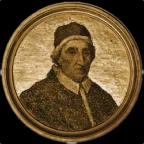
Clement XI (Giovanni Francesco Albani, 1649-1721; pope 1700-1721)
Born at Urbino on 23 July 1649 into the Albani, a noble family of Albanian descent settled in the Marches, he was educated in Rome at the Collegio Romano and acquired a reputation as a precocious classicist - his Latin prose and his standing among the literati of Queen Christina of Sweden's circle and the nascent Accademia dell'Arcadia were part of his public identity long before his election. He took a doctorate in utroque iure, served as governor of Rieti, Sabina and Orvieto, and was created cardinal-deacon by Alexander VIII in 1690, later serving as Secretary of Briefs. Characteristically for a curial career of that type, he was still not a priest: he was ordained only in September 1700, weeks before the conclave.
He was elected on 23 November 1700, at the end of a long conclave, and is said to have hesitated for several days before accepting, consulting theologians on whether he was obliged to. The timing was catastrophic: Charles II of Spain had died on 1 November, and the War of the Spanish Succession opened almost simultaneously with the pontificate.
Clement's attempt at neutrality between Bourbon and Habsburg claimants satisfied neither. Imperial troops invaded the Papal States in 1708-09, and he was compelled to recognise the Archduke Charles as king of Spain after having recognised Philip V. The Treaty of Utrecht (1713) then redistributed territories over which the papacy claimed feudal suzerainty - Sicily, Sardinia, the Farnese duchies - without consulting him; his protests were ignored. His reign is conventionally read as a marker of the collapse of papal weight in European diplomacy.
Two decisions gave him lasting historical significance:
- Jansenism. After Vineam Domini Sabaoth (1705), he issued the bull Unigenitus Dei Filius (8 September 1713), condemning 101 propositions drawn from Pasquier Quesnel's Reflexions morales. It provoked the "appellant" crisis in the French Church and a conflict that outlasted him by decades.
- The Chinese Rites. Through the decree of 1704 and the bull Ex illa die (1715) he prohibited Jesuit accommodation of ancestral and Confucian rites. The legation of Charles-Thomas Maillard de Tournon ended in disaster - Tournon died in Portuguese custody at Macao in 1710 - and the Kangxi emperor's hostility effectively closed the mission's most promising period.
He also extended the feast of the Immaculate Conception as a holy day of obligation for the universal Church (1708) and canonised Pius V, Andrea Avellino, Felix of Cantalice and Catherine of Bologna (1712).
Patronage. Clement was a serious patron of learning and antiquities. He greatly enriched the Vatican Library's Oriental holdings, sponsoring the missions of Giuseppe Simone Assemani to the East in search of Syriac, Arabic and Coptic manuscripts. He supported the Accademia di San Luca, whose Concorsi Clementini date from his reign; commissioned Francesco Bianchini's meridian line in Santa Maria degli Angeli; re-erected the obelisk in Piazza della Rotonda before the Pantheon (1711); and initiated the programme of colossal Apostle statues for the nave of San Giovanni in Laterano. His nephews Annibale and above all Alessandro Albani - later Winckelmann's patron - built on this foundation, and the Albani collections descend from his milieu.
He died on 19 March 1721 and was buried, at his own wish, under a plain pavement slab in St Peter's rather than in a monumental tomb.
-
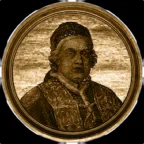
Clement XIII (Carlo della Torre di Rezzonico, 1693-1769; pope 1758-1769)
Born in Venice on 7 March 1693, Carlo Rezzonico came from a family originally of Como that had bought its way into the Venetian patriciate in 1687 - a recent, immensely wealthy house rather than an old one. He was educated by the Jesuits at the Collegio dei Nobili in Bologna and took his doctorate in utroque iure at Padua. This early Jesuit formation matters: it shaped the loyalty that would define, and effectively destroy, his pontificate.
His curial career was conventional and competent. Governor of Rieti and then of Fano, auditor of the Rota for Venice, ordained priest in 1731, created cardinal by Clement XII in 1737. In 1743 he became bishop of Padua, where - unusually for a curial cardinal of the period - he resided, held a diocesan synod, visited his parishes, and spent heavily on charity. Contemporaries who disliked his politics rarely questioned his personal piety or his generosity.
The conclave following Benedict XIV's death opened in May 1758 and lasted nearly two months. The leading candidate, Cardinal Carlo Alberto Guidobono Cavalchini, was blocked by the French crown's exclusive. Rezzonico emerged on 6 July as the compromise: unaligned, inoffensive, and known for devotion rather than for statecraft. He took his name in gratitude to the pope who had made him cardinal. The Rezzonico family celebrated by completing their palace on the Grand Canal - Giorgio Massari finished the unfinished Bon building, and Giambattista Tiepolo frescoed the ballroom ceiling and, in 1758, the Nuptial Allegory for the pope's nephew Ludovico. Ca' Rezzonico, now the Museo del Settecento Veneziano, is in effect a monument to this election.
The whole pontificate was consumed by a single conflict, and Clement lost it stage by stage. The Bourbon and Braganza courts, driven by regalist ministers, moved in sequence against the Society of Jesus: Pombal expelled them from Portugal and its empire in 1759; Louis XV suppressed the order in France in 1764; Charles III expelled them from Spain and its colonies in 1767, followed by Naples, Parma and Malta.
Clement's response was to dig in. The bull Apostolicum pascendi (7 January 1765) solemnly confirmed the Institute of the Society and praised its work - a defiant document that changed nothing on the ground. His Secretary of State, Cardinal Luigi Torrigiani, was an uncompromising defender of the Jesuits, and under his direction the papacy consistently chose confrontation over negotiation without possessing the means to sustain it.
The breaking point was Parma. When the Bourbon duchy issued edicts in 1768 curtailing ecclesiastical jurisdiction, Clement replied with a monitorium (30 January 1768) declaring them null and void. The Bourbon powers retaliated in concert: France seized Avignon and the Comtat Venaissin, Naples occupied Benevento and Pontecorvo. In January 1769 their ambassadors jointly demanded the total suppression of the Society. A consistory was convoked for 3 February. Clement died during the night of 2 February 1769, of a stroke, hours before he would have had to answer. His successor Clement XIV conceded the suppression in 1773.
Doctrinal and devotional acts. He condemned Helvetius's De l'esprit and placed the Encyclopedie on the Index in 1759, and pressed for the burning of Febronius's treatise on papal authority. In 1765 he approved the Mass and Office of the Sacred Heart for Poland and for the Roman archconfraternity - a modest-looking act that gave decisive impetus to a devotion the Jesuits had promoted and the Jansenists derided.
In 1763 Clement appointed Johann Joachim Winckelmann Prefect of Antiquities of Rome, an act that placed the emerging discipline of classical archaeology under papal protection. He favoured his Venetian compatriot Giovanni Battista Piranesi, who dedicated Della Magnificenza ed Architettura de' Romani (1761) to him and received the Order of Christ; Piranesi's only executed building, Santa Maria del Priorato on the Aventine, was commissioned by the pope's nephew Cardinal Giovanni Battista Rezzonico as Grand Prior of the Knights of Malta. And his own tomb in St Peter's, commissioned by the family from Antonio Canova and executed in the 1780s and early 1790s, is one of the founding monuments of Neoclassical sculpture - arguably the most important artistic consequence of the entire Rezzonico papacy.
He is also traditionally blamed for the campaign of fig leaves applied to antique nudes in the papal collections. The story is repeated everywhere but the documentary basis is thin, and the practice spans several pontificates; it should be treated as tradition, not fact.
-
Clovis I, King of the Franks
King Clovis I stands as one of the most consequential rulers of early medieval Europe: the man who unified the Frankish tribes, destroyed the last remnant of Roman authority in Gaul, and bound the nascent Frankish kingdom to Roman Catholic Christianity, forever shaping the religious and political identity of what would become France.
Clovis was born around 466 near present-day Tournai (in modern Belgium), the son of Childeric I and Basina, king and queen of the Salian Franks. He ascended to the kingship at approximately fifteen years of age upon the death of his father in 481, inheriting a kingdom that encompassed the region of modern Belgium and northeastern France. Though not the first Frankish king, he would prove to be the kingdom's true political and religious founder.
At this period, Gaul was a fragmented landscape of competing Germanic kingdoms and residual Roman enclaves. Clovis inherited authority over only one of several petty Frankish sub-kingdoms, and his early reign was defined by a relentless drive to consolidate and expand.
Clovis's first major military triumph came in 486 at the Battle of Soissons, where he defeated Syagrius, son of the Roman magister militum Aegidius and self-styled "King of the Romans," who controlled the last Gallo-Roman enclave between the Meuse and Loire rivers. With this victory, Clovis swept away the final fragment of the Western Roman Empire in northern Gaul and seized the important cities of Senlis, Beauvais, Soissons, and Paris. He made Paris his capital and established an abbey dedicated to Saints Peter and Paul on the south bank of the Seine.
Recognizing that he could not rule Gaul without the support of the Gallo-Roman clergy, Clovis integrated many of Syagrius's Roman military units into his own army and took a Catholic wife to cultivate ecclesiastical goodwill. The Roman kingdom was likely fully under his control by 491, after which he turned eastward against the Thuringians.
In 496, the Alamanni invaded Frankish territory, and some Salian and Ripuarian sub-kings defected to the enemy. Clovis met them near the fortress of Tolbiac (modern Zulpich), where the Franks initially suffered heavy losses. According to the celebrated legend, it was during this desperate moment that Clovis prayed to the Christian God, the God of his wife Clotilde, vowing to convert if victorious. He narrowly defeated the Alamanni with the help of the Ripuarian Franks, and the battle became the pivotal moment of his spiritual transformation.
On Christmas Day 496 (though some sources place the date around 498 or 506), Clovis was baptized at Reims by Bishop Remigius (Saint Remi), along with more than three thousand Frankish warriors. This was not merely a personal conversion but a geopolitical act of the first order: by embracing Roman Catholic orthodoxy rather than Arian Christianity (as the Visigoths and Burgundians had), Clovis aligned himself with the papacy, the Gallo-Roman population, and the Byzantine Empire. He became the most important western ally of the Byzantine emperor Anastasius I.
Having secured the north and the east, Clovis turned south against the Visigoths. In 507, at the Battle of Vouille near Poitiers, he defeated and killed the Visigothic king Alaric II, seizing most of Aquitaine and pushing Visigothic power back behind the Pyrenees. This victory made the Franks the dominant Germanic power in the Latin West.
Between 507 and 509, Clovis systematically eliminated rival Frankish sub-kings who might challenge his supremacy. He imprisoned and later executed Chararic and removed other competing Merovingian claimants, consolidating his authority over the Frankish world.
Beyond warfare, Clovis laid important institutional foundations. The Pactus Legis Salicae (Law of the Salian Franks), a written code blending Germanic customary law, Roman written law, and Christian ideals, likely originated during his reign and exercised long influence on medieval jurisprudence. He also appointed local counts to administer conquered territories, borrowing from Roman administrative models. In 511, the year of his death, he convened the Council of Orleans, further cementing the alliance between the Frankish crown and the Church.
Clovis died on November 27, 511, in Paris, aged approximately forty-five. He was buried in the Church of the Holy Apostles (later Saint-Genevieve) in Paris. His realm, encompassing most of modern France and Belgium, was divided among his four sons, who each received a portion centered on Reims, Orleans, Paris, and Soissons, ensuring the continuation of the Merovingian dynasty for another two centuries until the rise of the Carolingians in the 8th century.
The tomb effigy of Clovis, now at the Basilica of Saint-Denis, preserves the image of a crowned king holding a scepter, a fitting emblem of the man who transformed the Franks from one Germanic tribe among many into the foremost Catholic power of the early medieval West.
-
Codex Fuldensis
The Codex Fuldensis stands as one of the most significant early witnesses to the Latin Vulgate New Testament, offering crucial insights into 6th-century biblical transmission and the influence of Tatian's 2nd-century Diatessaron harmony. Produced between 541 and 546 at Capua in Italy under Bishop Victor of Capua, it integrates a harmonized Gospel narrative fashioned as a continuous woven text from the four evangelists, while including the full Vulgate New Testament afterward. Victor personally oversaw its correction, completing it by 2 May 546, as noted in his subscription, making it one of the earliest precisely dated New Testament manuscripts. Written in uncial script on parchment in one column per page, the manuscript reflects late antique Italian book production techniques. By 745, Saint Boniface acquired it and donated it to Fulda Abbey's library (as Codex Bonifatianus I, shelfmark Aa 1), where it remains today in the Hessian State Library, influencing Old High German and Old Saxon gospel harmonies. Arriving at Fulda during its rise as a Carolingian intellectual hub, the codex complemented the abbey's scriptorium output, including Brun Candidus's Vita Aegili. Though unilluminated itself, it represents proto-Carolingian textual prestige, later inspiring glosses possibly in Boniface's hand and serving vernacular translations amid Fulda's Anglo-Saxon missionary legacy.
-
Compagnia dei Laudesi (Laudesi Confraternities)
The Compagnia dei Laudesi were lay devotional associations that emerged in Italy in the 13th century; their primary purpose was to sing spiritual lauds in the vernacular in honor of the Virgin Mary and the saints—one of the most original and historically significant expressions of medieval popular piety.
The Laudesi movement developed in central Italy beginning in the 1240s, riding the wave of spiritual ferment promoted by the mendicant orders, particularly the Franciscans and Dominicans. The companies were spontaneous associations of laypeople—not clerical institutions—who gathered in the evening, after sunset and the closing of the markets, to sing praises to the Virgin together before a sacred image. This lay and popular character was entirely new: for the first time, religious singing emerged from churches and monasteries to become a communal practice of ordinary men and women, in the loggias, squares, and oratories of Italian cities.
The first Laudesi confraternity was founded in Siena in 1267, at a Dominican church—a distinction that places the city of Siena at the origin of one of the most important devotional movements of the Italian Middle Ages. Soon the practice spread throughout Tuscany and Umbria, giving rise to a flourishing of companies in the major cities: Florence, Perugia, Arezzo, and Pistoia.
The most famous of all was the Compagnia dei Laudesi di Orsanmichele in Florence, officially known as the Compagnia della Beata Vergine pura Madonna Santa Maria di San Michele in Orto. According to the testimony of Cardinal Niccolò da Prato in 1304, it was founded between 1244 and 1245 by Saint Peter Martyr—the Dominican Pietro da Verona—during his stay in Florence. Official recognition by Bishop Andrea de' Mozzi took place in 1294. The confraternity arose spontaneously around the growing veneration of a Madonna and Child painted on the pillars of the Florentine Loggia del Grano—attributed by Vasari to Ugolino da Siena—an image that, due to its miraculous powers, was called the Madonna delle Grazie.
Alongside the Orsanmichele company existed the older Compagnia Maggiore de' Laudesi della Beata Vergine Maria, founded in 1183, which had its own oratory in the heart of the city, near the entrance to Santa Reparata—exactly where Giotto's bell tower would later be erected. Many members of this company belonged to Florence's most noble families, and from this association emerged the Seven Holy Founders of the Order of the Servants of Mary. Other Florentine companies were linked to Santa Maria Novella, the Carmine, Santa Maria Maggiore, and San Frediano.
The heart of the Laudesi's activity was the spiritual lauda—a form of religious poetry and song in the vernacular, born in Italy in the 13th century, deeply linked to Franciscan spirituality. The lauda was sung during the companies' assemblies and constituted their most important devotional moment, in which all members participated in unison. Initially, these were monodic songs—a single voice, without harmony—but during the 14th century, the polyphonic lauda developed, with multiple voices intertwining, in a progression that foreshadowed the musical forms of the Renaissance. The companies preserved their repertoires in special manuscripts called laudari: the most splendid ones preserved to this day are those of the Florentine companies of Santo Spirito (circa 1330) and San Gilio (circa 1380).
Alongside their devotional function, the confraternities carried out intense charitable work: they collected offerings from the faithful, distributed alms to the poor, and assisted the sick and needy. The governing structure was simple yet effective: at the head were the Capitani, whose number varied over time—six, then four, then eight—who remained in office for four months, presided over by a Preposto chosen in rotation from among them. The statutes of the Florentine companies, some of which are still preserved, prescribed in minute detail the duties of the members, ranging from prayer to charity, to the "fight against heresies."
For the scholar of medieval art, the Laudese Confraternities are of paramount importance, as they were among the most active patrons in Italy during the 13th and 14th centuries. The great Marian devotion that animated these confraternities generated a constant demand for sacred images—painted panels, crucifixes, frescoes—intended for the oratories and churches where they gathered. The Madonna delle Grazie of Orsanmichele, which Vasari attributed to Ugolino da Siena, was the focal point around which the entire Florentine company was founded. The Laudese patronage was one of the main driving forces behind that extraordinary Sienese and Florentine artistic period which, from Cimabue to Duccio, from Giotto to Simone Martini, would forever transform the visual language of the West.
-
Compagnia della Madonna di Orsanmichele
The history of the Compagnia della Madonna di Orsanmichele is inseparable from the building that gave it its name — a structure of singular ambiguity in the urban fabric of medieval Florence, simultaneously grain market and sacred space, commercial exchange and oratory. Known in ancient times as the church of San Michele in Orto, Orsanmichele was originally built for the grain market: a loggia attributed to Arnolfo di Cambio, in use by February 1285, on one of whose columns a Madonna image had been mounted. The coexistence of commerce and devotion beneath the same roof was not a paradox but a structural feature of Florentine civic life.
The confraternity of Orsanmichele, a laudesi group dedicated to the Virgin Mary, was founded in 1291 at the Florentine grain market, just a year after the grain loggia's completion. The confraternity shared space with the traders under the loggia: traders worked there by day, while members met in the evenings and on Sundays and feast days, when the market was closed. On 3 July 1292, the Marian image miraculously began to heal the sick. In honour of the Madonna, a confraternity was formally founded on 10 August 1292, modelling itself on the Laudesi Brotherhood of Santa Maria Novella, especially in its mission to sing artistic hymns. The chronicler Giovanni Villani described the Madonna's power in vivid terms, reporting that she was seen to cure the sick, straighten the lame, and restore the mentally afflicted — visibly and in great number. The cult lasted centuries and became equated with the political and spiritual identity of Florence itself.
The members of the Compagnia were known as the Laudesi — those who praised — referring to the laude (hymns) that members pledged to sing in worship of the iconic painting. This was not, however, a merely spiritual institution. Backed by the communal and trading community, the confraternity provided essential physical and political protection for the grain market in the face of magnate factions that opposed and threatened it. The Madonna functioned as a kind of spiritual guarantor of civic order — a holy shield interposed between the vulnerable mechanisms of the food supply and the factional violence that threatened to disrupt them.
The Compagnia grew with extraordinary speed, becoming Florence's largest and wealthiest lay group, with over 3,000 members by 1324. The scale of membership — in a city of roughly 100,000 inhabitants — made it a genuinely mass institution, enrolling merchants, artisans, and workers alongside patricians and notaries. The communal government relied on the confraternity to promote social stability and political agendas. The financial resources that flowed from this membership, combined with votive offerings left at the image by the sick, the grateful, and the desperate, made the confraternity one of the wealthiest non-ecclesiastical bodies in Tuscany.
A fire in 1304 destroyed the original loggia and the miraculous image painted on its column. A replacement image was made, establishing a pattern that would repeat itself. In 1347 a third image was commissioned from Bernardo Daddi — the leading Florentine panel painter of his generation and a figure central to Erling Skaug's research on punzoni — while the second was moved to a side aisle. It was believed that the miraculous abilities transferred between each reproduction of the painting: the miracle was not lodged in the material object but in the Marian presence the object mediated, and that presence could migrate, intact, into each new image. Daddi's panel — an impressive work in tempera on poplar depicting the enthroned Virgin and Child adored by eight angels, now framed within Orcagna's tabernacle — is the image still visible in Orsanmichele today. He completed it a few months before the first wave of the Black Death hit Florence; Daddi himself died in the epidemic of 1348, leaving his masterwork as his final testament to the city's most powerful devotional image.
The plague of 1348 was the defining catastrophe of the century — and paradoxically, for the Compagnia, one of the greatest sources of its wealth. As Florentines died in their tens of thousands, many left bequests to the confraternity in their wills. The sheer volume of these simultaneous testamentary gifts delivered an extraordinary financial windfall to the Capitani. Matteo Villani, in his Chronicle of Florence, vehemently condemned the captains, accusing them of embezzlement and condemning them for their selfishness. Shortly thereafter, Andrea Orcagna received his commission for a new tabernacle — in part an act of public penance and reputational repair, a spectacular investment of contested funds in a monument whose magnificence would demonstrate the confraternity's devotion to the Madonna they served.
Commissioned in 1349 by the Laudesi, the tabernacle was designed by Orcagna, the foremost artist in the city at the time, as an architectonic edifice approximating the loggia form used by confraternities across the city. A two-tiered grate surrounds a square loggia on all four sides, with twisted column clusters forming piers from which spring the ribs of a vault; rounded arches provide sightlines for the miraculous painting on three sides; pinnacles and pediments extend toward the ceiling, partially concealing a ribbed dome that may symbolise the heavens above. The pedestal carries a cycle of marble reliefs depicting scenes from the Life of the Virgin — 117 figures in all — executed between 1352 and 1359. The tabernacle both framed the picture that, in 1365, was named the "official painting of Florence" and stood on its own as a cultural monument that drew local and international viewers in great numbers. The Madonna was veiled in expensive silk when not in active devotional use, revealed by means of a pulley system at times of prayer or supplication — a liturgical choreography of concealment and disclosure that heightened the drama of each encounter with the sacred image.
The Laudesi played a vital role in Florence especially during hard times such as the Black Death, managing to accumulate important sums of money and forming huge crowds of pilgrims who came from nearby villages and towns to visit the Madonna of Orsanmichele. The confraternity would slowly lose its grip and influence on the city as the Middle Ages faded into modernity. The institutional arc of the Compagnia — from devotional gathering born beside a grain market in 1291 to the patron of one of the supreme monuments of Gothic sculpture — condenses within itself the full range of forces that shaped Trecento Florence: the theology of the miraculous image, the politics of the arti and the commune, the economics of the grain trade, the catastrophe of the Black Death, and the artistic ambitions of a generation that turned crisis into stone, gold, and marble.
-
Compagnia di San Luca, Florence
In Florence there was no separate guild for artists. Painters belonged to the Guild of Physicians and Apothecaries (Arte dei Medici e Speziali), since they purchased their pigments from apothecaries, while sculptors were members of the Guild of Masters of Stone and Wood (Maestri di Pietri e Legname), or, if working in metal, of the smiths' guild. Because of this lack of autonomous representation, the artists created the Compagnia di San Luca, a confraternity dedicated to Saint Luke — their own society where they could meet, pray, and talk shop.
The founding date is debated in the sources: some attest 1339, others 1349. Jacopo del Casentino (c. 1297–1358) was among the founders, and was elected its first consigliere in 1339. Regardless of the precise year of formal institution, the Compagnia had existed since at least the fourteenth century. Allegretto Nuzi is documented for the first time in Florence in 1346, when he enrolled in the Compagnia — evidence that it was already fully operational by the mid-Trecento, with its own register of admissions that welcomed painters from outside Florence.
It is essential to distinguish the Compagnia di San Luca from the guilds proper. It was a separate entity from the guild system — a lay confraternity of a religious and mutual-aid character, providing shared devotion, commemoration of the deceased, and mutual support among members. Its purposes were to define a collective identity centred on the tutelary figure of Saint Luke the Evangelist — who, according to medieval tradition, had portrayed the Virgin Mary, thereby becoming the ideal patron of all who practised the art of painting. The choice of Saint Luke as patron was neither arbitrary nor merely conventional: the Evangelist embodied the possibility of elevating painting from a manual trade to an imitatio of the sacred, an implicit theology of the image of enormous importance in Trecento Florence at the moment when Giotto's followers were seeking to establish a new dignity for their art.
The Compagnia's register is a primary documentary source for the history of medieval Florentine art. Among its members figure some of the greatest painters of the Trecento. Jacopo da Pontormo (1494–1557) had been a member since 1525. Over time the Compagnia admitted Florentine and foreign painters alike, workshop masters and assistants, thereby documenting the rich web of inter-workshop relationships that Erling Skaug would later reconstruct — by way of the punzoni — in his monumental study of Tuscan panel paintings.
Around 1550, the Compagnia appears to have ceased carrying out its mutual-aid and religious activities. In 1560, the chapel formerly known as the Cappella Benizzi was granted to the sculptor Fra Giovanni Angelo Montorsoli (c. 1507–1563), who presented it to his fellow Florentine artists — among them Vasari, Bronzino, Francesco Salviati, and Bartolomeo Ammanati — for conversion into a memorial chapel for artists. At an assembly held in the chapel on 24 May 1562, when the remains of Jacopo Pontormo were transferred there for burial, the artists formally thanked Montorsoli for his donation; at that same meeting, Vasari announced his intention to revive the old Compagnia and to hold meetings in the chapel. Sculptors, who had previously been members of a confraternity dedicated to Saint Paul, also joined at this time.
The constitution of the Accademia del Disegno was approved by the court on 13 January 1563, under the patronage of Cosimo I de' Medici (1519–1574). It was initially named the Accademia e Compagnia delle Arti del Disegno and consisted of two parts: the Company was a kind of guild for all working artists, while the Academy was for the more eminent figures of the Medici court and supervised artistic production in the Duchy of Florence. Its numbers increased in 1571 when more artists broke away from the Arte dei Medici e Speziali and from the masons' guild. This form of the Compagnia was then formally incorporated into the city's guild system in 1572.
The chapel has been a symbolic site in Florentine artistic life since 1565, also known as the Cappella dei Pittori (Painters' Chapel). More recent research has revealed that it served as the principal venue for the Accademia del Disegno's official meetings from 1563 to 1579. Giorgio Vasari worked in this chapel, painting a fresco depicting Saint Luke in the act of portraying the Virgin — an image that alludes to Painting itself and conveys the idea that the Compagnia di San Luca, the ancient association of painters, may be regarded as the origin of the new Academy. With a remarkable surge of iconographic ambition, Vasari did not hesitate to represent himself in the very features of the Evangelist.
The register of the Compagnia di San Luca constitutes one of the foundational documentary sources for attributing Trecento Tuscan panels and for reconstructing the relationships between workshops — precisely the problem that Skaug addressed by material means through the punzoni. The comparison between the lists of members and the punches employed in the paintings makes it possible in many cases to corroborate attributions, to date works, and to trace the passage of tools from one master to another within the same workshop. The Compagnia, though an institution of a religious character, thus constitutes an implicit archive of the sociology of Florentine pictorial production in its golden century.
-
The Confraternita di Santa Maria del Mercato (Fabriano)
The confraternity was founded in 1316 and became one of the most powerful associations in medieval Fabriano. Its formal apparatus followed shortly after: a statute is recorded for 1328, later reconfirmed in 1441. The origin of the church is tied to the Confraternity of the Raccomandati, which managed a hospital dependent on Santa Maria del Mercato.
The name carries two affiliations that should remain distinct in the apparatus. In archival records it appears as the Confraternita di Santa Maria del Mercato, also called Recommendatorum, with an emblem formed by a capital M above a cross. The Recommendati/Raccomandati were a widespread Marian confraternal type placing members under the Virgin's protection. Members were also known as those of the "cerulean sacks," from the color of their robes. The penitential profile is explicit: the sodality practiced penance including public self-flagellation and dedicated itself to the care of orphans, placing it within the disciplinati/battuti movement while preserving a Marian-assistential identity.
The confraternity was a substantial economic and charitable corporation, not merely a devotional society. Its holdings and functions, as reconstructed from the parchment fund of the Ospedale di Santa Maria del Buon Gesu, include the following:
- Property and cult. It owned the church of Santa Maria del Mercato, where the brethren met under the guidance of a presbyter of the Chapter of San Venanzio to perform liturgy and devotional acts.
- Hospital. It ran a hospital, first sited outside the city gate and later moved into Piazza del Mercato, adjoining the church of the same name. A documentary discrepancy persists: the SIUSA record places the original hospital outside Porta Pisana, while parish tradition locates it extra et prope portam cervariam. The institution specialized in the care of abandoned children and infirm members of working families.
- Economic activity. In the market square the confraternity rented shops to mercers, maintained a regular pawn/lending office, had cotton woven on its own account to produce guarnelli, and operated a wet-nursing service for foundlings. This last detail is important because the guarnello cloth trade was Fabriano's characteristic textile sector after papermaking and wool.
Through legacies, donations, and testamentary bequests, the confraternity accumulated a considerable landed patrimony.
This entry is directly relevant for Nuzi cataloguing because the sodality functioned as a node connecting major Fabrianese painters across three generations.
Allegretto Nuzi. Archival tradition records that Allegretto di Nuzio served as one of the confraternity's administrators in the mid-Trecento. This is a documented civic role, distinct from any surviving commission, and it places Nuzi within confraternal governance in the same period as his mature polyptychs (1358-1373).
The Maestro di Campodonico. More speculatively, the anonymous master who, with the Maestro di Sant'Emiliano, helped found the Fabrianese school has been tentatively identified with a confraternal officer: a certain Bartoluccio, administrator of the Confraternita di Santa Maria del Mercato. This should be treated strictly as a proposed identification, not an established fact, but it reinforces the painter- administrator pattern.
Gentile da Fabriano's lineage. The confraternity also intersects with Gentile's family: his grandfather Giovanni appears repeatedly among the councillors of the Confraternita di Santa Maria del Mercato, in a family of guarnellari, the same textile trade the confraternity itself practiced.
The Signorelli commissions (Quattrocento). The confraternity's best-known surviving art was produced two generations after Nuzi. Luca Signorelli painted the double-sided processional banner (c. 1475), the Stendardo della Flagellazione, with a Flagellation on one face and a Madonna del Latte in glory on the other, commissioned by the Confraternita dei Raccomandati di Santa Maria del Mercato and now divided in the Pinacoteca di Brera. The iconography reflects the patrons' commitments: assistance to orphans (hence the Madonna del Latte) and penitential self-flagellation (hence the Flagellation). The panels reached Brera in 1811 during the Napoleonic suppressions. The now-vanished church was also the provenance of two celebrated Signorelli panels now in Brera.
The institution's long decline can be traced through its properties. In 1456 the hospital was absorbed into that of Santa Maria di Gesu; the confraternity was then aggregated to the Nome di Maria of Rome and thereafter exercised primarily cult functions. The church itself was displaced and rebuilt multiple times: around 1400 it was moved inside the walls to the small piazza between the Palazzo del Podesta and the market; rebuilt in 1646; restored in the Jubilee year 1825; and given its final facade in 1925, to a design by the architect Meloni, by the then declining confraternity. The sodality died out for lack of members in the early twentieth century; the neglected church was entrusted to the Cathedral Chapter in 1958, later passed to private ownership, and now houses a shop.
-
Confraternity of Santa Maria in Arezzo (Fraternità dei Laici)
The Confraternity of Santa Maria in Arezzo, formally known as the Fraternità di Santa Maria della Misericordia (later simplified to Fraternità dei Laici), emerged as a pivotal lay institution dedicated to charity and civic welfare in medieval Arezzo. Its roots trace back to before the 13th century, likely spurred by the penitential fervor following plagues, evolving into a Marian congregation influenced by Dominican friars. Officially founded in 1262 with approval from Bishop Guglielmo degli Ubertini of Arezzo, it shifted focus from devotional practices to structured aid for the poor, particularly nobles too proud to beg publicly.
By 1262, the confraternity boasted around 1,700 members, collecting alms through mendicancy and testamentary donations to support the poveri bisognosi—those ashamed to seek public aid. Notaries were obliged to recommend bequests to the group, and the Arezzo Commune granted privileges for property accumulation, including lands, shops, mills, and hospitals. During plagues like those of 1348 and 1383, its reputation soared for burying the dead, aiding the sick, and distributing aid, amassing a third of the city's wealth through legacies.
This era saw the confraternity intertwined with governance: from the 14th century, all Aretines born in the city automatically became members, prompting it to register births and deaths—effectively an early civil registry—and organize universal funerals. Such roles blurred lines between private piety and public service, distinguishing it from typical flagellant or devotional groups, as it managed indirect oversight of hospitals and supported noble paupers without manual labor stigma.
Initially meeting in temporary venues like the Ospedale di San Lorentino and Pieve di Santa Maria, the group built its own palazzo on Piazza Grande's eastern side starting in the late 14th century; the first floor was ready by 1377, though wars delayed completion. In 1395, Spinello Aretino painted a Christ in Pietà over the portal, symbolizing mercy amid turmoil under Florentine rule. Major benefactors like Lazzaro di Giovanni di Feo Bracci (1410 bequest) funded expansions, hiring architects Bernardo Rossellino and Giuliano da Settignano for the facade.
The 15th century marked grandeur: a new audience hall hosted Parri di Spinello's Madonna della Misericordia fresco, echoing protective themes in Aretine art. By the Renaissance, it funded public works, including Giorgio Vasari's logge and piazza designs, the Alpe di Poti aqueduct (1593), and the first public theater, La Fenice. Internally, it housed a public school, Girolamo Turini's library (Arezzo's first open to citizens), and a Monte Pio pawnshop.
Under Medici oversight in the 16th century, the confraternity administered orphanages, acquired the Spedale di Sant'Agostino (1525) for pilgrims—funding scholarships in medicine, law, and arts—and received legacies from Vasari and others. It survived Leopoldine suppressions of 1785 unscathed, rationalizing aid in Enlightenment style while building cemeteries, restoring theaters, and founding museums. 19th–20th century bequests (e.g., Ninci 1919, Occhini 1965) sustained education and youth programs; today, from Palazzo della Fraternita in Piazza Grande, it preserves archives, art collections, and charitable missions mirroring its medieval ethos.
-
Convertite of Saint Mary Magdalene
The phenomenon of the Convertite of Saint Mary Magdalene does not pertain to a single institution, but rather to a constellation of religious foundations that emerged throughout Italy beginning in the thirteenth century, united by a common purpose: to offer redemption, refuge, and a new spiritual identity to women considered morally compromised, above all prostitutes and concubines, under the patronage of the penitent Mary Magdalene, the biblical figure par excellence of sin transformed into grace.
The choice of Mary Magdalene as patroness was rooted in the medieval Western identification, formalized in Gregory the Great's synthesis, of the Magdalene with the repentant sinner of the Gospel. In this interpretation she became the supreme symbol of conversio, the prostitute redeemed by divine grace, and the ideal spiritual model for houses intended to receive women seeking to abandon a life of sin. The very name Convertite — the converted — derives from this theology of conversion.
Among the earliest and most important examples was the Florentine convent of Santa Maria Maddalena delle Convertite, already active before 1332, when the Cistercians of Badia a Settimo took control of it. Its history shows that the Florentine foundation belonged to a broader penitential movement already firmly established within the orbit of mendicant and monastic religious life. In Florence, as elsewhere, the Convertite were not marginal anomalies but durable institutions that translated penitential ideals into a concrete social and liturgical framework.
The Roman foundation became the best documented and historically most influential of the early modern era. It originated in a small medieval church dedicated to Santa Lucia della Colonna, first attested in 1228. In 1520 Pope Leo X ceded the site to the Compagnia della Carità, a lay confraternity that created a monastery for converted prostitutes under the name Monastero delle Convertite al Corso. The first nuns came not directly from the streets but from Santa Marta al Collegio Romano, where Ignatius of Loyola had founded a fraternity to assist married women who supplemented their income through prostitution; the community professed the Rule of St. Augustine and was known as the Sisters of Penance.
In Rome the institution grew into the largest of its kind in the city. The church was rebuilt in 1585 by Carlo Maderno, but a fire in 1617 destroyed the complex, after which reconstruction passed to Martino Longhi the Younger under the patronage of Donna Olimpia Aldobrandini, who had already secured new constitutions for the house in 1603 through her brother, Cardinal Aldobrandini. Its archival remains, preserved in the Historical Archives of the Vicariate of Rome, offer an exceptional record for the social history of early modern Rome.
Venice developed a comparable but distinctive foundation on the Giudecca. There, women first gathered by 1530 in rented quarters near Sant'Eufemia, after an earlier phase at the Ospedale degli Incurabili, and were soon organized into a public institution dedicated exclusively to former prostitutes. The first building complex was erected in 1543, the church was consecrated in 1576 under the invocation of Mary Magdalene, and Pope Julius III authorized the nuns in 1551 to adopt the Augustinian Rule. The convent was also remarkable for its printing press, active from 1557 to 1561, which issued religious books in both Latin and the vernacular and turned labor, literacy, and devotion into a single program of rehabilitation.
The model spread beyond the major urban centers. In Perugia, the commune founded a monastery in 1345 for women repentant of their worldly lives, dedicated as Sancta Maria Magdalenis de Repentutis; in Naples, the late-seventeenth-century Church of Santa Maria Maddalena delle Convertite Spagnole was created for young Spanish women who had converted to Catholicism, giving the tradition a more ethnic-religious than penitential orientation.
The system of the Convertite came to an end with the Napoleonic suppressions of the early nineteenth century. The Venetian house on the Giudecca was closed in 1806; its artworks were dispersed and the former convent later became a military prison, then a women’s prison, a function it still retains. In Rome, the monastery on Via del Corso disappeared in 1878, when the block was bought for the palace that still stands there today. What survives most vividly is the name of Via delle Convertite, a small but durable trace of a much larger spiritual and social world.
-
Corvey Abbey (Abbey of Korwey)
The Benedictine monastery of Corvey (Korvei) was founded in 822 by order of Emperor Louis the Pious, son of Charlemagne, as a daughter-house of the older Abbey of Corbie in Picardy. It was established on the eastern frontier of the Frankish realm to help Christianise the Saxons and consolidate imperial control over the region. The first stone church was consecrated in 844, and between 873 and 885 the remarkable Carolingian Westwerk (westwork) was built; this three-towered western façade is the oldest surviving example of its type and remains the abbey's defining architectural monument. Corvey quickly became one of the most influential monastic centres of the Frankish Empire, functioning both as a missionary base and a major scriptorium and school. Its cloisters sent out missionaries into Northern and Eastern Europe, and its library and scriptorium helped transmit classical and Christian texts during the Carolingian Renaissance. Among its most famous scholars was the 10th-century Saxon historian Widukind of Corvey, author of Res gestae Saxonicae. By the 10th century Corvey had acquired the status of an imperial abbey (Reichsabtei), with its abbots enjoying princely rank and considerable autonomy within the Holy Roman Empire. The abbey was repeatedly damaged, especially in the Thirty Years' War, and was rebuilt in a Baroque style in the 17th and 18th centuries; the monastic community was finally dissolved after secularisation in 1803. Today, the Carolingian Westwork and Civitas Corvey are inscribed as a UNESCO World Heritage Site.
-
Cosimo di Giovanni de' Medici (Cosimo il Vecchio)
Cosimo di Giovanni de' Medici, known as il Vecchio ("the Elder") and posthumously honored as Pater Patriae ("Father of the Fatherland"), was born in Florence on 27 September 1389 and is widely regarded as the founder of the Medici dynasty that shaped the Italian Renaissance for over a century.
Cosimo was the son of Giovanni di Bicci de' Medici, whose Banco dei Medici, established in 1397, laid the financial foundations of the family's power. From his father he inherited not only immense wealth but also a sharp political instinct. He expanded the banking enterprise across Europe, opening branches in Rome, Venice, Milan, Lyon, Bruges, and London, and even built a fleet based in Pisa. This network made the Medici bank the most powerful financial institution in Europe and gave Cosimo leverage over popes, kings, and city-states alike.
Cosimo's influence inevitably provoked enemies. In 1433, a rival oligarchic faction led by Rinaldo degli Albizzi had him condemned to ten years of exile. Rather than fading into obscurity, Cosimo used his time in Venice to maintain his political connections and continued to influence Florentine affairs from abroad. His popularity among the Florentine people remained intact, and within a year he was recalled to the city in triumph. From 1434 onward he effectively governed Florence for thirty years, wielding power not through formal titles but through control of elections, the tax system, and newly created civic magistracies staffed with loyal allies.
Cosimo governed with extraordinary subtlety, always maintaining the outward forms of republican government while consolidating real authority in his own hands. He forged a crucial alliance with the Sforza family of Milan, who provided military support in exchange for Medici gold. In 1454 he played a key role in brokering the Peace of Lodi alongside Pope Nicholas V, a diplomatic achievement that brought relative stability to the Italian peninsula after years of conflict. In 1458, facing renewed opposition, he executed a coup and created the Cento — a senate of one hundred loyal supporters — securing the final years of his rule.
Cosimo's cultural legacy is as monumental as his political one. He was a passionate and systematic patron of artists and architects, funding landmark works by Brunelleschi, Donatello, and Fra Angelico. He founded Europe's first public library at the convent of San Marco in 1444, making it accessible to scholars and citizens alike. In 1445 he established a Platonic Academy, inviting humanist philosophers to Florence and sponsoring the translation of Greek philosophical texts, an act that helped spark the intellectual revolution of the Renaissance. For a scholar of medieval and early Renaissance art such as yourself, Alberto, Cosimo's patronage represents the decisive turning point between the late medieval tradition and the new humanist visual culture.
Cosimo died at his villa in Careggi on 1 August 1464. The Florentine republic conferred on him the title Pater Patriae, the same honor given to Cicero in ancient Rome, a telling sign of how deeply his contemporaries felt his importance. His son Piero succeeded him, followed by his grandson Lorenzo il Magnifico, who built upon Cosimo's foundations to bring the Medici dynasty to its greatest splendor.
It is worth noting that the name "Cosimo de' Medici" is also borne by a later ruler: Cosimo I (1519–1574), who became Duke of Florence in 1537 and later the first Grand Duke of Tuscany. Though a distant relative, Cosimo I consciously invoked the memory of Cosimo il Vecchio to legitimize his own rule, continuing the family tradition of art patronage and political consolidation in a very different, more autocratic register.
-
Cyril of Scythopolis
Cyril of Scythopolis (c. 524–525 – c. 558–559 AD) was a Byzantine monk and hagiographer, the most important historian of Palestinian monasticism in late antiquity. Born in Scythopolis (modern Beit She'an, Israel), the principal city of the Roman province of Palaestina Secunda and one of the great cities of the Decapolis, he came from a family with deep roots in the ecclesiastical world of Palestine: his father John held a position in the local church administration, and through family connections the young Cyril had direct personal access to the leading figures of the Judaean desert tradition.
His birth coincided with the turbulent aftermath of the Council of Chalcedon (451 AD), which had fractured the Church of the East and left Palestine a battleground for competing christological positions — Chalcedonian orthodoxy against Miaphysite and Origenist currents. Cyril grew up in a world where theological controversy was not abstract but viscerally lived, shaping communities, monasteries, and careers.
The defining encounter of his early life came when, still a child or young adolescent, his mother brought him to meet Saint Sabas (439–532), the towering figure of Palestinian monasticism and founder of the Great Laura (Mar Saba), the vast lavra carved into the cliffs of the Kidron Valley south of Jerusalem. Sabas, then in extreme old age, reportedly prophesied that the boy would one day become a monk and write the history of the desert fathers — an anecdote that, whether literally true or hagiographic convention, establishes the narrative of providential vocation that Cyril himself cultivated in his writings. He also had childhood contact with Saint John the Hesychast (c. 454 – c. 558), the former bishop of Colonia in Armenia who had become a solitary at the Great Laura.
After a period of spiritual struggle described in his own writings, Cyril formally entered monastic life around 543–544 AD, joining the Laura of Saint Euthymius (Khan el-Ahmar) in the Judaean desert, where Euthymius the Great (376–473) had founded a community that remained spiritually central to Palestinian monasticism. Around 555 AD he transferred definitively to the Great Laura of Saint Sabas (Mar Saba), where he would remain for the rest of his life. By this time the Great Laura was the foremost monastic institution in Palestine — home to hundreds of monks of Greek, Syrian, Armenian, Georgian, and other origins — and a crucible of theological debate. Cyril witnessed firsthand the turbulent expulsion and eventual return of Origenist monks from the community, events that deeply coloured his historical vision.
It is as a hagiographer and historian that Cyril earns his place in the history of literature and religious culture. Between roughly 555 and 559 AD, in the final years of his short life, he composed a cycle of seven Vitae (Lives) of the Palestinian desert saints, constituting one of the most important hagiographical collections of late antiquity and the most detailed source we possess for the history of Palestinian monasticism in the fifth and sixth centuries. The seven Lives are dedicated to: Saint Euthymius the Great (Vita Euthymii); Saint Sabas (Vita Sabae), the longest and most complex, a near-contemporary account of the Great Laura's founder; Saint John the Hesychast (Vita Johannis); Saint Kyriakos (Vita Cyriaci); Saint Theodosius the Cenobiarch (Vita Theodosii); Saint Theognius (Vita Theognii); and Saint Abraamius (Vita Abraamii).
These texts were composed in Greek in a style that, while not rhetorically elaborate, is clear, precise, and animated by a strong documentary purpose. Cyril explicitly distinguished himself from hagiographers who embellished or invented: he cited his sources, identified informants by name, and acknowledged the limits of his own knowledge. He drew on direct testimony from elderly monks who had known Euthymius, Sabas, and John the Hesychast personally; on documentary sources including letters and official records of church councils; on personal observation of events he himself witnessed; and on earlier written sources, including a lost Life of Euthymius he partially incorporated and corrected. The Vita Sabae in particular is an indispensable historical document for the reigns of Anastasius I (491–518) and Justinian I (527–565), recording Sabas's embassies to Constantinople and the complex negotiations between the Palestinian monks and imperial religious policy.
Running through his entire project is an explicit polemical purpose: the defence of Chalcedonian orthodoxy and the condemnation of Origenism — the speculative theological current drawing on Origen of Alexandria (c. 184 – c. 253) that taught the pre-existence of souls, the ultimate restoration of all beings (apokatastasis), and a highly spiritualised eschatology. Origenist monks had at various points seized control of the New Laura and exerted influence even within the Great Laura itself. For Cyril, the monastic founders were champions of right belief against this error, and his Lives are constructed in part to justify the eventual condemnation of Origenism at the Fifth Ecumenical Council of Constantinople in 553 AD.
Cyril died around 558–559 AD, at perhaps thirty-five years of age, within the walls of the Great Laura. His works circulated widely in Byzantine monasticism and were translated into Latin, Syriac, Armenian, Georgian, and Old Church Slavonic. The Georgian translation, produced for Palestinian monastic communities of Georgian origin, preserves textual variants of particular importance for the critical edition of the Greek original. The standard modern critical edition is Eduard Schwartz, Kyrillos von Skythopolis (Leipzig, 1939); the standard English translation is R. M. Price, Lives of the Monks of Palestine (Cistercian Publications, Kalamazoo, 1991). Though not himself involved in manuscript production, Cyril's Lives became foundational texts for the iconographic tradition of Palestinian monasticism, and his narrative framework shaped the visual Vitae of these desert fathers across Byzantine fresco cycles, the Menologion illuminated manuscript tradition, and the religious art of Slavic and Georgian Christianity.
-
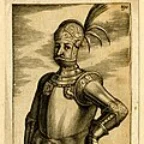
Count Syzzo (Dedo I) of the House of Wettin
Count Syzzo (also known as Dedo I, Ziazo, or Ciazo) of the Wettin dynasty (c. 960-1009) was a pivotal figure in the establishment of one of Europe's most enduring noble houses. As the son of Theodoric I of Wettin and Jutta of Merseburg, Syzzo is considered the first documented Count of Wettin and the effective founder of the dynasty that would eventually rule Saxony for over eight hundred years and extend its influence across multiple European thrones. His Italian name Syzzo reflects the Latinized variants (Ziazo, Ciazo, Dedo) used in medieval documents to identify him.
Syzzo was born around 960 as the son of Theodoric I (Dietrich I) of Wettin, the oldest traceable member of the House of Wettin, who died around 976-982. His mother was Jutta of Merseburg, connecting the family to important Saxon ecclesiastical territories. Theodoric I, also known as Thierry I of Liesgau, had been active in the German frontier expansion into formerly Slavic territories during the 10th century, establishing the family's presence in the region around the Saale River. Syzzo had at least one brother, Friedrich (Frederick) of Eilenburg, who also played a role in the family's territorial expansion.
Around the year 1000, Syzzo's family gained control of Wettin Castle, strategically located on the Saale River near Halle in what is now Saxony-Anhalt. This fortress, situated at an important river crossing, became the family's principal seat and gave the dynasty its enduring name. It was customary for noble families to adopt the name of their main castle or territory, and thus the House of Wettin was established. Syzzo himself is recognized as the first Count of Wettin, holding this title by virtue of his control over the castle and its surrounding territories.
Syzzo participated in the aggressive German push eastward into Slavic lands that characterized the late 10th and early 11th centuries. The Wettin family's acquisition of territories came as part of the broader German colonization and Christianization of regions previously held by West Slavic tribes. By the end of the 1080s - decades after Syzzo's death - his descendants would hold not only the County of Wettin but also the strategically crucial Margraviate of Meissen on the Elbe River, demonstrating how his foundational work enabled later territorial expansion.
Syzzo's most significant legacy came through his son Theodoric II (Dietrich II), Margrave of Lower Lusatia, who is considered the first true dynastic member of the House of Wettin in its established form. Theodoric II succeeded his father and expanded Wettin power significantly, becoming Margrave of Lower Lusatia and Count of Eilenburg and Brehna. Through Theodoric II, born around 990, the Wettin dynasty secured its position among the great noble houses of medieval Germany. Theodoric II would die in 1034, but not before ensuring the continuity of the line that Syzzo had founded.
Count Syzzo died on November 13, 1009, at Zorbig, having lived approximately forty-nine years. Though his lifetime achievements might have seemed modest compared to later Wettin margraves and electors, he is regarded as the true founder of the House of Wettin because he established the family's hereditary control over the County of Wettin and laid the territorial foundations for the dynasty's spectacular rise. His acquisition of Wettin Castle around 1000 proved to be one of the most consequential territorial gains in German noble history, as it gave a name and base to a dynasty that would eventually produce kings of Saxony, Poland, and the United Kingdom, as well as ruling houses in Belgium, Portugal, and Bulgaria.
The House of Wettin that Syzzo founded became one of the oldest and most successful dynasties in European history, ruling Saxon territories for more than 800 years. From Syzzo's modest beginnings as Count of Wettin around 1000, his descendants rose to become Margraves of Meissen (from 1089), Electors of Saxony (from 1423), and eventually Kings of Saxony (1806-1918). The dynasty divided into Ernestine and Albertine lines in 1485, both of which produced numerous ruling houses across Europe. Syzzo's decision to base his family at Wettin Castle and secure that county as the family's patrimony ensured that eight centuries later, historians would still trace Europe's most influential royal lineages back to this relatively obscure 10th-century Saxon count who died in 1009.
-
Castruccio Castracani degli Antelminelli (1281-1328)
Castruccio Castracani was the most formidable Ghibelline captain that Tuscany produced in the early Trecento: a soldier of fortune who rose from exile to make himself lord of Lucca, humiliate Florence in the field, and die a duke of the Empire at the very summit of his power. In the space of a dozen years he assembled a signoria that briefly rivalled Florence for mastery of Tuscany - and that dissolved almost the instant he was dead. His fame owes as much to Machiavelli, who later made him a literary exemplar of virtu, as to the historical record itself, and separating the two is part of any honest account of his life.
Family and origins
He was born in Lucca on 29 March 1281 into the Antelminelli, an ancient and staunchly Ghibelline family of the city. The surname Castracani ("dog-castrator," essentially) was a branch designation; contemporaries and later writers generally call him simply Castruccio. His Ghibelline lineage is the single most important fact of his early life, because it determined that he would spend his youth as an exile.
It is worth noting at the outset that Machiavelli's Vita di Castruccio Castracani da Lucca (1520) opens with a fictional tale of Castruccio as a foundling infant discovered in a vineyard and raised by a canon and his sister. This is invention in the classical mode - Machiavelli deliberately gives his hero a legendary, quasi-heroic birth. In reality Castruccio came from a well-attested noble house, and the foundling story should be discarded as biography even though it circulates widely.
Exile and formative years
Around 1300-1301, in the factional convulsions that also swept Dante out of Florence, the Guelphs (the Neri, Black Guelphs) took control of Lucca and drove out the leading Ghibelline families, the Antelminelli among them. Castruccio, still a boy or adolescent, went into an exile that lasted well over a decade and carried him across much of Latin Christendom.
The details of these wandering years are the least secure part of his biography and should be treated with caution. A persistent tradition places him in England, in the service or household of a nobleman, and later in France and Lombardy, learning the soldier's trade as a mercenary. The English episode in particular rests on thin and late evidence, and is best treated as plausible but unverified rather than established fact. What is not in doubt is the outcome: by his early thirties Castruccio had become an experienced professional man-at-arms with a reputation and a following.
Return to Tuscany: Uguccione della Faggiuola
His opportunity came through Uguccione della Faggiuola, the great Ghibelline warlord who seized Pisa in 1313 and then took Lucca in 1314. Castruccio returned to his native city in Uguccione's wake and quickly made himself indispensable as Uguccione's lieutenant.
The partnership produced one of the decisive Ghibelline victories of the age. On 29 August 1315, at Montecatini, the forces of Uguccione and Castruccio crushed the Guelph army of Florence and its Angevin (Neapolitan) allies. It was a bloody, prestige-shattering defeat for Florence. But Uguccione, suspicious of his brilliant subordinate's growing popularity, moved to have him arrested - and it was this overreach that undid him. In 1316, while Uguccione was distracted, the Lucchese rose, freed Castruccio, and expelled Uguccione. Castruccio emerged as signore of Lucca.
Lord of Lucca
From 1316 Castruccio governed Lucca as its lord, and over the following decade he transformed a city-state into a genuine territorial power and the anchor of Ghibelline resistance in Tuscany. He extended his control across the Lucchese contado and into Lunigiana and the Garfagnana, pressed on Pisa, and made himself the natural rival of Guelph Florence. His rule at home combined the usual apparatus of the early signoria - a strengthened citadel (the Augusta), reliable garrisons, and a personal military household - with genuine tactical and strategic gifts in the field.
The war with Florence and Altopascio
The defining struggle of his career was with Florence. It reached its climax at the Battle of Altopascio on 23 September 1325, where Castruccio inflicted a catastrophic defeat on the Florentine army, taking a great many prisoners and capturing Florentine standards; Giovanni Villani, himself a Florentine, records the disaster with evident anguish.
Castruccio pressed the humiliation with theatrical contempt. That autumn he ravaged the Florentine contado up to the walls and - in a gesture recorded by the chroniclers - staged palii (horse races) directly outside the gates of Florence, mocking the city's inability to respond. Altopascio marked the zenith of Lucchese ascendancy over Tuscany and made Castruccio, for a moment, the most feared man in central Italy.
Imperial alliance and the ducal title
Castruccio's fortunes then converged with imperial politics. When Louis IV of Bavaria (Ludwig the Bavarian) descended into Italy to pursue his contest with the Avignon papacy and to be crowned emperor, Castruccio attached himself to the imperial cause as its foremost Tuscan champion. Louis rewarded him: he was created Duke of Lucca (the ducal grant is dated to 1327) and appointed imperial vicar, and he accompanied Louis to Rome for the imperial coronation in January 1328.
Death and the collapse of the signoria
His triumph was undone with almost dramatic speed. While Castruccio was in Rome with the emperor, Pistoia - which he had earlier brought under his control - was lost to a Florentine-backed rising. He hurried north, retook Pistoia in the late summer of 1328, and then, at the very moment of restored mastery, was struck down by fever, almost certainly malaria. He died in Lucca on 3 September 1328, aged forty-seven.
The signoria he had built did not survive him. He left it to sons who lacked his authority and his sword, and within a short time his dominions fragmented - bought, seized, and quarrelled over by Pisa, Florence, the Empire's agents, and rival captains. The speed of the collapse is itself a comment on the man: the state had been, essentially, an extension of his own person.
Afterlife: Machiavelli and the historiographical problem
Castruccio's lasting hold on posterity is largely literary. In 1520 Niccolo Machiavelli wrote the Vita di Castruccio Castracani da Lucca, casting him as a model of the self-made prince who rises by ability and fortune - the embodiment of virtu confronting fortuna. The Vita is not a reliable biography: Machiavelli invents the foundling birth, compresses and reshapes events, and puts into Castruccio's mouth a string of witty apophthegms borrowed largely from Diogenes Laertius' lives of the ancient philosophers. It is best read as a political-literary exercise - a companion piece to The Prince - rather than as history.
For the historical Castruccio the indispensable near-contemporary source is the Nuova Cronica of Giovanni Villani, hostile but detailed, supplemented by Lucchese and Pisan chronicle material. Modern scholarship has had to work steadily to peel the Machiavellian legend away from the documentary figure. What survives that operation is impressive enough: a self-made Ghibelline captain who, for roughly a decade, made a single Tuscan city the fulcrum of imperial politics and the terror of Florence - and whose achievement proved as mortal as he was.
D
-
De universo (Rhabanus Maurus)
The De universo (seu De rerum naturis) is one of the most important encyclopedic works of the 9th century. Written around 842–847 and originally divided into 22 books, the treatise represents one of the first major syntheses of late antique-Carolingian knowledge following Isidore of Seville's Etymologiae, and remains a point of reference for the "naturae rerum" tradition in the Middle Ages. The De universo takes the form of a cosmological-theological encyclopedia: Rabanus begins with the Trinity and the nature of God, then proceeds to describe, in logical order, creation, the cosmos, the earth, meteorological phenomena, plants, animals, and man, also incorporating concepts of history, geography, and technology. Rabanus explicitly draws on Isidore, but also incorporates material from late-antique authors such as Pliny, Solinus, and Martianus Capella. The work enjoyed enormous popularity in the Middle Ages and contributed to the model of nature as a corpus of symbols and teachings. The text circulated in numerous manuscripts, including a famous Cassinese codex (Montecassino, Abbey Library, Cod. 132, ca. 1023), written in Beneventan minuscule and enriched with over 360 miniatures. From a Rabanian perspective, the De universo fits squarely within his production of "preceptio Patrum": nature becomes a book accessible to readers, to be interpreted in the light of Scripture and patristic tradition. This approach makes the treatise a bridge between ancient science and medieval theology, and explains why the Carolingian scholar is remembered as "praeceptor Germaniae" (teacher of Germany).
-
Paul Delaroche
Paul Delaroche was born in Paris on 17 July 1797, the son of a well-connected art expert and dealer. He trained first as a landscape painter before entering the studio of Antoine-Jean Gros, the leading history painter of the post-Napoleonic generation, and by his mid-twenties had abandoned landscape for the large-scale historical subjects on which his reputation would rest. He attracted wide notice at the Paris Salon in the early 1820s and established himself definitively with Joan of Arc Interrogated by Cardinal Winchester (1824) and, above all, with the celebrated Execution of Lady Jane Grey (1833), a work whose combination of theatrical pathos, meticulous costume archaeology, and highly finished surface made it one of the most admired and most reproduced paintings of the entire nineteenth century.
Delaroche occupied a deliberately intermediate position in the great stylistic quarrel of his day between the Neoclassicism descending from Jacques-Louis David and Jean-Auguste-Dominique Ingres and the Romanticism of Eugène Delacroix, a position contemporaries labeled the juste milieu. He rejected both the cool idealization of the academic tradition and the turbulent brushwork of the Romantics in favor of a legible, anecdotal realism applied to moments of historical pathos — the deaths of princes, the last hours of the condemned, the private griefs concealed behind public events — and this combination of high finish and emotional accessibility made his paintings, disseminated through engravings and, later, photographic reproduction, probably the most widely known French paintings of their generation, even as later criticism came to dismiss them as merely illustrative.
Delaroche's most consequential undertaking for the historiography of art, and the one that connects him directly to the modern rediscovery of Giovanni Pisano, was the immense semicircular mural known as the Hémicycle, painted for the awards hall of the École des Beaux-Arts in Paris between 1836 and 1841. The composition assembles some seventy-five of the greatest artists of all periods and nations, grouped by school around a central triad of enthroned figures personifying the arts of ancient Greece, before an idealized colonnaded temple. In placing Giovanni Pisano — rather than his more historically prominent father Nicola — among the acknowledged geniuses of world art, decades before Italian scholarship had settled on an independent assessment of the son's achievement, Delaroche anticipated by two generations a judgment that would only become orthodox with the twentieth-century rehabilitation carried forward by Michael Ayrton and Henry Moore.
A fire in the hall in 1855 destroyed much of the original mural; Delaroche, already gravely ill, supervised its near-total restoration from his own preparatory cartoons, a labor completed only shortly before his death in Paris on 4 November 1856. He had already largely withdrawn from public exhibition after harsh criticism of his 1837 Salon entries, continuing to work instead on private commissions and on a sustained engagement with the new technology of photography, which he regarded, in a much-quoted remark, as both an invaluable aid to painting and a rival that would eventually displace it in certain of its functions.
-
Diana degli Andalò (Blessed Diana of Bologna)
Diana degli Andalò was a 13th-century Dominican nun from Bologna, founder of the Monastery of Sant'Agnese, and one of the central female figures of early Dominican spirituality in Italy. Venerated as Blessed by the Catholic Church, she is commemorated liturgically on June 8.
She was born in Bologna around 1201 into the powerful Carbonesi-Andalò aristocratic milieu. Her father, Andrea di Lovello, belonged to one of the most influential urban lineages, and Diana grew up in an environment of wealth, factional politics, and strong family expectations of strategic marriage. The sources also preserve the familial patronymic "Andalò," linked to diminutives associated with her father.
Around 1218, Diana attended a sermon by the Dominican Reginald of Orleans in Bologna, an encounter that transformed her spiritual orientation. In 1219 she met Dominic of Guzman in person, and in the presence of Dominican friars she made a solemn promise to enter religious life. Dominic and his collaborators began planning a women's Dominican foundation in Bologna, but the project immediately met opposition from both civic-ecclesiastical authorities and Diana's family network.
In July 1221, seeking to realize her vocation, Diana entered the hermitage of Ronzano and requested the habit. Her relatives violently removed her from the convent and inflicted serious injuries, including a fractured rib, then kept her under constraint at home for about a year. This episode is a stark witness to the vulnerability of noblewomen in medieval Italy when family interests clashed with religious vocation.
After Dominic's death in 1221, Diana returned to the religious path with the support of Jordan of Saxony, later Master General of the Dominicans. On May 13, 1222, property near Porta San Procolo was purchased in her name for the future convent dedicated to Saint Agnes. During 1223 the first community was formed with Diana and other Bolognese noblewomen; experienced nuns from San Sisto in Rome, including Cecilia and Amata, were brought to establish stable observance, with Cecilia as first prioress.
Diana became the spiritual center of Sant'Agnese. A substantial portion of Jordan of Saxony's surviving letters to the Bolognese nuns are addressed directly to her, revealing an intense relationship of guidance, trust, and pastoral realism. He encouraged her zeal while cautioning moderation in fasting and bodily austerity, summarizing his advice in the well-known phrase: "Cultivate your heart; do not plow your body." Her own letters have not survived.
The convent's life unfolded amid institutional conflict. During the siege of Bologna by Frederick II in 1225, the monastery's position outside the walls exposed it to direct danger. At the same time, resistance among some friars to sustained governance of women's communities prompted papal intervention: Honorius III reaffirmed the obligation of Dominican superiors toward these convents, and Gregory IX confirmed this line in 1236.
Diana died on June 10, 1236, at about thirty-five years of age, after roughly thirteen years in Sant'Agnese. Her memory remained inseparable from that of her companions Amata and Cecilia, with whom she was linked in local cult and burial tradition. The joint cult of Diana, Amata, and Cecilia was officially confirmed by Pope Leo XIII in 1891.
Beyond her role as foundress, Diana's historical significance lies in the preservation of the Jordan of Saxony correspondence, one of the most important documentary windows into early Dominican life, women's religious communities, and affective spiritual direction in the 13th century.
-
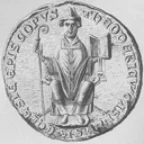
Dietrich II von Meißen, Bishop of Naumburg
Dietrich II von Meißen was born around 1190 as the illegitimate son of Margrave Dietrich of Meißen (known as Dietrich the Oppressed) and a sister of Meinhard von Wolftitz, the burgrave of Zeitz. Despite his illegitimate birth, his noble lineage through the powerful Wettin dynasty provided him access to ecclesiastical careers that were typically reserved for aristocratic families. His half-brother was Heinrich the Illustrious, who would later become margrave and play a decisive role in securing Dietrich's elevation to the episcopate.
Dietrich's career in the church began in childhood when he became a domicellar (a young cleric in training) at the Naumburg cathedral chapter. He served as parish priest in Torgau before advancing to become a canon of Naumburg Cathedral in 1213. His ecclesiastical ascent continued when he was appointed cathedral provost (Dompropst) in 1230, one of the most important administrative positions in the chapter. This progression demonstrates both his administrative capabilities and the influence of his family connections within the diocesan structure.
Following the death of Bishop Engelhard of Meißen in 1242, Dietrich's path to the episcopate was marked by conflict and irregular procedure. On June 5, 1243, the majority of the Naumburg cathedral chapter elected Peter von Hagin as the new bishop. However, Dietrich, supported by his powerful half-brother Margrave Heinrich the Illustrious, contested this election and ultimately prevailed through political pressure rather than canonical process. After Peter's unsuccessful interventions against this irregular procedure, Dietrich was finally consecrated in 1245 by Archbishop Siegfried III of Eppstein, following a papal dispensation that was necessary due to his illegitimate birth.
Dietrich's twenty-nine-year episcopate (1243-1272) was characterized by ongoing conflicts with the Wettin margraves and severe financial difficulties, despite his family connections. He faced persistent territorial and jurisdictional disputes with the secular powers of Saxony and Thuringia. In 1259, he was forced to conclude a humiliating treaty that required the demolition of fortifications in the city of Zeitz and the dismantling of several episcopal castles. By 1269, the financial situation had deteriorated to the point that the bishopric was compelled to contribute to a Wettin territorial tax, a significant loss of ecclesiastical independence.
Despite his financial struggles, Dietrich II is remembered for his role in one of the most significant artistic achievements of thirteenth-century Germany: the western choir of Naumburg Cathedral. The chronology of the campaign is debated, and some scholars place its beginnings in the last years of his predecessor Engelhard, bishop of Naumburg from 1207 to 1242; no document, however, connects Engelhard to the anonymous sculptor known as the Naumburg Master, and the earliest evidence that bears on the project belongs to Dietrich's episcopate. What is certain is that Dietrich, against severe fiscal constraints, saw the architectural structure and its sculptural programme through to completion. A document of 1249, in which he appealed for contributions towards the fabric, names the noble founders commemorated by the twelve figures of the choir, among them Uta and her husband Ekkehard II. The ensemble is one of the masterpieces of Gothic art in the German-speaking world.
Bishop Dietrich II von Meißen died on September 22, 1272, after nearly three decades as bishop of Naumburg. He was buried in Naumburg Cathedral, and his episcopal crosier from his tomb survives as an important artifact of 13th-century liturgical metalwork. His successor was Meinher von Neuenburg. While Dietrich's episcopate was marked by political weakness and financial crisis, his determination to complete the Naumburg west choir secured his place in art history as the patron under whom one of medieval Europe's most extraordinary sculptural programs was realized.
-
Disciplinati (Flagellant Confraternities)
The disciplinati were lay penitential confraternities whose members practised public self-flagellation as an act of corporate penance. The movement in its organised form is conventionally dated to Perugia in 1260, where the preaching of the hermit Raniero Fasani coincided with a wave of apocalyptic expectation, and spread rapidly through Umbria, the Marches and into Tuscany and Lombardy. Unlike the spontaneous flagellant processions that periodically alarmed civic and ecclesiastical authorities, the confraternities that emerged from this impulse were stable institutions with written statutes, elected officers, an oratory, and - crucially for the history of art - a treasury and a commissioning practice.
They should be distinguished from the laudesi, the older confraternities devoted to the singing of vernacular laude before an image of the Virgin, which had emerged in the 1230s and 1240s under Dominican and Franciscan encouragement. The two types often coexisted in the same city and occasionally in the same church, and both were shaped by mendicant direction, but their devotional emphasis differed: the laudesi around Marian praise and the cult of an image, the disciplinati around the Passion and the imitation of Christ's suffering. In Tuscany the laudesi were generally the earlier and more numerous type, and attributions of specific Tuscan commissions to disciplinati companies require documentary support rather than inference from subject matter.
As patrons, these companies account for a substantial share of thirteenth- and fourteenth-century devotional painting outside the sphere of the great mendicant churches: double-sided processional crosses carried in their public rituals, painted crosses for the oratory, and later the Umbrian gonfaloni. Their rise coincides with the diffusion of the suffering Christ, the Christus patiens, in place of the older triumphant type, and the two developments have often been read as connected - though the causal direction remains debated, since the iconographic shift is also attributable more broadly to Franciscan Passion piety and was under way before 1260.
-
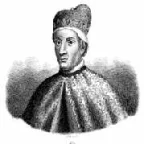
Doge Andrea Dandolo
Andrea Dandolo was descended from an old Venetian noble family, the Dandolo, that played an important role in Venetian politics from the twelfth to fifteenth centuries, and produced four Venetian doges, of whom he was the last, numerous admirals, and several other prominent citizens. The dynasty's most legendary figure was Enrico Dandolo, the nonagenarian doge who directed the catastrophic diversion of the Fourth Crusade against Constantinople in 1204, securing for Venice its extraordinary colonial empire in the eastern Mediterranean, and Andrea drew conscious inspiration from this ancestor throughout his life. A darker shadow of the family's martial tradition was cast by an earlier Andrea Dandolo who, commanding the Venetian fleet against Genoa at the Battle of Curzola in 1298, was taken prisoner and, unable to bear the shame of defeat, committed suicide by repeatedly striking his head against the wooden hull of the galley transporting him to prison. The Dandolo name was thus freighted with both glory and catastrophe, a tension that would mark the dogeship of the family's final representative.
Trained in historiography and law, Dandolo studied at the University of Padova, where he became a law professor until he was elected as doge. He had been the first Venetian noble to take a degree at the University of Padova, where he had also been a professor of jurisprudence. This distinction, the first doge to hold a university degree, is significant not merely as biographical curiosity but as an index of a broader cultural shift occurring in fourteenth-century Italy, where the humanist recovery of classical learning was beginning to penetrate even the most conservative institutional elites. That Venice's chief magistrate should be a trained jurist and historian, a man who had lectured at Padova and who would count Petrarch among his closest friends, signals the emergence of a new type of patrician statesman, one defined as much by intellectual formation as by military prowess or mercantile cunning.
His connection to Padova is also significant in the context of this biographical sequence: the University of Padova was the intellectual powerhouse of the Veneto, the institution where Guariento di Arpo received his formation, where Petrarch lectured, and where the cultural world that produced the great fresco cycles of the region was continuously nourished. Andrea Dandolo belonged to this world by formation as well as by geography.
Dandolo's ascent through the Venetian hierarchy was precocious even by the standards of a city that valued early service. Entering public life at a very young age, he held the highest offices of state: in 1328 Procurator of San Marco, in 1333 podesta of Trieste, in 1336 provveditore in the field. The office of Procurator of San Marco, the second most prestigious position in the Venetian hierarchy after the dogeship itself, held for life, was granted to him at approximately twenty-two years of age, an almost unheard-of elevation that speaks to the combination of family prestige and personal ability he brought to public service.
His role as podesta of Trieste in 1333 gave him direct administrative experience in one of Venice's most sensitive border territories, a city perpetually contested between Venetian interests and the claims of the Habsburgs and the Patriarchate of Aquileia. His subsequent appointment as provveditore in campo in 1336, a field command, rounded out his profile as a man equally capable of civil administration and military organization.
Dandolo became doge in 1343 at the age of 37. He was elected on 4 January 1343 to succeed Bartolomeo Gradenigo, who had died the previous December. His youth was remarkable: doges were typically men in their sixties or seventies, chosen precisely because advanced age was thought to ensure a prudent, measured rule and a limited tenure. Electing a man of thirty-seven broke with this convention decisively, suggesting that the governing class recognized in Dandolo not merely a distinguished name but a genuine intellectual and political force that the Republic needed at a moment of mounting external pressures.
Drawing inspiration from the example of Enrico Dandolo, to whom he was proud to trace his lineage, he demonstrated remarkable gifts as politician, man of action, and man of letters.
The most celebrated personal relationship of Andrea Dandolo's life was his friendship with Francesco Petrarca, Petrarch, the poet, humanist, and inaugurator of Italian literary modernity. He became a close friend of the poet Petrarch, who described him as "a just and incorruptible man." Petrarch's fuller characterization, preserved in his writings, presents Dandolo as "a just man, incorruptible, full of ardor and love for his country, erudite, eloquent, wise, affable and humane."
The friendship between the doge and the poet illuminates a dimension of Venetian cultural life rarely recognized in purely political histories: the degree to which the Venetian patriciate was intellectually engaged with the humanist movement taking shape across northern Italy. Dandolo was not a passive patron collecting artistic prestige; he was a scholar in his own right, a man whose conversation and correspondence Petrarch valued on equal terms.
The friendship was, however, tested by politics. They would later fall out over Petrarch's attempt to mediate between Venice and Genoa after the third Venetian-Genoese War of 1350-55. Writing to Doge Andrea Dandolo of Venice in May 1354 to dissuade him from continuing war with Genoa, Petrarch appealed to a shared Italian identity rooted in the land and Trojan heritage. Dandolo's response was characteristically direct: if diplomacy was being interpreted as weakness, Venice knew how to respond in harder terms. The doge responded that war was the way to bring peace back in the Mediterranean Sea: "If we get despised, we know how to behave in a violent and harsh way... We have no scruples to move war against the ones who do not know how to stand for peace." The exchange, a humanist poet pleading for peace to a soldier-scholar doge, crystallizes the contradictions of the age.
After Dandolo's death, Petrarch wrote Dandolo's epitaph. The poet who had urged peace honored the man who had chosen war with the most personal of literary tributes.
Dandolo's intellectual achievements were concentrated in two domains: historiography and law.
As a historian, Dandolo wrote two chronicles in Latin on the history of Venice: the Chronica per extensum descripta (written between 1344 and 1351/52), and the Chronica brevis (written before 1342), which can both be found in volume XII of Muratori's collection Rerum Italicarum Scriptores. The Chronicon Venetum by Andrea Dandolo was an influential early chronicle of the history of Venice, from the mythical foundations to the early 1300s. Petrarch wrote of him that he was "the most marvelous city of Venice, and its illustrious duke, to be named also for the sake of honour, Andreas, a man famous no less for his devotion to the good arts than for the insignia of such a great magistracy." The chronicles, which narrated the history of Aquileia and of Venice from its origins, established a framework for Venetian historical consciousness that influenced all subsequent chronicle writing in the city. Their authority, however problematic for the earliest periods, as a synthesis of civic memory and political ideology made them the essential reference point for generations of Venetian historiographers.
As a legal reformer, his achievement was equally substantial. He reformed the Venetian legal code, formally proclaiming a legal framework in 1346 that compiled all of the applicable laws in the Republic. No less important and meritorious is Dandolo for the reorganization of Venetian legislation and for the collection of the most ancient Venetian documents, the Liber Albus and Liber Blancus of the Venetian Archive. These compilations, assembling and systematizing the Republic's legal and documentary heritage, were acts of institutional preservation as consequential in their domain as his chronicles were in theirs. The impulse was the same: to construct a coherent, authoritative record of the Venetian past as the foundation for a stable and legitimate present.
Dandolo's dogeship coincided with one of the most ambitious programs of artistic patronage in the history of the Basilica di San Marco, a program he directed with the same systematic intelligence he brought to his chronicles and legal compilations. Andrea Dandolo demonstrated acute awareness of the power of images and of the written word as agents of legal and political certification and stabilization. He initiated an ambitious artistic campaign in San Marco, which comprised the building and decoration of the chapel of Sant'Isidoro and of the Baptistery of the basilica; the makeover of the Byzantine Pala d'Oro, which had been in place at the high altar of San Marco since the twelfth century; the commissioning of Paolo Veneziano's pala feriale; and the making of three lavish liturgical manuscripts for use in the basilica.
The Pala d'Oro. The third intervention on the Pala d'Oro dates back to the years 1343-1345, when, during the reign of Andrea Dandolo, the altarpiece was entirely renovated. This Byzantine masterwork of gold, enamel, and precious stones, accumulated across centuries and the spoils of the Fourth Crusade, was reconceived and partially rebuilt under Dandolo's direction, the goldsmith Giovanni Paolo Bonesegna completing the metalwork in 1342 and the carpentry in 1345.
The Pala Feriale. Paolo Veneziano was the official painter of Andrea Dandolo, for whom he and his sons Luca and Giovanni painted the Pala Feriale or "weekday altarpiece" for the Pala d'Oro of the high altar of San Marco, which was only opened on Sundays and feast days. This panel painting, depicting stories of Saint Mark and the saints across two registers, covered the glittering Byzantine metalwork on ordinary days, creating a bilingual visual economy in which the hieratic splendor of Byzantium was both preserved and partially screened by the newer pictorial language of the Italian Trecento. Paolo Veneziano's style, Italo-Byzantine, but increasingly influenced by the Gothic art developing north of the Alps, made him the ideal artist for this liminal commission, standing between two worlds just as Dandolo's Venice stood between its Byzantine inheritance and the emerging Italian Renaissance.
The Baptistery. As for the transformation desired by Dandolo, some scholars have recently observed that the Doge's intention, over and above giving the church a new Baptistery with rich mosaic decoration, must have been to celebrate his own person and his family: the Doge is depicted as an offerer at the foot of the great Crucifixion. The mosaics in the Baptistery and chapel of Sant'Isidoro exhibit a "visual dualism that has generally been understood as symptomatic of the underlying artistic orientations of mid-fourteenth-century Venice, still hesitant to relinquish Byzantine forms, but also drawn to the pictorial innovations and increased naturalism of Italian art." Scholars agree that Doge Dandolo used the mosaics as a form of political propaganda.
The Chapel of Sant'Isidoro. Added to the basilica under Dandolo's patronage, this chapel brought the relics of Saint Isidore of Chios, acquired during a Venetian crusading expedition, within the precincts of San Marco itself, weaving a further strand of Mediterranean sacred geography into the basilica's already dense symbolic fabric. Its mosaic decoration, like that of the Baptistery, placed Dandolo at the visual center of a sacred narrative, presenting the doge as pious benefactor and divinely sanctioned ruler.
Dandolo was thus the last Doge to be interred in St Mark's Basilica, buried in the very Baptistery he had commissioned, a space that became both his monument and his tomb, ensuring that his physical remains would remain permanently embedded within his greatest artistic achievement.
The intellectual and artistic brilliance of Dandolo's dogeship was enacted against a backdrop of almost unrelenting catastrophe.
The Earthquake of 1348. Venice was struck by a violent earthquake on 25 January 1348 that caused hundreds of casualties, destroyed numerous buildings and, it was assumed at the time, provoked the terrible outbreak of the Black Death. The contemporaries' assumption, that the earthquake and the plague were causally linked, both expressions of divine wrath, reveals the eschatological framework within which the fourteenth century experienced its disasters. The earthquake was not merely a geological event; it was a cosmic sign demanding moral and spiritual response.
The Black Death. Between 1348 and 1350, one-third of the population died. Across Europe, the plague that had traveled westward along the trade routes of the Mongol empire and reached the Mediterranean ports of Sicily and Genoa in late 1347 struck Venice with devastating force. The city's density, its maritime commerce, and the very mechanisms of prosperity that made it the envy of Europe became vectors of catastrophic contagion. Entire family lines were extinguished. The economic, demographic, and psychological consequences would shape Venetian life for generations, and it was precisely during the worst of the plague that Dandolo was simultaneously completing his legal reforms, commissioning his chronicle, and overseeing the decoration of San Marco.
The Wars with Zadar and Hungary. Venice endured a disastrous war with the Hungarians following Zadar's seventh revolt against the Most Serene Republic in 1345. The city of Zadar, strategically vital to Venetian control of the Adriatic, had been a recurrent site of rebellion, its population repeatedly seeking the protection of the Hungarian crown against Venetian sovereignty. The 1345 revolt, backed by Louis I of Hungary, opened a war that would eventually, under Dandolo's successor Giovanni Dolfin, lead to the catastrophic Treaty of Zadar of 1358 and the permanent loss of Dalmatia.
The Genoese War. Genoa deployed a powerful naval fleet to the Adriatic under the command of Paganino Doria that devastated the Venetian territories and threatened Venice herself. Venice was saved by the great naval victory of Lojera in 1353. In the long and bloody struggle with Genoa, Dandolo brought a note of resolute energy, to the point that in some quarters he was reproached either for having wanted war when it was not necessary, or for having prolonged it beyond what was fitting. The reproach was double-edged, a backhanded acknowledgment of the force of will he brought to the Republic's most intractable geopolitical rivalry.
Dandolo survived both events yet died in 1354 at the age of 48. He died on 7 September 1354, worn out at an age when most Venetian doges were only beginning their tenure. There is a popular tradition which maintains that Doge Andrea Dandolo died of a broken heart following the defeat of Venice to Genoa in battle. The tradition may be retrospective sentimentality, but it captures something real: the accumulation of military setbacks, the plague's devastation, and the immense personal cost of governing through a decade of almost unrelenting crisis had marked him deeply.
He was buried in the Baptistery of San Marco, the last doge to be interred in St Mark's Basilica. The tomb that received him was the monument he had himself created: the Baptistery mosaics looking down on his sarcophagus, the great Crucifixion at whose foot he had been depicted as offerer, the architectural space his patronage had made into one of the supreme devotional interiors of the trecento. In death as in life, Andrea Dandolo occupied the intersection of political authority, artistic vision, and sacred space.
His successor, Marino Faliero, was elected and then beheaded for treason within a year, and could not be buried in San Marco beside the relics of the Evangelist. The chain was broken. After Andrea Dandolo, the doges of Venice were buried elsewhere: in Santi Giovanni e Paolo, in the Frari, in the churches they individually patronized. The Baptistery, sealed with his remains, became a monument to the end of an era.
As a historian he left the Chronica per extensum descripta and the Chronica brevis, the foundational texts of Venetian civic historiography, the works that subsequent chroniclers of the Republic would use as their essential starting point and constant reference. As a legal reformer he left the compiled Statuta of 1346 and the Liber Albus and Liber Blancus of the Venetian Archive. As a patron he left the Baptistery, the Chapel of Sant'Isidoro, the renovated Pala d'Oro, and the Pala Feriale of Paolo Veneziano, an artistic legacy concentrated in the most sacred space of the Venetian state, woven into the physical fabric of the basilica that was simultaneously the Republic's chapel, treasure house, and ideological heart.
Andrea Dandolo was, in the fullest sense, the last of the great medieval Venetian doges: the last member of the Dandolo family to hold the ducal throne, the last to be buried in San Marco, the first to be a university graduate, and the last for whom the roles of soldier, statesman, historian, and patron could be held simultaneously in one life without any of them being diminished by the others.
-
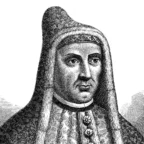
Doge Giovanni Dolfin
Giovanni Dolfin (c. 1303-22 July 1361) was one of the most prominent patrician statesmen of mid-14th century Venice and served as doge from 13 August 1356 until his death. He was born into the Dolfin, one of the oldest and wealthiest Venetian noble families, in its branch linked to Santi Apostoli. His father, Benedetto (also attested as Benetto, Bello, Bellerio, or Bellerino), was Procurator of San Marco de Supra from 1300 and an important political actor in the post-Serrata oligarchic order.
Through kinship and marriage networks, Dolfin stood at the center of the ruling patriciate. The Dolfin were closely allied with the Gradenigo, and his brother-in-law Giovanni Gradenigo preceded him on the ducal throne. Giovanni married first a daughter of Albano Zane (name not preserved in the sources), then Caterina Giustinian. His children included Benedetto, Pietro, and Nicolo, and daughters who entered or were integrated into major patrician and religious households, reflecting the family's broad social strategy within Venice.
Dolfin's public career became clearly visible in the 1340s. Around 1345 he appears as capo di Quarantia in decisions concerning military expenditure in Istria and as judge of the Petizion. During the crisis year 1348, he took part in a diplomatic mission to monitor the movements of King Louis I of Hungary after the peace settlement of that year. In 1349 he played a notable role in Senate deliberations tied to Byzantine policy, including timber provisioning for Constantinople.
On 25 April 1350, Dolfin was elected Procurator of San Marco de Supra, the highest lifetime magistracy below the dogeship. From 1350 onward he was repeatedly deployed in sensitive assignments linked to the Venetian-Genoese conflict and eastern Mediterranean diplomacy. He sailed with the fleet to Constantinople, oversaw the ratification of treaties, and was involved in the campaign culminating in the violent Battle of the Bosphorus (1352), after which he helped secure funding and oversight for continuing military operations.
Between 1353 and 1355 he undertook further embassies and military-administrative duties in northern Italy while also appearing in high-level internal commissions. In 1356, as one of the Venetian provveditori in Treviso during the Hungarian siege, he was already considered a leading candidate for the dogeship. He was elected doge in August 1356 while still in the besieged city. After safe-conduct negotiations failed, he broke through enemy lines and reached Venice for enthronement in a gesture later remembered as emblematic of ducal resolve.
His reign was dominated by war with Hungary and by the progressive Venetian collapse in Dalmatia. Despite energetic diplomatic efforts and attempts to stabilize trade, the Republic suffered severe military and financial pressure. The crisis culminated in the peace of 18 February 1358 (Treaty of Zadar), by which Venice ceded Dalmatian possessions while retaining Treviso and preserving naval predominance in the Adriatic through Hungarian acceptance of no competing royal fleet.
The settlement had major symbolic consequences: the traditional expanded ducal titulature, which had proclaimed rule over Dalmatia, Croatia, and part of Romaniae, was effectively reduced in official practice to a shorter form. Under Dolfin, Venice therefore experienced not only territorial contraction but also a visible redefinition of state ideology and ceremonial language.
Domestic conditions remained harsh. Plague returned in 1360, striking patrician society and Dolfin's own family; his son Benedetto died before July of that year. On 25 July 1360, Dolfin dictated his will in the Ducal Palace. The testament reveals both household governance and charitable patronage, including provisions for dependents, religious institutions, and his funerary monument.
Posthumous records show an active interest in books and manuscript culture: claims against his estate mention volumes being illuminated and bound at the time of his death, including prestigious literary holdings such as a glossed copy of Dante's Divina Commedia. This detail places Dolfin within the broader Trecento pattern of patrician bibliophilia and cultural investment.
Dolfin died in Venice on 22 July 1361, after unsuccessful treatment by his physician Albertino da Padova. His monumental tomb in the Basilica dei Santi Giovanni e Paolo, executed by Andrea da San Felice and originally enriched by painted decoration associated with Guariento, became one of the major Gothic ducal sepulchres of Venice. The monument, later displaced within the church, remains central to the study of Venetian funerary representation and political memory.
Historiographically, Giovanni Dolfin is best understood as a capable and experienced magistrate whose career spanned diplomacy, war finance, military command, and high office, but whose dogeship coincided with structural pressures beyond the control of any individual ruler. His tenure marks a decisive phase in the 14th-century reconfiguration of Venetian power after the loss of Dalmatia and on the eve of the longer conflicts that would define the later Trecento.
-
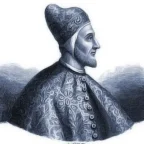
Doge Marco Corner
Marco Cornaro was born around 1286. The details of his early education and formation are not documented in the surviving sources, but the broad contours of his upbringing can be reconstructed from what we know of his mature career: he became simultaneously a merchant of considerable acumen, a military commander of experience, and a diplomat trusted with the most sensitive missions of the Republic. All three vocations required cultivation from youth within the complex institutional world of Venetian patrician life.
Cornaro acquired his own wealth through trade with Egypt. The Egyptian trade, primarily in spices, luxury textiles, and the products of the Levantine market, was at once the lifeblood of the Venetian economy and a recurrent source of diplomatic friction with the papacy, which periodically attempted to prohibit Christian merchants from commercial dealings with Muslim powers. That Corner built his personal fortune on this trade gives him a particularly Venetian character: pragmatic, commercially driven, and willing to operate in the grey zones between Christian devotion and mercantile necessity. It also explains why, as doge, one of his most consequential acts would be the re-opening of precisely this trade route.
Marco Cornaro's first marriage was to Giovanna Scrovegni of Padua, with whom he had three sons and two daughters. This union, contracted around 1305, is of profound interest not only genealogically but culturally. The Scrovegni were one of the most prominent banking families of Padova, and it was precisely Giovanna's kinsman Enrico Scrovegni who, around 1300-1305, commissioned the decoration of the family funerary chapel in Padova with the fresco cycle by Giotto di Bondone that remains one of the supreme monuments of Western art: the Cappella degli Scrovegni, whose luminous blue interior still stands adjacent to the very Eremitani church whose history we have traced in this sequence of biographies.
The marriage of Marco Corner into the Scrovegni family places him at the intersection of the two great poles of trecento culture: the mercantile patriciate of Venice and the banking and humanist culture of Padova. That Giovanna's family were the patrons of Giotto's greatest single achievement, and that Marco himself would later commission Guariento di Arpo, the painter who also worked at the Eremitani and decorated the tomb of his predecessor Giovanni Dolfin, to paint the great fresco of the Coronation of the Virgin in the Palazzo Ducale, gives his biography an extraordinary artistic coherence. Through both his marital and his patronage networks, Corner stood at the heart of the fourteenth-century artistic world that stretched between Padova and Venice.
After the death of Giovanna Scrovegni, Marco Corner contracted a second marriage, before 1336, to a woman named Caterina whose surname is not recorded. Very little is known of her, but the fact that her low social status at birth made the election of her spouse as doge difficult. Dogaressa Caterina was somewhat mocked for her simple habits, which was seen as unsuitable for the rank of a dogaressa, but the doge always loyally defended her and called her a good woman and wife.
This detail is remarkably revealing of the social codes governing the Venetian patriciate. The dogeship was an institution freighted with ceremonial expectation: the dogaressa was required to embody a certain grandeur of bearing, dress, and deportment that corresponded to the dignity of the office. A woman of modest origins, however virtuous her personal character, threatened to undermine the symbolic prestige of the ducal institution. That Corner's opponents raised this objection during his electoral campaign, alongside reservations about his age and his foreign friendships, shows how thoroughly the personal could become political in the hypervigilant world of Venetian oligarchic governance. And that Corner repeatedly, publicly, and loyally defended his wife against social mockery reveals a dimension of his character that sets him apart from the usual profile of the calculating Venetian statesman.
Cornaro followed both military and political careers in the service of the Republic, leading troops at sea and on the mainland. His military experience was real, tested in the dangerous waters of the Adriatic and the eastern Mediterranean during one of the most turbulent periods in Venetian history, a period that had seen war against Genoa, against Hungary, against the Ottomans, and the devastating loss of Dalmatia under his predecessor Giovanni Dolfin.
As a diplomat, Corner operated at the highest level of European statecraft. He served as ambassador to Emperor Charles IV and Pope Clement VI, and was also a member of the Venetian delegation to the election of Pope Urban V in Avignon. These three missions span a remarkable range: the Emperor Charles IV, the Luxembourg ruler who presided over the Holy Roman Empire from Prague, was the central political figure of mid-fourteenth-century Europe, whose investment in the governance of northern Italy was a constant preoccupation for Venice; Pope Clement VI (r. 1342-1352) was the architect of the Avignonese papacy at the height of its cultural splendor; and the conclave that elected Urban V in 1362 was itself an event of European significance. Corner's presence at all three occasions marks him as a trusted senior figure in the Republic's foreign policy establishment across three decades.
The single most dramatic episode of Marco Corner's pre-ducal career was his role in the discovery and crushing of the conspiracy of Doge Marino Faliero in April 1355, an event that entered Venetian legend and European literature, inspiring works from the chronicles of the trecento to the plays of Lord Byron.
Marino Faliero, the 55th Doge, had been elected in September 1354 at the extraordinary age of eighty. Humiliated by what he perceived as an insult to his much younger wife, and chafing against the constitutional constraints that bound the ducal office, Faliero entered into a conspiracy with Venetian commoners, particularly men from the Arsenal, to massacre the patriciate on 15 April 1355 and declare himself Prince of Venice, dissolving the republican constitution in favor of one-man rule.
Cornaro was instrumental in the discovery and suppression of the attempted coup d'etat in 1355 by the then doge Marino Faliero, who intended to declare himself prince of Venice. Following the dissolution of the plot and execution of the conspirators, Cornaro was briefly made vice-doge before a successor to Faliero could be appointed.
The plot was betrayed on its eve, the conspirators arrested, and Faliero himself tried, condemned, and beheaded between the two columns of the Piazzetta on 17 April 1355, the only doge ever executed for treason. In the Sala del Maggior Consiglio of the Palazzo Ducale, where the portraits of all the doges hang in succession, a painted black cloth covers the space where Faliero's portrait should be, bearing the inscription: "Hic est locus Marini Faledri decapitati pro crimine prodicionis", "This is the place of Marino Faliero, beheaded for the crime of treason."
That Marco Corner should have been among the figures principally responsible for saving the Republic from this coup places him in the most honorable position in the institutional memory of the Venetian state. His appointment as vice-doge in the immediate aftermath, holding the constitutional continuity of the Republic while a successor was sought, was a mark of the trust the governing class placed in him.
On 18 July 1365, Doge Lorenzo Celsi died, the end of a brief and troubled reign shadowed by the revolt of Saint Titus in Crete and by Celsi's own reportedly arrogant behavior, which some contemporaries suspected had led to his suspicious death. Venice required a successor of very different temperament.
On the death of the previous incumbent Lorenzo Celsi on 18 July 1365, Cornaro was elected to the dogal office, despite the aspersions cast by his opponents over his advanced age, his wife's low birth and his friendships with foreign princes.
The objections are worth examining carefully. Corner's advanced age, approximately seventy-nine at election, was a legitimate concern in an office demanding continuous engagement with affairs of state. His wife's humble origins transgressed the unwritten code of ducal decorum. And his friendships with foreign princes, while a mark of his long diplomatic career, raised, in the paranoid world of Venetian institutional politics, the question of whether his loyalties might be divided. Against all three objections the electors ultimately decided in his favor, presumably because his record of service, his demonstrated loyalty to the Republic during the Faliero crisis, and his decades of diplomatic experience outweighed every caveat.
Once elected, in contrast to his predecessors, he established a respectful stance towards Venice's public bodies. This quiet but significant note, marking a departure from the style of Celsi, whose arrogance had generated institutional friction, tells us something important about Corner's governing temperament: collegial rather than domineering, conscious of the constitutional framework within which the dogeship properly operated, and more interested in the substance of governance than in its ceremonial performance.
Corner's reign lasted two and a half years, brief even by the standards of an office that was frequently held by elderly men for short terms. Yet those two and a half years were far from uneventful, and in certain domains they left a permanent mark on Venetian history.
The Re-opening of the Egyptian Trade. The most consequential diplomatic achievement of Corner's dogeship was the restoration of Venetian commercial access to Egypt. The trade with the Mamluk Sultanate, in spices, silk, cotton, and luxury goods, was the single most important engine of Venetian mercantile wealth. It had been periodically interrupted by papal prohibitions on dealing with infidels, which placed Venice in the uncomfortable position of choosing between spiritual authority and economic survival. He was successful in re-establishing Venetian trade with Egypt by convincing Urban V to rescind his prohibition on dealing with infidels. This diplomatic coup, achieved through skillful negotiation with the same pope whose election Corner had attended as Venetian ambassador just three years earlier, was a major economic victory whose benefits would accrue to Venice for generations. It also illustrates the long institutional memory and personal networks that the Venetian system cultivated: Corner's relationship with the Avignonese curia, built during years of diplomatic service, was a resource he could now deploy on behalf of the Republic at the moment of greatest need.
The Loss of Chios, Lesbos, and Phocaea. The darker side of Corner's reign was the territorial contraction in the Aegean. During the two and a half years of his reign, Venice saw no major changes or wars, although it lost the islands of Chios and Lesbos and the city of Phocaea to the Republic of Genoa. These territories, which had been part of the commercial empire Venice had painstakingly constructed in the eastern Mediterranean, fell away at a moment when the Republic's energies were still depleted by the struggle against Hungary and by the economic disruption following the loss of Dalmatia under Giovanni Dolfin. The loss of Chios in particular, a key node in the mastic trade and the Aegean commercial network, was a significant blow.
The Wing of the Doge's Palace. On the architectural front, Corner left his mark on the physical fabric of Venice's most symbolic building. Cornaro ordered the construction of a wing of the Doge's Palace on its side facing San Marco. This was part of the great fourteenth-century program of expansion and embellishment that progressively transformed the Palazzo Ducale into the magnificent Gothic structure visible today, whose lace-like arcades and pink-and-white marble facing constitute one of the supreme achievements of Venetian Gothic architecture.
The most enduring artistic legacy of Marco Corner's dogeship was his patronage of the painter Guariento di Arpo for the decoration of the Hall of the Great Council (Sala del Maggior Consiglio) in the Palazzo Ducale, the vast chamber where Venice's governing assembly convened and where the most consequential decisions of the Republic were made.
When Marco Corner ascended the throne, he ordered the Great Council Hall to be decorated with paintings: one of the artists contacted was Guariento di Arpo, who was commissioned to decorate the eastern wall of the hall with the theme of Paradise, and more precisely of the coronation of the Virgin amidst the glory of it.
The Coronation of the Virgin was painted for the Chamber of the Great Council by Guariento between 1365 and 1368, and severely damaged in the fire of 1577. The fresco, spanning the entire eastern wall behind the ducal throne, in the most symbolically charged position in the most politically charged room in Venice, depicted the Virgin Mary crowned in glory, surrounded by the celestial court: a Paradiso that fused theological vision with Venetian civic ideology, placing the Republic under divine patronage in its own seat of power.
The Guariento Room's name is due to the fact it houses a fresco painted by the Paduan artist Guariento around 1365. Almost completely destroyed in the 1577 fire, the remains of that fresco were, in 1903, rediscovered under the large canvas Il Paradiso which Tintoretto was commissioned to paint. Tintoretto's Paradise, now the largest canvas painting in the world, replaced the destroyed fresco, but the ghostly remains of Guariento's original, discovered only at the beginning of the twentieth century beneath Tintoretto's canvas, can still be seen in the dedicated Sala del Guariento within the Palazzo Ducale.
The significance of this commission for the intellectual history traced in these biographies is profound. Guariento di Arpo, the same painter who had decorated the Cappella Maggiore of the Eremitani in Padova with the Stories of Saint Augustine, who had also provided the decorative program for the tomb of Doge Giovanni Dolfin in Santi Giovanni e Paolo, and whose earlier frescoes in the Cappella dei Carraresi in the Reggia Carrarese had made him the preeminent painter of the Padovan ruling court, now received from Marco Corner the most prestigious commission in all Venice. The career of Guariento thus serves as a kind of artistic thread that connects the figures in this biographical sequence: the Dolfin tomb, the Eremitani frescoes, and the Palazzo Ducale Paradise are all part of a single pictorial world shaped by one painter across three decades, a painter whose patrons included both the Doge who preceded Corner and Corner himself.
The Coronation of the Virgin in the Palazzo Ducale also connects explicitly to Guariento's later work documented in 1365 at the Palazzo Ducale in Venice, the same year he was awarded the commission there by the Venetian Republic after Corner's election to the dogeship. In 1365, Guariento was invited by the Venetian Republic to paint a representation of the Coronation of the Virgin in the Palazzo Ducale.
The figure of Corner's second wife, the Dogaressa Caterina of unknown surname, deserves a brief further consideration, not despite but because of the scarcity of documentation surrounding her. Her low social origins, her "simple habits," and the doge's repeated public defense of her character all suggest a marriage of personal attachment rather than dynastic calculation. In a world where patrician alliances were invariably calculated instruments of family strategy, Corner's marriage to a woman of modest station was genuinely anomalous.
The doge always loyally defended her and called her a good woman and wife. In the highly codified and performative world of the Venetian patriciate, where public speech was invariably managed and where what a man said about his wife carried institutional implications, this repeated public loyalty to a socially controversial spouse speaks to a dimension of Corner's personality that his official biography does not otherwise illuminate.
Marco Cornaro died in the early hours of 13 January 1368. He had been doge for two years and nearly six months, old even by the standards of the ducal office, dying at approximately eighty-two years of age.
He is buried in the Basilica of San Zanipolo, the Basilica dei Santi Giovanni e Paolo, the great Dominican church in the sestiere of Castello that served as the traditional funerary pantheon of the doges of Venice. His tomb stands in the company of those of his immediate predecessors and successors in that extraordinary sequence of Gothic and Renaissance funerary monuments that lines the walls of the nave. His predecessor in the dogeship, Giovanni Dolfin, whose biography immediately precedes this one, also lies in Santi Giovanni e Paolo, as, indeed, do the tombs of Jacopo and Ubertino da Carrara, the Padovan lords whose dynasty was so closely intertwined with the world of Corner's first marriage into the Scrovegni family.
Corner was succeeded as doge by Andrea Contarini, who would face the gravest military crisis of the century, the War of Chioggia (1378-1381), in which Genoa came perilously close to destroying Venice entirely. Corner himself did not live to see this catastrophe; his reign ended while the economic effects of the Treaty of Zadar were still being felt and before the storm of Chioggia broke. In that sense, his brief dogeship occupies a relatively calm interlude in the turbulence of fourteenth-century Venetian history, a moment of commercial restoration, architectural embellishment, and artistic patronage between the Hungarian war and the Genoese crisis.
For Alberto's research into the medieval art of the fourteenth century, Marco Corner occupies a particularly rich place. He is the biographical figure who most directly connects the artistic world of Padova, through his Scrovegni marriage and the legacy of Giotto, with the artistic world of Venice, through his commissioning of Guariento for the greatest secular fresco program in the Serenissima's history. He is also the doge who presided over the same moment in which Guariento completed the decorative program for the tomb of Giovanni Dolfin in Santi Giovanni e Paolo, the tomb that Zuleika Murat, whose biography opened this sequence, has studied so meticulously.
The figure of Guariento thus becomes the artistic axis around which the subjects of these biographies revolve: the Eremitani in Padova, the tomb of Dolfin, and the Coronation of the Virgin in the Palazzo Ducale all bear his hand, all fall within the decade of the 1360s, and all were shaped by the political and cultural world of which Marco Corner was both a product and a principal architect.
-
Dominic of Guzman (Saint Dominic)
Dominic of Guzman (1170–1221) was the founder of the Order of Preachers—the Dominicans—and one of the most influential spiritual and intellectual figures of the 13th century, whose impact on theology, art, and medieval culture was immense and enduring. Dominic was born around 1170 in Caleruega, a small village in Old Castile, Spain, to Felice de Guzman and Joanna of Aza, a woman of deep devotion who was later beatified. Tradition holds that before his birth, his mother saw in a dream a dog that, with a torch in its mouth, leaped from her womb and set the world ablaze—an image that became one of the iconographic emblems of the Dominican Order. He completed his studies in Palencia, one of the principal centers of Iberian culture, where he excelled in philosophy and theology, demonstrating from a young age an extraordinary capacity for intellectual synthesis and an uncommon ascetic zeal. Upon completing his studies, Dominic entered the chapter of the Canons Regular of the Cathedral of Osma, where he lived under the Rule of St. Augustine, combining community life with study and prayer. It was precisely in Osma that the decisive turning point of his life began: in 1203, Bishop Diego d'Acevedo took him along on a long diplomatic journey through northern Europe, bound for Denmark, on behalf of King Alfonso VIII of Castile. As they crossed southern France, the two clergymen were confronted with a shocking reality: the widespread prevalence of the Cathar heresy, which had by then conquered entire regions of Languedoc, undermining the social and religious structure of Christian Europe from within. The encounter with Catharism was a revelation and a calling for Dominic. The Cathars—also known as the Albigensians—preached a radical dualism between the material (corrupt) world and the spiritual (pure) world, rejecting the sacraments, the clergy, and the ecclesiastical institution. Their appeal also lay in the exemplary austerity of their ministers, the perfecti, who lived in rigorous poverty, far exceeding that of many Catholic clergy of the time. Dominic immediately understood that the response to heresy could not be merely military repression, but had to come through preaching and the example of his life: he therefore chose to walk the roads of southern France, poor among the poor, publicly debating with the Cathars and seeking to bring them back to the Catholic faith. For a full decade, from 1206 to 1216, Dominic remained in Languedoc as a missionary, collaborating with the Bishop of Toulouse, Folchetto of Marseille. In 1207, he founded a women's monastery at Notre-Dame-de-Prouille, near Fanjeaux, intended to welcome women converted from the Cathar heresy—the first institutional nucleus of the future Dominican family. He refused to participate in the crusade launched by Innocent III against the Albigensians in 1208, remaining faithful to his vocation as a peaceful preacher, even when the papal legate Peter of Castelnau was assassinated and the military crusade devastated the region. In 1215, Dominic gathered a small group of disciples around him in Toulouse and traveled to Rome to obtain papal recognition for the new religious institute. The Fourth Lateran Council, held that same year, had prohibited the founding of new orders, but Innocent III, recognizing the extraordinary value of Dominic's mission, advised him to adopt an existing rule. Dominic chose the Rule of St. Augustine, supplementing it with original constitutions that made theological study and itinerant preaching the pillars of community life. On December 22, 1216, Pope Honorius III solemnly approved the Order of Preachers with the bull Religiosam vitam. The structure Dominic conceived for his order was profoundly innovative: unlike Benedictine monasticism, rooted in a fixed location, the Preachers were by definition itinerant, and their friary was to be located preferably in university cities, alongside the great centers of learning. As early as 1217, Dominic sent his friars to Paris and Bologna—the two principal intellectual centers of Europe—thus inaugurating a model of urban and cultured religiosity that would profoundly shape medieval civilization. In the final years of his life, Dominic traveled tirelessly throughout Italy, Spain, and southern France, founding new monasteries and welcoming a growing number of friars into the Order. In May 1220, he presided over the Order's first General Chapter in Bologna, which drew up the definitive constitutions, establishing precise rules regarding preaching, study, poverty, and the democratic governance of the community. He died in Bologna on August 6, 1221, worn out by fatigue and asceticism, surrounded by his friars. Pope Gregory IX canonized him in 1234, just thirteen years after his death—an exceptionally short time, a sign of the speed with which his holiness was recognized throughout Christendom. St. Dominic's legacy was immense. Within a few decades, his friars became the leading figures of European intellectual life: Thomas Aquinas, Albert the Great, and Meister Eckhart were all Dominicans. In medieval iconography, Dominic is depicted in a white habit and black cloak, holding a lily—a symbol of purity—and with a dog at his feet, in reference to his mother's prophetic dream. His figure was celebrated by Dante in Paradiso (Canto XII), who placed him in the sphere of the Sun alongside St. Francis, presenting him as the champion of the faith, armed with doctrine and preaching. For the scholar of medieval art, the figure of St. Dominic is indispensable: Dominican patronage gave rise to some of the most important pictorial cycles of the Italian 13th and 14th centuries, from Cimabue to Duccio to Guido da Siena, transforming the Order's monasteries into extraordinary workshops of figurative art.
E
-
Enkleistra (Enkleistra of St. Neophytos)
The Enkleistra (Greek: Ἐγκλείστρα, from enkleistos, "enclosed" or "shut in") is the term for the cave-hermitage that St. Neophytos the Recluse carved into the hillside above Paphos, Cyprus, beginning in 1159-1160. The word derives from the same root as "enclosure" — it designates the dwelling-place of a recluse, someone who has voluntarily walled themselves off from the world for ascetic, contemplative purposes.
In Neophytos's case, the Enkleistra was not a single chamber but grew into a small complex of excavated rock-cut cells: his original cell and Bema (the altar space where he could celebrate the liturgy), later expanded with additional cells as his community of disciples grew, and eventually a second, higher cave called the "New Zion," completed by 1197, to which he retreated for greater solitude as the original Enkleistra became more frequented by visitors and pilgrims.
The term is significant for two reasons. First, it describes a recognized category of Byzantine ascetic dwelling — the cave-hermitage as opposed to a built monastery — though in Neophytos's case the Enkleistra eventually became the core of a fully institutionalized monastery (the still-functioning Monastery of St. Neophytos near Tala, north of Paphos). Second, it is the site of the celebrated fresco cycle painted by Theodoros Apsevdis in 1183, commissioned under the patronage of Bishop Basil Kinnamos — the same cycle that Cyril Mango and Ernest Hawkins studied in their foundational 1966 Dumbarton Oaks Papers article, and that Ioanna Kakoulli and Christian Fischer later subjected to modern materials analysis.
-
Eremitani
The church of the Santi Filippo e Giacomo — universally known as the Chiesa degli Eremitani — is a medieval Catholic place of worship that rises in Piazza Eremitani in Padova. Dedicated to Saints Philip and James the Lesser, it was built from 1264 as the church of the Order of the Hermits of Saint Augustine, who maintained their large convent to the north of the church, today occupied by the Musei Civici agli Eremitani. The Augustinian order governed the church until 1806. Today the church holds parish status and is administered by the secular clergy of the Diocese of Padova.
The Augustinians who built it belonged to the Ordo Fratrum Eremitarum Sancti Augustini, formally consolidated by the Magna Unio of 1256, which merged various congregations of hermits across central and northern Italy under a single mendicant rule. In Padova, two congregations are documented prior to the Magna Unio: the Guglielmiti, established in the Santa Croce area, and the Giamboniti. Their union gave rise to the community that would commission and inhabit the Eremitani complex for over five and a half centuries.
The initial construction began in 1276 and was completed in 1306. The church was built on the site of an earlier chapel dedicated to Saint Christopher, which was incorporated into the new structure. According to tradition, the construction was carried out under the guidance of Fra' Giovanni degli Eremitani.
The building is an extraordinary example of the "classicizing" style that developed in Padova during the communal age. Its architectural language features Gothic elements such as pointed arches, ribbed vaults, and flying buttresses, reflecting the transitional period from Romanesque to Gothic architecture.
The exterior is characterized by the warm tonal contrast between its upper section in exposed terracotta brick — where a handsome central rose window opens — and the lower section, which features a limestone loggia of five arches: the central one frames the main entrance portal, while the lateral ones contained devotional images.
The interior presents a single nave covered by a distinctive wooden ship's keel ceiling (soffitto a carena), originally the work of Fra' Giovanni degli Eremitani. The walls are adorned with the characteristic alternating bands of red and ochre brick. Despite the devastation of 1944, the spatial structure of the nave still conveys the austere grandeur of the original Gothic design. From an architectural standpoint it is considered one of the finest examples of pure Romanesque in northern Italy.
One of the most significant functions of the Eremitani in the fourteenth century was its role as a dynastic funerary space for the ruling signoria of Padova, the Da Carrara family. Near the entrance stand two sepulchres sculpted by Andriolo de Santi: on the left, the tomb of Jacopo da Carrara, bearing an inscription composed in Latin couplets by Petrarch; on the right, the tomb of Ubaldino da Carrara. These monuments, respectively dated to approximately 1345 and 1351, were executed by the Venetian sculptor Andriolo de Santi, two other Venetian artists, and the Lombard Bonino da Campione, to whom the two Madonnas and Child in the central niches of the sarcophagi are attributed. Both lords were rulers of Padova in the trecento, and their monuments — transported here from the destroyed church of Sant'Agostino in the early nineteenth century — still constitute, in the words of one tradition, the only two surviving funerary monuments of the lords of Padova, the Carraresi, and masterpieces of fourteenth-century sculptural art.
The most celebrated artistic event in the Eremitani was the decoration of the Ovetari Chapel, a commission that would mark the threshold between the medieval and Renaissance traditions in northern Italy.
Antonio Ovetari was a Padua notary who, at his death, left a large sum for the decoration of the family chapel in the Eremitani church. The project was carried out by his widow, Imperatrice Ovetari, who in 1448 commissioned the work to a group of artists, which included the elder Giovanni d'Alemagna, Antonio Vivarini (a Venetian late Gothic painter), and two young Paduans, Niccolò Pizzolo and Andrea Mantegna. The latter at the time was seventeen years old and had just begun his apprenticeship in Squarcione's workshop.
The side walls of the chapel were dedicated to scenes from the lives of Saint James and Saint Christopher, and the apse wall, with its window apertures, was to depict the Assumption of the Virgin. At the end of 1451 the works were halted due to lack of funds. They were restarted in November 1453 and completed in 1457. This second phase saw Mantegna alone at work, as Pizzolo had also died in 1453. Mantegna completed the Stories of Saint James, frescoed the central wall with the Assumption of the Virgin, and completed the lower sector of the Stories of Saint Christopher, where he painted two unified scenes: the Martyrdom of Saint Christopher.
The frescoes were remarkable for their archaeological precision and startling illusionistic perspective — figures seen from below (di sotto in sù), classical architectural settings, and an almost sculptural treatment of anatomy that was entirely new to the Veneto. Even in the artist's own lifetime, the work attracted controversy: Imperatrice Ovetari accused Mantegna of having painted only eight apostles instead of twelve in the Assumption. Two painters from Milan, Pietro da Milano and Giovanni Storlato, were called in to resolve the matter. They justified Mantegna's choice due to the lack of space.
The Eremitani attracted figures of European significance across the centuries. Henry III of Valois was received here on his journey toward France to assume the crown (1574). Saint Francis de Sales, when he was a university student in Padova, would come here to pray, from the nearby Via Zabarella where he resided. Martin Luther also stayed at the adjacent convent during his journey to Rome.
Among those interred within the church are the remains of the cavalier Zanino da Peraga, Ilario Sanguinacci, Jacopo da Forlì, the humanist Marco Mantova Benavides, the noblewoman Vittoria Accoramboni, the physician and biologist Antonio Vallisneri, and the singer and composer Barbara Strozzi.
The friars were expelled from their house by the Napoleonic Suppression Decree of 28 June 1806. The church was reopened for worship in 1808 and the cloister complex was converted into a military barracks (the Caserma Gattamelata). The adjacent convent — one of the largest in medieval Padova — was ultimately repurposed as the Musei Civici agli Eremitani, which today house halls of archaeological objects and — in the nearby Palazzo Zuckermann — a museum of modern and medieval applied art.
On the morning of 11 March 1944, the Eremitani was struck by Allied bombs during a raid on Padova. On Saturday 11 March 1944 at 11.45 AM, during the fourth Allied bombing raid on Padova, Mantegna's fresco cycle in the Ovetari Chapel was irreparably destroyed. The raid appears to have been directed at the German command at Arcella, but wind and an imprecise tracking system caused the bomb to fall on the Ovetari Chapel instead. The raid was thus not only a humanitarian disaster, with hundreds of casualties, but also an artistic one.
The destruction of the church and the shattering of the Ovetari Chapel's famous murals has been called Italy's biggest cultural loss of World War II. The greatest casualty of the bombing was the fresco decoration in the Ovetari Chapel. 88,000 shattered fragments were salvaged and put into storage. But a considerable amount of the fresco was lost forever. Only two scenes had escaped: around 1880 two frescoes — the Assumption and the Martyrdom of Saint Christopher — had been detached from the walls. During World War II these two frescoes were stored in a separate location and were thus saved from the destruction.
The architect Ferdinando Forlati, responsible for the main restoration work carried out after World War II in the Veneto region, restored the Eremitani church and the Ovetari Chapel. The presbytery of the church had collapsed, as had a portion of the facade. The nave was seriously damaged, and the adornments of the interior were all irreparably lost. The masonry surviving the collapse presented structural offsets ranging from 32 to 50 centimeters. The stage of collecting the debris began immediately in order to recover fragments of Mantegna's frescoes above all. Following the war, the fragments were delivered in 109 cases to the Istituto Centrale del Restauro in Rome, headed at that time by Cesare Brandi.
In 1946, the thousands of tiny fragments were collected and sent to the Italian Central Institute for Restoration (Istituto Centrale per il Restauro, ICR). Cesare Brandi and Paolo Mora carried out exemplary work restoring one of Mantegna's paintings. However, the scale of the loss made full recovery impossible through traditional means alone.
The restoration of the Ovetari Chapel began immediately with the recovery of fragments of Mantegna's frescoes. Like a giant jigsaw puzzle, people tried to rebuild that masterpiece — most recently in 2006, when computer technology was used to piece together fragments from 113 cases housing the remains. Computational mathematics, pattern recognition algorithms, and digital imaging were deployed in an unprecedented interdisciplinary effort to reassemble what could be salvaged.
Today, only two scenes and a few fragments survive, which were restored and repositioned in 2006. They are, however, known from black-and-white photographs that were taken before the war and have become the primary documentary record of one of the most ambitious fresco programs of the early Italian Renaissance.
The Church of the Eremitani is part of the UNESCO World Heritage Site of Padua's fourteenth-century fresco cycles, inscribed in 2021. This recognition — which encompasses the Scrovegni Chapel, the Palazzo della Ragione, the Baptistery of the Cathedral, and the Oratory of San Giorgio alongside the Eremitani — acknowledges the extraordinary concentration of innovative pictorial programs that made Padova, across the fourteenth and early fifteenth centuries, one of the creative centers of European art.
The Eremitani thus stands as a site of paradox and resilience: a church that once held some of the most luminous painting of the Renaissance, reduced to rubble in a single morning in 1944, and painstakingly rebuilt as a testimony to both irreplaceable loss and the limits and possibilities of modern restoration. For any researcher engaged with the visual and devotional culture of medieval and early Renaissance Italy, it remains an indispensable point of reference — and one directly relevant to the sensory and material questions that scholars such as Zuleika Murat, working just steps away at the University of Padova, continue to investigate today.
-
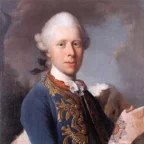
Ernst II (1745–1804), Duke of Saxe-Gotha-Altenburg
Not to be confused with Ernst II, Duke of Saxe-Coburg and Gotha (1818–1893), a much later and entirely different prince of the same Ernestine Saxon house. Some English-language and facsimile sources garble his own duchy's name as "Saxe-Coburg and Altenburg" — an error possibly encouraged by the existence of that later, similarly named duke — where the correct style is Ernst II, Duke of Saxe-Gotha-Altenburg.
Born in Gotha on 30 January 1745, Ernst was the third but second surviving son of Frederick III, Duke of Saxe-Gotha-Altenburg, and Luise Dorothea of Saxe-Meiningen; the death of his elder brother Frederick in 1756 made him heir apparent. His mother, a correspondent of Voltaire and a notable figure of the German Enlightenment in her own right, oversaw an unusually rigorous education for him, and in 1768–69 he undertook an educational journey to the Netherlands, England and France, during which he met leading figures of contemporary politics, science and the arts. On 21 March 1769, at Meiningen, he married Princess Charlotte of Saxe-Meiningen, his mother's half-first cousin; of their four sons, only two survived to adulthood, Emil Leopold August (later Duke Augustus) and Friedrich (later Duke Frederick IV), the elder of whom succeeded him.
Ernst succeeded his father as ruling duke on 10 March 1772 and governed the small Thuringian duchy until his death in 1804. Contemporaries described him as a "confidant of scholarship" and a "high patron and promoter" of the arts and sciences, and his reign is remembered as one of the model enlightened-absolutist courts of the Holy Roman Empire's smaller states: he founded the Gotha court theatre and engaged the celebrated actor Conrad Ekhof to direct it, laid out public parks, and dismantled the fortifications of the ducal seat, Friedenstein Palace, opening the town to the landscaped grounds that survive today. Privately his own passions were astronomy and physics; he brought the astronomer Franz Xaver von Zach to Gotha and, with him, founded the Seeberg observatory outside the town, which grew under Zach's direction into one of the leading centres of astronomical research in Europe and drew visitors of the stature of Goethe. Ernst is reported to have specified in his will that the observatory should stand as the sole visible monument to his reign.
He was elected a Knight of the Order of the Garter in 1790 — a distinction owed to the family connection through his aunt Princess Augusta, who had married Frederick, Prince of Wales, making Ernst a first cousin of King George III — and was formally invested at Friedenstein in April 1791; the insignia were returned to the order on his death in 1804. He was also active in Freemasonry, joining the Zinnendorf-rite lodge Zum Rautenkranz in Gotha in 1774 and becoming Grand Master of the Zinnendorf Landesloge of Germany the following year, and in 1783 he joined the Bavarian Illuminati under the cover-names "Quintus Severus" and "Timoleon," rising to oversee the order's affairs in Upper Saxony; in 1787 he granted the Illuminati's founder, Adam Weishaupt, refuge in Gotha after the order's suppression in Bavaria. The combination of his scientific pursuits and his secret-society ties fed a local folklore crediting him with quasi-magical powers, including a persistent Gotha legend that he could "banish" fire. Unsettled by the French Revolution, he even weighed abdicating to emigrate to Switzerland or the United States, going so far as to acquire land near Montgomery, Ohio, and commission the architect Joseph Ramée to design a country house there in 1796 — a plan he never carried out.
Ernst's collecting activity extended to the ducal library at Gotha, and it is in this connection that he is chiefly relevant to the history of medieval manuscripts: in 1801 he purchased, through the enterprising former Benedictine Jean-Baptiste Maugérard (1735–1815), some fifty valuable medieval manuscripts dispersed from the suppressed abbeys of Echternach and Murbach in the wake of the French Revolutionary occupation of the Rhineland — among them the Codex Aureus of Echternach, which passed through the ducal collection at Gotha before its twentieth-century sale to the Germanisches Nationalmuseum in Nuremberg. Ernst II died in Gotha on 20 April 1804.
-
Eugene IV (Gabriele Condulmer, c. 1383-1447)
Pope from 3 March 1431 to 23 February 1447.
Few pontificates of the fifteenth century compress so much contradiction into sixteen years. Gabriele Condulmer came to the throne of Peter as an ascetic Venetian canon regular who had given away a fortune; he spent nine of his sixteen years as pope in exile from his own city, hunted out of Rome by a mob and reduced at one point to lying in the bottom of a boat under a shield while stones rained down on the Tiber. He was formally deposed by a general council of the Church and confronted with a rival pope, the last antipope in the history of the Latin Church. And yet the same man presided over the Council of Ferrara-Florence, achieved, however briefly, the reunion of the Greek and Latin Churches, broke the conciliarist movement politically if not intellectually, and restored the papal monarchy to a position from which Nicholas V could launch the papacy of the High Renaissance.
For the historian of art, Eugene IV occupies a peculiar and often underestimated position. He was not a patron on the scale of Nicholas V or Julius II, and no coherent programme of image-making can be reconstructed for him with confidence. But he was physically present, as pope, at three of the defining moments of the early Florentine Renaissance: he consecrated Brunelleschi's cathedral in March 1436; he consecrated Michelozzo's rebuilt San Marco in January 1443, in a convent then being frescoed by Fra Angelico; and he brought the Byzantine imperial court to Ferrara and Florence in 1438-39, an encounter whose visual consequences, from Pisanello's medal of John VIII Palaiologos onward, Italian art absorbed for a century. His curia in exile housed Flavio Biondo, Poggio Bracciolini and Leon Battista Alberti. His bronze doors by Filarete still hang at the entrance of St Peter's, the only substantial fabric of the Constantinian basilica to survive its own demolition.
What follows is a biography that attempts to hold both halves together: the conciliar and political narrative, which is well documented and heavily studied, and the artistic and cultural context, which is more fragmentary and where attributions and interpretations must be handled with care. Where claims are disputed, the disputes are identified. Where the evidence is thin, that is stated explicitly.
Gabriele Condulmer (the family name also appears as Condulmaro, Condulmer, Condulmieri) was born in Venice, most probably in 1383. The year is not certain; it rests on later testimony rather than on a documented act, and older literature occasionally proposes 1388. The date should be cited as c. 1383 in any scholarly apparatus.
His father, Angelo Condulmer, belonged to a wealthy Venetian merchant family: prosperous, well-connected, but not among the ancient patriciate of the case vecchie. His mother, Beriola Correr, was the sister of Angelo Correr, who in 1406 would be elected pope as Gregory XII. This single fact determined the shape of Gabriele's early career. In the ecclesiastical Venice of the early Quattrocento, an uncle in the Roman obedience of a divided papacy was worth more than any patrimony.
Angelo Condulmer died when his son was young, leaving Gabriele a substantial inheritance. The figure of 20,000 ducats is repeatedly given in the sources, though such round sums in fifteenth-century biography should always be treated as rhetorical as much as documentary. Rather than enter trade, Gabriele joined the community of secular canons at San Giorgio in Alga, on an island in the Venetian lagoon, together with his cousin Antonio Correr. The congregation, formally constituted in the first years of the century, became one of the significant vehicles of the devotio reform current in the Veneto; its most celebrated member was Lorenzo Giustiniani, later first Patriarch of Venice and canonised in 1690. Condulmer and Correr are credited by tradition with endowing the community out of their patrimonies.
This background matters for understanding the man. Eugene IV's temperament, austere, personally continent, tall and gaunt, indifferent to luxury, rigid in judgement, and often disastrous at compromise, was formed in a reformed canonical community, not in a chancery or a studium. He was never a university theologian. The literature that praises him (Vespasiano da Bisticci's brief life is the most attractive example) praises his integrity and bearing; the literature that condemns him condemns his obstinacy. Both are describing the same formation.
In 1407 Gregory XII named his nephew Bishop of Siena. The appointment failed almost immediately: the Sienese objected to a young Venetian outsider, and Condulmer resigned the see, apparently without ever exercising it effectively.
On 9 May 1408 Gregory created him cardinal priest of San Clemente, and he also served as apostolic protonotary and papal treasurer. He remained loyal to his uncle through the crisis that produced the Council of Pisa (1409) and, briefly, a third obedience. When Gregory XII abdicated at the Council of Constance in 1415, the act that made the election of Martin V possible in 1417, Condulmer's cardinalate was among those confirmed by the new pope.
Under Martin V (Oddone Colonna), he served as a legate and administrator rather than a theologian or diplomat: legate in the March of Ancona from about 1420, and involved in the recovery and government of Bologna in the 1420s. He acquired, in these years, a reputation for firmness against local particularism and for financial rigour, and in the process a set of enemies.
Martin V died on 20 February 1431. The conclave of fourteen cardinals met in Santa Maria sopra Minerva and elected Condulmer on 3 March 1431; he was crowned on 11 March. Before the election the cardinals had subscribed an electoral capitulation, a document that would haunt the pontificate. Its terms bound the new pope to devote half the papal revenues to the College, to undertake reform, to convoke and support the general council already summoned to Basel, and not to move the curia or alienate territory without the cardinals' consent. Eugene signed. He would spend the next decade demonstrating, in practice, that he did not consider himself bound.
Eugene's first act of policy was also his first catastrophe. Martin V had been a Colonna, and his pontificate had transferred an enormous quantity of movable wealth, castles and offices to his relatives. Eugene demanded restitution of what he regarded as property of the Roman Church. The Colonna resisted; open war broke out in Rome and the Campagna in May 1431. Although a peace was patched together in the autumn, the conflict destroyed any possibility of a stable Roman base and consumed the treasury at precisely the moment Eugene needed money to confront Basel.
The reckoning came three years later. On 29 May 1434 Rome rose in revolt, proclaimed a republic under seven governatori, and drove the papal officials from the city. On or about 4 June 1434 Eugene IV escaped from Rome disguised in monastic habit, taken down the Tiber in a small boat toward Ostia while crowds on the banks pelted the vessel with stones; according to narrative sources, the pope lay covered by a shield. He reached Pisa and then, on 23 June 1434, Florence, which became the seat of the curia.
The recovery of the Papal States was accomplished not by Eugene but by Giovanni Vitelleschi, the warrior-prelate from Corneto, Patriarch of Alexandria and later cardinal, who retook Rome in October 1434 and reduced the Roman baronage with a brutality that became proverbial. The destruction of Palestrina, the Colonna stronghold, in 1436 was remembered for generations. Vitelleschi's usefulness did not protect him: on 19 March 1440 he was arrested at the bridge of Castel Sant'Angelo by the castellan Antonio Rido, and died of his wounds on 2 April 1440. Whether Eugene ordered the arrest, connived at it, or was presented with a fait accompli is genuinely disputed and cannot be settled from surviving documentation. Vitelleschi's place as papal commander passed to Ludovico Trevisan (Scarampo), Patriarch of Aquileia, who shared in the victory over the Milanese at Anghiari on 29 June 1440.
The Council of Basel had been summoned by Martin V under the terms of the Constance decree Frequens and opened, formally, in July 1431, under the presidency of Cardinal Giuliano Cesarini, a figure of real distinction, arriving from the disaster of Domazlice (Taus), where the crusade against the Hussites had collapsed in August 1431.
Eugene attempted to strangle the council in its cradle. By the bull Quoniam alto of 18 December 1431 he dissolved Basel and summoned a new council to Bologna in eighteen months. The fathers refused to disperse. In February 1432 they solemnly reaffirmed the Constance decree Haec sancta, the assertion that a general council holds its authority immediately from Christ and that all, including the pope, are bound to obey it in matters of faith, the ending of schism, and reform, and they summoned Eugene to appear before them.
The pope had no army, no money and no Rome. Sigismund of Luxembourg, whom Eugene crowned emperor in Rome on 31 May 1433, mediated from a position of strength. On 15 December 1433 Eugene capitulated: the bull Dudum sacrum revoked the dissolution and declared the Council of Basel legitimate from its inception. It was the deepest humiliation of the papal office since Constance.
Basel then proceeded to legislate: abolishing annates and reservations, restricting appeals to Rome, and dismantling the fiscal and jurisdictional machinery of the papal monarchy. It negotiated the Compactata with the moderate Hussites, agreed at Jihlava (Iglau) in July 1436, an agreement Eugene never ratified. Its decrees were received, in modified form, by the French crown in the Pragmatic Sanction of Bourges (7 July 1438) and by the German princes in the Acceptatio of Mainz (26 March 1439), following their declaration of neutrality at Frankfurt in 1438.
The break came over the Greeks. Both pope and council were negotiating with Constantinople for a council of union; the Byzantines, needing Western military aid against the Ottomans, would come, but only to a city they could reach. The Basel majority insisted on Basel, Avignon or Savoy; a minority, including Cesarini, accepted an Italian city. Eugene seized the opening. By the bull Doctoris gentium of 18 September 1437 he transferred the council to Ferrara. The minority, with the Greek ambassadors, went; the majority stayed and, on 25 June 1439, declared Eugene IV deposed as a heretic and schismatic. On 5 November 1439 they elected Amadeus VIII, Duke of Savoy, who took the name Felix V and was crowned at Basel on 24 July 1440.
Felix V was the last antipope of the Latin Church. He was also, decisively, an embarrassment: a lay prince, a widower, elected by a rump. The schism he headed had almost no traction outside Savoy, parts of Switzerland and Germany, and Aragon. He abdicated in 1449, two years after Eugene's death.
The Council of Ferrara opened on 8 January 1438. On 4 March 1438 the Byzantine delegation arrived: the Emperor John VIII Palaiologos, the Patriarch of Constantinople Joseph II, some seven hundred Greeks including Bessarion, metropolitan of Nicaea, Isidore, metropolitan of Kiev, Mark Eugenikos, metropolitan of Ephesus, and the philosopher George Gemistos Plethon.
Plague and, more decisively, money forced a transfer. Cosimo de' Medici and the Florentine commune undertook the costs; the first session at Florence was held on 26 February 1439. The theological debates turned on the Filioque (both doctrine and the legitimacy of the addition to the Creed), purgatory, the use of leavened or unleavened bread in the Eucharist, and, left deliberately vague, the primacy of the Roman See. Joseph II died on 10 June 1439 and was buried in Santa Maria Novella, where his monument and fresco portrait remain one of the few durable Florentine traces of the event.
On 6 July 1439, in Santa Maria del Fiore, the decree of union Laetentur caeli was proclaimed, read in Latin by Cesarini and in Greek by Bessarion, and subscribed by the emperor and the Greek prelates. Mark of Ephesus refused his signature, and his refusal proved to be the more accurate prophecy: the union was repudiated in Constantinople in practice almost immediately and never received by the Greek population or the other Eastern patriarchates. It was formally proclaimed in Hagia Sophia only in December 1452, months before the city fell on 29 May 1453.
Eugene extended the same conciliar method to other Eastern Churches. Decrees of union followed with the Armenians (Exsultate Deo, 22 November 1439), the Copts and Ethiopians (Cantate Domino, 4 February 1442), and, after the council's transfer to the Lateran in September 1443, with certain Syrians (1444) and with Chaldeans and Maronites of Cyprus (August 1445). None of these unions had significant durability. Their significance was political: they gave the papacy an ecumenical stage on which the Basel fathers could not appear, and they permitted Eugene to claim credibly that the pope, not the council, had reunited Christendom.
The union also gave Eugene two cardinals of the first rank: Bessarion and Isidore of Kiev, created on 18 December 1439. Bessarion's household in Rome became the principal channel of Greek learning into Italy, and his library, bequeathed to Venice in 1468, is the foundation of the Biblioteca Marciana.
The military corollary failed. The crusade Eugene promoted, with Cesarini as legate, ended in catastrophe at Varna on 10 November 1444; Cesarini died in the rout or its aftermath. The papal galleys under Trevisan achieved nothing decisive.
Eugene returned to Rome on 28 September 1443, after nine years. The final phase of the pontificate is a study in patient, unglamorous recovery.
The Treaty of Terracina (14 June 1443) recognised Alfonso V of Aragon as king of Naples, abandoning the Angevin claim of Rene; in exchange Alfonso withdrew his support from Felix V and expelled the Basel party from his territories. It was a straightforward exchange of legitimacy for obedience, and it worked.
Germany was harder and mattered more. The imperial electors had declared neutrality; Frederick III, elected King of the Romans in 1440, held the balance. The papal case was argued by two men of exceptional ability: Nicholas of Cusa, who abandoned Basel for Eugene and whose De concordantia catholica had begun as a conciliarist manifesto, and Enea Silvio Piccolomini, Basel's own secretary, then Frederick's, who came over to Eugene in 1445 and would himself be pope as Pius II. In February 1447, on his deathbed, Eugene issued the bulls generally cited from Salvatoris omnium, conceding German demands while reserving the rights of the Holy See and of a future council. Germany returned to obedience. The settlement was consolidated the following year, under Nicholas V, in the Concordat of Vienna (1448).
Eugene IV died in Rome on 23 February 1447. He was succeeded by Tommaso Parentucelli, one of his own creations, as Nicholas V.
Two documents of Eugene's pontificate have attracted attention far beyond their fifteenth-century weight. Sicut dudum (13 January 1435), addressed to Bishop Ferdinand of Rubicon in the Canaries, ordered under pain of excommunication the restoration to liberty, within fifteen days, of the Guanche natives of the Canary Islands who had been baptised or who had come voluntarily, and who had been enslaved by Iberian raiders. It is one of the earliest papal condemnations of the enslavement of a specific indigenous population.
Its efficacy was negligible, and historiographical claims sometimes made for it are overstated. Eugene's position shifted with Castilian and Portuguese diplomatic pressure over the following decade, and within eighteen years his successor Nicholas V would issue Dum diversas (1452) and Romanus pontifex (1455), which granted Portugal rights of conquest and perpetual servitude that Sicut dudum appeared to deny. Any use of Sicut dudum on medievalvisions.com should be framed within that trajectory rather than isolated from it.
The single surest monument of Eugene's patronage is the pair of bronze doors for the central portal of Old St Peter's, commissioned from Antonio Averlino, called Filarete, and executed between 1433 and 1445. They were transferred to the new basilica and remain in use at its central entrance, effectively the only major element of the Constantinian church still performing its original function.
The iconographic programme is conventional in its main registers: Christ enthroned, the Virgin, Sts Peter and Paul, and the martyrdoms of the two apostles. What makes the doors an extraordinary historical document is the subsidiary decoration: friezes and narrow panels recording events of the pontificate itself, including the coronation of Sigismund (1433), the arrival of John VIII Palaiologos, the Council of Florence and proclamation of union, and the departure of the Greeks. This is contemporary history rendered in bronze on the door of the mother church of Latin Christendom, and its message is clear: the pope who reunited the Churches is the legitimate pope, and Basel does not exist.
The style remains disputed. Filarete's antiquarianism, including classicising ornament, small-scale narratives, and the signature panel on the reverse showing the artist and his assistants dancing with a mule, has been read both as charmingly provincial beside Ghiberti and Donatello, and as a deliberate archaising strategy appropriate to a Constantinian basilica. Both readings have serious defenders.
Eugene's Rome was too poor, and he was in it too briefly, for a major building programme. The documented activity is largely conservative: repairs to churches, walls and fortifications; work on the Lateran; and, notably, the clearing and restoration of the Pantheon (Santa Maria ad Martyres), including its surroundings and ancient bronze doors, an intervention recorded by Flavio Biondo, Eugene's secretary, in this same milieu.
Eugene's most consequential contribution to the art of his century may have been simply to be in Florence between 1434 and 1436 and again in 1439 and 1443.
On 25 March 1436 he consecrated Santa Maria del Fiore, Brunelleschi's dome effectively complete. The ceremony occasioned Guillaume Dufay's motet Nuper rosarum flores, composed for the papal chapel. The reading that the motet's proportions encode those of Brunelleschi's dome was proposed by Charles Warren (1973) and comprehensively challenged by Craig Wright (1994), who argued instead for the proportions of the Temple of Solomon. Wright's case is now generally preferred, though the older claim continues to circulate.
On 6 January 1443 Eugene consecrated San Marco, rebuilt by Michelozzo at Cosimo de' Medici's expense and in the course of being frescoed by Fra Angelico and his workshop. In 1445 he summoned Angelico to Rome to fresco the Cappella del Sacramento in the Vatican, a work destroyed under Paul III in the sixteenth century and known only from descriptions. Vasari's story that Eugene wished to make Angelico archbishop of Florence, and that the friar deflected the offer toward Antoninus, is first attested much later and should be treated as hagiographic tradition rather than established fact.
The papal curia in exile was also an engine of humanism. Poggio Bracciolini and Flavio Biondo were apostolic secretaries. Leon Battista Alberti held a post as abbreviator and was in Florence with the curia when he composed De pictura (1435), with the Italian version Della pittura (1436) dedicated to Brunelleschi. Alberti was not Eugene's protege in any meaningful sense, and it would be an error to credit the pope with the treatise. But the mechanism by which the papal court transplanted a Roman humanist circle into Florence at that precise moment is a fact of Eugene's pontificate.
The arrival of the Byzantine court in 1438-39 gave Italian artists their only sustained sight of a living Eastern imperial court. Pisanello's medal of John VIII Palaiologos, cast at Ferrara or Florence in 1438-39, is the foundational object of the Renaissance portrait medal and the beginning of a long Italian fascination with the emperor's hat, beard and profile.
Beyond this, caution is required. It is frequently asserted that Benozzo Gozzoli's Journey of the Magi in the Palazzo Medici (1459) portrays John VIII and the council delegates; that Piero della Francesca's Flagellation encodes the crusade and fall of Constantinople; and that Eastern figures in the Arezzo cycle derive from the council. These are hypotheses of varying quality and should not be presented as established.
Eugene IV was buried in St Peter's. His funerary monument, attributed to Isaia da Pisa, was displaced in the reconstruction of the basilica and is now in San Salvatore in Lauro, the Roman church of the Venetian community. The monument's present arrangement is not its original one, and anyone using it as evidence for mid-Quattrocento Roman sculpture must reckon with the dismemberment and reassembly.
Jean Fouquet is reported to have painted Eugene IV in Rome, with two chamberlains, during a stay in the mid-1440s, and the picture is said to have hung in Santa Maria sopra Minerva. The painting is lost. Its reputation rests principally on the notice in Filarete's Trattato di architettura. The loss is significant and disputed: the portrait is one of the few pieces of evidence for Fouquet's Italian journey, which underpins the standard account of how Italian perspective and portraiture reached French painting. Copies and derivations have been proposed, none securely.
The contemporary portrait of Eugene is consistent: tall, thin, severe, personally blameless, generous to the poor, and immovable. Vespasiano da Bisticci admired him. His enemies at Basel found him impossible to negotiate with, which is not the same as finding him wrong.
The historiographical assessment has shifted over time. Nineteenth- and early twentieth-century Protestant scholarship often treated him as the destroyer of the last chance for constitutional reform of the Church from within; Ludwig von Pastor, from the opposite confessional position, treated him as the restorer of legitimate authority. The key rehabilitating account in English remains Joseph Gill's The Council of Florence (1959) and Eugenius IV: Pope of Christian Union (1961), both indispensable and learned, while openly sympathetic to their subject. On Basel itself, a modern standard remains Johannes Helmrath's Das Basler Konzil 1431-1449 (1987), while Antony Black's Council and Commune (1979) situates conciliarism in wider political thought.
For Italian-language work, especially relevant for medievalvisions.com, the entry in the Enciclopedia dei Papi (Treccani, 2000) and the corresponding Dizionario Biografico degli Italiani treatment are essential starting points, with full bibliography. The authorship of those entries should be cited directly from the printed volumes.
The fairest judgement is probably this: Eugene IV was a bad politician who won. He mishandled the Colonna, mishandled Rome, mishandled Basel in 1431 so badly that he was forced into retraction two years later, and mishandled Vitelleschi. But he understood one thing the council never did: that legitimacy in the fifteenth century was conferred by princes and by spectacle, and that a pope who could stand in Santa Maria del Fiore beside a Roman emperor and proclaim the reunion of Christendom had already won an argument that no decree of Basel could unmake. The conciliar theory survived him as an idea, in Paris and elsewhere, for a century. The conciliar movement did not.
-
Evagrius Scholasticus
Evagrius Scholasticus was a Syrian scholar, lawyer, and ecclesiastical historian, widely regarded as the last of the great continuators of Eusebius of Caesarea in the tradition of Christian historiography. Born around 536 AD in Epiphania, a city on the banks of the Orontes River in Coele-Syria (modern Hama, Syria), he lived through one of the most turbulent and theologically charged centuries of late antiquity: the age of Justinian, the plague, the Persian wars, and the final convulsions of the Monophysite controversy.
Evagrius received a thorough and wide-ranging classical education from an early age, beginning with grammar and progressing through the full curriculum of classical Greek literature before specializing in law. His childhood was not untouched by the great events of the age: he records in his own Ecclesiastical History that as a boy he accompanied his parents to Apamea to witness the solemn public veneration of a relic of the True Cross, during the general panic caused by the Sasanian king Khosrow I's sack of Antioch in 540 AD - a traumatic event that left a deep impression on him and recurs in his writing as a lived memory connecting the personal and the historical.
Upon completing his legal studies in his late twenties, he was awarded the prestigious title of scholasticus, a formal designation for a qualified advocate or jurist, from which his common surname derives. He established himself as a lawyer and advocate in Antioch, then as now the great metropolis of the Syrian East, and built a reputation sufficiently distinguished to bring him into the orbit of the most powerful ecclesiastical figure in the region.
The central professional relationship of Evagrius's life was his service to Gregory of Antioch, patriarch from 569 to 594 AD, whom he served as legal adviser, professional advocate, and close personal friend. This relationship was tested most dramatically in 588 AD, when Gregory was summoned before the Emperor Maurice and a synod in Constantinople to defend himself against grave accusations of sexual misconduct (incest in the sources, though the precise nature of the charge is debated). Evagrius accompanied the patriarch to Constantinople and successfully defended him, securing his acquittal - a legal triumph that consolidated both his own reputation and his standing at the imperial court.
His services were rewarded with considerable distinction by two successive emperors. Under Tiberius II (578-582), he was appointed quaestor, and under Maurice he received the honorary title of ex praefectis (honorary prefect), a mark of imperial esteem that placed him among the highest ranks of the civilian aristocracy without requiring him to hold active administrative office. A telling detail preserved in his own text reveals the social prominence he had achieved: when he returned to Antioch after Gregory's acquittal and married a young wife, the occasion was made the subject of a public festival in the city. Evagrius, a man of provincial Syrian birth, had risen to become one of the notable figures of the late antique eastern Mediterranean world.
His only surviving work is the Ecclesiastical History (Ekklēsiastikē Historia), a six-volume work completed around 593 AD and dedicated to the Emperor Maurice. It covers the history of the Christian Church from the First Council of Ephesus in 431 AD - where the Nestorian controversy came to its first great crisis - to the events of his own present, specifically the twelfth year of Maurice's reign in 593-594 AD. In terms of scope, it thus picks up precisely where the Ecclesiastical History of Sozomen leaves off and carries the Christian historical narrative through the tumultuous fifth and sixth centuries.
The work is organized thematically around the great theological controversies of the period. It traces in detail the development of Nestorianism, Eutychianism, and the successive phases of Monophysitism, the defining doctrinal conflicts that fractured the eastern church throughout this period. Evagrius was an explicit and committed Chalcedonian, loyal to the theological settlement of the Council of Chalcedon (451 AD), and this perspective shapes his judgments throughout. He is openly critical of non-Chalcedonian historians such as Zacharias Rhetor and Zosimus, whose theological presuppositions he contests even while using their work as source material.
What distinguishes Evagrius from more credulous hagiographic writers is his genuine engagement with documentary sources. He explicitly acknowledges his debts to earlier historians and incorporates substantial verbatim quotations from contemporary documents, including imperial letters, conciliar acts, and ecclesiastical correspondence, some of which survive nowhere else. This documentary conscientiousness makes the Ecclesiastical History an irreplaceable primary source for the fifth and sixth centuries, particularly for the internal politics of the eastern church, the biographies of notable bishops and holy men, and the intersection of imperial and ecclesiastical power.
He also writes from lived experience with unusual directness. His account of the Plague of Justinian, which he personally witnessed and from which members of his own family died, is one of the most vivid and historically valuable descriptions of that catastrophe to survive from antiquity. He records losing a daughter, a son-in-law, and grandchildren to the epidemic, and his testimony carries the weight of personal grief alongside the historian's analytical impulse. His early writings, now lost, actually began with a treatise specifically on this plague outbreak.
As a Chalcedonian writing at the end of the sixth century, Evagrius occupies a specific and well-defined position in the theological landscape of his age. His History is in many ways a sustained argument for the legitimacy of the Chalcedonian settlement against its Monophysite critics - a polemical purpose that must be kept in mind when evaluating his reliability on contested theological events. Nonetheless, his broad learning, his access to primary documents, and his generally careful citation of sources give his work a degree of trustworthiness that distinguishes it from purely partisan ecclesiastical writing.
His Ecclesiastical History contains one of the earliest detailed literary references to the Image of Edessa (Mandylion), describing how the miraculous cloth bearing Christ's face was used to repel a Sasanian Persian siege of Edessa in 544 AD. This passage is a crucial textual node in the transmission history of the Mandylion tradition, linking it to verifiable historical events and establishing it as an object of civic and military veneration well before its transfer to Constantinople in 944 AD. Evagrius's testimony thus stands at the intersection of the Abgar legend, the history of Byzantine sacred imagery, and the broader tradition of the acheiropoieton transmitted in medieval illuminated manuscripts.
He died sometime after 594 AD; the exact date is unknown. His Ecclesiastical History was first translated into Latin in the early modern period and into English by Edward Walford in 1846, and the standard modern scholarly edition and translation, with extensive commentary by Michael Whitby, was published by Liverpool University Press in 2000.
F
-
Frederick Barbarossa (Frederick I, Holy Roman Emperor)
Frederick I of Swabia, known as Barbarossa - a nickname given to him by the towns of northern Italy because of his thick, reddish beard - was Emperor of the Holy Roman Empire from 1155 until his death in 1190, and remains one of the most powerful, ambitious, and controversial medieval rulers in all of European history. His reign of nearly forty years was marked by six military expeditions to Italy, a long and bitter conflict with the papacy, and a proud vision of restoring the full translatio imperii of ancient Rome.
Frederick was born around 1122, the son of Frederick II, Duke of Swabia, of the House of Hohenstaufen, and Judith of Bavaria, of the House of Welf. This dual lineage - from two of the most powerful and rival families of medieval Germany - placed him in a unique position to mediate between the Guelph and Ghibelline factions that were tearing the German realm apart. When Emperor Conrad III died in 1152 without leaving a direct successor capable of garnering broad support, the German princes elected Frederick King of Germany on March 4 in Frankfurt, and crowned him in Aachen on March 9 of the same year. It was a choice dictated by the need to mend the rift between the Guelphs and Ghibellines, relying on a young man who represented both houses by blood.
In 1154-1155, Frederick traveled to Italy for the first time, with the aim of asserting his imperial authority over a politically turbulent peninsula, reestablishing control over the rebellious cities, and obtaining the imperial crown from the pope.
In Pavia, he received the crown of King of Italy, then destroyed the city of Tortona, an ally of Milan, and on June 18, 1155, he was crowned emperor by Pope Adrian IV in Rome - the same pope who, a few months earlier, had chosen his disciple Eugene III, a Cistercian from Pisa, as his own advisor. Returning to Germany almost immediately, Frederick had resolved nothing: in 1158 he descended again with a far larger army and, at the Diet of Roncaglia, promulgated the Constitutiones, a body of imperial laws that claimed rights for the crown over all the cities of Italy, including the collection of duties and taxes that the communes had by then come to regard as their own.
The response from the communes of northern Italy was swift and organized: in 1167, while Frederick was marching toward Rome with a large army - capturing the city on July 24 and installing an antipope, Paschal III, in exchange for a new imperial coronation - sixteen northern cities signed the Lombard League, with Milan at the helm, to collectively defend their autonomy. A terrible malaria epidemic decimated the imperial army near Rome in the summer of 1167, forcing Frederick into a hasty retreat: a sudden reversal that many contemporaries interpreted as divine punishment. The decisive confrontation came on May 29, 1176, at Legnano, in Lombardy, where the infantry of the communes - supported by the famous Milanese Carroccio - routed the German cavalry: it was a defeat that deeply shook the emperor's myth of invincibility.
Parallel to the Italian wars, Frederick waged a long conflict with the papacy that lasted nearly twenty years. In 1159, upon the death of Pope Adrian IV, a double election divided Christendom: Frederick supported the antipope Victor IV against the canonically elected Alexander III, creating a schism that was resolved only in 1177 with the Treaty of Venice. In that agreement, Frederick recognized Alexander III as the legitimate pope, formally renouncing his claims to supremacy over papal appointments, and in return secured the restoration of peace with the Italian communes, which was then definitively ratified by the Peace of Constance in 1183. The Peace of Constance was his most significant political concession: he recognized the Lombard communes' right to self-govern in civil matters, to maintain armies, and to form alliances, retaining only formal obedience to the emperor.
While Barbarossa suffered numerous setbacks in Italy, his rule in Germany was more stable and constructive. He reorganized the German feudal system, promoting expansion eastward into Slavic territories - the Drang nach Osten - and encouraging trade and urban development.
His most dangerous internal antagonist was Henry the Lion, Duke of Saxony and Bavaria, a powerful Guelph prince who had refused to participate in the Italian campaign of 1176, thereby indirectly contributing to the defeat at Legnano. In 1180 Frederick banished Henry the Lion from the Empire, confiscated his duchies, and exiled him to England, redistributing his lands to loyal princes: this was a consolidation of imperial power on the German front that partially offset the losses in Italy.
In the summer of 1189, Frederick set out on the Third Crusade at the age of sixty-six, at the head of one of the largest armies ever assembled in the West, with forces estimated at between 100,000 and 150,000 men.
The expedition crossed the Balkans and Anatolia amid enormous logistical difficulties, but Frederick kept the army cohesive and on the move. On June 10, 1190, he attempted to cross the Saleph River - today's Goksu, in southern Turkey - perhaps to shorten the route or to water his horse, and drowned in the river's cold, swirling waters. His sudden death was a shock to the crusade: most of the army scattered, and only a small portion continued on toward the Holy Land.
The figure of Barbarossa immediately transcended history to become a legend. Beginning in the 13th century, a tradition spread in Germany that the emperor had not died but was sleeping beneath Mount Kyffhauser in Thuringia, waiting to awaken when Germany needed him to usher in an era of justice and greatness. This medieval myth was revived for propaganda purposes in the modern era: the Wilhelmine emperor inaugurated the great Kyffhauser monument in 1896, and the name "Operation Barbarossa" was given in 1941 to the German invasion of the Soviet Union, symbolically appropriating the image of the medieval conqueror.
-
Frater Elia of Cortona
Frater Elia of Cortona was one of the most important and controversial figures in the early Franciscan movement: a close associate of St. Francis, an able organizer, builder, and leader, but also a man later criticized for his style of government and his political choices. He was born near Assisi around 1170–1180, died in Cortona on 22 April 1253, and became a central actor in shaping the institutional Franciscan Order.
The sources are uncertain about Elia's earliest years, but the best biographical tradition places his birth near Assisi and gives him the name Buonbarone, or Bonusbaro. Treccani notes that later sources are sparse and sometimes biased, yet they suggest he may have worked as a schoolmaster, a mattress-maker, or even a notary in Bologna before joining Francis's movement. His rise is striking because he entered the friars relatively late, likely between 1210 and 1215, after which he quickly became one of Francis's most trusted companions.
Elia's importance grew rapidly when Francis sent him in 1217 to the Holy Land as minister provincial of Syria. He returned with Francis in 1220 and was named vicar of the Order in 1221, which made him the practical administrator of the friars during Francis's final years. Treccani emphasizes that Francis entrusted him with enforcing the Rule and managing the order's expansion, while contemporary and near-contemporary sources present him as a faithful interpreter of Francis's will.
After Francis's death in 1226, Elia played a decisive role in announcing the saint's passing and in promoting the public cult of the stigmata. He then became the driving force behind the Basilica of Saint Francis in Assisi, securing the land, organizing funding, and overseeing construction. Later tradition even credited him with architectural planning for the basilica's two-tiered design, though that attribution is not certain. In historical terms, his greatest lasting achievement was to give the Franciscan memory a monumental architectural form.
Elia was elected minister general in 1232, but his leadership became increasingly contested. Critics accused him of authoritarian methods, luxury, and insufficient respect for Franciscan poverty, while supporters saw him as a strong administrator needed to govern a fast-growing order. His political alignment with Frederick II deepened the conflict, and he was deposed in 1239; he was then excommunicated in 1240 and again in 1244. After these ruptures, he withdrew to Cortona, where his life became bound up with local patronage and with the church of San Francesco he helped build there.
Elia's final years were spent in or around Cortona, and he died there on 22 April 1253. Treccani indicates that he was eventually reconciled with the Church before death, a detail that matters because later Franciscan tradition often turned him into a symbol of corruption and apostasy. That negative image became powerful in later medieval narratives, but modern scholarship tends to see a more nuanced figure: a brilliant organizer, a builder of institutions, and a controversial reformer caught between Francis's ideal of poverty and the demands of a rapidly expanding order.
His biography is therefore not only the story of a friar, but also a window into the early transformation of the Franciscan movement from a charismatic brotherhood into a structured religious institution.
-
Fatimid Caliphate (909-1171 CE)
The Fatimid Caliphate (909-1171 CE) represents one of the most creative and culturally ambitious dynasties in Islamic history. Ruling first from North Africa and then from Egypt, the Fatimids synthesized influences from Abbasid Mesopotamia, Byzantine Constantinople, ancient Egypt, and indigenous North African traditions into a distinctive visual and intellectual culture that exercised influence far beyond the borders of their empire, reaching directly into Norman Sicily and the court of Roger II.
The Fatimids were an Ismaili Shia dynasty whose founder claimed descent from Fatima, daughter of the Prophet Muhammad, and her husband Ali, the first Shia imam. This genealogical claim was not merely dynastic rhetoric but the theological cornerstone of their legitimacy, making the caliph both political sovereign and divinely guided imam. This dual sacred-political authority profoundly shaped Fatimid art and architecture, where ceremonial display functioned as theological performance.
The dynasty emerged from an Ismaili revolutionary movement in ninth-century Syria and established its first capital at al-Mahdiyya on the Tunisian coast in 921. The conquest of Egypt in 969 inaugurated its greatest phase. The general Jawhar al-Siqilli founded a new capital north of Fustat called al-Qahira ("The Victorious"), modern Cairo. From this imperial seat, the Fatimids presided over one of the most prosperous states in the medieval Mediterranean, drawing wealth from Egypt's agricultural surplus and from control of Red Sea and Indian Ocean trade networks.
Fatimid religious architecture established a formal vocabulary both innovative and syncretic, combining Abbasid, Byzantine, and North African Berber traditions. Hallmark features include the projected portal, treated as an autonomous element protruding from the facade; the keel-shaped arch with concave sides; and the deliberate alignment of mosque facades with urban streets as decorated public fronts. The dome before the mihrab marked ceremonial authority, while the mihrab and qibla wall received the finest carved stucco and marble programs, where geometric, vegetal, and epigraphic ornament reached exceptional refinement.
Two key monuments define Fatimid Cairo. Al-Azhar Mosque (969-973), founded with the city itself, became the principal congregational and intellectual center of Fatimid Ismaili learning and remains among the most prestigious institutions of Islamic scholarship. The Mosque of al-Hakim (begun 990, completed 1013) served both devotional and dynastic purposes, with monumental minaret forms and rich carved decoration in stone and stucco that integrated Quranic friezes with geometric and arabesque ornament.
Three great gates of Cairo's Fatimid walls survive as major works of medieval military architecture: Bab al-Nasr, Bab al-Futuh, and Bab Zuweila, completed under the vizier Badr al-Jamali between 1087 and 1092. Their stone construction and strongly Byzantine-leaning formal language are often linked to Armenian and Syrian Christian craftsmen active in Fatimid service, a revealing sign of the cosmopolitan character of Fatimid state culture.
Fatimid decorative arts rank among the supreme achievements of medieval Islamic craftsmanship. The royal treasury (khizana) held textiles, rock crystal vessels, ivory carvings, ceramics, metalwork, and jewelry of extraordinary quality. Textiles were especially prestigious, produced in court-sponsored tiraz workshops where inscriptions, dynastic titulature, and elite imagery were woven into silk and linen. The coronation mantle of Roger II in Vienna is regularly cited as a key witness to this Fatimid-influenced textile world as adapted in Norman Sicily.
Rock crystal carving reached exceptional virtuosity under Fatimid patronage, producing vessels and luxury objects of remarkable thinness and clarity, often decorated with vegetal and animal motifs. Many such works entered European treasuries through diplomacy, trade, and reuse as reliquaries. Fatimid lusterware ceramics circulated widely across the Mediterranean, and in Italy imported bowls (bacini) were embedded into Romanesque church facades and campanili, especially in Tuscany and Liguria, creating one of the most visible forms of cross-Mediterranean artistic exchange.
Carved woodwork was another signature medium: doors, minbars, screens, and ceiling elements were worked with extraordinary geometric and arabesque depth, and in some contexts with figural motifs. Artistic links with Norman Sicily are particularly strong in this medium; the wooden doors of Santa Maria dell'Ammiraglio (La Martorana) in Palermo are associated with craftsmen formed in Fatimid-derived traditions.
Fatimid manuscript patronage was also significant. The Blue Quran (Qur'an al-Azraq), written in gold and silver Kufic script on indigo-dyed parchment, is one of the most celebrated luxury manuscripts of the medieval Islamic world. Often associated with tenth-century Fatimid Tunisia, it demonstrates dialogue with both North African practices and broader Mediterranean traditions of luxury manuscript production.
A particularly important aspect of Fatimid visual culture is its substantial figural repertoire in luxury arts, including human and animal imagery in textiles, ivories, ceramics, and courtly painted settings. This distinguishes Fatimid court art from later, more strictly aniconic currents in many Sunni contexts. The painted wooden ceiling of the Cappella Palatina in Palermo, commissioned by Roger II around 1143, remains the largest surviving ensemble of Fatimid-inspired figural painting, preserving in Norman Sicily a visual language deeply indebted to Egypt.
Intellectually, the Fatimid court developed an elaborate missionary institution, the da'wa ("the call"), organized through a hierarchy of teachers and preachers headed by the da'i al-du'at. Al-Azhar functioned as a major center for doctrinal formation, while the Dar al-Hikmah (House of Wisdom), founded by al-Hakim in 1005, served as library and scholarly institution in law, philosophy, medicine, and the mathematical sciences. These institutions made Cairo one of the leading intellectual capitals of the medieval world.
The Fatimid Caliphate ended in 1171 when Saladin, vizier to the last Fatimid caliph, dissolved the dynasty and restored Sunni rule in Egypt. Yet Fatimid influence endured: its architectural and ornamental innovations shaped Ayyubid and Mamluk visual culture, while its epigraphic, geometric, and arabesque vocabulary entered the broader language of Mediterranean Islamic and cross-cultural medieval art.
-
Ferdinando Leopoldo del Migliore
Ferdinando Leopoldo del Migliore (Florence, 20 August 1628 - Florence, 1696) was an Italian historian, writer, and antiquarian whose work is closely tied to the cultural memory of seventeenth-century Florence. He is best known for compiling an enormous body of archival notes on Florentine history, local families, churches, palaces, and urban traditions, material that later became an important resource for historians of the city.
Del Migliore was born in Florence to Francesco Migliori and Francesca Vanni. He devoted much of his life to archival research and produced about 120 volumes of excerpts and notes on Florentine history, a vast documentary archive that was eventually transferred to the Biblioteca Magliabechiana and is now preserved in the Biblioteca Nazionale Centrale di Firenze. His activity made him one of the most frequently consulted erudite writers on Florence in the early modern period.
His first printed work, Senatori fiorentini, appeared in Florence in 1665 and dealt with the families that held the office of senator in the city. In 1684 he published the first volume of Firenze citta nobilissima illustrata, an ambitious survey of Florence that was intended to run to four volumes but remained incomplete because of his sudden death. The book offers a rich panorama of churches, buildings, streets, and families in seventeenth-century Florence.
Del Migliore's reputation is mixed. Later scholars admired the breadth of his collecting and the value of the information he preserved, especially when original documents were no longer available. At the same time, he was criticized for embellishing archival findings with undocumented details and, in some cases, for inventing documents outright.
One famous example concerns Salvino degli Armati, the supposed Florentine inventor of eyeglasses; Del Migliore helped promote this attribution by presenting material that later scholars judged unreliable. For this reason, he is remembered both as a valuable local historian and as a problematic source who must be used with caution.
Despite the doubts surrounding some of his methods, Del Migliore remains an important figure in Florentine historiography because he preserved a large quantity of otherwise inaccessible material. His writings are especially useful for understanding how seventeenth-century Florentines constructed the city's civic memory and noble identity. For researchers of Florence, his work is still significant as a witness to local traditions, even when it must be verified against more secure sources.
-
Filippo Minutolo
Filippo Minutolo was born in Naples into the noble Capece Minutolo family, one of the city's most distinguished patrician lineages. He first appears in the documentary record in 1269, when his name is listed, in second position among the deacon-canons, among the signatories of a bull issued by Archbishop Aiglerio of Naples. This early appearance indicates that he had already entered the cathedral chapter as a young cleric of notable rank. Before becoming archbishop, he served as chierico palatino and royal counsellor at the Angevin court, placing him at the center of royal administration.
His legal and diplomatic skill made him especially valuable to Charles I of Anjou, who entrusted him with several delicate missions. In 1270 he was sent to Tuscany on royal business; on another occasion he traveled to Lombardy to negotiate the liberation of prisoners; and he was dispatched twice to Pisa: first to raise a loan from a Sienese merchant for payment of the papal census, and again in 1272 to settle a commercial and political agreement between the crown and the Commune of Pisa, including the payment of 2,000 gold ounces by the Pisans as satisfaction for earlier offenses. These assignments reveal a figure deeply trusted in matters of high statecraft.
Filippo was elevated to the archbishopric of Naples in 1288, filling a see that had remained vacant for four years after the death of his French predecessor Aiglerio. His appointment therefore marked both a personal ascent and a renewed Italian presence in one of the kingdom's most important ecclesiastical offices. In the same year he took part in the general Parliament of the Kingdom held at Melfi in August, appearing among the foremost ecclesiastical magnates of Charles II's early reign.
His moral and intellectual authority at court is vividly attested in a remarkable document of 25 April 1295, in which Charles II, instructing his son Robert on prudent governance, named Filippo Minutolo first among the advisors the prince should consult, praising him as "the venerable father in Christ, Philip Archbishop of Naples." This exceptional endorsement underscores how highly Charles II valued his counsel. Filippo thus functioned as a crucial bridge between the reigns of Charles I and Charles II, and likely influenced the formation of Robert of Anjou, the future Robert "the Wise."
Filippo Minutolo died on 24 October 1301 and was buried in his family's chapel within the new cathedral of Naples, a space he had already furnished with an altar during his lifetime. His sarcophagus carries a recumbent effigy and a leonine-verse epitaph that summarizes his reputation: "Magnanimus sapiens prudens famaque serenus, / Philippus presul morum dulcedine plenus / Minutulus patrie decus et flos alta propago: hic silet, hic tegitur, iacet hic probitatis imago" ("Magnanimous, wise, prudent, serene in fame, Philip the bishop, full of the sweetness of character, Minutolo, ornament of his homeland and flower of noble lineage: here he is silent, here he is covered, here lies the image of probity").
-
Finnian of Clonard
Finnian of Clonard - also written Finian, Fionan, or in Latin Finianus - stands as one of the towering figures of early Irish Christianity, revered as a founding father of Irish monasticism and honored with the title Magister Sanctorum Hiberniae, the "Master of the Saints of Ireland". Born around 470 AD, most likely in the Kingdom of Leinster near present-day Myshall in County Carlow, he belonged to the noble lineage of the Clanna Rudhraighe from the Ulaid, and was baptized by a figure named Abban before being placed in the care of Bishop Fortchern of Trim for his early ecclesiastical formation.
From an early age, Finnian proved himself an eager scholar. Before departing Ireland, he founded three small churches in Leinster - traditionally identified as Rossacurra, Drumfea, and Kilmaglush - demonstrating both his pastoral ambition and his desire to lay a local foundation before seeking broader horizons. He then crossed to Wales, where he completed his monastic training under the celebrated masters Saints Cadoc at Llancarfan, Gildas, and David, absorbing the rigorous ascetic traditions that characterized Welsh monasticism at the time. Some sources further indicate that he extended his travels to the monastery of Martin of Tours in Gaul, where the Martinean tradition of strict communal piety would have deepened his formation.
Upon returning to Ireland around 520, Finnian first established a monastery at Aghowle in County Wicklow, where Oengus, the king of Leinster, granted him a site. He subsequently founded his most celebrated institution, Clonard Abbey, on the banks of the River Boyne in what is now County Meath. The choice of location was strategic: Clonard sat at a crossroads of ancient Irish routes, making it accessible to students from every province. The Rule he imposed at Clonard drew directly from the traditions of the Desert Fathers and the Welsh monastic models he had encountered, combining intense scriptural study with severe bodily asceticism - it was said that Finnian's own daily diet consisted of nothing more than barley bread and water, with fish and a small measure of ale reserved for Sundays and feast days.
At its height, the school at Clonard is said by late tradition to have enrolled as many as 3,000 students, drawn from every corner of Ireland and beyond. This number, while doubtlessly inflated in hagiographic memory, reflects the genuine prestige the institution commanded in the sixth century. The curriculum centered on Scripture, theology, and ascetic discipline, and the monastic model promoted at Clonard - founded on communal living, prayer, and rigorous learning - became a template for Irish monasticism as a whole. Finnian's school was especially renowned for its mastery of biblical texts, and his insistence that students go on to found their own schools generated a powerful network of monastic culture across Ireland and into Scotland and northern Britain.
Finnian's most enduring legacy is his role as teacher to the group traditionally known as the Twelve Apostles of Ireland, a cohort of saints who went on to shape Christianity across the insular world. Among his pupils were Saint Columba of Iona, Saint Brendan the Navigator, Saint Ciaran of Clonmacnoise, Saint Canice of Aghaboe, and Saint Mobhi of Glasnevin. These figures collectively carried the Irish monastic ideal of peregrinatio pro Christo - voluntary exile for the love of Christ - across Europe, founding monasteries in Scotland, Gaul, and northern Italy. It is scarcely an exaggeration to say that the intellectual and spiritual flowering of early medieval Europe known as the Irish mission has its roots, in no small part, in the classroom at Clonard.
Among Finnian's written works, the most significant is the Penitential of Finnian, considered by scholar Ludwig Bieler to be "the earliest Irish penitential now in existence". This text - preserved under the Latin form Uinniaus - sets out graduated penances for a wide range of sins, providing a systematic framework for private confession and spiritual correction that profoundly influenced subsequent penitential literature, including the celebrated Penitential of Columbanus. Scholarly debate continues over whether this work should be attributed to Finnian of Clonard or to his near-contemporary Finnian of Movilla (d. 579), with the authorship question remaining one of the more contested problems in early Irish ecclesiastical scholarship.
Finnian died on 12 December 549, during the catastrophic outbreak of the buidhe chonaill - the Yellow Plague - that swept through Britain and Ireland. According to his Lives, he refused to flee, remaining with his stricken community and dying in their care, an end entirely consistent with the pastoral selflessness his biography consistently projects. He was buried at Clonard, where his relics became an object of pilgrimage for centuries. His relics were translated and enshrined in 776, and miracles were reported at his tomb; the shrine was ultimately destroyed by Viking raiders in 891. His feast day, 12 December, is attested as early as a ninth-century Spanish martyrology, and he remains the patron saint of the Diocese of Meath. The cult of Finnian of Clonard, though traceable in its present form only from the late eighth century onward, encapsulates a formative moment in the history of Irish Christianity, when a single teacher's rigor and sanctity sent ripples across the entire medieval world.
-
Finnian of Movilla
Finnian of Movilla - variously rendered Finian, Finbarr, or in early Latin sources Uinnianus - was a sixth-century Irish bishop, monastic founder, and scholar whose influence on early Irish Christianity was profound, though he has long been overshadowed in popular memory by his near-namesake Finnian of Clonard. He is patron of Ulster, and his feast day falls on 10 September.
Finnian is said to have descended from Fiatach the Fair, of the royal lineage of the Dal Fiatach in Ulster. His name presents an immediate scholarly puzzle: he was also known as Findbarr, both names carrying the meaning "fair-haired" in Old Irish, and the Brittonic pet-name Uinniau - used in the earliest stratum of sources - has led scholar David Dumville and others to argue that the historical figure behind this saint was in origin a Briton, not an Irishman at all. Thomas Owen Clancy, writing in The Innes Review in 2001, went further still, proposing that Finnian of Movilla, Finnian of Clonard, Saint Ninian of Whithorn, and Finbarr of Cork may all represent variant traditions about a single historical ecclesiastical figure - a hypothesis that, if accepted, would dissolve the distinction between the two Finnians entirely.
Finnian received his early formation at two celebrated monasteries of eastern Ireland: first at the abbey of Dromore, under Saint Colman of Dromore, and then at the island community of Nendrum (Mahee Island) on Strangford Lough, under Saint Mochae. From Ireland he passed to Scotland, where he spent perhaps twenty years studying and working as a missionary - most likely at or near the ancient community of Candida Casa (Whithorn) in Galloway, the foundation associated with Saint Ninian. He then proceeded to Rome, where he is said to have been ordained; and he returned to Ireland around 540 carrying with him what tradition regards as an integral copy of Saint Jerome's Vulgate, the first complete Latin Bible brought to the island.
On his return, Finnian founded a small monastery at Dromin in County Louth, before establishing his principal community at Maigh Bhile - "the plain of the sacred tree," a site already venerated in pre-Christian Irish tradition - near the northern shore of Strangford Lough. This became Movilla Abbey, located about one mile from what is today Newtownards in County Down. The name Moville (in County Donegal) is a common source of confusion, but the two places are entirely distinct; Finnian's monastery was at Movilla in the Ards Peninsula. At the time of Finnian's death in 579, Movilla was already recognized as a great monastic foundation, renowned for its learning and scriptural scholarship.
Finnian's most celebrated - and most contested - story involves his student Saint Columba (Colum Cille), who would go on to found the great monastery of Iona in Scotland. According to tradition, Columba secretly copied a psalter belonging to Finnian without his teacher's permission, and when Finnian demanded the copy back, the dispute was brought before the High King Diarmait mac Cerbaill. The king's famous judgment - "to every cow its calf, and to every book its copy" - ruled in Finnian's favour. Columba's refusal to accept the verdict contributed to a chain of events that culminated in the Battle of Cul Dreimhne (561) and, ultimately, in Columba's self-imposed exile to Iona. Scholars today treat this narrative with considerable caution, noting real chronological difficulties in reconciling the dates of Finnian's death and Columba's period of study with him. The psalter in question is sometimes identified with the Cathach ("the Battler"), an early Irish manuscript of the Psalms now preserved in the Royal Irish Academy in Dublin, which was carried into battle by the O'Donnell clan for centuries.
Like his namesake of Clonard, Finnian is credited with composing a monastic rule and a penitential code, the canons of which were published by Wasserschleben in 1851. The authorship of what is generally known as the Penitential of Finnian - the earliest Irish penitential text in existence, and an influential model for all subsequent insular penitential literature - is disputed between the two Finnians, and modern scholarship has not reached a settled consensus. The Dictionary of Irish Biography goes so far as to suggest that the tradition associated with Finnian of Clonard may itself be a later elaboration built on the primary historical persona of Finnian of Movilla, with Clonard's community retrospectively constructing an autonomous founder to validate its claims to an extensive paruchia.
The Annals of Ulster record the death of Bishop Uinnianus of Dal Fiatach under the year 579 - the sole potentially early contemporary reference to this saint. Later traditions push his death to 589, and hagiographic Lives connect him to a broader network of insular sanctity reaching from Scotland to Rome. His cult is attested in Scotland through a Life that identifies the saint under the Welsh name Winninus and links his veneration to Kilwinning in Ayrshire, highlighting the transregional reach of his memory. The fifteenth-century ruins of Movilla Abbey remain visible in Newtownards today, a tangible remnant of the community he founded in the mid-sixth century.
-
Francesco Bossi (Bossio)
Francesco Bossio, more often written Francesco Bossi in modern scholarship, was a sixteenth-century Milanese jurist and bishop closely associated with Carlo Borromeo and with the institutional implementation of post-Tridentine reform in Italy.
He was born in Milan in the early sixteenth century to Egidio Bossi, a distinguished jurist and patrician, and Angela de' Pieni. Trained in law, he entered the College of Jurists of Milan and in 1562 edited and published his father's Tractatus varii. As a senator, he delivered a formal oration in 1554 for the accession of Philip (future Philip II) to the Duchy of Milan.
A decisive turning point came with his Roman period beginning in 1560, when he joined a Milanese delegation sent to congratulate the newly elected Pius IV. During this stay he was appointed consistorial advocate and referendary of the two Signatures. In Rome he formed a lasting relationship with Carlo Borromeo, sustained by correspondence and close collaboration in ecclesiastical reform. He was also influenced by the Sienese spiritual milieu associated with Bonsignore Cacciaguerra and maintained ties with the Barnabites.
Likely under Borromeo's influence, he moved from legal office into full ecclesiastical service: ordained subdeacon in July 1568, he became bishop of Gravina on 2 August 1568. He had already held major curial and legatine responsibilities, including vice-legations in Perugia and Bologna, and in 1567 he was appointed vicar for Borromeo at Santa Maria Maggiore in Rome.
On 5 May 1574 he was transferred to Perugia, where he renewed diocesan statutes in the synod of 1575; on 21 October 1579, at Borromeo's request, he was transferred again, this time to Novara, a suffragan see within the Milanese ecclesiastical province. His role in the history of Siena is especially notable: as part of Borromeo's wider program of apostolic visitation, he inspected several dioceses in central and northern Italy, including Siena in 1575, with detailed reports on churches, clergy, confraternities, and devotional life.
The acts of his apostolic visit to Siena have been critically edited in modern scholarship and are treated as a major source for the religious, artistic, and social history of late sixteenth-century Tuscany. Bossi died in Novara on 18 September 1584. His career exemplifies the post-Tridentine reforming prelate: juristically trained, administratively capable, and closely tied to the Borromean program of disciplined, inspection-based ecclesiastical renewal.
-
Francis of Assisi
Francis of Assisi, born Giovanni di Pietro di Bernardone in late 1181 or early 1182 in Assisi, was the founder of the Franciscan movement and one of the most transformative religious figures of the High Middle Ages. His life unfolded in a period marked by urban growth, crusading ideology, and intense ecclesiastical reform, and his radical embrace of poverty, humility, and evangelical simplicity offered a direct challenge to the material ambitions of his age.
He was the son of Pietro di Bernardone, a prosperous cloth merchant whose commercial ties with France helped shape Francis's early taste for troubadour culture, fine textiles, and chivalric ideals. Raised in relative comfort within Assisi's rising merchant class, Francis spent his youth immersed in festivals, sociability, and dreams of knighthood. Around 1202, however, after fighting in the war between Assisi and Perugia, he was captured following the battle of Collestrada and endured more than a year of imprisonment, an experience that, together with subsequent illness, began to unsettle his earlier ambitions.
After his release, physical weakness and spiritual uncertainty led him toward conversion. A failed journey to Spoleto in 1204 and a sequence of visionary experiences gradually drew him away from his father's business and toward acts of religious repair and charity. By 1205, while praying before the crucifix in the ruined church of San Damiano, he believed he heard Christ command him to "repair my house." At first he interpreted the instruction literally, using money derived from his father's cloth to restore neglected chapels such as San Damiano and Santa Maria degli Angeli (the Porziuncola), a course of action that provoked a decisive break with his family.
The public turning point came in 1206, when Francis appeared before the bishop of Assisi and renounced his inheritance, symbolically stripping himself of his clothes and placing himself under divine rather than paternal authority. From that moment he embraced radical paupertas, living among lepers, repairing abandoned churches, and cultivating a spirituality grounded in humility, compassion, and identification with society's outcasts. Early Franciscan tradition also associated him with emblematic episodes such as the taming of the wolf of Gubbio, narratives that expressed his vision of creation as a reconciled community under God.
On 24 February 1208, while attending Mass at the Porziuncola, Francis heard the Gospel passage in which Christ sends the apostles out without money, spare clothing, or worldly security. He took this as the defining rule of his life and began preaching repentance in the vernacular, soon gathering companions such as Bernard of Quintavalle and Peter Catani. By 1209 he had formed the nucleus of the fratres minores, the Friars Minor, and brought an informal rule based on Gospel precepts to Rome. Pope Innocent III, initially cautious, approved the group orally, allowing the Franciscan movement to emerge as a new and powerful model of apostolic life within the Church.
Francis's influence rapidly extended beyond the first friars. In 1212, Clare of Assisi joined his movement, giving rise to the Poor Clares, while a Third Order developed for lay men and women seeking to live according to Franciscan principles without withdrawing from ordinary society. In this way, Francis helped democratize ideals of sanctity, opening serious religious commitment to a far broader segment of medieval society than older monastic structures had typically allowed.
His ministry also took on an international and missionary dimension. He attempted voyages connected with the Holy Land and North Africa, and in 1219, during the Fifth Crusade, he crossed to the camp of the Ayyubid sultan al-Malik al-Kamil at Damietta, seeking peaceful witness rather than military triumph. Although no mass conversion resulted, the episode became one of the most celebrated moments in his biography and later Franciscan memory, symbolizing both evangelical boldness and a rare medieval model of interreligious encounter.
Francis's later years were marked by profound physical suffering and spiritual intensity. At Greccio in 1223 he staged the famous living Nativity, giving enduring form to popular devotion to the Incarnation. In 1224, while in retreat on Mount La Verna, he is said to have received the stigmata, the wounds of Christ impressed upon his own body, making him the first saint in Christian tradition to be so marked. During the same final period of illness he composed the Canticle of the Sun, one of the great vernacular texts of medieval Italy, praising God through "Brother Sun," "Sister Moon," and the whole created order.
Francis died on 3 October 1226 at the Porziuncola and was canonized with extraordinary speed on 16 July 1228 by Pope Gregory IX. The basilica built over his tomb at Assisi quickly became one of the major artistic and devotional centers of medieval Europe, and his life inspired an immense textual and visual tradition, from Thomas of Celano and Bonaventure to the fresco cycles later associated with Cimabue and Giotto. His legacy transformed medieval Christianity by making poverty, compassion, imitation of Christ, and reverence for creation central to religious imagination, and his influence has continued far beyond the Middle Ages in theology, literature, art, and modern ecological thought.
-
Francis (Jorge Mario Bergoglio, 1936-2025; pope 2013-2025)
Born on 17 December 1936 in the Flores district of Buenos Aires, the eldest of five children of Mario Bergoglio, a Piedmontese railway accountant who had emigrated in 1929, and Regina Sivori, herself of Italian descent. The family's Italian roots and dialect were formative, as was his grandmother Rosa, whom he credited with his first religious formation. He qualified as a chemical technician and worked briefly in a food laboratory before entering the seminary. At twenty-one a severe respiratory infection cost him the upper lobe of his right lung - a detail that shadowed his health for the rest of his life.
He entered the Society of Jesus in 1958, studied humanities in Chile, taught literature and psychology at Jesuit colleges in Santa Fe and Buenos Aires - where he befriended Jorge Luis Borges - and was ordained on 13 December 1969.
He was made Jesuit provincial of Argentina in 1973, at thirty-six, and governed through the years of the military junta and the Dirty War (1976-83). This period remains the most contested part of his biography. Accusations that he failed to protect two Jesuits, Orlando Yorio and Franz Jalics, who were abducted and tortured, circulated for decades; testimony later established that he had in fact worked covertly to shelter people and to secure their release, and Jalics publicly reconciled with him. He himself acknowledged that his style of governance in those years had been authoritarian and had left divisions in the province - a self-criticism he repeated often.
After a period of what amounted to internal exile in Cordoba, he was made auxiliary bishop of Buenos Aires in 1992, archbishop in 1998, and cardinal in 2001. He was known for living in a small flat rather than the archiepiscopal palace, travelling by bus and metro, and for his pastoral emphasis on the villas miseria. He is generally understood to have been the runner-up in the 2005 conclave that elected Ratzinger.
Elected on 13 March 2013 after Benedict XVI's resignation - the first Jesuit pope, the first from the Americas, the first non-European since Gregory III in the eighth century, and the first to take the name Francis, chosen for Francis of Assisi at the suggestion of Cardinal Claudio Hummes: a reminder to think of the poor. He appeared on the loggia in a plain white cassock, asked the crowd to bless him before he blessed them, and afterwards declined the Apostolic Palace, living in the Domus Sanctae Marthae guesthouse for the whole of his pontificate.
Evangelii gaudium (2013) set the programme: a Church that goes out, a preference for a bruised Church over a sick self-referential one, and a sharp critique of an economy of exclusion. Laudato si' (2015), addressed to every person on the planet, was the first papal encyclical on ecological crisis and became his most widely read text outside the Church; Fratelli tutti (2020) developed the theme of universal fraternity, drawing on his 2019 Document on Human Fraternity signed with the Grand Imam of al-Azhar in Abu Dhabi. Dilexit nos (2024) returned to the Sacred Heart. The apostolic exhortation Amoris laetitia (2016), and specifically its eighth chapter on access to the sacraments for the divorced and civilly remarried, generated the sharpest internal opposition of his reign, including the dubia submitted by four cardinals.
Governance. He reformed the Roman Curia through the constitution Praedicate evangelium (2022), opening dicastery leadership to lay men and women; overhauled Vatican finances after successive scandals; and pursued the multi-year Synod on Synodality (2021-2024), whose concluding assemblies included lay and women voters for the first time. He appointed the great majority of the cardinals who would elect his successor, deliberately from peripheries - Mongolia, Tonga, South Sudan - rather than traditional sees.
On abuse he acted decisively in Chile in 2018 after an initial and much-criticised defence of Bishop Juan Barros, summoning the entire episcopate to Rome and accepting mass resignations; he abolished the pontifical secret in abuse cases (2019) and laicised Theodore McCarrick (2019). Survivor organisations consistently judged the reforms real but insufficient on the question of episcopal accountability.
He also allowed non-ritual blessings of persons in irregular and same-sex unions (Fiducia supplicans, 2023), which produced open resistance from several episcopal conferences, particularly in Africa; and he restricted the pre-conciliar Missal through Traditionis custodes (2021), reversing Benedict XVI. His remark on a 2013 flight - asking who he was to judge a gay person seeking God - became the single most quoted sentence of the pontificate.
He brokered the 2014 US-Cuba thaw, signed a provisional and controversial accord with Beijing on the appointment of bishops (2018), travelled to Iraq in 2021 to meet Grand Ayatollah al-Sistani, and made repeated, sometimes criticised, appeals over Ukraine and Gaza. Lampedusa in July 2013 - his first journey outside Rome, made to mourn drowned migrants - set the tone for a decade of advocacy that put him at odds with several Western governments.
He died on 21 April 2025 at the Domus Sanctae Marthae, aged 88, following a stroke, the day after appearing at Easter. The funeral was celebrated on 26 April in St Peter's Square, presided over by Cardinal Giovanni Battista Re as dean of the College. He was buried the same day at Santa Maria Maggiore - the first pope buried outside the Vatican in over a century, and the first at that basilica in more than three hundred years. He had asked for a simple unadorned tomb near the altar of St Francis; the stone bears only the word Franciscus. The conclave that followed opened on 7 May and elected Robert Francis Prevost, who took the name Leo XIV and was inaugurated on 18 May.
The burial choice was not sentimental improvisation. Santa Maria Maggiore held the icon of Salus Populi Romani, before which he prayed at the outset and conclusion of every apostolic journey - over a hundred visits across the pontificate. This attachment ran to a specifically medieval and Byzantine-derived image rather than to the Baroque apparatus surrounding it, and his aesthetic instincts elsewhere ran the same way: a preference for the austere, the popular and the devotional over the ceremonial. He was, by contrast, largely uninterested in the Vatican's role as art patron in the conventional sense, and his contributions to the Musei Vaticani were institutional rather than commissioning.
Twelve years produced a pontificate that admirers read as a recovery of the Gospel's pastoral priority and of the Second Vatican Council's unfinished agenda, and that critics read as doctrinal ambiguity administered through an increasingly personal and unpredictable style of government. Both readings rest on the same documented record. The judgement is unusually unsettled, partly because the pontificate ended so recently and partly because the direction taken by his successor will substantially shape how it is remembered.
-
Froilan of Leon (San Froilan)
Froilan of Leon, known in Spanish as San Froilan, was one of the most consequential ecclesiastical figures of ninth-century Iberia: a hermit turned itinerant preacher, a founder of major monasteries, a close collaborator of the Astur-Leonese crown in the repopulation of the Reconquista frontier, and ultimately the Bishop of Leon from 900 until his death in 905. He is venerated as the patron saint of both Leon and Lugo, and his feast day is celebrated on 3 October (with his traditional death date held to be 5 October). His relics are enshrined in the Cathedral of Leon.
Froilan was born in the province of Lugo in 833, where he began his religious training in one of the most ancient episcopal cities of the Iberian Peninsula, founded by the Romans and surrounded by walls that still stand today. His hagiographic tradition emphasizes that after studying until the age of eighteen, he decided to abandon his studies and become a hermit, seeking the freedom to pray and deepen his relationship with God.
He retired first to the Gruta de Ruiterlan in the El Bierzo region, today preserved as a hermitage, and later withdrew to the Leonese mountains of Curueno. The Bierzo valley, nestled between the mountains of Galicia and the Leonese meseta, had long been a terrain of ascetic retreat; Froilan took his place in a tradition of Hispanic monasticism rooted in the earlier practices of figures such as Martin of Braga and the desert fathers whose spirituality had been transmitted through the Visigothic and Mozarabic church.
The pivotal moment in Froilan's biography is described in hagiographic sources through a striking miracle. Seeking a divine sign as to whether he should abandon his contemplative life, Froilan placed burning coals in his mouth and suffered no harm. He interpreted this as a call, a fire of divine love he was now charged to carry to others, and he subsequently traveled through numerous towns in Lugo, Leon, Zamora, Asturias, and Cantabria as a gifted speaker and preacher, converting many to Christianity.
This combination of extreme asceticism with a missionary drive places Froilan within a broader pattern of early medieval Iberian holy men who moved fluidly between solitude and apostolate, a pattern paralleling, in the western Iberian context, the peregrini ideal of Irish monasticism that had also deeply influenced the Visigothic church.
During one of his evangelizing journeys, Froilan encountered Atilano, the future Saint Atilano and Bishop of Zamora, with whom he formed a profound and lasting friendship. The two became inseparable companions, combining the eremitic and the coenobitic vocations in a characteristic pattern of ninth-century Iberian monasticism. Together they withdrew to the mountains of Curueno in Leon, but the people followed Froilan to his solitary cell in great numbers, including magnates and bishops eager to hear him preach.
Pressed by their persistent appeals, he descended to the city of Veseo, where he built his first monastery, which quickly filled with three hundred monks, marking the beginning of his new vocation as a founder of monasteries. Froilan served as abbot; Atilano as prior.
Froilan's fame crossed the mountains of Leon and reached the court of Alfonso III in Oviedo. The king sent messengers summoning him to court, and was profoundly impressed by the monk. Alfonso III (el Magno, 848-910), the most formidable of the Asturian monarchs, had inherited from his father Ordono I an ambitious programme of territorial expansion and repopulation southward along the valley of the Duero. Monasteries were integral instruments of this policy: they served as centers of settlement, spiritual authority, agricultural organization, and cultural production in territories recently wrested from or exposed to Muslim raiding.
Alfonso III, amazed by the two saints, granted them broad powers and undertook to fund the construction of several monasteries along the banks of the Duero, for which Froilan and Atilano would be responsible.
The two foundations that resulted from this royal commission were among the most important religious establishments of their age.
San Salvador de Tabara (near Zamora) was a double monastery, housing both monks and nuns in separate but adjacent communities, a model with deep roots in the Visigothic tradition. According to the deacon Juan, Froilan "built the monastery of Tabara, where he gathered six hundred servants of God, of both sexes." Froilan served as abbot and Atilano as prior; the illuminator Magio (Magius) made the Tabara scriptorium famous.
Moreruela was the second foundation, built near the river Esla "in a pleasant and high place," where Froilan gathered another two hundred monks. This monastery would later, in the twelfth century, become one of the earliest Cistercian foundations in Spain, its Benedictine heritage directly linked to Froilan's original endowment.
Of particular significance to the history of medieval manuscript culture is the scriptorium of San Salvador de Tabara, which Froilan's monastic foundation brought into being. The tower scriptorium of the San Salvador de Tabara Monastery was one of the most important sites for manuscript production during the tenth and eleventh centuries.
The scriptorium's most celebrated product is the Beatus of Tabara (completed 970), a copy of the Commentary on the Apocalypse by Beatus of Liebana. The manuscript was completed by the scribe Emeterius on 29 July 970; its illumination was begun by the monk Magius, who may be the same master as the "Maius" who illuminated the Morgan Beatus, but who died before completing the Tabara manuscript.
The Tabara Codex is remarkable above all for its extensive colophon and its depiction of the monastic scriptorium, which preserves the oldest surviving image of a scriptorium in European art. The miniature shows the tower of the monastery with scribes at work, a priceless visual document of the material and intellectual life of a monastic house that Froilan himself had established. This miniature of the tower alta et lapidea contains two scriveners working in the scriptorium and, in an adjacent room, a figure cutting the skin of an animal, that is, preparing parchment.
The Tabara scriptorium is also associated with the transmission of the Gerona Beatus (c. 975), illuminated in part by Ende, regarded as the first documented female artist in medieval Europe, who spent time at the Tabara monastery and may have belonged to the community of dominae who lived in the double monastery's female precinct.
When Bishop Vicente of Leon died in 900, the people asked King Alfonso III to appoint Froilan as the new bishop, while Atilano was named Bishop of Zamora. Both men were consecrated on the same day, the feast of Pentecost, 19 May 900, and the king and his entire court attended the ceremonies, which gives a sense of the political and spiritual importance attributed to these appointments.
Froilan's reluctance to accept the episcopate is a recurring theme in his hagiographic tradition, consistent with the Benedictine and ascetic ideal of humility before ecclesiastical office, a topos with deep roots in patristic literature, from the Life of Martin of Tours onward. One source notes that Froilan had no formal training as a priest, and that Alfonso III was obliged to persuade the reluctant monk to accept the bishopric.
As bishop, Froilan continued to lead a simple life and showed great love for the poor, even as he held the most prestigious see in the kingdom. He also maintained the prophetic gifts for which he had long been known: in his final years he urged the king, the clergy, and the people to seek through prayer the help and mercy of the Lord, and he is said to have predicted the day and hour of his death.
Froilan died in Leon on 5 October 905 and was buried in the cathedral, or the old church of Santa Maria, in a magnificent tomb that Alfonso III had built for himself but gave to his beloved bishop. The contemporary chronicles record that "the devout inhabitants of Leon wept bitterly at the loss of their holy shepherd Froilan."
The subsequent history of his relics is itself a document of medieval devotional politics. His remains were translated in 916 by order of King Ordono II to the new cathedral. When the hajib Almanzor sacked Leon (990-992), the relics were moved to the church of San Juan de Valdecesar, and from there to the Cistercian monastery of Moreruela, the house Froilan himself had founded. This provoked a bitter dispute between the monks of Moreruela and the people and ecclesiastical representatives of Leon, both of whom claimed the saint's body; the pope eventually resolved the conflict by ordering the relics to be divided equitably.
Froilan was canonized by Pope Urban II (pontificate 1088-1099) and was included in the Roman Martyrology in 1724.
Froilan is most commonly depicted in the company of a wolf, owing to the tradition that on one of his pilgrimages a hungry wolf attacked and killed his donkey. Yet the wolf was tamed by the saint's kind gaze and words of peace. The legend continues that the wolf thereafter carried the saint's baggage in place of the slain animal, a motif rooted in the widespread hagiographic topos of the holy man's authority over wild nature, most famously associated with Francis of Assisi three centuries later. In the iconographic tradition, Froilan appears as a bearded bishop or monk, typically with a wolf at his feet or beside him, sometimes carrying the episcopal cross or a model of one of his monasteries.
Froilan of Leon stands at the intersection of several of the most vital forces in ninth-century Iberian history: the tension between eremitic and communal forms of monasticism; the royal instrumentalization of religious foundations as tools of the Reconquista; the survival and renewal of Visigothic and Mozarabic ecclesiastical culture under Christian rule; and the emergence of Leon as the spiritual and political capital of the Christian north. His monastic foundations along the Duero frontier, particularly Tabara, with its celebrated scriptorium, represent enduring contributions to the material culture of the early medieval Iberian Church, whose fruits in illuminated manuscript production would be felt for generations after his death.
-
Florin (Gold Florin of Florence)
The gold florin was the standard currency of medieval international trade, minted in Florence beginning in 1252 from 24-karat gold, weighing approximately 3.537 grams. It was the most stable and reliable coin in Europe, accepted in major markets from London to Constantinople so much so that historians have often called it "the dollar of the Middle Ages."
Upon its introduction in 1252, the florin was worth about 20 soldi (1 lira); but during the 13th century, its value in mixed currency gradually increased, reaching around 29 soldi by about 1300, or just under one and a half lire.
The most telling source for answering this question comes directly from Siena and involves an identical figure. The Spedale di Santa Maria della Scala purchased a precious reliquary, a collection of relics from the imperial treasury, for the sum of 3,000 gold florins, and sources from the time clearly explain what that figure meant: with 3,000 florins, one could build a palace in the center of the city of Siena. The same sources provide a second, equally evocative point of comparison: 3,000 florins were equivalent to the value of a dozen farms.
To put these figures into further perspective, it is useful to compare them with the wages and costs documented in Siena and Tuscany in the early 14th century. A skilled laborer, a bricklayer or a carpenter, earned about 8-10 soldi a day, or about half a lira a day. Since in 1300 a gold florin was worth about 29 soldi, a skilled worker would need three or four days to earn a single florin. Extending this calculation to 3,000 florins yields a sum equivalent to about 24-25 years' wages for a craftsman working continuously every day of the year, an absolutely enormous amount.
The ability to move 3,000 florins in a single transaction was therefore the exclusive prerogative of the great Sienese banking families, the Tolomei, the Salimbeni, the Buonsignori, or of institutions such as Santa Maria della Scala itself, which managed assets on an international scale.
G
-
Girolamo Baruffaldi
Girolamo Baruffaldi (1675–1755) was an Italian priest, poet, historian, and notorious literary forger from Ferrara, whose scholarly works on local history and art retained enduring value despite his fabrications. His life intertwined ecclesiastical duties, regional patriotism, and creative deceptions that influenced later writers, including Leopardi.
Born on 17 July 1675 in Ferrara to the noble family of Niccolò Baruffaldi and Caterina dei Campi, Girolamo received his early education in grammar and rhetoric at a Jesuit seminary. He embraced a religious vocation early and became a priest around 1700, a position that enabled him to pursue sustained studies in archaeology, history, and poetry alongside his clerical duties. This Ferrarese intellectual environment shaped his lifelong devotion to the city's cultural heritage, combining serious antiquarian research with a marked taste for literary invention.
Baruffaldi dedicated much of his career to documenting Ferrara's past. Among his principal works are Dell'Istoria di Ferrara (1700), a large-scale chronicle of the city's history; Dissertatio de poetis Ferrariensibus (1698), an anthology of supposed Ferrarese poets; and Vite dei pittori e scultori ferraresi, a collection of biographies of local artists that, despite later scrutiny, remained an important source for the historiography of Ferrarese art. His poem Il Canapaio (1717), an eight-canto epic on hemp cultivation, reflected the agricultural world of Cento and the economic significance of hemp for Venetian naval production. He also wrote the Commentario storico-erudito (1704), centered on a local inscription and closely tied to debates over the antiquity of the Italian vernacular in Ferrara.
His career entered a troubled phase during the 1711 Comacchio dispute between the Papal States and the Este rulers of Modena. Though publicly aligned with the Church, he was accused of secretly supplying Ludovico Antonio Muratori with pro-Este documents, which led to the seizure of his papers, an examination in Rome, and a period of exile in the Veneto, notably at Fiesso and Castelguglielmo, until approximately 1713.
Baruffaldi's lasting notoriety derives above all from his forgeries. He fabricated medieval Ferrarese poems, including sonnets attributed to Brunelleschi and Leonello d'Este, as well as a macabre canzone that misled later readers such as Ugo Foscolo, Giosue Carducci, and Giacomo Leopardi, who incorporated some of these materials into works including the Crestomazia poetica. His forged cathedral inscription beginning "Li mille cento trenta cenque nato" was long accepted as evidence for an early Italian vernacular in 1135. These localist fabrications enhanced Ferrara's literary prestige while also seriously damaging his reputation as a philologist, making him one of the most ingenious literary forgers in early modern Italy.
After returning to Ferrara, Baruffaldi received further ecclesiastical honors between 1714 and 1729 and continued to write while serving as a canon. He died at Cento on 31 March 1753, though some sources give 1755 instead. A later namesake, Girolamo Baruffaldi the Younger (1740–1817), was a distinct figure and a Jesuit scholar of Ariosto. The elder Baruffaldi's art-historical writings, despite their entanglement with forgery, remain foundational for the study of Ferrarese painters and sculptors of the Renaissance. His career exemplifies the tension in early modern scholarship between regional pride, classical imitation, and emerging critical standards of historical proof.
-
Ghibellines
The Ghibellines were the pro-imperial faction in medieval Italy, opposing the pro-papal Guelphs, and their history runs from the late 11th century through the 14th and into the early Renaissance. Their identity evolved from a dynastic struggle in Germany into a complex web of local power conflicts inside Italian city-states, shaping the politics, art, and social life of regions such as Tuscany and Lombardy.
The labels "Guelph" and "Ghibelline" derive from the rivalry between two German noble houses: the Welfs (Guelfs) and the Hohenstaufen-linked Waiblingen (hence Ghibellino). As the German princes contested the title of Holy Roman Emperor in the 12th century, those who supported the Hohenstaufen rulers, especially Frederick I Barbarossa, came to be known in Italy as Ghibellines, while supporters of the Welf-aligned papal party were called Guelphs.
This split became politically meaningful in Italy when Frederick Barbarossa sought to reassert direct imperial control over the prosperous Lombard cities, which fiercely defended their autonomy. The Lombard League, backed by the pope, coalesced as a Guelph-leaning alliance, while urban elites who stood to gain from imperial charters, titles, or military backing gravitated toward Ghibellinism.
The party's most coherent "imperial" phase came under Frederick II (crowned emperor in 1220), who ruled from Sicily and sought to dominate central and northern Italy against successive popes. Within many cities, Ghibelline factions typically included feudal-minded nobles, bishops loyal to the emperor, and some merchant elites who saw imperial overlordship as a way to curb the power of local aristocratic Guelph clans.
In Florence, for example, Ghibelline governments in the 1240s tried to broaden their base by including the popolo (merchant guilds and artisans), introducing mixed institutions such as the primo popolo and shared captaincies. These experiments show that Ghibellinism was not simply "aristocratic" nor always anti-urban; rather, it was a shifting coalition of interests anchored ultimately in loyalty to the emperor.
By the mid-13th century, the Guelph-Ghibelline divide became less about the empire versus the papacy and more about internal urban power struggles. In Florence, Bologna, Siena, and other communes, control of the city government often shifted from one faction to the other after armed clashes or sieges, usually ending with the exile of the losing party and the confiscation or destruction of their towers and palaces.
In Florence, the Ghibellines enjoyed periods of dominance in the 1240s and again after their victory at the Battle of Montaperti in 1260, when Sienese-led Ghibelline forces routed the Florentine Guelph army. Such victories often led to campaigns of architectural demolition, as Ghibelline mobs pulled down Guelph towers, leaving a permanent mark on the urban landscape that can still be traced in the ruined or truncated tower-houses of Tuscany.
The death of Frederick II in 1250 and the eventual defeat and execution of his grandson Conradin at the Battle of Tagliacozzo (1268) shattered the Hohenstaufen line and with it the core imperial project that Ghibellinism had embodied. After Conradin's public beheading, the Guelph-backed Charles of Anjou became king of Sicily, consolidating papal and French power in southern Italy and weakening remaining Ghibelline strongholds.
In the decades that followed, Ghibelline networks persisted mainly as local aristocratic or regional groupings rather than as a coherent imperial party. Some cities, such as Forli in Romagna, remained Ghibelline bastions, while elsewhere Guelph dominance hardened, especially in Florence where the Ghibellines were largely expelled or forced underground after the 1266 victory of Charles of Anjou.
Even after the Hohenstaufens' fall, the Guelph-Ghibelline split did not vanish overnight. In the 14th century, the terms continued to mark coalitions in the Italian wars, such as the clashes between Bologna (Guelph) and Modena (Ghibelline) over the famous "War of the Bucket," and the favor that some Ghibelline families showed to Emperor Louis IV's invasion of Italy. In the 15th and 16th centuries, noble houses such as the Colonna or Gonzaga could still be described as Ghibellines, meaning they reliably backed the Holy Roman Emperor, while others (like the Orsini) remained aligned with French or papal interests.
Culturally, the Guelph-Ghibelline divide shaped literary and political thought: Dante, himself a Guelph driven into exile, treated the conflict as a central backdrop for his reflection on justice, factionalism, and the failure of the universal empire in the Vita Nuova and De Monarchia. Across Italian museums and churches, this history appears encoded in fresco cycles, inscriptions, and civic monuments, where the choice of imperial or papal imagery often signals the former allegiance of the patrons who commissioned them.
-
Ghirlandina (Civic Bell Tower of Modena)
The Ghirlandina is the civic bell tower of Modena Cathedral and one of the defining monuments of the city's medieval identity. Its history is inseparable from that of the Duomo: construction began in the early twelfth century as part of the wider cathedral complex initiated in 1099, but the tower was built in successive campaigns over more than two centuries. This long chronology explains its layered character, where an essentially Romanesque structural core was gradually completed with later additions shaped by changing technical needs and ceremonial functions.
The lower stages belong to the same building culture associated with Lanfranco's cathedral workshop, with Lombard-Romanesque masonry rhythms, narrow openings in the lower levels, and progressive lightening upward through biforas and triforas. In the later twelfth and thirteenth centuries, Campionese masters were central to the continuation of the work, coordinating structural completion with the broader reorganization of the cathedral's southern front toward Piazza Grande. The tower was not an isolated campanile: it functioned as part of a civic-sacred ensemble linking episcopal authority, communal institutions, and urban ceremonial space.
Its most recognizable upper termination, the octagonal lantern and crowning zone, was completed in 1319, traditionally associated with Arrigo (Enrico) da Campione and later Campionese activity. By that stage, the tower had become both bell tower and communal symbol, used for liturgical peals, civic alarms, and public signaling. The name "Ghirlandina" is generally connected to the decorative railings or "ghirlande" near the summit, and by the late Middle Ages the tower had already acquired a distinct urban identity beyond its strictly ecclesiastical role.
In modern historiography the Ghirlandina is read as a rare case of long-duration medieval construction that still preserves a strong formal unity despite multiple phases. Together with the cathedral and Piazza Grande, it was inscribed as a UNESCO World Heritage Site in 1997, recognized as an exceptional testimony to the civic and religious culture of the Romanesque city in northern Italy.
-
Giacomo (Jacopo) Colonna
Giacomo (or Jacopo) Colonna was one of the most prominent and controversial Roman prelates of the late thirteenth and early fourteenth centuries, embodying both the political weight of the Colonna family and the turbulent conflicts between Papacy and Roman baronage under Boniface VIII. Born around 1250 and dying in Avignon on 14 August 1318, his life spanned the height of Colonna influence in the College of Cardinals and the dramatic relocation of the papal court to France.
Giacomo belonged to the senior branch of the Colonna-of-Palestrina line, sons of Oddone of Giordano and Margherita Orsini, a connection that placed him at the heart of Roman aristocratic politics. As a younger scion of a powerful and historically Ghibelline-leaning baronial house, he was directed toward an ecclesiastical career; sources indicate he studied in Bologna, likely in law or theology, which was typical for high-ranking Roman nobles destined for church office. Little survives on his formative years, but chronicles such as those of Salimbene da Parma hint at his early presence in papal circles, where he appeared as a figure capable of negotiating spiritual privileges and local indulgences.
On 12 March 1278, his first cousin Pope Nicholas III elevated Giacomo to the cardinalate as cardinal deacon of Santa Maria in Via Lata, a move widely interpreted as reinforcing the Colonna family's preeminence within the Roman Curia. This appointment coincided with Nicholas III's broader strategy of entrusting key Roman families with leadership roles, and Giacomo soon figured as a legatee and executor in testamentary affairs of other senior cardinals, such as Giacomo Savelli (later Pope Honorius IV), underscoring his standing among the Roman baron-clergy. By 1288, he also became arciprete (archpriest) of the Basilica Liberiana (Santa Maria Maggiore), a prestigious liturgical and administrative role that gave him responsibility over one of Rome's four major basilicas.
In his capacity as arciprete of Santa Maria Maggiore, Giacomo played a central role in the late-thirteenth-century restoration and decoration of the Liberian basilica, in collaboration with Pope Nicholas IV. Together with the pope, he initiated building and mosaic projects in the basilica, including the commission of the renowned mosaicist Giacomo Torriti, whose work in the apse and nave helped define the late-Roman-Byzantine style that became typical of the basilica in that period. These works not only enhanced the sacred prestige of a major pilgrimage site but also served as a visible monument to Colonna influence in the Roman Church, blending devotional display with dynastic self-promotion.
Tensions erupted during the conclave of 1294, when Giacomo and his nephew Pietro Colonna opposed the election of Benedetto Caetani as Pope Boniface VIII, issuing the so-called manifesto of Lunghezza that questioned the validity of Pope Celestine V's resignation and thus the legitimacy of Boniface's election. The dispute intensified in 1297 when Giacomo, embroiled in a family quarrel with his brothers Ottone, Matteo, and Landolfo, dispossessed them of their lands; the brothers appealed to Boniface, who ordered Giacomo to restore their holdings and surrender the family's castles, including Colonna and Palestrina, to the Papacy. Giacomo refused, triggering a dramatic escalation: in May 1297 Boniface formally deposed him from the College of Cardinals, stripped him of his offices, and excommunicated him and his supporters.
Deprived of his title and sacraments, Giacomo joined his kinsmen in armed resistance against Boniface VIII, an episode that contributed to the broader crisis culminating in the alleged "outrage of Anagni" and the pope's death in 1303. After Boniface's death, the newly elected Pope Benedict XI withdrew the excommunications imposed on Giacomo and Pietro, yet they were excluded from the 1304 conclave due to the lingering canonical cloud. Full rehabilitation came only under Pope Clement V, who on 17 December 1305 formally reinstated Giacomo as cardinal and restored his arcipresbyterate of Santa Maria Maggiore, later naming him cardinal protodiacono and granting him the title church of San Lorenzo in Lucina.
During the Avignon period Giacomo appears as a figure working to repair the Colonna reputation and consolidate their ecclesiastical holdings, while still retaining considerable authority in Roman affairs. He remained closely involved in Roman projects, including organizing the rebuilding of the Lateran basilica after the devastating fire of May 1308, underscoring his role as a key administrator for the damaged papal complex in the Eternal City. He also participated in several conclaves, including those of 1280-81 (election of Martin IV), 1287-88 (Nicholas IV), 1292-94 (Celestine V), 1294 (Boniface VIII), and the long conclave of 1314-16 that produced Pope John XXII.
Giacomo Colonna died in Avignon on 14 August 1318, most likely in the context of the papal court's continued residence in southern France. His remains were later translated to Santa Maria Maggiore in Rome, where his tomb in the Liberian basilica became a focal point for the Colonna family's ecclesiastical memory. Historiographically, he is remembered both as a representative of the powerful Roman baron-cardinals whose rivalry with the papacy contributed to the "Babylonian Captivity" on the Rhone, and as a significant patron of late-thirteenth-century Roman art whose interventions helped shape the visual theology of Santa Maria Maggiore and, indirectly, the aesthetics of later Roman mosaics.
-
Gionata, Archbishop of Otranto
Archbishop Gionata of Otranto was the Latin archbishop of Otranto in the second half of the 12th century, and the most secure date associated with his episcopate is the commissioning of the great cathedral mosaic in 1163. He is remembered less for a surviving documentary career than for this major patronage, which made him an important figure in the artistic and ecclesiastical history of Apulia. Gionata governed Otranto at a time when the city was fully integrated into the cultural world of Norman southern Italy, where Latin, Byzantine, and local traditions coexisted. His name is chiefly associated with the famous floor mosaic in Otranto Cathedral, often called the Tree of Life mosaic. According to the available sources, the work was commissioned in 1163 under Gionata's authority and executed by the monk Pantaleone with a mixed team of craftsmen; this makes Gionata the patron of one of the most extraordinary medieval church pavements in Europe. Gionata's role as patron suggests a prelate concerned with presenting learned theology in a monumental artistic form, which fits the intellectual ambitions of major churchmen in 12th-century southern Italy. His importance lies in the fact that he helped shape the visual identity of Otranto Cathedral at a decisive moment.
-
Giorgio Vasari
Arezzo, 30 July 1511 – Florence, 27 June 1574
Giorgio Vasari was an Aretine painter, architect, courtier and writer whose Le vite de' più eccellenti pittori, scultori e architettori effectively founded early modern art history and shaped how later generations understood Italian medieval and Renaissance art.
Vasari was born in Arezzo on 30 July 1511 into an artisan family and showed precocious artistic talent. A cousin, Luca Signorelli, recommended the boy, and Vasari first trained locally with the French glass-painter Guglielmo da Marsiglia, absorbing a solid craft and drawing discipline. Around sixteen he was sent to Florence under the patronage of Cardinal Silvio Passerini, entering the circle of Andrea del Sarto and his pupils Rosso Fiorentino and Pontormo, and receiving a humanist education that included Latin authors and Tuscan literary culture. In the early 1530s he travelled to Rome, where he studied both ancient remains and the works of Raphael and Michelangelo; this encounter with the High Renaissance and antiquity decisively marked his taste and his theoretical conception of artistic progress.
These formative years were peripatetic: Vasari worked between Arezzo, Florence, Rome, Venice and other centres, executing altarpieces, devotional pictures and decorative cycles. His first securely dated work is the Burial of Christ (1532) now in Casa Vasari at Arezzo, already reflecting Medicean patronage and a Mannerist vocabulary indebted to Rosso and Salviati. Short stays in Venice (1541–42) brought him into contact with Venetian colour and with patrons such as the Corner-Spinelli, for whom he painted allegorical ceiling decorations and works like Patience, Justice and Hope. This early career built his reputation as a versatile decorator capable of handling large narrative and allegorical programs in a courtly idiom.
From the 1540s Vasari's career became increasingly tied to the Medici court. After various commissions in Rome and Naples, he returned definitively to Florence in the 1550s at the service of Duke Cosimo I, becoming the principal designer and organizer of large-scale decorative enterprises celebrating Medicean power. His painting is best represented by the vast cycles in the Palazzo Vecchio, where he and his workshop frescoed the Salone dei Cinquecento and other rooms with scenes exalting Florence and the Medici dynasty, as well as by the Cento giorni fresco in the Palazzo della Cancelleria in Rome, with episodes from the life of Paul III.
As an architect Vasari produced projects in several cities, but his most celebrated work is the Palazzo degli Uffizi in Florence, begun in 1560 as the administrative "offices" of Cosimo I. The long, narrow courtyard opening toward the Arno, with its regular rhythm of columns and loggias, is one of the iconic urban spaces of late Renaissance Florence. He also designed the Vasari Corridor (1565), the elevated passage linking Palazzo Vecchio to Palazzo Pitti via the Uffizi and Ponte Vecchio, a striking expression of courtly control over the city's space. Other architectural achievements include interventions in Santa Croce, the arrangement of artistic spaces in the Palazzo Vecchio, and work on fortifications and villas for Medicean patrons.
Vasari maintained a house in Florence and built a richly decorated residence in his native Arezzo (1547 onwards), where he frescoed walls and ceilings with allegories of the arts and scenes celebrating his own career; the Casa Vasari is now a museum and important document of his self-fashioning as artist and man of letters.
Despite his substantial artistic output, Vasari's enduring fame rests principally on his literary work, Le vite de' più eccellenti pittori, scultori e architettori. First published in Florence in 1550 and then in a greatly expanded, three-volume edition in 1568, the Lives offer a sequence of biographies from Cimabue and Giotto to Michelangelo, prefaced by theoretical introductions in which Vasari advances a teleological history of Italian art. He divides this history into three ages: an "infancy" with Cimabue and Giotto, a "youth" with masters such as Donatello, Brunelleschi, Ghiberti and Masaccio, and a "maturity" or "perfection" embodied by Leonardo, Raphael and above all Michelangelo.
The Lives are a hybrid work, combining anecdote, workshop gossip, documentary facts, stylistic judgments and theoretical reflections about design, imitation and artistic progress. Vasari consistently privileges drawing (disegno), primarily Florentine, as the root of artistic excellence and tends to view Venetian colour with some suspicion, although the second edition gives more space and praise to Venetian masters than the first. He frames the arts as moving from decline after antiquity, through a medieval "dark age", to "rebirth" in Tuscany — a period he literally calls rinascita, providing one of the fundamental early formulations of the concept of the Renaissance.
From a historiographical point of view, the Lives have long been considered "the first important book on art history" and "perhaps the most famous, and still the most read, work of early art literature". Modern scholarship has, of course, identified many factual errors, biases and hagiographic distortions, especially in biographies of artists before Vasari's own time or outside his Florentine milieu. Yet the work remains an indispensable primary source for fourteenth- to sixteenth-century Italian art, not only for its anecdotes and data but also as a key text in constructing the very narrative of artistic "progress" that dominated European art history for centuries. Vasari is cited throughout this database as an early written witness for works and attributions that must be weighed critically against documentary and material evidence.
Vasari's position at the Medici court made him a central cultural mediator between artists, patrons and institutions. In 1563, together with Cosimo I and with Michelangelo as symbolic head, he helped found the Florentine Accademia e Compagnia delle Arti del Disegno, one of the earliest artist academies in Europe, which codified the status of painting, sculpture and architecture as liberal arts based on disegno and theory rather than mere manual trades. This institutionalization of the profession is inseparable from the broader program of the Lives to present artists as heroic, intellectual figures comparable to poets and philosophers.
In his last decade Vasari continued to work for the Medici, supervising the decoration of spaces such as the interior of Brunelleschi's dome, where he designed the immense fresco cycle of the Last Judgment (begun 1572), completed after his death by Federico Zuccari. He also produced late paintings such as Perseus and Andromeda for Francesco I de' Medici, showing his continued engagement with mythological allegory and courtly themes. Giorgio Vasari died in Florence on 27 June 1574 and was buried in Santissima Annunziata; by then he was widely admired as a successful "Renaissance man" who united artistic practice, writing and architectural invention.
From the seventeenth century onward, scholars, collectors and artists repeatedly returned to the Lives for information and inspiration, and modern editions and translations have made it a constant presence in art-historical education. For this reason later historians have aptly called Vasari the "father of art history", not because he was neutral or "objective", but because he provided the first sustained, internally coherent narrative of the development of the visual arts, one that continues to structure debates about Giotto, Cimabue, Masaccio and their successors even when we argue against him.
-
Giovanni da Scanzo (Giovanni Bucelli), Bishop of Bergamo
Giovanni da Scanzo—whose real surname was Bucelli, a name preserved almost exclusively in the records of the curial notary Bartolomeo da Osa—served as bishop of Bergamo from 1295 until his death on November 12, 1309. A native of Scanzorosciate, a village in the hills southeast of Bergamo, he is considered one of the most energetic and culturally sensitive prelates of the Bergamo diocese during the transition period between the 13th and 14th centuries.
Born around 1250 in Scanzorosciate, Giovanni completed his ecclesiastical studies in Bergamo, where he was ordained a priest. He later moved to Rome in the entourage of the Bergamasque archdeacon Cassone della Torre, vice-chancellor of the Papal Curia, and worked in the Roman chancellery for over twenty years, acquiring extensive diplomatic and administrative expertise. Under the pontificate of Gregory X, he was appointed a canon at Bergamo Cathedral, his first institutional link with the church of his hometown.
The see of Bergamo had remained vacant since the death of Bishop Roberto Bonghi in December 1292, paralyzed for three years by disputes among the canonical factions representing the interests of the great Guelph and Ghibelline families—the Bonghis and Rivolas on one side, the Suardis and Colleonis on the other. The cathedral chapter proved incapable of electing a successor, and the diocese was governed pro tempore by the capitular vicar Petrazano Petrazani of Modena. It was Pope Boniface VIII, having just ascended to the papal throne, who imposed a solution by authority, appointing Giovanni Bucelli as bishop of Bergamo with the bull Aduniversalis Ecclesiae of July 31, 1295; the consecration was officiated by Cardinal Giovanni Boccamazza, Bishop of Tusculum.
Giovanni was unable to take up his seat immediately: the violence raging in the city forced him to wait until December 1295 to make his solemn entry. His episcopate was marked from the outset by the fratricidal struggle between the city's factions, culminating in the burning of the bishop's palace itself, set ablaze during a clash between the armed forces of the Colleoni and those of the Suardi. The bishop found refuge first with the Rivola family in the church of San Michele al Pozzo Bianco, then in the rectory of Sant'Alessandro Maggiore. Once the situation had stabilized, Giovanni devoted himself tirelessly to pastoral work, aiding the humblest segments of the population—those most affected by the violence of the factions—with intelligence and generosity.
The most significant moment of his pontificate in terms of ecclesiastical reform was the diocesan synod of 1304, one of the most well-attended assemblies in the history of the Church of Bergamo: it was attended by 27 prelates and canons and as many as 171 priests and clerics. The decrees approved condemned the desecration of the sacraments for the purpose of witchcraft, the theft and burning of sacred buildings, perjury, gambling, and the evasion of duties on the transport of goods. The synod also confirmed the prohibitions established by the 1287 Milanese provincial synod convened by Archbishop Ottone Visconti against the usurpation of ecclesiastical property, and reserved the conferral of the tonsure to episcopal authority, limiting the right to ecclesiastical immunity to only those persons actually belonging to the clergy.
In 1307, the mediation efforts that Giovanni had pursued since the beginning of his episcopate were finally brought to fruition: thanks to the intervention of four religious figures—Lanfranco Amici and Valentino Solari of the Dominican monastery of Santo Stefano, Filippo Vimercati and Guglielmo Pietrogallo of the convent of San Francesco—the opposing factions and city cliques swore to renounce strife and discord. Giovanni also showed particular attention to lay religious movements: in 1309, for the mixed community of the Monastery of San Giorgio di Redona of the Humiliati—which included both men and women—he appointed a woman as representative and governor, a gesture of equality that was absolutely unusual for the time and which attests to his pastoral openness. He also funded the Monastery of Santa Maria in Casale in Scanzorosciate, his hometown.
The curial chancellor Bartolomeo da Osa documented the bishop's activities almost daily, and his register also reveals a Giovanni Bucelli who was sensitive to art and culture. He commissioned the frescoes in the camera nova alta episcopatus, the hall of the bishop's palace; and according to scholars, the fresco of a praying bishop preserved in the hall of the Bergamo curia could be his portrait.
In 1309, Cassone della Torre, Archbishop of Milan—the same prelate who had once introduced the young Bucelli to the Roman Curia—was imprisoned by his cousin Guido Torriani on charges of siding with the Visconti. Giovanni, though already seriously ill, traveled to Milan to intercede on behalf of the metropolitan; the hardships of the journey worsened his health, and a few days after Cassone della Torre's release, the bishop died suddenly in Milan on November 12, 1309. The cathedral chapter, having convened to elect a successor, appointed Alessandro de' Clementi and Cipriano degli Alessandri as capitular vicars before proceeding to elect the latter as the new bishop.
-
Giovanni Gualberto (c. 985-1073)
Founder of the Vallombrosan Order · Saint · Feast day: 12 July
Giovanni Gualberto was a Florentine nobleman of the eleventh century who abandoned a career in arms, entered Benedictine monastic life, and eventually founded the Vallombrosan Congregation: a new religious order structured around a reformed, highly austere interpretation of the Rule of Saint Benedict, with a central and lasting constitutional innovation, the systematic use of lay brothers (conversi) to free choir monks entirely from manual labour for contemplative life. He was a major figure in the Gregorian Reform, an intransigent opponent of simony, and a saint whose cult, centered on the miraculous crucifix of San Miniato al Monte in Florence, generated a significant body of Trecento panel painting. He was canonized by Pope Celestine III in 1193 and his feast is observed on 12 July.
For researchers working on Santa Umilta da Faenza, Giovanni Gualberto is foundational: Umilta entered her anchoritic life in a cell attached to the Vallombrosan monastery of Sant'Apollinare at Faenza, a house Giovanni Gualberto himself founded, and the two Vallombrosan nunneries she subsequently established operated under the Rule and Constitutions of the order he created two centuries earlier.
Giovanni Gualberto was born around 985 - sources give dates ranging from c. 985 to c. 995 - into the noble Florentine family of the Visdomini, traditionally associated with the bishop's household (vicedomini) in Florence. He was born at the family castle of Poggio Petroio and had one sibling, an older brother Ugo. His early life, as the hagiographic tradition describes it, followed the pattern expected of a young Florentine nobleman: secular amusements, military training, and little interest in religion.
The turning point in Giovanni Gualberto's life, narrated in both his principal Vitae and embedded in the subsequent iconographic tradition, was a confrontation that occurred in Florence on a Good Friday, date unspecified in the sources. Giovanni had vowed to avenge the murder of his brother Ugo. Encountering the murderer in a narrow lane, sword drawn, he was about to strike when the man prostrated himself with arms outstretched in the form of a cross and begged mercy in the name of Christ. The gesture stopped Giovanni. He forgave the killer and proceeded immediately to the nearby Basilica of San Miniato al Monte, where, according to the hagiographic account, the image on the crucifix bowed its head toward him in acknowledgement of his act of mercy.
This encounter is the foundational narrative of the entire iconographic tradition surrounding Giovanni Gualberto, and the crucifix in question, preserved at San Miniato al Monte and later transferred to Santa Trinita in Florence in 1671, became the central devotional object of the Vallombrosan cult.
Immediately following the Good Friday episode, Giovanni cut his hair and asked to be received as a Benedictine monk at San Miniato al Monte, the ancient Benedictine basilica overlooking Florence on the south bank of the Arno. The abbot was initially reluctant, fearing the reaction of Giovanni's powerful father; the father, summoned, gave his blessing when he found his son resolute.
At San Miniato, Giovanni quickly discovered that the monastic community was corrupted by simony: both the abbot Oberto and the Bishop of Florence Pietro Mezzabarba were accused of purchasing their positions. Unwilling to tolerate this, he left San Miniato to seek a stricter and more observant community. He spent time at Camaldoli, another centre of Tuscan monastic reform, but found himself drawn to the cenobitic rather than the eremitic model, and continued searching.
Around 1030 Giovanni withdrew to a solitary forested location on the Pratomagno chain of the Tuscan Apennines, approximately thirty kilometres south-east of Florence, known at the time as Acquabella (vallis umbrosa, the shady valley, from which the community would take its name). He was accompanied by a small group of like-minded followers. The site was donated by Itta, the abbess of the neighbouring monastery of Sant'Ellero; the stone church was consecrated in 1038 by Rotho, Bishop of Paderborn, who happened to be passing through Italy.
Giovanni placed the community under the Benedictine Rule but supplemented it with additional constitutions that greatly increased the austerity of the observance: strict silence, absolute poverty, rigorous enclosure, extended fasting, and heavy penitential practices. He himself, characteristically, refused to be ordained as priest or to accept any holy orders of any kind, an expression of deliberate humility that contemporaries found remarkable. When it became likely he would be appointed abbot, he fled.
The most structurally significant of his constitutional innovations was the institution of a permanent class of lay brothers (conversi or laici oblati) whose function was to handle all the practical, material, and agricultural work of the monastery, freeing the choir monks to dedicate themselves entirely to the Opus Dei, prayer, and contemplation. This provision, essentially a two-tier system within the one community, was novel in Benedictine monasticism and proved enormously influential: the conversi system was later adopted by the Cistercians and became a standard feature of high medieval reformed monasticism. Giovanni also abandoned the traditional monastic garden entirely, ordering his monks to plant trees, firs and pines, which is the origin of his later patronage of foresters and park rangers.
The initial austerity of the rule was such that few postulants could endure it: only one further monastery, San Salvi at Florence, was established in the earliest years. When Giovanni moderated the constitutions somewhat, foundations multiplied: he personally established or reformed houses at Moscheta, Passignano, Rozzuolo, and Monte Salario during his lifetime, all under the authority of a single abbot general. This centralized government, all houses subordinate to one superior, was another constitutional innovation that distinguished the Vallombrosans from conventional Benedictine practice, in which each abbey was autonomous.
Hospices for the poor and sick were attached to several Vallombrosan houses, another mark of the order's commitment to active charity alongside its contemplative life.
The Vallombrosans were among the most active participants in the broader papal Gregorian Reform movement, which aimed to purify the church from simony, lay investiture, and clerical corruption. Giovanni Gualberto's personal battle against the simoniac Bishop of Florence Pietro Mezzabarba, whom he had already opposed at San Miniato, continued throughout his life. Popes Stephen IX, Alexander II, and Gregory VII all held Giovanni in high esteem; Gregory VII praised him specifically for the purity and meekness of his faith.
The most dramatic episode in this struggle, and the one that made Vallombrosa famous throughout Christendom, was the ordeal by fire (the iudicium ignis) of 1068. The monk Pietro Aldobrandini, known subsequently as Pietro Igneo, "the Fire-tested," walked successfully through a corridor of flames to demonstrate, before a large crowd assembled near Florence, the simoniacal nature of Pietro Mezzabarba's episcopal ordination. The feat electrified contemporaries, enormously enhanced the reputation of Vallombrosa, and was treated as a miraculous vindication of the Gregorian Reform party. Pietro Igneo subsequently became Cardinal-Bishop of Albano; he is beatified and is counted among the distinguished figures associated with the early order. He was related to Giovanni Gualberto.
Giovanni Gualberto consistently refused formal authority. He never accepted ordination, never willingly took the title of abbot, and is described in the Vitae as deeply humble and committed to penance. He fasted frequently and imposed severe penitential disciplines on himself. The hagiographic sources stress his care for the poor and sick, and the hospices attached to Vallombrosan houses are a material expression of this.
He died on 12 July 1073 at the monastery of Passignano, near Florence. He was buried there. His age at death is calculated at approximately eighty-five to eighty-eight, remarkable longevity for the period. Miracles were reported at his tomb almost immediately.
Pope Celestine III canonized Giovanni Gualberto on 24 October 1193. The primary hagiographic dossier, two Vitae and prayers attributed to the saint, was incorporated into the Acta Sanctorum at July III, pp. 297-433 (Antwerp, 1723 edition). The principal Vita (BHL 4398) was written by Atto da Pistoia (c. 1070-1153), himself a Vallombrosan, later Bishop of Pistoia, and now beatified; the manuscript tradition of this text was studied by scholars of the Firenze University Press in a recent critical investigation of its transmission.
His feast was not included in the Tridentine calendar but was added to the General Roman Calendar by Pope Clement VIII in 1595, and assigned the date of 12 July. Following the 1969 liturgical reform it was removed from the universal calendar, though it can still be celebrated; the Benedictines observe it as an Optional Memorial.
He is the patron saint of foresters, park rangers, and parks, patronages deriving from his instruction that his monks plant trees rather than cultivate gardens, and of the Badia di Passignano and the Vallombrosan Congregation.
Giovanni Gualberto's conversion narrative, the Good Friday encounter and the nodding crucifix, generated a specific and recurring iconographic programme in Trecento and Quattrocento Florentine painting, centred on the miraculous crucifix of San Miniato al Monte and its subsequent history of Vallombrosan patronage.
The crucifix before which Giovanni Gualberto is said to have received the miraculous acknowledgement of his act of mercy was preserved at San Miniato al Monte and became the principal devotional object of his cult. Traditionally described as a thirteenth-century cross (though subsequently heavily repainted), it was transferred in 1671 from San Miniato to the Vallombrosan church of Santa Trinita in Florence, where it remains today. The rearrangement of the altarpiece that had surrounded it at San Miniato, by Agnolo Gaddi, documented to c. 1387-1396, is recorded in the scholarship: the polyptych originally combined panels with scenes of Christ and standing figures of San Giovanni Gualberto and San Miniato as a frame for the crucifix itself; when the crucifix was removed, the painted panels were repositioned to fill the resulting gap.
-
Giovanni Tornielli, Bishop of Bergamo
Giovanni Tornielli was an Italian Catholic bishop of the early thirteenth century who served as Bishop of Bergamo from 1211 until his death on 7 March 1230. A member of the distinguished Novarese noble family of the Tornielli — one of the most prominent capitaneal lineages of northern Italy — he left a mark on the ecclesiastical, diplomatic, and religious life of Lombardy during a pivotal period of communal expansion and papal reform.
Giovanni Tornielli came from Novara, possibly born in the city itself or in Borgo Ticino, the ancestral seat of the Tornielli family. The Tornielli were a noble clan of ancient capitaneal rank whose first documented ancestor, Graziano Turniel, appears in 1127 as a witness to a feudal investiture by the Bishop of Novara. By the late twelfth century, several members of the family occupied senior positions in the Novarese church simultaneously, a testament to their ecclesiastical ambition. Giovanni himself, identified as a papal subdeacon (suddiacono papale), obtained a canonical prebend in Novara around 1196, provoking a dispute with a rival canonicus that was ultimately resolved by Pope Innocent III in 1198. It was that same Innocent III who later designated Giovanni as Bishop of Bergamo in 1211.
Giovanni was nominated and consecrated Bishop of Bergamo in August 1211, his appointment bearing the direct stamp of Pope Innocent III. His episcopal genealogy traces directly through Honorius III and Gregory IX, situating him within the reforming papacy's network of trusted prelates. In the very year of his consecration, he commissioned the construction of the church of San Galgario — a building later converted into the military barracks of Caserma Francesco Nullo — which he dedicated to the Holy Savior and entrusted to the Humiliati, the lay-religious movement of penitent workers that had obtained formal recognition from Innocent III.
In 1214, Tornielli presided over a diocesan synod held in the church of San Vincenzo in Bergamo, demonstrating his concern for the pastoral regulation of his diocese. He subsequently attended the Fourth Lateran Council of 1215, summoned by Innocent III — one of the most important ecclesiastical assemblies of the medieval period, which produced sweeping reforms in sacramental practice, clerical conduct, and the organization of religious life. His active participation in this council placed him squarely within the network of reforming prelates who shaped the institutional Church of the thirteenth century.
Giovanni Tornielli's most celebrated act of diplomacy came in 1219, when, together with Archbishop Enrico I da Settala of Milan, he successfully negotiated the lifting of the excommunication that Pope Honorius III had imposed on the city of Milan. Milan had incurred this censure by supporting the imperial pretender Otto IV against papal interests. That a bishop of Bergamo was entrusted with this delicate mission reflects the high regard in which Tornielli's diplomatic skills were held by the papal curia.
The year 1219 was singularly significant in Tornielli's episcopate. Together with Bishop Guala of Brescia — and in the physical presence of Saint Dominic himself, the founder of the Order of Friars Preachers — he established the Dominican order in Bergamo at the church of Santo Stefano. This made Bergamo one of the earliest Dominican foundations in northern Italy, a direct fruit of the Fourth Lateran Council's promotion of mendicant preaching. Tornielli also sought out Saint Francis of Assisi during the Poverello's visit to Bergamo on the occasion of the founding of a Franciscan house there, and according to tradition, a Mass was celebrated with both saints present at the ancient Monastery of Astino. The simultaneous encounter with Francis and Dominic — the two founding figures of the great mendicant movements — gave Giovanni Tornielli an almost symbolic place in the spiritual history of his age.
Tornielli's episcopate coincided with the turbulent emergence of the Commune of Bergamo as a self-governing municipal power, which created frequent jurisdictional clashes with ecclesiastical authority. A particularly intricate set of controversies arose over mining rights — especially silver extraction in the Val Seriana, in the localities of Ardesio and Gromo. In 1222, Tornielli ceded the Val di Scalve, including its mining rights, to the noble family known as the de Capitaneis, a concession that triggered a prolonged legal dispute that was only resolved in March 1231 — after his death — by a compromise granting the family rights over grain, flax, hemp, and livestock tithes while requiring them to pay a redemption sum of 2,400 imperial lire. In 1229, Tornielli attempted to annul the communal mining statutes (de metallis) imposed by the podestà Rubaconte da Mandello and called upon Bishop Guala of Brescia to adjudicate; though the sentence was handed down in the bishop's favour on 14 June 1235, it proved unenforceable, and the mines continued to be managed by the societas Ardizzone under communal regulations.
Giovanni Tornielli died in Bergamo on 7 March 1230. He was succeeded as Bishop of Bergamo by Atto, who held the see from 1231 to 1240. The bishop's legacy is multifaceted: he was a builder of ecclesiastical institutions, founding or supporting multiple religious houses at a time when the mendicant orders were reshaping the spiritual landscape of Italian cities; a skilled diplomat trusted by the papacy to resolve one of the most sensitive censures in northern Italian political life; and a participant in the great conciliar and reform movements launched by Innocent III. His connections to Saint Dominic and Saint Francis, whether historically verifiable in every detail or partly legendary, speak to the extraordinary religious vitality of the world he inhabited and helped shape.
-
Giovanni Villani
Giovanni Villani (c. 1280–1348) was a Florentine merchant, banker, and chronicler whose monumental chronicle, the Cronica, stands as one of the most important narrative sources for the history of Florence and Italy during the fourteenth century. In an era when historical writing was dominated by ecclesiastical authors and universal chronicles, Villani's work broke new ground: he was a layman writing from a merchant's perspective, concerned with the material, political, and commercial realities of his city, and his chronicle became the authoritative account of Florentine affairs for centuries after his death.
Born around 1280 into the Villani family, Florentine merchants and money-changers of considerable prominence, Giovanni was shaped by the commercial world of medieval Florence. The family had banking interests and participated actively in the political life of the republic. Giovanni himself was engaged in the family's mercantile enterprises, which gave him direct access to information about Florentine diplomacy, commerce, and internal politics. Unlike many medieval chroniclers who wrote from monastic cloisters or episcopal palaces, Villani wrote as an insider to the complex machinery of urban oligarchy and merchant republicanism.
The genesis of Villani's chronicle is recounted in his own prologue, where he describes a moment of spiritual awakening during a pilgrimage to Rome in 1300 to celebrate the Jubilee proclaimed by Pope Boniface VIII. Witnessing the masses of pilgrims converging on the Eternal City moved him to reflect on the greatness of Florence and the deeds of the Florentines. He resolved then to undertake a monumental work: to write the complete history of Florence from its legendary origins and throughout the entire medieval period down to his own time. What began as a pious impulse became a lifelong intellectual project.
Villani's Cronica is divided into twelve books, beginning with the mythological founding of Florence and extending to 1348, the year of his death. The first books, covering the legendary and early medieval periods, relied heavily on existing chronicles and classical sources, but as the narrative approached Villani's own lifetime, the work became increasingly original. For the thirteenth and especially the fourteenth centuries, Villani drew on his own observations, his access to official Florentine records, interviews with knowledgeable citizens, and his direct experience of major events. He recorded with meticulous attention political upheavals, diplomatic missions, military campaigns, the rise and fall of factional coalitions, the activities of the great Florentine banking families, the papacy's relations with Florence, and the shifting alliances among Italian powers.
What distinguishes Villani's chronicle from earlier medieval works is not merely its scope but its method and sensibility. He was fascinated by quantifiable data: he recorded population figures for Florence (estimating 100,000 inhabitants), statistical information about the city's economic capacity, the dimensions of public buildings, the costs of military campaigns, and the prices of commodities. This mathematical cast of mind — unusual for the age — reflected his training as a merchant and an accountant. He also possessed a keen eye for the dramatic moment and for the intersection of political and moral causality. When describing the fall of a leader or the collapse of a political faction, he often attributed outcomes to divine judgment or to the internal corruption of men, yet he never abandoned his attention to the concrete factors — military strength, financial resources, alliances — that actually determined outcomes.
Villani's chronicle is filled with vivid anecdotes and memorable characterizations. His accounts of the struggles between the Guelph and Ghibelline factions, the rise of the Medici family and other mercantile clans, the violence of political upheaval, and the building of Florence's great monuments — the cathedral, the city walls — come alive with specific detail and emotional immediacy. He narrates the catastrophe of the Black Death of 1348 with poignant restraint: he watched his own city fall into plague, saw the traditional structures of society collapse under the weight of mass mortality, and recorded the phenomenon with the precision of an eyewitness even as he recognized that this pestilence exceeded ordinary historical comprehension.
Villani himself fell victim to the plague in 1348, dying as Florence was being ravaged by the epidemic. He did not live to complete the full chronicle he had envisioned; indeed, his brother Matteo Villani and later other continuators took up the chronicle, extending it beyond Giovanni's death and maintaining the same general approach and perspective. This succession of chroniclers — Giovanni, Matteo, Filippo Villani, and others — created a continuous historical narrative spanning more than a century, a remarkable achievement in medieval historiography.
The significance of Villani's Cronica lies not in its literary elegance — it is written in a plain, practical style, vernacular Italian rather than Latin — but in its reliability, its comprehensiveness, and its perspective. For historians studying the fourteenth century, the work is indispensable. Villani recorded the names of officials, the dates of events, the details of diplomatic exchanges, the movements of armies. He preserved information about urban life, commercial practices, political structures, and the mentality of the Florentine ruling class that would be lost without his testimony. Modern scholars of Florence, Italy, and the fourteenth century rely constantly on his chronicle.
Villani's attitude toward his sources and his subject matter was sophisticated for his time. He acknowledged his debts to earlier chronicles, he recorded conflicting accounts and noted where sources disagreed, and he occasionally inserted his own critical judgment about the reliability of accounts he had received. He was aware that history writing was a responsible task, that accuracy mattered, that the chronicler bore a moral obligation to preserve the truth of events for posterity. This consciousness of historiographical responsibility was partly rooted in his religious faith — he saw himself as witnessing God's providence unfolding in the events of Florence — but it was also rooted in his experience as a merchant, where precision, honesty in dealing, and a careful accounting were virtues of the highest order.
The manuscript tradition of Villani's chronicle is rich, and the work circulated widely in Florence and beyond during the late medieval period. The Cronica was copied repeatedly, abbreviated, and adapted. Renaissance historians such as Machiavelli drew on Villani's work. Later chroniclers and histories of Florence consistently looked back to Villani as the authoritative account of earlier events. His influence on the historiography of Florence extended well into the modern period.
Giovanni Villani died in Florence in 1348, a victim of the bubonic plague that swept through Italy in that catastrophic year. His death symbolizes the rupture between the medieval world he had known and the transformed world that would emerge from the plague's devastation. Yet his chronicle survived, preserved in many copies, read by generations of Florentines and Italians, and consulted by scholars down to the present day. In recording the life and deeds of Florence, Villani ensured that the city's memory would endure. He remains one of the most important voices of the Italian fourteenth century and an indispensable source for understanding the political, economic, and cultural history of Florence during one of its most formative periods.
-
Giovanni Visconti, Archbishop of Milan
Giovanni Visconti stands out as one of the most prominent "Archbishop Visconti" figures from the medieval Visconti dynasty, which profoundly shaped Milan's political and ecclesiastical landscape in the 14th century. Born around 1290 as the son of Matteo I Visconti, lord of Milan, he embodied the family's strategy of blending spiritual authority with temporal power, serving as both a high-ranking churchman and a co-ruler of Milan until his death in 1354. His career illustrates how the Visconti leveraged the archbishopric to consolidate control over Lombardy amid Guelph-Ghibelline conflicts and papal rivalries.
Giovanni's ascent began amid family struggles against papal opposition. Elected archbishop of Milan by the city's capitol in 1317, his appointment faced immediate rejection from Pope John XXII, who favored a rival candidate and later excommunicated Giovanni on heresy charges in 1323. Undeterred, Giovanni allied with the antipope Nicholas V, securing a cardinal's title, and expanded his influence by becoming bishop and lord of Novara in 1331. This period highlights the era's church-state tensions, where local nobles like the Visconti navigated papal interdictions through antipapal alliances and military leverage, a tactic rooted in the family's earlier gains under Archbishop Ottone Visconti.
By 1339, following the death of his papal-appointed predecessor, Giovanni triumphantly entered Milan as its de facto archbishop, though formal papal confirmation from Clement VI arrived only in 1342. He ruled alongside his nephews Luchino and Stefano Visconti, forming a triumvirate that stabilized Milanese lordship after decades of factional strife. Giovanni's governance emphasized territorial expansion—adding cities like Bologna and Cortona to Visconti domains—and economic reforms, including tax restructuring to fund defenses against papal armies. For a scholar of medieval Italy, his tenure reveals the mechanics of signorial power: archbishops wielded spiritual legitimacy to legitimize secular rule, transforming Milan from a fractured commune into a proto-state.
Giovanni's alignment with Emperor Louis IV of Bavaria exacerbated clashes with the papacy, culminating in his 1352 excommunication alongside family members. Yet his diplomatic acumen shone in brokering peace with Pope Clement VI and managing alliances that preserved Visconti holdings during the Black Death's disruptions. These maneuvers underscore why the Visconti endured: unlike purely secular lords, their archbishops bridged imperial Ghibellinism with pragmatic reconciliation, ensuring continuity amid 14th-century upheavals.
Upon his death on October 5, 1354, Giovanni was buried in Milan Cathedral, leaving a unified lordship to his nephews, paving the way for Gian Galeazzo Visconti's ducal elevation. Within the Visconti lineage—tracing to Ottone (d. 1295), who founded their Milanese dominance by defeating the Della Torre at Desio in 1277—Giovanni represented the dynasty's ecclesiastical pillar. Modern historiography views him not as a mere opportunist but as a pivotal administrator whose churchmanship enabled the family's century-long rule, influencing everything from cathedral patronage to regional iconography.
This figure connects intriguingly to the broader ecclesiastical-political nexus of 13th–14th century Italy, as both archbishops like Giovanni and other reformers navigated complex relationships between Franciscan spirituality, papal authority, and secular lordship. His biography thus offers a lens on how Lombard prelates shaped artistic and institutional patronage in central Italy.
-
Gregorian Calendar
The Gregorian calendar is the solar dating system currently used through most of the world. It was introduced by Pope Gregory XIII in 1582 as a reform of the Julian calendar, with the aim of correcting an astronomical error that had accumulated over many centuries.
The Julian calendar, introduced by Julius Caesar in 45 BCE, assumed that the solar year lasted exactly 365.25 days and therefore inserted a leap day every four years without exception. This estimate is slightly longer than the true tropical year, which is approximately 365.2422 days. The difference is small in a single year, but over time it accumulates to nearly one day every 130 years. By the time of Gregory XIII, the calendar had shifted by about ten days relative to the seasons, and the date of Easter was drifting away from the standard established by the Council of Nicaea in 325.
The religious purpose of the reform was therefore to restore correct computation of Easter in relation to the vernal equinox. The project was developed above all by the Calabrian physician Aloysius Lilius and refined mathematically by the Jesuit Christopher Clavius. On 24 February 1582, Gregory XIII issued the bull Inter gravissimas, which formally instituted the new calendar.
Implementation was immediate and dramatic in Catholic territories that accepted the reform at once: Thursday 4 October 1582 was followed by Friday 15 October 1582, eliminating ten dates to realign civil time with astronomical time. October was chosen deliberately because it contained relatively few major liturgical feasts, minimizing disruption.
The technical core of the reform is the leap-year rule. In the Julian system, every year divisible by four is leap. In the Gregorian system, century years are not leap years unless they are also divisible by 400. Consequently, 1700, 1800, and 1900 were common years, while 1600 and 2000 were leap years. This produces an average year of 365.2425 days, much closer to the tropical year. The residual error is very small (about 26 seconds per year), so one day of drift accumulates only after more than three millennia. The cycle repeats every 400 years, corresponding to 146,097 days or exactly 20,871 weeks.
Adoption followed confessional and political lines. Catholic states such as Italy, Spain, Portugal, France, and Poland moved quickly in 1582. Many Protestant and Orthodox states delayed acceptance, initially viewing the reform as a papal imposition. England and its colonies changed only in 1752, dropping eleven days. Russia adopted the Gregorian calendar in 1918 after the Bolshevik Revolution, which is why the "October Revolution" corresponds to November in Gregorian dating. Japan adopted the system in 1873, Greece in 1923. Today it functions as the global civil standard, even where religious communities maintain traditional liturgical calendars.
For medieval and early modern historians, the Gregorian reform has direct methodological consequences. Medieval charters, chronicles, papal bulls, and manuscript colophons are dated in the Julian system, so modern conversion requires chronological correction that varies by period. The reform also concluded a long intellectual history, spanning late medieval astronomy, computus, and theology, in which scholars sought to reconcile liturgical observance with celestial measurement.
It is also essential to remember that medieval Europe did not use a single universal New Year's Day. Different regions followed different "styles" of year reckoning. In medieval Italy, three are especially relevant: more nativitatis (year beginning on 25 December), Florentine Annunciation style (year beginning on 25 March but counted in a way that can be one year ahead of modern reckoning for part of the year), and Pisan Annunciation style (also beginning on 25 March but counted differently, often one additional year above Florentine style). As a result, identical year numbers in documents from different cities can correspond to different modern years.
In practical work, the key rule is constant: identify the document's place of origin and its local dating style before converting to modern chronology. Critical editions and diplomatic repertories often mark this explicitly with abbreviations such as "s.f." (Florentine style) or "s.p." (Pisan style) to avoid chronological error.
-
Gregory the Great (c. 540–604)
Gregory I — called "the Great," one of only three popes to carry that designation in the official annals of the Church — was born around 540 in Rome, at that time recently reconquered by the Eastern Roman Empire from the Ostrogoths. The reconquest of Justinian had not restored stability but merely substituted one form of chaos for another: plague, famine, Lombard invasion, and the progressive collapse of the ancient civic order defined the Italy into which Gregory was born and the Rome he would eventually govern. Cities and commerce had declined, and cycles of famine and plague had depopulated the countryside in the wake of Justinian's reconquest of Italy (535–554). The Lombard invasion of 568 triggered several more decades of war. Centralised bureaucratic control continued to fragment, giving rise to local strongmen who held power at the expense of the civilian senatorial aristocracy. The Senate, the ancient institution of Republican and Imperial Rome, was effectively defunct. Into the vacuum it left, the papacy was being drawn — not by doctrinal ambition alone but by the sheer pressure of circumstance.
Gregory was born into a wealthy noble Roman family with close connections to the Church. His father Gordianus, a patrician who served as senator and for a time as Prefect of the City of Rome, also held the position of Regionarius in the Church. The family's ecclesiastical lineage was formidable: Gregory's great-great-grandfather had been Pope Felix III; his mother Silvia is herself a saint; his two paternal aunts, Trasilla and Emiliana, are venerated as saints. At age thirty Gregory became Prefect of Rome, the highest civil office in the city, distinguishing himself with exceptional management skills and unwavering integrity. After his father died in 575, he used his family's wealth for the benefit of others, turning the family home on the Caelian Hill — a patrician villa overlooking the Circus Maximus — into the monastery of Saint Andrew, and entering it as a simple monk. He would later describe those years as the happiest of his life: a period of contemplative peace that the rest of his career would never recapture.
The tranquillity of the monastery did not last. Pope Pelagius II appointed Gregory as his apocrisarius — papal ambassador — to the court of Constantinople, where he served for six years, roughly 579–585. The experience immersed him in the Greek world of the Eastern church and the sophisticated theological culture of the Byzantine capital. The most famous work he composed in this period was the Moralia in Job — eventually expanded to thirty-five books, it became one of the most widely read theological texts of the entire medieval period, reading the Book of Job simultaneously on its literal, moral, and typological levels. In doing so Gregory established the tripartite hermeneutic of Scripture — the literal, the allegorical, the moral — that would underpin biblical exegesis throughout the Latin Middle Ages.
Gregory was elected pope in 590 following the death of Pelagius II, himself a victim of the plague then sweeping Rome. The circumstances he faced were dire, and much of his work upon becoming pope can be described as emergency management. He immediately reorganised the Church's accounts, liquidated unproductive properties to free up funds for relief, ordered distant Church estates to send their produce to Rome and Ravenna rather than sell it, and created a general fund for relief administered by his clergymen. The Church he had inherited was the only functioning institution capable of feeding, housing, and administering justice to the population of central Italy. Gregory turned it into precisely that: a welfare state avant la lettre, with monks as administrators and Sicilian grain estates as its resource base. His self-chosen title — servus servorum Dei, servant of the servants of God — was not merely a formula of humility but a programmatic statement of the papacy's purpose.
Among Gregory's most immediately influential writings was the Cura Pastoralis — the Pastoral Rule — composed in the early years of his pontificate and distributed throughout the Western church as a manual for episcopal governance. A minister must teach so as "to suit all and each for their several needs, and yet never deviate from the art of common edification." The Pastoral Rule was translated into Greek during Gregory's lifetime, at the request of the Patriarch of Antioch; King Alfred the Great translated it into Old English in the ninth century; and Charlemagne ordered copies distributed to every bishop in his empire. No text outside of Scripture itself was more widely read by the medieval clergy.
The four books of the Dialogues — conversations between Gregory and his deacon Peter concerning the miracles and lives of Italian saints — occupy a different register: warm, narrative, anecdotal, full of marvels. The second book is devoted entirely to the life of Saint Benedict of Nursia — the only ancient biography of the founder of Western monasticism. For this reason alone, the Dialogues hold an indispensable place in medieval cultural history: without Gregory's text, virtually nothing would be known about Benedict beyond his Rule. The passage in which Gregory describes the great vision of Benedict — in which the whole world appeared to the saint gathered up in a single ray of divine light — is one of the most celebrated passages of early medieval Latin prose.
For the history of medieval art, Gregory's most consequential contribution was two letters addressed to Bishop Serenus of Marseille, written around 599–600. Serenus had ordered the sacred images in his churches destroyed on the grounds that they were objects of inappropriate veneration. Gregory reprimanded him in terms both clear and theologically precise: "he began breaking the images of the saints with the rather weak excuse that they ought not to be worshipped. And indeed we wholly praised you for forbidding them to be adored, but we blame you for having broken them." He then articulated the positive function of sacred imagery with a formula that became the irreplaceable axiom of medieval art theory: "for what writing provides for readers, this a picture provides for uneducated people looking at it, for in it the ignorant see what they should follow and the illiterate read the same from it." The distinction is surgically precise: he opposes the adoration of images, which would constitute idolatry, while defending their didactic function as visual texts for those who cannot read. The church building becomes, on this theory, a book written in paint and stone. Pope Gregory's remarks to Serenus were identified as the "classic" expressions of medieval western image-doctrine by Ernst Kitzinger in a 1954 article on the origins of the Byzantine icon controversy. The formula pictura est laicorum litteratura — painting is the literature of the laity — which medieval writers derived from Gregory's letters, is the single most important theoretical statement about the function of art in the entire Latin Middle Ages. Its consequences can be traced directly into the great fresco programmes of the Trecento — the Arena Chapel, the Upper Church of Assisi, the Spanish Chapel of Santa Maria Novella — and into the theological programme of the illuminated manuscript.
Gregory's connection to Western liturgical music is complex and long debated. The mainstream form of Western plainchant, standardised in the late ninth century, was attributed to Gregory I and so took the name of Gregorian chant. The earliest such attribution is in John the Deacon's 873 biography of Gregory, almost three centuries after his death, and the chant that bears his name "is the result of the fusion of Roman and Frankish elements which took place in the Franco-German empire under Pepin, Charlemagne and their successors." Whether Gregory composed chant, organised the Roman schola cantorum whose output was later attributed to him, or merely lent his name to a tradition that developed after his death, remains contested. What is uncontested is that the vast repertoire of Latin liturgical music that bears his name is the sonic counterpart to the visual tradition whose theological foundations he had laid in the Serenus letters: sound and image alike were, for the medieval church, forms of sacred pedagogy addressed to the whole human person.
In 596 Gregory sent Augustine with a party of monks to preach the word of God to the English nation. The famous story of how Gregory came to care about the English — seeing fair-haired Anglo-Saxon slaves in the Roman market and declaring them "not Angles but Angels" — may be legendary, but his commitment to their conversion was thoroughly documented. When Augustine's party lost heart on the road through Gaul and sent back requesting permission to abandon the mission, Gregory's reply was uncompromising: "Since it is better not to begin a good work than to think of giving it up once you have started, you ought diligently to complete the good work which, by the help of the Lord, you have undertaken." The mission to England was the direct source of the Gregorian tradition in English Christianity — the Benedictine monasticism of Canterbury, the episcopal structures of the English church, and the liturgical and artistic tradition that produced the Lindisfarne Gospels, the Vespasian Psalter, and the Anglo-Saxon illuminated manuscripts that stand among the supreme achievements of early medieval book art.
Gregory's surviving correspondence — the Registrum Epistularum — runs to over 850 letters across fourteen books, constituting one of the most comprehensive documentary archives of any individual in late antiquity. His correspondents included emperors and empresses, queens and kings, archbishops, deacons, patricians, praetors, physicians, notaries, abbots, and exarchs. It is a primary source of incalculable value for the social, economic, and ecclesiastical history of the period: a window into the daily management of a church that was simultaneously a theological institution, a landlord, an employer, a law court, and a relief agency.
Gregory died on 12 March 604, exhausted by gout, gastritis, and the relentless demands of his office. He was canonised immediately by popular acclaim. He is honoured, along with Augustine, Jerome, and Ambrose, as one of the four Great Latin Church Fathers, and was declared Doctor of the Church by Pope Boniface VIII in 1298. His feast day is 3 September in the Western church; in the Eastern tradition he carries the epithet Dialogist, in honour of the work by which he was most widely known in Byzantium. Gregory is a bridge between the patristic age and the medieval: the last of the Latin Fathers and the first of the medieval popes, a man formed by ancient Rome who spent his pontificate building the institutions that would define the next eight centuries. The theology of the image he articulated in his letters to Serenus became the doctrinal licence for a millennium of Christian visual culture — every altarpiece, every illuminated page, every fresco cycle from Castelseprio to the Scrovegni Chapel stands, in a direct intellectual line, under the authority of his formula: that a picture is the Scripture of those who cannot read.
-
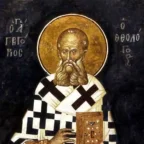
Gregory the Theologian (c. 329–390)
Gregory of Nazianzus (c. 329 – 25 January 390), also known as Saint Gregory the Theologian or Gregory Nazianzen, was an early Roman Christian theologian and prelate who served as Archbishop of Constantinople from 380 to 381. He is widely considered the most accomplished rhetorical stylist of the patristic age. As a classically trained orator and philosopher, he infused Hellenism into the early Church, establishing the paradigm of Byzantine theologians and church officials.
Gregory was born to Greek parents in the family estate of Karbala outside the village of Arianzus, near Nazianzus, in southwest Cappadocia. His parents, Gregory of Nazianzus the Elder and Nonna of Nazianzus, were wealthy landowners. Nonna is one of the great maternal presences in patristic literature — a devout woman who had prayed for a child for years before Gregory's birth, had consecrated him in a dream to God's service before his birth, and who drove the trajectory of a household that produced three children all subsequently venerated as saints: Gregory himself, his brother Caesarius, and his sister Gorgonia. The father, Gregory the Elder, is himself a remarkable figure — a bishop who had spent his earlier life in a syncretic pagan cult combining elements of Zoroastrianism and Judaism, converted to Christianity in his maturity by his wife, and then ordained bishop of his own city. Gregory the Theologian grew up in a household where conversion, devotion, and episcopal service were the immediate texture of daily life, and where the Greek literary tradition coexisted naturally with serious Christian faith. Cappadocia in the fourth century was the heartland of the theological revolution that would define orthodox Christianity: in the space of a single generation it produced three of the greatest theologians in the history of the Church — Gregory himself, his intimate friend Basil of Caesarea, and Basil's younger brother Gregory of Nyssa — whose collective work, the Cappadocian synthesis, is the intellectual foundation of Nicene orthodoxy as it has been confessed in the creed ever since.
The young Gregory first studied at home with his uncle Amphilokhios, before receiving the most comprehensive education available in the Roman world: the full curriculum of Greek paideia, from elementary grammar through the progymnasmata of advanced rhetoric to the philosophical traditions of the great schools. He studied at Caesarea in Palestine — where he first encountered Basil — then at Alexandria, and finally at Athens. On the way to Athens, his ship encountered a violent storm, and the terrified Gregory prayed to Christ that if He would deliver him, he would dedicate his life to His service. This vow — made in terror at sea, when the crew had given up hope — became the hinge event of Gregory's inner life. He survived, and the sense of personal obligation to the God who had saved him became the permanent emotional substrate of a vocation he would spend the rest of his life both embracing and resisting. The years at Athens also produced the defining friendship of his life. Basil of Caesarea and Gregory had met briefly in Caesarea; at Athens they became inseparable. They studied the same teachers, debated the same texts, and planned the same future — a monastic retreat in the wilderness of Pontus where they could live in prayer and philosophical study together, away from the world's demands. Athens made Gregory what he was as a stylist: the exposure to the full range of Greek prose and poetry — from Homer and the tragedians through Thucydides and Demosthenes to the Platonists — gave him a literary instrument of extraordinary range and precision, which he would deploy for the rest of his life in the service of Nicene Christianity.
He returned to Cappadocia around 356, was baptized, and spent a period in monastic retreat with Basil in the Pontic wilderness along the Iris river. There the two friends assembled a Philokalia of Origen — a careful anthology of the Alexandrian's most valuable passages, preserving what was orthodox in a thinker whose speculative excess had already begun to draw censure — and practised the ascetic disciplines that Gregory would maintain, in attenuated form, for the rest of his life. The peace of the retreat ended when Gregory's elderly father had his son ordained priest of Nazianzus in 361, against Gregory's explicit will and without adequate warning. The ordination precipitated what Gregory later described as a flight: he returned to Basil in Pontus for several months before accepting what had been done to him. His experience of this violence to his vocation produced his most celebrated prose work: the Apologia de fuga — the Defence of His Flight — an extended meditation on the nature and demands of the priestly office, the first defence of this kind in Christian literature. The Apologia articulates Gregory's fundamental conviction: that the care of souls is the most demanding of all human arts, requiring a breadth of knowledge, a fineness of sensitivity, and a degree of personal virtue that makes genuine pastoral fitness extraordinarily rare. This places Gregory, alongside Chrysostom (whose On the Priesthood directly responded to it), at the origin of the Christian theology of ordained ministry.
The second violence to Gregory's vocation came from Basil himself. In 371, embroiled in a conflict over the administrative division of Cappadocia, Basil consecrated Gregory bishop of the village of Sasima — a miserable staging post on the road between Caesarea and Tyana, chosen entirely for strategic reasons to strengthen Basil's canonical position. Gregory accepted the consecration but never served the see, and the episode left a permanent wound in the friendship. He remained instead at Nazianzus, assisting his aged father until the elder's death in 374, and then — finally — escaping to the solitude he had always sought, withdrawing to Seleucia in Isauria, near the shrine of St Thecla, where he lived in monastic retirement for several years.
The call that brought Gregory to Constantinople in 379 was a summons he could not refuse. The small pro-Nicene community in the imperial capital — overwhelmed by forty years of Arian dominance, stripped of its churches, its bishop dead, its leadership dispersed — sent to Gregory asking him to lead their restoration. He came to Constantinople; the Arians had taken all the churches, and he was forced to serve in a small house chapel dedicated to St. Anastasia the Martyr. From that borrowed room he began to preach his famous five sermons on the Trinity, called the Theologica. He was attacked in the streets, subjected to public abuse, pelted with stones, and endured an assassination attempt by a Novatian who entered the chapel as a worshipper and turned on him. The physical danger was real and sustained. But the sermons continued. When he left Constantinople two years later, the Arians did not have one church left to them in the city.
The five sermons that Gregory preached at the chapel of Anastasia — known collectively as the Theologica (Orations 27–31) — are the most important theological documents produced in the Arian controversy after the Council of Nicaea itself. Oration 27 opens the series with a meditation on the conditions required for theological discourse: the theologian must be a person of interior purity, sustained prayer, and genuine spiritual experience — not merely an intellectual equipped with arguments. Oration 28 addresses the divine nature: the divine essence (ousia) is structurally inaccessible to created minds, not merely difficult to know. This apophatic foundation was Gregory's great inheritance from the theological tradition and his greatest gift to it: by insisting on the incomprehensibility of the divine essence as a starting point rather than a limitation, he cleared the ground for a theology that was both intellectually honest and spiritually dynamic. Orations 29 and 30 refute in detail the Arian and Semi-Arian positions that would make the Son a subordinate or lesser deity. Oration 31 addresses the Holy Spirit, completing the Trinitarian argument. Gregory is the first to use the idea of procession to describe the relationship between the Spirit and the Godhead: "The Holy Spirit is truly Spirit, coming forth from the Father indeed but not after the manner of the Son, for it is not by generation but by procession, since I must coin a word for the sake of clearness." The terminological precision here is extraordinary: Gregory is not merely asserting the Spirit's divinity but distinguishing the mode of His origin from the Father — procession as distinct from generation — with a philosophical care that created the vocabulary all subsequent Trinitarian theology has used. The formula that distils his achievement — "The three one God when contemplated together; each God because consubstantial; one God because of the monarchia" — establishes in a few words the doctrinal grammar of Trinitarian Christianity as it has been confessed ever since.
The transformation that Gregory's preaching and leadership had accomplished in the Nicene community of Constantinople was so complete that when the Second Ecumenical Council assembled there in 381, it was natural that Gregory should be confirmed as Archbishop of Constantinople. When Meletius of Antioch, who had been presiding, died in the course of the council, Gregory was chosen in his stead and distinguished himself in his expositions of dogmatic theology. The Council expanded the Nicene Creed of 325 to the form still in use today — adding the pneumatological clauses affirming the Holy Spirit as "the Lord and Giver of Life, who proceeds from the Father, who together with the Father and Son is worshipped and glorified, who has spoken through the prophets." These clauses are the direct theological fruit of Gregory's Oration 31. But the council was also beset by the ecclesiastical politics that Gregory had always loathed, and a dispute over the see of Antioch provided the occasion for his resignation. His farewell speech to the assembled bishops — the Syntacterion — is a masterpiece of dignified valediction: eloquent without self-pity, honest about the conflicts he had endured, and clear-eyed about what both the Church and he himself had gained and lost. He established Eulalius as bishop of Nazianzus and withdrew to the solitude of Arianzus. He died there on 25 January 390.
The final decade of Gregory's life was spent at Arianzus composing the greater part of his extraordinary poetic output: the Carmina, an enormous collection spanning epic hexameters, elegiac couplets, iambic trimeters, and other metres, addressing theological themes, autobiographical reflection, nature, friendship, grief, and the experience of old age and illness. The most remarkable of these works is the De Vita Sua — the "Autobiography in Verse" — a poem of approximately 1,950 iambic trimeters that is the most extensive self-portrait in ancient Greek literature: a long meditation on the course of his life, the conflicts it had imposed on him, the losses he had endured, and the paradoxical shape of a vocation that wanted only silence and was given only noise. The sheer scale and range of this poetic output — unique among the Greek Fathers in its literary ambition — established Gregory as the founder of a tradition of Byzantine theological poetry that would continue through the centuries, reaching from Romanos the Melodist in the sixth century through the hymns of John of Damascus in the eighth. By 451 he was designated Theologus, or Theologian, by the Council of Chalcedon — a title held by no others save John the Apostle and Symeon the New Theologian (949–1022). It is not the title given to someone who does theology as an academic discipline; it is the title given to someone who has penetrated, in speech and in writing, to the inner mystery of the Godhead with a directness and accuracy that the Church recognizes as authoritative — one who has not merely reasoned about God but encountered Him.
This understanding connects Gregory's title directly to the Hesychast theology of Gregory Palamas: the distinction between the knowable divine energies and the unknowable divine essence that Palamas articulated in the fourteenth century is the direct development of Gregory's apophatic theology in the Theological Orations. The theological grammar that governed the bishop who preached the Trinity in a borrowed chapel in Constantinople in 380 also governs the monk who preached the hesychast path in the 1320s — the same inheritance, developed over a thousand years. For the researcher of Byzantine iconography, Gregory's theological contribution is mediated above all through his deployment of the term eikon — icon — not as a metaphor of resemblance but as a precise ontological claim: the Son is the icon of the Father in the sense that He is the perfect and complete expression of the Father's nature in a form accessible to created minds. To see the Son is to see the Father; to know the Son is to know the Father. This understanding of the Son as the primordial icon — the archetype of all images — is the theological foundation of Byzantine icon theology as it would be articulated in the iconoclast controversy of the eighth and ninth centuries. When John of Damascus defended the veneration of icons against the iconoclasts, he drew explicitly on the Cappadocian theology of the divine image: since God the Son is Himself the icon of the Father, the making and venerating of images of Christ is not idolatry but an extension of the Incarnation's logic. The Cappadocian Fathers also explained the concept of theosis, the belief that all Christians can be assimilated with God in imitation of the incarnate Son as the divine model.
Gregory appears in the sanctuary apse of virtually every Byzantine church alongside Chrysostom and Basil — the Three Holy Hierarchs in their episcopal vestments, their Gospel books in hand or open before them, their hands raised in blessing over the altar below. In the churches of Byzantine Macedonia studied by Pelekanidis at Kastoria and Papazotos at Veria, in the programmes painted by Kalliergis and his contemporaries across the early fourteenth century, these three figures stand as the permanent theological frame within which every Eucharistic celebration takes place: Gregory the Theologian, who defined the Trinity; Basil of Caesarea, whose liturgy preceded and informed the Divine Liturgy of Chrysostom; and John Chrysostom, whose liturgy enacts what Gregory's theology articulates. The three together constitute the doctrinal, liturgical, and pastoral foundation of Eastern Christianity — and their images in the sanctuary apse are the visual theology of every Byzantine fresco programme. The most celebrated visual expression of Gregory's Trinitarian theology is also the most celebrated icon in the history of Byzantine art: Andrei Rublev's Trinity, painted in 1408 — the three angels seated around Abraham's table, bowing toward one another in a perfect circle of mutual giving, embody in colour and line the formula Gregory had articulated in words: three hypostases, one essence, a unity that is simultaneously a loving communion of distinct persons.
Gregory was buried at Nazianzus. In 950 his relics were translated to Constantinople and enshrined in the Church of the Holy Apostles — the mausoleum of the emperors, where the relics of Chrysostom had also been brought. A large portion of his remains were stolen during the sacking of Constantinople by Crusaders in 1204 and taken to Rome, where they were held for the next eight hundred years. On 27 November 2004 — eight centuries after the theft — his relics were returned to Constantinople by Pope John Paul II, in a gesture of ecumenical restitution whose symbolic weight was recognized by both East and West.
-
Guelphs
The Guelphs were a medieval political faction that emerged from the long struggle between papal and imperial power in Europe, especially in Italy, where they became the party associated with support for the pope. Their opponents, the Ghibellines, were linked to the Holy Roman Empire and imperial authority. The name "Guelph" comes from the German noble house of Welf, whose rivalry with the Hohenstaufen dynasty helped give the faction its identity. The conflict took shape during the Investiture Controversy, when church and secular rulers disputed who had the right to appoint bishops and abbots.
In Germany, the struggle centered on imperial elections and dynastic rivalry, but in Italy it took on a broader political meaning. Italian cities and communes often chose sides based on whether they wanted more independence from the empire or closer alignment with the papacy. The Guelph cause gained strength in northern Italy during the conflicts of the 12th century, especially against Emperor Frederick I Barbarossa. The Lombard League, which opposed imperial domination, was aligned with the Guelph side and defeated Barbarossa at the Battle of Legnano in 1176.
Under Frederick II in the 13th century, the division sharpened further. By then, the Guelphs were more clearly the papal party, while the Ghibellines represented imperial interests, and this rivalry deeply shaped city politics in places such as Florence, Siena, Bologna, and Genoa. In many Italian cities, the struggle was not only between pope and emperor but also between local families and factions competing for power. Florence became one of the most famous centers of Guelph politics, and internal division eventually produced the White and Black Guelphs, with the Blacks backing the papacy more strongly.
This factionalism led to exile, retaliation, and repeated warfare. Dante Alighieri was among the White Guelphs and was exiled after the Black Guelphs gained control of Florence in 1302. By the 14th century, the original political meanings of Guelph and Ghibelline were weakening, even though the labels still mattered locally. Pope Benedict XII eventually threatened excommunication for those who continued to use the names, a sign that the old party struggle was becoming politically outdated.
Even so, the conflict left a lasting mark on Italian history, shaping urban government, aristocratic rivalries, architecture, literature, and the political imagination of medieval and early Renaissance Italy. The Guelphs were not a single unified movement, but a flexible label for people and cities that supported papal authority or opposed imperial control. Their history is best understood as part of the broader contest over who should rule Christian society: the pope, the emperor, or the communes themselves.
-
Guglielmo III, Bishop of Modena (Guglielmo di Savoia / William of Modena)
In Modenese cathedral historiography, the name "Guglielmo III" is commonly used for the bishop more widely known as William of Modena (Italian: Guglielmo di Modena, sometimes linked in sources to a Savoyard origin), who governed the see of Modena from 1222 to 1233 before entering wider papal service. Medieval episcopal lists are not always uniform in numbering, but in the context of the Duomo this label generally identifies the same thirteenth-century prelate associated with the transition from the earlier Romanesque phases to the mature Campionese interventions.
As bishop, he inherited a cathedral building tradition that had begun in 1099 under Lanfranco and had been structurally consolidated and ceremonially consecrated in 1184. The thirteenth century did not "found" the church anew; rather, it marked a decisive phase of reconfiguration, enrichment, and selective expansion. In this context, episcopal patronage helped coordinate liturgical priorities, chapter governance, and financial oversight while Campionese masters developed works such as the great pontile, the monumental Porta Regia on Piazza Grande, and major decorative programs that reshaped the cathedral's visual and civic presence.
William's significance extends beyond Modena. After resigning the see, he became one of the most active papal diplomats of the period, serving as legate in northern and eastern Europe and playing a major role in ecclesiastical organization and mediation in regions including Prussia and Livonia. For Modena's history, however, his importance lies in representing the episcopal phase in which cathedral patronage was increasingly institutional and programmatic, linking local construction policy to broader papal-era church governance.
-
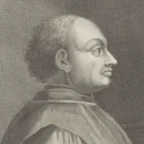
Guido Tarlati, Bishop of Arezzo (died 1327)
Guido Tarlati (died 1327) was a lord and Bishop of Arezzo. He was born into the Tarlati di Pietramala, the leading Ghibelline family of Arezzo, whose ancestral fief at Pietramala in the Apennines above the city was the physical embodiment of their territorial power. Arezzo in the early fourteenth century was a city of violent factional division, a pattern familiar across the Tuscan commune landscape, but enacted in Arezzo with a specificity that shaped Tarlati's entire career. In Arezzo, two aristocratic factions contended for domination, the Verdi and the Secchi, and when the latter gained control they had their leader, Guido Tarlati, Archpriest of the Pieve of Santa Maria Aretina, elected bishop in 1312.
The factional logic of the election, the Secchi installing their own leader as bishop, combining ecclesiastical and civic authority in a single person, was entirely consistent with the general pattern of Italian communal politics, where the boundaries between religious office and political power were permanently contested and frequently dissolved. What distinguished Tarlati was the scale and energy with which he exploited the dual authority his election gave him, transforming Arezzo's bishopric into the instrument of one of the most ambitious programmes of territorial expansion in the history of the city.
The electoral meeting following the death of Bishop Ildebrandino (1289-1312) chose to proceed by the "Way of compromise" and elected two persons, both Canons of the cathedral, to make the selection. They chose Guido, and the rest of the electoral meeting concurred and ratified the election. Guido immediately accepted, and procurators were chosen to carry the record of the election to the Papal Court at Avignon. Pope Clement V appointed a committee of three cardinals to look into the election and the character of the candidate, and when a favourable report was received, he issued a confirmation of the election of Bishop Guido on 7 July 1312.
The confirmation by Clement V, the French pope whose election Cardinal Napoleone Orsini had engineered in 1305, placed Tarlati within the orbit of the new Avignon papacy at the precise moment of its establishment. That the same Orsini who had made Clement pope was a political ally of the new Ghibelline bishop of Arezzo is not coincidental: the complex topology of Italian ecclesiastical and factional politics in the early fourteenth century produced alliances that cut across the simple Guelph-Ghibelline binary, and Napoleone Orsini, despite his Guelph family heritage and his Franciscan connections, was documented as sympathetic to Ghibelline causes in Tuscany during precisely these years.
From the moment of his confirmation, Guido Tarlati pursued a programme simultaneously episcopal and civic, sacred and military, spiritual and territorial. He embarked on an activist program, building a wall around the city, and creating a new silver and copper currency. Both acts are the marks of a sovereign: the wall defined the political boundary of his city and demonstrated his capacity to mobilize communal resources for defensive construction; the currency established the monetary infrastructure of an independent territorial authority, the coinage bearing the visual marks of Tarlati's dominion.
He also revived the long-stalled construction of Arezzo's cathedral, the building project that had been initiated in 1278 and virtually abandoned after the death of his predecessor Bishop Guglielmino Ubertini on the battlefield at Campaldino in 1289. The resumption of cathedral building under Tarlati was both a practical act of episcopal administration and a statement of ambition: the cathedral was the physical image of episcopal authority, and its completion was a public demonstration that the church of Arezzo, under its new lord, was once again a functioning institution capable of major building enterprise.
The most striking dimension of Tarlati's episcopate was its military character. He was not a prelate who reluctantly engaged in politics; he was a warlord who also happened to hold episcopal orders. The names that appear on his funerary monument, carved there as the permanent record of his achievements, testify to the scale of his territorial ambitions: Lusignano, Chiusi, Fronzoli, Castel Focognano, Rondina, Bucine, Caprese, Lacerina, and Monte Sansovino. Each name represents a castle, a commune, or a strategic position that Tarlati added to the territory of Arezzo through military action, diplomatic pressure, or the force of a personality that commanded the loyalty of soldiers and citizens across the Aretine contado.
The cumulative territory of these conquests transformed Arezzo from a contested communal city into a principality in all but formal designation, with Tarlati as its effective sovereign. The Iron Crown of Lombardy, which Louis IV of Bavaria would ask him to place on his head, was in one sense the symbolic confirmation of a temporal authority he had already exercised for fifteen years over Arezzo and its expanded territories.
Tarlati's political allegiances placed him at the centre of the Ghibelline network that linked the imperial cause across the fragmented landscape of early fourteenth-century Italian politics. His alliance with Cardinal Napoleone Orsini, documented through the close temporal relationship between Orsini's political reversal in March 1320 and the commission of the Tarlati Polyptych the following month, illustrates the complexity of these relationships: a Roman cardinal of the Guelph Orsini dynasty, allied with the leading Ghibelline bishop of Tuscany in a configuration that both men found politically advantageous.
The apogee of Tarlati's Ghibelline politics came in the final year of his life. By 1325 he had already been deposed by papal authority and excommunicated. Yet his political stature was sufficient to override canonical disability in the eyes of the most powerful monarch in Europe. Tarlati's prestige as the leader in Tuscany of the Ghibelline party was so high that German emperor Louis IV wanted to receive from him the Iron Crown. The coronation took place in Milan on 31 May 1327.
The Iron Crown of Lombardy, the ancient crown preserved at Monza, whose inner ring was said to incorporate a nail from the True Cross, was the symbol of the kingdom of Italy within the Holy Roman Empire. For a deposed and excommunicated bishop to crown the emperor with it was an act of extraordinary audacity, a performance of authority that directly contested papal claims to control the coronation of emperors in Italy. Tarlati placed the crown on Louis's head as an act of political defiance against John XXII, asserting simultaneously the validity of imperial authority independent of papal sanction and the continuing legitimacy of his own episcopal office despite the canonical deprivation he had undergone.
The conflict with John XXII had been building for years, driven by the fundamental incompatibility between the aggressive civic and territorial programme of the Ghibelline bishop-lord and the Avignon papacy's insistence on controlling the Italian church. A month later, on 20 July 1325, Guido Tarlati de Petramala was excommunicated. Bishop Guido was replaced by an Apostolic Administrator, Boso Ubertini, the Provost of Arezzo. Boso was named Bishop of Arezzo on 5 December 1326. But Tarlati hindered Boso from carrying out his functions.
The excommunication, the most severe sanction available to the Church against a layperson or cleric, transformed Tarlati from a bishop in canonical difficulty into a formal enemy of the papacy. He responded with characteristic disregard for institutional authority: he refused to recognize Boso Ubertini's appointment, continued to exercise control over Arezzo and its church, and proceeded, with the excommunication still nominally in force, to crown the emperor two years later.
A short time before his death Tarlati reconciled with the Pope. The deathbed reconciliation was the conventional resolution of a career of canonical rebellion: the Church offered and the sinner accepted the sacraments of penance and absolution, restoring Tarlati to communion in his final days. Whether the reconciliation represented genuine spiritual contrition or pragmatic calculation, a man whose body was failing seeking the Church's final ministrations, cannot be determined. He died in 1327, within months of crowning Louis IV.
The act of artistic patronage that placed Guido Tarlati permanently in the history of Trecento art was his commission, on 17 April 1320, of a polyptych from Pietro Lorenzetti for the high altar of Santa Maria della Pieve, the great collegiate church of Arezzo whose archpriestship Tarlati had held before his episcopal election.
The Tarlati Polyptych is a polyptych painted by Pietro Lorenzetti, in tempera and gold on panel, in 1320. It is located at the church of Santa Maria della Pieve in Arezzo. At its centre is the Madonna (draped in a magnificent ermine-lined robe) and Child, flanked (from left to right) by the saints Donatus (Arezzo's patron saint), John the Evangelist, John the Baptist, and Matthew.
The contract, dated April 17, 1320, specified the use of high-quality materials, including ultramarine blue for the Madonna's mantle, reflecting Tarlati's status as a powerful Ghibelline prelate invested in bolstering the church's visual prestige amid regional political competition. The specification of ultramarine, the most expensive pigment available, ground from lapis lazuli imported from Afghanistan, was a statement of intent that matched the ambition of the iconographic programme: the Madonna of Arezzo would wear the most costly blue procurable, a demonstration of Tarlati's capacity to command the best materials as well as the best painter.
The polyptych is one of Pietro Lorenzetti's four fully documented major works, and it holds a singular distinction: an uncommon case of a medieval work still located in the place for which it was conceived, the Tarlati Polyptych has remained on the high altar of the Pieve di Santa Maria since its installation in 1320. Most major Trecento altarpieces have been dispersed, damaged, or transferred to museums; Lorenzetti's commission for Arezzo survives in its original liturgical location, the most direct possible testimony to the patron's vision for the visual culture of his principal church.
The iconographic programme reflects a precise calculation of civic and religious identity. The central Madonna and Child, flanked by St. Donatus, Arezzo's patron and the bishop to whom the cathedral is dedicated, alongside Sts. John the Evangelist, John the Baptist, and Matthew, asserts Arezzo's particular sacred history while situating the city within the universal Church. The choice of Pietro Lorenzetti, the leading Sienese painter of the generation after Duccio, brought the most sophisticated pictorial tradition in Tuscany to Arezzo's main collegiate church: a deliberate upgrading of the city's visual environment commensurate with Tarlati's ambitions for its political stature.
The most architecturally imposing memorial in Arezzo Cathedral is not the work of any painter but of two Sienese sculptors working to a programme that compressed the entire career of a bishop-warlord into marble relief. The funerary monument of Guido Tarlati, commissioned posthumously by his brothers Delfo and Pier Saccone Tarlati, was completed around 1330 and represents one of the most ambitious sculptural commissions of the Trecento.
According to Giorgio Vasari the tomb commissioned by Guido's brother, the condottiero Pier Saccone Tarlati di Pietramala, was designed by Giotto (although this is disputed), who recommended to Pier Saccone the Sienese sculptors Agnolo da Ventura and Agostino di Giovanni to execute it. Vasari's attribution of the monument's design to Giotto, if accepted, would place the tomb in the same orbit as the Assisi frescoes and the Orsini chapel of San Nicola, making it yet another instance of Giotto's engagement with the Ghibelline-Franciscan network that also involved Cardinal Napoleone Orsini. The attribution remains contested: the visual language of the monument is more convincingly aligned with the Sienese sculptural tradition from which Agostino di Giovanni and Agnolo di Ventura emerged than with any known Giottesque project.
It is almost thirteen metres high. The sheer scale of the monument, nearly as tall as the nave in which it stands, makes it one of the most physically imposing commemorative structures in medieval Italian sculpture. Sixteen reliefs show episodes from Tarlati's life, including his military successes. This is the extraordinary innovation of the Tarlati tomb: the inclusion of biographical narrative relief, depicting not saints' lives or scriptural scenes but the actual events of the bishop's secular career, his military conquests, his civic programme, his coronation of the emperor, in the decorative programme of an episcopal funerary monument. It is a fundamentally unecclesiastical choice, the visual assertion that what made Tarlati worthy of commemoration was not his piety but his power.
The monument's imagery was of sufficient interest to subsequent generations of sculptors that Donatello could have seen the monumental tomb of Bishop Guido Tarlati in the cathedral of Arezzo, which includes a low-relief frieze of priests and acolyte chanting while holding a censer, a prayer book, and candles. The funeral ceremony depicted in the Tarlati monument's frieze, the priests censing and chanting over the body, the candles held by the acolytes, influenced the formal solution that Donatello later adopted for the Pecci tomb in Siena Cathedral, establishing the Arezzo monument as a link in the chain of Italian sculptural innovation that runs from the Trecento through the early Quattrocento.
Guido Tarlati died as he had lived, in the intersection of ecclesiastical authority and secular power, the canonical contradictions of his career resolved only at the last moment by a deathbed reconciliation that the Church routinely offered and the dying routinely accepted. He had been simultaneously a bishop, a warlord, a builder, an artistic patron, and the maker of an emperor's crown. The instruments through which his memory survived were a polyptych still in its original church and a funerary monument whose biographical relief programme was the most audacious assertion of secular achievement in the funerary art of the period.
His commission of Pietro Lorenzetti connects him to the chain of Sienese painting patronage that runs from Duccio through Simone Martini (Orsini's painter) and the Lorenzetti brothers to the later Trecento; his alliance with Napoleone Orsini connects him to the Roman cardinalate and the Avignon court; his coronation of Louis IV connects him to the highest level of imperial politics in the western world. That a bishop of a secondary Tuscan city could operate simultaneously in all three registers, the artistic, the ecclesiastical, and the imperial, is itself the most eloquent testimony to the particular character of Italian political culture in the first decades of the Trecento.
-
Guild of Physicians and Apothecaries (Arte dei Medici e Speziali)
The Guild of Physicians and Apothecaries was one of the seven Major Guilds of Florence and one of the most consequential corporations in the social history of medieval Italian art, because it was the body within which Florentine painters of the fourteenth century were required to enroll. Through this arrangement, some of the most important masters of Western art entered the same civic and professional structure that regulated physicians and apothecaries.
The guild took shape during the thirteenth century alongside the broader consolidation of Florentine corporate institutions. Its earliest surviving statutes, drawn up in 1313-1314 by the notary Ser Michele di Soldo da Gangalandi, record a highly articulated internal order binding all members to a detailed set of rules. By the end of the thirteenth century the guild already counted more than five hundred registered masters, an indication of both its economic weight and its political influence. In 1314 it purchased a house belonging to the Lamberti family on Via dei Cavalieri to serve as its headquarters.
Its government reflected the prestige of the institution within the Florentine commune. The guild was administered by six consuls elected twice yearly and meeting weekly, assisted by a camerlingo charged with the treasury, a notary, twelve councillors, eighteen buonomini, six statutari, and three officers. Such an elaborate structure shows that the guild was not merely a trade association but an important civic body integrated into the mechanisms of municipal administration.
The guild united three professional groups whose connection was more practical than it may first appear: physicians, apothecaries, and, from 1327 onward, painters. The inclusion of painters depended on the material realities of artistic production, since apothecaries sold pigments, oils, resins, gums, and other substances needed for making paint. Painting was therefore commercially and technically linked to the same world that governed medicinal compounds and botanical preparations. The formal inclusion of painters in 1327 marks an important threshold in Florentine art history, and the same year saw the enrollment of Ambrogio Lorenzetti.
Among painters associated with the guild were some of the greatest names in Florentine art, including Cimabue, Giotto, Botticelli, and Fra Angelico. The guild also offers an illuminating case of civic cross-membership through Dante Alighieri, who enrolled in 1295 not to practice medicine but because enrollment in a Major Guild was necessary for holding public office in Florence. His case shows how profession, citizenship, and political participation were deeply intertwined in the communal order.
One of the guild's most important long-term achievements was the compilation and enforcement of the Florentine Pharmacopoeia, among the earliest official pharmaceutical codes in Europe. Entrusted to the Medical College of Florence by the guild's consuls, this code could be imposed on physicians and apothecaries in both city and countryside without requiring prior intervention by civil magistrates. The guild's authority was therefore not only economic and corporative but also scientific, juridical, and regulatory, illustrating the broader role the Major Guilds played in the life of the Florentine Republic.
-
Guy de Lusignan (Guy of Lusignan, c. 1150–1194)
Guy de Lusignan was a Poitevin knight whose marriage propelled him to the throne of the Crusader Kingdom of Jerusalem, whose military leadership produced the catastrophic defeat at the Battle of Hattin, and whose final years founded the Lusignan dynasty of Cyprus — the very dynasty under whose newly-established rule Leon Authentes commissioned the frescoes of Lagoudera in December 1192, just months after Guy took possession of the island. He is, in this sense, the political pivot on which the entire sequence of figures examined here turns: the man whose actions transformed Cyprus from a Byzantine theme into a French feudal kingdom within the span of a single year.
Guy of Lusignan was the youngest son of Hugh VIII of Lusignan. The Lusignan family was, by the standards of the great houses of France, a relatively modest one. It originated in Poitou near Lusignan in western France in the early tenth century, and by the end of the eleventh century had risen to become the most prominent petty lords in the region from their castle at Lusignan. Guy's departure from France was occasioned by scandal and violence. After killing Patrick, 1st Earl of Salisbury, in a failed attempt to kidnap Eleanor of Aquitaine, he was banished from Poitou. In 1168 Guy and his brothers ambushed and killed Patrick of Salisbury, who was returning from a pilgrimage. They were banished from Poitou by their overlord, Richard, then acting Duke of Aquitaine. The irony that the man who exiled him — Richard, Duke of Aquitaine — would a quarter-century later, as King Richard I "the Lionheart" of England, conquer Cyprus and ultimately deliver it into Guy's hands, is one of the more striking coincidences of twelfth-century history.
Guy went to Jerusalem at some date between 1174 and 1180, where his older brother Amalric was already prominent at court, having married the daughter of Baldwin of Ibelin and obtained the patronage of King Baldwin IV and of his mother Agnes of Courtenay. Guy was hastily married to Sibylla, sister of Baldwin IV of Jerusalem, in 1180, to prevent a political coup. In 1183 he was briefly regent for his brother-in-law, who was incapacitated by leprosy, but Baldwin made Guy's stepson king as Baldwin V, and the Latin nobles forced Guy to yield command to Raymond of Tripoli.
The death of the child-king Baldwin V in 1186 precipitated the succession crisis that would define Guy's reign. On Baldwin V's death, Guy became king with the support of both his wife and Reginald of Châtillon, taking the throne as the jure uxoris king of the Kingdom of Jerusalem. His accession was deeply contentious from the outset — many of the kingdom's most powerful barons, including Raymond III of Tripoli, regarded him as an unsuitable and dangerously inexperienced ruler thrust onto the throne by his wife's dynastic right rather than by merit.
Guy's reign as King of Jerusalem is dominated, in historical memory, by a single event: the Battle of Hattin. In 1187 Guy attempted to relieve Saladin's siege of Tiberias, against the advice of Raymond III; his army was surrounded and cut off from water, and on 4 July 1187 the army of Jerusalem was completely destroyed at the Battle of Hattin. Guy's life was spared by the Saracens, along with those of his brother Geoffrey and Humphrey; Reginald of Châtillon was, however, beheaded by Saladin. The military disaster translated almost immediately into political disaster: Guy was held captive in Damascus while Sibylla and Balian of Ibelin tried to defend Jerusalem, which surrendered to Saladin on 2 October 1187. The fall of Jerusalem — a city that had been in Christian hands since the First Crusade in 1099 — was the proximate cause of the Third Crusade, the very expedition during which Richard the Lionheart would conquer Cyprus.
Released in 1188, Guy then led the Christian siege of Acre starting in August 1189, demonstrating tactical acumen at the Battle of Acre on 4 October 1189 by repelling Saladin's assaults and sustaining the effort until reinforcements arrived during the Third Crusade. This protracted siege — one of the longest and most gruelling operations of the entire crusading era — was Guy's attempt to rebuild both a kingdom and a reputation after Hattin. It succeeded militarily, but not politically: after the death of Sibylla in 1190, Guy's right to the throne was contested by Conrad, marquis of Montferrat, who was supported by Philip II. Guy was king of Jerusalem first as the husband and co-ruler of Queen Sibylla from 1186 to 1190, then as disputed ruler from 1190 to 1192.
The resolution of this succession dispute produced one of the most consequential transactions in medieval Mediterranean history. In spite of Richard I's support, Guy was compelled in 1192 to resign his title to Jerusalem, but was given the island of Cyprus as compensation. He bought it from the Templars in 1192, who had themselves bought it from Richard I, who had seized it from Isaac Komnenos. Upon acquiring Cyprus in May 1192, Guy de Lusignan established himself as its lord, thereby founding the Lusignan dynasty that would rule the island for nearly three centuries.
The precision of this chronology is essential. Guy took possession of Cyprus in May 1192. Seven months later, in December 1192, Leon Authentes commissioned the fresco cycle at Lagoudera. The two events were not merely contemporaneous — they were directly causal. Guy's arrival inaugurated the wholesale dispossession of the Greek Cypriot landed elite, and it is against this immediate backdrop of confiscation, displacement, and the installation of a new Latin nobility that Leon Authentes's commission of a Constantinopolitan-trained painter to execute the first known Virgin of the Passion must be read.
Although not formally crowned as king during his lifetime — a title his brother Amalric later obtained from Holy Roman Emperor Henry VI in 1197 — Guy assumed sovereign authority and styled himself as ruler. He implemented administrative reforms that blended Byzantine fiscal traditions with Latin feudal structures, confiscating estates from the former Byzantine elite, departing Greeks, and the Orthodox Church, and redistributing them as fiefs to incoming Latin settlers. The landed class of the new kingdom consisted of three hundred nobles and knights and two hundred squires, to whom Guy granted estates including the Cypriot peasants who lived upon them. One tradition holds that the Greek archontes had first to surrender half their possessions. This is precisely the world inhabited by Leon Authentes — a Greek archon, member of exactly the class of landholders being dispossessed, who nonetheless retained sufficient wealth in late 1192 to commission one of the great Byzantine fresco cycles. That the accomplishment of the Lagoudera mural cycle occurred without apparent rupture suggests the Latin conquest did not produce an immediate, total transformation — confiscation and dispossession proceeded unevenly, and pockets of Greek wealth and patronage persisted even as the new order took shape around them.
The Lusignan family established a Latin-style feudal monarchy that coexisted with the Orthodox Cypriot population. French became the language of the court while Greek remained the tongue of the people. The Catholic Church was dominant in official life, although the Orthodox Church continued under restrictions. Guy died in 1194, leaving no children who survived past childhood — his daughters had died in 1190. His brother Amalric became the next ruler of Cyprus, and Guy was buried at the Church of the Templars in Nicosia.
The dynasty Guy founded proved extraordinarily durable, even if his own personal reign over it lasted barely two years. The Lusignan family continued to rule the Kingdom of Cyprus until the Ottoman conquest of their Asian kingdoms, and the dynasty ended only when Queen Catherine Cornaro, a Venetian noblewoman and widow of the last Lusignan king, ceded Cyprus to Venice in 1489. Nearly three centuries of Lusignan rule thus followed from Guy's acquisition of the island in 1192. For art history specifically, the Lusignan conquest produced a paradox that the case of Leon Authentes illustrates perfectly: the political rupture of 1191–92 severed Cyprus from Byzantine imperial administration permanently, yet Greek Cypriot artistic patronage, far from being extinguished, in some instances intensified in the immediate aftermath, as local archontes used art to assert continuity, identity, and perhaps consolation in the face of dramatic political change. Guy of Lusignan's decisions and leadership played a significant role in the decline of the Crusader states in the Holy Land — but on Cyprus, the kingdom his acquisition founded would endure for centuries, governing an island whose Greek Orthodox cultural and artistic life, paintings like those at Lagoudera attest, continued to flourish under Latin rule in ways that the political history alone does not fully convey.
H
-
Henry II, King of England
Henry II Plantagenet was the first king of the Plantagenet dynasty, ruler of England from 1154 until his death in 1189, and the monarch who built the largest realm in Western Europe of his time, stretching from Ireland to the Pyrenees. His thirty-five-year reign is remembered for the revolution in English common law, for the deadly conflict with Archbishop Thomas Becket, and for the internal strife with his wife Eleanor of Aquitaine and his own children.
Henry was born on March 5, 1133, in Le Mans, the son of Geoffrey the Fair, Count of Anjou and Duke of Normandy, and Matilda of England, daughter of the last Norman king, Henry I.
This dual lineage - Angevin on his father's side, Norman and royal on his mother's - made him a potential heir to the English throne, but the kingdom was at that time held by the usurper Stephen of Blois, and Matilda had fought for years in a civil war known as "the Anarchy" to reclaim it. At the age of fourteen, Henry was knighted by his uncle David I of Scotland; at seventeen, he had already assumed the title of Duke of Normandy; at eighteen, he inherited the county of Anjou upon his father's death. In 1152, at just nineteen years of age, he married Eleanor of Aquitaine - the recently repudiated ex-wife of King Louis VII of France - adding Gascony, Poitou, and all of Aquitaine to his domains: he thus became the lord of more than half of France, richer and more powerful than his former French sovereign.
In 1153, Henry invaded England with an army and forced King Stephen to sign the Treaty of Wallingford, by which he recognized Henry as heir to the throne. Stephen died in November 1154, and Henry was crowned at Westminster on December 19 of that same year, without any significant opposition. He found a kingdom devastated by anarchy: illegal castles were proliferating everywhere, the barons had arrogated to themselves fiscal and judicial powers that belonged to the crown, and the currency was devalued and corrupted.
His first and tireless task was to restore order: he demolished castles built without royal license, reclaimed lands alienated from the crown, reformed the tax system, and introduced a new silver coin.
Henry II's most enduring contribution to history was not military but institutional: the creation of the English Common Law system, the common law applied equally to all free men of the kingdom. Before his reign, justice was fragmented among hundreds of feudal and ecclesiastical courts, each with its own rules, and the outcome of a case often depended on the whim of the local lord or on ordeal practices - judicial duels, trials by fire, or water - that had nothing to do with the ascertainment of facts. Henry established permanent royal courts in Westminster and a system of itinerant judges who regularly traveled through the counties, bringing the king's law to every corner of the realm. He introduced the "grand jury" as a means of bringing formal charges in criminal matters, and developed writs - written orders initiating trials - as a way to extend royal jurisdiction at the expense of feudal courts and the Church.
The great crisis of his reign was the conflict with Thomas Becket, his chancellor since 1155 and a personal friend, whom Henry himself had promoted to Archbishop of Canterbury in 1162 in the belief that he could control his loyalty.
Becket, as soon as he took up the crosier, became an uncompromising defender of ecclesiastical privileges, refusing to sign the Constitutions of Clarendon of 1164, through which Henry sought to limit the right of clerics to be judged by ecclesiastical courts, thereby removing them from royal jurisdiction. The conflict revolved around a fundamental principle: who held the final jurisdiction over men of the Church, the pope or the king? Becket fled to France in 1164, remained there in exile for six years, and returned to England in December 1170 without having yielded on any point.
On December 29, 1170, four of Henry's knights - interpreting the king's words "Who will rid me of this troublesome priest?" as an explicit order - caught up with Becket in Canterbury Cathedral and murdered him before the altar. The outcry was immediate and devastating: all of Christian Europe was horrified, Pope Alexander III canonized Becket just three years later, and Canterbury Cathedral became one of the most visited shrines in Europe. Henry publicly underwent a humiliating penance in Canterbury in 1174, allowing himself to be flogged by monks at the martyr's tomb to seek forgiveness for his moral responsibility.
Militarily, Henry built the so-called Angevin Empire through a combination of military campaigns, marriage diplomacy, and political pressure. In 1171-1172, he led an expedition to Ireland, where the local lords had already been partially subjugated by Irish Norman barons, and secured their homage as Dominus Hiberniae, Lord of Ireland. He imposed his supremacy on Wales and Scotland, though without annexing these kingdoms. At the height of his power, around 1172, his domains stretched from the Scottish border to the Pyrenees: no monarch in Western Europe had ruled over such vast territories since the fall of the Carolingian dynasty.
His relationship with Eleanor of Aquitaine was one of the most extraordinary and tumultuous of the European Middle Ages. Eleanor was eleven years older than Henry, had already been married to the King of France, was one of the most educated and powerful women of her time, and brought a vast estate as her dowry. The marriage was fruitful - eight children, including Richard the Lionheart and John Lackland - but also deeply conflicted. From 1173 onward, Eleanor openly supported the rebellion of her sons Henry the Younger, Richard, and Geoffrey against their father; Henry had her captured and held her prisoner for sixteen years, until his own death.
The final years of his reign were worn down by war with his sons, particularly with Richard, who allied himself with Philip II of France. In 1189, Henry was forced to sign a humiliating agreement and discovered that even his youngest son, John - his favorite - had joined the rebellion. He died on July 6, 1189, in Chinon, feverish and consumed by the betrayal of his sons, with the words "shame, shame on a king conquered by a son" on his lips, according to the chronicles of the time.
-
Henry II of Werl, Bishop of Paderborn
Henry II of Werl (c. 1050–1127) occupies a singular position in the history of medieval religious art: as Bishop of Paderborn from 1084 until his death, he was the patron whose commission produced the portable altars of Roger of Helmarshausen — the goldsmith-monk most plausibly identified with Theophilus Presbyter, whose De Diversis Artibus is the most important technical treatise on artistic practice to survive from the Latin Middle Ages. The relationship between Henry and Roger places this bishop at the intersection of two of the most consequential phenomena in Romanesque artistic culture: the theology of sacred craftsmanship articulated in the De Diversis Artibus, and its supreme material expression in the worked gold, silver, enamel, and niello of the Paderborn altars.
Heinrich II von Werl was born around 1050 into one of the most powerful comital families of Westphalia; his father was Bernhard von Werl, Graf von Werl, and his mother Beatrix, Countess of Westphalia. His elevation to the see of Paderborn in 1084 took place in the most politically charged circumstances of the Investiture Controversy: his installation was carried out at Rome by Henry IV in the immediate aftermath of the emperor's seizure of the city, the enthronement of Antipope Clement III, and the expulsion of Gregory VII. His predecessor, Heinrich I (Count of Assel), had been elected under the antiking Hermann of Salm and was a partisan of Gregorian reform. Henry II asserted himself against this rival through violent confrontation, backed by the military resources of his family, but suffered temporary depositions on several occasions before finally receiving papal sanction in 1106 — more than two decades after his original installation. The long gap between imperial appointment and Roman recognition encapsulates the entire drama of the Investiture Controversy as lived out at the level of a single diocese.
In the documentary record, Heinrich is referred to as the first Bishop of Paderborn styled Princeps — the first prince-bishop of the see in the formal sense, anticipating the constitution of the Prince-Bishopric of Paderborn as an ecclesiastical principality of the Holy Roman Empire (a status it held from 1281 to its secularization in 1802). His forty-three-year episcopate gave him the time and resources to pursue an ambitious programme of artistic patronage that placed Paderborn at the centre of one of the most significant moments in Romanesque metalwork.
Roger of Helmarshausen was a Benedictine goldsmith first heard of in connection with Stavelot Abbey in the Meuse valley, a leading centre of Mosan goldsmiths' work. He worked at the Monastery of St Pantaleon in Cologne between c. 1100 and 1107 before moving to Helmarshausen Abbey, where he established a workshop that would remain productive for more than half a century. At least two portable altars made by Roger survive in the treasury of Paderborn Cathedral. The better-documented altar, produced for Henry around 1100, is an oak box cased in partly gilded silver sheet with feet of gilded bronze (approximately 165 × 345 × 212 mm); its surface is articulated with figured reliefs in silver and niello depicting apostles and narrative scenes of exceptional refinement. The identification of Roger as the author of the De Diversis Artibus, writing under the pseudonym Theophilus Presbyter, though not universally accepted, is supported by the most detailed scholarly analysis and was incorporated into the critical edition of the text by C. R. Dodwell (1961). On the basis of internal evidence, Theophilus was a German Benedictine monk and priest of the early twelfth century whose monastic name was Rugerus or Rogerus, Theophilus having been assumed as a pseudonym. The three prologues of the De Diversis Artibus frame the craftsman's labour as a theological act: working gold and silver for the altar is not a commercial transaction but an offering to God, adorning the earthly sanctuary with skills received as divine gifts and prefiguring the beauty of the heavenly Jerusalem.
The connection between the bishop and his artistic commissions carried explicit legitimating force. Bishop Meinwerk of Paderborn (1009–1036) was the greatest builder-bishop in the history of the see — the man who had constructed the new cathedral, founded the Benedictine monastery of Abdinghof, and established Paderborn as one of the principal episcopal centres of the Ottonian empire. By commissioning works of comparable ambition, Henry II of Werl claimed a continuity of episcopal dignity with his celebrated predecessor, using the portable altar simultaneously as an offering to God, a gift to the liturgical life of the cathedral, and a statement of legitimacy addressed to the community of clergy and nobility who would judge his fitness to occupy the see. His patronage of Roger, and the workshop Roger subsequently established at Helmarshausen, was the foundation from which, if the identification with Theophilus is accepted, the greatest technical manual of medieval artistic practice was composed. When Dodwell opened his 1961 translation with the observation that Theophilus's identity as Roger of Helmarshausen had been documented through the Paderborn altars, the bishop of a Westphalian see became, however obliquely, part of the history of art-historical scholarship itself. Henry II of Werl died on 14 October 1127.
-
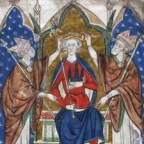
Henry III (1017–1056), King of the Romans and Holy Roman Emperor
The Salian emperor, not Henry III of England (1207–1272), who was never emperor — worth stating since the two are routinely conflated in Anglophone indexes.
Born on 28 October 1017, Henry III was the only surviving son of Conrad II, first of the Salian dynasty, and Gisela of Swabia. His father invested him with the duchy of Bavaria at ten, had him elected and crowned king of the Romans at Aachen in 1028, and added Swabia and the kingdom of Burgundy in 1038. Rarely has a medieval succession been prepared so thoroughly. He received an education far above the norm for a German prince — Wipo, his father's chaplain and biographer, addressed to him the Tetralogus urging that the nobility be taught letters — and contemporaries describe a ruler of unusual gravity and personal devotion, given to fasting, to public acts of penance, and to a conception of kingship as sacral office rather than as lordship.
He married first, in 1036, Gunhild of Denmark, daughter of Cnut the Great and Emma of Normandy — a match linking the Salians to the North Sea empire. She died of fever in Italy in 1038, leaving a daughter, Beatrice, later abbess of Quedlinburg and Gandersheim. In 1043 at Ingelheim he married Agnes of Poitou, daughter of Duke William V of Aquitaine, bringing the court into direct contact with Cluniac reforming circles and with Aquitanian culture. Their son, the future Henry IV, was born in 1050.
He succeeded on his father's death in June 1039 without opposition — the only Salian to do so. His policy was consistently to keep the great duchies in royal hands or in the hands of dependants rather than allow them to consolidate, which secured his own reign and stored up the resentments that broke out under his son. Godfrey the Bearded of Upper Lorraine rebelled repeatedly and was repeatedly subdued.
On the frontiers his record was mixed. Two campaigns against Břetislav I of Bohemia (1040–41) began with a serious reverse at Brůdek and ended with submission at Regensburg. In Hungary he defeated Samuel Aba at Ménfő in 1044 and restored Peter Orseolo, who received the kingdom as a fief — the high point of Salian eastward power — but the settlement collapsed after 1046, and the siege of Pressburg in 1052 failed. By the last years the eastern position had largely unravelled.
Two initiatives define his idea of kingship. At Constance in 1043 he proclaimed a general Day of Indulgence, publicly forgiving his enemies and requiring the magnates to do the same, and pressed the Treuga Dei — the Truce of God — as royal policy rather than as a purely ecclesiastical movement. And he refused, on principle, to accept payment for ecclesiastical appointments, treating simony as a sin in which the crown itself was implicated.
The Roman situation he found in 1046 was scandalous: three claimants to the papacy — Benedict IX, Sylvester III, and Gregory VI, who had acquired the office by purchase from Benedict. At the synod of Sutri in December 1046, and at Rome immediately after, Henry had Sylvester and Gregory removed and Benedict declared deposed, and installed his own chancellor's colleague Suidger of Bamberg as Clement II, who crowned him and Agnes emperor in St Peter's on Christmas Day 1046. The Romans conferred on him the title of Patrician, understood as carrying a decisive voice in papal elections.
He then appointed, in succession, Damasus II (Poppo of Brixen), Leo IX (Bruno of Toul, 1049) and Victor II (Gebhard of Eichstätt) — all German, all reformers. Leo IX's pontificate, with Humbert of Silva Candida and Hildebrand in his entourage, is conventionally taken as the beginning of the reform movement that within a generation would deny emperors any role in papal elections at all. This is the great irony of the reign: the most pious and most interventionist of German rulers created, in good faith, the instrument that destroyed his dynasty's position. The Investiture Contest is his legacy as surely as it is his son's.
He died on 5 October 1056 at the imperial hunting lodge of Bodfeld in the Harz, aged thirty-eight, having secured the succession of his six-year-old son (crowned at Aachen in 1054) and commended him to Pope Victor II. His heart was buried at Goslar, his body at Speyer. The long, unstable minority under Agnes of Poitou followed.
Henry III was one of the great patrons of the eleventh century, and his commissions bear directly on the manuscript traditions of the period:
- Speyer Cathedral — begun under Conrad II around 1030 and continued vigorously by Henry, Speyer was conceived as the Salian dynastic mausoleum and became, in its scale and its aisle-vaulted ambition, the defining monument of German Romanesque. Henry was buried there in 1056, and the imperial crypt eventually held eight rulers.
- Goslar — he effectively created the imperial palace complex in the Harz, the Kaiserpfalz, with the collegiate church of Sts Simon and Jude, as a northern centre of government sustained by the Rammelsberg silver mines.
- Echternach and the golden gospel books — the abbey of Echternach in Luxembourg, reformed and heavily supported under Salian patronage, produced under Henry III the two most spectacular Ottonian-Salian luxury gospel books: the Codex Aureus Escorialensis (the Speyer Golden Gospels, El Escorial, Cod. Vitrinas 17), made at Echternach around 1043–46 and given by Henry and Agnes to Speyer Cathedral, whose dedication miniatures — the imperial couple offering the book, and Conrad II and Gisela in adoration — are among the central images of Salian imperial theology; and the Codex Caesareus Upsaliensis (Uppsala University Library, C 93), made at Echternach around 1050 for the new foundation at Goslar, later carried off to Sweden as war booty in the seventeenth century and now fully digitised by Uppsala.
Both books stand in the direct line of the Codex Aureus of Echternach (Nuremberg, Germanisches Nationalmuseum, Hs. 156142). A note of caution there: Henry III's personal involvement in that manuscript is often asserted and is not securely documented — the traditional association rests on stylistic and circumstantial grounds, and the Trier goldsmith's cover of c. 990 belongs to an earlier phase of Ottonian patronage altogether. The Speyer and Uppsala books, by contrast, carry their imperial patronage in their own imagery.
German historiography has swung sharply on him. The nineteenth century saw the apogee of medieval imperial power; Steindorff's Jahrbücher remain the fundamental narrative. Later scholarship, following Bresslau and then the postwar revisionists, emphasised instead the fragility beneath the surface — the alienated Lorrainers and Saxons, the failed eastern settlements, the exhausted royal fisc, and the reforming papacy he had himself installed. The Emperor who deposed three popes at Sutri was, within twenty years of his death, the father of the king who stood at Canossa.
-
Henry the Lion (1129/1131–1195)
Henry the Lion (German: Heinrich der Löwe; 1129/1131 – 6 August 1195), also known as Henry III, Duke of Saxony (ruled 1142–1180) and Henry XII, Duke of Bavaria (ruled 1156–1180), was a member of the Welf dynasty. At the zenith of his power, he was the most formidable prince in the Holy Roman Empire after the emperor himself — a figure who bestrode northern Germany from the North Sea to the Alps, founded cities that still bear the marks of his ambition, patronised one of the supreme monuments of Romanesque manuscript illumination, and ultimately fell through the catastrophic convergence of his own intransigence and the cold patience of his Hohenstaufen cousin Frederick Barbarossa. His mother Gertrude was the daughter of Lothar III, Holy Roman Emperor; his father Henry the Proud, Duke of Bavaria and Saxony, had Carolingian marriage links. When Henry the Proud died in 1139, his son was still a child; but the power structure he had built was too formidable to dismantle, and the Saxon nobility maintained the Welf cause through the years of Henry's minority.
Conrad III had stripped Henry the Proud of both his duchies, but the Saxon magnates refused to accept the dispossession, and Conrad returned Saxony to Henry in 1142. The boy who became duke of Saxony at thirteen did so not through inheritance or imperial favour but through the combined pressure of dynastic loyalty and the political logic of a kingdom that could not afford indefinite civil war. Bavaria proved harder to recover, having been granted to Henry Jasomirgott, Margrave of Austria; it was reacquired in 1156 by a decision of the new Emperor Frederick Barbarossa — the cornerstone of the alliance between the two cousins that would define the next two decades of German political history.
From the moment he recovered Saxony, Henry pursued an aggressive policy of eastward expansion into the territories of the Slavic Wends — a campaign of Christianization, conquest, and colonization that his contemporaries compared to the eastern missions of Otto the Great. Campaigns climaxing in the 1160s with the conquest of the Abodrites allowed the chronicler Helmold of Bosau to hail him in 1171 as a reborn Otto the Great. Henry controlled swathes of new land between the rivers Elbe and Oder, exercised quasi-royal investiture rights in the bishoprics of the region, refounded Lübeck as a trading town, and remodelled Braunschweig as a ducal residence. He is the founder of Munich (1157) and Lübeck (1159), and also founded or developed Augsburg, Hildesheim, Stade, Kassel, Güstrow, Lüneburg, Salzwedel, Schwerin, and Brunswick. The foundation of Munich — a market and bridge crossing at a ford on the Isar, diverting the lucrative Alpine salt trade through a new settlement — became, over the following centuries, the capital of Bavaria. Lübeck became the pivot of the Baltic trading network and future queen of the Hanseatic League.
In Brunswick, his capital, Henry erected in 1166 a bronze lion — his heraldic animal — in the courtyard of his castle Dankwarderode: the first bronze statue north of the Alps. Newly married to the English princess Matilda, he had the castle built in the style of a Kaiserpfalz, rivalling the nearby Imperial Palace of Goslar. The lion — of extraordinary technical ambition, cast in bronze at a moment when large-scale metalwork of this kind had not been attempted north of the Alps — was not merely an heraldic device but a programmatic statement about the nature of ducal authority, claiming for Henry a quasi-imperial dignity. The sculpture, now housed in Dankwarderode Castle and replaced at its original site by a replica, remains one of the supreme achievements of Romanesque metalwork in the German-speaking world.
In 1168, Henry married Matilda (1156–1189), daughter of King Henry II of England and Eleanor of Aquitaine, and sister of King Richard I. The match connected Henry to the most powerful royal house in the western world and entered him into a dynastic network stretching from the Plantagenet territories to the Hohenstaufen empire. Their descendants included Otto IV, Holy Roman Emperor. Henry set off on pilgrimage to Jerusalem in January 1172, travelling through Hungary and surviving shipwreck and bandits in Byzantine territory before being received with great ceremony by Emperor Manuel I Komnenos at Constantinople on Good Friday (14 April) 1172. He continued to Palestine, was received in state by King Amalric at Jerusalem, visited the Holy Sepulchre, Bethlehem, Nazareth, and the river Jordan, and returned through Antioch and Tarsus, meeting the Seljuk Sultan Kilij Arslan II. The encounter with Constantinople and the magnificence of Byzantine sacred art left its mark on his subsequent artistic patronage. On his return, he founded Brunswick Cathedral in 1173, dedicated to Saints Blaise and John the Baptist, designating it as his burial site alongside Matilda, and enriched it with relics acquired during his travels.
The alliance between Henry and Barbarossa broke definitively at Chiavenna in 1176, when Henry refused the emperor's appeal for military support in his Italian campaign against the Lombard League — his price for aiding the Emperor was the imperial city of Goslar and its silver mines, which Frederick refused to cede. The Italian expedition, deprived of Henry's Saxons, ended in the catastrophic defeat at Legnano. Barbarossa never forgave the refusal. In 1180, taking advantage of the hostility of other German princes, Frederick had Henry tried in absentia for insubordination by a court of bishops and princes — the first great prince in German history to be condemned by a court of peers in his absence. Bavaria went to Otto von Wittelsbach, founder of the dynasty that would govern it until 1918. Saxony was partitioned. Henry, stripped of everything except his hereditary Brunswick and Lüneburg lands, was exiled to the court of his father-in-law Henry II of England in Normandy. He was allowed back into Germany in 1185, exiled again in 1189 for refusing to participate in the Third Crusade, and finally reconciled with the emperor in 1194. He died on 6 August 1195 at Brunswick and was buried in the cathedral he had founded.
The supreme monument of Henry's artistic patronage — and one of the supreme objects in the history of medieval manuscript illumination — was the Gospels of Henry the Lion, commissioned for the Altar of the Virgin Mary in Brunswick Cathedral. Henry the Lion and his wife Matilda commissioned it to be made at the Benedictine monastery of Saint Peter at Helmarshausen for presentation to the cathedral church of Saint Blaise at Brunswick, created between 1175 and 1188. Comprising 226 folios of high-quality parchment, it features protogothic script and Romanesque illumination of extraordinary quality — full-page miniatures, canon tables, evangelist portraits, and ornamental pages with generous use of gold and silver. The principal scribe is identified as the monk Herimann, whose signature appears in the colophon: liber labor est Herimanni ("this book is the work of Herimann"). The most famous of the miniatures is the Coronation page (folio 171v), showing Henry kneeling in the centre, flanked by his dynastic ancestors on both sides — reaching back through Emperor Lothar of Supplingenburg on his mother's side and King Henry II of England on Matilda's — a programme of legitimation as precisely calculated as any in the twelfth century.
The Helmarshausen scriptorium that produced the Gospels was the same workshop established decades earlier by Roger of Helmarshausen — the goldsmith-monk most plausibly identified with Theophilus Presbyter, whose portable altars for Bishop Henry II of Werl are preserved in the Paderborn Cathedral Treasury. The chain from Roger's commission around 1100 to the Gospels of Henry the Lion in 1175–1188 traces the full arc of Helmarshausen's achievement across nearly a century: from the intimate scale of the portable altar to the grandest statement of ducal devotion in northern Romanesque illumination. The Gospels passed through the hands of the Welf dynasty for centuries until in 1983 Ernst August of Hanover had the manuscript auctioned at Sotheby's, where it was acquired by a German consortium for 32.5 million Deutsche Mark — the highest price ever paid for a book or manuscript at the time — thus securing it for the Herzog August Library in Wolfenbüttel.
-
Hesychast Controversies
The Hesychast controversies were a series of prolonged theological and political disputes that convulsed the Byzantine world during the fourteenth century, centred on the legitimacy of a contemplative practice known as hesychia — from the Greek for "quiet," "stillness," or "silence" — and on the theological framework required to justify it. Though the conflict erupted in the 1330s, its roots reached back nearly a thousand years to the Desert Fathers and Mothers of Egypt, Palestine, and Syria, among whom early monastic figures such as Anthony the Great, Evagrius Ponticus, and John Climacus had developed techniques of watchfulness, inner recollection, and repeated short prayers aimed at guarding the mind and heart.
At the heart of hesychast practice lay the Jesus Prayer, a brief invocation — most commonly rendered as "Lord Jesus Christ, Son of God, have mercy on me" — designed for continuous repetition. Between the fifth and eighth centuries this form of prayer gradually acquired a rich Jesus-centred spirituality around it. By the fourteenth century, Mount Athos had become the undisputed centre of hesychast practice, its monastic communities claiming that through sustained ascetical discipline and unceasing prayer they could reach the actual vision of the Uncreated Light — the same radiance the apostles had witnessed at the Transfiguration of Christ on Mount Tabor. This was not understood as metaphor, but as genuine participation in the divine life itself.
The controversies properly speaking unfolded across three successive phases, each associated with a principal opponent of hesychasm. The first and most consequential adversary was Barlaam of Calabria, an Italo-Greek monk who had arrived in Constantinople around 1330 and accepted a chair in philosophy at the university there. Trained in Western Scholastic theology and Aristotelian logic, Barlaam was scandalized by the hesychast practices and wrote several treatises ridiculing the monks, coining for them the derisive epithet omphaloscopoi — "navel-gazers" — a nickname that coloured nearly all subsequent Western writing on the Byzantine mystics. His theological objection was more serious: the hesychast claim to see divine light directly seemed to him to posit two uncreated substances, amounting to polytheism.
The defence of hesychasm fell to Gregory Palamas (c. 1296–1357), a monk of Mount Athos formed in the very tradition he would be called upon to justify. In response to Barlaam, Palamas composed nine treatises known as the Triads for the Defense of Those Who Practice Sacred Quietude, one of the most sustained works of systematic theology produced in the medieval Greek world. His central contribution was a rigorous distinction between the divine essence and the divine energies: while God cannot be known in His essence, He is genuinely known and participated in through His energies — which are fully God, not a created or lesser reality, yet distinct from the incomprehensible essence in a way that preserves both transcendence and the reality of human communion with the divine. The Uncreated Light of Tabor was identified with these energies: real, not symbolic; divine, not manufactured. A synod held in Constantinople in 1341, presided over by Emperor Andronicus III, condemned Barlaam, who recanted and shortly afterward returned to Calabria.
The second phase of the controversy became fatally entangled with a civil war that broke out following the sudden death of Andronicus III in June 1341, just weeks after the first synod. A bitter struggle divided the regency government of the Dowager Empress Anna of Savoy and Patriarch John XIV Kalekas from the claim to co-imperial power of the Grand Domestic John Kantakouzenos, and the two factions aligned, roughly, with the anti-Palamite and Palamite camps respectively. The principal theological antagonist in this phase was Gregory Akindynos, a former disciple of Palamas who had originally sought a middle path but hardened into systematic opposition, arguing that the essence-energies distinction introduced an unacceptable division into the divine nature. Under the patronage of the anti-Kantakouzenos party, Palamas was imprisoned in 1342. Only when Kantakouzenos entered Constantinople in triumph in 1347 did the tide turn: a fourth synod deposed the patriarch and excommunicated Akindynos, who died the following year.
The third and final phase saw the controversy reach its definitive resolution through confrontation with Nicephorus Gregoras, one of the foremost scholars of the age — historian, philosopher, and astronomer — who lent the anti-Palamite cause its most intellectually sophisticated voice. In May 1351, a patriarchal council convened under Emperor John VI Kantakouzenos established the essence-energies distinction as the definitive doctrine of the Orthodox Church, declared Gregoras's views heretical, and condemned him. He refused to recant and was confined to a monastery for two years. The controversy had lasted fifteen turbulent years across three successive phases.
The theological stakes of the controversy extended far beyond monastic breathing techniques. At their deepest level they concerned the nature of God, the possibility of genuine human communion with the divine, and the epistemological status of mystical experience. The Palamite resolution held that both God's absolute transcendence and the genuine reality of human deification — theosis — could be upheld simultaneously, precisely through the essence-energies distinction. As Palamas himself wrote: "He who participates in the divine energy becomes himself, in a sense, light; he is united with the light and with the light he sees in full consciousness all that remains hidden for those who have not this grace."
The impact of the hesychast theology of Uncreated Light on Byzantine art was significant and measurable. The mandorla — the almond-shaped aureole surrounding the figure of Christ in Transfiguration scenes — became increasingly elaborate and luminous in the second half of the fourteenth century, reflecting the doctrine of uncreated divine energies radiating from the person of Christ. The characteristics of Palaiologan art of this period, visible in the fresco cycles of Ivanovo, Mystras, Kastoria, Manasija, and Kalenić, include elegant and decorative effects, virtuosity of drawing, and a richly refined harmony of colour. An increase in churches dedicated to the Transfiguration across the Orthodox Slavic lands in the fourteenth and fifteenth centuries further attests to hesychasm's artistic reach.
Gregory Palamas was canonized by the Orthodox Church in 1368, and his feast is celebrated on the second Sunday of Great Lent. The Roman Catholic Church has never fully accepted the essence-energies distinction, which remains a significant point of divergence between Eastern Orthodox and Western Catholic theology. Within the post-Vatican II Catholic Church, however, Palamas has been acknowledged as a major theological voice; Pope John Paul II repeatedly called him a great theological writer. The Hesychast controversies thus endure not merely as a chapter in Byzantine history but as a living fault line between the two great traditions of Christianity, and for the Eastern Orthodox world the definitive theological achievement of the medieval era.
-
Hilary of Poitiers (c. 310 – c. 367)
Hilary of Poitiers was a bishop, theologian and biblical exegete of Roman Gaul, the first Latin writer to produce a systematic defence of Nicene Trinitarian doctrine and, by common consent of the ancient and modern literature alike, the most considerable Latin theologian before Ambrose and Augustine. Augustine himself would call him "the illustrious doctor of the churches." He was declared a Doctor of the Church by Pope Pius IX in 1851, and his feast is kept on 13 January.
Born around 310 at Pictavium — Roman Poitiers, in the province of Gallia Aquitania — into a distinguished pagan family, Hilary received the classical education, including Greek, expected of his rank. His own testimony describes a philosophical search that passed through Neoplatonism before coming to rest in the reading of the Old and New Testaments, and above all in the opening of John's Gospel; he was married, and a daughter, later venerated as Saint Abra of Poitiers, was born before his conversion. Hilary, his wife and his daughter were baptized together into Nicene Christianity, and it was as a married layman with an established household that he was elected bishop of Poitiers around 353, chosen in part by Trinitarian Christians in Gaul as a counterweight to the Arian bishop Saturninus of Arles, whose excommunication Hilary helped secure through conciliar action in the years that followed.
Hilary's episcopate coincided with the high tide of Constantius II's support for a compromise Arian theology across the empire, and at the synod of Béziers in 356 Hilary refused to join the Gallic bishops in condemning Athanasius of Alexandria, the great Nicene champion in the East. Constantius banished him to Phrygia, in Roman Asia Minor, where he remained for roughly four years (356–360). Exile did not silence him: from Phrygia he continued to correspond with his Gallic diocese and produced the works that made his reputation, chief among them the twelve books De Trinitate (359–360), the first sustained and successful exposition in Latin of the theological vocabulary — one substance in three persons — that the Council of Nicaea had bequeathed to a Greek-speaking Church, and the earlier De Synodis (358), a detailed analysis, addressed to his fellow Gallic bishops, of the confusing proliferation of Eastern creeds produced in the preceding decade. This body of work earned Hilary, almost alone in Gaul, the title of the Athanasius of the West and, more combatively, the Hammer of the Arians.
Hilary returned to Poitiers around 360–361 and remained active until his death, continuing the campaign against Arian and semi-Arian bishops in the West: in 364 he impeached Auxentius of Milan as heterodox before the newly acclaimed emperor Valentinian I, and his Contra Arianos vel Auxentium Mediolanensem (365) records the episode. It was also in these years that he encouraged the future Martin of Tours, then a young ascetic, to found the monastic community at Ligugé, within Hilary's own diocese — traditionally reckoned among the earliest monastic foundations in Gaul.
Alongside his Trinitarian polemic, Hilary left two substantial exegetical works of independent importance. The Commentarius in Evangelium Matthaei, probably composed before his exile and the earliest of his writings, is the first Latin commentary on Matthew's Gospel to survive complete, and it quotes the Gospel text in a pre-Vulgate, Old Latin form current in fourth-century Gaul. It is precisely this lemma text that later Vetus Latina scholarship has matched against the readings of the Codex Usserianus Primus, identifying the codex's Matthew text as Gallican in affiliation — one of the threads, alongside the manuscript's link to a south-Gallican sacramentary, that pulls the codex's textual history toward Gaul rather than toward the Bobbio milieu suggested by its script. Hilary's other major exegetical undertaking, the Tractatus super Psalmos, a series of expositions on the Psalms composed after his return from exile and heavily indebted to Origen, survives incomplete and was already judged unfinished by Jerome.
Hilary died at Poitiers around 367, having done more than any other fourth-century Latin writer to naturalize Nicene theology in a Western vocabulary, and having left, in the Matthew commentary, a biblical text of Gaul against which later Gallic and Irish Gospel books — the Usserianus Primus among them — can still be measured.
-
Hildegard of Vinzgouw, Queen of the Franks
Hildegard (c. 757/758 – 30 April 783) was a Frankish noblewoman of Alemannian heritage who became the wife of Charlemagne around 771, shortly after the death of his brother Carloman, serving as a key political alliance to secure support from her family in the Middle Rhine region. Born into a prominent family — likely the daughter of Gerold, a count with lands near the Rhine — she married the future emperor at the young age of about 13 or 14, following his repudiation of a Lombard princess. Hildegard's union with Charlemagne was strategically vital, strengthening his control over eastern Frankish territories and integrating Alemannian elites into the Carolingian power structure. The couple's bond, described in contemporary accounts as affectionate despite its political origins, produced nine children over 11 years, including future rulers Charles the Younger, Pepin of Italy, and Louis the Pious, underscoring her pivotal role in Carolingian dynastic continuity. As queen, Hildegard accompanied Charlemagne on military campaigns; during the 773–774 siege of Pavia she traveled to the Frankish camp while heavily pregnant. Her charitable acts — such as patronage of Kempten Abbey — earned her a reputation for piety. Hildegard died young at age 25 or 26 in Thionville, possibly from complications of successive pregnancies, and was buried in St. Arnold's Church in Metz, where Charlemagne erected a grand tomb.
-
Henricus de Segusio (Hostiensis)
Henricus de Segusio was born, in all probability, in the town of Susa (Segusium in Latin), situated in the upper Val di Susa in the March of Turin, in what is today the Piedmont region of northwestern Italy, then part of the territories contested between the County of Savoy and the Holy Roman Empire. The precise date of his birth is uncertain - scholars have proposed dates ranging from approximately 1190 to 1210 - and nothing is known of his family background with certainty beyond his apparent connection to the urban patriciate of Susa, a town of some commercial and administrative importance on the ancient road across the Mont Cenis pass linking Italy to France.
His early intellectual formation took place in the context of the great schools of canon law at Bologna, which by the early thirteenth century had consolidated their position as the preeminent center of legal study in Latin Christendom. Bologna was the city of Irnerius and Gratian, where the Decretum had been compiled around 1140 and where successive generations of decretists and decretalists had built the science of canon law into the most sophisticated jurisprudential tradition of the medieval world. It was almost certainly at Bologna that Henricus received his foundational training in both Roman law (ius civile) and canon law (ius canonicum), acquiring the encyclopedic command of both bodies of law that would define his scholarly career.
Following his studies, Henricus embarked on a teaching career that appears to have taken him to both Bologna and Paris, though the precise chronology remains difficult to reconstruct. His presence at Paris, where he taught canon law for a significant period, is attested by multiple sources. The University of Paris, unlike Bologna, combined theological with legal study, and the Parisian intellectual environment - shaped in those decades by the great scholastic synthesis of figures such as Alexander of Hales, Bonaventure, and Thomas Aquinas - left its mark on Henricus's jurisprudential thinking, which shows a consistent integration of theological principles into canonical reasoning far more developed than was typical of the purely technical Bolognese tradition.
During his time in France, Henricus also came into contact with the English royal court. Some sources suggest he spent time in England and enjoyed the patronage of King Henry III of England, who was known for his cultivation of Italian ecclesiastics and canonists. The nature and duration of this English connection remain debated, but it may have contributed to his subsequent appointment to English benefices and his familiarity with the pastoral and jurisdictional problems of the northern European church.
Henricus's transition from academic canonist to active ecclesiastical administrator occurred during the 1240s, when he was appointed to a succession of episcopal sees of increasing prestige:
Bishop of Sisteron (1244) His first episcopal appointment was to the small diocese of Sisteron, in Provence (in the present-day Alpes-de-Haute-Provence), a sufficiently modest appointment for a man of his stature as to suggest either that his academic fame had not yet reached its full extent or that the appointment was intended as a stepping stone. He governed Sisteron for approximately six years.
Archbishop of Embrun (1250) In 1250, he was elevated to the metropolitical see of Embrun (Eburodunum), also in Provence, a see of considerably greater dignity and ecclesiastical weight, carrying with it authority over a significant number of suffragan bishops in the Alpine regions. His tenure at Embrun coincided with the period of his most intense scholarly production, and it is likely that much of his great Summa was completed during these years.
Cardinal-Bishop of Ostia and Velletri (1261) The summit of his ecclesiastical career came in 1261, when Pope Alexander IV elevated him to the Sacred College of Cardinals as Cardinal-Bishop of Ostia and Velletri, the most senior of the suburbicarian sees and traditionally the highest-ranking cardinalatial dignity in the Roman Church. The Cardinal-Bishop of Ostia held the exclusive prerogative of consecrating newly elected popes who required episcopal ordination - a function of immense liturgical and constitutional significance. From this appointment derived the Latinized toponym by which he has been known ever since: Hostiensis, the man of Ostia.
As a cardinal, Hostiensis participated in the most important ecclesiastical deliberations of the 1260s and early 1270s, including the negotiations surrounding the Sicilian crown and the fraught politics of the Angevin succession in southern Italy.
Hostiensis's intellectual legacy rests on two monumental contributions to the science of canon law, works that dominated canonical scholarship for two centuries after his death and continue to be fundamental reference points in the history of medieval jurisprudence.
Summa Aurea (Summa super titulis Decretalium)
The Summa Aurea, as it came to be known - the Golden Summary - is Hostiensis's most celebrated work. Composed primarily during his years at Embrun, though begun earlier, it is a systematic and comprehensive commentary on the five books of the Decretals of Gregory IX (Liber Extra, 1234), the foundational collection of papal decretal law promulgated by Pope Gregory IX on the advice of Raymond of Penyafort.
Unlike a strict textual gloss, the Summa operates at a level of synthetic jurisprudential analysis that goes far beyond the individual tituli it examines. Hostiensis integrates Roman civil law, patristic theology, conciliar legislation, and his own extensive practical experience as bishop and legate to produce a work of remarkable breadth and intellectual ambition. The Summa became, alongside the Glossa Ordinaria of Johannes Teutonicus and Bernard of Parma, one of the essential texts of the canonistic curriculum in every European studium, and it was cited by later canonists and theologians with an authority approaching that of the primary sources themselves.
The adjective aurea - golden - attached to the Summa not by Hostiensis himself but by later admirers, expressing their judgment of its exceptional quality among the abundant canonistic literature of the thirteenth century.
Lectura (Commentaria in quinque libros Decretalium)
Hostiensis's other major work, the Lectura - sometimes called Commentaria - is in some respects an even more massive and technically demanding achievement. It represents a meticulous, titulus-by-titulus engagement with the Gregorian Decretals, incorporating the extensive jurisprudential developments that had occurred between the Summa's composition and Hostiensis's later years. Many scholars regard the Lectura as the fuller expression of his mature legal thought, incorporating refinements and positions he had developed over decades of teaching and pastoral experience.
Together, the Summa Aurea and the Lectura established Hostiensis as what later generations called simply the Monarch of the Law (Monarcha iuris) - a title that speaks to the almost unrivaled authority he commanded within the canonistic tradition.
Plenitudo Potestatis and Universal Papal Dominion
Hostiensis's most influential and controversial contribution to medieval political theology concerns the doctrine of papal world dominion. Building on earlier canonistic arguments, he developed the position that the Incarnation of Christ had effected a transfer of all legitimate sovereignty - spiritual and temporal - to the Vicar of Christ, who delegated temporal authority to secular rulers. This meant, in Hostiensis's construction, that the legitimate political authority of non-Christian rulers was at best imperfect and incomplete: true, juridically grounded dominium required, in some sense, connection to the Christian order presided over by the pope.
This doctrine - sometimes called the Hostiensian theory - was enormously consequential in the later Middle Ages and, more problematically, in the early modern period of European expansion, when canonistic arguments derived from Hostiensis were invoked to justify the delegitimization of indigenous sovereignty in the Americas and elsewhere. Scholars such as Brian Tierney, Walter Ullmann, and James Muldoon have traced the genealogy of these arguments with considerable care.
The Doctrine of Just War (Iusta Causa)
Hostiensis made significant contributions to the elaboration of just war theory within the canonical framework, specifying with unusual rigor the conditions under which warfare could be considered licit - the requirement of legitimate authority, just cause, right intention, and formal declaration - and extending the analysis of war's jurisdictional implications in ways that influenced subsequent scholastic debate.
Procedural Law and Due Process
In the technical domain of canonical procedure - the law governing ecclesiastical courts, the conduct of trials, the rights of defendants, and the standards of proof - Hostiensis's Summa and Lectura made contributions of lasting importance, systematizing a body of procedural norms that had developed piecemeal through papal decretal activity and providing them with a theoretical architecture of remarkable coherence.
Marriage Law
His treatment of marriage law - one of the most contested areas of canonical jurisprudence in the thirteenth century, touching questions of consent, consummation, impediments, and the distinction between betrothal and binding matrimony - was among the most sophisticated of his generation, drawing on both the theological tradition (especially Petrus Lombardus) and the accumulated decretal case law to clarify positions that remained the subject of intense debate.
Hostiensis was present at the First Council of Lyon (1245), convened by Pope Innocent IV, which issued the formal deposition of Emperor Frederick II - one of the most audacious acts of papal authority in the entire medieval period. Whether as bishop of Sisteron or in some other capacity, his participation in this council placed him at the center of the great struggle between papal universalism and imperial authority that defined mid-thirteenth-century political life.
As a cardinal from 1261, he was involved in the deliberations surrounding several papal elections and in the complex negotiations of the 1260s concerning the Sicilian succession and the Angevin settlement.
Hostiensis died on October 25, 1271, at Lyon, during the preparatory phases of what would become the Second Council of Lyon (1274) - convened ultimately by Pope Gregory X to address the reform of the Church, the question of the Holy Land, and the union with the Greek Church. He did not live to see the council open.
He was buried at Lyon, in the Church of the Friars Minor (the Franciscan church of the city), reflecting his sympathy for the Mendicant orders that was shared by so many of the great canonists and theologians of his generation. His tomb, unfortunately, has not survived.
The reception of Hostiensis in the century following his death was extraordinary. Johannes Andreae (c. 1270-1348), himself one of the greatest canonists of the fourteenth century and known as the Fons et Tuba Iuris (Fountain and Trumpet of the Law), treated Hostiensis with a reverence approaching that accorded to patristic authorities. Panormitanus (Niccolò de' Tudeschi, 1386-1445) engaged with him as the foundational text against which all later canonistic opinion must be measured.
In the fifteenth and sixteenth centuries, as European powers confronted the legal and theological questions raised by colonial expansion, Hostiensis's doctrine on non-Christian sovereignty attracted renewed attention - and fierce controversy. Francisco de Vitoria and the School of Salamanca explicitly engaged with and largely rejected the Hostiensian position in their foundational work on international law, but the engagement itself testifies to the continuing authority of his arguments more than two centuries after his death.
-
Hugh of Tuscany (Ugo il Grande)
Hugh (Latin: Ugo or Hugo; c. 953/954 – Pistoia, 21 December 1001), known to posterity as Ugo il Grande ("Hugh the Great"), stands as one of the most remarkable political and spiritual figures of medieval Italy. He served as the 9th Margrave of Tuscany from approximately 969 until his death, and also held the titles of Duke of Spoleto and Margrave of Camerino from 989 to 996. His long and energetic rule left a profound mark on the political, ecclesiastical, and cultural landscape of central Italy.
Ugo was born into a family of high Carolingian nobility. He was the son of Uberto (Hubert), himself Margrave of Tuscany and Duke of Spoleto, and Willa, daughter of Boniface I, Duke of Spoleto. This double lineage from powerful margraves and dukes placed Ugo at the very summit of the Italian aristocracy in the tenth century. His family had long governed Tuscany on behalf of the Carolingian emperors and their successors, giving young Ugo a rich inheritance of both political authority and territorial responsibility.
Ugo assumed the marquisate of Tuscany while still a young man, around 969, following the death of his father. Tuscany at that time had suffered decades of administrative neglect: previous margraves, distracted by interests and ambitions elsewhere, had allowed the institutions of government to decay. Ugo took on the challenge of rebuilding state authority with vigor and determination, reorganizing the marchesal courts, reasserting control over coinage, and reconstituting an effective military force. This administrative renaissance earned him enduring admiration both from contemporaries and from later medieval chroniclers.
One of the defining characteristics of Ugo's rule was his steadfast support for the Ottonian dynasty, which had established its dominance over the Kingdom of Italy since 961. He became a loyal and valued partner of Emperor Otto III, supporting him actively in ecclesiastical reform and in his disputes against Venice, a relationship made all the more complex by the fact that Ugo was related by blood to Pietro IV Candiano, Duke of Venice. This combination of dynastic loyalty and diplomatic skill made Ugo one of the most influential secular lords in the Italian peninsula, bridging the gap between imperial power in the north and the rich, contested territories of central Italy.
Ugo's governance was equally distinguished by its close cooperation with the Papal States. He worked alongside the papacy to resolve territorial disputes that had long troubled the borders between Tuscany and the lands under Roman ecclesiastical jurisdiction. This alliance was not merely political but reflected a genuine piety that deepened throughout his life. The contemporary theologian and reformer Peter Damian praised Ugo explicitly in his treatise De principis officio (On the Office of a Prince) as an exemplar of justice and princely virtue. Such praise from a rigorous monastic reformer speaks volumes about the moral reputation Ugo cultivated.
Towards the later years of his life, Ugo's piety found increasingly tangible expression in the foundation and endowment of monasteries. He donated vast stretches of marchesal, that is, public, lands for the establishment of new monastic communities across Tuscany and beyond. Among his notable acts of patronage was the gifting of lands around Arezzo to the powerful Guidi clan, a family he actively supported, as well as donations to the churches of that city, acts subsequently confirmed by emperors Otto III and Henry II. The surge of gift-giving to religious institutions by Ugo and his fideles (loyal vassals) has been interpreted by modern historians as evidence of a broader spiritual revival sweeping through the Tuscan aristocracy in the final decades of the tenth century.
Ugo died at Pistoia on 21 December 1001, bringing to a close a rule of over three decades that had transformed Tuscany from a neglected borderland into a well-governed and spiritually vibrant march. His descendants and later medieval tradition honored him with the epithet il Grande, a tribute to the scope and enduring quality of his achievements. He was venerated for generations in the Florentine collective memory, and his patronage of monasteries made him a benefactor figure celebrated in the liturgical calendars of several religious houses he had founded or enriched. In the long arc of medieval Italian history, Ugo of Tuscany stands as a bridge figure: a feudal lord of the old Carolingian mold who nevertheless embraced the new reforming spirituality that would define the eleventh century and give rise to the Gregorian Reform.
I
-
Iconodulism
Iconodulism, from the Greek eikonodoulos (literally "servant of images"), refers to the religious veneration of icons: kissing them, offering incense and candlelight before them, and paying them honorable veneration as a legitimate practice in Christian life. The term names a middle position between two extremes, iconoclasm - the rejection or destruction of sacred images - and iconolatry, the idolatrous worship of images as if they were divine in themselves.
The use of sacred images long predates Christianity. In Greco-Roman religion, statues of the gods were not usually understood as the gods themselves, but as points of contact with the divine. Early Christians inherited this visual sensibility, and the catacombs and the Dura-Europos complex attest to figurative imagery in Christian worship from a very early period. Eusebius of Caesarea, in his Historia Ecclesiastica, also mentions painted depictions of Christ and his apostles, yet in a letter to Constantia he discouraged the making of a portrait of Christ, citing the biblical prohibition against images. The early Church therefore knew the use of images, but not yet a settled theology of their veneration.
Between the fifth and seventh centuries, as Christianity spread more deeply among the masses and Eastern monasticism expanded, icon veneration became embedded in popular devotion. Monasteries of the East became major centers of icon production and also strong defenders of their doctrinal use. At the same time, theologians worried about iconolatry, since true worship, latria, belonged to God alone. Iconodulism emerged as the attempt to preserve devotion without collapsing into idolatry.
That theological balance was sharpened in the age of Byzantine iconoclasm. In 726, Emperor Leo III ordered the removal of the image of Christ from the Chalke Gate and later issued a general edict against icons. His policies were driven by a mix of religious concern, pressure from Jewish and Muslim criticism of images, and political ambition aimed at reducing monastic influence. Patriarch Germanus I opposed the policy and was deposed, while John of Damascus became the great theologian of the iconodule cause from outside imperial jurisdiction.
John of Damascus distinguished carefully between latria and proskynesis, arguing that icons receive reverence, not divine adoration. His Christological defense was decisive: to deny the legitimacy of images of Christ was, in effect, to deny the Incarnation itself. If the Word truly became visible flesh, then matter could bear and mediate divine presence without becoming divine by nature. The icon, in this view, was a gateway to the prototype, not a substitute for it.
The controversy culminated in the Second Council of Nicaea in 787, convened under Empress Irene. The council affirmed that icons were not to be destroyed, nor adored with divine worship, but kissed and venerated with respectful proskynesis. Pope Adrian I accepted the decrees, though their Latin reception in the Frankish realm was troubled, producing the Libri Carolini and the Council of Frankfurt in 794, where Charlemagne's theologians rejected prostration before images while allowing their didactic use.
Iconoclasm returned under Leo V in 814, but the monk Theodore the Studite gave the iconodule position a fresh philosophical expression, insisting that the image shares in the identity of the prototype by likeness rather than by nature. The definitive restoration came in 843, when Empress Theodora, acting for Michael III, reestablished the veneration of icons. The Orthodox Church still commemorates that event as the Feast of Orthodoxy, or Triumph of Orthodoxy, on the first Sunday of Lent.
In the Latin West, the Council of Trent later confirmed the legitimacy of image veneration, using its own language of honor and veneration rather than the Byzantine formulas. The Protestant Reformation fractured the older consensus: Calvinist traditions rejected devotional images as violations of the second commandment, while Lutheran and Anglican churches retained images but rejected prostration before them. For medievalists and art historians, iconodulism is not a marginal doctrine but a foundational one, since it made possible the theological justification for Byzantine mosaics, panel icons, and the great pictorial cycles of medieval Latin art.
-
Jean-Auguste-Dominique Ingres
Jean-Auguste-Dominique Ingres was born in Montauban on 29 August 1780, the son of a provincial decorative sculptor and painter who gave him his first training in both music and drawing. He entered the Toulouse academy as a boy and moved to Paris in 1797 to study under Jacques-Louis David, the dominant Neoclassical painter of the revolutionary and Napoleonic periods, whose emphasis on precise contour and antique example shaped Ingres's art for life even as the pupil came to define himself against aspects of his master's manner. He won the Prix de Rome in 1801, though straitened public finances delayed his departure for Italy until 1806.
Ingres remained in Italy, chiefly in Rome and later Florence, for the better part of two decades, a period of relative critical neglect in France during which his portraits and history paintings — among them La Grande Odalisque (1814) and the Vow of Louis XIII (1824), the latter the success that finally secured his standing at home — matured into the highly personal idiom of sinuous, deliberately distorted line and glacial finish for which he is chiefly remembered. Returning to Paris in 1824, he became, over the following decades, the acknowledged head of the academic and Neoclassical camp in its long public rivalry with the Romanticism of Eugène Delacroix, a rivalry the two artists' own generation understood as the defining aesthetic conflict of the age.
Ingres's engagement with the sculpture of the Pisa Cathedral pulpit belongs to a broader and characteristically nineteenth-century phenomenon: the rediscovery, by artists working outside Italy and largely independent of Italian academic scholarship, of the expressive force of the Italian "primitives" — the painters and sculptors of the twelfth to fourteenth centuries whom Vasari's inherited framework had treated chiefly as a crude prelude to Raphael and Michelangelo. Ingres's drawings after elements of the dismembered Pisan pulpit, made in the context of his long Italian sojourns and his lifelong practice of copying admired works in graphite, place him, together with Paul Delaroche, among the first modern viewers to grant Giovanni Pisano's carving the status of major art rather than of archaeological curiosity — an appraisal Italian criticism would not fully absorb until the following century.
Ingres returned to Italy a second time as director of the French Academy in Rome from 1835 to 1841, a demanding administrative post he discharged conscientiously before resuming his Paris career. He continued to paint, exhibit, and teach into extreme old age, producing among his late works the second version of Le Bain turc (1862), and he died in Paris on 14 January 1867, having outlived Delacroix by four years and having seen his own uncompromising linearism become, for a new generation of academic painters, the unquestioned foundation of French artistic training.
J
-
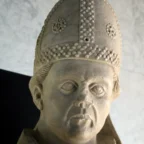
Jacopo da Varagine (Jacobus de Voragine)
Jacopo da Varagine (Jacobus de Voragine), Dominican friar, hagiographer and later archbishop of Genoa, was one of the most influential religious writers of the thirteenth century, above all thanks to the Legenda aurea, which became a foundational text for Western hagiography and devotional culture.
Jacopo was born around 1230, probably in Varazze on the Ligurian coast, although some sources allow the possibility of a birth in nearby Genoa, where a family originally from Varazze and bearing that name is documented. The ambiguity of his birthplace is typical of many medieval biographies, yet in any case his identity is closely tied to Liguria, which will remain the geographical and spiritual horizon of his life and later episcopal activity. He entered the Order of Preachers (Dominicans) in 1244, at a relatively young age, embracing the new mendicant ideal that combined study, preaching, and pastoral work.
Within the Dominican studium he followed the full cursus of studies, completing all the stages of the ratio studiorum by about 1264, which qualified him both for teaching and for high responsibilities in the order. Contemporary and later notices emphasize his broad culture: he knew Latin and at least some Hebrew, and he was versed in ancient history, classical literature, as well as Greek and Roman philosophy, which furnished him with a wide reservoir of authorities for his preaching and compilations. This solid intellectual background explains the rapid recognition he gained as teacher and preacher within the order and beyond.
Jacopo's career within the Dominicans unfolded through a series of priorates and provincial offices that placed him at the center of the order's administration in northern Italy. He served as prior in several convents: first at the Dominican house of San Domenico in Genoa (from 1267, and again re-elected four years later), then at Como, Bologna, and Asti, likely in rapid succession, which suggests the trust his superiors placed in his governance. In the general chapter of 1267 he was elected provincial of the vast Lombard province, the largest in the Dominican Order, a post he held, with some interruptions, until 1286.
The provincialate obliged him to extensive travel across Italy and neighbouring regions, since he had to preside over annual provincial chapters and regularly attend the triennial general chapters of the order. During these years Jacopo also distinguished himself as a successful itinerant preacher in many parts of Italy, while simultaneously teaching in Dominican schools, a dual role that blended academic theology with the pastoral needs of urban lay audiences. His participation as representative of the Lombard province in ecclesiastical councils, such as those of Lucca (1288) and Ferrara (1290), further inserted him into the wider politics of Church reform and mediation in a peninsula marked by continual conflicts.
Jacopo's appointment to the archbishopric of Genoa took place in a climate of both local factional strife and wider papal interventions in Italian politics. In 1288 Pope Nicholas IV, himself a Franciscan, had already entrusted him with a delicate mission, empowering him to absolve the Genoese people for their support of the Sicilians against Charles II of Anjou, a sign of papal confidence in his prudence and authority. Early in 1292 Nicholas summoned him to Rome, intending to consecrate him personally as archbishop of Genoa; Jacopo arrived in the city on Palm Sunday, only to find that the pope lay gravely ill and would die shortly afterwards, on Good Friday.
Despite this unexpected death, Jacopo was nevertheless appointed and took possession of the see of Genoa, which he governed from 1292 until his death in 1298. Contemporary testimonies and later tradition portray him as a good bishop, especially remembered for sustained efforts to pacify the chronic conflicts between Guelfs and Ghibellines that tore the city apart. He combined pastoral care and clerical reform with his continuing literary activity, showing that the episcopal office did not extinguish but rather reframed his vocation as preacher and writer in the service of civic and ecclesial peace.
Jacopo died in Genoa around 13-16 July 1298 (some sources give a range of 13-14 July), after about six years as archbishop, and was buried in the local Dominican church, a fitting resting place for one whose identity remained profoundly Dominican even as an episcopal prelate. His memory enjoyed continuous veneration in Varazze, Genoa, and throughout Liguria, where he was seen as both a civic and religious father, mediator of peace and author of texts that nourished popular devotion. This longstanding cult was formally recognized when Pope Pius VII confirmed his beatification in 1816, fixing his liturgical feast on 13 July and inscribing him among the beati of the Catholic Church.
The persistence of his cult over the centuries reflects not only local patriotism but also the European diffusion of his writings, especially the Legenda aurea, which associated his name with the lives of the saints that shaped late medieval spirituality. In modern times, both Catholic and secular scholarship have contributed to a renewed interest in his person and works, ranging from critical editions of his chronicles to studies on his influence on art and literature.
Jacopo's best-known work, the Legenda aurea (Latin: Legenda sanctorum; often Italianised as Leggenda aurea), is a vast collection of saints' lives arranged according to the liturgical year, and was probably compiled between about 1259-1260 and continuously reworked up to his death. The collection includes more than 150 hagiographical narratives, with a pronounced preference for ancient saints yet without neglecting figures closer to Jacopo's own time, thereby creating a bridge between early Christian models and contemporary devotional needs. Modern scholarship agrees in describing Jacopo more as a compiler than as an original author, since he drew abundantly on earlier sources, especially Bartholomew of Trent's Liber epilogorum in gesta sanctorum, but his selection, ordering and adaptation gave the material a new coherence and popular appeal.
The Legenda aurea became one of the most widely read religious books of the later Middle Ages; it circulated in Latin and in numerous vernacular translations, influencing preachers, lay readers, and artists across Europe. Its narratives supplied a repertoire of motifs and iconographic details that painters, sculptors and illuminators adopted to visualise the saints' lives, an aspect particularly evident in the visual cycles of saints such as George, Lucy, or Margaret, whose legends in Jacopo's collection helped standardise their symbolic attributes. At the same time the book functioned as a practical homiletic tool, offering structured material for sermons tied to the calendar, which made it indispensable in the pastoral practice of parish clergy and mendicant preachers.
In his Chronicon Ianuense Jacopo himself provides a list of other works he considered his own, which include several sermon collections and a Marian compilation. Among these are the Sermones de omnibus sanctis, the Sermones de omnibus evangeliis quae in singulis feriis in Quadragesima leguntur, the Sermones de omnibus evangeliis dominicalibus, as well as a Mariale and the Chronica itself. These collections document his continual engagement with the preaching of the liturgical year, particularly emphasizing saints and the Gospel pericopes of Lent and Sundays, and they show how his literary activity was deeply rooted in pastoral and liturgical practice.
The so-called Mariale is a compendium of sermons and meditations on the Virgin Mary, reflecting both the growth of Marian devotion in the thirteenth century and Jacopo's particular sensitivity to the theological and symbolic richness of Marian themes. Beyond these works, at least eleven other texts have been attributed to him with varying degrees of certainty, again mostly within the genres of sermons and devotional treatises, which suggests a prolific, though largely compilatory, output. Together they outline the figure of a preacher-bishop whose pen remained in service of catechesis, emphasizing accessible exempla and clear doctrinal instruction more than scholastic subtility.
Jacopo's Chronicon Ianuense is a history of the city of Genoa from its legendary origins up to 1297, thus almost to the end of his own episcopate, and represents one of the earliest comprehensive civic chronicles written by a local archbishop. The text interweaves civic, ecclesiastical and universal history, framing Genoa's fortunes within a providential narrative of creation and salvation, and thus offering both a record of events and a theological interpretation of the city's place in the cosmos. Modern historians have underlined how the chronicle presents a coherent vision of Genoa's identity, shaped by maritime expansion, internal factional struggles and complex relations with papal and imperial powers, all read through the lens of a Dominican prelate concerned with peace and order.
Although Jacopo drew on earlier sources and oral traditions, his position as archbishop gave him access to documents and first-hand information, especially for the contemporary sections, which makes the Chronicon an invaluable witness both for Genoese history and for the mentality of a late-thirteenth-century ecclesiastical chronicler. At the same time, the work reflects the medieval conviction that civic history cannot be separated from the history of the Church and of salvation, as seen in the frequent references to councils, papal decisions, and local ecclesiastical affairs interlaced with accounts of wars and political alliances. In this sense, the chronicle complements the more universal horizon of the Legenda aurea by anchoring Jacopo's theological vision to a specific urban community.
The impact of Jacopo da Varagine's works, above all the Legenda aurea, on later medieval literature and art is difficult to overstate: for centuries his collection functioned as a primary source of saintly narratives for writers, preachers, and artists across Europe. Vernacular adaptations and paraphrases disseminated his hagiographical models into diverse linguistic contexts, from Middle English to Middle Dutch and beyond, thereby shaping the narrative structure and imagery of countless later legends and miracle collections. In visual culture, the Legenda aurea provided a kind of narrative script for cycles of frescoes, panel paintings, sculptures and stained glass windows, offering iconographers a shared text from which to derive episodes, attributes and symbolic details.
Modern scholarship has also highlighted how Jacopo's compilations preserved earlier hagiographical traditions that might otherwise have been lost, even if his method often blurred historical and legendary material, privileging edification over critical scrutiny. For all its legendary content, the Legenda aurea thus serves as a crucial witness to medieval perceptions of sanctity, miracle, and divine intervention, and as a mirror of the spiritual needs and imaginative horizon of late medieval lay and clerical audiences. The continuing editorial and historiographical attention to his texts underlines Jacopo's enduring status as both a transmitter of tradition and an architect of one of the most influential hagiographical syntheses of the Latin Middle Ages.
-
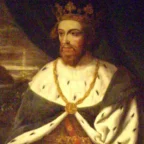
James I of Aragon (Jaume I "the Conqueror")
James I of Aragon, universally known in the Catalan-speaking world as Jaume el Conqueridor, "the Conqueror," was the most celebrated monarch of the medieval Crown of Aragon, whose sixty-three year reign reshaped the political geography of the western Mediterranean and laid the foundations for what would become a major European maritime empire. For historians of medieval art and manuscripts in Catalonia, he is also a pivotal cultural figure: the legal and institutional framework he created directly patronized the flourishing of Catalan Romanesque and early Gothic art in the territories he conquered.
James was born on 2 February 1208 in Montpellier, son of King Peter II of Aragon and Maria of Montpellier. His early childhood was extraordinarily precarious. His father, Peter II, died at the Battle of Muret in 1213, fighting against the crusaders of Simon de Montfort during the Albigensian Crusade, and the infant James was held as a ward by the Knights Templar at the castle of Monzon under the terms of a political arrangement. The regency of the kingdom was contested and turbulent, with the Aragonese and Catalan nobility frequently exploiting the child-king's weakness. James only began to take effective personal control of government around 1217-1218 and was not fully master of his realm until 1227.
The first great military enterprise of James's reign was the conquest of the Balearic Islands, then held by the Almohad Muslims and a notorious base for piracy that disrupted Catalan maritime trade in the western Mediterranean. In 1228, the Corts de Barcelona approved the campaign, and in 1229 James assembled a formidable fleet of over 155 ships, 1,500 horsemen, and approximately 15,000 infantry. On 31 December 1229, the city of Medina Mayurqa, today's Palma, fell to his forces after siege and assault. Menorca surrendered in 1231, and Ibiza was taken in 1235. After the conquest, James distributed the conquered lands among the participating nobles according to the Llibre del Repartiment (Book of Distribution), a systematic land-grant register that is itself a document of great historical significance.
The conquest of the Kingdom of Valencia was a more protracted and complex enterprise, driven partly by the king's own strategic vision and partly by the ambitions of the Aragonese nobility. The catalyst came in 1231, when the nobleman Blasco de Alagon met James at Alcaniz to plan a southward push into Muslim-held Valencian territory. The initial moves were cautious: Morella fell in 1232, providing a key highland stronghold from which further advances could be staged. Over the following years James systematically reduced Muslim resistance, aided by contingents from both Aragon and Catalonia as well as the military orders, particularly the Knights Templar. The great prize, the city of Valencia itself, fell to him on 28 September 1238, and James immediately constituted it as a separate kingdom with its own legal system, the Furs de Valencia (Fueros de Valencia), a sophisticated legal code that drew on Roman law traditions.
James was not only a conqueror but also a diplomatist of considerable skill. In 1258 he concluded the Treaty of Corbeil with Louis IX of France, by which he formally renounced all Aragonese-Catalan claims to territories in Languedoc and the south of France, thereby definitively reorienting the Crown of Aragon's expansionist ambitions away from the Pyrenean north and toward the Mediterranean south and east. This was a decisive geopolitical act, and its consequences for art history are not trivial: it concentrated Catalan cultural energy on the newly conquered territories of Valencia, Majorca, and eventually Sicily, creating the conditions for the remarkable flowering of Gothic art in these regions in the later thirteenth and fourteenth centuries. James also shrewdly arranged the marriage of his heir Peter to Constance of Sicily, planting the seed of the Sicilian Vespers episode and the subsequent Aragonese claim to that island.
James's achievements extended far beyond military conquest. His reign saw the codification of the Furs of Valencia, the development of the Llibre del consolat del mar (the great code of Mediterranean commercial and maritime law), and the emergence of the Corts, the representative assembly of the Crown of Aragon, as a functioning constitutional body. He also gave Barcelona and other cities their first formal civic administrations. For Jewish communities in particular, his protection and encouragement were notable: Catalan Jewish scholars enjoyed conditions of relative intellectual freedom during his reign. The Catalan language received important impetus as an administrative and literary vehicle: James's own autobiography, the Llibre dels Fets ("Book of Deeds"), is the earliest known autobiography written by a Christian king and remains a primary source of the first importance. In it he describes in vivid, first-person prose the campaigns for Majorca and Valencia, his love affairs, his disputes with the nobility, and his religious convictions.
Contemporary sources paint a compelling picture of James as a man of extraordinary physical stature and presence, tall, fair-haired, and imposing, as well as a leader of great personal courage who fought in the front lines of his own battles. His numerous love affairs, conducted openly alongside his three successive marriages, led one chronicler to describe him as an home de fembres ("a man of women"), and several of his political difficulties stemmed from attempts to have illegitimate children legitimized or to separate from his wives. His personality combined crusading piety, he undertook a crusading expedition to the Holy Land in 1269, though it was aborted, with a very pragmatic approach to politics, commerce, and dynastic strategy.
James I died on 27 July 1276 in Valencia, the city whose conquest had been the crowning achievement of his life, and was buried in the Cistercian monastery of Poblet in Catalonia, which he had designated as the royal pantheon of the Crown of Aragon. His tomb at Poblet, though damaged during the Napoleonic Wars and the anti-clerical violence of the nineteenth century, has been restored and remains a site of pilgrimage. His legacy in the Catalan-speaking world is immense: streets, schools, and public buildings across Catalonia, Valencia, and the Balearic Islands bear his name, and he is commemorated as the founder of the Valencian nation as well as the architect of the medieval Catalan Mediterranean empire that scholars such as Post, Ainaud de Lasarte, and their successors have spent generations studying through its surviving art.
-
James Jackson Jarves
James Jackson Jarves was an extraordinary American figure: newspaper editor, diplomat, travel writer, art critic, and above all the first American collector to systematically acquire Italian "primitive" paintings of the thirteenth, fourteenth, and fifteenth centuries, at a time when those works were almost universally dismissed or even destroyed to recover the gold in their backgrounds. His tenacious mission to educate America through art ultimately ruined him financially, yet secured a permanent place for Duecento and Trecento Italian painting in some of the greatest museums in the United States.
Jarves was born on 10 August 1818 in Boston, into a prominent and prosperous New England family. His father, Deming Jarves, was the founder of the famous Sandwich Glass Company on Cape Cod, and James grew up in comfortable circumstances. In 1838 he married Elizabeth Russell Swain, and in 1840, restless, adventurous, and already afflicted by the chronic ill-health that would dog him throughout his life, he sailed to the Hawaiian Islands, where he founded and edited one of the earliest newspapers in the Pacific, The Polynesian (1840-48). He became deeply involved in Hawaiian politics and culture, earning honorary Hawaiian citizenship and the Order of Kamehameha I for his diplomatic services during a critical period when European powers competed for influence over the islands.
The decisive turn in Jarves's life came in the early 1850s when, following extended travels in Europe, he discovered Italian painting, first in the Louvre in Paris, and then in the galleries, churches, and monasteries of Florence. He arrived in Florence and would make it his home for the next forty years. What struck him with visionary force was precisely what the mainstream European and American art world was ignoring or actively destroying: the "primitives", the panel paintings of the Duecento and Trecento masters, the anonymous gold-ground Madonnas and altarpieces of Cimabue's generation, the narrative cycles of Duccio and his followers, and the hieratic Byzantine-influenced works that most collectors regarded as crude precursors to the real art of the High Renaissance.
Jarves was among the first to grasp that these works represented not a failed attempt at naturalism but a coherent and sophisticated visual culture in its own right, what he called, in language ahead of its time, a living expression of a civilization's spirit and faith. He began buying with focused determination, acquiring works up to the limits of his relatively modest means, aiming from the outset not at personal enrichment but at building a historically arranged, didactic collection that he intended eventually to present to America as an instrument of cultural education. Between 1851 and 1860 he assembled 145 paintings spanning from the tenth to the seventeenth century.
Jarves's cultural idealism collided painfully with American indifference. When he attempted to sell his collection in New York and Boston in the early 1860s, he found no buyers willing to take it as a whole, and the American public remained conspicuously unmoved by paintings they considered archaic and crude. Desperate for funds, he agreed in 1868 to deposit 119 of the paintings at Yale College as security for a loan of $20,000 plus interest. He intended to redeem them, but could never raise sufficient capital. When he defaulted on the loan in 1871, Yale University Art Gallery acquired the entire group for approximately $22,000-$30,000, a fraction of their true worth, and Jarves lost the collection that had been his life's work.
The sale was a financial catastrophe for Jarves, but an incalculable gift to posterity. The Jarves Collection at Yale remains to this day one of the most important assemblages of Italian medieval and early Renaissance paintings in the Western hemisphere, a collection that scholars of Duecento and Trecento art continue to visit and study.
Characteristically, rather than abandoning his mission, Jarves returned to collecting almost immediately. He assembled a second group of 54 Italian paintings which was eventually purchased by the silver mining magnate Liberty E. Holden and is now housed at the Cleveland Museum of Art. In 1879, he acquired a collection of some 650 drawings formed by the Italian count Alessandro Maggiori, which he catalogued and sold to Cornelius Vanderbilt; Vanderbilt gifted the entire group to the Metropolitan Museum of Art in New York in 1880. His collection of Venetian glass also went to the Metropolitan, while his holdings of Renaissance textiles, lace, and costumes are preserved at the Davis Museum at Wellesley College.
Between 1880 and 1882 Jarves served as US Vice-Consul in Florence, his diplomatic career running in parallel with his ceaseless acquisition and study of art. He was also remarkably prescient about Japanese art, becoming one of the earliest Western connoisseurs of that tradition in Europe despite having never visited Japan. For his services to Italian art and cultural diplomacy, the King of Italy appointed him Cavaliere della Corona d'Italia.
Jarves was a prolific writer whose books constitute some of the earliest serious American writing on the history of art. His Art Hints (1855) and Art Studies (1861) argued passionately for the educational and moral value of art and for American institutions to engage seriously with the European tradition. His The Art-Idea (1864) is often cited as a foundational text in American art criticism. His Manual of the Jarves Collection (1868), prepared for Yale, included detailed descriptions of each painting, biographical notices of artists, and a pioneering introductory essay on early Christian art, in effect one of the first handbooks of Italian medieval painting written for an American audience.
His overall argument, that the pre-Renaissance masters of the Duecento and Trecento were not primitive failures but the authentic voices of a spiritually intense medieval civilisation, was deeply unfashionable in his own time but is now standard art historical orthodoxy. In this respect, Jarves was a true precursor to the Aesthetic Movement and to the later scholarly rehabilitation of the Italian primitives undertaken by Bernard Berenson and others in the early twentieth century.
Jarves died in Rome on 24 June 1888 of jaundice, and was buried in the Protestant Cemetery of Rome, the same Cimitero Acattolico that holds the graves of Keats and Shelley, an appropriate resting place for a nineteenth-century Anglophone wanderer who gave his life to Italy. He died in relative obscurity and financial penury, his name largely forgotten in America, though his collections lived on in the institutions that had acquired them under painful circumstances. Only in the twentieth century did scholarship begin to appreciate the full scope of what Jarves had achieved: a one-man campaign, conducted with limited resources and against prevailing taste, to transplant the art of medieval and Renaissance Italy into American soil.
-
Jerome (Eusebius Sophronius Hieronymus, c. 347–420)
Jerome — Eusebius Sophronius Hieronymus — was the translator of the Latin Vulgate Bible, one of the four traditional Doctors of the Western Church alongside Ambrose, Augustine and Gregory the Great, and, through his prologues to the Gospels, one of the most reproduced authorial voices in medieval book production: his prefatory letters were copied into the front matter of Latin Gospel books as a matter of course for the whole of the Middle Ages, the Codex Aureus of Echternach among them.
He was born around 347 at Stridon, a town on the border of Dalmatia and Pannonia destroyed soon afterward in the barbarian incursions of the later fourth century and never securely located by modern scholarship. His family was Christian and comfortably provincial; his father sent him to Rome as a young man for the standard course of grammar and rhetoric, where he studied under the celebrated grammarian Aelius Donatus and acquired the polished Latin style, saturated with allusions to Cicero and Virgil, that never left him even at his most ascetic. He was baptized in Rome, probably around 366, and travelled afterward to Trier and to Aquileia, where he joined a circle of ascetically minded clergy and laymen whose eventual dissolution amid mutual recriminations left him with a lifelong taste for theological controversy.
In the mid-370s Jerome withdrew to the Syrian desert of Chalcis, east of Antioch, to live for several years as a hermit among a loose community of ascetics — an experience he later described, in a famous letter to Eustochium, in terms of severe physical mortification and a haunting dream in which he was scourged before a divine tribunal for being "a Ciceronian, not a Christian," accused of loving pagan literature more than scripture. It was in this period that he began the study of Hebrew under a converted Jewish teacher, a competence almost unique among Latin Christian scholars of his generation and the foundation of his later achievement. He was ordained priest at Antioch, on the condition that he remain free to continue his ascetic and scholarly life, and he never in fact exercised regular priestly ministry. He then spent time in Constantinople, attending the lectures of Gregory of Nazianzus and beginning the translation of Eusebius of Caesarea's Chronicle into Latin.
Jerome's most consequential Roman sojourn came in 382, when he arrived in the retinue of bishops attending a synod and was retained by Pope Damasus I as secretary and theological adviser. Damasus set him to revise the existing Old Latin translations of the Gospels against the Greek text, a task Jerome undertook with declared reluctance, defending himself in advance against the charge of tampering with sacred scripture in the prefatory letter to Damasus conventionally cited by its opening words, Novum opus — the very text that opens the prefatory matter of the Codex Aureus of Echternach and that gives the manuscript's incipit page to Jerome's letter its unusual visual weight. During these same Roman years Jerome became the spiritual director of a circle of aristocratic and wealthy widows and virgins, among them Marcella, Paula and Paula's daughter Eustochium, whom he instructed in Hebrew and Scripture and who financed and eventually shared his later work in the East.
Damasus died in December 384, and Jerome's position in Rome collapsed almost at once: his ascetic severity, his sharp tongue against the laxer Roman clergy, and above all his closeness to Paula gave rise to hostile gossip that a nascent ecclesiastical inquiry appears to have taken seriously. He left Rome in 385 and, after visiting the holy sites of Palestine and the monastic settlements of Egypt, settled permanently at Bethlehem in 386. There Paula's wealth funded a double monastic foundation beside the Church of the Nativity — a monastery for men under Jerome and a convent for women under Paula and then Eustochium — together with a hospice for pilgrims, on the principle, as Jerome put it, that Bethlehem should not turn away the Holy Family it had once sheltered.
The Bethlehem decades, from 386 until his death, were Jerome's most productive as a scholar. Working from Hebrew manuscripts and with the guidance of Jewish teachers, he translated most of the Old Testament directly from what he called the Hebraica veritas — the "Hebrew truth" — rather than from the Greek Septuagint that earlier Latin translators had relied on, a methodological break that drew sharp criticism, notably from Augustine, who feared it would fracture the unity of Latin and Greek scripture and unsettle congregations accustomed to the old readings. Jerome defended his choice vigorously in a long correspondence with Augustine that ranks among the most substantial theological exchanges to survive from the period. His Old Testament translations, together with his earlier revision of the Gospels and other New Testament books revised either by him or under his influence, became with time the text later called the Vulgate, the standard Latin Bible of the Western Church for over a millennium and the basis of the Gospel text copied, in gold, into the Codex Aureus of Echternach itself.
Alongside the biblical translations Jerome produced a vast body of scriptural commentary, historical and biographical writing — including De viris illustribus, a catalogue of Christian authors modelled on pagan biographical compendia — and a stream of combative polemical treatises against opponents he judged doctrinally lax or dangerous, among them Helvidius, Jovinian, Vigilantius and, in his final years, his one-time friend Rufinus of Aquileia, with whom he fell into a bitter and very public dispute over the orthodoxy of Origen. His enormous correspondence, addressed to popes, bishops, aristocratic women and fellow scholars across the Mediterranean world, is itself among the principal sources for the intellectual and religious life of the late fourth and early fifth centuries.
Jerome died at Bethlehem on 30 September 420, and was buried near the Church of the Nativity, though his relics were later said to have been translated to Rome. His feast is kept on 30 September, and he was formally recognized as a Doctor of the Church. Medieval and later art represents him in two overlapping guises that draw on different strands of his legend: as the penitent hermit of Chalcis, gaunt and half-clothed, kneeling before a crucifix with a stone in his hand; and as the scholar-cardinal in his study, an anachronistic red hat marking his service to the Roman see, accompanied by a lion said to have been tamed after Jerome removed a thorn from its paw — a story in fact transferred to him from the desert father Gerasimus. Because of the Vulgate and his mastery of Hebrew and Greek, Jerome became the patron saint of translators, librarians and scholars, and his prologues to the Gospels, letters to Damasus and Paulinus of Nola among them, remained the standard prefatory matter of Latin Gospel books throughout the Middle Ages, which is why his name and his defense of the Novum opus open the text of the Codex Aureus of Echternach some six and a half centuries after his death.
-
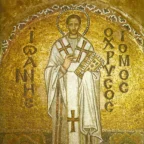
John Chrysostom (c. 347–407)
John Chrysostom (c. 347 – 14 September 407) was a Church Father who served as Archbishop of Constantinople. He is known for his preaching and public speaking, his Divine Liturgy of Saint John Chrysostom, and his ascetic sensibilities. The Eastern Orthodox, together with the Byzantine Catholics, hold him in special regard as one of the Three Holy Hierarchs, alongside Basil of Caesarea and Gregory of Nazianzus.
John was born in Antioch, Roman Syria in 347. His father was a high-ranking military officer who died shortly after John's birth, leaving his mother Anthusa a widow at approximately twenty years of age with two small children. She opted not to remarry, choosing instead to devote herself entirely to raising her son and John's older sister. Anthusa became one of the most celebrated maternal figures in patristic literature: the pagan rhetorician Libanius, who later taught the young John, reportedly marvelled on his deathbed that the Christians had produced such a mother. John himself, throughout his subsequent career, would return repeatedly to the dignity and importance of women as bearers of faith within the household — a theology of domestic Christianity whose origin is traceable to the devotion of Anthusa. Antioch was the third city of the Roman world after Rome and Alexandria: a metropolis of perhaps half a million inhabitants, a centre of commerce, philosophy, and religious plurality, the city where the followers of Jesus had first been called Christians, where the Apostle Paul had preached and quarrelled and organized, where the tension between Jewish Christianity and Gentile mission had first been formally negotiated. It was a city saturated in the competing claims of paganism, Judaism, and Christianity — a context that would permanently shape the character of Chrysostom's preaching, with its constant awareness of the non-Christian world pressing against the boundaries of the congregation.
John studied rhetoric under the pagan teacher Libanius of Antioch (c. 314–393), the most distinguished Greek rhetorician of the fourth century — a pagan who mourned the passing of the old religion but maintained his school through the Christian empire's successive reigns, producing students who became bishops, lawyers, and imperial officials. His curriculum was the classical one: Homer and the tragedians, Demosthenes and the Attic orators, the compositional exercises of the progymnasmata that taught the student to narrate, describe, amplify, compare, and refute in the cadences of high classical Greek. Libanius reportedly so admired his pupil that as he lay dying, he lamented that John could have been his successor as master of rhetoric, "if the Christians had not stolen him from us." The rhetorical formation that Libanius provided was the instrument Chrysostom would deploy for the rest of his life — not abandoned when he turned to theology but purified and redirected. The techniques of classical oratory — the periodic sentence, the diatribe, the vivid enargeia (visual description designed to place scenes before the listener's mental eye), the emotional pathos and intellectual ethos that Aristotle had theorized — became in Chrysostom's hands the vehicle for biblical exposition and moral exhortation of a kind that had never previously existed in Greek. He was the first preacher who fully merged the resources of the classical rhetorical tradition with the demands of Christian pastoral care. Alongside his studies under Libanius, John studied theology under Diodore of Tarsus, one of the leaders of the Antiochian school of biblical interpretation. The Antiochian school — in deliberate contrast to the Alexandrian tradition of Origen — emphasised the literal and historical sense of Scripture over the allegorical: the text meant what it said, in the context of the historical moment in which it was written. From Diodore, Chrysostom inherited a hermeneutic of textual sobriety and historical concreteness that would distinguish his homilies from the allegory-saturated exegesis of the Alexandrians — and that would ultimately bring him into conflict with Theophilus of Alexandria, who used the charge of Origenism as a political weapon against him.
Around the age of twenty, John's encounter with the bishop Meletius of Antioch drew him away from the world that his education had prepared him to enter. He underwent a profound conversion and was baptized in approximately 370, immediately entering the schola of the bishop — the community of clergy and ascetics gathered around the episcopal household — as a reader, the lowest of the minor orders. The pull of the desert was irresistible. John left the city and spent approximately six years in the mountains south of Antioch — first in a loose community of monks under the guidance of an experienced elder, then alone in a cave for two further years of extreme asceticism, memorizing Scripture, fasting, and maintaining prolonged standing vigils in the cold night air of the Syrian hills. The cost of these years was physical: the combination of inadequate food, exposure, and the extreme practices he imposed on his body damaged his stomach and kidneys in ways that plagued him for the rest of his life. Poor health forced his return to Antioch around 378, where Meletius ordained him deacon in approximately 381.
During the years between his return from the desert and his ordination as priest (386), Chrysostom composed what became his most famous prose work: Περὶ ἱερωσύνης — On the Priesthood — six books in dialogue form, ostensibly written to explain to his friend Basil (not Basil of Caesarea but an Antiochene friend of the same name) why he had declined episcopal consecration. The work rapidly transcended its immediate occasion to become the most influential treatise on the nature and demands of the Christian ministry in the history of the Church. Its central argument is that the pastoral vocation is the most demanding and potentially dangerous of all human callings: more demanding than the monastic life, because the monk risks his own soul in solitude, while the pastor risks not only his own soul but those of every member of his congregation. The priest who preaches must simultaneously master the techniques of rhetoric sufficient to hold an audience and resist the corruption that rhetorical success inevitably breeds in the form of vanity, the desire for applause, and the temptation to say what people want to hear rather than what they need to hear. The tension between the necessarily public art of preaching and the necessarily interior life of authentic prayer is the pastoral dilemma that On the Priesthood maps with extraordinary psychological precision. The work was translated into Latin within Chrysostom's lifetime; Gregory the Great used it extensively in composing his own Regula Pastoralis, and it remained the standard text of priestly formation in both East and West for a millennium.
Ordained a priest in 386, John began to preach in Antioch's cathedral, and it was there that he earned the epithet by which history has known him: Chrysostomos, golden-mouthed. For eleven years, from his ordination as priest to his abrupt removal to Constantinople in 397, he delivered the series of homilies on Matthew, John, the Pauline epistles, Genesis, and the Psalms that constitute the largest surviving body of scriptural commentary produced by any Father of the Church — over 800 homilies survive. Unlike Origen's commentaries, which moved through the text with scholarly deliberateness, Chrysostom's homilies were delivered orally to a listening congregation and transcribed in shorthand by professional notarii — a form of oral performance captured in writing that preserves the immediacy of the preached word, with its digressions, its direct address to the audience, its flashes of humour, its sudden turns of emotional intensity. The defining public act of the Antioch years was the Homilies on the Statues, delivered during Lent of 387. When a crowd went on a rampage mutilating statues of the Emperor Theodosius I and his family — an act legally equivalent to assault on the emperor himself — John preached more than twenty homilies entreating the people to see the error of their ways; many pagans converted to Christianity as a result, and the city was ultimately spared from severe consequences. These homilies are also significant for their sustained meditation on the theology of the image: the imperial image as a legal and sacred representation of the emperor's person, and the human person itself as the imago Dei — the image of God — that no earthly violence should profane, a meditation directly relevant to the tradition that Gregory the Great would later encode in his letters to Serenus of Marseille.
In the autumn of 397, John was appointed Archbishop of Constantinople after having been nominated without his knowledge by the eunuch Eutropius. He had to leave Antioch in secret due to fears that the departure of such a popular figure would cause civil unrest. His reforms in Constantinople were systematic and unsparing. He sold the ornamental marble and expensive furniture with which his predecessor had adorned the episcopal palace, using the proceeds to fund hospitals and food for the poor. He suspended bishops who had purchased their sees through simony, removed deacons guilty of adultery and murder, confined wandering monks to their monasteries, and preached against the extravagances of the aristocratic women of the court. Each reform created another enemy. The alliance that destroyed him was constructed from three forces: Theophilus of Alexandria, who opposed John and accused him of excessive partiality toward the teaching of Origen; the Empress Eudoxia, wife of the weak Emperor Arcadius, who felt herself the target of Chrysostom's denunciations of female extravagance; and the faction of corrupt clergy and regional bishops who had been disciplined by his reforms. The weapon they found was a council — convened at a suburban estate called The Oak across the Bosphorus in 403 — which brought a series of charges against Chrysostom and deposed him in his absence.
The first exile lasted barely two days. The people protested his departure so fiercely that he was recalled; an earthquake on the night of his departure was interpreted as a divine sign, and Eudoxia herself sent for his return. The second crisis was provoked by a literal image: a silver statue of Eudoxia was erected on a porphyry column in the square immediately in front of the cathedral of Hagia Sophia, and its dedication was celebrated with public games and dancing that Chrysostom considered profane and disrespectful of the adjacent church. His sermons against this arrangement were interpreted as personal attacks on the empress. The famous opening — Herodias rages again; again she dances; again she demands the head of John on a platter — was either genuinely applied by Chrysostom to Eudoxia, making the comparison explicit and incendiary, or was falsely attributed to him by his enemies. The result, in either case, was a second synod and a second condemnation. In June 404 he was sent into exile at Cucusus, in the Taurus mountains of Armenia, where he continued to write constantly — to bishops, deaconesses, communities of monks, and Pope Innocent I — maintaining the network of his pastoral relationships across geography. The pope, with the help of the Western emperor Honorius, attempted to intervene, but his efforts were brought to nothing by John's enemies.
After three years at Cucusus, his enemies in Constantinople secured an order for his transfer to Pityus, at the far eastern end of the Black Sea — the most remote point of the empire. The guards charged with his escort were instructed to march him at the maximum pace, regardless of weather or the prisoner's condition. In the late summer of 407, already weakened by years of poor health and privation, Chrysostom was marched through torrential rain and bitter cold along roads that his guards knew would kill him. He died at Comana on 14 September 407. His last words are reported to have been, Δόξα τῷ Θεῷ πάντων ἕνεκεν — "Glory be to God for all things" — a formula he had used in his homilies to punctuate moments of theological emphasis. He died using the words he had preached.
The official rehabilitation of Chrysostom began almost immediately after the death of Eudoxia in 404 and accelerated after the death of Arcadius in 408. The Council of Chalcedon in 451 formally vindicated his memory. The most dramatic act of rehabilitation was the return of his relics to Constantinople in 438 — thirty-one years after his death. Proclus, Archbishop of Constantinople (434–446), preached a celebrated homily praising his predecessor in the Church of Hagia Sophia, mobilizing public opinion in favour of the translation; the relics were enshrined in the Church of the Holy Apostles on 28 January 438. The Emperor Theodosius II himself met the returning procession and prostrated himself before the coffin, asking forgiveness on behalf of his parents Arcadius and Eudoxia for what they had done. Pope Pius V declared Chrysostom a Doctor of the Church in 1568.
The liturgical legacy of Chrysostom is the most enduring dimension of his influence on Christian civilization. The Divine Liturgy of Saint John Chrysostom, though likely refined by later hands, became the standard Eucharistic rite in the Eastern Orthodox Church and remains to this day the principal liturgy of the Byzantine rite, celebrated on every Sunday and feast day throughout the Orthodox world and in the Eastern Catholic churches in communion with Rome. The liturgy that bears his name defines the spatial and temporal context within which all Byzantine church decoration functions. The frescoes and mosaics that cover the walls and vaults of Byzantine churches are not ornamental: they are the visual complement of the Divine Liturgy, unfolding the same sacred history in pigment and gold that the liturgical text enacts in word and gesture. The programme of figures in the sanctuary apse — the Theotokos enthroned above the conch, the officiating Church Fathers (among them invariably Chrysostom, depicted with his characteristic large forehead and sparse beard, alongside Basil the Great) standing in priestly vestments along the lower register — is a visualization of the liturgical act performed before the altar: the earthly liturgy as the image and participation of the celestial liturgy that the saints celebrate in eternity. For the researcher of Byzantine fresco programmes, the Divine Liturgy of Saint John Chrysostom is not an external context but an internal principle of organization: the iconographic programme of a Byzantine church is, in its deepest structure, an image of the liturgy that is celebrated within it.
The dimension of Chrysostom's thought most consistently recovered in modern scholarship is his social teaching — his sustained, passionate, and practically specific insistence on the obligation of wealth toward poverty. The formulation attributed to him — that not to share one's goods with the poor is to rob them — captures the logic of an argument he made hundreds of times throughout his Antiochene and Constantinopolitan homilies: "Do you wish to honor the body of Christ? Do not ignore him when he is naked. He who said 'This is my body' is the same who said 'You saw me hungry and you gave me no food,' and 'Whatever you did to the least of my brothers you did also to me.' What good is it if the Eucharistic table is overloaded with golden chalices when your brother is dying of hunger?" The argument has a precise theological structure: the body of Christ present in the Eucharist and the body of Christ present in the poor are the same body. To adorn the one while ignoring the other is not devotion but hypocrisy. The implication for the theology of sacred art is pointed: the beauty of liturgical objects and church decoration is not inherently good but is measured by whether it exists alongside or in contradiction to care for the poor. This is not an argument against sacred art, but a permanent check on the aestheticization of devotion that loses its ethical root.
John Chrysostom is depicted in the celebrated 11th-century mosaic in St. Sophia Cathedral, Kyiv, Ukraine — one of the earliest and most authoritative representations of his iconographic type, dating from approximately 1040. It shows him in the lower register of the sanctuary apse alongside other Church Fathers, in his episcopal vestments and omophorion, his face characterised by the large forehead, sunken cheeks, and sparse beard that became canonical in Byzantine iconography. This canonical image is repeated in thousands of Byzantine and post-Byzantine churches across Greece, Bulgaria, Serbia, Russia, Romania, and the Orthodox diaspora. Wherever a Byzantine sanctuary apse preserves its original decoration, Chrysostom stands there — in paint or mosaic, on plaster or gilt ground, his hand raised in blessing or holding the closed Gospel book — as the priest of the Divine Liturgy that still bears his name, presiding over the intersection of the visible and invisible worlds that Byzantine sacred art was designed to make legible.
-
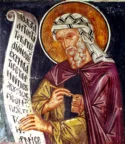
John of Damascus
John of Damascus (Arabic: Yuḥannā ibn Sarjūn; Greek: Ἰωάννης ὁ Δαμασκηνός) is one of the central theological figures of iconodulism and one of the most influential Doctors of the Christian tradition in both East and West. Proclaimed a Doctor of the Church by Leo XIII in 1890, he is often described as the "Thomas of the East" for the breadth and systematic quality of his theology.
He was born in Damascus between approximately 670 and 680 into a prominent Arab Christian family serving the Umayyad administration. His father, Sarjūn ibn Manṣūr (Sergius), held a high financial office, and John himself inherited an important administrative role at the caliphal court. According to tradition, his intellectual formation was shaped by the Sicilian monk Cosmas, acquired by his father and appointed as tutor to John and his adoptive brother Cosmas of Maiuma. Through this education he mastered Aristotelian logic, Greek philosophy, mathematics, and music, disciplines that gave his later theological writings unusual conceptual precision.
Around 700, John left public office, distributed his wealth to the poor, freed his servants, and embraced the monastic life in Palestine at the monastery of Mar Saba, between Jerusalem and Bethlehem. There he took vows, later became a presbyter, and served as a preacher associated with the Holy Sepulcher. The rest of his life unfolded chiefly between Mar Saba and Jerusalem in study, liturgical life, and writing.
His decisive historical role emerged during the first Byzantine iconoclasm. Because he lived under Muslim rule and not under direct Byzantine imperial jurisdiction, he could intervene freely when Leo III issued anti-icon edicts (726-730). In this context John wrote the three Orations in Defense of the Holy Images (Apologia contra eos qui sacras imagines abiiciunt), among the foundational texts of iconodule theology.
The core of his argument is Christological and incarnational: the God once unseen became visible in the flesh through the Incarnation of the Word. To prohibit images of Christ, in his reasoning, risks denying the reality of Christ's humanity and sliding toward docetic or monophysite implications. John formulates this principle with classic clarity: what was once unrepresentable in God became representable in the economy of the Incarnation, because the visible humanity of Christ is real and salvific.
John also articulated with precision the distinction between latria (adoration due to God alone) and proskynesis timetike (honorific veneration given to icons). In this view, the reverence shown to the image passes to its prototype and does not terminate in material substance as an idol. This distinction became a doctrinal cornerstone for the Second Council of Nicaea (787) and remains central in Catholic and Orthodox teaching on sacred images.
Later hagiographic tradition attributes to him the miracle of the restored hand: after being falsely accused of treason and mutilated, he prayed before an icon of the Virgin and was healed, then offered a silver hand in thanksgiving. This episode is linked to the devotion to the Virgin Tricherousa ("Three-handed"), still venerated in Eastern Christianity.
Beyond icon theology, John produced one of the most important syntheses of Greek patristic doctrine in the Fountain of Knowledge (Pege gnoseos), whose culminating part is the De Fide Orthodoxa. He also wrote the De haeresibus, a catalog of heresies, and composed major liturgical hymns; Orthodox tradition attributes to him important Paschal canons, including the hymn known in English as "Day of Resurrection." His works entered the Latin medieval schools and strongly influenced authors such as Peter Lombard and Thomas Aquinas.
He likely died on 4 December 749 at Mar Saba. His theological positions were vindicated posthumously at Nicaea II in 787. For medieval art history, John is indispensable: his theology of the image provided one of the principal doctrinal foundations for the flourishing of Byzantine icons, monumental mosaics, and the wider sacred visual culture of the medieval Christian world.
-
John of Toledo (Giovanni da Toledo)
John of Toledo, who died on 13 July 1275 at Montecassino, was an English-born Cistercian cardinal and one of the most influential ecclesiastical figures of the thirteenth century. Active at the papal court from the pontificate of Innocent IV onward, he combined curial authority with interests in medicine, theology, and monastic organization.
Information about his life before 1244 is limited. Sources indicate that he was born in England, studied medicine at Toledo, and acquired theological training at an unidentified center. He entered the Cistercian Order at Clairvaux, the abbey associated with Bernard of Clairvaux. Medieval accounts also describe him as physician, astrologer, and, in hostile polemical traditions, even a necromancer, reflecting the broad and sometimes controversial intellectual profile attributed to him.
A decisive early episode occurred in 1241: while traveling to Rome for a synod, he was captured by the troops of Frederick II together with other churchmen, including the Cistercian cardinal-bishop Giacomo da Pecorara of Palestrina. He remained an imperial prisoner for about two years, during the sharpest phase of the conflict between the emperor and the papacy of Gregory IX.
On 28 May 1244, Innocent IV created him Cardinal Priest of San Lorenzo in Lucina. As papal archiater (personal physician), he enjoyed direct and sustained access to the pope and held significant influence in the Curia. In 1254 he became Cardinal Protopresbyter; in 1262 he opted for the order of cardinal bishops and received the see of Porto and Santa Rufina; in January 1273 he became Dean of the Sacred College; and in 1274 he was appointed Vicar of Rome.
He is also connected with the long Conclave of Viterbo (1268-1271), the protracted election following Clement IV's death. Later tradition attributes to him the ironic suggestion to remove the roof and force a decision, an anecdote tied to the famous pressure tactics of the Viterbo population. The election of Gregory X eventually led to Ubi periculum (1274), the constitution that codified procedures for future conclaves.
As cardinal protector and patron linked to the Cistercian Order, John of Toledo promoted monastic intellectual structures, encouraging theological schools across Cistercian provinces and supporting a broader educational network. He also founded monasteries in Rome, Perugia, and Viterbo. His medical and alchemical interests at the papal court have been studied in modern scholarship, notably by Maria Gloria Vinci in the Rivista Cistercense.
-
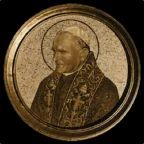
John Paul II (Karol Jozef Wojtyla, 1920-2005; pope 1978-2005)
Born on 18 May 1920 at Wadowice, a small town near Krakow, the second surviving child of Karol Wojtyla, a retired army lieutenant, and Emilia Kaczorowska. His childhood was marked by successive bereavements: a sister who died in infancy before his birth, his mother when he was eight, his brother Edmund - a young doctor - of scarlet fever caught from a patient in 1932, and his father in 1941. By his twenty-first year he had no immediate family left. Wadowice's Jewish population made up roughly a quarter of the town; his friendship with Jerzy Kluger, maintained across the whole of his life, later carried real diplomatic weight.
He entered the Jagiellonian University in 1938 to study Polish philology and was drawn to the theatre. The German invasion closed the university within a year. To avoid deportation he worked in the Zakrzowek limestone quarry and then at the Solvay chemical works, while acting in the underground Rhapsodic Theatre and reading Carmelite mysticism. In 1942 he entered the clandestine seminary run by Archbishop Adam Stefan Sapieha in his own residence, and was ordained on 1 November 1946.
Sapieha sent him to Rome, where he took a doctorate at the Angelicum under Reginald Garrigou-Lagrange on the concept of faith in John of the Cross (1948). A second doctorate at the Jagiellonian examined whether Max Scheler's phenomenology could ground a Christian ethic; the answer was qualified, but the method stayed with him permanently. He taught at the Catholic University of Lublin from 1954. Love and Responsibility (1960) and Osoba i czyn - The Acting Person (1969) - are the two works that explain most of what he later did as pope: a personalist ethics built on the irreducibility of the human subject and on self-gift as the fulfilment of freedom.
Bishop of Krakow. Auxiliary bishop in 1958 at thirty-eight, archbishop in 1964, cardinal in 1967. He attended all four sessions of the Second Vatican Council, contributing substantially to Gaudium et spes and to the declaration on religious liberty Dignitatis humanae - a text on which Polish experience of an atheist state gave him unusual authority. His long struggle to build a church at Nowa Huta, the model socialist town constructed without one, became emblematic: the Ark Church was consecrated in 1977.
Elected on 16 October 1978, after the thirty-three-day pontificate of John Paul I, he was the first non-Italian pope since Adrian VI in 1522 and the first Slav ever. His inaugural homily - Be not afraid; open wide the doors to Christ - set the register of the whole reign. At fifty-eight he was the youngest pope since Pius IX, and his pontificate ran twenty-six and a half years, the second longest in documented history.
The nine-day pilgrimage to Poland in June 1979 is widely regarded as the hinge event. Millions attended, organised themselves, and discovered they were not isolated; Solidarnosc emerged fourteen months later. He met Lech Walesa, sustained pressure through the martial-law years, and maintained a channel to both Washington and Moscow. Historians dispute the weight of the papal contribution relative to economic collapse and Gorbachev's choices, but few deny it mattered. Gorbachev himself said afterwards that what happened in Eastern Europe would not have been possible without this pope.
On 13 May 1981 Mehmet Ali Agca shot him in St Peter's Square. He nearly died; he attributed his survival to Our Lady of Fatima, whose feast it was, and had the recovered bullet set in her crown at the shrine. He visited Agca in Rebibbia prison in December 1983 and publicly forgave him. Responsibility beyond Agca - the Bulgarian and Soviet trails - has never been conclusively established.
Fourteen encyclicals, opening with Redemptor hominis (1979) and its programmatic claim that man is the way of the Church. The social trilogy - Laborem exercens (1981), Sollicitudo rei socialis (1987), Centesimus annus (1991) - developed a critique of both collectivism and unregulated market capitalism. Veritatis splendor (1993) confronted proportionalism in moral theology; Evangelium vitae (1995) set out the "culture of life" against abortion and euthanasia and effectively closed the door on capital punishment; Ut unum sint (1995) made the striking invitation to other Christians to help him find a way of exercising papal primacy acceptable to all; Fides et ratio (1998) defended reason's capacity for truth. The 129 Wednesday catecheses of 1979-84, later known as the Theology of the Body, are his most distinctive contribution. He also promulgated the 1983 Code of Canon Law, the 1990 Eastern code, and the Catechism of the Catholic Church (1992).
He restated the exclusion of women from priestly ordination in Ordinatio sacerdotalis (1994) in language intended to end discussion, while Mulieris dignitatem (1988) developed a theology of women's dignity that many found powerful and many others found insufficient.
Journeys, saints, other faiths. He made 104 foreign journeys to some 129 countries, more travel than all his predecessors combined. He beatified 1,338 people and canonised 482 - again more than the total of every previous pontificate - a deliberate policy of multiplying local models of holiness, and one criticised for loosening the process. Among his acts: the Assisi interreligious prayer meeting (1986), his visit to the Synagogue of Rome the same year and his description of Jews as elder brothers, the establishment of diplomatic relations with Israel (1993), the Jubilee Day of Pardon in March 2000 asking forgiveness for the sins of the Church's members, the pilgrimage to Jerusalem and the note left at the Western Wall, and the entry into the Umayyad Mosque at Damascus in 2001. World Youth Day, founded in 1985-86, was his own creation, and the Great Jubilee of 2000 the summit of the pontificate.
The gravest is his handling of clerical sexual abuse. His instinctive disbelief that priests could do such things, formed partly by Communist-era fabrications against the Polish clergy, contributed to years of institutional inertia; his sustained favour toward Marcial Maciel of the Legionaries of Christ, later exposed as a serial abuser, is the hardest case to defend, and the Vatican's own 2020 McCarrick Report documented failures in the promotion of Theodore McCarrick. Beyond this, critics point to the centralisation of appointments, the disciplining of liberation theologians, and the governance vacuum of his final years, when Parkinson's disease had severely disabled him. His defenders answer that he chose to make his visible suffering a last teaching on the dignity of the frail.
He died on 2 April 2005. Crowds at the funeral on 8 April chanted Santo subito. Benedict XVI beatified him in 2011; Francis canonised him on 27 April 2014, together with John XXIII. His feast is 22 October.
He was a poet and dramatist before he was a philosopher, publishing verse under the pseudonyms Andrzej Jawien and Stanislaw Andrzej Gruda; The Jeweller's Shop (1960) is still performed, and the Roman Triptych of 2003 was written as pope. Four documents bear most directly on medieval and Byzantine art history:
- Duodecimum saeculum (1987), the apostolic letter for the twelfth centenary of the Second Council of Nicaea, is his fullest statement on sacred images - the theological defence of the icon against iconoclasm, and an argument that the Church needs artists.
- Slavorum apostoli (1985) on Cyril and Methodius, whom he had already proclaimed co-patrons of Europe in 1980 (Egregiae virtutis), reoriented the medieval map of Christian Europe toward its Byzantine-Slavic half.
- In 1999 he named three co-patronesses of Europe - Bridget of Sweden, Catherine of Siena and Edith Stein - a choice of obvious interest for the study of Scandinavian medieval devotion.
- The Letter to Artists (1999) is his most quoted text on the relation of beauty to faith, built around the claim that the artist is an image of God the creator.
Under his pontificate the restoration of Michelangelo's Sistine frescoes was completed (1980-1994), amid a controversy over cleaning method that has still not entirely settled; the Vatican Archives were progressively opened to researchers; and the Pontifical Commission on Galileo concluded its work in 1992.
-
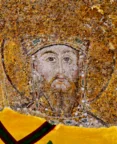
John V Palaiologos
John V Palaiologos (18 June 1332 - 16 February 1391) was Byzantine emperor from 1341 to 1391, with significant interruptions, making his one of the longest - and most turbulent - reigns in the empire's final centuries. His rule was defined not by conquest but by an almost unbroken sequence of disasters: civil war, plague, Ottoman encroachment, and personal humiliation. He presided over the transformation of Byzantium from a struggling but independent state into a virtual vassal of the Ottoman sultans.
John V was born in Didymoteichon in Thrace, the son of Emperor Andronikos III Palaiologos and Anna of Savoy. When his father died in June 1341, John was barely eight years old, and the question of who would govern in his name immediately fractured the empire. His mother Anna of Savoy claimed the regency, but the powerful and capable minister John VI Kantakouzenos - who had effectively run the government under Andronikos III - refused to accept her authority. This dispute ignited a catastrophic civil war that consumed the empire for nearly a decade. Anna, desperate for funds to sustain her faction, made one of the most shameful decisions in Byzantine history: she pawned the imperial crown jewels to Venice.
The civil war between Anna's regency council and John Kantakouzenos dragged on from 1341 to 1347. Kantakouzenos, needing military allies, turned to the Ottoman emir Orhan of Bithynia and even gave him his daughter Theodora in marriage, allowing Ottoman troops to plunder Byzantine Thrace at will in exchange for their support. When the Black Death struck in 1347, weakening both sides, the war exhausted itself into a compromise: Kantakouzenos entered Constantinople and was crowned John VI, agreeing to rule as senior emperor for ten years while the young John V ruled alongside him.
This arrangement was inherently unstable. In 1354, John V raised a rebellion and expelled Kantakouzenos, who retired to a monastery and spent the rest of his life writing history and theology. But the civil war had exacted an almost unsurvivable price. In March 1354, an earthquake destroyed the walls of Gallipoli, and the Ottomans under Orhan occupied the ruins, establishing their first permanent foothold in Europe - a foothold they would never relinquish. The Byzantine Empire had, in effect, imported the Ottoman threat into its own heartland.
Recognizing that Byzantium could not survive without Western military aid, John V embarked on a policy of appealing to the papacy and Western rulers for a crusade against the Turks. This inevitably involved the deeply sensitive question of Church Union - the reunification of the Greek Orthodox and Roman Catholic churches, which had been formally schismatic since 1054. In 1369, John V traveled to Rome in person and, in a private ceremony, converted to Roman Catholicism before Pope Urban V. It was an extraordinary act of personal humiliation: a Roman emperor submitting to the Bishop of Rome, something no predecessor had done. The gesture yielded almost nothing - no crusade materialized, and the Greek clergy at home largely refused to follow their emperor into union.
On his return journey, John V was detained in Venice - not as a diplomatic guest, but as a debtor, because the Byzantine state could not pay its outstanding bills to Venetian creditors. His own son Andronikos IV, ruling in Constantinople, reportedly refused to send the necessary funds to release him. The emperor of a thousand-year empire was effectively imprisoned for debt on the docks of Venice.
John V's late reign descended into a dynastic nightmare. In 1376, his son Andronikos IV allied with the Ottoman sultan Murad I and staged a coup, imprisoning John and his other son Manuel. John regained the throne in 1379 with the paradoxical help of Murad himself, at the cost of accepting formal Ottoman suzerainty and ceding the city of Philadelphia - the last Byzantine outpost in Asia Minor. Then in 1390, his grandson John VII launched yet another coup and briefly seized Constantinople before being expelled. John V thus holds the grim distinction of having been deposed twice by members of his own family.
In the final years of his reign, John V was compelled to personally assist Ottoman campaigns, accompanying Murad's successor Bayezid I on military expeditions as a vassal. He died on 16 February 1391 in Constantinople and was buried at the Hodegon Monastery. He was succeeded by his son Manuel II, who would continue the exhausting and ultimately futile effort to save what remained of the empire.
John V is a figure of genuine tragedy rather than simple failure. He inherited an empire already mortally wounded by civil war and Ottoman advance, and he spent fifty years fighting - diplomatically, militarily, and politically - against forces that were structurally beyond his power to reverse. His reign is indispensable for understanding the final phase of Byzantine history: the empire's slow compression into little more than Constantinople itself, surrounded by an Ottoman world that would, within sixty years of his death, extinguish it entirely.
-
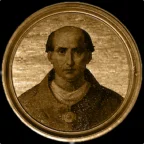
Pope John XXII (Jacques Dueze)
Pope John XXII (c. 1244-1334), born Jacques Dueze (also rendered d'Euse or Dueze), was the second pope of the Avignon line and reigned from 1316 to 1334. Born at Cahors in southern France to a prosperous non-noble family, he advanced through legal training and curial service rather than dynastic privilege, becoming one of the most consequential and controversial pontiffs of the fourteenth century.
Formed in canon and civil law, he built his career through high ecclesiastical office and Angevin royal connections, serving Charles II of Anjou and rising in rapid sequence as bishop of Frejus (1300), bishop of Avignon (1310), and cardinal-bishop of Porto (1312). At Clement V's death, he was already a seasoned curial jurist and administrator.
After the violent and factional interregnum of 1314-1316, with failed conclave phases at Carpentras and Lyon, the cardinals elected the elderly Jacques Dueze in August 1316. Crowned in September as John XXII, he was expected to be a short-term compromise pope, yet governed for eighteen years.
John did not inaugurate papal residence in southern France, but he entrenched Avignon as the effective administrative center of Latin Christendom. His greatest impact was institutional: he expanded central bureaucratic record-keeping, strengthened papal provisions and reservations over benefices, and systematized fiscal collection, including annates and related dues.
Contemporaries accused him of extreme avarice and immense treasure-hoarding, while modern scholarship, especially associated with Guillaume Mollat, treats the legendary totals with caution. Even so, the consensus is clear that John created a far more efficient and centralized papal fiscal machine than his predecessors had commanded.
His pontificate was dominated politically by conflict with Louis IV of Bavaria over imperial legitimacy and jurisdiction. John asserted broad papal rights during imperial vacancy and denied full imperial action without papal confirmation; after Louis's consolidation of power, the clash escalated into excommunication (1324), imperial retaliation in Italy, and the Roman imperial coronation of Louis in 1328.
Louis then backed the antipope Nicholas V (Pietro Rainalducci), whose regime quickly collapsed. The conflict nevertheless gave a political home to major anti-curial thinkers, including Marsilius of Padua and William of Ockham, and tied imperial opposition to theological dissent against John.
Within the Church, the Franciscan poverty controversy proved equally explosive. Through Quorumdam exigit (1317), Ad conditorem canonum (1322), and Cum inter nonnullos (1323), John dismantled the legal fiction supporting strict apostolic-poverty claims and condemned as heretical the proposition that Christ and the Apostles owned nothing at all. The resulting rupture pushed Michael of Cesena, Bonagratia of Bergamo, and Ockham into open opposition.
In a different register, John canonized Thomas Aquinas in 1323, helping secure Thomism's long-term status within Latin theology. He also supported missionary structures extending toward Asia, promoted repeated but largely unrealized crusading initiatives, and issued the decretal Spondent quas non exhibent (1317) against fraudulent alchemists.
Late in life he opened another doctrinal crisis through sermons (c. 1331-1332) on the beatific vision, arguing that the blessed dead do not fully behold God until the Last Judgment. Under sustained criticism, he moderated this position before his death in December 1334; Benedict XII settled the issue dogmatically in Benedictus Deus (1336), affirming immediate vision of God for the purified just.
John XXII died in Avignon on 4 December 1334 and was succeeded by Benedict XII. His canopy tomb in Notre-Dame des Doms at Avignon, though damaged in the Revolution and restored later, remains a significant monument of fourteenth-century French funerary sculpture.
Historiographically, John XXII remains deeply divisive: praised as a formidable reforming administrator who stabilized and professionalized papal governance, and criticized as a legalistic, fiscally aggressive pontiff whose interventions in poverty doctrine and the beatific-vision debate intensified opposition to papal authority. Few Avignon popes, however, had a broader institutional impact.
-
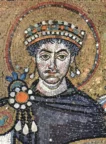
Justinian I (Justinian the Great)
Justinian I - known to history as Justinian the Great - was one of the most consequential rulers in the history of Western civilization, a Byzantine emperor whose nearly forty-year reign reshaped law, architecture, theology, and the political map of the Mediterranean world. Born around 482 AD in Tauresium, a small village in the Balkans province of Illyricum (modern North Macedonia), he rose from humble origins to become the last Roman emperor to speak Latin as a native tongue and the last to seriously attempt the full restoration of the ancient Roman Empire.
His birth name was Flavius Petrus Sabbatius, and he owed his extraordinary elevation entirely to family connections: his uncle, Justin I, was a soldier of Illyrian peasant stock who had risen through the ranks to become emperor in 518 AD. Justin, who was himself largely uneducated, recognized in his nephew exceptional intelligence and administrative talent, and brought him to Constantinople to receive a thorough education in law, theology, and the Roman classics. Justinian was formally adopted by Justin and appointed co-emperor, becoming sole ruler upon Justin's death in 527 AD. From the outset, Justinian demonstrated that his guiding political vision was the renovatio imperii - the restoration of the Empire - the grand ambition of reassembling, under Roman rule, the full territorial extent of the ancient world.
No biography of Justinian can omit Empress Theodora, arguably the most powerful woman in Byzantine history and his indispensable political partner. The daughter of a circus bear-keeper, Theodora had been an actress and mime performer - professions so socially disreputable in Byzantine law that marriage to a senator was technically illegal. Justinian persuaded his uncle to change the law in order to marry her around 525 AD, two years before his accession. She proved to be a woman of formidable courage and political acumen.
The most dramatic demonstration of her character came during the Nika Riots of January 532 AD, when Constantinople erupted in a week of urban violence that left much of the city in flames and tens of thousands dead. The rioters, drawn from the rival circus factions (the Blues and the Greens), had united in opposition to Justinian's ministers and were on the verge of proclaiming a new emperor. Justinian was reportedly prepared to flee the city by ship when Theodora rose in the imperial council and delivered a speech preserved by the historian Procopius, declaring that she would rather die in imperial purple than live in exile - "the purple is a fine winding sheet". Her resolve stiffened the court, Justinian stayed, and his generals Belisarius and Narses suppressed the revolt with terrible force. Theodora died of cancer in 548 AD, leaving Justinian visibly diminished for the remainder of his reign.
Justinian's most enduring legacy - and the achievement that most directly shaped the modern world - is the systematic codification of Roman law known as the Corpus Juris Civilis. Roman law had accumulated over a thousand years into a vast, contradictory, and largely inaccessible labyrinth of imperial edicts, juristic commentaries, and senatorial decrees. In 528 AD, Justinian appointed the brilliant legal scholar Tribonian to head a commission charged with rationalizing this entire tradition. The result, completed with extraordinary speed, comprised four parts: the Codex Justinianus (imperial constitutions), the Digesta (a synthesis of classical juristic writings), the Institutiones (a legal textbook for students), and the Novellae (new laws issued during the reign itself).
The Corpus was not merely an administrative convenience - it was a monumental intellectual achievement that preserved and transmitted the entire tradition of Roman legal thought to the medieval and modern world. When Roman law was rediscovered in the West during the eleventh and twelfth centuries (particularly at the University of Bologna), it was Justinian's Corpus that scholars studied. It became the foundation of canon law, the legal systems of continental Europe, and ultimately of all civil law traditions still operative today across France, Italy, Spain, Germany, and much of the world.
Justinian never personally commanded armies in the field, yet his reign witnessed the most spectacular military expansion since the height of the classical empire. The architect of these campaigns was his general Flavius Belisarius, one of the most gifted commanders of late antiquity, supported later by the eunuch general Narses.
The first great reconquest was North Africa. Since 439 AD, the Vandal Kingdom had controlled Carthage and the entire province of Africa - the wealthiest region of the western Mediterranean and the breadbasket of the ancient world. In 533 AD, Belisarius sailed from Constantinople with a relatively modest force and, in two decisive engagements, demolished the Vandal kingdom entirely, restoring Africa to imperial control within the year. The speed and completeness of the victory astonished contemporaries and confirmed Justinian's sense of providential mission.
Italy followed. The Ostrogothic Kingdom, which had ruled the Italian peninsula since 493 AD under the great Theoderic, was internally weakened by dynastic conflict. The Gothic Wars (535-554 AD) were a protracted and devastating conflict that ultimately restored imperial control over Italy, Sicily, and Dalmatia, but at catastrophic cost to the Italian population and urban fabric - cities like Milan were sacked and depopulated, and the senatorial aristocracy of Rome was effectively destroyed. The praetorian prefect Liberius additionally secured a strip of southern Spain (Spania), giving Justinian nominal control of the western Mediterranean coastline. By 555 AD, the empire had reached its greatest territorial extent since the Western Empire's collapse in 476 AD.
The Nika Riots of 532 had burned down the original basilica of Hagia Sophia in Constantinople. Justinian seized the catastrophe as an opportunity, commissioning the mathematicians Anthemius of Tralles and Isidore of Miletus to design a replacement on an unprecedented scale. Built between 532 and 537 AD, the new Hagia Sophia was a revolution in architectural history: its vast central dome, 31 meters in diameter and seemingly floating on a ring of forty windows, created an interior space of breathtaking luminosity that Byzantine observers described as a dome "suspended from heaven by a golden chain". It remained the largest cathedral in the world for nearly a thousand years, and its architectural influence - particularly its fusion of the longitudinal basilica plan with a centralized domed space - shaped the development of Byzantine, Islamic, and Renaissance architecture alike.
Justinian's patronage extended throughout the empire. He rebuilt Antioch after an earthquake, fortified the eastern frontier with a system of new military installations, constructed the famous underground Basilica Cistern beneath Constantinople to secure the city's water supply, and erected the great Sangarius Bridge in Bithynia. His reign also produced an extraordinary flowering of literary culture: the historians Procopius and Agathias, the poet and epigrammatist Paul the Silentiary, and the great hymnographer Romanos the Melodist all worked under his rule. For the history of medieval manuscript illumination, the Justinianic period is foundational: the court workshops of Constantinople under Justinian established the canonical conventions of Byzantine book illumination, gold-ground imagery, and the hieratic frontal figure style that would permeate manuscript production throughout the Eastern and Western Christian worlds for the next eight centuries.
Justinian was a deeply committed Christian who regarded himself as God's vice-regent on earth, responsible not only for the political but the spiritual unity of the empire. He intervened constantly in theological affairs, presiding over councils, issuing edicts on doctrinal matters, and working to enforce Chalcedonian orthodoxy against both Monophysite dissent in Egypt and Syria and the remnants of paganism. He closed the Neoplatonic Academy of Athens in 529 AD, effectively ending a nine-hundred-year tradition of pagan philosophical teaching. He restricted the civil rights of Jews and persecuted Samaritans with particular severity, provoking violent revolts.
His relationship with the papacy was complex. He secured papal recognition of imperial authority in ecclesiastical matters - a model of caesaropapism that would later generate immense conflict between the medieval papacy and secular rulers. His attempts to bridge the Chalcedonian-Monophysite divide (partly under Theodora's influence, who privately sympathized with Monophysitism) led to the Three Chapters Controversy, a theological dispute that occupied the last decades of his reign and forced Pope Vigilius into an undignified series of reversals under imperial pressure.
The western reconquests were achieved at considerable cost to the empire's eastern security. Justinian had concluded an "Eternal Peace" with the Sasanian Persian king Khosrow I in 532 AD, paying 11,000 pounds of gold to secure his eastern flank before turning west. But in 540 AD, Khosrow repudiated the treaty and sacked Antioch - one of the most traumatic events of the reign - inaugurating decades of costly warfare on two fronts simultaneously.
Compounding the military strain was a catastrophe of nature: the Plague of Justinian (541-549 AD), the first great pandemic of bubonic plague in recorded European history, which arrived in Constantinople in 541 AD from Egypt and swept through the empire with devastating mortality. Modern estimates suggest it killed between 25 and 50 million people across the Mediterranean world - perhaps a quarter of the total population. Justinian himself contracted the plague and survived, but the demographic collapse it caused permanently weakened the empire's tax base and military manpower, casting a long shadow over his later achievements.
Justinian died on 14 November 565 AD, in his early eighties, having reigned for thirty-eight years. He was succeeded by his nephew Justin II, who almost immediately faced the consequences of the overextension his uncle had imposed on the empire: the Lombards invaded Italy in 568 AD, undoing much of the Italian reconquest within years of Justinian's death. Within a generation, most of the western territories so bloodily reclaimed had slipped away again.
Yet the scale of his achievement defies easy dismissal. The Corpus Juris Civilis remains one of the most influential legal documents in human history, shaping the laws of dozens of modern nations. Hagia Sophia still stands in Istanbul, a monument of architectural genius that has served successively as a Christian cathedral, an Ottoman mosque, and now a mosque once again. His reign marked the definitive synthesis of Roman imperial tradition, Greek intellectual culture, and Christian theology into the distinctive civilization we call Byzantium - a civilization whose art, iconography, and manuscript tradition stood at the very center of medieval European culture for the next nine centuries.
-
Jutta von Sponheim
Jutta von Sponheim was a German noblewoman and religious recluse who lived in the early twelfth century and is remembered above all as the teacher and spiritual guide of Hildegard of Bingen. She was born into a noble family, probably around 1090, and after becoming seriously ill in her youth she chose a life of piety and enclosure rather than marriage or courtly life. She entered the religious community at Disibodenberg, where she lived as an anchoress in a small cell attached to the monastery. Her life was marked by austerity, prayer, fasting, and a deliberate withdrawal from the world, but over time other women joined her, and her cell became the center of a small female religious community. Jutta's importance in medieval history comes largely from her relationship with Hildegard of Bingen. Hildegard was entrusted to her care as a child, and Jutta instructed her in religious discipline, Latin learning, chanting, and the rhythms of monastic life. This formation had a deep impact on Hildegard's later development as abbess, writer, visionary, and composer. Although Jutta herself left few writings, her influence survived through Hildegard and through the community that grew around her at Disibodenberg. She died in 1136.
K
-
Kinnamos, Vasilios (Bishop of Paphos)
Vasilios (Basil) Kinnamos was Bishop of Paphos in Byzantine Cyprus during the second half of the twelfth century. He is a figure of considerable importance in the history of Byzantine art and Cypriot monasticism — not as a chronicler or theologian in his own right, but as the ecclesiastical patron who provided the institutional and financial conditions that made possible the creation of the Enkleistra of St. Neophytos and its celebrated fresco cycle. Without Kinnamos, the Enkleistra as we know it would not exist.
The surname Kinnamos (Κίνναμος, also Latinised as Cinnamus) is a recognisable name in twelfth-century Byzantium. John Kinnamos — born shortly after 1143, died after 1185 — was a Byzantine historian who served as imperial secretary to Emperor Manuel I Komnenos. Whether Vasilios was a kinsman of John Kinnamos cannot be established from available sources, but the name's association with Constantinople and the imperial court is well-attested in this period. Like many Cypriot episcopal appointees of the Komnenian era, Vasilios Kinnamos may have arrived on the island from the Byzantine heartland.
The sole direct primary source for Kinnamos is the Typikon of the Enkleistra, the foundational rule and autobiography composed by St. Neophytos. In it, Neophytos records with precision: "The bishopric of Paphos fell vacant, and in the seventh year of my residence in the hermitage [1166] that blessed man Basil Kinnamos assumed this office." The adjective Neophytos uses — "that blessed man" (ὁ μακάριος ἐκεῖνος ἄνθρωπος) — is a term of genuine veneration, not formal ecclesiastical language, and reflects the warmth of the personal relationship that developed between the two men.
From the moment of his appointment, Kinnamos became preoccupied with the spiritual figure living in the cave above his city. He "did not cease urging me for a whole four-year period, on the one hand himself coming and going frequently, and on the other making exhortations through his own lords, until he had strapped me to the yoke of the priesthood." In 1170, Kinnamos ordained Neophytos as a priest, required him to take a disciple, and drew up a sealed document committing the diocese to provide material support to the Enkleistra — a formal act of episcopal patronage with lasting institutional consequences. From then on, the buildings of the hermitage began to be extended and embellished. This sequence is historically significant: it was Kinnamos's persistent intervention that transformed a solitary cave hermitage into an organised monastic laura, with a formal rule, a guaranteed material subsistence, and a community of disciples. The monastery of St. Neophytos — one of the most visited Byzantine sites in Cyprus today — owes its existence in this institutional sense to Kinnamos's determination.
Kinnamos's most consequential act of patronage was the commissioning and financing of the Enkleistra's first major fresco cycle. The Enkleistra was painted in 1183 by Theodoros Apseudis, likely a Constantinopolitan painter who came to Cyprus at Kinnamos's instigation. Summoning a metropolitan-trained painter — one working in the classic court style that appears to have been evolved in Constantinople in the last quarter of the twelfth century — required both cultural access and financial means. Kinnamos provided both. The attribution is confirmed by an inscription on the north wall of the cell: "the Enkleistra was painted by the hand of me Theodore Apseudes, in the year 6691 from Adam [1183]." Kinnamos's name does not appear in the inscription — the honour is given to Neophytos as the spiritual patron — but the scholarly consensus is that it was the bishop's material backing that made the commission possible.
The iconographic programme followed Neophytos's own instructions. The painter depicted the Recluse in humble prayer, kneeling at Christ's feet with John the Baptist and the Virgin Mary standing on either side of Christ's throne; he also depicted Neophytos standing between the two archangels. These portraits of a living person — unprecedented in their context — reflect the collaborative confidence between founder, bishop-patron, and Constantinopolitan painter.
In the broader history of Byzantine Cyprus, Kinnamos represents the type of the enlightened provincial bishop who recognised and actively cultivated outstanding religious talent, used ecclesiastical authority and resources to anchor spiritual charisma in durable institutional form, and maintained ties to Constantinople sufficient to bring metropolitan artistic culture to a peripheral island diocese. No independent writings of Kinnamos survive — no episcopal correspondence, no theological treatises, no administrative documents. He is known entirely through the grateful testimony of the man he ordained, the frescoes he financed, and the monastery his patronage made possible. That his legacy lives entirely within the achievements of another may itself be the most eloquent testimony to the quality of his episcopal vision.
-
Kuno of Disibodenberg
Kuno of Disibodenberg was a 12th-century Benedictine abbot, known almost exclusively for his controversial relationship with Hildegard of Bingen, who lived and worked under his monastic authority for over thirty years. He emerges from the sources as a pragmatic administrator, fiercely protective of his institution's prerogatives, rather than as a spiritual guide: his resistance to Hildegard's plans constitutes one of the most illuminating episodes regarding the tensions between female autonomy and male authority in 12th-century monasticism.
The Disibodenberg monastery stood on a hill near Bad Sobernheim, between Mainz and Trier, in what is now Rhineland-Palatinate, and was a community of Benedictine monks to which a small community of women was attached.
When Hildegard arrived there as a child, entrusted to the care of the magistra Jutta von Sponheim, the women's monastery was modest in size and entirely subordinate to the authority of the male abbot. Kuno became abbot of the monastery - probably in the first half of the 12th century, though we do not know exactly when - and found the women's convent already transformed by Hildegard's presence, whose reputation as a saint and visionary attracted pilgrims, vocations, and donations, bringing prosperity and visibility to the entire institution.
In the early years of their relationship, Kuno maintained an attitude of substantial cooperation. It was with his permission that Hildegard, already in her forties, began to put her visions into writing - the project that would give rise to the Scivias - relying on the guidance of the monk Volmar and the assistance of the young Richardis von Stade.
Kuno not only authorized this intellectual work but was likely proud of it: Hildegard's extraordinary spiritual reputation was the best possible publicity for Disibodenberg, and the resulting influx of money and novices was a concrete and measurable benefit for his abbey.
The first documented friction between Kuno and Hildegard concerned not monastic policy but spiritual discipline: Kuno reproached Hildegard for not applying the principle of asceticism - fasting, vigils, bodily mortification - with sufficient rigor to the nuns under her care. Hildegard, who held a medicinal and holistic view of the health of the body as the temple of God, opposed ascetic excesses and sought to moderate the penitential practices of her sisters, sometimes in open tension with more traditional Benedictine customs. This divergence revealed a profound difference in sensibility: for Kuno, the rule was a normative code to be applied uniformly; for Hildegard, it was a principle to be wisely adapted to the nature of each person.
The decisive crisis erupted around 1148-1150, when Hildegard informed Kuno that she had received a divine command in a vision to found an autonomous monastery on the Rupertsberg, near Bingen on the Rhine. Kuno firmly opposed this: losing Hildegard meant losing her aura, her pilgrims, her gifts, and the prestige she had bestowed upon Disibodenberg over the years. Kuno's resistance was not motivated solely by economic interest - though that was the most immediate factor - but also by a genuine concern not to lose pastoral control over a women's community that had been formally entrusted to him. Hildegard, immobilized by a serious illness that she herself interpreted as a consequence of her disobedience to the divine will, eventually secured the decisive support of Archbishop Henry I of Mainz, who convinced Kuno to yield.
Even after the nuns' transfer to Rupertsberg, which took place no later than early 1152, the relationship between Kuno and Hildegard remained contentious over property matters. Hildegard claimed the right to receive the dowries of the nuns who had moved with her - sums of money and land that the families had paid to Disibodenberg when their daughters entered the monastery - but Kuno was unwilling to return them.
The dispute was long and grueling, and Hildegard had to resort repeatedly to outside mediators to assert her claims against an abbot who still formally held rights of guardianship over her community.
Kuno died in 1155, two years after Hildegard's final departure. His successor as abbot of Disibodenberg was Helengerus, with whom Hildegard had an even colder and more conflictual relationship: sources report that the mutual contempt between the two was open and declared. It was precisely with Helengerus - not with Kuno - that the most dramatic episode of Hildegard's old age took place: the punishment of silentium imposed on the entire Rupertsberg convent because Hildegard had granted a Christian burial to a young excommunicated man who had committed suicide, an episode in which Hildegard fought tenaciously to have the interdict revoked, succeeding a few months before her death.
L
-
Ludovico Ariosto
Ludovico Ariosto (8 September 1474 – 6 July 1533) was an Italian Renaissance poet, dramatist, and courtier best known as the author of the chivalric romance epic Orlando furioso. Born in Reggio Emilia into a noble but not wealthy family, he spent most of his life in Ferrara, at the court of the Este dynasty, where he developed into one of the defining literary figures of sixteenth‑century Italy.
Ariosto was the eldest of ten children of Niccolò Ariosto, a minor noble and military governor, and Daria Malaguzzi. The family moved to Ferrara around 1483, when Niccolò entered the service of Duke Ercole I d'Este, exposing the young Ludovico to the vibrant cultural circle of the Ferrarese court. He studied law and humanities at the Studio of Ferrara, then the city's main university, and later attended private academies where he began writing poetry in both Latin and vernacular Italian, signalling his early commitment to literary life over a purely legal or administrative career.
Because his father's death in 1500 left his large family in financial difficulty, Ariosto was forced to abandon a peaceful, scholarly life and instead seek positions at court. In 1503 he entered the service of Cardinal Ippolito d'Este, second son of Duke Ercole I, acting as a diplomat, secretary, and travelling companion on military and diplomatic missions, including the Ferrarese campaign against Venice and a tense journey to Rome during the papal–Ferrarese conflicts. After the cardinal's promotion to the bishopric of Buda in 1517, Ariosto passed into the service of Duke Alfonso I d'Este, who entrusted him with increasingly important administrative tasks, among them the governorship of the wild and turbulent Garfagnana region in northern Tuscany, where he managed to pacify local feuds and suppress banditry with relatively limited resources.
While fulfilling his duties as a courtier and administrator, Ariosto wrote across several genres: lyric poetry, satires, comedies, and his monumental epic. His most famous work, Orlando furioso ("Orlando Enraged"), began to take shape around 1505 and was first published in 40 cantos in 1516, with expanded and revised editions issued in 1521 and 1532 (the latter containing 46 cantos and considered definitive). The poem continues the Carolingian–Breton cycle started by Matteo Maria Boiardo's Orlando innamorato, weaving together the wars of Charlemagne against the Saracens with multiple love stories, fantastical episodes, and a pervasive irony that both celebrates and subtly critiques the chivalric tradition.
Ariosto's other significant works include five vernacular comedies — such as La Cassaria and I Suppositi — which helped shape the Italian Renaissance comedy that later influenced playwrights like Shakespeare, as well as a collection of Satires in terza rima that offer a personal and often bitter reflection on the burdens of court life, social injustice, and his own financial constraints. His use of the Italian vernacular for high literary forms, from the epic to drama, played a crucial role in consolidating Italian as a language of serious literary expression across Europe.
Ariosto's personal life was marked by both affection and frustration. He fell in love with Alessandra Strozzi‑Benucci, a married woman, after meeting her in Florence around 1513; though free to marry after her husband's death in 1515, he never formalized the relationship, perhaps due to family and social pressures. He later married Alessandra Benucci, a widow of uncertain status, and lived with her in Ferrara, where he devoted his final years to tending a suburban garden and revising Orlando furioso into its definitive 1532 edition.
In the same period he also became involved in the court's theatrical life, serving as director of the first organized repertory theatre in Europe, the Sala Grande di Corte, where he oversaw productions of his own comedies and helped standardize stage practice under Duke Alfonso's patronage. Ariosto died in Ferrara on 6 July 1533, a few months after the final edition of Orlando furioso appeared, having secured his reputation as one of the most influential poets of the Italian Renaissance.
Orlando furioso quickly became a best‑seller and was widely read and imitated across Europe, inspiring later poets such as Torquato Tasso and Edmund Spenser, as well as painters and composers who took scenes from the poem as subjects for art and opera. Modern critics often regard the poem as the finest expression of Renaissance humanism fused with irony and psychological complexity, balancing heroic idealism with a clear awareness of human frailty. Ariosto's status as a central figure in the literary canon is reflected in the numerous statues, street names, and academic studies dedicated to him in Ferrara and Reggio Emilia, where he remains a focal point of local cultural memory.
-
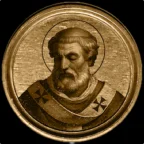
Pope Leo III
Pope Leo III (pope 795–816; canonised 1673) was Roman by birth, of modest and probably non-aristocratic family — his parents are named in the sources as Atzuppius and Elizabeth, names suggesting an eastern or southern Italian background rather than the old Roman clerical nobility. He rose entirely within the papal administration, serving in the vestiarium, becoming cardinal-priest of Santa Susanna, and finally vestararius, the official responsible for the papal treasury and its liturgical furnishings. That last post matters: he came to the papacy as a man who had spent his career among vestments, plate and precious metals, and his pontificate reflects it.
Election. Hadrian I died on 25 December 795; Leo was elected the following day, with unusual speed, and consecrated on 27 December. The haste was almost certainly designed to forestall the powerful clan of Hadrian's relatives, who regarded the see as theirs. Immediately after his consecration he sent Charlemagne the keys of the confessio of St Peter and the banner of the city, asking him to dispatch an envoy to receive the Romans' oath of fidelity — a gesture that acknowledged Frankish protection in unusually explicit terms and set the pattern for everything that followed.
The attack of 799. On 25 April 799, during the procession of the Greater Litany, Leo was ambushed in the streets of Rome by an armed faction led by Hadrian's nephews Paschalis, the primicerius, and Campulus, the sacellarius. The attackers attempted to blind him and cut out his tongue — the classic mutilations for rendering a man incapable of ecclesiastical office — and left him for dead. He recovered, or was reported to have recovered, both sight and speech; the papal sources treat this as miraculous, while the charges circulating against him were of perjury and adultery. He escaped to Spoleto and then travelled north to Charlemagne at Paderborn, an extraordinary journey that placed the bishop of Rome as a suppliant at a Frankish court.
Christmas 800. Escorted back to Rome, Leo faced his accusers only when Charlemagne arrived in person in November 800. The synod convened on 1 December concluded that the Apostolic See could be judged by no one — the principle prima sedes a nemine iudicatur — and on 23 December Leo cleared himself by a public oath of purgation, sworn voluntarily and with the explicit statement that it set no precedent. Two days later, at Mass in St Peter's on Christmas Day 800, he placed a crown on Charlemagne's head and the Roman people acclaimed him emperor. Einhard's celebrated claim that Charlemagne would not have entered the basilica that day had he known what was intended has been debated for twelve centuries. Whether the ceremony was a papal ambush, a negotiated arrangement whose choreography displeased the king, or a deliberate act of Frankish policy staged by Leo, it established the medieval theory that the imperial dignity was conferred by the pope — with consequences that ran through the Investiture Contest to the Reformation. It also gave permanent offence in Constantinople, where an emperor already existed.
Later pontificate. In 803 he suppressed the archbishopric of Lichfield, created under Hadrian I, restoring Canterbury's primacy over southern England. In 809 the Council of Aachen approved the insertion of the filioque into the Creed and sought his confirmation. Leo's response was carefully split: he accepted the doctrine as orthodox but refused to allow the addition to the sung Creed, and — according to the Liber Pontificalis — had the Creed engraved without the filioque on two silver shields in Greek and Latin, set up in St Peter's. It was a deliberate act of restraint that his successors eventually abandoned. After Charlemagne's death in January 814 a fresh conspiracy formed against him. Leo acted with severity, executing a number of Roman nobles without reference to the Frankish court; Bernard of Italy was sent to investigate. He died on 12 June 816 and was buried in St Peter's. Clement X canonised him in 1673; his feast is 12 June.
Art, building and patronage. Leo's vita in the Liber Pontificalis is among the longest in the entire collection, and the greater part of it consists of inventories: silk hangings, gold and silver vessels, vela with figured decoration, crowns, gospel covers, mosaic and pavement work in dozens of Roman churches. For anyone studying early medieval decorative arts, textiles and church furnishing, this is one of the richest documentary sources in existence — the more valuable because virtually none of the objects survives. He rebuilt and enlarged much of the Lateran patriarchium, and undertook work at St Peter's, Santa Susanna (his own titular church), San Paolo fuori le Mura and elsewhere.
Three points deserve particular attention. The Triclinium of Leo III at the Lateran — his great banqueting hall — was decorated with an apse mosaic that is the founding image of the new political theology: Christ giving the mission to the apostles in the conch, and on the flanking walls two paired scenes — St Peter conferring the keys on Pope Sylvester and the standard on Constantine, and St Peter conferring the pallium on Leo III and the banner on Charlemagne. It is the visual argument for the Christmas of 800, executed in the same years. The hall was demolished in the sixteenth to eighteenth centuries; what stands today in Piazza San Giovanni is a reconstruction of the eighteenth century, and its evidential value is contested. A fragment believed to come from the original survives in the Vatican. At Santi Nereo e Achilleo, the mosaic on the triumphal arch — Transfiguration, Annunciation, Virgin and Child enthroned — dates to his pontificate and is one of the few pieces of Leonine monumental decoration surviving in situ. Together with the roughly contemporary Roman mosaics of Paschal I it documents the Carolingian-era revival of the Early Christian idiom in Rome. Leo also appears with the square nimbus, the square halo denoting a living person, a convention that becomes standard in Roman donor portraiture of the ninth century and remains a useful dating and identification tool.
Assessment. Leo III was not a theologian or an administrator of the first rank, and his personal authority in Rome was always fragile — twice within twenty years the city's aristocracy tried to remove him by force. What he possessed was a clear grasp of a single strategic fact: that the papacy's future lay north of the Alps rather than in Byzantium. Everything else in the pontificate, including the mosaics, followed from that judgement.
-
Leon Authentes (Leontios Authentes)
Leon Authentes — known also as Leontios Authentes or Leon Afthentis — was a Byzantine Greek archon (local aristocrat) of Cyprus who in December 1192 commissioned the fresco cycle of the church of Panagia tou Araka (the Virgin of the Vetch) at Lagoudera in the Troodos Mountains. His name survives in a single dedicatory inscription above the north entrance of the church. That inscription, and the extraordinary paintings it records, constitute the entirety of the direct documentary record of his existence.
The designation Authentes (αὐθέντης) — etymological ancestor of the modern Greek afentis ("master," "lord") and the ultimate root of the English word "authentic" — designated a person of independent local authority: a landowner, a master of property and dependants, a man of standing in his community. The term carried no specific imperial court dignity, but placed Leon among the provincial landed class of Greek Cyprus — the archontes who had managed the island's affairs under Byzantine administration throughout the Komnenian period. He appears in the sources as both "Leon" and "Leontios," the longer form being the more formally Greek version of the same name.
To understand Leon Authentes, one must understand the convulsive political moment his patronage inhabited. In May 1191, Richard I of England — the same monarch whose defeat of the Byzantine usurper Isaakios Komnenos had been recorded with outrage by Neophytos the Recluse — conquered Cyprus en route to the Third Crusade. The island was sold to the Knights Templar, returned in the same year, and then purchased by Guy de Lusignan. When Guy became lord of Cyprus he distributed fiefs among incoming Latin lords, and many great Greek landholders were despoiled — one tradition has it that the archontes had first to surrender half their possessions. No Greek name is encountered among the vassals of the kings of Cyprus in the thirteenth century. The fresco cycle of Lagoudera was thus completed in the immediate aftermath — barely eighteen months — of the island's transfer from Orthodox Byzantine to Latin Frankish rule. For a Greek archon to commission a major fresco cycle in metropolitan Constantinopolitan style at precisely this moment was simultaneously an act of piety, cultural assertion, and — in its implicit evocation of the now-lost Byzantine civilisation of which he was a product — perhaps also one of quiet mourning.
The artist Leon engaged for this commission was Theodoros Apseudes — very likely the same painter who, nine years earlier in 1183, had executed the celebrated frescoes of the Enkleistra of St. Neophytos at Paphos under the patronage of Bishop Basil Kinnamos. Apseudes worked in the "classic court style" based on the "rococo" manner of painting evolved in Constantinople in the last quarter of the twelfth century. That this same Constantinopolitan court painter was available to a provincial Cypriot archon in December 1192 — and that Leon possessed both the resources and the artistic connections to engage him — speaks to the remarkable cultural density of late Byzantine Cyprus on the eve of its transformation into a Frankish kingdom.
The church of Panagia tou Araka is located near the village of Lagoudera, built atop the northeast slopes of Madari, the second highest summit of the Troodos Mountains. The paintings are of exceptional quality and follow the late Komnenian style, constituting the most complete series of frescoes of the Middle Byzantine period in Cyprus; both their style and iconographic programme express the trends of the art of Constantinople. Bearing in mind that almost nothing survives from this period in the empire's capital, one realises how important this monument is in the history of Byzantine art.
The iconographic cycle opens with scenes of the Lord surrounded by the throne of Preparation, Angels in medallions, Prophets, the Annunciation, and the Evangelists, followed by the Virgin Mary with Christ between Archangels and seven Saints of Cyprus, and scenes from the Birth of Christ, the Baptism, the Ascension, and the Dormition of the Virgin. The inclusion of the seven Cypriot saints on the semi-cylindrical apse wall — an explicitly insular, patriotic programme — is a striking choice for a patron commissioning art in the immediate aftermath of foreign conquest.
The single most iconographically significant image in the cycle is the Panagia Arakiotissa, the Virgin of the Passion, on the southeastern wall of the church — one of the oldest depictions of this iconographic type, in which the infant Christ, startled by angels bearing instruments of his future suffering, clings to his mother. The choice to commission what may be the first known image of the Virgin of the Passion acquires particular resonance read against the catastrophe of 1191: the suffering encoded in the image was simultaneously Christological and, for any Greek Cypriot of 1192, inescapably contemporary. Two portable icons of Christ and the Panagia Arakiotissa, now in the Byzantine Museum of the Archbishop Makarios III Foundation in Lefkosia and attributed to the same painter, suggest that Leon's commission encompassed both monumental and portable devotional objects.
The church became a UNESCO World Heritage Site in 1985. The frescoes in the apse of the bema are of a different style and are believed to have been painted by another artist slightly before 1192; the Virgin on the blind arch above the north entrance and some other scenes date from the fourteenth century; and the church was decorated for the last time in the seventeenth century, when the wooden iconostasis (1673) was also created.
Leon Authentes occupies a position in the history of Byzantine art comparable in some respects to that of Basil Kinnamos, whose patronage of the Enkleistra frescoes nine years earlier had produced the other great Theodoros Apseudes cycle on the island. Both men deployed metropolitan artistic talent in a provincial context; both were responding to acute historical pressures — Kinnamos to the last flourishing of Komnenian Cyprus, Authentes to its violent termination. What distinguishes Leon is the extremity of the moment: he commissioned art of the highest Constantinopolitan quality at the very instant when Constantinople's authority over Cyprus had been permanently extinguished. In doing so he produced — without knowing it — the most complete surviving document of the late Komnenian artistic tradition, precisely because the originals in Constantinople would be destroyed a decade later in the Fourth Crusade of 1204. He is, in this sense, one of history's great inadvertent preservers: a local lord in a mountain church in Cyprus, whose act of piety in December 1192 has saved for posterity what the imperial capital could not.
-
Liber Vitae of Corvey
The Liber Vitae (or memoriale) of Corvey is a confraternity-book listing monks, benefactors, and holy personages whose names were commemorated in the liturgy of the monastery. It belongs to the broader family of Carolingian libri memoriales, which served both liturgical and documentary purposes, structuring the community's idea of itself and its network of patrons. Studies of the Corvey Liber Vitae have shown that it preserves the names of many Corvey monks and external figures, and some scholarship explicitly notes that Adelricus appears in the Corvey list, confirming his monastic identity and linking him not only to the Vatican Terence but also to the commemorative culture of the abbey.
-
Lira senese and the Lira di San Donato
The Sienese Lira was one of the oldest and most sophisticated instruments of direct taxation in medieval communal Italy. Historians regard its establishment in the early thirteenth century as a clear sign of the administrative maturity of the Sienese commune, because it required a structured system of assessment, territorial organization, and written fiscal control unusual for so early a date.
The Lira was a direct tax on wealth, collected periodically by the Commune of Siena. Resident taxpayers were required to declare before the relevant officials their movable and immovable property, including land, houses, rents, livestock, and sometimes commercial credits. The name derived from the unit of account used for patrimonial assessment. Each declaration was a denuncia alla Lira, and the grouped declarations of a parish, district, or Terzo formed a Lira register. These registers were organized territorially, following Siena's three Terzi - Città, San Martino, and Camollia - and their dependent parishes.
The Lira di San Donato is therefore the fiscal register for the parish of San Donato, the district that developed around the Vallombrosan Benedictine monastery of San Michele Arcangelo in podio Sancti Donati, the institution that later gave its name to today's Piazza dell'Abbadia in Siena. Like other parish Lira registers, it listed household heads and property holders resident in the parish together with estimates of their taxable wealth. Preserved today in the Archivio di Stato di Siena, it is a major primary source for reconstructing the social and economic structure of the quarter in the thirteenth and early fourteenth centuries.
A document of particular importance is the Scompartimento delle Parrocchie e Contrade della Città di Siena fatto Terzo per Terzo nell'Anno 1318, compiled for a Lira or Presta imposed on real property. It provides a systematic parish-by-parish picture of urban property assessment, including San Donato, and shows the degree to which Sienese taxation depended on written, geographically ordered fiscal knowledge.
The institutional engine behind this fiscal system was the Biccherna, Siena's chief financial magistracy, already fully active and equipped with its own statute by at least 1226. It was governed by four Provveditori elected every six months, assisted by a camerlengo or treasurer. The Biccherna's books of receipts and expenditures - famous for their painted wooden covers from 1257 onward - form one of the richest surviving series of medieval financial documentation in communal Italy.
The wider Sienese fiscal archive included several complementary series. The Biccherna's books of income and expenditure form the oldest continuous sequence; the Lira registers were organized by parish and Terzo; the books of Preste recorded forced loans imposed on wealthy citizens in moments of military, political, or infrastructural emergency; and additional registers documented the operations of the general treasurer, the deliberations of fiscal officials, and the revenues of the salt customs system, one of the commune's principal sources of indirect taxation.
Because the Lira relied on self-declaration, it was vulnerable to underassessment by wealthier taxpayers. To address this problem, the Sienese government of the Nine ordered between 1315 and 1316 a more objective general cadastral survey of immovable property. Conducted between 1316 and 1320, this produced the celebrated Tavola delle Possessioni, often considered the earliest surviving serial cadastral documentation in Europe. The Tavola did not replace the Lira, but functioned alongside it as a cadastral reference, while Siena continued to rely on the older systems of Lira and Preste for ordinary fiscal administration.
-
Liutprand, King of the Lombards
Liutprand was king of the Lombards from 712 to 744, marking one of the longest and most transformative reigns in the kingdom's history on the Italian peninsula. Born around 680, he ascended the throne amid familial tragedy — his father Ansprand had been exiled by rivals, his brother blinded, and his mother and sister mutilated — yet he swiftly consolidated power after overthrowing King Aripert II, ruling for 31 years with a blend of military prowess, diplomatic acumen, and legislative innovation. His rule began aggressively, targeting Byzantine territories in Italy such as Ravenna's exarchate; he captured key sites like Bologna, Osimo, Rimini, Ancona, and the port of Classe, while maintaining a strategic alliance with the Franks under Charles Martel, cemented by his marriage to Guntrud, daughter of Bavarian duke Theodo I. Liutprand stands out for his extensive law-giving, issuing edicts in fifteen separate sessions between 713 and 735, which modernized Lombard law beyond tribal customs toward a more centralized royal authority; this legal corpus, preserved in the Edictum Langobardorum, not only stabilized his realm but left a lasting administrative legacy. A pivotal moment came in 728 with the Donation of Sutri, where Liutprand symbolically ceded the town near Rome to Pope Gregory II after initial seizures — the first grant of sovereign territory to the papacy. Tensions resurfaced under Pope Gregory III, but Liutprand signed a 20-year truce with Zachary in 741, prioritizing stability over conquest in his later years. Liutprand died in 744 in Pavia and was buried in the Basilica of San Pietro in Ciel d'Oro. Historians regard him as the most effective Lombard king, achieving hegemonic influence across Italy through conquests, legal reforms, and balanced foreign policy.
-
Lorenzo Ghiberti
Florence, c. 1378 – Florence, 1455
Florentine goldsmith, sculptor, and writer whose bronze doors for the Florence Baptistery marked a pivotal transition from Gothic to Renaissance art, blending classical naturalism with innovative perspective and narrative depth. Born around 1378 as Lorenzo di Cione di Ser Bonaccorso Ghiberti, he trained as a goldsmith in his father's workshop and under Bartoluccio di Michele, mastering techniques in modelling and chasing that later defined his sculptural reliefs. In 1401, at the age of twenty-three, he won the prestigious competition sponsored by the Arte di Calimala for the Baptistery's north doors, outshining rivals including Filippo Brunelleschi with his Sacrifice of Isaac panel — its balanced composition, nude figure inspired by classical antiquity, and subtle depth showcasing emerging humanist ideals within late Gothic conventions. This victory secured the commission for twenty-eight New Testament panels completed between 1403 and 1424.
His masterpiece, the east doors (1425–1452) — dubbed the "Gates of Paradise" by Michelangelo — features ten large panels from Genesis executed in schiacciato (flattened) relief with multi-plane compositions simulating atmospheric perspective and continuous narrative, drawing on Donatello's influence and antique sarcophagi. Surrounding frames with prophets and sibyls integrated architecture and sculpture, while free-standing figures such as the St. John the Baptist (1414) for Orsanmichele demonstrate the breadth of his workshop's output, which trained talents including Donatello, Masolino, and Paolo Uccello. These gilded bronze works embodied Florence's mercantile patronage, harmonising biblical storytelling with mathematical precision in foreshortening and the handling of light.
In the Commentarii (c. 1450) — the first autobiography by an artist — Ghiberti reflected on art's evolution from Cimabue to his own era, praising ancient Roman sculpture and advocating disegno as foundational. The Commentarii preserve important biographical and critical notices on Trecento masters, including Giotto, Cimabue, and the Berlinghieri family, that corroborate, amplify, or occasionally contradict the later accounts compiled by Vasari, and they remain a primary source for understanding how the art of the Duecento and Trecento was perceived by an informed witness working one generation after the style's apogee. Running a prolific bottega until his death on December 1, 1455, Ghiberti also served on the committee for Brunelleschi's dome; his sons Vittorio and Lorenzo the Younger continued the family legacy. His fusion of goldsmith finesse with monumental bronze bridged the International Gothic and the full Renaissance, establishing narrative sculpture as a rhetorical art form.
-
Louis the Pious, Emperor of the Carolingians
Louis the Pious (born 778 as Ludovicus Pius; d. 840) ruled the Carolingian Empire from 814 to 840, succeeding Charlemagne during the pivotal transition from military expansion to ecclesiastical consolidation and reform. His epithet derived from ostentatious acts of piety, most notably his public penance at Attigny in 822, where he atoned for blinding his nephew Bernard of Italy — a brutal enforcement of succession that haunted his reign. Crowned co-emperor by Charlemagne in 813 and sole ruler from 814, Louis immediately purged Aachen's court of "dissolute" figures and destroyed pagan artifacts to enforce moral rigor. The 817 Ordinatio Imperii divided the realm among his sons — Lothair (co-emperor, Francia Media), Pepin (Aquitaine), and Louis the German (Bavaria) — prioritizing imperial unity under clerical oversight while sowing the familial discord that would define his later years. He championed Benedict of Aniane's reforms, standardizing Benedictine observance via the Aachen councils of 816–819, which directly elevated Fulda's scriptorium: Rabanus Maurus became abbot in 822, fostering the opus geminata tradition in which Candidus composed his paired prose-verse hagiographies. Louis intervened decisively in Fulda's 816–822 turmoil by deposing Abbot Ratgar for tyrannical rule and installing the conciliatory Eigil, whose biography Candidus later penned as reformist propaganda. Sons rebelled in 830 and 833, deposing Louis at Colmar; restored by 834, he revised partition arrangements in 837 to favour the newborn Charles the Bald, fuelling further civil war until his death near Ingelheim in 840. The subsequent 843 Treaty of Verdun partitioned the empire into West Francia, East Francia, and the Middle Kingdom, fragmenting Charlemagne's vision into proto-national realms.
-
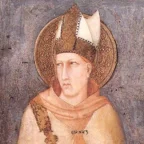
Louis of Toulouse (Louis of Anjou)
Louis of Toulouse, also known as Louis of Anjou, was a Neapolitan prince of the Capetian House of Anjou who renounced his rights to a royal throne in order to become a Franciscan friar and bishop, and was canonized as a saint in 1317. His brief life, marked by captivity, radical poverty and early episcopal office, made him a paradigmatic figure of Angevin piety and Franciscan spirituality at the turn of the fourteenth century.
Louis was born on 9 February 1274, probably at Brignoles in Provence, then part of the territories ruled by his Angevin family. He was the second son of Charles II of Anjou, later king of Naples and Sicily, and Mary (or Maria) of Hungary, placing him at the intersection of Capetian French and Hungarian royal lineages. Through his father he was a great-nephew of King Saint Louis IX of France, while on his mother's side he was related to Saint Elizabeth of Hungary and Saint Margaret of Hungary, giving him what contemporaries saw as an "impeccable saintly lineage." The family's dominions encompassed Provence, the kingdom of Naples and claims over Sicily and Jerusalem, and Louis grew up in a milieu shaped by dynastic warfare and crusading ambitions.
From an early age Louis was described as unusually devout and charitable, reportedly taking food from the castle to distribute to the poor and showing a particular concern for the sick. Later Franciscan hagiography emphasized his attraction to prayer and to the corporal works of mercy, building an image of a prince whose spiritual disposition anticipated his eventual renunciation of worldly power.
The decisive formative experience of Louis's youth came when he was taken hostage in the context of the War of the Sicilian Vespers, the violent conflict over Angevin control of southern Italy. Around the age of fourteen, Louis and two of his brothers were handed over as hostages to the Aragonese court as part of a political settlement involving their father Charles II and the king of Aragon. The brothers spent approximately seven years in captivity in Catalonia, probably in or near Barcelona, where they lived under relatively honorable conditions but remained pawns in Mediterranean power politics.
During this period the Angevin princes were educated by Franciscan friars, whose teaching combined scholastic formation with an emphasis on evangelical poverty and care for the marginalized. Under their influence Louis deepened his spiritual life, developed a special love for the poor and for those afflicted by leprosy, and gradually formed the intention to renounce his royal status in order to become a Franciscan. Sources record that while still a hostage he resolved internally to abandon the succession and embrace a life patterned on that of Saint Francis of Assisi.
Louis's spiritual project was complicated by a change in dynastic circumstances. His elder brother Charles Martel, originally heir to the Angevin claims, died unexpectedly, which placed Louis next in line to inherit the throne of Naples and the associated titles, including the largely nominal claim to the kingdom of Jerusalem. This made him, in theory, a future ruler whose decisions would shape the balance of power in the central Mediterranean, and family and papal interests pressed him toward acceptance of his political destiny.
Upon his release from captivity in 1295, Louis acted dramatically on his long-nurtured intention to abandon worldly power. He formally renounced his rights of succession in favor of his younger brother Robert, who would later rule as Robert of Anjou, king of Naples, thereby diverting the dynastic line and strengthening his brother's legitimacy with the aura of his own sanctity. Hagiographical tradition reports him saying that "Jesus Christ is my kingdom" and that Christ alone was his true wealth, phrases that encapsulate the Franciscan ideal of spiritual lordship through poverty. This renunciation had major political repercussions but also underpinned the later cult, in which Louis appeared as a prince who chose the mendicant life over a crown.
Louis's desire was to become an ordinary friar, but his royal birth made this impossible in the eyes of the papacy and his family. Pope Boniface VIII and Angevin advisers sought to harness his sanctity and his lineage for ecclesiastical politics, and in 1296 he was designated to the bishopric of Toulouse, a strategically important see in southern France. In order to reconcile his vocation with this appointment, the pope allowed him to make his Franciscan profession first, so that he entered the Order of Friars Minor and then, only a few days later, was ordained priest and consecrated bishop.
Some sources mention that he had first been proposed for the archbishopric of Lyon around 1295, an appointment he either refused or which did not come to fruition, suggesting that both court and papacy were searching for an appropriate episcopal role that would not overly inflame political tensions. On 5 February 1297 he was consecrated bishop of Toulouse, at a very young age and with limited experience, embodying the intertwining of noble birth and ecclesiastical office characteristic of the late thirteenth century.
Despite the brevity of his tenure, Louis acquired a reputation for notable pastoral zeal and generosity in Toulouse. He reportedly adopted a simple lifestyle consonant with the Franciscan rule, even while bound to the ceremonial and administrative obligations of a great bishopric. Contemporary and later accounts emphasize that he allocated a large portion-often said to be half to three-quarters-of the episcopal revenues to the poor and to the maintenance of churches, and that he daily fed a group of the indigent at his own table. These stories, though shaped by hagiographic convention, point to a deliberate effort to translate mendicant ideals into the context of high ecclesiastical office.
Louis is also portrayed as devoutly attentive to liturgical duties and visitation of his diocese, though his health appears to have been fragile and his period in office extremely short, lasting only a few months. His attachment to the Franciscan spirit remained strong: he continued to describe Christ as his only riches and sought to live as closely as possible to the friars' poverty, even while carrying a crozier and wearing a mitre.
Louis soon came to believe that he could not, or should not, continue as bishop of Toulouse and sought to resign the see in order to live more fully his Franciscan vocation. After only about six months in office he left his diocese and set out for Italy, intending to present his resignation personally to the pope, which suggests both a sense of responsibility and the hierarchical constraints under which he operated. On the journey, however, he fell ill, probably with a fever that some sources identify as typhoid, and died on 19 August 1297 at Brignoles, the place of his birth.
He was only twenty-three years old at the time of his death, having already passed through captivity, renunciation of a crown, entrance into the Franciscan Order and episcopal consecration. Reports of miracles at his tomb began to circulate soon afterward, including healings and other signs that were collected in a book of miracles associated with his cult. His body initially rested in Provence, and his relics later became the object of contention and translation, at one point being transferred from Marseille to Valencia by Aragonese forces, consolidating his status as a patron in both southern France and the Crown of Aragon.
The process leading to Louis's canonization unfolded rapidly by medieval standards. Pope John XXII, himself a former teacher of Louis and a pope with strong ties to the Franciscan movement, canonized him in 1317, making him the third member of the Order of Friars Minor to be formally declared a saint after Francis of Assisi and Anthony of Padua. This canonization responded to both genuine popular veneration and the active promotion of his cause by his family, notably his brother King Robert of Naples, who had inherited the throne renounced by Louis and had an interest in enhancing the prestige of the Angevin dynasty.
Liturgically his feast was fixed on 19 August, the anniversary of his death, and he was honored especially in Franciscan circles, in the Angevin domains and in regions connected with his life, such as Toulouse, Provence and Hungary. Over time he came to be invoked as a patron of youth, of those who renounce worldly status for religious life and of certain cities, including Valencia, where his relics were ultimately enshrined. His canonization also fed into broader debates within the Church about poverty and hierarchy, as his life seemed to show the compatibility-and tension-between Franciscan ideals and high ecclesiastical office.
Louis of Toulouse quickly became a favored subject for artists, especially in regions under Angevin influence, and his image played a significant role in late medieval and early Trecento visual culture. He is typically depicted in episcopal vestments-a mitre, a richly decorated cope often patterned with fleur-de-lis referencing his Capetian lineage, and sometimes a crozier-combined with Franciscan elements such as the cord of the friars or the brown habit visible under the liturgical garments. This blending of symbols visually articulates his double identity as prince-bishop and Franciscan friar, and many images include a crown placed at his feet or being handed to another, signifying his renunciation of royal power.
One of the most famous representations is the monumental altarpiece of Saint Louis of Toulouse painted by Simone Martini around 1317-1319 for the church of San Francesco in Naples, in which Louis is enthroned as a bishop while placing a crown on the head of his brother Robert, thereby legitimizing the latter's kingship through the saint's gesture. The saint also appears in Sienese painting, for instance in works associated with Pietro and Ambrogio Lorenzetti, and in later Renaissance panels such as a depiction by Giovanni Antonio Pordenone, where he stands holding a book and crozier, his cope adorned with fleur-de-lis. Manuscript illuminations, like the Getty Museum's "Initial T: Saint Louis of Toulouse," further disseminated his iconography in liturgical and devotional books, reinforcing his association with episcopal office, Franciscan humility and dynastic sanctity.
-
Louis VII, King of France ("the Younger")
Louis VII, known as the Younger, was King of France from 1137 until his death in 1180; he was the sixth ruler of the Capetian dynasty and the last to bear the title of "King of the Franks." His forty-year reign was dominated by three major themes: his failed marriage to Eleanor of Aquitaine, his disastrous participation in the Second Crusade, and his long-standing rivalry with Henry II of England, who seized the Aquitaine domains through Eleanor's second marriage.
Louis was born around 1120 in Paris, the second son of Louis VI the Fat and Adelaide of Savoy. He was not destined for the throne: the eldest son, Philip, was the designated heir, and Louis was sent to receive an ecclesiastical education, entrusted to the canons of Notre-Dame Cathedral in Paris, which left an indelible religious mark on him. In 1131, however, Philip died in a trivial accident - he was thrown from his horse by a stray pig that crossed his path - and Louis suddenly became heir to the throne, torn from the devout and ceremonious environment of the cloister to be plunged into the brutal reality of feudal politics. This rift between his religious calling and the demands of royal power shaped his entire personality: he was an intelligent and deeply pious man, but often hesitant and lacking the pragmatic toughness that medieval governance required.
In July 1137, a few days before becoming king upon his father's death, Louis married Eleanor of Aquitaine, the richest and most powerful woman in Western Europe, heiress to a duchy covering nearly a third of France. The marriage had been arranged by his father, Louis VI, as a strategic move to unite the French crown with Aquitaine, and it was a brilliant political move - so much so that Louis used the composite title of "King of the Franks and Duke of Aquitaine" for years. On a personal level, things were more complex: Eleanor was lively, cultured, independent, and a lover of troubadours; Louis was austere, devout, and tormented by religious scruples. One of the first serious incidents of his reign was the burning of the church at Vitry-en-Perthois in 1143, during a military campaign in Champagne: the flames killed over a thousand civilians who had taken refuge there, and remorse for that massacre haunted Louis for years, driving him to seek redemption through the crusade.
The Second Crusade (1147-1149)
In 1147, heeding the call of Pope Eugene III and the fiery preaching of Bernard of Clairvaux, Louis set out for the Second Crusade alongside Eleanor, who brought with her a retinue of ladies and an Aquitanian military contingent. The expedition was accompanied by marital tensions that escalated into an open crisis in Antioch, where Eleanor spent long days in private with her uncle Raymond of Poitiers, prince of the city: chroniclers of the time insinuated an adulterous affair, and Louis, wounded and furious, literally dragged his wife away from the city at night. Pope Eugene III, meeting them upon their return to Tusculum in 1149, attempted to reconcile the couple as we have already seen, insisting that they sleep in the same bed, but the damage was irreparable. The crusade ended with the shameful abandonment of the siege of Damascus after only five days in July 1148, a military defeat for which contemporaries sought a scapegoat and found one, in part, in Eleanor.
In 1152, the marriage of Louis and Eleanor was annulled on the pretext of consanguinity - both were descended from King Robert II of France - with the consent of a synod at Beaugency. Louis had fathered two daughters with his wife, Mary and Alice, but no male heir, and this was an urgent dynastic problem.
The divorce was the most politically disastrous decision of his life: Eleanor was free, and just eight weeks after the annulment she married Henry Plantagenet, Count of Anjou and Duke of Normandy, who in 1154 became King of England under the name Henry II. With this marriage, Louis's French rival acquired not only Aquitaine but also the Angevin domains: the Kingdom of France suddenly found itself surrounded to the west, north, and south by a vast "Angevin Empire," ruled by a lord richer and more powerful than the king himself. Louis remarried twice - in 1154 to Constance of Castile, who bore him two daughters, and in 1160 to Adele of Champagne, who finally gave him the long-awaited male heir, the future Philip II Augustus.
For the remainder of his reign, Louis never ceased to fight Henry II by every means at his disposal: open warfare, diplomacy, strategic marriages, and support for rebels within the Angevin kingdom. He supported the revolts of Henry's sons - Henry the Younger, Richard, and Geoffrey - during the great conflict of 1173-1174, seeking to dismantle the Angevin Empire from within. Domestically, Louis was a king who was relatively respectful of the autonomy of emerging cities: he encouraged the development of Capetian urban communes, granted charters of franchise to numerous cities, and maintained collaborative relations with the merchant bourgeoisie of Ile-de-France more systematically than his predecessors.
He was also a supporter of the University of Paris in its embryonic form, protecting the right of students and professors to operate in the capital.
Louis VII suffered a stroke in 1179, which partially paralyzed him and forced him to bring forward the coronation of his son Philip in Reims, a ceremony he was unable to attend. He died in Paris on September 18, 1180, at nearly sixty years of age, and was buried in the Abbey of Barbeau, which he himself had founded; his remains were transferred to the Basilica of Saint-Denis in 1817. Historiographical judgment of him has long been overshadowed by comparisons with his son Philip II Augustus, who built modern France, and with his rival Henry II, whose stature is beyond question. Yet Louis VII held the Kingdom of France together for forty-four years under extremely difficult circumstances, defended the papacy of Alexander III against Frederick Barbarossa, and upheld the Capetian principle of dynastic succession at a time when a single long-awaited male heir was enough to throw the entire monarchy into crisis.
-
Fra Ludovico da Pietralunga (16th century)
Ludovico da Pietralunga was a Franciscan Conventual friar, born at Pietralunga in the Alta Valle del Tevere (Umbria, in the territory of Città di Castello), who spent his mature years in the Sacro Convento at Assisi. He is consistently described in the literature as a frate-pittore — a friar who also practised painting, apparently at a modest artisanal level — though his own surviving output is negligible and this side of his career rests on slender evidence rather than on a documented corpus.
His claim on the attention of art historians rests entirely on one text: the Descrizione della Basilica di S. Francesco e di altri santuari di Assisi, compiled around 1570–1580 and preserved in manuscript 148 of the Biblioteca comunale di Assisi. It remained unpublished until the early twentieth century. The standard reference edition is Ludovico da Pietralunga, Descrizione della Basilica di S. Francesco e di altri santuari di Assisi. In appendice: Chiesa superiore, di Anonimo secentesco, ed. Pietro Scarpellini, Treviso, Canova, 1982 (series Fonti per la storia dell'arte) — cited in the scholarly literature as "Ludovico da Pietralunga, ed. 1982".
The Descrizione is the earliest systematic, room-by-room account of the decoration of the Basilica, and it is not a devotional inventory of relics but something closer to an artistic topography: Ludovico described the images, explained their iconography, recorded the names of illustrious donors — popes and cardinals — and dwelt at length on the names and merits of the painters. Because he wrote before the Baroque remodelling and the nineteenth-century interventions, he preserves evidence of things now lost.
Three examples of the kind of testimony he supplies: he is the first to record the panel of St Francis against a gold ground, surrounded by four scenes of miracles, now in the Museo del Tesoro; he recorded the tomb of Cardinal Gentile Partino da Montefiore in the pavement before the altar of the Cappella di S. Ludovico, of which no trace survives after the 1763 remodelling; and, read alongside Vasari, he documents heraldry in the Lower Church Passion cycle — the arms of Gualtieri di Brienne, recently identified in a badly worn portion of fresco by Michela Becchis exactly where Vasari and Ludovico had placed them, a find with consequences for the chronology of Pietro Lorenzetti at Assisi.
M
-
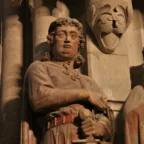
Margrave Ekkehard II of Meissen
Margrave Ekkehard II of Meißen (c. 985-1046) was the last ruler of the Ekkehardinger dynasty, a powerful noble family that controlled the eastern marches of the Holy Roman Empire in the early 11th century. He served as Margrave of Lusatia from 1034 and Margrave of Meißen from 1038 until his death, playing a crucial role as a close advisor to Emperor Henry III. Together with his wife Uta von Ballenstedt, he became immortalized as one of the twelve donor figures in Naumburg Cathedral, created by the Naumburg Master around 1245-1250, more than two centuries after their deaths.
Ekkehard was born around 985 as the younger son of Margrave Eckard I of Meißen (c. 960-1002), the founder of the Ekkehardinger dynasty, and his wife Swanehilde (Suanhild) of Billung, who belonged to the powerful Saxon Billung family. His father had been appointed Margrave of Meißen in 985 by Emperor Otto III following severe Saxon defeats against Slavic tribes during the Great Slav Rising. The Ekkehardinger family represented the first successful margravial dynasty to rule Meißen, establishing German authority over the disputed eastern frontier regions.
Ekkehard's path to power in 1034 was marked by violence and fratricide. He became Margrave of Lusatia (Lower Lusatia) after his followers assassinated the Wettin margrave Theoderic II, who was married to Ekkehard's own sister Matilda. This brutal act eliminated a rival dynasty and secured Lusatia for the Ekkehardingers. Four years later, in 1038, Ekkehard succeeded his brother Herman I as Margrave of Meißen, uniting both margraviates under his control and making him one of the most powerful nobles in the eastern Saxon territories.
In 1026, Ekkehard married Uta von Ballenstedt (c. 1000-1046), a noblewoman from the powerful Ascanian family. Uta had been educated at the monastery of Gernrode, where she learned to read and write as well as courtly manners and dance, accomplishments unusual for women of her era. The marriage was arranged according to common noble practice to strengthen political alliances and consolidate power. Though Uta was likely only around twelve years old at the time of marriage, as was customary for noblewomen of her status, she became an active partner in Ekkehard's governance and in their joint patronage of religious institutions.
Margrave Ekkehard remained one of the closest advisors to Emperor Henry III until his death, serving as a key figure in imperial policy along the eastern frontier. His dual control of Meissen and Lusatia made him indispensable to imperial strategy in managing the Slavic borderlands and maintaining German authority over the contested march territories. His exceptional wealth and political influence allowed him to play a decisive role in the governance of the eastern Saxon realm during a critical period of consolidation.
Ekkehard died on January 24, 1046, during a Saxon epidemic that claimed many lives. His death marked the extinction of the Ekkehardinger dynasty, as he left no male heirs to continue the family line. In an extraordinary testament to his loyalty to the empire, Ekkehard bequeathed his exceptional wealth and all his margravial titles and lands directly to King Henry III rather than to distant relatives. Henry subsequently bestowed the margraviate of Meissen on the Thuringian count William IV of Weimar, while Dedi I received Lusatia, effectively ending the Ekkehardinger control of the eastern marches.
Ekkehard and Uta were significant patrons and co-founders of Naumburg Cathedral, supporting its construction and endowment in the early 11th century. Their generous donations helped establish the cathedral as a major ecclesiastical center in the region. This patronage would lead to their commemoration in one of the most remarkable artistic achievements of the Middle Ages: the famous donor portraits created by the Naumburg Master between 1243 and 1250, more than two hundred years after their deaths.
The sculptures of Ekkehard and Uta in the west choir of Naumburg Cathedral represent masterpieces of Gothic sculpture and are among the most celebrated works of medieval art. Created around 1245-1260, these polychromed stone figures stand approximately 6 feet 2 inches (1.88 meters) tall. The Naumburg Master portrayed Ekkehard as a resolute warrior-nobleman, holding his sword firmly with a determined gaze that conveys self-confidence and strength, qualities essential for his roles in warfare and at the royal court. Beside him, Uta is depicted with her hand raised to her collar, creating an image of dignified sovereignty while suggesting protective self-containment. Since the sculptor worked two centuries after their deaths and had no portraits or descriptions to work from, these figures represent idealized types of noble benefactors rather than historical likenesses. The figure of Uta has become particularly famous, celebrated as one of the most beautiful and psychologically complex female sculptures of the medieval period.
-
Margrave Hermann I of Meißen
Margrave Hermann I of Meißen (c. 980-1038) was the eldest son of Margrave Eckard I and served as Margrave of Meißen from 1009 until his death, playing a crucial role in establishing Ekkehardinger power along the eastern frontier of the Holy Roman Empire. He was the elder brother of Ekkehard II, who would succeed him as margrave in 1038, and together they navigated the dangerous political landscape following their father's assassination in 1002. Like his brother, Hermann became one of the twelve donor figures immortalized in stone at Naumburg Cathedral, where the Naumburg Master created his portrait alongside his wife Reglindis around 1245-1250.
Hermann was born around 980 as the eldest son of Margrave Eckard I of Meissen (c. 960-1002), founder of the Ekkehardinger dynasty, and Swanehilde, daughter of the powerful Saxon duke Hermann Billung. His father's ambitions proved fatal: on April 30, 1002, Eckard I was murdered at the royal palace (Kaiserpfalz) of Pohlde after raising claims to the German throne following the death of Emperor Otto III. The newly elected King Henry II passed over Hermann and his brother Ekkehard, instead granting the Margraviate of Meissen to their uncle Gunzelin, forcing the brothers to retire to their family's allodial lands (hereditary properties not held as fiefs).
Hermann's fortunes changed during the ongoing conflicts with Poland. In 1007, during the German-Polish war, he was appointed count of Bautzen (Budissin), a strategic position in the Lusatian borderlands, though this territory was soon lost again to Polish king Boleslaw I Chrobry. The decisive turning point came in 1009 when King Henry II arrested and deposed Margrave Gunzelin, who had feuded continuously with his nephews. Hermann was chosen to replace him as Margrave of Meissen, having cultivated a far better relationship with the king than his uncle had managed. This appointment restored Ekkehardinger control over the march and marked the beginning of Hermann's nearly three-decade rule.
Hermann married Reglindis (also called Regelindis), daughter of the formidable Polish king Boleslaw I Chrobry of the Piast dynasty. This strategic marriage alliance connected the Ekkehardinger family directly to one of their most powerful adversaries, reflecting the complex diplomatic relationships along the German-Polish frontier. The marriage produced children who would continue the family line, and Reglindis appears alongside Hermann in the famous donor sculptures at Naumburg Cathedral. This Polish connection gave Hermann unique diplomatic leverage in the ongoing territorial conflicts that dominated his reign.
Margrave Hermann became a loyal supporter of King Conrad II, the first Salian emperor, who succeeded Henry II in 1024. In 1029, Hermann was granted additional titles and territories, being appointed count in the Saxon Hassegau and the adjacent Gau Chutizi in the March of Merseburg, significantly expanding his territorial authority. Despite his marriage ties to the Polish royal house, Hermann sent his forces against King Mieszko II Lambert of Poland (his brother-in-law) to reconquer Polish-occupied territories in the Lusatian marches. These military campaigns culminated in the Treaty of Merseburg in 1033, which secured the return of lost German territories and marked a turning point in the long conflict.
In 1028, with the consent of Emperor Conrad II, Hermann and his brother Ekkehard II undertook one of their most significant acts of religious patronage: the relocation of the Bishopric of Zeitz to Naumburg. Hermann endowed the new cathedral foundation at Naumburg generously with Ekkehardinger family properties (Eigengut), establishing what would become one of the most important ecclesiastical centers in eastern Saxony. This act of patronage not only strengthened the church's presence in the margraviate but also enhanced the family's prestige and spiritual legacy. The cathedral would later become the site of the famous donor sculptures that immortalized Hermann and his contemporaries.
Hermann's last years of governance, following the peace settlement of 1031 between Conrad II and Mieszko II Lambert, were marked by greater stability than the earlier decades of constant warfare. This peaceful period allowed the margrave to initiate the first efforts at territorial development (Landesausbau) in his domains, laying foundations for more systematic settlement and administration of the march. From 1032 onward, as Hermann's health declined, his brother Ekkehard II increasingly took over the administration of margravial affairs. Hermann died on November 1, 1038, having ruled Meissen for twenty-nine years. He was succeeded by his brother Ekkehard II, who would rule for only eight more years before the dynasty became extinct in 1046.
More than two centuries after his death, Hermann I was commemorated as one of the twelve founder figures in the west choir of Naumburg Cathedral, created by the Naumburg Master between 1243 and 1250. The sculptor portrayed him standing beside his wife Reglindis in polychromed limestone, part of an extraordinary ensemble celebrating the cathedral's noble benefactors. These donor portraits, standing approximately 6 feet tall, represent idealized types of 11th-century nobility rather than actual likenesses, since the sculptor worked without any contemporary descriptions or images to guide him. Nevertheless, Hermann's statue at Naumburg ensures his enduring presence as one of the great margraves of the Ekkehardinger dynasty and a key figure in the German colonization and Christianization of the Slavic borderlands.
-
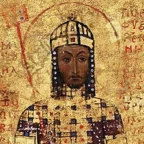
Manuel I Komnenos
Manuel I Komnenos (28 November 1118 – 24 September 1180) was a Byzantine emperor of the twelfth century who reigned over a crucial turning point in the history of Byzantium and the Mediterranean. His reign saw the last flowering of the Komnenian restoration, during which the Byzantine Empire experienced a resurgence of military and economic power and enjoyed a cultural revival. He is the emperor in whose court John Kinnamos served as imperial secretary — the same family name as the Bishop of Paphos, Basil Kinnamos, who ordained Neophytos the Recluse and commissioned the Enkleistra frescoes — and his reign forms the indispensable imperial backdrop to the entire Komnenian artistic renaissance whose provincial expression the Enkleistra represents.
Manuel was the fourth and youngest son of Emperor John II Komnenos and Irene of Hungary. He accompanied his father on military expeditions, and on one occasion led his personal attendants in a counterattack during the unsuccessful Siege of Neocaesarea (1140) against the Danishmendid Turks, which reversed the course of the engagement. John praised him as the "Saviour of the Romans," though also criticised his rashness. Manuel inherited the throne following his father's death in a freak hunting accident on 8 April 1143. John had passed over his elder son Isaac, deeming him too easily angered, and named Manuel his successor a few days before dying in Cilicia. Manuel raced back to Constantinople to secure the palace before his surviving brother could act, and was crowned emperor — the fourth ruler of the House of Komnenos.
His first major test was the Second Crusade (1147–1149). Manuel was forced to accommodate the passage of two large armies, under Conrad III of Germany and Louis VII of France; despite tensions and outbreaks of violence, both left Byzantine territory with relatively little damage, and Manuel subsequently made favourable agreements with both rulers. He married strategically into western dynasties: his first wife was Bertha of Sulzbach (renamed Eirene, 1146), sister-in-law of Conrad III, who died in 1159; his second wife, married in 1161, was Maria of Antioch — a union that visibly embodied his sustained engagement with the Crusader world. He made alliances with Pope Adrian IV, invaded the Norman Kingdom of Sicily (unsuccessfully), and was the last Eastern Roman emperor to attempt reconquests in the western Mediterranean.
Manuel's most spectacular eastern achievements came in the late 1150s. Following Reynald de Châtillon's attack on Byzantine Cyprus in 1156 — the very island where Neophytos had just established himself as a hermit the previous year — Manuel campaigned in Cilicia in 1158 and forced the submission of Antioch. He made a ceremonial entry into the city on horseback while the Prince of Antioch and King of Jerusalem walked behind him on foot, personally led his troops to defeat the Latin knights commanded by de Châtillon, and himself unhorsed two Italian knights. This triumph of 1159 represented the apex of Byzantine prestige in the Crusader world. Manuel established a Byzantine protectorate over the Crusader states of Outremer and participated in a combined invasion of Fatimid Egypt. In the Balkans, following his alliance with Béla III of Hungary, he became overlord of Serbia, Bosnia, and Croatia, and in 1167 Dalmatia, Croatia, and Bosnia were incorporated into the empire.
The gravest miscalculation of his reign was his rupture with Venice. Resenting the exceptional commercial privileges Venice had held since the reign of his grandfather Alexios I, Manuel confiscated Venetian goods, property, and ships, and arrested some 10,000 traders throughout the empire in 1171. Alternative Italian states such as Genoa and Pisa were supported instead, but the effect on Venetian dominance was negligible. Venice sent a fleet to exact revenge; an immediate crisis was averted when the Venetian crews were struck down by plague during a diplomatic parley, but the long-term wound festered. Venice's desire for vengeance contributed materially to the catastrophe of the Fourth Crusade and the sack of Constantinople in 1204.
Towards the end of his reign, Manuel's eastern achievements were compromised by a serious defeat at Myriokephalon on 17 September 1176. His army was trapped in a narrow pass in the Phrygian mountains; a massacre was only avoided through a peace settlement requiring the demolition of Byzantine fortresses at Dorylaeum and Sublaeum. Although he concluded a subsequent advantageous peace with Sultan Kilij Arslan II, Myriokephalon proved the final unsuccessful effort by the empire to recover the interior of Anatolia from the Turks, and created an enemy who would prove more than troublesome in the coming decades.
Manuel was one of the most personally compelling of all Byzantine emperors, called ho Megas (ὁ Μέγας, "the Great") by the Greeks. He appears as the hero of a history written by his secretary John Kinnamos, in whom every virtue is attributed to him. His court was a place of unusual cultural openness, combining Byzantine learned tradition with western chivalric influences absorbed through decades of crusading contact. Manuel composed a defence of astrology to the Church Fathers, asserting its compatibility with Christian doctrine — a controversy in which the theologian Michael Glykas refuted his arguments, revealing an emperor willing to enter theological debate in his own name. Venetian and other Italian traders became resident in Constantinople in large numbers, and their presence, together with the numerous Latin mercenaries Manuel employed, helped to spread Byzantine technology, art, literature, and culture throughout the Roman Catholic West. The "rococo" court style of Constantinopolitan painting that flourished during his reign — the very manner that Theodoros Apseudis brought to the Enkleistra in Cyprus in 1183 — was the direct artistic product of this cosmopolitan court atmosphere.
Manuel died on 24 September 1180, aged sixty-one, in Constantinople, succeeded by his eleven-year-old son Alexios II Komnenos with Maria of Antioch as regent. The succession crisis that followed was catastrophic: within three years Andronikos I Komnenos had seized power, had Maria of Antioch executed, strangled the young emperor, and assumed the throne himself — only to be overthrown and brutally killed in a popular uprising in 1185. The cultural flowering of Manuel's reign was nonetheless genuine and lasting. The Komnenian artistic style he patronised radiated from Constantinople to every corner of the Byzantine world and beyond — to Cyprus, to Sicily, to Venice, to the monasteries of Serbia and Russia — carrying the visual language of an empire that, even as it contracted militarily, continued to define the aesthetic horizon of the medieval Christian East.
-
Margaret of Brabant (Brabant, 4 October 1276 – Genoa, night of 13–14 December 1311)
Queen of the Germans and of Italy, wife of the Emperor Henry VII of Luxembourg
Margaret was the daughter of John I, Duke of Brabant, Lothier and Limburg, and of his second wife, Margaret of Flanders (Dampierre), daughter of Guy of Dampierre, Count of Flanders. She grew up in a duchy still absorbing the consequences of the War of the Limburg Succession, in which her father had defeated the Archbishop of Cologne and Henry, Count of Luxembourg, at the battle of Worringen in 1288 — a victory that left the house of Luxembourg the losing party, and made Margaret's own marriage, four years later, into an instrument of reconciliation between the two houses.
In Pentecost week of 1292 she married Henry of Luxembourg, the future Emperor Henry VII: the union settled the dispute over Limburg and joined the two dynasties that had recently faced each other in battle. Contemporaries describe the marriage as a genuinely affectionate one. Three children are documented: John, later called "the Blind" (10 August 1296 – 26 August 1346), who succeeded his father as Count of Luxembourg and became King of Bohemia through his marriage to Elisabeth Přemyslid; Marie (1304 – 26 March 1324), who became the second wife of King Charles IV of France and died in childbirth; and Beatrice (1305 – 11 November 1319), who married King Charles I of Hungary and likewise died young.
When Henry was elected King of the Romans at Frankfurt on 27 November 1308, Margaret was crowned beside him at Aachen on 6 January 1309, becoming queen of the Germans. She accompanied her husband on the Italian expedition of 1310–1313, the campaign — urged in Dante's political writings as the restoration of imperial authority in Italy — that would end in Henry's coronation as emperor in Rome and, within a year, in his own death. The royal couple crossed the Alps by the Mont Cenis pass, reached Susa on 23 October 1310, and progressed through Turin, Asti, Vercelli and Novara before entering Milan on 23 December. There, on the feast of the Epiphany, 6 January 1311, in the basilica of Sant'Ambrogio, Henry was crowned King of Italy with the Iron Crown of the Lombards — some accounts say with a substitute, the crown proper at Monza being unavailable — and Margaret was crowned queen at his side.
Margaret's part in the expedition was not merely ceremonial. Three letters composed by Dante Alighieri in 1311 in the name of Gherardesca di Battifolle, wife of the imperial vicar Guido Guidi, Count Palatine of Battifolle — the Epistles conventionally numbered VIII, IX and X, of which only X carries a firm date, 18 May 1311 — are addressed to Margaret, and attest to her active role in securing allies and adherents for her husband among the cities and lords of Italy. Contemporary chroniclers describe her besides as devout and charitable, personally serving food to the poor and working for reconciliation among the factions Henry's expedition encountered; during the siege of Brescia (May–September 1311) she is credited with having interceded to spare the civic bell-tower of Cremona, the Torrazzo, from destruction.
It was of the plague that broke out among the imperial forces at Brescia, in the judgement of the modern scholarship, that Margaret herself died in Genoa, in her thirty-sixth year, on the night of 13–14 December 1311 — one chronicler, Albertino Mussato, placing her death not within the city walls but at the nearby palace of the Zaccaria family. Henry had gone on to Genoa after securing Brescia's surrender, in preparation for the continuation of his march toward Rome and the imperial crown he would receive there, alone, on 29 June 1312. Margaret was buried near the high altar of the Franciscan church of San Francesco di Castelletto, and within two years, in 1313, was locally venerated as blessed. Because her death preceded her husband's own imperial coronation by some six and a half months, Margaret herself was never crowned empress, though later tradition — including the literature attached to her tomb — has often given her that title by courtesy.
Her grieving husband commissioned the funerary monument from Giovanni Pisano, then the most celebrated sculptor in Italy, in the spring of 1312; execution occupied 1312–1313 on the reconstruction followed in the entry on Giovanni Pisano, though some accounts extend the campaign into 1314. The monument originally stood in the apse of San Francesco di Castelletto; dismembered before 1602 and reused elsewhere within the same church, it was reduced to fragments when the building was demolished between 1798 and 1810. The surviving pieces — chief among them the celebrated group of the queen raised toward heaven between two attendant figures, the elevatio — passed through the Brignole Sale family's Villa Duchessa di Galliera at Voltri before their rediscovery there in the 1870s by the sculptor and antiquarian Santo Varni, and are now held in the Museo di Sant'Agostino, Genoa. See the entry on Giovanni Pisano for the monument itself.
-
Martin IV, Pope
Pope Martin IV was born Simon de Brion (also rendered Simon de Brie), most likely around 1210–1220, in the region of Brie or Touraine in northern France, though some sources point to Montpincon in Normandy as his birthplace. The precise date of his birth remains uncertain, as is common for ecclesiastical figures of his era. He came from a family of minor French nobility, a background that would prove decisive in shaping both his personality and his political allegiances throughout his life.
He received an excellent education, studying theology and canon law in Paris, then the intellectual capital of Latin Christendom and home to the most celebrated cathedral school in Europe. His scholastic formation placed him squarely within the tradition of rigorous Parisian theology, contemporaneous with the great flowering of scholasticism that produced figures such as Bonaventure and Thomas Aquinas.
Simon de Brion's early clerical career was marked by rapid advancement through the French royal administration. He became a canon at Rouen and subsequently at Paris, before entering the service of the French crown at the highest levels. He served as Keeper of the Royal Seal (Garde des Sceaux) and effectively as Chancellor of France under King Louis IX (Saint Louis) and subsequently under his son Philip III (Philip the Bold).
His close relationship with the Capetian monarchy was formative. He witnessed at close range the saintly and crusading character of Louis IX, and he absorbed deeply the idea that the French crown and the papacy shared a providential mission in Christendom. This conviction would later translate, during his pontificate, into an almost unconditional alignment of papal policy with French Angevin interests.
In 1261, Pope Urban IV — himself a Frenchman (Jacques Pantaleon of Troyes) — elevated Simon de Brion to the cardinalate, naming him Cardinal-Priest of Santa Cecilia in Trastevere, one of the ancient titular churches of Rome. This appointment marked the definitive transition from royal administrator to prince of the Church.
He served subsequently as papal legate in France on multiple occasions under Popes Urban IV and Clement IV, demonstrating considerable diplomatic skill in managing the complex relationship between the papacy and the French throne. One of his most consequential legations involved supporting the ambitions of Charles of Anjou, brother of Louis IX, in southern Italy — a political investment that would bear bitter fruit during his own pontificate.
Pope Nicholas III (Giovanni Gaetano Orsini) died on August 22, 1280, at Soriano nel Cimino. The conclave that followed took place in Viterbo and was one of the most contentious of the thirteenth century. The College of Cardinals was deeply divided between a powerful Italian faction — determined to maintain Roman aristocratic control over the papacy — and the French cardinals, backed by the formidable influence of Charles of Anjou, the dominant political force in central and southern Italy.
The deadlock lasted several months. It was eventually broken, at least in part, through pressure exerted by Charles of Anjou on the Italian cardinals. On February 22, 1281, Simon de Brion was elected pope and took the name Martin IV.
The choice of name is noteworthy and involves a historical confusion that persisted through the Middle Ages: Popes Marinus I (882–884) and Marinus II (942–946) had been mistakenly identified in the official lists as Martinus II and Martinus III. As a result, Simon de Brion, adopting the name Martin, was actually only the second pope to bear that name since the genuine Martin I (649–655), though he styled himself Martin IV. This numbering anomaly was not corrected until modern times.
At the time of his election, Simon de Brion was not yet in major holy orders — a not uncommon situation for high-ranking ecclesiastics of the era who had risen primarily through administrative rather than pastoral channels. He was accordingly ordained priest and then bishop in rapid succession, and consecrated as Supreme Pontiff on March 23, 1281, at Orvieto.
Martin IV's pontificate lasted just over four years, from 1281 to 1285. It was dominated, almost from beginning to end, by the profound political crisis unleashed by the Sicilian Vespers of 1282 and by his close, often servile relationship with Charles I of Anjou, King of Sicily and Naples and Senator of Rome. Contemporaries and later historians alike recognized that Martin IV was, in many respects, less the autonomous leader of Christendom than an instrument of Angevin foreign policy dressed in papal vestments.
From the very outset of his pontificate, Martin IV placed himself in the orbit of Charles of Anjou. He confirmed and extended Charles's position as Senator of Rome, a civic title that gave the Angevin king effective control of the city. This move alarmed many within the Italian ecclesiastical establishment, who had hoped for a more independent papacy after the death of the strongly pro-Roman Nicholas III.
Martin IV never actually resided in Rome during his pontificate. His court was established variously at Orvieto, Montefiascone, and finally Perugia, where he would die. His inability or unwillingness to reside in Rome — largely due to the political turbulence of the city and the dominant Angevin influence — was itself a symptom of the weakened position of the Holy See as an autonomous political actor.
One of Martin IV's most consequential early decisions was the repudiation of the ecclesiastical union achieved at the Second Council of Lyon (1274) under Pope Gregory X. That council had secured a formal, if largely nominal, reunion between the Roman Church and the Byzantine Church, engineered through the submission of Emperor Michael VIII Palaeologus (1259–1282), who had agreed to acknowledge papal primacy in exchange for political protection against Western aggression.
The Lyonese union had been deeply unpopular in Constantinople, where the vast majority of clergy and laity regarded it as a betrayal of Orthodoxy. Michael VIII had been forced to impose it by authoritarian means, provoking fierce resistance from monks, bishops, and the general populace. Nevertheless, it had served its diplomatic purpose: it had stayed the hand of Charles of Anjou, who had been planning a massive military expedition to overthrow the Byzantine Empire and restore the Latin Empire of Constantinople, which had fallen to Michael in 1261.
Martin IV, aligned with Charles's ambitions and uninterested in the theological niceties of Eastern Christianity, formally excommunicated Michael VIII Palaeologus in 1281, effectively nullifying the union of Lyon. This act removed the last diplomatic barrier to Charles of Anjou's projected crusade against Byzantium, a massive naval and military operation that was being assembled through the late months of 1281 and early 1282.
Michael VIII, isolated and facing existential threat, responded through one of the most dramatic episodes of medieval political espionage: he provided financial and diplomatic support to the Sicilian conspiracy that would detonate the Vespers.
The evening of March 30, 1282 — the Monday of Easter Week — witnessed one of the most dramatic popular uprisings of the Middle Ages. At the Church of the Holy Spirit (Santo Spirito) outside Palermo, a dispute between French soldiers and Sicilian townspeople erupted into a massacre. Within hours, the revolt had spread across the entire island. By dawn, thousands of French men, women, and children had been killed throughout Sicily, and the Angevin administration had been effectively annihilated.
The Sicilian Vespers was not purely spontaneous. It was the product of years of resentment against the harsh and exploitative rule of Charles of Anjou, combined with secret encouragement from Michael VIII Palaeologus and the disaffected Sicilian nobleman John of Procida, who served as a covert agent weaving together a conspiracy involving Aragonese, Byzantine, and Sicilian interests.
The political consequence was seismic. The Sicilians, unwilling to return to Angevin rule, offered the crown of Sicily to Peter III of Aragon, who was married to Constance, daughter of King Manfred of Sicily and granddaughter of Emperor Frederick II — and thus a legitimate claimant through the Hohenstaufen line. Peter landed in Sicily in August 1282 and was acclaimed king.
Martin IV's response was unequivocal and catastrophic in its long-term consequences. He excommunicated Peter III of Aragon (November 1282), declared Peter deposed from all his kingdoms and dignities, called for a Crusade against Aragon offering the kingdom of Aragon to Charles of Valois, and placed Sicily under interdict.
These measures were constitutionally audacious — the papacy claiming the power to depose a sovereign king and assign his kingdom to another — but politically hollow. The Crusade against Aragon was launched in 1284–1285 under Philip III of France, but proved a military disaster, ending in the retreat and death of Philip III at Perpignan in October 1285. Peter III of Aragon was not dislodged, and the War of the Sicilian Vespers would drag on for twenty years after Martin's death, finally settled by the Peace of Caltabellotta (1302).
For the papacy, the Vespers crisis represented a catastrophic failure: the loss of Sicily to Angevin control, the collapse of the anti-Byzantine crusade project, and the exposure of the fatal weakness of a papacy too closely bound to a single secular power.
Beyond the consuming Sicilian crisis, Martin IV attended to several matters of internal Church governance. He was a consistent supporter of the Mendicant orders — the Franciscans and Dominicans — whose role in preaching, inquisition, and university theology was a central feature of thirteenth-century Catholic life. He issued several privileges confirming and extending their rights against the often fierce opposition of the secular clergy and diocesan bishops.
He also engaged with the ongoing debates about Franciscan poverty, though the most acute phase of the controversy over the usus pauper and the question of whether Christ and the Apostles had owned property would only come to a head under his successors. His general sympathy lay with the Franciscan cause.
His pontificate saw no major ecumenical council, no landmark theological definition, and no significant liturgical reform. The political emergencies of his reign consumed virtually all available energy.
Martin IV's posthumous reputation received its most memorable (and devastating) literary treatment from Dante Alighieri in the Commedia. In Purgatorio, Canto XXIV, Dante encounters the penitent souls of the gluttons, and the poet Forese Donati identifies among them:
Ebbe la Santa Chiesa in le sue braccia: / dal Torso fu, e purga per digiuno / le anguille di Bolsena e la vernaccia.
Dante places Martin IV among the gluttons, purging his excessive love of food — specifically eels from Lake Bolsena prepared in Vernaccia wine, a Ligurian white wine. The image, combining irony with political commentary, encapsulates Dante's judgment on a pope who, in the poet's view, had gorged himself on temporal pleasures and Angevin patronage while neglecting his spiritual duties. Whether the detail about the eels was literally true or a satirical invention, it lodged itself permanently in the cultural memory of the medieval papacy.
Martin IV died at Perugia on March 28, 1285, having never returned to Rome during his entire pontificate. He was buried in the Cathedral of San Lorenzo in Perugia, where his tomb, bearing a fine Gothic effigy, can still be visited. The tomb is attributed to the workshop active in Perugia in the late thirteenth century, though precise attribution remains debated among art historians.
He was succeeded by Honorius IV (Giacomo Savelli), elected May 2, 1285.
Martin IV occupies a difficult place in the history of the medieval papacy. His pontificate coincided with a moment of maximum Angevin domination over the Holy See, a condition that seriously compromised the papacy's claim to stand above political factions as the universal arbiter of Christendom. His excommunication of Michael VIII — effectively burying the Union of Lyon — set back any prospect of genuine reconciliation between Rome and Constantinople for centuries. His crusade against Aragon, theologically and juridically dubious, ended in failure and embarrassment.
Yet it would be unfair to dismiss him entirely. He was a man of genuine learning, long experience, and sincere personal piety. His tragedy was structural as much as personal: elected through Angevin influence, dependent on Angevin power for the security of the Papal States, he lacked the independence — or perhaps the will — to chart a course of his own.
He reigned at the precise moment when the great edifice of thirteenth-century papal supremacy, built by Innocent III and Innocent IV, was beginning to show its deepest cracks. The Sicilian Vespers, which shattered the Angevin project of Mediterranean domination, also exposed the limits of a papacy that had subordinated itself to that project. In a sense, the catastrophe that overwhelmed Martin IV was the catastrophe of an entire era of papal history — the end of the confident, universalist papacy of the high Middle Ages, and the prelude to the Avignon captivity that would follow a generation later.
-
Matilda of England, Duchess of Saxony and Bavaria (1156–1189)
Matilda of England (June 1156 – June/July 1189) was an English princess of the House of Plantagenet and by marriage Duchess consort of Saxony and Bavaria from 1168 until her husband's deposition in 1180. Born as third child and eldest daughter of King Henry II of England and Eleanor of Aquitaine, she was named after her paternal grandmother, Empress Matilda, and baptized shortly after birth in Holy Trinity Priory, Aldgate, by Theobald of Bec, Archbishop of Canterbury. Her siblings included Henry the Young King, Richard I (who became Richard Lionheart), Geoffrey II of Brittany, Eleanor of England (Queen of Castile), Joan (Queen of Sicily), and the future King John. Her mother Eleanor was the most culturally formidable woman in Europe; her father Henry II was the architect of the Angevin Empire. Into this family, defined by its ambitions, its quarrels, and its relentless political energy, Matilda was born as the eldest daughter — the first of the family's daughters to be deployed as a diplomatic instrument on the continental stage.
The political logic of her marriage was worked out in the mid-1160s at the intersection of two converging crises. Upon the disputed Papal election of 1159 and the ensuing schism, Henry II established closer ties to the Holy Roman Empire, particularly when he came into conflict with Thomas Becket. Emperor Frederick Barbarossa sent the Cologne Archbishop Rainald of Dassel to negotiate an English–German matrimonial alliance, and Henry the Lion was chosen as a match for Matilda. Matilda was just nine years old when negotiations began in 1165. She left England in September 1167, and the wedding finally took place in Minden Cathedral on 1 February 1168. Her husband was 27 years older than her, the lord of a territory stretching from the Harz Mountains to the Baltic Sea; their official residence was Dankwarderode Castle at Brunswick, where the newlyweds had their wedding feast.
In the early years of marriage, despite her youth, Matilda ruled the vast ducal estates in her husband's absence — a formulation that places a girl who arrived in Germany at eleven or twelve in charge of the administration of two major duchies while Henry pursued his campaigns in the east and his pilgrimage to Jerusalem. A bracteate coin issued around 1172 documents her formal status: it portrays Matilda alongside Henry the Lion enthroned, with her holding a lily-crowned sceptre denoting consors regni — co-ruling authority atypical for a foreign consort. To show the duchess enthroned and sceptred alongside her husband was a public, circulating statement of political legitimacy that her Plantagenet lineage, as daughter of a king and granddaughter of an empress, made entirely credible.
Her children included Henry V (Count Palatine of the Rhine), Lothar of Bavaria, Otto IV, Holy Roman Emperor, and William of Winchester. Through her youngest son William she is an ancestress of the House of Hanover, which ascended the British throne in 1714 and continues as the British royal family to this day. In Germany, Henry and Matilda held a magnificent court at Dankwarderode Castle and had Brunswick Cathedral erected from 1173 onwards, dedicated to St Blaise and St John the Baptist and later also to St Thomas Becket — the cathedral consecrated by their eldest son on 29 December, the feast day of St Thomas, in an act of liturgical piety that simultaneously honoured the Plantagenet martyr and rehabilitated the reputation of the family whose member had caused his death. Matilda played an instrumental role in establishing the Becket cult in Saxony through her patronage, demonstrating to the world that her father had received the martyr's forgiveness.
The crisis of 1180 — when Frederick Barbarossa stripped Henry of his duchies and invaded Saxony — placed Matilda in circumstances that tested both her courage and her political intelligence. She appealed to the Emperor's chivalry to end the siege of Brunswick; her success saved the city from destruction. In November 1181 Henry submitted to the forfeiture. Matilda declined the Emperor's offer to retain her dower lands in Lüneburg, opting instead to join her husband in exile with their children. The family arrived at the court of her father Henry II of England in autumn 1181. By the summer of 1182 they reached Argentan in Normandy, where Matilda became acquainted with the troubadour Bertran de Born, who, calling her "Elena" or "Lana," made her the object of his desire in two poems of courtly love, comparing her beauty to that of Helen of Troy. In 1185, when Henry's three-year banishment ended, Henry II achieved the restitution of the allodial lands of Brunswick, and Matilda returned there with her husband and children.
Matilda's role in the commissioning of the Gospels of Henry the Lion was more than ceremonial. It is almost certain that, together with her husband, she was a patron and co-donor of the famous manuscript, created between 1175 and 1188 at Helmarshausen Abbey. The manuscript's iconographic programme makes this co-patronage visually explicit: the first miniature depicts the Duke and Duchess presenting the manuscript to the enthroned Virgin Mary, and the manuscript has been called the Gospels of Henry and Matilda. The Coronation miniature — the most genealogically ambitious image in the manuscript — shows the hands of God descending to crown both Henry and Matilda simultaneously, Matilda's Plantagenet ancestry displayed alongside Henry's Welf and imperial lineage, a statement of equivalence that places her as a full participant in the dynastic self-representation the manuscript embodies. Her son Henry of Brunswick's charter of 1223 describes "his dearest mother of most happy memory" as the sole donor of the altar dedicated to the Virgin in the church of St Blaise at Brunswick — suggesting that her contemporaries understood her role in the cathedral's patronage as having a distinct identity from that of her husband.
In the spring of 1189, facing the emperor's renewed ultimatum — crusade or exile — Henry chose exile and returned to England, while Matilda and her children remained in Brunswick to defend his interests. She died there, aged thirty-three, in June or July 1189, and was buried in Brunswick Cathedral. Her father, King Henry II of England, died approximately eight days after her — almost certainly before the news of her death reached him in Normandy. Henry the Lion returned to Brunswick after Frederick Barbarossa's death in 1191 and died in 1195, wishing to rest on the right hand of his wife "both in life and in death." Their sarcophagi lie side by side in the crypt of Brunswick Cathedral, beneath the church they built together, beside the altar she donated, in the city she had governed in his absence since she was twelve years old.
-
Michael Doukas Glabas Tarchaneiotes
Michael Doukas Glabas Tarchaneiotes — also known as Michael Tarchaneiotes Glabas — was born around 1235 and died after 1304. His full name combined the surnames of several of Byzantium's most distinguished aristocratic lineages: the Doukai, whose imperial prestige dated to the eleventh century; the Glabas, a military clan of long standing; and the Tarchaneiotai, a family of probable Turkic origin that had been thoroughly hellenised and integrated into the Byzantine military aristocracy by the Komnenian period. The layering of these names was not merely ornamental — it mapped a man's position within the dense web of intermarriages, alliances, and social debts that constituted the ruling class of the restored Palaiologan empire.
Michael Doukas Glabas Tarchaneiotes has often been confused, including in relatively modern studies, with the protovestiarios Michael Tarchaneiotes, a nephew of Michael VIII Palaiologos who was killed in 1283. The two men were contemporary, bore similar names, and served in overlapping theatres — a confusion that has affected the reliability of some older scholarship on both figures. The man known as Glabas was a different person entirely, of distinct though related aristocratic lineage.
Glabas married Maria Doukaina Komnene Branaina Palaiologina. The genealogical wealth embedded in her name — Doukaína, Komnēnē, Branaína, Palaiológina — placed her among the interconnected dynasties of Byzantine high nobility, and the union substantially reinforced Glabas's position at the Palaiologan court. They had one daughter, who married into the extended Angelos-Komnenos-Branas clan, further weaving the family into the uppermost tier of the imperial aristocracy.
Glabas is first mentioned around 1260, when he was assigned to capture the city of Mesembria on the Black Sea coast from the deposed Bulgarian tsar Mitso Asen. This initial assignment, at the very moment of the Palaiologan restoration following the recovery of Constantinople from the Latins in 1261, establishes the essential character of his career: a lifetime spent defending and extending the empire's northern and western frontiers.
At the same time, he rose in the imperial hierarchy, occupying progressively higher titles: from primmikerios of the court (33rd in the hierarchy), he became megas papias (22nd), pinkernes (15th), megas konostaulos (12th), and finally, sometime between 1297 and 1304 — probably around 1302–1303 — protostrator (8th in the hierarchy), in essence the commander-in-chief of the army, as the nominally superior megas domestikos had by that time become an honorific post. This steady ascent through six distinct rungs of the imperial court hierarchy over more than four decades is a remarkable career trajectory that reflects both sustained military effectiveness and reliable political loyalty across two successive reigns.
Glabas's military record opens with a sequence of striking successes against Bulgaria in the early years of the restored empire. Around 1263 he defeated a Bulgarian army at Bizye, fortified Brysis, and proceeded to capture the fortresses Skopos, Petra and Skopelos, and the cities of Agathopolis, Sozopolis, Debeltos and Anchialos. This string of Black Sea coastal operations consolidated Byzantine control over the strategically vital Thracian littoral and demonstrated a capacity for sustained offensive campaigning that would mark all his subsequent commands.
He reappears in 1278–79, leading another campaign against Bulgaria, where a successful revolt against Tsar Constantine Tikh had placed Ivaylo on the throne. Emperor Michael VIII sent Glabas at the head of an army to put the exiled prince Ivan Asen III on the Bulgarian throne. Glabas managed to capture the Bulgarian capital Tarnovo, where he seized Ivaylo's Byzantine wife Maria and their son Michael. He then pursued Ivaylo to the fortress of Silistra, which he besieged but failed to take. The capture of Tarnovo — even if it could not be held — was a spectacular achievement that demonstrated an aggressive strategic vision.
Glabas launched a raid against Serbia with some 4,000 Cumans in 1282, and fought against the Angevins in Albania around 1284. Sometime between 1284 and 1291, he was sent to Albania, where he fought against the Angevin kingdom of Naples and recovered Dyrrhachion, Kruja, and Kanina. The recovery of Dyrrhachion — modern Durrës — was a particularly significant strategic gain, as the city was the principal gateway between Constantinople and the Adriatic world.
Later, possibly in 1292, he defeated the sebastokrator Theodore, younger brother of the ruler of Thessaly Constantine Doukas, and unsuccessfully besieged the Epirote capital, Ioannina. The failure at Ioannina was one of the rare setbacks in an otherwise successful record, and the Despotate of Epirus remained a persistent irritant on Byzantium's western flank.
In 1297–1298, Glabas was named governor of the western part of the empire, with Thessaloniki as his seat, and sent to deal with the Serbs, who had been periodically attacking Byzantine holdings in Macedonia and Albania for over a decade. Despite his great military experience and a relatively strong army, Glabas was unable to make any headway as the Serbs relied on guerrilla tactics and refused a pitched battle. He accordingly advised Emperor Andronikos II Palaiologos to conclude a peace agreement with Stephen Uroš II — counsel that was strategically prudent even if it could not be presented as a victory. The advice was accepted, and a dynastic settlement with Stefan Milutin followed.
In 1304, Glabas was dispatched to counter a Bulgarian invasion under Tsar Theodore Svetoslav, which had taken several forts and cities along the Balkan Mountains and the Black Sea coast. According to a panegyric by the court poet Manuel Philes, he retook Roussokastron and Mesembria, rebuilt Anchialos, and forced the Bulgarians to withdraw behind the Balkan Mountains. The recapture of Mesembria — the very city that had been his first assignment some forty-four years earlier — gave his career a certain symmetrical completeness. He then fell ill and returned to Constantinople, while the co-emperor Michael IX Palaiologos assumed command. This campaign of 1304 was his last.
The esteem in which his contemporaries held Glabas is unusually well documented. The historian Nikephoros Gregoras claims that his military experience made the other generals "look like children." Philes also records that he had written a now lost treatise on "various military topics," one of the last attested examples in the long tradition of Byzantine military manuals — confirming that Glabas was not merely a practitioner of war but a reflective student of it.
The court poet Manuel Philes — the most prolific versifier of the early Palaiologan period — was intimately associated with Glabas and his wife throughout his career. His panegyrics on Glabas's military campaigns and his commemorative verses for the Pammakaristos chapel together constitute a sustained literary monument to the general and his family. Philes also composed works on works of art connected with their patronage, pieces of particular value for their bearing on Byzantine iconography, since the writer had before him the works he describes.
It is not known precisely when Glabas died, but it was probably sometime between 1305 and 1308. Before his death, he became a monk — the adoption of monastic tonsure in anticipation of death being standard practice among Byzantine aristocrats of every generation, including emperors.
It is above all as a patron of sacred architecture that Glabas has secured his permanent place in art history. He and his wife restored the Pammakaristos Church and handed it over to Patriarch John XII of Constantinople in 1293. The restoration of the main church was a substantial act of patronage in its own right — the Pammakaristos was one of the principal imperial monastery-churches of the capital.
The parekklesion, dedicated to Christ the Word, was added to the south side of the Pammakaristos by Maria around 1310 to house the tomb of her husband. While attached to the main church, it was conceived as an independent church in miniature — a cross-in-square with an apse, a naos whose central bay was covered by a dome, and a narthex with a gallery topped by two domes. The tomb of Tarchaneiotes and his wife was under an arcosolium at the centre of the northern wall of the naos. Despite its small scale — the nave only twenty feet wide, the dome approximately six feet in diameter — the architecture is an extraordinary tower of elaborate arches and vaults, completely encrusted with marble and mosaic, achieving an intensely grand and mystical beauty in a very small space.
A representation of the Pantocrator, surrounded by the prophets of the Old Testament — Moses, Jeremiah, Zephaniah, Micah, Joel, Zechariah, Obadiah, Habakkuk, Jonah, Malachi, Ezekiel, and Isaiah — fills the main dome. On the apse, Christ Hyperagathos is shown with the Virgin Mary and St. John the Baptist. The mosaics cannot be firmly dated through historical sources, but must date from around 1310, contemporary with those of the Chora Church. A twenty-three-line epitaph carved on the exterior string course, attributable to Manuel Philes, takes the form of a lament in which the bereaved widow addresses her late husband in her own voice. The integration of verse, architecture, mosaic, and funerary monument into a single coordinated programme of commemoration is one of the finest examples of Palaiologan aristocratic piety at its most sophisticated.
The Pammakaristos was not the only monument of Glabas's generosity. In 1302–1303 he and his wife sponsored the restoration of a chapel to St. Euthymios in the Church of St. Demetrius in Thessaloniki, as well as the Prisklabetza Monastery at Prilep and the Atheniotissa Church in Constantinople, where he also funded the construction of a hospice. The chapel of St. Euthymios in Thessaloniki — a significant site in the context of the Macedonian School of painting — appears directly in recent art-historical scholarship: Vapheiades's 2019 reattribution of the Protaton frescoes proposes that one of the painters of the Pammakaristos was none other than the artist of that Thessalonian chapel, creating a direct artistic link between the two foundations of Glabas and his wife.
Glabas's daughter, whose first name is not known, married Andronikos Asen, and became the great-great-grandmother of Byzantine emperors John VIII Palaiologos and Constantine XI Palaiologos — the last two reigning emperors of Byzantium before the Ottoman conquest of 1453. The family's bloodline thus ran directly to the final chapter of the empire's history.
After Glabas's death, his widow Maria became the nun Martha. She devoted the remaining years of her life to completing the commemorative programme at the Pammakaristos, commissioning poets, supervising mosaicists, and shaping the monument that would keep her husband's memory alive. In this sense, the Pammakaristos parekklesion is as much her monument as his — the creation of a woman who transformed grief and piety into one of the masterworks of late Byzantine civilisation.
-
Michael VIII Palaiologos
Michael VIII Palaiologos was born in 1224 or 1225. A scion of several former imperial families — Doukas, Angelos, Komnenos — he spent much of his youth in the imperial palaces at Nicaea and Nicomedia. His full dynastic name — Michael Doukas Angelos Komnenos Palaiologos — mapped the genealogical prestige of Byzantium's greatest families onto a single individual, and that prestige would prove one of his most potent political instruments.
His remarkable resourcefulness and talent for intrigue were revealed early. At the age of twenty-one he was charged by Emperor John III Vatatzes of Nicaea with treasonous conduct against the state, a charge from which he extricated himself by the force of his wit. During his years of service at the Nicaean court he rose through the military hierarchy, holding successively the titles of megas konostaulos, megas doux, and despotes. The Empire of Nicaea — the principal of the successor states that had emerged from the ruins of Byzantine power after the catastrophe of 1204, when the Fourth Crusade had sacked Constantinople and installed a Latin emperor — was the most powerful candidate to reconquer the imperial capital, and Michael aligned himself with that ambition from the first.
On the death of Emperor Theodore II Laskaris in 1258, Michael was chosen regent for Theodore's six-year-old son John IV. Michael was, in fact, John's second cousin once removed, both descended from Empress Euphrosyne Doukaina Kamatera. He moved rapidly: on 1 January 1259, Palaiologos made himself co-emperor as Michael VIII. The usurpation required ideological justification, and Michael found it in the argument that the moment demanded a man, not a child. The legitimacy question would haunt him throughout his reign, and the reconquest of Constantinople from the Latins became not merely a military objective but a political necessity — the act that would transform a usurper into a restorer.
The first great military test of his co-emperorship came quickly and was met brilliantly. After the Battle of Pelagonia in 1259 against an anti-Nicaean coalition — a victory achieved through military force and diplomatic manipulation that induced much of the enemy coalition to defect — Milutin was left free to pursue the reconquest. By 1259 the remnants of the Latin Empire were reduced to Constantinople and its immediate environs, isolated from both the remaining Latin states of Greece and from the Nicaeans' Greek rival, the Despotate of Epirus. The Genoese alliance, sealed by the Treaty of Nymphaeum in 1261, gave Byzantium the naval power to offset the Venetians, who had profited enormously from the Latin occupation and had every reason to resist its reversal.
Whether as the result of Michael's carefully planned ruse or of accident or both, the great city fell to his general in July 1261. The agent of the reconquest was the general Alexios Strategopoulos, who discovered that the Latin garrison had largely departed on a naval expedition and seized the moment, entering through a little-known passage in the walls. The Latin emperor Baldwin II fled by sea, never to return. The Orthodox clergy staged a triumphant liturgy in Hagia Sophia on 15 August 1261. Restorers scraped away Latin plaster, revealing the Christ Pantocrator in the apex of the south-west vestibule and the Deesis above the Imperial Door. Michael VIII entered through the Golden Gate, walked preceded by the icon of the Hodegetria, and then proceeded on horseback to Hagia Sophia and the Great Palace — a ritual itinerary that reconsecrated the city through the emperor's procession as much as through military force.
The reconquest secured the dynasty's future but did not resolve its original sin. John IV was left behind at Nicaea and was later blinded on Michael's orders on his eleventh birthday, 25 December 1261. The Patriarch Arsenios excommunicated Michael for the act, triggering the Arsenite Schism, an ecclesiastical crisis that divided the Orthodox clergy and plagued the empire for decades. A few Greeks, even at the moment of the reconquest, realised that the centre of gravity had shifted from Asia Minor to Europe — a concern that would prove fateful, leading to the neglect of the eastern frontiers and eventually to the conquest of all Asia Minor by the Turks.
Michael spent vast amounts of money restoring Constantinople after half a century of neglect under the Latin emperors. He restored Hagia Sophia — entrusting the monk Rouchas with the task, involving the restoration of the ambo, the solea, and the bema, and the installation of a colossal mosaic of the Deesis in the south gallery — rebuilt the Blachernae Palace, strengthened the city walls, and founded new churches and monasteries. In 1265–1266, Patriarch Germanos III commissioned a precious silk textile representing the emperor as a "New Constantine," hung in the western area of Hagia Sophia. Near the Church of the Holy Apostles, Michael VIII erected a column topped with a sculpture as a symbolic foundation gesture recalling Late Antique emperors. His re-establishment of the University of Constantinople contributed to the Palaiologan Renaissance, the cultural flowering between the thirteenth and fifteenth centuries.
The reconquest that secured Michael's domestic position immediately created a new and potentially fatal external threat. A powerful Western coalition against Michael was organised in 1267 by the Treaty of Viterbo between the Pope, the former Latin emperor, the Latin prince of Achaea, and Charles of Anjou — King of Sicily and the most formidable military organiser in the western Mediterranean. Against this coalition, military means were insufficient. Michael's response was the most audacious diplomatic gamble of the century.
The Union of Lyon between the Greek and Latin churches was largely the result of Michael's political aims. He initiated the negotiations and almost single-handedly attempted to force the union upon his empire, convinced it was the one effective means to avert the Angevin threat and induce the Holy See to restrain Charles. After long negotiations, Michael sent envoys to the Second Council of Lyon in 1274, where a union of the two Churches was declared. The Greeks looked upon this union — at which the Eastern patriarchs were not represented — as a fraud. His own sister was imprisoned for refusing to accept communion with the unionists. Monks, clergy, and laity alike regarded the subordination of the Orthodox Church to Rome as spiritual treason. The political calculation that had driven Michael to accept the union was invisible to those who experienced it only as a religious betrayal.
The political logic of the union broke down when Charles secured the election of his own papal candidate, Martin IV, who excommunicated Michael and declared a crusade against the "schismatic" Greeks. By 1281, a coalition of Western powers, with Venetian naval support and papal blessing, seemed to be repeating the events leading to the Fourth Crusade. Michael's counter-diplomacy in this final crisis was his most spectacular achievement. What he had on his side — the result of his consummate diplomatic ability — was a secret agreement with the Hohenstaufen supporters in Sicily and, most importantly, a secret alliance with King Peter III of Aragon. Scholarship has shown that the revolt known as the Sicilian Vespers, which broke out in Palermo on 30–31 March 1282, was in part engineered by Michael, who supplied the rebels with money. The massacre of the French signalled the revolt against Charles, and Byzantium was saved from a second Latin occupation — Michael's final and greatest coup, achieved by engineering an uprising six hundred miles away.
Michael VIII Palaiologos died on 11 December 1282, aged approximately fifty-eight, at Pachomion near Lysimachia, without receiving Orthodox burial rites, excommunicated by the Greek clergy for his imposition of the union. His son and successor Andronikos II repudiated the Union of Lyon at once. Michael VIII was the founder of the Palaiologan dynasty that would rule the Byzantine Empire until the Fall of Constantinople in 1453. He had transformed a rump state in western Anatolia into a restored empire centred on the greatest city in Christendom, and defended it against the most formidable military coalition the West had assembled since the Fourth Crusade. The historian Nikephoros Gregoras would call him the greatest emperor of the Palaiologans. Whether the trade of Constantinople for Anatolia was worth making is a question that Byzantine history continued to debate, in blood and territory, for the next two centuries.
-
Confraternity of the Misericordia (Florence)
The Venerabile Arciconfraternita della Misericordia di Firenze is a lay confraternity founded in Florence in 1244, making it the oldest Brotherhood for the care of the sick and, more broadly, the oldest private voluntary institution in the world still active since its foundation. It was established by the Dominican friar Pietro da Verona — canonized as St. Peter Martyr just one year after his assassination by Cathar heretics in 1252, in the fastest canonization in the history of the Church — during his mission to combat the Patarine heresy then establishing itself across Florentine society. The passionate sermons of the friar gave rise to a series of faith companies with particular devotion to the Virgin Mary, among which the Confraternity of Santa Maria della Misericordia, dedicated to works of evangelical mercy. What began as an armed militia in defence of orthodox faith swiftly enlarged its mission to include assistance to the needy, burial of the poor, and the donation of dowries to impoverished young women.
The first news about a permanent home of the Florentine Confraternity dates to 1321, when the Brothers acquired a portion of a house in the Adimari alley. In 1329, through a municipal provision that allowed the Compagnia to elect its own "captains," the Misericordia became a publicly recognized institution of the Florentine commune — a status that distinguished it from the many other charitable companies of the city and underpinned its growing role in public health and social welfare for the next seven centuries.
From its earliest years one of the most distinctive features of the Misericordia was the anonymity it imposed on its members. All Brothers wore long robes — during the Middle Ages the garments were red — and hooded masks (buffe) that covered the face with two holes for the eyes. With this disguise, patients never knew whether they were being carried to hospital by a count or a cobbler. The hood was not merely a dramatic sartorial convention but a theological statement: in the administration of mercy, social rank was irrelevant and must be invisible. Aristocrats, merchants, and artisans performed identical acts of service beneath identical garments, a radical embodied equality. It was only in 1497 that the confraternity changed the colour of its robes from red to black.
One of the Misericordia's most consequential practical innovations was the systematic transport of the sick, for which the Brothers developed a sequence of specialized equipment. A group of auxiliaries was created with the exclusive task of transporting the sick, first using a zana, a stretcher in the shape of a basket attached to the back with straps, then the cataletto (shoulder litter), and later the hand cart. The first ambulance vehicle would not arrive until 1911. The Brothers also took care of assisting prisoners, managing lazarettos, and attributing dowries to impoverished young women so they could marry or enter the convent.
The epidemic of 1348 was the supreme test of the confraternity's capacity and commitment. During the catastrophe that killed more than half of Florence's population within a single year, the Brothers carried the sick, collected and buried the dead, and maintained the confraternity's works at a moment when most public and private institutions collapsed. The simultaneous opening of thousands of plague victims' wills brought massive sums to the confraternity's accounts — a paradoxical windfall that financed the construction of its most enduring architectural monument.
With the accumulated wealth, the Brothers commissioned the Loggia del Bigallo, begun in 1352 and completed by 1358. The design is attributed to the architect Alberto Arnoldi, who also provided the most important sculptural fixtures. On 21 January 1355, the confraternity received a gift of land on the corner of the Piazza San Giovanni which was used to site the open loggia, giving the Misericordia an urban presence immediately opposite the Baptistery at one of the most sacred nodes of the city. The open loggia was designed to shelter unwanted infants and abandoned children placed in the care of the archconfraternity.
In 1425, the Florentine government decreed the union of the Bigallo and the Misericordia to save the former company from bankruptcy, an act overseen by Cosimo de' Medici in his capacity as Bigallo treasurer. The forced merger generated deep discontent, and as a natural consequence the former duties of the Misericordia were suspended. The silence lasted until 1490, when a large group of Brothers broke away to revive the Misericordia's original purpose under a "New Mercy" — described in the 1490 statutes as "more ardent in the works of mercy and charity than ever." The reborn confraternity immediately reasserted its role in public health, accepting responsibility for the Lazzaretto of San Bastiano and organizing surveillance services for suspected cases, isolation structures, and burial of those who died of plague — forms of epidemic control that anticipate modern public health practice by centuries.
In 1525 the Brothers moved to the church of San Cristoforo degli Adimari, granted to them by Pope Clement VII, and in 1576 Grand Duke Francesco I de' Medici assigned the confraternity its permanent premises in front of Giotto's campanile, where the Misericordia resides to this day. The palazzo was rebuilt in 1575–78 by Alfonso Parigi the Elder. The confraternity's museum contains a thirteenth-century Crucifix, a St. Sebastian and an unfinished Madonna (1495–97) carved by Benedetto da Maiano, as well as works by Giambologna, Della Robbia, and painters including Santi di Tito, Carlo Dolci, and the Caravaggio followers Valentin de Boulogne and Dirck van Baburen.
From the year of its birth almost eight centuries have passed during which the Confraternity has never interrupted its mission of charity and solidarity. The arc of the Misericordia's history — from Dominican anti-heresy militia to plague service to ambulance corps to modern emergency response — traces the full evolution of organized charity in Western Europe, institutionalizing the corporal works of mercy not as abstract virtues but as a structured, hierarchically governed, civically recognized operation, with its own equipment, its own buildings, and a habit designed to dissolve the social distinctions that governed every other aspect of Florentine life.
-
Misericordia Maggiore di Bergamo
The Misericordia Maggiore di Bergamo, known by its centuries-old abbreviation as MIA, is the oldest institution in Bergamo, founded in 1265 as a spiritual and charitable association, and still operating today as a foundation. Its history, spanning nearly eight centuries of the city's past, intertwines Christian charity, artistic patronage, and the stewardship of Bergamo's greatest civic monument: the Basilica of Santa Maria Maggiore.
The founding of MIA must be placed within the context of the great religious and associative ferment sweeping through 13th-century communal Italy in the aftermath of the Fourth Lateran Council of 1215, when the urban laity sought organized forms to express their charitable vocation. In Bergamo, as in many other cities of the Po Valley, this impulse took shape in the birth of a lay confraternity. In 1265, the Dominican friar Pinamonte da Brembate—later venerated as Blessed—founded, together with a group of laypeople and with the support of the Dominican bishop Erbordo, the Consorzio della Misericordia Maggiore, dictating the ten chapters of its original rule.
The explicit purpose of the foundation was twofold: the spiritual growth of the brothers and the systematic aid of the most vulnerable—the poor, destitute religious, hospitals, the sick, widows, and orphans. The initial income came from monetary and in-kind contributions from the brothers, to which a unique element was added: the collection of fines imposed on heretics, during a time of intense struggle against the Cathar and Waldensian movements present in the Lombardy region.
The rule of 1265 reflects the Dominican spirituality of those years: the document stated that the confraternity was established "ad confirmationem et exaltationem sancte fidei catholicae et ad confusionem et depressionem hereticorum".
As early as 1267, two years after its foundation, the MIA began to receive bequests of real estate. In 1272, a domus misericordiae is documented on the grounds of the church of Santa Maria Maggiore, the first physical link between the association and the basilica that would become its principal monument. From the end of the 13th century, the increase in donations—especially in the form of bequests of real estate—made it possible to establish a stable endowment capable of ensuring ongoing charitable work.
In the 14th century, the MIA gradually expanded its scope of action. In 1337 and in 1361, it received the so-called legates de Apibus in favor of poor students, foreshadowing the commitment to education that would characterize the institution for centuries to come. The Misericordia became the main focal point of what historians call the 13th-century "charity revolution," providing comprehensive assistance throughout the city and the entire provincial territory, in collaboration with the municipal administration.
The epochal turning point in the history of the MIA occurred on June 23, 1449, when the Senate and the Great Council of Bergamo, reserving the right of patronage, transferred the administration of the Basilica of Santa Maria Maggiore to the Consortium. The monument, built by a vow of the citizens in the 12th century and considered the "city's chapel", became from that moment on the "most noble and principal part" of the Consortium's activities. A few years later, on March 14, 1453, Pope Nicholas V confirmed the Consortium's autonomy with a papal bull, removing the basilica from episcopal jurisdiction and placing it directly under papal authority: a decision that would generate lasting tensions with the bishops of Bergamo.
From that moment on, the Misericordia Maggiore and the Basilica of Santa Maria Maggiore effectively became one entity, so much so that the institution's official name became Consortium of the Misericordia and of the Church and Fabric of Santa Maria Maggiore. This arrangement spurred a surge in donations and bequests, often in exchange for the distribution of bread to the poor, grants to needy students, and memorial Masses celebrated by the numerous priests in the service of the Consortium.
Bolstered by its substantial income from assets—estimated in 1626 at approximately 20,000 scudi annually, of which 15,000 were allocated to the poor—the MIA became one of the most important patrons of the arts in northern Lombardy. The flow of money from the Consortium's vast estates went in part toward the basilica's lavish decorations: the splendid tapestries, the late-Renaissance stuccoes, and, above all, the inlaid wooden choir screen—considered the most important work ever commissioned by the Congregation.
This masterpiece, created between 1522 and 1555 by Giovan Francesco Capoferri based on cartoons by the Venetian painter Lorenzo Lotto, represents one of the absolute pinnacles of Italian 16th-century wood inlay art. The fact that the MIA archive preserves several autograph letters by Lorenzo Lotto—among the most valuable sources for reconstructing the relationship between the painter and his Bergamasque patrons—underscores the archival significance of the collection itself.
It is interesting to note that the MIA archive also preserves 14 choir books and 5 manuscripts, of extraordinary value for the study of Bergamo's medieval written and musical culture.
The growing need to ensure the liturgical services of the basilica led to the founding, in 1506, of a school for clerics. Over time, this evolved into a full-fledged Academy in 1556, and then again in 1770 into the Collegio Mariano, which foreshadowed the middle and high school in Piazza Rosate. For over two and a half centuries, therefore, the Misericordia Maggiore assumed the responsibility of managing the city's main public secondary school, at a time when education was largely entrusted to religious and charitable institutions rather than to the state. In this regard, the MIA enjoyed extensive privileges granted by the Venetian administration—which governed Bergamo from 1428 to 1797—and even by the papal curia.
The end of the 18th century marked a profound turning point in the history of the MIA. With the French Revolution and the subsequent Napoleonic campaigns, the ancient Consortium lost much of its autonomy, merging in 1808 into the Congregation of Charity as part of the public administration. However, even during this period of institutional transformation, the MIA demonstrated its cultural vitality: Maestro Giovanni Simone Mayr, then the most renowned European composer, founded the Pia Scuola di Musica under its auspices, housed in the Cappella Musicale of Santa Maria Maggiore. Among the students of that school was the young Gaetano Donizetti, destined to become one of the greatest opera composers of the 19th century. The Scuola Pia was later separated from the Cappella Musicale and transformed into the current Civico Istituto Musicale Gaetano Donizetti.
From a documentary perspective, the archive of the Misericordia Maggiore is an inexhaustible source for the history of Bergamo and its territory. It preserves 12,001 parchments dating from 1148 to 1814, as well as 5,054 items including folders, registers, volumes, and individual documents from the 13th to the 19th century. The archive is particularly valuable for agricultural history: the MIA owned land holdings totaling over 23,000 perches (approximately 1,550 hectares) scattered throughout the city, the plains, and the valleys, and until the Napoleonic era, it was the MIA itself that set the reference price for silk cocoons, making its archive an indispensable source for the history of agricultural prices. In 2014, the MIA Foundation deposited the historical archive with the Bergamo State Archives, making it accessible for scientific research.
After the unification of Italy, the MIA continued to operate as a public welfare and charitable institution (IPAB), maintaining its functions of patronage over the basilica and assistance to the citizenry. Presidential Decree 616/1977 explicitly recognized the Opera Pia Misericordia Maggiore as an educational-religious institution, excluding it from transfer to the municipalities. Finally, in January 2004, the MIA assumed the legal form of a private foundation — the MIA Foundation — administered by a Board of nine members appointed by the Mayor of Bergamo. It continues its centuries-old mission today in the fields of education, culture, religion, and social assistance, in accordance with the principles of the original charter established by Pinamonte da Brembate nearly eight centuries ago.
-
Modena Cathedral: Foundation Inscriptions (1099)
Inscription 1: Anno Dominicae Incarnationis Domini Nostri Jhesus Christi millesimo nonagesimo nono, Indicatione septima, sub sie decimo Kalendas iuniis incoepta est fossio fundamenti huius ecclesia Mutiniensis, that is "In the year of the Incarnation of Our Lord Jesus Christ one thousand and ninety-nine, the seventh Indiction, on the tenth day before the Kalends of June, the digging of the foundations of this church of Modena was begun." Note that the tenth day before the Kalends of June (decimo Kalendas iuniis) corresponds to May 23rd, 1099.
Inscription 2: Eodem anno, quinto Idus iunii, coeptum est cementari fundamentum praefatae ecclesia Mutinensis, that is "In the same year, on the fifth day before the Ides of June, the laying in mortar of the foundations of the aforementioned church of Modena was begun." Note that the fifth day before the Ides of June (quinto Idus iunii) corresponds to June 9th, 1099.
The two inscriptions document two distinct phases of the construction site: the first (fossio fundamenti) marks the start of the excavations, while the second (cementari fundamentum) attests to the start of the laying of the foundation masonry, which took place about three weeks later. The expression Indicatione septima refers to the indictio system, the Roman 15-year fiscal cycle also adopted in medieval dating, which allows the inscription to be chronologically anchored with absolute precision. The term Mutiniensis (genitive of Mutina) is the classical Latin form of the name of the city of Modena.
-
Montaperti, Battle of (1260)
The Battle of Montaperti, fought on 4 September 1260 near Siena in the Val d'Arbia, stands as one of the most dramatic and symbolically charged episodes in the history of the Guelph-Ghibelline conflict in thirteenth-century Italy. It pitted the Guelph Tuscan League army, led by Florence, against the Ghibelline alliance centered on Siena but supported by Pisa, Citta di Castello, and contingents sent by King Manfred of Sicily, who backed the Hohenstaufen imperial cause. The encounter was explicitly framed as a clash between the papal-leaning Guelphs and the emperor-leaning Ghibellines, yet beneath that ideological veneer it was also a struggle over trade routes, territorial control of the Tuscan-Lombard corridor, and the balance of power between competing city-republics.
By the mid-1250s Florence had become the dominant Guelph power in central Italy, intervening aggressively in the internal politics of smaller cities and using leagues to suppress Ghibelline factions that threatened papal and its own commercial interests. Siena, on the other hand, had long been a Ghibelline stronghold, with its communal elite favoring closer ties to the Hohenstaufen emperors and later to Manfred, who presented himself as protector of Italian cities against Florentine expansion.
The immediate trigger for the battle was the Guelph attempt to extend direct control over Sienese territory and to discipline the Ghibelline families in the city, fearing that Sienese Ghibellines would provide a rear base for imperial armies moving into Tuscany. Siena, backed by Manfred, prepared a defensive posture and invited allied Ghibelline and imperial forces, including German cavalry and condottieri, thereby transforming what might have been a local skirmish into a full-scale regional confrontation.
The Florentine-led army, numbering some 30,000-35,000 men with a core of perhaps 10,000-17,000 combatants, advanced toward Siena via Abadia San Salvatore and the Arbia valley, hoping to force a decisive engagement on terrain favorable to their larger numbers. The Sienese and their allies, under the condotta of German knights and local captains, chose to fight on the Colle di Montaperti, a ridge just southeast of Siena that gave them a strong defensive position and a clear view of the Florentine approach.
The battle began with a series of cavalry clashes in which the Sienese-Ghibelline mounted forces, especially the German and Pisan contingents, proved tactically superior. A key moment came when the gate of the Sienese fortress-church of San Regolo (later known as "San Regolo a Montaperti") was opened unexpectedly, allowing allied troops hidden inside to descend and attack the Florentine flank. According to later tradition, a Sienese knight, Bocca degli Abati, cut the standard bearer of the Florentine army, causing confusion and panic among the Guelph ranks; this episode was later immortalized in Dante's Inferno as a betrayal destined for Hell.
The Florentine army broke and began to retreat across the Arbia, where many were drowned or killed in the rout. Contemporary and later sources speak of thousands of dead, including knights, foot soldiers, and even some of the city's leading citizens, and Montaperti entered collective memory as a "slaughter" infused with the bitterness of factional civil war.
The victory had profound political consequences. Siena used its success to consolidate its regional influence, expel or repress Guelph elements within the city, and strengthen its alliance with Manfred. In Florence, the defeat led to an immediate Ghibelline counter-revolution: the victors entered the city, installed a Ghibelline podesta, and began a campaign of confiscations and demolitions against Guelph houses and towers, reshaping the urban fabric of the city in the so-called tower-house wars.
For a few years afterward, Ghibelline governments held power in Florence and several other Tuscan centers, suggesting that the imperial and anti-papal faction had achieved a moment of hegemony in central Italy. However, this ascendancy proved fragile. The defeat of Manfred by Charles of Anjou at Benevento in 1266 shifted the balance again toward the papal-French-Guelph bloc, and Florence gradually reasserted its Guelph alignment, marginalizing its Ghibelline elite and turning Montaperti into a traumatic memory rather than a lasting political triumph.
Montaperti did not remain only a political turning point; it became a powerful symbol in Italian literature and civic identity. Dante, himself a victim of Florentine factionalism and in exile, refers to the battle in the Inferno (XIII, 147-150) as the "great slaughter" brought about by the "infamy" of the Sienese, merging historical memory with moral condemnation. The episode of Bocca degli Abati, whether historically accurate or embellished, crystallized in the popular imagination as a canonical example of treachery and the tragic consequences of civil discord.
In Siena, Montaperti was commemorated in civic rituals, coats of arms, and local monuments, while in Florence the site became a place of pilgrimage for those reflecting on the fragility of republics and the dangers of factional pride. Today, the battlefield and the surrounding landscape-marked by modern cippi and interpretive panels, as well as the prominent "Piramide di Montaperti" monument- still invite visitors to trace the physical and ideological contours of the struggle between Guelphs and Ghibellines, making Montaperti a concrete node in the larger narrative of medieval Italian communal politics that emerges across museum and manuscript contexts.
-
Morel de Saour
Morel de Saour (in Latin Morellus de Saurgio) was a French-born soldier who arrived in southern Italy in the retinue of the Angevins and became one of the most influential figures in inland Abruzzo during the second half of the 13th century, leaving behind one of the region's most intact and extraordinary cycles of medieval frescoes as a lasting testament to his presence.
Morel's origins almost certainly lie in southern France, as suggested by the toponym "de Saour" or "de Saurgio," which points to a place of origin across the Alps.
He arrived in Italy in the wake of the Angevin conquest of Southern Italy, a political-military campaign that Charles I of Anjou completed in 1266 by defeating Manfred of Swabia at Benevento and which concluded definitively in 1268 with the Battle of Tagliacozzo, fought in Abruzzo against Conradin of Swabia. Morel evidently distinguished himself on the battlefield, for as early as 1269—the year immediately following the Angevins' definitive victory—he was appointed castellan of Ocre, the mighty castle in the Aterno Valley, and became lord of one of the most strategic and fertile territories in the L'Aquila region of Abruzzo.
Morel's rise to castellan of Ocre placed him at the pinnacle of the local feudal hierarchy established by the Angevins, who had replaced the defeated Swabian aristocracy with their own loyalists. As a newcomer to a recently conquered land, Morel needed to establish his legitimacy in the eyes of the local population, and to do so he chose the most effective tool available in the Middle Ages: the pictorial decoration of a church. He commissioned the Abruzzese artist Gentile da Rocca (originally from Roccamorice, in the Pescara area) to create a complete pictorial covering of the church of Santa Maria ad Cryptas near Fossa, a small village in the Aterno Valley not far from Ocre. The decorative project, begun around 1269, was conceived with an iconographic unity rare for its coherence: the walls of the building were entirely covered with cycles from the Old Testament (on the right, from Genesis), scenes of the Last Judgment on the counter-façade, a calendar of monthly agricultural tasks, and a rich array of sacred figures, prophets, and knight-saints.
Morel wished to be immortalized inside the church through an iconographic solution of great propagandistic skill: he had himself depicted in a praying posture at the foot of the central Crucifixion, behind the high altar, so that the faithful looking toward the altar during Mass would constantly see him associated with the image of Christ crucified. The shield he holds bears the white and blue cross, a sign of his identity as a crusader knight and servant of God—a political-religious message that symbolically elevated him to the same rank as the warrior saints.
Marching in procession beside him is his entire family, identified through Latin inscriptions partially deciphered thanks to archival research and historical photographs: his wife (VXOR EIUS), his eldest son (GUILIELMUS MORELLI), and at least three daughters, including VGETTA, D[OMI]NA IOH [ANN]A and [GUI]LIELMA. One of the figures in the procession, dressed in monastic garb, is interpreted as the second-born son entering religious life, likely Abbot Guido.
The historically best-documented figure in the family is the daughter Guglielma, identified in documents as Guglielma, daughter of Morello di Saurgio in records dating from the late 13th to the early 14th century. These records show that upon her father's death she inherited a considerable estate, including properties in the Peligna Valley between Sulmona, Pettorano, Pescocostanzo, and Cerrano. Having no direct heirs, Guglielma stipulated that upon her death all her assets be transferred to the Monastery of Santo Spirito al Morrone, the large Celestine complex founded by Pietro del Morrone (the future Pope Celestine V) in the Sulmona area, reflecting the deep ties between the de Saour family and the region's monastic institutions.
-
Muqarnas
The term muqarnas refers to one of the most distinctive and sophisticated decorative elements in Islamic architecture: a three-dimensional composition of overlapping prismatic cells that creates a visual effect resembling a honeycomb or hanging stalactites. The scholar Oleg Grabar, one of the leading experts on Islamic art of the twentieth century, accurately defined it as a "three-dimensional composition formed by a variable number of small units."
The muqarnas originated as a technical solution to address the transition between a square or polygonal floor plan and the circular base of a dome, by subdividing corner niches into an increasing number of progressively smaller niches. The prismatic cells are arranged in overlapping horizontal rows, each projecting beyond the previous one, creating pendulous prisms that gradually detach from the base like stalactites, hence the common use of the term stalactite decoration.
From a geometric perspective, each muqarnas unit is a prismatic form that can take very different configurations: projecting, recessed, star-shaped, or fan-shaped.
The origins of the muqarnas lie in the Iranian-Eastern sphere, documented in Central Asia as early as the tenth century. From there, the form spread rapidly westward beginning in the eleventh and twelfth centuries: to Iraq, Syria, Egypt, the Maghreb, the Iberian Peninsula, and finally to Sicily, following the routes of expansion and circulation of Islamic culture. In Persia, muqarnas is attested from around 1000 AD.
In its evolution, the muqarnas gradually lost much of its structural role and became a predominantly decorative element, applied not only to domes but also to portals, cornices, portico vaults, apses, and ceilings. In Persian architecture, brick, stucco, and carved wood are used; in the western Arab world, glazed ceramics add further chromatic refinement. Muslim thinkers saw geometry as a unifying element between the material and spiritual worlds, and muqarnas, with its almost fractal mathematical logic, visually embodied this striving toward the absolute.
The best-known and most significant example of muqarnas for medieval studies is the wooden ceiling of the central nave of the Cappella Palatina in Palermo, executed by Fatimid artisans from Egypt around 1143 during the reign of Roger II. This ceiling is considered the most conspicuous and intact surviving example of Islamic painting, as the cells of the wooden muqarnas preserve a cycle of figurative scenes of Mesopotamian and Fatimid inspiration of exceptional value. Its location within a Christian church makes it an absolute unique in the history of medieval Mediterranean art.
N
-
Neophytos the Recluse (1134–c.1214)
Neophytos the Recluse was born in 1134 at the village of Kato Drys, near Lefkara, in the Larnaca district of Cyprus. He stands as one of the most remarkable figures of the Byzantine world — at once a contemplative hermit who dug his own cave by hand, a prolific literary writer, a patron of monumental art, and a fierce chronicler of his island's subjugation. His baptismal name derived from the word neophyte, meaning the newly baptised; unlike most monks, he kept the name given at baptism rather than taking a new one at tonsure. In his Typikon of the Enkleistra he described his parents as poor and of rural background, and himself as the youngest of eight children.
When an arranged marriage was planned by his parents, Neophytos fled to the Monastery of Saint John Chrysostomos in Koutsovendis. In 1152, at the age of 18, he became a monk there, remaining until 1158 and teaching himself to read the liturgical books of the Church — a self-acquired literacy that would later sustain an extraordinary literary output. After travelling to the Holy Land in 1158, he planned to continue to Asia Minor to live as a hermit, but was arrested at the port of Paphos upon debarkation. Released but forbidden to travel outside Cyprus, he relocated to the hills above Paphos and excavated a cave — later known as the Enkleistra — in which he lived for the rest of his life. The cell and the Bema (with an altar) were the first caves excavated, between September 1159 and September 1160.
The Enkleistra was painted in 1183 by Theodoros Apseudis, likely a Constantinopolitan painter who came to Cyprus at the instigation of the bishop of Paphos, Basil Kinnamos. His authorship is confirmed by an inscription on the north wall of the cell: "the Enkleistra was painted by the hand of me Theodore Apseudes, in the year 6691 from Adam [1183]." He executed the wall paintings in the saint's cell and the Bema in the "classic court style" based on the "rococo" manner evolved in Constantinople in the last quarter of the twelfth century. The painter depicted Neophytos in humble prayer kneeling at Christ's feet, and standing between the two archangels — portraits made while the saint was still alive, giving the Enkleistra the rare character of a self-authored sacred space. The walls of the Naos were painted after 1197 in the "monastic style" by an unknown painter working in the "Comnenian provincial" or "linear style." The Enkleistra is a unique monument of Byzantine art because it combines a multitude of features each quite rare in their own right: the cave was dug out by the saint himself, its decorative programme was dictated by him, and it contains his own portrait painted in his lifetime. The definitive scholarly study of the frescoes was produced by Cyril Mango and Ernest Hawkins: "The Hermitage of St. Neophytos and Its Wall Paintings," Dumbarton Oaks Papers 20 (1966).
The community organised around Neophytos became a centre of intellectual production with strong connections to the Byzantine elites of Cyprus and Constantinople during the tumultuous period spanning the last decades of Byzantine rule — ended by the conquest of the island by Richard the Lionheart in 1191 — through the first decades of Frankish rule. Neophytos himself was a hagiographer, letter-writer, poet, historiographer, scriptural interpreter, composer, autobiographer, and administrator. His writings — including the Typikon of the Enkleistra, homilies and catecheses, epistles, treatises and commentaries, and admonitions for monastic life — are original sources testifying to the Byzantine world as seen from a peripheral outpost, commenting on the everyday life of Cypriots under different rulers and providing first-hand information about the Crusades. His most historically significant chronicle is the Περὶ τῶν κατὰ χώραν Κύπρον σκαιῶν (On the Calamities against the Country of Cyprus), dated to 1196, one of the few Greek primary sources recording the events of the Third Crusade in Cyprus and the Lionheart's pursuit of the Byzantine ruler Isaakios Komninos — written from an explicitly anti-Latin standpoint.
In the Typikon, Neophytos entrusted his hermitage to his nephew the hieromonk Isaiah, explaining: "I offer this here location of my holy hermitage and its settlers firstly to Christ my God and his unblemished Mother and to His Holy Cross, and then to my nephew and the steward, the hieromonk Isaiah — a disposition made not by any means on account of loving kinship, but because, having been raised here from when his nails were tender, and having placed auspicious hopes in him, I offer the holy hermitage and all things attached to it." Neophytos died around 1214. He had carved his tomb within the Enkleistra walls with his own hands and was buried there — in the very cave he had excavated half a century before — surrounded by the frescoes he had commissioned and the manuscripts he had written. The Holy, Royal and Stavropegic Monastery of Saint Neophytos lies 15 km north of Paphos and preserves his skull and relics; the saint is commemorated liturgically on 12 April and 28 September.
-
Nikephoros II Phokas
Nikephoros II Phokas (born 912 in Cappadocia, died 11 December 969) was one of the most formidable warrior-emperors in the history of the Byzantine Empire, reigning from 963 to 969. His life embodied the ideal of the Byzantine soldier-statesman: deeply pious, strategically brilliant, and relentlessly aggressive on the battlefield. His campaigns against the Arabs earned him the fearsome sobriquet "Pale Death of the Saracens", and his reign marked a decisive turning point in Byzantium's long struggle to reclaim territories lost to Islam.
Nikephoros was born into the powerful military aristocracy of Cappadocia, the heart of Byzantine Asia Minor. The Phokas clan was one of the most distinguished military families in the empire, producing generals and governors across generations. His father Bardas Phokas was himself a celebrated soldier, and the young Nikephoros was shaped from childhood by a martial ethos that blended fierce Orthodox Christian devotion with an almost ascetic warrior discipline. The family's influence over the eastern armies gave Nikephoros access to experienced soldiers and veteran commanders, laying the foundation for his later successes.
During the 950s, Nikephoros steadily built his reputation on the eastern frontier against the Hamdanid emirate of Aleppo, led by the brilliant Arab commander Sayf al-Dawla. In June 957 he captured and destroyed the fortress of Adata, and the Byzantines continued pressing their advantage, inflicting a series of demoralizing defeats on the Hamdanids, who entered a period of unbroken decline from 955 onwards. The emperor Romanos II recognized Nikephoros' exceptional talent and placed him in effective command of the eastern Byzantine field army, positioning him as the empire's most indispensable soldier.
The crowning achievement of Nikephoros' pre-imperial career was the reconquest of Crete in 960-961. The island had been seized by Arab exiles from Spain in the early ninth century, who transformed it into a fortified emirate and used it as a base for devastating raids across the Aegean. Byzantium had launched five unsuccessful campaigns to retake it over more than a century, including expeditions ordered by Emperors Leo VI in 911 and Constantine VII in 949. In 960, Romanos II entrusted Nikephoros with a massive fleet of approximately 308 ships carrying 50,000 troops - virtually the entire strength of the Byzantine navy.
Nikephoros disembarked near Almyros and defeated an Arab force, then began a grueling nine-month siege of the fortified capital Chandax (modern Heraklion), enduring terrible winter conditions and supply shortages. On 6 March 961, Chandax fell and the entire island was restored to Byzantine rule. The last Emir of Crete, Abd al-Aziz, was paraded through Constantinople before the emperor Romanos II. Despite this extraordinary triumph, Nikephoros was denied the full honor of a formal triumph and received only an ovation in the Hippodrome - a slight that revealed the political tensions already forming around him.
When Emperor Romanos II died suddenly in March 963, he left behind two young sons, Basil and Constantine, under the regency of the powerful minister Joseph Bringas. Bringas, wary of Nikephoros' enormous prestige and army loyalty, maneuvered to sideline him. But the soldiers of the eastern army had other ideas. They acclaimed Nikephoros emperor at Caesarea, and he marched on Constantinople. His brother Leo Phokas slipped into the city at night with boats to cross the Bosphorus, and as popular riots broke out against Bringas, support for Nikephoros swelled. Bringas, abandoned and powerless, fled into exile, and Patriarch Polyeuktos formally crowned Nikephoros emperor in 963.
As emperor, Nikephoros unleashed an unprecedented wave of military expansion. From 964 to 965, he led an army of 40,000 men through Cilicia, systematically dismantling the Arab strongholds that had threatened Anatolia for generations. He captured Anazarbos, Adana, and - in a moment of supreme symbolic importance - the great city of Tarsus, birthplace of Saint Paul, which fell on 16 August 965 after Nikephoros shattered its Arab defenders with his famous heavy cavalry, the kataphraktoi. Tarsus' inhabitants were allowed to depart unharmed before the city was plundered.
Simultaneously, his patrician Niketas Chalkoutzes recovered the island of Cyprus from Arab control in 965. In October 966, Nikephoros raided deep into Mesopotamia, targeting Amida, Dara, and Nisibis before marching to Hierapolis, from where he brought back a precious relic bearing the image of Christ, later enshrined in the Church of the Virgin of the Pharos in Constantinople. These campaigns pushed Byzantine power further east than it had reached in centuries. His military doctrine was also codified in his treatise Praecepta Militaria, which theorized the devastating use of heavy armored cavalry and became a foundational text of Byzantine warfare.
Despite his military brilliance, Nikephoros was a poor politician. His tax policies burdened the population and alienated the Church - he attempted to restrict the growth of monastic landholding, which brought him into direct conflict with powerful ecclesiastical interests. His personal austerity and ascetic habits, shaped by close friendship with the monastic reformer Athanasios of Athos (for whom he helped found the Great Lavra monastery on Mount Athos), made him appear cold and distant to the citizens of Constantinople. The western diplomat Liutprand of Cremona, who visited his court, left an unflattering portrait, though historians now believe Liutprand's account was distorted by personal humiliation at the hands of Byzantine courtiers.
The failure of his Sicilian campaign also damaged his prestige. He sent a large fleet to relieve the Byzantine fortress of Rometta in Sicily, but the expedition was routed at the Battle of the Straits, and Rometta fell to the Muslims, completing the Islamic conquest of Sicily. On the Balkan frontier, his alliance with the Rus' prince Sviatoslav against Bulgaria ultimately backfired when Sviatoslav himself became a threat to Byzantine interests.
Nikephoros was murdered in his own bedchamber on the night of 10-11 December 969, in one of the most dramatic palace conspiracies in Byzantine history. His nephew and fellow general John Tzimiskes, who had grown estranged from him, organized the plot. Crucially, the empress Theophano - Nikephoros' own wife, whom he had married partly to legitimize his reign - opened the palace gates to the conspirators. Tzimiskes and his accomplices found Nikephoros sleeping on the floor (he was known for his austere habits, disdaining a proper bed), attacked him, and hurled his body from the palace window into the snow below.
His reign of barely six years was nonetheless transformative. He restored Crete and Cyprus to Byzantium, conquered Cilicia, penetrated deep into Syria, and established the military and territorial foundations upon which his successors John Tzimiskes and Basil II would build the empire's greatest medieval expansion. The soldier who prayed like a monk and fought like a demon left Byzantium stronger, larger, and more feared than he had found it - even if the palace that bred him ultimately consumed him.
O
-
Olivetan Order (Congregation of Saint Mary of Mount Olivet)
The Olivetan Order, formally the Congregation of Saint Mary of Mount Olivet (Congregatio Sanctae Mariae de Monte Oliveto), represents a reform branch of the Benedictine monastic tradition, emphasizing strict observance, Marian devotion, and communal unity. Founded in early 14th-century Tuscany amid spiritual renewal following crises like famine and plague, it sought to revive primitive Benedictine austerity while distinguishing itself through a centralized structure unusual among Benedictines.
Bernardo Tolomei, born Giovanni Tolomei around 1272 into Siena's nobility and educated in philosophy and law, experienced a profound conversion after a vision restored his eyesight, attributing it to the Virgin Mary. In 1313, he withdrew with companions Patrizio Patrizi and Ambrogio Piccolomini to the harsh Accona desert near Chiusure, adopting eremitic life under the anticipated Rule of St. Benedict. Bishop Guido Tarlati of Arezzo approved their charter on 26 March 1319, naming their hermitage Monte Oliveto after the biblical Mount of Olives, symbolizing Christ's Passion and evoking solitude for contemplation.
Pope John XXII entrusted them with monasteries, and by 1344 Clement VI confirmed the congregation, granting autonomy. Tolomei, canonized as Saint Bernard in 2007, died serving plague victims in Siena in 1348, embodying the order's charitable ethos. Early foundations like Monte Oliveto Maggiore (the motherhouse, expanded into a grand abbey) spread to Florence, Naples, and Padua (receiving Sant' Giustina in 1408), prioritizing liturgical arts, scriptoria, and manuscript illumination—interests aligning with medieval Tuscan cultural patronage.
Unlike decentralized Benedictines, Olivetans adopted a superior general overseeing all houses as "one body" (unum corpus), fostering unity through general chapters and shared governance from Monte Oliveto Maggiore. Their white habits—earning the "White Monks" moniker, distinct from the Cistercians— symbolized purity, paired with extreme asceticism: straw mats, wooden sandals, bread-and-water diets, public penances, and total abstinence from wine. Reforms targeted lax monasteries, influencing later Benedictine renewals like the Cassinese Congregation, while promoting education, music, and visual arts for liturgy.
Women formed parallel Olivetan nuns, focusing on the Divine Office, while sisters adapted the rule for active apostolates such as teaching. The order's scriptoria produced illuminated manuscripts blending Byzantine and Gothic styles, contributing to Tuscany's 14th- and 15th-century artistic ferment.
Peaking in the Renaissance with over 100 houses across Italy and France (including a revival of Bec Abbey after the Revolution), Olivetans built cultural landmarks such as grand abbeys and libraries. They weathered successive suppressions—Napoleonic and Leopoldine—through adaptability, aiding education and hospitals. Today, numbering around 500 monks, nuns, and sisters in approximately 20–25 houses worldwide—including foundations in South Korea and Ireland—they maintain Monte Oliveto Maggiore as their archabbey, whose 700th foundation anniversary was celebrated in 2019.
-
Opusculum de passione Domini (Brun Candidus)
The Opusculum de passione Domini ("Little Work on the Passion of the Lord") is a meditative homily on Christ's Passion, composed by Brun Candidus of Fulda in the early 9th century. Preserved in Patrologia Latina (vol. 106, cols. 59–108), it opens with a prefatory meditation on the dual nature of Christ — divine and invisible yet incarnate for human salvation — before narrating the Passion week events from the Last Supper through the Crucifixion, drawing directly from Gospel harmonies like those in the Codex Fuldensis. Candidus employs typological exegesis, likening Christ's humility (e.g., foot-washing in John 13) to monastic ideals of service and forgiveness, urging listeners to imitate this exemplum amid Fulda's reformist climate under Rabanus Maurus. The text's chaptered narrative prefigures later illustrated Passion cycles in Psalters and Evangelaries, where visual exempla amplify typology. In Fulda's milieu, it complemented the Codex Fuldensis's Diatessaron harmony, fostering integrated text-image piety that bridged Insular initials to Romanesque narrative scenes.
-
Order of the Servants of Mary (Servites)
The Order of the Servants of Mary, commonly called the Servites (Ordo Servorum Beatae Virginis Mariae, O.S.M.), is one of the major mendicant orders of the Catholic Church. Founded in Florence in the thirteenth century by the Seven Holy Founders and definitively approved by the Holy See in 1304, it developed a distinctly Marian and penitential spirituality out of the devotional culture of medieval Florence.
The order's origins are traditionally linked to the Compagnia dei Laudesi di Santa Maria, one of the many lay devotional associations that flourished in Florence amid the conflict between Guelphs and Ghibellines and the rise of mendicant spirituality. The seven founders were laymen from the Florentine merchant elite: Buonfiglio dei Monaldi, Giovanni di Buonagiunta, Bartolomeo degli Amidei, Ricovero dei Lippi-Uguccioni, Benedetto dell'Antella, Gherardino di Sostegno, and Alessio de' Falconieri. According to the order's tradition, on 15 August 1233, the feast of the Assumption, the Virgin Mary appeared to them in a vision and invited them to leave the world for a life of penance, poverty, and prayer.
After a first period of withdrawal near Florence, the seven received land on Monte Senario from Bishop Ardingo Foraboschi in 1234 and established there a hermitage. The community's earliest securely dated documents appear in 1245, but the traditional date of 1233 was preserved because of its association with the birth of Saint Philip Benizi, who would become the order's most important organizing figure. Under Benizi, the Servites adopted the Rule of St. Augustine and moved from a hermitic beginning toward a life that combined communal observance with preaching and pastoral work in the cities.
The order survived serious legal uncertainty because new religious foundations had been restricted by the Fourth Lateran Council of 1215 and later by the Second Council of Lyon in 1274. It was Philip Benizi's diplomacy, holiness, and work as prior general that secured papal recognition and public credibility. His mission in Forlì also became the context for the conversion of Pellegrino Laziosi, later revered as the Servite saint especially invoked by cancer patients.
The definitive approval of the order came on 11 February 1304, when Pope Benedict XI issued the bull Dum levamus, confirming the Servites' rule and constitutions. By then the order had grown to roughly 250 friars in 27 convents in Italy, organized into four provinces, with additional houses in Germany. The Servites soon acquired a stable institutional structure and became comparable in scope and influence to the other great mendicant orders of medieval Europe.
The Basilica of the Santissima Annunziata in Florence became the spiritual and artistic center of the order, entrusted to the Servites from 1252. In the Renaissance it attracted major artistic commissions from Andrea del Castagno, Andrea del Sarto, Pontormo, and Rosso Fiorentino, while the monasteries of the Annunziata and Santa Maria dei Servi in Bologna became important centers of theological study and intellectual formation. In the seventeenth century the order also became associated with Fra Paolo Sarpi, whose defense of Venetian jurisdiction during the Interdict of 1606-1607 made him one of the most famous Servite intellectuals.
Like other mendicant families, the Servites developed a wider spiritual household. Pope Martin V's bull Apostolicae Sedis providentia of 1424 confirmed the Third Order, now called the Secular Order of the Servants of Mary, and later women's branches such as the Mantellate and the Sisters Servants of Mary extended the order's reach into lay and apostolic life. The Seven Founders were canonized together by Leo XIII in 1888, an exceptionally rare collective canonization, and the order remains active today across the world with a continuing emphasis on Marian shrines, education, pastoral ministry, and the devotion to the Seven Sorrows of Mary and St. Pellegrino Laziosi.
-
Ordoño II, King of Galicia and León
Ordoño II of León (c. 873 – June 924) was king of Galicia from 910 and then ruler of both Galicia and León from 914 until his death, a reign that sits at the crucial juncture between the Asturian kingdom and the emerging Leonese monarchy. His decade-long rule (914–924) is usually seen as a phase of consolidation and military activism within the early Reconquista. Ordoño was the second son of Alfonso III "the Great" of Asturias and his queen Jimena. When García I died without issue in 914, Ordoño inherited León as well, thus reuniting the core territories of his father's partitioned regnum and effectively transforming the "Asturian" royal ideology into a "Leonese" one. Ordoño II's reign marks the formal transition from the regnum Asturum to the regnum Legionis, with León now acting as the main royal capital instead of Oviedo. Ordoño II pursued an active offensive policy against the Muslim powers of al-Andalus, especially the emirate of Córdoba under ʿAbd al-Raḥmān III. In the south-west, he launched raids deep into Lusitanian territory: the sack of Mérida and Évora around 913–915 is noted. In the east, he allied closely with Sancho I Garcés of Navarre, defeating Cordoban forces at San Esteban de Gormaz in 917 and then capturing Arnedo and Calahorra, thereby extending Christian control into La Rioja and the upper Ebro valley. Despite these successes, Ordoño also suffered reverses, notably a major Christian defeat at Valdejunquera (920). Ordoño II died in León in June 924.
-
Origen (c. 185 – c. 254)
To understand Origen one must first understand Alexandria. Origen of Alexandria (c. 185 – c. 253), also known as Origen Adamantius, was an early Christian scholar, ascetic, and theologian who was born and spent the first half of his career in that city. He was a prolific writer who wrote roughly 2,000 treatises in multiple branches of theology, including textual criticism, biblical exegesis and hermeneutics, homiletics, and spirituality. He has been described by John Anthony McGuckin as "the greatest genius the early church ever produced." Alexandria was the intellectual capital of the Mediterranean world — home to the Museum and the great Library, seat of the most sophisticated traditions of Greek philosophy, centre of a Jewish diaspora whose encounter with Hellenism had already produced the Septuagint and the allegorical method of Philo of Alexandria, and by the late second century a growing community of Christians whose faith demanded intellectual articulation.
Origenes Adamantius was born to a Christian family, the oldest of seven children, initially trained in both secular and religious literature by his father Leonides. The father's martyrdom in the persecution of Septimius Severus in 202 was a decisive event: it was to prevent Origen from presenting himself to the authorities and dying alongside Leonides that his mother hid his clothes, forcing him to remain at home. The self-offering the boy sought in martyrdom channelled itself instead into a lifetime of intellectual and ascetic labour of equally radical commitment. The epithet Adamantius — man of steel — that his contemporaries attached to his name evokes this quality of unbreakable persistence. Forced to support his family, he taught grammar for a time and then became head of the Christian catechetical school in Alexandria, where he adopted notably ascetic habits and extended his studies to the point of attending the lectures of the Platonist philosopher Ammonius Saccas — the same teacher who would later instruct Plotinus, the founder of Neoplatonism. Christianity and Neoplatonism thus emerged from the same intellectual milieu, trained by the same masters, asking related questions about the One, the Logos, the descent of souls into matter, and the possibility of their return to the divine source.
The transformation of Origen from a schoolteacher into one of the most prolific writers in the history of Christian thought was made possible by a remarkable act of patronage. A wealthy Christian named Ambrose, whom Origen converted from the teachings of the heretical Valentinus, provided him with shorthand writers, copyists, and calligraphers — the ancient equivalent of a research institute. The resulting output was staggering: estimates of over 6,000 works circulated under his name in antiquity, of which only a fraction survives in the original Greek or in Latin translation.
The most architecturally imposing of Origen's scholarly undertakings was the Hexapla — a work to which he devoted twenty-eight years of patient, meticulous labour. The structure was without precedent: six columns placed in parallel the Hebrew text in Hebrew characters, a transliteration of the Hebrew into Greek letters, the Greek translations of Aquila, Symmachus, and Theodotion, and the Septuagint marked with critical signs indicating additions and omissions. In certain books a seventh and eighth column were added, producing the Heptapla or Octapla; the complete work reportedly ran to approximately 6,000 pages. Origen was one of the few churchmen before the Reformation who learned Hebrew to assist his study of the Old Testament — an act of almost unique scholarly commitment requiring sustained contact with the Jewish community of Alexandria. The Hexapla established the principle, fundamental to all subsequent biblical scholarship, that the authority of Scripture rests on the accuracy of its textual transmission, and that theological interpretation must be grounded in philological precision.
On First Principles — written probably between 220 and 230 — was the first attempt to formulate a coherent system of Christian philosophy. Addressing in four books the nature of God, the rational creation, free will and salvation, and the interpretation of Scripture, it contains the principles that engendered controversy and were later condemned at the Fifth Ecumenical Council in 553: the pre-existence and transmigration of souls, and universal salvation at the consummation of the world. The doctrine of the pre-existence of souls reflects Origen's attempt to account philosophically for the diversity of human conditions and the problem of evil without appealing to divine injustice or the malice of a lesser creator-god. The doctrine of apokatastasis — the eventual universal restoration of all rational beings, including the demons, to their original unity with God — follows from the same logic: if God is absolutely good and omnipotent, and if the cause of the fall was free choice rather than a created defect, then the corrective process of history must ultimately restore what free choice damaged.
No aspect of Origen's work had greater consequences for the history of medieval culture than his theory of biblical interpretation. He found three levels of meaning in Scripture: the literal or historical sense, the moral or psychic sense, and the allegorical or spiritual sense — what the text reveals about Christ, the Church, and the ultimate mysteries of salvation. This hermeneutical programme authorised a mode of reading in which the literal narrative of the Old Testament becomes a vast web of prefigurations of the New: Isaac carrying wood up Mount Moriah prefigures Christ carrying his Cross; the Passover lamb prefigures the Eucharist; Solomon's temple prefigures the Church. Medieval exegesis — and with it the entire iconographic programme of medieval visual culture, from the typological windows of Chartres to the prefigurations in the Winchester Bible — operates squarely within the framework that Origen established. Gregory the Great's own hermeneutic method, as displayed in the Moralia in Job, is deeply Origenian in structure: the threefold reading that Gregory applied to the biblical text descended in a direct line from Origen's Alexandrian school through Ambrose and Augustine.
Among Origen's works, the Commentary on the Song of Songs and the associated Homilies on the Song of Songs hold a position of peculiar importance for the history of medieval religious culture. Jerome wrote: "While Origen surpassed all writers in his other books, in his Song of Songs he surpassed himself." Origen introduced the allegorical, multivocal view of the Bride as either the Church or the individual soul: the Bride who cries Trahe me post te ("Draw me after you") becomes simultaneously a figure of the Church in her relationship to Christ and of the individual soul in its ascent toward divine union. The commentary's influence on Christian mysticism cannot be overstated — it established the bridal mysticism tradition, shaped monastic spirituality, and made possible Bernard of Clairvaux's eighty-six sermons on the Song of Songs, the most substantial piece of medieval Latin mystical writing. The visual tradition those sermons inspired — the Sponsus and Sponsa cycles in Romanesque and Gothic manuscripts, the Annunciation as nuptial scene — all trace their iconographic logic to the allegorical framework Origen had established.
In approximately 248, near the end of his life, Origen composed his Contra Celsum — a point-by-point refutation of a philosophical attack on Christianity written by the Platonist Celsus roughly seventy years earlier. Celsus had argued that Christians were credulous, their theology inconsistent, and their insistence on the literal resurrection of the body physically absurd. Origen's response is measured, learned, and forceful — the most complete and sophisticated apology for Christianity produced before Augustine's City of God.
Origen's relationship with ecclesiastical authority was never smooth. His ordination as a presbyter by the bishops of Caesarea during a visit to Palestine — an act that bypassed his own bishop Demetrius of Alexandria — led to his excommunication around 231. He moved permanently to Caesarea, where he founded a new school that became one of the most important centres of Christian intellectual life in the East. He was tortured in the persecution of Decius in 250, imprisoned, subjected to iron fetters, and threatened with burning alive, but refused to recant. He survived the persecution but his health was broken. He died probably in 254 at Tyre in Phoenicia — not as a martyr but as a confessor, one who had suffered for the faith without dying for it.
The posthumous career of Origen's thought is among the most complex episodes in the history of Christian doctrine. Though he towers over the landscape of Christian thought, he has done so invisibly ever since his putative condemnation at the Fifth Ecumenical Council in 553 — and as the oldest records of that council show, the fifteen anathemas pronounced against "Origenism" were never discussed by the assembled bishops, let alone ratified or promulgated. The paradox at the heart of his afterlife is that he was simultaneously condemned as a heretic and absorbed as an authority by virtually every major Christian thinker of the patristic and medieval periods. The Cappadocian Fathers drew heavily on his writings; Ambrose of Milan's Neoplatonic theology is saturated with Origen; Augustine inherited an Origenian hermeneutic from Ambrose; Gregory the Great's Moralia is Origenian in structure; Bernard of Clairvaux's mystical theology is Origenian in its fundamental categories; Dante's Comedy thinks about purgatory and the soul's ascent in categories that Origen had shaped.
The connection between Origen and medieval visual culture is structural rather than merely thematic. The iconographic programme of the illuminated manuscript — the richest and most sustained tradition of visual theology in the medieval West — is grounded in the hermeneutical principles Origen established. The prefigurative relationship between Old and New Testaments that organises the illustration cycles of the great Bibles moralisées, the Psalters, the Books of Hours, and the typological windows of the great Gothic cathedrals: all of it presupposes an Origenian reading of Scripture in which the literal and historical surface is always already a figure of something deeper. The Bride receiving her Bridegroom in the historiated initials of the Song of Songs — depicted in manuscript after manuscript throughout the Romanesque and Gothic periods — enacts Origen's fundamental allegorical identification: the soul ascending toward God, the Church awaiting her Lord. Origen of Alexandria read the text of Scripture as a thing of inexhaustible depth, in which every word was a lamp concealing a sun; the tradition of sacred visual art that the medieval West produced is, in the most direct sense, the image of that reading made visible.
-
Ospedale Nuovo di Pisa (Ospedale Santa Chiara)
The Ospedale Nuovo di Pisa, later known as Ospedale Santa Chiara, is one of the oldest and most historically significant hospitals in Italy. Its development links papal penance, urban welfare, and the later rise of clinical and university medicine in Tuscany.
The institution was founded in 1257 as the Spedal Nuovo di S. Spirito o di Papa Alessandro, under conditions imposed by Pope Alexander IV to lift penalties placed on Pisa after conflicts tied to the imperial-papal struggle, especially the 1241 maritime "Giglio episode." In the bull of 23 March 1257, the commune was required to establish a new hospital within five years, partly at civic expense, as an act of ecclesiastical reparation and public utility.
Built near the cathedral zone and the Via Nuova di Paludozeri, the new hospital absorbed smaller local hospitia and xenodochia previously serving pilgrims, travellers, and the poor. A further papal act in 1258 regularized this consolidation, effectively creating a unified charitable complex often remembered as one of the Spedali Riuniti. Initially entrusted to Augustinian religious personnel and later to local confraternal management, the complex became increasingly associated with the nearby church of Santa Chiara and, by the mid-fourteenth century, was commonly identified by that name.
After Florence conquered Pisa in 1406, the hospital's autonomy and revenues weakened as administration shifted toward Florentine oversight. In the fifteenth and sixteenth centuries, control alternated among papal appointees, civic authorities, and Medicean administrators. In 1545, under Duke Cosimo I, Santa Chiara was placed under the jurisdiction of Santa Maria Nuova in Florence as part of broader Tuscan fiscal centralization in hospital governance. This dependency lasted until 1771, when full autonomy was restored.
During the reforms of the Lorraine grand dukes, especially under Pietro Leopoldo, the hospital was reorganized according to newer standards of ward planning and administration. At the same time, its connection with the University of Pisa strengthened, and by the late eighteenth century the institution increasingly operated as both a charitable hospital and a teaching center for clinical medicine.
Napoleonic administration (1808-1814) introduced further financial pressure and managerial rationalization, including stricter criteria for admission and stronger municipal oversight of hospitals and charitable bodies. In the post-unification nineteenth century, governance shifted more decisively toward a modern public model, marked in 1884 by the appointment of a formal municipal Consiglio di amministrazione.
In the modern era, the historic Santa Chiara complex near the Duomo remained active but became structurally inadequate for contemporary university-hospital needs. The large new Santa Chiara project in the Cisanello area was therefore developed as an integrated campus for care, teaching, and research, today forming a central component of the Azienda Ospedaliero-Universitaria Pisana. The medieval complex nonetheless survives as a major monument to Pisa's long history of institutional charity and medicine.
-
Oswald, King of Northumbria
King Oswald of Northumbria stands as one of the most significant figures of early medieval England: a warrior king, a devout Christian, and a saint whose cult spread far across Europe throughout the Middle Ages. The historian Bede, writing roughly a century after Oswald's death, remains the principal source of knowledge about him and gave him an extraordinarily positive assessment, portraying him as the archetype of the Christian king.
Oswald was born around 604 AD to Aethelfrith, the pagan King of Bernicia, and Acha, the daughter of Aelle, the previous King of Deira. He was thus of royal blood on both sides of the divided Northumbrian kingdom. When his father was killed in battle and the powerful Edwin of Deira seized the Northumbrian throne, the young Oswald and his brothers were forced into exile, likely around 616 AD. This exile took them northward into the Gaelic kingdom of Dal Riata, in what is now Scotland.
It was during these formative years in exile that Oswald was profoundly transformed. He came under the influence of the famous monastery of Iona, founded by the Irish monk Columba, and it was here that the son of a pagan king converted to Celtic Christianity. He also became an accomplished soldier fighting on behalf of the Christian king Eochaid of Dal Riata, gaining military experience and forging alliances that would later prove decisive.
The death of King Edwin in 632 at the hands of King Cadwallon of Gwynedd and the pagan Penda of Mercia plunged Northumbria into chaos. Oswald's brother Eanfrith briefly became king of Bernicia but was treacherously killed by Cadwallon in 634 while attempting to negotiate peace. The kingdom was leaderless and devastated.
Oswald then rode south at the head of a small army, probably reinforced by Scots and Pictish allies from his years in the north. He met the forces of Cadwallon near Hexham, in present-day Northumberland, at a site that would be remembered as Heavenfield. In a gesture that would define his entire reign, tradition records that Oswald ordered a large wooden cross to be erected before the battle, knelt beside it holding it firm until enough earth had been piled around its base, and then prayed with his entire army. Against all odds, his forces routed the far larger army of Cadwallon, who was killed in the fighting.
Following his victory at Heavenfield in 634, Oswald reunited the kingdoms of Bernicia and Deira into a single Northumbria and was proclaimed king. His realm extended from the Firth of Forth in the north to the Humber Estuary in the south, encompassing the whole eastern spine of what is now northern England and southern Scotland. Bede accorded him the title Bretwalda, roughly "ruler of Britain," recognizing him as the most powerful king in the island during his reign.
Oswald's most enduring act was his immediate invitation to the monks of Iona to come and evangelize his kingdom. The Irish monk Aidan led this mission and, at Oswald's direction, established a monastery on the island of Lindisfarne off the Northumbrian coast, a foundation that would become one of the great spiritual and artistic centers of early medieval Europe. Oswald himself reportedly acted as Aidan's interpreter when the monk preached to the English-speaking people who did not understand Irish, demonstrating both his linguistic ability and his personal commitment to the missionary cause.
The eight years of Oswald's rule saw the monastery of Lindisfarne flourish, churches built across the kingdom, and the populace gradually converted to Christianity. He also extended his political power northward, capturing Din Eidyn (Edinburgh) and receiving tribute from multiple kingdoms across Britain.
As with nearly all kings of this era, Oswald's reign ended on a battlefield. In 642 he led his army south into the territory of Mercia, confronting his long-standing adversary Penda, the last great pagan warlord of Anglo-Saxon England. At a place called Maserfield, identified by many scholars with modern-day Oswestry in Shropshire, near the Welsh border, the two armies met. Oswald was killed in battle on 5 August 642, in the eighth year of his reign.
According to Bede, Oswald's last words were a prayer for the souls of his soldiers as they fell around him. Penda, in an act of deliberate desecration of the Christian king, had Oswald's head and arms cut off and displayed on stakes. Ironically, this very act of mutilation accelerated Oswald's veneration: his dismembered remains became precious relics, and his brothers subsequently recovered them and distributed them to churches across the north of England.
Oswald was venerated as a martyr almost immediately after his death, and his cult spread with remarkable speed throughout the early medieval world. His feast day, 5 August, was observed not only across the British Isles but throughout much of continental Europe. Churches were dedicated to him in Germany, Switzerland, Austria, and the Low Countries, testimony to the reach of the Northumbrian church and its Irish-influenced missions. Bede catalogued numerous miracles attributed to his intercession, cementing his reputation as a holy king whose sanctity derived from his fusion of martial courage and Christian devotion.
His image appears in illuminated manuscripts, church sculpture, and hagiographic texts throughout the medieval period. Matthew Paris, the great 13th-century English chronicler and illuminator, included a portrait of Oswald, labelled S[an]c[tu]s Oswaldus, among a group of legendary royal figures in his Epitome of Chronicles, depicting him crowned and holding a cross-topped scepter. This iconography, linking the cross of Heavenfield to his royal identity, remained the defining visual emblem of the saint throughout the Middle Ages.
-
Otgar, Archbishop of Mainz
Archbishop Otgar of Mainz (d. 847) served as the Archbishop of Mainz from 826 until his death on April 21, 847, marking a pivotal shift in the leadership of this key Carolingian ecclesiastical center. Unlike his predecessors, who were often disciples of St. Boniface, Otgar emerged from the circle of reformers around Emperor Louis the Pious; the scholar Hrabanus Maurus praised his solid theological education. Otgar actively participated in Carolingian politics as part of the "Reichseinheitspartei," initially supporting Louis the Pious against his rebellious sons and later backing Lothair I after Louis's death in 840. During the 833 conspiracy that led to Louis the Pious's deposition, Otgar was compelled to guard the emperor, but he quickly regained favor, serving on a 835 diplomatic mission to Italy. His staunch opposition to Louis the German persisted through the civil wars until the 843 Treaty of Verdun, after which his diocese fell under Louis's East Frankish realm, yet he retained his position. Otgar played key roles in missionary efforts, baptizing Danish King Harald and his wife in St. Alban's on June 24, 826, and participating in the consecration of Ansgar of Corbie as missionary bishop to Scandinavia. He oversaw significant relic translations, including those of St. Severus from Ravenna to Erfurt, and in 834 his pilgrimage to Rome's Seven Pilgrim Churches yielded relics of St. Justinus, prompting the construction of St. Justin's Church in Höchst. Otgar's relationships with scholars like Hrabanus Maurus were strong; Hrabanus dedicated works to him, including De laudibus sanctae crucis, and composed his epitaph. Upon Otgar's death, Hrabanus succeeded him as archbishop.
P
-
Pope Celestine IV
Pope Celestine IV, born Goffredo (or Goffredo da Castiglione) around 1180–1187 in Milan, led one of the shortest pontificates in papal history. His brief tenure as head of the Catholic Church lasted just 17 days, from October 25 to November 10, 1241, amid intense political turmoil involving Emperor Frederick II. Goffredo's family ties to the Church remain debated; some sources claim he was a nephew of Pope Urban III, though this lacks firm evidence. By around 1219–1223, he served as chancellor of the Milanese church. In 1227, Pope Gregory IX elevated him to cardinal-priest of San Marco, and Gregory soon dispatched him as a legate to Lombardy and Tuscany (1228–1229). By 1239, he advanced to cardinal-bishop of Sabina. Celestine's election followed Pope Gregory IX's death on August 22, 1241, triggering a deadlock among the College of Cardinals. Roman senator Matteo Rosso Orsini intervened dramatically, confining the cardinals for nearly two months in the decaying Septizodium palace, in what is often considered the first formal "conclave" (from Latin cum clave, "with a key," implying lockdown). On October 25, after 60 days, Goffredo secured a two-thirds majority. He was consecrated on October 28 but never crowned due to his frailty. Aged about 54–61 and already unwell, Celestine succumbed on November 10, 1241, likely to exhaustion or "fatigue and old age." His death stalled papal leadership; Frederick II then imprisoned remaining cardinals, delaying Innocent IV's election until June 1243.
-
Clement V (Bertrand de Got, c. 1264-1314; pope 1305-1314)
Born at Villandraut in Gascony, probably around 1264, into a family of the minor nobility, Bertrand de Got studied canon and civil law at Orleans and Bologna. His rise was rapid and well-connected: canon and later vicar-general at Lyon under his brother, bishop of Comminges in 1295, chaplain to Boniface VIII, and archbishop of Bordeaux in 1299 - a see then within the lands of the English crown, which left him a subject of Edward I while owing allegiance in other respects to Philip IV of France. That double position, rather than any partisan zeal, largely explains why he was acceptable to the conclave. At Comminges he undertook the enlargement of the cathedral of Sainte-Marie, the first of the building campaigns that mark his career as a patron.
Election and the move north of the Alps. Elected on 5 June 1305 after an eleven-month deadlock at Perugia, he never went to Rome. He was crowned at Lyon on 14 November 1305 - the ceremony marred when a wall collapsed on the procession, killing bystanders and injuring the pope. The curia wandered through Gascony and Poitou before settling at Avignon in 1309, in a Dominican convent, on what was understood at the time as a temporary basis. It lasted, through his successors, until 1377. He also created a large majority of French cardinals, including five of his own relatives, which fixed the papacy's centre of gravity for two generations.
Under Philip the Fair. Clement's pontificate is dominated by the pressure of the French crown, and judgements of him turn on how much resistance one thinks was available to him.
After the mass arrests of October 1307, carried out by royal officers without papal authorisation, Clement first protested, then took over the process with Pastoralis praeeminentiae (November 1307), ordering arrests throughout Christendom. The Chinon interrogations of 1308 - the parchment rediscovered in the Vatican Archives and published in 2007 - show him absolving the leadership of heresy in private, while the public process continued. At the Council of Vienne (1311-12) the assembled fathers declined to condemn the order; Clement suppressed it anyway by administrative provision, Vox in excelso, dated 22 March 1312 and promulgated in conciliar session on 3 April, and transferred its property to the Hospitallers by Ad providam. Jacques de Molay was burned in Paris in March 1314.
Philip demanded a posthumous heresy trial of Boniface. Clement stalled for years and eventually purchased a compromise in 1311: the process was dropped, Guillaume de Nogaret absolved, Philip declared to have acted from good zeal, and the anti-French bulls annulled.
Other acts. He promulgated the Clementinae, the last major official collection of medieval canon law (completed 1314, published under John XXII in 1317). He canonised Celestine V - as Peter of Morrone, pointedly not under his papal name - in 1313. He granted studium generale status to Perugia in 1308 and to Orleans in 1306, and the Council of Vienne decreed chairs of Hebrew, Arabic and Chaldean at Paris, Oxford, Bologna, Salamanca and the papal curia.
Contemporaries attacked his nepotism and the scale of his financial exactions; Dante consigns him in advance to the pit of the simoniacs (Inferno XIX) and attacks him again in the Paradiso. He died at Roquemaure on 20 April 1314 and was buried, per his wishes, in the collegiate church of Notre-Dame at Uzeste, which he had himself endowed and largely rebuilt. His recumbent effigy - the principal monument of his patronage - was mutilated by Huguenot troops in the later sixteenth century; the head and portions of the figure survive, and it remains an important document for early fourteenth-century Gascon sculpture and its relation to Parisian and Italian tomb types.
-
Pope Eugenius III
Pope Eugenius III, born Bernardo of Pisa, was the 167th pontiff of the Catholic Church and the first Cistercian to ascend to the Chair of Peter, leading the Church from February 15, 1145, until his death on July 8, 1153. Beatified in 1872 by Pius IX, his pontificate was marked by near-permanent exile from Rome, the proclamation of the Second Crusade, and his intense spiritual relationship with St. Bernard of Clairvaux.
Bernardo was born around 1080 near Pisa, to a man named Godio about whom little is known. Since the 16th century, it has been common to identify him with the Paganelli family of Montemagno, members of the Pisan aristocracy, but this attribution contradicts older accounts that describe him as a man of very humble origins.
In 1106 he is recorded as a canon of the chapter of Pisa Cathedral, and from 1115 he is attested as a subdeacon; between 1133 and 1138 he held the office of vicedominus of the Archdiocese of Pisa, a position responsible for the economic and administrative management of ecclesiastical property.
The decisive turning point in Bernardo da Pisa’s life was his encounter with Bernard of Clairvaux, the most influential cleric of the medieval West, who had made Cîteaux the spiritual heart of 12th-century Christian Europe. Between 1134 and 1137, he was ordained a priest by Pope Innocent II, who was residing in Pisa at the time, having fled the schism of Anacletus II. In 1138, Bernardo da Pisa entered the Cistercian Order at the monastery of Clairvaux, submitting himself to the strict discipline of the reformed Benedictine Rule. A year later, he returned to Italy as prior of the Cistercian community of Scandriglia, and in the fall of 1140 he was appointed abbot of the monastery of Saints Vincent and Anastasius at Tre Fontane, outside Rome, now known as the Abbey of Tre Fontane.
Bernard was elected pope on February 15, 1145, the same day his predecessor Lucius II died, struck dead by a stone during a military assault on the Capitoline Hill: an election at a time of exceptional political and institutional crisis. His selection was favored by his well-known meekness and his detachment from the Roman factional struggles—no influential cardinal was willing to accept such a dangerous office—and by the fact that the election took place in territory controlled by the Frangipane family. Bernard of Clairvaux, his spiritual father, reacted with astonishment and reproach: he wrote to the cardinals, “May God forgive you for what you have done… you have torn the axe, the pickaxe, or the hoe from his hands, and you have raised him to a throne,” adding directly to the newly elected pope that “the finger of God raises the poor from the dust.” Despite these reservations, Bernard of Clairvaux remained the most influential advisor of the papacy, and the cardinals warned the pope that he owed his election to them, not to a single monk, sparking a tension that was never fully resolved.
No sooner had he been consecrated in the Abbey of Farfa—where he had fled on the night of February 16–17 because Rome was already in turmoil—than Eugene III found himself facing a rebellion by the Roman Commune, which, inspired by the preaching of Arnaldo da Brescia, had restored the ancient republic and appointed the patrician Giordano Pierleoni. Arnaldo da Brescia preached the abolition of the pope’s temporal power and the Church’s return to apostolic poverty, garnering a popular consensus that was difficult to contain. Eugene sought alliances with Tivoli and Roger II of Sicily to maintain a semblance of authority over his capital, but by March 1146 he was forced to abandon Rome and take refuge in Viterbo, Siena, and finally France: he was one of the most striking examples of a pope “exiled” from his own see. Saint Bernard of Clairvaux, aware of his disciple’s plight, wrote the treatise De Consideratione during those years, dedicated specifically to Eugene III, to guide him through the duties and temptations of governing the Church.
On December 1, 1145, a few months after his election, Eugene issued the bull Quantum praedecessores, addressed to Louis VII of France: it was the official proclamation of the Second Crusade in response to the fall of the County of Edessa into the hands of the Muslim Zengi in 1144. The preaching of the crusade was entrusted to Bernard of Clairvaux, who in 1146 stirred up immense crowds in Vézelay, Bavaria, Germany, and Flanders, drawing the German king Conrad III into the expedition as well. In 1147, Eugene also issued the bull Divina dispensatione, by which he extended the same crusading indulgences to those fighting against the pagan Slavs (the Wends) in Northern Europe, paving the way for the so-called Wendish Crusade. The final result, however, was an “ignominious defeat”: after a year of marching, the crusader army abandoned the siege of Damascus after just five days without having recaptured a single inch of Muslim territory.
Beyond his military exploits, Eugene III worked tirelessly for the reform of ecclesiastical life, presiding over synods in Paris, Reims (1148), and Trier (1147), dedicated to the discipline of the clergy. Of great significance for the history of medieval mysticism is the fact that Eugene III considered and approved the works of Hildegard of Bingen, conferring official authority on the Rhenish visionary precisely in the years when she was completing the Scivias with the help of her collaborator Richardis von Stade. In 1145 he also issued the bull Militia Dei, by which he permitted the Order of the Temple to collect tithes and burial fees, thereby consolidating the institutional role of the Templars.
In June 1148 Eugene returned to Italy, settling in Viterbo, but the persistent influence of Arnaldo da Brescia prevented him from entering Rome. He took up residence in the Tolomei fortress in Tusculum, the city closest to Rome where he could live in safety, where in April 1149 he met Louis VII of France and Queen Eleanor of Aquitaine upon their return from the crusade: the pope tried to reconcile the couple—by then torn apart by the tensions of the journey and rumors of infidelity—by insisting that they sleep together and conversing with them daily, but his efforts were in vain, and two years later he consented to the annulment of the marriage on grounds of consanguinity. At the end of 1149, he briefly managed to return to Rome thanks to Norman support, but in June 1150 he was once again forced to leave. He died in Tivoli on July 8, 1153, continuing to wear the rough Cistercian habit beneath his papal vestments until his last day. He was buried in the Vatican with full honors, and the people of Rome, though they had resisted him politically, recognized him as their spiritual shepherd.
-
Pope Gregory IX
Pope Gregory IX, born Ugolino di Conti around 1145 at Anagni, came from a powerful noble family closely tied to the Roman Church and became one of the most forceful popes of the thirteenth century. Educated at Paris and Bologna, he absorbed the intellectual disciplines of theology and canon law that would shape his later policies as both jurist and reformer. His ecclesiastical rise was swift: Pope Innocent III, his cousin, made him cardinal-deacon of Sant'Eustachio in 1198, and in 1206 he advanced to the see of Ostia e Velletri, later serving as dean of the College of Cardinals and as an important mediator in major disputes of the age.
Elected pope on 19 March 1227 after the death of Honorius III, Ugolino took the name Gregory and immediately projected an image of energetic papal leadership. He had already become closely associated with the new mendicant movements, above all the Franciscans, for whom he served as cardinal protector. A personal friend and supporter of Francis of Assisi, he canonized Francis in 1228 and promoted the rapid institutional growth of the order across Europe. His pontificate likewise witnessed the canonization of other major saints of the age, including Anthony of Padua, Dominic, and Elizabeth of Hungary, confirming his strong alignment with the spiritual renewal associated with the mendicant orders.
Gregory's reign is inseparable from his long and bitter conflict with the emperor Frederick II. In 1227 he excommunicated Frederick for delaying his crusading vow, and although the emperor later recovered Jerusalem diplomatically during the Sixth Crusade, Gregory remained deeply suspicious of imperial ambitions in Italy, especially after incursions into papal territory provoked the War of the Keys. A temporary peace in 1230 did not resolve the deeper ideological struggle, and Gregory excommunicated Frederick again in 1239, framing the contest as part of the larger papal claim to spiritual supremacy over secular rulers.
As a canonist, Gregory IX left an enduring institutional legacy. In 1234 he promulgated the Decretales, the great collection of papal law that became the central text of canon law for centuries. He also strengthened mechanisms for policing orthodoxy, most notably through the bull Excommunicamus of 1231, which helped formalize papal inquisitorial procedures and entrusted a major role to the Dominicans in combating heresy. These measures were conceived as instruments for protecting doctrinal unity in a period marked by persistent challenges from Cathar, Waldensian, and other dissident movements.
Beyond Europe, Gregory encouraged missionary and military expansion on several fronts, supporting the Teutonic Knights and other orders active in the Baltic, approving new religious foundations, and dispatching friars toward North Africa and Asia. He also pursued negotiations with the Greek East, though attempts at reunion foundered on long-standing doctrinal divisions. By the end of his life, Gregory had become an aged and embattled pope presiding over unresolved wars and institutional strains; he died in Rome on 22 August 1241.
Gregory IX's historical importance lies in the combination of legal codification, papal monarchy, support for mendicant spirituality, and militant defense of orthodoxy that defined his pontificate. He strengthened the conceptual and administrative foundations of papal government, yet his legacy remains controversial because the same structures also intensified coercive responses to heresy and sharpened conflict with secular power. In the history of medieval art and manuscript culture, his age intersects directly with the circulation of canon-law manuscripts, Franciscan hagiography, and the visual culture of a papacy increasingly conscious of its universal authority.
-
Pope Hadrian I
Pope Hadrian I (Hadrianus I; ca. 700 – 25 December 795) was bishop of Rome and ruler of the Papal States from 1 February 772 until his death, making his pontificate one of the longest in the early medieval papacy. A Roman noble, he came from the military aristocracy of the Eternal City and had served in the Roman Church under Popes Paul I and Stephen III before his election, which enjoyed strong support from the Frankish-oriented faction in Rome.
Shortly after his accession, the Lombard king Desiderius menaced the papal territories, culminating in an invasion of the Duchy of the Pentapolis and threats against Rome itself. Hadrian turned to the Frankish king Charlemagne for aid; Charlemagne's invasion of Italy, the siege of Pavia, and the overthrow of Desiderius in 774 led to the collapse of the Lombard kingdom and the extension of Frankish protection over the Papal States.
Under this Frankish umbrella, Hadrian secured the confirmation and expansion of the so-called "Donation" of the papal territories, including the Duchy of Rome, the Exarchate of Ravenna, and the Pentapolis, which became the core of the later Papal States. His policies were increasingly oriented toward the Carolingian alliance rather than to the Byzantine emperors in Constantinople, and he began dating his documents by Charlemagne's reign rather than that of the Eastern emperor.
Hadrian was a staunch defender of the veneration of icons and enthusiastically supported the Second Council of Nicaea (787), which affirmed the legitimacy of sacred images in Christian worship. He sent the council's decrees to Charlemagne, though translation issues sparked a brief controversy in the Frankish lands; despite doctrinal debates, the close political relationship between pope and emperor remained intact.
On the administrative and cultural level, Hadrian strengthened the Roman Church's structures, restored ancient aqueducts, and rebuilt or repaired important Roman churches such as Santa Maria in Cosmedin and San Marco, often employing Greek monks fleeing Byzantine iconoclasm. To the monastic community of Monte Cassino he donated a richly illuminated copy of the Rule of St. Benedict, underscoring his patronage of manuscript culture and monastic reform.
By the time of his death at an advanced age (around 95), Hadrian had consolidated the papacy's temporal position in central Italy and helped shape the emerging Carolingian-papal model of Christian empire.
-
Pope Innocent II
Pope Innocent II, born Gregorio Papareschi, was the 164th pope of the Catholic Church and reigned from 14 February 1130 until his death on 24 September 1143. His pontificate was among the most turbulent of the twelfth century, marked by a prolonged schism, alliance with the Holy Roman Emperor, and the major reforming effort of the Second Lateran Council.
Gregorio Papareschi was born in Rome around 1082, likely into a family associated with Trastevere. He entered clerical life at the Lateran, became abbot of the monastery of Saints Nicholas and Primitivus, and was elevated by Paschal II in 1116 as Cardinal-Deacon of Sant'Angelo in Pescheria. He quickly emerged as a trusted and reform-oriented papal diplomat.
Under Calixtus II, Gregorio helped negotiate the Concordat of Worms (1122), one of the key settlements ending the Investiture Controversy. The agreement distinguished spiritual investiture, reserved to the Church, from temporal investiture of episcopal lands, conceded to imperial authority. His role in this negotiation established his reputation as a skilled mediator in church-state relations.
After Honorius II's death on 13 February 1130, a rapid election led by Chancellor Haimeric chose Gregorio, who took the name Innocent II. A rival cardinal faction, tied to the Pierleoni family, rejected the election and chose Pietro Pierleoni as Antipope Anacletus II. Backed by strong Roman support, Anacletus controlled the city, forcing Innocent into exile through Pisa and Genoa and then into France.
From 1130 to 1138, Innocent fought for international recognition. Bernard of Clairvaux became his most influential advocate, helping secure support from France, England, and Germany. At the Council of Liege (1131), Emperor Lothair II recognized Innocent and later escorted him to Rome, where Innocent crowned him in 1133. Yet Anacletus remained entrenched in Rome with Norman support from Roger II of Sicily.
The schism effectively ended with Anacletus's death in January 1138. Innocent then convened the Second Lateran Council (April 1139), the tenth ecumenical council, to restore discipline and institutional unity after years of division. The council annulled ordinations made under the schismatic obedience, reaffirmed clerical celibacy, condemned simony, and issued broad disciplinary canons, reinforcing Roman primacy in church governance.
Innocent's final years still included major setbacks. In 1139, campaigning against Roger II for his support of Anacletus, Innocent was defeated and captured at Galluccio, then compelled to recognize Roger's royal title. He also expelled Arnold of Brescia from Italy, demonstrating his opposition to radical anti-curial reform currents challenging papal temporal authority.
Innocent II died on 24 September 1143 and was buried at Santa Maria in Trastevere, a church he had renovated extensively, including major mosaic decoration that remains central to twelfth-century Roman art history.
-
Pope Innocent III
Pope Innocent III (born Lotario dei Conti di Segni, 1161-1216) was the 176th pope of the Catholic Church and one of the most powerful and influential pontiffs of the Middle Ages, whose reign marked the high point of papal authority in Latin Europe.
Born in Gavignano in Lazio around 1160-61, Lotario belonged to the aristocratic family of the Counts of Segni. He received an exceptional education for his era, studying theology in Paris and canon law in Bologna, and quickly emerged as one of the most learned jurists and theologians of his generation. He was elected pope on 8 January 1198 at only thirty-seven years of age, and consecrated on 22 February of the same year.
The defining principle of his pontificate was a strongly theocratic vision of authority. Innocent III emphasized not only the traditional title of Vicar of Peter but also that of Vicar of Christ, grounding papal supremacy in the doctrine of plenitudo potestatis, the fullness of spiritual and temporal power. Following the trajectory opened by Gregory VII, he argued that the authority of kings and emperors depended on spiritual legitimacy conferred by the pope, just as the moon receives light from the sun. In practical terms, this claim justified papal intervention in the affairs of Christian kingdoms across Europe.
This theory produced concrete political outcomes. In England, when King John refused to accept the papal candidate for Canterbury, Innocent imposed an interdict on the kingdom and excommunicated the king in 1209; by 1213 John submitted and acknowledged papal overlordship. Innocent likewise expanded papal control over episcopal appointments, limiting local autonomy, and strengthened the principle that the canonization of saints fell under direct papal jurisdiction.
On the crusading and anti-heretical front, Innocent called the Fourth Crusade in 1198, addressing the military aristocracy of Europe directly. Although the expedition culminated in the sack of Constantinople in 1204, a development that severely damaged relations with the Greek Church, Innocent continued to pursue a universal primatial policy. He also promoted the Albigensian Crusade (from 1209) against Cathar communities in southern France, one of the earliest large-scale crusades directed against dissident Christians rather than non-Christians. In the same climate of doctrinal control, he supported stronger mechanisms of repression and inquisition, later entrusted in major part to the mendicant orders.
The legislative apex of his reign was the Fourth Lateran Council of 1215, one of the most decisive conciliar assemblies of the medieval Church. The council codified major doctrinal and disciplinary norms, including transubstantiation and the annual obligation of confession and communion, while also enacting measures against heresy and reforming clerical conduct. Its decrees profoundly shaped the liturgical, juridical, and pastoral life of the Latin West for centuries.
For the history of medieval art, Innocent III's pontificate coincided with a phase of intense cultural and artistic renewal in Rome and central Italy, the environment in which masters such as Pietro Cavallini and the Roman mosaicists began to reshape local figurative language. Innocent himself was also an author of theological and ascetic texts, most famously De miseria humanae conditionis. He died in Perugia on 16 July 1216, leaving behind a transformed papacy of European scale whose political, spiritual, and cultural influence extended through the thirteenth and fourteenth centuries.
-
Pope Innocent IV
Pope Innocent IV, born Sinibaldo Fieschi around 1195 in Genoa or its immediate territory, ruled the Catholic Church and the Papal States from 25 June 1243 until his death on 7 December 1254. A member of the powerful Fieschi family, he studied at Parma and Bologna and emerged as one of the most respected canonists of his generation before entering the Roman Curia. Gregory IX made him cardinal-priest of San Lorenzo in Lucina in 1227. Elected after the long vacancy that followed Celestine IV's brief reign, Innocent initially negotiated with Frederick II but soon judged Rome unsafe and fled first to Genoa and then to Lyon in 1244. There he convoked the First Council of Lyon in 1245, where Frederick II was formally condemned, excommunicated, and declared deposed — a dramatic assertion of papal authority in temporal as well as spiritual matters. Innocent's reign also extended beyond the imperial conflict: he promoted missions to the Mongols, intervened extensively in ecclesiastical appointments, and remained an influential jurist whose thought shaped later canon law. After Frederick's death in 1250, Innocent returned to Italy, but the papal struggle against the Hohenstaufen continued through their heirs, especially Manfred. He died in Naples in December 1254, leaving a pontificate remembered both for its uncompromising contest with imperial power and for its major role in defining the political ambitions of the thirteenth-century papacy.
-
Pope Innocent VI
Pope Innocent VI, born Etienne Aubert around 1282 in Les Monts-d'Ambazac near Limoges, reigned from 18 December 1352 to 12 September 1362 and was one of the most consequential pontiffs of the Avignon period. Trained in civil and canon law at Toulouse and among the most accomplished jurists of his generation, he rose through episcopal offices at Noyon and Clermont before becoming cardinal in 1342. By the time of his election, the papal court faced severe institutional strain: financial exhaustion, factional violence in Rome, and the near-disintegration of effective papal rule across central Italy. Innocent's pontificate is best understood as a decade of disciplined reconstruction, less brilliant in spectacle than decisive in structure.
His first objective was curial and moral reform. Against the opulence and nepotism widely associated with the Avignon court, Innocent promoted a stricter style of governance, reduced certain excesses in household spending, and sought to restore credibility to papal administration through legal regularity and tighter oversight. At the same time, he had to navigate the geopolitical crisis of the Hundred Years' War, repeatedly attempting mediation between France and England. Although lasting peace proved unattainable, his diplomacy contributed to temporary truces and reflected his consistent view that papal authority required juridical arbitration, not merely partisan alignment.
The central achievement of his reign lay in Italy. In 1353 Innocent appointed Cardinal Egidio Albornoz as papal legate with extraordinary powers to recover and reorganize the Papal States, many of which had fallen under local signori, mercenary captains, or semi-independent communes during the long Avignon absence. Innocent gave Albornoz the military and legal mandate required for sustained reconquest, negotiated submission, and administrative normalization. The resulting process, continued through the later 1350s, transformed papal territorial authority from aspirational claim into workable government across much of Romagna, the Marches, Umbria, and Lazio.
Innocent's larger political vision was inseparable from this policy. He understood that any eventual return of the papacy to Rome required more than symbolic will: it demanded fortified routes, loyal governors, restored fiscal circuits, and consistent legal institutions. The constitutional culmination of this line of action came with the Egidian Constitutions of 1357, promulgated under Albornoz but fully grounded in Innocent's program, which gave the Papal States a durable administrative framework for provincial government, justice, and taxation. In this respect Innocent VI prepared conditions that made Gregory XI's later return to Rome historically possible.
His pontificate also intersected with the major intellectual and spiritual currents of the fourteenth century. He corresponded with leading reform voices and confronted the social consequences of plague, war, and urban instability, while trying to preserve ecclesiastical discipline in clergy appointments and benefice distribution. Although less personally theatrical than some predecessor and successor popes, he was a methodical institutional strategist: a lawyer-pope whose temperament favored durable mechanisms over grand gestures.
Innocent VI died at Avignon on 12 September 1362 and was buried at the Charterhouse of Villeneuve-les- Avignon, the monastic foundation he had strongly supported. His historical legacy is often overshadowed by the drama of the Avignon exile itself, yet his reign marks one of its turning points. He did not end the exile, but he restored the political and administrative preconditions for ending it. Through curial reform, diplomatic pragmatism, and especially the Albornoz mission in Italy, Innocent VI stands as one of the principal architects of the papacy's mid-fourteenth-century recovery.
-
Pope Nicholas III (Giovanni Gaetano Orsini)
Nicholas III, born Giovanni Gaetano Orsini, was pope from 25 November 1277 until his death on 22 August 1280; his short pontificate was decisive for the consolidation of papal territorial power in central Italy and for the history of the Franciscan order.
Origins and family background. Giovanni Gaetano Orsini was born in Rome, probably between 1210 and 1225, into the powerful Orsini, one of the leading Guelf aristocratic families of the city. His father Matteo Rosso Orsini had played an important role in Roman politics and had supported the papacy in its conflicts with the Hohenstaufen, a loyalty later rewarded in Giovanni's own ecclesiastical career. The Orsini's extensive networks in the Curia and in the civic institutions of Rome formed the political background that would decisively shape Nicholas III's vision of a Rome free from foreign domination.
Curial career before the papacy. Giovanni entered the service of the Roman Church at a young age and rose rapidly in the Curia under a succession of pontiffs. Innocent IV made him cardinal-deacon of San Nicola in Carcere Tulliano on 28 May 1244 and granted him benefices in York, Laon and Soissons, indicating both favor and an early international profile. Under Alexander IV he became protector of the Franciscans, while Urban IV appointed him inquisitor-general; later he played a prominent role in the elections of Gregory X and John XXI and was named archpriest of Saint Peter's by the latter in 1276.
Election to the papacy. After the sudden death of John XXI in May 1277, the papal throne remained vacant for about six months, in part because of divisions within the small college of cardinals and the political pressure of Charles of Anjou. On 25 November 1277, at Viterbo, the cardinals chose Orsini as pope; he took the name Nicholas III, in probable memory of Nicholas II and to signal continuity in a line of reforming, politically assertive popes. He was ordained priest on 18 December, consecrated bishop on 19 December, and crowned shortly thereafter, then quickly made his way to Rome to establish his authority in the city.
Policy in Italy and relations with Charles of Anjou. Nicholas III's central political aim was to free Rome and the Papal States from foreign control, particularly from the overbearing influence of Charles I of Anjou, king of Naples and Sicily. He compelled Charles in 1278 to resign both the regency of Tuscany and the powerful dignity of Roman senator, ending a decade during which the Angevin ruler had dominated Roman civic institutions. To prevent any future foreign seizure of the senatorial office, Nicholas promulgated the constitution Fundamenta militantis on 18 July 1278, reserving the Roman senate and municipal posts exclusively to Roman citizens and excluding any emperor, king or external potentate.
Territorial consolidation of the Papal States. In the broader Italian context Nicholas sought to reinforce papal lordship over key regions such as the Romagna and to limit imperial pretensions there. In 1278 he induced Rudolf I of Habsburg, king of the Romans, to renounce formally any rights over the Romagna, a renunciation that was later confirmed by the German princes and became a juridical cornerstone of papal territorial claims in the area. Nicholas sent his nephew Cardinal Latino Orsini to take possession of the province and appointed another nephew, Berthold, as count of Romagna, intertwining family interest and papal governance in a way that contemporary critics would remember as emblematic of nepotism.
Government of Rome and patronage of the curia. Within the Papal States and the Curia, Nicholas III pursued administrative reforms designed to strengthen central control and to enhance the status of the College of Cardinals. He intervened particularly in chancery procedures and created nine new cardinals, including his brother Giordano and his nephew Latino, thereby securing Orsini influence in the electoral body and the daily work of government. This concentration of offices and benefices in the hands of his family later earned him a place, in some historical assessments, among the more controversial popes for his extensive use of nepotism.
The Franciscan question and Exiit qui seminat. One of Nicholas's most important ecclesiastical acts was the bull Exiit qui seminat, issued on 14 August 1279, at the height of internal disputes within the Franciscan order. The bull, still fundamental in the legal interpretation of the Franciscan Rule, confirmed a strict understanding of poverty by reaffirming that all property of the order (except what donors reserved) belonged not to the friars but to the Apostolic See, while clarifying and limiting previous concessions regarding the use of money. In doing so Nicholas attempted to reconcile the Spirituals and Conventuals by safeguarding the ideal of absolute poverty while offering a workable juridical framework for the order's daily life.
Relations with Byzantium and the union of Lyons. In the eastern Mediterranean Nicholas III inherited the delicate problem of implementing the union between the Latin and Greek Churches proclaimed at the Second Council of Lyons in 1274. He sent legates to Constantinople with instructions that included requiring the emperor to renew the oath of obedience to the Roman Church that his envoys had sworn at Lyons and to uphold the union in the face of internal opposition. Nicholas's efforts, however, were constrained by the instability of Byzantine politics and by Latin-Greek mistrust, and the union remained more a diplomatic instrument than a genuinely ecclesial reconciliation.
Crusade plans and international diplomacy. Nicholas III also entertained plans for a new crusade, hoping to harness European powers toward the recovery or defense of the Holy Land, but the fragmented political situation in the West prevented any concrete realization. His pontificate saw continued negotiations with Rudolf of Habsburg regarding imperial coronation and jurisdiction, though Nicholas avoided granting the imperial crown, preferring to keep the balance of power favorable to the papacy. In Florence, a papal mission led by Cardinal Latino Orsini sought both to reorganize the city's government and to curb Angevin dominance, exemplifying Nicholas's broader strategy of using legates and relatives to reshape communal regimes in central Italy.
Building activity and patronage in Rome. Despite its brevity, Nicholas's pontificate left visible marks on the urban fabric of Rome and the papal residences. Contemporary and later sources attribute to him extensive repairs to the Lateran and the Vatican at considerable cost, as well as the construction of a country retreat at Soriano near Viterbo where he would eventually die. These works reflected both the need to restore papal palaces after decades of conflict and the desire of an aristocratic Roman pope to monumentalize his rule through architecture and patronage.
Death, posthumous image, and Dante. Nicholas III died at Soriano nel Cimino, near Viterbo, on 22 August 1280, bringing to a close a pontificate of less than three years that nonetheless had far-reaching consequences for papal temporal power. Medieval chroniclers and later historians remembered him as a shrewd, often hard-headed politician, effective in limiting Angevin hegemony and reinforcing papal rights in Italy but also deeply marked by nepotistic promotion of his family. In Dante's Inferno Nicholas appears among the simoniac popes, where he prophesies the damnation of Boniface VIII and Clement V, a literary testimony to the severity with which early fourteenth-century observers judged his use of ecclesiastical office for familial and political ends.
-
Pope Nicholas IV
Pope Nicholas IV (born Girolamo Masci, 30 September 1227 - 4 April 1292) was head of the Catholic Church and ruler of the Papal States from 22 February 1288 until his death, and he is best known as the first Franciscan pope. His short but consequential pontificate reasserted the prestige of the Franciscan order within the Roman curia, intensified papal involvement in Mediterranean politics, and left a visible mark on Roman art and architecture.
Girolamo Masci came from humble origins in Lisciano, near Ascoli Piceno in the March of Ancona, and entered the Franciscan Order in his youth. He quickly rose to prominence within the Friars Minor, becoming provincial of Dalmatia and later minister general of the order in 1274, succeeding St. Bonaventure as head of a rapidly expanding and internally divided Franciscan movement. This experience turned him into a key papal diplomat: he was sent to Constantinople to foster reunion with the Greek Church and served as an envoy for both Gregory X and Nicholas III in high-level negotiations with secular and ecclesiastical leaders.
Created cardinal-priest of Santa Pudenziana by Nicholas III in 1278 and later promoted to cardinal bishop of Palestrina by Martin IV in 1281, Masci was already a senior figure in the Roman curia when he was elected pope in 1288 after a long and contentious vacancy of almost eleven months. He took the name Nicholas IV in pious memory of Nicholas III, who had strongly favored the Colonna family and the Franciscans, thereby signaling continuity with the previous pontificate's policies and alliances.
Nicholas IV pursued an assertive, quasi-imperial vision of the papacy, especially in southern Italy and the Mediterranean. He annulled the 1288 accord between Aragon and the Angevin kings over Sicily, backed the claims of the House of Anjou, and crowned Charles II King of Sicily and Naples at Rieti in 1289, reinforcing papal suzerainty over the kingdom. He also intervened in Hungarian succession politics, claiming the realm as a papal fief and granting it to Charles Martel, son of Charles II of Naples, in an attempt to extend Angevin-papal influence into Central Europe.
Deeply interested in East-West relations, Nicholas IV dispatched legates and embassies to Eastern Christian rulers, including the monarchs of Ethiopia, Georgia, and Armenia, seeking both political alliances and eventual ecclesial unity. He also advanced the cause of the Franciscan missions by sending Giovanni da Montecorvino to China, a mission that led to the establishment of the first Roman Catholic community in Khanbaliq (Beijing) and an early Latin-rite presence on the other side of the Eurasian land-mass. In addition, he issued formal confirmations of the Rule of the Third Order Regular and the Secular Franciscan Rule, strengthening the institutional framework for lay Franciscan piety and organized penitential communities.
In Rome, Nicholas IV developed some of the first coherent administrative and financial structures for the Papal States, experimenting with new ways to distribute Holy See revenues to the College of Cardinals so that they would share in the financial management of the Curia. He also played a major role as a patron of monumental art: he commissioned his fellow Franciscans, including Jacopo Camerino and Giacomo Torriti, to execute mosaics in the apses of major basilicas, especially Santa Maria Maggiore and the Lateran Basilica, whose imagery helped shape the late-thirteenth-century Roman style. These projects were closely tied to the work of Cardinal Giacomo Colonna, with whom Nicholas collaborated on the restoration and decoration of Santa Maria Maggiore, reinforcing the visual and symbolic presence of the papacy in the Roman basilical landscape.
Nicholas IV died in Rome on 4 April 1292 and was buried in the papal palace he had built, a short pontificate that nonetheless left a durable imprint on the Franciscan order, the structure of the Roman Curia, and the politics of thirteenth-century Italy. His successor was St. Celestine V, an election that quickly led to the further crisis culminating in Boniface VIII and the transfer of the papacy to Avignon; yet Nicholas's tenure is still remembered as a key moment when Franciscan spirituality and papal authority intersected at the very summit of the medieval Church.
-
Patriarch Nikephoros I of Constantinople
Patriarch Nikephoros I of Constantinople (Greek: Νικηφόρος Α΄, Constantinople, c. 758 - 828) is one of the most significant figures of the second phase of the Iconoclastic Controversy, venerated as a holy confessor by both the Catholic Church (March 13) and the Orthodox Churches (June 2).
Nikephoros was born in Constantinople around 758 into a noble and deeply Christian family. His father had already suffered for his faith: during the iconoclastic persecutions of Emperor Constantine V Copronymus (741-775), he had been sentenced to exile for refusing to endorse the imperial iconoclastic policies. Growing up in a family marked by this experience instilled in the young Nikephoros a deep sensitivity toward the issue of sacred images, which would define his entire public life. He received a solid classical and theological education, which led him to embark on a brilliant career as a high-ranking imperial official.
Before becoming patriarch, Nikephoros served as imperial secretary (asekretis) at the court of Empress Irene, and in this capacity he participated as a simple layperson in the Second Council of Nicaea in 787, the great ecumenical council that defined the iconodule doctrine and brought an end to the first phase of iconoclasm. His presence at Nicaea was fundamental to his doctrinal formation: he experienced firsthand the theological triumph of the iconodules and directly absorbed the conciliar arguments that he would later defend strenuously as patriarch.
Upon the death of Patriarch Tarasios (February 25, 806), Emperor Nikephoros I decided to elect Nikephoros to succeed him, despite the fact that he was still a mere layman, a canonically controversial decision that provoked immediate opposition from the Studite monks led by Theodore the Studite. Nikephoros was consecrated patriarch on April 12, 806, and in a gesture of extraordinary symbolic significance, during the consecration ceremony he held in his hand a treatise he had written in defense of icons, which he then placed on the altar as a solemn pledge of the fidelity he would maintain to the tradition of the Church.
The conflict with the Studites was bitter in the early years: Theodore the Studite accused him not only of an irregular election but also of excessive leniency toward the imperial court in disciplinary matters. However, when the iconoclastic threat resurfaced, the two reconciled and fought side by side.
The turning point came in 815, when the new emperor Leo V the Armenian decided to reinstate iconoclasm. Nikephoros firmly opposed this, refusing to accept the imperial decrees against icons. On March 13, 815, after courageously defending himself before a synod of iconoclastic bishops convened by the emperor in the Church of Hagia Sophia, he was deposed by a formal sentence and sent into exile across the Bosporus.
During his exile, which lasted until his death, Nikephoros never ceased writing. He composed his most important polemical works: the Antirrhetici (in three books), the Apologeticus maior, and the Apologeticus minor, three treatises in defense of icon veneration which, together with the writings of John of Damascus and Theodore the Studite, constitute the fundamental theological corpus of iconodulism. His approach was more philosophical and logical than that of John of Damascus: Nikephoros used the Aristotelian distinction between substance and accident to argue that the icon does not share the substance of Christ, but bears his image, and that therefore venerating it is not idolatry, but an honorable recognition of the prototype.
Nikephoros was not only a theologian but also a talented historian. He composed the Historia syntomos (Breviarium Nicephori), a historical chronicle narrating the events of the Byzantine Empire from 602 to 769, written in a clear and accessible style, invaluable for the history of the period and in particular for the origins of the Bulgarian state. He also wrote a Chronographikon syntomon, a universal chronicle spanning from Adam to 829. These two texts establish Nikephoros as one of the most important Byzantine chroniclers of the Middle Ages, on par with Theophanes the Confessor, his contemporary and friend.
Nikephoros died in exile on June 2, 828, in the monastery of Saint Theodore on the Bosporus, after more than thirteen years away from his patriarchal see. By order of Empress Theodora, the same who definitively restored the icons in 843, Patriarch Methodios solemnly brought his remains back to Constantinople on March 13, 846, and they were laid to rest in the Church of the Holy Apostles, where they became the object of annual imperial devotion. His theological and historical contribution was essential to the Triumph of Orthodoxy of 843: his arguments had already become part of the iconodule doctrinal heritage that guided the final restoration of sacred images.
-
Penda, King of Mercia
King Penda of Mercia was the last great pagan king of Anglo-Saxon England, a formidable warrior-ruler whose thirty-year reign transformed Mercia from a relatively obscure midland kingdom into the most powerful force in seventh-century Britain. He is a paradoxical figure in English history: known primarily through the writings of Bede, a Northumbrian Christian monk who viewed him as a dangerous adversary, yet acknowledged even by that hostile source as an extraordinary military and political leader.
Penda was the son of Pybba and descended from the noble house of Icling, the founding dynasty of the Mercian kings. The Anglo-Saxon Chronicle states that he came to the throne around 626 and was approximately fifty years old at his accession, which would place his birth around 576, though modern scholars regard these figures as approximate. At the start of his reign, his territory was limited to the central and upper valley of the River Trent and the region of Shropshire. Mercia at this point was hemmed in by more powerful neighbours: Northumbria to the north, Wessex to the south and west, East Anglia to the east.
His first recorded military action was in 628 at the Battle of Cirencester against the West Saxons, through which he took control of the Severn Valley and began establishing Mercia as an expansionist power. Some historians suggest he may not even have been formally king at this stage, but rather a "landless noble of the Mercian royal house fighting for his own hand," a warlord who built his kingdom through conquest and then claimed a throne.
The pivotal moment in Penda's career came in 633 at the Battle of Hatfield Chase, where he allied with the British king Cadwallon of Gwynedd to defeat and kill Edwin of Northumbria, at that time the most powerful ruler in Britain and holder of the Bretwalda title. This victory was transformative: it shattered Northumbrian dominance over the other kingdoms and announced Mercia as a major power. Following the battle, however, Penda was for a time forced to acknowledge Northumbrian overlordship under Edwin's successor.
He did not recover full independence until 641-642, when his army encountered and killed King Oswald of Northumbria at the Battle of Maserfield, almost certainly at the site of modern-day Oswestry in Shropshire. From that moment forward, Penda was arguably the most powerful Anglo-Saxon ruler of his generation. He had now killed two successive Northumbrian kings who had both held the Bretwalda title, and no single king in Britain could challenge him militarily.
The decade following Maserfield saw Penda extend Mercian dominance across much of England. He repeatedly attacked and subjugated the kingdom of East Anglia, killing two of its kings, Sigebert and Egric, in successive campaigns. He drove Cenwalh of Wessex into three years of exile (645-648), effectively controlling the West Saxon kingdom during his absence. By the early 650s, his son Peada had been installed as a sub-king over Middle Anglia, consolidating Mercian authority over that territory. The foundations he laid would support the later Mercian Supremacy over the Anglo-Saxon Heptarchy, the political dominance that Mercia would exercise well into the eighth century under kings such as Offa.
What makes Penda uniquely fascinating, and particularly significant in the context of medieval religious history, is his steadfast paganism at a time when Christianity was sweeping through the Anglo-Saxon kingdoms. Northumbria, East Anglia, and Wessex had all converted or were converting; Mercia under Penda stood as a conspicuous island of the old Germanic religion. Bede, writing from a Christian perspective, portrayed Penda's militarism in strongly negative terms and cast his battles against Northumbria as assaults upon God's chosen kings.
Yet Penda's relationship with Christianity was more nuanced than simple hostility. He reportedly despised Christian rulers not for their faith, but for their hypocrisy, those who professed Christianity while failing to live by its precepts. Remarkably, when his own son Peada wished to convert to Christianity in order to marry a Northumbrian princess, Penda permitted it and even allowed Christian missionaries to preach freely within Middle Anglia. He seems to have been motivated by political pragmatism rather than religious fanaticism: the old gods served Mercia's identity and independence, and conversion would have tied him into the web of Northumbrian cultural and ecclesiastical influence he was fighting to resist.
In 655, now an old man by seventh-century standards, Penda launched his most ambitious campaign, a full invasion of Northumbria with a coalition army drawn from many kingdoms across Britain. The Northumbrian king Oswiu (brother of Oswald, whom Penda had killed) faced him at the Battle of the Winwaed, fought near what is now Leeds in Yorkshire, on 15 November 655. The battle proved catastrophic for Penda: his army was defeated, the rivers ran in flood, and many of his men drowned in the retreat. Penda himself was killed.
His death marked the effective end of Anglo-Saxon paganism as a political force. The kings who succeeded him in Mercia, his sons Peada, Wulfhere, and Aethelred, were all Christians. The dynasty he founded, the house of Icling, retained power until the death of his grandson Ceolred in 716. The Mercian Supremacy that defined the next century of English politics was built entirely on the military and territorial foundations that Penda had constructed across his thirty years of warfare. He remains, in the words of Bede himself, "the most warlike of the rulers of Mercia," a verdict that even his bitterest literary enemy could not withhold.
-
Peter Lombard (Petrus Lombardus, c. 1096–1160)
Peter Lombard (also Peter the Lombard, Pierre Lombard, or Petrus Lombardus; c. 1096 – 21/22 August 1160) was an Italian scholastic theologian, Bishop of Paris, and author of the Sentences, which became the standard medieval textbook of theology. His Libri Quatuor Sententiarum — the Four Books of Sentences — is arguably the most consequential work of systematic theology produced in the Latin Middle Ages, generating more commentary between the thirteenth and sixteenth centuries than any text other than the Bible itself. He is called the Magister Sententiarum — the Master of the Sentences — or simply "the Master."
The designation Lombardus is a toponym, not a family surname. Peter came from Lombardy — the region of northern Italy that had once been the heartland of the Lombard kingdom. An annotation in a Florentine manuscript of the thirteenth century states that he came from Lumellogno, a small town on the outskirts of Novara, about forty miles to the west of Milan; his date of birth was likely between 1095 and 1100. He belonged to a modest family, as we may deduce from the letter of introduction that Bernard of Clairvaux wrote to Gilduin, Superior of the Abbey of Saint-Victor in Paris, asking him to give free accommodation to Peter, who wanted to go to that city to study. Bernard — the most powerful ecclesiastical figure in Europe at the time — vouched personally for the poor student from Novara. Peter was most likely educated first in Lucca, where a Master Otto produced a Summa sententiarum that would be one of the main sources for his own work, and it was Bishop Hubert of that city who recommended him to Bernard. Peter Lombard probably also studied at Bologna before proceeding northwards.
Lombard arrived in Paris in 1136, and by 1142 was recognised as a writer and teacher. In Paris he came into contact with Peter Abelard and Hugh of St. Victor, the leading theologians of the time. Abelard — the greatest logician of the age — had brought the sic et non method of juxtaposing contradictory authorities to its most provocative development; Hugh of Saint-Victor represented a more synthetic and mystical mode of theology, grounded in the Augustinian tradition and oriented toward the sacraments. Lombard absorbed both, and the Sentences reflects both strands. From 1140 he taught at the prestigious school of Notre-Dame. In 1148 he was charged by Pope Eugene III to examine the doctrine of Gilbert de la Porrée — a commission that confirms his standing as a figure of sufficient authority to be entrusted with a formal theological judgment of one of his most formidable contemporaries. Before the Sentences, he produced two major exegetical works — a commentary on the Psalms and a gloss on the Pauline Epistles — together constituting what later tradition called the Magna Glossatura, the Great Gloss, which were adopted almost immediately as standard teaching texts and generated numerous richly decorated manuscript copies across the twelfth and thirteenth centuries.
The Libri Quatuor Sententiarum was completed around 1157 or 1158, representing the culmination of Lombard's decades of teaching and scholarship at Notre-Dame. The four books are organised as a systematic theology of the entire Christian dispensation: Book I discusses God, the Trinity, divine guidance, evil, and predestination; Book II, angels, demons, the Fall of man, grace, and sin; Book III, the Incarnation, the redemption of sins, virtues, and the Ten Commandments; Book IV, the sacraments and the four last things — death, judgment, hell, and heaven. The work drew on multiple predecessors, including the Decretum of Gratian, Hugh of Saint-Victor's De Sacramentis, and the Summa Sententiarum. Peter Lombard's genius consisted in his selection of passages, his attempt to reconcile contradictory authorities, and his arrangement of the material in systematic order. Only about ten sentences in the work have been found to be wholly original; its intellectual achievement was structural rather than doctrinal — the ability to bring order to an enormous and often contradictory patristic inheritance and to present it in a form that could serve as the framework for systematic theological education. Pope Benedict XVI, in his 2009 catechesis on Lombard, expressed this well: the Sentences was "a faithful compilation of theological writings, intended to save students the work of looking up so many different books."
Despite its compilatory nature, the Sentences generated intense controversy. Lombard's most celebrated and theologically daring doctrine appears in Book I, distinction 17: his identification of charity with the Holy Spirit itself, such that when a Christian loves God and his neighbour, that love literally is God. His Christology also attracted sustained attack — the question whether Christ as a divine person who assumed human nature could be said to be "something" as a man, a position critics labelled nihilianism. His most powerful subsequent critic was the Calabrian abbot Joachim of Fiore, who attacked his Trinitarian theology. The controversy reached its resolution at the Fourth Lateran Council of 1215, which approved his teaching on the Trinity, condemned Joachim's attack, and prefaced a profession of faith with the words "We believe with Peter Lombard." From this moment the Sentences ceased to be a disputed text and became a canonical one — the textbook of theology for the entire subsequent medieval tradition.
Having become a priest, Lombard was appointed Bishop of Paris in 1159, a year before his death — a register of his standing, since election to the most intellectually significant see in France was not granted to minor figures. He died on 21 or 22 August 1160 in Paris and was buried in the church of Saint-Marcel.
From the 1220s until the sixteenth century, no work of Christian literature except the Bible itself was commented upon more frequently than the Sentences. Doctoral candidates were required to lecture on it for two years. All the major medieval thinkers were shaped by it: Bonaventure wrote a major commentary; Thomas Aquinas's first major work was his Scriptum super libros Sententiarum; Duns Scotus's Ordinatio is a commentary on the Sentences; William of Ockham's commentary is the primary source for his nominalist philosophy. Even the young Martin Luther wrote glosses on the Sentences. Even Aquinas's Summa Theologiae, written around 1270, would not eclipse the Sentences in importance until around the sixteenth century. Peter Lombard is, in the strictest sense, the architect of the medieval theological curriculum: a poor boy from a village outside Novara, given a letter of introduction by Bernard of Clairvaux to find free lodging in Paris, who died as Bishop of that city having written the textbook that structured six centuries of European theological education.
-
Philip I, Prince of Taranto (Philip II of Constantinople)
Philip I, Prince of Taranto (also known as Philip II of Constantinople), was one of the most geographically ambitious rulers produced by the House of Anjou. Born on 10 November 1278 in Naples, he was the fourth son of Charles II of Anjou, King of Naples, and Mary of Hungary, a prince of remarkable dynastic pedigree whose career unfolded across multiple thrones and claimancies.
As a younger son, Philip was not in the direct line of succession to Naples, but his father ensured he would hold major titles. In February 1294 Charles II created him Prince of Taranto, granting him a strategically important lordship in southern Italy. In July 1294 he was also appointed Vicar-General of the Kingdom of Sicily, at a time when the Angevin monarchy was still struggling to recover the island from Aragonese control. These appointments signaled Philip's central political role despite his place in the birth order.
On the same day as his investiture as Vicar-General, Philip married by proxy Thamar Angelina Komnene, daughter of Nikephoros I Komnenos Doukas, Despot of Epirus; the marriage was solemnized in person at L'Aquila in August 1294. Through this union, Philip acquired suzerainty over the Principality of Achaea, the Kingdom of Albania, and the Angevin rights to the extinct Latin Empire of Constantinople, lost in 1261 to Michael VIII Palaeologus. After his father-in-law's death, Philip also claimed the title "Despot of Romania," styling himself ruler of Epirus, Aetolia, Acarnania, and Great Vlachia.
Philip and Thamar had several children, including sons linked to the despotate and daughters married into other royal houses, notably Armenia and Athens. The marriage was dynastically productive but ended in scandal. In 1309 Philip accused Thamar of adultery with numerous men and had her imprisoned; she died in captivity in 1311, in circumstances most historians interpret as a politically motivated repudiation rather than a credible criminal case.
On 29 July 1313, Philip contracted a second marriage with Catherine of Valois-Courtenay, who was still a child at the time. Through Catherine, heiress to the Courtenay line, Philip acquired his most prestigious title: titular Latin Emperor of Constantinople. This marriage united Angevin eastern ambitions with the Courtenay imperial claim, giving Philip one of the most symbolic crowns in medieval Christendom, even if it remained nominal.
Philip died in Naples on 26 December 1331. Shortly before his death, his last surviving son from his first marriage had already died, so his titles and claims passed to the eldest son of his second marriage with Catherine. His career epitomizes the extraordinary reach of late Angevin dynastic policy: a prince of Naples simultaneously holding or claiming territories from southern Italy to Greece, Albania, and the shadow legacy of the Latin Empire.
In historical perspective, Philip I stands as a symbol of Angevin Mediterranean strategy at its widest horizon: politically bold, geographically expansive, and often structurally fragile. His power rested as much on marriage diplomacy, legal title, and inherited claims as on direct territorial control, revealing both the reach and the limits of Angevin imperial ambition in the early fourteenth century.
-
Philip IV of France (Philip the Fair)
Philip IV of France (c. 23 April-June 1268 - 29 November 1314), known as Philip the Fair (Philippe le Bel) for his reported good looks and imposing presence, was King of France from 1285 to 1314 and ruled Navarre (as Philip I) jointly with his wife Joan I from 1284 to 1305. His reign is often seen as a turning point toward a more centralized, bureaucratically administered French monarchy, but it is also remembered for the bitter clash between crown and Papacy that helped trigger the Avignon Papacy and for violent internal policies such as the expulsion of Jews and the suppression of the Knights Templar.
Born at Fontainebleau, Philip was the son of Philip III ("the Bold") and Isabel of Aragon, and he inherited a kingdom still shaped by the old Capetian balance between royal power and powerful feudal nobles. He was married in 1284 to Joan I of Navarre, heiress to Navarre and to the rich counties of Champagne and Brie, which gave the French crown substantial new territories and revenues and helped consolidate royal control over northern and eastern France. He became king on 5 October 1285, after his father's death in Aragon, and began his reign by trying to stabilize the kingdom rather than continuing his father's costly military campaigns.
Philip IV is widely credited with pushing the French monarchy toward a more "state-like" structure, moving beyond the earlier personal-feudal model of kingship. He expanded royal administration by reinforcing a permanent royal council, developing a more systematic legal system, and increasing the use of written records and chancery practices, foreshadowing the early modern bureaucratic state. Domestically, he curtailed the independence of some barons and neighboring lords, asserting the king's right to tax clergy and laity alike, and centralizing jurisdiction through the Parisian parlement, which became a key instrument of royal authority.
In foreign policy, Philip IV's reign was marked by repeated conflicts with England and Flanders, territories that lay within or on the borders of the French realm and whose nobles often pursued their own interests. He pressed Edward I of England over the English king's fiefs in southwestern France (Aquitaine/Guyenne), leading to the confiscation of most of those lands and the outbreak of the Anglo-French war of 1294-1303, which placed heavy financial strain on the French crown. Later he waged a protracted struggle against the rebellious County of Flanders, suffering a major humiliation at the Battle of the Golden Spurs (1302), where Flemish urban militia inflicted a heavy defeat on his army, though he later forced Flanders back under French hegemony through a mix of military and financial pressure.
Philip IV's assertion of royal power over the French Church brought him into direct confrontation with Pope Boniface VIII, who insisted that the king could not tax the clergy without papal consent. In 1296 Boniface issued the bull Clericis Laicos, forbidding lay taxation of the clergy, and Philip retaliated with a blockade of papal revenues in France, turning the quarrel into a struggle over the very limits of papal authority in the secular realm. The crisis peaked in 1303 when agents allegedly sent by Philip took part in the dramatic "outrage of Anagni," where Boniface was briefly detained by an armed party; the pope died shortly afterward, and Philip's protege, Clement V, later moved the papal court to Avignon in 1309, inaugurating the Avignon Papacy (often called the "Babylonian Captivity") and deepening the perception that the French monarchy had captured the Holy See.
Among the most controversial aspects of Philip's reign were his repressive fiscal-religious policies. In 1306 he ordered the expulsion of Jews from the royal demesne, confiscated their property, and expelled them from France, an act that both filled the royal coffers and set a model for later anti-Jewish measures in western Europe. Almost simultaneously, he targeted the Order of the Knights Templar, presumably to cancel royal debts and seize their vast wealth; in 1307 he arrested Templar leaders, subjected them to show trials, and pressured Clement V to dissolve the order in 1312, culminating in the execution of the Grand Master Jacques de Molay in Paris in 1314.
Philip married Joan I of Navarre in 1284, and the couple had three sons who all became kings of France in succession: Louis X, Philip V, and Charles IV, an unusual dynastic run that nonetheless ended the direct Capetian male line in 1328. His wife predeceased him in 1305, and his later years were marked by political strain, ill health, and the escalating dispute with the Papacy, yet he left the kingdom territorially expanded and fiscally more centralized. Philip IV died at Fontainebleau on 29 November 1314; chroniclers often portray him as a cold, relentless ruler - hence the nickname "the Iron King" - whose ambition reshaped the French monarchy even as it embittered relations with the Church and with powerful domestic groups.
-
Pietro Colonna
Pietro Colonna was one of the most prominent and turbulent figures in the late medieval Catholic Church, a scion of the powerful Roman Colonna dynasty whose career spanned nearly four decades of extraordinary ecclesiastical and political upheaval.
Pietro was born around 1260 in Rome, son of Giovanni di Oddone of the Palestrina branch of the Colonna family, and of a noblewoman of the Orsini family. He was brother to the famous Sciarra Colonna - the soldier who would later play a central role in the "Schiaffo di Anagni" - and to Stefano "il Vecchio" Colonna. The Colonna were one of the great aristocratic families of Rome, deeply entrenched in papal politics, and their power and influence were closely tied to the fortunes of the papacy itself.
Pietro owed his initial rise to his uncle, Cardinal Giacomo Colonna, who had been a cardinal since 1278 and who guided the family's interests within the Sacred College. On 16 May 1288, Pope Nicholas IV - a pontiff who relied heavily on Colonna support for his political control over the Papal States - elevated Pietro to the College of Cardinals, assigning him the title of Cardinal-Deacon of Sant'Eustachio. With both Pietro and his uncle Giacomo in the Sacred College, the Colonna family consolidated a formidable presence in the highest levels of Church governance. Pietro went on to participate in the papal elections of 1292-1294, which elected Celestino V, and in the conclave of 1294, which elected Boniface VIII.
The most dramatic episode of Pietro's career was his open confrontation with Pope Boniface VIII (Benedetto Caetani), a member of the rival Caetani family and a sworn enemy of the Colonna. In 1297, Pietro, his uncle Giacomo, and allies among the Spiritual Franciscans co-signed the so-called "Manifesto of Lunghezza," a document challenging the very validity of Boniface VIII's election to the papacy. The Pope responded with devastating force: on 10 May 1297, he excommunicated the Colonna leaders and stripped both Pietro and his uncle Giacomo of their cardinalatial dignity. The conflict escalated into open war, with Boniface VIII demanding the surrender of Colonna fortresses.
The Colonna cause was ultimately linked to that of the French Crown under Philip IV, whose own ferocious dispute with Boniface VIII culminated in the infamous "Schiaffo di Anagni" of 1303, in which Pietro's brother Sciarra participated directly in the physical humiliation of the Pope. Boniface VIII died shortly thereafter, broken in spirit.
The shift of the papacy toward French influence brought decisive relief to Pietro Colonna. Pope Clement V, elected in 1305 and closely aligned with French interests, rehabilitated Pietro on 15 December 1305 (or 2 February 1306 according to Italian sources), restoring him to the cardinalate, albeit initially without an assigned titular church. Pietro proved himself the most energetic of the Colonna cardinals during this period, actively cultivating the support of the French Crown - a strategy that proved crucial during the Avignonese papacy.
Pietro participated in the conclave of 1314-1316, which elected Pope John XXII. The new pope rewarded him generously: on 2 March 1317 he was granted the titular church of Sant'Angelo in Pescheria, and on 16 August 1318 he was appointed Archpriest of the Basilica of Santa Maria Maggiore. He had also earlier served as Archpriest of the Lateran Basilica, one of the most prestigious liturgical offices in Christendom.
Pietro Colonna died on 14 January 1326 (some Italian sources give 14 August 1326) in Avignon, the city that had become the seat of the papacy and where the twilight of his long ecclesiastical career unfolded. His life traced a remarkable arc - from pampered aristocratic cardinal to excommunicated rebel, and back again to one of the most senior and honoured figures in the Avignonese Curia - making him an emblematic figure of the fierce interplay between family power, papal authority, and Franco-Italian politics in the late thirteenth and early fourteenth centuries.
-
Pietro Igneo (Peter of Fire)
Pietro Igneo-whose given name was simply Pietro-was an Italian monk, abbot, bishop, and cardinal of the 11th century, a central figure in one of the most dramatic and symbolically powerful episodes of the reform of the medieval Church: the trial by fire of 1068, which led to the downfall of the simoniacal bishop of Florence.
He was likely born in Florence around 1020, although sources do not preserve any direct documentation regarding his birth or his early years. The tradition that he belonged to the noble Tuscan family of the Aldobrandeschi has been largely disproved by modern scholarship: the chronicler Attone of Pistoia, the primary source for his life, makes no mention of it whatsoever.
Between 1036 and 1038, Pietro entered the Vallombrosan congregation, the reformist monastic community founded by Giovanni Gualberto in Vallombrosa, in the Tuscan Apennines, where he fervently embraced the ideals of poverty, moral rigor, and the fight against ecclesiastical corruption that characterized the order. It is significant that the monastic chronicle records that the first duties entrusted to him by Giovanni Gualberto were those of tending the monastery's donkeys and then its cows-procurator asinorum, postea vaccarum fuit-bearing witness to a formation rooted in the most concrete humility.
Eleventh-century Florence was the scene of a religious controversy of extraordinary intensity. Since 1061, the city's episcopal see had been occupied by Pietro Mezzabarba, a native of Pavia of noble origins, accused by the Vallombrosans of having purchased the episcopal office with money-a practice that the Gregorian Reform branded as simony, one of the gravest sins against the purity of the Church. Giovanni Gualberto waged an unyielding campaign against him for years, urging the faithful to refuse the sacraments administered by a corrupt prelate, and resisting even the pressure of the great reformer Pier Damiani, who had been sent to Rome in 1063 to mediate and who, at the synod of 1067, accused the Vallombrosans of excess. Tension in the city was now on the verge of exploding.
On February 13, 1068, near the Abbey of Settimo, in the area that today corresponds to the municipality of Scandicci near Florence, the episode that would make Pietro immortal in medieval memory took place. Giovanni Gualberto-whom sources describe as the more or less hidden mastermind behind the entire operation-chose Pietro specifically as the champion of the Vallombrosan cause, a testament to the prominent role the monk had by then acquired within the congregation. Before a vast crowd of the faithful, Pietro walked through a corridor formed by two rows of burning bundles of wood, traversing a distance of about twelve feet through the flames. He emerged unscathed from the fire, and-according to the chronicles-even turned to pick up a piece of liturgical vestment that had fallen, eliciting ecstatic cheers from those present. The crowd cried out that it was a miracle: God's judgment had spoken, confirming Pietro Mezzabarba's guilt. The simoniacal bishop was driven out by the fury of the people and deposed shortly thereafter by Pope Alexander II. From that day on, the monk was called Igneo-"of the fire"-and immediately became the object of extraordinary veneration.
A few months after the famous trial by ordeal, in July 1068, Giovanni Gualberto sent Pietro Igneo to lead the Abbey of San Salvatore in Borgonovo-later identified as Fucecchio-at the express request of the Cadolingi counts, the powerful Tuscan aristocratic family that had contributed financially to the construction of the Abbey of Vallombrosa and wished to have a man of such high spiritual caliber at the head of their own monastery. On July 4, 1071, we find him with documented certainty at the helm of that monastery. In the summer of that same year, Giovanni Gualberto-the master, the inspirer, the silent director of the entire Florentine struggle-died at the Abbey of Passignano. Pietro Igneo was among his most direct spiritual successors.
In 1072, Pope Alexander II, recognizing the spiritual prestige and moral stature that Pietro Igneo had earned through the crucible of trial, elevated him to the dignity of Bishop of Albano and Cardinal, while retaining for him the honorary title of Abbot of San Salvatore in Borgonovo. This was a recognition of exceptional significance: the see of Albano was one of the oldest suburban dioceses of Rome, and the rank of cardinal made Pietro one of the pope's closest collaborators. Gregory VII, who succeeded Alexander II in 1073, made extensive use of Pietro Igneo as a papal legate on high-profile diplomatic missions in Italy, France, and Germany. In 1079, he sent him to Germany together with Cardinal Olderico to attempt to mediate the dramatic rift between the papacy and Emperor Henry IV: the legation concluded in October of that same year, and Pietro left Germany separately from his colleague, returning to Italy.
By February 1080, Pietro Igneo was already in France as the new papal legate, with two specific tasks: to settle the dispute that had arisen between the powerful Abbey of Cluny and the bishops of Lyon and Mâcon, and to try the anti-Gregorian Manasse of Reims, a prelate openly hostile to the reform. Between February 2 and 6, 1080, he resolved the dispute in Cluny's favor, and in March of that same year, he obtained confirmation of his decisions from Gregory VII at the Roman Lenten synod. A written account of this mission by Pietro Igneo himself has survived: it is the only text attributable to him that has come down to us, and it constitutes a valuable source for the history of the Gregorian Reform and the relations between the Apostolic See and the great monastic institutions of the West.
In 1085, he obtained from Pope Gregory VII the privilege of the Nullius Dioeceseos for the Abbey of San Salvatore in Borgonovo, by which the monastery came under the direct control of the Holy See, freeing itself from the authority of the diocesan bishops. In the final years of his life, he gradually withdrew from diplomatic life and returned to Vallombrosa, the place of his formation and his deepest spiritual identity. He died on February 8, 1089, most likely in Albano Laziale. His body was brought back to Vallombrosa and buried in the abbey, in accordance with his wishes. Cardinal Baronio included his name in the Roman Martyrology in 1673, and the Catholic Church celebrates his liturgical memorial on February 8.
-
Pietro Leopoldo d'Asburgo-Lorena (Leopold II, Holy Roman Emperor)
Pietro Leopoldo d'Asburgo-Lorena — known to history also as Leopold II, Holy Roman Emperor — was one of the most consequential sovereigns of eighteenth-century Europe, whose quarter-century reign over the Grand Duchy of Tuscany transformed the state into the most celebrated laboratory of Enlightened reform on the Italian peninsula. In the breadth and coherence of his legislative program, the depth of his administrative reorganization, and the audacity of his ecclesiastical policy, he stands as the supreme representative of enlightened absolutism in the Italian states.
Pietro Leopoldo was born at Schönbrunn Palace in Vienna on 5 May 1747, the third surviving son of Holy Roman Emperor Francis I Stephen of Lorraine and the formidable Empress Maria Theresa of Austria. Like all the children of the House of Habsburg-Lorraine, he received a rigorous and multifaceted education under a personal tutor, Franz von Thurn-Valsassina, a senior Carinthian officer whose death in early 1766 left a lasting void in the young Grand Duke's emotional life. Pietro Leopoldo spoke French and Italian in addition to his native German and Latin, and from an early age demonstrated an empirical cast of mind — a systematic interest in direct observation of social and economic reality rather than in abstract theory.
His path to the Tuscan throne was opened by dynastic accident. The Grand Duchy had been assigned to the Lorraine dynasty in 1737 as a compensation following the War of the Polish Succession; upon the death of his father Francis I in 1765, it was expected to pass to the second son Karl Joseph — but Karl Joseph had already died of smallpox at fifteen, making Pietro Leopoldo the heir. He arrived in Florence on 13 September 1765, at the age of eighteen, to begin what would become twenty-five years of uninterrupted reforming activity.
Pietro Leopoldo's economic vision was shaped by physiocracy — the school of thought that identified agriculture as the primary source of national wealth — and by the more broadly liberal ideas of the Enlightenment. One of his earliest and most consequential acts was the liberation of the grain trade: he abolished the vincoli annonari, the system of price controls and movement restrictions on cereal crops that had stifled agricultural development for centuries, opening Tuscany to a freer circulation of food commodities. He then demolished the guild system, liquidating the corporazioni of medieval origin that had controlled artisan and industrial activity in Florentine towns for centuries, thus clearing the ground for a more open economic structure.
His agrarian program included the most ambitious land reclamation campaign in Tuscan history. Pietro Leopoldo promoted the systematic drainage of the marshlands of the Maremma Senese and the Val di Chiana — that vast malarial swamp which Leonardo da Vinci himself had mapped and lamented as a productive wasteland — converting thousands of hectares into farmable land. He actively supported the Accademia dei Georgofili, which he transformed into the principal scientific institution for the study of agronomy and rural economics. He reorganized the entire territory of the Grand Duchy into approximately three hundred municipalities (comunità), replacing the old semi-feudal relationship between the sovereign and his subjects with a more direct and accountable structure of local government — described by twentieth-century historians as a genuinely revolutionary innovation for the time.
His fiscal reform was no less ambitious: he sought to move from a system heavily dependent on direct taxation and the privileges of ecclesiastical corporations toward one based primarily on indirect taxation, a process he set in motion from 1788 but which was still unfinished when he departed for Vienna in 1790.
The most internationally celebrated achievement of Pietro Leopoldo's reign was the promulgation of the Riforma criminale toscana — the Leopoldina — on 30 November 1786. This new criminal code abolished in a single legislative act the death penalty, judicial torture, the confiscation of convicted criminals' assets, and the charge of lesa maestà. With this reform Tuscany became the first state in the world to abolish capital punishment in law, an act that drew admiration from reformers and philosophers across Europe and that continues to make Pietro Leopoldo a point of reference in the global history of human rights and penal law.
The intellectual inspiration behind the Leopoldina owed much to Cesare Beccaria's Dei delitti e delle pene (1764), which Pietro Leopoldo had read and absorbed in the formative years of his reign. The Grand Duke's empirical method — his habit of traveling throughout his state, interviewing local administrators, and collecting systematic observations in his Relazioni sul governo della Toscana of 1789 — grounded this legislative achievement in a concrete understanding of the social reality it was designed to transform.
Pietro Leopoldo's religious policy was perhaps the most radical and contested aspect of his reign. Inspired by the principles of giurisdizionalismo — the doctrine asserting the sovereign's right to regulate the Church within his territory — and by a deep sympathy for the Jansenist reform movement, he undertook a comprehensive restructuring of ecclesiastical life in Tuscany. His principal ally in this enterprise was Scipione de' Ricci, Bishop of Pistoia and Prato, one of the most determined Jansenist reformers in Italy.
In 1786, the same year as the Leopoldina, Pietro Leopoldo had Scipione de' Ricci convene the Synod of Pistoia, which proposed sweeping reforms of Catholic practice: vernacular liturgy, reduction of external devotions and popular piety, simplification of the cult of saints, curtailment of the Jesuits' spiritual influence, and a redefinition of papal authority in broadly Gallican terms. The Synod's conclusions were ultimately condemned by Pope Pius VI in the bull Auctorem fidei of 1794, after Pietro Leopoldo had already departed; but the mere fact of its convocation demonstrated the ambition and internal coherence of the Grand Duke's religious program.
He suppressed approximately 150 convents and monasteries across Tuscany — targeting above all those houses of purely contemplative life deemed socially unproductive by Enlightenment criteria — and dismantled the legal immunities and fiscal exemptions of ecclesiastical corporations (manomorta), redirecting their revenues toward parish clergy and public instruction.
Among the most intriguing and historically significant dimensions of Pietro Leopoldo's program was his constitutional project, never ultimately realized. He envisaged a constitution for Tuscany that would have affirmed natural inalienable rights and set formal limits on sovereign power, grounding governance in the participation of property-owning subjects as representatives of socioeconomic interests. This was not liberalism in the modern sense, but it represented a genuine attempt to find an institutional framework beyond pure autocracy — one that distinguished his approach sharply from the unilateral despotism of his brother Joseph II, whose more impatient program of imposed reform he observed critically. The project was abandoned when the political crisis triggered by the French Revolution and his departure for Vienna in 1790 made its implementation impossible.
In 1764 Pietro Leopoldo married Maria Luisa of Spain, daughter of King Charles III, with whom he had sixteen children — twelve of whom survived to adulthood. The couple's family life appears to have been genuinely affectionate, and Maria Luisa was an active presence at the Florentine court. Pietro Leopoldo was a man of methodical habits, encyclopedic curiosity, and direct personal style: he is said to have discouraged elaborate court ceremony and to have preferred direct contact with his subjects and administrators. He was deeply interested in the natural sciences, and the Museo di Fisica e Storia Naturale — the scientific museum he founded in Florence, today's Museo Galileo — still preserves the chemical laboratory bench he used personally.
In 1790, upon the death of his childless brother Joseph II, Pietro Leopoldo was elevated to the Imperial throne as Leopold II, Holy Roman Emperor. He abdicated the Tuscan throne in favor of his second son Ferdinand and departed for Vienna, where he was crowned Emperor at Frankfurt on 9 October 1790. His brief imperial reign — only two years — was nonetheless consequential: he concluded peace with Prussia and the Ottoman Empire, pacified the Austrian Netherlands, and managed to stabilize a monarchy shaken by Josephinist overreach, while also signing the Declaration of Pillnitz (August 1791) with King Frederick William II of Prussia, threatening intervention against revolutionary France in defense of his sister Queen Marie Antoinette.
He died suddenly in Vienna on 1 March 1792, at forty-four years of age, leaving his vast reform legacy in Tuscany as the enduring monument to his singular political intelligence. The Leopoldina criminal code remains in historical memory the emblem of a reign that transformed a small Italian state into a model of governance admired across an entire continent.
-
Pietro Mezzabarba
Pietro Mezzabarba was one of the most controversial bishops of 11th-century Italy, whose story is deeply intertwined with the great struggle for Church reform and the condemnation of simony that characterized the Gregorian papacy.
He was born around 1030 in Pavia to Teuzone, a member of one of the city's most influential noble families. The Mezzabarbas were a family of Lombard origin, firmly rooted in the Pavia aristocracy. No reliable information has survived regarding his youth or his ecclesiastical training, but his noble background and ties to the imperial court suggested a high-profile career within the Church hierarchy.
Pietro was elected bishop of Florence to succeed Gerard of Burgundy-who had retained the Florentine episcopal see even after becoming pope under the name Nicholas II in 1058-who died on July 27, 1061. According to historian Robert Davidsohn, Mezzabarba's election took place at the Synod of Basel on October 28, 1061, the same council that designated Cadalo of Parma as pope of the imperial faction under the name Honorius II, in open opposition to Alexander II. Between December 1061 and January 1063, he gained the favor of the imperial court, coinciding with the mission of Burcardo of Halberstadt, who was tasked with verifying the validity of Alexander II's election. His ascension to the See of St. John the Baptist thus took place against a backdrop of deep division between imperial power and the Apostolic See.
From the very beginning of his episcopate, Pietro Mezzabarba was at the center of a violent dispute with the Vallombrosan monks led by Saint John Gualberto, founder of the Order of Vallombrosa. The Vallombrosans publicly accused him of simony-that is, of having purchased the episcopal office with money-and forbade the faithful from receiving the sacraments from him, sparking deep unrest in the city. The bishop responded harshly: in early 1067, he ordered an assault on the Vallombrosan monastery of San Salvi with the intent of eliminating Giovanni Gualberto and intimidating the rebellious monks. The situation had by then spiraled out of peaceful control.
In 1063, in an attempt to mediate the crisis, Pope Alexander II sent Saint Peter Damian, the great intellectual and monastic reformer, to Florence with the task of saving the bishop's position and restoring peace to the diocese. At the Lenten synod of 1067, Pier Damiani and Bishop Rainaldo of Como accused the Vallombrosan "extremists" of excessive behavior, while only Archdeacon Ildebrando-the future Gregory VII-openly defended them. Emerging strengthened from this synod, Mezzabarba even received a visit from Alexander II in Florence, who refused to attend a trial by fire organized by the Vallombrosans against him.
On February 13, 1068, the episode destined to remain in the medieval collective memory took place. The Vallombrosan monk Pietro Aldobrandeschi volunteered to walk through two rows of burning coals to prove the bishop's guilt. The chronicles recount that not only did he walk through the flames unscathed, but he even turned to pick up a fallen liturgical garment, drawing cheers from the astonished crowd. From that moment on, he was called Pietro Igneo-Peter of Fire-and later became a bishop and a saint. Divine will seemed unequivocal: Mezzabarba was a simoniac. His deposition by Pope Alexander II followed the Roman synod held after March 13 of the same year, although sources do not agree on its exact timing.
Despite the accusations that dogged him, Mezzabarba's episcopate was not without concrete pastoral initiatives. In the early months of 1067, with an urgent call for unity among the faithful of the diocese and thanks to the generosity of the noblewoman Gisla, he founded and endowed the women's monastery of San Pietro Maggiore, built next to a pre-existing church that he restored at his own expense. His story is part of the broader conflict between the Reichskirche-the Imperial Church in German historiography-and the Roman Apostolic See: the Vallombrosans' victory in 1068 marked a turning point in the pontificate of Alexander II and significantly altered the balance between the two spheres of power.
The story of Pietro Mezzabarba concludes with a surprisingly humble epilogue. After his deposition, deprived of all secular protection, the bishop radically changed his convictions and sought asylum from the very Vallombrosans he had so bitterly persecuted. They accepted him as a monk, and he spent the rest of his life in the Vallombrosan habit, devoted to prayer and penance. According to some sources, he retired to the monastery of Pomposa. He died in Florence after 1071, the year that constitutes the last documented reference to his existence.
-
Pope Alexander II (Anselmo da Baggio)
Pope Alexander II was the 156th pontiff of the Catholic Church, the first pope elected under the new rules of the Decree of 1059 without the intervention of imperial authority, and the architect of a crucial phase of ecclesiastical reform that would find its fulfillment in the great pontificate of his successor, Gregory VII.
He was born between 1010 and 1015 in Baggio, an ancient village near Milan-now a district of the city-with the name Anselmo, to a family of the Milanese nobility. He received his intellectual education at the Cluniac school founded by Lanfranc of Pavia at the famous Abbey of Notre-Dame du Bec in Normandy, one of the most advanced centers of ecclesiastical culture in 11th-century Europe. This connection to the Cluniac tradition and to Lanfranco-who would later become Archbishop of Canterbury-was decisive for his vision of the renewal of the Church. Upon returning to Italy, he was ordained a priest in Milan by Archbishop Guido da Velate around 1055-1056.
Anselm's time in Milan was marked by one of the century's most heated religious controversies: the Pataria, a popular protest movement against the corruption and immorality of the local clergy, which forcefully demanded reform of ecclesiastical life. Anselm sought to mediate between the reformist demands of the Patarines and the resistance of the Ambrosian high clergy, adopting a balanced position that already revealed his political maturity. In this context, he served as papal legate in Milan alongside Ildebrando di Soana-the future Gregory VII-and Pier Damiani, three figures destined to dominate the history of ecclesiastical reform in the second half of the 11th century. In 1057, Stephen IX appointed him bishop of Lucca, where he worked to rebuild the cathedral and continued to collaborate closely with Ildebrando in the fight against simony and Nicolaism.
Upon the death of Nicholas II on October 1, 1061, a conclave of cardinals gathered in Rome elected Anselm of Baggio as the new pope under the name Alexander II, in strict accordance with the Decree of 1059, which reserved the papal election solely for the College of Cardinals, excluding any imperial interference. He was the first pope in history to be elected in this manner, and the matter was not accepted peacefully. The regent of the empire, Agnes of Poitiers, the German nobility, and a Roman faction hostile to Ildebrando reacted by convening the Synod of Basel, which on October 28, 1061, designated Bishop Cadalo of Parma as antipope under the name Honorius II. The struggle between the two claimants to the papal throne dragged on for years, with Cadalo even managing to seize the Borgo of Rome by military force. It was not until 1064, at the Council of Mantua presided over by Archbishop Anno II of Cologne, that Alexander was definitively cleared of all charges and his legitimacy was universally recognized.
Having consolidated his position, Alexander II devoted himself energetically to advancing the reform program. In close collaboration with Ildebrando-who during these years exerted strong influence behind the scenes-he continued to combat simony, impose celibacy on the clergy, and protect the Patarine movement in Milan against the resistance of the Lombard ecclesiastical aristocracy. During his pontificate, he created forty-five cardinals in twelve separate consistories, profoundly renewing the College of Cardinals with men loyal to the reform program. He was also the first pope to resume dialogue with the Church of Constantinople after the traumatic rupture of the East-West Schism of 1054, seeking to reopen channels of communication with the Greek Patriarchate.
Alexander II maintained strong alliances with the Normans of Southern Italy, who had provided military support for his election: in 1070, papal legates solemnly crowned William the Conqueror in the newly conquered England, sealing a relationship of mutual protection between the Apostolic See and the new Norman monarchy of England. In 1063, he launched an appeal for the reconquest of Barbastro, in Spain, granting a plenary indulgence to the participating soldiers-an early foreshadowing of the concept of the crusade that Urban II would later systematize at Clermont. It was during his pontificate that the famous episode of the trial by fire of Pietro Igneo in 1068 took place, leading to the deposition of the simoniacal Bishop of Florence, Pietro Mezzabarba-one of the most dramatic episodes in the anti-simony struggle. However, Alexander had initially attempted to mediate, sending Pier Damiani to Florence and traveling to the city himself, where he refused to witness the ordeal: only after the miracle and pressure from the reform movement did he yield and depose the bishop.
During Alexander's pontificate, the lines of division with Emperor Henry IV became increasingly clear. The pope opposed lay investiture with growing firmness-the practice by which sovereigns appointed bishops and abbots as if they were imperial officials-and became increasingly aligned with the Normans as his relations with the Empire progressively deteriorated. These tensions, which Alexander was unable to resolve definitively, would lead a few years later, under his successor Gregory VII, to the famous Humiliation of Canossa in 1077. Alexander II died in Rome on April 21, 1073, and was buried in the Basilica of St. John Lateran. His legacy was immense: he left behind a Church profoundly transformed from the one he had found, with the principle of free papal election firmly established and the reform program sufficiently advanced to make possible the great Gregorian era that followed immediately after his death.
-
Pope Alexander III (Rolando Bandinelli)
Pope Alexander III, born Rolando Bandinelli in Siena around 1100-1105, was one of the most significant popes of the Middle Ages; his pontificate (1159-1181) profoundly reshaped relations between the Church of Rome, European monarchs, and the Empire.
His reign, which lasted nearly twenty-two years, was the longest since the end of the 8th century.
Bandinelli was of Sienese aristocratic origin and completed his theological and legal studies in Bologna, at the time the principal center of canon law in Europe. His legal acumen quickly brought him to the Pope's attention: in 1150, Pope Eugene III appointed him Cardinal Deacon, and in 1153, the same pontiff elevated him to Chancellor of the Roman Church, one of the most influential offices in the Curia. In this capacity, Rolando Bandinelli became one of the most brilliant canonical scholars of his time, contributing to the collection of canons known as the Summa Rolandi, although his authorship remains a subject of historical debate.
On September 7, 1159, upon the death of Pope Adrian IV, Bandinelli was elected pope by a majority of the cardinals and took the name Alexander III. However, Emperor Frederick I Barbarossa, eager to assert his influence over Italy, supported Cardinal Ottaviano, who proclaimed himself Pope Victor IV with the backing of a minority assembly. Barbarossa convened the Council of Pavia in 1160 to legitimize his own antipope, in Alexander's absence, thereby opening a schism that would tear the Church apart for nearly twenty years. Alexander responded by excommunicating the emperor, thereby depriving him of spiritual authority in the eyes of European rulers.
Forced to flee Rome, Alexander sought refuge in France in 1162, while Barbarossa destroyed Milan and Crema with exemplary brutality to crush the Lombard opposition. From his exile in France, Alexander conducted skillful diplomacy, securing the support of Louis VII of France, Henry II of England, the Iberian kingdoms, Hungary, and even the Byzantine Emperor Manuel I Comnenus. His political tenacity found its most effective instrument in the alliance with the communes of northern Italy: Alexander was the inspiration behind the Lega Lombarda (1167), the coalition of cities that would inflict the decisive defeat of Legnano on Barbarossa in 1176.
The Battle of Legnano forced Frederick Barbarossa to negotiate a surrender. In 1176, the two adversaries signed the Treaty of Anagni, followed in 1177 by the solemn Peace of Venice, in which Barbarossa formally recognized Alexander III as the legitimate pope. According to a legend, later widely circulated in the anti-papal literature of the 16th-century Reformation, Alexander is said to have placed his foot on the neck of the emperor as he knelt in Venice, a symbolic gesture of spiritual supremacy over temporal power. Although historically undocumented, the image expressed the popular perception of the papal victory.
During these same years, Alexander became involved in the bitter conflict between Henry II of England and the Archbishop of Canterbury, Thomas Becket, who was murdered in his cathedral in December 1170 at the king's instigation. Alexander responded with an interdict on Henry's lands and in 1173 canonized Becket as a martyr, just three years after his death, an extraordinarily swift procedure that underscored the gravity of the royal crime. Henry II was then forced to make public penance at Canterbury, cementing the papacy's moral victory in England as well. Alexander also canonized Bernard of Clairvaux and Edward the Confessor, King of England.
One of Alexander's most enduring achievements was the convening of the Third Lateran Council in 1179, attended by some three hundred bishops from across Europe. The Council decisively reformed papal election procedures, establishing that the election of the pope required a two-thirds majority of the College of Cardinals, a rule still in force today, to prevent the divisions and double elections that had plagued his own pontificate. The Council also addressed issues of heresy, ecclesiastical discipline, and the Church's rights regarding education.
More than any other pope before him, Alexander III transformed the Church into a modern legal institution. As a scholar from Bologna, he flooded the Curia with decrees, the so-called decretals, which codified the doctrine of marriage, the rights of appeal to Rome, ecclesiastical procedure, and the relationship between canonical and civil jurisdiction. His decretals became an essential part of the Corpus Iuris Canonici and profoundly shaped Western law, both ecclesiastical and secular.
Despite his victory over the imperial issue, Alexander never managed to establish himself permanently in Rome: the city was often in the grip of hostile factions that barred him from entering. He died on August 30, 1181, in Civita Castellana, one week before the twenty-second anniversary of his election. He was buried in the Basilica of St. John Lateran, where his funerary monument, the work of Domenico Guidi (1658-59), still stands today. The city of Alessandria, in Piedmont, was founded in 1168 by the Lombard communes as an anti-imperial stronghold and was named in his honor.
-
Pope Boniface VIII
Pope Boniface VIII was one of the most powerful, controversial, and tragic popes of the Middle Ages, whose pontificate marked both the zenith and the definitive decline of the Roman Church's theocratic claims. Benedetto Caetani—Boniface VIII's given name—was born in Anagni around 1235 into a family of the baronial nobility of Lazio with a strong tradition of service to the Roman Curia. He studied canon and civil law, acquiring a first-rate legal education that would profoundly influence his style of governance. He rapidly rose through the ranks of the ecclesiastical hierarchy: he served as apostolic nuncio to France and England, cardinal deacon, and then cardinal priest, establishing himself as one of the Curia's most skilled and uncompromising diplomats. Boniface ascended to the throne of Peter on December 24, 1294, succeeding Celestine V, the hermit pope who had made the sensational and unprecedented gesture of abdicating the papacy. The election was extremely swift, almost suspicious, and immediately cast a shadow of ambiguity over the new pontificate: rumors circulated—never fully quelled—that Caetani had manipulated the fragile and naive Celestine to push him toward resignation. Dante Alighieri, who considered Celestine's abdication an act of cowardice and Boniface's election a fraud, would later place the pope in the circle of simoniacs in Hell, anticipating—with extraordinary audacity—his damnation while he was still alive. The pontificate of Boniface VIII was dominated by an unprecedented political ambition: to definitively and dogmatically assert the supremacy of spiritual power over temporal power. This vision reached its most complete and radical expression in the bull Unam Sanctam, issued on November 18, 1302, in which the pope declared that obedience to the Roman pontiff was a necessary condition for the eternal salvation of every human being. The bull affirmed the existence of two swords—the spiritual and the temporal—both subordinate to papal authority, in a theological-political formulation that was unprecedented in its peremptory nature. On the ecclesiastical-legal front, Boniface left a lasting legacy: in 1298 he published the Liber Sextus, a systematic collection of papal decretals that supplemented and updated the body of canon law, becoming a fundamental source for canonists in all subsequent centuries. In 1300, he proclaimed the first Jubilee in Christian history, drawing hundreds of thousands of pilgrims from all over Europe to Rome—an event of extraordinary spiritual, political, and financial significance. The major conflict of his pontificate was with Philip IV the Fair, King of France, over the issue of taxation of the French clergy. Boniface, with the bull Clericis laicos (1296), prohibited prelates from paying taxes to sovereigns without prior papal authorization; Philip responded by blocking the export of precious metals from France, thereby depriving the Curia of essential revenue. The dispute intensified over the years, fueled by dynastic, territorial, and doctrinal issues, until it degenerated into an open and personal conflict. The crisis culminated in the so-called "Slap of Anagni" in September 1303. Agents of the French king—led by Guillaume de Nogaret and Sciarra Colonna, the pope's bitter enemy—stormed the papal palace in Anagni with the intention of arresting Boniface and transferring him to France for trial. The pope, now elderly and ill, confronted his attackers with resolve, refusing any humiliation. Freed after three days thanks to the uprising of the people of Anagni, Boniface was transported to Rome, but the physical and moral trauma had been too severe: he died on October 11, 1303, just a few weeks later. The death of Boniface VIII symbolically marked the end of the medieval theocratic ideal: after him, the papacy would never again be able to impose its supremacy over the sovereigns of Europe with the same authority. His pontificate remains one of the most debated figures in the history of the Church: on the one hand, a brilliant jurist, a capable organizer, and a patron of the arts—he commissioned works from Giotto and Arnolfo di Cambio; on the other, a man of boundless ambition, a nepotist, and one incapable of reading the political shifts of his time. Dante consigned him to Hell; history has consigned him to ambiguity, as one of the most unforgettable protagonists of the long European Middle Ages.
-
Pope Celestine III (Giacinto Bobone)
Pope Celestine III, born Giacinto Bobone around 1106 in Rome, was one of the most remarkable popes of the medieval period - remarkable not least because he ascended the throne of Saint Peter at the age of approximately 85 and governed the Church for over six years with surprising vigor. He was the first member of the illustrious Orsini family - one of Rome's most powerful noble dynasties - to become pope, a distinction that underscores the deep entanglement of Roman aristocracy with the medieval Church.
Giacinto Bobone's intellectual formation was shaped by one of the most celebrated and controversial thinkers of the twelfth century: Peter Abélard, the brilliant scholastic philosopher and theologian. This placed the young Giacinto at the very center of the intellectual ferment that was transforming European thought in the early 1100s. Despite defending his teacher at the Council of Sens in 1121, Bobone went on to build a reputation for prudence, reliability, and sound judgment that would define his entire career.
In 1144, Giacinto Bobone was appointed Cardinal-Deacon of Santa Maria in Cosmedin - a position he would hold for an extraordinary 47 years. This remarkable longevity in the cardinalate gave him an unparalleled depth of experience in the workings of the Roman Curia. His peers recognized him as a leading expert on the Iberian Peninsula, and he undertook two important legatine missions to Spain: the first in 1154-55 and the second lasting from 1172 to 1175. He also served as a legate to Germany, acquiring broad diplomatic experience across Latin Christendom.
His reputation extended to the highest circles of ecclesiastical politics. Saint Thomas Becket, Archbishop of Canterbury, considered Cardinal Bobone his most trustworthy and reliable friend within the Roman Curia - a striking tribute in an era notorious for political opportunism.
When Pope Clement III died in early 1191, the cardinals unanimously turned to the aged Giacinto Bobone, electing him pope on 29-30 March 1191. Because he was still only a deacon at the time of his election - not yet a priest or bishop - he had to be rapidly ordained. He received priestly ordination on 13 April 1191 (Holy Saturday) and episcopal consecration the following day, Easter Sunday. He took the name Celestine III.
Within days of his election, the powerful Emperor Henry VI arrived in Rome, and Celestine duly crowned him Holy Roman Emperor. In exchange, Henry agreed to restore Tusculum to Roman control - though this concession would prove more symbolic than substantial.
The dominant challenge of Celestine's pontificate was his fraught relationship with Emperor Henry VI, a young, ambitious, and ruthless ruler who systematically undermined papal authority. Henry ignored the traditional status of Sicily as a papal fief, failed to restore the full extent of the Papal States as had been agreed, and pursued a blood-soaked campaign of conquest in southern Italy.
The episode that most damaged Celestine's reputation in the eyes of posterity was his response to Henry's imprisonment of King Richard I of England (Richard the Lion-Heart). Richard was seized in 1192 by Duke Leopold of Austria on his return from the Third Crusade and handed over to the emperor, who held him prisoner until a colossal ransom of £100,000 was paid. Celestine threatened excommunication but ultimately did not carry it out, in part because the College of Cardinals was reluctant to support such drastic action.
Some historians have interpreted this restraint as senile weakness, but more nuanced scholarship suggests it reflected a considered policy of moderation and patience - an attempt to avoid an open rupture with the most powerful secular ruler in Christendom. Henry was also making promises of a crusade that, had it succeeded, might have dramatically extended Latin Christian power into the Byzantine East. Henry VI died unexpectedly on 28 September 1197, before the full consequences of his ambitions could unfold.
While Celestine showed restraint with Henry VI, he displayed considerably more resolution when defending ecclesiastical marriage law against other European monarchs. He condemned King Alfonso IX of León for his consanguineous marriage to Teresa of Portugal, placing both Portugal and León under interdict. When Alfonso allied with the Muslim Almohad Caliphate against Castile, Celestine went further and excommunicated him outright. Alfonso's subsequent marriage to Berengaria of Castile provoked yet another excommunication and interdict.
Celestine equally defended the rights of Queen Ingeborg of Denmark against the French king Philip II Augustus, who had repudiated her almost immediately after their 1193 wedding. Celestine refused to recognize Philip's attempts to obtain a divorce and declared invalid the annulment granted by obedient French bishops, upholding the indissolubility of the royal marriage. This placed him firmly on the side of canonical principle against royal convenience.
A significant aspect of Celestine's pontificate was his warm support for the Military Orders, the armed religious brotherhoods that embodied the crusading spirit. He formally blessed and confirmed the privileges of the Knights Templar, the Knights Hospitaller, and the newly founded Teutonic Knights - the last of which had emerged during the siege of Acre in the Third Crusade. His endorsement helped consolidate the institutional standing of these orders at a formative moment in their histories.
Celestine's diplomatic reach extended far into Northern Europe. In 1192 he sent the cardinal-priest Cinthius to Denmark to resolve discord among Danish princes. On Cinthius's return to Rome, Celestine issued three significant papal bulls - Cum Romana ecclesia, Etsi sedes debeat, and Quanto magnitudinem tuam - that shaped ecclesiastical relations in Scandinavia. His pontificate thus had a genuinely pan-European dimension, touching kingdoms from the Iberian Peninsula to the Baltic.
As he entered his nineties, Celestine attempted to abdicate the papacy at the end of 1197, a highly unusual gesture that reflects both his physical frailty and his remarkable self-awareness. The College of Cardinals, however, refused his request and insisted he remain in office. He died on 8 January 1198 in Rome, in approximately his ninety-second year, and was succeeded by the energetic and youthful Pope Innocent III - who would go on to define the high-medieval papacy in ways the aged Celestine never could.
Celestine III's papacy stands as an instructive case study in the limits and possibilities of papal authority during the age of the Hohenstaufen emperors. A man formed by the intellectual vitality of the twelfth-century renaissance, schooled in decades of curial diplomacy, and driven by a genuine sense of canonical justice, he navigated one of the most turbulent moments in the relationship between the papacy and secular power with a temperament more inclined to patience than confrontation.
-
Pope Celestine V
Pietro Angelerio, known as Pietro da Morrone and later as Pope Celestine V, was one of the most extraordinary figures of the entire Christian Middle Ages: a hermit, founder of a monastic order, pope for only five months, and the first pontiff in history to voluntarily renounce the See of Peter, he was canonized in 1313 and immortalized by Dante as the symbol of the "great refusal."
Pietro was born around 1215—some sources indicate 1209/1210—in the Isernia area of Molise, into a family of very humble origins, the eleventh of twelve children. From adolescence onward, he displayed an intense ascetic vocation, seeking solitude in the mountains of inland Abruzzo: he first withdrew to Mount Palleno, then went to Rome to receive priestly ordination, and finally returned to live as a hermit on Mount Morrone, near Sulmona, in the Peligni range of the Apennines.
The severity of his penance—daily fasting, unceasing prayer, and self-mortification—quickly earned him a reputation for holiness and drew other aspirants to the hermitic life to him. To give institutional form to the community of disciples gathered around him, Pietro moved to Mount Maiella, where in 1264 he obtained from Pope Urban IV official recognition of the congregation of the Hermits of San Damiano, later universally known as the Celestines, who lived according to the Benedictine Rule interpreted with extreme rigor. The order expanded rapidly: by the end of Pietro's pontificate, it numbered thirty-six monasteries with about six hundred monks and oblates, distributed mainly throughout central and southern Italy. Among the most important complexes associated with him is the Basilica of Santa Maria di Collemaggio in L'Aquila, which he had built in 1287 to house his remains: a building with an extraordinary façade in two-tone white and pink marble, considered one of the masterpieces of Abruzzese Romanesque architecture.
Upon the death of Nicholas IV in 1292, the College of Cardinals found itself split into two rival factions—the Colonnesi and the Orsini—who faced off in a conclave lasting over two years, one of the longest in papal history. In the summer of 1294, Cardinal Malabranca of Latinhome, exhausted by the situation, proposed the name of the elderly hermit of Morrone as a compromise candidate, capable of being accepted by both sides precisely because of his detachment from the political struggles of the Curia. Pietro, who was about eighty years old at the time, stubbornly refused until a delegation of cardinals accompanied by Charles II of Anjou, King of Naples, managed to persuade him. On August 29, 1294, in front of the Basilica of Santa Maria di Collemaggio in L'Aquila, he was crowned pope with the name Celestine V—the first pontiff in history to be crowned outside Rome.
The hopes of the reformist cardinals were quickly dashed by reality. Celestine V had no knowledge of Latin, lacked legal and theological training, and was entirely unfamiliar with the diplomatic dynamics of the Curia. Having settled in Naples under the dominant influence of Charles of Anjou, the hermit pope made a series of chaotic decisions: he granted benefices haphazardly, appointed bishops and cardinals without the necessary consultations, and proved incapable of governing the Church's complex administrative machinery. In an attempt to rediscover his lost solitude, he had a small wooden cell built inside Castel Nuovo in Naples—a gesture of monastic humility that caused consternation among the prelates accustomed to curial pomp. After just a few weeks, Celestine expressed a desire to renounce the papacy and return to the hermit's life.
On December 13, 1294, before the consistory assembled in Naples, Celestine V read the formula of renunciation of the papal throne with words that have gone down in history: "Ego Caelestinus Papa Quintus, motus ex legitimis causis… sponte ac libere cedo Papatui, et expresse renuncio loco et dignitati, oneri et honori". Having stepped down from the throne, he removed his ring and tiara, donned the humble habit of his congregation, and urged the College to elect a successor as soon as possible. Before performing that unprecedented act, he had issued a bull formally establishing the canonical lawfulness of papal abdication—the first legal act ever to establish this principle. Boniface VIII, elected a few days later, revoked many of Celestine's appointments and, fearing that the pro-French cardinals might restore his predecessor to the throne as a rival claimant, ordered his capture and imprisonment.
Celestine attempted to flee to Abruzzo and then to Greece to embark, but he was captured on the Gargano and taken prisoner to the castle of Fumone, in the Roman Campagna, where he was held in a cramped cell. He died there on May 19, 1296, at about eighty-one years of age, surrounded by a few faithful members of his congregation. His body was transferred to Ferentino, where he was buried in the church of Sant'Antonio, amid the emotion of a large crowd.
History's judgment of Celestine has been divided from the very beginning. Dante Alighieri, in Inferno (Canto III), placed in the "zone of the cowards"—that of those who refused to take sides—"he who through cowardice made the great refusal," identified by Dante scholars almost unanimously as Celestine V. Conversely, the Church quickly initiated the process of canonization: after a thorough investigation conducted between 1306 and 1312, on May 5, 1313, Pope Clement V canonized him as a confessor—and not as a martyr, as the King of France, Philip the Fair, would have wished—under the name of Saint Peter Celestine. His feast day is celebrated on May 19. His remains were later transferred to the Basilica of Santa Maria di Collemaggio in L'Aquila, where they still rest today in a beautifully crafted 14th-century urn, which survived the 2009 earthquake and underwent extensive restoration.
-
Pope Damasus I
Pope Damasus I was one of the most consequential bishops of Rome in the entire history of early Christianity, presiding over the Church during a period of dramatic transformation - from persecuted minority to official state religion of the Roman Empire. His eighteen-year pontificate (366-384) left an indelible mark on the Church's liturgy, its scriptural canon, its relationship with imperial power, and its theological self-definition.
Damasus was born around 304, almost certainly in Rome, though his family was probably of Hispanic origin - his father Antonius is thought to have come from the Iberian Peninsula. He was raised in a devoutly Christian household and received a thorough clerical formation from an early age, being ordained a deacon in the Roman church where his father served as a priest. As a young cleric he served under Pope Liberius, accompanying him into exile in Gaul when the Emperor Constantius II banished Liberius for his refusal to condemn Athanasius and capitulate to Arianism. This early experience of persecution and ecclesiastical conflict would prove formative for the rest of his career.
When Liberius died in 366, a large majority of the Roman clergy elected Damasus as his successor. However, a minority faction - loyal to Liberius and dissatisfied with Damasus - immediately elected and irregularly consecrated the deacon Ursinus as a rival claimant. The resulting schism was not merely theological: it erupted into open and bloody street violence in Rome, including brutal clashes in two major basilicas that scandalized the bishops of Italy and left scores of people dead. This violent beginning cast a shadow over Damasus's early years as pope, and his opponents seized the moment to level serious accusations against him, including charges of murder and adultery - accusations that modern historians largely regard as politically motivated and factually unfounded. Despite everything, Damasus consolidated his position, had Ursinus exiled by the imperial authorities, and went on to govern the Church with extraordinary energy and determination.
At the theological heart of Damasus's pontificate was an uncompromising defense of Nicene orthodoxy against the various heresies that were still tearing the Church apart. In two Roman synods held in 368 and 369, he condemned both Apollinarianism - which denied the full humanity of Christ - and Macedonianism, which denied the divinity of the Holy Spirit. He also sent legates to the First Council of Constantinople in 381, the great ecumenical council that definitively confirmed the Nicene Creed as the faith of the universal Church. Among the literary remains attributed to him are twenty-four anathemas against various fourth-century heresies, testifying to the breadth of the theological battles he was called to fight.
One of the most historically significant aspects of Damasus's pontificate was his vigorous and systematic assertion of the primacy of the Roman see over all other churches. In 382, he presided over a Council of Rome that formally established the canon of sacred Scripture - the official list of books recognized as inspired - a decision of incalculable importance for the subsequent history of Christianity. At the same council, Rome's supremacy was officially proclaimed; Damasus grounded this claim not in the decrees of councils, but in the very words of Christ to Peter in Matthew 16:18, giving the papacy a scriptural rather than merely institutional foundation. This move was partly motivated by a wariness of the growing prestige of Constantinople, which was already styling itself the "New Rome" and seeking an equivalent ecclesiastical status.
Perhaps Damasus's most enduring legacy is his commissioning of Saint Jerome to produce a definitive Latin translation of the entire Bible - the text that would become known as the Vulgata, the Vulgate. Recognizing that the existing Latin translations of Scripture were numerous, inconsistent, and unreliable, Damasus tasked his own secretary Jerome - the greatest biblical scholar of the age - with producing a single authoritative version based on the original Hebrew and Greek texts. This decision was revolutionary: the Vulgate would remain the standard text of Scripture for the Catholic Church for over a millennium, shaping the entire intellectual and spiritual culture of medieval Europe. The relationship between Damasus and Jerome was one of genuine intellectual partnership, and Jerome remained deeply devoted to the pope's memory long after his death.
Damasus had a profound personal devotion to the martyrs of the early Church, and this manifested in one of the most visible cultural programs of his pontificate. He undertook the systematic restoration and embellishment of the Roman catacombs, commissioning the repair of underground galleries, the improvement of lighting and accessibility, and the adornment of martyr shrines. He composed numerous verse epitaphs and inscriptions - known as the Damasian inscriptions - to honor individual martyrs, having them carved in a distinctive calligraphic script designed by his friend Furius Dionysius Philocalus. These inscriptions are today among the most important epigraphic documents of early Christian Rome.
During the pontificate of Damasus, Christianity crossed one of the most decisive thresholds in its history: in 380, the Emperor Theodosius I issued the Edict of Thessalonica, declaring Nicene Christianity the official state religion of the Roman Empire. This epochal change - which Damasus actively supported and encouraged - transformed the institutional context of the Church overnight, opening new possibilities for its influence over society and law, but also creating new risks of entanglement with imperial politics that would define the tensions of medieval Christianity for centuries to come.
Damasus died in Rome on 11 December 384, and was buried in a church he had himself built on the Via Ardeatina, alongside his mother and sister. He was canonized as a saint, and his feast day is celebrated on 11 December. His pontificate is remembered not only for its theological achievements, but for the clarity of vision with which he understood that the Church needed strong institutional foundations, a fixed scriptural text, a venerated tradition of martyrdom, and an unambiguous claim to universal authority - all things that Damasus worked, with remarkable consistency, to provide.
-
Pope Gregory VII (Ildebrando di Sovana)
Pope Gregory VII was the 157th pontiff of the Catholic Church and one of the most revolutionary figures of the entire Western Middle Ages. His pontificate, which lasted from 1073 to 1085, marked a turning point in the history of European civilization: for the first time, a pope asserted, with full theoretical and practical consistency, the supremacy of spiritual power over temporal power, irreversibly transforming relations between the Church and the kingdoms of Europe.
He was likely born in Sovana, in the present-day province of Grosseto, Tuscany, between 1013 and 1025, with the name Ildebrando. Medieval sources note that his father was named Bonizone and was a blacksmith-a humble origin that lends his rise to the Chair of Peter an almost legendary quality. While still a teenager, he was sent to Rome, where he received his education at the Benedictine monastery of Santa Maria sull'Aventino, likely under the tutelage of his maternal uncle Lorenzo, who was the abbot there. Here he came into direct contact with the Roman papal milieu and with the reformist currents that were beginning to transform the Latin Church.
Even before becoming pope, Ildebrando served for decades as the principal collaborator and inspiration for the reforming popes. He followed Pope Gregory VI into exile in Germany after the latter's deposition at the Synod of Sutri in 1046, coming into contact with the monastic community of Cluny and with Bruno of Toul-the future Leo IX. With Leo IX, he returned to Rome in 1049 and was placed in charge of the administration of ecclesiastical patrimonies, holding the office of subdiacon regionarius. He participated as a legate in Milan during the Patarine controversy, worked side by side with Pier Damiani, and was one of the unseen protagonists in the struggle against Florentine simony during the years of Pietro Mezzabarba and Pietro Igneo. Under Nicholas II, he was created cardinal deacon on March 6, 1059, and was among the principal architects of the decree reserving the papal election solely to the College of Cardinals. Under Alexander II, he exerted growing influence as archdeacon of the Roman Church, effectively becoming the true driving force behind papal policy.
Upon the death of Alexander II on April 21, 1073, something extraordinary occurred: while the funeral of the late pontiff was still underway in the Basilica of St. John Lateran, the crowd of Roman faithful spontaneously acclaimed Ildebrando as his successor. That same day, the cardinals ratified the popular acclamation, and Ildebrando was formally elevated to the papacy in the Church of San Pietro in Vincoli, taking the name Gregory VII. He accepted with evident reluctance, aware of the enormous weight of the office and the enormity of the tasks awaiting him: his papacy was consecrated on June 30, 1073.
The most famous and theoretically bold document of his pontificate is the Dictatus Papae, likely drafted between 1075 and 1076. It is a collection of twenty-seven concise propositions that affirm with unprecedented clarity the prerogatives of the Roman pontiff: the pope alone can convene ecumenical councils, only he can depose bishops, only he can release subjects from their oath of allegiance to sovereigns, and only he can depose emperors. This document was the theoretical articulation of what Gregory was already practicing: the conviction that the pope's spiritual authority was superior to any earthly authority, and that the pontiff had the right and duty to judge not only ecclesiastical matters but also the moral conduct of sovereigns.
The conflict with Emperor Henry IV dominated the entire second half of Gregory VII's pontificate. As early as 1074, the young king of Germany had made an act of penance in Nuremberg before the papal legates, promising obedience and reform. But this was a temporary surrender: in 1075, after a series of episcopal appointments imposed by the king against the pope's will in Italy and Germany, Gregory reacted with a fiery letter ordering Henry to cease investitures, on pain of excommunication. Henry summoned the German bishops to Worms in January 1076 and declared the pope deposed, calling him a usurper and a false monk. Gregory responded immediately with the excommunication and deposition of Henry IV, releasing his subjects from their oath of allegiance. The political impact was devastating: the German princes, who had their own reasons for wanting to rid themselves of the king, declared that they would depose Henry if he did not obtain papal absolution within a year. Forced by circumstances, the king crossed the Alps in the dead of winter and arrived on January 25, 1077, at the castle of Canossa, in Emilia, where Gregory was a guest of Countess Matilda. For three days he remained barefoot in the snow before the castle gate, dressed as a penitent, asking for forgiveness. Gregory, who as a shepherd could not refuse absolution to a sincere penitent, absolved him on January 28-but in return obtained specific commitments that Henry would soon disregard.
The Peace of Canossa was short-lived. Upon returning to Germany, Henry resumed appointing bishops on his own initiative, and in 1080 Gregory excommunicated him a second time. This time the imperial response was far more drastic: Henry convened a synod in Bressanone, which elected an antipope in the person of Cardinal Guibert of Ravenna, under the name Clement III. With a powerful army, Henry marched into Italy, advanced on Rome, and succeeded in occupying it in 1084. Gregory took refuge in Castel Sant'Angelo, while Clement III was enthroned in St. Peter's and crowned Henry Emperor of the Holy Roman Empire. Only the military intervention of Robert Guiscard's Normans, called to the pope's aid, freed Gregory from the siege-but the Norman soldiers sacked Rome with such ferocity that the Romans turned against the pope, forcing him to abandon the city forever.
Having taken refuge in Salerno under Norman protection, Gregory VII spent the last months of his life in what he himself called "exile." There he died on May 25, 1085, leaving to history one of the most memorable final words ever spoken by a pope: "Dilexi iustitiam et odi iniquitatem, propterea morior in exilio"-"I have loved justice and hated iniquity; therefore I die in exile." He was canonized by Pope Paul V in 1606, and his liturgical memorial is celebrated on May 25. His figure remains an absolute watershed in the history of Western civilization: without him, without the revolution that bore his name, neither the modern papacy nor that dialectic between spiritual and temporal power that has shaped Europe's political and cultural history for centuries would exist.
-
Pope John IV
Pope John IV was bishop of Rome from 24 December 640 until his death on 12 October 642, a brief but eventful pontificate falling amid the vacancy that followed the death of his predecessor Severinus and at the height of the Monothelite controversy then convulsing the eastern Church. He was a native of Dalmatia, born in or near Salona, the son of a scholasticus (a legal advocate) named Venantius, and he rose through the Roman clergy as a deacon before his election.
John's Dalmatian origins shaped one of the most visible projects of his pontificate. The province had been devastated by Avar and Slavic invasions in the preceding decades, its cities sacked and their populations killed, enslaved or scattered. As pope, John sent the abbot Martin to Dalmatia and Istria with funds to ransom captives and to recover the relics of local martyrs — among them Venantius, Domnio, Anastasius, Maurus and Septimius. These relics were installed in a new oratory dedicated to Saint Venantius, built by John within the Lateran Baptistery in Rome. The oratory's mosaics survive to this day and include a portrait of John himself, distinguished by the square halo Roman convention reserved for a donor still living at the time a work was made.
On the wider stage of ecclesiastical politics, John IV convened a synod at Rome in 641 that condemned the Ecthesis, the edict issued by the Byzantine emperor Heraclius promoting Monothelitism, the doctrine that Christ possessed a single will rather than both a human and a divine will. The condemnation placed Rome firmly on the dyothelite side of a dispute that would not be finally settled until the Third Council of Constantinople in 680–81.
John IV is of particular interest to the history of the early Irish church through a letter, preserved by Bede in his Historia Ecclesiastica (book II, chapter 19), addressed to the bishops, priests and abbots of Ireland on the questions of the correct dating of Easter and the reported revival of Pelagianism among the Irish. The letter was in fact composed while John was still pope-elect, in the name of himself and the Roman clergy, and Bede records its list of addressees by name, including a bishop "Cromanus" among those greeted alongside their fellow clergy. It was this Cromanus, later conflated in local tradition with Crónán of Roscrea, who gave rise to the now-discredited identification, repeated in older reference works such as the Catholic Encyclopedia, of the scribe named in the Book of Dimma's colophons with a seventh-century bishop of Connor addressed in this same letter — an identification that cannot survive the eighth-century dating of the manuscript and the demonstrated fraudulence of its "Dimma" colophons.
John IV died in Rome on 12 October 642 and was succeeded by Theodore I. His short pontificate is remembered chiefly for his defence of dyothelite orthodoxy against the Ecthesis, for his care of his Dalmatian homeland's dispersed relics and refugees, and, incidentally to the concerns of his own age, for the documentary trace his correspondence left in the history of the early Irish church.
-
Pope John VII
Pope John VII (c. 650–707) served as the 86th pope of the Catholic Church from March 1, 705, until his death on October 18, 707. A Greek native from Rossano (Calabria), born to Plato — a high-ranking Byzantine official who managed the emperor's Palatine Hill properties in Rome — and Blatta, he was the first pope from a family of imperial administrators, reflecting the era's strong Byzantine influence on the papacy. His brief reign navigated tensions between Rome, the Lombard kings, and Constantinople under the restored Emperor Justinian II. He skillfully maintained warm relations with Lombard King Aripert II, securing the return of papal estates in the Cottian Alps seized during prior conflicts — a diplomatic coup that strengthened Church holdings without warfare. In 706, Justinian II pressed him to ratify the canons of the Quinisext Council (Trullan Synod), which had been rejected by his predecessor Sergius I; John VII tactfully archived the documents without endorsement, avoiding direct confrontation while upholding papal autonomy. A notable patron of early medieval Roman art, John VII renovated multiple churches, adorning them with marble revetments, glass mosaics, and original frescoes — some reportedly designed by his own hand. He constructed a new papal residence (the "Hospice of John VII") at the Palatine's base and an oratory to the Virgin Mary beside St. Peter's Basilica, where he was later buried. His short pontificate (two years, seven months) left scant records but exemplified subtle statesmanship and cultural renewal during Rome's transition from Byzantine dominion toward Lombard and Frankish spheres.
-
Pope Leo IX
Pope Leo IX was the 152nd pontiff of the Catholic Church and one of the greatest reformers in the history of the medieval papacy; his brief but intensely active pontificate laid the foundations for the Gregorian Reform and precipitated the historic Great Schism of 1054.
He was born on June 21, 1002, in Eguisheim, Upper Alsace, with the name Bruno, the son of Count Hugh IV of Nordgau and Helvide of Dabo. His family belonged to the highest ranks of the German imperial aristocracy: on his father's side, he was related to Emperor Conrad II, and this noble lineage would profoundly shape both his upbringing and his ecclesiastical career. He received his complete education in Toul, in Lorraine, an episcopal city that at the time was part of the German Duchy, where he was trained in classical culture and the liberal arts. At eighteen he was already a canon of Saint-Étienne, at twenty-two a deacon, and in 1026, at only twenty-four, he was elected bishop of Toul, one of the oldest and most prestigious dioceses in Lorraine.
For twenty-five years, from 1026 to 1048, Bruno governed the diocese of Toul with extraordinary dedication and reformist vigor. During this long period, he distinguished himself as a bishop of firm moral integrity, capable of rendering important political services to Emperor Conrad II and then to his successor Henry III, while always maintaining a marked independence of judgment on ecclesiastical matters. Above all, during this episcopate he aligned himself with the reformist ideals of the Abbey of Cluny, actively spreading the Benedictine Rule throughout the monastic foundations of his diocese and building the reputation of a serious, learned, and morally irreproachable man of the Church that would lead him to the See of Peter.
Upon the death of Pope Damasus II in December 1048, an assembly convened in Worms to designate the new pontiff unanimously chose Bishop Bruno as his successor, with the full consent of Emperor Henry III and the Roman delegates. Bruno accepted, but set a condition that already carried the spirit of reform: he refused to don the papal purple before being canonically elected by the clergy and the people of Rome, as ancient custom prescribed, so as not to appear as a mere imperial appointment. Setting out after Christmas, he met in Besançon with Abbot Hugh of Cluny, where he was joined by the young monk Ildebrando-formerly an assistant to Pope Gregory VI and the future Pope Gregory VII-who urged him to make the journey to Rome dressed as a simple pilgrim.
He arrived in Rome in February 1049 in that humble guise, was enthusiastically welcomed by the people and the clergy, and was duly consecrated, taking the name Leo IX.
Leo IX's pontificate was, despite its brevity of just over five years, a veritable revolution in the history of the Latin Church. From his very first Easter synod in 1049, he established the penalty of immediate deposition for any bishop who had purchased his appointment with money-simony-and strongly reaffirmed the obligation of celibacy for all clerics from the rank of subdeacon upward. Leo was the first pope in history to undertake systematic travels across Europe, going in person to Germany, France, Switzerland, and various regions of Italy to preside over local synods, depose corrupt bishops, and directly reform monasteries. Between 1048 and 1054 he convened dozens of synods: in Rome, Reims, Mainz, Salerno, Siponto, and Vercelli, personally presiding over the reform of ecclesiastical life with an energy that his predecessors had rarely displayed. He called to his side men of extraordinary intellect and reformist zeal: Umberto of Silva Candida, Frederick of Lorraine (the future Pope Stephen IX), and Ildebrando himself, who became one of his closest collaborators.
One of the most dramatic and controversial aspects of Leo's pontificate was the military conflict with the Normans, who, from southern Italy, threatened the ecclesiastical territories and the populations of the South with their raids. In 1052, Leo IX met with Emperor Henry III in Saxony to ask for military support against this threat, but the emperor categorically refused to back a papal military campaign. The pope, left without an imperial ally, then turned to the Byzantines and attempted to forge an anti-Norman alliance with Constantinople, while simultaneously raising an army on his own in northern Italy. On June 18, 1053, at the Battle of Civitate in Capitanata, the papal forces were soundly defeated by the Normans led by Robert Guiscard and his brothers. Leo IX was captured and imprisoned in Benevento by the victorious Normans, who nevertheless treated him with respect and deference, prostrating themselves at his feet as a sign of submission.
From his cramped prison in Benevento, Leo IX also had to deal with the crisis involving the Church of Constantinople. Patriarch Michael Cerularius had responded to the expansion of the Latin rite in southern Italy-fostered by Cardinal Umberto di Silva Candida-by closing all Latin churches in Constantinople in 1053. Leo sent a delegation to Constantinople led by Umberto himself to open a dialogue, but the negotiations proved to be a diplomatic disaster. Leo IX died on April 19, 1054, still a prisoner in Benevento, before the crisis was resolved: a few months after his death, on July 16, 1054, the papal legates posted the bull of excommunication against Cerulario on the cathedral of Hagia Sophia, and Cerulario responded with a reciprocal excommunication-an act conventionally identified as the East-West Schism, the definitive rupture between the Latin Church and the Greek Church that continues to this day.
Leo IX died in Rome on April 19, 1054, a few days after being freed and transported to the city he had governed. His body was buried in St. Peter's Basilica, and almost immediately became the object of spontaneous popular veneration. He was canonized by Pope Victor III in 1087, and his liturgical memorial is celebrated on April 19. The Roman Martyrology remembers him as the one who "first, as bishop of Toul, strenuously defended his Church for twenty-five years; then, elected to the See of Rome, in five years of pontificate he convened many synods for the reform of the clergy's life and the eradication of simony." He represents the link between the papacy subordinate to the Carolingian Empire and the reformed papacy of Gregory VII: without Leo IX, the Gregorian Reform would not have been possible.
-
Pope Leo X (Giovanni di Lorenzo de' Medici)
Pope Leo X — born Giovanni di Lorenzo de' Medici on 11 December 1475 in Florence — was the 217th head of the Catholic Church and one of the most iconic figures of the High Renaissance. His pontificate combined the most dazzling cultural patronage of the age with the most catastrophic political failure: it was under his watch that Martin Luther launched the Protestant Reformation, shattering the unity of Western Christianity.
Giovanni was the second son of Lorenzo il Magnifico and was groomed from infancy for an ecclesiastical career of supreme ambition. He received the tonsure at seven years old, accumulated rich benefices across Italy and France before reaching adolescence, and was secretly made a cardinal by Pope Innocent VIII in 1489 at the age of thirteen — one of the youngest in the history of the Church. The public conferral of the cardinal's hat in March 1492 was celebrated with magnificent festivities in Florence, but only weeks later Lorenzo il Magnifico died, leaving the young cardinal an orphan at the apex of ecclesiastical privilege.
When the Medici were expelled from Florence in 1494, Giovanni went into exile, wandering the courts of Europe for nearly two decades. A crucial turning point came at the Battle of Ravenna (April 1512), where he served as Papal legate and was captured by the French after their victory. He managed to escape during his transfer northward, rejoined the victorious Holy League forces, and returned to Florence in September 1512 as the restored head of the Medici family.
Julius II died on 21 February 1513, and after five days of conclave deliberations, the College of Cardinals elected Giovanni de' Medici as Pope on 9 March 1513, taking the name Leo X. He was thirty-seven years old — still a deacon, not yet a priest — and had to be ordained priest and consecrated bishop in rapid succession before his coronation. The older cardinals had chosen him partly because they believed his chronically poor health would make his tenure short; instead he reigned for nearly nine years.
Leo X was a man of extraordinary cultural refinement and ruinous generosity. Physically heavy, severely myopic — he constantly held a jeweled magnifying glass — and prone to a recurring anal fistula that caused him constant pain, he nonetheless presided over his court with infectious enthusiasm for music, theatre, poetry, and the visual arts. He reportedly uttered, upon his election, words attributed to him ever since: "Since God has given us the papacy, let us enjoy it" — a phrase of uncertain authenticity but perfect symbolic resonance.
Leo X transformed Rome into the undisputed capital of European culture. He continued and extended the patronage of Raphael, who oversaw the decoration of the Vatican Stanze, directed the construction works of the new St. Peter's Basilica, and designed the church of San Giovanni dei Fiorentini on the Via Giulia. As a cardinal he had already restored Santa Maria in Domnica to Raphael's designs; as Pope he extended the Vatican library, reorganized the University of Rome, established a Greek college and printing house, and supported humanist scholarship on a scale unprecedented in the history of the papacy. He was, in the words of his contemporaries, the pope who "raised the Church to a high rank as the friend of whatever seemed to extend knowledge or to refine and embellish life".
This magnificence, however, came at an extraordinary financial cost. Within two years of his election, Leo X had consumed the entire treasury accumulated by the notoriously frugal Julius II and had driven the Papacy into deep debt. His court was a carnival of spending: lavish banquets, theatrical performances, hunting expeditions, gifts of benefices and money to friends and relatives — and even to people he barely knew.
Leo X pursued the consolidation of Medici dynastic power with the same energy he brought to cultural patronage. His most controversial political act was the War of Urbino (1516–17), launched to replace Francesco Maria della Rovere — the legitimate Duke of Urbino, who had disobeyed a Papal summons — with his own nephew Lorenzo di Piero de' Medici, whom he made Duke of Urbino and Lord of Pesaro. The war was costly, widely condemned as naked dynastic nepotism, and damaged Leo's prestige among the Italian powers, though it succeeded in its military objectives.
In 1517, alarmed by a conspiracy of cardinals who had allegedly plotted to poison him, Leo X used the episode to dramatically reconstitute the College of Cardinals, creating thirty-one new cardinals in a single consistory — diluting the power of the old cardinalate and filling the college with his own allies.
One of Leo X's most enduring political achievements was the Concordat of Bologna, negotiated with King Francis I of France following the French military triumph at Marignano in 1515. The agreement regulated the relationship between the French Crown and the Holy See over the appointment of bishops and abbots in France, granting the king broad powers of nomination in exchange for formal papal confirmation. The Concordat governed Church-state relations in France for nearly three centuries and represented a significant diplomatic success for Leo X in the aftermath of a military defeat.
The most consequential failure of Leo X's pontificate was his response — or lack thereof — to Martin Luther. In 1517, while Leo was financing the new St. Peter's Basilica partly through an aggressive campaign of indulgence sales, the Augustinian friar of Wittenberg published his Ninety-Five Theses challenging indulgence theology. The financial mechanism behind the indulgence campaign was itself intertwined with a deal Leo had struck with a German archbishop — Albert of Brandenburg — who needed a Papal dispensation for irregular accumulation of benefices and agreed to raise 10,000 ducats in return, partly through indulgence preaching.
Leo initially dismissed Luther as a quarrel among German monks, reportedly describing him as "a drunken German monk who will think differently when he is sober". By 1520, as the movement grew into a Europe-wide phenomenon, he issued the bull Exsurge Domine, condemning forty-one of Luther's propositions and threatening excommunication if he did not recant within sixty days. Luther publicly burned the bull, and Leo responded in January 1521 with the bull Decet Romanum Pontificem, formally excommunicating him. The Diet of Worms later that year placed Luther under imperial ban as well — but the Reformation was already irreversible.
Historians have judged Leo's handling of Luther with near-universal severity. He failed to grasp the theological depth of the challenge, allowed political distractions to consume his attention, and never pursued the internal reform of the Church that the Fifth Lateran Council (1512–1517) had been convened to produce.
Leo X died unexpectedly in Rome on 1 December 1521, at forty-six years of age, probably of pneumonia, having reigned eight years and eight months. He was buried in Santa Maria Sopra Minerva, though a monument was later erected in his honor in Santa Maria in Aracoeli. He left the papacy heavily in debt, the Church on the brink of schism, and Rome dazzlingly beautiful.
His legacy is permanently bifurcated: on one side stands the Renaissance patron who made Rome the luminous center of European civilization, the protector of Raphael, the builder of St. Peter's, the promoter of learning and letters; on the other stands the worldly prince who, absorbed in dynastic politics and aesthetic pleasures, fatally underestimated the most profound religious crisis since the Great Schism. He was the first Florentine pope in history, and remains among the most recognizable of all Medici figures — a sovereign of culture undone by the very magnificence he so passionately embodied.
-
Pope Paul III (Alessandro Farnese)
Pope Paul III, born Alessandro Farnese on 29 February 1468 in Canino, in the Papal States, was the 220th pope of the Catholic Church, reigning from 13 October 1534 until his death on 10 November 1549. He is remembered as simultaneously the last of the Renaissance popes and the first pope of the Counter-Reformation, a double identity that defines the paradoxical nature of his pontificate.
Alessandro Farnese came from an ancient Roman noble family with deep roots in the Italian political world. His father was Pier Luigi Farnese, and his family secured for him a humanist education in Rome and Florence, exposing him to the finest intellectual culture of the Renaissance. His rapid rise through the Church hierarchy owed much to his sister Giulia Farnese, who was a former mistress of Pope Alexander VI (Rodrigo Borgia) — a connection that earned Alessandro the mocking nickname Il Cardinale della Gonnella ("the petticoat cardinal"). He was elevated to cardinal on 20 September 1493 at just twenty-five years of age. His ascent continued steadily over the following decades, and he was elected pope in 1534 after the catastrophic Sack of Rome in 1527 had left the Church deeply shaken.
Despite the worldly and secular character of his early career — astrologers were reportedly admitted to his papal court — Paul III proved to be genuinely committed to reforming the Church from within. In 1536 he appointed a commission of nine eminent and learned prelates to investigate abuses within the Catholic institution. The following year they produced the Consilium de emendanda ecclesia, a bold document that frankly exposed corruption in the Roman Curia and in public worship, and proposed sweeping remedies. Paul proceeded carefully, aware that his predecessor Adrian VI had failed by pushing reform too abruptly, and he moved with deliberate patience in the face of enormous internal opposition.
His greatest act of reform was the convocation of the Council of Trent, which opened on 13 December 1545 after nine years of diplomatic maneuvering to overcome the resistance of emperors, kings, and prelates. The council, which met intermittently until 1563, became the most important single event of the Counter-Reformation, formally establishing Catholic doctrine in response to Protestant challenges and reshaping the Roman Church into the form it would hold for centuries.
Paul III extended his reforming energy beyond the council. In 1540 he officially approved the Society of Jesus, the Jesuit order founded by Ignatius of Loyola, recognizing it as a powerful instrument for education, missionary work, and the defence of Catholic orthodoxy. In 1542 he established the Roman Inquisition — formally the Congregation of the Holy Office — as a centralized tribunal to combat heresy across Catholic territories. These two institutions, the Jesuits and the Inquisition, became the twin pillars of the Counter-Reformation machinery that defined the Church's response to Protestantism for the next two centuries.
As a Renaissance prince, Paul III was a magnificent patron of the arts. He is closely associated with Michelangelo, whom he appointed official artist of the papacy and commissioned to complete the Last Judgement fresco in the Sistine Chapel (unveiled in 1541) as well as the frescoes in the Pauline Chapel. He also employed Titian, who painted several famous portraits of the pope — the austere 1543 portrait now in Naples and the remarkable group portrait Pope Paul III and his Grandsons of 1546, a work celebrated for its psychological penetration. Paul also promoted the construction of St. Peter's Basilica and placed Michelangelo in charge of its architectural direction in 1547.
Paul III's pontificate was deeply marked by nepotism. He elevated members of the Farnese family to positions of enormous power, making his grandsons cardinals and carving out the Duchy of Parma and Piacenza from papal territory in 1545 to give to his son Pier Luigi. This dynastic ambition created lasting tensions with Emperor Charles V and complicated his broader reform program. His final years were shadowed by the murder of Pier Luigi in 1547 and growing conflicts with the emperor over the direction of the Council of Trent, which Paul attempted to move from Trent to Bologna — a decision Charles V refused to accept.
Paul III died in Rome on 10 November 1549 at the age of eighty-one. His magnificent tomb in St. Peter's Basilica, carved by Guglielmo della Porta, stands as a fitting monument to his Renaissance grandeur. He left behind a Church profoundly transformed: the Council of Trent, the Jesuit order, and the Roman Inquisition together constituted a reformed institutional framework that gave Catholicism the resilience to survive the Protestant challenge and define itself with new clarity for the modern world.
-
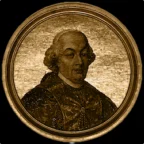
Pope Pius VI
Pope Pius VI, born Giannangelo Braschi, was the 250th Bishop of Rome. His pontificate lasted twenty-four years and unfolded during one of the most dramatic phases in modern Church history, ending with his death in French captivity after being taken prisoner by Napoleonic forces.
Giovanni Angelo Braschi was born in Cesena on 25 December 1717 into a prosperous but not dominant noble family of Romagna. Trained in law, he first pursued a juridical career, then chose the ecclesiastical path and was ordained priest in 1758. His advancement within the Curia was rapid: Clement XIII appointed him Treasurer General of the Apostolic Chamber in 1766, and Clement XIV created him cardinal in 1773. Contemporaries described him as cultivated and courteous, with strong artistic taste, but less decisive in moments of political crisis.
He was elected pope on 15 February 1775 after a difficult conclave marked by the unresolved legacy of the suppression of the Jesuits under Clement XIV. One of his first symbolic gestures was the release of Father Lorenzo Ricci, last Superior General of the Society of Jesus, from imprisonment in Castel Sant'Angelo. In internal governance, Pius VI pursued ambitious initiatives: reform of papal finances, expansion of the Pio-Clementine Museum, construction works at St. Peter's, and major hydraulic interventions in the Pontine Marshes.
His first major geopolitical conflict came with Emperor Joseph II and the reform program known as Josephinism, which reduced monasteries, restructured clerical formation, and curtailed papal influence in Habsburg lands. In 1782, Pius VI undertook the exceptional journey to Vienna, the first papal visit outside Italy in centuries, hoping to reverse these measures. The reception was ceremonially grand, but politically ineffective.
The decisive rupture began with the French Revolution. Pius VI condemned revolutionary principles and, above all, the Civil Constitution of the Clergy (1790), which subordinated the Church in France to the state and limited papal authority over episcopal appointments. The resulting division between constitutionally sworn clergy and refractory clergy deepened the crisis. After escalating tensions, including the killing of the French diplomat Ugo Basseville in Rome (1793), military pressure followed. In 1796 Napoleon's Italian campaign forced the papacy to accept severe terms in the Armistice of Bologna.
In February 1798, French troops under General Berthier entered Rome, proclaimed the Roman Republic, and demanded renunciation of temporal sovereignty. Pius VI, elderly and gravely ill, refused. He was arrested, moved through Tuscany and northern Italy, and finally deported across the Alps to France, where he died on 29 August 1799 at Valence. Revolutionary authorities registered him as "Citizen Braschi, exercising the profession of pontiff," a formula often cited as emblematic of the ideological distance between revolutionary politics and papal monarchy.
Pius VI's pontificate, among the longest in papal history, marked the nadir of papal temporal power in the revolutionary age. Yet his death in captivity generated wide Catholic sympathy and foreshadowed the equally difficult confrontation between Napoleon and his successor, Pius VII. For historians of the late eighteenth century, his reign stands at the transition between ancien regime papal governance and the modern reconfiguration of Church-state relations.
-
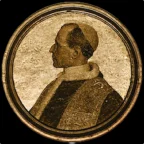
Pope Pius XII (Eugenio Pacelli)
Pope Pius XII, born Eugenio Maria Giuseppe Giovanni Pacelli on 2 March 1876 in Rome, was the 260th pope of the Catholic Church, reigning from 2 March 1939 until his death on 9 October 1958. His nineteen-year pontificate - one of the longest of the modern era - spanned the most catastrophic conflict in human history, the subsequent reconstruction of Europe, and the opening years of the Cold War.
Eugenio Pacelli was born into a distinguished Roman family with deep roots in the service of the Holy See. His grandfather Marcantonio Pacelli had founded the Vatican newspaper L'Osservatore Romano, and his father Filippo was Dean of the College of the Sacred Rota - the highest ecclesiastical court. This environment steeped the young Eugenio in canon law, Church governance, and Roman Catholic culture from his earliest years. He was a gifted and studious child who attended the Visconti lyceum before studying philosophy and theology at the Capranica College and the Gregorian University in Rome. He was ordained a priest on 2 April 1899.
Pacelli entered the Vatican's Secretariat of State in 1901 and quickly distinguished himself as one of the ablest ecclesiastical diplomats of his generation. He was appointed Apostolic Nuncio to Bavaria in 1917, a strategically vital post during the First World War, and became Apostolic Nuncio to the entire German Reich in 1920, a position he held until 1929. His years in Germany gave him an intimate familiarity with German culture, politics, and language - he became fluent in German - and shaped his worldview profoundly.
In 1929 he was recalled to Rome by Pope Pius XI, who appointed him a Cardinal-Priest and then, within days, Cardinal Secretary of State - the second-highest office in the Church. In this capacity he negotiated the Reichskonkordat with Nazi Germany in July 1933, a treaty intended to protect the rights of German Catholics that would become one of the most contested acts of his career. Critics argued it lent diplomatic legitimacy to the Hitler regime; defenders maintain it was a defensive instrument designed to safeguard the institutional Church in an increasingly dangerous political climate.
Pacelli was elected pope on 2 March 1939 - his sixty-third birthday - after one of the shortest conclaves of the twentieth century, requiring only three ballots. His election reflected the College of Cardinals' confidence in his diplomatic expertise at a moment of extreme international tension, just six months before the German invasion of Poland would plunge Europe into war.
The most debated aspect of Pius XII's papacy is his response to the Holocaust - the systematic genocide of six million Jews by Nazi Germany. Pius never issued a direct public condemnation of the extermination of the Jews by name, a choice that has generated a vast and still unresolved scholarly controversy. Critics, most famously the playwright Rolf Hochhuth in his 1963 play Der Stellvertreter (The Deputy), argued that a loud, unambiguous papal denunciation could have saved lives and carried immense moral weight. Defenders, including many Jewish leaders who lived through the war, countered that quiet diplomacy and the use of Vatican institutions to shelter refugees saved tens of thousands of lives - and that a public confrontation with Hitler would only have provoked savage reprisals against Catholics and Jews alike.
What is historically documented is that Vatican institutions, monasteries, convents, and the pope's own summer residence at Castel Gandolfo sheltered thousands of Jewish refugees. After the German occupation of Rome in September 1943, Pius XII ordered Roman religious houses to open their doors to Jews fleeing deportation, and it is estimated that over 4,000 Jews were hidden within Vatican properties and Church buildings in Rome alone. The debate over whether this was enough - and whether public silence was a moral failure or a pragmatic calculation - continues to animate historians, theologians, and ethicists to this day. The gradual opening of the Vatican Archives under Pope Francis, completed in 2020, has provided substantial new documentation without definitively settling the controversy.
Pius XII was one of the most theologically prolific popes of the modern era, authoring dozens of encyclicals and apostolic constitutions that addressed an extraordinary range of subjects. His 1943 encyclical Mystici Corporis Christi articulated a rich theology of the Church as the Mystical Body of Christ, a concept that would deeply influence the Second Vatican Council two decades later. His 1943 encyclical Divino Afflante Spiritu gave Catholic biblical scholars the freedom to use modern critical and historical methods in the study of Scripture - a landmark liberalization that opened the doors to the modern Catholic biblical scholarship movement. His 1947 encyclical Mediator Dei on the sacred liturgy laid intellectual groundwork for liturgical renewal. In 1950, exercising the prerogative of papal infallibility - used only once since its definition at Vatican I in 1870 - he defined the Assumption of the Virgin Mary into heaven as a dogma of the Catholic Church, the only dogmatic definition of his pontificate.
After 1945, Pius XII emerged as one of the most prominent and articulate voices in the ideological struggle against Communism. He issued repeated condemnations of Soviet-style Communism and supported Christian Democratic political parties across Western Europe as a bulwark against the Communist Left. In 1949 he issued a decree of excommunication against Catholics who formally joined or supported Communist parties. His geopolitical instincts aligned broadly with the Western powers during the early Cold War, and he maintained close ties with the United States government under both Truman and Eisenhower.
Those who knew Pius XII personally describe a man of profound asceticism, intellectual intensity, and remarkable personal warmth with individuals even while maintaining an imperious formality in public. He slept little, ate sparingly, and devoted hours each day to prayer. He was deeply devoted to the Virgin Mary - a devotion expressed most dramatically in his definition of the Assumption - and claimed to have personally witnessed the Miracle of the Sun from the Vatican gardens in 1950, an experience he wrote about in his diary. His cause for canonization was opened in 1965 by Pope Paul VI, and Pope Benedict XVI declared him Venerable on 19 December 2009.
Pius XII died at Castel Gandolfo on 9 October 1958 at the age of 82, after a prolonged illness in the final years of his life. He was succeeded by Angelo Roncalli, who took the name Pope John XXIII and soon convened the Second Vatican Council, whose reforming spirit stood in marked contrast to Pius's more authoritative style.
Pius XII remains one of the most complex figures in the modern history of the Catholic Church - a pope of extraordinary intellectual gifts, diplomatic sophistication, and genuine personal holiness, whose legacy is permanently shadowed by the unanswerable question of whether more could and should have been said during the darkest years of the twentieth century.
-
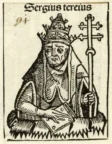
Pope Sergius III
Pope Sergius III was one of the most controversial popes of the Middle Ages: he reigned from January 29, 904, until his death on April 14, 911, ushering in the period that modern historians call the Saeculum Obscurum, or the "Dark Age of the Papacy," which spanned from his election until the death of Pope John XII in 964.
Sergius was born around 860 in Rome, the son of a nobleman named Benedictus. His ecclesiastical career began under the pontificate of Pope Marinus I (882-884), who ordained him a subdeacon, while Pope Stephen V consecrated him a deacon between 885 and 891.
It was then Pope Formosus, in the first half of the 890s, who consecrated him bishop of Caere - today's Cerveteri, a small town about 40 kilometers from Rome. According to a widespread tradition, Formosus made this appointment deliberately to remove Sergius from Roman politics, since the canon law of the time prohibited already-consecrated bishops from being transferred to the See of Rome. It was thus a way to close the door to the papacy for him.
Sergius, however, held political sympathies that diverged from those of Formosus: he supported Duke Lambert of Spoleto, while the pope backed Arnulf of Carinthia in the struggle for the imperial crown. When Formosus died in 896 and his successor, Pope Stephen VI, convened the infamous Synod of the Corpse, Sergius was a participant and staunch supporter.
The Synod of the Corpse (897) was one of the most macabre episodes in papal history: Formosus's corpse was exhumed, dressed in pontifical vestments, and posthumously put on trial by Stephen VI. At the conclusion, all of Formosus's ordinations were declared null and void, and the body was thrown into the Tiber. Sergius was among Stephen's supporters and approved of the annulment of his enemy's papacy, an act that also had the practical advantage of nullifying his own consecration as bishop of Caere, thus reopening the path to the papal tiara.
When Pope Theodore II died in 898, Sergius attempted to have himself elected pope with the support of the nobles loyal to Stephen VI, but the imperial faction backed John IX. A schism ensued: both were elected simultaneously, but John IX - backed by Emperor Lambert of Spoleto - prevailed and had Sergius excommunicated and exiled.
Years of extreme instability followed: from 896 to 904, no fewer than seven popes and one antipope succeeded one another on the throne of Peter.
The decisive turning point came in 903-904. Antipope Christopher had forcibly deposed the legitimate Pope Leo V, imprisoning him. Theophylactus I, Count of Tusculum and commander of the papal militias who had remained in Rome after the withdrawal of Emperor Louis the Blind, unexpectedly turned the tables: he had Christopher deposed, threw him into prison, and invited Sergius to take his place.
Sergius was consecrated pope on January 29, 904.
With his ascension, three consecrated popes were simultaneously alive: Sergius, Christopher, and Leo V. Shortly after Sergius took power, both Christopher and Leo were strangled in their cells. Medieval sources attribute these deaths to Sergius - some chronicles even claim that he committed the murders himself - making him the only pope in history credited with the murder of other popes. The matter remains, however, historiographically controversial: it is likely that it was Theophylactus himself, who had an army and assassins at his disposal, who ordered or carried out the murders.
Theophylactus effectively became the master of Rome: he was elected consul, senator, and commander of the papal forces, while his wife Theodora and his daughter Marozia were granted the extraordinary title of senatrix. He and his descendants would control papal elections for about a hundred years.
One of Sergius's first acts as pope was to convene an ecclesiastical council that reaffirmed the condemnations of the Synod of the Corpse, once again annulling all of Formosus's ordinations. This caused immense upheaval within the Church: numerous bishops far from Rome ignored the resolutions and continued to officiate as if nothing had happened. Later accounts tell of a second exhumation of Formosus, this time involving the decapitation of the corpse and the throwing of the head into the Tiber, but most modern scholars believe this account to be the result of a confusion between Sergius and Stephen VI in the sources of Liutprand of Cremona.
The most scandalous episode of Sergius's pontificate concerns his alleged affair with Marozia, daughter of Theophylactus, then twelve or fourteen years old. According to sources, a son was born of this union, the future Pope John XI (931).
The only direct source for this relationship is Liutprand of Cremona, who wrote his history - the Antapodosis - fifty years after the events, with an evident polemical intent against Theophylactus's family. His contemporary historians, such as Auxilius of Naples and Eugene Vulgarius, who were also critical of Sergius on other counts, make no mention of this scandal. There is also a chronological argument: John was born in 910, a year after Marozia's marriage to Alberic I of Spoleto in 909, which almost certainly indicates that his biological father was Alberic. Curiously, however, John - the eldest son - pursued an ecclesiastical career while his younger brother became Duke of Spoleto, subverting the noble custom whereby the eldest male heir inherited the secular title, a fact that raises suspicions regarding John's illegitimacy within his family.
On a more strictly ecclesiastical level, Sergius took a stand in favor of the fourth marriage of the Byzantine Emperor Leo VI, declaring it valid against the opinion of Patriarch Nicholas of Constantinople. This decision contributed to weakening papal prestige in the East, and the Greeks removed his name from ecclesiastical diptychs. His involvement in the patriarch's deposition is considered one of the distant factors that paved the way for the Schism of 1054. He also confirmed the establishment of new dioceses in England and protected Archbishop John of Ravenna against the Count of Istria.
Among the concrete achievements of his pontificate, the most important was the complete reconstruction of the Lateran Basilica, devastated by the earthquake of 896 - the collapse had occurred precisely during the Synod of the Corpse - and further plundered by Antipope Christopher. Sergius restored it, equipping it with new liturgical objects, wall frescoes, and crosses. He also financed the reconstruction of the monastery of Nonantola, destroyed by the Magyars, and invested in churches plundered by the Muslims, founding monasteries and churches in the Frankish kingdom.
The difficulties in the historical analysis of Sergius III stem largely from the partisan nature of the sources. The principal witness to his pontificate is Liutprand of Cremona, a 10th-century bishop and diplomat whose work Antapodosis ("The Revenge") was written explicitly to denigrate Liutprand's political enemies, including the descendants of Theophylact. On the opposite side, the grammarian Eugenius Vulgarius praised him almost excessively. As the Encyclopaedia Cattolica (New Advent) notes, "unfortunately, most of our knowledge of Sergius comes from his adversaries."
Sergius died on April 14, 911, in the midst of his pontificate, and was buried in St. Peter's Basilica. His seven-year reign was relatively long by the standards of the period, and he was never forcibly deposed - a notable circumstance for an era in which popes were deposed, exiled, and assassinated with alarming frequency. His lineage, if one accepts the paternity of John XI, would have given rise through Marozia to a veritable papal dynasty: two grandsons, two great-grandsons, and a great-great-grandson of Marozia became popes.
-
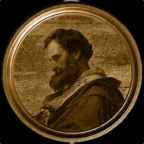
Pope Stephen IX (Frederick of Lorraine)
Pope Stephen IX was the 154th pontiff of the Catholic Church and the sixth pope of German origin. His very brief pontificate-less than nine months-was nonetheless filled with ambitious projects and marked by a reformist zeal of the highest order, in full continuity with the great Gregorian era.
He was probably born in the second decade of the 11th century, around 1020, in the diocese of Liège, in Lotharingia, with the name Frederick. He was the son of Gozzelon I, Duke of Lower Lorraine, and belonged to the line of the Counts of the Ardennes, descendants through the Carolingian line of Louis the Stammerer. The family was among the most powerful and influential in the Germanic world: one brother, Geoffrey the Bearded, became Duke of Lotharingia and Marquis of Tuscany; two sisters married the Counts of Namur and Leuven; an uncle, Adalberon, had been Bishop of Verdun; and a great-uncle had been Archbishop of Reims. As the third-born son, Frederick was destined from childhood for a career in the church, in accordance with the aristocratic custom of the time.
He received his intellectual and religious education at the cathedral school of Liège, one of the major cultural centers of Northern Europe in that century. There he became first a canon and then archdeacon of the chapter of Saint-Lambert, serving first under Bishop Wazone of Liège and then his successor Theodwin. In 1049, not yet thirty years old, he was elevated to the cardinalate by the reformer Pope Leo IX-who had drawn him into his circle of trusted collaborators-with the title of Cardinal Deacon of Santa Maria in Domnica. In 1051, Leo IX summoned him to Rome, appointing him Bibliothecarius, or chancellor of the Roman Church, the highest administrative office of the Apostolic See.
The years spent alongside Leo IX were a formative experience of exceptional intensity for Frederick. He accompanied the pope on the ill-fated military expedition against the Normans in southern Italy, which ended with the defeat of the papal army at the Battle of Civitate in 1053. He was then sent as an apocrisarius-a diplomatic representative-to Constantinople, where he witnessed firsthand the events that in 1054 precipitated the East-West Schism between the Latin and Greek Churches, a rupture that Cardinal Umberto di Silva Candida would consecrate by placing the bull of excommunication against Patriarch Michael Cerularius on the altar of Hagia Sophia. These experiences-the crisis with the Normans, the diplomatic failure with Byzantium, the death of the pope held captive in Benevento-hardened him as a man of the Church capable of reading the political reality with realism and determination.
During the pontificate of Victor II, his position became complicated for political reasons linked to the difficult relations between the Lorraine ducal family and Emperor Henry III. Since his brother Geoffrey the Bearded had entered into open conflict with the emperor, Frederick sought refuge in the Abbey of Montecassino, the most prestigious Benedictine monastery in the West, to escape a possible arrest ordered by the emperor to strike at his family. It was at Montecassino, on May 23, 1057, at the behest of Pope Victor II, that he was appointed abbot-the spiritual leader of the most revered monastic community in Italy. A few weeks later, Victor II also appointed him cardinal priest, definitively sealing his return to the top of the ecclesiastical hierarchy.
Victor II died on July 28, 1057. Just five days later, on August 2, an assembly of cardinals and prelates gathered in Florence-the city where Victor II had passed away-elected Frederick as his successor. The election was extremely swift and took place without consulting the emperor, in accordance with the reformist principles that the Gregorians were laboriously trying to assert against imperial control over the Church. Frederick accepted with considerable reluctance, urging those present to choose more worthy candidates, including his friend Giovanni Mincio dei Conti di Tuscolo. He was consecrated on August 3 and took the name Stephen IX in homage to the saint whose feast day fell on that day, deliberately ignoring the traditional numbering system that would have required the name Stephen X.
Stephen IX immediately surrounded himself with the finest minds of the reform: he appointed Cardinal Umberto di Silva Candida as head of the Chancellery, and sought the counsel of Pier Damiani and Archdeacon Ildebrando di Soana-the future Gregory VII-and Anselmo di Lucca, all figures of extraordinary stature. With this group of collaborators, he intended to continue and intensify Leo's reform program: to strengthen clerical celibacy, combat simony, and free the Church from the control of the secular nobility. He issued forceful decrees to impose celibacy on all clerics and confirmed the acts and privileges granted by Leo IX to various monasteries, including the rights of the abbot of the monastery of Sansepolcro in the Upper Tiber Valley.
The brevity of his pontificate prevented the realization of the two most ambitious political plans Stephen had conceived. The first was the definitive expulsion of the Normans from southern Italy, a project for which he was forging diplomatic and military alliances. The second, even more daring, was to promote the elevation of his brother Geoffrey the Bearded to the imperial throne, exploiting the succession crisis plaguing Germany. Both plans foundered when the pope was struck by a serious illness that irreparably compromised his health. He recovered only partially and temporarily.
Stephen IX died suddenly in Florence on March 29, 1058, at only about thirty-eight years of age, after a pontificate lasting less than nine months. He was buried in the church of Santa Reparata in Florence-the ancient cathedral on whose site Santa Maria del Fiore was later built-with papal honors. He was succeeded by Nicholas II, who had to confront the antipope Benedict X, the irregular election of Giovanni Mincio dei Conti di Tuscolo supported by the faction opposed to the reform. Despite his premature death, Stephen IX left a lasting legacy: the Decree of Nicholas II of 1059, which reserved the right to elect the pope solely for the cardinals, was also conceived as a response to the urgency that the reformers had learned precisely from his experience-that of removing papal succession once and for all from the influence of secular potentates.
-
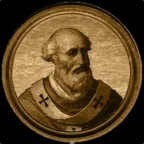
Pope Urban II
Urban II was the 159th pope of the Catholic Church, one of the most influential pontiffs of the Middle Ages, whose legacy is inextricably linked to the launch of the First Crusade in 1095 and the completion of the Gregorian Reform of the Church.
Born around 1040-1042 in Lagery, near Chatillon-sur-Marne, France, to a family of modest knightly nobility, the future pope was given the name Eudes (Oddone or Ottone) de Lagery. He was educated in the ecclesiastical schools of Reims, where his teacher and spiritual guide was Bruno of Cologne-the future founder of the Carthusian Order-who exerted a profound and lasting influence on him. Under that same guidance, in 1067 he abandoned a promising career as archdeacon in Reims to embrace the monastic life, entering the Abbey of Cluny, the principal center of the Benedictine ecclesiastical reform in Europe. There he rapidly rose through the ranks of the monastic hierarchy to become prior, the second-highest position in the abbey after that of abbot.
In 1077, he accompanied the abbot of Cluny, Hugh the Great, to the famous meeting at Canossa, where Emperor Henry IV humbled himself before Gregory VII to obtain the lifting of his excommunication. This closeness to the reforming pope earned him Gregory's trust; the pope retained him in Rome and in 1078 elevated him to the rank of cardinal-bishop of Ostia and Velletri, succeeding Pier Damiani. In this new capacity, he was sent twice as papal legate to Germany, with the difficult task of mediating the dispute between the Apostolic See and the emperor in the Investiture Controversy. The diplomatic experience gained during these missions made him one of the most knowledgeable and politically capable men in the College of Cardinals.
Upon the death of Victor III on March 12, 1088, a small conclave of about forty cardinals and prelates, gathered in Terracina since Rome was firmly in the hands of the antipope Clement III, supported by the emperor, elected Otto as the new pope under the name of Urban II.
The new pope had to wait until the following year before he could enter Rome, finding refuge in the Pierleoni fortress on the Tiber Island. Only in 1094, having consolidated his alliances with the powerful Frangipane family, did he succeed in taking possession of the Lateran Palace, definitively forcing the antipope Clement III to leave the city.
Urban II continued and expanded Gregory VII's reform program with great determination, combining it with a remarkable diplomatic flexibility that his predecessor had partly lacked. He immediately established solid relations with the Normans of Southern Italy, who supported him militarily in the recapture of Rome.
The first of his great reform councils was held in Melfi in September 1089, with the participation of seventy bishops: sixteen canons were issued there to condemn simony, prohibit lay investiture, impose celibacy on the clergy, and reform monastic discipline. During his long journey through southern Italy, he consecrated the Basilica of Saint Nicholas in Bari, placed the relics brought from the East there, and visited the Abbey of the Holy Trinity in Cava, whose basilica he consecrated. In Sicily, which had been wrested from the Muslims by the Normans, he granted Grand Count Roger the privilege of the Apostolic Legation, recognizing his authority to appoint bishops and collect ecclesiastical revenues: a pragmatic compromise that reflected the complexity of the island's re-Christianization after centuries of Islamic rule.
The most famous and historically decisive moment of Urban II's pontificate was the Council of Clermont-Ferrand, convened in November 1095. On November 27, at the conclusion of the council's proceedings, the pope delivered a fiery speech in the city's public square before a vast crowd of clerics, knights, and lay faithful, urging Western Christians to liberate Jerusalem and the Holy Sepulcher from Seljuk Turkish occupation, in response to the appeal of the Byzantine Emperor Alexius I Comnenus. The crowd's response was immediate and overwhelming: the cry Deus lo vult! - "God wills it!" - rose up in unison and became the expedition's motto. Urban established the "Truce of God" as a period of suspension of hostilities among Christians, appointed Bishop Ademar of Monteil as the spiritual leader of the crusade, designated Raymond of Toulouse as one of the lay leaders, and negotiated with the Genoese for naval transport. The preaching spread like wildfire throughout Europe, sparking a mass movement that would radically transform medieval history.
Urban II did not live long enough to see the fulfillment of the crusade he had preached. He died in Rome on July 29, 1099, just fourteen days after the crusaders' conquest of Jerusalem on July 15-news which, according to sources, he did not live to receive. His pontificate had lasted eleven years, four months, and seventeen days.
He was beatified by Pope Leo XIII in 1881, and his liturgical memorial is celebrated on July 29. He remains one of the most complex figures of the medieval papacy: an unyielding reformer, a skilled diplomat, and the architect of one of the most disruptive phenomena in the history of the Christian West.
-
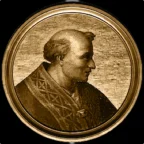
Pope Victor III (Desiderius of Montecassino)
Pope Victor III, born Dauferio Epifani Del Zotto in Benevento around 1026, was the 158th pope of the Catholic Church and successor to Gregory VII. His historical significance far exceeds the brevity of his pontificate: he was first and foremost the great abbot of Montecassino, under whom the abbey reached one of the pinnacles of its medieval glory.
Dauferio was the son of the Lombard prince Landolfo V of Benevento, and his aristocratic origins in southern Italy appeared to destine him for a political and military career. His monastic vocation, however, was strong from his youth. He is said to have escaped not one but two arranged marriages, withdrew for a period into eremitic life, and then entered the Benedictine sphere at Montecassino, the great center of monastic culture in southern Italy.
Taking the monastic name Desiderius, he became abbot of Montecassino in 1058, succeeding Frederick of Lorraine, later Pope Stephen IX. His abbacy lasted nearly thirty years and transformed Montecassino into an exceptional center of spiritual, intellectual, and artistic excellence. Under his leadership, the abbey basilica was rebuilt and magnificently decorated, including mosaics made by Byzantine artisans summoned from Constantinople. This moment is crucial for medieval Italian art history because these artisans helped transmit mosaic techniques to local workshops in southern Italy and Rome. He also attracted major intellectual figures, including Constantine the African, whose Latin translations of Arabic medical texts marked a turning point in western medieval science.
After Gregory VII's death in 1085, the papal see remained vacant for nearly a year. At the 1086 election, Desiderius resisted acceptance and, according to tradition, was effectively compelled by the cardinals to assume the papacy under the name Victor. His pontificate unfolded amid conflict with the antipope Clement III (Guibert of Ravenna), supported by Emperor Henry IV. Twice forced to flee Rome, Victor spent most of his brief reign at Montecassino rather than in the city. Despite frail health, he convened a synod at Capua in March 1087, reaffirmed papal authority, and was consecrated in Saint Peter's on 9 May 1087 after Norman forces expelled the antipope's troops.
One of the most striking acts associated with his reign was the backing of a military expedition against the Saracens of Tunis, ending in victory and tribute to the Holy See. Victor died on 16 September 1087 at Montecassino, where he had returned for the last time. He was beatified by Leo XIII on 23 July 1887, eight hundred years after his death, and his feast is celebrated on 16 September.
For medieval art history, Victor III and Abbot Desiderius are central to the study of East-West artistic circulation in the eleventh century. His decision to bring master mosaicists from Constantinople to Montecassino inserted the abbey into the same network of Byzantine-Latin exchange that, a generation later, would inform monuments such as the Cappella Palatina in Palermo under Roger II. As an author, Desiderius also wrote on the miracles of Saint Benedict, confirming his role as a major guardian and transmitter of Benedictine tradition.
-
Pseudo-Chrysostom (author of the Opus imperfectum in Matthaeum)
"Pseudo-Chrysostom" is the conventional modern label for the anonymous author of the Opus imperfectum in Matthaeum ("Unfinished Work on Matthew"), a sequence of fifty-four homiletic commentaries on the Gospel of Matthew that circulated throughout the Latin Middle Ages under the name of John Chrysostom, the great Greek preacher and archbishop of Constantinople (c. 349–407), but that modern scholarship has established was neither written by him nor originally composed in Greek at all. The work is a staple source in the Catena aurea compiled by Thomas Aquinas, and it is through that chain of patristic citations — attributed simply to "Chrysostom" in most medieval copies — that readings drawn from it, such as the allegorical gloss on the hedge of the vineyard in the parable of the wicked tenants (Matthew 21:33), entered the standard exegetical apparatus available to the makers of Latin Gospel books.
The commentary itself survives complete only in Latin, breaking off abruptly partway through Matthew 25 — hence its title, "the unfinished work" — whether because the author died or fell silent before finishing it, or because a completing portion was lost in transmission, is not established. Only scattered fragments of a Greek original are known, and it is disputed among specialists whether the Latin text as it survives is itself a translation from Greek or was composed directly in Latin by an author working within the Greek homiletic tradition. Its style is that of a series of sermons rather than a scholarly commentary in the manner of Jerome, moving verse by verse through Matthew with moral exhortation, allegorical reading and frequent digressions addressed to a congregation, which is part of what made it so serviceable to later medieval compilers assembling verse-by-verse chains of patristic comment.
The attribution to Chrysostom, already present in the manuscript tradition by the early medieval period, was first seriously questioned by humanist scholars in the sixteenth century, Erasmus among them, on grounds of style and doctrine that seemed hard to reconcile with the authentic Chrysostom corpus. Subsequent scholarship confirmed the suspicion and went further: close doctrinal analysis has shown the author to hold a subordinationist, Homoian theology of the kind associated with the fourth- and fifth-century Arian churches, together with passages that read as reflecting the experience of a Christian community under persecution — features entirely incompatible with Chrysostom's own Nicene orthodoxy and celebrated career in the imperial capital. On this basis modern scholars, notably the editor of the critical edition, have proposed a Latin- or Gothic-speaking Homoian bishop, writing somewhere in the western provinces of the later Roman Empire — the Balkans and the Vandal kingdom of North Africa are the regions most often suggested — probably in the fifth century, as the true author, though neither his name, his precise date, nor his place of writing has been established with certainty, and the question remains actively debated.
The paradox of the Opus imperfectum's later fortune is that a text written by a theologian whose own church the mainstream tradition regarded as heretical became, under a borrowed and prestigious name, one of the most heavily used patristic sources for the exegesis of Matthew in the Latin West: excerpted in the Glossa ordinaria, drawn on by Thomas Aquinas in the Catena aurea, and cited without hesitation by generations of preachers and commentators who read it simply as the words of Saint John Chrysostom. Its readings on the parable of the vineyard, alongside those of Jerome, Hilary and Origen, belong to exactly this current of transmitted, catena-mediated patristic comment that fed into the standard interpretive repertoire available to the readers and makers of illuminated Gospel books such as the Codex Aureus of Echternach, even where, as here, the source's real authorship had been lost from view for a thousand years.
-
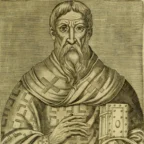
Pseudo-Dionysius the Areopagite
Pseudo-Dionysius the Areopagite is the name given to an anonymous Christian theologian and Neoplatonic philosopher who flourished around 500 CE, most likely a Syrian monk whose true identity has never been established. Writing under a deliberate and carefully chosen pseudonym, he produced a compact but extraordinarily influential body of Greek texts - collectively known as the Corpus Areopagiticum - that fused the late Neoplatonism of Proclus with Christian theology to create the foundational framework of Christian mysticism.
The name he chose was loaded with symbolic intent. In Acts 17, the apostle Paul preaches at the Areopagus in Athens, and among the few who convert is "Dionysius the Areopagite," a member of the city's governing council. By adopting this name, the author was declaring a theological ambition: to do for Christianity what that first Greek convert had done - bring Greek intellectual culture into dialogue with Pauline proclamation. He succeeded so well that his texts were received throughout the Middle Ages as genuinely apostolic, the authentic writings of Paul's own disciple, giving them an authority almost equal to Scripture.
The question of why he concealed his identity has long fascinated scholars. Pope Benedict XVI, in a 2008 address, proposed the most generous interpretation: that the author sought humility, wishing not to build a monument to himself but to create a truly ecclesial, "de-individualized" theology that belonged to the Church rather than to an individual voice. The deception was first seriously challenged in the twelfth century by Peter Abelard, who argued that the author could not have been a first-century contemporary of Paul - a judgment modern scholarship has confirmed conclusively, placing the texts firmly in the late fifth or early sixth century based on their dependence on Proclus, who died in 485.
The surviving writings form four treatises and ten letters. On the Divine Names examines how human language can and cannot apply to God, working through attributes such as Goodness, Being, Life, and Wisdom. On Mystical Theology, the shortest and most radical text, describes the soul's ascent toward union with a God who ultimately transcends all names, all concepts, and even the very category of existence. On the Celestial Hierarchy maps the nine angelic orders - Seraphim, Cherubim, Thrones, Dominations, Virtues, Powers, Principalities, Archangels, and Angels - as a cascading structure through which divine illumination descends toward humanity. On the Ecclesiastical Hierarchy mirrors this angelic structure within the institutional Church, showing sacraments and liturgy as the earthly counterpart to the celestial choir.
The single most distinctive and influential contribution of Pseudo-Dionysius is his rigorous development of apophatic, or negative theology - the insistence that God so radically transcends all categories of existence that no positive statement can adequately describe him. While a thinker like Thomas Aquinas would say that "God is good," Pseudo-Dionysius would say that God is beyond goodness as we conceive it, and that we approach truth most honestly by stripping away every human concept - much as a sculptor reveals the form hidden within marble by removing everything that is not the statue. God is therefore not merely "infinite" or "immaterial" in the way we negate finite, material things; he is hyper-ousia - beyond being itself, above the distinction between existence and non-existence. This "cloud of unknowing" between the soul and the divine would become the central metaphor of much later medieval mysticism.
Pseudo-Dionysius transforms the Neoplatonic universe - which Plotinus had conceived as a hierarchy of emanations flowing from the One - into a Christian cosmos of created intelligences united in praise. Each rank of angels receives divine light from above and transmits it downward, so that the entire created order becomes a vast liturgy, a symphony of reflection and praise rising toward its source. The liturgy of the Church on earth is therefore not a human construction but a participation in the eternal worship of the celestial beings; it inserts the congregation into a cosmic, not merely local, reality. This theological vision had profound consequences for how the medieval Church understood its rites, its architecture, and above all its sacred art and light - most visibly in the Gothic theology of light that inspired Abbot Suger at Saint-Denis in the twelfth century.
The Corpus Areopagiticum was first introduced to the Latin West through the translation of John Scottus Eriugena in the ninth century, commissioned by King Charles the Bald. From that moment, the texts became indispensable to medieval theological thought. Thomas Aquinas cited "Dionysius" more than 1,700 times in his works. Bonaventure, Meister Eckhart, Hugh of Saint-Victor, and Hildegard of Bingen all drew on the Dionysian framework. In the East, Maximus the Confessor wrote extensive commentaries on the corpus, and Byzantine theology was permanently marked by its apophatic strand.
For medieval manuscript culture, the Corpus Areopagiticum was among the most copied and glossed texts in monastic scriptoria. The transmission history is itself a fascinating chapter in the history of ideas: manuscripts moved from Syria to Constantinople, then to Rome and the Frankish court, accumulating commentary layers at each stage. Illuminated copies from the twelfth and thirteenth centuries often depicted the angelic hierarchies in elaborate diagrammatic forms, translating Dionysian cosmology directly into visual imagery. His influence on medieval iconographic programs - the ordering of angels in cathedral sculpture, the theological meaning of stained glass light at Chartres and Saint-Denis - is difficult to overstate.
-
Psychostasis
The term psychostasis (from the ancient Greek psychostasia: psychē, soul, and stasis, weighing or standing) denotes the ritual or eschatological act of weighing the soul to determine its moral worth and thereby its eternal fate. As a religious motif, it spans several civilizations and millennia, constituting one of the most persistent iconographic formulas in the history of art and theology.
Its earliest systematic expression occurs in ancient Egypt, where the Book of the Dead (second millennium BCE) describes the deceased appearing before the tribunal of Osiris, where the heart — the seat of conscience and moral life — is placed on a balance against the feather of Maat, the goddess of truth and cosmic order. If the heart was lighter than the feather, the deceased was declared righteous and admitted to eternal life; if heavier, the monstrous composite creature Ammit devoured it, condemning the soul to oblivion. The Greek tradition adapted the motif independently: in Homer's Iliad, Zeus weighs the destinies of heroes — Achilles against Hector, Greeks against Trojans — on golden scales, determining the outcome of battle and life.
In Christian iconography, psychostasis entered the visual tradition from at least the fourth century, becoming firmly established as a constituent element of Last Judgment cycles from the Romanesque period onward. The central agent of the weighing is Archangel Michael, who holds the scales — though no scriptural passage directly assigns this function to him, the association grew organically from his roles as celestial warrior, guardian of souls, and psychopomp. On one pan of the balance are placed the soul's good deeds; on the other, its sins. Demons characteristically attempt to manipulate the scales by pressing down on the sinful side, while Michael or a heavenly intercessor — sometimes the Virgin Mary — counteracts their interference. The soul itself is typically depicted as a small naked human figure, occasionally as a disembodied head.
After the Iconoclast controversy, the psychostasis was integrated into Byzantine Last Judgment compositions, usually sited on the west wall of the nave — the wall facing the congregation as they entered and exited, confronting them with the certainty of divine judgment at every liturgical gathering. In the Romanesque West the motif spread rapidly through tympanum sculpture, apse frescoes, and manuscript illumination, becoming one of the standard components of eschatological imagery alongside the resurrection of the dead, the separation of the elect and the damned, and the torments of Hell. Celebrated examples include the tympanum of the Cathedral of Autun (Gislebertus, c. 1130–1146), the frescoes of Sant'Angelo in Formis near Capua (late eleventh century), and — within the artistic world central to the present research — the fresco cycles of Trecento Padova and Venice, where Guariento di Arpo rendered the theme in the Eremitani and related commissions.
In Gothic and late medieval art, the psychostasis was sometimes represented as a discrete devotional image independent of a full Last Judgment cycle, with the archangel Michael holding scales as a fixed attribute even in contexts where no explicit weighing scene was depicted. The motif also appears in altarpieces, funerary monuments, and stained glass, reinforcing the penitential theology of the age and the urgency of moral preparation for death. By the late Middle Ages it had been assimilated into the devotional culture of the confraternities — the same Disciplinati and related lay organizations whose primary spiritual concern was precisely the salvation of the living and the dead.
From an art-historical perspective, the psychostasis is significant as a case study in the transmission of iconographic motifs across cultural and religious boundaries — from Egypt to Greece, from the classical world to early Christianity, and from Byzantium to the medieval West — and as evidence of the degree to which eschatological anxiety structured the visual culture of the Middle Ages at every level, from monumental cathedral programs to intimate manuscript illumination.
R
-
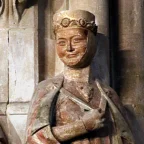
Reglindis of Meissen
Reglindis (also Regelindis or Regelinda, c. 989-1014/1016) was a Polish princess from the Piast dynasty and Margravine of Meissen through her marriage to Hermann I, Margrave of Meissen. As the daughter of King Boleslaw I the Brave (Boleslaw Chrobry), the first crowned king of Poland, she held the most distinguished lineage among the female donor figures commemorated at Naumburg Cathedral. Her sculptural portrait in the cathedral's west choir, created by the Naumburg Master around 1245-1260, is celebrated for its remarkable depiction of joy and vitality, featuring what may be the only prominent representation of a laughing human face in high medieval church sculpture.
Reglindis was born around 989 as the daughter of Boleslaw I the Brave, Duke (and later King) of Poland, and his third wife Emnilda, a Slavic princess identified as the daughter of Dobromir, possibly a prince in Lusatia or of Sorbian origin. Her father was one of the most powerful rulers in Central Europe during the early 11th century, who would be crowned the first King of Poland in 1025, shortly before his death. Through her father, Reglindis belonged to the Piast dynasty, Poland's first ruling house, which traced its origins to the legendary founder Piast the Wheelwright and had ruled the Polish lands since the 10th century. Her mother Emnilda gave Boleslaw at least three daughters and three sons, making Reglindis part of a large royal family with extensive dynastic connections across Central Europe.
Reglindis was married to Hermann I shortly after 1002, in the immediate aftermath of the assassination of Hermann's father, Margrave Eckard I of Meissen, who was murdered on April 30, 1002, at the royal palace of Pohlde. The marriage was arranged by her father Boleslaw I Chrobry, possibly as compensation for Hermann's loss of the margraviate-King Henry II had passed over Hermann in favor of his uncle Gunzelin-and because Boleslaw himself had been significantly involved in the political conflicts surrounding the succession. This strategic alliance connected the powerful Polish king directly to the Ekkehardinger family and gave him influence over the volatile German-Polish borderlands along the Elbe and Oder rivers. The marriage took place when Reglindis was approximately thirteen years old, a typical age for noble marriages in the early medieval period.
When King Henry II finally deposed Gunzelin in 1009 and installed Hermann as Margrave of Meissen, Reglindis became Margravine consort, a position she would hold until her premature death. As margravine, she presided over one of the most strategically important territories in the eastern German marches, a frontier region constantly threatened by warfare between German and Slavic powers. Her position was complicated by the ongoing conflicts between her husband and her father: despite the marriage alliance, territorial disputes continued between Poland and Meissen throughout her lifetime. The couple's joint patronage of religious institutions, particularly their support for the emerging cathedral foundation at Naumburg, helped consolidate their authority and establish their legacy as Christian rulers.
Reglindis died on March 21, probably in 1014 or 1016, at the young age of approximately 25-27 years. Her early death occurred during a particularly tense period in German-Polish relations. Two years after her death, in 1018, her widowed husband Hermann was forced to accept the Peace of Bautzen, which acknowledged the supremacy of her father Boleslaw I over contested territories in Lusatia and along the Elbe. The absence of Reglindis as a living link between the two rulers may have contributed to the deterioration of relations that culminated in this humiliating treaty for Hermann. The fact that she died so young suggests the dangers of childbirth and disease that claimed many medieval noblewomen, even those of the highest rank.
More than two centuries after her death, Reglindis was commemorated as one of the twelve donor figures in the west choir of Naumburg Cathedral, sculpted by the Naumburg Master between 1245 and 1260. The sculptor portrayed her standing beside her husband Hermann I in polychromed sandstone (limestone), creating one of the most celebrated works of medieval sculpture. Reglindis wears a richly decorated crown ring (Kronreif) under which individual strands of her hair are visible, emphasizing both her royal status and her youth. Unlike most medieval ecclesiastical sculpture, which maintained solemn dignity, the Naumburg Master depicted Reglindis with an open, radiant smile, capturing what appears to be genuine joy and vitality.
The statue of Reglindis has earned her the nickname "the Smiling Polish woman" due to the extraordinary expressiveness of her sculptural portrait. Her figure represents an exceptionally rare case of a laughing human face being depicted prominently in a high medieval church, where gravity and spiritual contemplation were the normative emotional tones. Art historians have debated the meaning of her smile: it may represent inner certainty about the attainment of eternal life through her and Hermann's generous donations to the cathedral, or it may symbolize her presumed youth and vitality at the time she became margravine. The sculpture's psychological depth and naturalism demonstrate the Naumburg Master's revolutionary approach to Gothic portraiture, creating individualized personalities rather than generic devotional types.
As daughter of the first Polish king and wife of a margrave of Meissen, Reglindis embodied the complex interweaving of Polish and German dynastic politics in the early 11th century. Her commemoration at Naumburg Cathedral ensured that her role as a benefactor and her distinguished royal lineage would be remembered by future generations. The extraordinary artistic quality of her sculptural portrait has made her one of the most recognizable figures from the medieval period, with plaster casts of the statue being commissioned and displayed in major museums, including a cast made by F. Kunsthardt in Hildesheim around 1875, now in the Victoria and Albert Museum in London. Through the Naumburg Master's genius, this young Polish princess who died a millennium ago continues to smile across the centuries, offering modern viewers a glimpse of medieval humanity that transcends the usual solemnity of church art.
-
Richardis von Stade
Richardis von Stade was a 12th-century German Benedictine nun, abbess of Bassum Abbey, and above all the closest collaborator and confidante of Hildegard of Bingen, whose visionary works she transcribed.
Richardis was born around 1124 into the ancient Saxon house of the Udonids, one of the most powerful families in the Holy Roman Empire. She was the daughter of Rudolf I, Count and Margrave of the Nordmark, and Richgard von Sponheim, and her lineage connected her to major ecclesiastical and political figures of the time. Her brother Hartwig became Archbishop of Bremen; her sister Liutgard was Queen Consort of Denmark. She was also linked maternally to the Sponheims: her mother was related to Jutta von Spanheim, the magistra who had guided Hildegard’s monastic formation, making Richardis almost a spiritual great-granddaughter of the same Rhenish religious tradition.
Sent to a convent at a young age, Richardis arrived at the women’s monastery of Disibodenberg, where Hildegard of Bingen lived with her small community. The two women formed an immediate and fruitful partnership. Hildegard recognized in Richardis not only intelligence and devotion, but also an exceptional collaborator with a solid classical education and knowledge of Latin, medicine, astronomy, and anatomy. Richardis’s mother, the Margravine of Stade, was one of the most generous benefactors of Hildegard’s project and strongly supported the community’s move to the new convent at Rupertsberg, helping Hildegard overcome the resistance of the abbot of Disibodenberg.
From the 1140s, Richardis worked closely with Hildegard on the drafting of the visionary treatise Scivias (Scito vias Domini, “Know the Ways of the Lord”), completed around 1151. Her task was not merely mechanical: she translated Hildegard’s rough Latin into more elegant and correct prose, drafted final copies, prepared the text for illumination, and served as editor and literary advisor. The monk Volmar also worked alongside her as secretary, but Hildegard described her bond with Richardis in intensely personal terms, writing that she was “deeply attached to a noble nun with all her affection, as Paul was to Timothy.”
In 1151, through an election that Hildegard considered dubious, Richardis was appointed abbess of the convent of Bassum in Saxony, an institution where she had never lived. Behind the appointment stood pressure from her brother Hartwig, Archbishop of Bremen, whose diocese included Bassum and who worked to secure his sister a position of institutional prestige. Hildegard reacted with unusual vehemence, writing passionate letters to the pope, to the archbishop of Mainz, to Hartwig himself, and to the pontiff, accusing the promoters of simony: the obtaining of an ecclesiastical office through worldly favor. Her pleas went unheeded, and Richardis departed for Bassum, leaving Hildegard in a state of grief that is vivid in the surviving correspondence.
Richardis died on 29 October 1152, after less than a year as abbess. Before her death she had expressed a desire to return to Rupertsberg to be with Hildegard, perhaps regretting having yielded to family pressure and the ambition of an independent office. The news of her death reached Hildegard through a letter from Hartwig, who informed her of his sister’s repentance and final wish to be reunited with her. Hildegard replied with words of extraordinary emotion, reading in Richardis’s premature death a providential seal on their spiritual bond. Hildegard outlived her pupil by nearly forty years, dying in 1179 at the age of eighty-one.
Scholars regard Richardis’s role in the transmission of Hildegard’s work as fundamental: without her philological and editorial mediation, the Scivias would not have reached the definitive form that survives today. Her portrait appears on the title page of the Liber divinorum operum, alongside Volmar and Hildegard herself, testifying to her central role in the intellectual community of Rupertsberg. The relationship between the two women has attracted historians of monasticism, scholars of medieval female spirituality, and literary critics, who have treated Hildegard’s letters as an extraordinary document of spiritual friendship in the 12th century. Richardis was also portrayed in the 2009 German film Vision, dedicated to the life of Hildegard of Bingen, where her character plays a prominent narrative role.
-
Robert of Anjou (Robert the Wise, Roberto il Saggio)
King Robert of Anjou, better known as Robert the Wise (Roberto il Saggio), was one of the most important rulers in fourteenth-century Italy, reigning as King of Naples from 1309 until January 1343 while also holding the titles of titular King of Jerusalem and Count of Provence and Forcalquier. A leading Angevin prince and the foremost Guelf ruler of his age, he stood at the center of Italian politics for more than three decades.
Robert was born in the later 1270s, the son of King Charles II of Naples and Mary of Hungary, and he belonged to the Angevin dynasty that ruled southern Italy. Although he was not his father's eldest son, he emerged as heir during Charles II's lifetime and was styled Duke of Calabria from 1296 until his accession in 1309. His youth was marked by political upheaval, and he spent years as a hostage in Aragon after his father had been captured in war against the Aragonese.
After his release, Robert was drawn immediately into the dynastic struggle over Sicily, the island lost by his family after the Sicilian Vespers. Britannica notes that his early military activity contributed to the Peace of Caltabellotta in 1302, which attempted to regulate Angevin and Aragonese claims over Sicily, though the settlement did not restore lasting Angevin control. When Charles II died in 1309, Robert succeeded as king of Naples and became the chief political representative of Angevin and papal interests in Italy.
Robert became the principal leader of the Guelf, or papal, party in Italy during the crisis created by Emperor Henry VII's descent into the peninsula in 1310. He was widely praised by admirers as a statesman who might unify Italy and restrain both imperial and Aragonese ambitions, and some later traditions even called him the "peace-maker of Italy." Yet his actual political record was mixed, since his efforts to dominate the peninsula and recover Sicily ultimately fell short, and some contemporaries criticized him for caution and limited military effectiveness.
Robert's court at Naples became an important center of learned and artistic life, and modern summaries describe his reign, especially together with his second wife Sancha of Majorca, as a moment when Naples emerged as a center of early Renaissance culture. The same court was also linked with currents of religious reform and dissent, including support for Joachimite ideas and the Spiritual Franciscans. This combination of political ambition, intellectual prestige, and religious seriousness explains why Robert acquired the lasting epithet "the Wise."
Robert married first Yolanda of Aragon and later Sancha of Majorca, and his direct male line was weakened by the death of his son Charles, Duke of Calabria, in 1328. To stabilize the succession, he arranged the future of his granddaughter Giovanna, who eventually succeeded him as Joanna I after his death in January 1343. Robert remains a major figure in medieval Italian history because, even where his political aims failed, he embodied Angevin kingship at its most intellectually ambitious and gave Naples a prestige that extended far beyond the boundaries of his kingdom.
-
Roger I of Sicily (Roger Bosso, il Gran Conte)
Roger I of Sicily — known as Ruggero I in Italian, Roger Bosso to his contemporaries, and most commonly to history as the Great Count (il Gran Conte) — was the Norman warrior and statesman who conquered Sicily from its Arab rulers between 1061 and 1091, laying the political and cultural foundations upon which his son Roger II would build the Kingdom of Sicily. Born around 1031 in Hauteville-la-Guichard in Normandy and dying on 22 June 1101 at Mileto in Calabria, he was one of the most consequential figures in the medieval Mediterranean world.
Roger was the youngest son of Tancred of Hauteville, a minor Norman lord from the Cotentin Peninsula, by Tancred's second wife Fredisenda. Being the twelfth and last son, he had virtually no prospect of inheriting land or wealth in Normandy, and like so many of his brothers before him, he sought his fortune in southern Italy, where the Normans had been establishing themselves as mercenaries and eventually as autonomous rulers since the early eleventh century. He arrived in Italy around 1056–1057 to join his elder brother Robert Guiscard, Duke of Apulia, who was already the dominant Norman power in the south and was then engaged in wresting Calabria from its Byzantine governors.
The relationship between Roger and Robert was the central dynamic of the first phase of the Sicilian conquest. It was a partnership of equals in military talent but profoundly unequal in rank and resources, and it was periodically strained — most notably by a brief but bitter quarrel in 1062 rooted in Roger's frustration at Robert's refusal to share the wealth of conquest adequately. Nevertheless, the two brothers ultimately proved an extraordinarily effective military team, combining Robert's strategic authority and political weight with Roger's personal courage and tactical brilliance in the field.
The background to the Norman conquest of Sicily lies in the island's political fragmentation. Since 827, Arab forces from North Africa had gradually conquered the island from its Byzantine rulers, and by the mid-ninth century it had become the Emirate of Sicily, a prosperous and culturally flourishing Muslim state. By the mid-eleventh century, however, the emirate had fragmented into warring factions — the Kalbid dynasty that had governed it had collapsed, and rival Arab emirs competed for power, some of them actively seeking Norman military assistance against their rivals. The papal schism of 1054, which hardened the boundary between Latin and Greek Christianity, gave the papacy an ideological incentive to support the recovery of the island for the Latin church.
Roger crossed the Strait of Messina for the first time in 1061, capturing Messina within a year and establishing a bridgehead in the northeast of the island. The Battle of Cerami in 1063 was an early turning point — a significant Norman victory against a larger Muslim force that secured control of the region between Troina and Messina and demonstrated that the conquest was militarily feasible. It was celebrated in Norman chronicles with legendary embellishments, including the reported apparition of Saint George on the battlefield.
Progress thereafter was measured and deliberate rather than swift. The terrain of Sicily, the distance from Norman supply bases in Calabria, and the persistent resistance of the Arab population meant that the conquest took thirty years to complete. The decisive moment came with the fall of Palermo on 10 January 1072, when Roger and Robert entered the city together after a combined land and sea blockade. At Palermo, Robert formally invested Roger as Count of Sicily under his authority as Duke of Apulia — an investiture that gave Roger an official title and the authority to govern the island in Robert's name, while Robert retained Messina and the Val Demone for himself. After Robert's departure for the Italian mainland, the remaining conquest fell entirely to Roger.
Palermo fell in 1072, Trapani in 1077, Agrigento in 1087, and finally — after years of intermittent resistance — Enna and Noto in 1091, the last Arab stronghold. In the same year, Roger crossed to Malta, which capitulated with little resistance, completing the conquest of the central Mediterranean island group.
Roger's administrative genius was, in the long run, as significant as his military achievements. He deliberately avoided the creation of numerous small feudal lordships, which had turned the Norman territories on the Italian mainland into a landscape of near-perpetual baronial rebellion. Large grants of land were made almost exclusively to the Catholic Church, whose institutional stability Roger correctly identified as the surest foundation for his own legitimacy. This policy of concentrating landed wealth in ecclesiastical hands while maintaining centralized comital authority over the nobility created the administrative conditions for the extraordinarily powerful royal government that his son Roger II would subsequently inherit and develop.
His approach to the island's Muslim and Greek Christian populations was pragmatic and relatively tolerant. Rather than expelling or forcibly converting the Arab population — which constituted the overwhelming majority of the island's inhabitants — Roger permitted Muslims to continue practicing their faith, retain their property, and serve in his administration and army. Arabic remained a language of governance. Greek Orthodox monasteries continued to function alongside the new Latin bishoprics that Roger established at Syracuse, Agrigento, and elsewhere. This policy of multicultural coexistence was not idealism but state-craft: Roger needed the agricultural productivity and administrative expertise of his Arab subjects, and he needed the loyalty of the Greek Christian communities whose ecclesiastical traditions predated the Arab conquest.
His relationship with the papacy was one of the most carefully managed dimensions of his reign. In 1098, Pope Urban II — whom Roger had sheltered and supported during the crisis of the anti-pope Clement III — granted Roger and his heirs the apostolic legateship of Sicily, a remarkable concession that gave the count virtually the powers of a papal legate over the Sicilian church, including the right to appoint bishops personally without reference to Rome. This privilege, known as the Monarchia Sicula, became one of the most jealously guarded prerogatives of the Sicilian crown and was still being disputed between the papacy and the kings of Sicily in the seventeenth century.
Roger married three times. His first wife was Judith of Évreux (married c. 1062), who died in 1076. His second wife was Eremburga of Mortain (married 1077), who died in 1087. His third and most consequential marriage was to Adelaide del Vasto (married 1089), a noblewoman of Lombard Aleramici origin from Piedmont, who bore him three children who survived to adulthood: Simon, Constance, and — born on 22 December 1095 — the future Roger II. It was Adelaide who served as regent of Sicily after Roger's death and oversaw the education of the young Roger II in the cosmopolitan Palermo court.
Roger died at Mileto in Calabria on 22 June 1101, at approximately seventy years of age — remarkable longevity for a man who had spent four decades in almost continuous military campaigning. He was buried at the abbey of Sant'Eufemia in Calabria, a Benedictine monastery he had himself founded. The state he left behind him was the County of Sicily and Calabria — not yet a kingdom, but already the wealthiest and most sophisticated polity in southern Italy, and the seedbed from which, under his son, the first genuinely multicultural medieval monarchy of Western Europe would grow.
-
Roger II of Sicily (Roger the Great, Ruggero II)
Roger II of Sicily, also known as Roger the Great (Ruggero II), was one of the most remarkable monarchs of the medieval world, ruling a multicultural kingdom that blended Norman, Byzantine, Arab, and Latin traditions into a singular and sophisticated civilization. Born on 22 December 1095, he died on 26 February 1154, leaving behind a state that shaped southern Italy for centuries.
He was the son of Roger I of Sicily, the Norman conqueror who had wrested the island from Arab rule, and Adelaide del Vasto. Upon the death of his elder brother Simon in 1105, the nine-year-old Roger inherited the County of Sicily under the regency of his mother. Educated by Greek and Arab tutors at the cosmopolitan court of Palermo, he grew up in an environment where Italian, Arabic, Greek, and Norman French circulated together, an experience that deeply informed his later policies.
Roger assumed personal control of the county around 1112 and quickly demonstrated the political and military skill that would define his reign. By 1122, he had absorbed all of Calabria on the mainland. When Duke William of Apulia died without an heir in 1127, Roger claimed the duchy, overcoming baronial resistance and papal reluctance to accept a powerful southern state.
The decisive turn in Roger's career came during the papal schism of 1130, when Innocent II and Antipope Anacletus II contested the papal throne. Roger backed Anacletus and in return received a bull dated 27 September 1130 that elevated him to kingship. He was crowned King of Sicily on Christmas Day 1130 in Palermo Cathedral, becoming the first ruler of a kingdom that endured for centuries.
After Anacletus's death in 1138, Roger's position became precarious, but in 1139 he defeated Innocent II's forces at Galluccio, captured the pope, and compelled recognition of his title as rex Siciliae ducatus Apuliae et principatus Capuae, King of Sicily, Duke of Apulia, and Prince of Capua, through the Treaty of Mignano. The framework established there defined the political geography of southern Italy into the modern era.
Roger was not only a conqueror but also a major institutional builder. He promoted legal reforms that strengthened royal and bureaucratic authority while curbing recurrent feudal rebellion, and he advanced a standardized coinage, the ducat, associated with the Duchy of Apulia. His administration operated in Latin, Greek, and Arabic, with Greek and Arab officials serving alongside Norman elites, making his state one of the most sophisticated political systems in twelfth-century Europe.
His ambitions extended across the Mediterranean. With a powerful fleet led by admirals styled emirs, most famously George of Antioch, Roger launched campaigns on the North African coast: Tripoli fell in 1146 and Cape Bona in 1148, earning him the additional title of King of Africa. These possessions were later lost under William I, but they reveal Roger's broader imperial vision centered on Sicily.
Roger's artistic patronage is central to medieval art history. The Cappella Palatina in Palermo, begun around 1130, remains the most celebrated monument of his reign, combining Saracenic muqarnas, Byzantine gold mosaics, and Latin architectural structure into a coherent royal statement. The mosaic in Santa Maria dell'Ammiraglio (La Martorana), showing Roger crowned directly by Christ in Byzantine imperial mode, articulated a potent theology of kingship. His royal mantle, now in the Imperial Treasury in Vienna, bears Arabic embroidery dated 528 AH (1133-34), a rare and material witness to the court's cultural synthesis.
Roger II died in Palermo on 26 February 1154 at the age of fifty-eight and was buried in a porphyry sarcophagus in Palermo Cathedral. He was succeeded by his son William I. The kingdom he forged, where Muslim scholars, Greek monks, Norman knights, and Jewish merchants coexisted under one crown, remains one of the most distinctive political and cultural experiments of medieval Europe.
-
Roman Linearism
In Roman art history, the term "Roman linearism" is not a standard, widely recognized stylistic category like verism or classicizing style; instead, it usually refers informally to the way Roman painters handled contour lines and spatial construction in frescoes and panel paintings, particularly in domestic and architectural illusionism (e.g., Pompeian wall-painting). It is best understood as a descriptive shorthand for the linear logic they used to suggest depth, volume, and continuity rather than a single, codified "school" of style. In Roman interior painting, especially in the Second and Fourth Pompeian Styles, artists relied heavily on silhouettes and incised contours to define columns, cornices, balustrades, and architectural frames that recede into the "picture-space." These linear elements are not coherently bound to a single horizon line in the Renaissance sense of linear perspective; instead, they follow a kind of pragmatic, multiple-horizon optics, where each architectural zone has its own implied vanishing-point axis. This produces a layered, almost "stage-set" effect, in which lines cluster to suggest depth without enforcing a single, mathematically unified vanishing system.
In the Middle Ages "Roman linearism" is best read as a shorthand for how Roman-derived linear and spatial habits survived, mutated, and were re-encoded in medieval art. In practice, this lineage appears in three main ways: the inheritance of Roman contour-driven modeling, the persistence of Roman architectural illusionism in early Christian and Romanesque spaces, and the transmission of Roman linearity into manuscript illumination and panel painting. In illuminated manuscripts from the ninth to the thirteenth century, "Roman linearism" manifests as a continuity of contour-based drawing and patterned space. Carolingian and Romanesque initials, narrative scenes, and marginal figures often rely on strong, rhythmic lines to define drapery, bodies, and architectural frames, rather than on a consistent, unified illusion of depth.
S
-
Sacchetti, Franco (c. 1332/1334-1400)
Franco Sacchetti was a Florentine merchant, civil servant and storyteller whose Trecentonovelle is among the most important vernacular sources for the everyday texture of life in Trecento Florence, including the reputations and rivalries of its painters and sculptors. He was born into an old Guelph merchant family of the city, probably between 1332 and 1334, and spent part of his youth in the family's trading interests on the eastern Adriatic, at Ragusa (modern Dubrovnik) and along the Slavonian coast, before settling into the mercantile and civic life expected of a man of his class in Florence.
From the 1360s onward Sacchetti built a long career in the service of the Florentine commune, sitting on councils and magistracies in the city and repeatedly serving as podestà or capitano in subject and allied towns - among them San Miniato, Bibbiena and Faenza. This was not a literary sideline pursued between more serious duties; it was the substance of his working life, and it gave him direct, recurring exposure to the speech, gossip and social friction of provincial as well as Florentine society that he later transmuted into fiction. He moved in the same literary milieu as Giovanni Boccaccio, with whom he corresponded, and his narrative writing takes the Decameron as its evident model while pulling away from Boccaccio's more elevated and idealising register toward something rougher, more anecdotal and more insistently local.
The Trecentonovelle, planned as three hundred tales and surviving in roughly two hundred and twenty, was composed mostly in the 1390s and left unfinished at Sacchetti's death. Its cast is drawn from merchants, friars, magistrates, wits and craftsmen rather than princes, and painters of the earlier Trecento recur repeatedly as protagonists - Giotto above all, whose sharp tongue supplies several of the collection's best-known stories. It is in this same gossipy, undocumented register that novella 136 shows a company of Florentine artists, including the sculptor and painter Andrea di Cione, dining at San Miniato al Monte and arguing over who, after Giotto, was the greatest master of the age; Sacchetti calls Andrea simply "l'Orcagna," using the nickname without a word of explanation, which is itself evidence that the sobriquet needed none for a Florentine reader within a generation of the artist's death. Sacchetti's other writing includes a substantial body of lyric verse - sonnets, ballate and cacce gathered as the Libro delle Rime - together with moral and political letters and a commentary on Dante known as the Sposizioni di libri.
He died in 1400, probably of plague, while serving once again as podestà of San Miniato, and the Trecentonovelle remained, by his own design or by the accident of his death, incomplete.
-
Scrovegni, Enrico degli
Enrico degli Scrovegni was a wealthy Paduan banker, moneylender, political actor, and art patron whose historical importance rests above all on the monument he commissioned: the Scrovegni (Arena) Chapel in Padua, decorated by Giotto and regarded as one of the foundational works of Western painting. Born in Padua, he was the son of Reginaldo (Rinaldo/Rainaldo) degli Scrovegni and Capellina Malacapelli, and inherited both extraordinary wealth and a deeply compromised family reputation tied to usury.
Reginaldo's notoriety became literary memory when Dante placed him among the usurers in the seventh circle of Inferno. Enrico inherited the family business and expanded it within the financial and political structures of the Paduan commune, while also seeking social rehabilitation through strategic alliances and religious patronage. Sources connect him to major regional dynasties through marriage ties with the Carrara and Este families, and to the factional instability of early fourteenth-century Veneto politics.
Around 1300, near the Roman arena in Padua, Enrico acquired land for a large family complex and built a private chapel dedicated to Santa Maria della Carita. He commissioned Giotto to decorate it, and the frescoes executed circa 1303-1305 present a unified cycle of the Life of the Virgin, the Life of Christ, and the Last Judgment. In the latter, Enrico is represented offering a model of the chapel to the Virgin, a highly charged image of patronage, devotion, and hoped-for salvation.
Scholars have long debated whether the commission was principally penitential, intended to atone for personal and familial sin, or also an assertion of status and dynastic memory. The chronology shows that Giotto's cycle predates the composition of Dante's Inferno, so the chapel cannot be read as a direct reply to Dante's condemnation. At the same time, its scale, cost, and function as a family burial space indicate that expiation, commemoration, and public prestige all converged in the project.
Enrico later became entangled in changing regional power struggles: he left Padua for Venice in 1320, was formally banished in 1328, and died in Venice in 1336 after establishing new financial operations there. Despite exile, he ordered that his body be returned to Padua and buried in his chapel. His tomb remains in the apse, and a notably lifelike sculpted portrait, attributed to the Master of the Scrovegni and Salomone Tombs, survives in the sacristy. Enrico is therefore remembered less as a financier than as the patron who made possible Giotto's decisive reconfiguration of pictorial language at the beginning of the Trecento.
-
Simone della Tosa (c. 1300 - Florence, 24 October 1380)
Florentine magnate, office-holder, and annalist
The Della Tosa, or Tosinghi, held jointly and by hereditary right with the Visdomini and the Aliotti the dignity of visdomini of the Florentine bishopric: the administration of episcopal temporalities during a vacancy of the see, together with the ceremonial responsibilities attending a new bishop's entry into Florence and his installation. For Simone, the office was more than a source of income and forms the connective tissue between his public life and his writing.
Simone is named among the protectors of the bishopric in the Bullettone, the consorteria's register of episcopal goods, rights, and precedents, under the date 14 May 1323, and again in 1325, when the reigning bishop confirmed to the three houses their traditional honours. Bonanno names the bishop of 1325 as Acciaiuoli; since Angelo Acciaiuoli held the see only from 1342, this is very likely a slip in the DBI text and the reference is instead to Francesco Silvestri. The point should be checked against the Bullettone itself.
Simone's recorded service falls in the decades of Florence's costly and ultimately unsuccessful bid for Guelf hegemony in Tuscany. His offices were administrative, diplomatic, and military rather than deliberative, the range available to a magnate under the Ordinances of Justice.
- May 1324 - guardiano of the fortress of San Miniato.
- December 1328 - accompanies Pino della Tosa, his consorte, to Bologna on a communal embassy to Cardinal Bertrand du Poujet, papal legate in Lombardy, in connection with the mutiny of German knights against Louis the Bavarian.
- May 1329 - accompanies messer Simone di Rosso della Tosa on an embassy to Volterra to negotiate peace with Pisa.
- 7 September 1330 - posted, again with Simone di Rosso, to garrison Carmignano.
- July 1331 - serves in the office of the Condotta.
- February 1332 - sent to Serravalle.
- 5 June 1335 - at Pisa with Lorenzo di Nello.
- January 1336 - at Perugia with Pino della Tosa at the outbreak of the war with Mastino della Scala, lord of Verona.
- May 1337 - captain of the pavesari grossi during the Florentine devastation of the Lucchese contado.
- August 1337 - at the castle of Vernio with Iacopo Ciccioni.
- 4 August 1342 - present in Florence, by the traditional prerogative of his consorteria, at the entry of the new bishop Angelo Acciaiuoli.
- September 1343 - 11 June 1344 - podestà of Poggibonsi.
- 1350 - ambassador to Modena, the one commission he does not record in his own Annali.
Alongside these offices, the Annali register the management of his patrimony, enlarged by purchases of land at Travalle, at Sesto, and in the pieve of San Niccolò a Calenzano. In 1336 he paid 300 gold florins to discharge a fine imposed on his brother Francesco under anti-magnate legislation.
On 25 October 1370, as an old man, Simone petitioned the Signoria for the status of popolano. Bonanno shows that this was not a break with his consorts: his kinsmen had already crossed from magnate to popular status, taking the new surname Biligiardi, and the petition itself states that only Simone and two nephews - Niccolò di Giovanni and Lodovico di messer Bindo - remained inscribed among the magnates. He was admitted by a narrow margin, with access to all offices of the Republic except the Signoria and the Collegi, a restriction standard in such petitions from 1361.
Manni reports that on this occasion he assumed a new coat of arms, which he later directed by will to be carved on his tomb in Santa Maria Novella and painted on three priestly chasubles for Santa Maria Novella, Santa Reparata, and a third church to be chosen by his son Baldo, who would become a knight and rise to the priorate. That he was the last of his house to relinquish magnate status, and that he composed a memorandum for the perpetuation of his consorteria's episcopal privileges, together mark an unusually tenacious attachment to the traditions of an old lineage.
On 17 October 1377, taking advantage of confiscations during the War of the Eight Saints, Simone bought from the Commune, for 170 gold florins, a house and farmland belonging to the pieve of San Martino a Sesto. On 20 July 1378 his name appears in the chronicles among the citizens knighted by the insurgent Ciompi, but he was not among those who later accepted the Signoria's confirmation of the new dignity. On 21 October 1380 he made his will, restored the ecclesiastical goods acquired three years earlier, and posted a usury bond acknowledging that he had been a public usurer and promising restitution of his gains from lending at interest. He made his son Baldo universal heir, with a third of the estate to go to his sister Margherita should Baldo die without male issue, and a codicil assigned his share of the houses and shops held with the consorts to his nephew Niccolò di Giovanni di Baldo, keeping consortial property in the male line. He died at Florence on 24 October 1380, three days after making his will.
A caution for prosopographers: Gaetano Salvemini, in La dignità cavalleresca nel Comune di Firenze (1896), lists Simone among knights created on 20 January 1382. Bonanno notes that he had then been dead for two years; the knight is his son Baldo, on the testimony of Marchionne di Coppo Stefani. Simone's memory rests chiefly on the Annali fiorentini, a list of consuls and podestà from 1196 to 1278 followed by annalistic notices and private ricordi from 1115 to 1346, with a lacuna between 1310 and 1323. The period of composition is unknown. The work belongs to the dense, mutually contaminated corpus of Florentine cronichette, is reliable in its factual indications, and was described by Natalino Sapegno as rigid in style and dry in content. For the historian of art and architecture, it is especially valuable for the dating of the first loggia of Or San Michele to 1284 and for its notices of Arno floods.
The Annali were printed by Domenico Maria Manni in Cronichette antiche di varj scrittori del buon secolo della lingua toscana (Florence, 1733), and a further edition appeared in Milan in 1844. In the same volume Manni assembled biographical notices on the author from archival documents. His remains the edition in general scholarly use, though it is not critical: modernizing orthography has been shown to account for many divergences between print and manuscript. A critical edition by Silvia Cagnizi, Simone della Tosa, Annali fiorentini. Edizione critica (University of Padua, 2017), should be verified before citation.
A second work survives in an eighteenth-century copy: the Memoriale del vescovado di Firenze in sede vacante scritto da Simone della Tosa l'anno MCCCLXX (Archivio di Stato di Firenze, Manoscritti, 167, cc. 39r-55v). It sets out the office of the visdomini - custody of episcopal temporalities during a vacancy, ceremonial functions at the entry of a bishop-elect, and the privileges of the visdominato - and closes with an enumeration of episcopal notaries. Simone says plainly that it should serve as instruction and record for the houses of the Visdomini, Tosinghi, and Aliotti whenever the see falls vacant.
-
Simone Saltarelli, Archbishop of Pisa (c. 1262–1342)
Simone Saltarelli was a Florentine Dominican friar who rose through the ranks of his order to become bishop of Parma and then archbishop of Pisa, a see he held for nearly twenty turbulent years. He is remembered both as a churchman who steered Pisa through occupation and exile, and as a patron whose commissions - above all the frescoes of the Camposanto and his own tomb in the church of Santa Caterina - remain landmarks of Trecento art.
Florentine origins and Dominican formation
Saltarelli was born in Florence around 1262, the son of Guido Saltarelli, whose family originated from Monte di Croce in the lower Val di Sieve. His brother Lapo Saltarelli was a White Guelf jurist and politician whom Dante, no admirer, named among the corrupt in the Paradiso (canto XV, line 128).
In 1281 Simone entered the Dominican convent of Santa Maria Novella in Florence, the house with which he would keep close ties for the rest of his life. After his formation he taught as lector in the order's schools, at Lucca in 1288 and at Arezzo in 1292. Between 1298 and 1316 his career within the Order of Preachers accelerated: he served as prior of Santa Maria Novella from 1300, represented his province at general chapters in Marseille, Genoa, and Bologna, and from around 1307 acted as chaplain and household cleric to Cardinal Napoleone Orsini, whom he assisted as a papal legate in Tuscany, Romagna, and the Trevigiano. By 1314 he was procurator general of the Dominican Order, its chief representative at the papal curia.
On 7 September 1316, shortly after his election, Pope John XXII named Saltarelli bishop of Parma. He arrived in the city in February 1317 and devoted his episcopate largely to civic pacification - a local chronicle records that he had the cathedral bell rung each morning to call the faithful to pray for Parma's peace, so that it became known as the "bell of peace." After 1320 he supported the papal legate Bertrando del Poggetto in his campaign against the Visconti in Emilia.
In 1323 Saltarelli was transferred to the archdiocese of Pisa, succeeding Oddone della Sala, whose long conflict with the commune had made his position untenable. He received the pallium from three cardinal-deacons - Napoleone Orsini, Giacomo Stefaneschi, and Luca Fieschi - on 6 July 1323, but remained at Avignon for another year, sending his vicar and his nephew Tommaso di Bino ahead to take possession of the archiepiscopal palace on 26 October 1323. He himself reached Pisa only in October 1324, once a war between Pisa and Aragon over Sardinia had been settled.
As archbishop, Saltarelli pursued a conciliatory course, confirming the synodal constitutions of his predecessor and working to align Pisan policy with Florence, a shift that also benefited his own family: in 1326 the confiscated property of his brother Lapo was restored.
Saltarelli's governance was interrupted by the invasion of Emperor Louis of Bavaria, who entered Tuscany with Castruccio Castracani's support and besieged Pisa. The archbishop urged resistance, but Louis entered the city on 11 October 1327 and Saltarelli fled - first to Siena, then to Massa Marittima, where in January 1328 he drafted a detailed memorandum in his own defense, and eventually to Avignon. There he is documented from January 1329, surviving on the administration of the abbey of Pomposa and a benefice near Fiesole granted by the pope.
Pisa expelled the imperial vicar on 17 June 1329 and returned to papal obedience; Saltarelli, together with the bishop of Lucca, later helped hand the antipope Nicholas V over to John XXII in July 1330. His nephew returned to Pisa in August 1329, and Saltarelli himself followed in January 1330. He spent his remaining years managing the delicate politics of the city's new rulers, the Della Gherardesca and Gualandi Maccaione factions, and in November 1339 personally visited the suffragan diocese of Massa Marittima - the first archbishop, a contemporary chronicler noted, ever to have done so.
Saltarelli's name is inseparable from the Camposanto monumentale of Pisa, whose fresco cycle - including the celebrated Triumph of Death - was long attributed to Buonamico Buffalmacco and is now more cautiously assigned by scholars to an anonymous "Master of the Triumph of Death" (a name proposed after the historian Michele Luzzati's 1988 study linking the cycle's Dominican iconographic program to Saltarelli's patronage). Modern art historians remain divided over the attribution, with Francesco Traini also proposed as a candidate, but the consensus that Saltarelli shaped the theological program of the frescoes, painted around 1336, has held. He also maintained close ties to Santa Maria Novella in Florence, fitting out rooms there for his own use in 1337 and, around 1340, donating liturgical furnishings and study books to several convents of the Roman Dominican province. In 1342 he had the church and convent of Santa Marta built in Pisa for Dominican nuns.
Simone Saltarelli died on 24 September 1342. He chose burial in the Dominican church of Santa Caterina in Pisa, where his nephew Michele di Bino commissioned the workshop of Andrea, Nino, and Tommaso Pisano to carve his funerary monument - today considered one of the masterpieces of Trecento Pisan sculpture, though it now stands in a different position from its original placement. The reliefs beneath the recumbent effigy are thought to illustrate the virtuous deeds attributed to Saltarelli in the necrology of Santa Maria Novella. So well regarded was he in Pisa that, on his death, both the cathedral chapter and the commune asked the pope to appoint another Dominican, Marco Roncioni, as his successor; Clement VI instead transferred Dino da Radicofani, archbishop of Genoa, to the see.
-
Societa dei Toschi (Societa de' Toschi)
The Societa dei Toschi (also written Societa de' Toschi) refers to a specific military and foreigners' guild in Bologna, active primarily between the twelfth and thirteenth centuries, and not simply to a general association of people surnamed Toschi.
In medieval Bologna, the Societa de' Toschi functioned as a military company and guild of Tuscan citizens residing in the city, identified precisely as toschi, that is, foreigners of Tuscan origin. These societies possessed statutes, internal magistracies, and their own armament, operating in part as military groups and in part as social and political associations.
The Toschi represented one of the largest foreign communities in Bologna, due both to geographical proximity to Tuscany and to migratory inflows linked to Guelf-Ghibelline conflicts. The Societa de' Toschi became involved in urban political dynamics, acting as a significant lobbying group and armed force, with connected families assuming prominent roles within the republican institutions of the Bolognese commune during the early thirteenth century.
The Torre Toschi, now in Piazza Minghetti, is traditionally associated with this community: it was most likely built by a Guelf branch of the Toschi family that emerged within the context of that military society. Although the tower later passed to the Passipoveri, then the Cazzanemici, and later the Locatelli, it remains the most visible architectural symbol of the political and social influence of the Societa dei Toschi in medieval Bologna.
-
St Stanislaus of Szczepanów and the Piotrawin Miracle
St Stanislaus of Szczepanów (Stanisław ze Szczepanowa), bishop of Kraków and martyr, canonized in 1253, is inseparable in art-historical terms from a single legend: the resurrection of the knight Piotr of Piotrawin, the miracle by which the bishop proved the lawfulness of a land purchase and which became the standard attribute by which he is identified in narrative cycles.
According to the account, Bishop Stanislaus purchased an estate on the right bank of the Vistula — the village later called Piotrawin — from a knight named Piotr, shortly before the latter's death. After Piotr's death his heirs claimed the land back; summoned before the royal court, Stanislaus explained how he had come into possession of it but was not believed. The bishop then asked for a three-day adjournment, which he spent in fasting and prayer, after which he entered the church at Piotrawin, said Mass, ordered the grave opened, and raised Piotr so that he might testify to the truth of the transaction. In the fuller devotional retelling, Stanislaus touched the corpse with his crozier and commanded it to rise; the knight emerged from the grave, put on a church alb, and, led by the bishop, went before the royal tribunal. On the Vistula meadows between Solec and Piotrawin, before the king and his retinue assembled for the wielkie roki (the great judicial sessions), the risen Piotr confirmed the sale and then lay back down in his coffin. King Bolesław II the Bold, already in conflict with the bishop, is said to have incited Piotr's kinsmen to bring the suit; the other witnesses to the sale feared the royal anger, and Piotr had been dead three years.
The episode appears in the Vita of St Stanislaus by Wincenty of Kielcza (Vincentius de Kielcza, c. 1200 – after 1262), Dominican, canon of Kraków, and author of Gaude Mater Polonia. He wrote two redactions of the life — the Vita minor (c. 1250) and the expanded Vita maior (c. 1260) — and took an active part in the campaign for the canonization, which was achieved in 1253. The placement is not incidental: the first part of the Vita maior opens with the resurrection episode, which establishes the king's hostility toward the bishop and sets in motion the conflict leading to the martyrdom. The miracle is, in other words, a structural device in a canonization dossier, and should be read as such.
The onomastics are unstable and the epithets are almost certainly later. Different sources give the name as Piotr Piotrawiński of Piotrawin or as Piotr Strzemieńczyk of Janiszów, and note that he is remembered for nothing he did in life. Two points worth flagging for any use of this material:
- "Strzemieńczyk" means "bearer of the Strzemię (Stirrup) arms." Polish clan heraldry is not attested before the thirteenth century; an eleventh-century knight identified by a coat of arms is an anachronism, reflecting late-medieval noble genealogical practice — Długosz's milieu — rather than eleventh-century reality.
- "Piotrawin/Piotrowin" is a toponymic byname; whether the village is named after the man or the man after the village is not recoverable. The form Piotrowin entered Polish as a common noun in the simile blady jak Piotrowin ("pale as Piotrowin").
The church at Piotrawin, built in 1441 and essentially never rebuilt, became a major pilgrimage site — for a period more important than the Skałka in Kraków, drawing bishops, kings and princes. It was founded by Bishop Zbigniew Oleśnicki in the mid-fifteenth century as a votive offering commemorating the miracle, near Piotr's grave. The oldest surviving furnishing is a Gothic foundation plaque with a relief of the Virgin and Child flanked by the church's patrons, St Thomas and St Stanislaus, with the kneeling founder Oleśnicki holding a model of the building. A sepulchral chapel of Piotrowin was raised at the same period over an earlier stone slab, now set into the chapel's interior wall; a late Gothic triptych showing the purchase of the village, the trial, and related scenes was destroyed by artillery fire.
This is where the figure matters most for art history. From the fifteenth century onward depictions of St Stanislaus multiply, and he is normally shown with the resurrected Piotr, a figure rendered at progressively smaller scale as time passes — reduced from a narrative participant to an attribute. The standard scenes in medieval cycles are: the purchase of Piotrawin, the raising of Piotr, Piotr testifying before the king, the murder of Stanislaus, the dismemberment of his body, the four eagles guarding the fragments, and the burial; cycles survive in the Bodzentyn and Kobylin triptychs.
Devotional literature repeatedly asserts that the raising of Piotr was cited at solemn sessions of the Council of Basel in connection with the doctrine of the immortality of the soul; this circulates widely in Polish parish and pilgrimage publications but has not been verified against the conciliar acts, and should not be repeated as fact without checking Mansi or the Concilium Basiliense editions. Likewise, one of the sources consulted attributes the narrative to Jacobus de Voragine; that is almost certainly a confusion with later Polish accretions to the Legenda aurea tradition and should be disregarded.
For serious work, the essential primary reference is the Vita maior sancti Stanislai in Monumenta Poloniae Historica IV, and the critical literature on Wincenty of Kielcza runs through Marian Plezia and Gerard Labuda, who disagreed over his origins — Plezia arguing for Kielce, Labuda for Kielcza near Strzelce Opolskie in the Odrowąż patrimony.
-
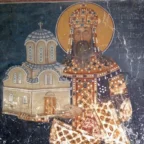
Stefan Uroš II Milutin Nemanjić
King Stefan Uroš II Milutin Nemanjić was born around 1254–1255 as the second son of King Uroš I Nemanjić and Queen Helen. He was the seventh ruler of the Nemanjić dynasty — the ruling house that had governed Serbia since the late twelfth century, when Stefan Nemanja had forged a unified Serbian state and his son St. Sava had given it an autocephalous Orthodox Church. The dynasty's identity was inseparable from its religious mission: each Nemanjić king was simultaneously a political sovereign and a protector of Orthodoxy, a role that the Church reinforced through hagiography, liturgy, and the monumental art of the endowment churches.
According to the Lives of Serbian Kings and Archbishops by his contemporary Archbishop Danilo II, a conflict broke out between his father King Uroš I and his brother King Stefan Uroš Dragutin in 1276. King Uroš I abdicated and died less than two years later. Six years later, following a riding accident, King Dragutin abdicated in favour of his younger brother during the council of Deževo in 1282. The circumstances of Milutin's accession were thus already entangled in the dynastic tensions that would shadow his entire reign: he came to power not by primogeniture but through the incapacity of a brother who retained substantial northern territories and a claim that his own heirs could one day press.
Together with his great-grandfather Stefan Nemanja, the founder of the Nemanjić dynasty, and his grandson Emperor Stefan Uroš IV Dušan, King Milutin is considered the most powerful ruler of the Nemanjić dynasty. This assessment reflects a reign of thirty-nine years that transformed Serbia from a regional power into the dominant force in the Balkans — doubling the kingdom's territory, reorienting its cultural identity towards Byzantium, and laying the foundations of economic prosperity that would make the Serbia of Dušan the wealthiest state in the region.
The first seventeen years of Milutin's reign were defined above all by sustained military pressure on Byzantine Macedonia. The ailing empire of Andronikos II, stripped of its army and its navy, could offer only sporadic resistance. Milutin advanced systematically down the Vardar valley, seizing towns, fortresses, and entire regions that had been Byzantine for centuries. In 1284, Milutin also gained control of northern Albania and the city of Dyrrachion — the same port that his contemporary Michael Glabas Tarchaneiotes had also contested — demonstrating the breadth of his strategic ambition across both the Aegean and Adriatic spheres.
Alongside the Byzantine campaigns, Milutin managed the threat from Bulgarian feudal warlords in the northeast. At the end of the 1290s, two Bulgarian lords — Darman and Kudelin — were jointly ruling the Braničevo region and often attacking the lands of his brother Stefan Dragutin. In 1291, Milutin and Dragutin joined forces against them, securing the northern frontier. The cumulative effect of these campaigns was the annexation of a vast swathe of Macedonian territory, including Skopje, Tetovo, Veles, Štip, Ohrid, and Prizren — cities with substantial Greek-speaking populations and deep Byzantine institutional, ecclesiastical, and cultural roots.
Much of that was brought to a close with the Serbo-Byzantine peace treaty of 1299, which recognised the new realities of Serbian expansion into Macedonia. The agreement was sealed by a dynastic marriage between the king and Emperor Andronikos's minor daughter Simonida. Simonida was five years old and Milutin was almost fifty, had been married three times, and had adult children. The negotiations were conducted by the Byzantine minister Theodore Metochites; Church circles in Constantinople opposed the marriage, but the emperor was determined to push the deal through. The marriage was celebrated in Thessaloniki in spring 1299, and as a wedding present the Byzantines recognised Serbian rule north of the line Ohrid–Prilep–Štip — a formal recognition by Constantinople of territorial losses it had been unable to reverse militarily, dressed in the language of dynastic alliance.
The marriage to Simonida, however politically calculated, had profound cultural consequences. It brought the emperor's daughter — and with her a retinue of Greek courtiers, craftsmen, and ecclesiastical advisors — into the heart of the Serbian kingdom at the precise moment when Milutin was embarking on his most ambitious programme of church building. The Byzantine imperial culture she embodied found immediate expression in the art that would define the reign.
The peace with Byzantium paradoxically destabilised Milutin's relationship with his own brother. Disputes began between them after 1299, and war broke out, lasting with sporadic cease-fires until Dragutin's death in 1316. The conflict had dynastic roots: the agreement at Deževo in 1282 had implicitly promised that Dragutin's line would inherit the throne if Milutin died without heirs, but Milutin's surviving sons and his new Byzantine queen altered the succession calculus. By 1309, Milutin appointed his son, future king Stefan Dečanski, as governor of Zeta — signalling that Dečanski, not Dragutin's son Stefan Vladislav II, was to be heir. This decision provoked Dečanski's own subsequent revolt, and Milutin ordered his son blinded and exiled to Constantinople as punishment — a sentence later apparently reversed, since Dečanski was said to have miraculously recovered his sight and eventually inherited the throne on Milutin's death in 1321.
Economic transformation was one of Milutin's most consequential legacies. During his reign, Serbian economic power grew rapidly, mostly due to the development of mining. He founded Novo Brdo, which became an internationally important silver mining site. Saxon miners introduced efficient techniques and a legal system that granted them greater autonomy; after fifty years, the Novo Brdo mine became the most prosperous in medieval Serbia and housed a state mint that produced the most silver in the country. Other important sites expanded under his reign included Trepča and Janjevo, and by the fifteenth century Serbia and Bosnia together produced more than twenty percent of all the silver in Europe.
King Milutin started minting his own money, producing imitations of Venetian coins (grosso), which gradually diminished in value. This led to the ban of these coins by the Republic of Venice and provided King Milutin a place in Dante's Divina Commedia — placed among the falsifiers of coin in the Purgatorio, a detail that registers the impact of his debasement policy on the wider Mediterranean trading economy as far as fourteenth-century Florence.
It is as a builder and patron of the arts — above all as a ktetor, a founder of churches — that Milutin left his most enduring mark on cultural history. His biographer Archbishop Danilo II records that Milutin founded forty churches and monastic institutions in Serbia, Constantinople, Mount Athos, Thessaloniki, and even in Jerusalem and the monastery of Mount Sinai. Six of the most important survive in Serbia and the former Yugoslav space, together constituting one of the supreme collections of Palaiologan monumental painting anywhere in the Orthodox world.
The principal monuments include: Bogorodica Ljeviška, Prizren (1306–1307), with frescoes by the Byzantine painters Michael Astrapas and Eutychios, where Milutin is represented in full Byzantine costume with a Byzantine crown — a political statement suggesting his intention to supplant the ruling Byzantine emperor; St. George, Staro Nagoričino (1316–1318), whose monumental decoration was signed twice by the Greek painter Michael Astrapas, most probably of Thessaloniki; the King's Church, Studenica (1314), whose frescoes by Mihailo Astrapas and his workshop are among the finest examples of the Palaiologan Renaissance on Serbian soil; and Gračanica Monastery (completed 1321), whose ktetor's composition shows Christ sending crowns to King Milutin and Queen Simonis in an iconographic concept previously reserved for Byzantine emperors.
Gračanica also contains one of the most significant innovations in Serbian medieval iconography. The Nemanjić Family Tree — known only in Serbian churches and appearing here for the first time — depicted the entire dynasty rooted in Stefan Nemanja and flowering upwards toward Milutin himself, a powerful visual argument for dynastic legitimacy and divine favour based on compositions of the Tree of Jesse. It would be imitated by his successors throughout the fourteenth century.
The adoption of the Byzantine artistic idiom was not merely aesthetic but theological and political. By commissioning Thessalonian Greek painters to decorate his foundations in the Palaiologan style, Milutin placed his kingdom within the cultural horizon of Constantinople. His court adopted Byzantine court titles, ceremonial dress, and iconographic programmes for royal portraiture — depicting him consistently in imperial costume, receiving crowns from angels or carrying church models, in a visual rhetoric that claimed imperial status for the Serbian king even as he acknowledged the emperor in Constantinople as his father-in-law.
Stefan Uroš II Milutin died on 29 October 1321. He was initially buried in the Bulgarian capital Sofia, where his remains were translated in 1460 to the St. Nedelya Cathedral. After his death, disputes over the succession between his son Stefan Konstantin and Stefan Dečanski resulted in civil war, from which Dečanski emerged victorious, crowned king in January 1322. As with most of the Nemanjić monarchs, Milutin was proclaimed a saint by the Serbian Orthodox Church, with a feast day on 30 October — a recognition not only of his personal piety but of his monumental contribution to the Church: forty foundations across the Orthodox world, the introduction of the Palaiologan style to Serbian sacred art, and a reign that had made Serbia the dominant Orthodox kingdom of the Balkans at a moment when Byzantium itself was in terminal decline.
-
Sulpicius Severus
Sulpicius Severus (c. 363 – c. 425) was a Gallo-Roman writer of Aquitaine whose Life of St Martin became the founding text of Western hagiography — the model on which very nearly every subsequent Latin saint's life, Muirchú's Life of Patrick among them, was directly or indirectly built. Born to a noble family, he received a thorough classical education and studied law at Burdigala (Bordeaux), where he was accounted an eloquent and promising advocate. He married the daughter of a consular family, but she died young and childless, and her death left him free — encouraged, notably, by his own mother-in-law, though opposed by his father — to turn away from a legal and civic career toward the ascetic Christianity that was then spreading among the Gallo-Roman aristocracy.
The decisive influence on this conversion was Martin, the soldier-turned-monk who had become bishop of Tours around 371. Severus never joined Martin's own monastic community at Marmoutier as a resident disciple; instead he withdrew to his own estate at Primuliacum in southern Gaul, where, together with his friend and fellow ascetic Paulinus of Nola — the two men's correspondence is a principal source for Severus's later life — he built a small household community and commissioned decorated buildings and portraits of Martin and of St Paul, of which Paulinus's letters give a vivid description. Gennadius of Marseille, writing later in the fifth century, recorded that Severus was ordained a priest, though the details of any pastoral ministry he exercised are obscure.
Severus began the Vita Sancti Martini before Martin's death in 397, on the basis of what he represented as a personal visit to the aged bishop, and continued to add to the Martinian dossier after it: three Epistulae recounting Martin's death and burial (the letters ad Eusebium, ad Aurelium, and one to his mother-in-law Bassula), and two — later expanded to three — books of Dialogi, in which speakers debate Martin's sanctity against the achievements of the Egyptian desert fathers and answer critics who doubted his miracles. The Vita presents Martin as a bishop who never ceased to be a monk, working wonders, destroying pagan shrines, and confronting worldly power while retaining the charisma of the ascetic — a template that shaped how sanctity itself would be written about in the West for a millennium afterward. His other major work, the Chronica (or Chronicorum libri duo, c. 403), is a compressed universal history from the Creation to his own day, prized above all for its near-contemporary account of the Priscillianist controversy in Spain and Gaul.
Gennadius adds a curious coda to Severus's later years: deceived, in old age, by adherents of Pelagius, he is said to have imposed on himself a penitential silence for the remainder of his life as atonement for having spoken too freely. He is thought to have died in the 420s, probably in the region of Toulouse.
Severus's Martinian corpus — the Vita, the Dialogi, and the letters ad Eusebium and ad Aurelium — supplies the third and final division of the Book of Armagh, bound immediately after the New Testament. Its inclusion makes explicit the typological claim that runs through the whole manuscript: that Patrick is Ireland's Martin, an ascetic bishop standing in direct, continuous descent from the paradigmatic holy man of the Latin West, and that Armagh's authority is thereby anchored not at Ireland's margins but within the mainstream of continental Christianity.
T
-
The Rabbula Gospels (Rabbula Evangeliarium)
The Rabbula Gospels (Rabbula Evangeliarium; Florence, Biblioteca Medicea Laurenziana, cod. Plut. I, 56) is one of the most extraordinary illuminated manuscripts to survive from Late Antiquity, a sixth-century Syriac Gospel Book that stands at a pivotal crossroads between Eastern and Western Christian art, between Hellenistic naturalism and the formative language of Byzantine iconography. For any student of medieval manuscript illumination, it is an indispensable reference point.
The manuscript was completed in 586 at the Monastery of Saint John in Beth Zagba (Beth Zagba), a location long thought to be in northern Mesopotamia but now more convincingly placed in the hinterland between Antioch and Apamea in northern Syria. This relocation is significant because it situates the codex within the cultural orbit of Antioch, helping explain its classical visual references. The monastery itself is described in tradition as a major complex of four spacious churches whose facades faced a central octagon containing a venerated relic.
The codex is written on parchment. Its folios now measure about 34 x 27 cm, though they were likely larger before repeated rebinding and trimming. It contains 291 folios. The Gospel text, beginning at Matthew 1:23 (so the opening of Matthew is lost), is in the Syriac Peshitta, the standard Syriac biblical translation. It is copied in Estrangela script, a prestigious early Syriac book hand, written right-to-left, so the codex is physically structured opposite to Latin and Greek books.
The manuscript's name derives from a colophon near the end (folio 291r), where the scribe identifies himself as Rabbula and records date and place. Beyond that line, nothing certain is known about him: his rank, origins, or whether he also painted the miniatures. Some scholars have proposed that scribe and miniaturist could be the same person, but this remains unproven. The colophon is written in the same Estrangela script as the Gospel text, in a smaller hand, securely connecting the dated signature to the main codex.
Modern scholarship shows that the Rabbula Gospels in its present form is a composite object assembled over time, probably into its current binding in the fifteenth or sixteenth century. It contains three main sections: twenty-six illustrated parchment pages with full-page miniatures and canon tables preceding the Gospel text; a set of twelfth-century paper leaves with liturgical readings (lectionary material); and the principal parchment body of the Peshitta Gospels copied in 586. This composite history means the image cycle and the Gospel text may not have been conceived as one unified project from the beginning.
The codex's fame rests chiefly on its pictorial cycle, attributed to an anonymous miniaturist or workshop distinct from the named scribe. Most decoration is concentrated in the opening folios and includes full-page miniatures together with Eusebian canon tables framed by elaborate arcades. The canon tables, based on Eusebius of Caesarea's fourth-century concordance system, are enriched with columns, arches, vegetal motifs, birds, deer, rabbits, and prophet and evangelist imagery.
Stylistically, the miniatures favor saturated color, energetic movement, and strong narrative drama. Certain figures retain draped postures inherited from Hellenistic art, while the ornamental vocabulary often reflects eastern decorative traditions, including interlace and patterned architectural framing, yielding a visual language distinct from contemporary Latin manuscripts.
The Crucifixion (folio 13a) is one of the most historically significant images in Christian art and is widely regarded as the earliest surviving Crucifixion in an illuminated manuscript. Christ appears alive and open-eyed, clothed in a long sleeveless tunic (colobium), in keeping with early eastern Christus Triumphans conventions. The scene includes the thieves, soldiers casting lots, the Virgin and John, and associated narrative details.
The Ascension (folio 13b) is equally ambitious: Christ rises in a mandorla, accompanied by symbolic imagery of the four living creatures associated with the Evangelists. Below, the apostles gather while the Virgin appears in an orant pose. The personified sun and moon point to continued dialogue with classical visual memory in sixth-century Syria.
The manuscript also includes an early monumental Pentecost and a rare scene of the Apostles choosing Matthias to replace Judas (Acts 1), an episode seldom foregrounded in later medieval art. On folio 12r, Judas is depicted hanging from a tree, a stark example of the cycle's narrative directness.
The codex preserves notes in Syriac, Arabic, and Garshuni (Arabic written in Syriac script), documenting its long life across multiple linguistic communities. A section of liturgical indices in East Syriac script (folios 15v-19r) indicates continued use in public worship.
Its post-586 history is obscure until the medieval period. An inscription on folio 292v records a donation to the Church of Saint George after the death of Romano, "a priest and visitor from Antioch," suggesting movement from monastic to parish or urban church context, likely in the eleventh or twelfth century. A dated note of 15 May 1361 places the manuscript at the Monastery of Qannubin in Lebanon, seat of the Maronite Patriarchate in the Qadisha Valley. In the late fifteenth or early sixteenth century, the codex was brought to the Biblioteca Medicea Laurenziana in Florence, where it remains today as cod. Plut. I, 56. Around this final phase, the three sections were assembled in their current form, and some retouching may have occurred.
The Rabbula Gospels holds a singular place in the history of Christian illumination. Few luxuriously illustrated sixth-century manuscripts survive. Its cycle preserves essential evidence for Christian image-making in the eastern Mediterranean on the eve of the Islamic conquests. The manuscript demonstrates a synthesis of Hellenistic figural language, near-eastern ornamental abstraction, and emergent Byzantine theological iconography. For this reason, it is not a peripheral curiosity but a central witness for later Byzantine, Coptic, Armenian, and medieval Latin manuscript traditions.
-
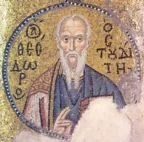
Theodore the Studite
Theodore the Studite (Greek: Θεόδωρος ὁ Στουδίτης, Constantinople, 758/759 - Chalkis, November 11, 826) is the third great pillar of iconodulist theology, alongside John of Damascus and Patriarch Nikephoros. A reforming monk, charismatic abbot, and prolific writer, he is venerated as a saint by both the Catholic Church and the Orthodox Churches on November 11.
Theodore was born in Constantinople around 758 to a family of high-ranking imperial officials. The decisive turning point in his life occurred around 780, when he followed his maternal uncle Plato, a man of profound spirituality, to the family estate at Sakkoudion, in Bithynia, on Mount Olympus, where they founded a new monastic community. In 784 Theodore took his monastic vows, and in 794, upon his uncle's death, he became its abbot, immediately distinguishing himself for his ascetic rigor and the growing number of disciples he attracted around him. His personality was one that brooked no compromise: combative, tenacious, capable of standing up to emperors and patriarchs, yet also a spiritual guide of extraordinary gentleness toward his monks.
Theodore's unyielding character manifested itself for the first time not in a theological dispute, but in a disciplinary matter. When Emperor Constantine VI repudiated his lawful wife Maria to marry his niece Theodota, Theodore categorically refused to recognize the union as legitimate and accused the priest who had celebrated the new wedding of having committed an act contrary to Christian morality. For this courageous opposition, he was exiled to Thessalonica in 796, where he remained until the death of Constantine VI in 797. This episode already revealed Theodore's defining trait: the conviction that the Church must be autonomous from imperial power in matters of doctrine and morality, a theme that would permeate his entire work.
After his recall from exile, Empress Irene assigned Theodore the famous Monastery of Stoudion (or Studios) in Constantinople, founded in 463 on the model of the Acemeti. Under his leadership, between 800 and 810, Stoudion became the most important monastic community in the Christian East, with over a thousand monks, and a unique model of regulated life. Theodore drew up a Rule (the Hypotyposis) that precisely codified every aspect of communal life: choral prayer, manual labor, the copying of manuscripts, and the discipline of silence and penance. In this way, Stoudion also became a great scriptorium, a center for the production of liturgical books and patristic texts that exerted an enormous influence on the transmission of medieval Byzantine culture.
Theodore's theological contribution to iconodulism stands in sharp contrast to that of John of Damascus due to his more distinctly Aristotelian and logical approach. In his three Antirrhetici (Refutations Against the Iconoclasts), Theodore developed a philosophical argument of great originality: the icon does not share the nature (ousia) of Christ, but bears his characteristic image (hypostasis), that is, his visible personal identity. By becoming incarnate, Christ became circumscribable, representable, in his human nature. To reject this circumscribability is equivalent to denying the real Incarnation, to slipping into Docetism. Veneration directed toward the icon, therefore, automatically passes to the prototype, just as the honor rendered to an imperial portrait was considered honor rendered to the emperor himself.
Theodore further explained that the icon of Christ depicts neither his divine nature alone nor his human nature alone separately, but his entire person, the unitary hypostasis of the Incarnate Word. This argument was of extraordinary Christological subtlety, as it cut off any Monophysite or Nestorian loophole for the iconoclasts.
Theodore endured a total of three exiles, each linked to a different political-religious crisis. The third and harshest was the one imposed by Emperor Leo V the Armenian beginning in 815, when the second imperial iconoclasm regained momentum. Theodore refused to accept any compromise, wrote letters to the popes of Rome, Leo III and Paschal I, invoking the authority of the Apostolic See against imperial persecutions, and continued to spiritually guide his scattered monks through an intense epistolary correspondence. During these years of persecution, he was flogged, imprisoned, and transferred from prison to prison throughout Anatolia. Upon the death of Leo V in 820, he regained his freedom but was unable to return to Stoudion, and he died in the small monastery of Calkite, in Bithynia, on November 11, 826.
Theodore left behind a vast literary corpus, all contained in vol. XCIX of the Patrologia Graeca. In addition to the iconoclastic refutations, he wrote hundreds of letters (278 of which have survived), catecheses for his monks, homilies on the Virgin Mary of great beauty, and liturgical hymns. His most enduring contribution to the Eastern liturgy is the Lenten Triodion, the collection of hymns and prayers for the Lenten season that the Orthodox Church still uses in its entirety today. His remains were solemnly transferred to the Stoudion Monastery on January 26, 844, a few months after the Triumph of Orthodoxy in 843, a symbolic gesture that cemented his place among the founding fathers of the iconodule victory.
-
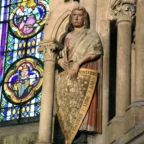
Thimo of Kistritz
Thimo of Kistritz (also known as Timo von Kistritz or Timo de Kistericz) was a medieval nobleman and benefactor of Naumburg Cathedral, immortalized as one of the twelve donor figures in the cathedral's west choir created by the Naumburg Master around 1245-1250. An inscription on his sculptural shield records his generous donation: "Thimo of Kistritz gave to the church seven villages" (Latin: "TIMO DE KISTERICZ QVI DEDIT ECCLESIE SEPTEM VILLA"). While some earlier scholarship attempted to identify him with Thimo the Brave, Count of Wettin (c. 1034-1091/1118), recent research has concluded that this identification is unlikely, and Thimo of Kistritz remains a distinct historical figure whose precise identity and dates are uncertain.
The historical record for Thimo of Kistritz is fragmentary, consisting primarily of references in Naumburg mortuary rolls (Mortuologien) that mention him as a donor who gave the village of Kistritz and other properties to the cathedral. Earlier historians attempted to identify this benefactor with Thimo the Brave (Thimo der Tapfere), the powerful Count of Wettin and Brehna who died in 1091 or possibly as late as 1118. Thimo the Brave was the son of Margrave Theoderic II of Lower Lusatia and Mathilde of Meissen, and was the first member of the Wettin family to adopt the name "von Wettin" after the family's castle. However, more recent scholarship has demonstrated that this conflation is probably incorrect, suggesting that Thimo of Kistritz was a separate individual, possibly from a lesser noble family associated with the place name Kistritz (modern Kostritz).
What we know with certainty about Thimo of Kistritz comes from the sculptural program itself. His statue in the west choir stands to the right of Count Wilhelm of Camburg, positioned as part of the carefully arranged ensemble of twelve founder figures. The Latin inscription on his shield-"Thimo of Kistritz gave to the church seven villages"- provides the most concrete evidence of his historical existence and his generous patronage. The donation of seven villages (septem villas) with all their appurtenances (rights, agricultural production, and inhabitants) represented a substantial endowment that would have provided significant ongoing revenue to support the cathedral and its clergy. This type of landed donation was typical of noble benefactors seeking to secure prayers for their souls and their families' spiritual welfare.
The Naumburg Master created Thimo's statue around 1250 as part of the extraordinary ensemble in the west choir, more than a century after the historical Thimo's death. Like the other donor figures, the sculpture was carved from limestone and originally polychromed with vivid colors, though much of the paint has worn away over the centuries. The figure portrays Thimo as a noble warrior, equipped with shield and armor, embodying the ideal of the Christian knight who uses his wealth and martial prowess to support the church. Ten of the twelve founder statues, possibly including Thimo's, were carved from single blocks together with the engaged columns behind them, demonstrating the extraordinary technical virtuosity of the Naumburg Master's workshop.
The statue of Thimo von Kistritz demonstrates the Naumburg Master's revolutionary approach to Gothic sculpture, particularly in the deliberate portrayal of individual character and psychological depth. Rather than creating generic, idealized types, the sculptor imbued each founder figure with distinctive facial features, postures, and expressions that suggest specific personalities and emotional states. This naturalism and psychological sophistication distinguished the Naumburg west choir sculptures from earlier Romanesque donor portraits and influenced the development of Gothic sculpture throughout German-speaking territories. The inclusion of the specific donation inscription on Thimo's shield also reflects the commemorative function of these sculptures: they served not merely as religious decoration but as permanent memorials ensuring that the benefactors' generosity would be remembered by future generations of cathedral visitors and clergy.
The creation of Thimo's donor statue in the mid-13th century, long after his actual lifetime, illustrates an important aspect of medieval memorial practice. The Naumburg cathedral chapter commissioned these sculptures to honor benefactors whose donations had been crucial to the cathedral's foundation and ongoing prosperity, even though no one in the 1250s could have known what these 11th-century donors actually looked like. The Naumburg Master's portraits thus represent idealized commemorations rather than historical likenesses, created to inspire continued patronage and to demonstrate gratitude for ancestral generosity. The fact that medieval chronicles later developed elaborate legendary narratives around the name "Thimo"-drawing on motifs from chivalric romances-suggests that the statue itself may have inspired storytelling, with the powerful sculptural presence generating fictional elaborations of Thimo's life and deeds. In this sense, the sculpture became more historically significant than the historical figure it supposedly commemorated, transforming Thimo of Kistritz into an enduring symbol of noble Christian benefaction.
-
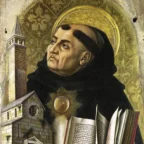
Thomas Aquinas
Thomas Aquinas was born at Roccasecca, near Aquino, in what was then the Kingdom of Sicily (present-day Lazio, Italy), around 1225. He was born to the most powerful branch of the d'Aquino family. His father, Landulf VI of Aquino, Lord of Roccasecca, was a miles in the service of Frederick II, Holy Roman Emperor. Thomas's mother, Theodora Galluccio, Countess of Teano, belonged to the Rossi branch of the Neapolitan Caracciolo family. Through his maternal lineage, Thomas was distantly related to the Hohenstaufen imperial dynasty, and to the royal houses of Aragon, Castile, and France.
The geopolitical context of his birth was turbulent. The Kingdom of Sicily was governed by Frederick II, who was in almost continual conflict with the papacy. The d'Aquino family's position, loyal to the Emperor yet deeply Catholic, placed Thomas from birth at the intersection of the great powers of medieval Christendom, a tension that would define not only his childhood but, in sublimated form, his entire intellectual project.
Thomas Aquinas spent most of his childhood in the Benedictine monastery at Monte Cassino, where his parents placed him as a prospective monk when he was about five years old. The family's intention was explicit: as the youngest son, Thomas was destined for an ecclesiastical career of prestige, ideally as abbot of Monte Cassino itself, one of the oldest and most venerable monasteries in Christendom, founded by Saint Benedict in the sixth century. The oblation of a child to such an institution was both a religious act and a dynastic strategy: it secured the family's spiritual patronage while providing Thomas with the finest available education.
He remained at Monte Cassino for nine years, receiving a thorough grounding in the liberal arts, Latin, Scripture, and the patristic tradition. When he was fifteen, Emperor Frederick II took over the monastery and the monks and students had to leave, so Thomas went to the University of Naples. At Naples, one of the few European universities founded by a secular ruler rather than the Church, and consequently more open to heterodox currents of thought, Thomas encountered two forces that would reshape the entire direction of his life. The first was Aristotle: the texts of the Greek philosopher, newly translated into Latin through Arabic intermediary versions, were beginning to circulate in the European schools with the force of intellectual revelation, reopening fundamental questions about the nature of reality, knowledge, and the cosmos that the Platonic-Augustinian tradition had settled too comfortably. The second was the Order of Preachers, the Dominicans, whose friars, committed to lives of radical poverty, study, and apostolic preaching, embodied a form of religious dedication wholly unlike the wealthy Benedictine monasticism his family had planned for him.
In 1244, at approximately nineteen years of age, Thomas secretly joined the Dominican Order at Naples. When his family found out, they felt so betrayed that he had turned his back on the principles to which they subscribed that they decided to kidnap him. The prospect of a nobleman of the d'Aquino line embracing the life of a mendicant friar, begging, wandering, preaching to the poor, was, to his family, a social catastrophe of the first order. The Dominicans were a new kind of religious institution, barely a generation old, and their conspicuous poverty was associated not with the honorable withdrawal of traditional monasticism but with a subversive assault on established hierarchies.
In an attempt to prevent Theodora's interference in Thomas's choice, the Dominicans arranged for Thomas to be removed to Rome and then to Paris. However, on the way to Rome, his brothers who were soldiers under Emperor Frederick, following their mother's instructions, seized him as he was drinking from a spring near the town of Acquapendente and took him back to his parents, who were then at the castle of Monte San Giovanni Campano.
He was held in the family homes at Monte San Giovanni and Roccasecca in an attempt to prevent him from assuming the Dominican habit and to convince him to become a Benedictine. Political concerns prevented the Pope from ordering Thomas's release, which extended his detention, during which he spent time tutoring his sisters and communicating with members of the Dominican Order. The family's desperation escalated: his brothers, as tradition records, arranged for a young woman to enter his chamber and tempt him into sexual sin, which, had it succeeded, would have made him ineligible for the priesthood. Thomas, according to every source, seized a burning brand from the hearth and drove her out, then fell to his knees in prayer. The tradition adds that two angels appeared to him that night and girded him with a cord of chastity, a grace he was said to have felt physically for the rest of his life.
After nearly two years of detention, his family relented. Teodora and her daughters saw that further attempts to change Thomas's resolve were useless and allowed him to rejoin the friars in Naples, from whence he was sent to Paris.
Arriving at the Dominican priory of Saint-Jacques in Paris around October 1245, Thomas began his formal theological studies under the greatest natural philosopher of the age: the celebrated Saint Albert the Great. It was Albert, Albertus Magnus, who had made it his life's mission to assimilate the whole of Aristotelian philosophy into the framework of Christian thought, commenting on virtually every work of the Stagirite with encyclopedic thoroughness. Under Albert's tutelage, Thomas received not only a comprehensive education in Aristotelian science, metaphysics, and ethics, but also the intellectual method, patient, rigorous, comprehensive, that would define his own mature work.
The relationship between master and pupil became one of the great intellectual partnerships of the medieval period. Thomas's sheer physical size and his characteristic silence in disputations had misled his fellow students into dismissing him as slow-witted, they called him the "Dumb Ox of Sicily." Albert corrected this misperception with a prophecy that has become one of the most famous utterances in the history of education: "We call him the dumb ox, but in his teaching he will one day produce such a bellowing that it will be heard throughout the world."
Albert brought Thomas with him when he was appointed to establish a new studium generale at Cologne, where Thomas continued his studies and was ordained as a priest around 1250. After four years as a bachelor of theology, lecturing on the Bible and on Peter Lombard's Sentences, Aquinas received his doctorate and was immediately appointed master of theology, once again at an earlier age than the statutes officially allowed.
From 1256 until 1259, Thomas held the Dominican chair of theology in Paris, preaching, lecturing on the Bible, and presiding over various philosophical and theological disputations. This was the most intellectually charged environment in Europe. The University of Paris was the supreme arena of scholastic controversy, where Dominicans, Franciscans, secular masters, and Augustinian Hermits competed for intellectual prestige and institutional authority. Thomas quickly established himself as one of the dominant presences among the mendicant masters, not through aggression but through the extraordinary clarity, precision, and comprehensiveness of his thought.
The central intellectual challenge of his era was the arrival of the full Aristotelian corpus in Latin translation, much of it channeled through Arabic commentators, above all Averroes (Ibn Rushd) of Cordoba, whose radical interpretations of Aristotle threatened to dissolve the boundary between philosophy and theology entirely. Some of the Averroist theses, particularly the doctrine of the unity of the intellect, which seemed to deny individual immortality, were incompatible with Christian doctrine. Thomas's response was neither to reject Aristotle (as some conservatives wished) nor to follow Averroes in his most radical conclusions (as the Latin Averroists at Paris were doing), but to reread Aristotle more carefully and argue that a correct interpretation of the philosopher was fully compatible with Christian faith.
It was also during this period that Thomas began work on the Summa contra gentiles, a systematic theological treatise written not for university students but, initially, as a handbook for Dominican missionaries engaged in apologetic disputes with Muslims, Jews, and heretical Christians in North Africa and Spain. This treatise was completed after he returned to Italy to lecture at the papal court in 1261.
From 1259 to 1268, Thomas served at various locations in Italy, Orvieto, Rome, Viterbo, attached to the papal court as its resident theologian. These years were among the most productive of his life. He enjoyed the direct patronage of successive popes, access to the finest libraries, and the leisure to develop his thought without the constant pressure of university disputations.
It was in Rome, around 1265, that Thomas began the work that would become the crowning achievement of medieval theology: the Summa Theologiae. He began his masterwork while he was in Rome, teaching Dominican students. The Summa was conceived as a comprehensive, systematic account of the whole of Christian doctrine, organized in a characteristic dialectical method: each article poses a question, states objections to the correct answer, gives the correct answer (responsio), and then replies to each objection in turn. The structure is both pedagogically efficient and intellectually elegant, allowing the reader to understand not only what Thomas thought but why he thought it and what considerations he was weighing.
The architecture of the Summa is tripartite. The first part (Prima Pars) treats God, the divine nature, the Trinity, creation, and the angels. The second part, divided into two (Prima Secundae and Secunda Secundae), is a comprehensive ethics: the nature of human happiness, the passions, virtues and vices, law, grace, and the specific moral theology of the Christian life. The third part (Tertia Pars) treats Christ, the Incarnation, and the sacraments. Among its best-known contents are the Five Ways (Quinque Viae), Thomas's famous arguments for God's existence, natural law theory, virtue ethics, and sacramental theology.
It was also during these Italian years that Thomas was commissioned by Pope Urban IV to compose the liturgical texts for the newly instituted feast of Corpus Christi, the celebration of the Eucharist. The result was a set of hymns and antiphons, including the Pange Lingua, Tantum Ergo, and O Salutaris Hostia, that are still sung throughout the Catholic world. As a poet, he wrote some of the most gravely beautiful eucharistic hymns in the Church's liturgy.
When his second four-year term in Paris came to an end he returned to Italy, but between 1269 and 1272 Thomas was recalled to Paris for a second stint, and this period was the most fiercely combative of his career. He was now fighting on two fronts simultaneously. Against the radical Averroists, above all Siger of Brabant, he argued that the doctrine of the unity of the intellect was philosophically indefensible even on Aristotle's own terms. Against conservative Augustinians, led partly by Franciscan masters, he defended his use of Aristotelian philosophy against charges of innovation and heterodoxy.
Aquinas was also heavily influenced by Augustine's integration of Christian theology with Neoplatonism, particularly regarding the nature of God and the soul. He also drew inspiration from Islamic and Jewish thinkers such as Avicenna, Averroes, and Maimonides. His intellectual generosity, his willingness to learn from Muslim and Jewish philosophers, to follow Aristotle wherever the argument led, to grant the strongest possible formulation to his opponents before refuting them, was itself a kind of intellectual courage remarkable for its age.
The Five Ways, presented in the opening questions of the Prima Pars of the Summa, distill this synthesis into five tightly argued demonstrations of God's existence from natural reason alone. The First Way reasons from motion to an Unmoved Mover; the Second from efficient causation to an Uncaused First Cause; the Third from contingent beings to a Necessary Being; the Fourth from degrees of perfection to an absolute standard; and the Fifth from the teleological order of nature to an intelligent designer. None of these arguments was invented by Thomas, they have roots in Aristotle, Avicenna, and earlier Christian thinkers, but his formulation of them was precise, economical, and compelling enough to make them the standard reference points for all subsequent natural theology.
In 1272, Thomas returned to Naples, where he established a new Dominican studium and continued simultaneously his enormous commentary series on Aristotle and the composition of the Summa. He was nearing completion of the final portion in December 1273.
Then, on the feast of Saint Nicholas, 6 December 1273, something happened at Mass in the Dominican church of San Domenico Maggiore in Naples that has never been fully explained. Aquinas had a mystical experience while celebrating Mass on December 6, 1273, after which he stopped writing, leaving his great work, the Summa Theologiae, unfinished. When asked why he had stopped writing, Aquinas replied: "I cannot go on. All that I have written seems to me like so much straw compared to what I have seen and what has been revealed to me."
He used the remainder of December 1273 to recover at his sister Theodora's house. Nonetheless, Thomas still had his wits about him, for not only was he able to carry on a conversation until the end of his life, but two months later he composed one precious last piece of theological writing, a brief exposition on the relation of human freedom and divine foreknowledge for the monks at Monte Cassino.
The Summa was never completed. What Thomas left unfinished, the treatment of penance, extreme unction, holy orders, matrimony, and the last things, was subsequently compiled by his disciples, primarily from his earlier commentary on the Sentences of Peter Lombard, and appended as the Supplementum.
Early in 1274, the Pope directed Thomas to attend the Second Council of Lyons, and though far from well, he undertook the journey. On the way he stopped at the castle of a niece and there became seriously ill. He wished to end his days in a monastery and not being able to reach a house of the Dominicans, he was taken to the Cistercians. He died at the monastery of Fossanova, one mile from Sonnino, on March 7, 1274. He was forty-nine years old.
His last recorded words, spoken before receiving the Eucharist for the final time, were: "I receive Thee, price of my soul's redemption, I receive Thee, viaticum of my pilgrimage, for whose love I have studied, watched, labored; I have preached Thee, I have taught Thee." He submitted all his writings to the judgment of the Church, asking that whatever in them was erroneous be corrected.
-
Thomas of Celano
Thomas of Celano — in Italian Tommaso da Celano — was a Franciscan friar, hagiographer, and poet, best known as the principal biographer of Saint Francis of Assisi and the probable author of the Dies Irae, one of the most celebrated Latin sequences of the medieval liturgy. His writings constitute the earliest and most authoritative documentary sources for the life of Francis, making him an indispensable figure for anyone studying thirteenth-century Italian religious culture and hagiography.
Thomas was born around 1185–1190 into the noble family of the Conti dei Marsi at Celano, a town in the Abruzzi region of central Italy. He received a thorough liberal arts education, possibly at the Benedictine monastery of Saint John the Baptist near his hometown, which gave him the intellectual formation necessary for the sophisticated Latin prose he would later produce. He joined the Order of Friars Minor around 1215, during the lifetime of Francis himself, and developed a personal acquaintance with the saint that would lend an eyewitness dimension to his later biographical writing.
In 1221, Thomas was sent to Germany alongside Caesarius of Speyer to expand and consolidate the Franciscan presence in the German-speaking lands — one of the order's most ambitious early missionary ventures. He proved an effective administrator and was appointed custos (guardian) responsible for the convents of Cologne, Mainz, Worms, and Speyer, and subsequently became Caesarius's vicar in governing the entire German province. He returned to Italy before September 1223 and remained there for the rest of his life, maintaining close proximity to Francis in the saint's final years.
Thomas produced three major hagiographical works on Francis of Assisi, all written on commission and constituting a unique documentary corpus on the founder of the Franciscan order.
The Vita Prima (Vita Beati Francisci), completed by 1230, was commissioned directly by Pope Gregory IX shortly after Francis's canonization in 1228. It is structured in three uneven parts: the first covers Francis's youth, conversion, and the founding of the order up to 1223; the second describes the final two years of his life, his reception of the stigmata on Mount La Verna on 14 September 1224 (the first human recorded to have borne the marks of Christ's Passion), and his death in 1226; the third recounts the canonization and early miracles. The work draws on eyewitness testimony and is imbued with the theological framework of the saint as a perfect alter Christus.
The Vita Secunda, compiled between 1244 and 1247 on the commission of Crescentius of Jesi, then Minister General of the order, functions as a supplement rather than a replacement of the first biography. It incorporates new materials gathered from the direct companions of Francis — notably Brother Leo and Rufinus of Assisi — and reflects the evolving internal debates within the Franciscan order about the true interpretation of Francis's ideal of poverty. A third work, a treatise on the Miracles of Saint Francis, was written around 1254–1257 at the request of Blessed John of Parma, Crescentius's successor as Minister General.
Thomas has long been considered the author of the Dies Irae ("Day of Wrath"), the great eschatological sequence describing the Last Judgment that became the standard sequence of the Tridentine Requiem Mass. Its authorship, however, remains uncertain and is debated by modern scholars. He also traditionally receives credit for the earliest Life of Saint Clare of Assisi, though this attribution too is not universally accepted. Regardless of these disputes, his Latin prose and verse demonstrate exceptional literary mastery and a deep command of the Augustinian and Bernardine spiritual tradition.
In 1260, Thomas retired to his last post as spiritual director to a convent of Poor Clares (Clarisses) in Tagliacozzo, in his native Abruzzi. He died there sometime between 1260 and 1270, and was initially buried in the church of San Giovanni Val dei Varri; his remains were later translated to the church of San Francesco in Tagliacozzo, where they rest today. A process for his beatification was formally opened in Avezzano, and in 1991 the Congregation for the Causes of Saints declared the process valid and opened the Roman Phase, granting him the title Servant of God.
For scholars of medieval hagiography, Franciscan history, and Italian religious culture, Thomas of Celano's writings are primary sources of the highest order. His biographies shaped the visual and literary image of Francis that artists — from Cimabue and Giotto onward — translated into the great fresco cycles of Assisi and beyond. His precise descriptions of Francis's spiritual experiences, physical appearance, and miraculous deeds provided the iconographic materia from which the entire tradition of Franciscan art drew its narrative vocabulary.
U
-
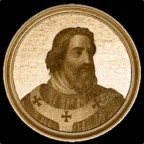
Urban IV (Jacques Pantaleon)
Pope Urban IV (Jacques Pantaleon; c. 1195-2 October 1264) reigned for barely three years, never once set foot in Rome as pope, and yet did two things that outlasted him: he instituted the feast of Corpus Christi, and he invited Charles of Anjou into Italy, setting in motion the destruction of the Hohenstaufen and the reorientation of the peninsula's politics for a century.
He was born at Troyes in Champagne, probably in the closing years of the twelfth century. c. 1195 is the usual estimate, though c. 1200 is also given, and no source is decisive. The tradition that he was the son of a cobbler (sutor) is repeated by the older literature and is plausible for a career made entirely through university and curial service rather than birth; it should nonetheless be labelled tradition rather than documented fact. He studied at Paris (theology and law), and accounts diverge on whether he then taught canon law there. Britannica asserts it, the Catholic Encyclopedia does not, and the professorship should be treated as uncertain.
His career was that of a competent northern French cleric who became useful to popes. He held a canonry at Laon and became archdeacon of Liège, later archdeacon of Laon. At Liège, in the 1240s, he encountered the eucharistic devotion of Juliana of Mont-Cornillon and the diocesan feast of Corpus Christi ordered by Bishop Robert de Thourotte in 1246, the single most important fact in his biography for the Bolsena question. He came to the notice of Innocent IV at the First Council of Lyon (1245), and was sent on missions to Germany, where he worked at ecclesiastical discipline in Silesia and at the long conflict between the Teutonic Knights and their Prussian subjects, a process that culminated in the Treaty of Christburg (usually dated 1249, sometimes 1248). In 1251 he was in northern Germany recruiting support for William of Holland, the papal candidate for the Empire. He was made bishop of Verdun in 1253 and Latin Patriarch of Jerusalem in 1255 by Alexander IV, an office by then largely titular in a kingdom reduced to a coastal strip.
He was at Viterbo, seeking western aid for the Holy Land, when Alexander IV died on 25 May 1261. The Sacred College then numbered only eight cardinals, and after a three-month deadlock they chose the patriarch, a man outside their own body. Urban was the first pope elected without being a cardinal; only five would follow him (Gregory X, Celestine V, Clement V, Urban V, Urban VI). He was crowned on 4 September 1261 at Santa Maria a Gradi in Viterbo. He immediately addressed the smallness of the College by creating fourteen cardinals, among them Simon de Brion (the future Martin IV) and Guy Foulques (the future Clement IV), an act with consequences well beyond his lifetime, and one that decisively strengthened the French element in the curia.
A fortnight before his election, Constantinople had fallen to Michael VIII Palaiologos and the Latin Empire had ended. Urban attempted, without success, to raise a crusade for its restoration. Pachymeres reports that he had one of Michael's envoys flayed alive, a hostile Greek source and a claim that deserves caution typical of atrocity anecdotes in polemical historiography. His more consequential eastern initiative was intellectual: he commissioned Thomas Aquinas, then attached to the papal court at Orvieto, to write the Contra errores Graecorum (1263), and it was to Urban that Aquinas dedicated the Catena aurea.
The pontificate's political substance was the Sicilian question. Manfred, illegitimate son of Frederick II, held the kingdom (a papal fief), and his influence extended into Lombardy and Tuscany. Urban renewed his excommunication and sought a counter-king, offering the crown successively to Louis IX's brother, to Edmund of England, and finally, in 1263, to Charles of Anjou, count of Provence and Louis IX's brother. The terms Urban imposed are revealing: Sicily was never to be united to the Empire; its king would swear fealty, pay an annual tribute (10,000 ounces of gold), and abstain from acquiring substantial dominion in northern Italy or the Papal States. Meanwhile Urban simultaneously negotiated with Manfred, dangling papal recognition in exchange for help against Byzantium, a double game he sustained for two years. Whether this was cynicism or prudence by a weak power with two irons in the fire remains debated. Fearing assassination plots and a converging Ghibelline attack, he moved from Orvieto to Perugia in 1264.
Between those two Umbrian residences falls the event for which he is popularly remembered. On 11 August 1264, at Orvieto, he issued the bull Transiturus de hoc mundo, extending the feast of Corpus Christi to the universal Church, to be kept on the Thursday after the octave of Pentecost, arguably the first papally mandated universal feast of the Latin rite. The office and hymns, including Pange lingua, are traditionally ascribed to Aquinas; the attribution was long doubted and is now broadly, though not universally, accepted on the strength of early Dominican liturgical manuscripts. What must be stressed, since the two are often conflated, is that Transiturus nowhere mentions Bolsena, a miracle, or a corporal. The bull argues from theology and calendar. Urban's motive is fully explained by Liège, where he had watched the feast take shape decades earlier. The link to the Bolsena miracle is a fourteenth-century construction, and any biography that presents the bull as Urban's response to the bleeding host has reversed the causation.
He fell ill after reaching Perugia and died there on 2 October 1264, before Charles of Anjou ever crossed the Alps. Contemporaries linked his death to the Great Comet of that year, which appeared as he sickened and faded as he died, a coincidence that says more about thirteenth century cosmology than about pathology; no cause of death is recorded. He was buried at Perugia. Clement IV, one of his own creations, carried the Angevin policy through to Manfred's death at Benevento (1266) and Conradin's execution at Naples (1268).
Two things survive him physically. He began the church of Saint-Urbain at Troyes in 1262, on the site of his father's shop, a rayonnant building of remarkable structural daring. And the corporal of Bolsena, which he almost certainly never heard of, is still carried through Orvieto on the feast he founded.
He also wandered, unwillingly, into legend: in some versions of the Tannhäuser story it is Urban who refuses absolution and whose dry staff then blossoms. There is nothing behind this in thirteenth-century evidence.
-
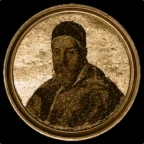
Urban VIII (Maffeo Vincenzo Barberini, 1568-1644; pope 1623-1644)
Born in Florence in April 1568 into a family of Tuscan merchants and minor officials who had prospered in wool and banking. His father died when he was three, and he was raised largely by his uncle Francesco Barberini, an apostolic protonotary in Rome, who directed him to the Jesuits' Collegio Romano and then to a doctorate in law at Pisa (1589). His career was that of a competent, cultivated curial jurist: apostolic protonotary, governor of Fano, nuncio to the French court from 1604 — where he acquired the francophile leanings that would define his foreign policy — cardinal in petto in 1606, published 1607, and bishop of Spoleto. He was also a genuine Latin poet of some standing, publishing his Poemata and continuing to versify as pope.
He was elected on 6 August 1623, aged fifty-five, in a conclave conducted during a malarial Roman August that killed several participants. He nearly died himself in the weeks after; his coronation was postponed to 29 September. The pontificate that followed ran almost twenty-one years, one of the longest of the early modern period, and he outlived nearly all the cardinals who had chosen him.
Nepotism is the aspect contemporaries fixed on first. He raised his brother Antonio Marcello (Cardinal Sant'Onofrio, a Capuchin), and his nephews Francesco and Antonio to the purple, while a third nephew, Taddeo, became Prefect of Rome, Prince of Palestrina and General of the Church. The Barberini extracted a fortune from ecclesiastical revenues that even sympathetic estimates put in the tens of millions of scudi. Urban was sufficiently uneasy to convene a commission of theologians late in life to advise whether the family was obliged to make restitution; they obligingly said no. After his death Innocent X opened proceedings, and Francesco and Antonio fled to France under Mazarin's protection.
His foreign policy was governed by fear of Habsburg encirclement of the Papal States rather than by confessional solidarity. During the decisive phase of the Thirty Years' War he withheld meaningful support from the Emperor, tolerated Richelieu's alliances with Protestant powers, and refused to declare the conflict a religious war — conduct that earned him bitter reproach from Spain and Vienna, most famously in Cardinal Gaspare Borgia's protest in consistory in 1632. He did, however, annex the Duchy of Urbino on the extinction of the della Rovere line in 1631, the last significant territorial gain the papacy ever made, and he spent enormously on fortification: Castel Sant'Angelo, the arsenal at Civitavecchia, Fort Urbano near Castelfranco, and a cannon foundry at Tivoli.
The end of the reign was ruinous. The War of Castro (1641–1644), provoked by his family's designs on the Farnese duchy, united Parma, Modena, Venice and Tuscany against him, emptied the treasury, and closed with a humiliating peace in March 1644. He died on 29 July, and the Roman crowd's reaction was openly hostile: his statue on the Capitol had to be protected, and by some accounts destroyed.
Several ecclesiastical acts were consequential and long-lasting:
- Causes of saints. The decrees of 1625 and the bull Caelestis Hierusalem cives (1634) reserved beatification and canonisation definitively to the Holy See and established the procedural framework — including the ban on public cult of the non-beatified and the rule on immemorial cults — that governed the process into the twentieth century. This directly affects the legal status of many medieval local cults.
- Jansenism. In eminenti (dated 1642, promulgated 1643) condemned Jansenius's Augustinus, opening a controversy that outlasted him by a century and a half.
- Missions. He founded the Collegium Urbanum de Propaganda Fide (1627) for the training of missionary clergy, and issued Commissum nobis (1639) against the enslavement of the indigenous peoples of the Americas.
- The Breviary hymns. In 1629 he appointed a commission of Jesuit humanists which, for the 1632 Breviary, rewrote the great body of Latin hymnody into classicising metre and diction. Roughly nine hundred alterations were made. For a medievalist this is the most damaging act of the pontificate: the accentual, rhymed Latin of Ambrose, Prudentius, Venantius Fortunatus and the medieval Office was systematically neutralised, and the revision was only reversed after the Second Vatican Council. The epigram of the period — that if the pope had had his way, the hymns would have been improved out of existence — captures the reaction of those who cared.
As Cardinal Barberini he had been Galileo's friend and admirer, writing a poem in his honour, and after his election he granted him six audiences and encouraged him to write on the world systems provided the Copernican account was presented hypothetically. The Dialogo of 1632 put Urban's own preferred argument — that God's omnipotence forbids concluding necessarily from appearances — into the mouth of the character Simplicio. Whether Galileo intended the insult remains disputed; Urban's fury did not. He referred the matter to the Inquisition, and Galileo was condemned in June 1633 and confined for life. The episode is usually read as personal grievance compounding institutional conservatism, at a moment when the pope was politically exposed and unwilling to appear soft on doctrine.
He made Gian Lorenzo Bernini, then twenty-five, the dominant artist of Rome — reportedly telling him that it was his great fortune to see Maffeo Barberini pope, but the pope's greater fortune that Bernini lived in his pontificate. The commissions include the baldacchino over the tomb of St Peter (1624–1633), the campanili of St Peter's (a structural failure, demolished under Innocent X, and the one lasting blot on Bernini's career), the Triton and Barberini fountains, and Urban's own tomb in St Peter's. The bronze for the baldacchino was stripped from the portico of the Pantheon, producing the most famous pasquinade in Roman history: what the barbarians did not do, the Barberini did.
Palazzo Barberini alle Quattro Fontane was begun by Carlo Maderno and completed by Bernini and Borromini — the building in which the two men's rivalry took visible form, and now the Galleria Nazionale d'Arte Antica. Its salone carries Pietro da Cortona's Allegory of Divine Providence and Barberini Power (1632–1639), the founding monument of Roman Baroque illusionistic ceiling painting and one of the most sustained pieces of papal-family propaganda ever executed. The Barberini bees, laurel and sun saturate Roman topography to this day.
For medieval studies, the essential thread runs through his nephew Cardinal Francesco Barberini, the greatest collector-patron of the age. His library — assembled with the help of Lucas Holstenius and Cassiano dal Pozzo, and in correspondence with Peiresc — became one of the outstanding manuscript collections in Europe, and passed to the Vatican Library in 1902 as the Barberiniani latini, graeci and orientales funds. It contains material of the first importance for the medieval period, including illuminated manuscripts and liturgical rolls. The late-antique imperial ivory panel now in the Louvre still carries the family's name because it entered that collection, a gift from Peiresc. Cassiano dal Pozzo's Museo Cartaceo, the vast drawn record of Roman antiquities and early Christian monuments — including copies of medieval and Early Christian mosaics and frescoes since destroyed — was assembled in the same household and is now an irreplaceable source for lost monuments.
A cultivated, autocratic, politically overconfident pope whose reign produced the visual definition of Baroque Rome and the financial and diplomatic exhaustion of the papal monarchy. Ranke's judgement — that he combined great taste with disastrous statecraft — has proved durable. For anyone working on the Middle Ages, he is a double figure: through the Barberini collections one of the great preservers of medieval material, and through the Breviary of 1632 one of its most efficient destroyers.
-
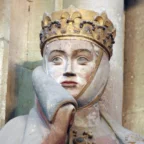
Uta von Ballenstedt
Uta von Ballenstedt (c. 1000-23 October before 1046) was a German noblewoman from the powerful House of Ascania who became Margravine of Meissen through her marriage to Ekkehard II, Margrave of Meissen. She is celebrated as one of the most iconic figures of medieval art, immortalized in the famous sculptural portrait known as "Uta of Naumburg," created by the Naumburg Master around 1245-1250 in the west choir of Naumburg Cathedral. Often described as "the most beautiful woman of the German Middle Ages," her statue has become one of the most recognizable and influential works of Gothic sculpture, inspiring everything from 20th-century art movements to Disney's depiction of the Evil Queen in Snow White.
Uta was born around the year 1000 in Ballenstedt, the ancestral seat of her family in the eastern Harz region of Saxony. She was the daughter of Count Adalbert of Ballenstedt and his wife Hidda, who was herself the daughter of Margrave Hodo I of the Saxon March of Lusatia. Her brother Esico of Ballenstedt became the progenitor of the Ascanian dynasty, one of the most important noble houses in medieval Germany, which would later rule Brandenburg, Saxony, and Anhalt. Through her family connections, Uta belonged to the highest circles of Saxon nobility and was related to the German imperial court.
Uta spent her early years at her parents' ancestral castle in Ballenstedt before being sent to the monastery of Gernrode for her education. At Gernrode, she received instruction in reading and writing-remarkable accomplishments for a woman of her era-as well as training in courtly manners, dance, and the refined behaviors expected of high nobility. This education at a prestigious religious institution was typical for daughters of the highest aristocracy and prepared her for her future role as a margravine. Her sister Hazecha would later become abbess of Gernrode, appointed to that position by King Henry III in 1044, just two years before Uta's death.
In 1026, when Uta was approximately twelve years old-the customary age of marriage for noble girls in the medieval period-she was married to Ekkehard II, Margrave of Meissen. The marriage was arranged by Uta's father Adalbert for political and strategic reasons, specifically to increase the family's power and maintain peace between the Ascanian and Ekkehardinger dynasties. Ekkehard, who was significantly older than his young bride (he was born around 985), had become Margrave of Lusatia in 1034 and would succeed his brother Hermann I as Margrave of Meissen in 1038, making Uta Margravine of Meissen from 1038 until her death.
As Margravine of Meissen, Uta managed the margravial residence at Nuwenburch (the "new castle") in Naumburg while her husband was frequently away on military campaigns or attending the imperial court as one of Emperor Henry III's closest advisors. Her responsibilities would have included overseeing the household, managing estates, and representing margravial authority in Ekkehard's absence. Together with her husband, Uta became a generous patron and co-founder of Naumburg Cathedral, making substantial donations that supported the cathedral's construction and endowment. These acts of religious patronage were typical of high nobility seeking to secure spiritual benefits and demonstrate Christian piety.
Uta's marriage to Ekkehard remained childless, a circumstance that would have profound dynastic consequences. She died on October 23, either in 1045 or early 1046 at approximately 45-46 years of age, though the cause of her death is unknown. Uta was buried in Naumburg Cathedral beneath the altar of the cross. Following her death, her substantial dowry was distributed according to her husband's wishes: large portions went to the convent of Gernrode in her homeland, where her sister Hazecha served as abbess, while other parts went to Empress Agnes. Just one year later, in January 1046, Ekkehard himself died, marking the extinction of the Ekkehardinger dynasty. Because the couple had no heirs, Ekkehard bequeathed his entire estate and exceptional wealth to Emperor Henry III, fundamentally altering the political landscape of the eastern marches.
More than two hundred years after her death, Uta was commemorated as one of the twelve donor figures in Naumburg Cathedral's west choir, created by the anonymous sculptor known as the Naumburg Master between 1243 and 1250. The life-size statue, carved from polychromed limestone, depicts Uta standing beside her husband Ekkehard in a composition that has become one of the most celebrated works of medieval art. The sculptor portrayed her wearing a crown and an elegant cloak, with her right hand gracefully raised to draw the collar of her mantle closer to her face in a gesture that suggests both regal composure and protective self-containment. Her facial expression conveys serene nobility, described as "cool, almost expressionless" yet radiating quiet power and emotional control.
The statue of Uta has earned her the epithet "the most beautiful woman of the Middle Ages," and she became almost a cult figure in German Gothic art. What distinguishes her portrait from other medieval sculpture is the Naumburg Master's revolutionary approach to psychological depth and individualized characterization. Rather than creating a generic devotional type, the sculptor imbued Uta's statue with distinctive personality and presence-a serene, powerful woman clearly in control of her emotions and circumstances. Art historians celebrate the work for its remarkable naturalism, subtle modeling of fabric and flesh, and the sculptor's ability to suggest inner life and character through posture and expression.
Uta's sculptural portrait has exerted extraordinary influence on modern culture, far beyond its original medieval context. In the 20th century, the statue inspired numerous artists and became an icon of Gothic art appreciation in Germany. Most famously, Walt Disney's animators used Uta's statue as direct inspiration for the Evil Queen in Snow White and the Seven Dwarfs (1937), particularly her regal bearing, elegant costume, and distinctive crown. The comparison highlights both the statue's enduring visual power and its curious transformation from a memorial to Christian piety into a symbol of imperious beauty. Today, Uta von Ballenstedt remains one of the most recognizable figures from the medieval period, though ironically she is far better known through her 13th-century sculptural representation than through any historical records of her actual life. The Naumburg Master's genius ensured that this young Ascanian noblewoman, who died childless nearly a millennium ago, achieved a form of immortality that her contemporaries could never have imagined.
V
-
Vallombrosan Order
The Vallombrosan Order, formally the Congregatio Vallis Umbrosae Ordinis Sancti Benedicti (O.S.B. Vall.), is one of the most significant monastic reform congregations to emerge from medieval Italy, rooted in an intense spiritual movement that sought to restore the purity of Benedictine life in an era of widespread ecclesiastical corruption.
The Order was founded by San Giovanni Gualberto (c. 985-1073), a Florentine nobleman of the Visdomini family. According to Vallombrosan hagiographic tradition, his conversion occurred on Good Friday of 1003, when he renounced vengeance against his brother's murderer - an act of Christian forgiveness that profoundly redirected his life. He subsequently sought a monastic vocation, experimenting first with the Cluniac community of San Miniato al Monte in Florence and later with the Camaldolese hermits, before withdrawing definitively to the dense forest of Vallombrosa, in the Apennine hills southeast of Florence, around 1030-1036.
The site of Vallombrosa - forested, solitary, and elevated at roughly 3,300 feet above sea level - suited perfectly Giovanni's vision of strict withdrawal from the world. The new community's foundation received formal ecclesiastical recognition with the consecration of its first church by Blessed Rotho, Bishop of Paderborn, in 1038, and the donation of the land by Itta, Abbess of the neighboring monastery of Sant'Ellero, in 1039.
The spirituality of Vallombrosa was built on a rigorous return to the Regula Benedicti, with a particular emphasis on communal poverty, strict clausura, and the rejection of simony and Nicolaitanism - the two great corruptions plaguing the eleventh-century Church. Giovanni was opposed above all to the buying and selling of ecclesiastical offices and sacraments, and his community became a living protest against clerical worldliness.
A distinctive institution of the new order was the extensive use of conversi - lay brothers who performed manual labor and external tasks, allowing the choir monks to remain in strict enclosure. The order also refused to provide officials for parish churches and chapels, preserving its communal integrity. The constitutional framework Giovanni envisioned, known as the Vinculum Caritatis (Bond of Charity), organized the monasteries into a congregation in which each house was autonomous and governed by its own abbot, elected by the community with the consent of the Abbot Major of Vallombrosa. The Abbot Major himself was elected by the assembled abbots of all the affiliated houses, who met annually at Vallombrosa with full legislative authority.
The most dramatic episode in the early history of the order was the ordeal by fire performed by the Vallombrosan monk Blessed Pietro Igneo (Petrus Igneus) at the abbey of Settimo near Florence in February 1068. The event was staged as a divine proof against the simoniac Bishop Pietro Mezzabarba of Florence, and Pietro Igneo reportedly walked through flames unharmed, inflaming popular devotion and drawing enormous attention to the Vallombrosan reform cause. The episode earned the order both papal favor and widespread public sympathy, consolidating its moral authority throughout Tuscany.
Formal papal protection came in stages: Pope Victor II confirmed the order in 1056, and a bull of Urban II in 1090 enumerated fifteen monasteries besides the motherhouse. A bull of Paschal II in 1115 listed twelve more, and under Anastasius IV and Adrian IV (1153-1156) a further twenty-four were added. By the pontificate of Innocent III (early thirteenth century), the congregation counted over sixty monasteries, all situated in Italy, with a notable presence in Sardinia where the order administered wealthy monasteries and governed numerous rural villages.
The period from the foundation to the early fourteenth century represents the true eta d'oro of Vallombrosan monasticism. The congregation expanded throughout central and northern Italy, radiating from its Tuscan heartland into Lombardy, Liguria, and the Veneto, as well as into Sardinia. By 1160, Vallombrosan monks were present in fifty-seven monasteries. The annual chapter at Vallombrosa - where all abbots gathered with legislative power - maintained cohesion across the growing network and ensured the circulation of monks between houses, sustaining a uniform observance.
Among the order's most distinguished early figures was Bernardo degli Uberti, the superior general who, under the impulse of Popes Gregory VII, Urban II, and Paschal II, gave definitive structural form to the congregation as a fully recognized branch of the Benedictine family. The movement only began to be formally described as "Vallombrosan" in sources from around 1080.
The fourteenth century brought difficulties common to much of European monasticism: the catastrophe of the Black Death (1348), internal weakening, and above all the corrosive system of commenda, by which secular or absentee abbots were appointed by external authority, draining monastic revenues and disrupting communal life. The institution of the Abbot Major gradually lost much of its authority, and the congregation's expansion halted.
A decisive reform came in 1540, when the Vallombrosans, having suffered extensively from the effects of commenda, adopted the constitutions of the Cassinese Congregation of Saint Justina of Padua, including the exchange of their traditional grey wool habit for a black garb. The reform abolished the system of life-term abbots and replaced it with three-year terms, while the office of superior general ceased to be identified with the Abbot of Vallombrosa and became instead a titular abbot serving four-year terms alongside four definitors.
From 1662 to 1680, the Vallombrosan congregation was briefly united with the Sylvestrine order, a union that proved temporary. The monastery of Vallombrosa itself was enriched by the construction works of Abbot Nicolini in 1637 and saw the establishment of an astronomical observatory in 1634.
The Napoleonic era struck a severe blow: in 1808, French troops plundered Vallombrosa and the monastery was left deserted until 1815. The final suppression came with the unified Italian state: in 1866, the Italian government suppressed the monastery under the laws dissolving religious houses. The abbey buildings were converted in 1870 into Italy's first school of forestry, modeled on German institutions, and the site also became a mountain health resort.
Despite the suppression of 1866, a small community of monks survived to care for the church and maintain a meteorological station at Vallombrosa. The order was not extinguished: the Vallombrosan congregation persisted and eventually regrouped, and it continues to exist today as a living branch of the Benedictine family. In June 2025, Pope Leo XIV formally addressed the Vallombrosan congregation, underscoring its continuing significance within the Catholic Church.
The Vallombrosans' legacy extends well beyond their institutional history. Their fierce anti-simoniac stance in the eleventh century made them one of the principal engines of the Gregorian Reform, and their constitutional model - with its balance between monastic autonomy and congregational cohesion - influenced the organization of later medieval religious orders.
-
Vatican Terence (Codex Vaticanus Latinus 3868)
The Vatican Terence (Codex Vaticanus Latinus 3868) is an illuminated manuscript, dated to around 825, containing the six comedies of Publius Terentius Afer and housed in the Vatican Apostolic Library. Copied from a late-antique model from the 3rd century, it is a masterpiece of Carolingian art that preserves the Roman illustrative tradition. The Vatican Terence was likely produced in the Palatine School at the court of Louis the Pious in Aachen, although hypotheses regarding Corbie or Corvey remain debated; the scribe Hrodgarius signed the colophon, while Adelricus contributed only to some of the 150 miniatures, which are the work of three distinct artists. The text in Carolingian minuscule is enriched with interlinear and marginal commentaries (like the 9th-century Brunsianum and Monacense), with titles in rustic red and black capitals. Its history includes a theft during the Napoleonic era (1797–1816) before its return to the Vatican, where it has been digitized on DigiVatLib.
-
Via del Guardingo in Passignano
The Via del Guardingo in Passignano is one of the oldest and most strategically important roads in medieval Florentine territory, running through the heart of Chianti and connecting the main valleys of central Tuscany.
The term guardingo has deep roots in medieval Tuscan place-name etymology. In the lexicon of the time, it designated a place for observation and control of the territory: a military lookout and surveillance post, often associated with the presence of fortified structures. It was therefore not merely a geographical name, but a functional designation that indicated the very nature of the route. The Abbey of Passignano, founded in 1049 by Blessed Giovanni Gualberto as a center of the Vallombrosan Order, conferred further prestige and sacredness upon the entire route.
The Via del Guardingo di Passignano was historically a road of primary importance in the Florentine countryside's road network. Its fundamental role was to connect the main valleys of inland Tuscany—the Val di Greve, the Val di Pesa, and the Val d'Elsa—linking them with the Upper Valdarno. This road axis thus represented an essential infrastructure for Florence's political, military, and economic control of the territory, facilitating the transit of goods, pilgrims, soldiers, and officials between the various podesteries of the countryside.
The road took on even greater importance as it passed near the Abbey of Passignano, which by the High Middle Ages had already become one of the principal monasteries of the Vallombrosan Order and one of the region's largest landowners. Throughout medieval Tuscany, the Vallombrosan monasteries served as guides and providers of assistance for travelers, making the roads adjacent to them more heavily traveled and relatively safe.
One of the most significant aspects of this road's history is the way it shaped human settlement along its route. The village of Montefioralle—originally called Monteficalle after the fig trees that grew on the hillside—owes its medieval importance precisely to its location along the Via del Guardingo di Passignano. The castle of Monteficalle, dating back to the first half of the 10th century and first mentioned in a document from 1085, belonged over time to the Ricasoli, Benci, Gerardini, and Buondelmonti families, some of the most powerful noble houses in the Florentine countryside. Its function was precisely to control and guard the passage along the route.
Along the route there were also other sites of great historical and devotional interest. The Cappella dei Pesci, near the Fonte di Camugnana, is linked to a famous hagiographic episode: according to tradition, in 1050, on the occasion of Pope Leo IX's visit to the Abbey, Giovanni Gualberto asked two lay brothers to fish at the spring, which was notoriously devoid of fish. The two unexpectedly found two large pike, an event that was interpreted as a miracle and rendered the spring's water miraculous. In 1510, Don Jacopo Mindria da Bibbiena had an oratory built near the spring following a miraculous healing, transforming the site into a small local pilgrimage destination.
The spiritual and physical hub of the entire route was the Abbey of Passignano, whose oldest document dates back to the 890s, in the height of the Lombard era. Founded as a hermitage in 1049 by Giovanni Gualberto, founder of the Vallombrosan Order, the Abbey became one of the most powerful monastic centers in Tuscany during the 12th and 13th centuries, amassing an immense landholding by the mid-14th century. The structure, with its appearance of a turreted fortress surrounded by crenellated walls, perfectly reflected the dual nature of the road: sacred for pilgrims, military for the Florentine power.
Inside the abbey church of San Michele Arcangelo, dating back to the 12th century in its Romanesque form but remodeled several times, works of extraordinary importance are preserved: the frescoes by Domenico Ghirlandaio in the ancient refectory and the works of Domenico Cresti, known as "il Passignano"—a painter born in the rural house of Casa Pugliano, right along the route of the road—who painted the vault of the main chapel at the end of the 16th century.
With the gradual consolidation of Florentine power in the 14th and 15th centuries and the construction of a more extensive and better-controlled road network, the Via del Guardingo di Passignano gradually lost its function as the main artery of the countryside. The villages that owed their strategic existence to it—such as Montefioralle—were transformed into small agricultural settlements, and the route was reduced to a rural road. In the 18th century, the very name of the Monteficalle castle was changed to the current Montefioralle, a symbolic sign of how the memory of its ancient military-road function had by then faded into the Chianti landscape.
Today, the Via del Guardingo di Passignano survives as a hiking trail, known as the Anello del Guardingo (CAI trail marker 460), which starts at the Abbey of Passignano and winds through the vineyards, woods, and farmhouses of the Chianti countryside. The trail, approximately 6.7 km long with a modest elevation gain of 150 meters, allows hikers to visit all the sites linked to the road's history: the Abbey, the Cappella dei Pesci, Casa Pugliano, and the historic farmsteads dotting the landscape. Today, this trail represents not only a nature hike through the Chianti landscape but a true journey through the historical memory of a medieval road that for centuries was one of the vital arteries of the Florentine countryside.
-
Vita Aegili abbatis Fuldensis (Brun Candidus)
Candidus's masterpiece is the Vita Aegili abbatis Fuldensis (Life of Abbot Eigil of Fulda), composed around 840 at Rabanus Maurus's behest as an opus geminatum — a "twinned work" pairing prose and verse texts, a form popularized by Rabanus. This hagiography chronicles Eigil's election after Ratgar's fall, portraying him as a wise shepherd restoring unity amid rebellion, symbolized through Old Testament parallels like the unicorn from Psalm 22 attacking the flock. It serves as a key source for Fulda's 816–817 crisis and the Anian reforms emphasizing strict Benedictine observance, charity, consensus, and correction over tyranny. Candidus also wrote a now-lost Vita Baugulfi, but the Vita Aegili endures for its historical detail on monastic governance and Carolingian politics. Remarkably, the Vita Aegili is recognized as the earliest known illustrated biography in the Latin West, integrating Candidus's probable artistic expertise into a biblically inflected visual program. Though the original manuscript is lost, descriptions suggest miniatures accompanied the text, enhancing its role as propaganda for monastic reform amid 9th-century upheavals like the Gottschalk heresy debates and imperial civil wars. This fusion of prose, verse, and images exemplifies Carolingian opus geminatum innovation. Editions appear in Monumenta Germaniae Historica (prose in SS 15; verse in Poet. 2), underscoring its value for studying 9th-century paleography, hagiography, and the shift from Merovingian to Ottonian manuscript traditions.
W
-
Walter VI of Brienne, Duke of Athens (c. 1302-1356)
Walter VI of Brienne - Gualtieri VI di Brienne to his Florentine subjects - was a French nobleman of the crusader house of Brienne and titular Duke of Athens, a dignity his family had held since the early thirteenth century even after effective control of the duchy passed to the Catalan Company in 1311. Much of his early career was spent in largely fruitless attempts to recover Athens by force, and it was this crusading pedigree, together with Angevin connections through the royal house of Naples, that opened the way to a career as a hired captain in Tuscany, where he first served Florence as a military commander in the later 1320s.
He returned to Florentine service in 1342, engaged as captain of war in the faltering conflict with Pisa over Lucca. Florence's military reverses, compounded by the collapse of the great Bardi and Peruzzi banking houses and by bitter factional strife among the guilds and the old magnate families, led the commune to invest him first with an extraordinary conservatorship and then, in September 1342, with the signoria of the city for life - an outright grant of dictatorial power unprecedented in republican Florence. Walter ruled as a tyrant in the fullest medieval sense: he taxed heavily, courted the disenfranchised magnate nobility against the guild oligarchy that had actually installed him, executed and mutilated opponents, and surrounded himself with foreign mercenaries and officials answerable to him alone. The result was a coalition of grievances - guildsmen, magnates, and popolani alike - that by the summer of 1343 had turned universally against him.
On 26 July 1343, the feast of St Anne, the Florentines rose in arms, besieged Walter and his household in the Palazzo della Signoria, and forced him to renounce the signoria and quit the city under safe conduct; the Stinche, the communal prison in which he had held political opponents, was stormed and its prisoners freed in the same uprising. St Anne was adopted thereafter as a protectress of Florentine liberty, and the day of his fall became one of the city's most commemorated political anniversaries - the subject, a generation or so later, of Andrea di Cione's circular fresco of the Expulsion of the Duke of Athens, painted for the wall of the Stinche itself. Walter's subsequent career took him back to France and into the opening phase of the Hundred Years' War; he rose to become Constable of France under King John II and was killed leading the French vanguard at the Battle of Poitiers on 19 September 1356.
-
William I of Sicily ("the Bad")
William I of Sicily, known as "the Bad" or "the Wicked," ruled from 1154 to 1166. He was the second king of Sicily, the son of Roger II, and his reign is usually remembered for internal revolt, pressure from the Byzantine Empire, and the struggle to maintain royal authority across a politically fragile kingdom. William inherited the throne on the death of his father in 1154 and relied heavily on the official Maio of Bari, who exercised enormous influence at court. The most serious crisis came in 1155–1156, when Byzantine forces recovered several cities in Apulia and threatened the kingdom's mainland holdings. William responded decisively, defeated the Byzantines at Brindisi, and regained control, leading to the Treaty of Benevento in 1156, which confirmed him as king and restored papal recognition. His regime was shaken again by the revolt of 1160–1161 after the murder of Maio of Bari; rebels briefly seized the king, but William recovered power and imposed harsh punishments on the conspirators. These episodes helped shape his lasting reputation as a difficult and sometimes brutal ruler. The nickname "the Bad" is now often seen as reflecting the hostility of hostile chroniclers rather than a balanced historical judgment; modern scholarship tends to stress that William ruled a kingdom under severe structural pressures. William's later years were comparatively calmer, and he supported Pope Alexander III against Emperor Frederick Barbarossa. He died in Palermo in 1166, and was succeeded by his young son William II under a regency.
-
William II of Sicily ("the Good," Guglielmo il Buono)
William II of Sicily, known to history as William the Good (Guglielmo il Buono), was the last Norman king of Sicily, ruling from 1166 until his death in 1189 at the age of thirty-five. Though his personal character remains elusive in the sources, his reign was marked by major architectural patronage, sophisticated diplomacy, and the continued prosperity of the multicultural kingdom founded by his grandfather Roger II. Dante would later place him in Paradise in the Divine Comedy, a literary tribute to the peace and justice associated with his rule.
William was born in Palermo in December 1153, son of William I of Sicily and Margaret of Navarre. When his father died in May 1166, the crown passed to the twelve-year-old king under the regency of his mother. The early regency was turbulent: power first centered on Chancellor Stephen du Perche, whose unpopularity with the Norman baronage led to his overthrow in 1168, after which Walter Ophamil, archbishop of Palermo, and the vice-chancellor Matthew of Ajello became decisive political figures.
The regency also exposed a long-term dynastic vulnerability. William's only surviving legitimate Hauteville relative was his aunt Constance, long kept in the convent of Santissimo Salvatore in Palermo under the famous prophecy that "her marriage would destroy Sicily." As long as William produced an heir, this remained latent; after his death, it became decisive.
William assumed personal government in 1171. In domestic policy he cultivated clemency and negotiated balance with both urban elites and barons, distinguishing himself from the harsher methods associated with his father. Contemporary sources often describe him as court-centered and personally reserved, governing through trusted ministers from Palermo rather than through constant military presence in the provinces.
Yet the Palermitan court remained among the most cosmopolitan in Europe, preserving the administrative and cultural synthesis developed under Roger II. Arabic, Greek, and Latin continued in chancery practice, and the court sustained interactions among Christian, Muslim, and Jewish intellectual environments. In this sense, William functioned less as a radical innovator than as a successful custodian of an already exceptional political civilization.
In foreign policy he was active and ambitious. He concluded important treaties with Genoa (1174) and Venice (1175), strengthening Sicily's role in Mediterranean exchange. On 13 February 1177 he married Joan of England, daughter of Henry II and Eleanor of Aquitaine, confirming Sicilian rank within the wider European diplomatic system, though the marriage remained without surviving heirs.
William also navigated papal-imperial conflict with considerable skill. A supporter of Pope Alexander III and the anti-imperial cause in Italy, he moved after Legnano (1176) toward pragmatic accommodation, concluding a truce with Frederick Barbarossa at Venice in 1177. His later decision to betroth Constance to Barbarossa's son Henry (formalized by marriage in 1186) solved an immediate dynastic problem but ultimately opened Sicily to Hohenstaufen succession claims.
Relations with Byzantium produced the most dramatic military episode of his reign. After initial contacts, including a proposed marriage with the Byzantine princess Maria, policy shifted sharply. In 1185, Sicilian forces invaded Byzantine territories, captured Thessalonica, and briefly threatened Constantinople itself. The success proved temporary: William's army was destroyed near the Strymon in November 1185, and by 1189 peace with Isaac II Angelos required abandonment of the conquests. The campaign revealed both the scale and the limits of Norman Sicilian power.
The enduring achievement of William's reign is the Cathedral of Monreale (Santa Maria la Nuova), begun around 1174 and completed with remarkable speed. William founded not only the church but also an attached Benedictine abbey and archbishopric, creating a major ecclesiastical pole near Palermo and rebalancing power long concentrated in the Palermitan church hierarchy.
Monreale is one of the supreme monuments of medieval art, synthesizing Norman, Byzantine, and Arab visual languages on a monumental scale. Its interior preserves approximately 6,340 square meters of gold mosaic, among the largest surviving medieval mosaic ensembles, with extensive Old and New Testament cycles and a monumental apse Christ Pantocrator that reflects direct Byzantine workshop authority. The dedicatory image of William offering the church to the Virgin consciously echoes earlier royal iconography associated with Roger II at La Martorana.
William died in Palermo on 18 November 1189, childless after twelve years of marriage. The succession crisis that followed, between the claims of Constance and Henry VI and the Norman-backed candidacy of Tancred of Lecce, ended with Henry's conquest in 1194 and the extinction of independent Norman Sicily. In that sense, the prophecy surrounding Constance proved fatally accurate. Yet the cultural synthesis consolidated under Roger II and magnified under William II survived the dynasty itself and continued to shape the political and artistic world of Frederick II and thirteenth-century Mediterranean Europe.
X
-
Xenos Psalidas (fl. 1314–1315)
Xenos Psalidas was a Byzantine donor figure of the early fourteenth century whose name and image are preserved within the Crucifixion fresco of the Church of Christ (Christos) in Veria, painted by Georgios Kalliergis in 1314–1315. He is recorded in the Byzantine Art database of the Aristotle University of Thessaloniki as a named figure in a detail of the Naos Crucifixion — a mural painting of 1314–1315 by Georgios Kalliergis — identified alongside a woman named Euphrosyne. He belongs, therefore, not to the history of Byzantine scholarship but to the history of Byzantine patronage: one of the lay donors who financed or contributed to the decoration of the church that Thanasis Papazotos studied, that Maria I. Iakovleva analysed in her 2017 article, and whose painter Kalliergis called himself the best in all of Thessaly.
The discovery of his name within the fresco is an act of precisely the kind of prosopographical recovery that Georgios Theocharidis pursued through documents: a name extracted from the visual record of the monument itself, placed before the scholarly community by the photographic and cataloguing work of the Aristotle University's Chair of Byzantine Archaeology and Art.
The name Xenos Psalidas (Ξένος Ψαλίδας) carries within it two pieces of social information of some interest. Xenos (stranger, foreigner) is an attested Byzantine personal name, used throughout the middle and late Byzantine periods — neither uncommon nor particularly distinctive, but carrying in the fourteenth-century Macedonian context a possible suggestion of family origins outside the region. Psalidas (ψαλίδα, scissors) is a surname derived from a tool, following the widespread Byzantine and post-Byzantine practice of naming families after the trade or craft by which an ancestor had become identified. The Psalidas family — if it was indeed a family, rather than a personal epithet — was likely of artisanal origin, possibly from the cloth-working or barber trades; both used scissors as their primary instruments in the medieval economy.
The most famous bearer of the name Psalidas in Greek cultural history is Athanasios Psalidas (1767–1829), the Enlightenment scholar and director of the Kaplaneios School at Ioannina — a coincidence that connects, across five centuries, the world of Byzantine Veria to the intellectual culture of the Ottoman Greek city where Enlightenment ideas entered the Greek-speaking world. Whether any genealogical connection exists between the fourteenth-century Verian donor and the eighteenth-century Ioanniniot scholar is unknown and cannot be established from the available evidence.
The practice of including donor portraits within the iconographic programme of a Byzantine church is ancient and theologically precise. Donors who financed the construction or decoration of a church expected, in return, to be depicted within it — placed in the eternal space of sacred history, in the company of the saints and in the sight of God, so that their act of piety might be commemorated in perpetuity by the liturgical community that gathered in the space they had helped to create.
The Crucifixion is the most theologically freighted location available within the Byzantine iconographic programme. The scene of Christ's death on the Cross — the central redemptive event of Christian theology — occupies a dominant position within the naos, typically on the west wall of the apse or the east wall of the naos, positioned so that the congregation faces it throughout the liturgy. To be depicted within the Crucifixion scene — prostrate at the foot of the Cross, kneeling in the foreground, or standing at the margins alongside the Myrrhbearers and the Beloved Disciple — is to claim a place literally at the foot of Calvary: the donor presents himself and his companion as witnesses of the Passion, their faces turned toward Christ at the moment of his death, their names inscribed in the gold and pigment of the sacred space they have endowed.
The coupling of Xenos Psalidas with Euphrosyne — a woman whose name (Εὐφροσύνη, one of the three Graces, meaning mirth or good cheer) was common in Byzantine female nomenclature — suggests a spousal or familial relationship: a husband and wife presenting themselves together as co-donors of the decoration, their joint commemoration secured within the Crucifixion scene for as long as the plaster endures.
The identification of Xenos Psalidas and Euphrosyne within the Crucifixion of the Kalliergis programme places them in a specific and documentable historical context. The Church of Christ in Veria was the katholikon of the Resurrection Monastery, a stavropegial foundation — one subject directly to the authority of the Ecumenical Patriarchate rather than the local bishop, a status granted by the patriarch Niphon and the emperor Andronikos II in 1314. The patronage of this church's decoration was therefore an act conducted under the eyes of the highest ecclesiastical authority in the Byzantine world: the Patriarch of Constantinople himself had granted the church its patriarchal standing in the very years of its decoration.
Within this institutional framework, Xenos Psalidas and Euphrosyne represent the lay dimension of a patronage network that also encompassed the monk Ignatios Kalothetos — a friend of Gregory Palamas, then pursuing his ascetic vocation at the nearby monastery of Timios Prodromos — and the painter Kalliergis, who came from Thessaloniki and brought with him the most advanced pictorial tradition in the Byzantine world of that moment. The co-presence in a single decorative programme of a prominent monastic figure, a Thessalonian painter of the first rank, and a lay donor couple of artisanal surname suggests the social complexity of early Palaeologan religious patronage in a provincial Macedonian city: monks, painters, and merchants collaborating in the production of a monument that placed all of them, in different registers, in the presence of the eternal.
The entry that records Xenos Psalidas and Euphrosyne in the Byzantine Art Thematic Collection database of the Aristotle University of Thessaloniki is itself the product of the scholarly tradition we have been tracing through this conversation: the archival work that began with Lambros's manuscripts, continued through Pelekanidis's photographic documentation, was deepened by Papazotos's monograph on Byzantine Veria and its churches, and received fresh analytical attention in Iakovleva's 2017 article on the Kalliergis frescoes. The database entry — assigning Iconclass code 73D6 (the Crucifixion), noting the painter, the date, the medium, and the institutional archive that holds the photographic record — is the final, digital expression of a century of work to make the Byzantine heritage of Greek Macedonia legible to the scholarly community worldwide.
Xenos Psalidas himself left no documents, wrote no texts, and built no other monuments that have survived. He is known entirely from his image within a fresco, and from the four syllables of his name inscribed beside that image by the hand of Kalliergis or one of his assistants, in a church that has stood in Veria for more than seven hundred years. That is, in the context of Byzantine studies, a remarkable quantity of evidence — more than survives for the vast majority of the people who lived and prayed and died in fourteenth-century Macedonia.
Z
-
Zacharias of Mytilene (Zacharias Rhetor)
Zacharias of Mytilene, known to scholarship variously as Zacharias Rhetor, Zacharias Scholasticus, or simply Zacharias of Mytilene, was a bishop, ecclesiastical historian, and advocate whose life and work sit at the precise intersection of Greek classical learning, Syriac Christianity, and the great theological controversies of the late fifth and early sixth centuries. He is one of the most important, and most textually complex, historians of the late antique Christian East.
Zacharias was born around 465 AD in Gaza, the famous city on the Mediterranean coast of Palestine that was, in the late fifth century, a remarkable center of Greek rhetorical and philosophical culture. The so-called "School of Gaza" produced some of the most polished Greek prose stylists of the age, and Zacharias was formed in this environment of sophisticated Greek learning, steeped equally in classical rhetoric and Christian theology.
From Gaza he moved to Alexandria to pursue higher studies in law, a trajectory shared with several other significant Christian intellectuals of his generation, including the philosopher Aeneas of Gaza and the future historian Procopius of Caesarea. Alexandria in the late fifth century was a city of intense intellectual and theological conflict, above all between Chalcedonian and Monophysite factions, and Zacharias's years there shaped his theological sympathies decisively. He studied alongside future Monophysite thinkers and witnessed at first hand the turbulent ecclesiastical politics of the Alexandrian church, experiences that fed directly into his later historical writing. After completing his legal studies he received, like Evagrius of Antioch, the title of scholasticus, the formal qualification of a trained advocate, from which one of his common surnames derives.
After his education in Alexandria, Zacharias pursued a legal and ecclesiastical career, initially as a practicing advocate and subsequently as a churchman. His legal title Rhetor reflects his standing as a qualified pleader in the courts, a profession of considerable social prestige in late antique society. He eventually became Bishop of Mytilene, the principal city of the island of Lesbos, a post he held until sometime before 553 AD, when a new bishop of Mytilene attended the Second Council of Constantinople, indicating that Zacharias had died or vacated the see by that point. The precise date of his death remains unknown; scholarship establishes only that he was still active after 536 AD, the latest datable events he records in his writings.
Zacharias was a prolific author across several genres. His surviving and attested writings include a Life of Severus of Antioch, the great Monophysite patriarch, composed around 512 AD and preserving invaluable biographical detail about one of the defining theological figures of the age. He also wrote a philosophical dialogue, On the Creation of the World (Ammonius), which engages critically with Neoplatonic arguments for the eternity of the universe, a direct intervention in the debates between Christian theology and the pagan philosophical tradition that still flourished in Alexandria's schools. A further hagiographic life, that of the holy man Isaias of Gaza, also came from his pen.
His most historically significant work, however, is his Ecclesiastical History, originally composed in Greek and covering the period from 451 AD (the Council of Chalcedon) to 491 AD (the death of the Emperor Zeno). It was dedicated to a dignitary named Eupraxius and drew on Zacharias's own lived experience and personal knowledge of the eastern church during this critical period. Tragically, the original Greek text of the Ecclesiastical History is entirely lost.
The survival of Zacharias's historical work is one of the most intriguing textual puzzles in late antique scholarship. The Greek original did not survive directly; instead, a Syriac translation and expansion was made in the sixth century by an anonymous author, almost certainly a Monophysite monk from Amida (modern Diyarbakir in southeastern Turkey), working around 569 AD. This anonymous compiler incorporated Zacharias's ecclesiastical history, constituting Books 3-6 of his compilation, into a larger twelve-book work titled A Volume of Records of Events Which Have Happened in the World, which scholars designate the Historia Miscellanea.
This anonymous compiler is known in modern scholarship as Pseudo-Zacharias Rhetor, a designation that helpfully distinguishes the original author from his later adapter. The Historia Miscellanea significantly expanded Zacharias's original narrative, extending its coverage through the early years of Justinian's reign and incorporating additional documentary sources, including eyewitness accounts of the siege of Amida in 502-503 AD, numerous imperial and ecclesiastical documents, and an independent account of the Persian wars and the Nika Riots under Justinian. The entire Pseudo-Zacharias compilation survives in a single manuscript on vellum, now preserved as British Library Add MS 17202, dated to around 600 AD, making it one of the most precious and earliest surviving codices of Syriac ecclesiastical historiography.
The standard modern edition of the Syriac text was produced by E. W. Brooks for the Corpus Scriptorum Christianorum Orientalium (CSCO 83-84, Paris, 1919-1924). The first complete English translation and critical commentary was published by Liverpool University Press in 2011, edited by Geoffrey Greatrex, Robert Phenix, and Cornelia Horn, the standard scholarly tool for accessing the text today.
Zacharias was a Monophysite sympathizer, or at least deeply sympathetic to the anti-Chalcedonian cause, throughout his career, though the precise evolution of his theological position is debated. His years in Alexandria, his friendship with Severus of Antioch, and his biography of that patriarch all situate him firmly within the intellectual world of eastern Monophysitism. This stands in direct contrast to his near-contemporary Evagrius Scholasticus, who explicitly criticized Zacharias's theological presuppositions while nonetheless using his historical work as a source, a vivid illustration of how competing theological communities in the sixth century read and argued with each other's historiography even across doctrinal divides.
For scholars of late antique Christian history, Syriac literature, and the transmission of ecclesiastical texts, and especially for those working on the culture of the eastern Mediterranean in the fifth and sixth centuries, Zacharias Rhetor and his Pseudo-Zacharias continuation constitute a source of extraordinary value. The Historia Miscellanea preserves documents, narratives, and perspectives that survive nowhere else in Greek or Latin literature, offering a distinctively Syriac and Monophysite viewpoint on the great events of the age: the Chalcedonian schism, the theological politics of Constantinople, the Persian invasions, and the internal life of the Syrian church. For medievalists working on illuminated manuscripts and the transmission of Christian iconographic and textual traditions through the Syriac East, a tradition that ran parallel to and frequently intersected with the Latin and Byzantine West, Zacharias and Pseudo-Zacharias are essential interlocutors whose testimony illuminates the richly pluralistic world of early medieval Christianity.