Book of Mulling
( 25% )
Introduction: A Small Book with a Long Shadow
Among the manuscripts preserved in the Library of Trinity College Dublin, the Book of Mulling (MS 60, formerly shelf-marked A.I.15) is easily overshadowed by its glamorous neighbour, the Book of Kells. Visitors queue for the great display Gospels; few pause over the small, worn, copper-stained volume that shares its case and its century. Yet for the historian of early medieval Ireland, the Book of Mulling is in certain respects the more eloquent witness. It is not a book conceived for spectacle. It is a working book — small enough to be carried, dense with abbreviation, written in the everyday minuscule hand rather than the ceremonial majuscule of Kells or of the Lindisfarne Gospels — and precisely because it is modest, it preserves categories of evidence that the grander manuscripts do not. It carries a scribal colophon that names a person.
It carries added liturgical texts that open a window onto the devotional life of a specific monastic community. It carries, on its final battered leaf, a circular diagram that has generated more than a century of scholarly argument and remains genuinely unresolved. And it carries, in its very damage — the green stains of long contact with metal, the torn and patched last folio — the physical record of a second life, lived not as a text to be read but as a relic to be enshrined.
The present essay attempts a full account of this manuscript for a specialist audience: its historical setting in the cult of St Moling of St Mullins; its place within the distinctively Insular genre of the pocket Gospel book; its codicology, script and decoration; the colophon that gave it its name and the interpretative problems that colophon creates; the enigmatic device on folio 94v; the liturgical additions; the character of its Gospel text; the late medieval cumdach or book-shrine that housed it; its provenance from the MacMurrough-Kavanagh family to Trinity College; and finally its modern historiography and conservation.
Throughout, a deliberate method is observed. Every assertion is layered according to its epistemic standing: what the sources document, what may reasonably be inferred, and what remains speculative are distinguished explicitly, and several errors that circulate persistently in the popular and even the older scholarly literature — above all the flat claim that St Moling himself wrote the book, and the confident description of the final diagram as a plan of the monastery — are identified and corrected.
The modern literature on the manuscript rests on three works above all: H. J. Lawlor’s Chapters on the Book of Mulling (Edinburgh, 1897), the foundational monographic study, available online; Patrick McGurk’s 1956 article, which defined the pocket Gospel book as a class; and Lawrence Nees’s 1983 reassessment of the final drawing, which reoriented its interpretation. The rest of the scholarship, including the study of the manuscript’s Gospel of Luke and the descriptive work of the Trinity College catalogues and digitisation project, is drawn upon without personal attribution.
The story that emerges is double. On one side stands the eighth-century object: a compact Gospel book made by three scribes, textually old-fashioned, decorated with real accomplishment on a small scale. On the other side stands the relic: a book credited to a seventh-century saint, sealed for centuries in a silver-fronted shrine under the guardianship of a royal Leinster dynasty, and surrendered to an institutional library only at the end of the eighteenth century. The tension between these two identities — the book as artefact and the book as cult object — runs through every section that follows, and it is, in the end, what makes the Book of Mulling so instructive a case study in how early medieval books were made, used, venerated, misremembered and, at last, studied.
St Moling and the Monastery of Tech-Moling
The manuscript takes its name, and much of its later aura, from St Moling — Mo Ling, also called Moling Luachra, and appearing in the annalistic record under the name Dairchell — the Leinster ecclesiastic who founded the monastery of Tech-Moling, “the house of Moling,” on the banks of the River Barrow at the place still called St Mullins (Tigh Moling) in County Carlow. Tradition places his birth around 614 and his death around 697, and remembers him as the second bishop of Ferns, as one of the “four great prophets of Erin,” and as a saint commemorated on 17 June.
His presence in the earliest Irish martyrologies establishes that his cult is genuinely ancient; but around that documented core there accumulated a thick sediment of hagiography and legend. He is credited with obtaining the remission of the Bórama, the punishing cattle-tribute levied by the kings of Tara upon Leinster — a story that made him a political benefactor of his province as well as a spiritual one. He is said to have excavated a mile-long mill-race with his own hands over seven years of labour. And he is woven into one of the most haunting narratives of medieval Irish literature, the tale of Suibhne Geilt, the wandering madman of Buile Shuibhne, who is said to have died under Moling’s protection.
The historian must handle this material with care. The mill-race, the prophetic gifts, the Suibhne connection: these are the products of a living cult elaborating its founder over centuries, and none of them can be treated as biographical fact. What is securely documented is more austere but no less significant. A monastery bearing Moling’s name existed at St Mullins and grew into one of the most important ecclesiastical sites of south-east Ireland, comparable in regional weight to Glendalough or Clonmacnoise. Its subsequent history frames the survival of the book. The site suffered in the Viking incursions — the annalistic record points to plundering in the tenth century — and it is reported burnt in 1138; in 1158 St Mullins was granted to the Augustinian1 house at Ferns. A ninth-century high cross and the ruins of the later abbey still stand at the site.
Why does this matter for the manuscript? Because the Book of Mulling cannot be understood apart from the cult within which it was preserved. A community with a founder-saint of Moling’s stature had every reason to treasure a Gospel book associated with his name; a book so treasured acquired, over time, the status of a relic; and a relic, unlike an ordinary book, was protected, enshrined and transmitted with a tenacity that mere texts rarely enjoyed. The crucial methodological point — one repeatedly blurred in popular accounts — is that the association between the book and the saint is, in the first instance, a matter of cult and tradition. Whether it also rests on a genuine historical connection is a question that must be answered from the manuscript itself, and specifically from its script and its colophon; and as will be seen, the answer the manuscript gives is more interesting, and more carefully qualified, than the legend.
The Irish Pocket Gospel Book
The Book of Mulling belongs to a small and distinctively Insular category of manuscript, the “Irish pocket Gospel book.” The classic study of the type is Patrick McGurk’s article “The Irish Pocket Gospel Book,” published in Sacris Erudiri 8 (1956), pages 249–270, which assembled a group of small Gospel manuscripts of Irish origin ranging in date from the seventh to the ninth century. Its members include, alongside Mulling itself, the Book of Dimma, the Book of Deer, the Book of Armagh, the MacDurnan Gospels, and the Cadmug Gospels preserved at Fulda. What unites these books is not a shared scriptorium or a shared decoration but a shared physical strategy: a small format achieved through compressed minuscule script and an unusually heavy use of abbreviation, producing a self-contained copy of the Gospels (in Armagh’s case of the whole New Testament) light enough to be carried in a satchel.
The members of the group were not all used in the same way. Some show clear signs of liturgical use, and this bears directly on Mulling, which carries an added order for the visitation of the sick. A private and a pastoral function are not, of course, mutually exclusive.
The genre is often explained by appeal to a specific moment in Irish Christianity — the era in which Irish monks travelled as pilgrims and missionaries through Britain and onto the Continent, and in which a compact, complete Gospel book had obvious practical value. The image of the missionary’s pocket book is attractive, and as a general account of why the format existed it is plausible. But it must be held lightly in any individual case, for it is a functional inference, not a documented fact about any particular manuscript. In Mulling’s case, indeed, the surviving evidence points the other way.
The liturgical additions tie the book to the devotional routine of a settled community; the long enclosure in a shrine ties it to a fixed cult centre and a single dynastic family. Whatever the travels of its lost exemplar may have been, the Book of Mulling as we have it appears to have lived a sedentary life: first as the working and praying book of the monastery of St Moling, then as the enshrined relic of that monastery’s founder.
Codicology and Physical Description
Physically, the Book of Mulling is a modest volume of vellum. Its leaves measure approximately 165 by 120 millimetres, about the size of a modern paperback, and Trinity College Library counts 99 folios; Lawlor, who examined the loose leaves in the 1890s, likewise counted 99 leaves, correcting an earlier count of 98. The layout is not constant. In the first gathering, which carries the prefatory matter, Lawlor found twenty-three to twenty-six lines written across the full page; the Gospels are in two columns, with from twenty-six to thirty-two lines in a column in Mark and from twenty-seven to thirty-nine in Luke. In the gathering of John the writing is, in his words, distinctly inferior to that of the others, and one leaf, folio 93, is written in three columns on both sides, a lapse for which Lawlor cited a parallel in the Book of Armagh. It is one of several concrete indications that the manuscript was produced as a working book rather than a luxury object, a world away from the spacious display Gospels.
The contents are those of a complete Gospel book. The four Gospels stand in the canonical order Matthew–Mark–Luke–John, prefaced by introductory matter — a general preface and the argumenta, the prologues to the individual Gospels — and equipped with canon tables and Eusebian section-numbers in the margins. The quire structure is organised with one gathering to each Gospel, an arrangement that left several leaves originally blank at the ends of sections; and it was these blanks that later received the manuscript’s most celebrated non-biblical matter, including the liturgical texts and the circular diagram discussed below. Beyond the main body of the book there also survive fragmentary additional Gospel leaves, preserving portions of Matthew 26–27 and Mark 1–6.
The leaf count requires a word, because a second numbering coexists with the present one. The folio references in this essay follow the present foliation of Trinity College Library, in which the portrait of John stands on folio 81v, the end of John and the colophon on folio 94r, and the circular device on folio 94v. The portrait leaf itself carries, at the upper right, the number 53: this agrees with the numbers the British Museum binders gave to the three painted leaves (ff. 51–53) in Lawlor’s list, and should not be mistaken for a folio of the book as now counted.
Script, Scribes and Date
The script of the Book of Mulling is Irish minuscule, and this fact carries interpretative weight of its own. The great Insular display Gospels — Durrow, Lindisfarne, Kells — are written in the formal Insular majuscule, the half-uncial that constituted the “high style” of the tradition, a script whose deliberate, rounded monumentality was itself a form of reverence. Mulling, by contrast, is a book in the everyday hand: the rapid, compressed, heavily abbreviated minuscule in which the ordinary business of Irish literacy was conducted. What makes the combination remarkable is that this workaday script coexists in Mulling with decoration executed in the older high style, and the manuscript is frequently described as one of the latest survivors to unite minuscule text with majuscule-tradition ornament. The book thus stands at a stylistic hinge: its words belong to the practical future of Irish script, its pictures to the ceremonial past.
The catalogue descriptions distinguish three scribes: one responsible for the prefatory material, a second for the three synoptic Gospels — Matthew, Mark and Luke — and a third for John. Lawlor, for his part, was prepared to assume that the Gospels might have been penned throughout by a single scribe, and noticed only that the writing of the gathering of John is distinctly inferior to the others. The division into three hands is therefore a modern analysis and not a settled fact, and it matters for two reasons. First, it complicates from the outset any notion of a single named “author” of the manuscript, a point that will prove decisive when the colophon is considered. Second, it means that questions of date and of textual affiliation must in principle be posed section by section: a book written by several hands may, in theory, have been written in more than one campaign, and its different parts may descend from different exemplars.
On the question of date, the palaeographical consensus is that the manuscript belongs to the second half of the eighth century, and this is the dating adopted by Trinity College Library itself; some formulations extend the possible range into the early ninth century. It is worth pausing over the epistemic character of this judgement. Palaeographical dating rests on the expert reading of letter-forms, ligatures, abbreviations and scribal habits, compared across the corpus of dated and datable manuscripts.
It is a robust method, but it yields an approximate and consensual chronology, not a calendar year; the honest statement is that the Book of Mulling was written some generations — roughly a century — after the death of St Moling in or around 697, not that it can be pinned to a particular decade. That single chronological fact, however approximate, is the decisive datum in the entire authorship debate, because it excludes, on physical grounds, the possibility that the seventh-century saint penned the surviving book.
The Colophon Page: Book of Mulling, folio 94r
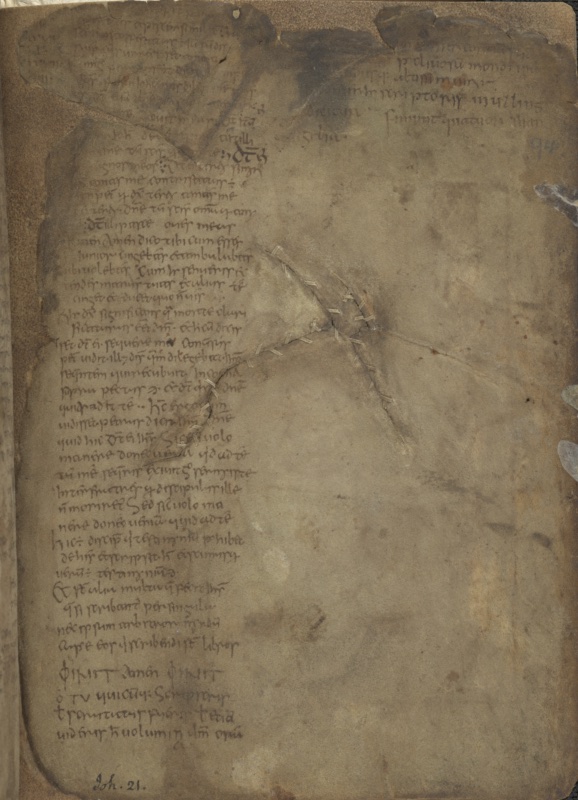
The colophon is the hinge on which the whole question of the book’s identity turns, and it repays the closest reading. It stands at the end of the Gospel of John, on the recto of the last leaf of that Gospel’s quire (folio 94r), and in the reading that Lawlor established it is an address to the reader.
It opens,
O tu quicumque scripseris uel scrutatus fueris uel etiam uideris haec uolumina
“O you, whoever you may be who shall have written, or examined, or even looked upon these volumes” — continuing with an invocation of mercy, and concluding
[N]omen scriptoris Mulling dicitur. Finiunt quatuor euangelia
“the name of the scribe is said to be Mulling. Here end the four Gospels.”
The foundational modern study of this text, as of the manuscript’s other non-biblical matter, is the work of H. J. Lawlor, whose Chapters on the Book of Mulling (Edinburgh, 1897) gathered and extended his earlier investigations. Lawlor drew attention to the precise wording “haec uolumina,” “these volumes,” in the plural, which earlier writers had misread, and argued that it referred to the separate gatherings (fasciculi) of which the book is composed, one to each Gospel besides the prefatory gathering. On this reading, the scribe of the surviving manuscript had imitated not only the text of his exemplar but its very physical arrangement — a copy faithful down to the architecture of its quires.
The identification of the “Mulling” of the colophon with the saint of St Mullins is superficially attractive, and it was once widely accepted in its strongest form. Lawlor held it highly probable that the scribe named was Moiling of Ferns, and he strengthened the case by the history of the book, which had remained until the end of the eighteenth century in the custody of the Kavanagh family, to which, he noted, St Moling was reckoned to belong.
But Lawlor was too good a scholar to ignore the palaeography, which dated the manuscript at least a century after the saint’s death; and the reconciliation he arrived at has become the standard scholarly position. On this account, Moling wrote a copy of the Gospels; roughly a century after his death, an anonymous scribe in his own monastery made a fresh transcript of that venerated book; and in doing so he copied the colophon along with everything else, transmitting the dead saint’s subscription into the new manuscript.
The colophon, in other words, is genuine but inherited — a copied signature rather than a contemporary one. The phenomenon is well attested in Insular manuscript culture. A comparison often drawn is with the Book of Durrow, whose colophon asks the reader to remember “Columba the writer”; but at Durrow the colophon is read as a later relic-claim and not as a subscription copied from an exemplar, so that the parallel is one of effect rather than of mechanism.
It is at this point that a persistent and remarkably durable error must be flagged and corrected. Popular accounts, heritage literature and even some older scholarly writing state flatly that St Moling wrote the Book of Mulling. The palaeographical evidence disposes of the literal claim entirely: the seventh-century saint did not write the surviving book, and it was the work not of one saint but of a team, working in an ordinary, if skilled, monastic routine. The legend is not without value — it testifies to the reverence in which the book was held and to the cult logic that fused relic and founder — but it is a legend, and it should be reported as such.
The honest formulation of the authorship question therefore layers the evidence in three registers. What is documented is that the colophon names a scribe called “Mulling,” in a manuscript written around the second half of the eighth century by three hands. What is a reasonable inference — resting on the extreme rarity of the name, on the book’s unbroken association with St Mullins, and on the mechanics of colophon-copying — is that this Mulling is the saint, whose name entered the surviving book because it stood in the exemplar.
What is speculative, plausible but strictly unprovable, is the final step: that the exemplar was an autograph, a Gospel book written by St Moling’s own hand. That possibility cannot be excluded, and the copied colophon is precisely the kind of trace an autograph exemplar would leave; but no independent evidence confirms it, and it should be presented as an open hypothesis, never as a fact. The Book of Mulling is thus best described not as the saint’s book but as the shadow of the saint’s book: a witness, at one remove, to a lost volume around which the community of Tech-Moling organised its memory.
The Circular Device: Book of Mulling, folio 94v
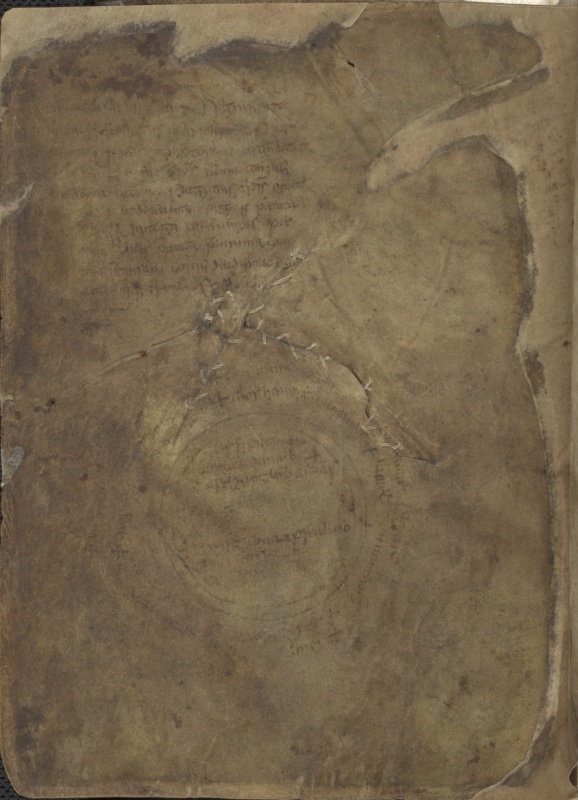
The verso of the last leaf of the Book of Mulling (Dublin, Trinity College Library, MS 60, fol. 94v) is, by common consent, the most discussed single page of the manuscript, and among the most contested pages in the whole corpus of early Irish books. Its fame rests on an improbable conjunction. On a leaf left over from the quire devoted to the Gospel of John — the recto of which carries the end of that Gospel and the colophon naming the scribe “Mulling” — the community that made the book inscribed two further things: a compressed devotional office, and a diagram of two concentric circles ringed and filled with captioned crosses. Office and diagram share the page, were conceived in relation to one another, and have been argued over for more than a century. The leaf is thus a terminal page in every sense: the physical end of the book, the seal set upon its text, and the point at which the manuscript passes from Gospel transmission into the devotional imagination of its makers.
The material condition of the leaf must be described first, because it conditions everything that can be said about its contents. Folio 94v is badly damaged: deeply stained and discoloured, darkened and eroded along its edges, torn and subsequently patched, in the present state the drawing survives only as a ghost — the concentric circles and their captioned crosses are now so faded as to be scarcely visible to the naked eye, far fainter than the office above them, so that the diagram is hard to make out in an ordinary reproduction such as the one above. The Book of Mulling spent centuries as a block of unbound quires inside its metal cumdach, and the strong green copper-staining found on the manuscript’s outer leaves shows that the vellum lay in direct contact with the metal of the shrine; the final leaf, standing at the exposed end of that unbound block, bore the worst of it. The page’s damage is therefore the physical trace of the book’s second life as an enshrined relic — but it is also the reason why every caption on the diagram, and every line of the adjacent office, must be recovered by patient decipherment, and why all readings of this page carry an irreducible margin of uncertainty.
The diagram itself consists of two concentric circles, which Lawlor measured at 3.6 and 4.2 centimetres across, accompanied by crosses, with captions and indications of direction written in Irish, including the four cardinal points — a detail that immediately gives the device an oriented, map-like air and that has fuelled its topographical interpretation. Lawlor’s transcription reads, in the outer line of writing, the cross of Mark at the south, Matthew at the west, John at the north and Luke at the east; and in the inner line the crosses of Jeremiah at the south-east, Daniel at the south-west and Ezekiel at the north-west, with a cross at the north-east whose name, restored as Isaiah, is lost. Since evangelists and prophets are named in the same order, Lawlor inferred that each evangelist stood with one prophet — Matthew with Daniel, Mark with Jeremiah, Luke with Isaiah, John with Ezekiel — an inference he found confirmed in the case of Ezekiel. The scheme thus binds the four witnesses of the New Covenant to four witnesses of the Old, arranging concord between prophecy and Gospel around the circumference of a circle — a theological architecture, whatever else it may also be.
Four further crosses stand within the circles, and their captions, now only partly legible, can be recovered in sequence from top to bottom: the “cross of the Holy Spirit”; a cross “… with gifts”; a cross “… with angels from above”; and “Christ with his apostles.” However the lacunae are filled, the surviving words establish the register of the inner zone: it is populated not by buildings or landmarks but by the Spirit, the angelic host, and Christ among his apostles. The drawing is approximately contemporary with the rest of the manuscript, and its content is thus a direct expression of the mental world of the community at Tech-Moling at about the turn of the ninth century, or somewhat later if the Carolingian argument discussed below is accepted — a community capable of conceiving sacred order as a bounded, oriented circle in which evangelists, prophets, Spirit and Christ each had an appointed station.
The office that shares the page is the diagram’s indispensable context. Written in the same hand as the main text, it was analysed in detail by H. J. Lawlor, whose Chapters on the Book of Mulling (1897) remains the foundation of all study of this leaf; its contents are set out in the section on the added liturgical texts below. What matters here is that it is a daily devotional office, composed or compiled by the producing community and not inherited from the venerated exemplar, and that it colours the whole page with the language of guardianship.
The oldest and most tenacious interpretation of the diagram is topographical, and its history is a cautionary tale. The suggestion was made by Thomas Olden, who took the circles for the rampart of St Moling’s rath, the outer crosses for its entrances and the inner crosses for the buildings within; Lawlor adopted it as a working hypothesis and argued it at length in his book.
But he also tested it against the ground, visiting St Mullins and trying to match the crosses with the surviving remains, found the topographical evidence inconclusive, and concluded that Olden’s suggestion was “a hypothesis highly plausible in itself” but “still only a hypothesis,” which perhaps could not be either proved or disproved. It is this scrupulously hedged suggestion that later writers have too often repeated as a fact. The correction must be made plainly: the plan reading is a Victorian hypothesis that its own champion presented as unproved, and the sources consulted for this essay record no archaeological correlation between the drawing and the topography of St Mullins.
The decisive modern reassessment is that of Lawrence Nees, in “The Colophon Drawing in the Book of Mulling: A Supposed Irish Monastery Plan and the Tradition of Terminal Illustration in Early Medieval Manuscripts” (Cambridge Medieval Celtic Studies 5, 1983). Nees approached the device not as topography but as a “colophon drawing,” situating it within the early medieval tradition of terminal illustration — the marking of a sacred text’s end with a significant image. He argued that the pairing of evangelists with prophets has its roots in Carolingian art, so that the Irish designer must have had a Carolingian model before him.
This reading does not merely displace the map; it relocates the page from parochial record-keeping to an international visual culture, and it carries a chronological consequence: if the drawing depends on a Carolingian source, it cannot be earlier than that model, and may therefore be later than the Gospel text it closes. A third reading, which is an inference from the context of the page and not one found in the sources consulted, is apotropaic: a circular, cross-studded, oriented device accompanying a protective office is at least intelligible as a diagram of guardianship, gathering the defenders of the faith into a bounded cosmos — whether the circle was imagined as enclosing a monastery, a community, a reader, or the book itself.
What, finally, can be responsibly said of folio 94v? Three readings — monastery plan, Carolingian-derived colophon drawing, apotropaic diagram — remain in play, overlapping rather than mutually exclusive, and none can currently be established to the exclusion of the others. The plan retains a residual plausibility from the cardinal points and the enclosure-like circles, though it has not been tied to the site; the colophon-drawing reading is the best grounded art-historically; the protective reading is a reasonable contextual inference.
What is certain is more modest and more valuable: that around the year 800, or not long after, the community of St Moling closed its Gospel book with a page on which prayer and image answer one another — an office of nightly protection beside a circle in which prophets and evangelists keep their stations around the Spirit and Christ. The leaf’s very ruin, earned in centuries inside the shrine, completes the lesson: this is a page that was venerated far longer than it was read, and its damage, its diagram and its devotions together make it one of the most concentrated documents we possess of how an early Irish community imagined, used and guarded the ending of a sacred book.
Decoration and the Evangelist Portraits
For the art historian, the heart of the Book of Mulling is its decoration: decorated initials and the surviving evangelist portraits. Three portraits survive, conventionally identified as Matthew, Mark and John; there is none of Luke. Their connection with the book deserves a caution. When Lawlor examined the contents of the shrine in 1893 the three painted leaves lay loose among the rest, and he observed that the assumption that they belonged to the book had perhaps been made too hastily, since they agree in size even more closely with the fragmentary leaves of Matthew and Mark kept in the same case. The catalogue descriptions treat them as part of the manuscript, and so does this essay, but the point is worth keeping in view.
The portrait of John, the only one illustrated here, shows what the programme was: a frontal standing figure, haloed, holding a book, set in a frame and unaccompanied by any evangelist symbol. The identification of the figure as John rests on position alone, and a catalogue record of the leaf marks it with a query.
The Portrait of John: Book of Mulling, folio 81v
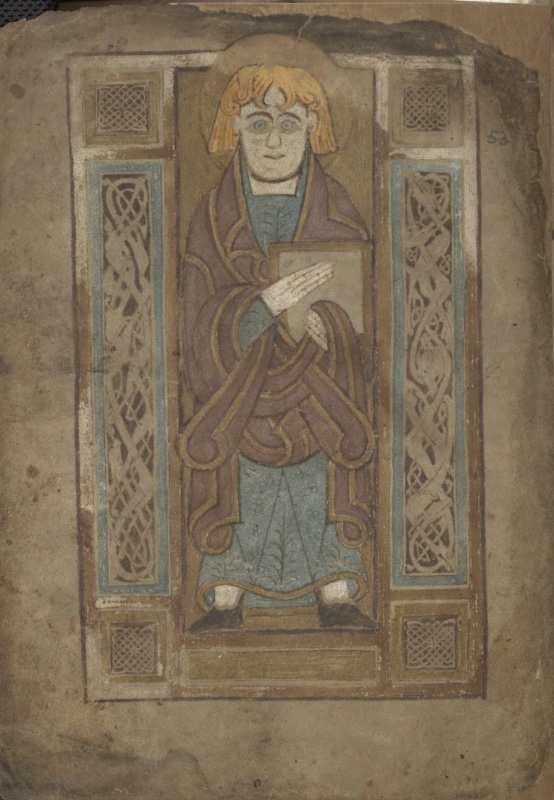
John stands fully frontal, holding a book or tablet against his body, one hand laid flat over it. His robes, painted in purple and blue, do not fall naturalistically; they break into interlaced, near-geometric bands edged in gold-toned lines, whose rhythms echo the ornament of the surrounding border, so that figure and frame speak a single decorative language.
His halo, characteristically for the Insular tradition, breaks the frame, asserting the sacred figure’s precedence over the architecture that contains him. The border itself is comparatively plain above and below, but at left and right it carries dense interlace: knotwork filling the corner squares, and panels of elongated, interlaced zoomorphic forms on blue grounds, attenuated almost to the point of pure abstraction. These patterns invite comparison with contemporary metalwork, for Insular book ornament and Insular metalworking drew on a shared visual vocabulary of interlace, spiral and stylised beast, and the borders read almost as painted translations of chip-carved or filigree panels. Despite its small format and utilitarian script the book is decorated with real accomplishment.
Two cautions are in order, both of them characteristic of the epistemic discipline this manuscript demands. The first concerns identification. The labels “Matthew,” “Mark” and “John” rest on the presumed position of each portrait before its Gospel and not on inscriptions or evangelist symbols, which are absent from the leaf illustrated here; Lawlor himself called the three leaves portraits “presumably” of evangelists. The second concerns interpretation. Descriptive language about colour, gesture and ornament, however grounded in close looking, is necessarily interpretative, and the comparison with metalwork is an art-historical reading and not a documented intention of the eighth-century painter. Both portraits and readings are best presented with that distinction visible.
The Added Liturgical Texts
If the diagram is the manuscript’s enigma, the liturgical additions are its treasure, for they are rare survivals of the early Irish liturgy, a body of practice for which the documentary record is painfully thin. The additions fall into two clusters, both written onto leaves left blank by the quire structure of the original book.
The first stands on a blank leaf at the end of Matthew: an Office for the Visitation of the Sick, a service providing for the unction and communion of the sick, which was published in Warren’s Liturgy and Ritual of the Celtic Church. This addition aligns Mulling closely with its sister pocket books — most nearly the Book of Dimma, and also the Book of Deer — which likewise carry orders for the communion or unction of the sick. The convergence is one of the clearest indications that these small Gospel books were not merely private reading copies but had a genuine pastoral and liturgical function: the priest who carried such a book to a sickbed carried in one volume both the Gospels and the rite their presence sanctified.
The second cluster stands on the verso of the last leaf, folio 94v, sharing the page with the circular diagram, and it was analysed in detail by Lawlor, who corrected the earlier description of it. Written in the same hand as the main text, in a single column of some thirteen or fourteen lines, it is a compressed liturgical fragment that refers to a sequence of pieces by their opening words: the Magnificat and the Benedictus; a passage beginning Uidens autem Ihs turbas ascendit in montem, the opening of the Sermon on the Mount in Matthew 5; the couplet “Patricius episcopus orat pro nobis omnibus / ut deleantur protinus peccata quae commisimus,” which belongs to the hymn of Secundinus (Sechnall) in honour of St Patrick and is also found in the Antiphonary of Bangor and the Book of Hymns; and the Creed, followed on Lawlor’s conjectural reading by the Lord’s Prayer. That sequence of Creed and Pater, he showed, is characteristic of the Celtic offices, recurring in the Book of Dimma, in the Antiphonary of Bangor and in the Book of Hymns, a small structural fingerprint that places the Mulling fragment within a specific liturgical family.
Two points about this second office deserve emphasis.
The first concerns its use. It is a monastic devotional office, and its most probable setting is the daily rhythm of “lying down and rising up” — recitation at night and in the morning — a usage that the medieval story attached to the Secundinus hymn expressly associates with the hymn’s protective virtue. Here text and diagram converge: the page that carries a protective office also carries a cross-ringed circle, and whatever the diagram’s primary meaning, the devotional atmosphere of the page is unmistakably one of guardianship.
The second point concerns chronology and origin, and it is consistent with the palaeographical argument about the colophon. Because this liturgical matter follows the colophon and is written in the main hand, Lawlor inferred that it does not derive from a Moling-era exemplar at all, but was composed or compiled by a member of the monastery around the close of the eighth or the beginning of the ninth century. If that inference holds — and it is a strong one — then these leaves are something precious: not a copy of an older community’s prayer, but a direct, first-hand witness to the liturgical practice of the very community that produced the book.
The Gospel Text: An Irish Mixed Recension
The Book of Mulling matters to biblical scholarship as well as to art history, and it holds an established place in the apparatus of New Testament textual criticism, where it is catalogued among the Old Latin witnesses as VL 35, under the sigla μ or “mull,” and under the alternative titles Codex Moliensis or Liber Moliensis. That classification should not mislead: the text of Mulling is neither pure Old Latin nor pure Vulgate. It is best described as an “Irish mixed text” — a fundamentally Vulgate base carrying a significant admixture of pre-Vulgate Old Latin readings. The profile is characteristic of the way the biblical text reached and settled in Ireland: not by clean replacement of the old version by Jerome2’s new one, but by gradual, accretive correction, in which older readings survived beneath the Vulgate overlay like earlier strata in an excavation.
The Old Latin element in Mulling is not evenly distributed. It is particularly concentrated in the Gospel of Luke — the studies point to a strong Old Latin layer in the region of Luke chapters 4 to 9 — and the manuscript’s Luke has accordingly been treated as a member of a “Celtic mixed text” grouping shared with a handful of other Insular witnesses. Luke was the subject of a dedicated study, “The Text of St. Luke’s Gospel in the Book of Mulling,” published in the Proceedings of the Royal Irish Academy 73 C (1973), pages 177–200, which remains the standard detailed analysis of that Gospel’s readings in this manuscript.
The prefatory and reference apparatus tells a complementary and rather elegant story. Mulling carries the general preface Novum opus — Jerome’s dedicatory letter to Pope Damasus3 — together with the Gospel prologues, and its margins bear canon tables and Eusebian section-numbers, though, as is usual in the pocket books, the Eusebian apparatus is handled economically and imperfectly. Lawlor’s late nineteenth-century work already exposed a revealing pattern in this apparatus: the Eusebian section-divisions in Mulling correspond to the standard system only in those parts of the book whose text is closest to the Vulgate — notably Mark — whereas in Matthew and Luke, where the Old Latin element is stronger, the divisions diverge from the Eusebian norm.
In other words, the structure of the reference apparatus tracks the textual affiliation of the underlying Gospel: text and apparatus travelled together from their respective exemplars, and each can be used to cross-check the other.
The Book of Mulling among Its Peers
It is worth pausing, before turning to the shrine, to set the Book of Mulling deliberately among its companions, for the manuscript’s individuality emerges most clearly by comparison. Within McGurk’s corpus of pocket Gospel books, its nearest relative is the Book of Dimma, also preserved at Trinity College Dublin, and the kinship runs deeper than format. Both are small Irish Gospel books in minuscule; both carry, on leaves not required by the Gospel text, an added order for the ministry to the sick; both were enshrined in metal cumdachs under aristocratic patronage; and both attach to their texts the name of a scribe around whom legend gathered.
Even their divergences are instructive. Dimma’s shrine is decorated on all its faces and belongs, in its principal phase, to the twelfth century; Mulling’s is ornamented only on the front and belongs, in its principal phase, to around 1402. The MacDurnan Gospels and the Cadmug Gospels at Fulda round out the group and remind us of its geographical spread: the pocket Gospel book was a portable idea as well as a portable object, and its examples came to rest from Leinster to the middle Rhine.
Set against the great display Gospels, the contrast defines both parties. Durrow, Lindisfarne and Kells are books of the Insular majuscule, spacious, ceremonial, conceived for the altar and for wonder; Mulling is a book of the working minuscule, compressed and utilitarian. Yet the opposition should not be drawn too starkly, for Mulling’s decoration speaks the same visual language as the great books — frontal evangelists, frame-breaking haloes, interlace and attenuated beasts akin to metalwork — executed at a fraction of the scale and expense. It is thus a bridge rather than a poor relation: the ceremonial tradition of Insular book-painting, miniaturised and domesticated for daily use.
One further comparison is the most telling of all, and it concerns not appearance but authorship. The Book of Durrow carries a colophon that asks the reader to remember “Columba the writer,” in a manuscript that Columba, on any responsible dating, cannot have written; the Book of Mulling carries a colophon naming Mulling in a manuscript written, on the palaeographical evidence, roughly a century after St Moling’s death. The two cases illuminate each other.
In both, cult and community were ready to read a signature as the mark of the saint himself, though the mechanisms seem to differ: the Durrow colophon is read as a later relic-claim, the Mulling one as a copied subscription. The phenomenon is a warning and a resource at once. It warns against the naive equation of a named scribe with the hand on the page; and it offers, to the historian prepared to read it critically, precious evidence of lost exemplars and of the reverence in which they were held. The Book of Mulling, seen in this company, is not an anomaly but an exemplary case — the pocket Gospel book in which the genre’s characteristic features, pastoral, codicological and legendary, converge most completely and can be studied in the sharpest focus.
The Cumdach: The Shrine of the Book of Mulling
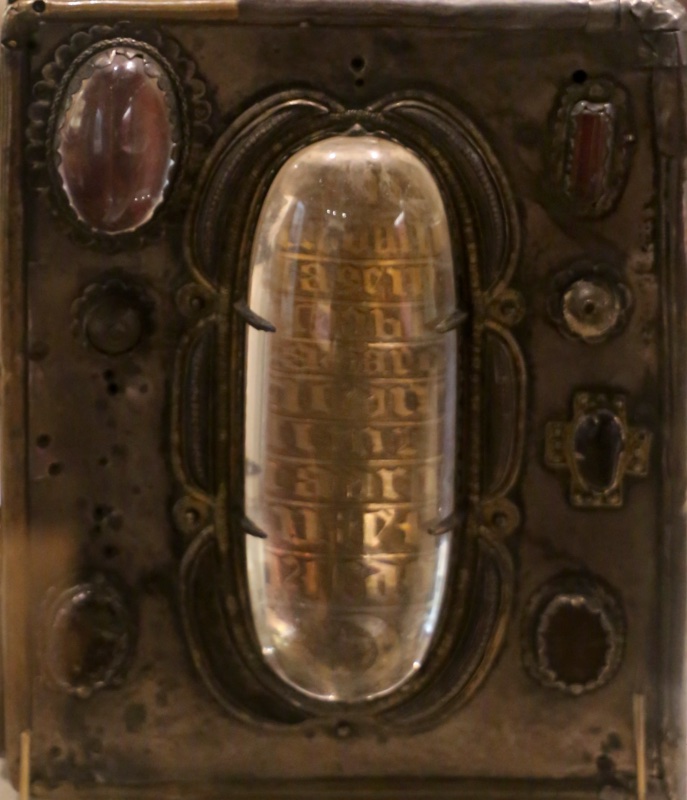
Like several of the most venerated Irish books, the Book of Mulling was preserved for much of its life not as a bound volume on a shelf but as a relic sealed inside a metal cumdach, or book-shrine — and the shrine survives. It is a box constructed of copper-alloy sheets partly covered with silver, and, unlike the shrine of the Book of Dimma, which is decorated on all its faces, the Mulling shrine is ornamented only on its front. That front carries a deliberately heterogeneous display: eight settings made at different times in the object’s history, accumulated rather than designed, so that the shrine’s face is itself a kind of stratigraphy of devotion.
Its centrepiece is a large oval rock crystal, and beneath that crystal lies a plate of silver foil bearing an inscription in Gothic script — an inscription at once concealed and magnified by the stone above it, legible only through the very jewel that protects it. The inscription connects the shrine to Art Mór Mac Murchadha Caomhánach — Art MacMurrough-Kavanagh, King of Leinster, who died in 1417 — and Trinity College’s own account dates the shrine to 1402, with later additions. An eighteenth-century antiquarian notice records the shrine under the Irish name “Liath Meisicith” and describes it as a box of brass cased with silver, about two inches deep, containing a number of loose sheets of vellum.
Two points of recurrent confusion in the literature should be resolved explicitly. The first concerns date. Some heritage writing calls the Mulling shrine simply “fourteenth-century,” while other accounts attach a “twelfth-century” date to the phrase “encased in a book-shrine.” The twelfth-century date properly belongs to the shrine of the Book of Dimma — a different object with its own history — and should not be transferred to Mulling. The best-supported statement is that the Mulling shrine’s principal phase belongs to around 1402, within the reign of Art MacMurrough, with additional settings accumulating over time; the “fourteenth-century” and “1402” datings are essentially compatible descriptions of a phased object, whereas the “twelfth-century” attribution is a conflation to be avoided.
The second point concerns the physical relationship between book and shrine, and it is one of the most evidentially eloquent facts about the manuscript. Strong green copper-staining, most pronounced on the first leaves of the volume, shows that the vellum lay for a very long time in direct contact with the metal of its case, without the protection of a binding; and the eighteenth-century description of “loose sheets of vellum” confirms the picture. This is also why the last leaf, at the exposed end of the block, is so discoloured, torn and patched. The book, in other words, spent much of its later medieval and early modern life not as a text to be read but as a relic to be enshrined; its damage is not an accident of neglect but the direct trace of its veneration. Few manuscripts record their own cult history so legibly on their skin.
The shrine and the book are today in different institutions. The manuscript remains at Trinity College Dublin; the shrine is housed in the National Museum of Ireland, Dublin. The sources differ on how it came there: Lawlor found the cumdach in the Library of Trinity College in 1893, where, he says, it had lain for more than a century, whereas a museum tour of the Leinster kings states that it remained with the Kavanagh family until 2001, when it was deposited in the Museum. The point is left open.
Provenance: From the Kavanaghs to Trinity College
The provenance of the Book of Mulling is, by the standards of early Insular manuscripts, unusually continuous at its later end and almost entirely dark at its earlier end. Of the book’s history in the early medieval centuries essentially nothing is documented: no surviving record attests its use, custody or movements between its making in the later eighth century and the later Middle Ages. This silence is typical of its class and should be stated plainly rather than filled with conjecture.
What can be traced is the book’s late medieval and modern career as a dynastic relic. By the turn of the fourteenth and fifteenth centuries it had been enshrined under the patronage of the MacMurrough-Kavanaghs, the leading dynasty of Leinster, and it remained with that family — whose seat was at Borris, County Carlow, in the neighbourhood of St Mullins — together with its shrine, for centuries. The possession of such an object carried political as well as religious weight. A book credited to the founder-saint of St Mullins, held by the family that claimed descent from the province’s kings, reinforced dynastic prestige and, through the saint, territorial association; the shrine of 1402, made in the reign of Art MacMurrough, is itself a monument to that politics of relic-holding. The antiquary Vallancey, writing in the 1780s, saw the book still in the family’s house at Borris; a few years later it was deposited, with its cumdach and the Charter Horn of the Kavanaghs, in the Library of Trinity College Dublin. The book entered the Library’s collection as MS 60 (A.I.15), where it remains.
Lawlor, writing in the 1890s, already saw the historical value of this continuity. He used the unbroken Kavanagh custody as an argument that every part of the manuscript must have been written at the monastery of St Moling itself, since the book had descended within the family — to which, he noted, St Moling was reckoned to belong — down to nearly the end of the eighteenth century, and since the family seat at Borris Idrone lay within a few miles of St Mullins. The Borris in question is the one in County Carlow, close to the monastery. The argument remains one of the firmer elements in the manuscript’s history: an unwritten provenance made credible by geography, genealogy and cult.
Historiography and Conservation
The modern study of the Book of Mulling effectively begins in the late nineteenth century, and its historiography can be told in three phases. The first is Lawlor’s. His Chapters on the Book of Mulling (Edinburgh, 1897), together with his earlier paper on the book’s non-biblical matter read to the Society of Antiquaries of Scotland, established the reading of the colophon, the description and analysis of the added liturgical texts, the argument about the Eusebian apparatus, and the fullest early statement of Olden’s plan hypothesis for the circular device — while also, to his lasting credit, marking with unusual honesty the limits of what could be proved. Much subsequent confusion about the manuscript has arisen precisely where later writers forgot Lawlor’s hedges while repeating his conjectures.
The second phase belongs to the mid and later twentieth century and runs along two tracks. On the textual side, the manuscript was drawn into the comparative study of Insular Gospel texts and of the pocket Gospel books as a group: McGurk’s 1956 article gave the class its definition and its corpus, and the dedicated 1973 study of the Luke text in the Proceedings of the Royal Irish Academy supplied the detailed textual analysis of the Gospel where Mulling’s Old Latin inheritance is strongest. On the art-historical and codicological side, the decisive intervention was Nees’s 1983 article on the colophon drawing, which reoriented the interpretation of folio 94v away from local topography and towards the traditions of terminal illustration, the liturgical context of the page, and the Carolingian sources of its evangelist-and-prophet pairing.
The third phase is conservational and technological, and here the book’s binding history is itself instructive. Before 1977 the manuscript wore a late nineteenth-century binding made at the British Museum, in which the individual vellum leaves had been mounted on paper panels and sewn into a leather cover — a structure devised to secure and stabilise the loose quires that had come out of the shrine. In 1977 the book was rebound by the conservator Anthony Cains in a traditional Insular manner comparable to the current binding of the Book of Kells: sewn on vegetable-fibre double cords laced into quarter-sawn oak boards, and covered with white alum-tawed skin in a quarter binding.
The choice was itself a historiographical statement — a rejection of the Victorian album in favour of a structure the eighth century would have recognised. The book has since been imaged in full under Trinity’s Early Irish Manuscripts Project, a programme that also embraced the Book of Dimma, the Garland of Howth and the Codex Usserianus Primus, and its digital surrogate is available online. The trajectory of these interventions — from utilitarian Victorian stabilisation, through the historically informed reconstruction of the 1970s, to non-invasive imaging in the twenty-first century — mirrors in miniature the whole modern history of manuscript conservation; and its practical result is that the Book of Mulling is today both physically stable and, for the first time in its existence, open to the scrutiny of scholars who will never handle the fragile original.
Conclusion: What the Book of Mulling Teaches
The Book of Mulling rewards the discipline it demands. Read with epistemic care, it resolves into a set of layered certainties, probabilities and open questions that together constitute a small education in early medieval evidence. It is certain that the surviving manuscript is a product of the later eighth century, the work, on the catalogue analysis, of three scribes writing Irish minuscule, decorated with three surviving evangelist portraits of real quality, textually an Irish mixed recension richest in Old Latin readings in Luke, and furnished — by the community that made it — with liturgical additions that are among the rare direct witnesses to early Irish devotional practice.
It is probable, on strong converging grounds, that the “Mulling” of its colophon is St Moling of St Mullins, whose name reached the book by faithful copying from an exemplar kept and venerated at his monastery. It is possible, but strictly unprovable, that the exemplar was the saint’s autograph. It is false — demonstrably, on palaeographical grounds — that the saint wrote the surviving book; and it is unproven, despite a century of confident repetition, that the circle on folio 94v is a plan of his monastery, a reading its principal advocate left as an unproved hypothesis and modern art history has largely displaced in favour of the colophon-drawing tradition and its Carolingian iconography, with an apotropaic dimension plausibly supplied by the protective office beside it.
Around this core of manuscript evidence stands the second history, the history of the relic: the shrine of 1402 with its crystal-magnified inscription naming the milieu of Art MacMurrough-Kavanagh; the green stains and the ruined last leaf that record centuries spent as loose quires in a metal box; the unbroken custody of a royal Leinster family binding the book to its home landscape until the age of institutional libraries; and finally the modern afterlife of rebinding, analysis and digitisation. The Book of Mulling is thus two objects in one: an eighth-century book whose makers can be glimpsed at their economies and their prayers, and a medieval relic whose keepers can be glimpsed at their politics and their piety. That both survive in a single small volume — legible now to anyone, anywhere, through Trinity’s digital surrogate — is the quiet good fortune of Irish manuscript studies; and the manuscript’s tangled historiography, in which legend, hypothesis and fact have so often changed places, is a standing reminder of why the layering of evidence is not a scholarly nicety but the condition of understanding such an object at all.
The first lesson concerns function. Because Mulling is small, worn and compressed, it is easy to treat it as a minor relation of the display Gospels, but its added order for the ministry to the sick, shared with Dimma and Deer, shows that the genre had a pastoral purpose that the great books do not document. The priest who carried such a volume to a sickbed carried in it both the Gospel text and the rite its presence sanctified. A history of Insular book-painting written only from Durrow, Lindisfarne and Kells would therefore miss a whole register of use, and Mulling restores it. Its decoration shows, moreover, that this register was not artistically impoverished: the ceremonial tradition survives here in miniature.
The second lesson concerns names. The colophon that gives Mulling its title is a salutary example of how a signature can outlive its signer. At Mulling a copied colophon, at Durrow a later relic-claim, was read by later communities as a living claim. The conclusion is not that such colophons are worthless. They are among the best evidence for lost exemplars and for the reverence in which those exemplars were held, and the Moling-era model that lies behind the surviving book is a real, if unrecoverable, part of its history. What the evidence forbids is the shortcut from the name on the page to the hand that wrote it.
The third lesson is that the date of the Book of Mulling is not a single figure. The Gospel text, its decoration and its colophon belong to the later eighth century. The liturgical matter that follows the colophon, in the main hand, was composed or compiled by a member of the monastery around the close of the eighth century or the beginning of the ninth. The drawing on folio 94v, if Nees is right that it depends on a Carolingian model, could be later than the Gospel text it closes. The shrine adds a further layer, with its principal phase around 1402 and its later settings accumulating afterwards. A manuscript of this kind has to be dated by component and by episode, and the habit of attaching one date to the whole object is a convenience that obscures the way it grew.
The fourth lesson is historiographical. The history of the circular device shows how readily a hedged conjecture hardens into a settled fact. Lawlor offered Olden’s plan reading as a hypothesis that perhaps could be neither proved nor disproved; later repetition reduced it to the claim that folio 94v is a plan of the monastery. The same pattern appears in the shrine, where the twelfth-century date that belongs to the Book of Dimma has migrated to Mulling’s later object. These errors have a common cause: later writers repeated a conclusion without the qualifications of the source that supplied it. Lawlor’s own candour is the best corrective, and the modern literature is at its most reliable where it keeps his hedges together with his findings.
What remains open is considerable, and the open questions are better stated plainly than filled with conjecture. Nothing documents the book’s movements between the eighth century and the later Middle Ages. The relationship between the circular diagram and its Carolingian model, and with it the exact date of the last leaf, may admit further refinement. Yet the conditions for progress are better than at any earlier time. The manuscript is physically stable in Cains’s Insular-style binding, it has been subjected to non-destructive pigment analysis, and its full digital surrogate is freely available to scholars who will never handle the original. The book now needs to be read slowly and sceptically, with its layers of evidence kept apart.