Maestro di Rosano
( 25% )
A Painter Known by a Single Work
Medieval art history is full of painters who survive only through the works that gave them their names. Even among these anonymous masters, few rest on a foundation as narrow, and at the same time as rich, as the Master of Rosano. No document records him and no signature identifies him. No contract, payment or chronicle mentions a painter at work in the Benedictine1 nunnery on the left bank of the Arno in the 1120s or 1130s. What survives is one object of exceptional ambition: a monumental shaped panel showing the living Christ on the cross, surrounded by narrative scenes, mourning figures in the terminals and Latin verse captions. It was painted for the nuns of the monastery of Santa Maria a Rosano, in Rignano sull’Arno (Florence), and it has never left their possession. The painter is a modern construct. His name is a convenience that lets scholars speak of a single hand behind a single work, and of the small group of other panels that may or may not belong with it.
That situation shapes how any honest account must proceed. Every statement about the “author” is an inference from three kinds of evidence. The first is the object itself, which since its restoration at the Opificio delle Pietre Dure in Florence, completed in 2006, has become one of the best-understood Italian panels of the twelfth century. The second is the history of the community that commissioned it and of the comital family that protected that community. The third is a comparison with a handful of other early painted crosses in Tuscany and beyond, whose dates and attributions are themselves often uncertain. Throughout, this essay keeps three levels of knowledge apart: what is documented, what scholars have proposed and on what grounds, and what remains speculation, however attractive or widely repeated.
Evelyn Sandberg-Vavalà’s typological study of the painted cross, published in Verona in 1929, first set the Rosano cross beside the Pisan ones. Edward B. Garrison’s Italian Romanesque Panel Painting: An Illustrated Index, published in Florence in 1949, gave twelfth-century Italian panels their first systematic catalogue and placed the Rosano cross within it. Miklós Boskovits, in The Origins of Florentine Painting, 1100–1270 (1993), the opening volume of the Corpus of Florentine Painting, proposed the dating that most writers now follow. Alessio Monciatti studied the cross most closely after its restoration, contributed to both the restoration monographs and argued for its Roman cultural matrix. Other contributors, including restorers, epigraphers, historians and scientists, are referred to here through the publications and institutions in which their work appeared, not by name.
What emerges from this evidence is not a provincial primitive. It is a painter of real intellectual and technical ambition. He planned a complex narrative programme with ruled layouts and reusable patterns. He modelled bodies with graded shadows over a greenish underlayer. He laid his gold directly on the gesso and sealed the whole surface with a varnish meant to make the colours glow. He very probably lettered the verse captions himself, and those verses point to circuits of Latin poetry that ran between the schools of the Loire and the Rome of the reform papacy. To understand him, the starting point must be not his style but the place for which he worked.
The Monastery of Santa Maria a Rosano and the Guidi Counts
The monastery of Santa Maria a Rosano stands in the comune of Rignano sull’Arno, in the province of Florence and the diocese of Fiesole, on the stretch of the Arno valley where the river turns from the upper Valdarno towards Pontassieve and Florence. It is still a living Benedictine house of nuns. The community celebrates the Divine Office in Latin and Gregorian chant, so the painted cross has a continuity of liturgical use that very few twelfth-century panels can claim. Most of its contemporaries now hang on museum walls, separated from the rites they were made to serve. The Rosano cross still hangs in the church for which it was painted, before the community that commissioned it, though not, as will be seen, always in the same position.
The monastery’s earliest history is wrapped in legend. A traditional foundation date of 780 comes from an inscription on the architrave of the church portal,
ANNO DOMINI DCCLXXX EDIFICATUM FUIT.
The inscription is itself early modern: it has been described as sixteenth-century, and one local history calls it eighteenth-century. Either way, it is an assertion of antiquity, not an early medieval record. The same applies to the tradition, reported in the Camaldolese2 annals, of a founder named Urso or Ursone and his wife Rosana, from whom the place supposedly took its name. This is the sort of etymological story medieval and early modern communities often told about their origins, and it is best read as such.
The documented history begins with a charter of 1003, in which the abbess Rolinda leased farmland to one Ildo, son of Andrea. By the opening of the eleventh century, then, Rosano was an established female community with an abbess and landed property. The early charters were edited in 1982 in the volume I più antichi documenti del monastero di S. Maria di Rosano (secoli XI–XIII), in the series Monumenta Italiae ecclesiastica, and they are the foundation for any serious history of the house.
For the cross, the decisive fact is Rosano’s tie to the Guidi, the great comital family whose lordships stretched across the Casentino, the upper Valdarno and the Apennine passes towards Romagna. According to the standard modern summary, the monastery became a proprietary (allodial) possession of the Guidi in 1040. Towards the end of the eleventh century a woman of the family, Berta, became abbess; 1099 is the date usually given. Her tenure is associated with enlarging the church and building the bell tower. Rosano was thus not only a religious community but also a dynastic foundation, where the family placed its daughters and widows, displayed its piety and secured spiritual intercession, and through which it held land and influence.
A firmer framework for the decades around 1130 comes from the entry on Sofia Guidi in the Dizionario Biografico degli Italiani. That entry draws on an exceptional source: a dossier of witness testimony collected in 1204 for a lawsuit between the abbess of Rosano, Agata, and the Guidi counts, who claimed the right to choose the abbess. Testimony of this kind, gathered three generations after the events it describes, has to be read with care, since witnesses remembered selectively and testified in the interest of one party. It nonetheless gives a vivid picture of how the family’s relationship with the monastery worked in practice.
It shows that Sofia was the daughter of Count Guido, numbered Guido V in the family’s genealogy and also called Guido Guerra I, and of his wife Imilia. She was presumably born around 1115, and her father probably died in 1124, when she was still a child. Around 1129, following the example of her paternal aunt Berta, she was set on the monastic life. Her clothing as a nun was a solemn ceremony attended by the bishops of Fiesole, Pistoia and Faenza. It coincided with the rebuilding of the monastery church, which her mother Imilia wished to restore. Sofia’s dowry was substantial: lands at Bagnolo and Rimaggio, and gold and precious stones laid on the altar to be made into a chalice and a thurible. Her brother Guido, the sixth of the name and second to be called Guerra, gave the silver from his saddle to cover a Gospel book. The nuns wanted the young Sofia as their abbess, but Imilia preferred Matilde, Sofia’s spiritual mistress. Before long Sofia left Rosano for Pratovecchio in the Casentino, where in 1134 her mother founded for her the nunnery of San Giovanni Evangelista. She governed it for decades, and after her brother’s death in 1157 she also administered the Guidi county.
The rebuilt church at Rosano is traditionally said to have been consecrated on 25 March 1130, a year after Berta’s death. The building that survives has been heavily restored but keeps its twelfth-century structure. It has a plain Romanesque façade, a five-storey bell tower of Lombard type, three aisles divided by square piers, a semicircular apse and a raised presbytery above a crypt. The crypt has five aisles with columns of pietra serena and invites comparison with the crypt of San Miniato al Monte in Florence. This architectural arrangement, as will be seen, matters for understanding how the cross was originally displayed.
The church’s later history affected the cross too. The Florentines attacked the monastery in 1143 during their wars with the Guidi. The family’s patronage formally ended on 13 August 1204, when Countess Gualdrada renounced it; this is the outcome of the lawsuit for which the testimony was gathered. The building was remodelled under the abbess Dianora da Filicaia from 1502, and modernised again from 1696 with a barrel vault and stucco decoration. It was “restored” in 1965, when the Baroque additions were stripped away in pursuit of a recovered medieval purity, in the manner typical of that decade.
Two widely repeated errors need correcting here. A diocesan press article published in 2006, at the cross’s return, put both the consecration of the church and Sofia’s profession in 1124. The Dizionario Biografico places her profession around 1129, which matches the traditional consecration date of 1130. The year 1124 is the probable date of her father’s death, which may explain the confusion. Popular accounts also sometimes call Sofia the daughter of “Guido Guerra V”, which conflates two numbering systems and produces a person who never existed. Finally, the monastery’s own mid-twentieth-century history recorded that the cross then hung at the back of the church, above the baptismal font. Its present place behind the high altar was therefore chosen at the restoration, not inherited unchanged from the Middle Ages.
The Object: Form, Programme and Iconography
Painted Cross with Passion Scenes, Monastery of Santa Maria a Rosano
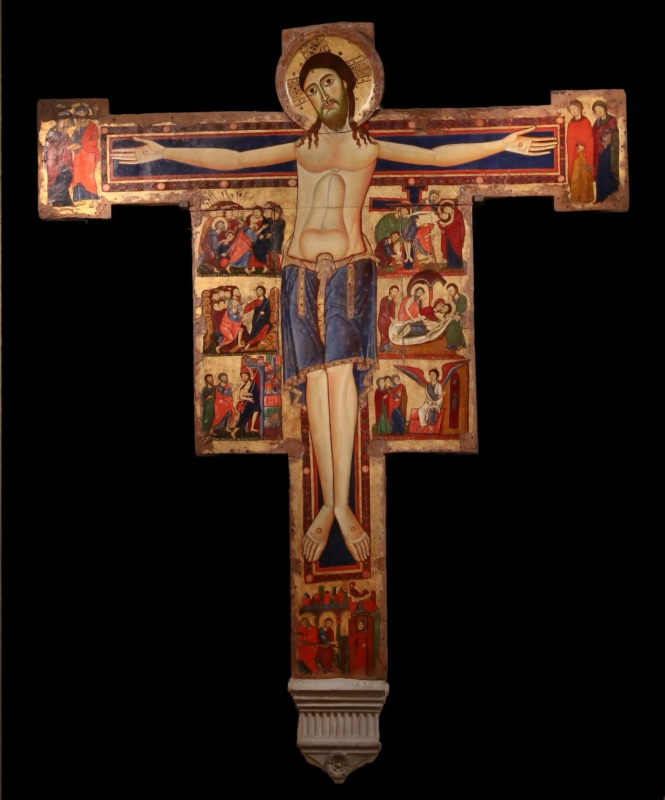
The Rosano cross belongs to the type Italian scholarship calls the croce dipinta or croce sagomata: a panel cut to the outline of the cross itself, not a rectangle with a cross painted on it. Its broad central section, the tabellone, extends on either side of Christ’s body and provides fields for narrative scenes. The arms end in terminals that carry further figures. Originally an upper section, the cimasa, rose above the head of Christ, and a foot projected below his feet. This format turned the instrument of the Passion into a structure carrying images: at once a cross, an icon and a sequence of stories.
At the centre is a large Christus triumphans. Christ is alive, frontal and upright, with his eyes open and no sign of the sagging weight of death. This was the dominant formula for monumental crosses in twelfth-century Italy. In the thirteenth century, through Pisan painting and the new devotional practices of the Franciscans and Dominicans, it gave way to the Christus patiens, the dead or dying Christ with closed eyes and curving body. It would be a mistake to read the triumphant type at Rosano as a sign of artistic naivety, as if the painter simply could not represent suffering. It is a theological statement. The cross is the throne of a Christ who reigns, and his death is already his victory. A community that sang the Office before this image daily would have understood the cross as a sign of Christ’s kingship, not as an occasion for pathos.
The narrative programme can be stated precisely thanks to the epigraphic study published in the 2007 restoration volume, which identified each scene by its caption. The cross now carries seven scenes. Six occupy the side panels in two columns of three, read from top to bottom. On the left are the Capture of Christ, with the kiss of Judas, the Descent into Limbo, and the meeting with the disciples on the road to Emmaus. On the right are the Deposition from the Cross, the Entombment, and the Holy Women at the Sepulchre. The seventh scene, the Denial of Peter, appears on the foot, but its caption was lost when the lower part of the panel was cut down. The arm terminals carry the mourning figures; the Fondazione Zeri catalogue records the Virgin, Saint John the Evangelist and the Holy Women among the subjects. A press report at the time of the return described the side panels as showing “four saints”. That does not match the sequence established by the specialists and should be set aside.
The arrangement of the scenes deserves attention, because it is not a simple chronological reading. The left column is not the first half of a story continued on the right. Instead the left column gathers episodes in which Christ appears alive or risen: betrayed but still acting, triumphant in the underworld, walking unrecognised with his disciples. The right column gathers episodes of his dead or absent body: taken down, laid in the tomb, sought by the women at a tomb that is now empty. The cross thus reads across as well as down. Living and dead, presence and absence, face each other on either side of a Christ who is both crucified and alive. This is a sophisticated piece of visual thinking, and whoever devised it, whether the painter or a learned adviser within or outside the community, thought carefully about how an image might hold together the paradox of the Easter mystery.
Within this scheme the Descent into Limbo has particular weight. It is the only one of the six side scenes without a basis in the canonical Gospels. It derives from the apocryphal tradition of Christ’s descent to the dead, long since absorbed into the liturgy and the creed. It also carries the cross’s most direct message of salvation: Christ grasps Adam by the wrist and draws him, Eve and their descendants out of the underworld. The nuns of Rosano singled out exactly this image in their own words at the cross’s return in 2006. They described the Saviour who, before passing from death to life, descended into hell and, grasping man firmly by the wrist, raised him up. It is a small but telling sign that the image still speaks to the community that owns it on the terms for which it was made.
The cross does not survive at its original size. The restoration showed that the panel was cut at top and bottom when it was moved to a new position at some point in the early modern period. The cut at the top removed the cimasa, which must have carried the titulus with Christ’s title and very probably a final scene. By analogy with surviving crosses of the period that scene was most likely an Ascension, which would have crowned the whole programme with Christ’s return to the Father. The cut at the bottom removed the lower foot, the caption of the Denial of Peter, and probably the structural element on which the cross stood.
The date of this reduction is reported inconsistently, and the inconsistency should be stated, not resolved by fiat. The publisher’s description of the 2007 restoration monograph speaks of a partial revision in a Counter-Reformation context at the beginning of the seventeenth century, and the press coverage of 2006 also put the cuts in the 1600s. The technical account published by the Opificio’s restorer in 2012, however, links the reduction to the cross being moved beneath the organ at the beginning of the eighteenth century, probably during building works. The two accounts may describe different interventions, since the second varnish, the nailed black-and-gold frame and the cutting of the panel need not all be contemporary. Until the archival basis is published in full, the most honest statement is that the cross was cut down in the early modern period, in the seventeenth or early eighteenth century.
The Fondazione Zeri catalogue records the panel as it now stands at 253 × 230 centimetres, and this essay follows it. A figure of 445 by 370 centimetres circulates on non-specialist websites, but it cannot be confirmed from the Opificio’s publications, the Zeri catalogue or the Corpus of Florentine Painting, and it is far larger than the extent Zeri records for the surviving panel. No source consulted says whether it refers to a reconstruction of the cross with its lost cimasa and foot, and it should not be cited without checking against the 2007 monograph. What is certain is that this is a monumental object, made to dominate the space of a church, not a small devotional panel.
Wood, Canvas and Gesso: The Material Body of the Cross
When the cross entered the Opificio’s laboratories it was almost illegible. Its surface was covered by a dark film that writers had complained of since the late nineteenth century, and the black-and-white photograph published in the monastery’s history of 1957 shows little more than a shadow. The restoration was carried out by the Opificio’s laboratory for paintings on panel and canvas, with funding from a private bank. By the accounts given on completion it lasted about ten years. Its starting date is variously given: some sources say 1994, while the contemporary diocesan report speaks of the cross returning “after ten years”, which points to about 1996. On Saturday 16 December 2006 the cross was solemnly returned to the monastery and set behind the high altar, with a homily delivered on behalf of the Pontifical Commission for the Cultural Heritage of the Church.
The findings were published in two volumes, which together form the essential literature on the work. The first, La Croce dipinta dell’abbazia di Rosano. Visibile e invisibile. Studio e restauro per la comprensione, appeared in Florence in 2007 as the twenty-third volume of the Opificio’s series Problemi di conservazione e restauro. It gathers the technical, scientific, historical, epigraphic and art-historical studies made during the restoration. The second, La pittura su tavola del secolo XII. Riconsiderazioni e nuove acquisizioni a seguito del restauro della Croce di Rosano, appeared in 2012. It was promoted by the Kunsthistorisches Institut in Florenz – Max-Planck-Institut, the Università degli Studi del Molise and the Opificio, with Monciatti among its editors. It set the Rosano findings within an international reassessment of twelfth-century panel painting and opened a new series appropriately titled Dal restauro agli studi, “from restoration to scholarship”.
The support is chestnut. This seemed surprising when poplar was assumed to be the normal wood for Tuscan panels. The Opificio’s comparative studies have since shown that chestnut was typical of twelfth-century Tuscan panels; the cross painted by Guglielmo for Sarzana in 1138 is also chestnut. The wood has practical advantages: it is harder and heavier than poplar and resists wood-boring insects. It also has disadvantages: it is harder to work with hand tools, and its tannins can stain the layers laid over it. The choice of chestnut at Rosano thus places the cross within a regional practice, not against it.
The carpentry is where Rosano differs most strikingly from its dated contemporary at Sarzana, and where its historical importance becomes clearest. At Sarzana, a robust vertical board receives two separate arms by mortise and tenon, locked with pins. The arms thin towards their ends, a solution the Opificio describes as never adopted again. At Rosano, the carpenter used two continuous pieces, the whole upright and the whole crossbar, joined by a half-lap (the Italian incastro a mezzo legno), with the crossbar passing in front of the joint. This arrangement prevailed through the thirteenth century, from the crosses of Giunta Pisano to Cimabue’s cross at Arezzo. Only with Cimabue’s cross for Santa Croce in Florence did the reverse arrangement, with the crossbar passing behind, become dominant. Press accounts at the time described how the boards had been thinned so that the joint could be made without obvious cuts through Christ’s body or arms. In its construction, then, Rosano stands at the head of a long Tuscan lineage. Although it is probably a few years older, it is technically closer to the thirteenth century than the securely dated cross of Sarzana.
The restorer was candid that the carpentry was not refined. He wrote that the support does not show particular care in construction, unlike the carefully thought-out structure at Sarzana. That may explain why the entire painted face was covered with two layers of very fine canvas. The canvas smoothed the irregularities of the wood, bridged the joints between boards and gave the ground a stable surface. Covering panels with canvas was common in medieval practice. At Rosano its doubling suggests a deliberate effort to correct a support the painter could not fully trust.
The ground produced the most surprising discovery of the restoration. The standard medieval Italian ground, as described in later treatises and found in many panels, is a mixture of slaked gypsum (calcium sulphate dihydrate) and animal glue, applied warm in successive layers. Analysis at Rosano found instead anhydrous gypsum bound with a plant gum, possibly cherry gum. The same gum was used to stick down the canvases. This is not a failed or eccentric recipe: the restorers themselves used it for their fills and found it worked. The restorer offered two explanations, and both should be read as hypotheses. The first is practical. A ground mixed cold, without heating glue, suits a temporary worksite better than an established workshop, which would fit the idea of an itinerant master painting on site at Rosano. The second is aesthetic. A denser, less absorbent ground would make the colours above it more brilliant. Neither is proven, but the material itself is documented, and so far it appears unique to Rosano among the twelfth-century crosses studied.
The restoration also recovered evidence of how the cross was originally set up and seen. Traces of a crosspiece on the back of the lower upright suggest it acted as a stop, fixing how deep the cross sat when slotted into a base. The upright is thinner beneath the foot panel, which was never painted, confirming that this part was hidden in the base. Nails driven into the sides probably held cables that steadied the cross, much like the arrangement Giotto painted in the scene of the Crib at Greccio in the Upper Church at Assisi. The edges carry a decorated band and the back is primed, which suggests the reverse was meant to be seen, at least in part.
From these observations the restorer drew a wider conclusion about the church. At Rosano, a raised presbytery above a crypt separated clergy from laity without a screen, and no rood screen is known there. The cross thus contradicts the easy assumption that all early painted crosses were made to stand on a screen. It may have stood free in the presbytery, visible from several sides, its painted front facing the nave and its decorated back facing the choir or the space behind the altar.
X-radiographs revealed one more lost feature. Impressions in the canvas show that relief elements were once set alternately around the edges of the panel, trefoil-like forms at the corners with other shapes between them. One survives on Christ’s raised halo. The rest were crudely planed away when the early modern frame was nailed directly over the paint and gold. The original cross was therefore a more sculptural, more richly articulated object than the one seen now. Its edges caught the light with modelled ornaments, much as goldsmiths’ crosses did, which Rosano’s panel in some sense translated into wood and paint.
Drawing, Pattern and Colour: The Painter at Work
If the support speaks of improvisation, the painting speaks of rigorous planning. Infrared reflectography, which reveals carbon-based drawing beneath the paint, allowed the restorers to follow the painter’s procedure with unusual precision. This is the part of the evidence that brings the reader closest to the Master of Rosano as an individual working mind.
The painter began by laying out the large fields of the side panels with ruled charcoal lines, which he then partly erased. He reinforced the divisions between scenes with freehand incision. The bands that would carry the verse captions were laid out less carefully: they vary in width and are sometimes not even parallel. The letters themselves were painted directly, without preliminary drawing. Yet their spacing and abbreviations fit so well that some preliminary layout must be assumed, perhaps on parchment or with templates, worked out before the brush touched the panel. A painter who could letter so precisely without guidelines was trained in a tradition in which writing and painting were closely linked.
Within the scenes, reflectography showed that the painter reused patterns (patroni). The same figure types can be laid over one another, rotated or reversed. The head of Christ in the Descent into Limbo, for example, can be rotated to match exactly the head of Christ in the Emmaus scene. This is not a sign of poverty of invention. It is how medieval painters worked: they built repertoires of tested forms that could be adapted to new compositions while guaranteeing the recognisability and consistency of sacred figures. What is remarkable at Rosano is that the patterns can be detected at all, which says something about the sharpness of the drawing beneath the paint.
Fine, sharp incisions outline every element that borders the gold, including tiny internal areas, so that the gold leaf could be laid with precision. Unusually, the architecture in the Emmaus and Denial scenes was not constructed with incised lines but painted freely. The painter used incision as a tool for gilding rather than as a habit applied to every form.
The drawing of the body is the most revealing evidence. Charcoal drawing survives throughout and is most extensive in the great Christ. Freehand hatching models the abdomen, the rib cage and the face, establishing the volumes the paint would later develop. The largest change in the whole work shifts the navel and the three-part lower abdomen slightly, giving the body a greater sense of leaning; it was made entirely within the planned outline.
Beneath the garments of figures in the scenes, especially those moving or kneeling, the painter drew legs and other anatomical cues before clothing them, so that the drapery would fall correctly and the shadows sit in the right places. Christ’s left thigh is sketched beneath the blue loincloth. On this evidence the restorers spoke of a painter who thought in terms of bodies rather than mere outlines. The Opificio’s direction likewise observed that the drawing and painting of Christ’s legs already seek a sculptural shading. The Master of Rosano conceived his figures as solids occupying space, then covered them with paint and cloth.
The paint layers confirm this. The flesh of every figure, down to the small figures in the scenes, rests on a greenish-grey underlayer laid in broad, even strokes. The restorers identified it with the prasinus described in Theophilus’s treatise on the arts, and with the proplasma of the Byzantine painter’s manual later compiled by Dionysius of Fourna. On this underlayer the painter built the flesh with graded shadows from red to green rather than flat colour, especially in Christ’s face, where the transitions are subtle. The green underlayer shows through the warmer upper tones in the shadows, giving the flesh a cool, luminous depth that flat colour could not achieve.
Christ’s loincloth is painted in lapis lazuli, the most precious blue pigment available in the Middle Ages. Along the left thigh a red lake glaze does two things at once. It suggests that the cloth is semi-transparent, with the flesh showing through, and it brings the left leg forward in space in front of the right. A single glaze serves both description and spatial construction. In the Deposition the Virgin supports her son’s body by holding his halo, which is painted as a solid object she can grip, a vivid sign of how literally the painter imagined his forms. Throughout the scenes, hands grip and press into flesh, and bodies have weight that other hands must bear.
The gold was water-gilded and burnished directly on the gesso, without the layer of red bole that became standard in the thirteenth century. Bole gives burnished gold its warmth and depth, and its absence was once considered an anomaly. The Opificio’s comparative research now treats gilding without bole as normal twelfth-century practice. Rosano, once again, helps define the norm rather than departing from it.
The varnish raised the restoration’s central ethical problem. Investigation showed that the layer in direct contact with the paint was the original medieval varnish, surviving across the whole surface because the cross had never had a thorough modern cleaning. The early modern campaign had added only a second varnish, the black-and-gold frame and retouching of a few losses. The original varnish had darkened so much that it hid the image, and removing it would have revealed the paint at once. But it was itself a medieval material, part of the painter’s intended surface. After reflecting on the problem, the Opificio concluded that the varnish had been meant to make the colours glow like goldsmiths’ enamels, not to dim them. It was therefore thinned gradually rather than removed, with progress checked under ultraviolet fluorescence.
A good part of the medieval varnish remains. As a result the Rosano cross keeps a twelfth-century surface to a degree almost without parallel. The restorer was not exaggerating when he called it a manual of medieval artistic technique, a biblia pictorum of technique against which more damaged works can be measured. For the historian of painting, this may be the cross’s most lasting significance: it shows not only what a twelfth-century painter depicted but how he made it, down to the final coating.
The Relic Within the Wood and the Problem of Patronage
The restoration’s most publicised discovery concerned not the paint but the interior of the panel. A cavity was found containing a small cloth bag. Inside were a fragment of bone and a small slate cross, decorated on both faces and pierced at the top so that it could be worn around the neck. According to the restorer, the relic was originally sealed in a cavity cut into the upright above Christ’s head. When that part was cut away in the early modern reduction, a new housing was made for it. The cross was therefore a monumental reliquary as well as an image. The relic sealed in its wood conferred on the whole object something of the sacred power medieval Christians attributed to the remains of saints and to objects that had touched holy places. The Opificio placed the discovery within a broader pattern of relics deposited in painted crosses and carved figures, by which the miraculous virtue of the relic passed to the image enclosing it.
From this point the evidence quickly thins into conjecture, and it is worth tracing how. The 2007 volume included a study of the slate cross and a technical report on its material and treatment. It raised the possibility of a link with a journey to Jerusalem by Guido Guerra, a member of the family that may have commissioned the cross. In popular accounts this possibility has hardened into apparent certainty. They describe a pectoral “enclopion”, a garbling of the Greek encolpion, “brought back by crusaders”, a bone fragment from the Holy Sepulchre, and a cross “commissioned by a nobleman returning from the crusade”. None of this is documented. No inscription or certificate of authenticity accompanies the relic. The bone is unidentified. The slate cross could have reached Rosano by many routes: gift, pilgrimage, purchase or inheritance.
The chronology in the Dizionario Biografico creates a further difficulty for the crusader story. If Sofia’s father, Guido V, died in 1124, and the cross dates from around 1129–1134, he cannot have commissioned it on his return from anywhere. At most the cross could commemorate him, or enclose an object associated with him. The 2006 press reports already set out the alternatives in this more cautious form: the cross might be a commission connected with Sofia’s profession and dowry, or a memorial of the count’s journey. Both remain possibilities and neither is a fact.
The Guidi connection is solidly grounded as context, though not as a documented commission. The family held the patronage of Rosano. It supplied abbesses, notably Berta. In or around 1129 it lavished gifts on the church at Sofia’s profession. The 2007 volume included a historical study of the Guidi principality and its devotion, which places the cross firmly in that world of lordship and piety. And yet the testimony of 1204, the richest source, lists a chalice, a thurible and a Gospel-book cover among the gifts of 1129, and does not mention a painted cross, at least in the parts summarised in modern scholarship. That silence does not prove the cross was not a Guidi gift: witnesses remembered what mattered to their case, and a cross might have been commissioned separately or by the community itself. But it rules out treating the commission as documented.
The most responsible statement is this. The cross was very probably made for the rebuilt church of around 1129–1130, at a time of heavy Guidi investment in the monastery, and a Guidi commission, perhaps linked to Sofia’s profession, is likely but unproven. Where the relic came from, and the crusading romance attached to it, remain beyond the evidence.
The Inscriptions: Leonine Verse Between Rome and the Loire
The verse captions are among the most important evidence the restoration brought to light, and their study has done more than anything else to change how the painter is understood. Before the restoration, the captions could be read only in part. The transcription in the Corpus of Florentine Painting had gaps and, in places, produced a Latin the later editors described as at least fanciful, which is understandable given the cross’s condition. The epigraphic study in the 2007 volume edited the six surviving captions reliably for the first time and analysed their language, metre, letter forms and literary sources.
The captions are written in small gold capitals, on dark green grounds on the left side and bright red grounds on the right. The colour coding reinforces the division between the column of the living Christ and the column of the dead. They are leonine hexameters, the metre much loved by medieval Latin poets, in which the word at the caesura rhymes with the end of the line. The analysis made during the restoration, together with the balanced spacing between scenes and bands, confirms that the captions belonged to the original design and were not added later.
The texts read as follows:
- The Capture of Christ bears
OSCULA DAT RABI CAPIT HUNC PLES DIGNAQUE LABI:
the master receives a kiss, the crowd seizes him, and he submits to falling. PLES stands for plebs, and LABI was first written LAVI before correction.
- The Descent into Limbo bears
AD MEA REGNA REDI QUIA TE MORIENDO REDEMI
Christ’s words to Adam: “Return to my kingdom, because by dying I have redeemed you.”
- The Emmaus scene bears
DISCIPULIS DOMINUS APPARUIT UT PEREGRINUS:
the Lord appeared to the disciples as a pilgrim.
- The Deposition bears
NIHCODEMUS SOLVIT IOSEP QUEM CORPORE C[INGIT],
Nicodemus loosening the body that Joseph embraces; the final verb is a proposed restoration of a damaged word.
- The Entombment bears
PER QUAM VITA DATUR VICTURA CARO TUMULATUR:
the flesh through which life is given, flesh destined to live, is laid in the tomb.
- The Holy Women at the Sepulchre bear
SUR[GI]GIT REX FORTIS FRANGENS HIC VINCULA M[ORTIS]:
the strong king has risen, breaking here the chains of death. The doubled syllable in surgigit is an evident slip by the writer.
The spelling occasionally reflects pronunciation, as in ples for plebs and lavi for labi. There are corrections made during painting. And the letters were laid in by the same single hand that fitted them to the scenes. These observations led the epigraphers to suggest that the painter wrote the captions himself, following a draft prepared by someone with good literary and metrical training. The Master of Rosano was thus not only a painter but also a capable scribe of display lettering. He worked alongside, and perhaps under the direction of, a learned author or compiler, who may have belonged to the community, to the Guidi entourage or to the circle that sent the painter to Rosano.
The literary sources of the lines are the most striking result of the epigraphic study. The verse of the Descent into Limbo corresponds word for word to the second line of a distich in the Inscriptionum christianarum libellus, a collection of verse inscriptions traditionally attributed to Hildebert of Lavardin, bishop of Le Mans and later archbishop of Tours. The first half of the Entombment verse corresponds to a line in the same collection, and it also appears in a twelfth-century inscription at the Tomb of the Virgin in the Valley of Jehoshaphat in Jerusalem. The verse of the Holy Women appears to be a free reworking of two lines from the Nuptiae Christi et Ecclesiae of Fulcoius of Beauvais, a long allegorical poem completed around 1069–1070, a copy of which Fulcoius personally carried to Pope Alexander II in Rome. Echoes of Fulcoius recur in the Capture and Emmaus lines.
The “Hildebertine” verses actually belong to the wider circle of the Loire schools, between about 1090 and the later twelfth century; none of the relevant lines can be securely attributed to Hildebert himself. Their known appearances in works of art outside France are rare. The epigraphic study identified Rome as the one place where both traditions, the Hildebertine and the Fulcoian, are attested in painted contexts in the right period. A verse of Fulcoius appears in the frescoes of the lower church of San Clemente, painted around 1078–1084. A Hildebertine distich appears in the frescoes of Santa Maria Immacolata at Ceri, in northern Lazio, datable between 1102 and 1134. The conclusion is cautious but significant. The Rosano captions presuppose access to northern French verse that, on present evidence, circulated in painted contexts plausibly only in Rome during the Gregorian reform, from the 1080s to about 1130.
The letter forms point the same way. The alphabet is a strictly maintained capital, with square proportions, a practised alternation of thick and thin strokes, swallow-tail endings on C, G and S, and fine horizontal serifs. Such discipline is unusual for the period, especially in Florence and Tuscany, where twelfth-century display scripts readily absorbed uncial and mixed forms. The unusual tail of the R has parallels in a passionary of Lucchese origin preserved at the Lateran and in the so-called Byzantine Bible of San Daniele del Friuli. The epigraphers concluded that the Rosano inscriptions show undeniable contacts with the painted inscriptions of Rome and its sphere. The common ground is a shared model: classical capital as updated in the display scripts of the giant “Atlantic” Bibles produced in central Italy in the age of reform. Some ornamental variants seem to derive from the graphic culture of Montecassino under Abbot Desiderius. The analysis also strongly supports a date within roughly the first three decades of the twelfth century.
The 2012 volume took the discussion further, with one contribution examining the Rosano cross beyond Lazio and Tuscany as a reflection of the European reach of the Gregorian reform, and another, in English, devoted to the “French connection” of word and image on the cross. The inscriptions, once barely legible strings of gold letters on a darkened ground, are now among the strongest arguments for the cross’s cultural position.
Dating the Cross: From Garrison to Boskovits
The cross’s dating has moved a long way over the last century, and the history of that movement illuminates the problems of early Italian panel painting more generally.
Writers of the early twentieth century recognised close links between Rosano and the Pisan cross of San Frediano. This was true of the first systematic studies of Tuscan painting in the 1920s and of the monumental typological study of the painted cross by Sandberg-Vavalà, published in Verona in 1929, which spoke of “our Romanesque-Pisan master” found working far from home, at Rosano near Pontassieve. The general tendency of that scholarship, however, was to push the earliest panels forward into the late twelfth or thirteenth century, treating them as mere preludes to Berlinghiero and the great Pisan and Lucchese masters of the Duecento. The photographic archive of the Fondazione Zeri preserves traces of this uncertainty. One old photograph is captioned “Scuola pisana (?) del secolo XII”, while the catalogue now files the work as by an anonymous twelfth-century Florentine painter and records “Maestro di Rosano” as the attribution found in the literature. Its dating field still reads the last quarter of the twelfth century, about 1175–1199, which agrees with the end-of-the-century date of Garrison, one of the two works its bibliography cites. It records “about 1130” only as a different dating.
Garrison’s Italian Romanesque Panel Painting was the decisive systematic effort. It catalogued more twelfth-century panels than any previous study and distinguished an earlier phase, open to models from north of the Alps, from a later phase dominated by Byzantine influence after 1204. Garrison’s photographs of the Rosano cross remain in the Zeri archive, and his index long served as the basic reference. His date for Rosano, however, the end of the twelfth century, now seems too late by several generations. Later writers have observed that Garrison’s relative intervals between works were more reliable than his absolute dates. He placed many decades between Rosano and the second campaign at San Frediano, on the one hand, and their derivatives at Castiglion Fiorentino and in a Roman private collection, on the other. One recent study proposes keeping those intervals while shifting the whole series back by some seventy or eighty years.
The modern dating rests on Boskovits, who in The Origins of Florentine Painting, 1100–1270 placed the cross in 1129–1134. He set the cross from San Paolo all’Orto in Pisa and the first campaign at San Frediano earlier, in the first quarter of the century. This date has become the standard reference, and the restoration did nothing to dislodge it. The historical and art-historical essays in the 2007 volume, Monciatti’s among them, place the cross firmly in the first three decades of the twelfth century, with slightly different nuances. The epigraphic analysis extends its comparisons to about 1150 but finds its best parallels before 1130. The Opificio’s restorer describes the cross as datable to 1129. A French study of Roman architectural decoration gives the same year, associating it with the consecration under Guidi patronage, while accepting the work’s Roman character.
It is important to understand what anchors this date and how firm the anchor is. It rests on the documented episode of about 1129–1130: Sofia Guidi’s profession, the bishops’ visit, the rebuilding of the church and its consecration. That is the moment when the commission of a monumental painted cross makes most sense, and the style, the technique and the inscriptions are all consistent with it. But the anchor is circumstantial. No document mentions the cross, and the date is inferred from the probable occasion of the commission. If the cross had been made a decade earlier for the old church, or a decade later as a further embellishment of the new one, nothing in the written record would contradict it. The convergence of the evidence makes the early 1130s likely, not certain.
Scientific dating was also attempted. The 2007 volume published a radiocarbon study of the cross’s materials, carried out by the LABEC laboratory of the Istituto Nazionale di Fisica Nucleare in Florence. Popular websites claim that it dated the chestnut wood to between 1120 and 1130. That range could not be verified, nor could the materials sampled be established, and it should not be repeated until the published report is consulted. Two methodological points apply in any case. A radiocarbon date on wood dates the growth of the sampled tree rings, not the felling of the tree, and still less the painting. And a calibrated range of only ten years would be unusually narrow for this period. No source consulted reports a tree-ring (dendrochronological) study.
Other dates circulate, and they need placing. Several non-specialist sites give “around 1120” or “1115–1120”, making Rosano the oldest painted cross in Tuscany and some twenty years older than Sarzana. These figures go beyond the specialist literature, which prefers 1129–1134 or, more broadly, the first three decades of the century. At the other extreme, the abstract of an international conference on crucifixes described Rosano as late twelfth-century, which reflects Garrison’s older chronology rather than post-restoration scholarship.
The firmest formulation consistent with all the evidence is that the cross was most probably painted around 1129–1134, and in any case in the first half of the twelfth century. It therefore probably predates the Sarzana cross signed by Guglielmo and dated 1138, but only by a few years, and that margin depends on a date that is itself inferred.
A Roman Painter in the Valdarno? Cultural Matrix and Stylistic Sources
Where did the Master of Rosano come from, and in what tradition was he formed? Before the restoration the question hardly arose: the cross was simply folded into a Pisan or Florentine story, as an early link in a chain leading to the Duecento. After the restoration the question became central. Monciatti argued for a Roman origin, connected with the Byzantine-Cassinese culture that Montecassino under Desiderius had developed and spread, and that marked Roman painting in the age of the reform popes. The epigraphic findings, reached independently from the evidence of letters and verses, gave this thesis strong support. In the Opificio’s own formulation, the inscriptions and the Roman hypothesis could lead to regarding the Rosano cross as a notable anticipator of later developments, which arrived by a different route than Pisan influence.
Current Italian reference works record that the painter’s figurative culture has been variously interpreted. Opinion leans towards a painter from south-eastern Tuscany, perhaps Arezzo, while stressing his connections with the artistic, religious and intellectual milieu of Rome. These positions are not necessarily in conflict. A Tuscan painter trained in, or closely in contact with, Roman reform culture is as plausible as a Roman painter summoned north. The Guidi had interests and connections extending across central Italy, and Benedictine communities were linked by networks of exchange that could carry painters, models and texts. The hypothesis of an itinerant master working on site, suggested by the cold-mixed ground, fits either scenario. What the evidence rules out is the old picture of an isolated provincial primitive, working without access to the great currents of his time.
Rosano’s relation to Byzantium is more complex than the slogans suggest. A 2006 press report, echoed on popular websites, claimed that the cleaning had revealed a total absence of Byzantine influence and a properly Western language. Taken literally, that overstates the case. Some of the cross’s technical procedures belong to a tradition shared with Byzantine painting, above all the greenish underlayer beneath the flesh. The Opificio’s direction noted that this discovery complicated its own earlier hypothesis that coloured underlayers and bole reached Tuscany through Pisa as a thirteenth-century Byzantine import. At Rosano, the underlayer is present a century earlier, in a work whose cultural links run towards Rome, not Pisa. At the same time, the iconography and the lettering belong to the culture of the Latin reform: the leonine hexameters, the Hildebertine and Fulcoian sources, the classicising capital, and an Emmaus scene that represents Christ as a pilgrim in a manner familiar from Western liturgical drama.
The accurate formulation, then, is that Rosano is Western in its programme and much of its technique, while sharing certain painting procedures with the Byzantine-Cassinese world, transmitted through Rome. This is in fact what one would expect of a work connected with Roman reform culture, which drew deliberately on early Christian and Byzantine models as part of its programme of renewal and reasserted the authority of the Roman church.
Comparisons with wall painting have also been proposed. Coverage of the return reported the view that the cross converses with the frescoes of Sant’Angelo in Formis, the great Cassinese cycle near Capua, and with the Catalan apses of Santa Maria and Sant Climent de Taüll, consecrated in 1123. The 2012 volume followed up the Catalan parallel with a study of twelfth-century Catalan panel painting. These comparisons are suggestive and place Rosano within a broad Romanesque culture of the human figure, monumental, frontal and solemn, yet increasingly concerned with volume and weight. They should be read as evidence of a shared culture, not of direct contact, for which there is no proof.
The painter’s search for bodily presence sets him clearly apart from his contemporary at Sarzana. At Rosano the legs are modelled with shading, the loincloth is semi-transparent, the halo is solid enough to be held, and hands press into flesh. At Sarzana the restoration found purely linear underdrawing, a white ground with no coloured underlayer, and flesh painted in a single layer with drawn contours. The two crosses are roughly contemporary and both carry leonine verse, but they belong to different schools, in technique as well as style. Rosano’s painter was reaching towards the plastic, three-dimensional conception of the figure that later generations would develop, by a route that passed through Rome.
Rosano Among the Earliest Painted Crosses
The origins of the Tuscan painted cross cannot be told from Rosano alone, and part of its significance lies in the company it keeps.
The cross from San Paolo all’Orto in Pisa, now in the Museo Nazionale di San Matteo, is generally placed around 1100–1120 and is considered by many the earliest known Tuscan painted cross. Its strongly linear figures, limited palette and reduced narrative are usually read as signs of an early date. The cross of San Frediano in Pisa is a more complicated case, because it has two superimposed painted campaigns. The earlier was uncovered during the restoration of 1968–1972 and survives in the central Christ and fragments of the scenes. The later survives in the scenes of the side panels and in the cimasa, and has long been recognised as extremely close to Rosano. One recent study of the San Frediano inscriptions dates the earlier campaign to about 1100–1120 and the later to about 1130–1140. It considers the later campaign, together with the first campaign of a headless cross also in San Matteo, very probably by the same master as Rosano. San Frediano is also the earliest cross of the properly Pisan type, with scenes from the life of Christ in the side panels rather than the mourning figures. Rosano shares that formula, with narrative side panels and mourners moved to the terminals.
Guglielmo’s cross in Sarzana Cathedral, signed and dated 1138, remains the earliest painted cross with a secure date. Its inscription states that in the year one thousand one hundred and thirty-eight Guglielmo painted the cross and composed these verses, claiming for the painter the composition of its leonine hexameters as well as the painting. Sarzana is, as the Rosano epigraphic study noted, the only other early painted cross with captions in its scenes. The comparison is instructive: Sarzana’s script belongs naturally among twelfth-century Tuscan manuscripts, while Rosano’s points towards Rome. Two near-contemporary painters, both lettering their own verses, worked in two different graphic cultures.
The Lucchese crosses, among them those of San Michele in Foro and the cross from Santa Maria dei Servi now in the Museo Nazionale di Villa Guinigi, share Sarzana’s construction and belong to a school centred on Lucca. The Opificio’s comparative studies in the 2012 volume set a series of them beside Rosano, examining wood, joints, grounds and gilding. Cross 432 in the Uffizi, of the later twelfth century, carries the Christus triumphans formula into Florence itself. By the early thirteenth century, the Pisan Cross No. 20, with its Byzantine-inflected Christus patiens, marks the great turn to the suffering Christ. Even this cross, the Opificio found, rested on a thoroughly Western material practice, with a continuous layer of parchment or hide beneath the ground. The Umbrian development offers a further regional strand, reaching its fullest expression in the cross signed by Alberto Sotio for Spoleto in 1187, which also once held a relic in a cavity, now empty.
Against this background Rosano’s importance can be stated precisely. It is among the very earliest painted crosses in Tuscany and very probably the earliest securely connected with Florentine territory. The publisher’s description of the 2007 monograph, with due caution, calls it perhaps the oldest painting that scholarship has attributed to the Florentine school. Its carpentry anticipates the solution that dominated Tuscan crosses for the next century and a half. Its exceptionally preserved surface, original varnish included, makes it a technical benchmark for twelfth-century panel painting. Its inscriptions and style connect early Tuscan panel painting with Rome and the Gregorian reform, rather than leaving it a regional prelude to Pisa. The Opificio’s direction went further, tracing a native Western stylistic line from the Master of the Rosano cross to the Master of the Bigallo. In its view this idiom was still detectable in the late twelfth-century Madonna of Santa Maria Maggiore in Florence and in Florentine painting before the arrival of Byzantine influence by way of Pisa. That is an interpretation, but it shows how central the cross has become to the prehistory of Florentine painting.
Popular claims that Rosano is “the oldest panel painting in Italy” should be firmly corrected. Roman icons, from the Acheropita of the Lateran to the Marian panels of the Roman churches, are centuries older. Even among painted crosses, San Paolo all’Orto and the first campaign of San Frediano are generally placed earlier. The defensible claim is narrower and more interesting: Rosano is one of the oldest surviving Tuscan painted crosses, and among the most complete and best-studied panels of its century anywhere in Italy.
The Question of an Oeuvre
Whether the Master of Rosano left other surviving works is one of the most contested aspects of the problem, and the candidates should be kept clearly apart, because they rest on different kinds of evidence and enjoy different degrees of support.
The strongest candidate is a smaller painted cross in a Roman private collection. Garrison recorded that it came from the Florentine art market, and that the dealer said it originated in Sansepolcro. After the restoration Monciatti attributed it outright to the Master of the Rosano cross. He judged it similar in form but simplified overall, and later than the Rosano panel. The Opificio’s direction likewise wrote of a second, smaller cross in a private collection that appears absolutely by the same hand. The attribution has not gone unchallenged. A mid-twentieth-century critic doubted the cross’s authenticity, and Garrison himself later reported that X-rays revealed repainting of the torso and loincloth. A recent study rejects it as an autograph work, finding it flatter, more elongated and weaker in execution, and proposing pupils working around 1190. That study also notes that the fragmentary IC XC monogram on this cross is otherwise unknown on painted crosses before the thirteenth century. The Roman cross is therefore a serious attribution, supported by those who know the Rosano cross best, but not a settled one.
The cross at Castiglion Fiorentino belongs to a different category. It comes from the former parish church of San Giuliano and is now in the town’s Pinacoteca Comunale. Its side panels have been cut down and it has lost its upper roundel, but it preserves Rosano’s iconographic and structural model. Research connected with the restoration led the Opificio to regard it as a later replica of somewhat lower quality. One specialist attributed it, together with the Roman cross, to the Master himself. Others date it to the later twelfth century as workshop or follower production, and Garrison placed it as late as about 1250. It is best described as a derivation from Rosano. Its existence shows that the Rosano model persisted in the Arezzo region, which lends some indirect support to the idea of a south-eastern Tuscan base for the painter or for those who followed him.
The Pisan works form a third and more speculative group: the second painted campaign at San Frediano and the first campaign of the headless cross in San Matteo. Their close relationship with Rosano has been noticed since the 1920s. Boskovits himself considered the San Paolo all’Orto cross perhaps by the same hand as related works. If these attributions were accepted, the Master of Rosano would become a painter active in Pisa as well as in the Valdarno. That would complicate both the Roman thesis and any idea of a specifically Florentine school, and would suggest instead an itinerant master moving between centres of patronage across Tuscany. For now these attributions remain hypotheses, resting on stylistic judgments about works that are themselves damaged, overpainted or only partly legible.
It follows that the Master of Rosano should be treated as the author of one securely identified work, the Rosano cross. Around it has formed a small, disputed group of attributions and derivations. To speak of his career, his development or his workshop goes beyond the evidence, except as a framework for testing hypotheses. The name designates a hand recognised in one object, not a biography.
Function, Liturgy and Reception
The cross was made for a community of enclosed nuns, and it remains in their church. The 2007 volume rightly included contributions by the nuns themselves and by a Benedictine abbot on the cross’s place in Benedictine spirituality and liturgy. They are a reminder that technical art history, however illuminating, does not exhaust the meaning of a work that has been prayed before for nearly nine centuries.
As argued above, the cross probably stood free in the presbytery, above or near the altar. Its programme matches the theology of Easter: a reigning Christus triumphans above scenes of the living and the dead Christ, with the Descent into Limbo and the empty tomb proclaiming his victory over death. The relic sealed in its wood made it a reliquary as well as an image, joining the physical presence of the holy to its visual representation. For the nuns of Rosano the cross was a liturgical object in the fullest sense: the focus of the Office, the sign of Christ’s kingship and the guardian of a sacred deposit.
At the return of 2006 the homily said that the work writes a new page in the art of the twelfth century, while insisting that the image serves the liturgy. The two phrases capture the cross’s double life, as a liturgical image still in use and as an art-historical document of the first importance. They need not compete: the very continuity of use that kept the cross in its church also preserved its original varnish, protecting it from the drastic cleanings to which museum objects were often subjected.
Its modern reception was long shaped by inaccessibility. It hung in the church of an enclosed community. It was shown at the great Giotto exhibition in Florence in 1937, where twelfth-century paintings served as the background against which Giotto was supposed to have reacted. The major mid-century critical syntheses of thirteenth-century painting passed over it, along with other early crosses, as a product of mechanical Byzantine formulas. The restoration transformed this situation. The cross became the subject of two monographs, the starting point of a new series of studies and a reference point in international debates on the Gregorian reform, on word and image in Romanesque art, and on the material history of panel painting.
The monastery’s artistic history did not end with the twelfth century. In 2018 a fragmentary Madonna and Child from Rosano was deposited at the Opificio. It is part of a Maestà attributed to the Master of the Uffizi Cross 434 and datable to about 1235–1240, a reminder that the nuns continued to commission panels in the following century. The twelfth-century cross itself is again in the monastery church, where visitors can see it when the church is open for the liturgy.
Conclusion: What Can Be Said of the Master of Rosano
The Master of Rosano remains nameless, and he will very probably always remain so. Yet the evidence gathered around his single secure work allows a portrait of unusual precision, not of the man but of the painter. He planned a complex programme with ruled layouts and reusable patterns, arranging the scenes so that the cross reads across as well as down, setting the living Christ against the dead. He worked on a chestnut support built without particular care and covered with two layers of canvas. On it he laid a ground of anhydrous gypsum bound with plant gum, a recipe that suggests either a temporary worksite or a deliberate pursuit of brilliance. He drew his figures as bodies before he clothed them. He set his flesh on a greenish underlayer and modelled it with graded shadows, and he used a single glaze to make a loincloth transparent and to bring a leg forward in space. He laid his gold directly on the gesso and sealed the whole surface with a varnish meant to make the colours shine like enamel. And he very probably lettered the captions himself, in a disciplined Roman-inflected capital, setting out leonine hexameters drawn from the poetry of the Loire schools and from Fulcoius of Beauvais, verses that in painted form are otherwise found in the Rome of the reform popes.
He probably worked around 1129–1134 for the Benedictine nuns of Rosano, at a time of heavy Guidi investment in their church, perhaps on site with locally recruited carpenters. Whether he was a Roman called north, a Tuscan formed in the culture of Roman reform, or a master based in the Arezzo region remains open. So does the question of whether the cross in a Roman private collection and the related works in Pisa are by his hand. The crusader stories attached to the relic in his cross, and the confident claims that his work is the oldest painting in Italy or the work of a returning crusader’s commission, belong to the afterlife of the object, not to its history.
The importance of his surviving work is not in doubt. The Rosano cross is one of the founding monuments of the Tuscan painted cross and the earliest work securely linked to Florentine territory. Technically it is the best-preserved twelfth-century panel in Italy, and it is a key witness to how the culture of the Roman reform reached the valley of the Arno. Its study shows what restoration conceived as research can achieve: from a darkened shadow above a baptismal font, it has become a manual of medieval technique and a document of intellectual history. It also shows how quickly attractive hypotheses harden into false facts once they leave the specialist literature. A responsible account of the Master of Rosano must hold both lessons together: the richness of what can be known from a single object, and the discipline needed not to claim more than it can tell.