Maestro della Croce di San Frediano
( 25% )
A name in search of a painter
The Master of the San Frediano Cross (Maestro della Croce di San Frediano) is a conventional name for the anonymous author of the painted Christus triumphans that still hangs in the church of San Frediano in Pisa, and the first thing to be said about him is that the name conceals not one painter but at least two, working on the same panel within a few decades of each other in the first half of the twelfth century. The Italian national catalogue of cultural heritage records the work under the code 0900104854 as a croce dipinta in tempera on panel, with the subject “storie della passione di Cristo”, attributed to the “Maestro della Croce di San Frediano (attribuito)”, an artist “documented in the second half of the twelfth century”, and it assigns the object to the years 1150–1174. That catalogue date, compiled in 1978 and revised in 2001 and 2006, already sits uneasily with the more recent literature, which has pushed the earlier of the two painted layers back to the first two decades of the twelfth century and the later one to the 1130s.
A preliminary correction is necessary before anything else can be said. In popular and occasionally even in specialist writing the San Frediano cross is sometimes conflated with the painted crosses of Lucca, partly because the basilica of San Frediano in Lucca is far more famous than its Pisan namesake, and partly because the early history of the Tuscan painted cross is so often told through the Lucchese sequence that culminates in Berlinghiero. The eponymous work of our master is not in Lucca, it is not in the Museo Nazionale di Villa Guinigi, and it has nothing to do with the Berlinghieri workshop. It is a Pisan object, in a Pisan church, probably painted for that church from the start, and its significance lies precisely in the fact that it represents a type of crucifix distinct from the Lucchese one, a type in which the lateral panels beside Christ’s body are given over to narrative episodes rather than to the mourning Virgin and Saint John. To speak of the Master of the San Frediano Cross is therefore to speak of the very beginnings of what the literature has come to call the “Pisan” narrative cross.
The name itself was coined in the context of a restoration. It was Lucia Bertolini Campetti who, in the entry devoted to the cross in the catalogue of the 1972 restoration exhibition held in Pisa, summarised what the state catalogue calls, with a certain admiration, the “chronological and attributive problem” and proposed to give the painter an individual identity under the title by which he is now known; she was preceded in the idea of an autonomous author by Ragghianti, but it is her formulation that fixed the name in the literature. The irony, which the following pages will try to unfold, is that the very campaign of restoration that occasioned the christening also revealed that the panel carried two superimposed twelfth-century paintings, so that the “master” so named became, almost at the moment of his birth, a composite figure.
San Frediano in Pisa: a church and its successive owners
The building that houses the cross has its own complex institutional history, which matters for any attempt to imagine the original setting and later fortunes of the image. The church of San Frediano is first mentioned in 1061, together with an annexed hospital for the poor and for pilgrims, under a double dedication to Saints Martin and Frediano. It stood along an important urban axis that connected the river crossing with the area of the present Piazza dei Cavalieri, the political heart of medieval Pisa, and its hospital function reflects the network of charitable foundations that grew up along such routes in the eleventh century. Between 1076 and 1084, according to the archdiocesan record, a group of Pisan citizens promoted the concession of the church to the Camaldolese1 monks, who rebuilt the church and constructed the adjoining monastery; the Camaldolese held the complex until 1561, a span of nearly five centuries that covers the entire period in which the cross was painted and repainted. The Romanesque fabric visible today, with its three-aisled basilican plan, its marble columns and its capitals, is essentially the result of that Camaldolese reconstruction at the turn of the eleventh and twelfth centuries.
In 1561 or 1562 the church passed to the newly founded military Order of the Knights of Saint Stephen, created by Cosimo I de’ Medici, who carried out a general refitting of the interior around 1589 and placed the arms of the order on the façade. In 1594 it was granted to the Clerks Regular of Saint Paul, the Barnabites, who undertook further works and remained until their suppression in 1783–1784, after which San Frediano became a parish church. A fire in 1675 led to the construction of the vault of the nave and the frescoing of the choir in Baroque forms. On 9 February 1964 the church was reconsecrated after a restoration that sought to recover its Romanesque appearance, and it now serves as the university church of Pisa.
It is tempting, and it has been tempted, to connect the creation of the cross directly with the arrival of the Camaldolese. The 2017 palaeographic study of the two tituli, published in the first issue of the journal Contesti d’Arte under the title “I due tituli della Croce dipinta della chiesa di San Frediano a Pisa: un caso unico nelle Croci dipinte del XII secolo” and discussed below, raises the possibility that the earlier painting might even go back to the end of the eleventh century, and in that case suggests 1077, the date it gives for the establishment of the monks, as a plausible terminus post quem, on the hypothesis that the new community would have furnished itself with new liturgical apparatus. This is an attractive conjecture, but it remains a conjecture: no document connects the panel to a specific commission, abbot, donor or altar, and the catalogue’s prudent formula that the work was “probably placed in San Frediano from the start” is as far as the evidence allows us to go.
The life of an image: miracle, veil and chapel
Whatever its original function, the cross did not remain a merely liturgical object. The state catalogue records that from the fifteenth century onwards it was the object of public veneration as a miraculous image, as attested by a grant of indulgences drawn up in 1486. The sixteenth-century Pisan chronicler on whose testimony the catalogue relies reports that in his day the painting was ordinarily covered by a cloth and was shown to the faithful on the first Sunday of every month and on the feasts of the Holy Cross, which the catalogue gives as 5 May and 14 September. The practice of veiling and periodic unveiling is a familiar mechanism for intensifying the aura of a cult image: the panel became, in effect, a relic-like presence whose visibility was rationed and ritualised.
At the beginning of the seventeenth century the Venerosi Pesciolini family promoted the construction of a chapel dedicated to the Holy Cross, annexed to the first bay of the right aisle, in which the sacred image was displayed. Today the cross hangs in the chapel opposite, in the left aisle. The catalogue is explicit that this involvement in public cult entailed “frequent tamperings and repaintings of the paint surface in the various periods”, which is to say that the twelfth-century work reached the twentieth century under several strata of devotional maintenance. A first modern intervention took place in 1927, when the restorer D. Fiscali consolidated the panel and the paint and removed the Baroque frame in which the image had been enclosed. The far more radical campaign of 1960–1972, conducted by the restorer N. Carusi, is the one that transformed the object and our understanding of it; the 2017 study gives the decisive phase as 1968–1972, and reports that the older titulus had already been partially uncovered in 1965.
For most of its existence the San Frediano cross was not looked at as a Romanesque painting but venerated as a miraculous crucifix.
The object and the limits of our knowledge
The Cross of San Frediano: Christus triumphans with Passion and Easter Scenes
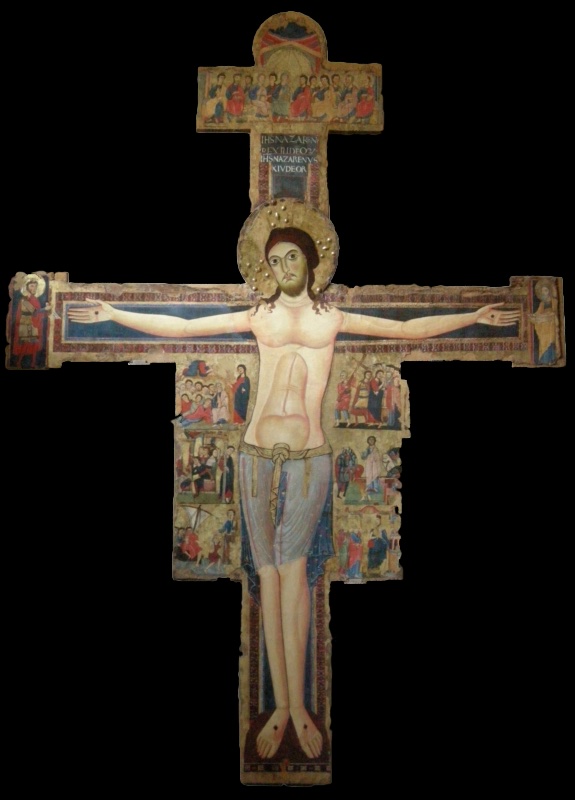
The cross belongs to the type of the large shaped and painted crucifix, with a central Christus triumphans flanked by lateral panels, the so-called tabellone, with terminals at the ends of the horizontal arm and an upper panel or cimasa. The national catalogue describes the technique simply as tempera on panel. It does not, in the publicly accessible record, give the dimensions of the object, and none of the other sources consulted for this essay, from the catalogue of the photographic archive of the Fondazione Zeri to the published studies of the inscriptions and of repainting practices, provides reliable measurements.
This is worth stating plainly, because figures circulate for neighbouring crosses and it would be easy to transfer them by analogy. For comparison, the national catalogue gives 282 by 236 centimetres for the Croce n. 15 from the Santo Sepolcro and 298 by 233 centimetres for the Croce n. 20, both in the Museo Nazionale di San Matteo, while the cross from San Paolo all’Orto measures roughly 295 centimetres in height; the San Frediano cross is clearly of comparable monumental scale, but its own measurements are not reproduced here.
Equally unknown, at least as far as published technical data go, are the species of wood, the joinery and the preparation. The gap is significant, because the restoration of the Rosano cross revealed a chestnut support, gilding laid without bole directly on the gesso, an unusual preparation of anhydrous gypsum bound with vegetable gum, and a horizontal arm passing continuously across the upright in a half-lap joint; whether the San Frediano panel shares any of these features is not known.
The programme: Christ, six scenes, Pentecost and two prophets
At the centre of the cross Christ is represented alive, as a Christus triumphans, with his eyes open and turned towards the beholder, his head slightly inclined to his left, naked except for the loincloth. The face, according to the catalogue, belongs to the earlier of the two painted layers, and is today the most substantial surviving portion of the first painting. Around him, in the tabellone, are disposed six scenes, three on each side, of equal size and symmetrical arrangement. Read, as the catalogue reads them, from left to right and from top to bottom, they show the Agony in the Garden and Pilate washing his hands; then the Way to Calvary and the Resurrection; and finally the Appearance of Christ on the Sea of Galilee and the Incredulity of Saint Thomas.
The Fondazione Zeri catalogue, which describes the same cycle, specifies that the second scene combines Pilate washing his hands with the Flagellation, and calls the fifth the Appearance of Christ to the apostles on the Lake of Tiberias; in the Way to Calvary, as in much medieval imagery derived from the Synoptic account, the cross is carried by Simon of Cyrene. The cimasa above contains the Pentecost, and the terminals of the horizontal arm hold the prophets David, on the left, and Isaiah, on the right.
The structure of this cycle is more eloquent than its individual episodes. It moves from the night in Gethsemane, through the judicial and penal moments of Pilate and the Flagellation, to the procession to Golgotha, and then, skipping the Crucifixion itself, which is embodied by the great central figure, leaps to the Resurrection and to two post-Resurrection appearances, culminating in the Pentecost at the top. The narrative therefore wraps the triumphant Christ in a sequence that is half Passion and half Easter, and the ascending reading from the lower scenes towards the cimasa ends with the descent of the Spirit on the apostles, an image of the Church born from the Cross. The two prophets on the arms, David and Isaiah, supply the Old Testament warrant for the whole: the psalmist whose verses were read as prophecies of the Passion, and the prophet of the suffering servant.
What makes this arrangement historically important is its difference from the type that prevailed in Lucca. As an often-repeated observation puts it, compared with the earlier crosses of San Paolo all’Orto and of Sarzana, the San Frediano cross shows an innovation: in the lateral panels the Passion scenes are organised in equal and symmetrical compartments, three to a side, accentuating the narrative aspects of the work over the more strictly devotional contents represented by the presence of the Virgin and the other mourners. The 2017 study states the point more sharply, calling the San Frediano cross the oldest of the type properly defined as “Pisan”, that is, with stories of the life of Christ in the tabellone instead of the figures of the mourners. This judgement holds even if one accepts the earliest proposed date for the San Paolo all’Orto cross, whose tabellone still combines the Virgin and Saint John and the holy women with only two narrative scenes.
A caution must, however, be added. Because the scenes, the cimasa and the prophets as we see them belong to the second painted layer, the programme just described is, strictly speaking, the programme of the repainting. The first painting may have had a different iconography in at least two of the compartments, as the next sections will explain, so that the “oldest Pisan narrative cross” is itself a palimpsest whose original narrative content is only partly recoverable.
The inscriptions: two tituli, one above the other
Between the nimbus of Christ and the cimasa, at the top of the vertical arm, runs the titulus. The catalogue transcribes it, in capital letters painted with the brush, as
I(E)HS NAZAREN(US) / REX IUDEO(RUM),
and notes that both layers carrying the inscription are visible. This laconic note conceals one of the most remarkable features of the cross. As the 2017 palaeographic study demonstrates, the San Frediano titulus is, as far as its author’s research could establish, the only case of a titulus repainted in antiquity among the painted crosses on panel of the twelfth and thirteenth centuries. The two inscriptions are now visible almost entire, one above the other, although part of the more recent one was erased during the restoration precisely in order to uncover the older text beneath.
The two inscriptions differ in ways that can be described with some precision. Both are laid out on two lines in fields with a blue ground, but the older, lower inscription is painted in white, whereas the later, upper one is in gold, with its field framed by a red line. The later titulus was placed higher because the Christ of the second painting had a slightly longer face. Both carry the Johannine formula Iesus Nazarenus Rex Iudeorum, with different abbreviations. The most striking difference is the first U of IUDEORUM, which in the older inscription is a Latin V and in the later one an uncial U. The older inscription is regular, with letters separated by equal spaces; the later one keeps its letters well spaced but slightly larger, uses abbreviations, and sometimes raises or compresses letters to fit them into the available room, as in the Z and E of NAZARENUS.
An earlier palaeographic analysis, an essay on the Rosano cross “beyond Lazio and Tuscany” published on pages 119–132 of the 2012 volume La pittura su tavola del secolo XII and building on a 2007 study of the Rosano inscriptions, had characterised the older titulus as written in a majuscule imitating classical models, without ligatures or nexus, with the abbreviation IHS obtained by a tegular stroke, and had observed that it “pare distante dagli esempi pisani per la specifica volontà di recuperare la capitale classica”, that is, that it seemed distant from Pisan examples because of its deliberate recovery of the classical capital on the model of the display scripts of the Atlantic Bibles.
The same analysis described the later titulus as a Romanesque majuscule with uncial elements, of irregular module, and dated it, on the basis of the uncial U with an undulating first stroke ending in a curl and of the Z with wavy horizontals, to the end of the twelfth or the beginning of the thirteenth century. The 2017 study accepted the first characterisation but contested the second dating: it pointed out that the titulus of the Sarzana cross of 1138 already shows the U with an undulating curled stroke, that a Z with wavy strokes appears practically identical in the titulus of the cross from the Santo Sepolcro in Pisa, and that close comparisons for the later inscription are to be found in Pistoian manuscripts of the first quarter and first half of the twelfth century.
Above all, the 2017 study placed the later titulus among dated Pisan stone inscriptions, three of the closest of which bear the dates 1131, 1134 and 1137: an inscription of 1131 on the façade of San Giovanni Battista at Ghezzano, near Pisa; a copper plate of 1134 formerly at the altar of Saint Anastasia in San Paolo a Ripa d’Arno; and an inscription of 1137 carved on a pilaster of the west side of the transept of Pisa Cathedral. On this basis it dated the older titulus to about 1100–1120 and the later one to about 1130–1140, while noting that partial parallels continue into the third and last quarters of the twelfth century, which it treated as an outer limit. It should be stressed that palaeographic dating of short painted inscriptions is inherently approximate, and that the 2017 argument depends on accepting that the decisive letter forms were available in Tuscany earlier than had been supposed; but the convergence between script and style is the strongest evidence currently available for the date of either layer.
Two paintings on one panel
The restoration of 1960–1972, in the words of the state catalogue, brought to light “a paint surface composed of two successive layers, both dating from the twelfth century”. To the older belongs the face of Christ; the scenes in the tabellone and cimasa, and the two figures in the terminals, belong to the second layer, although in some areas tests were made on the underlying painting. The same catalogue records, with a candour unusual in such records, that the long restoration led to the “contested removal” of parts of the paint strata belonging to the second campaign along with the more recent repaintings. The cross we see today is therefore neither the first nor the second twelfth-century painting but an archaeological compromise: an earlier Christ, at least in the face, surrounded by later scenes, under a doubled titulus, with the later Christ that once covered the earlier one now lost.
That lost second-layer Christ is known only from photographs taken before the restoration. The 2017 study, which studied those photographs, states that the Christ of the second painting, “now cancelled by the restorations”, was almost identical to the Christ of the Rosano cross. This observation is crucial for the attribution of the second campaign, and it also measures the cost of the restoration: the figure that would have allowed the most direct comparison with Rosano was sacrificed to recover the earlier face beneath. A study of early repainting practices published in 2011–2012 describes the procedure of the second painter in terms that apply to the whole panel: within a few decades the image was completely repainted, faithfully retracing the structure of the main figure and of the scenes but in an updated formal language.
The consequence for connoisseurship is that every stylistic judgement on the San Frediano cross must specify which layer it concerns. Much of the older literature discussed the second painting believing it the only one; much of the recent literature discusses the first painting through the face of Christ and a few fragments revealed by tests. Confusion between the two is the principal source of the wild oscillations in dating reviewed below.
Why repaint? Emmaus beneath Thomas
Why should a monumental crucifix, barely a generation old, have been completely repainted? The question is not idle, because the answer bears on how the twelfth century understood its own images. The study of early repainting just mentioned, which surveyed a series of cases from the Roman icon of Santa Francesca Romana to Simone Martini’s Maestà in Siena, argued that medieval repaintings were usually undertaken either to restore damaged images or to modify their iconography, and only secondarily, if at all, to update their style. For the San Frediano cross it drew attention to a photograph taken during the restoration: beneath the scene of the Incredulity of Thomas there re-emerged a scene of Christ and the disciples at Emmaus, which the repainting had replaced. The episode below on the left, the Appearance of Jesus on the Sea of Galilee, still preserved in the second painting, also revealed in tests the presence of an underlying scene, probably of a different subject. The study concluded that these changes of iconography may have been the cause of the repainting of the whole paint surface.
The hypothesis is economical and persuasive, although it cannot be proved. The substitution of Thomas for Emmaus is not a trivial change. The Supper at Emmaus, with its breaking of bread and recognition, is a eucharistic image; the Incredulity of Thomas, with its touching of the wound, is an image of bodily proof of the Resurrection and of faith overcoming doubt. A shift from one to the other might reflect a change in liturgical emphasis, in the use of the cross within the Camaldolese church, or simply in the preferences of a new patron. It is worth observing that Emmaus figured prominently in the earliest narrative crosses of the region: it appears on the San Paolo all’Orto cross and on the Rosano cross, and it reappears on the Croce n. 15. Its replacement at San Frediano is thus a departure from a shared repertory rather than a mere variation. That the second painter retraced layout and main figure faithfully while changing at least one scene suggests that what mattered to the patrons was the iconographic programme, not the style.
The question of date
No feature of the San Frediano cross has been more debated than its date, and the history of that debate is a small history of the discipline. The first critical attention to the work came from Da Morrona, a late eighteenth-century Pisan antiquarian, who dated it to the eleventh century and considered it earlier than Giunta; the local literature of the following decades repeated his view, and Rosini, in the nineteenth century, assigned it generically to a “Greco-Italic manner”. The modern problem begins with Osvald Sirén, who placed the cross in the corpus of the hypothetical “Maestro Tedice” and therefore in the first half of the thirteenth century (the catalogue gives no year for this judgement), a dating that Raimond van Marle moved slightly earlier by linking the cross to that of Sarzana. Others placed it at the end of the twelfth or beginning of the thirteenth century beside the crosses of Rosano and of the Florentine Accademia, without assigning them to a single master; Viktor Lazarev, whom the catalogue writes Lazareff, went to the opposite extreme and assigned it to the end of the eleventh century. By the time the catalogue sheet was compiled, the dating to the second half or end of the twelfth century seemed the most accepted, shared by Coletti, Marcucci and Lucia Bertolini Campetti herself.
The decisive revision came with Miklós Boskovits, in the first volume of the new series of the Corpus of Florentine Painting, devoted to the origins of Florentine painting between 1100 and 1270 and published in 1993. Boskovits dated the first painted layer of the San Frediano cross to 1110–1120 and held that the repainting took place “in all probability still within the first half of the century”; he dated the Rosano cross to 1129–1134. These figures, like Boskovits’s grouping of the cross with Rosano and San Paolo all’Orto and his date for the latter, are reported here at second hand, from the later studies that cite him: the 1993 volume itself was not consulted for this essay.
As a doctoral study of early Tuscan painting has put it, the decisive backdating of the work by about a century was made possible by the discovery of an older and well-preserved painted layer that brings the cross close to that of Rosano. The 2017 palaeographic study declared itself almost perfectly in agreement with Boskovits and refined the second campaign to about 1130–1140. A study of repainting practices of 2011–2012 likewise assigns the work to the first half of the twelfth century, and the official catalogue’s 1150–1174, together with its statement that the cross was “repainted already at the close of the twelfth century”, should accordingly be read as reflecting the state of opinion before these studies rather than current consensus.
What, then, can be considered established? It is documented that the panel carries two twelfth-century paintings, and the catalogue, Boskovits and the later studies all agree on this. It is the prevailing scholarly view, supported by stylistic and palaeographic arguments that converge, that the first painting dates to roughly the second decade of the twelfth century and the second to roughly the 1130s. It remains a hypothesis that the first painting might be as early as the last quarter of the eleventh century, and a further hypothesis that it was occasioned by the Camaldolese arrival. And it remains unknown exactly how many years separate the two campaigns, who commissioned either of them, and for which position in the church the cross was made.
The first painter and the Roman horizon
The earlier painting, now visible principally in the central Christ and in fragments of scenes, has been read in two quite different ways. The national catalogue, reflecting a view current in the 1970s, relates the first layer to works of Byzantine and Crusader milieu of the mid-twelfth century, a tendency also visible in Pisa in illuminated manuscripts such as the Calci Bible of 1168, and finds this eastern affinity especially in the treatment of Christ’s face, with its red underlinings and shadings emphasising the cheeks, nose, eyelids and other anatomical details. More recent research has looked instead towards Rome. The 2017 study, drawing on comparisons gathered by Boskovits, finds the first layer quite similar to Roman works attributed to the last quarter of the eleventh century: the miniatures of the Bible of Santa Cecilia, the panel of the Last Judgment in the Vatican Pinacoteca, formerly in San Gregorio Nazianzeno, and some of the frescoes of the lower church of San Clemente. It also notes parallels with three panel paintings of the first half of the twelfth century: the cross from San Paolo all’Orto in Pisa, the painted cross in the Victoria and Albert Museum in London, and the Madonna of the church of Santa Chiara in Pisa.
These two readings are not necessarily incompatible, since the Roman painting of the late eleventh century was itself deeply engaged with Byzantine models, but they imply different histories. The “Byzantine-Crusader” reading situates the first painter within a mid-century Pisan culture of maritime contacts with the eastern Mediterranean; the “Roman” reading situates him within the visual culture of the Gregorian reform at the turn of the century, when Rome was the most important centre of monumental painting in central Italy and Pisa was closely tied to the reform papacy. The palaeographic evidence of the older titulus reinforces the Roman orientation. The 2017 author was careful not to conclude that the painter was a Roman: it seemed to him more likely that a common textual and graphic model from Rome, or the help of a scribe trained in Roman epigraphic culture, lies behind the inscription.
In formal terms, what remains of the first painting suggests a frontal and austere figure, defined by firm contour and modelled through linear accents of red on the flesh rather than continuous chiaroscuro. Beyond this, a detailed characterisation of the first painter is hampered by how little of his work is exposed. He is, in the most literal sense, a master known by a face.
The second painter, Rosano, and the problem of an oeuvre
The second painting, which survives in the six scenes, the cimasa and the prophets, has a much more substantial body of comparanda, and it is here that the question of an oeuvre arises. Its very close correspondences with the painted cross of the monastery of Santa Maria a Rosano, in Rignano sull’Arno, are discussed in the 1929 monograph La croce dipinta italiana e l’iconografia della Passione (Verona 1929) of Evelyn Sandberg-Vavalà, which the Fondazione Zeri cites at pages 578-581 for the Rosano cross.
Boskovits grouped San Frediano and Rosano together with the cross of San Paolo all’Orto as “perhaps by the same hand”. The 2017 study, which compared the pre-restoration photographs of the second-layer Christ with the Rosano Christ and found them almost identical, considered the second painting of San Frediano and the Rosano cross very probably by the same master, and added to them the first painting of a little-known headless cross in the church of San Matteo in Pisa.
If this grouping is accepted, the second painter of San Frediano is to be identified with the so-called Master of Rosano, and the San Frediano repainting becomes a work of the same personality who painted, around 1129–1134 if Boskovits’s date for Rosano is followed, the oldest surviving painted cross in the Florentine area. The Encyclopedia of Medieval Art’s entry on Florence, published in 1995, makes the converse point: among the oldest and most important paintings of the Florentine area is the Rosano cross, but its most immediate stylistic parallels are with Pisan painting of the second half of the twelfth century, and specifically with Pisan crosses. Whether the master was a Pisan who worked for Florentine patrons or an itinerant painter whose career touched both cities cannot be decided on present evidence; what can be said is that the old disciplinary boundary between “Pisan” and “Florentine” origins dissolves around this group of works.
Other crosses have been drawn into the orbit of the Rosano master. The crosses in the Museo Civico of Castiglion Fiorentino and in a Roman private collection, the latter said by a Florentine dealer to have come from Sansepolcro, show faces and details extremely similar to the second painting of San Frediano. They have been attributed to the Rosano master himself by an essay in the 2007 volume on the restored Rosano cross and by a 2009 conference paper which explicitly endorsed that essay’s view that the Roman cross is “della stessa mano del Crocifisso di Rosano”, a view the 2017 study resisted: it judged the Castiglion Fiorentino cross a simplified and schematised work, perhaps from the workshop, which it placed around 1170–1180, and the Roman cross, which it knew only from photographs, a probably later work by pupils of the Rosano and San Frediano painter, to be placed between the end of the twelfth and the first quarter of the thirteenth century. The precise limits of this oeuvre thus remain open, and attributions beyond the San Frediano second layer, Rosano and the headless San Matteo cross should be regarded as hypotheses of varying strength.
It is a paradox worth underlining that the “Master of the San Frediano Cross”, as christened in 1972, may in the end dissolve into two other figures: an anonymous painter of Roman culture active around 1110–1120, known essentially by a single face, and the Master of Rosano, a better-defined personality to whom the visible scenes of San Frediano would belong. The name nevertheless retains its usefulness as a label for the panel and for the problem it poses, and it is in this sense that the national catalogue continues to employ it.
The Pisan context: San Paolo all’Orto, the Santo Sepolcro cross, the Calci Bible and the Croce n. 20
The San Frediano cross is the oldest painted cross remaining in Pisa still in its church, and it can only be understood within the extraordinary concentration of twelfth- and thirteenth-century crosses that survive from Pisan churches, most of them now in the Museo Nazionale di San Matteo. The Encyclopedia of Medieval Art’s entry on Pisa describes the oldest painted crosses, that from San Paolo all’Orto and that of San Frediano, as testifying to an uninterrupted pictorial evolution based on this iconographic type.
The cross from San Paolo all’Orto, a church documented from 1086, is the closest comparison for the first painting. It is very fragmentary, roughly 295 centimetres high, and has been dated by Boskovits to the beginning of the twelfth century. Its iconography is still largely of the older kind: its tabellone combines the Virgin and Saint John and two holy women with two narrative scenes, the Descent into Limbo and the Supper at Emmaus, all of them post mortem episodes, while the cimasa shows the blessing Redeemer with angels, and in place of the usual titulus there is a unique triangular structure that has been interpreted as an image of the aedicule of the Holy Sepulchre. In this cross we see the narrative principle entering the tabellone without yet displacing the mourners, and it is precisely the San Frediano cross that takes the next step.
The cross from the church of the Santo Sepolcro, the Croce n. 15 of the Museo Nazionale di San Matteo, is the key Pisan comparison for the second painting and the next stage in the development of the narrative type. The national catalogue records it as a work of the Pisan milieu of the second half of the twelfth century, dated 1150–1199, inventory number 1578. Originally in the Hospitaller church of San Sepolcro, it was exhibited at the end of the nineteenth century in the thirteenth-century room of the new civic museum, and the number 15 under which it was registered in the museum catalogues of 1894 and 1906 still identifies it in the critical literature.
Its cycle is more extensive than that of San Frediano: the left terminal shows the Last Supper and the right the Washing of the Feet; the tabellone contains the Mocking of Christ, the Crucifixion, the holy women at the tomb, the Supper at Emmaus, the Appearance to the apostles, and the meal with the apostles; the foot of the cross shows the Pentecost; and the cimasa, whose upper part is missing, the Ascension. The catalogue notes the rare Washing of the Feet and suggests that a cycle covering all the main moments of the Passion is particularly suited to eucharistic meanings, and it records vivid details such as the conical mock hat imposed on Christ in the Mocking and the gesture of Longinus raising his fingers to his eyes after piercing the Saviour’s side.
The relation between the Croce n. 15 and San Frediano has been formulated in several ways. Sirén first (1914) saw in it the influence of Giunta and later, in a phase the catalogue does not date, attributed it to the same author as the San Frediano and Rosano crosses; the 1929 monograph moved it towards 1220; one study of 1994, as summarised in the catalogue, related it, together with the cross from the Pisan church of Santa Cristina now in the sanctuary-house of Saint Catherine in Siena, to the period and stylistic area of the upper layer of San Frediano, which “cannot be later than the end of the twelfth century”, and stressed that both crosses show affinities with Umbro-Roman painting and illumination. Another study of 1994 observed that the Croce n. 15 carries to its fullest development a tendency already present in the older San Frediano cross, the tendency “a far prevalere le finalità didascaliche dell’apparato narrativo”, that is, to let the didactic purposes of the narrative apparatus prevail over the more strictly devotional and pathetic ones.
The Encyclopedia of Medieval Art entry on Pisa, by contrast, places the Santo Sepolcro cross at the beginning of the thirteenth century, describing its Christ alive and its colourful scenes of lively, popular character; this discrepancy, between a dating in the second half of the twelfth century and one in the early thirteenth, has not been resolved and should be acknowledged rather than concealed. The 2017 palaeographic study, for its part, refers the titulus of the Santo Sepolcro cross to the third quarter of the twelfth century. On any of these datings, the Croce n. 15 stands to San Frediano as a development to a prototype.
The Calci Bible provides the indispensable point of contrast for both crosses. This four-volume illuminated Bible was begun on 10 October 1168 at the initiative of the priest Gerardus of San Vito in Pisa, written by Magister Vivianus and illuminated by Albertus or Adalbertus of Volterra, and is one of the very few Pisan works of the period with a date, a patron and named makers. Burresi and Caleca (1993) distinguish two currents in Pisa: one represented by the Calci Bible, which translates Byzantine models and iconographies, and one, to which they assign the Croce n. 15, that depends on the Umbro-Roman giant Bibles; the catalogue ties the upper layer of San Frediano to the same Umbro-Roman current, and the 2017 study adds Roman painting. The Dizionario Biografico, by contrast, reads the master of the Croce n. 15 as a master of almost exclusively Byzantine reference.
At the far end of this Pisan development stands the Croce n. 20 of the Museo Nazionale di San Matteo, which the national catalogue attributes to the “Master of the Croce n. 20” and dates between 1200 and 1210. It measures 298 by 233 centimetres, and is executed in tempera and gold on a panel covered with skin: the technique field of the catalogue says cuoio, leather, while its notes, reporting the 1929 monograph, speak of parchment glued on wood. Here Christ is shown dead, fixed to the cross by four nails, his head resting on his right shoulder and his eyes closed, with blood and water flowing from his side: it is one of the earliest examples of the Christus patiens on a shaped painted cross in the West.
The catalogue relates its painter to Byzantine art of the late Comnenian period and suggests he may have reached Pisa after the Fourth Crusade, when Byzantine-trained artists were active in the city, as the lintels of San Michele degli Scalzi of 1204 and of the Baptistery portals attest. Between the triumphant, open-eyed Christ of San Frediano and the dead Christ of the Croce n. 20 lies the whole passage from the Romanesque to the Byzantinising culture of the early Duecento that would lead to Giunta Pisano. The Croce n. 20 is thus the measure of how archaic, by 1200, the San Frediano type had become, and of how early San Frediano itself must be.
The Lucchese mirage
The confusion between the San Frediano cross and the crosses of Lucca, mentioned at the outset, is more than a matter of names. It arises from a historiographical habit of treating the Lucchese sequence as the normative history of the twelfth-century painted cross. That sequence is indeed remarkable. Its earliest firmly dated monument is the cross in Sarzana Cathedral, signed by Guglielmus and dated 1138 in a Latin inscription in leonine hexameters, a work generally considered Lucchese and partly repainted in the following century, when, according to the study of repainting, abundant blood flowing from the wounds was introduced in line with the new, more dolorous interpretation of the Crucifixion. Then come the crosses of Santa Giulia, now in the cathedral of San Martino, of San Michele in Foro, and of Santa Maria dei Servi, now in the Museo Nazionale di Villa Guinigi, generally placed around the middle of the century, and finally, in the early thirteenth century, the work of Berlinghiero, whose signed cross from Santa Maria degli Angeli, now at Villa Guinigi, carries the words BERLINGERIUS ME PINXIT.
The Lucchese crosses share a type in which the lateral panels are occupied predominantly by mourners and by figures and episodes clustered around the Crucifixion itself and its aftermath, rather than by a cycle of evenly distributed narrative compartments. It is against this background that the specificity of San Frediano becomes clear. The difference of type is decisive, and it is a difference of function as well as of form: the Lucchese cross keeps the mourning witnesses at the foot of the cross as models for the beholder’s compassion, while the Pisan narrative cross turns the panel into a compact Gospel, in which the triumphant body of Christ is surrounded by the history of his Passion and of his risen presence.
The Lucchese mirage has also distorted dating. The survey in which Sirén attached the San Frediano cross to “Maestro Tedice” did so within a framework in which, as a 2012 historiographical essay observes, the Lucchese and Pisan works were treated as mere forerunners attracted towards Berlinghiero and “Maestro Tedice” and therefore postdated into the thirteenth century. Restored to Pisa and to the twelfth century, the San Frediano cross reveals at least two parallel traditions, Lucchese and Pisan, developing side by side from the first decades of the century.
Function and setting
Nothing is documented about the original position of the cross within San Frediano. The general literature on twelfth-century Tuscan crosses suggests a few possibilities: such crosses could be placed above or behind an altar, or above the screen or transenna separating the nave from the presbytery, and they were conceived to be seen from a distance by the faithful. The catalogue entry for the Croce n. 15 proposes for that cross a position close to the space of liturgical action, perhaps above a screen dividing nave from presbytery, and links its eucharistic programme to that position. Similar reasoning may apply to San Frediano, especially if the original Emmaus scene is given its eucharistic weight, but it must remain a reasoned analogy rather than a documented fact.
What can be said with more confidence is that the iconography of the Christus triumphans, with its open eyes and untroubled body, expresses, in the words of the San Matteo catalogue, the victory over death and the redemption of humanity from sin. In a Camaldolese church with a hospital for the poor and pilgrims, a cross that wrapped the triumphant Christ in scenes of Passion, Resurrection and appearances, crowned by the Pentecost, offered a theology of the Cross as the source of the Church’s life; its later fate as a veiled miraculous image transformed this programmatic object into a focus of personal and civic devotion.
The historiography of the name
The fortunes of the San Frediano cross mirror those of twelfth-century panel painting in Italian art history, which, as a 2012 historiographical essay has shown, long lacked an identifying profile, absorbed into a generic pre-Giottesque prehistory or judged by the standard of the Duecento. Within this history the cross, after its antiquarian notices and its thirteenth-century dating in Sirén’s corpus of Maestro Tedice, was given a date “entro il 1150”, within 1150, for its second painting by a 1936 article, “Su alcune Croci pisane” in the Rivista d’Arte, christened in 1972 and redated in 1993; the restoration of the Rosano cross in 2006 and the 2017 analysis of the tituli have consolidated the early dating. The anonymous painter has thus moved from the margins of a thirteenth-century narrative to the centre of a twelfth-century one.
Conclusion
The Master of the San Frediano Cross is, in the end, less a person than a problem. The name designates a monumental Christus triumphans in the church of San Frediano in Pisa, not in Lucca, carrying six Passion and post-Resurrection scenes, a Pentecost in the cimasa, David and Isaiah on the arms, and a titulus repainted in antiquity. Beneath this visible programme lie two twelfth-century paintings: an earlier one, now visible chiefly in the face of Christ, which current research dates to around 1110–1120 and relates to Roman painting of the turn of the century; and a later one, now visible in the scenes, which current research dates to around 1130–1140 and attributes, with strong probability, to the painter of the Rosano cross. The official catalogue’s date of 1150–1174 belongs to an earlier stage of the debate, and the attribution to a single “master” coined by Lucia Bertolini Campetti in 1972 must now be understood as a label for a layered object rather than for a single hand.
What remains unknown is considerable: the dimensions and technical structure of the panel, the patrons of either campaign, the original position of the cross, the full iconography of the first painting, and the interval between the two campaigns. What has been established is enough to make the cross a cornerstone of the history of Italian painting before 1200. It shows that the narrative crucifix was born in Pisa in the first decades of the twelfth century, that the boundaries between Pisan, Florentine and Roman culture were porous, and that medieval images could be thoroughly renewed within a generation without any wish to change their style. The recovery of the earlier painting cost us the second-layer Christ, and the debate on that decision is not closed; but it also gave us, in the doubled titulus and in the ghost of Emmaus beneath Thomas, a rare glimpse of a twelfth-century image in the very act of being remade.