Giunta Pisano
( 25% )
Introduction and the historiographical problem
Few painters occupy so paradoxical a position in the history of early Italian art as Giunta di Capitino, called Giunta Pisano. On the one hand he is, by the plain testimony of the objects themselves, the earliest Italian painter whose name survives inscribed on extant works — a fact of real weight in a period when the maker’s identity was almost never recorded. On the other hand, the man behind the four proud signatures is documented by so few and so laconic records that almost every statement about his life beyond those signatures must be qualified as inference, reconstruction, or frank conjecture. The tension between the loud self-assertion of the works (“the learned hand of Giunta Pisano painted me”) and the near-silence of the archives is the central historiographical problem of Giunta studies, and it has produced, over more than a century of scholarship, a striking range of verdicts: from the dismissive to the reverential, from the marginal to the foundational.
This essay attempts to hold that tension steadily in view. It distinguishes throughout among three epistemic registers: what is documented (the signatures on the works and the handful of archival records); what is broadly accepted attribution on stylistic grounds; and what is disputed, conjectural, or simply unknown. It also aims, as a matter of scholarly hygiene, to identify and set aside the accumulated errors and embellishments that cling to Giunta’s name — the invented birth and death dates, the confident biographical narratives spun from a single misread document, the myth-making around the lost cross of Assisi and its association with Frate Elia, and above all the durable cliché that Giunta “invented” the image of the suffering Christ. None of these survives contact with the primary evidence, and the more interesting Giunta — a technically formidable Pisan artist who repeatedly renewed his idiom by absorbing Byzantine models, and who became, in effect, the first house painter of the Franciscan order — emerges more clearly once they are cleared away.
The modern literature on Giunta is overwhelmingly Italian, and it is punctuated by a small number of load-bearing interventions. In the interest of the constraint governing this essay, three modern scholars are named and their positions attributed with precision: Cesare Brandi, whose 1936 study of the Bologna cross, undertaken after its restoration, effectively reconstituted Giunta as a critical personality; Roberto Longhi, whose 1948 “Giudizio sul Duecento” delivered the most memorable adverse verdict on Giunta’s art; and Angelo Tartuferi, author of the 1991 monograph and of the entry in the Dizionario Biografico degli Italiani (2001), whose work represents the fullest modern synthesis. All other scholarship — the archival study of 1922 that first sorted the Pisan documents, the mid-century illustrated corpus of Romanesque panel painting, the reassessment of 1973 and its author’s later Corpus of Florentine painting, the Byzantinist tradition, and the connoisseurial strand of Pisan studies — is referred to generically, as “recent scholarship,” “the critical tradition,” “some critics,” and the like. This is a deliberate economy, not a slight to the many hands that have shaped the field.
Documentary evidence and biography: the Pisan and Roman records
The secure documentary base for Giunta is astonishingly thin, and it is essential to state exactly what it consists of before any biography is built on it. The foundational work of sorting the many Pisan documents of the period that mention persons named Giunta — a common name — from those that genuinely concern the painter was done in an archival study published in the Bollettino d’Arte in 1922, which critically re-examined the labours of the eighteenth-century Pisan érudits (notably Tempesti in 1790 and Da Morrona1 in 1793). That study, and the modern scholarship that has refined it, yields the following.
The single most repeated datum about Giunta — that he was “active from 1229 to 1254,” a formula that recurs in encyclopaedias and museum labels alike — is in fact insecure at its lower bound, and this is the first correction the primary record demands. The document of 29 January 1229 that is conventionally cited as the beginning of Giunta’s career records a certain Giunta di Guidotto who owned land in the district of Calci, near Pisa. Recent scholarship has argued, persuasively, that this man is not the painter but a namesake — the more so because a further Pisan document of 30 January 1239 names a “Iunte q. Guidocti de Colle” without any painterly appellation. The temptation to attach the painter to the 1229 record is understandable, since Giunta the painter would indeed later be attested as a landowner at Calci; but coincidence of place is not identity of person, and the “1229” that opens so many accounts of Giunta’s life should be regarded as, at best, unproven and probably erroneous.
The securely attributable record therefore begins in 1236, with the date borne by the lost cross commissioned by Frate Elia for the basilica of San Francesco at Assisi. The next firm attestation comes from Rome. Two parchments dated 4 and 26 May 1239, drawn up in the church of San Clemente and concerning a dispute over mills and water rights in the territory of Monte Albino near the Marmore falls — between the monks of San Sebastiano ad Catacumbas and the priory of Santa Maria Nuova — name as witness a “Leopardo clerico nato Magistri Iuncte pictoris Pisani,” that is, Leopardo, cleric, son of Master Giunta the Pisan painter.
The second act also names a “Iohanne Pisano famulo Magistri Iuncte,” a servant or workshop assistant of Master Giunta. These documents, published by Cesare Verani in 1958, are of considerable biographical value. The presence in Rome not only of the painter’s son but of a member of his household makes it likely, though not certain, that Giunta himself was in the city in the spring of 1239. More importantly, they permit a rough calculation of his dates: if Leopardo could appear as a witness to a notarial act in 1239 he must have been at least twenty-five, hence born by about 1214; and if Giunta was at least twenty when his son was born, his own birth falls somewhere in the last two decades of the twelfth century. This is the whole of the evidentiary basis for the frequently stated birthdate of “c. 1180,” and it should be presented as the loose inference it is, not as a fact.
Two further Pisan records complete the secure file. A document of 28 January 1241, preserved in the archiepiscopal archive of Pisa and known through a fourteenth-century transcription, mentions the painter — here “Iuncta pictor” — as owner of land in the territory of Calci, in a contract of sale. And the last securely attributable attestation is a Pisan document of 28 August 1254, likewise surviving only in a fourteenth-century transcription, in which “Juncta Capitinus pictor” appears among the nobles of the city swearing an oath of fealty to Archbishop Federico Visconti2. This last document is doubly important: it fixes the terminal point of the secure record, and it confirms the painter’s true name, Giunta di Capitino, since “Capitinus” is a patronymic (the name of his father, Capitino) and not a family surname in the modern sense. The same patronymic recurs in the fragmentary signature on the Santa Maria degli Angeli cross. The popular forms “Giunta Capitini” or “Giunta Capitanio,” treated as though they were surnames, are therefore misleading modernizations of a medieval patronymic.
On the question of Giunta’s death, restraint is again in order. The last secure record is the oath of August 1254; everything after that is estimate. The widely printed death dates — “c. 1250,” “1258,” “c. 1260,” and the like — are inferences that simply allow a few years beyond the last attestation, and they should be labelled as such. A claim occasionally encountered, that a recently discovered document attests Giunta still alive and working in Pisa in the 1260s, cannot be confirmed from the standard reference literature and runs contrary to the one post-1254 lead that scholarship reports: a document of 1257 that appears to imply he was by then already dead, though that reference cannot itself be securely linked to the painter.
The honest conclusion is that Giunta’s death is undocumented and can only be placed, vaguely, around the middle or third quarter of the century. The eighteenth-century notion, still occasionally repeated in older reference works, that he “flourished 1202–1236” or was born in 1202 has no documentary basis whatever and belongs to the pre-critical prehistory of the subject.
What the secure record does establish, and what deserves emphasis, is genuinely remarkable for its date: here, for the first time in the history of Italian art, we can trace the profile of a named painter who worked not only in his native city but in several distinct geographical centres — Pisa, Assisi, and (probably) Rome — carrying his workshop and his manner with him. That mobility, and the self-conscious pride of the signatures, are themselves historical facts of the first importance, quite apart from the meagreness of the biographical harvest.
The lost cross of San Francesco at Assisi (1236) and the commission of Frate Elia
The most historically resonant of Giunta’s works no longer exists, and reconstructing what can and cannot be known about it is a model case of the discipline this subject demands. According to the securely transmitted sources, in 1236 Giunta painted a large cross for the basilica of San Francesco at Assisi, commissioned by Frate Elia3 — Elias of Cortona, the powerful and controversial companion of Saint Francis4 who served as minister general of the order in 1232–1239 and who oversaw the building of the great basilica over the saint’s tomb. The cross bore a signed and dated inscription.
In the standard scholarly reconstruction it read:
Frater Helias fieri me fecit / Iesu Christe pie / miserere precantis Helie / Iunta Pisanus me pinxit / A(nno) D(omini) MCCXXXVI / Indictione nona
Brother Elias had me made; O merciful Jesus Christ, have mercy on Elias who prays; Giunta Pisano painted me; in the year of the Lord 1236, in the ninth indiction.
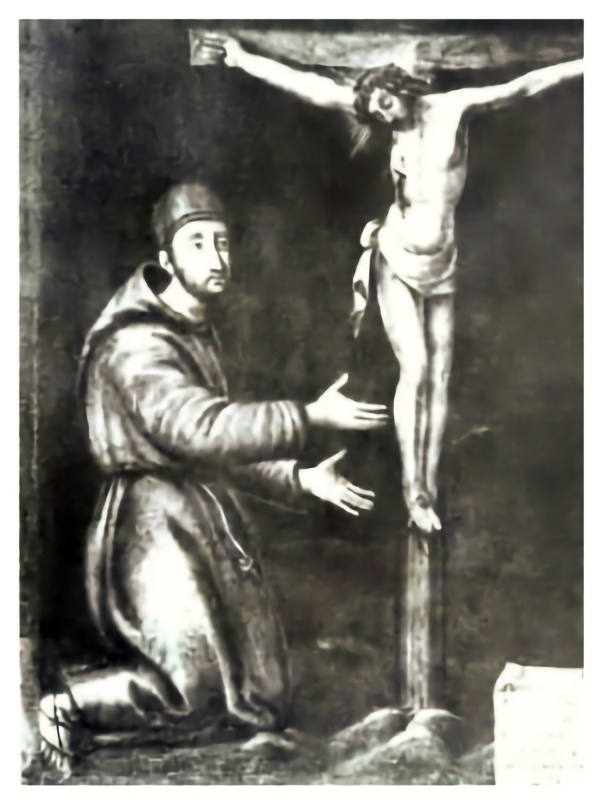
The transmission history of this inscription is itself instructive, because the cross was already barely legible when it was rediscovered and was destroyed not long after. The pivotal moment came in 1623. In preparation for the episcopal consecration of Francesco Boncompagni in the Upper Church, the great cross that hung high on a beam spanning the church — the last vestige, in effect, of a dismantled rood-screen or iconostasis arrangement — was lowered to the ground. Only then, at the foot of the cross, was a small image of a kneeling friar discovered, together with the inscription naming Elias, the year 1236, and the painter.
The event was reported almost at once in a letter of 1624 from Bishop Marcello Crescenzi of Assisi to Cardinal Federico Borromeo5, a document later found in the Borromeo holdings of the Biblioteca Ambrosiana in Milan and published in 1927 (in both the Archivio Storico Lombardo and the Miscellanea Francescana). The presence of the friar and the substance of the inscription had already been noticed, if less precisely, in Luke Wadding’s “Annales Minorum” (Lyon, 1625, recording the discovery under the year 1623), and the fullest early account, together with a note of the cross’s ruinous state, was given by the Franciscan historian Francesco Maria Angeli in his “Collis Paradisi amoenitas” (1704).
The wording is stable in substance across all these witnesses — Brother Elias had it made; a prayer for mercy on Elias; Giunta painted it; 1236, ninth indiction — but it varies in orthographic and word-order detail from source to source: the name of the friar appears as Helias, Elias, or Eliae; the painter’s name as Iunta, Iuncta, Juncta, and, in the transcription of the Crescenzi letter, the striking misreading “Guncta”; and the phrase “fieri me fecit” appears variously as “fecit fieri” or “fieri fecit.” These are exactly the sort of variants one expects in the transmission of a half-obliterated inscription through successive copyists, and no single wording should be presented as the “authentic” text; the reconstruction given above is a scholarly consensus, not a photograph.
The subsequent fate of the object is quickly told and should be told soberly. After its removal from the beam in 1623–24 the cross was displaced, deteriorated further — very plausibly through worm damage to the wood, as one restorer with hands-on experience of crosses of the period has observed — and by around 1700 it had effectively fallen apart. Its appearance is known only at second hand: a seventeenth-century painted copy that was formerly in the church of Santa Maria della Concezione in Rome, and engravings derived from the figure of the kneeling Elias.
The historical significance of this lost work is considerable and needs to be stated carefully. It is the only work of art documented to have stood in San Francesco before the basilica’s consecration in 1253 — dated, indeed, a full seventeen years earlier. It shows that Giunta enjoyed the patronage of the order’s minister general at the height of his power, and it locates the painter, as early as 1236, at the very centre of the emerging Franciscan visual culture. There is a reasonable scholarly argument, first advanced in the 1930s and developed since, that the cross was originally made for the Lower Church — the only part of the basilica then in liturgical use, the Upper Church being still a building site in 1236 — and was later moved up to hang on the transverse beam of the Upper Church, where Vasari6 would see it. That argument is inferential but well grounded in the building history.
Here, too, the legends require debunking. The portrait of Frate Elia at Christ’s feet has attracted a good deal of romantic embroidery, some of it fastening on an unusual “cap” or headgear supposedly worn by the friar and read, in one tradition, as an “Armenian beret” connecting Elias to the East. The more sober reading, again from a restorer’s vantage, is that the cross was so dirtied and darkened by 1623 that what looked like an exotic cap was very likely the friar’s tonsure obscured by grime; and the insistence of the seventeenth-century witnesses on the “Capuchin” form of Elias’s habit is itself a product of a contemporary polemic — the post-1525 controversy, still unhealed in 1623, over the true shape of Saint Francis’s habit — rather than a neutral observation.
It is also worth resisting the tidy but chronologically awkward hypothesis, floated in the critical tradition, that the celebrated cross painted in 1272 by the so-called Master of Saint Francis (now in the Galleria Nazionale dell’Umbria in Perugia), which shows Saint Francis kneeling in adoration at the foot of the cross, faithfully reproduces Giunta’s lost Assisi model, with the kneeling Elias merely replaced by a kneeling Francis. The idea is attractive because it would make Giunta’s cross the archetype of the entire Franciscan “saint-adoring-the-crucifix” type; but a cross of 1272 is a fragile witness to a model of 1236, and the identification remains conjectural. What can be said with confidence is only what the documents say: that in 1236 Giunta signed and dated a cross for Elias at Assisi, that it bore a portrait of the kneeling friar, and that it perished.
The signed crosses: Santa Maria degli Angeli, San Ranierino, San Domenico
Three signed monumental crosses survive, and they constitute the documentary and stylistic core of Giunta’s oeuvre. Each carries a signature; none carries a date; and their relative chronology is the single most contested question in the literature.
Crucifix of Santa Maria degli Angeli: The Earliest Surviving Signed Cross of Italian Painting
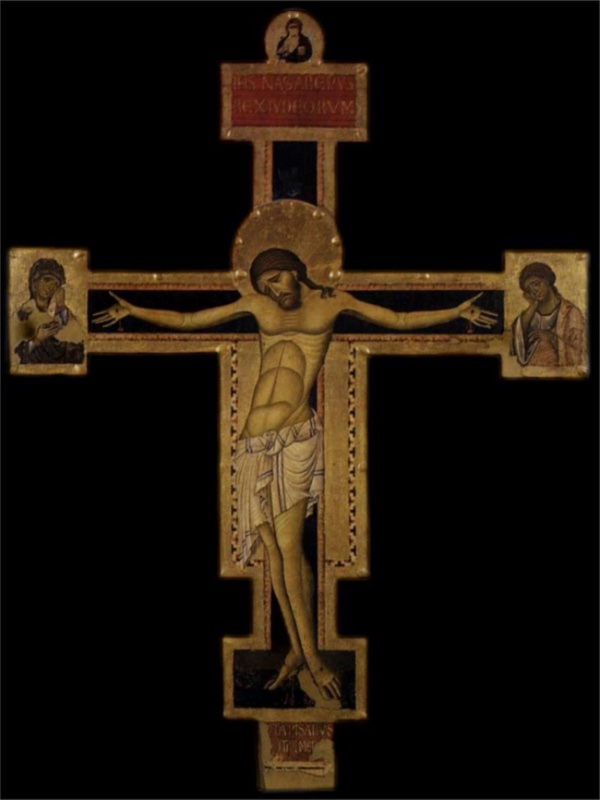
The painted crucifix preserved in the museum of the basilica of Santa Maria degli Angeli, at the foot of Assisi, occupies a singular position in the history of Italian painting: it is, on the prevailing chronology, the earliest surviving cross to bear the name of its maker. The fragmentary signature at the base, reconstructed as
(Iu)nta Pisanus (Cap)itini me f(ecit),
identifies the painter as Giunta di Capitino of Pisa and, in preserving the patronymic, agrees with the Pisan document of 1254 in which “Juncta Capitinus pictor” swore fealty to Archbishop Federico Visconti. The work carries no date, and its conventional placement in the first half of the 1230s — before the lost cross that Giunta signed and dated for Frate Elia at San Francesco in 1236 — rests on stylistic judgment rather than documentation; but that judgment is widely shared, and it makes this modest panel, some 174 by 131 centimetres, the point of departure for any account of the painter’s development.
The carpentry and layout of the cross announce, in embryonic form, the reform that Giunta would carry to its conclusion in Bologna. The shaped panel follows the traditional Tuscan format — apron flanking the body, rectangular terminals at the ends of the arms, a titulus and cyma rising above the head — but the narrative Passion scenes that crowd the aprons of twelfth-century crosses have been entirely suppressed. In their place Giunta sets a field of deep, nearly black blue, framed by gilded borders and enlivened only by a slender ornamental band of white lozenges threaded along the inner edge, punctuated with red. The effect is one of deliberate concentration: nothing on the panel competes with the single monumental figure, and the dark ground, read against the gold, functions almost as a void from which the pale body of Christ emerges with quiet insistence.
The Christ is unmistakably the Christus patiens — dead, the eyes closed, the head fallen upon the right shoulder — yet the interpretation of death here is remarkable for its restraint. The body inclines rather than collapses: the axis bends gently at the hips, the abdomen swings only slightly beyond the vertical, and the legs descend in a long, calm diagonal to the feet, nailed separately upon the suppedaneum. Compared with the violent arc of the Bologna cross, where the body overflows the frame under its own dead weight, the Porziuncola Christ hangs in near-equilibrium, and it is precisely this composure that has persuaded most critics to see in it the young Giunta, still working within the measured conventions of the Byzantine model before amplifying them into the dramatic formula of his maturity.
The anatomy rewards close reading, for it documents the technical ambition that distinguishes Giunta from his Italian contemporaries. The torso is constructed, not merely drawn: the arched cage of the ribs, the sternum, the tripartite division of the abdomen are modelled in graduated passages of ochre and green-tinged shadow that give the flesh genuine volume against the dark apron. The arms, stretched taut along the cross-beam, are articulated at shoulder and elbow with a firmness that betrays study of the body’s mechanics under tension; thin rivulets of blood descend from the nail wounds of the palms. This is the “constructive” chiaroscuro that scholarship has recognized as Giunta’s recovery of a plastic ambition largely dormant in Italian painting since late antiquity — still disciplined here by linear contour, but already unmistakably present.
The head concentrates the emotional argument of the whole. Framed by a cruciform halo worked with punched and incised ornament in the gold, the face sinks toward the shoulder with the long hair falling in dark strands across the neck; the closed lids, the drawn brows, and the shadowed hollows of the cheeks render death as sleep rather than agony. Below, the loincloth is one of the panel’s most refined passages: a length of white cloth, rendered with translucent veils of paint through which the tone of the thighs faintly passes, knotted at the hip and falling in fine, calligraphic folds. The transparency of this perizoma, a device of Byzantine derivation, allows the painter to preserve the continuity of the body’s design while displaying his command of the most delicate glazing.
At the ends of the cross-beam, the mourning figures complete the image’s devotional programme. In the left terminal the Virgin, her maphorion drawn about her face, raises a hand toward her cheek in the ancient gesture of grief; the surface here is visibly abraded and lacunose, yet enough survives to show the tenderness of modelling that makes her one of the touchstones of Giunta’s art. In the right terminal Saint John the Evangelist, wrapped in a rose mantle over blue, inclines his head and gathers his hand to his breast in restrained sorrow. Both are half-length, set against gold, and both are reduced to essentials: no attendant figures, no narrative apparatus, only the two canonical witnesses whose silent grief instructs the viewer’s own.
The upper members of the cross carry the inscriptions and the theological coda. The titulus is a red tablet lettered in pale capitals with
IHS NASARENVS REX IVDEORVM,
the wording of John’s Gospel, its rubricated ground echoing the red accents of the ornamental borders. Above it, in the cyma, a half-length Christ appears within a roundel, raising his hand in blessing — the Risen or glorified Christ set over the dead one below, so that the panel holds death and triumph in a single vertical reading. At the opposite extremity, beneath the suppedaneum, runs the mutilated signature.
The survival of these fragments matters beyond philology: the confident “me fecit,” placed at the base of a liturgical object of this importance, is among the earliest assertions of artistic identity in Italian painting, and it anticipates the still prouder hexameter of Bologna,
cuius docta manus me pinxit Iunta Pisanus.
Seen whole, the crucifix of Santa Maria degli Angeli is best understood as the threshold work of Giunta’s career and, with it, of a chapter in the history of Italian art. It presupposes the Byzantine importation of the dead Christ — already present in Pisa around 1210 in the anonymous Cross no. 20 — and refines it toward a new humanity without yet forcing it toward pathos; its suppression of narrative, its constructive modelling, and its concentration upon the isolated body prepare the formula that Giunta would monumentalize at Bologna and that Cimabue would inherit at Arezzo a generation later. Its early history before the modern era is undocumented, and its precise original destination within the Franciscan orbit remains conjectural; but hanging today in the museum beside the Porziuncola chapel, at the place where Francis died, it stands as the oldest surviving signed witness to the alliance between the new mendicant spirituality and the painter who became, in effect, the first official artist of the order.
Crucifix of San Ranierino: The Neo-Hellenistic Maturity of the First Signed Master
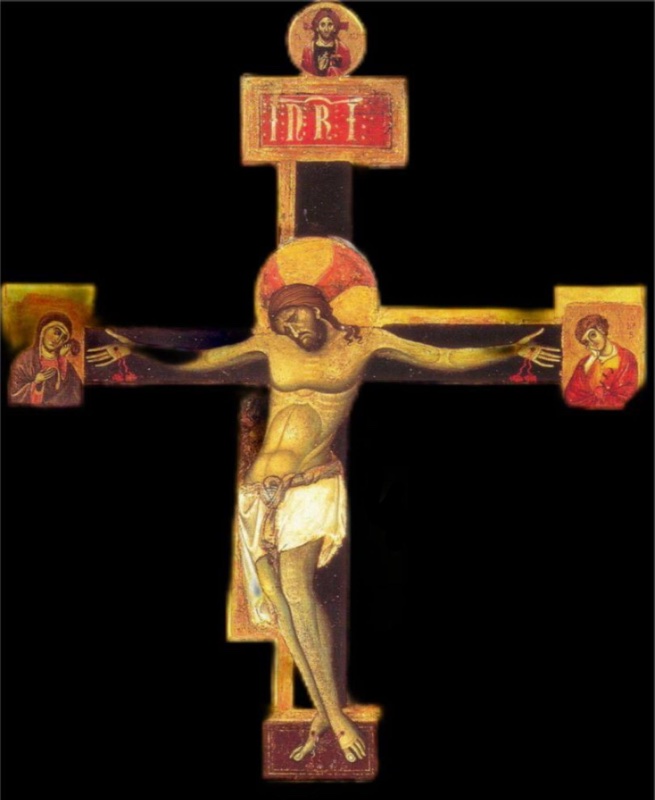
The crucifix known as that of San Ranierino, now in the Museo Nazionale di San Matteo in Pisa, is the only one of Giunta Pisano’s three surviving signed crosses to remain in his native city, and it carries the plainest of his signatures:
IUNCTA PISANUS ME FECIT,
inscribed on the suppedaneum beneath Christ’s feet. Like its companions it bears no date, and its conventional placement in the 1240s — for some critics extending to about 1250 or just beyond — rests on stylistic argument rather than documentation. On the reading followed here, it represents the latest and most refined of the three signed works: the moment at which Giunta, having already formulated the dramatic scheme of the great Bologna cross, softened and clarified his idiom through renewed contact with the most sophisticated Byzantine painting of his day. At roughly 185 by 135 centimetres it is a work of moderate scale, made for close address rather than distant spectacle, and its intimacy is part of its meaning.
The modern history of the panel begins with one of the memorable episodes in the rediscovery of the Italian primitives. In 1793 the Pisan érudit Alessandro Da Morrona found the cross hanging, blackened with smoke, in the kitchen of the monastery of Sant’Anna in Pisa, read the signature, and recognized in Giunta a protagonist of the origins of Italian painting — the first step in the recovery of a name that Vasari had never known.
In the course of the nineteenth century the cross passed to the Dal Pozzo chapel in the Camposanto and then to the new church of San Ranierino, from which it takes its familiar name, before entering the national collection at San Matteo around the middle of the twentieth century. Its conservation history has been correspondingly eventful: earlier restorations left problems unresolved, and a full diagnostic and conservation campaign, presented to the public in 2018, has returned the surface to legibility. Its original destination is undocumented, and the itinerary before Sant’Anna remains conjectural.
The architecture of the cross restates the reform that Giunta had made his own. The shaped panel retains the Tuscan format — apron, rectangular terminals, titulus and cyma — but every trace of narrative has been banished: the apron is a field of deep, near-black ground bounded by gilded borders and threaded with a slender ornamental band, so that the body of Christ stands alone against darkness and gold. Within this austere frame the figure describes the arc that is Giunta’s signature invention in its mature form. The head falls upon the right shoulder, the torso swings decisively to the viewer’s left, the hips press outward beyond the vertical axis, and the legs return in a long counter-curve to the feet nailed side by side on the suppedaneum. Yet compared with the extreme tension of Bologna the curve here is tempered, absorbed into a rhythm that reads less as collapse than as cadence — the drama internalized rather than declaimed.
It is above all in the modelling of the body that the San Ranierino cross earns its place at the summit of Giunta’s development. Scholarship has long recognized in this work the painter’s most fully “neo-Hellenistic” moment: a genuine chiaroscuro with a constructive, form-building function, of a kind largely unknown in Italian painting since late antiquity. The light does not merely decorate the anatomy; it builds it. The ribcage rises and turns in graduated passages of ochre against olive shadow, the sternum and the tripartite abdomen are modelled as volumes rather than drawn as ciphers, and the transitions along the flanks are softened until the contour seems to breathe. The arms, stretched along the beam with blood descending in fine threads from the pierced palms, are articulated with an understanding of tension and weight that presupposes sustained attention to Byzantine models of the highest quality — whether icons, miniatures from the Crusader scriptoria, or monumental painting encountered through Pisa’s Mediterranean traffic.
The head of Christ gathers the pathos of the image into a single passage of painting. Set against a cruciform halo enriched with red and gold, the face sinks toward the shoulder beneath a fall of dark hair; the closed lids and drawn brows render death with the same humane restraint that governs the whole, sorrow distilled rather than dramatized. Below, the loincloth is among the most beautiful in Duecento painting: a white perizoma knotted at the hip, painted in translucent veils through which the tone of the flesh faintly passes, its folds falling in soft, luminous pleats rather than the incised calligraphy of the older tradition. In such passages the linear armature of the maniera greca dissolves into something approaching pure painting, and it is not difficult to understand why this phase of Giunta’s art proved the most widely imitated by his followers.
The mourning figures in the lateral terminals sustain the meditative register. At the left the Virgin, wrapped in a dark maphorion edged with gold, inclines her head and draws her hand toward her face in the ancient gesture of grief; at the right Saint John the Evangelist, in a rose mantle, props his cheek upon his hand in the attitude of absorbed sorrow. Both are half-length against gold, reduced to the two canonical witnesses of the Johannine account, and both are handled with the fluent, almost abbreviated touch that distinguishes Giunta’s late manner — forms stated in swift, secure strokes, the emotion carried by posture and shadow rather than by linear insistence. The abraded state of parts of these terminals does not obscure their quality; they belong with the finest small-scale painting of the Italian thirteenth century.
The vertical members frame the theological argument. The titulus is a red tablet lettered “INRI” in pale capitals — here in the abbreviated form, where the Porziuncola cross spells the text out in full — and above it, in the cyma, a half-length Christ appears in a roundel, wrapped in a vivid red mantle and raising his hand in blessing. This small figure, suffused with light, is justly celebrated as one of the most purely pictorial passages in Giunta’s entire oeuvre: the red of the mantle burns against the gold, and the modelling of the face achieves, in miniature, the same soft luminosity as the great body below. The vertical reading thus holds the dead Christ and the living, glorified Christ in a single devotional structure, death answered by triumph at the summit of the cross.
Taken whole, the San Ranierino crucifix is the testament of Giunta’s maturity and the hinge between the first and second halves of the Italian Duecento. It presupposes the Byzantine importation of the Christus patiens and Giunta’s own dramatic reformulation of it, and it refines both into an idiom of tempered pathos and constructed light that his contemporaries found irresistible: the Pisan masters of his following, the painters of his manner in Umbria and Emilia, and ultimately the young Cimabue, whose Arezzo cross descends from Giunta’s scheme, all build upon the achievement visible here. That so consequential an object should have survived by the accident of a convent kitchen, its author’s name recovered only in 1793 from the soot-darkened suppedaneum, is a parable of the fortunes of early Italian painting — and a reminder that the recovery of Giunta di Capitino is among the exemplary achievements of modern art-historical method.
Crucifix of San Domenico: The Learned Hand and the Monumental Pathos of the Duecento
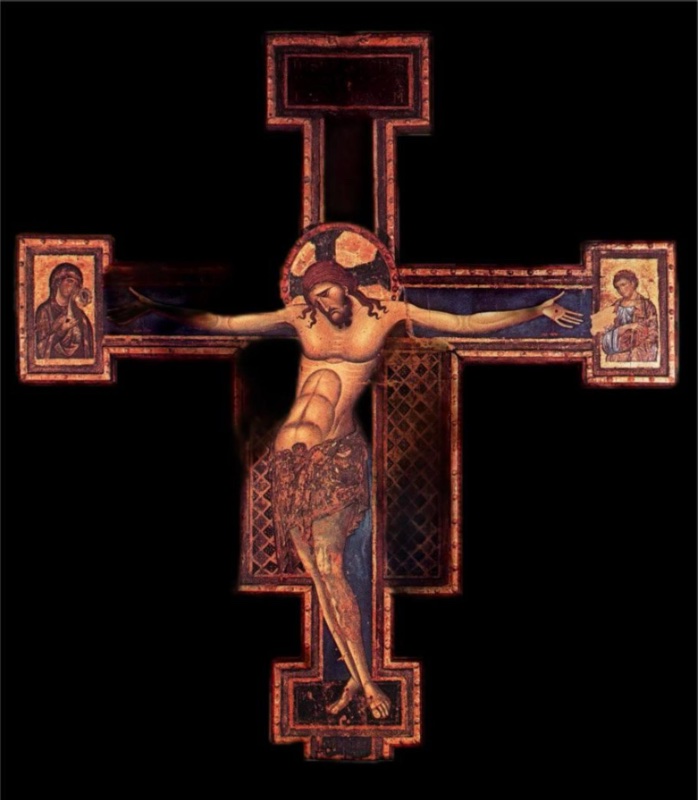
The crucifix of the basilica of San Domenico in Bologna is the largest, the most famous, and the most consequential of Giunta Pisano’s three surviving signed crosses, and it bears the proudest signature in early Italian painting:
CVIVS DOCTA MANVS ME PINXIT IVNTA PISANVS
“whose learned hand painted me, Giunta Pisano” — a Latin hexameter inscribed at the base of the panel.
That a painter of the mid-Duecento should describe his own hand as docta, learned, is itself a historical document of the first order, an assertion of intellectual dignity for the craft a full generation before Cimabue and two before Giotto. The inscription, recovered in the course of the restoration of the 1930s that re-established the work critically, transforms an anonymous liturgical object into the manifesto of a named artistic personality; no earlier Italian painting makes so explicit a claim.
The cross is a work of imposing scale — most catalogues record it at 336 by 285 centimetres, with somewhat higher figures also cited — and its dimensions are inseparable from its original function. It was made to hang, slightly inclined toward the nave, above the tramezzo, the screen dividing the friars’ choir from the space of the laity, in the church where Saint Dominic lay buried and which was consecrated in 1251. Suspended at height and tilted forward over the heads of the congregation, the dying Christ was designed to preside over the liturgy and to focus the devotion of the faithful at the boundary between the two halves of the church.
The conventional dating around 1250–55 rests on this context; it should be said, however, that the placement is not unanimous, and a minority position in the modern literature has argued for a substantially earlier date, pointing to building activity at San Domenico from the 1220s and the translation of the saint’s relics in 1233. No document adjudicates the question, and the traditional mid-century dating adopted here remains an attribution of scholarship, not a fact of the archive.
The design carries Giunta’s reform of the painted cross to its logical conclusion. The apron is stripped of every narrative episode: in place of the Passion cycles of the older tradition there is only a deep, dark field bounded by broad borders of red and gold, worked with geometric ornament — lozenges, crosshatched panels, patterned bands — that frame the figure like the setting of an enormous jewel. The suppression of incident is not decorative economy but rhetorical strategy: nothing on the panel competes with the body of Christ, and the ornament, precisely because it is abstract, throws the single human form into overwhelming relief. Seen from the nave floor, the cross would have read as one great dark silhouette rimmed with fire, bearing a pale body at its centre.
That body is the most dramatic invention of Italian painting before Cimabue. The Christ of Bologna is thrown into a violent arc: the head falls heavily upon the right shoulder, the torso swings far to the viewer’s left, the pelvis presses outward until the hip overflows the inner border and invades the lateral field, and the legs descend in a long returning curve to the feet nailed upon the suppedaneum.
Where the Porziuncola Christ inclines and the San Ranierino Christ cadences, the Bologna Christ collapses — the dead weight of the body dragging against the nails, the anatomy stretched and compressed by its own gravity. It was this figure that provoked the most memorable adverse verdict in the historiography of the Duecento, Roberto Longhi’s characterization of it in 1948 as “a huge and unctuous shark nailed on the last wrench”; and it is a measure of the image’s power that even its greatest detractor reached for so violent a metaphor. The modern literature has reversed the judgment while confirming the perception: the expressive extremism Longhi condemned is precisely the point.
The modelling sustains the drama. The ribcage is drawn upward and outward by the stretched arms, its arches stated in firm passages of shadow; the sternum, the tripartite abdomen, and the hollowed flank are constructed with the chiaroscuro that Giunta had recovered for Italian painting, here deployed at monumental scale. The long arms, thin and taut, follow the beam with blood threading from the pierced palms; the knees press together as the legs fold into their counter-curve. The linear inheritance of the maniera greca is still present — in the contours, in the stylized locks of hair falling across the shoulder — but it is everywhere subordinated to the rendering of mass and weight, so that the body reads not as a sacred cipher but as flesh surrendered to death.
Against the austerity of the dark apron, the loincloth introduces a note of startling luxury. In place of the translucent white perizoma of the Pisan and Porziuncola crosses, the Bologna Christ wears a length of richly patterned cloth, ornamented in red and gold, knotted low at the hip and falling in heavy folds against the thigh. The device has Byzantine precedents, and its effect here is deliberately paradoxical: the most sumptuous passage of the painting clothes the most broken part of the body, royal splendour wrapped about defeat, as though the titulus — the kingship of the crucified — had descended into the fabric itself. Technically it is a bravura performance of ornament over form, the pattern bending with the folds; iconographically it marks the Bologna cross apart from its two companions and underscores the ceremonial, public character of the commission.
The subsidiary fields complete the devotional structure. In the lateral terminals the mourning figures appear as framed, icon-like panels: at the left the Virgin, wrapped in her dark maphorion, inclines her head with her hand drawn toward her breast; at the right Saint John the Evangelist gathers his mantle in grief. Their treatment as bounded rectangles — small icons attached to the great cross — reinforces the Byzantine formality of the whole, two silent witnesses fixed at the extremities of the beam. The upper members, titulus and cyma, have suffered with time and their painted content is no longer fully legible; the geometry of the cross, with its stepped terminals and layered borders, carries the vertical reading on its own. A strand of the critical tradition has proposed workshop intervention in the terminals of Giunta’s crosses; the essay’s position, following the fullest modern synthesis, is that such hypothetical collaborators explain little, and that the mourning figures belong with the accomplished passages of the work.
Seen as a whole, the crucifix of San Domenico is the keystone of the Duecento’s history of the painted cross and the clearest measure of Giunta’s historical stature. Commissioned by the Dominicans for the mother church of their order — the counterpart, in the rival mendicant family, of his Franciscan commissions at Assisi — it canonized the dramatic Christus patiens as the public image of the century, and its authority radiated outward for a generation: when the Dominicans of Arezzo required a great cross in the later 1260s, the young Cimabue supplied one modelled point for point on Giunta’s — the arched body, the patterned borders, the framed mourners — before pressing the formula toward his own ends. The line that runs from this panel through Arezzo to Santa Croce, and thence into the world of Giotto, is among the securest filiations in early Italian painting; and it begins with the learned hand that signed, in a proud hexameter, the great dark cross of Bologna.
Attributed works and the workshop
Beyond the four signatures, Giunta’s oeuvre is a matter of attribution, and here the ground shifts from documentation to connoisseurship, with all the attendant uncertainty. Several works are attached to his name with varying degrees of confidence, and it is worth distinguishing the more secure from the more speculative.
Saint Francis and Four Posthumous Miracles: Giunta Pisano or the Master of the Treasury?
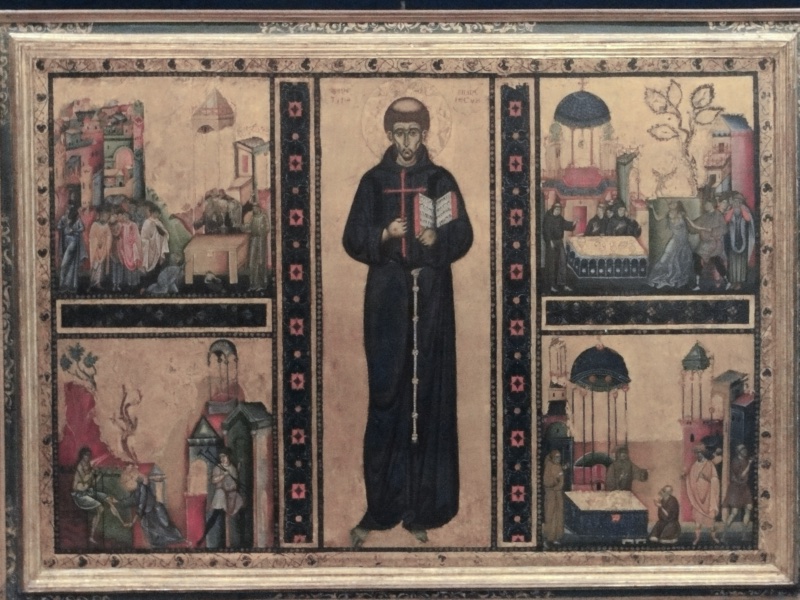
The painting is a rectangular dossal of horizontal format in tempera and gold on panel, showing Saint Francis standing rigidly frontal at the centre, displaying the stigmata, holding a red cross and an open book. The open book bears the text of Matthew 19:21 (“If you wish to be perfect, go, sell your possessions and give to the poor… and follow me”), one of the scriptural foundations of the Franciscan Rule.
Flanking the central icon are four narrative scenes of the saint’s posthumous miracles, read top-to-bottom and left-to-right:
- the healing of a girl whose head was twisted to her shoulder;
- the healing of the cripple Bartolomeo da Narni;
- the liberation (exorcism) of a possessed woman; and
- the healing of the cripple Niccolò da Foligno.
Two of the scenes are set at the saint’s first tomb in San Giorgio (before canonisation) and two at the altar under a ciborium. Unlike the cuspidate (gabled) Pisa dossal of Saint Francis with six miracles, with which it is constantly compared, the Assisi panel is a low, wide rectangle (approximately 111.5 × 154.5 cm), its horizontal proportions consistent with a placement above or behind an altar, or upon the choir screen of the Lower Church. It is preserved in the Museo del Tesoro della Basilica di San Francesco (Sacro Convento), Assisi, and derives from the Lower Church of San Francesco. Dating on labels and in the literature ranges across “c. 1253,” “c. 1260,” “c. 1265,” and, generically, “the second third of the thirteenth century.”
The earliest secure historical record is the description of the Basilica written by the Franciscan Fra Ludovico da Pietralunga, dated 1571, who noted the panel — a gold-ground Saint Francis surrounded by four miracle scenes — hanging above the door of the lower-church sacristy, and reported the tradition that Francis’s body had been washed on that very board after death, which gave the panel the status of a relic. The work is subsequently traceable in convent documentation from the sixteenth to eighteenth centuries. It was thus almost certainly made for the Lower Church; scholarship suggests it may have stood near the high altar above the saint’s burial chamber, or on/above the choir screen (demolished c. 1300), functioning as a surrogate for the interred relics.
A key argument bearing on both provenance and date is that the altar under the ciborium shown in the two right-hand scenes is identified with the high altar of the Lower Church, consecrated by Pope Innocent IV on 25 May 1253; moreover, the exorcism episode (the possessed girl of Norcia freed “before the altar of St Francis”) was first put into writing in Thomas of Celano’s Tractatus de Miraculis (c. 1252–53). Tartuferi has been the most explicit in tying the panel to c. 1253 on precisely this basis, noting that the consecrated altar “figures precisely described in both the right-hand scenes.” This furnishes a plausible terminus post quem around 1253, though it is an argument from internal iconographic evidence rather than a document naming the panel.
Early twentieth-century criticism first joined the two panels: Pietro Toesca (1927) was among the first to cite the closely related Vatican Pinacoteca dossal and to connect it with the Assisi Treasury panel, assigning both to a Pisan painter of the mid-thirteenth century. In his foundational 1949 illustrated index of Italian Romanesque panel painting, Edward B. Garrison praised the panel as one of the finest works of the thirteenth century and assigned it to a “close follower of Giunta,” dating it c. 1250–1260 — an anonymous, Giuntesque, but not autograph attribution. A dismissive current is represented by Roberto Longhi (“Giudizio sul Duecento,” Proporzioni 2, 1948), who panned the related material as “ignoble” for the repetitiveness of its figure-types and preferred to speak of a generic thirteenth-century Pisan school.
The decisive shift toward Giunta himself came with Miklós Boskovits’s essay “Giunta Pisano: una svolta nella pittura italiana del Duecento” (Arte illustrata 6, nos. 55–56, 1973, pp. 61–73), which attributed the Assisi Treasury dossal to Giunta and grouped with it two further dossals of similar iconography — the Pisa dossal (San Matteo) and, more tentatively, the Vatican Pinacoteca panel. Boskovits argued from the chromatic and compositional affinities with Giunta’s most “Byzantine” works, notably the signed crosses.
Angelo Tartuferi, in his 1991 monograph on Giunta and again in his 2001 entry on “Giunta di Capitino, detto Giunta Pisano” in the Dizionario Biografico degli Italiani, consolidated the autograph attribution, calling the Treasury dossal “certainly one of the masterpieces of thirteenth-century Italian painting” and reading it as the coherent late development of the formal ideas of Giunta’s Crocifisso di San Ranierino. In the DBI he dates it “probably around or a little after 1253.” A note of caution is required here: at least one peer-reviewed source reports that Tartuferi elsewhere (1991; 2007) shifts the panel to the 1270s, so his stated dating is not perfectly consistent across his publications; the c. 1253 formulation is the one printed in the DBI.
Later twentieth- and early twenty-first-century institutional and popularising records have tended to retain the anonymous designation “Maestro del Tesoro di San Francesco” or “school of Giunta.” Most recently, the exhibition “L’enigma del Maestro di San Francesco” (Galleria Nazionale dell’Umbria, Perugia, 10 March–9 June 2024; curated by Andrea De Marchi, Veruska Picchiarelli and Emanuele Zappasodi, 60 works) presented the panel as Giunta’s Umbrian work but re-dated it markedly earlier — the GNU’s own listing describes “reassessing, with a higher date, toward 1230, the dossal with Saint Francis and four posthumous miracles of the Museo del Tesoro.”
The case for Giunta’s autograph hand rests on:
- continuity with the neo-Hellenistic, chiaroscuro-rich phase of the signed Crocifisso di San Ranierino and the associated Madonna in Pisa;
- the panel’s narrative ambition: the architectural backgrounds with classicising aedicules and an urban view (towers, palaces, churches) read by Giunta’s champions as prefiguring, “a quarter-century before, only a Cimabue,” the fictive Rome on the Upper Church vault;
- the elongation of figures and heightened colour taken as the logical terminus of Giunta’s late manner; and
- the linkage to the Pisa dossal of Saint Francis and Six Stories, itself given to Giunta by the same scholars. The powerful expressive intensity — e.g., the calligraphic loops on the robe of the exorcised madwoman — is cited as beyond the reach of a mere copyist.
The case against (i.e., for an anonymous master or workshop) rests on:
- the chronological problem — the depicted miracles were codified only c. 1253, whereas Giunta was traditionally thought dead by then (a difficulty softened, but not removed, by a document attesting Giunta at Pisa into the 1260s);
- a perceived Byzantinising stiffness and archaism, and a “lesser dramatic intensity” than the signed crosses;
- quality and handling judged as those of a close follower rather than the master; and
- the observation that some hands in the group differ. Notably, even the strongest advocate of Giunta’s authorship, Tartuferi, firmly separates the Vatican Pinacoteca dossal from Giunta, citing its “marked stylistic difference” from the Assisi panel — evidence that connoisseurship within this group is contested even among those sympathetic to Giunta.
Three related Franciscan dossals anchor the debate. The Pisa dossal (Saint Francis and Six Stories, Museo Nazionale di San Matteo, c. 155 × 132.5 cm) is officially “attributed to Giunta” but the attribution remains hedged: some critics see a follower, and the same 1253-codification problem applies. The Assisi Treasury dossal is the panel under discussion. The Vatican Pinacoteca dossal (Saint Francis and Four Posthumous Miracles, 67 × 86.5 cm) is close in form and iconography but generally judged weaker and later (Garrison in 1949 called it “much damaged and extensively repainted, especially in the lower-right scene,” and dated it 1275–1300); it is variously assigned to Giunta’s school. One influential hypothesis (Pietro Scarpellini, in the 1980 monographic catalogue of the Treasury) proposed that all three were produced at Assisi in a workshop specialising in this type of dossal.
The notname “Maestro del Tesoro di San Francesco” / “Master of the Treasury” is conventionally sourced to the 1999 Electa exhibition catalogue The Treasury of Saint Francis of Assisi (ed. Giovanni Morello & Laurence B. Kanter), which systematised a whole family of Treasury-based convenience names (Master of the Blue Crucifixes, Master of the Gubbio Cross, Master of the Perkins Saint Paul, etc.). Garrison (1949) did not use this eponym; he spoke of an anonymous “close follower of Giunta.” It could not be confirmed from primary text whether any earlier author used the exact phrase, and the interior text of the 1999 catalogue could not be inspected directly — so the precise first coinage should be regarded as probable-but-unverified. The notname is essentially monographic — it designates the author of this one picture — and is therefore, in practice, less an independent artistic personality than a placeholder for “the Giuntesque master (or phase, or workshop) responsible for the Treasury dossal.” It is in this sense that the designation is sometimes treated as simply a phase or workshop of Giunta rather than a distinct hand.
We can reasonably say:
-
Documented fact: the physical panel; its function and relic-tradition; its presence in the Lower Church sacristy area by 1571; and the internal evidence that the altar depicted corresponds to the high altar consecrated on 25 May 1253, with one miracle textually fixed only c. 1253. These support an Assisi origin and a date not earlier than c. 1253 — though the c. 1230 re-dating advanced in 2024 explicitly challenges this.
-
Accepted (default) attribution: the balance of institutional and reference cataloguing treats the panel as the work of an anonymous Giuntesque master — the “Maestro del Tesoro di San Francesco” — c. 1250–1260. Museum signage and general guides use the notname; the Basilica’s own website calls it “school of Giunta Pisano.” At the same time, the Italian national catalogue (ICCD/beniculturali) lists the closely tied Pisa dossal under “Giunta di Capitino… (attribuito),” and the Fondazione Zeri photo archive preserves the attribution history — so the institutional record is itself divided.
-
Conjecture (weighty but unproven): the autograph attribution to Giunta, argued by Boskovits (1973) and Tartuferi (1991; 2001), which reads the panel as Giunta’s late masterpiece. This thesis has gained ground since restoration campaigns and was, in effect, endorsed (with a radically earlier date) by the 2024 Perugia exhibition.
In conclusion: the autograph-Giunta case is the single most powerful positive argument on the table — the stylistic continuity with the San Ranierino cross and the narrative sophistication are real, and they are pressed by the two scholars who know Giunta’s corpus best.
But it is not proven: it depends on connoisseurship, it must overcome the 1253 chronological pinch-point, and its advocates cannot even agree on a date (c. 1253 vs. the 1270s vs. c. 1230).
For that reason the cautious cataloguing default — an outstanding Giuntesque master working at Assisi around the mid-1250s, conventionally the “Master of the Treasury” — remains the responsible position, while acknowledging that “Master of the Treasury” and “late Giunta” may well name the same hand.
Recommendations for the enquirer. (1) Treat the panel, in writing, as “Master of the Treasury of Saint Francis (a close follower of Giunta Pisano), c. 1250–1260,” and note explicitly that Boskovits and Tartuferi argue for Giunta’s autograph authorship — this reflects both the institutional default and the live scholarly minority. (2) To adjudicate further, consult three items not fully accessible here: the entry on the panel by Tartuferi in the 2015 Florence catalogue L’arte di Francesco (Giunti; the Giunta entry is cat. no. 7, pp. 180–181, with the essay “I pittori di Francesco,” pp. 145–159); the Bonsanti Mirabilia Italiae Basilica volume (2002), entry no. 2361, pp. 645–647; and Scarpellini’s essay in Il Tesoro della Basilica di San Francesco ad Assisi (1980), pp. 38–41 — these will confirm the exact wording of the notname and Tartuferi’s most recent dating. (3) The benchmark that would move the question decisively is documentary or technical: a published restoration/diagnostic report (underdrawing, pigment analysis, dendrochronology) directly comparing the Treasury panel with the signed San Ranierino cross, or a new archival document. Absent that, the attribution should stay hedged. If a full technical study emerges affirming shared workshop practice with the signed crosses, the “Giunta autograph, c. 1253” position would become the preferable one; if it isolates the Treasury hand from Giunta’s, the anonymous-master label should be retained firmly.
Saint Francis and Four Posthumous Miracles in the Vatican Pinacoteca: The Giuntesque Formula at One Remove
The small dossal of Saint Francis with four posthumous miracles in the Vatican Pinacoteca (inv. MV.40023.0.0) is the third and least celebrated member of the family of Franciscan dossals that gathers around the name of Giunta Pisano — alongside the gabled panel of Francis with six miracles in Pisa and the rectangular panel of Francis with four miracles in the Museo del Tesoro at Assisi. Painted in tempera and gold on poplar and measuring only 67 by 86.5 centimetres, it is by a considerable margin the smallest of the three, a work of intimate rather than monumental scale; and it is also the one whose attribution to Giunta himself commands the least support.
The critical tradition has oscillated between a generic assignment to the Pisan school, a proposal — advanced in the reassessment of 1973 by Miklós Boskovits, which attributed the Assisi panel to Giunta and grouped this one with it more tentatively — that it too might approach the master, and the firmer modern position of Angelo Tartuferi, who in 2001 rejected the Giunta attribution outright, citing the panel’s marked stylistic difference from the Assisi dossal, and assigned it to an anonymous Pisan follower.
It is under some such designation that the panel is best presented; its date, in the caption adopted here, falls in the 1260s, though earlier scholarship — Edward B. Garrison in his 1949 index — pushed it later still, to the last quarter of the century, while noting that the picture was much damaged and extensively repainted, especially in the lower right scene. The dating, like the attribution, remains an open question of connoisseurship rather than a documented fact.
The composition restates, at reduced scale, the scheme common to all three dossals. Saint Francis stands frontally at the centre of a wide rectangular field, a full-length hieratic icon flanked by two tiers of narrative on either side; vertical ornamental bands — dark grounds strewn with white vine-scrolls and studded with red lozenge devices — separate the central figure from the stories, and matching horizontal bands divide the upper scenes from the lower.
The gold ground, now abraded in broad passages to the reddish bole beneath, unifies the whole. This is the format of the Assisi Treasury panel almost element for element, and the correspondence extends to the choice and disposition of the miracles themselves: the same four posthumous episodes, distributed in the same quadrants. It is precisely this near-duplication that has driven the workshop hypothesis — the proposal, formulated in the 1980 monographic study of the Assisi Treasury, that all three dossals issued from a single bottega, plausibly active at Assisi itself, specialising in images of the newly canonized saint for Franciscan altars.
The central figure carries the ideological weight of the image. Francis stands rigid and columnar in the dark grey-brown habit of the order, the cowl framing a long, ascetic face rendered in the greenish flesh-tones of the Byzantine tradition, the great eyes fixed on the viewer with the unblinking directness of an icon. In his right hand he holds a slender red cross — the instrument of the Passion assimilated to his own person as alter Christus — and on his left arm he supports an open book, its pages bare or now illegible, where the Assisi panel displays the text of Matthew 19:21.
The stigmata are shown on the exposed hands and on the bare feet that protrude, greenish and emphatic, beneath the hem of the habit; the knotted cord of the order falls in a long vertical past the knees, reinforcing the figure’s austere axiality. Compared with the Assisi Francis, the Vatican saint is squatter in proportion and harder in contour, the drapery organized into angular, metallic folds heightened with pale striations — a drier, more schematic recension of the same figural idea.
The two left-hand scenes narrate healings at the saint’s first tomb in San Giorgio, before the translation of 1230. Above, the healing of the girl whose head had been twisted to her shoulder: a crowd of petitioners in vividly coloured mantles — rose, vermilion, blue — presses toward the tomb at the right, where a kneeling figure receives the miracle beneath the gaze of a friar; the architecture behind, a compressed screen of towers, gables and aedicules in improbable oranges and greens, supplies the episode with a civic backdrop. Below, the healing of the cripple Bartolomeo da Narni: under a red-roofed ciborium borne on slender columns, the crippled man, half-naked, is tended at the tomb by a haloed friar, while at the left a countryman with a staff strides in from a schematic landscape of dark trees and a chapel — one of the few passages in the panel where narrative incident opens toward genre observation.
The right-hand scenes shift the setting to the altar of the saint, under its liturgical furnishings. Above, the liberation of the possessed woman: friars officiate at an altar draped in a red, patterned frontal and hung with votive lamps, while at the right the demoniac, her red hair streaming, is convulsed before a knot of onlookers; the demon’s exit, the dramatic crux of the episode, is rendered with the abbreviated violence that this iconography demanded.
Below, the healing of the crippled Niccolò da Foligno: beneath a canopy hung with lamps, friars at the altar turn toward the kneeling cripple at the right, who approaches on his knees with his walking-trestles, in the presence of standing witnesses. It is this lower right quadrant that Garrison singled out as the most damaged and repainted of the panel, and its present legibility owes something to restoration; any stylistic argument built on this scene in particular must therefore be advanced with corresponding caution.
Read against its two siblings, the Vatican dossal defines the lower boundary of the group’s quality, and it is on this differential that the attribution question turns. The champions of Giunta’s authorship of the Assisi Treasury panel point there to a narrative sophistication — the classicising aedicules, the psychological characterization, the calligraphic bravura of the possessed woman’s drapery — that they hold beyond the reach of a copyist; in the Vatican panel those same elements reappear stiffened and conventionalized, the architecture reduced to bright scenography, the figures to lively but formulaic types.
This is why even Tartuferi, the most committed advocate of Giunta’s hand at Assisi, draws the line here: the “marked stylistic difference” he registers between the two panels is, in effect, the difference between invention and recension. Yet the panel is not negligible. Its colour — the saturated reds and oranges against the dark ornamental bands — has a decorative force of its own, and its very fidelity to the model makes it a document of the first importance for reconstructing how the Giuntesque image of Francis was standardized and diffused.
The function and early history of the panel remain largely conjectural. Nothing certain is known of its original destination; its modest dimensions suit a small altar, a chapel, or conceivably a portable devotional use, and its iconography — the saint enthroned in effigy between the miracles worked at his tomb and altar — presupposes a public that sought, in the image, a surrogate for pilgrimage to Assisi.
The choice of precisely these four post-mortem miracles, codified in the hagiographic dossier assembled around the canonization and given definitive written form in Thomas of Celano’s treatise on the miracles of about 1252–53, binds the panel to the promotional programme of the order in the decades when the cult was being organized around the new basilica; whether it was painted at Assisi, as the workshop hypothesis would have it, or in Pisa within Giunta’s following, cannot at present be decided. The panel entered the papal collections by routes that the accessible literature does not document precisely, and its provenance before the Pinacoteca should be stated as unknown rather than supplied by conjecture.
Seen whole, the Vatican dossal is best understood not as a diminished Giunta but as evidence of Giunta’s success: the moment at which a formula invented at the highest level — the hieratic Francis of the Pisa and Assisi panels, flanked by the miracles that authenticated his sanctity — became reproducible, an image-type that a competent workshop could restate for a widening market of Franciscan patrons. In this it stands to the Assisi Treasury dossal somewhat as the “giunteschi” crosses of Pisa and Umbria stand to the signed crucifixes: a translation that preserves the scheme while relaxing its tensions. For the historian of the Duecento its value is therefore double. It fixes one term of the comparison by which the quality of the Assisi panel — and hence the case for Giunta’s autography there — is measured; and it documents, better than any autograph work could, the machinery of replication through which the mendicant orders turned a painter’s invention into the common visual property of the century.
*Saint Francis and Six Stories in Pisa: The Gabled Dossal and the Question of Giunta’s Narrative Art
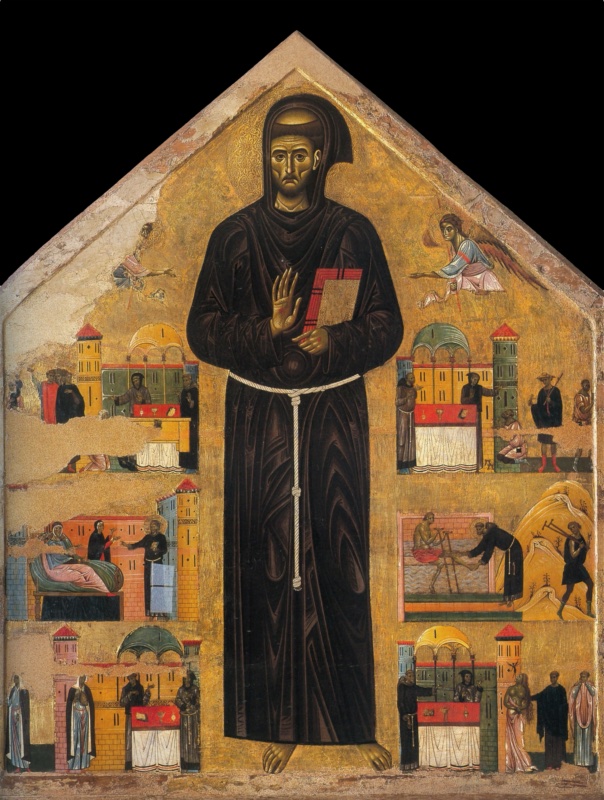
The dossal of Saint Francis with six stories in the Museo Nazionale di San Matteo is the Pisan member of the small family of Franciscan dossals bound to the name of Giunta Pisano, and in several respects it is the head of that family: the largest of the three panels after the Assisi Treasury dossal in surface, the only one of cuspidate form, and the one with the longest attributional pedigree. It comes from the church of San Francesco in Pisa, and its early historiography is entangled with a celebrated ghost: an old Florentine tradition, recorded in Renaissance sources and repeated in both editions of Vasari, spoke of a Saint Francis in San Francesco at Pisa as a work of Cimabue.
It was Alessandro Da Morrona, in 1793 — the same érudit who in the same year recovered Giunta’s signature from the soot-blackened cross of Sant’Anna — who first rejected the Cimabue attribution and proposed Giunta’s name, though whether the panel the early writers saw is identical with the surviving dossal cannot be established with certainty. The modern attribution to Giunta, sustained by the fullest recent scholarship and adopted in the Italian national catalogue with the prudent qualifier “attribuito,” is not unanimous: some critics have preferred a close follower, citing a certain dryness of touch; and the panel’s date, conventionally c. 1250–60, is itself an inference from style and from the hagiographic sources of its scenes.
The format distinguishes the Pisa panel at once from its rectangular siblings at Assisi and in the Vatican. The dossal rises to a tall gable — the cuspidate silhouette of an altar retable — and the pointed field is put to iconographic use: two angels, painted in rapid, luminous strokes, hover at the level of the saint’s head, turning toward him with veiled hands in the attitude of celestial witnesses, so that the earthly icon is framed from above by the court of heaven. Equally distinctive is the treatment of the ground. Where the Assisi and Vatican panels discipline their narratives behind dark ornamental bands strewn with vine-scroll, the Pisa dossal disposes its six scenes directly upon the open gold, as floating vignettes stacked three deep on either side of the central figure. The effect is at once more archaic and more airy: the stories inhabit the same golden element as the saint, unwalled, like episodes remembered around an icon rather than compartments of a reliquary.
The figure of Francis is the panel’s theological centre and its most striking invention within the group. He stands frontal and columnar in the dark habit, the white knotted cord falling in a long vertical, the bare stigmatized feet planted on the gold; but where the Assisi and Vatican dossals arm him with the red cross, here the right hand is raised, palm outward, in a gesture that is simultaneously blessing, address, and display — the wound in the palm exhibited to the viewer as the credential of his conformity to Christ. Under the left arm he carries the book bound in red, closed, the Rule and the Gospel compressed into a single attribute. The head, framed by the cowl, is among the most severe in Duecento painting: elongated, hollow-cheeked, the beard sparse, the enormous eyes fixed in the unblinking frontality of the icon tradition, the flesh built up in the greenish underlayers and ochre lights of the maniera greca. It is a portrait not of a man but of an ascesis, and its authority depends precisely on the Byzantine grammar in which it is written.
The six scenes unfold the saint’s posthumous power, the miracles worked at his tomb and altar in the years around and after the canonization of 1228.
On the left, reading downward:
- a healing at the shrine, where petitioners approach the draped altar-tomb beneath its lamps;
- a sickbed scene, the invalid laid on a red-covered bed within a tower-flanked chamber as the saint’s intervention is invoked; and
- a scene of women — clothed in the pale, veiled dress that marks them as suppliants — gathered at the altar under its ciborium.
On the right, again downward:
- cripples and pilgrims at the altar, one with the staff of the wayfarer;
- the healing of a crippled man tended at a low basin or tomb by a haloed friar, with a countryman striding in from a rocky landscape; and
- a final altar scene with kneeling figures received by friars.
The identification of the individual episodes with the miracles catalogued in the early hagiographic dossiers is, in several cases, a matter of scholarly proposal rather than certainty, and it is prudent to present the cycle generically — healings of the crippled and the sick, liberations, graces at the tomb — while noting that the codification of these miracles in written form belongs to the years around mid-century, which furnishes the panel’s approximate terminus.
The narrative style of the scenes is where the case for Giunta’s authorship is chiefly argued, and where it is chiefly resisted. In their favour: the architecture, a brilliant scenography of towers, domed ciboria, arcades and city gates in improbable rose, green and ochre, stacked with a confidence that presupposes a designer of real invention; the figures, small but psychologically pointed, each assuming a defined role in the drama of petition and grace; the palette, saturated and jewel-like against the gold.
The comparison that has done most work in the literature is with the analogous dossal signed by Bonaventura Berlinghieri and dated 1235 at Pescia: set against the Lucchese panel, the Pisa dossal has seemed to its advocates more concentrated, less anecdotal, its actors graver and more individually characterized — qualities consonant with the painter of the signed crosses. Against this, the sceptics point to a certain graphic conventionalism, a dryness in the execution of the small figures that they find hard to reconcile with the pictorial fluency of the San Ranierino cross; on their reading the dossal is the work of the closest of the “giunteschi,” reproducing the master’s figural ideas at one remove.
The relationship of the central figure to the signed crosses deserves particular attention, because it supplies the strongest internal evidence for keeping the panel within Giunta’s immediate orbit, whichever hand executed it. The construction of the head — the elongated oval, the structural shadows at temple and cheek, the drawing of the eyes with their heavy upper lids — belongs to the same figural culture as the Christ of the Pisan cross; the drapery of the habit, dark on dark, is modelled with the same economy of graduated shadow relieved by sparse lights; and the greenish preparation of the flesh, left frankly visible in the half-tones, is the Byzantine technique that Giunta commanded more completely than any Italian contemporary. Whether these correspondences prove identity of hand or fidelity of workshop is exactly the point at issue; what they prove beyond dispute is that the dossal was designed within the closest reach of the master, in his city, for the church of his order’s Pisan convent.
The panel’s importance for the history of Franciscan iconography is independent of the attribution question. Together with the Pescia dossal of 1235 and the Assisi and Vatican panels, it documents the formation, within a generation of the saint’s death, of the canonical image-type of Francis: the standing frontal effigy, hieratic as an Eastern saint, authenticated by the stigmata and surrounded by the miracles that continued his presence among the faithful. The Pisa dossal’s particular contribution to the type is the gesture of display — the raised, wounded palm — which makes the stigmata not an attribute among others but the very argument of the image, and which anticipates the rhetoric of exhibition that the later thirteenth century, up to the great narrative cycles, would elaborate. That this argument was first framed in Pisa, in the visual language of Byzantium, by the painter (or the immediate circle of the painter) whom Frate Elia had summoned to Assisi in 1236, gives the panel its place in the larger story: the Franciscan image was, at its origin, a Pisan and a Greek invention.
Seen whole, the dossal of San Matteo is the necessary complement to the signed crosses in any account of Giunta’s art, because it is the principal witness — autograph or near-autograph — to the narrative dimension that the crosses, by design, suppress. In the crucifixes Giunta banished storytelling to concentrate the image on a single overwhelming figure; here, or in his closest orbit, the suppressed narrative returns, disciplined into vignettes around an icon. The two formats are not contradictory but complementary instruments of the same mendicant visual culture, the one for the tramezzo and the liturgy, the other for the altar and the cult of the new saint; and the fact that the same figural language serves both is the final measure of the coherence of Giunta’s achievement. However the attribution is ultimately weighed, the panel remains what Da Morrona already saw in 1793: a foundation document of Pisan painting, standing at the point where the legend of Francis, the ambitions of his order, and the Byzantine inheritance of a maritime republic converge.
Style: from Christus triumphans to Christus patiens, the Byzantine question, and the Franciscan context
No claim about Giunta is more often repeated, and none is more in need of correction, than that he “invented” the image of the dead or dying Christ on the cross — the Christus patiens — in place of the older image of the living, triumphant Christ, the Christus triumphans. The correction is not a quibble; it goes to the heart of what Giunta actually did.
The iconography of the suffering, dead Christ, head fallen on the shoulder and eyes closed, was not an Italian and certainly not a Franciscan invention. It was a Byzantine development, present in Eastern art from the eleventh century, if not earlier, and it had already reached Italy at the beginning of the thirteenth century. The decisive local witness stands in the very same museum as Giunta’s Pisan cross: the so-called Cross no. 20 of the Museo Nazionale di San Matteo, a shaped panel painted in tempera and gold on a skin laid over wood (the state catalogue gives cuoio, leather, in its technique field and, reporting Sandberg-Vavalà, parchment glued to wood in its notes), recorded at 298 by 233 centimetres, the work of an anonymous Byzantine (or Pisan-Byzantine) master of about 1210.
It is generally regarded as the earliest Christus patiens on a shaped, painted cross in the Western world, and it was proposed as early as 1936, by Viktor Lazarev, as the probable ancestor and model of Giunta’s crosses — a filiation reaffirmed by much subsequent scholarship, including Tartuferi. Cross no. 20 shows precisely the “new” iconography, its Christ already dead; what it does not yet have is Giunta’s radical treatment of it.
What Giunta contributed to, then, was not the theme but its transformation into a vehicle of monumental pathos. In Cross no. 20 the dead Christ still hangs almost vertically, the anatomy still rigid, the lateral fields still occupied by narrative scenes, all of them taken from after the death of Christ. In Giunta’s crosses the body is thrown into a decisive arc, overflowing the left border of the cross under its own dead weight; the narrative scenes are banished from the terminals, replaced by geometric ornament on a gold or dark ground, so that nothing competes with the single, overwhelming figure; a genuine chiaroscuro, modulated sometimes gradually and sometimes abruptly along the contours, models the ribs, the sternum, the biceps, the tripartite abdomen, giving the body a vigour and volume entirely absent from the Byzantine prototype. It is this concentration and this dramatic amplification — not the mere adoption of the dead Christ — that constitute Giunta’s real innovation, and that would prove so consequential for the next two generations.
The relationship to Byzantine art, the “maniera greca” of Vasari’s vocabulary, is the true key to Giunta’s development, and it is more complex than a single act of borrowing. The evidence assembled by recent scholarship suggests that Giunta returned repeatedly to Eastern models at successive stages of his career, drawing on different phases and different media of Byzantine art. His formation is best located, following an argument first pressed by Lazarev in 1936 and endorsed by Tartuferi, within the flourishing Byzantinizing culture of Pisa itself around 1200 — a culture visible in the works of the Byzantine masters of the crucifixes from the Santo Sepolcro and from the monastery of San Matteo, in the Pisan-Byzantine architraves of San Michele degli Scalzi (1204) and of the Baptistery portals, and in such objects as the Calci Bible of 1168 — rather than, as an older view held (advanced by Brandi in 1936 and maintained by some Pisan connoisseurship), within the Lucchese ambit of the Berlinghieri and their Christus triumphans.
This is a real and still live disagreement: the Pisan derivation is now the majority view, but the Lucchese-Berlinghieresque thesis has been reasserted with force in more recent decades, and morphological echoes of Berlinghiero (the tripartite belly of Christ, the hair parted into four locks) can indeed be pointed to in the Bologna cross. Beyond this local Pisan-Byzantine matrix, scholarship has proposed a series of specific comparanda for the individual crosses among the products of the Comnenian and post-Comnenian world and of the Crusader scriptoria — the late-twelfth-century frescoes of Vatopedi on Mount Athos, the Crucifixion of 1208–09 at Studenica in Serbia, the frescoes of Sopoćani and Žiča and of the church of the Apostles at Peć, the wall paintings of Psachna in Euboea dated 1245 — and, above all, the illuminated manuscripts produced in the Latin Kingdom of Jerusalem, such as the psalter written for a princess in Jerusalem around the mid-1230s (now in the Biblioteca Riccardiana in Florence) and the Arsenal Bible in Paris. Whether or not every one of these comparisons holds, their cumulative force is to show that Giunta was not a provincial receiving a single foreign impulse but an artist in continuous, sophisticated dialogue with the most prestigious painting of the Eastern Mediterranean, updating himself decade by decade.
The Franciscan context is the other indispensable frame, and it is the one that recent scholarship has rightly urged us to take more seriously than the tired iconographic cliché. Giunta was, in effect, the first official painter of the Franciscan order — a point Tartuferi makes explicitly, observing that Giunta prefigured a role that Cimabue and then Giotto would fill in the following decades. The commission of 1236 from the minister general himself, the Porziuncola cross, and the hagiographic dossals all bind Giunta tightly to the order at the very moment when Franciscan spirituality was placing the humanity and suffering of Christ at the centre of devotion.
It is tempting, and not wholly wrong, to connect Giunta’s “humanized” and pathos-laden Christ to that spirituality; but the connection must be stated carefully, since the patiens iconography preceded the Franciscans and the Franciscans adapted an existing image to their devotional ends rather than commissioning it into being. It is also worth registering the intriguing possibility, raised in the literature, that Frate Elia himself — who had headed the Franciscan mission to the Holy Land as Provincial Minister of Syria in 1217–20 — was a conduit for the Byzantine iconography of the dying Christ into the Italian and specifically the Franciscan orbit. That would give the 1236 commission a further layer of meaning, and it is at least consistent with the documented facts of Elia’s career, though it remains a hypothesis.
The aesthetic assessment of all this has swung violently across the century, and the swing is itself part of the story. An influential appreciation of 1928 pioneered the modern positive estimate of Giunta, recognizing the authentic expressive synthesis and the extraordinary technical mastery beneath the “Greek” conventions. Brandi’s 1936 study consolidated that estimate and issued the lapidary judgement that still serves as the high-water mark of Giunta’s fortunes: “No painter is greater than he in Italy before Cimabue and Duccio.” Against this stands Longhi’s 1948 devaluation, with its “huge and unctuous shark” and its “cold graphic ferocity” — a verdict that reflects a mid-century taste impatient with what it read as mere Byzantine calligraphy, and that has itself now been largely set aside, though Longhi conceded, revealingly, a genuine “pseudo-plastic” intention in the Santa Maria degli Angeli cross and objected above all to deriving that cross from Pisan Cross no. 20. The modern consensus, articulated most fully by Tartuferi, restores Giunta to the front rank: a tragic, profound, tormented realism achieved through, not in spite of, a formidable command of the inherited Byzantine grammar.
Giunta’s influence and his place in the historiography of the origins of Italian painting
Giunta’s importance for what came after him is, if anything, easier to demonstrate than the facts of his own life, because it is written into the works of a whole generation of painters. His mature, neo-Hellenistic manner — the phase represented by the San Ranierino cross — enjoyed the widest diffusion of any moment of his art. In Pisa itself it was taken up by the Master of the cross of San Paolo a Ripa d’Arno, an enthusiast so faithful as to be almost a deliberate “recorder” of Giunta’s modes, and by the Master of the Madonna of Saints Cosmas and Damian; a signed crucifix by Ugolino di Tedice, now in the Hermitage in St Petersburg, testifies to the same local fortune.
In Florentine painting his stamp is visible in Coppo di Marcovaldo at the time of the Vico l’Abate dossal and, still more, in the strictly Giuntesque Master of Santa Maria Primerana. In Umbria and Emilia the most original and qualitatively distinguished interpreter of his idiom was the Master of the Blue Crucifixes, one of the major artists of the Italian Duecento; the Umbrian Master of Saint Francis, long regarded as Giunta’s principal follower there, in fact translated Giunta’s pathos into a more graphic and linear language of his own. The dissemination was not, on the most probable reading, a matter of the Pisan workshop mailing out panels: it is more likely that Giunta inserted himself personally, for periods, into these different centres — Bologna, Assisi, Rome, and perhaps Florence — a mobility already visible in the secure documents and consonant with his role as the order’s painter.
The line that matters most for the grand narrative of the “origins of Italian painting” runs from Giunta to Cimabue. It is a commonplace of the literature, and a well-founded one, that Cimabue was among Giunta’s most legitimate heirs. The demonstration is clearest in Cimabue’s earliest surviving work, the great painted cross of San Domenico at Arezzo (336 by 267 centimetres), datable to the later 1260s (c. 1267–71). That the Aretine Dominicans should have wanted a cross on the model of the mother church of their order — Giunta’s cross at San Domenico in Bologna — is entirely natural, and the dependence is patent: the body type and contortion of Christ, the drapery, the architecture of the cross-beams, the patterned borders, the half-length mourning Virgin and Saint John at the terminals all descend from the Bologna cross.
Cimabue then goes further, pushing the arc of the body and the portrayal of agony beyond his model, and introducing subtler chiaroscuro and a new coloristic brilliance; the Byzantine gold striations (crisografie) in Christ’s loincloth and in the garments of the mourners, which he would abandon after his next cross (the one in Santa Croce in Florence, of around 1280), mark the Arezzo cross as his most archaic and hence earliest surviving work. In the beautiful mourning figures of the Arezzo cross scholarship has read a direct descent from Giunta’s most intensely neo-Hellenistic phase; and in more general terms it has been argued that Cimabue derived from his great Pisan predecessor the capacity to represent the drama of the Crucifixion as suspended between painful real presence and abstract, timeless synthesis. The recent restoration and study of Cimabue’s early work, and the fuller mapping of the Duecento panorama achieved over the last half-century, have if anything strengthened this filiation. A monograph on Cimabue of 1998 reaffirmed the primary role of Giunta’s art in the formation of the Florentine master.
It is in this light that Giunta’s true historical stature comes into focus, and it is a stature that the meagreness of his biography tends to obscure. His powerful synthesis of Byzantine stimuli, marked by a very high originality, did more than renew the figurative language of Pisa: it acted, decades in advance of the comparable “national” operations of Cimabue and Giotto, as a factor of cultural aggregation across wide areas of central Italy — and it did so, tellingly, through the same channel those later masters would use, the Franciscan order. The old verdict of Brandi, once one strips away the excesses of both the reverential and the dismissive traditions, retains its force as a historiographical marker: whatever the precise ranking, Giunta stands at the head of the sequence that leads to the painting of the century’s end, the first named Italian painter of genuinely major ambition whose works we can still read.
A final, cautionary note on the historiography returns us to the primary sources and to the discipline this subject requires. Vasari, writing in the sixteenth century, has no Life of Giunta at all — the name was entirely unknown to him and would remain unknown to art history until the seventeenth century. When Vasari came to describe the very cross that Giunta had signed and dated at Assisi in 1236, he saw it hanging “upon a beam that crosses the church” (sopra un legno che attraversa la chiesa), registered it as a crucifix “painted in the Greek manner” (dipinto alla greca), failed to see the inscription, and attributed it, in his Life of Margaritone, to the Aretine painter Margaritone d’Arezzo.
That misattribution is emblematic of the whole problem. The greatest Italian painter of the first half of the Duecento vanished so completely from memory that his most conspicuous public work was reassigned to another hand, and his own name had to be recovered, piecemeal, from the wood of his surviving crosses, from a bishop’s letter of 1624, from a Franciscan chronicle, and from a scatter of Pisan and Roman notarial acts. The rediscovery of Giunta di Capitino is, in this sense, one of the exemplary achievements of modern art-historical method — and a standing reminder of how much, and how little, the documents will bear.
Conclusion
The figure who emerges from a strict reading of the evidence is at once more modest and more impressive than the one the popular literature offers. He did not invent the Christus patiens, which was Byzantine and already present in Italy before he began; he did not, so far as any document shows, paint frescoes at Assisi; he was not demonstrably “active from 1229,” that date resting on a document about a namesake; and his birth around 1180 and death around 1260 are inferences, not facts — the latter undocumented and even mildly contradicted by a possible reference of 1257.
What he did do is securely attested by four signatures and a handful of records: he painted, for the Franciscans and for the Dominicans, in Pisa and Assisi and Bologna and probably Rome, a series of monumental crosses in which the inherited Byzantine image of the dead Christ was transformed into an instrument of overwhelming pathos, and he did so with a technical command — a real chiaroscuro, a plasticity of the suffering body — that reopened possibilities dormant in Italian painting since late antiquity. Through his signed crosses and through a wide progeny of followers, and above all through the young Cimabue, that transformation passed into the mainstream from which the painting of Giotto would emerge.
It is worth restating, in closing, how the evidence divides among the three registers with which this essay began. To the documented register belong the four signatures — the lost Assisi cross of 1236, known through the Crescenzi letter and the Franciscan chroniclers; the fragmentary “(Iu)nta Pisanus (Cap)itini” of the Porziuncola cross; the plain “Iuncta Pisanus me fecit” of San Ranierino; and the hexameter of Bologna — together with the Roman acts of May 1239, the Calci sale of 1241, and the oath of fealty of August 1254.
To the register of accepted attribution belong the dates assigned to the three surviving crosses, none of which is dated on the panel, and the placing of Giunta’s formation within the Byzantinizing culture of Pisa. Everything else — the Pisa, Assisi and Vatican dossals as autograph works, the Lower Church origin of the Elia cross, Elia as a conduit of Eastern iconography, the painter’s presence in person at Rome — sits, with varying degrees of plausibility, in the register of conjecture. The proportions are sobering: a career of perhaps a quarter-century rests on a handful of fixed points, and most of what is written about Giunta is written in the space between them.
The most consequential open question is one the signed crosses cannot settle on their own: their order. The reading followed here places the Porziuncola cross first, in the earlier 1230s, on the strength of its composure, and treats San Ranierino as the latest and most refined of the three, a tempering of the dramatic scheme formulated at Bologna. That sequence sits uneasily with the conventional dating of the Bologna cross to 1250–55, tied to the consecration of San Domenico in 1251, and with the conventional placement of San Ranierino in the 1240s.
The knot can be loosened in two ways — by accepting the minority argument for an earlier Bologna, linked to the building activity of the 1220s and the translation of Dominic’s relics in 1233, or by extending San Ranierino, as some critics do, to about 1250 or beyond — but no document compels either solution. It is more honest to say that Giunta’s development can be described in its stylistic logic with some confidence, and fixed in absolute time hardly at all.
The Franciscan dossals mark the outer edge of what connoisseurship can responsibly claim. Their shared scheme — the frontal, stigmatized Francis flanked by the miracles worked at his tomb and altar — is unmistakably Giuntesque, and the Pisa and Assisi panels are of a quality that makes the autograph thesis, pressed most fully by Tartuferi, a serious one. But the thesis rests on stylistic judgment alone; its advocates propose dates spread across some four decades; the Vatican panel is excluded even by Giunta’s strongest champion; and the miracles the panels depict were fixed in writing only around 1252–53, close to the last secure record of the painter’s life. The prudent course is to keep the dossals within Giunta’s immediate orbit — autograph, workshop, or closest follower — without letting them bear weight in the reconstruction of his biography, and to recognize that their historical importance does not hang on the answer: they document the formation of the canonical image of Francis, and the machinery by which a master’s invention became a reproducible type.
On the Byzantine question the evidence supports a verdict more generous than the old opposition between “Greek” convention and Italian renewal allowed. Giunta did not receive Byzantine art once, as a provincial receives a foreign fashion, and then outgrow it; he returned to it repeatedly — to the Pisan-Byzantine culture of his formation, to Comnenian and post-Comnenian monumental painting, to the manuscripts of the Crusader scriptoria — and each return renewed rather than diluted his idiom. The neo-Hellenistic softness of San Ranierino is the fruit of that dialogue, not a retreat from the drama of Bologna. Whether his first training was Pisan, as the majority view holds, or Lucchese, as a persistent minority contends, the larger conclusion stands: Giunta belongs to the Mediterranean world of a maritime republic whose ships, merchants and clerics tied it to Constantinople and the Latin East, and his art is among the most eloquent witnesses to that connection.
The mendicant frame, too, deserves a formulation that avoids both cliché and understatement. Giunta did not create an image for the Franciscans; he placed an existing image at their service — and at the service of the Dominicans as well — at the precise moment when both orders were raising the great churches that would define their public presence. The minister general of the Franciscans commissioned him in 1236; the Dominicans entrusted him with the cross for the church that held their founder’s body; the Franciscan image-type of the dossals took shape in his immediate circle. In this double patronage, and in the mobility it demanded, Giunta anticipates the career pattern of the painters who came after him: the artist moving from city to city in the service of orders whose networks spanned Italy, carrying a workshop and a manner with him. That pattern, more than any single iconographic motif, may be his most durable legacy to the structure of Italian art.
Finally, Giunta’s fortunes are a lesson in the instability of critical taste. Unknown to Vasari, who gave the Assisi cross to Margaritone; recovered by the Pisan érudits of the late eighteenth century from a convent kitchen and a scatter of notarial acts; exalted by Brandi in 1936 as unsurpassed in Italy before Cimabue and Duccio; dismissed by Longhi in 1948 with his “unctuous shark”; restored by Tartuferi and the modern literature to the front rank — he has been, in turn, a void, a curiosity, a hero, and a cautionary example.
What can move the question further is not another turn of taste but new evidence: systematic technical study of the signed crosses and the dossals side by side, comparing underdrawing, pigments and carpentry; dendrochronology where the panels permit it; and patient work in the Pisan archives, which have more than once rewarded a careful reading. Until such evidence emerges, the responsible account of Giunta is the one that keeps its registers distinct and lets the signed works speak first. The archives will tell us little more than they have; the crosses continue to say, in their own words, that a learned hand made them, and that the hand was Giunta’s.