Maestro della Croce n. 20
( 25% )
A Name Born of an Inventory
The conventional names of anonymous medieval painters usually carry some trace of the works that gave them identity. A master is named after an altarpiece, a church, a patron, or a distinctive manner. The painter discussed here owes his identity to a museum number. Italian scholarship calls him the Maestro della Croce n. 20, German literature the Meister des Kreuzes Nr. 20, and French writers the Maître de la Croix n° 20. All three forms go back to the old numbering of the municipal collection of Pisa, in which the great painted cross from the convent of San Matteo was catalogued as number twenty. In the present inventory of the Museo Nazionale di San Matteo the same object bears the number 5724. The Dizionario Biografico degli Italiani records both numbers in its entry on Giunta Pisano, describing the work as the cross from the monastery of San Matteo, “inv. n. 5724; già n. 20”. The museum number has outlived the system that produced it. It has become the name of a man whose real name, origin and life are lost.
A second conventional name runs alongside the first in popular and encyclopaedic literature: the “Byzantine Master of the Crucifix of Pisa”. This label already contains the central question of the scholarly debate. It assumes the painter was Byzantine, but the critical tradition has never settled whether he was a Greek working in Pisa, a Pisan trained in the Byzantine manner, or a figure whose formation fits neither category. The neutral, numerical designation is therefore preferable. It claims nothing beyond the fact that a single work exists and that its author is unknown.
The documentary basis for this artistic personality is extremely narrow, and that has to be stated plainly before anything else. No document names him, no signature survives, no contract or payment is recorded, and no medieval source mentions the cross. Everything that can be said about him comes from three sources: the object itself, one fragment attributed to him on technical and stylistic grounds, and roughly two centuries of interpretation. This essay keeps three kinds of statement carefully apart. Some things are documented by the official catalogues and the material evidence. Some are accepted by the prevailing critical consensus. Others are hypotheses, however attractive. Where commonly repeated statements about the master turn out, on examination, to be inexact or unfounded, the essay says so.
Despite these limits, the master holds a place in the history of Italian painting that few anonymous artists can claim. The Italian state catalogue concludes its critical notes on the cross with the statement that “with this work the iconography of the dead Christ makes its first appearance in Italian painted crosses”. If that judgement is right, and it is shared by the main encyclopaedic and museum sources, then the long line of suffering Christs that runs through Giunta Pisano to Cimabue and Giotto begins with this nameless painter in Pisa in the first years of the thirteenth century. The following sections examine how this came about, what the work actually shows, and how far the claims made for it can be sustained.
Provenance and the Migrations of an Object
The history of the cross can be reconstructed only from the beginning of the nineteenth century, and even then only in outline. The catalogue entry compiled by the Soprintendenza of Pisa in 2001 and revised in 2007 gives the essential sequence. The cross came “from a dormitory of the convent of San Matteo”. Between 1810 and 1837 it was moved to the main chapel of the Camposanto, and it later passed into the Museo civico. The photographic archive of the Fondazione Federico Zeri in Bologna classifies the work as Pisan, first half of the thirteenth century, under the heading “Galleria di Pisa, Crocifisso n. 20”, and records the same sequence: the convent of San Matteo, then the main chapel of the Camposanto from 1810 to 1837, then the museum.
A recent journalistic account adds more detail. It says the move to the Camposanto followed the Napoleonic suppression of the convent, that the chapel in question was the Dal Pozzo1 chapel, and that the transfer was arranged by the conservator of the monumental cemetery, who was then gathering works from suppressed religious houses. It adds that the cross stayed there until it entered the civic collection late in the nineteenth century. These details are plausible and fit the general history of Pisan collections in the Napoleonic period. However, they appear in a popular source, not in the official catalogues, and they should be accepted only provisionally until checked against archival documents.
The reference to the dormitory deserves attention, because it is easy to pass over a detail that is in fact revealing. A painted cross almost three metres high is not an object made for a monastic sleeping quarter. Its presence there at the beginning of the nineteenth century can only be the result of a secondary relocation. It probably reflects a change in liturgical taste that had pushed the medieval cross out of the church interior, or a later rearrangement of the convent’s furnishings. Where the cross was originally placed is not recorded anywhere. Modern accounts often suggest it was made for the church of San Matteo in Soarta itself. This rests on circumstantial reasoning. According to the Enciclopedia dell’Arte Medievale, the church is first recorded in 1027 and was rebuilt in the late twelfth century, so a large cross from the early thirteenth century would suit the chronology of a renewed interior. The hypothesis is reasonable, but nothing in the documents confirms it. The cross may have been painted for another Pisan church and brought to San Matteo later, as happened to many medieval furnishings when communities merged, were suppressed or redecorated their churches.
This uncertainty about the original location affects every attempt to interpret the cross in its liturgical setting. The question of the community that commissioned it also matters. The convent of San Matteo was Benedictine2, and it would be tempting to link the unusual iconography of the dead Christ with a particular monastic spirituality or with links between the community and the Greek East. No document supports such a link. The commissioning, the commissioner and the intended place of the cross all remain open questions, and they are best left open.
Material, Technique and the Question of the Skin Support
The cross is a shaped panel painted in tempera with gilding. The ministerial catalogue gives its dimensions as 298 centimetres high by 233 centimetres wide, and the Zeri archive gives the same figures. Some recent publications round them to 297 by 234 centimetres. The difference is negligible and reflects measuring practice, not any real disagreement. The scale alone places the work among the monumental crosses meant to dominate a church interior and to be seen from a considerable distance.
The cross differs from almost all its Tuscan contemporaries in its painting support. The usual method in twelfth- and thirteenth-century Tuscany was to cover the wooden structure with canvas and gesso and paint on that prepared ground. The San Matteo cross was instead painted on an animal skin glued to the wood. Here the sources disagree in a way that should be recorded, not smoothed over. The technical field of the ministerial catalogue entry describes the material as cuoio, that is, leather. The critical notes in the same entry speak of pergamena incollata su legno, parchment glued to wood. The catalogue entry for the related fragment from Santa Cecilia uses the more neutral phrase pelle incollata su tavola, skin glued to panel. Most of the literature, including the recent popular accounts, calls the support parchment.
The disagreement matters. Parchment is a finely prepared skin, scraped, stretched and dried under tension, and it belongs to the world of the book. Leather is tanned skin and belongs to different trades and uses. To say the cross is painted on parchment ties it closely to manuscript illumination. To call the support leather loosens that tie. No published conservation report on the cross could be found, and no account of a technical analysis of the membrane is available in accessible sources. The exact nature of the support cannot be settled here. The only certain fact is that the painting was executed on an animal skin laid over the wooden armature. Statements that the cross is “painted on parchment”, repeated as established fact in much popular literature, should be understood as the most common reading of a point that has not been verified technically.
The technique has had a large influence on the critical reputation of the master. According to the ministerial catalogue, the procedure appears in Pisa only in this cross and in the Santa Cecilia fragment. The fragment’s entry states that the method “appears in Pisa only in the case of the cross no. 20”. The skin support was the main reason why Evelyn Sandberg-Vavalà, in her great study of the Italian painted cross published in 1929, suggested that the author was a miniaturist, a painter trained to work on membrane rather than on panel. She found this confirmed by her impression that the artist controlled the individual parts of the composition better than the effect of the whole. Viktor Lazarev approached the cross by a different route in 1936, in his study of the Byzantinizing culture of Pisa around 1200, in which he set it within the orbit of Comnenian and post-Comnenian art and stressed its link with Giunta.
The miniaturist hypothesis is attractive. It fits the extraordinary delicacy of the small narrative scenes, the calligraphic quality of the line and the jewel-like treatment of ornamental detail. It is also the kind of hypothesis that can easily harden into received fact through repetition, so its status must be stressed. It is an inference drawn from technique and style, not a documented fact about the painter’s training. A panel painter could choose a skin support for reasons we cannot now recover: a regional practice, a particular workshop tradition, the wish to obtain a smooth surface, or the availability of materials. Conversely, a manuscript illuminator moving to monumental work could equally have adopted the normal gesso ground. The skin support suggests a link with the art of the book. It does not prove one.
Equal care is needed about the cross’s state of preservation, since little can responsibly be said about it. The official catalogue entries contain no conservation history, and no report, campaign date or technical analysis could be located. For one of the most often reproduced images in the history of Italian medieval painting, this gap in the accessible technical literature is striking. It means that observations about colour, surface and the condition of the gold have to be made cautiously. It also means that any future study of the master will have to start from the museum’s own conservation files and from direct examination of the object.
Two Images of Christ: Triumphans and Patiens
The historical position of the San Matteo cross makes sense only against the background of the two iconographic types between which it stands. The painted crosses of twelfth-century Tuscany, of which Pisa preserves the richest series anywhere, showed Christ almost without exception as Christus triumphans. He is alive on the cross, with open eyes and an upright head, and his body shows no sign of suffering. A Treccani essay on the passage from the triumphant to the suffering Christ explains that this image held together the two complementary moments of the paschal mystery, death and resurrection, and put the victory over death in the foreground. The Christ of these crosses does not die before the viewer’s eyes. He reigns from the wood, and the cross becomes a throne.
The alternative image, the Christus patiens, shows Christ dead or dying. His eyes are closed, his head sinks onto his shoulder, and his body gives way to death. This type was not a Western invention, and one of the most persistent commonplaces in the popular history of Italian art needs correcting here. It is still often written that the suffering Christ was introduced into Italian painting by Giunta Pisano, as though the Pisan painter of the 1230s and 1240s had invented the image. The Dizionario Biografico degli Italiani entry on Giunta, written by one of the leading specialists in Duecento painting, rejects this view explicitly. It states that the iconography of the Christus patiens “was present in Byzantine art from the eleventh century” and that the old idea of Giunta as its originator has to be abandoned. The Enciclopedia dell’Arte Medievale entry on Giunta likewise calls the image a Byzantine innovation. Other accounts push its Byzantine beginnings back to the tenth century. That disagreement concerns the earliest Byzantine examples, not the main point, on which all the sources agree: the image of the dead Christ on the cross was formulated in Byzantium and fully developed there in the Comnenian period, before it reached the painted crosses of Italy.
This is the precise sense in which the San Matteo cross holds its well-known position. The Treccani history of European civilisation states that the first example of a monumental cross with the Christus patiens is generally identified as the one now in the Museo di San Matteo. The ministerial catalogue, as already quoted, closes its critical notes by calling this work the first appearance of the dead Christ in Italian painted crosses. This claim also needs a qualification, because it is often misreported. It concerns the painted cross as a genre, the shaped monumental panel that was the most characteristic object of Tuscan religious painting. It does not concern the dead Christ in Western art at large. Western miniatures, ivories and wall paintings had shown the dead or dying Christ before, and the Treccani entry on the crucifix itself notes a Christus patiens in a German psalter of about 1210 to 1220, roughly contemporary with the Pisan cross. It is therefore inaccurate to say, as is sometimes said, that the Pisan cross introduced the dead Christ to the West. Its novelty is more specific, and arguably more consequential. It transferred a Byzantine image into the central medium of Tuscan devotion and installed it, at monumental scale, at the visual focus of a Latin church.
A further complication has entered the discussion recently. Some commentators have asked whether the Christ of the San Matteo cross is properly dead, or dying, or “sleeping” in expectation of the resurrection, the so-called Christus dormiens. A recent Italian commentator, quoted in a popular article, dismissed this last category as an iconography “of recent identification” that she did not find credible. The debate need not be resolved to see why it arose. It shows how delicately the image balances death and serenity, sorrow and peace. Whatever term is preferred, the Christ of this cross does not show the agony and convulsion of later Italian suffering Christs. That restraint is one of the most important keys to the work, as the description of the central figure will show.
The Body on the Cross
The San Matteo Cross (Croce n. 20): Christus Patiens with Scenes of the Deposition, Lamentation, Entombment and the Post-Resurrection Appearances
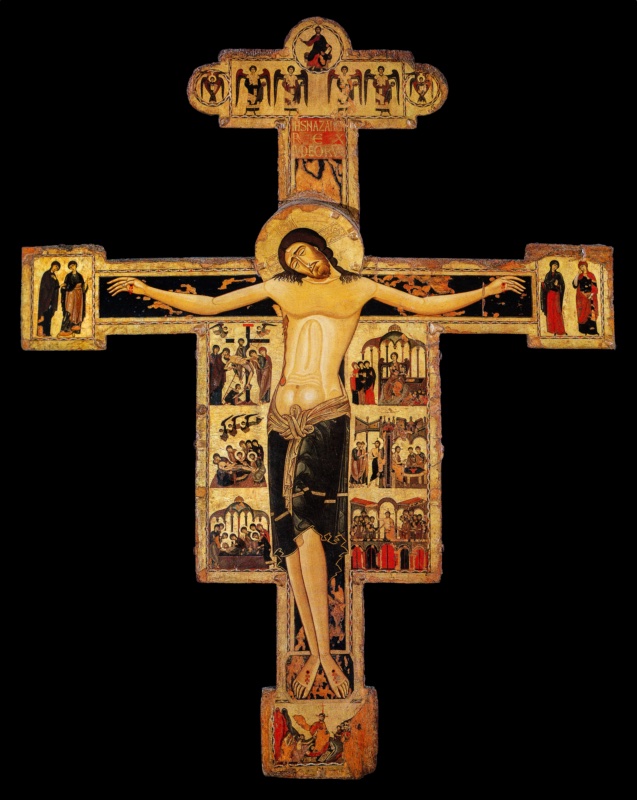
Christ is fixed to the cross with four nails, one in each hand and one in each foot. This follows the older tradition, not the three-nail scheme in which the feet are crossed and pierced by a single nail, which became standard later in the thirteenth century. The catalogue describes the figure as lifeless, with the head resting on the right shoulder and the eyes closed. The body is covered only by the loincloth, and streams of blood and water flow from the wound in the side. Popular accounts often say the head is inclined to the left. The two descriptions agree once one remembers that Christ’s right shoulder is on the viewer’s left. The point is minor but worth noting, because the confusion between the figure’s right and the viewer’s left recurs constantly in descriptions of medieval images.
The detail of blood and water, rather than blood alone, is theologically precise. It recalls the Johannine account of the soldier’s lance and the long tradition of reading the two streams sacramentally, as signs of baptism and the Eucharist flowing from the opened side of Christ. It also belongs to the established repertory of the Byzantine Crucifixion, where the wound in the side is a focus of devotional attention. The painter of the San Matteo cross reproduced it with the care of someone who knew the meaning of what he was painting.
What sets this Christ most clearly apart from later Italian versions of the suffering type is the restraint of the body. The figure does not arch sideways beyond the edge of the cross, as it would in the crosses of Giunta Pisano and, even more emphatically, of Cimabue. It hangs almost vertically, with only a gentle bend of the legs. The anatomy of the chest and abdomen is indicated schematically, through linear articulation rather than modelled volume. An early twentieth-century critic, summarised in a recent account, spoke of rigid schematisation and a woodenness unusual for a Greek painter. The observation is worth keeping, even if the conclusion drawn from it, that the painter had already absorbed something of local practice, remains debatable. The upper body is constructed rather than modelled, and the eye reads it as a pattern of lines more than as a weighty mass.
The head is treated quite differently. Its descent onto the shoulder is soft and yielding, and every observer has noted the delicacy of the hair and beard. Here the painter’s refinement of drawing is fully visible. The loincloth falls in small folds that catch the light like facets and is secured at the waist by an elaborate knot. It has been compared to the interlace that decorates the margins of illuminated manuscripts. As with the support, the comparison points towards the world of the miniature without proving a direct link.
The overall effect is not anguish but composed grief. The death of Christ appears as an accomplished and solemn fact, not as a spectacle of pain. The body neither writhes nor collapses. It hangs in a stillness that is at once the stillness of death and something like rest. This dignity, this suspension between sorrow and peace, is what later commentators have tried to capture with terms such as dormiens. It is also what distinguishes the San Matteo cross most sharply from the dramatic pathos the image would acquire in later Italian hands.
The Mourners and the Logic of Grief
Full-length mourners occupy the ends of the transverse arm. The ministerial description is clear: on the left the Virgin Mary and John the Evangelist, on the right the holy women “in an attitude of grief”. The catalogue identifies Mary Magdalene and Mary of Cleophas among those shown. The Zeri archive, which titles the right terminal more generally as the Virgin and the Marys, suggests that the identification of each woman is not entirely straightforward. The variation should be recorded rather than resolved arbitrarily.
The doubling of the mourners deserves comment. Later crosses usually have a single figure on each terminal, the Virgin on one side and John on the other. Here the painter put a pair at each end, so the grief at the death of Christ is spread across a small group. This choice gives the terminals a narrative breadth that links them to the Byzantine Crucifixion scene, in which the holy women often accompany the Virgin at the foot of the cross. It also has an expressive effect. The restraint of the central figure is answered by the measured gestures of those who mourn him, so that the emotional charge the dead body does not show is carried by the living around it. The mourners do not dramatise grief. They embody it with the same gravity that governs the figure of Christ, so the whole transverse arm reads as a single field of contained sorrow.
A Narrative of Death and Resurrection
Apart from the central figure, the most remarkable part of the cross is the sequence of scenes painted on the apron, the broad lateral fields that flank the body of Christ. The catalogue lists them in reading order from top to bottom. On the left are the Deposition from the Cross, the Lamentation over the dead Christ and the Entombment. On the right are the holy women at the sepulchre, the Supper at Emmaus and the Incredulity of Thomas. The Zeri archive specifies that the second scene on the right combines Christ’s meeting with the disciples on the road to Emmaus and the supper itself. A recent description adds that the two episodes share a register divided into two parts. The suppedaneum below Christ’s feet shows the Descent into Limbo, the Byzantine Anastasis.
At this point a further correction is needed, this time to the official catalogue itself. The ministerial entry is titled “Croce n° 20. Cristo crocifisso trionfante con storie della Passione”, a crucified triumphant Christ with stories of the Passion. Both parts of this title are inaccurate when compared with the entry’s own description. The Christ of the cross is not triumphans but dead. The catalogue’s critical notes say so explicitly, and they credit the work with the first appearance of the dead Christ in Italian painted crosses. And the narrative scenes are not stories of the Passion in the strict sense. None shows the events before the death of Christ, such as the Last Supper, the arrest, the trial, the flagellation or the road to Calvary. The title appears to reflect a generic cataloguing formula, not the content of the work. Since titles of this kind are easily copied into derivative publications and online databases, the discrepancy should be noted.
The choice of episodes is in fact the most eloquent feature of the narrative programme. Many Tuscan crosses of the twelfth century tell the Passion from the Last Supper or the arrest onward. The San Matteo cross begins only after the death of Christ. Every scene is either after his death or after his resurrection: the taking down of the body, the mourning over it, its burial, the empty tomb, and then the appearances in which the risen Christ made himself known. The programme thus completes the meaning of the central image. The dead Christ at the centre is framed by the story of what followed his death. The left side speaks of death and burial, and the right side of resurrection and its proofs. The Anastasis on the suppedaneum, in which Christ breaks the gates of hell and raises Adam, is the theological key to the whole.
This structure suggests the most satisfying explanation of how a painter familiar with the Byzantine suffering type could place it on a cross for a Latin church still used to the triumphant Christ. The image of death is not presented in isolation. It sits within a structure that proclaims victory. The worshipper who looked at the dead body also saw, on either side and beneath it, the burial that would be followed by the empty tomb, the appearances on the road and at table, Thomas’s doubting hand placed in the wound, and Christ’s descent among the dead to free them. The triumph the twelfth-century crosses had placed in the living, open-eyed figure of Christ is here moved into the narrative. Death occupies the centre, and resurrection surrounds it.
Several subjects belong specifically to the Byzantine repertory as it developed in the Comnenian period. The Lamentation, in which the Virgin embraces the body laid on the stone, is the Byzantine threnos, a theme given intense emotional treatment in twelfth-century Byzantine painting. The Anastasis is the Byzantine image of the Resurrection par excellence. Western art of the time more often showed the Resurrection through the holy women at the tomb or, later, through Christ rising from the sarcophagus.
A recent description adds that in the Lamentation the dead Christ, wrapped in his shroud, is mourned by the Virgin in the presence of John, Joseph of Arimathea and Nicodemus, and that the painter also included these two figures in the Entombment. The same account points out a refined narrative device. A small centrally planned building forms the backdrop to the Entombment on the left, and the same structure reappears in the first scene on the right, the holy women at the tomb. It acts as a visual hinge that leads the eye across from one column of narrative to the other. The tomb in which Christ is laid and the tomb found empty are thus visibly the same place, and the meaning of the sequence is built into the architecture of the scenes.
The Enciclopedia dell’Arte Medievale, in its essay on Pisa, characterises these narratives as storiette a slanciate figurine, tra fondali a padiglioni: small stories with slender figures set against pavilion-like backdrops. The phrase captures what distinguishes them from the livelier but more popular narratives of earlier Pisan crosses. The figures are elongated and elegant, the architecture is light and theatrical, and the drama is controlled.
Pisan Structure, Byzantine Language
The arrangement of the scenes, three on each side read from top to bottom, matters as much as their content. Here the critical literature has made one of its most important observations. According to the entry in the 2005 Pisan exhibition catalogue, as reported in recent literature, this arrangement follows an organisation typical of Pisan crosses of the period, such as those from San Frediano, the Santo Sepolcro and Santa Cristina. The Enciclopedia dell’Arte Medievale puts the same point more briefly but just as forcefully. It describes the cross as certainly the work of a Constantinopolitan artist, but states that its typology and iconographic contents show it was made in Pisa and not imported.
This is the decisive argument for placing the master’s activity in Pisa, and its logic deserves to be spelled out. The shaped cross, with an apron of narrative scenes, terminals with mourners, a cimasa and a suppedaneum, was essentially foreign to Byzantine liturgical furnishing. A painter working in Constantinople for a Byzantine patron would have had no reason to adopt it. A painter who did adopt it was responding to the expectations of Pisan patrons, fitting his own visual language into a structure already established in local practice and following the local convention for arranging scenes. The theory that the cross was painted in the East and shipped to Pisa as a finished object, which a reader might assume from the label “Byzantine Master”, is therefore unlikely. The cross is Byzantine in its figurative language and Pisan in its structure, and that combination points to production in Pisa.
The inscription supports this conclusion. Between the cimasa and the head of Christ runs the titulus, which the catalogue transcribes as “I(E)H(SU)S NAZAREN(US) REX IUDEORUM”, in Latin capitals painted with the brush. A Byzantine Crucifixion would normally carry a Greek title or the monogram IC XC. The San Matteo cross carries the full Latin titulus, as do other Pisan crosses such as those of the Santo Sepolcro and of San Frediano, whose tituli read in the same way. The Latin title is therefore one more local convention adopted by the master, and it confirms that the work was conceived for a Latin public.
A recent commentary observes that the inscription is laid out on three lines in a way that isolates the word REX on the second line, enlarging its letters and the spaces between them, so that Christ’s kingship sits at the centre of the epigraphic message. This observation comes from a popular source, not the specialist literature, and is offered here with that caveat. If correct, it would add a subtle counterweight to the image of death below: the dead man on the cross remains a king in the very lettering of the inscription. Such a reading would fit the theological logic of the whole cross, in which death is constantly framed by triumph.
The upper terminal, or cimasa, completes this logic. According to the catalogue it shows Christ Pantokrator enthroned within a clipeus, above a host of archangels. The Zeri archive describes it as Christ in glory among angels, and a recent account mentions angels and seraphim. The vision of the enthroned Christ above the dead Christ is the climax of the vertical axis. Read from bottom to top, the cross rises from the Anastasis at the foot, through the dead body at the centre, to the ruler of the cosmos in glory at the summit. The vertical reading tells the same story as the horizontal narrative: the death at the centre is the passage through which Christ goes from the harrowing of hell to eternal sovereignty. The painter did not choose between the triumphant and the suffering Christ. He placed the suffering Christ inside a structure in which triumph comes before and after him.
The Painter’s Style: A Comnenian Hand in a Latin City
The Byzantine character of the cross’s style has been recognised since the beginning of its critical history. The ministerial catalogue states without hesitation that the cross can be attributed, on stylistic and iconographic grounds, to a Byzantine painter of the time of the last Comnenian emperors, that is, of the second half of the twelfth century. The Dizionario Biografico degli Italiani, in its entry on Giunta Pisano, calls the cross “quel capolavoro altissimo della cultura bizantina in terra italiana”, that supreme masterpiece of Byzantine culture on Italian soil. The Enciclopedia dell’Arte Medievale describes it as great and noble. These formulations agree on one perception: the cross is the work of a painter of high quality, fully trained in the visual language of late Comnenian Byzantium. Its elongated figures, linear refinement and restrained emotional register belong to the mainstream of twelfth-century Byzantine painting, not to its provincial echoes.
The exact nature of this Byzantine culture has remained a matter of interpretation, and the critical tradition has moved between positions that are worth setting out. Sandberg-Vavalà admired the calligraphic refinement but doubted that the painter’s training was strictly Byzantine. She also stressed how isolated the work is, both within Pisan painting and in relation to Giunta. Lazarev, by contrast, set the cross firmly within the Comnenian and post-Comnenian orbit and dated it around 1230.
An Italian critic writing in 1927, summarised in recent accounts, noted the rigid schematisation and woodenness already mentioned. He took these as signs that a painter of Eastern formation had absorbed something of local practice. In 1948 one of the most influential Italian critics of the twentieth century put a sharper alternative: should one see in the cross a breath of new life, or an artisanal diminution of the ancient Eastern model? Later Italian criticism, from the 1970s onward, gave the cross the status of a masterpiece expressing a broader and more considered culture than the other Pisan crosses of its time. The 2005 exhibition catalogue, as reported, adopted this judgement.
These assessments need not be reconciled by choosing one. They describe a single phenomenon from different angles. The painter’s figurative language is Byzantine and of high quality. His medium and technique suggest familiarity with the practice of the miniature, though they do not prove it. And because his work was made within the structural and liturgical conventions of a Tuscan city, it inevitably took on a character that is neither purely Constantinopolitan nor properly Pisan. The “woodenness” one critic saw and the “isolation” another stressed may be two expressions of the same condition: that of an artist working at the meeting point of two traditions, with the formal habits of the first and the structural demands of the second.
The question that has divided critics, whether the painter was a Greek settled in Pisa or a Pisan trained in a Byzantine workshop, cannot be answered on the present evidence. The swing of the critical literature between these positions is the most honest record of the state of knowledge. Nineteenth-century and early twentieth-century writers generally saw him as a Pisan of Byzantine culture (Supino in 1894, Bellini Pietri in 1906). Later writers increasingly preferred to see him as a Byzantine who had come to Pisa, and Carli moved from the first view (1974) to the second (1994) over twenty years of reflection. This drift reflects, among other things, a growing appreciation of the quality of the work and of how closely it relates to Constantinopolitan painting. But quality alone cannot establish birthplace. A Pisan who had spent years in Constantinople, and the Pisan quarter of the Byzantine capital would have made that perfectly possible, could have acquired a Byzantine manner as complete as any native painter’s.
Reconstructing a Corpus: The Santa Cecilia Fragment
Attempts to give the master a body of work beyond the eponymous cross have produced, in the available sources, only one convincing result. Its reconstruction is owed to Antonino Caleca, in studies of 1972 and 1987 and in the 1993 museum publication he co-authored. The ministerial catalogue records that a fragmentary head of the triumphans type, from a now lost cross from the Pisan church of Santa Cecilia and today in the Museo di San Matteo, is also attributed to the anonymous master, and it cites Caleca’s studies as the basis for the attribution.
The fragment’s own catalogue entry gives its details. It measures 43 by 49 centimetres. In the early twentieth century it was in the church of Santa Cecilia, at the second altar of the right aisle, and it is now kept, provisionally, in the museum storerooms. The surviving piece was originally the projecting disc around the head of Christ on a large painted cross, the part that carried the nimbus and broke the outline of the upper arm. It shows the face of the living Christ, with open eyes and the head slightly inclined to the left, within a cruciform nimbus decorated with elegant plant motifs. Its state of preservation is described as very poor.
The arguments for the attribution are of two kinds. The first is technical. The fragment is painted on skin glued to panel, the procedure that in Pisa otherwise appears only in the San Matteo cross. The second is stylistic. According to the catalogue, the affinity between the two works lies especially in the decorative solutions and in certain physiognomic details, namely the hair, the beard and the eyebrows. Neither argument is decisive alone. A technique could be shared within a workshop or passed on by imitation, and physiognomic types circulated widely in Byzantine and Byzantinising painting. Together, however, they make the attribution persuasive, and the official catalogue entries for both works accept it, recording the fragment as “attributed” to the master. That formula correctly marks the attribution as an informed judgement, not a certainty.
The fragment matters for a reason beyond enlarging a tiny corpus. It shows a living Christ, a Christus triumphans. It therefore shows that the master, or at least the technical and stylistic milieu to which he belonged, was not committed exclusively to the new iconography of the dead Christ. If the attribution is correct, the same painter produced, for different Pisan commissions, both the traditional triumphant image and the innovative suffering one. This changes how the San Matteo cross should be understood. Its choice of the dead Christ looks less like the programmatic signature of an artist who came to Pisa to impose a new image, and more like a response to a particular commission, community or setting. The master appears as a painter working within the Pisan market, capable of either type and meeting the expectations of different patrons. The innovation of the San Matteo cross remains an innovation, but it becomes the innovation of a commission as much as of a painter.
No other works attributed to the master were found in the sources consulted. The literature on Pisan painting around 1200 does not, as far as could be established, assign him any other panels, frescoes or manuscript illuminations, despite the miniaturist hypothesis that might have encouraged such searches. Any future attribution would have to be weighed against a danger inherent in reconstructing anonymous artists: dissolving a distinct hand into a generic “Byzantine” current, so that every Byzantinising work in Pisa or Tuscany ends up attached to the one celebrated name. On the present evidence it is honest to conclude that the master is, and may remain, a personality defined by one masterpiece and one ruined fragment.
The Question of Date
The proposed dates for the cross have ranged over some eighty years, and the history of these proposals is also a history of how the work was understood. The ministerial catalogue currently dates the cross after 1200 and before 1210, a bracket based, as its records state, on stylistic analysis and on the literature. The Zeri archive places it more broadly in the first half of the thirteenth century.
Earlier opinion, summarised in the same catalogue, varied widely. Rosini, a Pisan historian of painting writing in the first half of the nineteenth century, attributed the cross to a Byzantine artist later than Giunta. A recent account says that a Pisan writer of 1839 had proposed an anonymous Byzantine master and a date no later than 1210, which is essentially the view that has prevailed. These two summaries of early nineteenth-century opinion do not agree. They may refer to different writers or to different readings of the same text, and the discrepancy can be resolved only by returning to the original publications. In the second half of the nineteenth century, Cavalcaselle’s survey of Italian painting (1886) dated the cross between 1150 and 1200. Lazarev, in 1936, placed it around 1230. Vigni (1950) continued to recognise its Byzantine character while dating it within the first half of the thirteenth century. Popular reference works still circulate both “around 1210” and “around 1230”, the latter evidently descended from Lazarev, often without saying that the two dates come from different and incompatible critical positions.
The arguments for the early date are of three kinds. The first is stylistic. The figures resemble late Comnenian painting of the second half of the twelfth century, which suggests the painter was trained before the catastrophe of 1204. The second is contextual. Artists of Byzantine culture were working on major sculptural commissions in Pisa around 1204, discussed in the next section, and this offers a plausible setting for a Byzantine-trained painter’s arrival or activity. The third, perhaps the most important, concerns the relationship with Giunta. The leading specialists regard the cross as earlier than Giunta Pisano, whose documented activity runs from 1236 to 1254 and whose formation is placed in the Pisan culture of the late twelfth and early thirteenth centuries. They also see it as one of the sources of his style. Sandberg-Vavalà had already asked whether the master was earlier than Giunta, and the ministerial catalogue notes that this is what “one now tends to believe”. If the cross fed into Giunta’s earliest crosses, it must come before them, and a date around 1230 becomes hard to maintain.
The argument for the later date, chiefly Lazarev’s, rested on a different reading of the stylistic evidence and of the relationship with Giunta. It cannot be dismissed simply because the official catalogues have moved on, since the dependence of Giunta on the cross is itself partly an inference, and an inference cannot be used to settle a chronology without some circularity. What can be said is that the prevailing view, expressed in the ministerial and museum documentation, places the cross in the first decade of the thirteenth century, and that this view fits the iconographic, technical and historical evidence. The datings proposed in some of the major twentieth-century corpora of Romanesque and Duecento panel painting could not be checked directly, and they are therefore not reported here rather than reported second-hand.
Byzantium on the Arno
Any explanation of how a painter of this culture came to work in Pisa has to begin with the city’s Mediterranean horizon. In the twelfth century Pisa was one of the great maritime powers of the Mediterranean, and its relations with Byzantium were close, though often stormy. The Pisans received commercial privileges from the emperor Alexios I Komnenos and established their own quarter in Constantinople along the Golden Horn, as the Venetians, Genoese and Amalfitans also did. Recent scholarship on the Pisan presence in Byzantium indicates that before 1182 Pisa had a permanent administration in Constantinople headed by a vicecomes. In that year the Latin communities of the capital, above all the Pisans and Genoese, suffered a violent massacre during the accession of Andronikos I Komnenos. The Pisan quarter was a place where Pisans and Greeks lived, traded and clashed. For Pisan merchants, clerics and travellers, the Byzantine visual world of icons, illuminated books and monumental decoration was part of daily experience, not a distant model.
The ministerial catalogue proposes a specific hypothesis for the painter’s arrival. It suggests he could have reached Pisa after the Fourth Crusade, when a diaspora of Byzantine artists took place, some of whom came to Pisa. The supporting evidence comes from sculpture. The catalogue notes that artists of Byzantine culture made the lintel of San Michele degli Scalzi in 1204 and, in the same period, the lintels of the eastern and northern portals of the Baptistery. The Enciclopedia dell’Arte Medievale confirms that around 1200 the city was enriched by many foreign presences. It identifies a Byzantine master as the author, in 1204, of the majestic Pantokrator in the lunette of the central portal of San Michele degli Scalzi, of the lintel below it and of reliefs on the eastern portal of the Baptistery. The church of San Michele had been given in 1178 to the Pulsanese Benedictines, a congregation of southern Italian origin. Its first restoration was completed in 1204, and an inscription behind the Christ of the lunette records that completion.
The coincidence of dates is suggestive, and the hypothesis that the painter belonged to the same wave of Byzantine artists is attractive. It must still be held with the caution the catalogue itself shows by using the conditional mood. The crusaders sacked Constantinople in April 1204, and the Byzantine sculptor of San Michele degli Scalzi completed a work dated that same year. It is far from certain that his presence in Pisa resulted from the sack, rather than from the ordinary movement of artists along Pisan routes, which had been intense throughout the Comnenian century. For the painter of the cross, whose style is anchored in late Comnenian art, several scenarios remain possible. He may have been a refugee from 1204. He may have reached Pisa through the commercial and ecclesiastical networks that had long linked the city with the East. Or, as earlier criticism held, he may have been a Pisan who learned his art in a Byzantine setting, perhaps in the Pisan quarter of Constantinople itself. What the sculpture does establish is that in the very years to which the cross is now dated, Byzantine artists of high rank were working in Pisa on prominent civic and religious commissions. The cross is not an isolated anomaly but part of a broader moment of Byzantine presence in the city.
The local precedents for Byzantine culture in Pisan art should also be recalled. The ministerial catalogue entry for Giunta’s cross from San Ranierino relates its style to several kinds of Byzantinising culture present in Pisa in the twelfth and thirteenth centuries. On one side are the San Matteo cross and the lintels of San Michele degli Scalzi and the Baptistery. On the other is the great Bible of Calci, made in 1168 and now also in the San Matteo museum. The Byzantine element in the master’s art entered a city that had long been open to Eastern models, in manuscript illumination as in sculpture. His cross is best read as the most radical and refined episode in that longer history, not as a sudden intrusion of a foreign style.
The Pisan Painted Cross Before and Around the Master
The San Matteo cross must also be seen against the series of Pisan painted crosses that preceded it and surrounded it, which the museum preserves in a concentration unmatched anywhere. The most directly comparable is the cross from the church of the Santo Sepolcro, traditionally known as Cross no. 15 and now inventory 1578. It shows a living Christ surrounded by small scenes of the Passion and its aftermath, arranged on the terminals, the apron and the suppedaneum, with a heavenly vision in the cimasa. Its date is itself contested. The Enciclopedia dell’Arte Medievale places it at the beginning of the thirteenth century, while other accounts put it in the second half of the twelfth. The Enciclopedia describes its small narratives as colourful and of lively, popular character.
The comparison is instructive. The two works share the same structural format and the same principle of narrative scenes flanking the central figure. Where the Santo Sepolcro cross keeps the living Christ and narrates with vivid directness, the San Matteo cross introduces the dead Christ and narrates with elegance and restraint. It is all the more striking, then, that the Dizionario Biografico degli Italiani, in its entry on Giunta, pairs the two works as the twin sources of the great Pisan painter’s formation. According to this account, Giunta’s culture should be traced not to the Lucchese circle of Berlinghiero, as earlier criticism had often held, but to the flourishing Pisan culture of the late twelfth and early thirteenth centuries. In particular it points to the refined and select activity, of almost exclusively Byzantine reference, of the masters of the crosses from the Santo Sepolcro and from the monastery of San Matteo.
The phrase matters here because it describes both masters as painters of Byzantine reference, working in a common Pisan milieu. From this perspective the Master of the Cross no. 20 was not a lone Greek in a Latin city. He was the most accomplished figure in a Pisan pictorial culture already steeped in Byzantine models, a culture in which the living Christ of the Santo Sepolcro and the dead Christ of San Matteo could exist side by side as two options within one artistic environment. If the date proposed by the Enciclopedia for the Santo Sepolcro cross is accepted, the two works would even be roughly contemporary. Pisa around 1200 would then appear as a place where the triumphant and suffering types were being painted at the same moment, by masters of different temperaments but similar cultural orientation.
The relationship with Lucca and with the Berlinghieri family should be stated with equal care. The Lucchese school of Berlinghiero, active in the first decades of the thirteenth century, produced triumphant crosses of great decorative splendour and was long regarded as the source of Giunta’s art. The Dizionario Biografico entry rejects this derivation for Giunta’s formation as a whole. It does, however, note specific morphological and iconographic parallels between Giunta’s Bologna cross and the culture of Berlinghiero, such as Christ’s tripartite abdomen and hair divided into four locks. The world of the Master of the Cross no. 20 and that of Berlinghiero are best seen as two distinct currents in the Byzantinising painting of western Tuscany around 1200. The Pisan current was more directly Constantinopolitan and more refined in its linearity. The Lucchese current was more decorative and more firmly attached to the triumphant type. Both were available to Giunta’s generation.
The Master and Giunta Pisano
The most important consequence of the San Matteo cross is its relationship with Giunta Pisano. Giunta is the first Italian painter whose name survives on extant works. He is documented between 1236 and 1254 and signed crosses in Assisi, Bologna and Pisa. The Enciclopedia dell’Arte Medievale states that the influence of the San Matteo masterpiece combined with the teaching of the earlier tradition and with Giunta’s own expressive force to produce his iconography of the suffering Christ, with its characteristically drawn features and its body arched to one side.
The Dizionario Biografico degli Italiani is more specific still. It records that critics recognised the deep cultural link between Giunta and the San Matteo cross early on, first of all Lazarev in his 1936 article “New light on the problem of the Pisan school” in The Burlington Magazine, and that later scholarship has repeatedly confirmed it. It calls this link the most concrete argument for the crucial relationship between Giunta and Byzantine culture. It relates the purely linear style of the Bologna cross, with its extraordinary rhythmic elegance, first of all to Pisan culture of the early Duecento, with a particular reference, very pronounced at the level of style, to Cross no. 20 in the Pisan museum.
The relationship was not universally accepted. The same entry records that the influential critic of 1948 already mentioned, while generally depreciating Giunta’s work, admitted at least in the Assisi cross a pseudo-plastic intention, and opposed Lazarev’s thesis that Giunta derived from the Pisan cross. The dissent matters because it shows that the line of descent from the anonymous master to Giunta, now widely accepted, was the subject of genuine debate. The present literature, however, has clearly converged. Giunta’s dead Christ, with its heightened pathos and arched body later inherited by Cimabue, presupposes the San Matteo cross as its local model. The anonymous master stands at the origin of the Pisan, and therefore the Italian, development of the suffering Christ on the painted cross.
The difference between the two painters is as instructive as the connection. The Christ of the San Matteo cross hangs almost upright, with schematic anatomy and an expression of restrained sorrow. Giunta’s Christ bends sideways in an arc, the face drawn and the body visibly giving way to its own weight. The anonymous master supplied the image. Giunta turned it into a vehicle for dramatic pathos. The Enciclopedia dell’Arte Medievale connects this transformation with a demand for realistic drama coming from the mendicant orders, and the Dizionario Biografico stresses the close relationship between Giunta’s art and Franciscan spirituality, calling Giunta the first official painter of the Order.
Here the chronology of the San Matteo cross takes on its full significance. If the cross dates from the first decade of the thirteenth century, it comes before the Franciscan establishment in Pisa and before the friars’ activity in the Levant. Recent English-language scholarship on Passion imagery has argued that the Byzantine element in Duecento Passion narratives may derive partly from Franciscan missionary activity in the East, which was under way by the 1230s. The San Matteo cross, whatever its exact date in the early decades of the century, shows that the Byzantine dead Christ entered the Pisan painted cross through channels that were not, or not yet, mendicant. These channels were the commercial, ecclesiastical and artistic networks of a maritime republic, and perhaps, though this cannot be documented, the Benedictine community of San Matteo itself. The mendicant orders would adopt the image and spread it across Italy with extraordinary success, but they did not introduce it. The common account that ties the birth of the Italian suffering Christ to Franciscan devotion is therefore incomplete. The image already existed in Pisa, on a monumental cross, before the friars turned it into their own.
Function, Space and the Eye of the Worshipper
Because the original location of the cross is unknown, its function in the church for which it was made cannot be reconstructed with certainty. What can be said is that large painted crosses of this type, in twelfth- and thirteenth-century Italy, were displayed in prominent positions: above the altar, on the triumphal arch, or above the screen, the tramezzo, which separated the nave of the laity from the choir of the clergy. The Dizionario Biografico entry on Giunta offers a precise contemporary parallel. The lost cross that Brother Elias3 commissioned from Giunta in 1236, almost certainly for the lower church of San Francesco at Assisi, was later moved to the upper church and set above the iconostasis, where it remained until 1624. The scale of the San Matteo cross, nearly three metres high, is entirely consistent with a raised position of this kind. From there it would have been seen at a distance by the laity in the nave and would have formed the visual focus of the interior.
This helps explain the internal economy of the cross. From a distance, the large central figure with closed eyes and bowed head, the gold, and the clear outline of the shaped panel would have been legible to everyone. The small narrative scenes, with their slender figures and delicate architecture, could have been read only close up, by those whose status or role brought them near the cross, or at moments when the cross could be approached. The work thus combines two functions. It is an icon, offering the faithful an image of the dead Christ for contemplation and prayer. It is also a narrative, unfolding the story of death, burial and resurrection for those who could follow it in detail. The two functions are not in tension. They correspond to two ways of looking that the medieval church interior allowed and encouraged: the distant gaze of the congregation and the close reading of the clergy or the devout visitor.
No document links the San Matteo cross with any particular liturgical use. These remarks describe how the type functioned, not the documented history of this object. Whether the cross was ever used in the rites of Holy Week, whether it stood on a screen or hung above an altar, and whether it was visible to the laity or reserved to a monastic choir are all unknown. Given the dormitory where it was found in the nineteenth century, it is quite possible that its last medieval or early modern setting differed from its first.
Two Centuries of Interpretation
The critical history of the cross is a small history of how Byzantine art has been understood in Italy. Pisan antiquarian literature of the late eighteenth century, according to recent accounts, attributed the cross to Giunta’s teacher, thereby placing it before the great Pisan painter. In the early nineteenth century it was assigned to the twelfth century. In the 1830s and 1850s local tradition attributed it to the legendary Greek painter Apollonio, a figure from Renaissance art literature said to have worked in Tuscany in the Duecento. The attribution is revealing. It shows the need to give a Byzantine-looking work a Greek author with a name, even when the name came from a literary tradition with no documentary basis.
In the second half of the nineteenth century Cavalcaselle’s survey of Italian painting (1886) dated the work between 1150 and 1200. At the end of the century, as the ministerial catalogue summarises, it was attributed to a Pisan painter of Byzantine culture (Supino, 1894). This interpretation continued into the twentieth century and was taken up in different forms by Sandberg-Vavalà in 1929 and by Carli in 1974, before giving way to the alternative view of a Byzantine who had come to Pisa.
The interwar period produced the two interpretations that still frame the debate. Sandberg-Vavalà described the painter as a miniaturist, stressed the work’s isolation within Pisan painting, and raised the question of whether it came before Giunta. Lazarev set the author within the Comnenian orbit, dated the cross around 1230, and emphasised its link with Giunta. Their positions differ on date and on the painter’s training, but both made the relationship with Giunta central, and that became the foundation of all later discussion. The miniaturist hypothesis, which is Sandberg-Vavalà’s, remains a hypothesis that no technical study has yet confirmed or refuted.
After the Second World War, Italian criticism moved between the image of a Pisan of Byzantine culture and that of a Byzantine settled in Pisa. Carli adopted the first position in 1974 and the second in 1994. The reconstruction of the master’s minimal corpus through the Santa Cecilia fragment was Caleca’s achievement, in the studies of 1972 and 1987 and the museum guide of 1993. It remains the most significant addition to knowledge of the master since the cross itself was identified. The 2005 Pisan exhibition devoted to painting from Giunta to Giotto produced a catalogue entry on the cross that is still the most frequently cited modern discussion, and its observations on the Pisan arrangement of the scenes have been especially important for locating the painter’s activity.
Read as a whole, this history shows a steady rise in esteem for the work, from an object attributed to obscure or legendary figures to a recognised masterpiece of Byzantine culture on Italian soil. It also shows a slow clarification of its place in the development of Italian painting. The questions of the painter’s origin and the cross’s exact date have not been resolved, but their terms are now much better understood.
Significance and Legacy
The importance of the Master of the Cross no. 20 rests on a single work, but that work holds a strategic position in the history of Italian painting. Ministerial, museum and encyclopaedic sources regard it as the first monumental painted cross in Italy to show the dead Christ. It is therefore the starting point for the series of suffering-Christ crosses that would dominate Italian painting for the rest of the thirteenth century and well into the fourteenth, through Giunta Pisano to Cimabue and Giotto. It is the most concrete evidence for the direct transmission of late Comnenian Byzantine painting to Tuscany and for Pisa’s role as a point of entry for Eastern models. It is also one of the earliest Italian panels in which a high-ranking Byzantine visual language was fitted into Western structures: the Tuscan shaped cross, the Latin titulus and the Pisan arrangement of narrative scenes. The result was a hybrid that, in the hands of the next generation, became the foundation of a distinctively Italian pictorial tradition.
Its legacy has a paradox. The painter’s image was adopted, but his manner was not. Later painters took over his dead Christ and turned it into a vehicle for drama, making the body bend and the face contract and placing pain where he had placed stillness. The restraint of the San Matteo cross, its balance between death and peace, and its framing of death within a structure of resurrection and glory had no direct successors. It belongs to a moment, perhaps a brief one, when the Byzantine image of the dead Christ entered the Latin West without yet being reshaped by the new spirituality of compassion that the mendicant orders would bring.
The cross is therefore significant on two levels. Historically, it is the first link in a chain. As a work of art, it is a self-contained achievement, one of the most refined treatments of the theme in medieval art, whose quality does not depend on what came after it. The Enciclopedia dell’Arte Medievale called it great and noble, and those two adjectives still describe it as well as any.
Open Questions
Several questions remain open, and listing them is part of describing the master accurately. The original destination of the cross is not documented. The nature of its support is described inconsistently even within the official catalogue. No published conservation report could be found. The datings proposed in some major corpora of Romanesque and Duecento panel painting could not be checked directly. The painter’s identity, as a Greek settler or a Pisan trained in a Byzantine setting, cannot be determined. The corpus rests on one cross and one attributed fragment. The official catalogue title, describing a triumphant Christ with stories of the Passion, contradicts the content of the work and the catalogue’s own critical notes. Two summaries of early nineteenth-century opinion on the date disagree with each other.
These uncertainties do not reduce the master’s significance. They define its shape. They also point to the most promising lines of research. A renewed technical study of the cross and the Santa Cecilia fragment could settle the nature of the support and test the miniaturist hypothesis. A systematic search of the archives of San Matteo and of the Pisan religious houses suppressed in the Napoleonic period might recover the cross’s original location and perhaps its commissioner. A close comparison with the Byzantine sculpture of San Michele degli Scalzi and the Baptistery could clarify how the painter relates to the other Byzantine artists working in Pisa around 1204. Until such studies are done, the Master of the Cross no. 20 remains what the conventional name suggests: a museum number, behind which stands one of the decisive painters of the Italian Middle Ages.
Conclusion
The Master of the Cross no. 20 enters the history of art without a name, a biography or a document, and the evidence on which this essay rests is correspondingly narrow: one monumental cross, one ruined fragment, and two centuries of interpretation. Within those limits, a good deal can be said with confidence. The cross was made for a Latin city around the first decade of the thirteenth century, by a painter fully trained in the language of late Comnenian Byzantium, and it presents the dead Christ on a shaped Tuscan cross at a scale and in a position of visual authority that no earlier Italian example had attempted.
What gives the work its particular character is the way it holds two traditions together. Its figures, its linear refinement and its restrained emotion belong to Constantinople, while its structure belongs to Pisa: the shaped panel, the Latin titulus, the apron of narrative scenes arranged three to a side, the mourners on the terminals. This combination is the strongest argument that the cross was painted in Pisa for Pisan patrons, and it explains why the label “Byzantine Master” is at once accurate and misleading. The painter was Byzantine in his manner, but he worked inside conventions he had to learn and respect.
The iconography shows the same intelligence. By framing the dead Christ with scenes that begin only after his death, and by placing the Anastasis beneath his feet and the Pantokrator above his head, the painter did not choose between the triumphant and the suffering image. He placed one inside the other, so that death occupies the centre and resurrection surrounds it. This is why the claim that the cross introduced the dead Christ into Italian painted crosses must be stated with care: it concerns the painted cross as a genre, not Western art at large, and its force lies less in the novelty of the image than in the coherence with which the image was made part of a Latin devotional object.
The historical consequences were considerable. Giunta Pisano and, through him, Cimabue and Giotto inherited the dead Christ of San Matteo, though not its stillness; they turned a composed grief into pathos, and the mendicant orders gave that pathos a wide public. The chronology proposed here, with the cross placed before the Franciscan presence in Pisa, shows that the Byzantine suffering Christ reached the Italian painted cross through the commercial, ecclesiastical and artistic networks of a maritime republic, not through the friars. The common account that ties the birth of the Italian suffering Christ to Franciscan devotion is therefore incomplete.
Much remains uncertain, and the essay has tried to say so wherever it matters: the original setting and commissioner, the exact nature of the support, the painter’s origin and the extent of his work. These gaps do not diminish the cross. They define the shape of what is known, and they mark where further study would be most productive.
The conventional name, a museum number that outlived the inventory which produced it, is in the end an honest one. It claims nothing beyond a single great work and its unknown author, and it leaves room for what future research may add. Until then the cross speaks for its painter with a clarity that does not depend on his identity: a work of high refinement, made at the meeting point of Byzantium and Tuscany, at the moment when the image of the dead Christ first took its place on the monumental cross of the Latin West.