Berlinghiero di Melanese
( 25% )
Prologue: A Voice at the Foot of the Cross
Few painters of the early thirteenth century can be met at all, and fewer still in their own words. At the foot of a shaped and painted cross from the Lucchese monastery of Santa Maria degli Angeli, beneath the feet of a living, open-eyed Christ, there is a short Latin sentence:
BERLINGERIUS ME PINXIT, “Berlinghiero painted me”.
The formula is conventional. It belongs to the long medieval habit of letting the object speak in the first person, a gesture inherited from twelfth-century sculptors and painters who carved or painted their names into the fabric of their works. In the historiography of Italian painting, however, these few letters carry unusual weight. For more than a century this inscription was the only thing that tied a name to a surviving painting in the Lucchese Duecento. Almost everything written about Berlinghiero since the nineteenth century has grown outwards from it, through comparison, inference and conjecture.
The man behind the name remains elusive. No contract survives, no will has been found, no account book and no chronicle mention. What remains is a single list of citizens swearing to a peace treaty, preserved only in a later copy. There is a gradual accumulation of notarial references in which he appears only as the father of other men, and a body of paintings whose attribution has been argued and reargued for generations. Yet this small and uneven body of evidence supports a coherent picture. It shows a painter born in Volterra and formed in the strongly Byzantinising culture of western Tuscany, who settled in Lucca and founded there the most influential family workshop in Tuscany before Florence and Siena came to dominate the history of painting.
This essay sets out that evidence and tries to keep what the documents and inscriptions actually say separate from what has been deduced from them. Three modern scholars stand at the centre of the story, and they are the only ones named here. The American art historian Edward B. Garrison, from the 1940s onwards, revised the documentary basis of early Lucchese painting and built the first critical catalogue of the Berlinghieresque circle. Evelyn Sandberg-Vavalà, in her monumental study of the Italian painted cross published in Verona in 1929, placed Berlinghiero’s crosses within the whole typological development of the genre. Antonino Caleca, working on Pisan and Lucchese painting, recovered in 1981 the second signature on the cross from Fucecchio, and with it the painter’s Volterran origin. The opinions of other scholars are referred to without names.
The Problem of the Name
The first difficulty is the name itself. The form “Berlinghiero Berlinghieri” still dominates museum labels, popular encyclopaedias and library catalogues, but it has no medieval authority. The entry in the Dizionario Biografico degli Italiani, published in 1967, states plainly that the commonly used patronymic “Berlinghieri” is an arbitrary usage going back to the nineteenth century. The surname arose by back-formation from the genitive in which the painter’s sons recorded their father’s name. Bonaventura signed his panel at Pescia “Bonaventura Berlingeri de Luca”, meaning Bonaventura son of Berlinghiero, of Lucca. The nineteenth-century habit of turning such patronymics into family names produced a “Berlinghieri dynasty”, and its founder ended up, absurdly, carrying his own name twice. Scholarship since Garrison has generally preferred the simple “Berlinghiero”, sometimes with “of Lucca” or, more precisely, “di Melanese”. The Metropolitan Museum of Art in New York catalogues him simply as Berlinghiero, active in Lucca by 1228 and dead by 1236.
A second confusion, more persistent and more instructive, concerns the epithet “Milanese”. For decades the painter was believed to have come from Milan, and the idea survives in some English-language reference works that describe the family as Lombard. The error goes back to the one document in which Berlinghiero appears as an acting person, the oath of peace between Lucca and Pisa in 1228. In the copy that survives he is recorded as “Berlingerius Melanese maius”. The great English-language survey of Italian painting published in the 1860s, later translated into Italian, read “Melanese” as an ethnic adjective and made the painter a Milanese. Garrison’s revision of 1951, published in The Art Bulletin under the programmatic title “Toward a New History of Early Lucchese Painting”, showed that the phrase should be understood as a patronymic with a qualifier: Berlinghiero son of Melanese the elder. “Melanese” is the personal name of the painter’s father, and “maior” distinguishes the elder Melanese from a younger man of the same name. The Enciclopedia dell’Arte Medievale, in its entry of 1992, accepts this reading and renders the formula as “Berlinghiero di Melanese il Vecchio”. The Milanese origin is a philological ghost, and nothing in the surviving documentation supports it.
The painter’s true place of origin emerged only in 1981, and from a painting rather than an archive. During the restoration of the large cross from the abbey church of San Salvatore at Fucecchio, the remains of an older painted signature were found beneath later inscriptions. Caleca read it as
BERLINGERIUS VULTERRANUS ME PINXIT
and published it that year in the exhibition catalogue Momenti dell’arte a Volterra. The adjective admits only one meaning: Berlinghiero was a Volterran. This matters because, as will be seen, the scriptoria and painters’ workshops of Volterra and Pisa in the later twelfth century were among the most strongly Byzantinising centres of western Tuscany. By calling himself Volterran on a cross painted for an abbey in the diocese of Lucca, the painter declared his birthplace. He may also have been naming a pedigree of training that he expected his patrons to recognise. Several modern reference works therefore combine the two documented elements into “Berlinghiero di Melanese da Volterra”. This is historically more defensible than the conventional double name, even if the latter is unlikely ever to disappear from common use.
The Documentary Record: An Oath, a Copy and a Trail of Patronymics
The documents that concern Berlinghiero directly are so few that each can be examined on its own. The only one in which he appears as an acting person is the list of Lucchese citizens who swore to the peace concluded between Lucca and Pisa in March 1228, after a long phase of hostility between the two cities. Berlinghiero appears in this list together with his sons Barone and Bonaventura, both of whom were therefore already of age and able to swear in their own right. The original parchment has not been traced. The text survives only in a later copy now in the Biblioteca Statale of Lucca, manuscript 1902.
The two principal reference works do not agree on the details, and the disagreement deserves to be stated openly. The Dizionario Biografico dates the oath to 22 March 1228 and attributes the copy to the seventeenth-century friar Marco Grossi, who did not name his source. The Enciclopedia dell’Arte Medievale gives 25 March 1228 and speaks of eighteenth-century copies. The difference in the day may reflect the different reckonings of the year used in Pisa and Lucca, or simply different readings of the copy. In either case, the historian must accept that Berlinghiero’s single direct appearance in the record is mediated by an early modern transcription whose exemplar is unknown. Nothing suggests that the copy is unreliable. Its secondhand character does help explain how a reading such as “Melanese maius” could give rise to so much confusion.
What can be inferred from the oath is limited but valuable. In 1228 Berlinghiero was a citizen of Lucca, or at least a resident counted among those whose oath was required, and he had at least two adult sons. On this basis modern scholarship has proposed an approximate birth date. The Enciclopedia dell’Arte Medievale suggests a birth around 1175 and the beginning of an independent career around 1200, on the reasonable ground that a man with two sons of age in 1228 is unlikely to have been born much later. This remains a demographic estimate rather than a recorded fact, and other scholars have placed the birth somewhat later. Every birth date given for Berlinghiero, including the “c. 1175” repeated in many catalogues, should be read as a conjecture.
The rest of the documentation is indirect but chronologically more precise. Berlinghiero’s name recurs in Lucchese notarial acts as the patronymic of his three painter sons, Barone, Bonaventura and Marco. The formulas used allow the date of his death to be bracketed, since the father is named either as living or as quondam, “the late”. According to the Enciclopedia dell’Arte Medievale, these incidental mentions present him as living from 1232 to 1235 and as dead from 1236 onwards. This bracket depends largely on documents published in 1980 in the journal Prospettiva, in an article devoted to new records concerning Bonaventura and Marco. Before that publication the accepted terminus was considerably looser. The Dizionario Biografico of 1967 placed his death between 1228, when he swore the peace with Pisa, and 1243, when another document described him as already dead, and some later dictionaries still repeat the formula “died before 1242”. The more recent and better documented bracket of 1235–1236 should now be preferred. Some authority files give an even sharper terminus, “before February 1236”. The precise month is plausible, but it rests on an act that could not be checked directly and is better cited with caution.
The documents therefore support three secure propositions. Berlinghiero was active and mature in Lucca by 1228. He headed a family of painters, at least two of whom were adults by that date. He was dead by 1236. Everything else in his biography, including his birth, training, arrival in Lucca and early career, has to be reconstructed from the paintings and from what is known of the artistic culture in which they were made.
Volterra, Pisa and the Greek Manner of Western Tuscany
The single word Vulterranus on the Fucecchio cross changed the discussion of Berlinghiero’s formation. Before 1981 his evident Byzantinism was usually explained by a vague appeal to imported icons, or to the generic maniera greca that seemed to cover Italian painting around 1200. Since then it has been possible to anchor it in a particular regional milieu. Caleca, in his entry for the Enciclopedia dell’Arte Medievale, located the cultural antecedents of the Lucca cross in the strongly Hellenising circles of western Tuscany. He pointed above all to the team of illuminators working between Pisa and Volterra who, from 1168, decorated the great Bible made for the Pisan church of San Vito and now preserved at the Certosa di Calci.
The Calci Bible is a monumental atlantic Bible in four volumes, richly decorated with ornamental and historiated initials. A colophon in the fourth volume records that work began on 10 October 1168, 1169 in the Pisan style, at the initiative of the priest Gerardo. It names the craftsmen involved, among them a magister Vivianus and an Adalbertus, scribe “of the large letters in gold and colour”, who is described as a Volterran. Modern scholarship has debated which of the two was responsible for the painted decoration. What matters here is the conjunction, in a precisely dated Pisan manuscript, of Volterran personnel with an ornamental and figural repertory. That repertory draws on the Tuscan variant of the giant Bibles of the Umbro-Roman tradition and at the same time shows direct knowledge of Byzantine art. In Caleca’s reconstruction, the Volterran and Pisan illuminators of the period knew Byzantine painting both from Constantinople and from Norman Sicily. His conclusion is unequivocal: this was evidently the environment in which Berlinghiero, a Volterran by birth, was formed.
The hypothesis is attractive because it accounts for several features of Berlinghiero’s art at once. One is the refined, almost miniaturist handling of the highlights. Another is the white hatching laid over flesh and drapery, which the Dizionario Biografico had already called decidedly Byzantine. A third is the calligraphic control of contour, and a fourth is the easy familiarity with Byzantine iconographic formulas, such as the Hodegetria Virgin, that recur in the Madonnas attributed to him. Caleca also observed that this culture largely coincided with the one from which the younger Giunta Pisano emerged. That would explain why Berlinghiero, late in his career, could approach Giunta’s language of pathos without any sense of rupture.
The limits of the argument must be acknowledged. The Volterran-Pisan hypothesis rests on cultural affinity, not on any documented apprenticeship. No record places Berlinghiero in a Pisan or Volterran workshop, and no illuminated manuscript has been convincingly attributed to his hand. Within these limits it remains the most coherent explanation of his formation yet proposed, and it has the great merit of resting on a signature rather than on a presumed foreign origin.
Lucca Before Berlinghiero: The Painted Cross as Liturgical and Civic Image
Lucca in the early thirteenth century was among the wealthiest cities of Tuscany. It was a centre of silk manufacture and banking and the seat of an ancient bishopric, whose cathedral housed the Volto Santo, the most celebrated wooden crucifix of the Latin West. It is no accident that the painted cross became the dominant monumental genre of Lucchese painting. These shaped panels, bearing the image of the crucified Christ and often surrounded by narrative scenes, stood on or above the screens that divided choir from nave, or hung in the apse or from the triumphal arch. They were among the most visible and most costly images a church could commission.
The earliest dated example of the genre lies just beyond the Lucchese border, in the cathedral of Sarzana, then in the diocese of Luni. The cross signed by a master Guglielmo and dated 1138 by an inscription in leonine verse presents the Christus triumphans in its canonical early form. Christ is alive, frontal and open-eyed, his head upright, flanked by the mourning Virgin and Saint John and by small fields with scenes of the Passion. The Dizionario Biografico calls this cross the capostipite, the founding ancestor, of the Lucchese crosses on which Berlinghiero’s own iconography depends. Between Guglielmo and Berlinghiero stands a group of anonymous Lucchese crosses of the later twelfth century, those of Santa Giulia, of San Michele in Foro and of the Servi, the last now in the Museo Nazionale di Villa Guinigi. Sandberg-Vavalà examined them in an essay in Dedalo in 1928 and again in La croce dipinta italiana e l’iconografia della passione. Together they define a local type with densely narrative lateral panels, richly ornamented borders and a jewel-like colour that the Dizionario Biografico describes as an exquisite chromatic refinement.
Berlinghiero inherited this type and transformed it. In the words of the Dizionario Biografico, his cross descends from these models in a number of iconographic particulars, but its language has changed substantially. The function of these objects matters for understanding why the change counted. The Lucchese crosses were not merely devotional images. They were public objects in a city that defined itself through its relics and its images. The Volto Santo served Lucca as a civic palladium, and the painted crosses of its churches belonged to a visual culture in which the crucified Christ was a liturgical sign, an object of popular veneration and an emblem of communal identity all at once. A painter who mastered the genre in such a city occupied a central place in its artistic economy. The scale of the family workshop documented in the following decades suggests that Berlinghiero did.
The Signed Cross from Santa Maria degli Angeli
Cross of Santa Maria degli Angeli
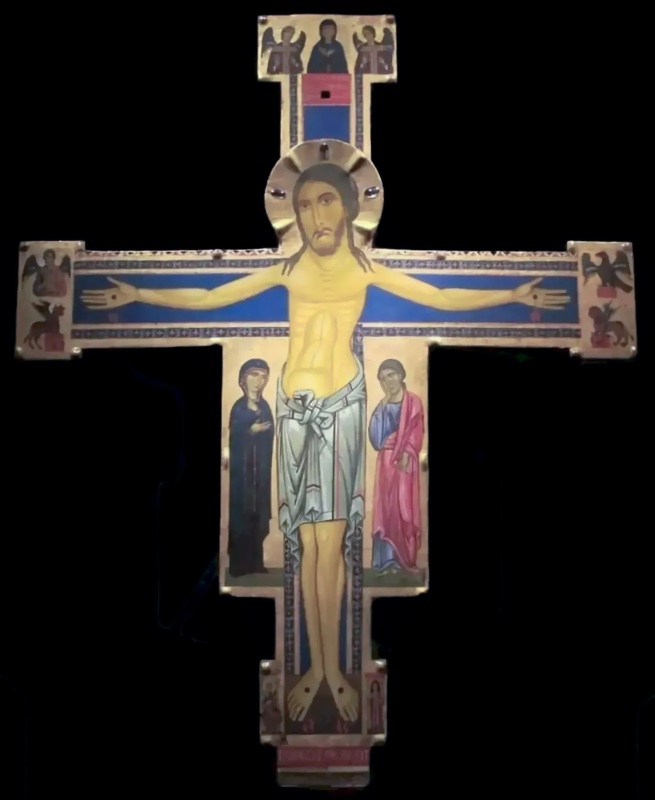
The cross from the Lucchese monastery of Santa Maria degli Angeli is the work on which the modern identity of Berlinghiero rests. It bears his signature,
BERLINGERIUS ME PINXIT,
in the lower part of the panel. For a long time it was the only work in the Lucchese Duecento that tied a name securely to a painted object. Scholars have built the master’s corpus outwards from it, comparing the Madonna in New York, the “Madonna di sotto gli organi” in Pisa Cathedral and the Cleveland tabernacle against its faces, draperies and ornament. It is also one of the best preserved painted crosses of its generation. The original colour has survived with unusual intensity, and this is immediately evident even in a photograph: the deep blue of the cross, the warm gold of the grounds, and the strong reds and blues of the mourners’ garments keep a clarity that most crosses of the period have lost under dirt, overpaint or abrasion.
The panel follows the shaped format traditional in Lucca since the twelfth century. The long vertical shaft and the horizontal crossbar are widened at the centre into two rectangular lateral fields, the tabelloni, behind Christ’s body. Each arm ends in a squared terminal, and the shaft is completed above by a tall cimasa and below by a narrower suppedaneum. Everything is subordinated to the figure of Christ, whose body occupies the full height of the central axis and whose arms span the crossbar almost from end to end. A continuous decorative band runs along the edges of the blue cross. The ministerial catalogue describes it as a row of white pearls on a red ground combined with a foliate motif, and identifies it as a kind of trademark of Berlinghiero’s workshop. The band frames Christ’s body like a precious setting, and in a period when signatures are rare it acts as an ornamental signature that recurs across the production of the family shop.
Christ is shown as the Christus triumphans, the living and victorious Christ of the Romanesque and Byzantine tradition. He is not yet the dead and suffering Christus patiens that Giunta Pisano would make dominant in Tuscany during the following decades. His eyes are open and look out towards the viewer. His head is held almost upright and framed by long dark hair falling onto the shoulders, and a short, forked beard completes the long, narrow face. The nimbus is not merely painted. It is a raised disc of gilding set with small round bosses, so that it catches light as a physical object in the dim interior of a church. The arms are stretched horizontally along the crossbar with the palms open, a gesture that reads less as suspension from nails than as an embrace offered to the congregation.
The body is painted in a warm, golden flesh tone and modelled according to Byzantine formulas. The chest is articulated by a schematic but elegant pattern of pectoral and rib lines, and the abdomen is divided into rounded segments that read more as an abstract system of forms than as observed anatomy. The head is noticeably enlarged in relation to the body. This hierarchical emphasis on the face was abandoned in Berlinghiero’s late cross from Fucecchio, which has more natural proportions. The loincloth, which the ministerial record describes as green with red and brown borders, appears in the photograph as a pale, almost silvery green-grey. It is knotted at the waist and falls to the knees in sharp, angular folds traced in darker lines. The legs descend straight and parallel, and the feet are nailed separately, side by side, in the four-nail arrangement characteristic of the Romanesque cross.
What distinguishes the image from its Lucchese predecessors is not its iconography but its tone. The Dizionario Biografico expresses this well. The handling of the white highlights and the refinement of execution are decidedly Byzantine, but the calm settling of the contours and the gentleness of the face reveal a wholly Western poetic sensibility. Christ is impassive but not severe, and his presence is serene rather than commanding.
On either side of Christ’s body, against a gold ground, stand the Virgin and Saint John at full length. This arrangement departs significantly from Lucchese tradition. Twelfth-century crosses such as those of the Servi, of San Michele in Foro and of Santa Giulia filled these fields with densely packed scenes of the Passion. Berlinghiero removes the narratives altogether and gives the space to two monumental witnesses. The Virgin, on Christ’s right, is wrapped in a dark blue maphorion that falls in long, quiet folds, with one hand raised before her breast. Saint John, on the other side, wears a red mantle over a blue tunic and is shown with his hand raised in a gesture of grief. Both figures have the long, slightly inclined faces, sharp noses and small chins that recur in the Madonnas attributed to the painter. These are the facial types on which those attributions largely depend.
The result is a concentration of the image. The older crosses asked the viewer to read the Passion as a sequence of episodes. Here the eye moves directly from the living Christ to the two figures who mourn him and back again. The cross becomes less a narrative and more an icon, a single devotional image in which the Crucifixion is presented as a timeless state rather than an event.
The square terminals of the crossbar hold the symbols of the four Evangelists, arranged in pairs. On the left the angel of Matthew stands above the winged lion of Mark, and on the right the eagle of John stands above the winged ox of Luke. As the ministerial record notes, this arrangement has an analogue in the earlier Lucchese cross of Santa Giulia.
The cimasa contains the most significant iconographic innovation. Above the titulus, a frontal figure in dark blue appears between two angels: the Assumption of the Virgin. In the earlier Lucchese crosses this position was held by the Ascension of Christ. The substitution has sometimes been connected with the dedication of the church for which the cross was made, but no document of the commission survives to confirm it. Below the cimasa a small rectangular red field carries the titulus with the inscription naming Jesus of Nazareth, King of the Jews.
At the foot of the cross, flanking Christ’s feet, small figures make up the Denial of Peter. According to the catalogue description, it is composed in two parts, with the apostle seated on an elaborate throne and a brazier burning at his feet. The episode has a precedent in the cross still preserved in San Michele in Foro, a connection that Evelyn Sandberg-Vavalà had already established in her study of the Italian painted cross. Its placement beneath Christ’s feet sets the human weakness of the first apostle against the divine constancy of the figure above.
The cross belongs to a moment when Tuscan painting was still drawing its models of form and colour from Byzantium. Antonino Caleca has convincingly connected Berlinghiero’s formation with the strongly Byzantinising culture of western Tuscany, and particularly with the illuminators active between Pisa and Volterra who decorated the Calci Bible from 1168. The signature on the Fucecchio cross, which names the painter as Vulterranus, made that connection historically plausible. This background can be seen in the Lucca cross: in the fine white hatching that models flesh and drapery, in the calligraphic control of contour, and in the jewel-like handling of colour. It is not, however, the work of a copyist. The removal of the narrative scenes, the full-length mourners and the Assumption in the cimasa are deliberate choices that transform the Lucchese tradition from within, using a Byzantine vocabulary to make a new kind of image.
No document records when the cross was commissioned or completed, and its dating rests on stylistic comparison alone. The fundamental argument is that the Lucca cross shows none of the pathos that marks Berlinghiero’s late cross from Fucecchio. In the Fucecchio cross, painted around 1230–1235, Caleca recognised a painter who had taken on board Giunta Pisano’s new emotional language. By contrast, the Lucca cross keeps the archaic enlargement of the head, the hieratic calm of the figure and an unmixed Byzantine handling of highlights. Critical opinion has therefore generally regarded it as a relatively early work. It also places the cross before the Tereglio cross, which reuses some of its compositional models with a somewhat freer handling. A date in the second decade of the thirteenth century fits this picture best. Because it remains a hypothesis, it should be qualified with “c.”, and the museum’s own later bracket of c. 1225–1235 should be acknowledged as a minority alternative.
The cross from Santa Maria degli Angeli stands at the threshold of the history of Tuscan painting in two senses. Artistically, it is the most accomplished statement of the Byzantine-Lucchese synthesis before Giunta Pisano and the Christus patiens changed the genre. Historically, its three-word signature marks one of the first moments when a Tuscan painting can be tied with certainty to a named master. That master went on to found a family workshop which, through his sons Bonaventura, Barone and Marco, carried his manner to Pescia, Camaldoli1 and Bologna. Behind the serene, open-eyed Christ of Lucca stands the earliest well-documented painter’s workshop in Tuscany.
The Fucecchio Cross: A Second Signature and the Late Berlinghiero
Crucifix
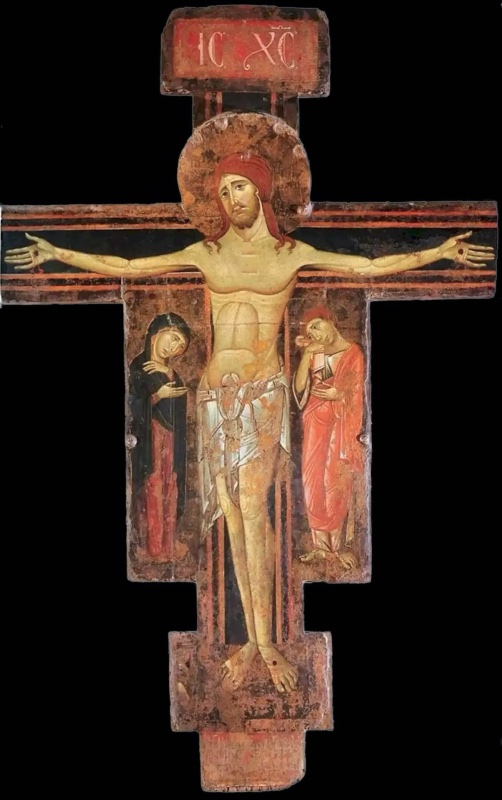
The Fucecchio cross is the second signed work of Berlinghiero, and the one that gave the painter a birthplace. For almost two centuries its authorship was obscured by later inscriptions. On the back was an apocryphal attribution to Giunta Pisano with the date 1238, and on the suppedaneum an Italian text stated that the image had been made in that year and restored in 1633 and 1743. During the 1981 restoration, traces of an older painted signature emerged beneath these additions, which Caleca read as
BERLINGERIUS VULTERRANUS ME PINXIT.
The adjective Vulterranus connected the painter with Volterra, one of the most Hellenised artistic centres of thirteenth-century Tuscany. This turned a long-standing debate about whether the cross was Pisan, Lucchese or Florentine into a question about the late style of the founder of the Lucchese school.
The cross was painted for the Benedictine2 abbey church of San Salvatore at Fucecchio, in the lower Valdarno, which then lay within the diocese of Lucca. According to the Fucecchio museum guide, it remained in the church until 1780. It then passed through Pisan antiquarian hands and was displayed for a time in the Camposanto before reaching the Museo Nazionale di San Matteo. Along the way it was dismembered, and the photograph shows this clearly. The crossbar ends abruptly where the square terminals should be. The left terminal, with a deacon saint and a female saint, is now in the Museo Civico at Fucecchio. That fragment had long lain in storage under the label “Russian-Byzantine School”, a revealing misattribution that shows how thoroughly Byzantine its handling appeared. The right terminal, with a holy woman and Saint Paul, was identified in a private collection in the early 1990s.
The painted surface has suffered more than that of the Lucca cross. The gold grounds of the lateral fields and the zones around the feet are heavily worn, the panel joins are visible, and there are losses along the edges and in the suppedaneum. The essential parts of the image are nonetheless well preserved: the head and body of Christ and the two mourners.
The silhouette follows the Lucchese shaped type, with widened lateral fields behind the body, a tall cimasa, a projecting suppedaneum and, originally, square terminals at the ends of the arms. The colour scheme differs strikingly from the Lucca cross. Christ’s body no longer lies against a luminous blue but against a dark, almost black ground. It is edged by bands of red that run along the arms and the shaft like a frame within the frame. In the cimasa, a red field carries the Greek monogram IC XC in white letters, the abbreviation of Jesus Christ. This is a further Byzantine element, and it replaces the narrative upper scene of the Lucca cross. The Fucecchio guide notes that Berlinghiero here uses broad fields of background colour in the Umbro-Roman manner, organised in tight, balanced rhythms of Western origin. These features separate his work clearly from the twelfth-century crosses of Lucca.
Christ remains, in type, a Christus triumphans. He is alive, his eyes are open, his body is upright and his arms are stretched horizontally along the crossbar with open palms. Within this convention, however, everything has changed. The head no longer stands upright and frontal. It inclines towards Christ’s right shoulder beneath a raised, tooled gilded halo, and the face carries an unmistakable expression of sorrow: drawn brows, heavy lids and a downturned mouth framed by a short reddish beard. The body is much more slender than in the Lucca cross and proportioned more naturally, with a smaller head in relation to the torso and long, thin limbs. The torso is still built from Byzantine formulas, with a vertical sternal line, arching ribs and segmented abdomen. These are now drawn with a softer, more continuous modelling, which the Fucecchio guide describes as a new linear and chromatic softness.
The loincloth contributes much to the new character of the image. It is no longer a heavy, coloured garment falling in angular folds. It is a thin, almost transparent white cloth with a large twisted knot at the centre, descending in fine, fluttering pleats to the knees, so that the body seems to show through it. The legs fall straight and parallel, and the feet are nailed separately to the suppedaneum, with drops of blood painted at the wounds.
In the lateral fields stand the Virgin, on Christ’s right, and Saint John, on his left, at full length against gold. As in the Lucca cross, Berlinghiero gives these fields wholly to the two witnesses rather than to narrative scenes. Their behaviour, however, is entirely different. In Lucca the mourners stood upright and composed. Here both lean towards the cross with heads inclined, and each raises a hand to the cheek in the ancient gesture of grief. The Virgin is wrapped in a dark blue maphorion over a red garment, her other hand held before her breast. Saint John wears a strong red mantle and holds a closed book. Their grief echoes the inclination of Christ’s head, so that the three figures are bound together by a shared emotional movement that is absent from the earlier cross.
The change from Lucca to Fucecchio is the clearest evidence of Berlinghiero’s stylistic development. Caleca put it precisely: in the Fucecchio cross Berlinghiero shows himself up to date with Giunta Pisano’s language of pathos. The Fucecchio guide frames the same change in devotional terms, observing that Francis of Assisi3’s meditation on Christ’s humanity affected Berlinghiero’s firm and dogmatic certainties. Berlinghiero did not take the final step that Giunta had taken. His Christ is not yet the dead, swaying Christus patiens with closed eyes and curved body that would dominate Tuscan crosses by mid-century. His painting nevertheless absorbs the essential novelty of that type: the humanity of Christ made visible through suffering, and a viewer drawn into compassion rather than awe.
This reverses the usual pattern of influence. Here the older master learns from the younger. If Caleca’s reconstruction of Berlinghiero’s formation is correct, both painters drew on the same Volterran-Pisan culture, which would explain why the change does not read as a break. The two signed crosses together frame the whole arc of his career. The Lucca cross belongs to its hieratic, jewel-like Byzantine beginning, and the Fucecchio cross to its compassionate, Franciscan-inflected end.
The question of execution cannot be entirely set aside. Berlinghiero was dead by 1236, and the cross belongs to the last year or two of his activity. By then his sons Bonaventura and Barone were fully trained painters working in the family shop, and Bonaventura signed the Pescia panel in 1235. It is therefore plausible that other hands contributed to the Fucecchio cross, or that it was completed after the master’s death, as the Fucecchio guide allows. Either possibility suits a work that marks the passage between generations. The signature asserts the master’s authorship, while the painting shows a workshop language already moving towards the idiom of the sons.
The Fucecchio cross matters well beyond its own quality. It recovered Berlinghiero’s Volterran origin, fixed the late end of his chronology, and showed that the founder of the Lucchese school did not hold fast to an imported formula. Close to the end of his life, he engaged with the most innovative painting of his time. Seen alongside the Lucca cross, it allows a single painter of the early Duecento to be followed from the serene Christ of Byzantine tradition to the sorrowing Christ of the Franciscan age. Few painters of the period can be followed through such a change.
Two Madonnas: New York and Pisa
Around the two signed crosses scholars have gathered, over several decades, a small group of panels attributed to Berlinghiero on grounds of style. The best known is the Madonna and Child in the Metropolitan Museum of Art. It was formerly in the Straus collection in New York, was given to the museum by Irma N. Straus in 1960, and had first been attributed to Berlinghiero in an article in The Burlington Magazine in 1927. The museum describes it as tempera on wood with a gold ground, measuring about 80 by 54 centimetres overall, and dates it possibly to the 1230s. Its catalogue calls it one of only two works that can be confidently attributed to Berlinghiero, the other being the Lucca cross, and bases the attribution on stylistic analogies with that cross. The formulation is cautious and accurate. The attribution rests on style, not on documents.
Madonna di sotto gli organi
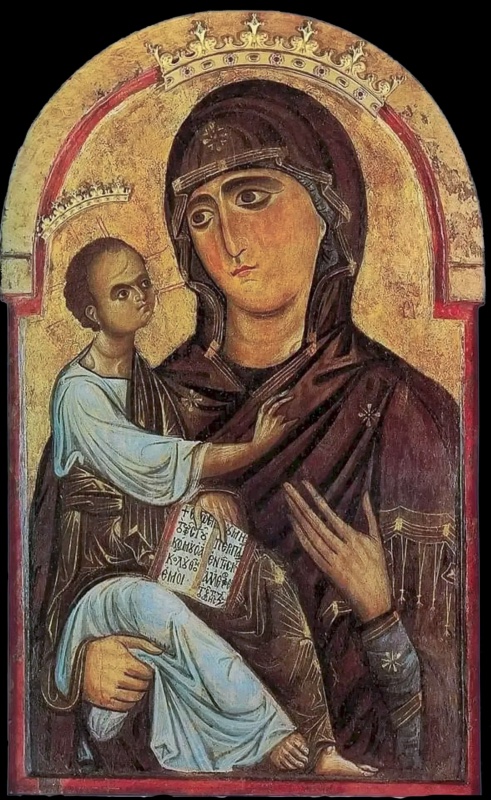
Few panels of the early Duecento have so full a history as an object of veneration, and so uncertain a history as a painting. For centuries the Madonna di sotto gli organi was the most revered image in Pisa Cathedral. It was hardly ever seen, and its painted surface was so often reworked that what is seen today is in large part the product of later hands. Any stylistic analysis must therefore start with the history of the object, since that history determines which parts of the picture can be used as evidence.
The legends about the panel’s origin are attested in complete form only from the sixteenth century. According to the oldest and most widespread version, the image was originally kept in the castle of Lombrici near Camaiore, in Lucchese territory. Pisan soldiers are said to have carried it off during the wars with Lucca, either to save it from fire or to prevent its plunder, and brought it in triumph to the cathedral. The traditional date is 1226, usually corrected to 1225 on the assumption of Pisan reckoning. As the cathedral record observes, however, a March 1226 date might need no correction, because the Pisan year changed on 25 March, the feast of the Annunciation. Many scholars doubt the story and believe that the panel was painted for the cathedral itself.
The first historical mention of the image in the cathedral occurs in the chronicle of Portoveneri at the end of the fifteenth century. By then the panel was considered miraculous and stood beneath the main organ at the entrance to the north transept, the location that gave it its name. During the fire of October 1595 it was the first object the rescuers saved, at the risk of their lives. It was housed temporarily in the Baptistery and in 1604 was placed in the new altar built for it, where it still stands.
Throughout this period the image was kept covered by veils. These were not removed even on the rare occasions when it was carried in procession, hence its other names, Madonna dei sette veli and Madonna incognita. One chronicler, writing just after the fire, described it as a Madonna that, as far as anyone knew, no eye had ever seen. In the two following centuries the painting almost ceased to exist as a physical object in the minds of those who wrote about it, and several authors described it as a sculpture. Only between December 1789 and June 1790, at the wish of Grand Duke Leopold4, did it become visible again. On that occasion it was entrusted to the painter Giovanni Battista Tempesti, who went over it extensively in oil.
The first scientific study of the panel came only after the Second World War, when Garrison examined it closely following a restoration in 1943 and left a detailed report. A further conservation campaign followed in 1963. Garrison’s conclusions remain fundamental. Although the picture appears intact and its colours bright, very little remains of the original paint layer. The parts where it is most clearly recognisable are the upper part of the Virgin’s head, including the eyes, and some portions of the mantles, in particular the Child’s. Everything else consists of old restorations, some earlier than Tempesti’s, of Tempesti’s own work, and of light modern completions.
This explains a striking feature of the panel as it now appears. The Virgin’s large, dark eyes, set in long almond-shaped outlines under heavy lids, have a gravity that the softer, smoother modelling of the lower face and neck does not share. The eyes belong to the thirteenth century, while much of the surrounding flesh belongs to later restorers. Garrison nevertheless judged that the old restorers had tried to stay as faithful as possible to the venerated image. The overall character of the painting does correspond to what one would expect from the first half of the Duecento, and it cannot be dismissed as an invention of sixteenth- or seventeenth-century retouchers.
The crowns are also later additions. According to the cathedral record, they are copies made in 1912 by Ludovico Pogliaghi of originals placed on the panel in 1847 and later stolen. Until the restoration of 1943 they sat lower, covering the foreheads of both figures.
The panel presents the Virgin and Child in the Byzantine type of the Hodegetria, “she who shows the way”. The Virgin is shown half-length, filling almost the entire field, her head inclined slightly towards the Child. She wears a dark purple maphorion with a gold-fringed border, marked on the forehead and the shoulder with gold stars, the traditional signs of her virginity before, during and after the birth of Christ. Beneath the maphorion a close-fitting cap is visible at the brow. Her free hand is raised before her breast, with long tapering fingers, in the gesture that directs the viewer’s attention to the Child, who is the true subject of the image.
Two features depart from the most common Italian form of the type. The Child sits on his mother’s right arm rather than her left, and he holds an open book rather than the usual scroll. The book carries a Greek inscription reproducing the verse of John’s Gospel in which Christ calls himself the light of the world, with the promise that whoever follows him will not walk in darkness. Garrison considered the inscription largely remade. The cathedral record notes that the arrangement is not unique even in Pisa, citing a contemporary Madonna from the church of Santa Chiara now in the Museo Nazionale di San Matteo. It also compares the overall iconography with an icon on Mount Sinai in which the Child, likewise seated on his mother’s right arm, holds a book in place of a scroll. On these grounds Garrison connected the Pisan panel with an eleventh-century Byzantine model, or with a twelfth-century Lucchese derivation of such a model.
The Child is not the stiff, frontal infant-philosopher of many Hodegetria icons. He turns towards his mother and looks up into her face, and one hand reaches out to touch the edge of her maphorion. He wears a pale blue tunic under a mantle laced with fine gold hatching, the chrysography of Byzantine tradition. This mantle belongs to the areas where Garrison recognised original paint, and its tight, regular network of gold lines is among the most reliable evidence for the panel’s original handling. His bare feet emerge at the lower edge, and the Virgin’s hand supporting him can be seen beneath his legs.
The arched panel with its raised red frame and gold ground is integral to the image’s effect. The frame isolates the figures as in a niche, and the round arch at the top echoes the curve of the Virgin’s veiled head. It is not clear from the evidence whether the panel was conceived as an independent devotional image or as part of a larger ensemble. Its scale, nearly a metre high, is consistent with a public cult image intended to be seen at some distance.
The attribution rests entirely on stylistic comparison. Garrison compared the surviving original parts, and the style evoked by the restorations, with the signed cross from Santa Maria degli Angeli in Lucca and with the Madonna and Child in the Metropolitan Museum. The Dizionario Biografico degli Italiani summarises the main points of contact. In both Madonnas the long ovals of the faces incline in the same way, the noses are sharp, and the drawing of the eye and the small chin coincide. The drapery also has precise analogies with the loincloth of the Lucca cross. Garrison dated the panel to around 1220, before the Lucca cross. That would place it at the most explicitly Byzantine moment of Berlinghiero’s career and would not contradict the legend of its arrival in Pisa in the mid-1220s.
The attribution has not gone unchallenged. Since the 1990s two scholars have questioned both the traditional provenance and the attribution. One proposed that the panel might be an Eastern work, painted in a Byzantine milieu in the second half of the twelfth century. The other found in it a Byzantine orientation not otherwise seen in Berlinghiero and foreign to the Lucchese tradition, and suggested instead a connection with Pisan painting. The cathedral record answers that these objections rely too heavily on details that Garrison had already identified as misleading because they were remade. In its view, Garrison’s comparisons remain valid.
That seems the most balanced position. The panel is a highly plausible but not certain work of Berlinghiero. Its attribution rests on a few surviving passages, above all the eyes of the Virgin and the gold-hatched mantle of the Child. Its present appearance owes much to centuries of devout restoration.
The Madonna di sotto gli organi shows, almost uniquely, how a medieval panel could live for centuries as a sacred presence rather than as a picture. Veiled, carried in procession, saved from fire and repeatedly repainted, it was valued for what it was believed to be, not for the hand that made it. Its connection with Berlinghiero places it at the beginning of the Lucchese master’s career and close to the Byzantine models that shaped him. It also shows that the surviving evidence for his art is fragile, and in this case partly buried under the work of those who sought to preserve it.
Madonna and Child
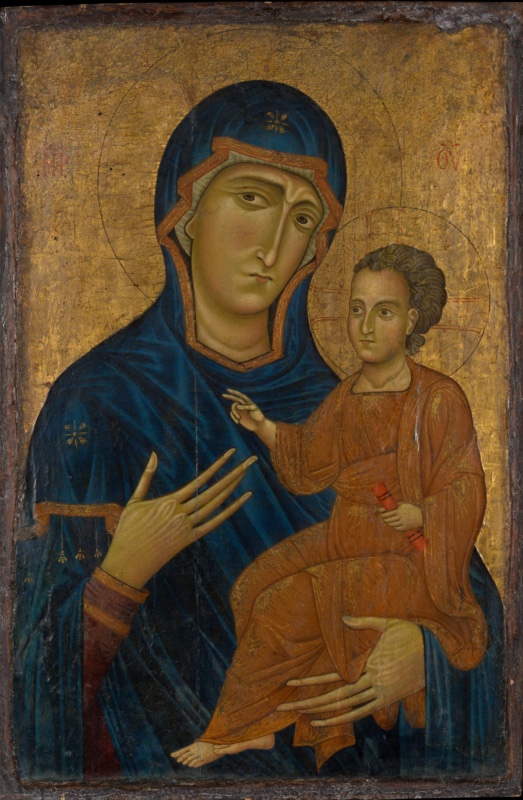
The Metropolitan Museum dates the panel possibly 1230s and gives the dimensions as overall 80.3 × 53.7 cm and painted surface 76.2 × 49.5 cm. The museum’s own catalogue notes contain a tension that deserves mention. They state that the Met’s Madonna must be more or less contemporary with the Crucifix in Lucca. Yet the Lucca cross is most often dated c. 1210–1220, as noted above. The two statements are hard to reconcile, and they reflect the absence of any fixed point for either work.
The literature summarised in the museum’s bibliography offers a range of opinions. One study accepts the attribution to Berlinghiero and dates it about 1230; compares it to the “Madonna di sotto gli organi” in the cathedral at Pisa. The Dizionario Biografico degli Italiani records Garrison’s view that the panel belongs to the later 1220s and would therefore be among Berlinghiero’s last works. Since the painter was dead by 1236, any date must fall before that year. “Possibly 1230s” is therefore acceptable only if read as “c. 1230–1236”. The formula “c. 1228–1236”, sometimes used in teaching resources, is no better founded. The museum’s wording, as in the caption above, is best kept, with the date treated as a stylistic proposal.
Alongside the signed cross in Lucca, this panel is the work most often used to define Berlinghiero’s art. The Metropolitan Museum calls it one of only two works that can be confidently attributed to Berlinghiero, the leading painter in the Tuscan city of Lucca. Its attribution goes back to an article in The Burlington Magazine in 1927. It rests on stylistic comparison with the Lucca cross, not on any inscription or document. The panel was in the New York collection of Jesse Isidor and Irma N. Straus from 1936 and entered the museum in 1960.
Not all scholars have accepted the attribution without qualification. The museum’s bibliography records that one author calls it a work of the school of Berlinghiero. A 1957 publication noted that it had been assigned to Berlinghiero or to his son Bonaventura, without giving the source of the latter view. According to the cathedral record in Pisa, another scholar has proposed giving it to the anonymous painter of a cross in the Museo Nazionale di San Matteo. The majority opinion, however, holds it to be an autograph work by the father, and one of exceptional quality.
Unlike the arched Madonna di sotto gli organi in Pisa, the New York panel is a simple rectangle. The half-length Virgin fills almost the entire field against a gold ground. The haloes of both figures are marked by incised circles in the gilding, and the Child’s halo carries the arms of a cross drawn in red. On either side of the Virgin’s head, in red, are the Greek monograms ΜΡ ΘΥ, the abbreviation of Mētēr Theou, Mother of God. They are a direct borrowing from the Byzantine icon, whose conventions the painter follows throughout. The gold ground is worn in places and the edges of the panel are abraded, but the figures themselves are well preserved, with their colour and the fine linear detail of hands and faces largely intact.
The composition follows the Byzantine type of the Hodegetria, “she who shows the way”. In the museum’s words, “Christ’s mother points to her son as the way to salvation; dressed like an ancient philosopher, the child holds a scroll.” The arrangement is the canonical one, the mirror image of the Pisan panel. The Child sits on his mother’s left arm, supported by her left hand, whose long fingers spread beneath his legs at the lower right. Her right hand rises before her breast, the fingers extended in a slow, elongated gesture that leads the eye across to the Child. The museum suggests that the painter would have known the type from icons that arrived in Italy following the fall of Constantinople in 1204. That is a plausible historical context, although no specific model has been identified.
The Virgin wears a deep blue maphorion that covers her head and shoulders and falls over her arms. Its edge is bordered with a narrow band of orange and gold, and it is marked with gold stars at the forehead and on the shoulder. A pale cap is visible beneath the veil at the brow, and at the wrist of the raised hand appears a red sleeve with a gold cuff. The drapery is modelled with dark blue folds and light, almost silvery highlights that follow the curve of the shoulders in long, regular arcs.
The face is the heart of the painting. It is a long, narrow oval in which the line of the brows continues without a break into the straight, elongated ridge of the nose, a convention inherited from Byzantine painting. The mouth is small and closed and the chin small and rounded. The large almond-shaped eyes, heavy-lidded and dark, do not look at the Child. They turn sideways, past the viewer, with an expression of grave melancholy. The Dizionario Biografico describes the panel as softened by a more sensitive use of chiaroscuro than the Lucca cross, and the flesh shows it: the transitions from olive shadow to warm light are gentler and more continuous than the hatched highlights of the earlier work.
The Virgin’s sadness is not incidental, and the museum has made it the subject of public explanation. Its curator of European painting asked why the Virgin is so sad in this piece and replied that “It’s an expression that can be dead, unless we engage ourselves in it.” The traditional reading of such a gaze is theological: the Mother foresees the Passion of the Child she holds. What distinguishes Berlinghiero’s panel is how quietly this foreknowledge is conveyed, through the turn of the eyes and the slight inclination of the head rather than through any overt sign of grief.
The Child sits upright on his mother’s arm, his body turned towards her while his face, framed by short curling hair, looks outwards. He wears an orange-red robe and mantle covered with fine gold hatching, the chrysography that in Byzantine painting signals divine light. Like a small ancient philosopher, he holds a red scroll in his left hand, the sign of the Word and of teaching. His right hand is raised in blessing with two extended fingers, the gesture directed towards his mother as much as towards the viewer. One bare foot emerges from the hem of the robe at the lower edge. His features are those of a child, but his bearing is that of the wise and authoritative Christ, the Logos, in keeping with the Byzantine conception of the infant God.
The museum quotes an observation that captures the essence of the panel: “Berlinghiero’s work operates with nuances . . . the language of gestures, with their gentle flow and their subtle meaning on both human and theological levels.” The composition is in fact built on three gestures. The Virgin’s raised hand points towards the Child, the Child’s hand blesses in return, and the Virgin’s averted gaze turns away from both towards a future the image does not show. These gestures form a slow circuit of meaning across the panel, connecting the Virgin’s role as guide to salvation, the Child’s identity as the source of blessing and truth, and the human sorrow that their relationship will entail.
The attribution depends on precise morphological parallels. The Dizionario Biografico notes that the New York Madonna and the Madonna di sotto gli organi in Pisa share the same inclination of the long oval faces, the same sharp noses and the same drawing of the eyes and small chins. Both also show drapery analogies with the loincloth of the Lucca cross. The comparison with the Lucca mourners is equally telling. The Virgin and Saint John at the sides of the Lucca Christ have the same long faces, slender noses and small chins, and the same restraint in emotional expression.
The differences matter as much as the similarities. Compared with the hieratic Pisa panel, whose surviving original passages show a more strictly Byzantine handling, the New York Madonna is warmer and more introspective. Compared with the Lucca cross, its modelling is softer. These differences support placing it later rather than earlier in Berlinghiero’s career. They do not, however, establish whether it belongs to the late 1220s or the early 1230s.
The New York Madonna shows Berlinghiero as more than a skilled transmitter of Byzantine formulas. Every element of the panel comes from the icon tradition: the Hodegetria type, the star-marked maphorion, the Greek monograms, the chrysography and the infant philosopher with his scroll. Through slight adjustments of gaze, gesture and modelling, the painter gives these conventional forms a gravity and an inwardness that belong to the Western devotional sensibility then emerging in Tuscany. That sensibility was soon to be transformed by the Franciscan movement and by the art of Giunta Pisano. In this sense the panel stands at the same threshold as the Fucecchio cross: a Byzantine image that has begun to invite compassion as well as veneration.
Small Devotional Formats: The Cleveland Tabernacle and the Raleigh Madonna
The workshop did not produce only monumental crosses and large icons. The most important evidence for its activity in small devotional painting is a portable triptych, or tabernacle, in the Cleveland Museum of Art. The museum describes it as tempera and gold on poplar, measuring about 43 by 52 centimetres overall, and dates it to the 1230s. Its provenance can be followed through the Parisian dealer Théodore Bonjean and the Matthiesen Gallery in London to the Brussels collection of Adolphe Stoclet. It was sold at Sotheby’s in London in 1965 and acquired by the museum in 1966. According to the museum, it was while in the Stoclet collection that the tabernacle was recognised as Berlinghiero’s work.
Virgin and Child with Saints (triptych)
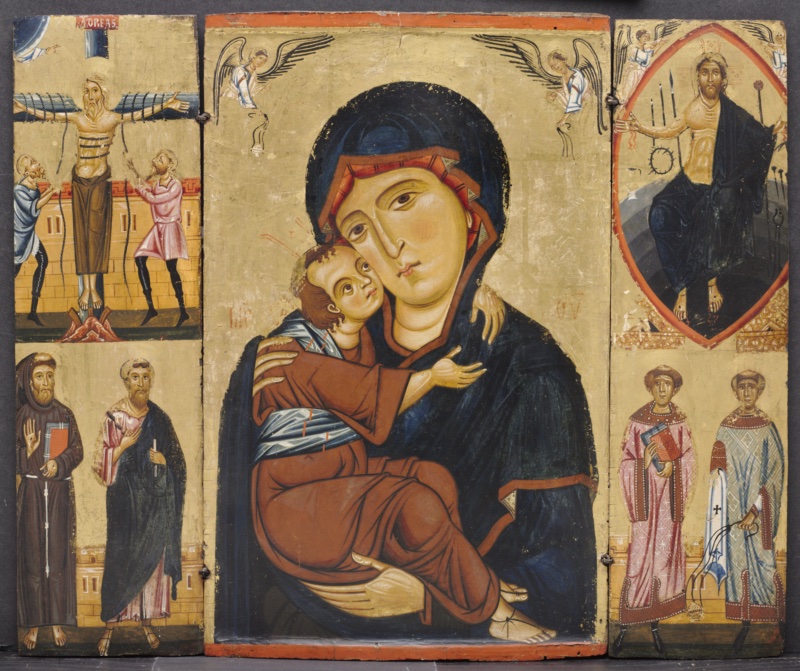
The Cleveland triptych is the most important surviving evidence for small-scale devotional painting in Berlinghiero’s circle. The museum’s description reads: “This small altarpiece, intended for a domestic interior or private chapel, consists of three panels, allowing it to be folded and easily transported.” The metal hinges that join the wings to the central panel are still visible. Closed, the wings would have covered the Virgin and Child completely.
Open, they turn the object into a miniature sanctuary: a central icon flanked by two narrow fields, each divided into a narrative or visionary scene above and a pair of standing saints below. The attribution to Berlinghiero dates from the years when the work belonged to Adolphe Stoclet. Garrison published it in the 1940s, and it has since been placed among the core group of works gathered around the signed cross in Lucca. As with all of Berlinghiero’s later production, the possibility that members of his family workshop took part in its execution cannot be excluded.
The left wing: Crucifixion of Saint Andrew; Saints Francis and Paul
The left wing is divided into two fields of roughly equal height. The upper field shows the martyrdom of Saint Andrew, identified by an inscription on a small red label at the top, of which the letters
[AN]DREAS
remain legible. The lower field presents two standing saints, Francis and Paul, side by side against a gold ground. The scheme combines narrative and iconic modes: a moment of martyrdom above, timeless figures of intercession below. It follows a logic familiar from Byzantine and Italo-Byzantine portable icons, in which the wings of a triptych gather saints around the central image as a heavenly court.
The Crucifixion of Saint Andrew is told with striking economy. The apostle, an old man with long white hair and beard, is bound to his cross with heavy black ropes that wind around his arms, chest and legs. He wears a long brown loincloth, and his emaciated body is modelled with the same schematic articulation of ribs and abdomen found on Berlinghiero’s painted crosses. The cross is not the diagonal saltire that later became Andrew’s standard attribute. It has a horizontal beam along which the outstretched arms are tied, following an older tradition. In the upper left corner a hand emerges from a blue arc of heaven, the hand of God acknowledging the martyr.
Two executioners flank the cross and pull at the ropes, one in a blue tunic on the left and one in a pink tunic on the right, both with black hose. Their bodies lean away from the cross in tense diagonals, and the effort of their pulling sets against the frontal stillness of the saint. Behind them runs a crenellated wall in ochre and red, pierced by small windows, a conventional indication of the city outside whose walls martyrdoms traditionally took place. At the foot of the cross lies a reddish mound. The painter compresses the narrative into a single, legible image in which the instruments of martyrdom, the ropes and the cross, are as important as the actors.
The lower field holds two saints whose juxtaposition is historically remarkable. On the left stands Saint Francis of Assisi in a brown hooded habit tied with a knotted white cord, barefoot, tonsured and bearded. He holds a red book in his left hand and raises his right hand with the palm turned outward. The gesture may display the stigma, the wound that by the 1230s had become central to his cult. At this scale and in this photograph, however, the mark itself cannot be identified with certainty. The figure is one of the earliest surviving images of Francis, and a modern catalogue of early Franciscan iconography includes the Cleveland panel.
Beside Francis stands Saint Paul, recognisable by his high, balding forehead and dark pointed beard. He wears a pink tunic under a dark green-black mantle that falls in long folds, holds a long, pale, sword-like object in his left hand, and raises his right hand to his chest. The pairing of the two saints is instructive. Paul, the apostle and missionary par excellence, appears next to the newly canonised Francis, as if the new saint were being admitted into the company of the apostolic founders of the Church. Francis appears here not as the protagonist of a narrative cycle, as in Bonaventura’s Pescia panel of 1235, but as one saint among others in a long tradition.
Stylistically, the wing displays the features the museum singles out as characteristically Byzantine: “The long expressive lines that define the clothing and hands of the figures are typical of Byzantine painting, which spread from Constantinople to Italy in the Middle Ages.” The draperies of Paul’s mantle and Francis’s habit are built from long, flowing contour lines and narrow bands of light. Faces are drawn with the same elongated noses, almond eyes and small mouths found on the larger works attributed to Berlinghiero. The miniature scale does not reduce the painter’s precision. Every hand, foot and fold is articulated with a calligraphic clarity that recalls the art of the illuminated manuscript.
The setting of the lower field repeats the motif of the city wall from the scene above. A low crenellated wall with paired windows runs behind the saints’ feet, tying the two fields of the wing together and creating a shallow stage before a gold sky. This device, also found on the right wing, gives the whole triptych a unity of setting. The saints stand in an idealised architectural space that evokes the heavenly Jerusalem as much as any earthly city. The figures nonetheless remain flat and frontal, set against the gold rather than within a coherent space.
The choice of Andrew and Francis may reflect the devotion of the person who commissioned the triptych. A private tabernacle was a personal object, and its saints were often chosen for their connection with the owner’s name, religious affiliation or particular needs. Andrew’s prominent martyrdom scene may point to a patron who bore the apostle’s name, and the presence of Francis to a link with the new Franciscan movement. No document survives to confirm either possibility. What can be said is that the wing records, almost at the moment of his canonisation, how Francis was being absorbed into the established visual language of sanctity.
The central panel: Virgin and Child
The central panel is framed at the top and bottom by narrow red borders and dominated by the half-length figure of the Virgin holding the Child. Unlike the Hodegetria of the Metropolitan Museum panel, which presents the Child formally to the viewer, the Cleveland Virgin follows the type of tender embrace known in Byzantine art as the Eleousa, “the merciful”, or Glykophilousa, “the sweetly kissing”. The Child throws his arms around his mother’s neck, their cheeks pressed together. The red monograms ΜΡ ΘΥ, Mother of God, flank the figures in the usual Byzantine manner.
The Virgin is wrapped in a dark blue, almost black maphorion edged with a band of orange-red, enlivened by fine gold lines and small triangular accents, with a blue cap visible beneath it at the brow. The mantle encloses the head and shoulders in a single dark mass that stands out sharply against the gold. Within this frame the face is a long oval, with a straight nose continuing the line of the brows, large almond eyes under heavy lids, a small closed mouth and softly flushed cheeks. Her head inclines towards the Child. Her eyes do not meet his: they look out past him with the grave, melancholy expression that also marks the New York Madonna.
The Child is the most dynamic figure in the panel. Seated on his mother’s right arm, he throws his body towards her. His left arm reaches around her neck, so that his small hand appears on her far shoulder, his right hand stretches open across her breast, and his cheek presses against hers. He looks up into her face with wide eyes, his head tipped back beneath a halo marked by red rays. He wears a reddish-brown robe crossed by a blue-grey mantle wound around his chest and shoulder, its folds picked out in white and touched with lines of red chrysography. His bare feet, laced with fine sandal straps, rest against his mother’s arm at the lower edge.
The Virgin’s hands frame and support the Child. Her right hand presses gently against his back at the shoulder, and her left hand, with long tapering fingers, cradles his legs from below. These hands, like those of the saints on the wings, are drawn with the long, expressive contours the museum identifies as Byzantine. In this panel they acquire a particular eloquence, holding the Child close in an embrace that answers his own. The design is thus built on an interlocking circle of limbs and glances, which draws the viewer’s eye inward from the edges of the dark mantle to the meeting of the two faces at the centre.
In the upper corners two small half-length angels fly towards the Virgin, their large dark-feathered wings spread across the gold. They wear pale tunics with blue accents, and each extends a hand downwards from which a cord hangs with a small object at its end. These appear to be censers, though the detail is small and partly worn. Their presence turns the intimate embrace into a liturgical image. The Mother and Child receive the homage of the heavenly court, and the private devotion of the tabernacle’s owner joins the eternal worship of the angels.
The type of the tender embrace carries a meaning beyond intimacy. In Byzantine theology, the Eleousa image held together the tenderness of the Incarnation and the foreknowledge of the Passion. The Child who clings to his mother is the same Christ who will die on the cross, and the Virgin’s averted, sorrowful gaze anticipates that future. On the Cleveland triptych this meaning is made explicit by the wings, which flank the embrace with Andrew’s martyrdom on one side and the instruments of Christ’s Passion on the other. The central icon, at first sight the most tender of the three panels, is in fact the hinge of a programme about suffering and redemption.
Stylistically, the central panel is closely related to the Madonnas attributed to Berlinghiero in New York and Pisa. The Virgin’s long face, sharp nose, heavy-lidded eyes and small chin are the defining traits on which those attributions rest. The softness of the modelling, with its warm flesh and gentle transitions into shadow, matches the more sensitive chiaroscuro that the Dizionario Biografico noted in the New York panel. The Child’s pose, however, is far more animated than in either of the larger Madonnas. It shows that the workshop could vary Byzantine models with considerable freedom when working at a small, intimate scale.
The condition of the central panel is generally good, though not perfect. The gold ground shows wear and some fine vertical cracks, especially in the upper part. The dark blue of the maphorion has darkened and lost some modelling, and the angels and the lower edge show small losses. The faces and hands, which carry the expressive weight of the image, remain well preserved. They allow the painting to be read with confidence as a work of high quality from the Lucchese circle of the 1230s.
The right wing: Christ with the Instruments of the Passion; Saints Stephen and Lawrence
The right wing mirrors the structure of the left. In the upper field Christ is enthroned in a mandorla, surrounded by the instruments of his Passion. In the lower field two young deacon saints stand side by side. The museum identifies the upper scene as Christ with the instruments of the Passion and the two figures below as Saint Stephen and Saint Lawrence. The symmetry with the left wing is deliberate. Andrew’s martyrdom on the left answers Christ’s Passion on the right, and Francis and Paul answer the two deacon martyrs. The central Virgin and Child is thus framed by two parallel meditations on suffering and sanctity.
Christ is seated within an almond-shaped mandorla outlined in red, against a background that shades from gold into dark grey, where he appears to rest on an arc. He is bare-chested, his torso modelled with the same schematic anatomy as the crucified Christ of Berlinghiero’s crosses. A dark blue mantle falls over his left shoulder and covers his lap and legs. His arms are extended to the sides, his halo is cruciform, and his gaze is directed straight at the viewer. The bare chest and the wounds visible on his feet show him as the risen Christ who still bears the marks of the Passion.
The instruments of the Passion, later known collectively as the arma Christi, are arranged around him within the mandorla. On one side are the lance, the reed and other staffs, and below them the crown of thorns, drawn as a dark circle. On the other side are a staff ending in a red, rounded form, probably the sponge on its reed, and the nails, drawn as dark spikes. Christ displaying his wounds among the instruments of his suffering is closely associated with the Last Judgement, where he appears as judge and shows the signs of the sacrifice through which humanity was redeemed. Two small angels in the upper corners outside the mandorla, and ornamental fields with a red and gold diaper pattern in the lower corners, complete the composition.
The image belongs to an early stage in the development of Passion iconography in Italian painting. Over the course of the thirteenth and fourteenth centuries, the instruments of the Passion became an increasingly independent subject of devotion. They were contemplated, counted and associated with indulgences and prayers. In the Cleveland panel they are still integrated into an image of Christ in glory rather than isolated as emblems. They nonetheless already function as objects of meditation, inviting the owner to reflect on each element of Christ’s suffering. In a private devotional object this invitation would have been used daily.
The lower field shows the two deacon martyrs in the liturgical vestment of their order, the dalmatic. The figure on the left, whom the museum’s listing order suggests is Saint Stephen, wears a pink dalmatic patterned with small white stars and edged with bands of pearls, and holds a book, probably the Gospel book that the deacon carried in the liturgy. The figure on the right, by the same logic Saint Lawrence, wears a pale blue-grey dalmatic with a fine lozenge pattern. He holds a censer on its chain in one hand, while from his arm hangs a white liturgical cloth marked with a black cross. Both are young, beardless and tonsured, with the long faces and wide eyes typical of the workshop.
Neither deacon carries the attribute that later art would make standard, the stones of Stephen or the gridiron of Lawrence. They are characterised instead by their liturgical function: the book and the censer recall the deacon’s role in the Mass. The two martyrs had been closely associated in Roman tradition, sharing a basilica outside the walls of Rome, and their pairing was well established by the thirteenth century. Without individual attributes, the identification of each figure depends on convention and on the museum’s reading. It is therefore more prudent to treat the attribution of names to the two figures, rather than the identity of the pair, as provisional.
The rich patterning of the dalmatics is one of the most decorative passages in the whole triptych. Their surfaces are covered with tiny repeated motifs, stars on one and a lozenge diaper on the other, painted in white over the ground colour, and their borders are outlined with rows of white pearls. These recall the pearled ornament that the ministerial catalogue identifies as a trademark of Berlinghiero’s workshop on the Lucca cross. As in the left wing, a crenellated wall with windows runs behind the saints’ feet, creating a shallow stage against the gold and linking the lower fields of both wings into a single architectural setting.
Taken together, the right wing completes the theological programme of the triptych. The left wing presents martyrdom through Andrew, who imitated Christ in his death. The right wing presents the Passion of Christ himself, now glorified, and two martyrs who served him at the altar. Between them, the Virgin embraces the Child who will suffer that Passion. The owner of this small object could thus pass, in a single act of contemplation, from the tenderness of the Incarnation to the sacrifice of the cross and the promise of judgement and redemption. Berlinghiero and his workshop achieved this at a scale small enough to fold and carry in the hands, with the refinement of the illuminated page and the authority of the icon.
Virgin and Child Hodegetria, central panel of a triptych
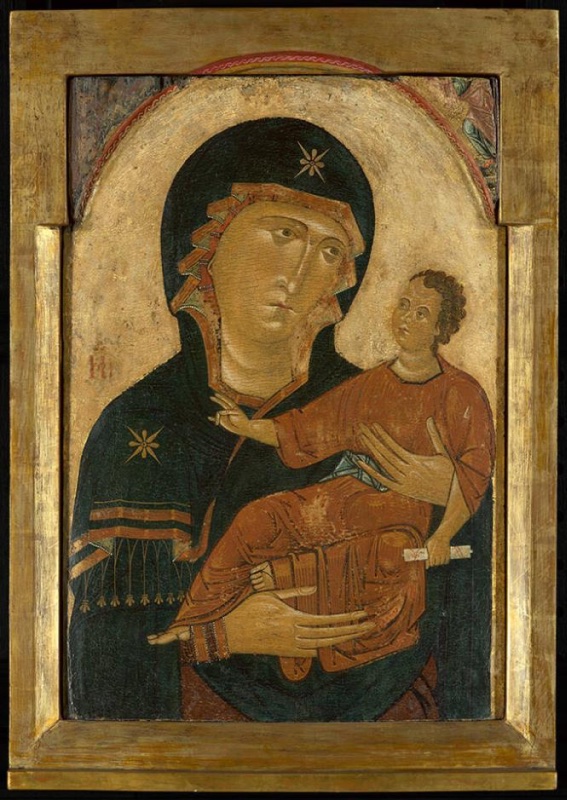
This panel in Raleigh is a clear example of how the Berlinghieresque corpus has been revised over the past seventy years. The museum’s first director published it in 1957 as a Madonna by Berlinghiero. The museum’s records show that it entered the collection the same year, with the inventory number GL.57.16.1. Later scholars catalogued it as a late autograph work of around 1230, while Garrison assigned it to the school of the master. The museum now presents it, in its collection database, as a product of Berlinghiero’s workshop, with a broad date of about 1225–1250. Its title also records that it was originally the central element of a triptych. Like the Cleveland tabernacle, it was once flanked by wings that are now lost, and it should be read as part of a larger devotional ensemble.
The composition follows the Byzantine type of the Hodegetria. As the museum’s educational text explains, “The Virgin Mary gestures toward the infant Jesus in this painting, indicating that he is the way to find salvation. The name “Hodegetria” in the title refers to the Virgin Mary and means “she who points the way.”” As in the Metropolitan Museum panel, the Child sits on his mother’s left arm, the canonical arrangement and the mirror image of the Pisan Madonna di sotto gli organi. The Virgin is shown half-length against a gold ground, filling almost the full width of the field, with the Child placed high on the right so that the two heads form a descending diagonal across the upper half of the panel.
The shape of the panel is an important part of its design. The painted field ends in a round arch, outlined by a red band with a fine white ornamental motif, and the gold ground within the arch serves as a single great halo for the Virgin. In the triangular spandrels between the arch and the rectangular edge of the panel, small figures were originally painted, which the museum identifies as an Annunciation. Today the left spandrel is almost entirely lost, and the right one keeps only a fragment of a figure in green and red drapery. The surviving traces are too worn for a confident reading. Placing the Annunciation above the Virgin and Child would have made the Incarnation the theme of the whole panel, from the angel’s announcement to the Child held in his mother’s arms.
The Virgin’s dark blue-green maphorion covers her head and shoulders and is marked with eight-pointed gold stars on the forehead and the shoulder. The museum offers a devotional reading of these signs: “The Virgin Mary’s fringed veil is decorated with stars to show that she is the “Star of the Sea” (the meaning of the Jewish form of her name, Miriam) and as a reminder that she is as constant as the North Star, which represents guidance, hope, and inspiration.” In the Byzantine tradition from which the motif derives, the stars more commonly signify her perpetual virginity. The two readings belong to different strands of Marian devotion and need not exclude each other. On her left shoulder, the maphorion carries orange stripes and a row of small hanging tassels, a richly detailed fringe that is one of the distinctive features of this panel.
The Virgin’s face is a long oval framed by an orange-red inner border with gold hatching. It shows the facial type associated with Berlinghiero’s circle: a long straight nose continuing the line of the brows, large almond-shaped eyes under heavy lids, a small closed mouth and a narrow chin. Her gaze is directed past the viewer and slightly to the side, not at the Child, with the restrained melancholy that characterises the New York Madonna. Only the letters ΜΡ of the Greek monogram of the Mother of God survive in red at the left of the field. The corresponding ΘΥ on the right is no longer visible, probably lost to abrasion of the gold ground.
The Child wears an orange-red robe, with a blue-green garment visible at the chest and waist. He raises his right hand towards his mother in blessing and holds in his left hand a small white scroll tied with red. His head, with short curling hair, is turned in three-quarter view and slightly lifted. He is the infant philosopher of the Byzantine tradition, small in scale but with the bearing of the divine Word. The pose closely recalls that of the Child in the Metropolitan Museum panel, with the blessing hand, the scroll and the seated, upright posture. This confirms the derivation of both images from a common model or a common stock of workshop patterns.
The Virgin’s hands are drawn with the long, elegant contours typical of the Lucchese Byzantinising manner. Her left hand rests against the Child’s body at his side, steadying him. Her right hand lies low across the front of the composition, fingers extended towards the Child, both supporting him and making the Hodegetria’s indicating gesture. The two hands thus frame the Child from below and from the side, enclosing him within the Virgin’s protective presence. They also direct the viewer’s eye to him as the focus of the image, as the museum’s reading of the gesture suggests.
The condition of the panel affects any stylistic judgement. The gold ground is heavily worn, revealing the reddish bole beneath in many places. The Child’s robe and the lower part of the Virgin’s mantle show extensive abrasion, and a fine network of cracks runs across the paint surface. The faces and hands are better preserved and allow the main features of the style to be assessed. The plain gilded frame that now surrounds the panel appears to be a later addition. It encloses the original arched field and the damaged spandrels without reconstructing the lost wings.
The comparison with the Metropolitan Museum panel is central to the attribution. The 1957 publication of the Raleigh panel itself compared the two works, and both share the type, the composition, the facial features and the treatment of the hands. Differences in execution, however, explain why most scholars have stopped short of giving the Raleigh panel to Berlinghiero himself. The drawing of the Virgin’s face is somewhat harder and more schematic than in New York, and the transitions of modelling less subtle. The decorative details, such as the striped and fringed border of the maphorion, are treated with a more insistent ornamental emphasis. These features fit the hypothesis of a workshop painter working closely from the master’s models, perhaps after his death, more readily than that of an autograph late work.
The Raleigh Madonna nonetheless has considerable historical value. It shows how the formulas Berlinghiero established in Lucca were reproduced and adapted in his workshop for the triptychs and tabernacles that served private and monastic devotion in the second quarter of the thirteenth century. It was once part of a larger ensemble, with an Annunciation above and wings now lost. Its central image repeats, with small variations, the model represented by the Metropolitan Museum panel, and its execution bears the marks of the shop’s collective practice. In this sense it is evidence less of a single artistic personality than of a family enterprise, which carried the Byzantine-Lucchese idiom of its founder well beyond his lifetime.
The Workshop Crosses: Tereglio, Villa Basilica and the Problem of the Bottega
The painted crosses of the Lucchese territory associated with the workshop pose the sharpest problems of attribution, and also the most instructive. The most important is the cross in the church of Santa Maria Assunta at Tereglio, in the upper Serchio valley, in the comune of Coreglia Antelminelli. According to local tradition, recorded in the monograph published on the occasion of its restoration in 1998, it originally belonged to the church of San Martino in the small castle-village of Bori, or Alborio, near Tereglio. It came to Tereglio after the village was destroyed in the second half of the fourteenth century.
The later history of the cross is unusually well documented at the parish level. A memorandum of 1808 records that in 1728 it hung plain and bare on the wall of the church, with only a small lamp lit before it on Fridays thanks to a benefactor’s alms. After disputes within the parish community that reached the archbishop, it was placed in 1766 on the altar of the Crucifix, displacing a carved crucifix. It was later enclosed in a gilded case which, as the 1998 monograph observes, made it almost inaccessible and withheld it from scholarly attention. The restoration, promoted by a local Lions Club in collaboration with the Soprintendenza, was completed in 1998, and the cross was then exhibited at the Museo Nazionale di Villa Guinigi.
Like the Lucca cross, the Tereglio cross shows the Christus triumphans against a blue cross with a gold ground and a pearled border. Its programme is more archaic in some respects and more inventive in others. In the lateral panels the two mourners stand above two Passion scenes, the Capture of Christ and the Holy Women at the Tomb. The Evangelist symbols occupy the square terminals of the crossbar, above and below Christ’s hands. The upper terminal contains a half-length Christ blessing and holding an open book between two angels, his gilded nimbus filling a semicircle that rises above the rectangular field. In the suppedaneum the Denial is divided by Christ’s feet, with Peter on one side and the servant girl on the other.
Sandberg-Vavalà, who devoted a long analysis to the cross, considered it the closest of all the Berlinghieresque crosses to the signed cross of Santa Maria degli Angeli. Among other things, she noted that certain scenes, the Denial in particular, appear to depend on the same cartoons as the signed work. She also detected a move away from Byzantine models compared with the Lucca cross, in both style and iconography, and judged the solution of the upper terminal a great success, one that found favour with the other members of the workshop. Her conclusion was carefully balanced. The cross was either an early and somewhat careless work by Berlinghiero himself, or the work of a less experienced hand under his direct supervision. Garrison assigned it to the school of Berlinghiero and dated it between 1235 and 1245. Caleca stressed its close affinity with the work of Bonaventura while ranking it among the finest products of the group, and Bonaventura’s authorship has since been argued by others as well.
The 1998 restoration changed the terms of the debate. The accompanying monograph reports that the extensive repaintings noted by earlier scholars had concealed a pictorial quality of a decidedly high level and an unexpectedly good state of preservation. It argues that the undeniable correspondences with the Lucca cross reflect the coherent restatement of models revisited by the same author with new experience a few decades later, rather than the serial repetition of workshop formulas. With due caution, and bearing in mind that medieval workshops normally involved several hands in a single work, the authors concluded that it did not seem rash to propose a decisive participation of the master in the execution as well as the design. More recently, the cross has been attributed to a collaboration between Berlinghiero and the anonymous Master of the Cross no. 434 and dated shortly before the middle of the thirteenth century. The proposed dates thus range from the master’s last years to the decade after his death, and a date of about 1235–1245, within the orbit of the master and his eldest collaborators, is perhaps as precise as the evidence allows.
Painted Cross (Tereglio Cross)
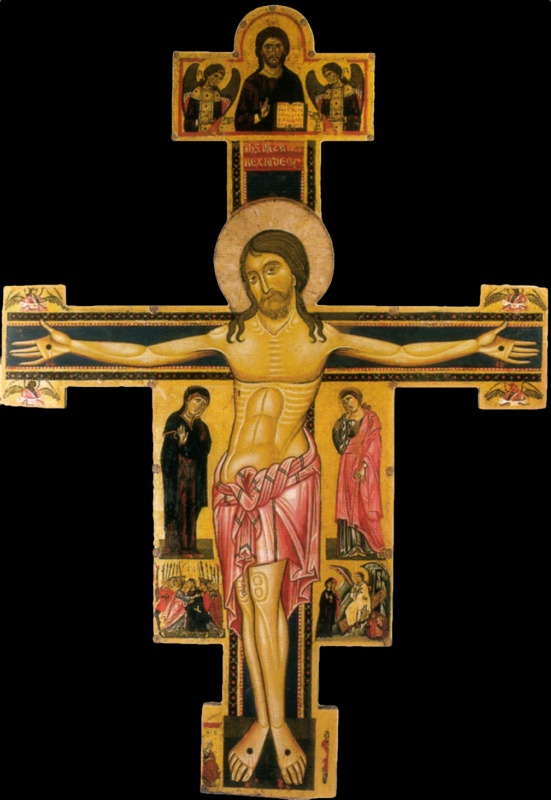
The Tereglio Cross is the most complete and best preserved of the painted crosses connected with the Berlinghieri workshop outside the two signed works of Berlinghiero. It preserves all the main parts of the Lucchese type. These are the long vertical shaft with the body of Christ; the horizontal arm ending in square terminals; the widened lateral fields with the mourners and two narrative scenes; the cimasa with the titulus below it; and the suppedaneum at the foot. This completeness makes it an invaluable document of how the workshop organised a monumental cross in the years around Berlinghiero’s death. The 1998 restoration, which removed extensive repaintings, has also made it one of the most legible.
Christ is shown against a dark blue cross, edged with red bands set with rows of white pearls, the ornamental device the ministerial catalogue considers a trademark of the Berlinghieri shop. His eyes are open, so in type he remains a Christus triumphans. Yet the figure departs noticeably from the rigid frontality of the Lucca cross. The head, under a large gilded halo, inclines towards Christ’s right shoulder, and the long dark hair falls in wavy strands onto the shoulders. The face has a grave, almost melancholy expression. The arms extend horizontally along the crossbar, with nail wounds in the open palms, and the long, slender legs descend to feet nailed separately to the suppedaneum.
The anatomy of the torso is more elaborate and more expressive than in the Lucca cross. The chest is articulated by a pattern of ribs drawn in curved lines. The abdomen is divided into rounded swelling segments and pushed outward, giving the body a slight sway that anticipates the curving silhouette of the Christus patiens. The loincloth is a long pink garment, knotted at the waist and falling below the knees in crisp, angular folds highlighted in white. Sandberg-Vavalà noted a move away from Byzantine models compared with the Lucca cross. It is visible here in the greater sense of weight and volume, and in the way the body seems to hang from the arms rather than simply stand before the cross.
The lateral fields are divided into two zones. Above, the Virgin and Saint John stand at full length as mourners against the gold. The Virgin, on Christ’s right, is wrapped in a dark maphorion and raises one hand in a gesture of grief. Saint John, on the other side, wears a bright pink mantle over a blue tunic and lifts his hand to his cheek, his head inclined in sorrow. Below them, two small narrative scenes return to the Passion cycle that Berlinghiero had removed from the Lucca cross. On the left is the Capture of Christ, a crowd of soldiers with spears and lanterns pressing around Christ and Judas. On the right are the Holy Women at the Tomb, with the angel seated in white on the empty sepulchre before the women and the sleeping guards.
The combination of full-length mourners and narrative scenes is one of the features that makes the Tereglio Cross, as noted above, both more archaic and more inventive than the Lucca cross. The return of Passion scenes recalls the twelfth-century Lucchese tradition of crosses with densely narrative lateral panels. The choice of subjects, however, is pointed. The Capture marks the beginning of the Passion and the Holy Women at the Tomb its outcome in the Resurrection. Placed on either side of Christ’s body, they frame the image of the Crucifixion within the larger story of Christ’s death and victory.
The cimasa is particularly successful. In the centre Christ appears half-length, blessing with his right hand and holding an open book in his left. His gilded nimbus fills a semicircle that rises above the rectangular field of the cimasa, giving the top of the cross a distinctive arched profile. On either side stand two angels in richly jewelled court costume, a Byzantine motif that lends the scene an imperial solemnity. Sandberg-Vavalà considered this solution a great success that found favour with other members of the workshop. Directly below, a black field carries the titulus in red letters, naming Jesus of Nazareth, King of the Jews.
The symbols of the four Evangelists occupy the corners of the square terminals at the ends of the crossbar, as small winged figures painted on gold, two above and two below the level of Christ’s hands. In the suppedaneum the Denial of Peter is divided by Christ’s feet, with Peter on one side and the servant girl on the other. It is the same episode that Berlinghiero placed at the foot of the Lucca cross. Sandberg-Vavalà believed that some of these scenes depended on the same cartoons as the signed cross, which points to a workshop practice in which models were reused and adapted over many years.
The history of the cross after the Middle Ages is unusually well documented at the parish level. Its survival owes much to the devotion and the disputes of the Tereglio community. According to local tradition, the cross came from the church of San Martino at Bori, or Alborio, a castle-village destroyed in the second half of the fourteenth century. Parish records describe it hanging bare on the wall of the church in the early eighteenth century, honoured only with a small lamp on Fridays. In 1766, after a dispute that reached the archbishop, it was placed on the altar of the Crucifix. Later enclosed in a gilded case, it remained almost inaccessible until the restoration completed in 1998.
The attribution of the cross has been one of the most debated questions in Berlinghiero studies, and the debate is not closed. Sandberg-Vavalà hesitated between an early, somewhat careless work by Berlinghiero and the work of a less experienced hand under his supervision. Garrison placed it in the school of Berlinghiero, and Caleca stressed its affinity with Bonaventura. The 1998 restoration monograph, impressed by the quality revealed by the cleaning, argued for a decisive participation of the master himself, returning to his models after some decades. Most recently, a collaboration between a member of the Berlinghieri family and the anonymous Master of the Cross no. 434 has been proposed. The divergence of these opinions reflects the collective nature of the workshop more than the shortcomings of any one view.
Whatever its precise authorship, the Tereglio Cross documents a crucial phase in the history of the Lucchese painted cross. It keeps the triumphant, open-eyed Christ and the ornamental vocabulary established by Berlinghiero. It combines them with a heavier, more swaying body, a more emotional treatment of the mourners and a renewed interest in narrative. In this it shows the workshop responding, around the time of its founder’s death, to the same currents that were transforming Tuscan painting under the influence of Giunta Pisano and the Franciscan devotion to Christ’s humanity. Its remarkable state of preservation, recovered in 1998, makes it the best surviving witness to the Berlinghieri workshop’s monumental production in the decades between the signed crosses of the father and the later works of the sons.
Technique and Materials
The technical evidence for Berlinghiero’s painting is less abundant than one would wish, but it is not negligible. All the works associated with him are painted in egg tempera on wooden supports prepared with gesso, and the crosses and icons are gilded. The Cleveland tabernacle is painted on poplar, the wood most commonly used for Tuscan panels. The crosses are composite constructions whose shaped silhouettes were built up from joined boards and, in some cases, supporting frameworks. The ministerial record for the Lucca cross describes its material as panel, framework and tempera.
The 1998 monograph on the Tereglio cross remains the most detailed technical study of any work of the circle. It devotes separate chapters to construction, state of preservation, petrographic and chemical analysis, and metrical and proportional composition. The exhibition notice issued at Villa Guinigi records that the restoration recovered a brilliant polychromy of gold and lapis lazuli and gave new naturalness to the refined rendering of anatomical detail.
The use of lapis lazuli deserves emphasis. Natural ultramarine was the most costly pigment of medieval painting, imported from distant mines through the trade routes of the Levant. Its presence on a cross in a mountain church of the Serchio valley says something about the resources of Lucchese patrons and about the commercial reach of a city whose merchants were active across the Mediterranean. The blue on which the body of Christ is set therefore had material as well as symbolic value.
Certain features of the handling recur in all descriptions. They are the white highlights laid in fine hatching over darker underlayers, the firm control of contour, and the precision of the ornamental borders with their rows of white pearls on red. Sandberg-Vavalà’s observation that the Tereglio Denial seems to reuse the cartoons of the Lucca cross points to a workshop practice in which patterns were transmitted, adapted and repeated. This accords with what is known of the organisation of thirteenth-century painters’ shops. In such a system the autograph work of the master is a matter of degree rather than an absolute category, and any attempt to distinguish father from sons must work with probabilities.
The Sons: Bonaventura, Barone and Marco
The documentary record of the sons is far richer than that of the father, and it gives the workshop its historical depth. Bonaventura, the most important of them, first appears in the peace oath of 1228 with his father and brother. The Enciclopedia dell’Arte Medievale records further documents concerning him in 1232, 1244, 1250, 1266 and 1274. His only certain work is the large panel with Saint Francis and scenes of his life in the church of San Francesco at Pescia, signed and dated 1235 with the formula in which he names himself son of Berlinghiero of Lucca.
The Pescia panel is famous above all for its iconographic priority. It is the earliest surviving example of the historiated panel in which the standing figure of the saint is surrounded by scenes of his miracles in life and after death. The tall, rigidly stylised figure of Francis, the earthy tones and the Byzantine iconographic details continue the father’s manner. The six small narrative scenes, two from the saint’s life, the Sermon to the Birds and the Stigmatisation, and four posthumous miracles of healing, are freer in language and sober in their narrative tone. An eighteenth-century source records a second, now lost image of Francis painted by Bonaventura for the church of Guiglia near Modena, and further paintings have been attributed to him on stylistic grounds.
For the present essay the Pescia panel matters in two ways. Its date, 1235, falls in the last year in which Berlinghiero is documented alive. Caleca also used it as the principal comparison for dating the Fucecchio cross. Father and son thus appear working in parallel, in closely related idioms, at the moment when the workshop was taking up the most urgent new subject in Italian religious art.
Barone is the most obscure of the three. The Enciclopedia dell’Arte Medievale considers him possibly the eldest. He appears in documents connected with significant commissions: in 1243 a panel for the archdeacon of Lucca, in 1256 a crucifix for Casabasciana in the territory of Bagni di Lucca, and in 1282 a crucifix, a Madonna and a Saint Andrew for the Lucchese church of Sant’Alessandro. No signed work survives, and the same entry judges that attempts to attribute paintings to him have so far proved vain. The span of his documented activity, from 1228 to 1282, is remarkable. It means that the workshop founded by Berlinghiero remained active for almost half a century after his death.
Marco, perhaps the youngest, is documented in Lucca in 1232, 1236 and 1239. He is the only member of the family whose activity can be connected, with some probability, with manuscript illumination. Two documents of 1250 record a Bible he executed for the hospital of San Martino in Lucca. Garrison identified it with the first manuscript of the Biblioteca Capitolare of Lucca, a codex the Dizionario Biografico calls certainly Berlinghieresque.
Garrison also identified him with the “Marcus pictor de Luca” who decorated a sacramentary for the abbey of Camaldoli, now in the British Library, and with a Marco da Lucca paid in 1255 for painting in the chapel of the Palazzo del Podestà in Bologna. According to the Enciclopedia dell’Arte Medievale, a “Marcus pictor” was enrolled in Bologna in 1259 in the Società dei Toschi5, the association of Tuscans in the city. These identifications rest on the improbability that two painters of the same name and origin were working in Bologna at the same time. The attribution to Marco of the fresco of the Massacre of the Innocents in the church of the Holy Sepulchre within the Santo Stefano complex, published by Garrison in 1946, is described by the Enciclopedia dell’Arte Medievale as plausible but not entirely certain. If these identifications hold, Marco carried the family idiom into the Apennine monastic world of Camaldoli and into the civic sphere of Bologna, far beyond the walls of Lucca.
It should be said clearly that no manuscript illumination can be securely attributed to Berlinghiero himself. The manuscripts associated with the family are given to Marco. The link between the father and the art of the book rests on the cultural argument for his Volterran-Pisan formation, not on any surviving miniature by his hand. Any account that presents Berlinghiero as an illuminator goes beyond the evidence.
Between Byzantium and Giunta: Berlinghiero’s Place in Tuscan Painting
Berlinghiero’s historical position can be described in two complementary ways. In the first, he is the last great exponent of a Tuscan painting that still looked to Byzantium for its models of form and colour, immediately preceding Giunta Pisano, Coppo di Marcovaldo and, later, Cimabue. In the second, he is the founder of the first well-documented painting workshop in Tuscany, whose organisation, repetition of models and family succession anticipate the bottega system of the later Florentine and Sienese tradition. Both descriptions are true, and the tension between them defines his significance.
His relationship to Byzantine art is not that of a provincial copyist. The Hodegetria type, the white-hatched highlights, the elongated faces and the star-marked mantle are used with full understanding of their function. They are combined with iconographic decisions rooted in the Lucchese tradition and the needs of local patrons: the full-length mourners, the elimination of narrative panels, the Assumption in the upper terminal. The Dizionario Biografico records a historiographical dispute on precisely this point. One early twentieth-century survey denied that his culture was neo-Hellenistic Byzantine, while Sandberg-Vavalà, writing in 1938, affirmed that it was. The entry’s own formula, Byzantine technique joined to a Western poetic sensibility, remains the most balanced judgement.
His relationship to Giunta is that of an older master who, in his final years, absorbed the new pathetic language that the younger Pisan had developed under the influence of Franciscan spirituality. The Fucecchio cross makes this clear. Berlinghiero never took the decisive step to the Christus patiens, and his crosses always show Christ alive. But the softened contours, the more natural proportions and the heightened emotion of the Fucecchio mourners show that he understood the direction in which Tuscan painting was moving. Through his workshop that transition was carried forward, and the later works of the circle bear the Byzantine-Lucchese idiom into the decades in which the dead Christ became the norm.
His relationship to Florence is the hardest to define. The Dizionario Biografico asserts that the influence of his school was felt in Pisa and Florence as well, and the history of attribution confirms that early Florentine painting was long confused with Lucchese work. The Bigallo cross, once given to Berlinghiero, and a group of panels once assigned to Barone were later judged by an eminent critic to be the work of a Florentine painter of around 1240 who had emerged from Lucchese culture, a generation before Coppo di Marcovaldo. The reattribution captures something essential. Before Florence developed an independent tradition of panel painting, Lucca was, as the Cleveland Museum notes, the most important artistic centre in Tuscany, and Berlinghiero’s workshop was its most influential producer of painted images. When Coppo and Cimabue later transformed Tuscan painting, the inherited language they transformed was in part the language that Berlinghiero and his sons had established.
Historiography and Critical Fortune
The modern reception of Berlinghiero followed the general fortunes of the so-called primitives. The Dizionario Biografico remarks that the long devaluation of medieval painting, from the fourteenth century until Romanticism, was followed by a rediscovery of the primitives. That rediscovery gave the work of Berlinghiero and his son Bonaventura a prominence perhaps exaggerated in relation to its merits, and it is that prominence which more recent criticism had reduced. The judgement is itself a document of the 1960s, when the early Duecento was often measured against the later revolution of Cimabue and Giotto. It should be weighed against later studies, which have tended to restore Berlinghiero’s importance by revealing the sophistication of his Byzantine sources and the coherence of his workshop’s production.
The nineteenth century established the main elements of the story, and some of its errors. Lucchese antiquaries published the signature of the Lucca cross and the first notices of the family. The Pisan writer of 1812 described the Fucecchio cross without recognising its author. The English survey of the 1860s produced the Milanese misreading. In the early twentieth century the attributed corpus expanded rapidly and often uncritically. The Straus Madonna was attributed in 1927, the Bigallo cross and other Florentine works were annexed to the Lucchese circle, and “the Berlinghieri” became a label for an entire region and period.
Sandberg-Vavalà’s typological studies of 1928 and 1929 provided the first systematic framework for the crosses. Garrison’s work of the 1940s and early 1950s was a deliberate act of purification. His 1951 article opened by deploring the innumerable errors and confusions that earlier writing on Lucchese painting had credulously perpetuated, and it set out a programme founded on archival research. With the help of archivists in Lucca, Pisa and Bologna, Garrison put the study of the family on a documentary footing. He corrected the name, reinterpreted the oath of 1228, attributed the Pisa Madonna and reconstructed Marco’s activity as illuminator and fresco painter.
The decisive late twentieth-century contribution came from Caleca. His recovery of the Fucecchio signature in 1981 doubled the number of signed works and, through the word Vulterranus, gave the painter a birthplace and a cultural context. His 1992 entry for the Enciclopedia dell’Arte Medievale remains the most balanced synthesis of the evidence. It joins the documentary data published in 1980 to a cautious assessment of the attributed corpus and a clear warning about the difficulty of distinguishing father from sons. The restoration of the Tereglio cross in 1998, which reopened the question of the master’s direct involvement, shows that the corpus is not closed. Technical study of works long hidden under repaint or inside reliquary cases can still alter the picture.
Conclusion: The Measure of a Founder
What, in the end, can be said with confidence? Berlinghiero was born in Volterra, probably in the last quarter of the twelfth century. He was formed in the Byzantinising milieu of western Tuscany, whose greatest surviving monument is the Calci Bible. He settled in Lucca, where by 1228 he was a citizen with adult sons who were themselves painters, and he was dead by 1236. He signed at least two crosses, one for a Lucchese monastery and one for a Benedictine abbey in the Lucchese diocese. Together they trace a development from a hieratic and refined Byzantinism to a softer, more pathetic idiom informed by the work of Giunta Pisano. A small group of Madonnas and a portable tabernacle can be attributed to him with varying degrees of probability. They reveal a painter who mastered the Byzantine icon types and gave them an introspective gravity of his own. He founded a family workshop whose members carried his manner to Pescia, to Camaldoli and to Bologna, and which remained active in Lucca into the 1280s.
It is equally necessary to say what cannot be said. The date and place of his death are unknown, and his birth is a demographic estimate. No record places him in a Pisan or Volterran workshop, and no illuminated page can be given to his hand. The Madonna di sotto gli organi rests on a few surviving passages beneath centuries of restoration, the New York Madonna on stylistic comparison alone, and the Cleveland tabernacle and the Raleigh panel on a judgement about how much of the work belongs to the master and how much to the shop. Even the date of the signed cross in Lucca depends on the absence of a pathos that appears later. The secure biography is short, and the painter described here is largely assembled from objects. This is not a reason for despair, but it does require that each statement be given the weight of its evidence and no more.
The two signed crosses give that assembly its framework. The cross from Santa Maria degli Angeli shows a painter at the height of his Byzantine training, with a Christ of hieratic calm, a head enlarged by hierarchical emphasis and a surface of jewel-like colour. The cross from Fucecchio, painted a decade or two later, shows the same painter inclining the head of Christ, thinning his body, lightening the loincloth and letting the mourners lean towards the cross with hands raised to their cheeks. Between these two points lie the Madonnas, the tabernacle and the workshop crosses, and every attempt to order them chronologically has taken the two signed works as its fixed poles. That so much of his career can be read as a movement between them, from an image of authority to an image that invites compassion, is the most persuasive argument that the corpus, however disputed at its edges, is the record of one developing artistic intelligence.
The same corpus shows how thoroughly a medieval painter’s output depended on his shop. Models were reused, as the Denial of Peter on the Tereglio cross suggests, and ornamental devices such as the pearled border recur across crosses, panels and a small tabernacle. A painter who trained his sons in the same repertory, and who was surrounded by pupils and assistants whose names are unknown, could not leave a body of work that divides cleanly into autograph and workshop pieces. The oscillation of opinion about Tereglio, between the master, his eldest son and an anonymous collaborator, is therefore not a failure of method. It records the way such objects were actually made. Berlinghiero’s authorship should be understood as the authority under which a shop worked, exercised through design and supervision as much as through the brush.
The conditions that made this possible were those of Lucca itself. A wealthy commercial city, proud of its Volto Santo and densely supplied with churches, monasteries and hospitals, created a steady demand for monumental crosses, devotional icons and portable altarpieces. The lapis lazuli recovered on the Tereglio cross, the gilding of the Pisan Madonna and the private tabernacle now in Cleveland all point to patrons who were willing to pay for materials and expertise of the highest order, from the cathedral and the great monasteries to the households of individual donors. Berlinghiero met this demand by joining a Byzantine vocabulary, learned in western Tuscany, to the iconographic habits of Lucchese devotion. The result was an art that suited the city’s liturgy and its civic pride, and that proved flexible enough to accommodate the new figure of Francis within a few years of his canonisation.
The history of the scholarship offers a last measure of the man. The patronymic mistaken for a surname, the “Milanese” born of a misread genitive, the signature hidden beneath later inscriptions and the terminal of a cross lying for decades in storage under the label “Russian-Byzantine School” each show how easily a painter can be lost to the very tradition that preserved his work. Garrison’s archival revision, Sandberg-Vavalà’s typology and Caleca’s recovery of the Fucecchio signature each restored something that earlier writers had taken away. The restoration of the Tereglio cross in 1998 shows that this work is not finished. Cleaning, technical analysis and the study of works still hidden in parish churches and private collections may yet add to the corpus, adjust its chronology or alter the balance between father and sons. The picture drawn here is the best that the present evidence allows, and it remains open to correction.
None of this makes Berlinghiero a revolutionary in the sense in which the word is applied to Giotto, or even to Cimabue. But a founder is not measured by novelty alone. At a moment of exceptional religious and civic intensity in Tuscany, Berlinghiero established a pictorial language capable of bearing the weight of the Lucchese cult of the crucified Christ and of the new devotion to Francis of Assisi. He also created the institutional form through which that language could be reproduced and handed on: a family bottega with shared models and recognisable ornamental signatures. Read at Villa Guinigi, the words at the foot of the cross from Santa Maria degli Angeli sound less like a boast than like a quiet record of authorship. It marks the point at which the history of Tuscan painting begins to have not only works but also names.