Maestro di Cesi
( 25% )
Introduction: An Anonymous Painter and a Question Mark
The Maestro di Cesi was the leading Spoletan painter of the generation formed in the workshops of Assisi around 1290, and Andrea De Marchi and Alessandro Delpriori propose that he is the same artist as the so-called Primo Maestro della Beata Chiara da Montefalco, who in 1333 painted the great Crucifixion and the right wall of the Cappella di Santa Croce at Montefalco. Both statements need qualification, and much of what follows is devoted to that qualification. The painter has no name, no recorded biography and no known contract; every work given to him has been assembled around a single dated panel, and the hypothesis that unites him with the Montefalco master rests on the comparison of styles rather than on any document. Yet the body of work that has gathered under his conventional name over the last century is among the most coherent and the most rewarding in the whole of early fourteenth-century Umbria, and it illuminates with unusual clarity how the revolution of Assisi was received, transformed and put to devotional use in a region that possessed its own strong pictorial traditions.
Few areas of Italian painting around 1300 combine so many surviving objects with so few names and documents as the old Duchy of Spoleto. The territory runs from the broad Valle Umbra up the narrow valley of the Nera into the Sibillini mountains, and its cultural reach spilled across the Apennines into the southern Marche and Abruzzo. Its parish churches, convents and rural chapels still preserve, or preserved until recently, an exceptional quantity of painted crosses, shuttered tabernacles, dossals and fresco cycles from precisely those decades in which the Franciscan basilica at Assisi was the most important painting site in Europe. Almost all their makers are anonymous. Earthquakes, the suppression of religious houses after Italian unification and the dispersal or destruction of local archives have stripped away the documentary record, so that modern scholarship has had to rebuild artistic personalities from the evidence of style alone and to give each of them a conventional name, the German Notname, drawn from a key work or a place.
The Maestro di Cesi is one of the most important of these reconstructed artists. His name derives from a single dated and inscribed panel in the small hill town of Cesi, above Terni, commissioned in 1308 by a woman called Elena. Around this fixed point scholars have gathered a monumental winged tabernacle from a Spoletan convent, now in Paris; a large painted cross in Spoleto; a Madonna from Vallo di Nera regarded as dated 1315; a dossal from the Valnerina; and a growing number of crosses, panels and fresco fragments scattered along the Nera valley and around Montefalco. The result is a painter of real stature, whose career appears to begin in the last decade of the thirteenth century and to extend, if the Montefalco hypothesis is accepted, well into the 1330s.
The central problem of present research is the painter’s identity. For several decades the frescoes painted in 1333 in the Cappella di Santa Croce, the apse of the old church in which Chiara of Montefalco died in 1308, were divided between two anonymous hands, a First and a Second Master of Blessed Clare. More recently Andrea De Marchi has proposed, in a catalogue entry of 2007, that the First Master is the Maestro di Cesi in his old age, and Alessandro Delpriori, in his 2015 monograph on the fourteenth-century school of Spoleto, devoted to the problem a chapter whose title deliberately keeps the question open: “Dal Maestro di Cesi al Primo Maestro della Beata Chiara da Montefalco: un percorso unitario?” The identification is therefore not settled but a hypothesis to be tested.
The essay proceeds thematically. It begins by correcting a confusion about where the name-piece actually is, then examines in turn the dated dossal of Cesi, the Stella triptych and its iconography, the painted cross that appears to have formed a pair with it, the wider corpus of panels and frescoes, and the technical evidence for how the painter worked. It then reconstructs his formation between Assisi, Rome, Spoleto and Siena, sets him within the political and religious world of the Duchy around 1300, and turns to Chiara of Montefalco, the 1333 commission of the Cappella di Santa Croce and the division of hands on its walls. A sustained discussion of the arguments for and against the identification is followed by a short history of how the painter came to be reconstructed, and by a conclusion that sets out what is known, what is probable and what remains open.
Two limits govern everything that follows. First, no archival document names this painter or connects him with any of the works discussed, so that every attribution, however well founded, is an inference from style. Second, several of the older studies that first defined his catalogue could be consulted only through later citations, catalogue entries and summaries rather than in full; wherever that limitation affects a statement, it is noted. Throughout, the aim is to distinguish what the objects and the documents establish from what scholars have inferred, and both from what remains conjecture.
Correcting the Record: Cesi, Spoleto and Paris
A recurrent confusion places the Cesi altarpiece in the Musée Marmottan Monet in Paris. The sources do not support this, and the reasons for the mistake are instructive, because they reveal how the painter’s catalogue was built. The dated panel of 1308 that gives him his name has never left Umbria, except during the years when it was missing after a twentieth-century theft. It belongs to the Archdiocese of Spoleto-Norcia, and after its restoration in 2012 and periods of exhibition in Terni it returned to the parish church of Santa Maria Assunta at Cesi, where it now hangs in the chapel of the Santissimo Sacramento, to the right of the high altar.
The Paris panel is an entirely different and considerably larger object. It is a winged tabernacle whose central field shows the Assumption of the Virgin in the arms of Christ and whose shutters carry eight scenes of the Virgin’s Dormition. It came from the convent of Santi Stefano e Tommaso, known as “della Stella”, in Spoleto. It belongs to the Académie des Beaux-Arts of the Institut de France through the bequest of Béatrice Ephrussi de Rothschild, and since 1993 it has been on deposit at the Musée Marmottan Monet, placed there by the Fondation Ephrussi de Rothschild. In the literature it has become known as the Stella triptych or Stella altarpiece, after its convent of origin.
The relationship between the two works runs in one direction only. The triptych was attributed to the Maestro di Cesi by comparing it with the Cesi dossal, not the other way round. The two objects form the twin pillars of the catalogue: the Cesi panel secured by its inscription and date, the Stella triptych by the judgement of connoisseurs who recognised the same hand in it. The confusion between them is easy to understand. The Paris triptych is by far the best-known work of the master outside Italy, it is exhibited under his name in a famous museum, and in reproductions and online collections it is often the only image attached to the label “Maestro di Cesi”. A reader who meets the name in Paris naturally supposes that the eponymous work hangs there.
The distinction matters for more than cataloguing reasons. The Cesi dossal is a work commissioned by a laywoman for a parish setting in the southern part of the Duchy, close to Terni and to the ruins of Roman Carsulae. The Stella triptych is a work made for an enclosed community of nuns in the city of Spoleto itself. The two objects therefore represent two different audiences, two different devotional uses and, quite possibly, two different moments in the painter’s career; to treat them as one object, or to locate them in the same place, would obscure exactly the range of patronage that makes this painter historically interesting. This correction is a small instance of the method that governs the whole discussion: before interpreting, establish what each object is, where it is, and on what evidence its connection with the painter rests.
The Name-Piece: The Dossal of Domina Elena, 1308
The Cesi panel is a horizontal dossal, the long low altarpiece that stood on or behind an altar, organised around a central Virgin and Child enthroned. At the lower left of the throne kneels a small woman in a black mantle and white veil, the donor, rendered at the reduced scale that medieval painting reserved for the living patron in the presence of the sacred. Twelve smaller full-length figures flank the throne, arranged in two tiers of three on each side, each named on a red band beneath the feet. Published descriptions identify those of the upper tiers as Paul, John the Evangelist and the Archangel Michael on one side, and Gabriel, Peter and John the Baptist on the other; the lower tiers hold Bartholomew, Luke and Mark on one side, and Andrew, Thomas and Matthew on the other. The two archangels occupy the places nearest the throne in the upper tiers, so that their large dark wings, tipped with red, spread behind the Virgin and bind the flanking saints to the central image.
The company is unusual. Because two archangels and the Baptist stand among apostles and evangelists, the group does not correspond to the canonical Twelve, a divergence increased by the presence of Paul and of the evangelists Luke and Mark, none of whom belonged to the Twelve, and the selection appears to have been shaped by particular dedications, local cults or the wishes of the patron. Neither the precise logic of the programme nor the dedication of the altar for which it was made can be reconstructed from the published material, and it would be imprudent to propose one. What can be said is that the arrangement of small saints ranked in tiers around a dominant central image belongs firmly to thirteenth-century tradition, and that the painter adopted it in a work of 1308 without apparent discomfort.
The original frame survives, though damaged. Its upper band carries angels and the Tetramorph, the four symbols of the Evangelists; the lateral strips hold small standing figures in narrow compartments; and the lower band bears the inscription. Reports published after the 2012 restoration draw attention to a series of round hollows in the frame, which probably once held inserts of stone, enamel or coloured glass. If so, the panel originally presented a jewelled surface closer to goldsmiths’ work, and to the gem-studded thrones of Roman painting, than to the flat gilding of an ordinary altarpiece. That reading is an inference from the empty settings; no record of the lost materials survives, and their nature cannot be specified.
The inscription is the document on which the painter’s whole chronology depends. Local publications give it, with the abbreviations expanded, as
In nomine Domini amen. Anno Domini millesimo CCCVIII tempore domini Clementis pape V indictione VI domina Elena fecit fieri hoc opus:
in the name of the Lord, amen. In the year of the Lord 1308, in the time of the lord Pope Clement V1, in the sixth indiction, the lady Elena had this work made. Its dating elements are internally consistent, for Clement V reigned from 1305 to 1314 and the sixth year of the fifteen-year indiction cycle fell in 1308. No critical epigraphic edition has been available, however, so the forms of the letters and the marks of abbreviation cannot be described, and the transcription should be used with that reservation.
The content of the text is nonetheless unambiguous. A woman named Elena, styled domina, had the work made in 1308. The title marks her social standing, but it does not by itself identify her family, and no source consulted connects her with any known lineage of the Terni area; any such identification would be pure speculation. The panel is one of very few Umbrian paintings from the first decade of the fourteenth century to carry both a firm date and a named patron, and it is a rare record of a laywoman commissioning an altarpiece in her own name, without mention of a husband, a confraternity or a religious house.
Where the panel first stood in Cesi is uncertain, and the sources preserve two traditions. One places it in Santa Maria “de fori”, the ancient parish church of the territory that lay between Cesi and Carsulae, and a local account suggests that this church may have been restored around 1308, which would offer an attractive occasion for a new altarpiece. Another tradition places it in Sant’Angelo, that is, the church of San Michele Arcangelo near the walls of the castle, whence it passed to the town hall around 1860 and later to the sacristy of Santa Maria Assunta. The presence of Michael and Gabriel among the flanking figures might seem to favour the church of the archangel, but archangels appear frequently in Marian and apostolic settings, and the argument is at most suggestive.
The modern history of the panel is better documented. It was stolen in the twentieth century and recovered in January 1965 through the Italian state’s office for the recovery of looted works of art, then returned to the parish on 25 December 1968. An earlier campaign of maintenance had apparently made the painting harder to read, and between June and December 2012 it was restored again by a Terni conservation firm, with funding from the Fondazione Cassa di Risparmio di Terni e Narni and under the supervision of the regional Soprintendenza. It was exhibited in Terni until February 2013 and shown again in the exhibition Presenze artistiche in Umbria at Palazzo Montani Leoni, Terni, between December 2018 and February 2019. No full technical report on the support, the preparatory layers or the gilding has been available, so that statements about how the panel was made must remain general.
In style the dossal holds old and new in balance. The tiered saints and the gemmed frame look back to the thirteenth century, and observers have long sensed something Roman in its formal, hieratic order; an early survey compared it with the Roman and Assisi painting associated with Pietro Cavallini, while another opinion linked it with Giuliano da Rimini, whose dated dossal of 1307 is strikingly close in format and date. De Marchi has refined this second comparison, writing of “sottili analogie” between the Cesi master of 1308 and Giuliano of 1307: both, in his reading, build on a Giottesque foundation while retaining archaic habits, but their emotional temperature is opposite. Within the inherited format, the modelling of the faces, the weight of the bodies and the Virgin’s quiet engagement with the viewer reveal a painter who had absorbed the new manner developed at Assisi and translated it into the stately idiom of a provincial altarpiece. The Cesi panel is grave and contained where the Rimini work is warmer and more animated.
The Dossal of Domina Elena: Virgin and Child Enthroned with Archangels, Apostles and Evangelists
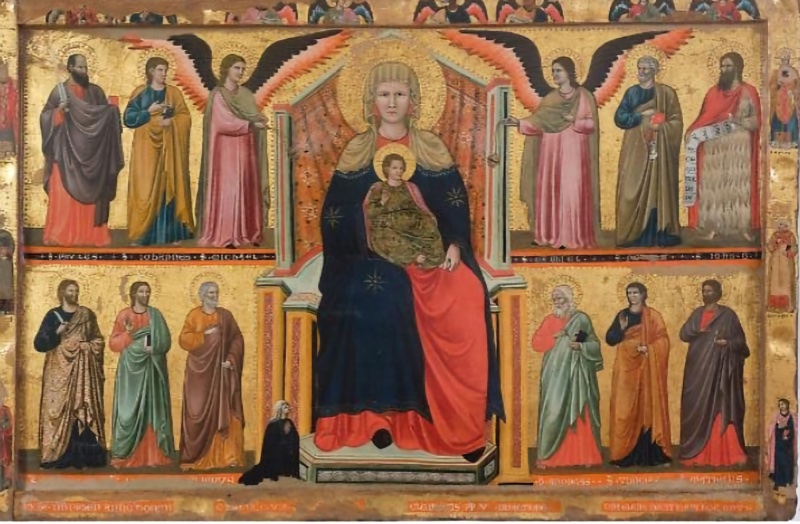
This section describes the panel as the image shows it. The inscription, the frame, the patron and the panel’s later history are treated above.
The format is a horizontal dossal, built symmetrically around a dominant central image with smaller figures in tiers to either side. The central field rises into the upper frame, so the throne and its archangels occupy the full height of the panel. The saints are set in two registers, each the height of half the panel. This scheme of a large central icon flanked by ranked saints is thirteenth-century in conception, and the painter adopts it without hesitation in 1308. The modernity of the work lies not in its structure but in how the figures are painted inside it.
The Virgin sits frontally on a tall throne, her body forming a broad pyramid of colour. Her mantle is a deep blue, nearly black in the image, marked on the shoulders with gold stars, a convention inherited from the Byzantine maphorion. Beneath it she wears a red dress whose folds spread across the base of the throne. A pale veil frames her face, which is modelled softly in light flesh tones and turned directly to the viewer. The Child sits upright on her lap in a garment of olive and gold. His head stands against a tooled halo, and his scale and bearing are those of a small sovereign rather than an infant.
The throne is one of the most carefully built passages in the panel. A high back hung with a patterned red-orange cloth is set between slender uprights in green and red. Below, a wide base with steps projects toward the viewer, so the Virgin is raised and the throne reads as an object with depth, not as flat ornament. Behind it two archangels stand close to the uprights, dressed in pink and green, with large dark wings tipped in red. The wings spread across the upper register and tie the central image to the flanking saints.
The twelve flanking figures, identified above, stand on narrow ground lines. Several attributes confirm the reading: Peter is white-haired with a short beard, the Baptist wears a hair garment under a red mantle and holds an unrolled scroll, and the evangelists and apostles carry books.
The donor kneels at the lower left of the throne, dressed in black with a white veil. She turns in profile toward the Virgin, her hands raised, and she is the one figure in the panel who looks at the sacred group rather than out at the viewer.
The colour has a deliberate range. The deep blue of the Virgin’s mantle is the darkest note in the panel and fixes the centre. Around it the saints alternate red, rose, green, ochre, mauve and gold, so that no two neighbours repeat a tone. The gold ground is tooled around the heads, and the haloes stand out against it as discs. The garments are modelled in graded tones that give the figures weight and a firm footing, a point that sets the painter apart from the flatter manner of earlier Spoletan panels.
Triptych of the Assumption and Dormition of the Virgin
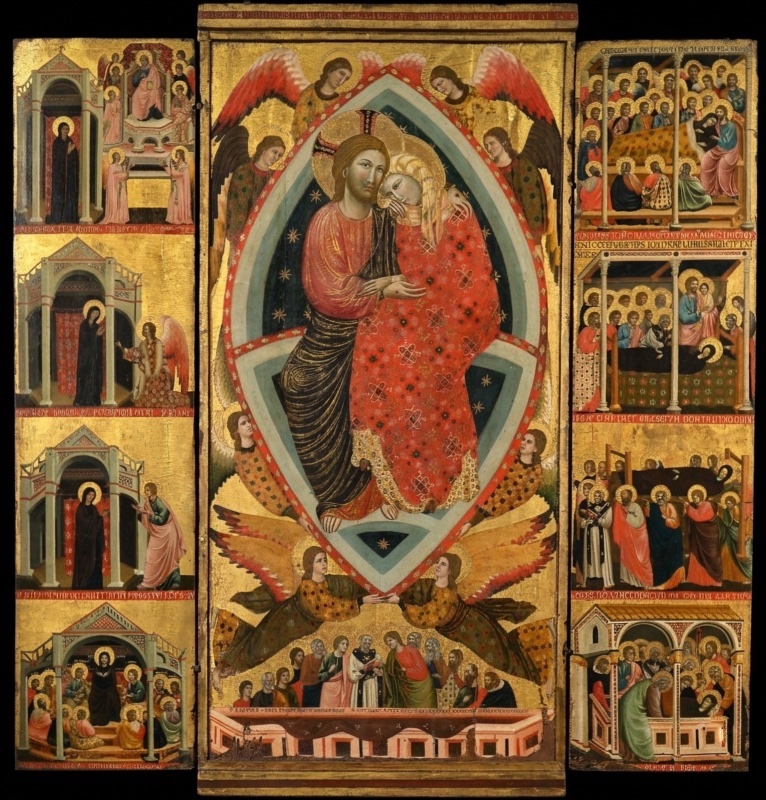
Central Panel: The Assumption of the Virgin in the Arms of Christ
If the Cesi dossal gives the painter a date, the Stella triptych gives him stature, and its central panel is the work on which that stature chiefly rests. The French repertory of Italian paintings in public collections, published in the AGORHA database of the Institut national d’histoire de l’art, records the triptych under depositary number D. 9-1993 and Ephrussi inventory numbers INV. MS. P 4731 and EdR 4731. It gives the central panel as 1.86 by 0.91 metres. The INHA’s site for the Rothschild collections gives 186 by 92 centimetres, a negligible difference. The French records date the work with prudence to the end of the thirteenth century or the first quarter of the fourteenth, or around 1300. That date is consistent with the view, discussed below, that the triptych belongs to the master’s early maturity and precedes the Cesi dossal of 1308.
The panel is organised on a single vertical axis. A great pointed mandorla occupies most of its height, outlined in successive bands of red, pale blue and white. Inside it a deep blue field, scattered with small gold stars, stands for the heavens into which the Virgin is being raised. Around the mandorla the gold ground is left unbroken, so the almond shape seems to float in a field of light. At the bottom, a shallow strip of earthly space holds the apostles and the tomb. The composition reads from base to apex as a movement from earth to heaven, from the witnesses’ grief to the glory of the reunited Mother and Son.
At the centre Christ and the Virgin are seated together in a close embrace. Christ, in a red tunic with a dark mantle shot with gold over his knees, holds his Mother against his side and clasps her hand. The Virgin, in a red robe covered with a quatrefoil pattern, is drawn onto his lap and leans her veiled head against his, cheek almost touching cheek. The two faces turn toward each other and toward the viewer at once. Both large haloes are tooled into the gold, and the tenderness of the group is held within the strict geometry of the mandorla.
Eight angels carry and attend the mandorla, and the image confirms the count given in the literature. Two angels with red wings flank its apex, with two smaller angels with dark wings just below. Two more, in dotted robes, cling to its sides at mid-height. At the bottom two larger angels with spread orange wings reach toward each other beneath the point of the mandorla, as if lifting the whole vision upward. The repeated wings give the gold ground a rhythmic animation that offsets the stillness of the couple at the centre.
The lower strip shows the apostles crowded in a dense frieze behind a long marble tomb, its pink front opened by small arcaded niches. The tomb is empty: the body it held has risen. The figures are labelled by inscriptions. According to the literature, they include a thirteenth figure identified as Dionysius the Pseudo-Areopagite2, the supposed disciple of Paul to whom medieval tradition attributed an eyewitness account of the Virgin’s passing. His presence signals the learned, textual basis of the programme. The painter, or his advisers, drew on the apocryphal and patristic narratives of the Dormition and Assumption that circulated widely in the thirteenth century. A tall figure in white stands at the centre of the group, but the image does not allow the individual figures to be matched with their labels.
The composition depends on Cimabue’s Assumption in the apse of the Upper Church of San Francesco at Assisi. That fresco was the first large-scale Italian image of this type, in which Christ and Mary are enthroned together in an affectionate embrace. Cimabue’s frescoes are now gravely deteriorated, partly because his lead white has darkened through chemical change. The painter did not simply copy, however. He adapted the composition to the vertical format of the panel, with eight angels carrying and attending the mandorla, and concentrated attention on the couple at the centre. No source consulted gives the number of angels in Cimabue’s fresco, which is too damaged to be counted from a image, so the two cannot be compared on this point.
Scholars have connected the image with the Song of Songs, with the liturgy of the feast of the Assumption on 15 August, and with Franciscan teaching on the Virgin’s bodily Assumption. One reading takes the closeness of the two bodies, interpreted through the so-called “slung leg” motif, as a sign of marital union between Bridegroom and Bride, Sponsus and Sponsa, in the language of the Song of Songs as read by medieval commentators. In a convent of nuns this nuptial meaning took on a sharp edge. Andrea De Marchi writes that Christ receives the Virgin “come accoglie ogni donna che lasci il mondo e si voti a lui”: as he welcomes every woman who leaves the world and vows herself to him. The Assumption thus becomes not only a Marian mystery but a mirror held up to the professed sister, whose vows were understood as a betrothal to Christ.
The colour scheme serves this meaning with great economy. Red dominates the couple, uniting Mother and Son in a single warm mass that the eye reads as one form. The cool blue and white of the mandorla’s bands, and the deep blue of the starry field, set this mass apart from the gold around it. The angels’ wings, red above and orange below, carry the warm tones outward. Nothing in the panel distracts from the central embrace, and the decorative richness of the Virgin’s patterned robe, set against the darker mantle of Christ, sets her apart while joining her to him.
The construction of the central panel is unusually well documented. The Centre de Recherche et de Restauration des Musées de France examined it in 1986 and again in 2013. The panel is poplar, identified in 1986, and is made of one broad board sawn flat, flanked by two narrower boards sawn on the half-quarter. The grain is irregular and knotty. Irregularly spaced dowels aligned the joins, and three nailed horizontal battens held the assembly together at the back. A fourth batten, along the lower edge, was lost when the panel was cut down by about five centimetres; this explains the slightly truncated look of the tomb at the bottom of the image. On the painted face the joins were reinforced first with parchment, then with canvas strips that show on the X-ray. Forged nails mark the old hinges of the wings, and two staples through the upper batten probably held hanging rings.
The panel’s history of loss and recovery is told in the analysis of the right wing; here its place in the painter’s career matters more. De Marchi regards the triptych as an early masterpiece of the Maestro di Cesi, made for the enclosed nuns of the Stella, probably as a pair with the living Christ painted on the cross now in Spoleto. On this view the Assumption shows a painter of the first rank working around 1300, fresh from close study of Cimabue’s apse at Assisi. He adapted its grandeur to the intimate devotional needs of a community of women. The panel was attributed to the master by comparison with the dated Cesi dossal, not the other way round, and it is the strongest evidence for his stature.
Left Wing: Four Scenes of the Virgin’s Last Days
The left wing opens the narrative that the central panel resolves. It contains four scenes set one above another and read from top to bottom. The French catalogue identifies them as the mission of Gabriel, the announcement to the Virgin of her approaching death, the Virgin receiving John the Evangelist, and her leave-taking from the apostles. With the right wing, the shutters unfold the story in eight episodes, following the apocryphal tradition of the Transitus Mariae (the Passing of Mary) and its medieval retellings. Each scene is marked off by a red band carrying a caption in capital letters, partly worn, so that text and image guide the viewer together.
The wing is a single board of poplar-type construction with the grain running vertically, according to the French technical summary. It is noticeably narrower than the central panel. The AGORHA measurements, 177 by 44 centimetres, are confirmed by the image, in which each wing is about half the width of the centre. The figure of 24 centimetres given on the INHA’s Rothschild site is inconsistent both with the image and with the published overall open width of 175.5 centimetres, and should be treated as an error. The back of the wing keeps traces of five nailed battens, three horizontal and two diagonal, which formed a lozenge with the matching battens of the right wing when the triptych was closed. The back was finished in gesso and red ochre, so the outside of the closed tabernacle presented a deliberate painted surface.
The first scene is divided in two. On the left the Virgin stands in the doorway of a small columned building in her dark blue mantle, quiet and expectant. On the right, in the celestial zone, an enthroned figure attended by angels is shown sending forth the messenger, according to the catalogue’s identification of the scene as the mission of Gabriel. The two halves of the scene are separated by architecture rather than by a frame, so heaven and earth stand side by side in a single field. This device lets the painter show cause and effect at once: the heavenly decision and the woman who will receive its message.
In the second scene the angel reaches the Virgin. She stands again in the doorway of a gabled building, and a winged angel in pink approaches from the right with his wings spread. In the apocryphal narrative this is the angel who announces her coming death, traditionally carrying a palm from paradise. The image is not sharp enough to confirm the object he holds, and the detail should be checked against the original. The gesture of the Virgin, still and upright, echoes the earlier Annunciation of the Incarnation, which the medieval viewer could not fail to recall: the same messenger and the same doorway now announce her death rather than a birth.
The third scene shows the arrival of John the Evangelist, who in the narrative is miraculously carried to the Virgin’s house to be with her at the end. The Virgin stands in her doorway once more. John, young and beardless, in a pink mantle, approaches from the right with a book. The repetition of the architectural setting is deliberate. The same building recurs from scene to scene with small variations, so the viewer moving down the wing has the sense of a single dwelling visited by successive messengers. Consistent architecture combined with varying encounters was the device that let the painter build a narrative within a narrow format.
The fourth scene is the most crowded and the most significant. The Virgin, now seated at the centre and raised above the others, presides over the apostles gathered around her in a domed or polygonal structure. The literature identifies this as her leave-taking from the disciples. In one of the narrative scenes the Virgin sits at the top of a stepped platform among the named apostles and the Pseudo-Areopagite. A damaged caption beneath reads approximately H(oc) e(st) q(ua)n(do) desideravit videre discipulos, “this is when she desired to see the disciples”. The scene turns the private farewells of the earlier panels into a collective, almost liturgical assembly. The apostles’ rows of haloes form a golden crown around the Virgin.
The architecture of the wing deserves attention in its own right. The small buildings are pale pink and grey, with slender columns, round arches, gables and dome-like roofs. They are seen at a slight angle, so their sides recede and their porches project toward the viewer. These structures are not consistent perspective constructions, but they create a believable stage for each episode. They show that the painter had absorbed the new interest in painted architecture developed at Assisi in the 1290s, where buildings were made to advance and recede in space. Their delicate colours also set off the darker figures of the Virgin and the bright pink of the visiting angel and apostle.
The figure of the Virgin is the thread that holds the wing together. In every scene she wears the same dark blue mantle over a red garment, and she appears in the same doorway or at the same central point. Her gestures are restrained, her posture upright, and her face turned toward the messengers who come to her. The figure scale is small, but the faces are softly modelled and the bodies have weight. The same qualities appear, in the larger format, in the Cesi dossal. The narrative scenes of the wings therefore make one of the clearest grounds for attributing the triptych to the master of the dated Cesi panel.
The narrative wings invite comparison with Duccio’s Maestà, whose upper register, painted between 1308 and 1311, includes scenes of the Virgin’s last days. De Marchi argues that the Spoletan Dormition narrative precedes Duccio’s, anticipating its wealth of episodes and in any case not depending on it. If so, the left wing is not a provincial echo of Siena. It is an independent and early example of a fully developed Marian narrative cycle, made around 1300 for a community of women. That conclusion agrees with the “c. 1300” dating of the French records and strengthens the case for placing the triptych early in the painter’s career.
The devotional purpose of the wing comes into focus when its audience is remembered. The Virgin’s acceptance of the news of her death, her welcome of the beloved disciple and her last gathering with the apostles are precisely the moments in which a contemplative community could recognise its own expected end. The nuns of the Stella would have seen the wings opened, probably on feast days such as the Assumption, revealing these quiet preparations for death beside the glory of the central panel. The left wing thus taught a manner of dying as much as it told a story: with composure, in community, and in expectation of the Bridegroom.
Right Wing: The Agony, Death, Funeral and Entombment of the Virgin
The right wing completes the narrative begun on the left and leads the eye back to the central panel. According to the French catalogue, its four scenes, read from top to bottom, show the Virgin’s agony, her death, her funeral and her entombment. Where the left wing moves through a series of quiet encounters, the right wing is dense with figures. The apostles gather in growing numbers around the Virgin’s body, and the narrative rises toward the communal grief of the funeral and the burial. Here too each scene is accompanied by a red band of inscription, partly worn, identifying its subject.
The first scene shows the Virgin lying on a bed under an arcade of slender columns, surrounded by apostles whose haloed heads rise in tiers behind her. One figure bends closely over her at the right. The image does not allow him to be identified with certainty, though tradition often gives this place to John or Peter. The crowding of the haloes, filling almost the whole field, conveys the gathering of the disciples summoned to her deathbed. The interior setting continues the architectural language of the left wing, but the buildings are now seen from within, as enclosing spaces rather than doorways approached from outside.
In the second scene the Virgin has died. She lies on her bed beneath a rich coverlet, and the apostles crowd behind her as before. At the upper right a standing figure, apparently Christ, appears among them holding a small swaddled form. In the established iconography of the Dormition this is the Virgin’s soul, received by her Son. The motif links the narrative wing directly to the central panel, where body and soul are reunited in the Assumption. The detail should be confirmed against the original or a high-resolution image, but the composition clearly follows the Byzantine and Italian tradition of the Koimesis (the “falling asleep” of the Virgin).
The third scene, the funeral, breaks the closed interiors of the earlier panels. The apostles carry the bier with the shrouded body on their shoulders against the gold ground, in procession across the field. The figures overlap in a tight mass, their heads and haloes set at different heights, and the bier forms a strong horizontal above them. The medieval narrative tells of a hostile intervention during the procession. The image alone does not allow the reading of a particular figure as that episode, and none is proposed. The movement of the procession from left to right carries the eye toward the final scene.
The fourth scene shows the entombment inside an arcaded building. The apostles lower the Virgin’s body into the tomb, one of them in green bending prominently in the foreground. The architecture returns to the pink and grey of the left wing, with round arches and columns. It closes the narrative in a space that recalls the dwellings where the story began. The tomb into which the body is placed is the same empty tomb that appears at the foot of the central panel, where the apostles discover that she has been taken up. The two wings and the centre are thus bound by a continuous narrative logic.
The construction of the right wing matches the left. It is a single board with vertical grain, 177 by 44 centimetres according to AGORHA, and on its back it keeps traces of five nailed battens, three horizontal and two diagonal. With the left wing these form a lozenge when the triptych is closed. The back was prepared with gesso and painted in red ochre. Forged nails on the central panel record the hinges on which the wings turned. Together these features confirm that the triptych was a working tabernacle, closed over its central image and opened to reveal the full narrative, probably on feast days such as the Assumption on 15 August.
The modern history of the triptych is one of loss and recovery that mirrors the fate of many Umbrian works after Italian unification. The French catalogue states that it was made for the convent of Santi Stefano e Tommaso, called della Stella, and remained there until 1863. Local research adds that it was recorded at the Stella in 1861. By then the convent had been turned into a barracks and its nuns had moved to the Monastero della Passione in Spoleto. The work was recorded at the Passione in 1872, after which it was sold illegally. A Spoletan antiquarian searched for it in vain between 1892 and 1894. When it resurfaced it was in the collection of Béatrice Ephrussi de Rothschild at Saint-Jean-Cap-Ferrat, and it entered the Institut de France with her bequest in 1934. How, when and through whom it left Italy is not recorded.
The order of the community that owned it is also disputed. The French catalogue and the Italian literature describe the Stella as Augustinian3. The 2001 study in Artibus et Historiae that named the work the “Stella Altarpiece” describes it as Benedictine4. The disagreement matters for the spiritual culture of the nuns who used the triptych and should be recorded rather than resolved by assumption. What is not in doubt is the dedication of the house to Saints Stephen and Thomas. Those two saints appear on the painted cross in Spoleto that De Marchi believes formed a pair with this triptych for the same enclosed choir.
The rediscovery of the triptych as a work of art belongs to Millard Meiss, who found it at Saint-Jean-Cap-Ferrat. It was then darkened by heavy varnish and physically divided: the wings were mounted on either side of a doorway on one floor of the villa and the central panel hung on another. Meiss attributed it to the Maestro di Cesi and published it in 1962 as “Reflections of Assisi: a tabernacle and the Cesi Master”. He proposed a Spoletan origin on grounds of style, without knowing the exact provenance. An Italian article on the same work, “Un dossale italiano a Saint-Jean-Cap-Ferrat”, had appeared in Paragone in 1961, and secondary sources disagree over which contribution has priority.
The physical recovery followed. Between 1984 and 1990 the triptych was restored and reassembled at the Louvre, which removed the darkened varnish and returned the separated panels to their original relationship; the clarity of colour visible in the image owes much to that campaign. It was shown at the Louvre in Giotto e compagni in 2013 and returned to Umbria in 2018 for Capolavori del Trecento. Il cantiere di Giotto, Spoleto e l’Appennino, held from 24 June to 4 November at Trevi, Montefalco, Spoleto and Scheggino. It was shown at Spoleto, for the first time in more than a century, among works of the Duchy. A devotional object made for a closed community, the triptych passed through suppression, illegal sale and private ownership. It survived divided and obscured, and was recovered first by the eye of a connoisseur and then by the hands of restorers.
The Christus Triumphans of the Stella: A Living Christ for an Enclosed Choir
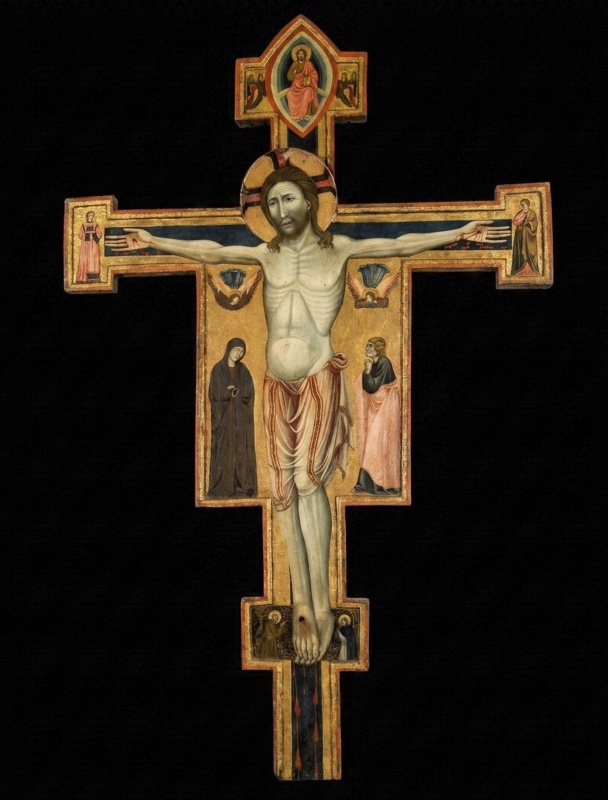
The third major panel attributed to the Maestro di Cesi is a large painted cross now in the Museo Nazionale del Ducato within the Rocca Albornoziana at Spoleto. The Italian national catalogue of cultural heritage records it as tempera on panel, 245 by 158 centimetres. That entry was compiled before the reorganisation of the Spoletan museums and still places the cross in the Pinacoteca Comunale; later sources, including the photographic archive of the Fondazione Zeri, give its present home in the Rocca. The cross is the master’s only surviving monumental crucifix of secure attribution. With the dated dossal of Cesi and the Stella triptych in Paris, it forms the core of his early catalogue.
The structure follows a traditional scheme. The vertical shaft and horizontal arms end in square terminals, and a broad apron, the tabellone, extends on either side of Christ’s body. At the top a raised terminal holds Christ blessing within a red mandorla, flanked by two small angels. The lateral terminals each hold a single standing saint. On the apron the Virgin, in a dark mantle, stands to the left of the body with her hands joined, and John the Evangelist, in a pink mantle, stands to the right with his hand raised to his face in grief. Below the arms two small half-length angels with blue wings hover close to Christ’s hands. At the foot of the cross, in a small panel flanking the feet, kneel two friars: Francis5 in a brown habit on the left and Dominic6 in the black and white of the Preachers on the right. Below them the shaft runs down in a blue field marked by a stream of blood.
The two saints in the lateral terminals are identified by the catalogue as Stephen and Thomas. The figure on the left wears a red garment consistent with a deacon’s dalmatic, Stephen’s usual dress; the figure on the right, in blue and red, holds a book, as an apostle would. The image does not allow the attributes to be read with certainty, but the identification is consistent with what is visible. These two saints matter more than their small scale suggests. Stephen and Thomas were the titular saints of the convent of Santi Stefano e Tommaso, called della Stella, in Spoleto, the house for which the Dormition triptych now in Paris was made. Their presence is the main evidence for the cross’s origin, which is otherwise undocumented.
The most striking feature of the cross is its type. Christ is alive, his head upright though slightly inclined and his eyes open: a Christus triumphans, the victorious Christ who reigns from the cross. Across central Italy this type had largely given way during the thirteenth century to the Christus patiens, the dead or dying Christ with sagging body and closed eyes, who invited compassion rather than awe. To paint a living Christ in the early fourteenth century was therefore a deliberate archaism. The catalogue notes that the carpentry is equally conservative, with the shape of the cross and the arrangement of its terminals still bound to Romanesque models.
The archaism, however, is not complete, and this is what makes the cross remarkable. The type is old, but the way the body is painted is new. The torso is modelled with care: the ribs, the hollow below the chest and the swelling of the abdomen are rendered in graded tones that give the body volume. The loincloth, white striped with red and gold, falls in soft folds to the knees, and the legs are long and slender. The living head of an ancient type is thus joined to a body observed with the new naturalism of the decades around 1300. That combination fits a painter trained at Assisi in the 1290s who worked for clients attached to older devotional forms.
The content is also brought up to date. Francis and Dominic kneeling at the foot of the cross place the image firmly in the devotional world of the mendicant orders, which by 1300 dominated spiritual life in the Duchy of Spoleto. Descriptions of the cross also record chalices catching the blood from Christ’s wounds, a feature that would tie the image to the Eucharist celebrated beneath it. The image does not show the chalices clearly, and the detail should be checked on the original. The blood running down the lower shaft beneath the feet, however, is plainly visible, and it already gives the cross a strong eucharistic accent.
The catalogue entry contains an inconsistency that should be noted. Its heading dates the cross “ca 1200 – ca 1210”, but its own critical text summarises a century of opinion placing the work in the early fourteenth century; the heading is evidently a data-entry error. The history of opinion is useful. The cross was mentioned locally in 1872. In 1920 it was given to the fourteenth-century school of Foligno. In 1949 an American scholar placed it in the first quarter of the fourteenth century and grouped it with the Maestro di Cesi, whom he saw as a northern Umbrian painter open to Florentine and Roman-Assisi influences. A later study dated it around 1310 and treated it as the prototype for the many triumphant Christs painted in the Valnerina down to the sixteenth century.
On the basis of the shared saints, Andrea De Marchi has proposed one of the most attractive hypotheses in recent scholarship. He argues that in women’s convents of the region the painted cross and the narrative tabernacle formed a deliberate pair. The model was the Basilica of Santa Chiara at Assisi, where the Poor Clares venerated in their choir the crucifix of San Damiano, the living Christ that, according to Franciscan legend, had spoken to Francis and told him to repair the Church. At Spoleto the Christus triumphans and the Dormition triptych would have formed such a pair for the enclosed nuns of the Stella. On this reading the living Christ is not provincial conservatism but a conscious evocation of a venerated prototype, chosen for women who knew the cult of San Damiano well.
De Marchi calls the cross and the triptych “capolavori giovanili del Maestro di Cesi”, early masterpieces of the painter, and the phrase matters for dating. He argues that the Dormition narrative on the Stella wings precedes the corresponding scenes on Duccio’s Maestà of 1308–1311, rather than depending on them. If the triptych and the cross belong together and precede the Cesi dossal of 1308, the painter was already working at a high level around 1300. The broad catalogue dating to the first quarter of the century therefore stands. The narrower bracket of about 1300 to 1310, supported by the c. 1310 dating proposed for the cross and by De Marchi’s chronology, better reflects current opinion.
The cross holds a key place in the history of Umbrian painting. As the prototype of a long Valnerina tradition of triumphant crucifixes, it shows how a single image made for an enclosed community of women could shape devotional painting in a whole territory for two centuries. As a work of the Maestro di Cesi, it reveals the same tension between inherited forms and new means that runs through his art, from the tiered saints of the Cesi dossal to the narrative architecture of the Stella wings. Back in Spoleto together with the triptych it was probably made to accompany, as at the 2018 exhibition Capolavori del Trecento, the cross recovers its original meaning: one half of a pair of cult objects, speaking to the nuns of the Stella of the living Christ who reigns from the cross and of the Mother he receives into glory.
Widening the Corpus: Panels of the Valnerina and the Valle Umbra
Beyond the Cesi dossal, the Stella triptych and the Spoleto cross, the master’s catalogue has grown considerably over the last two decades through systematic study of the diocese of Spoleto and of the Nera valley. The additions do not all carry the same weight. Some are widely accepted and appear consistently in museum labels and scholarly literature; others rest on a single scholar’s proposal, on an entry in a photographic archive or on a local guide. These latter additions are better treated as hypotheses awaiting confirmation. The discussion that follows keeps these levels of certainty distinct, and it notes where the sources themselves disagree.
The addition that matters most for the Montefalco question is a Madonna and Child with two angels and two prophets in the Museo Diocesano of Spoleto. The museum’s own description gives it as tempera on panel, 163 by 70 centimetres. The Virgin sits on a throne finely covered with tooled leather, and the Child stands upright on her lap, throwing his arms around her shoulders in an embrace of striking tenderness. Behind them two small angels hold up a precious cloth of honour decorated with small geometric motifs, of a kind common in the textiles of the period.
In the spandrels above the slightly projecting semicircular frame are two prophets, identified as Ezekiel on the left and Isaiah on the right. An English-language description adds that the Child wears a Franciscan habit tied with a cord and that the prophets hold Marian texts. These details would be significant for the panel’s Franciscan context, but they need confirming against a technical catalogue. The panel was part of a triptych with closing wings, in other words another example of the shuttered tabernacle so characteristic of the region.
The museum, De Marchi and other writers call the panel dated 1315, an expression that in Italian usage normally indicates an inscribed date. No source consulted, however, transcribes such an inscription, so whether the date is painted on the panel or derived from another source could not be verified. The provenance is reported in two ways. The museum’s description and a regional guide give it as the church of San Giovanni Battista at Vallo di Nera, adding that it was kept for a time in the parish house before reaching the museum. De Marchi instead names the Franciscan church of Santa Maria in the same town, where remains of a large Crucifixion attributed to the master are thought to survive beneath the frescoes of 1383 in the apse.
The two accounts may reflect a move of the panel between the town’s churches at some point in its history, but none of the sources explains the discrepancy, which should be recorded rather than resolved. The attribution history is more revealing still. The museum assigns the panel to the Maestro di Cesi; the Umbrian regional cultural portal captions it “Primo Maestro di Santa Chiara da Montefalco, 1315”; and an English-language guide gives it to one of the two masters named after the 1333 frescoes of the Cappella di Santa Croce. A single object catalogued under both names is the clearest sign of the overlap from which the identification hypothesis grew.
A second Marian panel, the so-called Madonna della Selvetta, brings the sequence almost to the threshold of the Montefalco frescoes. It is a tall arched panel, 157 by 63 centimetres according to the Fondazione Zeri, showing the Virgin enthroned with the Child on her knee, two half-length prophets holding scrolls in the spandrels above the arch and, according to the catalogue title, a donor. It was made for the small hilltop church of Santa Maria della Selva Mattutina, called the Selvetta, which lies within the territory of Montefalco on the border with Giano dell’Umbria and Castel Ritaldi, and it is now in the parish church of Colle del Marchese at Castel Ritaldi.
A two-line inscription along the base dates the work to 1332, in the pontificate of John XXII7, and records that it was made in the time of the lord Taddeo, rector of the church. No critical transcription of the inscription has been found, and the text should be treated as a proposed reading until it is checked on the original. The Zeri record catalogues the panel under the Maestro di Santa Chiara da Montefalco, while noting the recent proposal to see that master’s works as the late phase of the Maestro di Cesi. Its prophets in the spandrels repeat the arrangement of the Vallo di Nera Madonna, and the Child who reaches up to touch his Mother’s face belongs to the same family of tender gestures. A panel dated one year before the Santa Croce frescoes, made for a church in the territory of Montefalco itself, is thus the closest dated link between the two names.
A damaged rectangular dossal in the Museo Diocesano, from the church of Santa Maria di Ponte at Cerreto di Spoleto, leads the same double life. It shows Christ in glory within a mandorla, surrounded by roundels with the symbols of the Evangelists and the Lamb of God, and accompanied by censing angels and standing saints. Below survive the remains of an Annunciation, a Nativity and busts of saints. The Fondazione Zeri catalogues it under the Maestro di Cesi with a broad date of 1290 to 1325, while an English-language guide assigns it to the First Master of Blessed Clare. A recent study in the journal Spoletium describes the activity of the master “e della sua bottega” along the Valnerina, “dal Dossale già in Santa Maria di Ponte … all’intensa Deposizione affrescata in San Lorenzo a Borgo Cerreto”. It presents this production as a model studied by painters of the inland Marche, among them the Master of the Ascoli Polyptych.
The same Spoletium study links several crosses and a tabernacle to the master’s manner. A painted cross from San Giovanni at Leonessa is described as “probabile lavoro di bottega”, a probable workshop piece; the Zeri archive records it in the Episcopal Palace at Rieti and dates it between 1300 and 1315. A cross from Santa Maria at Vallinfante, near Castelsantangelo sul Nera, is described as “davvero prossimo”, truly close, to the 1315 Madonna. A panel of Saint Christina from the church dedicated to her at Caso, near Sant’Anatolia di Narco, once given to the minor Maestro di Monteleone, was the centre of a tabernacle whose painted shutters are lost. In Delpriori’s reconstruction, which De Marchi calls brilliant, scattered panels with stories of Saint Christina belonged to the Caso tabernacle, and the master also painted the cross of the same church. A painted Christus patiens cross in San Domenico, Spoleto, dated by the Fondazione Zeri to the first half of the fourteenth century, is recorded there among the works of the Primo Maestro, and lectures given at the Museo Diocesano have also listed it among the master’s works. Both attributions are reported as recorded and have not been checked against a catalogue entry.
One further panel belongs to the zone of uncertainty. A small portable triptych in the Galleria Nazionale dell’Umbria at Perugia, 95 by 93 centimetres, appears in the Zeri archive under the Maestro di Cesi with a date of 1290 to 1325. In the centre, beneath a single arch, the Virgin and Child and Saint Anne with the child Mary are enthroned side by side, above the Crucifixion and the Agony in the Garden. The wings carry paired saints, identified in a published description as Paul and Peter, Giovanni Gualberto8 and an angel, Catherine of Alexandria and Cecilia on the left, and John the Baptist and Lawrence, Augustine9 and Sperandeo, James and another apostle on the right. Sperandeo was venerated at Gubbio, and the presence of Augustine and of the founder of the Vallombrosans10 suggests a regular religious community, but the triptych’s destination cannot be established without documents. Its attribution should be treated as a photographic-archive record rather than an established consensus.
Taken together, these works form a substantial and coherent body of production, rooted in the diocese of Spoleto and made largely for convents, parish churches and religious houses. Its geography, stretching from the city along the Nera valley to Leonessa and the edge of the Marche, corresponds closely to the ecclesiastical reach of Spoleto itself. Its typology, dominated by crosses, shuttered tabernacles, dossals and small portable altarpieces, corresponds to the needs of rural and monastic communities. If the 1315 date is accepted, its chronology fills the gap between the early Stella works and the frescoes of 1333 with a sequence of panels running from the Vallo di Nera Madonna to the Madonna della Selvetta of 1332, whose double attributions place them already halfway between the two masters. The overall pattern is clear, but the individual panels still await the technical study and documentary confirmation that would turn a coherent hypothesis into an established catalogue.
A Portable Triptych for Private Devotion: The Virgin and Saint Anne Enthroned, with the Crucifixion and the Agony in the Garden
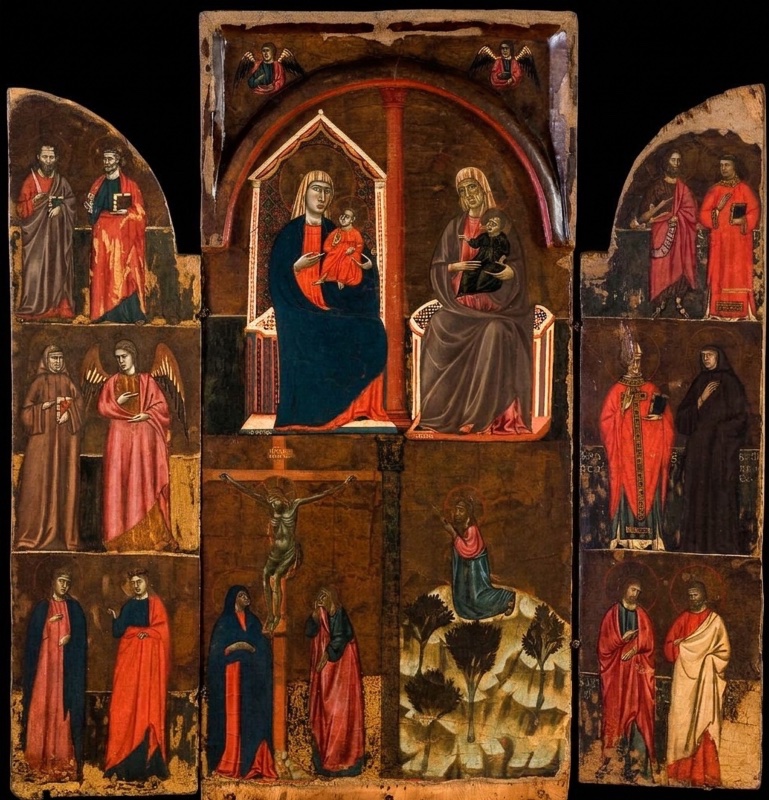
This small triptych in the Galleria Nazionale dell’Umbria in Perugia is one of the least studied works associated with the Maestro di Cesi. The photographic archive of the Fondazione Zeri catalogues it under the master’s name and dates it broadly between 1290 and 1325. It records approximate overall dimensions of 95 by 93 centimetres, which match the proportions of the open triptych seen here. No published discussion of the attribution has been found beyond that archival record. The panel should therefore be presented as a work attributed to the master, not as part of the core group anchored by the Cesi dossal of 1308, the Stella triptych and the Spoleto cross. Any narrower date within the archive’s range would be a proposal still to be argued, not an established fact.
The format is that of a portable altarpiece for private or small-group devotion. A rectangular central panel is flanked by two narrow wings with rounded tops, made to fold over the centre and protect it. When closed, the triptych would have been a compact object that could be moved, stored or carried. When open, it unfolded a dense programme of images at close range. The type is related in function, though not in scale, to the monumental shuttered tabernacles made in the Spoleto area for enclosed communities, of which the Stella triptych is the grandest example. Its modest size points to a single owner or a small community, praying before it at arm’s length.
The central panel is divided into two registers. The upper one, under a broad round arch on slender supports, sets two enthroned figures side by side. On the left the Virgin, in a dark blue mantle over red, sits on a throne with a pointed gable and holds the Christ Child, dressed in red, on her knee. On the right Saint Anne, in a grey-mauve mantle over red, sits on a simpler throne and holds the child Mary, dressed in dark clothes. A red column rises between them and divides the arch. In the spandrels above, two small angels with spread wings attend the group. The pairing of Mary with the Christ Child and Anne with the child Mary presents two generations of motherhood in parallel. The holy lineage is shown as a sequence of mothers and children, an emphasis well suited to a devotion centred on the Virgin’s own birth and upbringing.
The two figure groups echo each other closely. The Virgin and Anne share the same seated pose, the same veiled heads and the same frontal presentation. The differences carry the meaning: Mary’s deep blue mantle against Anne’s muted grey, and the bright red of the Christ Child against the darker dress of the young Mary. The faces of both women are long and oval, with pale veils close around them. This facial type, the Virgin’s dark blue mantle over a red dress, and the rather solid modelling of the seated bodies invite comparison with the Virgin of the Cesi dossal, and they probably underlie the attribution in the Zeri archive. Without a technical study, however, the comparison remains one of style.
The lower register sets two Passion scenes side by side. On the left Christ hangs on a tall cross whose titulus (the inscribed board above his head) is still visible. His body sags, his head is bowed and his arms are pulled taut: the type of the Christus patiens, the dead or suffering Christ, not the living, triumphant Christ of the Spoleto cross. The Virgin, wrapped in her dark blue mantle, stands at the left of the cross. John, in red, stands at the right with his head bent in grief. The contrast with the Spoleto Christus triumphans is worth noting: if both works are by the same painter, he chose the older or the more modern type according to the function and the patrons of each commission.
On the right of the lower register is the Agony in the Garden. Christ, in blue and red, kneels in prayer at the top of a pale, rocky hill, turned toward the upper left, where the divine presence or a consoling angel would traditionally appear. The rocks are rendered as layered, light-coloured terraces, and stylised dark trees with rounded crowns stand on their slopes. The sleeping apostles who often accompany the scene do not appear, at least in the visible state of the panel. The scene is reduced to the solitary figure of Christ in prayer, a choice that suits an image made for private contemplation.
The wings each carry three registers of standing saints, arranged in pairs. On the left wing, the upper register shows two bearded saints, one in a grey mantle and one in red holding a book. The middle register shows a friar in a brown habit holding a red book beside a winged angel in a pink mantle. The lower register shows two young figures in red and blue mantles. On the right wing, the upper register shows two saints in red, one of them holding a book. The middle register shows a bishop in a mitre and red cope, holding a book, beside a figure in a black habit with a hood. The lower register shows two bearded saints, one in red and one in a white mantle. Several figures bear traces of inscriptions, but they cannot be read in the image. The published description names the saints: on the left Paul and Peter, Giovanni Gualberto and an angel, Catherine of Alexandria and Cecilia; on the right John the Baptist and Lawrence, Augustine and Sperandeo, James and another apostle. Where attributes show, the image is consistent with it, as with the friar in brown beside the angel, the saint in red holding a book, or the bishop in a mitre; the other identifications cannot be tested without reading the inscriptions on the original.
The Zeri record names Saint Augustine and Saint Sperandeo among the paired saints, and the image is consistent with that pairing. The bishop with mitre and book in the middle register of the right wing matches Augustine’s usual episcopal guise, and the figure in a black habit beside him is given as Sperandeo, though the image shows only a hooded habit. The presence of Augustine suggests a link with a community that followed the Augustinian rule. Sperandeo was venerated at Gubbio, which raises the possibility that the triptych was made for an owner or community in that city or connected with its cults. That hypothesis cannot be tested without documents. The friar in brown on the left wing is, in the published description, Giovanni Gualberto, founder of the Vallombrosans, and not a Franciscan; he belongs to the same regular setting as Augustine.
The condition of the triptych affects how it can be read. The gold ground now appears dark and uneven over much of the surface. This is most likely the result of wear to the gilding, which exposes the reddish preparatory layer beneath, though only a technical examination could confirm it. The edges of the wings, especially at the top and along the lower right, show losses and abrasions, and the paint surface is worn in several places. The strong colours of the draperies, red, deep blue, grey and pink, remain legible and keep the overall design clear. The architecture of the central arch, with its red column and pointed throne-back, also survives well enough to show the care with which the painter organised space within so small a field.
The panel’s value lies in two directions. If the attribution in the Zeri archive is confirmed, it would show the Maestro di Cesi working on a small scale for private devotion, alongside his monumental altarpieces and crosses, and handling a varied iconography of Marian lineage, Passion and saints. If it is not confirmed, the triptych remains an important witness to how widely his formal language spread in the territory. That language includes the solid seated Virgin in deep blue, the clear architectural framing and the conversational pairing of saints. Either way, the work deserves a full technical study and a reading of its inscriptions on the original. These would establish its date more precisely, clarify its saints and place it more securely in the history of painting in the Duchy of Spoleto.
The Madonna della Selvetta: A Dated Panel of 1332 on the Eve of the Montefalco Frescoes
The Madonna della Selvetta, now in the parish church of Colle del Marchese at Castel Ritaldi, is a tall arched panel catalogued by the Fondazione Zeri as Madonna and Child Enthroned with a Donor and Two Prophets. The record gives its dimensions as 157 by 63 centimetres and its date as 1332. It came from the church of Santa Maria della Selva Mattutina, known as the Selvetta, a small hilltop church on the border between Montefalco, Giano dell’Umbria and Castel Ritaldi, within the territory of Montefalco. There it stood on a polychrome wooden altar before being moved to Colle del Marchese. The Zeri record lists the panel under the Maestro di Santa Chiara da Montefalco. It notes that recent studies by Andrea De Marchi and by Alessandro Delpriori, in his 2015 monograph on the school of Spoleto, propose to recognise in that master’s works the late phase of the Maestro di Cesi.
The inscription on the base of the frame is the panel’s most valuable document. It runs over two lines in gothic letters, now worn. The second line can be read, with reasonable confidence, as
tempore domini Taddei rectoris istius ecclesie:
“in the time of the lord Taddeo, rector of this church”.
The first line opens with Anno, gives the year 1332 and names Pope John XXII, followed by a formula recording that the work was made. The reference to John XXII, who reigned from 1316 to 1334, agrees with the date. Whether the year is introduced by Domini or salutis cannot be confirmed from the image, and since no critical transcription has been found, the full text is best presented as a proposed reading.
The inscription dates the panel to the pontificate of the same pope who had opened the inquiry into Chiara of Montefalco’s sanctity in 1317. It also names a local priest, Taddeo, rector of the Selvetta. The formula tempore domini Taddei records that the work was made during his tenure. It is tempting to identify him with the donor named in the Zeri title, but the inscription does not say that he paid for the panel, and the identification remains a hypothesis. At the lower right, beside the base of the throne, a small dark and heavily abraded form may be the remains of the kneeling donor. Its state does not allow its gender or dress to be determined.
The date gives the panel special significance for the history of Umbrian painting. The frescoes of the Cappella di Santa Croce at Montefalco, which define the First Master of Blessed Clare, were commissioned by Jean Amiel11 and dated 1333. A panel dated 1332, made for a church in the territory of Montefalco and given to the same master, shows him already at work locally a year before that commission. He was evidently an established painter in the Montefalco area, serving rural churches as well as the town’s most prestigious shrine. His selection for the Santa Croce project by Amiel becomes a natural one, and the late phase of his career gains a second fixed date beside the frescoes.
The Virgin sits frontally on a throne whose round red cushions show at either side. Her feet rest on a pale step set over a blue-green floor patterned with fine ornament. She wears a dark blue mantle lined in white, its border studded with small gold motifs, over a red dress. Her head is covered with a white veil striped with red and scattered with small red crosses, framing a long oval face with large almond eyes and a small mouth. Her gaze turns slightly downward and aside, grave and inward. The broad mantle, spreading over her knees to the step, builds a stable pyramid of dark colour against the gold ground.
The Child sits on his Mother’s left knee, dressed in an olive-green tunic and mantle edged with gold, his feet bare. His gilded halo carries a cross, rendered in relief and so distinguished from the gold ground. He turns toward the Virgin and raises his right hand to touch her face or the edge of her veil, while his left holds a small scroll. The Virgin rests her right hand on his body and supports his leg with her left. The gesture of the Child reaching to his Mother’s face gives the formal image an intimate warmth. It belongs to the same family of tender gestures as the embrace of the Child in the Vallo di Nera Madonna of 1315 and the embrace of Christ and the Virgin in the Stella Assumption.
Above the arch, in the two corners of the panel, two half-length prophets hold scrolls that curve along the moulding of the frame. The figure on the left is an old man with a white beard in grey-blue robes; the figure on the right has a dark beard and wears a red mantle over a blue-green tunic. Neither is identified in the published record. The scrolls are inscribed, but the image allows only a tentative reading. The first word on the left appears to be ecce, which would suit Isaiah’s prophecy Ecce virgo concipiet (Isaiah 7:14), and the right-hand scroll is not legible. Until the texts are read on the original, the prophets should not be named. Their role is nevertheless clear: as in the Vallo di Nera Madonna, where Ezekiel and Isaiah occupy the same position, they stand for the Old Testament prophecies of the Incarnation, framing the Mother and Child as their fulfilment.
The construction and condition of the panel can be described only from what is visible. The painted field is set within an arched frame with red and blue mouldings, and the base forms a slightly projecting step that carries the inscription. The gold ground is worn and uneven, showing the preparation beneath in many places. The surface also has scattered losses, especially in the lower right corner and along the edges. The colours of the drapery, the dark blue, red, white and olive green, remain strong, and the faces are well preserved. The colour image corrects the impression given by the black-and-white archival image. It shows a palette of considerable refinement, with the cool green of the Child’s dress set against the deep blue of the mantle and the warm red of the cushions and dress.
In style the panel shows both continuity and change in relation to the works gathered under the name of the Maestro di Cesi. The frontal Virgin, the long oval face framed by a pale veil, the dark mantle over red and the solid modelling of the seated figure recall the Virgin of the Cesi dossal of 1308 and the Vallo di Nera Madonna of 1315. The prophets in the spandrels repeat a solution found in the 1315 panel. At the same time, the drapery is broader and less finely articulated, and the faces are more simplified. That would fit a painter in the late phase of a long career, and it would also anticipate the more emphatic manner that scholars recognise in the Santa Croce frescoes of the following year.
The panel therefore occupies a central place in the debate over the identity of the two masters. It is catalogued under the First Master, yet the Zeri record itself acknowledges that recent scholarship would see it as the late work of the Maestro di Cesi. Its prophets and its tender Mother and Child link it to the Vallo di Nera Madonna of 1315, which some sources give to the Maestro di Cesi and others to the First Master, and its date links it to the Santa Croce frescoes of 1333. It does not prove the identification: a gap remains between the dated works of 1315 and 1332, and a close pupil could have used the same formulas. But no other dated object narrows the distance between the two names so far. A critical transcription of its inscriptions and a technical study would make the Madonna della Selvetta one of the key documents for settling the question.
Frescoes and the Painter-Sculptor Workshop
The master’s panels are matched by a smaller and more fragmentary group of frescoes, which assume particular importance because the defining works of the First Master of Blessed Clare are themselves frescoes. At Santa Maria in Vallo di Nera, the Franciscan church from which, in De Marchi’s account, the 1315 Madonna came, he reports traces of tall painted curtains and a Calvary by the master lying beneath the late fourteenth-century paintings of the tribune, together with a row of saints on the left wall, in front of the place where the choir screen once stood. These remains are partially covered by later decoration and are therefore difficult to judge, but they show the master working in fresco within a Franciscan church, in the same building that housed one of his key panels.
At Montefalco itself, in the church of Sant’Agostino, De Marchi describes frescoes that “intarsia segmenti di architetture in violento e scombinato aggetto”, inlaying fragments of architecture that project at violent and disordered angles. He reads these painted structures as memories of Assisi, where the architectural framing of the Upper Church had demonstrated how painted buildings could be made to advance and recede in space. Their disorder, in his interpretation, is the mark of a painter who retained the vocabulary of Assisi without fully sharing its spatial logic, a characterisation that will return when the late style is discussed.
Outside Montefalco, in the small church of Santa Maria di Turrita, a fragmentary Crucifixion in the apse, with Saints Severus and Fortunatus, a Madonna and an Annunciation, is assigned to the First Master. The composition of the Crucifixion closely echoes that of the Santa Croce Crucifixion, and the attribution places the First Master’s activity in the immediate surroundings of Montefalco. If the identification of the two masters is accepted, the Turrita and Sant’Agostino frescoes together show that the painter was an established presence in and around Montefalco before, or around the time of, the great commission of 1333, a circumstance that would make his selection for that commission entirely natural.
The frescoes are complemented by a line of research that bears directly on how the painter organised his work. Building on an earlier hypothesis, Delpriori argues that in the Duchy of Spoleto the workshops of painters and of wood-carvers were often one and the same, so that crosses, tabernacles and painted statues issued from combined shops in which the same masters both carved and coloured. His evidence is of two kinds. The first is epigraphic: the signature of the Spoletan painter Machilone and his son on the wooden Madonna of Bugnara, dated 1262, uses the verb depinserunt, “they painted”, showing that a painter’s workshop could be responsible for, and sign, a sculpted image. The second is stylistic: the repeated coincidence of groups of paintings with groups of sculptures across the territory.
For the Maestro di Cesi this coincidence is especially marked. In De Marchi’s summary of Delpriori’s findings, “il Maestro di Cesi lavora sempre con lo scultore della Santa Cristina di Caso”, the master always works with the sculptor of the Saint Christina of Caso, and the book recovers “diverse sculture lignee da lui policromate e verosimilmente pure intagliate”, several wooden sculptures that he painted and probably carved as well. The Caso church, where the master is credited with a tabernacle and a cross, thus becomes a test case for a workshop that could supply an entire altar ensemble: a carved and polychromed statue, a painted cross and a shuttered tabernacle with narrative wings.
If correct, this model alters the image of the painter considerably. Rather than an isolated artist moving from commission to commission, he would emerge as the head of a workshop capable of furnishing churches with complete sets of cult objects in more than one medium, and the relative uniformity of the Valnerina production would reflect the organisation of that workshop as much as the hand of its master. The model nonetheless rests on stylistic matches and on a small number of inscriptions, not on contracts or account books, and it should be held as a well-argued hypothesis rather than a demonstrated fact. It does, however, provide an important framework for the problem of hands at Montefalco, where the question is precisely how much of a large commission a master executed himself and how much he entrusted to associates.
Materials and Making
Technical information on the master’s works is uneven, and the richest body of evidence concerns the object that has travelled furthest from home. The Stella triptych was examined by the Centre de Recherche et de Restauration des Musées de France in 1986 and again in 2013, and the results are summarised in the French catalogue. They allow a reconstruction of the object’s construction in some detail and, through it, an appreciation of the kind of workshop that produced it.
The central panel is of poplar, the standard support of Italian panel painting, identified by examination of the wood structure in 1986. It is composed of one broad board sawn flat, flanked by two narrower boards sawn on the half-quarter, and the grain is irregular and knotty. Irregularly spaced dowels aligned the joins between the boards, and three nailed horizontal battens on the back held the assembly together. A fourth batten, along the lower edge, has been lost, because at some point the panel was cut down at the bottom by about five centimetres. On the painted face the joins were reinforced, first with strips of parchment and then with strips of canvas, which show clearly in the X-radiographs and which were also used to cover flaws in the wood. Forged nails record the position of the hinges that once attached the wings, and two staples driven through the upper batten probably held rings by which the tabernacle could be hung or secured.
The wings tell a complementary story. Each is a single board with vertical grain. The back of each preserves traces of five nailed battens, three horizontal and two diagonal, which together form a lozenge pattern when the triptych is closed. The backs were prepared with gesso and painted in red ochre. In other words, the outer faces of the shutters were designed to be seen: when the tabernacle was closed, the viewer confronted a finished surface rather than raw carpentry, and the diagonal battens formed a deliberate geometric design.
These details confirm, on the material level, the function proposed on iconographic grounds. The Spoletan tabernacle was an object that closed over a central image and opened, probably on feast days or at particular moments of the liturgy, to reveal its narrative wings and its glorious centre. The careful finishing of the exterior, the hinges and the hanging staples all belong to an object that was handled, opened and closed. The layered reinforcement of the joins with parchment and canvas follows standard Italian practice of the period and suggests a well-equipped professional workshop rather than a rural improviser, which accords with the quality of the painting itself.
For the other panels the technical record is thin. On the Cesi dossal, the most notable reported feature is the frame with its empty hollows for lost inlays, discussed above. On the 1315 Madonna it is the stamped leather of the throne, although the published description does not specify whether this effect is painted in imitation or modelled in relief in the gesso. No source consulted describes the punched decoration of the haloes beyond calling it finely worked, and any claim about the use of particular punch tools, of the kind that has proved so useful in distinguishing Sienese and Florentine workshops, would therefore go beyond the available evidence. The punch repertory of the Maestro di Cesi remains, as far as the published literature reveals, unstudied.
The frescoes of Montefalco were restored by the Spoletan firm Coobec, but no technical report on the giornate, the patches of fresh plaster laid and painted in a single day, has been available. Such a study would be of the greatest value, because the sequence and joins of the giornate, together with the evidence of underdrawing and of the methods used to transfer designs, could show where one painter’s work ends and another’s begins, and whether the two masters worked side by side or in succession. What can be said on present evidence concerns ornament. In the vault, broad bands of festive scrollwork on a black ground, in a taste characteristic of the late thirteenth century, frame the symbols of the Evangelists, and De Marchi notes that these still adopt the old zoocephalic form of the Tetramorph, with animal heads set on human bodies. Ornament, being the part of a decoration most often entrusted to habit, is a valuable witness to a painter’s formation, and its archaism in 1333 is one of the arguments to which the discussion of identity will return.
Formation and Style: Assisi, Rome, Spoleto and Siena
Opinions on where and how the Maestro di Cesi was trained have followed the development of the field itself. Early writers judged the Cesi dossal against the painting of Rimini and of Rome. A mid-century view made him a northern Umbrian receptive to Florentine and Roman-Assisi influences. Recent Italian scholarship, led by De Marchi and Delpriori, makes Assisi the central experience of his formation and Spoleto the milieu in which he absorbed and transformed it. Each of these strands deserves examination, together with the Sienese parallel that his Dormition narrative inevitably invites.
The case for Assisi rests on three kinds of evidence. The first is direct quotation. The Assumption at the centre of the Stella triptych draws, in De Marchi’s words, in part on Cimabue’s frescoes in the apse of the Upper Church; a painter who drew on them must have studied the original, and probably at length. The second is the persistence of particular motifs. At Montefalco in 1333 the enthroned Madonna wears a crumpled white veil which, as De Marchi observes, descends from Giotto’s roundel of the Virgin on the inner façade of the Upper Church, painted some forty years earlier. The later painter retains the outward form of the motif but no longer its sense of volume and space, as if it had been learned by heart long before and repeated from memory. The third is compositional habit. De Marchi argues that the master learned in the Upper Church how to set images in rhetorical counterpoint across walls and registers, so that scenes answer one another across a space, and that he carried this lesson into the dense “polifonia” of the small Montefalco chapel.
From this evidence De Marchi concludes that the painter’s visual culture was formed “sui ponteggi del ciclo francescano, verso il 1290”, on the scaffolding of the Franciscan cycle around 1290, alongside the young Giotto. Delpriori calls him “il primo dei giotteschi spoletini”, the first of the Spoletan followers of Giotto. No document places any Spoletan painter on the scaffolding of Assisi, and the conclusion is therefore a strong inference from style rather than an established fact. It is, however, an inference supported by several independent indications, and it accounts better than any alternative for the combination of Cimabuesque composition and Giottesque motif that runs through the corpus.
The Roman strand is visible in the gemmed frame and the formal, hierarchical arrangement of the Cesi dossal, and in the comparison with Cavallini made by early writers. Yet in the 1280s and 1290s Assisi was itself in large part a Roman painting site, where Jacopo Torriti and other Roman masters worked close to Cimabue and the young Giotto. The Roman elements in the master’s art are therefore more economically explained by the mixed culture of the Assisi workshops than by a separate training in Rome. The literature speaks of the transition at Assisi from the workshops of Cimabue and Torriti to that of the young Giotto, the moment of the stories of Isaac and of the so-called Master of the Capture. The sources consulted do not, however, tie the Maestro di Cesi specifically to the hand of the Isaac Master or to any single team within the Upper Church, and a more precise claim would overstate the evidence.
The Spoletan strand runs deepest. Spoleto had possessed a vigorous school of painting in the twelfth and thirteenth centuries, from the crosses of Alberto Sotio to the signed works of Simeone and Machilone and of Rainaldetto di Ranuccio, whose works reached as far as Fabriano and Matelica. Its repertory included painted crosses with figured lateral panels, Madonnas enclosed in shuttered tabernacles and a high emotional pitch that set it apart from neighbouring traditions. De Marchi describes how in this milieu Giotto’s ideals were bent “ad un fauve cromatico e materico, ad una mimica esasperata fra urla di dolore e tenerezze struggenti”, towards a wild intensity of colour and paint surface and a gestural language pushed to extremes, between cries of pain and aching tenderness. The Maestro di Cesi shows how fully he belonged to this tradition in three ways: he revived the triumphans type of the cross, he favoured the shuttered tabernacle, and he continued to use the ornamental vocabulary of the late thirteenth century long after it had gone out of fashion elsewhere.
Siena requires careful handling. The eight Dormition scenes of the Stella triptych invite comparison with the narratives in the upper register of Duccio’s Maestà, but De Marchi insists that the Spoletan work precedes Duccio’s and does not depend on it. The literature therefore offers no basis for a Sienese training. By the 1330s the crowded Crucifixion painted by Pietro Lorenzetti in the left transept of the Lower Church at Assisi had become a model for the many-figured Calvaries of the Spoletan territory, and the Montefalco Crucifixion might be expected to follow it. De Marchi identifies its specific source instead in Giotto’s Crucifixion in the right transept of the Lower Church, of around 1310 to 1312, particularly in the motif of the fainting Virgin supported by the holy women. Whatever Sienese elements may be detected in the late work thus arrive by way of Assisi and remain secondary.
De Marchi places the Maestro di Cesi beside the Master of the Trevi Cross as the two poles of early Giottesque painting in the Duchy, each growing steadily more independent of what he calls “la grandiosa nobiltà dei prototipi giotteschi”, the grand nobility of Giotto’s models. The gestures of the Cesi master are “più colorita e colloquiale”, more colourful and conversational; those of the Trevi master “più scarna ed incandescente”, barer and more incandescent. The following generation, led by the Master of Fossa, approached Giotto through the Lower Church, Simone Martini and Pietro Lorenzetti. Within this sequence the Maestro di Cesi emerges as the founding figure of a Spoletan fourteenth-century school: not a diluter of Giotto for provincial use, but the painter who first reinterpreted the lessons of Assisi in the expressive and devotional language of his own region.
The Duchy of Spoleto around 1300
The painter’s works cannot be understood apart from the political and religious world for which they were made. Around 1300 the former Lombard duchy of Spoleto was a province of the Papal State, administered by rectors and treasurers appointed by the pope. After the papacy settled at Avignon in the first decade of the fourteenth century, these officials were frequently French clerics drawn from the Apostolic Camera, the financial office of the papal court. The Duchy was thus governed from a distance, by men whose careers moved between Avignon and the Italian provinces, and who brought with them the tastes and devotional expectations of the curia.
The patron of the Montefalco frescoes is a typical example of this class of official. Jean Amiel, known in Latin as Johannes de Amelio and probably a native of the Quercy in south-western France, built his career in the Duchy. John XXII appointed him treasurer on 18 December 1317, and in that capacity he was charged with building a fortress at Montefalco, which had become the favourite residence of the rectors. He was made rector of the Duchy on 28 December 1323; recent studies date his rectorate to 1323–1332, while other accounts give a start in 1322 or an end in 1333. In January 1324 he issued constitutions at the provincial parliament held at Foligno, in a province repeatedly troubled by rebellion against papal authority. Montefalco, in other words, was not a provincial backwater but an administrative seat, frequented by officials who travelled to and from Avignon and who had both the means and the motives to commission ambitious works of art.
The ecclesiastical geography of the region was equally important. The diocese of Spoleto was vast, stretching from the Valle Umbra through the Valnerina towards Visso, Norcia and Cascia. This extent explains why works from the master’s circle appear at Leonessa and Vallinfante, far up the mountain valleys, and why Spoletan models could shape painters working at Camerino and Ascoli on the other side of the Apennines. The diocese was a network of parishes, monasteries and convents linked to the city by roads, by obligations and by the movement of clergy, and a successful Spoletan workshop could expect commissions from every part of it.
The Franciscans dominated the religious landscape. Assisi lay a day’s journey away, and the friars served as spiritual guides to many of the women’s communities that proliferated in the region during the thirteenth century. The visual culture of the Order, shaped above all by the decoration of the basilica of San Francesco, radiated outward through these channels; the painters who had worked or studied at Assisi carried its forms into the churches and convents that the friars served. In this sense the master’s dependence on Assisi is not only a fact of artistic training but a reflection of the religious structure of the territory in which he worked.
Women’s religious life is the decisive context for this painter. The Stella triptych and, very probably, the triumphant cross were made for an enclosed convent of nuns; the Montefalco frescoes decorated the church of a community of Augustinian nuns, built under the leadership of a woman whom many already venerated as a saint. De Marchi observes that the Spoletan shuttered tabernacle seems to have been made principally, perhaps exclusively, for women’s monasteries, where it was seen at close range within enclosed choirs. He suggests that these objects responded to small portable models of French and other northern origin, while their monumental scale and their more developed narratives made them a regional speciality. The Stella triptych is the grandest surviving example of the type executed entirely in paint.
This context helps to explain features of the master’s art that might otherwise appear simply conservative. The living Christ of the Spoleto cross evokes the venerated crucifix of the Poor Clares at Assisi; the nuptial embrace of the Stella Assumption speaks to women who regarded themselves as brides of Christ; the closing tabernacle answers to the rhythms of enclosure, concealment and revelation. The painter’s clients were communities with precise devotional needs and, in some cases, with distinguished prototypes in mind, and his art was shaped by those needs as much as by his own formation. When, in 1333, a papal official sought to honour the memory of a holy abbess in her own church, he turned to a painter who, if the identification is correct, had spent his career working for exactly such communities.
Chiara of Montefalco and the Making of a Cult
The Cappella di Santa Croce cannot be read without its saint. Chiara was born at Montefalco in 1268 to Damiano and Iacopa. At the age of six she joined her elder sister Giovanna in the hermitage of San Leonardo, a community of female recluses that at first followed no fixed rule. Giovanna later moved the community to a new reclusory dedicated to the Holy Cross, Santa Croce, and in June 1290 Bishop Gerardo of Spoleto allowed it to adopt the Rule of Saint Augustine, with Giovanna as abbess. When Giovanna died in 1291, Chiara was elected to succeed her. An Augustinian historical source dates the laying of the first stone of the new church, dedicated to the Cross, to 24 June 1303.
The Dizionario Biografico degli Italiani stresses three features of the community that are important for interpreting its art. It was Augustinian in its discipline, by virtue of the rule granted in 1290. Yet the documents of Chiara’s canonisation process provide no proof of any institutional link with the Augustinian Hermits, the male mendicant order with which later tradition associated her. And the Franciscans were prominent among its spiritual guides. The community therefore stood at a crossroads of religious affiliations, and the Franciscan accents of the art made for it, such as the figure of Francis on the arch of the 1333 chapel, are entirely consistent with its history.
Chiara died, aged about forty, on 17 August 1308 in the convent of the Cross. Her sisters reported that on opening her body they found within her heart the symbols of the Passion, and they connected this discovery to her dying words that she carried the cross within her heart. On 22 August the podestà of Montefalco and the civic and ecclesiastical authorities came to see the relics. The coincidence of date is worth noting: Chiara died in the very year in which, at Cesi, Domina Elena commissioned the dossal that gives the master his name.
The chief promoter of the cult was Bérenger of Saint-Affrique12, a Frenchman who served as vicar of the bishop of Spoleto. He wrote a Vita of Chiara, usually dated to 1309 or 1310, and pleaded her cause at Avignon. In October 1317 John XXII authorised an apostolic inquiry, addressed to the bishops of Perugia and Orvieto and to the rector of the Duchy. The inquiry opened at Montefalco on 6 September 1318, and the hearing of witnesses was concluded in July 1319. The acts survive incomplete and were critically edited in 1984; they preserve hundreds of depositions, and one study counts 486 witnesses. A commission of cardinals completed its examination only in 1331, but no canonisation followed. The most likely reasons were John XXII’s distrust of Chiara’s connections with the Colonna family and with the Spiritual Franciscans, and of a visionary piety that seemed to move at the edge of orthodoxy. Her cult was regularised only much later: Urban VIII13 permitted her office and Mass in 1624, and Leo XIII canonised her on 8 December 1881.
These facts bear directly on the frescoes of 1333. A notice on Jean Amiel published by the cathedral chapter of Fréjus states that he knew Bérenger and Chiara’s brother, the Franciscan inquisitor Francesco di Damiano, and that he probably attended sessions of the process. The notice is a work of ecclesiastical history rather than a critical study and should be read with that in mind, but its central point is consistent with Amiel’s offices: as treasurer and then rector of the Duchy during the years of the inquiry, he could hardly have been unaware of it. When he chose, at the end of his rectorship, to decorate the presbytery in which Chiara had died and where miracles were reported, he did so knowing that her cause had been heard in full but not decided.
The Cappella di Santa Croce may therefore be understood as a canonisation in paint. Two years after the cardinals had concluded their review without result, a senior official of the papal administration placed his own image, three times over, within a cycle that presented Chiara’s life, her mystical union with Christ and her death as the life, union and death of a saint. The frescoes affirmed in images what the papacy had declined to affirm in law, and they did so in the very place where the body lay and where pilgrims came. Whatever the painter’s identity, his task was to give visual form to a contested holiness, for an audience of nuns who had known Chiara and a public that already venerated her.
The Cappella di Santa Croce: Commission and Programme
The present Cappella di Santa Croce, opening off the left side of the later church of Santa Chiara at Montefalco, was originally the apse of the small church of Santa Croce built under Chiara’s leadership. It is a scarsella, a small square apse lit by a single window, and it is the place where she died. According to the convent’s own account, her body lay there in a separate tomb beneath an aedicule, a small framed niche, on the right wall, until it was translated on 26 June 1430. The space is therefore at once a presbytery, a death chamber and a shrine, and its decoration had to serve all three functions.
The commission is recorded within the frescoes themselves. The Fréjus notice transcribes the painted inscription as
Anno Domini MCCCXXXIII, indictione prima, Reverendus vir Dominus Johannes de Amelio, olim rector[e] Spoletani ducatus fecit hoc opus:
in the year of the Lord 1333, in the first indiction, the reverend man lord Johannes de Amelio, formerly rector of the Duchy of Spoleto, had this work made. The year and the indiction agree, since 1333 was the first year of the cycle. The word olim, “formerly”, fits precisely what is known of Amiel’s career: his rectorship had ended in 1332, and on 12 February 1333, back at Avignon, he was named apostolic notary to assist him in his new duties as a clerk of the Apostolic Camera. The work was thus commissioned, or at least completed, by a man who had just left the office he had held in the Duchy.
This transcription has not been checked against a critical epigraphic edition, and its position on the walls is reported inconsistently: one English-language guide places it beneath the Crucifixion, while the Fréjus notice associates it with the scenes of presentation on the left wall. What is secure is the identity of the patron, the date and the three portraits in which he appears. He kneels at the foot of the cross in the robe and short cape of a canon, and twice more, in the dress of a clerk of the Camera, he is presented to Christ by Saint Blaise and by Saint Catherine of Alexandria.
Two common errors should be corrected here. The first concerns the patron’s name. Johannes de Amelio, rendered in Italian as Giovanni d’Amelio or d’Amiel, is the French cleric Jean Amiel, not a native of the Umbrian town of Amelia, as the Italian form of his name might suggest. The second concerns the role of the abbess Giovanna. The commission did not come from her: she had died in 1291, more than forty years before the frescoes were painted, and she appears in the cycle as the abbess who receives the child Chiara into the community, not as its patron. Amiel’s later career confirms his lasting attachment to the region. In 1334 he was nuncio to the March of Ancona and the Romagna; in 1338 Benedict XII14 charged him with drawing up an inventory of the papal archives kept at Assisi; and on 23 October 1349 Clement VI15 appointed him bishop of Spoleto, a see he held until his death around 1370. In May 1336, according to the Vatican museums, he gave the Franciscans of Montefalco a large polyptych with the Passion, now in the Vatican and attributed to the Master of Fossa, whose inscription, recovered in the restoration completed in 2017, records the date and the patron.
The decoration of the chapel is distributed across the altar wall, the two side walls, the vault and the entrance arch. The altar wall is dominated by a great Crucifixion with more than forty-five figures, centred on a Christ that De Marchi calls “immane”, enormous. On the left the holy women support the fainting Virgin; the Magdalen embraces the foot of the cross; John stands apart in solitary grief on the right; the centurion appears on horseback and a soldier raises the sponge. Below, small in scale, kneels the patron. The right wall carries scenes of Chiara and of Saint Blaise: the child Chiara received by Giovanna, the Virgin allowing the Christ Child to play with Chiara, and Blaise in prison, with Christ blessing among angels above. The aedicule on this wall shows the Virgin and Child walking between archangels, whom one guide identifies as Gabriel and Michael and another as Raphael and Gabriel, above the scene in which Christ, appearing as a pilgrim, plants the cross in Chiara’s heart, the image that gives visual form to the discovery made after her death.
The left wall carries the martyrdom of Saint Catherine, the death of Chiara, a Christ of Pity beneath the window above the eucharistic repository, and Christ in a mandorla with Amiel presented by Blaise and Catherine. The vault, with its black-ground scrollwork, frames the symbols of the Evangelists, and the underside of the entrance arch carries Francis, Fortunatus, Peter, Paul, Clare16 and Mary Magdalen around a Lamb of God. The inclusion of Fortunatus, venerated at Montefalco, and of Francis and Clare of Assisi situates Chiara of Montefalco within both a local and a Franciscan communion of saints.
De Marchi’s reading of the space is the most searching yet proposed. The Christ of Pity rises from an embroidered cloth above the repository, between the final moments of Chiara and of Catherine and beneath Christ in Majesty. The nuns could see this group through a grating in the opposite wall, set beneath the image of Saint Blaise in prison, “perché anche quella monacale è una cattività”, because the nun’s life too is a captivity. A second grating, beside the fainting Virgin of the Crucifixion, allowed the nuns, who identified with the Mother’s grief, to look across at the aedicule where Chiara receives the cross into her heart. The images therefore answer one another across the chapel rather than unfolding in a narrative sequence, and De Marchi compares the effect to a lauda, a devotional song, by Jacopone da Todi. During the recent restoration a small window and a revolving hatch linking the nuns with the public were discovered, supporting the reading of the chapel as a carefully managed threshold between cloister and world.
Two Hands on the Walls
That two painters worked in the Cappella di Santa Croce is common ground in the literature consulted. The press report published at the conclusion of the recent restoration assigns the Crucifixion and the right wall to the First Master, and the left wall and the underside of the entrance arch to the Second. De Marchi refines the second assignment, noting that the two painters shared the panels on the underside of the arch, and several guides also give the vault to the First Master. The division is therefore not a simple split of the chapel down its axis, but a partition of tasks in which the principal wall, the most intimate narrative of Chiara’s mystical life and much of the ornamental framework went to one painter, while the scenes of death, the patron’s presentation and part of the arch went to the other.
The two painters differ in temperament as much as in hand. The First Master’s Crucifixion is crowded and charged, built from strong contours and fixed, emphatic gestures within an archaic ornamental vocabulary. In De Marchi’s words he “ancora ragiona per gesti icastici e bloccati”, still thinks in terms of stark, frozen gestures. His figures do not so much move as hold attitudes, each one declaring its emotion with the clarity of a sign; the effect is powerful at a distance and in a confined space, where the great Christ and the knot of grieving women impose themselves on anyone entering the chapel.
The Second Master is, for De Marchi, “di formazione ben più antica”, of a much older training. His work is marked by abundant drapery broken into fine pleats and by “l’acre espressività dei volti macerati”, the bitter expressiveness of worn and wasted faces. These traits, De Marchi argues, descend from the Maestro di Sant’Alò, an earlier Spoletan painter of the generation that witnessed the transition at Assisi. He goes so far as to ask whether the Second Master might be the Maestro di Sant’Alò himself in old age, while acknowledging frankly that supporting evidence and a connecting link between the two bodies of work are lacking. A further parallel for the harsh style of the Montefalco frescoes has been detected in the work of the Maestro di Colle Altino, active in the area of Camerino, which would set the chapel within a wider trans-Apennine current of expressive painting.
The division of hands has implications that extend beyond the problem of attribution. It shows that in 1333 the most prestigious commission in the Duchy, paid for by its recently departed rector and destined for the shrine of its most celebrated holy woman, was entrusted not to a single painter but to a partnership, perhaps a principal master working with an older associate. Whether this partnership was a permanent workshop, a collaboration arranged for this commission alone or a form of subcontracting cannot be determined from the published evidence. The painter-sculptor workshop model proposed by Delpriori would allow for a permanent association, but it does not require one, and no document records the terms on which either painter worked.
It is worth stressing how unusual it would be, if the identification with the Maestro di Cesi is correct, for the principal painter of the chapel to be the younger of the two. On De Marchi’s account the First Master was formed around 1290 and the Second earlier still, so that by 1333 both would have been men of considerable age, carrying into the fourth decade of the fourteenth century habits learned in the last decades of the thirteenth. The archaism that pervades the chapel, in its ornament, its Tetramorph, its gestures and its veils, would then be the natural expression of a generation, and the Montefalco frescoes would stand as the late testament of the painters who had first brought the lessons of Assisi to Spoleto.
This reading has the merit of explaining the peculiar character of the chapel: up to date in its sources, since its Crucifixion follows Giotto’s in the Lower Church, but old-fashioned in its means. It also leaves open a less romantic alternative, in which one or both painters were younger men trained in an older workshop and faithful to its repertory. The distinction between an ageing master and a faithful pupil is exactly the distinction on which the identification of the First Master with the Maestro di Cesi turns, and that question now requires direct treatment.
One Painter or Two?
The identification of the First Master of Blessed Clare with the Maestro di Cesi has been advanced most forcefully by De Marchi. The Fondazione Zeri records the proposal in his contribution of 2007 to the catalogue Fascino del bello. Opere d’arte dalla Collezione Terruzzi, at page 401. Delpriori’s 2015 monograph supports it at length, and in his introduction to that book De Marchi calls the identification “per me incontrovertibile”, for him beyond dispute. The Zeri catalogue now reports that “studi recenti hanno proposto di riconoscere nelle opere del Primo Maestro della beata Chiara da Montefalco la fase tarda del Maestro di Cesi”, that recent studies have proposed recognising in the works of the First Master the late phase of the Maestro di Cesi, and at least one local guide already treats the Santa Croce Crucifixion as correctly reassigned to him. It is the strongest hypothesis current in the literature consulted, and it rests on style, not on documents; the arguments on both sides need to be weighed.
The first and strongest argument in favour concerns the works that have been catalogued under both names. The Vallo di Nera Madonna, regarded as dated 1315, appears in the Museo Diocesano under the Maestro di Cesi and on the regional cultural portal under the First Master; the Ponte dossal is catalogued by the Zeri archive under the Maestro di Cesi and by an English-language guide under the First Master; the Madonna della Selvetta, dated 1332 and now at Colle del Marchese, is catalogued by the Zeri archive under the Master of Santa Chiara, in a record that itself reports the proposal to see the First Master’s works as the late phase of the Maestro di Cesi. The Vallo di Nera panel, dated 1315 and so lying between the dossal of 1308 and the frescoes of 1333, would form a bridge between the early and late phases. If the early works and the late frescoes can each be linked convincingly to this intermediate panel, a single career would account for the evidence, and the double attributions would cease to be a confusion and become a clue.
The second argument concerns the archaic motifs at Montefalco. The black-ground scrollwork of the vault, the zoocephalic Tetramorph and the crumpled veil derived from Giotto’s roundel of around 1290 were all old-fashioned by 1333. They make sense if the painter had formed his repertory at Assisi some forty years earlier and continued to draw on it. The Cesi frame also carries a Tetramorph, and a comparison between the two would be an obvious test; but the published descriptions of the dossal do not specify the form its Evangelist symbols take, so this point must be checked against the object before it can be used.
The third argument concerns compositional habit. The Montefalco Crucifixion follows Giotto’s in the Lower Church, and the dialogue of images across the chapel walls echoes the rhetorical counterpoint of the Upper Church. Both features are what one would expect from a painter trained at Assisi who continued to follow developments there. The fourth argument concerns territory. The master’s activity, as now reconstructed, is concentrated in the diocese of Spoleto, and the frescoes of Turrita and Sant’Agostino would place him at Montefalco itself. The Madonna della Selvetta strengthens the point: its inscription dates it to 1332, in the pontificate of John XXII and the time of Taddeo, rector of the church, and it was made for Santa Maria della Selva Mattutina in the territory of Montefalco, one year before the Santa Croce frescoes. That he should have been chosen for the most important commission in the town in 1333 is, on this view, historically plausible and even likely.
The arguments for caution are no less serious. The first is chronological. If the Stella works date from around 1300 and the painter’s formation from around 1290, then by 1333 his career would extend over more than forty years. Long careers were not unknown, but between the Vallo di Nera Madonna of 1315 and the Madonna della Selvetta of 1332 lies a gap of seventeen years with no dated work. The Selvetta panel, moreover, is itself catalogued under the First Master, so it dates the late phase without by itself proving that the late phase belongs to the Maestro di Cesi. The second concerns style. The Montefalco Crucifixion appears coarser and more abrupt than the Stella triptych, whose style the French notice calls “sévère et raffiné”, severe and refined. The supporters of the identification themselves describe the late manner in terms of frozen gestures and of architecture projecting “in violento e scombinato aggetto”. The difference could reflect an ageing painter working rapidly in fresco with an associate, but it could equally reflect a pupil who had inherited his master’s repertory without his refinement; style alone cannot decide between these possibilities.
The third caution concerns medium. The master’s core works are panels, while the First Master’s defining works are frescoes, and comparison across media is notoriously difficult. The frescoes attributed to the master in the Valnerina, which might provide a bridge, are fragmentary and partly covered by later painting. The fourth caution arises from the workshop hypothesis itself, which cuts both ways. De Marchi and Delpriori identify followers of the master, among them a minor Maestro di San Giovenale di Nocera responsible for a cross and a wooden Madonna, and the Leonessa cross is already described as a workshop piece. If the master headed a workshop with pupils trained in his manner, parts of the Montefalco frescoes, or even the whole of the First Master’s share, could be the work of such a pupil.
On balance the identification is the strongest hypothesis current in the literature consulted, and it rests on specific evidence rather than on general resemblance: shared attributions, datable archaisms, a coherent territory and a plausible chronology. It is not, however, proven. Delpriori’s chapter title retains its question mark, and the Zeri catalogue continues to list the First Master and the Maestro di Cesi as alternatives rather than as a single person. The position of De Marchi and Delpriori is that the First Master of Blessed Clare is the Maestro di Cesi in a late phase of his career, perhaps assisted by members of his workshop; the possibility of a pupil thoroughly steeped in his repertory cannot be excluded. Only a technical study of the frescoes, or the discovery of a document, could settle the matter.
A Notname and its Historians
The reconstruction of the Maestro di Cesi is a small history of twentieth-century Italian connoisseurship. In its earliest phase the Cesi dossal was judged in relation to the great centres: writers compared it with the painting of Rimini, and with Roman art in the circle of Cavallini, as though a provincial work could be understood only as the reflection of a metropolitan one. The painted cross in Spoleto, meanwhile, was ascribed in 1920 to the fourteenth-century school of Foligno, an attribution that reflected the limited knowledge of Spoletan painting at the time rather than any specific evidence.
The first decisive step towards a coherent artistic personality came in the middle of the century, when an American study published in 1949 linked the dossal with the Ponte panel and the Spoleto cross and gave the painter a profile as a northern Umbrian open to Florentine and Roman-Assisi influences. The second step was Meiss’s discovery of the Saint-Jean-Cap-Ferrat tabernacle and its publication in 1962. By adding a work of monumental scale and exceptional iconographic interest, Meiss transformed the painter’s stature; by reading the tabernacle as a reflection of Assisi, he redirected the whole question of his formation. An Italian study in Paragone had already addressed the Rothschild panel in 1961, so that the rediscovery was effectively a shared achievement of Italian and American scholarship at the same moment.
In parallel, the study of Umbrian painting as a field in its own right was being shaped by a celebrated university course given in Florence in 1953 and 1954 and published after its author’s death in 1973, which made “la passione degli umbri”, the Umbrians’ Passion, a theme of historical inquiry. Its students laid the foundations for the regional study of Spoleto and of Umbrian wooden sculpture, the two strands that would converge decades later in Delpriori’s work. The 1970s and 1980s brought systematic surveys of the territory, notably the “Manuali del territorio” devoted to the Valnerina in 1977 and to Spoleto in 1978, and the concept of an “Umbria alla sinistra del Tevere”, an Umbria on the left bank of the Tiber whose culture differed from that of Perugia and Orvieto with their orientation towards Tuscany. An encyclopaedic repertory of Umbrian painting appeared in 1989; De Marchi has criticised it sharply for breaking artistic personalities into lists of works detached from their contexts.
The Montefalco names have a history of their own that is harder to reconstruct. A general history of Italian painting published in 1986 already included an entry on the “Primo Maestro di Santa Chiara a Montefalco”, and the conventional division of the chapel between a First and a Second Master was in use by the third quarter of the century. When and by whom these names were first coined could not be established from the sources consulted, and it would be unwise to assign the coinage to any particular scholar without verification.
The decisive recent contributions belong to the present century. The 2001 study in Artibus et Historiae gave the triptych its modern name and its full iconographic interpretation. De Marchi formulated the identification of the First Master with the Maestro di Cesi and developed, above all in his introduction to Delpriori’s monograph, the broader picture of Spoleto around 1300 in which that identification makes sense. Delpriori’s Florentine doctoral thesis of 2010, published in 2015 as La scuola di Spoleto. Immagini dipinte e scolpite nel Trecento tra Valle Umbra e Valnerina, provided the first systematic monograph on fourteenth-century Spoletan painting and sculpture, combining the two media in a single account and placing the master at the head of a regional school. In his introduction to that book, De Marchi asked how it could be that there were still no monographs “su artisti di grande carattere come il Maestro di Cesi”, on artists of such strong character as the Maestro di Cesi, and presented the volume as the end of that neglect.
The 2018 exhibition Capolavori del Trecento, co-curated by Delpriori and held across Trevi, Montefalco, Spoleto and Scheggino, gave these arguments public form by bringing the Stella triptych back from Paris and showing it at Spoleto, for the first time in more than a century, among works of the Duchy. The history of the Notname thus ends, for the moment, where its objects began: in the territory of the Duchy, seen together, with the question of the painter’s late identity placed openly before the visitor rather than resolved behind the scenes.
Conclusion: What Is Known, What Is Probable, What Remains Open
The Maestro di Cesi matters to the history of Italian painting for three reasons, which can be stated with confidence independently of the Montefalco question. He provides one of the very few fixed points in early fourteenth-century Umbrian painting: a panel dated 1308, in the pontificate of Clement V, and commissioned by a named laywoman. His Stella triptych is a major monument of Marian iconography, drawing on Cimabue’s Assumption at Assisi and, in De Marchi’s view, anticipating Duccio in expanding the Dormition into a full narrative cycle. And his works as a whole show with unusual clarity how the innovations of Assisi were received and transformed in a region with strong traditions of its own. He did not dilute Giotto for provincial consumption; he reinvented the language of Assisi for enclosed nuns, mountain parishes and the devotional intensity that the Spoletan laude expressed in words.
If the identification with the First Master of Blessed Clare holds, his significance grows further. He would then be the painter of the principal visual testimony to the cult of Chiara of Montefalco, created in 1333 between a canonisation process that had stalled and a canonisation that would come only five and a half centuries later. The same hand that had painted a nuptial Assumption for the nuns of the Stella would have painted, at the end of a long career, the mystical marriage of another holy woman with the cross of Christ, for another community of women who had known her. The coherence of such a career, devoted from first to last to the devotional needs of female religious communities in the Duchy, is one of the reasons the hypothesis is so attractive; but attractiveness is not proof, and the distinction must be maintained.
The open problems should therefore be stated plainly. The painter’s identity, origin and training remain unknown, and no document records any of his commissions. The original location of the 1308 dossal within Cesi is uncertain, and its inscription still lacks a critical transcription. The dimensions of the Stella triptych and the religious order of its convent are recorded inconsistently, and its route out of Italy after 1872 is not documented. The 1315 date of the Vallo di Nera Madonna requires confirmation from the object itself.
Several attributions, including the Perugia portable altarpiece and the Spoleto San Domenico crucifix, rest on a single scholar’s proposal, a lecture or a photographic-archive entry. The 1333 inscription at Montefalco needs a critical edition and a firm location on the walls. Above all, the identification of the First Master with the Maestro di Cesi, proposed by De Marchi and developed by Delpriori, still lacks technical confirmation: a study of the giornate, the underdrawing and the working procedures in the Santa Croce frescoes, compared with what can be learned of the master’s frescoes in the Valnerina, could confirm or weaken it beyond the reach of stylistic argument. Until then, the question mark that closes Delpriori’s chapter title is a fair summary of the evidence: a hypothesis argued by De Marchi and Delpriori, but not yet a settled one.