Chiara da Montefalco
( 25% )
Historical and religious context: Umbria, Montefalco, and the world of the bizzoche
Late-thirteenth-century Umbria was the most densely “sanctified” region of the Italian peninsula, a landscape of small communes saturated with the memory of Francis of Assisi1 and Clare of Assisi2, crossed by penitential and eremitical movements, and increasingly policed by the mendicant orders and the papal Inquisition. Montefalco, a fortified hill-town commanding the Valle Umbra (the “ringhiera dell’Umbria”), in the diocese of Spoleto, reproduced this pattern in miniature: within its walls or immediately outside them stood Franciscan, Augustinian3 and Benedictine houses4, and it would eventually claim to be the “town of eight saints.”
The decisive social phenomenon for Chiara’s story is the movement of female penitents and recluses that Italian historiography, following Mario Sensi and Giovanna Casagrande, calls the bizzocaggio. These were women — variously bizzoche, recluse, incarcerate, pinzochere, mantellate, penitenti — who adopted a life of poverty, chastity, prayer and mortification without, at first, a canonically approved rule, living either domestically or in small communities (reclusoria), often supported by family property and by alms. Sensi’s Storie di bizzoche tra Umbria e Marche (Rome 1995) and the essays gathered in Il movimento religioso femminile in Umbria nei secoli XIII–XIV (Convegno of 1982, ed. Roberto Rusconi; CISAM reprint 1991) situate the foundation of San Leonardo by Chiara’s sister Giovanna squarely within this world.
The Church’s tendency after the constitution Periculoso (1298) was to normalize such groups by imposing enclosure and an approved rule — usually either affiliation to a recognized order or, more flexibly, the Rule of St Augustine, which because of its brevity and generality accommodated a long “experimental” phase of female religious life. This is precisely the trajectory of Chiara’s community.
Cutting across this was the crisis of the Franciscan Spirituals and the fringe heresies that shadowed the penitential movement. The most important for Chiara is the secta Spiritus libertatis (“Sect of the Spirit of Freedom”), a quietist-antinomian current whose Umbrian leader was the Franciscan Bentivenga da Gubbio5. According to the Vita and the canonization depositions (analyzed by Livario Oliger, De secta spiritus libertatis in Umbria saec. XIV, Rome 1943; Romana Guarnieri; and most recently Gian Luca Potestà), its adherents held that the soul united to God could reach a definitive state of peace in which no act — including carnal acts “absque excusatione matrimonii” — constituted sin, that hell did not exist, and that man was free to do whatever he willed.
Around 1306 Bentivenga and his disciple Iacopo (Giacomo) da Montefalco frequented the monastery of Santa Croce as chaplains/confessors and attempted to draw Chiara into their teaching. The sources depict Chiara — “illiterate” but scripturally acute — refuting the friar’s “quietism,” insisting above all that God cannot will evil. She denounced Bentivenga, first to local inquisitors and then, through her brother Francesco di Damiano, to the inquisitor Andrea da Perugia and to the cardinal-legate Napoleone Orsini. In 1307 Bentivenga and several companions were arrested, tried at Arezzo, and condemned to perpetual imprisonment. Orsini’s chaplain at this period was Ubertino da Casale, leader of the rigorist Spirituals, whom the sources connect to the affair and who is said to have been miraculously cured of an inguinal hernia after meeting Chiara.
Potestà’s recent study (Ubertino da Casale, Chiara da Montefalco e lo Spirito di libertà, in SCRIPTA 25, 2025) rereads the whole dossier to argue that Ubertino’s campaign against the Spiritus libertatis was intended to draw a sharp boundary against an experience felt to be dangerously close to that of the Spirituals themselves — which, he argues, illuminates the later distancing of Iacopone da Todi and Angela da Foligno from mystical doctrines they had earlier held. This is a significant reinterpretation and should be flagged as a recent thesis rather than settled consensus.
Life
Chiara was born at Montefalco c. 1268, the daughter of Damiano and Iacopa (Giacoma). The family was among the more comfortable of the town and intensely religious: a brother, Francesco di Damiano, became a Friar Minor, provincial and inquisitor; the elder sister, Giovanna, was Chiara’s spiritual mother and the first abbess of the community. Giulia Barone’s entry in the Dizionario Biografico degli Italiani (vol. 24, 1980) stresses that, unusually, Chiara’s Vita records no “conversion”: she is presented as predestined, withdrawing to pray in solitude already at age four. At six she obtained her parents’ permission to join Giovanna in the reclusorium of San Leonardo, a hermitage built by Damiano (traditionally dated 1271; her entry 1274/1275).
Giovanna’s community began, in Barone’s words, “sine regula,” resembling the many recluse communities of central Italy: poverty, chastity, obedience, humility, prescribed fasts and silence. As the group grew it moved (c. 1281) toward the hill of Santa Caterina “del Bottaccio,” where a larger house — the future monastery of Santa Croce and Santa Caterina d’Alessandria — was begun.
The new foundation met local hostility: because it lived on alms, three older houses (Franciscan, Augustinian, Benedictine) and elements of the commune feared competition for donations and loss of tax revenue, and tried to block it; the rector of the Duchy of Spoleto, Filippo della Vena, ultimately authorized its continuation. In June 1290 Giovanna asked the bishop of Spoleto, Gerardo, to allow the community to profess a monastic rule; the bishop assigned the Rule of St Augustine, and Giovanna remained as abbess. Chiara was thus, disciplinarily, an Augustinian nun from 1290 — a point on which Barone is emphatic: the monastery was under the direct jurisdiction of the bishop, and the acts furnish no proof that it was tied to the male mendicant Order of Augustinian Hermits, “come a lungo si è creduto.”
Giovanna died on 22 November 1291. Chiara, then about twenty-three, was elected to succeed her, reluctantly and after the bishop’s intervention. As abbess for some sixteen or seventeen years she organized the common life — manual work (weaving, sewing, gardening), the Divine Office, private prayer, spiritual reading — while participating in the hardest tasks herself. She was famous for extreme austerity (the biographer Isidoro Mosconi called her sanctity “magis admiranda quam imitanda,” “more to be admired than imitated”), for thaumaturgic gifts and cardiognosis (the reputed ability to read others’ sins), and for prophetic insight. Cardinals Giacomo and Pietro Colonna, Napoleone Orsini and Niccolò da Prato, and Ubertino da Casale are among the eminent figures said to have sought her counsel; Giacomo Colonna sent her a large gold alms and, according to later tradition, a pectoral cross.
In 1303 Chiara had the community’s church rebuilt from the foundations and dedicated to the Holy Cross; the first stone was blessed by the Dominican bishop of Spoleto, Niccolò Alberti, and laid on 24 June 1303. Increasingly ill from about 1300 and bedridden by July 1308, she died in the monastery of Santa Croce on Saturday 17 August 1308, about forty years old. (The 18 August date found in some older references is best treated as a liturgical/biographical variant without canonical authority.)
Mystical theology: the Cross planted in the heart
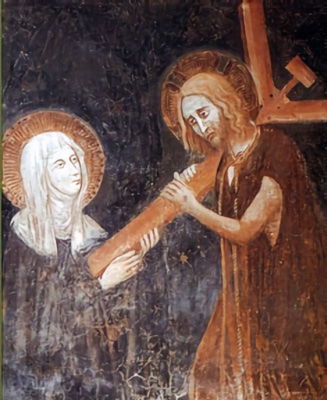
The core of Chiara’s spirituality is a radical imitatio Christi focused on the Passion and the Cross. Its founding narrative, set in the crisis-year 1294 — after an Epiphany general confession she is said to have fallen into an ecstasy lasting several weeks — is the vision in which Christ appeared as a wayfarer bowed under a great cross, saying (in Berengario’s Latin, rendered): “I have been searching for a strong place in which to plant my cross, and I find here the fitting place to plant it.” From that moment Chiara reportedly declared that she carried the Cross in her heart — in the vernacular of the depositions, “Io ajo Jesu Christo mio crucifisso entro lo core mio” (“I have my crucified Jesus within my heart”).
Scholars have situated this imagery precisely. Claudio Leonardi — who famously called Chiara “la piccola grandissima donna” (“the little, very great woman”) — analyzed the interplay of hagiographer and saint in Chiara e Berengario. L’agiografia sulla santa di Montefalco. Lino Pertile (Chiara di Montefalco, il Cantico dei Cantici e Dante, Olschki 2010; repr. 2011) shows that the pulcerrimus young Christ who seeks Chiara through streets and squares until he finds her is the Christ of the Song of Songs, with the Bride-Bridegroom roles inverted — a reading with implications for Dante. A separate line of scholarship (the same essay collection on La spiritualità della Croce in Chiara da Montefalco) traces a probable textual source in the Devotio Crucis and in Peter Damian’s sermons on the Exaltation of the Cross. Notably, Chiara left no writings; her “teachings” survive only as reported speech in the Vita and the process, a fact that shapes every interpretation.
Chiara belongs to the great generation of Umbrian and central-Italian women mystics, and the comparisons are instructive. Her near-contemporaries — Angela da Foligno (d. 1309), Margherita da Cortona (d. 1297), and the model of Clare of Assisi — share the affective, Passion-centered, visionary and penitential register that Chiara embodies; the essay by Emore Paoli, Parole di donna, scritture di uomini: Angela da Foligno, Margherita da Cortona, Chiara da Montefalco (2011), treats them precisely as a cluster whose words reach us through male scribes. The crucial difference underlined by Katharine Park and by the Caroline Walker Bynum tradition is that male sanctity tended to externalize (stigmata, healing), whereas female sanctity tended to internalize — which is why Chiara’s decisive sign was sought, and found, inside her body.
The post-mortem cardiotomy of August 1308
The events immediately following Chiara’s death are documented in unusual detail and are the single most studied aspect of her cult. On the evening of her death, or the following day (18–19 August 1308), the senior nuns of Santa Croce decided to preserve the body they judged “worthy of heaven,” and, drawing on their knowledge of embalming, removed and opened the viscera. It was Sister Francesca of Foligno who performed the dissection: after embalming, she opened the abdomen to discard the internal organs in a small chapel, and the heart was placed separately in a box. Recalling Chiara’s repeated claim to bear the Cross in her heart, the nuns opened the heart and found, formed of the cardiac tissue itself, what they interpreted as the Cross and a scourge. When the monastery physician, Master Simone of Spello, refused to open the gallbladder, Sister Francesca opened it herself and found three small stones of equal size, color and weight, arranged (it was said) in a triangle and read as a figure of the Trinity.
Berengario6’s own description, cited from the process, enumerates the arma Christi: “within the heart of this virgin, in the form of hard nerves of flesh, on one side the cross, three nails, the sponge and the reed; and on the other side the column, the whip or scourge with five thongs, and the crown … In the little sack of the gall … there were three round stones, in all things equal … which probably represented the Trinity.” According to the process depositions the crucifix was “about the size of a thumb,” with Christ’s head leaning to the right, the body white “except for a tiny aperture in the right side which is a livid reddish color,” the scourge and Crown of Thorns formed of whitish nerve fibers and the three nails of dark fibrous tissue. He insists he examined and handled these signs repeatedly (“qui inspexi pluries et palpavi”).
The vicar’s initial reaction is telling and is reported in the sources: the bishop of Spoleto’s vicar — Berengario himself — rode from Spoleto to Montefalco on 21–22 August 1308 burning with indignation, suspecting the nuns had planted the objects, intending to punish them. On examination — and after consultation with theologians, jurists and physicians (a commission of medici e periti) — he was converted to belief in their authenticity. The three gallbladder stones were described by the Vicar General Isidoro Mosconi as “colored like ashes, equal in appearance, color, and weight, and laid out in the gallbladder in such a way that a triangular form resulted, by which the secrets of the Very Holy Trinity were represented.” The civil authorities of Montefalco, led by the podestà, came to the monastery on 22 August to view the marvel; the relics were later shown to thousands and taken to Rome at the wish of Cardinal Giacomo Colonna, who examined them with Napoleone Orsini.
The modern historiography treats this seriously and on several levels. The fundamental study is Katharine Park, Secrets of Women: Gender, Generation, and the Origins of Human Dissection (New York: Zone Books, 2006), whose opening chapter, “Holy Anatomies,” makes Chiara the paradigmatic case — “the 1308 dissection of Abbess Chiara of Montefalco, who was embalmed by the sisters of her order… When it was cut open as part of the continued exploration of the body, the heart contained the image of the crucified Christ and other passion symbols.” Park had already treated the case in Relics of a Fertile Heart: The “Autopsy” of Clare of Montefalco (in The Material Culture of Sex, Procreation and Marriage in Premodern Europe, ed. McClanan and Encarnación, 2001) and in The Criminal and the Saintly Body: Autopsy and Dissection in Renaissance Italy (Renaissance Quarterly 47, 1994).
Park’s key arguments:
-
these openings were performed by and on women, drawing on embalming knowledge;
-
they belong to a continuum of medieval bodily opening (embalming, autopsy, sectio in mortua for baptism) that refutes the myth of a Church hostile to dissection;
-
the medieval understanding of the heart as the seat of the soul and of divine love made it “reasonable” to expect empirically observable effects of that love inside the organ.
Park explicitly parallels Chiara with Margherita of Città di Castello (examined 1297), in whose heart three stones bearing images were reportedly found. The controversy — that the nuns might have fabricated the signs and that Chiara had “consorted with heretics” — is emphasized by Bradford Bouley and others.
Beyond Park, the case is discussed in the history of stigmatization (Pierre Debongnie, Essai critique sur l’histoire des stigmatisations au Moyen Age, 1936) and repeatedly in the devotional-scientific literature that Barone dismisses as “letteratura pseudo-scientifica.” Retrospective diagnostic speculation (e.g. that the cardiac structures represent organized thrombus, fibrous tissue, or a benign tumor, and that the gallstones are ordinary cholelithiasis) circulates in popular and some medical writing, but I have found no rigorous peer-reviewed anatomical study of the surviving relics of a caliber to cite as fact; the responsible position is that the objects are today, in the words of one Augustinian source, “confusi” and no longer legible as in 1308, and that any modern diagnosis is conjectural. The claim that a formal scientific recognition/examination occurred in 2005 or later is repeated in some sources but I could not verify it from a reliable named study, and it should not be presented as established.
The canonization process and Menestò’s edition
The dossier is, for the social historian, the real treasure. The chronology, drawn from Barone (DBI), Nessi, Menestò and Potestà, runs:
-
1309: On 18 June 1309 the bishop of Spoleto, Pietro Paolo (Trinci) da Foligno, ordered the opening of the diocesan informative process on Chiara’s life, virtues and miracles. Berengario di Sant’Africano — the vicar who had come to punish and stayed to venerate — collected testimony and became the promoter of the cause. A fragment of this diocesan process of 1309 survives (see manuscripts, below).
-
1315–1317: Results were presented to John XXII7 at Avignon; the cardinal-legate Napoleone Orsini conducted a supplementary inquest (the “prima inquisitio,” 1316–1317).
-
1317–1319: By order of 25 October 1317, John XXII authorized a full apostolic process; it opened at Montefalco in September 1318 and ran to 1319. On the basis of 315 interrogatory articles (articuli interrogatorii) drafted by Berengario himself, it yielded at least 486 depositions (Potestà 2025, from Menestò 1984); the Augustinian tradition gives the rounder figure of “circa 470 testimoni.”
-
c. 1330: A cardinalatial commission (originally three cardinals: Napoleone Orsini, Pietro de Arrablay, Bertrand de la Tour) was charged with digesting the enormous file; owing to deaths among the commissioners it finished only c. 1330–1331, producing the “summary of the three cardinals” listing over 300 miracles, later reduced to 35.
-
The long stall. Canonization did not follow. Barone suggests John XXII’s opposition — perhaps because of Chiara’s evident ties to the Colonna and, through them, to the Italian Spirituals whom the pope distrusted, and a general suspicion of visionary mysticism “sempre al limite dell’ortodossia.”
-
Modern revival. Urban VIII8 in 1624 permitted the Office and Mass in Chiara’s honor (to the Augustinians on 14 August, to the diocese of Spoleto on 28 September); Clement X inserted her in the Roman Martyrology in 1673. Clement XII revived the cause in 1736 and beatified her on 13 April 1737 (confirmation of cultus ab immemorabili); a new apostolic process on virtues and miracles followed (1738, ratified 1743), with further processes in 1850–1852. Finally, Leo XIII canonized Chiara on 8 December 1881 (the feast of the Immaculate Conception) at St Peter’s — alongside Benedict Joseph Labre, Giovanni Battista de’ Rossi and Lawrence of Brindisi — 573 years after her death, one of the longest documented canonization processes in the Church’s history.
The scholarly turning point is Enrico Menestò, Il processo di canonizzazione di Chiara da Montefalco** (Regione dell’Umbria–La Nuova Italia, 1984; CISAM reprint 1991), pp. CLXXXVIII–700, with a preface by Claudio Leonardi and a historical-documentary appendix by Silvestro Nessi. This is the critical edition of the apostolic Inquisitio of 1318–1319 (Inquisitio processus canonizationis Clarae de Cruce Montifalconis Ordinis sancti Augustini … ab 6.IX.1318 ad VII.1319 facta), with an extended study of the manuscript tradition, a linguistic reconstruction (the depositions preserve much vernacular), and an essay on hagiography and sanctity. Its significance is twofold: it made available one of the largest and most socially detailed canonization inquests of the early fourteenth century — a primary source for the material culture, kinship, medicine, and popular religion of a small Umbrian commune — and it placed the study of Chiara on a rigorous philological footing.
The sources: Berengario’s Vita, its date and authorship, and the manuscript tradition
The principal narrative source is the Latin Vita by Berengario di Sant’Africano (Béranger Donadieu de Saint-Affrique), a cleric from Saint-Affrique in the diocese of Rodez/Vabres (Aveyron) who served as vicar of the bishop of Spoleto in 1308–1310 and later became bishop of Sutri. The Vita is organized in chapters covering her childhood and entry to the reclusorium, the second reclusorium, the building of the monastery of Santa Croce and her abbacy, her ecstasies and compassion, her prophetic spirit and revelations, her zeal against the heretics of the spiritus libertatis, and the post-mortem findings.
Berengario’s standing as narrator cannot be separated from his own biography, which the sources present as a conversion narrative running parallel to Chiara’s own. He arrived at Montefalco in August 1308 already predisposed to suspect the nuns of fraud, and it is precisely this initial hostility, followed by his examination of the relics and his consultation with theologians and physicians, that the Vita stages as the guarantee of its own reliability: a hostile witness converted by evidence is a stronger witness than a credulous one. This rhetorical strategy, common to canonization literature, does not by itself invalidate his testimony, but it means that Berengario the vicar-turned-promoter and Berengario the author of the Vita are not easily disentangled, since the text he later composed inevitably reworked his own institutional role into a demonstration of the case he was simultaneously building. His subsequent elevation to the see of Sutri gave him the ecclesiastical authority of a bishop standing behind the dossier, a fact the Augustinian promoters of the cause were not slow to exploit in later petitions to Avignon.
The precise date of composition of the Vita, and its relationship to the depositions gathered in the 1309 diocesan inquiry and the far larger apostolic process of 1318–1319, remain debated. Menestò and Nessi have argued that Berengario’s narrative cannot be a simple transcription of testimony taken after the fact, since he was already collecting material and shaping a promotional case from the autumn of 1308, well before either process was formally opened; at the same time, the finished text as it survives shows clear traces of the fuller evidentiary base assembled once Berengario himself drafted the 315 articuli interrogatorii used in 1318–1319. The likeliest reconstruction is therefore of a text built up in successive campaigns — an initial core close to the events of August 1308, subsequently expanded and polished in light of the depositions his own interrogatory had elicited — rather than a single act of composition. This layered genesis, typical of canonization vitae of the period, complicates any attempt to treat the Vita as a straightforwardly prior source feeding an independent judicial process; legenda and processus grew up together, each shaping the other’s language and emphasis.
The manuscript tradition underlying Menestò’s edition is comparatively narrow, consistent with a cult that remained largely local and Augustinian until its eighteenth- and nineteenth-century revivals. The base witnesses used for the 1984 edition derive chiefly from ecclesiastical collections tied to Umbria and to the Augustinian houses that preserved Chiara’s memory after 1492, and Nessi’s documentary appendix traces how copies of the Vita and of extracts from the process were transmitted alongside, and sometimes conflated with, abbreviated legendae composed for liturgical use once Urban VIII authorized a proper Office and Mass in 1624. These liturgical abridgments, aimed at reading in choir rather than at judicial proof, tend to compress or omit the more forensic passages — the interrogation of witnesses, the medical consultation over the relics — in favor of the miracle narrative and the Cross-in-the-heart vision, and their divergence from the fuller Vita is itself a index of how the dossier was received differently by canon lawyers and by the devout. Menestò’s linguistic reconstruction further shows that the manuscript tradition preserves, embedded within Berengario’s literary Latin, substantial fragments of the vernacular testimony as originally recorded by the process notaries, a layering that makes the surviving text as valuable for the history of early Umbrian volgare as for the history of sanctity.
Cult, relics, reception, and patronage
Chiara’s cult began instantly and locally: the fame of the heart, the incorrupt body, and hundreds of reported miracles turned Montefalco into a pilgrimage site. The feast is kept on 17 August (with the traditional evening “processione delle Lampade” on 16 August), and a second feast, Impressio Crucifixi in corde s. Clarae, on 30 October, commemorates the Passion-signs in her heart. The Augustinian Order actively promoted her as one of its two great female mystic saints (with Rita of Cascia). She is invoked as patron of Montefalco and, in modern popular devotion, of those with heart ailments; a widespread devotional tradition holds that the wayfarer-Christ left her a staff that took root as a tree (a Melia azedarach, the “tree of St Clare”), whose woody drupes are used for rosaries — a clear later devotional accretion rather than a documented fact.
The reception is inseparable from a centuries-long Franciscan–Augustinian tug-of-war. Chiara’s community had Franciscan-penitential origins and Franciscan spiritual directors, and Montefalco (dominated by the Friars Minor) tended to claim her as a Franciscan; but she was disciplinarily Augustinian from 1290, and it was the Augustinians who eventually secured her cult. The dispute was fought inside the convent of Santa Croce itself in the fifteenth century (nuns wanting the Augustinian Rule versus those wanting to be Poor Clares) and was resolved by a papal provision of 1492 assigning Santa Croce to the Augustinian Hermits and the hermitage of San Leonardo to the Franciscan-inclined sisters. Barone notes the irony that Chiara’s canonization was never requested by either mendicant order.
Conclusion
Chiara da Montefalco’s documented life is short and outwardly uneventful — a girl who entered a hermitage at six, an abbess who governed a single Umbrian house for some sixteen or seventeen years and never left the Valle Umbra — yet it condenses, almost programmatically, the principal currents of late-thirteenth-century Italian female religiosity. She belongs to the world of the bizzocaggio traced by Sensi and Casagrande, to the post-Periculoso movement toward enclosure and an approved rule, and to the generation of Umbrian mystics — Angela da Foligno, Margherita da Cortona — whose interior lives reach the historical record only through the mediating hands of male confessors and hagiographers. Her Vita’s insistence on a life without conversion, predestined to sanctity from early childhood, is itself a rhetorical choice as much as a biographical fact, and reading her career “against the grain” of that hagiographic framing, as Barone urges, does not diminish the underlying figure so much as clarify how thoroughly her contemporaries needed her to fit a pre-existing mould of the holy woman.
The confrontation with Bentivenga da Gubbio and the secta Spiritus libertatis shows that this mould was not merely passive. Chiara’s doctrinal firmness — her insistence that God cannot will evil, deployed against a quietist antinomianism that had seduced friars and penitents in her own circle — places her, an “illiterate” recluse, in the position of theological arbiter over an ordained preacher, and it was this episode, more than any other single act, that drew her into the highest ecclesiastical politics of her day, from the inquisitor Andrea da Perugia to Cardinal Napoleone Orsini and Ubertino da Casale. Potestà’s recent rereading of the affair, treating it as evidence of the Spirituals’ own anxious self-definition against a mysticism they recognized as uncomfortably close to their own, is a reminder that Chiara’s significance was never purely private or devotional: her body and her words were immediately absorbed into the doctrinal battles of the Franciscan order, well before her own death made her body itself the subject of a further and stranger kind of scrutiny.
That scrutiny — the cardiotomy of August 1308 — remains the single most consequential episode of her cult, precisely because it translated a lifetime of reported interior experience into an object that could be seen, handled, and argued over. Sister Francesca’s dissection, Berengario’s initially hostile and then convinced examination, and the subsequent parade of cardinals, physicians, and jurists before the relics turned Chiara’s heart into a test case for what Katharine Park calls the medieval logic of holy anatomy: a culture in which the heart’s status as the seat of the soul made it reasonable to expect, and to look for, physical traces of a love that had been declared long before the body was opened. The parallel Park draws with Margherita of Città di Castello suggests this was not an isolated fantasy of one Umbrian convent but a recognizable pattern in how female sanctity, denied the external stigmata more readily granted to men, was instead sought and confirmed within the body’s hidden interior.
The subsequent canonization process, running intermittently from the diocesan inquiry of 1309 to Leo XIII’s act of 1881, is remarkable less for its length than for what that length preserved. The 486 depositions gathered under Berengario’s own interrogatory in 1318–1319, and the philological labor of Menestò’s 1984 edition in recovering them, make the dossier a source whose value long ago outgrew the question of Chiara’s sanctity as such: it is now read as much for the vernacular speech of early fourteenth-century Umbria, for the material culture of a small commune, and for the practice of embalming and dissection, as for the hagiographic claims it was assembled to support. The centuries-long stall between the apostolic process and the eventual canonization — plausibly linked, as Barone suggests, to Chiara’s proximity to the Colonna and to a papacy wary of visionary mysticism after the Spirituals affair — is itself a historical fact worth weighing alongside the miracles: sanctity here was as much a matter of political timing as of the merits of the case.
Taken together, the strands examined above — the penitential milieu that formed her, the doctrinal conflict that tested her, the anatomical spectacle that confirmed her, and the protracted judicial and confessional struggle that finally canonized her — resist collapsing into a single interpretive key. Chiara da Montefalco is at once a product of Umbrian devotional culture, a minor actor in the Franciscan Spirituals controversy, a foundational case in the history of medieval dissection, and an object of century-long contention between the Augustinian and Franciscan orders that had each, in different ways, shaped her community. Modern scholarship, from Leonardi’s literary analysis of the Vita to Park’s history of anatomy to Potestà’s reopening of the Ubertino dossier, continues to find in her case material for questions well beyond the boundaries of traditional hagiography, which is perhaps the surest sign that the dossier assembled in her name in the fourteenth century remains, seven centuries on, still unexhausted.