Primo Maestro della Beata Chiara da Montefalco
( 25% )
Introduction: An Anonymous Painter and a Single Room
Few painters of the Italian Trecento owe their existence to one room as completely as the artist known as the Primo Maestro della Beata Chiara da Montefalco. The room is the Cappella di Santa Croce, a small vaulted chamber opening off the seventeenth-century church of Santa Chiara in Montefalco, in the heart of the Valle Umbra. It is the surviving presbytery of a modest church that Chiara built around 1303, in which she died on 17 August 1308, and in which she was first buried. In 1333 its walls were covered with frescoes commissioned by Jean d’Amiel1, a French cleric who had governed the Duchy of Spoleto as papal rector on behalf of the Avignon popes. No document names the painters. Modern criticism, observing that two distinct hands were at work, gave the leading one the conventional title of “first master” and the other that of “second master”. The painter discussed here is therefore, in the strictest sense, a construction of connoisseurship: a personality inferred from paint on plaster, defined by its difference from a collaborator, and named after the holy woman whose memory the chapel was decorated to serve.
That construction has proved both durable and unstable. It was first articulated by Roberto Longhi in his Florentine lectures on Umbrian painting of the early fourteenth century. In the last decade it has been radically reinterpreted by Andrea De Marchi and Alessandro Delpriori, who argue that the Primo Maestro is not an independent artist but the late phase of an older painter, the Maestro di Cesi, whose career they trace back to the Assisi scaffolding of the 1290s. To write about the Primo Maestro today is therefore to write about two things at once. One is a group of works of rare devotional intensity, almost miraculously preserved in their original setting. The other is a scholarly argument about the identity, career and chronology of a painter whose name, if he ever had one in the documents, has been lost.
This essay works through both. It considers the name itself and what it implies, then the historical world of Chiara and her cult, which gives the frescoes their meaning. It turns next to the patron, to the space and its unusual double audience, and to a close reading of the principal paintings and of the altar dossal now in the Vatican. It then takes up the painter’s style and the Spoletan tradition from which it grew, the relationship with the second master, the history of critical opinion from Longhi to the present, and the wider and often uncertain catalogue attributed to him. Throughout, the essay tries to keep a clear line between what the primary and secondary sources establish and what remains hypothesis. Several points that recur in popular literature cannot be confirmed in the specialist studies, and it is better to say so than to fill the gaps.
A Name in Search of a Painter
The habit of naming anonymous painters after a work, a place or a patron is one of the oldest tools of Italian connoisseurship. It arises wherever archives are silent, and in the territory of the medieval Duchy of Spoleto they are almost always silent. Earthquakes, the dispersal of monastic property, the loss of notarial records and the simple attrition of centuries have left the painters of Spoleto, Foligno, Montefalco and the Valnerina almost entirely without recorded names. A modern history of the Spoletan school describes them, in effect, as a large population of masters who have not acquired, and may never acquire, an archival identity. The Primo Maestro belongs to that population. Everything known about him derives from the works themselves and from inferences about their date, their patron and their relation to other anonymous groups.
Even the name is unstable. Italian literature has used several forms, from the simple “Maestro di Santa Chiara da Montefalco” to “Primo Maestro di Santa Chiara da Montefalco” and the more precise “Primo Maestro della Beata Chiara da Montefalco”. The photographic catalogue of the Fondazione Federico Zeri, one of the principal reference tools for the field, records the works under the generic heading “Maestro di Santa Chiara da Montefalco” and gives the more precise form as an alternative attribution. The choice between “Santa” and “Beata” is not a matter of pedantry. When the frescoes were painted, Chiara had not been canonised; her cause was pending at the papal court in Avignon, and the formal sanction of her cult lay centuries in the future. Her beatification is usually dated to 1737 and her canonisation by Leo XIII to 8 December 1881. “Beata” therefore names the woman as the painter knew her: venerated locally, the object of a vigorous campaign for recognition, but not yet a saint of the universal Church. The more precise form of the name preserves something of the frescoes’ own historical moment.
The name also invites confusion with other painters whose labels contain the words “Santa Chiara”. The “Maestro di Santa Chiara”, named after the panel of Clare of Assisi2 dated 1283 in her basilica at Assisi, has nothing to do with Montefalco. Nor does the “Maestro Espressionista di Santa Chiara”, often identified with Palmerino di Guido, a name taken from frescoes in the same Assisi basilica. Both refer to the founder of the Poor Clares; the Montefalco painter refers to an Augustinian3 visionary from a small hill town forty kilometres away. Popular guidebooks have occasionally run these figures together, and it is worth stating plainly that the Primo Maestro of Montefalco is a distinct critical entity.
Finally, the adjective “Primo” is relational. It presupposes a “Secondo”, and from the beginning of modern study the chapel has been understood as the work of two painters of different temperament and training. The first was given three areas: the altar wall with its vast Crucifixion, the vault, and the wall containing a painted tabernacle with Christ planting the Cross in Chiara’s heart. The second was given most of the opposite wall, including the death of Chiara, and a share of the decoration of the entrance arch. The distinction rests on style alone. As will become clear, one of the most interesting consequences of recent scholarship is that the “first” master may not be a person at all, in the sense of a separately identifiable career. He may instead be the last chapter in the career of a painter whose earlier works carry another conventional name. If that is so, the label survives only as a convenient way of referring to one moment, the moment of 1333, in a much longer story.
Chiara of Montefalco and the Making of a Cult
The frescoes cannot be understood without their subject. Chiara was born at Montefalco in 1268, the daughter of a man named Damiano. As a child she entered the small community of recluses that her elder sister Giovanna had founded with family support. It was a group of women leading a penitential life of enclosure on the margins of the Franciscan movement, of a kind common in central Italy in the late thirteenth century and viewed with some suspicion by ecclesiastical authorities wary of unregulated female religious life. To secure its position, the community obtained a rule from the bishop of Spoleto and in 1290 adopted the Rule of Saint Augustine. On Giovanna’s death in 1291 Chiara succeeded her as abbess. The community took the title of the Holy Cross, a dedication that captures the Christocentric, Passion-focused piety running through every surviving testimony about Chiara.
The primary sources for her life are unusually rich for a woman of her time and region. The first is a Latin Life written before 1320 by Bérenger de Saint-Affrique4, known in Italian as Berengario di Donadio, a cleric from the south of France who in 1308 was serving as vicar of the bishop of Spoleto. Bérenger was not merely a biographer. He was the driving force behind the inquiries into Chiara’s sanctity: a diocesan process began in 1309, and in 1316 Bérenger travelled to Avignon to present the cause to John XXII5. On 25 October 1317 the pope ordered an apostolic process, and witnesses were examined at Montefalco from September 1318 to July 1319. The records of that process, published in a modern critical edition in 1984, preserve the testimony of a very large number of witnesses; a Spanish study of the saint’s iconography gives the figure of 486 depositions. Together with Bérenger’s Life, these testimonies are the indispensable basis for reading the frescoes, several of whose episodes they record.
Two episodes in particular shape the paintings. The first is a vision that tradition places early in 1294, in which Christ appeared to Chiara as a weary pilgrim bowed under the weight of the Cross. In the account preserved by the tradition of her cult, he told her that he had been seeking a strong place in which to plant the Cross and had found it in her. From then on Chiara is said to have felt the Cross within her heart. The second episode followed her death. Bérenger relates that when the nuns opened her heart they found within it what he calls the treasure of the Cross, together with signs of the Passion. In the apostolic process a physician named Simone testified that on the second or third day after her death he had seen the cross and the scourge in the opened heart. The heart and the objects associated with it are still venerated at Montefalco. For Chiara’s devotees, the posthumous discovery turned the vision into a bodily sign: the Cross that Christ had promised to plant in her heart was found there.
The cause did not reach a conclusion in Chiara’s century. After the death of John XXII in 1334 it lost momentum, and the formal recognition of her cult came only by stages in the following centuries. This later history matters for the frescoes. They were painted in 1333, fourteen years after the apostolic process closed and while the cause still waited in Avignon. The chapel was not decorated to celebrate a canonised saint. It was decorated to proclaim the sanctity of a woman whose holiness had been asserted, investigated and documented, but not yet confirmed by papal authority. Read in that light, the frescoes are not only devotional images; they also served, implicitly, as a visual dossier for a pending cause, set in the very room where many of the events recorded in the process had taken place.
The building is itself part of this story. The chapel is the surviving apse of the church of Santa Croce that Chiara built around 1303, which was later absorbed into the larger church of Santa Chiara, begun in 1615 to a design attributed to Valentino Martelli. The monastery’s own published account reports that recent restoration has revealed a small window and the “ruota”, the revolving hatch through which the enclosed nuns communicated with the outside world. These details confirm that the space was shaped from the outset by the requirements of enclosure, which, as will be seen, profoundly affected how the paintings were arranged and seen. The chapel is therefore more than the setting of a fresco cycle. It is the place where Chiara lived her last days, died and was first buried, and where, according to the testimonies of the process, wonders were reported. Whoever painted its walls in 1333 was painting inside a relic.
Jean d’Amiel and the Commission of 1333
The patron of the decoration was Jean d’Amiel, a Frenchman in the service of the Avignon papacy. Papal registers name him as Magister Iohannes de Amelio, archdeacon of Fréjus and rector of the Duchy of Spoleto “in spiritualibus et temporalibus”, that is, holding both spiritual and temporal authority over the papal territory in Umbria. Recent studies based on this documentation date his rectorate to 1323–1332. According to the notice of the chapter of Fréjus he became bishop of Spoleto on 23 October 1349 and is last attested on 21 March 1369, his successor being named on 10 February 1371. Other accounts give slightly different dates, including a beginning in 1322 or a term extending into 1333. The monastery’s own tradition holds that he had arrived at Montefalco about fifteen years before the frescoes were painted. These discrepancies cannot be fully resolved from the sources consulted. What does seem secure is that by 1332–33 a new rector, Pierre de Castanet, was issuing constitutions for the Duchy. The decoration of Santa Croce therefore falls at or just after the end of d’Amiel’s rectorate, which fits the monastic tradition that understands the frescoes as a farewell gift to a community he had come to know well.
Montefalco was not a peripheral location for such a man. In these decades it was one of the seats of papal administration in the Duchy, and d’Amiel’s presence in the town is recorded in works of art. The arms of John XXII on the side portal of the church of Sant’Agostino, set up during the enlargement of 1327, have been connected with his initiative. In May 1336, three years after the Santa Croce campaign, he gave the Franciscans of Montefalco a large polyptych with the Crucifixion and stories of the Passion, now in the Vatican and attributed to the Maestro di Fossa. Its inscription, recovered during the restoration completed in 2017, records both the date and the patron. When the Vatican museums exhibited this polyptych beside the Santa Croce altar dossal in 2019, the curators stressed the contrast. Within three years and for the same patron, two workshops produced two profoundly different works: one faithful to the Umbrian tradition, the other shaped by artistic exchange with Avignon. That contrast is one of the best ways to see what is distinctive about the Primo Maestro, and the essay will return to it.
D’Amiel’s personal connection with Chiara’s cult probably ran through his compatriot Bérenger, whose Life of the abbess was new when the rector was active in Umbria. The monastery’s tradition also holds that he knew Chiara’s brother, Fra Francesco di Damiano, who acted as inquisitor in the Spoleto valley in 1326 and was sent on missions to Avignon. Whatever the precise networks, the frescoes leave no doubt about the patron’s wish to be associated with the holy woman. He appears three times. In the great Crucifixion on the altar wall he kneels, small in scale, at the foot of the Cross. On a side wall he appears twice more, presented to Christ in glory by Saint Blaise and Saint Catherine of Alexandria, the two martyrs who also dominate the altar dossal. A popular account of the 2019 Vatican exhibition says that one of these portraits shows him tonsured and bearing a yoke on his shoulders, a sign of the burdens of office. The same account says the other shows him with a shield marked with a cross, which it connects with papal crusading projects. These readings derive from a short journalistic piece, not from a full scholarly analysis, and they are best treated as suggestions to be tested in front of the paintings.
The commissioning inscription is transcribed in the notice on d’Amiel published by the chapter of Fréjus: “Anno Domini MCCCXXXIII, indictione prima, Reverendus vir Dominus Johannes de Amelio, olim rectore Spoletani ducatus fecit hoc opus”. The phrase olim rectore places the commission after the end of his rectorate. The notice, as consulted, does not give the position of the text: English-language guide literature places it beneath the Crucifixion, while other sources describe numerous explanatory inscriptions around the scenes of the patron’s presentation on the side wall. The date 1333 and d’Amiel’s patronage are reported consistently throughout the literature and in the Fondazione Zeri catalogue, which dates the individual scenes to that year. The position of the inscription remains to be verified in the chapel itself.
The Space and Its Two Audiences
The decoration fills a small, nearly square, vaulted chamber of the type Italian scholars call a scarsella, lit by a single window. The most penetrating modern reading of it is Andrea De Marchi’s, set out in his introduction to Alessandro Delpriori’s study of the Spoletan school published in 2015. De Marchi treats the chapel as a microcosm in which the whole argument of Spoletan painting is condensed. He compares its manner to a recitative and sees in it something like the painted equivalent of a lauda by Jacopone da Todi, the great poet of penitential and Passion devotion from nearby Todi. His central insight is that the arrangement of the paintings cannot be read as a continuous, chronological narrative in the manner of a Giottesque cycle. It must be read instead as an orchestration of sightlines for two distinct audiences. One was the clergy and lay visitors gathered in front of the altar. The other was the enclosed nuns, who saw the chapel through grilles from the spaces of the monastery.
De Marchi’s description is worth following closely. Beneath the single window, above the place where the Eucharist was kept, the Man of Sorrows emerges from an embroidered cloth. Beside him are the last moments of the Blessed Chiara and the martyrdom of Saint Catherine, and above them is the glorious vision of Christ in majesty. According to De Marchi, the nuns could see this ensemble through a grille in the opposite wall, placed beneath an image of Saint Blaise in prison. He reads the juxtaposition as an analogy: monastic enclosure itself is a kind of imprisonment, voluntarily embraced. A second grille opened in the altar wall, next to the figure of the Virgin collapsing in grief within the great Calvary. Through it the nuns, invited to identify with the Mother of Christ in her sorrow, could look across to the painted tabernacle on the side wall. There the upper part shows the Madonna with the Christ Child walking, and the lower part shows Christ physically planting the Cross he carries on his shoulder into Chiara’s heart. De Marchi notes the correspondence between this intimate encounter and the visionary exchange between Chiara and the Child painted above it.
From this he draws a broader conclusion. The apparent fragmentation of the cycle, which might seem a failure of narrative coherence, is in fact the source of its intensity. The story is freed from orderly sequence and works instead through single piercing examples, through comparisons and contrasts across the walls. This reading transforms the frescoes from a provincial cycle into an exceptional document of how painting functioned in a community of enclosed women. It also explains features that older criticism might have attributed to clumsiness, above all the abrupt juxtaposition of iconic images and narrative episodes. The Primo Maestro’s images were placed to be seen from particular positions, by particular viewers, at particular moments of the liturgical and devotional life of the monastery. Setting the swooning Virgin next to the grille, and the Man of Sorrows above the Eucharistic repository, belongs to a deliberate rhetoric of devotion, not to accident.
A word of caution is needed here, because descriptions of the chapel disagree about which wall is “left” and which “right”. The difference depends on whether the writer stands in the church facing the chapel or inside the chapel facing the altar, and at least one lecture reported in the diocesan press distributes the work of the two masters differently. The most widely repeated division gives the Primo Maestro the altar wall with the Crucifixion, the vault with the symbols of the Evangelists, and the wall containing the painted tabernacle with Christ planting the Cross. The second master receives the opposite wall, with the death of Chiara, the martyrdom of Catherine and the Man of Sorrows beneath the window, together with part of the decoration of the arch. The Fondazione Zeri records place the enthroned Madonna and Child with angels, the scene of Christ planting the Cross, and Christ blessing among angels on what it calls the right wall. De Marchi’s description, which places the Man of Sorrows between the deaths of Chiara and Catherine, is consistent with this division. Readers and visitors are best advised to orient themselves by subject rather than by side.
Crucifixion with Mourning Angels, the Holy Women and the Patron Jean d’Amiel
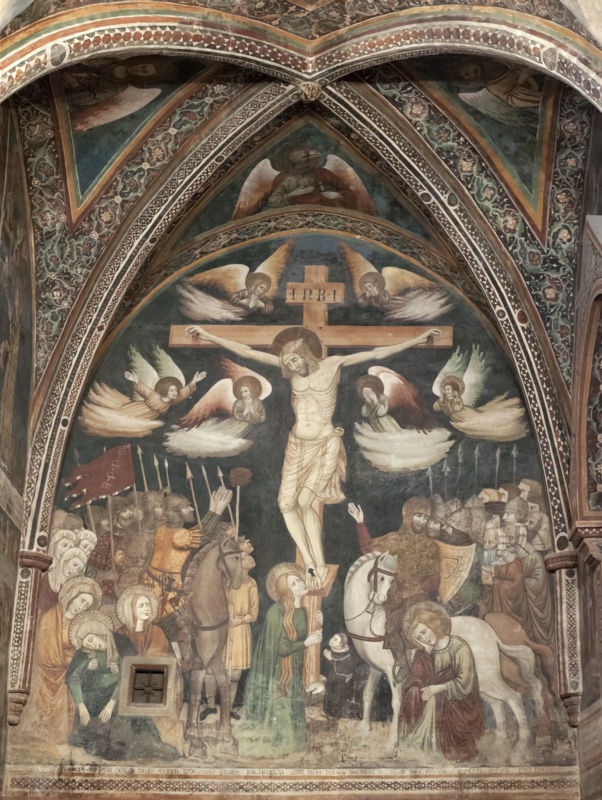
The Crucifixion on the altar wall is the most ambitious painting in the Cappella di Santa Croce, the one most often reproduced, and the image around which the whole decoration is organised. It fills the pointed lunette beneath the rib vault, so the architecture becomes a frame for the scene; the two converging arches enclose the event like a monumental tabernacle. Modern descriptions count more than forty figures, and the diocesan account gives forty-five. The painting belongs to the type of the “Calvario popoloso”, the crowded Calvary that spread through Umbria in the first half of the fourteenth century. Its most influential model was Pietro Lorenzetti’s Crucifixion in the left transept of the Lower Church at Assisi. At Montefalco, however, the type has been compressed into a much smaller, nearly square field. The painter has had to stack rather than spread his crowd, setting the soldiers in tight vertical tiers on either side of the cross and pushing the mourners right down to the lower edge. The diocesan description notes that the iconography draws on both the Johannine and the Lucan accounts of the Passion.
The figure of Christ dominates the field with a scale that has little to do with the logic of the surrounding space. The tall cross rises almost to the apex of the lunette, crowned by a rectangular titulus bearing the letters INRI. Christ’s arms stretch nearly the full width of the crossbar. His body sags in a gentle curve, the head inclined towards his right shoulder, the eyes closed in death. Andrea De Marchi associated this towering, immense Christ with Cimabue: the overall arrangement is up to date, but the Christ belongs to an older, more hieratic conception of the Crucified. The anatomy is rendered with clear contours and restrained modelling, the ribs and abdomen marked by linear accents rather than by a continuous play of light. Thin streams of blood run from the wounds in the feet down the shaft of the cross. They lead the eye directly to the Magdalene below, who embraces the wood at precisely that point.
Six angels hover around the cross in two symmetrical groups, two beside the titulus and two on either side of the arms. Their lower bodies dissolve into white, wispy trails, so they seem to be made of the cloud on which they move. This formula comes from the Giottesque Crucifixions at Assisi and Padua, but at Montefalco it is handled with a vehemence typical of the Spoletan tradition. The angels do not simply float in sorrow. They twist, raise their hands to their faces, throw out their arms and look towards Christ with expressions of acute grief. Against the deep blue-green ground, the warm reds, ochres and pinks of their wings create a ring of agitated colour around the pale body of Christ. The heavenly lament thus answers, at a higher register, the earthly lament below.
The left side of the composition belongs to the soldiers and to the group of the holy women. Behind a rider on a brown horse rises a dense cluster of helmeted figures, spears and lances. A red banner bears an emblem that cannot be securely read in the photograph, and a reed tipped with the sponge stands out against the sky. A soldier in a golden-orange tunic raises his hand, and grey-bearded elders crowd beside him, their heads packed together in the stepped manner typical of Spoletan Calvaries. Depth is suggested not by perspective but by accumulating heads and weapons, which give this half of the picture an almost tapestry-like density. In the lower left corner the Virgin collapses into the arms of the holy women, who hold her under the arms and around the shoulders. De Marchi recognised this group as directly dependent on the Crucifixion in the right transept of the Lower Church at Assisi, which he dates to around 1310–1312; the borrowing is clearest here. Yet the Montefalco painter has translated the borrowed motif into his own idiom. The faces are drawn with strong contours, the haloes overlap like a row of golden discs, and grief is stated with almost declamatory directness.
Immediately beside the swooning Virgin, a small square opening with an iron grating is cut into the wall. On De Marchi’s reading, this was one of the grilles through which the enclosed Augustinian nuns followed the liturgy from their side of the wall. Its placement was deliberate. The nuns looked into the chapel through the very image of the Mother of Christ in her sorrow, and were invited to identify their own devotion with hers. The rhetoric of the fainting Virgin was therefore aimed not only at the clergy and laity in front of the altar but also at the community behind the wall. The image becomes an instrument of devotion addressed to two audiences at once.
At the foot of the cross kneels Mary Magdalene, in a green gown, her long, loose, reddish-gold hair falling down her back as she clasps the wood. She is the axis of the lower half of the painting, as Christ is of the upper. Her figure ties together the stream of blood from the wounded feet, the mourning women on the left and the horsemen on the right. Immediately beside her, separate from the group of holy women, appears a much smaller kneeling figure in dark clothing, hands joined in prayer. This is the patron, Jean d’Amiel, the French cleric who had governed the Duchy of Spoleto as papal rector. His reduced scale is conventional, but his position is not, and his presence is more than a routine donor portrait. In the church where Chiara had died, and where her devotees believed her heart had revealed the Cross, the patron set his own image at the very point where devotion to the Cross was concentrated. He was thus drawn into a community of mourning that joined the Gospel figures, the dead abbess and the living women of her monastery.
The right side mirrors the left with a different emotional tone. A rider on a white horse, seen in sharp profile, leads a group of helmeted soldiers and bearded figures, one of whom holds a large, pale shield. A helmeted figure near the cross, apparently the rider himself or the soldier just beside him, raises his hand towards Christ. The gesture traditionally identifies the centurion who, in the Synoptic Gospels, acknowledged the Son of God at the moment of his death; the photograph does not allow a certain identification. The two horses, one on each side, flank the cross rather than surround it. Their heads cut diagonally across the space and introduce movement into an otherwise frontal arrangement. In the lower right corner, a mourning figure in a red mantle over a green tunic sits huddled, head bowed and resting on one hand. This is presumably Saint John, shown in a pose of withdrawn, inward grief that contrasts with the collapsing Virgin opposite.
Stylistically, the fresco shows with particular clarity the tension that defines this painter. The structure of the composition, the swooning Virgin and the lamenting angels derive from Assisi. Yet, as De Marchi insists, the language is different: it speaks to the feelings first and to the intellect only afterwards, and its roots lie much deeper in the past. Colours are saturated and strongly contrasted. Faces are defined by emphatic outlines. Gestures are emphatic and held, made to be read at a distance, and the emotional pitch is sustained from one end of the wall to the other. Roberto Longhi first isolated this painter’s personality in his lectures of 1953–54. The monastery’s published account of the chapel reports his appreciation of the anonymous painters’ “qualità di immediatezza sentimentale di espressione affannata e appassionata”, their immediacy of feeling and breathless, impassioned expression. The phrase seems written for this wall. A modern diocesan guide speaks of the fusion of solid Romanesque traditions with Giottesque innovations arriving from Assisi. The wording is a guide’s rather than a scholar’s, but the judgement agrees with the specialist literature: the painter accepts Giotto’s compositional models but declines the core of Giottesque form, the construction of solid bodies in coherent space.
The vault above deepens this sense of conscious archaism. In the compartment directly above the lunette appears the eagle-headed figure of Saint John, and in the other compartments, partly visible, the remaining Evangelists take the same old zoocephalic form. Broad bands of foliate scrolls on a dark ground run along the ribs and the arch. De Marchi singled out this taste for festive ornament on black grounds, together with the zoocephalic Tetramorph, as habits of the late thirteenth century. In a work of 1333 they are best explained by the training of an older painter. This is one of the main arguments for identifying the Primo Maestro with the late phase of the Maestro di Cesi, a painter trained around the Assisi scaffolding of the 1290s whose first dated work is the Cesi dossal of 1308. Delpriori has supported the identification while presenting it, honestly, as a thesis rather than a certainty, and it remains the strongest current hypothesis rather than an established fact.
Read in its setting, the Crucifixion is not an isolated devotional image but the hinge of a carefully planned programme. It faced the clergy and laity before the altar while opening, through the grille beside the Virgin, towards the enclosed nuns. Across the chapel it was answered by the painted tabernacle in which Christ plants the Cross in Chiara’s heart. The universal sacrifice on the altar wall and the particular sanctity of the local visionary were thus set in dialogue: the Cross of Calvary became the Cross that Chiara had received in vision and that her community believed had been found in her heart. Painted in 1333, while her cause still waited at Avignon, the fresco proclaims the Passion and, implicitly, the holiness of the woman whose church this had been. Together with the rest of the chapel, it is one of the most intact and eloquent documents of Spoletan painting in the first half of the fourteenth century.
Vault with the Four Evangelists in Zoocephalic Form
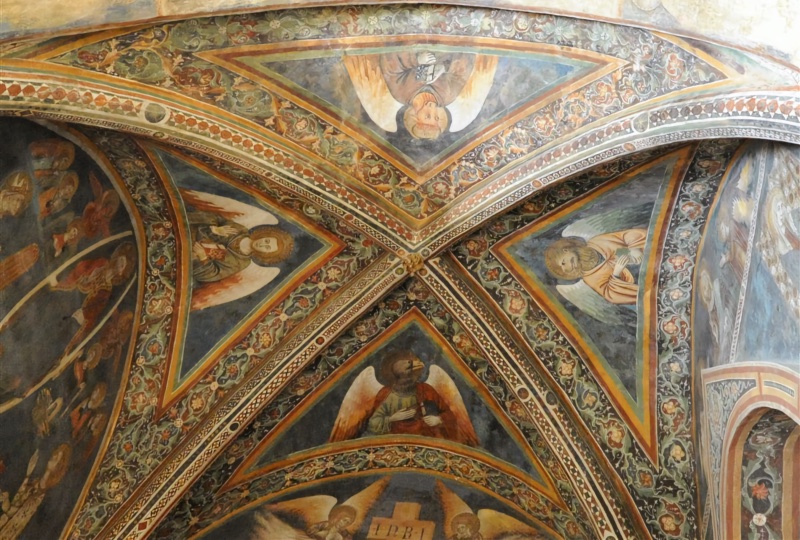
The vault of the Cappella di Santa Croce is a ribbed cross vault: four triangular compartments, or webs, meet at a small central boss. Seen from below, as in this photograph, it forms the ceiling of a chamber that is almost a painted reliquary. The webs are painted a deep, slightly mottled blue, each framed by a narrow band of orange and green. In each sits a single winged Evangelist with a book. The surrounding surfaces, along the diagonal ribs, the transverse arch and the broad borders between them, are covered almost without interruption by ornament. Little of the architectural surface is left bare. The chamber is wrapped in a continuous skin of colour and pattern, which binds the vault visually to the Crucifixion below, whose upper edge with the INRI titulus and two of the mourning angels is visible at the bottom of the image.
The figures are not simply the symbols of the Evangelists but the Evangelists themselves, in the old zoocephalic form: winged figures with human bodies, haloes, tunics and mantles, holding books, but with the heads of their symbolic creatures. The clearest is in the compartment directly above the Crucifixion. A figure in a green tunic and red mantle, his wings spread wide, holds a book in both hands, and above the shoulders rises the brown, hooked head of an eagle within a golden halo: Saint John. The other three figures, in the compartments to the left, right and top of the photograph, are harder to read at this resolution. Their heads, set within haloes, should correspond to the man or angel of Matthew, the lion of Mark and the ox of Luke. The precise distribution should be verified on site before it is stated as fact.
The arrangement is strictly radial. In each web the Evangelist is turned so that his head points towards the central boss and his body stretches out towards the springing of the vault. The figure at the top of the photograph therefore appears upside down, and those on the sides appear to lie horizontally. The effect cannot be appreciated from any single viewpoint, because the vault is designed as a centred whole rather than for a viewer standing in one place. The four writers of the Gospel converge on the apex of the vault as on a heavenly centre, directly above the altar and the Crucifixion. The arrangement is old: it belongs to a long tradition of vaults with Evangelists and Doctors of the Church that the Upper Church at Assisi had made canonical in central Italy at the end of the thirteenth century.
Here the Primo Maestro’s conservatism is most openly displayed. De Marchi argues that identifying this painter with the Maestro di Cesi explains several archaisms that would otherwise be hard to account for in a work of 1333. One is the taste for festive ornamental scrolls on a black ground, which enliven the broad bands of the vault and which he associates with the late thirteenth century. Another is the old iconography of the Tetramorph in zoocephalic form, Evangelists with human bodies and the heads of their symbolic creatures, which by the 1330s had largely given way to purely animal symbols or to Evangelists in fully human form. Both features are plainly visible in the photograph, and together they give the vault a character closer to the decorative world of the 1290s than to that of the Lorenzettian 1330s.
A third archaism lies not on the vault but in the painted tabernacle on the side wall: the crumpled white veil on the shoulders of the enthroned Madonna. In De Marchi’s view it derives from the roundel of the Virgin and Child on the inner façade of the Upper Church at Assisi, attributed to Giotto and painted some forty years earlier. At Montefalco, however, it has been emptied of the plastic and spatial meaning it had there. For De Marchi these are not the habits of a painter trained in the 1320s. They belong to a painter whose visual culture was formed in the Assisi of the 1290s and who kept them into the 1330s, whether by conviction, by habit or out of a sense of what devotional decorum required. The vault and the Madonna thus belong to the same line of argument. They make visible the generation to which the painter belonged.
The ornament deserves attention in its own right, because it is not mere filler. The diagonal ribs are painted with narrow strips of small, repeated geometric motifs in red, white and dark tones, a sort of painted inlay recalling the marble inlay of Roman cosmatesque work. The transverse arch at the top of the image carries a row of red and white dots like a string of beads. Between ribs and webs run the broad borders De Marchi describes: dark green or almost black grounds over which wind scrolling stems of foliage, punctuated by red and white rosettes. The effect is that of precious textile or embroidery laid over the architecture. The repetition is dense yet lively, because the scrolls vary in rhythm and the rosettes are freely spaced. In such a small room this decorative richness turns the vault into a canopy, almost a painted baldachin over the altar.
The Evangelists themselves are painted in the same idiom as the figures on the walls below. Their wings are rendered in broad, warm feathers of red, ochre and white that open like fans against the blue ground. Their drapery is described with clear contours and a few strong folds rather than with systematic modelling. Their hands, gripping the books, are drawn with the firm outline that characterises the whole chapel. The figures fill their triangular fields well, adapting to the narrowing shape of the web without appearing cramped. That is no small achievement in a vault of such modest size, and it shows a painter well practised at fitting figures to awkward architectural fields.
Colour binds the vault to the rest of the decoration. The deep blue of the webs is the same ground that sets off the angels and the cross in the Crucifixion. The red, orange and green of the frames recur in the clothing of the mourners and soldiers below. The warm tones of the wings echo the agitated ring of angels around the dead Christ. The chapel’s colour system is thus unified from floor to apex, one of the reasons it reads, despite its two painters, as a coherent whole. Seen from below, the eye moves continuously from the Crucifixion to the eagle of John directly above it. The Evangelist who stood at the foot of the cross in the Gospel narrative is placed, in the vault, immediately above the Calvary he witnessed. That coincidence suits the chapel’s programme, though the sources consulted do not say whether it was intended.
The edges of the photograph show how the vault fits into the room as a whole. On the left, beyond the ribbed frame, rows of haloed figures belong to the side wall. They are probably part of the scene of Christ in glory with the patron presented by Saints Blaise and Catherine, though the fragment visible here does not allow a firm identification. On the right appears part of an arched opening framed by the same ornamental vocabulary, its intrados painted with foliage. These glimpses confirm that the decorative system of the vault continues without a break into the walls: the same borders, colours and patterns frame the narrative and iconic scenes below. This continuity is part of what De Marchi meant by describing the chapel as a microcosm in which the whole argument of Spoletan painting is condensed.
Read in its devotional context, the vault completes the theological structure of the chapel. Below, the altar wall presents the Crucifixion, and the side walls present the visions and death of Chiara and the patron’s devotion to his chosen saints. Above, the four Evangelists, the authors of the Gospel account of the Passion, converge on the apex as witnesses and guarantors of the truth that the walls make visible. For the enclosed nuns who followed the liturgy through the grilles, and for the clergy and laity before the altar, the vault framed the whole room as a sacred space under the authority of Scripture. Painted in 1333, while Chiara’s cause still waited at Avignon, it shows the Primo Maestro, whether or not he is the late Maestro di Cesi, using an old visual language deliberately and with conviction for a room that served at once as chapel, relic and memorial.
Maestà: The Virgin and Child Enthroned between Two Angels
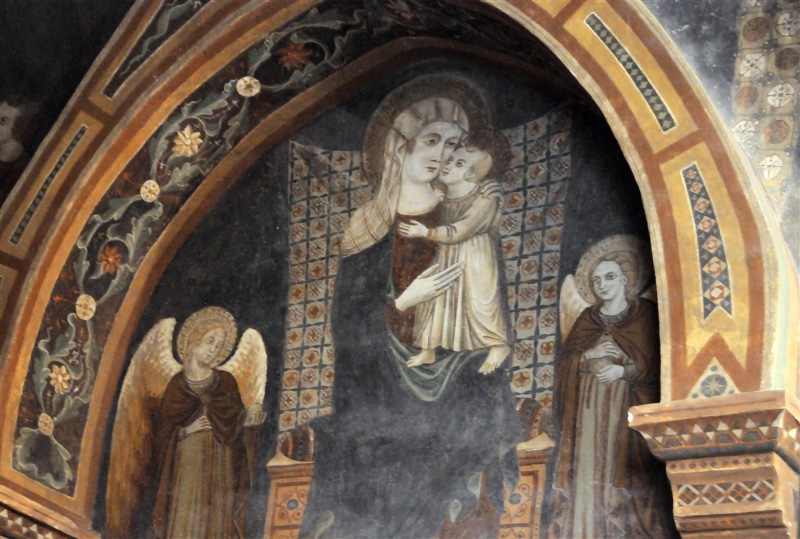
The Maestà occupies the upper part of the painted tabernacle on the side wall of the Cappella di Santa Croce. The tabernacle is a fictive niche under a pointed arch, and below the Maestà Christ, dressed as a pilgrim, drives the foot of his Cross into Chiara’s breast. Image and vision are thus stacked one above the other within a single painted structure. Above is the iconic, timeless presence of the Mother of God with her Son; below is the dramatic moment that founded Chiara’s mystical identity. The tabernacle faces the death of Chiara on the opposite wall, and on Andrea De Marchi’s reading it was visible to the enclosed nuns through the grille opening beside the swooning Virgin in the Crucifixion on the altar wall. The Maestà was therefore not a separate devotional image. It was one element of a carefully planned programme in which each image answered another across the room.
The Virgin sits frontally on a throne, her monumental figure filling the centre of the arch. Her proportions are those of an icon rather than of a narrative figure: she is markedly larger than the flanking angels, and her mass dominates the field. She wears a white veil over her head and shoulders, a dark mantle now much darkened, and beneath it a red dress visible at the neck. Her face is long and oval, with a straight nose, heavy-lidded eyes and a small mouth. Her expression is grave and inward, typical of the Spoletan painters, who placed restraint and melancholy at the centre of their Marian images. A large golden halo, partly faded, frames her head. Her right hand lies across the Child’s body, close to her own chest, in a gesture both protective and presenting.
The Christ Child does not sit in his mother’s lap. He stands on it, barefoot, in a pale tunic that falls in soft folds to his ankles. He throws his arms around her neck and presses his cheek against hers. The type is that of the Virgin of Tenderness, known in Byzantine tradition as Glykophilousa, in which the intimate affection between mother and child replaces the solemn presentation of the Hodegetria. The contrast between the Virgin’s grave face and the Child’s eager embrace gives the image its emotional charge: the tenderness is real, but it is shadowed by the mother’s foreknowledge of the Passion. De Marchi’s description of the tabernacle mentions the Madonna with the Child walking, and the standing pose here, the bare feet planted on her lap as if in mid-step, suits that description.
The most significant motif for the history of the painter is the white veil. De Marchi singled out the crumpled white veil on the shoulders of the enthroned Madonna as one of the archaisms of this master. In his view it derives from the roundel of the Virgin and Child on the inner façade of the Upper Church at Assisi, attributed to Giotto and painted some forty years earlier. At Montefalco, however, it has been emptied of the plastic and spatial meaning it had there. In the photograph the veil appears as a pale, softly folded surface that frames the face and falls onto the shoulders. Its folds are drawn rather than modelled; they describe the fabric without giving it volume in space. This is the kind of borrowing that, for De Marchi, betrays a painter formed in the Assisi of the 1290s who kept its motifs into the 1330s.
Behind the throne hangs a cloth of honour patterned with a dense chequer of small squares in red and white. Its upper edge is held out stiffly at the sides like a canopy. The textile is treated as a flat ornamental field, setting the figures against a vibrating pattern rather than within a defined space. The throne itself is barely visible, but at its lower corners appear fragments of geometric inlay in the manner of Roman cosmatesque work, which recurs in the borders of the chapel’s architecture. The background beyond the cloth is the same dark blue that grounds the Crucifixion and the vault, binding the image to the colour system of the whole room.
The two angels stand on either side of the throne, smaller in scale than the Virgin and turned slightly towards her. The left one, with fair hair and a golden halo, wears a brown mantle over a lighter tunic, his large wings spread behind him, his hands crossed on his chest. The right one, with curly fair hair and a halo, wears a similar brown mantle and holds his hands to his chest as if clasping something small, though the photograph does not show what. A faint wing can be made out behind his shoulder. Neither angel carries the attribute that would identify him with certainty: no lily for Gabriel, no sword, scales or armour for Michael, no fish or staff for Raphael. The popular identifications as Gabriel and Michael, or Raphael and Gabriel, contradict each other, and the Fondazione Zeri catalogue records them simply as angels. Until an inscription or attribute is verified on site, the cautious description is the correct one.
The arch that frames the niche is a small anthology of the chapel’s ornamental vocabulary. Its inner band carries scrolling stems of dark foliage on a near-black ground, set with white and orange rosettes. These are the festive scrolls on a black ground that De Marchi associated with the late thirteenth century and that also enliven the vault. The outer band is articulated in ochre, orange and red, with inset strips of small lozenges and geometric motifs. On the right, the arch springs from a painted corbel or capital decorated with sawtooth and triangular patterns. Above it is a field of circular rosettes like inlaid tiles. The painted architecture thus imitates a real tabernacle built of precious materials, turning the niche into a fictive reliquary for the image it contains.
Stylistically, the Maestà shows the same tension between Assisi models and Spoletan language that defines the Primo Maestro’s work on the altar wall. The composition of an enthroned Madonna between angels against a cloth of honour belongs to a widely shared Giottesque formula. The handling does not. Forms are defined by clear outlines, faces are elongated and melancholic, drapery is drawn rather than modelled, and space is suggested rather than constructed. The image speaks, as De Marchi put it of the Crucifixion, to the feelings first and to the intellect only afterwards. The tenderness between mother and child is stated with a directness that owes more to the expressive tradition of the late thirteenth century than to Giotto’s measured gravity.
Within the programme, the Maestà and the scene below form a single devotional statement. Above, the Child embraces his mother in an image of the Incarnation; below, the grown Christ, now a pilgrim bearing the Cross, plants it in Chiara’s heart. The vertical sequence leads from the tenderness of infancy to the Passion and to Chiara’s participation in it, just as the Virgin’s foreknowledge of the Passion shadows her expression above. De Marchi read the visionary dialogue between Chiara and the Child painted in this area as a model for the nuns. The Maestà offers the same model in iconic form: an intimacy with Christ that the community was invited to share, in the image of the Mother who first held him.
The Maestà was painted in 1333 as part of the decoration commissioned by Jean d’Amiel, while Chiara’s cause still waited at Avignon. It is a key image for the question of the painter’s identity. Its white veil is one of the motifs on which De Marchi and Delpriori base the identification of the Primo Maestro with the late Maestro di Cesi, the Spoletan painter whose dated dossal at Cesi goes back to 1308. Delpriori has presented that identification as a thesis rather than a certainty, and it should be read as such. Whatever name the painter finally bears, the Maestà shows him at his most composed and most tender, using the old language of his training to set the Mother of God at the head of a painted structure devoted to the Cross and to the woman who had received it.
The Virgin Brings the Christ Child to the Blessed Chiara
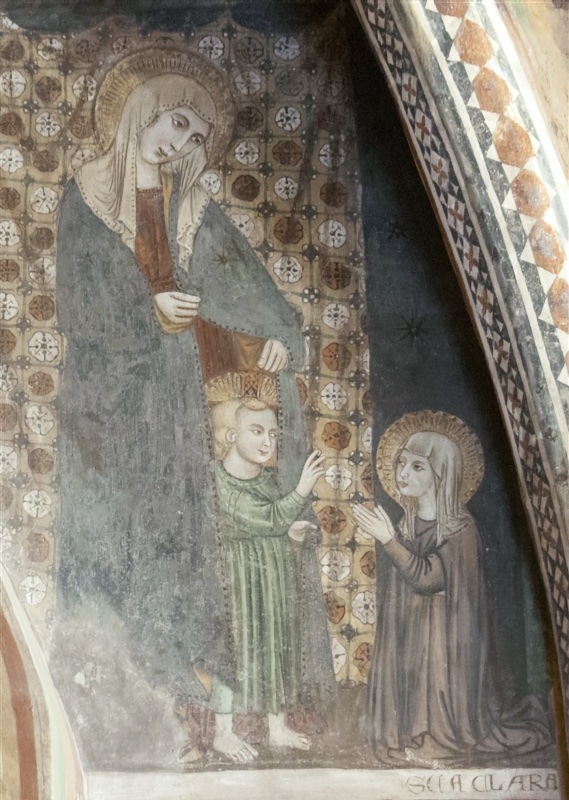
This fresco forms a narrative scene in the painted tabernacle on the side wall of the Cappella di Santa Croce. It belongs to the same painted tabernacle as the Maestà, above the scene in which Christ, in the guise of a pilgrim, drives the foot of his Cross into Chiara’s breast. The sources do not make clear how the Maestà and this scene share the upper zone, and the arrangement should be checked on site. De Marchi describes the arrangement precisely: in the upper part the Madonna appears with the Child walking, and below, Chiara physically receives the Cross. The intimate exchange between Chiara and the Child above is presented as the model for the encounter with the adult Christ below. The two scenes are thus conceived as a pair. Infancy and Passion, tenderness and suffering, the Child offered and the Cross received are set one above the other within a single fictive structure, facing the death of Chiara on the opposite wall and, through the grille in the altar wall, the enclosed nuns.
The Virgin stands, tall and slender, occupying almost the whole height of the field. She is not enthroned, and her pose is neither the frontal presentation of the Maestà nor the seated intimacy of the Virgin of Tenderness. Her head inclines towards the right, towards Chiara, with an expression of grave, attentive gentleness. She wears a white veil over her head and shoulders, a grey-green mantle that has probably darkened and altered over time, and a red dress visible at the neck and down the front. A large golden halo with an incised border frames her head. Her monumental scale, far larger than Chiara’s, marks the hierarchy of the image: the Mother of God dominates the space, the visionary kneels at its edge.
The central action is a gesture of opening. The Virgin’s left hand draws back her mantle at the waist, while her right hand rests at her breast. From the space this opens, the Christ Child steps forward. He stands barefoot on the ground, dressed in a green tunic that falls to his ankles, with fair hair and a cruciform halo. His left foot is set forward as if in mid-step, and his right hand stretches towards Chiara, almost touching her raised hands. The motif recalls the protective gesture of the Madonna della Misericordia, who shelters the faithful beneath her mantle, but here it is reversed. The mantle does not enclose; it releases, and the Child emerges from it to go towards the kneeling nun.
Chiara kneels at the lower right, small in scale, her body turned towards the Child and her face lifted towards him. She wears the dark brown habit and white veil of her community, and a golden halo frames her head. Her hands are raised, palms open, in a gesture that is at once adoration and welcome, as if she were about to receive the Child into her arms. Her face is calm, with the long nose and heavy-lidded eyes typical of the chapel’s figures, and her whole posture expresses an attentive, receptive stillness. The inscription SCA CLARA at the lower right, Sancta Clara, names her as a saint, consistent with her halo and with the local cult, which venerated her as holy long before any papal sanction. Whether this inscription is original or a later retouch should be checked on site before any conclusion is drawn from it.
The episode belongs to the visionary life of Chiara as remembered by her community. Guide literature records among the scenes on this wall Chiara’s vision of the Virgin with the infant Jesus, and the fresco is traditionally titled La Madonna fa giocare Santa Chiara con Gesù Bambino, “the Madonna lets Saint Chiara play with the Infant Jesus”. The motif of play could not be verified in Bérenger de Saint-Affrique’s Life or in the canonisation testimonies consulted, and the traditional title is best quoted as such. What the image shows is unambiguous. The Virgin entrusts the Child to Chiara, and the Child goes towards her of his own accord. It is an image of intimacy granted, the kind of familiar, almost domestic encounter with the Christ Child that recurs in the visionary literature of religious women in the late Middle Ages.
The background reinforces the sense of a vision set apart from ordinary space. Behind the Virgin hangs a cloth patterned with a regular grid of rosettes, alternately white and reddish-brown, linked by small cross-shaped motifs. It is a brocade or embroidered hanging that functions as a cloth of honour for the standing Mother of God. To the right, behind Chiara, the ground is a deep blue scattered with eight-pointed stars, a heavenly field that marks the encounter as taking place outside earthly time. The contrast between the patterned textile and the starry sky divides the field into two zones: the precious, ceremonial zone of the Virgin and the celestial zone into which Chiara is admitted.
The painted architecture frames the image as part of a tabernacle. Along the right edge runs the intrados of the arch, decorated with a band of red and white triangles and small diamond motifs, the same geometric vocabulary that appears on the ribs of the vault and on the corbel beside the Maestà. The fresco is thus held within a fictive structure that imitates precious materials, turning the encounter into a sacred image set in a reliquary. The arrangement matches De Marchi’s reading of the whole chapel as a system of images set in architectural frames, each answering the others across the room.
Stylistically, the fresco shows the Primo Maestro at his most lyrical. The forms are defined by clear contours, the drapery by long, simple folds that fall vertically, and the faces by the elongated, melancholic features characteristic of the chapel. The painter does not construct a coherent space; he sets the figures against flat ornamental fields and relies on scale, gesture and direction of gaze to carry the meaning. The Virgin’s inclined head, the Child’s extended arm and Chiara’s raised hands form a descending diagonal that leads the eye from the Mother of God, through the Child, to the visionary. Here as elsewhere, what De Marchi called the painter’s held gestures, made to be read at a distance, give the encounter its legibility and its emotional force.
The white veil around the Virgin’s face links this image to the argument about the painter’s identity. De Marchi singled out the crumpled white veil of the chapel’s Madonnas as one of the archaisms of this master, derived from the Assisi roundel of the Virgin and Child attributed to Giotto and painted some forty years earlier, but emptied of its plastic and spatial meaning. Here too the veil frames the face in soft, drawn folds without real volume. Together with the ornamental vocabulary of the frame, it supports the identification, proposed by De Marchi and argued by Delpriori, of the Primo Maestro with the late Maestro di Cesi, a painter trained around Assisi in the 1290s. Delpriori presents the identification as a thesis rather than a certainty, and it should be read with the same caution.
Read within the programme, the fresco carries a precise devotional message. Above, the Child comes towards Chiara from beneath his mother’s mantle; below, the grown Christ plants the Cross in her heart. The sequence leads from the gift of the Child to the gift of the Cross, from the joy of the Incarnation to participation in the Passion, and presents Chiara as the woman who received both. For the enclosed nuns who looked at this wall, it offered a model of the intimacy with Christ to which their life was directed, through the figure of a sister they had known. Painted in 1333, while her cause still waited at Avignon, and, if the inscription Sancta Clara is original, labelling her a saint in defiance of the slow pace of papal recognition, the image is both a vision and an affirmation: the community’s own declaration that the woman who had died among them stood in the presence of the Mother and the Child.
Christ Planting the Cross in the Heart of the Blessed Chiara
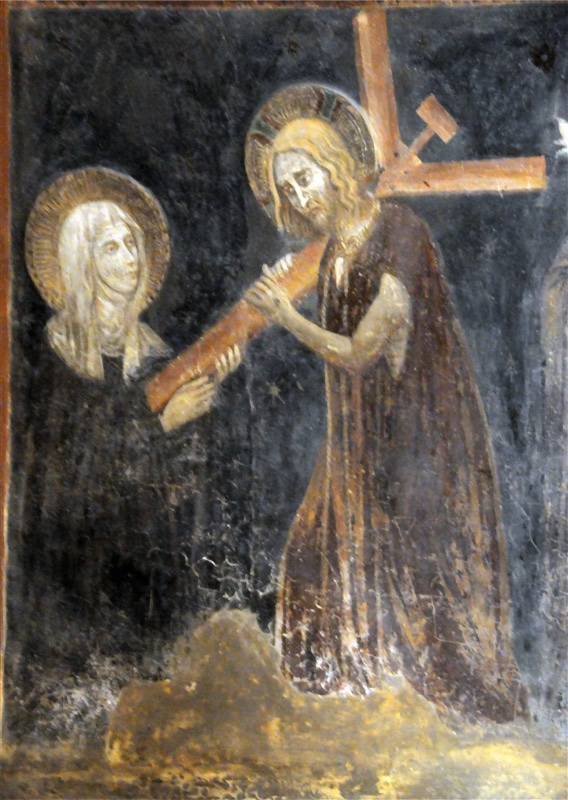
This fresco occupies the lower part of the painted tabernacle on the side wall of the Cappella di Santa Croce, beneath the Marian scenes of the upper zone, including the one in which the Virgin brings the walking Christ Child to Chiara. De Marchi describes the pairing as deliberate. Above, the visionary exchange between Chiara and the Child is set out as a model; below, Chiara physically receives the Cross that Christ carries on his shoulder as he drives it into her heart. The two images, one above the other, lead from the gift of the Child to the gift of the Cross. The Fondazione Zeri catalogue titles the scene Christ planting the Cross in the breast of Saint Chiara of Montefalco. It is the image that became the iconographic emblem of her cult and is still the image by which her sanctuary presents her.
The subject comes from the central episode of Chiara’s mystical life. According to the tradition of her cult, early in 1294 Christ appeared to her as a weary pilgrim, bent beneath the weight of the Cross. The present-day profile of the saint issued by the Holy See renders his words in Italian: he had been seeking a strong place in which to plant the Cross, and had found it in her. From that moment, the tradition holds, Chiara felt the Cross within her heart. The episode is recorded in the cult’s tradition and finds its context in the Latin Life written before 1320 by Bérenger de Saint-Affrique and in the testimonies of the apostolic process held at Montefalco in 1318–1319. The fresco turns these words into an action. Christ does not speak of planting the Cross; he plants it.
Christ stands on the right, his body inclined forward, one knee bent as he steps towards Chiara. He wears a long, simple, reddish-brown garment that falls to the ground in long vertical folds, the dress of a wayfarer rather than the royal or priestly robes of iconic images. His forearms are bare. His face, framed by long fair hair and a beard, is turned down towards Chiara with an expression of sorrow and gentleness. A golden halo, now worn, surrounds his head. The Cross rests on his left shoulder, its crossbar and titulus rising behind him at the upper right. With both hands he grips the long shaft, which runs diagonally down to the left, so that its foot meets Chiara’s breast. The whole figure is a single movement, a bending forward that combines effort and tenderness.
Chiara stands facing him on the left, upright and still. She wears the dark habit of her community, which in the darkened state of the fresco almost merges with the background, and a white veil that frames a pale, oval face. A golden halo surrounds her head. Her expression is calm and receptive, without the anguish one might expect. Her hand is raised beneath the foot of the Cross, as if to guide it towards her heart or to receive it, not to resist it. The contrast between the two figures carries the meaning of the scene. Christ, bowed and burdened, is the active figure; Chiara, upright and composed, is the willing recipient. The strong place Christ was seeking is shown as a woman who stands firm.
The composition is reduced to a few large forms that interlock with great clarity. The bent body of Christ forms one mass, the upright body of Chiara another, and the diagonal of the Cross binds them together. The crossbar and titulus at the upper right balance the composition, and the ochre mound on which Christ stands gives the scene a minimal suggestion of ground. The dark ground isolates the encounter from any setting, as though it took place in a visionary space outside the world, which in a sense it did. The scene is neither elaborate nor crowded. Its power lies in the directness with which a theological claim becomes a physical gesture, legible from a distance and from the grille through which, on De Marchi’s reading, the enclosed nuns looked towards this wall.
The image’s meaning depends on what happened after Chiara’s death on 17 August 1308. According to Bérenger, the nuns who opened her heart found within it what he calls the treasure of the Cross, together with signs of the Passion. In the apostolic process a physician named Simone testified that, on the second or third day after her death, he had seen the cross and the scourge in the opened heart. The fresco binds the vision of 1294 to the discovery of 1308. It invites the viewer to understand that the cross found in the dead woman’s heart was the one Christ himself had planted there. Painted in 1333, while her cause still waited at Avignon, it worked as a theological image of conformity to the Passion and, implicitly, as a kind of visual proof of her sanctity.
At the right edge of the photograph part of another figure is visible, cut off by the framing. An older photographic caption in the Fondazione Zeri archive identifies a standing figure on the right of this scene as the Blessed Giovanna, Chiara’s elder sister and the founder of the community. If the figure at the edge is the one meant, the scene would include a quiet record of the community’s own history, binding the founder to the abbess and the abbess to Christ. The identification comes from an archival caption rather than from a full scholarly discussion, and it should be checked against the whole wall before it is stated as fact.
Stylistically, the fresco shows the Primo Maestro’s characteristic fusion of Assisi models and Spoletan expression. The figure of Christ carrying the Cross belongs to the iconography of the Way to Calvary that the Giottesque cycles had made familiar. The handling, however, is not Giottesque. The forms are defined by contour rather than modelling, the folds of Christ’s garment are long lines rather than volumes, and space is not constructed but implied by a mound of ground and an empty dark field. As De Marchi said of the painter’s Crucifixion, the image speaks to the feelings first and to the intellect only afterwards. The intensity of the encounter lies not in naturalism but in the clarity of the held gesture and the emotional charge of the two faces.
The surface of the fresco has suffered considerably. The dark ground has lost much of its original colour, Chiara’s habit has nearly dissolved into it, and the lower area shows whitish efflorescence, abrasion and losses, especially around the ochre mound and along the lower edge. Christ’s garment has kept more of its colour, and the faces, haloes and hands have survived well enough to preserve the essential expression. These losses should be kept in mind when judging the painting. The present contrast between the luminous faces and the darkened bodies is partly the effect of time, and the original image was probably richer in colour and more legible in its details.
Within the programme of the chapel, the scene is the counterpart of the Death of the Blessed Chiara on the opposite wall, painted by the second master. Together the two walls frame Chiara’s mystical life from the Cross received to the death after which the Cross was believed to have been found in her heart. Above this scene, the Virgin brings the Child to Chiara. On the altar wall, the crowded Calvary shows the universal sacrifice, with the patron Jean d’Amiel kneeling at its foot. Read in this context, the fresco is the hinge of the whole programme, the point at which the Passion of Christ and the life of the local visionary meet. Whether the Primo Maestro is an independent painter or, as De Marchi and Delpriori argue, the late Maestro di Cesi, here he created the defining image of Chiara of Montefalco, in the very church where she had lived, died and been venerated.
The Death of the Blessed Chiara of Montefalco
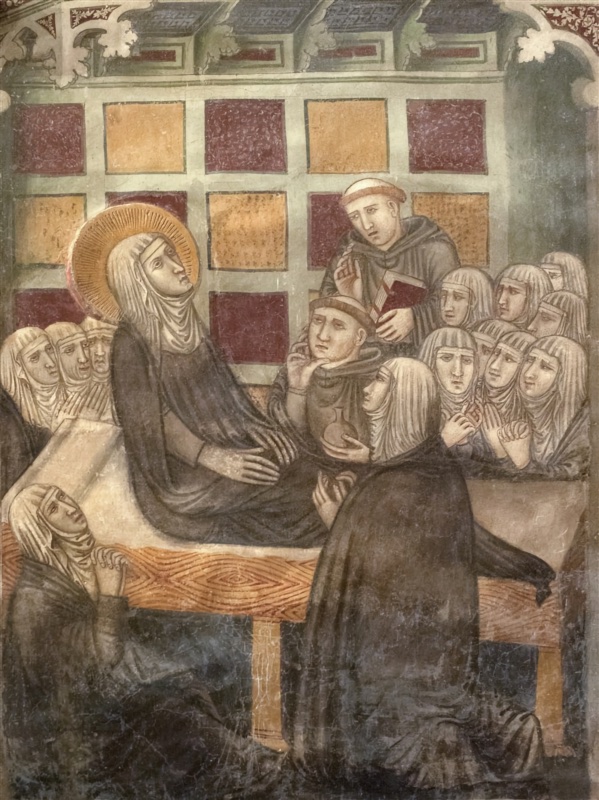
The Death of the Blessed Chiara occupies a field on the side wall of the Cappella di Santa Croce, facing the wall with the painted tabernacle in which Christ plants the Cross in Chiara’s heart. It shows the event that gives the chapel its meaning. In this very church, on 17 August 1308, the abbess of the community of the Holy Cross died, and her devotees later believed that her opened heart had revealed the signs of the Passion. Most of the literature gives the scene not to the Primo Maestro but to the second painter, who worked beside him in 1333. Its value for understanding the Primo Maestro lies precisely in this difference. Set against the altar wall and the tabernacle opposite, it shows how two painters of different training interpreted the same programme for the same patron, and why criticism has distinguished their hands since Roberto Longhi’s lectures of 1953–54.
Chiara sits upright on her bed rather than lying down, her back straight, her hands folded on her lap, her face turned upwards with eyes raised to heaven. The pose follows the tradition, recorded in her cult, that she died seated and erect, absorbed in contemplation. She wears the black habit of her Augustinian community with a white wimple and veil, and a large golden halo with incised rays frames her head. Her expression is calm and inward, without the vehement grief of the figures around her. She is the still centre of the composition. The rest of the painting moves towards her, while she is turned entirely away from the room towards the invisible goal of her gaze.
Around her the community gathers in two dense groups. On the left, three nuns in white veils press close behind her head. On the right, about ten more stand in tightly packed rows, hands clasped or raised in prayer, their long faces marked by sorrow. The painter has stacked them in tiers, head above head, so that the crowd seems to fill the entire right half of the space without any real depth. The faces are elongated, with long noses and heavy-lidded eyes, and the veils are rendered in many small, dense folds. De Marchi’s description of this second hand fits closely: abundant drapery with dense small folds and a sour expressiveness of wasted faces, which he traced back to the Maestro di Sant’Alò, an early Spoletan painter formed between Cimabue and the young Giotto at Assisi.
Two tonsured friars in grey-brown habits stand among the nuns. The first, at the back, holds a red-bound book in his left hand and raises his right, as if speaking, reading the prayers for the dying or blessing. The second, closer to the bed, rests his cheek on his hand in a traditional gesture of grief and holds a small round-bodied flask, perhaps containing holy water or oil for the last rites. The sources consulted do not identify these figures. Their presence nevertheless reflects a historical reality: a community of enclosed women depended on male clergy for confession, the sacraments and spiritual direction. The scene records the death of an abbess within her community, not in isolation.
The foreground is closed by two kneeling nuns. On the left, a nun kneels against the bed and looks up at Chiara, her hands resting on its edge, in an attitude of intense, almost intimate attention. On the right, a large figure in a dark mantle kneels with her back to the viewer, a repoussoir that draws the eye into the scene and places the viewer, in effect, among the mourning community. The bed is covered with an ochre cloth patterned in red, whose lively surface contrasts with the dark habits. Behind the figures rises a wall of square panels alternating dark red and ochre, framed by grey-green bands. Above it a painted cornice with Gothic leaf ornament and a coffered ceiling in rudimentary perspective suggests an interior without constructing it coherently. The architecture is a backdrop rather than a space, in keeping with the Spoletan tendency to state space rather than build it.
The scene finds its meaning in the dialogue with the opposite wall. The wall opposite the death of Chiara is organised around a painted tabernacle, a fictive niche that guide literature describes as large. In its upper part the Madonna and Child appear between angels. Popular accounts disagree on the identity of these angels, naming Gabriel and Michael in one case and Raphael and Gabriel in another. As with the confusion over left and right, such descriptions are unreliable, and the identification should be checked against any inscriptions and attributes in the fresco itself; the Fondazione Zeri catalogue records the scene simply as the Madonna and Child enthroned with angels. Below is the image that became the emblem of Chiara’s cult. Christ, dressed as a pilgrim, his face marked by sorrow, carries the Cross on his shoulder and drives its foot into Chiara’s breast. The Zeri catalogue titles the scene accordingly: Christ planting the Cross in the breast of Saint Chiara of Montefalco. An older photographic caption in the same archive identifies a standing figure on the right as the Blessed Giovanna, Chiara’s sister and the founder of the community. If that identification is correct, the image is both a vision and a quiet record of the community’s own history, binding the founder to the abbess and the abbess to Christ.
The planting of the Cross is the cycle’s most original iconographic invention and the image that became the iconographic emblem of Chiara’s cult. It turns words recorded in the tradition of her life, Christ seeking a strong place to plant his Cross, into an almost literal action. In doing so it binds together the vision of 1294 and the discovery in the heart in 1308, inviting the viewer to understand that the cross found within the dead woman’s heart was the one Christ himself had placed there. Theologically, the image expresses Chiara’s conformity to the Passion. In the circumstances of 1333, with the cause still pending, it also served as a kind of visual proof. The painter knew how to make such an idea legible at a distance. He reduced the encounter to a few large, interlocking forms: the bent body of Christ, the strong diagonal of the Cross and the upright, receptive figure of Chiara. The scene is neither elaborate nor crowded. Its power lies in the directness with which a theological claim becomes a physical gesture.
Seen together, the two walls frame Chiara’s mystical life from beginning to end. On one side, the Primo Maestro shows the Cross received, the moment of 1294 when Christ planted it in her heart. On the other, the second master shows the death of 1308, after which, according to Bérenger de Saint-Affrique’s Life and the testimonies of the canonisation process, the nuns opened her heart and found the signs of the Passion within it. The upright Chiara of the death scene, her eyes raised to heaven, answers the upright Chiara of the vision, receiving the Cross. Between the two walls the viewer stood, or the nun looked through her grille, inside the narrative itself, in the church where both events were believed to have taken place.
The stylistic contrast between the two scenes is instructive. The Primo Maestro builds his images from few, large forms and emphatic, held gestures that read clearly from a distance. The second master prefers crowding and detail: many faces, many folds, a multiplicity of small gestures of grief. His figures are more brittle and more densely draped, his pathos sharper and more acrid. De Marchi tentatively asked whether this second painter might be the Maestro di Sant’Alò himself, active around 1300 and otherwise lost from view. He was careful to add that the hypothesis would need further evidence. If it were correct, the chapel would be the joint work of two veterans of the Assisi generation, and the differences between their hands would reflect two distinct strands of the late thirteenth-century Spoletan tradition, rather than master and assistant.
Painted in 1333, while Chiara’s cause still waited at Avignon, the death scene had a function beyond narrative. Its image of a holy woman dying upright in contemplation, surrounded by her sisters and by clergy, gave visual form to the testimony gathered at Montefalco in 1318–1319. It presented the death as the culmination of a life of conformity to the Cross. For the nuns who looked at it daily, it also offered a model of how to live and how to die within enclosure. Together with the tabernacle opposite, it makes the Cappella di Santa Croce not only a place of worship but a painted memorial of the community’s own foundress and abbess, in the very room where her memory was most alive.
Altar Dossal with the Crucifixion and Stories of Saint Catherine of Alexandria and Saint Blaise
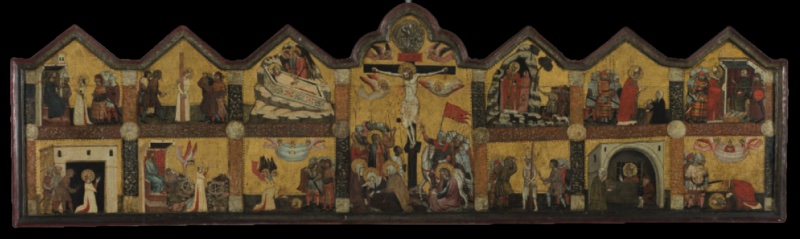
The altar of the Cappella di Santa Croce once carried a long, low painted dossal, now in the Vatican Museums. Its profile is distinctive: a row of gables runs across the top, three on each side, framing the upper scenes, and a taller, rounded central arch rises above the Crucifixion. At the centre is a Crucifixion surmounted by the mystic pelican tearing its breast to feed its young. On either side, in two registers, are six stories each of Saint Catherine of Alexandria, on the left, and Saint Blaise, on the right, drawn from Jacopo da Varazze6’s Legenda aurea. The scenes are separated by narrow painted columns and set against a continuous gold ground. The whole reads as a single precious object: a horizontal frieze of narratives converging on the Cross, placed beneath the great frescoed Calvary of the altar wall.
The panel left Montefalco in the twentieth century. According to the Vatican’s art-historical and restoration notes, it was sold to the Vatican in 1927, in very poor condition, because of the monastery’s financial difficulties. When it arrived the panel was split in two, and a crack ran the full length of the painting. A first restoration in 1928 dealt with both the wooden support and the paint surface and consolidated the crack. A second followed in 1970, when the dossal was assigned to the furnishings of the papal apartments. The third, carried out in the Vatican laboratories in 2017, paid particular attention to the damage caused by popular devotion. In 2018 the panel was lent to the Umbrian exhibition Capolavori del Trecento. Il cantiere di Giotto, Spoleto e l’Appennino, which brought it briefly back to Montefalco. In 2019 it was shown in Room XVII of the Pinacoteca Vaticana, in the exhibition dedicated to Chiara of Montefalco and Jean d’Amiel, beside the polyptych given by the same patron to the Franciscans of Montefalco in 1336. Its usual location is in the papal representative apartments.
The Vatican curators state explicitly that the dossal was painted by the first of the two masters who frescoed the chapel, and describe its stories as told in a naive, fable-like manner, faithful to the Umbrian tradition. The literature dates the panel with the frescoes to around 1333 and assumes that d’Amiel commissioned it. That is a reasonable inference from its subjects, which repeat the patron’s favoured saints, and from its provenance from the chapel’s altar. In the absence of an inscription, however, it remains an inference. The Fondazione Zeri catalogue lists the dossal under the generic heading of the Maestro di Santa Chiara da Montefalco, records both the Primo Maestro and the Maestro di Cesi as alternative attributions, and cites the entry in the 2018 exhibition catalogue. The exhibition literature itself, reflecting De Marchi’s position, presented the work plainly as an “opera estrema del più giottesco dei pittori spoletini, il Maestro di Cesi”, a late work by the most Giottesque of the Spoletan painters.
The central compartment repeats, on a reduced scale, the crowded Calvary of the altar wall above it. Christ hangs on a tall cross against the gold, his body pale, blood running from his wounds, while angels hover at either side of the crossbar. Below, on the left, the Virgin collapses among the holy women in a dense knot of haloed figures. The Vatican notes observe that in this tragic group the painter gives poetic form to a way of feeling widely shared in the Franciscan world. On the right, soldiers crowd beneath a red banner, and a rider on a white horse turns towards the cross. Saint John sits mourning in the lower right corner, as in the fresco. In the roundel at the top of the central arch, the pelican piercing its breast to feed its young gives the sacrifice a Eucharistic reading, suited to an image standing directly behind the altar.
The left wing tells the story of Catherine, the young Christian of noble Alexandrian family who opposed the emperor Maxentius, was condemned to the torture of the wheel and finally beheaded. Her body, according to the legend, was carried by angels to Mount Sinai, where a monastery was dedicated to her. Several episodes can be recognised in the photograph, though the precise reading of each compartment should be checked against detail images. They include Catherine, crowned and dressed in white, before an enthroned ruler; Catherine in prison, kneeling in a doorway; the torture of the wheels, shattered by an angel descending from the sky as she stands unharmed before the enthroned emperor; a scene with angels in the sky, a kneeling figure and soldiers, which appears to be her execution; and, in the upper register nearest the Crucifixion, her body laid in a tomb on a rocky mountain, with angels above. The Vatican notes record that in one scene milk rather than blood flows from her severed head, the miracle that made her patron of wet-nurses.
The right wing tells the story of Blaise, bishop of Sebaste in Cappadocia, who took refuge in a cave during the persecution of Diocletian. There, according to the legend, birds brought him food and animals came to him for his blessing. This episode is recognisable in the upper compartment nearest the Crucifixion, where a figure in red sits in a rocky cave beside a tree. After his arrest, a woman cooked for him the very pig he had once rescued from a wolf and restored to her. The Vatican notes point out that this episode appears both on the dossal and in the frescoes of the chapel. In another scene Blaise saves a child choking on a fishbone. Condemned to have his flesh torn with iron combs, he was finally beheaded. In the lower register a nearly naked figure stands bound between two torturers, an arched prison holds a haloed figure, and a final scene shows a kneeling figure in red beneath an angel in the sky, apparently the beheading. As with Catherine, the exact identification of each compartment should be confirmed against detail photographs. The notes add that Blaise’s cult was dear to the Augustinians and to the rural world, which suits a community living under the Augustinian rule.
The Vatican curators stress the strong empathetic power the images exercised on the faithful, who immersed themselves in the drama of the Cross and took part ideally in the stories of the saints. Devout viewers were led to react with violence against the wicked figures and damaged them with pointed instruments. Scratches and losses of various sizes were deliberately inflicted on negative characters, above all in the martyrdom scenes, at the time when the dossal stood on the chapel’s altar. The restoration of 2017 faced a delicate choice. After cleaning away glues, waxes and earlier retouching, the restorers treated these damaged areas with a watercolour stippling. This method restored the legibility of the stories and of the Crucifixion while preserving visible evidence of what the Vatican notes call the most genuine, quarrelsome and invasive expressions of the faithful’s devotion. The damage is thus kept as a small, vivid document of reception: viewers took these stories literally enough to wound the images of the wicked.
The dossal is the clearest witness to the Primo Maestro’s narrative manner on a small scale. Each scene contains few figures, set against the gold ground, with clear silhouettes and decisive gestures, so that it can be read at a glance. Architectural settings are reduced to a few signs: a doorway for the prison, an arch for an interior, a jagged rock for the mountain or the cave. Colour is bright and strongly contrasted, with the red of Blaise’s vestments and of the soldiers’ banner punctuating the gold. Delpriori describes this parcelled narrative, divided into many small compartments, as characteristic of Spoletan painting, along with the region’s painted tabernacles with folding wings.
This narrative manner differs both from the expansive architecture of Giotto’s Assisi cycles and from the courtly refinement of the Maestro di Fossa’s polyptych of 1336. When the two works hung side by side in the Vatican in 2019, the contrast made concrete a choice between two ideas of painting available in Montefalco in the same decade and to the same patron. The Vatican curators describe the dossal as faithful to the Umbrian tradition and the polyptych as the fruit of exchanges between the Umbrian artistic world and Avignon. In the dossal, the old language of the Spoletan school serves a devotion that wanted to be moved, to participate, even to strike back, rather than to admire.
Within the chapel, the dossal completed a carefully planned programme. Behind the altar stood the panel with the Crucifixion and the pelican, beneath the great frescoed Calvary of the altar wall. Around it, on the walls and on the panel, were the patron’s two saints: Blaise, whose cult was dear to the Augustinians, and Catherine, who also appears in the frescoes presenting d’Amiel to Christ. Facing it were the visions and death of Chiara. The dossal thus bound the liturgy of the altar to the stories of the martyrs and to the memory of the local visionary, in a single coherent decoration probably commissioned by one patron around 1333. Separated from its altar and now hanging in the papal apartments, it remains the most legible testimony to how the Primo Maestro told stories, and to how intensely the nuns and faithful of Montefalco responded to them.
Reliquary Panel with Eight Apostles (10207); The Virgin and Saints (10208)
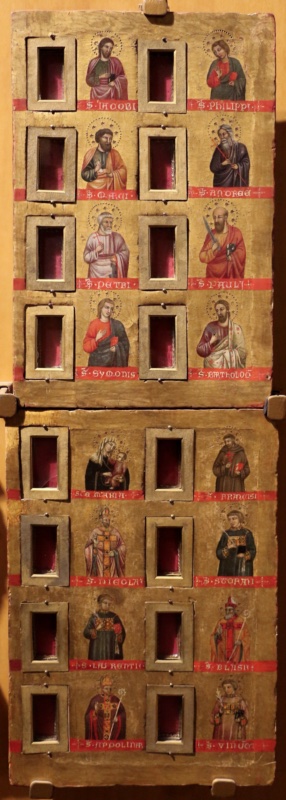
Panel I: Apostles (inv. 10207)
The panel belongs to a pair of reliquary panels now in the Museo Nazionale di Palazzo Venezia in Rome, part of the VIVE institute. This one carries the inventory number 10207, its companion 10208. Each is a thick wooden board covered with gold and divided into four horizontal rows. In each row two half-length saints alternate with two small recesses in which relics were kept. The present panel is devoted to eight apostles. Unlike most of the works associated with the Primo Maestro della Beata Chiara da Montefalco, it is not a fresco or an altar image but a small object made to be handled, opened and venerated at close range, a rare survival of the devotional equipment of early fourteenth-century Umbria.
The recesses are the reason the object exists. Each is framed by a strip of gilt metal with tooled decoration, closed by a small pane of glass and lined with red fabric. According to the museum’s entry, they once held fragments of relics of the saint painted beside them. Small metal pins above and below each opening show where the glazed frames were fixed. The arrangement makes each painted figure a label and a guarantee for the relic next to it: the image identifies, honours and in a sense makes present the saint whose physical remains were kept a few centimetres away. The museum notes that the arrangement of the relics fits neither the banded type of reliquary nor the porthole type, which makes the object unusual within its category.
Each figure stands above a red band bearing its name in gold Gothic capitals, preceded by an abbreviated “S.” for Sancti. The names, in the genitive, refer to the relic: the relic “of Saint James”, “of Saint Philip”, and so on. The museum’s transcription reads, row by row, James and Philip, Mark and Andrew, Peter and Paul, Simon and Bartholomew. The red bands run the full width of the panel, behind the metal frames, binding the rows into continuous horizontal strips. They give the surface a strong rhythm of gold and red, and their lettering, legible from close by, matches the intimate scale of the object.
In the top row, Saint James appears on the left as a dark-bearded man in a mauve mantle over a green tunic, holding a small dark book. Philip, beside him, is young and beardless, in a red tunic and green mantle; he raises his right hand with the palm turned outward and holds a red book in his left. The two figures set out at once the painter’s method. Each saint is reduced to head, shoulders and hands, turned slightly towards his neighbour or towards the viewer, and characterised by age, hair, beard and colour more than by individualised features. The gestures are few and clear: a book held, a hand raised. They are meant to be read immediately, at very close range.
In the second row, Mark wears an orange mantle over a green tunic and holds a small white object, perhaps a book or scroll, in front of his chest. Andrew, opposite, is the most venerable figure on the panel, with white hair, a long white beard and a dark blue-violet mantle. He holds a slender red cross that crosses his body diagonally, alluding to the cross of his martyrdom. The contrast between Mark’s dark beard and warm colours and Andrew’s white hair and cool mantle is typical of the panel’s alternating colour scheme. Warm and cool tones, young and old faces follow one another across the rows, so the eye never meets two similar figures side by side.
The third row is given to the two princes of the apostles. Peter, white-haired and bearded, wears a pale lilac robe and holds the keys, in red, together with a slender red staff ending in a cross. Paul, opposite, is recognisable by his high forehead and dark pointed beard. He wears a red mantle and holds a raised sword, the instrument of his martyrdom, and a dark book decorated with a cross, the sign of his letters. Their placement at the same level, side by side, follows a long tradition of pairing Peter and Paul as the founders of the Roman Church. The panel thus has, at its heart, the two apostles who most clearly represented the authority of the Church in the eyes of a fourteenth-century viewer.
In the bottom row, Simon appears as a young, beardless figure in a red tunic and a dark green mantle, his right hand laid on his breast and a red book in his left. Bartholomew, beside him, is dark-bearded and wears a white mantle scattered with small red flowers over a red tunic. He holds a dark knife, the instrument of his flaying, and a book. The patterned mantle is the most decorative piece of costume on the panel, and it shows the painter’s taste for ornamental surfaces that recurs in the borders of the Montefalco frescoes. It also shows how, even at this tiny scale, he varied the materials of his figures to keep the sequence lively.
Technically, the panel is a precious object in miniature. The gold ground was applied over a prepared surface and the haloes were tooled with rings of small punched dots, with star-shaped motifs around them, a decoration that catches the light as the panel is moved. The figures are painted in tempera with fine brushwork, faces modelled with light touches over a darker base, drapery defined by firm contours and a few folds. The museum describes the conservation as good, though the gold shows a dense network of fine cracks. The thickness of the wood, three centimetres, is unusual for a painted panel of this size. The museum takes it, together with the absence of hinges, as evidence that the two panels were not hinged together as a diptych.
The attribution history places this little object at the centre of the debate on the Montefalco master. Roberto Longhi attributed the two panels to the Master of Santa Chiara da Montefalco, and the attribution was repeated by later scholars. Others compared the panels with the dossal at Cesi, the dated work of 1308 that gave the Maestro di Cesi his name. The two lines of interpretation, which once seemed alternatives, have converged. Andrea De Marchi, in 2007, proposed that the Primo Maestro of Montefalco and the Maestro di Cesi are one painter at different moments of his career. Alessandro Delpriori defended the identification in his 2015 study of the Spoletan school and placed the Roman panels at the end of the 1320s. That is why the 2009 exhibition at Palazzo Venezia presented the panels under the name of the First Master of the Blessed Chiara, the 2018 exhibition under that of the Master of Cesi, and the museum’s current entry under the latter.
The dating to the late 1320s places the panel only a few years before the frescoes of Santa Croce of 1333, and this gives it particular importance. If De Marchi and Delpriori are right, it shows the same painter working at the scale of the miniature, with the same clarity of gesture and the same feeling for strong colour against gold that he brought to the altar wall and to the Vatican dossal. The museum entry mentions earlier observations linking the panels to Umbrian miniature painting, which suits the delicacy of the execution. In any case the panel shows that the painter’s language was not confined to monumental decoration. It could be compressed into a few centimetres of gold for an object of intimate devotion without losing its directness.
Panel II: The Virgin and Saints (inv. 10208)
The second panel, inventory 10208, repeats the format of the first: four rows, each with two half-length figures alternating with two glazed relic recesses, on a gold ground with red name bands. Its subjects, however, form a different group. The apostles of the first panel give way to the Virgin and Child, a recent founder saint, two bishops of the early Church, two martyr deacons and two further holy bishops. The museum’s entry lists the Madonna and Child, Saint Francis, Saint Nicholas of Bari, Saint Stephen, Saint Lawrence, Saint Blaise, Saint Apollinaris and Saint Vincent. The red bands confirm the names in gold Gothic capitals, from Sancta Maria to Sancti Vincentii. Together the two panels form a calendar of the sixteen holy figures whose relics were gathered in the object.
The Virgin and Child open the panel, in the place of honour at the top left. Mary wears a white veil over her head and a dark mantle, and holds the Child on her left arm. The Child, in a reddish garment, leans towards her. The type recalls the tender Madonnas of the Santa Croce chapel, where the Virgin’s white veil, derived according to De Marchi from Giotto’s roundel on the counter-façade of the Upper Church at Assisi, is one of the archaisms on which the identification of the painter rests. At this tiny scale the motif is necessarily simplified, but the white veil framing the face and the dark mantle around the Child form the same pattern. The Virgin’s inscription reads Sancta Maria, which suggests that a Marian relic, perhaps a fragment of a garment, was kept beside her.
Beside the Virgin stands Saint Francis7 in a brown habit, tonsured, holding a red cross and a red book. His presence at the top of the panel, at the Virgin’s side, is the strongest clue to the object’s origin. The museum notes that the inclusion of Francis makes a Franciscan commission plausible. Placing him at the same level as the Virgin, above bishops and martyrs of the early Church, suggests that the panel was made for a community or a patron for whom Francis held a special place. A Franciscan context also fits the Umbrian territory in which the painter worked, closely linked to Assisi and to the Franciscan houses of the Spoleto valley. This remains a hypothesis, since the panel’s provenance is unknown.
In the second row, Saint Nicholas, the bishop of Myra whose relics had been at Bari since the end of the eleventh century, wears a bishop’s mitre and a chasuble with an orange cross-shaped orphrey. He raises his right hand in blessing. His popularity in central Italy was immense, and his presence among the relics needs no special explanation. The figure shows the painter’s way of rendering liturgical dress at small scale: the orphrey is a bright vertical and horizontal band, the chasuble a broad field of colour, the mitre a simple pointed shape. These are exactly the elements that make the figure recognisable at once, and the painter reduces each costume to the details needed for identification.
The two deacon martyrs occupy the right of the second row and the left of the third. Saint Stephen, the first martyr, wears a dark green dalmatic with gold ornament and holds a book and the palm of martyrdom. Saint Lawrence, the Roman deacon martyred on the gridiron, wears a similar dalmatic, again green and richly decorated, and holds a red book. The two figures are almost twins, as the iconographic tradition often made them: both young, both tonsured, both in dalmatics. The painter differentiates them by the position of their hands and attributes, but he keeps their kinship visible. Placed diagonally across the panel, they form a quiet visual rhyme that connects the second and third rows.
Saint Blaise, bishop of Sebaste, appears on the right of the third row, with a white beard, a red mitre and a red chasuble with an orange cross, holding a crozier. His presence deserves attention from the reader interested in the Santa Croce chapel. Blaise is one of the two saints, with Catherine, whose stories fill the Vatican dossal and recur in the frescoes, and the Vatican’s notes record that his cult was dear to the Augustinians and to the rural world. Nothing in the panel’s documented history connects it with Montefalco, and the presence of Blaise should not be taken as evidence of provenance. It does show, however, that his cult was firmly established in the devotional world this painter served, and that the painter returned to his figure in very different contexts.
The bottom row is given to Saint Apollinaris and Saint Vincent. Apollinaris, the first bishop of Ravenna, wears a mitre and a red cope with a cross orphrey and holds a crozier whose crook ends in an ornamental, star-like finial. He blesses with his right hand. Vincent, the deacon martyr of Saragossa, wears a pinkish dalmatic with gold decoration and holds a palm and a book. He is the youngest-looking figure on the panel, his round face and short hair contrasting with the white-bearded bishops. The pairing of a bishop and a deacon in this row repeats the pattern of the second, so the panel alternates between the two orders of the clergy: bishops on the right and left of the outer rows, deacons in between.
The selection of figures suggests a carefully considered programme, though its precise logic remains unknown. The Virgin heads the group, followed by the most recent saint, Francis, and then by figures of the early Church: bishops, among them Nicholas, Blaise and Apollinaris, and deacon martyrs, among them Stephen, Lawrence and Vincent. Together with the apostles of the first panel, they form a compact image of the Church triumphant. Its relics, gathered in one place, offered the owner direct contact with the holiness of each figure. The museum’s entry concludes that the two panels were probably conceived as a single object for private devotion. The modest size, the precious finish and the presence of relics all suit use in a small chapel or a private oratory, rather than display on a public altar.
The reconstruction of the object as a whole is uncertain. The museum notes the pronounced thickness of the wood, the absence of hinges, the slight asymmetry between the two pieces and the unusual arrangement of the relics. These features make it unlikely that the panels formed a diptych or were set in a larger compartmented structure. The provenance is equally obscure. The two panels belonged to the Sterbini collection in Rome and passed to the museum of Palazzo Venezia in 1940, donated by Giovanni Armenise. An older inventory card proposed that they came from the convent of Sant’Alò at Spoleto, but the museum considers that hypothesis unfounded. What remains is the object itself, carefully preserved, and the evidence of its painting.
Seen beside the frescoes of Santa Croce and the Vatican dossal, the panel shows the range of the painter whom De Marchi and Delpriori identify as one artist, the Maestro di Cesi in his late phase. In the chapel he worked on the scale of a wall, building great forms meant to be read from a distance and through grilles. Here, at the end of the 1320s, he worked on the scale of a hand, with the same sense of clear outline, strong colour and decisive gesture, but with the delicacy of a miniaturist. Longhi had already recognised the hand of the Montefalco master in these panels long before the identification with the Maestro di Cesi was proposed. The convergence of the two attributions, which once seemed alternatives, is one of the strongest arguments for the unity of this painter’s career. As always with anonymous masters, it remains a hypothesis supported by style rather than by documents.
Crucifixion and Scenes from the Passion of Christ
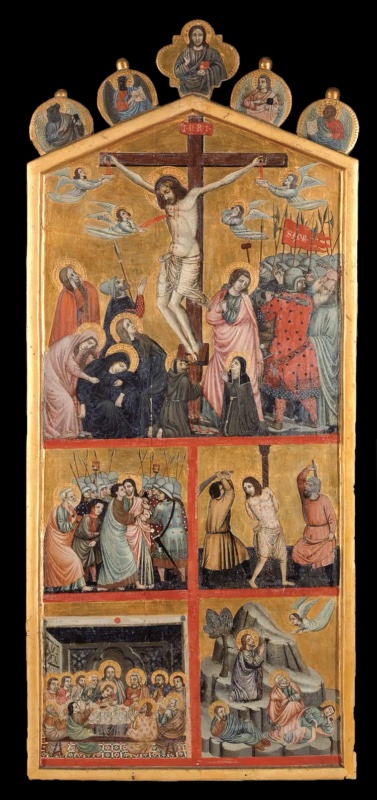
The attribution of this panel is disputed. Roberto Longhi gave it to the master of the Santa Croce frescoes in 1973, as guide literature reports; that attribution could not be verified against his text. The note on Jean d’Amiel records the other position: the Vatican curators now give the polyptych of San Francesco at Montefalco, with the Crucifixion and stories of the Passion, to the Maestro di Fossa, on the strength of the inscription of May 1336 recovered in 2017, and treat Longhi’s attribution as superseded for that work. The sources consulted do not say whether this small gabled panel and that polyptych are one object, and the description below keeps the two attributions apart.
This tall gabled panel, now in the storerooms of the Pinacoteca Vaticana, gathers in a single image the whole drama of the Passion. A large Crucifixion fills the upper part, beneath the slope of the gable. Four smaller scenes, separated by red bands, occupy the lower half: the Last Supper and the Agony in the Garden at the bottom, the Betrayal and the Flagellation above them. Five roundels crown the gable, the central one, a quatrefoil, containing Christ blessing, the others containing the four Evangelists. According to the documentation summarised in recent local studies, the panel was recorded in 1771 on the altar of the Holy Name of Jesus in the church of San Francesco at Montefalco. It was one of two panels, the second of which had disappeared by 1798. Its history is then lost until Roberto Longhi published it in 1973 as a work of the master of the Santa Croce frescoes.
The narrative is arranged to be read from the bottom upwards. It begins at lower left with the Last Supper, moves to the Agony in the Garden at lower right, rises to the Betrayal and the Flagellation, and culminates in the Crucifixion, which towers over the whole panel. The order follows the sequence of the Gospels, but the reading upwards also has a symbolic logic: the eye climbs from the institution of the Eucharist to the sacrifice on the Cross, from the table of the Supper to the altar of Calvary. The red bands dividing the scenes, continuous across the panel, act as steps in this ascent. Their strong colour, repeated in the soldiers’ banner and in the clothing of the figures, binds the composition together.
The Last Supper is set in an interior suggested by a few architectural signs: a back wall with dark coffering, small side walls in rudimentary perspective, a tiled floor in the foreground. The apostles crowd around a table covered with a white cloth, their haloes overlapping in a dense row. Christ sits at the centre, and John, in the traditional pose, rests his head on his breast. In front of the table, on the viewer’s side, sits a figure apart from the others, presumably Judas. The painter compresses thirteen figures into a narrow field, piling heads one above the other in the same manner as the crowded Calvary of Santa Croce. The effect is not one of depth but of intimacy, a close circle around the Master on the night before his death.
In the Agony in the Garden, Christ kneels on a rocky outcrop, hands raised in prayer towards an angel who descends from the upper right corner. A tree rises beside the rock, its foliage stylised into a rounded mass. In the foreground the three apostles who were meant to watch with him, traditionally Peter, James and John, lie asleep on the rocky ground, their bodies sprawled in poses of heavy abandon. The contrast between the upright, vigilant Christ and the slack bodies of the sleepers carries the meaning of the episode. The landscape is reduced to a few pale, angular rocks, a language that recalls the mountain and cave of the Santa Croce dossal, where the saints’ stories are set among similar schematic rocks.
The Betrayal is one of the most densely packed scenes on the panel. Judas, in a greenish mantle, embraces Christ and presses his face against his. Around them a crowd of helmeted soldiers raises spears and lanterns, their heads aligned in a compact mass. At the left an older apostle, presumably Peter, turns towards the scene. The painter does not show the episode of Peter cutting off the servant’s ear, or if he does, it is not legible in the photograph; he concentrates on the kiss, the moment of treachery. The tight interlocking of the bodies of Christ and Judas, almost a single form, gives the gesture an unsettling intimacy. It is the darkest of the narrative scenes and prepares for the violence of the Flagellation beside it.
The Flagellation is reduced to three figures. Christ, naked except for a loincloth, is tied to a slender column that rises behind him to the top of the field. His body is covered with small red wounds. On either side, two tormentors in short tunics raise their arms to strike, one with a scourge, the other with a rod. The composition is almost heraldic in its symmetry, with Christ at the centre and the two executioners as mirror images. Their raised arms form a strong rhythm against the gold. The scene shows the painter’s capacity to reduce an episode to its essentials: one victim, two aggressors, one column, and the empty gold ground around them, which isolates the suffering body.
The Crucifixion dominates the panel. Christ hangs from a dark cross beneath a red titulus inscribed INRI, his body pale and elongated, head fallen to one side. Four angels in the sky gather his blood: those at the ends of the crossbar catch the blood from his hands in cups, while another catches the jet from the wound in his side. The motif of angels collecting the blood gives the image a sacramental meaning, linking the Crucifixion to the Eucharist instituted at the Supper below. On the left, the Virgin swoons in a dark mantle among the holy women, one of whom, in red, raises her hands to her face in grief. A helmeted soldier behind them points upward, perhaps the centurion acknowledging Christ. On the right, soldiers crowd beneath a red banner inscribed SPQR, among them a figure in a red tunic patterned with dots and an old man with a long white beard.
The most striking figures are at the foot of the cross. A tonsured friar in a brown habit kneels and kisses the feet of Christ, or the wood of the cross just below them. This is the pose in which Francis of Assisi was traditionally shown in Franciscan Crucifixions, as on the painted Crucifix of the Maestro Espressionista di Santa Chiara in San Francesco at Montefalco itself. Beside him, John stands in a pink mantle, hands clasped. To the right a nun in a black habit and white wimple kneels in prayer, with a halo. Her identity is not certain. In a Franciscan context she would most naturally be Clare of Assisi, paired with Francis as at the foot of many Umbrian Crucifixions. The identification with Chiara of Montefalco is tempting, given the panel’s Montefalco provenance and its attribution to the painter of her chapel, but no source consulted confirms it. The question should be checked against the inscriptions, if any, and against the specialist literature.
The roundels of the gable provide one of the strongest stylistic links with the Santa Croce frescoes. Christ blessing occupies the central quatrefoil, holding a red book. The four Evangelists sit in the other roundels, each with a book. As far as the photograph allows a judgement, at least some of them have animal heads: the dark heads in the outer and inner left roundels and in the outer right roundel suggest the eagle, lion and ox, while the inner right figure has a human face and must be Matthew. If confirmed, this would repeat the archaic zoocephalic Tetramorph of the Santa Croce vault, one of the motifs on which De Marchi based the identification of the Primo Maestro with the Maestro di Cesi. The detail deserves verification on the original or in a high-resolution photograph, since it would strengthen the attribution considerably.
Longhi’s attribution of 1973 places the panel within the group of works that Delpriori and De Marchi now gather under the name of the Maestro di Cesi in his late phase, identified with the Primo Maestro della Beata Chiara da Montefalco. The style supports this. The crowded composition of the Crucifixion, the swooning Virgin, the blocked gestures, the strong colours against gold and the reduction of space to a few signs all recur in the altar wall and the dossal of Santa Croce. The panel’s documented presence in San Francesco at Montefalco also places it in the same small town where the painter worked for Jean d’Amiel. The panel’s original date and destination remain uncertain, and with them the identity of the kneeling nun, but it shows the Primo Maestro at his most ambitious as a painter of panels, compressing the whole Passion into a single image built from the Supper to the Cross.
Crucifixion with the Two Thieves and Saint Francis
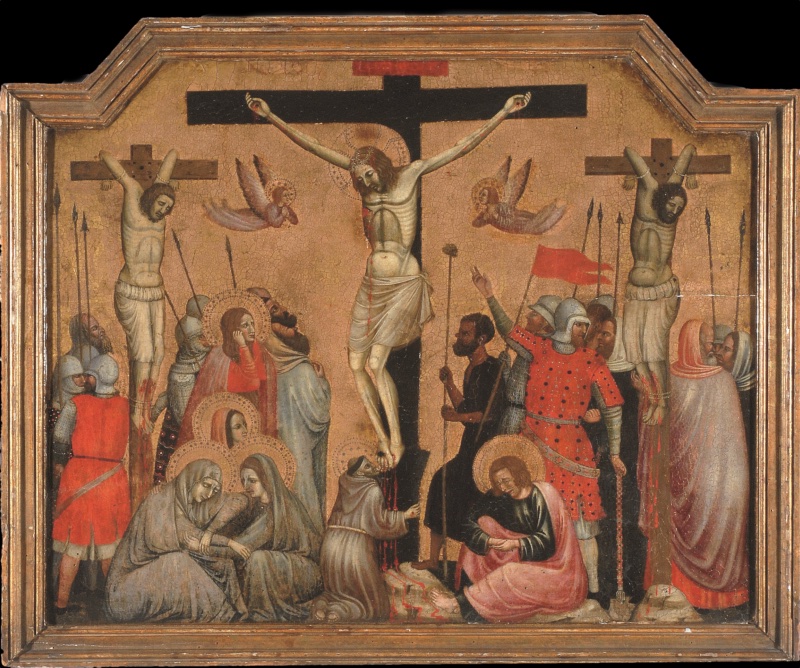
This panel in the Terruzzi collection presents the Crucifixion as a crowded, highly emotional scene on a gold ground. It extends the subject beyond the Crucified and the mourners to include the two thieves, soldiers, elders and Francis of Assisi. The panel is horizontal and of medium size, sixty-six by nearly eighty centimetres, and today sits in a moulded frame with a shaped upper profile. The gold has developed a dense network of cracks, but the figures are well preserved and their colours keep much of their intensity. The panel has a particular place in the history of the Primo Maestro della Beata Chiara da Montefalco. It was in the catalogue entry on a work of the Terruzzi collection, published in 2007, that Andrea De Marchi first proposed identifying the Primo Maestro with the Maestro di Cesi. If this is the panel that entry discusses, as its catalogue number suggests, it is the starting point of the hypothesis of a single career linking the dossal of Cesi of 1308 to the frescoes of Montefalco of 1333.
Christ hangs on a tall cross painted black, beneath a red titulus whose letters have faded. His body is long and pale, sagging forward, the head fallen onto the right shoulder beneath the crown of thorns. The anatomy is described with linear precision: the ribs are a series of curved strokes, the abdomen a swelling form, the arms thin and stretched almost to breaking. Blood runs from the nailed hands, from the wound in the side and from the feet. It flows down the shaft of the cross and onto the rocky ground of Golgotha, where it trickles in red streams into the cracks of the rock. Insisting on the blood was central to the devotion of the period, and it recurs in the Vatican panel of the Passion, where angels collect it in cups.
The two thieves hang on lower crosses at either side, their arms thrown over the crossbars and tied with cords rather than nailed. Their bodies, smaller and pale, are shown with the same linear anatomy as Christ, but their legs are streaked with blood, an allusion to the breaking of their legs described in the Gospel of John. The thief on the left inclines his head towards Christ with closed eyes, perhaps the repentant thief. The one on the right, with dark hair and beard, lets his head fall forward. Their presence widens the scene from a devotional image of the Crucified with mourners to a narrative of Calvary, and gives the composition a strong rhythm of three crosses rising from the crowd.
Two angels fly on either side of Christ, small figures in pinkish robes with outspread wings whose lower bodies trail away. The left angel clasps its hands, the right raises a hand to its cheek in grief. Compared with the six vehement angels of the Santa Croce fresco or the blood-collecting angels of the Vatican panel, they are few and restrained. Their role is to frame the head of Christ and to introduce, in the upper part of the panel, the note of mourning that dominates the crowd below. Their scale, much smaller than that of the earthly figures, places them at a distance, in the gold of heaven.
On the left, the Virgin sinks to the ground in a grey mantle, supported by another holy woman who embraces her. The two figures form a compact group of interlocking bodies and veils in the lower left corner. Behind them other haloed women watch, and a figure in red with a pink mantle raises a hand to her cheek, probably Mary Magdalene. A bearded man behind her looks up at the cross. Further left, soldiers in helmets and mail, one in a red tunic, stand with raised spears, and an old bearded man appears among them. The Virgin seated on the ground in her swoon differs from the standing swoon of the Santa Croce fresco. The painter evidently varied his formulas from work to work, while keeping the same intense, close grouping of mourners.
At the foot of the cross Francis of Assisi kneels and kisses Christ’s bleeding feet, the blood flowing over his face and hands. He wears the brown habit with a cord, a halo surrounds his head, and a red mark on his hand may indicate the stigmata. The motif of Francis embracing the foot of the cross belongs to a long Umbrian tradition and recurs in the Vatican panel with the stories of the Passion that Longhi attributed to the same painter. It gives the image a clear Franciscan character. Francis is shown not as a historical witness of Calvary but as the model of the devout viewer, who takes part in the Passion by kissing the wounds of Christ. Since the panel’s original destination is unknown, the motif suggests a Franciscan context without proving one.
On the right, Saint John sits on the ground at the foot of the cross, in a black tunic and a pink mantle that spreads around him. His hands are clasped in his lap and his face is contorted in weeping. His pose matches the seated, huddled John in the lower right corner of the Santa Croce Crucifixion almost exactly, one of the clearest links between the two works. Behind him stands a dark-skinned, bearded man in a dark garment holding the reed with the sponge, the figure later traditions called Stephaton. Beside him a soldier in a red tunic studded with dots, sword at his side, raises his arm and points upward. This is probably the centurion who recognised the Son of God. The red dotted tunic is identical to that of a soldier in the Vatican Passion panel, another precise link between the works of this group.
The right side closes with a group of soldiers under a red banner and, at the edge, elders in long robes, one in a pink mantle with a grey beard. They may represent the chief priests and elders who mocked Christ. Spears rise above the crowd on both sides, forming vertical accents that answer the crosses and give the composition a dense, bristling texture. Space is built not by perspective but by layering. Figures are stacked one behind another, their heads and helmets rising towards the gold, and the ground is reduced to the narrow rocky strip of Golgotha. This is exactly the compression of space that marks the Santa Croce fresco and the Vatican panel.
Style supports the attribution to the painter of Santa Croce, whatever name one gives him. The figures are defined by strong contours, the faces are long and expressive, and the drapery is drawn in flowing lines rather than modelled in depth. Colour is concentrated in strong accents of red, pink and black against the gold. The emotional register is high but controlled. Each figure performs a single legible action: swooning, kissing, weeping, pointing. The repeated motifs are telling: John seated weeping, Francis at the feet of Christ, the soldier in the red dotted tunic, the crowded Calvary on the model of the Lower Church at Assisi. They connect this panel to the dated fresco of 1333 and to the Vatican panel of the Passion, and make it a central piece in the reconstruction of a single artistic personality.
The importance of the panel lies above all in the argument it supports. For De Marchi, and later for Delpriori, works like this one show that the painter of the Santa Croce frescoes and the author of the Cesi dossal and the Spoletan panels of the 1300s and 1310s are the same artist at different moments of his career. On this view the Terruzzi Crucifixion belongs to the late phase, around the time of Montefalco. It is a panel of private or altar devotion in which a painter trained at Assisi in the 1290s recast the crowded Calvary of the Lower Church in the expressive language of the Spoletan school. The identification remains a hypothesis based on style, and the date of the panel should be verified against De Marchi’s entry of 2007 and Delpriori’s study of 2015. As an image, however, it stands among the most moving Crucifixions of the Spoletan Trecento, and as a document it lies at the origin of the modern understanding of the painter.
The Virgin and Child Enthroned with Saints Blaise and Nicholas; Saints Bartholomew, Mary Magdalene, Urban, Agatha and Anthony Abbot (left panel); The Crucifixion with the Virgin, Saint John, Saints Scholastica and Agnes and a Monastic Donor; Saints Emilian, Constantia and an Unidentified Female Saint (right panel)
Left Panel (inv. 19-1869)
This small panel is the left wing of a reliquary diptych in the Victoria and Albert Museum. The museum describes it as a small reliquary diptych which opens and closes like a book. Its exterior shows traces of imitation marbling. Its interior comprises painted panels divided by a hollowed-out area in the middle which still holds relics, wrapped in paper and labelled. Each wing is a shallow box with a raised frame, hinged to its companion. When closed, the object showed only its marbled exterior. When opened, it revealed the saints painted inside and the relics kept among them. It is a rare survival: the museum notes that Reliquary diptychs dating from the early 1300s that retain their original appearance are unusual.
The upper field shows the Virgin enthroned with the Christ Child, flanked by two bishops. The Virgin sits frontally on a simple block-shaped throne, in a white veil and a dark green mantle, holding the Child, who wears a pink robe and turns towards her. On her right stands Saint Blaise in a red chasuble with a gold orphrey, mitre and crozier, raising his hand in blessing. On her left stands Saint Nicholas in a green chasuble with a red cross-shaped orphrey, a red mitre and a red book. The red band beneath names the figures and adds a prayer to the Virgin.
The museum transcribes it as
S.BLASIUS.MAT[ER] DEI ORA P[RO] NOB[IS].S.NICOLAS:
“Saint Blaise, Mother of God pray for us, Saint Nicholas.”
Blaise deserves a comment. He is one of the two saints, with Catherine, whose stories fill the dossal of the Cappella di Santa Croce now in the Vatican, and he appears among the relics on the reliquary panels of Palazzo Venezia attributed to the Maestro di Cesi. His prominence here, at the Virgin’s right hand, shows once again how widespread his cult was in the area of Spoleto in the first decades of the fourteenth century. The museum’s entry is cautious about the authenticity of his relics, recalling that they were said to exist in such abundance that their authenticity was sometimes questioned. Among the labels still visible in the recess is one that seems to name him, so the painted figure stood beside a fragment believed to be his.
The central recess, closed by glass, still holds the relics wrapped in small pieces of paper inscribed in ink. The museum’s reading of the labels on this side mentions Blaise, Mary Magdalene, a piece of gold cloth twisted into a knot, a relic from the church of the Virgin at Nazareth and a fragment of the veil of Saint Agatha, the one that according to tradition stopped the fire of Etna. The last legible label refers to Saint Nicholas. The labels thus correspond in part to the figures painted above and below, confirming that the images served as a visual index of the relics. The museum notes that the relics seem to have shifted in transit, so their present order does not necessarily reflect the original arrangement. It also judges that the glass appears to have been added at a later date.
The lower field shows five standing saints, again named on a red band:
S.BARTHOLOMEUS.S.M[ARI]A MA[G]D[LEN]A. S.URBAN. S.AGATHA. S.ANTONI[US].
Bartholomew wears a red tunic and a white mantle scattered with red flowers and holds his knife. Mary Magdalene, in the form of the penitent hermit, is covered from head to foot by her long golden hair, her hands raised. Urban, a bishop, wears a golden chasuble with a dark orphrey and holds a book and a crozier. Agatha wears a white veil and a green mantle and holds a palm. Anthony, white-bearded, wears a brown habit, blesses with his right hand and holds a red book. The figures stand side by side, slightly overlapping, on a narrow strip of ground.
The individual saints are remarkably generic. The museum observes that only St. Bartholomew, who holds his customary knife, is readily identifiable by an accompanying attribute. The bishops are distinguished only by the colour of their vestments, the women by their dress. Without the inscriptions, most of the figures could not be named. The museum draws a striking conclusion from this: The generic character of the images of bishops and holy women may indicate that the diptych was made to accommodate a collection of relics which was still being added to. The owner, in other words, may have commissioned the diptych before knowing which relics he would acquire, and the inscriptions fixed the identity of each figure as the collection grew.
Anthony Abbot raises a further question. The museum notes that he is identified by the inscription but is more commonly shown in a black robe. The brown habit, like the generic treatment of the other figures, suggests that the inscription, rather than the image, carried the identification. Together with Scholastica on the right wing and the black-robed donor beneath the Crucifixion, Anthony gives the object a monastic character. The museum suggests that the diptych may have been made for a Benedictine8 monk, perhaps in a monastery near Spoleto.
The painting is small but carefully executed. The museum reports that under the microscope the diptych reveals very carefully painted faces, a gilded background and exquisite drapery. It also notes that the gilding has been overlaid with a tonal varnish which has darkened over time, so that the original appearance would have been much brighter. Azurite seems to have been used for the blues, and vermilion and red lake for the reds. What now appears as a dull brownish ground was originally bright gold. The haloes are decorated, according to the same entry, with very simple circular punches inside a painted black line. The museum uses this as a criterion to distinguish the diptych from the panels in Palazzo Venezia, whose haloes are punched with small stars.
The attribution has a long and contested history. When the diptych was acquired it was considered Sienese. Later scholars placed it in Umbria. Some compared it with the works of the master of the Santa Chiara frescoes at Montefalco; others attributed it directly to that master, or to the First Master of the Blessed Chiara; others still placed it more generally in a Spoletan circle. The museum’s current position derives from a comparison with two small reliquary panels from the church of Sant’Alò at Spoleto. It concludes that the London diptych and those panels are by the same hand or hands, with at least two different hands apparent, and that they belong to a workshop conventionally called the Master of Sant’Alò. In a separate line of argument, Andrea De Marchi has tentatively asked whether the second painter of the Santa Croce frescoes might be the Maestro di Sant’Alò. That hypothesis is not part of the museum’s entry and should be kept distinct from it.
The provenance places the diptych firmly in Spoleto. It belonged to the Spoletan collector Serafino Tordelli, who died in 1864. His heirs sold his collection to the Milanese dealer Giuseppe Baslini, from whom the museum bought the diptych for four pounds; the purchase was approved on 17 July 1868. The panel is therefore a document both of devotion in the area of Spoleto in the 1320s and of the dispersal of Umbrian collections in the nineteenth century. Its relation to the Montefalco master remains a question of style rather than of documents. It is a precious witness to the same devotional world: one in which relics, saints’ images and personal prayer were combined in small, portable objects made by the workshops of the Duchy.
Right Panel (inv. 20-1869)
The right wing of the diptych is devoted to the Crucifixion and to a group of saints, mostly women, separated by a central relic recess. In the museum’s description, At the top right the Crucifixion is represented, with a male donor wearing a monastic habit, flanked by the Virgin and St. John the Evangelist, St. Scholastica and St. Agnese. Below appear St. Emilian, St. Costanza and an unidentified female saint. The wing answers its companion: on the left the Virgin and Child, an image of the Incarnation; on the right the Crucifixion, an image of the Passion. The museum’s blog captures the logic of the pairing. One can perhaps imagine the diptych’s owner beginning his devotions by focusing on Christ’s incarnation, looking at the image of the Virgin and Child, before going on to contemplate his death in the Crucifixion, and mentally picturing himself below the cross, sharing in Christ’s suffering.
Christ hangs on a dark cross set against the gold, his body pale and slender, his head inclined. Blood runs in thin streams from his hands, his side and his feet down the shaft of the cross. The anatomy is drawn with fine lines, the loincloth with a few delicate folds. Despite the tiny scale, the figure follows the same Giottesque type of the dead Christ, with sagging body and fallen head, that the Spoletan painters of the period adopted from Assisi. The red titulus above the cross is barely legible. The Crucifixion occupies the centre of the upper field and divides the four standing figures into two pairs, setting the axis of the whole wing.
At the foot of the cross kneels a tiny figure in a black habit, embracing the wood just below Christ’s feet. He is the donor, the only figure on the diptych who is not a saint, and his scale is much smaller than that of the holy figures. The museum observes that The black robe of the donor figure suggests that he was a Benedictine monk. His pose is that of Francis in Franciscan Crucifixions, as in the Vatican panel of the Passion and the Terruzzi Crucifixion attributed to the Maestro di Cesi. Here, however, the place is taken by a living monk, who presents himself as the model of the devout viewer. By opening the diptych, the owner literally saw himself painted at the foot of the cross.
Beside the cross stand the Virgin, in a dark mantle, hands joined in grief, and Saint John, in a pink mantle, his face raised towards Christ and his hands clasped. Beyond them, at the outer edges, stand two female saints, identified by the inscription as Scholastica and Agnes. Scholastica, at the left, wears a white robe. Agnes, at the right, wears a pale blue-grey mantle and raises her hand to her breast. The museum notes that none of the female saints on the diptych has a significant attribute, apart from the Virgin and the Magdalene. It observes that the three women who carry stylized lilies and a palm are labelled Scholastica and Agnes and, on the lower right, “Agostantia”.
The presence of Scholastica is significant. She was the sister of Saint Benedict, and her place in the upper field, close to the Crucifixion, supports the hypothesis of a Benedictine owner. The museum notes, however, that Benedict himself is absent, which complicates the picture. The combination of Scholastica, Anthony Abbot on the left wing and the black-robed donor beneath the cross points nonetheless to a monastic context. In the museum’s view this context is consistent with the Spoletan provenance of the object and with the many Benedictine houses of Umbria.
The central recess, like that of the left wing, still holds relics behind glass. The museum describes the contents as partly removed and shifted. On this side some relics have been taken out, and those that remain include bone fragments and papers whose inscriptions are partly illegible, one possibly referring to the Cross. In the photograph a bone fragment and a folded label are clearly visible, together with smaller pieces. The presence of a relic of the Cross, if confirmed, would explain why the Crucifixion was placed directly above this recess. The museum also notes small dowel marks on the shelf on which the glass rests, which suggest that the recess may originally have had a tripartite frame like the Sant’Alò panels.
The lower field shows three standing figures. On the left is Saint Emilian, a bishop in a golden chasuble with a dark orphrey and mitre, holding a crozier and raising his hand in blessing. In the centre is a female saint in a maroon mantle, labelled “Agostantia”. On the right is a female saint in a greenish mantle with no inscription. The museum comments that it is not clear if the name “Agostantia” is meant to indicate Costanza, though that seems the most likely possibility. It notes too that the rightmost saint has no inscription at all. Emilian, it observes, was a less well-known bishop. An earlier scholar thought his presence pointed to Perugia, but the museum’s own view links the object to Spoleto.
The asymmetry between the two wings is instructive. There are five saints in the lower field of the left wing and only three in the lower field of the right, the last one unnamed. For the museum, this supports the idea of a diptych conceived to grow with its owner’s collection. In its words, the Benedictine monk who owned or commissioned it had the relics of Sts Bartholomew and Mary Magdalene, and was planning to collect more. Since he may not have known which relics he would find, he had the artist paint the known saints and requested that generic figures of holy men and women be added to fill up the remaining space on the diptych. The empty name band beneath the last saint would then be the trace of a relic that never arrived.
Stylistically, the right wing confirms the qualities of the left. The figures are slender and elegant, their drapery falling in long, finely drawn folds, their faces small and delicate. Colour is concentrated in a few clear tones against the gold: the black of the Virgin and the donor, the pink of John, the pale robes of the women, the gold of Emilian’s chasuble. Overall the style seems closer to the brittle, densely draped figures of the second master of Santa Croce than to the broad, emphatic forms of the Primo Maestro. That impression agrees with the museum’s attribution to the Maestro di Sant’Alò and with De Marchi’s tentative link between that painter and the second master. It remains, however, a matter of stylistic judgement.
The diptych as a whole offers a rare view of how relics, images and prayer came together in private devotion in the area of Spoleto in the 1320s. The owner opened it like a book, read the names of the saints, looked at their images, and knew that fragments of their bodies or belongings lay a few centimetres away behind the glass. He could pray to the Mother of God, as the inscription on the left wing invites, and contemplate the Crucifixion, at whose foot he saw himself kneeling. The workshop that made the diptych, whether it was the Maestro di Sant’Alò, a monastic workshop or one of the painters active at Montefalco, shared the language of the Spoletan school. The object is closely related to the reliquary panels of Palazzo Venezia, and the museum notes that the two share similarities in their inscriptions while differing in the punching of the haloes.
Painted Cross with the Crucified Christ (Christus patiens)
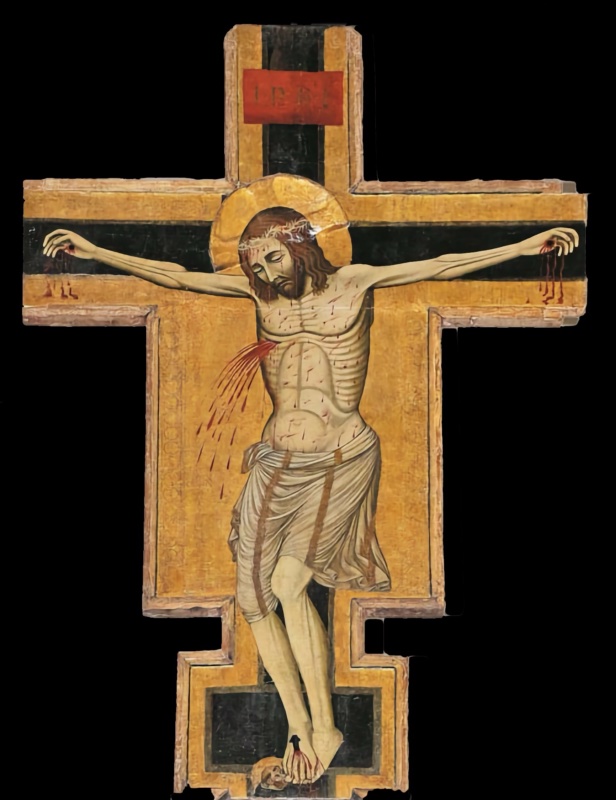
The painted cross that hangs above the altar in the church of San Domenico at Spoleto belongs to one of the oldest and most characteristic types of central Italian religious art. It is a cross-shaped panel on which the figure of the crucified Christ is painted at life scale or nearly so, made to be suspended above an altar or at the entrance to the choir. Spoleto has a long tradition of such crosses. The cross in the cathedral attributed to Alberto Sotio, dated 1187, is often considered the starting point of the Umbrian series. The San Domenico cross belongs to a much later moment. Its figure of Christ is no longer the living, triumphant Christ of the twelfth century but the dead Christ, the Christus patiens, which spread through Umbria after the great Assisi models of the thirteenth century.
The shape of the cross is sober. A long upright crosses a broad transverse arm. A narrow upper extension carries the red titulus, and a short lower extension contains the feet of Christ and the skull at the base. The panel is framed by a raised border. Behind the figure the surface is gilded, and a black band, framed by gold, runs along the arms and the upright, so that a dark cross seems to stand out against the gold of the panel. The arms end in straight edges without the terminal panels that often carried the mourning Virgin and Saint John, and the top has no cimasa with Christ blessing or the pelican. Whether the cross was always so plain or has lost its terminals cannot be decided from the photograph.
Christ hangs from the cross in the pose of death. His arms are stretched almost horizontally, slightly raised towards the hands, which are pierced by nails and drip blood. His head falls onto his right shoulder beneath a crown of thorns, framed by a large gilded halo that appears to be slightly raised and tooled. His eyes are closed, his face long and narrow, with a straight nose and a short beard. Long reddish hair falls onto his shoulders. The expression is calm, without convulsion: the suffering is over, and what the viewer sees is the stillness of the dead body. This is the formula that Giotto and the Assisi workshops made canonical at the end of the thirteenth century, replacing the convulsed patiens of earlier Umbrian and Tuscan crosses.
The body is described with insistent linear precision. The ribs are a series of curved horizontal lines, the sternum and the abdominal muscles a symmetrical system of strokes, the navel a small round mark in the softly swollen belly. The flesh is pale, almost greenish in the shadows, and covered with small red marks, the wounds of the scourging, from which tiny drops of blood run. The figure sags slightly to one side, with a gentle curve of the hips, but the effect is less of weight than of a drawn, almost ornamental anatomy. This linear treatment of the body, more graphic than sculptural, is typical of Umbrian painters who absorbed Giotto’s model without fully adopting his plastic modelling.
The most striking motif is the wound in Christ’s side, from which a jet of blood spurts in a wide arc and falls in drops onto the gold. The motif recurs in several Umbrian Crucifixions of the first half of the fourteenth century, including those of the Spoletan school. In the Crucifixion with stories of the Passion in the Vatican, attributed by Longhi to the Primo Maestro della Beata Chiara da Montefalco, an angel catches the same jet in a cup. Here, without angels, the blood falls freely onto the gold and becomes a powerful visual sign of the sacrifice. Placed above the altar, the image directly links the blood of the Crucified to the wine consecrated in the Mass below.
The loincloth is a transparent white veil, knotted at the hip and falling in soft folds to above the knees, crossed by vertical brown stripes. Its transparency lets the outline of the legs show through. The treatment recalls the Assisi crosses and their Umbrian derivatives, where the loincloth became a field for a delicate display of painting. The folds are drawn rather than modelled, with fine lines marking the edges of the fabric. The contrast between the semi-transparent white of the cloth and the pale flesh of the body is one of the most refined passages of the painting.
The feet are crossed and fixed with a single nail, a detail that dates the cross after the introduction of the three-nail type in Italian painting at the end of the thirteenth century, associated above all with Giotto’s crosses. Blood flows from the wound over the feet and down the cross. At the base, beneath the feet, lies a small skull. This is the skull of Adam, buried according to tradition beneath the hill of Golgotha, on whom the blood of Christ falls to redeem humanity from original sin. The detail is small but theologically central: it closes the image at the bottom with the memory of the Fall, just as the titulus closes it at the top with the proclamation of Christ’s kingship.
The cross is catalogued by the Fondazione Federico Zeri under the generic heading of the Maestro di Santa Chiara da Montefalco. The alternative attributions recorded are the Primo Maestro della Beata Chiara da Montefalco and the Maestro di Cesi, and the date is given as the first half of the fourteenth century. The attribution rests on the published literature. The cross already appears in a 1989 survey of Umbrian painting. Alessandro Delpriori discusses it in his 2015 study of the Spoletan school, in the chapter devoted to the path “from the Maestro di Cesi to the Primo Maestro della Beata Chiara da Montefalco”. It was then included in the catalogue of the 2018 exhibition Capolavori del Trecento. Il cantiere di Giotto, Spoleto e l’Appennino.
Andrea De Marchi first proposed, in 2007, that the works of the Primo Maestro represent the late phase of the Maestro di Cesi, and Delpriori developed the thesis. On this reading the San Domenico cross belongs to the career of a single painter active in Spoleto from the first years of the century to the frescoes of Santa Croce at Montefalco of 1333. Several features of the cross are consistent with this attribution: the linear, almost graphic anatomy, the transparent striped loincloth, the jet of blood from the side, the calm and melancholic face, and the intense red accents against the gold. The jet of blood links it in particular to the Crucifixion with stories of the Passion in the Vatican, where an angel catches the same stream in a cup. As with all the works of this group, the identification rests on style rather than on documents, and the precise date within the half-century remains open.
The Dominican setting gives the cross a particular meaning. San Domenico at Spoleto was the church of the Order of Preachers, whose devotion to the Passion and preaching on the sacrifice of Christ found a natural focus in the image of the Crucified above the altar. The same church contains other works of the Spoletan school, including the panel with Saint Peter Martyr and a kneeling Dominican attributed to the Maestro di Fossa, showing that the friars commissioned works from the leading local painters. Whether the cross was made for this church or reached it later cannot be determined from the sources consulted.
Seen within the development of Spoletan painting, the cross shows how the region’s painters took up the new models of the Assisi workshops. The dead Christ, the crossed feet, the transparent loincloth and the calm face all derive from the Giottesque crosses of the turn of the century. The linear anatomy, the intense red of the blood against the gold, the dramatic jet from the side and the sober, almost severe structure of the panel belong to the Spoletan tradition, with its preference for emotional directness over plastic construction. Whoever painted it, and whether or not further research confirms the link with the Maestro di Cesi, the cross remains a powerful example of Umbrian Passion devotion in the first half of the fourteenth century, still hanging, as it was meant to, above the altar it served.
Style and the Spoletan Tradition
The Primo Maestro’s style grows out of what De Marchi describes as a long and robust Spoletan tradition, reshaped by contact with the workshops of Assisi. Spoleto, he insists, was the seat of a genuine school, comparable in this respect to Rimini. The difference lies in how each centre received the culture of Giotto. In Rimini the Giottesque explosion was sudden, linked to Giotto’s brief presence at San Francesco shortly before 1300. In Spoleto the culture of Giotto and Assisi settled on a tradition whose fundamental preferences had been formed in the thirteenth century and remained substantially unchanged. Those preferences shaped how the new ideals were received. In De Marchi’s account they bent the Giottesque legacy towards an almost fauve intensity of colour and material and an exaggerated mimicry of cries of pain and of aching tenderness. They also preserved a nostalgic and uncompromising expressive pitch that links the two centuries.
All of this is visible at Santa Croce. The colours are strong and saturated, the black-ground ornamental bands sparkle, and figures are defined by firm contours. Faces display emotion openly. Above all, the narrative is built from gestures that De Marchi characterises as icastic and blocked: gestures that stop and hold rather than flow, and that speak with the clarity of signs. He also attributes to this painter frescoes in the church of Sant’Agostino at Montefalco. There, in his description, fragments of architecture project violently and disjointedly, like memories resurfacing from the painter’s decisive experience at Giotto’s side on the scaffolding of the Franciscan cycle around 1290. The image is a precise one. It describes a painter who absorbed the spatial devices of the Upper Church without their underlying rationality, and who used them for emphasis rather than construction.
From Assisi the painter also learned the rhetoric of counterpoint. De Marchi observes that the Upper Church cycles were an extraordinary school in this respect. Images there answer one another across walls and between upper and lower registers with an entirely new rhetorical force, and in his view the Maestro di Cesi learned and translated this lesson. At Santa Croce the scale is very different, reduced to a gathered, almost private devotion around the altar and the body of the Blessed Chiara. Yet the placing of the images produces an intense polyphony: the swooning Virgin answers the nuns at the grille, the Man of Sorrows answers the Eucharist, Blaise in prison answers the enclosed community. The chapel is an Assisi lesson recast for the needs of enclosed women.
Recent scholarship has also stressed a technical and workshop dimension, though it bears more directly on the earlier career attributed to the same painter than on the frescoes themselves. Delpriori argues that in the Duchy of Spoleto the workshops of painters and woodcarvers frequently coincided, so that painters were also, in some measure, sculptors. He supports this with a recurring pairing of stylistic groups. The Maestro di Cesi consistently appears alongside the sculptor of the Santa Cristina at Caso. The Maestro della Croce di Trevi appears with the Maestro del Crocifisso di Visso, and the Maestro di Fossa with the sculptor of the Madonna in the cathedral of Spoleto. According to De Marchi, Delpriori’s book identifies several wooden sculptures painted, and probably also carved, by the Maestro di Cesi. If the Primo Maestro is indeed the late Maestro di Cesi, the Santa Croce frescoes are the wall paintings of an artisan who worked on panel, plaster and wood alike. Their strongly outlined, almost sculptural figures would then be the painted counterpart of that integrated practice. This remains an interpretation, but it is a suggestive one, and it helps explain the physical solidity that the painter achieves without Giotto’s systematic modelling of space.
The Second Master and the Problem of Collaboration
An essay on the first master must give some attention to the second, because the contrast between the two hands has defined the Primo Maestro’s personality from the start. De Marchi describes the second master as a far from negligible collaborator who shared the decoration of the arch with his companion and seems to have had a training considerably older than his companion’s. His abundant draperies, with their dense small folds, and the sour expressiveness of his wasted faces descend, directly or indirectly, from the Maestro di Sant’Alò. That early Spoletan painter, in De Marchi’s account, was formed in the passage from Cimabue to the young Giotto at Assisi. De Marchi goes so far as to ask whether the second master might be the Maestro di Sant’Alò himself, active around 1300 and otherwise lost to view thereafter. He is careful to add that the hypothesis would require further evidence and connecting works. The proposal is explicitly a question, and it must be reported as such.
Even as a question, it matters for understanding the Primo Maestro. It suggests that the chapel was the joint work of two veterans of the Assisi generation, both formed around 1290–1300 and working side by side more than three decades later. If that is right, the archaisms of the decoration are not a sign of provincial delay. They are the late statement of men whose artistic idiom had been fixed decades before, and who brought it to bear on a subject that suited it. The contrast between the two hands also becomes easier to describe. The Primo Maestro’s figures are fuller and more compact, his gestures more emphatic and his compositions closer to Giotto’s structural models. The second master’s figures are more brittle and more densely draped, and his pathos is sharper and more acrid. His scene of Chiara’s death shows her sitting upright on her bed, eyes raised, surrounded by attentive religious, in keeping with the tradition that she died seated and erect. It is the narrative counterpart, in another hand, of the Primo Maestro’s visionary tabernacle on the opposite wall. Together the two scenes frame the room with the beginning and the end of Chiara’s mystical life: the Cross received and the soul released.
The Critical Construction: Longhi and His Legacy
Modern understanding of the Primo Maestro begins with Roberto Longhi. In the academic year 1953–54, in his course at the University of Florence on Umbrian painting of the first half of the fourteenth century, Longhi revived a whole territory of Trecento painting that had been neglected by a canon centred on Florence and Siena. The lectures were published posthumously in 1973, both in the journal Paragone and as a book, La pittura umbra della prima metà del Trecento. Delpriori describes this publication as the foundation of all subsequent research on the subject. Longhi’s enthusiasm for these painters was as much aesthetic as philological. He found in them an expressive force, a passion, that the Tuscan-centred tradition had undervalued, and his writing helped make it visible. The monastery’s account of the chapel credits him with recognising the immediacy of feeling and impassioned expression of the anonymous painters of Santa Croce. Guide literature further reports that in the same publication he attributed to the Primo Maestro a Vatican panel with the Crucifixion and stories of the Passion from San Francesco at Montefalco. That attribution could not be verified against Longhi’s text for this essay and is mentioned with caution.
Longhi’s method was attributive and connoisseurial. He constructed the Maestro di Santa Chiara da Montefalco as an autonomous artistic personality, distinct from his collaborator, and that construction set the terms of discussion for half a century. Among the scholars who followed him, two broad lines of research developed. One concentrated on attribution, on defining catalogues and relationships between anonymous groups. The other concentrated on territory, on lost contexts and on the patterns of what has and has not survived. Delpriori’s methodological introduction to his 2015 study explicitly aims to reconcile these approaches, and the Primo Maestro’s critical fortunes show why both are needed. As a name tied to a single site, he invited the construction of a catalogue around a fixed point. As the painter of a site whose meaning depends on how it was used, he demanded the reconstruction of a devotional and institutional context that pure connoisseurship could not supply.
From the Primo Maestro to the Maestro di Cesi
The decisive turn in recent scholarship is the proposal to identify the Primo Maestro with the Maestro di Cesi. The Maestro di Cesi takes his name from a dossal at Cesi, near Terni, commissioned by a woman named in its inscription as Domina Elena. It shows the Madonna and Child enthroned among angels and saints, with the donor kneeling, and its inscription, as transcribed in local accounts, dates it to 1308, in the time of Pope Clement V9. Around this fixed point scholars have gathered a substantial body of work. The most important is a monumental triptych with the Assumption and the Death of the Virgin, painted for the Spoletan monastery of Santi Stefano e Tommaso, known as the monastery of the Stella, and now on deposit at the Musée Marmottan Monet in Paris. With it goes a painted Cross with the triumphant Christ in the Museo Nazionale del Ducato at Spoleto, made for the same nuns as a companion piece. The group also includes the Marian panel from Vallo di Nera dated 1315, now in the Museo Diocesano of Spoleto, and, in Delpriori’s reconstruction, the stories of Saint Cristina from the tabernacle at Caso in the Valnerina.
De Marchi argues that the Maestro di Cesi worked, probably, on the same scaffolding as Giotto in the Franciscan cycle of the Upper Church at Assisi, which would make him the first of the Spoletan followers of Giotto. In the Stella triptych, he observes, the painter tells the Virgin’s farewell to the apostles in eight scenes on the wings. The narrative culminates at the centre in Christ’s embrace as he receives his mother into heaven. De Marchi counts this among the most moving and passionate treatments the subject ever received. It draws partly on Cimabue’s frescoes in the apse of the Upper Church, and he places it before Duccio’s Maestà, whose wealth of episodes it anticipates without depending on it.
In his introduction to Delpriori’s book, De Marchi states his position on the chapel without hedging. The decoration of 1333 was, in his words, “condotta dallo stesso Maestro di Cesi e da un suo notevole socio”, carried out by the Maestro di Cesi himself and a notable partner. He calls the identification of the chapel’s leading painter with the author of the Cesi dossal “per me incontrovertibile”, incontrovertible in his view, and “ulteriormente corroborata in questo libro”, further strengthened in Delpriori’s study. The Fondazione Zeri catalogue records that recent studies have proposed to recognise in the Primo Maestro’s works “la fase tarda del Maestro di Cesi”, the late phase of the Maestro di Cesi. It cites De Marchi’s catalogue entry in a volume on the Terruzzi collection and Delpriori’s monograph. Delpriori’s own chapter on the question is titled “Dal Maestro di Cesi al Primo Maestro della Beata Chiara da Montefalco: un percorso unitario?”, from the Maestro di Cesi to the First Master of the Blessed Chiara: a single path? The question mark is significant. Although Delpriori supports the identification, he frames it as a thesis to be argued, not as a settled fact.
The arguments for the identification are essentially stylistic and generational. As De Marchi presents them, the frescoes of 1333 preserve motifs that belong to the culture of the 1290s and recur in the works grouped around the Cesi dossal. Among them are the ornamental scrolls on black grounds, the zoocephalic Evangelists, the crumpled veil derived from the Upper Church roundel, the blocked gestures and the dislocated architectural fragments of Assisi origin. Read this way, the two personalities merge into one career. It would begin with a young collaborator on the Assisi scaffolding around 1290, continue through the Spoletan panels of the first decades of the century, and end with an elderly master leading the decoration of Santa Croce in 1333. On this hypothesis, the Primo Maestro della Beata Chiara is not a person but a phase.
The identification also has costs, which honesty requires stating. It implies a working life of about four decades, which is possible but long. It assumes a stylistic continuity across that span that an anonymous and undocumented body of work can only partly demonstrate. And it rests entirely on connoisseurship: no contract, signature or record of payment connects the dossal of 1308 to the frescoes of 1333. The Fondazione Zeri’s handling of the question is instructive. It keeps the traditional heading of the Maestro di Santa Chiara da Montefalco and records the Maestro di Cesi as an alternative attribution supported by recent literature. Some local descriptions of the chapel have adopted the new attribution outright, stating that the Crucifixion long given to the Primo Maestro has recently been correctly reassigned to the Maestro di Cesi; others keep the older label. The identification is best understood as the strongest current hypothesis, held with conviction by its principal proponents and supported by serious arguments, but not as an established fact.
The Wider Catalogue: Attributions and Doubts
Beyond the chapel and its dossal, several other works have been associated with the Primo Maestro’s name, on evidence of very uneven quality. At Santa Maria di Turrita, outside Montefalco, the apse retains frescoes including a Crucifixion whose central part is entirely lost, above the remains of an Assumption. The church also preserves Saints Severus and Fortunatus, a fragmentary Madonna and Child and an Annunciation on the nave wall. These paintings have been compared with the Santa Croce Calvary in composition and handling and attributed to the Primo Maestro or, by those who accept the identification, to the Maestro di Cesi. A local account adds that around 1320 d’Amiel acquired the priory as a residence for the papal administration. That claim comes from a non-specialist source, which itself introduces it cautiously, and it cannot be relied upon without documentary confirmation. The stylistic comparison is plausible and widely repeated, but this essay has not been able to trace it to a specific argument in the specialist literature.
At Spoleto, the Museo Diocesano holds two panels connected with this painter. The first is the Madonna and Child with two angels and prophets from Vallo di Nera, dated 1315. A museum guide records its size as 163 by 70 centimetres and identifies the prophets in the spandrels as Ezekiel and Isaiah, holding scrolls with Marian prophecies. The Child kisses his mother’s cheek and, according to one description, wears a Franciscan habit tied with a cord. The Umbrian regional cultural catalogue lists the panel under the Primo Maestro di Santa Chiara da Montefalco, whereas De Marchi and Delpriori give it to the Maestro di Cesi. The double attribution is itself a symptom of the identification: if the two masters are one, the conflict disappears. Its original location is also uncertain, with sources naming different churches at Vallo di Nera. The second panel is a damaged rectangular altar frontal from Santa Maria at Borgo Cerreto, near Spoleto. It shows Christ in majesty within a mandorla, surrounded by roundels with the Evangelist symbols and the Lamb of God, flanked by a censing angel and standing saints, with fragments of narrative scenes below. Guide literature attributes it to the Primo Maestro, while regional tourism literature describes a Cerreto frontal as the work of the Maestro di Cesi. Neither attribution could be checked against a primary scholarly entry for this essay.
Two cautions follow from this survey. First, much of the extended catalogue is known through popular summaries of the specialist literature rather than through the literature itself, and such summaries are prone to simplification and error. Second, the merging of the Primo Maestro into the Maestro di Cesi has a practical effect on cataloguing. Works once listed under the first name increasingly appear under the second, so the same object may carry different attributions in different sources. Anyone working on these paintings should test every attribution against Delpriori’s monograph of 2015 and the catalogue of the 2018 exhibition, which remain the fullest scholarly treatments.
Giotto, Assisi and the Spoletan Contemporaries
The Primo Maestro’s relationship to Giotto is both direct and selective. His great Calvary takes its structure from the Crucifixions in the Lower Church at Assisi, and its swooning Virgin from the one in the right transept. His enthroned Madonna takes her veil from Giotto’s roundel in the Upper Church. If De Marchi’s reconstruction of his early career is accepted, the painter’s memory of the Franciscan cycle came from having worked on it himself. Yet he consistently declines the essence of Giottesque form, the construction of solid bodies within a coherent, measurable space. The veil is emptied of its spatial meaning, architectural elements project at incoherent angles, and gestures are held rather than modelled. The result is not a failed Giottism. It is what De Marchi calls a translation: Assisi supplied models, motifs and rhetorical devices, and the Spoletan tradition recast them in its own language of expressive intensity.
Within the Spoletan school, De Marchi sets the Maestro di Cesi and the Maestro della Croce di Trevi, whom Longhi called the “Maestro del 1310”, as the two poles in the reception of Giotto. Both grew progressively independent of the grand nobility of the Giottesque prototypes. The former developed a more colourful and conversational expressiveness, the latter a sparer and more incandescent one. The crowded Calvaries of the principal Spoletan painters, the Maestro di Cesi, the Maestro della Croce di Trevi and the Maestro di Fossa, together express the school’s dominant drive towards strong emotional involvement. They complement the stark, painful essentialism of the wooden Crucifixes of the Maestro del Crocifisso di Visso. The Maestro di Fossa, active in the same years and, through the polyptych of 1336, for the same patron, represents the opposite pole. Shaped by Giotto’s work in the Lower Church and by the art of Simone Martini and Pietro Lorenzetti, his manner is refined, elegant and receptive to the courtly culture of Avignon. When the Santa Croce dossal and the Fossa polyptych hung together in the Vatican, the comparison was eloquent. It showed one patron and two workshops, three years apart, embodying two different ideas of what a devotional painting should be and do.
The wider geography also matters. Foligno and the Valle Umbra belong, with Spoleto, to what scholarship following Longhi has treated as a distinct cultural region of Umbria east of the Tiber. That region is centred on Spoleto and open towards the Marche and the Abruzzo, unlike the zone of Perugia and Orvieto, where Tuscan models dominated. The Primo Maestro, working at Montefalco, between Foligno and Spoleto, for a rector of the Duchy, belongs fully to this world. The 2018 exhibition made the geography visible by distributing its works among Trevi, Montefalco, Spoleto and Scheggino, reconstructing a landscape rather than isolating masterpieces.
Dating and Chronology
The date of the Santa Croce frescoes is the firmest fact in the whole question. The literature reports 1333 consistently, and the Fondazione Zeri dates the scenes to that year. The altar dossal is assigned to the same campaign on the grounds of its provenance, subjects and style. Beyond these fixed points, the chronology depends entirely on which attribution one accepts. If the Primo Maestro is an independent personality, his datable activity is confined to the early 1330s, with the frescoes at Turrita usually placed close to Santa Croce. If he is the late Maestro di Cesi, his chronology reaches back through the Vallo di Nera panel of 1315 and the Cesi dossal of 1308 to the Stella triptych and the painted Cross. De Marchi regards those two works as youthful and places them before Duccio’s Maestà. Further back still lies the presumed apprenticeship on the Assisi scaffolding around 1290. On that reading, the Santa Croce cycle is a late work, its archaisms are to be expected rather than explained away, and its emotional force is that of an old master returning to the vocabulary of his youth for a subject that called for it.
Legacy and Significance
The Primo Maestro and the chapel he dominated matter in three ways. The first is survival. De Marchi describes Santa Croce as miraculously preserved in its integrity, and in a territory where Delpriori repeatedly stresses how much has been lost, dismantled and dispersed, the chapel offers a rare chance to study images in the place for which they were made. The dossal has left, but the walls remain, and with them the relationship between painting, architecture and use that most surviving Trecento works have lost.
The second is the cult. The chapel is the founding visual document of devotion to Chiara of Montefalco. The image of Christ planting the Cross in her heart became the central iconographic formula of her sanctity and remains the image by which her sanctuary presents her today. It was conceived at a moment when her holiness was still contested, in the room where she had died, for a community that remembered her personally, and with the support of a patron who had witnessed the campaign for her recognition. Few images of a medieval holy woman are so closely bound to the circumstances of her cult.
The third is enclosure. If De Marchi’s reading is accepted, the chapel is one of the most eloquent surviving witnesses to how painting served communities of enclosed women. Its grilles, sightlines and paired images show a painter, or a programme, thinking carefully about viewers who could see the altar only through openings in a wall, and who were invited to read their own lives in the images they saw: the grief of the Virgin, the imprisonment of Blaise, the Cross received by Chiara. The fragmentation that a narrative-minded critic might regret becomes, in this light, a deliberate strategy of devotion.
For the history of style, the Primo Maestro, whether or not he is the Maestro di Cesi, testifies to the long afterlife of the Assisi generation. He shows that the reception of Giotto in Umbria was not a single moment of modernisation but a process of translation lasting decades. Motifs from the 1290s could still be used with full conviction in the 1330s, side by side with the latest compositional models from the Lower Church. That is perhaps the most lasting lesson of this anonymous painter. In Spoleto and its territory, to be provincial was not to be backward. It was to cultivate, deliberately and with considerable sophistication, an expressive language suited to a particular kind of devotion: the devotion of the laude, of sacred drama and of the visionary piety of women such as Chiara.
A Note on Sources
The primary sources underlying this essay are the frescoes of the Cappella di Santa Croce in the Santuario di Santa Chiara della Croce at Montefalco and the altar dossal with the Crucifixion and stories of Saints Blaise and Catherine in the Vatican museums. They are complemented by the Latin Life of Chiara by Bérenger de Saint-Affrique, written before 1320 and available in Italian translation, by the acts of the apostolic process of 1318–1319 in their critical edition of 1984, and by the papal registers recording Iohannes de Amelio as rector of the Duchy of Spoleto. The fundamental secondary literature consists of Roberto Longhi’s La pittura umbra della prima metà del Trecento (1973), which grew out of his lectures of 1953–54. It also includes Alessandro Delpriori’s La scuola di Spoleto. Immagini dipinte e scolpite nel Trecento tra Valle Umbra e Valnerina (2015), with Andrea De Marchi’s introduction, and De Marchi’s related catalogue entry on the Terruzzi collection. To these are added the catalogue of the 2018 exhibition Capolavori del Trecento. Il cantiere di Giotto, Spoleto e l’Appennino, the online catalogue of the Fondazione Federico Zeri, and the documentation of the 2019 exhibition at the Pinacoteca Vaticana devoted to Chiara of Montefalco and Jean d’Amiel. Points that rest only on popular or local descriptions, such as the position of the commissioning inscription, the identity of some figures and several secondary attributions, have been flagged in the text as unverified.