Giuliano da Rimini
( 25% )
Giuliano da Rimini is known for certain through one signed and dated work, the great dossal of 1307 now in the Isabella Stewart Gardner Museum in Boston. That panel is the earliest firmly dated painting of the Riminese school and one of the earliest dated works anywhere in Italy to cite Giotto’s Assisi frescoes. Everything else attributed to him is a matter of stylistic judgement, and some of it is still disputed. His biography comes almost entirely from notarial documents. Read together, they suggest that he was one of several painter sons of a certain Martino, that he worked in a family workshop in the contrada of San Giovanni Evangelista with his brother Giovanni, generally held to be the elder, and his brother Zangolo, and that he had died before March 1346.
Rimini around 1300: a city between the Adriatic, the Papacy and the Malatesta
The Rimini in which Giuliano trained had a long history as an Adriatic crossroads. The Roman colony of Ariminum stood where the Via Flaminia, the Via Aemilia and the Via Popilia met, and it had a port. In late antiquity and the early Middle Ages the city was bound politically and culturally to Ravenna. It became part of the maritime Pentapolis in 567, and in 756 it passed to the Church of Rome. The Byzantine and Ravennate inheritance was not a vague memory. Buildings with mosaic decoration, such as the sacello of San Gregorio and the sanctuary of San Gaudenzio, were part of the city’s visual fabric, and the painters who emerged around 1300 worked in a place where Eastern forms had never quite gone out of use.
Politically, the decades around 1300 saw a lordship established over a commune that remained formally subject to the Papacy. Malatesta della Penna was elected podestà in 1239, which began the Malatesta ascendancy. It was completed on 13 December 1295, when Malatesta da Verucchio and his sons took control of the city and drove out the rival Ghibelline Parcitadi. The old Malatesta, Dante’s “mastin vecchio”, died in 1312 and was succeeded first by his son Malatestino and then by Pandolfo I. The communal statutes of 1334 gave legal form to a signoria that had long existed in practice. Next to the Malatesta residence on the platea communis stood the Palazzo dell’Arengo of 1204–1207, whose great hall later gave its name to one of the anonymous masters of the Riminese school.
The mendicant orders were the most important patrons of monumental painting in this city. The Franciscan church of San Francesco was built after 1257 and became the Malatesta family church, where they had their tombs. It survives only in fragments inside the fifteenth-century shell of the Tempio Malatestiano. The Augustinian Hermits had been in Rimini since 1247, and by the early fourteenth century they had built the church dedicated to St John the Evangelist, now known as Sant’Agostino. It was in the contrada named after that church that Giuliano and his brothers lived, and it was in that church that the most important surviving fresco cycle of early Riminese painting was found in the twentieth century.
The documentary profile
For a painter of his period Giuliano is unusually well documented, though almost none of the documents concern painting. Before the systematic archival research of Oreste Delucca, published in Rimini by Luisè in 1992 under the title I pittori riminesi del Trecento nelle carte d’archivio, the Riminese masters were known, in the words of the Comune di Rimini’s own account of that book, from only “un modesto gruzzolo di documenti: una ventina in tutto”. That research roughly quintupled the documentary base. It also established that Giovanni, Giuliano and Zangolo were brothers, sons of a Martino. Whether a painter called Foscolo, also a son of a Martino, belonged to the same family is still considered much less certain.
If the family reconstruction is accepted, the earliest trace of Giuliano dates to 22 March 1292. On that day the painter Giovanni, acting “suo nomine et fratrum”, paid the rent for the current year and the two previous years on a plot belonging to the hospital of San Lazzaro in the parish of Sant’Ermete. The payment was three pairs of capons. The brothers are not named individually in this act. The identification depends on later documents, above all a deed of 4 January 1300 renewing the lease of a house in the parish of Sant’Eufemia, which names Zangolo and Giuliano together with the “magister” Giovanni. The two standard summaries describe their role differently: in the Enciclopedia dell’Arte Medievale the renewal is made in the brothers’ names as well as Giovanni’s, while the Dizionario Biografico has them appear as witnesses. No document gives the brothers’ ages. Giovanni is generally taken to be the elder because three indications converge: in 1292 he acts in his own name and his brothers’, in 1300 he is already a magister, and he is documented as a painter fifteen years before Giuliano signed the dossal.
On 9 April 1316,
Zangolus pictor de contrata Sancti Iohannis Evangeliste, suo nomine et nomine fratris sui Iuliani,
paid a rent to the abbot of San Giuliano.
On 25 March 1323,
magister Iulianus depintor de contrata Sanctis Iohannis Evangeliste
paid one denaro to the monastery of San Giuliano as emphyteutic rent for a house, which one account places in the contrada of San Bartolo.
Finally, a Riminese charter of 19 March 1346 names
domina Catalina, filia magistri Carbonis, uxor quondam magistri Zuliani pictoris.
The word quondam shows that the painter was dead by then. The act was witnessed by two painters, Paolino and Gregorio, a small reminder of how many painters were active in the city.
These documents allow a precise statement of what is known. Giuliano’s own signature fixes his activity in 1307. The 1323 act attests him as a master in Rimini. A transcription made in 1527 records his name on a lost polyptych in the church of the Eremitani at Padua, with an inscription of 1324 that is discussed below. The 1346 charter gives a date by which he was already dead. The standard reference works therefore describe him as documented from 1307 to 1323 or 1324 and dead by 1346. The 1292 and 1300 mentions push the family record back further if the identification is accepted, and they imply that Giuliano was already an adult and a legal witness by the turn of the century. The common idea that he was “documented from 1307 to 1346” needs correcting. The 1346 document is posthumous, and no known record shows him alive after 1324. His date of birth is unknown.
The documents are almost all about land and houses: emphyteutic leases, rents in kind, contracts witnessed in the contrada. This led the 1992 archival study to suggest that the brothers may, at least for a time, have combined painting with farming on their leased plots. Whatever one makes of that suggestion, the picture is of a family of craftsmen rooted in a particular quarter. They shared a house and at times acted jointly, and one brother could pay what another owed. This is the documentary basis for the idea of a family workshop.
The forms of the painter’s name are part of this evidence. On the dossal he signs in formal Latin as “Iulianus pictor de Arimino”. In the 1323 act he is “magister Iulianus depintor”, a vernacular-flavoured title that sits oddly in a Latin notarial text. The 1527 transcription of the Padua inscription gives the genitive “Iuliani”. The 1346 charter uses the Venetian-Romagnol form “Zuliani”. His brother Giovanni shows the same variation, appearing in the documents both as “Iohannes” and as “Zagnonus”, that is Giovannone.
Virgin and Child Enthroned with Eight Saints (Dossal of 1307)
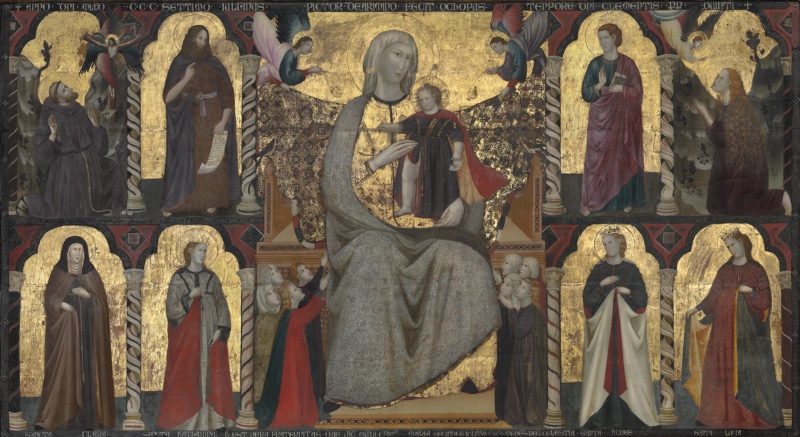
The panel, its inscriptions and its history
The Boston panel is a large rectangular dossal in tempera and gold, measuring 164 by 300 centimetres according to the Gardner Museum’s catalogue entry, a size also given in the Dizionario Biografico degli Italiani.
The centre of the panel shows the Virgin and Child enthroned between two censing angels. Kneeling women are gathered at the foot of the throne. The museum’s own description notes that some wear religious habits and one wears a crown. On either side, in two superimposed registers under Gothic canopies carried by multicoloured twisted columns, stand four saints on each side. On the left, in the upper register, are St Francis receiving the stigmata and St John the Baptist, and below them St Clare and St Catherine of Alexandria. On the right are St John the Evangelist and St Mary Magdalene in the desert, and below them St Agnes and St Lucy. Painted inscriptions name the saints. The Baptist holds a scroll with “Ecce Agnus Dei”. Along the lower edge runs a second inscription, which the museum transcribes and translates as “This is a true fraternity that conquers the world’s sins. Following the glorious Mary, you will obtain the kingdom of heaven.” The text addresses a community gathered in the Virgin’s name.
The panel’s original destination is clear in outline but uncertain in its details, and the sources describe it in slightly different ways. The main Italian reference accounts say the dossal stood on the altar of the church of the Confraternita di San Giovanni Decollato, also called “dei Morti”, which was attached to the cemetery of the Franciscan friars at Urbania, the medieval Casteldurante. The encyclopaedia entry by Daniele Benati says more briefly that it came from the church of San Francesco at Urbania. The Gardner Museum’s catalogue entry, based on a 2003 collection handbook, says it was “commissioned by the Order of Clares for the Franciscan church of San Giovanni Decollato”.
It reads the kneeling women as members of the commissioning order, some of them perhaps wealthy donors. These accounts should not be merged. The word “fraternitas” in the lower inscription points strongly to a confraternity as the community being addressed. The prominence of female saints, St Clare’s placement directly below St Francis, and the kneeling women all suggest female devotional users, whether Clares, tertiaries or women of the confraternity. No commissioning document is known. The honest conclusion is that the dossal was made for a Franciscan setting at Casteldurante in which a confraternity and devout women were central. Whether the patron was a community of Clares is an interpretation, not a documented fact.
The later history of the panel is better known. It was in the sacristy of Urbania cathedral by 1863, and it was mentioned in a travellers’ handbook of 1867. The painter Joseph Lindon Smith bought it in May 1903 from an Italian restorer in London who said it belonged to his brother in Italy, and on 18 May 1903 Isabella Stewart Gardner bought it from Smith for 1,500 dollars. A study published in Predella, no. 56 (2024, issued 2025), pp. 39–86, used unpublished files in the Archivio Centrale dello Stato in Rome to argue that “in 1901, the Dossale of Giuliano da Rimini was illegally transferred by the Cathedral Chapter” to a Florentine dealer.
This account of the panel’s export does not contradict the museum’s record of the London sale, but it adds a chapter the Boston documentation does not mention. The panel’s physical history should also be kept in mind. In his entry for the Enciclopedia dell’Arte Medievale, Daniele Benati described the dossal as the subject of “valutazioni discordi” and “in parte depresso da un’eccessiva pulitura”. In other words, an earlier cleaning has partly flattened its surface, and any judgement of its modelling and colour has to allow for that. Technical study has concentrated on the materials. The panel was included in “Calcium Sulphate Minerals in the Grounds of Italian Paintings”, Studies in Conservation, vol. 1, no. 4 (1954), pp. 174–89, and “The Development of Sgraffito in Sienese Painting”, in Simone Martini: Atti del convegno (Florence, 1988), pp. 147–50, singled out the Virgin’s mantle, whose decoration scratched through paint to the gold is among the most elaborate of its date.
The epigraphy of the dossal
The dossal carries four distinct orders of inscription, and together they constitute a small epigraphic programme as deliberate as the pictorial one. Along the upper edge runs the artist’s dedication:
+ANNO.DNI.MLLO..C.C.C.SETTIMO..IULIANUS..PICTOR.DEARIMINO..FECIT.OCHOPUS.TENPORE.DNI.CLEMENTIS..PP..QUINTI+,
“In the year of the Lord 1307, Giuliano, painter from Rimini, made this work in the time of the lord Pope Clement V.” Its Latin is the Latin of a workshop rather than a chancery. OCHOPUS runs together an irregular spelling of hoc opus, with the northern Italian habit of writing ch for a hard aspirate; TENPORE substitutes n for m before the labial, a purely phonetic spelling; and SETTIMO, most tellingly, is not Latin at all but the vernacular ordinal, slipped into the formula where septimo was wanted. These are not defects to be excused but evidence: the painter, or whichever workshop hand lettered the frame, wrote Latin as he heard it spoken, and the inscription preserves the sound of early Trecento Romagnol Latinity as faithfully as the paint preserves the forms of Assisi.
A second order of inscription runs across the middle of the panel, naming the saints of the upper register:
SANCUS FRANCISO, IONES BATISTA, S. IONAS EVEGL, S. MARIA MAGDAL.
Here the orthography grows freer still. SANCUS drops the t of sanctus; FRANCISO the second c of Franciscus; the Baptist appears as IONES BATISTA, with the vernacular reduction of Iohannes and the simplification of Baptista; and the Evangelist as IONAS with the abbreviated EVEGL for Evangelista, a form whose confusion with the prophet Jonah is only apparent, the context and the book leaving no doubt. The abbreviations MAGDAL and EVEGL show the letterer working within fixed spatial compartments, cutting words to fit the architecture of the arcades, exactly as a lapidary would.
The lower edge carries the third and richest order. At its left,
.SANCTA. .CLARA. SANCTA. KATHARINA.
name the saints of the lower left register, and at its right
.SANTA. AGNES. SANTA. .LUCIA.
name their companions, the shift from SANCTA to SANTA within a single frame once again registering the pull of the spoken language against the written formula.
Between them, beneath the Virgin’s throne, runs the dedicatory verse:
H HIC. EST VERA FRATERNITAS.QUE VIC MUDI CRIM(…) .MARIA.SECUTA.E.ICLITA TENES.REG.CELESTIA.,
that is, with the abbreviations resolved,
Hic est vera fraternitas que vic[it] mu[n]di crim[ina]: Maria[m] secuta e[st], i[n]clita tene[n]s reg[na] celestia,
“This is the true fraternity that has conquered the sins of the world: it has followed Mary, and, glorious, holds the heavenly kingdoms.”
This central text is not a free composition. It follows, almost word for word, a venerable liturgical antiphon sung on the feasts of martyrs, Haec est vera fraternitas quae vicit mundi crimina: Christum secuta est, inclita tenens regna caelestia, “This is the true brotherhood that conquered the sins of the world: it followed Christ, and, glorious, holds the heavenly kingdoms.”
The dossal’s letterer has made one change, and it is the whole programme in a single word: for CHRISTUM he has written MARIA. The fraternity gathered before this altar follows the Virgin, who presents Christ at the panel’s centre; the chant of the martyrs, familiar to every cleric from the office, is bent toward the Marian devotion of the lay company for which, on the likeliest reading, the dossal was made.
Whether the substitution was devised by a friar of the convent or requested by the community gathered before the altar cannot be known, but it confirms, from inside the text, what the kneeling women and the word fraternitas already suggested: this is a corporate image, and the corporation understood itself, in the language of the liturgy, as a brotherhood of the Virgin already assured, through her, of the martyrs’ reward. If the altar was indeed that of the burial confraternity, its borrowing of the antiphon of the martyrs, transferring to its own dead the promise of the regna caelestia, would be as economical a piece of medieval theology as the panel affords.
The fourth inscription belongs to a single figure: the scroll of the Baptist, lettered
Ecce Agnus Dei
with the abbreviation for the continuation,
ecce qui tollit peccata mundi,
“Behold the Lamb of God, behold him who takes away the sins of the world” (John 1:29). It is the one voice within the picture, and it converses directly with the corporate voice below: the Baptist’s peccata mundi and the antiphon’s mundi crimina answer one another across the panel’s height, the sins of the world taken away by the Lamb above, conquered by the fraternity below. Even the panel’s grammar of quotation, Gospel on the scroll, liturgy on the frame, workshop Latin in the artist’s signature, reproduces the medieval hierarchy of languages, and the whole epigraphic apparatus, from the papal dating clause to the misspelled saints’ names, makes the Boston dossal not only the first dated painting of the Riminese school but one of its most eloquent written documents.
The Virgin and Child enthroned
The central field of the dossal is nearly twice the width of the lateral compartments, and everything in the panel’s design conspires to make the enthroned Virgin its gravitational centre. She is not framed by the trefoil arcades that shelter the eight saints but occupies an open zone of gold, so that the throne seems to stand in a space of its own, at once continuous with and set apart from the flanking registers. The two dedicatory inscriptions, the artist’s along the top and the confraternity’s along the base, run toward her from either side, and the twisted columns of the arcades act as a coloured colonnade leading the eye inward. The composition thus translates the logic of an apse into the format of an altar dossal: the Virgin is the cult image, the saints her court.
The Virgin sits frontally but turns her upper body and her long, grave face slightly toward the Child, whom she supports standing on her left knee. Her right hand is raised before her breast in a gesture that hovers between presentation and intercession, directing the viewer’s attention to her son while also receiving the homage of the kneeling women below. The pose belongs to the family of the Maestà, the Virgin in majesty, which dominated central Italian altar painting in the decades around 1300, but Giuliano softens its hieratic frontality with this gentle torsion, a first sign of the naturalism that the Riminese painters absorbed from Giotto’s work at Assisi and in their own city.
Her dress is among the most remarkable passages of the whole panel. Over a pale grey-violet gown she wears a great mantle whose surface is covered with an intricate pattern revealed by scratching the paint away to expose the gold leaf beneath, the technique known as sgraffito. The 1988 study of sgraffito presented at the Simone Martini conference in Florence singled out this mantle as among the most elaborate examples of its date, which is worth stressing: at the very moment when Giuliano was quoting the newest Giottesque inventions, he was also pushing a refined goldsmith-like technique of panel decoration to an extreme. The cloth of honour behind the throne, likewise patterned in gold, doubles this effect, so that the Virgin appears wrapped in and enthroned against woven light.
The throne itself is a substantial piece of painted carpentry, with a stepped base, side panels and a high back partly hidden by the textile. It is drawn with an evident, if imperfect, ambition to suggest depth: the steps recede, the arms open obliquely, and the Virgin’s body has real seated weight. Here the comparison with Giotto’s thrones at Assisi is instructive. Giuliano has understood that the new painting requires the Madonna to occupy a constructed place rather than float on the gold, but he does not pursue the construction to its logical end, and the throne remains a frame for splendour rather than a fully rationalized space. Daniele Benati’s observation that Giuliano transferred Giotto’s monumental inventions into the dossal format with a convert’s zeal, without ever making spatial logic his chief concern, is nowhere better verified than here.
The Christ Child is shown standing, wrapped in a rose-red mantle shot with gold striations, one arm reaching toward his mother. The upright stance, more solemn than the seated or nursing infant types, presents him as the small Lord, the Emmanuel, received on the Virgin’s knee as on a living throne; the chrysography of his garment, an inheritance from Byzantine practice, marks his divinity in the traditional Eastern manner even as his tender movement toward the Virgin’s face speaks the newer affective language of the early Trecento. In this single figure the double formation of the Riminese school, Adriatic-Byzantine in its materials and formulas, Giottesque in its human sentiment, is compressed into a few centimetres of paint.
Above the throne two angels lean in from the gold on either side, swinging censers on long chains, while two further angels hover at the outer edges of the central field. The censing angels assimilate the painted image to the liturgy that was performed in front of it: what the clergy did with incense before the altar, the angels do perpetually before the Virgin. Their diagonal flight also does quiet compositional work, bridging the gap between the strict verticals of the arcades and the pyramid of the central group, and their pink and green wings introduce the brightest notes of colour in the upper zone of the panel.
At the foot of the throne kneel two groups of small-scale women, those on the left led by figures in dark religious habits, those on the right including, as the museum’s description notes, one who wears a crown. Their diminutive size follows the medieval convention of hierarchical scale: they are portraits of devotion rather than of individuals, the painted congregation of the “vera fraternitas” addressed in the inscription below. Whether they are Poor Clares, Franciscan tertiaries or the women of the confraternity of San Giovanni Decollato cannot be settled, as we have seen, but their presence transforms the Maestà from a timeless icon into a transaction: the community offers its prayer, and the lower inscription promises that those who follow the glorious Mary will obtain the kingdom of heaven.
Taken as a whole, the central group displays Giuliano’s temperament at its most characteristic. The drawing of the Virgin’s elongated face, with its high brows, narrow eyes and small mouth, has the lyrical gravity that the Italian reference literature ascribes to him; the colour is light and luminous, the modelling moderate, the emotional temperature even rather than dramatic. One must allow, with Benati, for the harsh early cleaning that has flattened parts of the surface, yet even in its present state the group shows a painter who received Giotto’s revolution as a repertory of motifs and a new sense of bodily presence, and who set that repertory, without apparent strain, within the golden hierarchies of the traditional dossal.
St Francis receiving the stigmata
The upper left compartment, the position of first honour at the Virgin’s right hand, is given not to a standing saint but to a narrative: Francis of Assisi kneeling on the rocky slope of La Verna, receiving the stigmata from the seraphic apparition of the crucified Christ that plunges toward him from the upper corner. The choice is programmatic. In a Franciscan setting, the stigmatization is the scene that authenticates the whole order, the moment in September 1224 when, two years before his death, Francis was marked with the wounds of Christ and became, in the language of his hagiographers, the alter Christus. Opening the dossal with this scene declares the spiritual family to which the panel and its users belonged.
Francis kneels in profile, his body turning up and back toward the apparition, his hands lifted and opened to display the palms toward the viewer as much as toward the seraph. The gesture is doctrinally exact: the wounds are the point of the scene, and the composition is arranged so that the beholder can verify them. The little chapel or hermitage behind him and the schematic rocks beneath establish the wilderness of La Verna with the abbreviated scenery of early Trecento narrative, a stage-set rather than a landscape, sufficient to locate the miracle without distracting from it.
The seraph itself descends diagonally, a crucified figure wrapped in wings, and golden rays connect the wounds of the apparition to the body of the saint. This ray-borne transmission of the stigmata is precisely the solution worked out in the fresco of the Stigmatization in the Legend of St Francis in the Upper Church at Assisi, and it is on this correspondence that much of the panel’s art-historical celebrity rests. The argument published in the Burlington Magazine in 1956 took the dependence of Giuliano’s Franciscan iconography on the Assisi frescoes as evidence for dating the Legend before 1307, and the Gardner’s own catalogue entry summarizes the panel’s role in that debate. If the inscription’s date is accepted, as it now generally is, this small compartment is the earliest dated echo of the Assisi cycle anywhere in Italian painting.
Francis wears the grey-brown habit of the Minorites, corded at the waist, and the paint handles the coarse cloth with deliberate plainness against the surrounding gold. The contrast is itself meaningful. Everywhere else the dossal luxuriates in patterned textiles, chrysography and sgraffito; here, in the compartment of the order’s founder, the painter renders poverty. The tonsured head, the lean profile and the bare feet complete a figure whose visual austerity is the panel’s homage to the Franciscan ideal that its patrons professed.
Iconographically the compartment compresses a narrative into the format of a saint’s “portrait”. The other seven saints stand frontally under their arcades; Francis alone is caught in an event. This asymmetry, far from disturbing the panel’s order, elevates him: his identity is his miracle, and no static effigy could state his sanctity as efficiently as the scene of his conformity to Christ. Painters of the Duecento had already made the stigmatization a standard element of Franciscan dossals and vita-panels, and Giuliano stands in that tradition while modernizing its figure style from the Assisi model.
The placement directly above St Clare deserves note. The left wing of the dossal reads vertically as a Franciscan column, founder above foundress, and horizontally as the male-female pairing that governs the whole programme. For the women kneeling at the Virgin’s feet, whoever exactly they were, Francis and Clare together offered the double face of their spiritual tradition, and the stigmatized founder at the top of the hierarchy anchored the panel’s promise of salvation in the most celebrated miracle of the age.
Stylistically the compartment shows Giuliano’s narrative gifts in miniature. The scene is legible at a glance, the diagonals of seraph, rays and kneeling body binding it together; the rocks and architecture are painted with a light, almost calligraphic touch; the saint’s upturned face carries feeling without pathos. The comparison with the corresponding Assisi fresco also measures the distance between model and reception: what is monumental, spatial and gravely naturalistic on the wall becomes, on the panel, compact, ornamental and lyrical, a Giottesque invention re-set like a gem in gold.
For the historian, finally, this is the compartment that carries the heaviest evidentiary weight. The doubts raised in the 1982 Fenway Court article about the authenticity of the 1307 inscription would, if sustained, have dissolved the panel’s value as a terminus for Assisi; the Dizionario Biografico dismissed those doubts as inconsistent, and the scholarly consensus has followed. As matters stand, the little Stigmatization at the top left corner of a dossal from Casteldurante remains one of the fixed points from which the chronology of the Legend of St Francis, and with it much of early Trecento painting, is still measured.
St John the Baptist
Beside the Stigmatization, in the second compartment of the upper left register, stands John the Baptist, the desert prophet and Forerunner. His inclusion beside Francis is anything but casual. Franciscan writers habitually paired the two, reading Francis as a new Baptist, a herald sent before the Lord’s second coming as John had been before the first, and the juxtaposition of the ragged prophet and the ragged friar makes that typology visible. At the same time the Baptist points toward the panel’s probable destination, for the confraternity church at Casteldurante was dedicated to San Giovanni Decollato, John the Beheaded, and the titular’s presence in the place of honour would be entirely natural.
The Baptist stands frontally, gaunt and long-bearded, his dark hair falling to his shoulders. His identity is stated three times over: by the painted inscription that names him, by his hair-shirt of camel skin visible beneath the mantle, and by the open scroll in his left hand bearing the words ECCE AGNUS DEI, “Behold the Lamb of God”, the testimony he gave at the Jordan according to the Gospel of John. His right hand rises across his chest, in the age-old gesture of the prophet who points beyond himself, here directed inward, toward the Virgin and Child at the panel’s centre, so that his scroll’s words find their referent a few centimetres away in the Christ Child himself.
The figure type is deliberately archaic. Where Francis beside him is caught in movement, the Baptist is an effigy, columnar and severe, his emaciation and wild dress inherited from a Byzantine formula of the Prodromos that Adriatic painting had preserved for centuries. Giuliano’s handling, however, gives the old type a new physical density: the mantle wraps a body that is felt beneath it, the feet grip the ground, the head sits heavily on the neck. It is exactly this negotiation, Eastern formula filled with Giottesque weight, that defines the first Riminese generation.
There is also a family connection to register. Daniele Benati observed that the Baptist and the St Catherine of this dossal repeat figures from the Presentation in the Temple frescoed by Giuliano’s brother Giovanni in the chapel of the Virgin at Sant’Agostino in Rimini, the aged Simeon and the prophetess Anna. The correspondence matters twice over: it indicates that Giovanni’s Marian cycle existed, at least in design, by around 1307, and it shows the brothers’ workshop circulating drawings between wall and panel, between Rimini and the Metauro valley. The gaunt, scroll-bearing elder of the fresco becomes, on the dossal, the Forerunner.
The colour of the compartment is kept deliberately sober, browns and dull violets against the gold, in keeping with the desert theme, and the painted inscription band and punched halo carry the ornamental burden instead. The scroll is rendered with care, its letters legible, for it was meant to be read: in a panel addressed to a lay fraternity, the Baptist’s text is the one passage of Scripture placed directly before the congregation’s eyes, an Ecce that turns every viewer into a witness at the Jordan.
Within the programme the Baptist completes a precise theological chain. He points to the Lamb; the Lamb stands on his mother’s knee at the centre; the Magdalene and the martyrs on the right embody the penitence and purity that the Lamb’s sacrifice makes fruitful; the inscription below promises the kingdom to those who follow Mary. The Forerunner is thus the panel’s internal preacher, and his position in the upper register, level with the stigmatized Francis, sets the two great ascetics of Christian history side by side as the models of the penitential life the confraternity professed.
The desert prophet also had a funerary resonance appropriate to the panel’s setting. The confraternity “dei Morti” attached to the Franciscan cemetery buried the dead and prayed for them, and John, preacher of repentance in the face of the coming judgement, whose own death by beheading the church’s title commemorated, was a fitting patron for such work. His stern frontality, among the more Byzantine notes of the dossal, reads in this light not as stylistic conservatism alone but as decorum.
As a piece of painting the compartment rewards attention to its head, one of the strongest in the panel: the deep eye sockets, the furrowed brow, the descending lines of hair and beard drawn with a wiry precision that recalls the graphic finesse the Riminese painters shared with their great miniaturist contemporary Neri. The over-cleaning that Benati lamented has told on the modelling here as elsewhere, yet the figure retains its authority, an Old Testament presence guarding the threshold of the New.
St Clare of Assisi
The lower left register opens with Clare of Assisi, placed directly beneath Francis so that the left wing of the dossal becomes a genealogy of the Franciscan family: the founder above, the foundress of its second order below. Clare had died in 1253 and been canonized only two years later, and by 1307 her cult was the natural complement to her master’s wherever the Minorites and their women’s communities were established. Her presence in this position, rather than in the outer compartments, gives her precedence among the four female saints of the lower zone and is the strongest internal argument for the panel’s connection with a female Franciscan public.
She stands frontally in the dark habit of her order, mantled and veiled, her face framed by the white wimple. Against the surrounding gold and the coloured columns her silhouette is a block of sober brown-black, the visual sister of Francis’s grey habit above; the painter has again made renunciation itself the figure’s ornament. Only the punched halo and the painted inscription naming her interrupt this austerity, and the contrast with the crowned and jewelled virgin martyrs to her right and across the panel is surely calculated: the poverty of San Damiano set beside the royalty of the early Church.
Her attributes are minimal, and it is the habit that identifies her, together with the inscription. The complex later iconography of Clare, with the monstrance or pyx of the Saracen legend, belongs largely to subsequent generations; in the first decades after her canonization she appears, as here, simply as the perfect Franciscan nun. Giuliano’s restraint is thus chronologically eloquent, a document of how Clare was pictured two generations after her death, before her legend crystallized into emblems.
It has been suggested that this figure is a reversed copy of the St Clare painted on the entrance arch of the chapel of St Nicholas in the Lower Church at Assisi, one of the series of borrowings from the Orsini chapel that the reference literature registers in this dossal. The identification of this particular derivation should be kept, as the scholarship keeps it, at the level of proposal rather than fact, but it is consistent with everything else we know about the panel’s genesis: Giuliano, or his workshop’s stock of drawings, had been at Assisi, and the newest Franciscan images of the mother church were being redeployed on the Adriatic side of the Apennines within a few years of their creation.
For the kneeling women at the Virgin’s feet, Clare was the decisive exemplar. Whether they were Clares in the strict sense, as the Gardner’s account of the commission holds, or tertiaries or confraternity women, as the inscription’s “fraternitas” may rather suggest, the veiled foundress showed them their own state raised to sanctity. The women in religious habits among the kneeling donors mirror her dress in miniature, and the panel thus constructs a visual ladder: the devotee below, the sainted nun in the register above, the Virgin, crowned queen of virgins, enthroned at the centre.
The pairing of Clare with Catherine of Alexandria in the same register is also considered. Clare embodies the evangelical poverty of the present age, Catherine the learned constancy of the age of martyrs; between them the two principal models of female sanctity available to a medieval woman, the nun and the virgin martyr, stand side by side. The dossal’s lower zone, entirely female but for the flanking columns, is in effect a small treatise on the forms of women’s holiness, with Clare as its modern, Franciscan term.
Formally the figure is among the quietest in the panel, and deliberately so. The head, small and regular under the veil, has the even, lyrical calm that distinguishes Giuliano’s physiognomies from the sharper characterizations of his brother Giovanni; the drapery falls in a few long, unbroken lines. If the Jesi and Sassoferrato attributions are accepted, one can follow this same figural quietness into Giuliano’s later work, in the Jesi fresco and the Sassoferrato painted cross on panel; here, in 1307, it already marks his temperament within the family workshop.
Historiographically, finally, Clare’s compartment has served as one of the touchstones for the panel’s Assisi connections and hence for its role in the dating controversies. Every element that ties the dossal to the Lower Church chapels tightens the knot by which this provincial altarpiece holds fast the chronology of the mother church’s decoration, and the unassuming nun in her dark habit has therefore carried, in the scholarly literature, a weight out of all proportion to her painted splendour.
St Catherine of Alexandria
Beside Clare, completing the lower left register, stands the saint whom the painted inscription names as Catherine, the virgin martyr of Alexandria. Her legend, among the most beloved of the Middle Ages, told of a royal maiden of the early fourth century who confounded fifty pagan philosophers in debate, survived the spiked wheel prepared for her torture when it shattered at her prayer, and was finally beheaded, her body borne by angels to Mount Sinai. By 1307 she was venerated across Europe as patroness of learning, of unmarried women and of the dying, a portfolio that made her an almost inevitable presence on an altarpiece serving a female devotional community attached to a burial confraternity.
She stands frontally beneath her arcade, a slender upright figure whose pale robe, lit with red, contrasts with the dark mass of Clare beside her. The juxtaposition is the programme in miniature: the modern nun in her habit of renunciation, the ancient princess in the dress of her rank, two roads to the same crown. Catherine’s youth and erect bearing carry the conventional signs of the virgin martyr, purity and constancy, while the inscription secures an identity that her generalized attributes might otherwise leave open.
As noted in the Baptist’s compartment, Benati recognized in this Catherine, together with the Baptist, a repetition of figures from Giovanni da Rimini’s Presentation in the Temple at Sant’Agostino, where the aged Simeon and the prophetess Anna flank the scene. The transformation is remarkable: a figure invented for an elderly participant in a Gospel narrative is recast, with adjusted head and attributes, as a young Alexandrian martyr. Nothing could show more concretely how a family workshop’s stock of drawings functioned, patterns migrating between wall and panel, between narrative and effigy, between Rimini and Casteldurante, with identity conferred at the last moment by inscription and attribute.
Catherine’s presence also speaks to the panel’s Franciscan milieu in a specific way. The Franciscans were energetic promoters of her cult, and at Assisi itself she received a chapel in the Lower Church; her appearance here among the Franciscan founders continues the dossal’s steady dialogue with the mother church. Moreover, her legendary translation to Sinai by angels made her a patroness of the good death and of the soul’s safe passage, a resonance that a confraternity “dei Morti”, burying the dead beside the friars’ church, could hardly have missed.
Within the female tetrad of the lower zone Catherine holds a precise place. Clare beside her represents the consecrated life; Agnes and Lucy across the panel, the martyrs of Rome and Syracuse, represent with her the heroic virginity of the persecutions. Catherine, the most “learned” of the four, adds wisdom to the catalogue of virtues the panel proposes, and medieval sermons on her feast dwelt exactly on this: that a woman’s tongue, armed with faith, had silenced the philosophers of the empire.
The compartment’s colour deserves a word. The lower register is where the dossal’s palette is at its most varied, and Catherine’s whites and reds, set between Clare’s darkness and the polychrome twisted column at her side, contribute to the jewelled, textile-like richness that the panel presents when seen from the nave, an effect entirely appropriate to an object that functioned as the golden backdrop of the altar. Giuliano’s decorative intelligence, the quality Benati summarized as an “ornate” reading of Assisi Giottism, governs such passages.
Her frontal stillness, like that of her three companions below, also had a liturgical logic. The lower register stood nearest the mensa and the celebrant; its saints are the panel’s intercessory rank, presented face-on to receive the prayers rising from the altar. The narrative energy of the Stigmatization and the eremitic Magdalene is confined to the upper corners; below, all is audience and advocacy, and Catherine’s open, regular features, characteristic of Giuliano’s idealizing bent, are composed for exactly that office.
For the modern student, finally, Catherine’s compartment is a lesson in method. Without the inscription, the figure’s identity would rest on generalized attributes and context; with it, we can watch the painter convert a borrowed workshop pattern into a named intercessor. The dossal is full of such controlled transformations, and they explain why the scholarship, from the 1956 Assisi argument to Benati’s entries of the 1990s, has treated this panel less as an isolated masterpiece than as a junction box through which the images of Assisi and Rimini passed on their way into the Marche.
St John the Evangelist
The upper right register opens, at the Virgin’s immediate left hand, with John the Evangelist, named by the painted inscription and clad in a great red mantle over green, a book in his covered hand. His position is the mirror of the Baptist’s across the panel, and the pairing of the two Johns, Baptist and Evangelist, Forerunner and Beloved Disciple, is one of the oldest symmetries in Christian iconography, familiar from Deesis compositions and church dedications alike. Flanking the Virgin with the two Johns places the dossal in that long tradition, while each John also carried, as we shall see, a particular charge in this Franciscan and confraternal context.
The Evangelist is shown youthful and beardless, in the Western manner, his hair falling in soft locks, his gaze set frontally. The book he bears is his Gospel, the “spiritual gospel” of the eagle, and its presence beside the Baptist’s scroll across the panel completes a diptych of testimony: the Forerunner’s spoken Ecce Agnus Dei on one side, the Evangelist’s written In principio on the other, the two witnesses between whom the Word made flesh sits enthroned at the centre. The panel’s theology, as so often in this period, is built of such silent correspondences.
His prominence had, moreover, a local and a familial resonance. The contrada of Rimini in which Giuliano and his brothers lived and worked took its name from the church of St John the Evangelist, the Augustinians’ church now called Sant’Agostino, whose chapels Giovanni was frescoing in these very years.
John’s presence also served the panel’s female public in a specific way. Medieval devotion remembered him as the virgin apostle, the disciple to whom the crucified Christ entrusted his mother, and thereafter Mary’s guardian and companion. On a dossal centred on the Virgin and addressed largely to women, the apostle who lived with the Virgin was her natural attendant, and his station at her left hand quietly narrates that guardianship. The Magdalene beside him extends the thought: the two figures who stood with Mary at the foot of the Cross here flank her throne in glory.
The red of his mantle is the strongest single field of colour in the upper register, balancing the darker Franciscan tones of the opposite wing and drawing the eye rightward from the central gold. Giuliano’s palette, light and luminous by the general judgement of the literature, here shows its capacity for splendour: the broad, simply folded mantle, the green undergarment, the gilt-edged book together make the Evangelist the most princely figure of the upper zone, decorum befitting the apostle whom the Apocalypse crowned as seer.
For a confraternity of the dead, John had further meanings. He was the author, in medieval belief, of the Apocalypse, the book of the last things that governed the imagination of every burial society, and his own end was held to be miraculous, an assumption or a painless passing at Ephesus. The saint who had seen the heavenly Jerusalem and, by legend, tasted no corruption was a powerful advocate for souls in transit, and his calm frontal presence on the panel’s right wing answers the Baptist’s austere summons to repentance on the left with the promise of the vision of peace.
Stylistically the figure invites comparison with the Evangelist cycles that Giovanni’s circle painted in the choir of Sant’Agostino, dedicated to the same saint. On the dossal the type is simpler, an effigy stripped of narrative, but the family resemblance in the oval of the face and the fall of the hair belongs to the shared repertory of the brothers’ workshop. The modelling of the head, gentler than the Baptist’s craggy mask, exemplifies the even, idealizing register in which Giuliano preferred to work.
One last observation concerns hierarchy. Modern eyes read left to right and might take Francis, in the first compartment, as the panel’s ranking saint; medieval protocol read from the Virgin outward, and by that count the two apostolic witnesses, Evangelist and Baptist, hold the innermost stations, with the Franciscans and the women martyrs deployed beyond them. The dossal thus keeps perfect canonical order even while its Franciscan sympathies colour everything, a balance between universal Church and particular order that its clerical designers, whoever they were, evidently intended.
St Mary Magdalene in the desert
The outermost compartment of the upper right register holds the most visually arresting of the eight lateral figures: Mary Magdalene, not as the myrrh-bearer or the penitent at Christ’s feet, but as the desert anchoress of her Provençal legend, her body entirely clothed in the miraculous growth of her own hair. According to the account diffused above all by the Legenda Aurea, the Magdalene passed the last thirty years of her life in a wilderness cave near Marseilles, without food or clothing, sustained only by the celestial banquet to which angels raised her at the canonical hours. Giuliano paints her at that legendary station, upright in her mantle of hair against the gold, with small angels attending her, the desert’s answer to the enthroned queen at the panel’s centre.
The figure is a study in sanctified wildness. The hair falls in long, regular waves that the painter treats almost as a textile, a garment woven by grace, and the face that emerges from it is not haggard but serene, the penitence already transfigured. The little angels beside her cite the legend’s most beloved detail, her daily elevation, and mark her compartment, like the Stigmatization diagonally opposite, as a narrative embedded among effigies. The two corners of the upper register thus mirror one another: Francis on his mountain, the Magdalene in her desert, the two great penitents of the panel, each visited from heaven.
That mirroring was doctrinally pointed in a Franciscan context. The Minorites cultivated the Magdalene intensely as the exemplar of perfect penance, the sinner whose love had made her, in the phrase the friars loved, the apostle of the apostles; within a few years of this dossal the Lower Church at Assisi would receive an entire chapel of her legend. Setting her opposite the stigmatized founder proposes an equation the order itself drew: what Francis achieved by conformity to the crucified Christ, the Magdalene achieved by conformity of the heart, and both show the fraternity below that no distance from God is unbridgeable.
For the women before the altar, the Magdalene’s presence enlarged the panel’s anthology of female sanctity in a crucial direction. Clare offered the way of the cloister, Catherine, Agnes and Lucy the way of intact virginity, roads closed to a widow or a married woman of the confraternity. The Magdalene, neither virgin nor nun, sainted through repentance and love, opened the panel’s promise to every woman kneeling there. Her position balancing St Clare’s file on the opposite wing gives the programme its full breadth: foundress and penitent, the two poles between which lay every female life the dossal addressed.
Her funerary aptness was no less exact. The Magdalene stood at the tomb on Easter morning and was the first witness of the Resurrection; for a confraternity that buried the dead in the cemetery beside the friars’ church, no advocate spoke more directly to the hope in which graves were dug. The desert legend added its own consolation, the daily foretaste of heaven granted to the penitent, so that her compartment reads, in that setting, as a painted promise that penance ends in elevation.
The eremitic, hair-clad Magdalene was still a relatively fresh image in Italian panel painting around 1300, its fortune rising with the mendicant orders, and Giuliano’s version is among the notable early examples on this side of the Apennines. He treats the type with his usual decorative instinct: the hair-mantle becomes an ornamental field to rival the sgraffito of the Virgin’s robe, wildness domesticated into pattern. The comparison encapsulates his art, in which even the desert is rendered as a kind of goldsmith’s work.
Compositionally the compartment closes the upper register with a strong silhouette, the unbroken almond of the hair-clad body reading clearly at a distance, as the outermost figures of a wide dossal must. The attending angels soften the outer edge and echo the censing angels of the central field, knitting the extremities of the panel back to its heart. Such calculations, figure by figure, are what make the Boston dossal, for all its compartmented format, a single composed object rather than a row of icons.
Finally, the Magdalene’s compartment has its part in the panel’s dialogue with Assisi and with the Riminese school’s later development. Her cult’s Franciscan momentum, about to produce the Assisi Magdalene chapel, and her prominence in Riminese painting of the following decades, make Giuliano’s desert saint of 1307 an early document of a devotional current still gathering force. Here as throughout, the dossal stands at a threshold, translating the newest Franciscan imagery into the panel-painter’s golden idiom at the very moment of its formation.
St Agnes
The lower right register begins, beside the throne, with the saint whom the inscription names as Agnes, the child martyr of Rome. Her legend, among the oldest and best attested of the virgin martyrs, told of a girl of about thirteen, of noble family, who refused marriage for the sake of Christ during the persecutions around the year 304, was exposed and miraculously protected, and died by the sword. Buried on the Via Nomentana, honoured with a basilica since Constantinian times and named daily in the Roman Canon of the Mass, Agnes belonged to the innermost circle of the Church’s virgins, and her presence here, nearest the Virgin among the right-hand women, respects that ancient precedence.
Giuliano presents her crowned, in a pale mantle lined with red over her robe, a slight, upright figure whose regal dress answers her legend’s insistence on her noble birth and, more deeply, the sponsa Christi theme that governed her cult: the girl who called Christ her bridegroom is dressed as the bride and queen her refusal of earthly marriage made her. The crown also converses with the crowned woman kneeling among the devotees at the Virgin’s feet, a painted rhyme between the sainted virgin above and the noble devotee below that can hardly be accidental in so calculated a programme.
Her name was her theology. Agnus, the lamb, sounded in Agnes to every medieval ear, and her iconography made the pun canonical by giving her a lamb as attribute; on her feast, to this day, lambs are blessed at her Roman basilica. On this dossal the correspondence runs deeper than attribute: across the panel the Baptist’s scroll proclaims Ecce Agnus Dei, and Agnes, the lamb-named virgin sacrificed in her innocence, embodies on the human side what the scroll declares of Christ. The panel’s designers, evidently, thought in such echoes.
Within the female tetrad of the lower zone, Agnes and Lucy form the ancient pair, Roman and Sicilian martyrs of the same great persecution, as Clare and Catherine across the throne join the modern foundress to the legendary Alexandrian. Both Agnes and Lucy, moreover, stand with Agatha and Cecilia among the seven women named in the Canon of the Mass, so that the register nearest the altar table gathers precisely those virgins whom the celebrant invoked in every Mass said before the panel.
For the confraternity and its women, Agnes carried the special authority of extreme youth. The thirteen-year-old who outfaced Roman power offered the panel’s most absolute image of purity and constancy, a model held up to daughters as the Magdalene above was to penitents and Clare to the professed. The sequence of ages across the dossal’s women, the child Agnes, the maiden Catherine, the matron-penitent Magdalene, the abbess Clare, and the Virgin Mother enthroned over all, composes an entire female lifetime under grace.
The compartment’s placement also served the panel’s chromatic architecture. Between the gold of the central field and the outer column, Agnes’s whites and reds pick up the Evangelist’s mantle directly above her, binding the right wing vertically as Francis and Clare’s habits bind the left. Giuliano’s decorative government of the whole surface, praised throughout the literature as his particular strength, is nowhere more evident than in these calculated relays of colour from register to register.
Her frontal calm, like Catherine’s opposite, belongs to the intercessory decorum of the lower zone, and her physiognomy shows Giuliano’s idealizing type at its purest: the small oval face, high brow and quiet mouth that recur across his securely attributed work, from the Urbania Madonna to the female saints of the Norfolk triptych a decade and more later. Allowing always for the surface losses Benati recorded, the head of Agnes remains one of the panel’s gentlest passages.
Historically, her cult needed no Franciscan mediation, and that is itself significant for reading the programme. The dossal joins the order’s new saints, Francis and Clare, to the universal virgins of the Canon, Agnes and Lucy, and to the great figures of Gospel and legend, the two Johns, the Magdalene, Catherine. The resulting college is at once intensely Franciscan and impeccably catholic, exactly the balance a mendicant church serving a lay confraternity required, and Agnes, ancient, Roman and liturgical, is one of the weights that holds that balance true.
St Lucy
The outermost compartment of the lower right register, and the last figure of the nine, is the saint whom the inscription names as Lucy, the virgin martyr of Syracuse. Her passio placed her death in the persecution of Diocletian, in 304, the same storm that carried off Agnes beside her: a Sicilian maiden who, after praying at the tomb of St Agatha for her mother’s healing, distributed her dowry to the poor, was denounced by her betrothed, withstood the judge Paschasius, proved immovable when oxen were set to drag her to a brothel, survived fire, and died by the sword. Like Agnes she entered the Canon of the Mass, and her feast on the thirteenth of December, in the darkest days of the year, wove her permanently into the Church’s calendar of light.
Lucia, from lux, was glossed by every medieval preacher as the light-bearer, and the Legenda Aurea opens her chapter with exactly that etymology; the later, familiar attribute of the eyes on a dish grew from this luminous name rather than from the earliest legend.
Giuliano paints her as a slender, frontal figure in the file of virgins, her mantle falling in the long, quiet lines that characterize the lower register, the painted inscription above securing her name. Her station at the panel’s extreme edge demanded, like the Magdalene’s above her, a clear silhouette legible from the nave, and the painter answers with verticality and simplicity, reserving his ornamental exuberance for the columns beside her and the golden field behind.
Her pairing with Agnes has already been noted as the panel’s ancient, liturgical pair of virgins; her vertical relation to the Magdalene above is equally considered. The right edge of the dossal descends from the penitent transfigured in the desert to the virgin unmoved before her judge, two forms of female constancy, while the left edge descends from the stigmatized founder to his foundress. The four outer compartments thus frame the whole panel in exemplarity, the four inner ones in testimony and precedence, a grid as thoughtful as any contemporary sermon’s divisions.
For the women of the fraternity, Lucy’s legend spoke with particular directness about the body and its dangers. The maiden whom no force could drag to dishonour, whose very immobility became her miracle, offered an image of inviolable integrity that medieval female piety prized; her care for her mother and her distributed dowry added works of mercy to the pattern.
Sicilian by origin, Lucy was by 1307 the common property of the whole Latin Church, her cult long established across the Adriatic world; Venice indeed claimed her relics. Her appearance on a Marchigian altarpiece therefore requires no special channel, though her universality is itself the point: with Agnes she anchors the dossal’s Franciscan novelties in the oldest strata of the cult of the saints, the virgins of the age of persecution on whom the whole edifice of later female sanctity was raised.
As painting, the compartment shares the qualities and the fate of its register: the even, luminous flesh tones the literature ascribes to Giuliano, the graphic delicacy of features and hair, and the losses of a cleaning that has thinned the modelling here as elsewhere. Seen across the panel from the Stigmatization, it measures the dossal’s full expressive range, from narrative drama to intercessory stillness, contained within a single, consistent figural culture.
With Lucy the ennead is complete, and its architecture can be stated in a sentence: at the centre the Virgin and Child with their angels and their kneeling clients; innermost, the two Johns, witnesses of the Word; then the Franciscan column of founder and foundress facing the Gospel pair of Evangelist and Magdalene; outermost below, the canonical virgins Agnes and Lucy flanking, with Catherine and Clare, the throne’s approaches. It is a programme of remarkable coherence for a provincial commission, executed by a painter who had just seen Assisi and never forgot it, and signed, dated and papally anchored with a confidence that has made this dossal, for more than a century of scholarship, the first firm stone in the edifice of the Riminese Trecento.
Reading the dossal: Assisi quotations and a painter’s temperament
The dossal’s importance for Trecento chronology does not rest on the inscription alone. From the mid-twentieth century scholars noticed that the panel contains precise quotations from the frescoes at Assisi. An article titled “The Date of ‘The Legend of St Francis’ at Assisi”, published in the Burlington Magazine, vol. 98, no. 643 (October 1956), pp. 344–51, and a 1960 monograph on Giotto and Assisi drew on these borrowings in the long debate about when the St Francis legend in the Upper Church was painted.
The Gardner catalogue summarises the 1956 argument as showing that the St Francis iconography in the dossal depends on the Assisi frescoes. The standard Italian reference entry also notes a series of citations from the frescoes of the Orsini chapel, dedicated to St Nicholas, in the Lower Church. The stigmatization at the upper left is generally said to derive from the corresponding scene in the Upper Church. Some commentators have identified the St Clare at the lower left as a reversed copy of the St Clare painted on the entrance arch of the St Nicholas chapel, though it is not clear that this particular identification goes back to the mid-century studies. The twisted columns separating the saints, which the reference literature calls “of Assisi inspiration”, are another Giottesque borrowing. Daniele Benati remarked on the “zelo da neofita”, the convert’s zeal, with which Giuliano moved devices invented by Giotto for monumental wall painting, above all the powerful spiral columns, into the incongruous setting of a gold-ground dossal.
The value of these quotations for dating needs to be stated precisely. If the 1307 inscription is authentic, the Boston dossal is the earliest securely dated work to quote the Assisi St Francis cycle, and it gives a firm latest date for that cycle and for the chapel of St Nicholas. For that reason the reliability of the inscription has been questioned. In 1982 an article titled “An Altarpiece by Giuliano da Rimini”, published in the Gardner Museum’s journal Fenway Court, pp. 14–27, argued that the inscription was a later addition and dated the panel between the 1320s and the 1340s, which the museum’s bibliography summarises as “inscription as a later addition, dated 1320s-1340s”.
The detailed arguments of that article could not be consulted for this essay and are not paraphrased here. Its reception in Italian scholarship, however, has been clear. The 2001 Dizionario Biografico degli Italiani entry calls the doubts about the authenticity of the inscription and its date “argomenti inconsistenti”, and modern accounts generally accept the date of 1307. The consistency between the style of the dossal and the other works attributed to Giuliano’s early career, together with the documented activity of the Rimini workshop in the first decade of the century, strongly supports that consensus.
As a work of art, the dossal shows a temperament rather than only a chronology. The Italian reference literature agrees that Giuliano’s art has a strongly lyrical and narrative quality. He took up Giottesque elements freely without ever making spatial construction or sculptural modelling his main concern. The figures seek a moderate volume in the space allotted to them. The flesh tones have a certain naturalism, and the colour range is light and luminous. Compared with his brother Giovanni, whom both the documents and modern criticism treat as the leading figure of the first Riminese generation, Giuliano shows less interest in the emotional characterization of his figures and a more even, decorative sensibility. Giotto’s new language is received here as a repertory of motifs and a new sense of bodily presence, set within a structure that remains that of the traditional dossal, with its hierarchical symmetry, gold ground and sequence of standing saints.
A further detail links the dossal to the painter’s immediate surroundings. As Daniele Benati pointed out, the St John the Baptist and the St Catherine repeat, respectively, the figures of Simeon and of the prophetess Anna in the Presentation in the Temple painted by Giovanni in the chapel of the Virgin at Sant’Agostino in Rimini. This coincidence has two consequences. It suggests that Giovanni’s Marian cycle was painted before or around 1307, and it shows that Giuliano was constantly looking at his brother’s work. A 1961 study in Arte Veneta, “Lo svolgimento del linguaggio giottesco da Assisi a Padova: il soggiorno riminese e la componente ravennate” (pp. 11–24), went further and gave Giuliano the Sant’Agostino frescoes themselves. That view has not been followed. The figure repetitions are better explained as the circulation of drawings and models within a single family workshop. The Riminese “school” was first of all a shared stock of patterns, and the dossal is the first dated evidence of it.
Giotto at Rimini and the formation of the Riminese idiom
Any account of Giuliano has to face the Giotto question, because the dossal was painted within a few years of Giotto’s work in Rimini. The main written source is Riccobaldo of Ferrara’s Compilatio chronologica. It names Giotto as a “pictor eximius” from Florence and cites as evidence of his fame the works he made “in ecclesiis minorum Assisii, Arimini, Paduae”, as well as those in the communal palace and the Arena church at Padua. Modern opinion places the passage no later than 1313. It is embedded in Riccobaldo’s memories of his time in Padua in about 1306–1308, which gives an approximate latest date for the works he lists. Riccobaldo is therefore a nearly contemporary witness to Giotto’s presence in the Franciscan church of Rimini. Much later, Vasari recorded numerous paintings by Giotto in San Francesco at Rimini that were destroyed in the fifteenth-century rebuilding. According to the modern reference literature, the frescoes in the choir probably showed scenes from the life of St Francis.
The only surviving work of Giotto’s Rimini campaign is the large painted crucifix, still in the apse of the Tempio Malatestiano. It has lost the ends of its arms and its lateral terminals with the mourning Virgin and St John. Its history as an object of study is instructive. It was forgotten for centuries, mentioned in guidebooks only from the mid-nineteenth century, and restored in 1934, when it was attributed to Giotto. At the 1935 exhibition of Riminese painting it was shown more cautiously as the work of a local painter of around 1310–15. In 1957 its missing crowning panel, a Redeemer blessing, was identified in the former Jekyll collection in London. Current opinion accepts it as Giotto’s and dates it around or even before 1300. An important study in the 1995 Neri da Rimini catalogue fixed Giotto’s stay in Rimini, with a good margin of certainty, at around or before 1300. The Enciclopedia dell’Arte Medievale entry on Rimini states that the critics now place his presence between the end of the thirteenth century and the very first years of the fourteenth, because by then the works of Neri da Rimini, Giovanni and Giuliano already show a direct knowledge and assimilation of his language.
This chronology matters for Giuliano. If Giotto was in Rimini around 1300, a painter active in the family workshop could have seen the Florentine’s frescoes and cross while they were being made, and could have reworked them in his own practice within a few years. The dossal, though, points just as strongly to Assisi, both in its Franciscan iconography and in its borrowings from the Lower Church chapel of St Nicholas. The 2001 Dizionario Biografico entry concludes that the deep knowledge of Giotto shown by the leading painters of the first Riminese generation very probably implies a stay at Assisi, deepened and reinforced by direct contact with Giotto’s works in Rimini. Miklós Boskovits pushed this further for Giovanni. He argued that the classicizing breadth of the Sant’Agostino Marian cycle reflects an experience of Giotto acquired at Assisi or in Rome, perhaps even before Giotto came to Rimini.
The alternative, and older, reading of the Riminese idiom stressed Rome and Pietro Cavallini. An early 1920s study of the newly uncovered Sant’Agostino frescoes spoke of a “school of Pietro Cavallini at Rimini”, and this Roman reading dominated the first decades of research. It has not stood up. Modern criticism sees the Riminese painters’ classicism as mediated by Giotto and his Assisi workshop, not by Cavallini directly. The Roman question has not quite disappeared, however, because the Assisi workshop itself was deeply shaped by Roman experience, and the “antique” quality that scholars have found in Riminese painting cannot be reduced to a single source.
The Byzantine and Adriatic component is the other part of the problem. The first Riminese generation did not start from nothing. Giovanni’s early works, above all the painted cross of Talamello and the small panel at Faenza with a variant of the Pelagonitissa type of the Virgin, show Eastern formulas that the 2001 entry on him calls rooted in a “humus di cultura bizantina”. Giotto’s naturalism arrived in a setting shaped by Ravenna, the Adriatic trade and Byzantine icons. In Giuliano’s case the Byzantine element is less obvious than in Giovanni’s early works. The 1307 dossal is conservative mainly in its format and its decorative richness, not in any particular Eastern type. The Dizionario Biografico, as we shall see, finds a late “neo-Byzantine” and solemn tone in the Norfolk triptych of about 1320, which it reads as a return to the arcane timbre of Giovanni’s earliest works.
The relation between Giotto and the Riminese was neither simple dependence nor local resistance. The idea found in some older literature that the Rimini painters might in turn have influenced Giotto during his visit rests on no documentary evidence and has no support in the modern reference literature. What can be said is that Rimini was, with Assisi and Padua, one of the three centres named by Riccobaldo, and that by 1307 painters trained in the city were producing works that already reworked the Assisi models with remarkable assurance. Carlo Volpe’s 1965 description of Giovanni’s language as “quasi sostegno dorsale e linfa poetica di tutta la scuola”, almost the backbone and poetic lifeblood of the whole school, recognized that the Riminese idiom was a local creation even though Giotto triggered it.
The attributed corpus: a catalogue in dispute
Outside the dossal, every work given to Giuliano rests on stylistic argument. The degree of agreement varies a good deal, and it is best to proceed from the most secure attributions to the most contested.
The attribution most widely accepted as belonging to Giuliano’s earliest phase is the fragmentary fresco of the Crucifixion with the Virgin and St John, from the chapter house of the Servite convent of San Pellegrino at Forlì. The attribution goes back to Carlo Volpe. The 2001 Dizionario Biografico describes it as enjoying “unanimous recognition”. On historical grounds, discussed by Miklós Boskovits in 1993, the chapter-house decoration should date from the same time as the Boston dossal. Some summaries date the fresco precisely to 1308. That precision should be treated as an inference from the historical evidence, not as a documented date. Its present location is also given differently in different sources. The 1995 encyclopaedia entry lists it in the Pinacoteca Civica at Forlì. More recent regional guides and a recent civic presentation describe the detached fresco as kept in the complex of San Pellegrino Laziosi, and one guide says it was returned there in 1965. Stylistically, Daniele Benati read it as evidence of Giuliano’s loyalty to archaic models. The crucified Christ follows the type of Giotto’s Rimini cross. The Forlì fresco therefore shows that the Riminese workshop was already working for mendicant communities outside Rimini around 1307–08, and that the Rimini crucifix had immediately become a model.
Closely related in style to the dossal is the fresco of the Virgin and Child enthroned in the small Oratorio della Madonna del Carmine at Urbania. It was first recognized as Giuliano’s in 1958 in a study of a Riminese Deposition, and a note by the same scholar in his photographic archive dates it to about 1307–1310. The Dizionario Biografico sees it as still closely tied to the dossal. Daniele Benati sees in it a greater compositional ease that suggests a somewhat later date.
Local historiography says the fresco was originally painted on a wall of the Rocca of Casteldurante and moved with its supporting wall into the oratory when the fortress was demolished in about 1516–17. One study of 1988, however, argued that it had been in the oratory from the start. The fresco was later set in a Renaissance stone frame decorated with candelabra, and it was retouched in the sixteenth century. The Urbania fresco shows that Giuliano’s work at Casteldurante was not limited to one altarpiece, and that the small town was one of the main centres of Riminese painting in the Metauro valley.
Crucifixion with the Virgin and St John the Evangelist (from the Chapter House of San Pellegrino, Forlì)
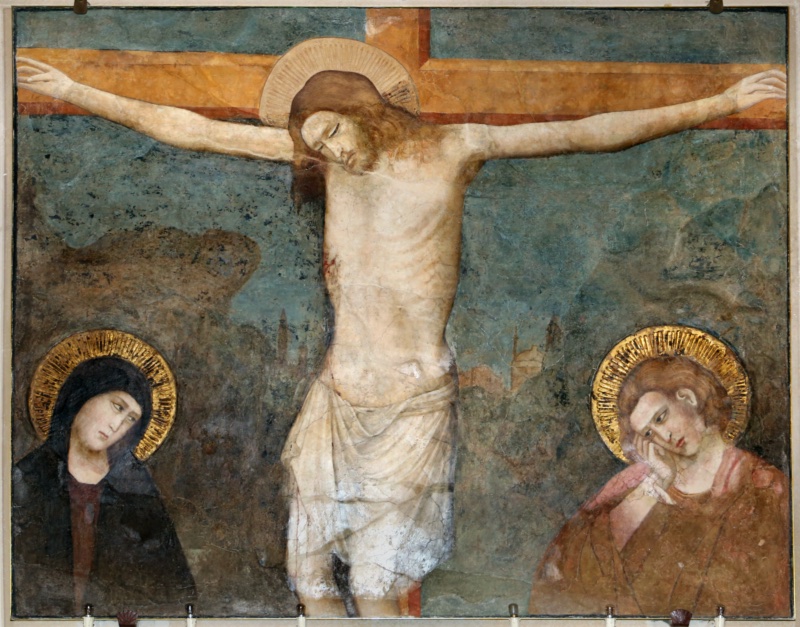
The fresco comes from the chapter house of the Servite convent of San Pellegrino at Forlì, and its original setting explains its form. The chapter house was the room in which a mendicant community assembled daily, heard the rule read, confessed faults and deliberated; from the thirteenth century onward its inner wall, facing the entering friars, customarily carried a Crucifixion, the image before which the community’s discipline was enacted. What survives at Forlì is the heart of such a decoration, detached from its wall and reduced along its edges, and the historical argument advanced by Miklós Boskovits in 1993, that the furnishing of the chapter house belongs to the same years as Giuliano’s dated dossal of 1307, gives the fresco its accepted place at the very beginning of the painter’s reconstructed career. The attribution itself was Carlo Volpe’s, made in his fundamental study of 1965, and it is the one addition to Giuliano’s catalogue that the Dizionario Biografico degli Italiani describes as enjoying unanimous recognition.
The composition is of the utmost economy: the crucified Christ at the centre, and at either side, emerging half-length from the lower corners, the two canonical mourners, the Virgin at Christ’s right hand and the young St John the Evangelist at his left. Nothing else survives, and probably little else was ever there; the reduced, iconic Crucifixion, purged of crowds and narrative, was the form proper to a room of discipline, where the image served not to tell the story of Golgotha but to place the community perpetually beneath the Cross. The half-length mourners, rising into the field as if from behind a parapet, concentrate the whole scene into three heads and a body, and give the fresco the devotional intimacy of an enormously enlarged panel painting.
The Christ is the document of Giuliano’s formation. The body hangs frontally with arms nearly horizontal, the head fallen to the right shoulder, the eyes closed in death; the abdomen sinks, the ribcage lifts, and the long, pale anatomy is modelled in soft gradations rather than the graphic striations of the older Byzantine crosses. The type is that of the great painted crucifix in the apse of the Tempio Malatestiano, the one surviving work of Giotto’s Rimini sojourn: the same quiet verticality, the same dead weight without spasm, the same translucent loincloth knotted at the hip through which the line of the body continues. Daniele Benati read the Forlì fresco precisely in these terms, as evidence of Giuliano’s fidelity to the models of his first formation, and the derivation shows how immediately Giotto’s cross, painted around or shortly after 1300, became canonical for the painters of the city that housed it.
The head of Christ concentrates the fresco’s feeling. Framed by long auburn hair that falls in parallel waves onto the shoulder, the face is inclined but composed, the brows unknotted, the mouth closed; the wide cruciform halo, its gold laid in radiating strokes, isolates it against the dark ground like a disc of light. This is the dead Christ of the new Giottesque devotion, the Christus patiens rendered without contortion, and its restraint is characteristic of Giuliano: where his brother Giovanni sharpens expression toward pathos, Giuliano keeps the emotional temperature even, and the Forlì Christ dies with the same lyrical gravity that his Virgin of the dossal enthrones. The small wound in the side, with its thin fall of blood, is stated rather than dramatized, sufficient for the meditating friar to fix upon without rhetorical insistence.
The Virgin, at the left, is a study in enclosed grief. Wrapped entirely in a mantle so deep in tone that it now reads almost as black, her face framed by the white edge of a veil, she inclines her head toward her son with lowered eyes, her sorrow turned inward rather than performed. The pale oval of the face, the high brows and the small, firm mouth belong to the same idealizing physiognomic type as the women of the Boston dossal, and the comparison is instructive in both directions: the panel’s enthroned queen and the fresco’s mourning mother are the same figure of Mary at the two poles of her compassion, and the workshop’s repertory of faces served both without strain.
St John, at the right, performs the most ancient gesture of mourning in Christian art: the head leaned upon the hand, the cheek pressed against the open palm, the elbow supported, one supposes, on the arm folded across the body below the fresco’s broken edge. The pose descends from centuries of Byzantine Crucifixions and Dormitions, but Giuliano fills it with a new softness, the youthful head with its cap of waving hair tilting into the hand as if with actual weight, the rose mantle gathering in broad, simplified folds. Set against the Evangelist of the dossal, upright and princely with his book, the Forlì John shows the same figure translated from effigy into affect, and his silent, almost drowsy sorrow, so different from the wailing Johns of the Duecento crosses, is among the clearest signs of the Giottesque schooling of the whole conception.
The fresco’s colour and condition must be read together. The ground against which the three figures stand is now a deep, mottled blue-green, an effect produced in large part by the fate of the original blue, laid a secco over the plaster and since darkened, abraded and lost in patches, as azurite grounds on medieval walls almost invariably are; the warm ochre and yellow of the cross, by contrast, and the gold of the three rayed haloes have kept much of their force, so that the crucifix now seems to glow against a nocturnal field the painter never quite intended. Losses along the lower edge have consumed the foot of the cross and the mourners’ lower bodies, and the whole surface has the soft, worn transparency of a detached fresco. Yet the essentials, the modelling of the torso, the three heads, the great simple silhouettes, survive legibly, and the ruin has if anything purified the image toward the iconic concentration its room required.
Within Giuliano’s corpus the Forlì Crucifixion holds a precise and double significance. It is his earliest surviving wall painting and the only one whose attribution commands general assent, the fixed point from which the debated Jesi fresco and Sassoferrato painted cross are argued; and it is the first evidence that the family workshop of the contrada of San Giovanni Evangelista was exporting its art beyond Rimini within a year or so of the dossal, working here not for Franciscans but for the Servants of Mary, a reminder that the school’s mendicant clientele was plural from the start. Seen whole, the fresco is the mural counterpart of the Boston panel: the same moment, the same formation, the same temperament, with Giotto’s Rimini cross standing behind the one as the Assisi frescoes stand behind the other, and between them the two works define, more completely than any other pairing, what the art of Giuliano da Rimini was in the years around 1307.
Virgin and Child Enthroned (Oratorio della Madonna del Carmine, Urbania)
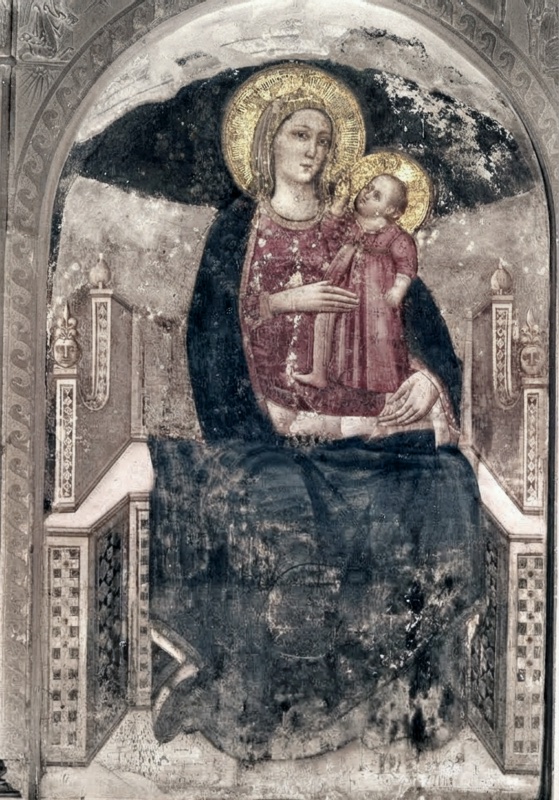
The fresco of the Virgin and Child enthroned in the little Oratorio della Madonna del Carmine is Giuliano da Rimini’s second surviving work at Casteldurante, the modern Urbania, and the necessary companion piece to the dossal of 1307 painted for the same town. Its attribution history is brief and firm: Carlo Volpe first recognized the fresco as Giuliano’s in 1958, in a study of a Riminese Deposition, and an annotation in his photographic archive dates it to about 1307–1310; the Dizionario Biografico degli Italiani accepts the attribution and sees the work as still closely tied to the Boston dossal, while Daniele Benati, noting a greater compositional ease, inclines toward a slightly later moment. The catalogue of the Soprintendenza records that criticism once thought of a generic Riminese hand, perhaps a pupil of Neri da Rimini, before settling almost unanimously on Giuliano, anchored precisely by the dated dossal he had supplied to the town. Between these positions the honest dating is circa 1307–1310, the years in which the painter’s Casteldurante clientele is documented.
Its original location is the one genuinely open question. The local historiography of Casteldurante holds that the image was painted on a wall of the Rocca, the Brancaleoni fortress, and that when the fortress was dismantled in the second decade of the sixteenth century the fresco was cut out with its supporting masonry and translated to the wayside chapel at the town’s upper gate, the shrine recorded in 1478 as the “Majestà de porta de sopra” and enlarged into an oratory at the end of the fifteenth century. Against this tradition, Leonardi (1988, p. 92) argued that the painting had stood in the oratory from the beginning. The two hypotheses give the image two quite different first lives, as the devotional focus of a fortress or as a roadside Maestà sanctifying the approach to the town, and the evidence does not yet allow a decision; what is certain is that from the sixteenth century onward the fresco was the altar image of the chapel, renamed for the Madonna del Carmine after the confraternity founded there in 1610, and that it received then the carved stone frame with candelabra ornament, and a campaign of retouching, that condition its present appearance.
The composition belongs to the same family as the centre of the Boston dossal, and comparing the two is the quickest way into the fresco. The Virgin sits frontally on a substantial Gothic throne, her head inclined toward the Child, who does not sit but stands on her left knee, steadied by her long right hand laid across his breast while her left rests open upon her own knee. The standing Child, wrapped at Boston in a gold-striated mantle, here wears a simple rose-red tunic, and his gesture has grown warmer: he looks up into his mother’s face and reaches a small hand toward her chin, the caress of the Eleousa tradition grafted onto the frontal majesty of the Western Maestà. It is exactly the kind of adjustment Benati’s “greater ease” describes, the hieratic scheme of 1307 relaxing, within a few years, toward affective intimacy, while the underlying pattern, the same long hands, the same fall of the mantle over the knees, remains recognizably the workshop’s.
The throne rewards close attention, for it is the most elaborate piece of painted architecture in Giuliano’s small surviving corpus. Its high back rises between two uprights that terminate in pinnacles, each carrying, remarkably, a small sculpted head, a humanized finial of a kind the painter could have seen in contemporary Gothic micro-architecture, and the base and arms are faced with panels of checkered inlay in the Cosmatesque manner, painted with enough care that the geometry still reads through the abrasion. The seat is spread with a dark cloth on which the Virgin’s mantle pools in broad folds. As at Boston, the structure recedes obliquely with a real, if intuitive, ambition of depth: Giuliano has again understood from Giotto that a Madonna must have somewhere to sit, without pursuing the construction to systematic rigour, and the throne remains, characteristically, as much a frame of honour as a spatial fact.
The Virgin herself is the workshop’s ideal type at full scale. The oval face with its high brows, narrow eyes and small firm mouth is the same physiognomy enthroned at Boston and mourning at Forlì; the veil descends smoothly from the crown of the head beneath the mantle’s edge, and the great rayed halo, its gold laid in radiating strokes, isolates the head against what was once a blue ground and now reads as a darkened, mottled field, the usual fate of azurite laid a secco. Her dress is the fresco’s chief chromatic survival: a crimson robe patterned with small ornaments, worn under the night-blue mantle, so that the colour chord, red under blue against gold, repeats on the wall the regal harmony of the dossal’s sgraffito queen, translated from goldsmith’s refinement into the broader economies of fresco.
The condition must be read into any judgement of quality. The surface is abraded throughout, with losses concentrated in the lower zone where the mantle spreads over the throne step; the blues have darkened and thinned; and the sixteenth-century campaign that framed the image also retouched it, most visibly along the margins and, one suspects, in the reinforcement of some contours. The arched stone surround with its candelabra, and the painted decoration of the spandrels, in the upper left of which a small angel amid rays belongs to the later devotional dressing of the chapel rather than to Giuliano’s design, enclose the Trecento image in a Renaissance reliquary, and the fresco must be mentally extracted from that casing before it can be compared with its contemporaries. Yet the essentials, the two heads, the hands, the throne, survive with unexpected freshness, and the ICCD scheda justly records the state of conservation as good for a wall painting of its age and history.
Iconographically the fresco is a Maestà reduced to its nucleus, without attendant saints or angels within the original field, and that concentration suits both hypotheses about its first setting. As a fortress image it would have condensed the town’s devotion into the single sovereign figure of the Virgin; as a roadside Majestà at the upper gate it belongs to the great medieval family of civic threshold Madonnas, the enthroned Queen guarding the entrance as she guarded the road onward toward the Apennine passes. The standing Child reaching to his mother’s face gave either public what such images existed to give, majesty made approachable, and the fresco’s later career, hidden, translated, reframed, retouched and finally renamed for the Carmine, is itself a five-century document of that approachability, a cult image too loved to be allowed to perish with its wall.
Within Giuliano’s reconstructed career the Urbania Madonna holds a modest but structurally important place. It proves that the commission of 1307 was not an isolated transaction but the beginning of a relationship between the Rimini workshop and Casteldurante, making the small Metauro town, with Urbania’s dossal now in Boston and this fresco still in situ, one of the principal centres of Riminese expansion into the Marche; and it supplies the stylistic bridge between the dossal and the painter’s maturer wall work, sharing the panel’s figure types while breathing the freer air that Benati detected. Seen in the dim, windowless oratory for which, on Leonardi’s argument, it may always have been destined, lit only by the rose window above the door, the fresco still performs its medieval office, and the visitor who finds it there encounters what the kneeling women of the Boston dossal encountered six centuries in reverse: the painting of Giuliano da Rimini in the act of being prayed to.
Triptych of the Coronation of the Virgin (the “Norfolk Triptych”)
The most important work added to Giuliano’s catalogue in recent decades is the large triptych of the Coronation of the Virgin, formerly in the collection of the Dukes of Norfolk at Carlton Towers in Yorkshire. Miklós Boskovits identified it and attributed it to Giuliano in studies of 1992 and 1993. Daniele Benati called the attribution “impeccable”. The central panel shows the Coronation, with the Crucifixion above and the Annunciation in two roundels. The left wing has a female martyr saint and St John the Baptist, three roundels with saints, and the Crowning with Thorns or Mocking of Christ in the gable.
The right wing has St John the Evangelist and St Andrew, three roundels, and the Entombment or Lamentation above. According to the photographic archive of the Fondazione Zeri, the central compartment measures about 190.5 by 71.5 centimetres and the wings about 155 by 67. The female martyr is usually called St Catherine of Alexandria, but it has been suggested that she could be St Colomba, patron of Rimini. In the mid-nineteenth century the triptych was in the Diotallevi collection in Rimini. Its original location is disputed. The Fondazione Zeri record and Daniele Benati give it as the Dominican church of San Cataldo.
The Dizionario Biografico thinks it came from either San Cataldo or the cathedral of Santa Colomba, both demolished in the early nineteenth century, and argues that the scale of the carpentry and the refinement of the execution point to one of the city’s principal churches. A local report of 2003 mentions the church of San Giorgio in Foro. The triptych was shown in the 1995 Rimini exhibition. It was acquired in 1996 by the Fondazione Cassa di Risparmio di Rimini and restored in 2001–2003, when layers of nineteenth- and twentieth-century overpaint were removed. It is now on deposit in the Museo della Città in Rimini.
Stylistically, the Norfolk triptych marks a turning point. Miklós Boskovits stressed the “classicismo gotico” of its main figures, with their unusually elongated proportions and draperies channelled into fine, close, parallel folds. The Dizionario Biografico argues that here Giuliano sets aside the approachable, pleasantly narrative character of his earlier art, founded on an “ornate” reading of Assisi Giottism. In its place he adopts a solemn, courtly language that seems to recover the arcane, neo-Byzantine tone of Giovanni’s earliest works.
The same source suggests that the imminent rise of Pietro da Rimini, around 1320, was probably not irrelevant to this Gothic development. It also raises, as a legitimate question, whether the painting of Paolo Veneziano and his circle had any influence. Daniele Benati, for his part, reads the triptych as adapting the manner Giovanni had developed on the triumphal arch of Sant’Agostino. Whatever the model, the date of about 1320 now generally proposed places the Norfolk triptych in the final phase of Giuliano’s activity: it is his last surviving work, though the lost polyptych painted with Pietro da Rimini for the Eremitani in Padua, recorded by an inscription dated 1324, shows him still active afterwards.
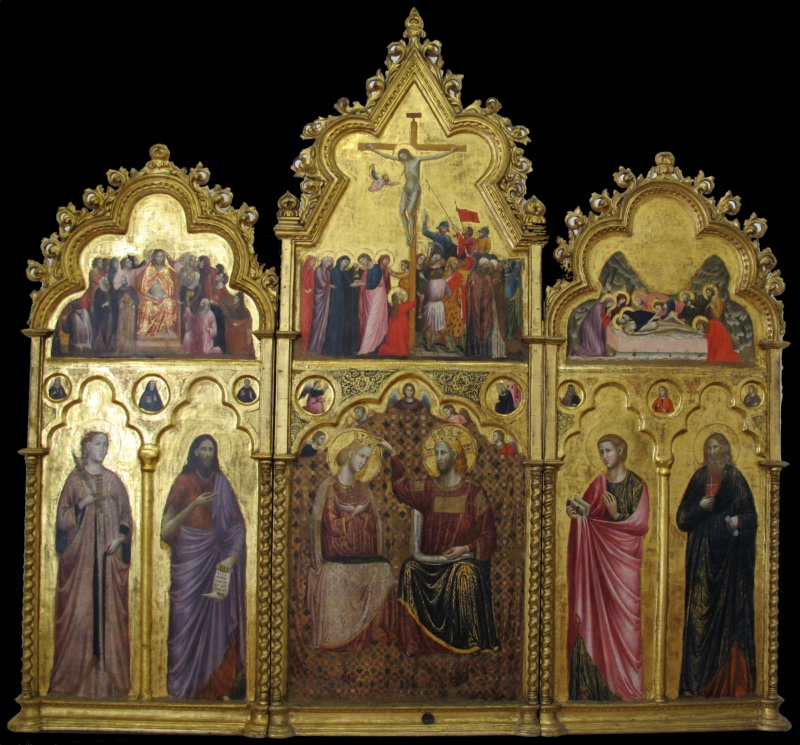
The central panel: the Coronation of the Virgin, the Crucifixion, and the Annunciation
The centre of the triptych presents the Coronation of the Virgin, the subject that names the whole complex and announces at once how far Giuliano had travelled since 1307. Where the Boston dossal enthroned the Virgin as the frontal queen of a Franciscan court, here she appears in the moment of her glorification: seated beside Christ on a single broad throne, inclining her crowned head beneath his extended hands, her own hands crossed at her breast in the gesture of humble acceptance. The subject itself was the newest of the great Marian themes, carried to prominence in exactly these decades by Tuscan and Venetian painting, and its adoption by the Rimini workshop for a major urban altarpiece registers the school’s continuing conversation with the most current developments in Italian art.
Christ and the Virgin share the throne as sponsus and sponsa, and the composition turns on the diagonal of the crowning gesture, answered by the Virgin’s bowed head and echoed in the fall of her mantle. Behind them hangs a cloth of honour patterned in gold, and the whole throne zone becomes, as at Boston, a field of woven splendour. Their proportions are strikingly elongated, the heads small upon long bodies, and their draperies gather in fine, close, parallel folds that run like fluting down the limbs. This is the “classicismo gotico” that Miklós Boskovits described when he restored the triptych to Giuliano in his studies of 1992 and 1993: a courtly, linear elegance that exchanges the approachable narrative charm of the dossal for solemnity.
The Dizionario Biografico degli Italiani reads this transformation precisely. In the Norfolk triptych Giuliano sets aside the “ornate” digestion of Assisi Giottism that had defined his early manner and adopts a grave, aulic language that seems deliberately to recover the arcane, neo-Byzantine timbre of his brother Giovanni’s earliest works; the entry adds that the imminent rise of Pietro da Rimini around 1320 was probably not irrelevant to this Gothic turn, and raises, as a legitimate open question, whether the painting of Paolo Veneziano and his circle had begun to tell on the Riminese. Daniele Benati, for his part, judged Boskovits’s attribution “impeccable” and connected the triptych’s manner to the style Giovanni had matured on the triumphal arch of Sant’Agostino. Between these readings the panel emerges as the meeting point of the whole school’s second phase.
Above the Coronation, in the great crocketed gable, rises the Crucifixion, and it is a Crucifixion of a kind Giuliano had never attempted at Forlì: not the iconic three-figure image of the chapter house but a crowded Calvary. Christ hangs at the centre on a tall cross against the gold, angels gathering at his wounds; at the left the Virgin swoons amid the holy women, their mantles a chord of violet, blue and rose; at the right the centurion and a knot of soldiers press forward beneath a red banner, and the good order of the two crowds, believers and executioners, divides the scene along the axis of the cross. The narrative density, the courtly costumes and the animated grouping belong to the second Riminese generation’s taste, and they measure how attentively the ageing Giuliano watched the storytelling art rising around him.
Between gable and main field runs a band of roundels: at the centre a small blessing figure of Christ, and at either side the Annunciation divided in the traditional manner, the angel Gabriel in the left tondo and the Virgin Annunciate in the right, with further small medallions of saints continuing onto the wings. The arrangement makes the central axis of the triptych a compressed history of salvation read from bottom to top: the Virgin’s election announced in the roundels, her Son’s sacrifice in the gable, and between them, as the fruit of both, her coronation as Queen of Heaven. Such vertical theological programmes were the common property of Gothic altarpiece design, but their coherence here confirms that the triptych was conceived as a unified machine, not an assemblage.
The panel’s material splendour deserves its own paragraph, for it is the vehicle of the new style. The throne textile and the garments of Christ are worked with patterns in gold; the punched haloes are elaborated; and the framing itself, with its cusped arches, crocketed gables, pinnacles and twisted colonnettes, translates into gilded carpentry the Gothic micro-architecture that the painted twisted columns of the Boston dossal had only imitated. The scale of this carpentry, together with the refinement of the execution, is among the arguments advanced in the Dizionario Biografico for an original destination in one of Rimini’s principal churches: this was a metropolitan commission, the largest surviving panel complex of the school after Boston.
Which church, however, remains unresolved, and the honest account keeps the alternatives open. In the mid-nineteenth century the triptych was in the Diotallevi collection at Rimini; the Fondazione Zeri records and Benati derive it from the Dominican church of San Cataldo, the Dizionario Biografico weighs San Cataldo against the old cathedral of Santa Colomba, both demolished in the early nineteenth century, and a local report of 2003 adds the name of San Giorgio in Foro. From the Diotallevi collection the panels passed to the Dukes of Norfolk at Carlton Towers in Yorkshire, whence the modern name; Boskovits identified and published them from there; they returned to Italy for the 1995 exhibition, were acquired in 1996 by the Fondazione Cassa di Risparmio di Rimini, and were restored in 2001–2003, when layers of nineteenth- and twentieth-century overpaint were removed and the original surfaces recovered.
Read whole, the central panel is the document of a painter renewing himself in late career. If the identification of the female martyr on the left wing as Colomba, patron of Rimini’s cathedral, were ever confirmed, the triptych would acquire a civic dimension to match its scale; even without that, the Coronation shows the founder generation’s last word spoken in the accents of the next. Thirteen years after signing the first dated work of the school, Giuliano here paints its most Gothic one, and the distance between the Boston Virgin receiving her kneeling fraternity and this Virgin bowing beneath her Son’s crown is the distance the entire Riminese Trecento travelled in a generation.
The left wing: a female martyr and St John the Baptist, with the Mocking of Christ
The left wing pairs, in its main register, a crowned female martyr and St John the Baptist, standing under cusped arches against the gold. The martyr, at the outer edge, is a figure of court refinement: crowned, mantled, bearing the palm of her victory, her small head poised on the long neck that the triptych’s elongated canon gives all its figures. She is usually called Catherine of Alexandria, the identification her regal type most naturally invites; but it has been suggested that she could instead be Colomba, the virgin patron of Rimini’s cathedral, a proposal that matters because the cathedral of Santa Colomba is one of the candidate churches for the triptych’s original home. The panel itself, lacking an inscribed name or an unequivocal attribute, does not decide the question, and the prudent catalogue keeps both names in play.
Whichever her name, her function in the programme is clear. She opens the triptych as the virgin bride of Christ, the earthly mirror of the celestial coronation at the centre: what the Virgin receives from her Son in glory, the crowned martyr has received in miniature through her death. Her costume repays attention, for it is here that the triptych’s new Gothic taste is most legible, the mantle drawn across the body in long, fine, close-set folds, the borders worked in gold, the whole figure conceived as a column of courtly drapery. Set beside the sturdy Catherine of the Boston dossal, she shows the same workshop’s ideal recast in the elongated, linear canon of about 1320.
Beside her, in the place of honour nearest the Coronation, stands John the Baptist, and his presence knits the triptych to the painter’s whole career. Bearded, gaunt, dark-maned, clothed in the camel skin beneath his mantle, he holds the unrolled scroll of his testimony and raises his right hand toward the centre, the same prophetic economy Giuliano had painted at Boston thirteen years earlier. The type is recognizably the old workshop pattern, but the execution has changed with the style: the silhouette is longer, the drapery more finely pleated, the severity tempered by elegance. The Forerunner who points to the Lamb here points to the Lamb’s triumph, the crowning of the mother whose Son he baptized.
Above the two saints runs the band of small medallions that continues from the central panel, three roundels with the heads of saints whose identities, without inscriptions legible in reproduction, are better left unnamed than guessed. Their function is architectural as much as iconographic: they course the triptych horizontally at the level of the capitals, binding wings and centre into a single elevation, and they multiply the heavenly court economically, a Gothic solution to the problem the Boston dossal had solved with its eight full-length saints.
The gable of the left wing carries the wing’s narrative: the Mocking of Christ. Christ sits enthroned in derision at the centre of a pressing crowd, the tormentors gesturing about him, a scene rare enough in Trecento panel painting to be worth underlining. Its selection here belongs to the triptych’s Passion programme, which distributes three moments across the three gables, the Mocking at the left, the Crucifixion at the centre, the Lamentation at the right, so that the upper zone reads as a continuous Passion narrative crowning the celestial triumph below.
The theological construction of the wing is thus double. Vertically, the mocked King of the gable stands above the Baptist who proclaimed him and the martyr who died for him: the false coronation with thorns above, answered across the triptych by the true coronation of the Virgin at the centre. Medieval preaching loved exactly this antithesis, the rex illusus and the rex gloriae, and the designers of the triptych built it into the panel’s architecture.
In the Mocking, small animated figures crowd a compressed stage with the storytelling appetite of the school’s second generation; below, the two standing saints keep the grave, courtly stillness of the new manner. That a single complex holds both without discord is the mark of a designed ensemble, and the comparison with Giovanni’s late work that Benati proposed, the manner of the Sant’Agostino triumphal arch adapted to panel, is nowhere easier to test than on this wing.
The wing shares, finally, in the triptych’s modern history: Carlton Towers, Boskovits’s publication of 1992–93, the return for the 1995 Rimini exhibition, the acquisition of 1996 and the restoration of 2001–2003 that freed these surfaces from later repaint. What the cleaning recovered on this wing above all is the fineness of the linear drapery and the gold ornament on which the attribution’s stylistic argument rests, and the left wing now stands as one of the two best-preserved statements of Giuliano’s final manner.
The right wing: St John the Evangelist and St Andrew, with the Lamentation
The right wing answers the left with a second pair of standing saints: John the Evangelist nearest the centre and, at the outer edge, the apostle Andrew. The Evangelist is shown in the Western manner as a beardless youth, his rose mantle falling over a green robe, and his station at the Virgin’s side of the Coronation repeats, at the scale of the whole triptych, the office he had held on the Boston dossal and holds throughout Trecento art: the virgin apostle, guardian of the Virgin, witness of the Passion displayed in the gables above. His pairing across the triptych with the Baptist restores the two Johns to their traditional flanking dignity, the panel’s innermost saints as at Boston, so that even in his most Gothic work Giuliano kept the canonical symmetries of his beginnings.
Andrew is identified by his venerable type and his cross: an old apostle, white-haired and long-bearded, bearing the instrument of his own martyrdom. His weathered head is the strongest piece of characterization on the wings, a reminder that the workshop’s idealizing habit could sharpen into portraiture of age when decorum allowed, and his cross, carried like an attribute of triumph, extends the Passion theology of the gables into the register of the saints: the follower crucified after the master, apostolic proof that the way to the crown passes through the cross.
The choice of Andrew, less predictable than the triptych’s other saints, is one of the small unresolved questions of the programme. He belonged to the universal calendar and needed no special channel; but titular devotion, a patron’s name-saint, or the dedication of an altar in the destination church are all possible motives, and since that church itself is disputed among San Cataldo, Santa Colomba and San Giorgio in Foro, the apostle’s presence cannot yet be turned into evidence. The honest catalogue records him, notes the question, and leaves it open.
The main register of the wing displays the triptych’s late style at its purest. Both saints are built as long, slender verticals, the heads small, the contours unbroken, the draperies channelled into those fine parallel folds that Boskovits made the signature of the “classicismo gotico”; the Evangelist’s rose and green against Andrew’s deeper tones continues the courtly palette of the centre. Against the Evangelist of the Boston dossal, broad, princely, planted, this figure seems drawn upward by the Gothic frame itself, and the pair documents, better than any description, what the Dizionario Biografico means by the solemn, neo-Byzantine gravity of Giuliano’s final phase.
Above, the medallion band continues with its three small saints’ heads, and the gable carries the last scene of the Passion sequence: the Lamentation over the dead Christ. The body lies extended on the stone before the sarcophagus, the Virgin bent to her son, the Magdalene and the holy women gathered in grief, John and the elders behind, the rocky hill of Calvary closing the scene against the gold. The composition condenses the great mural Lamentations of the Giotto tradition into the gable’s triangle, and its restrained pathos, sorrow stated through inclination and gesture rather than outcry, is Giuliano’s temperament keeping its evenness even in the school’s most emotional subject.
Read vertically, the right wing completes the triptych’s argument. The Lamentation above shows the Passion’s end, the mother receiving the dead body; the Coronation beside it shows the same mother receiving the crown from the same Son, risen and glorified; and beneath the Lamentation stand the two witnesses, the Evangelist who recorded the burial and the apostle who embraced his own cross. The Passion read across the gables, Mocking, Crucifixion, Lamentation, thus flows into the triumph of the central panel, and the whole upper storey of the triptych becomes the narrative premise of the lower one’s theology.
The wing also carries its share of the ensemble’s historiographic weight. It was the coherence of precisely these figures, their proportions, their drapery style, their relation both to Giovanni’s late manner and to Giuliano’s secure works, that allowed Boskovits to reunite the Norfolk panels with the painter of the 1307 dossal, an attribution Benati pronounced impeccable and the subsequent literature has ratified. The 2001–2003 restoration, removing the repaints accumulated since the nineteenth century, returned to these saints the linear refinement on which that argument stands.
Standing today in the Museo della Città, a short walk from the contrada where the notarial acts place the painter’s family, the right wing closes the triptych and, in the present state of knowledge, Giuliano’s catalogue of panel painting. Within four years of its likely date he would be working at Padua beside the young Pietro da Rimini; within a generation his widow would be named in the charter that proves him dead. In the Norfolk triptych the first master to date a work of the Riminese school shows himself, at the end, still its attentive student, absorbing the Gothic future without surrendering the grave lyricism that had been his from the beginning.
The same late phase includes a fragmentary St Catherine of Alexandria, formerly in an American private collection and later with the Galleria Moretti in Florence, which Miklós Boskovits attributed to Giuliano in 1993. It may have been the side panel of a polyptych or the centre of an independent panel. The Dizionario Biografico sees it as an updated version of the dossal’s formulas, perhaps from the early 1320s. The small panel with the head of the crucified Christ belongs here too. It measures about 30 by 20 centimetres, is owned by the Fondazione Cassa di Risparmio di Rimini, and is on deposit in the city museums. It was exhibited recently alongside Giovanni’s crosses as a work by Giuliano of about 1320, the moving fragment of a lost painted cross. The literature on this fragment consists of exhibition presentations, not a full critical study, so its place in Giuliano’s catalogue should be regarded as proposed, not established.
Crucifixion (church of San Marco, Jesi)
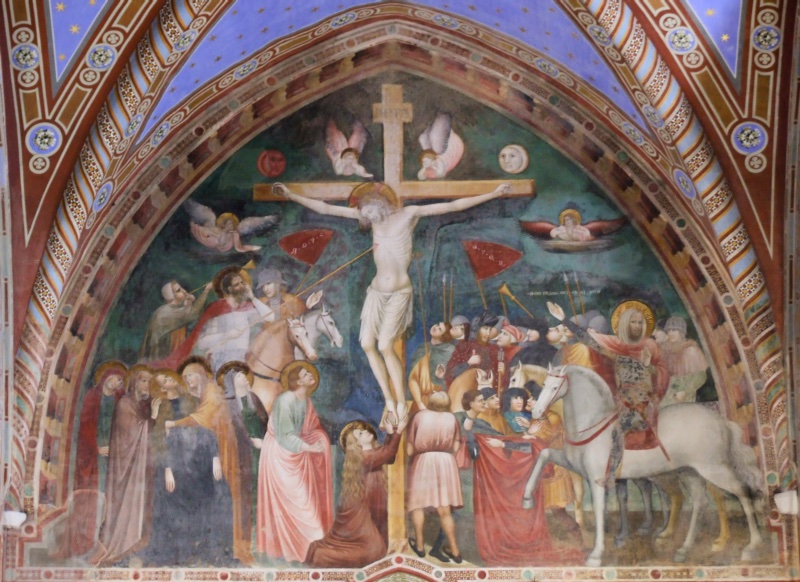
On the wall of the church of San Marco at Jesi, filling a great pointed lunette beneath the blue of the vault, spreads the most ambitious Riminese fresco in the Marche: a crowded Crucifixion that carries the language of the school’s founding generation into the heart of the region where Giuliano’s documented masterpiece had travelled in 1307. The painting belongs to the same southward current as the Boston dossal and the Urbania Madonna, the trail of commissions that Franciscan and civic networks drew from Rimini down the Adriatic edge of central Italy; and its scale, a full lunette conceived as a single teeming scene, makes it the grandest surviving statement of that current. The date generally proposed, about 1310–1320, makes it a late work, of the years leading toward the Norfolk triptych.
The composition turns, as all Crucifixions must, on the vertical of the cross, but the painter has made that vertical the quiet centre of a storm. Christ hangs high against the deep green-blue of the field, his body pale, elongated and gently bowed, the loincloth transparent, the head fallen toward the good thief’s side; above the arms of the cross float the two gold discs of the sun and the moon, the cosmic witnesses of the darkness at the sixth hour, and half-length angels emerge at either side of the crossbeam while others, further out, wheel in flight with the red seraphic glow the Riminese loved. The angels gathering toward the wounds belong to the Giottesque tradition of the mourning heavens that Giuliano’s generation had absorbed at Assisi and that also appear in the Last Judgement on the triumphal arch of Sant’Agostino at Rimini, probably by his brother Giovanni.
Beneath the cross the crowd divides into the two nations of every medieval Calvary. At the left stand the friends of Christ: the holy women closing around the Virgin, who sinks fainting into their arms, her collapse the emotional anchor of the whole left half; near them, haloed mourners and, pressing forward at the cross itself, the Magdalene, who kneels to embrace the shaft in the gesture that Giotto had fixed for the century. At the right masses the world of power: soldiers shoulder to shoulder, a forest of lances against the sky, trumpeters lifting their instruments, red banners snapping above the throng, and horsemen turning their mounts in the press. The contrast of the two halves, grief gathered and compact on one side, martial noise and movement on the other, is the fresco’s governing rhetorical device.
Within the right-hand crowd the painter has marked the scene’s theological turning point: the centurion, mounted on a white horse and distinguished by a halo, turns toward the crucified with the raised hand of recognition, the Gentile officer confessing at the moment of death what the armed multitude around him cannot see. His counterpart on the left, the lance-bearer traditionally named Longinus, drives the spear toward Christ’s side from horseback. Between these two riders, the one who wounds and the one who believes, the fresco compresses the whole conversion narrative that medieval preaching drew from the ninth hour, and their prominence, both raised above the crowd on horseback, both turned toward the cross, frames Christ with the double image of humanity’s violence and its awakening faith.
The fresco’s setting is inseparable from its effect. The lunette rises within a painted architecture of ornamental bands, chevroned and coffered borders sown with cosmatesque rosettes, beneath a vault of deep blue, so that the scene reads as if through the arch of a great portal into the darkened sky of Golgotha. This decorative framing, with its echo of the fictive architecture of Assisi, is itself part of the Riminese inheritance: the painters of Giuliano’s generation learned in the Umbrian basilica not only figures and narratives but the art of binding scenes into an architectural whole, and at Jesi that lesson is applied to a single wall with complete assurance.
The question of the master’s name, however, has divided the scholarship, and the honest account must present the division rather than dissolve it. The fresco entered the modern literature under generic labels, the school of Giotto, the school of Rimini, before connoisseurship began to distinguish hands within the founding generation. Daniele Benati and the Dizionario Biografico degli Italiani assign it to Giuliano at about 1310–1320, reading its crowded narrative energy and its figure types as the mural counterpart of the master of the 1307 dossal in his late phase; Miklós Boskovits argued instead for Giovanni da Rimini, placing the lunette within his reconstruction of Giovanni’s career. The dispute is not a scandal but a symptom: the brothers shared a workshop formation, and their mural manners approach each other most closely exactly in works of this decade.
For the visitor rather than the connoisseur, what the debate should not obscure is the fresco’s quality and its historical weight. The pale, softly modelled body of Christ, the fine grieving heads of the women, the confident construction of the horses and the sure orchestration of nearly forty figures across the lunette show the Rimini workshop operating at full power away from home; and the survival of such an ensemble at Jesi documents, better than any archive, the prestige the school commanded in the Marche in the 1310s. Whether the contract was signed by Giuliano or by Giovanni, the fresco belongs to the same family enterprise whose members the Rimini documents show renting, witnessing and paying side by side in the contrada of San Giovanni Evangelista.
The state of the painting, finally, rewards the patient eye. The lunette preserves its composition entire, a rarity among Riminese mural complexes, and the reds, greens and earths keep much of their strength, though the blues of the field have darkened and thinned with time as the azurite grounds of the school always do, and the surface carries the scattered losses of seven centuries. Read today from the floor of San Marco, the great Calvary still performs the office for which it was painted: it fills the wall with the hour of the Passion, and divides the world into mourners and mockers.
Head of the Crucified Christ (fragment of a painted cross)
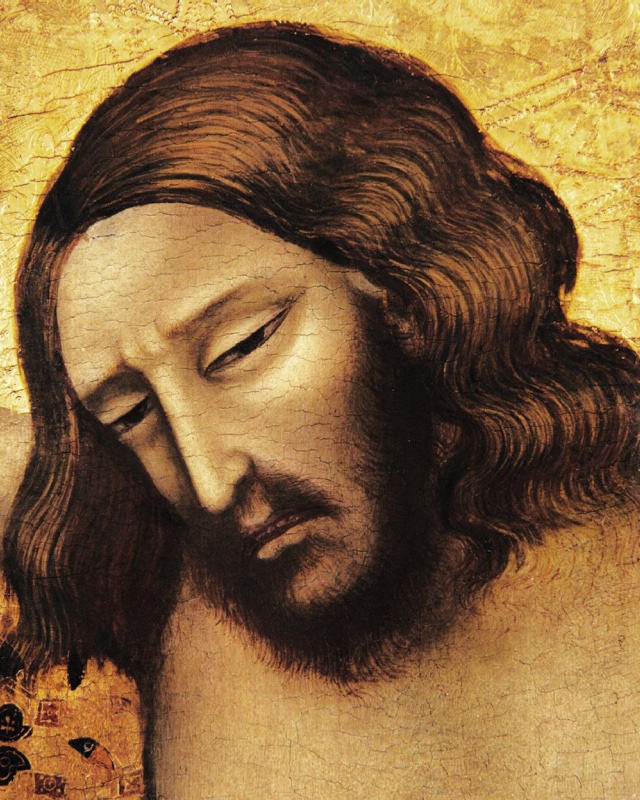
The smallest object in Giuliano’s dossier is also, in its way, the most concentrated: a panel of some thirty by twenty centimetres preserving nothing but the head and upper chest of the dead Christ, sawn in a later century from a painted cross whose remaining members are lost. What survives is the emotional core of the dismembered whole. The head falls toward the right shoulder under its own weight, the eyes are closed, the mouth is set in the stillness after suffering, and the long dark hair spreads in waves over the shoulders; behind, the gold ground keeps the traces of a punched halo and of the ornamented field that once decorated the cross’s surface. The fragment thus belongs to the oldest and most venerable genre of Italian panel painting, the monumental croce dipinta that hung above choir screens and altars, reduced by time to a single face.
The type is the Christus patiens, the suffering and dead Christ that Giunta Pisano had naturalized in the thirteenth century and Giotto had renewed for Giuliano’s generation; and it is Giotto’s renewal, specifically, that governs this head. The face is not distorted by agony but composed in death: the brows knit gently, the lids lie closed without violence, the flesh is modelled in soft continuous shadow rather than the graphic furrows of the Byzantine tradition. The nearest ancestor is the cross Giotto painted for the Franciscans of Rimini around 1300, now in the Tempio Malatestiano, whose quiet, heavy-headed Christ re-educated the entire local school; every Riminese painted cross of the following generation descends from it, and this fragment descends from it visibly, in the fall of the head, the transparency of the shadows and the restraint of the grief.
Within that shared descent, the fragment has been attributed to Giuliano at about 1320, and the comparison invoked is with the secure works of his maturity. The soft gradation of the modelling, the elongated oval of the face, the fine drawing of brows and lids and the dark, silken mass of the hair sit comfortably beside the Christ of the Norfolk triptych’s Crucifixion gable and the crucified of the Forlì chapter house; the gentleness of expression, sorrow without rhetoric, is the temperament that runs through everything securely his. It must be said plainly, however, that the attribution is a proposal rather than a settled fact: the fragment has not been through the long sieve of debate that fixed Boston, Forlì or the Norfolk panels, and a piece this small, shorn of its context, offers connoisseurship little to grip. The honest label is “attributed”.
The caution is worth a paragraph of its own, because painted crosses are precisely the ground on which the Riminese hands are hardest to separate. The genre imposed its type: the bowed head, the closed eyes, the pattern of hair and beard were fixed by function and by the Giotto model, so that master and follower converge exactly where a fragment like this preserves its only evidence. The school’s crosses have accordingly been shuttled among Giovanni, Giuliano, Pietro and the anonymous masters for a century of scholarship — the Mercatello cross re-read, the Sassoferrato cross disputed between the brothers — and a head alone, without the framing members, the apron ornament or the terminal figures that usually decide such questions, invites the same instability. The attribution to Giuliano is reasonable; it is not, in the nature of the evidence, demonstrable.
What no attribution debate can diminish is the quality of the painting itself. The modelling of the face is achieved almost without line, in veils of shadow that turn the cheek and sink the eye sockets; the highlights are laid with extreme economy on the ridge of the nose and the brow; the hair is painted strand over strand with a patience that survives even the surface’s age. The head’s pathos is of the interior kind the Riminese preferred: nothing in the features cries out, and the whole expressive burden is carried by weight, the sheer heaviness of the fallen head, and by the silence of the closed eyes. It is the same emotional register as the Forlì fresco, grief stated once, quietly, and left to work.
The gold ground around the head repays attention, for it is the fragment’s testimony to the lost whole. Traces of the halo’s punched rays survive at the crown, and the field carries the remains of ornament, the decorated borders and patterned zones with which Riminese crosses enriched the surface around the corpus. These vestiges, together with the head’s scale, allow a rough mental reconstruction: a cross of considerable size, its Christ well over life-size of the panel we have, hanging high in a church of Rimini or its territory, with, in all likelihood, the mourning Virgin and John in its terminals and a blessing Redeemer or pelican at its summit. Of all that machinery of public devotion, the saw of a dealer or a demolisher spared only the face.
The fragment’s modern history is quickly told and belongs to the same civic recovery that gathered the Norfolk triptych. Preserved today in the collection of the Fondazione Cassa di Risparmio di Rimini, it joined the body of Riminese Trecento painting that the foundation has assembled for the city, and it is exhibited and published within that context. Its earlier provenance, the church it served, the date of the cross’s dismemberment, the fragment’s wanderings before it came to rest, remains obscure, as is the common fate of cut pieces; and that obscurity is itself part of the object’s meaning, a reminder of how much of the school’s production reaches us mutilated when it reaches us at all.
Seen last in a sequence that began with the Boston dossal, the little head makes a fitting close, whoever painted it. It shows the image at the centre of the whole Riminese enterprise, the dead Christ of Giotto’s cross, carried forward into the 1320s with undiminished tenderness; and it shows the fragility of that enterprise’s survival, a monumental public image reduced to a private relic smaller than a page. If the attribution to Giuliano holds, it gives us his meditation, near the end of his career, on the image with which his school began; if it belongs to a brother or a companion, it still speaks the dialect of the family workshop in the contrada of San Giovanni Evangelista, whose collective achievement these fragments, gathered again at Rimini, continue to attest.
Painted Cross (church of San Francesco, Sassoferrato)
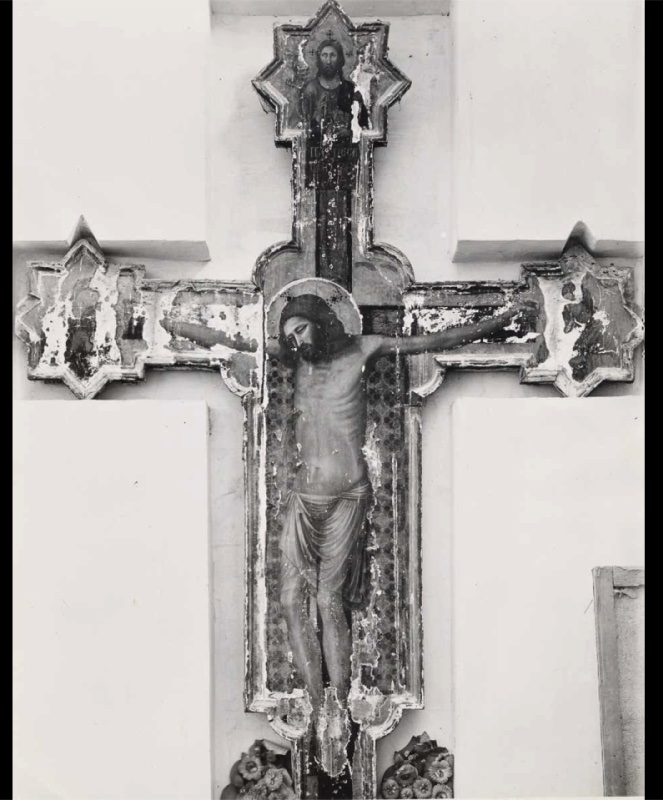
In the Franciscan church of Sassoferrato, in the hill country of the upper Marche, hangs the painted cross that local tradition rightly counts among the highest expressions of Riminese Trecento painting in the region. It belongs to the same southward current that this series has followed from the Boston dossal onward: the network of Franciscan houses and civic patrons that drew the Rimini workshop down the Adriatic corridor in the first decades of the fourteenth century. The Franciscans had held the site since before the mid-thirteenth century, when the old church of San Marco was enlarged and reconsecrated to St Francis, and it was for their choir or their rood beam that this cross was painted, on the dating now current, in the years around 1310–1320, the very decade in which the school’s frescoes were rising at Jesi.
The cross is of the shaped and ornamented type that the Riminese developed from Giotto’s model, and its carpentry is among the most elaborate the school produced. The terminals of the arms and the summit are eight-lobed stars, their moulded frames stepping outward in points; the apron behind the body of Christ is painted as a hanging textile patterned with rosettes in a continuous diaper, a field of ornament against which the pale flesh stands isolated; and the borders are gilded throughout. At the summit, above the titulus, a lobed panel holds a blessing half-figure, and the star terminals of the arms held the mourners, though centuries of flaking have reduced these lateral figures to shadows. The local descriptions record the programme as the Eternal Father, the Virgin and St John in the polylobed fields of the summit and the arms — the standard court of the Riminese cross, here framed with unusual splendour.
The Christ is the patiens of the Giotto tradition in its Riminese redaction. The head falls to the right shoulder inside a large punched halo; the eyes are closed; the torso hangs with the ribcage lifted and the belly hollowed; the long transparent loincloth falls in soft folds to the knees; and the legs descend, straight and slender, to the crossed feet. One detail deserves particular notice, because it binds this cross into the small group of works this series has already examined: the lips are parted so that the teeth of the upper arch are visible. The catalogue entry for the Christ-head fragment in the Fondazione Cassa di Risparmio di Rimini singles out exactly this trait as common to both works and derives it from Giotto’s crucifix in Santa Maria Novella at Florence — a Florentine refinement, transmitted through the family workshop, that marks the painter of Sassoferrato as a student of Giotto’s crosses beyond the Rimini example alone.
Stylistically the cross speaks the dialect of the founding generation at its most refined. The modelling of the body is soft and continuous, built in veils of shadow rather than drawn lines; the anatomy is naturalistic without harshness, the pathos quiet, the grief of the surviving terminal figures stated through inclination rather than outcry. The ornamental splendour of the patterned apron, unusual beside the dark, plain aprons of the Diotallevi and Mercatello crosses, aligns it instead with the decorative taste of the 1310s, the years of the Boston dossal’s woven throne-cloths and the gilded fields of the Urbania Madonna; and it is this combination, grave figure style within luxuriant ornament, that has made the cross so difficult to assign between the brothers.
The history of the attribution must be told plainly. Carlo Volpe, in the monograph of 1965, gave it to the anonymous Master of the Choir of Sant’Agostino, the personality he had assembled around the Rimini choir frescoes. Anna Tambini, in her study of 1988 on Giuliano and painting between Romagna and the Marche — published in the same volume of “Notizie da Palazzo Albani” as Boskovits’s famous essay on the school — claimed it for Giuliano, together with the Jesi Crucifixion, as documents of his mature activity in the Marche. Boskovits himself argued instead for Giovanni, and the Fondazione Zeri scheda registers both names side by side, filing the cross under Giovanni while recording Tambini’s attribution. The Enciclopedia dell’Arte Medievale entry on Giuliano calls the cross “a qualitatively higher edition of the Jesi Crucifixion” and so assigns it to him.
The instability is, once again, structural rather than scandalous. Painted crosses are the ground on which the Riminese hands converge most closely: the genre fixed the type of the Christ, the brothers shared a single workshop formation in the contrada of San Giovanni Evangelista, and the connoisseur’s usual footholds, narrative invention, figure grouping, spatial construction, are absent from an image reduced to one body and three half-figures. What can be said is that the case for Giuliano rests on the soft breadth of the modelling and the kinship with the Forlì Crucifixion and the Carim fragment, while the case for Giovanni rests on the taut elegance of the contour and the descent from the Diotallevi and Mercatello crosses. Here as at Jesi the balance of opinion favours Giuliano, and the attribution to Giovanni is the minority position; the cross remains nonetheless a masterpiece of the family workshop, disputed between the two brothers whose hands can be named.
The condition of the cross, candidly recorded in the archival photographs, asks for a compassionate eye. The paint film has suffered extensive flaking, worst on the stem below the feet and across the star terminals, where the lateral mourners survive only in part; the gold is abraded; and the losses lie scattered over the apron’s pattern like the wear of the centuries it has hung. The church itself has not had an easy history: the convent was suppressed under Innocent X in 1653, and the complex passed through secular uses that did the works of art no service. That the cross has remained in the church for which it was made, through suppression and neglect, makes it one of the few works in this entire series still standing in its original setting.
Seen at the end of the sequence that began with the 1307 dossal, the Sassoferrato cross completes the map of the Rimini workshop’s Marchigian enterprise: Urbania on the road inland, Jesi in the Esino valley, Sassoferrato in the Apennine foothills, each house of friars furnished with the new painting from the same Adriatic city. Whether Giuliano or Giovanni held the brush, the cross carries the family’s shared inheritance, Giotto’s dead Christ spoken with the Riminese softness, and its parted lips, showing the teeth as Giotto’s Florentine crucifix had shown them, are the small, precise signature of a workshop that studied its master more closely than any other in Italy. It stands best beside the Jesi lunette: two contested masterpieces that measure, better than the secure works, how completely the brothers of the contrada of San Giovanni Evangelista had become one artistic mind.
Finally, there are works where Giuliano’s name is linked with Pietro da Rimini. The documentary anchor is the lost polyptych in the church of the Eremitani at Padua. According to a transcription made in 1527 and published in 1931, it bore the inscription
Anno Domini MCCCXXIIII hoc opus fecit frater Nicolaus de Sancta Cecilia et factum fuit per manus Iuliani et Petrucii de Arimino.
The wording separates the friar responsible for the commission, who “fecit” the work, from the two painters “by whose hands” it was made. It is the only written evidence of a partnership between Giuliano and the younger Pietro, and of Riminese activity in Padua. Detached fragments of frescoes with scenes from the life of Christ, from the chapter house of the same convent and now in the Museo Civico at Padua, have been connected with this collaboration.
They are badly preserved. The Dizionario Biografico describes them as oriented mainly towards Pietro, with some accents that suit Giuliano. Carlo Volpe was among those who saw Giuliano’s hand there. A 1958 proposal also saw a Giuliano–Pietro collaboration in the great Cappellone of San Nicola at Tolentino, and the author of the 2001 entry thinks it very likely. Daniele Benati firmly rejects it and considers the design of the Tolentino decoration entirely Pietro’s, whatever variations in quality it shows. The question is still open.
A number of older attributions have been abandoned, and they should be mentioned so that they are not revived by accident. The frescoes in the chapel at the base of the campanile of Sant’Agostino in Rimini, once given to Giuliano in 1961, are now generally recognized as Giovanni’s. The frescoes of the refectory of Pomposa, attributed to Giuliano in a 1902 German study of the Giotto school in Romagna, are now a cornerstone of Pietro da Rimini’s work.
So is the diptych with the Crucifixion and Dormition of the Virgin, formerly in the Wedells collection and now in the Kunsthalle in Hamburg, given to Giuliano in 1933. At Urbino, the Galleria Nazionale delle Marche has a triptych that the 1937 Enciclopedia Italiana already described as “formerly attributed to Giuliano da Rimini, now to an anonymous Riminese master”. The Urbino collection’s firm Riminese anchor is instead Giovanni Baronzio’s polyptych, signed and dated 1345, from San Francesco at Macerata Feltria. For Fano no work securely attributed to Giuliano appears in the reference literature consulted, and none is claimed here.
Workshop, family and the Rimini school
The documents that make Giuliano a brother of Giovanni and Zangolo changed the question of workshop organization. Before 1992 scholars had to explain the similarities between Giovanni and Giuliano, and the whole group of anonymous masters around Sant’Agostino, in terms of master and pupil or influence. Once the family ties were established, a better explanation was a single domestic workshop in the contrada of San Giovanni Evangelista, which shared models and cartoons and in which the brothers worked side by side. Daniele Benati and others described Riminese painting in these terms, as a matter of workshops, botteghe, and this is reflected in the subtitle of the 1995 exhibition, Maestri e botteghe tra Romagna e Marche.
The Sant’Agostino frescoes are the clearest test. They were found under later whitewash after the earthquake of 17 May 1916 and were largely detached and restored in the following decade. The Stories of the Virgin in the chapel at the base of the campanile are now given to Giovanni. They have been connected with a bequest of 1303 by a certain Umizolo di Neri for the embellishment of an altar of the Virgin in the church, which suggests that they were already painted, or at least commissioned, by then. The great Last Judgement on the triumphal arch gave its name to the “Master of the Arengo”, after the hall of the Palazzo dell’Arengo where it was displayed after detachment. Miklós Boskovits reassigned it to Giovanni, and his view is now widely accepted. It is usually dated shortly before 1318, when the Augustinian general chapter met in Rimini. The Stories of St John the Evangelist and St Augustine in the choir, and the painted cross above the high altar, have been given to an artist called the “Master of the Choir of Sant’Agostino”. Daniele Benati tentatively identified him with Zangolo, the brother for whom no signed work survives. Miklós Boskovits, by contrast, read the choir as the most mature expression of Giovanni himself.
Where does Giuliano fit? The 2001 entry does not see his direct intervention in the Last Judgement. Local commentary following the 1992 archival discoveries, however, suggested that the choir frescoes show a dialectic between two tendencies: the linear, archaizing and “metaphysical” manner of the older Giovanni, and the more sculptural, narrative and forceful manner of the “young” Giuliano and Zangolo. On this view, the work once distributed among several anonymous masters would be shared among the brothers. The Dizionario Biografico’s objection to this line of argument is worth stating in substance. The idea of a common workshop of Giovanni and Giuliano, it warns, can become an inappropriate excuse for giving up the effort to distinguish their work. A shared workshop explains shared models. It does not remove the differences in temperament that the dossal shows so clearly.
The other members of the first and second Riminese generations complete the picture. Neri da Rimini, miniaturist, was active from 1300, the date of his earliest signed leaf of an antiphonary, now in the Fondazione Giorgio Cini in Venice. He signed and dated works throughout his career, and his choir books show the transition from late thirteenth-century Bolognese illumination to a volumetric manner formed in the wake of Giotto. He is documented as a miniaturist in the 1320s and 1330s. Pietro da Rimini is known through his signed crucifix at Urbania and through the 1324 Padua inscription alongside Giuliano. In the reconstructions of the 1990s he became the dominant painter of the second phase, responsible for Pomposa, Tolentino and Ravenna. Giovanni Baronzio, whose surname turns out to be a patronymic, is documented in 1343. His signed polyptych of 1345 comes from Macerata Feltria, and his tomb in San Giuliano at Rimini is recorded in 1362. Among these painters Giuliano is the documented link between the founding generation of Giovanni and Neri and the next generation of Pietro. He was active in 1307 in the orbit of his brother and was still working with Pietro in 1324.
One historiographical accident shows how far Giuliano’s reputation depended on the chronology of others. The crucifix of San Francesco at Mercatello sul Metauro is signed “Iohannes pictor” and dated. For decades its date was read as 1344 or 1345 and the work was given to Giovanni Baronzio. It was shown under Baronzio’s name at the 1935 exhibition. As long as that reading stood, Giovanni da Rimini had no signed anchor at the start of the century, and Giuliano’s 1307 dossal looked strangely isolated. Carlo Volpe was the first, in 1965, to judge the late reading incompatible with the style. Palaeographic study, published in full only in 1995, confirmed his view and read the date as 1309 or, less probably, 1314; the restorations, down to the campaign of 2020–21, could not settle the damaged numeral. From then on Giovanni was the founding father, and Giuliano’s dossal could be understood as part of a family workshop’s output in the first decade of the century.
Patronage and religious context
Giuliano’s known and attributed commissions are almost all mendicant or confraternal. The 1307 dossal belongs to a Franciscan setting at Casteldurante, with a confraternity and devout women at its centre. The Forlì Crucifixion was painted for the chapter house of the Servites of San Pellegrino, a room where the community met for discipline and deliberation. The Fermo frescoes are in the Franciscan church. The Sassoferrato cross hangs in San Francesco. The Padua polyptych was made for the Augustinian Hermits, commissioned through a friar, “frater Nicolaus de Sancta Cecilia”. The Norfolk triptych’s proposed origin in the Dominican church of San Cataldo would complete the range of mendicant orders. The Riminese painters worked for the mendicant churches and confraternities of a region where the friars were the main builders and decorators of new churches.
The relationship with the Malatesta is more indirect than is sometimes supposed. Giotto’s work in San Francesco at Rimini was done in the church the Malatesta had chosen for their tombs, and local accounts suggest that Giotto may have worked for Malatesta da Verucchio as well as for the friars, since the new lord was closely tied to the Minorites. There is, however, no document connecting Giuliano with the Malatesta, and none of the works attributed to him bears Malatesta heraldry or a Malatesta commission. Seigneurial patronage of the Riminese school becomes more visible later, for instance in the French manuscript made for Ferrantino Malatesta in the early 1320s, whose illumination has been connected with Neri. For Giuliano it is more accurate to speak of a political context than of Malatesta patronage. The Malatesta consolidation after 1295 gave Rimini the stability and prosperity in which a family of painters could flourish, and the friars they protected were the painters’ actual clients.
The religious content of the dossal shows what these patrons expected. The Virgin enthroned is the focus of a community’s intercession. The kneeling women and the inscription about the “true fraternity” make the painted assembly a mirror of the confraternity or community gathered before it. The stigmatized Francis, St Clare, and the virgin martyrs Catherine, Agnes and Lucy set out a model of holiness especially suited to female devotion. It pairs the Franciscan founders with the chaste women martyrs of the early Church, and adds Mary Magdalene in the desert as the model of penance. The Baptist may also allude to the church’s title of San Giovanni Decollato. The panel is therefore Franciscan in a precise sense. It shows the friars’ spirituality as it was lived by lay and religious women in a small town of the Metauro valley.
Historiography and critical fortune
Giuliano’s modern fortune began with the Boston panel. In the nineteenth century the dossal was studied while it was still in Urbania cathedral, and the 1883 Italian edition of the great history of Italian painting by Crowe and Cavalcaselle discussed it. The nineteenth-century Riminese historian who published the 1346 document mentioning the painter’s widow provided the first archival trace. After the panel went to Boston in 1903, an article titled “Giuliano, Pietro and Giovanni da Rimini” in the Burlington Magazine, vol. 29, no. 163 (October 1916), pp. 276–81, introduced the Riminese names to English-language scholarship. The Sant’Agostino frescoes, found in 1916, gave the discussion a monumental body of work. The first readings, of the early 1920s, placed it under the sign of Cavallini.
The decisive moment in establishing the school was the exhibition Mostra della pittura riminese del Trecento, held in the Palazzo dell’Arengo in Rimini from 20 June to 30 September 1935. Its catalogue included an introduction on Riminese painting, a guide to the frescoes preserved in the city and an illustrated repertory of works not exhibited. It was the first modern survey of a field previously known only through scattered episodes. Its fundamental ideas were the “choral” coherence of the school and the primacy of Giotto, with everything flowing from the Assisi workshop. These ideas shaped research for decades, even though many of its specific attributions were later revised, beginning with the misreading of the Mercatello crucifix and the cautious presentation of the Rimini cross as the work of a local painter.
The second foundation was Carlo Volpe’s La pittura riminese del Trecento, published in Milan in 1965. The Dizionario Biografico calls it a book “still today at the basis of every scientific survey of the subject”. Volpe restored Giovanni’s early works, including the Talamello cross, rejected the late reading of Mercatello, and gave Giuliano the Forlì Crucifixion. He also divided much of the Sant’Agostino material and the second-generation frescoes among anonymous masters: the Master of the Arengo, the Master of the Choir, the Master of the Pomposa Refectory, the Master of Tolentino. He described the Master of the Arengo as dependent on “the ineffable Giottesque archetype of the more archaic Giuliano” as well as on Giovanni’s classicizing progress. That phrase sums up his view of Giuliano as the most archaic, and in a sense the most purely Giottesque, of the founders. Volpe’s photographic archive, presented online in an exhibition on the Riminese Trecento, records the evidence on which this reconstruction was built.
The third phase, from the late 1980s to the mid-1990s, was a period of consolidation. It began with a conference at Mercatello in 1987, whose proceedings of 1988 contain the essay by Miklós Boskovits on the passage “from Giovanni to Pietro da Rimini” and a study devoted to Giuliano and painting between Romagna and the Marche. The 1992 archival volume followed, then Boskovits’s 1992 and 1993 articles, which added the Norfolk triptych and the St Catherine to Giuliano’s catalogue and reassigned the Last Judgement to Giovanni. Where Volpe had divided the material among many anonymous hands, Boskovits tended to regroup it under a few documented names. Pietro received the great fresco cycles, and Giovanni received much of what had belonged to the Master of the Arengo and the Master of the Choir. The exhibition Il Trecento riminese. Maestri e botteghe tra Romagna e Marche, curated by Daniele Benati at the Museo della Città in Rimini from 20 August 1995 to 7 January 1996, brought this phase together. Its catalogue, with Benati’s essay “Disegno del Trecento riminese”, is now the standard reference. The same year saw the exhibition on Neri da Rimini, with its re-dating of Giotto’s stay, and Benati’s entry on Giuliano in the Enciclopedia dell’Arte Medievale, which remains the most concise critical account of the painter.
Since then the main contributions have concerned Giotto’s Rimini campaign and the chronology of the Riminese painters. They include a 2002 monograph on Giotto and the Riminese, the 2001 Dizionario Biografico entries on Giuliano and Giovanni, the restoration of the Mercatello cross, the reinstallation of the Last Judgement in the Museo della Città, and archival work on the export of the Boston dossal. No comprehensive monograph on Giuliano himself has been identified in the sources consulted. The main unresolved questions remain those set out above: the division of hands at Sant’Agostino, the attribution of the Jesi Crucifixion and the Sassoferrato cross, the extent of his work at Padua and Tolentino, and the exact commission of the Boston dossal.
Conclusion: the place of Giuliano da Rimini
Giuliano cannot be called the founder of the Riminese school in the strict sense the phrase suggests. The documents and the critical consensus give that role to his brother Giovanni, generally held to be the elder. It was Giovanni’s workshop that shaped the Riminese idiom, and his Marian frescoes at Sant’Agostino provided the figures Giuliano copied in the dossal. Giuliano’s importance lies elsewhere, and it is considerable. He signed and dated the first work of the school. In doing so he gave art historians a fixed point from which Giovanni’s chronology, the date of Giotto’s Assisi cycles and the whole history of the Riminese Trecento could be measured. His dossal shows how quickly and how inventively a painter of the Adriatic periphery could take over the language of Assisi and Rimini without giving up the traditional forms of the gold-ground altarpiece. His career, as far as it can be reconstructed, runs from the family workshop around 1307 through Franciscan and Servite commissions in Romagna and the Marche to the more courtly Gothic of the Norfolk triptych and the partnership with Pietro at Padua in 1324.
For a specialist audience the main lesson may be methodological. Almost everything we know about Giuliano comes from two kinds of evidence that must be kept apart: notarial documents and stylistic attribution. The documents tell us that he was a magister and depintor, a brother, a tenant and a husband. They do not tell us which frescoes he painted. The attributions, however persuasive, remain judgements of the eye, contested by scholars as experienced as Carlo Volpe, Miklós Boskovits and Daniele Benati. Only the 1307 dossal combines the two kinds of evidence, because the painter wrote his name on it. It is fitting that the one work in which he speaks for himself is also the work on which the history of his school depends.