Maestro della Croce del Santo Sepolcro
( 25% )
Introduction: A Name in Search of a Painter
The painter whom modern writing calls the Master of the Cross of the Santo Sepolcro is known to us through a single object: the large painted cross with the living Christ and stories from the Gospels that once belonged to the church of the Santo Sepolcro in Pisa and is now preserved, under the historic number 15 and the inventory number 1578, in the Museo Nazionale di San Matteo. Everything that can responsibly be said about him must start from that panel and, in the end, return to it. There is no signature that survives in a readable form, no contract, no payment record and no chronicle that names the man who painted it. There is not even a stable consensus that the label itself designates a distinct artistic personality, since the official catalogues of the Italian state and of the Fondazione Zeri continue to file the work as anonymous Pisan painting of the twelfth century. To write about this master, then, is to write about a cross, about the place for which it was made, about the culture that produced it, and about a century and a half of critical efforts to give its maker a face.
That situation is not a weakness to be concealed but the very condition of the subject, and it shapes the method followed here. Romanesque panel painting in Tuscany survives in a handful of monumental crosses, many of them damaged, repainted or reduced, and the anonymous names attached to them by art historians are tools of classification rather than recovered biographies. Some of those names have grown into coherent groups of works; others remain attached to a single piece and serve mainly to keep it distinct from its neighbours. The Master of the Cross of the Santo Sepolcro belongs, on present evidence, to the second category. The pages that follow will therefore distinguish carefully between what is documented, what is observed on the panel itself, what has been proposed by scholars, and what remains open. Where commonly repeated statements turn out to rest on misreadings or confusions, they will be identified and corrected rather than silently passed over.
The cross deserves this attention for reasons that go well beyond the problem of authorship. It is among the most ambitious narrative crosses of Pisan painting around 1200, measuring 282 by 236 centimetres according to the state catalogue, painted in tempera with gilding on a shaped wooden support. Around a triumphant Christ it unfolds a sequence that begins in the Upper Room with the Last Supper and the Washing of the Feet, passes through the Mocking and the Crucifixion, dwells at length on the appearances of the risen Christ and his meals with the disciples, and closes with the Ascension and Pentecost. Few surviving crosses give such weight to the Eucharistic and post-Resurrection episodes, and the catalogue entry rightly singles out the Washing of the Feet as a rare subject in this context. The programme was conceived, moreover, for a church whose dedication and architecture evoked the Tomb of Christ in Jerusalem and which belonged to the military-religious order of the Hospitallers of St John. The cross thus stands at the meeting point of liturgy, pilgrimage memory and the Mediterranean horizons of a great maritime republic.
Stylistically, the panel is equally significant, and it is where the sources divide. The Dizionario Biografico degli Italiani, in its entry on Giunta Pisano, names the masters of the crosses from the Santo Sepolcro and from San Matteo together as the refined and select activity, of almost exclusively Byzantine reference, in which the formation of the great Pisan painter is to be sought; the Enciclopedia dell’Arte Medievale places the cross at the beginning of the thirteenth century, with a living Christ and colourful little stories of lively, popular character. The state catalogue, on the other hand, dates it to the second half of the twelfth century and calls its style composite, with the firm outlines and clear colour fields of Romanesque illumination of the Umbro-Roman area beside compositional and iconographic devices borrowed from Byzantine and Crusader painting, and touches of drama that recall German illumination. This essay follows the first reading for the character of the style, reports the second as the position of those who hold it, and dates the cross around 1200, where the two datings meet. On either reading the cross belongs to the same Pisan moment as the Christus patiens of Croce n. 20, which the state catalogue dates between 1200 and 1210, and it allows us to see what Pisan painters were doing when the city’s art still faced in several directions at once.
The essay proceeds in thematic stages. It first clarifies what the conventional name covers and which confusions it has generated. It then reconstructs the setting for which the cross was made and the vicissitudes that brought it to the museum. The object is next examined in its structure, condition and technique, its central figure, its narrative programme and its most inventive details. The discussion then turns to style and to the network of related crosses in Pisa, Lucca, Siena and the Florentine countryside, before following the critical history of attribution and dating through the contributions of three scholars whose views have defined the problem: Osvald Sirén, Evelyn Sandberg-Vavalà and Antonino Caleca. A final section weighs what can and cannot be claimed about a corpus for this master, and a conclusion draws the threads together.
The Name and Its Limits
Any serious discussion must begin by stating exactly what the conventional name covers, because the label is less firmly anchored than its confident English or Italian form might suggest. The national catalogue of the Istituto Centrale per il Catalogo e la Documentazione, compiled in 1996 and updated in 2001, 2002 and 2007, describes the object as a painted cross of the “ambito pisano (seconda metà sec. XII)”, and it does not assign it to any named master. This is a significant choice, because the same catalogue does attach conventional names to neighbouring works: the cross in the Pisan church of San Frediano is entered under a “Maestro della Croce di San Frediano (attribuito)”, and the famous Croce n. 20 of the San Matteo museum under the “Maestro della Croce n° 20”. The online photographic catalogue of the Fondazione Zeri, to the extent that its listing could be consulted, likewise records the work as by an “Anonimo pisano sec. XII”, narrowing its date to the last quarter of the century, between 1175 and 1199. In the documentary and catalographic tradition, therefore, the painter of Croce n. 15 is anonymous in the strict sense, without even the half-identity that a conventional name confers.
The phrase “Master of the Cross of the Holy Sepulcher”, or its Italian equivalent, belongs instead to recent writing aimed at a wider museum public, where it serves as a practical caption for the panel in the hall of painted crosses at San Matteo. In that usage it says no more than that the cross had an author and that the author is unknown. No monographic study has been found, in Italian, English, German or French, that constructs an oeuvre under this name, sets out the stylistic criteria for adding works to it, or defends it against rival groupings. The name used in this essay must accordingly be understood in a limited and provisional sense: it designates the hand responsible for one securely identified object, and nothing more is implied unless argued explicitly. That restriction is not pedantic. It protects the reader from the impression, easily created by an anonymous name, that a coherent body of paintings already stands behind it.
Two confusions follow from the name and should be dispelled at the outset. The first concerns the other anonymous masters of Pisa who are named after crosses in the same city or the same museum. The Master of Croce n. 20 is the Byzantine-trained author of the Christus patiens from the convent of San Matteo, a work that the state catalogue places between 1200 and 1210 and that marks a new departure in Pisan painting. The Master of the San Frediano Cross is the conventional author of the cross that still hangs in the church of San Frediano, a palimpsest of two twelfth-century paint layers. Both painters are essential to understanding the Master of the Santo Sepolcro, but neither is identical with him, and the similarity of their designations has occasionally encouraged careless conflation in popular accounts. A related confusion concerns the museum numbering itself: the figure 15 is not an inventory number but the historic number under which the cross appeared in the museum catalogues of 1894 and 1906, and which, as the state catalogue observes, still identifies the work in the critical literature. Its inventory number is 1578.
The second and more insidious confusion is geographical. The Tuscan town of Sansepolcro, called Borgo San Sepolcro until modern times and celebrated as the birthplace of Piero della Francesca, has its own distinguished medieval and Renaissance heritage, including the great altarpiece painted by Sassetta for the town’s church of San Francesco. The verbal coincidence between that town and the Pisan church has led some searches, and occasionally some summaries, to look for the Master of the Santo Sepolcro in the upper Tiber valley. No source consulted for this study establishes any link between the Pisan cross, or its painter, and Sansepolcro. The Santo Sepolcro of the name is the octagonal church on the south bank of the Arno in Pisa, dedicated to the Holy Sepulchre of Jerusalem, and the epithet refers to the provenance of the panel, not to a place of origin of the artist.
A final caution concerns what the name cannot tell us. It does not establish whether the painter was a layman or a cleric, whether he worked mainly on panels or also in manuscripts and on walls, whether he was born in Pisa or arrived there, or whether the cross was painted for the church at the moment of its building or some decades later. Each of these questions has been answered, at one time or another, by implication or assumption. In what follows they will be treated as open unless the evidence of the object or of documents allows a reasoned answer.
The Church of the Santo Sepolcro: Hospitallers, Jerusalem and Pisa
The church that gave the master his name is one of the most singular buildings of Romanesque Pisa, and its character helps explain the unusual emphasis of the cross’s programme. It stands on the south bank of the Arno, in the old quarter of Chinzica, a district that in the twelfth century was closely bound up with the commercial and maritime life of the city. The building is octagonal in plan, crowned by a pyramidal roof that rises above a raised central drum, and its centralised form was a deliberate quotation of the Anastasis rotunda that enclosed the Tomb of Christ in Jerusalem. Copies of this kind, never literal reproductions but recognisable evocations through plan, dedication and liturgy, multiplied across Latin Europe in the generations that followed the First Crusade, and Pisa, whose fleets had taken part in the crusading enterprise and whose merchants were established in the ports of the Levant, had every reason to build one.
The earliest documentary mention of the church comes from a record of 1138 preserved in the Archivio di Stato di Pisa, which places it within the complex of the Hospitallers of St John of Jerusalem. This point deserves emphasis, because a persistent tradition, repeated in guidebooks and popular accounts, attributes the building to the Templars. The documentary evidence points instead to the Hospitallers, an order founded to care for pilgrims in Jerusalem and soon endowed with military functions, whose houses in the West served as centres of hospitality, recruitment and fund-raising for the Holy Land. An inscription on the bell-tower associates the building with Diotisalvi, the architect who is also connected with the Baptistery of Pisa, which shares with the Santo Sepolcro the centralised plan and the evocation of Jerusalem. The Hospitaller ownership of the church and its attribution to one of the leading builders of twelfth-century Pisa together situate the Santo Sepolcro at the heart of the city’s artistic and religious life rather than at its margins.
For the painted cross, the significance of this setting is twofold. On the one hand, a church dedicated to the Holy Sepulchre was by definition a place where the mystery of the empty Tomb and of the Resurrection held a privileged position, and where the memory of Jerusalem was made present to those who could not travel there. On the other hand, a church served by an order with houses in the Latin East was a natural channel for the circulation of images, objects and ideas between the eastern Mediterranean and Tuscany. Both aspects resonate in the cross, whose narrative gives unusual space to the Holy Women at the Tomb and to the appearances of the risen Christ.
It would be tempting to go further and to read the whole programme as a direct expression of Hospitaller spirituality or of a liturgy specific to the church. Such a reading, however attractive, is not supported by any surviving document. No commission, inventory or liturgical book has been found that describes the cross in its original position or records the intentions of those who ordered it. The connection between the dedication of the church and the iconographic emphases of the panel is therefore an inference, though a reasonable one, drawn from the coincidence between the themes of the cycle and the identity of the place. The state catalogue itself frames its interpretation in terms of likelihood, suggesting that the cross was probably placed in close proximity to the space of liturgical action, perhaps above a screen separating the nave from the presbytery, and that its cycle seems particularly suited to the expression of Eucharistic meanings. That careful wording should be preserved rather than hardened into certainty.
The date of the church offers a loose frame for the cross but not a precise one. If the building existed by 1138, a cross made for it could in principle date from any moment after that year. Whether the cross is placed in the second half of the twelfth century, as the state catalogue does, or at the beginning of the thirteenth, as the Enciclopedia dell’Arte Medievale does, it was probably not part of the original furnishing of the church but a later addition, perhaps replacing or supplementing an earlier image. That hypothesis cannot be verified, and it is mentioned here only to make clear that the foundation date of the building and the date of the panel are separate questions, which the literature has not always kept apart.
From the Santo Sepolcro to San Matteo: The Fortunes of Croce n. 15
The later history of the cross can be followed only in outline, and almost entirely through the historical notes of the state catalogue, which summarise the testimony of earlier local writers. The first point on which these notes are explicit is the original location: the work, they state, was “collocata originariamente nella chiesa di San Sepolcro”. How and when it left the church is not recorded. By the late eighteenth century it was no longer there, for in 1792 the Pisan antiquarian Da Morrona, author of one of the first systematic descriptions of the city’s monuments, saw it in the men’s ward of the Ospedale di Santa Chiara1, the great hospital of Pisa. Rosini, an early nineteenth-century historian of Italian painting, later saw it in the same place. The transfer from a Hospitaller church to a hospital ward is suggestive, given the vocation of the order, but no document explains it, and it would be imprudent to build on it more than the bare fact of the panel’s presence in the hospital.
The two early observers left a small but instructive puzzle concerning an inscription at the base of the cross. According to the catalogue, Rosini read there a text that, in his opinion, contained the name of Giunta, the great Pisan painter of crosses active in the second quarter of the thirteenth century. Da Morrona, who had examined the panel earlier in the same place, had instead read only the letters VS at the beginning of a second line.
The discrepancy is revealing. The earlier and presumably less altered reading records a fragment that cannot be completed with any confidence; the later reading converts a damaged inscription into the signature of the most famous Pisan master of painted crosses. The tendency to attach celebrated names to anonymous works was strong in the period, and the attribution to Giunta should be understood as a product of that tendency rather than as evidence. No inscription bearing a painter’s name can now be verified on the panel, and the catalogue’s own description records only the titulus above the halo. The name of Giunta therefore has no documentary standing in the history of this cross and must be set aside.
In the closing decades of the nineteenth century the cross entered the new Museo Civico of Pisa, where it was exhibited in the room devoted to the Duecento. Its placement there reflects the uncertainty that still surrounded its date, for it was then commonly considered a thirteenth-century work. The museum’s catalogues of 1894 and 1906 registered it under the number 15, which is why the literature speaks of Croce n. 15. The 1906 catalogue described the work generically as Pisan school of the twelfth century, an assessment that, as later research would show, was closer to the truth than several of the more ambitious proposals that followed.
The civic collections later passed into the Museo Nazionale di San Matteo, created in 1949 in the former Benedictine2 convent of San Matteo in Soarta, on the Lungarno Mediceo. There Croce n. 15 now hangs in the hall of monumental painted crosses, one of the most important assemblages of its kind in the world, where it can be compared directly with Croce n. 20, with the Giunta-related crosses and with the later Pisan production of the Duecento. The juxtaposition is invaluable for the student, because it allows the eye to measure the distance between the narrative, illuminator’s manner of the Santo Sepolcro cross and the Byzantine gravity of its younger neighbour.
The documentary trail thus establishes three secure points: an origin in the church of the Santo Sepolcro, a presence in the Ospedale di Santa Chiara by 1792, and an entry into the civic museum by 1894 at the latest. Everything between those points, including the date and circumstances of the removal from the church, remains unknown. It is worth noting, finally, that the panel’s long sojourn in a hospital ward and its passage through several institutions may account for part of the damage that the catalogue records, notably the loss of the upper part of the cimasa and of the original borders, although no source attributes that damage to any particular moment.
The Object: Structure, State, Inscription and Technique
Painted Cross (Croce n. 15)
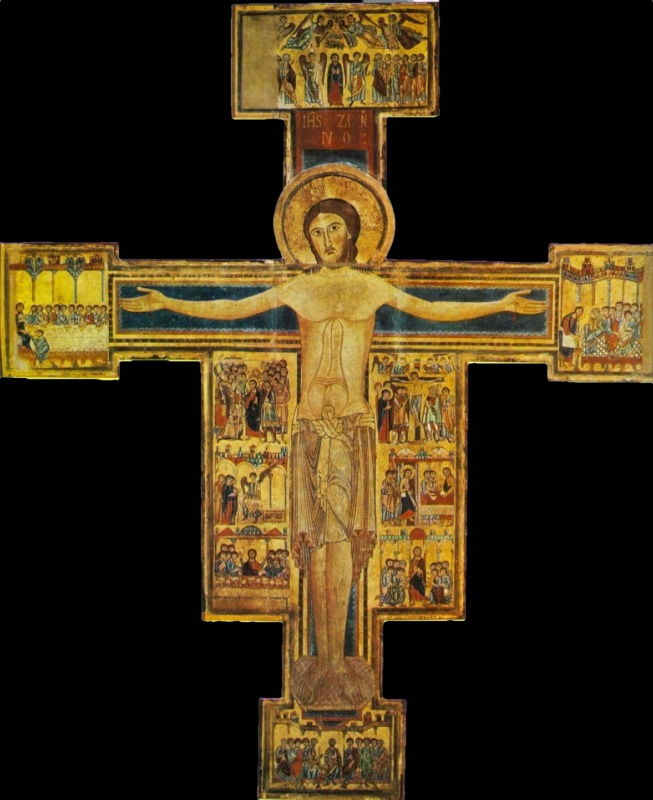
Croce n. 15 belongs to the type that dominated monumental painting in Tuscany during the twelfth century: the large shaped wooden cross with a central figure of Christ and painted narratives arranged on its expanded surfaces. The state catalogue defines it as a “grande croce lignea” with a cimasa, terminals at the ends of the horizontal arm, lateral panels flanking the body of Christ, known in Italian as tabelloni, and a figured foot. This structure, which transforms the simple cross into an organised field for images, allowed the painter to combine the iconic presence of Christ with a sequence of scenes that could be read by the faithful as a continuous meditation on the mystery of salvation. The tabellone, the broad panel behind the arms and body of Christ, was the principal space for narrative; the terminals, the cimasa and the foot offered secondary fields, each with its own iconographic role.
The dimensions recorded by the catalogue are 282 centimetres in height and 236 in width. Some secondary accounts give slightly different figures, such as 285 by 238 centimetres, and at least one popular source contains an evident typographical error that turns the width into 286. These variations probably reflect different methods of measurement or the inclusion of framing elements, but in the absence of a published technical study the catalogue figures should be regarded as authoritative. The medium is tempera on panel, with gilding, as the catalogue specifies. The halo of Christ is worked in relief, projecting from the surface, and enriched with vegetal and meander motifs, a device that lends the head both physical and symbolic prominence and that would have caught the light of candles and lamps in the church.
The condition of the panel matters for any interpretation of its imagery. The catalogue records that the upper part of the cimasa is missing and that the original borders are lost. The first of these losses has had consequences for iconographic reading, as will be seen when the subject of the cimasa is discussed: what survives is the lower register of a composition whose upper part has gone. The loss of the borders deprives us of the frame that would originally have defined the silhouette of the cross and perhaps carried ornamental or epigraphic elements.
The present silhouette is therefore more abrupt than the original, and the scenes now run right up to the cut edges of the panel; despite these losses the design remains exceptionally legible, each field clearly bounded and the eye passing easily from the central figure to the stories around it. Beyond these structural losses, the catalogue does not detail the state of the paint surface, and no account of a modern restoration specific to this cross has been traced. It would be unwise, therefore, to make claims about the degree of repainting or about the original chromatic balance beyond what can be seen in good photographs.
The only inscription that the catalogue transcribes is the titulus, written in painted Latin capitals and recorded as
I E H SU S NA ZA RE N US REX IU DE O RUM.
The catalogue’s descriptive field places it at the terminal of the arm above the halo, while its inscription field specifies “sopra l’aureola”; there is no real contradiction, since the titulus occupies the upper end of the vertical shaft immediately above the head of Christ, but the descriptive sentence, which speaks of the horizontal arm, appears to contain a slip. In the image only part of this text survives legibly, beginning with the monogram IHS and continuing in a fragmentary second line. The inscription at the base reported by the early observers, discussed in the previous section, is not transcribed and cannot be assessed.
On the technical side, a cautious distinction must be drawn between what is known and what is merely plausible. The catalogue’s description of the medium is consistent with the general practice of twelfth-century Tuscan panel painting, in which a support built from planks was prepared with a ground, gilded in selected areas and painted in egg tempera.
For comparison, the state catalogue describes the support of Croce n. 20 as cuoio, leather, in its technique field, while its critical notes, reporting Sandberg-Vavalà, speak of pergamena incollata su legno, parchment glued to wood; that is the catalogue’s reading and not a technical finding, and the catalogue records no such feature for Croce n. 15. Beyond this, however, no published analysis of the wood, the ground layers, the underdrawing or the pigments of the Santo Sepolcro cross has come to light in the course of this research. The investigation carried out by the Opificio delle Pietre Dure in Florence on the related cross of Rosano, and published in a volume of 2012, shows how much such studies can reveal about workshop practice, chronology and the relations between panels. Until a comparable campaign is undertaken for Croce n. 15, statements about its technical kinship with other crosses must remain stylistic rather than material.
The Triumphant Christ
At the centre of the panel stands the figure that gives the work its theological meaning: Christ alive upon the cross, the type that modern scholarship calls the Christus triumphans. The catalogue describes him with precision. He is set against a plain cross bounded by an outer border in red and an inner border decorated with stylised half-palmettes, a narrow band of dark blue that stands out sharply against the gold of the narrative fields; he is represented living, clothed only in the loincloth, in a strictly frontal posture, with the sole exception of the head, which inclines slightly towards the left. The arms stretch in a perfectly horizontal line along the crossbar and the hands are open rather than contracted; the eyes are wide open and turned towards the beholder, in a long oval face framed by dark hair falling to the shoulders and a short beard, without any suggestion of suffering. His feet rest side by side upon a suppedaneum covered with a cushion. Above him the halo projects in relief, ornamented with vegetal and meander patterns. The figure is not suspended in agony but stands, upright and serene, as if the cross were a throne rather than an instrument of death.
This image belongs to a long tradition that the catalogue sums up in a single sentence: the living Christ “esprime emblematicamente la vittoria sulla morte e il riscatto dell’umanità dal peccato”. The triumphant type dominated Italian painted crosses throughout the twelfth century and gave way only gradually, in the course of the thirteenth, to the suffering Christ with closed eyes and a body bent by death, the Christus patiens that Pisa adopted in Croce n. 20 and that Giunta would carry to its most influential form. To look at Croce n. 15 alongside Croce n. 20 in the San Matteo hall is to see two options of one Pisan moment within a few metres: on the Enciclopedia’s date the two crosses are roughly contemporary, and the Dizionario Biografico pairs their masters. In Croce n. 15 the living body is an emblem, symmetrical and composed, its anatomy articulated by firm lines rather than by modelling; in Croce n. 20 the dead body, almost upright and still schematic in its anatomy, hangs in a restrained stillness. The difference between them lies less in the manner of drawing than in the image of Christ and in the narrative: a living Christ with a cycle that runs from the Last Supper to Pentecost, a dead Christ with scenes that begin only after his death.
The painter’s graphic habits are clearest in the anatomy. The torso is described almost entirely through line: pectorals, ribs and abdomen are divided into symmetrical, ornamental compartments, and the soft ochre flesh is barely modelled. The long loincloth falls almost to the knees and is gathered at the waist into a large central knot, from which the folds descend in parallel curves ending in a decorative fringe. The body here is a clear diagram, legible from a great distance, in which line does the work that tonal gradation does elsewhere in Byzantine painting.
The slight inclination of the head, which the catalogue takes care to note, is a detail of some interest. It introduces a minimal departure from the strict frontality of the figure, a hint of movement and attention in an otherwise hieratic image. A similar inclination appears in the San Frediano cross, whose Christ, according to its own catalogue entry, has open eyes turned towards the viewer and a head slightly inclined to the left, and it belongs to the repertoire of twelfth-century Tuscan crosses more broadly. It would therefore be wrong to read it as a personal signature of the Santo Sepolcro painter. What it does show is that the triumphant type was not a rigid formula but admitted inflections, through which painters could soften the emblematic character of the image without abandoning it.
A further observation, found in a recent descriptive account of the San Matteo collection, holds that thin streams of blood flow from the wounds of the living Christ on Croce n. 15. If confirmed, this detail would be noteworthy, since it would combine the triumphant posture with a discreet reference to the physical reality of the Passion, a combination that some twelfth-century crosses display and that anticipates in a muted form the concerns of the following century. The state catalogue, however, does not mention it, and it has not been possible to verify it on an adequate photographic basis. It is recorded here as an observation to be checked under good light before any interpretation is built upon it.
The cushion beneath the feet, finally, is a small but telling element. The suppedaneum, the support on which the feet of Christ rest, is common in twelfth-century crosses, but its covering with a cushion gives a domestic, almost courtly note to what is otherwise a solemn image. Together with the relief halo, the ornamental borders and the gilding, it contributes to the character of the figure as an image of majesty. The Christ of the Santo Sepolcro is a sovereign who has already conquered death, and the narratives around him are to be read in the light of that victory.
The Narrative Programme: From the Upper Room to Pentecost
The narrative scenes that surround the triumphant Christ are arranged with a clarity that is itself part of the painter’s achievement, and the catalogue’s reading of their order provides the most reliable guide to them. On the terminals of the horizontal arm, at the viewer’s left and right, are the Last Supper and the Washing of the Feet. On the tabellone, six scenes are disposed in three registers, two on each side of the body of Christ. In the uppermost register appear the Mocking of Christ on the left and the Crucifixion on the right; in the middle register, the Holy Women at the Sepulchre on the left and the Supper at Emmaus on the right; in the lowest register, the Appearance to the Apostles on the left and the Meal with the Apostles on the right. The foot of the cross carries Pentecost, and the cimasa, in its surviving part, the Ascension. The scenes are set in separate gold fields with few figures. On the terminals, the Last Supper shows Christ and the apostles seated along a long table under an arcaded backdrop, while in the Washing of the Feet Christ bends before Peter as the other apostles watch from beneath a crenellated structure; at the foot, the apostles of Pentecost sit in a closely packed row.
Read in sequence, the cycle traces a coherent arc. It opens in the Upper Room, with the institution of the Eucharist and the act of humility by which Christ washed the feet of his disciples. It passes through the outrage of the Mocking and the death on the cross. It then lingers, with a weight unusual among surviving crosses, on the period after the Resurrection: the women at the empty tomb, the recognition of Christ at Emmaus in the breaking of bread, the appearance to the gathered apostles, and the meal at which the risen Lord ate with them. It closes with the two events that conclude the earthly presence of Christ and inaugurate the life of the Church, the Ascension and the descent of the Spirit at Pentecost. The reader of the cross is thus led from the sacrament instituted at the Last Supper to the community gathered by the Spirit, with the Resurrection as the hinge.
The catalogue rightly stresses that the cycle illustrates all the principal moments of the history of the Passion, “ivi compresa una rara Lavanda dei piedi”. The emphasis on meals is striking. The Last Supper, the Supper at Emmaus and the meal of the risen Christ with the apostles form a sequence of three tables, distributed across the cross, which present the shared meal as the privileged place of encounter with Christ before and after his death. The depiction of the risen Christ eating with the eleven, with bread and fish on the table according to descriptions of the scene, is a rare subject in monumental painting of the period, and its presence here gives the programme a distinctive accent. Combined with the Washing of the Feet, which in the liturgy of Holy Thursday accompanied the commemoration of the Last Supper, these scenes make the cross a meditation on the Eucharist as much as on the Passion.
The subject of the cimasa requires a brief clarification, because it has been described in different ways. Some accounts speak of the Virgin among angels and apostles, others even of an Assumption. The catalogue identifies it as an Ascension, and that identification fits both the logic of the sequence, which places the Ascension between the post-Resurrection appearances and Pentecost, and the condition of the panel, which has lost the upper part of the cimasa. What survives is a dense group of standing figures below a band of angels whose wings can still be made out along the cut upper edge: evidently the earthly register of an Ascension, in which the Virgin stands among the apostles and angels as they witness the departure of Christ, while the figure of the ascending Lord, which would have occupied the lost upper portion, is gone. The reading as an Assumption should be regarded as a misinterpretation produced by that loss.
The relation between this programme and the church for which the cross was made has already been suggested. Yet the same programme also belongs to a broader tradition of twelfth-century Tuscan crosses, which frequently combine Passion and post-Resurrection episodes; the San Frediano cross, for instance, includes the Resurrection, the Appearance on the Sea of Galilee, the Incredulity of Thomas and Pentecost. What distinguishes the Santo Sepolcro cross is not the presence of post-Resurrection scenes as such but the concentration on meals and on the Washing of the Feet, which gives its narrative a coherent Eucharistic orientation. Whether that orientation was dictated by the patrons, devised by the painter, or derived from a model now lost cannot be determined.
Drama and Invention: The Mocking and Longinus
If the overall structure of the programme reveals a theological intelligence, two details of the narrative reveal the painter’s inventiveness as a storyteller, and the catalogue singles them out with good reason. Its general judgement is that in the scenes the artist recovered compositional schemes of Byzantine origin while introducing significant variants that tend to emphasise the dramatic aspect of the history of the Passion. The two variants it names are found in the uppermost register of the tabellone, the Mocking of Christ and the Crucifixion, which are thus placed at the level of the outstretched arms and close to the eyes of anyone looking up at the cross.
In the Mocking, Christ is made to wear a burlesque, cone-shaped hat. The detail transforms the scene from a solemn image of patience into a spectacle of humiliation, in which the derision of the tormentors takes visible form on the head of their victim. The Gospels speak of a crown of thorns, a purple robe and a reed placed in the hand of Christ, but the pointed cap belongs to a different register, one closer to the practices of public shaming and mock-coronation familiar to a medieval audience. The catalogue observes that the dramatic representation of the Mocking recalls analogous solutions found in German illumination of the twelfth century. This observation deserves to be taken seriously, because it suggests that the painter’s visual culture extended beyond the Umbro-Roman and Byzantine sources that dominate the rest of the panel, and that he could draw, directly or through intermediaries now lost, on northern models in which the narrative of the Passion was charged with a coarse and vivid theatricality.
In the Crucifixion, the second detail concerns Longinus, the soldier who pierced the side of Christ with a lance. The catalogue describes his gesture as that of a man who brings his fingers to his eyes, eyes that it characterises as rendered incapable of seeing after the Saviour had been pierced by the lance. The gesture belongs to a rich legendary tradition surrounding the figure of Longinus, which developed in the apocryphal and hagiographic literature of the Middle Ages and which associated the centurion with blindness and with the healing power of the blood that flowed from the wound.
In its most widespread form, the legend held that Longinus was afflicted in his sight and that a drop of the blood of Christ, touched to his eyes, restored it, leading to his conversion. The catalogue’s wording leaves some ambiguity as to which moment of this story the painter intended, and it would be unwise to resolve that ambiguity without close examination of the scene. What is certain is that the gesture draws the viewer’s attention to the eyes of Longinus and thus to the theme of sight and blindness, of seeing and believing, which runs through the whole cycle, from the recognition at Emmaus to the appearance to the apostles.
These two details illustrate a characteristic of the painter that sets him apart from a mere copyist of models. He did not simply transcribe Byzantine compositions, which often present the episodes of the Passion with a measured dignity, but inflected them with gestures and attributes that heighten the emotional and moral content of the scenes. The pointed hat sharpens the cruelty of the Mocking; the gesture of Longinus introduces a note of miracle and conversion into the very moment of death. This inclination towards the didactic and the dramatic is consistent with a judgement of Carli (1994) recorded in the catalogue, according to which the cross carries to its fullest development a tendency already present in the San Frediano cross, namely the prevalence of the didactic purposes of the narrative apparatus over its more strictly devotional and pathetic ones. The Santo Sepolcro painter, in other words, used the narrative fields of the cross less to move the viewer to compassion than to instruct and to make the sacred history vivid. That orientation has been read as proper to Romanesque narrative painting and illumination, in which clarity of storytelling was the primary virtue, and it sits with a master of Byzantine reference because, as the catalogue notes, the Byzantine schemes are recast with dramatic variants of his own. It distinguishes him from Giunta’s generation, for whom the suffering body of Christ would become the principal object of devotion, and it separates his cross from Croce n. 20, whose narrative begins after the death and whose focus is the dead body.
A Byzantine Reference and the Composite Reading
Two readings of the style of the cross stand side by side in the sources, and the choice between them is the main interpretive decision of this essay. The first is found in the Dizionario Biografico degli Italiani. In its entry on Giunta Pisano the formation of the great Pisan painter is traced to the flourishing Pisan culture between the end of the twelfth century and the beginning of the thirteenth, and in particular to the refined and select activity, of almost exclusively Byzantine reference, of the masters of the crosses from the Santo Sepolcro and from the monastery of San Matteo, that is, of Croce n. 15 and Croce n. 20. The entry dates neither cross; it names the two masters together, as parts of one Pisan milieu, and sets that milieu against the Lucchese circle of Berlinghiero, to which earlier critics had looked. The Enciclopedia dell’Arte Medievale, in its entry on Pisa, supplies the date, the beginning of the thirteenth century, and a characterisation of its own: a living Christ and colourful little stories of lively, popular character. The two sources do not speak with one voice, since ‘refined and select’ and ‘popular’ pull in different directions, and the tension is recorded here and not resolved. What they share is the placing of the cross at the turn of the century, beside Croce n. 20, in a Pisan painting that looked to Byzantium.
The second reading is the one the state catalogue reports, and it is set out here as the position of those who hold it. The catalogue note, which dates the cross to the second half of the twelfth century, records that scholars have found in it elements of differing origin and calls its style composite. In the graphic treatment of anatomy, garments and architectural backgrounds the cross belongs to the Romanesque tradition of the twelfth century, with its most convincing comparisons in illuminated works of the Umbro-Roman area; knowledge of Byzantine models and of Crusader painting shows above all in compositions, iconography, some decorative motifs and the folds of drapery; and the dramatic Mocking recalls German illumination. The Umbro-Roman component refers to a group of large illuminated Bibles, often called Atlantic Bibles because of their monumental format, produced from the eleventh century onwards in central Italy in connection with the Gregorian reform of the Church, and distributed widely to cathedrals and monasteries, including those of Tuscany. Their figure style, with its firm contours, its clear separation of colour fields and its repertory of standard physiognomies and architectural settings, provided a common language for Romanesque painting across much of the peninsula.
Vigni (1950), as the catalogue records, saw in the firm drawing that sharply delimits the fields of colour a technique close to the illumination of the time, with Lucchese accents, and Carli (1974) related the work to the first phase of Pisan illumination, closely linked to that of Florence around the middle of the twelfth century, stressing its spacious and rhythmic clarity and the liveliness of its colour. Burresi and Caleca (1993) set it in the stylistic current to which the Umbro-Roman Bibles belong and identify those Bibles as the painter’s source. These judgements converge on the image of a painter who thought in the terms of the scriptorium; they are reported here as the state catalogue summarises them, without having been checked against the original publications. The hypothesis that the painter was himself a miniaturist, which Sandberg-Vavalà advanced in 1929, concerns in the sources consulted the author of Croce n. 20 and not this master, and it should not be transferred to him.
On the composite reading the consequences of that transfer are visible throughout the panel. The scenes are composed with few figures, set against simple architectural backdrops that function as signs of place rather than as constructed spaces. Faces and gestures recur from scene to scene with a certain regularity, which assists recognition and gives the cycle a unity of rhythm. Colour is bright and applied in clearly bounded areas, without the gradual modelling that Byzantine painters used to create volume. The result is a narrative of great legibility, which could be read from a distance and which corresponds well to the didactic purpose identified by the critics.
On the composite reading the Byzantine and Crusader component operates at a different level from the Umbro-Roman one: it supplies compositional schemes, iconographic solutions, ornamental motifs and ways of rendering the folds of drapery, and it does not transform the manner of drawing. The Dizionario Biografico asks more of it, since it speaks of a reference almost exclusively Byzantine. The two statements agree that Byzantium supplied the schemes and the iconography of the scenes, and that in a Pisa with intense contacts with the eastern Mediterranean, and with Crusader states where Latin patrons commissioned works from painters trained in Byzantine traditions, such models could arrive through portable objects, manuscripts and the movement of people; they disagree on how far the manner of drawing itself was Byzantine. That disagreement is the content of the dissent and not a detail of it. The weight assigned to the Byzantine component has determined whether the cross was placed before or after the Byzantine turn of Pisan painting around 1200. On the reading adopted here there is no before and after: the cross and Croce n. 20 are two products of one Pisan culture of Byzantine reference, the first keeping the living Christ and a narrative of the Passion and its aftermath, the second introducing the dead Christ.
Neighbours and Kin: San Frediano, Santa Cristina, Rosano and Croce n. 20
No anonymous painter can be understood in isolation, and the Master of the Santo Sepolcro is defined as much by the works that surround his cross as by the cross itself. Four comparisons have dominated the literature: the cross of San Frediano in Pisa, the cross from the Pisan church of Santa Cristina now in Siena, the cross of the Benedictine nunnery of Rosano near Pontassieve, and Croce n. 20 of the San Matteo museum. Each illuminates a different aspect of the problem, and each has, at one time or another, been drawn into the question of authorship.
The San Frediano cross is the most important point of reference within Pisa. It still belongs to the church whose name it bears, and its catalogue entry, compiled in 1978 and updated in 2001 and 2006, records a complex history. The restoration carried out between 1960 and 1972 revealed a painted surface composed of two successive layers, both of the twelfth century. To the earlier layer belongs the face of Christ; to the second belong the scenes on the tabellone and the cimasa and the two figures on the terminals. The cross was repainted already towards the end of the twelfth century and again in later periods; it became an object of public veneration as a miraculous image from the fifteenth century, which brought frequent interventions, and the long restoration removed, together with recent repaints, parts of the layer that the catalogue dates to the end of the twelfth century, a choice the catalogue itself calls discussed.
Its programme, with the Agony in the Garden, Pilate washing his hands, the Ascent to Calvary and the Resurrection, the Appearance on the Sea of Galilee, the Incredulity of Thomas, Pentecost in the cimasa and the prophets David and Isaiah at the ends of the arm, shares with the Santo Sepolcro cross the alliance of Passion and post-Resurrection subjects. Stylistically, many scholars connect it, especially in its second layer, with the classicising current of Umbro-Roman origin, while the first layer looks to Byzantine and Crusader works of the mid-twelfth century, a tendency also visible in Pisa in illuminated manuscripts such as the Bible of Calci, dated 1168. The upper layer of San Frediano is the closest comparison for the Santo Sepolcro panel. The state catalogue dates the San Frediano cross to the third quarter of the twelfth century, between 1150 and 1174, while acknowledging that its chronology and attribution are not fully settled. The more recent literature, as reported in the entry on the San Frediano cross, dates the first painting to about 1110-1120 and the repainting to about 1130-1140 (Boskovits 1993, which this essay knows only at second hand). On that chronology San Frediano is earlier than the Santo Sepolcro cross on any date proposed for the latter, by one to several decades if the catalogue’s second half of the twelfth century is accepted and by six or seven decades at the Enciclopedia’s date. The upper layer is then a precedent and not a contemporary, which is how Carli (1994) already reads the relation when he sees the Santo Sepolcro cross carry to its fullest development a tendency present in the older San Frediano cross.
The cross from Santa Cristina belongs to the same Pisan milieu, though it has long been removed from it. According to a well-established tradition, Catherine of Siena received the stigmata before it in 1375, during her stay in Pisa, and it was for this reason that the cross was later transferred to Siena, where it is preserved in the sanctuary of the saint’s house. Like the Santo Sepolcro cross, it is a shaped Christus triumphans with narrative fields, of the second half of the twelfth century. It has been described as sharing with Croce n. 15 the anatomy of Christ and the pattern of the loincloth, while its lateral scenes are closer to Lucchese models. The San Frediano catalogue entry, for its part, notes points of contact between that cross and the Santa Cristina panel. The three crosses thus form a triangle of related works, whose precise relations remain to be clarified.
The Rosano cross, preserved in the Benedictine nunnery of Santa Maria a Rosano in the upper Arno valley, lies outside Pisa but has played a part in the debate because it was once grouped with the Santo Sepolcro and San Frediano crosses under a single hand. Its recent restoration by the Opificio delle Pietre Dure, followed by an international study published in 2012, has transformed knowledge of twelfth-century panel painting in Tuscany, revealing among other things an exceptionally preserved original surface and encouraging an earlier dating than had previously been accepted. Whatever its exact chronology, the Rosano cross now appears as a work of a distinct character, and its association with the Santo Sepolcro panel can no longer be taken for granted.
Croce n. 20, finally, is the nearest comparison in date and in culture. Its anonymous master, trained in Byzantine practice, painted the suffering Christ with closed eyes, and the state catalogue dates the cross between 1200 and 1210. The Dizionario Biografico pairs the masters of the two crosses as the Byzantine-referenced sources of Giunta’s formation, and on the Enciclopedia’s date for Croce n. 15 the two works are roughly contemporary. Set side by side they show two choices within one Pisan milieu: the living Christ among a long narrative of the Passion and its aftermath, and the dead Christ among scenes that begin only after his death. Whether Croce n. 15 shows any trace of Croce n. 20, or the reverse, is the question that the dating debate leaves open.
Critical Fortune I: From Giunta to Sirén and Sandberg-Vavalà
The modern critical history of Croce n. 15 is, above all, a history of dating, and the oscillations of opinion are wide enough to be instructive in themselves. Proposals have ranged from the middle of the twelfth century to the second half of the thirteenth, a span of roughly a hundred years within which the meaning of the work changes. To place the cross in the second half of the twelfth century, as the state catalogue does, is to make it a document of Romanesque narrative painting before the turn of the century; to place it at the beginning of the thirteenth, as the Enciclopedia dell’Arte Medievale does, is to make it a witness, with Croce n. 20, of the Pisan culture of Byzantine reference from which Giunta came; to place it around 1220, as Sandberg-Vavalà did, is to make it a repercussion of that culture on the Romanesque tradition; and to place it in the later thirteenth century is to make it an archaism. Each position implies a different idea of the painter and of Pisan painting as a whole.
The earliest phase, already described, belongs to the local antiquarian tradition of the late eighteenth and early nineteenth centuries. Towards the end of the nineteenth century, Cavalcaselle’s survey of Italian painting (1886) dated the work to the second half of the Duecento, a position that reflected the general uncertainty about the chronology of early Tuscan painting and the tendency to regard all painted crosses of this type as products of the thirteenth century. The museum catalogue of 1906 (Bellini Pietri), more cautiously, assigned it to the Pisan school of the twelfth century, and two influential surveys, Venturi’s of 1907 and Van Marle’s of 1923, placed it between the end of the twelfth and the beginning of the thirteenth century. By the early twentieth century, then, the possibility of a twelfth-century date had been opened, but it had not been argued in stylistic detail.
The first scholar to attempt a genuine attribution was Osvald Sirén, the Finnish-born Swedish art historian whose surveys of early Tuscan painting laid much of the groundwork for the field. According to the state catalogue, Sirén initially, in 1914, recognised in the cross an influence of Giunta, which would have implied a date in the thirteenth century. Later, in a second phase that the catalogue does not date, he changed his view and attributed the cross to the same author as the cross of San Frediano and the cross of the nunnery of Rosano, dating it accordingly to the twelfth century. This grouping is the closest the literature has come to constructing a corpus around the painter of the Santo Sepolcro cross, and it deserves to be recorded as such. It did not, however, take its name from the Pisan cross, and it has not survived later research as a single-hand attribution.
A discrepancy within the state catalogue itself should be noted at this point, because it bears on the reliability of the reported grouping. The entry for the San Frediano cross, compiled independently, records that Sirén included that cross in the corpus of the hypothetical Maestro Tedice and dated it consequently to the first half of the thirteenth century. The two entries may refer to different moments of Sirén’s thinking, or one of them may simplify his position; without direct verification against the pages of his publications, which could not be consulted for this study, the question cannot be resolved. What is clear is that Sirén perceived a close relationship between the Santo Sepolcro and San Frediano crosses, and that his view of their date shifted over time. The exact form and date of his attribution should be checked against his own publications before it is cited as settled.
Evelyn Sandberg-Vavalà took a markedly different view in her fundamental study of the Italian painted cross and the iconography of the Passion, published in Verona in 1929, a work that remains indispensable for its systematic survey of the type. According to the catalogue, she decisively moved the cross towards 1220 and affirmed that it revealed the first repercussion of the new Byzantinising style of Pisa on the Romanesque tradition. In her reading, the Santo Sepolcro painter was a Romanesque artist touched by the novelty that Croce n. 20 had introduced, and his panel documented the moment when the older narrative manner began to absorb the lessons of Byzantine painting.
Sandberg-Vavalà’s interpretation has a real merit: it takes seriously the Byzantine elements of the cross, which are undeniable, and it explains why Croce n. 15 and Croce n. 20 have so often been considered together. Her dating towards 1220 is the latest of the serious proposals, and the sources consulted do not show that it has been taken up since. The state catalogue answers that the Byzantine component is confined to compositional schemes, iconographic choices and certain details of drapery and ornament, and does not require the mediation of Croce n. 20; the Dizionario Biografico and the Enciclopedia, by contrast, place the two crosses in the same Pisan moment without making one depend on the other. Her insight that the cross must be read in relation to the Byzantine currents active in Pisa survives under both readings.
Critical Fortune II: Caleca and the Umbro-Roman Current
Between Sandberg-Vavalà and the end of the twentieth century, a series of studies refined the understanding of the cross without overturning it. Vigni’s assessment of 1950 found in it a great decorative virtuosity joined to a traditional spirit of majesty, while Carli’s studies of 1974 and 1994, already cited, tied it ever more closely to Pisan and Florentine illumination and to the didactic purpose of its narrative. These contributions progressively moved the centre of gravity of the discussion away from Byzantium and towards the world of Romanesque illumination, and they prepared the ground for the formulation that underlies the state catalogue. That formulation is the dissenting one in this essay, and it is set out in full because it is the most carefully argued.
That formulation is due above all to Antonino Caleca, whose long engagement with the medieval art of Pisa gives his judgement particular authority. In the didactic volume on the painted crosses of the San Matteo museum that he co-authored, published in Pisa in 1993, Caleca placed the work within the stylistic current to which the Umbro-Roman Bibles belong, identifying those Bibles as the source of the painter’s inspiration. In doing so he distinguished the Santo Sepolcro painter from other tendencies present in Pisa at the same time, notably the one represented by the illuminators of the Bible of Calci, who drew instead on the prototypes of the Byzantine cultural tradition. This distinction is the key to Caleca’s interpretation. It establishes that Pisan painting in the second half of the twelfth century did not move in a single direction, but contained at least two coexisting idioms, one rooted in the Umbro-Roman books and the other in Byzantine models, and it places the Santo Sepolcro cross firmly in the first.
In a further contribution of 1994, cited in the state catalogue and most probably to be identified with his synthesis of medieval painting in Tuscany published in the Electa series on Italian painting, Caleca went further and proposed a precise chronological anchor. He referred both the Santo Sepolcro cross and the cross from Santa Cristina now in Siena to the period and the stylistic area of the upper layer of the San Frediano cross, that is, of the more recent layer, which in the catalogue’s summary of his view cannot be later than the end of the twelfth century. The San Frediano cross in its upper layer, the catalogue adds, shows, like Croce n. 15, affinities with Umbro-Roman painting and illumination. Caleca also reconstructed a nucleus of primitive crosses from north-western Tuscany, to which he added the two Pisan examples from San Paolo all’Orto and the Santo Sepolcro, thereby situating the Master of the Santo Sepolcro within a regional tradition rather than as an isolated personality.
The strength of Caleca’s position lies in its economy. It explains the Romanesque character of the figure style without denying the Byzantine elements; it accounts for the closeness to the upper layer of San Frediano and to the Santa Cristina cross; it fixes a terminus ante quem at the end of the twelfth century; and it makes intelligible the distance that separates Croce n. 15 from Croce n. 20. It is the position of the state catalogue, which places the work in the second half of the twelfth century, and of the Zeri listing, within its last quarter. It does not, however, account for the Enciclopedia’s date, or for the Dizionario Biografico’s pairing of the cross with Croce n. 20 as a master of Byzantine reference, and it rests on a date for the upper layer of San Frediano, the end of the twelfth century in the catalogue, that the more recent literature has moved back by half a century or more. For these reasons it is a serious alternative to the reading adopted here and not the settled view.
Caleca’s formulation is, however, carefully worded, and its caution deserves to be preserved. It assigns the Santo Sepolcro and Santa Cristina crosses to the same period and the same stylistic area as the upper layer of San Frediano. It does not state, at least in the form reported by the catalogue, that a single painter executed all three. The difference between a shared stylistic area and a shared hand is precisely the difference between a regional school and an individual master, and it is the difference on which the very existence of a Master of the Cross of the Santo Sepolcro, as more than the name of one object, depends. Caleca’s work thus clarifies the context of the cross without resolving the question of its author’s identity; it tells us where the painter belongs, not who he was or what else he painted.
What Can Be Known: Toward a Corpus?
The evidence reviewed so far allows a graduated statement of what can be claimed about the Master of the Santo Sepolcro, and it is useful to set it out in order of decreasing certainty. At the most secure level stand the facts established by the object and the documents: the cross exists, it came from the church of the Santo Sepolcro in Pisa, it was in the Ospedale di Santa Chiara by 1792, it entered the civic museum by 1894, and it is now in the Museo Nazionale di San Matteo, where it bears the historic number 15 and the inventory number 1578. Its dimensions, medium, structure, losses, titulus and iconographic programme are recorded by the state catalogue and can be verified on the panel itself.
At a second level stand the conclusions of stylistic analysis on which the sources converge. The cross is a Pisan work of the turn of the twelfth and thirteenth centuries: the state catalogue and the Fondazione Zeri place it in the second half of the twelfth, the Enciclopedia dell’Arte Medievale at the beginning of the thirteenth, and Sandberg-Vavalà around 1220; the proposals that go beyond these limits are no longer defended. Its painter worked with selective knowledge of Byzantine and Crusader models and with at least one dramatic accent that recalls German illumination; the weight of the Byzantine component is the point of dissent, between the Dizionario Biografico’s reference almost exclusively Byzantine and the state catalogue’s Umbro-Roman graphic base. He belongs to the same milieu as Croce n. 20, to which the upper layer of the San Frediano cross stands as a precedent, and as a relative to the Santa Cristina cross now in Siena. These conclusions rest on the catalogues, on the two encyclopaedias and on the most recent coherent critical synthesis, and they remain judgements rather than proofs.
At a third level stand the hypotheses that would give the master a body of work beyond his name-piece. Two such hypotheses have been advanced, at least implicitly. The first is Sirén’s grouping of the Santo Sepolcro cross with those of San Frediano and Rosano under a single hand. That grouping must now be considered superseded in its original form: the discovery that the San Frediano cross consists of two twelfth-century paint layers, with the narrative scenes belonging to the later one, means that any comparison must be made with a specific layer rather than with the cross as a whole, and the restoration and study of the Rosano cross have given that work a distinct physiognomy and an earlier chronology that make a common authorship with the Santo Sepolcro panel difficult to sustain.
The second hypothesis concerns the Santa Cristina cross and the upper layer of San Frediano, which Caleca placed in the same period and stylistic area as Croce n. 15. Of these, the Santa Cristina cross is the strongest candidate for association with the Santo Sepolcro painter, since it has been described as sharing with Croce n. 15 the anatomy of Christ and the pattern of the loincloth, two features that tend to be specific to a workshop. The differences in its lateral scenes, closer to Lucchese models, introduce however an element of doubt, which could be explained equally by a different hand trained in the same milieu, by a collaborator, or by the same painter working from different models. The upper layer of San Frediano offers the most suggestive comparison for the narrative manner, as a precedent on the recent chronology of that cross, but the damage inflicted on it by the restoration of 1960 to 1972, which removed parts of the paint the catalogue dates to the end of the twelfth century together with later repaints, complicates any judgement about hands.
The state of the question can therefore be summarised without exaggeration. The Master of the Cross of the Santo Sepolcro is, at present, a name with one securely attributed work. The Santa Cristina cross is a possible but unproven second work, the upper layer of San Frediano a close stylistic relative and probably a precedent, and the Rosano cross a former associate whose connection has weakened with recent research. No other painting, panel, fresco or manuscript has been attributed to this hand in any source consulted. Commonly repeated claims that would assign him a wider oeuvre, or that would identify him with Giunta or with a painter from Sansepolcro, have no basis in the evidence.
What would change this picture is clear. A technical study of Croce n. 15 comparable to the one carried out on the Rosano cross, extended where possible to the Santa Cristina cross and to the upper layer of San Frediano, would allow comparison not only of forms but of materials, preparation, underdrawing and workshop practice. Such a study could confirm or exclude a common authorship with a degree of certainty that stylistic analysis alone cannot reach. Until it is undertaken, the honest position is to maintain the distinction between the name and the hypothesis, and to treat any expansion of the master’s corpus as a proposal to be tested rather than a fact to be repeated.
Conclusion
The Master of the Cross of the Santo Sepolcro emerges from this inquiry not as a recovered biography but as a clearly defined artistic presence, known through one work of exceptional quality and interest. The anonymity of his name should not obscure the distinctiveness of his achievement. Working in Pisa around 1200, he belongs, on the reading adopted here, to the refined Pisan activity of almost exclusively Byzantine reference that the Dizionario Biografico names, with the master of Croce n. 20, among the sources of Giunta’s formation. He gave that language the monumental format of a painted cross nearly three metres high, enriched it with compositional and iconographic solutions drawn from Byzantine and Crusader painting, and inflected the inherited schemes with dramatic details of his own, such as the pointed cap of the Mocking and the gesture of Longinus, which reveal a narrator attentive to the moral and emotional content of the sacred story. The state catalogue, which dates the cross to the second half of the twelfth century and finds its graphic base in Umbro-Roman illumination, records the dissenting reading, and the difference between the two is not settled.
For a church dedicated to the Holy Sepulchre, built on the model of the Jerusalem rotunda and belonging to the Hospitallers of St John, he devised, or at least executed, one of the most coherent Eucharistic and post-Resurrection programmes among surviving Romanesque crosses. The sequence of three meals, from the Last Supper through Emmaus to the risen Christ eating with the apostles, framed by the rare Washing of the Feet and culminating in the Ascension and Pentecost, gives the cross a theological unity that deserves more attention than it has generally received. The probable placement of the cross near the space of the liturgy, above a screen between nave and presbytery, would have brought this meditation on the Eucharist into direct relation with the celebration at the altar.
The critical history of the work illustrates both the difficulties and the progress of the study of early Italian painting. The attribution to Giunta, born of an uncertain reading of a damaged inscription, has no foundation. The dating to the later thirteenth century belongs to an age that had not yet learned to distinguish the phases of Romanesque painting. Sirén’s grouping of the cross with those of San Frediano and Rosano under a single hand opened the way to a twelfth-century dating, but in its original form it has not withstood later discoveries. Sandberg-Vavalà’s dating around 1220 took the Byzantine elements seriously, and her reading of the work as a repercussion of Pisa’s Byzantinising style is the late end of a range whose centre is now the turn of the century. Two syntheses divide the field. The Dizionario Biografico and the Enciclopedia place the cross at the beginning of the thirteenth century among the Pisan masters of Byzantine reference; Burresi and Caleca place it, with Santa Cristina and beside the upper layer of San Frediano, in the Umbro-Roman current of the later twelfth century, as the official catalogue reports. This essay adopts the first for the character of the style, records the second as the dissent, and keeps a date around 1200, between the two.
Several common errors can be laid to rest on the basis of the evidence. The church of the Santo Sepolcro belonged to the Hospitallers, not to the Templars. The Master has nothing to do with the town of Sansepolcro. The number 15 is a historic catalogue number, not an inventory number. The subject of the damaged cimasa is an Ascension, not an Assumption. And the conventional name, used here for convenience, does not correspond to an established corpus but to a single object whose author remains anonymous in the catalographic tradition.
The Master of the Cross of the Santo Sepolcro thus stands at a precise point in the history of Pisan art, at the turn of the twelfth and thirteenth centuries, beside the master of Croce n. 20, in a Pisan culture of Byzantine reference from which Giunta would come. Whether he will one day become more than the name of his cross depends on the technical study of the panel and of its closest relatives, and on the dating of the cross, which the sources still divide between the second half of the twelfth century and the beginning of the thirteenth. Until then, his cross speaks for him, and it does so with a clarity, an inventiveness and a theological coherence that justify its place among the key documents of Pisan painting around 1200.