Angela of Foligno
( 25% )
Introduction
Angela of Foligno (Italian Angela da Foligno; c. 1248 – 4 January 1309) is one of the most powerful and disquieting voices in the Western Christian mystical tradition, and simultaneously one of its most elusive historical subjects. A well-to-do married woman of the Umbrian town of Foligno, near Assisi, she underwent a dramatic conversion in her late thirties, entered the Franciscan Third Order as a secular penitent, and, through years of dictation to a Franciscan confessor known only as “Brother A.” (Frater A.), produced the text known as the Liber — comprising the autobiographical Memoriale and the more heterogeneous Instructiones, together with letters and an official approbation. Evelyn Underhill, the twentieth-century scholar of mysticism, judged that, excepting only St. Bonaventure, Angela “has probably exerted a more enduring, more far-reaching influence than any other Franciscan of the century which followed the Founder’s death”; Bernard McGinn’s more recent verdict is that her Book “rightly stands as the premier text of all Franciscan women mystics.”
Yet the confident biographical narratives found in devotional literature and older reference works rest on remarkably thin documentary foundations. As the New Catholic Encyclopedia frankly states, “almost nothing is known about the details and external circumstances of Angela’s life,” and “except for the date of her death, virtually all the information we have about her must be deduced or inferred from her Book.” This biography therefore proceeds on two tracks at once: it reconstructs the life and teaching as they emerge from the sources, and it grades the reliability of each claim, distinguishing documented fact, hagiographic topos, and modern scholarly reconstruction. The distinction is not pedantic: the historiography of Angela over the past century — from the French editions of the 1920s to the Roman dossier of 1999 and the Menestò facsimile of 2009 — is in large part the story of scholars learning to separate the woman from the book attributed to her.
The Historical and Biographical Life
Angela was born, by scholarly convention, around 1248 in Foligno (Latin Fulginium), a prosperous commune in the Valle Umbra a short distance from Assisi. The date is not securely documented; it is an inference, and Benedict XVI1’s 2010 catechesis cautiously gives “about 1248.”
She came from a well-to-do, perhaps minor-noble family. Her father died when she was young, and — according to the reconstruction drawn from the Liber and elaborated by Benedict XVI — she was raised “in a somewhat superficial manner by her mother.” She received no formal Latin education and was, in the language of the sources, illitterata: she did not know Latin and probably could not write, though whether she could read the vernacular remains uncertain (a point Bernard McGinn leaves explicitly open).
She married, traditionally around the age of twenty, a man of Foligno’s comfortable worldly circles, and bore several children (the sources say “sons”). Later devotional tradition dramatized her early life as “wild, adulterously, and sacrilegious,” a phrase that has passed into countless popular accounts. This lurid characterization must be treated with caution: it is a hagiographic topos of the great-sinner-turned-saint, amplified by later writers (the 1928 account of Hugh Francis Blunt is a florid example). Angela’s own text speaks of a “mortally sinful” life and of grave sins she was too ashamed to confess, but as one recent survey notes, it “remains highly probable” that what she reproached in herself may have been the ordinary luxuries and attachments of her class — fine food, fine clothing, marital sexuality — read through the lens of a penitential culture that prized fasting, poverty, and chastity. The precise nature of her “sin” is unknowable and has been over-interpreted.
Around 1285, in her late thirties, Angela experienced a conversion. The traditional account, followed by Benedict XVI, holds that she was moved by a growing terror of damnation, invoked St. Francis2, who appeared to her in a vision, and then made a general confession to a Franciscan friar at the church of San Feliciano in Foligno. The Liber frames the beginning of her spiritual itinerary — the “first step” — precisely as “the knowledge of sin,” followed by fear of hell and bitter weeping.
Contextual factors are sometimes adduced: Benedict XVI’s catechesis mentions the earthquake of 1279, storms, and the grinding war between Foligno and Perugia as events that unsettled Angela and turned her toward penance. The Key to Umbria local tradition even links her conversion to the example of the Foligno hermit-penitent Blessed Peter Crisci (Petruccio), whom she says she had once mocked. These are plausible reconstructions of context rather than firmly dated events in her life, and should be presented as such.
The dating of the conversion to 1285 goes back to Martin-Jean Ferré’s influential 1925 chronology, “Les principales dates de la vie d’Angèle de Foligno.” Jacques Dalarun has subjected this chronology to sharp skeptical critique, arguing that much of it rests on single, late, or circular sources; Mario Sensi likewise regarded the evidence for 1285 as too weak to be certain. The “seventh centenary of the conversion” was nonetheless celebrated in 1985 (with a major congress and the appearance of the Thier–Calufetti edition), and the “seventh centenary of her entry into the Third Order” in 1991 — a reminder, as Dalarun wryly observed, that scholarly commemorations can lend an air of solidity to dates that are in fact conjectural.
At a pivotal moment — placed around 1288 — Angela was, in the words of the Liber, “released from any emotional ties”: within a short span her mother died, then her husband, then all her children. The text’s tone here is notoriously stark: Angela records that she had prayed for release from these family bonds and experienced their deaths as a divine mercy answering her prayer, a passage that has scandalized modern readers and fascinated commentators from Georges Bataille to feminist critics such as Cristina Mazzoni. This is one of the places where the Memoriale’s spiritual logic (the stripping away of every worldly attachment) collides most violently with ordinary human sentiment, and where scholars caution against reading the text as a straightforward emotional autobiography.
With her family gone, and accompanied by a servant-companion named Masazuola (Pasqualina is named in the Italian tradition as another close companion, said to have died in 1313), Angela began divesting herself of her possessions to live as a penitent. She joined the Franciscan Third Order — the Brothers and Sisters of Penance — around 1291, professing what she understood as “the rule of blessed Francis,” most likely the rule established for lay penitents by Nicholas IV’s bull Supra montem (1289).
The turning point of Angela’s mystical life, as narrated in the Memoriale, was a pilgrimage to Assisi around 1291. On the road from Foligno, near a wayside church of the Trinity (SS. Trinità), she reports hearing the Holy Spirit speak within her, promising divine presence until her second entry into the Basilica of San Francesco. In the Upper Church at Assisi, gazing at a stained-glass image showing St. Francis held in the arms of Christ, she felt herself possessed by God — and then, as the presence withdrew, she collapsed and cried out, in the celebrated phrase, “Amor non cognitus, quare?” — “Love unknown, why? why? why?” Her screams, she says, were so choked in her throat that the words were unintelligible.
Her friar-relative, the future scribe “Brother A.,” was at the Sacro Convento at the time and was, according to the tradition, mortified by the public scene and forbade her to return to Assisi. It was precisely this episode, and his effort to determine whether her experiences were divinely inspired or diabolical, that prompted him to begin writing down what she told him — the genesis of the Memoriale.
From roughly 1296 until her death, Angela became the center of a circle of disciples — tertiaries, friars, and laymen — whom she addressed as her “sons” (filii) and who called her their spiritual mother; one title used among them was doctrix or “teacher in the discipline of God.” She established at Foligno a community of women tertiaries who lived a common life of poverty and charity — caring especially, the tradition says, for lepers and the sick — without binding themselves to monastic enclosure, so as to remain free for works of mercy. (Older accounts, such as the 1913 Catholic Encyclopedia, claim the community took “the three vows of religion”; this is doubtful and reflects later regularizing assumptions.)
Among the friars drawn into her orbit was the fiery Spiritual Franciscan Ubertino da Casale, who credited her with his own spiritual rebirth (discussed below). Her later revelations — including notable ecstasies at the Porziuncola (2 August 1300) and during Holy Week 1301 — were recorded by “Brother A.” and other friars and form part of the Instructiones.
Angela died in Foligno on 4 January 1309, surrounded by her disciples. A marginal note in the oldest manuscript (Assisi MS 342, c. 1308–9) records the death with unusual precision:
Transiit autem venerabilis sponsa Christi … ex huius mundi naufragio ad celi gaudia … anno dominice incarnationis MCCCIX pridie nonas ianuarias tempore domini Clementis V.
“The venerable spouse of Christ, Angela of Foligno, passed from the shipwreck of this world to the joys of heaven … in the year of the Lord 1309 on the day before the nones of January, in the time of our lord Pope Clement V2.” (Some devotional sources give 3 January or even 1310; 4 January 1309 is the best-attested date, though the modern liturgical calendar has occasionally shifted the feast.) She was buried in the Church of San Francesco in Foligno, where her tomb at once became the focus of a cult.
The Textual Tradition and the Liber
Angela’s writings are conventionally gathered under the title Il Libro della beata Angela da Foligno — the Liber — a work that, as McGinn notes, “actually has none” (no original title) and has circulated under many names, including Liber de vere fidelium experientia (“Book of the experience of the truly faithful”), the title favored in the older French tradition. The Liber has two principal parts:
-
The Memoriale — the autobiographical narrative of Angela’s inner journey, dictated by Angela in her Umbrian dialect and translated into Latin by “Brother A.” It occupies roughly the first half of the work and is organized around the famous sequence of “steps” or “transformations.”
-
The Instructiones (Instructions) — a heterogeneous collection of exactly 36 texts (letters, exhortations, discourses, meditations, accounts of visions), of varied and often uncertain authorship, plus a notice of Angela’s death and an epilogue. As the Franciscan Publishing Company summarizes the scholarly consensus, “the Instructiones are 36 separate texts and … while those numbered 35 and 36 are likely the last two to be written, the numbered order reflects neither the order the texts were produced in nor the order the texts appeared in any early manuscripts.” They reflect her teaching in her last years and after, “albeit at some remove,” and were compiled by several hands.
The Liber also contains the crucial approbation (Testificatio / Approbatio fratrum): a prologue attesting that the Memoriale was read and approved by the cardinal-deacon Giacomo (James) Colonna — explicitly “before his conflict with the Supreme Pontiff” (i.e., before the Colonna cardinals’ deposition by Boniface VIII in 1297, which dates the approbation to before May 1297) — together with eight named-by-function Franciscan theologians (one a longtime lector at the studium generale of Milan, four former provincial ministers, two former inquisitors, one a custos), plus three further learned friars. This approbation was both a guarantee of orthodoxy and, functionally, a shield for a text whose language flirted with the era’s suspicion of the heresy of the Free Spirit.
The Memoriale organizes Angela’s ascent as a sequence of “steps” (passus) or “mutations.” The friar-scribe reports that Angela recounted her itinerary as twenty steps, to which a further set was added; but the final ten proved so difficult for him to comprehend that he condensed them into seven “supplementary steps” (passus supplementari), which occupy a large and theologically dense portion of the text. The result is the traditional scheme of “thirty steps,” though the numbering is famously unstable and the scribe himself confessed he could not “put them entirely in order.” Benedict XVI, quoting the Liber, stressed exactly this: the friar sought “to sort them into stages … but without managing to put them entirely in order,” because the experience of union left in Angela only “a shadow” of what she had understood.
The composition of the Memoriale is generally dated between about 1292 (when “Brother A.” began writing, after Angela entered the Third Order) and 1296, with the text approved by 1296–97 and revised by the scribe around 1298–1300. The Instructiones accreted between roughly 1296 and after her death in 1309.
Authorship, dictation, and the “male scribe, female voice” problem
The most debated feature of the Liber is its collaborative and mediated authorship. Angela dictated orally, in Umbrian; “Brother A.” translated, selected, organized, and to some degree reworked the material into a Latin “marked by tics of notarial style, with many reminiscences of the vernacular” (Pascale Bourgain analyzed this peculiar Latin in the 1999 dossier). The scribe repeatedly insists on his fidelity — that he wrote down only what Angela said, sometimes reading it back to her for correction — yet the very structure of the text (his first-person interventions, his framing, his confessed incomprehension) reveals his shaping hand.
Scholarship has taken several positions here, which should be attributed rather than blended into false consensus:
- Catherine M. Mooney, in her influential essay “The Authorial Role of Brother A. in the Composition of Angela of Foligno’s Revelations” (1994), foregrounds the scribe’s mediating and shaping role, cautioning against naïvely reading the text as Angela’s unmediated voice.
- John W. Coakley (“Hagiography and Theology in the Memorial of Angela of Foligno”) and Emore Paoli (“Parole di donna, scritture di uomini: Angela da Foligno, Margherita da Cortona, Chiara da Montefalco,” 2011) similarly examine the male-clerical framing of female mystical speech.
- Giovanni Pozzi, the literary scholar whose 1992 Adelphi edition Il libro dell’esperienza remains a landmark, emphasized the text’s “radical passivity” and the apophatic tension between the sayable and the ineffable.
- Cristina Mazzoni and others (drawing on Karma Lochrie) situate the Memoriale “outside medieval taxonomies of authorship,” arguing that dictation was a normal mode of composition and that Angela’s authorship, though mediated, is real.
- Massimo Vedova (Esperienza e dottrina: il “Memoriale” di Angela da Foligno, 2009) argues the scribe’s aim was theological rather than merely hagiographic.
The most radical formulation is Jacques Dalarun’s 1995 essay “Angèle de Foligno a-t-elle existé?” — a title he later insisted was a boutade (a provocation) — which nonetheless framed the central problem: not whether a historical tertiary existed, but “the exact relationship between the woman and the Book said to be hers.” Dalarun and Romana Guarnieri convened a Roman round table in December 1995 that produced the essential collective volume Angèle de Foligno: Le dossier (ed. Giulia Barone and Jacques Dalarun, École française de Rome, 1999).
On the scribe’s very identity, precision matters. The manuscripts name him only as “Frater A.” / “Fr. A.” (in Memoriale III God tells Angela to “ask him, that is, Brother A.”; the Subiaco codex uses the siglum “Fr. A.”). The traditional expansion “Arnaldo/Arnoldo (da Foligno),” used even by the official Vatican biography, is a conjecture, not a documented name; Italian Wikipedia prudently writes “frate A. (Arnaldo?).” Mario Sensi proposed identifying him with the archival figure Fra Berardo Arnolti (“Fra Berardo Arnolti, il ‘frater scriptor’ del Memoriale di Angela?,” 1992) — but the question mark in his own title signals that this remains a hypothesis.
Theology and Mystical Doctrine
Angela’s mysticism is, at its core, a mysticism of the Passion. Benedict XVI put it precisely: on Angela’s journey “the transition from conversion to mystical experience, from what can be expressed to the inexpressible, took place through the Crucified One,” the “God-made-human of the Passion.” Her entire itinerary is a striving for perfect “likeness” (conformitas) with the crucified Christ through ever more radical purifications, so as “to die with all the sorrows suffered by the God-man crucified in order to be totally transformed in him.”
This is thoroughly Franciscan: it descends from Francis’s own devotion to the Passion and the stigmata and from Bonaventure’s Lignum vitae, and it shares the affective, Christocentric, Eucharistic intensity McGinn identifies with the “new mysticism” of the thirteenth century. The Eucharist is central: Angela reports visions of the Host radiating supernatural beauty, of “two most splendid Eyes” in the Host, and of the Child Jesus enthroned — and a longing to communicate daily. Caroline Walker Bynum’s thesis on the incarnational, Eucharistic character of female piety in this period is often applied to Angela.
Angela’s ascent is not a smooth Bonaventurean ladder but a turbulent, oscillating spiral between beatific consolation and devastating desolation. McGinn stresses two difficulties peculiar to her Memoriale: first, the instability of the “steps”; second, that the highest stages transgress “the ordinary bounds of language,” requiring “an original form of apophatic mysticism.” In the culminating supplementary steps, Angela passes through a horrific “dark night” — “the most horrible darkness,” an abyss of loneliness and despair, in which humility and a “vexing pride” war within her — before entering the ineffable.
Two of her most distinctive terms are the abyss (abyssus) and annihilation (adnichilatio). She speaks of being “abyssed” (inabyssare) into God, and, in the Instructiones, teaches that “true annihilation consists in becoming aware that we are truly not the authors of any good” — a two-fold kenotic movement in which the soul first contemplates the self-emptying of the Incarnation and then strips itself of possessions and of its very self. This vocabulary is why Paul Lachance titled his study Angela of Foligno: Passionate Mystic of the Double Abyss — the double abyss being the abyss of the soul’s nothingness and the abyss of the divine Trinity. McGinn treats her together with Mechthild of Hackeborn and Marguerite Porete in his 2016 study “Annihilation and Authorship: Three Women Mystics of the 1290s,” calling her book “one of the great exemplars of apophasis in all mystical literature.”
The summit of Angela’s experience is Trinitarian. During the Assisi pilgrimage and afterward she reports an overwhelming, imageless manifestation of the Trinity — “I saw something full, an immense majesty, which I cannot say, but it seemed to me that it was all good” — and later describes resting “in the midst of that Trinity which I see with such great darkness (tenebra).” Here Angela contemplates God not as image but as darkness, a good “greater than can be thought.” McGinn and others place this apophatic Trinitarianism among the boldest in medieval literature; recent theological work (the University of Chicago dissertation “The Darkness in Christ’s Eyes: The Incarnational Theology of Divine Union in Angela of Foligno’s Memorial”) reads her union as a mutual interpenetration in which God shares human passibility and the soul shares the divine darkness — grounded in her intuition of Christ’s hypostatic union and of the Trinity’s unity-in-distinction.
Her most famous single locution encapsulates the whole: while meditating on Christ’s death in Holy Week (1301), she heard the words, “Non ti ho amata per scherzo” — “My love for you has not been a hoax” (or: “I have not loved you as a joke”) — which threw into relief, she says, the “game-playing” insufficiency of her own love.
Angela stands within, and helped shape, the reformist and “Spiritual” current of the Franciscan movement, though her precise relationship to the Spirituals is debated (Stefano Brufani, David Burr, and Romana Guarnieri have discussed this; Guarnieri’s dossier essay “Santa Angela? Angela, Ubertino e lo spiritualismo francescano” even probes the polemical epilogue to the Instructiones). Her circle overlapped with rigorist friars, and her Instructiones and letters counsel radical poverty and interior reform.
The clearest documented link is with Ubertino da Casale (c. 1259 – c. 1329), a leader of the Spirituals. In his Arbor vitae crucifixae Iesu, composed at La Verna in 1305, Ubertino names Angela as “the reverend and most holy mother, Angela of Foligno, who lived a truly angelic life on earth,” and credits her insight into his soul with his spiritual rebirth, calling her an incarnation of Divine Wisdom whose many spiritual children found in her “a mother of fair love and of fear, of greatness and of holy hope.” Angela is said to have addressed a letter of exhortation to Ubertino around 1302. Ubertino’s testimony is among the very few external medieval references to Angela — which is precisely why it is so heavily weighted in the scholarship. Ubertino may also have had a hand in the hagiographic-polemical epilogue to the Instructiones, found in some manuscripts.
Manuscript Tradition and Edition History
Recent scholarship has established that the oldest, most authoritative witness to the Liber is the Assisi codex — Biblioteca Comunale di Assisi (Fondo Antico del Sacro Convento), MS 342. Paleographical study (notably by Attilio Bartoli Langeli in the 1999 dossier, “Il codice di Assisi, ovvero il Liber sororis Lelle”) dates it to c. 1308–1309, essentially contemporary with Angela’s death, and describes it as a modest parchment book of medium format (c. 24 × 17 cm), about 52 folios, of mediocre-quality parchment (with a preexisting hole and repaired cuts), copied — probably by an unnamed Friar Minor — from a now-lost exemplar. Its title identifies the work as Liber sororis Lelle de Fulgineo de tertio ordine sancti Francisci — “the Book of Sister Lella [a diminutive of Angela] of Foligno of the Third Order of St. Francis” — even though such an order did not formally exist as an institution.
The codex contains the Memoriale (articulated into seven passus) followed by 28 Instructiones. Massimiliano Bassetti (“Un manoscritto francescano?”) examined its Franciscan character, and Mateusz Stróżyński has argued, in “The Composition of the Instructiones of St Angela of Foligno” (Collectanea Franciscana 88, 2018), that “the author of the Assisi codex copied it from two independent exemplaria: one with the Memoriale, the other with the Instructiones, and that the composition of the latter was influenced by the presence of the Free Spirit heresy in Umbria.” The Liber survives in roughly thirty manuscripts (Thier and Calufetti studied twenty-eight; Paolo Mariani’s dossier essay analyzed twenty-three “miscellanei”), in Latin and later in vernacular translations, dispersed across Italy and northern Europe — with witnesses in Assisi, Bologna, Brussels, Liège, Subiaco, and elsewhere, and an important Florentine vernacular version (Magliabechiano XXXVIII.122).
A major text-critical question concerns the relationship between a longer (maior) and shorter (minor) Latin redaction of the Memoriale. Thier and Calufetti advanced one theory of the redactions; Enrico Menestò argued that the maior is the original redaction (reversing the editors’ assumption), and Emore Paoli (“Le due redazioni del Liber: il perché di una riscrittura,” 1999) developed this, arguing the minor is a later abridgement — a “cleaned-up” summary of the narrative of Angela’s mystical experience. This is now the more widely accepted view.
History of the Cult and Canonization
Angela’s cult was immediate and local: veneration at her tomb in San Francesco in Foligno began at once, with reports of miracles, and the title beata was used long before any formal act. Her Liber circulated widely from the fourteenth to the sixteenth century, and — a notable fact — was often more popular abroad than in Italy: it was read among French religious and laity, and became a spiritual model among Spanish Franciscans in the sixteenth and seventeenth centuries (Jane Tar). Her seventeenth-century admirers included the Jesuit Maximilian Sandaeus (van der Sandt), who coined the title Theologorum Magistra (“Teacher/Mistress of Theologians”), later cited by Bollandus in the Acta Sanctorum — the origin of her enduring epithet.
The official Vatican record (the Dicastero delle Cause dei Santi) and the 2013 Decretal Letter itself present the following documented acts: on 7 May 1701, Pope Clement XI3 granted the Friars Minor Conventual and the city and diocese of Foligno the faculty to recite the Divine Office of the Blessed — the act that functioned as her (equipollent) beatification; and on 20 December 1766, Pope Clement XIII4 added the faculty to celebrate her Mass.
This clean picture is muddied by conflicting dates in the secondary and popular literature, which should be flagged:
- Many sources (including Italian Wikipedia and various devotional sites) attribute a confirmation of cult to Pope Innocent XII in 1693 (one English source says 1697). This claim does not appear in the official Vatican documentation, which credits Clement XI (1701); the “1693/1697 Innocent XII” data are internally inconsistent across sources and should be treated as unverified against primary documentation.
- English-language sources (including English Wikipedia and several saint databases) give the beatification as 11 July 1701 (some adding “in St. Peter’s Basilica”); this conflicts with the official Vatican date of 7 May 1701. The claim that “Mass and Office” were both approved on 3 April 1701 could not be verified and appears to be erroneous, since the official decree separates the Office (1701) from the Mass (1766).
The prudent conclusion: the securely documented facts are Clement XI’s concession of the Office in 1701 and Clement XIII’s concession of the Mass in 1766; the “1693 Innocent XII” tradition is unverified.
The road to canonization: John Paul II and Benedict XVI
Angela’s modern rehabilitation had powerful papal patrons. On Good Friday 1983 (1 April 1983), during the extraordinary Jubilee of the Redemption, John Paul II5 used texts of Blessed Angela as the meditations for the Way of the Cross at the Colosseum (a series that in adjacent years drew on St. Teresa of Ávila, St. Catherine of Siena, and St. Bonaventure). On 20 June 1993, visiting Foligno, he called her “teacher of theologians” (maestra dei teologi) in his homily and, praying before her relics, praised her as a “wise teacher of Christian discernment” and “sure guide on the path of perfection.” (The attribution of these words rests on Cardinal Angelo Amato’s authoritative account in L’Osservatore Romano; the full verbatim homily text is not readily available online, and pre-publication verification against the Insegnamenti di Giovanni Paolo II is advisable.)
The choice of a still-unequivocally-beata medieval penitent as the voice of a papal Way of the Cross was itself a significant act of informal rehabilitation. The Colosseum Via Crucis meditations of the 1983–1984 Jubilee cycle were commissioned each year from a single spiritual author whose writings furnished reflections for all fourteen stations, a format that placed Angela, for that Good Friday, in the same company as canonized Doctors of the Church such as Teresa of Ávila and Catherine of Siena. For a laywoman-turned-tertiary who had never been canonized and whose cult remained largely local to Foligno and to Franciscan circles, this was a considerable elevation in visibility, and it is generally read by later commentators (including Amato in his 2013 retrospective) as the first modern papal gesture toward what would eventually become her canonization seventy years later.
The 1993 visit built on this momentum in a more institutional register. By addressing Angela directly as maestra dei teologi in Foligno itself — reviving the seventeenth-century epithet coined by Maximilian Sandaeus and transmitted through Bollandus’s Acta Sanctorum — John Paul II was not inventing a new title but formally ratifying, from the See of Peter, a description that had circulated in devotional and scholarly literature for three centuries without ever receiving explicit papal endorsement. The visit also came at a moment of renewed historical-critical attention to Angela’s Liber, only two years after the 1991 “seventh centenary of her entry into the Third Order,” and it is plausible — though not documented in the sources consulted here — that the coincidence of scholarly and papal interest reinforced one another.
Benedict XVI’s 2010 catechesis is worth dwelling on for its content as much as its occasion, since it is the fullest doctrinal synthesis of Angela’s spirituality ever offered by a pope. Delivered at the general audience of 13 October 2010 — and, notably, referred to in the Italian original as “la vita di santa Angela” (“the life of St. Angela”), a usage clearer than the official English rendering (“Blessed Angela’s life”) — the catechesis explicitly framed its purpose as a corrective: readers, Benedict said, are usually fascinated by Angela’s “consummate experience of union with God” but “give too little consideration to her first steps,” and he devoted most of the address to the itinerary from conversion to mystical union rather than to the ecstasies themselves.
He named the contextual pressures on her conversion with unusual specificity — “the violent earthquake in 1279, a hurricane, the endless war against Perugia and its harsh consequences” — before turning to the theological core of her teaching: that Angela’s path led “from conversion to mystical experience, from what can be expressed to the inexpressible,” and that this transition “took place through the Crucified One,” whom she called her “teacher of perfection.” He closed not with abstraction but with direct pastoral application, urging his audience to become “attentive to the signs” by which God, though He “seems so distant from daily life,” in fact “wants to take total possession” of every believer’s heart — an unusually direct homiletic appropriation of a medieval mystic’s teaching for a contemporary general audience.
The mechanism that made Angela’s eventual canonization possible without a new judicial process — equipollent (or equivalent) canonization — was itself an inheritance from an earlier era of papal scholarship on sanctity. Codified in the eighteenth century by Prospero Lambertini, the future Benedict XIV, in his treatise De servorum Dei beatificatione et de beatorum canonizatione, the procedure had already been used for figures as varied as Romuald (1595), Bruno of Cologne (1623), Gregory VII (1728), Peter Damian (1828), and, in Benedict XVI’s own pontificate, Hildegard of Bingen (10 May 2012). It was precisely this last precedent — a medieval woman visionary and Doctor of the Church raised to universal veneration by dispensing with newly adjudicated miracles — that appears to have supplied the immediate template invoked when the petition for Angela was launched only months later, framing her case as a parallel instance of a long, unbroken, and well-documented local cult awaiting only formal universal recognition.
The formal petition followed swiftly and moved through several institutional layers in quick succession. Following Hildegard’s equipollent canonization in May 2012, five Franciscan superiors general first petitioned for Angela’s canonization; the whole Franciscan Family then petitioned collectively on 8 December 2012, and the Umbrian Episcopal Conference added its own petition on 10 December 2012. On 20 December 2012, Benedict XVI authorized the preparation of the necessary documentation — one of the last acts of his pontificate on this file before his resignation the following February, leaving the cause to be carried to completion under his successor.
The equipollent canonization (9 October 2013)
The cause was examined by the historical and theological consultors and then by the cardinals and bishops in the Ordinary Session of 24 September 2013 (with Cardinal Angelo Amato, Prefect of the Congregation for the Causes of Saints, as Ponente/Relator of the cause). On 9 October 2013, Pope Francis6, receiving Amato in audience, ratified the sentence and extended Angela’s liturgical cult to the universal Church by equipollent (equivalent) canonization — the procedure, described by Benedict XIV in the eighteenth century, by which the pope waives the ordinary judicial process (with its requirement of formally proven miracles) and declares a long-venerated beata to be a saint. The formal instrument is the Litterae Decretales (Decretal Letter), incipit “Cum sanctus,” “De peracta Canonizatione aequipollenti beatae Angelae de Fulginio,” published in Acta Apostolicae Sedis 111 (2019), pp. 477–482. The act was publicly announced on 10–11 October 2013, with Amato’s explanatory article “Non ti ho amata per scherzo” in L’Osservatore Romano.
Equipollent canonization was, in this period, “not frequent” but “not rare” (Amato): Pope Francis used it the same year for Peter Faber (canonized 17 December 2013, 467 years after his death; Angela’s canonization on 9 October 2013 came 704 years after hers). Angela’s canonization thus recognized the “validity of the long-standing veneration of her,” rather than resting on newly adjudicated miracles. Pope Francis later invoked her in his 2024 encyclical Dilexit nos among the “holy women” who “have spoken of resting in the heart of the Lord as the source of life and interior peace.” Her feast is celebrated on 4 January in most of the world; in the United States, Franciscans of the Third Order tradition (both Secular and Regular) observe it on 7 January.
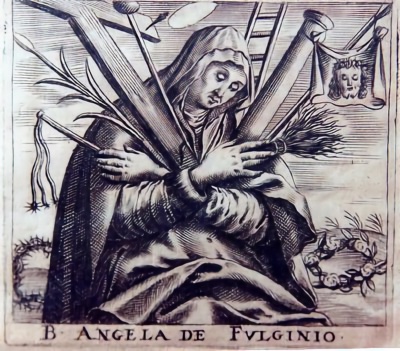
Angela of Foligno is not the subject of a rich medieval iconographic tradition; there is no securely attributed contemporary portrait, and her surviving imagery is overwhelmingly early-modern devotional art tied to the Foligno cult. Attributions below are graded for reliability.
Angela’s relics are venerated in the Church of San Francesco in Foligno (Piazza San Francesco), the Franciscan church adjacent to which she lived and worshipped; the complex incorporated the older church of San Matteo. Her body — described in the devotional tradition as incorrupt — was long kept in a wooden reliquary and, in the twentieth century, transferred to a glass reliquary/urn displayed on the second altar on the left of the nave. The sixteenth-century wooden reliquary-simulacrum (simulacro-reliquiario ligneo) of the Blessed Angela is preserved in the sacristy. After the 2016 central-Italy earthquake, the church was closed for repair and the relics of Angela (together with those of the Blessed James and Philip of Bevagna and the Blessed Angelina of Montegiove, also venerated there) were temporarily transferred to the adjacent Oratorio del Gonfalone.
The most important artwork directly associated with her cult is the altarpiece over her altar: a “Vision of Blessed Angela of Foligno” (c. 1791) by Gaetano Gandolfi (1734–1802) of Bologna, commissioned by Bishop Filippo Trenta and since restored.
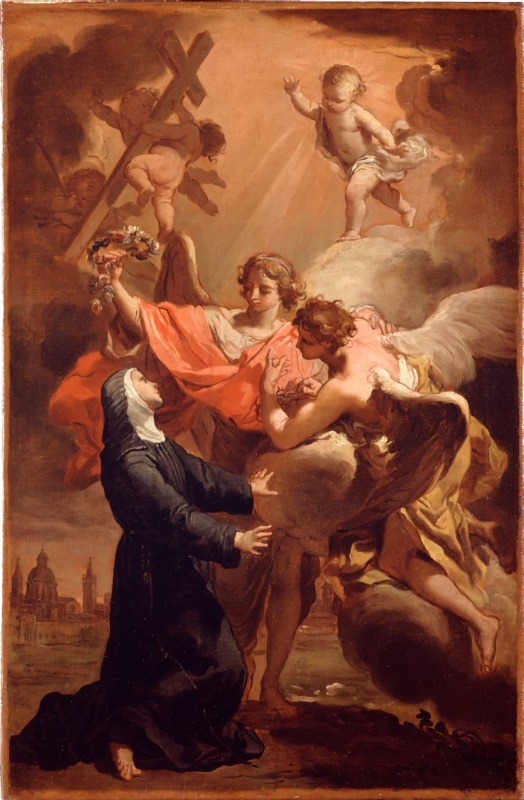
This small-format work served as a design for an altarpiece in the Church of San Francesco in Foligno, which is shown in the background. Gandolfi worked primarily in Bologna and Emilia-Romagna and is considered one of the last representatives of late Baroque painting in northern Italy. Although this work is still dominated by a dynamic Baroque visual language, some elements, such as the statuesque angel with a wreath of flowers, already foreshadow the emerging Neoclassicism.
The church also holds a wooden Crucifixion group (1697) by the Foligno sculptor Antonio Calcioni and, in the adjoining San Matteo chapel, “the most conspicuous group of early-Trecento paintings existing in the city” (Giordana Benazzi) — frescoes not depicting Angela but contemporary with her milieu and thus of art-historical interest for her Umbrian Trecento context.
Conclusion
Angela of Foligno presents, in acute form, the central paradox of medieval women’s religious history: a figure of towering later influence whose documented life amounts to almost nothing beyond the text attributed to her. Evelyn Underhill’s judgment that she was the most consequential Franciscan after Bonaventure, and McGinn’s verdict that her Book is “the premier text of all Franciscan women mystics,” sit uneasily alongside the New Catholic Encyclopedia’s blunt admission that virtually everything known about her must be “deduced or inferred” from that same Book. This biography has tried to hold both truths at once, tracing the itinerary that generations of readers have found so compelling while flagging, at every turn, where inference shades into conjecture and where hagiographic convention has hardened into supposed fact. The result is necessarily a life told twice — once as narrative, once as an audit of the narrative’s evidentiary foundations — and the two tellings cannot be collapsed into one without doing violence to the historical record.
The biographical arc itself — the comfortable Folignate marriage, the “mortally sinful” years whose content is unrecoverable, the conversion around 1285, the successive deaths of mother, husband, and sons “read as liberation,” the Assisi pilgrimage and its shattering “Amor non cognitus,” the gathering of spiritual sons and daughters, the death in 1309 — is coherent and psychologically compelling. It is also, as Jacques Dalarun and Mario Sensi have separately insisted, a chronology built almost entirely on a single source read against itself, its firmest date (Ferré’s 1925 placement of the conversion in 1285) resting on inference that neither scholar found secure. The lesson is not that the life should be discarded as unknowable, but that its individual episodes carry different evidentiary weights, and that a responsible account must say so explicitly rather than smoothing the whole into uniform certainty.
At the heart of the textual problem stands “Brother A.,” the anonymous Franciscan scribe whose Latin gives Angela’s Umbrian speech the only form in which it survives. The debate staked out by Catherine M. Mooney, John W. Coakley, and Giovanni Pozzi — over how much of the Memoriale’s shape, theology, and even syntax belongs to the confessor rather than the penitent — is not a peripheral philological quibble but the single question on which every other claim about Angela’s thought ultimately depends. Dalarun’s provocative 1995 title, “Angèle de Foligno a-t-elle existé?,” pressed this to its limit, and though he himself called it a boutade, the round table and dossier it produced in 1999 permanently changed how the text is read: not as a transparent window onto a woman’s interior life, but as the product of a collaboration whose exact division of labor cannot be fully recovered. Attempts to name the scribe himself — Sensi’s tentative identification with Berardo Arnolti chief among them — remain, by their proposers’ own admission, hypotheses rather than findings.
Despite this irreducible mediation, the theological content that emerges from the Liber is distinctive enough to have earned Angela a permanent place among the architects of late-medieval mysticism. Her Christocentric itinerary of conformitas with the crucified Christ, her vocabulary of the abyss and of annihilation, and above all her apophatic Trinitarianism — the vision of God as a darkness “greater than can be thought” — situate her, in McGinn’s framing, alongside Mechthild of Hackeborn and Marguerite Porete as one of three women mystics of the 1290s who pushed the language of union to its breaking point. Whatever the scribe’s shaping hand contributed to the text’s final form, the theological ambition it records — an ascent that refuses the tidy Bonaventurean ladder in favor of a turbulent spiral through consolation, “vexing pride,” and a genuinely horrific dark night — reads as too idiosyncratic, too resistant to conventional hagiographic smoothing, to be the scribe’s invention alone.
The afterlife of the Liber was, for centuries, more vigorous abroad than at home: its wider circulation among French religious and Spanish Franciscans, well before any formal papal recognition, meant that Angela’s reputation as Theologorum Magistra — a title coined by Maximilian Sandaeus and canonized by inclusion in the Acta Sanctorum — preceded rather than followed institutional sanction. The documented sequence of ecclesiastical acts (Clement XI’s concession of the Office in 1701, Clement XIII’s concession of the Mass in 1766) is considerably thinner and later than the popular literature’s confident but internally inconsistent talk of an Innocent XII confirmation in the 1690s, a reminder that even the history of her cult requires the same source-critical discipline as the history of her life.
The twentieth- and twenty-first-century rehabilitation that culminated in her 2013 equipollent canonization was driven less by newly adjudicated miracles than by a sustained papal and scholarly rereading of the Liber itself: John Paul II’s use of her texts at the 1983 Colosseum Via Crucis and his 1993 visit to Foligno, Benedict XVI’s 2010 catechesis and his subsequent authorization of the canonization process, and finally Pope Francis’s 2013 ratification, which explicitly recognized “the validity of the long-standing veneration of her” rather than resting on new proof of the miraculous. That Francis returned to her in Dilexit nos in 2024, grouping her among “holy women” who rested in the heart of the Lord, suggests that her theological voice, mediated as it is, continues to be read as her own by the Church that has come to venerate her as a saint.
Angela of Foligno therefore stands, finally, less as a settled biographical subject than as a case study in how medieval women’s spiritual authority was produced, transmitted, and only much later scrutinized. The near-absence of a contemporary iconographic tradition, the modesty of the Assisi manuscript that preserves her words, and the persistence of unresolved questions about redaction, dating, and even the scribe’s name are not failures of the record but honest markers of its limits. What the sources do secure — a rigorous itinerary of Passion-centered mysticism, an apophatic vision of the Trinity as luminous darkness, and a documented, if belated, ecclesiastical recognition — is more than sufficient to explain why Underhill, McGinn, and successive popes have judged her among the most important religious voices the Franciscan movement produced, and why the labor of separating “the woman from the book attributed to her,” in the phrase that opened this account, remains very much unfinished scholarly work.