Codex Aureus of Lorsch (Lorsch Gospels)
( 25% )
Introduction and Historiographical Framing
Few objects of the early Middle Ages embody so completely the ambitions, contradictions and afterlife of a whole civilisation as the Codex Aureus of Lorsch. Produced about 810 in the court scriptorium of Charlemagne1 and celebrated for twelve centuries as one of the supreme achievements of Carolingian book art, the manuscript now exists as a body dismembered: the first textual half, containing the prefatory matter, canon tables and the Gospels of Matthew and Mark, rests at Alba Iulia in Transylvania (Biblioteca Documentară Batthyáneum, Ms. R II 1); the second half, with Luke, John and the capitulare evangeliorum, is in the Vatican (Biblioteca Apostolica Vaticana, Pal. lat. 50); the ivory carving that once formed the front cover is in London (Victoria and Albert Museum, 138-1866); and the ivory of the back cover remains in the Vatican (Museo Sacro, kept under the shelfmark Pal. lat. 50). A single work of art, conceived as a unity of text, image and sculpted binding, is today distributed across four collections in three countries and two ecclesiastical jurisdictions.
This essay treats the Codex Aureus as simultaneously a material object, an argument about empire, and a contested piece of European heritage. The scholarly literature on the manuscript is overwhelmingly German, and it has three principal strata. The first is the classificatory art history of the earlier twentieth century, above all Wilhelm Koehler’s monumental corpus of Carolingian miniatures, whose second volume (Die karolingischen Miniaturen II: Die Hofschule Karls des Großen, 1958) fixed the very category “Court School of Charlemagne” and placed the Lorsch Gospels as the last and most mature product of the group.
The second stratum is the palaeographical and codicological research of Bernhard Bischoff on the abbey of Lorsch, its scriptorium and its library catalogues, above all his Die Abtei Lorsch im Spiegel ihrer Handschriften (2nd ed., 1989), which anchored the manuscript in a documented institutional history. The third is the modern synthesis assembled around the 2000 facsimile commentary edited by Hermann Schefers and the Trier conference of October 2018, in which Hermann Fillitz gave the ivories their fullest recent treatment and Adrian Papahagi offered the most searching account of the manuscript’s place within the “Ada group” and of the theological logic that governs its programme.
To these must be added the physical and archival scholarship of Charles Rufus Morey, whose two studies in Speculum (1928 and 1929, the first with Margaret Longhurst) and catalogue of the Museo Sacro ivories (1936) established the fundamental facts about the two covers. These five — Koehler, Bischoff, Morey, Fillitz and Papahagi — will serve as the essay’s principal interlocutors.
Lorsch Abbey, Its Library, and the Carolingian Educational Project
The abbey of Lorsch, on the plain between the Rhine and the Odenwald near Worms, was founded in 764 by the Frankish count Cancor and his mother Williswinda, with the involvement of Chrodegang of Metz. In 765 it received from Italy the relics of the martyr St Nazarius, whose patronage it thereafter bore; the community moved to its permanent site and the church was consecrated in the following years. In 772 the monastery was transferred to Charlemagne, becoming a royal abbey (Reichskloster) and, in the words of the Heidelberg project that has reconstructed its library, “a central economic and administrative base in the Carolingian dominion on the Middle and Upper Rhine.” It remained an imperial abbey until 1232, when it passed to the archbishopric of Mainz.
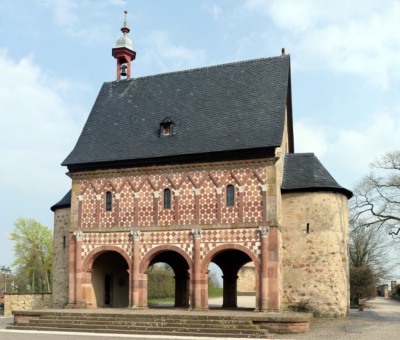
The decisive moment for the history of books at Lorsch came under its fourth abbot, Richbod (784–804), a member of the circle of Alcuin1 who was trained at Charlemagne’s court and who between 791 and 793 also held the archbishopric of Trier. Richbod built up the scriptorium and, with it, a school and a library; his successor Adalung (804–837) — who from 808 was simultaneously abbot of Saint-Vaast at Arras — expanded the collection still further, before growth tailed off under Abbot Samuel (837–856). According to the four surviving library catalogues (Vatican, BAV, Pal. lat. 1877, and Pal. lat. 57), compiled between about 830 and 860, roughly five hundred codices had been gathered at Lorsch by the middle of the ninth century. The library held treasures of late antiquity, including the fifth- or sixth-century “Vergilius Palatinus” (Pal. lat. 1631) and a palimpsest (Pal. lat. 24) whose lower script reaches back to the fourth century, and it preserved unique texts such as books 41–45 of Livy (now Vienna, ÖNB, Cod. 15).
The abbey’s fortunes and the scattering of its books map the whole later history of the region. After a second flowering in the eleventh century under Abbot Udalrich (1056–1075), decline set in; manuscripts were carried off to Eberbach and Arnstein, and the library was ultimately absorbed, under the Elector Palatine Ottheinrich (1556–1559), into the Bibliotheca Palatina at Heidelberg. When Heidelberg fell in 1622, the Palatina was given to the papacy and transferred to Rome.
The reconstruction of the dispersed Lorsch library is itself one of the achievements of modern scholarship: as the Heidelberg University Library’s project “Bibliotheca Laureshamensis – digital” states, “more than 300 medieval manuscripts have survived and today they are spread over 73 libraries worldwide,” the largest single contingent — “with 130 manuscripts, and manuscript fragments … in the Palatina-Fonds of the Biblioteca Apostolica Vaticana.” Much of this reconstruction rests on the palaeographical work of Bernhard Bischoff, who divided the first century of the Lorsch scriptorium into an “older Lorsch style” (developed between 781/83 and shortly after 800, showing strong Anglo-Saxon influence and affinities with the court and Metz), a brief “transitional style,” a “Saint-Vaast style” associated with Adalung’s Arras connection, and a “younger Lorsch style” that emerged under Adalung, possibly after 820, and endured to the end of the ninth century.
Within this institutional matrix the Codex Aureus occupies a peculiar position: it was almost certainly not made at Lorsch, but for or given to Lorsch. It stands at the head of the abbey’s most comprehensive catalogue as a supreme possession, yet, as will be seen, its script was to become a model for the reform of the Lorsch hand itself. It is therefore both an import from the court and a formative presence in the abbey’s own scribal culture — a fact that has shaped the debate over its date.
The Court School: Attribution, Dating and the “Ada” Problem
The Lorsch Gospels belongs to a small and famous group of luxury liturgical books produced at Charlemagne’s court over roughly three decades. The group has traditionally been called the “Ada group,” a name derived from the dedicatory poem of the Ada Gospels (Trier, Stadtbibliothek, Hs. 22), addressed to a certain Ada, ancilla Dei (“Ada, handmaid of God”). The more accurate designation “Court School of Charlemagne” (Hofschule Karls des Großen) was established by Wilhelm Koehler, who argued that the manuscripts were made in the ambit of the ruler; the connection to Charlemagne is secured by the dedicatory verses of the Godescalc Evangelistary and the Dagulf Psalter, which name the king. The workshop is generally located at the palace of Aachen, where Charlemagne resided from 794, and is thought to have been the scriptorium of the imperial chapel.
The sequence of the group, as reconstructed by Koehler and refined by later scholarship, runs approximately: the Godescalc Evangelistary (Paris, BnF, nouv. acq. lat. 1203, c. 781–783); the Arsenal or Saint-Martin-des-Champs Gospels (Paris, Bibliothèque de l’Arsenal, Ms. 599, before 790); the first campaign of the Ada Gospels (Trier, Hs. 22, fols. 6r–38v, c. 791–795); the Dagulf Psalter (Vienna, ÖNB, Cod. 1861, before 795); a small Gospel fragment (London, BL, Cotton Claudius B. V, c. 800); the Centula or Saint-Riquier Gospels (Abbeville, Bibliothèque municipale, Ms. 4, shortly before 800); the Harley Gospels (London, BL, Harley 2788, last decade of the eighth century); the Saint-Médard Gospels of Soissons (Paris, BnF, lat. 8850, of the same decade); the second campaign of the Ada Gospels (Trier, Hs. 22, fols. 39r–171r, before 810); and, finally, the Lorsch Gospels. Adrian Papahagi has characterised the Lorsch Gospels as “the last product of the so-called ‘Ada Group’,” made after the entire textual, palaeographical and artistic tradition of the group had accumulated over the previous three decades.
The dating is not entirely settled. The consensus, which this essay follows, places the manuscript about 810, and in any case before Charlemagne’s death in 814; a great many authorities converge on this bracket, and Romanian sources often cite “between 805 and 810.” A minority position pushes the book, or at least its capitulare and covers, into the 820s and the reign of Louis the Pious. The late-dating argument rests on an observation of Bernhard Bischoff: that the Caroline minuscule of the capitulare evangeliorum in the Lorsch Gospels was the model for five manuscripts copied at Lorsch, one of which — now the J. Paul Getty Museum’s Ludwig MS II.1 (olim Phillipps 3015) — was written for Folcwith, bishop of Worms, who entered office in 825 or 826.
Bischoff concluded that “either the scribe who reformed handwriting at Lorsch came from the court or the Capitulare was added to the sumptuous Gospels at Lorsch.” Peter Harbison extended this to a wholesale late dating of the manuscript and its ivories. Papahagi, following the arguments assembled by Schefers in the 2000 commentary, rejects the extension: the capitulare begins on folio 116, which is not the start of a new quire but belongs to the central bifolium of a quire containing the end of John, so it cannot be a physically separable later addition; and it would be perverse for a book whose Gospel readings are so carefully marked to lack the capitulare on which those markings depend. The better reading is that the whole book, capitulare included, is a unitary product of the court about 810, and that either its scribe subsequently moved to Lorsch or a Lorsch scribe imitated its minuscule once the book had arrived. The outer bracket sometimes quoted in the reference literature is c. 778–820.
The attribution to the court, rather than to Lorsch or another centre, is not absolutely demonstrable — no colophon names the place, and Aachen, Fulda, Lorsch and (for the Godescalc book) Worms have all at various times been proposed for members of the group — but the stylistic, palaeographical and textual continuity of the Lorsch Gospels with the rest of the group is decisive. The Lorsch Gospels is the culmination of a tradition, not a provincial echo of it.
The Book as Material Object: Codicology, Script, Chrysography, Purple
In its original state the Codex Aureus was a single large volume of the four Gospels with the usual apparatus: the prefatory letters and prologues of Jerome and Eusebius (the Novum opus letter to Damasus, the Plures fuisse prologue, the letter of Eusebius to Carpianus and the Sciendum etiam), twelve canon tables, four evangelist prefaces (argumenta), the Gospel text itself in a good Vulgate recension, and the capitulare evangeliorum or list of liturgical readings.
The manuscript measures about 37.4 × 27 cm (the facsimile trade cites 37.4 × 27.1 cm), with a written area of about 27 × 17.5 cm. It was written on the finest bright calf parchment (vellum), in two columns of thirty-one lines. The reference literature — including the German Wikipedia summary that follows the standard authorities — states that the book originally comprised 474 pages, though some English-language sources give 478 and the Lucerne facsimile reproduces 473; the discrepancy reflects different ways of counting and the losses and rebindings the book has suffered.
The script is a hierarchy of forms. The main Gospel text is written throughout in gold uncial — an entirely chrysographic text, letter by letter in gold ink, one of the features that gives the book its name (codex aureus, “golden book”). Display pages and rubrics are in capitalis (square capitals), while the capitulare evangeliorum is set off in Carolingian minuscule. The uncial of the Lorsch Gospels is notable for being less mannered than that of some other Court School books, whose scribes cultivated exaggerated serifs, curls and forked finials (Rosamond McKitterick’s “holiday look”); it is closer to the restrained uncial of the roughly contemporary Coronation Gospels of Vienna (Kunsthistorisches Museum, Schatzkammer), the product of a different court workshop.
The number of individual hands has never been fixed with precision in the published literature; the manuscript is generally said to be the work of several scribes and painters, and there is codicological evidence — the portraits of Matthew (fol. 13v) and Mark (fol. 74v) are each painted on single leaves pasted at the beginning of a quire — that some of the miniatures were executed separately from the text quires and inserted.
Every text page is framed by a distinct border of foliate ornament; no frame repeats, a deliberate display of inexhaustible invention noted already by Koehler, who observed that the framing of the Matthew opening corresponds almost exactly, in mirror image, to that of the facing page. Several display pages are written in purple on a gold ground, and the book contains two full purple pages at the opening of Matthew. Gold and silver are used lavishly not only in the text but in the miniatures.
No dedicated scientific analysis of the pigments and dyes of the Lorsch Gospels appears to have been published, which is a real gap: what passes as “purple” in the reference literature is nowhere chemically identified for this manuscript. By analogy with the securely analysed Dagulf Psalter — a sibling Court School book in Vienna, on which non-invasive analysis (Aceto and colleagues) identified organic dye-based purples of the folium and orchil type together with a dark blue — it is likely that the Lorsch “purple” is likewise an organic lake rather than true murex-derived Tyrian purple, but this remains an inference, not a measurement.
The two halves as they survive today divide the text at the join between Mark and Luke. The Alba Iulia volume (Ms. R II 1) contains the prefatory matter, the canon tables and Matthew and Mark; the Vatican volume (Pal. lat. 50) contains Luke, John and the capitulare, the last occupying folios 116r–124v. The Vatican part is described in the German literature as comprising 124 pages; precise, mutually consistent folio and quire counts for each half are, however, surprisingly hard to extract from the published descriptions, in part because the Alba Iulia volume carries an old pagination that coexists in the literature with modern foliation, producing apparent contradictions (the same canon-table and Maiestas openings are cited by some authorities as “pages 13–15, 18–19” and by others as folios). This is an area where the state of the question is genuinely unsatisfactory, and where the Heidelberg digital reunification, discussed below, now allows verification leaf by leaf.
The Pictorial Programme: Canon Tables, Evangelists, Maiestas Domini
The painted decoration comprises the twelve canon tables, four full-page evangelist portraits, a full-page Maiestas Domini, a Generationes Christi page, and a series of sumptuous incipit and display pages, including the two purple pages of Matthew. The canon tables — the concordance of parallel Gospel passages devised by Eusebius of Caesarea — are set within architectural arcades of columns and arches, in the manner inherited from late antique and Byzantine models and developed across the Court School; Albert Boeckler’s study of the Ada-group canon arcades and their models (1954) remains the classic treatment.
In the related Harley and Soissons Gospels the tympana of the canon arcades are “inhabited” by the symbols of the four evangelists and by other icons; the Lorsch canon tables share with those books the motif of tabulae ansatae and open books bearing the inscription of the relevant canon, held by angels or the living creatures beneath the vaults. The Court School canon arcades are also famous for the naturalistic birds and animals in their spandrels — the strutting heron of the Lorsch codex is a locus classicus of the type, cited in the Reallexikon zur Deutschen Kunstgeschichte alongside the fighting cocks of the Soissons Gospels as evidence of the survival of antique illusionism.
Saint Luke the Evangelist with His Symbol, the Winged Ox
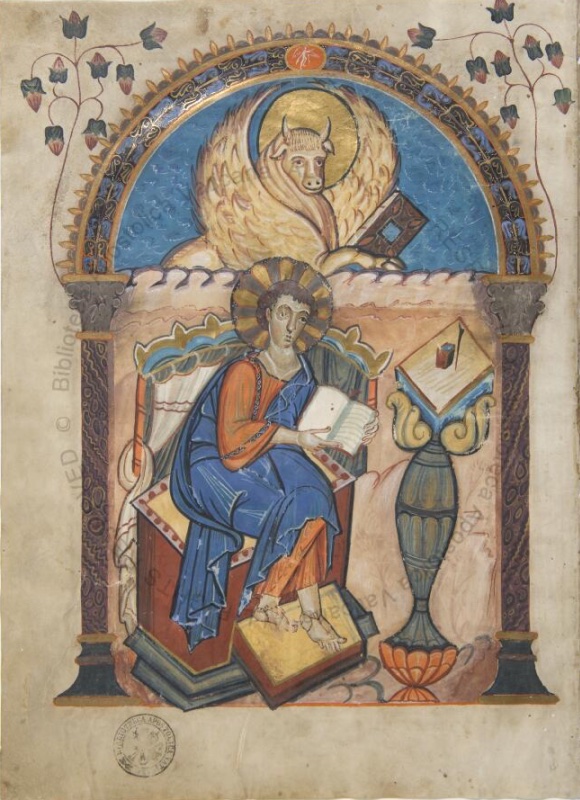
The full-page evangelist portrait that opens the Vatican portion of the Lorsch Gospels presents Saint Luke enthroned beneath a monumental round arch, in a composition that divides the page into two superimposed realms. In the lunette above, the evangelist’s apocalyptic symbol — the winged ox — hovers against a deep blue ground streaked with white, its wings spread in a great tawny fan of feathers. The creature is nimbed in burnished gold and clasps a jewelled codex between its forelegs, a visual assertion that the beast itself is a bearer of the Gospel. The arch that frames it is edged with a dark band of interlace and gemmed ornament, and at its apex an orange-red medallion encloses a golden foliate motif; from the spandrels spring slender vine scrolls bearing leaves and pendant buds, animating the upper margins of the page.
Below, separated from the celestial zone by a parapet crested with white acanthus, Luke sits on a cushioned throne draped with a swag of blue and white cloth. He is shown youthful and beardless, his head encircled by a radiate halo of golden striations — a distinctive feature of the Lorsch evangelists. Clad in a blue pallium over an orange tunic, he turns slightly toward the viewer while supporting an open book with both hands, its pages inclined as if inviting the reader into the text that follows. His bare feet rest on a golden footstool. To his right stands an elegant baluster-shaped lectern rising from a foliate cup of orange leaves, its double-sloped desk surmounted by a small vessel for ink: the instruments of the evangelist’s labour rendered as precious furniture.
The painterly modelling of the drapery, the atmospheric rose and ochre washes of the ground, and the classicising architecture betray the Court School’s close study of late antique and Byzantine models, mediated here into the sumptuous idiom of the manuscript’s golden script. The portrait inaugurates the Gospel of Luke in the second volume of the codex, whose first half (Matthew and Mark) is today preserved in the Batthyaneum Library at Alba Iulia.
Incipit of the Argumentum to the Gospel of Luke
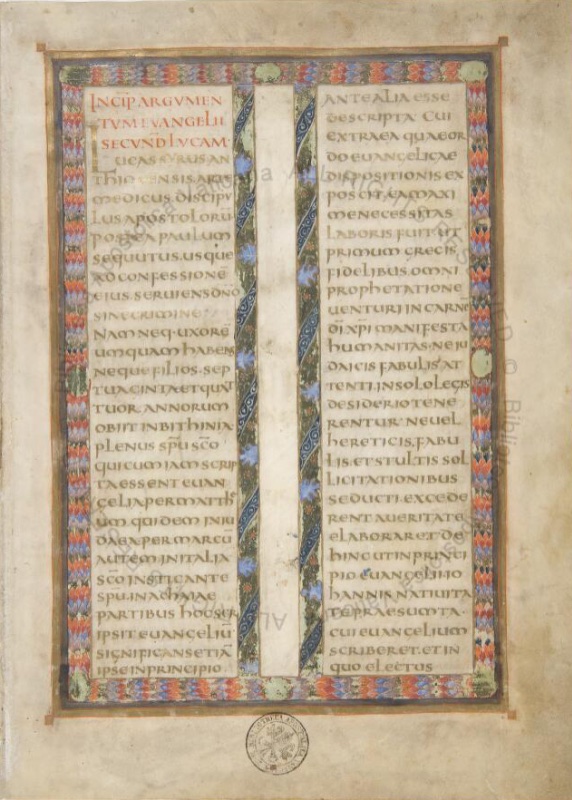
Facing the portrait of Luke across the opening, this page demonstrates that in the Lorsch Gospels the written word itself was conceived as an object of splendour. The entire folio is treated as an ornamental field: a rectangular frame of densely packed polychrome bands — imbricated palmette and feather motifs in vermilion, blue, green and gold, punctuated at the corners and midpoints by pale green medallions — encloses two columns of text, which are in turn divided by vertical bars of foliate ornament sprinkled with small blue blossoms. The effect is that of a precious textile or a leaf of enamelled metalwork, an aesthetic wholly consonant with the goldsmith’s sensibility that pervades the manuscript.
The text is written throughout in gold uncial, the chrysography from which the codex takes its name, laid directly onto the unstained parchment so that the letters glimmer against the warm tone of the vellum. The opening rubric, set off in red-orange capitals
INCIPIT ARGUMENTUM EVANGELII SECUNDUM LUCAM
introduces not the Gospel itself but its ancient preface: the so-called Monarchian prologue, which begins
Lucas Syrus Antiochensis, arte medicus, discipulus apostolorum,
presenting Luke as a Syrian of Antioch, a physician by profession and disciple of the apostles who later followed Paul, and rehearsing the traditions of his celibate life, his death in Bithynia at seventy-four, and the circumstances under which he wrote after Matthew and Mark. An enlarged gold initial L marks the beginning of the prologue proper.
Pages such as this reveal the deliberate rhythm of the codex, in which framed prefatory texts, full-page portraits and monumental incipits succeed one another in a graduated crescendo of ornament leading into each Gospel. The uncial script, consciously archaising in the ninth century, aligns the book with the authority of late antique models — the same models that inform the illusionism of the evangelist portraits — and proclaims the Carolingian court’s ambition to renew the Christian Roman past in material form.
Saint John the Evangelist with His Symbol, the Eagle
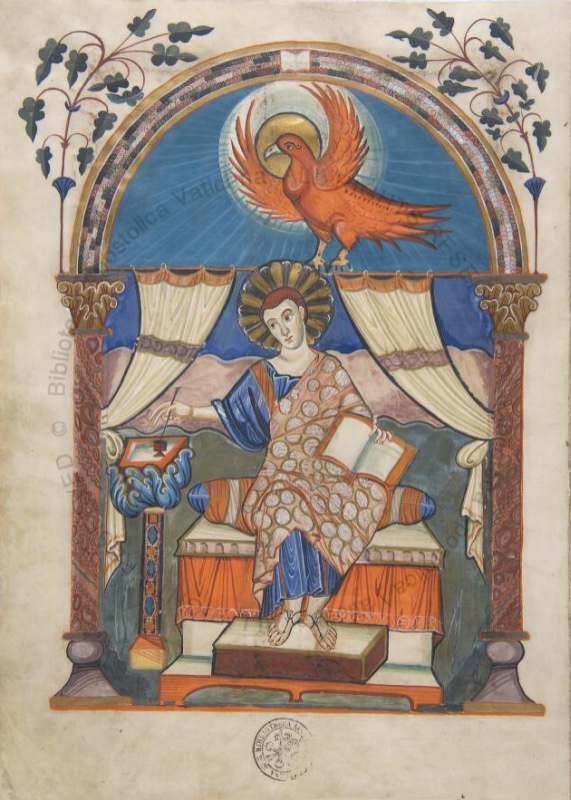
The portrait of Saint John, prefacing the fourth Gospel, is the counterpart to the Luke page and the more theatrical of the two Vatican miniatures. Within the lunette, the eagle of the Apocalypse descends with wings flung wide, its vermilion plumage set against a blue field from which white rays stream outward in all directions — a luminous burst that transforms the upper zone into an epiphany of divine inspiration rather than a mere heraldic display of the evangelist’s symbol. The bird’s head, ringed by a golden nimbus, bends sharply downward toward the writer below, and its talons come to rest almost upon the crown of his radiate halo, so that celestial messenger and human author are joined in a single vertical axis. The framing arch is built up of polychrome bands imitating mosaic or inlaid stone, and from its haunches spring ivy scrolls punctuated by blue palmette blossoms, spreading into the upper corners of the page.
The earthly zone is staged as a chamber revealed: knotted curtains, suspended from rods between marbled columns with gilt foliate capitals, are drawn back to either side to disclose the evangelist at work. John sits frontally on a throne heaped with orange bolsters and draped cloths, clad in a blue tunic beneath a sumptuous gold mantle patterned with dark roundels — the painter’s evocation of a figured silk, and among the most striking renderings of precious textile in Carolingian illumination. His head, youthful and beardless, is framed by the striated radiate halo characteristic of the Lorsch evangelists.
The miniature captures him in the very act of composition: with his right hand he reaches across to dip his pen into the inkstand that rests on a stand at his left, a blue acanthus cup borne on a slender jewelled colonnette, while his left arm steadies the open codex propped against his knee. His bare feet rest on a casket-like footstool set upon a stepped dais, and behind the throne a range of soft mauve and rose washes suggests a receding, atmospheric distance.
Even more than the Luke portrait, this page displays the Court School’s assimilation of late antique illusionism — the painterly flesh, the plausible still-life of writing implements, the space-creating curtains — harnessed to a hieratic frontal scheme of thoroughly medieval solemnity. It is the last of the great figural pages of the codex before the incipit of John’s Gospel.
Incipit of the Argumentum to the Gospel of John
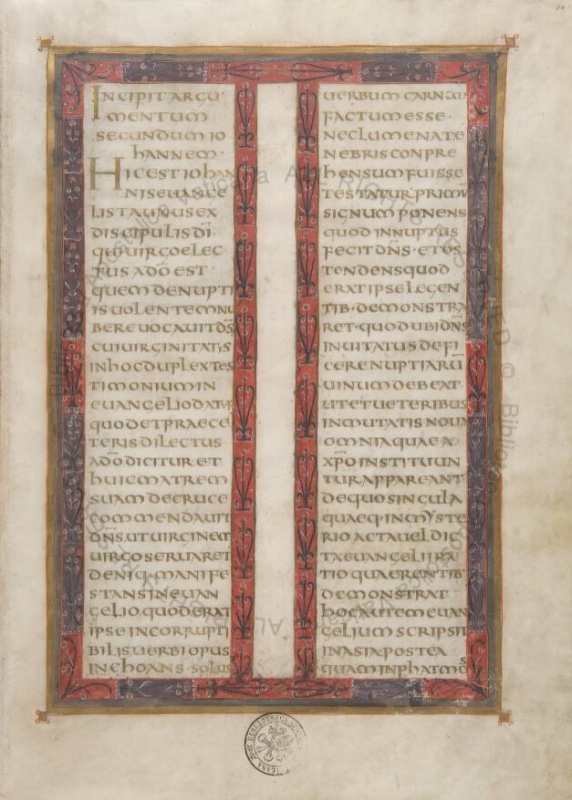
The recto facing the portrait of John completes the second of the two great openings preserved in the Vatican volume, and answers the evangelist’s image with a page of pure calligraphic splendour. As on the corresponding leaf of Luke, the folio is conceived as a single ornamental object: a rectangular frame encloses two columns of text separated by a broad central bar, but the decorative vocabulary is deliberately varied. Here the bands are grounded in vermilion and dusky purple, and along their length march rows of dark, stylised candelabra-trees — slender stems sprouting paired volutes and budding tips, evoking at once acanthus candelabra of Roman ornament and abstracted trees of life. Small clasps of contrasting colour articulate the corners and midpoints, and delicate gold finials sprout from the frame’s outer edges. Set beside the palmette borders of fol. 1r, the page shows the Court School’s ornamental repertoire being deployed in calculated alternation, so that no two prefatory frames in the codex read identically.
The text, again in the gold uncial that gives the manuscript its name, opens with the rubric
INCIPIT ARGUMENTUM SECUNDUM IOHANNEM,
followed by an enlarged initial H introducing the Monarchian prologue to the fourth Gospel:
Hic est Iohannes evangelista unus ex discipulis Dei
“This is John the evangelist, one of the disciples of God, who was chosen by God as a virgin.”
The preface rehearses the themes that shaped the medieval image of John: his virginity, doubly attested when Christ called him from his wedding and entrusted the Virgin Mother to him from the Cross; the miracle at Cana, in which water turned to wine signals the old order transformed into the new; and the incorruptible “Word made flesh” — Verbum caro factum — that opens his Gospel, the light shining uncomprehended in the darkness. The prologue closes by noting that John wrote his Gospel in Asia, after the Apocalypse composed on Patmos.
Read together with the eagle page opposite, the opening enacts a progression from vision to word: the descending symbol of inspiration on the verso, and on the recto the golden letters in which that inspiration was believed to have been fixed for the Church.
The Golden Incipit of the Gospel of John
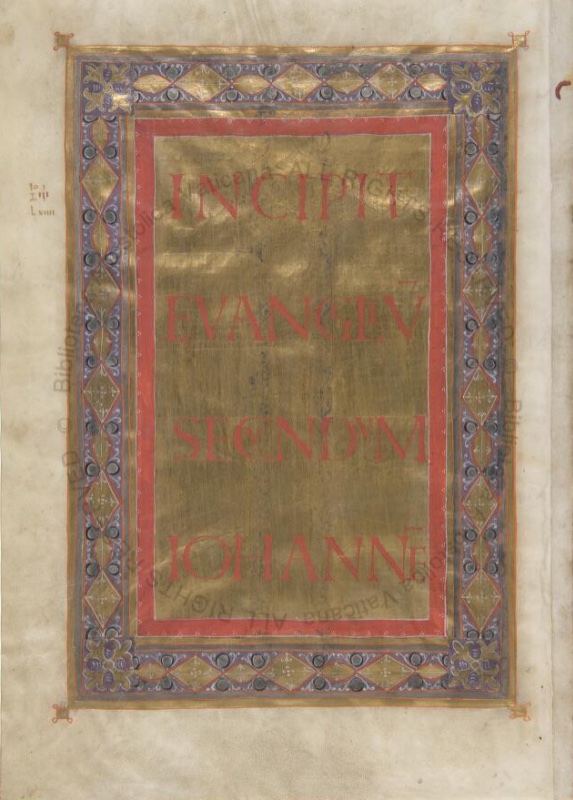
With this opening the codex reaches the climax of its decorative programme for the fourth Gospel: two facing pages on which ornament and script fuse into a single act of veneration. Both folios are conceived on the same principle — a field of burnished gold leaf, framed in vermilion and enclosed by broad ornamental borders, carrying nothing but monumental letters — so that the opening confronts the reader like a pair of goldsmith’s plaques, or the twin faces of a reliquary laid open on the altar.
On the verso, the announcement:
INCIPIT EVANGELIUM SECUNDUM IOHANNEM,
disposed in four widely spaced lines of red-orange capitals across the gold ground. The lettering is a stately Roman capital, consciously epigraphic in spirit, its forms recalling the inscriptions of imperial monuments rather than the book scripts of the period; abbreviation strokes and the small superscript letters are handled with the same lapidary poise. The frame is among the richest in the manuscript: an inner band of gold lozenges set on purple-grey ground and studded with dark bosses like cabochon gems, an outer band of gold interlace and diapered panels, and at the four corners great splayed acanthus rosettes in gold and lavender. Fine gold hasps project beyond the frame at the corners, strengthening the impression that the page reproduces, in paint, an actual object of precious metalwork.
Openings such as this stand behind the entire tradition of the medieval incipit page, and in the Lorsch Gospels they articulate the book’s deepest ambition: to make the Gospel text itself the treasure that its ivory covers and golden script proclaim it to be.
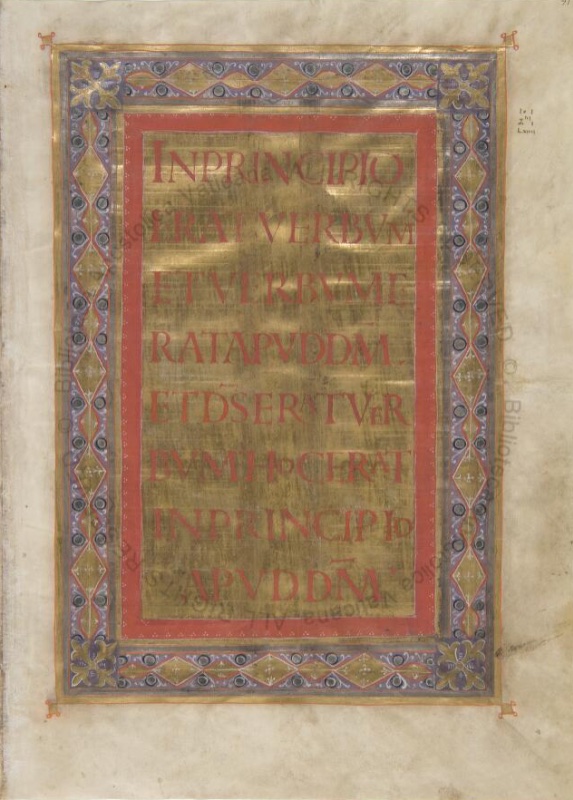
The recto answers with the opening words of the Gospel itself, the passage that medieval exegesis prized above all others:
IN PRINCIPIO ERAT VERBUM ET VERBUM ERAT APUD D(EU)M ET D(EU)S ERAT VERBUM. HOC ERAT IN PRINCIPIO APUD D(EU)M
“In the beginning was the Word, and the Word was with God, and God was the Word.”
Seven lines of red capitals, contracted with the nomina sacra, descend the golden field within a matching jewelled border. Here the theology of the page and its material realisation coincide perfectly: the eternal Word is not merely written but enshrined, gold made to serve as the visual equivalent of the uncreated light of which John’s prologue speaks. Where the body of the manuscript renders its text in gold letters on parchment, these pages invert the relationship — red letters swimming in a sea of gold — reserving the most extravagant use of the precious metal for the moment of the Gospel’s beginning.
Saint Matthew the Evangelist with His Symbol, the Winged Man
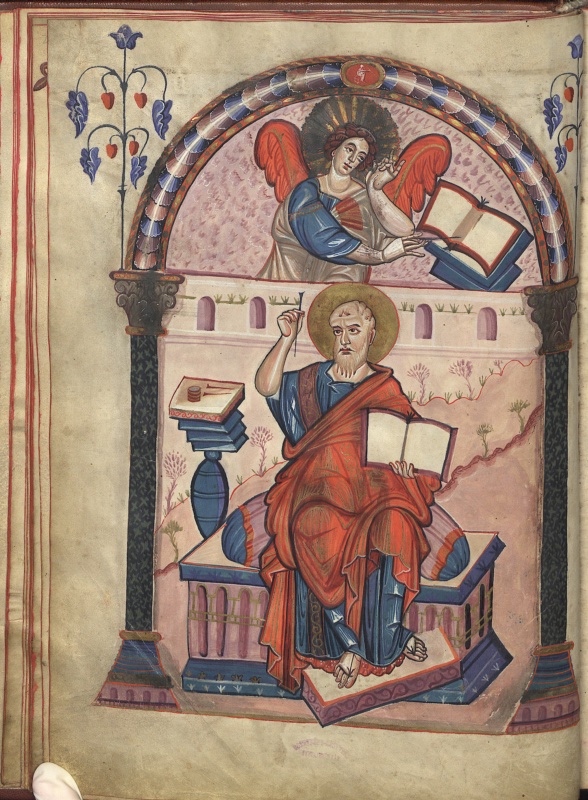
With this page the reunited series of the four Lorsch evangelists can be opened at its beginning: the portrait of Matthew, first of the great figural leaves of the codex, preserved in the Alba Iulia portion of the divided manuscript. The compositional scheme is the one that governs all four portraits — evangelist enthroned beneath an arch, his apocalyptic creature in the lunette above — yet the page has a character of its own, softer in palette and more painterly in touch than its Vatican companions, its rose, mauve and slate-blue harmonies evoking the faded frescoes of a late antique wall.
In the lunette, Matthew’s symbol appears not as beast but as angel: the winged man, his vermilion wings spread wide against a mottled pink ground, his head encircled by a dark radiate nimbus. He is caught in an act of remarkable narrative specificity — bending toward an open codex propped on a draped blue lectern, pen in hand, as though himself engaged in the writing he inspires. At the apex of the arch, whose archivolt is built of overlapping feather-like scales in alternating hues, a small red medallion encloses a diminutive seated figure with a staff or pen — a miniature within the miniature. Slender flowering stems, hung with blue bell-blossoms and red heart-shaped buds, rise through the outer margins in place of the vine scrolls of the later portraits.
Below, the evangelist sits on a cushioned bench-throne whose front is articulated by a delicate arcaded balustrade. Matthew alone of the Lorsch evangelists is shown aged and bearded, his balding brow and grave features lending him a patriarchal authority appropriate to the first Gospel; his head is set against a plain burnished gold nimbus. Clad in a blue tunic under a voluminous red-orange pallium whose folds are drawn with long, fluent strokes of darker red, he displays an open book on his left hand while his right rises beside his head, holding a slender pen aloft — a gesture poised between reflection and readiness, as if awaiting the angel’s dictation. At his left a baluster-stemmed stand supports a stack of blue tablets or books crowned by a writing-desk with an inkpot; behind the throne runs a pink arcaded precinct wall sprouting tufts of vegetation, and beyond it a hillside dotted with flowering shrubs recedes in bands of rose — one of the most atmospheric landscape passages in Carolingian painting.
The page thus establishes at the outset the codex’s governing theme: the Gospel as inspired dictation, angel and evangelist mirroring one another across the parapet, each with book and pen, the heavenly author above and the human one below.
Saint Mark the Evangelist with His Symbol, the Winged Lion
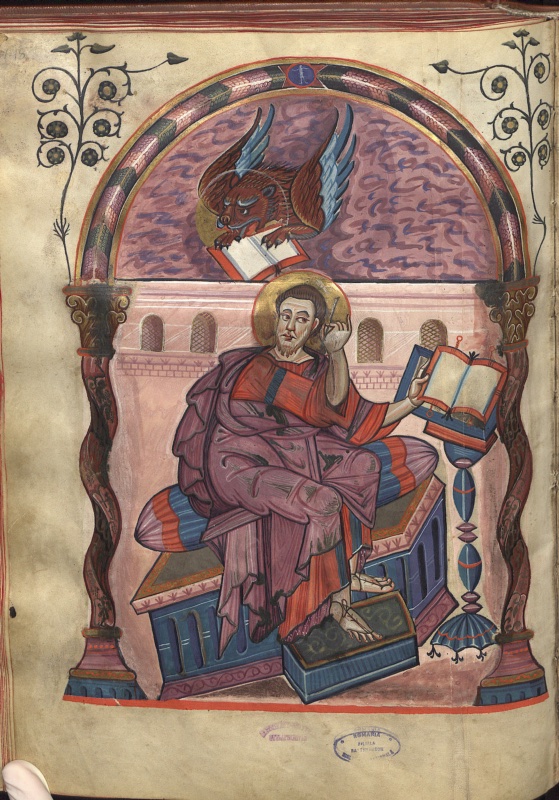
The portrait of Mark, prefacing the second Gospel in the Alba Iulia volume, is perhaps the most dramatically conceived of the four Lorsch evangelists — a page in which the moment of inspiration is rendered not as serene attendance but as urgent event. In the lunette, the winged lion plunges downward through a sky of deep violet streaked with restless blue and purple flourishes, its shaggy brown body foreshortened in flight, its blue wings beating behind it. Haloed in gold, the beast grips an open book in its forepaws and lowers its muzzle to it, as though roaring the Gospel into being: an image of the vox clamantis in deserto, the voice crying in the wilderness with which Mark’s text opens. At the apex of the feather-scaled archivolt a small blue medallion encloses a standing figure, continuing the series of enigmatic miniature busts and figures that crown each portrait’s arch, while spiralling stems with gold-centred rosettes climb the margins to either side.
The evangelist below responds to the apparition above with the most animated pose of the cycle. Seated on a blue box-throne heaped with striped bolsters, his body turns in a spiral: legs crossed toward the left, torso swinging back to the right, where his left hand steadies an open codex on a tall baluster lectern with a bell-shaped, tasselled base. His right hand rises to the level of his ear, pen held aloft — the ancient gesture of the scribe pausing to listen — and his bearded face, framed by a gold nimbus, lifts with parted attention as if straining to catch the lion’s voice.
He wears a red tunic marked with a blue clavus beneath a voluminous mauve-purple pallium, whose cascading folds, drawn with long serpentine strokes, animate the whole lower half of the page. His bare feet rest on a footstool covered with dark patterned cloth. Behind him runs the familiar pink precinct wall, here pierced by latticed arched windows and crested with tufted vegetation, and the framing columns are given a twisting, vine-wreathed form that echoes the torsion of the figure between them.
Where Matthew waits and Luke displays, Mark hearkens: the page translates into Carolingian terms the late antique iconography of the inspired author, and does so with a rhythmic energy — diving beast, spiralling scribe, corkscrew columns — that makes it the most kinetic invention of the Lorsch painter.
Maiestas Domini: Christ Enthroned amid the Four Living Creatures
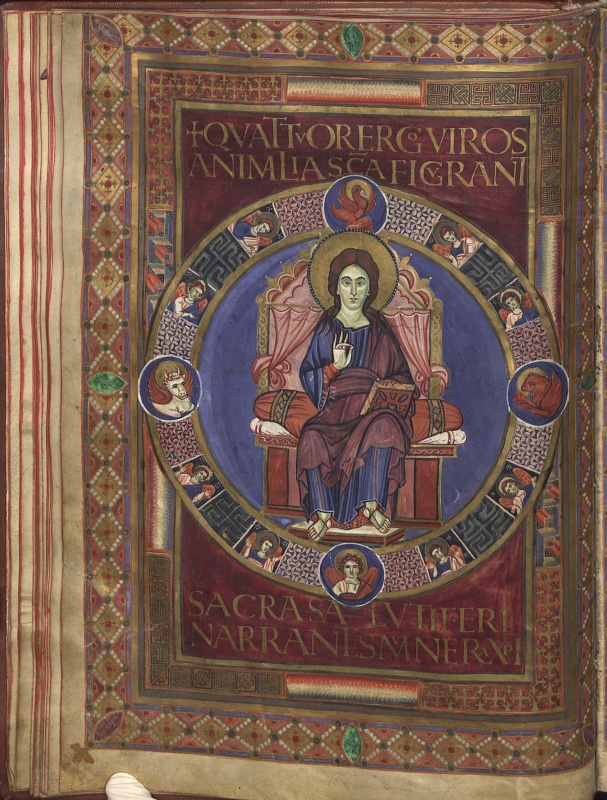
Set at the threshold of Matthew’s Gospel, the Maiestas Domini is the theological keystone of the entire codex: the one page on which the four witnesses of the evangelist portraits are gathered around their common source. It is also the most sumptuous painting in the Alba Iulia volume, conceived not as an architectural stage but as a cosmic diagram — circle within rectangle, the eternal enclosed by the ornamental splendour of the book itself.
The folio is bounded by a double frame of goldsmith’s character: an outer border of gold lozenges on red, studded at intervals with green and red cabochon-like stones, and an inner system of diapered bands and gold meander panels. Within lies a field of deep murex purple — the imperial ground par excellence — bearing a metrical titulus in monumental gold capitals, two lines above the circle and two below:
Quattuor ergo viros animalia sancta figurant / sacra salutiferi narrantes munera Christi
“The holy creatures thus figure the four men who narrate the sacred gifts of salvation-bearing Christ.”
Script, colour and image are here fused into a single exegetical statement: the verses explain the picture, and the picture enacts the verses.
The great circle is built of concentric rings. An outer wheel, patterned with a running curl motif in white, blue and red, is interrupted at the four cardinal points by blue medallions bearing the living creatures — the eagle above, the winged man below, the ox to the left and the lion to the right, the latter pair rendered as half-length busts emerging from their roundels. Between them, eight half-length angels lean inward from panels alternating with grey-green meander blocks, a celestial cohort encircling the throne and multiplying the Apocalyptic vision’s “living creatures round about the throne.”
At the centre, against a clipeus of intense blue, Christ sits frontally on a red-cushioned throne whose back is hung with knotted rose curtains. He raises His right hand in blessing and supports on His knee a jewelled, gold-bound book — the Gospel itself, closed, whose contents the four creatures and four evangelists unfold. His long dark hair falls to His shoulders within a gold pearl-rimmed nimbus, and His garments of violet and crimson pool over the footstool beneath His bare feet. The striking olive-green cast of the face — whether a deliberate terre-verte solemnity or the residue of underpainting exposed by the loss of upper flesh glazes — lends the image today an otherworldly gravity that has become inseparable from its effect.
Iconographically the page condenses Apocalypse 4 with the harmony of the Gospels: one Lord, four voices, an unbroken ring of praise. Within the structure of the codex it functions as a visual canon table — the unity of which the four portraits are the members — and it transmits to the Ottonian and Romanesque Maiestas tradition a formula of enduring authority.
The evangelist portraits follow the pattern established across the group: the four holy men seated at work beneath arcades, in antique dress, inspired by their symbols, with oval faces and wide-open eyes, shown at different moments of composition — awaiting inspiration with the pen in the air (Anruftypus), writing (Schreibtypus), dipping the pen (Eintauchtypus), and displaying the open book (Zeigetypus). As Florentine Mütherich repeatedly insisted, the evangelist portrait was the central theme of the Court School’s book art. But in the Lorsch Gospels the four portraits precede the prefaces to their respective Gospels rather than facing the Gospel incipits, and this displacement is the key to the book’s originality.
The organising insight of the Lorsch programme, argued most fully by Papahagi, is that the Maiestas Domini — the iconic image of the enthroned Christ, blessing with the right hand and holding the closed Gospel Book in the left — was elevated to become the dominant image of the whole book, displacing the evangelist portraits from their customary primacy. In the Godescalc Evangelistary the Maiestas is present (fol. 3r) but “lost” among the opening miniatures; in the Soissons Gospels it survives only within the inhabited initial Q of Luke (fol. 124r); the Lorsch Gospels magnifies it into a full-page frontispiece.
The Lorsch Maiestas (Alba Iulia, Ms. R II 1, p. 36) copies almost in every detail the small Christ-in-majesty of the Soissons initial — a dependence Boeckler noted, observing that “the representations in Soissons and Lorsch give the same figure, agreeing down to every detail of the arrangement of the drapery” — but sets it within a framed clipeus decorated with medallions of the tetramorph and cases inhabited by angels, and gives it a titulus that names the four Gospels and insists that they narrate “the holy gifts of the Saviour” (sacra salutiferi … munera Christi), where the parallel Harley title had spoken only of the four Gospels.
Crucially, the Lorsch Maiestas is placed on p. 36 facing the purple incipit of Matthew, so that the most iconic and theologically charged opening of the book is a perfectly balanced double spread of purple and gold.
For consistency the other three portraits were likewise moved before their argumenta, which in turn made the fully decorated Gospel incipits superfluous, so that in Lorsch the incipits (apart from Matthew) are reduced to text in large capitals. What James Harmon read as “a clear rejection of the placement canon established in the Abbeville, London and Soissons Evangeliaria” — even prompting the doubt whether the Lorsch Gospels were “products of this scriptorium or revivals of Court School vocabulary by designers unfamiliar with its syntax” — is, on Papahagi’s reading, a deliberate rethinking that subordinates everything to the figure of Christ, and confirms rather than questions the manuscript’s Court School affiliation.
The Lorsch Maiestas differs from its ancestors precisely in this dominance. The Godescalc Maiestas is one image among several, embedded in a dense opening cycle that includes the Fons Vitae; the Soissons Maiestas is reduced to an initial and is accompanied by the Fons Vitae (fol. 6v) and the Adoratio Agni (fol. 1v) that the Lorsch designers suppressed as now redundant. Where the Godescalc and Soissons books diffuse their theophany across several images, the Lorsch book concentrates it, making the enthroned Christ the single key in which the four Gospels, the genealogy, and the incipit of Matthew are all to be read.
Models and Sources: Late Antique, Byzantine, Ravennate, Insular
The art of the Court School is a conscious act of retrieval, and the Lorsch Gospels wears its sources openly. The canon tables and evangelist portraits derive from late antique models, Byzantine or Italic, that have not survived; the decorative initials, uncommon in the Mediterranean tradition, draw on Insular models, so that the book fuses a Mediterranean figural language with a Hiberno-Saxon ornamental vocabulary. In the Maiestas the figure of Christ is Byzantine in its classical drapery, its regularised features and its piercing frontal gaze, while the interlace and abstract patterning of the frame are Insular; within the mandorla the evangelist symbols are rendered in an Insular idiom beside small figures reminiscent of late antique portraiture.
The Maiestas Domini itself has a long ancestry that the Carolingian designers evidently knew in some form. Its distant origins lie in the secular Roman imagery of enthroned consuls and officials — witness the diptych of Rufius Probianus (Berlin) — and in the Traditio legis in which Christ, flanked by Peter and Paul, hands over the law in imitation of an emperor promulgating a decree, as on the sarcophagus of Junius Bassus (359) or in the apse of Santa Pudenziana (c. 420). Early manuscript variants appear in the Anglo-Saxon Codex Amiatinus (c. 700), the Frankish Gundohinus Gospels (754–755) and the Insular Book of Kells (c. 800). The Lorsch designers stand consciously in this line, adapting a specifically imperial vocabulary of majesty to the enthroned Christ, a genealogy studied at length by Anne-Orange Poilpré. That the same iconography appears as the frontispiece of several Touronian Gospels, as Herbert Kessler showed in his study of the illustrated Bibles from Tours, confirms how central the theme was to Carolingian book art as a whole.
The Ivory Covers and the Reuse of Antiquity
The two ivory covers, each assembled from five plaques of elephant ivory, form the most extensive ivory cycle ever produced by the Court School and, with the manuscript, a genuine Gesamtkunstwerk. They were carved, in the current scholarly consensus, at Aachen about 810, contemporary with the book. The front cover, now in the Victoria and Albert Museum (138:1 to 6-1866), is the so-called Marientafel: its central panel shows the Virgin and Child enthroned, flanked by St John the Baptist on the left (holding a scroll) and the prophet Zacharias on the right (with incense); the top panel shows two angels holding a medallion containing the bust of Christ, his right hand raised in blessing; the bottom panel shows the Nativity and the Annunciation to the Shepherds. The V&A plaques measure, overall with the gaps for the frame, about 37 × 26.3 cm. The central panel has two deep vertical cracks — one at top, to the left of the Virgin’s head, and one at bottom, to the left of her footstool — and old ivory restorations set into the canopy above the Virgin, the centre of the lower border, and the medallion surrounding Christ.
The back cover, in the Vatican’s Museo Sacro, is the Christustafel: its central panel shows Christ in Triumph treading on the beasts of Psalm 90(91):13 (super aspidem et basiliscum … leonem et draconem conculcabis), flanked by two standing figures; a top panel of two angels bearing a medallion with the bust of Christ; and a bottom narrative panel of the Nativity and Adoration. The German literature gives its dimensions as about 37.7 × 27.5 cm, a figure consistent with the manuscript and the London plaques but not independently confirmed from a Vatican primary source; the definitive measurement would be found in Morey’s 1936 catalogue of the Museo Sacro or in Volbach’s Elfenbeinarbeiten (1976, cat. no. 224). Its gilt-metal frame, of seventeenth- or early-eighteenth-century type, was removed in 1927. No discrete Museo Sacro object inventory number for the ivory could be confirmed; the plaque is catalogued under the manuscript shelfmark Pal. lat. 50.
The single most important fact about the covers, and the point on which the popular literature — including the English Wikipedia article — is reversed and garbled, is the determination of which was front and which was back. This was settled by Charles Rufus Morey, who in his two Speculum studies (1928, 1929) and his 1936 catalogue minutely investigated the plaques and, crucially, the pattern of pin-holes. As the V&A’s own record summarises, following Morey, “the three large holes now filled with plaster in the left border of the plaque with John the Baptist indicate that the London cover was from the beginning the front cover of the Gospels: these were the substantial holes connected with the binding of the manuscript and are echoed by identical holes on the right side of the Vatican cover.” The narrative order of the lower scenes and the fact that the London reliefs served as the cover of the first two Gospels when the book was divided confirm the point. The London (Virgin) plaque is the front; the Vatican (Christ) plaque is the back. Popular summaries that place the Christ cover at the front, or that transfer the “John the Baptist and Zacharias” flanking figures to the Christ panel, conflate the two covers — an error the present essay is at pains to correct.
The identity of the two large figures flanking the central Christ on the Vatican back cover is, by contrast, genuinely unresolved. As pendants to the Baptist and Zacharias of the front, they are most often described simply as “two prophets,” standing witness figures under arches; some popular sources loosely call them “angels” or “archangels,” but the true angels belong to the upper medallion, and this label should be resisted. Whether they are prophets, apostles (Peter and Paul), or a second pairing of Baptist and Zacharias is a question on which the specialist literature — Morey’s studies, Hermann Schnitzler’s influential 1950 compositional analysis of the plaques, and Fillitz’s 2000 essay — does not speak with a single voice, and it cannot be resolved from the accessible summaries.
The debate reaches back at least to Hans Graeven’s 1901 study of “the Madonna between Zacharias and John.” It is a point that still requires direct consultation of the primary studies. What is not in doubt is a subtle iconographic adjustment noticed by Papahagi: whereas the traditional Christ-treading-the-beasts holds a cross-staff on his shoulder (as on the Genoels-Elderen diptych in Brussels and the Douce 176 covers in Oxford), the Lorsch back cover shows Christ pointing to the Book rather than clasping the cross, so that his posture mirrors that of the painted Maiestas Domini inside; a sketch of a blessing hand survives on the reverse of the plaque, apparent evidence that the carver was working out this very modification. The image of Christ holding the closed Gospels and gesturing to them thus recurs twice in the miniatures (the Maiestas of fol. 18v and the smaller Maiestas of the Generationes page) and three times on the ivories (the two upper medallions and the central Christ of the back cover), binding the covers and the book into a single Christocentric statement.
The covers are also a monument of the reuse of antiquity, in two senses. Formally, their five-part structure derives from the sixth-century five-part diptychs of Constantinople, of which the Barberini ivory in the Louvre is the great exemplar; the standing figures echo the ivory throne (cathedra) of Maximianus in Ravenna (c. 545–553); the frontal Virgin and Child descends from such models as the sixth-century Virgin plaque now in Berlin; and it has been suggested that a more recent model of the type of the early-eighth-century painted panel in Santa Maria in Trastevere in Rome also played a part. Materially, the reuse is literal: as the V&A record notes, “the bottom plaque of the Vatican cover has the remains of an inscription identifying it as a leaf from a consular diptych of Flavius Anastasius” — consul at Constantinople in 517 — a spolium of imperial Rome pressed into the service of Christian empire. The scarcity of African elephant ivory in the Carolingian north made such reuse common, but here it also carries an ideological charge, appropriating the visual language of Roman consular and imperial authority. Bruno Reudenbach’s study of the Lorsch ivories reads precisely this absorption of late antique ruler-iconography into Carolingian art.
On the relationship between the ivories and the miniatures the two principal recent authorities diverge. Fillitz, in his 2000 essay “Habens tabulas eburneas,” was cautious, writing that it is scarcely possible to demonstrate cross-connections between the miniatures of the Court School and the ivory sculptures. Papahagi, together with Paul Williamson, Giusi Zanichelli, Poilpré and Lawrence Nees, argues on the contrary for a unitary conception, pointing to the repeated posture of Christ and to shared ornamental patterns — for example the “feathered” arch above the Virgin’s head, which recurs above the canon tables. The V&A record likewise notes the “obvious and understandable stylistic connections” — plump faces, staring eyes, scalloped haloes, long curved fingers — between the plaques and the illumination, and infers a strong shared workshop identity. The stylistic differences between the two covers, meanwhile, point (following Schnitzler) to at least two distinct carvers and possibly to the use of different models.
Gold, Purple and Imperial Ideology: The Codex as an Argument about Empire
The material extravagance of the Codex Aureus — an entire Gospel text written in gold, purple display pages, silver, and the largest surviving ivory covers of the school — is not mere ostentation but an argument. The Court School books were instruments of Charlemagne’s renovatio, the renewal of religious, intellectual and political life that accompanied his reign and his imperial coronation of 800. The Admonitio generalis of 789 had ordered the correction and standardisation of liturgical books and entrusted their production only to experienced, mature hands (perfectae aetatis homines); the Gospel book stood at the centre of this reform, and the luxury copies of the court, sent as imperial gifts to great churches, projected the ideal of a unified Christian empire. The UNESCO Memory of the World citation of 2023 captures the point exactly when it describes the Court School manuscripts as representing “a shining pillar casting a bright light on the ideal of the political and cultural unity of the Carolingian empire,” given “as imperial gifts … to high-ranking dignitaries and important medieval cultural centres, such as Tours, Trier, Lorsch, Centula and Soissons.”
The programme of the Lorsch Gospels can be read still more precisely against the Carolingian debate on images. In the 790s the court produced the Opus Caroli regis contra synodum, traditionally called the Libri Carolini and attributed by Ann Freeman’s modern edition to Theodulf of Orleans, a lengthy refutation of the acts of the Second Council of Nicaea (787) as the Franks understood them. The Synod of Frankfurt of 794 adopted the Frankish position: it rejected the “adoration” of images while assigning to painting a legitimate role of decoration and instruction — a via media between Byzantine iconoclasm and Byzantine image-veneration. Art historians have long read the restrained, didactic, Word-centred character of Court School decoration in this light. The Lorsch Gospels fits the argument almost programmatically.
It does not multiply cult images of saints; images of the Virgin and of other saints are, across the Carolingian period, almost absent from the interiors of these books, and the Maiestas Domini is itself initially rare. What the Lorsch book venerates, through its gold and purple, is the Word: the Gospel text itself is glorified materially, and the dominant image is not an object of devotion but a theophany, the enthroned Christ who holds and points to the very book the reader opens. The genealogy of Christ, the Maiestas, and the covers — from Nativity on the front to Resurrection-triumph on the back — together offer, in the phrase of Schnitzler’s compositional study, “the quintessence of the enclosed Gospels.” The reuse of Roman consular ivory on the back cover reinforces the imperial claim: the new Christian empire appropriates and fulfils the old. Beat Brenk’s study of “Schriftlichkeit und Bildlichkeit” in the Court School — text and image playing off one another in the pericopes displayed in the evangelists’ books — belongs to the same argument, though Papahagi observes that in the Lorsch book this subtle interplay is abandoned, the represented books left blank, because the artistic focus has shifted decisively from the evangelists to their protagonist.
Dismemberment and Diaspora: Heidelberg, Rome, Vienna, Alba Iulia, London
The codex is first securely recorded in the third and most comprehensive Lorsch catalogue (Vatican, Pal. lat. 1877, fol. 1r) as Euangelium pictum cum auro scriptum habens tabulas eburneas — a painted Gospel, written in gold, having ivory tablets. (The word order is transmitted variously; the V&A record, citing Schefers 2000, p. 29, gives Evangelium scriptum cum auro pictum habens tabulas eburneas, and dates the abbey inventory to about 860.) This catalogue is dated by Bischoff and by Angelika Häse, the modern editor of the Lorsch catalogues, to about 850–860; the earlier catalogues of about 830 do not mention the book, not because it was absent but because they list only the volumes shelved in the armarium, whereas the precious Gospel was kept in the sacristy or on the altars. This resolves the apparent conflict in the reference literature between a “c. 830” and a “c. 860” catalogue date: the codex appears in the catalogue of about 850–860, and its silence in the earlier lists is a matter of shelving, not of arrival. The book most probably reached Lorsch as a gift from Charlemagne or Louis the Pious to Abbot Adalung.
A note at the end of the manuscript records that it was rebound in 1479. It was probably at this rebinding, or at any rate by then, that the book was divided into two volumes, the front (Virgin) cover being fitted to the Matthew–Mark half and the back (Christ) cover to the Luke–John half; this is the view of the V&A record and of the German reference literature. A competing view, argued by Papahagi following the 2000 commentary, holds that the physical division into two halves occurred only later, in Rome or on the way there, during the dispersal of 1622/23. The 1479 rebinding is documented; the precise date of the split into two independent volumes is not, and the two readings should be reported side by side, with the alignment of the two covers to the two textual halves offering some support to the earlier date.
The subsequent history is a chain of migrations. In 1556 Ottheinrich dissolved Lorsch and carried its library, the Codex Aureus among it, to the Bibliotheca Palatina at Heidelberg. (Some sources give the dissolution as 1563; 1556 is the better-supported date.) When Catholic forces took Heidelberg in 1622 during the Thirty Years’ War, the Palatina was seized and given by Maximilian I of Bavaria to Pope Gregory XV; it was transferred to Rome in 1622/23, and the Latin portion of the Palatina remains today a distinct collection within the Vatican Library. The Luke–John half, with its Christ cover, entered the Vatican as Pal. lat. 50 and has remained there ever since. The Matthew–Mark half had a more adventurous fate. The Greek scholar Leone Allacci, charged with organising the escorted transport of the Palatina from Heidelberg to Rome in 1623, is said to have diverted twelve crates of books to himself; the Matthew–Mark half was probably among them. Allacci later bequeathed his books to the Collegium Graecum in Rome, which sold parts of its library, and by 1711 this half of the Codex Aureus was reckoned lost, probably preserved in a private Roman collection.
It resurfaced in the library of Cardinal Christoph Anton von Migazzi, Archbishop of Vienna. In the catalogue of the Migazzi collection (Alba Iulia, Ms. XI.11, c. 1781–82) the book is listed as Evangelia bina Divi Matthaei et Divi Marci … aureis characteribus exarata, its great antiquity assigned to the ninth century. Migazzi’s library was bought by Ignác Batthyány (1741–1798), Roman Catholic bishop of Transylvania.
The date of the purchase is given variously as 1782 (in the specialist Hungarian literature on the Batthyaneum, followed by Papahagi), 1785 (the V&A record: the volume “was sold, apparently without its ivory cover, to Count Ignaz Batthyány, Bishop of Transylvania, in 1785”), and 1786 (the Romanian press) — a discrepancy that itself deserves flagging and that the present state of scholarship does not decisively resolve. Batthyány had acquired the former Trinitarian church at Alba Iulia (Gyulafehérvár) in 1792, set up an astronomical observatory there in 1794, moved his library — some eight thousand volumes from Migazzi among a larger collection — in 1795, and formally founded the institution, the Batthyaneum, by his testament of 31 July 1798, dying in November of the same year.
Through the Grand Principality of Transylvania, the Kingdom of Hungary and, after 1918, the Kingdom of Romania, this half of the Codex Aureus travelled with the Batthyaneum. Its very existence at Alba Iulia was brought to scholarly attention only in 1912, by the librarian Robert Szentiványi; after the Romanian revolution of 1989 its fate was for a time uncertain, since the library ceased to answer enquiries, and only in 1992 was it confirmed that the fragment had survived intact. In 1999 it was exhibited at the Museumszentrum Lorsch, reunited for the occasion with the other parts of the book.
The front (Virgin) ivory, meanwhile, had been detached from the Matthew–Mark half before the book left Migazzi’s orbit — at any rate before 1782, since the mid-eighteenth-century antiquary A. F. Gori published the Vatican cover but not the London panels — and had entered the art market. It appeared in the sale of the Cologne collector Peter Leven in 1853 (lot 817), passed into the collection of Prince Petr Soltykoff in Paris (whose craftsmen probably added the spiral gilt-metal frame between 1853 and 1861), and at the Soltykoff sale of 1861 (lot 9) was bought by the London dealer John Webb, from whom, in the words of the V&A record, it was “purchased by the Museum from Webb in 1866 (£588).”
The Modern Life of the Object: Facsimiles, Digital Reunification, UNESCO, Restitution
The scattered condition of the Codex Aureus has made its reunification — physical, facsimile and digital — a recurring project of modern scholarship and cultural diplomacy. The four parts were brought together physically for the great Charlemagne exhibition, Karl der Grosse: Werk und Wirkung, at Aachen in 1965. Two years later the first full facsimile appeared, edited by Wolfgang Braunfels and published by Prestel in Munich in an edition of nine hundred copies and, in New York, by Braziller. A second, more elaborate facsimile was produced by the Faksimile Verlag of Lucerne around 1998–2000, in an edition of some three hundred and thirty copies, with a commentary volume published in 2000 in the series “Codices e Vaticanis selecti,” under UNESCO patronage and in cooperation with the Biblioteca Apostolica Vaticana; this commentary, edited by Hermann Schefers and gathering the fundamental modern studies — including Fillitz on the ivories (pp. 103–110) and Bierbrauer on the miniatures and canon tables (pp. 79–88) — remains the indispensable scholarly instrument. As a gesture of the book’s status as shared European heritage, a facsimile was presented by Pope Benedict XVI to Queen Elizabeth II during his visit to the United Kingdom on 16 September 2010.
The most consequential modern reunification is digital. Within the Heidelberg University Library project “Bibliotheca Laureshamensis – digital,” the four dispersed parts — the Alba Iulia volume, the Vatican Pal. lat. 50 with its Christ cover, and the London ivory — have been virtually reassembled, so that, as the project itself puts it, “the Lorsch Gospels, split into four parts, could now be virtually reunited.” Twelve centuries after its creation the book can again be seen as a whole, if only in digital substitute. The Vatican volume is separately available through the Vatican Library’s own DigiVatLib platform.
In 2023 the Codex Aureus entered the UNESCO Memory of the World International Register, not on its own but as part of the group nomination “The illuminated manuscripts of Charlemagne’s Court School,” inscribed by the UNESCO Executive Board on 18 May 2023. The nomination, a transnational project uniting Germany, France, Austria, the United Kingdom and Romania, was initiated in 2016 by Michael Embach, then director of the city and university library of Trier; the Romanian scholar Adrian Papahagi served for seven years as the link between the German committee and the Batthyaneum. The corpus is variously counted as eight (or nine) manuscripts and a fragment, or, when the dispersed parts and covers of the Lorsch book are listed separately, as eleven items. The award certificates were presented at a ceremony in the Electoral Palace at Trier on 15 April 2024. The inscription complements the older recognition of the abbey itself: Lorsch, with its famous Torhalle, has been a UNESCO World Heritage Site (no. 515) since 1991, and the Lorsch Pharmacopoeia (Bamberg, Staatsbibliothek, Msc. Med. 1) entered the Memory of the World register in 2013.
The Alba Iulia half is also the object of a long and bitter legal contest. The Batthyaneum was sealed by the communist authorities in 1947 and nationalised, becoming in 1961 a branch of the State Central Library, today the National Library of Romania. In 1998 an emergency government ordinance (no. 13/1998) named the Batthyaneum for restitution to the Roman Catholic Church, but it was never implemented. In 2012, in Catholic Archdiocese of Alba Iulia v. Romania (application no. 33003/03, judgment of 25 September 2012), the European Court of Human Rights found that Romania had violated the Church’s property rights under Article 1 of Protocol No. 1 by failing for fourteen years to issue a formal decision on its claim, and awarded non-pecuniary damages; Romania paid the compensation but did not return the property.
The restitution commission rejected the claim in September 2015, the Alba Iulia Court of Appeal rejected the Church’s action on 4 July 2018 (judgment 153/2018), and on 25 May 2021 the High Court of Cassation and Justice (ÎCCJ) dismissed the Archdiocese’s appeal as unfounded, closing the case with a final judgment. The dispute turns on the interpretation of Batthyány’s testament of 1798: the Church argues that the bishop left the library and observatory to the Roman Catholic Church, while the Romanian state relies on the clause bequeathing the collection to “the Church and the Province of Transylvania,” reading the “province” as a public entity that legitimises state ownership. The scale of what is at stake is regularly rehearsed in the Romanian and Hungarian press, drawing on figures given by Adrian Cioroianu, director of the National Library: a library of some 65,000 volumes including about 1,650 medieval manuscripts, holding three-quarters of the codices and ancient printed books in Romania; the Codex Aureus itself was insured for 25 million US dollars in 2002 when it was transported to Germany.
The most recent developments are, for once, constructive. On 16 November 2024 the Romanian Minister of Culture, Raluca Turcan, announced a 16-million-euro restoration of the Batthyaneum, financed by a loan from the Council of Europe Development Bank, with design services contracted and the project enrolled in the ministry’s “Temelii culturale” programme; the litigation that had blocked any investment was now finally resolved. And between 17 and 21 December 2024, in the wake of the UNESCO recognition, the Codex Aureus was displayed to the general public in Romania for the first time — the manuscript had been shown in 1999 at Lorsch and, it was belatedly established, some four decades earlier at the Art Museum of the Socialist Republic of Romania, but never before to a general Romanian audience.
Afterlife and Influence: Ottonian Reception
The Lorsch Gospels was influential twice over, once at Lorsch and once far beyond it. Within the abbey, as Bischoff showed, the Caroline minuscule of its capitulare evangeliorum (Pal. lat. 50, fols. 116r–124v) became the model for the reform of the Lorsch hand — the regular “younger Lorsch style” that emerged under Adalung and endured through the ninth century. The book that Lorsch received as a treasure thus reshaped the abbey’s own scribal identity.
The wider afterlife came in the Ottonian period. Around 969 the evangelist portraits and the Maiestas Domini of the Lorsch Gospels were copied — the portraits on folios 1v–4v and the Maiestas on fol. 5v — in the Gero Codex (Darmstadt, Universitäts- und Landesbibliothek, Cod. 1948), made for Gero, Archbishop of Cologne, and reckoned the earliest and grandest of the “Eburnant group” that stands at the head of the Reichenau school. The Ottonian artist reproduced the enormous golden haloes and the seated compositions of his Carolingian model while transforming the drapery into the sharper, more abstract patterns characteristic of the new style; the figures are simpler and more monumental, the architecture proportionally larger, nature de-emphasised.
The Maiestas of the Gero Codex in turn inspired that of the Petershausen Sacramentary (Heidelberg, Universitätsbibliothek, Cod. Sal. IXb), made at Reichenau about a decade later, and the manuscript is closely related to the Hornbach Sacramentary. The imagery devised at Charlemagne’s court about 810 thus became, through the mediation of Lorsch and Reichenau, one of the foundations of Ottonian book art — a reception the more remarkable in that it bridged the visual language of two imperial renewals, Carolingian and Ottonian, and reappeared in the later Middle Ages, for instance in the eleventh- to thirteenth-century Gospel books of the Hildesheim scriptorium (such as the Guntbald Gospels), whose evangelist and Maiestas images likewise depend closely on the Lorsch miniatures.
Conclusion: State of the Question and Desiderata
The Codex Aureus of Lorsch is at once perfectly documented and full of unanswered questions. On its central facts the scholarship is secure: it is the last and most fully realised product of Charlemagne’s Court School, made about 810, an entirely chrysographic Gospel book whose pictorial and sculptural programme was reorganised around the figure of the enthroned Christ; its front cover, in London, bears the Virgin and Child, and its back cover, in the Vatican, Christ treading the beasts, the two established as front and back by Morey’s analysis of the binding pin-holes; and it has been dismembered by the accidents of the Reformation, the Thirty Years’ War and modern politics into four fragments in three countries.
Yet several questions remain genuinely open, and honesty requires that they be named as such. The identity of the two figures flanking Christ on the Vatican back cover is not settled, and the popular literature actively confuses it with the front cover’s Baptist and Zacharias. The precise mechanism and date of the division into two volumes — at the 1479 rebinding or only in the dispersal of 1622/23 — remains debated. The date at which the Matthew–Mark half was sold to Batthyány is given as 1782, 1785 or 1786 by different sources. The exact folio and quire structure of each half is reported inconsistently, a problem exacerbated by the coexistence of an old pagination and a modern foliation in the Alba Iulia volume.
No dedicated scientific analysis of the manuscript’s gold, silver and purple has been published, so that the very “purple” that is central to its imperial rhetoric remains chemically unidentified. And the number of hands, both scribal and painterly, has never been fixed. The digital reunification of the four parts now makes the codicological questions answerable as never before, and the resolution of the Alba Iulia litigation and the funded restoration of the Batthyaneum open, at last, the prospect that the surviving original may again be studied, conserved and shown. The chief desiderata for future research are therefore a full codicological description of both halves on the basis of the digital surrogates; a materials analysis of the pigments and dyes on the model of the work already done on the Dagulf Psalter; a fresh study of the Vatican cover’s iconography drawing on the primary studies of Morey, Schnitzler and Fillitz; and a reconsideration, now possible in reunified form, of the theological programme that Papahagi has done most to illuminate.