Maestro della Madonna di Perugia
( 25% )
Introduction: An Artist Who Exists Only as a Name
Among the many anonymous personalities that populate the history of early Italian painting, few illustrate the workings of modern connoisseurship as instructively as the Maestro della Madonna di Perugia. He is, in the strictest sense, an artist who exists only as a name. No document records his birth, his training, his commissions, or his death. No signature survives, no contract, no payment entered in a communal register, no mention in a chronicle or a tax roll. Everything that can responsibly be said about him has been deduced from a single small painting: a panel of the Virgin and Child, barely more than thirty centimetres high, preserved today in the Galleria Nazionale dell’Umbria in Perugia under inventory number 69. Around this modest object twentieth-century scholarship constructed an artistic personality, gave it a conventional name, situated it within the currents of Umbrian painting of the second quarter of the fourteenth century, and proposed for it a surprisingly wide cultural horizon reaching as far as the Angevin court of Naples. The construction has held for half a century, and yet, as the most recent specialist assessment concedes, the figure behind the name remains, in the words of the 2021 catalogue of the Galleria Nazionale, difficult to reconstruct with any precision: a fascinating but still elusive painter.
The present essay sets out to examine this elusive figure from every angle that the surviving evidence permits, and to be equally explicit about the angles it does not permit. Its method is deliberately layered. At every point an effort is made to distinguish between what is documented fact, what is established scholarly consensus, what is the reasoned proposal of an individual critic, and what is inference or speculation. This discipline matters more than usual in the case of the Maestro della Madonna di Perugia, because the thinness of the evidence has left the field unusually open to error. As will be seen, mistakes of identity circulate widely: the master is confused with Duccio di Buoninsegna, whose celebrated polyptych panel in the same Perugian museum is itself commonly nicknamed the “Madonna di Perugia”; he is turned into a sculptor and credited with a polychrome wooden statue that belongs to a different anonymous carver; his period of activity is misplaced by decades in a widely consulted database; and works of unverified identity are attached to his name in the captions of commercial image libraries. Part of the purpose of what follows is to clear this ground, so that the genuine, if slender, achievement of the scholarship on this painter can stand out clearly.
Three scholars are named in the course of the essay, because the master’s historiography cannot be told without them. The first is Miklós Boskovits, the Hungarian-Italian historian of early Italian painting, who first discussed the Perugia panel in 1965 and who, in 1973, separated it from an earlier grouping and reconstructed around it the independent personality that bears the name Maestro della Madonna di Perugia. The second is Filippo Todini, whose systematic surveys of Italian and Umbrian painting of the Duecento and Trecento, published in 1986 and 1989, consolidated the new attribution and fixed the master’s place in the standard reference literature. The third is Emanuele Zappasodi, whose catalogue entry of 2021, written for the exhibition of the Galleria Nazionale dell’Umbria’s medieval masterpieces at the State Hermitage Museum, represents the most recent sustained scholarly engagement with the painting and delivers the candid verdict on the state of the question quoted above. All other contributions to the literature, from the museum catalogues of the 1960s to the database entries of the present day, are referred to generically, as the early catalogues, the subsequent criticism, or the recent scholarship.
A final introductory word concerns the shape of the essay. Because the master is known through one secure work, the study of that work necessarily carries a weight it would not carry in the case of a painter with a large catalogue. The eponymous panel is therefore examined at length: its physical characteristics, its provenance and later devotional settings, its inscription, its dating, and above all its iconography, which places it within a rare and theologically resonant family of Marian images, the type of the playing Child, whose roots lie in Byzantium and whose closest Italian relatives belong to the school of Rimini. Around this core the essay reconstructs the wider contexts that give the painting its meaning: the historiographical context of the notname and its vicissitudes; the artistic context of Perugia between Assisi, Siena, and Naples in the decades around 1330; and the critical context of the attributional debates, the reconstructed corpus, and the errors that have grown up around the name. The essay closes with an account of the panel’s recent public career, which has been unexpectedly brilliant for so obscure a master, and with an assessment of the tasks that remain for future research. Throughout, the guiding conviction is that an honest portrait of an anonymous artist must include the silences as well as the statements of the sources, and that the history of what remains unknown about the Maestro della Madonna di Perugia is itself a piece of the history of art.
The Making of a Notname: The Historiography of an Invented Artist, 1965–2021
The practice of assigning conventional names to unknown painters is one of the founding procedures of the modern study of early Italian art. It emerged from the scientific connoisseurship of the later nineteenth century, when critics began to insist that attributions be grounded in the close comparative study of morphological details rather than in tradition, sentiment, or the authority of old labels. Where a coherent group of works could be assembled around a shared manner but no documented name could be attached to it, the solution was to invent a provisional designation, usually derived from a key work or from the place where it was preserved. The German literature spoke of the “Meister von”, the Italian of the “Maestro di”. The purpose of the device was, and remains, heuristic. A notname allows the historian to speak of a hand before identifying a person; it pins a cluster of stylistic judgements to a concrete object that can be inspected, photographed, restored, and argued over; and it keeps the question of identity open, awaiting the document that may one day convert the label into a biography. The dangers of the device are equally familiar. A notname can harden by accretion into a fictitious personality, as each new attribution appears to confirm the existence of an artist whose reality was only ever inferred; and conversely a notname can dissolve, when closer study reveals that the works gathered under it belong to several hands, or to the workshop of a painter already known. The Maestro della Madonna di Perugia exhibits both the strength and the fragility of the method in an unusually pure form, because his entire critical existence unfolded within the career of a single scholar and within the pages of a small number of publications, all of them traceable.
The documented sequence begins in 1965. In that year Miklós Boskovits, then at the beginning of the long engagement with early Italian painting that would make him one of the discipline’s central figures, discussed the little Perugian panel of the Virgin with the playing Child in a study whose relevant observations fall at pages 118 and 122, in notes 20 and 21, as the entry in Italy’s national heritage catalogue records. Boskovits proposed at that date to assign the panel to the Maestro della Maestà delle Volte, an anonymous Perugian painter of the early Trecento named after a fresco of the enthroned Virgin painted beneath the vaults, the Volte, of a public passageway in Perugia. The proposal had an evident logic. The Maestà delle Volte group represented the dominant strain of Perugian painting in the generation after the great Assisi campaigns, a local idiom of pronounced Giottesque and Assisian stamp, and a small Marian panel of high quality found in Perugia naturally invited comparison with it. The attribution entered the official literature four years later, when the catalogue of the Galleria Nazionale dell’Umbria published in 1969 presented the panel as a work of the Maestro della Maestà delle Volte. For a moment, then, the future Maestro della Madonna di Perugia did not exist: his name-work was a satellite in another master’s orbit.
The decisive turn came in 1973, and it came from the same hand. In his volume Pittura umbra e marchigiana fra Medioevo e Rinascimento, published in Florence in that year, Boskovits returned to the panel and reversed his own earlier judgement. At pages 16 to 18 of that book he detached the painting from the Maestà delle Volte group and, in the words of the national catalogue, reconstructed around it a distinct anonymous personality, to whom he gave the name Maestro della Madonna di Perugia. The historiographical significance of this self-correction deserves emphasis. Attributional revisions are common enough in the literature of early Italian painting, but they are usually the work of a second critic challenging a first. Here a single scholar, having lived with the object for eight years, concluded that its stylistic peculiarities could not after all be accommodated within the group to which he had assigned it, and that intellectual honesty required the creation of a new name. The episode displays the notname procedure operating exactly as its founders intended: not as a machine for multiplying fictitious artists, but as a disciplined way of registering the resistance of an object to existing categories.
What, in substance, was the argument of 1973? As far as the verifiable record shows, Boskovits’s central observation concerned the panel’s cultural orientation. He recognised in it affinities not with the Perugian mainstream, and not with the Sienese painting that was so conspicuously present in the city, but with the Giottesque painting of Angevin Naples, and specifically with the anonymous painter known as the Maestro delle Tempere Francescane, whose name-works are a group of rare paintings in tempera on canvas associated with the Franciscan patronage of the Neapolitan court around 1336. This perception of a Neapolitan component in a Perugian devotional panel is the intellectual core of the master’s identity, the observation that made a new name necessary and that has defined the painter’s historical interest ever since. It transformed a charming provincial Madonna into a witness to the circulation of artistic ideas between central Italy and the Angevin south, a circulation whose channels, as will be discussed below, remain to be mapped.
The subsequent fortune of the new name was smooth, which is itself worth noting, since many notnames coined in the attributional ferment of the 1960s and 1970s were contested or quietly abandoned. Filippo Todini, in the two systematic surveys that made him the indispensable cartographer of Umbrian painting, accepted Boskovits’s reconstruction and repeated the stress on the Neapolitan connections: the master appears at volume II, page 401 of his 1986 survey of Italian painting of the Duecento and Trecento, and at volume I, page 150 of his 1989 corpus of Umbrian painting, La pittura umbra dal Duecento al primo Cinquecento. A parallel survey of Umbrian Trecento painting published in 1986, cited in the national catalogue at volume II, page 608, likewise adopted the attribution, and a 1994 entry in the Galleria Nazionale’s own catalogue of studies and restorations confirmed it. By the mid-1990s the national catalogue could describe the panel as “oggi concordemente ascritta”, today unanimously ascribed, to the Maestro della Madonna di Perugia. The name had passed from proposal to consensus within a generation.
Yet the consensus, examined closely, is narrower than the confident phrase suggests. What the literature agrees upon is the authorship of one painting and the correctness of its separation from the Maestà delle Volte group. It does not agree upon, because it has never securely established, a larger oeuvre, a chronology of development, a workshop, or a network of pupils. The most recent specialist voice makes the limitation explicit. Writing in 2021 in the catalogue of the exhibition Arti del Medioevo at the State Hermitage Museum, Emanuele Zappasodi reviewed what he called the long attributional history of the panel and concluded, in a passage summarised by the national catalogue, that at the present state of studies the author remains a personality “difficile da ricostruire con puntualità”, difficult to reconstruct with precision, so much so that the figure of this “pittore affascinante ma ancora sfuggente”, this fascinating but still elusive painter, remains wrapped in uncertainty. Coming from a scholar closely involved in the Galleria Nazionale’s recent campaign of exhibitions and research on Umbrian painting of the Duecento and Trecento, the verdict carries weight. It defines the present condition of the master with exemplary candour: a stable name, a secure name-work, an accepted cultural orientation, and, behind them, a personality that half a century of scholarship has not been able to fill out. The remainder of this essay works within that condition rather than against it.
A Crowded Name: Disambiguating the Madonnas and Masters of Perugia
Before the master and his work can be examined on their own terms, a preliminary labour of disambiguation is indispensable, for the simple reason that “the Madonna of Perugia” is not a unique designation. Several distinct objects and several distinct conventional names orbit dangerously close to one another in the literature and, still more, in the loosely edited information that circulates online, and the confusions between them are not hypothetical: they can be documented, and they have consequences for how the master is misdescribed.
The first and most consequential source of confusion is Duccio di Buoninsegna. The Galleria Nazionale dell’Umbria preserves, as one of its most celebrated treasures, Duccio’s Madonna and Child with Six Angels, the central panel of a dismembered polyptych painted for the church of San Domenico in Perugia and dated in the national catalogue to about 1305 to 1310, with an earlier critical tradition placing it between about 1295 and 1305. Because this is Duccio’s principal surviving work in the city, the scholarly and popular literature alike habitually calls it “the Madonna di Perugia” or “Duccio’s Perugian Madonna”. The national catalogue itself, in its entry on Duccio’s panel, uses precisely this shorthand when it enumerates the painter’s works connected with the Dominican order: the Rucellai Madonna, the little tabernacle in the National Gallery in London, the Siena Maestà, and “the Madonna di Perugia”. The consequences for the anonymous master are easy to foresee.
Anyone who encounters the phrase “Master of the Perugia Madonna” with Duccio’s famous panel in mind will naturally assume that the master was so named because he painted, copied, or imitated that panel, and will conclude that he must have been a Sienese-orientated painter of the years around 1300, a follower of Duccio. The assumption is understandable and entirely wrong. No scholarly source that can be verified attributes Duccio’s Perugian polyptych to the anonymous master, and none connects the anonymous master’s formation primarily with Duccio. The overlap between the two designations is an accident of nomenclature, not a relationship of style, workshop, or attribution. The eponymous work of the Maestro della Madonna di Perugia is a different painting altogether: far smaller, a generation later, and orientated, as the following sections will show, towards artistic centres other than Siena. The correction matters because the Duccesque misreading is probably the most widespread error concerning this master, and because it reverses his actual historical position, turning a witness to the diffusion of Giotto’s legacy into an epigone of Giotto’s great Sienese contemporary.
A second potential confusion involves another anonymous personality whose conventional name differs from this master’s by a single word: the Maestro del Trittico di Perugia, the Master of the Perugia Triptych. This painter is represented in the Galleria Nazionale by a tabernacle-triptych of the Virgin enthroned with scenes from the lives of the Virgin and of Christ, inventory number 877. The records of the Fondazione Zeri photographic archive document its provenance from the collection of Monsignor Marzolini and, before that, from the convent of Sant’Agnese in Perugia, and they register the attribution of its central portion to an anonymous Umbrian painter of the second half of the thirteenth century, following the classification established in the mid-twentieth-century index of Romanesque panel painting, with an alternative dating of 1275 to 1285; the outer faces of its shutters, bearing Saints Francis and Clare, are assigned to an Umbrian hand of the early Trecento.
The potential for conflation with the Maestro della Madonna di Perugia is heightened by a curious material coincidence. The eponymous panel of the Maestro della Madonna di Perugia was itself, until its modern separation, set into the base of a small tabernacle whose shutters likewise carried images of Saints Francis and Clare, although in its case the tabernacle is recorded as a work of the sixteenth century, inventoried separately as number 329. Two Perugian tabernacles, two pairs of Franciscan shutters, two Marian images, two anonymous masters whose names contain the word Perugia: the conditions for a muddle could hardly be more complete. They are nonetheless distinct objects by distinct hands, separated by something like half a century, and the two notnames must never be treated as variants of one another.
The third confusion crosses the boundary between media, and it can be traced to a specific, widely read source. The Italian Wikipedia article on the Galleria Nazionale dell’Umbria has stated that in room 4 of the museum the visitor’s attention is caught by the wooden statue of the Madonna and Child “del Maestro della Madonna di Perugia”, placing the figure among the Sienese-orientated sculptures displayed in that room. The statement appears to be an error of compression. The wooden statue in question is the so-called Madonna di Sant’Agostino, a poplar-wood figure preserving its polychromy, 103 centimetres high, dated about 1320 to 1340, and held by the Galleria on deposit from the Augustinian friars of Perugia since 1958 under inventory number 1030.
The national catalogue entry devoted to the statue makes clear that its carver has his own, different conventional name: a study of 1983, at pages 12 to 20, baptised him the Maestro della Madonna di Sant’Agostino. A study of 1994, at pages 148 to 149, proposed to identify the sculptor with Ambrogio Maitani, brother of the more famous Lorenzo; an entry of 2004, at page 258, objected that no documentary trace whatever, “qualsivoglia traccia documentaria”, supports Ambrogio’s activity as a sculptor, and returned the figure to the anonymous Umbrian ambit. Whatever the eventual resolution of that debate, one point is beyond dispute: the sculptor of the Sant’Agostino Madonna is not the painter studied here, and no specialist source attributes sculpture of any kind to the Maestro della Madonna di Perugia. The encyclopedia’s slip, harmless in itself, has the capacity to generate a phantom sculptor-painter, and it is worth naming precisely so that it can be recognised and discounted.
Finally, the master must be situated among, and distinguished from, the other anonymous and documented personalities of medieval Perugia with whom a hurried reading might associate him. The Maestro di San Francesco, the greatest Umbrian painter of the thirteenth century, belongs to an earlier world: his monumental crucifix in the Galleria Nazionale, dated 1272, anchors him firmly in the Duecento, two generations before the Maestro della Madonna di Perugia. The Maestro Espressionista di Santa Chiara and the Maestro dei dossali di Subiaco are likewise personalities of the Duecento and of different artistic formation. Meo da Siena, sometimes invoked in discussions of Sienese presence in Perugia, was a documented, named painter, not an anonymous one, active in the city in the early Trecento. None of these has ever been identified with the Maestro della Madonna di Perugia in the verifiable literature.
The one Perugian anonymous with a genuine place in the master’s biography, so to speak, is the Maestro della Maestà delle Volte, within whose group the eponymous panel spent the first years of its critical life. It may be added, for completeness, that Todini proposed to identify the Maestro della Maestà delle Volte with the Perugian illuminator and painter Marino di Elemosina, to whom he attributed choir books produced for San Domenico before 1321; that proposal concerns the Maestà delle Volte group alone, and it has never been extended to the Maestro della Madonna di Perugia. With these boundaries drawn, the subject of this essay stands free of its homonyms and neighbours: the anonymous painter, reconstructed by Boskovits in 1973, who takes his name from the small panel of the Virgin with the playing Child, inventory number 69, in the Galleria Nazionale dell’Umbria.
The Eponymous Panel: Object, Provenance, Frame, and Inscription
The painting on which the master’s entire identity rests is, in physical terms, a modest object, and its modesty is part of its meaning. The national heritage catalogue records its dimensions as 32.3 centimetres in height by 23.5 in width and its technique as tempera on panel, and it describes the work with a phrase that repays attention: “tavola con cornice coeva”, a panel with its contemporary frame. In the world of Trecento panel painting this is no small distinction.
The overwhelming majority of small devotional panels of the period have survived stripped of their original framing, sawn from larger complexes, thinned, cradled, or otherwise transformed by the interventions of collectors and restorers, so that their original format must be laboriously deduced from the cut edges of the gold ground and from the raised lip of gesso, the barbe, that once abutted the engaged moulding. Here, exceptionally, the frame survives with the picture, and with it survives the object’s integrity as a made thing: a portable image, complete in itself, designed to be held in the hand, stood upon a small altar or a chest, or fitted into a larger devotional structure. For a master known through a single work, the fact that the work retains its original carpentry is a genuine consolation, since it means that at least one dimension of his workshop practice, the relation of painting to frame, is preserved intact and awaits proper technical study.
The panel’s provenance, by contrast, is short and frustratingly opaque. According to the catalogue, it entered the Galleria Nazionale from the collections of Perugia’s Accademia di Belle Arti, whose holdings, assembled in the nineteenth century largely from suppressed religious houses and older civic collections, form one of the historical nuclei of the museum. Where the painting stood before the Accademia acquired it is unknown. One intermediate station of its history is, however, recorded, and it is eloquent. Before its modern isolation and display as an independent work, the panel was set into the base of a small tabernacle of the sixteenth century, itself inventoried by the museum as number 329, whose shutters bore painted images of Saints Francis and Clare. This later setting is a document of devotional history in its own right.
It shows that some two centuries after it was painted, the little Madonna was still an object of active veneration, valued enough to be preserved, reframed, and incorporated into a new devotional apparatus with an explicitly Franciscan, and indeed Clarissan, programme. What the setting cannot reveal, and what must be resisted as a temptation, is the panel’s original destination. It would be easy, and it would make a satisfying story, to conclude from the sixteenth-century shutters that the Madonna had been painted in the 1330s for a community of Poor Clares in or near Perugia, whose successors later honoured it with a new tabernacle. The inference is possible; it is even plausible; but nothing in the published record supports it, and it must be labelled for what it is, a speculation built upon a later state of the object. The distinction between the history an object carries and the history it is tempting to write for it is nowhere more necessary than in the study of anonymous masters.
One further physical feature is recorded in the catalogue, and it constitutes the only text the painting bears. In the roundel at the upper left, the catalogue registers the letters “H.P”, in Latin capitals, executed by incision, and it offers no reading of them. The image of the panel, examined in the section that follows, suggests a reading. The two letters form a ligature in the left-hand roundel, and the right-hand roundel carries a matching pair, ΘV. Read together, in the manner of icon inscriptions, the two roundels give the standard Greek sigla ΜΡ ΘΥ, Mḗtēr Theoû, Mother of God. The catalogue’s “H.P” is best understood as a transcription of the Greek ligature into the Latin letters it resembles, not as a set of initials. Two questions nevertheless remain for technical examination. The first is the reading itself, which rests on an image and not on inspection of the surface. The second is the date of the lettering: an incision sealed beneath original glazes belongs to the painter’s design, while one that cuts through varnish and later accretions was added during the panel’s long later use. If the sigla are original, as their place in the decorative scheme suggests, they are a telling sign of the panel’s Byzantine orientation. Until that examination is published, the reading should be presented as highly probable rather than certain.
The dating of the panel, in the absence of documents, rests entirely on stylistic judgement, and the judgement of the responsible institutions is consistent. The national catalogue assigns the work to about 1330 to about 1340, and the same bracket appears on the cover of the catalogue of the 2021 Hermitage exhibition, where the painting is reproduced as the “Madonna di Perugia, 1330–1340 circa”. An alternative bracket of about 1320 to 1330 circulates in some captions, but no authoritative published source for it has been traced, and it should be treated with caution; its origin is perhaps a contamination from the date of about 1320 that Boskovits assigned to the one other work associated with the master, discussed below.
A more serious anomaly lurks in the national catalogue itself, whose general heading for the artist describes him as active in Umbria “in the second half of the fourteenth century”. This formula contradicts the same database’s dating of the eponymous panel, contradicts the c. 1320 dating of the second work, and contradicts every scholarly date that has been traced; it has all the appearance of a mechanical database inconsistency rather than a considered position, and it should on no account be repeated as a characterisation of the painter’s period of activity. The weight of the evidence places the master’s known production in the second quarter of the Trecento, with the eponymous panel in the decade 1330 to 1340.
Of the panel’s material condition, finally, the published record permits little to be said. No detailed conservation report and no published restoration history have been traced. The survival of the contemporary frame, and the museum’s willingness to lend the painting to major international exhibitions in 2021 and 2024, suggest an object in stable condition, but any statement about losses, retouching, the state of the gold, or the integrity of the glazes would exceed the available evidence, and such information must be sought in the object itself and in the conservation files of the Galleria Nazionale. Here as elsewhere in the study of this master, the boundary of what can be said runs close to the object, and honesty consists in walking it exactly.
Madonna di Perugia (Madonna with the Playing Child)
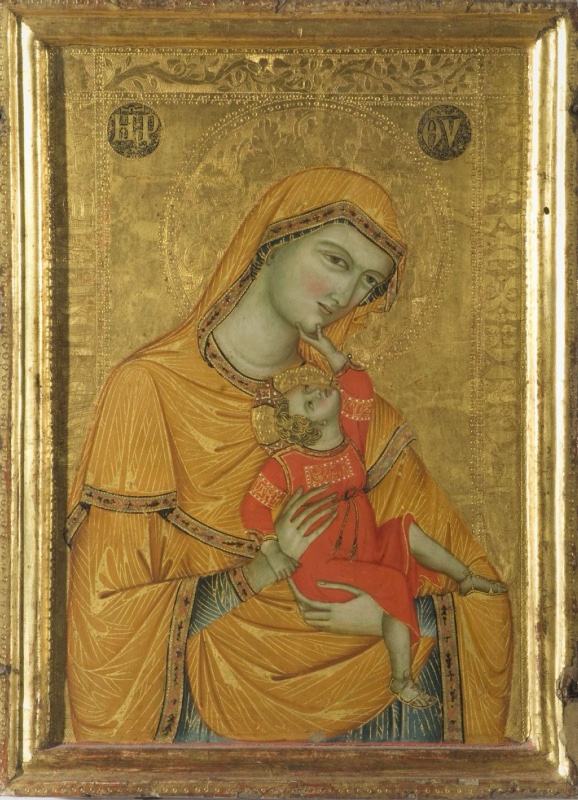
The picture that gave the anonymous master his name is a small object of extraordinary preciousness: a panel of 32.3 by 23.5 centimetres, painted in tempera and gold and still enclosed within its contemporary engaged frame, whose gilded mouldings, rubbed at the corners and edges down to the red bole and the bare wood, are trimmed along their inner face with a running border of punched pearls. Nothing in the picture field escapes the government of gold. The ground is not a neutral backdrop but a worked surface, tooled with delicate incised ornament: slender foliate scrolls wander across the upper zone, rows of punched dots trace an inner border that echoes the frame and rises into an arch above the figures, and the Virgin’s halo is drawn in the gold itself, a broad incised ring whose decorated band and fine radiating pattern shimmer into visibility only as the light moves. Against this luminous field hang, at the two upper corners, a pair of dark roundels bearing gilt letters. The right-hand medallion reads ΘV; the left carries a ligature in which the Eta and Rho recorded by the national catalogue as “H.P” are bound together. Read as a pair, in the manner of icon inscriptions, they yield the conventional Greek sigla ΜΡ ΘΥ, Mḗtēr Theoû, Mother of God — the standard Byzantine designation of the Virgin, transplanted whole onto an Umbrian panel of the fourteenth century.
The Virgin fills the field in half length, turned three-quarters towards her left, her head bowed until her cheek nearly grazes the Child’s raised hand. The most arresting decision of the whole painting is the colour of her mantle. It is not the customary blue but a luminous golden yellow, drawn up over her head as a veil and falling in broad folds across her shoulders and arms, and its entire surface is combed with dense chrysography, fine parallel and fanning striations of gold that follow the folds and dissolve the drapery into a tissue of light, so that the figure seems less clothed in cloth than in the same radiance as the ground behind her. The hems and the edge of the veil are finished with narrow ornamented bands, red and gold and studded with pale dots like seed pearls, and where the mantle opens at the breast and below, a dark blue garment appears, itself veined with gold striations. Above this shimmering costume the face is painted with quiet naturalism: a long oval of pale flesh warmed by rose at the cheeks, thin arched brows, heavy-lidded eyes cast down towards the Child, a long straight nose, and a small, grave mouth. The expression is tenderness shadowed by thought, the inward gravity that Marian images of this generation so often give the mother who foresees. Her right hand, with long, articulate fingers, spans the Child’s body and thigh, steadying the small restless weight against her.
The Child is the panel’s centre of energy, and his costume is its one blaze of colour: a tunic of saturated red, girdled at the waist with a knotted sash whose ties spring outward, and enriched with gold-embroidered bands at the collar, down the breast, and at the cuffs, a princely dress that sets the incarnate King against his mother’s gold. He does not sit so much as sprawl, half reclining across her supporting arm, one leg stretched out along her forearm and the other hanging free, his feet shod in light sandals laced at the ankle. His head, covered with short fair curls, tips back to seek his mother’s face, and his raised right hand reaches up to touch her chin. This is the gesture that earns the painting its catalogue title of Madonna con Bambino che gioca, the Madonna with the playing Child, and it belongs to the old Byzantine repertory of the infant’s tender, restless play, in which the caress of the mother’s chin and the squirming, kicking liveliness of the small body carry the type’s double meaning: the complete, touching reality of the human child, and, folded within it, the premonition of the Passion that the mother’s grave, downcast gaze acknowledges. Nothing in the composition is inert: the reaching arm, the outstretched leg, the flying sash-ends, and the answering incline of the Virgin’s head bind the two figures into a single continuous movement of affection.
Seen as a whole, the panel speaks two artistic languages at once, and speaks both fluently. Its apparatus is emphatically Byzantine: the Greek sigla, the tooled gold, the chrysography, the golden maphorion enveloping the Virgin all belong to the world of the icon, maintained here with a completeness rare in central Italian painting of the 1330s. Its life, however, is Trecento: the modelled softness of the faces, the credible weight and wriggle of the Child, the psychological exchange between mother and son are the fruits of the naturalism that Giotto’s generation had made the common property of Italian painters. It is precisely this fusion that the scholarship on the master has sought to place, finding the panel’s iconographic ancestry in the Adriatic current that runs through Rimini and its stylistic affinities in the Giottesque painting of Angevin Naples, and the image bears the reading out: this is an image conceived in the gravity of the post-Giottesque generation but deliberately clothed in the splendour of the Greek manner.
The state of the picture, as far as the image allows judgement, is worthy of its quality. The gold ground and its tooling are substantially preserved, the colours of the two figures keep their intensity, and the losses are concentrated where use always concentrates them, on the projecting mouldings of the frame, whose abraded gilding and exposed corners are the honourable wear of centuries of handling. That handling is the final thing the object communicates. A panel of this size, complete with its frame, was made for the closest kind of looking: to stand on a chest or a small altar, to be picked up, to accompany prayer at the distance of an arm. Its sophistication of language and its intimacy of scale belong together, and together they explain why this single small painting could sustain, for half a century, the entire identity of an artist.
The Playing Child: Iconography Between Byzantium and the Trecento
The full title under which the painting is registered in the national catalogue is “Madonna di Perugia. Madonna con Bambino che gioca”, the Madonna of Perugia, or Madonna with the playing Child, and the second half of that title is not a casual description but a precise iconographic classification, the most substantial interpretive contribution of recent scholarship to the understanding of the work. In his entry of 2021, Zappasodi connected the panel explicitly with the Byzantine compositional type known in the Russian scholarly tradition as the Vzygranie Mladentsa, the “Playing of the Child”, drawing on a classic study of Byzantine Marian iconography published in 1938, which he cites at pages 42 to 46. The identification places the little Perugian panel within a distinct and relatively rare family of Marian images, and understanding that family is the key to understanding what kind of picture this is.
Byzantine art had developed, over the centuries, a repertory of codified Marian types, each with its own theological accent and its own devotional resonance. The Hodegetria, “she who shows the way”, presents the Child frontally, enthroned upon his mother’s arm, while she gestures towards him as the path of salvation; the emphasis falls on majesty and doctrine. The Eleousa or Glykophilousa, the Virgin of tenderness or of the sweet kiss, presses the Child’s cheek to her own; the emphasis falls on maternal love and, through it, on the pathos of the Incarnation. The type of the playing Child stands apart from both. Here the Child is neither hieratically composed nor tenderly enfolded but caught in movement: he twists in his mother’s arms, reaches, kicks, plays, behaves, in short, like an actual infant.
The apparent naturalism is itself theologically charged. In the interpretive tradition that grew up around the type, the Child’s restlessness carries a premonitory weight: his agitation, his vulnerability, the very instability of his small body foreshadow the Passion of the incarnate God, so that the mother who steadies him in play is already, implicitly, the mother who will receive him from the cross. Italian painters of the later Duecento and the Trecento found in this type a formula perfectly suited to the moment, because it allowed them to unite the two forces then transforming Marian imagery: the inherited authority of the Byzantine types, with their compressed theological content, and the new Gothic and Giottesque appetite for the observed truth of bodies, gestures, and affections.
A child who plays is a real child; a real child who is God incarnate, playing on the edge of his own sacrifice, is an image of extraordinary devotional power. As Zappasodi observes in the passage summarised by the national catalogue, the type “ebbe una certa diffusione nella pittura italiana tra Due e Trecento”, enjoyed a certain diffusion in Italian painting between the thirteenth and fourteenth centuries; it never became common, and each occurrence therefore carries a certain deliberateness, a choice.
The most illuminating element of Zappasodi’s discussion is the comparison he identifies as the closest and chronologically nearest precedent for the Perugia panel: the panel of the Virgin and Child by Giovanni da Rimini in the Pinacoteca Comunale of Faenza. The choice of comparison is rich in implications. Giovanni da Rimini, documented from 1292 and the founding figure of the Riminese school, stands at the head of one of the earliest and most original regional responses to Giotto, a school whose painters absorbed the Florentine master’s structural and emotional innovations in the very first years of the fourteenth century and inflected them with a lyricism and a chromatic delicacy all their own, and whose influence radiated southward along the Adriatic into the Marche and inland into Umbria.
If the nearest relative of the Perugian playing Child is Riminese, then the iconographic genealogy of the Perugia panel points not towards Siena and the Duccesque tradition, as the accidents of its nickname might suggest, but towards the Adriatic face of central Italy and towards the diffusion of Giotto’s legacy through regional schools. The observation converges, from an entirely independent direction, with the stylistic judgement that Boskovits had formulated half a century earlier: both the iconography and the style of the panel look away from Siena and towards the world of the Giottesque diaspora. This convergence of two independent lines of evidence, iconographic and stylistic, is the strongest structural fact in the whole scholarship on the master, and it deserves to be stated as such.
A word of methodological caution must nonetheless accompany the iconographic discussion. The published sources consulted for this study classify the panel as a playing Child, but they do not describe the Child’s gestures. Those gestures can be read from the image, as the description above has done. The Child half reclines across his mother’s arm, one leg outstretched and the other hanging, his feet in sandals, and reaches up to touch his mother’s chin. Panels of the type combine a small repertory of such motifs in varying ways: the Child may grasp his mother’s veil, clutch her hand or her mantle, hold a bird, or reach for her face. The Perugian painter chose the caress of the chin. The meanings attached to these motifs are a different matter from their presence. The caress belongs to the old Byzantine repertory of the Child’s tender play. That is an interpretive reading, not a feature of the panel, and no published source assigns it to this painting in particular. What can be affirmed is the classification made explicitly in the recent specialist literature, the gestures that the image itself shows, and the interpretive horizon that the two together open.
The iconography, finally, illuminates the function and the intended experience of the object. Images of the playing Child are, almost by their nature, images for close viewing. Their effect depends upon intimacy: the beholder is invited to witness what appears to be a private, domestic moment between mother and infant, and to discover within that moment, gradually, the whole mystery of the Incarnation and its cost. A monumental altarpiece can proclaim; a panel of thirty-two centimetres can only confide. The dimensions of the Perugia Madonna, its complete contemporary frame, and its later absorption into a devotional tabernacle all belong to the same functional world, that of private or semi-private devotion, whether in the cell of a religious, the meeting room of a confraternity, or the chamber of a devout household. Whoever the Maestro della Madonna di Perugia was, the one work by which he is known was made not to command a church but to accompany a life of prayer at close quarters, and the sophistication of its iconographic choice suggests a patron, or a painter, of some theological cultivation.
Visual Character and the Neapolitan Connection
At this point a close visual reading of the painting that gives the master his name is naturally expected. The description that accompanies the image above supplies one: the golden mantle combed with chrysography, the red tunic of the Child, the tooled gold ground, the Greek sigla, and the exchange of gestures between mother and son. What the published literature does not supply is a formal analysis of its own. The sources consulted record the panel’s dimensions, technique, frame, inscription, date and iconographic classification, but no detailed formal description by a specialist and no technical study have been traced. The description given here therefore rests on the image. It can report what is visible, but it cannot settle questions that only the object can answer, such as the underdrawing, the pigments, the punch tools, or the extent of any retouching. Those remain a task for autopsy, for the scholar standing before the panel in Perugia with the museum’s files at hand. What the present section can add is something different and, in its way, no less informative: the critical comparisons that the literature has attached to the panel. Each comparison acts as a mirror. It shows how specialists who knew the object placed it, and it can now be checked against what the image shows.
The first mirror is the group from which the panel was separated. When Boskovits in 1965, and the museum catalogue in 1969, placed the little Madonna with the Maestro della Maestà delle Volte, they implicitly asserted that it could plausibly stand among that painter’s works, and the published characterisations of that group therefore say something about the Perugia panel. A museum description of works associated with the Maestà delle Volte painter speaks of a “forte vena espressionistica”, a strong expressionist vein, animating figures “di chiara matrice giottesca-assisiate”, of clearly Giottesque and Assisian stamp. That the Perugia Madonna could be grouped with such works for nearly a decade suggests that it shares at least the general physiognomy of this idiom: the structural solidity, the gravity of expression, the Assisian inflection of Giotto’s language that marked Perugian painting of the early Trecento. The second mirror is the act of separation itself. When Boskovits detached the panel in 1973, he implicitly asserted that something in it resisted the Perugian mainstream, and his positive identification of that something is on record: an affinity with the painting of Angevin Naples, and specifically with the Maestro delle Tempere Francescane. Between the two mirrors a silhouette emerges: a painting Giottesque enough to pass, for a time, as Perugian-Assisian, yet marked by qualities distinctive enough to demand a different explanation, and those qualities Neapolitan.
To give content to the Neapolitan comparison, one must look at the comparandum. The Maestro delle Tempere Francescane takes his conventional name from a group of four rare paintings executed in tempera on canvas, a technique whose survival from the Trecento is exceptional. According to the Musei nazionali di Matera, where part of the group is preserved, these canvases were “realizzate su commissione del re Roberto d’Angiò nel 1336 e destinate, probabilmente, alla Basilica di Santa Chiara di Napoli”, executed on the commission of King Robert of Anjou in 1336 and probably destined for the basilica of Santa Chiara in Naples; the national catalogue, following a study of 1969 that proposed to identify the anonymous master with the documented Neapolitan painter and illuminator Pietro Orimina, dates the group more cautiously “entro il 1336”, by 1336.
The same sources characterise the master as an artist close to the dissident, poverty-minded Franciscan circles gathered around Queen Sancia of Majorca, Robert’s consort, and as one of the painters who received and diffused Giotto’s innovations in Naples in the years of and after the Florentine master’s documented residence at the Angevin court. The visual culture this implies is reasonably well defined. Neapolitan painting in Giotto’s wake is marked by a solid, almost sculptural construction of form, by a gravely expressive, sometimes austere treatment of faces, and by strong, clear chromatic relationships; it stands at a considerable distance from the linear refinement, the melodic contours, and the precious chromatic harmonies of the Sienese tradition. If the closest relatives of the Perugia panel are Neapolitan in this sense, then its visual language is to be understood as a variety of Giottism transmitted or paralleled through the Angevin south, and emphatically not as a provincial echo of Duccio. It must be underlined, once more, that this is an inference drawn from a documented critical comparison, not a direct description of the panel; but it is the inference that the entire critical tradition, from Boskovits through Todini to the 1994 museum entry, invites.
The Neapolitan comparison raises, inevitably, the question of how such an affinity could have come about, and here the honest answer is that the sources are silent. Several mechanisms are conceivable. The Perugian master could have travelled: painters of the period were mobile, and the roads between Umbria and the Regno were kept busy by merchants, prelates, and above all by the Franciscan order, whose administrative and spiritual networks bound Assisi to Naples with particular intimacy in precisely these decades, when the Angevin dynasty’s Franciscan devotion was at its height. Neapolitan works, especially small and portable ones, could have travelled north; Umbrian patrons with southern connections could have imported models; an itinerant painter formed in the south could have worked in Perugia.
It is even worth noticing, without building anything upon it, a small Franciscan constellation around the panel: the Maestro delle Tempere Francescane is defined by works tied to the Franciscan patronage of the Neapolitan court and probably destined for Santa Chiara; Umbria was the heartland of the order; and the Perugia panel’s later tabernacle framed it with images of Francis and Clare. Three Franciscan facts do not make an argument, and the sixteenth-century date of the tabernacle in particular forbids any direct inference about original patronage; but they mark out the terrain on which future research might most profitably dig. What the sources support, strictly, is the stylistic relationship; the route of transmission remains an open question, and it is one of the genuinely interesting open questions in the study of Trecento regionalism, since every documented case of artistic exchange between Umbria and Angevin Naples enlarges the picture of how Giotto’s revolution actually propagated through the peninsula.
One further indirect witness to the panel’s quality deserves mention: its modern career. Museums do not place obscure works on the covers of international exhibition catalogues, and the Galleria Nazionale’s choice of the Madonna di Perugia as the cover image of the 2021 Hermitage catalogue, discussed more fully below, is a curatorial judgement of visual distinction rendered in the most public form available. Whatever the limits of the published literature on the panel’s appearance, the institutions that know it best have treated it as an object of exceptional beauty, and that judgement, too, is a datum in the master’s file.
Perugia Between Assisi, Siena, and Angevin Naples: The Historical Setting
To understand what it meant to paint a small Madonna in Perugia in the 1330s, one must reconstruct, however summarily, the artistic geography within which the city stood. Perugia in the second quarter of the fourteenth century was a prosperous, populous, and politically assertive commune, one of the principal urban centres of central Italy. Its civic self-confidence had taken monumental form in the preceding decades: the Fontana Maggiore, completed in 1278 with sculpture by Nicola and Giovanni Pisano, adorned the summit of the town, and the Palazzo dei Priori, the great communal palace that today houses the Galleria Nazionale dell’Umbria, and thus the master’s eponymous panel, had risen and been extended in successive campaigns from the 1290s onward. The city’s mendicant churches, San Domenico and San Francesco al Prato above all, were among the largest in the region and functioned as magnets for artistic commissions of every scale, from monumental altarpieces to precisely the kind of small devotional panel with which this essay is concerned. A painter working in this environment stood within reach of three artistic poles of very unequal distance and very different character, and the interplay of the three defines the field of forces in which the Maestro della Madonna di Perugia must be situated.
The nearest pole, and for Umbrian painting the gravitational centre, was Assisi. The basilica of San Francesco, from the later Duecento onward, was the most important site of monumental painting on the Italian peninsula, a vast and continuous workshop through which Roman, Florentine, and Sienese masters passed in succession or worked side by side. The consequences for the surrounding region were profound and lasting: Umbrian painters of the generations after 1300 were, almost without exception, formed in the shadow of the Assisi campaigns, and the Giottesque idiom in its Assisian inflection became the lingua franca of the region, the manner visible in the Maestà delle Volte group with which the Perugia panel was first associated.
The Galleria Nazionale’s own recent exhibition programme has made this Umbrian crossroads its central theme: the exhibition of 2024, L’enigma del Maestro di San Francesco. Lo stil novo del Duecento umbro, presented from 10 March to 9 June of that year, gathered what the museum’s own presentation described as sixty masterpieces around the greatest Umbrian anonymous of the thirteenth century, and the exhibition announced for 14 March to 14 June 2026, Giotto e san Francesco. Una rivoluzione nell’Umbria del Trecento, timed by the Ministry of Culture’s announcement to the eighth centenary of the death of Saint Francis, addresses precisely the Giottesque transformation of Umbrian painting within which the master worked. In the picture these projects have drawn, Assisi appears less as a single source than as a clearing house, a place where currents from every part of Italy met, mingled, and were redistributed through the region; and a minor Perugian master with an unexpected stylistic orientation is exactly the kind of figure such a clearing house would produce.
The second pole was Siena. Sienese painters were conspicuously present in Perugia in the early Trecento, and Sienese panel painting offered the city its most refined models of Marian imagery, above all Duccio’s polyptych for San Domenico, whose central panel, the other “Madonna di Perugia”, has already been discussed. The documented activity of Meo da Siena and the steady flow of Sienese commissions gave the city a genuine Sienese stratum, and the wooden sculpture displayed in the museum’s early rooms shows the same orientation. Against this background, the significance of the master’s profile stands out by contrast: the one thing the entire critical tradition agrees upon is that his affinities are not Sienese. In a city saturated with Sienese models, he looked elsewhere, and that fact, secure because it is attributional bedrock, is among the few genuinely individual traits that can be ascribed to him.
The third pole lay far to the south, and its relevance is the specific discovery of the scholarship on this master: Angevin Naples. The kingdom of Robert of Anjou, called the Wise, who reigned from 1309 to 1343, was in these decades one of the great centres of European court culture, and its artistic policy was ambitious and importing: Simone Martini worked for the dynasty, and Giotto himself is documented in Naples from the end of 1328 until 1333, named a familiar of the king, “familiaris”, on 20 January 1330 according to the Angevin records discussed in the recent literature on court artists. Around Giotto’s Neapolitan activity there formed a local school of Giottesque painting, to which the Maestro delle Tempere Francescane belongs, coloured by the intense Franciscan devotion of the court, and particularly of Queen Sancia of Majorca, whose foundation of Santa Chiara made the Neapolitan Clares one of the most conspicuous religious establishments in Italy.
The channels between this southern world and Umbria were real and heavily travelled. The Franciscan order’s centre of gravity was Assisi; its royal patrons sat in Naples; friars, officials, alms, relics, books, and inevitably images moved along the roads between them. When Boskovits recognised a Neapolitan component in a Perugian panel of the 1330s, he was therefore proposing nothing historically implausible; he was, rather, supplying a piece of visual evidence for a circulation that the institutional history of the period leads one to expect but that surviving works rarely document. Therein lies the larger significance of this obscure master. If the Neapolitan affinity holds, the Madonna di Perugia is a small but concrete witness to the southern current within the Umbrian confluence, a current far less studied than the Assisian and Sienese ones, and every future clarification of the master’s corpus will simultaneously clarify a chapter in the geography of the Giottesque diaspora.
The Riminese element identified in the panel’s iconography completes the picture and gives it a fourth, Adriatic direction. Riminese painting of the early Trecento, inaugurated by Giovanni da Rimini, was among the earliest and most original responses to Giotto outside Tuscany, and its influence spread through the Marche towards the Umbrian border. A Perugian painter of the 1330s whose iconography finds its nearest precedent in Rimini and whose style finds its nearest relatives in Naples is, on the face of it, a paradoxical figure; but the paradox dissolves when both connections are seen as branches of a single phenomenon, the propagation of Giotto’s revolution through regional schools. The master belongs to the generation formed after the heroic age of Assisi, a generation that received Giotto not directly but through the refractions of Rimini, Naples, Florence, and the local Umbrian tradition, and that combined those refractions according to opportunity and temperament. Within that generation he occupies a modest but genuine place: a painter of small devotional images, working in a great artistic crossroads, whose one surviving work testifies that even the private, intimate end of the market was touched by the full breadth of the peninsula’s artistic exchanges.
The Reconstructed Corpus: Evidence, Absence, and the Kraków Problem
A reconstructed master normally comes equipped with a catalogue: a series of works that share the defining traits of the eponymous piece and that together allow a career, however schematic, to be traced through time. It is in the matter of the catalogue that the Maestro della Madonna di Perugia most conspicuously fails the expectations his name arouses, and the failure must be described plainly rather than papered over with speculative additions, because the shape of the gap is itself historical evidence.
The fixed point of the corpus is, of course, the eponymous panel, inventory 69 of the Galleria Nazionale dell’Umbria, whose attribution the national catalogue describes as unanimously accepted. Around this fixed point, exactly one further work can be traced in the secondary literature available to the present study: a Madonna formerly in the Scotto collection in Genoa. The reference occurs in a specialist study of the ornament of the Virgin’s garments in Duecento and Trecento painting, where the ex-Scotto panel is cited, for comparative purposes, as a work of the Maestro della Madonna di Perugia dated about 1320, with a reference to page 18 of Boskovits’s book of 1973.
The citation is doubly precious. First, it points into the founding text of the notname itself: page 18 falls within the very pages, 16 to 18, in which Boskovits reconstructed the master, which strongly suggests that the ex-Scotto Madonna belonged to his original definition of the personality, a second panel set beside the Perugian one to give the new name a minimal plurality of works. Second, its dating of about 1320 carries chronological information: if accepted, it pushes the master’s activity back a decade before the 1330–1340 bracket of the eponymous panel and sketches a career extending across the 1320s and 1330s. Against these gains must be set a loss: the current whereabouts of the ex-Scotto Madonna are not given in the sources consulted, and the panel must for the present be counted among the untraced works of the Italian private-collection diaspora, a category whose recovery is one of the perennial hopes of Trecento studies.
Beyond these two panels, the verifiable corpus simply ends, and the strong narrative pressure to extend it must be resisted. The founding pages of Boskovits’s 1973 volume presumably contain whatever further comparisons or attributions he adduced in defining the master, and Todini’s surveys of 1986 and 1989 will have recorded, revised, or augmented the list; but those pages could not be consulted directly for the present study, and their contents will not be reconstructed here by inference, because a guessed catalogue is worse than no catalogue.
One negative observation, however, can be reported, and it is telling. The photographic archive of the Fondazione Zeri, ordinarily an indispensable instrument for tracing the critical fortunes of anonymous Italian masters, whose folders preserve the sedimented attributions of a century of connoisseurship and of the art market, does not appear, in the searches that could be conducted, to maintain a folder under this notname. The absence is not proof of anything, since the archive’s coverage has its own history and its own gaps; but it is consistent with the picture that emerges from every other direction, namely that the Maestro della Madonna di Perugia has never attracted the accumulating cloud of attributions, hopeful, commercial, or scholarly, that gathers around most named anonymi. He has remained what Boskovits made him: a name, a panel, and little more.
One apparent exception circulates online and must be confronted directly, because it is the kind of claim that, unexamined, hardens into fact through repetition. Websites in the art-reproduction and image-licensing trade offer a “Virgin and Child, 1320 (tempera & gold on panel)” under the name “Master of the Madonna of Perugia”, locating the work in the National Museum in Kraków. No scholarly source has been found that confirms this attribution, identifies the object, or verifies its presence in the Kraków collections. Captions in the reproduction trade are notoriously unreliable witnesses: they descend from old photographic archives and dealers’ descriptions, are copied from site to site without control, and are almost never checked against current scholarship.
Several explanations of the Kraków caption are possible. It may preserve, in degraded form, a genuine older attribution, perhaps even one deriving from the Boskovits or Todini lists that could not be consulted; the coincidence of its date, 1320, with the date of the ex-Scotto Madonna even permits the suspicion that the caption is a garbled memory of that very panel, its Genoese provenance lost and a Polish location acquired somewhere in the chain of copying. It may equally result from confusion with another “Perugia” master, or from simple error. Until the attribution is confirmed by the museum’s own catalogue or by a scholarly publication, the Kraków Virgin and Child cannot be admitted to the corpus, and the responsible formula is the one used here: an unverified claim, recorded in order to be flagged.
What, finally, does the thinness of the corpus mean? Zappasodi’s verdict of 2021, that the master remains difficult to reconstruct with precision, is at bottom a statement about exactly this thinness, and several explanations of it are conceivable, none provable. The master’s output may genuinely have been small: a painter of small devotional panels, unlike a frescante or an altarpiece specialist, could work a lifetime and leave a fragile, dispersible legacy. His production may have been larger and largely lost, small panels being of all medieval paintings the most vulnerable to fire, theft, dispersal, and neglect. His hand may survive unrecognised, hidden among the works still assigned to the Maestà delle Volte painter or to the generic Umbrian ambit of the early Trecento, awaiting the eye that will detach them as Boskovits detached the name-work.
Or, finally, the stylistic profile that justified the notname may be narrower than a personality: it is at least conceivable that the “master” is a single moment in the production of a workshop otherwise known under another name, and that the future of the notname is absorption rather than growth. Between these possibilities the evidence does not choose. The honest position, and the one this essay adopts, is that the notname registers a real and repeatedly confirmed stylistic observation about one painting, and that the larger personality it implies remains a hypothesis in search of works.
Chronology, Dating, and the Anatomy of Error
The chronology of the Maestro della Madonna di Perugia rests entirely on stylistic dating, since no document and no dated or signed work anchors his career, and the evidence, though slender, is internally coherent once its anomalies are removed. Two date ranges can be verified in the responsible literature. The national catalogue and the 2021 Hermitage catalogue place the eponymous panel at about 1330 to 1340. Boskovits’s book of 1973, as cited in the secondary literature, places the ex-Scotto Madonna at about 1320. Taken together, and granting the ex-Scotto attribution, these brackets sketch an activity spanning the 1320s and 1330s, the second quarter of the Trecento, a placement that the master’s cultural profile independently supports. The Neapolitan comparison, in particular, favours the later end of the range for the name-work: the canvases of the Maestro delle Tempere Francescane are tied to a royal commission of, or by, 1336, and Giotto’s documented Neapolitan residence ran from late 1328 to 1333, so that a Perugian reflection of this milieu sits most comfortably in the 1330s. Style, iconography, and the shape of the artistic geography thus converge on a single decade, and the convergence, modest as it is, represents the sum of what can be affirmed about the master’s place in time.
Against this coherent core stand the anomalies, and it is worth dissecting them one by one, because each exemplifies a distinct mechanism by which error enters and propagates through the literature on minor masters. The first anomaly is the bracket of about 1320 to 1330 that appears in some circulating captions for the eponymous panel. No authoritative published source for it has been traced. Its most economical explanation is contamination: the date of the ex-Scotto Madonna, about 1320, migrating onto the name-work through careless copying. The mechanism, the transfer of data between works of the same master, is among the most common in the caption literature, and the case is a reminder that a date attached to a painting is only as good as the publication behind it.
The second anomaly is graver because its source is official: the national catalogue’s general heading for the artist describes him as active in Umbria in the second half of the fourteenth century, a placement contradicted by the same database’s own dating of the panel, by the 1320 date of the second work, and by every scholarly date traced. This is the mechanism of the database inconsistency, the artefact of cataloguing systems in which biographical headers and object entries are compiled separately and never reconciled; its danger lies precisely in its official provenance, since a researcher citing the header in good faith would misplace the master by a generation. It should be discarded, and the discrepancy deserves to be reported to the compilers.
The third and most consequential error has already been anatomised in the third section of this essay but belongs also here, in the account of chronology, because its effect is chronological: the presentation of the master as a follower of Duccio active in the late Duecento or early Trecento. Its mechanism is homonymy, the collision of two nicknames, and its effect is to displace the painter backwards by thirty to forty years and sideways into the wrong artistic tradition. The fourth error is the attribution to the master of the wooden Madonna di Sant’Agostino, whose mechanism is the garbled summary, an encyclopedia’s compression of two distinct conventional names into one; its effect is to endow the painter with a second profession.
The fifth is the Kraków Virgin and Child of the reproduction trade, whose mechanism is the unverifiable caption and whose effect, if admitted, would be to double the corpus on no evidence. And a sixth, subtler error hovers over the whole literature of anonymous masters and must be named in conclusion: the temptation to present the corpus as larger and firmer than it is, to let the confident grammar of the monographic essay, this master did, this master preferred, this master developed, manufacture a solidity the evidence does not possess. Zappasodi’s warning that the painter remains difficult to reconstruct with precision is the standing antidote to this last error, and the present essay has tried to keep it in view on every page.
What emerges from this anatomy is a small case study in the epistemology of attribution. The verified facts about the Maestro della Madonna di Perugia would fit on a single sheet: one panel, its measurements, its frame, its inscription, its provenance from the Accademia, its dates of exhibition; one further panel cited in the founding publication and since lost to view; a sequence of five or six publications between 1965 and 2021. Everything else that circulates under his name, the Duccio connection, the sculpture, the late dating, the Kraków panel, is error of one identifiable kind or another. That the errors outnumber the facts is not an indictment of the scholarship, which has been careful, but a consequence of the environment in which information about minor masters now lives, an environment of databases, encyclopedias, and image libraries that copy faster than they check. For the historian, the practical lesson is the one this essay has tried to enact: for such figures, every statement must be run back to its source, and the statements that cannot be run back must be marked, not merely omitted, so that what is passed on includes not only the knowledge but the map of its limits.
An Unexpected Celebrity: Exhibitions, the State of Research, and Conclusions
For a painter of one secure work, the Maestro della Madonna di Perugia has enjoyed, in the last five years, a public career of unexpected brilliance, and the story of that career is the natural close of his historiography. In 2021 the eponymous panel travelled to Russia for the exhibition Arti del Medioevo. Capolavori dalla Galleria Nazionale dell’Umbria, held at the State Hermitage Museum in St Petersburg from 19 May to 19 September of that year, a survey of the Perugian museum’s medieval holdings. The accompanying catalogue, edited by the museum’s direction and published by Skira in 2022, made a remarkable choice: it placed the little Madonna, reproduced with the caption “Madonna di Perugia, 1330–1340 circa”, on its cover, ahead of the Duccios, the sculptures, and the celebrated altarpieces of the collection.
Within that catalogue, Zappasodi’s entry, cited by the national catalogue as scheda 20, delivered the assessment that has been quoted throughout this essay. One bibliographical wrinkle should be recorded for the sake of completeness: the photographic credits in a publicly available extract of the catalogue refer to the cover image as cat. 5, a discrepancy with the scheda 20 of the national catalogue’s citation that could not be resolved from the accessible sources and that may reflect nothing more than two different numbering systems within the volume. In 2024 the panel travelled again, this time to Venice, for the exhibition The Golden Way – La via dell’oro at the Galleria Giorgio Franchetti alla Ca’ d’Oro, from 17 April to 16 June, where, according to the Galleria Nazionale dell’Umbria’s own presentation, works by Duccio, Gentile da Fabriano, the Maestro della Madonna di Perugia, Giovanni Baronzio, Cataluccio da Todi, and Bartolomeo Caporali were placed in dialogue with twentieth-century artists of gold, among them Alberto Burri, Lucio Fontana, and Michelangelo Pistoletto.
These curatorial choices are themselves interpretable evidence. They suggest that the panel is now valued less as the document of a defined artistic personality, which, as shown above, it can only imperfectly be, than as an exemplary object: a small, intense, gold-ground image capable of representing, on a catalogue cover or in a dialogue with Burri and Fontana, the whole devotional and material culture of the Trecento. The promotion carries an irony and a risk. The irony is that the master owes his modern fame to precisely the qualities, smallness, intimacy, preciousness, that condemned his oeuvre to dispersal and his person to oblivion. The risk is that each new appearance under the ambiguous name “Madonna di Perugia”, especially in company with Duccio, as at the Ca’ d’Oro, feeds the very confusion of identities that the third section of this essay laboured to untangle.
The state of research, at the date of writing, can be summarised in a few sentences. The notname is stable and universally accepted; the eponymous panel is securely attributed; the master’s placement in Perugia in the second quarter of the Trecento, with stylistic affinities towards the Giottesque painting of Angevin Naples and iconographic affinities towards Rimini, is the consolidated position of the literature from Boskovits through Todini to the museum entries of 1994 and 2021. Beyond this, nearly everything remains to be done, and the agenda writes itself. A published technical study of the eponymous panel, embracing the punchwork, the relation of panel to frame, the incised inscription, and the pigments, would give the master, for the first time, a material identity independent of stylistic argument.
A direct re-examination of pages 16 to 18 of Boskovits’s 1973 volume, and of the corresponding pages of Todini’s surveys, would establish the founding corpus exactly as its authors defined it, ending the present reliance on second-hand citation. A search for the ex-Scotto Madonna, last visible in a Genoese private collection, might restore the master’s second work to view and test the c. 1320 dating. A query to the National Museum in Kraków would settle, in one direction or the other, the question of the caption-attributed Virgin and Child. And a systematic review of the small Marian panels still filed under the Maestà delle Volte painter and the generic Umbrian ambit of the early Trecento might yet find the companions that the name-work has awaited for half a century.
It remains to say what kind of historical figure this essay has, in the end, described. The Maestro della Madonna di Perugia is a limiting case of the anonymous master: a personality constituted by a single act of connoisseurship, sustained by a thin but unbroken chain of scholarly assent, and embodied in a single object of acknowledged beauty. He is also, and this is why he repays the attention lavished on him here, a genuinely informative figure. His panel documents the presence, in the Perugia of the 1330s, of an iconographic type of Byzantine ancestry and Riminese transmission; his style, as the critics have read it, documents a Neapolitan current in Umbrian painting that the standard accounts of the region, organised around Assisi and Siena, scarcely register; and his historiography documents, with unusual clarity, both the power of the notname method to rescue an individual hand from anonymity and the limits of that method when the works fail to accumulate. The elusive painter of the playing Child thus earns his place in the history of Trecento art twice over: once for what his picture shows, and once for what his case teaches. Until the archives or the storerooms yield more, that double claim, modest, secure, and honestly bounded, is his portrait.
Conclusion
This essay began with an artist who exists only as a name, and it ends with the same artist, known a little better and bounded much more clearly. Everything said about the Maestro della Madonna di Perugia comes back to one small panel, inventory 69 of the Galleria Nazionale dell’Umbria, and to the short chain of publications that has interpreted it since 1965. The essay has tried throughout to keep four kinds of statement apart: documented fact, established consensus, individual scholarly proposal, and inference or speculation. In the case of a well-documented painter these categories blur harmlessly into one another. In the case of this master they cannot be allowed to blur, because the evidence is so thin that each misplaced sentence changes the picture. The Conclusion therefore takes the four categories in turn before asking what, taken together, they allow to be said.
The documented facts belong almost entirely to the object. The panel measures 32.3 by 23.5 centimetres, is painted in tempera and gold, and keeps its contemporary frame, a rare survival that preserves the painting as a complete, portable devotional thing. It came to the Galleria Nazionale from the collections of the Accademia di Belle Arti, and before its modern isolation it was set into the base of a sixteenth-century tabernacle, inventoried as number 329, whose shutters carried Saints Francis and Clare. Where it stood before the Accademia acquired it is unknown. The catalogue records the incised letters “H.P” in the roundel at the upper left, and the image suggests that they are the first half of the Greek sigla ΜΡ ΘΥ, Mother of God, completed by the letters in the opposite roundel; that reading, like the date of the incision, still awaits confirmation by technical examination. The responsible institutions date the panel to about 1330–1340, and no document of any kind names, pays or mentions its painter.
The consensus is real, but it is narrow. Boskovits first placed the panel with the Maestro della Maestà delle Volte in 1965, the museum catalogue of 1969 followed him, and in 1973 Boskovits himself reversed that judgement and created the new name. Todini’s surveys of 1986 and 1989, a parallel survey of Umbrian Trecento painting and the museum’s own entry of 1994 accepted the reconstruction, so that by the mid-1990s the panel could be described as unanimously ascribed to the master. What that unanimity covers is precise: the authorship of one painting, and the rightness of separating it from the Maestà delle Volte group. It does not cover an oeuvre, a chronology of development, a workshop or a following, none of which has ever been securely established. Zappasodi’s verdict of 2021, that the painter remains difficult to reconstruct with precision, is not a dissent from the consensus but an accurate description of its limits.
The scholarly proposals that give the master his historical interest are two, and they come from independent directions. The first, Boskovits’s, is stylistic: the panel looks not to Siena and not to the Perugian mainstream but to the Giottesque painting of Angevin Naples, and in particular to the Maestro delle Tempere Francescane, whose canvases are tied to a royal commission of, or by, 1336. The second, Zappasodi’s, is iconographic: the panel belongs to the Byzantine type of the playing Child, the Vzygranie Mladentsa, and its nearest precedent is Giovanni da Rimini’s small panel in Faenza. Neither proposal proves the other, but they agree in turning the painting away from Duccio and towards the regional diffusion of Giotto’s legacy, and their agreement is the strongest structural fact in the whole literature on the master. It is also the reason why a Perugian Madonna of thirty-two centimetres matters beyond Perugia.
Around these proposals lies a ring of speculation that the essay has labelled as such and that the Conclusion must leave labelled. The Franciscan shutters of the later tabernacle invite the story that the panel was painted for a community of Poor Clares, but the tabernacle is two centuries later than the painting and cannot speak for its first owners. The route by which a Neapolitan manner reached a Perugian painter, whether by travel, by imported models or by an itinerant hand, is unknown. The Madonna formerly in the Scotto collection in Genoa, dated about 1320 and apparently part of Boskovits’s founding definition, would extend the master’s activity back into the 1320s, but its present whereabouts are not recorded. And it remains possible that the notname describes not a person but a moment in the production of a workshop known under another name. None of these hypotheses is unreasonable; none can yet be tested.
The errors, by contrast, can be named exactly, and naming them has been one of the essay’s main tasks. The master is not a follower of Duccio, whose Perugian polyptych shares only a nickname with his panel. He is not the carver of the wooden Madonna di Sant’Agostino, which has its own anonymous sculptor. He was not active in the second half of the fourteenth century, whatever the heading of the national catalogue may say, and the bracket of about 1320–1330 sometimes attached to the name-work has no traceable source. The Kraków Virgin and Child of the image libraries is an unverified caption, not a second work. Each error arose by an identifiable route: homonymy, compression, database inconsistency, contamination between works, uncontrolled copying. Together they show how quickly, around a minor master, the errors can come to outnumber the facts, and why each statement about such a figure has to be traced back to its source.
What remains, once the errors are cleared away, is a painting that repays close looking and a painter whose historical position is small but genuine. The Virgin, wrapped in a golden mantle combed with chrysography, bends towards a Child in saturated red who sprawls across her arm, reaches up to her chin, one sandalled foot stretched along her arm. The painting keeps the full apparatus of the icon, Greek sigla, tooled gold and golden maphorion, and gives it the weight, movement and psychological exchange that Giotto’s generation had made common property. It was made in a city where Assisi, Siena, Naples and, through Rimini, the Adriatic all met, and in a medium designed for prayer at arm’s length. Its recent career, on the cover of the Hermitage catalogue in 2021 and among the gold-ground works of the Ca’ d’Oro in 2024, confirms its standing as an object; the irony, noted above, is that the smallness and preciousness that make it so exhibitable are the same qualities that dispersed the rest of its painter’s work.
The questions that remain open are, for once, answerable in principle. A technical study of the panel would give the master a material identity: its punchwork, its frame, its pigments and the date of its incised letters. A direct reading of Boskovits’s pages of 1973 and of Todini’s surveys would fix the founding corpus as its authors defined it. A search for the ex-Scotto Madonna, a query to the museum in Kraków, and a review of the small Marian panels still filed under the Maestà delle Volte painter or the generic Umbrian ambit could each enlarge the corpus or confirm that it is as small as it appears. Until then, the Maestro della Madonna di Perugia remains what half a century of careful scholarship has made him: a name, a single secure panel, and a set of well-founded observations about where that panel’s language came from. That portrait is modest, but everything in it can be traced to a source, and it shows what can and cannot be known about him.