Nicola Pisano
( 25% )
Introduction
Nicola Pisano, also known in documents as Nicola d’Apulia, was born probably between about 1210 and 1225 in the region of Apulia in southern Italy, then part of the kingdom of Frederick II. Two documents of 1266 call him explicitly “magister Nichola de Apulia,” which confirms his southern origin even if the precise locality of his birth remains unknown. His later surname “Pisano” is a toponym reflecting his adoption of Pisa as his civic home after he migrated north and established a flourishing workshop there around the middle of the century. Nothing certain is known about his parents or siblings, but his early technical mastery and mobility suggest that he came from a family embedded in the professional artisan milieu rather than from either the rural peasantry or the high aristocracy.
In such families, children typically entered apprenticeship within the paternal craft at an early age, so his childhood was almost certainly spent in a workshop environment where domestic life and professional training were closely intertwined. The court of Frederick II in Apulia fostered a classicising artistic culture and an unusually high degree of contact with surviving Roman sculpture, and it is within this broader familial and social setting that his first formation must be situated. Later antiquarian traditions occasionally embellished his origins with legendary details, yet modern scholarship has stripped these away and returned to the sparse but reliable medieval references.
As a consequence, the family background of Nicola Pisano can be reconstructed only in general terms, emphasising his insertion into a mobile, urban craft stratum that moved along the routes connecting Apulia with central Italy. This composite social identity, at once southern and Tuscan, courtly and communal, framed the way in which his household would later function in Pisa. It also helps to explain why his art from the outset combined the technical discipline of a trained court sculptor with the pragmatic responsiveness demanded by civic and ecclesiastical patrons in the cities where he eventually settled.
The best documented member of Nicola Pisano’s immediate family is his son Giovanni, born probably around 1250 in Pisa and active as both sculptor and architect. Giovanni is mentioned in contemporary sources as “filius” of Nicola and appears as collaborator or associate in several major projects, including the pulpit of Siena Cathedral and the Fontana Maggiore in Perugia. The presence of a son trained within his workshop illustrates the dynastic character of many thirteenth‑century sculptural enterprises, in which family ties and professional hierarchies overlapped. In such contexts, the workshop was not merely a place of production but the very core of family life, where domestic authority, commercial decision‑making, and artistic transmission converged.
Giovanni’s later stylistic independence, with its more pronounced Gothic expressivity, testifies to the fact that the paternal household could generate both continuity and creative divergence. Other collaborators who appear in documents, such as Arnolfo di Cambio and Lapo di Ricevuto, were not blood relatives but came to function within the workshop almost as fictive kin, sharing in projects, responsibilities, and the transmission of Nicola’s models across the peninsula. Through these figures, the Pisan household extended itself into a broader network of dependants and associates that effectively constituted an enlarged artistic “family.”
The economic security of the Pisano household thus rested on a careful balance between inherited skills, marital alliances that are otherwise undocumented, and the recruitment of promising apprentices into a tightly controlled workshop community. While the names of Nicola’s spouse or spouses do not survive, the birth and successful career of Giovanni imply the existence of a domestic structure able to support long absences and complex commissions in distant cities. This family‑workshop nexus formed the foundation upon which Nicola could accept ambitious projects, knowing that his son and close collaborators would sustain and disseminate his artistic legacy even beyond his death.
Familial bonds
The household of Nicola Pisano must also be understood in relation to the broader social fabric of Pisa in the mid thirteenth century, a maritime republic at the apex of its commercial and political power. By the time he settled there, probably in the 1240s or early 1250s, the city offered exceptional opportunities for craftsmen who could serve both its ecclesiastical institutions and its self‑conscious civic elite. The family of the sculptor thus inserted itself into a vibrant urban society of merchant dynasties, notarial families, and established building trades that clustered around the cathedral works and related enterprises.
Participation in major communal projects, such as the pulpit for the baptistery, brought the Pisano household into contact with prominent lay patrons and with the clerical chapters that directed the “Opera” of the cathedral complex. These contacts, in turn, provided the family with a measure of social distinction and material stability unusual for sculptors of earlier generations. Even though there is no evidence that Nicola or Giovanni belonged to the political ruling class, the scale and visibility of their commissions created a form of symbolic capital that elevated their status within the city. The workshop itself would have occupied a liminal position between the domestic interior and the public street, serving as a space where tools, apprentices, family members, and clients came together. Such a setting blurred the boundaries between private and public life, so that the reputation of the Pisano name depended simultaneously on the quality of its works and on the conduct of its members. Within this framework, kinship, honour, and artistic achievement became mutually reinforcing elements that shaped the enduring identity of the family in Pisan memory.
Nicola Pisano’s family history is further entangled with the legal and civic status he acquired in the cities where he worked, which conditioned the rights and obligations of his household. In 1272 he obtained citizenship in Siena, a status that implies a degree of stable residence and the integration of his family into the local community. Such a grant would have affected not only Nicola himself but also his adult son and any younger children or dependants present in the workshop, granting them access to local courts and to certain economic protections. The movement of the Pisano family between Pisa and Siena therefore cannot be seen merely as a sequence of professional relocations; it also represented shifts in civic identity and in the legal frameworks that governed their property and contracts.
In thirteenth‑century Italy, where citizenship remained a prized and contested privilege, a sculptor who secured it for himself and his family achieved a significant degree of social affirmation. That affirmation was grounded in the appreciation of his works, yet it also reflected the perceived reliability and probity of his household as a corporate unit. The Pisano family thus negotiated its place within multiple civic communities, leveraging artistic reputation to anchor its members in urban societies that valued skilled labour and monumental building. Over time, this process of integration ensured that the name “Pisano” would outlive the individual biography of Nicola and identify a lineage of sculptors and their associates in later historiography. Although most documentary traces concern contracts and payments, their implications for family status are far‑reaching, revealing a household whose identity oscillated between the mobility of itinerant craftsmen and the rootedness of recognised citizens.
Artistic patronage
The career of Nicola Pisano unfolded under the protection of a series of powerful patrons, whose choices and expectations decisively shaped the trajectory of his work. The earliest phase of his activity, although lacking securely signed works, appears to have been connected with the artistic workshops sponsored by Emperor Frederick II in southern Italy, particularly around Capua and other strategic centres of the kingdom. Scholars have long noted the close formal affinity between certain figures on the Pisa Baptistery pulpit and sculptural fragments from Frederick’s triumphal arch at Capua, especially a group representing Jupiter and imperial advisers. This visual kinship strongly suggests that Nicola either trained or worked in imperial ateliers that cultivated an erudite revival of Roman classicism, providing him with patrons whose political ambitions required an art of authority and monumental splendour.
Within this context, he would have encountered not only surviving marbles but also the ideological program of a ruler who styled himself as a new Caesar, and whose court poets and jurists elaborated a corresponding rhetoric of renewal. Even if Nicola later left the kingdom for Tuscany, the memory of these early patrons remained inscribed in his visual vocabulary, which continued to draw on imperial models of power and decorum. The emperor and his administrators thus formed an initial horizon of patronage that situated the young sculptor at the intersection of royal, ecclesiastical, and urban commissions in southern Italy. From this base he was able to reposition himself within the communal systems of central Italy, where different but equally demanding patrons awaited. The shift from court to commune did not erase his earlier experience; rather, it allowed him to translate courtly classicism into idioms compatible with the aspirations of civic and ecclesiastical institutions in Pisa and beyond.
The patrons who most decisively marked Nicola’s mature career were the ecclesiastical authorities and civic bodies of Pisa, whose cathedral complex offered an exceptional stage for ambitious sculptural programmes. By the late 1250s he appears as the leading sculptor involved in the commission of the marble pulpit for the baptistery of the cathedral, a work that was completed and signed in 1260 according to the Pisan calendar. The impetus for such a commission came from the “Opera” of the baptistery, directed by a chapter of canons and supported financially by the commune and by private benefactors who sought liturgical prestige and commemoration within the space. These institutional patrons required a pulpit that would both serve the sacramental function of preaching to catechumens and symbolise the doctrinal richness of baptism through a complex iconographic cycle.
The choice of Nicola, an artist trained in classicising forms yet receptive to Gothic innovations, reflects their desire for a work that would project both continuity with the Christian past and the cultural ambitions of contemporary Pisa. In accepting the commission, Nicola aligned his workshop closely with the cathedral fabric, securing a position at the centre of Pisan religious and civic life. The baptistery pulpit in turn consolidated his reputation and provided a concrete demonstration to other potential patrons of what his workshop could achieve in marble, narrative relief, and architectural sculpture. Thus, the Pisan ecclesiastical authorities, supported by communal resources, functioned simultaneously as spiritual employers and as public promoters of the sculptor’s talent, anchoring his career in their monumental complex.
Works
The Pulpit of the Pisa Baptistery, 1255/57–1259: Nicola Pisano and the Beginning of the Series
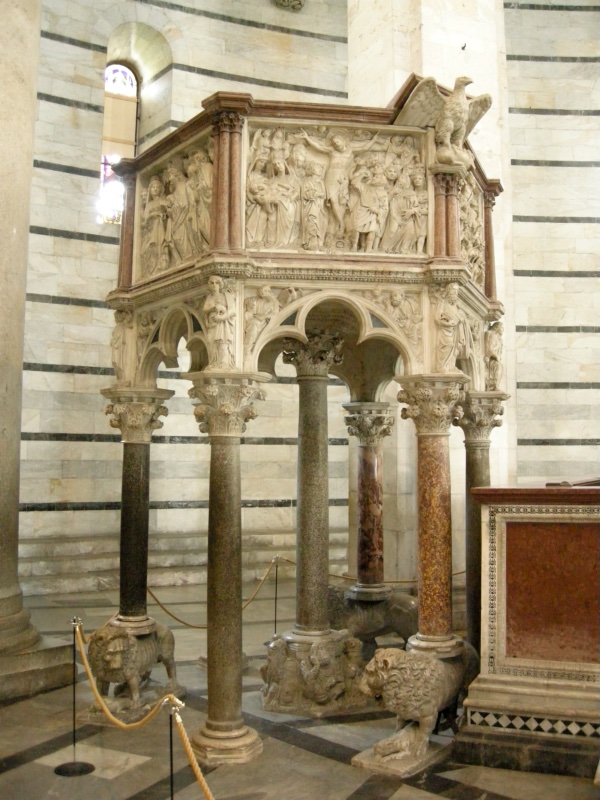
The pulpit is signed and dated by a metrical inscription incised at the foot of the last relief, the Last Judgement:
ANNO MILLENO BIS CENTUM BISQUE TRICENO / HOC OPUS INSINGNE SCULPSIT NICOLA PISANUS / LAUDETUR DINGNE TAM BENE DOCTA MANUS
“In the year 1260 Nicola Pisano carved this noble work; may so gifted a hand be praised as it deserves.”
The date requires conversion. The epigraph gives 1260 in Pisan style, which anticipates the common era by one year from 25 March; the work was therefore brought to completion in the second part of 1259, and in any case not later than 24 March of the following year. 1259 is the correct modern-style completion date, and “1260” should be given only with the calendar specified. Much of the literature repeats the epigraphic figure without this qualification, and Italian and English sources accordingly appear to disagree when they do not.
The start date is less secure. Proposals run from about 1255 through 1257 to 1258, none of them documented; the range should be given as such. The commission is generally connected with the archiepiscopal patronage of the Visconti — though at least one account names the archbishop Filippo Visconti, which is an error: the see of Pisa was held from 1254 to 1277 by Federico Visconti. The identification of the patron should be verified before printing.
A further hypothesis worth reporting with care: the selection of episodes has been connected with the preaching of the Franciscan theologian Bonaventure at Pisa in 1257. This is an attractive suggestion about the programme’s intellectual milieu, not a documented commission instruction.
- The break with precedent
The hexagonal plan has no precedent. Earlier pulpits — Guglielmo’s, once in Pisa Cathedral and now in that of Cagliari, and those diffused through southern Italy in the twelfth century — were all square or rectangular. Nicola rejected the traditional square form and the wall-attached position, and set a free-standing hexagonal body in the space of the Baptistery.
The consequences are more than geometric. A polygonal pulpit standing clear of any wall must be walked around; the narrative can no longer be read from a fixed point, and the preacher’s platform becomes a monument in the round. Every subsequent pulpit in the Pisano series — Siena’s octagon, Pistoia’s hexagon, the circle at Pisa Cathedral — is a variation on the decision taken here.
The tribune rests on seven columns of various marbles. Six stand at the angles; three of these rise from stylophore lions in the Romanesque tradition, the other three from hexagonal bases, so that the supports alternate in rhythm around the perimeter. The seventh column stands at the centre, on a high figured pedestal with human figures and animals alluding to the earthly world redeemed by the sacrifice of Christ; the crouching supporters are described in some accounts as three telamones.
The shafts are red granite; the finely worked capitals and the bases are white marble. Above the capitals, round-headed trefoil arches — Gothic cusping within a Romanesque profile — span from column to column. Gothic elements such as the trefoil arches, the capitals with their rich naturalistic ornament, and the mouldings are harmoniously fused with Romanesque elements such as the stylophore lions, with a sense of measure that is characteristically classical.
The figural apparatus is disposed in two registers of differing relief depth. Above the capitals stand the Virtues and the Baptist in high relief; in the spandrels, in lower relief, are the Prophets and the Four Evangelists. Among the corner figures is the nude Fortitude in the guise of Hercules — one of the earliest monumental male nudes in Western sculpture since antiquity, and a declaration of intent as unambiguous as the signature.
The hexagonal cassa, open on one side to permit access, presents five carved slabs separated at each angle by three elegant colonnettes of red granite. The lectern is borne on the outspread wings of an eagle, symbol both of St John the Evangelist and of theology.
- The five reliefs
The parapet carries five panels in bas-relief with scenes from the life of Christ, chosen as the most affecting moments of the Infancy and the Passion: the Nativity, the Adoration of the Magi, the Presentation in the Temple, the Crucifixion, and the Last Judgement. The sixth face is absent, its width taken by the access to the pulpit.
The Nativity of the Pisa Baptistery Pulpit: Byzantine Syntax in a Roman Idiom
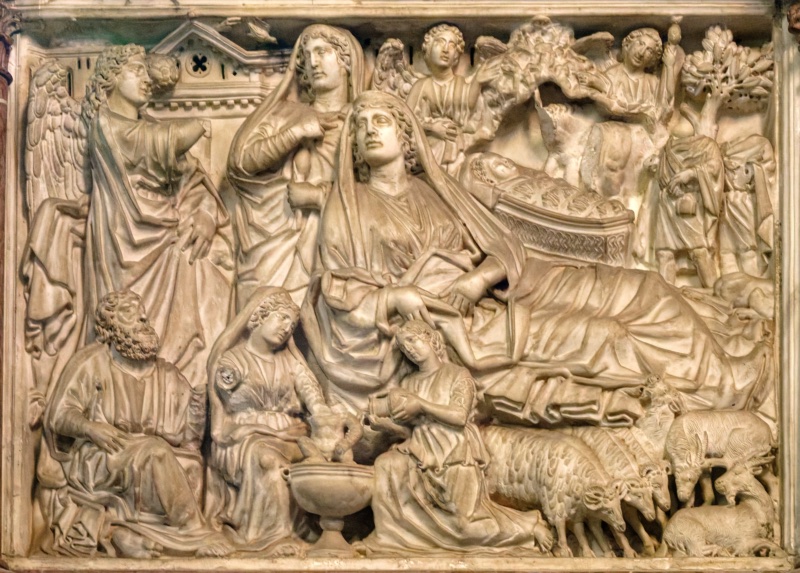
The Nativity is the first of the five christological slabs of the hexagonal parapet, and the panel from which the reading of the whole monument begins. Carved in Carrara marble in high relief, set between the triple colonnettes of red granite that articulate each angle of the cassa, it occupies a horizontal field whose proportions derive not from any medieval convention but from the Roman sarcophagus front — a fact that governs everything within it.
The compositional method is best seen in the first panel. The Nativity does not follow a linear development but is composed of distinct groups corresponding to different episodes, their scale proportioned to the importance of the event narrated. The Nativity itself is the central and largest scene; around this nucleus are disposed the Annunciation at the upper left, the Annunciation to the Shepherds at the upper right, and the Bath of the Child at the lower centre, with Joseph observing from one side. There is no unity of time or place. This kind of layout derives from works of Byzantine conception — a point worth stating plainly, since the standard account of Nicola as a proto-Renaissance classicist tends to obscure how much of his narrative syntax remains Byzantine.
The image allows the hierarchy to be read directly. At the upper left the angel Gabriel approaches a standing Virgin before a small pedimented aedicule; the architectural fragment does duty for the whole of Nazareth. Immediately to the right, and on a markedly larger scale, the same Virgin reappears reclining across the full width of the field, her head raised on her hand. Behind and above her the manger is seen with the swaddled Child, the ox and the ass leaning toward it; further right, angels and a standing shepherd with his staff among trees carry the announcement in the fields. At the lower centre two midwives bend over a basin in the Bath of the Child, and at the lower left Joseph sits apart, chin on hand, in the pose of meditative withdrawal that the Byzantine tradition assigns him. The lower right corner is filled with sheep and goats, densely and closely observed.
The Virgin thus appears twice within a single field, at two scales, in two moments. This is not an inconsistency but the governing principle: the panel is a theological argument in which magnitude signifies importance, not proximity.
- The antique
The classical references are constant and specific: figures are frequently presented as antique statues, in their faces, their poses, and their drapery. The semi-recumbent Virgin of the Nativity derives directly from Roman sarcophagi showing matrons on the triclinium. The pulpit stood within a few hundred metres of the Camposanto’s collection of antique sarcophagi, and the derivations are not general homage but demonstrable quotation.
The consequence is visible in the treatment of the Virgin’s head: the broad oval face, the parted wavy hair beneath the veil, the level brow and heavy lids belong to Roman matronal portraiture rather than to any thirteenth-century type. The drapery over her body falls in the deep, tubular, gravity-obedient folds of an antique statue, and the horizontal disposition across the panel’s width is the funerary banqueting pose transposed to a birth.
What is remarkable is that the borrowing is not decorative. The Nativity required a reclining Virgin — the Byzantine iconography of the childbed demanded it — and Nicola found in the Roman repertory a form that satisfied the requirement while transforming the register of the whole. The antique is used because it works, not because it is antique.
- Expression within the borrowed idiom
The figures are large and monumental, yet they participate in the action despite their classical solemnity and composure. Nicola’s distinction lies in the ability to express emotion and psychological detail while working in a borrowed classical idiom — and the reading, as the object was designed to be taken, runs from below upward, retracing the theological content of the preaching of the time.
The Virgin’s upward gaze is the test case. Nothing in the pose is unclassical; the emotion is carried entirely by the direction of the eyes and the slight lift of the head, superimposed on a form that in its Roman source expressed repose. Similarly, the midwives at the basin retain statuesque drapery while performing a wholly domestic action, and Joseph’s seated withdrawal is at once a Roman philosopher-type and a psychological observation about a man at the margin of an event he does not command.
The relief is also, technically, an argument for depth. Foreground heads stand nearly free of the ground; the shepherds and angels behind are cut progressively shallower; the architecture at the upper left is barely more than incised. Nicola is constructing recession by graduated relief depth rather than by perspective, and the panel functions as a demonstration of what marble can be made to do.
Phaedra Enthroned: Nicola Pisano’s Adoration of the Magi at the Pisa Baptistery
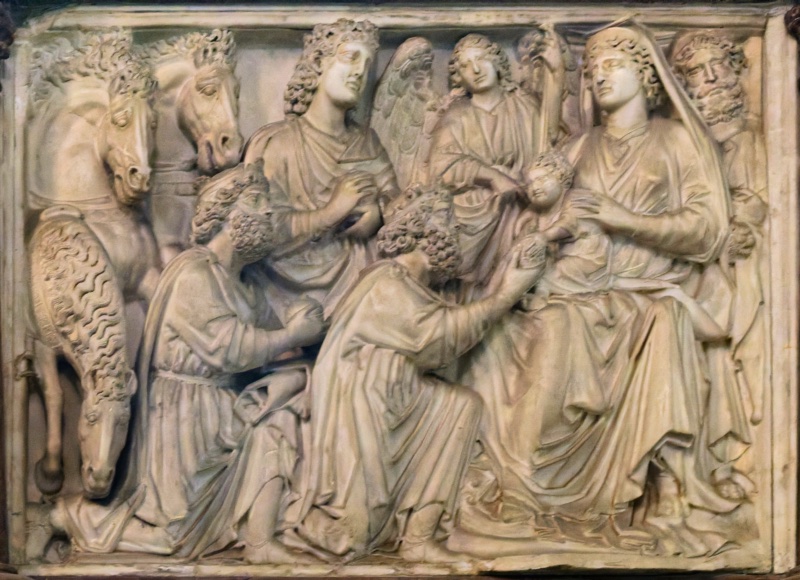
The Adoration of the Magi is the second of the five christological slabs of the hexagonal parapet, carved in white Carrara marble and separated from its neighbours by the tristyle pilasters of red granite that mark each angle of the cassa. The panel measures 85 cm in height. The five slabs are unmistakably inspired by the front panels of Roman sarcophagi — a derivation nowhere more evident than here, where a single event is deployed frieze-like across the full width of the field.
The panel abandons the multi-episode structure of the Nativity for a unified scene. Classical order and solemnity determine a composition that is unitary and essential: the scene is composed of few figures, of large scale, disposed according to an orthogonal grid. Essential forms, ample volumes, and composed, elegant attitudes confer a sense of great solemnity, while the measured and attentive gestures achieve a perfect equilibrium between natural grace and the circumstance of the sacred ceremony.
Reading the field from left to right: three horses fill the left quarter, their heads turned inward and downward, one seen in sharp foreshortening, a groom’s figure barely emerging behind them. The horses are notably well constructed in their foreshortening — an observation worth registering, since the Magi arrive here on horseback in the manner of a Roman equestrian retinue rather than with the camels of the eastern tradition.
The three Magi occupy the centre. The eldest kneels foremost, bowed low and pressing forward to the Child; a second kneels behind him at a slightly higher level; the third stands upright at the left of the group, crowned with a wreath, his hand raised in a gesture of presentation. Behind them, at the upper register, further heads appear in low relief, among them an attendant carrying a staff.
At the right the Virgin sits enthroned, veiled, the Child on her knee leaning sharply forward to receive the offering. The figures are disposed on three planes; an angel and Saint Joseph appear at the right. The bearded head at the extreme right edge is Joseph’s.
Although the sculptor did not know linear perspective, he sought to create the visual sensation of depth by placing the figures on different planes of vertical disposition. The device is the same as in the Nativity — graduated relief depth substituting for construction — but here it serves a single continuous action rather than a set of simultaneous episodes.
Pisa offered a treasury of antique works, in part still preserved in the Camposanto monumentale, which could serve as study material; among these it is possible to identify a series of precise correspondences with individual figures of the pulpit, and the enthroned Mary of the Adoration relief refers back to the figure of Phaedra on the so-called Phaedra sarcophagus. The sarcophagus dates to the second century AD; it stands today in the Camposanto Monumentale but in the sculptor’s time was placed in the Piazza dei Miracoli — that is, directly outside the Baptistery in which the pulpit was being erected. The derivation is therefore not a matter of remembered models or pattern-book transmission but of an object standing a few dozen metres from the workshop.
The borrowing is a quotation, not a paraphrase: the frontal seated posture, the matronal proportions, the fall of the mantle across the knees, and the veiled head are transferred substantially intact. Yet Mary here appears even more plastic, more solid, more noble and vital than her antique models.
This last point deserves emphasis, because it distinguishes Nicola’s classicism from antiquarianism. All the reliefs are marked by a complete mastery of the representation of the human figure, absolutely new relative to the preceding panorama of Tuscan sculpture; and this mastery is founded not on direct observation of nature but on a thoroughgoing study of the antique. If one may speak of a “proto-Renaissance” in reference to European sculpture of the thirteenth century, one must do so first of all for Nicola’s Pisan pergamo.
The panel that follows it, the Presentation in the Temple, extends the same procedure: it is the most learned scene of the cycle and the richest in citations, the High Priest at the right, supported by a youth, openly recalling the figure of Dionysus on the so-called Vaso del Talento, likewise belonging to the collection at the Camposanto. The old man with his arm supported by a putto is adapted from the relief of a krater with Dionysiac scenes, also at Pisa.
The classicism does not stand alone. This resumption of classical elements coexists with a Gothic restlessness, visible in the falling draperies, in the agitated manes of the horses, and in the beards of the men, all obtained through use of the drill. The Adoration is filled with a calm serenity, yet the Gothic unease is discernible in the beards of the kings and in the moving manes of the horses, animated by skilled work with the drill.
Various elements refer to the classical world: the ample drapery that reveals the forms beneath, and the heads with clean profiles, executed with the use of the drill to accentuate the strong chiaroscuro effects of the hair and the curly beards of the Magi. The drill is thus doing double duty — a classical tool producing an anti-classical agitation. The panel’s interest lies precisely in this instability: a Roman matron enthroned among figures whose hair and beards seethe with a nervous energy that no second-century sculptor would have permitted.
Across the cycle one notes the introduction of an ever greater number of narrative details, evidenced by a progressive annulment of the background surface. In this panel the ground has almost disappeared behind the crowd of heads.
A Drunken God Made Priest: Nicola Pisano’s Presentation in the Temple at the Pisa Baptistery
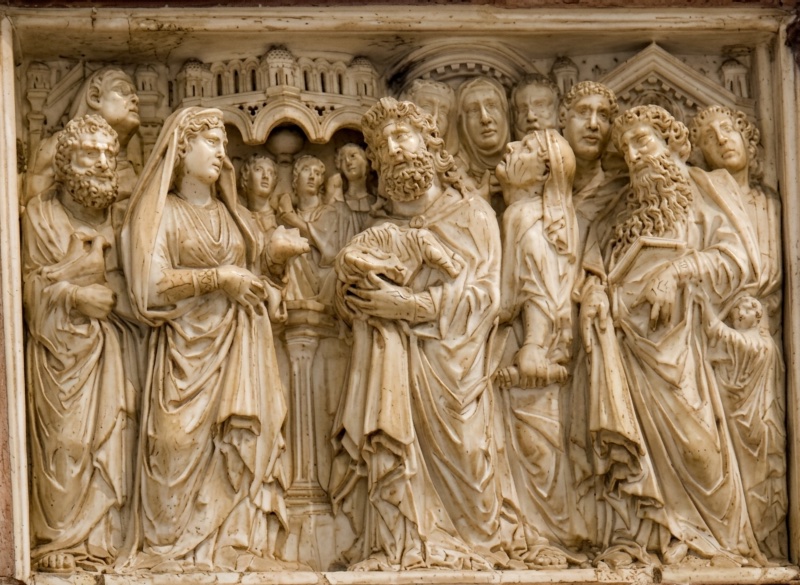
The Presentation in the Temple is the third of the five christological slabs of the hexagonal parapet, carved in white Carrara marble and framed at each angle by the tristyle pilasters of red granite. Among the five it holds a particular place: it is the most learned scene of the cycle and the richest in citations. Where the Nativity borrows a single figure-type and the Adoration one enthroned matron, the Presentation assembles a whole population of antique derivations within an architectural setting of unusual elaboration.
The scene of the Presentation of Jesus in the Temple, ordered and composed, presents a notable setting with an urban background and an effect of depth produced by the superimposed planes on which the figures are arrayed. Behind the personages are visible temples and palaces in which classical inspirations and orientalising motifs may be traced.
This is the only panel in the cycle where architecture does substantive work. In the Nativity a single pedimented aedicule stands for the whole of Nazareth; here the upper register is filled with a continuous skyline of arcaded and gabled structures, a dome or ciborium at the centre, and a pitched roof at the right edge. The Temple is not indicated by a symbol but constructed as a place, and the figures stand within it rather than before it.
The composition divides at a central vertical axis marked by a slender fluted column supporting the altar. To the left of it the Virgin advances, veiled, her head raised and one hand lifted toward the centre, her mantle falling in long unbroken folds to the ground; a bearded male figure stands behind her at the left edge. To the right of the axis the aged Simeon holds the swaddled Child against his breast, his head bowed forward, his hair and beard deeply drilled into a mass of separate curls. Behind and above him press a dense crowd of heads — witnesses, attendants, prophets — carved at progressively shallower depth. At the right stands a second bearded elder in a long mantle, and a small figure, apparently a child, appears at the extreme right edge.
The recession is achieved, as elsewhere on this pulpit, by graduated relief depth rather than by any perspectival construction: foreground figures nearly free of the ground, the middle rank in half-relief, the architecture barely raised from the surface.
The panel’s most celebrated feature is a specific and demonstrable borrowing. The High Priest at the right, supported by a youth, openly recalls the figure of Dionysus on the so-called Vaso del Talento, likewise belonging to the collection at the Camposanto. The old man with his arm supported by a putto is adapted from the relief of a krater with Dionysiac scenes, also at Pisa. The antique group is a drunken Dionysus leaning with his elbow upon a putto, recovered from a relief vase now in the Camposanto, and reused for the figure of the majestic elder who advances at the right.
The transformation deserves to be stated plainly, since it illustrates Nicola’s method better than any general formula. A wine-god steadied by a small attendant because he cannot stand unaided becomes an aged priest whose weakness is that of great age and whose supporting boy is an act of reverence. The pose is transferred intact; its meaning is inverted from intoxication to sanctity. Nothing in the source is disguised, and nothing of the source’s meaning survives.
Pisa offered a treasury of antique works, in part still preserved in the Camposanto monumentale, which could serve as study material; among these it is possible to identify a series of precise correspondences with individual figures of the pulpit. As with the Phaedra sarcophagus behind the Adoration, the model here stood within the Piazza dei Miracoli, a few dozen metres from the workshop.
In the Presentation in the Temple too one observes this synthesis between a restless Gothic dynamism and classical solemnity. The Virgin’s figure is the classical pole: a standing draped matron of unbroken vertical rhythm, her drapery obedient to gravity, her profile level and calm. The Gothic pole is Simeon’s, where the drill has been driven repeatedly into the beard and hair to break the surface into agitated light and shade.
Across the cycle one notes the introduction of an ever greater number of narrative details, evidenced by a progressive annulment of the background surface; the Presentation stands well advanced along that trajectory, its ground almost wholly consumed by heads and buildings. All the reliefs are marked by a complete mastery of the representation of the human figure, absolutely new relative to the preceding panorama of Tuscan sculpture; and this mastery is founded not on direct observation of nature but on a thoroughgoing study of the antique.
The subject conflates two moments of Luke 2: the presentation of the firstborn and the purification of the Virgin, with the prophecy of Simeon and, in most treatments, the presence of the prophetess Anna. Whether Anna is among the figures behind Simeon, and whether the bearded man at the left is Joseph, cannot be settled from the image and should be checked against a published diagram before either identification is printed.
The Still Axis: Nicola Pisano’s Crucifixion at the Pisa Baptistery
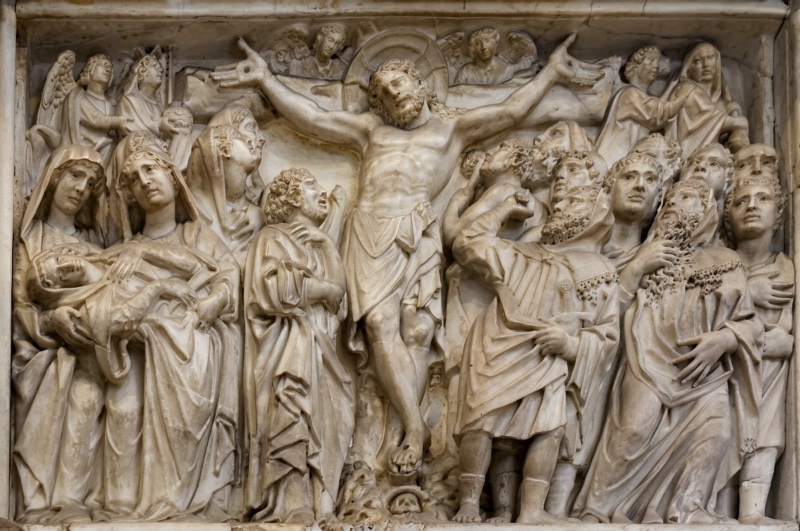
The Crucifixion is the fourth of the five christological slabs of the hexagonal parapet, carved in white Carrara marble and framed at each angle by the tristyle pilasters of red granite. It follows the Presentation in the Temple and precedes the Last Judgement, which carries the signature and date at its foot. Within the cycle it marks the transition from the Infancy to the Passion, and it does so with a sudden concentration of means: a single moment, a single vertical axis, and a crowd disposed in two contending halves.
The panel is organised around the body of Christ, which occupies the full height of the field and divides it exactly. The cross itself is barely indicated — a shallow horizontal bar behind the outstretched arms and a shaft largely swallowed by the figure — so that the composition reads as a nude body suspended above a press of heads rather than as an instrument of execution with a victim attached. The head falls to Christ’s right, the eyes lifted, the beard and hair worked with the drill into agitated masses; the torso is rendered with an anatomical seriousness that has few precedents in thirteenth-century Tuscan sculpture, the ribs and the musculature of the abdomen carefully articulated beneath taut skin. The legs cross at the ankle, and beneath the feet a small skull appears at the base of the field — Golgotha, the place of the skull, and by tradition the burial-place of Adam, over whose bones the redemption is enacted.
To the left stand the holy women, the Virgin swooning among them, supported and enclosed by her companions, whose veiled heads are turned upward toward the cross in a compact block of grief. To the right stand the soldiers and the crowd, and it is here that the panel’s drama is located: a dense mass of male heads at every angle, several with arms raised and hands gesturing sharply toward the cross, one striking his breast, another turning away. In the upper corners angels lean inward from behind the frame, their hands raised to their faces.
The scene thus polarises. Left is silent, vertical, and drapery-dominated; right is agitated, diagonal, and dominated by gesture and physiognomy. The nude body of Christ stands between them as the single still element in the field, and the composition’s meaning is carried by that opposition.
The Crucifixion is the panel in which Nicola’s classicism operates least as citation and most as capability. There is no single identifiable model here of the kind that stands behind the Adoration or the Presentation; what the antique has supplied is instead the ability to represent an unclothed male body convincingly at full length — an ability that the preceding Tuscan tradition did not possess, and which Nicola acquired through the sustained study of the Roman sarcophagi of the Piazza dei Miracoli. The dead Christ of this panel and the nude Fortitude in the guise of Hercules on the pulpit’s corner are two applications of a single acquired competence.
The Gothic counter-current is equally present. The drill has been driven into every beard and head of hair on the right side of the field, breaking the surface into restless light; the drapery of the mourning women falls in the angular, gravity-defying folds that mark this pulpit throughout. As across the cycle, the background surface has been progressively annulled: virtually no ground remains visible between the figures, and the recession is constructed entirely by graduated relief depth, the foreground heads nearly free of the block and the rearmost barely raised from it.
The physiognomic range on the right side deserves particular notice. The heads are individuated to a degree unusual in the cycle — bearded, clean-shaven, young, old, helmeted, turned in profile and in three-quarter — and the effect is of a specific crowd rather than a type. This acuity of physiognomic description, joined to a lively and dynamic sense of narrative, is among the qualities that allow the high reliefs of these panels to be set beside Roman originals without disadvantage.
Laudetur Digne: Nicola Pisano’s Last Judgement and the Signature of the Pisa Baptistery Pulpit
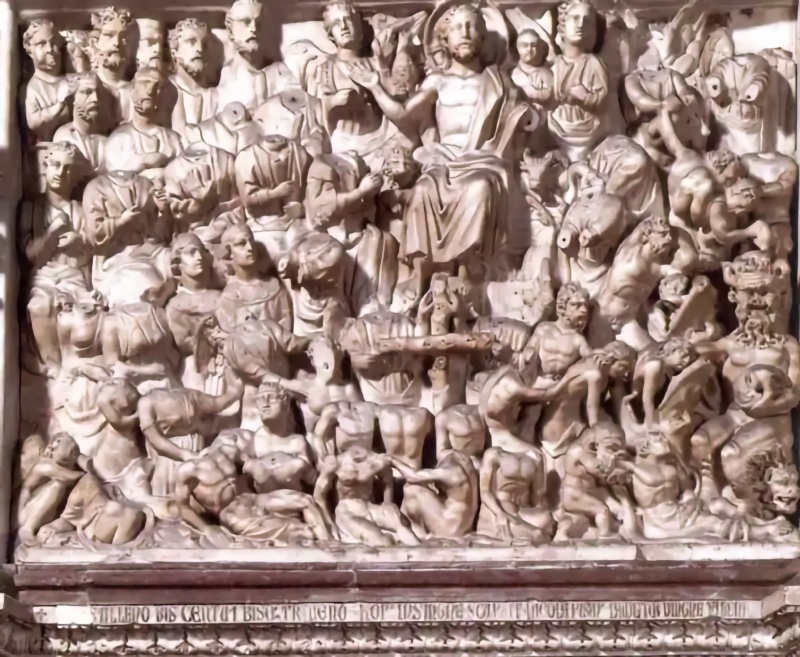
The Last Judgement is the fifth and final slab of the hexagonal parapet, and the one that closes the cycle begun with the Nativity. Its particular importance is documentary as well as artistic: it is at the foot of this relief that the metrical inscription is incised, running along the moulding visible at the base of the image —
ANNO MILLENO BIS CENTUM BISQUE TRICENO / HOC OPUS INSINGNE SCULPSIT NICOLA PISANUS / LAUDETUR DINGNE TAM BENE DOCTA MANUS
“In the year 1260 Nicola Pisano carved this noble work; may so gifted a hand be praised as it deserves.” The date is given in Pisan style and corresponds to 1259 in modern reckoning.
The placement is not neutral, and the point is worth making in the entry. The sculptor’s request to be praised as he deserves — laudetur digne — is set directly beneath the scene in which deserts are weighed and assigned. Whether Nicola intended the resonance cannot be demonstrated, but the juxtaposition is available to any medieval reader of the epigraph, and the pulpit is in every other respect a monument of calculated self-assertion. This should be offered as an interpretation, not as a documented intention.
Where the Siena pulpit would distribute the Judgement across two fields, and where Giovanni at Pisa Cathedral would likewise divide the saved from the damned into separate panels, Nicola here compresses the whole eschatological drama into a single slab. The compression is the panel’s governing condition.
Christ occupies the upper centre, enthroned, bearded, within a cruciform nimbus, the chest bared and the right hand raised with the palm turned outward in the gesture of the ostentatio vulnerum — the display of the wounds by which the sentence is justified. The drapery falls across his knees in the broad classical folds that govern the whole cycle. He is the only figure in the field granted space around him; everything else is packed.
Ranged behind and beside him, in three and four superimposed tiers, are the apostles and the company of heaven — a dense mass of heads carved at progressively diminishing depth, the rearmost barely raised from the ground. The background surface has here been almost wholly annulled, completing the trajectory that runs across the five panels from the relatively open field of the Nativity to this state of total saturation.
The field divides at the axis of Christ’s body according to the standard eschatological convention.
- To Christ’s right (the viewer’s left): the Elect
The figures remain clothed, upright, and composed; they are disposed in ordered ranks, faces turned upward or toward the throne, their drapery falling in continuous vertical rhythms. The register is one of stillness. Toward the lower left the ranks give way to the resurrecting dead, half-draped figures rising and being drawn upward.
- To Christ’s left (the viewer’s right): the Damned
Here the order collapses. The bodies are nude, contorted, seized and dragged; demons intervene among them, distinguished by grotesque physiognomies, horned and shaggy heads, and hair and beards worked into serpentine masses by the drill. Limbs project at every angle; figures tumble headlong; the composition disintegrates deliberately as it approaches the right margin.
Along the bottom: the resurrection of the flesh, with figures emerging from the ground across the full width beneath both halves.
The panel thus constructs its meaning through a formal opposition rather than through narrative sequence. Salvation is legible as vertical order and the retention of clothing; damnation as horizontal chaos and nakedness. It is an argument made in compositional syntax before it is made in iconography.
The Last Judgement is where Nicola’s classicism is put to a use for which no antique model could serve directly. The Roman sarcophagi of the Piazza dei Miracoli supplied the crowded battle-relief as a formal type — the packed field of struggling nude bodies, the layered recession, the projecting limbs — and it is that type, rather than any single quotable figure, that stands behind the right half of this panel. The technical vocabulary of the antique is deployed to represent a subject antiquity did not possess.
This has a specific consequence for the next generation. Ascani has suggested that the demons and the damned of this relief — athletic and classicising, but sometimes caricaturally distorted, with serpentine hair and beards — formed an important object of study for the young Giovanni Pisano in the crucial years of his stylistic formation. The panel that closes Nicola’s masterpiece is thus also the point at which the pulpit’s influence on his son is most concretely traceable. The tragic and violent registers of the Pistoia Massacre of the Innocents and the Pisa Cathedral Last Judgement begin here.
Position in the sequence
The pulpit was carved almost entirely by Nicola’s own hand, and it was finished when Giovanni was a boy; it is unlikely to have offered him more than the menial workshop tasks of polishing. Its importance for the son is therefore not that of participation but of object-lesson. The proud signature would furnish the model for Giovanni’s own at Pistoia and Pisa. The demons and the damned of the Last Judgement, athletic and classicising but sometimes caricaturally distorted, with serpentine hair and beards, formed an important object of study for him in the crucial years of his stylistic formation.
The success of the Pisa baptistery pulpit quickly attracted the attention of neighbouring Siena, whose cathedral authorities were engaged in an ambitious building programme that sought to rival and surpass other Tuscan centres. In 1265 a contract was concluded between Nicola and the “Opera” of Siena Cathedral for a new marble pulpit, to be executed with the help of his workshop and completed by 1268.
Five years after its completion, the Sienese operaio Fra Melano, who acted as intermediary between the sculptor and the chapter and who ensured that the project conformed to liturgical needs and financial capacities, encouraged Nicola to design an octagonal pulpit, supported by columns and adorned with seven large reliefs narrating episodes from the life of Christ, together with a rich decorative program of prophets, evangelists, and personifications. By commissioning an artist already celebrated in Pisa, the Sienese chapter aligned itself with the most advanced currents of Tuscan sculpture, while at the same time asserting its autonomy through a distinctive iconographic and formal programme.
The Siena Cathedral Pulpit
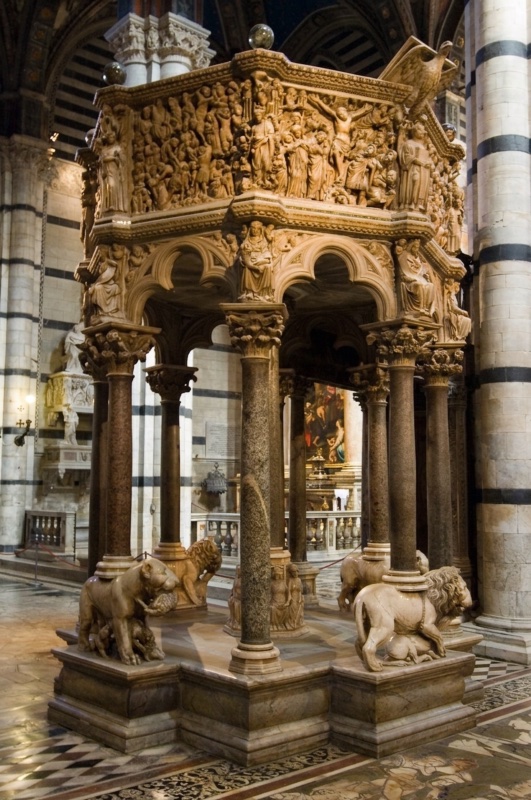
The patronage relationship extended beyond the delivery of the object, as Nicola’s presence in Siena encouraged further commissions for members of his workshop and led to his eventual acquisition of Sienese citizenship in 1272. Thus, the Siena pulpit exemplifies a symbiotic relation in which patrons gained prestige and doctrinally rich imagery, while the sculptor and his family attained new legal status and a broader platform for their art.
Another key group of patrons were the mendicant orders, especially the Dominicans, whose rapid expansion in the thirteenth century created fresh opportunities for monumental sculpture associated with preaching and burial. Around 1264, the Dominicans of Bologna initiated a grand project for the tomb of their founder, Saint Dominic1, whose body lay in their convent church and attracted increasing numbers of pilgrims. According to documentary and stylistic evidence, Nicola designed the marble sarcophagus that formed the core of the so‑called Arca di San Domenico, although the execution of much of the sculpture was entrusted to his follower Lapo di Ricevuto and later to other masters, including Niccolò dell’Arca and Michelangelo in subsequent centuries.
Here the patrons sought an object that would combine doctrinal clarity, hagiographic narrative, and sumptuous carving, in order both to honour the saint and to project the prestige of their order. The lower reliefs, attributed to Nicola’s design, depict key episodes from Dominic’s life in a style that fuses compact, classically inspired figures with a more animated rhythm appropriate to mendicant spirituality. Although Nicola’s personal presence in Bologna is debated, the patronage relationship is nonetheless significant, because it demonstrates the geographical diffusion of his reputation and the trust placed in his designs by a powerful translocal religious order.
In commissioning him or his workshop, the Dominicans aligned their cultic centre with the same classicising current that distinguished the cathedral pulpits of Pisa and Siena. The Arca project therefore marks an extension of Nicola’s patronage network beyond the strictly episcopal and communal institutions of Tuscany into the new religious movements that were reconfiguring urban piety in northern and central Italy.
Richer and More Beautiful: The Visitation and Nativity of the Siena Cathedral Pulpit
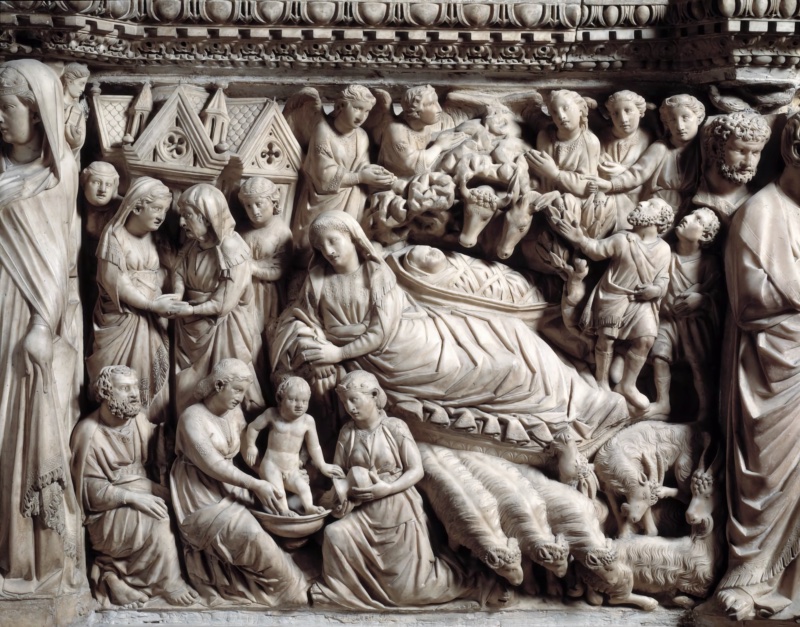
The Visitation and Nativity is the first of the seven narrative slabs of the octagonal parapet of the Siena pulpit, contracted on 29 September 1265 and paid off on 6 November 1268. It opens a cycle that runs through the Journey and Adoration of the Magi, the Presentation and Flight into Egypt, the Massacre of the Innocents, the Crucifixion, and the two fields of the Last Judgement.
Its interest lies almost entirely in comparison. Nicola had carved the same subject at the Pisa Baptistery six or seven years earlier, in a panel of near-identical episodic construction; the operaio Fra Melano had signed the Siena contract standing in front of that very object, having stipulated something richer and more beautiful. This relief is the direct answer to that stipulation, and every difference between the two is a measure of what the intervening years — and the arrival of a workshop of autonomous personalities — had produced.
The panel retains the multi-episode structure inherited from Byzantine models: no unity of time or place, distinct groups corresponding to distinct moments, their scale proportioned to their importance. But the population has roughly doubled and the field is now saturated.
- Upper left: the Visitation
Mary and Elizabeth meet before a Gothic aedicule, hands extended toward one another, attended by two further figures. Elizabeth is characterised as aged, her face lined and her head close-veiled; Mary stands upright and youthful. Behind them a small building rises with steep gables, tiled roofs, and quatrefoil oculi.
This is the first substantive departure from Pisa. There the upper left carried the Annunciation, set before a classical pedimented aedicule; here the Annunciation appears to have been displaced by the Visitation, and the architecture that frames it has become emphatically Gothic. Both changes point the same way — away from the antique register and toward the contemporary and the affective. The absence of the Annunciation from this panel should nonetheless be verified before being asserted, since the episode may be reduced to a group not legible in this view.
- Centre and right: the Nativity
The Virgin reclines across the full width of the field on a thick mattress whose folds fall in deep parallel troughs. Above and behind her the swaddled Child lies in the manger, the ox and the ass thrusting their heads down toward him; angels lean in from above, and to the right the shepherds receive the annunciation, one youthful in a short tunic and boots, another gesturing toward the flock.
- Lower centre: the Bath of the Child
Two midwives kneel over a footed basin in which the nude Child stands upright; one supports him beneath the arms, the other tests or pours the water.
- Lower left: Joseph
Seated apart, bearded, one hand on his knee, in the posture of meditative withdrawal that the Byzantine tradition assigns him.
- Lower right: the flock
Sheep, goats and a ram fill the corner, their fleeces rendered in tightly drilled curls, their heads individuated.
The tall draped figures at either edge of the image are not part of the panel: they are the standing figures that at Siena replace the colonnettes of Pisa at the angles of the parapet, and they belong to the pulpit’s structural articulation rather than to the narrative.
Three things distinguish this relief from its Pisan predecessor, and the entry should make them explicit:
-
The episodes are now linked: at Pisa the reclining Virgin gazed upward and away, her scene juxtaposed with the Bath below but not connected to it. Here she inclines her head downward and to her right, looking toward the bathing group, and her right hand descends toward the basin. The two moments are joined by a gesture across the compositional divide. Simultaneity has become relation, and the panel begins to behave as a single scene rather than as an assemblage.
-
The ground has been consumed: the progressive annulment of the background surface, traceable across the five Pisan panels, has here reached a further stage: virtually no field remains visible between the figures, and recession is constructed wholly by graduated relief depth, from heads standing nearly free of the block to forms barely raised from it.
-
The surfaces have become ornamental: the women’s garments now carry embroidered hems, pearled necklines, and pleated cuffs, worked with the drill into fine pierced detail. This is a Gothic taste for surface incident that the Pisan panel, with its broad classical planes, largely refused.
The classical substrate nonetheless remains. The reclining Virgin derives, as at Pisa, from the Roman sarcophagi showing matrons on the triclinium; the proportions and the drapery logic are unchanged. What has altered is the temperature.
The Siena pulpit was executed by a workshop of increasingly autonomous personalities — Arnolfo di Cambio above all, with Lapo, Donato, and the young Giovanni Pisano — and the attribution of individual figures has never been resolved. The difficulty derives from the shop’s method: pupils executed particular figures to the master’s overall compositional and iconographic design, probably fixed beforehand in drawings and cartoons, and their work was then reabsorbed into the whole by Nicola’s finishing interventions. One consequently finds figures whose drapery reveals Arnolfesque or Giovannesque idioms while the faces betray the master’s hand.
No specific attribution has been proposed for this panel in the sources consulted, and none should be offered. It is worth noting that the encyclopedic tradition takes the sceptical view outright, holding that the pulpit’s unity of style and execution does not permit a division between master and collaborators at all.
The Cavalcade and the Offering: Nicola Pisano’s Adoration of the Magi at Siena
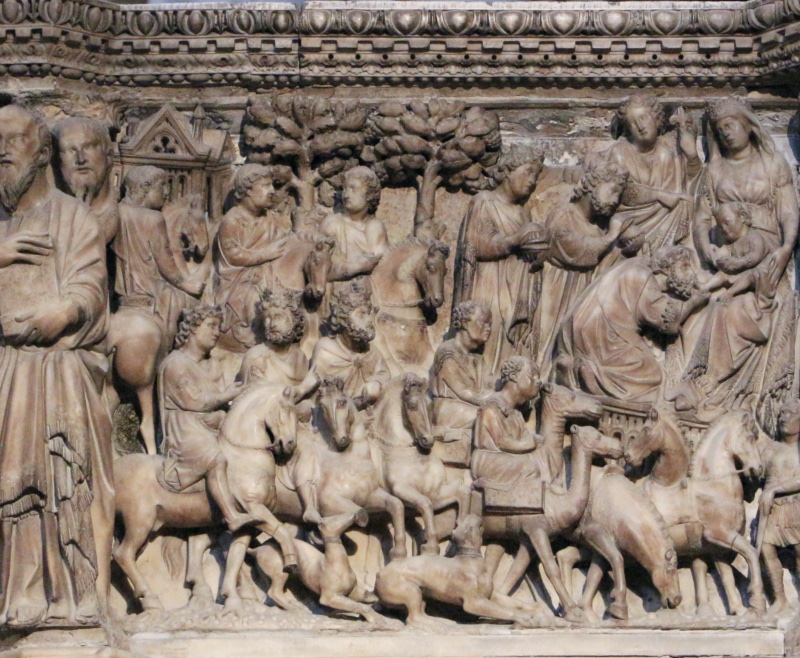
The Adoration of the Magi is the second of the seven narrative slabs of the octagonal parapet of the Siena pulpit, contracted on 29 September 1265 and paid off on 6 November 1268. It follows the Visitation and Nativity and precedes the Presentation in the Temple with the Flight into Egypt.
Like every panel on this pulpit it invites direct comparison with its Pisan predecessor of 1259, and here the comparison is unusually instructive, because the two reliefs treat the same subject under opposite compositional principles. Fra Melano had signed the Siena contract standing in the Pisa Baptistery, before Nicola’s earlier Adoration, and had stipulated something richer and more beautiful. The Siena panel is the fulfilment of that clause in its most literal form: what has principally increased is quantity.
The Pisan Adoration had been governed by classical order and solemnity — few figures, large in scale, disposed on an orthogonal grid. Nothing of that restraint survives here.
The relief is organised in two diagonally opposed masses. The lower two-thirds are given over to the cavalcade: a press of at least six or seven horses, their heads at varying heights and angles, several seen in sharp foreshortening, bridled and harnessed, with grooms and attendants moving among them. Dogs run and crouch beneath the hooves in the foreground. Camels appear at the right, their long necks and small heads unmistakable among the horses. The animals are not background but subject, occupying more of the field than the human figures and rendered with a naturalistic attention — to musculature, to the fall of manes, to the individual set of each head — that has few precedents.
The upper right carries the Adoration proper. The Virgin sits enthroned at the extreme right, veiled and crowned, the Child on her knee leaning forward; the eldest Magus, bearded, bows low before her, and the second Magus stands behind him presenting a covered vessel. A further attendant figure appears above. At the upper left a Gothic aedicule with a steep gable and quatrefoil oculus stands for the architecture of the journey, and a broad-crowned tree, deeply undercut, rises at the centre.
The tall draped figures at the left edge of the image — one bearded and holding a book — are not part of the panel. They belong to the standing figures that at Siena replace the colonnettes of Pisa at the angles of the parapet, articulating the octagon with sculpture rather than with architectural members.
The panel’s essential departure from Pisa is that it fuses two episodes. At Pisa the horses were confined to the left margin, a compact group of three heads acknowledging that the Magi had travelled; the scene itself was static, ceremonial, and unified. Here the journey is given equal standing with its terminus. The Magi are shown arriving and adoring at once, the retinue still in motion at the lower left while the offering is already being made at the upper right.
The result is a composition with a strong internal current. The eye is drawn from the lower left, where the horses press forward, diagonally upward to the right, where the movement resolves in the bowed figure of the eldest Magus. Nicola has converted a static ceremonial into a narrative with direction — the same operation that will govern the Massacre of the Innocents on this pulpit, and that Giovanni will carry much further at Pistoia.
The technical means is the near-total annulment of the background surface. Virtually no ground remains visible; recession is constructed entirely by graduated relief depth, from the horses’ heads standing almost free of the block to the rearmost figures barely raised from it.
The naturalism and the extraordinary capacity for observation evident in the figures of animals and plants is among the qualities the literature consistently attributes to Nicola’s work, and this panel is its principal demonstration piece. The horses in particular have been singled out for the skill of their foreshortening.
The inclusion of camels alongside horses is worth remarking. At Pisa the Magi arrived on horseback in the manner of a Roman equestrian retinue; here the eastern beast has been admitted, and with it a note of the exotic that the earlier panel’s romanising had excluded. This is consistent with the general direction of change between the two pulpits — away from the antique register and toward abundance, incident, and contemporary Gothic taste.
This is one of the panels most frequently invoked in the attribution debate. Figures are found in which the drapery reveals Arnolfesque or Giovannesque idioms while the faces betray the master’s hand, as in the group of Magi in the Adoration.
The observation is diagnostic of the workshop’s method rather than resolving it. Pupils executed particular figures to Nicola’s overall compositional and iconographic design, probably fixed beforehand in drawings and cartoons; their work was then reabsorbed into the whole by the master’s finishing interventions. The Magi group is thus a place where the seam is visible without being separable — which is precisely why twentieth-century criticism could not close the question.
The encyclopedic tradition draws the opposite conclusion from the same evidence, holding that the pulpit’s unity of style and execution does not permit a division between master and collaborators at all. Both positions should be reported.
Two Journeys in One Field: The Presentation in the Temple and Flight into Egypt at Siena
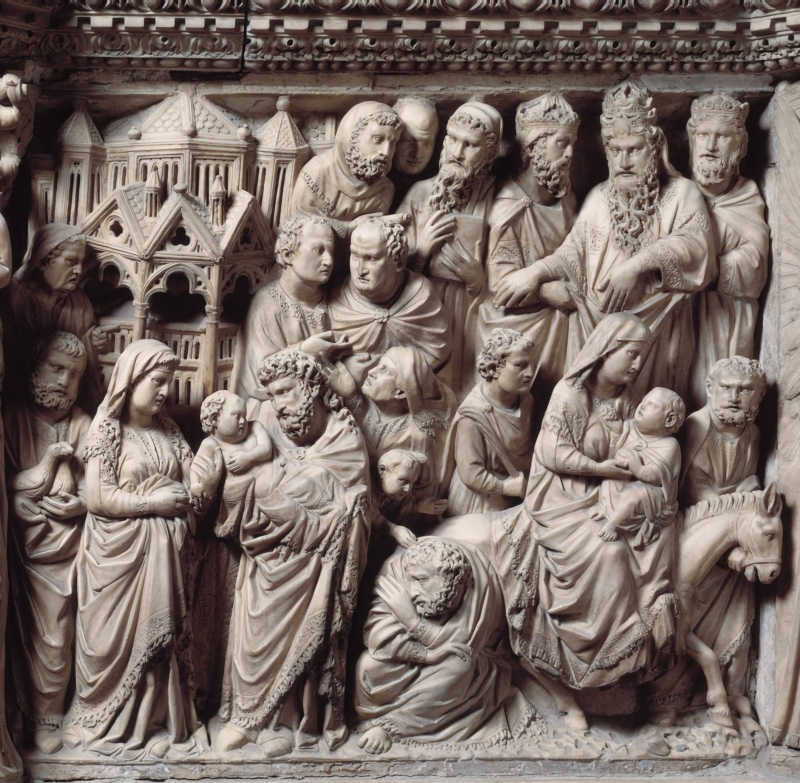
The Presentation in the Temple and Flight into Egypt is the third of the seven narrative slabs of the octagonal parapet of the Siena pulpit, contracted on 29 September 1265 and paid off on 6 November 1268. It follows the Journey and Adoration of the Magi and precedes the Massacre of the Innocents.
The panel exemplifies the compositional principle by which the Siena cycle differs from its Pisan predecessor of 1259. At Pisa the Presentation had occupied a slab to itself, ordered and composed, its figures arrayed before an urban skyline. Here two episodes separated by an interval of days share a single field, so that the seven Sienese panels can carry a narrative substantially longer than the five Pisan ones without a proportionate increase in surface. Compression, rather than expansion, is what the octagon has bought.
The field divides roughly at the centre, though the division is not marked by any architectural or spatial device and the two episodes interpenetrate at their meeting.
- Left half: the Presentation in the Temple
A Gothic ciborium with steep gables, quatrefoil oculi, crocketed pinnacles and tiled roofs rises at the upper left, standing for the Temple; behind and beside it further arcaded structures indicate the city. Below, the Virgin advances at the extreme left, veiled and richly robed, carrying in her hands the two turtledoves of the purification offering — a detail rendered with unusual clarity, the birds’ heads and folded wings distinctly cut. Beside her, the aged Simeon receives the Child, who is held against his shoulder; the old man’s head is thrown back and his hand raised, and the Child turns to look back toward his mother.
Behind them rise several ranks of witnesses: bearded elders in the middle ground, and at the upper right a group of figures in tall mitre-like headgear, one of them of exceptional prominence — a great bearded head with hair and beard drilled into a mass of separate serpentine locks, his arm extended forward with the hand open. This is presumably the high priest, or a prophet of the Temple. Between the groups a woman with a lined face and close-drawn veil looks upward: almost certainly the prophetess Anna, whose presence Luke’s account requires.
- Right half: the Flight into Egypt
At the lower right the Virgin sits sidesaddle, veiled, holding the Child against her breast; she turns her head back toward the scene she is leaving. The head of the ass appears at the extreme right edge, and behind her a bearded man — Joseph — leads the beast. A youthful figure stands between the two halves of the panel, cloaked and turned toward the right, apparently accompanying the departure.
The Virgin’s backward glance is the compositional hinge. It reaches across the field into the Presentation, binding the two episodes into a single sequence and giving the panel a direction of reading from left to right.
The relief is constructed on the same principles as the rest of the cycle. The background surface has been almost wholly annulled: no ground is visible between figures except where the architecture supplies it, and recession is built entirely by graduated relief depth, from foreground heads standing nearly free of the block to figures at the top barely raised from the surface. Four or five distinct planes are legible in the upper right group alone.
Two features distinguish this panel within the Siena cycle:
- The first is the density of physiognomic characterisation: the male heads in the middle and upper registers are individuated to a marked degree, ranging from smooth youth to extreme age, with beards worked by the drill into distinct textures
- The second is the ornamental elaboration of the garments — embroidered hems, pearled and pleated necklines, jewelled borders — which recurs across the pulpit but is here especially conspicuous on the two Virgins.
The Gothic architecture is worth noting as a departure. At Pisa the Temple had been suggested by structures in which classical inspirations and orientalising motifs could be traced; here the ciborium is unambiguously contemporary Gothic, a small building of the kind Nicola’s own generation was raising. The setting has been brought home.
No specific antique quotation has been proposed for this panel in the sources consulted, and the entry should not imply one. This is a substantive point rather than a gap. The Pisan Presentation was the most learned scene of that cycle and the richest in citations, its high priest openly recalling the Dionysus of the so-called Vaso del Talento in the Camposanto. The Siena Presentation appears to abandon that procedure. If the observation holds, it registers a real shift in Nicola’s practice between 1259 and 1268 — from demonstrable quotation of specific antique models toward an assimilated command exercised without visible citation. The claim requires checking against a modern monograph before it is printed.
The Siena pulpit was executed by a workshop of increasingly autonomous personalities — Arnolfo di Cambio above all, with Lapo, Donato, and the young Giovanni Pisano. The difficulty of separating them derives from the shop’s working method: pupils executed particular figures to Nicola’s overall compositional and iconographic design, probably fixed beforehand in drawings and cartoons, and their work was then reabsorbed into the whole by the master’s finishing interventions.
The great bearded head at the upper right of this panel, with its violently drilled hair and its emphatic forward gesture, is the kind of figure in which criticism has looked for a younger and more energetic hand.
A Field Without a Centre: Nicola Pisano’s Massacre of the Innocents at Siena
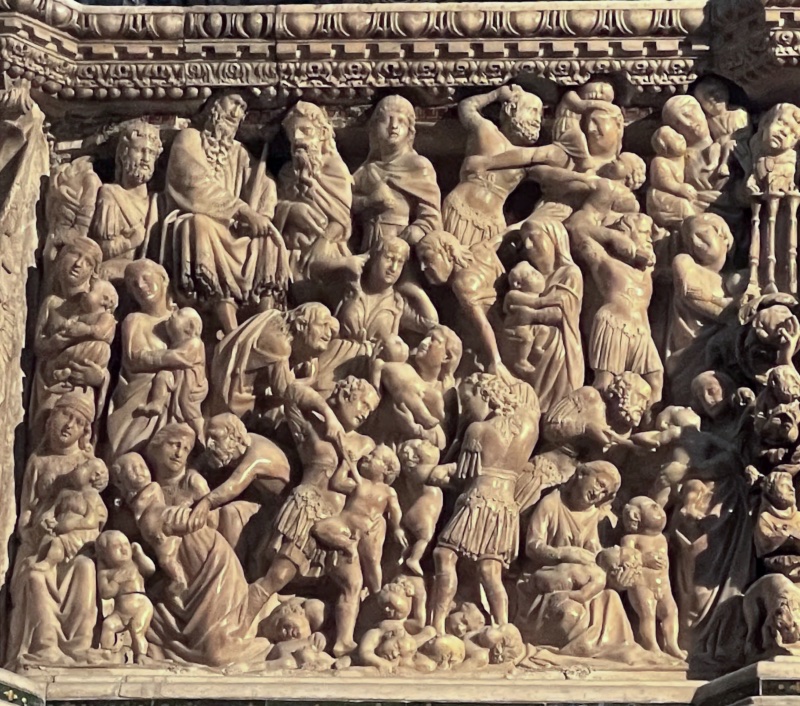
The Massacre of the Innocents is the fourth of the seven narrative slabs of the octagonal parapet of the Siena pulpit, contracted on 29 September 1265 and paid off on 6 November 1268. It follows the Presentation in the Temple and Flight into Egypt and precedes the Crucifixion.
The subject has no counterpart at the Pisa Baptistery, where the five slabs run from the Nativity directly to the Crucifixion. Its inclusion at Siena is therefore one of the concrete results of the octagonal plan: two additional fields permitted the cycle to admit episodes the hexagon had excluded, and the workshop chose to spend one of them on the most violent narrative in the Infancy. The decision has consequences that reach well beyond this pulpit.
The relief abandons the compositional habits of the rest of the cycle. There is no division into episodes, no architectural framing, no clear reading direction. Instead the field is filled edge to edge with a single continuous mass of struggling bodies, and the background surface has been annulled entirely — no ground remains visible anywhere.
- Upper register
Herod is enthroned at the upper left, bearded and crowned, seated frontally with one hand extended in the gesture of command that sets the whole in motion. He is the only seated figure in the panel and the only one at rest. Around and to the right of him stand counsellors and elders, several bearded, one turning away.
- Centre and right
The executioners occupy the middle of the field: young soldiers in short belted tunics and boots, bare-legged, their bodies twisted into violent diagonals. Two are shown with arms raised above their heads, one grasping a child by the leg, another with a raised blade. Their poses are markedly athletic and classicising, drawn from the vocabulary of the Roman battle-sarcophagus, and their nudity of limb sets them apart from the heavily draped figures of the surrounding cycle.
- Left and lower left
The mothers form a dense block of grief: seated, kneeling, and crouching figures, veiled, clutching living infants to their breasts or bending over dead ones. Their heads are turned upward toward the executioners or downward toward the bodies, and their drapery falls in long enveloping folds that contrast directly with the exposed limbs of the soldiers.
- Lower edge
Along the base of the field lie the slaughtered children, small nude bodies heaped horizontally, some face down, others with limbs projecting. The lower register of the panel is a stratum of corpses on which the entire scene stands.
The visible fragment of the pulpit’s structure at the left of the image — a standing draped figure with a scroll or attribute, and the moulding beneath — belongs to the parapet’s angle articulation and to the trilobed arcade below, not to the relief.
Three formal decisions carry the panel’s meaning:
-
The vertical hierarchy: Herod sits at the top, immobile; the soldiers act at the middle level; the children die at the bottom. The command descends through the field to its consequence, and the composition can be read as a vertical section through the mechanism of an atrocity.
-
The opposition of body types: draped, enclosed, static female figures on the left; bare-limbed, exposed, violently articulated male figures at the centre and right. The contrast is the same one Nicola had used to divide the Last Judgement at Pisa between clothed Elect and naked Damned, redeployed here to separate victim from perpetrator.
-
The refusal of a focal point: unlike every other panel in the cycle, this relief offers no dominant figure to which the eye resolves. Herod is displaced to a corner; no single mother or soldier commands the field; the incidents multiply without hierarchy. The effect is of a scene the beholder cannot organise — which is, presumably, the point.
This is the relief of the Siena pulpit with the greatest consequence for what followed, and the entry should say so plainly.
Giovanni Pisano would carve the same subject at Sant’Andrea in Pistoia some thirty years later, and the Pistoia Massacre, with its tangle of soldiers, mothers, and slaughtered children, is among the most harrowing narrative reliefs of the Middle Ages. The genealogy is direct. Whatever is finally decided about the division of hands at Siena, the compositional problem Giovanni solved at Pistoia — how to represent an atrocity as a single undifferentiated mass of bodies rather than as a series of incidents — was posed and first attempted here.
This panel occupies a particular place in the attribution debate. Ascani has argued that the central group of women, with their bold movements turned inward and their fluid linear energy, the rapid passage of planes, and the very high relief with passages worked à jour, points to an energetic and youthful hand — that is, to the young Giovanni.
The argument is stylistic and cannot be documented, and it should be reported as one position within a debate the shop’s method was designed to render irresolvable: pupils executed particular figures to the master’s overall compositional design, probably fixed beforehand in drawings and cartoons, and their work was reabsorbed into the whole by Nicola’s finishing interventions. The encyclopedic tradition takes the contrary view, holding that the pulpit’s unity of style and execution does not permit any division between master and collaborators.
Both positions must be stated. But it is worth noting that the two claims converge on the same object: whether or not Giovanni’s hand is present in the Siena Massacre, the Pistoia Massacre is unmistakably its descendant.
The Saturated Field: Nicola Pisano’s Crucifixion at Siena
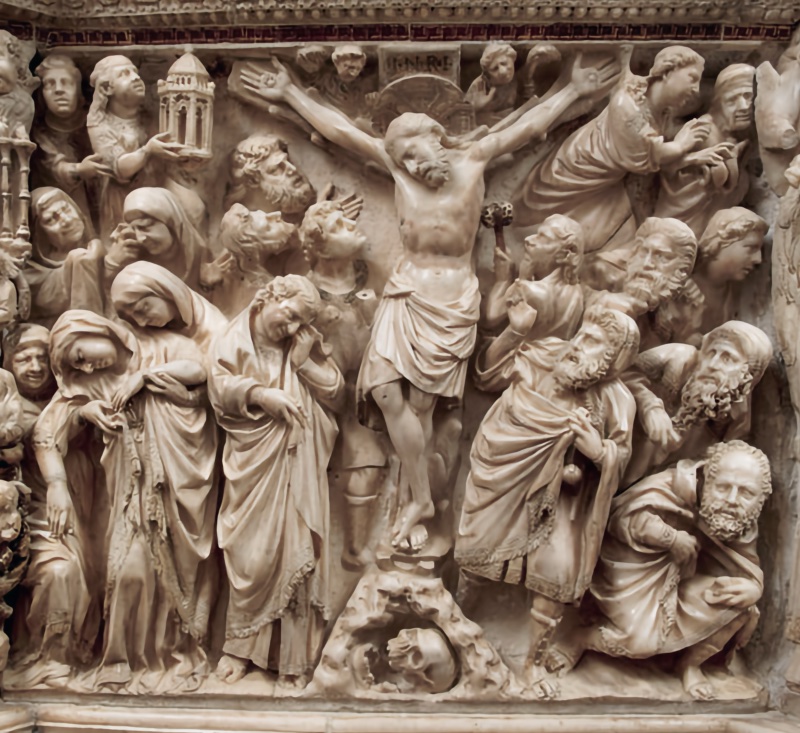
The Crucifixion is the fifth of the seven narrative slabs of the octagonal parapet of the Siena pulpit, contracted on 29 September 1265 and paid off on 6 November 1268. It follows the Massacre of the Innocents and precedes the two fields of the Last Judgement, and it marks the point at which the cycle passes from the Infancy to the Passion.
The comparison with the Pisan Crucifixion of 1259 is unavoidable and unusually productive, because the two reliefs are built on the same armature and diverge in almost every particular of temperature and density. At Pisa the crucified body stood as the single still element in a field of some twenty figures, the composition polarised cleanly between silent grief at the left and agitated response at the right. Here the figure count has perhaps doubled, the ground has vanished entirely, and the stillness has gone.
- The axis
Christ occupies the centre, arms outstretched, the head fallen forward and to his right, the beard and hair drilled into separate locks. The titulus — I·N·R·I — is legible on the tablet above the cross, and behind the head a foliate or rayed nimbus is cut into the ground. The body is more attenuated and more explicitly dead than its Pisan counterpart: the ribs project sharply, the abdomen is drawn in, the legs hang with the knees slightly bent. The loincloth falls in deep vertical folds to the knee. Beneath the feet, at the base of the shaft, lies the skull — Golgotha, the place of the skull, and by tradition the burial-place of Adam over whose bones the redemption is enacted.
- Christ’s right (the viewer’s left): the mourners
The Virgin collapses into the arms of the holy women at the lower left, her body given over entirely to their support — the swooning Virgin, an image drawn from Franciscan meditative literature that Nicola had introduced at Pisa and here develops into a larger and more enveloping group. Immediately left of the cross stands a solitary draped figure, hand raised to the face in the gesture of grief, the head bowed: St John the Evangelist, isolated within his own drapery and given a full vertical column of the composition. Behind and above, further mourners press upward, several with hands raised toward the cross.
- Christ’s left (the viewer’s right): the witnesses
The right half is a dense press of individuated male heads at every angle — bearded and clean-shaven, young and aged, several in headcloths, one at the upper right with arms flung wide. In the middle ground a figure raises what appears to be a mace or club-headed staff. At the lower right a crouching bearded man is seated on the ground, turned inward, one hand raised. Two soldiers in short belted tunics with embroidered hems and boots stand at the centre-right, close beneath the cross.
At the upper left of the field a standing female figure holds aloft a small domed and arcaded building, rendered in miniature with pierced windows and a tiled roof; a second figure stands close behind and beside her. The building is not a portrait of any particular church but an attribute: she is Ecclesia, the personified Church, and the templum in her hands is the institution founded at the moment of the sacrifice she attends.
Her placement is more significant than her presence. In the Gothic north, Ecclesia occupies one of the two positions immediately flanking the cross, where she governs the doctrinal reading of the image. Here she has been displaced to the upper corner, at the rearmost plane of a relief four or five planes deep, barely legible from the floor of the cathedral. The positions she has vacated are given instead to the swooning Virgin — an image drawn from Franciscan meditative writing — and to the mourning John, whose face proposes an investigation of pathos. The allegory is stated correctly and stated at the margin; the centre belongs to grief.
This is not a loss of theological content but a reordering of access to it. The doctrine remains available to the beholder who looks for it, while what the beholder is meant to feel has been moved to the foreground. It is a Franciscan reweighting of a Scholastic image, and it anticipates the direction Giovanni would take at Pistoia, where allegorical figures disappear from the narrative panels altogether.
What has changed since Pisa
-
Saturation: the background surface, still faintly visible at Pisa in the interval around Christ’s body, has been annulled here. Recession is constructed entirely by graduated relief depth across four or five planes; nothing remains of the field.
-
Ornament: the garments now carry embroidered borders, pearled hems, and pleated cuffs, cut with the drill into fine pierced detail — the same Gothic taste for surface incident that marks the Visitation and Nativity and the Presentation on this pulpit.
-
The loss of the clean opposition: at Pisa the right-hand group formed a legible progression from defiance through doubt to repentance. Here the sheer number of heads and the multiplication of gestures dissolve that structure. Whether this represents a gain in dramatic intensity or a loss of argumentative clarity is a judgement the entry may make explicitly; the change itself is not in doubt.
-
The elaboration of the swoon: the Virgin’s collapse, at Pisa a compact incident within the left-hand group, has become the organising event of that half of the panel.
The Siena pulpit was executed by a workshop of increasingly autonomous personalities — Arnolfo di Cambio above all, with Lapo, Donato, and the young Giovanni Pisano — and the attribution of individual figures has never been resolved. The difficulty derives from the shop’s method: pupils executed particular figures to Nicola’s overall compositional and iconographic design, probably fixed beforehand in drawings and cartoons, and their work was reabsorbed into the whole by the master’s finishing interventions. The encyclopedic tradition takes the sceptical view outright, holding that the pulpit’s unity of style and execution does not permit any division between master and collaborators.
Some scholarship detects Giovanni’s style explicitly in the Siena Last Judgement; no equivalent claim for this panel appears in the material consulted, and none should be advanced here without support.
Time Runs Upward: Nicola Pisano’s Elect at Siena
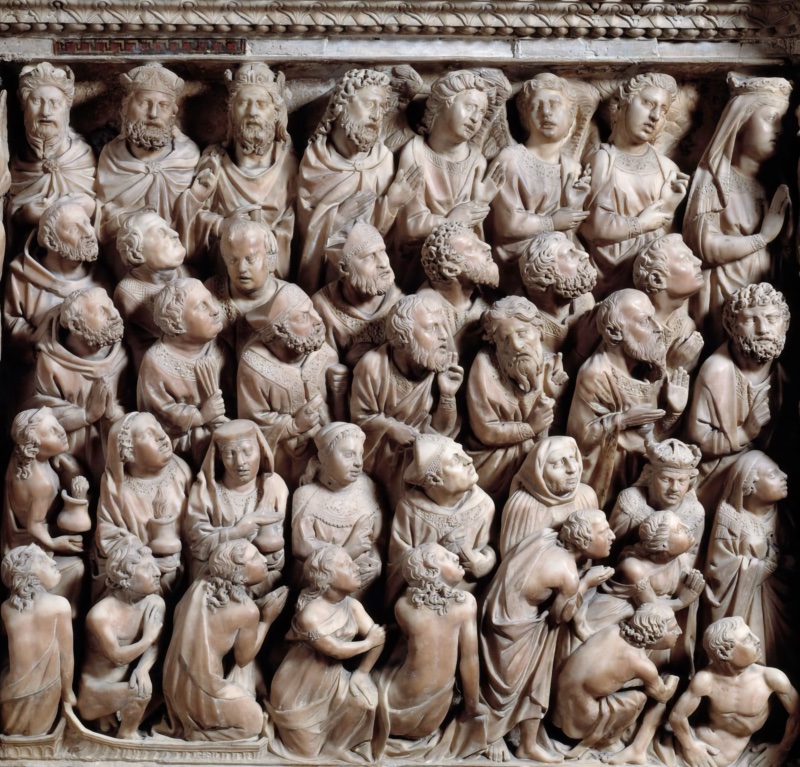
The Elect is the sixth of the seven narrative slabs of the octagonal parapet of the Siena pulpit, contracted on 29 September 1265 and paid off on 6 November 1268. It follows the Crucifixion and forms the first half of a Last Judgement divided across two fields, the second carrying the Damned.
The division is itself a consequence of the octagonal plan and one of the clearest measures of the distance from Pisa. At the Baptistery the entire eschatological drama — Christ enthroned, the Elect, the Damned, the resurrection of the flesh — had been compressed into a single slab, the last of five, and had achieved its effect by the violent contrast of order and collapse within one field. At Siena the two destinies are separated, each given a full panel, and each is developed at length. Christ the Judge occupies the angle between them.
The consequence for this relief is that the Elect no longer function as one term of a visible antithesis. They must sustain a panel on their own, and the problem Nicola faced here was how to make blessedness hold a field without the damned to define it by contrast.
The solution is a tiered congregation, four ranks deep, filling the field edge to edge with no ground visible anywhere. Recession is constructed entirely by graduated relief depth — the foreground figures cut nearly free of the block, those behind in successively lower relief — and the ranks rise rather than recede, so that the panel reads as an ascending assembly rather than as a crowd seen in perspective.
- Upper rank
Standing figures in half-length, several crowned, others in caps or with bare heads, their hands raised in prayer or crossed at the breast. The heads at the far left are bearded and aged; toward the right they become youthful and smooth. A veiled figure at the extreme right raises both hands. This uppermost register is the most ceremonious: the figures stand upright, symmetrically disposed, and address the Judge in the adjoining field.
- Second and third ranks
The most densely populated zone, and the panel’s centre of interest. Here the heads are individuated to a degree unusual even for this pulpit — an aged man with a forked beard, a mitred figure in profile, a bald and heavy-featured man, a youth with tightly drilled curls, a bearded man raising his hand to his lips in a gesture of wonder or of silence. Several wear the embroidered and pearled collars that recur across the Siena reliefs. The variety is not merely decorative: the ranks are populated by distinct social and ecclesiastical types, and the panel is legible as a portrait of the whole Christian community rather than of a category.
- Fourth rank and lower edge
In the foreground, half-length and half-nude figures rise from below the frame — the resurrection of the flesh. They are shown emerging, torsos bare, arms lifted or braced, heads turned upward. Among them at the right a woman carries a child. Their nakedness marks them as newly risen, not yet clothed in glory; the clothed and crowned figures above them have already been received.
The panel therefore contains a vertical narrative: the dead rise nude along the bottom edge, are gathered into the ranks of the blessed in the middle, and stand crowned and composed at the top. Time runs upward.
At the left of the third rank a woman holds a small covered vessel, and a second woman beside her appears to hold another. In a Last Judgement these are most likely the wise virgins of Matthew 25, whose lamps were filled and who were admitted to the marriage feast — a parable whose relevance to the separation of the saved from the damned is direct, and which appears with some regularity in Italian Judgement cycles. A third woman holds what appears to be the ointment jar of Mary Magdalene.
Two features distinguish this panel within the cycle:
-
The physiognomic range is the widest Nicola attempted: some forty heads are legible, and scarcely any repeats another. Beards are drilled into distinct textures — tight curls, long waves, forked and combed; ages run from infancy to extreme old age; expressions range from ecstatic upward gazing through meditative absorption to something close to bewilderment. This acuity of physiognomic description, joined to a lively and dynamic sense of narrative, is among the qualities that allow these reliefs to be set beside Roman originals without disadvantage.
-
The composition is additive rather than dramatic: unlike the Massacre, which refuses a focal point in order to represent chaos, this panel refuses one in order to represent multitude. There is no protagonist and no incident; the interest is distributed evenly across the surface. The risk of monotony is real, and it is averted solely by the variety of the heads. Whether the panel succeeds is a legitimate critical question, and the entry may pose it.
The Siena pulpit was executed by Nicola with the collaboration of his young son Giovanni, the young Arnolfo di Cambio, Goro, and the brothers Lapo and Donato di Ricevuto. The pulpit was for a long period attributed to Giovanni himself; recent documentary discoveries have established Nicola’s authorship.
Some scholarship detects Giovanni’s style explicitly in the Last Judgement. Given that the Judgement occupies two panels, the entry should establish which of them is meant before repeating the claim. The general caution applies throughout: pupils executed particular figures to Nicola’s overall design, probably fixed beforehand in drawings and cartoons, and their work was reabsorbed into the whole by the master’s finishing interventions, so that drapery and faces on the same figure may belong to different hands.
Stripped: Nicola Pisano’s Damned at Siena
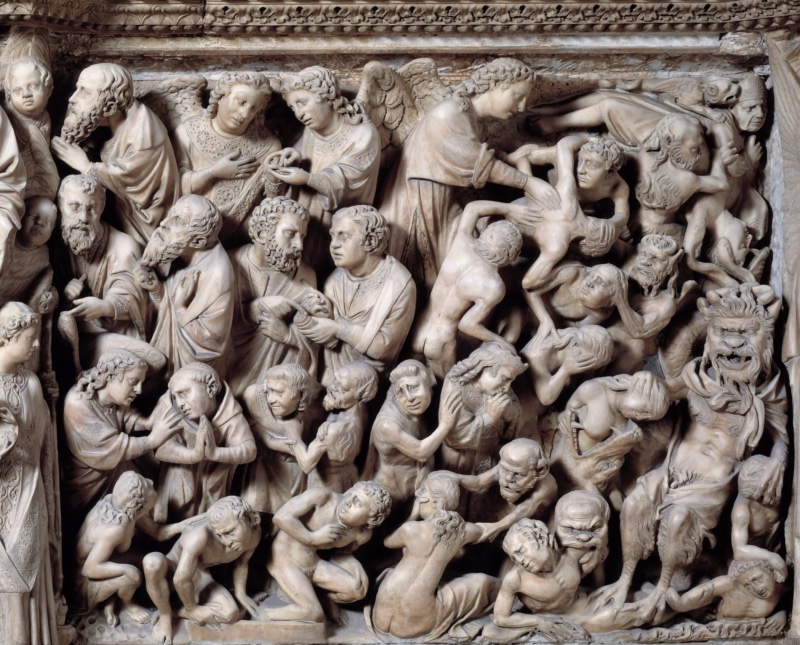
The Damned is the seventh and last of the narrative slabs of the octagonal parapet of the Siena pulpit, contracted on 29 September 1265 and paid off on 6 November 1268. It forms the second half of a Last Judgement divided across two fields, the first carrying the Elect, with Christ the Judge at the angle between them.
The division is the panel’s precondition. At the Pisa Baptistery the whole Judgement had been compressed into a single slab, the Damned confined to its right margin and reading as a disturbance at the edge of an ordered field. Here they are given an entire panel, and the consequence is that damnation ceases to be the negative term of a contrast and becomes a subject in its own right, developed at length and with a sustained attention that the earlier composition had no room for.
The relief is organised as a diagonal collapse running from upper left to lower right, and it is the only panel of the cycle whose structure is directional rather than either hierarchical or additive.
- Upper register: the angels of separation
Three winged angels occupy the top of the field, their tunics worked with embroidered roundels and orphreys. Two stand with heads inclined and hands lowered toward the crowd beneath them; the third, at the right, leans far forward out of the register, extends one arm downward and thrusts a small nude soul head-first into the mass below. The soul is carved at a reduced scale, and the disparity is the point: it is handled rather than judged. To the left of the group stands a bearded apostle or prophet with hands joined.
The panel’s action therefore originates here, not at the right margin. The sentence descends through a chain of agents — Christ pronounces from the angle figure between the two Judgement panels, the angels expel, the demons receive — and the diagonal running from upper left to lower right is a chain of custody rather than a formal collapse. The relief’s true subject is the moment at which a body passes from angelic hands into demonic ones.
The comparison with the Elect becomes exact at this point. There no agent is shown: the blessed rise and are gathered without visible cause. Here every stage is enacted by a hand on a body. Salvation happens; damnation is done.
- Centre: the interrogated
The middle registers are filled with clothed figures still in possession of their dignity: bearded elders, a monk or friar in a hood with hands pressed together in prayer, a beardless young man with his head turned, a figure at the centre in a mantle with an embroidered collar who looks down at his own hands. Several are shown in exchange with one another, heads turned in conversation, gesturing. These are not yet the damned; they are the judged in the moment before the sentence takes hold, and their faces carry the whole range from bewilderment to pleading to a kind of stunned recognition.
- Right and lower right: the demons and the seizure
The order breaks down completely toward the right margin. Nude bodies are grasped, inverted, and hauled away; a figure is carried head downward across the field. The demons are the panel’s most inventive passages: horned and shaggy heads, one at the right with a broad flat muzzle and bared teeth, another with a beaked or snouted face, their hair and beards drilled into serpentine masses. They are athletic and classicising in body, but caricaturally distorted in the head — a combination that will matter greatly for what follows.
- Lower edge
Along the bottom the nude damned crouch, kneel, and crawl, several with their heads in their hands, one on all fours, another gripped by the hair. This register is the exact counterpart of the resurrection along the base of the Elect, but where those figures rose, these are pressed down.
The pairing repays attention as a designed opposition rather than as two separate reliefs:
-
In the Elect, time runs upward: the nude rise along the lower edge, are gathered into ranks, and stand crowned at the top.
-
Here time runs downward and to the right: the clothed and upright at the upper left are progressively stripped, seized, and driven toward the lower right corner. The two panels share a vocabulary — tiered ranks, individuated heads, nudity marking the newly risen — and invert its direction.
The retention of clothing is the panel’s most eloquent device. Nicola distinguishes the judged from the damned not by expression but by dress: those who still wear their embroidered collars and hooded mantles are still persons, and those who have lost them are already bodies. The transition from one state to the other occurs visibly across the width of the field.
This is the relief with the clearest afterlife in the next generation, and the connection is not merely thematic.
The demons and the damned of the Pisan Last Judgement — athletic and classicising but sometimes caricaturally distorted, with serpentine hair and beards — have been identified as an important object of study for the young Giovanni in the crucial years of his stylistic formation. The Siena panel takes that vocabulary and gives it four times the space. Whatever is finally decided about Giovanni’s participation here, the expressive register he would deploy at Pistoia and in the Pisa Cathedral Last Judgement is stated in this field more fully than anywhere else in his father’s work.
Some scholarship detects Giovanni’s style explicitly in the Siena Last Judgement. Since the Judgement occupies two panels, the entry must establish which is meant before repeating the claim. The general caution stands: pupils executed particular figures to Nicola’s overall design, probably fixed beforehand in drawings and cartoons, and their work was reabsorbed into the whole by the master’s finishing interventions.
The Arca di San Domenico, Bologna: Nicola Pisano’s Sarcophagus of 1264–1267 and Its Five Centuries of Accretion
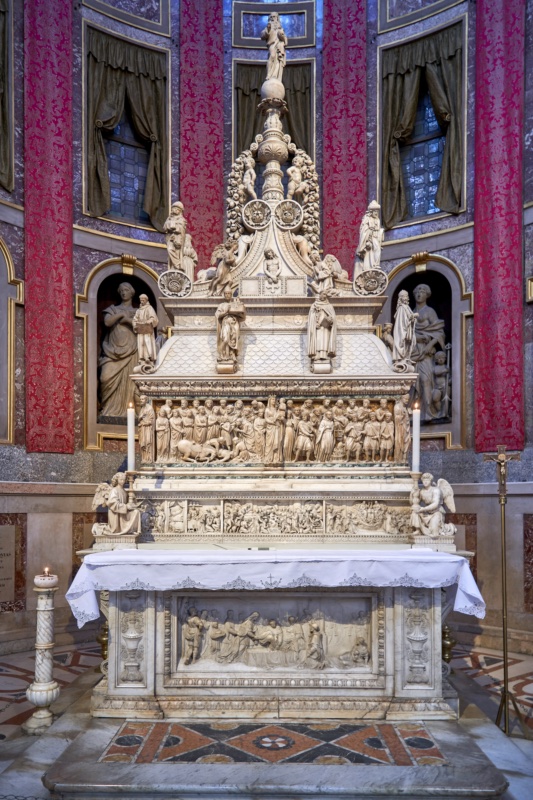
The Arca di San Domenico is one of the most significant and important Italian sculptural monuments, the fruit of interventions and different hands succeeding one another across a very wide span of time; its elaboration was performed in separate stages by the best sculptors of their time and took almost five hundred years to finish.
Reading the image from the middle outward: the deeply undercut narrative band at the centre is Nicola Pisano’s sarcophagus of 1264–1267. Everything above it — the scaled lid, the standing saints, the pinnacle with putti and festoons, and the blessing Pantocrator at the summit — is the fifteenth-century cimasa. The two kneeling candle-bearing angels flanking the altar are by two different hands a generation apart. The frieze immediately below the sarcophagus is a sixteenth-century predella, and the altar frontal below that is an eighteenth-century addition. An entry on Nicola Pisano must therefore begin by isolating his contribution from the ensemble in which it is embedded.
Saint Dominic died in the convent of the church of San Nicolò delle Vigne on 6 August 1221 and was buried behind the altar. The remains were moved in 1233 into a simple marble sarcophagus placed on the floor of the right aisle for the faithful; since most of the pilgrims, who came in great numbers, could not see the shrine for the crowd standing before it, the need was felt for a new one.
The workshop question here is more acute than at Siena, because the two commissions overlap. Nicola designed the new tomb and carved several figures for the principal face of the sarcophagus before being called to Siena in 1265 to construct the cathedral pulpit; the arca was completed by his workshop assistants, led by Lapo di Ricevuto. The Sienese contract of 29 September 1265 required Nicola’s residence in Siena from 1 March 1266, and the Bologna work was necessarily delegated from that point.
The collaborators named are Arnolfo di Cambio above all, with Lapo and Donato — the last on Vasari’s authority — and the Dominican lay brother Guglielmo da Pisa, who accompanied the sarcophagus panels to Bologna to set them in place. One catalogue record gives the year of that installation as 1367; this is a century adrift and plainly a typographical error for 1267, but it circulates and should not be reproduced.
The consequence for attribution is direct: the Arca is the least autograph of Nicola’s major works, and the balance of hands within it is correspondingly the most contested.
The sarcophagus
Nicola executed six marble panels in high relief describing six scenes from the life of the saint; the six panels decorate the four sides of the parallelepiped sarcophagus. They are separated by six statuettes representing Christ the Redeemer, the Virgin and Child, and four saints connected with the Dominican order. Chronologically the narrative begins from the right-hand panel of the front long side and proceeds leftward in clockwise order.
The programme is hagiographic rather than christological — a departure from the pulpits, and a necessary one, since the object commemorates a saint canonised within living memory. Its subjects are drawn from the miracles and institutional foundations of the order.
The formal character is visible even in reproduction. The figures are massed edge to edge across the whole field, in the crowded, classicising manner of the Siena pulpit reliefs, with figures worked nearly free of the ground and dramatic incidents disposed at differing depths. The relation to the pulpits is one of simultaneity: the Bologna panels and the Siena panels were carved by the same shop in the same years, and the stylistic questions cannot be separated.
A significant loss. The rectangular sarcophagus was originally borne on caryatid figures. These supports were removed in the fifteenth-century reworking, so that the original relation between the urn and its bearers — an arrangement that anticipates the figure-supports Giovanni would later develop at Pisa Cathedral — can no longer be seen in situ. The present appearance of the sarcophagus, resting on a Renaissance predella above a Baroque altar, reverses Nicola’s intention entirely.
The later campaigns
| Date | Author | Contribution |
|---|---|---|
| From 1469 | Niccolò da Bari, thereafter Niccolò dell’Arca | The freestanding statues crowning the lid and the tall cimasa with the blessing Pantocrator. The commission gave him the name by which he is known. |
| 1494–95 | Michelangelo Buonarroti | Three statues completing the work left unfinished at Niccolò’s death in 1494: St Petronius, St Proculus, and the angel bearing the candelabrum. Michelangelo, not yet twenty, was in Bologna having fled Florence after the expulsion of the Medici, and was received by Giovan Francesco Aldrovandi, who obtained him the commission. |
| 1532 | Alfonso Lombardi | The predella beneath the sarcophagus, with an Adoration of the Magi and scenes from the life of the saint. |
| 1539 | Girolamo Coltellini | Final interventions, per one account. |
| 1768 | Giovanni Battista Boudard, to a design by Carlo Bianconi | The altar frontal with the Burial of St Dominic, carved at Parma. |
The two kneeling angels flanking the predella are by Niccolò dell’Arca and Michelangelo respectively — the juxtaposition being one of the most instructive in Italian sculpture, and entirely fortuitous.
Behind the Arca is preserved the reliquary of 1383 by the goldsmith Jacopo da Bologna, called Roseto, made to contain the saint’s head when it was carried in procession through the city on his feast.
The chapel itself is a later frame: square in plan with a semicircular apse, opening at the midpoint of the right aisle, and richly furnished in the manner visible in the image, with its damask hangings and marble revetment.
Perugia, Fontana Maggiore (Nicola and Giovanni Pisano, 1278) and the Palazzo dei Priori
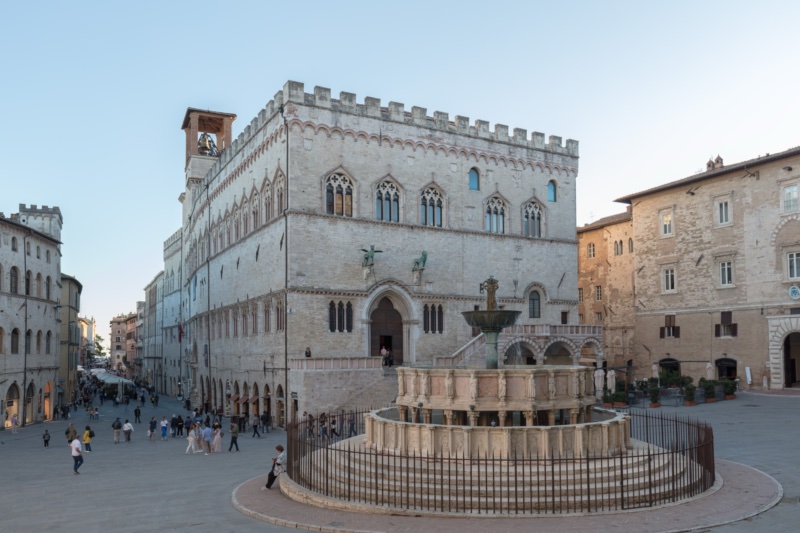
The most impressive civic commission undertaken by Nicola Pisano, in partnership with his son Giovanni, was the Fontana Maggiore in Perugia, completed and signed in 1278. This monumental fountain, erected in the main square between the cathedral and the communal palace, was financed by the commune of Perugia to celebrate the completion of an aqueduct bringing water to the city. The patronage here was explicitly civic rather than purely ecclesiastical, although the spatial dialogue between the fountain, the episcopal complex, and the Palazzo dei Priori ensured that religious and secular powers remained visually intertwined.
For a more specific treatment of the Fontana Maggiore, see Giovanni Pisano
The Weight Transferred: Nicola Pisano’s Deposition at Lucca, c. 1257–1260
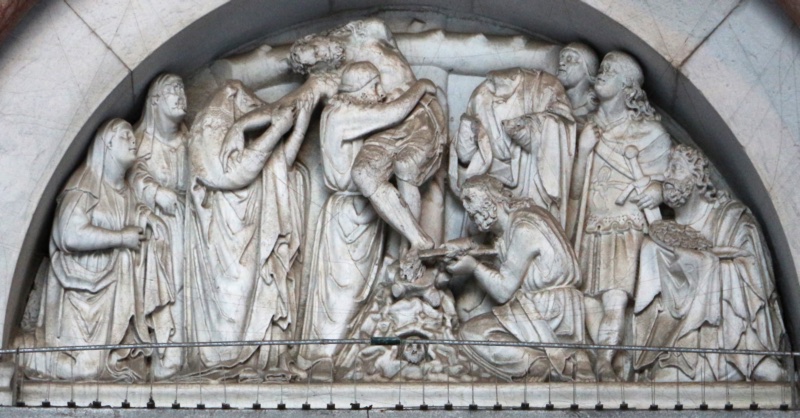
The relief occupies the lunette of the left-hand portal of the façade portico of the Cathedral of San Martino at Lucca — the so-called portale della Croce, the portal of the Cross. The façade is preceded by a portico-narthex opening onto the piazza through three great arches, one narrower than the others because of the proximity of the pre-existing campanile; the three portals, one to each nave, carry decoration largely of 1233 by an unknown Lombard master, with the Decapitation of St Regulus in the right-hand lunette and cycles of the Labours of the Months and Stories of St Martin flanking the central door. The porticus was frequently occupied by the benches of money-changers doing business with the pilgrims passing through Lucca, one of the principal stations on the Via Francigena.
The setting matters for the reading. This is not a pulpit relief addressed to a congregation within a church but a public image at street level, seen by travellers on the road to Rome, in a space of commerce as much as of devotion.
After the death of Guido Bigarelli in 1257, the decoration of the lunette and architrave of the left portal — with the Deposition above and the Annunciation, Nativity and Adoration of the Magi below — was executed by Nicola Pisano between about 1257 and 1260. The sculptor, called in by Bigarelli’s workshop, produced in these figured reliefs one of the most advanced works of its time, completing the decoration of the portals.
The chronology is the crux. Scholars agree in considering this sculptural cycle — architrave and lunette together — contemporary with the pulpit of the Pisa Baptistery, completed in 1260. The contemporaneity of the Lucca portal with the Pisan pulpit was established by 1967. One position holds that the conception and execution of the two complexes, the Pisan and the Lucchese, may have proceeded in step, since the Lucca architrave relief is obtained by contaminating the compositions of the Pisan panels that separately depict the Annunciation with the Nativity on the one hand and the Adoration of the Magi on the other; on this basis the Lucca work is supposed to be slightly the later.
The two commissions therefore overlap, and Nicola was working simultaneously on the pulpit that would carry his signature and on a portal for another city.
Subject: the schiavellazione
The Deposition, set within the semicircle of the lunette, expresses with intense drama the moment of the so-called schiavellazione — the unnailing — when the body of Christ, now lifeless, falls heavily into the arms of Joseph of Arimathea.
The Italian term has no exact English equivalent and is worth retaining in the entry with a gloss. It names not the Deposition as a completed act but the instant of the body’s release: the moment when the nails give way and the weight, until then borne by the cross, transfers to human arms. Nicola has chosen the least stable point in the sequence.
Composition
The lunette imposes a semicircle, and Nicola exploits it by setting the dead body on a strong diagonal that runs from the upper centre down to the right, filling the crown of the arch where a symmetrical composition would leave a void.
- Centre
Christ’s body slumps forward and to the right, the head fallen back with the beard raised, the torso twisted, the legs bent. Joseph of Arimathea takes the whole weight against his shoulder and chest, his own body forced into a counter-diagonal by the load. The transverse arm of the cross is visible behind, cut with deliberate flatness so as not to compete.
- Lower right
A bearded man kneels and works at the feet with a pair of pincers, extracting the nail — Nicodemus, and the specific agent of the schiavellazione. Beneath the foot of the cross lies the skull of Adam.
- Left
The Virgin stands at the centre-left and receives Christ’s released hand, drawing it upward and pressing it against her own face. This is the composition’s affective centre, and it is a motif of Byzantine derivation — the mother’s cheek laid to the dead son — transposed here from the Threnos into the Deposition. Behind her a file of holy women recedes toward the left edge, veiled, their heads inclined at varying angles; the figure at the extreme left is set lower and turns her face upward.
- Right
Behind Nicodemus stand further figures: one heavily draped with a hand raised toward the face in the gesture of grief, presumably St John; beyond him, at the right edge, two or three figures including one who appears to hold a scroll and one in a short belted tunic. Their identification is not secure from this view.
- Structure
The panel divides at the vertical of Christ’s body into a left half that is still, draped, and female, and a right half that is active, labouring, and male. The Virgin’s group mourns; Joseph and Nicodemus work. The opposition is the same one Nicola deploys in the Pisan and Sienese Crucifixions, redeployed here to distinguish grief from the physical labour of taking a body down.
The Lucca reliefs are among the most contested items in the corpus, and the two elements of the portal have fared very differently.
| Architrave | Lunette | |
|---|---|---|
| Vasari | First assigned it to Nicola. | Enumerated among Nicola’s works. |
| Modern criticism | Attribution confirmed from Schmarsow (1890) through Nicco Fasola (1941), Gnudi (1948), and Bottari (1962). | Attributed to Nicola. |
| Encyclopedic revision | Can be excluded from Nicola’s autograph corpus, on grounds of summary treatment of details and a sequential juxtaposition of scenes lacking any overall vision; the work of a sculptor who borrowed individual elements from both of Nicola’s pulpits and combined them in a continuous relief. | “More complex is the question of the author of the Deposition.” |
The relief has stood in the open portico for some seven and a half centuries, exposed to weather and to the traffic of the piazza. The surface is markedly worn, the drapery edges softened and the finer chisel-work largely lost; the visible network of horizontal wires and spikes across the base of the lunette is modern bird-deterrent, not original. Any comparison of finish with the Pisan pulpit panels, which have stood indoors, must allow for this difference.
The governing magistrates of Perugia commissioned the Pisan workshop to design and carve a two‑tiered marble and bronze structure whose iconographic programme would encompass biblical episodes, the labours of the months, the Liberal Arts, personified cities, and heraldic beasts. In choosing Nicola and Giovanni, the Perugian patrons sought sculptors capable of integrating didactic imagery and symbolic references into a coherent and visually compelling ensemble at the heart of the city. The inscription naming both father and son as authors of the fountain underscores the communal desire to associate their urban identity with artists already celebrated for their work in major Tuscan centres. This commission, with its complex interplay of civic pride, theological motifs, and public utility, further diversified Nicola’s patronage base and extended his reputation into Umbria. It also demonstrates the degree to which his workshop had become a trusted partner for large‑scale public projects requiring close collaboration between patrons, engineers, and sculptors. In this sense, the communal government of Perugia appears not merely as a client but as a co‑producer of an artwork that embodied its own political aspirations and self‑representation.
Behind these major institutional patrons stood a wider constellation of individuals and groups whose support, though less visible, contributed to sustaining Nicola Pisano’s workshop over several decades. Cathedral chapters and civic governments acted through committees and operai, but their decisions were often influenced by local elites, confraternities, and clerical communities who sought commemoration or liturgical prestige. The very existence of large, intricately carved pulpits and fountains presupposes a network of donors willing to finance expensive materials such as Carrara marble and bronze, as well as the prolonged labour of skilled artisans.
While the names of many such donors have not survived, inscriptions, payment records, and the heraldry incorporated into the works themselves hint at their presence and intentions. In Perugia, for example, the coats of arms on the fountain’s panels signal the involvement of local powers and guilds that wished their emblems to be permanently associated with the city’s water supply and symbolic centre. Similarly, in Pisa and Siena, the strategic placement of pulpits within the liturgical space suggests negotiations among clergy, lay confraternities, and civic authorities over access, visibility, and control of preaching.
Nicola’s capacity to navigate this intricate patronage landscape, responding to differing institutional cultures and theological emphases, was crucial to his success. His art offered patrons a means to articulate doctrinal orthodoxy and civic identity through a language that combined antique authority, narrative clarity, and emerging Gothic sensibilities. Thus, beyond the named institutions, there existed an entire social field of patronage that framed his activity and gave his sculptures both economic viability and symbolic resonance.
Artistic style
The style of Nicola Pisano’s sculpture has often been described as a “classicising Gothic,” in which the solid, volumetric bodies and draperies derived from Roman marbles coexist with a new attention to narrative clarity and emotional nuance. His most famous work, the marble pulpit in the Pisa Baptistery, exemplifies this fusion by combining a hexagonal architectural framework of columns and arches with densely populated relief panels illustrating episodes from the life of Christ. In the panel that unites the Annunciation, Nativity, and Adoration of the Shepherds, for instance, the Virgin’s massive, reclining figure recalls a Phaedra from a Roman sarcophagus in the Camposanto of Pisa, adapted to Christian subject matter while retaining its classical gravitas.
The draperies cling to the bodies, revealing their underlying structure and weight, and the heads possess a calm, idealised beauty far removed from the more schematic figures of earlier Romanesque sculpture. At the same time, the arrangement of figures in layered bands, the overlapping gestures, and the inclusion of multiple episodes within a single frame show a concern for narrative continuity and visual rhythm that responds to contemporary Gothic developments. Nicola’s sculptural language thus rejects both the static hieraticism of earlier medieval relief and a mere antiquarian imitation of Roman models, choosing instead to reanimate classical forms within a Christian story of salvation. This stylistic innovation has led many scholars to identify him as a precursor of Renaissance naturalism, even if his work remains firmly anchored in the thirteenth‑century context of liturgical sculpture. The Pisa pulpit, with its powerful synthesis of antique form and Gothic narrative, set the terms for much Tuscan sculpture in the second half of the century and defined the stylistic horizon within which his pupils operated.
On the Siena Cathedral pulpit, Nicola extended and intensified the stylistic solutions first tested in Pisa, creating an octagonal structure with seven large narrative panels that display greater depth, complexity, and movement. Here, the relief is carved more deeply, producing stronger contrasts of light and shadow and a heightened sense of corporeality in the figures. The scenes from the life of Christ are more crowded, with overlapping bodies and vigorous gestures that guide the viewer’s eye across the surface in a dynamic, almost cinematic fashion. Yet despite this increased density, the compositions remain legible, thanks to Nicola’s careful organisation of groupings and his use of architectural elements to articulate spatial intervals.
The classicising impulse persists in the dignified heads, the carefully modelled torsos, and the draperies whose heavy folds suggest both weight and movement. At the same time, certain figures, especially in the Crucifixion and Last Judgement reliefs, manifest a growing interest in expressive distortion and pathos, perhaps anticipating or influenced by Giovanni’s emerging Gothic sensibility. Animal figures, decorative foliage, and personifications further enliven the surface, binding together narrative, symbolic, and ornamental registers. The Siena pulpit thus embodies a stylistic evolution towards greater dramatic intensity and sculptural depth, while retaining the classical underpinning that defines Nicola’s art. Its success ensured that the classicising Gothic idiom would become a major strand in central Italian sculpture, capable of accommodating both doctrinal exposition and emotional engagement.
In the Fontana Maggiore of Perugia, Nicola and Giovanni adapted their sculptural language to an entirely different kind of monument, one positioned outdoors in a civic square and designed to be circled by viewers. The twenty‑five sided lower basin carries two tiers of low reliefs depicting Bible episodes, allegories, the labours of the months, and the Liberal Arts, arranged in a continuous sequence legible to a mobile spectator. Here, Nicola’s classicising tendencies appear in the dignified, compact figures of prophets, personified sciences, and ancient heroes such as Romulus and Remus, whose poses often recall Roman sarcophagi and imperial reliefs.
Yet the narrative requirements differ from those of a pulpit, because the fountain’s imagery must accommodate civic symbolism, agricultural cycles, and didactic personifications alongside sacred scenes. The sculptors responded by simplifying certain forms, emphasising clear profiles and legible attributes that could be recognised even at a distance or in changing light. At the same time, they integrated playful elements, such as heraldic beasts and fabled animals, which enliven the structure and connect it to local traditions and communal emblems. The result is a sculptural style more fragmented yet more encyclopaedic, in which classical restraint coexists with medieval variety. The fountain demonstrates Nicola’s ability to adapt his characteristic modelling, drapery, and figural types to the demands of an urban, secular monument, without abandoning the classical core of his vocabulary. In this work, as in the pulpits, the sculptor’s style proves both coherent and flexible, capable of serving different patronage contexts while maintaining a recognisable artistic identity.
A distinctive feature of Nicola Pisano’s style is his approach to the human body, which he treats as a three‑dimensional, weight‑bearing structure rather than a flat emblem or diagram. His figures stand, sit, or recline with a convincing sense of balance, and their gestures emerge from the articulation of shoulders, hips, and limbs in ways that recall ancient statuary. This is particularly evident in the reclining Virgin of the Pisa Nativity panel, whose torso twists slightly and whose drapery follows the movement of her body with subtle adjustments of fold and contour. The male figures, whether shepherds, apostles, or executioners, display muscular arms and chests that project out of the relief plane and cast strong shadows, reinforcing the impression of solidity and mass. Even in scenes crowded with figures, Nicola strives to give each body a distinct stance and relation to the surrounding space, avoiding the rigid frontality that characterises many Romanesque ensembles.
His concern with corporeality extends to the depiction of horses in the Adoration of the Magi and in the Siena pulpit, whose flared nostrils, arched necks, and taut muscles suggest motion and physical strain. Yet his naturalism is always measured; he stops short of anatomical exposition, preferring an idealised, harmonious body that can embody both classical decorum and Christian humility. This balance between observation and idealisation contributes greatly to the persuasive power of his reliefs, in which sacred history is made present through bodies that seem at once timeless and alive. The emphasis on three‑dimensional form and weight would become a defining legacy for later Italian sculpture, influencing artists from Arnolfo di Cambio to the early Renaissance.
Equally central to Nicola’s style is his mastery of narrative composition, through which he organises complex theological stories into visually intelligible sequences. On both pulpits, he often combines several episodes within a single rectangular panel, using overlapping figures, changes of scale, and architectural motifs to distinguish and yet connect the scenes. In the Pisa Nativity relief, the Annunciation appears in a corner, the Birth of Christ and the Adoration of the Shepherds occupy the centre and right, and secondary details such as the washing of the Child unfold at the margins, all within a continuous space.
The viewer is invited to read the panel not as a series of discrete compartments but as a flowing narrative that mirrors the unfolding of the liturgical year and of salvation history. On the Siena pulpit, Nicola further refines this strategy, creating processional rhythms within the panels as groups of figures advance toward focal points such as the Christ Child or the crucified Saviour. He uses diagonals, gaze directions, and hands that point or indicate to guide the spectator’s attention and to underscore doctrinal emphases, such as the role of the Virgin or the reality of Christ’s suffering. This narrative intelligence aligns his sculpture with contemporary developments in preaching and devotional literature, which likewise sought to render the mysteries of the faith accessible through vivid exempla and affective imagery. At the same time, the integration of Christian narrative with classical compositional devices, such as the grouping of figures in triads or balanced contraposto, reinforces the sense of order and clarity. Through this fusion, Nicola’s style achieves a rare combination of theological complexity and visual immediacy that would prove influential for generations of sculptors and painters.
The ultimate sources of Nicola Pisano’s style lie in a carefully mediated encounter with ancient Roman sculpture, especially sarcophagi and large‑scale reliefs that survived in southern Italy and Pisa. As noted, scholars have identified specific borrowings from sarcophagi in the Camposanto at Pisa, such as the transformation of a Phaedra figure into the Virgin on the Pisa pulpit and the adaptation of imperial advisers into prophets and evangelists. These borrowings are not slavish copies but creative reinterpretations, in which classical gestures, proportions, and draperies are reoriented toward Christian narratives. Nicola seems to have been particularly drawn to the calm dignity and balanced poses of Roman female figures, which he recasts as Marian types endowed with both maternal tenderness and royal majesty.
His male protagonists, too, bear the imprint of antique models in their contrapposto stances and their idealised musculature, qualities that endow biblical scenes with an air of solemnity and timelessness. At the same time, he selectively simplifies or intensifies classical prototypes, in order to adapt them to the tighter spaces and more crowded compositions of pulpit reliefs. This process of assimilation and transformation reflects the environment of Frederick II’s court, where the study and reuse of ancient marbles were cultivated as part of a broader imperial ideology. Nicola thus stands within a chain of transmission that connects late antique sculpture to the renewed appreciation of antiquity in the thirteenth century and ultimately to the Renaissance. His achievement lies not in the mere revival of classical forms, but in their integration into a living Christian iconography that speaks to the devotional and intellectual concerns of his contemporaries.
Alongside classical sculpture, scholars have identified the influence of French Gothic art on Nicola’s work, mediated either through direct travel or, more plausibly for some, through the circulation of artworks and craftsmen in Apulia and central Italy. Certain expressive faces, flowing draperies, and the increased verticality of figures on the Siena pulpit, for example, bear comparison with sculpture from cathedrals in northern France. The trilobed arches, colonnettes, and decorative vegetal motifs that frame some of his reliefs also echo contemporary Gothic architectural ornament. However, rather than simply adopting a French idiom, Nicola appears to have filtered selected Gothic elements through his classical training, using them to enliven his compositions and add rhythmic variety without abandoning the weighty presence of his figures.
The result is a hybrid style in which Gothic linearity enriches but does not overshadow classical solidity, producing a visual language uniquely suited to Tuscan tastes. Some scholars have proposed that he may have travelled to France in the 1250s, pointing to iconographic parallels and formal analogies as evidence. Others remain more cautious, suggesting that such influences could have reached him through imported objects, manuscripts, or contacts with artists who had themselves worked north of the Alps. Regardless of the exact mechanisms, it is clear that Nicola’s art participates in a broader European Gothic culture while maintaining a distinctive anchoring in the study of antiquity. This balanced reception of foreign elements reinforces his position as both heir to and transformer of multiple artistic traditions.
The Romanesque and Lombard traditions of sculpture in Tuscany and northern Italy provided another set of influences that Nicola Pisano absorbed and reoriented. Earlier in the century, church façades and portals in cities such as Lucca, Pisa, and Modena had been adorned with figural reliefs and animal supports that combined symbolic motifs with robust, often fantastical carving. In the Pisa and Siena pulpits, the use of lions as supports for columns and the inclusion of bestiaries and prophet figures in the spandrels of arches recall this Romanesque heritage. Yet Nicola refines and classicises these motifs, taming their earlier exuberance and aligning them more closely with antique prototypes.
The lions under the columns, for instance, become not only apotropaic guardians but also formal echoes of Roman pedestal sculpture, grounding the pulpit in both medieval and classical vocabularies. Similarly, the prophets and apostles carved in the spandrels lose some of the schematic stiffness of earlier Romanesque figures and acquire a measured grandeur derived from sarcophagi and imperial monuments. In this way, Nicola’s style does not reject the local sculptural past but rather absorbs and transforms it, demonstrating an acute awareness of his regional predecessors. His works thus function as mediators between different strata of visual tradition, enabling Romanesque, Gothic, and classical elements to coexist within a single, coherent idiom. This capacity to synthesise and recalibrate inherited motifs is one of the hallmarks of his artistic intelligence and contributes significantly to his influence on subsequent generations.
Artistic and geographic influence
The influence of Nicola Pisano radiated outward through the work of his pupils and collaborators, whose own stylistic choices both attest to and redefine his legacy. Giovanni Pisano, his son, developed a more agitated, expressive Gothic style, characterised by sharp folds, intense facial expressions, and a heightened sense of movement, yet his work remains grounded in the volumetric solidity and classicising tendency learned in his father’s workshop. Arnolfo di Cambio, another important associate, carried Nicola’s lessons into Roman contexts, where he designed monumental tombs and architectural sculpture that likewise combine antique forms with emerging Gothic sensibilities. Through these figures, Nicola’s approach to bodily mass, drapery, and narrative relief became embedded in the fabric of Italian sculpture from Tuscany to Umbria and Latium.
The diffusion of his models also influenced painters, who increasingly sought to render volume, weight, and classical calm in their figures, anticipating developments in the work of Cimabue and Giotto. In this indirect sense, Nicola’s style contributed to a broader shift in Italian visual culture towards naturalism and a renewed engagement with antiquity. The persistence of his motifs in later pulpits, tombs, and fountains indicates that his synthesis of classical and Gothic elements offered a viable and compelling template for others. Thus, Nicola’s artistic influences must be measured not only in terms of what he received from earlier traditions but also in terms of what he transmitted to a wide network of sculptors and painters in the later thirteenth and early fourteenth centuries.
The geographic trajectory of Nicola Pisano’s life and work traces a path from the southern kingdom of Sicily to the urban centres of Tuscany and Umbria, following routes of courtly and communal patronage. Born in Apulia, he would have been familiar from an early age with the artistic programmes sponsored by Frederick II, including monumental gateways, palace decorations, and the reuse of ancient marbles in imperial contexts. The emperor’s court attracted craftsmen from across the Mediterranean, and it is within this cosmopolitan environment that Nicola likely received his initial training as a sculptor and perhaps as an architect.
From southern Italy he travelled northward, probably in the 1240s or early 1250s, drawn by the opportunities presented by the flourishing maritime city of Pisa. The journey would have taken him along established roads through the Apennines or by sea routes connecting Apulian ports to the Tyrrhenian coast, routes commonly used by merchants, clerics, and artists. Such mobility was not unusual for skilled craftsmen, yet in his case it acquired particular significance, because it enabled the transfer of southern classicising tendencies into the heart of Tuscan communal culture. By relocating to Pisa, he effectively positioned himself at a crossroads of Mediterranean trade and intellectual exchange, from which he could access commissions in neighbouring cities such as Lucca and Siena. His early travels thus shaped not only his own opportunities but also the larger geography of Italian sculpture in the thirteenth century.
Within Tuscany, Nicola’s movements followed the rhythm of major commissions and the exigencies of workshop management. After establishing himself in Pisa, he appears briefly in Lucca around 1258 in connection with sculptural work for the cathedral of San Martino, where certain reliefs have been attributed to his workshop. Shortly thereafter he is documented at Siena, where his bottega participated in the cathedral works and where he would later execute the great pulpit between 1265 and 1268. These travels between Pisa, Lucca, and Siena reflect the interconnected nature of Tuscan artistic life, in which sculptors moved along a circuit of cathedral building sites that exchanged models, materials, and labour.
Such mobility demanded a robust workshop structure capable of functioning in multiple locations, with assistants and family members managing tasks in Nicola’s absence. The grant of Sienese citizenship in 1272 implies a period of extended residence there, during which his household likely divided its time between the two cities according to contractual requirements. Through these repeated journeys, Nicola deepened his familiarity with diverse local sculptural traditions and adapted his style to different architectural spaces and liturgical practices. The continuous circulation of the sculptor and his entourage thus ensured that his classicising idiom was disseminated across central Italy in a manner inseparable from the geography of his travels.
The question of whether Nicola Pisano travelled beyond Italy, particularly to France, has been a subject of scholarly debate. Some art historians have argued that specific iconographic and stylistic parallels between his work and French Gothic sculpture, especially in portal figures and narrative reliefs, imply direct observation of cathedrals north of the Alps. On this view, he might have journeyed to France in the 1250s, perhaps in connection with the broader diplomatic and cultural exchanges involving Frederick II’s court or Italian communes.
Others, however, emphasise that French influences could have reached him through imported objects, manuscript illumination, or the presence of artists who had themselves worked in northern Europe. The lack of documentary evidence for such a journey cautions against treating it as established fact, even if it remains a plausible hypothesis given the stylistic evidence. Whether or not he physically visited France, Nicola’s art testifies to his awareness of Gothic stylistic innovations and his ability to integrate them selectively into his own classicising language. The debate itself highlights the importance of travel, real or mediated, in the construction of medieval artistic identities. It also underscores the fact that Nicola’s work cannot be fully understood without situating it within transalpine networks of form and iconography, carried by people, objects, and texts across vast distances.
In the final phase of his career, Nicola’s travels extended into Umbria, where he undertook the Fontana Maggiore in Perugia together with Giovanni, and possibly, through his designs, into Emilia with the Arca di San Domenico in Bologna. The Perugia commission required at least temporary residence at the site, in order to coordinate with engineers and communal officials, supervise the carving of reliefs, and oversee the installation of the fountain in the central square. This project thus added a new urban environment to the map of cities shaped by his presence, expanding his sphere of activity beyond Tuscany into a neighbouring region with its own artistic traditions.
As for Bologna, even if the execution of the Arca was largely entrusted to Lapo di Ricevuto, the transmission of Nicola’s designs nonetheless implied contact with the Dominican convent and with local patrons, whether through direct visits or through intermediaries. These journeys, actual or virtual, contributed to the diffusion of his models and secured for his name a recognition that extended across several Italian regions. The pattern of movement evident in his documented commissions suggests a career marked by sustained, purposeful travel in response to high‑profile projects, rather than constant itinerancy. In this combination of rootedness in Pisa and strategic mobility to other centres, Nicola epitomises the new type of artist whose identity is both local and supralocal, anchored in specific civic communities yet active within a broader network of regional and interregional exchange.
Death
The end of Nicola Pisano’s life also has a familial dimension, because his death initiated the transition of workshop authority to Giovanni and the reconfiguration of kinship roles within the household. A document from Siena composed after March 1284 already refers to Nicola as deceased, establishing a terminus ante quem for his death, while his final documented activity is linked to the completion and signing of the Fontana Maggiore in Perugia in 1278. On this basis, scholars generally place his death between about 1278 and 1284, probably in Pisa or possibly Siena, when he would have been in his late fifties or early seventies depending on the birth date assumed. The medieval sources give no information about the precise date or the cause of death, and there is no evidence of violence, epidemic, or judicial execution connected with his person.
In the absence of contradictory data, it is therefore reasonable to suppose that he died of natural causes, as did most men of his age and social standing in that period. His passing did not interrupt the activity of the workshop, which continued under Giovanni’s leadership and maintained existing patronage relationships in Siena, Pisa, and elsewhere. For the family, however, the death of the founder must have compelled a reorganisation of property, responsibilities, and apprentices, even if these internal rearrangements escape the documentary record. The transmission of models, drawings, and possibly moulds from father to son ensured a degree of stylistic continuity that linked the oeuvre of Giovanni to the memory of Nicola.
Thus the biographical limit marked by his death did not coincide with the end of the Pisano artistic “family,” whose collective identity persisted in materials, contracts, and narratives long after the founder’s disappearance. In this fusion of biological descent, workshop continuity, and posthumous reputation lies the deepest sense in which the family of Nicola Pisano can be said to have shaped the course of Italian sculpture around 1300.
Conclusion
The life of Nicola Pisano is documented thinly and his work abundantly, and the disproportion governs everything that can responsibly be said about him. Two references of 1266 establish that he came from Apulia; a Sienese document written after March 1284 establishes that he was dead. Between those two fixed points lie a signature, three contracts, a scatter of payments, and a grant of citizenship. Nothing survives of his training, his household beyond the existence of a son, his movements between commissions, or his opinions about his own art. What survives instead is a body of marble of exceptional quality and legibility, and the temptation — to which the literature has often yielded — is to read the biography out of the objects. The present entry has tried to resist that, marking as inference what is inference and leaving open what the evidence does not close.
What the objects do establish, and establish beyond argument, is a decision taken at Pisa around 1255 that altered the terms of Italian sculpture. Earlier pulpits were square and attached to a wall; Nicola set a free-standing hexagon in the open space of the Baptistery, and in doing so converted a liturgical fitting into a monument that must be walked around. Every subsequent pulpit in the series — the Sienese octagon, Giovanni’s hexagon at Pistoia, the circle at Pisa Cathedral — is a variation on that single decision. The signature incised at the foot of the Last Judgement, with its request that so gifted a hand be praised as it deserves, belongs to the same act of self-assertion: it is not a mason’s mark but a claim to authorship, and it furnished the model for his son’s still bolder epigraphs a generation later.
The classicism for which he is celebrated was not antiquarianism, and the distinction matters. The Roman sarcophagi of the Piazza dei Miracoli stood a few dozen metres from the workshop, and the borrowings from them are demonstrable and specific: the Phaedra enthroned as the Virgin of the Adoration, the drunken Dionysus of the Vaso del Talento converted into the priest of the Presentation, the matron on the triclinium reclining as the Virgin of the Nativity. But the models were taken because they solved problems, not because they were ancient. The Byzantine iconography of the childbed required a reclining Virgin, and the Roman repertory supplied a form that satisfied the requirement. What antiquity finally gave him was not a set of quotations but a capability — the power to represent a body convincingly, clothed or nude, at rest or under strain — and that capability was then applied to subjects, above all the Crucifixion and the Last Judgement, for which antiquity offered no model at all.
The narrative syntax, by contrast, remained substantially Byzantine, and the standard account of Nicola as a proto-Renaissance classicist tends to obscure the fact. The Pisan Nativity observes no unity of time or place: four episodes share one field, their scale proportioned to their theological weight rather than to their distance from the beholder, and the Virgin appears twice at two magnitudes. This is not a residue awaiting correction but a working method, and it persists at Siena, where the Presentation and the Flight into Egypt occupy a single slab. The two traditions coexist in his work without being reconciled, and the interest of the reliefs lies precisely in that unreconciled state.
Between Pisa and Siena a trajectory is visible, and it can be described with some precision. Fra Melano signed the Sienese contract standing before the earlier pulpit, having stipulated something richer and more beautiful; what he received was, above all, more. The population of each field roughly doubles, the background surface — still faintly present at Pisa — is annulled entirely, garments acquire embroidered hems and pearled collars, and the antique quotations that made the Pisan Presentation the most learned panel of its cycle appear to fall away in favour of an assimilated command exercised without visible citation. Whether the octagon represents a gain in dramatic intensity or a loss of argumentative clarity is a judgement the beholder may make; that the temperature has changed is not in doubt.
The Siena pulpit also poses the problem that has occupied criticism for a century and that the shop’s own method was designed, in effect, to make insoluble. Pupils executed particular figures to a compositional and iconographic design fixed beforehand by the master, probably in drawings and cartoons, and their work was then reabsorbed into the whole by his finishing interventions. The result is figures whose drapery speaks in an Arnolfesque or Giovannesque idiom while the faces betray Nicola’s hand. One tradition of scholarship reads the seams and assigns names; another holds that the pulpit’s unity of style and execution permits no division at all. Both positions rest on the same evidence, and this entry reports both rather than choosing. What can be said without controversy is that the Bologna sarcophagus, carved in the same years and largely delegated after 1265, is the least autograph of the major works, and that the balance of hands within it is correspondingly the most contested.
His patronage was unusually wide, and the range is itself part of the achievement. He appears to have formed in the imperial ateliers of Frederick II, worked for a cathedral chapter at Pisa and another at Siena, for a mendicant order at Bologna, for a communal government at Perugia, and for the fabric of a pilgrimage church at Lucca. Each required a different register — sacramental exposition, hagiographic narrative, civic encyclopaedia, public devotion at street level — and he supplied each without abandoning a recognisable idiom. The Sienese citizenship of 1272 measures what that flexibility was worth: a sculptor whose household had secured legal standing in two communes, an outcome that would have been scarcely conceivable for a craftsman of the preceding generation.
What he transmitted is finally more consequential than what he made. Giovanni took the tragic and violent registers of the Pisan Last Judgement and the Sienese Massacre and carried them to Pistoia; Arnolfo took the volumetric conception to Rome and to Florence; the classicising Gothic idiom became, through them, a major strand of central Italian sculpture for a century. Whether the term “proto-Renaissance” clarifies or distorts this remains debatable — it describes a destination Nicola cannot have envisaged and risks reducing a thirteenth-century liturgical sculptor to a precursor of something else. What is not debatable is the specific competence he introduced: a complete mastery of the human figure, absolutely new relative to the preceding panorama of Tuscan sculpture, founded not on the observation of nature but on the sustained study of the antique. The questions that remain open — the date and circumstances of his birth, the reality of a French journey, the division of hands at Siena and Bologna, the authorship of the Lucca lunette — have moved more than once in the last century, and there is no reason to suppose they have finished moving.