Buonamico Buffalmacco
( 25% )
Introduction: A Name Suspended Between Archive and Anecdote
Few figures in the history of Italian Trecento painting present so instructive a paradox as Buonamico Buffalmacco. For the better part of five centuries he existed principally as a literary character — the irrepressible practical joker of Giovanni Boccaccio’s Decameron and Franco Sacchetti1’s Trecentonovelle, the merry companion of Bruno and the gullible Calandrino, and, in Giorgio Vasari2’s hands, the protagonist of one of the most anecdote-laden and least reliable of all the Lives. So thoroughly did this comic persona colonise his memory that he was long regarded as a merely literary figure, a name without identified works. And yet the same Buonamico is today credited, in the prevailing view, with one of the supreme achievements of fourteenth-century mural painting: the vast cycle on the south wall of the Camposanto of Pisa, dominated by the celebrated Triumph of Death, together with the Last Judgement and Hell and the Thebaid.
The distance between these two Buffalmaccos — the buffoon of the novella and the tragic poet of mortality on the Pisan wall — measures the central problem of any account of the painter. It is a problem of method as much as of biography, because the evidence for Buonamico falls into three sharply distinct categories that must never be silently conflated. There is, first, the documentary record: a small number of archival notices that establish, beyond reasonable doubt, the existence of a Florentine painter named Buonamico di Martino active in the first decades of the fourteenth century. There is, second, the body of modern art-historical argument — connoisseurial, iconographic, and philological — that has, since 1974, reconstructed an artistic personality for this documented painter and assigned to him a corpus of surviving works, above all the Pisan frescoes. And there is, third, the literary and legendary tradition, which is the oldest, the richest, and by far the most treacherous of the three, for it furnishes not facts about Buonamico’s art but a portrait of a type — the witty, idle, disreputable artisan-painter — into which his name happened to be poured.
This essay proceeds by keeping these three registers deliberately separate. It begins with what the documents actually say; turns then to the literary legend and its formation in Boccaccio, Sacchetti, and Vasari, and to the ways that legend distorted the painter’s fortunes; examines the great critical question of the Camposanto attribution and the revolution effected by Luciano Bellosi in 1974; analyses the iconography and meaning of the Triumph of Death cycle; confronts the vexed controversy over its date and its supposed relation to the Black Death; surveys the other works, lost and surviving, associated with Buonamico’s name; and finally situates him within the landscape of post-Giotto Tuscan painting and traces the remarkable arc of his critical fortune. Throughout, a legend contradicted by evidence is named as such.
The Documentary Record: Buonamico di Martino
The secure documentary foundation for Buonamico’s existence is narrow but solid, and it was assembled piecemeal over the course of roughly a century of archival research between the 1880s and the mid-twentieth century. Three notices form its core.
The first is his matriculation in the Florentine guild to which painters belonged, the Arte dei Medici e Speziali3. In the guild’s matriculation records his name appears as “Bonamichus magistri Martini” — Buonamico son of master Martino — in the register of 1320. This single formula is of capital importance, for it fixes the painter’s true patronymic: he was the son of a certain Martino, and it is from this that modern scholarship derives the correct form of his name, Buonamico di Martino. It thereby silently corrects Vasari, who in the Vite called him “Buonamico di Cristofano” — one of many small but telling inaccuracies in the Aretine biographer’s account. Because painters normally matriculated as independent masters, the 1320 enrolment implies that Buonamico was already an established practitioner by that date, and hence that he was probably born in the last quarter of the thirteenth century, around 1290–1295.
The second notice is a Pisan document of the spring of 1336, brought to light by Peleo Bacci in 1917, as the Enciclopedia dell’Arte Medievale records (the entry on Buffalmacco, by Bellosi, 1992), which records a “Bonamicus pictor … qui fuit de Florentia” — Buonamico painter, who was from Florence — resident in Pisa, in the parish of the cathedral (the cappella sancte Marie maioris ecclesie pisane civitatis), the place where the Opera of the cathedral lodged the artists it hired. This is the single most consequential document in the entire dossier, for it places a Florentine painter named Buonamico in Pisa precisely in the middle of the 1330s — the very moment and the very city in which, on stylistic grounds, the Camposanto frescoes would later be located.
The third notice comes from Arezzo. A document of 20 January 1341, published by Angelo and Ubaldo Pasqui in their 1880 study of the Aretine cathedral (La cattedrale aretina e i suoi monumenti), records that the operai of the cathedral commissioned two painters, Andrea and Balduccio, to decorate certain arches, stipulating that the work be done “sicut facti sunt arcus capelle episcopatus Aretini per Bonamicum pictorem” — just as the arches of the chapel of the bishopric of Arezzo had been made by Buonamico the painter. The document is not a contract with Buonamico himself; it is a later reference to work he had already executed in the episcopal chapel, invoked as a benchmark of quality. But it establishes securely that a painter named Buonamico had worked at Arezzo cathedral at some point before 1341.
These three documents — the guild matriculation of 1320, the Pisan notice of 1336, the Aretine reference of 1341 — are the bedrock. But it is essential to state plainly what they do and do not establish. They establish that Buonamico di Martino was a real, Florentine, professionally active painter who worked in Florence, Pisa, and Arezzo in the first four decades of the fourteenth century. They do not mention the Camposanto frescoes, or indeed any surviving work. Everything beyond the bare fact of his existence and his geography — every attribution — belongs to the second, interpretive register and rests ultimately on connoisseurship, not on archival proof.
To these documents may be added the testimony of the fifteenth-century sculptor and writer Lorenzo Ghiberti4, whose Commentarii (composed around 1452–1455) constitute the earliest and most valuable of the near-primary sources on Buonamico’s art, since Ghiberti stood far closer to the painter in time than Vasari and wrote without the freight of comic anecdote. Ghiberti’s judgement is unequivocally admiring: Buonamico was an excellent master, who spent little labour on his works, painted with a fresh touch, and surpassed the other painters when he set his mind to it. He records that Buonamico painted in the convent of the nuns “di Faenza,” which he praised as entirely and admirably decorated by the master’s own hand; that he did “moltissimi lavorii” at Pisa, and specifically
dipinse in Campo Santo a Pisa moltissime istorie;
and that at San Paolo a Ripa d’Arno he painted Old Testament scenes and “molte istorie di vergini.” Ghiberti also writes that he “fece moltissimi lavori” at Bologna, as the Enciclopedia dell’Arte Medievale records. This passage is the linchpin of the modern attribution, for it is the earliest source to state, in so many words, that Buffalmacco painted “very many stories” in the Camposanto — though, as discussed below, the vagueness of the phrase left ample room for later confusion about which frescoes were meant.
There is, finally, one further datum that the sources supply but that the archive does not confirm: the tradition, reported by Sacchetti, that Buffalmacco worked for Guido Tarlati5, the Ghibelline6 bishop and lord of Arezzo between 1321 and 1327. This coheres neatly with the 1341 documentary reference to his work in the episcopal chapel at Arezzo, and is therefore plausible, but it should be classed as literary testimony rather than documentary proof.
The Literary Legend I: Boccaccio and the Comic Painter
The Buffalmacco whom most readers have always known is not the painter of the documents but the character of the novella, and it is worth dwelling on how thoroughly this literary figure preceded and overshadowed the historical one. He enters European literature in Boccaccio’s Decameron, composed in the years around 1350, where he appears in a cluster of tales set among a trio of Florentine painters: Bruno di Giovanni d’Olivieri, the slow-witted Calandrino (whose historical original was a real if minor painter), and Buffalmacco himself.
In the Decameron Buonamico is characteristically the accomplice of Bruno rather than the prime mover; the two are described, in the famous phrase of the third tale of the Eighth Day, as
…l’un bruno et l’altro buffalmacco huomini sollazevoli molto ma p(er) altro avveduti et sagaci. liquali co(n) calandrino usavan p(er)ciò che de modi suoi et della sua simplicità sove(n)te gran festa prendevano.
… the one named Bruno and the other Buffalmacco, men much given to merriment, but for the rest shrewd and astute, who kept company with Calandrino because they often [drew great amusement] from his ways and his simple-mindedness.
Bruno and Buffalmacco in Boccaccio’s Own Hand: The Autograph Decameron, Fol. 84v
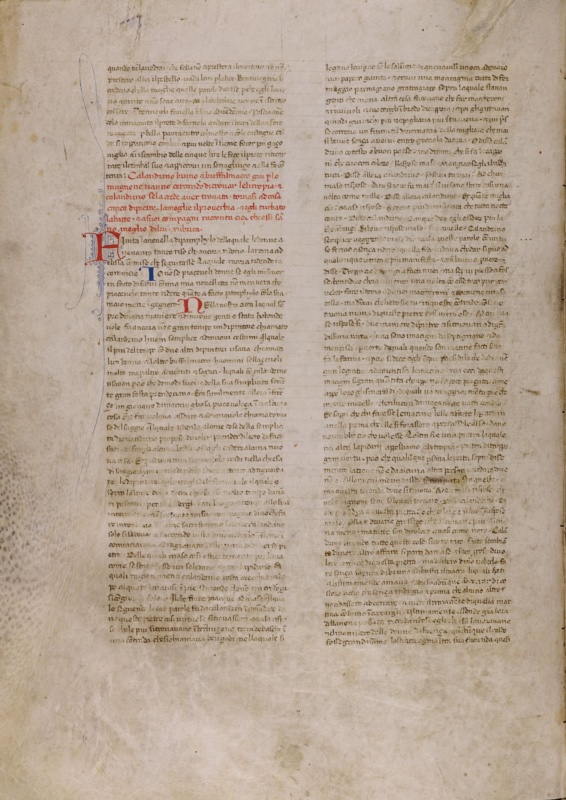
The tales in which the pair figure are among the most celebrated comic inventions of medieval Italian prose. In the story of the elitropia (VIII, 3), Bruno and Buffalmacco persuade the credulous Calandrino that a common stone found in the Mugnone confers invisibility, and then pelt him with rocks all the way home as he imagines himself unseen.
In another (VIII, 6) they steal a pig from Calandrino and, by means of ginger-and-wine “pills,” convince him of his own guilt; in a third (IX, 3) they persuade the hapless painter that he has become pregnant. Across these tales Buonamico is depicted as a working painter — repeatedly shown at his craft in the houses of Florentine gentlemen — but a painter for whom the workshop is chiefly a base of operations for eating, drinking, and the elaborate engineering of beffe at his colleagues’ expense.
It is crucial, for the epistemic sorting this essay attempts, to recognise what Boccaccio’s tales are and are not. They are fiction, deploying the names of real, recognisable Florentine artisans to lend verisimilitude to a comic world; they are not, and were never intended as, biography. That the surrounding circumstantial detail is often accurate — the topography, the trades, the social textures — has been demonstrated by modern scholarship, and this very accuracy is part of what later lent the fictional Buffalmacco his air of documentary solidity. But nothing in Boccaccio offers anything reliable about Buonamico di Martino’s character, still less about his painting. The comic Buffalmacco is a mask, and the historical painter’s misfortune was to be remembered chiefly through it.
The Literary Legend II: Sacchetti’s Ambivalent Master
If Boccaccio made Buffalmacco a comic accomplice, it was Franco Sacchetti, writing his Trecentonovelle in the last decades of the fourteenth century, who both amplified the prankster and, at the same time, preserved a countervailing memory of the painter as a great master. Buffalmacco appears in five of Sacchetti’s tales (novelle CXXXVI, CLXI, CLXIX, CXCI, and CXCII), and here he is no longer the sidekick but the protagonist of the pranks. Yet Sacchetti’s testimony is doubly valuable precisely because it is not univocal.
In novella CXXXVI a company of painters, asked who was the greatest master after Giotto, proposes Buonamico among its names, with Cimabue, Stefano, Bernardo and others; in novella CLXI Sacchetti states flatly that Buffalmacco “fu al tempo di Giotto e fu grandissimo maestro” — he lived in Giotto’s time and was a very great master. This is an early vernacular assertion of Buonamico’s artistic eminence, and it agrees with Ghiberti’s independent judgement of some decades later. It is evidence for his reputation, not for his biography.
Sacchetti is also the source for the single most famous anecdote attached to Buonamico’s name, the prank of Sant’Ercolano at Perugia (novella CLXIX). Commissioned by the Perugians to paint their patron, the bishop-martyr Ercolano, on a wall in the city’s main piazza, Buffalmacco erected a screen of boards and matting to conceal his work, then grew exasperated by the citizens who daily disturbed him to demand its completion. Having collected his fee, he unveiled a saint crowned not with a halo but — in Sacchetti’s memorable words — with a garland
non d’alloro, come i poeti, non di diadema, come i santi, non di corona d’oro, come li re, ma d’una corona, o ghirlanda di lasche
a wreath of roach, the fish of Lake Trasimeno, in mockery of the Perugians whom local wit dubbed magnalasche, roach-eaters. Buonamico, the tale concludes, was already on the road to Florence before the furious citizens discovered the insult.
The story is a splendid specimen of Trecento civic humour, and it has been so beloved in Umbria that Perugian pastry-cooks still make a sweet in the shape of Sant’Ercolano’s roach. But as evidence for the historical painter it is worthless, or nearly so — a floating comic motif of the kind that attached itself readily to the figure of the itinerant painter-wit. What Sacchetti does reliably transmit, and what deserves to be extracted from the anecdotal froth, is the double memory of Buffalmacco: prankster and, simultaneously, “grandissimo maestro.” Sacchetti’s tribute has been read as more than an accident: it may reflect the standing the painter enjoyed in the generations after his death, a standing that the later reduction of his memory to pure buffoonery would obscure.
The Literary Legend III: Vasari and the Fabricated Life
The transformation of Buffalmacco from an artisan-wit of the novella into a fully fledged (and largely fictitious) artistic biography was the work of Giorgio Vasari, whose Life of Buonamico Buffalmacco appears in both the 1550 and the 1568 editions of the Vite and changed considerably between them. Vasari opens by presenting his subject as
Buonamico di Cristofano detto Buffalmacco pittore fiorentino, il qual fu discepolo d’Andrea Tafi, e come uomo burlevole celebrato da messer Giovanni Boccaccio nel suo Decamerone
thereby, in a single sentence, misstating the patronymic, asserting an apprenticeship to the mosaicist Andrea Tafi, and folding the painter’s identity into the comic reputation bestowed by Boccaccio.
Vasari’s Life is, by common scholarly consent, among the most “favoleggianti” — the most fable-laden — of all his biographies. He tells the prank of the beetles: the young Buonamico, resenting his master Tafi’s habit of rising before dawn to work and rousing his apprentices, fixes little candles to the backs of thirty cockroaches and releases them into the master’s chamber at night, so that Tafi, terrified, takes the crawling lights for demons and abandons his early hours.
He recounts the affair of Capodoca’s wife, whose nocturnal spinning at a wheel set opposite Buonamico’s bed drove the painter to his ruses; the celebrated dealings with the nuns of Faenza; and a string of pranks played on patrons. Vasari also notes — with a certain condescension — Buffalmacco’s habit of inserting written scrolls and inscriptions into his paintings, a device the biographer treats as one more of the witty painter’s jokes, which his lesser contemporaries had foolishly misunderstood and imitated.
Vasari attributes a long list of works to Buonamico, many already lost by the sixteenth century: paintings at the convent of Faenza in Florence, works for the abbey of Settimo, tempera panels for the Certosa monks, frescoes of the Passion in the Giochi and Bastari chapel of the Badia of Florence, a Saint Catherine cycle at Assisi, and several commissions at Pisa. Crucially, for the later history of the Camposanto question, Vasari in the second edition distributed the great frescoes of the Pisan cemetery among several artists: he gave the Passion cycle on the east wall to Buffalmacco, but assigned the Triumph of Death and the Last Judgement to Andrea Orcagna, the Hell to Orcagna’s brother Nardo di Cione, and the Thebaid to Pietro Lorenzetti. These misattributions, carried by Vasari’s immense authority and the accessibility of the 1568 text, would dominate the literature on the Camposanto for close to three centuries.
The deepest damage Vasari inflicted, however, was not any particular false attribution but the overall shape of the portrait: a gifted but idle and disreputable jester, whose art was almost incidental to his capacity for mischief. It is a measure of how completely this image took hold that a strain of scholarly opinion could later question whether so shadowy and anecdotal a figure had ever really painted anything at all.
It is worth noting, nonetheless, that Vasari’s account is not merely destructive. Recent literary scholarship — notably Norman E. Land’s essay “Vasari’s Buffalmacco and the Transubstantiation of Paint” (Renaissance Quarterly 58, no. 3, Fall 2005, pp. 881–895) — has argued that beneath the comic surface Vasari invested Buffalmacco with a serious aesthetic significance, praising in the anecdotes of the Faenza nuns the painter’s near-miraculous power to “transubstantiate” mere pigment into living representation, an ability that placed him, for Vasari, among the primi lumi, the first lights of the reborn art of painting. On this reading the jester conceals a theologian of the image — a reminder that even the most fabulous of the early sources can repay careful, critical reading.
Debunking the Legend: Separating the Painter from the Persona
Before turning to the Camposanto it is worth gathering, explicitly, the errors and legends that scholarship has corrected, since the actively critical sorting of true from false is fundamental to any honest treatment of Buonamico.
The first and gravest consequence was the reduction of the painter to a literary figure: until Bellosi’s book he was a name without identified works, the prankster of the novelle. What restored the painter was the archive: the matriculation of 1320, the Pisan document of 1336, and the Aretine reference of 1341 together attest a Florentine painter named Buonamico beyond dispute.
The second error was Vasari’s patronymic. “Buonamico di Cristofano” is a mistake; the guild record’s “Bonamichus magistri Martini” gives the correct filiation, and the modern preference for the form Buonamico di Martino reflects the primacy of document over anecdote.
The third cluster of errors concerns the Camposanto attributions themselves — the assignment of the south-wall frescoes to Orcagna, Nardo di Cione, and Pietro Lorenzetti. These were already being dismantled in the nineteenth century, when critics such as Giovanni Battista Cavalcaselle and Joseph Archer Crowe (in their History of Painting in Italy, 1864–1866) and later Igino Benvenuto Supino (Il Camposanto di Pisa, 1896) rejected the Orcagna and Lorenzetti attributions; it was Supino who advanced, tentatively, the ascription of the frescoes to the Pisan painter Francesco Traini. That is the subject of the sections that follow.
The fourth, and in some ways the most stubborn, is the popular conviction — still repeated in guidebooks and general accounts — that the Triumph of Death is a document of the psychological trauma of the Black Death of 1348. As shown below, the dating now generally cited places the cycle roughly a decade before the plague, which entirely inverts the causal relationship long taken for granted between the pestilence and this most famous of macabre images.
Finally, there are the frankly folkloric legends that cling to the monument and the man: the tradition that the Camposanto’s holy earth, said to have been shipped from Golgotha, reduced buried bodies to bone within twenty-four hours; and the whole apparatus of pranks — the roach-crowned saint, the candle-bearing beetles — which belong to the migratory stock of comic anecdote and reveal the medieval imagination of the painter’s trade, not about Buonamico di Martino.
The Camposanto of Pisa: The Monument and Its Wounds
To understand the frescoes on which Buonamico’s modern reputation rests, one must first understand their extraordinary setting. The Camposanto — the “holy field” — is the monumental cemetery on the north side of the Piazza del Duomo at Pisa, a long rectangular cloister enclosing a plot of earth that, according to a cherished legend, had been carried by ship from the Holy Land, so that the Pisan dead might rest in the soil of Calvary. Begun in 1277–1278 to the design of the architect Giovanni di Simone, the building took the form still visible essentially in the second campaign of construction: an elongated quadrilateral of walls pierced later with elaborate Gothic tracery, enclosing the sacred ground, with a broad paved ambulatory running around it and tomb-chambers set into the pavement.
The frescoing of the interior walls began in the 1330s, in the south-eastern corner — the first part of the building to be completed and roofed, and the ritual and liturgical heart of the cemetery — and continued, with long interruptions caused by plague and political upheaval, for a century and a half, until the Old Testament cycle on the north wall was brought to completion by Benozzo Gozzoli in the later fifteenth century. Over that span the walls accumulated what became the most extensive fresco decoration in Italy: the Opera della Primaziale Pisana describes the ensemble as an immense painted programme of almost two thousand square metres of painting (some estimates run higher still) by many of the leading Tuscan masters of the Tre- and Quattrocento — Taddeo Gaddi, Antonio Veneziano, Spinello Aretino, Piero di Puccio, Benozzo Gozzoli, and the anonymous master of the first campaign whose identity is the subject of this essay. The disposition of subjects was governed by the building’s function as a place of the dead: on the east wall, Christ’s death and his victory over death (the Crucifixion, attributed to Traini and dated around 1330, then the Resurrection, Incredulity of Saint Thomas, and Ascension); on the south wall, the fate of the individual soul, in the tripartite confrontation of the Triumph of Death, the Last Judgement and Hell, and the Thebaid. The attribution of the Crucifixion is itself discussed: the Dizionario Biografico gives it to Traini with a date of c. 1330–1335, while the Enciclopedia dell’Arte Medievale, in the entry on Buffalmacco (Bellosi, 1992), relying on the verse guide of Michelangelo di Cristofano da Volterra, gives Buffalmacco the whole east wall “from the Crucifixion to the Ascension”.
The modern history of these paintings is a history of catastrophe and salvage. On 27 July 1944, during the Allied advance through Tuscany, an incendiary device struck the roof of the Camposanto; the lead of the roof melted, the burning timbers collapsed, and the fire raged for days, inflicting irreparable damage on the frescoes and the marbles beneath. In the aftermath the surviving murals were detached from the walls — a drastic but necessary rescue — and in the course of the detachment the sinopie, the preparatory underdrawings on the wall’s first plaster layer, were recovered and published, opening a new chapter in the study of the cycle. The hurried post-war reattachment, using materials later found to be damaging, created fresh problems, and the frescoes passed through decades of conservation. Only on 6 June 2018, after a restoration campaign that had lasted, in one form or another, more than seventy years, was the Triumph of Death finally reinstalled in its original position on the south wall, extending, with its companion scenes, more than forty-six metres along the gallery from the former main entrance (the Porta Regia). The paintings that Buonamico’s advocates admire are therefore, in a real sense, ruins — battered, transferred, and partly repainted survivals of what was once a far more brilliant and legible whole.
The Attribution Question: From Orcagna to Traini to Buffalmacco
The identity of the master of the south-wall frescoes is one of the classic problems of Italian art history, and its solution — or at least the answer now generally accepted — is inseparable from the name of Luciano Bellosi. To grasp the magnitude of his intervention one must trace the earlier states of the question.
For nearly three centuries after Vasari, the frescoes were divided among Orcagna, Nardo di Cione, and Pietro Lorenzetti, on the authority of the 1568 Vite. In the nineteenth century this scheme collapsed. Cavalcaselle and Crowe, and then Supino, rejected the Orcagna and Lorenzetti attributions, and Supino in 1896 tentatively assigned the cycle to the Pisan painter Francesco Traini, on the reasoning that Traini was a competent local master who had demonstrably worked elsewhere in the Camposanto. Meanwhile, in 1888, German scholarship (Heinrich Thode) had given the anonymous author of the frescoes the notname by which he would long be known — the “Master of the Triumph of Death” — a label that at once acknowledged the stylistic unity of the group (Resurrection, Incredulity of Saint Thomas, Ascension, Triumph of Death, Last Judgement, Hell, and Thebaid) and confessed ignorance of who he was.
The Traini hypothesis received its most authoritative statement and its most consequential elaboration from the American scholar Millard Meiss, whose article of 1933, “The Problem of Francesco Traini” (The Art Bulletin 15, no. 2), corroborated the attribution of the frescoes to the Pisan painter and dated them around the middle of the century. On this foundation Meiss erected, in his celebrated 1951 book Painting in Florence and Siena after the Black Death, an entire interpretation of mid-Trecento Tuscan art. But an alternative current, associated with the connoisseur Roberto Longhi — under whom Bellosi was himself trained — held that the Master of the Triumph of Death had little in common with Tuscan painting and might rather be an anonymous Bolognese artist, working around 1360.
Into this divided field Bellosi launched, in 1974, his short and now classic book Buffalmacco e il Trionfo della Morte, published by Einaudi and awarded that year’s Premio Viareggio for a first work of non-fiction (opera prima saggistica). Its argument is a model of art-historical detective work, combining several independent lines of evidence. He began from the documentary and near-documentary testimony — above all Ghiberti’s explicit statement that Buonamico had painted “moltissime istorie” in the Camposanto, a notice that later writers, following Vasari, had misapplied to other parts of the building. Reading Ghiberti more carefully, Bellosi argued that the “very many stories” could be identified with the stylistically unified group that scholarship had christened the Master of the Triumph of Death. He reinforced the identification with a chain of stylistic comparisons: the fragmentary fresco of the Madonna and Child with saints in the cathedral of Arezzo — connected to Buonamico by Pier Paolo Donati in a 1967 study, on the strength of Vasari’s testimony and the documentary reference of 1341 to his work in the episcopal chapel there — showed, in Bellosi’s eyes, precise affinities with the Pisan cycle. Further comparisons drew in the frescoes of the baptistery of Parma, consistent with Ghiberti’s report that Buonamico had also worked in Emilia and thereby reconciling the old “Bolognese” intuition with the new Florentine identification. The result was to collapse two problems into one: the anonymous Master of the Triumph of Death and the documented, celebrated, but seemingly workless Buffalmacco were, Bellosi contended, the same man.
Bellosi’s achievement was to bring together the celebrated but workless name and the masterly but nameless frescoes of Pisa, and so to restore to Buonamico a major artistic personality and to vindicate the exalted rank that Sacchetti and Ghiberti had assigned him.
Iconography and Meaning of the Triumph of Death Cycle
Whatever one concludes about the painter’s name, the frescoes themselves are among the most powerful visual meditations on death and salvation that the Middle Ages produced, and their iconography repays close description. The three great cartelloni of the south wall — the Triumph of Death, the Last Judgement and Hell, and the Thebaid — form a coherent moral and eschatological programme, framed at either end, as recent scholarship has emphasised, by images of hermits, so that the whole sequence is bracketed by the eremitical ideal.
The Triumph of Death is the most famous and complex of the three, and it is built from several autonomous narrative nuclei juxtaposed in a single vast field. At the left, an elegant hunting party of richly dressed young men and women, mounted and accompanied by dogs and falcons, comes suddenly upon three open coffins containing corpses in successive stages of decay — a bloated body, a desiccated one, a skeleton — over which a hermit unfurls a scroll. This is the widely diffused medieval legend of the Three Living and the Three Dead, whose burden is the reciprocal address of corpse to onlooker: as you are, so once was I; as I am, so shall you be.
But here, as scholarship has observed, the motif is transformed: the hermit above the coffins is no longer a passive signpost but a preacher, and the three corpses have become the exempla of his sermon on penitence. At the centre, a group of cripples and beggars stretches out their hands, not to flee death but to invoke it as a release from misery — a scroll among them, according to the transcriptions reported in the literature, appealing to Death as the medicine for every pain. At the right unfolds the scene that has done most to make the fresco famous: a brigata of leisured, beautiful youths gathered in a flowering garden, one playing an instrument, another holding a hawk, a small dog on a lap, wholly absorbed in their pleasures while, above them, the figure of Death — a fury with a great scythe — sweeps down upon them. Across the upper zone, angels and demons contend for the little naked souls of the newly dead, carrying them toward heaven or bearing them off to a fiery mountain riddled with the mouths of hell.
The Triumph of Death: Buonamico’s Sermon on Mortality
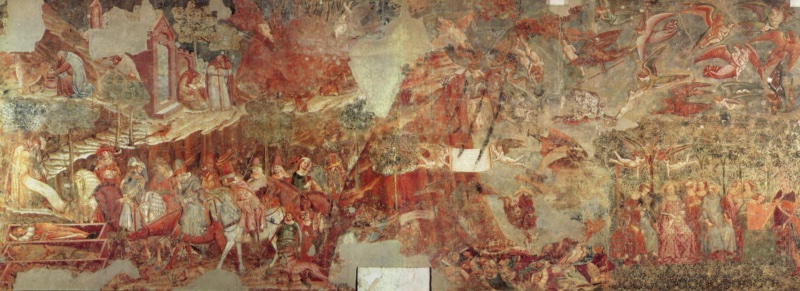
The Triumph of Death opens the great moral sequence of the Camposanto’s south wall and is, by common consent, its imaginative summit: the scene from which the anonymous master long took his notname, and the work on which Buonamico Buffalmacco’s modern reputation chiefly rests. Nearly fifteen metres of continuous painted field confront the visitor who once entered by the Porta Regia, so that the first image met in the city’s holy burial ground was neither consolation nor glory but the unanswerable fact of death itself — the premise on which the adjoining Last Judgement, Hell, and Thebaid then build their argument.
Unlike the Judgement, the composition obeys no hierarchical scheme: it is a panorama, organised as a diagonal landscape of rock, wood, and garden across which several autonomous episodes are distributed, to be read cumulatively, as a preacher accumulates exempla. A great cleft of bare mountain divides the field near the centre, separating the zone of admonition on the left from the zone of heedlessness on the right, while the upper register belongs throughout to the contested air — the sky in which the destiny of souls is decided. The unity of the whole is rhetorical rather than spatial, and precisely this additive, panoramic logic sets the master apart from the measured scenography of the Giottesque mainstream.
The episode at the lower left transforms the most widespread of medieval macabre legends, the Encounter of the Three Living and the Three Dead. A courtly hunting party — crowned riders, ladies, falconers, hounds — rounds the base of the mountain and halts abruptly before three open coffins in which three corpses lie in graded states of ruin: one bloated, one putrefying and serpent-ridden, one reduced to bone. The horses shy and the riders recoil; one, in a touch of unforgettable naturalism, pinches his nose against the stench. Above the coffins the aged hermit unrolls a long scroll of admonition: the old mirror-formula of the legend — what you are, we were; what we are, you will be — here converted from a floating motif into the text of a sermon, with the corpses as its visible exempla.
The mountain above the coffins answers the admonition with its remedy. On its terraced slopes a community of hermits conducts the contemplative life around a small chapel: one milks a doe, another reads, others converse or labour in tranquil self-sufficiency. These anchorites — kin to the Desert Fathers who will fill the Thebaid at the other end of the wall, and to the vernacular lives of the Fathers composed in these very years by the Pisan Dominican Domenico Cavalca — are the only figures in the entire fresco whom death does not terrify, because they alone have already died to the world. The cycle’s eremitic frame thus begins here, inside its opening scene.
The centre belongs to the poor. A huddle of beggars, cripples, and the blind — painted with a harsh, documentary attention to deformity and rag — stretch their arms and faces upward, and their scroll makes their plea explicit: they call upon Death as the end of all pain, begging the release that she refuses them. It is the fresco’s cruellest irony and its sharpest social observation: Death ignores those who invoke her and flies instead toward those who have forgotten her — a reversal that the preachers of the age used precisely to argue the vanity of earthly condition, since neither misery can hasten nor privilege defer the appointed hour.
The right half stages the object of that flight. In a grove of fruiting orange trees, a brigata of ten elegant young men and women sits in conversation and music — a psaltery played, a viol, a falcon on a wrist, a lapdog on a hem — an image of courtly leisure so complete that it has often been thought a source, or at least a twin, of the frame of Boccaccio’s Decameron, whose storytellers likewise withdraw to a garden while death reigns outside. Above them, unseen, the colossal figure of Death descends: not the later skeleton but a fury — an aged, taloned, bat-winged woman with streaming white hair — swinging her great scythe toward the company. Beneath her lies the harvest already taken, a heap of the dead of every estate, kings, prelates, and ladies tumbled together in the democracy of the grave.
The upper air completes the theology. From the corpses below, small naked souls issue from the mouths of the dead and are instantly contested: angels on one side, grotesque winged demons on the other, seize, carry, and wrestle over them, bearing the saved toward heaven and dragging the reprobate toward the fiery mountain at the horizon. This aerial psychomachia, painted with a vehemence and a monstrous invention that once persuaded critics the master must be Bolognese, binds the Triumph to the Judgement and Hell beside it: what is fought over in this sky is adjudicated in the next scene and executed in the third.
The fresco’s modern history is the cycle’s in extremity. Gravely damaged in the fire of 27 July 1944, detached in the post-war salvage with the recovery of its superb sinopia, and disfigured for decades by the failing materials of the first transfer, the Triumph of Death was the last of the Camposanto murals to return to its wall, reinstalled in June 2018 after a restoration of unprecedented length. What hangs there now is a ruin of its first splendour, yet the essential survives: the one Trecento image in which the certainty of death is argued, scene by scene, with the urgency of a preacher and the imagination of a great painter — composed, it must always be repeated, a decade before the Black Death gave its warning the force of prophecy.
The Last Judgement of the Camposanto: Christ and the Virgin Enthroned in Judgement
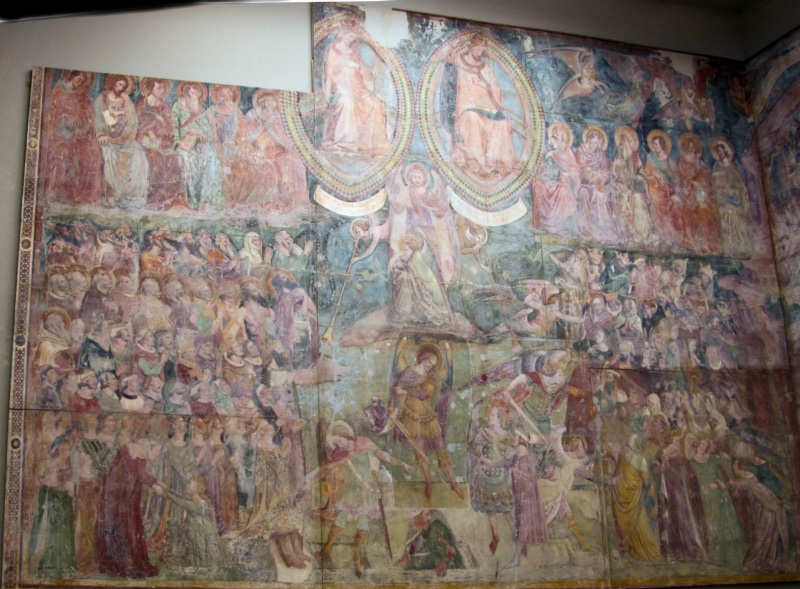
The Last Judgement occupies the pivotal position in the great moral cycle of the Camposanto’s south wall, standing between the Triumph of Death and the Hell that completes it to the right, and opposite the eremitic counter-example of the Thebaid. Within the programme — generally referred to the Dominican milieu of Santa Caterina in the years of Archbishop Simone Saltarelli7 — it supplies the doctrinal resolution of the drama staged in the Triumph: the souls contested there by angels and demons arrive here before their Judge, and the cemetery’s visitor, walking the gallery among the tombs, is made to walk the very sequence of death, judgement, and eternal destiny that the preachers of the age expounded.
The composition is governed by one of the most audacious iconographic decisions of the entire Trecento: Christ does not sit alone. Two mandorlas of equal scale and identical rainbow-fretted borders are set side by side at the summit of the field, the Virgin at the left, Christ at the right, each enthroned within an almond of light attended by scrolls that unfurl beneath them. The pairing has no real precedent in the canonical Judgement schemes descending from Byzantine and Giottesque models, where Mary appears, if at all, as first among the interceding elect. Here she is raised almost to the rank of co-protagonist — not co-judge in any doctrinal sense, for her gesture is one of compassionate recoil rather than sentence, but a visual counterweight to her Son, embodying mercy at the very moment justice is pronounced.
Christ himself is the fulcrum of the drama. He is shown as the Iudex of the Apocalypse rather than the mild teacher of the Gospels: crowned, his mantle drawn back as he displays the wound in his side, one arm raised in the gesture that simultaneously reveals his sacrifice and delivers the sentence of damnation. The motif of the self-revealed wound — the proof of the Passion turned into the instrument of judgement — gives the figure its terrible double meaning: the same body that redeemed the world now condemns those who refused its redemption. The downward thrust of his gesture is aimed unmistakably toward the right, where the damned are herded toward the adjoining Hell, so that the entire field is set in motion by a single movement of the Judge’s hand.
Around this double epiphany the celestial court is arranged with tribunal-like solemnity. Twelve apostles, six to either side, sit in a continuous row on clouds flanking the mandorlas, each haloed, several holding books and scrolls, their postures varied between contemplation, dispute, and astonishment — assessors at the trial of humankind, in accordance with the promise of Matthew 19:28 that they would sit upon twelve thrones judging the tribes of Israel. Above and between them, angels bear the instruments of the Passion, while at the centre of the field the angels of the Resurrection sound their long trumpets and display the scrolls of summons; one angel, placed directly beneath the mandorlas, covers part of his face in a gesture of grief — a humanising detail entirely characteristic of this master, for whom even the ministers of judgement are not exempt from emotion.
The middle and lower registers are given over to humanity itself, and it is here that the painter’s narrative genius is most evident. The resurrected do not rise from neat rows of graves, as in the standard scheme; they are already assembled, two immense crowds pressed shoulder to shoulder, a cross-section of medieval society in which crowned kings, bishops in their mitres, monks, veiled nuns, and laymen and women of every age can be distinguished. On the left, the elect lift their faces and hands toward the Judge in attitudes of hope and dawning relief; among them the painter has scattered passages of remarkable portrait-like particularity — aged, furrowed faces, whispering pairs, figures turning to one another as if to verify their salvation. The crowd is not an abstraction of the blessed but a gathered populace, observed with the same appetite for individual incident that animates the beggars and horsemen of the Triumph of Death.
At the centre of the lower zone the armoured archangels execute the sentence, and in them the fresco reaches its most dramatic invention. Michael stands at the axis in his cuirass, sword drawn, the immovable bar between the two eternities; his companions act with startling violence, seizing the reprobate and thrusting them bodily toward the right. Most celebrated is the figure of the archangel who wrenches away a soul attempting to conceal itself among the blessed — the hypocrite unmasked at the last — a motif of forensic cruelty that contemporary preaching, with its insistence that no dissimulation survives the Judgement, makes fully intelligible. The sorting of souls is thus staged not as a serene allotment but as a physical struggle, charged with the same expressive vehemence that led earlier critics to seek this master outside Tuscany altogether.
That vehemence is the stylistic signature of the whole. The painter — identified since Luciano Bellosi’s reconstruction of 1974 with the documented Florentine Buonamico Buffalmacco, after centuries of misattribution to Orcagna and his circle and, in the earlier twentieth century, to Francesco Traini — stands deliberately apart from Giottesque decorum. Space is additive and panoramic rather than measured; the crowds are built by accumulation, face upon face; colour, even in its present abraded state, retains the high, chalky brilliance that Ghiberti remembered when he wrote that Buonamico “colorì freschissimamente.” The equal mandorlas, the weeping angel, the unmasked hypocrite are the inventions of an artist who thought in terms of preaching — of exempla, admonition, and shock — rather than of classical narrative balance.
The condition of the fresco bears the marks of its modern history. Gravely damaged in the incendiary bombardment of 27 July 1944, it was detached from the wall in the post-war salvage campaign — the joins between the transferred sections remain plainly visible, as in the present photograph — and its sinopie were recovered and are now displayed separately in the Museo delle Sinopie. After decades of conservation the cycle was returned to the south wall, the Triumph of Death last of all in June 2018. What survives is a diminished but still overwhelming ruin: legible enough to support the dating of c. 1336–1341, a decade before the Black Death with which the cycle was so long associated, and to secure its author’s place — under whatever residual margin of doubt attends any attribution made on style — among the great tragic imaginations of the Italian Trecento.
The Hell of the Camposanto: Lucifer and the Architecture of Damnation
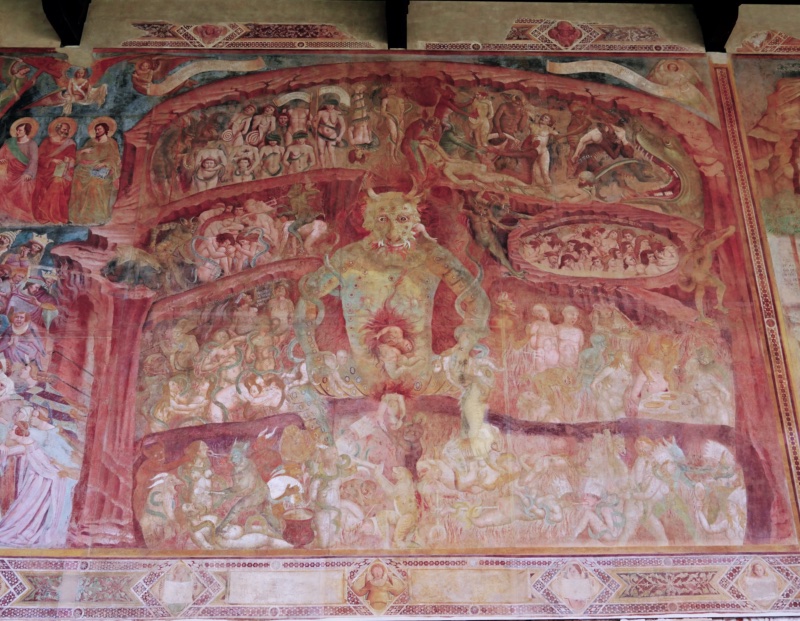
The Hell completes the eschatological sequence of the Camposanto’s south wall, forming with the Last Judgement a single continuous field in which sentence and execution are inseparable: the damned driven rightward by the archangels of the Judgement pass, without interruption of the painted surface, into the mountain of their punishment. Within the larger programme usually referred to the Dominican circle of Santa Caterina, the scene supplies the terminal term of the meditation begun in the Triumph of Death — the fate from which the hermits of the Thebaid, at the far end of the wall, model the only escape. For the visitor walking the gallery among the tombs, it was the last and loudest word of the sermon.
Structurally, the painter conceives Hell as a hollowed mountain, a vast conical mass of livid rock split into superimposed tiers and cellular compartments, each an enclosed chamber of torment. The arrangement is deliberately architectural — an infernal counter-building set against the ordered courts of heaven on the adjoining field — and deliberately legible: the eye descends from ledge to ledge as the preacher’s voice would descend through the catalogue of sins. The near-monochrome palette of reds, russets, and scorched browns, though exaggerated by abrasion and later retouching, was always the scene’s expressive key, an atmosphere of universal burning that no other Trecento Hell pursues with such saturation.
At the centre, dominating the whole, stands the colossal figure of Lucifer: horned, crowned with his own monstrosity, his grotesque mask-like face staring frontally out of the rock. He is an engine of consumption — a sinner disappears into his jaws while a second mouth, opened in his belly, grinds another, and serpents issue from his body to seize further victims. The conception descends from the Byzantine and Romanesque tradition of the devouring Satan, but its nearest imaginative kin is the Lucifer of Inferno XXXIV, chewing the arch-traitors at the pit of the world; here, as in Dante, the prince of Hell is himself the deepest instrument of punishment, fixed at the axis of the system he rules.
Around him the compartments stage the economy of contrappasso. Demons — dark, winged, bestial — preside over each chamber, and the punishments answer the sins: the gluttonous and the violent boiled in cauldrons, the lustful mauled and bound, usurers and hoarders tormented with their gold, hypocrites and traitors flayed, hanged, and devoured. Inscriptions painted beside the groups, many now effaced or renewed by restorers, originally named the categories of sin, turning the wall into a captioned taxonomy of evil — a feature consonant with the fondness for speech-scrolls and written words within the image that Vasari reports of Buonamico.
Among the damned the painter placed identifiable contemporaries, and it is here that the fresco becomes a historical document of the first order. An inscription identifies the antipope Nicholas V — the Franciscan Pietro Rainalducci, raised against John XXII8 by the Emperor Louis the Bavarian, who submitted in 1330 and died in 1333 — consigned to torment and branded a “friend of Muhammad,” with the Prophet himself tortured nearby. This violently topical, Guelph9 and anti-schismatic polemic anchors the cycle chronologically: the antipope’s infamy was a live issue in the mid-1330s and a cold one by mid-century, and this detail was among the decisive arguments for abandoning the old post-plague dating.
The relationship with Dante, pervasive throughout, deserves precise statement. The tiered subdivision of the mountain, the classification of sinners, the logic of retributive symmetry, and the devouring Lucifer all presuppose the Commedia, which by the 1330s was already the object of public lectures and popular diffusion in Tuscany. Yet the fresco is not an illustration of the poem: its orchestration is that of the pulpit rather than the terzina, cruder, more cumulative, aimed at the broadest audience of the cemetery’s visitors. It stands as the earliest monumental demonstration of how quickly Dante’s infernal imagination was absorbed into the common visual and homiletic culture of Tuscany.
In execution the Hell is generally judged the least autograph portion of the south wall. The invention — the mountain, the Lucifer, the taxonomic machinery — bears the stamp of the master responsible for the Triumph and the Judgement, identified since Luciano Bellosi’s reconstruction of 1974 with the documented Florentine Buonamico Buffalmacco; but the handling is more summary, and substantial tracts of the present surface are the work of later centuries, for this section, exposed and venerated as a moral spectacle, was repeatedly repaired and repainted long before the modern era. Any stylistic judgement must therefore be made through a double veil: workshop execution beneath, restorers’ brushes above.
Its modern history follows that of the whole cycle. Scorched and battered in the incendiary strike of 27 July 1944, the scene was detached in the post-war salvage, its sinopia recovered for the Museo delle Sinopie, and the fresco eventually returned to the south wall after the long conservation campaign concluded in 2018. Even in its compromised state it remains the most comprehensive Hell of the Italian Trecento — the indispensable right-hand term of Buonamico’s great triptych of mortality, and the panel in which the preacher’s threat, elsewhere implied, is spelled out chamber by chamber.
The Thebaid: The Desert Fathers and the Conquest of Death
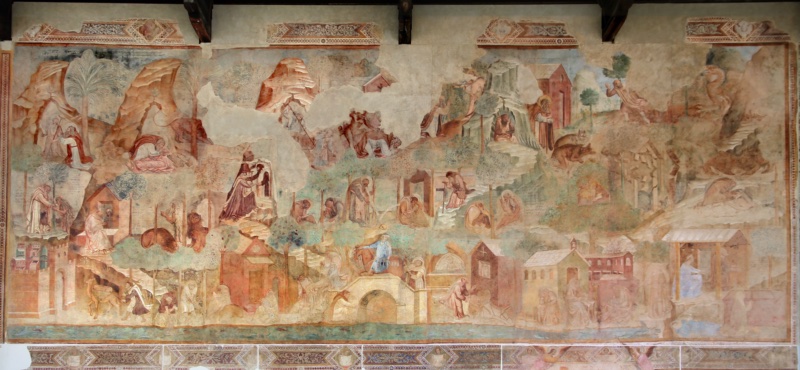
The Thebaid closes the moral sequence of the Camposanto’s south wall and resolves it: after the universality of death, the terror of judgement, and the machinery of damnation, the cycle’s final word is the image of the life that overcomes all three. Its subject is the legendary desert of Egypt — the Thebaid of the first Christian anchorites — rendered as a single immense landscape in which the lives, labours, temptations, and deaths of the Fathers unfold simultaneously. Placed beside the Hell, it functions as its exact antithesis: against the mountain of torment, a mountain of salvation; against the taxonomy of sins, a repertory of virtues in action.
The composition is the most radical of the whole cycle, for it dispenses almost entirely with dramatic focus. There is no protagonist, no centre, no event: the field is a continuous terrain of pale rock, scattered vegetation, hermitages, and oratories, bounded along its lower edge by the river — the Nile of the legend — with its boats and fishermen, and populated throughout by dozens of small figures of monks and hermits distributed with an even, map-like dispersion. The viewer is not addressed, as before the Triumph, but invited to wander: the eye travels from cell to cell as a pilgrim would travel the desert, and the reading of the fresco becomes itself a kind of contemplative exercise.
The literary foundation of this world is the corpus of the lives of the Desert Fathers, and in this precise Pisan context above all the vernacular Vite dei Santi Padri of Domenico Cavalca, the Dominican of Santa Caterina who was translating and composing these very legends in these very years. The coincidence is the strongest single argument for the Dominican conception of the whole programme: the fresco transposes onto the wall the book that the convent was placing in the hands of the laity, and several of its episodes correspond to chapters of that collection — though it must be said plainly that no document names Cavalca, or anyone, as the programme’s author, and the connection, however compelling, remains inferential.
Among the identifiable episodes, the classic figures of the tradition can be recognised. The meeting of the two patriarchs of monasticism, Anthony Abbot and Paul the first hermit, appears with the raven that brought them bread; the aged Paphnutius, Macarius, and Hilarion occupy their cells; Mary of Egypt, the penitent harlot of the desert, receives communion from the monk Zosimus; and the famous exemplum of the hermit and the devil disguised — the temptations that assail the solitaries in the form of women, beasts, and small black demons — recurs across the slopes. Each episode is self-contained, a painted chapter, and the inscriptions that once accompanied several of them confirmed the didactic, book-like character of the whole.
Woven among these narrative moments is the fresco’s most original and most influential content: the representation of the ordinary monastic day. Hermits weave baskets and mats, draw water, fish the river, read at lecterns, teach disciples, tend and are served by animals — the lion, the doe, the obedient beasts of the legends — and bury their dead. No earlier Italian painting had given the texture of daily labour and routine so extensive a field. It is the visual equivalent of the ora et labora of the ascetic tradition, and it supplied the model for the entire later fortune of the Thebaid theme in Tuscan art, from the Florentine panel versions of the late Trecento to the Quattrocento.
Doctrinally, the scene completes the argument begun fifteen metres away, inside the Triumph of Death itself. There, on the mountain above the three coffins, a first colony of hermits already lived untroubled by the horror below; here that parenthesis expands to fill an entire wall. The Fathers of the desert are the only human beings in the cycle for whom death holds no terror — several are shown dying, and their deaths are serene, attended, almost liturgical — because they have anticipated it: having renounced the world, they have nothing for Death’s scythe to cut. The Thebaid is thus not an appendix but the cycle’s conclusion in the strict sense: the demonstration that the sermon of the south wall has a practicable answer.
In execution the scene shows the same workshop breadth as the rest of the campaign, with passages of high quality — the animals, certain heads of the old solitaries, the landscape’s strange pale geology — alongside more summary tracts, and it has suffered gravely: the losses of plaster are here more disfiguring than anywhere else on the wall, entire episodes surviving only as blank lacunae or in the sinopia. Vasari’s old ascription to Pietro Lorenzetti, prompted perhaps by memory of the Sienese Carmine predella with its own eremitic scenes, retains only historiographical interest; the invention belongs with the Triumph and the Judgement to the master whom the modern reconstruction names Buonamico Buffalmacco.
Its modern vicissitudes are those of its companions: the fire of 27 July 1944, the post-war detachment with the recovery of the sinopie, the long conservation, and the return to the south wall concluded in 2018. Ruined as it is, the Thebaid remains the earliest and greatest monumental treatment of its theme in Italian painting, and the indispensable final term of Buonamico’s programme — the quiet landscape without which the thunder of the Triumph, the Judgement, and the Hell would be terror without exit.
The Dating Controversy and the Black Death Question
No aspect of the Camposanto cycle has been more consequential for the general history of art than its date, because the Triumph of Death became, in the middle of the twentieth century, the keystone of one of the most influential theses ever advanced about Trecento painting — and because that thesis has since been substantially overturned.
The thesis was Millard Meiss’s. In Painting in Florence and Siena after the Black Death (1951), Meiss argued that the catastrophe of 1348, in which perhaps half the population of Tuscany perished, produced a profound spiritual and psychological reaction: a turn away from the confident, naturalistic, human-centred art of the early Trecento — the art of Giotto and the Lorenzetti — toward a more hieratic, abstract, otherworldly and penitential mode, as a guilt-stricken society read the plague as divine punishment for its worldliness. The two great exhibits in Meiss’s argument were Orcagna’s Strozzi Altarpiece in Santa Maria Novella and the Pisan Triumph of Death, which he attributed to Traini and dated around 1350, reading its merciless, omnipresent Death as a direct response to the horrors of the pestilence. For a generation, Meiss’s book set the terms of debate, and the Triumph of Death was seen, above all, as the supreme pictorial monument of the plague years.
The redating of the cycle therefore struck at the foundation of a whole interpretive edifice. The challenge came from two directions. First, Joseph Polzer, in 1964, questioned the traditional dating and anticipated it on historical and iconographic grounds (as the Enciclopedia dell’Arte Medievale records), and the topical, anti-imperial content of the Hell — in particular the prominence of the antipope Nicholas V, a figure of maximum relevance in the mid-1330s — points the same way, towards that decade rather than around 1350. Meiss himself, notably, retreated from his original position: in 1971 he admitted that the frescoes were probably earlier than 1345, the almost certain date of the Last Judgement of Bonaccorso di Cino in the hospital of the Misericordia e Dolce at Prato, which derives from the Pisan one (again as the Enciclopedia dell’Arte Medievale reports).
The decisive blow, however, was Bellosi’s, and it was struck with an instrument that has since become famous in its own right: the analysis of costume. Reasoning that the fashions worn by figures in a dated painting furnish an objective terminus, Bellosi conducted a detailed study of the dress in the Camposanto frescoes, comparing it with securely datable works of the first half of the century — among them Simone Martini’s Guidoriccio da Fogliano, whose costume he compared with that of the Camposanto figures. The fashions pushed the cycle firmly back into the 1330s, in proximity to the documented presence of Buonamico at Pisa in 1336. Bellosi accordingly dated the Triumph of Death to about 1336, and the cycle as a whole to roughly 1336–1341, anticipating the previously accepted chronology by more than a decade.
The upshot, now generally accepted, is that the Triumph of Death was painted perhaps ten to twelve years before the Black Death, not after it. This does not empty the image of its terror, but it decisively changes the meaning of that terror. The fresco is not the traumatised aftermath of a specific historical calamity; it is a preacher’s memento mori, an admonition to penitence addressed to the living from the wall of a cemetery, drawing on the settled medieval theology of mortality and the certainty of judgement rather than on the raw memory of the plague. Indeed the influence, if anything, runs the other way: the great success and wide imitation of the Pisan cycle came after 1348, when its imagery answered with uncanny aptness to the experience of a stricken society, and there is a real possibility, often noted, that the garden of pleasure-seeking youths beneath the descending scythe helped suggest to Boccaccio the very setting of the Decameron, whose ten storytellers flee a plague-ridden Florence for a country villa. The painting did not record the catastrophe; the catastrophe caught up with the painting.
Other Works: Attributed, Documented, and Lost
Beyond the Camposanto, the reconstruction of Buonamico’s oeuvre is a delicate exercise in which the categories of the documented, the attributed, and the merely reported must be kept carefully apart, for the surviving physical remains are pitifully few and much of what the early sources describe has perished.
The one surviving work that an early source names is the mural decoration of the Spini chapel in the abbey of Badia a Settimo, near Florence, which the Enciclopedia dell’Arte Medievale (Bellosi, 1992) dates to 1315 by an inscription and calls the only work seriously attributed to him; the source of the attribution is Ghiberti, not a document. This is, in effect, the touchstone of Buonamico’s early manner. Unfortunately the frescoes, which depict prophets and evangelists in the vaults and Stories of Saint James on the walls, are so ruined as to permit only the faintest impression of the painter: they suggest an art abreast of the Florentine painting of the first two decades of the century but decidedly aloof from strict Giottesque orthodoxy. Because they rest on Ghiberti’s testimony and are nearly illegible, they exemplify the frustration of the Buffalmacco question — the best-attested survival reveals least.
A Prophet in the Vault of Settimo: Buffalmacco’s Earliest Surviving Hand
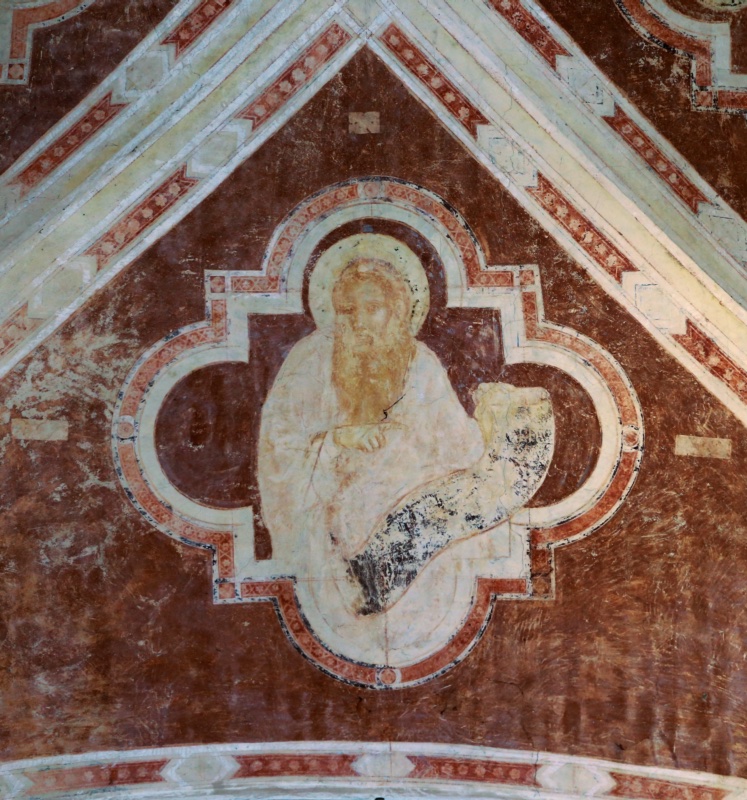
The figure occupies one of the webs of the small rib-vaulted chamber that served the Cistercian10 community of Settimo as its armarium — the book-room opening off the cloister — before its rededication as the Cappella di San Jacopo. The vault programme of prophets and evangelists presiding over the space below belongs to the oldest conventions of medieval decoration: the witnesses of the two Testaments gathered above a room of books and, later, an altar. It is this modest chamber, and not any grand Florentine commission, that preserves the earliest painting attached to Buonamico’s name.
The attribution rests on the most valuable of the early testimonies. Ghiberti, writing in the Commentarii around the middle of the fifteenth century, praised the chapel at Settimo as admirably painted by Buonamico’s own hand — testimony a full century closer to the painter than Vasari’s anecdotal Life, and free of its comic distortions. Modern criticism has treated the Settimo murals as the fixed point from which his early style must be read, the Florentine beginning of the career that would end on the walls of the Camposanto.
The prophet himself, the best preserved of the vault figures, shows what that early style was. An old man of grave, slightly melancholy cast inclines his head within the quatrefoil, the long beard rendered in soft strokes of ochre and sienna, the pale mantle gathered in broad, simplified folds around the hand that steadies the scroll. The drawing of the face — large eyes under heavy lids, the nose found with a single decisive contour — has a linear frankness that already stands at a certain angle to Giotto’s sculptural gravity: the form is stated by outline and tinted modelling rather than built by light.
The quatrefoil frame deserves attention in its own right. A white polylobed band edged with red chequer and rosette ornament isolates the figure against the deep red-brown of the web, producing the effect of a gem or enamel set into the vault — a decorative conception, abstract and chromatic, that governs the whole chamber. The taste for strong flat grounds and framing geometry connects the ensemble to the current of Florentine painting around 1300 that ran parallel to Giotto rather than through him, the milieu of the so-called Master of Santa Cecilia, whom Adolfo Venturi, in 1907–1908, proposed to identify with Buonamico, an identification now regarded as untenable on chronological grounds.
The scroll is the prophet’s defining attribute and the carrier of the image’s meaning: the Old Testament witness holds out the text that the evangelists of the neighbouring webs will fulfil. Its surface is now abraded to illegibility, blackened where the lead-based highlights have oxidised, and no transcription of its original text, if it bore one, survives in the literature. Given the fondness for inscribed scrolls that Vasari reports of this painter, and that is spectacular at Pisa, the loss is more than decorative.
The condition of the web is instructive for the whole complex. The red-brown ground survives strongly, the ornamental bands retain their crispness, but the figure has suffered the selective losses typical of secco finishes over fresco: darkened lead white, fallen azurite, scoured flesh tones. What remains is, in effect, the fresco’s understructure — closer in places to a worked-up sinopia than to the finished surface the Trecento saw — and every stylistic judgement about Settimo must allow for that filter.
Chronology and context reinforce one another. The 1315 date places the chamber in the years immediately following Buonamico’s documented emergence (he matriculated in the Arte dei Medici e Speziali by 1320, as an already independent master), when the abbey of Settimo, among the richest Cistercian houses of the Florentine contado, was renewing its buildings. For the painter’s biography the chapel is therefore doubly precious: it anchors his beginnings in a monastic, not a civic, commission, and it shows the un-Giottesque accent of his art present from the start, not acquired on his travels.
The Darkened Witness: Material History in a Settimo Vault Figure
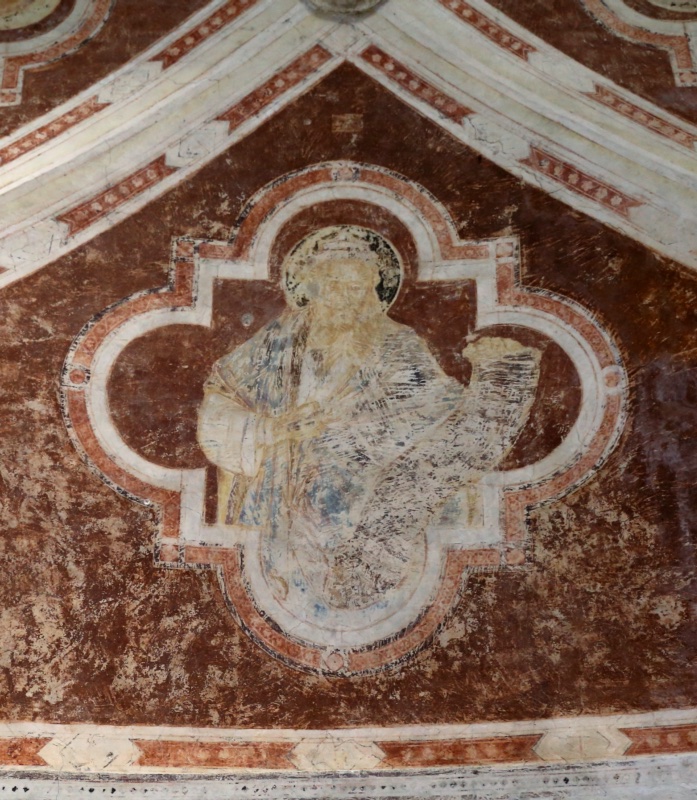
The second quatrefoil figure repeats the formula of the first — the haloed witness displaying his text within the polylobed frame — and its pairing across the vault confirms that the chamber was conceived as a unified college of witnesses, prophets and evangelists distributed among the webs in the hierarchical way that small vaulted spaces invited. The identity of the individual figure is beyond recovery: no inscription survives, and the type — bearded, mantled, scroll in hand — serves prophet and apostle alike. Honest cataloguing must leave the name open.
What distinguishes this web is its material history, written on the surface with unusual clarity. The halo, once luminous, is now a black disc: the classic signature of oxidised metallic preparation or lead-based pigment, the same chemistry that has silvered into darkness so many Trecento halos and highlights. Around it, the figure survives as a kind of spectre — the pale drapery reduced to scrubbed, directional strokes, the blue of the mantle fallen to scattered grains of azurite, the face a faint ochre memory within the dark ring.
Precisely this ruin makes the web valuable to the technical historian. The losses expose the painter’s working sequence: the broad laying-in of the drapery masses, the terra verde and ochre underpaint of the flesh, the final definitions — now gone — that were carried in secco. One reads here, as on a palimpsest, how economically the master worked: few layers, confident drawing beneath, the effect entrusted to colour and contour rather than to laboured modelling. Ghiberti’s remark that Buonamico spent little labour on his works, yet surpassed others when he set his mind to it, acquires an almost literal illustration.
The drawing that survives beneath the losses is of real quality. The gesture — both hands raising the broad scroll toward the viewer below — is amply and clearly composed for its steep viewing angle, the shoulders turned, the head dipped over the text in a movement at once rhetorical and natural. The painter thinks in silhouette, as he would at Pisa on an immensely larger scale: the figure is designed to carry from the floor as a legible shape, and it still does, even stripped of nearly all its surface.
The unfurled scroll, larger and more demonstratively displayed than in the companion web, again raises the question of lost inscriptions. Nothing legible remains; but the insistence of the motif across the vault — every witness with his text — gives the little chamber a markedly scriptural, almost disputational character, appropriate to its first function as the monks’ book-room. The programme turns the architecture itself into an open codex, each web a page held out by its author.
The ornamental system binds the web to its companions: the same white polylobe edged in red chequer, the same rosetted bands along the ribs, the same saturated red-brown field. The chromatic architecture of the chamber — light ribs, dark grounds, jewelled medallions — is its best-preserved aesthetic fact, and it argues a painter for whom decorative ensemble and figure were a single calculation, a sensibility that at the Camposanto would expand into the orchestration of entire walls.
For the attribution, this figure adds the evidence of type. The ample, simplified drapery, the large-eyed, summarily constructed head, the preference for frontal legibility over spatial complication recur in the Aretine Madonna fragment and, monumentalised, in the apostles and hermits of Pisa; the chain of comparisons that modern scholarship has drawn through these works passes directly through this web. Its very distance from the refined Giottism of contemporary Florence is, paradoxically, its strongest credential.
The Evangelist Enthroned: Authority and Architecture in the Settimo Vault
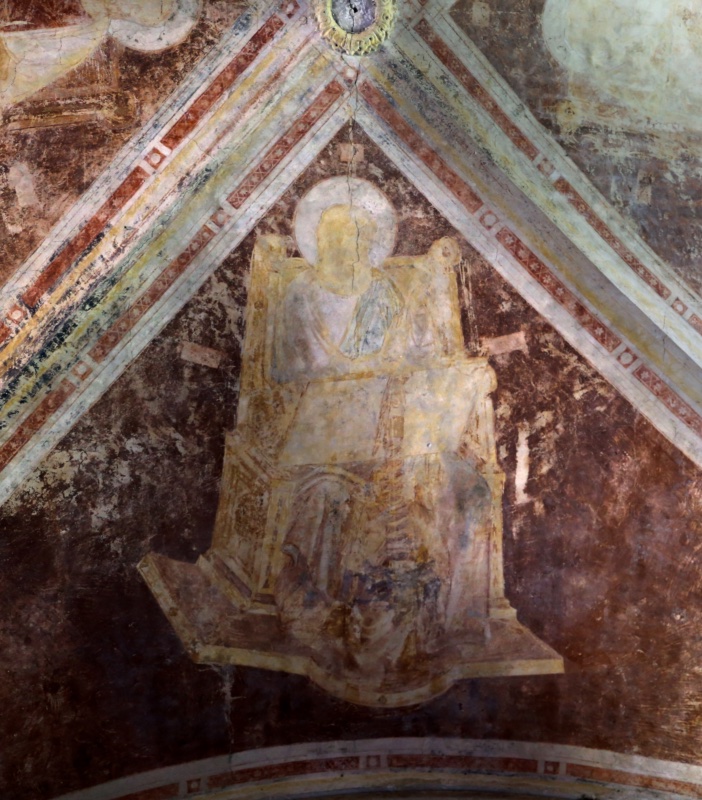
With this web the vault changes register. The quatrefoil medallion is set aside: the figure sits full-length on a monumental throne that fills the triangular field from rib to rib, a difference of apparatus that in the decorative logic of such programmes marks a difference of rank. These enthroned figures are best understood as the evangelists — the fulfilment answering the prophets’ scrolls in the neighbouring webs — seated in the cathedrae of their doctrinal authority, in the arrangement Ghiberti’s notice of prophets and evangelists in the vaults implies.
The throne is the painting’s protagonist and its most revealing passage. A high-backed marble seat with panelled sides, scrolled terminals, and a boldly projecting polygonal footpace, it is drawn with long, assured orthogonals that open a shallow but convincing space within the web — perspective not as system but as craft, handled with the empirical confidence of the generation that had absorbed Giotto’s conquests without submitting to his discipline. The slight splaying of the footrest toward the viewer below shows the painter adjusting the construction to the steep sight-line, a practical intelligence about real viewing conditions that will govern the Camposanto’s towering fields.
The figure, by contrast, has nearly dissolved. The halo survives as a pale disc, the head within it as a faint ochre oval; the body is a mantled mass of yellowed whites, the right hand perhaps once raised in blessing or holding the pen, the book or lectern that completed the evangelist’s apparatus now only a lighter patch among the abrasions. As elsewhere in the chamber, what time has spared is the design: silhouette, throne, and the broad fall of drapery over the knees — enough to show a figure conceived with real amplitude, filling its architecture like a seated statue.
Style must therefore be read in the bones. The proportions are large and the forms simplified; the drapery is organised in a few long, pliant falls rather than Giotto’s weighty excavated folds; contour does the constructive work. The ensemble recalls, more than anything in the Giottesque mainstream, the linear monumentality of the Santa Cecilia current — that alternative Florentine manner, elegant and anecdotal, in which modern criticism has repeatedly sought Buonamico’s roots. The Settimo evangelists are that manner tested, successfully, against the demands of monumental scale.
The decorative frame reaches its richest form here: double bands of star-and-chequer ornament along the ribs, converging on the painted and gilded boss at the crown of the vault, the red-brown field pressing close around the throne. The absence of the quatrefoil lets ground and figure meet directly, and the dark field behind the pale throne produces, even in ruin, a strong heraldic clarity — the evangelist as an apparition stamped on the vault, visible at a glance from the doorway of the little room.
The function of the image completes its meaning. Over the monks’ books — and, after the rededication to St James, over the altar — the enthroned evangelists asserted the source and warrant of everything read and enacted below: Scripture enthroned above its users. The programme is modest in extent but exact in thought, and its coherence tells against any notion of the young Buffalmacco as a careless or merely facetious decorator; the Settimo chamber is the work of a painter who understood programmes.
For the reconstruction of the career, this web supplies the term that the quatrefoil figures cannot: evidence of how the young master handled the seated monumental figure and its architecture. The line from this throne to the enthroned judges and crowned mandorlas of the Pisan Last Judgement is long but continuous — the same frontal authority, the same reliance on silhouette and framing structure, matured over twenty years and an itinerant career through Arezzo and Emilia.
The Evangelist and His Creature: The Most Legible of the Settimo Webs
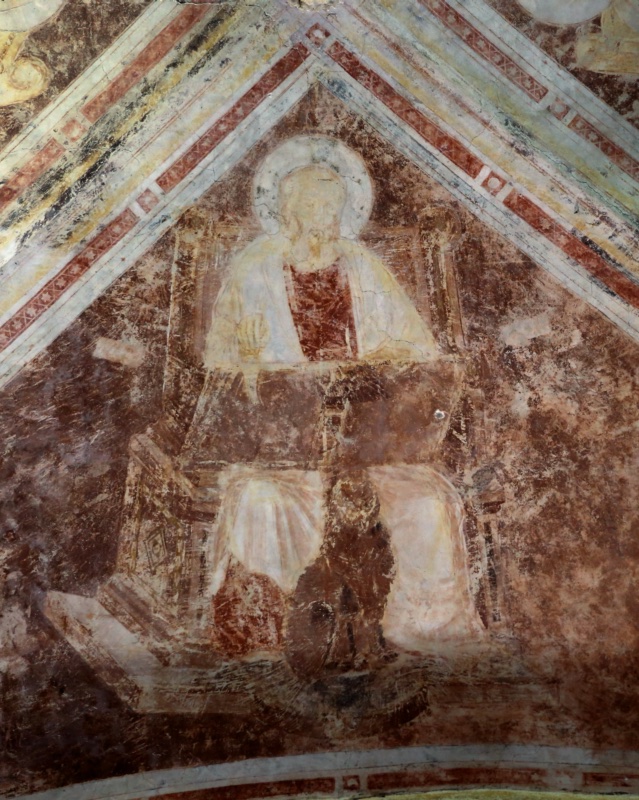
The fourth web pairs with the third: the same monumental formula of the enthroned evangelist, here in better figurative preservation and enriched by the one attribute that survives anywhere in the chamber — the dark creature crouched at the figure’s feet. Together the two enthroned webs and the two quatrefoil witnesses compose the chamber’s concordance of the Testaments: prophecy displayed on scrolls, fulfilment seated in authority, the whole small vault a diagram of the transmission of the Word.
The evangelist is the most fully readable figure of the ensemble. The bearded head, inclined and framed by a broad pale halo, retains its drawing; the dark red of the tunic survives strongly against the bleached mantle; the right hand rises before the chest in a gesture of address or blessing. The throne repeats the panelled, scroll-armed cathedra of the companion web, its orthogonals again splayed for the view from below. Amid so much ruin, the figure gives the best available measure of how the finished chamber once looked: saturated local colour, firm contour, grave and simple presence.
The creature at his feet is the crux. A dark, compact quadruped, apparently winged, pressed against the evangelist’s knees between the falls of drapery — unmistakably the evangelist’s symbol, but too damaged for its species to be pronounced with safety: the massed dark form would suit the lion of Mark or the ox of Luke, and honest cataloguing should say exactly that, leaving the alternative open rather than forcing an identification the surface no longer supports. What matters iconographically is the formula itself: the living symbol domesticated at the author’s feet, companion and warrant of the text.
That formula has a precise dignity. The evangelist with his creature beneath the throne belongs to the most venerable stratum of medieval author-imagery, descending from Carolingian and Romanesque models into the Trecento; the young painter deploys it without irony and without simplification, the beast tucked into the composition with real naturalness, its dark mass anchoring the pale pyramid of figure and throne. In handling, the web confirms the chamber’s lessons. The flesh is built thinly over the ochre preparation; the drapery is stated in long tempered falls with the light carried by the white of the mantle; the throne’s marbling and mouldings are abbreviated with a speed that never loses structure. It is painting of economical confidence — Ghiberti’s freschissimamente — and its distance from the dense facture of the Giotto school is as evident here as anywhere: this is the other Florence of the 1310s, linear, chromatic, and swift.
The condition, though the best in the chamber, still imposes caution. The surface is abraded throughout, the secco finishes gone, the creature reduced to silhouette, and old interventions are detectable along the ribs and ground. As with its companions, the web is read best as the authoritative underdrawing of itself — enough to secure design, type, and palette, not enough to judge the finest qualities of touch on which connoisseurship would ideally rest.
Its place in the corpus is correspondingly strategic. This is the figure at Settimo that speaks most directly to the Camposanto: the frontal bearded authority enthroned, the animal familiar at the feet — a conjunction the Pisan Thebaid will multiply into its whole population of hermits and obedient beasts. The comparison is not proof, but it is exactly the kind of continuity of type and temperament on which the modern reconstruction of Buffalmacco was built, and the Settimo evangelist is its earliest term.
Dated with the ensemble to c. 1315 and attributed on Ghiberti’s testimony, the web closes the vault’s programme. Taken together, the four figures give what no other monument can: Buonamico before Pisa — provincial in commission, modest in scale, already unmistakable in accent — the necessary first chapter of the career that ends in the Triumph of Death.
Buffalmacco at Arezzo: The Tarlati Years and the Keystone of the Corpus
Between Florence and Pisa, Buonamico Buffalmacco’s career passes through Arezzo, and it is at Arezzo that his modern recovery was decided. The literary tradition had always associated him with the city: Franco Sacchetti, the earliest witness to call him a very great master, records that Buonamico worked for Guido Tarlati, the Ghibelline bishop who ruled Arezzo as its lord from 1321 until his death in 1327, and Vasari later elaborated an Aretine chapter of his own. For once, the archive lends the legend real support.
The document of 20 January 1341 (see above) is retrospective: it does not hire Buonamico but invokes work he had already completed as the standard others were to meet, proof at once of his presence and of his reputation in the city.
What survives on the walls is a single fragmentary complex: the Madonna and Child Enthroned with saints, surmounted by a lunette with Christ in pietà and the instruments of the Passion. The fragmentary fresco was attributed to Buonamico by Donati in 1967 on the combined strength of Vasari’s testimony and the 1341 documentary reference to his work in the episcopal chapel. This attribution proved pivotal, for it supplied the stylistic bridge on which Bellosi’s identification of the Camposanto master would rest: reading the Aretine figures against the Pisan walls, Bellosi could follow a single artistic personality from documented Florentine beginnings, through the Tarlati years, to the Triumph of Death.
The dating follows from this convergence of testimony and politics. The years of Tarlati’s lordship remain the most plausible frame for the commission, placing the fresco at the midpoint of Buonamico’s career: after the Settimo vaults of c. 1315, a decade before the Pisan campaign of c. 1336–1341. It is, in effect, the painter’s middle period in a single surviving wall — the Settimo manner matured, the Pisan vehemence announced. The epistemic layering should nonetheless be kept in view: the 1341 document proves that Buonamico painted admirably in the chapel of the bishopric, while the identification of the surviving fragment with that praised work remains an inference of modern criticism — much cited, but an inference, and the captions retain “attr.” accordingly.
The three sections that follow examine the complex part by part: the lunette with the Man of Sorrows amid the arma Christi; the enthroned Madonna with the standing Child, the keystone of the whole Buffalmacco reconstruction; and the two surviving saints of the Virgin’s court, among them a holy pope whose early-Trecento tiara dates the wall independently of style. Ruined, truncated, and long overlooked, the Aretine fragment is nonetheless the central document of Buonamico’s middle years — the wall without which the leap from the Florentine archives to the Camposanto of Pisa could never have been argued.
The Arezzo Fragment Entire: Buffalmacco’s Surviving Wall in the Cathedral
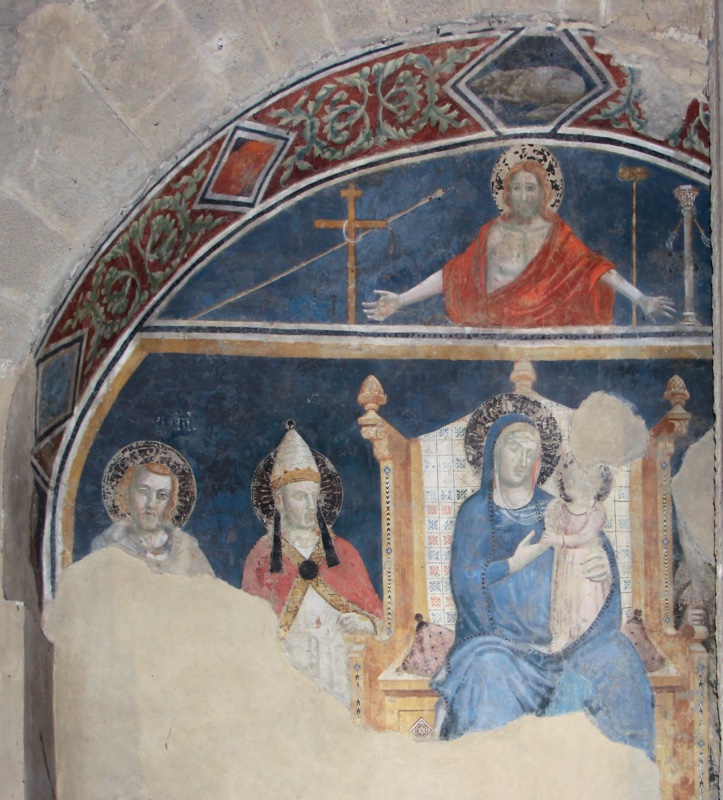
The Lunette: Christ in Pietà with the Instruments of the Passion
The upper register of the Aretine fragment is occupied by one of the most theologically concentrated images of the Trecento repertory: the Christus patiens shown half-length, alive in death, displaying his wounds amid the instruments of his Passion. Rising behind the painted cornice that separates him from the Madonna below, Christ spreads his arms in a gesture that is simultaneously the memory of the Crucifixion and an embrace offered to the viewer — the imago pietatis expanded from devotional icon into monumental apparition.
The iconographic apparatus is carefully inventoried. The tall cross stands at Christ’s right; the lance crosses the field diagonally toward his wounded side; at the far right rises the column of the Flagellation with, beside it, what survives of the sponge-pole and scourges. These arma Christi — the “weapons” by which death was defeated — transform the lunette into a compendium of the Passion to be read emblem by emblem, in the meditative, enumerative manner that fourteenth-century devotion, and especially the preaching orders, cultivated.
The figure itself concentrates the fresco’s pathos. The face, abraded but legible, inclines with a mournful fixity beneath the flaking halo; the red mantle — the colour of the Passion — slides from the shoulders to bare the chest and the wound; the open hands show the marks of the nails. The anatomy is summary, the modelling thin, but the silhouette is of great rhetorical power: the wide-flung arms span almost the entire lunette, so that the architecture of the chapel itself seems gathered into the gesture.
The relationship between the two registers gives the whole its meaning. Above the enthroned Virgin and Child, the suffering Christ states the destiny of the Infant below: the composition binds Incarnation and Passion in a single vertical argument, of a kind frequent over altars, where the eucharistic body on the mensa found its images directly above. The fragment thus almost certainly crowned an altar — a liturgical orientation that any presentation of the work should preserve.
The ornamental frame deserves notice. The painted archivolt of red bands, green acanthus scrolls, and white-edged lozenges enclosing bust-medallions (one reddish head survives at the left) is executed with the same decorative confidence as the vault borders of Badia a Settimo, and the deep blue ground — azurite, now darkened and scoured — repeats the chromatic scheme of the Settimo webs: light figures stamped on saturated fields.
For the attribution, the lunette is a crucial witness. The type of the head — large-eyed, long-nosed, the hair falling in soft reddish masses — recurs almost identically in the Christ of the Pisan Last Judgement; the taste for emblematic display, for the image as a summation to be read, anticipates the inscribed, admonitory rhetoric of the Camposanto. It was precisely such correspondences that allowed Donati’s Aretine proposal of 1967 to become, in Bellosi’s hands, the hinge of the entire reconstruction.
The condition is that of a survivor. The halo has lost its metallic finish to oxidation, the blue ground is ravaged, the lower edge is cut by the cornice, and old losses have been neutrally toned. Yet by the standards of Buonamico’s corpus the lunette is well preserved: the design is intact, much original colour survives, and no later repainting confuses the hand — a rarity among his murals.
The Madonna and Child Enthroned
At the centre of the Aretine fragment sits the image that modern criticism has made the keystone of Buonamico’s catalogue: the Virgin enthroned with the standing Child. The group follows the solemn Tuscan formula of the Maestà reduced to its essentials — the great architectural throne, the cloth of honour, the Mother presenting the Son — but inflects it with a domestic tenderness: the Child does not sit in hieratic benediction but stands on his mother’s knee, steadied by her long hand, in the animated, affectionate variant that Florentine painting developed in the wake of Giotto’s humanisation of the theme.
The throne is described with conspicuous pleasure. Golden-yellow, with panelled uprights, cosmatesque inlay running up the pilasters, scrolled arms, and pinecone finials flanking a gabled crest, it belongs to the carpentered, goldsmith-like throne architecture of the early Trecento; over its back hangs the cloth of honour, white, diapered with alternating red and blue quatrefoil squares — a textile passage of real refinement, and one of the best-preserved surfaces of the fresco. Two tasselled cushions complete the furnishing. The ensemble shows the same decorative intelligence, promoted from border to furniture, that governs Settimo.
The Virgin herself is the painter’s most complete surviving female figure. The deep blue mantle — unusually well conserved — envelops her in long, pliant falls, edged with a pale border and opened over the dark red dress; the head, veiled beneath the mantle, inclines toward the Child with heavy-lidded eyes and a small, grave mouth; the hand that crosses her breast to steady the Son is drawn large and eloquent, in the painter’s characteristic shorthand for tenderness. The halo retains traces of its punched and painted ornament, with vestiges of lettering around the rim.
The Child, dressed in a pale rose tunic, stands in a springy contrapposto on his mother’s knee, one arm reaching toward her breast or veil in the gesture of intimate traffic between Mother and Son that the period loved. A cruel lacuna has carried away his face — the fragment’s gravest loss — but the body’s movement survives, and with it the group’s essential invention: the quiet counterpoint between the Virgin’s monumental stillness and the Infant’s live, unbalanced step.
Read stylistically, the group declares its distance from Giottesque orthodoxy as plainly as anything at Pisa. The space of the throne is asserted rather than constructed; the figures are built by contour and colour-field; the expressive weight falls on silhouette, on the long unbroken line of the blue mantle, on the slightly archaic frontality warmed by inclined heads. Condition shapes interpretation. The lower third is gone, taking the Virgin’s feet, the throne’s base, and any donor or inscription zone; broad lacunae eat into the right side, where the throne’s second upright and finial survive in isolation; the blues have darkened, the flesh tones thinned. What remains, however, is coherent and, for Buffalmacco, exceptionally legible — the reason this fragment, rather than Settimo’s ghosts, could carry the weight of the attributional argument.
The Two Saints at the Left
To the Virgin’s right — the place of honour — the fragment preserves two of the saints who once formed her court, the survivors of what was in all likelihood a symmetrical sacra conversazione whose right-hand wing has perished with the wall. They stand against the same deep azurite ground, on the same scale, turned in three-quarter attendance toward the throne: a court reduced to two witnesses, but enough to restore the composition’s original ceremonial breadth.
The nearer figure is a sainted pope, and his vestments are the fragment’s documentary showpiece. The tall white tiara, still essentially the conical camelaucum with its coronet and black lappets, dates itself to the early fourteenth century, before the triple crown became canonical; the red cope, fastened by a great black morse, opens over white vestments, its orphrey patterned with the quatrefoil diaper that recurs on the cloth of honour beside him. The hand extended toward the throne — blessing, or presenting the lost donor below — is drawn with the painter’s typical large eloquence.
His identity must remain open. The losses have removed any attribute beyond the papal insignia, and the faint inscription traces above the halo no longer yield a name; the sainted popes most frequently honoured in Tuscan programmes — Gregory the Great11, Sylvester, Clement — are all possible, and honest cataloguing should present him simply as a holy pope, resisting the older guidebook habit of confident baptism. The same discipline applies to his companion.
The further saint, at the fragment’s left edge, survives only from the chest upward: a beardless or short-bearded young man with reddish hair, a pale garment at the neck, and a halo that keeps vestiges of ornament and, above it, remnants of a painted titulus. The youthful type would suit any of a dozen sanctities; in the cathedral of San Donato the mind runs naturally to the city’s patrons and to the deacon-martyrs, but the surface gives no warrant to choose, and an honest account should say so.
As painting, the pair shows the master’s portrait-like vein. The pope’s head in particular — fleshy, heavy-jawed, individualised beneath the tiara — has the observed, almost caricatural concreteness that will populate the crowds of the Pisan Judgement; the young saint’s face, more abraded, keeps the large melancholy eyes of the Settimo prophets. Between the two, the painter’s double register — decorative splendour in the vestments, blunt humanity in the heads — is already fully formed.
The passage is also precious for its technique. The red of the cope retains its body; the whites are laid with the rapid, loaded strokes that Ghiberti’s freschissimamente describes; the inscriptions, the halo ornament, and the black details were carried in secco and survive only in shadows. The great lacuna that devours the lower half of both figures — bare plaster, left honestly untoned — shows the fragment’s archaeology at its rawest.
Compositionally, the two saints anchor the fragment’s claim to have been a major altar wall. Their scale matches the Virgin’s; their spacing implies at least one further figure in the lost left field and a balancing pair on the right; the whole, with the Passion lunette above, reconstructs itself as a full-height tramezzo or altar composition of real ambition — exactly the kind of work the 1341 document implies when it holds up Buonamico’s chapel as the standard for others to meet.
Dated with the ensemble, on the Tarlati hypothesis, to the 1320s, the two saints complete the account of the Aretine fragment. Minor in preservation, they are not minor in argument: the pope’s tiara ties the fragment’s chronology to the early Trecento independently of style; the heads tie its authorship to the hand of Settimo and Pisa. In the economy of a corpus as thin as Buffalmacco’s, even two half-figures are load-bearing.
Beyond the Core: Attributions, Fragments, and Lost Works in the Buffalmacco Corpus
The reconstruction of Buonamico Buffalmacco’s art rests on a small and uneven foundation. Three groups of works carry the main weight: the ruined vault figures of Badia a Settimo, linked to his name by Ghiberti’s testimony; the fresco fragment in Arezzo Cathedral, connected to the 1341 document recording his work in the chapel of the bishopric; and the great cycle of the Camposanto of Pisa, given to him since Luciano Bellosi’s study of 1974. Around this core lies a wider and less secure circle of attributed works, isolated fragments, and paintings known only from the early sources. This section brings that wider circle together.
The Arezzo cathedral fragment has a companion in the countryside. A small panel of the Madonna and Child in the church of San Donato at Pergognano, near Castiglion Fiorentino, recorded in the diocesan inventory as an attribution to Buonamico, shows similar affinities and was adduced as further evidence of the painter’s passage through the region. At Pisa, beyond the Camposanto, Ghiberti recorded Old Testament scenes and “istorie di vergini” at San Paolo a Ripa d’Arno; the frescoes themselves are gone, but two figures of saints surviving on a pier of that church were long recognised as directly akin to the Master of the Triumph of Death, a comparison cited in support of the reconstruction. Fragments in the baptistery of Parma, a Saint Catherine and a Saint George and the dragon, have likewise been assigned to the same hand, in keeping with the reported Emilian sojourn.
Moreover, a number of panel paintings have been drawn into Buonamico’s orbit by twentieth-century connoisseurship, generally by association with the Badia a Settimo frescoes; none is documented, and the attributions remain matters of judgement. The early-twentieth-century identification of Buffalmacco with the Master of Santa Cecilia should be recorded as an episode in the history of the problem rather than as a settled result.
Finally, there is the substantial body of works that exist now only as words on the page of the early sources: the frescoes Ghiberti so admired in the convent of the nuns “di Faenza”; the Passion cycle Vasari placed in the Badia of Florence; the panels for the Certosa; the Saint Catherine stories Vasari located at Assisi and Perugia; the “moltissimi lavori” at Bologna. Some of these notices may preserve a genuine memory of lost paintings; others may be Vasarian invention or confusion. They belong, methodologically, to the register of report, testimony to be weighed rather than evidence to be banked, and the honest historian records them as such, neither dismissing them wholesale nor treating them as fact.
What follows keeps these registers apart. Each caption states whether a work is documented, attributed, or merely reported, and the text explains the grounds of that judgement. The result is a corpus with firm edges in some places and open ones in others, which is an accurate picture of what is actually known about Buonamico.
The Madonna of Pergognano: A Panel at the Margins of the Buffalmacco Corpus
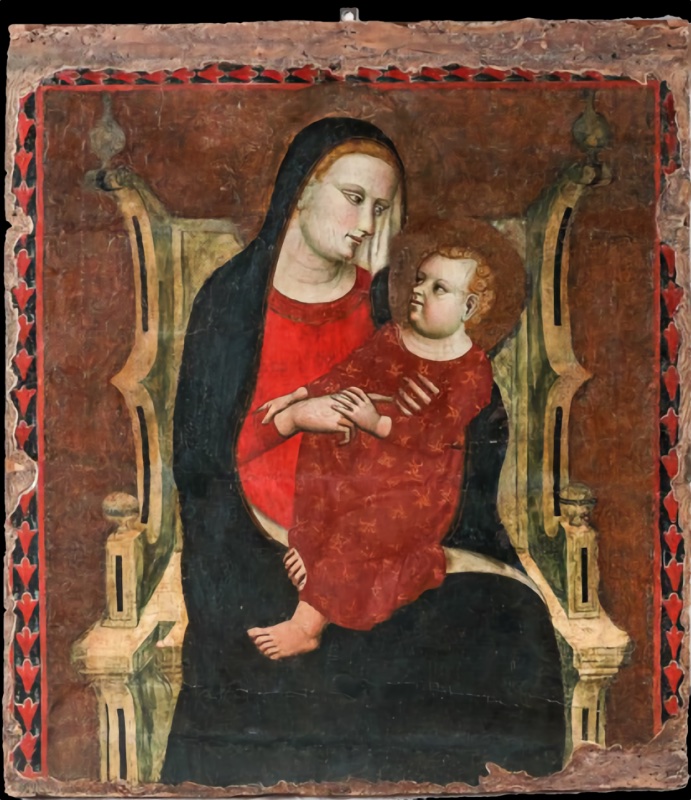
The small panel in the church of San Donato at Pergognano, in the countryside of Castiglion Fiorentino, presents the Virgin and Child in the most intimate of the formulas available to Trecento Tuscany: the Mother enthroned, the Son on her lap, the two joined by glance and gesture rather than by liturgical display. There are no angels, saints, or donors, only the throne, the two figures, and a framing border. At 58 by 55 centimetres the panel is a domestic or parish devotional image, made to be seen at close range on a side altar or pier of a rural church, not on a high altar.
Its documentary history is short but continuous. Around 1915–1920 the Gabinetto Fotografico of Florence, founded in 1904 to document the artistic heritage of the Tuscan territory, photographed the panel in the church of San Donato and labelled it as Florentine school of the fourteenth century. It has therefore been in its present location for at least a century. The diocesan inventory now records it as attributed to Buonamico di Martino, called Buffalmacco, and classifies it within the Aretine sphere in the first half of the century. The throne carries much of the composition’s structure. Painted in pale green and ochre, it rises in two tall uprights pierced by elongated Gothic openings with trefoiled heads and crowned by turned pinnacles, with a low seat and small capitals at the ends of the arm-rests. Its forms are those of contemporary choir-stalls and tabernacles, set flat against the ground with only a summary indication of depth: a carpenter’s Gothic, legible at a glance, rather than a constructed architectural space.
The Virgin is composed from three broad colour fields: the blue mantle, darkened almost to black, which frames the head and envelops the body; the bright vermilion dress at the breast; and the pale oval face, turned in three-quarter view toward the Child. The large heavy-lidded eyes, the long nose stated with a single contour, and the small closed mouth give her a gravity softened by tenderness. In type she is close to the Virgin of the fresco fragment in Arezzo Cathedral, with the same enveloping dark mantle, the same inclined head, and the same reliance on silhouette and colour rather than on sculptural modelling.
The Child is the liveliest passage. Sturdy, curly-haired, his faint halo still visible, he sits upright and looks up at his mother, one hand clasped around her fingers, his bare feet projecting below a red tunic scattered with small gold stars or fleurons. The heavy proportions and the direct exchange of glances belong to the humanised Child that Florentine painting adopted after Giotto. The motif of the vigorous, active Infant answering a still, monumental Mother is also the essential invention of the Aretine cathedral group, and it is the strongest point of contact between the two works.
The decoration of the field deserves careful observation. A border of alternating red and black leaf or heart-shaped motifs surrounds the image, and the ground behind the figures is a dark red with a faint surface pattern. The Virgin’s halo is no longer legible. Together these features suggest that the red may be the bole preparation exposed by the loss of an original gold ground rather than an intended painted ground. That is a hypothesis for technical examination on site, not a finding, but it would substantially change the picture of the panel’s original appearance.
The condition imposes other cautions. The edges are irregular and damaged, the upper margin is worn, a hanging fixture has been inserted at the top, and the nearly square format may result from a reduction of a larger, perhaps gabled, panel. The dark blue of the mantle has lost most of its internal modelling, so that the figure now reads chiefly as a silhouette. Any judgement of quality must therefore allow for what has been lost: surface finish, gilding, and probably part of the original format.
In the Buffalmacco corpus the Pergognano panel occupies a marginal but useful place. If the attribution is accepted, it would be one of the very few panel paintings associated with a painter known almost entirely as a muralist, and it would confirm, alongside the Arezzo cathedral fragment, his activity in the Aretine territory during or after the years of Guido Tarlati’s rule. Its closeness to the cathedral Madonna is real, but closeness of type is not identity of hand, and an Aretine follower working from Buonamico’s models remains a serious alternative. The panel is best presented with that balance: an attributed work, documented in its church since the early twentieth century, whose date and authorship still await a full technical and critical study.
Style and Place in Post-Giotto Tuscan Painting
If the reconstruction associated with Bellosi is accepted — and it is now the prevailing view — then Buonamico Buffalmacco emerges as one of the most original and least classifiable personalities of Tuscan painting in the generation after Giotto, and precisely his unclassifiability is the key to his historical interest.
The salient fact about his art, on this reconstruction, is its distance from the Giottesque mainstream. Where the great line of Giotto’s Florentine heirs — Taddeo Gaddi, Maso di Banco, Bernardo Daddi — pursued the master’s ideals of solid, sculptural form, measured spatial construction, and grave dramatic restraint, the painter of the Camposanto works in a manner that is free, even disorderly, in its handling of space, and that privileges narrative abundance, psychological vividness, and, at the extreme, the grotesque.
His pictorial world is one of teeming incident and violent emotional register — the terror on the face of a damned soul, the fury of the descending Death, the swarming particularity of the hermits’ desert and the sinners’ hell — organised not by the lucid architecture of the Giottesque istoria but by a more panoramic, additive, sometimes almost cartographic logic.
Where, then, did such an art come from? The reconstruction proposes a Florentine formation in the first decade of the century, but within a milieu alternative to strict Giottism — the same current that produced the enigmatic “Master of Santa Cecilia,” whom earlier criticism sought to identify with Buonamico, and which cultivated a more linear, more anecdotal, less monumental manner than Giotto’s. On this account Buonamico’s career then carried him outward from Florence — precisely, it has been suggested, as the alternatives to the Giottesque became marginalised in his native city during the 1320s — to Arezzo under the Tarlati, to Pisa, to Emilia and its Bolognese painters, and back to Pisa for the great enterprise of the Camposanto.
The Emilian sojourn in particular helps to explain the features that once led Longhi to suppose the Master of the Triumph of Death a Bolognese: the expressive intensity and dramatic realism that set him apart from Tuscan decorum find genuine analogues in the painting of Bologna. Buonamico, in short, is best understood as an itinerant and cosmopolitan artist, a synthesiser of Florentine, Aretine, Pisan, and Emilian elements, whose very refusal of a single regional idiom made him so hard to place that for a century he had no name at all but a notname.
His position in the larger story of the Trecento is correspondingly distinctive. If the century’s canonical narrative runs from Giotto’s naturalism through its Florentine codification to the supposed crisis of mid-century, Buonamico stands somewhat athwart that line — a reminder that the post-Giotto generation was more various, more experimental, and more open to non-classical, expressive, and popular currents than the Giotto-centred account allows. That the greatest surviving monument of this expressive strain should be the Triumph of Death, and that its author should be a painter remembered for three centuries chiefly as a clown, is one of the finer ironies of art history.
Critical Fortune and Conclusion
The critical fortune of Buonamico Buffalmacco is, in the end, as remarkable as anything in his art, and it may be read as a parable of the disciplines of attribution and evidence. For roughly five hundred years, the painter of the documents was eclipsed by the jester of the novella; the comic reputation forged by Boccaccio, embroidered by Sacchetti, and fixed by Vasari was so vivid and so durable that it not only obscured Buonamico’s stature but, at its nineteenth-century extreme, threatened to dissolve him into pure fiction. The recovery of the historical painter was the work of the archive — the documents of 1320, 1336, and 1341 — and the recovery of his art was the work of a single, brilliant piece of connoisseurial and philological reconstruction, Bellosi’s Buffalmacco e il Trionfo della Morte of 1974, which reunited the celebrated but workless name with the masterly but nameless frescoes of Pisa.
That reconstruction is now the prevailing view. The most recent assessment cited here, Roberto Bartalini’s essay “‘Bonamicho excellentissimo maestro’” (Prospettiva 163–164, 2016, pp. 76–87), was printed together with Bellosi’s own unpublished lecture of the winter of 1985–86 at the Scuola Normale di Pisa, “Trionfalmacco per Pisa” (pp. 88–93), in which Bellosi set out the reflection and research behind his book.
It should be recorded, in the interest of a fair accounting, that the attribution was contested in its early years and is not wholly settled: some reference works still favour Traini, and the evidence for the pre-plague dating has been judged suggestive rather than conclusive. The reception of Bellosi’s proposal was not the reception of a demonstration but the gradual consolidation of a persuasion.
It rests, after all, on stylistic argument, and stylistic argument is by nature probabilistic; the documents that would make it certain — a contract, a signature, a payment for the Camposanto frescoes — do not exist and in all likelihood never will. But the convergence of independent indications — Ghiberti’s testimony, the documented Pisan residence of 1336, the Aretine stylistic bridge, the costume evidence, the Emilian analogies — is strong enough that the identification of Buonamico di Martino with the Master of the Triumph of Death is, with a high degree of probability, correct.
One nuance deserves to be preserved against the tidiness of “consensus.” The modern position bundles together two logically separable claims — that the frescoes date from the 1330s rather than the 1350s, and that their author is specifically Buonamico Buffalmacco. A shift in dating and a shift in attribution, though they arrived together and are often cited together, are not the same proposition and did not rest on identical evidence: the dating draws on costume, on the topical content of the Hell and on the Pisan document of 1336, the name on Ghiberti’s testimony and on the stylistic bridge through Arezzo.
Two conclusions, kept properly distinct, may therefore be drawn. As a matter of documented fact, Buonamico di Martino was a Florentine painter of the first half of the fourteenth century, esteemed in the later fourteenth and fifteenth centuries — Sacchetti and Ghiberti call him a very great master — active in Florence, Arezzo, Pisa, and probably Bologna, whose one surviving work named by an early source, the ruined chapel at Badia a Settimo, reveals tantalisingly little. As a matter of scholarly reconstruction, this same painter is, with a high but not absolute degree of confidence, the author of the Camposanto cycle, one of the towering achievements of the Italian Trecento and, on the now-prevailing chronology, a pre-plague memento mori rather than a post-plague lament. The painter who was for centuries only a joke has become, on the strength of evidence carefully weighed, one of the essential names of his century; but the good historian remembers that “essential” and “certain” are not synonyms, and that the recovery of Buonamico Buffalmacco is a triumph less of proof than of disciplined, self-aware interpretation.