Andrea di Cione di Arcangelo (Orcagna)
( 25% )
Introduction: The Problem of Orcagna
Few artists of the Italian fourteenth century have been asked to carry as much interpretative weight as Andrea di Cione di Arcangelo, called Orcagna. He is at once one of the best-documented Florentine masters of his generation and one of the most persistently misunderstood. The documents place him at the centre of nearly every major artistic enterprise undertaken in Florence between the fall of the Duke of Athens in 1343 and the outbreak of plague and political crisis at the end of the 1360s: the Dominican basilica of Santa Maria Novella, the Franciscan basilica of Santa Croce, the guild oratory of Orsanmichele, the cathedral workshops of Florence and Orvieto. He signed his name on two surviving works of the first importance, one painted and one carved. He was, uniquely among his Florentine contemporaries, active as painter, sculptor and architect, and the sources credit him with verse as well. He directed a family workshop whose products supplied altarpieces to Florentine churches for half a century.
And yet the picture that emerges from the modern literature is curiously unstable. For four centuries Orcagna was known chiefly as the author of works he did not make. He was credited with the frescoes of the Camposanto at Pisa, with the Loggia della Signoria, with a body of panel painting that has since been redistributed among his brothers and a shifting population of anonymous masters. In the twentieth century he acquired a second, quite different celebrity: he became the exemplary artist of the post-plague reaction, the painter in whose work a supposedly confident, humane, spatially coherent Giottesque tradition was seen to falter and turn back towards hieratic abstraction. That reading, advanced with great learning and rhetorical force in 1951 by Millard Meiss, dominated Anglophone accounts of Tuscan painting for a generation, and it still shapes the way Orcagna is introduced in general surveys and museum labels. It has also, in its essentials, been substantially revised — and one of the two works on which it was originally built is no longer thought to be by the artist to whom Meiss attributed it, nor even to postdate the plague.
The result is that Orcagna is habitually described in terms of what he supposedly represents rather than what he demonstrably made. The purpose of this essay is to reverse that emphasis: to set out, as precisely as the evidence allows, what is documented about Andrea di Cione’s life and career; what survives of his work and in what condition; what the early sources actually say, and where they can be shown to be wrong; and how the modern historiography has arrived at its present, considerably more cautious position. Where the evidence is contested — and it very often is — the disagreement is reported rather than resolved.
A methodological note is necessary at the outset. This essay observes a deliberate economy in its citation of modern scholarship, naming only three specialists: Richard Offner, whose connoisseurial work provided the foundation for every subsequent discussion of the Cione workshop; Millard Meiss, whose 1951 book framed the interpretative debate; and Gert Kreytenberg, the author of the standard modern monograph on the artist and of the principal encyclopaedia treatments. Other scholarly contributions are described by date, venue and argument rather than by author’s name. The early sources — Franco Sacchetti, Lorenzo Ghiberti, the Libro di Antonio Billi, the Anonimo Magliabechiano, Giorgio Vasari — are named throughout, since they are the objects of analysis rather than instruments of it. Claims that rest on a single source, or that are disputed, are flagged as such.
Name, Family and Origins
Andrea was the son of a Florentine named Cione, from whom he and his brothers took their patronymic. Three brothers are securely attested as artists: Nardo di Cione, a painter, who died around 1365 or 1366; Jacopo di Cione, also a painter, documented from the mid-1360s and active until the closing years of the century; and Matteo di Cione, a sculptor, who worked alongside Andrea at Orsanmichele and accompanied him to Orvieto. The precise birth order is unrecorded, though Vasari’s assertion that Nardo was the elder has been widely repeated, and Jacopo was certainly the youngest of the four.
It is worth stating plainly that Benci di Cione, the architect associated with the Loggia della Signoria and with much of the fabric of Orsanmichele, was not a member of this family. His full name was Benci di Cione Dami; his father Cione was an architect of Comasque origin who had settled in Florence and was dead by April 1348. The coincidence of patronymic — “Cione” being a common Florentine hypocoristic, possibly abbreviated from Belfincione — has generated a persistent error, still repeated on museum websites and in guidebooks, that makes Benci a brother of Orcagna and thereby draws the Loggia into the family orbit. The two men were unrelated, though they did work in proximity: both appear among the artists consulted on the Florentine cathedral in the mid-1360s.
The nickname is more interesting than it looks. “Orcagna” is a Florentine vernacular corruption of Arcagnolo or Arcagnuolo, itself derived from Arcangelo — archangel. Kreytenberg reports that contemporaries applied the epithet to Andrea admiringly, and Vasari, who devoted a long and enthusiastic Life to him, treats the name as already fixed by tradition. The form is unstable in the early sources: some documents and manuscripts give the family name as “di Cione Arcagnuolo,” which has occasionally been read as evidence that the grandfather was called Arcangelo, and which lies behind the form “Andrea di Cione di Arcangelo” found in modern reference works. The philological question remains genuinely open. What matters is that by the 1390s, when Sacchetti was writing, “l’Orcagna” was a name a Florentine reader would recognise without explanation.
Of Andrea’s birth date nothing is known directly. Vasari states that he died at sixty, which — taken with the documented death in 1368 — yields a birth around 1308, and this is the figure most frequently repeated. Kreytenberg regards it as too early and proposes a birth between about 1315 and 1320, on the grounds that a man born in 1308 would be expected to appear in the guild records well before 1343. The disagreement is not trivial: a birth in 1308 makes Orcagna a contemporary of the last Giotto workshop and a mature painter at the time of the Black Death; a birth in 1318 makes him a member of the generation that came of age in the plague’s immediate aftermath. Neither hypothesis can be proved, and both remain in circulation.
Nor is anything known of his training. Vasari names Andrea Pisano as his master in sculpture and, in a passage that has been much quoted and little tested, implies an apprenticeship in the Giottesque orbit. The visual evidence points elsewhere, or at least more widely. The earliest works plausibly given to Andrea show a close engagement with Maso di Banco — the breadth of form, the massive and simplified drapery, the intensity of unmodulated colour — and with Taddeo Gaddi, whose linear rhythms and doctrinal cast of mind seem to have suited him. Kreytenberg regards Maso and Taddeo as the two decisive presences for the young Andrea while acknowledging that we simply do not know in whose shop he served.
Of his domestic circumstances the documents preserve a few facts. In 1349 he was living in the quarter of San Giovanni, near the Porta di Balla, in the parish of San Michele Visdomini; from 1354 he lived in the parish of San Lorenzo. A document of 1377, drawn up nine years after his death, records that he had been married to a woman named Francesca and that he left two daughters, Tessa and Romola. There is no evidence that any of his children continued the workshop; that fell to Jacopo.
The Documentary Spine, 1343–1368
Orcagna’s career can be reconstructed from archival records with a precision unusual for a Trecento artist, and it is worth setting the sequence out plainly before turning to the works, since almost every attribution argument depends on it.
1343
Andrea is recorded working as a painter at Santa Maria Novella for the Compagnia di Gesù Pellegrino, a lay confraternity attached to the Dominican convent. This is his first documentary appearance.
1343–46. He is inscribed in the Arte dei Medici e degli Speziali, the guild of physicians and apothecaries, within which Florentine painters were organised as a subgroup. The registers are not precisely dated; 1343–44 is the usual reading.
1346 An altarpiece of the Annunciation painted for the Florentine church of San Remigio carries a donor inscription naming the wool merchant Bellozzo di Bartolo and the signature formula Andreas Cionis de Florentia me pinxit, with the date 1346. The panel later entered the Conti Gerli collection in Milan. Its evidential value is now almost nil: it was in very poor condition and was so extensively repainted in a restoration after 1947 that Kreytenberg judged it could scarcely any longer be regarded as Andrea’s work in any material sense. What survives is essentially a modern surface over a fourteenth-century compositional idea.
1348–49. In connection with a polyptych planned for San Giovanni Fuorcivitas in Pistoia — a commission that ultimately went to Taddeo Gaddi — Andrea’s name appears on a list of the best painters in Florence. The document is preserved in the account books of the Pistoiese Opera and was published in the nineteenth century among the annotations to Vasari. Its significance is that it establishes Andrea’s high standing among his peers well before any of his surviving major works.
1349
Recorded as resident in the parish of San Michele Visdomini.
1352
Two crucial entries. Andrea paints a panel of the Madonna, now lost, for the Compagnia di Orsanmichele. In the same year he matriculates in the Arte dei Maestri di Pietra e Legname — the guild of stone- and woodworkers — shortly after receiving the commission for the Orsanmichele tabernacle. The sequence matters: he joined the builders’ guild because he had taken on a work in marble, not the reverse. He never ceased to describe himself as a painter.
1354
Tommaso di Rossello Strozzi commissions the polyptych for the family chapel in the left transept of Santa Maria Novella.
1355
Payments for the Orsanmichele tabernacle are documented from this year onward.
June–August 1357
At the cathedral works of Santa Maria del Fiore, a dispute arises over the form to be given to the nave piers. Francesco Talenti, the capomaestro, and Andrea each present a model. Andrea’s is approved; nevertheless a second design by Talenti is ultimately adopted. This episode — a painter-sculptor competing on equal terms with the cathedral’s chief architect, winning the vote, and then losing the commission — has been the subject of a specialised literature since a much-cited article in The Burlington Magazine in 1971 reopened the question of what Orcagna was actually doing in that year.
1357
The Strozzi altarpiece is signed and dated.
June 1358
Andrea contracts with the Opera del Duomo of Orvieto. The terms are precise and revealing: he will complete the Orsanmichele tabernacle within about fourteen months, then take up the post of capomaestro at Orvieto for a salary of three hundred florins a year, for a maximum of five years, with four months’ notice of termination on either side. The salary is very substantial, and the fourteen-month clause tells us the Orvietan authorities were prepared to wait for him.
1359
The Orsanmichele tabernacle is signed and dated. In October Andrea takes up the Orvieto post, bringing his brother Matteo as assistant.
1359–60
At Orvieto his principal charge is the mosaic decoration of the cathedral façade. He remains only until March 1360. In 1360 he collaborated with a local master, Giovanni di Buccio di Leonardello, on the cartoon for a mosaic of the Baptism of Christ for the gable over the left portal.
September 1360 – 1362
He returns to Orvieto in September 1360 to rescind his contract and to finish the mosaic within three months. In early 1361 the mosaic is measured; in September 1362 it is valued, and — after doubts are raised about its structural soundness — priced at sixty florins. None of the original fourteenth-century façade mosaics survives; the present decoration is the result of later campaigns and replacements.
October 1364
Back in Florence, Andrea takes part in a consultation at the cathedral concerning the structure of the nave walls, the possible installation of a gallery, and the form of the windows.
July 1366 – October 1367
The definitive structure of the cathedral choir is determined — a centrally planned volume to be annexed to the longitudinal body. The resulting model was the product of collective deliberation by a body of masons and painters, among whom Andrea held a prominent position. A rival competition entry had been submitted by Simone Talenti and Giovanni di Lapo Ghini; the winning model, agreed in August 1366, became binding for decades.
13 September 1367
The Arte del Cambio1, the guild of money-changers, commissions Andrea, for forty florins, an altarpiece with a full-length St Matthew and lateral compartments, to clothe one of the piers of Orsanmichele.
November 1367 – June 1368
The captains of Orsanmichele press him vigorously to complete a fresco of the Madonna in their Audience Chamber. The work drags on; in March 1368 his goods are distrained; in June, following completion, they are returned. The fresco is lost.
25 August 1368
Jacopo di Cione promises the consuls of the Arte del Cambio that he will execute the panels of the St Matthew altarpiece. The document states that Andrea is ill.
End of 1368
Andrea is presumed to have died. There is no surviving death record, and the frequently cited date of 25 August 1368 — which appears in a number of reference works, including widely consulted online sources — is almost certainly a misreading: it is the date of Jacopo’s undertaking, not of Andrea’s death. Since the artist was alive in June 1368 when his goods were restored, and since Jacopo’s promise of August cites illness rather than death, the terminus is best given as late 1368.
This is a career of extraordinary institutional density. Between 1352 and 1368 Andrea was simultaneously running a large painting workshop, directing a monumental sculptural project, holding a cathedral appointment in another city, and sitting on the advisory bodies that determined the shape of Florence’s principal building site. The distraint of his goods in 1368 is not a sign of failure but of overcommitment; Kreytenberg observes that in 1367–68 Andrea could not meet all his obligations because he had too many of them and was seriously ill.
The Sources: Sacchetti, Ghiberti, Vasari and the Making of a Reputation
Orcagna is one of the very few Trecento artists who appears as a character in fourteenth-century literature. In the hundred and thirty-sixth story of Franco Sacchetti’s Trecentonovelle, written in the last decade of the century, a group of painters and other masters dining at San Miniato al Monte fall into an after-dinner argument. It is “l’Orcagna” — identified by Sacchetti as chief master of the noble oratory of Our Lady of Orsanmichele — who poses the question that starts it: who was the greatest master of painting, apart from Giotto? The company proposes Cimabue, Stefano, Bernardo, Buffalmacco, and others; Taddeo Gaddi replies that many able painters have worked in ways beyond human capacity, but that the art is declining daily. The story then veers into a comic set-piece, but the frame is precious. It shows that within a generation of his death Orcagna was remembered not merely as a maker but as the kind of artist who convened debates about the history and standing of his profession — and it registers, in Taddeo’s answer, an anxiety about decline that Florentine painters themselves apparently articulated.
Sacchetti also identifies him by his office at Orsanmichele rather than by his paintings. Two decades after the tabernacle was finished, that was the achievement by which a literate Florentine would place him.
The most important art-historical source is Lorenzo Ghiberti, writing in the Commentarii in the mid-fifteenth century. Ghiberti attributes to Andrea, at Santa Maria Novella, the Strozzi altarpiece, the frescoes of the main chapel of the choir, and “a great many other things”; at Santa Croce, “three magnificent istorie,” which other sources allow us to identify as the Triumph of Death, the Last Judgement and the Hell, together with the decoration, now lost, of a chapel; two chapels at Santissima Annunziata, both destroyed; and the refectory of Santo Spirito. Crucially, Ghiberti assigns the frescoes of the Strozzi Chapel itself — as distinct from the altarpiece — to Nardo. This single sentence is the foundation of the modern separation of the two brothers’ hands, and it has held up remarkably well.
The fifteenth- and sixteenth-century Florentine compilations — the Libro di Antonio Billi, the Codice Magliabechiano, Giovanni Battista Gelli’s lives — add further attributions of varying reliability. The tradition culminates in Vasari, whose Life of Orcagna appears in both the 1550 and 1568 editions of the Vite and whose account is by far the fullest, the most influential, and the least trustworthy.
Vasari’s contribution is threefold. First, he transmits genuine information: the derivation of the name, the age at death, the identification of the tabernacle as Andrea’s masterpiece in architecture and sculpture, the note that Andrea also wrote verse. Second, he supplies a critical judgement of real acuity: he observes that the Orsanmichele tabernacle, though di maniera tedesca — that is, Gothic — nonetheless achieves “grace and proportion.” Coming from a writer temperamentally hostile to Gothic form, this is a considered concession, and it points, as later critics have recognised, to the tabernacle’s unusual structural coherence, gathered upward and held by the dome, beneath its dense encrustation of ornament.
Third, and most consequentially, Vasari attributes to Orcagna works that are not his. Two errors have proved especially tenacious.
- The first is the Camposanto at Pisa
Vasari assigns to Andrea, as early works, the great mural cycle of the Triumph of Death, the Last Judgement and the Hell in the Pisan burial ground, and explicitly states that Andrea afterwards repeated the same subjects in Santa Croce. The attribution held for roughly four centuries and shaped every account of the artist written before the twentieth century. It has since been comprehensively dismantled. The Camposanto frescoes were successively reassigned — to Bernardo Daddi, to Pietro Lorenzetti, to Vitale da Bologna, and, in Meiss’s confident but contested proposal, to the Pisan painter Francesco Traini. In 1974 a monograph devoted to the question argued for Buonamico Buffalmacco and, decisively, for a date before the plague of 1348. That attribution and that dating are now the majority position, though not unanimous.
- The second is the Loggia della Signoria
Vasari states that Orcagna designed it, and later writers repeated him; in the nineteenth century the building came to be called the Loggia dell’Orcagna, a name still current. The documents are unambiguous. Construction began in 1376 — more than eight years after Andrea’s death, and years after the purchase and demolition of the houses that cleared the site — under the direction of Benci di Cione Dami and Simone di Francesco Talenti, and continued to 1382. Kreytenberg rules out Andrea’s authorship on chronological grounds alone. Some accounts allow that he may have contributed to a project or model at an earlier stage, since a resolution to build a loggia had been taken as early as 1356, but no document connects him to the design, and a nineteenth-century commentator made the sensible objection that a design produced before the site was cleared could hardly have survived the process of execution intact.
A third Vasarian claim deserves separate treatment because it belongs to literary rather than art history. Vasari reports that Andrea took pleasure in writing verse and that, in old age, he addressed sonnets to the young Burchiello. This is chronologically impossible: Domenico di Giovanni, called il Burchiello, was born in 1404, thirty-six years after Andrea’s death. The underlying tradition, however, is not simply an invention. Florentine literary history recognises a comic-nonsense manner known as rimare alla burchia, of which Burchiello was the great populariser rather than the inventor, and the precursors named in that tradition are Franco Sacchetti and “an Orcagna, painter.” Whether that Orcagna is Andrea di Cione or a later namesake has been questioned since the nineteenth century, and at least one authoritative reference work registers doubt that the poet was the famous artist. The safest statement is that Andrea had a reputation as a versifier, that a strand of Florentine comic poetry was associated with his name, and that Vasari’s specific anecdote about Burchiello is untenable.
The cumulative effect of these errors is worth emphasising. For most of its history, the Orcagna known to European art lovers was largely a construction: a painter of terrifying Pisan frescoes and a designer of one of the most admired secular structures in Florence. Strip away the Camposanto and the Loggia, and what remains is a smaller, stranger, and considerably more interesting artist.
Beginnings: Santa Maria Novella and the Maso–Taddeo Horizon
Nativity and Annunciation to the Shepherds
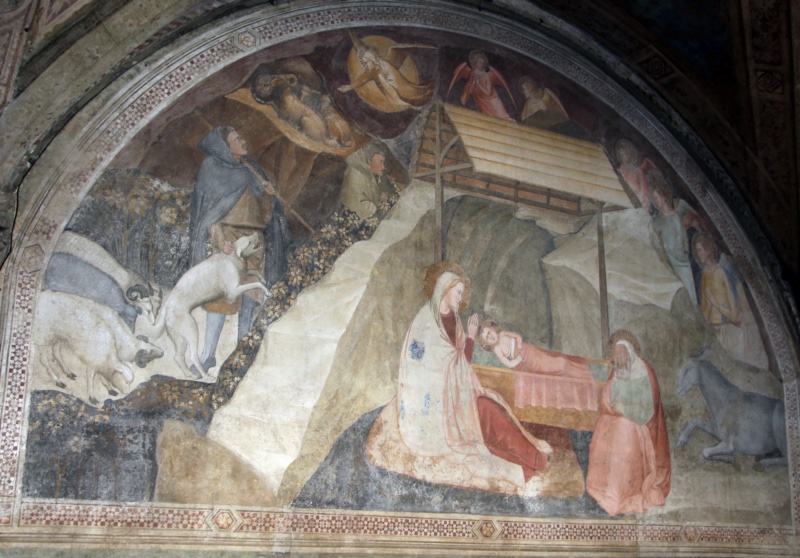
The fresco occupies the south lunette of the small cross-vaulted funerary chapel endowed by Bice Trinciavelli, widow of Filippo di Pagno Strozzi, and forms a pair with the Crucifixion on the west wall. The third narrative field, the Annunciation to which the chapel was dedicated, occupied the north wall and was demolished in the early twentieth century during works in the cloister. The two surviving lunettes therefore preserve the opening and closing terms of a Christological sequence — Incarnation and Sacrifice — whose middle term is lost. Of the two, the Nativity is by a considerable margin the better preserved, and it consequently offers the more reliable evidence for the quality of hand at work in the chapel.
A single continuous field accommodates two distinct moments of the narrative, divided by a rocky spur that climbs from the lower left corner to the crown of the arch. The device is Giottesque in origin and thoroughly Florentine in its handling: the ridge does not merely partition the surface but establishes a real spatial recession, its pale flanks catching the light while the darker planes behind carry sparse gold-ochre tufts of vegetation over a near-black ground.
To the left of this diagonal lies the pastoral world; to the right, screened by the ridge, the shed of the Nativity and the adoration proper. The eye is led up the slope from the browsing flock at the lower left, past the standing shepherds, to the announcing angel at the apex, and then down the right-hand side along a descending file of angels to the manger — a circuit that binds the two episodes into one movement without confusing them.
Two shepherds occupy the left slope. The foremost stands in a heavy grey-blue hooded cloak, staff in hand, his face turned sharply upward in a movement of alarm rather than devotion; the second, in an olive hood, appears behind and slightly above him in three-quarter view. Their flock is dispersed across the lower left: a ram with heavy curling horns, goats, and sheep, several shown browsing with their heads down among the rocks, drawn with a naturalist’s attention to the differing anatomies of the species. A white dog rears against the foremost shepherd’s thigh, muzzle open — a detail of considerable freshness, and one of the passages that most clearly signals a painter working from observation rather than from pattern.
Above them the angel descends head-foremost in a great sweep of golden drapery, the body foreshortened almost to the horizontal against a dark field. Further animals rest on the ridge behind, at the threshold of legibility in the present state.
The shed is a plain timber lean-to of joined planks, its pitched roof resting on slender posts, set against the rock and closed behind by a hanging cloth. Beneath it the Child lies in a wooden manger draped with rose-coloured cloth, his body largely bare save for a white band, one arm free, the head turned towards his mother: a living infant rather than the tightly bound fasciae of the Byzantine formula.
The Virgin occupies the centre foreground, her torso erect, hands joined in prayer, the head inclined towards the manger; the lower body extends to the left in a long, unbroken sweep of drapery, so that the posture reads between kneeling adoration and the older recumbent type [?, precise posture to be confirmed in situ]. Whichever reading prevails, the emphasis has decisively shifted from the parturient Virgin of the Byzantine tradition to the Virgin in prayer before her son. This matters for dating: the adoring Virgin is frequently explained by reference to the vision of Birgitta of Sweden, but that vision belongs to 1372 and cannot be the source here. If the accepted dating of the chapel holds, the fresco is an early Florentine instance of the motif and must be accounted for independently of the Bridgettine tradition.
Joseph sits on the ground to the right of the manger, seen largely from behind, elderly and bearded, wrapped in a coral mantle over a grey-green hood — the withdrawn, meditative Joseph of Trecento practice, present but excluded from the exchange between mother and child. The ass appears at the right margin behind the crib; the ox is not clearly legible. A file of haloed angels descends along the right edge in blue, coral and ochre, while two more hover above the roof, one with arms crossed upon the breast in a gesture of reverence. No midwives and no bathing of the Child appear, and the apocryphal episodes are accordingly absent from the programme.
The attribution to Andrea Orcagna is contested. It rests on comparison with the fragments of the apse decoration of the basilica, recovered beneath Ghirlandaio’s frescoes and now in the Cappella degli Ubriachi, and part of the critical tradition assigns to Andrea the two lunettes, the vault and the entrance soffit alike; another authoritative reading gives the Nativity and Crucifixion instead to one of the subordinate hands distinguishable in the vault of the cappella maggiore. Boskovits derived Orcagna’s formation from Maso di Banco, a filiation that the broad, planar massing of the rocks and the weight of the shepherds’ draperies here support, inflected by the linear cadence associated with Taddeo Gaddi. Comparisons commonly adduced include the Ruballa Maestà of 1337 and the Crucifixion at Santa Marta a Montughi of 1341–42.
The conventional bracket of 1340–47 is an inference from the documents of the cappella maggiore, which run from 1340 to 1348 and support a date around 1345 for that campaign; the cloister frescoes have been placed by some slightly earlier.
The lunette is markedly better preserved than its companion, retaining legible modelling throughout and much of its original chromatic range. Three observations bear on its material history. The white mantle of the Virgin is flecked with residual blue, indicating that the garment was originally blue and that the pigment, applied over a paler preparation, has largely detached — the loss is therefore of the layer, not of the design. The upper field has darkened to a russet-brown of the kind produced when a secco blue falls from its morellone ground, matching the condition of the Crucifixion on the west wall [?, technical confirmation required]. Abrasion is concentrated in the lower foreground, where the ground plane before the Virgin has been reduced to a pale scoured surface.
The frescoes of the chapel are reported to have been detached in the 1950s and reinstated only a few years before the flood of November 1966, which struck the convent severely.
The painted borders — a band of polychrome hexagons, rosettes and chequer below, geometric bands on the intrados — are well preserved and retain their cosmatesque character.
The Crucifixion with the Swooning Virgin and the Witnesses of Golgotha
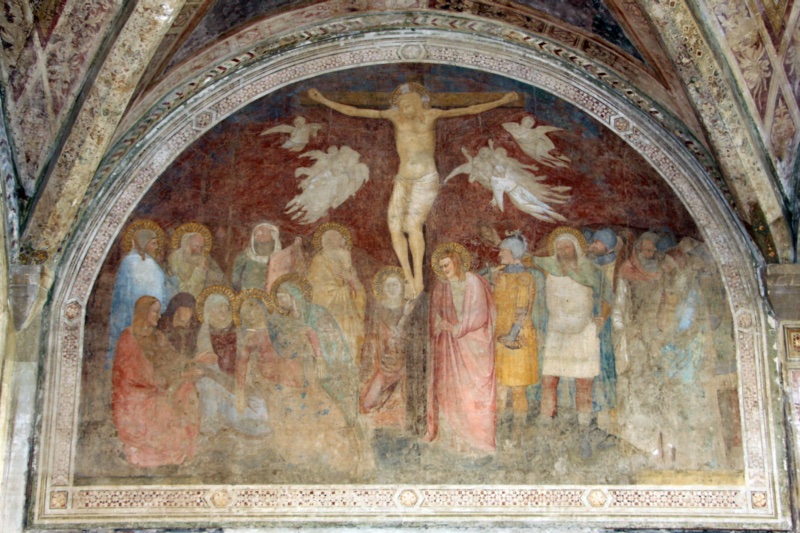
The fresco occupies the west wall of a small, cross-vaulted funerary chapel opening off one corner of the Chiostro dei Morti, the oldest of the three burial cloisters of the Dominican convent of Santa Maria Novella. The chapel was endowed by Bice Trinciavelli, widow of Filippo di Pagno Strozzi, whose testamentary provisions famously obliged the friars to a commemorative meal each 25 March, the feast of the Annunciation and the beginning of the Florentine year. The dedication accounts for the chapel’s name and for its original iconographic programme, of which only two of three narrative walls survive: the Nativity to the south and the present Crucifixion to the west. The northern wall, which carried the Annunciation proper, was already illegible by the late eighteenth century and was demolished — the sources diverge as to whether at the close of the nineteenth century or in the opening years of the twentieth. In the soffit of the entrance arch the four Evangelists appear alongside Saints Benedict and Leonard, the name-saints and protectors of the foundress’s grandsons, with the Strozzi arms at either extremity. The ensemble is among the best-preserved of the cloister, and is today protected by a glazed screen.
The scene is constrained by the pointed profile of the vault bay, and the painter has turned that constraint into the governing principle of the design. The cross rises on the central axis, its upper arm reaching almost to the apex of the lunette, and divides the field into two unequal crowds whose contrasting emotional registers organise the whole: the mourners to the left, the executioners, soldiers and hostile witnesses to the right. This is the Crocifissione affollata, the crowded Crucifixion of the Florentine Trecento, in which the two thieves are suppressed and the narrative interest transferred entirely to the human response gathered at the foot of the cross.
The upper third of the composition is given over to a dark field, now a deep russet with surviving passages of blue at the extreme corners of the arch, across which at least four angels wheel in steep foreshortening, their wings streaming into long white striations and their draperies whipped into ragged trails. Their agitation supplies the emotional pitch that the crowd below expresses in more measured terms, and the type descends, through the intermediary of Giotto’s followers, from the mourning angels of the Scrovegni Chapel.
The Christ is elongated and almost weightless, the ribcage barely modelled, the body describing a shallow curve to the proper right. The head has fallen onto the right shoulder, the eyes are closed, and the wound and blood are handled with notable restraint: this is a dead Christ presented for contemplation rather than a spectacle of suffering. The feet are crossed one over the other in the three-nail Gothic formula [?, to confirm at close range], and a plain white perizoma, knotted at the hip, falls in soft, unbroken folds. The cruciform nimbus retains its gilding and its incised radiating pattern.
To the left, the holy women form a low, dense pyramid of haloed heads whose collective downward pressure answers the vertical of the cross. At its centre the Virgin collapses backwards into the arms of her companions — the spasimo or swoon, a motif that entered Florentine painting from the affective devotional literature of the period, notably the Pseudo-Bonaventuran Meditationes vitae Christi, and which here is treated with a gravity closer to fainting than to convulsion. An unhaloed figure in coral drapery, seen from behind at the lower left corner, functions as a repoussoir drawing the beholder into the scene. A kneeling haloed figure grasps the base of the cross, conventionally identified as the Magdalene.
To the right the register changes entirely. Saint John the Evangelist stands immediately beside the cross in a rose-pink mantle of extraordinary breadth, head inclined, hands loosely joined — the hinge between the two halves of the composition and the only figure whose grief is expressed in stillness. Behind and beyond him press soldiers and elders in the contemporary dress of Trecento Florence: mail coifs, a conical helm, a broad-brimmed travelling hat, turbans, a bearded figure in a pale tunic who gestures towards the crucified body in what may be intended as the centurion’s confession. A figure in yellow carries a pail-like vessel that may correspond to the bucket of vinegar of the sponge-bearer. No lance is now clearly legible, and the identification of Longinus cannot be sustained on the present evidence.
The attribution to Andrea Orcagna rests principally on comparison with the surviving fragments of the apse decoration of the basilica, recovered beneath Ghirlandaio’s frescoes during the mid-twentieth-century restoration campaign and now displayed in the Cappella degli Ubriachi within the museum. The affinities are real: the same broad, planar handling of volume, indebted to Maso di Banco, is inflected by a linear cadence closer to Taddeo Gaddi. The attribution is not, however, unanimous. One authoritative reading assigns the Nativity and Crucifixion not to Andrea himself but to one of the two subordinate hands distinguishable in the vault of the cappella maggiore, which would make the chapel a workshop product supervised rather than executed by the master. The conventional dating of 1340–47 is likewise an inference: documents concerning the cappella maggiore run from 1340 to 1348 and support a date around 1345 for that campaign, with the cloister frescoes placed by some slightly earlier. Gaia Ravalli’s monographic study of the Chiostrino dei Morti (2015) is the point of departure for any revision of these positions.
The lower third of the fresco has suffered severe abrasion, and the ground plane of Golgotha is now almost wholly effaced, leaving the figures to stand on an indeterminate pale field. The blue mantles have lost much of their azurite, and the russet of the sky is in all probability the morellone preparation exposed by the loss of a secco blue applied over it — an inference supported by the blue that survives in the sheltered angles of the arch. The painted borders, a band of polychrome hexagons and rosettes below and geometric bands on the intrados, are comparatively well preserved and retain their cosmatesque character.
Saint Anne and the Expulsion of the Duke of Athens: An Allegory of Florentine Liberty
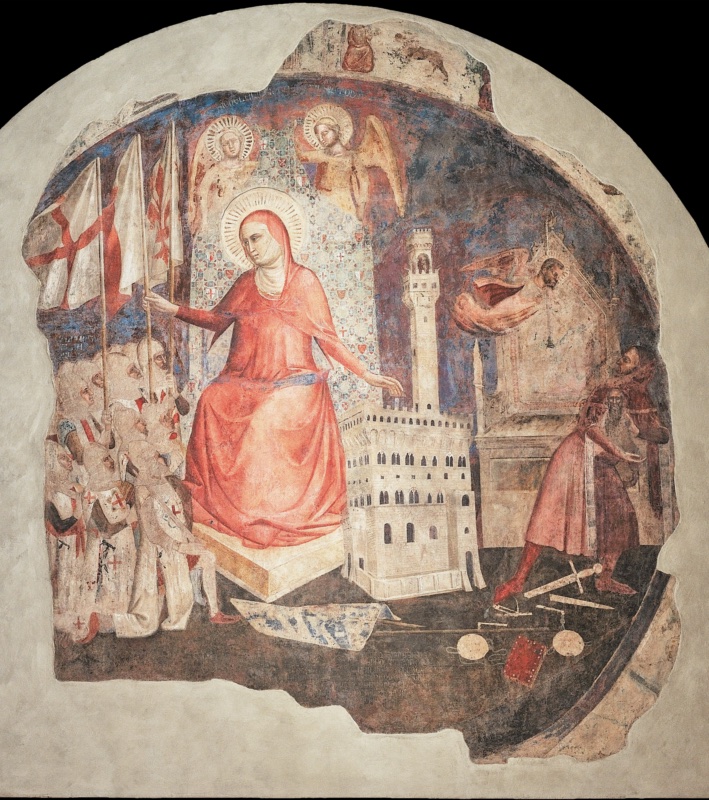
On 26 July 1343, the feast of Saint Anne, a general rising drove Walter VI of Brienne, titular Duke of Athens, from Florence after some ten months of signorial rule. In the course of the revolt the Stinche — the prison reserved for political detainees — was stormed and the duke’s opponents released, while Walter himself is said to have escaped from the Palazzo dei Priori through a concealed postern. The coincidence of the day was decisive for the city’s civic religion: Anne was thereafter honoured as protectress of Florence and of its liberty, and the anniversary became a public feast.
The fresco was executed on a wall of the Stinche to commemorate the event, and this placement is itself the most curious fact about it. A monumental celebration of liberation on the wall of a prison admits of no straightforward explanation, and the intended audience and function of the image remain unresolved. The prison was suppressed and partly demolished after 1833; the painting was subsequently enclosed within a street tabernacle, and only in 1964 was it detached and restored. It is now displayed in the Palazzo Vecchio, in the Mezzanino, reopened to the public in 2025; older literature places it in the Salotta of the Quartiere di Eleonora, and the two designations should not be confused.
The work survives as a fragment of an originally circular field, its edges broken into a ragged silhouette and set within a neutral plaster surround. Substantial losses affect the upper margin — where a detached scrap preserving a seated figure and an animal indicates that the composition once continued above — the right flank, and the whole lower right quadrant. The surface has been thinned by the transfer, and the blue of the upper ground is much abraded, though the reds retain remarkable saturation. Two inscriptions are present, one running along the head of the cloth of honour and one across the dark foreground band; both are now largely illegible.
The design is allegorical rather than narrative: the historical action is nowhere represented, and the events of 26 July are compressed into a single juridical tableau of investiture and dispossession, organised as a confrontation across the width of the field.
Saint Anne occupies the left of centre, enthroned and vastly out of scale with the human figures, in a rose-red robe and mantle drawn over a white wimple, her head encircled by a rayed nimbus and inclined towards the citizens. Behind her hangs a cloth of honour patterned with a dense lattice of small heraldic shields — the arms of the Commune, the Popolo and their associated bodies — which converts the throne-back into a statement of corporate civic identity. Two haloed angels appear above, the right one with wings spread; the left is severely damaged.
The saint’s two hands perform the two halves of the argument. With her right she grasps the staves of the banners, which pass down into the hands of the armed citizens massed at the left: a company in white surcoats charged with red crosses, in mail coifs and helmets, bearing lances and four great standards among which the cross of the Popolo and the lily of the Commune are legible. The gesture is one of consignment — the standards of the city are delivered from the saint to the citizen body, and legitimate authority is shown passing directly from heaven to the commune without the mediation of a lord. With her left hand, extended and open, she covers the Palazzo dei Priori, rendered in pale stone with its two registers of arched windows, its crenellated ballatoio and its tower: an early and unusually attentive portrait of the building, functioning here as the emblem of the republican regime restored.
To the right the duke departs. He strides out of the field in a short rose tunic and red hose, his back to the city and to the saint, a sword at his side, the diminished scale of the figure making the point that the saint’s scale makes on the other side. Behind him stands an abandoned canopied structure — throne or tabernacle — surmounted by a winged form with a bearded human face, and beyond it an elderly bearded man and a smaller hooded figure whose identifications are not established. Popular tradition has read the winged bearded head as an idol of the Baphomet type, a reading that belongs to nineteenth- and twentieth-century esoteric literature rather than to the scholarship on the fresco.
The foreground is strewn with the debris of the fallen regime: sword blades, broken staves and shafts, a red casket or book with gilt studs, two pale spheres, and a long overturned object bearing a blue and white pattern whose identification is uncertain. The strewn arms function as the visual counterpart to the banners raised on the opposite side — weapons abandoned against standards conferred.
The attribution to Orcagna is traditional and dubitative. The early sources divide between Andrea di Cione and Cennino Cennini, and modern criticism has been reluctant to sustain either: Zeri regarded the work as Giottesque in school but not securely attributable, and the cautious formula “attributed to Orcagna” used by the Musei Civici should be read as a convention of display rather than as a settled judgement. The dating bracket of 1343–1349 is the one currently in use; the terminus post quem is fixed by the event itself, the terminus ante quem less securely.
The interest of the work does not depend on the attribution. It is among the earliest surviving Italian images to translate a contemporary political event into monumental public painting, and it does so not by depicting the event but by recasting it as a transaction between a saint, a city and a tyrant — a mode that anticipates the civic allegories of the later Trecento and that deserves comparison with the Sienese tradition of Ambrogio Lorenzetti.
The Virgin and Child with Saints Mary Magdalene and Ansanus: A Dated Florentine Triptych of 1350
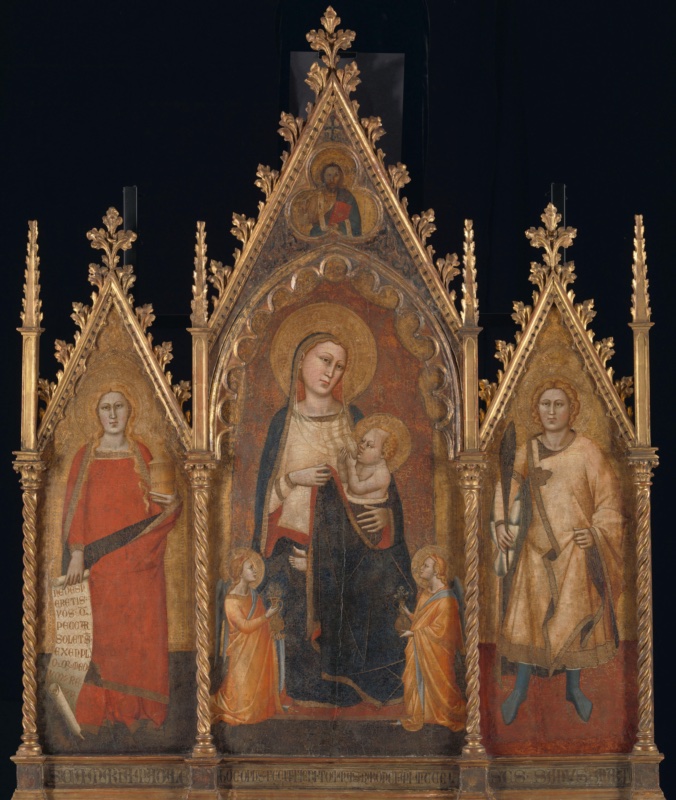
The triptych survives with its integral frame, an exceptional circumstance for a Tuscan altarpiece of this scale and one that makes the object as valuable for the history of carpentry as for the history of painting. Three gabled compartments are articulated by spiral colonnettes rising to foliate capitals and continuing as slender pinnacles; the gables are edged with dentiled mouldings and crowned by carved acanthus crockets and finials, the central gable higher than its neighbours and set forward of them. Within the central gable a trilobe encloses the half-length blessing Christ, holding a red-bound codex; the apex of the arch below is punctuated by a small carved head. The whole is a miniature of Gothic architecture in gilded wood, and the design is emphatically vertical: the eye is carried from the predella inscription through the Virgin to Christ at the summit.
The Virgin is seated low and turned slightly to her left, the Child supported on her knee. Behind her hangs a cloth of honour of deep red brocaded with a stamped gold pattern, its upper edge cusped in imitation of a canopy; there is no visible throne structure, and the mantle spreads broadly across the ground before her, so that the composition may belong to the Madonna of Humility type rather than to the enthroned formula. The Child, blond and nearly naked, turns his face up towards his mother and reaches with his right hand towards her breast while she draws aside the fabric of her gown — a gesture that brings the panel into the orbit of the Madonna del Latte without completing it, and which sets an image of intercession through maternal nourishment at the centre of the altarpiece.
The Virgin wears a blue mantle over a cream gown, the blue now much degraded and the underdrawing showing through in places. Two angels kneel at the lower corners in orange-gold robes, each presenting a vase of flowers, their heads turned inward and upward. The haloes throughout are gold, richly punched with radiating patterns.
On the left stands Mary Magdalene, frontal and static against gold, in a red gown crossed by a dark sash, her long fair hair loose over her shoulders. She holds the ointment jar in her right hand and, in her left, an unrolled scroll whose text is the leonine couplet:
Ne desperetis vos qui peccar[e] soletis exemplo que meo vos re[parate deo]
— do not despair, you who are given to sin; by my example, restore yourselves to God.
The distich is a standard Magdalene formula, and its presence turns the wing into an address to the beholder: the saint is not merely represented but speaks, and the altarpiece thereby acquires a penitential function that the central panel alone would not supply.
On the right stands Saint Ansanus, youthful and curly-haired, in a pale cream tunic and mantle with a dark baldric crossing the breast, holding the martyr’s palm. Ansanus is the protomartyr and patron of Siena, and his appearance on a Florentine panel of 1350 is the most interesting question the triptych poses. He implies either a Sienese patron resident in or connected with Florence, or a destination outside the Florentine contado.
The inscription and the commission
The predella carries a continuous inscription in Gothic majuscules, divided across the three compartments: the titulus of the Magdalene at the left, the titulus of Ansanus at the right, and at the centre the dedicatory formula recording that the donor caused the work to be made, with the date MCCCL.
The Rijksmuseum reads the inscription as:
Sca. Maria Madale / Hoc opus fecit fieri Tommas Baronci anni MCCCL / Scs. Anusmas
The text is worth taking apart carefully:
-
It is a patron’s inscription, not a signature: Hoc opus fecit fieri — “caused this work to be made” — is the standard formula of commission. It names the man who paid, and says nothing whatever about who painted. The consequence is that the date is documentary, the attribution is not, and the two must not be allowed to support one another.
-
The Latin is vernacularised, and that is informative: Anni MCCCL is irregular: classical usage wants anno in the ablative, or anni Domini with the noun supplied. Tommas is not a Latin nominative — Thomas is — and the dropped aspirate with that ending points to the Tuscan Tommaso imperfectly Latinised. This is painter’s or workshop Latin, not notarial Latin, which in turn suggests the inscription was composed on the shop floor from information supplied, rather than copied from a contract.
-
The date needs a calendar caveat: Florence reckoned the year ab Incarnatione, beginning 25 March. A panel inscribed MCCCL in Florentine style falls anywhere between 25 March 1350 and 24 March 1351 in modern reckoning. Siena used the same style. So “1350” is correct as transcribed but should be given as 1350/51 in any chronology where a few months matter.
-
Baronci is a real Florentine surname, and a famous one: the family appears in Boccaccio’s Decameron VI.6, where Michele Scalza wins a wager by proving them the noblest lineage on earth on the grounds that God made them first, while still learning to paint — the joke turning on their supposedly ill-assembled faces. Boccaccio was writing in precisely these years. This is a lead rather than an identification: surname coincidence is not proof, and the Baronci were numerous. But it does place the donor plausibly in Florence, which sharpens rather than resolves the problem of Ansanus.
-
The real puzzle: if the patron is a Florentine Baronci, the Sienese protomartyr on the right wing is not explained by the donor’s origin. Nor is he the donor’s name-saint — that would be Thomas, who is absent. The elimination of both easy explanations pushes the answer towards the altar itself: the saints most likely reflect the dedication of the chapel or altar the triptych was made for, or a spouse’s devotion, or a confraternity. This makes locating the original setting the single most valuable outstanding question, and it is one the inscription conspicuously does not answer — there is no church named, no altar, no pro anima clause, no executor. The museum’s statement that the work was made for a side-altar is therefore an inference from format, not a reading of the text.
-
On “Scs. Anusmas”: the most economical reconstruction is a damaged or abbreviated S(AN)C(TV)S ANSANVS MAR(TYR), from which a transcriber working at speed could easily produce “Anusmas” by dropping letters — and the fact that the left titulus is also incomplete (Madale for Madalena) suggests both ends of the predella band have suffered. Two damaged tituli flanking an intact central clause is a coherent picture of the object; a correctly transcribed nonsense-word is not. Whether the same doubt extends to Tommas Baronci depends on where in the band the abrasion falls, which only inspection or a raking-light image will settle.
-
Finally, the year itself carries weight: 1350 is two years after the Black Death and is Clement VI’s Jubilee — the first since 1300. The Magdalene’s scroll, ne desperetis vos qui peccare soletis, addresses the beholder directly with an anti-despair, pro-penitence message that sits very precisely in both contexts. Meiss discusses this panel at p. 53 of Painting in Florence and Siena after the Black Death, so the connection is already in the literature.
The Rijksmuseum retains the traditional name, using the Dutch formula “genaamd Orcagna”, which signals a name attached to the object rather than a demonstrated authorship. The bibliography assembled by the museum makes the instability plain: the panel is discussed by Berenson, by Longhi in the context of Taddeo Gaddi’s workshop practice, by Boskovits both in 1971 and 1975, by Padoa Rizzo, by Meiss in his study of painting after the Black Death, by Wilkins in connection with Maso di Banco, and most recently in the 2008 exhibition L’eredità di Giotto.
The paint surface carries a dense and stable craquelure throughout. Abrasion is most evident in the flesh tones of the two wing saints and in the Virgin’s mantle, where the loss of the blue has left a dull and partly transparent surface. A vertical split runs through the central panel below the Virgin’s knee. The gilding of the frame and the punchwork of the haloes are in comparatively good condition. The dark rectangular forms visible in the museum image are mounting hardware and belong to the installation, not to the object.
A Tabernacle of Roman Martyrs and Desert Penitence: Saint Agnes and Saint Lawrence
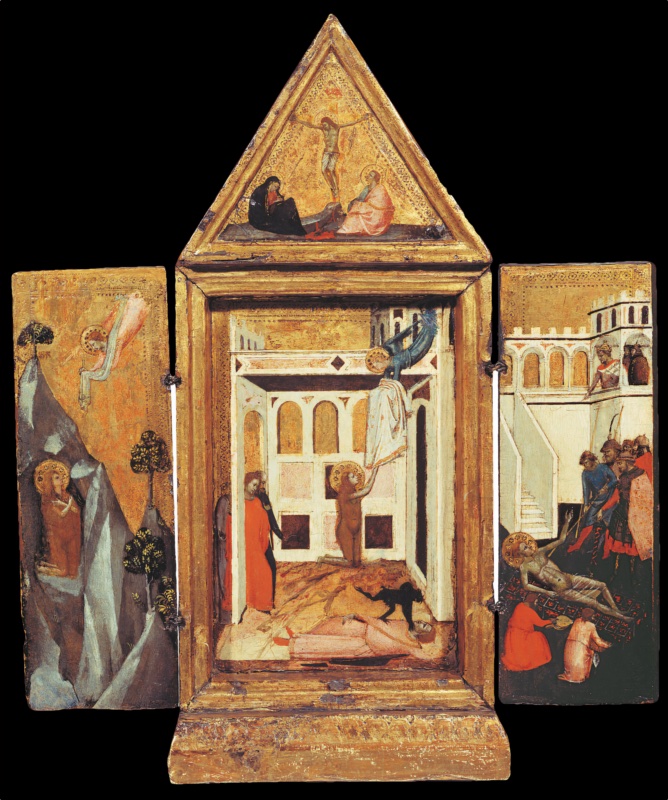
The tabernacle is conceived as a miniature building rather than as a picture in three parts. A central compartment, framed by flat pilasters carrying a heavy projecting cornice, is surmounted by a steep gable and set upon a moulded plinth that projects forward like a step. Two narrower wings, hinged on iron pins of which four are visible, close over the centre. The proportional system is architectural throughout: the cornice reads as an entablature, the gable as a pediment, the plinth as a stylobate, and the interior of the central compartment as a room into which the beholder looks.
This matters for the reading of the object. The wings, when open, do not merely flank the centre; they stand at an angle to it, so that the three scenes are experienced as a shallow enclosure around the worshipper’s line of sight. The gold is worked with small rosette and circle punches along the gable field and the upper borders of the wings, and is worn through to the red bole across most raised surfaces.
- The gable: Crucifixion
Against a punched gold ground Christ hangs on a slender cross, the body attenuated and the head fallen. The Virgin is seated on the ground at the left in a dark mantle, her head sunk; Saint John sits at the right in rose, turned inward, one hand raised towards his face. Both are seated rather than standing — a compressed, contemplative variant of the Calvary group suited to a small triangular field, and one that converts the summit of the object into an image of mourning rather than of triumph.
- The left wing: a penitent saint in the wilderness
The wing shows a landscape of grey and ochre crags with small trees bearing gold-flecked foliage, and a pale cascade — of water or of drapery — falling down the rock at the left. A haloed figure with long loose hair stands in a cleft, the body bare and darkened, the arms crossed over the breast in the gesture of modesty. Above and to the right, against gold, an angel descends in rose drapery, haloed, one arm extended, holding out a white garment towards her.
The angel with the white garment is the same motif as in the central compartment, where an angel in blue brings the shining robe to Agnes. The two wings and the centre are thus tied by a deliberate visual rhyme: in both cases a naked woman, exposed and defenceless, is clothed by heaven. Whether the painter intended a typological pairing of the virgin martyr with the penitent harlot — chastity preserved and chastity recovered, both vindicated by the same celestial gesture — or simply re-used a workshop motif, the echo is too exact to be accidental.
- The central compartment: Saint Agnes in the brothel
The setting is a white masonry building seen frontally: a wall of squared blocks pierced by two dark rectangular openings below and by three round-headed niches above, with a projecting string course and a doorway at the right through which the space opens. At the right stands a naked haloed young woman, her hair falling loose over her shoulders, her arms raised. Descending towards her through the upper right, in steep foreshortening, is an angel in deep blue with a gold halo, holding out a large pale garment which unfurls between them. At the left stand two men, the foremost in a red robe with a grey mantle, looking downward; a second head appears behind his shoulder. Across the immediate foreground lies a naked youth, prone and lifeless, his head to the right; and over him stands a black demon.
These elements correspond to the legend of Saint Agnes as transmitted by Jacobus de Voragine2. Condemned for refusing the prefect’s son, Agnes is sent naked to the brothel; her hair grows to cover her; an angel fills the place with light and clothes her in a shining white garment. The prefect’s son enters to violate her and is seized by a devil and strangled at the threshold. The prefect, arriving to find his son dead, begs Agnes for his life, and she restores him.
The painter has compressed the whole sequence into a single field: the miraculous robe descending, the corpse of the youth, the demon that killed him, and the prefect arriving at the left. The compression is characteristically Florentine, and the reading is secure enough to be stated without hedging — the conjunction of nudity, heaven-sent robe, strangled youth and black demon admits of no other legend I am aware of.
- The right wing: the martyrdom of Saint Lawrence
Against a dark green ground rises a civic architecture of white masonry: an arcaded loggia, a crenellated tower, an external staircase. In the lower half the saint lies extended on a rectangular lattice of red-outlined cells — the gridiron over its coals — his body naked, haloed and bearded, his right arm raised. Two figures crouch beneath the grill tending the fire, one in red at the left with a vessel, one in rose at the right. To the right stand executioners in mail and helmets, one in a blue tunic thrusting downwards with a fork. Above, in the loggia, a crowned figure presides among attendants.
Every element of the standard iconography is present: the gridiron, the bellows and vessels, the forks with which the tormentors turned the body, and the emperor watching from a balcony. The raised arm is the gesture that accompanies the saint’s famous address to his executioners, and the painter has used it to carry the diagonal of the composition up into the loggia, binding victim and judge into a single line.
The attribution to Andrea di Cione is inherited from the source of the image and has not been tested. Two observations bear on it. The architectural settings of the centre and right wing are unusually ambitious for panels of this scale: both are constructed as coherent stage-boxes with measured recession, and the preference for white masonry articulated by arcading and cornices recalls the manner of Maso di Banco, from whom Boskovits derived Orcagna’s formation. The figures, by contrast, are compact and heavy-shouldered, with small heads and broadly massed drapery, which is compatible with the Cionesque orbit without being diagnostic of it. Small devotional objects of this type were routinely executed by workshops.
The gilding is heavily abraded throughout, exposing red bole along the gable, the cornice, the pilasters and the outer edges of the wings. Losses affect the lower edge of the central compartment and the front of the plinth, and the junction of gable and cornice shows damage and probable restoration. A network of drying cracks runs across the central panel. The paint of the wings survives rather better than that of the centre, where abrasion has flattened the modelling of the prone body. The tabernacle has never been dismembered, which is itself remarkable: portable triptychs of this kind were very frequently taken apart in the nineteenth century and dispersed as three separate pictures.
The Del Palagio Polyptych: The Virgin and Child Enthroned with Music-Making Angels and Four Saints
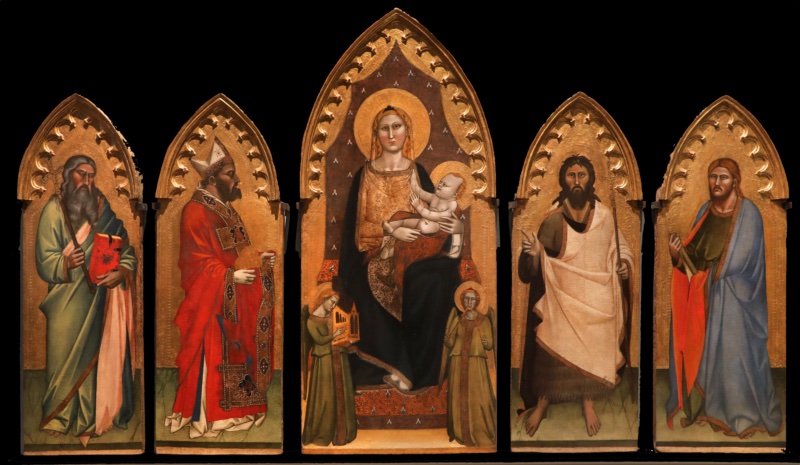
The polyptych comes from the Servite basilica of Santissima Annunziata, where it stood on the altar of the Del Palagio family chapel, the first on the right on entering, founded in 1353 and dedicated to Saint Nicholas of Bari. The chapel walls carried a cycle of the saint’s storie, now lost, which the sources attribute to Taddeo Gaddi.
The foundation date of 1353 supplies a firm terminus post quem and accounts for the dating of the altarpiece to the middle of the decade. It also explains the iconographic hierarchy of the ensemble, which is otherwise unusual: Nicholas, not one of the two Florentine patrons and not an apostle, occupies the place of honour at the Virgin’s right hand, and is shown in strict profile turned towards her, so that the two figures appear to be in conversation across the frame division. The chapel’s titular saint is thus not merely present but is given a privileged relation to the Virgin that the other three saints do not share — a subtle but deliberate encoding of the dedication in the composition itself.
- The central compartment
The Virgin is enthroned frontally, her head inclined slightly to her left. Behind her hangs a dark red cloth of honour scattered with small gilded stars, which fills the pointed field and isolates the figure against a warm, absorbent ground rather than against gold. She wears a gown of cream damask worked with a woven pattern, over which falls a mantle of very dark blue-black, and across her lap lies a further cloth of red and gold brocade on which the Child is seated. Her feet, in pale shoes, rest on the step of the throne, which is likewise draped with the red brocade.
The Child is naked, fair and curly-headed, seated across his mother’s knee and turning towards her, one hand raised towards her breast and veil. The contrast of the almost monochrome black mantle with the two panels of patterned red-and-gold textile is the chromatic argument of the whole panel, and it is a characteristically Orcagnesque one: colour deployed as mass rather than as ornament.
Two angels kneel at the foot of the throne, in olive-green robes with gilded hems. The angel at the left holds a portative organ, its pipes ranged behind a small Gothic arcade; the angel at the right raises a slender wind instrument to his lips. The pairing of a keyboard and a wind instrument, played rather than merely held, converts the base of the panel into a small concert and belongs to the Marian coronation imagery of the period without depicting the Coronation itself.
- The lateral compartments
Saint Andrew (far left) stands barefoot, an elderly figure with long white hair and beard, in a sea-green mantle over a rose tunic, holding a red-bound codex in one hand and a tall staff in the other. The apostle’s usual saltire is not conspicuous here; the staff terminates in a small cross.
Saint Nicholas of Bari wears the jewelled mitre and a scarlet cope over an orphreyed dalmatic, and holds the three golden spheres of his legend — the dowry gold given to the three impoverished daughters. He alone among the four is shown in profile, turned inwards.
Saint John the Baptist stands in the camel-skin garment, visible at the hem and sleeve, beneath a pale mantle, one hand raised in admonition, the other holding the slender reed cross. The figure is gaunt and barefoot, the head unkempt, in the ascetic formula standard in Florence.
Saint James the Greater (far right) is a younger, long-haired and bearded figure in a green tunic and a blue mantle lined with orange-red, holding a fold of drapery and, apparently, a scroll. The pilgrim’s staff and scallop are absent, and here the identification derives from the ICCD record rather than from a decisive attribute.
Each compartment is closed by a pointed arch whose gilded moulding is carved with foliate cusping in low relief, the spandrels punched with small tools. The saints stand on a narrow strip of green ground below a gold field; the Virgin, by contrast, is set against textile rather than gold, which raises her compartment above the others in kind as well as in scale.
The panels are at present mounted with visible separations and metal brackets, and the carpentry that once united them — engaged colonnettes, predella and cusped superstructure — is lost. This is the normal fate of Florentine polyptychs dismembered during the Napoleonic suppressions and reassembled in the nineteenth-century academies, and any reconstruction of the original silhouette must be treated as hypothetical.
The Galleria dell’Accademia gives the work to Andrea di Cione without qualification, and characterises the style in terms that the panels bear out: massive and solemn figures, plastically defined by a clear and precise drawing, with severe physiognomies, rooted in the lesson of Giotto’s immediate followers and of Maso di Banco in particular. The ICCD record notes that the attribution to Orcagna was advanced by Sirén and by Toesca.
The comparison that matters is with the Strozzi altarpiece of 1357, signed and dated, in Santa Maria Novella. If the Del Palagio polyptych was painted around 1353–55 it stands immediately before that work, and the two together define Andrea’s manner in the years of his fullest authority: the same frontal gravity, the same preference for broad unbroken masses of drapery, the same refusal of the anecdotal.
The panels are in generally good condition, with a fine and stable craquelure. The Virgin’s mantle has darkened considerably, and what now reads as black is likely to have been a deep blue; the gold is worn along the arch mouldings and at the edges of the compartments. The green ground strips are abraded. The paint of the two lateral saints at the right appears somewhat thinner than that of the two at the left.
The Descent of the Holy Spirit: The Pentecost Triptych of Santi Apostoli
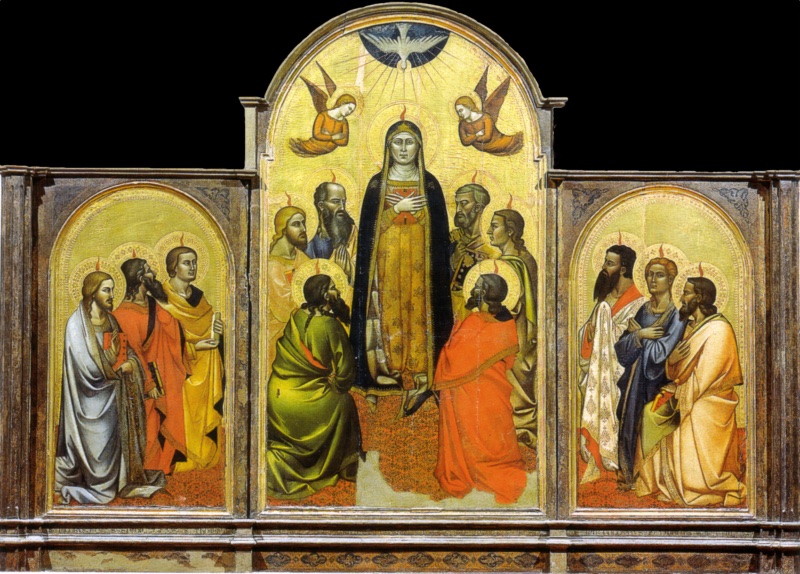
The triptych is thought to be identifiable with the painting Vasari saw on the high altar of the Florentine church of Santi Apostoli. If the identification holds it is a satisfying one, since a Pentecost — the moment at which the apostolic college receives its commission — is the ideal subject for the high altar of a church dedicated to the Apostles. The panel was probably displaced during the sixteenth-century works carried out by Giovanni Antonio Dosio and relocated to the Viviani chapel; it appears to have been taken to the Badia Fiorentina, perhaps in the eighteenth century, and was moved to the Accademia in 1939, where it hangs in the rooms devoted to the Cioni and their followers, in the former monastery of San Niccolò di Cafaggio.
The subject is Acts 2:1–4, with the Virgin included among the assembled disciples on the authority of Acts 1:14. The scene is organised on a strict vertical: the dove of the Holy Spirit descends within a pale oval at the apex of the central arch, emitting a fan of gilded rays that opens downward across the whole field; the Virgin stands immediately beneath it on the central axis; and the apostles are ranged around her in three groups.
The triptych format sets the painter a real problem, since the physical divisions of the carpentry cut the apostolic college into three separated compartments and threaten to dissolve the unity of a moment that is by definition collective. The solution adopted is to turn every figure in the wings inward, towards the centre, and to place two apostles in the immediate foreground of the central panel kneeling with their backs to the beholder — a Giottesque repoussoir that establishes the near edge of the room and draws the eye through into the group. The two kneeling figures, one in deep olive-green and one in strong vermilion, are the chromatic anchors of the composition and the passage in which the painter’s command of massed drapery over a bent body is most conspicuous.
Two angels in orange, wings spread, hover to either side of the dove with their hands crossed on their breasts. The floor is a red ground worked with fine gilded ornament, and the ground behind is gold, so that the figures stand within a continuous field of metal broken only by the drapery masses.
The Virgin stands rather than sits — a choice worth noting, since the seated Virgin is at least as common in Trecento Pentecosts and confers a different, more hieratic authority. Here she is upright, frontal, her hands crossed on her breast in the gesture of acceptance, wearing a mantle of very dark blue over a gown of gold brocade whose pattern is rendered with punched and tooled gold. A tongue of flame rises above her veiled head as it does above each of the apostles: she receives the Spirit with them and on the same terms, which is a theologically precise and not a merely decorative decision.
Pentecost is among the subjects in which Trecento painters deliberately did not individuate the apostolic college. Unlike a polyptych of standing saints, where each figure carries an attribute precisely so as to be named, a Pentecost shows the apostles as a body — twelve men receiving a single gift — and the painter’s interest lies in the variety of their reactions rather than in their identities. No attributes are present here: no keys, no swords, no saltire, no books beyond the generic codex.
Where individuation is pursued here, it is physiognomic rather than onomastic: the painter differentiates age, hair colour, complexion and bearing across the twelve with considerable care — a bald and heavily bearded elder, a red-haired man in his prime, a young man with loose fair hair, an olive-skinned figure in a white brocaded mantle — so that the group reads as a company of distinct individuals without any of them being named. This is characteristic of Andrea’s manner, in which gravity of type substitutes for anecdote.
The attributional history is unusually tangled and is worth rehearsing in full, because the traditional label conceals it.
Vasari gave the altarpiece to Spinello Aretino, and that attribution persisted in the Florentine guidebooks for centuries. In the nineteenth century a more cautious ascription to the Giottesque school prevailed. Crowe and Cavalcaselle first proposed Andrea Orcagna, tentatively; the ascription was subsequently refined to Andrea with the collaboration of his brother Jacopo di Cione, and this has been broadly confirmed. Dissenting voices include Evelyn Sandberg Vavalà, who gave the work to Jacopo alone, and Richard Offner, who detached it from both brothers and assigned it to an assistant he christened the Master of the Pentecost. The ICCD record additionally preserves proposals for Allegretto Nuzi, for the Orcagna workshop generally, and for a collaboration of Orcagna and Spinello. Recent scholarship has moved back towards Andrea’s autograph hand.
This is a good example of a work whose “traditional attribution” is in fact a late arrival: Orcagna’s name has been attached to it for rather less time than Spinello’s was.
The triptych has been restored for the Gallery by Muriel Vervat, and the surface is in good and legible condition. The frame is a later structure and should not be taken as original carpentry; inscribed or painted bands are visible along its base at left and right and require transcription. The tarnishing of the silver leaf, where present, will have altered the intended relation between the two metals, and the original effect would have been considerably more varied than the uniform gold that now predominates.
The Triumph of Death, the Last Judgement and Hell: The Ruined Cycle of Santa Croce
The most ambitious pictorial undertaking of Orcagna’s career survives only in ruins. On the wall of the right aisle of the nave of Santa Croce — the great Franciscan church on the other side of the city from his Dominican patrons — Andrea painted an immense mural comprising three linked subjects: a Triumph of Death, a Last Judgement, and a Hell. Ghiberti praised them as three great istorie; Vasari describes them and, in the same breath, claims that they repeat what Andrea had already done at Pisa — a claim that fails twice over, since the Camposanto frescoes are now given to Buonamico Buffalmacco, or by an older tradition to Francesco Traini, and not to Orcagna at all.
The wall did not survive the sixteenth century. The murals appear to have been gravely damaged by the flood of 1557, and Vasari’s reordering of Santa Croce, with its rank of stone altars set against the aisle walls, then covered what remained beneath new plaster. It is worth resisting the easy view of Vasari here as a mere moderniser indifferent to the old masters: he admired them, and the state of the wall after 1557 is likely to have left him little choice.
Fragments were recovered from beneath the sixteenth-century intonaco of the right aisle over a long campaign running from 1911 to 1942. Six fragments from the ensemble are now displayed in the Museo dell’Opera di Santa Croce, installed in the old refectory alongside Cimabue’s Crucifix and Taddeo Gaddi’s Tree of Life and Last Supper, and arranged so as to make the original narrative as legible as the losses allow. The flood of 1966, which devastated the refectory and its contents, struck the fragments after their recovery and display, not before; it belongs to the conservation history of the detached pieces rather than to the destruction of the wall.
What can still be read is remarkable. Along the outer band of the composition ran the fifteen signs that, according to a widespread medieval tradition, would precede the Last Judgement. In the first surviving scene, men observe extraordinary portents in the sky, above all the darkening of the sun. In the second, an earthquake brings down the buildings of a city — a passage of vehement spatial and architectural description. In the third, people watch the sea rise.
The Last Judgement itself is lost; by analogy with the Pisan Judgement it is presumed to have had Christ as judge at the centre, with the blessed and the damned at the lower extremities. In the surviving fragment at the lower right, beside a twisted column, one sees a damned soul wearing a headdress of oriental fashion, a black demon acting as a doorkeeper, and the gate of Hell surmounted by a vulture-shaped demon pronouncing the Dantean verse commanding the abandonment of hope. Other fragments show the punishment of the lustful; the punishment of the avaricious and the wrathful, with Satan devouring Judas, Brutus and Cassius; and Lucifer clawing two giants and Antenor. A further fragment, from the Triumph of Death proper, shows the poor calling upon death to come, and preserves the remains of a vernacular caption now almost wholly effaced.
The Dantean armature is unmistakable and has been recognised as such since the fragment’s rediscovery. This is a monumental painting organised, at least in part, by the Inferno — a fact of some importance for the history of Dante illustration, since the Santa Croce fragment stands between Giotto’s Arena Chapel Judgement of about 1305 and the Pisan Camposanto Hell, and belongs to the same Florentine milieu that produced Nardo’s Dantean Hell in the Strozzi Chapel.
The dating is the crux, and it remains genuinely unresolved. Proposals cluster around three positions rather than two. One school places the cycle in the artist’s late maturity, around 1360–65, on the grounds of its affinity with parts of the Orsanmichele tabernacle and the theatrical, declamatory character of its tragic effect. A second, argued by Kreytenberg, places it early, around 1345, citing the pronounced interest in spatial representation — the earthquake scene above all — together with the plastic corporeality and harmonious proportions of the figures, which also account for the closeness to Maso di Banco.
A third, argued by Padoa Rizzo, sets the cycle in the years immediately following the plague of 1348, so that the Triumph of Death would preserve a relatively fresh memory of it; the “around 1350” that appears in catalogue entries is this positive thesis rather than a compromise between the other two. The difference matters enormously for the Meiss thesis: an early date makes the Santa Croce cycle a pre-plague meditation on death and judgement rather than a response to one.
There is a further, quieter point. Whichever date is preferred, the Santa Croce murals show Orcagna working at maximum scale in a narrative and dramatic mode, and doing so with evident relish. The nineteenth- and twentieth-century characterisation of him as an artist temperamentally averse to narrative, who reduced istoria to icon, is difficult to sustain against these fragments — which is precisely why their date has been so heavily contested.
Hell
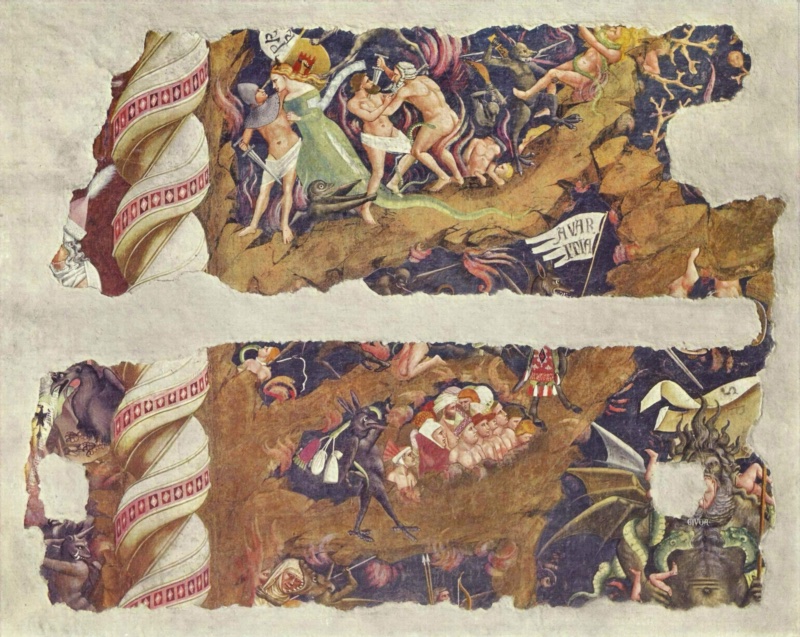
The fragment corresponds to the group catalogued as the punishment of the lustful, the punishment of the avaricious and the wrathful with Satan devouring Judas, Brutus and Cassius, and Lucifer clawing two giants and Antenor.
Two horizontal bands of detached fresco are mounted on a neutral plaster support, separated by a wide lacuna and broken along every edge into the ragged contour characteristic of stacco.
Along the left margin runs a twisted column, its shaft banded by a spiralling ribbon of red-and-white lozenges. This is the architectural member that divided the compartments of Hell in the original composition, and its survival at the edge of both bands establishes that the two strips belong to adjacent registers of a single wall.
In the upper band, a ground of ochre rock rises against a dark blue field. Naked damned figures fight one another with swords and shields; at the left a crowned figure in green, above whom a lettered banderole survives in part, is assailed by a nude man with a buckler; a green serpent winds across the rock; demons drag further bodies at the right. A scroll inscribed AVARITIA identifies the vice punished in this compartment, and the fighting confirms that the wrathful are punished alongside the avaricious.
In the lower band, a black demon with a bird’s beak and clawed feet strides forward carrying white money-sacks — the avaricious burdened for eternity with what they hoarded. Behind him presses a dense crowd of the damned in turbans and elaborate coloured headdresses, the costume markedly exotic and contemporary at once. A demon in red hose strides above them. At the right rises the great winged figure of Satan among green serpents, small naked bodies caught in his grasp, with an inscription beside the mouth that appears to read GIVDA. Along the bottom edge, fanged demon heads and the shafts of pitchforks emerge from the flames.
The presence of tituli is worth emphasising: the cycle named its vices in painted letters, and the surviving inscriptions are evidence that it was designed to be read as well as looked at.
The Poor Invoke Death: Two Fragments from the Triumph of Death at Santa Croce
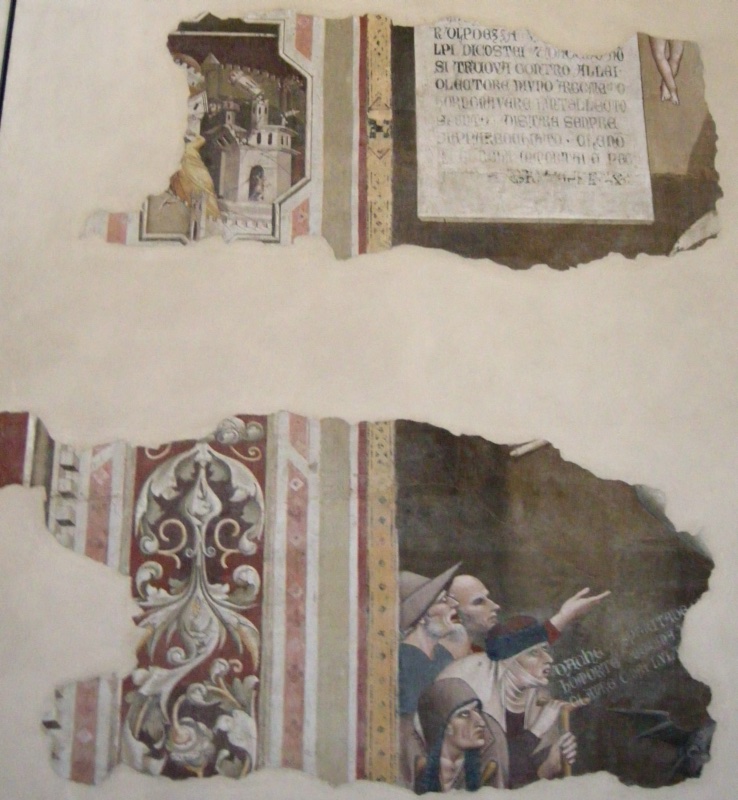
Two irregular fragments are mounted one above the other on a plain plaster ground, their edges broken into the ragged silhouette left by stacco. The gap between them is not a lacuna within a single field but the interval separating two registers of the original wall, and the fragments have been hung so as to preserve that relation.
Both preserve substantial passages of the painted framing system, and this is their first documentary value. The mural was not a continuous field but a compartmented one: vertical bands of polychrome fillets — red, grey-green, white — flank a narrow decorated strip worked in gold-ochre with lozenges and running ornament, and in the lower fragment a broad border carries a symmetrical white acanthus rinceau, candelabra-fashion, on a deep red ground. Painted architecture of this kind divided the great wall into legible units and provided the armature within which the three subjects were disposed. Any reconstruction of the original layout will have to be built from these borders rather than from the figural scraps.
- The upper fragment
At the left survives a vignette of a walled city rendered in pale grey and white: crenellated curtain walls, a gate, towers of varying height, an arcaded structure, and an arched opening in which a small figure stands. A pale golden form intrudes at the lower left, its identification uncertain. The vignette is enclosed by its own painted frame, and the buildings are described with a precision of architectural observation that has been central to the argument for an early dating of the cycle.
To the right of the framing band, against a dark brown ground, is a large rectangular white field bearing a long inscription in Gothic script, in the Tuscan vernacular. The lettering is worn and only partly legible; among the sequences that can be made out are references to costei — “she”, that is Death, feminine in Italian — and to intellecto, in what appears to be a moralising address in verse warning the reader that nothing avails against her.
At the extreme upper right a pair of crossed bare legs is cut by the break — the lower portion of a figure whose subject cannot now be recovered.
- The lower fragment
Beyond the acanthus border, at the right, appears the passage that gives the fragment its importance: a tightly packed group of heads, four in all. An old man in a broad conical hat, white-bearded, opens his mouth in a cry; behind him a bald, clean-shaven man in sharp profile raises his right arm with the hand flung open; an elderly woman in a white wimple bows her head at the right; and below, a hooded figure turns his face up towards the others. Across the dark ground behind them runs a further inscription in light letters, a speech text issuing from the group and now only fragmentarily legible.
This is the episode named among the six Santa Croce fragments as the poor calling upon Death — the aged, the destitute and the maimed who beg her to take them and are passed over, a topos of the Triumph of Death and the counterpart to the courtly company whom she strikes down unwilling. The pictorial argument is carried entirely by the heads. Each is individuated with a naturalistic force that owes nothing to type: the slack flesh beneath the old man’s jaw, the tendons of the bald man’s neck, the wet catch of the open mouths. Nothing here is generic, and the group has no recourse to attribute or emblem; it works by observed physiognomy alone.
Two points follow, both of which bear on the standing of Orcagna in the literature.
-
The inscriptions: both fragments carry extensive vernacular text — a formal tablet in the upper register, a speech scroll among the figures in the lower — which establishes that the cycle was designed to be read as much as seen, and read by a lay Florentine public in its own language. A monumental wall of this kind, in the nave of a Franciscan preaching church, functioned as an instrument of vernacular exhortation, and the loss of most of its text is a loss of the argument the images were framed to carry.
-
The artist: the characterisation of Andrea as a painter who suppressed narrative in favour of hieratic frontality, formulated in the nineteenth century and given its most influential form in the mid-twentieth, is difficult to reconcile with these heads. Here is a painter working at the top of his range in the most demanding of narrative modes, differentiating six figures by age, physical condition and emotional pitch within a few centimetres of wall. It is precisely this quality that has made the dating of the cycle so contested, since an early date would place such work before the Black Death and remove the cycle from the explanatory framework in which it has usually been read.
The Last Supper of Santo Spirito: The Right-Hand Fragment with Two Apostles and an Augustinian Saint
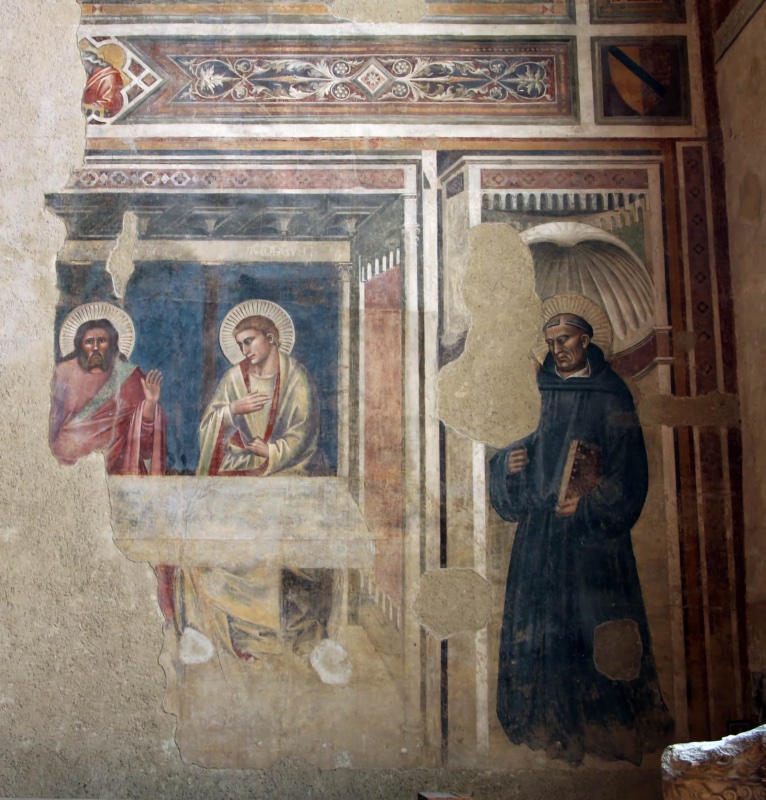
The refectory is the only room of the first medieval convent to survive Brunelleschi’s fifteenth-century rebuilding, and the Orcagna wall is among the largest Trecento mural paintings still extant. Its condition, however, is the result of a nineteenth-century catastrophe rather than of slow decay. After the suppression of the religious corporations and the transfer of this wing to the Comune in 1868, the refectory was put to use as a tram depot, and the wall giving onto the piazza was opened — destroying the centre of the Last Supper irreparably. What survives of the Supper is two fragments at the extremities: a minimal one at the left, and at the right the more substantial passage reproduced here. Recovery and consolidation belong to the campaign of architectural restoration carried out before and during the Second World War, between 1938 and 1944.
The surviving right-hand portion preserves three distinct zones of the original wall, and its interest lies as much in what it shows of the mural’s structure as in its figures.
- The decorative registers
Across the top runs a broad frieze of white acanthus scrollwork with rosettes and lozenges on alternating grounds of dark red and blue, bounded by fillets. At the upper left a cusped Gothic medallion encloses the half-figure of a haloed man in red, of whom only the head and shoulders survive; at the upper right a framed panel contains a further object, indistinct in its present state. Below the frieze a second, narrower band of quatrefoils and lozenges marks the top of the narrative field. These registers establish that the wall was articulated by an elaborate painted architecture within which the two great scenes were set.
- The two apostles
Against a deep blue ground two apostles are seated behind the table. At the left an older man with a grizzled beard, in a rose-red mantle over green, raises his right hand with the fingers spread in a gesture of protest or exclamation; beside him a young, fair-haired and beardless apostle in a pale cream mantle lined with red inclines his head and brings his right hand to his breast in the gesture of self-exculpation — numquid ego sum? Their haloes are executed in relief, raised rings incised with radiating rays, a technique that catches the light of the refectory and that distinguishes these figures from the flat gold of panel painting. Above them, in the painted entablature, traces of lettering survive, which suggests that the apostles were originally named in inscription.
The two figures conform to the standard Trecento distribution of reaction around the announcement of the betrayal, and their placement at the far right of the table means that they were among the furthest from Christ, whose figure occupied the destroyed centre.
Below them the front edge of the table survives with its white cloth, largely abraded, together with the ghost of the trestle beneath.
- The Augustinian saint
At the right, separated by a painted pier, a fluted shell-headed niche contains a standing friar in the black habit and cowl of the Augustinian Hermits, tonsured, haloed, holding a book with red-edged binding and raising his other hand with the fist closed. The face is drawn with severity — heavy brows, hollowed cheeks, a downturned mouth — and is one of the most forceful passages of characterisation in the surviving fresco. He is one of the two Augustinian saints who flanked the composition; their presence declares the order to which the refectory belonged and gives the whole wall its institutional address.
The Musei Civici Fiorentini state that the dark red ground of this fresco is not a chosen colour but the rosso morellone preparation laid down to receive an application of azurite, now entirely lost.
This is worth recording carefully, because it is documentary confirmation, from the responsible authority and for a mural of the Cione workshop, of the mechanism that can otherwise only be inferred: where a Florentine Trecento fresco now presents a deep red-brown field, the probability is high that one is looking at the preparation for a blue that has detached. The same reading, proposed as a hypothesis for the russet skies of the Cappella dell’Annunciazione at Santa Maria Novella, may accordingly be advanced there with more confidence — though confirmation for those particular walls still requires their own technical examination.
The wall has been given to Orcagna since Ghiberti’s Commentarii, and the ascription was reaffirmed in the modern literature by Pietro Toesca. It was subsequently doubted by a number of scholars before being firmly restored to the painter’s catalogue, notably by Padoa Rizzo and by Becherucci, who additionally recognised the hand of Nardo di Cione in the execution. This is therefore one of the rare cases in this corpus where the traditional attribution rests on a fifteenth-century source rather than on nineteenth-century connoisseurship, and where the modern debate has been about confirming an old ascription rather than replacing one.
The Strozzi Altarpiece: Christ in Glory Conferring Doctrine and Jurisdiction
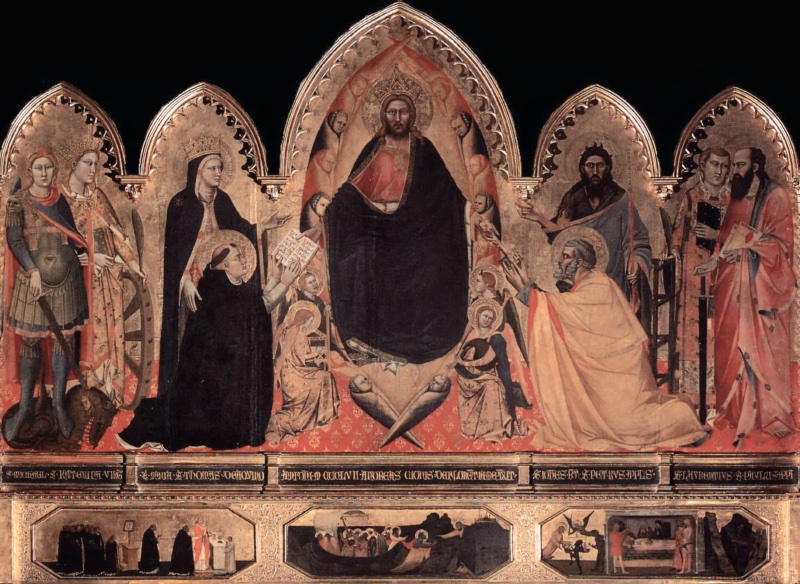
The altarpiece carries its own apparatus of identification, and every attribution made below rests on it rather than on attributes alone. A continuous band of Gothic majuscules runs along the base of the five compartments, naming the figures above and, at the centre, the painter and the year:
- S. MICHAEL · S. KATERINA VIRG.
- S. MARIA · S. THOMAS DE AQUINO
- ANNO DNI MCCCLVII ANDREAS CIONIS DE FLORENTIA ME PINXIT
- S. IOHES BT. · S. PETRUS APLS
- S. LAURENTIUS · S. PAULUS APLS
The lettering is worn in places and the transcription above should be checked against the panel; the substance, however, is not in doubt.
The saints, left to right
| Compartment | Figures | Attributes visible |
|---|---|---|
| I (far left) | Archangel Michael; Catherine of Alexandria | Michael in armour with sword, the dragon crushed beneath his feet; Catherine crowned, with the spiked wheel behind her |
| II | The Virgin Mary; Thomas Aquinas, kneeling | The Virgin in dark mantle, presenting; Thomas in the Dominican black cappa over white, receiving the book |
| III (centre) | Christ in Glory, with seraphim and two angels | Crowned, frontal, within a mandorla; book in the left hand, keys in the right |
| IV | John the Baptist; Peter, kneeling | The Baptist in camel skin; Peter receiving the keys |
| V (far right) | Lawrence; Paul | Lawrence young, in the deacon’s dalmatic, with the gridiron behind him; Paul bearded, in red, with the sword |
The inscription settles the identity of the archangel: he is Michael, not George. The confusion arises from the dragon, and it is common in guidebooks, but the panel itself names him.
The polyptych on the altar of the Strozzi Chapel in the left transept of Santa Maria Novella is the only surviving panel painting signed by Orcagna and the one work universally accepted as wholly his: Anno Domini MCCCLVII Andreas Cionis de Florentia me pinxit. It was contracted in 1354, and it remains on the altar for which it was made — a circumstance rarer still than the signature.
The chapel stands slightly off-axis at the head of the transept because the campanile occupies the space behind the left portion of the end wall [?, verify the building history and the date of completion]. It was dedicated to St Thomas Aquinas — a dedication that determines everything about the altarpiece’s iconography and that also, conveniently, echoed the patron’s own name. Between about 1350 and 1357 the walls were frescoed by Nardo di Cione, with marginal participation by other hands, in a programme devoted almost entirely to the Last Judgement, distributed across the three walls with Paradise on one side and a Dante-derived Hell on the other. It has often been suggested in the literature that the patron undertook the decoration in expiation of the sin of usury; the proposal is plausible in the context of Florentine banking piety but is an inference rather than a documented fact.
The chapel is therefore a coordinated ensemble by two brothers, and one of the very few places where the distinct temperaments of Andrea and Nardo can be compared directly on site. The division of labour — Andrea the altarpiece, Nardo the walls — is recorded early and has never been seriously challenged [?, verify the precise wording of Ghiberti’s notice before attributing the observation to him].
The panel is a five-compartment polyptych with a painted predella of three scenes. Its most consequential formal decision is negative: Orcagna suppressed the twisted colonnettes that ordinarily divide the compartments of a Florentine polyptych. In doing so he abolished the additive logic of the type — a row of discrete saints, each in his own gilded box — and produced a single continuous painted field within a frame that has become part of the representation rather than a container for it.
Kreytenberg’s analysis of this device is the most searching in the literature. The pointed arches of the frame, ornamented with a small arcaded frieze, are detached from the plane of the panel so that a zone of shadow of indefinite depth opens between the two. The result is that the frame reads simultaneously as architecture and as a threshold into pictorial space. The ornamental motifs of the floor, which are not scaled perspectivally and therefore assert the flatness of the surface, run continuously only beneath the central figure of Christ; at the sides they are interrupted by figures and thus become legible in a quasi-spatial sense. The outer pairs of saints stand obliquely, one behind the other, generating diagonals that are continued in the projecting angles of the frame.
This is not a painter abolishing space. It is a painter constructing a very precise equilibrium between two-dimensional assertion and three-dimensional description — an equilibrium in which the flattest passage is reserved for the theophany at the centre.
The programme
At the centre, within a mandorla of seraphim, Christ appears frontally, as in a vision. He does not sit in a narrative or a devotional setting; he manifests. With one hand he hands a book — the symbol of ecclesiastical doctrine — to St Thomas Aquinas, who kneels at his right in a position of exceptional privilege and is presented by the Virgin. With the other he gives the keys, the sign of the Church’s authority, to St Peter, presented by John the Baptist. Behind the two kneeling saints, the Virgin and the Baptist flank Christ to form a Deesis. The outer pairs are the Archangel Michael and St Catherine of Alexandria on one side, St Lawrence and St Paul on the other.
Two things are unusual here, and both were noticed early. First, the depiction of an adult, full-length Christ as the principal figure of a Florentine or Sienese altarpiece is close to unprecedented in the fourteenth century; the norm is the Virgin and Child. Second, the subject — the simultaneous transmission of doctrine and of jurisdiction — has no ready parallel in Trecento panel painting. Its ancestry lies in the traditio legis et clavium of early Christian and Roman art, and behind that in the imagery of papal authority. The choice of a hieratic, frontal, visionary Christ is thus not merely a matter of style; it is a return to a specific and highly charged iconographic tradition, made in a Dominican chapel dedicated to the order’s greatest theologian, at a moment when the Dominicans of Santa Maria Novella were vigorously asserting the doctrinal authority of the Church.
The predella extends the argument. Its three scenes are the Mass of St Thomas Aquinas; St Peter saved from the waters, an adaptation of the Navicella; and the death of the Emperor Henry II, whose soul is weighed in the balance and saved when a golden chalice is cast into the scale. The unifying theme is not the lives of the saints but the sacramental and doctrinal machinery of the Church itself: the Mass, the primacy of Peter, and the efficacy of pious donation. In a chapel paid for by a banker, the last of these is not an idle choice.
The third scene deserves a further remark, because it binds the predella to the register above. In the Legenda aurea it is Saint Lawrence who throws into the balance the golden chalice that Henry had given to a church under his patronage, tipping the scales against the devil’s tally of sins. If the painted scene follows that version — and the presence of an angel with scales and a demon suggests it does — then Lawrence’s otherwise puzzling appearance in the outermost right compartment is explained: he is there not as a generic deacon-martyr but as the intercessor whose miracle the predella narrates, and as the patron saint of donation itself [?, confirm that Lawrence is identifiable in the predella scene].
Notably, the predella is also the most spatially developed part of the ensemble. Where the main register presses towards the plane, the small scenes below open into depth. This distribution — hieratic above, narrative and spatial below — is a deliberate rhetorical arrangement, not an inconsistency.
Style
The formal character of the altarpiece is easy to describe and hard to evaluate fairly. The figures detach themselves from the gold ground with abrupt, statuesque clarity; the modelling is compact; the drapery folds are handled with an angular, faceted incisiveness; the colour is intense, saturated and, in places, almost violent in its contrasts — the deep blue-black of Christ’s mantle set against the vermilion of the ground and the salmon of Peter’s robe. There is no atmospheric softening. Every form is closed.
Read one way — and this is essentially how it was read for most of the twentieth century — the picture registers a retreat from Giottesque naturalism into an archaising, anti-illusionistic hieraticism, a tense and cramped abstract space belonging to the previous century. Read another way, it is a work of considerable formal ambition in which the artist has unified a traditionally additive format, integrated frame and image, and calibrated the relation of flatness to depth scene by scene, register by register.
Kreytenberg’s judgement is that a diminution of spatial illusionism relative to the 1346 Annunciation is undeniable, but that the picture is neither developed two-dimensionally nor purged of pictorial space, as an anti-illusionist reading would require. Something similar had been said much earlier from a less sympathetic angle: the 1961 entry in the Dizionario Biografico degli Italiani describes the result as a calculated accord between archaic ideality and modern Gothic manner that amounts to compromise and academic pedantry — a harsh verdict, but one that at least identifies the same two poles rather than reducing the picture to one of them.
The Tabernacle of Orsanmichele: A Marble Shrine for the Madonna of Bernardo Daddi
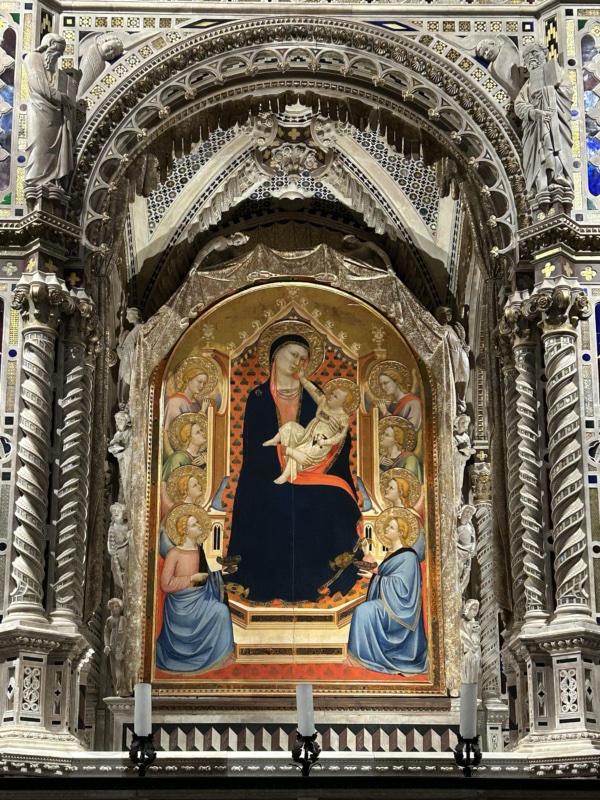
The image shows the front of the tabernacle: the cusped and crocketed arch, the clustered twisted colonnettes encrusted with glass and gold tesserae, the marble figures standing on the piers to either side, and, framed within, Daddi’s panel.
The decisive feature is the marble curtain. Carved drapery is gathered and drawn back to either side of the opening, looped and knotted, with small angels attending it above — a permanent representation in stone of the veil that was intermittently drawn back in cloth before the miraculous image. Visitors of a later period could pay to have the curtain pulled aside. The tabernacle is thus not a frame but a mechanism: it stages an act of revelation and encodes that act in its own ornament.
In the panel there are no saints: Daddi’s Madonna shows the enthroned Virgin and Child adored by eight angels, four to each side, the two lowest kneeling in the foreground and holding vessels. The Child reaches to his mother’s face and holds a goldfinch. The Virgin wears a lapis mantle. Any account that names saints in this panel is describing a different picture.
The marble figures visible on the piers of the tabernacle belong to the sculptural programme — evangelists with books, apostles, prophets, and angels.
If the Strozzi altarpiece is the work by which Orcagna is judged, the Orsanmichele tabernacle is the work by which his contemporaries knew him. Sacchetti identifies him by it. It is the only work of sculpture that can be given to Andrea with certainty, and the only surviving evidence of his activity as an architect. In 1365 the panel it enshrines was named the official painting of Florence.
Institution and occasion
Orsanmichele was, and in its lower storey still visibly is, a communal grain loggia; it was also the seat of a lay confraternity devoted to a miracle-working image of the Virgin, and it became the ceremonial church of the Florentine guilds. The panel the tabernacle was built to house is Bernardo Daddi’s Madonna and Child with Eight Angels, painted in 1347 to replace an earlier miraculous image lost or damaged in the fire of 1304 — identified in part of the literature as a panel by Ugolino di Nerio, though the sources differ as to whether the original was a panel or an image painted on one of the loggia’s piers.
The commission has a specific and rather uncomfortable institutional background. The plague of 1348 brought the confraternity an extraordinary windfall as the wills of thousands of Florentine victims were opened at once and their bequests distributed. The chronicler Matteo Villani condemned the captains of Orsanmichele in the strongest terms for their handling of these funds, accusing them of embezzlement and selfishness. The contract for a new tabernacle was awarded to Andrea in 1349, with work apparently beginning three years later — a sequence that places the commission immediately upon the windfall rather than four years after it, and that tightens rather than loosens the connection. It has therefore been argued that the project functioned in part as a public and lavishly visible justification of the confraternity’s stewardship. The building of an ostentatiously costly shrine is a familiar answer to accusations of misappropriation.
The essential modern studies are Nancy Rash Fabbri and Nina Rutenburg, “The Tabernacle of Orsanmichele in Context,” The Art Bulletin 63:3 (1981), 385–405, and Brendan Cassidy, “Orcagna’s Tabernacle in Florence: Design and Function,” Zeitschrift für Kunstgeschichte 55 (1992), 180–211. It should be said that the central argument of the Fabbri and Rutenburg article is not the stewardship thesis but a broader one: that the tabernacle’s unusual features are explained by the history of the miraculous image, the practices of the confraternity and the particular circumstances of Florence in the 1350s, and that the monument therefore shows continuity with the period before the Black Death rather than a radical break with it.
Architecture
The tabernacle is square in plan and stands on a base of three steps. Four corner piers, formed of clustered twisted colonnettes, are joined by round-headed arches and carry a ribbed cross vault. Above rises a crowning stage with four pinnacles over the piers, linked by triangular gables; these enclose a dome of eight segments set on a drum. The arches are closed at the bottom by low balustrades that read as a socle; the interior is accessible only through a very small door at the back.
The rear arch is closed entirely, not merely by the balustrade but by a solid wall. This wall contains a narrow staircase leading to the upper part of the structure. On its inner face — that is, facing into the tabernacle — hangs Daddi’s panel. On its outer face is the monumental relief of the Death and Assumption of the Virgin, with which the cycle of reliefs concludes.
The functional logic of this arrangement is worth spelling out, because it explains features that otherwise look arbitrary. The staircase and the concealed interior served the ritual unveiling of the image: custodians within the structure operated ropes that drew back an actual curtain in front of the Madonna. Angels carved around the opening pull back a marble curtain, permanently rehearsing in stone the ceremony performed intermittently in cloth. As the fourteenth century advanced, the open arcades of the surrounding building were progressively walled up and the image itself increasingly veiled; access to it became a privilege, and the tabernacle is the machinery of that privilege.
The dome on a drum, of eight segments, is architecturally the tabernacle’s most consequential idea. Kreytenberg argues that the conception formulated here allowed Andrea to exercise a decisive influence on the design of the choir of Florence Cathedral in 1366–67 — the moment at which the octagonal crossing that Brunelleschi would eventually have to vault was fixed as binding for the future. Whether or not one accepts the full weight of that claim, it is at least the case that the man who built an eight-part dome over a drum in miniature in the 1350s sat on the committee that determined the shape of the cathedral’s east end a few years later.
Sculpture
The tabernacle carries in the region of 117 pieces of figural sculpture — reliefs, statuettes, angels, evangelists, prophets — worked in marble and inlaid with gold, coloured glass and semi-precious stone, producing a dense, jewelled polychromy that is at its most concentrated in the celestial zones and that has the effect of flattening them further. The elaborate surface finds its counterpart in the brocaded textiles of contemporary painting.
The socle carries an alternating sequence of polygonal reliefs: large octagonal fields with scenes from the Life of the Virgin, small hexagonal fields with personifications of the Virtues. Some handbooks reverse the two assignments; the octagonal-narrative, hexagonal-Virtue distribution is the one supported by the older descriptive literature, and the alternation itself is not in doubt. Among the narrative reliefs are the Birth of the Virgin, her Education, the Annunciation, the Presentation, and the Annunciation of her death. The sequence culminates in the great rear relief of the Dormition and Assumption. Around the image itself, angels draw back the marble curtain; evangelists with books and further angels stand on the piers and colonnettes, asserting the textual and doctrinal authority behind the Marian devotion.
Andrea cannot have carved all of this himself, and no one has ever supposed he did. A team of sculptors and masons worked to his design, and his brother Matteo was probably among them. What is striking, and what Kreytenberg emphasises, is the severity with which the master imposed a unified conception on his executants. Figures that are demonstrably by different hands — the paired angels bearing the scrolls Ave Maria and Gratia plena are the classic example — correspond so exactly that they must derive from a common model. Differences of quality are visible, and the passages usually singled out as Andrea’s own are the Dormition and Assumption, the Nativity, the Annunciation, the Annunciation of the Virgin’s death, and the Virtues.
The relief and the signature
The rear relief is the tabernacle’s climax and the most-discussed piece of Trecento sculpture in Florence after Andrea Pisano’s Baptistery doors. In the lower zone, the Death of the Virgin takes place in a shallow, crowded space in which the figures press close together and almost no foreground is allowed; the sense of too many persons in too little room is deliberate and oppressive. In the upper zone, the Virgin ascends, and here the ground is worked with gilded and coloured marble inlay rather than described as space. St Thomas receives the girdle — the relic venerated at Prato and a subject of local devotional weight, later treated by Nanni di Banco at the Porta della Mandorla. A small realistic touch has often been noted: two figures at the far right of the lower group wear contemporary dress rather than timeless drapery.
The whole is signed and dated:
Andreas Cionis pictor Florentinus oratorii archimagister extitit huius MCCCLIX.
The formulation deserves attention. On his one certain work of sculpture, Andrea describes himself as pictor — a painter — and as archimagister of this oratory. He did not call himself a sculptor. The wrought grille that now encloses the structure is later, of 1366.
Kreytenberg draws the conclusion that follows from this. The reliefs are conceived as painted images carved in stone: their compositional structure is related to an ideal surface, and this surface and the space of the relief interpenetrate in a controlled synthesis. Andrea thus develops relief beyond the manner of Andrea Pisano and in the direction that Ghiberti would take. At the same time the tabernacle sculpture and the Strozzi altarpiece, exactly contemporary, exhibit a fundamental agreement of conception realised in different materials — a point one can test directly by comparing the Virgin and St Thomas in the Assumption relief with the Christ and St Peter of the panel, or the Ave Maria angel with the painted St Michael.
The older critical tradition reached a related judgement from the opposite direction. Writing in 1961, the Dizionario Biografico entry observed that Orcagna, preoccupied with giving plastic robustness to Andrea Pisano’s Gothic forms, showed remarkably little interest in space — and that this apparent contradiction had a real significance, since his essentially volumetric ambition answered a need, unfelt in Florentine sculpture since Nicola Pisano, to give the human form an architectural value complete in itself, as Giotto had already given it in painting. On this reading Orcagna’s importance in the history of Florentine sculpture is genuine, though intellectual rather than poetic, and it finds an echo two generations later in Nanni di Banco.
Orvieto, the Cathedral of Florence, and Orcagna as Architect
The three years between 1359 and 1362 are the least visible and, in some ways, the most revealing part of Orcagna’s career.
The Orvieto contract of June 1358 is the clearest measure of his standing. The Opera del Duomo of a wealthy papal city was prepared to wait fourteen months for him, to pay him three hundred florins a year, and to appoint him capomaestro of a cathedral whose façade was among the most ambitious sculptural and decorative programmes in Italy — a post previously held by Lorenzo Maitani and then by Andrea Pisano. He took up the appointment in October 1359 with Matteo as his assistant.
His principal charge was the mosaic decoration of the façade. He also appears to have been responsible, or largely responsible, for the great rose window and the tabernacles flanking it. Marble for the window had been purchased in Rome as early as 1354 — broken up, according to the Orvietan accounts, at the temple of Jupiter and carried in the largest possible pieces to the Tiber — and payments for its transport to the river port at Attigliano run through 1356, 1358 and 1359. The window was therefore in preparation before Andrea’s arrival and executed under his direction; the attribution to him rests on that circumstance and on early twentieth-century stylistic argument rather than on a document naming him as its designer. The apostles in the niches above the rose window were a fifteenth-century addition intended to correct its proportions, and the prophets in the flanking niches were completed by later hands over the following two centuries.
The mosaics themselves are lost. In 1360 Andrea collaborated with a local master, Giovanni di Buccio di Leonardello, on the cartoon for a Baptism of Christ for the gable over the left portal. He left Orvieto in March 1360 and returned only in September to terminate the contract and complete the work within three months. In early 1361 the mosaic was measured; in September 1362 it was valued, and, because doubts had arisen about its stability, it was priced at sixty florins3 — a low figure against the salary he had been promised. No fourteenth-century mosaic survives on the Orvieto façade; the present decoration is the accumulated product of later campaigns and wholesale replacements. Andrea’s most conspicuous public commission outside Florence is, in material terms, entirely gone.
In Florence his architectural role is documented but always collective and always consultative. In the summer of 1357 he submitted a model for the nave piers of Santa Maria del Fiore in competition with Francesco Talenti; his model was approved and Talenti’s second scheme nonetheless adopted. In October 1364 he participated in a consultation on the nave walls, a possible gallery and the form of the windows. Between July 1366 and October 1367 he was a prominent member of the body of masons and painters that produced the definitive model for the choir — a centrally planned volume annexed to the nave — after a competition entered by Simone Talenti and Giovanni di Lapo Ghini.
The pattern is consistent: Orcagna made designs and directed, and no building can be securely assigned to his hand. This is not unusual for a Trecento capomaestro, and it is exactly why the Loggia della Signoria attached itself so easily to his name. The tabernacle remains the sole architectural work that is unambiguously his, and it is a work of architecture in miniature.
The Sacrifice above the Supper: The East Wall of the Santo Spirito Refectory
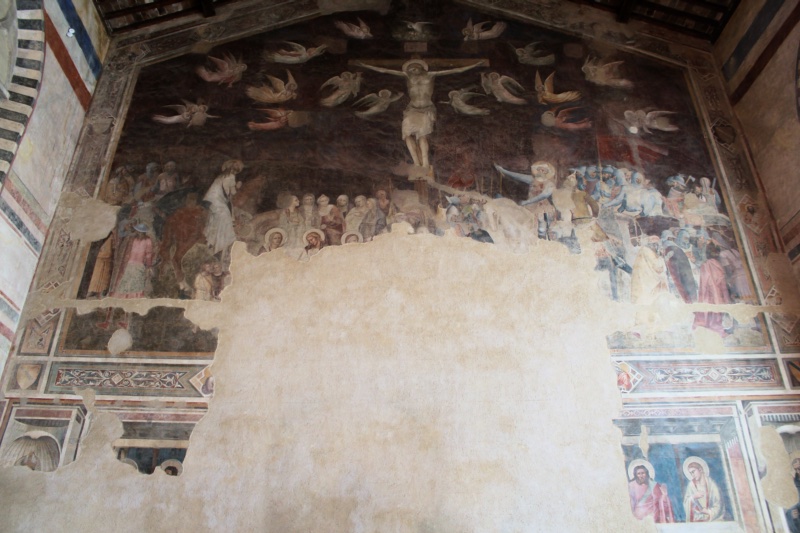
The painting occupies the entire east wall of a single great room roofed with open trusses — the only interior of the first medieval convent to survive Brunelleschi’s fifteenth-century rebuilding. It is among the most extensive Trecento mural paintings still in existence, and it was conceived for the wall it occupies rather than adapted to it: the composition rises with the room, the Crucifixion filling the full height beneath the roof and the Supper laid out along the base at the level of the friars’ own tables.
The programme is the standard one of the Florentine cenacolo, and Santo Spirito and Santa Croce are the two oldest examples of it. The Last Supper below establishes the institution of the Eucharist; the Crucifixion above shows what the Eucharist commemorates. Friars eating in the room were placed, physically, at the lower end of a single continuous argument running from their own table to the cross. The rhetorical logic is thus vertical, and the Supper — for all that it names the room — is subordinate.
- The Crucifixion
Christ hangs alone on a tall cross set on the central axis, the body slender and pale against a vast field of dark red-brown, the head fallen to the right, the loincloth knotted at the hip. There are no thieves: this is the crowded Crucifixion without Calvary’s full complement, the same type as the lunette in the Cappella dell’Annunciazione at Santa Maria Novella, and here expanded to a scale that the small chapel could not accommodate.
The upper half of the field is given over to angels — more than a dozen, wheeling through the dark in every attitude of flight and grief, some plunging headlong, some with hands raised to their faces, their draperies streaming into long trails of rose, cream, ochre and pale blue. They occupy the sky as a swarm rather than as a symmetrical pair or quartet, and the effect is of continuous agitation surrounding a motionless centre.
Below, two great crowds press towards the foot of the cross. At the left are the mourners: a compact group of haloed heads, the Virgin among the holy women, with horsemen and armed men behind and a pale-robed figure standing above the group. At the right is the party of the soldiers and the officials — mailed figures, lances held vertically, a banner charged with a red cross, mounted men, and a dense file of heads receding towards the margin. Longinus with the lance, singled out in the descriptive literature, belongs to this side.
The chromatic effect of the whole is dominated by the deep red-brown ground, and it should be understood as accidental rather than intended. The Musei Civici Fiorentini state that this ground is the rosso morellone preparation laid to receive an application of azurite that has since been entirely lost. The sky was blue. What now reads as a sombre, almost nocturnal field was designed as its opposite, and every judgement about the “tragic” tonality of the fresco needs to be qualified accordingly.
- The Last Supper and the lacuna
Of the Supper almost nothing survives. The great pale rectangle occupying the centre and lower third of the wall is not decay but demolition: after the suppression of the religious corporations and the transfer of this wing to the Comune in 1868, the refectory was used as a tram depot, and the wall giving onto the piazza was opened, destroying the centre of the composition irreparably.
What remains lies at the two extremities. At the lower right, best preserved, are two apostles seated behind the table — an older bearded man with his hand raised in protest, a young beardless apostle with his hand to his breast — with their haloes executed in relief, and beyond them an Augustinian saint standing in a shell-headed niche. At the lower left a corresponding fragment preserves a second shell niche with the remains of a figure, and a further scrap of the setting below. Between them: nothing.
The two black-habited Augustinian saints framing the Supper are the wall’s institutional signature. They declare the order whose refectory this was, and they occupied the outer edges of the lower register as the angels occupy the upper reaches of the Crucifixion, closing the composition at both levels.
Running between the two registers is a broad ornamental band of white foliate scrollwork, and armorial shields are reported in the lower corners of the fresco [?, blazon and identify].
The wall has been referred to Orcagna since Ghiberti’s Commentarii and was reaffirmed in the modern literature by Pietro Toesca. It was subsequently doubted by several scholars before being restored with decision to the painter’s catalogue, notably by Padoa Rizzo and by Becherucci, who additionally recognised Nardo di Cione’s hand in the execution.
This is worth stressing because it distinguishes the wall from most of the Orcagna corpus. Elsewhere — the Santa Croce fragments, the Accademia Pentecost, the Alana tabernacle, the Rijksmuseum triptych — the painter’s name arrives late and is contested. Here it arrives in the fifteenth century, from a source who knew the Florentine tradition at first hand, and the modern argument has been about confirming an old ascription rather than about supplying one.
Saint Matthew and Four Scenes from His Life: The Pillar Altarpiece of the Arte del Cambio
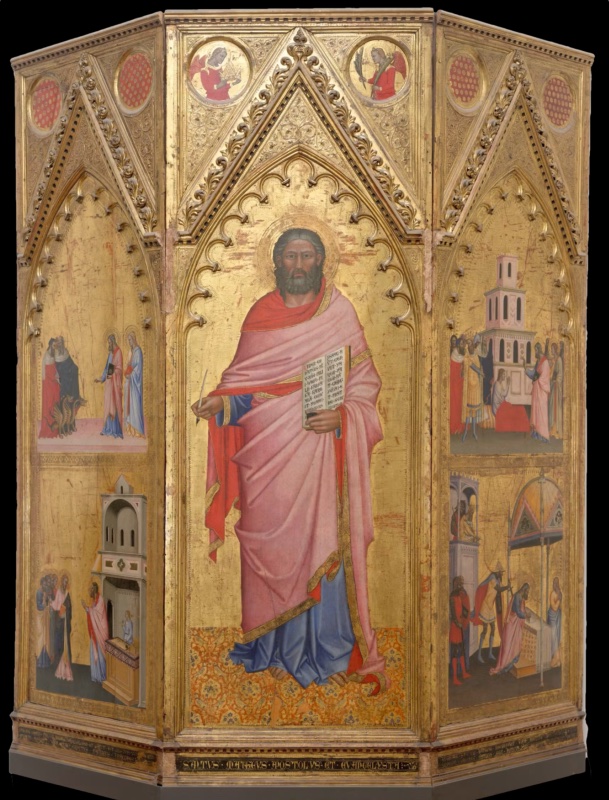
The most immediately arresting thing about this panel is its shape. It is not a flat triptych but a convex one: the two wings are angled forward from the central compartment, and the whole was built to wrap around one of the internal pillars of Orsanmichele. The base moulding follows the same polygonal plan, and the object was designed to be seen from an oblique approach as a worshipper moved through the loggia, never frontally in the way a museum image presents it.
This single fact explains a great deal. The wings are not subordinate flanking panels of the ordinary kind but two independently legible faces, each carrying two scenes stacked one above the other; the central saint is a fixed axis around which the narrative turns. The type is specific to Orsanmichele, where the guilds decorated the internal piers as they would later decorate the external niches with statues.
Saint Matthew was the patron of the money-changers, and the altarpiece was commissioned by the consuls of the Arte del Cambio. The guild’s presence is asserted in the ornament as well as in the subject: the four circular fields at the summit of the lateral panels, red strewn with gold, carry the guild’s arms. In a building that had begun as a grain market and was becoming the ceremonial church of the Florentine guilds, this is the visual language of corporate patronage.
The commission was awarded to Andrea on 15 July 1367 for a fee of forty florins, but the precise date is not uniformly given. By the following August the work was not finished, Andrea having declared himself gravely ill, and his younger brother Jacopo undertook before the consuls to complete the panels. The date recorded for Jacopo’s undertaking is 25 August 1368 — the same date usually given for Andrea’s death.
This, then, is the last work of Orcagna’s career, and quite possibly one he never touched.
- The central panel
Matthew stands full-length against gold, frontal and monumental, in a full pink mantle lined with red and edged with gold, over a light blue tunic. He holds a quill in his right hand and, in his left, an open codex whose text is the opening of his own Gospel — Liber generationis Iesu Christi filii David filii Abraham; Abraham genuit Isaac, Isaac autem genuit Iacob — the genealogy of Christ, written out in a Gothic bookhand across two columns and entirely legible.
The choice is pointed. The evangelist is shown not with a symbolic attribute but at the act of writing, and the words he displays are the ones that open the New Testament. Along the base of the central compartment runs the titulus: SANCTVS MATHEVS APOSTOLVS ET EVANGELISTA. Two angels in red occupy roundels in the spandrels of the central gable.
- The four narrative scenes
Reading order:
Left panel: read from bottom to top Right panel: read from top to bottom Each scene’s description appears at the bottom of the panel on which it is depicted
- The four episodes** (in medieval Latin, viewed head on)
Left panel:
- QUOMODO. SANTUS. MATHEUS. DECESSIT. DE. CHELONEO. ET. SECUTUS. EST. CRISTUM — Vocation of St Matthew
- QUOMODO. MISERŨT. SUP. EUM. SANCTUS. MATHEUS. DRACONES — St Matthew tames the two dragons of Vadabar
Right panel:
- QUOMODO. SANCTUS. MATHEUS. RESUSCITAVIT. UNUM. MORTUUM — St Matthew raises the son of King Egippus
- QUOMODO. SANCTUS. MATHEUS. FUIT. ACCISUS — Martyrdom of St Matthew
The panels on the pillars of Orsanmichele were removed in 1402. The triptych went first to the old hospital of San Matteo, then to the hospital church of Santa Maria Nuova, where it remained until 1860; it passed subsequently into the hospital’s picture gallery, which was acquired by the Uffizi in 1900.
The panel was recognised as Orcagna’s by Crowe and Cavalcaselle, who only afterwards connected it with the surviving documents. Gaetano Milanesi still gave it to Mariotto di Nardo in 1878 and corrected himself in 1885. Since then the Cionesque authorship has not been questioned; the argument has been entirely about the division of labour between Andrea, Jacopo and the workshop.
The gold ground is extensively scratched and abraded, with fine incised losses running across the field around the saint; the red bole shows through along the frame mouldings and at the junctions of the wings. Losses are visible at the inner edges of the lateral panels where the hinged or jointed members meet the centre. The figure of Matthew and the small narrative compartments are otherwise well preserved, retaining their modelling and much of the tooled ornament of the floor beneath the saint’s feet.
The critical question is how much of the work is Andrea’s. Kreytenberg’s position is uncompromising: given the burden of commissions and the gravity of his illness in 1367–68, it is very unlikely that Andrea produced even the design. He points to the triptych’s close stylistic affinity with the predella panels of Jacopo’s San Pier Maggiore polyptych, now divided among several museums, and with Jacopo’s Crucifixion in the National Gallery in London; on this reading the triptych represents not the terminus of Andrea’s development but the beginning of Jacopo’s independent career. Another line of argument, advanced in the 1970s and subsequently accepted by some Italian specialists, excludes Jacopo from the actual execution — holding that he intervened only to discharge the contractual obligation — and assigns the painting to an artist of his workshop known as the Master of the Ashmolean Predella. Older criticism, from Milanesi’s revised opinion of 1885 onward, treated the work as conceived by Andrea and executed by Jacopo, and this remains the compromise formula found on most labels.
The importance of the dispute lies in what the triptych looks like. Its layout — a large hieratic saint flanked by scenes from his life — is a conscious return to thirteenth-century models, and the gold ground and surface dominate to a degree unmatched in Andrea’s securely documented painting, with a marked reduction of both spatial and volumetric illusionism. Meiss took precisely this kind of retrospection as characteristic of art after the plague. If the triptych is Jacopo’s invention rather than Andrea’s, then the most archaising work in the traditional Orcagna corpus is evidence about the next generation, not about him — and, as Kreytenberg observes, the works of the 1360s that are his show a painter moving towards a freer, not a more rigid, formal language.
The Crucifixion with the Virgin, the Magdalene and Saint John: The Fresco of Santa Marta
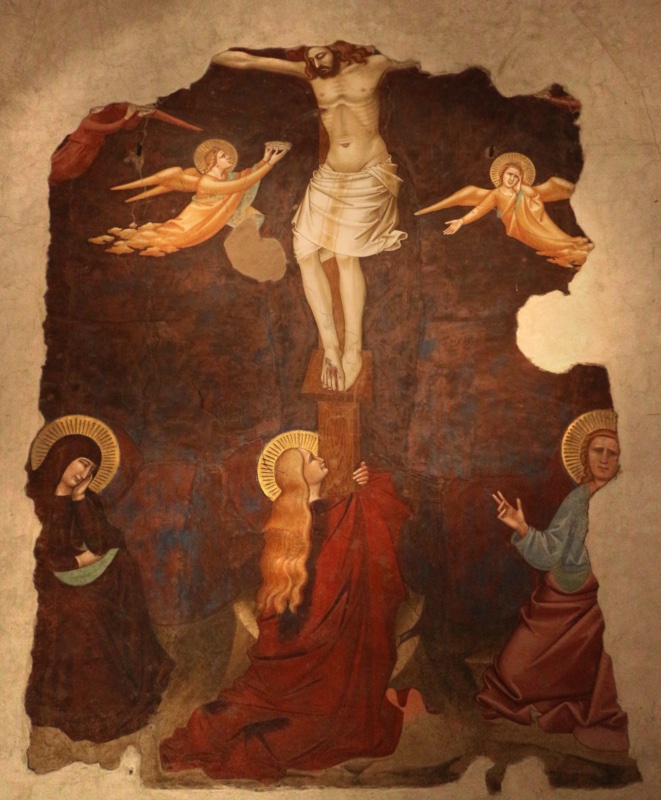
The fresco was found only in 1966, in a fragmentary state but well preserved in the parts that survive, beneath the altarpiece by Giovanni Battista Naldini which had covered it. The ragged silhouette visible today, with its two large lacunae at the right and the smaller loss at the centre left, is the shape of what emerged from under the later painting; the surrounding plaster has been left neutral rather than reintegrated.
The recovery matters for the history of the artist. Boskovits, writing in 1971 on Orcagna’s activity before the Strozzi altarpiece of 1357, treated the Santa Marta fresco as one of the most emblematic works of that phase, precisely because the echoes of Maso di Banco remain so evident in it. A work invisible before 1966 thus became, within five years, a pivot of the argument about Orcagna’s early formation.
The most striking feature is the reduction. Where the Santa Maria Novella lunette and the Santo Spirito refectory wall present crowded Crucifixions with dense masses of mourners, soldiers and horsemen, here there are four figures and nothing else. Christ hangs alone on the cross at the centre; the Virgin, the Magdalene and Saint John occupy the ground below; two angels fly in the upper field, with the fragmentary remains of a third at the upper left. There is no Golgotha, no crowd, no landscape — only a dark ground and the figures set upon it.
This is the devotional rather than the narrative Crucifixion, and its placement explains the choice: an image above the altar of an enclosed community, to be looked at daily and at length by a small number of women, needs concentration rather than incident.
Christ is elongated and pale, the ribs and sternum described with restraint, the head fallen forward against the right shoulder, the hair falling in heavy locks. The loincloth is a full white cloth with a knotted fall and broad shadowed folds — one of the finest passages of drapery painting in the fresco. The feet rest side by side upon a wooden suppedaneum rather than crossed one over the other, which makes this a four-nail Crucifixion; by the middle of the fourteenth century the three-nail type was dominant in Florence, and the retention of the older formula here is worth noting.
The two angels fly in from either side in orange draperies with gold haloes. The angel at the left holds out a shallow bowl to catch the blood from Christ’s right hand, in the Eucharistic gesture that connects the image directly to the altar beneath it; the angel at the right spreads her arms and brings one hand to her breast. Both are cut by losses at the lower edge, where they had been supported on small ledges of cloud.
The Virgin, at the lower left, is seated on the ground, her head sunk and supported on her right hand, in a dark mantle over a green gown. The pose is the ancient one of mourning — the seated, hand-to-cheek figure of grief — and its restraint contrasts sharply with the swooning Virgin of the Cappella dell’Annunciazione.
The Magdalene kneels at the foot of the cross in a deep red mantle, her long golden hair unbound over her shoulders and back, her hands raised towards the wood, her face lifted. She is the pictorial centre of the lower zone, and it is this figure that has been compared in the literature with the Magdalene of the Cappella dell’Annunciazione at Santa Maria Novella — a comparison worth pursuing directly, since it bears on the relative chronology of the two works.
Saint John, at the lower right, kneels in a blue-grey tunic and dark red mantle, his hands raised and open, his head turned upward towards Christ, the face drawn with an unguarded and almost childlike distress.
The ICCD description identifies what is most distinctive here: a chromatic range that is restrained rather than varied, enlivened by a light that envelops the figures at the foot of the cross and is reflected with particular intensity in the gilded haloes that frame their faces. The observation is exact. The four haloes — punched or incised with radiating rays and gilded — are the brightest things in the fresco, and they function as sources rather than as attributes, throwing the faces they surround into relief against the dark field.
That dark field is once again a deep red-brown flecked with surviving blue, and the same reading applies here as at Santo Spirito: the probability is high that one is looking at the rosso morellone preparation for an azurite sky now lost, and that the sombre tonality looks like a condition rather than an intention.
The monastery was established by the testamentary provision of the merchant Lottieri Davanzati and assigned to the Umiliate; the sources give the foundation variously as 1336, with the community installed under Lotta Acciaiuoli in 1343, and as 1350. The Umiliate were replaced by Camaldolese4 nuns after the suppression of their order in 1571. If the earlier foundation dates are correct, the fresco belongs to the first decades of the house.
The Crucifixion: The Pinnacle of a Camaldolese Altarpiece
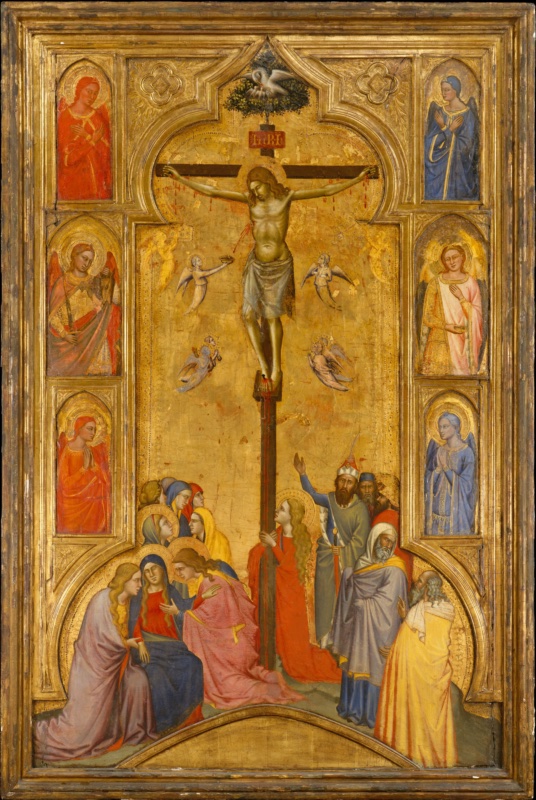
The Crucifixion panel was originally the central pinnacle of an altarpiece — the peaked compartment set above the main tier, not an independent picture. Its shape declares this: the field rises to a cusped ogee arch and is cut at the bottom by an inverted arch, the profile of a pinnacle designed to sit over the crown of the panel below. The six small half-length angels ranged three to a side belong to a different element again; the Met describes them as having formed pilasters of the same altarpiece, while other scholarship holds that they were probably pinnacles from another altarpiece entirely. Their present disposition, framed symmetrically around the Crucifixion, is a nineteenth-century collector’s reconfiguration and reflects nothing about the original arrangement.
The dimensions in the caption therefore measure a Victorian assembly, not a Trecento object.
The altarpiece was probably painted for Santa Maria degli Angeli, the Camaldolese house of Florence, and perhaps for the chapel founded there in 1365 and dedicated to Ognissanti, endowed by Ser Francesco di Ser Berto degli Albizzi. The Cione brothers, and Nardo in particular, were involved in several commissions for that monastery.
The name attached to the panel in the gallery derives from Robert Lehman’s 1928 catalogue of his father’s collection, where the attribution to Orcagna and assistants was proposed; the Museum continues to exhibit it under that name. The alternatives are numerous and none is idle. The commission may have been given to Nardo in 1365 and taken over by Jacopo after Nardo’s death in 1366 — a sequence that would explain a divided execution without invoking Andrea at all. Don Silvestro dei Gherarducci, painter and illuminator of Santa Maria degli Angeli itself, has also been proposed, which has the merit of placing the hand inside the house that commissioned the work.
The angels are given by the Museum to Jacopo.
- Composition
Christ hangs at the centre of a gold field, alone, the body golden-brown and slender, the head fallen forward, the loincloth a pale blue-grey cloth knotted at the hip. The titulus is a small red tablet lettered INRI. Above the head of the cross, set within a dark mass of green foliage, a white pelican rends her own breast to feed her young — the standard Christological emblem of self-sacrifice, and one that makes the Eucharistic reading of the panel explicit.
Blood is the organising motif. It falls in long red threads from both hands, springs from the wound in the side, and runs from the pierced feet in a heavy stream down the whole shaft of the cross to the ground, where the Magdalene kneels in it. Four small angels attend: two above, one catching the blood of the side wound in a shallow bowl and one at the right hand; two below, hovering in blue and rose with hands raised in mourning. Further angels survive only as ghosts in the gold, their pigment lost.
Below, the composition divides into two groups on either side of the cross, as in the crowded Crucifixions of the Cione workshop generally. At the left the Virgin collapses backward, supported by the holy women, with a young haloed figure in rose bending over her; a woman in pale mauve kneels at the far left, and behind them a file of women’s heads recedes. At the right stand the elders and officials: a bearded man in a pointed cap raises his arm in argument, others crowd behind in turbans and hats, and an old man in yellow is seen from behind at the lower right, a repoussoir closing the group. Between the two, at the very foot of the cross, the Magdalene kneels in red with her arms about the shaft and her face turned up.
- The angels of the frame
The six panels each contain a haloed angel at half length against gold, alternating red and blue in the upper and lower pairs. The two at the centre are larger and more elaborate: at the left an angel in armour holding a sword; at the right an angel in salmon and white holding a small vessel. Whether these are archangels with attributes — Michael with the sword, and a companion whose vessel might indicate Raphael.
The panel’s modern history runs through some of the founding figures of the taste for Italian primitives: William Young Ottley, then Sir Charles Eastlake, then briefly Roger Fry, before its acquisition around 1913 by Philip Lehman. It passed to his son Robert, whose collection came to the Metropolitan Museum in 1969. The reconfiguration of pinnacle and pilaster panels into a single framed unit belongs somewhere in that nineteenth-century sequence.
The Throne of Grace: A Florentine Panel of the Trinity
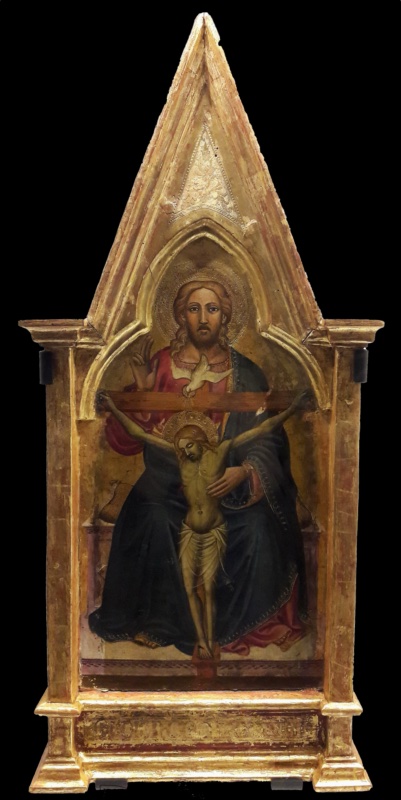
The Thronus Gratiae — the Throne of Grace, or in the German literature the Gnadenstuhl — is the Trinitarian formula in which God the Father, enthroned and frontal, holds before him the cross on which the Son hangs, while the dove of the Holy Spirit descends between them. The name derives from the exhortation of Hebrews 4:16 to approach the throne of grace with confidence, and the type emerged in twelfth-century France before spreading across northern Europe, where it became the dominant image of the Trinity.
Its comparative rarity in Trecento Italy is what makes this panel interesting. The closest parallel, and it is very close indeed, is Nardo di Cione’s Trinity in the Galleria dell’Accademia in Florence — a correspondence that argues for a shared workshop model rather than independent invention, and that ties this panel firmly into the Cione orbit whatever one concludes about the individual hand.
The theological content of the type deserves stating, because it is not merely a picture of three persons. It presents the Trinity through the Passion: the Father does not merely preside over the sacrifice but holds it out towards the beholder, and the Spirit proceeds visibly between the two. It is an image of the economy of salvation rather than of the Godhead at rest, and it belongs in front of an altar or in a private oratory, where the cross displayed is the same cross the viewer is asked to contemplate.
- The panel
The object is shaped as a miniature building. A steep gable, its field tooled with a foliate pattern within an incised triangle, rises above a cusped ogee arch; flat pilasters carry a projecting cornice at either side; the whole stands on a moulded plinth. The frame is engaged, carved from the same structure as the panel, and heavily abraded, with the red bole and in places the bare gesso showing through the gilding.
The Father occupies almost the entire field. He is shown as a mature bearded man with long parted hair — the Father given the features of the Son, in the medieval convention that avoided depicting him otherwise — with a broad halo punched with rays and rosettes. He wears a red robe beneath a dark blue-green mantle whose folds fall in heavy vertical masses on either side of the composition; a red cushion and the suggestion of a throne arm are visible behind at the right. His right hand is raised in blessing with two fingers extended; his other hand emerges from the mantle at the right to rest against the Son’s side.
The cross passes horizontally across the Father’s breast, its arms reaching almost the full width of the panel. The crucified Christ hangs from it at a markedly smaller scale, the head fallen forward, the body slight, the loincloth a pale cloth knotted at the hip. The dove descends between the Father’s face and the Son’s head, wings spread, with fine rays issuing towards the crucified body.
The disparity of scale between the two figures is not a failure of proportion but the point of the type: the Son is held, offered, presented — a thing displayed rather than a person seated.
The panel is much rubbed. The gilding of the frame is worn across every raised member; the gold ground survives unevenly. Most tellingly, the flesh of the crucified Christ now reads as distinctly green: this is the verdaccio underpaint showing through where the pink surface modelling has abraded away, a standard and diagnostic form of loss in Trecento tempera, and not an intended morbid colouring. Descriptions that treat the greenish flesh as expressive should be resisted. A long vertical split or join is visible through the cross-arm at the right.
The name of Orcagna is attached to the panel in the reference literature, so two cautions are worth stating. First, the closeness to Nardo’s Accademia Trinity means that the panel could as easily belong to Nardo or to the shared workshop as to Andrea, and the Cione brothers’ production is precisely the area in which such distinctions are least secure. Second, a work on deposit from a private collection has usually not passed through the scrutiny that a museum acquisition attracts.
What “Orcagnesque” Means
Orcagna’s importance for Florentine painting after 1350 was institutional as much as artistic. He ran the largest and best-connected workshop in the city, employing numerous assistants and collaborators, and the products of that shop and its satellites — conventionally grouped as orcagneschi or cioneschi — dominate the Florentine altarpiece for the rest of the century.
Yet the family resemblance is deceptive. Two observations recur in the literature. The first is that the painters of the later Trecento generally absorbed the manner of Nardo, or of Jacopo, more readily than Andrea’s own: Nardo’s lyrical vein, poetic sensibility and soft, colouristically differentiated modelling proved easier to imitate than Andrea’s angular severity. The second is that the diffusion of an “Orcagnesque” idiom has repeatedly caused works to be assigned to Andrea that belong to his brothers or to anonymous shop hands.
The disentangling of this material is the achievement of connoisseurship, and above all of Richard Offner, whose Critical and Historical Corpus of Florentine Painting devoted a full volume of its fourth section to Andrea di Cione as painter. Offner’s method — the patient comparison of morphological detail, of the drawing of hands, ears and eyelids, of the handling of drapery folds and of punched ornament — produced a series of reassignments that materially reduced Andrea’s corpus. Among the most consequential was his transfer, in the 1920s, of two panels of St John the Baptist and St Paul at Yale from Orcagna to Nardo. That judgement stood unchallenged for eighty years until a specialist re-examination in 2004 restored the Baptist to Andrea while leaving the Paul with Nardo, a division maintained in the 2023 catalogue of the Yale collection. The episode is characteristic of the field: attributions in the Cione orbit are provisional, they oscillate, and they oscillate slowly.
The same instability affects works in other collections. A Madonna of Humility in Washington, long catalogued as Orcagna and later as a joint work of Andrea and Jacopo, is now given to Jacopo alone; Kreytenberg himself published a paper on its attribution and iconography in 1990, and had earlier proposed that another Madonna of Humility might be Andrea’s latest surviving work. Panels from the same dispersed altarpieces turn up in London, New York, Oxford and elsewhere, their attributions shifting with each new catalogue.
The practical consequence for anyone approaching Orcagna is that the secure corpus is very small: the Strozzi altarpiece; the Orsanmichele tabernacle, with the qualification that much of its carving is by assistants; the Santa Croce fragments, on the strength of Ghiberti’s testimony; and a group of frescoes and panels held with varying degrees of confidence. Almost everything else is negotiable.
Historiography: Meiss and After
No account of Orcagna can avoid the interpretative framework erected around him in the twentieth century, and none should adopt it uncritically.
In Painting in Florence and Siena after the Black Death, published in 1951, Millard Meiss argued that Tuscan society understood the calamities of the mid-Trecento — plague, banking collapse, famine, political upheaval — as divine punishment for worldliness, and that this understanding produced a rejection of the human-centred, naturalistic pictorial style of the early fourteenth century in favour of a revival of the spiritually centred, abstract manner of the Dugento. His book opens with Orcagna’s Strozzi altarpiece; his second principal exhibit was the Triumph of Death in the Camposanto at Pisa, which he attributed to Francesco Traini. The chapter headings of the first section — “From narrative to ritual,” “Exaltation of God, the Church and the priest,” “The supernatural,” “Recovery of the Dugento” — state the thesis in miniature.
The book’s influence was enormous and, in one respect, deserved: it treated style as historically caused rather than merely described, and it integrated connoisseurship, iconography, social history and religious literature in a way that few art-historical monographs had attempted. For a generation it was the paradigm within which Trecento specialists worked, and it remains the reason most educated readers encounter Orcagna’s name at all.
The criticisms began early — a sceptical review appeared in The Art Bulletin the following year — and accumulated in three waves.
The first, gathering in the 1970s, questioned whether the stylistic change had occurred at all in the terms Meiss described. A 1975 study of Florentine painting on the eve of the Renaissance and a 1979 study of Sienese painting of 1330–70 both argued that the supposed mid-century rupture dissolved on close inspection of the actual sequence of works.
The second accepted that something changed but rejected Meiss’s explanation. A 1979 contribution to a survey of Italian art-historical method proposed that the change reflected a younger generation’s reverence for the “golden age” of earlier masters. A 1981 article in Art History attributed it to changing demographics and patterns of patronage rather than to a spiritual crisis. A 1997 reassessment of painting in the age of Giotto offered the deflating explanation that artistically weaker painters were repeating aspects of earlier models. A 2007 monograph on Sienese painting after the plague argued for a “pluralistic” artistic culture in which continuity and change were held in deliberate balance, and located the cause in altered workshop organisation and a new art market rather than in penitential religiosity.
The third and most damaging line of attack was not interpretative but factual. Meiss’s Pisan exhibit has been reassigned. The Camposanto Triumph of Death is now generally given to Buonamico Buffalmacco and dated before 1348, on the arguments of the 1974 monograph mentioned above. If that is right, then one of the two pillars of the thesis is neither by the painter Meiss named nor a response to the event he invoked. Meanwhile the dating of Orcagna’s own Santa Croce Triumph of Death remains unresolved between roughly 1345 and roughly 1365, which means it cannot be used to settle the question either way.
A fourth observation, less often made, concerns the internal evidence of Orcagna’s own career. The Strozzi altarpiece dates from 1354–57, six to nine years after the plague, and its most conspicuous “archaisms” — the frontal visionary Christ, the Traditio legis type, the emphasis on doctrine and priesthood — are demanded by a chapel dedicated to Thomas Aquinas in the mother house of Florentine Dominican theology. An iconographic programme dictated by a specific patron and a specific dedication is weak evidence for a general shift in collective sensibility. And the works of the 1360s, on Kreytenberg’s reading, show Andrea moving towards a freer formal language, not a more rigid one; the rigid, gold-dominated, thirteenth-century-inflected St Matthew triptych, so often cited as the endpoint of his development, may well belong to Jacopo.
Kreytenberg proposes a different interpretative frame, drawn from a 1986 study of the meaning of central perspective. On this account Orcagna’s significance lies in his having given form to two opposed spiritual currents — a Franciscan narrative painting saturated with realism and spatiality, and a Dominican devotional and conceptual art that reaches back with some deliberation to the Dugento tradition. Whether or not one accepts the confessional neatness of the scheme, it has the merit of explaining why an artist could paint the earthquake at Santa Croce and the Christ of the Strozzi Chapel without inconsistency: they answer to different orders, different patrons and different purposes.
The prudent conclusion is that Meiss’s book should be read as the great statement of a problem rather than its solution. Something does change in Tuscan painting around the middle of the century. Where the agency lies — in the workshops, in the patrons, in the culture at large — remains genuinely undecided, and given the scarcity of first-person documentation it may remain so.
Afterlife and Modern Recovery
Orcagna’s posthumous reputation followed the curve of his misattributions. Through the sixteenth, seventeenth and eighteenth centuries he was, on Vasari’s authority, the painter of the Camposanto and the architect of the Loggia — a figure of the first rank, discussed by Bocchi, Del Migliore, Baldinucci, Richa, Della Valle and Lanzi. The nineteenth century began the correction and, characteristically, also the celebration: a formal Elogio d’Andrea Orcagna was published in Florence in 1816, and by the 1820s German scholarship had begun the critical reassessment of the corpus. The decisive work was archival. Documents relating to his activity at Orvieto were published in 1859; Crowe and Cavalcaselle reorganised the corpus in 1864; the great Orvietan documentary volume appeared in 1891; further Florentine documents were published in 1901. By the early twentieth century the documentary spine set out in section III above was substantially in place, and the Camposanto and the Loggia had begun to detach themselves from his name.
The twentieth century added recovery of a different kind. The Santa Croce fragments were retrieved in 1911 and 1942; the thirty-five quatrefoils in the vault of the cappella maggiore of Santa Maria Novella emerged in 1940; fragments of the Santo Spirito refectory were saved during restorations between 1938 and 1944; the Expulsion of the Duke of Athens was detached and conserved in 1964. The 1966 flood then damaged much of what had been recovered at Santa Croce and Santo Spirito. The Orcagna available to a visitor today is therefore, to an unusual degree, a product of twentieth-century salvage, and the physical condition of nearly everything except the Strozzi altarpiece and the tabernacle is poor.
Conclusion
Andrea di Cione was not the pivotal figure of a spiritual crisis, and he was not the archaising reactionary of the standard account. He was something less dramatic and, on the evidence, more interesting: the most institutionally central artist in Florence in the third quarter of the fourteenth century, a painter who took on the direction of a major sculptural workshop and a cathedral fabric, and who carried into stone a conception of relief formed by painting — signing his one great work of sculpture, pointedly, as pictor.
His formal project, as far as it can be reconstructed from the two signed works, was the pursuit of an equilibrium: between the assertion of the picture plane and the description of space, between the abstraction proper to a theophany and the plastic weight proper to a body, between frame and image, between the flat gold of heaven and the receding floor of the predella. That equilibrium was struck differently in each work, and the results range from the visionary frontality of the Strozzi Christ to the crowded, almost claustrophobic realism of the Dormition relief.
What has obscured this is partly the accident of survival — the loss of the Orvieto mosaics, the Orsanmichele Madonna, the Santissima Annunziata chapels, the greater part of Santa Croce and Santo Spirito — and partly the long shadow of two powerful writers. Vasari gave him works he did not make; Meiss gave him a meaning he may not have carried. Removing both leaves a body of work small enough to be examined closely and coherent enough to reward the examination.
It also leaves a set of questions that are still open, and which any serious study of the artist must confront rather than conceal: when the Santa Croce murals were painted; how much of the St Matthew triptych, if any, is his; whether the Santo Spirito refectory frescoes are his at all; how far he was responsible for the Orvieto rose window; and where, in the long series of Florentine altarpieces of the later Trecento, his hand ends and his brothers’ begin. The answers have changed more than once in the last century, and there is no reason to assume they have finished changing.