Allegretto Nuzi
( 25% )
Introduction: A Provincial Master and the Confluence of Tuscan Currents
Allegretto Nuzi — recorded in documents and on his own panels as Allegretto di Nuzio, Allegrittus Nuttii, and Allegritus de Fabriano — occupies a singular position in the history of fourteenth-century Italian painting. Born at Fabriano, in the mountainous interior of the Marche, around 1315–1320 (the National Gallery of Art’s systematic catalogue and the Kress Foundation give the birth range as 1316–1320, and his death as 1373 or 1373/1374, while Italian scholarship conventionally cites “Fabriano, 1315 circa – 1373”), he was at once a provincial artist and a cosmopolitan one: a painter whose formation drew on the two dominant schools of the Tuscan Trecento, Florence and Siena, and who then transplanted that synthesis into the Adriatic hinterland, where it took root and flowered into a genuine local school. If the Marche possessed, before the middle of the fourteenth century, only sporadic and anonymous traces of monumental painting, it was Allegretto who gave the region its first artistic personality of enduring consequence, the figure around whom a recognisable “Fabrianese school” crystallised and from whose achievement the line runs, across two generations, to Gentile da Fabriano and the splendours of the International Gothic.
The essential paradox of Allegretto’s career is that his greatness is inseparable from his provinciality. He was not an innovator in the sense that Giotto or Ambrogio Lorenzetti were innovators; his historical importance, as one of his earliest modern biographers observed, rarely transcends the “communal glory” of his native city and the merit of having disseminated Tuscan forms across the Apennine watershed. And yet, precisely because he stood at the meeting point of currents — Florentine plasticity and Sienese line, Riminese Giottism and, in his final years, an incipient Venetian decorativism — his oeuvre offers an unusually legible cross-section of the artistic geography of the mid-Trecento. He absorbed the monumental gravity of Maso di Banco and Bernardo Daddi, the tender expressivity of the Lorenzetti, and the ornamental sumptuousness that would become the hallmark of the courtly Gothic; and he fused these into a language of his own, at once grave and decorative, plastically weighty and increasingly linear, capable of both the grand altarpiece and the intimate devotional panel.
This essay seeks to reconstruct Allegretto Nuzi’s life, work and afterlife on the basis of primary documents — his 1346 enrolment in the Florentine painters’ confraternity, the scatter of notarial records that place him back in Fabriano, and his testament of 1373 — and of the most authoritative secondary scholarship. In keeping with the principle that uncertainty should be named rather than smoothed over, particular attention is paid throughout to the points at which the evidence is fragmentary, the attributions disputed, or the dates in conflict. The catalogue of his securely dated works, fortunately, is comparatively rich for a fourteenth-century provincial master: a series of dated panels, several of them signed, provides a firm chronological armature onto which the larger body of attributed works, and the great fresco cycles of Fabriano, may be fastened.
Fabriano in the Fourteenth Century: Paper, Piety and Patronage
To understand Allegretto Nuzi one must first understand Fabriano, the town that made him and that he, in turn, made famous. Nestled in the Esino valley among the foothills of the central Apennines, Fabriano in the thirteenth and fourteenth centuries was no sleepy mountain settlement but a prosperous and technologically precocious commune, and the source of its wealth was paper. The earliest surviving evidence of the industry is a parchment document of 1264, preserved today at Matelica, recording the neighbouring municipality’s purchase of Fabriano-made paper for its official acts — sized with animal gelatine and made from hemp and linen rags — and by the late thirteenth century the town had become the leading centre of paper manufacture in medieval Europe. Fabriano’s rise rested on three documented technical innovations that transformed the economics and quality of European papermaking: animal-gelatine sizing, the watermark, and the multiple (water-powered) hammer mill for macerating rags into pulp. These gave Fabriano a near-monopoly on high-quality paper that would endure for centuries, and would furnish the sheets prized by merchants, princes and popes across the Mediterranean world. The first documentary reference to professional papermakers in a Fabriano notarial register dates to 1282.
The prosperity generated by paper, alongside a substantial wool industry, underwrote a communal society of considerable sophistication. By the thirteenth century the government of Fabriano had evolved from seigneurial rule by noble families into a republican commune administered through established guilds; a public act of 1278 lists twelve artisan corporations, among which the merchants and the wool-workers were dominant. Crucially, the Marche belonged to the Papal States, and the town’s prosperity was played out against the backdrop of papal overlordship, ecclesiastical patronage and the intense devotional life of the mendicant orders. The great churches of Fabriano — the cathedral of San Venanzio, San Domenico (later Santa Lucia Novella), Sant’Agostino, Santa Lucia — were the theatres of that devotional life, and it was for them, and for the confraternities and religious houses attached to them, that Allegretto would produce his frescoes and altarpieces. A society wealthy enough to prize luxury, pious enough to demand a constant supply of sacred images, and mercantile enough to be plugged into wider currents of exchange: this was the milieu in which Allegretto’s art of gold and colour found its natural audience.
Yet before Allegretto, the artistic record of Fabriano is thin and largely anonymous. Scholarship has identified a handful of shadowy but distinctive personalities active in and around the town in the first half of the Trecento. The most important of these is the so-called Master of Campodonico, named for the frescoes — a Crucifixion and other scenes — in the Benedictine abbey of San Biagio in Caprile at Campodonico, and also known as the Master of San Biagio in Caprile. Active in the second quarter of the century — his only dated work is the Crucifixion of 1345 — this anonymous master was an interpreter of the Giottesque tradition of unusual power and formal control, described by the art historian Luigi Serra as “the highest expression of the Giottesque tradition in the Marchigian sphere”; the plasticity and sculptural volume of his figures, and the refined lapidary inscriptions in his works, have even led to the suggestion that he was a miniaturist and sculptor as well as a painter.
Alongside him stand the Master of Sant’Emiliano — whose Maestà from Sant’Emiliano in Congiuntoli is now in Fabriano’s civic gallery — and the anonymous fresco painter of San Biagio in Caprile, figures who together laid the foundations of what would become the Fabrianese school. It was through such local intermediaries, according to one strand of scholarship, that echoes of Sienese art, and specifically of Ambrogio Lorenzetti, first reached Fabriano, preparing the ground for Allegretto’s own more direct engagement with Tuscan painting. The town also lay open to the Riminese Giottesque painters then active across the Marche, so that the young Allegretto grew up in an environment already saturated, if at second hand, with the achievements of the central-Italian mainstream.
The Biography and the Documents: A Life Reconstructed
The documentary record of Allegretto Nuzi, while incomplete, is unusually informative for a provincial painter of his generation, and it anchors what would otherwise be a purely stylistic reconstruction. The point of departure is his birth at Fabriano, placed by scholarly consensus around 1315–1320. That he was a native of Fabriano is not in doubt: he signed several of his works “Allegritus de Fabriano,” proclaiming his origin, and the family name derived from his father, Nuzio (a diminutive of a longer baptismal name), so that “Allegretto di Nuzio” means simply “Allegretto, son of Nuzio.”
The first firm date in his biography is 1346, and it locates him not in Fabriano but in Florence. In that year he enrolled in the Compagnia di San Luca, the lay confraternity of Florentine painters, and his name also appears in the register of foreign members of the Arte dei Medici e Speziali, the guild that incorporated painters. The transcription of these Florentine records was published by the scholar Ugo Procacci in his 1961 study “Il primo ricordo di Giovanni da Milano a Firenze” (the relevant notice appears on page 65). What makes the entry especially revealing is the form of the name: “Allegrettus Nuccii de Senis” — Allegretto, son of Nuccio, “of Siena.” The designation “de Senis” has generated considerable discussion. It cannot mean that Allegretto was Sienese by birth, for his Fabrianese origin is otherwise secure; the most economical explanation, widely accepted, is that he arrived in Florence after a formative period spent in Siena, so that the Florentine authorities registered him according to his most recent place of residence. This documentary hint of a Sienese sojourn dovetails precisely with the profound imprint of Sienese art — above all of Ambrogio Lorenzetti — that pervades his mature painting.
Allegretto’s Florentine sojourn was not prolonged. He returned to Fabriano at the end of the 1340s — the recent scholarship of Andrea De Marchi and Matteo Mazzalupi dates the return firmly to 1347, from which year he is said to have worked continuously (“stabilmente”) at Fabriano until his death, while the older tradition represented by the Treccani Enciclopedia dell’Arte Medievale places the return around 1348 and links it explicitly to the flight from the Black Death.
Whichever year is preferred, notarial documents place him back in his native city in 1348 and 1350, and his name also appears, undated, in the register of a Fabriano confraternity begun in 1343 — a record published by Stefano Felicetti in his “Regesti documentari, 1299–1499” appended to the 1998 volume on the Master of Campodonico edited by Fabio Marcelli (the notice on page 215). From this point until his death, Allegretto worked principally at Fabriano and in the surrounding Marchigian centres — Macerata, Apiro, San Severino and others — producing altarpieces for churches and confraternities, small portable panels for private devotion, and extensive fresco cycles. Scholarship has suggested, on stylistic grounds, that he may have renewed his Florentine contacts in the 1350s, drawing closer to the flourishing workshop of Andrea Orcagna and his brother Nardo di Cione; some have even hypothesised a second Florentine journey around 1360. Whether or not he travelled again to Tuscany, the evidence of his panels makes clear that he remained in living dialogue with Florentine developments throughout his career.
The most poignant of the documents is the last. Allegretto’s testament was drawn up on 26 September 1373 at Fabriano, before the notary Diotisalvi di Bonaventura; it was first published by Anselmi in 1893. He died shortly afterwards, in any case before 20 November 1373, so that his death can be placed with precision between late September and late November of that year (some museum catalogues, allowing for the interval between the will and the settlement of his affairs, extend the possible death date into 1374, hence the occasional “1373/1374”). He was buried, according to a second study by Anselmi published in 1906, in the church of San Niccolò at Fabriano.
The substantive contents of the will — its bequests, its heirs, any endowment of a chapel or altar — are not reported in the standard reference literature, and in the absence of direct consultation of Anselmi’s 1893 transcription no claim about them can responsibly be made here. What the testament does establish beyond doubt is the terminus of a working life of nearly three decades in his native city. Two minor bibliographical discrepancies should be flagged for the specialist: the journal in which Anselmi published the will in 1893 is cited variously as the Archivio Storico Italiano and as the Archivio Storico dell’Arte, and the title of his 1906 essay appears as both “La data della morte…” and “L’anno della morte…”; the author, year and pagination are nonetheless consistent across these citations.
Around Allegretto there gathered, as around every successful Trecento master, a workshop and a family enterprise. The most important of his associates was his fellow Fabrianese Francescuccio di Cecco Ghissi, at once his pupil, emulator and occasional collaborator, whose independent activity is documented from 1359 to 1395. Equally significant for the reconstruction of his career is his documented professional association with the Florentine painter Puccio di Simone, with whom he collaborated on a major altarpiece destined for Fabriano — a partnership discussed in detail below. The extensive fresco cycles attributed to him in the churches of Fabriano were, the sources agree, executed with substantial workshop participation, and at least two or three additional hands besides Allegretto’s own have been distinguished within them.
Florentine Formation and Sienese Sensibility: The Making of a Style
The stylistic personality of Allegretto Nuzi is best understood as a controlled tension between two poles: the sculptural, space-making tradition of Florence and the linear, colouristic, ornamental tradition of Siena. His earliest surviving works reveal a painter steeped in the Florentine idiom of the second quarter of the century. The foundational Florentine component of his art derives, according to the systematic scholarship, essentially from Maso di Banco — the gravest and most monumental of Giotto’s immediate followers — with a strong admixture of Bernardo Daddi, the Florentine master who had himself effected a graceful compromise between Giottesque volume and Sienese sweetness. From Daddi, Allegretto took the softly rounded contours, the tender exchanges of glance between Mother and Child, the intimate scale of the portable tabernacle; from Maso, the sense of figures possessing real weight and occupying real space.
To this Florentine foundation Allegretto joined, from the outset, an intimate familiarity with Sienese painting, and specifically with the art of the Lorenzetti brothers, Pietro and Ambrogio. The documentary suggestion that he had spent time in Siena before 1346 is fully borne out by the character of his work, in which the influence of Ambrogio Lorenzetti is, in the words of his principal twentieth-century biographer, “dominant throughout the whole activity of the Fabrianese.” From Ambrogio came the softly modelled, gently melancholic faces, the caressing line, and above all the love of richly patterned textiles and ornamental surface that would grow ever more pronounced as Allegretto matured. His art is thus a personal resolution of the great dialectic of the Tuscan Trecento — the Florentine-Sienese synthesis that Daddi had pioneered and that Allegretto carried across the Apennines.
Around the middle of the 1350s a discernible shift occurs. Allegretto begins to move away from the Daddesque manner and to show a vivid interest in the art of Andrea Orcagna and Nardo di Cione, the brothers whose severe, hieratic, monumentally simplified style dominated Florentine painting in the aftermath of the Black Death. Orcagna’s Strozzi Altarpiece of 1357 in Santa Maria Novella has been invoked as the touchstone for the new gravity and iconic frontality of Allegretto’s mature figures, which emerge, in one modern formulation, “from a gold ground with sharp outlines, isolating them in a dimension of solemn and arcane sacredness.”
Yet even as he absorbed Orcagna’s monumentality, Allegretto increasingly subordinated it to a decorative impulse of his own. The plastic, space-making conception of the figure that he had learned in Florence gradually yielded, over the 1360s, to a flatter, more linear and more ornamental manner in which the modelling of form matters less than the play of pattern across the surface — the sumptuous brocades, the tooled and punched gold, the fantastical textiles woven with birds and other motifs. In his final years, some scholars have detected a further inflection: the penetration into the Marche of the Venetian painters Paolo and Lorenzo Veneziano, whose flat, richly decorative treatment of fabrics may have reinforced Allegretto’s own late linearism, prompting the hypothesis — advanced cautiously and never documented — of a journey into Veneto territory.
The Catalogue of Dated and Documented Works
The reconstruction of Allegretto’s artistic trajectory rests on a spine of dated works, several of them signed, and it is worth setting these out with care, for it is precisely in the dates and inscriptions that the discipline of primary evidence must be exercised most rigorously.
Allegretto Nuzi and Puccio di Simone, The Fabriano Triptych of 1354: Madonna and Child Enthroned with Saints and Angels, with Saints Anthony Abbot and Venantius
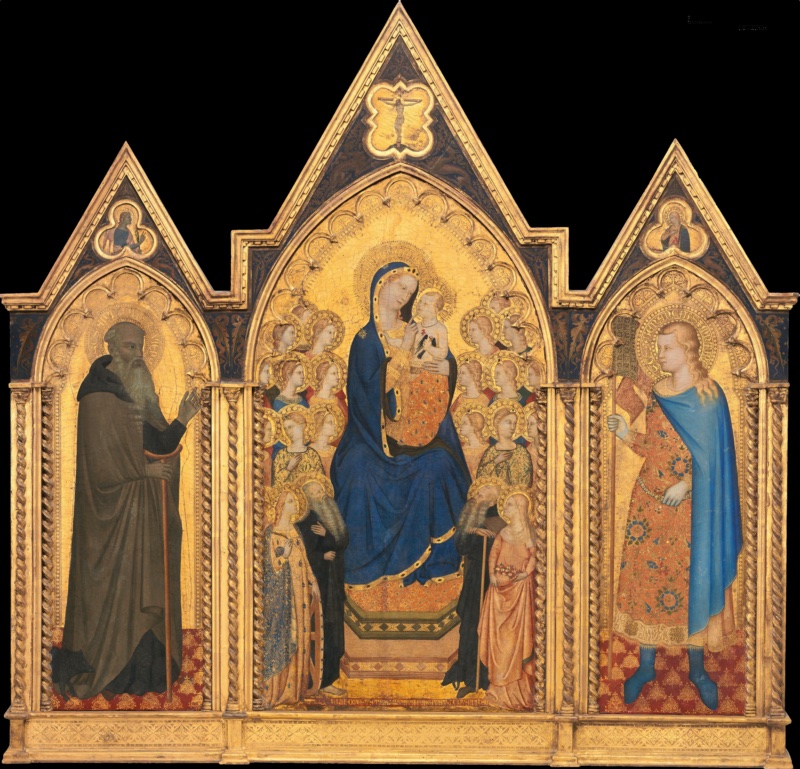
The first securely dated surviving work in which Allegretto Nuzi’s hand can be recognised is the triptych now in the National Gallery of Art in Washington, executed in 1354. This celebrated altarpiece was painted jointly by the Florentine Puccio di Simone and Allegretto Nuzi. Its central panel shows the Madonna and Child Enthroned with Four Saints and Eighteen Angels, flanked by lateral panels of Saint Anthony Abbot on the left and Saint Venantius on the right. The date 1354 is recorded, in partly damaged form, in the vernacular inscription along the lower edge of the central panel, which also preserves the name of the commissioning friar, “frate Giovanni.”
The collaboration is instructive. The two artists were not based in the same city: Puccio was among the leading painters of Florence, while Allegretto, after his Florentine sojourn, had returned to the Marche. The Florentine master was evidently called to Fabriano to work on an altarpiece for a church dedicated to Saint Anthony Abbot, who accordingly appears twice, in the left wing and among the saints gathered around the Virgin’s throne. According to the National Gallery of Art’s catalogue, Puccio painted the central panel and the right wing with Saint Venantius, while Allegretto’s contribution was the left wing with Saint Anthony. The Florentine painter was long known to scholarship only by the provisional name “Master of the Fabriano Altarpiece,” before that anonymous personality was identified with Puccio di Simone. Fifteen years later, Allegretto painted alone a practically identical version of the altarpiece, now in the Duomo of Macerata, for the church of Sant’Antonio Abate in that town. The inscriptions of both works name a commissioning friar called Giovanni, which suggests that the same Antonine patron commissioned both. The Washington triptych entered the collection of the American financier Andrew W. Mellon, having passed through the hands of the collector Carl Hamilton and the dealer Joseph Duveen, and came to the National Gallery of Art in 1937. On the strength of its left wing, the museum holds the cornerstone of Allegretto’s dated oeuvre.
Local Fabrianese sources report earlier dated works, namely panels in the church of Santa Lucia dated 1345 and 1349. These are lost, their inscriptions can no longer be verified, and the reliability of the reported dates cannot now be tested. In 1834 the antiquarian Amico Ricci tentatively identified the work of 1345 with a Madonna and Child Enthroned with Eight Angels formerly in the D’Abernon collection in London. Because that panel’s inscription is now illegible, however, the identification remains unprovable. A street tabernacle with a fresco of the Madonna and Child, formerly on the Via di San Filippo in Fabriano and now in the town’s Pinacoteca, may also date to around 1354. Its inscription too is lost, and the date recorded by local tradition appears to have been incorrectly transcribed. Such cases are salutary reminders of how much of the early record rests on testimony that can no longer be verified.
Left Panel: Saint Anthony Abbot
Saint Anthony Abbot, the father of Christian monasticism, stands alone beneath a cusped Gothic arch, set against a burnished gold ground. He is the elder of the two titular saints who frame the Virgin’s court. He is rendered as a venerable hermit with a long, flowing grey beard, and his face is furrowed and grave. His head is covered by the hood of a heavy brown habit whose dark cowl gathers around his shoulders. His body turns in three-quarter view toward the central panel, so that he becomes not an isolated devotional icon but a participant in the sacred conversation unfolding beside him. His gaze is fixed on the enthroned Virgin, and his whole figure is oriented toward her as an intercessor presenting the faithful to Christ and his Mother.
The saint’s gestures are economical and eloquent. His right hand is raised before his chest, with the fingers loosely opened in a gesture of address or witness that recalls the rhetorical language of Giottesque painting. His left hand grasps a tall staff with a curved handle, the traditional attribute of the aged hermit who supported himself in the Egyptian desert. The staff descends in a single, unbroken line to the ground, giving the composition a firm vertical axis that echoes the colonnettes of the frame. At the lower left, partly absorbed into the shadow of the habit, a small dark animal can be discerned: the pig that accompanies the saint in Western iconography. The motif alludes to his victory over the demonic, but also, more concretely, to the Hospital Brothers of Saint Anthony, whose pigs were permitted to roam freely through medieval towns to raise alms for the care of the sick. As the inscription on the halo makes explicit, it is precisely this Antonine saint whom the panel presents.
The figure possesses a monumental, almost architectonic weight that reveals how deeply Allegretto had absorbed the Florentine tradition during his years in Tuscany. The habit falls in broad, heavy folds whose volumes are modelled through gradations of brown and deep umber rather than through linear pattern. The body thus reads as a solid mass occupying real space, in the manner of Maso di Banco and Bernardo Daddi, whose works shaped the Marchigian painter’s early style. This severe, sculptural conception, with its restraint of colour and its avoidance of ornament on the garment itself, sets the Anthony panel apart from the richly brocaded Venantius on the opposite wing, painted by Puccio di Simone. The contrast between the two lateral figures thus makes the collaboration legible at a glance. The difference lies less in quality than in temperament: the Fabrianese painter’s grave, massive saint stands against the Florentine’s more graceful and ornate youth.
The head merits particular attention. The beard is built up with fine, fluid strokes of grey and white that evoke the texture of hair without dissolving the overall form. The flesh is modelled with the soft greenish underlayer characteristic of Tuscan tempera technique, over which warmer tones have been applied. The deep-set eyes, the heavy brows and the downturned mouth convey an ascetic seriousness appropriate to the desert father. In type, this head recalls the patriarchs and hermits of Bernardo Daddi’s workshop, from whose orbit both Puccio di Simone and the young Allegretto emerged.
Around the saint’s head, the gold of the halo is tooled with an inscription reading
.S[AN]C[TU]S.ANTONIVS.D[E].VIENA,
“Saint Anthony of Vienne.”
The lettering is incised and punched into the gold leaf within a circular band, surrounded by concentric rings of ornament. The epithet is more than a formula. It names the saint not simply as the Egyptian desert father but as the Anthony venerated at Saint-Antoine-en-Viennois, near Vienne in the Dauphiné, where his relics had been translated in the eleventh century. That shrine was also the mother house of the Hospital Brothers of Saint Anthony, whose hospitals cared for sufferers of ergotism, known as “Saint Anthony’s fire.”
The inscription therefore places the panel within the orbit of the Antonine cult, which by the fourteenth century had spread widely across Italy, and it strengthens the view that the altarpiece was connected with a church or altar under Anthony’s dedication. Inscribed haloes of this kind, common in Florentine painting of the period, also had a practical function, securing the identification of the figure for a congregation that might encounter the altarpiece from a distance. The tooling of the gold ground, with its punched and incised cusped arcading following the profile of the arch, displays the sophisticated goldsmith-like technique shared by the two painters.
Beneath the saint’s feet lies a red floor or carpet decorated with a gold pattern of small trefoils and lozenges. This device appears on both lateral panels and establishes a common ground plane for the two titular saints. It is at once a spatial indication, anchoring the figures on a stable surface, and an ornamental one, since the carpet evokes the precious textiles laid before altars and thrones. The motif also creates a chromatic link between the lateral panels and the red and orange tones of the central throne, contributing to the unity of the ensemble.
In the gable above the arch, within a trefoil medallion, appears the half-length figure of the Archangel Gabriel, holding a slender stem and turning toward the opposite wing. Together with the Annunciate Virgin in the corresponding gable of the right panel, he forms an Annunciation divided across the two wings. This arrangement, standard in Tuscan triptychs of the period, frames the whole altarpiece within the mystery of the Incarnation. The small figure is painted with a delicacy and brilliance of colour that contrasts with the sober brown of the saint below. The blue spandrels surrounding the medallion are enlivened with foliate ornament.
The frame, with its spiral colonnettes, pointed gable and moulded cornice, gives the panel the character of a small architectural shrine. Whether every element of the present engaged frame is original is a question that belongs to the technical literature on the object. The panel as a whole, however, exemplifies the refined articulation of the mid-Trecento polyptych, in which painting, carpentry and gilding combine to produce a unified sacred architecture. The austere presence of Saint Anthony in this setting, grave, monumental and turned in humble address toward the Virgin, provides the altarpiece with its note of monastic gravity.
Central Panel: Madonna and Child Enthroned with Four Saints and Eighteen Angels
The central panel, taller and broader than the lateral wings, presents the Virgin enthroned as Queen of Heaven, surrounded by a dense celestial court. Mary is seated frontally at the axis of the composition on a throne whose seat and back are covered with a cloth of orange-red brocade shot with gold. Its polygonal base, stepped and decorated with a band of geometric ornament, projects forward into the foreground. The composition follows the type of the Florentine Maestà as it had developed in the circle of Bernardo Daddi. In this type, the monumental enthroned Virgin is combined with a crowded, vertically stacked assembly of angels and saints that fills the gold field on either side and almost entirely conceals the throne’s architecture.
The Virgin wears a mantle of deep ultramarine, bordered with a band of gold, which envelops her head and falls in broad folds across her knees to the foot of the throne. A small gold star shines on her shoulder, the traditional emblem of Mary as Stella Maris. Beneath the mantle, a gold-embroidered garment is visible at the breast. Her head inclines gently toward the Child in an attitude of tender contemplation, and the long, oval face, with its narrow eyes and small mouth, conveys a reserved melancholy. Her halo, the largest and most elaborately tooled in the altarpiece, carries the inscription
.S[AN]C[T]A.MARIA.MATER.DEI.,
“Holy Mary, Mother of God.” The title Mater Dei, the Latin equivalent of the Theotokos affirmed at the Council of Ephesus, states in words what the image states in form: the woman enthroned at the centre is honoured because she bore God incarnate. The massive blue form of her body, unbroken by ornament apart from the gold border, is the chromatic and structural anchor of the entire altarpiece. It stands out against the gold ground and the multicoloured angelic host with remarkable clarity.
The Christ Child sits on his Mother’s left knee, dressed in a tunic of orange-red brocade that echoes the cloth of honour on the throne. He turns toward her and reaches up to her, while in his other hand he holds a small bird with black and red plumage: a goldfinch. His halo bears the letters IIS . XRO . M, an abbreviated form of the holy name. The first group corresponds to the familiar IHS, and XRO renders the Greek-derived monogram of Christus (usually written XPO, with the Greek rho transcribed here as a Latin R); the final M remains uncertain. In late medieval devotional imagery the goldfinch carried a Passion symbolism. According to legend, the red spot on its head recalled the blood of Christ, or the thorns of the crown that the goldfinch had tried to remove. The playful, childlike motif thus foreshadows the sacrifice depicted in the Crucifixion of the central gable directly above. In this way, a vertical theological axis runs through the panel, from the Incarnation embodied in the Child and named in his halo to the Passion accomplished on the Cross.
On either side of the throne the angels rise in tiers, their haloed heads arranged in rows that recede toward the upper part of the arch. Most turn in profile or three-quarter view toward the Virgin. Some are dressed in blue and red; others, in the lowest rows, wear tunics of gold and green brocade and cross their hands over the breast in adoration. The multiplication of heads and haloes produces a rhythmic, almost musical pattern across the gold field. Here the Florentine monumentality of the central group gives way to a decorative animation in which each halo becomes a small disc of tooled light.
In the foreground, flanking the throne, stand four saints. On the left, a young female saint accompanied by the spiked wheel of her martyrdom is identifiable as Saint Catherine of Alexandria. She wears a mantle of blue and gold richly patterned in the manner of an oriental silk. Beside her stands a bearded elder in a black habit with his hands joined, a monastic figure whose precise identity should be checked against the museum’s catalogue. On the right, a second bearded saint in a black habit leans on a tau-headed staff, the attribute of Saint Anthony Abbot, while a young female saint in a rose-coloured dress and white veil gathers roses in her skirt. The roses and the veil suggest Saint Elizabeth of Hungary, although this reading too requires verification. The four figures, smaller in scale than the Virgin, form a terrestrial choir that mediates between the viewer and the celestial court behind them.
The treatment of the gold is exceptionally refined. The cusped arcading punched along the inner profile of the arch, the finely tooled concentric bands of the Virgin’s halo, and the individually decorated haloes of the angels and saints together display the full repertory of Trecento gold technique. The brocades of the throne cloth, of the Child’s tunic and of the saints’ garments, rendered with gold beneath or over the paint, anticipate the love of sumptuous textile that would become a hallmark of Allegretto’s mature works in the Marche. This precious surface does not undermine the plastic gravity of the principal figures; rather, it surrounds and enhances it.
Along the lower edge of the painted field runs the inscription
[MCCC]LIIII.QUESTA TA[VOLA HA F]ATTA F[A]RE. FRATE GIOVANNI DA […],
recording that in 1354 Friar Giovanni had this panel made. Although damaged, it is one of the most important documents for the chronology of both painters. The hundreds of the date are lost, but the surviving LIIII, read together with the style of the painting and the careers of the two artists, admits only the reading 1354.
It is notable that the dedication is written in the vernacular rather than in Latin, a choice that addresses the altarpiece to a lay as well as a clerical public. The context of the commission, however, points in a clear direction. The altarpiece was made for a church dedicated to Saint Anthony Abbot, and the saint’s halo on the left wing names him as Anthony of Vienne, the patron of the Hospital Brothers of Saint Anthony.
A friar named Giovanni also appears in the inscription of Allegretto’s triptych of 1369, now in the Duomo of Macerata, which came from the church of Sant’Antonio Abate in that town. That coincidence led Bernard Berenson to suppose a common patron for the two works. His hypothesis has since gained considerable support from the recognition that the Macerata triptych is a practically identical version of the Washington altarpiece, repeating even the rare double representation of Saint Anthony. It therefore seems likely that the same Antonine friar commissioned both works fifteen years apart, and that the later altarpiece was deliberately modelled on the earlier one. Even so, in the absence of the lost toponym, the identity of the two patrons remains a strong probability rather than a documented fact.
In the central gable, within a gold quatrefoil set in a blue field, appears the crucified Christ. The small, pale body is suspended on the Cross against the gold with remarkable concision. The Crucifixion crowns the whole altarpiece and completes its programme: the Annunciation in the lateral gables announces the Incarnation, the enthroned Virgin and Child manifest it, and the Crucifixion reveals its redemptive purpose. The central panel is therefore not only the visual core of the triptych but also its theological summary, in which Florentine monumentality and Marchigian ornament unite in the service of a coherent devotional narrative.
Right Panel: Saint Venantius
Saint Venantius, the youthful martyr of Camerino and patron of Fabriano, stands beneath the cusped arch of the right wing as the civic counterpart to the monastic Saint Anthony. His presence is the most eloquent indication of the altarpiece’s Fabrianese destination. The cult of Venantius, who according to legend was martyred as a boy of fifteen under the emperor Decius, was deeply rooted in the Marche, and the cathedral of Fabriano bears his dedication. By placing him in a position of honour at the Virgin’s left hand, the patron integrated the universal hierarchy of the Maestà with the devotional identity of the local community.
The saint is represented as a beardless youth with long, wavy golden hair falling to his shoulders. His face is turned in three-quarter view toward the central panel. The features are delicate and slightly elongated, with a high forehead, narrow eyes and a small mouth, and the flesh is modelled in pale, luminous tones. The expression is serene and somewhat distant, conveying the idealised composure of the martyr rather than the psychological intensity of the elderly Anthony opposite. Around his head, a finely tooled halo bears the inscription
.S[AN]C[TU]S . VENANCIVS . M[A]RTIRI,
“Saint Venantius Martyr.”
The spelling Venancius, with c in place of t before the vowel, reflects ordinary medieval Latin orthography. The epithet martir stresses the claim on which his cult rested: his death for the faith as a youth under Decius. The inscription thus mirrors the halo of Saint Anthony on the opposite wing, and the two lettered haloes frame the Virgin’s court with a pair of named protectors, one monastic, the other civic.
In his right hand Venantius holds a tall staff bearing a banner, the standard of victory associated with the martyr and with the city that claimed him as protector. The banner is decorated with a lattice or chequered pattern in its upper section, over a red field below. It functions both as an attribute of triumph over death and as a heraldic reference to the civic realm. The staff rises parallel to the spiral colonnettes of the frame, balancing the long staff of Saint Anthony on the left wing, so that the two lateral figures correspond to each other in symmetrical opposition.
The saint’s costume is the most sumptuous element of the whole altarpiece. He wears a long tunic of orange-red brocade densely covered with gold patterning and punctuated by large blue rosettes, and its hem is bordered with a broad band of gold bearing ornamental lettering. Over his left shoulder falls a cloak of intense azure blue, which descends in long, simple folds to below the knees. His legs are clad in blue hose. The juxtaposition of the flat, glittering expanse of brocade with the smooth, luminous blue of the cloak produces an effect of extraordinary chromatic splendour. It contrasts sharply with the restrained brown of the Anthony panel.
The Saint Venantius is the work of Puccio di Simone, and it displays the refined decorative manner that the Florentine painter had developed in the orbit of Bernardo Daddi. The brocade of the tunic is conceived less as a modelled volume than as a precious surface spread across the body, and the elongated, slender proportions and the delicate modelling of the face give the figure a courtly elegance. Unusually for an altarpiece of this kind, the lateral saints are painted on a larger scale than the enthroned Madonna of the central panel, whose court of angels and saints is composed of numerous small figures. The juxtaposition of this polished Florentine youth with Allegretto’s austere Anthony on the left wing offers an instructive image of the encounter between the two painters. It is worth noting, finally, that the love of sumptuous textile displayed here would become a hallmark of Allegretto’s own mature works in the Marche. The collaboration with Puccio may have been one of the channels through which this taste reached him.
The saint’s left hand, drawn back to his waist, gathers the edge of the blue cloak in a gesture of quiet elegance. His stance is slightly swaying, with the weight resting on one leg. This courtly poise, with its hint of Gothic hanchement, distinguishes Venantius from the firmly planted Anthony and gives the right wing a lighter, more graceful rhythm. The feet, clad in blue, stand on the same red carpet with gold ornament that appears beneath Saint Anthony, confirming the common ground plane of the two titular saints and the unity of the lateral panels.
The gold ground behind the saint is tooled with the same cusped arcading and punched ornament found on the other panels, following the profile of the arch. The tooling of the halo and the gold-rich brocade of the tunic create a surface of dense, shimmering light around the figure. In the context of a church interior lit by candles and oil lamps, such surfaces would have animated the image with shifting reflections. The saint would thus have appeared to the faithful as a radiant presence emerging from a field of celestial light.
In the gable above, within a trefoil medallion, appears the Annunciate Virgin, veiled in blue, with her hand raised to her breast in a gesture of humble acceptance. She receives the message of the Archangel Gabriel from the opposite wing. The small figure completes the Annunciation that frames the triptych and binds the two lateral panels together across the central Maestà. In this way, the right wing combines the civic, local devotion embodied in Venantius with the universal mystery of the Incarnation announced in its gable, and the altarpiece as a whole appears as a coherent statement of faith addressed to a Fabrianese community.
The next dated work is a much-damaged Madonna and Child, formerly in the Sabatucci collection and now in a private collection, which bears the date 1358 on the base of the throne. On the occasion of the 2021 Fabriano exhibition it was presented as the centre of a triptych whose lateral panels, with Saints Anthony Abbot and John the Evangelist and Saints John the Baptist and Venantius, are in the Museo Diocesano of Fabriano.
Triptych of 1365: Madonna and Child Enthroned with Donors between Saint Michael the Archangel and Saint Ursula
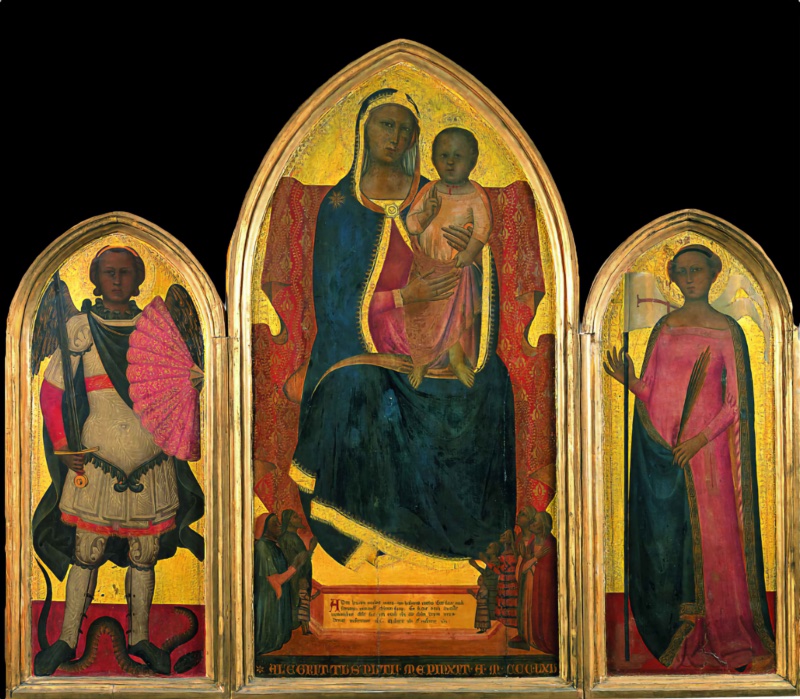
The single most important dated altarpiece of Allegretto’s mature period is the triptych now in the Pinacoteca Vaticana, signed and dated 1365. Its central panel shows the Virgin enthroned with the blessing Child and, at the foot of the throne, the kneeling figures of the donors. It is flanked by Saint Michael the Archangel, in armour with sword and shield, on the left wing, and by Saint Ursula, with banner and the palm of martyrdom, on the right. The painter’s signature and the date run along the base of the central panel:
ALEGRITTUS NUTII ME PINXIT A(NNO) MCCCLXV.
The central panel measures 123 × 65.8 cm, the left wing 91.3 × 41.8 cm and the right wing 92 × 41.4 cm. According to the Vatican catalogue, the altarpiece was probably commissioned by Nofrio di Santi for the chapel of Saints Ursula and Michael the Archangel in the church of Santa Lucia at Fabriano; the kneeling figures have accordingly been read, with due caution, as the family of Onofrio Santi. In 1634 it belonged to the Santi family of Fabriano, who in 1664 donated it to the church of Saints Leonard and Romuald alla Lungara in Rome, demolished in 1863.
By 1800 it was in the collection of Agostino Mariotti (1724–1806), passed by inheritance to Donato Luparelli, and in 1820 was purchased by Pope Pius VII for the Museo Cristiano of the Biblioteca Apostolica. On 19 December 1908 it entered the Pinacoteca of Pius X. In the central panel the Virgin is built with a powerful plasticity that is still Florentine and close to Orcagna, while the lateral saints already display the heightened taste for the decoration of vestments and ornament that betrays the deepening pull of Sienese art. It is in this work, above all, that the transition from Allegretto’s monumental to his decorative manner can be observed in a single object.
Central Panel: Madonna and Child Enthroned with Donors
The central panel presents the Virgin as Queen of Heaven in a composition of striking concentration. Beneath a pointed arch, against a burnished gold ground, Mary is seated frontally on a tall throne, and she occupies almost the entire height and breadth of the painted field. Unlike the crowded Maestà of the Washington triptych, with its tiers of angels and saints, the Vatican panel dispenses with the celestial court altogether. The Virgin and Child are alone before the viewer, apart from the small donors at their feet. This reduction to essentials gives the image an iconic austerity that looks back to the great enthroned Madonnas of the Florentine tradition, and it concentrates the whole devotional charge of the altarpiece on the two sacred figures at its centre.
The Virgin wears a voluminous mantle of deep blue, now darkened to a cool, greenish tone in places, which is edged with a gold border. It falls from her head over her shoulders and spreads across her knees in broad, heavy folds that almost reach the lower edge of the panel. A small gold star shines on her right shoulder, the emblem of Mary as Stella Maris, and a gold clasp fastens the mantle at her throat. Beneath it, a rose-red gown and a white veil framing the face provide warm accents against the dark mass of the mantle. The face is long and oval, with a straight nose, narrow eyes and a small mouth. Its expression is solemn and withdrawn, addressed less to the Child than to the faithful standing before the altar.
The monumentality of the figure is the most Florentine aspect of the painting. The body is conceived as a single, massive, pyramidal form, and the fall of the mantle is modelled to suggest the weight of the knees and the breadth of the lap beneath. The contour of the figure is firm and continuous, isolating it from the gold ground with sharp clarity. This severe, almost sculptural conception, with its frontality and its simplified volumes, reflects Allegretto’s renewed dialogue with the art of Andrea Orcagna and Nardo di Cione, whose hieratic Madonnas dominated Florentine painting in the years after the Black Death.
The Christ Child sits on his Mother’s left knee, turned in three-quarter view toward the viewer. He wears a rose-coloured tunic under a paler garment and is barefoot, his small feet resting on the folds of the Virgin’s mantle. With his right hand raised he gives the blessing, a gesture that transforms the intimate group of mother and son into an image of divine authority addressed to the donors and to the congregation. The Virgin supports him with her hands, one resting across his body, in a gesture of protection that also presents him to the viewer. The Child’s rounded head, with its short curls and gravely attentive expression, gives him the air of a small sovereign rather than an infant.
Behind the Virgin rises the throne, whose high back is covered by a cloth of honour of deep red patterned with gold. The fabric falls over the uprights on either side of the seat and frames the dark blue silhouette of the Virgin with a field of warm colour. The contrast of red and blue against gold is the chromatic key of the panel. It also anticipates the rich textiles that fill the lateral wings. The patterning of the cloth, rendered through a combination of painted ornament and gold, shows the growing attention to precious surface that would characterise Allegretto’s works of the later 1360s.
At the foot of the throne, on a scale drastically reduced in relation to the sacred figures, kneel the donors. On the left, figures in dark, hooded garments turn in prayer toward the Virgin; on the right, a group of smaller figures in red and patterned clothing kneels in corresponding devotion. The difference in scale follows the hierarchical conventions of fourteenth-century painting. It expresses the distance between the heavenly and the earthly orders, while at the same time placing the patrons permanently within the sacred space, under the direct protection of the Mother of God. All of them raise their faces toward the enthroned group above, and this upward gaze is precisely the attitude that the inscription between them puts into words. If, as the Vatican catalogue suggests, the altarpiece was commissioned by Nofrio di Santi, these figures would represent members of his family, commemorated before the altar of their chapel in an act of perpetual supplication.
On the front of the throne’s step, between the two groups of donors, a painted cartouche opened by a red initial carries the first two verses of Psalm 122 (123 in the Hebrew numbering):
Ad te levavi oculos meos, qui habitas in celis,
“Unto thee lift I up mine eyes, O thou that dwellest in the heavens.”
The psalm, one of the gradual psalms or Songs of Ascents, continues with a double image of dependence: as the eyes of servants look to the hands of their masters, and as the eyes of a maidservant look to the hands of her mistress, so the eyes of the faithful look to God until he has mercy on them. The choice of text is remarkably apt. The kneeling donors literally enact the words of the psalm, lifting their eyes toward the Child enthroned in glory, and the reference to the ancilla looking to her domina acquires a particular resonance before an image of the Virgin, the handmaid of the Lord who has become the Lady of heaven.
The inscription thus serves as a prayer spoken on the donors’ behalf, a plea for mercy that the image keeps perpetually before God. Beneath it, along the lower edge of the panel, runs the painter’s signature in Roman capitals:
ALEGRITTUS NUTII ME PINXIT A(NNO) MCCCLXV,
“Allegretto di Nuzio painted me in the year 1365.”
The phrasing in which the painting itself speaks, me pinxit, is a common formula in Trecento signatures. Allegretto signed a considerable number of his works, and this habit reflects the professional self-awareness of a master who ran a successful workshop in his native city.
The central panel thus summarises the character of the whole altarpiece. It is a devotional image of great simplicity and dignity, built on the monumental Florentine model, but enriched by the red and gold of the cloth of honour and by the precise record of its commission. The altarpiece was painted in the same year in which, according to local sources, the Dominicans began to rebuild their church in Fabriano under the title of Santa Lucia Novella. The chapel of Saint Ursula in that church preserves an extensive fresco cycle by Allegretto and his workshop. Whether the triptych was made for the same devotional setting is a question that the documentary record, as far as it can be verified here, does not allow us to settle.
Left Panel: Saint Michael the Archangel
Saint Michael the Archangel stands beneath the pointed arch of the left wing, filling the narrow field almost from top to bottom. He is represented as the captain of the heavenly host: a youthful warrior in armour, with outspread wings, triumphing over the dragon that writhes beneath his feet. His figure faces the viewer almost frontally, with his head turned slightly toward the central panel, and his firm, planted stance gives him an air of watchful guardianship. As the leader of the angels who cast Satan out of heaven, according to the Book of Revelation, and as the protector of souls at the hour of death, Michael was among the most widely venerated saints of the Middle Ages.
The archangel’s head is youthful and round, framed by short, curly auburn hair and a gold halo. The features are regular, with wide-set eyes and a small, firm mouth, and the expression is calm and composed. This impassivity is characteristic of the medieval representation of Michael, whose victory over evil is presented not as a struggle but as an effortless manifestation of divine power. Behind him rise two great wings with dark, finely articulated feathers, which fill the upper part of the arch on either side of the head and give the figure an imposing breadth.
Michael holds an upright sword in his right hand, its blade rising along his side and its gold hilt resting near his waist. On his left arm he bears a large shield decorated with a pink ground and fine patterned ornament, which spreads across the right half of the figure like a great fan. Sword and shield are the traditional attributes of the warrior archangel, and they define him as the defender of the Church and of the faithful. The shield’s delicate colour and ornate surface, however, suggest a ceremonial rather than a martial object, in keeping with the courtly refinement of the whole figure.
The archangel’s costume is one of the most elaborate passages in Allegretto’s work. He wears a cuirass of pale, cream-coloured armour, modelled to the form of the chest, with a red sash tied at the waist. A skirt of strips edged with dark fringes hangs from the cuirass, and a band of red and gold runs across the lower edge. A dark mantle falls from his shoulders behind the body, and his legs are protected by pale greaves. This fanciful armour, derived from the antique military costume that painters of the period used for warrior saints, allows Allegretto to display his talent for the depiction of ornament and texture across a large area of the panel.
Beneath the archangel’s feet lies the dragon, a dark, serpentine creature coiling across the red ground of the lower field. Its sinuous body and small head contrast with the vertical stability of the saint who stands upon it. The motif illustrates the passage of the Apocalypse in which Michael and his angels fight against the dragon, the ancient serpent, and cast him down from heaven. In the context of a funerary or family chapel, the image of the conqueror of Satan would also have evoked Michael’s role as the weigher and guide of souls at the moment of judgement.
Stylistically, the Saint Michael shows the direction Allegretto’s art was taking in the mid-1360s. The figure retains the solid, frontal construction learned from Florentine painting, but the emphasis has shifted from the modelling of volume to the play of decorative detail across the surface. The pale armour, the fringed skirt, the patterned shield and the dark wings together create a composition of rich contrasts. Here the Sienese love of ornament, which the painter had absorbed from the Lorenzetti, begins to prevail over the Florentine gravity of the central Madonna.
The red ground on which the saint stands establishes a common base line with the right wing, where Saint Ursula stands on a similar field. The two lateral figures are thus set on a shared ground plane, distinct from the throne and step of the central panel. The gold background, framed by the pointed arch, isolates the archangel in the same abstract, luminous space as the Virgin, affirming that the three panels, although separately framed, belong to a single celestial realm.
In the programme of the altarpiece, Saint Michael occupies the place of honour at the Virgin’s right hand. If the triptych was indeed made for a chapel dedicated to Saints Ursula and Michael, as the Vatican catalogue suggests, the two lateral figures would represent the titular saints of the chapel itself, presenting the donors to the Virgin and Child. The warrior archangel, protector against evil and guide of souls, would then have served as the particular patron under whose protection the Santi family placed its hopes of salvation.
Right Panel: Saint Ursula
Saint Ursula stands beneath the pointed arch of the right wing as the counterpart to Saint Michael. According to the legend popularised in the thirteenth century by the Golden Legend, Ursula was a British princess who, betrothed to a pagan prince, undertook a pilgrimage to Rome accompanied by eleven thousand virgins. On the return journey she was martyred with her companions by the Huns at Cologne. Her cult enjoyed immense popularity in the late Middle Ages, and in Fabriano it is attested by the extensive fresco cycle of her legend painted by Allegretto and his workshop in the chapel of Saint Ursula in the Dominican church.
The saint is represented as a young woman standing in a slightly swaying pose, with her body turned toward the central panel. Her face is oval and pale, with delicate features, and her hair is gathered around the head. The expression is serene and withdrawn, conveying the composure of the martyr rather than the drama of her death. A gold halo frames her head, and the figure is set against the gold ground of the arch, which isolates her in the same abstract, luminous space as the Virgin and the archangel.
In her right hand Ursula holds a staff bearing a white banner marked with a red cross, one of her characteristic attributes. The banner, the symbol of Christ’s victory over death, identifies her as a leader of the faithful and alludes to her role as the head of the great company of virgins who followed her to martyrdom. In her left hand she holds the palm, the universal emblem of martyrdom. Together, the two attributes define her as a victorious martyr, whose death is understood as a triumph rather than a defeat.
Ursula wears a long gown of rose-pink, which falls to her feet in simple, vertical folds, and over it a mantle of dark blue lined and bordered with gold. The mantle, drawn across the front of the body and gathered at the side, frames the figure with a band of dark colour. The contrast between the delicate rose of the gown and the deep blue of the mantle recalls the palette of the central Madonna, but inverted, and establishes a chromatic dialogue across the altarpiece. The gold border of the mantle, following its edges in continuous curves, gives the figure an elegant linear rhythm.
Compared with the archangel on the left wing, Ursula’s figure is simpler and more restrained. The gown is barely modelled, and the figure is defined above all by its outline and by the contrast of colour fields. In this respect it demonstrates more clearly than any other part of the altarpiece the shift in Allegretto’s manner toward a flatter, more linear style. The slender, elongated proportions and the gentle sway of the body give Ursula a courtly grace that anticipates the elegance of the International Gothic.
The saint’s pose and gesture are directed toward the centre. Her body turns toward the Virgin and Child, and the banner leans slightly inward, so that the right wing, like the left, participates in the sacred conversation unfolding in the central panel. This orientation of the lateral figures, standard in Trecento triptychs, turns the three separately framed panels into a single devotional unity. It also creates a visual movement that leads the viewer’s eye from the wings toward the enthroned Madonna.
Beneath the saint’s feet extends the same red ground found on the left wing, which gives the two titular saints a common base. The lower hem of her gown falls in soft folds over this field, and the continuity of the red ground between the wings balances the composition and frames the central panel. The symmetry between the two lateral figures, the armoured archangel and the virgin martyr, is thus not only compositional but chromatic: the dark mantles and the rose tones of both figures correspond across the altarpiece.
In the context of the altarpiece’s presumed destination, Ursula represents the second titular saint of the chapel of Saints Ursula and Michael. As the leader of a great company of virgins, she was invoked as a protector of young women and of a good death, which made her an especially fitting patron for a family chapel. The pairing of Michael and Ursula, the warrior of heaven and the virgin martyr, gives the altarpiece a complementary programme. Both saints are represented as victors over evil and death, and both present the donors, gathered at the foot of the throne, to the Virgin and Child as their intercessors.
The year 1366 yields two works. The first is the polyptych in the Palazzo Comunale at Apiro, in the province of Macerata, today displayed in the council chamber. It is composed of five gabled compartments on a gold ground, with the Madonna and Child enthroned in the centre between Saints Catherine of Alexandria and Francis of Assisi on the left, and Saints Martin and Lucy on the right.
An inscription in Gothic letters on the base of the throne records the commission:
HOC OPUS FECIT FIERI FRATER OFREDUTIUS GUALTERUTII SUB ANNO DOMINI MCCCLXVI,
“Friar Ofreduzio di Gualteruccio had this work made in the year of the Lord 1366.”
In the central panel the contour of the Virgin’s mantle falls vertically from shoulder to lap, a motif found repeatedly in the Madonnas of Orcagna. The ministry’s catalogue observes that the references to Daddi and to Sienese painting remain evident. Although the hems of the garments now fall rigidly rather than in sinuous curves, the faces, such as those of the Child and of Saint Catherine, are still soft and delicately modelled, in the memory of Ambrogio Lorenzetti. The second work of that year is the Madonna of Humility in the Pinacoteca of San Severino Marche.
Polyptych of 1366: Madonna and Child Enthroned with Saints Catherine of Alexandria, Francis of Assisi, Martin and Lucy
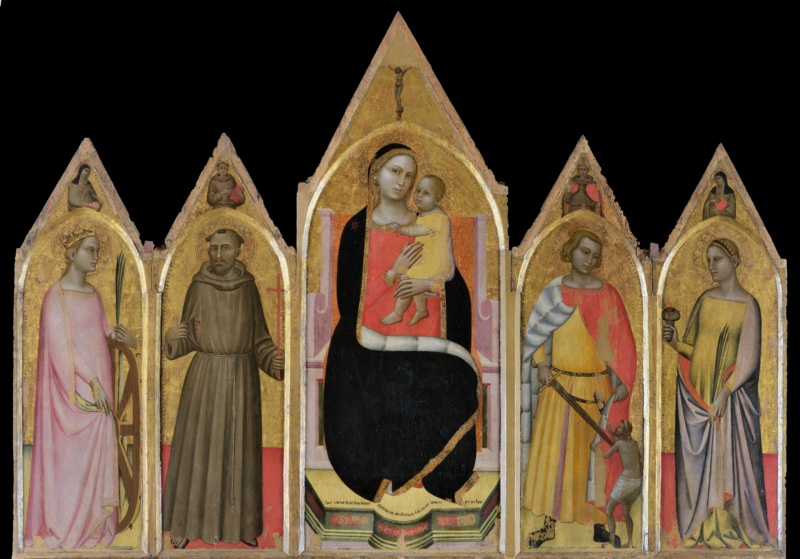
Central Panel: Madonna and Child Enthroned
The central panel, taller and broader than the four lateral compartments, presents the Virgin enthroned as Queen of Heaven beneath a round-headed arch set within a steep triangular gable. Mary is seated frontally at the axis of the polyptych, and her figure fills almost the entire painted field, from the halo that touches the arch to the hem of the mantle spreading across the base of the throne. As in the Vatican triptych of the previous year, Allegretto dispenses with angels and attendant saints within the central panel. The Virgin and Child appear alone before the viewer, and the whole devotional weight of the altarpiece is concentrated on their encounter.
The Virgin wears a mantle that now appears almost black, fastened at the breast and edged with a narrow gold border. It envelops her head and shoulders and falls in a vast, unbroken mass over her knees to the step of the throne. The present darkness of the mantle probably results in part from the alteration of the original blue pigment over time, a common phenomenon in Trecento panels. Beneath it she wears a bright vermilion gown, visible at the breast and across the lap, and a gold star shines on her right shoulder, the emblem of Mary as Stella Maris. Her face is long and pale, with narrow, almond-shaped eyes, a straight nose and a small mouth, and she gazes out toward the viewer with a grave, slightly melancholy expression.
The most distinctive feature of the figure is the treatment of the mantle’s contour. Its edge, lined with white, falls vertically from the Virgin’s left shoulder toward the lap and then sweeps across the knees in a broad curve that exposes the pale lining. This motif, as the Enciclopedia dell’Arte Medievale observes, recurs in many Madonnas by Orcagna, and it testifies to Allegretto’s continuing dialogue with Florentine painting after the Black Death. The strong vertical and the broad curve give the figure a simple, monumental geometry, in which the dark mantle acts as a frame for the brilliant red of the gown and the golden yellow of the Child.
The Christ Child sits on his Mother’s left arm, turned toward her with his cheek pressed against hers. He wears a tunic of golden yellow and is barefoot. With his right hand he grasps the neckline of the Virgin’s gown, a gesture of childlike affection drawn from the Sienese tradition of the Madonna della tenerezza, while the Virgin supports him with her right hand laid gently across his body. The Child’s round face, with its large eyes and softly modelled cheeks, looks outward with an expression of solemn curiosity. The intimacy of the group tempers the hieratic frontality of the enthroned Virgin with a note of human tenderness.
The throne is rendered as a piece of carved architecture in pale pink and lilac stone. Its sides are shaped into volutes and its uprights are articulated with mouldings and panels. Behind the Virgin hangs a cloth of honour of red patterned with gold, whose warm colour echoes her gown and sets off the dark mass of the mantle. The perspective of the throne is not systematic, but the projecting armrests and the stepped base create a convincing sense of depth. This attention to the three-dimensional structure of the seat recalls the Florentine thrones of the Giottesque tradition, from which Allegretto had learned the construction of pictorial space.
At the base of the throne, on the pale surface of the step, runs the commissioning inscription in Gothic minuscule:
hoc opus fecit fieri frater Ofredutius Gualterutii sub anno domini MCCCLXVI,
“Friar Ofreduzio di Gualteruccio had this work made in the year of the Lord 1366.”
The ministry’s catalogue records the date as DCCCLVI, but this is evidently a misreading, since the photograph shows the numerals MCCCLXVI. Below, on the front of the green-edged step, further lettering in capitals can be discerned in three sections; it presumably contains the painter’s signature but is only partly legible in the photograph. The inscription identifies the donor as a friar, and the Franciscan character of the saints in the lateral compartments suggests that he belonged to the Order of Friars Minor.
In the gable above the arch, against the gold ground, appears a small Crucifix. The body of Christ hangs on a slender cross that rises from a small red base. The motif, far simpler than the Crucifixion scenes in the gables of the Washington triptych, is presented almost as an object of devotion in its own right, a painted crucifix set above the image of the Virgin. As in Allegretto’s other altarpieces, the Crucifixion crowns the image of the Incarnation below. The Child in his Mother’s arms is thus seen in the light of his future sacrifice, and the vertical axis of the central panel joins the beginning and the end of the story of salvation.
The central panel shows Allegretto at the moment of his full maturity. The monumental construction of the Virgin, with her Orcagnesque contour and her massive, geometric silhouette, belongs to the Florentine tradition. The tender embrace of the Child and the softly modelled faces recall the Sienese art of Ambrogio Lorenzetti. The flat, bright fields of colour and the reduction of ornament point toward the linear, simplified style of the painter’s last years. The panel thus embodies in a single image the confluence of Florentine and Sienese forms that the Dizionario Biografico degli Italiani identified as the essence of Allegretto’s art.
Inner Left Panel: Saint Francis of Assisi
Saint Francis occupies the place of honour at the Virgin’s right hand, immediately beside the central panel, and his presence defines the Franciscan character of the whole polyptych. He stands frontally beneath a round-headed arch, against the gold ground, on a floor of pale yellow before a band of red. His body is enveloped in the brown habit of the Friars Minor, girded with a knotted white cord whose long end falls almost to the hem. The founder of the order is presented not as a narrative protagonist but as an iconic figure, the alter Christus whose life and wounds conformed him to the crucified Lord.
The saint’s head is shown with the tonsure, short brown hair and a short beard, and the cowl of the habit is gathered around his neck. His face is lean and gaunt, with prominent cheekbones, deep-set eyes and a serious, penetrating gaze directed at the viewer. The features are more individualised than those of the idealised female saints, and they convey the ascetic severity of the Poverello. The gold halo, finely tooled, frames the head and isolates it against the gold ground.
The principal subject of the image is the stigmata. Francis raises his right hand to show the wound in its palm, and with the same gesture he opens the habit at his side to reveal the wound in his chest, marked by a small red stain. His feet, visible beneath the hem, also bear the marks of the nails. The display of the wounds received on Mount La Verna in 1224 was the central element of Franciscan iconography, since it presented the saint as a living image of Christ crucified. It also links the figure directly to the Crucifix in the gable of the central panel, establishing a visual dialogue between the wounded saint and the crucified Christ.
In his left hand Francis holds a slender red cross on a staff, with trefoil terminals at the ends of the arms. The cross is at once an attribute of the saint’s devotion to the Passion and an emblem of the Franciscan mission of preaching. Its bright red contrasts with the brown of the habit and echoes the red of the Virgin’s gown and of the cloth of honour, creating a chromatic link between the lateral and central panels.
The treatment of the habit is exemplary of Allegretto’s mature manner. The brown fabric falls in long, vertical folds, modelled through gradations of warm and dark tones, and the sleeves, wide and heavy, hang from the arms in simple forms. The figure has a solid, columnar presence, and the volume of the body beneath the habit is suggested with restraint. Yet the modelling is less emphatic than in the Florentine works of the 1350s, and the folds tend toward a linear regularity that anticipates the simplified forms of the painter’s last years.
In the gable above the arch appears a half-length Franciscan friar, tonsured and holding a red book. He is probably Saint Anthony of Padua, the most celebrated saint of the order after its founder, whose attribute is the book of Scripture he preached. The identification cannot be confirmed from the attribute alone, however. The figure stands against the gold ground of the gable, above the arch, in a format repeated across all four lateral compartments, and the four small figures together constitute a secondary register of Franciscan saints.
The juxtaposition of Francis with the Virgin carries a particular significance in the Franciscan tradition, which cultivated an intense devotion to Mary as the humble mother of the poor Christ. The saint who had embraced absolute poverty in imitation of Christ stands beside the Mother who had given birth to him in poverty. In an altarpiece commissioned by a Franciscan friar, the figure of the founder also served as a reminder of the order’s spiritual ideals and as a model for the community gathered before the altar.
The Saint Francis is one of the best-preserved panels of the polyptych, and it displays Allegretto’s gift for the grave, dignified single figure. The severity of the image, its sober palette and its direct frontality give it a devotional intensity that sets it apart from the more elegant female saints of the outer compartments. It is a figure of powerful simplicity, in which the essential message of Franciscan spirituality, the conformity to Christ crucified, is conveyed with economy and conviction.
Outer Left Panel: Saint Catherine of Alexandria
Saint Catherine of Alexandria occupies the outer left compartment, beneath a round-headed arch set within a steep gable. According to her legend, she was a royal princess of Alexandria, learned in philosophy, who confuted the pagan scholars summoned by the emperor Maxentius, was condemned to be broken on a spiked wheel and, when the wheel was shattered by divine intervention, was beheaded. Her cult was among the most widespread of the Middle Ages. She was the patron of philosophers and scholars, and a model of wisdom and virginity.
The saint is represented as a young woman standing in a slightly swaying pose, with her head turned in profile toward the central panel. She wears a crown of gold set with red and blue stones, the sign of her royal birth, and her hair is gathered at the nape. Her face is pale and delicate, with a long, straight nose, a small mouth and a gentle, contemplative expression. As the ministry’s catalogue notes, her face, like that of the Child, retains a soft, delicate modelling that recalls Ambrogio Lorenzetti.
Catherine wears a long, loose gown of pale rose-pink, which falls from her shoulders to her feet in broad folds. Its hem and sleeves are edged with narrow gold borders, and it is gathered at one side to reveal a glimpse of a yellow lining. The simple, almost unornamented garment contrasts with the richly patterned textiles of Allegretto’s later works. Its pale colour gives the figure a luminous, ethereal quality against the gold ground.
In her left hand the saint holds the palm, the universal emblem of martyrdom, which rises beside her head in a tall, slender form. Her right hand rests on the rim of the great wheel that stands at her side, its spokes and felloe rendered in brown and gold. The wheel, the instrument of her intended martyrdom, is her most characteristic attribute. Its large circular form fills the right half of the compartment and balances the vertical figure of the saint.
The construction of the figure shows the direction of Allegretto’s mature style. The body is slender and elongated, and the fall of the gown is conceived in long, rhythmic folds that emphasise the vertical axis. The modelling of the drapery is soft and restrained, and the contours are clear and continuous. The figure is defined above all by its outline and by the harmony of its pale colours, in a manner that anticipates the linear elegance of the International Gothic.
In the gable above the arch appears a half-length female saint in the dark habit and veil of a nun, holding a red object before her. She is presumably a Franciscan saint, possibly Saint Clare, the founder of the Poor Clares, or another female saint of the order. A similar figure appears in the gable of the outer right compartment, so that the two nuns frame the polyptych at its extremities. Their precise identities should be verified.
Catherine’s placement at the outer left of the polyptych, beside Saint Francis, reflects the hierarchical arrangement of the altarpiece. The founder of the order occupies the inner place, closer to the Virgin, and the virgin martyr the outer. The female saints on either side, Catherine and Lucy, frame the male saints and the Virgin at the centre. This symmetrical composition, in which virgin martyrs occupy the outer positions, was common in Trecento polyptychs and gave the altarpiece a clear and balanced structure.
The figure of Saint Catherine is one of the most refined in the polyptych. The delicacy of the face, the pale luminosity of the gown and the graceful sway of the body give her an air of courtly elegance. She embodies the ideal of the learned and noble virgin, and her presence in a Franciscan altarpiece reflects the universal appeal of her cult, which crossed the boundaries of religious orders and social classes.
Inner Right Panel: Saint Martin
Saint Martin occupies the inner right compartment, at the Virgin’s left hand, opposite Saint Francis. According to his legend, Martin, a young soldier in the Roman army, met a nearly naked beggar at the gate of Amiens on a winter’s day and, having nothing else to give him, cut his military cloak in half with his sword and gave one part to the poor man. That night Christ appeared to him in a dream wearing the half cloak. Martin later became bishop of Tours and one of the most venerated saints of the Western Church.
Allegretto represents the saint not as a bishop but as the young soldier of the legend, at the moment of his act of charity. Martin is a beardless youth with short, curly golden hair, standing in a slightly swaying pose with his head bent downward toward the beggar at his side. His face is gentle and thoughtful, with lowered eyes, and it expresses the compassion that moved him to share his cloak. The gold halo frames his head against the gold ground of the arch.
The saint wears a knee-length tunic of golden yellow, girded with a dark belt ornamented with gold, and over his shoulders a red cloak lined with pale grey fur, rendered as vair. The fur lining, turned outward over his right shoulder, falls in a long, heavy fold along the left side of the figure. It is a mark of the saint’s noble rank, which heightens the significance of his renunciation. The warm red and yellow of the costume echo the colours of the Virgin’s gown and of the Child’s tunic.
With his right hand Martin draws his sword and cuts through the cloak, while with his left he holds one end of the fabric. At his feet, on a much smaller scale, the beggar, naked apart from a loincloth and with a band around his head, grasps the cloak and pulls it toward himself. The reduction in scale follows the hierarchical conventions of medieval painting and emphasises the distance between the saint and the poor man. The beggar’s emaciated body and eager gesture convey the urgency of his need. The image is a moving illustration of the virtue of charity.
The theme of Martin sharing his cloak had a particular resonance in a Franciscan altarpiece. The Franciscan ideal of poverty and charity toward the poor found in Martin’s act a model of Christian compassion. It is significant that the saint is placed opposite Francis, who had himself, according to his early biographers, given his clothing to the poor on several occasions. The two saints on either side of the Virgin thus embody the virtue of charity in complementary forms, the one through total renunciation, the other through the gift of half of what he possessed.
The Saint Martin panel has suffered some losses of paint, visible in the areas of exposed ground on the cloak and at the saint’s feet, but its composition remains clearly legible. The figure is constructed with the solid, columnar form of Allegretto’s mature style, and the fall of the tunic and cloak is rendered in long, vertical folds. As the ministry’s catalogue notes, the hems of the garments in this polyptych fall rigidly rather than in sinuous curves, a sign of the painter’s movement away from the Sienese linearism of his earlier works toward a more simplified, geometric manner.
In the gable above the arch appears a half-length figure of a bishop, wearing a mitre and a red cope over a brown habit, raising his right hand in blessing and holding a crozier. The combination of episcopal vestments and a Franciscan habit points to Saint Louis of Toulouse, the Franciscan bishop and member of the Angevin royal house, whose cult was widely promoted by the order in the fourteenth century. The identification is suggested by his dress and should be confirmed.
The Saint Martin is the most narrative of the five panels, and the only one in which a secondary figure appears beside the saint. The inclusion of the beggar transforms the iconic image of the standing saint into a scene of action and emotion, which engages the viewer directly in the drama of charity. This combination of devotional image and narrative episode, rare in the lateral compartments of Trecento polyptychs, testifies to Allegretto’s inventiveness within the conventions of the genre.
Outer Right Panel: Saint Lucy
Saint Lucy occupies the outer right compartment, corresponding to Saint Catherine on the left. According to her legend, Lucy was a young noblewoman of Syracuse who distributed her dowry to the poor, was denounced as a Christian by her rejected suitor and, after surviving a series of torments, was put to death by the sword under Diocletian. Her cult, centred on the invocation of her protection against diseases of the eyes, was widespread throughout Italy. Her name, derived from the Latin lux, light, made her a symbol of spiritual illumination.
The saint is represented as a young woman standing in a slightly swaying pose, with her head turned in profile toward the central panel. Her hair is braided and bound around her head with a band, and her face is pale and delicate, with a long, straight nose, a small mouth and a serene expression. The treatment of the face corresponds closely to that of Saint Catherine, so that the two virgin martyrs appear as a matched pair at the extremities of the polyptych.
Lucy wears a long gown of pale golden yellow, and over it a mantle of lilac and violet lined with a warm colour, which she gathers across her body with her left hand. The mantle falls in broad, heavy folds to her feet, and its cool colour contrasts with the warm yellow of the gown. The combination of yellow and violet creates a chromatic harmony distinct from the pink of Catherine’s gown, while maintaining the pale, luminous palette of the female saints.
In her right hand the saint holds a small vessel with a flame, a burning lamp that alludes to her name and to the light of faith. In her left hand, together with the gathered folds of the mantle, she holds the palm of martyrdom, which rises beside her body. The lamp is the attribute that distinguishes Lucy from other virgin martyrs, and its small flame echoes, on a reduced scale, the symbolism of light associated with her cult.
The figure of Lucy displays the same qualities of linear elegance as that of Catherine. The body is slender and elongated, and the fall of the mantle is conceived in long, rhythmic folds. The gathering of the mantle across the body creates a pattern of curves and diagonals that animates the figure and gives it a sense of graceful movement. The treatment of the drapery, with its restrained modelling and clear contours, belongs to the linear and decorative style of Allegretto’s maturity.
In the gable above the arch appears a half-length female saint in the dark habit and veil of a nun, holding a red book. She corresponds to the nun in the gable of the outer left compartment, and she too is presumably a Franciscan saint, perhaps Saint Clare. As with the other gable figures, her identity should be verified. The upper edge of this compartment and its gable show visible damage to the wood and gilding.
Lucy’s placement at the outer right, corresponding to Catherine on the left, completes the symmetrical structure of the polyptych. The two virgin martyrs frame the composition, while the two male saints, Francis and Martin, occupy the inner positions beside the Virgin. This arrangement reflects both the hierarchy of the saints and the balance of the composition. The choice of Lucy, whose legend emphasised the distribution of her wealth to the poor, also harmonises with the Franciscan theme of charity embodied by Francis and Martin.
The figure of Saint Lucy completes the programme of the Apiro polyptych, in which the Virgin and Child are surrounded by saints who embody the virtues of charity, poverty and faithful witness. The polyptych, commissioned by a Franciscan friar in 1366, is a coherent expression of Franciscan spirituality, articulated through a carefully chosen group of saints. In its combination of monumental construction, tender expression and linear elegance, it shows Allegretto at the height of his maturity.
The second is the Madonna of Humility now in the Pinacoteca Civica “P. Tacchi Venturi” at San Severino Marche, which comes from the church of San Domenico and bears Allegretto’s signature and the date 1366. Despite heavy restoration in the nineteenth century, the art historian Lionello Venturi in 1915 was able to reconstruct the fragmentary inscription on the base of the painting and to secure the attribution to Allegretto. He further proposed that this panel served as the model for the majority of the works of Francescuccio Ghissi. After being lent to the 2021 Fabriano exhibition Oro e colore nel cuore dell’Appennino, the panel was restored by Giacomo Maranesi of Fermo in a workshop set up within the galleries of the Pinacoteca, so that visitors could follow the work as it progressed. These two dated works of 1366, together with the Vatican triptych of the previous year, define the artist’s fully mature phase, in which the forms are gentled into a more linear and decorative language and the figures increasingly simplified.
Our Lady of Humility, 1366
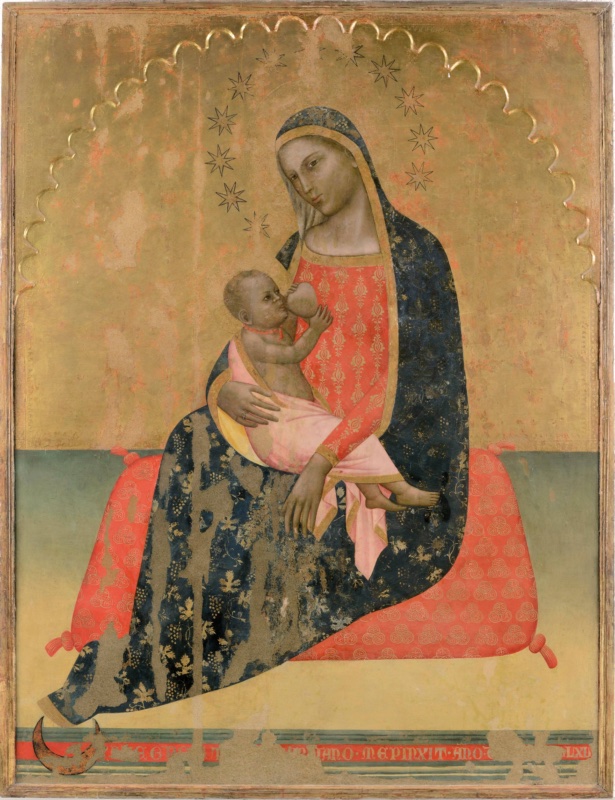
The San Severino panel is one of the most monumental representations of the Madonna of Humility painted in central Italy in the fourteenth century. It is also the image through which Allegretto contributed most decisively to the diffusion of this type in the Marche. The Virgin does not sit on a throne but low upon a great cushion laid on the ground, the posture that gives the type its name, from the Latin humilitas, rooted in humus, earth. The iconography, which emerged in the early decades of the century and spread rapidly through the preaching and patronage of the mendicant orders, presented the Mother of God as humble and close to the faithful, in deliberate contrast to the regal Maestà. The panel’s provenance from the Dominican church of San Severino places it squarely within this mendicant devotional culture. Its scale, more than one and a half metres high, shows that the humble Virgin could command an altar with all the authority of an enthroned Queen.
The Virgin is seated in three-quarter view, turned toward the left, with her body forming a broad, stable pyramid that rises from the spreading hem of her mantle to the gently inclined head. She wears a mantle of deep blue, lined with gold and edged with a gold border, which covers her head and falls across her knees to the ground. Beneath it, a red gown patterned with gold is visible at the breast and along the arm, and a white veil frames her face. The face is long and oval, with a straight, narrow nose, almond-shaped eyes and a small mouth, and its expression, melancholy and inward, is directed toward the viewer rather than toward the Child. This tension between the tender action of nursing and the grave, contemplative gaze is characteristic of Allegretto’s Madonnas and gives the image its solemn devotional tone.
The Humility type is here combined with that of the nursing Virgin, the Madonna del latte. The Child, held across his Mother’s lap in her right arm, clasps her breast with both hands and suckles, with his eyes turned outward toward the viewer. He is wrapped in a pink cloth edged with gold that leaves his chest and legs bare, and around his neck he wears a necklace of red coral. Coral was traditionally worn by children as an amulet against evil, and in religious painting it also carried an allusion to the blood of Christ’s Passion, so that the necklace quietly foreshadows the sacrifice to come. On one finger of the hand with which the Virgin supports the Child, a ring can be seen. It is a small but eloquent detail, which may be read as a sign of Mary’s role as the bride of Christ, the Sponsa of the Song of Songs. Together, the nursing, the coral and the ring enrich the intimate image with layers of theological meaning.
Around the Virgin’s head, painted on the gold ground, a crown of twelve dark, eight-pointed stars forms an arc from shoulder to shoulder, and at the lower left of the panel, beneath the hem of her mantle, lies a crescent moon. These attributes derive from the vision in the Book of Revelation of the woman clothed with the sun, with the moon under her feet and a crown of twelve stars on her head. The fusion of the humble, nursing Virgin with the Woman of the Apocalypse, which had been established in Sienese painting around the circle of Simone Martini, gives the image a cosmic dimension. The Mother seated on the ground is at the same time the Queen of Heaven, crowned with stars and exalted above the changeable world symbolised by the moon.
The great cushion on which the Virgin sits is one of the most striking elements of the composition. Rendered in brilliant red and covered with a regular pattern of gold trefoils, it spreads across the whole width of the panel, and its corners are gathered into tassels. Behind it a green band, perhaps a low wall or a receding ground, separates it from the gold background, while in front a pale yellow ground stretches to the lower edge. The cushion provides a warm, luminous field against which the dark blue of the mantle stands out with great force. Its patterned surface, together with the gold decoration of the gown and mantle, demonstrates the love of precious textiles that the Pinacoteca’s own description associates with Sienese painting.
The decoration of the garments is among the richest in Allegretto’s oeuvre. The deep blue mantle is strewn with gilded vine leaves and clusters of grapes, linked by fine, curling tendrils that spread across its whole surface. The motif carries a clear Eucharistic meaning. It alludes to the wine of the Mass and to Christ’s words “I am the true vine,” and it accords with the nursing that nourishes the Child, so that the Virgin’s mantle becomes a garment woven with the promise of the sacrament. The red gown is patterned with rows of gold palmettes, and the borders of the mantle and gown are defined by bands of gold. This ornament is not merely applied to the figure but spread across its whole surface, turning the Virgin’s body into a field of shimmering pattern. Here the linear, decorative direction of Allegretto’s mature style appears with particular clarity.
The figure is framed by a cusped arch in raised gilding, which rises from the level of the cushion and follows the outline of the panel in a series of rounded lobes. This moulded arch, modelled in relief on the gesso ground and then gilded, gives the image the character of a sacred niche and articulates the flat expanse of the gold ground. Along the lower edge of the panel, on a red band between green borders, runs the inscription in Roman capitals:
[AL]EGRE[C]T[US DE FA]B[R]IANO ME PINXIT AN(N)O D[(OMI)NI MCCC]LXV[I?],
“Allegretto of Fabriano painted me in the year of the Lord 1366.”
Although much of the lettering has been lost, the surviving letters are sufficient to identify the painter. As on the Macerata triptych of 1369, Allegretto signs here not with his patronymic, as on the Vatican triptych and the Urbino Madonna, but with the name of his native city, a proud declaration of his Fabrianese identity in a work destined for a neighbouring town. The spelling of the name, with E in place of the I of Alegrittus found in his other signatures, is a variant typical of the fluid orthography of the period. Venturi’s reconstruction of this fragmentary inscription in 1915 allowed him to establish the painter’s authorship and the date, and it remains the basis for the work’s place in Allegretto’s chronology.
The panel has suffered considerable damage over the centuries. The most extensive losses affect the lower part of the mantle and the inscription band, where the paint has flaked away to reveal the preparation beneath, and the gold of the background is worn in many places, exposing the red bole. The heavy restorations of the nineteenth century recorded in the literature further complicated the reading of the surface. The recent intervention by Giacomo Maranesi, carried out after the 2021 exhibition, has recovered much of the original brilliance of the colours: the ultramarine of the mantle, the vermilion of the gown and cushion, and the delicate pink of the Child’s cloth now appear with renewed intensity. The lacunae, as the photograph shows, have been left visible rather than reconstructed, so that the viewer can distinguish clearly between the surviving original paint and the areas of loss. Despite these losses, the grandeur of the composition and the refinement of its execution remain fully legible. As Venturi recognised, the San Severino Madonna became the model for Francescuccio Ghissi’s many Madonnas of Humility. It thus stands at the head of one of the most characteristic devotional traditions of Trecento painting in the Marche.
To 1369 belongs the signed and dated triptych in the Duomo di San Giuliano at Macerata, the city’s cathedral until 2023. It came from the demolished church of Sant’Antonio Abate in the same town. The central panel shows the Madonna and Child enthroned, with angels arranged in three superimposed tiers and, in the foreground flanking the throne, Saints Anthony Abbot, Rose, Benedict and Catherine of Alexandria. The lateral panels show Saint Julian and Saint Anthony Abbot, and the gables are decorated with the Crucified Christ between Elijah and Moses at the centre and, within quatrefoils, the Annunciate Virgin and the Archangel Gabriel at the sides. The work is of exceptional interest because it repeats, on a slightly larger scale, the composition of the Washington triptych of 1354, which the National Gallery of Art’s catalogue describes as practically identical.
The correspondences extend to one of the Washington altarpiece’s rarest features: in both, Saint Anthony Abbot appears twice, once among the saints around the throne and again on a lateral panel. Bernard Berenson had already noted the similarity of layout between the two works and observed that the inscriptions of both name a commissioning friar called Giovanni, leading him to suppose a common patron. The subsequent recognition of the near-identity of the two compositions, together with the Antonine dedication of both destinations, lends that hypothesis considerable weight. It now seems likely that the same friar, presumably a member of the Hospital Brothers of Saint Anthony, commissioned both altarpieces fifteen years apart, first for an Antonine church at Fabriano and then for the church of Sant’Antonio Abate at Macerata, and that he asked the painter to repeat the programme devised for the earlier work. The later work, however, is not a simple copy. Whereas the Washington triptych was the product of a collaboration between Allegretto and the Florentine Puccio di Simone, the Macerata version was painted by Allegretto alone. It translates the earlier composition into the idiom of his late style: the flattening of volume is fully evident, the faces are elongated and sharp, and the fabrics are rendered as broad, flat surfaces. The comparison between the two works thus offers a rare opportunity to measure, on the basis of a shared model, the distance Allegretto had travelled between 1354 and 1369.
The last dated work is the Madonna and Child Enthroned now in the Galleria Nazionale delle Marche in the Ducal Palace at Urbino, signed and dated 1372, painted, that is, in the year before the artist’s death. The inscription on the base of the throne reads [H]OC OPUS PINXIT ALEGRITTUS NUTII DE FABRIANO ANNO MCCCLXXII. The panel measures 167 by 96 centimetres. It was first recorded by Amico Ricci in 1834 in the collection of Alessandro Castrica at Fabriano, was noted by Crowe and Cavalcaselle in 1864 in the Fornari collection in the same city, and entered the Galleria Nazionale delle Marche in 1914. The panel probably formed the central compartment of a triptych. This is the culminating statement of Allegretto’s final manner: the forms are more rigid, the monumentality intense but abstracted, and the decorative surface paramount. It is here, more than anywhere, that scholars have detected the possible influence of contemporary Venetian painting.
Alongside these securely dated panels, the sources place the three panels with Saint Augustine between Saint Nicholas of Tolentino and Saint Stephen in the Pinacoteca of Fabriano, long regarded as the artist’s final work. Recent studies have shown, however, that the ensemble is not an original triptych but three lateral compartments of a dismembered polyptych, later remounted in triptych form, and probably painted for the Augustinian church of Santa Maria Nova in Fabriano. Its date is disputed: some accounts place it about 1362, while others, including reports on the 2021 Fabriano exhibition, date it about 1372. The emphatic decoration of the vestments and the abstraction of the figures accord well with a late date, but the traditional view of the ensemble as Allegretto’s last work can no longer be taken for granted.
Madonna and Child Enthroned, 1372
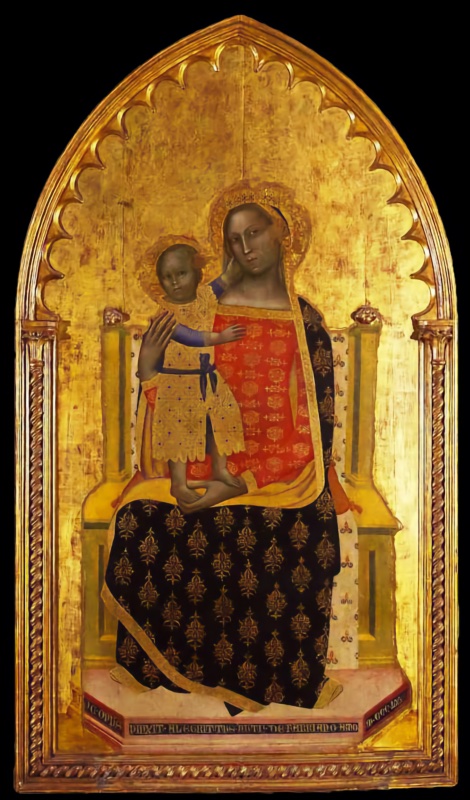
The Urbino Madonna, painted in 1372, is the last dated work of Allegretto Nuzi and the fullest expression of the style of his final years. Beneath a pointed arch, framed by a cusped arcade modelled in relief and gilded, the Virgin sits enthroned against a burnished gold ground, holding the standing Christ Child on her lap. The panel is unusually tall and imposing, and the figure of the Virgin, seated on a broad throne that fills the lower two thirds of the field, has a commanding monumentality. The Galleria Nazionale’s catalogue speaks of a new kind of monumentality in this work, marked by the sharp contours of figures that stand out against the gold ground, isolated in a dimension of solemn and arcane sacredness. The image thus combines the gravity of the enthroned Maestà with an abstract, almost hieratic stillness that sets it apart from the more naturalistic Madonnas of Allegretto’s earlier career.
The Virgin is represented as Queen of Heaven. A gold crown with tall, finely punched pinnacles rests on her veiled head, and it is surrounded by a halo tooled with delicate floral ornament. Her face is long and narrow, with a straight, elongated nose, almond-shaped eyes and a small, closed mouth, and its pale flesh is modelled with the soft greenish underlayer of Trecento tempera technique. She inclines her head slightly toward the Child, but her gaze is directed out toward the viewer, grave and withdrawn. This detachment, characteristic of Allegretto’s late Madonnas, gives the image the solemn distance of an icon. Motherly intimacy is conveyed through the gestures of the figures rather than through the expression of the face.
The Virgin’s costume is the most splendid in Allegretto’s oeuvre. She wears a gown of vermilion patterned with rows of gold rosettes and lozenges, and over it a dark mantle, lined with golden yellow and edged with a broad gold border, which is strewn with large gold palmettes arranged in regular rows. The mantle falls from her shoulders and spreads across her knees to the step of the throne, and its lining is turned back across the lap in a broad fold. The gold ornament is spread across the dark surface with little regard for the folds of the fabric, so that the mantle reads less as a modelled garment than as a flat field of precious pattern. The catalogue rightly stresses the rare elegance of this decoration, in which the alternation of red, blue, white and gold is enriched by punchwork.
The Christ Child stands on his Mother’s lap, supported by her hands, one at his back and the other holding his feet. He wears a tunic of gold patterned with a fine lattice of small ornaments and lozenges, with blue sleeves and a blue sash tied at the waist, and its scalloped hem falls to his knees. With one arm he reaches up to touch his Mother’s cheek, and with the other he rests his hand on her breast, while he turns his face outward toward the viewer. The gesture of the caress, drawn from Byzantine images of the Virgin of Tenderness and absorbed into Tuscan painting, introduces a note of affection into the otherwise solemn composition. It is a characteristic feature of Allegretto’s art that the tenderness between Mother and Child is expressed through such delicate gestures, even in his most hieratic images.
The throne is a broad structure of pale green and yellow stone, with square uprights crowned by small, knobbed finials and a stepped base. Its back and sides are hung with a white cloth decorated with small blue and red fleurons, and a red cushion, gathered with tassels, lies on the seat beside the Virgin. The pale tones of the throne and its cloth create a luminous field against which the dark mantle stands out with great force, and the three principal colours of the image, red, dark blue and white, are thus set off by the surrounding gold. The perspective of the throne is simplified, and its masses are treated as flat, geometric planes. This reduction of spatial depth, in comparison with the more convincingly three-dimensional thrones of the Apiro polyptych and the Vatican triptych, is another sign of the abstract tendency of Allegretto’s late style.
Along the front of the throne’s base, in three sections separated by the projecting corners of the step, runs the inscription in Roman capitals on a dark ground:
[H]OC OPUS / PINXIT ALEGRITTUS NUTII DE FABRIANO ANNO / MCCCLXXII,
“Allegretto di Nuzio of Fabriano painted this work in the year 1372.”
The signature combines the two forms that Allegretto used elsewhere: the patronymic Nutii, found on the Vatican triptych of 1365, and the toponym de Fabriano, found on the Macerata triptych of 1369 and on the San Severino Madonna. This full formula, the most complete in his oeuvre, gives the last dated work an air of solemn summation. It records not only the painter’s name and the date but also his lineage and his native city, as if the master, in the year before his death, wished to leave a complete record of his identity.
In its style, the Urbino Madonna represents the culmination of the tendencies that had been developing in Allegretto’s art since the mid-1360s. The plastic modelling of form, learned in Florence, has given way almost entirely to a linear and decorative manner in which the figures are defined by their contours and their surfaces are covered with ornament. The forms are rigid and simplified, and the monumentality of the image is intense but abstract, achieved not through the suggestion of mass and volume but through the scale of the figures and the clarity of their outlines. The Dizionario Biografico degli Italiani suggests that in this final phase Allegretto may have been influenced by the Venetian painting that was then penetrating the Marche, and the flat, richly decorated textiles of the Urbino panel recall the art of Paolo and Lorenzo Veneziano. The Venetian influence, however, remains a hypothesis, and it is not documented by any evidence beyond the style of the works.
The panel probably formed the central compartment of a dismembered triptych, as the Galleria Nazionale’s catalogue proposes. Its history can be traced from the early nineteenth century: it was recorded by Amico Ricci in 1834 in the collection of Alessandro Castrica at Fabriano, was noted in 1864 in the Fornari collection in the same city, and entered the Galleria Nazionale delle Marche in 1914. Painted in the year before Allegretto’s death in 1373, it can be regarded as his artistic testament. In its fusion of monumental grandeur and decorative splendour, it points toward the courtly art of the International Gothic, which would find its supreme expression in the work of another painter of Fabriano, Gentile, born around 1370. The Urbino Madonna thus closes Allegretto’s career while opening the way to the next chapter in the history of the Fabrianese school.
Beyond the dated works stands a large body of panels attributed to Allegretto on stylistic and technical grounds, now dispersed across the museums of Europe and North America — a diaspora that is itself a testament to the esteem in which his shimmering gold grounds were held by collectors from the nineteenth century onward.
Virgin and Child Enthroned between Saints Bartholomew and Catherine of Alexandria (wing of a diptych)
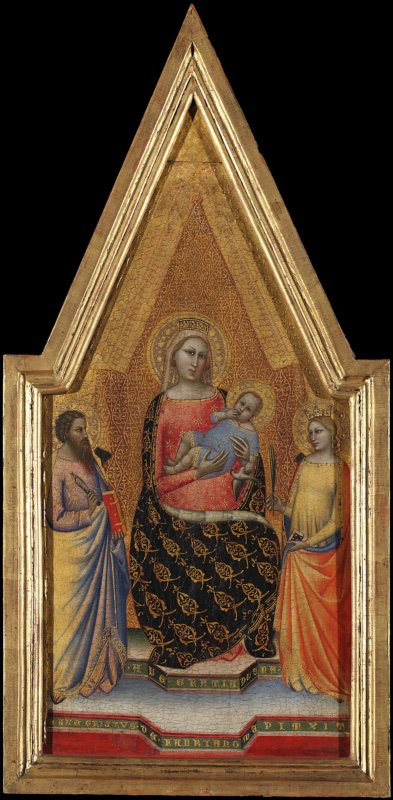
This small panel, just over half a metre high, is one wing of a devotional diptych whose other wing showed the Crucifixion. According to the Enciclopedia dell’Arte Medievale, the work appears to belong to Allegretto’s early years of activity, although Fernanda Imondi Romagnoli, in her 1927 monograph Allegretto Nuzi pittore fabrianese, dated it to 1365 on the basis of the inscription on the step of the throne. Its modest dimensions and the pairing of the enthroned Virgin with the Crucifixion identify it as an object for private devotion, a type in which Allegretto excelled. The Berlin diptych was among the loans to the 2021 Fabriano exhibition, and one reviewer observed that the painter’s innovations concerned not only style but also type, notably small diptychs and triptychs intended for personal devotion, signs of a spirituality increasingly close to the devotio moderna. The Berlin panel shows how Allegretto could concentrate the monumental forms of his altarpieces into an image of intimate scale.
The Virgin sits frontally on a throne at the centre of the composition, her figure occupying almost the whole height of the painted field. She wears a gold crown set with red stones, surrounded by a finely punched halo, and her fair hair falls beneath a white veil. Her gown is of vermilion sprinkled with small gold stars, an allusion to her title of Queen of Heaven, and her mantle, dark and strewn with large gold leaf-shaped ornaments, falls from her shoulders and spreads across her knees to the step of the throne. The pale lining of the mantle, turned back along its edge, descends vertically from her left shoulder and then sweeps across her lap in a broad curve. This motif, derived from Orcagna and repeated in the Apiro polyptych of 1366, gives the figure a clear and monumental geometry despite the small scale of the panel. The Virgin’s long face, with its almond-shaped eyes and small mouth, gazes out toward the viewer with an expression of grave serenity.
The Christ Child, dressed in a pale blue tunic, reclines across his Mother’s lap, supported by her hands, and turns his head toward the viewer. He raises one hand to his mouth in a spontaneous childlike gesture, and in the other he holds a small bird by the wing, which hangs down beside the Virgin’s hand. The bird is almost certainly a goldfinch, the traditional symbol of the Passion. Its presence here acquires a particular meaning, since the other wing of the diptych showed the Crucifixion. The small bird held by the playful Child thus anticipates the sacrifice depicted on the opposite panel, and the two wings of the diptych, when opened before the devout owner, presented together the beginning and the end of Christ’s earthly life.
Behind the throne rises a cloth of honour of red and gold brocade, patterned with scrolling ornament, which extends upward into the gable of the panel in a pointed form. This textile frames the figure of the Virgin and establishes her regal status, while at the same time it fills the upper part of the panel with a dense surface of precious pattern. Its tapering shape echoes the outline of the gable, so that the cloth of honour, the frame and the figure of the Virgin form a series of concentric pointed forms converging on her crowned head. The gold ground visible around the cloth and the punched haloes of the figures complete the effect of luminous preciousness, characteristic of the small devotional panels of the Trecento.
On the left of the throne stands Saint Bartholomew, one of the twelve apostles, who according to tradition was flayed alive in Armenia. He is shown as a man in the prime of life, with curly dark hair and a full beard, turning in three-quarter view toward the Virgin. He holds a knife, the instrument of his martyrdom, and a book bound in red, the attribute of the apostles. He wears a tunic of pale lilac and a mantle whose colours shift from yellow to blue, falling in broad, rhythmic folds to his feet. This treatment of colour, in which the drapery changes hue as it turns in the light, is the technique known as cangiante, and reviewers of the 2021 exhibition singled out the luminous shot-colour effects of this diptych, with its solid yet gentle and elegant bodies.
On the right stands Saint Catherine of Alexandria, crowned as a royal princess, with fair hair and a delicate, pale face turned toward the Virgin. She wears a gown of golden yellow and a mantle of orange-red, which she gathers across her body in a broad fold. In her right hand she holds the palm of martyrdom, and in her left a small object that appears to be a fragment of the spiked wheel on which she was to be broken. The two saints correspond to each other across the throne: Bartholomew, the bearded apostle, and Catherine, the young virgin martyr, represent two complementary forms of holiness, and their presence may reflect the particular devotion of the owner for whom the diptych was painted.
The panel bears two inscriptions. On the upper step of the throne, just beneath the Virgin’s feet, runs the Angelic Salutation,
AVE.GRATIA.PLENA,
“Hail, full of grace,”
the words with which the Archangel Gabriel greeted Mary at the Annunciation. The inscription invites the viewer to address the Virgin with the angel’s words, and it links the image to the recitation of the Ave Maria, the prayer central to private Marian devotion. On the base of the panel, in three sections, runs the painter’s signature:
ALEGRICTUS. EN. FABRIANO ME PIMXIT,
“Allegretto of Fabriano painted me.”
The spelling Alegrictus is another variant of the painter’s name, alongside Alegrittus and Alegrectus; EN stands here for the de of his other signatures, the vernacular preposition slipping into the Latin formula; and pimxit for pinxit is a common scribal slip. As in the Macerata triptych and the San Severino Madonna, Allegretto identifies himself by his native city.
Despite its small size, the Berlin panel displays all the qualities of Allegretto’s art. The monumental construction of the Virgin, with its Orcagnesque contour, is combined with the intimate tenderness of the reclining Child, the luminous shot colours of the saints’ draperies and the rich decoration of the textiles and punched gold. Reviewers of the 2021 exhibition noted that the preciousness characteristic of Gothic painting is amplified in Allegretto’s work through an extraordinary variety of punches and the richness of his fabrics. The date of the diptych remains uncertain: the museum’s own range, 1350–70, reflects this uncertainty, as does the divergence between the prevailing early dating and Romagnoli’s proposal of 1365. Whatever its precise date, the panel stands as one of the finest examples of Allegretto’s devotional painting on a small scale.
The Crucifixion with the Virgin, Saint John the Evangelist and Mary Magdalene (wing of a diptych)
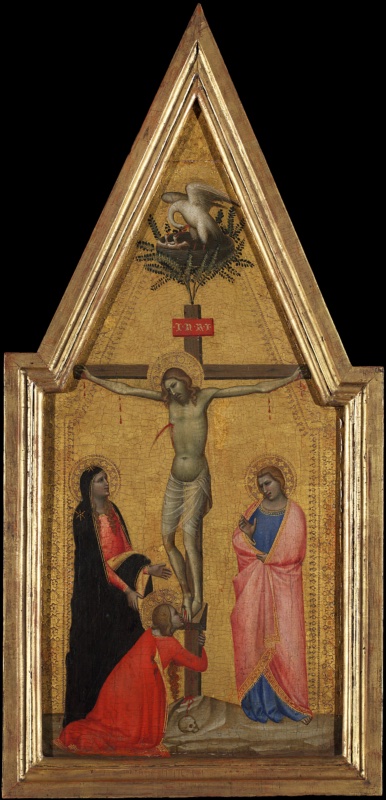
This panel, identical in size and frame to the Virgin and Child Enthroned between Saints Bartholomew and Catherine in the same collection (inv. 1076), formed the second wing of a small devotional diptych. The pairing of the enthroned Virgin with the Crucifixion was one of the most common arrangements for portable diptychs in fourteenth-century Tuscany and the Marche. When the two wings were opened, the owner would have had before him, side by side, the Incarnation and the Passion, the Mother presenting the Child and the Son offering himself on the Cross. The Enciclopedia dell’Arte Medievale describes the diptych in precisely these terms, and places it among Allegretto’s early works. Its intimate dimensions and its richly worked gold identify it as an object for private prayer, of the type that the 2021 Fabriano exhibition recognised as one of Allegretto’s most characteristic contributions.
At the centre of the composition, the Cross rises from the rock of Golgotha to the gable of the panel. Christ hangs dead upon it, his head bowed onto his right shoulder, his eyes closed and his long hair falling over his breast. The body is slender and softly modelled, with the ribs and the muscles of the torso indicated by delicate gradations of greenish flesh tone, and a transparent white loincloth, edged with gold, is knotted at the hip. The arms, stretched almost horizontally along the crossbar, sag slightly under the weight of the body, and the legs are bent, with the feet crossed and fixed by a single nail to a small projecting support. This type of the dead Christ, the Christus patiens, had been established in Tuscan painting since the late thirteenth century, and Allegretto treats it here with a restrained pathos that emphasises the silent dignity of death rather than the violence of suffering.
The blood of Christ is given particular prominence. It drips in regular drops from the wounds in his hands, flows in a long red stream from the wound in his side, and runs from the nailed feet down the upright of the Cross to the rock below. There, in a cleft of the rock, lies a skull, the skull of Adam, who according to a widespread medieval legend was buried on the site of the Crucifixion. The blood of the new Adam falling on the bones of the first man expresses in visual form the doctrine of redemption: the sacrifice of Christ cleanses the sin inherited from Adam and opens to humankind the way to salvation. For the owner of the diptych, meditating on the image in prayer, the stream of blood would have evoked the Eucharist, in which the same blood was offered daily on the altar.
Kneeling at the foot of the Cross, Mary Magdalene embraces the wood with both arms and presses her lips to the bleeding feet of Christ. She wears a gown of brilliant vermilion, and her long, loose hair falls down her back, the traditional sign of the repentant sinner who had once dried Christ’s feet with her hair. Her gesture of intense, bodily devotion offered the viewer a model of prayer. In the practice of affective meditation promoted by the mendicant orders and by devotional texts such as the Meditationes Vitae Christi, the faithful were urged to imagine themselves present at the Passion and to share the grief of those who had witnessed it. The Magdalene, prostrate at the Cross and kissing the wounds, embodied the compassion and the penitence that such meditation sought to awaken.
On the left stands the Virgin, wrapped in a dark mantle marked with a gold star on the shoulder, over a red gown. She raises her face toward her dying Son with an expression of silent grief, and extends her right hand toward him while her left hand descends toward the kneeling Magdalene, as if to include her in her sorrow. On the right stands Saint John the Evangelist, the beloved disciple, in a blue tunic and a rose-pink mantle edged with a broad gold border. He lowers his head and gazes down in sorrow, while raising his right hand in a gesture of lament and drawing his mantle around him with the left. The two figures, standing on either side of the Cross in symmetrical correspondence, follow the traditional composition of the Crucifixion with the Virgin and Saint John, in which the Mother and the disciple recall Christ’s words from the Cross, “Woman, behold thy son” and “Behold thy mother.”
Above the titulus, a red tablet inscribed INRI (Iesus Nazarenus Rex Iudaeorum, “Jesus of Nazareth, King of the Jews”), the upright of the Cross sprouts a spray of green leaves, which spreads into the gable. The motif transforms the instrument of death into a living tree, the lignum vitae or Tree of Life. According to medieval tradition, the wood of the Cross came from a sapling of the Tree of Life in Paradise, and the Franciscan theologian Bonaventure, in his treatise Lignum vitae, had taught the faithful to meditate on the Cross as a tree bearing the fruits of salvation. Nesting in the foliage, at the summit of the panel, a pelican pierces her breast with her beak to feed her young with her own blood. The image derives from the Physiologus, the early Christian bestiary, according to which the pelican revives her dead young with her blood. It became one of the most widespread symbols of Christ, who gives his blood to redeem humankind and to nourish the faithful in the Eucharist.
The pelican and the living Cross thus give the Crucifixion a symbolic superstructure that complements the narrative scene below. The blood that flows from Christ’s wounds to the skull of Adam is echoed by the blood that the pelican gives to her young, and the dead wood of the Cross is transformed into a flourishing tree. The vertical axis of the panel leads the viewer’s eye from death, represented by the skull at the foot of the Cross, to life, represented by the green branches and the nourished young at its summit. This theological programme, compact yet rich, is well suited to an object of private devotion, in which the image served as a support for prolonged meditation rather than for liturgical display.
In its style, the Crucifixion confirms the early dating proposed for the diptych. The graceful proportions of the figures, the gentle modelling of the faces and the soft, rhythmic folds of the draperies recall the art of Bernardo Daddi, whom Allegretto had encountered in Florence in the 1340s. The Dizionario Biografico degli Italiani describes the works of Allegretto’s early Daddesque period as graceful works on the path of the Sienese-Florentine compromise established by Daddi. The brilliant colours of the Magdalene’s gown and John’s mantle stand out against the gold ground, which is enriched by a punched border along the edges of the panel and by the finely tooled haloes of the figures. The panel demonstrates Allegretto’s ability to combine narrative clarity, emotional intensity and decorative refinement within the small format of a devotional image, and it forms a worthy counterpart to the enthroned Virgin of the opposite wing.
Portable Triptych with the Crucifixion, Saints and the Annunciation
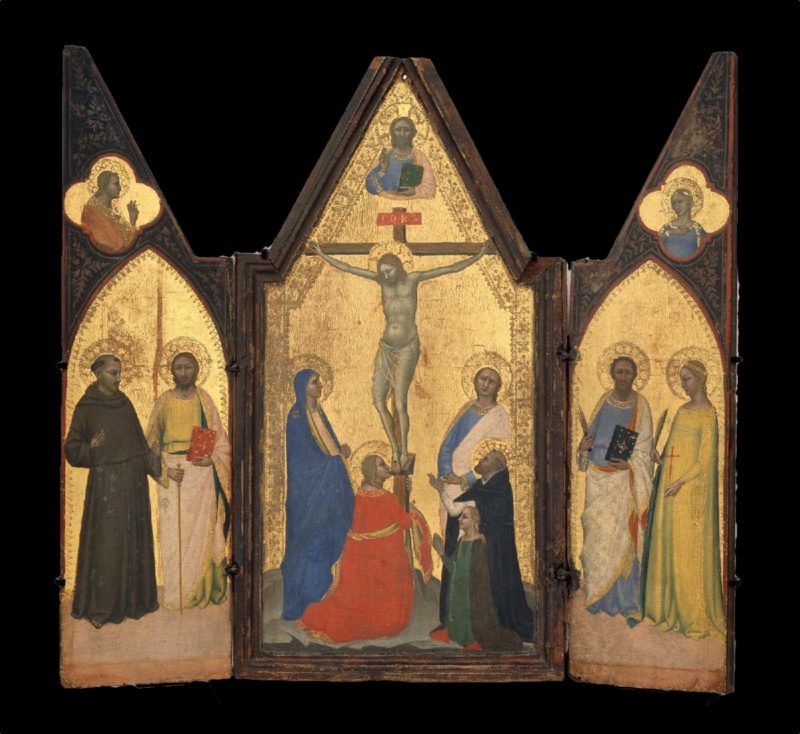
Central Panel: The Crucifixion with Saints and a Donor
The Bern triptych is one of the finest surviving examples of the small portable altarpieces for private devotion in which Allegretto excelled. It consists of a central panel with a steep gable and two narrow hinged wings, each almost exactly half the width of the centre. When closed, the wings folded over the central panel to protect it; when opened, they revealed the complete programme, arranged like a miniature church altarpiece. The work retains its original frame and its metal hinges, a rare survival that allows us to understand how such objects were handled and used. The Dizionario Biografico degli Italiani places the tabernacle in Bern, with the Crucifixion, saints and Annunciation, among the works of Allegretto’s early Daddesque period, and the museum’s dating to 1350–55 accords with this view.
The Crucifixion occupies the whole height of the central panel. Christ hangs on a tall, dark Cross that rises against the gold ground, with his arms stretched along the crossbar, his head bowed onto his right shoulder and his eyes closed in death. His slender body, modelled in pale, greenish flesh tones, is girded by a transparent loincloth, and his crossed feet are nailed to a small support. A red titulus inscribed INRI is fixed above his head. The figure is conceived in the Tuscan type of the Christus patiens, and its gentle modelling and elegant proportions recall the Crucifixions of Bernardo Daddi, whose workshop Allegretto had come to know in Florence during the 1340s.
On the left stands the Virgin, wrapped from head to foot in a mantle of deep ultramarine, with a small gold star on the shoulder. She raises her face toward her dead Son with an expression of silent grief, and her hands are hidden in the folds of her mantle. The broad, simple mass of blue gives her figure a monumental gravity that belies the small scale of the panel. Opposite her stands Saint John the Evangelist, youthful and beardless, in a blue tunic and a pale mantle lined with rose. He lowers his gaze and raises his right hand before his chest in a gesture of lament. The two figures, arranged in symmetrical correspondence on either side of the Cross, follow the traditional composition of the Crucifixion with the mourning Mother and the beloved disciple.
At the foot of the Cross, Mary Magdalene kneels in a gown of brilliant vermilion, her long, loose hair falling down her back, and embraces the wood with both arms, raising her face toward the feet of Christ. Her figure, set on the rocky ground of Golgotha, is the most intensely expressive in the composition. The Magdalene’s gesture of physical devotion, clasping the instrument of the Passion, provided the owner of the triptych with a model of affective prayer. It invited the viewer to imagine himself or herself at the foot of the Cross and to share the grief and the penitence of the saint.
On the right, in front of Saint John, a tonsured saint in the black mantle and white habit of the Dominican order, with a halo, kneels and extends his hands toward the Cross. Beside him kneels a much smaller female figure in a green gown with her hands joined in prayer, whom he appears to present to the crucified Christ. The Dominican saint is probably Saint Dominic himself, founder of the Order of Preachers, although no distinctive attribute is visible that would exclude another saint of the order, such as Peter Martyr. The small kneeling woman is the donor, the person for whom the triptych was made. Her presence within the sacred scene, under the protection of a Dominican saint, suggests that she had a particular bond with the order, perhaps as a tertiary or as a patron of a Dominican house.
The inclusion of the donor in the Crucifixion itself, rather than at the margins of the image, is significant. It places the owner of the triptych permanently at the foot of the Cross, in the company of the Virgin, Saint John and the Magdalene, and it expresses in visual form the hope of salvation through the blood of Christ. The difference in scale between the donor and the saints follows the hierarchical conventions of fourteenth-century painting. Yet it also conveys a sense of intimacy and humility: the small figure, kneeling among the mourners, appears to participate personally in the scene she contemplates in prayer.
In the gable above the Cross, against the gold ground, appears the half-length figure of Christ, bearded and haloed, raising his right hand in blessing and holding a green book in his left. This image of the risen and glorified Christ, the Redeemer and Judge of the world, completes the programme of the central panel. The dead Christ on the Cross below is thus answered by the living Christ in glory above, and the vertical axis of the panel leads the viewer’s eye from the sacrifice of the Passion to the triumph of the Resurrection. The gable is framed by a punched border that follows its outline, and the gold ground of the whole panel is enriched with delicate tooling along the edges.
The central panel exemplifies the qualities of Allegretto’s early devotional painting. The composition is clear and balanced, the figures are graceful and softly modelled, and the colours, the blue of the Virgin and John, the vermilion of the Magdalene and the black and white of the Dominican saint, stand out with brilliant clarity against the gold. The small format demands a refined execution, and Allegretto achieves it with a precision worthy of the Florentine masters he had studied. In the Daddesque grace of its figures and the Sienese tenderness of its expressions, the panel embodies the Sienese-Florentine synthesis that the scholarship has identified as the foundation of his art.
Left Wing: Saint Francis and Saint James the Greater (?)
The left wing, hinged to the central panel, is a narrow, gabled panel with a pointed arch framing two standing saints against a gold ground. Above the arch, in a quatrefoil set within a dark spandrel decorated with foliate ornament, appears the half-length figure of the Archangel Gabriel. The wing was designed to fold over the left half of the central panel, and its dimensions, almost exactly half the width of the centre, reflect this function. When the triptych stood open on a table or a small altar, the left wing formed with its companion a symmetrical frame for the Crucifixion, turning the whole into a miniature image of a church altarpiece.
On the left of the wing stands Saint Francis of Assisi, in the brown habit of the Friars Minor girded with a cord. He is represented with the tonsure and a short beard, and he raises his right hand before his chest, with the palm turned outward, in a gesture that may display the wound of the stigmata or express devotion. His figure, simple and austere, is modelled with restraint, and its dark silhouette stands out clearly against the gold ground. The presence of Saint Francis beside the Dominican saint in the central panel brings together the founders of the two great mendicant orders, whose preaching had shaped the devotional culture of the fourteenth century.
Beside Francis stands a bearded saint with long hair, dressed in a yellow tunic and a pale rose mantle lined with green. He holds a red book in his left hand and a tall staff in his right. The combination of the book, the attribute of the apostles, and the staff, the pilgrim’s staff, suggests that he is Saint James the Greater. The apostle, whose relics were venerated at Santiago de Compostela, was the patron of pilgrims, and his image was widespread in fourteenth-century Italy. The identification, however, is based on these attributes alone and should be confirmed.
The two saints are placed side by side on a pale ground, turned slightly toward the central panel, so that they appear to participate in the scene of the Crucifixion. Their haloes, finely punched, overlap the edge of the arch, and their figures fill almost the entire height of the wing. The difference between the dark, monastic Francis and the colourful, elegant apostle creates a chromatic contrast that enlivens the narrow panel, while the gentle inclination of both figures toward the centre links them to the sacred drama unfolding beside them.
In the quatrefoil above the arch, the Archangel Gabriel appears in half-length, dressed in a red mantle, raising his right hand in greeting. He is turned toward the right, toward the Virgin Annunciate in the corresponding quatrefoil of the right wing. The Annunciation, divided between the two wings, frames the whole triptych within the mystery of the Incarnation. When the triptych was open, the angel and the Virgin faced each other across the Crucifixion, so that the beginning of Christ’s earthly life was set above its end.
The spandrels around the quatrefoil are painted dark and decorated with fine foliate patterns in gold. This decoration, which survives remarkably well, gives an idea of the original appearance of the framing elements of small portable altarpieces, which are often lost or heavily restored. The dark ground sets off the gold of the quatrefoil and the arch and creates a rich contrast with the luminous gold of the main field.
The style of the left wing is consistent with that of the central panel. The figures are slender and graceful, the modelling of the faces and draperies is soft and delicate, and the colours are clear and luminous. The treatment of the apostle’s mantle, with its lining turned back to reveal a contrasting colour, and the careful rendering of the gold borders show Allegretto’s attention to the decorative qualities of dress even in his early works. These qualities would become increasingly prominent in his later paintings.
The pairing of Saint Francis with an apostle probably reflects the particular devotion of the owner of the triptych, although the precise reasons for the choice of saints cannot be established without further evidence. Such small altarpieces were often commissioned for individuals, whose name saints or patron saints were included among the figures depicted. If the donor’s identity could be discovered, the choice of saints might become more intelligible.
Right Wing: A Bearded Apostle (Saint Bartholomew?) and a Virgin Martyr
The right wing corresponds to the left in shape, size and structure. Beneath a pointed arch, against a gold ground, stand two saints, and above the arch, in a quatrefoil framed by dark spandrels with gold foliate ornament, appears the half-length figure of the Virgin Annunciate. The wing folded over the right half of the central panel, and when the triptych was open it completed the symmetrical frame around the Crucifixion. The measurements of the two wings, which differ by only a few millimetres, show the care with which the carpenter constructed the portable altarpiece.
On the left of the wing stands a bearded saint with dark hair and a dark complexion, dressed in a blue tunic and a white mantle patterned with gold. He holds a dark book in his left hand and, in his right, a small blade that appears to be a knife. The knife, the instrument of his martyrdom by flaying, would identify him as Saint Bartholomew the Apostle, whom Allegretto also represented in the Berlin diptych. Should the object prove to be a different attribute, the identification would need to be revised.
Beside him stands a young female saint with fair hair, crowned or bound with a diadem, wearing a gown of golden yellow and a mantle of green. She holds a palm, the emblem of martyrdom, and a small red cross, which she presses against her breast. The cross and palm identify her as a virgin martyr, but they do not permit a secure identification, since several martyrs were represented with a cross. Saint Margaret of Antioch, who overcame the dragon with the sign of the cross, is one possible identification, but others cannot be excluded.
The two saints are turned slightly toward the central panel, like those of the left wing, so that the four saints of the wings form a single company around the Crucifixion. The apostle’s white mantle patterned with gold and the martyr’s yellow gown create a luminous chromatic harmony that balances the darker tones of Saint Francis on the left wing. The pale ground on which the figures stand continues the ground plane of the left wing and links the wings to the rocky ground of the central panel.
In the quatrefoil above the arch, the Virgin Annunciate appears in half-length, dressed in a blue mantle, with her hands crossed on her breast in a gesture of humble acceptance. She is turned toward the left, toward the Archangel Gabriel in the corresponding quatrefoil of the left wing. The Annunciation divided between the two wings was a common feature of Trecento triptychs, and it gave the whole ensemble a theological structure that embraced the Incarnation and the Redemption.
The spandrels around the quatrefoil are decorated, like those of the left wing, with fine gold foliate patterns on a dark ground. The survival of this decoration, together with the original frame and hinges, makes the Bern triptych a document of great importance for the study of the construction and appearance of portable altarpieces of the fourteenth century. The wear visible on the lower parts of the wings, where the paint of the ground has been rubbed, bears witness to the repeated handling of the object over many years of devotional use.
The style of the right wing is consistent with that of the rest of the triptych. The figures are slender and elegant, their faces delicately modelled, and their draperies fall in soft, rhythmic folds. The gentle, contemplative expression of the female saint, in particular, recalls the tender faces of the Sienese painting that Allegretto had absorbed alongside the Florentine example of Daddi. The combination of these two traditions, evident throughout the triptych, defines the character of Allegretto’s early work.
The Bern triptych as a whole represents a complete devotional programme in miniature. The Crucifixion at the centre, with the donor at the foot of the Cross, is framed by the blessing Christ above, by the Annunciation in the gables of the wings, and by four saints who form a heavenly company of intercessors. For its owner, the triptych offered a portable image of the whole history of salvation and of the communion of saints, to be opened in private prayer and closed for safekeeping or travel. It is one of the most complete and best-preserved testimonies to the type of devotional object that Allegretto helped to diffuse in the Marche.
Polyptych with the Virgin and Child and Saints Mary Magdalene, James the Greater, Stephen and a Bishop Saint
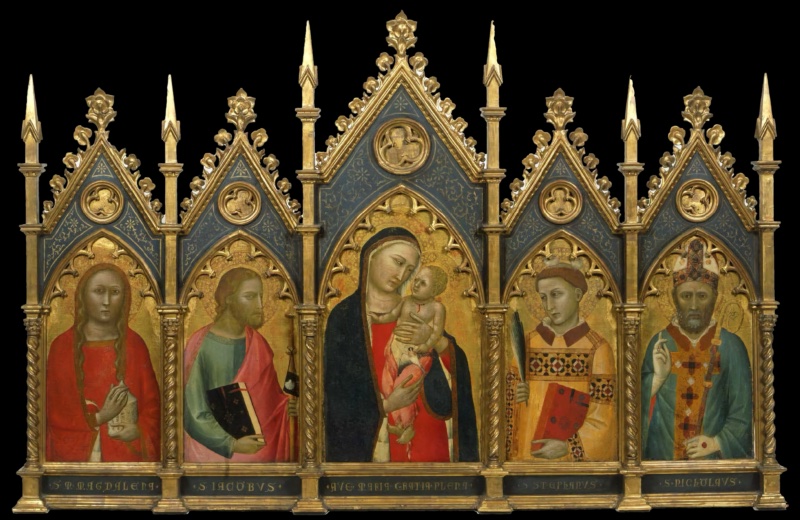
Central Panel: The Virgin and Child
The Philadelphia polyptych, dated by the museum to about 1346, the year in which Allegretto is documented in Florence as a member of the Compagnia di San Luca, belongs to the earliest phase of his known activity. It follows a Florentine type that Bernardo Daddi had made popular: a central panel with the Virgin and Child flanked by four saints, all shown in half-length and set beneath cusped arches against a gold ground. The half-length format brings the figures close to the viewer and creates an intimate, direct relationship between the sacred figures and the faithful. In the central panel, taller and broader than the lateral ones, the Virgin holds the Child in a tender embrace, and her figure establishes the devotional focus of the whole altarpiece.
The Virgin is shown from the waist up, wrapped in a mantle of deep blue, now darkened almost to black, which covers her head and falls over her shoulders. Beneath it she wears a vermilion gown and a white veil that frames her face. She inclines her head toward the Child and presses her cheek against his, while her eyes gaze downward with an expression of gentle melancholy. Her face, with its long, straight nose, narrow eyes and small mouth, is softly modelled in the Florentine manner, and its expression of quiet sorrow suggests her foreknowledge of her Son’s Passion.
The Child is seated on his Mother’s left arm, turned toward her with his cheek pressed to hers. His body is partly bare, wrapped at the waist and legs in a transparent pink cloth, and around his neck hangs a small horn of red coral. Coral amulets of this shape were commonly worn by children in fourteenth-century Italy as protection against the evil eye, and Berenson, cataloguing the polyptych in 1913, already recognised the pendant as this charm. In religious painting, however, coral also carried a further meaning: its red colour evoked the blood of Christ, so that the amulet that protected an ordinary child here alludes to the sacrifice awaiting the Son of God. The Child reaches up with one hand toward the Virgin’s neck, in a gesture of affection, while the Virgin supports him with her hands. The motif of the Mother and Child cheek to cheek, derived from the Byzantine type of the Virgin of Tenderness (Glykophilousa), had been adopted by Tuscan painters, and Allegretto renders it here with a naturalness and warmth that reflect his Sienese as well as his Florentine sources.
Near the Child’s hand, against the red of the Virgin’s gown, is a small bird, a goldfinch, which he holds. The goldfinch, whose red markings were associated with the blood of Christ, was a common symbol of the Passion in Trecento painting, and its presence here introduces a note of foreboding into the tender scene. The Child who plays with the bird is the same who will shed his blood on the Cross. This juxtaposition of intimacy and sacrifice, of the Mother’s affection and her foreknowledge of the Passion, is central to the devotional meaning of the image.
The gold ground behind the figures is framed by a cusped arch, and the haloes of the Virgin and Child are finely tooled with punched ornament. The cusped arch of the central panel is carved in relief and gilded, and the gable above it is painted blue and decorated with gold foliate patterns, with a carved trefoil roundel at its centre. These elements, together with the elaborate pinnacles and crockets of the frame, give the polyptych the appearance of a miniature Gothic building. How much of the present frame is original, however, is a question that the museum’s technical documentation would need to answer.
On the base beneath the central panel runs the inscription
AVE MARIA GRATIA PLENA,
“Hail Mary, full of grace,” the words of the Archangel Gabriel at the Annunciation, which formed the opening of the Ave Maria. The inscription invites the viewer to greet the Virgin with the angel’s words, turning the image into a focus of prayer. The Marian greeting on the central panel is echoed by the names of the saints inscribed on the bases of the lateral panels, so that the whole polyptych is articulated by a sequence of inscriptions that identify its figures and direct the viewer’s devotion.
The style of the central panel reflects Allegretto’s close study of Bernardo Daddi. The soft modelling of the faces, the graceful inclination of the Virgin’s head, the tenderness of the embrace and the rich but restrained colour are all characteristic of Daddi’s devotional panels of the 1330s and 1340s. The Dizionario Biografico degli Italiani notes that in 1346 Allegretto came into contact with Daddi, and it describes the works of his early Daddesque period as graceful and aligned with the Sienese-Florentine compromise established by Daddi. The Philadelphia Virgin is one of the clearest expressions of this phase.
The central panel thus establishes the tone of the whole polyptych: intimate, tender and devotional, with a sense of quiet sorrow that anticipates the Passion. The half-length format, the cheek-to-cheek embrace, the goldfinch and the Marian inscription together create an image of great emotional immediacy. Painted at the beginning of Allegretto’s documented career, the panel shows that the young painter from Fabriano had fully mastered the language of Florentine devotional painting and was able to use it with sensitivity and conviction.
Outer Left Panel: Saint Mary Magdalene
The outer left panel presents Saint Mary Magdalene in half-length, beneath a cusped arch, against a gold ground. The base bears the inscription S·M·MAGDALENA, “Saint Mary Magdalene.” According to the Gospels, Mary Magdalene was the woman from whom Christ cast out seven devils, who stood at the foot of the Cross and who was the first witness of the Resurrection. Medieval tradition identified her with the sinful woman who anointed Christ’s feet and with Mary of Bethany, and she became the model of the repentant sinner and of contemplative love.
The saint is shown frontally, with long, loose, golden hair falling over her shoulders and down to her waist. Her face is pale and oval, with a straight nose and a small mouth, and her large eyes gaze directly at the viewer with an intense, fixed expression. The directness of her gaze, unusual among the figures of the polyptych, establishes a personal relationship with the viewer and invites reflection on her example of penitence and devotion.
The Magdalene is dressed entirely in red: a gown of vermilion and a mantle of the same colour, edged with gold, which falls over her shoulders and arms. Red was her traditional colour, symbolising both the ardour of her love for Christ and, in some interpretations, her former life of sin. The broad expanses of red, modelled with restraint, give the figure a strong, unified presence that balances the dark mantle of the Virgin in the central panel.
In her hands the saint holds her characteristic attribute, the jar of ointment with which she anointed Christ’s feet and with which she went to the tomb on Easter morning to anoint his body. The jar, white and cylindrical, is decorated with gold ornament and closed with a lid, and she holds it delicately in both hands before her breast. Its precious appearance recalls the costly spikenard of the Gospel account and alludes to the value of her devotion.
The loose hair, falling freely over her shoulders, is another traditional attribute of the Magdalene. It recalls the episode in which she dried Christ’s feet with her hair, and it distinguishes her from the veiled matrons and crowned virgin martyrs of medieval iconography. Allegretto renders the hair with fine, flowing strokes of gold and light brown that create a rhythmic pattern framing the figure.
The panel is framed by twisted colonnettes and surmounted by a gable painted blue with gold foliate ornament, a carved trefoil roundel and crockets. The cusped arch that frames the saint’s head is carved and gilded. These elements are repeated on each of the lateral panels, creating a unified and rhythmic structure across the polyptych.
The placement of the Magdalene at the outer left, balanced by the bishop saint at the outer right, reflects the hierarchical arrangement of the polyptych. She is paired with Saint James on the left, forming with him a group of figures closely associated with the life and Passion of Christ. Her presence in the polyptych may reflect the particular devotion of the patron or the dedication of the church or chapel for which the altarpiece was made.
Stylistically, the figure of the Magdalene is consistent with the Daddesque character of the central panel. The soft modelling of the face, the graceful fall of the drapery and the restrained use of colour are all characteristic of Allegretto’s early manner. At the same time, the fixed, frontal gaze and the somewhat hieratic pose suggest a certain severity that distinguishes the figure from the gentler saints of Daddi’s workshop and may reflect Allegretto’s own temperament.
Inner Left Panel: Saint James the Greater
The inner left panel presents Saint James the Greater, the apostle and brother of Saint John the Evangelist. The base bears the inscription S·IACOBUS, “Saint James.” According to tradition, James preached the Gospel in Spain and was martyred in Jerusalem under Herod Agrippa, and his body was later translated to Santiago de Compostela, which became one of the greatest pilgrimage destinations of the Middle Ages.
The apostle is shown in half-length, turned in three-quarter view toward the central panel, so that his gaze is directed toward the Virgin and Child. He has long, wavy brown hair and a full beard, and his face is grave and dignified, with a long nose and deep-set eyes. The expression of calm concentration suits the apostle’s role as a witness to Christ and a preacher of the Gospel.
James wears a tunic of green and a mantle of rose-pink, lined with a lighter colour and edged with gold, which falls over his left shoulder and arm. The combination of green and pink, one of the favourite colour harmonies of Florentine painting in the circle of Daddi, gives the figure a luminous and elegant appearance. The folds of the mantle are modelled with soft gradations of tone that suggest the volume of the body beneath.
In his right hand the apostle holds a large book bound in black with gold ornament, the attribute of the apostles and of the Gospel they preached. In his left hand he holds a pilgrim’s staff, to which is attached a scallop shell, the badge of the pilgrims of Santiago de Compostela. The shell and the staff identify him unmistakably as Saint James the Greater, patron of pilgrims.
The pilgrim’s attributes had a particular resonance in the fourteenth century, when the pilgrimage to Compostela attracted large numbers of the faithful from all over Europe. The inclusion of James in the polyptych may reflect the devotion of a patron who had made the pilgrimage or who belonged to a confraternity dedicated to the saint. In the absence of documentary evidence, however, the reasons for his inclusion cannot be determined.
The saint’s orientation toward the central panel links him to the Virgin and Child and creates a sense of movement toward the centre of the polyptych. His figure, turned inward, balances that of Saint Stephen on the opposite side, who also turns toward the centre. This symmetrical arrangement of the inner saints, facing the Virgin, frames the central image and directs the viewer’s attention toward it.
Stylistically, the figure of James is one of the most characteristically Daddesque in the polyptych. The graceful proportions, the soft modelling and the harmonious colour recall the apostles in Daddi’s polyptychs of the 1340s, and the figure demonstrates how closely Allegretto had studied the Florentine master’s work. The fine punched decoration of the halo and the gold border of the mantle add a touch of refinement.
The panel of Saint James thus combines iconographic precision, stylistic elegance and devotional directness. It presents the apostle as a dignified witness to Christ, turned in contemplation toward the Virgin and Child, and it offers the viewer a model of faith and pilgrimage. Together with the Magdalene, he forms a harmonious group on the left side of the polyptych.
Inner Right Panel: Saint Stephen
The inner right panel presents Saint Stephen, the first martyr of the Church, whose stoning is recounted in the Acts of the Apostles. The base bears the inscription S·STEPHANUS, “Saint Stephen.” Stephen was one of the seven deacons appointed by the apostles to serve the needs of the early Christian community in Jerusalem, and his death, witnessed by Saul, the future Saint Paul, made him the protomartyr, the model of all Christian martyrs.
The saint is shown in half-length, turned in three-quarter view toward the central panel, with his head inclined and his gaze directed downward. He is represented as a beardless young man with the tonsure, and on his head rest small stones, the instruments of his martyrdom. The motif of the stones placed on the head was a common iconographic convention, allowing the painter to identify the saint while preserving the serenity of his image.
Stephen wears the dalmatic, the liturgical vestment of the deacon, which is the most richly decorated garment in the polyptych. It is of golden yellow, adorned with broad bands of geometric ornament in which lozenges and squares alternate in red, black and gold, and it is completed by a collar of red. The museum’s technical description records the use of silver in the polyptych, and the dark areas in the patterns of the dalmatic may be silver leaf that has oxidised over time. The rich decoration of the vestment reflects Allegretto’s love of ornament, already evident in this early work.
In his right hand the saint holds a palm, the emblem of martyrdom, and in his left a large book bound in red, which alludes to his role as a deacon, charged with the reading of the Gospel in the liturgy. The palm and the book together define Stephen as both martyr and minister of the Word. The red of the book echoes the red of his collar and of the Virgin’s gown, creating a chromatic link between the panels.
The saint’s youthful face, with its soft modelling, delicate features and gentle expression, conveys the serenity of the martyr who, according to the Acts, saw the heavens open and the Son of Man standing at the right hand of God at the moment of his death. The inclination of his head toward the central panel links him to the Virgin and Child and balances the figure of Saint James on the opposite side.
The rich geometric patterns of the dalmatic contrast with the simpler draperies of the other saints and create a focus of decorative interest on the right side of the polyptych. This contrast between plain and ornate surfaces, between modelled drapery and flat pattern, would become one of the defining features of Allegretto’s mature style. In the Philadelphia polyptych it is still subordinated to the overall harmony of the composition.
The inclusion of Saint Stephen alongside Saint James may reflect the patron’s devotion or the dedication of the altar for which the polyptych was made. Stephen was widely venerated throughout Italy, and many churches and altars were dedicated to him. His presence in the polyptych, as the first martyr, complements that of James, the first apostle to be martyred, and gives the altarpiece a coherent programme of witness and martyrdom.
The panel of Saint Stephen is one of the most refined in the polyptych. The delicate modelling of the face, the rich decoration of the dalmatic and the harmonious colour combine to create an image of youthful holiness and liturgical splendour. It shows that Allegretto, even at the beginning of his career, was capable of combining Florentine grace with a decorative sensibility that would become increasingly prominent in his later work.
Outer Right Panel: A Bishop Saint
The outer right panel presents a bishop saint in half-length, beneath a cusped arch, against a gold ground. The base bears the inscription S·NICHOLAUS, “Saint Nicholas,” and the identification is at least a century old: Berenson, in his 1913 catalogue of the Johnson Collection, already described the figure as Saint Nicholas, wearing a white mitre and a bluish-green mantle trimmed with ochre. The museum today, however, catalogues him simply as “a Bishop Saint.” This caution is justified. The inscribed bases may be part of a later frame, and the figure lacks the three golden balls or purses that were Nicholas’s usual attribute in Italian painting. The identification therefore remains possible but unproven.
The saint is represented as an elderly man with a short grey beard and a lined, grave face, looking out toward the viewer. He wears a tall mitre richly decorated with geometric patterns in red, gold and black, and he is dressed in a green chasuble adorned with a broad orphrey of gold with a cross-shaped pattern. The rich episcopal vestments, rendered with great attention to detail, contrast with the simpler garments of the other saints.
With his right hand, covered by a white glove, the bishop raises two fingers in blessing, and in his left, also gloved, he holds a crozier, the pastoral staff of the bishop, whose curved head is visible at the upper right of the panel. On the finger of his left hand he wears an episcopal ring with a red stone. The gloves, the ring and the crozier are all insignia of episcopal dignity and emphasise the saint’s authority as a shepherd of the Church.
The geometric patterns of the mitre and the orphrey, like those of Saint Stephen’s dalmatic, may originally have included silver, which has darkened over time. The rich decoration of the vestments balances that of Stephen’s dalmatic on the inner panel, so that the two saints on the right side of the polyptych form a pair distinguished by their liturgical splendour, in contrast to the simpler dress of the Magdalene and James on the left.
The bishop’s frontal pose and direct gaze give him an air of authority and dignity. Unlike Saint Stephen, who turns toward the centre, the bishop faces the viewer, raising his hand in blessing as if addressing the faithful before the altar. This frontal orientation balances that of the Magdalene on the outer left, who also gazes directly at the viewer, so that the two outer figures frame the polyptych with their direct address.
If the bishop is indeed Saint Nicholas, his inclusion in the polyptych would reflect the immense popularity of the saint in fourteenth-century Italy. Nicholas, bishop of Myra, whose relics had been translated to Bari in 1087, was venerated as a protector of children, sailors and the poor, and his cult was widespread in the Marche as well as in Tuscany. The absence of his usual attribute, however, makes it prudent to leave the identification open.
Stylistically, the figure of the bishop shows a slightly different character from the other saints. The lined face, the grey beard and the grave expression convey a sense of age and authority, and the modelling is more emphatic than in the youthful figures of Stephen and the Magdalene. The rich decoration of the vestments, however, is consistent with the rest of the polyptych, and the figure is fully integrated into its overall harmony.
The panel of the bishop saint completes the programme of the Philadelphia polyptych. The four saints, two on each side, form a heavenly court around the Virgin and Child. The Magdalene and James on the left, associated with the life of Christ, and Stephen and the bishop on the right, associated with the ministry of the Church, together represent the various forms of holiness: penitence, apostolic witness, martyrdom and pastoral care. Painted at the beginning of Allegretto’s career, the polyptych is one of the most complete and harmonious works of his early Daddesque phase.
The attribution of the polyptych to Allegretto is a relatively recent achievement. When Berenson catalogued it in 1913, he gave it to “Giottino,” the Florentine artistic personality to whom he assigned the frescoes of the Strozzi Chapel in Santa Maria Novella and of the chapter house of Santo Spirito in Florence, praising it as the work of a noble artist deeply influenced by the Lorenzetti. Berenson’s error is instructive. The polyptych is so thoroughly Florentine in its forms, and so close to the Sienese-inflected painting of Florence in the 1340s, that it could be mistaken for the work of a native Florentine master. Its later recognition as a work by Allegretto has become one of the clearest demonstrations of how deeply the young painter from Fabriano had absorbed the art of Florence during his years there.
Virgin and Child Enthroned with Saints Lucy, John the Baptist, Anthony Abbot and a Female Martyr, with the Angel of the Annunciation
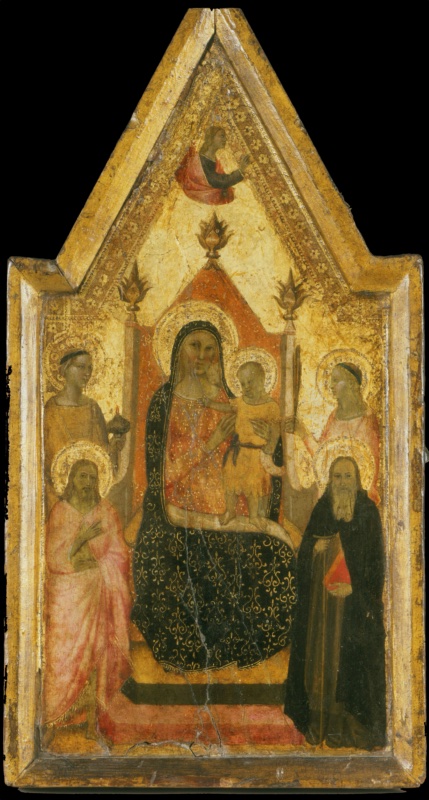
This small panel, less than half a metre high and still in its original engaged frame, belongs to the type of portable devotional image that Allegretto produced throughout his career. Several features suggest that it was the left wing of a diptych. The half-length Archangel Gabriel in the gable turns to the right, toward a figure no longer present, and he would have been answered by the Annunciate Virgin in the gable of a companion panel, most probably a Crucifixion, as in the Berlin diptych. A small metal fitting on the right edge of the frame may be a remnant of the hinge that joined the two wings. The museum’s dating to about 1350 places the panel in Allegretto’s early phase, shortly after his Florentine sojourn, when the influence of Bernardo Daddi was still dominant in his work.
The composition is dominated by the Virgin, enthroned frontally at the centre on a tall, narrow throne whose back is covered by a cloth of red and orange. The throne rises into a pointed gable crowned by a gilded finial in the form of a flaming vase, and its uprights are topped by similar gilded ornaments shaped like flames or foliage. This vertical architecture, rising into the gable of the panel, gives the Virgin an imposing presence despite the small scale of the image. The throne also serves to separate the Virgin from the saints on either side, affirming her status as Queen of Heaven while situating her in the midst of her heavenly court.
The Virgin wears a dark mantle, strewn with gold scrolling ornament and fleurons, over a gown of red sprinkled with small gold motifs, and her head is covered by the mantle, beneath which a white veil frames her face. She looks directly at the viewer with a grave expression, her long face and narrow eyes recalling the Madonnas of Daddi’s workshop. Across her lap the pale lining of the mantle sweeps in a broad curve, a motif Allegretto would repeat in larger works such as the Apiro polyptych. The Child stands on his Mother’s lap, dressed in a yellow tunic tied at the waist with a blue sash. He reaches toward her breast and looks down, while the Virgin supports him with her hands. The standing Child, active and attentive, gives the solemn frontal group a note of animation.
Behind the throne, on either side, appear two young female saints, shown half-hidden by the throne and by the saints in front of them. On the left is Saint Lucy, identified by the burning lamp she holds, an attribute that alludes to her name, derived from the Latin lux, light. On the right is a young female martyr holding a palm, whose identity cannot be determined from this attribute alone, since the palm was common to all martyrs. Both wear their hair bound with a dark band and are dressed in pale garments that harmonise with the gold ground. Their placement in the second plane, behind the throne, suggests a heavenly court that extends beyond the visible figures, a device that Allegretto adapted from the larger Maestà compositions of Florentine and Sienese painting.
In the foreground stand two male saints. On the left, Saint John the Baptist, bearded and with long, dishevelled hair, wears a rose-pink mantle over his camel-hair garment, and his bare legs and feet recall his life in the wilderness. He places his right hand on his breast in a gesture of devotion, turning toward the Virgin. On the right, Saint Anthony Abbot, with a long grey beard, wears the black habit of the hermits and holds a staff and a red book. His dark figure, standing firmly beside the throne, balances the rose mantle of the Baptist, and the two saints frame the throne with their contrasting colours and characters: the prophet of the desert and the father of monasticism.
The choice of saints is revealing. Saint Anthony Abbot appears in several of Allegretto’s works associated with Antonine patronage, including the Washington triptych of 1354 and the Macerata triptych of 1369, and his presence here may reflect the particular devotion of the owner. John the Baptist, as the last of the prophets and the forerunner of Christ, was often paired with the Virgin as an intercessor for humanity. Saint Lucy, whose lamp symbolised the light of faith, was invoked against diseases of the eyes and enjoyed a widespread cult in the Marche, where Allegretto himself represented her in the Apiro polyptych of 1366. The combination of these saints suggests a personal selection by the patron, whose name saints or protectors they may have been.
The Archangel in the gable and the fitting on the right edge of the frame both point to a missing second wing. Berenson had already reached this conclusion in 1913: he judged that the little pointed panel must have formed part of a diptych, on the top of whose other panel the Virgin Annunciate answered the Gabriel represented here. At that time he attributed the panel to Bernardo Daddi, an attribution that itself testifies to how closely Allegretto’s early work followed the Florentine master. Whether the companion wing survives remains to be established; the museum’s catalogue by Strehlke (2004) may identify it.
The panel has suffered from the passage of time. A long vertical crack runs through the Virgin’s figure and the throne, and there are losses of paint and wear to the gold, particularly in the lower part of the panel and on the frame. Despite this damage, the qualities of Allegretto’s early style remain clearly legible: the graceful, softly modelled faces, the harmonious colour, the refined decoration of the Virgin’s mantle, and the careful tooling of the haloes and borders. The panel shows how the young painter, fresh from his contact with Daddi’s workshop, could condense the grandeur of a Florentine altarpiece into the intimate format of a private devotional image, creating a small but complete vision of the Virgin enthroned among her saints.
Virgin and Child, c. 1360
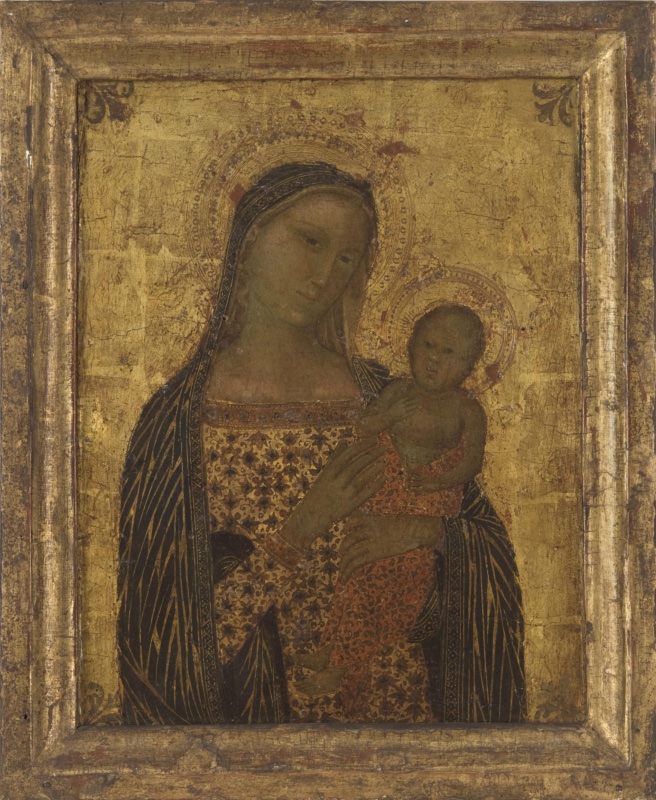
This small panel presents the Virgin and Child in half-length, close to the viewer, in the intimate format of the private devotional image. The Virgin fills almost the entire height of the gold ground, her figure cut at the level of the hips by the lower edge of the panel, and the Child is held high on her left arm so that his head reaches the level of her shoulder. There are no saints, angels or architectural elements: the image is reduced to the essential relationship between Mother and Son, set against a luminous field of gold. The museum’s dating to about 1360 places the panel in Allegretto’s mature phase, between the Washington triptych of 1354 and the Vatican triptych of 1365, when his art was moving from the Daddesque grace of his early works toward the more decorative manner of his later years.
The Virgin inclines her head gently toward the Child, while her eyes, turned sideways, seem to look past him toward the viewer. Her face is long and oval, with a straight nose, narrow, almond-shaped eyes and a small, closed mouth, and its expression is one of quiet melancholy. The flesh tones have darkened considerably over time, and the greenish underlayer of the tempera now shows through, giving the faces a sombre cast that was not intended by the painter. Even so, the delicacy of the modelling and the gentle tilt of the head convey the tenderness and the foreboding that characterise Allegretto’s Madonnas, in which maternal affection is always tinged with awareness of the Passion to come.
The Virgin’s mantle, dark blue or black, covers her head and falls over her shoulders to the lower edge of the panel. Its surface is traversed by fine gold lines that follow the folds of the fabric, in a technique that recalls the chrysography of Byzantine icons, in which gold striations were used to model drapery and to suggest divine light. The mantle is edged with an embroidered border decorated with a pattern of crosses and lozenges. Beneath it, the Virgin wears a gown of gold brocade densely patterned with small dark flowers and stars, whose surface shimmers against the gold ground. The museum’s technical description records the use of silver, which may have been employed in the decoration of the garments, although its exact location should be confirmed in the technical literature.
The Christ Child is seated on his Mother’s left arm, wrapped in a cloth of red and gold brocade patterned with dark ornament, which leaves his chest and arms bare. He turns his face toward the viewer with a grave, almost adult expression, and raises one hand to his breast, where a small red pendant, perhaps a piece of coral, hangs from a cord around his neck. Coral, worn as an amulet by children, was also associated with the blood of Christ, so that the small ornament may carry an allusion to the Passion. The Virgin supports the Child with her hands, her long, slender fingers resting on his body in a gesture of protection and presentation.
The haloes of the Virgin and Child are among the most elaborately tooled elements of the panel. Each is composed of concentric bands of punched ornament, with rings of small circles and rosettes and incised lines radiating from the head. The gold ground around the figures, now much worn, reveals in many places the red bole beneath. In the upper corners and at the lower left, painted ornaments of dark foliate motifs decorate the gold ground, softening the rectangular format of the panel and suggesting a framing arch. These corner decorations, together with the rectangular format and the horizontal grain of the wood, raise the question of whether the panel preserves its original shape or was adapted at some point in its history.
The richness of the textiles, the gold striations of the mantle and the dense patterns of the gown and of the Child’s cloth show Allegretto’s growing interest in the decorative possibilities of gold and colour. At the same time, the figures retain the soft modelling and the gentle proportions of his Florentine training. The panel thus stands at a point of transition in the painter’s career, between the Daddesque grace of the 1340s and 1350s and the flatter, more ornamental manner of his last decade. The icon-like character of the image, with its frontal presentation, its gold ground and its chrysographic mantle, also reflects the persistence of Byzantine devotional models in fourteenth-century Italian painting, particularly in images intended for private prayer.
The inscription on the reverse of the panel reveals an important chapter in the later history of the image. It records that anyone who came devoutly to see this sacred image of the Most Holy Name of Mary and recited any prayer before it would gain an indulgence of one hundred days, and that reciting the litanies would gain a further fifty days, under a concession of Pope Pius VI. Since Pius VI reigned from 1775 to 1799, the inscription shows that more than four centuries after it was painted, the panel was still the object of public veneration, probably in a church or chapel, and that its cult was sanctioned by the papacy. The dedication to the Most Holy Name of Mary, a feast extended to the universal Church in the late seventeenth century, suggests that the image may have been associated with a confraternity or altar of that title.
The Philadelphia Virgin and Child is thus significant not only as a work of Allegretto’s maturity but also as a document of the long devotional life of medieval images. Painted around 1360 for private or public devotion, it continued to attract prayer and veneration in the late eighteenth century, when its antiquity and its icon-like appearance may have enhanced its sacred aura. Its worn surface, darkened flesh tones and damaged gold bear witness to this long history of use. Despite its condition, the panel conveys the qualities that made Allegretto’s devotional images so widely esteemed: the tenderness of the relationship between Mother and Child, the refinement of the decoration, and the luminous splendour of gold.
Diptych with the Virgin and Child and the Man of Sorrows, c. 1366
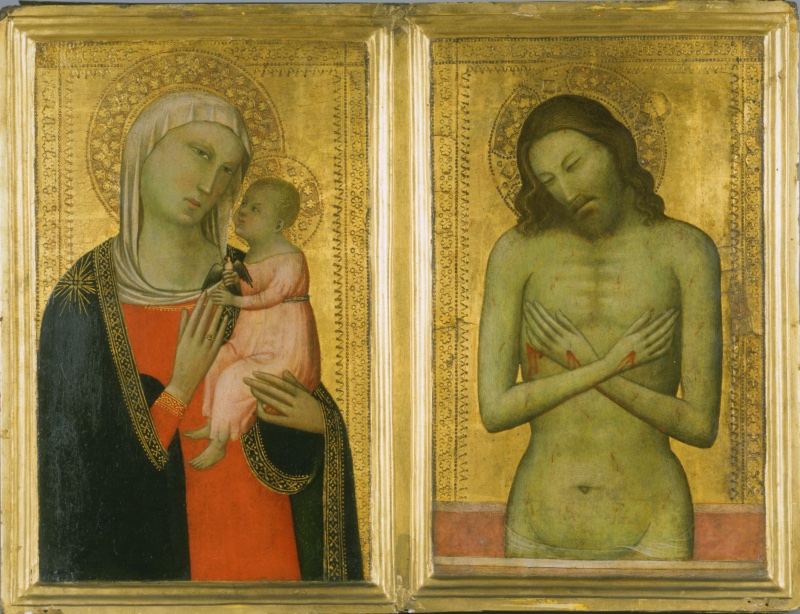
Left Wing: The Virgin and Child
The Philadelphia diptych is one of the most moving examples of the small devotional images through which Allegretto reached the private piety of his patrons. Its two wings, still joined in their original engaged frames, confront the viewer with the two poles of the Christian story: on the left, the Mother holding her infant Son, and on the right, the same Son dead and risen from his tomb. The museum’s dating to about 1366 places the diptych in the same years as the Apiro polyptych and the San Severino Madonna of Humility, at the height of Allegretto’s maturity. The 2021 Fabriano exhibition included another diptych by Allegretto pairing the Madonna and Child with the Imago Pietatis, now divided between a private collection and the Musei Civici of Pesaro, which shows that the painter returned to this combination more than once.
The Virgin is shown in half-length, turned in three-quarter view toward the Child, who is held on her left arm. She wears a white veil that frames her face and falls over her shoulders, and above it a mantle of deep blue, now darkened almost to black, edged with a broad gold border embroidered with a lattice of crosses. On her right shoulder shines a large gold star with radiating rays, the emblem of Mary as Stella Maris. Beneath the mantle she wears a gown of brilliant vermilion, whose colour stands out with great force between the dark folds of the mantle. The restrained palette of dark blue, red and white, set against the gold, gives the image an intensity and clarity characteristic of Allegretto’s mature devotional panels.
The Virgin’s face is long and oval, with a straight, narrow nose, almond-shaped eyes and a small, closed mouth. She does not look at the Child but gazes out beyond the viewer with a grave, melancholy expression, as if absorbed in thoughts of the future. This withdrawn gaze, a constant of Allegretto’s Madonnas, acquires particular significance in a diptych whose second wing shows the dead Christ. The Mother who holds her infant Son appears already to foresee the Passion displayed on the opposite panel, so that her sorrow becomes the link between the two images.
The Christ Child, dressed in a pink tunic girded with a blue sash, sits on his Mother’s arm and turns toward her, raising his face to hers. With both hands he holds a small bird with a red face and black and yellow wings, a goldfinch, which he presses against the Virgin’s breast. The museum’s own description explains the symbolism: the bird, fond of eating thistles and thorns, was often shown as a reminder of Christ’s future Passion and the crown of thorns. Like the Virgin’s gaze, the goldfinch links the tender scene of the left wing to the image of suffering on the right, making the whole diptych a meditation on the unity of Incarnation and Redemption.
The Virgin raises her right hand before her breast, touching the Child’s hands and the bird, while her left hand supports him from below. On the ring finger of her right hand she wears a small gold ring. The same detail appears in the San Severino Madonna of Humility of 1366, and it may be read as a sign of Mary’s role as the bride of Christ, the Sponsa of the Song of Songs, in whom the Church was personified. The recurrence of the ring in two works of the same years suggests a deliberate iconographic choice on Allegretto’s part, perhaps reflecting the devotional culture of the mendicant orders for which he frequently worked.
The Virgin’s hands are painted with a delicacy and elegance that reveal the refinement of Allegretto’s mature style. Her long, slender fingers are arranged in graceful gestures, one raised before her breast, the other supporting the Child, and their pale flesh stands out against the vermilion of the gown. The gesture of the raised hand, which both touches and presents the Child and the bird, draws the viewer’s attention to the symbolic centre of the image, where the Mother’s hand, the Son’s hands and the bird of the Passion meet.
The gold ground behind the figures is framed by broad punched borders decorated with rows of small rosettes, ogival motifs and scalloped bands, and the haloes of the Virgin and Child are richly tooled with floral ornament. The density of the punchwork, which covers the whole border of the panel, testifies to Allegretto’s extraordinary mastery of gold tooling, singled out by modern scholarship as one of the hallmarks of his art. In the small format of the diptych, the richly worked gold creates an effect of preciousness appropriate to an object intended for intimate, prolonged contemplation.
The left wing of the Philadelphia diptych thus presents the Virgin and Child as an image of tenderness shadowed by sorrow. The affectionate gesture of the Child turning to his Mother, the grave expression of the Virgin, the goldfinch and the ring together compose a dense web of meanings that the devout owner would have unfolded in prayer. Opened on a table or a small altar, the diptych offered its owner the image of the Mother presenting her Son, and at the same time invited him to turn toward the opposite wing, where the Son appears as the Man of Sorrows.
Right Wing: The Man of Sorrows
The right wing presents the Man of Sorrows, or Imago Pietatis, the image of the dead Christ rising in half-length from his tomb. The type, which originated in Byzantine art and spread through Italy from the late thirteenth century, did not illustrate a moment of the Gospel narrative. It condensed the Passion, death and Resurrection into a single timeless image, designed to arouse compassion and devotion. It became one of the most widespread subjects of private devotion in the fourteenth century, particularly in small diptychs such as this, where it was paired with the Virgin and Child.
Christ is shown frontally, rising from a sarcophagus whose red and pink front runs across the lower part of the panel. His head is bowed onto his right shoulder, his eyes are almost closed, and his long brown hair falls over his shoulders. His face, with its lowered lids, parted lips and short beard, expresses the stillness of death and at the same time a mysterious life, for the dead Christ stands upright in his tomb. This ambiguity between death and life lies at the heart of the Imago Pietatis, which presents Christ as dead and yet present, suffering and yet victorious.
Christ’s arms are crossed over his breast, with the hands laid on the opposite shoulders. This pose, derived from Byzantine models, was among the most common in Italian representations of the subject, and it emphasises both the stillness of death and the display of the wounds. The wounds in his hands are clearly visible, with blood flowing from them in thin streams down the forearms, and the wound in his side, partly concealed by the crossed arms, also bleeds. The display of the wounds, the signs of Christ’s sacrifice, invited the viewer to meditate on the suffering of the Passion and on the love that it revealed.
The body of Christ is covered with small red marks, the traces of the scourging and of the crown of thorns. These wounds are scattered across the chest, the arms and the abdomen, and small drops of blood run from the brow. Allegretto renders them with restraint, as fine red strokes on the pale flesh, avoiding any excess of violence. The effect is one of quiet pathos rather than horror, in keeping with the contemplative character of an image for private devotion.
The modelling of the body is one of the finest passages in Allegretto’s work. The torso is rendered with a careful attention to anatomy, with the ribs, the muscles of the chest and the abdomen indicated by subtle gradations of tone. The flesh has a greenish cast, which results in part from the green underpainting, or verdaccio, of Trecento tempera technique becoming more visible over time as the upper layers have thinned, but which also expresses the pallor of death. The lower edge of the body is veiled by a transparent loincloth, visible just above the edge of the tomb.
Behind Christ’s head is a cruciform halo, richly tooled and set with punched square motifs that suggest jewels. The cross inscribed within the halo, reserved for Christ, identifies him as the Son of God. The gold ground around him is framed by the same broad punched borders as the left wing, so that the two panels, when opened side by side, form a unified and harmonious ensemble. The consistency of the decoration confirms that the two wings were conceived together as a single object.
The pairing of the Virgin and Child with the Man of Sorrows had a profound devotional meaning. It set side by side the Incarnation and the Passion, the infant Christ in his Mother’s arms and the dead Christ in his tomb, inviting the viewer to meditate on the continuity between the two. The Virgin’s sorrowful gaze and the goldfinch on the left wing anticipate the suffering shown on the right, while the Man of Sorrows recalls the human body that the Virgin had given to her Son. In the practice of affective devotion promoted by the mendicant orders, such diptychs served as supports for prayer, in which the faithful were encouraged to share the grief of the Mother and to contemplate the wounds of the Son.
The Philadelphia diptych is one of the most refined and intense examples of Allegretto’s devotional painting. The two wings, united by their gold grounds, their punched borders and their original frames, compose a coherent and moving meditation on the mystery of salvation. The tenderness of the left wing and the silent suffering of the right are expressed with a delicacy and restraint that reveal the painter at the height of his maturity. Painted around 1366, in the same years as the Apiro polyptych and the San Severino Madonna, the diptych shows how Allegretto could combine monumental dignity and intimate emotion within the smallest of formats.
The Crucifixion with the Virgin, Saint John the Evangelist, Mary Magdalene and Two Angels, 1345–50
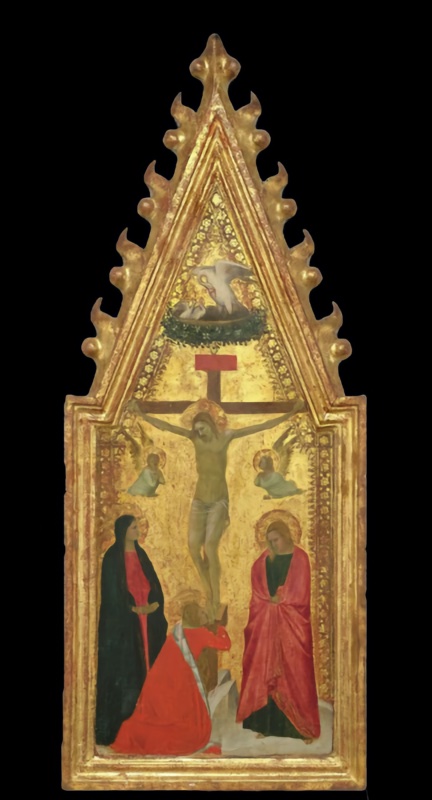
This small Crucifixion, dated by the museum to about 1345–50, is a work whose authorship has been debated for almost a century. It is presented here under the name of Allegretto Nuzi, an attribution first proposed by Bernard Berenson in 1936 and maintained by him in 1968. More recently, the National Gallery of Art’s catalogue has included the Richmond Crucifixion among the works on which the initial phase of Allegretto’s career can be reconstructed, works in which the Florentine stylistic component, essentially derived from Maso di Banco, is fused with elements revealing his familiarity with the art of the Lorenzetti. If this attribution is accepted, the panel belongs to the years immediately surrounding Allegretto’s documented presence in Florence in 1346. Its modest dimensions and its composition suggest that it was intended for private devotion, perhaps as the wing of a diptych, although the present frame, with its crockets and finial, gives it the appearance of an independent gabled panel.
The composition is organised around the tall Cross, which rises from the rocky ground of Golgotha to the gable of the panel. Christ hangs dead upon it, his arms stretched along the crossbar and his body sagging under its own weight, his head bowed onto his right shoulder. The slender body, modelled in pale, greenish flesh tones, is girded by a transparent loincloth, and the legs are bent, with the feet crossed and nailed to the upright. Above his head is a red titulus, on which no inscription is now legible. The figure belongs to the Tuscan type of the Christus patiens, and its gentle modelling and elegant proportions reflect the example of Bernardo Daddi and of the Florentine painters Allegretto encountered in the 1340s.
On either side of the Cross, in the upper part of the panel, appear two small angels in half-length, emerging from clouds against the gold ground. Dressed in pale garments, with spread wings, they join their hands and bow their heads in grief. The mourning angels, a motif introduced into Crucifixion scenes by Giotto in the Arena Chapel and widely adopted by his followers, extend the lament for Christ’s death from the earthly to the heavenly sphere. Their small scale and their position in the upper corners of the field balance the composition and frame the body of Christ, directing the viewer’s attention toward it.
At the foot of the Cross, Mary Magdalene kneels on the rocks, her figure wrapped in a mantle of brilliant vermilion lined with a paler colour, and embraces the wood with both arms. Her face is pressed against the Cross, close to Christ’s nailed feet, and her long hair falls over her shoulders. Her gesture of intense, bodily devotion, repeated in several of Allegretto’s Crucifixions, including the Berlin diptych and the Bern triptych, offered the viewer a model of affective prayer. The Magdalene, the repentant sinner who had anointed Christ’s feet, appears here as the embodiment of penitence and of love for the crucified Lord.
On the left stands the Virgin, wrapped in a dark mantle that covers her head and falls to the ground, over a red gown. She stands upright, her hands joined before her, and her face, turned toward the Cross, expresses silent, contained grief. On the right stands Saint John the Evangelist, in a red mantle over a green tunic, with his head bowed and his hands clasped before him in a gesture of sorrow. The two figures, placed on either side of the Cross in symmetrical correspondence, follow the traditional composition of the Crucifixion with the Mother and the beloved disciple. Their broad, simple silhouettes, modelled with solid volumes, reflect the monumental conception of the figure that Allegretto learned from Maso di Banco.
In the gable, above the titulus, a pelican in a nest wreathed with green foliage pierces her breast to feed her young with her blood. The image, derived from the early Christian bestiary known as the Physiologus, was one of the most widespread symbols of Christ, who gives his blood for the redemption of humankind and nourishes the faithful in the Eucharist. The same motif crowns the Crucifixion of the Berlin diptych, where the pelican nests in a spray of leaves sprouting from the top of the Cross. The recurrence of the pelican in these two works shows how Allegretto developed a consistent iconographic formula for his devotional Crucifixions, in which the historical scene below is completed by a symbolic image of the sacrifice above.
The gold ground of the panel is framed by a punched border of floral ornament, which follows the outline of the gable, and the haloes of the figures are finely tooled. The frame, with its crockets and pointed finial, is richly carved and gilded, although whether it is original or a later addition would need to be verified in the museum’s documentation. Crocketed frames of this kind were common in Tuscan panels of the period, but many surviving examples on small devotional panels have been restored or replaced.
Few works in Allegretto’s catalogue have had so varied a critical history. In 1932 Berenson listed the panel under Jacopo di Cione, and in 1933 Lionello Venturi published it as the work of a collaborator of Giotto. When it entered the Minneapolis Institute of Arts with the Van Derlip bequest in 1935, it was first catalogued as Florentine School and then as Maso di Banco. In 1936 Berenson reassigned it to Allegretto Nuzi, and the Virginia Museum of Fine Arts, which acquired it with the Arthur and Margaret Glasgow Fund, published it in 1966 as Maso di Banco.
In his 1969 dissertation on Maso, David Wilkins rejected that attribution, while recognising the panel as a high-quality work of the second or third quarter of the Trecento. Fredericksen and Zeri, in their 1972 census of Italian paintings in North American collections, catalogued it as studio of Maso di Banco. Meanwhile Carlo Volpe in 1971, Miklós Boskovits in 1975 and Everett Fahy in 2001–2002 assigned it to the anonymous Florentine painter known as the Master of San Lucchese. The oscillation between Maso di Banco, his workshop, the Cione, the Master of San Lucchese and Allegretto is itself revealing. It shows how closely the panel is bound to the Florentine painting of the 1340s, and how difficult it is to separate the young Allegretto’s work from that of the Florentine masters and workshops whose idiom he absorbed. It is particularly noteworthy that Boskovits, who in 1975 gave the panel to the Master of San Lucchese, is the author of the National Gallery of Art’s systematic catalogue, which now lists it among Allegretto’s early works. The attribution to Allegretto should therefore be regarded as plausible, supported by authoritative opinion, but not beyond dispute.
In its style, the Richmond Crucifixion stands at the heart of the Florentine painting of the 1340s. The monumental figures of the Virgin and Saint John, with their simple silhouettes and solid volumes, reflect the example of Maso di Banco, and it is no accident that the panel was long attributed to Maso himself or to his workshop. The tender expressions and graceful gestures, on the other hand, recall the Sienese art of the Lorenzetti. The composition is clear and balanced, and the colours, the red of the Magdalene and John, the dark blue of the Virgin and the green of John’s tunic, stand out with brilliant clarity against the gold. The iconographic affinities with Allegretto’s Berlin Crucifixion, in particular the pelican in the gable and the kneeling Magdalene embracing the Cross, lend some support to the attribution to him. Whether by Allegretto or by a Florentine contemporary, the panel offers a precious testimony to the artistic milieu in which the young painter from Fabriano was formed.
Portable Tabernacle with the Madonna and Child Enthroned with Saints, the Nativity, the Crucifixion and the Annunciation
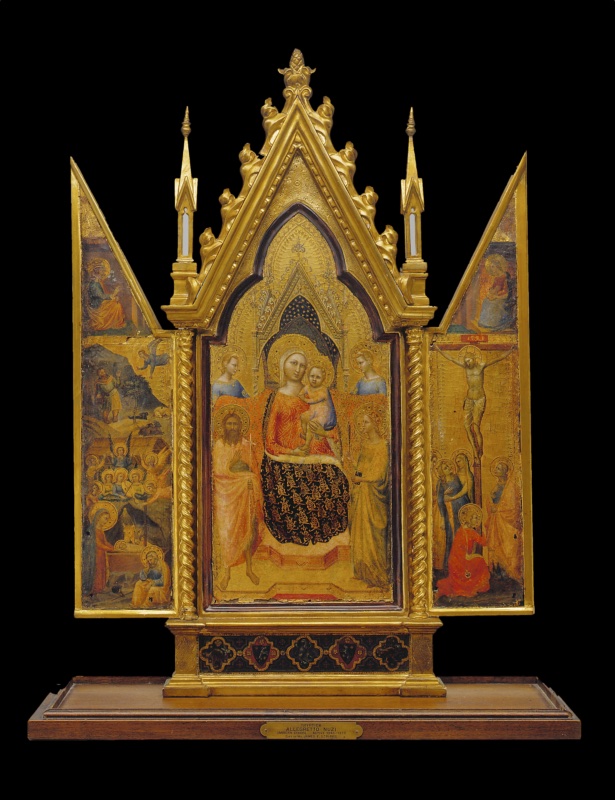
Central Panel: The Madonna and Child Enthroned with Saints
The Detroit tabernacle is among the most complete surviving examples of the portable devotional altarpieces produced in Allegretto’s workshop. It consists of a central panel with a pointed arch and two hinged wings, which could be closed over the centre to protect it and opened to reveal the whole programme: the Virgin and Child enthroned, the Nativity, the Crucifixion and the Annunciation. The Dizionario Biografico degli Italiani lists the portable tabernacle in Detroit, with the Madonna enthroned, the Nativity, the Crucifixion and the Annunciation, among the works of Allegretto’s first Daddesque period, which it describes as graceful works aligned with the Sienese-Florentine compromise established by Daddi. The museum’s broader dating to 1350–70 reflects the uncertainty that still surrounds the chronology of Allegretto’s small devotional works.
At the centre of the panel, the Virgin sits enthroned beneath an elaborate Gothic canopy. The throne rises behind her in the form of a miniature architectural structure, with pointed gables, pinnacles and tracery rendered in delicate gold, and its vault, visible above her head, is painted deep blue and sprinkled with golden stars, an image of the heavenly firmament. This architectural throne, derived from the tabernacles and baldachins of Gothic church furnishings, transforms the Virgin’s seat into a sacred shrine and affirms her status as Queen of Heaven. Its fine gold ornament, punched and incised into the gilded surface, demonstrates Allegretto’s mastery of the goldsmith’s techniques applied to panel painting.
The Virgin wears a gown of red, its folds highlighted with fine gold lines, and a mantle whose lower part, spread across her knees, is dark and densely patterned with gold ornament, lined with white. The rendering of this precious fabric, in which the pattern imitates the luxury silks imported and woven in fourteenth-century Italy, is sufficiently accomplished that the tabernacle was included in Brigitte Klesse’s study of silk textiles in Italian painting of the Trecento (1967).
The Virgin’s face, framed by a white veil and a finely tooled halo, is long and oval, with narrow eyes and a small mouth, and she looks out toward the viewer with a gentle, grave expression. The Child sits on her left arm, dressed in a blue tunic, and clings to her with one hand while turning toward the viewer. The motif attracted the attention of Dorothy Shorr, who reproduced a detail of the Child in her study of the Christ Child in Italian devotional images of the fourteenth century (1954). The intimacy of the embrace, set within the solemn frame of the throne, combines the tenderness of the Sienese tradition with the monumental order of Florentine painting.
Behind the throne, on either side, stand two angels in blue robes, with haloes and folded hands, turning toward the Virgin in adoration. Their pale faces and gentle expressions recall the angels of Daddi’s small altarpieces, and their symmetrical placement frames the enthroned group. The angels represent the heavenly court, and their presence extends the throne’s architecture into a vision of the celestial realm, within which the saints in the foreground stand as intercessors on behalf of the faithful.
In front of the throne, on the left, stands Saint John the Baptist, bearded and with dishevelled hair, in a rose-pink mantle over his camel-hair garment. He holds a slender cross-staff in one hand and raises the other in a gesture that points toward the Virgin and Child, as the forerunner who announced the coming of the Messiah. His bare feet rest on the ground before the throne. On the right stands a young female saint in golden-yellow robes, with a crown or diadem on her head, holding a small book and a palm. The palm identifies her as a virgin martyr, but her identity cannot be determined with certainty from these attributes alone.
The saints are painted on a slightly smaller scale than the Virgin, according to the hierarchical conventions of the period, and they are turned toward the enthroned group, participating in the sacred conversation. The Baptist’s gesture of indication and the female saint’s gentle inclination link them to the Virgin and Child and direct the viewer’s attention toward the centre. Their selection presumably reflects the personal devotion of the patron for whom the tabernacle was painted, whose coats of arms may appear on the painted base.
The base of the tabernacle is decorated with a band of dark painted quatrefoils, some of which contain coats of arms, alternating with foliate ornament. If these heraldic devices are original, they would identify the family that commissioned the tabernacle, and they could provide valuable evidence for its provenance and date. The present frame, with its pinnacles, crockets, finial and twisted columns, is richly carved and gilded. The neo-Gothic character of some of its elements, however, suggests that it may have been restored or partly reconstructed. Since the Scripps catalogue already described the work as a triptych in 1889, any such intervention probably predates its arrival in Detroit. Attached to the wooden stand is a small brass plaque recording the gift of James E. Scripps and identifying the painter as “Allegretto Nuzi, Umbrian School, active 1346–1373,” a label that reflects the state of scholarship in the early twentieth century rather than the work’s original presentation.
The central panel thus presents a complete devotional image in miniature: the Virgin enthroned in a celestial shrine, adored by angels and flanked by saints who intercede for the faithful. The graceful figures, the delicate modelling, the refined gold decoration and the harmonious colour are characteristic of Allegretto’s early work, when the influence of Bernardo Daddi was strongest. In its combination of monumental order and intimate tenderness, the panel shows how the young painter from Fabriano condensed the grandeur of a Florentine altarpiece into the portable format of a private tabernacle.
The tabernacle entered the Detroit Museum of Art with the collection of James E. Scripps, whose catalogue of 1889 described it as a triptych attributed to Giotto. The attribution was repeated in the periodical The Collector in 1891 and again in the museum’s handbook of 1910, a characteristic example of the late nineteenth-century habit of giving the finest Trecento panels to the most celebrated name of the period. It was Bernard Berenson who, in his Central Italian Painters of the Renaissance of 1908, first ascribed the triptych to Allegretto Nuzi.
The small brass plaque still attached to the base, which describes the painter as belonging to the “Umbrian School,” reflects the classification of the period, when Allegretto was grouped with the painters of central Italy rather than recognised as the founder of a distinct Fabrianese school. Berenson’s attribution was soon confirmed by Chandler R. Post, who devoted an article to the work in 1915, and it has been accepted by all subsequent scholarship, from Berenson’s own studies of Allegretto’s early works (1922 and 1930) and Raimond van Marle’s survey of 1925 to Lionello Venturi, Wilhelm Valentiner, Alessandro Marabottini’s monograph of 1951–1952, Federico Zeri and Burton Fredericksen’s census of 1972, Miklós Boskovits in 1975 and Fabio Marcelli’s monograph of 2004.
The date has been less settled: the museum’s catalogue of 1944 proposed about 1365, whereas later scholarship has tended to place the tabernacle in Allegretto’s early Daddesque phase. In 2008 the tabernacle was exhibited at the Uffizi in L’eredità di Giotto. Arte a Firenze 1340–1375, a recognition of its place in the Florentine painting of the mid-fourteenth century from which the young painter of Fabriano drew his formation.
Left Wing: The Nativity and the Annunciation to the Shepherds
The left wing presents the Nativity of Christ, combined with the Annunciation to the Shepherds, in a vertical composition that fills the narrow panel from top to bottom. In the gable above, a half-length figure, probably the Archangel Gabriel, turns toward the right, toward the Annunciate Virgin in the gable of the opposite wing. The narrative is organised in three superimposed zones, which lead the viewer’s eye from the hillside of the shepherds at the top, through the choir of angels in the middle, to the manger at the bottom. This vertical arrangement, dictated by the tall, narrow format of the wing, is typical of the narrative panels of portable tabernacles.
In the upper zone, set in a rocky landscape of hills and trees, an angel swoops down from the sky toward a shepherd standing on the hillside, bringing him the tidings of the birth of Christ. Around the shepherd, sheep graze or rest on the slopes, and a dog lies among them. The episode follows the account of the Gospel of Luke, in which the angel appears to the shepherds keeping watch over their flock by night. The landscape, rendered in greens and browns with simplified rocky forms, belongs to the Giottesque tradition of pictorial space, which Allegretto adapted to the small scale of the tabernacle.
In the middle zone, above the roof of the stable, a choir of angels gathers in adoration, their haloed heads arranged in tiers, some with joined hands, some singing or playing. They fill the space between the landscape of the shepherds and the scene of the Nativity below, and they represent the heavenly host that, according to Luke, praised God and sang “Glory to God in the highest.” The dense grouping of the angels, their gold haloes shining against the dark background, creates a rich decorative pattern that animates the centre of the composition.
In the lower zone, the Nativity takes place in the shelter of a rocky cave or stable. The Virgin, in a dark mantle over a red gown, kneels or bends over the manger, in which the Christ Child lies swaddled in white, while the ox and the ass, their heads visible above the manger, warm him with their breath. Rays of light descend from above onto the Child, marking the divine nature of the newborn. The Virgin’s attitude of adoration, rather than of maternal care, reflects the devotional interpretation of the Nativity that spread in the fourteenth century, in which Mary kneels before her Son as the first of the faithful to worship him.
In the lower right corner sits Saint Joseph, his head resting on his hand in an attitude of meditation or sleep. His figure, in a blue and golden mantle, turned away from the central scene, follows the traditional iconography of the pensive Joseph, who contemplates the mystery of the Incarnation or rests after the journey to Bethlehem. His position, separated from the Virgin and Child, emphasises the divine origin of the Child and the unique role of Mary in the Incarnation.
The composition of the Nativity, with its superimposed zones and its combination of several episodes in a single panel, reflects the narrative traditions of Tuscan painting, which Allegretto had studied in Florence. The Giottesque model of the Nativity, familiar from the Arena Chapel and the Lower Church at Assisi, is adapted here to the tall format of the wing and enriched with details, such as the choir of angels, that heighten its devotional appeal. The small figures are painted with remarkable delicacy, and their gestures and expressions convey the joy and wonder of the event.
In the gable above, the half-length figure turned toward the right completes the Annunciation that spans the two wings. The figure is small and worn, and its identification as Gabriel rests on its position and orientation, since the angel traditionally occupied the left side of a divided Annunciation. When the tabernacle was open, the angel and the Virgin faced each other across the central panel, framing the whole object within the mystery of the Incarnation.
The left wing thus presents, in a single vertical composition, the beginning of Christ’s earthly life: the announcement to the shepherds, the heavenly praise and the adoration of the newborn Child. It forms the counterpart to the Crucifixion on the right wing, which presents the end of that life. Together, the two wings frame the enthroned Virgin and Child of the central panel with the two decisive moments of the story of salvation, the Incarnation and the Redemption.
Right Wing: The Crucifixion
The right wing presents the Crucifixion, in a composition that fills the narrow panel with the tall Cross and the group of mourners at its foot. In the gable above, a half-length figure, probably the Annunciate Virgin, kneels with her hands crossed on her breast, completing the Annunciation begun in the gable of the left wing. The wing forms the counterpart to the Nativity, so that the tabernacle, when open, set the birth and death of Christ on either side of the enthroned Virgin and Child.
At the centre of the panel, the Cross rises against the gold ground, with a red titulus inscribed INRI above Christ’s head. Christ hangs dead upon it, his arms stretched along the crossbar, his head bowed and his body sagging under its own weight. His slender body, modelled in pale flesh tones, is girded by a loincloth, and his feet are nailed to the upright. The figure, conceived in the Tuscan type of the Christus patiens, dominates the upper part of the panel, and its isolation against the gold ground conveys the solitude of death.
At the foot of the Cross, on the left, the Virgin swoons in grief, supported by two holy women who hold her up and gaze at her with sorrow. The motif of the fainting Virgin, the spasimo, had been introduced into Italian painting in the late thirteenth century and became widespread in the fourteenth, particularly in Tuscan Crucifixions. It expressed the Virgin’s participation in the Passion of her Son, the compassio that made her the model of all Christian mourning.
Kneeling at the foot of the Cross, Mary Magdalene, in a brilliant vermilion gown, embraces the wood with both arms, raising her face toward the feet of Christ. The same motif appears in Allegretto’s Crucifixions in Berlin, Bern and Richmond, and it offered the viewer a model of affective devotion and penitence. The intense red of the Magdalene’s gown creates a focal point at the base of the composition, leading the viewer’s eye up the Cross to the body of Christ.
On the right stands Saint John the Evangelist, in a rose-pink mantle over a blue tunic, looking up toward Christ with an expression of sorrow. His figure, standing apart from the group of women, balances the composition and completes the traditional group of mourners at the Cross. The contrast between the collapsing Virgin on the left and the upright John on the right creates a dynamic asymmetry that animates the scene.
The ground at the foot of the Cross is rendered as a rocky hill, the Golgotha of the Gospels, and the gold ground above is enriched by punched decoration along its edges. The figures are small and delicately painted, with graceful proportions and expressive gestures that convey the grief of the mourners. The narrative clarity of the composition, which presents the essential elements of the Crucifixion in a compact and legible form, suits the devotional function of the tabernacle.
The Crucifixion on the right wing thus completes the programme of the tabernacle. The Nativity and the Crucifixion, the beginning and the end of Christ’s earthly life, frame the Virgin and Child enthroned in the centre, while the Annunciation in the gables embraces the whole object within the mystery of the Incarnation. For the owner of the tabernacle, it offered a portable image of the entire history of salvation, to be opened in private prayer and closed for protection or travel.
In its style, the Detroit tabernacle is fully consistent with Allegretto’s early Daddesque manner. The graceful figures, the delicate modelling, the harmonious colour and the refined gold decoration recall the small portable altarpieces of Bernardo Daddi and his workshop, which were produced in great numbers for private devotion in Florence in the 1330s and 1340s. The tabernacle shows how Allegretto adopted this Florentine type and brought it to the Marche. It stands, together with the Bern triptych and the Berlin diptych, among the finest examples of his devotional painting on a small scale.
Triptych of the Coronation of the Virgin with Saints, Prophets and Angels, c. 1360
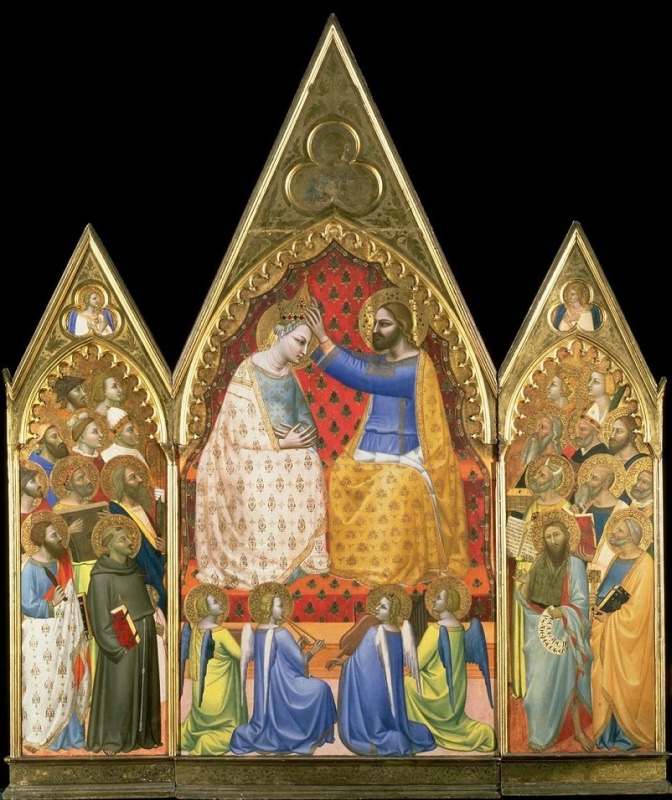
Central Panel: The Coronation of the Virgin
The Southampton triptych is one of Allegretto’s most ambitious surviving altarpieces and, according to the gallery, by far the earliest work in its collection. The central panel presents the Coronation of the Virgin, the heavenly consummation of Mary’s life, in which Christ crowns his Mother as Queen of Heaven. The subject, drawn not from Scripture but from theological reflection and liturgical tradition, became one of the most popular themes of Italian altarpieces in the fourteenth century, especially in Florence, where painters such as Bernardo Daddi and the Cione brothers gave it definitive form. Allegretto’s version, painted around 1360, reflects this Florentine model, which he had come to know during his years in Tuscany.
Christ and the Virgin sit side by side on a single broad throne, whose back and seat are covered with a cloth of red patterned with small dark green trefoils. The throne rises into a pointed form beneath the cusped arch of the panel, and its red cloth fills the upper part of the composition, creating a warm, luminous field against which the two figures stand out. The sharing of the throne between Mother and Son expresses the theology of the Coronation: the Virgin, assumed into heaven body and soul, is raised to reign beside Christ as Queen of the celestial court.
Christ, on the right, is represented as a bearded man in the prime of life, with long brown hair and a grave, intent expression. He wears a tunic of intense blue and a mantle of golden yellow patterned with ornament, which falls over his knees in broad folds. With both hands he raises a jewelled crown and places it on his Mother’s head, leaning toward her in a gesture that combines solemnity and tenderness. The deep blue of his tunic, set against the red of the throne and the gold of his mantle, gives his figure a commanding presence.
The Virgin, on the left, bows her head to receive the crown, her hands crossed on her breast in a gesture of humility and acceptance. She wears a white veil and a mantle of white brocade patterned with gold motifs over a gown of pale blue, also decorated with ornament. Her face, seen in profile, is delicate and serene, and her bowed posture contrasts with the upright figure of Christ. The white and gold of her garments, symbols of her purity and glory, distinguish her from the more intense colours of Christ’s robes and create a harmonious contrast between the two figures.
In the lower part of the panel, four angels kneel before the throne, making music in honour of the Coronation. Two wear blue robes and two yellow-green robes, and all have wings of blue and white. The gallery notes that four angels provide the musical accompaniment. Among the instruments visible are a bowed instrument, a vielle, and a wind instrument. The music of the angels, evoking the eternal praise of the heavenly court, was an essential element of the iconography of the Coronation, and it gave the scene a sense of joyful celebration.
The arrangement of the angels, two on each side, facing each other in pairs, creates a symmetrical composition that balances the asymmetry of the throne above. Their kneeling postures and upturned faces direct the viewer’s attention toward the central group, and their brightly coloured robes, the blue and yellow-green, form a luminous base for the composition. The figures are painted with the graceful proportions and soft modelling characteristic of Allegretto’s mature style.
The panel is framed by a carved and gilded cusped arch, and the gable above contains a trefoil, now much worn, in which a half-length figure can still be discerned. The gold of the gable is decorated with foliate ornament. The richness of the decoration, the gold of the arch, the patterned textiles of the throne and the garments, and the brilliant colours of the angels’ robes, gives the central panel an effect of great splendour, appropriate to the celebration of the Virgin’s glory.
The central panel of the Southampton triptych shows Allegretto at the height of his powers as a painter of large altarpieces. The composition, derived from Florentine models, is clear and balanced, and the figures combine monumental dignity with grace and tenderness. The rich textiles and the brilliant colour reflect Allegretto’s growing interest in decorative effects, which would become increasingly pronounced in his later works. The Coronation of the Virgin, the triumph of Mary in heaven, is presented here with a solemnity and splendour that make it one of the most impressive images of the Fabrianese school.
Left Panel: Saints and Old Testament Figures
The left panel presents a crowd of saints and biblical figures, arranged in tiers and turned toward the Coronation in the central panel. Beneath a cusped arch, against a gold ground, their haloed heads rise one above another to the top of the arch, creating the impression of a vast heavenly assembly of which only a part is visible. This arrangement, derived from Florentine Coronations in which the celestial court fills the lateral panels, gives the altarpiece the character of a vision of paradise, in which all the blessed participate in the glorification of the Virgin.
According to the gallery, the figures identifiable on the left panel include Saint Stephen with the stones of his martyrdom, King David with his harp, and Abraham with his knife and his son Isaac. Stephen, the first martyr, is recognisable in the upper part of the panel by the stones on his head. David, the royal ancestor of Christ and of the Virgin, and Abraham, the patriarch whose sacrifice of Isaac prefigured that of Christ, represent the Old Testament, whose promises were fulfilled in the New.
In the foreground stand two larger figures. On the right is Saint Francis of Assisi, in the brown habit of the Friars Minor, holding a red book and a slender cross, with the stigmata visible on his hands. His presence suggests a connection with the Franciscan order, perhaps as patrons of the altarpiece or as custodians of the church for which it was painted. On the left stands a bearded figure in a mantle of white brocade patterned with gold, holding a book and a knife. The knife could identify him as Abraham, as the gallery’s account suggests, or as the apostle Bartholomew, whose attribute was also a knife. The identification should be verified.
Behind these foreground figures, the tiers of saints include figures of different ages and types: bearded elders, young men, a figure holding a large book, and figures in varied headgear. Their faces, turned toward the central panel, express devout attention, and their haloes, finely tooled, create a pattern of gold discs rising toward the top of the arch. The density of the crowd, in which heads overlap and bodies are partly concealed, conveys the multitude of the blessed gathered around the throne of the Virgin.
At the left edge of the panel, near its lower part, a fragment of an object cut by the edge of the panel is visible. According to the catalogue of the Museum of Fine Arts, Houston, part of the grill of Saint Lawrence, cut off on one of the Houston panels, continues onto the left lateral panel of the Southampton altarpiece. This fragment is the incontrovertible proof that the Houston panels once formed part of the same altarpiece. The Southampton triptych, in other words, is the central part of a larger polyptych, which originally extended further to the left, and probably to the right.
The colours of the left panel are rich and varied: the white brocade of the foreground figure, the brown of Saint Francis’s habit, and the reds, blues and yellows of the saints behind. These colours echo those of the central panel, creating a chromatic unity across the altarpiece. The patterned textiles, in particular the white brocade of the foreground figure, correspond to the Virgin’s mantle in the central panel and demonstrate Allegretto’s attention to the depiction of precious fabrics.
In the gable above the arch, a trefoil contains a half-length figure of a youthful angel, dressed in blue and white, with hands crossed on the breast in a gesture of devotion. The figure is turned toward the centre of the altarpiece, and it corresponds exactly to the angel in the gable of the right panel. Together the two angels frame the central gable, whose trefoil, now much worn, once contained the principal image of the upper register. Their gesture of adoration extends the celestial homage of the Coronation to the summit of the altarpiece, so that the heavenly court, gathered around the throne in the main panels, is echoed by the angels in the gables.
The left panel of the Southampton triptych thus presents a portion of the heavenly court, in which saints of the New Testament and figures of the Old Testament are united in the celebration of the Virgin’s glory. The combination of Old Testament patriarchs and kings with saints of the Christian era expresses the continuity of salvation history, which culminates in the Coronation of the Virgin. The panel, with its dense crowd of figures and its rich colours, is a remarkable example of Allegretto’s ability to organise complex compositions within the narrow format of a lateral panel.
Right Panel: Saints and Prophets
The right panel corresponds to the left in composition and structure. Beneath a cusped arch, against a gold ground, a crowd of saints and biblical figures is arranged in tiers, turned toward the Coronation in the central panel. The heads of the figures rise one above another to the top of the arch, and their haloes create a rhythmic pattern of gold discs. The symmetry between the two lateral panels frames the central scene and gives the altarpiece a balanced and harmonious structure.
According to the gallery, the right panel includes Moses with his tablets of stone and Saint Peter with his keys and book. Moses is recognisable in the middle tiers by the horns that, according to a medieval tradition based on a translation of the Book of Exodus, radiated from his head when he descended from Mount Sinai. Saint Peter, the prince of the apostles, stands in the foreground on the right, in a blue tunic and a golden mantle, holding his keys and a book, and looking up toward the central panel.
In the foreground on the left stands Saint John the Baptist, in a mantle of pale blue lined with red over his camel-hair garment, holding a scroll on which part of the inscription ECCE AGNUS DEI, “Behold the Lamb of God,” can be read. These words, spoken by John when he saw Jesus coming toward him, identify him as the forerunner who announced the coming of the Messiah. The gallery does not mention him, but his identification is secure from his costume and his scroll.
Behind the foreground figures, the tiers of saints include a Dominican saint in the black and white habit of the Order of Preachers, probably Saint Dominic, a bishop in a mitre, bearded elders, a figure holding an open book, and, at the top, young female saints with palms. The presence of a Dominican saint in the right panel, balancing Saint Francis in the left, brings together the founders of the two great mendicant orders, as in several of Allegretto’s works. The identity of the other figures cannot always be established from their attributes.
The pairing of Saint John the Baptist and Saint Peter in the foreground of the right panel is significant. John, the last of the prophets, and Peter, the first of the apostles, represent the transition from the Old Covenant to the New, and they correspond to the Old Testament figures on the left panel. Together, the foreground saints of the two lateral panels form a company of intercessors who present the faithful to the Virgin and Christ.
The colours of the right panel echo those of the left and central panels: the pale blue and red of the Baptist’s mantle, the gold and blue of Peter’s garments, and the varied colours of the saints behind. The golden mantle of Saint Peter, in particular, corresponds to the golden mantle of Christ in the central panel, creating a visual link between the apostle and his Lord. The chromatic unity of the three panels contributes to the harmony of the altarpiece.
In the gable above the arch, a trefoil contains the corresponding half-length angel, in blue and white, with hands crossed on the breast, turned toward the centre. The symmetry between the two gable angels mirrors that of the lateral panels below and completes the balanced structure of the altarpiece. Their adoring attitude directs the viewer’s gaze toward the central gable, reinforcing the upward movement of the whole composition, from the music-making angels at the foot of the throne, through the Coronation itself, to the summit of the altarpiece.
The Southampton triptych, completed by the two panels in Houston, originally formed a large polyptych, one of the most ambitious altarpieces of Allegretto’s career. The Houston catalogue records that when Percy Straus acquired his two panels in 1922, they had the same moulding at the top as the Southampton panels, but they had been cut down by about one-sixth of their height. Neither the Southampton triptych nor the Houston panels has yet undergone dendrochronological testing or pigment analysis. In its original state, the altarpiece presented the Coronation at the centre, framed by a heavenly court of saints and Old Testament figures extending across five panels, from Saint Stephen, Saint Francis and the patriarchs on the left to Moses, Saint John the Baptist and Saint Peter on the right, all turned toward the throne. At the summit, the adoring angels in the side gables directed the gaze toward the central gable. The reconstruction gives an idea of the grandeur of Allegretto’s conception, and it makes the Southampton triptych one of the most important documents of the painter’s activity as a creator of large altarpieces.
Two Panels with Saints and Angels from the Fabriano Pentaptych (wings of the Southampton Coronation of the Virgin)
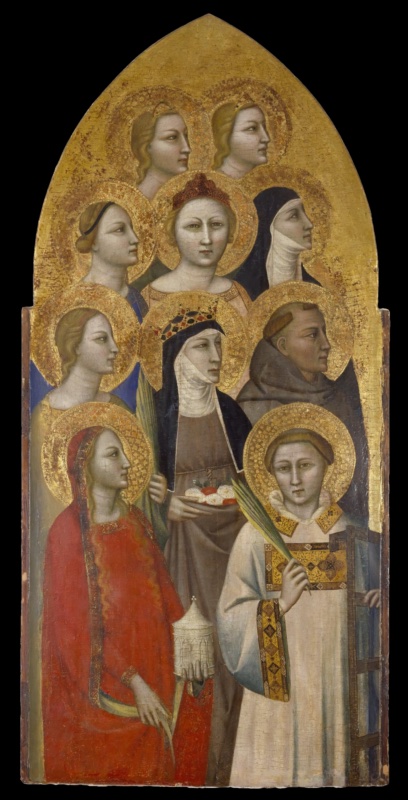
Left Panel: Mary Magdalene, Saint Lawrence and the Company of Female Saints
This panel and its companion are the outer wings of the great polyptych whose central Coronation of the Virgin and two inner panels are in the Southampton City Art Gallery. Their attribution to Allegretto Nuzi was first proposed by F. Mason Perkins in 1922, published by Lionello Venturi in 1931 and widely accepted since. Each panel is filled with four rows of saints and angels, arranged in groups of twos and threes on a gold ground, so that the eye moves upward through a dense assembly of haloed figures. Placed at the far left of the altarpiece, the panel formed the outer edge of a heavenly court that extended across five compartments toward the throne of the Virgin.
In the front row stand the two principal figures. On the left, Mary Magdalene, in a mantle of brilliant vermilion with a gold border, holds the palm of martyrdom and her ointment jar, the vessel with which she anointed Christ’s feet and went to the tomb on Easter morning. Her face, seen in profile, is delicate and grave, and her rich red mantle, falling in ample folds, gives her figure a commanding presence at the edge of the composition. The Magdalene, the model of penitence and of contemplative love, was among the most widely venerated saints of the fourteenth century, and Allegretto represented her frequently, notably at the foot of the Cross in his Crucifixions.
Beside her stands Saint Lawrence, the deacon of the Roman Church martyred in 258, represented as a beardless youth in a white dalmatic with a broad orphrey of gold ornament and a golden cap. He holds the palm of martyrdom and, at his side, the iron grill on which, according to his legend, he was roasted alive. The grill is cut off at the right edge of the panel, and its continuation on the left lateral panel of the Southampton triptych is, as the Houston catalogue puts it, the incontrovertible proof of the original connection between the two groups of panels. This small overlap of a painted object across a join is a rare and valuable piece of material evidence for the reconstruction of a dismembered altarpiece.
In the centre of the row above them stands Saint Elizabeth of Hungary, or of Thuringia, crowned but wearing a nun’s habit. She has gathered up her skirt to cradle red and white roses, evidence of her famous Miracle of the Roses, in which the bread she was carrying to the poor was turned into flowers when her husband demanded to see what she concealed. The combination of crown and habit expresses the essence of her legend: a princess who renounced her rank for a life of charity and penance. She was a member of the Third Order of Franciscans, and her presence is one of the indications of the Franciscan character of the whole altarpiece.
Elizabeth is flanked by an unidentified Franciscan friar, possibly Saint Anthony of Padua, in the brown habit of the Friars Minor, and by a female martyr carrying a palm frond, whose idealised female type recurs in the figures of the upper rows. Directly above Elizabeth, a young woman adorned with a large diadem looks out directly toward the viewer, the only figure in the panel to do so. Neither she nor the other female figures has been identified, although the habited woman beside her may be Saint Clare of Assisi, the founder of the Poor Clares and Elizabeth’s Franciscan counterpart.
The uppermost row contains two young figures with large haloes but no attributes, who are believed to represent angels. Their idealised faces and simple garments distinguish them from the saints below, and they correspond to a similar pair at the top of the companion panel. Together with the music-making angels at the foot of the throne in the Southampton Coronation and the adoring angels in the gables, they complete the angelic presence that surrounds the Virgin’s celestial court.
The composition of the panel is remarkable for its dense but legible arrangement. The figures are set in overlapping tiers, with the heads of the upper rows rising between the shoulders of those below, so that a crowd is suggested without confusion. Almost all the faces are shown in profile or three-quarter view, turned toward the right, that is, toward the centre of the altarpiece, and this uniform orientation creates a powerful sense of collective attention directed at the Coronation. The gold ground unifies the whole and the haloes, densely punched with floral ornament, form a shimmering pattern across the surface.
The stylistic hallmark of the panel, as the Houston catalogue observes, is its rich presentation, dominated by the gold ground and the heavy, intricately punched golden haloes, and extending to the sumptuous clothing, rendered with great attention to detail. This love for luxurious materials, the catalogue notes, predates the ornate style of Gentile da Fabriano, one of the outstanding representatives of the International Style. In the female saints of this panel, with their idealised faces and their delicate profiles, the Sienese element of Allegretto’s formation is particularly evident, while the solidity of the figures recalls his Florentine training.
Right Panel: Saint Louis of Toulouse and the Company of Male Saints
The right panel, the outer wing at the opposite end of the altarpiece, corresponds to the left in size, structure and composition, but its figures are turned toward the left, again facing the centre. Its rows are dominated by male saints, whereas the left panel is dominated by female ones, so that the two wings framed the assembly in a balanced arrangement. The panel was cut down by about one-sixth of its height, as its companion was, probably on account of damage, and its original moulding at the top survives only in traces.
The most outstanding figure is a man draped in a blue mantle adorned with the golden fleurs-de-lis of the French king. His mitre and bishop’s crook identify him as Louis of Anjou, bishop of Toulouse, who had a claim on the French crown but chose the church instead. Beneath the episcopal vestments he wears the brown habit of the Friars Minor, the sign of the Franciscan vocation for which he renounced his royal inheritance. He, like his royal counterpart Saint Elizabeth on the opposite panel, was closely associated with the Third Order of Franciscans, and the deliberate pairing of the two royal Franciscan saints at the outer edges of the altarpiece can hardly be accidental.
Beside Saint Louis stands Saint Catherine, in a pale gown with a golden mantle, holding a book and turning her face upward toward the centre. Her presence balances that of Mary Magdalene at the corresponding position on the left panel, so that each wing includes a prominent female saint in the front row. The two foreground figures of this panel, the royal bishop and the virgin martyr, are the most richly dressed in the whole ensemble, and their sumptuous garments, the fleur-de-lis mantle and the gold-lined robe, create a brilliant focus at the lower edge of the composition.
Directly above Saint Louis stands Saint Paul, recognisable by his high forehead and pointed beard, and beside him, possibly, Saint Anthony Abbot, holding a book. The row above contains three of the most readily identifiable figures of the panel: Saint Jerome, wearing a cardinal’s hat and holding a pen, an anachronistic but standard attribute that presents the translator of the Vulgate as a prince of the Church; Saint Dominic, with a lily, the emblem of his purity and of the Order of Preachers; and Saint Ursula, with her banner. As in the left panel, the topmost pair of figures, with large haloes but no attributes, are believed to represent angels.
The arrangement of the saints follows the same principles as the left panel. The figures are set in overlapping tiers, their heads rising between the shoulders of those below, and almost all are shown in profile or three-quarter view, turned toward the centre. The variety of types is striking: the youthful bishop, the bearded apostles, the elderly Jerome, the Dominican in his black cappa, the young female saints. This variety, held within a rigorous compositional order, produces the impression of an entire community of the blessed, in which every age, rank and vocation is represented.
The presence of Saint Dominic on this panel, balancing the Franciscan friar on the left, brings together the two great mendicant orders, as in several of Allegretto’s works. The prominence of the Franciscan saints, however, is unmistakable: Louis of Toulouse and Elizabeth of Hungary in the foreground of the two wings, the friar beside Elizabeth, and Saint Francis himself in the left lateral panel of the Southampton triptych. This Franciscan emphasis led Federico Zeri to argue that the pentaptych was most likely destined for the high altar of the church of San Francesco in Allegretto’s native Fabriano. The church was demolished in 1864, and the reconstruction of its high altar remains theoretical.
The dating of the complex remains debated. Zeri argued for a date around 1370 and for a collaboration with Francescuccio Ghissi, whereas earlier scholars such as Alessandro Marabottini pointed to the panels’ similarity with Bernardo Daddi and placed them in the early part of Allegretto’s career. The Houston catalogue dates the two panels about 1370, while the Southampton gallery dates the Coronation to 1360, and the Houston comparative illustration gives it as about 1350. This range of nearly two decades reflects the difficulty of establishing a chronology for works that carry neither date nor signature.
The two Houston panels have a distinguished modern history. They passed through the hands of the dealers D’Atri in Paris, Ugo Jandolo in Rome and Enrico Testa in Florence before being acquired by Percy S. Straus in New York in November 1922, and they were bequeathed to the Museum of Fine Arts, Houston, in November 1944. They have been discussed by Richard Offner, Raimond van Marle, Bernard Berenson, Marabottini, Zeri and others, and their punchwork was included in Erling Skaug’s corpus of Trecento punch marks. Neither they nor the Southampton panels has yet undergone dendrochronological testing or pigment analysis, but, as the Houston catalogue states, the visual evidence for their original unity is indisputable.
Pentaptych with the Madonna and Child and Saints Mary Magdalene, John the Evangelist, Bartholomew and Venantius
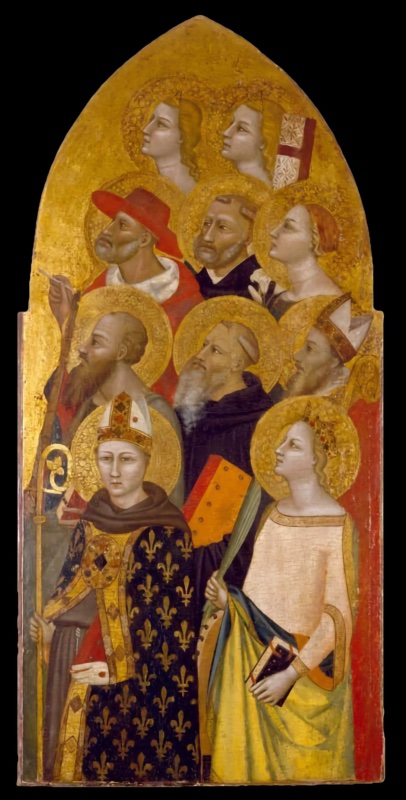
Central Panel: The Madonna and Child
The Fabriano pentaptych is one of the most refined altarpieces that Allegretto painted for his native city, and one of the few that remain there. It belongs to the Curia vescovile of Fabriano-Matelica and is kept in the Pinacoteca Civica ““Bruno Molajoli”,” where it was restored in 2014. The Dizionario Biografico degli Italiani places it among the principal works of Allegretto’s mature phase, alongside the Apiro polyptych of 1366, the Macerata triptych of 1369 and the Urbino Madonna of 1372. In this phase the painter moved progressively away from the Florentine plastic vision and accentuated his links with Sienese art, above all with Ambrogio Lorenzetti. The composition follows the Florentine type of the half-length polyptych, with the Virgin and Child at the centre and four saints in the lateral compartments.
The Virgin is shown in half-length, turned slightly toward the Child whom she holds on her left arm. She wears a mantle of deep blue, now darkened almost to black, which covers her head and falls over her shoulders, with a gold star on her right shoulder. Beneath the mantle a red band frames her face, and she wears a gown of vermilion sprinkled with small gold stars, whose luminous pattern stands out against the dark mantle. The star on the shoulder and the stars on the gown allude to Mary’s titles of Stella Maris and Queen of Heaven.
The Virgin’s face is long and oval, with a straight nose, almond-shaped eyes and a small mouth, and it is modelled with soft transitions of tone that give it a gentle, luminous quality. She looks out toward the viewer with a grave, contemplative expression, and her head inclines slightly toward the Child. This melancholy gaze, a constant of Allegretto’s Madonnas, suggests her foreknowledge of the Passion, which is made explicit by the Crucifixion in the gable directly above her head.
The Christ Child sits on his Mother’s arm, dressed in a white tunic that leaves his legs bare. He turns toward the viewer and raises one hand to his mouth, with his fingers pressed against his lips, in a spontaneous childlike gesture that Allegretto also used in the Berlin diptych. With his other arm he reaches around his Mother’s shoulder. The Virgin holds him with both hands, one supporting his body, the other holding his foot. The naturalism of the Child’s pose and gesture, drawn from observation of real infants, gives the image an intimacy and warmth that temper the solemnity of the altarpiece.
The gold ground behind the figures is framed by a pointed arch, and the haloes of the Virgin and Child are richly tooled with floral ornament. The central panel is taller and broader than the lateral compartments, and its gable rises above theirs, affirming the pre-eminence of the Virgin and Child in the hierarchy of the altarpiece. The dark frame, with its engaged colonnettes and gables, appears to preserve the original carpentry of the polyptych, though this should be confirmed by the restoration report.
In the gable above the arch, against a gold field framed by spandrels of red decorated with gold foliate ornament, appears the crucified Christ. The Cross bears the titulus INRI, and the pale body of Christ hangs with bowed head. The image of the Crucifixion directly above the Virgin and Child establishes the vertical axis of the altarpiece, linking the Incarnation to the Passion. It is completed by the two roundels in the gables of the inner lateral panels, which show the mourning Virgin and Saint John. The Crucifixion is thus divided across three gables, in a manner that unifies the upper register of the polyptych.
The central panel displays the qualities that the Dizionario Biografico degli Italiani associates with Allegretto’s mature style: the linear and decorative intentions visible in the rendering of fabrics and ornaments, and the accentuated relationship with Sienese art. The gown sprinkled with stars, the delicate modelling of the faces and the tender naturalism of the Child’s gesture recall the art of Ambrogio Lorenzetti. At the same time, the monumental construction of the Virgin and the clarity of the composition reflect Allegretto’s Florentine training.
The central panel thus establishes the tone of the whole altarpiece: intimate, tender and devotional, with a sense of quiet sorrow that anticipates the Passion. The combination of the Virgin’s grave expression, the Child’s spontaneous gesture and the Crucifixion above creates an image of great emotional depth. Painted for a Fabrianese patron, the panel shows Allegretto at the height of his maturity, combining the lessons of Florence and Siena in a language of great refinement.
Outer Left Panel: Saint Mary Magdalene
The outer left panel presents Mary Magdalene in half-length, beneath a pointed arch, against a gold ground. The Magdalene, the woman from whom Christ cast out seven devils, who stood at the foot of the Cross and who was the first witness of the Resurrection, was venerated as the model of the repentant sinner and of contemplative love. Her cult enjoyed extraordinary popularity in the fourteenth century, particularly among the mendicant orders, and she appears frequently in Allegretto’s work.
The saint is shown turned in three-quarter view toward the central panel, her head inclined and her eyes lowered in an expression of quiet contemplation. She is wrapped entirely in red: a mantle of vermilion covers her head and falls over her shoulders, and beneath it she wears a gown of the same colour. Red was her traditional colour, symbolising the ardour of her love for Christ. The broad expanses of red, modelled with subtle gradations of tone, give the figure a strong and unified presence at the outer edge of the altarpiece.
In her hands the Magdalene holds her characteristic attribute, the jar of ointment with which she anointed Christ’s feet. The jar, white and cylindrical, with a conical lid and decorated with incised ornament, is held delicately in both hands before her breast. Its precious appearance recalls the costly ointment of the Gospel account and alludes to the value of her devotion.
The Magdalene’s face is oval and pale, with a long, straight nose, lowered eyes and a small mouth, and it is modelled with soft, luminous transitions of tone. The delicacy of the face and the gentle inclination of the head express the saint’s humility and her inward devotion. The treatment of the face, with its delicate modelling and its tender expression, reflects the Sienese element of Allegretto’s style, which the Dizionario Biografico degli Italiani identifies as dominant in this phase of his career.
The saint’s halo, finely tooled with floral ornament, stands out against the gold ground, and the pointed arch of the panel frames her figure. The simplicity of the composition, a single figure against a gold ground, gives the panel a devotional intensity that invites contemplation. The red of the Magdalene’s garments corresponds to the red of the Virgin’s gown in the central panel, creating a chromatic link across the altarpiece.
In the roundel in the gable above the arch appears the half-length figure of Saint Anthony Abbot, bearded, in the dark habit of the hermits, holding a book. Saint Anthony, the father of monasticism, appears in several of Allegretto’s works. His presence here, in the outer left gable, may reflect the devotion of the patron or the dedication of an altar. The small figure, painted against a gold ground within the roundel, is framed by red spandrels decorated with gold foliate ornament.
The placement of the Magdalene at the outer left, balanced by Saint Venantius at the outer right, frames the altarpiece with two figures of particular significance. The Magdalene represents the penitent sinner who became a saint through love, while Venantius, the patron saint of Fabriano, represents the civic devotion of the community for which the altarpiece was painted. The two figures together express the universal and the local dimensions of the altarpiece’s devotional programme.
The Magdalene panel is one of the most refined in the pentaptych. The delicacy of the face, the harmony of the red garments and the elegance of the jar create an image of gentle, contemplative piety. It shows Allegretto’s ability to create single figures of great devotional intensity, in which simplicity of composition is combined with refinement of execution.
Inner Left Panel: Saint John the Evangelist
The inner left panel presents Saint John the Evangelist, the beloved disciple of Christ, the author of the fourth Gospel and, according to tradition, of the Book of Revelation. He is represented as a beardless youth, in accordance with the tradition that he was the youngest of the apostles, and he stands at the Virgin’s right hand, in the place of honour beside the central panel.
The saint is shown in half-length, turned in three-quarter view toward the viewer, with his long, curly golden hair falling to his shoulders. His face is youthful and grave, with wide-set eyes and a small mouth, and he gazes directly at the viewer with an expression of serious concentration. He wears a tunic of blue edged with gold and a mantle of pink, lined with red, which falls over his left shoulder and arm. The combination of blue and pink, one of the favourite colour harmonies of Florentine painting, gives the figure a luminous and elegant appearance.
In his hands John holds an open book, which he displays to the viewer, pointing with his right hand to the text. The pages bear the opening words of his Gospel, written in Gothic letters:
In principio erat verbum et verbum erat apud Deum et Deus erat verbum. Hoc erat in principio,
“In the beginning was the Word, and the Word was with God, and the Word was God. The same was in the beginning” (John 1:1–2). This text, which proclaims the divinity of Christ and the mystery of the Incarnation, is the theological key of the altarpiece. It is displayed immediately beside the Virgin holding the incarnate Word.
The juxtaposition of the Evangelist’s text with the image of the Virgin and Child is highly significant. The Word that was in the beginning with God is the Child held in his Mother’s arms in the central panel, and the Gospel text thus becomes a commentary on the image beside it. This intellectual and theological dimension distinguishes the pentaptych from simpler devotional altarpieces and suggests a patron of some learning, perhaps a cleric.
The saint’s halo is finely tooled with floral ornament, and the pointed arch of the panel frames his figure against the gold ground. The treatment of the drapery, with its soft folds and its gold border, and the delicate modelling of the face show the refinement of Allegretto’s mature style. The figure’s direct gaze, addressed to the viewer, invites contemplation of the text he displays.
In the roundel in the gable above the arch appears the half-length figure of the Virgin, in a dark mantle over a red gown, raising both hands in a gesture of grief. She is one of the two mourners of the Crucifixion divided across the three central gables, facing the crucified Christ in the gable of the central panel. The presence of the mourning Virgin above the Evangelist is particularly apt, since John was the disciple to whom Christ entrusted his Mother from the Cross.
The placement of John at the Virgin’s right hand, in the place of honour, reflects his special relationship with Christ and with Mary. As the beloved disciple and the adoptive son of the Virgin, he was the saint most closely associated with her, and his presence beside her in the altarpiece expresses this bond. His Gospel text, displayed beside the image of the incarnate Word, links him to the central mystery of the altarpiece.
The panel of Saint John is thus one of the most significant in the pentaptych, both for its theological content and for its artistic quality. The youthful figure, with its luminous colours and its grave expression, and the Gospel text, with its proclamation of the Incarnation, combine to create an image of great spiritual depth. It shows Allegretto’s ability to combine devotional intensity with theological meaning in a single figure.
Inner Right Panel: Saint Bartholomew
The inner right panel presents Saint Bartholomew the Apostle, who according to tradition preached the Gospel in India and Armenia, where he was flayed alive and beheaded. He stands at the Virgin’s left hand, beside the central panel, balancing Saint John on the opposite side. His cult was widespread in medieval Italy, and Allegretto represented him in several works, including the Berlin diptych.
The saint is shown in half-length, facing the viewer, with thick curly brown hair and a full, flowing beard. His face is strong and grave, with a straight nose, deep-set eyes and a firm mouth, and he gazes directly at the viewer with a penetrating expression. The strength and maturity of his features contrast with the youthful delicacy of Saint John on the other side of the Virgin, so that the two apostles flanking the central panel represent youth and maturity.
Bartholomew wears a tunic of golden yellow and a mantle of lilac, which falls over his left shoulder and is gathered across his body. In his right hand he holds a knife, the instrument of his martyrdom by flaying, raised before his breast. In his left hand he holds a large book bound in dark leather with metal fittings, the attribute of the apostles and of the Gospel they preached. The knife and the book together identify him as an apostle and a martyr.
The golden yellow of the tunic and the lilac of the mantle create a harmonious chromatic combination, which balances the blue and pink of Saint John on the opposite side. The folds of the mantle, modelled with soft gradations of tone, suggest the volume of the body beneath, and the gold border of the garments adds a touch of refinement. The figure has a solid, monumental presence that reflects Allegretto’s Florentine training.
The saint’s halo, finely tooled with floral ornament, stands out against the gold ground, and the pointed arch of the panel frames his figure. The directness of his gaze and the frontality of his pose give the figure an imposing authority, appropriate to an apostle and a martyr. His presence beside the Virgin and Child expresses his role as a witness to Christ and an intercessor for the faithful.
In the roundel in the gable above the arch appears the half-length figure of Saint John the Evangelist, in a pink mantle, with his hand raised to his face in a gesture of grief. He is the second mourner of the Crucifixion divided across the three central gables, facing the crucified Christ from the right, as the mourning Virgin faces him from the left. The Crucifixion group, spread across the three central gables, forms a unified narrative at the summit of the altarpiece.
The pairing of Saint Bartholomew with Saint John the Evangelist on either side of the Virgin is significant. Both were apostles, both were witnesses to Christ’s life and teaching, and both were venerated as intercessors. Their contrast in age and character, the youthful John and the mature Bartholomew, creates a balanced composition and expresses the variety of the apostolic community.
The panel of Saint Bartholomew shows Allegretto’s ability to create figures of strong character and monumental presence. The penetrating gaze, the full beard and the solid form give the saint an air of authority and dignity, while the harmonious colours and the refined decoration reflect the painter’s mature style. The panel forms a worthy counterpart to Saint John on the opposite side of the Virgin.
Outer Right Panel: Saint Venantius
The outer right panel presents Saint Venantius, the youthful martyr of Camerino and patron saint of Fabriano. According to his legend, Venantius was a youth of noble family who, at the age of fifteen, was martyred under the emperor Decius after surviving a series of torments. His cult was deeply rooted in the Marche, and the cathedral of Fabriano bears his dedication. His presence in the pentaptych expresses the civic identity of the community for which the altarpiece was painted.
The saint is represented as a beardless youth, with short, curly golden hair, turned in three-quarter view toward the central panel. His face is delicate and serene, with a long nose, narrow eyes and a small mouth. He looks toward the Virgin and Child with an expression of quiet devotion, and his youthful beauty expresses the idealised innocence of the martyr who died for his faith as a boy.
Venantius wears a costume that marks his noble rank: a red tunic, visible at the arm and the lower edge, and over it a cloak of blue, fastened at the neck with a broad collar of dark fabric embroidered with gold ornament in the form of lozenges and crosses. The rich embroidery of the collar and the brilliant colours of the garments display Allegretto’s love of precious textiles, which would become increasingly prominent in his later works.
In his right hand the saint holds a tall lance bearing a white banner, the standard of victory that was one of his traditional attributes. The banner, rising beside his head, is the emblem of the martyr’s triumph over death and of the city that claimed him as protector. The same attribute appears in the Washington triptych of 1354, where Venantius also holds a banner, and it was characteristic of the saint’s iconography in the Marche.
The saint’s halo is finely tooled with floral ornament, and the pointed arch of the panel frames his figure against the gold ground. The combination of the youthful face, the rich costume and the banner creates an image of noble grace and civic dignity. The contrast between the brilliant blue and red of his garments and the gold ground gives the figure a luminous presence at the outer edge of the altarpiece.
In the roundel in the gable above the arch appears the half-length figure of a young female saint, with a palm and a diadem, turned toward the centre. She is a virgin martyr, but her identity cannot be determined from her attributes alone. Her presence in the outer right gable balances that of Saint Anthony Abbot in the outer left, so that the two outer roundels frame the Crucifixion group in the central gables.
The placement of Venantius at the outer right, corresponding to the Magdalene at the outer left, frames the altarpiece with two figures of different character. The Magdalene, the penitent sinner, and Venantius, the youthful martyr, represent two paths to holiness, penitence and martyrdom, and together they express the universal scope of the altarpiece’s devotional programme. The civic dimension, embodied in Venantius, gives the altarpiece a particular meaning for the community of Fabriano.
The panel of Saint Venantius completes the programme of the Fabriano pentaptych. The Virgin and Child at the centre are flanked by four saints who represent the universal Church and the local community: the Magdalene and John on the left, Bartholomew and Venantius on the right. The Crucifixion group in the gables, with Saint Anthony Abbot and a female martyr, crowns the whole. Painted in Allegretto’s maturity for a Fabrianese patron, the pentaptych is one of the most complete and harmonious expressions of his art, and it remains in the city for which it was made.
Saint Augustine between Saint Nicholas of Tolentino and Saint Stephen (three lateral compartments of a dismembered polyptych)
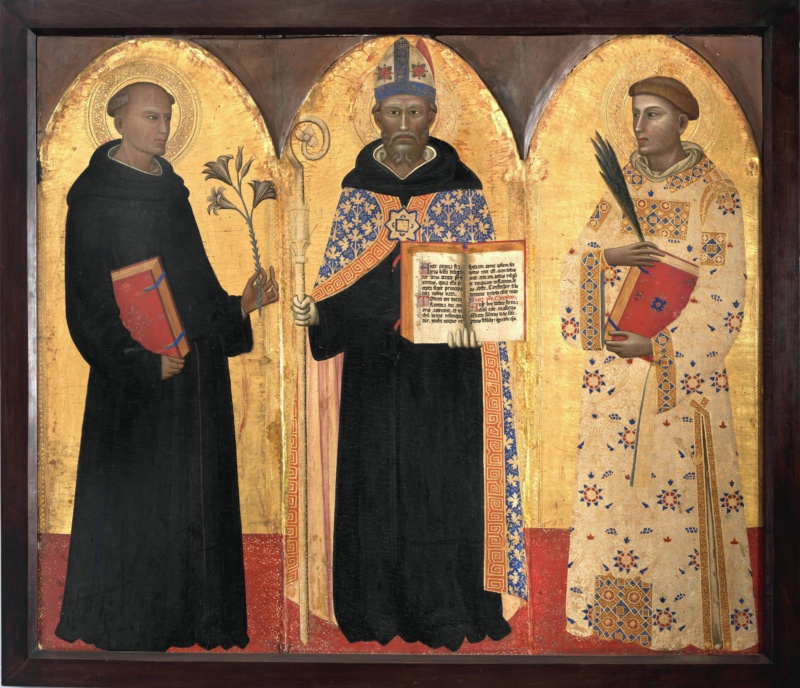
Central Panel: Saint Augustine
The work now presented as a triptych is, according to the Pinacoteca of Fabriano, not originally a triptych at all but three lateral compartments of a polyptych, remounted in the form of a triptych. The three panels are of the same size, and none of them was designed as the centre of an altarpiece. Saint Augustine, who now occupies the middle, originally stood among the lateral saints flanking a central image that has been lost, presumably the Virgin and Child. The altarpiece has been connected with the church of Santa Maria Nova in Fabriano, which was served by the Augustinian community, and the Augustinian character of its saints supports this destination. The work was among those that yielded new discoveries on the occasion of the 2021 Fabriano exhibition.
Saint Augustine of Hippo, the Father of the Church whose Rule was followed by the Order of Hermits of Saint Augustine, stands frontally, gazing directly at the viewer. He is represented as a mature man with a short dark beard and a grave, penetrating expression. On his head he wears a tall mitre decorated with red, blue and gold ornament, and in his right hand he holds a crozier whose curved head rises above his shoulder. These are the insignia of his dignity as bishop of Hippo, the office he held for more than three decades in North Africa.
Beneath his episcopal vestments Augustine wears the black habit of the Augustinian friars, whose hood is visible at his neck. The combination is deliberate. The mendicant order that claimed Augustine as its founder presented him not only as a bishop and doctor of the Church but as a friar of their own, clothed in their habit, and this iconography was actively promoted by the Augustinians in the fourteenth century. The juxtaposition of the humble black habit and the magnificent episcopal vestments expresses the union of monastic poverty and pastoral authority that the order wished to embody.
Over the habit Augustine wears a cope of blue patterned with gold ornament, bordered with a broad orphrey in orange and gold decorated with a meander pattern, and fastened at the breast with a star-shaped morse. The richness of this vestment, with its dense gold patterns and its bold border, exemplifies the heightened decorativism that scholars have associated with Allegretto’s last phase, with its increasingly abstract figures and garments quilted with gold. The contrast between the flat, patterned blue of the cope and the dark mass of the habit creates a striking effect against the gold ground.
With his left hand the saint holds an open book, which he presents to the viewer. Its two pages, written in Gothic minuscule with red initials and a red rubric, contain three texts. The first, at the top of the left page, is the opening of the Rule of Saint Augustine:
Ante omnia, fratres carissimi, diligatur Deus, deinde proximus, quia ista praecepta sunt principaliter nobis data,
“Before all things, dearest brothers, let God be loved, and then your neighbour, because these are the chief commandments given to us.”
The second, introduced by a red initial and continuing onto the right page, is a prayer circulated in the Middle Ages under Augustine’s name:
Totum cor meum flamma tui amoris accendat, et nihil in me relinquatur mihi, neque respiciam ad me ipsum, sed totus in te sim, cum totus in te ardeam, totus diligam te tamquam inflammatus a te. Confiteor tibi, Domine, in toto corde meo,
“May the flame of your love set my whole heart on fire, so that nothing in me is left to myself, nor do I look back upon myself, but that I may be wholly in you, burning wholly in you, loving you wholly as one set aflame by you. I confess to you, O Lord, with my whole heart.”
The closing words echo the opening of Psalm 137 in the Vulgate numbering, and the red rubric beneath them, Super psalmum CXXXVII, presents the passage as drawn from Augustine’s commentary on that psalm. The image of the heart burning with divine love evokes the flaming heart that was Augustine’s emblem in medieval iconography, derived from the Confessions. The third text, opened by two further red initials and only partly legible, is a eulogy of the saint:
Augustinus, lux doctorum, firma[mentum …] … malleus haereticorum … vas sac[rum] … fidelibus in gra[tia] Dei …,
“Augustine, light of the doctors, pillar [of the Church] … hammer of heretics … sacred vessel … to the faithful in the grace of God …”
These are the titles traditionally bestowed on Augustine as the greatest of the Latin Fathers and the adversary of the Manichaeans, Donatists and Pelagians, and the passage probably belongs to an antiphon or responsory for his feast. Taken together, the three texts present Augustine as the legislator of the order, as the doctor of divine love and as the champion of orthodoxy. They offered the friars who prayed before the altarpiece both the foundation of their common life and a model of ardent devotion.
The saint stands on a red ground decorated with a fine pattern, which continues across all three panels and gives them a common base line. The gold ground behind him is framed by a round-headed arch, and his halo is finely tooled. The full-length format, less common in Allegretto’s work than the half-length figure, gives the saint a monumental presence, and his frontal pose and direct gaze confer on him an air of solemn authority.
The date of the panels is debated. The Pinacoteca’s own materials and other accounts give about 1362, and one account of the 2021 exhibition dates them no later than 1362. Another report on the same exhibition dates the triptych about 1372, and the Dizionario Biografico degli Italiani regarded it as the artist’s last work. A collaboration with Francescuccio Ghissi has also been proposed. The emphatic decoration of the vestments and the abstraction of the figures accord well with a late date, but the question cannot be settled without the evidence published in the 2021 catalogue.
The panel of Saint Augustine thus presents the founder of the order as bishop, doctor and legislator, clothed in the habit of his friars and displaying the Rule by which they lived. The magnificent cope and the rich decoration give the figure a splendour appropriate to his dignity, while the black habit expresses the humility of the mendicant life. Now placed at the centre of the ensemble, although originally a lateral figure, Augustine dominates the three panels as the spiritual father of the community that commissioned them.
Left Panel: Saint Nicholas of Tolentino
The left panel presents Saint Nicholas of Tolentino, the Augustinian friar who died at Tolentino, in the Marche, in 1305, and whose cult spread rapidly through the region after his death. He was formally canonised only in 1446, so that at the time the panel was painted he was venerated as beatus rather than as a canonised saint. His representation with a halo in the 1360s or early 1370s testifies to the strength of his local cult, which the Augustinians actively promoted.
The saint stands in the black habit of the Augustinian friars, with its hood gathered around his neck, and his head bears the tonsure. He is represented as a beardless man with a gentle, grave face, turned in three-quarter view toward the centre, that is, toward Saint Augustine. The simplicity of his dress and the gentleness of his expression convey the humility and the ascetic life for which he was renowned.
In his left hand Nicholas holds a lily, the emblem of his purity, and in his right hand a book bound in red, which the Pinacoteca identifies as the book of the Sacred Scriptures. The lily was his characteristic attribute from the earliest images of his cult, recalling the chastity and austerity of his life. The bright red of the book creates a vivid accent against the black of the habit.
The black habit, rendered as a broad, dark mass against the gold ground, gives the figure a severe and imposing silhouette. The folds of the habit, modelled with subtle gradations of tone, suggest the volume of the body beneath, while the dark colour isolates the figure against the luminous gold. The contrast between the dark habit and the gold ground, softened only by the red of the book and the white of the lily, gives the panel a sober dignity.
The presence of Saint Nicholas beside Saint Augustine reflects the Augustinian character of the altarpiece. Nicholas was the most celebrated saint of the order in the fourteenth century, and his inclusion alongside the order’s founder expresses the order’s pride in its recent holy men. For a community of Augustinian friars in Fabriano, not far from Tolentino, Nicholas would have been a particularly beloved and familiar figure.
The saint stands on the same red ground as Augustine and Stephen, and his halo is finely tooled. The round-headed arch of the panel frames his figure against the gold ground. The full-length format gives him the same monumental presence as the other two saints, so that the three figures form a unified group of equal importance.
The panel of Saint Nicholas is, together with the Saint Augustine, one of the most significant early images of the friar from Tolentino. It shows how the Augustinians used painting to promote the cult of their recent saints, presenting them with the attributes that would become standard in later iconography. The lily and the book, the black habit and the gentle expression, established a type that would be repeated throughout the following centuries.
The Saint Nicholas panel thus expresses the devotion of the Augustinian community to its most beloved saint. The simplicity and austerity of the figure, in contrast with the magnificence of Saint Augustine and Saint Stephen, express the humility of the friar. At the same time, his halo and his place beside the founder of the order affirm his holiness and his importance for the community.
Right Panel: Saint Stephen
The right panel presents Saint Stephen, the first martyr of the Church, one of the seven deacons appointed by the apostles, whose stoning is recounted in the Acts of the Apostles. His presence in an Augustinian altarpiece may reflect Augustine’s own devotion to the protomartyr. Augustine described the miracles worked by Stephen’s relics, which had been brought to North Africa, and preached on his feast. It may also reflect a particular dedication of the altar or the devotion of a patron.
Stephen is represented as a beardless young man with short brown hair, turned in three-quarter view toward the centre. His face is delicate and grave, with a long nose, narrow eyes and a small mouth. He looks toward Saint Augustine with an expression of quiet devotion, and his youthful appearance recalls the tradition that he was a young man at the time of his martyrdom.
The saint wears the dalmatic, the liturgical vestment of the deacon, which is the most richly decorated garment in the ensemble. It is of cream or white, covered with blue and red rosettes and cross-shaped motifs, and adorned with bands of orange and gold ornament in which lozenges and squares alternate. The rich decoration of the dalmatic, spread across the entire surface of the garment, is an outstanding example of the decorativism of Allegretto’s late style.
In his right hand Stephen holds the palm of martyrdom, and in his left a book bound in red, which alludes to his role as a deacon, charged with the reading of the Gospel in the liturgy. The palm and the book together define Stephen as both martyr and minister of the Word. The red of the book echoes the red of Saint Nicholas’s book on the opposite side, creating a chromatic symmetry across the ensemble.
The splendour of Stephen’s dalmatic balances the magnificence of Augustine’s cope, and together they contrast with the austere black habit of Saint Nicholas. This contrast between the ornate liturgical vestments of the bishop and the deacon and the simple habit of the friar expresses the diversity of vocations within the Church, from the pastoral and liturgical ministry to the mendicant life of poverty.
Stephen stands on the same red ground as the other two saints, and his halo is finely tooled. The round-headed arch of the panel frames his figure against the gold ground. The full-length format and the frontal pose give him a monumental presence, and his delicate face and elegant dalmatic give him an air of youthful grace.
The treatment of the dalmatic, with its dense patterns of rosettes and lozenges, shows Allegretto’s mastery of the representation of precious textiles. The pattern is spread across the surface of the garment with little regard for its folds, so that the dalmatic reads less as a modelled garment than as a flat field of ornament. This tendency toward the flat, decorative treatment of textiles is characteristic of the painter’s late works and anticipates the courtly art of Gentile da Fabriano.
The panel of Saint Stephen completes the ensemble of the three saints. Augustine, the founder of the order, stands at the centre, flanked by Nicholas of Tolentino, the order’s most celebrated recent saint, and Stephen, the first martyr, whom Augustine himself venerated. Although they are no longer arranged as the painter intended, having originally flanked a lost central image, the three panels together form a coherent expression of Augustinian devotion. They show Allegretto at the most decorative phase of his art.
Saint Bartholomew the Apostle (attr.)
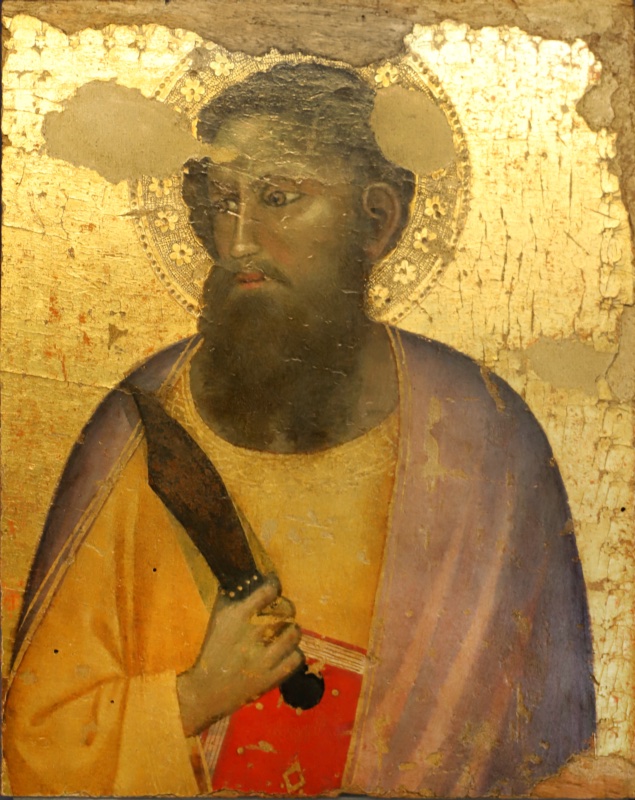
This small half-length panel of Saint Bartholomew, preserved in the Museo dell’Opera del Duomo at Orvieto and attributed to Allegretto Nuzi, is a fragment from the mid-fourteenth century, when Tuscan painting was being carried into Umbria and the Marche. The apostle appears against a gold ground, his torso cut by the lower edge of the panel, holding the flaying knife of his martyrdom and a red-bound book. Despite substantial losses to the gilding and abrasion of the flesh tones, the figure keeps a physical presence and psychological intensity that place it firmly in the post-Giottesque idiom. The generally proposed date of around 1350 locates the work at a pivotal point in the painter’s career, between his Florentine training and his mature activity in his native Fabriano.
The panel’s present format is almost certainly not its original one. The trimmed lower edge, the band of bare wood along the top, and the rows of punched rosettes that follow the upper margins of the gold ground all suggest that the image once sat beneath an arched or cusped frame. It was probably one lateral compartment of a polyptych or part of an upper register of half-length saints. The direction of the apostle’s gaze supports this reading. His head is turned slightly and his eyes look sharply towards the viewer’s right, a device commonly used to connect lateral saints with a central image, usually the Virgin and Child. Bartholomew would therefore have stood to the left of the central panel, and his glance would have directed the devotional attention of the beholder towards the principal subject of the altarpiece. The original ensemble, its commission, and the route by which the fragment reached the Orvieto collections need confirmation from documentary sources and the museum’s records.
The iconography follows the conventions well established for Bartholomew by the fourteenth century. According to the tradition collected in Jacobus de Voragine’s Legenda aurea, the apostle preached in India and Armenia and was flayed alive before being beheaded. The knife he grasps is therefore both an instrument of torture and a badge of triumph over death. Here it is shown with a broad, dark, slightly curved blade and a riveted handle ending in a round black pommel, a realistic detail that makes the attribute concrete and even menacing. The book, bound in vermilion with gilt studs and a lozenge ornament, with its page edges rendered as fine white striations, identifies him as an apostle and bearer of the Gospel. Holding the two attributes together, the implement of his passion and the Word he died for, sums up the saint’s identity in a single, compact gesture.
The treatment of the head shows the painter’s grasp of Florentine physiognomic types. The dark, thick hair and full, flowing beard recall the description of Bartholomew in the Legenda aurea, where he is given black curling hair, large eyes, and a long beard. The painter departs from that source in leaving the ear exposed, where the text describes it as covered by the hair. The face is built with firm plastic logic: a long, straight nose, a strongly modelled brow, cheekbones catching the light, and a small, slightly parted red mouth set within the mass of the beard. Above all it is the sideways glance, with the whites of the eyes clearly visible, that gives the figure its alert, almost apprehensive intensity. This is no impassive icon but a saint who seems aware of his own fate, and that inward animation is a hallmark of the best Florentine painting of the 1340s.
The drapery and colour show a sophisticated balance between Tuscan structure and a more lyrical chromatic taste. The saint wears a golden-yellow tunic whose broad, soft folds define the shoulders and chest, and over it a mantle of pale violet shading into deeper lilac. The mantle is drawn around the right shoulder and falls in long vertical folds along the right side of the panel. Gold borders trace the edges of both garments and catch the light of the ground, tying the figure to the surrounding field. The complementary relation between yellow and violet, punctuated by the intense red of the book, produces a harmony that is refined yet sonorous. The yellow is especially notable. Blending into the gold background, it gives the figure an almost luminous quality, as though the saint were partly made of the same substance as the celestial field behind him.
The technical features of the panel repay close attention. The halo has an inner field worked with fine granulation, scattered with six-petalled rosette punches and bordered by rows of circular punch marks. This is a vocabulary of ornament closely comparable to that used in Florentine workshops around the middle of the century. Punch tools of this kind are a useful instrument for attribution and dating, since they moved between workshops with painters and assistants. The condition of the work, meanwhile, shows its material stratigraphy. Large areas of lost gilding expose the grey preparation beneath, and the network of craquelure across the gold registers the ageing of the gesso layer. The flesh tones appear dark and olive, probably because the upper pink layers have been abraded and the green-earth underpainting (verdaccio) shows through, a phenomenon common in Trecento panels painted according to the Giottesque method. This deterioration now accentuates the shadowed, brooding character of the face, but it should not be mistaken for the painter’s original intention.
The attribution to Allegretto Nuzi rests on stylistic comparison and should be treated with appropriate caution, as the “attributed” qualification indicates. The monumentality of the figure, the plastic construction of the head, and the Daddesque character of the ornament are consistent with Nuzi’s Florentine formation. The warm palette and the concentrated emotional tone anticipate his later works in the Marche. Other painters in the Florentine orbit of the 1340s and 1350s have similar traits, so an exact attribution will depend on closer analysis of the punch tools, the panel construction, and any identification of companion fragments. Whatever its final attribution, the Orvieto Bartholomew is an eloquent witness to the transmission of Florentine art into central Italy around 1350. Although damaged and removed from its original context, it keeps the dignity and inner life that the best painters of the generation after Giotto gave to the saints of their altarpieces.
The Crucifixion with the Holy Women, Saint John the Evangelist, Mary Magdalene and Angels
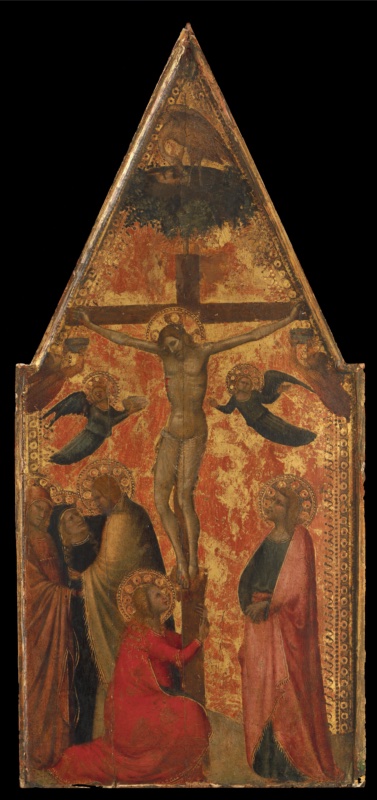
This small gabled panel, less than half a metre high, belongs to the group of devotional Crucifixions that Allegretto painted for private patrons, alongside those in Berlin, Bern and Richmond. The Metropolitan Museum attributes it to Allegretto di Nuzio and dates it to about 1355–60, placing it in the years following the Washington triptych of 1354, in the painter’s mature phase. Its format and composition suggest that it was the right wing of a diptych whose left wing, now lost or unidentified, probably showed the Virgin and Child. The panel entered the Metropolitan Museum in 1975 with the Robert Lehman Collection, which Philip and Carrie Lehman had begun around 1905 and which their son Robert bequeathed to the museum. It is catalogued in the first volume of the collection’s catalogue, devoted to Italian paintings, by John Pope-Hennessy.
The composition is dominated by the tall Cross, which rises from the rocky ground of Golgotha to the gable. Christ hangs dead upon it, his arms stretched along the crossbar, his head bowed onto his right shoulder, his body slender and softly modelled in pale, greenish tones. A transparent loincloth is knotted at his hips, and his crossed feet are fixed by a single nail. The wound in his side bleeds, and the blood from his feet runs down the upright of the Cross. The figure belongs to the Tuscan type of the Christus patiens, and its restrained pathos and graceful proportions are characteristic of Allegretto’s devotional painting.
The most distinctive feature of the panel is the group of four angels surrounding the crucified Christ. Two half-length angels emerge from the upper corners of the field, at the level of the crossbar, each holding a bowl or chalice toward Christ’s hands. Two further angels, with dark, outspread wings, hover beside his body at the level of his chest. The one on the left holds a bowl to catch the blood from the wound in his side, while the one on the right extends a hand toward him. The motif of angels gathering Christ’s blood in chalices, which spread through Italian painting after Giotto’s Crucifixion in the Arena Chapel, gives the scene an explicitly Eucharistic meaning: the blood shed on the Cross is the same blood offered in the chalice of the Mass.
At the foot of the Cross, Mary Magdalene kneels on the ground in a gown of brilliant vermilion, her long golden hair falling down her back, and embraces the wood with both hands, raising her face toward Christ. On the left, the Virgin, in a dark mantle, sinks in grief and turns her face upward, supported by a holy woman in a red mantle who holds her from behind. Beside them, a bearded male figure with a halo, wrapped in an olive-gold mantle, bends tenderly over the Virgin. He cannot be Saint John the Evangelist, who is represented beardless and standing on the right, and his identity remains uncertain. He may be one of the disciples who, according to the Gospels, witnessed the Crucifixion from afar, or Joseph of Arimathea or Nicodemus, who would later take Christ’s body down from the Cross.
On the right, Saint John the Evangelist stands in a rose-pink mantle over a green tunic, gazing up at Christ with an expression of sorrow. The composition thus brings together the mourners of the Crucifixion, and, as in Allegretto’s other Crucifixions, the Magdalene embracing the Cross offers the viewer a model of affective prayer.
In the gable, above the Cross, a pelican nests in a spray of green foliage, piercing her breast to feed her young with her blood. The foliage grows from the top of the Cross itself, transforming the instrument of death into a living tree, the lignum vitae. The same combination of the pelican and the flowering Cross crowns the Crucifixion of the Berlin diptych, and the pelican also appears in the Richmond Crucifixion. The recurrence of these motifs shows that Allegretto developed a consistent symbolic formula for his devotional Crucifixions. In the Metropolitan panel the formula is enriched by the angels with chalices, so that the theme of the saving blood runs from the summit of the panel, where the pelican feeds her young, to the Cross, where the angels gather the blood of Christ.
The gold ground of the panel has suffered severe abrasion, and over large areas the red bole beneath the gold is now exposed, giving the background its present reddish appearance. The original effect would have been one of uniform, luminous gold, against which the figures stood out with brilliant clarity. The punched border along the edges of the panel and the haloes of the figures, tooled with rings of small circles, survive better and still show the refinement of the original decoration. The panel also shows vertical splits in the wood and losses of paint, particularly in the gable, where the pelican and the foliage are much worn.
Despite its condition, the panel displays the qualities of Allegretto’s devotional painting. The figures are graceful and softly modelled, their gestures eloquent and restrained, and the composition, although crowded, remains clear and legible. The dark-winged angels, the vermilion of the Magdalene, the pink and green of Saint John and the dark and red mantles of the holy women create a rich chromatic harmony. The expressive intensity of the mourners, in particular the fainting Virgin and the upturned face of the Magdalene, reflects the Sienese element of Allegretto’s style, derived from his study of the Lorenzetti.
The Metropolitan Crucifixion thus takes its place within a coherent group of works in which Allegretto developed a distinctive devotional formula for the Passion. The pelican and the leafy Cross, the Magdalene embracing the Cross and the fainting Virgin recur, with variations, across these works, while the angels gathering the blood in chalices give this panel its particular Eucharistic emphasis. Together, these Crucifixions document the importance of the small devotional image in Allegretto’s workshop and the refinement with which he adapted Florentine and Sienese models to the needs of private piety.
Five Apostles in Half-Length (fragment of a predella)
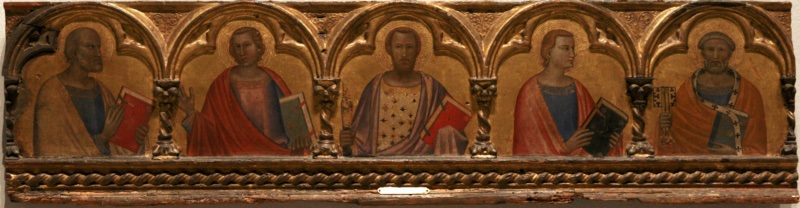
First Compartment: An Elderly Apostle
The Strasbourg panel is a fragment of the predella of a large altarpiece, the horizontal base on which the main panels of a polyptych rested. It contains five apostles in half-length, each set beneath a round arch of an arcade carved in relief and gilded, supported by twisted colonnettes with foliate capitals. The sequence of arches continues beyond the present edges of the panel: at the left, part of a sixth arch is visible, and the damaged ends of the moulding show that the predella has been cut. The complete predella probably contained the twelve apostles, arranged on either side of a central image, perhaps Christ or the Man of Sorrows. Such a programme was common in Tuscan and Marchigian altarpieces of the fourteenth century.
The first apostle, at the left, is an elderly man with a high, bald forehead, short grey-brown hair and a full beard. He is shown in three-quarter view, turned toward the right, that is, toward the centre of the predella, with a grave and concentrated expression. His features, with their strong nose and deep-set eyes, are modelled with the soft greenish underlayer and warm highlights of Trecento tempera technique.
The apostle wears a blue tunic and over it a mantle of golden ochre, which falls over his shoulders and is drawn across his body. In his hands he holds a book bound in red, raised before his breast, the attribute common to all the apostles as preachers of the Gospel. The book is the only attribute visible, and it is not sufficient to identify the apostle with certainty. His type, with the bald forehead and the beard, has sometimes been associated with Saint Paul or Saint Andrew, but without a distinguishing attribute such as Paul’s sword or Andrew’s cross the identification must remain open.
The ochre of the mantle, close in tone to the gold ground, gives the figure a luminous but subdued presence, while the blue of the tunic and the red of the book provide chromatic accents. The folds of the mantle are modelled with soft gradations of tone, and they suggest the volume of the body beneath with restraint.
The apostle’s halo, finely tooled with punched ornament, stands out against the gold ground, and the round arch above frames his head. The carved arcade, with its moulded arches and foliate spandrels, creates a series of niches that isolate each apostle while uniting them in a continuous rhythm across the predella. The left edge of this compartment is damaged, and part of the adjoining arch has been lost.
The figure shows the qualities of Allegretto’s mature style: the solid construction of the half-length figure, derived from his Florentine training, and the gentle modelling of the face, reflecting his study of Sienese painting. The gravity of the expression and the dignity of the pose give the figure an authority appropriate to an apostle.
The orientation of the apostle toward the right indicates his place in the original predella. Since the figures on this fragment face toward the right, and Saint Peter stands at the right end, it is likely that the fragment formed the left half of the predella, and that the centre of the altarpiece lay beyond Peter. On the other side of the centre, the remaining apostles would have faced toward the left, in a symmetrical arrangement.
The first compartment thus opens the sequence of apostles with a figure of dignity and gravity. Although the apostle’s identity cannot be determined, his presence in the predella contributes to the programme of the altarpiece, in which the apostles, as the foundation of the Church, supported the image of the Virgin and saints above. The predella’s function as the base of the altarpiece gave this programme a theological meaning: the Church is built on the foundation of the apostles.
Second Compartment: A Youthful Apostle with Raised Hand
The second apostle is represented as a beardless youth, with short, curly auburn hair, turned in three-quarter view toward the viewer. His face is gentle and serious, with wide-set eyes and a small mouth, and he looks out of the panel with a direct and calm gaze. His youthful appearance distinguishes him from the bearded apostles around him.
He wears a pink tunic edged with gold at the neck and a mantle of brilliant red, which falls over his left shoulder and is drawn across his body. The combination of pink and red, set against the gold ground, gives the figure a warm and luminous presence. The folds of the mantle are modelled with gradations of red and deep crimson, suggesting the volume of the body beneath.
The apostle raises his right hand, with the palm open, in a gesture of speech or witness, and in his left he holds a book bound in green. The gesture of the raised hand, which recalls the rhetoric of preaching, gives the figure an animation that distinguishes it from the more static poses of the other apostles. It may be read as an allusion to the apostolic mission of proclaiming the Gospel.
The youthful type could identify the apostle as Saint John the Evangelist, traditionally represented as the youngest of the apostles. However, the fourth apostle of the panel is also beardless and youthful, and without a specific attribute neither can be identified with certainty as John. Other apostles, such as Philip or Thomas, were also sometimes represented as young men.
The halo is finely tooled, and the round arch above frames the head. The figure fills the compartment from the base of the arcade to the arch, and the raised hand extends into the space of the adjoining twisted colonnette, creating a sense of movement across the arcade.
The treatment of the face, with its soft modelling and gentle expression, and the harmony of the warm colours show the refinement of Allegretto’s mature style. The raised hand, rendered with delicate fingers, and the elegant fall of the mantle give the figure a grace that recalls the Sienese component of his art.
The pairing of this youthful apostle with the elderly apostle on his left creates a contrast of age and character that animates the sequence. This alternation of bearded and beardless figures, which continues across the panel, gives the predella a rhythmic variety that avoids monotony and suggests the diversity of the apostolic college.
The second compartment thus presents an apostle who, with his raised hand and his book, embodies the mission of preaching. His youthful beauty and his luminous colours give the figure an attractive presence, and his gesture introduces a note of movement into the solemn sequence of the predella.
Third Compartment: Saint Bartholomew (?)
The third apostle, at the centre of the fragment, is a man in the prime of life, with thick, curly dark hair and a full beard. He is shown frontally, looking directly at the viewer with a grave and intense expression. His strong features, with a straight nose and deep-set eyes, give him an air of authority that makes him the visual focus of the fragment.
In his right hand he holds a large knife with a broad blade, raised along his side, and in his left a book bound in red. The knife is the instrument of the martyrdom of Saint Bartholomew, who according to tradition was flayed alive in Armenia, and it is his characteristic attribute. The combination of the knife and the book identifies the apostle as Bartholomew with a high degree of probability, since the knife was rarely used as an attribute for other apostles.
Bartholomew wears a tunic of cream decorated with a pattern of small dark motifs and gold, and over it a mantle of lilac and violet, which falls over his shoulders and is drawn across his body. The patterned tunic, rendered with gold and small coloured motifs, is the most richly decorated garment in the panel, and it demonstrates Allegretto’s love of precious textiles, which would become increasingly prominent in his later works.
The frontal pose and direct gaze of Bartholomew distinguish him from the other apostles, who are turned toward the right. This frontality gives him a central, almost iconic role within the fragment. Whether this reflects his position in the complete predella or simply the painter’s desire for variety cannot be determined without the rest of the sequence.
The halo is finely tooled, and the round arch above frames the head. The figure fills the compartment from the base of the arcade to the arch, and his imposing presence, with the raised knife and the book, gives the centre of the fragment a strong emphasis.
Allegretto represented Bartholomew in several of his works, including the Berlin diptych and the Fabriano pentaptych, where the saint also holds a knife and a book. The comparison with these works confirms the identification and shows the consistency of Allegretto’s iconography. The type of the saint, with the dark curly hair and the full beard, is also similar in these works.
The treatment of the figure shows the qualities of Allegretto’s mature style: the solid construction and the strong characterisation of the face, derived from his Florentine training, and the decorative richness of the tunic, reflecting his growing interest in ornament. The contrast between the grave face and the delicate pattern of the tunic is characteristic of his art in the 1360s.
The third compartment thus presents the most clearly identifiable apostle of the fragment after Saint Peter. With his knife, his book and his richly decorated tunic, Bartholomew embodies both the apostle’s mission and the martyr’s witness, and his central, frontal position gives him a particular prominence in the fragment.
Fourth Compartment: A Youthful Apostle with a Book
The fourth apostle is represented, like the second, as a beardless youth, with short, straight auburn hair, turned in three-quarter view toward the right. His face is gentle and serene, with a straight nose and a small mouth, and his gaze is directed toward the right, toward Saint Peter and the centre of the original predella.
He wears a tunic of intense blue, edged with gold at the neck, and over it a mantle of red and coral, which falls over his shoulders and is drawn across his body. The contrast between the blue tunic and the red mantle creates a vivid chromatic accent. The combination of colours is an inversion of that of the first apostle, whose blue tunic was covered by an ochre mantle.
In his hands the apostle holds a large book bound in dark green or black with metal fittings, held open or closed before his body. The book is his only attribute, and, as with the second apostle, it does not permit a secure identification. His youthful type could suggest Saint John the Evangelist, but, since the second apostle is also youthful, one of the two may be another apostle, such as Philip, Thomas or James the Less.
The figure’s pose, with the body turned toward the right and the book held before him, is calm and contemplative, and it contrasts with the animated gesture of the second apostle. This variation of poses and gestures across the sequence gives the predella a rhythmic diversity.
The halo is finely tooled, and the round arch above frames the head. The figure fills the compartment, and the book, with its dark binding, creates a strong accent at the lower right, balancing the red of the mantle.
The gentle modelling of the face and the harmony of the colours show the refinement of Allegretto’s mature style. The figure’s calm expression and its orientation toward the right reinforce the movement of the sequence toward the centre of the original predella, where the principal image would have been placed.
The juxtaposition of this youthful apostle with Saint Peter on his right creates a contrast between youth and age, between the unidentified apostle and the prince of the apostles. This contrast mirrors that between the first and second apostles on the left side of the fragment, and it gives the whole sequence a balanced rhythm.
The fourth compartment thus presents an apostle of gentle and contemplative character, whose identity cannot be determined but whose presence contributes to the harmony of the predella. His luminous colours and calm pose prepare the viewer for the imposing figure of Saint Peter, who closes the sequence on the right.
Fifth Compartment: Saint Peter
The fifth apostle, at the right end of the fragment, is Saint Peter, the prince of the apostles and the first bishop of Rome. He is represented according to his traditional type: an elderly man with short grey hair, tonsured, and a short, curly grey beard. He is shown frontally, looking directly at the viewer with a grave and dignified expression. His strong, square features give him an air of authority appropriate to his role as the head of the apostolic college.
In his right hand Peter holds a large golden key, rendered with an elaborately decorated bit, and in his left a book bound in dark green. The key is his characteristic attribute, recalling Christ’s words: “I will give unto thee the keys of the kingdom of heaven” (Matthew 16:19). It symbolised the authority of Peter and his successors, the popes, to bind and loose. The book, as with the other apostles, alludes to the Gospel.
Peter wears a blue tunic, visible at the neck, and over it a mantle of orange, which falls over his shoulders and is drawn across his body. Over the mantle, around his shoulders and falling down his front, he wears a white band marked with black crosses, which resembles the pallium, the liturgical vestment of the pope and of archbishops. This detail presents Peter not only as an apostle but as the first pope, the head of the Church. It gives his figure a particular dignity within the sequence of apostles.
The frontal pose and direct gaze of Peter, like those of Bartholomew at the centre, distinguish him from the apostles turned toward the right. His position at the right end of the fragment, adjacent to the probable centre of the original predella, would have placed him in the place of honour, immediately beside the principal image. This position corresponds to his rank as the prince of the apostles.
The halo is finely tooled, and the round arch above frames the head. The figure fills the compartment, and the golden key, with its elaborate bit, creates a strong accent at the left of the compartment, balancing the dark book on the right.
The treatment of the figure shows the qualities of Allegretto’s mature style: the strong characterisation of the face, the solid construction of the figure and the rich decoration of the garments. The white band with its black crosses and the elaborate key show his attention to decorative detail, which would become increasingly prominent in his later works.
The identification of Saint Peter is secure, and it provides a fixed point for the reconstruction of the original predella. If Peter stood immediately beside the centre, as his position at the right end of the fragment suggests, Saint Paul would probably have stood on the other side of the centre. The remaining apostles would then have continued the sequence to the right, facing toward the left.
The fifth compartment thus closes the fragment with the most important apostle, the prince of the apostles and the first pope. His imposing presence, with the key, the book and the pallium, gives the fragment a strong conclusion. It also suggests the grandeur of the original altarpiece, whose predella, with its twelve apostles, formed the foundation of a large and ambitious composition.
Allegretto Nuzi and workshop, Madonna and Child (left wing of a diptych with the Man of Sorrows), c. 1365
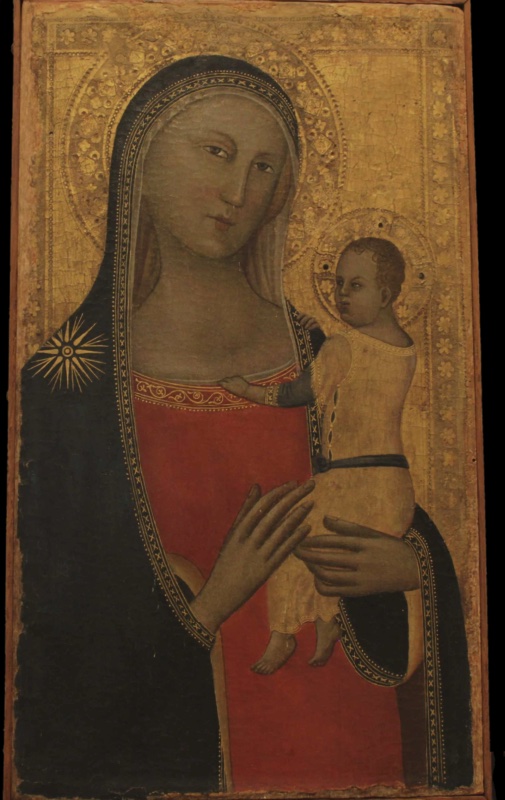
This small panel, just over a third of a metre high, is one wing of a devotional diptych whose other wing, also in the Pinacoteca Vaticana, represents the dead Christ as the Man of Sorrows. The Vatican Museums catalogue the panel as the work of Allegretto Nuzi and his workshop, a formulation that recognises the participation of assistants in its execution.
The attribution is characteristic of the small devotional diptychs produced in Allegretto’s workshop, which were made in considerable numbers for private patrons and in which the master’s designs were often carried out wholly or partly by his collaborators. The museums date the diptych about 1365 and see in the pairing of the two wings a testimony to the particular devotional attention given both to the Incarnation and to the sufferings Christ endured until his death. The date places the work in the same years as the great triptych of 1365 in the same collection, at the height of Allegretto’s maturity. The combination of the Virgin and Child with the Vir dolorum recurs in the Philadelphia diptych and in the diptych divided between a private collection and Pesaro, and it was evidently one of the formulas most in demand in Allegretto’s workshop.
The Virgin is shown in half-length, filling almost the entire height of the panel, so that the image offered its owner the intimacy of a close encounter with the Mother of God. She wears a white veil that frames her face and falls over her shoulders, and above it a mantle of deep blue, now darkened almost to black, edged with a band of gold embroidered with dots. On her right shoulder shines a large gold star with radiating rays, the emblem of Mary as Stella Maris, the star of the sea that guides the faithful. Beneath the mantle she wears a gown of vermilion, whose neckline is decorated with a band of gold embroidery with scrolling motifs. The intense red of the gown, framed by the dark mantle, is the chromatic focus of the image.
The Virgin’s face is long and oval, with a straight, narrow nose, almond-shaped eyes and a small, closed mouth, and it is modelled with soft gradations of tone over a greenish underlayer. She inclines her head slightly and looks out toward the viewer with a grave, melancholy gaze. This detachment from the Child, a constant of Allegretto’s Madonnas, acquires a precise meaning in a diptych whose other wing shows the dead Christ. The Mother appears already to contemplate the Passion displayed on the opposite panel, so that her silent sorrow becomes the link between the two images.
The Virgin raises her right hand before her breast, with her long, slender fingers gently extended, while with her left hand she supports the Child. The gesture of the raised hand, which appears in almost identical form in the Philadelphia diptych, has an ambivalent meaning: it both presents the Child to the viewer and seems to express the Mother’s inward emotion. In the context of the diptych, it may also be read as directing the viewer’s attention across to the opposite wing, where the Son whom she presents appears as the Man of Sorrows.
The Christ Child sits on his Mother’s left arm, dressed in a pale tunic tied at the waist with a dark sash, which leaves his feet bare. He turns his body toward her and reaches with one hand toward the embroidered neckline of her gown, a spontaneous gesture of affection that echoes the tender motifs of Sienese painting. At the same time he turns his head toward the viewer, with a grave, attentive expression that seems older than his years. The combination of the childlike gesture and the solemn gaze expresses the double nature of the Child, at once a human infant and the incarnate Son of God.
The gold ground behind the figures is framed by a broad punched border decorated with floral motifs, and the haloes of the Virgin and Child are richly tooled with rings of ornament. In the small format of the diptych, this dense punchwork creates an effect of preciousness appropriate to an object intended for intimate and prolonged contemplation. The same technique frames the gold ground of the Philadelphia diptych, and it testifies to Allegretto’s mastery of gold tooling, which modern scholarship has recognised as one of the hallmarks of his art.
The companion wing presents the Man of Sorrows, the dead Christ shown in half-length, standing, stripped of his garments, with his hands bound, his eyes closed and his face inclined in the sleep of death. The pairing of the two wings set side by side the Incarnation and the Passion: the infant Christ in his Mother’s arms and the dead Christ displaying his suffering. When the diptych was opened, the owner was invited to meditate on the continuity between the two, sharing the sorrow of the Mother and contemplating the wounds of the Son, in the practice of affective devotion promoted by the mendicant orders.
Despite the wear of its surface and the craquelure that marks the paint and the gold, the panel preserves the essential qualities of Allegretto’s mature devotional painting: the monumental construction of the Virgin, the harmony of the dark blue, red and white, and the refinement of the punched gold. The close correspondence with the Madonna of the Philadelphia diptych, in the pose of the Virgin, the raised hand and the star on the shoulder, shows how a successful composition devised by the master was repeated for different patrons. It is precisely this practice of repetition that explains the Vatican’s attribution to Allegretto and his workshop. The design and the general conception belong to the master, while the execution may reflect the hand of assistants, perhaps in the somewhat simplified modelling of the drapery and the more summary treatment of certain details. The panel thus documents not only Allegretto’s devotional art but also the organisation of his workshop, which allowed the painter to meet the demand for small images of private devotion that his reputation had created in Fabriano and the Marche.
Allegretto Nuzi and workshop, Man of Sorrows (right wing of a diptych with the Madonna and Child), c. 1365
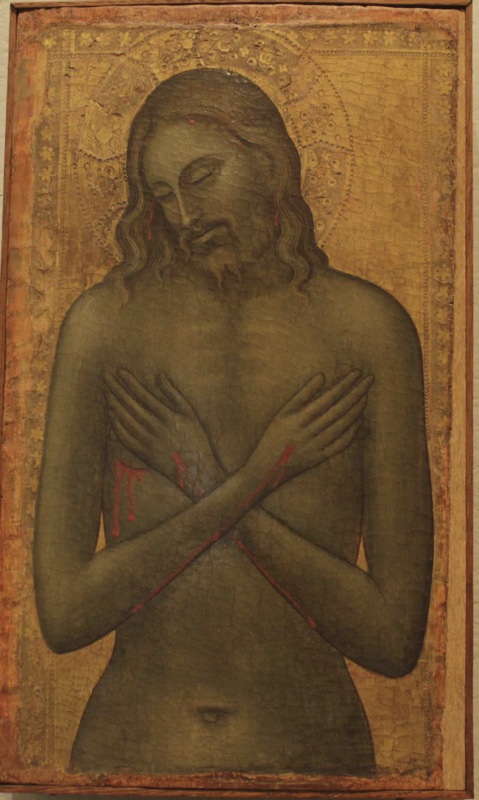
This small panel, companion to the Madonna and Child in the same collection, formed the right wing of a devotional diptych catalogued by the Vatican Museums as the work of Allegretto Nuzi and his workshop and dated about 1365. The two wings are almost identical in size and share the same gold ground framed by a punched floral border, which confirms that they were conceived together. The Vatican Museums, presenting this panel, observe that in the image of the Vir dolorum the sorrow of Christ’s Passion and death appears almost crystallised, and they see in the diptych as a whole a testimony to the particular devotional attention given to the Incarnation and to the sufferings Christ endured until his death.
The Man of Sorrows, or Imago Pietatis, was not an illustration of a moment in the Gospel narrative but a timeless devotional image, which condensed the Passion, death and Resurrection into a single figure. Originating in Byzantine art, the type spread through Italy from the late thirteenth century and became one of the most widespread subjects of private devotion in the fourteenth. It was frequently paired with the Virgin and Child in small diptychs, as here and in the Philadelphia diptych, where the same pairing appears in a composition closely related to the Vatican work.
Christ is shown frontally, in half-length, his body cut just below the navel by the lower edge of the panel. Unlike the Philadelphia version, in which he rises from a sarcophagus, here no tomb is visible, and the figure emerges directly from the lower edge of the panel against the gold ground. The effect is one of immediate presence: the dead Christ appears before the viewer at close range, as if offered for contemplation in the intimacy of private prayer. The absence of any narrative setting concentrates the whole meaning of the image on the body of Christ and its wounds.
His head is bowed onto his right shoulder, his eyes are closed and his long, wavy brown hair falls over his shoulders and breast. His face, with its lowered lids, straight nose, parted lips and short beard, expresses the stillness of death, and a few drops of blood run from his brow, recalling the crown of thorns. At the same time the upright figure possesses a mysterious life, for the dead Christ stands before the viewer as if still present. This ambiguity between death and life lies at the heart of the Imago Pietatis, which presents Christ as dead and yet living, suffering and yet victorious over death.
Christ’s arms are crossed over his breast, with his hands laid on the opposite shoulders. This pose, derived from Byzantine models, emphasises the stillness of death and at the same time displays the wounds. Blood flows in thin red streams from the wounds in his hands down the forearms, and the wound in his side, partly covered by the crossed arms, also bleeds in vertical streams. Allegretto renders the wounds with restraint, as fine red lines against the pale, greenish flesh. The effect is one of quiet pathos, which invites the viewer to meditate on the suffering of the Passion rather than to recoil from it.
The modelling of the body, with the muscles of the chest and arms and the navel indicated by subtle gradations of tone, is soft and restrained. The flesh has a pronounced greenish cast, which results in part from the green underpainting, or verdaccio, of Trecento tempera technique, now more visible as the upper layers have thinned. It also expresses, however, the pallor of death. The treatment of the body is somewhat simpler than in the Philadelphia version, a difference that may reflect the participation of the workshop recognised by the Vatican catalogue.
Behind Christ’s head is a cruciform halo, richly tooled with punched ornament, whose inscribed cross, reserved for Christ alone, identifies him as the Son of God even in death. The gold ground is framed by a punched border of floral motifs identical to that of the companion wing. When the diptych was opened, the two panels formed a unified ensemble. On the left, the Virgin in her dark mantle, with the star on her shoulder, presented the infant Christ, gazing out with a melancholy expression. On the right, the same Christ appeared dead, displaying the wounds of the Passion. The Virgin’s sorrowful gaze and her raised hand directed the viewer’s attention across the diptych to the image of her suffering Son.
The Vatican diptych thus offered its owner a concentrated meditation on the mystery of salvation, setting side by side the Incarnation and the Passion, the Mother holding her Child and the dead Christ displaying his wounds. In the practice of affective devotion promoted by the mendicant orders, such images served as supports for prayer, in which the faithful were encouraged to share the grief of the Mother and to contemplate the wounds of the Son. Although the execution may reflect the participation of assistants, the conception of the diptych belongs to Allegretto. It shows how his workshop met the demand for small devotional images, repeating and varying compositions devised by the master for patrons in Fabriano and the Marche.
School of Allegretto Nuzi, Madonna and Child Enthroned with Two Angels between Saints Catherine of Alexandria and John the Baptist, c. 1380–90
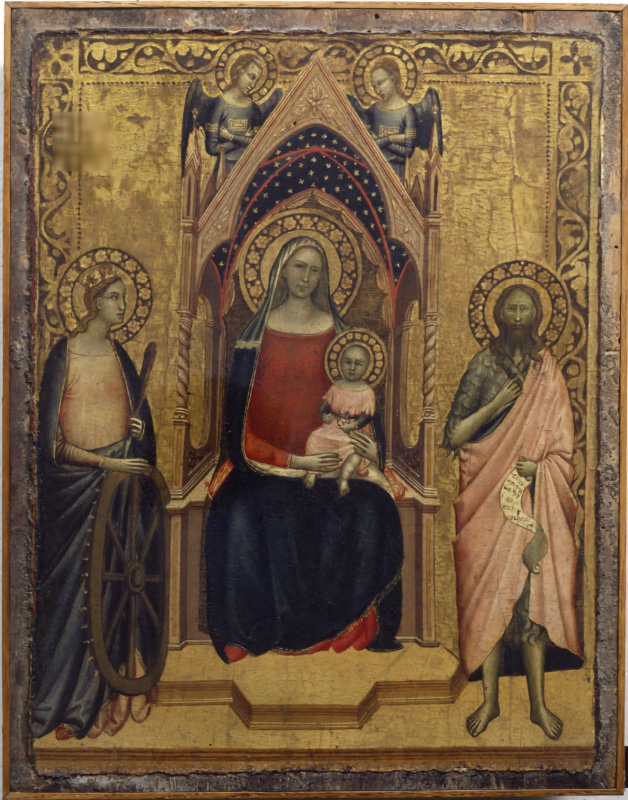
This small devotional panel, catalogued by the Vatican Museums as an altarolo, a portable altarpiece for private prayer, is attributed not to Allegretto himself but to his school, and dated 1380–90. The date places it in the decade or more after the painter’s death in 1373, when his models continued to be repeated by the painters of the Fabrianese school formed in his workshop. The panel is therefore a document of Allegretto’s afterlife: it shows how his compositions, his figure types and his decorative vocabulary survived him and continued to satisfy the demand for devotional images in Fabriano and the Marche in the last decades of the century.
The composition is centred on the Virgin, enthroned beneath an elaborate Gothic canopy. The throne rises in the form of a miniature architectural structure, with a pointed gable, pinnacles and twisted colonnettes, and its vault, visible above the Virgin’s head, is painted deep blue and spangled with gold stars, an image of the heavenly firmament. This type of throne closely recalls that of the central panel of the Detroit tabernacle, painted by Allegretto himself, where the Virgin also sits beneath a Gothic canopy with a starry vault. The similarity suggests that the painter of the Vatican panel drew directly on compositions devised by the master, which circulated in his workshop and among his followers.
The Virgin wears a white veil and a mantle of deep blue, now darkened, over a gown of vermilion. She sits frontally, with her head slightly inclined, and looks out toward the viewer with a gentle, grave expression. Her face, with its long nose, narrow eyes and small mouth, follows the type of Allegretto’s Madonnas, although the modelling is simpler and less refined than in the master’s autograph works. The Child sits on her knee, dressed in a pink tunic, holding a small object before his breast, perhaps a bird, and turning toward the viewer. The Virgin supports him with both hands, in a pose that echoes the enthroned Madonnas of Allegretto’s small altarpieces.
Above the throne, on either side of its pinnacled gable, appear two angels in half-length, dressed in blue and with dark wings, their haloes finely tooled. Each appears to hold a small open book, perhaps a book of chant, as if singing the praises of the Virgin. Their symmetrical placement frames the throne and extends the heavenly court into the upper part of the panel, in a manner that recalls the angels behind the throne in the Detroit tabernacle.
On the left stands Saint Catherine of Alexandria, crowned as a royal princess, in a pale pink gown and a dark blue mantle. In one hand she holds the palm of martyrdom, and beside her stands the great spiked wheel on which she was to be broken, rendered with its spokes and felloe in brown. The large circular form of the wheel fills the lower left corner of the panel and balances the vertical figure of the saint. Catherine’s gentle, pale face and her elegant, slightly swaying pose follow the type of the virgin martyrs in Allegretto’s altarpieces, such as the Saint Catherine of the Apiro polyptych.
On the right stands Saint John the Baptist, bearded and with long, dishevelled hair, wearing his camel-skin garment beneath a rose-pink mantle, with his legs and feet bare. With his right hand he points toward the Virgin and Child, and in his left he holds an unrolled scroll inscribed with lines of text. Traditionally, this inscription reads Ecce Agnus Dei, “Behold the Lamb of God,” the words with which John announced the coming of Christ. The pairing of the Baptist with a crowned female saint on either side of the enthroned Virgin repeats the arrangement of the central panel of the Detroit tabernacle, in which the Baptist and a female martyr also flank the throne.
The gold ground is framed by a painted border of dark foliate scrolls, which runs around the edges of the panel, and the haloes of all the figures are richly tooled. The decorative repertory, with the starry vault of the canopy, the tooled haloes and the foliate border, belongs to the tradition established by Allegretto. The execution, however, is somewhat drier and more schematic than in his autograph works: the draperies fall in simpler folds, and the figures have a certain stiffness that distinguishes them from the graceful forms of the master. A small area at the upper left of the photograph is obscured, and the panel shows some wear to the gold and the paint.
The Vatican panel thus illustrates the persistence of Allegretto’s art after his death. The composition, derived from models such as the Detroit tabernacle, the figure types of the Virgin and the saints, and the decorative vocabulary of gold and colour were transmitted through his workshop to the painters of the following generation. Francescuccio Ghissi, active until 1395, is the best known of them, but many others remain anonymous. Works such as this show that the Fabrianese school founded by Allegretto remained a living tradition into the last decades of the fourteenth century, preparing the ground from which Gentile da Fabriano would emerge.
The Crucifixion with the Virgin, Saint John the Evangelist and Mary Magdalene, c. 1365
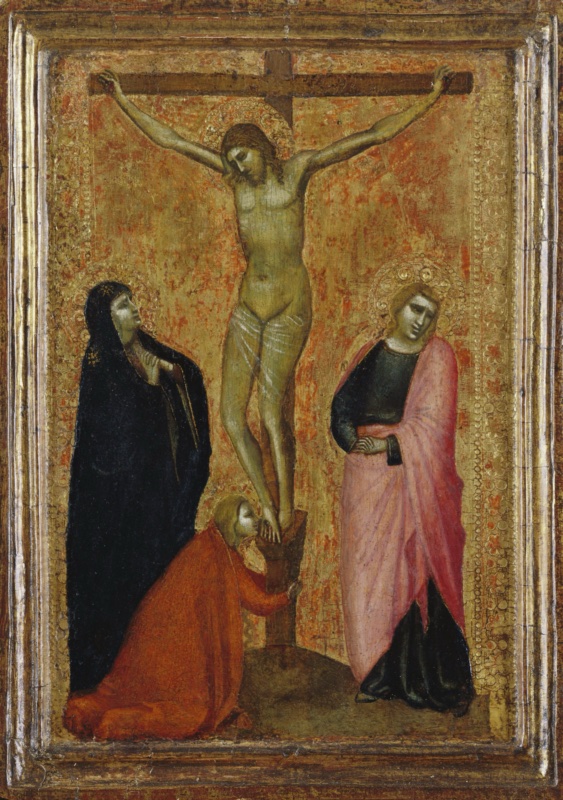
This small panel, whose painted surface measures little more than twenty centimetres in height, is the most intimate of the Crucifixions attributed to Allegretto. It came to the Birmingham Museum of Art in 1961 as a gift of the Samuel H. Kress Foundation, which distributed its vast collection of Italian paintings among American museums in the middle of the twentieth century. The museum dates it to about 1365, in the same years as the Vatican triptych and the Vatican and Philadelphia diptychs. According to the museum, the panel probably formed the right wing of a diptych, whose left wing would most likely have represented the Madonna and Child. Its diminutive size suggests that the diptych was portable, intended for use in a domestic or private devotional setting. The pairing of the Crucifixion with the Madonna and Child, the Passion with the Incarnation, is the same as in Allegretto’s diptychs in Berlin, Philadelphia and the Vatican, and it confirms how central this devotional formula was to the production of his workshop.
Compared with Allegretto’s other Crucifixions, the Birmingham panel is remarkable for its concentration. There are no angels gathering the blood of Christ, as in the Metropolitan panel and the Richmond Crucifixion, no pelican in the gable, as in the Berlin diptych, and no holy women supporting the fainting Virgin. The composition is reduced to its essential elements: the Cross, the dead Christ and the three mourners who, according to tradition, stood closest to him at the moment of his death. This reduction gives the image a severe and silent intensity, appropriate to an object intended for personal meditation.
The Cross rises from a dark mound, the hill of Golgotha, to the upper edge of the panel, and its crossbar extends almost to the edges of the frame. Christ hangs dead upon it, his arms stretched slightly upward along the crossbar, his head bowed onto his right shoulder and his eyes closed. His slender body, modelled in pale, greenish flesh tones with delicate indications of the ribs and the muscles of the chest and abdomen, is girded by a transparent white loincloth that clings to his thighs. His legs are bent, and his crossed feet are nailed to a small support at the base of the upright. The figure belongs to the Tuscan type of the Christus patiens, and its elegant proportions and restrained modelling reflect Allegretto’s Florentine formation.
At the foot of the Cross, Mary Magdalene kneels in a mantle of orange-red, which spreads across the ground in broad, heavy folds. She embraces the upright of the Cross with both arms and presses her face against Christ’s nailed feet, in an attitude of complete abandonment to grief and love. Her long golden hair falls down her back beneath her mantle. The motif of the Magdalene embracing the Cross and kissing Christ’s feet, which recurs in almost all of Allegretto’s Crucifixions, offered the viewer a model of penitence and affective devotion. Here the Magdalene’s face, almost hidden against the wood, conveys an especially intense intimacy.
On the left stands the Virgin, wrapped from head to foot in a mantle of deep blue, now darkened almost to black, marked on the head with a small gold star, the emblem of Mary as Stella Maris. She raises her face toward her dead Son with an expression of anguish, and brings one hand to her throat in a gesture of grief that seems to stifle a cry. The Virgin’s figure, a tall, dark column rising from the ground to the level of Christ’s knees, has a monumental simplicity that gives it great expressive power. The restrained gesture and the upturned face convey her sorrow with more intensity than the fainting Virgin of Allegretto’s larger compositions.
On the right stands Saint John the Evangelist, youthful and beardless, in a dark green tunic and a rose-pink mantle that falls from his shoulder in broad folds to the ground. He clasps his hands at his waist and inclines his head to one side, looking down with an expression of quiet sorrow. His pose, turned inward and absorbed in grief, contrasts with the Virgin’s upward gaze, and the two standing figures frame the Cross in a balanced composition. The pink and green of John’s garments, a colour harmony favoured by Florentine painters, balance the dark blue of the Virgin’s mantle and the orange-red of the Magdalene’s.
The gold ground of the panel has suffered severe abrasion, and over large areas the red bole beneath the gold is now exposed, giving the background its present reddish, mottled appearance. As with the Metropolitan Crucifixion, the original effect would have been one of uniform, luminous gold. The punched border that runs along the edges of the panel and the haloes of the Virgin and Saint John, tooled with rings of circles, survive better and still show the refinement of the original decoration. The figures themselves are relatively well preserved, and their colours retain much of their original intensity.
The Birmingham Crucifixion thus represents the most concentrated version of the devotional formula that Allegretto developed for the Passion. Stripped of the symbolic and narrative elements that enrich his other Crucifixions, it presents the essential drama of Christ’s death and the grief of those who loved him most, in a small format designed for close, personal contemplation. The graceful figures, the soft modelling, the expressive gestures and the harmonious colours show the qualities of Allegretto’s mature art. The panel demonstrates his ability to convey profound emotion with the simplest means.
Allegretto Nuzi and Francescuccio Ghissi, Saints Catherine of Alexandria and Bartholomew
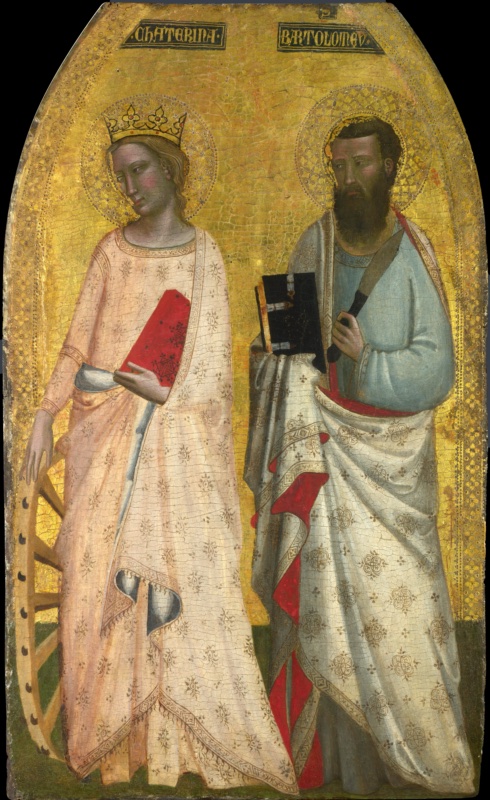
This panel, representing Saints Catherine of Alexandria and Bartholomew standing side by side, is one of the most instructive works associated with Allegretto Nuzi, because it raises directly the question of how the Fabrianese workshop functioned. The National Gallery attributes it jointly to Allegretto Nuzi and Francescuccio Ghissi and explains the reasoning behind this attribution. The painting has been connected with Allegretto’s workshop on the basis of the punch marks in the gold leaf, visible in the haloes and the border, which are also found in other pictures by the artist. The style of painting and the lettering of the inscriptions, however, resemble the works of Francescuccio Ghissi. The gallery therefore suggests that Allegretto may have designed the picture and that Ghissi painted it, using his master’s tools. The panel is thus an exemplary case of the use of punchwork analysis to associate an unsigned work with a particular workshop.
According to the National Gallery, the panel probably formed the right-hand side of a triptych. Both saints turn toward the left, that is, toward the centre of the lost altarpiece, where the principal image would have stood. The gallery, following Dillian Gordon’s 2011 catalogue, notes that a roundel with Christ blessing, now in the Museum of Art of Bowdoin College in Brunswick, Maine, has been connected with this panel on the basis of its condition, and may therefore have crowned the lost central panel. This connection has been challenged by a more recent proposal.
In 2022, Emanuele Zappasodi assigned the Bowdoin roundel to a small polyptych centred on the Crucifixion now in the church of the Ursuline nuns in Fribourg, together with two panels of Saint Agnes and a female martyr. If Zappasodi is right, the roundel did not belong to the altarpiece of the London panel, unless the London panel was itself one of the further compartments that his reconstruction requires, a hypothesis that remains to be tested. The gallery also observes that Catherine and Bartholomew both had churches dedicated to them in Allegretto’s hometown of Fabriano, where he collaborated on several works with Ghissi after his return from Florence, and that the panel was therefore probably made there.
Above the heads of the saints, two black tablets bear their names in Gothic capitals: ·CHATERINA· and BARTOLOMEU·. The spelling Chaterina, with ch in place of the Latin c, and the vernacular form Bartolomeu reflect the fluid orthography of the fourteenth century and the mingling of Latin and Italian forms in the inscriptions of the period. According to the National Gallery, the lettering of these inscriptions is one of the elements that point to the hand of Ghissi rather than that of Allegretto. The inscribed tablets, set against the gold ground, give the panel a clarity of identification suited to an altarpiece viewed from a distance.
On the left stands Saint Catherine of Alexandria, crowned as a royal princess. Her gold crown is set with red stones and flanked by fleurons, and her long golden hair falls over her shoulders. She inclines her head gently and looks down toward the left, with a delicate, pensive expression. She wears a long gown of pale pink, patterned with small motifs in brown and gold and edged with embroidered borders at the neck, the sleeves and the hem. In her left hand she holds a book bound in red, the emblem of her learning, since according to her legend she confuted the pagan philosophers summoned by the emperor. Her right hand rests on the rim of the great wheel studded with metal spikes, the instrument on which she was to be tortured for her faith, which stands at the left edge of the panel.
On the right stands Saint Bartholomew, a man in the prime of life with thick dark hair and a full beard, turning his head toward the left with a grave expression. He wears a tunic of light blue and over it a white mantle patterned with rosettes and crosses in gold, lined with brilliant red, which falls from his shoulder in broad, heavy folds. In his right hand he holds a large book bound in black with metal clasps, the attribute of the apostles, and in his left a large knife, the symbol of his martyrdom, since he was flayed alive. The contrast between the pale blue of the tunic, the white of the mantle and the red of its lining gives the figure a luminous and refined presence.
The pairing of Catherine and Bartholomew recurs in Allegretto’s work: in the Berlin diptych, the enthroned Virgin is flanked by exactly the same two saints, Bartholomew on the left and Catherine on the right. This repetition suggests a particular devotion to the two saints in Fabriano, where, as the National Gallery notes, both had churches dedicated to them, and it strengthens the connection of the London panel with Allegretto’s workshop. The type of Bartholomew, with his dark beard and his knife, is also similar to the figures of the saint in the Berlin diptych, the Fabriano pentaptych and the Strasbourg predella.
The panel displays the qualities that characterise the collaboration between Allegretto and Ghissi. The figures are tall and elegant, with graceful proportions and gentle expressions, and the draperies fall in broad, rhythmic folds. The patterned textiles of the gown and the mantle, rendered with small repeated motifs, reflect the love of precious fabrics that runs through the Fabrianese school. The softness of the modelling, the delicacy of Catherine’s face and the somewhat linear treatment of the folds are consistent with Ghissi’s manner, which, while closely following his master’s models, tends toward a gentler and more decorative style. The punched border that runs around the arched top of the panel and the richly tooled haloes testify to the shared workshop tools.
The London panel thus documents, with unusual clarity, the collaborative practice of Allegretto’s workshop. The master’s design and tools, identified through the punch marks, combine with the hand of his closest collaborator, identified through style and lettering, to produce a work that belongs to both. The panel was purchased in 1920 from or through Alphonse Kann in Paris by Herbert Charles Coleman, who bequeathed it to the National Gallery in 1949. It is fully catalogued in Dillian Gordon’s volume on the gallery’s Italian paintings before 1400 (2011). It demonstrates how modern technical study, alongside stylistic analysis, has refined our understanding of the relationship between Allegretto and Ghissi, one of the central problems of Fabrianese painting.
Christ Blessing (roundel from the pinnacle of a dismembered altarpiece)
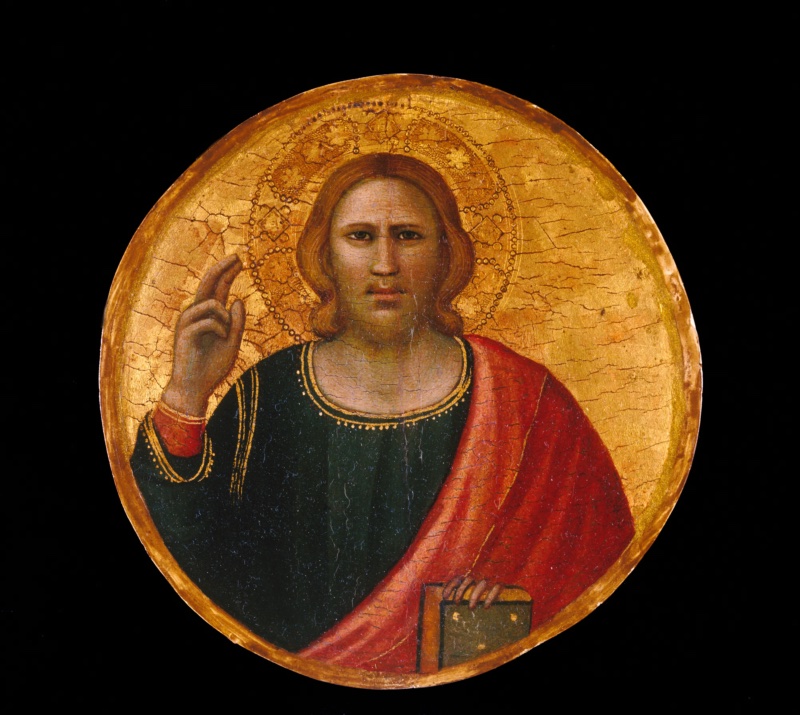
This small roundel, less than twenty centimetres in diameter, originally crowned the central pinnacle of an altarpiece. Images of Christ blessing, God the Father or the Redeemer set in roundels or trefoils at the summit of the central gable were a common feature of fourteenth-century polyptychs. They completed the programme of the altarpiece by placing the divine authority above the Virgin and saints of the main register. Like many such elements, the roundel was separated from its altarpiece at an unknown date and entered the art market as an independent image. It came to the Bowdoin College Museum of Art in 1961 as a gift of the Samuel H. Kress Foundation, which distributed its collection of Italian paintings among American museums in the middle of the twentieth century.
The identification of the altarpiece from which the roundel came has been the subject of two different proposals. The National Gallery in London, following Dillian Gordon’s catalogue of its Italian paintings before 1400 (2011), connects it on the basis of its condition with the panel of Saints Catherine and Bartholomew attributed to Allegretto Nuzi and Francescuccio Ghissi. That panel probably formed the right-hand side of a triptych, whose lost central panel the roundel would have crowned. In 2022, on the occasion of the exhibition in Fabriano of the recently restored Crucifixion from the church of the Ursuline nuns in Fribourg, Emanuele Zappasodi proposed a different reconstruction.
He associated the Crucifixion with two panels of Saint Agnes and a female martyr recovered by the Carabinieri’s cultural heritage unit. In his view, the three panels came from a polyptych of modest dimensions, with the Crucifixion at the centre, surmounted in its pinnacle by the Bowdoin roundel, and with at least one further compartment beside the two saints. As published, the two proposals are incompatible. They could be reconciled only if the London panel proved to be one of the missing compartments of the Fribourg polyptych, a possibility that neither source raises and that only a comparison of the dimensions, punchwork and condition of the panels could test. The original context of the roundel therefore remains an open question.
Christ is shown in half-length, facing the viewer frontally, his figure filling the roundel from the halo, which touches its upper edge, to the lower edge, where his body is cut at the waist. His long, light-brown hair falls in soft waves to his shoulders, parted in the middle, and he has a short beard and moustache. His face, with its straight nose, wide-set eyes and small mouth, gazes directly out at the viewer with a calm and solemn expression. The frontal presentation and the direct gaze are appropriate to an image placed at the summit of an altarpiece, from which Christ would have looked down upon the faithful as the Judge and Saviour of the world.
Christ raises his right hand in blessing, with the index and middle fingers extended and the others folded against the palm, in the traditional gesture of the Latin benediction. In his left hand he holds a closed book with a green binding, which he rests against his body. The book signifies Christ as the Word of God and the source of the Gospel, and the blessing expresses his role as the giver of grace. Together, the gesture and the book define the image as that of Christ the Redeemer, or Salvator Mundi, the Saviour of the world who blesses and teaches.
He wears a tunic of blue-green, edged at the neck with a band of gold decorated with small dots and with gold lines at the cuff, and over it a mantle of red, which falls from his left shoulder and is drawn across his body. The combination of the blue-green tunic and the red mantle, one of the traditional colour schemes for Christ, symbolises his two natures, divine and human. The broad, simple folds of the mantle are modelled with soft gradations of tone, and they give the small figure a monumental presence despite its reduced size.
Behind Christ’s head is a halo richly tooled with punched ornament, in which the arms of the cross, reserved for Christ, can be made out through the patterns of punched motifs. The gold ground of the roundel shows a network of craquelure, and the modelling of the flesh reveals in places the greenish underlayer of the tempera technique. The roundel is set within a square gilded surround whose spandrels are decorated with punched motifs, and the whole is mounted on red velvet in a later frame. Whether the square surround is part of the original carpentry or a later adaptation for independent display would need to be established by technical examination.
In its style, the roundel shows the qualities of Allegretto’s mature art. The frontal construction of the figure, the solid volumes of the body beneath the drapery and the clarity of the composition reflect the painter’s Florentine training. The gentle modelling of the face and the harmony of the colours recall the Sienese component of his art. The type of Christ, with the long parted hair, the short beard and the calm gaze, corresponds to the figures of Christ in Allegretto’s other works, such as the blessing Christ in the gable of the Bern triptych.
The Bowdoin roundel thus provides a striking example of the dismemberment of fourteenth-century altarpieces, whose elements were dispersed among collections in Europe and America and which modern scholarship has sought to reconstruct. The two competing proposals for its original context, the triptych to which the London Saints Catherine and Bartholomew belonged and the Fribourg Crucifixion polyptych, show both the possibilities and the limits of such reconstructions. They also illustrate the importance of physical evidence, such as the condition of the panels, their dimensions and their punched decoration, alongside stylistic analysis. Whatever its original context, the roundel preserves, in its small format, an image of Christ of great dignity and serenity. In its original position, it would have crowned an altarpiece of Allegretto’s workshop.
The Fribourg Polyptych: The Crucifixion between Saint Agnes and a Female Martyr (recomposed)
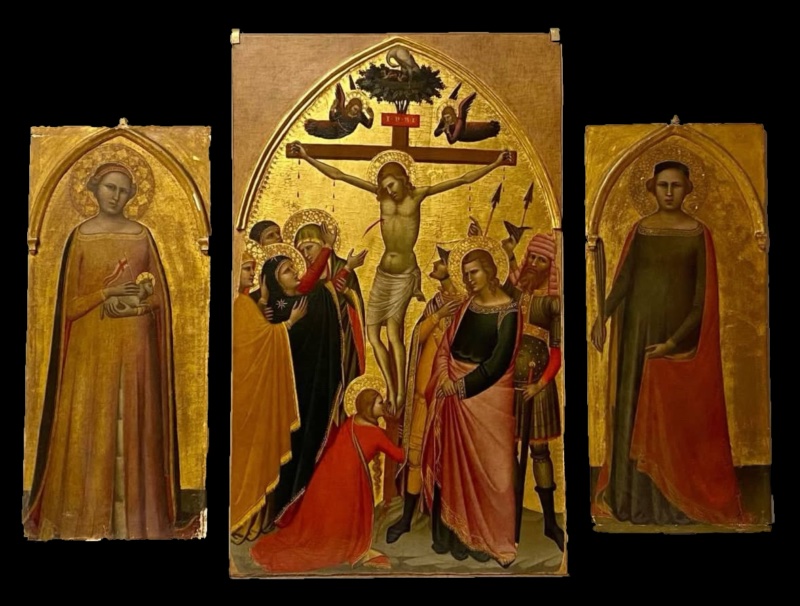
The three panels reunited in Fabriano in 2022 offer a rare opportunity to see a dismembered altarpiece by Allegretto Nuzi in something close to its original form. The central Crucifixion, preserved in the church of the Ursuline nuns in Fribourg, in Switzerland, but of unknown provenance, had long been known to scholarship. The two lateral panels, representing Saint Agnes and an unidentified female martyr, emerged only recently, when the Carabinieri’s cultural heritage unit recovered them in a seizure. Later studies attributed them to the Fabrianese painter. They were associated with the Crucifixion by Emanuele Zappasodi, who proposed that the three panels came from a polyptych of modest dimensions. The exhibition Allegretto Nuzi e la Crocifissione di Friburgo. Oro e colore ritrovati thus presented, for the first time, the recomposed central section of this altarpiece.
The recovery of the Crucifixion’s original quality was the achievement of the restoration carried out by Lucia Biondi, funded by the Ursuline convent. The restorer first examined the panel in October 2021, during the installation of the monographic exhibition devoted to Allegretto in Fabriano. She was immediately struck by the quality and state of preservation of the painting, even though its pigments were obscured by a thick layer of dark, opaque materials connected with its conservation history. During the restoration, a meticulous cleaning removed the deposits of lamp-black and yellowed varnish. In the restorer’s words, it recovered the painting typical of Allegretto, with its exquisite colour harmonies and fine brushstrokes that blend softly into one another.
The central panel, beneath a pointed arch, presents the Crucifixion as a crowded narrative scene, far richer than the devotional Crucifixions of Allegretto’s diptychs. Christ hangs dead on the Cross at the centre, his head bowed and his body slender and pale, girded by a white loincloth. Blood drips in regular drops from his hands and spurts from the wound in his side. Above the red titulus inscribed INRI, two angels hover in lament on either side, and at the summit of the Cross, where the upright sprouts into a small leafy tree, a pelican feeds her young with her own blood in her nest. The combination of the pelican and the living Cross, which recurs in the Berlin and Richmond Crucifixions and in the Metropolitan panel, confirms that the Fribourg panel belongs to the same family of works.
On the left, a compact group of mourners surrounds the Virgin. Wrapped in a dark mantle marked with a gold star, she sinks in grief, supported by the holy women in mantles of yellow, red and green, one of whom raises her arms in lament. At the foot of the Cross, Mary Magdalene kneels in a vermilion mantle, embracing the upright and pressing her face against Christ’s feet, in the gesture of affective devotion that Allegretto repeats in almost all his Crucifixions. The emotional intensity of this group, with its interlocking gestures and grieving faces, reflects the Sienese component of Allegretto’s art, derived from his study of the Lorenzetti.
On the right, the scene opens onto the world of the executioners and witnesses. In the foreground, Saint John the Evangelist, in a rose-pink mantle over a dark green tunic, stands with his head bowed and his hands clasped, absorbed in silent grief. Behind him are gathered the soldiers, with lances and pennants rising against the gold ground, a soldier in armour with a shield and a bearded figure in a striped turban. One figure raises his face toward Christ, in a gesture that may identify him as the centurion who, according to the Gospels, recognised Christ at the moment of his death as the Son of God. The inclusion of the soldiers, absent from Allegretto’s smaller devotional Crucifixions, gives the Fribourg panel a narrative breadth that recalls the great Florentine Crucifixions of the mid-fourteenth century.
On the left lateral panel, beneath a pointed arch, stands Saint Agnes, the young Roman virgin martyred under Diocletian. She wears a long gown of pink and orange and a dark mantle, and she holds in her arms her attribute, a small white lamb, whose name in Latin, agnus, evokes her own and which symbolises her purity and her sacrifice. On the right lateral panel stands a female martyr, whose identity has not been established, in a dark green gown and a red mantle, holding a slender palm. Both saints are shown frontally, standing on a narrow strip of ground against the gold, with a calm and solemn dignity that contrasts with the animated drama of the central Crucifixion.
Zappasodi’s reconstruction places Saint Agnes on the left and the female martyr on the right of the Crucifixion, with the roundel of Christ blessing now at Bowdoin College in the pinnacle above the central panel. Each of the two saints, in his view, would in turn have been flanked by at least one further compartment. The model, as Zappasodi observes, is the type of polyptych that enjoyed wide success in fourteenth-century Florence. The attribution of the Bowdoin roundel to this ensemble, however, conflicts with the National Gallery’s connection of the same roundel with its panel of Saints Catherine and Bartholomew. That conflict remains to be resolved by a comparison of the dimensions, punchwork and condition of all the panels concerned.
The Fribourg polyptych, even in its incomplete state, demonstrates the quality of Allegretto’s narrative painting on a moderate scale. The combination of the crowded central Crucifixion with the solemn standing saints in the lateral panels, the refined colour harmonies revealed by the restoration and the delicate modelling of the faces show the painter at his best. It is appropriate that, as the exhibition’s presentation of the artist emphasised, Allegretto should be remembered for his delicate, plastic images clothed in golden embroidery, and for his close relationship with the Florentine heirs of Giotto, such as Bernardo Daddi, Maso di Banco and Andrea Orcagna, and above all with Puccio di Simone. The recomposition of the Fribourg polyptych is a significant contribution to the reconstruction of his oeuvre, and a reminder of how much of it may still await rediscovery.
Madonna and Child Enthroned with Angels and Saints, between Saints Anthony Abbot and Julian (The Macerata Triptych), 1369
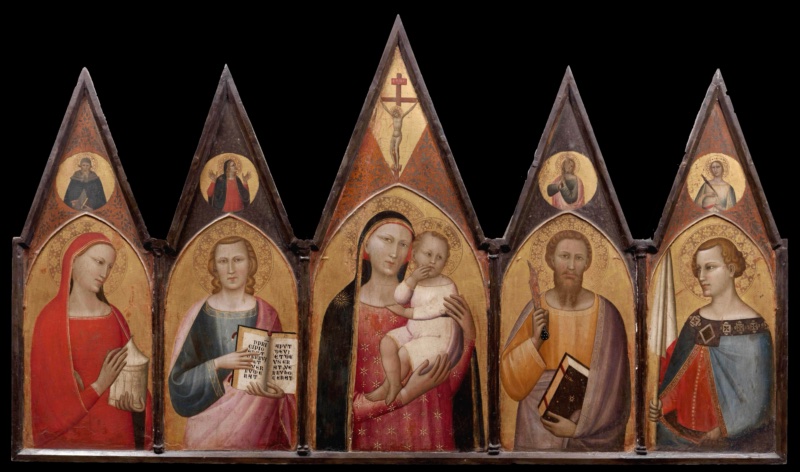
Central Panel: The Virgin and Child Enthroned with Angels and Saints
The central panel is the documentary heart of the altarpiece, because the base of the throne carries the inscription that records both the commission and the authorship. As transcribed in the literature, it reads:
ISTAM TABULAM FECIT FIERI FRATER IOHANNES CLERICUS PRECEPTOR TOLENTINI: ALEGRITTUS DE FABRIANO ME PINXIT […] MCCCLXVIIII.
The painting thus belongs to the small and precious group of Nuzi’s signed and dated works, which provide the scaffolding of his chronology. In the sequence of dated works it follows the Vatican triptych of 1365 and the Apiro polyptych and San Severino Madonna of Humility, both of 1366, and precedes the Madonna and Child Enthroned in Urbino of 1372. Produced four years before the painter’s death in 1373, the Macerata triptych is therefore a document of Nuzi’s mature and late manner, painted at a moment when his workshop dominated panel painting in the southern Marche.
The work cannot be understood apart from its prototype. Miklós Boskovits, in his catalogue of the National Gallery of Art, observed that the Washington triptych is exceptional for the disparity between the numerous small figures in the centre and the large figures in the laterals, which are even larger in scale than the enthroned Madonna, and for the rare repetition of Saint Anthony Abbot, who appears both in the central panel and again in the left lateral. He further noted that, uniquely, a practically identical, slightly larger version exists in the Duomo of Macerata, with a provenance from the church of Sant’Antonio Abate in that town. In the Macerata panel, then, Nuzi does not invent a composition but re-performs one: the Florentine design that Puccio di Simone had executed in Fabriano in 1354 is here translated into the idiom of the Marchigian painter who had himself contributed the left wing of the earlier work.
Compositionally, the panel is organised around a strong vertical axis that runs from the crucifix in the gable, through the crowned head of the Virgin, down to the inscribed base of the throne. The throne itself is almost entirely concealed beneath the sweep of the Virgin’s mantle, so that the Mother of God seems to rise from a pedestal of drapery rather than to sit upon a piece of furniture. Around her, the angels are stacked in superimposed tiers on either side, their haloes forming overlapping discs of gold that read as a continuous, shimmering screen rather than as a space inhabited by bodies. The result is a deliberate tension between the Giottesque solidity of the central figure and the archaic, hieratic crowding of the celestial court, a tension already present in the Washington prototype and here accentuated by Nuzi’s preference for surface pattern over spatial recession.
The Virgin is characterised by the elongated oval face, the narrow almond-shaped eyes and the small, closed mouth that recur throughout Nuzi’s Madonnas of the 1360s. Her gaze is directed outward, towards the beholder, while the Child, seated upright on her left arm, turns towards her in a gesture that softens the frontal formality of the image. The most striking feature, however, is the mantle, whose entire surface is covered by a dense gold pattern worked over a dark ground in the manner of a luxury silk. This treatment, which Nuzi shares with contemporary Sienese and Florentine panel painters, transforms the garment into a precious object in its own right and aligns the Virgin with the imagery of the Queen of Heaven, an association reinforced by the crown resting upon her veil.
In the lower register, flanking the throne and standing in front of the angelic tiers, are four saints. The Enciclopedia dell’Arte Medievale identifies them as Saints Anthony Abbot, Rose, Benedict and Catherine of Alexandria, and the same reading is repeated in local guides. The crowned female saint in red on the right is readily recognisable as Catherine, and the dark-habited figure beside her is consistent with Benedict; the identification of the female saint on the left as Rose, however, cannot be confirmed from the reproduction and deserves verification in front of the panel. The presence of Anthony Abbot among these saints, in addition to his monumental figure in the left wing, is the most eloquent sign of the Antonine destination of the altarpiece, for it doubles the titular saint of the commissioning order within the heavenly court itself.
The inscription on the base of the throne deserves attention not only as a signature but as a statement of institutional identity. The donor, Frater Iohannes, styles himself clericus and preceptor Tolentini. Since the houses of the Antonine order were called preceptories, it has been surmised that Johannes was the superior of the Antonine house in Tolentino and perhaps the promoter of its daughter-house in Macerata. Luigi Serra, in 1929, conjectured that the same person had commissioned both the Macerata altarpiece and its Washington prototype, a hypothesis that would explain the otherwise puzzling decision to replicate a fifteen-year-old composition almost exactly. On this reading, the design functioned as a kind of corporate image of the Antonine communities in the Marche, repeated from house to house as an emblem of the order’s devotional identity.
The central gable completes the vertical programme. At its apex, within a gilded quatrefoil, is the Crucified Christ, while two half-length figures in blue and rose garments lean towards the cross from the spandrels of the gable. The Enciclopedia dell’Arte Medievale describes the scene as the Crucifix between Elijah and Moses; this reading, unusual for a Crucifixion, would align the image with the Transfiguration typology, and it should be checked against the panel itself, since the mourning Virgin and Saint John would be the more customary pairing. Whatever the identity of the flanking figures, the placement of the Crucifixion directly above the Virgin and Child establishes a eucharistic axis familiar from Trecento altarpieces: the Incarnation presented below finds its sacrificial fulfilment above, immediately over the altar on which the Mass was celebrated.
Technically, the panel displays the full range of Nuzi’s goldsmith-like surface treatment: incised and punched haloes, the pierced and cusped trefoil arch that frames the Virgin, and the sgraffito brocade of her mantle. Erling S. Skaug’s systematic study of punch marks has made Nuzi’s repertory of tools one of the best-documented in fourteenth-century central Italy, and the Macerata triptych, as a fully autograph and dated work, constitutes an essential reference point for that repertory. Stylistically, the panel shows how thoroughly Nuzi had absorbed the lessons of his Florentine sojourn and of his collaboration with Puccio di Simone, while filtering them through a Sienese-inflected taste for line, decorative richness and gentle facial types. The effect is less the dramatic realism of Puccio’s 1354 centre than a serene, courtly and luminous devotional image.
Left Panel: Saint Anthony Abbot
The left wing is occupied by a single monumental figure of Saint Anthony Abbot, the Egyptian hermit venerated as the father of Christian monasticism and the patron of the Hospital Brothers of Saint Anthony. The Antonines, whose mother house was at Saint-Antoine-en-Viennois in the Dauphiné, maintained a network of preceptories and hospitals across Europe, where they cared above all for victims of ergotism, the disease known as “Saint Anthony’s fire”. The prominence of the saint in this altarpiece, and his repetition in the central panel, is fully explained by the provenance of the triptych from the church of Sant’Antonio Abate in Macerata, a foundation dependent, as the inscription suggests, on the Antonine preceptory of Tolentino.
The most immediately striking aspect of the figure is its scale. Anthony stands on a red patterned floor that projects forward like a carpet, and his body fills almost the entire height of the arched field, so that he appears physically larger than the enthroned Virgin in the adjoining panel. This inversion of the usual hierarchy of scale, inherited from the Washington prototype, is not a lapse of proportion but a deliberate strategy: the laterals present the saints as near and accessible intercessors, standing on the same ground as the viewer, while the central panel presents the celestial court as a distant, jewelled vision.
The saint’s head is conceived with considerable psychological gravity. The long grey beard, the drawn cheeks and the heavy-lidded eyes convey age and ascetic discipline, in keeping with the hagiographic image of the desert father who lived to more than a hundred years. Nuzi models the face with soft transitions from the greenish underlayer to the warmer flesh tones, a technique rooted in the Tuscan tradition, yet he avoids the incisive naturalism that Puccio di Simone had brought to the figures of the 1354 triptych. The expression is meditative rather than dramatic, turned slightly towards the centre, as if the saint were addressing the Virgin on behalf of the faithful.
The habit is rendered as a heavy, dark brown garment with a hood drawn up over the head, falling in long vertical folds to the floor. The drapery is modelled with broad planes of light and shadow that confer weight and volume on the figure, recalling the Giottesque conception of the body as a solid mass beneath cloth. At the same time, the silhouette is simplified and elongated, and the lower edge of the habit spreads slightly on the floor, anchoring the figure. The sobriety of this monastic garment contrasts pointedly with the gold brocades of the Virgin’s mantle and of Saint Julian’s tunic, making visible within the altarpiece the ascetic ideal that the Antonine order claimed as its origin.
Anthony holds a tau-shaped staff in his left hand, the crutch-like emblem of the order, which the Antonines also wore as a blue tau on their habits. His right hand is raised, open, with the palm turned outward, in a gesture that may be read as speech, benediction or intercession; the same gesture appears in other figures of the saint by Nuzi, including the panel of 1372 now in the Museo Diocesano of Fabriano. At the lower left, near the saint’s feet, a dark form is visible that is consistent with the pig, his traditional attribute, which alluded to the Antonines’ privilege of letting their pigs roam freely in towns to support their hospitals; its legibility should be confirmed on the original.
The architectural frame defines the figure’s space with a pointed arch whose intrados is filled with pierced, gilded cusps, and with twisted colonnettes running along the lateral edges. Small lozenge-shaped inserts decorate the piers between the panels. This carpentry, with its crocketed gables and pinnacled buttresses, belongs to the vocabulary of Gothic micro-architecture that transformed the altarpiece into an image of a church façade. Whether all elements of the present frame are original, or partly the result of later restoration and regilding, is a question that the photograph cannot resolve and that should be verified in the conservation literature.
In the gable above the saint, within a gilded quatrefoil set against a red field, appears the Angel Gabriel, winged and half-length, turning towards the centre. His counterpart, the Virgin Annunciate, occupies the corresponding quatrefoil above the right wing, so that the Annunciation is distributed across the two lateral gables, separated by the Crucifixion in the centre. The Enciclopedia dell’Arte Medievale records the Virgin Annunciate and the Archangel Gabriel within quatrefoils in the lateral gables. This arrangement, common in Trecento triptychs, frames the entire altarpiece between the moment of the Incarnation and the moment of the Redemption.
The doubling of Anthony Abbot, present both here and in the central panel, invites reflection on the function of the altarpiece. In the centre, Anthony belongs to the eternal court of heaven, one saint among many around the Virgin; in the wing, he stands alone, at human scale, as the patron and founder figure of the community that served at the altar. The two images thus articulate two modes of sanctity, the celestial and the institutional, and they made the triptych a mirror in which the Antonine brothers of Macerata could see both the object of their devotion and the model of their religious life.
Right Panel: Saint Julian the Hospitaller
The right wing presents Saint Julian, the patron saint of Macerata, whose cult was so central to the city that the cathedral itself is dedicated to him; the church of San Giuliano, known since the tenth century, served as the cathedral of the diocese of Macerata until 6 February 2023. The choice of Julian here signals the adaptation of the Washington scheme to a new civic context. In the 1354 prototype the right wing was occupied by Saint Venantius, the patron of Fabriano; in Macerata, Nuzi substituted the patron of the new host city, preserving the formula of an Antonine founder on the left paired with a local civic protector on the right.
The Saint Julian venerated in Macerata is identified with Julian the Hospitaller, whose legend, popularised by Jacobus de Voragine’s Golden Legend, tells of a young nobleman who, deceived by a prophecy he had tried to escape, unwittingly killed his own parents, and who atoned for the crime by founding a hospice by a river where he ferried and sheltered travellers and the poor. The legend combines aristocratic identity, tragic guilt and redemptive charity, and it made Julian the patron of travellers, boatmen, innkeepers and hospitals. It is precisely this last dimension that makes him an especially apt companion for Anthony Abbot in an altarpiece commissioned by a hospital order.
Nuzi presents Julian as an idealised youth: the face is smooth and oval, framed by blond hair falling in soft curls, the eyes gently lowered, the expression composed and serene. The contrast with the aged, bearded Anthony across the altarpiece is complete, and it is surely intentional. Youth and age, courtly nobility and desert asceticism, the lay knight and the monastic founder are set in balance on either side of the Virgin, giving the triptych an internal rhetoric of complementary forms of holiness.
The saint’s costume is among the most sumptuous passages in the whole altarpiece. He wears a knee-length tunic covered with a dense gold brocade pattern, similar in technique to the Virgin’s mantle, and over it a dark cloak lined in a contrasting colour, which he gathers with his left hand across his body. The costume corresponds to the fashionable dress of the fourteenth-century nobility and presents Julian in his earthly identity as a young knight. The rich surface of the brocade, executed in sgraffito over gold, is a technical tour de force that links the lateral figure to the precious textures of the central panel and unifies the altarpiece decoratively.
In his right hand Julian holds a lance bearing a red pennant, the attribute of the knightly saint, which rises almost to the arch of the frame and establishes a strong vertical that mirrors Anthony’s tau staff on the opposite wing. The banner also carries civic connotations, since the saint was venerated as the protector of Macerata, and the image of the armed patron bearing a standard would have resonated with the city’s communal self-representation. Like Anthony, Julian stands on a red patterned floor, and his feet, turned outward, give the figure a stable, almost sculptural stance.
The pairing of Anthony and Julian gives the triptych its conceptual coherence. Both saints are, in different ways, figures of hospitality: Anthony as the patron of the Antonine hospitals, Julian as the penitent who founded a hospice for the poor and for travellers. For an order whose raison d’être was the care of the sick, and for a church in a city under Julian’s protection, the two figures together articulated a theology of charitable service under the intercession of the Virgin. This convergence of order, city and devotion is one of the most interesting aspects of the Macerata replica compared with its Washington model.
In the right gable, within a quatrefoil on a red ground, the Virgin Annunciate appears in half-length, her head inclined and her hands crossed on her breast in the traditional gesture of acceptance. She answers the Angel Gabriel in the opposite gable, completing the Annunciation across the width of the altarpiece. Placed above the knightly Julian, the Virgin’s humility offers a counterpoint to the saint’s worldly splendour, and it frames the entire lower programme within the mystery of the Incarnation, which the central panel then presents in its fulfilled form, with the Child enthroned on his mother’s lap.
The provenance history requires some caution. Boskovits records the altarpiece’s provenance from the church of Sant’Antonio Abate in Macerata, a church now destroyed, whereas the Enciclopedia dell’Arte Medievale lists the triptych in Macerata, Pinacoteca e Museo Comunale, with a provenance from Monte Cassiano. Current sources locate the work in the Duomo, on the right wall of the presbytery, though others place it in the canons’ hall of the sacristy. These discrepancies do not affect the attribution, which is secured by the signature, but they should be resolved before publication. As a fully autograph, signed and dated work of 1369, the Macerata triptych remains a key monument for understanding the late Nuzi, his relationship with Florentine painting, and the role of the Antonine order as a patron of art in the Trecento Marche.
Iconography and Devotion: The Madonna of Humility, the Coronation, and the Saints
Allegretto Nuzi was not merely a transmitter of Tuscan forms; he was, in matters of iconography, a genuine innovator within his region, and his choice of subjects illuminates the devotional culture of the fourteenth-century Marche. The theme most closely associated with his name is the Madonna of Humility — the image of the Virgin seated not upon a throne but low upon the ground, or upon a cushion laid on the ground, nursing or holding the Child. The iconography, which emerged in the early fourteenth century, embodied a theology of humility (from the Latin humus, earth) closely bound up with the ideals of the mendicant orders, who wished to present the Church, symbolised by the Virgin, as humble and at the level of the common people, in deliberate contrast to the regal Maestà with its enthroned Queen of Heaven. Allegretto was among the principal agents of the diffusion of this type in the Adriatic region, producing multiple redactions of it — the signed and dated Madonna of Humility of 1366 at San Severino Marche foremost among them — and passing the model on to his pupil Francescuccio Ghissi, whose own numerous Madonnas of Humility descend directly from it. That an intimate, tender, devotionally accessible image should have flourished in Allegretto’s hands is entirely consonant with his Sienese-inflected sensibility and with the mendicant patronage that sustained so much of his work.
The Coronation of the Virgin, by contrast, gave Allegretto occasion for the grand, hierarchical, ceremonial mode: the Southampton triptych shows Christ crowning his mother as Queen of Heaven to the accompaniment of music-making angels, with saints and biblical figures — Saint Stephen with his stones among them — gathered in the wings. Between these two poles, the humble and the celestial, ranges the rest of his Marian imagery: the enthroned Madonnas of Apiro, Macerata and Urbino, and the many small Madonnas for private devotion.
His repertory of saints is likewise revealing of local cult and confraternal patronage. Saint Venantius (Venanzio), the martyr-patron of Fabriano, recurs prominently — in the Washington triptych, in the Fabriano pentaptych, and elsewhere — a reflection of civic devotion to the town’s protector. Saint Anthony Abbot, patron of a Fabriano church and of the sick, appears repeatedly. Saint Ursula, with her banner and palm, is the subject not only of the Vatican triptych’s lateral panel but of an entire fresco cycle. Mary Magdalene, Saint Augustine, Saint Nicholas of Tolentino (the great Augustinian saint), Saint Michael the Archangel, Saint Lawrence, Saint Catherine of Alexandria with her spiked wheel, Saint Bartholomew — the roster maps precisely onto the mendicant houses and confraternities of Fabriano and its neighbours: the Dominicans of San Domenico, the Augustinians of Sant’Agostino, the various lay brotherhoods for whom Allegretto and his shop supplied altarpieces and frescoes. His art was, in the deepest sense, an art of and for its community, its subjects dictated by the devotional needs of the churches, orders and confraternities that commissioned it.
Technique, Materials and the Poetry of Gold
If Allegretto Nuzi’s compositions were learned in Tuscany, his surfaces were his own glory, and it is in his handling of gold and colour that his originality as a craftsman is most apparent. The reputation of his gold grounds — their quality and their decorative richness — was, the sources insist, extraordinary from the very beginning and grew still greater in later centuries, so that his works were contested by connoisseurs and collectors and dispersed into the great museums of Italy and abroad. To understand this achievement one must understand the techniques of Trecento panel painting, in which the painter worked in egg tempera on a gessoed wooden panel and applied gold leaf to a bole ground, which was then burnished to a mirror-like brilliance and worked with a repertory of decorative techniques.
Allegretto was a master, and something of an experimenter, in all of these. The scholarship describes his surfaces as achieved “with the granulation and punching of the metal leaf and with sgraffito” — that is, with the full arsenal of gold-tooling techniques. The first of these is punchwork: the stamping of small motifs into the burnished gold with iron punches, used to decorate haloes, borders and backgrounds. The second is granatura, the stippling of the gold surface with a small rounded punch to make it, in the celebrated phrase of the contemporary handbook of Cennino Cennini, “glitter like grains of millet.” The third is sgraffito (or sgraffio), the technique by which a painter lays colour over gold and then scratches away the pigment to reveal the metal beneath, used above all for the rendering of gold-brocaded textiles. Allegretto combined these with great freedom, and he delighted in the depiction of sumptuous “operated” fabrics patterned with fantastical motifs — birds, tortoises and the like — that lend his mature and late panels their air of courtly luxury and look forward to the textile splendours of Gentile da Fabriano.
Punchwork is of more than aesthetic interest, for it has become one of the most powerful tools of modern connoisseurship. Because each workshop possessed its own set of iron punches, the individual punch-marks left in the gold can serve as a kind of fingerprint, allowing scholars to associate unsigned works with a particular shop and to trace relationships between workshops. The foundational study in this field is the monumental corpus of Trecento Tuscan punch-marks compiled by the Norwegian scholar Erling Skaug, whose catalogue of punches “from Giotto to Fra Angelico” (published in two volumes at Oslo in 1994) has become the indispensable reference for the attribution and dating of early Italian paintings. The method has been applied directly to Allegretto and his circle: a panel of Saints Catherine and Bartholomew in the National Gallery, London, unsigned, has been connected to the workshop of Allegretto Nuzi precisely on the basis of its punch-marks, which recur in other works by the artist, even as the style of painting and the lettering of the inscriptions point rather to the hand of Francescuccio Ghissi — a discrepancy resolved by the hypothesis that Nuzi designed the picture while Ghissi executed it in the shared workshop using the shared tools. The point is a general one: in a period when iron punches were precious objects passed down and shared between painters, the study of gold tooling offers an avenue into the collaborative realities of workshop practice that stylistic analysis alone cannot reach. Allegretto’s punches have accordingly been catalogued and studied as part of the wider effort to map the material culture of central-Italian painting.
Colour, finally, completes the account. Allegretto’s palette — the lapis-blue mantles, the brick reds and peach and azure of the saints’ robes, the orange tunics patterned with blue flowers, all set against and enriched by gold — is deployed with a decorative logic that grows stronger as his career advances. In his frescoes, the sources note a particular sensitivity in the use of colour that would find a wide echo in the later “courtly” painting of the Marche; in his panels, colour and tooled gold together produce that fusion of gravity and preciousness which is the signature of his art.
The Frescoes of Fabriano
Although Allegretto’s fame today rests largely on his panel paintings, dispersed across the world’s museums, his contemporaries would have known him equally as a fresco painter, and it is in the churches of Fabriano that his monumental art survives — hidden, in several cases, in the interstices left between older apses and the newer choirs constructed in later rebuildings, so that the cycles have acquired the character of “secret chapels.”
Three churches preserve his mural work: the cathedral of San Venanzio, the church of Sant’Agostino, and the church of San Domenico (later Santa Lucia Novella).
In the cathedral of San Venanzio, hidden behind the wooden stalls of the choir and reached by a narrow passage, lies the chapel of San Lorenzo, whose walls Allegretto frescoed with Stories of the life of Saint Lawrence, together with a Virgin enthroned with saints. The dating of this cycle has been debated: a document of 1365 records that work was still being carried out on this part of the church, which supports the belief that Allegretto was at work there around that time, and the stylistic proximity of the frescoes to the Vatican triptych of 1365 reinforces a dating to the middle of the decade; against this, some scholarship, relying on old manuscript guides, has proposed a date as early as around 1345, while others favour simply “the 1360s,” when the artist had reached full maturity. The tribune of San Venanzio, erected in the 1360s, has been described as an unrecognised summit of central-Italian Gothic architecture, and it is within it that these frescoes are preserved.
In San Domenico, Allegretto and his workshop frescoed the chapel of Sant’Orsola (Saint Ursula) with an extensive cycle of the Stories of Saint Ursula, together with a Martyrdom of Saint Stephen and other scenes, and decorated the chapter house (sala capitolare) and the sacristy. These works, slightly later than the cathedral cycle, are the product of a broad collaboration between the master and his assistants: at least two hands besides Allegretto’s own have been identified, with the master himself recognisable in the figure of the Archangel Michael and in certain scenes of the saint’s life, while a Saint Dominic in the sacristy, only recently brought to light, has also been given to him. It is these Ursula frescoes that have sometimes been singled out as his masterpiece in the fresco medium.
Allegretto Nuzi and Workshop, The Voyage of Saint Ursula and Pope Cyriacus, c. 1365
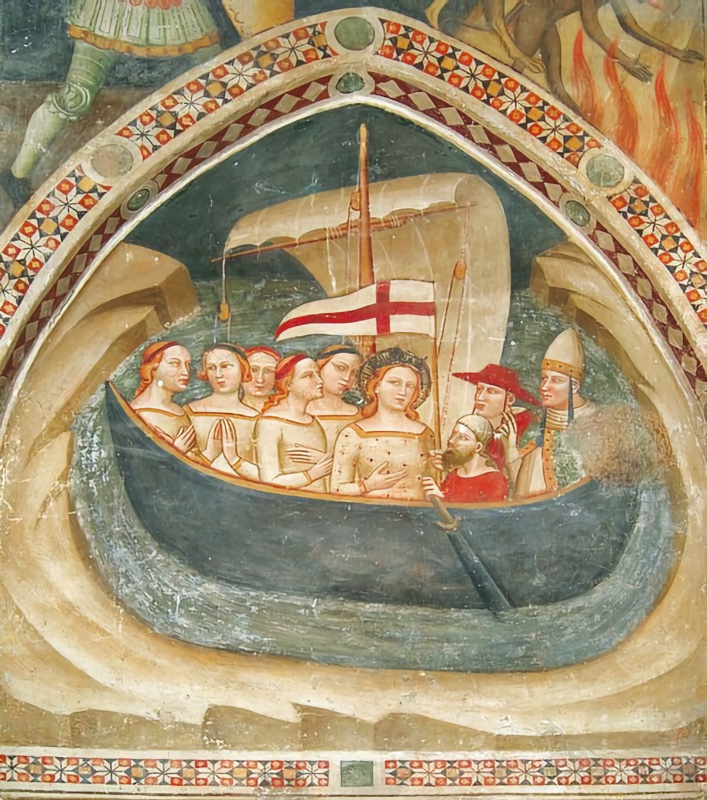
The fresco belongs to the cycle that decorates the chapel opening to the left of the presbytery in the church of San Domenico at Fabriano, formerly known as Santa Lucia Novella. The chapel is dedicated jointly to Saint Michael and Saint Ursula. Its programme combines a monumental Archangel Michael weighing souls, which fills an entire wall, with narrative cycles of Saint Ursula and Saint Nicholas on the facing walls. The date of 1365 commonly attached to the scene should be treated as an approximation rather than a documented fact. Claudia Ghisalberti’s entry in the Enciclopedia dell’Arte Medievale places the Ursula cycle shortly after the frescoes of the Chapel of San Lorenzo in Fabriano Cathedral. The dating of that cycle is itself disputed: Miklós Boskovits proposed c. 1345, Alessandro Marabottini c. 1365, and Giampiero Donnini the 1360s. A date in the mid-to-late 1360s is therefore the most defensible, placing the frescoes in the same years as the signed Vatican triptych of 1365.
The attribution requires nuance. Donnini observed in 1986 that the Ursula stories resulted from extensive collaboration between the painter and his assistants. He identified at least two hands besides Nuzi’s own, which he recognised in the Archangel Michael and in some scenes from the saint’s life. Other sources are more cautious still: the Touring Club Italiano guide describes the chapel’s frescoes simply as school of Allegretto Nuzi. The formula “Allegretto Nuzi and workshop” is therefore the most accurate label for this scene. It acknowledges both the unity of the design, which clearly depends on the master, and the plurality of execution typical of large fresco campaigns in the Trecento.
The episode derives from the legend of Ursula as fixed in Jacobus de Voragine’s Golden Legend. In that account the British princess, betrothed against her will to a pagan prince, obtains a delay to undertake a pilgrimage to Rome with eleven thousand virgin companions. On the return journey the fleet is joined by Pope Cyriacus, who renounces the papacy to share their fate, and by several prelates. The company sails up the Rhine to Cologne, where they are massacred by the besieging Huns. The legend also explains that Cyriacus’s name was struck from the list of popes because he had abandoned his office. Nuzi’s scene represents this final voyage, the moment of serene confidence before the martyrdom, when the virgins and the churchmen travel together towards a destiny the viewer already knows.
The composition is governed by the pointed arch of the field. The dark hull of the boat curves upward at both ends, echoing the arch and forming a crescent that cradles the passengers. Two ochre rocky banks, drawn in the stylised, faceted manner inherited from Giotto and the Sienese, close the scene at left and right. The river thus becomes a narrow channel between them, appropriate to the Rhine of the legend. The water is rendered as a grey-green surface animated by white, rhythmic wave lines, a decorative convention rather than an observed sea. The whole field is enclosed by a broad ornamental border of red, white and green geometric motifs with small roundels, which asserts the flat, tapestry-like character of the wall surface.
On the left, Ursula’s companions are packed into the boat in a dense row of overlapping heads, turned three-quarters and nearly identical in type. Their red-gold hair is bound with fillets, and their pale gowns and hands are joined in prayer. The repetition is deliberate. It conveys the idea of a multitude, the eleven thousand of the legend, within the few figures the space allows, and it gives the group the quality of a choir moving in unison. Ursula stands at the centre, distinguished by her gold halo and by a pale gown enlivened with small red dots. Her hands are crossed on her breast in a gesture of humility and acceptance, and her gaze is directed calmly outward. The oval faces, long noses and small closed mouths correspond closely to the female type of Nuzi’s panel paintings of the 1360s.
The right half of the boat belongs to the churchmen, and here the painting shows its greatest variety of characterisation. Pope Cyriacus wears a tall white tiara, and beside him stands a cardinal in the broad red hat of his rank. This is an anachronism, typical of medieval narrative painting, that translates the legend into the ecclesiastical world familiar to fourteenth-century viewers. In the stern a bearded helmsman in a red garment works the long steering oar, which cuts diagonally across the hull towards the lower right. His furrowed, individualised features contrast with the idealised faces of the virgins. The contrast between the anonymous serenity of the maidens and the more incisive heads on the right may reflect the different hands Donnini identified within the cycle, though this can only be judged in front of the wall.
Above the passengers rise the white sail and a white banner bearing a red cross. The banner is both the vexillum of the Resurrection and Ursula’s personal attribute, and it announces the triumph of martyrdom within a scene of apparent calm. The motif links the fresco to Nuzi’s panel painting. In the Vatican triptych of 1365, the lateral panels show Saint Michael in armour with a sword and Saint Ursula with her banner and palm of martyrdom. Enrica Neri Lusanna suggested that the triptych was originally painted for the church of Santa Lucia, which is San Domenico itself. If so, the triptych and the chapel shared the same pair of dedicatees, and the fresco cycle can be read as the narrative and monumental counterpart of the devotional panel, and together they testify to a cult of Michael and Ursula in this Dominican church. The church’s patrons were the Chiavelli, lords of Fabriano, whose fourteenth-century coat of arms survives on the exterior. Whether they sponsored the chapel itself remains to be established.
The fresco exemplifies the qualities for which Nuzi’s wall painting has been admired: the ability to combine a simplified grandeur of the whole with the narrative immediacy of detail. The decorative clarity of the design, the luminous palette of pale flesh, white, red and grey-green, and the courtly elegance of the figures made the cycle an important source for the later “courtly” painting of the Marche, culminating a generation later in Gentile da Fabriano. Fragments of adjoining scenes, visible above the border, show that the lunette was only one element of a continuous decorative system: an armoured leg at upper left and tongues of flame at upper right. Access to the chapel has been restricted since the earthquake of 2016. The 2021–2022 exhibition Allegretto Nuzi e il Trecento a Fabriano at the Pinacoteca Molajoli documented the cycle in its catalogue, but visitors could not reach the frescoes themselves. The scene remains one of the key surviving witnesses of Nuzi’s activity as a fresco painter and of the collaborative practice of his Fabriano workshop.
Allegretto Nuzi (or Francescuccio Ghissi?), Babylon the Great Seated on the Seven-Headed Beast
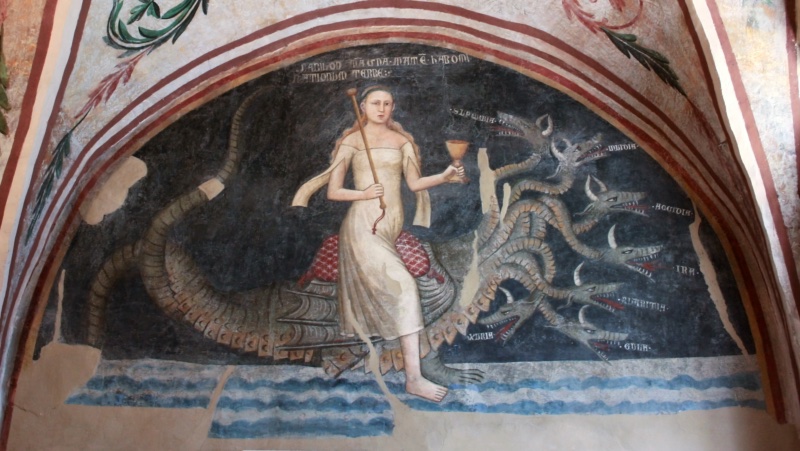
The fresco decorates a lunette of the room that now serves as the sacristy of San Domenico at Fabriano, the former church of Santa Lucia Novella. The room was probably the chapter hall of the Dominican convent before it became a sacristy. Its walls were painted in the second half of the Trecento by the leading masters of the Fabriano school. The attribution of this particular scene is not settled. Popular accounts divide the room between Allegretto Nuzi and Francescuccio Ghissi, assigning the Woman of Babylon, the Dormition of the Virgin and Saint Arsenius with his companions to Ghissi, and the Crucifixion, the Saint Dominic and the Madonna and Child to Nuzi. The photographic archive of the Fondazione Zeri, by contrast, files the image of “the Whore on the seven-headed Hydra” among Nuzi’s frescoes. Ghisalberti’s entry in the Enciclopedia dell’Arte Medievale credits Nuzi only with the Saint Dominic in the sacristy, following Donnini. The prudent label is therefore “Allegretto Nuzi or Francescuccio Ghissi”, or “Fabriano school, circle of Allegretto Nuzi”. The dating to the mid-1360s depends on the stylistic chronology of Nuzi’s frescoes, not on any document.
The subject derives from the seventeenth chapter of the Apocalypse. An angel shows John the great harlot who sits upon many waters. She is seated on a scarlet beast with seven heads and ten horns, dressed in purple and scarlet, adorned with gold, pearls and precious stones, and holding a golden cup full of abominations. On her forehead is written a name:
Babylon magna, mater fornicationum et abominationum terrae* (Rev. 17:5).
The painted inscription at the top of the lunette reproduces this title in Gothic capitals, apparently in shortened form:
BABILON MAGNA MATE[R] HABOMI/NATIONUM TERRE.
It seems to omit fornicationum and spells abominationum with the initial H common in medieval Latin. The reading should be checked on the wall, since the letters are abbreviated and partly abraded.
The composition exploits the wide, low shape of the lunette with notable skill. The beast’s body stretches horizontally across the field. Its tail rises in a long curve on the left, following the arch, while the seven necks spread in a fan on the right, filling the opposite curve of the frame. The woman sits at the centre-left in rigorous frontality, forming a strong vertical axis against the horizontal mass of the dragon. The deep blue-black ground, now darkened, isolates the figures like an emblem on a heraldic field. Along the lower edge, stylised blue and white waves render the “many waters” upon which Babylon sits. According to the angel’s own explanation (Rev. 17:15), these waters signify peoples, multitudes, nations and tongues. Her single bare foot resting on the waves is a small but eloquent detail: the power of Babylon rests on the unstable multitude of the world.
The figure of the woman departs from the biblical text in revealing ways. Instead of the purple and scarlet of Revelation, she wears a pale, close-fitting gown cut low across the shoulders, with long hanging sleeves in the fashion of the mid-fourteenth century. Her long reddish hair falls loose over her shoulders, held only by a thin fillet. Loose hair was the conventional sign of the unmarried woman and, in a moral context, of the courtesan. Her face is youthful, oval and impassive, with the narrow eyes and small mouth of the Fabriano female type. Seduction is thus expressed not through overt sensuality but through worldly elegance and composure, in line with the preaching tradition that presented vice as attractive before revealing it as deadly. In her left hand she raises the golden chalice of abominations, in her right a long staff ending in a knob with a red tassel, a sceptre that marks her dominion over the kings of the earth.
The beast is the most inventive part of the image. Rather than the scarlet monster of the text, it is a grey-green dragon covered in overlapping scales, with clawed feet and a ridged, segmented tail. Seven serpentine necks issue from its body, each ending in a horned, wolf-like head with gaping, fanged jaws and a red forked tongue. Each head is labelled in white capitals with one of the seven capital vices: SUPERBIA, INVIDIA, ACCIDIA, IRA, AVARITIA, GULA and LUXURIA. The sequence opens with pride, root of all sins, at the top, and closes with lust at the bottom, closest to the woman. This substitution of the vices for the seven kings or seven hills of the angel’s interpretation (Rev. 17:9–10) is a fully medieval, moralising exegesis. It transforms an eschatological and political symbol into a catalogue of sins that every Christian could recognise within himself.
This moral reading acquires its full meaning in the Dominican setting. The Order of Preachers had made the systematic analysis of vices and virtues a cornerstone of its pastoral mission; the Dominican William Peraldus’s Summa de vitiis was among the most widely used preaching manuals of the later Middle Ages. If the room was indeed the chapter hall, the image also acquires a liturgical-disciplinary function. In the daily chapter, the friars gathered to hear a reading from the Rule and to accuse themselves publicly of their faults. For a community examining its own failings, the harlot enthroned on the vices offered a permanent visual speculum peccatorum: a mirror of the sins to be confessed and resisted, and a reminder of the eternal ruin that awaits those who drink from Babylon’s cup.
Stylistically, the fresco combines the incisive linear drawing and decorative clarity of the Fabriano school with a vivid gift for fantastic invention. The rhythmic repetition of scales, the calligraphic curves of the necks and the careful variation of the heads, each turned at a different angle, show a painter accustomed to transforming nature into ornament. Two readings are possible. The attribution to Nuzi would stress the continuity with the courtly elegance of the Ursula cycle in the nearby chapel. The attribution to Ghissi, Nuzi’s closest follower and the specialist of his workshop’s formulas, would explain the somewhat simplified modelling of the woman’s face and drapery. The surface has suffered considerably: large areas of plaster are lost along the left side, a long vertical crack runs through the beast’s necks and the woman’s gown, and the dark ground has probably altered. The vault above preserves fragments of green and red foliate scrolls, a reminder of the original decorative richness of the room.
Within the programme of the chapter hall, the Babylon lunette was not an isolated image but part of a dialectic of salvation and damnation. The Crucifixion, the Dormition, the Madonna and Child and the solemn figure of Saint Dominic presented the models of redemption, holiness and the Order’s own identity. Babylon, the “mother of abominations”, stood as their dark antitype: the false mother opposed to the Mother of God, the cup of abominations opposed to the Eucharistic chalice, and the worldly city opposed to the heavenly Jerusalem. The fresco is one of the most original apocalyptic images of fourteenth-century Marchigian painting. It shows how the painters of the Nuzi circle could adapt a complex biblical vision to the concrete needs of a religious community, turning prophecy into a tool of moral instruction.
Allegretto Nuzi (attr.), The Four Evangelists
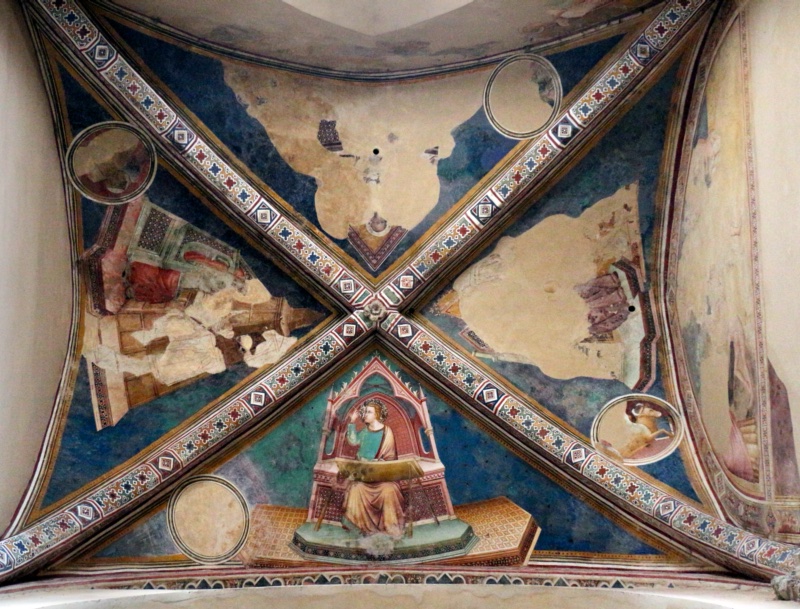
The vault covers the inner apsidal chapel on the left of the Gothic choir of San Domenico in Perugia. The chapel was originally dedicated to Saint Nicholas and is now known as the Cappella del Nome di Gesù. It is documented in 1382, when Alberto di Nino di Lello Guidalotti wished to be buried there, and it had probably belonged to his family from the start. The later history of the chapel is tied to the same lineage: Fra Angelico’s Guidalotti Polyptych was painted for its altar in 1447–1449. The frescoes of the vault are traditionally attributed to Allegretto Nuzi. The attribution goes back to Miklós Boskovits, who in 1973 assigned to Nuzi the frescoes of San Domenico in Perugia, some of which are now detached and kept in the Galleria Nazionale dell’Umbria. No document secures either the authorship or the date. Since the chapel belongs to the crossing and choir built in the mid-fourteenth century, the decoration can only be placed broadly in the third quarter of the century.
The theme follows a long-established tradition in Italian Gothic vault decoration. The four Evangelists occupy the four webs of the vault, which symbolise the four quarters of the world to which the Gospel was carried. Their writing becomes a kind of celestial architecture above the altar. The most influential precedent was Cimabue’s vault in the crossing of the Upper Church at Assisi, where the Evangelists are shown writing, each with his symbol and a view of the region he evangelised. From Assisi the scheme spread throughout central Italy. The same subject appears in Nuzi’s own work in Fabriano: in the Chapel of San Lorenzo in the cathedral, the vault was decorated with the Evangelists, of whom Saint John is also partly visible. The coincidence of theme and of state of preservation makes the comparison between the two vaults particularly instructive for the attribution.
The decorative framework is organised with great clarity. The four diagonal ribs are painted as broad bands of repeating ornament, quatrefoils and lozenges in red, blue, white and ochre, which convert the structural members into precious, jewelled borders. They converge on a small carved boss at the centre of the vault. The webs are painted on a ground of deep blue, now largely abraded. Where the blue has survived it gives the impression of a night sky. Where it has fallen, it reveals a greenish or greyish underlayer, as in the lower web. This loss pattern is typical of azurite, which was applied a secco over the dry plaster and therefore tends to flake away. Circular medallions near the springing of each web held the symbols of the Evangelists. A frieze of triangular and scalloped motifs runs along the base of the wall arch, completing the frame.
Saint John, in the lower web, is the only figure that has survived almost intact, and he allows the quality of the lost cycle to be gauged. He is represented as a beardless youth with soft curling hair, following the Western convention that distinguishes him as the youngest of the apostles. His gold halo is set off against the blue. He wears a green-blue tunic under an ochre mantle that falls in broad folds over his knees. With his left hand he writes on a slanting desk that projects towards the viewer, while his right hand is raised towards his head. The gesture evokes the moment of inspiration, the Evangelist listening to the divine voice before setting the words on the page. The face, with its oval contour and gentle, attentive expression, corresponds to the youthful male type found in Nuzi’s panel paintings.
The throne is a small masterpiece of painted architecture. It is a Gothic seat of pink stone, crowned by a pointed canopy with crockets and pinnacles, and its side walls are pierced by openings that suggest depth. It stands on a stepped platform with a green base, and in front of it a large orange carpet decorated with a lozenge pattern is laid out in steep perspective. The painter has adapted this box-like space to the awkward triangular shape of the web. The throne is placed on the axis of the triangle, and the platform and carpet spread outward to fill its lower width. This perspectival construction reflects the Florentine lesson of Giotto and his followers, in particular Maso di Banco, whose influence on Nuzi’s early formation is widely recognised. At the same time, the patterned surfaces and the pastel architecture show the painter’s taste for decorative refinement.
The other three webs have suffered severe losses, and their figures can only be reconstructed from fragments. In the left web, part of a throne with a red drapery, the edge of a writing desk and some architectural elements survive. In the upper web, little remains except the lower edge of a desk covered with a triangular patterned cloth and a small round object that may be an inkwell. In the right web, a violet drapery and part of a throne can be distinguished. Of the medallions, the one at lower right still shows a winged ox, the symbol of Luke, while the others are faded or empty. The loss of the other figures prevents any secure reconstruction of the order in which the Evangelists were arranged, but the placement of the ox suggests that Luke occupied the right web.
Stylistically, the surviving figure of John supports the traditional attribution. The ample, well-structured drapery, the solid seated pose and the perspectival throne recall Nuzi’s Florentine experience. The soft modelling of the face, the elongated proportions and the decorative colour, with its combination of green, ochre, pink and orange, correspond to his Marchigian manner. The painted architecture of the throne can be compared with the Gothic seats of his panel Madonnas. Given the scarcity of surviving material and the absence of documents, however, the attribution should be presented as traditional rather than proven. A comparison with the Evangelist vault of the Chapel of San Lorenzo in Fabriano would be the most direct way to test it.
The Perugia vault is important for understanding Nuzi’s career beyond the Marche. If the attribution is correct, it documents the activity of the Fabriano painter in the Dominican church of the Umbrian capital. This is consistent with the dense artistic exchanges between Umbria and the Marche in the fourteenth century, and with Nuzi’s connections with the Dominican order, attested at Fabriano by the frescoes in San Domenico (Santa Lucia Novella). The vault also shows how a small funerary chapel, later linked to one of Perugia’s leading families, could be given a monumental decoration of cosmic and theological significance. The figure of Saint John, rescued from the general ruin of the cycle, remains a precious witness of the refinement of Nuzi’s painting in fresco and of its dissemination along the routes between Fabriano and Perugia.
Allegretto Nuzi (attr.), Saint John the Evangelist
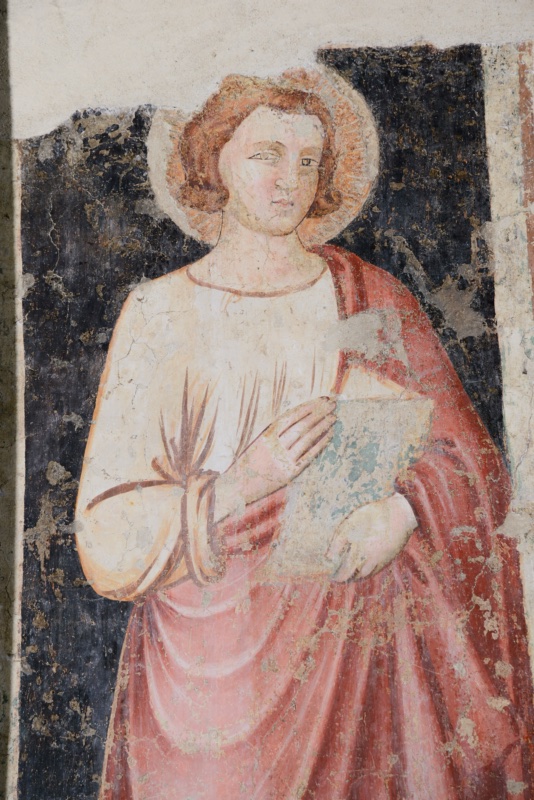
The fresco decorates the right wall of the small church of Santa Maria Maddalena at Fabriano. The church stands in the medieval Borgo del Piano, outside the city walls, in the quarter where Fabriano’s celebrated paper industry developed. It belongs to the Pia Università dei Cartai, the historic papermakers’ guild, and its first documentary mention dates to 1326. Three crosses on the exterior link the church to a hospital dependent on the Arcispedale di Santo Spirito in Sassia in Rome, so it originally served a charitable as well as devotional function. Three fourteenth-century frescoes survive on the right wall: this Saint John the Evangelist, traditionally dated 1336 and attributed to Allegretto Nuzi, and a Crucifixion with the Virgin and Saint John and an Annunciation given to the Master of Campodonico. The Zeri photo archive groups all three under the Master of Campodonico in a single card, so the attribution of the Saint John is not settled. The high altar holds Orazio Gentileschi’s Penitent Magdalen, painted during his Fabriano period (1612–1615), a reminder that the Magdalen was the patron saint of the papermakers.
The chronological position of the work requires careful consideration. The date of 1336 would make the fresco by far the earliest known work by Nuzi. Ghisalberti’s entry in the Enciclopedia dell’Arte Medievale gives his birth at around 1320. His first secure documentation is in 1346 in Florence, where he enrolled in the Compagnia di San Luca, and his first securely dated work is the left wing of the Washington triptych of 1354. A fresco of 1336 would therefore have been painted when he was barely an adult, a decade before any documented activity. This is not impossible, but the source of the date is not clear from the available literature: it may derive from a lost or damaged inscription, or from local tradition.
The juxtaposition with the Crucifixion by the Master of Campodonico is of considerable historical interest. Nuzi certainly knew the work of the local masters, the Master of Campodonico above all, before encountering Giotto and his followers in Florence; no document, however, places him in that workshop, and the “de Senis” of his Florentine enrolment points elsewhere. The Master of Campodonico was himself the principal channel through which the art of Ambrogio Lorenzetti reached Fabriano, even if indirectly. The two frescoes, side by side on the same wall, thus offer a rare opportunity to compare the art of the master and that of the younger painter who followed him in the same town. Should the early date be confirmed, the Saint John would document the very beginnings of Nuzi’s career within the workshop culture of his native town.
The saint is represented as a youthful, beardless figure standing at full height, now visible from the knees up against a dark ground. This is the conventional type that distinguishes John as the youngest of the apostles and the beloved disciple. His head is framed by short, curling auburn hair and by a halo whose surface is incised with fine radiating lines, a technique that imitates in fresco the tooled gold haloes of panel painting. The face is broad and oval, with a straight nose, a small, firmly closed mouth and large almond-shaped eyes that look directly out at the viewer. The expression is calm and slightly grave, conveying the contemplative character traditionally associated with the author of the Fourth Gospel.
The costume and its drapery are the most accomplished part of the figure. The saint wears a pale tunic with a simple round neckline and long sleeves, gathered at the wrist. Over it a red mantle falls from the left shoulder and wraps around the lower body, gathered into a broad curve at the hip that falls in deep, sweeping folds to the lower edge of the surviving fragment. The folds are modelled with a controlled gradation from pale pink to deep red and articulated by incisive brown lines, particularly on the sleeve of the tunic. The effect is one of solidity and weight, rooted in the Giottesque tradition, and it reveals a painter already concerned with the plastic presence of the body beneath the cloth.
John holds his Gospel with both hands against his chest: the right hand, with its long, delicately drawn fingers, rests on the front cover, while the left supports the book from below. The cover, now greenish and abraded, was probably originally decorated or partly painted a secco. The gesture is at once protective and demonstrative, presenting the sacred text to the viewer as the saint’s defining attribute. In the context of a hospital church, the figure of the Evangelist, author of the Gospel of love and of the Book of Revelation, would have had a clear devotional function as an intercessor for the sick and the poor sheltered by the institution.
Stylistically, the fresco combines a solid, sculptural conception of the figure with a still somewhat archaic simplification of forms. The broad planes of the face, the strong outlines and the clear distinction of colour areas reflect the Giottesque culture of the Adriatic regions, transmitted to Fabriano partly through the Riminese school and partly through local masters such as the Master of Campodonico. The monumental conception of the drapery is close to the manner that Nuzi would develop more fully after his Florentine experience, when he absorbed the art of Bernardo Daddi and Maso di Banco. The fresco can therefore be read either as an early work that already anticipates those developments, or as a work of the late 1340s. In the second case, the date of 1336 would need to be reconsidered.
The condition of the fresco is precarious. The dark ground, probably originally blue applied a secco over a dark underlayer, has largely flaked away, leaving numerous losses; the plaster surface is marked by cracks and abrasions; and the upper part of the wall has been covered with later plaster. Nevertheless, the head, the hands and much of the drapery survive in legible condition. Despite its fragmentary state, the Saint John in Santa Maria Maddalena is an important document of Trecento painting in Fabriano. It bears witness to the relationship between Nuzi and the Master of Campodonico, and it is closely tied to the history of the papermakers’ guild, whose church preserves it to this day.
The Virgin Interceding with Christ Enthroned
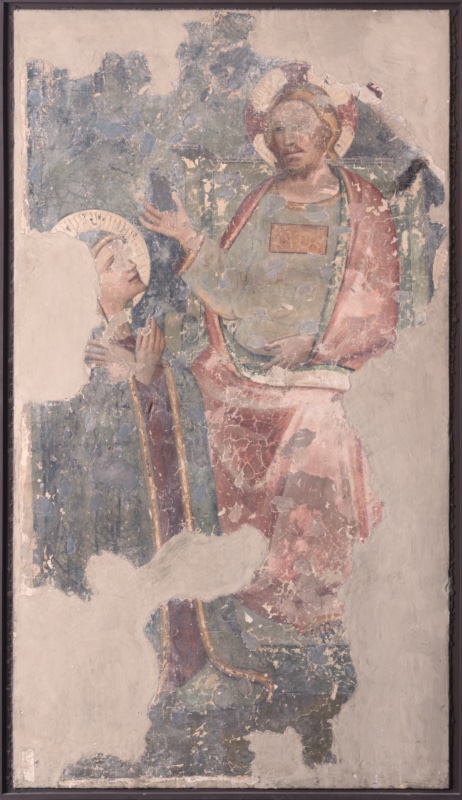
The fresco belongs to the group of wall paintings rescued from Fabriano’s lost medieval churches and now preserved in the Pinacoteca Civica “Bruno Molajoli”. It comes from the church of San Giovanni del Cantone, demolished in 1903. The painting was detached from its original wall and transferred to a canvas support before or at the time of the demolition. It thus survived the destruction of its architectural setting, but at the cost of its original context: we no longer know on which wall it was placed, whether it formed part of a larger programme, or whether it was an isolated votive image. Its present state, with large lacunae filled with neutral plaster, is typical of frescoes recovered in these circumstances. It allows the surviving parts to be read without inventing what has been lost.
The Pinacoteca attributes the fresco to Allegretto Nuzi, and the dating to 1360–1370 places it in the painter’s full maturity, the decade of his dated works, several of them signed: the Vatican triptych of 1365, the Apiro polyptych and the San Severino Madonna of Humility of 1366, and the Macerata triptych of 1369. The attribution is supported by the facial types, the broad handling of the drapery and the pale, luminous palette. The bearded Christ, with his oval face, long straight nose and calm gaze, closely resembles the Christ figures in Nuzi’s panel paintings of the 1360s. The Virgin’s profile, with its small features and upturned face, belongs to the same repertoire of gentle, idealised female types that characterises his late production. As with Nuzi’s other frescoes in Fabriano, such as the Chapel of San Lorenzo in the cathedral and the Chapel of Saint Ursula in San Domenico, the participation of assistants cannot be excluded. The damaged state of the surface, however, makes it impossible to distinguish different hands, and the design and the quality of the surviving heads are fully consistent with the master.
The composition sets the two figures on a diagonal that rises from the kneeling Virgin at lower left to the enthroned Christ at upper right. The asymmetry is deliberate: the Virgin’s lower position and upward gaze express her role as a supplicant, while Christ’s elevated position on the throne expresses his majesty as judge and redeemer. The two figures are linked by Christ’s raised right hand, extended towards the Virgin’s face, and by her gaze directed towards him. The empty space between them, now partly lost, was the charged interval of the dialogue, the place where prayer and response meet. Despite the losses, this central axis of communication remains perfectly legible.
Christ is represented as a mature, bearded figure with long reddish-blond hair falling onto his shoulders, framed by a large halo with incised ornament. He wears a tunic of a pale greenish-blue tone, described in the museum’s entry as light blue. The present greenish cast may partly reflect the alteration of the original pigment or the loss of a secco layer. Over it he wears a rose-red mantle that covers his shoulders and falls in heavy folds over his knees. On the breast a small rectangular gold element can be seen, perhaps the clasp of the mantle or an ornamental plaque. His right hand is raised with the palm open towards the Virgin in a gesture that can be read as benediction, as acknowledgement of her prayer, or as a sign of acceptance of her intercession. His left hand rests calmly on his lap.
The throne on which Christ sits is rendered as a piece of green architecture with a flat back and moulded elements, of which only fragments survive. It follows the Giottesque convention of the throne as a three-dimensional structure that defines a coherent space around the figure. Its lower part, visible near the bottom edge of the fragment, suggests a raised platform or dais. Christ is therefore not a vision floating in the sky but a sovereign seated in majesty, a presentation consistent with his role as judge at the end of time.
The Virgin kneels in profile at the left, turned towards her Son. She wears a dark mantle edged with a gold border over a red dress, and her head is framed by a halo whose incised decoration is still partly visible. Her hands are crossed on her breast in the gesture of humility and supplication, the same gesture of the Annunciation, when she accepted the divine will. Her face is lifted towards Christ with an expression of intense but composed entreaty. Her posture, smaller in scale and lower in the field, embodies the hierarchy between the Mother of God and her Son, and her role as the first and most powerful intercessor on behalf of humanity.
The iconography derives from the Byzantine Deesis, in which the Virgin and John the Baptist stand on either side of the enthroned Christ, interceding for the souls of the dead at the Last Judgement. In the West, the scheme was frequently simplified to show the Virgin alone, sometimes baring her breast to remind Christ of the humanity he received from her. Here she crosses her hands in a more restrained gesture. Whether the fresco originally included a second intercessor on the right is uncertain. A small curved fragment of what may be a halo is visible at the right edge, next to the throne, and this could indicate the presence of another figure, perhaps John the Baptist, which would complete the Deesis. The possibility should be verified on the original before any firm conclusion is drawn.
Within the collection of the Pinacoteca, the fresco bears witness to two histories at once. The first is the devotional life of fourteenth-century Fabriano, in which the theme of intercession responded to widespread anxiety about death and judgement in the decades following the Black Death of 1348. The second is the loss of the city’s medieval heritage, of which the demolition of San Giovanni del Cantone in 1903 is only one episode. Despite its fragmentary state, the image preserves the essential core of its message: the Virgin’s prayer and Christ’s gesture of response. Its detachment and conservation have preserved an important, if damaged, example of Allegretto Nuzi’s wall painting from the years of his full maturity.
Madonna and Child Enthroned, with the Blessing Christ and Seraphim
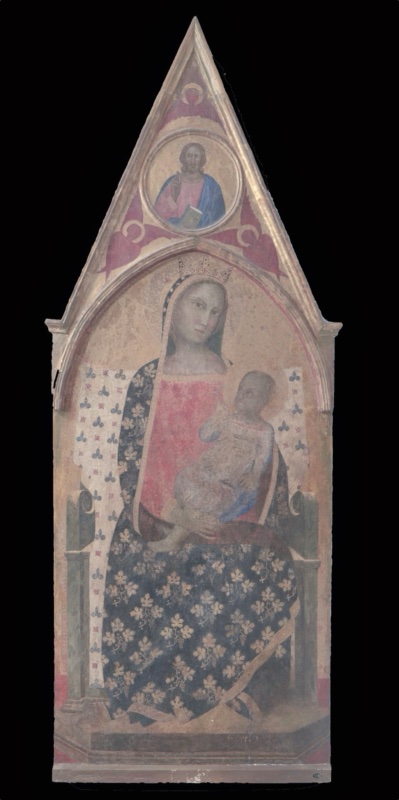
The panel comes from the church of San Nicolò in Fabriano, a provenance of particular significance for the painter’s biography. According to Ghisalberti’s entry in the Enciclopedia dell’Arte Medievale, Nuzi died in Fabriano in 1373, some time after 26 September, when he drew up his will, and he was buried in the church of San Niccolò. The Madonna therefore comes from the very church in which the painter chose to be laid to rest. It is tempting to see in it a work produced for a community with which he had a particularly close relationship, although no document links the commission to his burial. The panel is now in the Pinacoteca Civica “Bruno Molajoli”, where the museum dates it to 1370 and assigns it to the master’s hand.
The panel’s format is that of a tall, cusped panel, 182.9 by 68.3 centimetres, crowned by a steep triangular gable and framed by a pointed arch with mouldings. Its proportions and its self-contained iconographic programme suggest that it may have been an independent devotional image rather than the central element of a polyptych. The possibility of lost lateral panels cannot, however, be excluded without technical examination of the edges. The architecture of the frame, with its trilobed arch and small lateral capitals, follows the Gothic vocabulary common to Nuzi’s altarpieces. Within it, the composition is dominated by the monumental, frontal figure of the enthroned Virgin, who fills almost the entire width of the field.
The Virgin’s face displays the features of Nuzi’s late female type: a long, narrow oval, a thin straight nose, small eyes set beneath arched brows, and a closed, slightly melancholy mouth. Her head, slightly inclined, is framed by a dark veil and surmounted by a delicate crown with fleurs-de-lis and small gems, marking her as Queen of Heaven. Her gaze is directed outward towards the beholder rather than towards the Child, a convention that establishes a direct devotional relationship with the viewer. The heavy, somewhat abstract modelling of the face, now worn down to its underlayers, reflects the late tendency described in the literature: in Nuzi’s works of the 1370s, forms become more rigid and simplified, and volumes are progressively flattened.
The most striking element of the panel is the Virgin’s mantle. Its dark blue-black ground is covered with a regular pattern of gold vine branches, leaves and clusters of grapes, and it is edged with a broad gold border that traces an elegant curve across her knees. As the museum’s entry notes, the vine and the grapes are symbols of Christ’s sacrifice. Christ describes himself in the Gospel of John as “the true vine”, and the wine of the Eucharist is the blood he shed for humanity. By wrapping the Virgin in this pattern, the painter turns her mantle into an image of the Eucharist, anticipating the Passion within the tender image of the Mother and Child. The treatment of the fabric as a flat decorative surface, spread across the lower half of the panel, exemplifies the “decorative vocation” that the museum identifies as characteristic of Nuzi’s last years.
The Child sits on the Virgin’s left knee, supported by her hands, and turns towards her with his head raised and his arm extended to reach her. He wears a pale garment with touches of blue, now much abraded. His pose conveys a natural intimacy that contrasts with the hieratic frontality of the Mother. The museum’s entry refers to the mechanical gestures of the figures. The observation is apt: the movements of the hands and of the Child’s body, repeated from the formulas of the workshop, have lost some of the spontaneity of Nuzi’s works of the 1350s and 1360s, and become signs within a decorative system rather than the expression of a spontaneous emotional relationship.
Behind the Virgin, a white cloth of honour is draped over the back of the throne and falls on either side of her figure. It is decorated with a regular pattern of blue trefoils alternating with small red crosses. The museum interprets the trefoil as a probable allusion to the Trinity. Such a reading is plausible in a panel whose programme combines the Incarnation, the Eucharist and the heavenly glory of Christ, although the motif was also widespread as a textile ornament. The throne itself is a solid structure of green stone with scrolled armrests and small columns, set on a low dais. It retains the three-dimensional conception inherited from Giotto and his Florentine followers, even as the textiles spread across it tend to dissolve its spatial depth into pattern.
In the gable, within a gold roundel, appears the half-length figure of Christ, bearded, dressed in a red tunic and a blue mantle. He raises his right hand in blessing and holds a closed book in his left. The roundel is surrounded by three red seraphim, the highest order of the angelic hierarchy, whose wings fill the triangular field around it. The vertical axis thus leads from the Child on the Virgin’s knee to the adult Christ in glory above. The panel presents at once the Incarnate Word and the eternal Word, the Son of Mary and the Pantocrator surrounded by the heavenly court.
The condition of the panel requires a careful reading. The museum’s phrase “profound unveiling of the pictorial film” refers to the severe abrasion of the paint surface. Much of the final modelling of the faces and flesh has been lost, exposing the green underlayers, and the gold and the colours have been worn down, giving the image its present faded appearance. The attribution nevertheless rests on solid ground: the facial types, the structure of the throne, the design of the textiles and the treatment of the gable correspond closely to Nuzi’s dated late works, above all the Madonna Enthroned of 1372 in Urbino. The panel from San Nicolò is thus a significant document of the final phase of Allegretto Nuzi’s career, when the leading master of the Fabriano school, at the end of his life, pushed his painting towards an increasingly rich and ornamental language.
Head of the Christ Child (fragment of a Saint Christopher?)
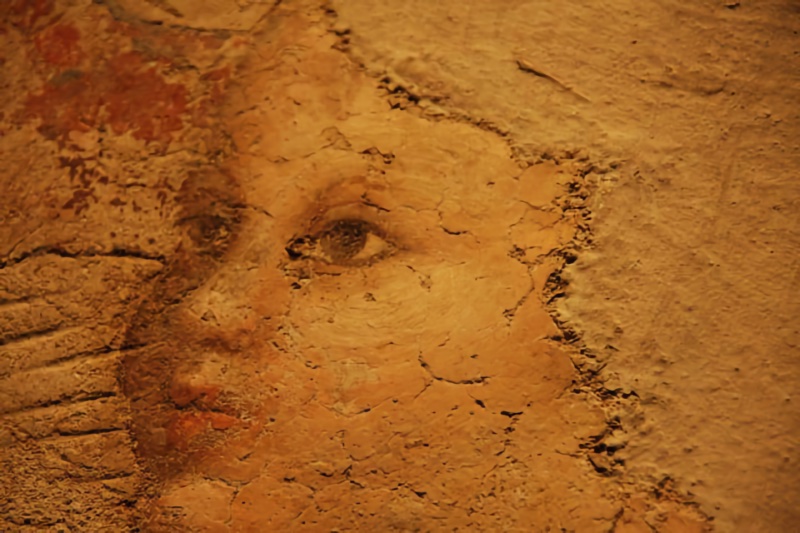
The fragment comes from the Palazzo del Podestà, the Gothic civic palace that closes the main square of Fabriano. The building is raised over a monumental vaulted passage, the voltone, through which one of the town’s principal streets runs beneath the palace. The fresco was painted on the surfaces of this passage, a public space of transit rather than a church or chapel. It was later detached and mounted on a support, and it is now preserved in the Pinacoteca Civica “Bruno Molajoli”. The detachment rescued what survived of the painting from the damage caused by exposure, traffic and time, but it isolated the head from the larger composition to which it belonged. Today that composition can only be reconstructed through the fragment itself and through the iconographic conventions of the period.
The subject can be recovered with reasonable confidence. The museum’s entry notes that the Child was shown with his arms raised and extended towards a figure at his right, and it identifies that figure as Saint Christopher, whose hair the Child grasps. According to the Golden Legend, Christopher was a giant who served travellers by carrying them across a dangerous river on his shoulders. One night he carried a child who grew so heavy that the giant could barely reach the far bank; the child then revealed himself as Christ, who bore the weight of the whole world and its Creator. In Italian painting of the fourteenth century, the Child is frequently shown seated on the saint’s shoulder, holding onto his head or hair, which corresponds exactly to the pose described by the museum.
The location of the image is fully consistent with this identification. Late medieval devotion held that whoever looked upon an image of Saint Christopher would be protected from sudden death, mors improvisa, for the rest of that day. For this reason, gigantic figures of the saint were painted on façades, near town gates, on bridges and along roads, where travellers and passers-by could see them. A monumental Saint Christopher under the voltone of the Palazzo del Podestà, over a busy public thoroughfare, would have offered daily protection to the citizens and travellers passing beneath it. The saint’s colossal scale, of which the small head of the Child gives only an indirect idea, was an essential part of the image’s effectiveness.
What survives is the Child’s face in three-quarter view, turned towards the left. The single visible eye is almond-shaped, with a dark iris and a softly modelled lid, and it gazes forward with a calm, almost pensive expression. The cheek is full and rounded, and the contours of the nose, lips and chin are defined by subtle transitions of tone rather than by strong outlines. The modelling of the flesh proceeds by gentle gradations of warm pink and ochre, which confer on the face a soft, luminous volume. The museum’s entry rightly draws attention to the delicacy of the flesh tones, which are the most distinctive quality of the fragment.
The traces to the left of the face offer clues to the lost composition. A series of horizontal brownish strands, rendered with parallel strokes, may correspond to the hair of Saint Christopher, which the Child held with his raised hands, or to the curls of the Child himself. The reddish pigment visible at upper left may belong to the Child’s garment, the saint’s clothing or the red cross of a cruciform halo. Given the fragmentary state and the warm lighting of the photograph, these identifications must remain tentative. Nevertheless, they are consistent with a composition in which the Child and the giant were closely joined, heads almost touching, in the intimate relationship that characterises many Trecento images of Saint Christopher.
The attribution to Allegretto Nuzi and the dating to around 1360 place the fragment in the years of the painter’s greatest activity as a fresco painter in Fabriano. The soft, rounded modelling of the face, the gentle transitions of tone and the calm expression find close parallels in the Child figures of his panel paintings and in the youthful heads of his frescoes, such as the maidens in the Ursula cycle in San Domenico. The fragment reveals a painter who had absorbed the Florentine lesson of plastic modelling and adapted it to a softer, more luminous idiom. At this scale, the quality of the handling is surprisingly high for an image intended to be seen from a distance by passers-by in a public passage.
The fresco’s condition is fragile, and its state of preservation must be taken into account in any reading. The paint surface is covered by a dense network of cracks and small losses, and the painted layer breaks off to the right along an irregular edge that exposes the bare plaster. The present warm, golden tonality of the image is partly the result of the ageing of the surface and of any materials applied during detachment and restoration. It is also accentuated by the lighting of the photograph. The original colours were probably cooler and more varied, and the flesh tones would have stood out against the saint’s garments and the background more sharply than they do today.
Despite its modest size and fragmentary state, the head of the Christ Child is an important document of Nuzi’s activity for civic patrons and of the role of images in the public spaces of the medieval Italian commune. It shows that the leading painter of Fabriano did not work only for churches and religious orders, but also for the civic institutions that governed his town. Their commissions invested the seat of communal power with the protection of the saints. The delicate face of the Child, detached from the lost colossus that once carried him, remains a moving witness of a monumental image that watched over the daily life of Fabriano.
Four Roundels with King David, a Prophet and Two Apostles
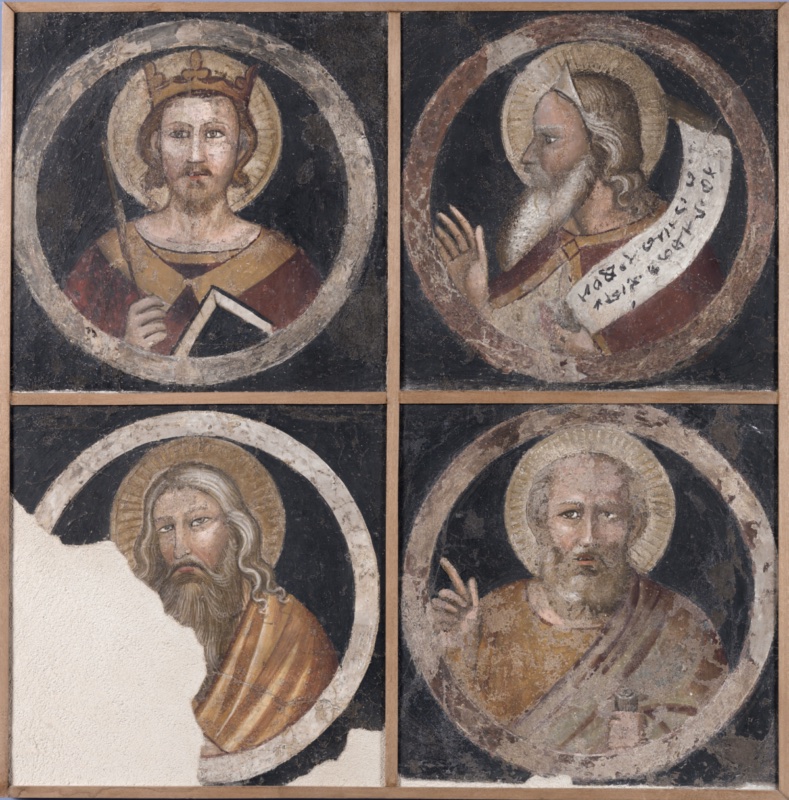
The four roundels come from the church of San Giovanni del Cantone in Fabriano, demolished in 1903. The same church also yielded the detached fresco of the Virgin interceding with Christ enthroned, now likewise in the Pinacoteca Civica “Bruno Molajoli” and also attributed to Allegretto Nuzi. The two works therefore allow a partial reconstruction of the decoration of a lost church, painted in the 1360s by the leading master of the Fabriano school. The roundels were detached from the wall, transferred to a new support and reassembled in a single frame. The present square arrangement is modern and does not reflect their original sequence. They were most probably part of a continuous series of clipei running along the intrados of an arch, the ribs of a vault or a painted frieze.
The clipeus, a circular frame containing a portrait bust, has a long history that goes back to Roman funerary and imperial imagery. In medieval art, it became the standard device for presenting series of prophets, apostles, saints and ancestors of Christ on arches, vaults and borders. In the fourteenth century, painters in the Giottesque tradition used such series to frame narrative cycles and to construct typological programmes, in which the figures of the Old Testament announced those of the New. Here the painted frames are rendered as simple rings of grey-white stone against a black ground, which lends the figures an effect of sculptural relief. The busts project slightly beyond the edge of the frame, and their gestures and attributes animate the circular field.
The first roundel, at upper left, shows a crowned king with short curly brown hair and a trimmed beard. The museum identifies him as King David. He holds a sceptre in his right hand, its thin shaft rising diagonally across the field, and a closed book in his left. The book is a fitting attribute for the author of the Psalms, which the medieval Church read as the most important prophecies of Christ. David was also the royal ancestor from whose line the Messiah was to descend, and his presence establishes the genealogical and prophetic link between the Old and New Testaments. His frontal pose, direct gaze and regular features give him a dignified, almost iconic presence.
The second roundel, at upper right, contains an elderly prophet shown in strict profile, turned towards the left. He has long white hair and a flowing white beard, and he wears a white pointed cap. This form of headgear was often used in medieval art to characterise Old Testament figures. He raises his right hand with the palm open in a gesture of speech or prophecy, and holds with his other hand an unrolled scroll that curves across the right side of the roundel. The scroll bears an inscription in dark letters, now difficult to read. Its transcription on the original could permit the identification of the prophet through the text of his prophecy. The profile pose, rare in the series, suggests that he was turned towards an adjacent figure or towards the centre of the programme.
The third roundel, at lower left, shows a saint with long, wavy white hair falling onto his shoulders and a long, full beard, wrapped in an orange mantle. The museum proposes his identification as the apostle Andrew, whose traditional iconography features precisely such dishevelled white hair and a long beard. The face is modelled with care: the heavy-lidded eyes, the long straight nose and the downturned mouth convey an expression of grave contemplation. A large part of this roundel is lost at the lower left, where the missing plaster has been filled with a neutral surface. The surviving part nevertheless preserves the head and the upper part of the mantle almost intact.
The fourth roundel, at lower right, contains a saint with short, curly grey hair and a thick, short beard. He raises his right hand with two fingers extended in a gesture of speech or blessing and holds a scroll in his left. The museum identifies him as the apostle Peter, whose physiognomy corresponds closely to the traditional type. In the absence of his usual attribute, the keys, the identification rests on the face alone and remains probable rather than certain. The pairing of Peter and Andrew, brothers and the first apostles called by Christ, would be entirely natural within a series of apostles. It suggests that the original sequence of roundels included at least part of the apostolic college, alongside prophets and kings of the Old Testament.
Stylistically, the roundels are consistent with Nuzi’s mature manner of the 1360s. The heads are constructed with solid, rounded volumes and modelled with soft transitions of flesh tones over a greenish underlayer, while the hair and beards are rendered with long, fluid strokes that give them a sense of movement. The expressive range is notable, from the regal composure of David to the prophetic intensity of the elder in profile and the grave meditation of the apostles, and it testifies to the painter’s ability to individualise figures within a repetitive decorative format. The black ground, which may originally have been a deep blue applied a secco, now sets off the pale flesh and warm garments with particular force.
Together with the Virgin interceding with Christ enthroned, the four roundels offer a glimpse of the lost decoration of San Giovanni del Cantone. It is plausible that the kings, prophets and apostles in their clipei framed or accompanied the central image of Christ enthroned with the interceding Virgin, forming a programme centred on the Last Judgement and the communion of saints. Such a hypothesis cannot be verified without further documentation. The fragments nevertheless testify to the quality of Nuzi’s fresco painting in his maturity. Reassembled in the Pinacoteca, these four small heads preserve the memory of a church that disappeared in 1903.
The Mystic Marriage of Saint Catherine of Alexandria, with a Female Saint Presenting a Kneeling Donor
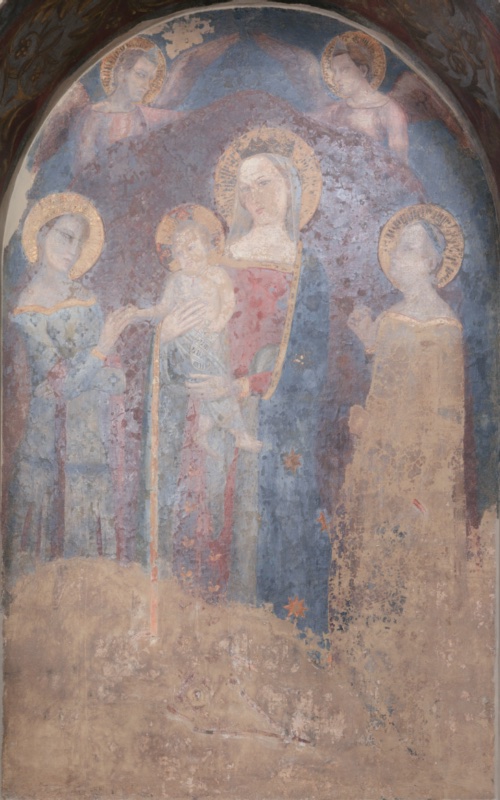
The fresco decorated a street shrine in Via San Filippo in Fabriano, a district that in the fourteenth century was occupied by the convent of the church of San Francesco alle Logge. It was detached in 1971 for conservation reasons and transferred to the Pinacoteca Civica “Bruno Molajoli”, where it is displayed in a niche that reproduces the original arched shape of the shrine. The work has exceptional documentary importance, since it is the only fresco by Nuzi that survives with his signature. It therefore constitutes the fixed point of reference against which all the attributions of his wall paintings must be measured, from the Chapel of San Lorenzo in the cathedral to the Ursula cycle in San Domenico and the fragments from San Giovanni del Cantone.
Street shrines were a characteristic feature of the medieval Italian city. Small niches or aedicules opened on the façades of houses, at street corners or along convent walls, they offered passers-by an image of the Virgin and the saints for prayer and protection. They were often commissioned by private individuals as ex-votos or as public acts of piety, and they testify to the diffusion of sacred images beyond churches into the spaces of daily life. The Via San Filippo shrine, with its elaborate programme of Virgin, Child, saints, angels and a kneeling donor, represents an unusually ambitious example of this type. Its quality and its signature show that the leading painter of Fabriano did not disdain such commissions.
The composition is organised around the standing Virgin, who occupies the centre of the niche. She wears a crown over a white veil and a deep blue mantle scattered with gold stars over a red dress. The stars allude to her titles of Queen of Heaven and Stella Maris, the Star of the Sea. Her face, with its long oval, narrow eyes and small mouth, corresponds to Nuzi’s mature female type. She gazes out towards the beholder rather than towards the Child or the saints, a convention that connects the devotional image with the passer-by in the street. Two winged angels hover above her, turned towards the centre, in a gesture that seems to frame and honour the Mother of God.
The Christ Child, seated on the Virgin’s right arm, is the active protagonist of the scene. He turns towards Saint Catherine on the left and holds a scroll, while extending his hand towards her to place the ring on her finger. Catherine, identified by her halo and her position, wears a pale blue gown with a gold neckline and extends her hand to receive the ring. According to the legend, Catherine was a princess of Alexandria in the fourth century, to whom Christ appeared in a vision and took as his bride, and upon waking she found the ring of the mystic marriage still on her finger. The theme is a late medieval development of her legend, not found in its earliest versions. It was particularly popular in the fourteenth century, when it expressed the ideal of the soul’s spiritual union with Christ.
On the right, a second female saint, not yet identified, stands in a golden gown and raises her hand in a gesture of presentation. According to the museum’s entry, she accompanied a kneeling donor, probably a knight, whose sword and armour can still be made out. Most of the donor figure is lost in the heavily abraded lower zone of the fresco. The donor’s presence reveals the votive nature of the shrine. The patron had himself represented in eternal prayer before the Virgin, recommended by his patron saint, in a public place where his piety would be visible to his fellow citizens. The identity of the knight remains unknown. Should coats of arms or inscriptions emerge from technical examination, they could shed light on his family.
The decoration extended beyond the main wall into the embrasures and vault of the niche. The vault is painted with dark red foliate scrolls, with a lozenge-shaped motif at its apex. In the right embrasure stands Saint Lucy, the martyr of Syracuse, still recognisable; in the left embrasure, only the halo of another saint survives. The presence of Lucy, patron of eyesight and of light, may reflect the devotion of the donor or of the neighbourhood. The whole shrine formed a small, coherent sacred space. The viewer standing in the street found himself enclosed by the Virgin, the saints and the angels, as if before a miniature chapel.
Stylistically, the fresco displays the characteristics of Nuzi’s mature manner. The figures are elongated and elegant, the faces gentle and idealised, and the drapery falls in long, rhythmic folds. The palette combines blue, red, pale blue and gold in a decorative harmony typical of his work of the 1360s. The gold haloes, worked with incised rays, and the starry mantle of the Virgin show the care devoted to the precious details. The rigorous frontality of the Virgin, contrasting with the lively movement of the Child and the saints, creates a balanced tension between devotional icon and narrative scene. The signature confirms, if confirmation were needed, the stylistic consistency between Nuzi’s fresco and panel painting.
The condition of the fresco reflects centuries of exposure to the weather in a street shrine. The lower part, including the kneeling donor, is heavily abraded, and the paint surface is covered with losses and discolorations. The blue ground has partly faded or altered, and some areas, such as the right saint’s gown, have lost their original modelling. The heads of the Virgin, the Child, the angels and the saints nevertheless survive in legible condition, and they allow the quality of the work to be appreciated. The detachment of 1971 saved the fresco from further decay, and it remains an irreplaceable document: the signed touchstone of Allegretto Nuzi’s wall painting and a vivid witness to the public devotion of fourteenth-century Fabriano.
Workshop, Followers and the Road to Gentile da Fabriano
The measure of Allegretto Nuzi’s historical importance lies not only in his own production but in the school he founded. Before his activity, as one early twentieth-century survey bluntly put it, a school of painting could hardly be said to have existed in the Marche; after it, Fabriano possessed a continuous local tradition that would culminate, within two generations, in one of the supreme masters of the International Gothic. Allegretto was, in the words of the 2021 exhibition that consecrated his rediscovery, the reference point around which a genuine Fabrianese school developed.
The most important of his direct followers was Francescuccio di Cecco Ghissi, documented between 1359 and 1395, at once his pupil, his emulator and his collaborator. Ghissi took over Allegretto’s compositional types — above all the Madonna of Humility, of which the San Severino panel of 1366 furnished the prototype — and translated them with a mystical gentleness and an exquisite decorative sense of his own, though with, in the traditional critical judgement, less marked originality than his master. His works are scattered across the Marche and beyond — in Santa Lucia at Fabriano (1359), in Sant’Andrea at Montegiorgio (1374), in the Pinacoteca of San Severino (1366), in Fermo and Ascoli Piceno — and his dismembered altarpiece of the life of Saint John the Evangelist, its nine panels long dispersed among museums and recently reunited for study and exhibition, has become a celebrated case in the reconstruction of Trecento polyptychs. The precise nature of the Nuzi–Ghissi relationship — where the master’s hand ends and the pupil’s begins — remains one of the central problems of Fabrianese studies, and it was the subject of an influential hypothesis by Federico Zeri.
Around these two principals gathered a wider circle. The sources name the shadowy Maestro dei Magi di Fabriano, a sculptor in polychrome wood whose sacred groups echo Allegretto’s painting in the tenderness of their gestures and the richness of their painted fabrics; the anonymous painters of the San Domenico sacristy, once gathered under the problematic name of “Angelo di Meo Cartaiolo” but certainly the work of several hands; and the various local masters — the Master of Staffolo among them — who carried Allegretto’s manner into the last decades of the century. The influence radiated beyond Fabriano across Umbria and the Marche, and frescoes as far afield as San Domenico in Perugia have been drawn into his orbit.
The ultimate significance of this school lies in the road it opened to Gentile da Fabriano, born around 1370 and thus overlapping with Allegretto’s life by only three years. Gentile, who would become the greatest Italian exponent of the International Gothic and the painter of the dazzling Adoration of the Magi of 1423, began, according to the consensus of scholarship, within the Fabrianese tradition shaped by Allegretto Nuzi and Francescuccio Ghissi — that “precious, anti-naturalistic decorativism, at the limits of abstraction,” as the 2014 exhibition catalogue characterised it, from which Gentile drew before renewing and transcending it. It is no small thing to have prepared, however indirectly, the ground for such a flowering, and it is above all as the founder of the tradition that produced Gentile that Allegretto claims his place in the larger narrative of Italian art. The love of tooled gold and sumptuous textile, the fusion of monumental form with decorative surface, the courtly refinement of colour — all the elements that Gentile would raise to their apogee were present, in embryo, in the art of the older Fabrianese master.
Historiography and Critical Fortune
The critical fortune of Allegretto Nuzi is itself an instructive chapter in the history of taste, tracing the long arc by which a provincial master, all but forgotten in the centuries after his death, was gradually restored to view. Giorgio Vasari, whose Lives fixed the canon of Italian art around a Florentine and Tuscan axis, passed him over in silence, as he did most of the painters of the Marche; the rediscovery of Allegretto would therefore have to await the rise of local antiquarian scholarship and, later, of connoisseurship.
The founding text of Marchigian art history, and the point of departure for all study of Allegretto, is the Memorie storiche delle arti e degli artisti della Marca di Ancona, published at Macerata in 1834 by the Marchese Amico Ricci (1794–1862), the first systematic survey of the art of the region. Ricci gathered the local traditions, recorded works and inscriptions since lost, and gave Allegretto his first sustained modern treatment; it is to Ricci that we owe, among much else, the report of the lost dated works in Santa Lucia and the early notice of the Urbino Madonna in the Castrica collection. The later nineteenth and early twentieth centuries saw the documentary foundations laid: Anselmi published the testament in 1893 and established the date of death and place of burial in 1906; local scholars such as Marcoaldi, Sassi and Zonghi combed the Fabriano archives; and the panels began to attract the attention of the international connoisseurs — Bernard Berenson, who devoted a pioneering study to Allegretto’s “early works” in 1921–1922, Raimond van Marle, Lionello Venturi, whose 1915 “Attraverso le Marche” reconstructed key inscriptions, and Richard Offner, whose Corpus of Florentine Painting situated Allegretto within the Florentine orbit.
The modern scholarly foundation, however, was laid at mid-century, and here the specialist literature converges on a small number of authoritative voices. The first is Alessandro Marabottini, whose monographic study of 1951–1952 in the Rivista d’arte and whose entry in the second volume of the Dizionario Biografico degli Italiani (1960) together constituted the first rigorous modern account of the artist’s life and work, establishing the chronological framework — the movement from an early Daddesque phase, through the Orcagnesque turn of the mid-1350s, to the increasingly Sienese and decorative maturity, and finally to the Venetian-inflected last works — that has structured all subsequent discussion. Marabottini’s reading, with its insistence on the dominance of Ambrogio Lorenzetti throughout Allegretto’s career and its cautious hypothesis of a late Venetian journey, remains the indispensable point of reference.
The second decisive contribution came from Miklós Boskovits, the pre-eminent connoisseur of early Italian painting in the later twentieth century, whose studies of Umbrian and Marchigian painting (from 1973 onward) and whose authoritative catalogue of the thirteenth- and fourteenth-century Italian paintings of the National Gallery of Art in Washington placed Allegretto’s dated works and their attribution on a secure critical footing, refined the reconstruction of his Florentine sources — locating the essential Florentine component in Maso di Banco rather than Daddi alone — and integrated the documentary record with the material evidence of the panels themselves. It is largely through the systematic catalogues of the great museums, of which Boskovits’s Washington volume is the model, that Allegretto has entered the international art-historical mainstream.
The third and most recent protagonist of Nuzi studies is Andrea De Marchi, the leading contemporary authority on Trecento painting in the Marche, who together with Matteo Mazzalupi curated the landmark exhibition Oro e colore nel cuore dell’Appennino. Allegretto Nuzi e il ‘300 a Fabriano, held at the Pinacoteca Civica “Bruno Molajoli” and the Museo Diocesano of Fabriano from 14 October 2021 to 30 January 2022 — the first exhibition ever devoted wholly to the artist. As the curators themselves described the achievement, the exhibition succeeded in “returning to Fabriano some thirty works by the great Master lent for the occasion, among them eleven panels from foreign museums” (“riportare a Fabriano una trentina di opere del grande Maestro prestate per l’occasione, fra cui undici tavole da musei stranieri”), and it reunited long-dispersed portions of polyptychs — marking the definitive rehabilitation of Allegretto as a major protagonist of the fourteenth century rather than a mere provincial epigone.
De Marchi’s characterisation of the artist — as a painter who, “strong in his Tuscan education,” exercised an enormous influence across Umbria and the Marche, importing a calm and monumental language matured on the tenderness of the Lorenzetti and the caressing volumes of Florentine Giotteschi like Maso di Banco and Bernardo Daddi, an innovator in iconography and an experimenter in technique who combined punches with abandon and displayed shimmering worked fabrics patterned with fancies of birds and tortoises — represents the current state of scholarship and has restored to Allegretto the full measure of his artistic personality. The 2021 exhibition was itself the sequel to the broader 2014 Fabriano exhibition Da Giotto a Gentile, which had already set Allegretto within the longue durée of the Fabrianese school from its Giottesque origins to Gentile’s International Gothic, and it was accompanied by a rich programme of restoration and technical study, including the exemplary restoration of the Fabriano pentaptych.
The trajectory of Allegretto’s critical fortune thus runs from Vasarian silence, through antiquarian retrieval and documentary excavation, to the connoisseurial reconstruction of Marabottini and Boskovits and the definitive modern consecration achieved by De Marchi and his collaborators — a curve that mirrors in miniature the broader modern rehabilitation of the “primitives” and of the regional schools once dismissed as peripheral to the Florentine-centred canon.
Conclusion
Allegretto Nuzi was a provincial master in the most honourable sense of the term: an artist who took the highest achievements of the metropolitan centres — the plastic gravity of Florence, the linear sweetness of Siena — and made them speak in the dialect of his own region, with such conviction and such craftsmanship that he founded a school where none had existed before. His art is a mirror of the artistic geography of the mid-Trecento: in his early panels one reads the lessons of Daddi and Maso di Banco; in his maturity, the monumentality of Orcagna and the pervasive tenderness of Ambrogio Lorenzetti; in his last works, the first intimations of Venetian decorativism. Through it all runs a constant that is his alone — the love of gold worked into shimmering pattern, of textile rendered as pure ornament, of the sacred image made both grave and precious.
If the altarpieces carry Allegretto’s public voice, the small panels reveal his private one. The diptychs and portable triptychs now scattered between Berlin and other collections — the enthroned Virgin paired with the Crucifixion, the Virgin and Child set opposite the Man of Sorrows, the tabernacles in which the Nativity, the Annunciation and the Crucifixion unfold within a few hand-spans of gilded wood — were objects to be opened, handled and contemplated at close range, and in them the monumental forms of his polyptychs are distilled into images of intimate scale. The reviewers of the 2021 exhibition were right to see in these works an innovation of type as well as of style, and to connect them with a spirituality of personal prayer increasingly close to the devotio moderna. Together with the Madonna of Humility, which he carried into the Adriatic world and handed on to Francescuccio Ghissi, they show that Allegretto’s originality lay as much in what he gave his patrons to pray before as in the manner in which he painted it.
His art was also, and inescapably, a collaborative one. The Washington triptych of 1354 bears witness to his partnership with the Florentine Puccio di Simone; the frescoes of San Domenico betray at least two hands besides his own; and the London panel of Saints Catherine and Bartholomew, in which Allegretto’s punches frame what appears to be Ghissi’s brushwork, shows master and pupil working with the same tools in the same shop. To speak of “Allegretto Nuzi” is therefore to speak not only of an individual painter but of an enterprise: a workshop that designed, gilded, painted and delivered sacred images for the churches, religious houses and confraternities of Fabriano and its neighbours. The instruments of modern connoisseurship, from the study of punch-marks to the technical analysis that accompanies restoration, have made it possible to glimpse the division of labour within that enterprise, but the boundary between the master’s hand and those of his assistants remains, in many works, a matter of judgement rather than of proof.
The fate of his works after his death has in turn shaped the way in which he can be known. The polyptychs that once stood on the altars of the Marche were dismembered, their panels sold separately and dispersed across the museums of Europe and North America, so that a single altarpiece may today be divided between several cities, and its original appearance can be recovered only by the patient comparison of dimensions, frames, punchwork and provenance. The catalogue assembled in this essay bears the marks of that history: the lateral compartments of the Saint Augustine polyptych, the wings of the Southampton Coronation, the recomposed Fribourg polyptych and the fragments of predellas and pinnacles are the surviving pieces of larger wholes. Paradoxically, the very prestige that made his gold grounds coveted by collectors ensured both his dispersal and his survival, and it was only with the 2021 exhibition, which brought eleven panels back from foreign museums, that some of these fragments were seen together again in the city for which they were made.
Much, finally, remains open. The contents of the testament of 1373 await a fresh reading of Anselmi’s transcription or of the notarial original; the chronology of the undated panels still oscillates between competing proposals, as the distance between the prevailing early dating of the Berlin diptych and Romagnoli’s date of 1365 makes clear; the respective shares of Allegretto, Ghissi and the workshop in the panels and frescoes continue to divide specialists; and the Venetian journey of his last years remains a hypothesis. These questions are not a weakness in the study of Allegretto but a sign of its vitality. The nearly one hundred years that separate Romagnoli’s monograph of 1927 from the Fabriano exhibition of 2021 transformed a local glory into a painter of international standing, and the panels themselves, with their inscriptions, their punches and their pigments, still hold evidence that future research may yet recover.
The documentary record, from the Florentine enrolment of 1346 to the testament of 26 September 1373, allows us to trace the outline of a working life anchored in Fabriano; the sequence of dated panels, several of them signed, from the Washington triptych of 1354 to the Urbino Madonna of 1372, gives that life a firm chronological spine; and the frescoes of San Venanzio, San Domenico and Sant’Agostino, half-hidden in the churches of his native city, preserve the monumental art by which his contemporaries knew him. Where the evidence fails — in the lost dated works of Santa Lucia, in the illegible inscriptions, in the disputed attributions and the unverifiable early dates — honesty requires that the gaps be named, and they have been named here. What remains, when the uncertainties are set aside, is the figure of a painter of real distinction and genuine historical consequence: the founder of the Fabrianese school, the disseminator of Tuscan forms across the Apennines, the innovator who carried the Madonna of Humility into the Adriatic world, and the ancestor, across the short span of a single generation, of Gentile da Fabriano and the golden autumn of the International Gothic. It is fitting that his own city, after centuries in which his finest works drifted away to the museums of the world, should at last have gathered them home to honour him.