Maestro della Madonna di Perugia
( 25% )
Introduction
The name Maestro della Madonna di Perugia designates an anonymous Umbrian painter active in the first half of the fourteenth century, whose artistic personality has been reconstructed on the basis of a small group of related works rather than on documentary evidence. The eponymous panel, a tempera-on-panel Madonna and Child now in the Galleria Nazionale dell’Umbria at Palazzo dei Priori in Perugia, provides the most secure point of departure for mapping this elusive career.
Modern catalogues date this painting to roughly between 1330 and 1340, situating the artist within the generation that absorbed Giotto’s innovations while still working within a fundamentally Italo-Byzantine idiom. Archival research has not yielded a birth date, place of origin, or death notice for the painter, and even his workshop affiliations remain hypothetical, so that the label functions purely as a notname rather than a recovered historical identity. Early attributions sometimes conflated the master with the so‑called Maestro della Maestà delle Volte and connected him with Neapolitan painting, but subsequent scholarship—especially the work of Miklós Boskovits and later Alessandro Conti—has insisted on keeping these personalities distinct and on reconsidering stylistic genealogies.
As a result, the Maestro della Madonna di Perugia is now generally regarded as a central figure within the local Umbrian reception of both Sienese refinement and Giottesque monumentality, rather than as a direct Neapolitan transplant. His biography must therefore be reconstructed indirectly, through stylistic comparison, iconographic analysis and the study of patronage networks in early Trecento Perugia, Assisi and the wider region.
Life and family background
No documentary record has yet emerged that would disclose the Maestro della Madonna di Perugia’s baptismal name, family ties or civic status, and all attempts to anchor him in known Perugian lineages remain speculative. Scholars have instead inferred his social and professional profile from the scale and function of his surviving works, which point to a painter competent in supplying images for both institutional and private devotion, but not necessarily among the most highly remunerated masters of his generation. The modest dimensions of the Perugia Madonna panel suggest an object conceived for an intimate setting, perhaps within a domestic or conventual cell, which in turn implies a clientele outside the circle of great communal or episcopal commissions.
The panel’s later insertion into a sixteenth‑century tabernacle owned by the Accademia di Belle Arti, with shutters painted with Saints Francis and Clare, further hints at a devotional environment aligned with Franciscan spirituality, though the original patron remains unknown. On this basis, some authors have envisaged the painter as a craftsman embedded in the dense network of mendicant and lay confraternities that characterised Perugian religious life in the early Trecento, rather than as a court artist attached to a single powerful household. Stylistic features, such as certain soft facial types and linear graces, have encouraged others to posit a training in a Sienese milieu before a move to Umbria, but this hypothesis, while plausible, is not backed by archival corroboration.
The notion of a Sienese origin would imply family connections or apprenticeship links tying the master to that Tuscan city, yet no contracts, tax records or guild entries survive to substantiate such a background. The complete absence of signatures on works attributed to the Maestro della Madonna di Perugia also aligns him with a broad Umbrian tradition in which individual authorship was often subordinated to workshop or icon type, masking biographical particulars behind formulaic sacred images. As a result, modern reconstructions of his family context remain necessarily cautious, preferring to sketch the social horizon of middling artisans in mid‑Trecento Perugia rather than invent genealogies for an otherwise undocumented personality.
Biographical uncertainty extends equally to the artist’s date and place of birth, which cannot be deduced more precisely than by inference from stylistic maturity around the second quarter of the fourteenth century. If, as most scholars agree, the Perugia Madonna and related works belong to circa 1330–1340, the master would likely have been born toward the end of the thirteenth century, perhaps in the 1290s, in order to have completed an apprenticeship and established an independent workshop by that time.
Whether that birth took place in Perugia itself, in another Umbrian centre such as Assisi or Spoleto, or in Siena—as some stylistic readings would allow—remains an open question that cannot at present be resolved in the absence of documents. The tendency of older scholarship to project firm geographic origins on the basis of a few stylistic traits has been criticised in more recent literature, which emphasises the high degree of mobility and stylistic hybridisation among Trecento painters.
Consequently, it is methodologically sounder to speak of a master formed at the intersection of Umbrian and Sienese visual cultures than to assign him a single birthplace. That formation would have involved not only workshop training but also exposure to the fresco cycles in Assisi and other major centres, which functioned as open‑air academies for younger painters, although these experiences leave no trace in civil registers. The silence of notarial and guild records regarding the Maestro della Madonna di Perugia contrasts with the relative richness of documentation for slightly later figures, such as Cola Petruccioli, and underlines the fragmentary state of sources for the first half of the Trecento in Umbria. In the absence of baptismal or testamentary entries, any specific statement about the artist’s birthplace must therefore be couched as conjecture grounded in stylistic comparison rather than as a secure biographical datum.
The problem of family background is further complicated by the collaborative nature of workshop practice in the period, which tends to blur the stylistic contours of individual hands within a shared repertoire. The Perugia Madonna has been used as a stylistic touchstone to isolate the master’s personal idiom, yet technical and stylistic overlaps with works by contemporaries such as the Maestro delle Tempere Francescane or local Umbrian followers of Giotto make it difficult to distinguish between the contributions of a single painter and those of a cooperative workshop.
In some cases, works once attributed to the Maestro della Madonna di Perugia have been reassigned to other anonymous masters or to documented painters, illustrating how fragile the reconstruction of his oeuvre remains. These shifts in attribution indirectly affect how scholars imagine his familial and professional network, since each addition or subtraction from the corpus modifies the range of patrons, locations and iconographies associated with his hand. The hypothesis advanced in older literature of a close tie to a Neapolitan context, based on perceived analogies with the Maestro delle Tempere Francescane, has been progressively weakened as more nuanced readings of those stylistic affinities have emerged.
Conti, for instance, recommends abandoning the “contorti sentieri napoletani” once used to explain the master’s formation, arguing instead for a reading that places him within a broadly Umbrian and Sienese frame. Under such a view, the family and workshop environment of the painter is imagined as part of the artisanal fabric of central Italian communes rather than as an appendage of Angevin court culture. This reorientation underscores how questions of biography are inseparable from broader debates about artistic geography and the circulation of models in early Trecento Italy.
Modern scholars have also interrogated the ways in which devotional imagery like the Perugia Madonna participated in the affective and social construction of family life, even when painters’ own domestic circumstances escape the historical record. The tender gesture of the Christ Child grasping his mother’s chin, derived from Byzantine prototypes of the Vzygranie Mladentsa or Pelagonitissa type, resonates strongly with contemporary ideals of maternal care and spiritual intimacy.
By staging the Virgin and Child in a moment of playful interaction that yet prefigures the Passion through symbolic details, the image speaks to familial bonds both human and divine, bonds that would have been deeply meaningful to the lay and religious viewers who kept such panels in their oratories. It is therefore possible to argue that the Maestro della Madonna di Perugia’s sensitivity to the emotional dynamics between mother and child mirrors, in an oblique fashion, the centrality of kinship ties in the society for which he worked. This argument does not, of course, provide concrete information about his own household, but it situates his artistic production within a cultural matrix where familial affection, lineage, and spiritual motherhood were prominent themes.
Nothing is known about the later years of the Maestro della Madonna di Perugia’s life, including the date, place or circumstances of his death, which remain entirely undocumented in surviving sources. Since his securely dated works cluster around the 1330s and early 1340s, the most that can be said is that he must have died sometime after the mid‑Trecento, perhaps in the 1350s or 1360s, although this is only an inference.
The catastrophic Black Death of 1348, which decimated populations in both Umbria and Tuscany, offers a plausible terminus within which many artists’ careers were abruptly cut short, but there is no direct evidence to link the Maestro della Madonna di Perugia’s demise to the plague. Later chronicles and ecclesiastical visitation records that describe the state of altars and images in Umbrian churches make no mention of him by name, reflecting the anonymous status he had even for early modern observers. As a consequence, modern biographical entries must state plainly that his date and cause of death are unknown, underscoring the degree to which his person remains a scholarly construct derived from the paintings themselves rather than from written testimony.
Patrons and social context
The documentary notice in the Italian national catalogue emphasises that the Perugia Madonna was once mounted at the back of a small sixteenth‑century tabernacle whose shutters bore images of Saints Francis and Clare, indicating a later Franciscan framing of an earlier Trecento panel. While this information does not reveal the original patron, it does suggest that Franciscan environments in and around Perugia were receptive settings for the master’s Marian imagery. Perugia in the early fourteenth century hosted important Franciscan and Dominican houses, as well as numerous lay confraternities dedicated to the Virgin and to saints associated with the mendicant orders, creating a dense market for portable devotional panels. Within this milieu, small gold‑ground Madonnas like the Perugia panel functioned as focal points for prayer, processions and private contemplation, whether installed on chapel altars or in domestic spaces belonging to pious lay families. The master’s ability to render both the theological dignity and the tender humanity of the Virgin and Child would have been particularly attractive to such patrons, who sought images that mediated between liturgical doctrine and everyday emotional experience.
The attribution history recorded in the catalogues of the Galleria Nazionale dell’Umbria reveals that the Perugia Madonna was once associated with the Maestro della Maestà delle Volte and later reassigned to the distinct personality of the Maestro della Madonna di Perugia as defined by Boskovits. This shifting attributionscape reflects evolving scholarly understandings of patronage networks, since each reclassification reconfigures the set of institutions and individuals thought to have commissioned the works. When the panel was connected to the Maestà delle Volte, it was more readily situated within the orbit of large civic commissions related to the communal palace and major churches, whereas its current notname encourages a focus on more modest, though no less significant, forms of patronage. The fact that the piece passed through the Accademia di Belle Arti before entering the Galleria Nazionale underscores how, by the nineteenth century, such works had become part of a broader civic patrimony, treasured as exemplars of Perugian medieval art rather than as objects tied to specific medieval families or confraternities.
Christie’s description of an Umbrian portable triptych dated circa 1335, stylistically placed between Puccio Capanna and Meo da Siena and compared with a triptych once in the von Kaufmann collection in Berlin that Federico Zeri and Fabio Todini had attributed to the Master of the Perugia Madonna, points to another sphere of potential patronage. The iconographic programme of that triptych, with a central Crucifixion flanked by saints and scenes of the Annunciation, suggests a commission for a patron steeped in the new, more narrative‑rich forms of devotion that emerged in the wake of the Franciscan movement.
Portable triptychs of this type could be used both in ecclesiastical settings, such as side altars in mendicant churches, and in lay households, where they structured the rhythm of daily prayers and seasonal devotions. If the attribution to the Maestro della Madonna di Perugia is accepted, even as a hypothesis, it would indicate that he responded to patrons who desired complex iconographic ensembles articulating Christ’s Passion and the Virgin’s salvific role in ways that echoed recent preaching and meditation texts.
Beyond individual commissions, the Maestro della Madonna di Perugia must be placed within the broader patronage strategies of communal Perugia, which, like many central Italian cities, used Marian imagery to articulate civic identity and divine protection. The Palazzo dei Priori itself, where the Galleria Nazionale now houses his eponymous panel, was a key stage for the display of images of the Virgin and patron saints, both in sculpted portals and in painted dossals serving confraternal altars.
While there is no direct evidence that our master received commissions for large‑scale civic projects, the stylistic proximity of his work to other Umbrian panels associated with communal institutions suggests that his patrons participated in the same culture of images that shaped public religious spaces. The diffusion of similar half‑length Madonnas with the Child clasping the mother’s chin throughout Umbria in this period indicates that patrons—whether confraternities, parish priests or lay families—shared a repertoire of preferred iconographic types that painters like the Maestro della Madonna di Perugia adapted to local needs.
The perceived links between the Maestro della Madonna di Perugia and the Maestro delle Tempere Francescane, emphasised by Boskovits and later nuanced by other scholars, have also influenced interpretations of patronage. The latter master’s sobriquet derives from a series of small tempera panels associated with Franciscan contexts, and the stylistic relationship between the two painters has encouraged some to imagine overlapping clienteles among Franciscan houses in Umbria and perhaps further south.
If such connections are accepted, they would imply that the Maestro della Madonna di Perugia’s works circulated among patrons familiar with the visual language of Franciscan spirituality, including emphases on Christ’s humanity, the sorrows and joys of the Virgin, and the virtues of Franciscan saints such as Louis of Toulouse. However, more recent studies warn against overextending Neapolitan or strictly Franciscan explanations, preferring to see the master as part of a broader current in central Italian painting that synthesised diverse inputs while serving a range of patrons across monastic, clerical and lay spheres.
Painting style
The Perugia Madonna panel offers the clearest window onto the Maestro della Madonna di Perugia’s mature style, combining a hieratic frontal presentation of the Virgin with subtler gestures and physiognomies that betray a receptivity to Giottesque naturalism. The Virgin is shown half‑length against a gold ground, wrapped in a dark mantle that falls in soft, rhythmically arranged folds, while the Christ Child, dressed in a tunic, turns toward her in a lively movement and reaches up to grasp her chin. This tender gesture, derived from Byzantine models of the Vzygranie Mladentsa or Pelagonitissa type, has been highlighted by Zappasodi and others as a key to the image’s affective power, balancing doctrinal content with an almost anecdotal immediacy. The master’s drapery patterns, especially in the mantle’s border and the subtle modulation of light on its surface, align with what recent scholarship terms the “Abito del Primo Trecento,” a type of Marian dress that synthesises earlier Comnenian and Gothic elements into a more volumetric, softly modelling garment. Coloristically, the painter favours deep blues and reds contrasted with delicately hatched flesh tones, achieving a balance between decorative splendour and the suggestion of three‑dimensional bodies under cloth.
Comparisons with the von Kaufmann triptych and with works by Puccio Capanna and Meo da Siena, as noted in the Christie’s lot essay, further refine the profile of the master’s style. The triptych’s Crucifixion scene exhibits a solid, pyramidal composition and weighty, sorrowing figures reminiscent of Giotto’s Assisi frescoes, yet the linear elegance of certain contours and the ornamental treatment of details, such as halo punchwork and border motifs, recall Sienese practices. This combination of Giottesque structure and Sienese grace corresponds to what Conti calls the “classicismo gotico” that matured in Umbria in the early Trecento, a classicism that the Maestro della Madonna di Perugia exemplifies in the small scale. The master’s faces often display rounded, softly modelled cheeks, almond‑shaped eyes with elongated inner corners, and small, refined mouths whose slight smiles or grimaces convey restrained emotion rather than overt pathos. Such physiognomic types underscore his orientation toward a gentle, contemplative affect rather than the more dramatic expressivity associated with later fourteenth‑century currents.
In terms of iconography, the maestro’s works participate in a broader redefinition of Marian imagery around 1300–1340, in which the traditional enthroned Queen of Heaven (Maestà) is supplemented by more intimate half‑length or three‑quarter‑length representations. The Perugia Madonna exemplifies this shift by presenting the Virgin not as a distant sovereign but as a mother absorbed in delicate interaction with her son, even as the gold ground and jewelled borders maintain the icon’s status as a heavenly presence. The Christ Child’s playful grasp of the Virgin’s chin is not merely anecdotal but has been read, following Lazarev’s work on Byzantine prototypes, as a sign of the paradoxical union of divine wisdom and childlike spontaneity, as well as a veiled allusion to the future Passion through the tender yet firm grip on the maternal body. By adopting this motif, the Maestro della Madonna di Perugia aligns himself with a trans-Mediterranean current in Marian iconography that blends Eastern devotional types with Western narrative sensibilities.
Artistic influences
The Maestro della Madonna di Perugia’s art cannot be understood without reference to the pervasive influence of Giotto and his circle in central Italy during the first decades of the fourteenth century. The fresco cycles in the lower church of San Francesco at Assisi, in particular, served as a vital training ground and source of motifs for a whole generation of Umbrian painters, including Puccio Capanna and Meo da Siena, whom the Christie’s essay situates as stylistic neighbours of our master. The solid construction of figures, the carefully articulated volumes of draperies, and the gravitas of certain saintly types in works associated with the Maestro della Madonna di Perugia echo these Giottesque models, even when transposed to the small scale of portable panels. At the same time, features such as the refined linear rhythms of contour and the gentle, slightly idealised physiognomies link his style to Sienese currents descending from artists like Duccio and his followers, whose works circulated in Umbria through trade, commissions and the movement of painters.
Boskovits’s reconstruction of the master’s oeuvre underscored perceived affinities with the Maestro delle Tempere Francescane, a painter associated with a cluster of small tempera panels depicting Franciscan themes, suggesting that the two shared not only patrons but also visual models. Both artists cultivate an intimate scale and a focus on the emotional resonance of sacred figures, often employing close-up formats that bring viewer and subject into immediate proximity. Yet subsequent scholarship, especially Conti’s reassessment, has cautioned against collapsing their identities or overemphasising a Neapolitan connection, noting that similar stylistic solutions could emerge independently within the rich network of Umbrian workshops. This debate over influence highlights the difficulty of disentangling direct borrowing from shared responses to broader stylistic stimuli, such as the influx of French Gothic motifs or the continued prestige of Byzantine icons.
A further layer of influence can be traced in the adoption and adaptation of specific Marian iconographies with roots in the Eastern Mediterranean. Lazarev and later authors have demonstrated that the type of the Virgin with the playing Child, in which the infant reaches towards the mother’s face in a lively gesture, enjoyed a certain diffusion in Italian painting between the Duecento and Trecento, with notable examples such as Giovanni da Rimini’s panel in the Pinacoteca Comunale of Faenza. The Maestro della Madonna di Perugia’s eponymous panel participates in this current, reworking the type through the lens of Giottesque volumetry and Sienese colourism. Here, influence operates not merely as passive reception but as active translation, as the master integrates an imported iconographic scheme into the devout sensibilities and visual expectations of Umbrian patrons.
Travels and artistic horizons
Because no contracts, guild records or narrative sources mention the Maestro della Madonna di Perugia by name, reconstructing his travels must rely entirely on stylistic and iconographic analysis. The strong Giottesque component in his work makes it highly probable that he spent time in Assisi or at least studied closely the fresco cycles in the Basilica of San Francesco, where Giotto and his assistants worked in the final decades of the thirteenth century. Many Umbrian painters are known to have drawn inspiration from these cycles, whether through direct apprenticeship, as in the case of Puccio Capanna, or through repeated viewing and copying, and the Maestro della Madonna di Perugia would have been no exception. The incorporation of Sienese stylistic traits suggests, moreover, exposure either to works imported from Siena or to Sienese painters active in Umbria, possibilities that could have arisen through travel or through the circulation of artworks along trade routes linking Siena, Perugia and other central Italian cities.
Boskovits’s earlier hypothesis of a connection with Neapolitan painting, especially with the Maestro delle Tempere Francescane, opened the further possibility of travel or at least visual contact between Umbria and the Angevin court at Naples. Neapolitan churches and palaces in the early Trecento housed rich cycles of painting influenced by both French Gothic and local Italian traditions, and itinerant Umbrian masters are documented in the region, though not under the notname of the Maestro della Madonna di Perugia. Later scholars, however, have been more cautious in positing direct Neapolitan itineraries for our master, preferring to understand the perceived affinities as part of a wider circulation of models rather than as proof of personal travel. In this view, the artist’s “travels” would be conceptual rather than strictly geographic, consisting in the movement of images, patterns and ideas across regions, to which he responded creatively within his Perugian or Umbrian base.
Within Umbria itself, the master’s horizon would have encompassed not only Perugia and Assisi but also smaller centres where mural decoration and panel painting flourished in the wake of Giotto’s innovations. Studies of umbrella masters active in Spoleto, Orvieto and other towns, such as the so‑called Maestro della Croce di Gubbio or Maestro sottile, underscore the existence of an interconnected constellation of workshops whose members likely travelled in search of commissions and transmitted motifs from one locale to another. Even if the Maestro della Madonna di Perugia never left central Italy, his participation in this network meant that his style was shaped by a continuous, if fragmentary, exposure to diverse visual cultures, from Roman and Byzantine legacies to the latest Tuscan experiments.
Principal works and themes
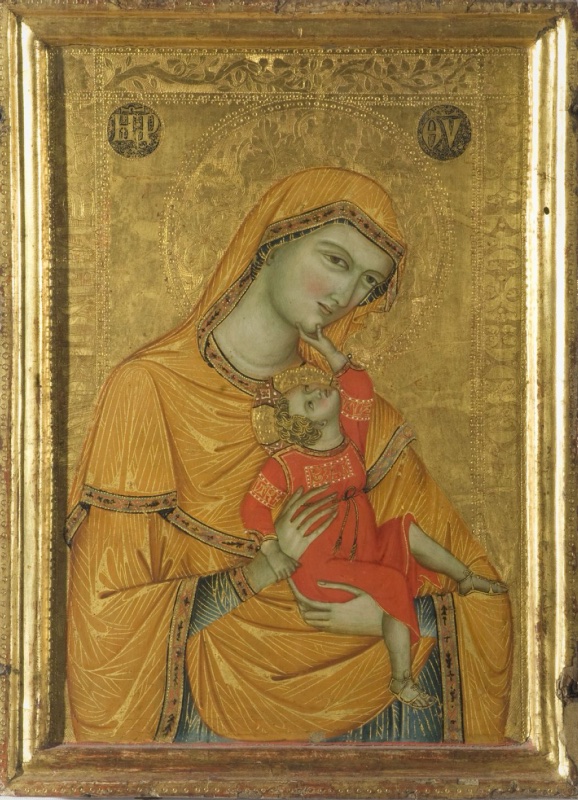
The most securely attributed work by the Maestro della Madonna di Perugia is the small panel known as the Madonna di Perugia, now in the Galleria Nazionale dell’Umbria and dated circa 1330–1340. Measuring approximately 32.3 by 23.5 centimetres, this tempera and gold on panel shows the Virgin half‑length, holding the standing Christ Child who reaches up to clasp her chin, all set against a richly punched gold ground. The panel’s provenance prior to its appearance in the Accademia di Belle Arti remains unknown, but its later incorporation into a Renaissance tabernacle with Franciscan saints on the shutters points to continued veneration and to a Franciscan devotional context in the early modern period. Iconographically, the work fuses the Eastern Pelagonitissa type with Western Gothic elegance, producing an image that is both hieratic and disarmingly intimate, and it has rightly become emblematic of the master’s oeuvre.
Other works have been proposed for the corpus, though often with greater uncertainty, including a small panel with four saints in the Vatican collections mentioned by Conti and associated in older literature with the same hand. This tavoletta, whose precise inventory number is not always given in secondary sources, is described as showing standing saints in a narrow format that echoes the slender proportions and refined linear treatment seen in the Perugia Madonna. If this attribution is correct, it would demonstrate the master’s versatility in handling not only Marian subjects but also processional or altarpiece side panels featuring individual saints, perhaps destined to flank a central image now lost. The thematic focus on holy intercessors would align with the devotional needs of confraternities and small communities seeking protectors against plague, war and other calamities, while the stylistic coherence with the Perugia panel would strengthen the case for a coherent personal idiom.
The comparison drawn by Christie’s between an Umbrian triptych auctioned as a follower of Giotto and a lost or dispersed triptych in the von Kaufmann collection, catalogued by Todini as by the Master of the Perugia Madonna, introduces yet another significant, if debated, work into the discussion. The von Kaufmann triptych, as described in Todini’s survey and echoed in the auction catalogue, presented a central Crucifixion flanked by panels with saints and scenes connected to the Annunciation, a programme rich in theological and devotional resonance. The strong structural clarity of the Crucifixion, with its dominant vertical of the cross and carefully orchestrated mourners, recalls Giotto’s dramaturgy, while the exquisite detailing of garments and halos parallels the Perugia Madonna’s ornamental sophistication, which supports the attribution to the same master in the eyes of some scholars. If accepted, this work would broaden the maestro’s profile beyond Marian imagery to include complex narrative ensembles that articulate key episodes of salvation history.
In sum, while the Maestro della Madonna di Perugia remains biographically opaque, the small constellation of works associated with his name—anchored by the Madonna di Perugia panel and augmented by proposed Vatican and triptych pieces—reveals a painter of considerable sensitivity and skill, at once deeply rooted in Umbrian devotional culture and attuned to wider stylistic currents from Siena, Assisi and the Byzantine world.