Duccio di Buoninsegna
( 25% )
Early Life and Family
Duccio di Buoninsegna was born in Siena around 1255-1260, emerging from the artisan class of the Tuscan republic that would become synonymous with the distinctive elegance and chromatic sophistication of Sienese painting. The patronymic “di Buoninsegna” identifies his father as Buoninsegna, though no records survive documenting this parent’s profession or social standing, leaving Duccio’s familial background in the obscurity typical of thirteenth-century artisan families.
The absence of the aristocratic “di” or “del” prefixes associated with noble lineages indicates that the Buoninsegna family belonged to the productive classes—craftsmen, merchants, or minor professionals—who formed the economic backbone of the Sienese commune. Early documents placing Duccio in Siena throughout his career suggest that his family maintained established urban residence rather than recent immigration from the contado, positioning them within the complex network of guild associations, parish affiliations, and neighborhood loyalties that structured medieval urban life. The city of Siena during Duccio’s youth, having recently achieved its greatest political and military triumph with the 1260 Battle of Montaperti1 against Florence, was experiencing cultural flowering that would establish it as a major center of Italian art, creating an environment wherein a talented young painter could aspire to professional success and social recognition.
Duccio’s artistic training, though entirely undocumented, must have occurred within the established Sienese workshop traditions that maintained close connections to Byzantine artistic practices while gradually incorporating Gothic influences from transalpine sources. The identity of his master remains unknown, with various scholars proposing different candidates including Guido da Siena, the shadowy figure associated with several thirteenth-century Sienese panels, or unidentified Byzantine masters who may have worked in Siena during the mid-thirteenth century.
The profound understanding of Byzantine compositional principles, iconographic conventions, and technical procedures evident throughout Duccio’s career indicates immersion in this tradition from his earliest training, whether through direct instruction from Greek painters or through intensive study of Byzantine icons and manuscripts circulating in Siena. The city’s position along trade routes connecting Italy with the Eastern Mediterranean facilitated the importation of Byzantine artworks that served as models for local painters, while Siena’s diplomatic and commercial relationships with Constantinople and other Byzantine centers created opportunities for direct contact with Greek artistic traditions. The workshop environment wherein Duccio acquired his craft would have emphasized meticulous technical training in panel preparation, the grinding and application of expensive pigments, the complex procedures of gold leaf application and tooling, and the carefully systematized approaches to figure drawing and drapery rendering that characterized Byzantine practice.
The first documentary reference to Duccio appears in 1278, when he is recorded as receiving payment for painting twelve chests or coffers for the Sienese commune’s Biccherna2 office, establishing that by his early twenties he had achieved sufficient professional recognition to secure civic commissions. This early document, prosaic in its reference to decorative rather than devotional work, nevertheless confirms Duccio’s integration into the professional networks that connected artisan workshops with institutional patrons. The subsequent documentary trail, though fragmentary, reveals a career characterized by both extraordinary artistic achievement and persistent financial difficulties, with multiple records documenting fines for various civic infractions, debts to creditors, and failure to meet military service obligations. These financial troubles, contrasting with the prestigious commissions Duccio commanded, suggest either improvident personal habits, the economic pressures facing even successful artists in an era of irregular payment schedules and expensive materials, or perhaps political difficulties resulting from factional alignments in Siena’s turbulent civic life.
Family circumstances emerge obliquely through scattered documentary references, indicating that Duccio married and fathered multiple children, though his wife’s name and the exact number of offspring remain uncertain. References to “Duccio’s sons” in various documents suggest at least two male children, while other evidence points to daughters as well, indicating a household of substantial size requiring ongoing economic support. Whether any of Duccio’s children followed him into the painting profession cannot be determined from surviving records, though the absence of any documented “Duccio dynasty” comparable to the Memmi or Berlinghieri families suggests that his workshop remained a personal rather than dynastic enterprise. The economic burden of maintaining a large family may partially explain the financial difficulties that punctuate the documentary record, with Duccio required to balance the slow payment schedules of major ecclesiastical commissions against the immediate needs of dependent household members. Property records indicate that Duccio owned a house in Siena’s Stalloreggi district near the cathedral, positioning him within the urban fabric close to his most important patron while suggesting sufficient prosperity to maintain real estate despite periodic financial pressures.
Patrons and Commissions
The cathedral chapter of Siena, the Opera del Duomo, provided Duccio with his most significant and prestigious patronage relationship, commissioning works that would establish his historical reputation and transform Sienese painting. The great Maestà altarpiece, commissioned in 1308 for the cathedral’s high altar and completed in 1311, represents the culmination of Duccio’s career and one of the most ambitious artistic undertakings of the early fourteenth century. This extraordinary commission, documented through surviving contracts that specify dimensions, subject matter, and payment schedules, required Duccio to create a double-sided altarpiece of unprecedented scale and complexity—the front depicting the Madonna enthroned in majesty surrounded by saints and angels, the back presenting an extensive narrative cycle depicting scenes from Christ’s Passion.
The cathedral chapter’s decision to entrust this supreme commission to Duccio, rather than seeking a Florentine master like Cimabue or Giotto whose innovations were transforming Tuscan painting, affirmed Siena’s cultural independence and its confidence in local artistic traditions. The contract stipulated that Duccio personally execute the work, prohibiting the kind of extensive workshop assistance common in large commissions, demonstrating the patrons’ specific desire for his individual hand rather than generic workshop production. The payment structure, involving substantial advances followed by completion payment totaling 3,000 gold florins3, an enormous sum reflecting both the work’s scale and Duccio’s elevated status, provided economic security during the altarpiece’s three-year execution period.
The celebration surrounding the Maestà’s installation in June 1311, documented in contemporary chronicles describing a processional movement of the altarpiece from Duccio’s workshop to the cathedral accompanied by clergy, civic officials, and rejoicing crowds, testifies to the work’s perceived importance as a civic as well as religious monument. This public triumph, rare in medieval artistic production, positioned Duccio as a figure of civic pride whose achievements brought glory to the Sienese republic.
The Maestà’s subsequent history, remaining on the cathedral’s high altar until 1506 when it was moved to accommodate changing liturgical practices and later dismantled with panels dispersed to various museums, ensures its enduring accessibility to scholarship while tragically destroying the original unified composition. The Opera del Duomo’s continuing patronage extended to other commissions, including the great circular stained glass window for the cathedral’s apse depicting the Virgin and Child surrounded by the four Evangelists, designed by Duccio around 1287-1288 and executed in colored glass by workshop specialists, demonstrating his versatility across different media and his capacity to design for architectural integration.
The Compagnia dei Laudesi4, the lay confraternity associated with the Dominican church of Santa Maria Novella in Florence, provided Duccio with his most significant Florentine commission—the great Rucellai Madonna, executed around 1285. This work, though long attributed to Cimabue before documentary research in the twentieth century established Duccio’s authorship, represents a crucial moment in the cross-pollination between Florentine and Sienese artistic traditions.
The commission brought Duccio to Florence at a formative moment in his career, exposing him to Florentine workshop practices, to Cimabue’s innovations in monumental panel painting, and to the competitive artistic environment that characterized Florence in the 1280s. The Laudesi’s choice of a Sienese painter for a major Florentine commission suggests either dissatisfaction with available local talent or recognition that Duccio possessed distinctive qualities unavailable among Florentine masters. The altarpiece’s subsequent installation in the prominent chapel of the Laudesi confraternity within Santa Maria Novella ensured high visibility, making it a subject of observation and emulation by Florentine painters who absorbed aspects of Duccio’s lyrical linearity and chromatic sophistication while maintaining distinct Florentine characteristics. The work’s monumental scale, comparable to Cimabue’s contemporary Maestà panels, and its technical brilliance established Duccio’s reputation beyond Siena and demonstrated that provincial Sienese traditions could compete with metropolitan Florentine achievements.
Additional Sienese ecclesiastical patrons included various religious orders and confraternities commissioning portable altarpieces, devotional panels, and processional standards. The church of San Domenico in Siena, the principal Dominican establishment in the city, may have commissioned works from Duccio, though secure attributions remain contested. The Franciscan presence in Siena similarly created demand for panel paintings and crucifixes meeting mendicant devotional emphases. These smaller-scale commissions, often involving Madonna and Child compositions or saints’ panels intended for domestic devotion or confraternity chapels, provided steady income supplementing major commissions while allowing Duccio to develop the smaller-scale compositions and intimate devotional imagery that characterized much of his production. The proliferation of works attributed to Duccio or his workshop, scattered across European and American museums, testifies to substantial production meeting diverse patronage needs, though the challenges of distinguishing autograph works from workshop productions and later imitations complicate assessment of the full scope of his activity.
Civic patronage beyond the cathedral commission appears in scattered documents, including the 1278 reference to painted coffers for the Biccherna office and other records indicating Duccio’s involvement in various municipal decorative programs. The Sienese commune’s extensive use of art for political messaging, civic identity formation, and the glorification of republican virtues created demand for painters capable of executing both prestigious altarpieces and utilitarian decorative work. Duccio’s apparent willingness to accept such varied commissions, from supreme religious art to practical decorative jobs, reflects the economic realities facing even celebrated masters in an era when artistic prestige did not guarantee financial security. The civic commissions positioned Duccio within the broader social and political networks structuring Sienese life, creating relationships with communal officials and wealthy citizens that might generate additional patronage while also exposing him to the factional conflicts and civic obligations that occasionally manifested in the fines and penalties documented in fiscal records.
Artistic Innovations
Duccio’s fundamental achievement lay in perfecting a distinctively Sienese synthesis of Byzantine tradition with Gothic elegance, creating a style characterized by lyrical linearity, chromatic sophistication, and emotional refinement that would define Sienese painting for generations. His figures, while maintaining Byzantine elongated proportions and frontal orientation appropriate to devotional imagery, were inflected with Gothic grace—the gentle S-curve of standing figures, the delicate articulation of hands and facial features, the flowing linearity of drapery folds that followed body contours while creating decorative patterns of extraordinary beauty.
This synthesis transcended mere eclecticism to create an integrated stylistic language wherein Byzantine spiritual authority and Gothic courtly refinement reinforced each other. The result was imagery that satisfied traditional devotional expectations while appealing to increasingly sophisticated aesthetic sensibilities shaped by exposure to French Gothic manuscripts, ivory carvings, and luxury objects circulating through commercial and diplomatic networks. Duccio’s figures possessed a refinement and elegance that distinguished them from the more robust, sculpturally conceived figures of contemporary Florentine masters like Giotto, establishing the aesthetic polarity between Florentine and Sienese traditions that would persist throughout the fourteenth century.
The chromatic innovations that distinguish Duccio’s work transformed Sienese painting’s relationship to color, establishing standards of chromatic sophistication that influenced subsequent generations. His palette, while employing the traditional expensive pigments—ultramarine blue from lapis lazuli, vermillion red, gold leaf—deployed them with unprecedented subtlety and complexity. The technique of modulating primary colors through careful application of translucent glazes created chromatic richness and depth unavailable through opaque application alone.
The soft transitions between tones, the subtle variations in hue across single colored surfaces, and the calculated color harmonies relating different elements within compositions demonstrated color functioning as a primary expressive and organizational tool rather than merely providing local identification of objects. The extensive use of gold, not simply as background signifying transcendent realm but tooled into elaborate decorative patterns, punched into radiating haloes, and applied to create highlights on drapery, created works of extraordinary visual splendor that satisfied patrons’ desires for manifest luxury while serving devotional functions. This chromatic sophistication, combined with meticulous craftsmanship in gold application and surface preparation, established technical standards that subsequent Sienese painters would emulate and develop.
Duccio’s approach to narrative painting, most fully realized in the Maestà’s predella and back panels depicting Christ’s Passion, revolutionized the possibilities for visual storytelling within the constraints of altarpiece format. The sequential narrative panels, arranged to be read in careful order, presented the Passion story with unprecedented psychological subtlety and attention to human interaction. Rather than depicting single iconic moments frozen in hieratic arrangements, Duccio showed narrative unfolding through time, with characters interacting through gesture and glance, crowds responding with varied emotions, and spatial settings suggesting the physical environments wherein biblical events occurred.
The Entry into Jerusalem, the Last Supper, the Betrayal, the Crucifixion, and the Resurrection appear not as timeless theological symbols but as witnessed events involving recognizable human psychology and social dynamics. This narrative approach, while maintaining doctrinal orthodoxy and devotional decorum, created imagery inviting viewers’ emotional engagement and imaginative participation in sacred history. The influence of this narrative innovation extended beyond Siena to shape Italian painting’s approach to religious storytelling, establishing models that artists throughout the fourteenth century would study and develop.
The refinement of linear draftsmanship that characterizes Duccio’s work represented crucial innovation in the technical procedures of panel painting. His underdrawings, partially revealed through technical investigation employing infrared reflectography and X-radiography, show extraordinarily precise and confident line work establishing compositions with minimal revision. This draftsmanship served multiple functions: defining figure contours with elegant flowing lines that themselves possessed aesthetic beauty, establishing complex drapery patterns that would guide subsequent paint application, and creating architectural frameworks situating figures within spatial settings. The visible outlines in finished works, rather than being entirely covered by opaque paint layers, often remained partially visible, contributing to the linear quality that distinguishes Sienese from Florentine painting. This emphasis on line as a primary expressive tool, creating rhythmic patterns across compositions and defining forms through contour rather than through volumetric modeling, established aesthetic principles that would characterize Sienese tradition and influence the development of International Gothic style in the late fourteenth century.
The integration of architectural and landscape elements within narrative compositions, while less revolutionary than contemporary Florentine spatial innovations, demonstrated Duccio’s sophisticated understanding of how environmental setting contributes to narrative legibility and emotional effect. The Maestà predella panels show buildings rendered in oblique projection suggesting spatial recession, interiors with visible architectural details providing context for human action, and landscape elements—hills, trees, architectural complexes—establishing location and creating compositional frameworks. While Duccio never achieved the systematic perspectival consistency that Giotto would develop, his empirical approaches to spatial representation created convincing settings wherein narratives unfolded. The careful attention to architectural detail, including recognizable building types drawn from contemporary Italian urban architecture, grounded biblical narratives in familiar visual vocabularies that aided viewers’ imaginative engagement. This approach to environmental representation, balancing decorative stylization with observational accuracy, influenced subsequent Sienese painting’s characteristic treatment of landscape and architecture as integral narrative elements rather than mere backdrop.
Artistic Influences
The Byzantine artistic tradition provided the foundational vocabulary of Duccio’s visual language, supplying iconographic conventions, compositional formulas, and technical procedures that he would transform into distinctively Sienese expressions. The maniera greca, as Byzantine-influenced Italian painting was termed, dominated Sienese artistic practice throughout the thirteenth century, with local painters maintaining closer connections to Byzantine precedents than their Florentine contemporaries. Duccio’s formation within this tradition instilled profound understanding of Byzantine principles—the hierarchical organization of sacred figures, the symbolic deployment of gold backgrounds signifying transcendent realm, the elongated proportions and frontal orientation of devotional figures, the systematized approaches to facial features and drapery rendering.
However, Duccio’s relationship to Byzantine tradition transcended imitation to become creative transformation, as he inflected inherited conventions with Gothic grace, chromatic sophistication, and psychological subtlety that produced works feeling simultaneously traditional and innovative. The continuing prestige of Byzantine art in early fourteenth-century Italy, particularly in Siena where political and commercial connections to the East remained strong, meant that Duccio’s sophisticated synthesis of Byzantine and Gothic elements satisfied conservative expectations while introducing aesthetic refinements that appealed to increasingly cultivated patronage.
Guido da Siena, the enigmatic master associated with several mid-thirteenth-century Sienese panels, may have influenced Duccio’s formation either as direct teacher or as the source of workshop traditions Duccio inherited through intermediaries. The stylistic connections between works attributed to Guido and Duccio’s early productions—particularly in approach to the Madonna and Child theme and in treatment of drapery patterns—suggest continuities of workshop practice, though the chronological relationship between the two masters remains contested among scholars. Whether Duccio trained in a workshop maintaining Guido’s traditions or developed his style through independent study of earlier Sienese painting, the existence of established local precedents provided foundations upon which he built his distinctive achievements. This local Sienese tradition, characterized by particular approaches to color, line, and decorative elaboration, differentiated Sienese painting from contemporary Florentine developments and established the aesthetic principles that Duccio would perfect and transmit to subsequent generations.
The influence of French Gothic art, transmitted through illuminated manuscripts, ivory carvings, metalwork, and other luxury objects circulating through trade and diplomatic networks, shaped Duccio’s synthesis of Byzantine tradition with Gothic elegance. The distinctive qualities of Gothic art—the elongated figure proportions with characteristic S-curve poses, the refined facial features and delicate gestures, the flowing linear drapery patterns, the interest in decorative elaboration and surface richness—found selective incorporation in Duccio’s work.
The exposure to French artistic products may have occurred through multiple channels: Sienese banking families maintaining operations in France, ecclesiastical connections bringing French manuscripts and luxury objects to Italian religious houses, or diplomatic exchanges between Siena and French royal or papal courts. The selective adoption of Gothic characteristics while maintaining fundamental Byzantine compositional principles demonstrates Duccio’s sophisticated approach to influence, incorporating innovations serving his aesthetic purposes while rejecting elements incompatible with Italian devotional conventions. This Gothic influence would become increasingly prominent in Sienese painting after Duccio, particularly in the work of Simone Martini, but Duccio established the fundamental synthesis that made later developments possible.
Coppo di Marcovaldo and other Florentine painters working in Siena provided models of how Byzantine tradition could be inflected with emerging naturalistic tendencies and emotional intensity. Coppo’s Madonna del Bordone, painted in Siena in 1261 while he was held prisoner following the Battle of Montaperti, demonstrated powerful chiaroscuro modeling and emotional expressiveness that influenced Sienese painters including possibly the young Duccio.
The exposure to Florentine innovations, whether through works like the Madonna del Bordone remaining in Siena or through Duccio’s own presence in Florence during the Rucellai Madonna commission, created opportunities for cross-regional artistic exchange. However, Duccio’s response to Florentine precedents involved selective adaptation rather than wholesale adoption, as he maintained distinctively Sienese characteristics—the primacy of line over mass, the emphasis on decorative richness and chromatic sophistication, the preference for elegant refinement over dramatic power—that distinguished his work from Florentine contemporaries like Cimabue and Giotto. This capacity to absorb useful innovations while maintaining stylistic identity characterized Duccio’s sophisticated approach to artistic influence and established Siena’s distinctive aesthetic path.
Travels and Career
Duccio’s documented presence in Florence around 1285 to execute the Rucellai Madonna commission represents his most significant professional journey beyond Siena and provided crucial exposure to Florentine artistic developments. The travel to Florence, approximately 70 kilometers from Siena across the Chianti hills, would have required several days’ journey with the necessary equipment, assistants, and materials for executing a major altarpiece. The decision to accept a Florentine commission demonstrates Duccio’s professional ambition and willingness to compete in the broader Tuscan artistic marketplace rather than limiting his practice to Siena. Florence in the 1280s, experiencing rapid economic growth and ambitious building programs including the ongoing construction of the new cathedral (Santa Maria del Fiore) and major mendicant churches, represented an extraordinarily competitive artistic environment wherein multiple masters of exceptional ability competed for prestigious commissions. Duccio’s ability to secure the Rucellai Madonna commission from the Compagnia dei Laudesi demonstrates that his reputation had spread beyond Siena and that Florentine patrons recognized distinctive qualities in his work unavailable from local masters.
The Florentine sojourn provided opportunities for observing Cimabue’s recent works, including his great Maestà for Santa Trinita and possibly early work in the Florentine baptistery or other civic projects. The stylistic dialogue between Duccio’s Rucellai Madonna and Cimabue’s approximately contemporary Madonna panels suggests mutual observation and perhaps competitive emulation, with both masters working within Byzantine compositional traditions while introducing distinctive innovations. Whether Duccio and Cimabue met personally, engaged in workshop visits, or simply studied each other’s completed works cannot be determined from surviving evidence, though the proximity of their Florentine activities creates possibilities for direct interaction. The exposure to Florentine painting’s emerging emphasis on volumetric modeling and spatial experimentation, visible in works by Cimabue and the young Giotto, may have catalyzed some of Duccio’s own spatial interests evident in later works like the Maestà predella panels, though he never adopted the systematic perspectival approaches that would characterize Florentine developments.
Beyond the documented Florentine journey, Duccio’s career appears primarily Sienese, with his workshop established in the Stalloreggi district near the cathedral and his major commissions coming from local ecclesiastical and civic patrons. The decision to maintain a Siena-based practice, rather than seeking opportunities in more cosmopolitan centers like Florence, Rome, or the papal court, reflected both the vitality of Sienese patronage and perhaps Duccio’s integration into local social and professional networks that provided continuing commissions. Siena in the late thirteenth and early fourteenth centuries, though smaller than Florence and lacking comparable international banking operations, maintained sufficient wealth and civic ambition to support sophisticated artistic production. The cathedral building program, the expansion of civic palaces, the construction and decoration of numerous churches and confraternity chapels created ongoing demand for painting services that successful masters like Duccio could monopolize. The absence of documented travel beyond the Florentine commission suggests either that Duccio’s Sienese patronage network satisfied his economic needs or that local civic obligations, family responsibilities, or personal preferences kept him rooted in his native city despite opportunities that might have existed elsewhere.
The organization of Duccio’s workshop, though incompletely documented, appears to have involved multiple assistants whose participation in major commissions helped meet production demands while training the next generation of Sienese painters. The scale of undertakings like the Maestà, involving hundreds of individual narrative panels and figures, required assistance in preparatory work, gold application, background preparation, and possibly execution of secondary figures under Duccio’s supervision. The 1308 contract for the Maestà, specifying that Duccio personally execute the work, should be understood as requiring his direct involvement and artistic control rather than literally prohibiting all assistant participation in a multi-year project of such scale. The question of which assistants worked in Duccio’s shop and which later became independent masters remains largely speculative, though stylistic analysis of works by Ugolino di Nerio, Segna di Bonaventura, and other early fourteenth-century Sienese painters suggests they absorbed Duccio’s principles either through direct workshop training or through intensive study of his works. This workshop structure, combining master’s artistic authority with assistant labor, characterized medieval artistic production and enabled the execution of ambitious projects while transmitting technical knowledge and aesthetic principles across generations.
Death and Legacy
Duccio’s death, occurring in Siena in 1318 or 1319, concluded a career spanning approximately four decades and establishing the foundations of Sienese painting for subsequent centuries. The final documentary references, from 1318, indicate continuing professional activity and ongoing financial entanglements, suggesting death occurred while Duccio remained engaged with workshop production and civic life. The circumstances of death and burial remain undocumented, with no tomb identified or commemorative inscriptions preserved that might provide contemporary assessments of his achievement. This biographical lacuna, typical for fourteenth-century artists, contrasts with the enduring fame of his works, particularly the great Maestà whose installation seven years earlier had occasioned public celebration. The absence of detailed death records or testamentary documents complicates understanding of how his workshop assets and professional legacy were distributed, though the emergence of numerous painters working in styles derivative from Duccio suggests that workshop traditions and possibly pattern books or drawings were preserved and transmitted to subsequent practitioners.
The immediate impact of Duccio’s death on Sienese painting manifested in the proliferation of followers and imitators who perpetuated his stylistic principles while gradually introducing modifications reflecting changing aesthetic preferences. Ugolino di Nerio, whose documented career extends from the early fourteenth century through the 1320s and 1330s, represents the most accomplished of Duccio’s immediate followers, maintaining the master’s chromatic sophistication and compositional principles while introducing subtle variations in figure types and decorative elaboration. Segna di Bonaventura, Duccio’s nephew or cousin according to some interpretations of documentary evidence, perpetuated family workshop traditions and created works closely adhering to Ducciesque principles. The Duccio school or Duccio manner dominated Sienese panel painting throughout the first half of the fourteenth century, with numerous painters producing Madonnas, crucifixes, and altarpieces that replicated or varied Duccio’s compositions and stylistic characteristics. This prolonged influence, extending decades beyond his death, testifies to the perceived authority and aesthetic success of his artistic solutions and to Siena’s conservative cultural tendencies that valued continuity with established traditions.
The transformation of Duccio’s influence through the work of Simone Martini, Siena’s other great fourteenth-century master, demonstrates how Ducciesque foundations supported progressive developments rather than stifling innovation. Simone, born around 1284 and thus active as Duccio reached career maturity, absorbed fundamental principles from the older master while introducing Gothic refinements, increased spatial sophistication, and courtly elegance that characterized International Gothic style. The relationship between Duccio and Simone—whether involving direct workshop training, collegial observation, or independent parallel development—remains debated, though stylistic connections suggest meaningful engagement with Ducciesque precedents. Simone’s capacity to build upon Duccio’s achievements while creating distinctive innovations established the pattern whereby strong local traditions facilitated rather than inhibited creative development, as subsequent generations found in established masters’ works both inspiration and challenge requiring surpassing. The marriage alliance connecting Simone to the Memmi family through his wife Giovanna, daughter of Memmo di Filippuccio, created professional networks linking major Sienese artistic families and ensuring continued dominance of painting production by interconnected workshop dynasties.
The dispersal of the great Maestà, dismantled in the sixteenth century with panels sold or donated to various institutions, paradoxically ensured Duccio’s continued visibility while destroying the work’s original unified conception. The central panel depicting the Madonna enthroned, now in Siena’s Museo dell’Opera del Duomo, and the numerous predella and back panel narratives scattered across museums in London, New York, Washington, and elsewhere, allow detailed study of Duccio’s technique and narrative sophistication while preventing apprehension of the altarpiece’s original overwhelming scale and theological complexity. Modern museum installations, typically presenting individual panels as autonomous artworks rather than reconstructing original relationships, reflect contemporary aesthetic preferences for isolated contemplation but sacrifice understanding of how the Maestà functioned as integrated devotional and theological program. Scholarly efforts to reconstruct the original configuration through photographic documentation and hypothetical diagrams provide conceptual understanding while the physical dispersal remains irreversible, exemplifying broader tensions between preserving historical context and enabling modern accessibility in museum culture.
The historiographical assessment of Duccio’s achievement has evolved substantially across centuries, reflecting changing criteria for evaluating artistic quality and shifting understanding of the relationship between Byzantine tradition and Renaissance innovation. Vasari’s sixteenth-century account, while recognizing Duccio’s importance as a founder of the Sienese school, positioned him within a narrative of gradual progress toward Renaissance naturalism that implicitly devalued his Byzantine-inflected style as representing incomplete movement away from medieval conventions. This Renaissance and post-Renaissance perspective, privileging volumetric naturalism and systematic perspectival space, found Duccio’s linear elegance and decorative sophistication less revolutionary than Giotto’s spatial and sculptural achievements, relegating Sienese tradition to secondary status in art historical narratives dominated by Florentine developments. Modern twentieth-century scholarship, informed by revised appreciation for medieval art’s aesthetic and theological sophistication and by recognition that Renaissance naturalism represented one possible artistic direction rather than inevitable progress, has substantially elevated Duccio’s reputation and recognized his achievement on its own terms rather than as imperfect anticipation of Renaissance ideals.
The technical investigations employing scientific analysis, infrared reflectography revealing underdrawings, X-radiography exposing compositional changes and structural details, and pigment analysis identifying materials and techniques, have enriched understanding of Duccio’s working methods and established more secure attributions by distinguishing his hand from workshop assistants and later imitators. These studies confirm extraordinary technical sophistication underlying works whose surface beauty might suggest purely decorative concerns, revealing complex preparatory procedures, sophisticated color mixing and layering strategies, and meticulous craftsmanship that required years of training to master. The examination of panel construction, including wood selection, join patterns, and structural supports, provides evidence about workshop organization and the practical logistics of creating large-scale altarpieces requiring collaboration among specialized craftsmen. This scientific approach, complementing traditional connoisseurial analysis based on visual comparison and stylistic assessment, creates more comprehensive understanding of Duccio’s achievement and establishes him definitively as one of the supreme masters of early Italian painting whose technical brilliance matched his aesthetic refinement.
Major Works and Masterpieces
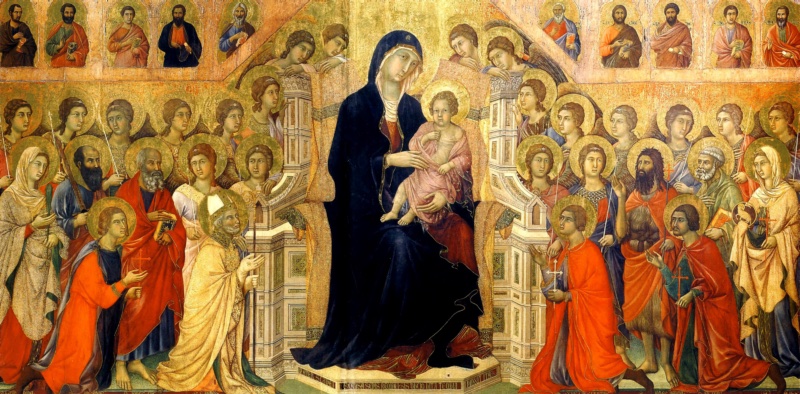
Maestà (central panel)
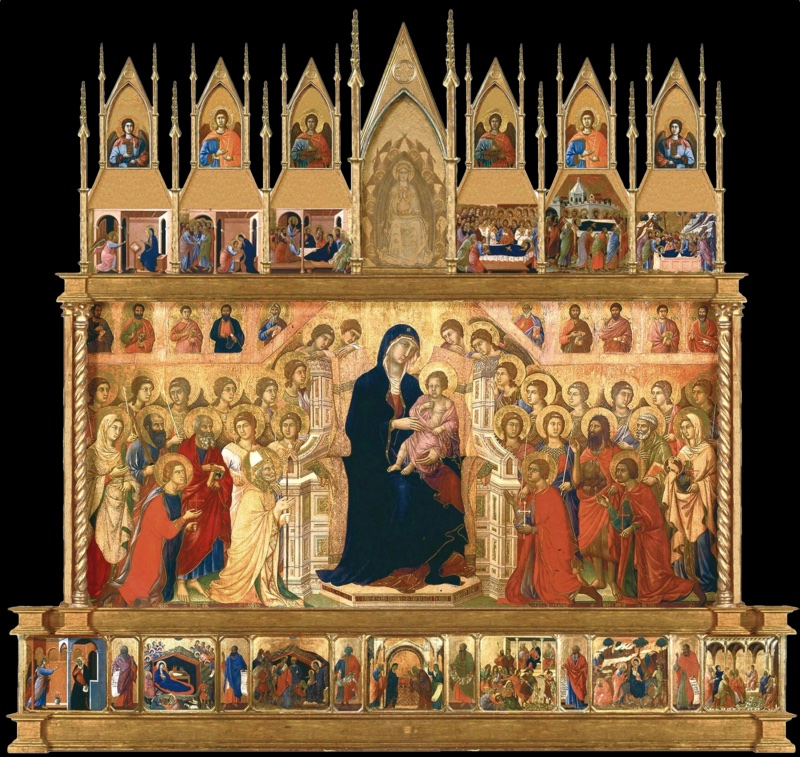
Maestà (Virtual reconstruction of the front section)
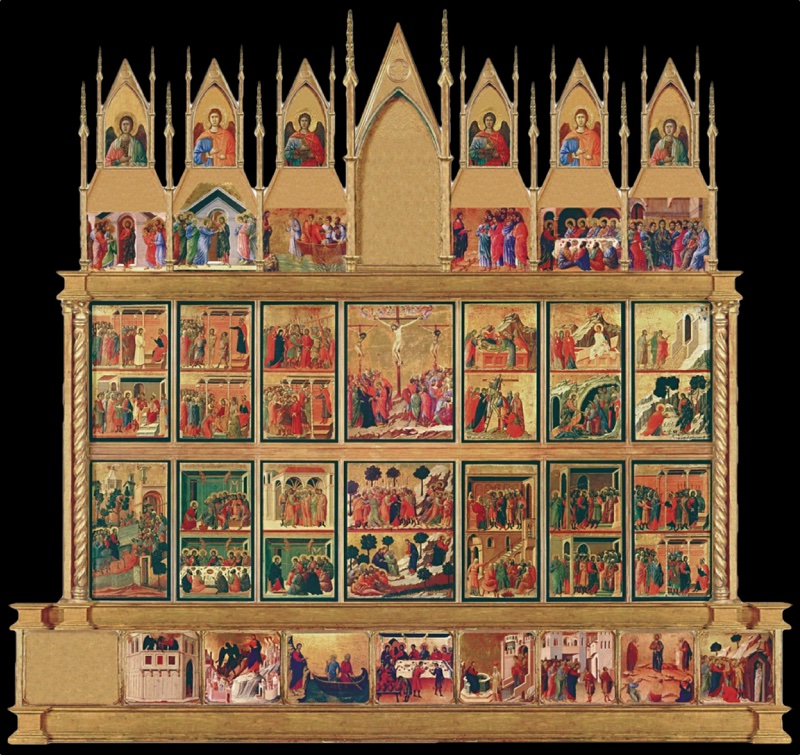
Maestà (Virtual reconstruction of the back section)
The monumental double-sided altarpiece commissioned for Siena cathedral’s high altar represents Duccio’s supreme achievement and one of the most ambitious artistic undertakings of the medieval period. The front face, depicting the Madonna and Child enthroned in majesty surrounded by saints and angels, measures approximately 214 × 435 cm for the central panel alone, with additional predella panels and pinnacles bringing the total original height to nearly 5 meters.
The Virgin, seated on an elaborate Gothic throne rendered with architectural detail suggesting actual constructed furniture, holds the Christ Child who turns toward her in a gesture of tender intimacy while maintaining hieratic authority appropriate to his divine nature. The surrounding saints, arranged in careful hierarchical order with apostles nearest the throne and local Sienese saints including patron saints Ansanus, Savinus, Crescentius, and Victor in prominent positions, create a heavenly court testifying to Siena’s special relationship with the Virgin, the city’s patron. The angels flanking the throne, rendered with varied facial expressions and individualized features despite conforming to bilateral symmetry, suggest psychological presence and create the impression of a living celestial assembly rather than abstract theological diagram.
The technical execution demonstrates Duccio’s supreme mastery of panel painting and his sophisticated understanding of how large-scale works must balance overall compositional legibility with rewards for close inspection. The gold background, extensively tooled with punched patterns creating radiating haloes and decorative borders, catches and reflects light differently depending on viewing angle, creating shimmering effects that suggest immaterial transcendent realm.
The Virgin’s ultramarine blue mantle, painted using expensive lapis lazuli pigment that contemporary documents specify was provided by the cathedral patrons, achieves chromatic intensity and depth through careful layering of translucent glazes over opaque base layers. The elaborate throne architecture, rendered with attention to Gothic decorative vocabulary including pointed arches, crockets, finials, and tracery patterns, demonstrates Duccio’s familiarity with contemporary architectural forms and his capacity to translate three-dimensional structures into painted representation. The predella panels beneath the main composition, depicting scenes from Christ’s infancy and the Virgin’s final days on earth, extend the theological program while demonstrating Duccio’s narrative sophistication in small-scale format.
The back panels, originally visible only to clergy serving at the altar and depicting an extensive Passion cycle in twenty-six narrative scenes, represent Duccio’s most revolutionary contribution to narrative painting and demonstrate possibilities for sequential storytelling within altarpiece format. The scenes, arranged to be read from left to right and top to bottom, present the Passion story from the Entry into Jerusalem through the post-Resurrection appearances with unprecedented psychological subtlety and attention to human interaction.
The Entry into Jerusalem shows crowds greeting Christ with varied gestures and expressions, children climbing trees for better views, architectural settings suggesting actual urban spaces—creating vivid recreation of witnessed events rather than iconic theological statement. The Last Supper depicts the disciples arranged around a table with Christ instituting the Eucharist, their faces showing the beginning recognition of approaching betrayal, while Judas’s position and gesture subtle differentiate him from the faithful apostles. The Betrayal shows Judas’s kiss occurring amid crowd of soldiers and disciples, with Peter cutting off the high priest’s servant’s ear and Christ simultaneously healing the wound—multiple temporally distinct moments compressed into unified composition that nevertheless maintains narrative clarity.
The Crucifixion, the central and largest back panel, presents the culminating Passion event with dramatic power tempered by decorative elegance characteristic of Duccio’s aesthetic. Christ on the cross, rendered with the curved body of the Christus patiens iconography pioneered earlier by Giunta Pisano but inflected with Duccio’s characteristic refinement, dominates the composition while crowds of mourners, soldiers, and witnesses fill the surrounding space.
The Virgin Mary, collapsing in grief and supported by holy women, and Saint John the Evangelist, gesturing toward the dying Christ, anchor the composition’s left side while soldiers casting lots for Christ’s garments and the converted centurion recognizing Christ’s divinity occupy the right. The spatial depth suggested through overlapping figures and the carefully rendered city of Jerusalem visible beyond the cross demonstrates Duccio’s capacity for spatial representation while maintaining the flat gold background’s theological significance. The emotional range expressed through varied facial expressions and gestures—grief, confusion, hostility, recognition—creates psychologically rich narrative inviting viewers’ empathetic engagement with the Passion’s human dimensions.
The subsequent dismantling of the Maestà, beginning in the sixteenth century and continuing through the nineteenth century, scattered the predella and back panels across international museums, with the National Gallery London, the Frick Collection and Metropolitan Museum of Art in New York, the National Gallery of Art in Washington, and other institutions holding individual scenes. This dispersal, while allowing widespread access to Duccio’s narrative brilliance, prevents apprehension of the original work’s overwhelming scale and complex theological program wherein individual narrative panels functioned as components of comprehensive salvation history. Modern scholarly reconstructions, combining photographic documentation with careful analysis of panel dimensions, wood grain patterns, and narrative sequence, allow conceptual understanding of original configuration while the physical reunification remains impossible given current ownership distribution across multiple institutions.
Virgin and Child enthroned, surrounded by angels (the Rucellai Madonna)
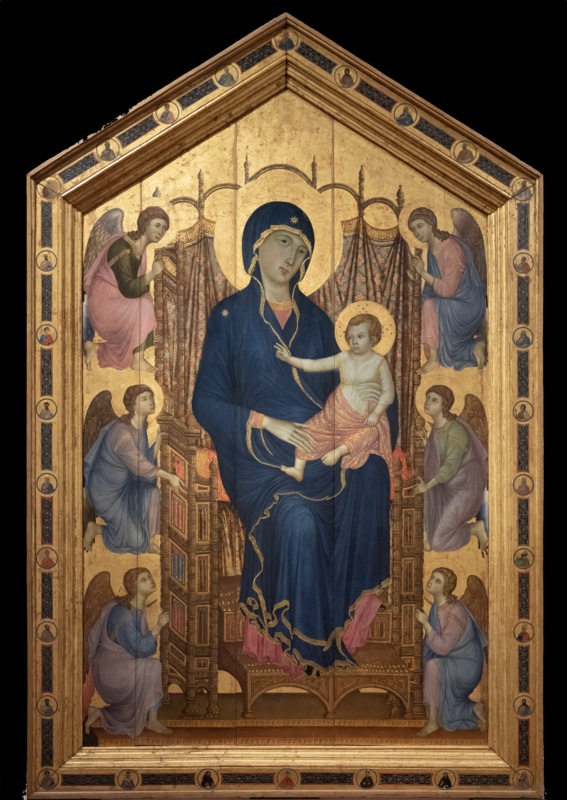
The monumental panel commissioned by the Compagnia dei Laudesi for the Dominican church of Santa Maria Novella represents Duccio’s most significant Florentine work and demonstrates his capacity to compete with Florentine masters on their home territory. The composition, measuring approximately 450 × 290 cm, depicts the Virgin and Child enthroned and surrounded by six angels in an arrangement closely paralleling contemporary Florentine Maestà compositions by Cimabue while introducing distinctively Sienese characteristics. The Virgin, seated on an elaborate throne rendered with architectural detail, holds the Christ Child who turns toward her in an intimate gesture while maintaining the frontal orientation appropriate to devotional imagery. The surrounding angels, kneeling in adoration with varied gestures and individualized facial features, create a celestial court emphasizing the Virgin’s queenly status and divine motherhood.
The technical execution reveals Duccio’s supreme craftsmanship and his sophisticated chromatic sense, with the Virgin’s ultramarine blue mantle achieving extraordinary intensity through careful layering of expensive lapis lazuli pigment. The gold background, extensively tooled with punched patterns creating decorative borders and radiating haloes, demonstrates the importance of surface richness and material luxury in devotional panel painting. The delicate modeling of facial features, particularly the Virgin’s refined physiognomy with its elongated proportions and subtle volumetric suggestion, exemplifies Duccio’s synthesis of Byzantine conventions with emerging naturalistic tendencies. The drapery treatment, combining flowing linear rhythms with attention to how cloth falls and drapes around bodies, creates decorative patterns that please the eye while suggesting underlying corporeal forms. The angels’ rainbow-hued robes—rose, green, violet, ochre—demonstrate Duccio’s interest in chromatic variety and harmonious color relationships that distinguish his work from more austere contemporary Florentine practice.
The work’s attribution history illuminates broader issues of artistic identity and the construction of canonical narratives in art history. The panel’s long attribution to Cimabue, based on Vasari’s sixteenth-century account and perpetuated through subsequent centuries, reflected assumptions that major Florentine commissions would necessarily be executed by Florentine masters and perhaps also implicit devaluation of Sienese artistic capabilities. The documentary discovery in 1889 of payment records establishing Duccio’s authorship revolutionized understanding and required reassessment of relationships between Florentine and Sienese painting traditions. The recognition that a Sienese painter could successfully compete for a major Florentine commission and create a work initially mistaken for a Florentine master’s production demonstrated the sophistication of cross-regional artistic exchange and the arbitrary nature of strict regional school distinctions. The Rucellai Madonna’s stylistic characteristics—the linear grace, the chromatic sophistication, the refined facial features—now appear clearly Sienese in retrospect, yet the work’s capacity to function successfully within Florentine aesthetic contexts demonstrates that regional styles, while distinctive, remained sufficiently flexible to accommodate varied patronage expectations and competitive pressures.
Stained Glass Window
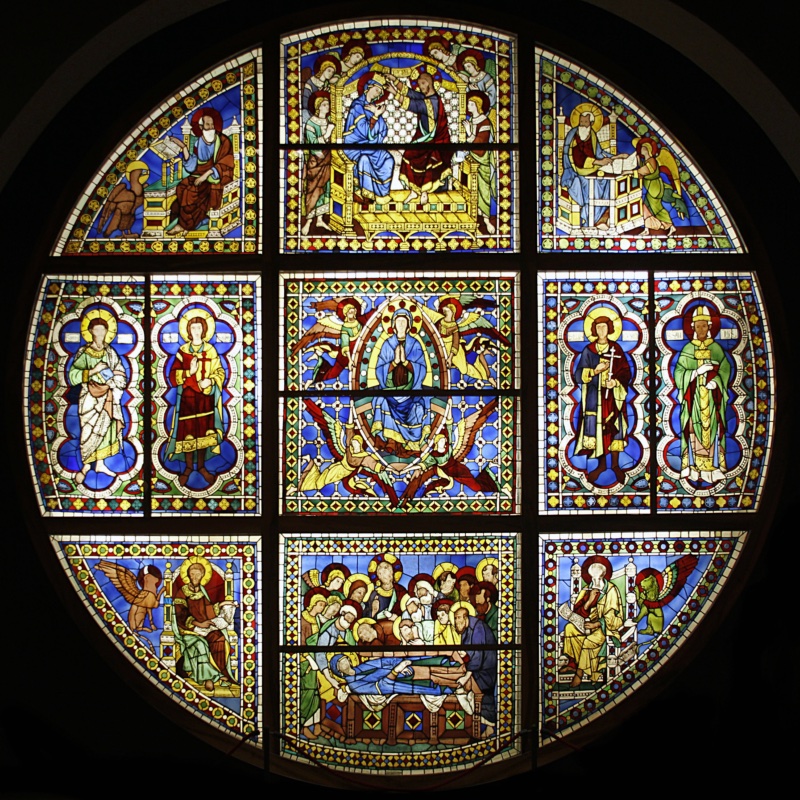
The great circular window designed by Duccio for the cathedral’s apse demonstrates his versatility across different media and his capacity to design for architectural integration. The window, approximately 6 meters in diameter, depicts the Virgin and Child surrounded by the four Evangelists in medallions, with additional ornamental borders and decorative elements filling the circular format. The design required translation of Duccio’s characteristic figure style and chromatic sophistication into the distinct medium of colored glass, where light transmission rather than surface reflection creates visual effects and where the lead caming dividing individual glass pieces imposes structural constraints on design possibilities. The collaboration between Duccio as designer providing the cartoon (full-scale preparatory drawing) and specialized glaziers executing the actual glass cutting, leading, and installation exemplifies the division of labor common in medieval artistic production, with different crafts contributing specialized expertise to collaborative projects.
The window’s prominent architectural position, filling the apse’s circular opening and visible throughout the cathedral’s interior, made it a focus of devotional attention and a demonstration of the Opera del Duomo’s willingness to invest in artistic excellence across multiple media. The colored glass, with its jewellike intensity when illuminated by sunlight streaming through from behind, created chromatic effects impossible in panel painting or fresco, producing a glowing, immaterial vision appropriate to representing the Virgin and celestial court. The integration of the window with the cathedral’s overall decorative program, coordinating with the sculptural elements of the façade and the painted altarpieces within, demonstrates the Opera del Duomo’s comprehensive approach to creating unified artistic environments wherein different media reinforced common theological and aesthetic messages. The survival of the window, despite various restorations and replacements of damaged glass sections over seven centuries, preserves Duccio’s design in substantially original form and ensures continuing visibility of his achievement in a medium where few medieval examples survive in good condition.
Madonna and Child with Saints
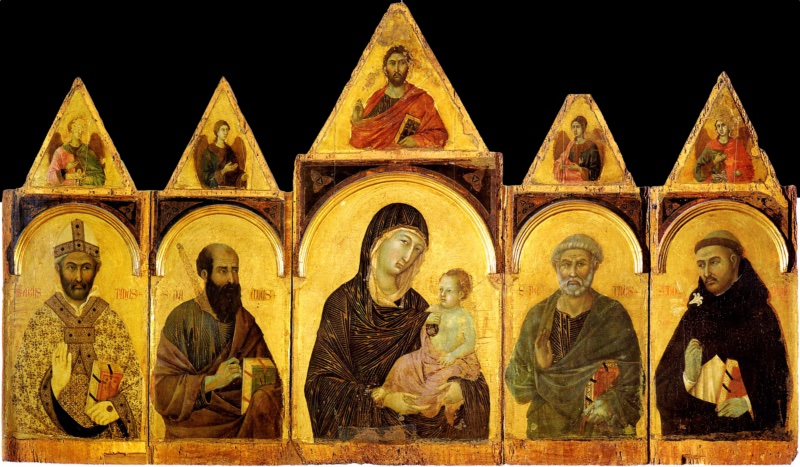
It is a polyptych with five main panels, featuring the Madonna enthroned at the center, holding the blessing Child, surrounded by saints such as Agnes, John the Evangelist, John the Baptist, and Mary Magdalene; above them are patriarchs, prophets, and angels, culminating with Christ at the top. The structure reflects the typical Sienese style of the time, with overlapping panels creating a hierarchical and devotional effect, emphasizing the centrality of the Virgin. The gold of the background, stamped and engraved, lends a sacred and luminous aura, while the vivid colors—ultramarine blue for the Madonna’s mantle, intense reds—enhance the Byzantine solemnity fused with Gothic elegance.
The Madonna, seated regally on a Gothic throne with mullioned windows, symbolizes divine Majesty, a recurring theme in Duccio’s work that evolves from the Italo-Byzantine tradition toward a greater humanistic tenderness; the Child wears the red-and-gold drapery typical of his divine nature, foreshadowing the Passion. The saints on either side, arranged symmetrically, serve as intercessors, embodying ideals of purity (Agnes), prophecy (John the Baptist), and redemption (Mary Magdalene), in a visual dialogue that invites the faithful to contemplation. This work, painted between ca. 1305–1318, reflects the Sienese context following the Maestà del Duomo (1311), showing Duccio’s evolution toward softer folds and flesh tones modeled with subtle chiaroscuro.
Duccio uses lean tempera on prepared wood, with compass-drawn gold for halos and backgrounds, a technique derived from miniature painting and Byzantine art but innovated by influences from Cimabue and French Gothic art. The garments display fluid, decorative folds, no longer rigid as in Eastern models, with transparencies in the veil and delicate shadows suggesting bodily volume, foreshadowing Giotto’s naturalism. The hierarchical scale—larger figures at the center—and minute details, such as the mullioned windows of the throne, create illusory depth without Renaissance perspective, maintaining a mystical aura ideal for devotion.
Probably created for a Franciscan or Sienese convent altar, the work bears witness to the zenith of the Sienese school, where Duccio blends Gothic spirituality and Byzantine rigor, distinguishing himself from Giotto through his linear and chromatic grace. Within the context of 14th-century Italian art, it represents the transition from medieval solemnity to a more intimate emotionality, a crucial aspect of your research on illuminated manuscripts and Sienese painting.