Giuliano da Rimini
( 25% )
It has long been believed that Giuliano da Rimini was active in the early 14th century, at a time when the Italian cultural and artistic climate was undergoing a significant transformation under the broader influence of Giotto and new humanistic ideals. Scholars generally place his birth in Rimini itself, although the exact documentation remains elusive, and the year of his arrival in the world has often been approximated to the last decades of the 13th century.
Several archival traces suggest that he was producing recognisable works as early as the first decade of the 14th century, leading some historians to deduce that his date of birth may have been around 1280 or 1290. Although these estimates are based on indirect stylistic and documentary evidence, there is strong consensus among scholars that Giuliano did indeed come from Rimini, a city whose vibrant artistic circles and access to maritime trade routes exposed him to a tapestry of influences during his formative years. From those early days, his name slowly but surely began to appear in contracts, civic registers and ecclesiastical sources, each of which hinted at his growing reputation as a painter of renown. From these references, it can be deduced that he must have received initial training or an apprenticeship in one of the active local workshops, where the craft was passed on by word of mouth, demonstration and fervent devotion to religious iconography.
Family background
He was born into a family that, while not exceptionally wealthy, held a modest position in the Rimini community. Local documents suggest that his father was a small trader in fabrics and cereals, who did business with merchants passing through the busy port. This type of work would have provided a steady, if unspectacular, income, allowing the family to consider supporting the young Giuliano if he showed any early inclination towards the arts. There is every reason to imagine him as a child watching the bales of cloth being loaded onto carts, listening intently to the conversations between his father and the travelling craftsmen, and slowly grasping the sense of possibility that such encounters can open up to an impressionable mind. His father, although not an artist himself, probably recognised the spark of creativity in his son and, according to some anecdotes handed down by local tradition, encouraged him to learn the basics of drawing and painting in a local workshop.
The maternal side of the family seems to have been involved, at least tangentially, in ecclesiastical affairs. Some references describe uncles and cousins who served as scribes, assistants to priests, or caretakers of ecclesiastical properties in and around Rimini. Through these relatives, the young Giuliano may have become familiar with illuminated manuscripts, religious ceremonies, and the iconography that decorated sacred spaces, all of which would later influence his creative palette. Family gatherings may have exposed him to theological discussions, especially if members of his extended family were literate enough to comment on the scriptures or homilies heard during Mass. These influences likely shaped his early conceptions of sacred imagery, introducing him to the idea that a painting was more than just a representation: it was a window into devotion and community identity.
His closeness to his younger siblings and cousins, if local accounts are to be believed, also fostered in him a sense of collaboration and shared commitment. In a small family unit typical of medieval Italian city-states, older children regularly helped their younger siblings with daily chores, from grinding grain to tidying up the workshop. These shared tasks undoubtedly instilled discipline and a certain empathy, qualities that may have later emerged in Giuliano’s detailed depictions of the Madonna and Child, where tenderness and mutual trust are palpable. Although there are few direct documents describing the emotional tenor of his upbringing, scattered observations in his early contracts speak to his reliability and moral seriousness, suggesting that he absorbed a strong sense of duty and family responsibility.
Extended family ties may also explain his ability to network beyond Rimini, as there are suggestions that uncles or cousins settled in other nearby cities, thus offering Giuliano both a refuge and an opportunity to showcase his art to potential patrons. Such ties were a lifeline for many artists of the time, whose fortunes rose and fell depending on whether they had safe passage and friendly introductions to new markets. In Giuliano’s case, even when documentary gaps persist, one can sense the threads of support that tied him to a wider family network that facilitated his professional steps.
There is a persistent tradition that an older relative, perhaps a great-uncle who was a parish priest, provided an early spiritual framework that lent gravity and depth to the young painter’s religious subjects. This guidance may have emphasised the symbolic resonance of the saints, the reverence due to liturgical scenes, and the clarity of expression that the faithful expected from sacred images. This exposure from an early age would anchor Giuliano’s approach to composition and subject matter, indelibly linking his art to the devout sensibility of his environment. Even when he later devoted himself to more ambitious commissions, the early family influence remained a crucial touchstone, ensuring that his works retained a sense of piety and narrative clarity.
Patronage
While still young, Giuliano attracted the attention of local notables who perceived, in the vigour and solemnity of his work, a new direction for Rimini painting. One of his first patrons, as far as can be gleaned from partial records, was a minor noble family affiliated with the Malatesta clan, which was beginning to consolidate power in Rimini. They recognised in Giuliano’s panels and frescoes the ability to blend the tradition of Byzantine-inspired solemnity with the fresher, more realistic treatments of the human figure that were then coming out of Florence under the banner of Giotto. This fusion appealed to an aristocratic taste that sought to be both ostentatious in its devotion and forward-looking in its artistic style, giving rise to commissions for small private altarpieces for family chapels or personal oratories. These early commissions were probably closely supervised by the patrons, who paid close attention to the iconography, the use of colour and the overall atmosphere projected by the scenes.
The Church almost immediately emerged as another vital patron, as local parish priests and monastic communities commissioned him to decorate chapels with cycles of frescoes depicting the lives of saints and episodes from the Gospel narratives. Monasteries, in particular, found Giuliano’s approach to painting conducive to their educational goals, as he infused his art with a gravity that was both accessible and edifying. In the turmoil of the 14th century, when social and political fortunes could change suddenly, religious institutions sought to consolidate their place by investing in lasting and visually striking artistic statements. Giuliano’s skill in biblical narrative, combined with his refined sense of composition, made him an ideal candidate for these ecclesiastical endeavours, and over the years he forged lasting relationships with abbots, priors and patrons of the church who appreciated his talent.
Secular patrons also turned to him because Rimini prospered through trade and occasional political alliances. Wealthy merchants who wished to express their civic pride commissioned him to create processional banners or decorative panels for guild halls. This type of patronage required a slightly different tone from strictly religious works, as these civic-minded men and women wanted symbols of local identity, testimonies of prosperity and tributes to the protectors of their trade. Giuliano proved himself equal to the task, adapting religious iconography to incorporate subtle references to the professional activities of his benefactors or creating layered scenes that mixed local folklore with more conventional saints. Over time, these secular commissions brought him into contact with influential figures who could extend his reputation beyond the borders of Rimini.
Occasionally, there were also special commissions from travelling dignitaries, whose presence in Rimini might be fleeting but whose social reach extended far and wide. These short-term visitors often sought unique souvenirs – small diptychs or portable altar panels – featuring their favourite saints, family crests or personal mottos. Giuliano, always attentive to the nuances of iconography, carefully incorporated the heraldic symbols or personal devotions of his visitors into his paintings, thus ensuring a tangible link between Rimini’s artistic circles and the wider networks of the travelling European elite. It is likely that word of his diligent craftsmanship spread through these fleeting encounters, leading to further opportunities outside his hometown.
Later in his career, political patrons emerged who wished to consolidate or celebrate their position in the region. Members of local government councils, for example, might commission large altarpieces for newly built or renovated churches in the hope of emphasising their role as protectors of the city’s spiritual welfare. In this capacity, Giuliano had the task of balancing the conflicting demands of his patrons’ desire for personal glorification and the Church’s insistence on doctrinal correctness. The painter skilfully navigated these treacherous waters, rarely managing to satisfy both the ecclesiastical authorities and his political financiers, thus ensuring not only payment but also a lasting legacy in the community’s memory. This ability to unite divergent interests under a single artistic vision was a hallmark of Giuliano’s success as an artist who depended on the benevolence and capital of powerful patrons.
Although we know relatively little about each individual who financed Giuliano’s art, documents referring to sums paid, materials supplied or deadlines set reveal that the painter was highly regarded by a range of different supporters. The fluid environment of the early 14th century, with its overlapping secular and religious spheres, offered him a wide range of benefactors who could both criticise and support his art. In fulfilling these commissions, Giuliano refined the confident approach that characterised his painting, an approach that is best understood by examining in detail his stylistic development, from his early works to his later triumphs.
Painting style
His painting style evolved during the transition from Byzantine formality to the new naturalism championed by Giotto and his followers. Giuliano’s earliest surviving works show traces of the elongated figures, solemn gazes and gilded backgrounds typical of medieval sacred art, with saints and biblical figures arranged in strict, hieratic compositions. However, even in these early works, there is a noticeable desire to experiment with more realistic facial expressions, nuanced shading, and a hint of spatial depth that lifts the figures from a purely two-dimensional plane. During this period, the artist made extensive use of gold leaf, highlighting the sacred figures against radiant backgrounds intended to evoke the divine realm. Nevertheless, the positioning of the arms, the tilt of the heads and the subtle interactions between the subjects already indicated an emerging realism, suggesting that Giuliano was embracing evolving modes of representation without abandoning the reverent splendour of traditional iconography.
As his career matured, Giuliano brought increasing subtlety to his palette, moderating the sharp contrast between light and dark that characterised his early Byzantine-inspired works. He introduced gentle gradations of tone, allowing for smoother transitions between areas of colour. This refined approach gives his figures a warmer, more human presence. Christ, the Virgin Mary, and various saints took on greater emotional resonance, as if Giuliano had understood that pity and empathy were not mutually exclusive. In some altarpieces, Mary’s pain, tenderness, or quiet determination become evident in the slight lowering of her eyes, while the infant Jesus, though divinely announced, shows small gestures of affectionate curiosity. The painter’s intention was clearly to bring viewers closer to the sacred narratives.
In addition to the more expressive treatment of human faces, Giuliano introduced greater dimensionality into his compositions. Instead of stacking figures on top of each other in symmetrical rows, he began to create modest illusions of depth by overlapping them at slight angles or inserting architectural motifs in the background. This innovation, which mirrored Giotto’s contemporary discoveries in perspective, was never extreme or mathematically precise—true linear perspective had not yet been fully developed—but it marked a shift from pure symbolism to a more experiential rendering of space. Such compositional choices gave viewers the feeling of entering the scene, helping them to perceive that the story depicted was taking place in a tangible environment.
Within these new spatial arrangements, Giuliano also became skilled at highlighting focal points. He would sometimes draw the viewer’s eye to the central figure, typically Christ or the Virgin, by means of a subtle luminous nuance or the gently curving line of secondary figures that guide the gaze inwards. This attention to narrative, which places the main figures in the moral spotlight and surrounds them with a supporting cast, became a distinctive feature. While some older iconographic traditions presented saints in rigid, isolated poses, Giuliano’s saints often interact, turning gently towards one another, sharing gestures of supplication or casting affectionate glances at the central theme. These choices infuse the painting with a sense of movement and communal worship rather than static formality.
His treatment of drapery is another aspect of his style that evolved over time. Early on, the folds of clothing could appear stylised, forming rhythmic patterns reminiscent of the Romanesque or Byzantine traditions. But as he embraced emerging naturalism, the folds became softer, conveying the underlying structure of the body and the weight and texture of the fabric. In scenes involving multiple figures, the variety of drapery not only highlights the hierarchy or role of individuals, but also lends a harmonious unity to the entire composition, emphasising a pictorial flow that guides the viewer’s eye.
Colour harmony was equally significant in Giuliano’s work. His early works display the strong contrasts typical of medieval painting, dominated by rich blues, bold reds, and brilliant golds. Later, he embraced a more balanced scheme, integrating softer tones, exploring transitions within a single colour range, and occasionally employing pastel tones in secondary elements such as background architecture or ornamental details. These changes reflect both the evolution of artistic tastes and Giuliano’s growing confidence in orchestrating colour to achieve emotional and narrative effects. Through careful layering of pigments, Giuliano could capture the luminous essence of flesh, the sheen of a halo, or the delicate transition from the highlights of a garment to its recesses.
Equally notable is Giuliano’s fascination with gestures. Hands, in particular, become eloquent conveyors of emotion in his mature works. Saints may raise a palm in blessing, or worshippers may clasp their hands in prayer, each gesture calibrated to convey devotion, wonder, or humility. In group scenes, subtle bodily angles suggest relationships: an apostle craning his neck toward Christ, a devotee leaning forward in amazement, or an angel gently lifting the hem of the Virgin’s robe. These small but powerful cues inject a narrative dynamism into Giuliano’s panels, which many contemporary witnesses found moving and spiritually illuminating.
Overall, Giuliano’s stylistic evolution shows an artist walking a fine line between tradition and innovation. His works never entirely abandon the medieval sense of the sacred, retaining a certain gravity and symbolism in their arrangement, golden halos, and choice of subjects. However, by integrating emotional expressiveness, subtle depth, and more naturalistic drapery, he contributed significantly to the wave of change that would transform European art. While not as radically innovative as Giotto, he represented a regional reflection of those broader movements, adapting them to the tastes and liturgical needs of the Rimini domain.
Artistic influences
He was undoubtedly influenced by Giotto’s revolutionary approach to three-dimensionality and emotional narrative. Although it is unclear whether Giuliano ever worked directly with Giotto, it is likely that he assisted or studied Giotto’s frescoes, through sketches, second-hand accounts or perhaps even a direct visit to Padua or Florence. The profound impact of Giotto’s frescoes in the Arena Chapel1 - where space, form and human emotions took on a new verisimilitude - is echoed in Giuliano’s more confidently modelled figures and the compositional clarity that characterises his best works. The idea that sacred stories could be rendered in a way that would reach the hearts of the faithful with the same force with which they reached their eyes was a revelation to many painters of Giuliano’s generation.
Equally significant was the broader Rimini School that surrounded him, which included contemporaries such as Giovanni Baronzio and Neri da Rimini. Although each artist had his own distinct traits, they shared certain regional idioms: the interaction between Byzantine formality and the new wave of realism, the emphasis on bright but modulated colour palettes, and a predilection for gentle facial expressions. It is likely that these painters influenced each other through local commissions, workshop collaborations, and ongoing conversation within the city’s artistic milieu. Giuliano, for his part, seems to have absorbed the best of these local influences while forging a personal style that was distinctly his own.
He may also have been inspired by older pictorial traditions of the Italo-Byzantine style that persisted in some monastic communities. The gold-ground panels and solemn frontal presentations seen in his early works speak to this venerable heritage, which shaped Italian painting for centuries. The icons and mosaics of Ravenna, a relatively short distance from Rimini, were accessible, and their resonance of timeless spirituality found an echo in Giuliano’s preference for majesty and compositional harmony. Even in his later years, he occasionally returned to some of these older visual tropes, perhaps out of nostalgia or in response to patrons who preferred a more traditional approach.
Another influence, albeit more subtle, may have come from the trends of Northern Gothic, which spread to Italy via trade routes along the Adriatic. The delicate linear ornamentation, the graceful elongation of the figures and the decorative motifs in the framing of the altarpieces sometimes suggest transalpine inspiration. Although not as evident as Giottesque influence, this northern element can be detected in the filigree motifs and refined sense of line that sometimes surface in Giuliano’s narrative details. Such cross-cultural influences highlight the dynamism of the 14th-century art world, in which ideas were shared between regions much more widely than is often believed.
Literary trends, particularly religious texts, also played a role in shaping his artistic imagination. Hagiographies and sermons, which circulated among monastic communities, provided ample narrative possibilities for depicting miracles, martyrs, and virtuous deeds. Giuliano may have drawn from these texts a deeper understanding of theological themes, which he then translated into emotionally resonant images. Furthermore, the Franciscan emphasis on the humanity of Christ and the Dominican passion for didactic clarity likely left their mark on the way he portrayed scriptural events. By grounding biblical scenes in tangible human experiences, Julian was in step with broader cultural currents that sought to bring spirituality closer to the faithful.
The local civic culture, with its festivals, processions, and public celebrations, offered constant immersion in symbolic spectacle. Rimini’s pageantry often involved costumes, banners, and theatrical performances that transformed the streets into dramatic stages. It is plausible that Giuliano’s aptitude for composition was reinforced by observing these events, which placed living, moving figures against architectural backdrops in a manner not unlike a painter’s arrangement of forms on a canvas. The city’s civic rituals constantly reminded him of the visual power of uniting the community around shared beliefs.
Even outside the confines of Rimini, Giuliano was exposed to the theological debates of the time, particularly those centred on the representation of the sacred. The 14th century was a time of ferment and introspection for the Church, with challenges such as the Avignon papacy, local heresies and the push for reform. Painters, as a result, had to navigate a delicate path between tradition and new currents of thought. Giuliano’s work, which balances a deep veneration for the mystical with a growing attention to human emotions, can be read as a visual response to those complex theological currents that were reshaping the spiritual landscape of late medieval Italy.
Over time, the artist refined his practice by dissecting and reassembling these multiple influences, gradually finding ways to integrate them into his own vision. His ability to remain stylistically flexible, drawing on Giotto’s innovative perspective, the Rimini School’s characteristic blend of formality and emotional engagement, and the more distant echoes of Northern and Byzantine traditions, shows a painter who understood that the evolution of art is a constant dialogue with the past and the present. Rather than rejecting tradition, he found subtle ways to blend them, thus ensuring that his works spoke to a wide audience seeking spiritual resonance, regional pride, and aesthetic pleasure.
Travels
His travels in Italy, although not exhaustively documented, constitute an essential chapter in his life and help to explain the stylistic breadth evident in his surviving works. It can be assumed that Giuliano often travelled the motorways and secondary roads of the Italian peninsula in search of new clients, new inspiration or simply a change of perspective from the daily routine of his hometown. As Rimini was a strategic point along the Adriatic coast, his travels could have been facilitated by both land and sea routes, making it plausible that he visited some of the major artistic centres of the time.
It is believed that he spent a fruitful period in Bologna, a city revered for its universities and lively intellectual environment. There, Giuliano would have had the opportunity to interact with local artists and perhaps study the elements of Gothic architecture that were spreading in ecclesiastical buildings. The city’s lively academic activity may also have exposed him to theological treatises and philosophical discourses, further broadening his conceptual framework. His stay in Bologna probably brought him commissions, as local churches and wealthy families would have welcomed a painter from Rimini with fresh stylistic qualities to complete the cultural tapestry of the growing city.
Florence is another place that has been hypothesised as part of his itinerary, although evidence remains scarce. Had he travelled there, he could have become more directly acquainted with Giotto’s works, including the transformative frescoes of Santa Croce and the innovations seen in the altarpieces of Badia, now lost. Such a pilgrimage to Florence, the cradle of the new naturalism, would have given Giuliano’s brush new energy, spurring him to further refine the emotional clarity and spatial coherence that would define his later works. Although documentation is lacking, stylistic echoes in some of his mature paintings suggest that, in one way or another, he assimilated the Florentine lesson.
He also seems to have travelled south, at least as far as the Papal States, to secure ecclesiastical commissions from communities intrigued by the Rimini style. These commissions may have involved painting small chapels or restoring older frescoes, tasks that required considerable diplomacy given the complex political alignments of the time. In these southern regions, he would have encountered artists influenced by Roman traditions, thus gaining an insight into the bold narrative cycles that decorated the walls of churches and cloisters. This cross-fertilisation of ideas was typical of the peripatetic life of a painter who relied on a wide range of clients for his livelihood and artistic growth.
Venice may also have been part of his itinerary, as suggested by the subtle traces of Venetian colourism in some of the altarpieces attributed to him. Although Rimini itself had maritime links, Venice was the great port city that served as a gateway to the East and a confluence of countless artistic styles. Even a brief stay there would have exposed Giuliano to the dazzling mosaics of St Mark’s, the play of light on the water and the city’s particular fondness for radiant colour harmonies. It is not difficult to imagine that he stopped in Venice to absorb these elements before bringing them back into his pictorial narratives.
Tradition has it that Giuliano visited smaller towns along the Apennines, perhaps following the routes of pilgrims or merchants. In these remote areas, churches and convents sometimes needed skilled artists to create altarpieces or devotional images. Although modest, such commissions required an adaptable approach, as local tastes might favour a more traditional or even archaic style. Giuliano’s willingness to meet these expectations, without abandoning the fundamental steps he had already taken towards realism, allowed him to maintain a steady income while discovering new motifs, landscapes and the quiet charm of hilltop communities.
Wherever he went, travel was not just a means to an end, but a defining influence on his worldview. Long journeys on horseback or by carriage allowed him to contemplate the changing landscape, observe rural life and forge bonds with travellers from different backgrounds. Merchants, clerics, soldiers and craftsmen shared their stories in roadside inns or within the city gates, offering Giuliano new perspectives on events and legends that lay beyond the horizon of Rimini. These encounters enriched his narrative skills, allowing him to draw on a broader repertoire of themes when depicting saints who were venerated differently from region to region.
These journeys were also crucial for building a network of colleagues, apprentices, and workshop collaborators. Painters in medieval Italy often exchanged ideas about pigments, brush techniques, and the logistics of large-scale fresco projects. By leaving Rimini, Giuliano was able to refine his methods, experiment with new materials, or learn about innovations—such as a better approach to plaster preparation—that would improve the quality and durability of his work. In turn, Giuliano spread the Rimini flavour throughout the regions he visited, leaving behind altarpieces and panels that carried his characteristic blend of reverence, emotional warmth, and evolving spatial awareness.
Even in his later years, he did not completely abandon the road. Although aged and perhaps more selective about the commissions he accepted, Giuliano remained open to invitations from faraway places. Such requests might come from nobility, church leaders, or civic councils who appreciated his established reputation. These periodic travels, well into his mature years, reinforce the idea that Giuliano saw himself not only as a local painter tied to the fortunes of Rimini, but as a travelling craftsman in tune with the cultural heart of an Italy constantly negotiating between tradition and innovation. When his final travels came to an end, he had left behind a trail of works that bore witness to both his personal evolution and the broader artistic currents that were shaping the peninsula.
Death
The precise details of Giuliano da Rimini’s final years are somewhat obscure, as the early years of the 14th century offer only sparse mentions in documents that have survived to the present day. However, the weight of scholarly opinion suggests that he died around the mid-1320s, probably in or near Rimini, where most of his known works were produced. The exact date is not documented, but many historians believe that 1324 is a plausible estimate, given the sudden cessation of commissions bearing his signature and the appearance of references to the settlement of his estate. The cause of death remains unknown, although disease and epidemics were common enough at that time to cause the deaths of many, including luminaries of the arts and the church. It is entirely possible that the painter succumbed to some illness or natural cause, leaving behind an artistic legacy that subsequent generations could only reconstruct through careful study of the scattered altarpieces, crucifixes, and panels attributed to him.
Important works
The Coronation of the Virgin and the Saints
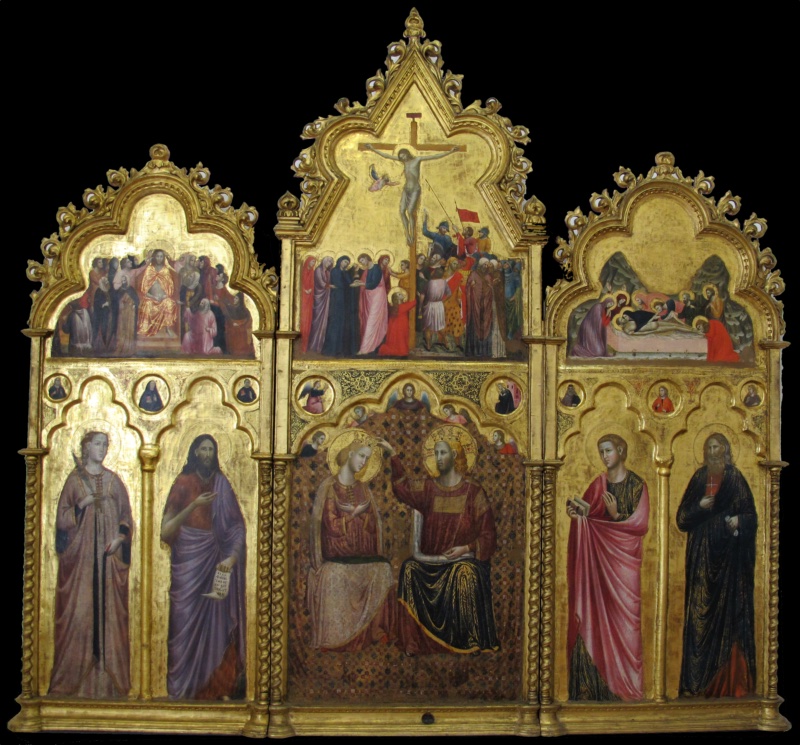
The polyptych consists of three main panels, framed by an architectural structure featuring multi-lobed Gothic niches supported by tapered columns. The central panel, which is larger, depicts the Coronation of the Virgin: Christ crowns Mary as she sits on the throne, while above, the scene of the Crucifixion is set against the spandrel, featuring a dense procession of figures and an aura of sacred theatricality. In the spaces between the arches below, there are roundels with busts of martyr saints, representing a type of “minor saints” that punctuates the scene with iconography rich in liturgical and devotional references.
On the sides, in the lower registers, full-length figures of saints are framed within modest arches: on the left, Saint Catherine and Saint John the Baptist; on the right, Saint John the Evangelist and Saint Andrew, arranged in a devout and solemn posture that recalls Giotto’s tradition of statuesque figures. In the lateral spandrels of the upper register, Giuliano places episodes from the Passion: the Mockery of Christ on the left and the Deposition into the Tomb on the right, narratively linked to the central crucifixion and rendered with a lively direction of gestures and glances. The overall composition dissolves the architectural space into an interplay of frames, arches, and medallions, creating an almost theatrical atmosphere, where the sacred scene stands out against a golden background with richly decorated fabrics, rendered in a refined color scheme of light tones, typical of the family workshop.
The support consists of wooden panels prepared with chalk and glue, onto which Giuliano applied tempera paint with extensive use of gold leaf, especially in the backgrounds and halos, which are engraved with a burin to create motifs of plant clusters and extremely fine decorations. On the back of the panel is a later decoration, featuring in the center the figure of the devout pelican, a Eucharistic emblem that refers to the sacrificial theology of the Passion.
The overall dimensions of the triptych are impressive: the total width is approximately 500 cm, while the height is around 205.5 cm. More specifically, the central panel measures 190.5 cm in height by 71.5 cm in width, while the side panels are slightly shorter but of equal width: 154 cm for the left panel and 155.5 cm for the right, each 67 cm wide. These measurements confirm the polyptych’s “wall-mounted” design, intended for a main altar in a Franciscan or Dominican church, where the scene of the Coronation could serve both as a devotional focal point and as an image designed for scholastic and Franciscan-Observant iconography.
Crucifixion
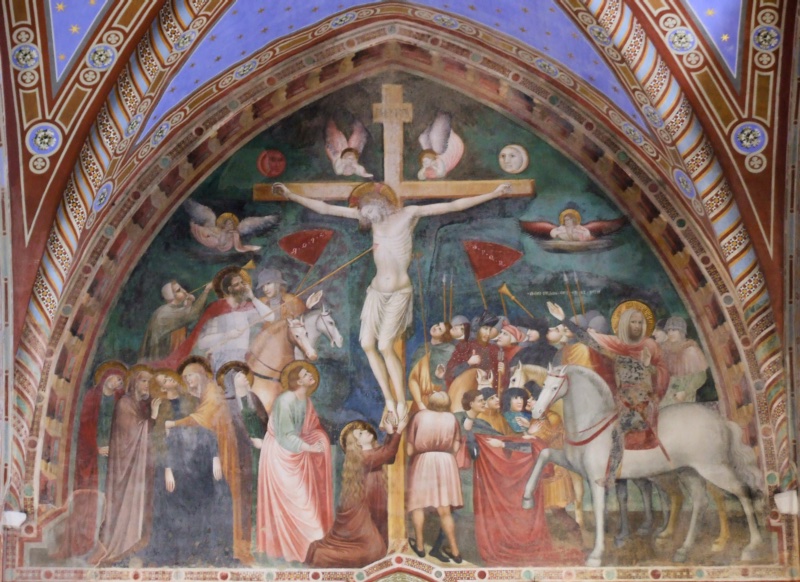
The Crucifixion in the Church of San Marco in Jesi is a large mural fresco attributed to the Rimini workshop of Giuliano da Rimini (or jointly to Giovanni and Giuliano da Rimini), painted in the first half of the 14th century and part of the Giotto-inspired movement active in the Romagna and Marche regions. It is one of the building’s artistic cornerstones, located in the upper part of the last bay of the central nave, where it dominates the sacred scene spatially.
The fresco depicts Christ crucified at the center, his body in agony and marked by a dramatic physical rendering, within a broad scene that includes the Virgin Mary and saints surrounding the cross. To the right of the Crucifix appears the fainted Madonna supported by a pious woman, while to the left unfolds a group of figures, including some “onlookers” who are part of the tragic spectacle, making the narrative more intensely emotional and evocative. At the foot of the cross are Mary and Saint John the Evangelist, in accordance with medieval iconographic tradition, with Christ’s body silhouetted against the light, highlighted by a light background or a sky that accentuates the solitude of Golgotha.
The style clearly falls within the orbit of Romagnolo Giottesque art, with moderately sculptural volumes, measured yet heartfelt gestures, and a chiaroscuro that suggests a certain three-dimensionality, albeit within a structure that remains strongly decorative. The figure of Christ displays a rugged and intense expressiveness, typical of Rimini painting between the second and third decades of the 14th century, where the precociousness of Giottesque style blends with more archaic solutions and a certain harshness of line. Light and luminous colors, dominated by reds and ochres, are applied across broad chromatic planes, giving the whole the quality of monumental narrative painting, designed to impress the faithful from the nave and to punctuate the sequence of sacred stories decorating the church.
In the church of San Marco in Jesi, the Crucifixion serves as a high point of the sacred narrative, situated at the end of the central nave, almost as an emblem of redemption. It is flanked, on the side walls, by other important scenes (such as the Annunciation and the Dormition of the Virgin), which together create a coherent visual cycle, attributable to painters of the Rimini school active in the Marche region. In this context, the Crucifixion also acquires the value of a theological summa within the space, placing the death and resurrection of Christ at the center of the Franciscan devotional experience that informs the church.
Virgin and Child Enthroned with Saints
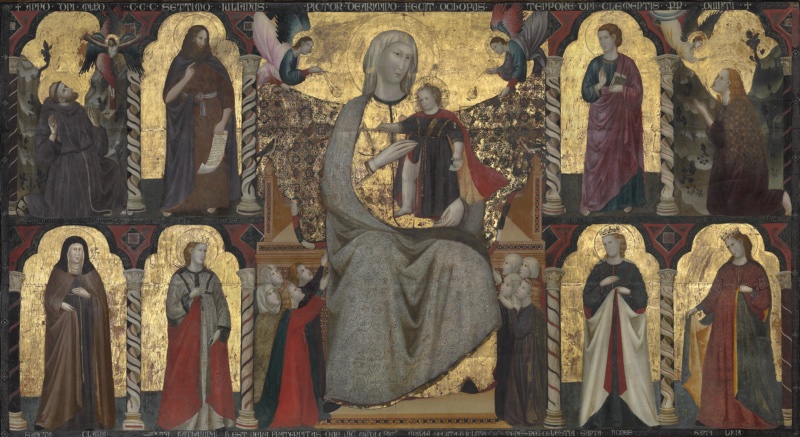
Giuliano da Rimini’s Virgin and Child Enthroned with Saints (1307) is a large frontal polyptych, painted in tempera and gold on wood, originally commissioned for a Franciscan altar and now housed at the Isabella Stewart Gardner Museum in Boston. With its substantial dimensions (approximately 164 × 300 cm), the panel dominates the space with a clearly hierarchical composition, centered on the Virgin and Child Enthroned, surrounded by a large assembly of saints and supplicants.
The image is organized into several horizontal registers, with the Madonna seated on a majestic throne at the center, facing the viewer directly, while the Child is held close in her arms. Surrounding the Virgin, saints and devout figures are arranged with alternating regularity, either in a semicircle or in a symmetrical order, in a manner that recalls both the Byzantine tradition and the compositional innovations of Giotto’s followers. The background is gilded, as was customary in fourteenth-century devotional art, and the figures stand out sharply against the gold, with incised outlines and defined profiles.
The altarpiece was commissioned for the Order of St. Clare, in a Franciscan church (San Giovanni Decollato) in Urbania, near Urbino, and Giuliano structured the iconographic program with a strongly hagiographic and monastic focus. At the bottom, on the lower band, female saints such as Saint Catherine, Saint Agnes, and Saint Lucy appear, while near the Virgin Mary are figures of supplicants, some dressed as nuns, others with crowns or noble insignia, who embody the sisters and founders of the order. In a prominent position is Saint Clare, founder of the Poor Clares, often depicted in the lower left, with Saint Francis above her, emphasizing the dual Franciscan-Claresian charismatic lineage.
Giuliano da Rimini blends a composition that is still essentially “architectural” and frontal with a subtle emergence of depth and spatial breadth, visible in the perspective lines of the throne and in the overlapping of the figures. The garments are rendered with sharp, nervous folds, executed in an almost Gothic manner, with bulges and longitudinal “drapes” reminiscent of the Roman and Giottesque painters, while the faces tend toward a certain softness and gentleness, especially the female ones. The use of large swaths of gold, richly decorated costumes, and miniature details (such as jewelry, vestments, and patterned backgrounds) accentuates the sacred-luxurious character of the panel, designed for a monastic setting and for the collective devotion of the nuns.
The work was conceived as a central focus of contemplation for a community of nuns, with particular emphasis on the female figures and the intercessory role of the Virgin. In the explanatory inscription running along the top or the edge (as reported in some descriptions), the text emphasizes the existence of a “true” sisterhood of devotees and the intercessory power of the Virgin Mary, inviting the nuns to identify themselves physically and symbolically with those figures kneeling before the throne. In this way, the polyptych is both a historical-hagiographic document and a tool for spiritual formation, spatially and visually consecrating the presence of the women of the community at the heart of the sacred scene.
Crucifixion with Mary and John the Apostle
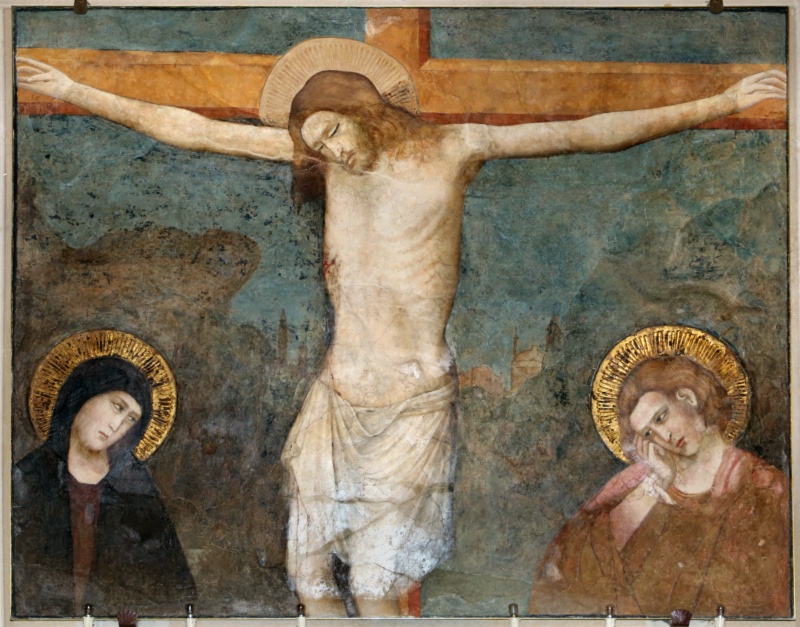
This fresco, attributed to Giuliano da Rimini, originally came from the Convent of the Servants of Mary of San Pellegrino in Forlì (Palazzo dei Servi di Maria), where it likely adorned the chapter house; today it is publicly preserved in the same location or in an exhibition space associated with the complex.
At the center of the scene stands the crucified Christ, with a slender body and elongated limbs, rendered in a style typical of mature Giottesque art and the emerging “Gothic Classicism” that characterizes Giuliano da Rimini’s work. His arms are outstretched and his feet are crossed, with his head slightly tilted back in a gesture of surrender and pain, while the figure is rendered with soft chiaroscuro, without dramatic exaggeration, in line with the devout yet contemplative tendency of the Romagna school.
The body is marked in a concise manner by the wounds, but the scene avoids raw realism; the emphasis is primarily on the symbolic and spiritual pain, rather than on the wounded anatomy. At the foot of the cross are the two main figures of the group: the Virgin Mary and Saint John the Evangelist, often—but not always—accompanied by other mourners or saints, according to the tradition of the Servite cycles.
Mary is depicted with a contemplative turn, her hands clasped or raised in a gesture of piety, wrapped in a blue cloak that falls in broad, flowing folds, with an expressive intensity that is sober yet charged with pathos. Saint John, typically depicted as the young apostle, is placed on the other side of the cross, with an attitude of attentive participation and almost as a spiritual guide for the viewer, in the role of a privileged “witness” to the Passion.
Giuliano da Rimini’s style is evident here in the restrained cry, in the moderate volumetry of the figures, and in the construction of a space that, while not articulated in perspective, rests on a horizontal base line that organizes the lower register. The folds of the drapery are dense and subtle, with a play of lines that draws the eye toward Christ, while the palette remains relatively light and luminous, with pearlescent and blue tones that evoke Giotto’s legacy and the Assisi tradition widespread in Romagna. Despite its large size, the painting does not seek a highly theatrical spatial effect, favoring instead a compositional synthesis and an intimate meditation, suited to the conventual function of the chapter house.
The work places the image of the crucified Christ within a context of Servite devotion, that is, linked to the spirituality of the Servants of Mary, which placed great emphasis on Mary’s compassion and the shared suffering of the saints. In this sense, the presence of Mary and St. John must also be interpreted as a model of piety for the friars gathered in the hall, while the scene takes on the value of both a sacramental remembrance and an ascetic tool for meditating on the Passion.