Maestro della Maestà delle Volte
( 25% )
Introduction
The name Maestro della Maestà delle Volte designates an anonymous painter active in Perugia in the early decades of the fourteenth century, whose conventional identity is based on the Marian fresco once venerated under a vaulted passage in Via Maestà delle Volte. No archival document records his personal name, family, or precise dates, but the commission of the Maestà in 1297 and its stylistic features situate his activity around the third decade of the fourteenth century. The extant fresco with the Madonna, the Child, and attendant angels, heavily repainted yet still legible in its core composition, remains the principal work on which his personality has been reconstructed. Later scholarship has long debated whether this hand should be distinguished from, or assimilated to, other anonymous Umbrian painters such as Marino di Elemosina and the so‑called Maestro della Madonna di Perugia.
The painter is generally regarded as a local master rooted in Perugian civic and devotional culture, but open to broader currents from Assisi, Siena, and the Riminese area at the turn of the fourteenth century. His oeuvre, very limited in securely attributable works, stands at the intersection between communal piety, confraternal patronage, and the visual strategies of urban control that exploited images of the Virgin as protectress of the city. The present report gathers the fragmentary documentary and historiographical evidence, reconstructing the artist’s biographical horizon, patronage network, stylistic profile, and possible influences, while also considering the debated catalogue of his works. It also situates the Maestà delle Volte within the topography and civic iconography of medieval Perugia, drawing on urban, architectural, and devotional studies. Given the anonymity of the painter, the following pages necessarily operate with hypotheses and probabilities, clearly distinguishing them from documented facts. The report aims to offer a critical, evidence‑based synthesis rather than a fictional biography, foregrounding both what is known and what remains conjectural.
Family Background and Social Milieu
Virtually nothing is documented about the family of the Maestro della Maestà delle Volte, and even his civic status—whether a full citizen of Perugia or an immigrant craftsman—must be inferred indirectly from stylistic and contextual evidence. The designation of the master as an autore locale in Treccani’s survey of medieval Perugia strongly suggests that modern scholarship situates him within the city’s own artisanal and artistic milieu, as opposed to a transient foreign painter. Given the chronology of the Maestà around 1310–1320 and the commission recorded in 1297, it is reasonable to suppose that he was born in the final decades of the thirteenth century, likely in Perugia or its contado, so as to be a mature master by the time of the work. The structure of Perugian society in this period, dominated by arti and confraternities, implies that any painter working on a prominent public Marian image in a key urban passage would have had to be integrated into local corporate networks, perhaps through kinship ties with craftsmen, notaries, or minor officials.
The close relationship between painters and woodcarvers, as attested by the local production of sculpture and painted panels connected to the decoration of churches and oratories, makes it plausible that his family environment was one in which multiple artisanal skills coexisted within the same lineage or vicinanza. Comparisons with documented Umbrian masters such as Marino di Elemosina, whose signature on the Valdiponte Madonna reveals his dual status as painter and civic figure, suggest that families could combine workshop activity with participation in communal governance. In this sense, the Maestro della Maestà delle Volte may be considered representative of a strata of urban craftsmen whose identities remain largely submerged but whose work shaped the devotional landscape of the city. The absence of a family name in the sources is itself significant, revealing how the memory of artisanal lineages could be eclipsed when not anchored by extraordinary fame or extensive documentary traces. Nonetheless, the persistence of his notname in modern scholarship testifies to the enduring visibility of the Maestà within Perugia’s collective memory and urban fabric, even as the individuals behind the image have been forgotten.
Hypothetical Kinship and Workshop Structures
Although direct proof is lacking, the Maestro della Maestà delle Volte almost certainly operated within a workshop context in which kinship ties played a fundamental role in the transmission of skills and commissions. Studies of other Umbrian painters of the period show that fathers, brothers, and sons frequently collaborated on altarpieces, fresco cycles, and manuscript illumination, blurring the boundaries between individual authorship and collective production. The technical competence required to execute a large fresco under an urban vault—where difficult angles, perspective distortions, and exposure to humidity posed serious challenges—implies a well‑organized bottega, possibly involving relatives trained from adolescence.
In such a context, the anonymity of the master’s personal name might conceal a dynastic reality in which several family members contributed to the same project, while only one stylistic personality has been isolated by modern connoisseurship. The iconographic and formal affinities between the Maestà delle Volte and other Marian images in the Perugian district, some of which were later associated with Marino di Elemosina or the Maestro della Madonna di Perugia, have encouraged scholars to posit networks of related workshops circulating models and cartoons. These relationships could well have been underpinned by marital alliances or shared domestic spaces among artisans from neighboring parishes, reinforcing the sense that the Maestro emerged from a dense fabric of family‑based collaboration.
The probable proximity of his dwelling and workshop to the civic center—given the importance of the Maestà’s location near the Palazzo del Podestà—would have facilitated daily contact with patrons, confraternities, and fellow craftsmen working on nearby sites. Thus, even in the absence of names, the socio‑familial environment of the Maestro can be reconstructed typologically as that of a small urban household whose economic survival depended on a continuous flow of commissions mediated by communal and ecclesiastical institutions. This broader pattern lends credibility to the hypothesis that the master belonged to a modest but integrated artisan family whose history, though undocumented, was intertwined with that of Perugia’s Trecento urban elite and religious communities.
Social Status and Civic Identity
The commissioning of a Maestà in so visible and politically charged a site as the passage under the Palazzo del Podestà presupposes that the painter had achieved a level of professional recognition and trust that is unlikely for a completely marginal figure. The Maestà delle Volte was not a private domestic image but a public icon, closely linked to the self‑representation of the commune and the need to sacralize a contested urban space. Comparable cases in central Italy show that such commissions, often promoted by confraternities or civic magistrates, were normally entrusted to artists whose reputation in the city was already established, even if their names are no longer known. This suggests that the Maestro della Maestà delle Volte enjoyed a moderate but significant standing within the urban community, perhaps being a member of the painters’ or mixed artisans’ guild, and recognized as capable of handling an image with both devotional and disciplinary functions.
His social identity would thus have combined the humility proper to a craftsman with a certain symbolic authority derived from his role in shaping the city’s sacred topography. In Perugia, where visual culture was deeply implicated in communal politics—as evidenced by the elaborate sculptural program of the Fontana Maggiore and the rich decoration of the Palazzo dei Priori—the production of a Maestà under a civic vault aligned the painter with broader processes of ideological communication. This integration into civic identity is further implied by later interventions: in 1335 an oratory was erected to protect the image, and in the fifteenth century it was embellished with sculpture by Agostino di Duccio, marking the Maestà as a long‑term focal point of urban devotion. The continuity of care suggests that the original commission had successfully met communal expectations, indirectly validating the artistic and social competence of its author. Therefore, even in the absence of explicit records, the Maestro can be located within the mid‑level strata of Perugian artisans who contributed indispensably to the visual manifestation of the commune’s religious and political ideals.
Absence of Documentary Genealogy
The silence of archival sources about the Maestro della Maestà delle Volte, despite the wealth of documentation preserved for Perugia’s communal building projects, highlights the structural limits of medieval record‑keeping for reconstructing artisanal genealogies. Large‑scale civic enterprises such as the Fontana Maggiore or the Palazzo dei Priori preserve the names of leading architects and sculptors, whereas the painters of minor oratories, street shrines, and devotional panels often appear only implicitly through later notnames derived from their works. The Maestà delle Volte, while important in the devotional life of the neighborhood, remained peripheral to the monumental programs that attracted detailed contracts and payment records, which explains why no extant document associates a proper name with the fresco.
Moreover, the destructive fire of 1534 that consumed the medieval Palazzo del Podestà and much of its archival material further reduced the chances of recovering early references to the painter or his family. Historians of Umbrian art have therefore been obliged to reconstruct his profile primarily through stylistic comparison and the urban history of the site, a method that, while rigorous, cannot yield personal genealogical data. The resulting picture is one of a master whose biological kin are lost to history, yet whose artistic lineage can be partially mapped through affinities and divergences with other local and regional painters. This situation is not exceptional but typical for many Trecento artists below the highest echelon, and it warns against overly confident reconstructions of family trees based solely on style. Consequently, any discussion of the Maestro’s family background must be presented as a reasoned hypothesis grounded in analogies with better documented cases, rather than as a factual biography. The historiographical discipline of maintaining this distinction between evidence and conjecture is itself part of the legacy of modern scholarship on anonymous masters of the Duecento and Trecento.
Patrons: Communal Authorities and Urban Governance
The location of the Maestà under a structural vault of the Palazzo del Podestà, which housed the communal magistrates, strongly indicates that the original commission was authorized, if not entirely financed, by the civic authorities of Perugia. The palace, renovated and decorated with paintings between 1282 and 1292, functioned as a key symbol of communal power, and the decision to adorn one of its supporting arches with a Marian image corresponded to a deliberate strategy of sacralizing the seat of government.
Urban historians note that the passage later known as Via Maestà delle Volte was a narrow, dark thoroughfare leading from the cathedral square towards other quarters, and that the Maestà was possibly intended to deter malefactors and sanctify a potentially dangerous space. In this context, the patrons of the fresco would have been the priors of the commune or other civic magistrates acting in concert with ecclesiastical authorities, perhaps the cathedral chapter or a nearby confraternity, to ensure the orthodoxy and efficacy of the image. The intertwining of civic and religious initiatives is characteristic of Perugia’s Trecento visual culture, where civic halls, fountains, and gates were often entrusted to artists whose works bore complex symbolic programs negotiated between lay and clerical patrons.
The survival of the Maestà, though repainted, within a later oratory built in 1335 to protect it, and reconstructed after the fire of 1534, confirms that successive generations of civic and ecclesiastical elites considered the image worthy of conservation and renewed framing. While specific names of individual patrons remain unrecorded, the institutional patronage of the commune emerges clearly from the urban and architectural context. This institutional framework conditioned the iconography, scale, and style of the work, encouraging a solemn but accessible representation of the Virgin and Child flanked by angels suitable for a mixed audience of magistrates, citizens, and travelers. Thus, the Maestro’s primary patrons can be identified in general terms as the communal and ecclesiastical bodies that orchestrated the visual identity of Perugia’s civic center in the early fourteenth century.
Confraternities and Lay Devotion
Beyond strictly communal authorities, confraternities and lay devotional groups likely played an important role in commissioning, maintaining, and ritualizing the Maestà delle Volte. Throughout central Italy, Marian images in urban passages were often associated with companies of laymen who organized processions, lamps, and almsgiving around them, thereby integrating the images into a rhythm of daily and festal practices. The creation of an oratory in 1335 to shelter the Perugian Maestà, later rebuilt in the sixteenth century, suggests the institutionalization of a cultic focus that exceeded mere architectural ornament and responded to lay devotional needs.
Such oratories, frequently endowed by confraternities, provided spaces for collective prayer, votive offerings, and gatherings, and typically preserved records of benefactors and statutes, even if these have not survived in this case. The Maestro della Maestà delle Volte would therefore have interacted with lay patrons concerned not only with the theological propriety of the image but also with its capacity to generate emotional responses and protective efficacy.
In this environment, the painter’s ability to articulate a tender yet hieratic relationship between the Virgin and Child, mediated by adoring angels, would have been especially valued as a means of eliciting trust and supplication from viewers. The persistence of veneration, documented indirectly by the repeated architectural investments in the site, points to a successful alignment between the painter’s visual vocabulary and confraternal expectations. Although the names of specific lay patrons are lost, their collective agency is inscribed in the history of the image’s conservation and the transformation of the vaulted passage into a quasi‑chapel overlooking one of Perugia’s most evocative medieval streets. Consequently, the Maestro’s artistic identity cannot be divorced from the devotional communities that animated and sustained the Maestà over the centuries.
The broader stylistic and iconographic milieu of the Maestro della Maestà delle Volte is inseparable from the presence of the Franciscan and Dominican orders in Perugia, both of which fostered intense Marian devotion and promoted new forms of narrative and doctrinal imagery. The Dominicans, established at S. Domenico, commissioned extensive cycles of frescoes and illuminated choir books that included scenes such as the angels bringing bread to the table of Saint Dominic, a subject attributed in one case to the Maestro della Maestà delle Volte.
Even if the exact attribution remains debated, the association of his name with such a theme underscores the likelihood that members of the order or their associated confraternities were among his patrons for works beyond the Maestà in Via delle Volte. The Franciscans, whose basilica at Assisi exerted a powerful gravitational pull on Umbrian artists, also contributed to shaping the expectations of patrons in Perugia, who would have been familiar with Giottesque solutions to Marian and Christological subjects.
Within this environment, the Maestro’s patrons might have sought a stylistic compromise that balanced the sober didacticism favored by the mendicants with the refined elegance and coloristic sweetness associated with Sienese painting. Theological advisors from these orders, perhaps acting as confessors or preachers to the confraternities, could have influenced the choice of inscriptions, gestures, and symbolic details in the Maestà, though no such directives are recorded. The painter’s sensitivity to both doctrinal clarity and affective appeal would have been indispensable in negotiating such expectations, further explaining why his services were retained for images associated with religious orders. Thus, while direct documentary links between the Maestro and specific friars are lacking, the patronage of mendicant institutions and their spiritual networks formed an essential part of the horizon within which his oeuvre emerged.
Patrons in the Perugian Contado
Some scholars, notably Scarpellini and Todini, have related the Maestà delle Volte to a group of Marian images in the surrounding countryside—at Valfabbrica, Sant’Egidio, Pieve Pagliaccia, and Sant’Angelo—which were at various times attributed to Marino di Elemosina or the Maestro della Madonna di Perugia. Even when these works are no longer assigned directly to the Maestro della Maestà delle Volte, the stylistic kinship suggests that similar rural patrons, including monasteries, parish churches, and local confraternities, sought images of the Virgin modeled on successful urban prototypes.
The diffusion of this typology indicates that his urban patrons in Perugia may have acted as intermediaries or exemplars for patrons in the contado, who wished to replicate the protective and intercessory function of the Maestà within their own communities. In such cases, the socio‑economic profile of patrons ranged from relatively wealthy abbeys, such as Valfabbrica, to modest rural parishes, all of whom perceived Marian images as crucial instruments of spiritual and social cohesion. The painter’s responsiveness to different scales and contexts—adapting the core iconography to panel, fresco, or perhaps even miniature—would have been a key factor in his appeal to this heterogeneous patronage base. Although the boundaries of his personal catalogue remain contested, the network of patrons implied by these stylistically related works helps situate him within a regional system of artistic exchange anchored in Perugia but radiating into the countryside. This patronal geography, in turn, reflects the interdependence of city and contado in shaping devotional imagery and offers a plausible, if indirect, glimpse into the diversity of clients who may have sought out the Maestro’s services.
The history of the Maestà delle Volte after its creation reveals successive waves of patronage devoted not to commissioning new works from the Maestro but to preserving and recontextualizing his image in response to changing urban and liturgical needs. In 1335 the construction of an oratory around the fresco can be regarded as a new phase of patronage, in which civic and ecclesiastical authorities reaffirmed their commitment to the image by providing it with architectural protection and a more formal cultic setting.
The later addition in 1470 of sculptural revetment by Agostino di Duccio further enhanced the visual and symbolic prominence of the site, demonstrating that Renaissance patrons continued to value the medieval Maestà as a focus of devotion. After the disastrous fire of 1534 that destroyed the Palazzo del Podestà and much of the medieval fabric, the decision to rebuild the oratory in 1567 with a Renaissance façade testifies to the ongoing investment of resources in the conservation of the image, even as urban tastes and architectural languages evolved.
Modern transformations, including the deconsecration of the oratory and its adaptation to secular uses such as a shop, have not erased the memory of the Maestà, which remains embedded in the toponymy and tourist narratives of Via Maestà delle Volte. These successive appropriations—medieval, Renaissance, and modern—reflect the work’s capacity to accommodate new patrons who reinterpreted its significance while maintaining some continuity with earlier devotional functions. Though these later patrons had no direct relationship with the Maestro himself, their sustained efforts to frame, restore, and promote his fresco are integral to understanding the long reception of his art. The Maestà thus serves as a palimpsest of patronage, in which the original Trecento commission is overlaid by centuries of architectural and ritual interventions that collectively testify to the enduring impact of the anonymous painter’s work.
Stylistic Profile: General Characteristics
The stylistic identity of the Maestro della Maestà delle Volte has been reconstructed primarily from the surviving Madonna with Child and angels in the oratory on Via Maestà delle Volte, despite later overpainting that complicates precise analysis. Scholars generally agree that the image belongs to the early Trecento and exhibits a synthesis of local Umbrian traditions with more progressive currents from Siena and Assisi. The Madonna is enthroned frontally, holding the Child on her lap, while attendant angels flank or hover near the throne, creating a celestial court around the Virgin that nonetheless remains accessible to the viewer in the street below.
Even through later restorations, the composition preserves a certain monumental calm, with a centralized focus on the intimate but hieratic relationship between Mother and Child. The figures display a modest volumetric articulation, more solid than the linear Byzantine manner but less robust than the full Giottesque plasticity seen in Assisi, suggesting an intermediate stylistic position. The painter’s handling of drapery, with soft, somewhat schematic folds, and his use of color, likely once enriched by gold ground and saturated pigments, point to an awareness of Sienese solutions, even if filtered through local practice.
Facial types, with slightly elongated ovals and gentle, contemplative expressions, align the master with the so‑called “Masters of 1310” identified in Umbrian painting, who modulated Giottesque models with a more lyrical sensibility. Overall, the stylistic profile emerging from the Maestà is that of a competent, reflective painter positioned at the crossroads of major artistic currents but working primarily for a local audience and within the constraints of a functional urban shrine.
One of the distinctive aspects of the Maestro’s style is his capacity to integrate pictorial imagery with a challenging architectural setting, namely the underside of a structural vault across a narrow street. The Maestà was originally painted under a supporting arch of the Palazzo del Podestà, so that passers‑by would encounter the Virgin and Child looking down upon them as they moved through the dimly lit passage. This required the painter to adjust proportions and sight lines to counteract foreshortening and to ensure legibility from below and at oblique angles, a task demanding both technical skill and spatial imagination.
The composition’s vertical emphasis, with the enthroned Madonna occupying the central axis of the vault, suggests an intentional alignment with the viewer’s line of sight as one approached from the piazza, reinforcing the sense of protective oversight. The probable use of a gold or luminous background would have amplified the image’s visibility in the semi‑darkness of the covered way, while the angels’ arrangement around the throne might have been calibrated to follow the curvature of the vault, creating an enveloping celestial canopy.
Such spatial sensitivity aligns the Maestro with broader trends in Italian mural painting where artists responded inventively to the demands of vaults, lunettes, and apsidal curves, often using figure placement and architectural motifs to mediate between real and painted space. In the case of the Maestà delle Volte, the image not only decorates the architectural support but also symbolically reinforces it, as if the Virgin’s presence were sustaining the very structure under which citizens pass. This intimate dialogue between painting and architecture is a hallmark of the master’s style and contributes decisively to the work’s enduring impact within the urban environment.
Iconography and Devotional Function
Iconographically, the Maestà delle Volte belongs to the widespread type of the enthroned Madonna and Child surrounded by angels, a formula particularly favored in communal settings where the Virgin was invoked as patron and protectress of the city. The choice of this subject, rather than a narrative scene, underscores the desire for a stable, timeless presence rather than a specific biblical episode. Within this typology, however, the Maestro appears to have introduced subtle nuances in gesture and gaze that mediate between the transcendence of the Virgin and her accessibility to urban viewers below.
The Child likely engages the viewer more directly, perhaps blessing or holding a scroll, while the Madonna’s gaze, though serene, may incline slightly, suggesting her attentive oversight of the street and its passers‑by. The angels, positioned symmetrically, reinforce the sense of a celestial court while also acting as models of veneration, inviting the faithful to join their praise and intercession. This configuration aligns with contemporary emphasis on Marian mediation and reflects the theological currents disseminated by mendicant preaching, in which the Virgin’s compassion and protective power were repeatedly extolled. The placement of the image at a liminal point between the cathedral square and other urban zones further enhances its function as guardian of thresholds, both physical and spiritual. Thus, the Maestro’s iconographic choices, while conventional in broad outline, are finely tuned to the specific devotional and topographical functions demanded by his patrons and the city’s religious culture.
The style of the Maestro della Maestà delle Volte cannot be understood in isolation from the broader constellation of Umbrian painters active around 1300–1330, including figures such as the Maestro di San Francesco, the Maestro Espressionista di Santa Chiara, and Marino di Elemosina. Treccani’s overview of Perugia highlights a flowering of local painting grounded in the monumental cycles at Assisi but articulated through diverse “maestri locali” whose works adorned churches, abbeys, and urban oratories. Within this milieu, the Maestro shares with his contemporaries a concern for clear narrative or devotional focus, a preference for relatively large, legible figures, and a gradual move away from the stiff hieratic formulas of earlier Duecento Italo‑Byzantine painting.
At the same time, compared to the more dramatically modeled and emotionally charged works of the Espressionista di Santa Chiara, his Maestà appears more restrained, aligning him with a slightly more conservative or decorous current within Umbrian art. The affinities with panels and frescoes previously grouped under Marino di Elemosina or the Maestro della Madonna di Perugia, particularly in the treatment of the Virgin’s mantle and the gentle inclination of heads, suggest shared workshop practices or reciprocal influence among artists working in and around Perugia. These interconnections have led some scholars to propose that the Maestro della Maestà delle Volte formed part of the so‑called “Maestri del 1310,” a loose sodality of Spoletan and Perugian painters who collectively mediated Giottesque innovations for regional audiences. While such constructs remain heuristic, they underscore the extent to which his style participates in a dynamic local tradition rather than representing an isolated anomaly.
A recurrent theme in the historiography of early Trecento Umbrian painting is the impact of Sienese art, particularly that of Duccio di Buoninsegna and his school, on local Marian imagery. Lunghi’s analysis of Marino di Elemosina’s Madonna from Valdiponte emphasizes its dependence, at the level of iconographic scheme, on a Duccesque prototype—probably the Maestà painted for the Cappella dei Nove in the Palazzo Pubblico of Siena—while noting that its spatial measure and solid plasticity derive from Assisi‑based masters.
Although this discussion concerns another painter, the fact that Scarpellini related the Valdiponte Madonna to the Maestà delle Volte indicates that similar combinations of Sienese elegance and Umbrian solidity were perceived in the latter. The Maestro’s gentle modeling of faces, the rhythmic fall of draperies, and the serene solemnity of the enthroned Virgin resonate with the Duccesque ideal of a refined, courtly Madonna, even as the volumetric treatment and somewhat earthier physiognomies betray a stronger Giottesque substratum. This dual allegiance reflects broader patterns in Perugia, where Nocera and Spoleto masters, influenced by Cimabue and Giotto, interacted with imported Sienese works and their local imitators. The Maestro della Maestà delle Volte thus occupies a position within a cross‑regional dialogue, adapting selective Sienese features to the expectations of his patrons while maintaining a fundamentally Umbrian sense of weight and presence. His style can therefore be read as part of a negotiated synthesis in which Duccesque lyricism is tempered by Assisi‑derived monumentality, a synthesis well suited to the needs of a civic Marian image in Perugia.
Principal Work: The Maestà delle Volte in Perugia
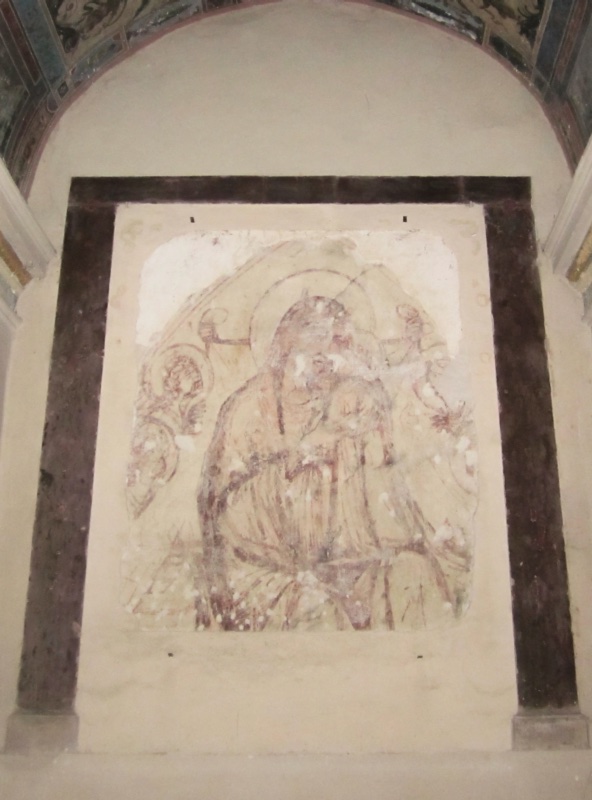
The fresco depicts the Madonna Enthroned (Majesty) with the Child, flanked by angelic figures, according to the iconographic tradition of the Theotokos Enthroned, inspired by Byzantine models but reworked in an Italian Gothic style. The composition is centered on the majestic figure of the Virgin seated in the center, recognizable by her frontal posture and the throne that exalts her as Regina Coeli. On either side are adoring angels, including, according to some theological interpretations of the original image, figures reminiscent of the Seraphim, the highest angels in the celestial hierarchy, guardians of the divine Face. The baby Jesus was probably depicted sitting on his Mother’s lap, according to the Hodegetria pattern.
What appears in the image today is largely the sinopia or the first preparatory layer of the fresco, i.e., the underlying drawing executed with red earth on the plaster, made visible by the almost total loss of the overlapping layers of paint. The areas of color that can still be glimpsed—ochre and reddish-brown tones—belong to the deepest layers of the execution, while the original chromatic finishes have been almost completely lost due to the passage of time and, above all, the destructive events that have affected the oratory. Above, the archivolt vault still preserves traces of geometric decorations in blue and green, belonging to a later decorative phase, probably from the 16th century.
The fresco was created with a specific apotropaic and devotional function: painted under a dark vault in the Palazzo del Podestà in Perugia, in a narrow and dangerous street, its declared purpose was to discourage evildoers and protect passers-by by invoking the protective presence of the Virgin Mary. In 1335, to protect and enhance the sacred image, a veritable oratory was erected around the fresco, that of the Maestà delle Volte, which became a place of worship for the city.