Maestro di San Francesco
( 25% )
The Maestro di San Francesco, designated in Italian scholarship as Maestro di S. Francesco and rendered in anglophone literature as the Master of Saint Francis, stands as one of the most consequential and yet most irreducibly anonymous figures in the history of thirteenth-century Italian painting. His very identity is a scholarly construction, the product of art-historical inference rather than archival documentation, and his biography must therefore be reconstructed through stylistic analysis, iconographic interpretation, and the historical circumstances of his commissions rather than through any surviving documentary record that names him directly.
The denomination by which he is universally known was coined in 1885 by the German art historian Heinrich Thode, who associated several works of coherent style and shared iconographic vocabulary under the rubric of a single master, deriving the name from a panel painting of Saint Francis with Two Angels then preserved in the sacristy of Santa Maria degli Angeli in Assisi. As an anonymous master, he was almost certainly active in the third quarter of the thirteenth century, with scholarly consensus placing the arc of his career between approximately 1250 and 1280. Hypotheses regarding his place of birth have varied considerably across more than a century of art-historical debate: some scholars have proposed Pisan origins, citing formal and stylistic affinities with the Pisan pictorial tradition and in particular with the workshop of Giunta Pisano, while others have emphasized his thorough assimilation of Umbrian artistic culture and suggested that his training, if not his birth, was solidly rooted in Umbria.
If the hypothesis of Pisan origins is accepted, one might tentatively propose a birthdate somewhere in the second or third decade of the thirteenth century, perhaps around 1220 to 1235, consistent with a career beginning in earnest by the mid-1250s. The alternative hypothesis, advanced by those who find his formation inseparable from the Umbrian milieu, does not necessarily contradict a Pisan origin, since mobility between artistic centers was entirely normal for a craftsman of his period and attainment. Some scholars, noting that he was possibly a member of the Franciscan1 Order itself, forse un religioso, as Italian critics have phrased it, have suggested that his formation may have taken place within the walls of a Franciscan house, perhaps combining monastic discipline with artistic apprenticeship in a tradition common among mendicant painters of the Duecento. Whatever his origins, the painter who would later be identified by Thode as the Maestro di San Francesco was formed at a historically remarkable moment:
the decades immediately following the death of Saint Francis of Assisi in 1226 and the rapid institutional consolidation of the Franciscan Order, events that generated an unprecedented demand for devotional images throughout central Italy. The basilica complex at Assisi, begun in earnest after 1228 under papal patronage and the direction of the Friars Minor, became the central gravitational force in the artistic landscape of mid-thirteenth-century Italy, drawing painters, glaziers, and sculptors from across the peninsula and from transalpine Europe, and it was within this environment that the Maestro di San Francesco would accomplish the most significant work of his career.
Family and Social Formation
The social and familial background of the Maestro di San Francesco lies, by definition, beyond the reach of documentary reconstruction, since no contract, notarial act, testament, or guild record has yet been identified that might restore his given name or attach him to a traceable lineage. The anonymity that envelops him is not exceptional for an artist of his period and geographic context: the Duecento Italian workshop functioned within a system of artisanal transmission in which the master’s identity was largely subsumed within the collective enterprise of the bottega, and in which signed works constituted the exception rather than the rule. If one accepts the hypothesis of Pisan origin, it is reasonable to situate his early formation within the exceptionally dynamic artistic culture of Pisa in the second quarter of the thirteenth century, a city whose commercial connections with Byzantium, its crusader networks, and its role as a Mediterranean entrepôt had made it one of the principal points of absorption and transformation of Byzantine visual culture in the Italian peninsula.
Pisa in this period sustained a vigorous tradition of panel painting and mosaic work, and the workshops that produced devotional panels for the city’s many Franciscan and Dominican2 churches would have provided a young painter with direct exposure to Byzantine iconographic models, to the use of gold grounds, to the depiction of the Christus patiens, and to the compositional syntax of multi-figured narrative scenes. The workshop into which such a painter would have entered as a young apprentice was, in all probability, that of Giunta di Capitino, known to art history as Giunta Pisano, whose documented activity spans approximately 1229 to 1254 and whose work in the chapel of the Porziuncula at Assisi and in San Francesco at Pisa established the normative vocabulary for the Franciscan painted crucifix of the mid-thirteenth century.
If the Maestro di San Francesco was trained in Giunta’s workshop, as a large body of scholarship maintains, then his “family” in the most professionally meaningful sense would have been the community of the bottega: the master, his journeymen, and the other apprentices who shared the daily rhythms of panel preparation, pigment grinding, gilding, and the execution of under-drawings and final passages of paint. Medieval workshop culture structured these relationships with an intimacy and hierarchical discipline that in many respects paralleled and complemented the structures of family life: the master was simultaneously employer, teacher, and, in some cases, the head of a domestic household within which apprentices resided and ate, learning their craft through years of graduated participation in real commissions. If the Maestro di San Francesco was himself a member of a religious order, a hypothesis that several Italian critics have advanced with some persistence, then his “family” would also have been the confraternity of his religious house, the community of Friars Minor who would have been simultaneously his brothers in religion and his primary commissioners.
The possibility that the painter was a Franciscan friar has particular appeal in the light of the devotional intensity and theological sophistication that characterize the fresco cycle in the Lower Church of Assisi: the careful parallelism between the life of Saint Francis and the Passion of Christ, the precise iconographic choices that align with specific hagiographic sources, and the evident familiarity with Franciscan devotional theology all suggest a painter who inhabited the Franciscan world from within rather than as an external craftsman. Whether or not he was himself a friar, the Maestro di San Francesco must have possessed a degree of learning and theological acumen that set him apart from many of his contemporaries: the inscriptions that appear in his works, including the passage from Galatians 2:19 inscribed on the open Gospel held by Saint Francis in the polyptych panels, “I have been crucified with Christ”, reflect a biblically literate painter who understood the theological program of his commissions with genuine depth. His social world, in any case, was defined by the Franciscan institutional universe that dominated Umbrian artistic life from the 1250s onward: a world of friaries, pilgrimage churches, lay confraternities, and mendicant patrons whose commissions would shape every significant decision of his career.
The question of the Maestro di San Francesco’s possible family of origin intersects with broader questions about the demographic composition of artistic workshops in central Italy during the Duecento. Artisanal families in which the craft of painting was transmitted across generations were common in Pisan and Florentine workshops of the period, and it is entirely conceivable that the painter emerged from a household in which a father or uncle had already practiced some branch of the figurative arts, whether painting, mosaic, or the production of illuminated manuscripts. The Pisan school, with which the Maestro di San Francesco shares important stylistic characteristics, was not a monolithic entity but rather a constellation of overlapping workshops and family traditions, united by a common engagement with Byzantine visual models and by the commercial and devotional demands of a mercantile city closely connected to the Latin East.
Some scholars have speculated, without conclusive evidence, that the Master might be identified with one of the anonymous collaborators documented in connection with the early campaigns of decoration at the Basilica of San Francesco in Assisi: the account books and administrative records of the Franciscan community at Assisi in the 1250s and 1260s are far from complete, and the possibility that a document naming him may yet surface in Italian archives cannot be entirely dismissed. The culture of the medieval bottega also raises the question of whether the Maestro di San Francesco had assistants and pupils of his own: the major Italian encyclopedia of medieval art notes that several passages in his known fresco cycle can be distinguished stylistically from the autograph sections and attributed to collaborators working under his direction.
The identification of a Maestro dei Funerali, a secondary hand responsible for the scene of Saint Francis’s funeral in the Lower Church, suggests that the Maestro di San Francesco did indeed preside over a workshop of some size and complexity, with collaborators who shared his general approach but differed from him in the fluency and authority of their draftsmanship. This workshop dimension is consistent with the scale and logistical demands of the commissions he undertook: the decoration of the nave walls of the Lower Church of San Francesco, the design of stained glass cartoons for the Upper Church, and the creation of a monumental polyptych and painted crucifix for San Francesco al Prato in Perugia, all within a relatively compressed period, would have been impossible for a single individual working without assistance.
The collaborative structure of his bottega also helps explain certain inconsistencies in quality and execution that are visible in the fresco cycle: the scenes of the Rinuncia ai beni paterni (Renunciation of Worldly Goods) and the Sogno di Innocenzo III (Dream of Pope Innocent III) are generally considered the work of a collaborator whose style is more closely tied to the giuntesco-spoletina tradition of the late 1250s than to the master’s own more evolved and expressive manner. Whether the painter’s workshop was organized along family lines, with sons or nephews serving as apprentices, or was constituted entirely of unrelated artisans united by professional ties, remains unknown; but the internal coherence of the surviving corpus suggests a well-organized enterprise under the sustained creative direction of a single guiding intelligence. Whatever the precise social arrangements of his professional life, the Maestro di San Francesco left a legacy that transcended the boundaries of any single workshop or family tradition, influencing the trajectory of Umbrian and ultimately Sienese and Florentine painting in ways that would shape the course of Italian art for generations after his death.
The possibility that the Maestro di San Francesco received some dimension of his early formation through exposure to illuminated manuscript production adds yet another layer to any reconstruction of his formative environment. Some scholars note comparisons with contemporary manuscript illumination, and the Wikipedia article specifically mentions the Gospel Book of Giovanni da Gaibena produced in Padua as a point of stylistic reference. This suggestion implies a painter who was not confined to a single medium or workshop tradition but who circulated, perhaps as a journeyman, through the diverse artistic environments of northern and central Italy before settling into the Umbrian Franciscan orbit. The connection with manuscript illumination is particularly significant given the Franciscan Order’s deep engagement with book culture: the friars were active producers and consumers of illuminated texts, and the visual culture of Franciscan devotion drew freely on the narrative and iconographic conventions of manuscript painting as well as on the traditions of monumental fresco and panel work.
If the painter spent time in a scriptorium or in the workshop of an illuminator, whether in Bologna, Padua, or within a Franciscan house, this experience would help explain the particular quality of his decorative sensibility, his ability to articulate complex narrative sequences within compact pictorial fields, and the evident care with which he integrated text and image in his figural compositions. Bologna in particular deserves attention in this context: some scholars note that the artistic climate of Bologna, with its sophisticated tradition of manuscript illumination and the presence of Nicola Pisano’s Arca di San Domenico, may have stimulated developments in the painter’s career, particularly in the direction of a more plastic and spatially aware figural style. The social world of a journeyman painter moving through these environments would have been one of constant exposure to new ideas, techniques, and patrons, a mobility that is entirely consistent with the eclectic sophistication of the Maestro di San Francesco’s mature style.
The Franciscan network itself constituted a kind of extended family or confraternal support system for artists working within its orbit: the friars maintained houses across the length of Italy, and a painter associated with the Order would have had access to lodging, patronage connections, and an international community of learned religious who could function as iconographic advisors and theological consultants. The role of such advisors in the elaboration of the complex theological program of the Lower Church fresco cycle, with its careful parallelism between the vita Christi and the vita Francisci, its precise dependence on the Vita secunda of Thomas of Celano3 rather than on the later Legenda maior of Bonaventure4, strongly implies that the painter worked in close collaboration with a theologically sophisticated Franciscan interlocutor who guided the iconographic choices of the commission. In this sense, the intellectual “family” of the Maestro di San Francesco may be located less in his blood relatives than in the community of learned Franciscan friars who shaped the theological vision that his paintings so powerfully express.
The question of the painter’s possible self-identification as a Franciscan religious merits closer examination, since it bears directly on the nature of his social bonds and his relationship to his work. Several Italian critics have noted that the painter may have been a friar, describing him as forse un religioso, “perhaps a religious”, whose intimate knowledge of Franciscan devotional practice and theological doctrine would be most naturally explained by his membership in the Order itself. If this hypothesis is correct, then the Maestro di San Francesco would have occupied a uniquely privileged position within the Franciscan institutional world: not an external craftsman hired to execute a commission, but a brother friar whose artistic gifts were understood as a charism placed at the service of the Order’s evangelical and apostolic mission.
The devotional intensity of his figural language, the theatrical expressiveness of his Passion scenes, the emotional immediacy of his representations of the dying and stigmatized Francis, would in this reading reflect a painter’s direct personal investment in the spiritual reality he was depicting, not merely professional competence in the execution of a commission. Franciscan brother-painters were not unknown in the thirteenth century: the Order’s constitutions did not prohibit artistic activity, and several documented cases of friar-painters are known from the later Duecento and early Trecento. The hypothesis also helps explain the painter’s willingness to work for what appear to have been exclusively Franciscan patrons throughout his documented career: if he was himself a friar, the restriction of his commissions to Franciscan churches and convents would reflect institutional loyalty and obedience rather than mere market circumstances.
Whether or not he was formally a member of the Order, the Maestro di San Francesco was clearly embedded in the Franciscan world at its most intimate level: the devotional objects he created, the panel of Saint Francis with the stigmata made from what tradition held to be the wood of the saint’s deathbed, the parallel cycles of Franciscan and Christological frescoes, the crucifix with the kneeling stigmatized Francis at the foot of Christ, reflect a painter who understood the Franciscan charism not as an external program but as a lived spiritual reality. The “family” of this painter, in the deepest sense, was the family of the poverello, the brotherhood of Francis of Assisi, whose revolutionary spiritual vision had transformed the religious landscape of thirteenth-century Italy and whose artistic legacy the Maestro di San Francesco would do more than any other painter of his generation to define and perpetuate.
The question of whether the Maestro di San Francesco had descendants, artistic or biological, is one that can only be addressed through the analysis of later works that show his influence. As already noted, some scholars identify within the fresco cycle at Assisi the hands of several collaborators and minor masters who worked alongside or under the direction of the principal painter, and who subsequently dispersed to work independently in various Umbrian centers. The gradual dissolution of the Assisi workshop, which the same source describes as a process of rallentamento e progressiva dispersione della bottega originaria verso i centri circonvicini (slowing and progressive dispersal of the original workshop toward neighboring centers), implies that the Maestro di San Francesco did indeed form a generation of younger painters who carried elements of his style into the wider Umbrian and central Italian pictorial tradition.
The influence of his workshop is detectable in anonymous Umbrian paintings of the 1270s and 1280s, in works associated with Perugia and Gubbio, and, most significantly for the subsequent history of Italian art, in the style of Cimabue, whom Italian sources identify as having been influenced by the Maestro di San Francesco. The Maestro’s “artistic children,” in other words, include some of the most important figures of the subsequent generation of Italian painters, even if the precise mechanisms of transmission remain a subject of ongoing scholarly discussion. The dispersal of the polyptych panels from the high altar of San Francesco al Prato across European and American collections, panels that now reside in Perugia, Assisi, New York, and Washington, is itself a testament to the far-reaching afterlife of his artistic legacy, the scattered fragments of a once-unified commission that continues to attract scholarly attention and to generate new attributions and reattributions.
Patrons and Commissions
The Maestro di San Francesco worked almost exclusively, and, so far as the surviving record indicates, entirely, within the orbit of the Franciscan Order, a circumstance that defines every significant dimension of his surviving corpus and that reflects the dominant cultural reality of thirteenth-century Umbria. The rapid growth of the Friars Minor following the death of their founder in 1226, and the construction of the grand basilica complex at Assisi in the years after 1228, had created a demand for devotional imagery of unprecedented scale and sophistication, a demand that drew the most talented painters of central Italy into sustained engagement with a single institutional patron of extraordinary ambition and organizational capacity. The earliest surviving work attributed to the Maestro di San Francesco is the panel painting of Saint Francis with Two Angels, now in the Museo della Porziuncula in Santa Maria degli Angeli at Assisi, which was probably created around 1255 and almost certainly commissioned by the community of the Friars Minor associated with the Porziuncula, the small chapel near Assisi that Francis himself had restored and that remained the most sacred site of the early Franciscan movement.
The commission of this panel was not a routine devotional enterprise:
the Porziuncula was the site of Francis’s death on the evening of October 3, 1226, and the panel was probably intended to be venerated by pilgrims who came to pray at the very spot where the founder had breathed his last.
The inscription on the open book held by the Saint, “This was my bed when I was living and when I was dying”, and the tradition that the wood of the panel itself was taken from the plank on which Francis’s body had rested immediately after death, give this commission an unmistakable dimension of relic veneration that goes beyond ordinary devotional patronage. The longer inscription in the lower portion of the panel, drawn from the papal bull of 1237 in which Pope Gregory IX5 defended the authenticity of the stigmata, situates this early commission explicitly within the framework of official Franciscan hagiography and papal endorsement, suggesting that the friars who commissioned the work were consciously asserting the theological legitimacy of Francis’s stigmatization at a moment when that claim was still contested in some ecclesiastical quarters. The most prestigious and historically significant commission undertaken by the Maestro di San Francesco was, however, the decoration of the nave walls of the Lower Church of the Basilica of San Francesco at Assisi, probably executed between approximately 1260 and 1265 and almost certainly commissioned by the Franciscan general chapter or its designated representatives at Assisi.
The dating of this fresco cycle has been the subject of extended scholarly debate, but a broad consensus now places it in the years immediately following the election of Bonaventure of Bagnoregio to the generalate of the Franciscan Order in 1258 and during the period of his most intensive presence in Umbria, approximately 1260 to 1263. The iconographic program of the cycle, which pairs five scenes from the Passion of Christ on the right wall of the nave with five scenes from the life of Saint Francis on the left, establishing a systematic typological correspondence between the alter Christus Francis and the suffering Savior, reflects a theological vision that is perfectly consistent with the Bonaventurian theology of Franciscan spirituality, and the friars’ leadership must be understood as the guiding intellectual force behind the program’s conception. Bonaventure’s insistence on the orthodox, ecclesially sanctioned character of Francis’s holiness, his firm control of any tendency toward the more radical Spiritualist interpretation of the founder’s life, is reflected in the cycle’s careful dependence on the Vita secunda of Thomas of Celano rather than on Bonaventure’s own Legenda maior, which had not yet been composed at the time of the frescoes’ execution but whose theological spirit is nevertheless palpable in the program’s overall conception.
The commission for the stained glass windows of the Upper Church of San Francesco at Assisi constitutes another dimension of the Maestro di San Francesco’s engagement with Franciscan institutional patronage, and its attribution, while less universally accepted than that of the fresco cycle, has been convincingly argued by a succession of scholars including Marchini and, more recently, Romano. The stained glass program of the Upper Church was an enterprise of international scope: French and German glaziers were among the first to work on the windows, and the presence of transalpine craftsmen at Assisi in the 1260s and early 1270s provided the Maestro di San Francesco, or at least his workshop, with direct access to technical knowledge and decorative vocabulary that would otherwise have been extremely difficult to acquire in the Italian context.
If the attribution of the nave and right transept windows to the Maestro di San Francesco is correct, it means that he was probably the first Italian artist to master the technique of stained glass on a monumental scale, a claim of considerable art-historical significance that testifies to the exceptional range of his technical capabilities and to the confidence that his Franciscan patrons placed in his ability to undertake commissions that required skills not traditionally associated with Italian painters. The iconographic program of the stained glass windows attributed to his workshop includes scenes from the lives of the Apostles, drawn from the Golden Legend of Jacopo da Varagine6, a text that postdates approximately 1265 and thus provides a terminus post quem for the glass, as well as narratives from the life of Saint Francis and Saint Anthony, executed with a pictorial style closely related to that of the Lower Church frescoes.
The transition from the transalpine glaziers to the Maestro’s workshop can be observed particularly clearly in the right transept window (finestra V), which depicts Apparitions of Christ and Angels and in which, as some scholars note, transalpine elements and stylemes proper to the Umbrian workshop are intermixed in a revealing transitional manner. The Franciscan patronage system that sustained these commissions at Assisi was not a simple bureaucratic arrangement but a complex web of institutional, personal, and devotional relationships: the Pope, who had assumed direct protection of the basilica complex from its earliest stages, the Minister General of the Order, the local Franciscan community, and the growing stream of pilgrims whose offerings helped finance the decorative campaigns, all contributed to the institutional conditions within which the Maestro di San Francesco worked.
The Perugian phase of the Maestro di San Francesco’s career, which is associated primarily with the church of San Francesco al Prato in Perugia, represents a logical extension of his Assisi-based Franciscan patronage into a second important Umbrian center. Perugia, the regional capital and a city with a large and prosperous Franciscan community, had been closely connected to the Franciscan movement from its earliest decades, and the church of San Francesco al Prato, begun in the first half of the thirteenth century, was one of the most ambitious Franciscan building projects in Umbria outside Assisi itself. The commission for the great painted Crucifix dated 1272, now in the Galleria Nazionale dell’Umbria in Perugia, was almost certainly issued by the Franciscan community of San Francesco al Prato, and it must be understood as part of a comprehensive program of liturgical furnishing that also included the monumental double-sided polyptych that originally served as the high altarpiece of the church.
The relationship between the Crucifix and the polyptych is not merely one of simultaneous execution but of integrated liturgical function: the painted cross hung above the high altar, while the double-sided altarpiece stood on the altar table, facing both the lay congregation in the nave and the friars assembled for the choral office in the choir behind the altar. The need for a double-sided altarpiece, an unusual arrangement that Donal Cooper has connected to the specific organization of the Franciscan choir at San Francesco al Prato, reflects the sophistication of the liturgical thinking that characterized Franciscan patronage in this period, and it testifies to the close collaboration between the painter and his ecclesiastical patrons in the design of a commission of exceptional functional complexity. The identity of the specific friars or Franciscan dignitaries who commissioned these Perugian works is not documented, but the prestige and scale of the commission place it among the most important artistic undertakings in Umbria in the decade of the 1270s.
The Crucifix’s iconographic inclusion of the stigmatized Saint Francis kneeling at the foot of the cross, a motif that integrates the Franciscan patron into the very heart of the Christological image, reflects the devotional priorities of a Franciscan community for whom the identification of Francis with the crucified Christ was not merely a theological proposition but a living spiritual reality. The subsequent dismemberment of the polyptych, which had been replaced by a new altarpiece in 1403, and the dispersal of its panels across sacristy inventories, private collections, and ultimately the great museums of Europe and America, is itself a testament to the vicissitudes of Franciscan institutional life across the centuries. Three panels that are now in the United States, preserved in the Metropolitan Museum of Art in New York and the National Gallery of Art in Washington, passed through the Arciconfraternita della Pietà del Camposanto Teutonico in Rome before being sold in 1921, tracing a complex provenance that reflects the upheavals of Italian ecclesiastical history in the post-Tridentine and modern periods. The Franciscan community of San Francesco al Prato thus emerges as one of the most culturally ambitious institutional patrons of thirteenth-century Umbria, capable of commissioning from the Maestro di San Francesco a coordinated ensemble of painted crucifix and double-sided polyptych that constituted the most sophisticated liturgical furnishing program in the region outside the basilica of Assisi itself.
The broader context of Franciscan patronage in thirteenth-century Italy must be understood against the backdrop of the Order’s rapid expansion and its increasingly complex institutional structure. By the 1260s, the Friars Minor maintained hundreds of houses across the Italian peninsula, each of which required devotional images appropriate to its liturgical needs, and the demand generated by this expansion created conditions in which talented painters could sustain careers of considerable length and productivity. The Maestro di San Francesco’s exclusive association with Franciscan patronage may reflect not only his own possible membership in the Order but also the increasingly institutionalized character of Franciscan artistic commissioning in Umbria, where the workshop of the master painter who had decorated the mother church at Assisi would naturally have been regarded as the preeminent source of images appropriate to Franciscan devotion.
The geographical distribution of his commissions, centered on the Assisi-Perugia axis, with secondary connections to Gubbio and other Umbrian centers, corresponds precisely to the most dynamic zone of Franciscan institutional activity in mid-thirteenth-century central Italy. Papal patronage, mediated through the Franciscan institutional structure, also played an indirect but important role in sustaining the Maestro di San Francesco’s career: the basilica of Assisi was a papal basilica under the direct protection of the Holy See, and the commissions executed for its decoration were in a real sense expressions of papal religious and cultural policy as well as of Franciscan devotion.
The canonization of Louis of Toulouse7 in 1317 and the subsequent proliferation of images of Franciscan saints across Italy testify to the importance of the Franciscan network as a commissioning environment, a network that the Maestro di San Francesco had served during its most formative and culturally productive decades. Some scholars note that the gradual dispersal of the Assisi workshop in the 1270s was accompanied by a continuing engagement with Franciscan patronage in neighboring centers, suggesting that the painter or his closest associates continued to respond to the commissions generated by the expanding network of Umbrian Franciscan communities even as the great campaigns at Assisi drew to a close. Within this patronage system, the Maestro di San Francesco occupied a position of singular authority: as the painter responsible for the earliest and most theologically ambitious decoration of the most sacred Franciscan site, he was the visible embodiment of a new visual language for Franciscan devotion, and his works would serve as models for generations of painters who sought to translate the Franciscan spirit into painted form.
The relationship between the Maestro di San Francesco and the broader ecclesiastical culture of his time extended beyond the specifically Franciscan sphere, though no commission from a non-Franciscan patron has yet been securely identified in his surviving corpus. The presence at Assisi in the 1260s and 1270s of artists from France, Germany, and England, drawn to the prestigious basilica by the patronage of the Franciscan Order and the papacy, meant that the painter worked in an environment of remarkable cultural diversity, exposed to artistic traditions and technical practices that were not native to the Italian peninsula. The transalpine glaziers who preceded him in the Upper Church, and with whose workshop his own bottega appears to have been in direct contact, represented a form of patronage network that transcended national boundaries and that connected the Umbrian workshop to the most sophisticated artistic milieu of Gothic France and Germany.
The evidence of direct contact between the Maestro di San Francesco’s workshop and these northern craftsmen, visible in the transitional window of the right transept, where Umbrian and Franco-English stylemes are intermixed, implies a collaborative working relationship that must have been organized and sustained by the Franciscan community at Assisi, acting as the institutional broker between different artistic traditions. This international dimension of the Franciscan patronage network situates the Maestro di San Francesco at the intersection of multiple artistic traditions, a position that is reflected in the singular eclecticism of his mature style, its simultaneous engagement with Byzantine iconographic models, with Gothic decorative vocabulary of northern origin, and with the specifically Italian tradition of monumental panel painting.
The institutional history of the Maestro di San Francesco’s commissions at Assisi must also be understood in relation to the political conflicts that periodically disrupted the life of the Franciscan community during his active years. The tensions between the Conventual and Spiritual wings of the Order, which would intensify dramatically in the final decades of the thirteenth century, were already present in attenuated form during the period of the fresco cycle’s execution, and the iconographic conservatism of the cycle, its strict adherence to the Celanean version of the stigmatization narrative, its emphasis on ecclesiastical orthodoxy and papal authorization, may reflect a deliberate policy on the part of Bonaventure and the Conventual leadership to prevent the decoration of their mother church from being captured by more radical Spiritualist interpretations of the founder’s life.
The painter who executed this commission thus found himself at the center of a complex institutional negotiation whose stakes extended far beyond the merely aesthetic, and his success in navigating these pressures, producing a cycle of images that satisfied the theological requirements of the Conventual leadership while achieving a level of spiritual power and emotional immediacy that resonated with the broadest spectrum of Franciscan devotional sensibility, is itself a testament to his exceptional artistic intelligence. The inscription drawn from the Vita secunda of Thomas of Celano that appears in several scenes of the fresco cycle is not a mere decorative element but a precise iconographic choice that stakes a specific position in the contested hagiographic landscape of mid-thirteenth-century Franciscanism. The Maestro di San Francesco’s patrons were thus not simply providers of economic support but active intellectual collaborators in the creation of images that carried significant theological and institutional weight, and the quality of his engagement with their program reflects a painter capable of working at the highest levels of conceptual sophistication.
The question of secondary or subsidiary patrons, lay confraternities, individual friars of special devotion, or minor Franciscan houses, who might have commissioned smaller works from the Maestro di San Francesco or his workshop must also be considered, even if the surviving evidence is limited. The processional crucifix now in the Galleria Nazionale dell’Umbria in Perugia, documented in the nineteenth century at Santa Maria della Misericordia, may represent a commission from a Perugian lay confraternity associated with the Franciscan movement, reflecting the broader diffusion of the painter’s work beyond the principal Franciscan church of the city. The panel of Saint Francis with the stigmata included in the polyptych panels at the Galleria Nazionale dell’Umbria, bearing the inscription from Galatians, and the inclusion of Saint Anthony of Padua among the polyptych’s surviving figures testify to the range of Franciscan devotional interests represented in the San Francesco al Prato commission, embracing both the Umbrian Francis and the Portuguese Anthony, the Order’s most celebrated preacher.
The patronage of individual Franciscan chapels and altars, which multiplied rapidly across Umbrian towns in the second half of the thirteenth century as lay devotion to the Franciscan saints intensified, would also have provided a secondary market for works by the Maestro di San Francesco or by painters trained in his workshop. This secondary market, less prestigious than the great basilica commissions but commercially more continuous, probably sustained the workshop during the intervals between major campaigns and helped maintain the community of painters trained in the master’s style. The source’s observation that works by “seguaci molto vicini” (very close followers) of the Maestro continued to be produced after the master’s last documented work in 1272 implies that the institutional demand for paintings in his distinctive style outlasted his own personal activity, and that his workshop continued to function under the direction of his collaborators long after the master himself had ceased, or been unable, to paint.
Painting Style
The painting style of the Maestro di San Francesco represents one of the most individual and consequential artistic personalities of the Italian Duecento, a synthesis of Byzantine formal traditions, Gothic decorative exuberance, and an entirely personal expressive intensity that sets his work apart from that of all his contemporaries and most of his successors. The foundational grammar of his style derives from the Byzantine pictorial tradition, specifically from the maniera greca that dominated Italian painting in the first half of the thirteenth century, but he transforms this inheritance in ways that are thoroughly original and that anticipate developments in Italian painting that would not be fully consolidated until the work of Cimabue and, beyond him, Giotto.
encyclopedic source characterize his mark as un segno rapido, spesso pesante, a rapid, often heavy line, combined with a taste for colori vivaci e accostati talvolta ‘a intarsio’ (vivid colors placed side by side sometimes in the manner of intarsia work), a description that captures both the nervous energy and the decorative boldness that distinguish his surfaces from the more measured and hieratic treatment of Byzantine-influenced painters such as Coppo di Marcovaldo or the earlier Giunta Pisano. The theatrical quality of his figural expression, which several critics have described as teatrale and even mask-like in its intensity, is perhaps the single most immediately recognizable feature of his style: his figures do not merely represent grief, devotion, or suffering; they perform it, with a physicality and emotional urgency that breaks definitively with the contemplative stillness of the Byzantine iconic tradition.
This expressionism is most fully realized in the Passion scenes of the Lower Church fresco cycle: in the Compianto (Lamentation), the Virgin swoons to the left of Christ’s body in a gesture of total physical and emotional collapse that is without precedent in Italian painting of the period and that anticipates the pathos of the great Trecento painters by several decades. The representation of grief and suffering as events that penetrate the body, that disorganize posture, that pull the face into attitudes of extremity, is the Maestro’s most radical contribution to the pictorial language of his time, and it is this quality above all that leads scholars such as Joanna Cannon and Serena Romano to insist on his importance as a transitional figure between the hieratic world of Byzantine painting and the more emphatically humanist art of Cimabue and his successors.
His color palette is equally distinctive: where Byzantine painters of the Italian Duecento typically employed a relatively restricted range of saturated hues coordinated by a compositional logic that privileges balance and symmetry, the Maestro di San Francesco juxtaposes colors with a boldness that verges on the aggressive, creating surfaces of startling chromatic intensity that communicate emotional states as much through the shock of unexpected color relationships as through figural gesture and expression. The National Gallery, London, notes that his dramatic expressiveness, combined with his use of brilliant color, may have influenced Duccio and other Sienese painters, a claim that situates him at the origin of one of the most important lineages in the history of medieval Italian art. His treatment of the human figure retains the formal conventions of Byzantine painting, the use of gold ground, the articulation of drapery through a system of highlight lines that run along prominent folds, the tendency to render the face through a limited vocabulary of standardized features, but inflects these conventions with an emotional charge that makes his figures feel genuinely present in a way that purely Byzantine painting does not attempt. The resulting style is not a simple combination of Byzantine and Gothic elements but something more complex and more interesting: a genuinely new pictorial language that uses the Byzantine conventions as a framework within which to insert an expressive dimension that those conventions were never designed to accommodate.
The decorative dimension of the Maestro di San Francesco’s style constitutes a second major area of scholarly attention and represents one of his most important contributions to the visual culture of thirteenth-century Umbria. The fresco cycle in the Lower Church at Assisi is framed by an exceptionally rich system of geometric and vegetable friezes, borders, rib decorations, interlace patterns, foliate ornaments, that encyclopedic source characterize as closely related to the repertorio franco-inglese di epoca tardonormanna (the Franco-English decorative repertory of the late Norman period). This observation has significant implications for any understanding of the painter’s formation and cultural contacts: the Franco-English late-Norman decorative vocabulary, which was widely disseminated through illuminated manuscripts, ivory carvings, and metalwork, would have been accessible to an Italian painter only through direct contact with northern European artists or with their productions, and its presence in the Lower Church frescoes suggests that the Maestro di San Francesco had opportunities to study transalpine art that were not available to most of his Italian contemporaries.
The geometric complexity and variety of these decorative passages, which the same source describes as appearing in numero e varietà sorprendenti (surprising number and variety), is entirely without parallel in Italian painting of the mid-thirteenth century and reveals a painter who brought to the decorative organization of his pictorial fields the same creative energy and inventive boldness that characterize his figural compositions. The structural logic of the decorative system is itself of Gothic character: the borders, ribs, and frames of the fresco cycle organize the wall surface according to a gothic architectural mentality that is quite different from the more static and hierarchical compositional principles of Byzantine monumental painting. This gothic decorative sensibility must be understood in relation to the broader context of the Basilica of San Francesco itself, which was from its earliest stages a building designed in the Gothic style under the influence of French architectural models, and whose spatial character would naturally have encouraged the adoption of Gothic decorative principles in its painted decoration as well. The integration of decorative and figural elements in the fresco cycle, the way in which the painted borders frame and articulate the narrative scenes without suppressing their emotional intensity, is one of the most accomplished aspects of the Maestro di San Francesco’s visual intelligence, and it testifies to a painter who was genuinely at home in both the Byzantine figural tradition and the Gothic decorative vocabulary.
The treatment of narrative in the Maestro di San Francesco’s work reveals a sophisticated understanding of visual storytelling that goes well beyond mere iconographic competence. In the fresco cycle of the Lower Church, the ten scenes, five from the life of Christ and five from the life of Francis, are arranged on opposite walls of the nave in a way that makes visible to any attentive viewer the typological correspondence between the two holy figures, a correspondence that is at once theological proposition and devotional invitation. The individual scenes are compact but compositionally assured: figures are disposed across the pictorial field with a clarity of narrative intention that allows the viewer to read the action at a glance, even as the emotional charge of the scenes rewards sustained contemplation.
The Crocifissione (Crucifixion) scene, in which Christ commends his mother to the care of Saint John the Evangelist, deploys a triangular compositional arrangement, Christ on the cross at center, the grieving Virgin to the left and John to the right, that organizes the theological relationship between the figures with precise visual logic, while the emotional expressiveness of the Virgin and John breaks any risk of compositional coldness. In the Deposizione (Deposition), the horizontal removal of Christ’s body from the cross generates a diagonal movement across the pictorial field that connects the active figures of the deposition with the grieving witnesses below in a way that anticipates the compositional innovations of the great Trecento fresco painters. The scene of the Stigmatizzazione of Francis, of which only the figure of the seraph survives in the fresco, deploys the version of the narrative in which a crucified seraph appears to Francis rather than Christ himself, a choice that encyclopedic source identify as a precise iconographic decision with significant theological implications, locating the fresco firmly before 1266 when Bonaventure’s Legenda maior established the alternative version as the only officially approved account.
The painter’s ability to compress complex theological propositions into single images that are simultaneously visually compelling and devotionally accessible is one of the most remarkable features of his narrative intelligence, and it helps explain why his works were so influential in establishing the iconographic conventions for the representation of Franciscan subjects. The narrative scenes of the polyptych panels, particularly the Deposizione and Compianto now in the Galleria Nazionale dell’Umbria in Perugia, show the same directness of emotional communication, translating the fresco cycle’s monumental pathos into the more intimate register of the portable panel painting.
The Maestro di San Francesco’s handling of space and figure within the picture field occupies an important position in any assessment of his stylistic contribution. Like most painters of the Italo-Byzantine tradition, he does not attempt the systematic representation of three-dimensional space: his figures exist on a surface that is defined by the gold ground rather than articulated as a recession into illusionistic depth, and his architectural and landscape settings are rendered as schematic indicators of narrative context rather than as spatially convincing environments. Nevertheless, within these conventional limitations, the Maestro di San Francesco achieves effects of compositional sophistication that go considerably beyond the formulaic arrangements of the Byzantine workshop tradition: his groupings of figures show an awareness of the possibilities of overlapping, of contrasting scales, and of diagonal compositional movement that gives his narrative scenes a dynamism entirely absent from the more rigidly hierarchical compositions of his predecessors.
The relationship between individual figures and the pictorial field as a whole is managed with a formal intelligence that allows the painter to distribute emotional weight across the composition in ways that guide the viewer’s eye and modulate the devotional experience of the image. The kneeling figure of Saint Francis at the foot of the cross in the 1272 Crucifix, small in relation to the great painted cross but emphatically placed and emotionally charged, demonstrates the painter’s ability to use scale contrast as a device for the articulation of theological relationships: the saint is small because he is merely human; the crucifix is large because it represents the divine sacrifice that is the ground of all Franciscan devotion. This capacity for theological visualization, the ability to make visible through purely pictorial means the relational structure of Franciscan spiritual theology, is the deepest expression of the Maestro di San Francesco’s artistic intelligence and the quality that most fully justifies his position as the preeminent painter of Franciscan devotion in the age before Cimabue.
The technical dimension of the Maestro di San Francesco’s practice, encompassing fresco, panel painting, and the design of stained glass cartoons, reveals a craftsman of exceptional versatility. The fresco technique employed in the Lower Church at Assisi follows the conventions of Italian mid-thirteenth-century wall painting: the artist or his collaborators applied the final painted surface to fresh plaster (intonaco) in sections corresponding to a single day’s work, using earth pigments and lime-stable colors to achieve the surfaces that survive, in damaged but still legible condition, today. The panel paintings attributed to the Maestro di San Francesco, including the panel of Saint Francis with Two Angels and the surviving fragments of the San Francesco al Prato polyptych, are executed in tempera on wood, following the standard Italian practice of the period, with gold grounds applied in the areas surrounding the figures and gilded details used to articulate the drapery highlights and the haloes of sacred figures.
The double-sided construction of the San Francesco al Prato polyptych represents a technical achievement of considerable complexity: the panels must have been constructed and painted in a way that allowed them to function as an integrated altarpiece visible from both sides simultaneously, a demanding technical challenge that implies a sophisticated understanding of the physical requirements of liturgical furnishing. The stained glass cartoons attributed to the Maestro di San Francesco’s workshop add yet another technical dimension to his practice: the design of stained glass required not only a mastery of figural composition and color but also a specific understanding of the way in which leaded glass transmits and modulates light, a knowledge that was typically acquired through direct collaboration with specialist glaziers. encyclopedic source suggest that the painter’s workshop acquired the technique of stained glass from the transalpine glaziers who were already working on the Upper Church at Assisi when the Maestro’s bottega arrived on the site, a plausible hypothesis that reflects the collaborative, multi-media character of the great medieval building campaigns.
The question of the Maestro di San Francesco’s relationship to the lingua franca, the hybrid style that combines Byzantine iconographic elements with Gothic western formal vocabulary in the art of mid-thirteenth-century central Italy, is central to any comprehensive assessment of his artistic significance. The encyclopedic analysis by Serena Romano explicitly identifies this phenomenon of ambivalenza stilistica, di compresenza semantica tra elementi bizantini ed elementi gotici occidentali as a defining characteristic of his visual language, situating him at the intersection of two great pictorial traditions rather than within either one alone. This dual cultural inscription is not the product of superficial eclecticism but reflects a historically specific artistic condition:
the mid-thirteenth century in central Italy was a moment of genuine aesthetic reconfiguration, in which the dominant Byzantine inherited manner was beginning to be productively destabilized by contact with the Gothic art of France and England, transmitted through the great building campaigns of the mendicant orders and through the international networks of the papal curia.
The Maestro di San Francesco’s particular contribution to this reconfiguration was not merely to combine Byzantine and Gothic elements in new proportions but to generate from their conjunction a pictorial language of genuine originality: one in which the Byzantine conventions of figural representation were made to carry an expressive weight that they had never been designed to bear, and in which the Gothic vocabulary of decoration was adapted to serve the specific devotional purposes of a Franciscan iconographic program. The evidence for this creative synthesis is everywhere visible in the fresco cycle: in the Byzantine gold tessellate backgrounds that frame scenes of Gothic emotional intensity; in the Byzantine drapery conventions of chrysographic highlight lines that articulate figures whose postures and gestures express a Gothic pathos; in the Byzantine iconic frontality of the Saint Francis panels that coexists with a sense of physical vulnerability and spiritual intensity that is thoroughly alien to the hieratic serenity of the Byzantine tradition. The term lingua franca captures the communicative ambition of this synthesis: a visual language designed to be legible to a maximally diverse audience of pilgrims, friars, and dignitaries from across the Mediterranean world and transalpine Europe who converged on the basilica at Assisi. The Maestro di San Francesco did not merely speak this lingua franca passively but contributed to its active development, inflecting it in directions of greater psychological depth and expressive power that would subsequently be taken up and further developed by Cimabue, Duccio, and the painters of the generation that would usher in the revolutionary transformation of Italian painting in the late thirteenth and early fourteenth centuries.
The treatment of the Christus patiens, the suffering, dying Christ in contrast to the Christus triumphans of the earlier Byzantine tradition, constitutes perhaps the most theologically charged innovation of the Maestro di San Francesco’s pictorial vocabulary and his most consequential contribution to the broader development of Italian devotional painting. The shift from the image of Christ reigning in triumph from the cross to the representation of Christ dying in physical agony was one of the most significant transformations in Western Christian art of the twelfth and thirteenth centuries, closely connected with the Franciscan spirituality of compassio, the invitation to the faithful to share in the bodily suffering of the Savior, that was one of the most distinctive characteristics of Franciscan devotional culture.
In the 1272 Crucifix in Perugia, the Maestro di San Francesco achieves his most definitive and theologically concentrated statement of the Christus patiens: the dead or dying Christ hangs from the cross with closed eyes and bowed head, the body slumped against the arms of the cross in a posture that conveys genuine physical weight and the full reality of death. The contrast with the 1236 Crucifix of Giunta Pisano in the lower church at Assisi, in which the patiens type is already present but rendered in a more formal, hieratic manner, illuminates the distance that the Maestro di San Francesco has traveled in the direction of naturalistic bodily representation, even while maintaining the formal conventions of the Byzantine panel tradition.
The inclusion of the stigmatized Saint Francis kneeling at the foot of the 1272 Crucifix adds a specifically Franciscan dimension to the theology of the Christus patiens: the little figure of the poverello gazing at the wounds in Christ’s feet embodies the Franciscan invitation to compassio in its most concentrated form, and its devotional message would not have been lost on any Franciscan viewer who encountered the image in its liturgical context above the high altar of San Francesco al Prato. The interplay between the grand physical scale of the painted cross and the tiny, devotionally intense figure of Francis is itself a visual argument about the relationship between divine suffering and human sanctity, a visual theology of kenosis, of the divine self-emptying that Franciscan spirituality celebrated as the ground of all authentic religious life. The color management of the 1272 Crucifix, the blood-red loincloth against the white body of Christ, the gold ground against the darkened flesh tones of the dying figure, demonstrates the Maestro di San Francesco’s ability to use color as a primary vehicle of theological meaning rather than merely as a descriptive or decorative element, an achievement that places him at the origin of a tradition of Christological color symbolism that would reach its highest expression in the works of Duccio and the Sienese school.
The question of the Maestro di San Francesco’s later style, as manifested in the Perugian works of approximately 1272 and distinguished from the Assisi fresco cycle of approximately 1260 to 1265, is one that scholarship has addressed with care, identifying both continuities and significant evolutions in his pictorial approach. Serena Romano’s analysis in the source suggests that the Perugian polyptych panels show a tendency toward greater figural gravity and psychological concentration than the fresco cycle, qualities that the same source associates with the influence of the sculptural tradition represented by Nicola Pisano’s Arca di San Domenico (1265) in Bologna.
The relationship between the Maestro di San Francesco’s panel paintings and the emerging sculptural tradition of Nicola Pisano, which was introducing into Italian art a new sense of physical mass, corporeal volume, and classicizing dignity in the representation of the human figure, opens an important perspective on the cultural horizons within which the painter was operating during his Perugian phase. If the painter visited Bologna and encountered the Arca di San Domenico during the period between the completion of his Assisi work and the execution of the Perugian commission, this experience may have contributed to the somewhat heavier and more volumetrically assured quality of the polyptych figures by comparison with the more linearly dynamic figures of the fresco cycle. The overall trajectory of the Maestro di San Francesco’s stylistic development, from the energetically expressive, somewhat summary draftsmanship of the early panel with Saint Francis through the compositional authority and emotional intensity of the fresco cycle to the gravitas of the late polyptych panels, reflects a painter in continuous dialogue with the most advanced artistic ideas of his time, never settling into a formulaic repetition of proven solutions but consistently extending the range of his pictorial language in response to new stimuli and new challenges.
Artistic Influences
The pictorial formation of the Maestro di San Francesco was shaped in the first instance by the legacy of Giunta Pisano, the single most important Pisan painter of the second quarter of the thirteenth century and the artist who, more than any other, established the normative vocabulary for the representation of the Franciscan Christus patiens in Italian panel painting. Giunta di Capitino, active between approximately 1229 and 1254, had worked directly at Assisi, where a signed Crucifix for the chapel of the Porziuncula is documented, and had developed a style that combined the formal conventions of the Byzantine maniera greca with a new expressive intensity in the representation of Christ’s physical suffering, a combination that corresponds closely to the Franciscan devotional program of compassio. The analysis by Serena Romano explicitly describes the Maestro di San Francesco as representing un’importante evoluzione dei modi giunteschi, an important evolution of Giunta’s manner, situating him clearly within the tradition that the Pisan master had established while insisting on the originality and independence of the evolution he achieved.
The specific elements of Giunta’s legacy most visible in the Maestro’s early work include the patiens typology for the crucified Christ, the slumped body, the closed eyes, the expression of extremity, the use of gold grounds in panel painting, and the practice of framing the central cruciform image with subsidiary figures of the Virgin and Saint John in the terminal panels of the cross arm. The Maestro di San Francesco went considerably beyond his Giuntesque inheritance, however, in the direction of emotional intensity, compositional complexity, and stylistic eclecticism: where Giunta’s figures remain relatively contained within the formal conventions of the Byzantine tradition, the Maestro’s figures break free of those conventions in the direction of a theatrical expressiveness that has no precise precedent in the Italian Duecento. The influence of Giunta must therefore be understood not as a constraining model but as a productive point of departure, a formal vocabulary that the Maestro di San Francesco received, internalized, and then systematically exceeded in the pursuit of a more powerfully communicative devotional art.
The relationship between the two painters is best visualized by comparing Giunta’s crucifix in Santa Maria degli Angeli with the Maestro’s 1272 Crucifix in Perugia: the family resemblance is unmistakable in the formal typology of the patiens image, but the Perugian cross shows a level of psychological intensity and coloristic boldness that goes significantly beyond anything Giunta achieved. The debt to Giunta is thus foundational rather than limiting, and the Maestro di San Francesco’s art is best understood as the highest realization of the possibilities inherent in the Giuntesque tradition, pushed to a point of expressive extremity that constituted a genuine stylistic breakthrough. The presence of the stigmatized Francis at the foot of the Crucifix, an iconographic element that goes beyond anything in Giunta’s preserved corpus, reflects the extent to which the Maestro di San Francesco was capable of innovating iconographically within a formal tradition he had inherited. The relationship with Giunta Pisano therefore illuminates the single most important vector of influence in the Maestro’s formation while simultaneously highlighting the creative independence that makes him something far more than a talented follower of a Pisan school tradition.
The Byzantine visual tradition, absorbed principally through the maniera greca as practiced in Pisa, Lucca, Florence, and the various Italian centers of the mid-thirteenth century, but also, as Serena Romano has argued, through more direct contact with specific Byzantine provincial painting, constitutes the deepest and most pervasive layer of the Maestro di San Francesco’s pictorial formation. Some sources specifically identify affinities between the Maestro’s figural style and the provincial Byzantine painting of Nerezi, in what is now North Macedonia, and of Peć, in what is now Kosovo, monuments of the twelfth-century Byzantine revival that represent some of the most emotionally intense figural painting in the entire Byzantine tradition and that were accessible to Italian painters only through the mediation of Byzantine-trained craftsmen or through works derived from this tradition.
The emotional expressiveness of the Nerezi frescoes, particularly the celebrated Lamentation of ca. 1164, with its extraordinary representation of the grief-stricken Mother of God clutching the dead body of her son, anticipates the affective intensity of the Maestro di San Francesco’s own Passion scenes in a way that suggests a genuine connection, even if the precise mechanism of transmission remains elusive. The hypothesis of a direct knowledge of provincial Byzantine monumental painting would require either travel to the Balkans, unlikely but not impossible for a Franciscan friar or a painter connected to the crusader networks of the period, or access to portable works derived from this tradition, such as icons, ivory carvings, or illuminated manuscripts produced in crusader or Byzantine workshops.
The Byzantine influence is also visible in the Maestro di San Francesco’s use of the gold ground as the universal setting for his panel paintings, a convention that simultaneously identifies the sacred space of the image as distinct from the contingent spatial world of the viewer and creates a shimmering surface of divine light that reinforces the devotional power of the image. The Byzantine chrysographic technique, the articulation of drapery folds through fine gold highlight lines, appears in the Maestro’s panel paintings as one of several formal devices inherited from the maniera greca and deployed with characteristic individual freedom: the Maestro’s chrysographic passages are typically more energetic and less geometrically regular than those of strictly Byzantine-trained painters, reflecting an artist who used the convention as a starting point for his own more dynamic approach to the rendering of drapery in motion.
The formal conventions of Byzantine figural representation, the standardized vocabulary of gestures, the hierarchical scaling of figures according to spiritual significance, the typological consistency of physiognomic features that allows the viewer to recognize Saint Francis or the Virgin instantaneously across different representations, also played a fundamental role in the painter’s formation, providing the stable iconographic platform upon which his more personal expressive inventions could be built. The Maestro di San Francesco’s achievement in relation to his Byzantine inheritance was precisely to use its stable conventions as a ground against which expressive departures could register with maximum force: the emotional intensity of a swooning Virgin or a grief-stricken John the Evangelist reads all the more powerfully against the composed backdrop of the gold ground and the regularized figural vocabulary of the maniera greca. In this sense, the Byzantine tradition in the Maestro’s work functions not as a limitation but as a controlled constraint that gives his expressive innovations their distinctive character and power, much as the conventions of the sonnet form gave force to the great innovations of Petrarch or Shakespeare.
The influence of manuscript illumination on the Maestro di San Francesco represents a dimension of his formation that has been emphasized by several scholars, including Pietro Toesca, who in 1927 drew specific comparisons between the painter’s decorative vocabulary and the ornamental systems of contemporary Italian and northern European manuscripts. The Gospel Book of Giovanni da Gaibana, produced in Padua in approximately 1259 and cited by the Wikipedia entry as a point of stylistic comparison, represents a northeastern Italian tradition of manuscript illumination that combined Byzantine figural elements with increasingly confident Gothic decorative passages, a combination that parallels the synthesis visible in the Maestro di San Francesco’s fresco decorations at Assisi. The relationship between monumental painting and manuscript illumination in the thirteenth century was one of active reciprocal exchange rather than simple unidirectional influence: painters of monumental frescoes drew on the compositional conventions and iconographic solutions developed by manuscript illuminators, while illuminators in turn were influenced by the stylistic innovations of the monumental tradition.
The Maestro di San Francesco’s decorative passages, the elaborate geometric and vegetable friezes that frame his fresco scenes, the intricate interlace patterns that articulate the ribs of the Lower Church nave, are most closely paralleled not in any Italian fresco tradition but in the ornamental vocabulary of English and French manuscripts of the late Norman and early Gothic period, as Romano has argued. This observation raises the possibility that the painter had access to manuscripts of transalpine origin, through the Franciscan Order’s connections with France and England, through the papal curia at which northern European ecclesiastics circulated, or through the personal collections of the educated Franciscan friars who would have been his closest intellectual associates.
The influence of the Bolognese manuscript tradition is also significant: Bologna in the 1260s was becoming the most important center of legal manuscript illumination in Italy, and the Maestro di San Francesco’s evident familiarity with the figural conventions of this tradition, visible in certain panel figures that show a plastic, volumetrically assertive quality characteristic of Bolognese illumination, suggests direct exposure to the Bolognese workshop environment. The multiple manuscript traditions that contributed to the Maestro di San Francesco’s formation thus constitute a kind of composite pictorial education, assembling elements from Pisan, northeastern Italian, Bolognese, French, and English illuminated sources into a decorative vocabulary of unprecedented richness and variety. The connection between the painter’s decorative sensibility and the manuscript tradition also illuminates his relationship to the culture of Franciscan book production: the friars were active producers and consumers of illuminated manuscripts, and a painter embedded in the Franciscan world would have had regular access to illuminated books of considerable variety and quality. The influence of the stained glass tradition, transmitted through direct contact with the transalpine glaziers at Assisi, must also be understood as a form of artistic influence that shaped the Maestro’s development in specific directions: the need to design images in which strong color contrasts would register powerfully across a large spatial distance, for example, may have reinforced his pre-existing tendencies toward bold, saturated color and high-contrast chromatic juxtapositions.
The sculptural tradition represented by the work of Nicola Pisano, the most consequential Italian sculptor of the mid-thirteenth century and the artist who was doing for Italian sculpture what the Maestro di San Francesco was attempting to do for Italian painting, must also be considered among the painter’s significant artistic influences, particularly in relation to the later Perugian phase of his career. Nicola Pisano’s Pulpit in the Baptistery of Pisa, executed approximately 1255 to 1260, and his Arca di San Domenico in Bologna, completed in 1265, introduced into Italian figural art a new sense of physical mass, corporeal weight, and classicizing dignity that drew on the painter’s direct study of ancient Roman sarcophagi, a development of extraordinary importance for the subsequent history of Italian art. The possibility that the Maestro di San Francesco was aware of the Pisan pulpit, which was completed during the period when he appears to have been in Pisa or its vicinity, preparing for his Assisi commissions, and that the increased gravitas of his later figural style reflects an engagement with Nicola’s sculptural innovations, has been cautiously raised by scholars including Romano, who notes the greater volumetric assurance of the Perugian polyptych figures by comparison with the more planar treatment of the fresco cycle figures. Whether or not a direct influence can be demonstrated, the parallel between the two artists’ projects is historically revealing: both Nicola Pisano and the Maestro di San Francesco were engaged in the 1250s and 1260s in the project of transforming the inherited conventions of Italian art, in Nicola’s case the mannerist-Gothic tradition of Campionese sculpture, in the Maestro’s case the maniera greca of Byzantine-derived panel painting, in the direction of a greater corporeal expressiveness and emotional immediacy.
The broader artistic environment of mid-thirteenth-century Italy, the presence of Roman antiquity in the form of sarcophagi, architectural fragments, and mosaic traditions visible in Rome, Pisa, and across the peninsula, also constitutes a diffuse but important background influence that should not be neglected in any comprehensive account of the painter’s formation. The antique tradition of corporeal representation, absorbed indirectly through the sculptural tradition of Nicola Pisano or more directly through whatever opportunity the painter had to observe ancient works, reinforced his movement away from the dematerialized, spiritualized body of the Byzantine tradition toward a more physically convincing and emotionally accessible mode of figural representation. The culmination of this trajectory, the gravely corporeal dead Christ of the 1272 Perugia Crucifix, hanging with genuine physical weight from the arms of the painted cross, represents the farthest point of the Maestro di San Francesco’s engagement with the possibilities of corporeal representation within the constraints of the Duecento panel tradition, and its significance for the subsequent development of Italian Passion imagery cannot be overstated.
The influence of Byzantine provincial painting on the Maestro di San Francesco, specifically the emotional Byzantine tradition that Romano identifies with Nerezi and Peć, must be situated within the broader context of the extraordinary cross-cultural artistic exchange that characterized the Mediterranean world of the mid-thirteenth century. The Fourth Crusade of 1204 had led to the establishment of Latin rule in Constantinople and across much of the Byzantine east, creating conditions in which Byzantine artworks, craftsmen, and visual conventions circulated within the Latin world with unprecedented intensity. Italian merchants, Franciscan missionaries, and crusader pilgrims all participated in this circulation, and the Franciscan Order’s extensive presence in the eastern Mediterranean, documented from the 1220s onward, gave Italian Franciscan painters access to Byzantine visual culture through channels that were unavailable to most of their contemporaries.
The specific quality of the Byzantine expressionism that the Maestro di San Francesco absorbed, its intensity of facial expression, its willingness to represent grief as physical disorganization, its pathos, is characteristic not of the courtly Byzantine tradition of Constantinople but of the more provincial tradition of the Balkans and the crusader states, where Byzantine iconographic conventions were combined with a greater willingness to depict the human body in states of emotional extremity. The mechanism of this influence most plausibly involved the circulation of portable icons and illustrated manuscripts from Byzantine and crusader workshops through the Franciscan network, rather than any direct personal visit to Byzantine monuments, though the possibility of such a visit cannot be entirely excluded in the case of a painter who was, as we have seen, notably mobile in his artistic formation.
The ultimate significance of the Byzantine provincial tradition for the Maestro di San Francesco’s art lies in the validation it provided for a direction of expressive development that was implicit in the Franciscan devotional program but that the Italian pictorial tradition had not yet fully authorized: the representation of holy suffering as a genuinely human and physically overwhelming experience, the sacred body subjected to real pain and real death. This validation, this precedent in the most prestigious artistic tradition available to a thirteenth-century Italian painter for the representation of extreme religious emotion through physical gesture and facial expression, gave the Maestro di San Francesco the artistic authority to push the expressive possibilities of Italian painting in directions that his contemporaries had not yet dared, and that his successors, Cimabue above all, would develop into the foundation of the great tradition of Trecento devotional art.
Travels and Artistic Mobility
Any account of the travels of the Maestro di San Francesco must begin with the acknowledgment that, in the absence of documentary sources, his physical movements can only be inferred from the stylistic evidence of his works and from the historical logic of the commissions associated with his name. The pattern of artistic formation discernible in his surviving corpus, combining Pisan giuntesque figural conventions with an evident familiarity with northern European decorative vocabulary, Byzantine provincial expressionism, Bolognese manuscript illumination, and the technical practice of stained glass, implies a career of considerable mobility, in which the painter moved through several distinct artistic environments before establishing himself in the Umbrian Franciscan orbit that defines his mature activity. The hypothesis of Pisan origin, which commands broad scholarly support, implies that the painter’s earliest artistic formation took place in one of the most internationally connected cities in thirteenth-century Italy, a city whose merchants, pilgrims, and churchmen traveled extensively throughout the Mediterranean world and whose artistic workshops were in regular contact with Byzantine, Islamic, and northern European visual cultures.
The young painter’s formation in Pisa, whether in the workshop of Giunta Pisano directly or in one of the several other Pisan botteghe active in the production of devotional panels in the mid-thirteenth century, would have provided him with an education in the Italo-Byzantine pictorial tradition and with the technical skills, panel preparation, tempera painting, gilding, that would remain the foundation of his practice throughout his career. The move from Pisa to Assisi, which must have occurred by the late 1250s at the latest if the fresco cycle is to be dated to approximately 1260 to 1265, represents the most consequential journey of the Maestro di San Francesco’s career: it brought him to the principal artistic building site of mid-thirteenth-century Italy and placed him in contact with a constellation of artistic traditions, Umbrian, Tuscan, transalpine, that would reshape his pictorial vocabulary in fundamental ways. The road from Pisa to Assisi passed through Florence and the Arno valley, and it is entirely plausible that a painter making this journey in the late 1250s would have spent time in Florence, observing the work of Coppo di Marcovaldo and the other Florentine painters who were developing a sophisticated engagement with the Byzantine figural tradition in the same years. The entire itinerary of formation implied by the Maestro di San Francesco’s mature style, Pisa, Bologna, Florence, Assisi, traces a path through the most dynamic artistic centers of mid-thirteenth-century central Italy, a path that would have exposed the painter to the full range of stylistic possibilities available in the Italian Duecento.
The hypothesis that the Maestro di San Francesco had some form of contact with northern European art, contact sufficiently direct and sustained to explain the Franco-English decorative vocabulary that Romano identifies in the Lower Church fresco decorations, raises the most challenging questions about his possible travels. The most economical explanation for this contact would be the painter’s direct engagement at Assisi with the transalpine glaziers who had preceded his workshop in the Upper Church, a contact that Romano herself postulates as the most likely mechanism of transmission and that would not have required any journey beyond Assisi itself. However, the sheer depth and variety of the painter’s Gothic decorative vocabulary, its precise parallels with the late-Norman Franco-English repertory of geometric interlace, foliate scroll, and inhabited vine that are characteristic of English manuscripts and architectural decorations of the late twelfth and early thirteenth century, suggests a familiarity that may go beyond what could be acquired through the study of transalpine glass cartoons.
The possibility of a visit to France must therefore be entertained, however cautiously: France in the 1250s and 1260s was undergoing the most spectacular flowering of Gothic art in its history, with the Sainte-Chapelle in Paris (consecrated 1248) and the great cathedral building campaigns at Reims, Amiens, and Chartres all producing works of international significance that were visited by pilgrims, churchmen, and artists from across Europe. A Franciscan friar-painter accompanying his superiors on a journey to the general chapter of the Order, held periodically in France, or traveling to Paris in the company of Franciscan scholars who frequented the great university, would have had ample opportunity to observe the decorative vocabulary of French Gothic art at first hand. The alternative mechanism of contact through English Franciscan manuscripts, the English Franciscan community maintained close connections with the Italian friars from the earliest decades of the Order’s expansion into England, is perhaps the most historically plausible hypothesis, since the circulation of decorated manuscripts through the Franciscan network required no travel on the painter’s part, only the presence in his immediate environment of books produced in the Franco-English decorative tradition. Whether or not the painter ever set foot in France or England, the northern European dimension of his decorative sensibility is an incontestable fact of his artistic personality, and it constitutes one of the most intriguing aspects of his cultural biography.
The painter’s documented connection with the Umbrian centers of Assisi and Perugia defines the geographical core of his mature career, and the relationship between these two sites must be understood in terms of the practical logistics of artistic production in thirteenth-century Umbria. The distance between Assisi and Perugia, approximately twenty-five kilometers along roads that were well-traveled by Franciscan friars, pilgrims, and merchants, was not a significant obstacle to a painter who maintained a workshop and needed to respond to commissions in both centers. The sequence of Assisi fresco cycle, Assisi stained glass, Perugian crucifix and polyptych implied by the scholarly dating of the works suggests that the painter moved his operation from Assisi to Perugia in the early 1270s, probably as the Assisi campaigns drew to a close and the Perugian community of San Francesco al Prato commissioned the great ensemble of painted cross and double-sided altarpiece.
The source’s observation that the dispersal of the Assisi workshop in the later 1270s was accompanied by the movement of individual collaborators toward “i centri circonvicini”, the surrounding Umbrian centers, implies that the later activity of the workshop was geographically dispersed across a network of Umbrian Franciscan communities, with the master himself or his principal collaborators traveling to execute commissions in Gubbio, Foligno, Spoleto, and other towns where the Franciscan presence was strong. encyclopedic source also mention potential connections with the Umbrian culture of Gubbio, a town that maintained active artistic connections with both Assisi and Perugia and that was served by painters trained in the Assisi-Perugia tradition. The painter’s mobility within the Umbrian Franciscan circuit thus constituted a kind of constant professional itineracy that was entirely consistent with the mendicant culture of poverty and movement that Francis of Assisi had established as the foundational ideal of his Order, an ideal that the painter, whether friar or lay collaborator, appears to have embraced as an organizing principle of his working life.
The question of the Maestro di San Francesco’s possible contact with the Roman artistic environment deserves consideration, even in the absence of specific evidence linking him to the Eternal City. Rome in the mid-thirteenth century was a city of intense artistic activity: the papal program of basilica decoration and mosaic restoration maintained by successive popes from Honorius III to Nicholas III created conditions in which the most talented painters of central Italy converged on the city, and the presence of ancient Roman monuments, sarcophagi, mosaics, sculptures, provided an unparalleled visual education for any painter alert to the possibilities of classical figural representation. The Maestro di San Francesco’s documented connections with the Franciscan institutional world, and particularly with the papal dimension of the Franciscan patronage system, since the basilica at Assisi was a direct papal foundation, would naturally have brought him into contact with ecclesiastical dignitaries who circulated between Rome and Assisi on a regular basis.
Whether any of these contacts translated into a personal visit to Rome cannot be established, but the possibility cannot be excluded, and the increasing gravitas and volumetric assurance of the Maestro’s late Perugian style, qualities that the same source associates with exposure to the sculptural tradition of Nicola Pisano, might alternatively or additionally reflect some engagement with the classicizing figurative tradition visible in the Roman mosaic workshops of the 1250s and 1260s. The Roman connection would also help explain the painter’s awareness of the papal theological position on the Franciscan stigmata, reflected in the precise inscription from Gregory IX’s 1237 bull incorporated in the panel of Saint Francis at the Porziuncula, which was the kind of institutional legal knowledge most likely to be current in ecclesiastical circles with direct Roman connections. The trajectory of the Maestro di San Francesco’s career, as reconstructed from the evidence of his surviving works and the scholarly literature generated by more than a century of art-historical investigation, thus traces the movements of an artist who was by the standards of his time and place exceptionally mobile, culturally cosmopolitan, and responsive to the widest possible range of artistic stimuli, a painter whose itinerant formation constitutes one of the most important preconditions for the synthetic originality of his mature style.
Death
No documentary record of the Maestro di San Francesco’s death survives, as would be expected given that his very name remains an art-historical construction rather than a historical identification. The date 1272, inscribed on the great Crucifix in Perugia’s Galleria Nazionale dell’Umbria, constitutes the last firm chronological anchor in the reconstruction of his career, and it is widely understood in the scholarly literature as marking the approximate terminus of his autograph activity. The encyclopedic source observes that “seguaci molto vicini” continued to produce works in his style after the conclusion of the Perugian commission, implying that the master himself ceased painting, whether through death, incapacity, or retirement from active workshop production, sometime after 1272, probably in the course of the 1270s or at the latest the early 1280s.
The cause of death, like the date and place of birth, must remain entirely speculative: in an era when plague, dysentery, malaria, and a range of other infectious diseases claimed lives with brutal regularity, and when the average life expectancy even of those who survived childhood was considerably lower than in modern times, a painter who had been active since the mid-1250s and who reached his last documented commission in 1272 had already enjoyed a career of considerable length. If the hypothesis of a birth in the 1220s or early 1230s is accepted, the painter may have been in his fifties or sixties at the time of the Perugian commission, a considerable age for a craftsman engaged in the physically demanding work of monumental fresco and large-scale panel painting, and one that might naturally explain a gradual withdrawal from active production in the years following 1272. Whatever the circumstances of his death, the Maestro di San Francesco left behind a corpus of works whose significance for the subsequent history of Italian painting was immediately recognized by his contemporaries, as evidenced by the continuing demand for works in his style documented by some scholars, and that would be progressively recovered and celebrated by art historians from Henry Thode in 1885 to Serena Romano in the twentieth and twenty-first centuries.
Principal Works
Portrait of Saint Francis with two angels
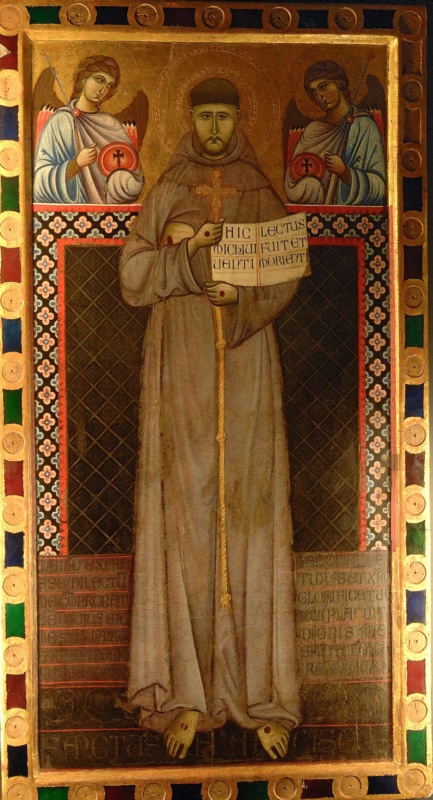
The Panel of Saint Francis with Two Angels, now in the Museo della Porziuncula in the complex of Santa Maria degli Angeli near Assisi, stands as the earliest autograph work attributed to the Maestro di San Francesco and the work that gave him his art-historical name. The panel depicts Saint Francis in full length, his body turned slightly toward the left, his right hand raised in a gesture of blessing and his left holding an open Gospel codex inscribed with the text: Hic lectus michi fuit et viventi et morienti (This was my bed when I was living and when I was dying). The saint bears the five stigmata, the wounds of Christ’s Passion impressed upon his body on La Verna in 1224, visible in the right side of his chest, the palms of his hands, and, presumably, his feet, making this one of the earliest surviving images in which all five stigmata are depicted. Two small flanking angels, each half the height of the central figure, face toward Francis with expressions of reverent devotion, their presence elevating the private devotional image to a quasi-official hagiographic statement about the supernatural dignity of the poverello.
The long inscription in the lower register of the panel, drawn from the 1237 bull of Pope Gregory IX in defense of the stigmata’s authenticity, anchors the image firmly within the framework of official Franciscan hagiography and papal authority, transforming what might otherwise have been a personal devotional panel into an institutional statement about the theological status of the Franciscan founder. The tradition that the panel’s wood derived from the plank on which Francis’s body rested immediately after death gave the object a dimension of relic veneration that must have powerfully shaped the devotional experience of pilgrims who encountered it at the Porziuncula. The Byzantine formal conventions of the image, the gold ground, the frontal hieratic presentation, the regularized physiognomic vocabulary, are inflected by a warmth and directness of expression that represents the earliest visible expression of the Maestro di San Francesco’s characteristic expressive personality. This panel was first documented in the sacristy of Santa Maria degli Angeli in 1885 by Thode, whose identification of it as the work of a distinct master launched the entire scholarly tradition of the Maestro di San Francesco. It remains in the Museo della Porziuncula in the complex of Santa Maria degli Angeli, the most sacred site of early Franciscan devotion and the physical setting for which it was almost certainly originally designed.
The fresco cycle in the Lower Basilica of San Francesco at Assisi (ca. 1260–1265) is unquestionably the most ambitious, artistically consequential, and historically significant enterprise associated with the Maestro di San Francesco. Executed on the lateral walls of the three-bay nave of the Lower Church, a vaulted Romanesque space of considerable austerity, lit by narrow windows that have since been enlarged or replaced by the openings to lateral chapels, the cycle consists of ten scenes arranged in a strictly symmetrical typological program: five scenes from the Passion of Christ on the right wall (the Preparation of the Cross, the Crucifixion, the Deposition, the Lamentation, and the Supper at Emmaus or Women at the Tomb), and five scenes from the life of Saint Francis on the left (the Renunciation of Worldly Goods, the Dream of Pope Innocent III, the Preaching to the Birds, the Stigmatization, and the Death and Funeral of Saint Francis).
Some scholars identify as autograph the scenes concentrated in the second bay and partially in the first and third, while attributing the Dream and Renunciation to a hand more closely aligned with the giuntesco-Spoletine culture of the late 1250s, and the Funeral to a more cursive and summary execution style. The Crucifixion scene, in which the dying Christ commends his mother to John the Evangelist while angels descend to gather the blood from his wounds and a Byzantine-derived crowd of soldiers, mourners, and witnesses surrounds the cross, deploys the dramatic resources of the Maestro’s mature style with particular authority, organizing the complex multi-figure composition around the central vertical of the cross with a clarity of theological vision that makes the complex narrative immediately readable.
The Lamentation, in which the body of Christ is mourned by the Virgin (who swoons in a gesture of total physical abandonment to grief), Saint John, the Magdalene, and other holy figures, represents the most emotionally intense passage in the cycle and the most direct anticipation of the great Trecento Passion cycles. The parallel scene of the Funeral of Saint Francis on the opposite wall, in which the assembled friars point to the stigmata on the dead saint’s body as proof of his Christ-like sanctity, completes the typological argument of the cycle by showing the death of the alter Christus in explicit visual correspondence with the death of Christ himself. The fresco cycle is now housed in a condition of significant damage, the enlargement of the nave windows for the lateral chapel entrances in the fourteenth century destroyed substantial portions of each scene, but the surviving fragments retain sufficient legibility to sustain scholarly analysis and to communicate the cycle’s extraordinary expressive power. The fresco cycle remains in situ in the Lower Basilica of San Francesco at Assisi, preserved as a component of the UNESCO World Heritage complex that includes both the upper and lower basilica.
Crucifix of London
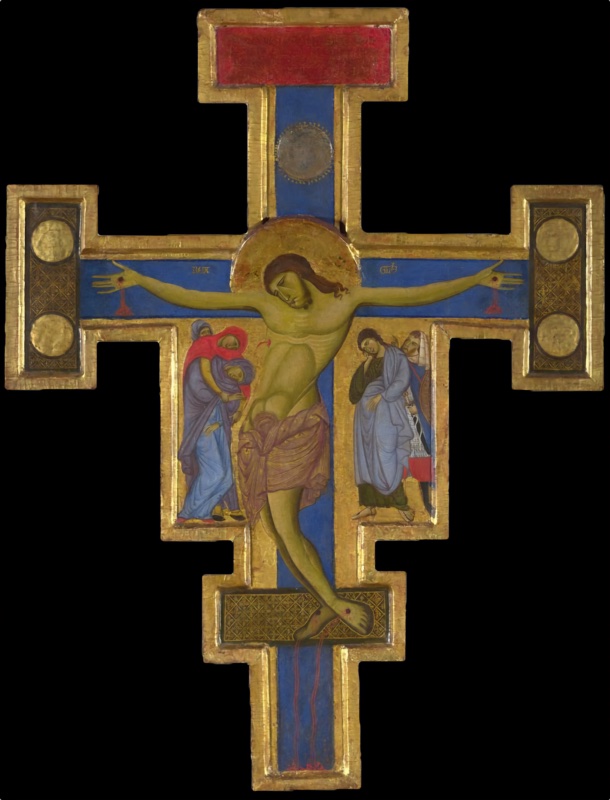
The Crucifix in the National Gallery, London (NG6361, ca. 1265–70), is the only autograph work by the Maestro di San Francesco in a British public collection and one of the most important thirteenth-century Italian paintings in the United Kingdom. Acquired by the National Gallery in 1965 with contributions from the Art Fund and an anonymous donor, the work is executed in egg tempera on wood, almost certainly poplar, and measures 91.8 × 70.6 cm. It retains its original thirteenth-century Umbrian frame, an exceptional circumstance of preservation that makes it among the most physically intact of all surviving Duecento painted crosses: the carved and gilded mouldings of the frame belong to the same moment of production as the painted surface and testify to the integrated character of the original object as it would have been seen by its first audiences. The cross is currently displayed in Room 65 of the National Gallery as part of the permanent collection.
The work belongs to the same typological category as the Processional Crucifix in the Galleria Nazionale dell’Umbria: it was originally a double-sided cross, carrying the same image on both painted faces and designed for display in processions as well as in a fixed devotional context. The present panel represents only one face of the original object, the other having been lost when the cross was split in two, probably as a consequence of the structural damage that accumulated through generations of processional use. The reduction to a single face is consistent with the fate of many Duecento processional crosses, whose double construction made them vulnerable to delamination and separation, and whose liturgical redundancy once the processional function ceased often led to the dismemberment of the object and the separate circulation of its two painted surfaces.
The iconographic program of the surviving face groups the standard elements of the Passion crucifix type in a composition that reveals the Maestro di San Francesco’s mature pictorial intelligence at a moment of concentrated expressive force. At the center of the cross, Christ hangs in the posture of the Christus patiens, his body bowed in the slumped weight of death, his head drooping toward the chest, his eyes closed. The representation of physical death is entirely consistent with the theological and devotional program of the Franciscan compassio: the viewer is invited not to contemplate a triumphant sovereign but to share, in the tradition of Francis himself, in the extremity of bodily suffering that constitutes the ground of Christian salvation. The blood from the nail wounds in the hands and feet drips in neat, formalized lines, a detail that bridges the affective and the decorative dimensions of the image in a way characteristic of the Maestro’s handling of the patiens type: the blood is real in its haematic red, but its stylized, rhythmic flow belongs to a pictorial syntax of ornamental precision that prevents any slide from devotional intensity into mere naturalistic description.
The terminal panels of the horizontal beam present a Passion assembly that departs from the minimal canonical pairing of the Virgin and Saint John that characterizes all the painted crosses previously discussed in this entry. On the left panel stands the Virgin, supported in her grief by the figure of Mary Magdalene, whose physical presence in the arm terminal is iconographically unusual for the Duecento cross type and reflects a more expansive Passion iconography than the two-figure terminal convention established by Giunta Pisano. The inclusion of the Magdalene alongside the Virgin recalls the compositional logic of the Lamentation scene in the Assisi fresco cycle, in which the Magdalene likewise appears as a participant in the Marian grief, suggesting that the London cross may have been produced in close temporal proximity to the completion of the fresco cycle and under the direct influence of its iconographic innovations.
On the right panel, Saint John the Evangelist is accompanied by the Roman soldier who, according to the account in Luke’s Gospel, recognized Christ as the Son of God at the moment of his death: this figure, identified in the Latin iconographic tradition as the centurion (sometimes conflated with Longinus, the soldier who pierced Christ’s side with his lance), gives theological depth to the right panel by articulating the moment of Gentile recognition that was understood in patristic exegesis as a figure of the Church’s universal mission. The paired terminal panels thus develop the Passion narrative beyond the purely devotional register of the canonical Virgin-and-John terminal into a more doctrinally complex Passion assembly, connecting the private emotional experience of the bereavement at the cross with the doctrinal claim of universal redemption, a connection that was entirely consonant with the Franciscan programmatic of the period.
The dating of the London Crucifix to approximately 1265–70, proposed by the National Gallery, positions the work in the mature phase of the Maestro di San Francesco’s activity, after the completion of the Assisi fresco cycle and before the firmly dated 1272 Crucifix in Perugia’s Galleria Nazionale dell’Umbria. This intermediate chronological position gives the London cross a pivotal significance in the reconstruction of the master’s stylistic trajectory: it documents the painter’s handling of the Christus patiens type in the period between the two major documented crucifix commissions and provides evidence for a consistent deepening of expressive intensity across the master’s career. The iconographic comparison with the 1272 Perugia Crucifix reveals both the continuity and the development of the Maestro’s treatment of the dying Christ: while the London cross shares the fundamental formal typology of the Perugia cross, the representation of the Passion assembly in the terminal panels shows a richer narrative and doctrinal complexity, suggesting that the painter was in this period actively expanding the iconographic possibilities of the cross type he had inherited from Giunta Pisano.
The Lamentation over the Dead Christ
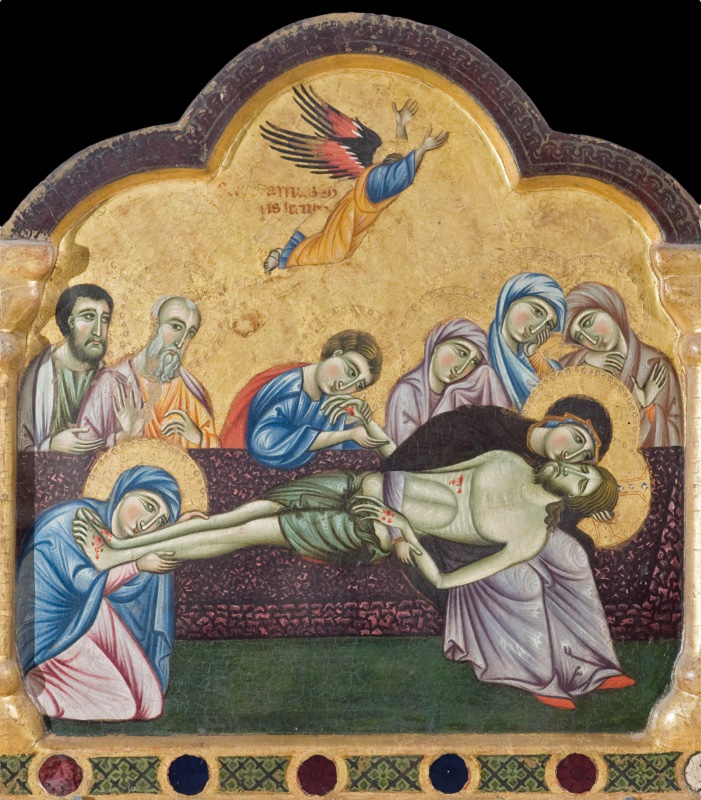
The Deposition of the Dead Christ
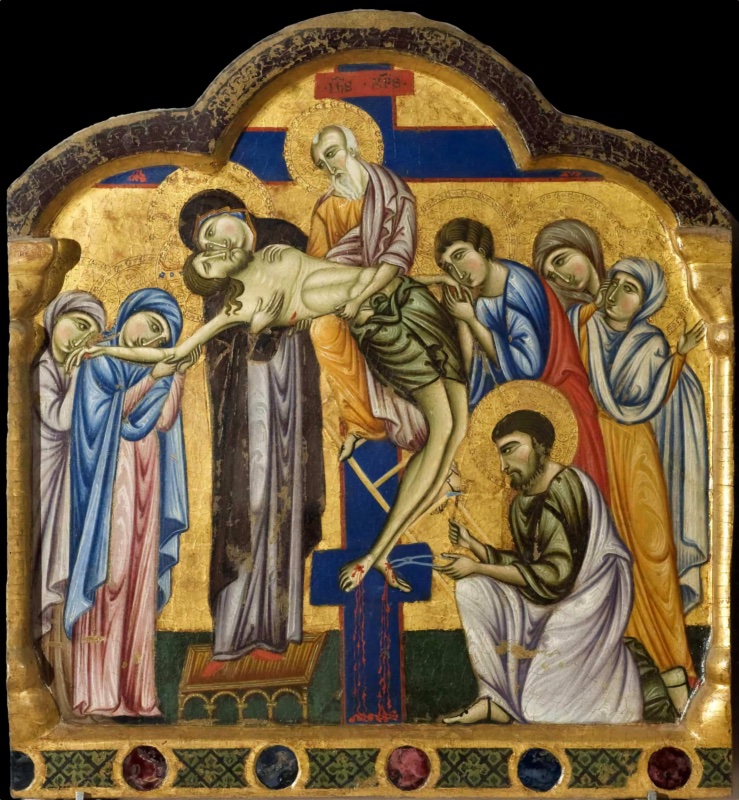
The panels of the double-sided polyptych from the high altar of San Francesco al Prato in Perugia (ca. 1272) constitute one of the most remarkable and complex surviving monuments of Duecento Italian painting, and their scholarly reconstruction, pursued successively by Garrison and others, represents one of the most significant achievements of twentieth-century Italian art history. Dillian Gordon’s landmark 1982 study in the Burlington Magazine demonstrated that the surviving panels, dispersed at the time of writing across the Galleria Nazionale dell’Umbria in Perugia, the Museo del Tesoro di San Francesco in Assisi, the Metropolitan Museum of Art in New York (Robert Lehman Collection), the National Gallery of Art in Washington (Kress Collection), and a private collection in Brussels (formerly Stoclet collection, now in the Galleria Nazionale dell’Umbria after its acquisition in 2001), constituted less than half of what was originally a monumental double-sided altarpiece designed to stand on the high altar of San Francesco al Prato.
The nave-facing side of the polyptych, the face visible to the lay congregation, was organized around a central image, probably of the Madonna and Child (now lost), flanked by panels depicting the stigmatized Saint Francis (Galleria Nazionale dell’Umbria, Perugia, inv. 24), Saints Simon and Bartholomew (Metropolitan Museum of Art, New York), Saint James Minor (National Gallery of Art, Washington), Saint Andrew (Galleria Nazionale dell’Umbria, identified in a restoration of 1994 through an inscription connecting him with his martyrdom in Patras), Saint Peter (Galleria Nazionale dell’Umbria, acquired from a Brussels private collection in 2001), and Saints John the Evangelist and James (National Gallery of Art, Washington). The choir-facing side, the face visible to the friars assembled for the choral office, presented a Passion sequence, including the Deposition of Christ (Galleria Nazionale dell’Umbria, inv. 22) and the Lamentation (Galleria Nazionale dell’Umbria, inv. 22), arranged around a central image, probably of the Crucifixion (now lost), and flanked by panels of prophets including the Prophet Isaiah (Museo del Tesoro di San Francesco, Assisi).
The narrative scenes of the choir-facing side, the Deposition and Lamentation, are, as some scholars note, esemplate direttamente sugli affreschi assisiati (modeled directly on the Assisi frescoes), confirming both the chronological priority of the Lower Church cycle and the creative continuity that links the Perugian commission to the master’s greatest monumental achievement. The Deposition panel shows the body of Christ being lowered from the cross in a diagonal movement that echoes the corresponding fresco composition; the Lamentation shows the swooning Virgin clutching the dead Christ in a gesture of grief that parallels the most emotionally intense passage of the Assisi cycle, translated into the intimate scale of the portable panel.
Donal Cooper’s 2001 study in the Journal of the Warburg and Courtauld Institutes established that the need for a double-sided altarpiece at San Francesco al Prato arose because the Franciscan choir was located behind the high altar, an unusual arrangement for Umbrian Franciscan churches of the period that explains the exceptional liturgical and iconographic complexity of the commission. The subsequent dispersal of the panels, beginning with their replacement by a new altarpiece in 1403, their movement to the sacristy, and their eventual dispersal through the Arciconfraternita della Pietà del Camposanto Teutonico to American collections in 1921, traces a complex provenance history that has been progressively clarified by generations of scholarship. The surviving panels remain distributed across their respective museum collections, where they constitute among the most precious and most carefully studied examples of thirteenth-century Umbrian painting in existence.
Saints Bartholomew and Simon
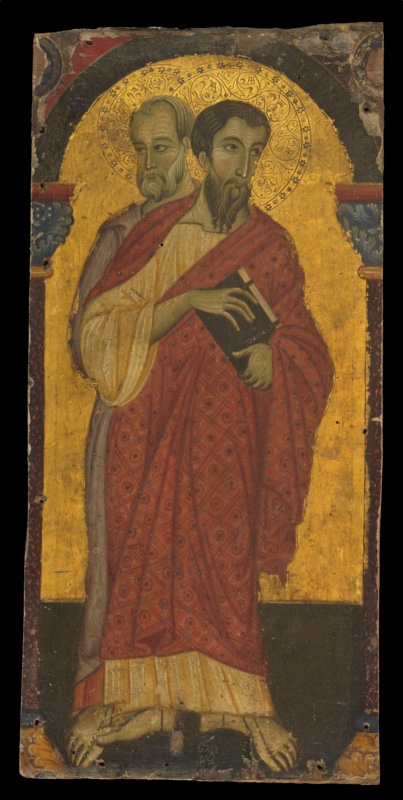
The panel housed at the Metropolitan Museum of Art in New York is the oldest Italian painting in the entire Lehman Collection, and represents one of the surviving fragments of what was likely the most important Italian polyptych of the third quarter of the 13th century. The panel was part of a double-sided altarpiece—a type of altar designed to be viewed from both sides—almost certainly commissioned for the high altar of the church of San Francesco al Prato in Perugia. It was a monumental and complex work, now dispersed among numerous international collections.
This panel depicting Saints Bartholomew and Simon formed the left side of one of the altarpiece’s two faces, alongside other panels depicting Saint Francis (National Gallery, Perugia), Saint James and Saint John the Evangelist (National Gallery of Art, Washington, D.C.), Saint Matthew (National Gallery, Perugia), and Saint Peter (private collection). The opposite side of the altarpiece, on the other hand, included Isaiah (Treasure of St. Francis, Assisi), the Deposition, the Lamentation, and St. Anthony (all at the National Gallery of Perugia). The support is a wooden panel of modest dimensions (47.6 × 22.9 cm), prepared with a plaster ground covered with canvas, upon which tempera and gold leaf have been applied.
The two figures of the saints, Bartholomew and Simon, are depicted standing, facing forward, within painted arches that imitate a colonnaded architecture in faux porphyry with foliate capitals, a continuous compositional system that linked all the panels of the altarpiece in a unified rhythmic sequence. The arches punctuate the space with an almost liturgical order, evoking the structure of a portico or a sacred hortus conclusus.
In the spandrels at the upper corners, tondos have been created by cutting through the panel from the canvas backing down to the preparatory plaster layer; these were originally—as in the twin panels preserved in Perugia—filled with colored and gilded glass. This use of glass as a decorative element integrated into the painting is a refined and unusual feature for the time, attesting to a level of craftsmanship and patronage of the highest quality.
The Master of San Francesco works in the full Italo-Byzantine tradition, blending iconography of Eastern origin with Western decorative forms and a highly original use of color. The figures of the two apostles display the typical traits of his style: flattened yet not lifeless volumes, drapery marked by golden lines of light (chrysography) following the Greek model, and a dramatic expressiveness conveyed above all through the gaze and the gesture of the hands. The frontal and solemn arrangement of the figures recalls the prototype of the Byzantine icon, but the linear quality and chromatic brilliance reveal a stylistic autonomy that, according to many scholars, anticipates Duccesque art. The overall structure of the altarpiece of which the panel is a part can be reconstructed as a continuous series of apostles within painted arched frames, designed to be viewed from both sides of the altar.
The work is chronologically close to the large Painted Cross of 1272 in the National Gallery of Umbria—a signed and dated work, exceptional for the time—which is the main chronological reference point for the Master’s entire late production. The date c. 1266–75 proposed by the Met for this panel places it at a time of the artist’s greatest maturity.
The formal comparison between the painted arches and the sculpted reliefs of contemporary sarcophagi, noted in scholarly studies, suggests that the Master of San Francesco was attentive to developments in 14th-century sculpture, establishing a dialogue between the arts that foreshadows the great syntheses of the late 13th century. The panel at the Met is therefore not only a rare surviving fragment of a lost masterpiece, but an extraordinary testament to the cultural complexity of Umbrian painting in the second half of the 13th century.
A final work of particular significance is the Processional Crucifix (ca. 1272), now in the Galleria Nazionale dell’Umbria, Perugia, attributed to the Maestro di San Francesco or a very close follower, and documented in the nineteenth century in the church of Santa Maria della Misericordia in Perugia. This double-sided processional cross depicts the Christus patiens on both faces, with the Virgin and Saint John flanking the cross arms in the standard Passion composition; on one face, the lower panel contains a small kneeling figure of Saint Francis, originally depicted kissing the right foot of Christ, an image of Franciscan compassio of striking intimacy, whose Franciscan attributes (the habit and the stigmata) were at some point overpainted and only recovered in a modern restoration. The overpaint that concealed the Franciscan character of the kneeling figure presumably reflects the later transfer of the work to a non-Franciscan context, the Misericordia, where the explicit Franciscan iconography may have been considered inappropriate; the restoration has restored the image to its original theological integrity and confirmed the specifically Franciscan devotional purpose for which it was created. The processional function of the cross, carried in public liturgical processions through the streets of Perugia, gives it a quite different devotional context from the large altar crucifix and implies an audience of urban laypeople participating in public civic-religious ceremonies, testifying to the breadth of the Franciscan devotional culture that the Maestro di San Francesco served throughout his career. The work is preserved in the Galleria Nazionale dell’Umbria, Perugia, alongside the great 1272 Crucifix and the surviving polyptych panels, making that institution the most important single repository of the Maestro di San Francesco’s art in any museum in the world.
Painted Cross
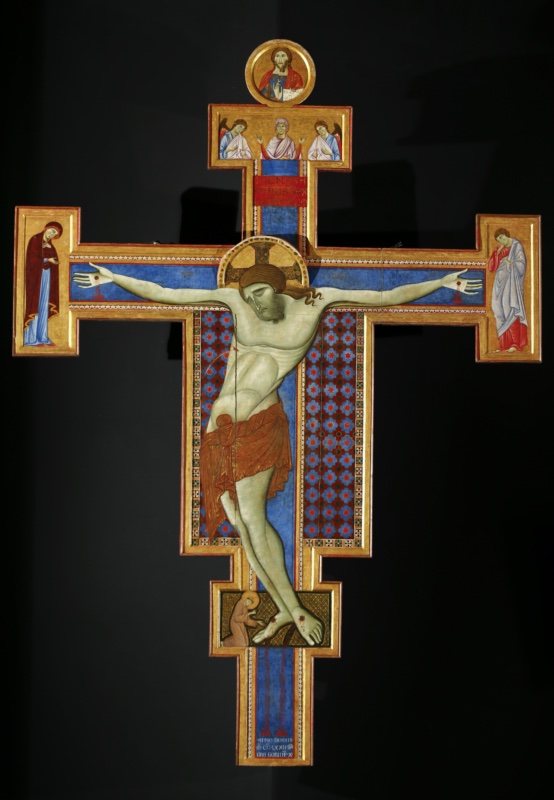
The Painted Cross by the Master of St. Francis (1272) is one of the most monumental and iconographically significant works of 13th-century Italian painting; it is currently housed at the National Gallery of Umbria in Perugia. The work was created in 1272 in tempera on poplar panel and measures 489 × 352 cm, with a thickness of 13 cm and a weight of approximately 260 kg. It comes from the church of San Francesco al Prato in Perugia, where it was originally hung at the end of the second bay, aligned with the high altar. It is exceptional for the 13th century in that it bears both a signature and an explicit date, with reference to the pontificate of Gregory X (1271–1276), information that was quite rare for the time. It represents the artistic peak of the anonymous artist, active between Assisi and Perugia from about 1255 to 1280.
It is a monumental Byzantine-style cross, organized according to a hierarchical and symmetrical compositional scheme. The wooden support is shaped with tabula-shaped terminations (the so-called apices or pediments) at the ends of the horizontal arm, a cimboro (cornice) at the top, and a suppedaneum at the bottom. The background of the central panel is decorated with a geometric motif of red and blue lozenges with stars, revealing a refined synthesis between Byzantine tradition and Umbrian Romanesque sensibility. The color scheme is varied and skillfully combined, embellished with touches of gold that highlight the contours and trace intricate geometric patterns along the edges of the cross.
At the center of the work dominates the figure of Christ crucified, rendered according to the iconography of the Christus Patiens—the Suffering Christ—in stark contrast to the older Christus Triumphans. The body is arched forward in a particularly pronounced manner, with the abdomen relaxed and the arms outstretched along the horizontal beam of the cross; the head is reclined on the chest as a sign of death. The face is livid and emaciated, and thin streams of bright red blood trickle from the side, hands, and feet. The terracotta-orange loincloth encircling the hips is rendered with a volumetric plasticity unusual for the time, anticipating formal solutions that would reach full maturity in Cimabue.
One of the work’s most significant iconographic innovations is the presence of Saint Francis of Assisi kneeling on the footstool at the foot of the cross. The saint is depicted full-length, with his head uncovered and wearing a brown Franciscan habit, in a posture of adoration turned toward Christ’s wounds. Visible on his hands and side are the stigmata, the seal of his mystical identification with the Crucified One. This devotional posture—the tiny saint adoring the feet of the monumental Christ—establishes a powerful visual spiritual hierarchy and inaugurates an iconographic typology destined for great success in fourteenth-century painting.
At the top of the cross, the circular finial features a enthroned Christ giving the sign of blessing, depicted in full face with a cruciform halo and a purple mantle, in a majestic and hierarchical pose. At his sides, a praying Madonna is depicted in a frontal position, with her hands clasped, flanked by two praying angels arranged symmetrically, with outstretched wings and robes of alternating colors. This heavenly scene introduces a theological register distinct from the drama of the Crucifixion: while the cymatium depicts the glorious and triumphant Christ, the central panel shows Christ suffering and dead.
At the ends of the horizontal beam are the two side panels (apices) with half-length figures in mourning. On the left is the Sorrowful Madonna (Mater Dolorosa), her face marked by grief, her hands clasped or raised to her face, wrapped in a dark blue mantle. On the right is Saint John the Evangelist, also in a posture of mourning, with the gray-white cloak that distinguishes him iconographically. These two figures echo the typology of the Byzantine Klagende, but their emotional expressiveness anticipates the humanistic tension that would run through all 14th- and 15th-century Umbrian and Tuscan painting.
The work represents the culmination of the career of the Master of Saint Francis and a crucial moment in the history of Italian art: it is situated chronologically and stylistically between Giunta Pisano (to whom it owes the composition of the Christus Patiens) and Cimabue (who would develop its expressive tensions). The signature and explicit dating, the presence of St. Francis in the pedestal, and the compositional complexity of the entablature make this cross an extraordinary document of Umbrian painting of the 13th century, revealing a painter fully aware of his own artistic identity in an era when anonymity was the norm.
Bifrontal Processional Cross (recto)
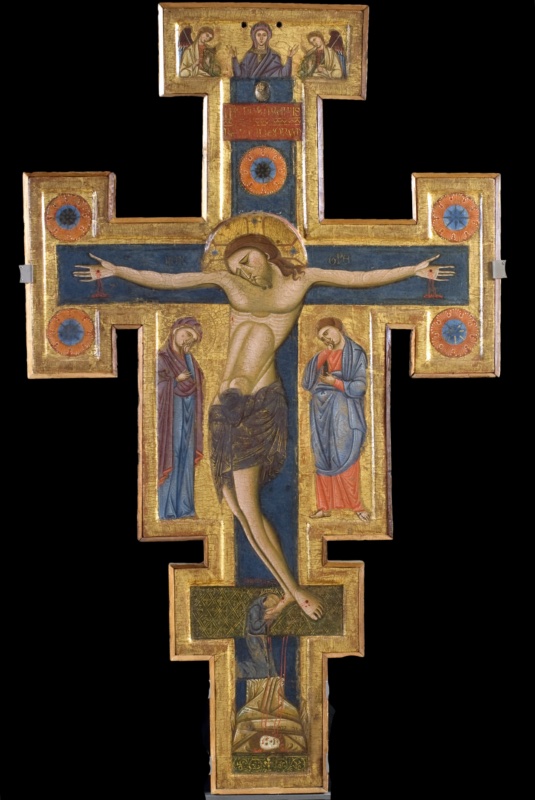
Bifrontal Processional Cross (verso)
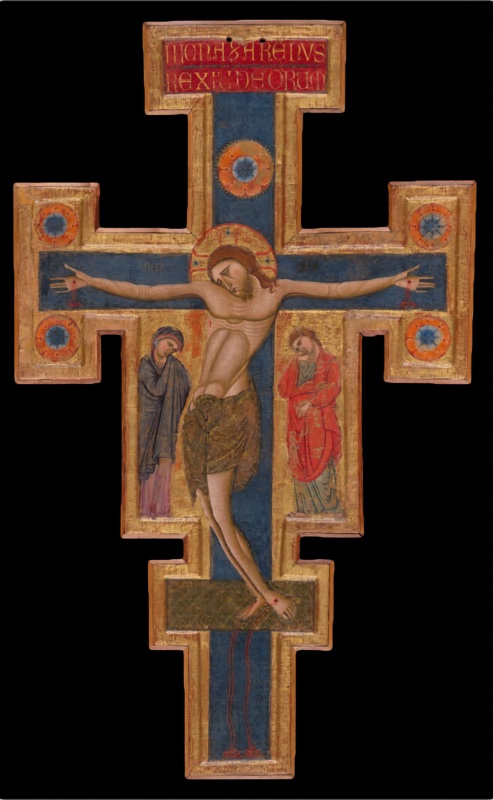
This is the double-sided processional cross by the Master of St. Francis, dated 1272 and housed in the National Gallery of Umbria in Perugia—one of the most important works of 13th-century Umbrian painting. A complete analytical description follows. The cross belongs to a type of purely Umbrian origin, widespread since the 13th century: the double-sided processional cross, designed to be carried in procession mounted on a pole, or placed on the altar on a pedestal. The expanded “tau” structure—characteristic of the Franciscan tradition—features a cimasa (the upper panel, above Christ’s head), two side panels on either side of the horizontal arm, and a soppedaneo (the lower panel, beneath Christ’s feet). Its dimensions—129 × 77 cm—make it a medium-sized artifact, intended for devotional processions rather than as a monument.
The central iconographic subject of the recto is the Christus patiens—the suffering Christ, not the triumphant one. Jesus’s body is depicted arched to the left with a strong emphasis on the curve of the torso and the relaxed abdomen, his head reclined with closed eyes, his hair falling over his left shoulder: all elements that convey the physical weight of death and the devotional emotion typical of Franciscan spirituality. The face appears livid and emaciated, with a carefully rendered beard and a golden halo marking his divinity. In the side panels flanking the horizontal beam are the sorrowful figures of the Virgin Mary (on the left) and Saint John the Evangelist (on the right), both full-length, dressed in intensely colored garments—Mary’s brick-red cloak and John’s blue—set against a deep blue background, typical of the Master’s style. Their postures express restrained grief and reverence.
The cimasa depicts the praying Virgin in half-length between two angels, in a posture of supplication turned upward, an iconography alluding to the Ascension and Marian mediation. Above it runs the inscription in red on a gold field: IHC NAZARENUS / REX IUDEORUM, the titulus crucis in the customary medieval formula.
In the soppedaneo, an iconographic element of extraordinary importance, a small St. Francis of Assisi is kneeling, devoutly touching the bleeding feet of Christ. The figure had long been generically identified as an anonymous friar, until the restoration carried out between 1992 and 1993 brought to light the inscription FRANCISCUS written in red above the saint’s head, definitively confirming his identity. This presence is an iconographic innovation of great significance: Saint Francis as the imitator Christi par excellence, physically prostrate at the feet of the Redeemer.
The reverse side of the cross also features the subject of the Christus patiens, flanked on the side panels by the Virgin and Saint John the Evangelist, with the same compositional arrangement as the obverse. The main difference lies in the cimasa: on the reverse, the entire surface is occupied by the inscription IHC NAZARENUS / REX IUDEORUM in larger letters, without the praying Virgin, giving the inscription the character of a theological manifesto visible during processions.
The Master of St. Francis was active in Assisi and Perugia between approximately 1255 and 1280, having trained in the workshop of Giunta Pisano, the great pioneer of Umbrian-Pisan painting. His style blends the solidity of the Byzantine tradition—visible in the lapis lazuli blue background, the use of gold, and the hierarchy of figures—with a wholly original expressive tension that foreshadows the path toward Cimabue and then toward Duccio. The color scheme is vibrant: gold dominates the frames and halos, the cobalt blue of the background creates a dramatic contrast with the flesh tones of Christ, and the reds and oranges of the decorative discs at the tips of the arms enrich the composition with chromatic liveliness.
The most recent studies confirm the work’s attribution to the Master of St. Francis through comparison with the Stories of Christ and St. Francis frescoed in the nave of the Lower Basilica of Assisi, with the monumental Painted Cross by the same painter preserved in the same gallery, and with panels in the Louvre in Paris and the National Gallery in London.
The dating to 1272—attested by the inscription mentioning the pontificate of Gregory X—makes this cross a precise historical document, rare for the time. The work was created in an atmosphere of intense Franciscan devotion: the presence of St. Francis in the apse is not merely decorative, but expresses the theology ofimitatio Christi developed by the Order of Friars Minor, according to which Francis, stigmatized like Christ, is the supreme model of conformity to the Passion. The processional cross served as a tool for itinerant preaching and visual catechesis for the faithful, and every iconographic element was therefore designed to immediately convey the message of salvation.