Maestro della Croce 434
( 25% )
Family and social background
The painter conventionally known as the Master of the Cross 434 was an anonymous artist active in Tuscany from around 1230 to the middle of the thirteenth century, and neither his original name nor the exact date and place of his birth are recorded in any surviving document. Stylistic and contextual evidence indicate that he was formed in the Lucchese milieu but worked primarily in the Florentine orbit, suggesting an origin in or near Lucca with later relocation or regular circulation toward Florence. Because his identity has been lost, nothing can be said with certainty about his parents, siblings, or marital status, and any reconstruction of his family must proceed by analogy with the social conditions of other painters in early Duecento Tuscany.
Painters customarily emerged from artisan households in which several male relatives shared a workshop, transmitting skills, patterns, and contacts from one generation to the next. The Master of the Cross 434 seems to fit that pattern, operating within a workshop culture grounded in kinship and apprenticeship rather than in the individualistic model that would characterize later Renaissance practice. His consistent handling of figures and drapery across a coherent yet varied oeuvre suggests a stable nucleus of collaborators, probably including younger relatives or dependents who absorbed his idiom.
The geographic focus of his activity, centered on small towns and monastic communities around Lucca and Florence, points to a family network embedded in regional craft and devotional economies rather than in courtly patronage. That network would have shaped his access to commissions, his familiarity with liturgical needs, and his understanding of mendicant spirituality. Although the lack of archival records prevents the precise identification of his natal family, the works themselves testify to the continuity of a shared visual language sustained over several decades. In this sense the painter’s “family” is legible primarily through workshop practice and regional devotion rather than through documented genealogy.
Scholars have long hypothesized a more specific familial connection between the Master of the Cross 434 and the celebrated Lucchese painter Berlinghiero Berlinghieri, whose workshop dominated crucifix and panel production in Lucca during the early thirteenth century. The pronounced debt to Berlinghiero’s pictorial language has led some historians to propose that the Master of the Cross 434 may have been one of Berlinghiero’s sons, perhaps the otherwise undocumented Marco, although this remains conjectural. Even if the identification cannot be proved, the hypothesis underscores the extent to which family workshops functioned as primary training sites and vehicles of stylistic transmission. Within such an atelier, a younger painter would learn not only drawing and color preparation but also the routines of dealing with patrons, managing assistants, and organizing the labor of gilding, punchwork, and underdrawing.
The consistency of certain ornamental devices, such as the crisply punched haloes and the elaborate knotting of Christ’s loincloth, could be read as the survival of inherited family formulas adapted to new contexts. If the Master of the Cross 434 indeed emerged from Berlinghiero’s circle, then his family background would have combined Lucchese commercial pragmatism with a keen sense of how to rework Byzantine prototypes for local devotional needs. In this intergenerational setting, cousins, in-laws, and godparents might all participate at different levels in the workshop economy, blurring the boundaries between family and shop. The circulation of patterns and cartoons from Lucca to Florence would have been facilitated by these tight kin relations and shared professional interests. Thus, even in the absence of names, the painter’s familial horizon can be glimpsed through the dynamics of workshop inheritance and stylistic kinship.
The broader social profile of a thirteenth‑century Tuscan painter’s family also illuminates the likely circumstances of the Master of the Cross 434’s upbringing. Families of artisans in cities such as Lucca and Florence often occupied an intermediate social tier, possessing modest property and commercial ties without belonging to the great mercantile dynasties. Literacy for such households was variable, but the need to read contracts and devotional texts meant that at least some members, perhaps including the painter himself, would have acquired basic skills in reading and numeracy.
Religious observance permeated domestic life, with confraternities and parish structures linking households to larger devotional communities, particularly in neighborhoods close to mendicant churches. The prominence of Franciscan1 themes in the Master’s work implies an early exposure to mendicant preaching and liturgy, likely mediated by the family’s regular attendance at sermons and processions. It is plausible that relatives participated in lay confraternities attached to Franciscan or Benedictine2 houses, thereby strengthening ties between the workshop and potential patrons. Such families also navigated the changing guild structures that increasingly regulated artistic work in mid‑Duecento Florence, though painters’ guilds would only later assume the central role they held in the Trecento. In this social world, marriage alliances, dowries, and the placement of daughters in convents all had implications for the distribution of commissions and the visibility of a workshop. The painter’s family background, therefore, would have been deeply entwined with religious institutions, urban governance, and the rhythms of liturgical time.
The Monastery of Santa Maria at Rosano, where one of the earliest Madonnas with Child attributed to the Master of the Cross 434 is preserved, offers an additional lens for imagining the familial ambit in which he moved. Rosano was a long‑established Benedictine women’s abbey, closely tied to aristocratic families of the Valdarno and to broader networks of patronage and protection. For an artisan painter linked to this monastery, family relations would have extended beyond blood kin to include spiritual kinship with abbesses, nuns, and their lay protectors. Such connections often spanned generations, as particular workshops became traditional suppliers for specific religious houses.
The commissioning of a Madonna for Rosano implies a relationship of trust between the painter’s household and the monastic community, mediated perhaps through confessors, procurators, or noble patrons attached to the abbey. The painter’s family may thus have benefitted from a form of institutional patronage that guaranteed a degree of economic stability in exchange for ongoing artistic service. In return, the workshop furnished images that reinforced the identity and devotional practices of the monastic “family,” visually articulating ties between earthly kinship and spiritual motherhood. These layers of affiliation further complicate the notion of family for the Master of the Cross 434, situating his household within a web of spiritual and social relations that exceeded the narrow confines of blood lineage.
Over time, the very anonymity of the Master of the Cross 434 has generated a different kind of “family,” constituted by scholars, curators, and restorers who have labored to reconstruct his oeuvre and contextualize his practice. From Edward Garrison’s early proposals to Miklós Boskovits’s formulation of the name “Maestro della Croce 434” and Angelo Tartuferi’s subsequent refinements, a chain of attributional debates has clustered around the crucifix now in the Uffizi and related works.
These modern interlocutors have effectively adopted the painter as a shared object of intellectual kinship, arguing about his connections to the Master of the Bardi Saint Francis and to Coppo di Marcovaldo. The resulting scholarly “genealogy” positions him as a pivotal ancestor in the family tree of Florentine painting, occupying a generation between the Lucchese Berlinghieri and the later achievements of Cimabue and Giotto. Restoration campaigns—such as those undertaken on the Uffizi crucifix and on related panels—have added conservators to this extended family, as technical analysis has clarified workshop procedures and material choices.
Archival research on monastic patrons and the mapping of object histories have similarly tightened or loosened the bonds between works formerly attributed to him. In this sense, the Master of the Cross 434’s “family” now includes the institutions that preserve, exhibit, and interpret his paintings, from the Uffizi in Florence to the Pushkin Museum in Moscow. The painter’s historical anonymity paradoxically ensures his enduring presence within this scholarly and curatorial community, which continues to negotiate his place within the broader lineage of Italian art.
Patrons and institutional contexts
Although the names of individual patrons of the Master of the Cross 434 are not preserved, the institutional character of his commissions can be reconstructed from the present and original locations of his works. The panel of the Madonna and Child at the Benedictine Abbey of Santa Maria a Rosano points to a monastic community of women as one of his early and perhaps most enduring clients. Such a community, rooted in aristocratic traditions and long‑standing devotional practices, required images that could support liturgical use and private contemplation within the cloister. The choice of a tender yet hieratically composed Madonna reflects the abbey’s Marian dedication and its desire to align itself with contemporary currents in Tuscan Marian devotion. The painter’s ability to supply such an image implies familiarity not only with Byzantine prototypes but also with the specific needs of a monastic female audience. In turn, the abbey’s social and economic ties to noble families would have enhanced the painter’s visibility, potentially leading to further commissions in the surrounding territory. The Rosano Madonna thus embodies a nexus of patronage in which monastic, aristocratic, and artisan interests intersect. It reveals how female religious houses played a central role in sustaining early Duecento panel painting alongside the better documented mendicant orders.
The crucifix now known as Cross 434 in the Uffizi, a large painted cross with eight scenes from the Passion of Christ, was almost certainly created for a religious institution rather than for a lay confraternity or private chapel. The Uffizi catalogue notes that similar narrative crucifixes with historiated terminals were particularly common in Tuscan churches associated with female monasteries during the twelfth and thirteenth centuries. Although the original provenance of Cross 434 is unknown, stylistic parallels with other crosses linked to women’s communities suggest that it may have been commissioned for a nunnery located between Florence and Pisa, as some modern commentators have proposed.
The dense program of Passion scenes would have served as a visual aid for meditation, allowing the community to move mentally from Christ before the Sanhedrin to the mocking, flagellation, ascent to Calvary, deposition, entombment, visit of the myrrh‑bearing women, and supper at Emmaus. This narrative emphasis reflects a patronal interest in affective piety and in the sequential visualization of scriptural events, themes particularly associated with new devotional trends fostered by mendicant preaching. The commissioner—whether abbess, guardian, or a lay protector—thus required an artist capable of orchestrating complex iconography across a large support while maintaining doctrinal clarity and emotional immediacy. The Master of the Cross 434’s successful fulfillment of this brief evidently secured his reputation as a specialist in monumental crucifixes for institutional patrons.
Another key patronal context for the Master of the Cross 434 was the Franciscan Order, as indicated by the panel of Saint Francis Receiving the Stigmata in the Uffizi. The painting, executed between about 1240 and 1250, is one of the earliest surviving depictions of the stigmatization and focuses exclusively on this single episode rather than embedding it within a broader narrative cycle. Such a choice presupposes a patron keenly attuned to the extraordinary status of the miracle, which distinguished Francis from all earlier saints and underscored his role as alter Christus.
The original location of the panel remains unknown, but it must have belonged either to a Franciscan convent or to a community, perhaps of tertiaries or Clarissan3 nuns, closely allied with the order’s spirituality. The fact that the image survived the 1266 Franciscan directive to destroy earlier representations of Francis suggests that it was either protected by its community or displaced into a context where the decree was not rigorously enforced. In commissioning such a work, the patron entrusted the painter with articulating the visual theology of the stigmata, linking the saint’s wounds to the luminous rays descending from the crucified seraph. The Master’s responsiveness to this patronal agenda reinforced his association with Franciscan imagery and contributed to the continued demand for his services in mendicant settings.
The large dossal of Saint Francis and Eight Scenes of His Life, now in the Museo Civico of Pistoia and attributed jointly to the Master of the Cross 434 and the Master of Santa Maria Primerana, further clarifies the nature of his Franciscan patronage. Originally painted for the church of Santa Maria Maddalena al Prato in Pistoia, a foundation with close ties to Franciscan reform, the panel organizes the saint’s biography into a sequence of narrative compartments surrounding a full‑length central figure. The patron or community that commissioned this work sought a portable yet imposing altarpiece capable of instructing viewers in Francis’s exemplary life, from his conversion and renunciation of paternal wealth to the confirmation of the Rule and the reception of the stigmata.
Collaboration between two masters suggests either the scale of the commission or the desire to integrate complementary stylistic tendencies associated with different regional traditions. The panel’s sophisticated narrative program aligns with a patronal milieu shaped by educated friars and lay supporters interested in promoting the saint’s cult in a form accessible to a broad urban audience. In this case, the Master of the Cross 434 functioned as part of a team serving an institutionally complex patron, reinforcing his position within a network of Franciscan and quasi‑Franciscan communities in central Tuscany.
The Madonna with Child enthroned and seventeen scenes from the life of the Virgin, now in the Pushkin Museum in Moscow, testifies to another kind of institutional patronage, one centered on Marian devotion and possibly on confraternal worship. The panel, painted around 1255–1260, most likely originated in a Tuscan church or oratory before entering modern collections and ultimately being transferred to Russia. Its elaborate narrative cycle, encircling the central Madonna with episodes ranging from the Annunciation to the Dormition, reflects the needs of a community—perhaps a Marian confraternity or a monastic house dedicated to the Virgin—keen to visualize the full arc of her salvific role.
Commissioning such a complex and expensive object required significant financial resources and access to an atelier capable of orchestrating numerous small‑scale scenes without sacrificing legibility. The patron thus relied on the Master of the Cross 434’s proven ability to handle multi‑scene crucifixes and Franciscan dossals, reorienting his narrative skills toward Marian subject matter. The current location of the panel in Moscow is a product of later collecting and does not imply any direct relationship between the artist and Russia, yet it underscores the long‑term appeal of his work beyond its original institutional environment. Through this commission, the painter deepened his engagement with patrons invested in Marian theology and ritual, complementing his established connections with Franciscan communities.
Beyond these major altarpieces, the Master of the Cross 434 also produced works for smaller ecclesiastical patrons, including the crucifix with the Repentance of Peter now in the Museo Bandini at Fiesole and the crucifix in the church of Santa Maria Assunta at Tereglio near Lucca. These works suggest patronage by parish churches or modest religious houses seeking powerful yet affordable images to dominate their liturgical spaces. The Tereglio crucifix in particular anchors his activity in the Lucchese hinterland, indicating that his clientele was not limited to major urban centers but extended into rural communities.
The Bandini crucifix, with its poignant juxtaposition of the suffering Christ and the penitent apostle, may have served a community engaged in penitential devotions, perhaps under Franciscan or Augustinian influence. A further crucifix, preserved in the church of the Montalve in Florence but originally from San Jacopo di Ripoli, points to yet another urban parish or conventual context in which his monumental crosses mediated between liturgical performance and personal piety. In each case, the patrons—priors, abbesses, or confraternal leaders—sought an image that could visually articulate their community’s relationship to the Passion and to the intercessory power of the saints.
Painting style and visual language
The painting style of the Master of the Cross 434 occupies a pivotal position between the Italo‑Byzantine idiom of early Duecento Tuscany and the emergent naturalism of later Florentine painting. His works are consistently executed in tempera on panel with gold ground, following established Byzantine conventions, yet they introduce a distinctive play of light and shadow that gives the figures an unusually strong sense of corporeal presence. The Uffizi description of Cross 434 emphasizes the painter’s use of sharp contrasts between highlights and darker passages to suggest the plasticity of Christ’s body, even as the overall figure remains anchored in inherited Byzantine models.
This “plasticizing” of form is achieved through elongated, flowing highlights applied along limbs and draperies, which both model volume and reinforce contour. At the same time, a thick dark outline encloses the forms, creating a tension between linear stylization and volumetric suggestion. The result is a visual language that is still fundamentally hieratic and iconic, but charged with an affective intensity that anticipates later developments. The painter’s style thus mediates between the abstraction of earlier crucifixes and the more incisive corporeality of Cimabue and Coppo di Marcovaldo, representing an intermediate but crucial stage in the evolution of Tuscan panel painting.
In Cross 434 itself, the depiction of Christ as Christus patiens—the suffering Christ with closed eyes and head inclined—encapsulates the Master’s approach to expressive form. The body sags slightly from the nails, with a subtle torsion that conveys both the weight of the flesh and the spiritual drama of the Passion. The face is marked by deeply incised lines around the mouth and eyes, producing a grimace of pain that is at once stylized and psychologically resonant. These linear accents find echoes in the waves of the hair and the curls of the beard, binding physiognomy and ornament into a single rhythmic system. The elaborate knotting of the perizoma, with its cascading folds and asymmetrical ripples, demonstrates a comparable virtuosity in the treatment of drapery, transforming a simple cloth into a complex pattern of light, shadow, and line.
Surrounding Passion scenes, disposed in rectangular fields along the transverse arms of the cross, are rendered with compact compositions in which a few figures, sharply profiled against gold, enact key moments of Christ’s ordeal. Despite the small scale of these scenes, the painter maintains a high degree of legibility, using clear gestures, strongly differentiated poses, and architectural backdrops to guide the viewer’s narrative reading. This combination of monumental central figure and carefully articulated narrative margins exemplifies his mastery of both iconic presence and storytelling.
The Master’s handling of light and shadow constitutes one of the most distinctive features of his style. As early commentators noted and recent scholarship has reiterated, he relies on emphatic, often elongated highlights—sometimes described as “filanti,” or streaming—to enliven surfaces and to carve out volumes against the gold ground. On faces, these highlights trace the bridge of the nose, the brow ridge, and the cheekbones, creating a network of luminous lines that articulate bone structure and flesh with an almost calligraphic energy. On draperies, they snake along the main folds, intensifying sharp breaks and emphasizing the directional movement of the cloth.
Shadows, conversely, are laid in with relatively dark, cool tones, deepening the undercut areas beneath chins, in the eye sockets, and within the hollows of pleats. The juxtaposition of such deep shadows with brilliant highlights produces a chiaroscuro more dramatic than in most contemporary Lucchese works, foreshadowing later Florentine experiments in modeling. At the same time, the painter preserves large flat zones of unmodulated color, particularly in backgrounds and secondary garments, maintaining a balance between volumetric description and planar abstraction. This dialectic between line, color, and light is central to his visual language and underpins the emotional charge of his images.
His figural types further reveal a distinctive approach to expression and embodiment. Male saints and Christ are generally rendered with elongated proportions, narrow shoulders, and slightly tapering torsos, conveying a certain ascetic refinement consistent with mendicant spirituality. Faces tend toward oblong or egg‑shaped forms with high foreheads and relatively small chins, creating a sense of upward thrust that directs attention toward the eyes. The eyes themselves are large, almond‑shaped, and set slightly deep beneath arched brows, often with pronounced dark lines emphasizing the eyelids and pupils.
Mouths, especially in scenes of suffering or penitence, are delineated with short, curved strokes that can suggest both grimacing pain and quiet sorrow, depending on the context. Female figures, including the Madonna and the pious women at the cross, display softer modeling but retain an underlying linear firmness, with veils and mantles framing the faces in controlled rhythms. In the Madonnas attributed to him, the Child is often perched on the left arm, raising a hand in blessing while turning slightly toward the viewer, a formula derived from Byzantine Hodegetria types but inflected with a gentler, more intimate affect. Across the corpus, these figural conventions create a recognizable “family resemblance” that allows attributions to be made even in the absence of signatures.
The iconographic and compositional strategies of the Stigmatization of Saint Francis panel further refine an understanding of his style. In this work, Francis kneels in the rocky landscape of La Verna, arms extended in a gesture that is both orant and cruciform, while above him appears Christ as a seraphic crucifix, radiating three beams of light that strike the saint’s head and hands. The composition is remarkably focused, stripping away extraneous figures to concentrate on the exchange between the suffering Christ and the receptive Francis. The stylized cliffs of the Casentino, rendered as a series of sharply sloping planes with sparse vegetation, form a kind of sacred enclosure around the miraculous event.
A small chapel perched on the ridge evokes the hermitage’s architectural reality while also serving as a sign of the institutional Church’s recognition of the saint’s experience. In this setting, the Master’s linear highlights and deep shadows accentuate the emaciated body of Francis and the fluttering folds of his habit, while the seraph’s wings and fiery mandorla fuse Byzantine celestial imagery with specifically Franciscan theology. The overall effect is both austere and intensely affective, demonstrating how the painter adapted his crucifix style to new hagiographic subjects.
Over the course of his career, the Master of the Cross 434 appears to have developed his style from more strictly Lucchese‑Byzantine beginnings toward an increasingly sophisticated Florentine synthesis. Early works, such as the Tereglio crucifix and possibly the Rosano Madonna, cling more closely to Berlinghiero’s schematized anatomies and relatively restrained chiaroscuro. As his activity shifts toward Florence and its environs, however, his handling of volume grows more confident, and his narrative compositions become more complex, culminating in multi‑scene panels like the Francis dossal at Pistoia and the Marian altarpiece now in Moscow.
In these later works, spatial hints—such as shallow architectural settings, overlapping figures, and differentiated ground lines—introduce a rudimentary sense of recession without abandoning the fundamentally frontal orientation of the main figures. The painter remains, throughout, committed to gold grounds and to the hieratic presentation of central protagonists, yet he increasingly experiments with ways of animating the surrounding space. This gradual evolution illustrates how an artist rooted in Lucchese workshop practice could absorb and contribute to new visual currents emerging from the dynamic religious and urban environment of mid‑Duecento Florence.
Technical aspects of his work further illuminate his stylistic choices. The panels are prepared with gesso grounds and covered with extensive gold leaf fields, which are then articulated with punchwork, incised halos, and decorative borders. In Cross 434, the haloes of Christ and the attendant figures display finely punched patterns that create a shimmering corona around the heads, reinforcing their sanctity while also catching the candlelight of the liturgical space.
Incised lines often anticipate painted contours, indicating the use of incising as a guide during the painting process and suggesting an underlying drawing routine consistent with workshop practice of the period. Pigments include traditional tempera colors, such as azurite for blues, red and yellow ochres, and organic lakes, applied in layered glazes and opaque passages to achieve chromatic depth. The precision of the punchwork and the consistency of the incised patterns across works imply the availability of specialized tools and perhaps the participation of assistants dedicated to these decorative tasks. These material and technical features reinforce the impression of a disciplined workshop capable of producing complex, richly adorned panels for demanding institutional patrons.
Artistic influences and broader context
The most fundamental layer of the Master of the Cross 434’s artistic formation lies in the Byzantine tradition that dominated Tuscan panel painting in the late twelfth and early thirteenth centuries. His reliance on gold ground, frontal hieratic figures, and established iconographic types such as the Hodegetria and Christus patiens clearly situates him within this Italo‑Byzantine matrix. The chrysography, that is fine gold lines applied over garments to indicate folds and highlight divine radiance, visible in some of his works echoes techniques found in contemporary icons imported from the eastern Mediterranean.
The rigid symmetry of many compositions, especially in earlier crucifixes, reveals a commitment to Byzantine notions of sacred order and visual authority. Yet within this framework he begins to question absolute frontality, introducing slight torsions of the body and carefully calibrated gestures that open the figures to narrative interaction. This negotiation between continuity and innovation is characteristic of Tuscan painters who, while still deeply indebted to Byzantine models, were experimenting with new forms of affective engagement appropriate to the devotional needs of mendicant and monastic patrons. The Master’s work thus embodies a localized, historically specific reworking of broader Mediterranean visual currents.
Equally decisive is the influence of the Lucchese school, particularly that of Berlinghiero Berlinghieri and his workshop. The Master of the Cross 434’s stylized yet emotionally charged faces, his strong contours, and his pronounced chiaroscuro align closely with Berlinghiero’s solutions, especially in crucifixes and Marian panels. Scholars have noted that his work seems to “translate” Berlinghiero’s idiom into a slightly more dramatic key, intensifying the modeling and sharpening the psychological resonance of expressions. Lucchese workshop practice provided him with a repertoire of compositional schemes, ornamental devices, and technical procedures that he would continue to deploy even after his move toward the Florentine orbit.
At the same time, he modifies some of these inherited elements, for example by introducing more complex narrative cycles around central images or by adjusting figural proportions to suit new spatial and liturgical contexts. This selective incorporation and transformation of Lucchese models suggests a creative rather than merely imitative engagement with his formative influences. Through his work, Lucchese stylistic traits achieve wider dissemination in central Tuscany, contributing to a broader regional convergence in panel painting during the mid‑Duecento.
The painter’s relationship to Coppo di Marcovaldo and to the Master of the Bardi Saint Francis has been the subject of sustained historiographical debate. Luciano Bellosi proposed that the Master of the Cross 434 might in fact represent an early phase in the career of Coppo di Marcovaldo, pointing to similarities in crucifix iconography and in the handling of light and shadow. Miklós Boskovits, by contrast, argued for distinguishing the Master of the Cross 434 as a separate personality, perhaps situated within Coppo’s broader circle rather than identical with him, emphasizing differences in figural types and compositional choices.
The association with the Master of the Bardi Saint Francis further complicates the picture, as scholars have at times assigned works, especially Franciscan panels, to one or the other based on shifting criteria. These debates underscore the porous boundaries between workshop identities in mid‑Duecento Florence and Lucca, where stylistic overlaps reflect shared training, collaboration, and the circulation of patterns. Regardless of the ultimate resolution of these attributional questions, it is clear that the Master of the Cross 434 participated in the same visual discourse as Coppo and related figures, contributing to the gradual emergence of a more robust Florentine pictorial tradition. His oeuvre thus stands at a crucial intersection of overlapping artistic personalities and workshops.
The influence of Franciscan spirituality constitutes another major factor shaping his art. The adoption of the Christus patiens type in crucifixes like Cross 434 corresponds closely to the spread of Franciscan preaching, which emphasized Christ’s humanity, suffering, and emotional accessibility. By representing Christ with closed eyes, a bowed head, and a visibly wounded body, the Master aligns his imagery with sermons and devotional texts that invited the faithful to contemplate the Passion in compassionate identification. His panels devoted to Francis, especially the Stigmatization and the multi‑scene dossal, extend this affective strategy to the saint’s own life, presenting him as a mirror of Christ whose wounds and asceticism echo those of the crucified Lord. The painter’s iconographic choices—such as the three rays linking the seraphic Christ to Francis or the careful selection of episodes for the Francis cycle—reveal a close engagement with Franciscan theology and with the order’s efforts to shape its visual identity. Through these works, the Master of the Cross 434 contributed significantly to the early codification of Franciscan iconography, influencing how later artists, including those of the more naturalistic Giottesque generation, would visualize the saint.
Finally, the painter’s own influence on subsequent Florentine and central Tuscan art should not be underestimated. The Uffizi and related scholarship have stressed that the Master of the Cross 434 was one of the principal artistic personalities in Florence before Coppo and Cimabue, shaping the early development of the city’s painting tradition. His mediation between Lucchese stylistic resources and local devotional needs provided a crucial precedent for the more ambitious synthetic projects of later masters.
Elements of his crucifix iconography, including the combination of a central suffering Christ with surrounding narrative scenes, can be traced in later works that refine or expand his schemes. His handling of light, though still anchored in Italo‑Byzantine conventions, opened pathways for more nuanced modeling adopted by Cimabue and ultimately transformed by Giotto. Moreover, his success in negotiating complex institutional patronage—spanning Benedictine, Franciscan, and parish contexts—demonstrated how painters could function as cultural intermediaries between diverse communities. In this sense, the Master of the Cross 434 occupies an important, if still partly shadowy, place in the genealogy of Italian painting, acting as a bridge between the inherited visual culture of the twelfth century and the innovations of the later Duecento and Trecento.
Travels, mobility, and the end of a career
No archival document records the travels of the Master of the Cross 434, yet the distribution of his works allows a plausible reconstruction of his geographic movements and professional radius. The presence of significant pieces in and around Lucca—such as the crucifix at Tereglio—and in the Florentine area—Rosano, Fiesole, and the city itself—implies a pattern of mobility along established Tuscan routes connecting these centers. Training in a Lucchese workshop, probably that of Berlinghiero or his successors, would have grounded him initially in a local context before opportunities in the more dynamic Florentine market drew him toward the Arno valley.
Such movement was facilitated by commercial and religious networks, including monastic ties and the itineraries of mendicant preachers. The painter’s ability to secure commissions both in rural settings like Tereglio and in more urban or suburban environments like Fiesole and Florence suggests that he traveled with relative ease between these different contexts. Transporting large crucifixes and altarpieces required logistical coordination and the cooperation of patrons, reinforcing the idea of sustained relationships that spanned multiple sites. The pattern of his extant works thus traces an informal itinerary across central Tuscany rather than a localized, static practice.
Within this regional framework, Lucca and Florence functioned as complementary poles in his artistic trajectory. Lucca, with its entrenched Lucchese school and long tradition of contact with Byzantine models, likely provided his initial training, contacts, and technical vocabulary. Florence, by contrast, offered an expanding urban market, growing mendicant institutions, and the possibility of higher‑profile commissions for churches and convents seeking to align themselves with emerging devotional currents. The Master’s movement between these centers can be seen as both a physical and stylistic journey, as he gradually recalibrated his inherited Lucchese idiom to respond to Florentine expectations. Works produced for Rosano and for Franciscan contexts in Florence demonstrate his capacity to adapt to distinct religious cultures while maintaining a recognizable personal style. The geographical spread of his oeuvre, therefore, reflects not random dispersal but a considered engagement with specific zones of patronage that required his presence, negotiation, and artistic labor.
His activity further extended into neighboring cities such as Pistoia, where the Francis dossal now in the Museo Civico originates, indicating that his reputation and services were sought beyond the Lucca–Florence axis. Pistoia’s mendicant and monastic communities, engaged in their own projects of urban religious reform, would have recognized in him a painter capable of articulating complex hagiographic narratives and of visually encoding new forms of sanctity.
Travel to Pistoia, whether occasional or repeated, inserted him into a wider network of Tuscan cities sharing similar devotional and institutional concerns. The later presence of one of his major Marian panels in Moscow, though resulting from post‑medieval collecting, further attests to the mobility of his works across time and space, even if not of the artist himself. Such long‑distance movements of objects have shaped modern perceptions of his oeuvre, requiring scholars to reconstruct original contexts from geographically dispersed survivals. Through these patterns of object migration, the painter’s reputation has come to inhabit an international art‑historical landscape, far removed from the local circuits he once traversed.
As with his birth, neither the precise date nor the circumstances of the Master of the Cross 434’s death are documented in surviving records, and no obituary or contract marks the end of his career. Stylistic chronology suggests that his activity did not extend beyond the middle decades of the thirteenth century, after which other artistic personalities, notably Coppo di Marcovaldo and Cimabue, increasingly dominate the Florentine scene. It is possible that he died sometime in this period, perhaps in Florence or Lucca, or that his workshop was absorbed into those of more prominent successors, causing his individual hand to dissolve into a broader atelier practice.
The absence of later works in his characteristic style, combined with the emergence of more advanced solutions to problems of space and narrative, implies that his artistic language reached a culmination and then ceased to evolve further. No source records an illness, accident, or other cause of death, and any hypothesis on this point would be purely speculative. What can be said is that his artistic legacy continued to “travel” through the reuse of his compositional schemes, the survival of his panels in liturgical settings, and the citations of his motifs in later works. In this sense, the trajectory of his life, though biographically opaque at its endpoints, is inscribed in the paths taken by his images across central Italy and, eventually, across Europe.
Principal works
Pistoia Saint Francis Retable
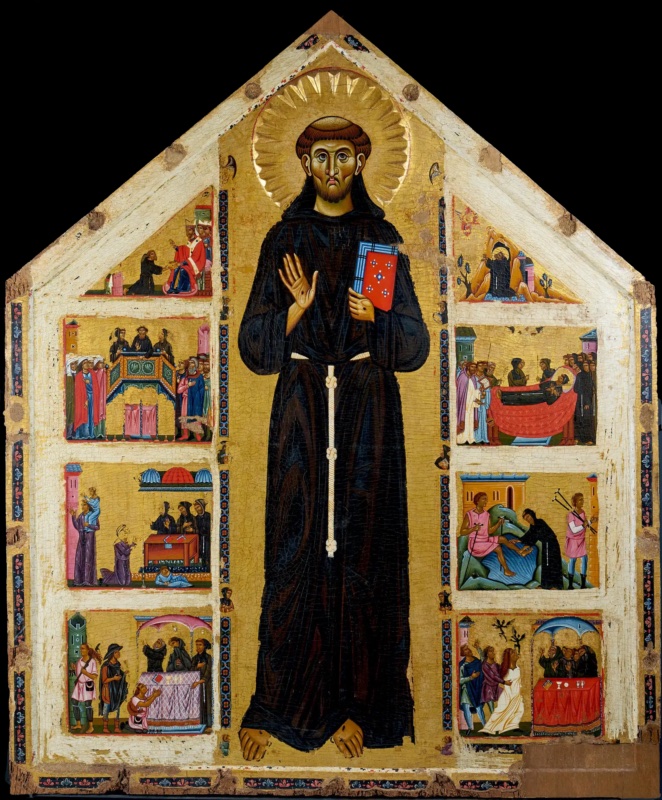
The panel painting Saint Francis and Eight Stories from His Life, housed at the Civic Museum of Pistoia, is one of the absolute masterpieces of 13th-century Italian painting. It was created around 1250–1260 and is attributed by modern critics to a collaboration between two masters: the Master of the Cross No. 434 and the Master of Santa Maria Primerana (named after the Marian icon in Fiesole). The work originally came from the Pistoia church of San Francesco al Prato and is executed in tempera and gold leaf on wood.
The panel is cuspidate in shape—with a triangular pointed top—and follows the iconographic model widespread in Tuscan Franciscan churches since the early 13th century, the same scheme adopted by Bonaventura Berlinghieri in the famous Pescia altarpiece of 1235. Along the outer edge of the frame are empty settings for semi-precious stones or glass pastes that have fallen out over the centuries, likely reliquaries integrated into the structure; the frame is painted with phytomorphic motifs, and the narrow side edges preserve the busts of eight early Franciscan figures, almost invisible at first glance.
In 1614, the work underwent a drastic alteration by Francesco Leoncini, who transformed it into a rectangular format by adding an announcing angel and a Virgin being announced on either side of the cusp, as well as redesigned plant decorations; the original cusp-shaped form was restored through modern conservation efforts, the last of which dates to 1981.
At the center of the panel dominates the standing figure of St. Francis, almost life-size, with a gilded halo in relief. The saint wears the dark brown Franciscan habit, cinched with a white cord tied in knots. With his right hand raised, he makes a gesture of blessing or welcome, while with his left he holds a red book adorned with crosses—a symbol of the Franciscan Rule—and is depicted barefoot.
The background is entirely in gold leaf, in accordance with the Byzantine-derived iconographic tradition that amplifies the sacred and timeless character of the figure. The stigmata on his hands and feet, though rendered with discretion, are recognizable. The stories are arranged in four panels to the left and four to the right of the saint, following a reading order that, in the tradition of Tuscan hagiographic panels, generally proceeds from top to bottom. Based on the key hagiographic texts of the 13th century—primarily the Vita Prima by Thomas of Celano4 and then the Legenda Maior by Bonaventure5, where the stories are divided into four episodes from his earthly life and four postmortem miracles.
- Stories from his life (left side)
The panel in the top left almost certainly depicts the episode of the renunciation of his father’s possessions before Bishop Guido of Assisi (c. 1206): Francis, still a young man, returns his clothes and belongings to his father Pietro di Bernardone in the presence of the prelate, a founding gesture of his choice of radical poverty.
The second panel on the left likely depicts the confirmation of the Rule by Pope Innocent III (1209–1210): the pope, enthroned with the cardinals, approves the first form of life of the Franciscan fraternity—a scene explicitly mentioned in sources relating to the Pistoia panel.
The third panel likely depicts the dream of Innocent III (the pope dreaming of Francis reinforcing the Lateran Basilica), or the preaching to the birds, or another Gospel episode from the saint’s itinerant ministry.
The fourth panel at the bottom left is most likely dedicated to the stigmata of La Verna (September 1224), the high point of Franciscan mysticism, with Francis kneeling before the seraphim crucified on the mountain.
- Post-mortem Miracles (right side)
The panel in the upper right most likely depicts the death and funeral of Francis (October 1226), with the saint’s body laid out and the friars in mourning—a scene that sources explicitly mention among those depicted in the Pistoia altarpiece.
The three remaining panels illustrate miraculous healings performed after his death: healings of the sick, deliverance of the possessed, or resurrections of the dead—central themes in the 1228 canonization process and in Franciscan hagiographic propaganda. These scenes show figures prostrate or touched by grace, with stylized architecture in the background framing domestic or sacred spaces.
The work is a fundamental document for understanding the birth of hagiographic panel painting in the Tuscan region. It reflects the model of the imago clipeata of early Christian derivation and the two-dimensional, precious style of the Byzantine tradition, but introduces elements of lively narration and intense color—vibrant reds, deep blues, emerald green—that foreshadow the evolution toward proto-Gothic naturalism. Its importance was confirmed by its loan to the National Gallery in London for the exhibition Saint Francis of Assisi (May–July 2023), described by director Gabriele Finaldi as “one of the rarest and most remarkable Franciscan images to have survived to the present day.”
Painted Cross
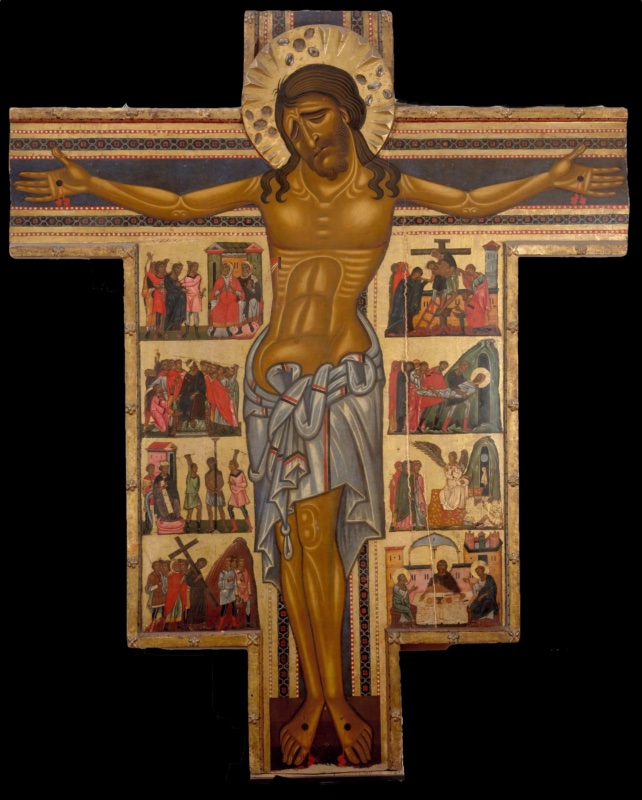
The Cross 434 in the Uffizi is one of the absolute masterpieces of 13th-century Tuscan painting, a work of extraordinary narrative and technical quality that brings together, on a cross-shaped wooden panel, the image of the crucified Christ and eight scenes from the Passion and Resurrection.
The panel measures approximately 247–250 x 200–202 cm and is executed in tempera on a punched gold ground. The form is that of a painted cross with a panel depicting a narrative scene, a type that was very widespread in Tuscany between the 12th and 13th centuries: the body of the cross houses the central figure of Christ, while the lateral terminals (called tabelle or patibula) and the panels arranged along the arms contain the narrative scenes. Many examples of this type were intended for churches in women’s monasteries, where images of the Passion supported meditation and the lectio of the Holy Scriptures.
At the center of the cross dominates the figure of Christ depicted according to the iconography of the Christus Patiens, the suffering and dying Christ, which had spread throughout Italy during the 13th century. His eyes are closed, his head is tilted to one side, and his body is abandoned to the weight of death. Blood flows visibly from the wounds in his hands, feet, and side pierced by the lance. The expressiveness of the face is extremely pronounced: the grimace of pain is amplified through a complex interplay of lines and wrinkles, which extend into the waves of the hair and the curls of the beard, creating a refined system of sculptural rhythms. The loincloth features a highly intricate knot with asymmetrical ripples, which break away from the schematic style common in contemporary works.
The Gospel scenes are arranged in panels on either side of the central cross and at the ends, narrating in sequence the episodes of Christ’s Passion, Death, and Resurrection.
On the left side, proceeding from top to bottom, there are four episodes: Jesus before the Sanhedrin (the night trial before the high priest Caiaphas), Christ mocked and crowned with thorns (the coronatio spinarum with the Roman soldiers mocking him), Christ scourged at the pillar, and finally The ascent to Calvary (the iter ad crucem, with Christ carrying the cross toward the place of execution).
On the right side, mirrored, are four other episodes: the Deposition from the Cross (Depositio), the Placement in the Tomb (Sepulture of Christ), the Encounter of the Pious Women with the Angel at the Empty Tomb (announcing the Resurrection), and the Supper at Emmaus (the appearance of the risen Christ to the disciples during the meal at Emmaus).
The Master employs strong contrasts of light and shadow to suggest the plasticity of the bodies, which, however, remain rendered according to conventional Byzantine models. The artist’s training is today generally traced to the Lucca area, with an evident debt to Berlinghiero Berlinghieri (Volterra, c. 1175 – Lucca, c. 1235/36), one of the founding masters of the Tuscan painting tradition. Despite his roots in the Orientalizing tradition, the Master of the Cross 434 introduces an incipient Western sensibility in the emotional rendering of the scenes, which anticipates the achievements of the late 13th century.
The provenance of the cross is unknown: it was already in the Uffizi’s storage in 1881, and the painter is conventionally identified by the work’s inventory number. The question of attribution remains open: some scholars identify him with the Master of the Madonna of Santa Maria Primerana in Fiesole, recognizing Cross 434 as his earliest phase; others, including Luciano Bellosi, have identified him with the young Coppo di Marcovaldo, one of the most significant figures in 13th-century Florence. Mikhail Boskovits, taking a more cautious approach, places him in Coppo’s circle, dating the work to the fourth or fifth decade of the 13th century.
The Stigmata of Saint Francis
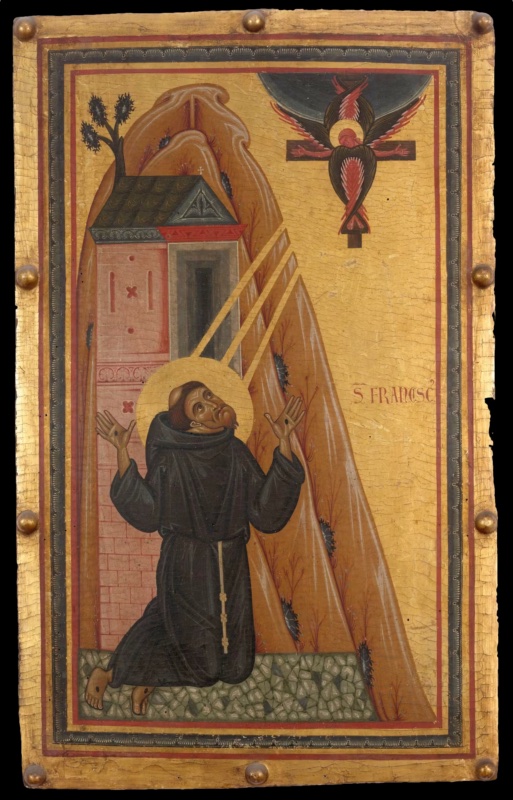
The panel painting of the Stigmata of Saint Francis is considered one of the oldest extant pictorial representations of this miraculous episode, and it stands out for its striking narrative focus on a single theophanic event.
The work is painted in tempera and gold on wood (81 x 51 cm) and has a cusp-shaped form—with the upper part culminating in a pointed arch—which gives the composition an architectural-devotional character, almost like a window opening onto the sacred. The background is in stamped gold, in accordance with the Byzantine tradition in which the Master was trained. The panel was donated by the merchant Ugo Baldi to the Academy of Fine Arts in Florence in 1863, and its original provenance remains unknown.
At the center of the composition, Francis of Assisi is kneeling, depicted in full-face view in a praying posture, with his arms open and outstretched. He wears the dark-colored Franciscan habit, the gray-brown cowl typical of the Order of Friars Minor. His face is austere and pensive, turned upward in ecstatic contemplation of the heavenly vision. In the lower right, an inscription bearing the saint’s name (Franciscus) confirms the protagonist’s identity, almost as an apotropaic act to ward off any iconographic ambiguity—which reveals how recently the subject had been introduced into sacred art.
Clearly visible on Francis’s hands and feet are the heads of the nails that materialize the stigmata—the four wounds of the limbs. The Master deliberately chooses not to show the fifth wound in the side, that of the lance: a theologically prudent choice in an era when the miracle was still controversial and its iconographic representation had to be constructed with extreme caution.
In the upper right corner of the panel appears the heavenly vision: a seraphic angel nailed to the cross—a mystical Jesus on the Cross enveloped by six angelic wings—from whom three rays of light branch out, descending toward Francis and striking his hands and feet. This iconography of the crucified seraph is the most archaic form of the representation of the stigmata, in which the vision is still ambiguously halfway between Christ and the seraph described by Bonaventure of Bagnoregio in the Legenda Maior. The rays indicate the spiritual dialogue between the ascetic and the vision, from which springs the miracle of Francis’s bodily conformation to the crucified Christ.
Behind Francis unfolds the rocky landscape of La Verna, the mountain in the Casentino region given to Francis by Count Orlando Cattani as a hermitage. The Master depicts it as a succession of steep, jagged cliffs, almost impossible to climb, on which sparse wild vegetation grows. High on the cliff, above the rocks, stands a small chapel that the Uffizi source identifies as the first church of the hermitage, dedicated to Santa Maria degli Angeli. This rocky backdrop, stylized and anti-naturalistic in its formal rigidity, is nonetheless rich in meaning: La Verna is the locus sanctus, the place of theophany, and its inhospitable harshness alludes to the ascetic solitude necessary for the encounter with the divine.
This work constitutes an absolute rarity among 13th-century images of Francis: unlike contemporary hagiographic panels—such as Coppo di Marcovaldo’s Tavola Bardi or the altarpieces by Bonaventura Berlinghieri—it does not recount the life of the saint through a cycle of scenes, but focuses the entire narrative on a single episode, that of the stigmata in September 1224. The miracle had only been made public in 1226, upon Francis’s death, in the encyclical letter by Brother Elias. The panel thus belongs to the nascent phase of a new iconography and was created at a time when the rules governing its representation were still being fully developed.
Tereglio Crucifix
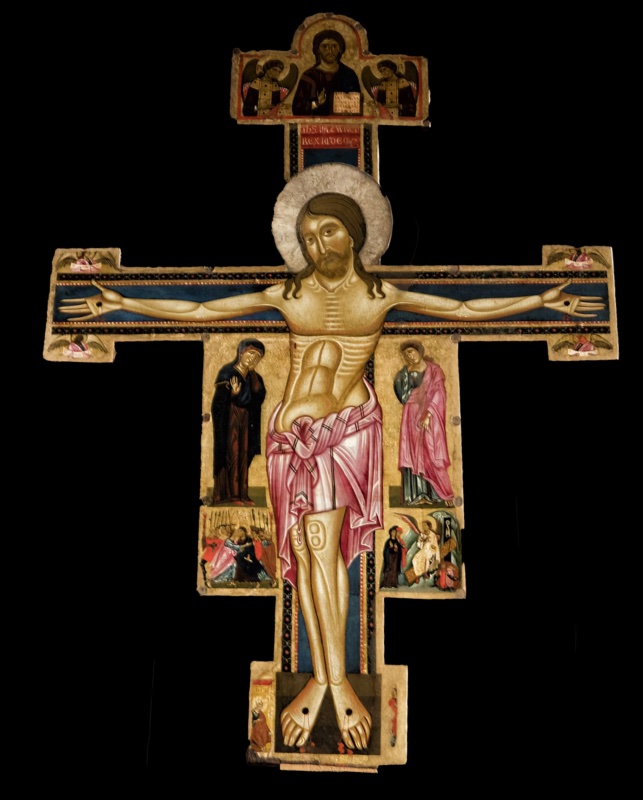
The figure of Christ occupies the entire height of the vertical beam of the cross and dominates the composition with a monumental presence. He is depicted according to the iconography of the Christus Triumphans—alive on the cross, with open eyes and a serene, frontal face turned toward the viewer. His body is upright, not succumbing to the weight of death as in the Christus Patiens of Cross 434 in the Uffizi. The perizoma is a deep rose-pink, tied at the right hip with a complex, asymmetrical fold, a recognizable characteristic of the Master’s style. The complexion is fair and golden, with slender highlights that define the ribs and chest with an almost sculptural effect. The head is surrounded by a large silver-white circular halo, dark hair falls over the shoulders, and the face expresses a solemn composure.
In the upper panel—the lunette-shaped cymatium—is depicted a Christ in a mandorla as Judge (Pantokrator), seated facing forward with his right hand raised in a gesture of blessing and his left hand holding the Book of the Gospels. He is flanked by two adoring angels with outstretched wings. This scene in the cimas is a typical element of the Tuscan painted cross: by placing the risen and glorious Redeemer above the crucified Christ, a theological axis is established that integrates the Passion with the eschatological promise of the Judgment. Between the cymatium and the horizontal arms runs a Greek inscription on a red field (IHSUS NAZARENUS REX IUDEORUM, in the abbreviated form of Eastern tradition), which identifies the condemned man.
At the four ends of the horizontal arms—above and below Christ’s hands—are painted the tetramorphic symbols of the four Evangelists: the winged figures with animal heads according to the vision of Ezekiel and the Apocalypse of John. The image depicts the eagle (John) and the lion (Mark) at the upper ends, while the lower ends likely feature the bull (Luke) and the angel (Matthew). This arrangement of the Tetramorph at the four corners of the cross transforms the panel into a cosmic image: Christ’s sacrifice is witnessed by the four Evangelists radiating toward the four cardinal points.
- The Mourners in the Side Panel
On either side of Christ’s body, in the central panel along the vertical arm, stand the two traditional figures of the mourners. On the left, in dark clothing, is the Virgin Mary, depicted in an attitude of composed grief, with her hand raised to her chest in a gesture of mourning. On the right is John the Evangelist, in a red cloak, similarly absorbed in a gesture of restrained sorrow. The two figures are rendered with the Master’s typical stylization: intense profiles, wide-open eyes, slender hands, and tapered fingers.
- The narrative scenes in the panels
On the left side, one can recognize the Arrest of Christ (Kiss of Judas) in the Garden of Gethsemane—one of the best-preserved scenes, in which the figures of soldiers armed with spears and Judas approaching Christ are clearly distinguishable. On the right side, the scene is identified as the pious women at the tomb (Three Marys): the figures of the women approach the open tomb where the angel appears announcing the Resurrection.
Critics have long debated whether the Tereglio Crucifix is the work of the Master of the Cross 434 alone or the result of a collaboration with the Berlinghieri workshop—so much so that some sources attribute its authorship jointly to Bonaventura Berlinghieri and the Master of the Cross 434. The dating ranges from 1235 to 1260 depending on the scholar: the Cultural Heritage catalog indicates post 1235. The Christus Triumphans, compared to the Christus Patiens of the Uffizi Cross, represents a more archaic iconographic choice, rooted in the Orientalizing tradition of Lucca, which refers directly to the prototypes of Berlinghiero Berlinghieri and to Byzantine models.
Bandini Crucifix
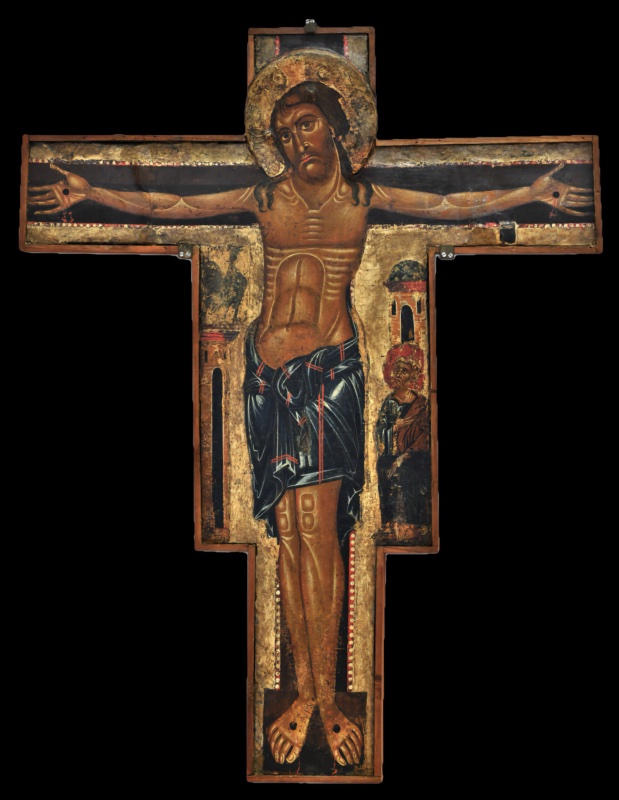
The Crucifix at the Bandini Museum has an exceptional history, revealed in 1952 by the restorer Leonetto Tintori and the art historian Ugo Procacci. The work lay hidden beneath a crude 18th-century repainting and, above that, beneath a second 13th-century crucifix of later workmanship. Thanks to a daring process that used pyridine heated to between 50 and 60 degrees, Tintori managed to separate the two overlapping layers of tempera without damaging them, restoring both works. The older of the two, attributed to the Master of the Cross 434 and dated to around 1230–1240, was attributed to this master in 1977 by Boskovits and later confirmed by Tartuferi.
The central figure of the painting represents the Christus triumphans, an iconographic type depicting Christ on the cross with his head held high, his eyes open, and his face serene, victorious over death. This motif contrasts with the Christus patiens—widespread in Florence during the second half of the 13th century—where Christ appears suffering, with his eyes closed and his head bowed. In the Bandini Crucifix, the body is stylized according to the abstract canons of the Byzantine-Lucchese tradition: the ribs are highlighted with graphic precision, the loincloth is dark blue with elegant folds, and the background was originally silver—now lost due to the heat of the candles.
On the upper tabellone—the rectangular panel surmounting the vertical arm of the cross—is painted the scene of St. Peter’s Denial and Repentance at the Crowing of the Rooster. This narrative scene, a Gospel episode depicting Peter’s threefold denial (John 18:15–27), takes place within a stylized architectural setting visible on the right side of the panel: a building-like structure with a reddish dome against a blue background, representing the palace of the high priest Caiaphas. Saint Peter is depicted there with a halo around his head, in the gesture of one turning at the sound of the cock’s crow—a symbol of repentance and the possibility of redemption.
The rooster itself, a particularly lively and melodious iconographic element, belongs to the most recent layer of painting (the third quarter of the 13th century) but was deliberately left on the original support during restoration, so as not to disrupt the compositional and iconographic balance of the scene.
The work is executed in tempera and gold on shaped panel, in the typical form of the 13th-century Italian painted cross with tabelloni at the ends. The ground was originally in silver leaf—not gold as in the later version—which gave the image a cold, lunar luminosity, consistent with the solemnity of the Christus triumphans. The painter employs a still schematic chiaroscuro, with geometric highlights on Christ’s body that reflect contemporary Lucca models, far removed from the more naturalistic rendering that Cimabue would introduce a few decades later.
The Bandini Crucifix is one of the rare examples of Florentine painting from the second quarter of the 13th century preserved in situ in Fiesole, and is of extraordinary importance for the history of modern restoration: the technique of separating the two layers of paint developed by Tintori in 1952 represented a methodological innovation documented in the Bollettino d’Arte of 1953. The scene of Peter’s Repentance with the rooster—an icon of second chances and mercy—adds a narrative and devotional dimension to the cross that goes beyond the simple commemoration of the Passion, transforming the work into a true theological treatise on redemption.
Madonna di Rosano
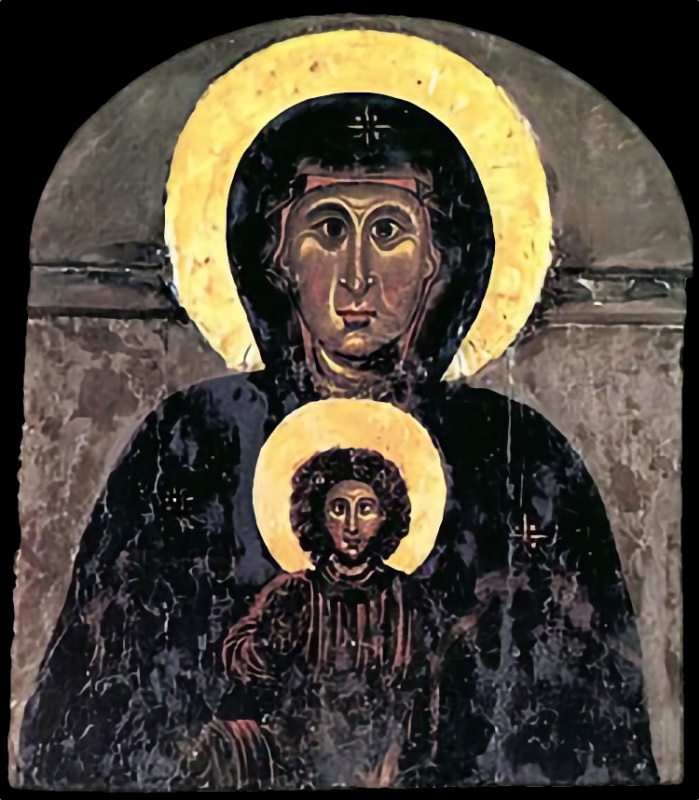
The Madonna of Rosano is a panel painting on a gold ground dating from around 1230, housed in the Monastery of Santa Maria a Rosano near Rignano sull’Arno, attributed to the Master of the Cross 434 or, according to some scholars, to the young Coppo di Marcovaldo.The Master of the Cross 434 is an anonymous painter active in Florence during the second quarter of the 13th century, whose conventional name derives from the inventory number (no. 434) of his principal work, housed in the Uffizi. He is among the most significant figures in the Florentine painting scene of the first half of the 13th century, and some scholars have suggested that he may be identified with the young Coppo di Marcovaldo.
The Madonna of Rosano is part of the Benedictine iconographic tradition of the monastery founded by the Guidi Counts, long-standing patrons of artistic works of the highest quality. The panel depicts the Virgin Enthroned in the style of the Theotokos or Majesty, seated facing forward with the Infant Jesus resting on her lap or left arm.
Mary appears clad in a bluish-blue maphorion (mantle), decorated with delicate golden ornaments in accordance with the iconographic tradition of Byzantine derivation, and with a red or ochre inner tunic visible at the hem. The Virgin’s face is rendered in the characteristic Italo-Byzantine style: almond-shaped eyes with the whites outlined by thin black lines, a long, slender nose, and lips pressed together in a solemn, distant expression.
The Bambino Gesù is depicted seated on his Mother’s arm in a solemn, frontal pose, already adult in his features—according to the “Wise Child” formula typical of medieval iconography—with his right hand raised in a gesture of blessing (Latin benedictio) and his left hand holding a scroll or codex, a symbol of the Divine Word. Surrounding the heads of both figures are large circular halos in gold leaf, which in the Virgin may feature decorative geometric or floral engravings.
On either side of the central figure of the Madonna, figures of angels in adoration were likely present, either at the edges of the panel or on the side panels, following a compositional scheme common in Florentine painting of the second quarter of the 13th century—similar to that of Cimabue’s contemporary Maestà and the Enthroned Madonnas attributed to the same circles.
The uniform gold ground creates a typically medieval effect of spatial abstraction, negating material depth in favor of a spiritual and otherworldly dimension.
The support is a wooden panel—likely made of chestnut or poplar, woods favored by the Tuscan-Florentine workshops of the 13th century. A linen ground (a double layer of fine linen) was applied to the wooden surface, upon which several layers of very fine chalk mixed with vegetable gum were applied, unlike the custom of the time, which called for the use of animal glues. The paint film is in egg tempera, with chromatic backgrounds applied in successive glazes to build volume through strong contrasts of light and shadow. The gold ground is made with beaten gold leaf, applied to the preparatory layer and likely burnished with agate stone to achieve maximum luster.
The master employs strong contrasts between light and shadow to suggest the plasticity of the bodies, rendered according to conventional Byzantine models. The color scheme alternates intense blues, vermilion reds, and gold on a gilded background, creating a precious and opulent effect typical of the taste of Tuscan monastic patrons of the time. The style is fully situated in the transition between the Byzantine Mannerism of icons and the early Proto-Gothic renewal that would fully establish itself with Cimabue and Duccio in the second half of the 13th century.
Madonna Enthroned with Seventeen Scenes from the Life of the Virgin
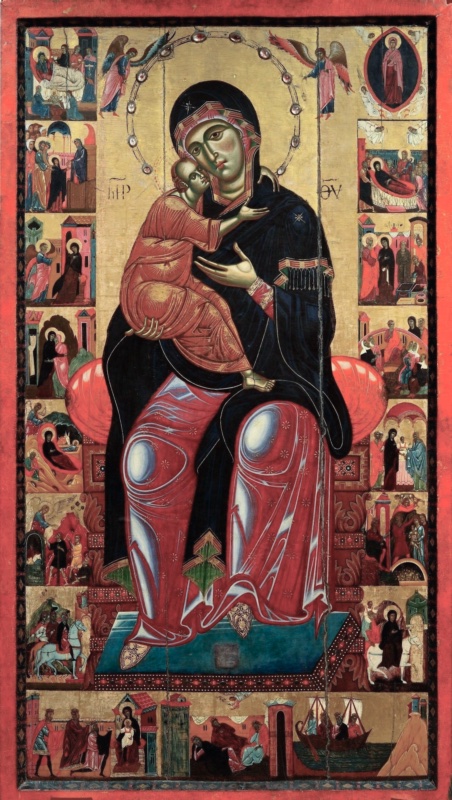
The Madonna and Child Enthroned with Seventeen Scenes from the Life of the Virgin by the Master of Cross 434 is one of the most important 13th-century panels in early Italian painting; it is housed at the Pushkin Museum in Moscow and dates from around 1255–1260. The work is executed in tempera and gold on panel, with a gold-leaf ground, a technique typical of 13th-century Italian painting of Byzantine origin. Its dimensions are 246 × 138 cm, making it a large altarpiece of considerable grandeur.
The panel was purchased on the antiquities market in Rome in 1863 by the Russian traveler and collector Petr Ivanovich Sevastyanov, a well-known enthusiast of Christian antiquities, who brought it to Russia. Prior to this acquisition, the work was virtually unknown even to scholars of early Italian painting.
At the center of the composition stands the Enthroned Madonna, following the iconography of the Hodegetria Dexiokratousa, that is, the Virgin seated on a throne holding the Infant Jesus on her right arm. The Virgin wears a deep blue mantle (maphorion) over a red tunic, adorned with refined chrysography—gold relief decorations created using a mordant technique, which lend luster and preciousness to the painted surface. The Child is dressed in a decorated tunic and holds a scroll in his left hand, a symbol of his divine and sapiential nature.
The Greek inscriptions MP ΘV (Mater Theou, Mother of God) identify the figure of the Virgin according to Byzantine iconographic tradition. The throne is richly decorated, and the Madonna’s frontal, solemn pose attests to the profound influence of the Greek manner (Greek manner as Vasari defined it) on 13th-century Tuscan painting.
The scenes are arranged on either side of the central figure in small narrative panels, forming a complete cycle of the Life of the Virgin, ranging from the Birth of Mary to her Dormition and Assumption. The precise identification of all seventeen scenes, which can be read from top to bottom across the two side registers, includes the following episodes:
Left side (to be read from top to bottom)
- Joachim and Anna, the Virgin’s parents in prayer, perhaps the scene of the Angel announcing Mary’s birth
- Birth of Mary, the newborn Virgin, with the midwives and Anna at her bedside
- Presentation of Mary at the Temple with the infant Mary led by her parents to the priest
- Betrothal of the Virgin with Mary and Joseph before the priest
- Annunciation (the Archangel Gabriel announces the Incarnation to Mary)
- Visitation (Mary visits her cousin Elizabeth)
- Nativity of Jesus with the birth of Christ in the manger with angels and shepherds
- Adoration of the Magi with the Magi pay homage to the Child
- Flight into Egypt (the Holy Family fleeing)
Right side (to be read from top to bottom)
- Presentation of Jesus in the Temple (the Purification of Mary and the presentation of the Child to the priest Simeon)
- Jesus among the Doctors, the young Christ debating in the Temple
- Wedding at Cana, Jesus’ first miracle, witnessed by Mary
- Dormition of the Virgin (Koimesis)
- Mary on her deathbed, surrounded by the apostles and Christ holding her soul
- Assumption of Mary (the Virgin assumed into heaven)
- Coronation of the Virgin (Mary crowned Queen of Heaven by Christ)
Two additional scenes complete the cycle, featuring episodes related to the lives of Mary and Christ, including likely the Presentation or scenes from the Passion in connection with Our Lady of Sorrows.
In the Pushkin panel, the master reveals himself to be a skilled storyteller: he employs strong contrasts of light and shadow to suggest the plasticity of the bodies, rendered according to conventional Byzantine models, but with a narrative vitality that foreshadows the figurative revolution of Cimabue and Giotto. The painting displays an extraordinary mastery of the chrysographic technique, with gilded lines applied with mordant to the Virgin’s garments to evoke the divine light radiating from her body, following a Byzantine-Crusader tradition that arrived in Tuscany in the second half of the 13th century.
Scholars have compared the panel to the great Maestà works by Cimabue, Duccio, and Giotto, with which it was placed in direct dialogue during the exhibition held at the Uffizi between October 2011 and January 2012, titled The Dawn of Florentine Painting. The Maestà from the Pushkin Museum in Moscow. Jaroslav Folda, in his monograph Byzantine Art and Italian Panel Painting (Cambridge University Press), devotes considerable attention to the Pushkin Madonna as an exceptional document of the moment when Tuscan painting absorbed and reworked the Crusader and Byzantine traditions, placing it within the context of the great Hodegetria Madonnas of the third quarter of the 13th century.