Bonaventura Berlinghieri
( 25% )
Bonaventura Berlinghieri was born circa 1210 in Lucca, Tuscany, into one of the most significant artistic dynasties of thirteenth-century Italy. The Berlinghieri family represented a crucial transitional moment in Italian painting, bridging the Byzantine tradition with emerging local innovations that would eventually culminate in the Renaissance. Bonaventura emerged as the most documented member of this artistic lineage, primarily through his signed and dated altarpiece of Saint Francis, completed in 1235. His active period is generally placed between 1235 and 1244, though some sources extend his life to approximately 1287. The artist’s birth into an established workshop environment provided him with exceptional training from childhood, immersing him in the technical and aesthetic principles that dominated Tuscan painting of the early Duecento.
Lucca itself served as a vibrant artistic center during this period, fostering multiple workshops and attracting patronage from both ecclesiastical and civic authorities. The city’s strategic position along pilgrimage routes and its economic prosperity created favorable conditions for artistic production and innovation. Bonaventura’s formative years coincided with the canonization of Saint Francis1 in 1228, an event that would profoundly influence his most celebrated commission. His death occurred sometime around 1287, though the precise circumstances remain undocumented in surviving records. The scarcity of biographical details reflects the broader challenge of reconstructing individual artistic lives from the medieval period, when documentary evidence was limited and often confined to contractual or notarial records.
Family Background and Workshop Structure
The Berlinghieri family emerged as one of the most significant artistic dynasties in thirteenth-century Tuscany, establishing a workshop tradition that spanned multiple generations and shaped the visual culture of Lucca. The patriarch Berlinghiero Berlinghieri appears in a crucial document dated March 22, 1228, where he is explicitly identified as “Milanese,” indicating either his birthplace in Lombardy or his family’s geographic origins before settling in Tuscany. This same notarial record, preserved in Lucchese archives and known through seventeenth-century transcriptions, mentions Berlinghiero alongside his three sons—Marco, Barone, and Bonaventura—during a formal oath of peace with Pisa, suggesting all were recognized as independent practitioners by this date.
The document’s context within civic proceedings indicates the family’s integration into Lucca’s social and political structures, reflecting the elevated status that successful artisans could achieve in communal Italy. Berlinghiero’s designation as “son of Melanese the elder” in this document provides rare genealogical information, extending family history back an additional generation. The fact that at least two sons—Barone and Bonaventura—had reached majority by 1228 suggests Berlinghiero was born approximately fifty years earlier, around 1175, placing his artistic formation in the late twelfth century.
This chronology positions Berlinghiero’s training within the fully developed Byzantine-influenced tradition that had dominated Italian painting since the early medieval period. The family’s established presence in Lucca by 1228, combined with documented commissions and signed works, indicates a flourishing workshop that had secured stable patronage networks. Berlinghiero’s self-identification as Volterran on signed crucifixes, contrasting with the “Milanese” designation in the 1228 document, has generated scholarly debate regarding the family’s precise geographic trajectory before establishing their Lucchese practice. The workshop’s specialization in painted crucifixes and devotional panels created a defined market niche, with surviving signed works demonstrating the technical and aesthetic standards that established the family’s reputation.
Workshop organization in medieval Italian painting followed familial structures that integrated domestic and professional spheres, with training, production, and commerce conducted within household contexts. The Berlinghieri bottega exemplified this model, functioning as both family residence and artistic production facility where sons learned their craft through direct observation and graduated participation in commissions. Medieval workshop pedagogy emphasized practical demonstration rather than theoretical instruction, with apprentices beginning training in childhood through menial tasks like grinding pigments and preparing panels. As skills developed, apprentices progressed to executing secondary passages under master supervision, eventually achieving sufficient competence to undertake independent work while remaining within the family enterprise.
The collaborative nature of workshop production meant that finished works often represented multiple hands, with the master establishing overall design and executing critical passages while assistants contributed to less prominent areas. This system created challenges for modern attribution practices, as distinguishing individual artistic personalities within collective production requires careful stylistic analysis and, increasingly, scientific investigation. The workshop’s economic model balanced prestigious commissions that established reputation with smaller devotional works that provided steady income, ensuring financial stability across fluctuating market conditions. Family workshops maintained continuity across generations through systematic transmission of technical knowledge, aesthetic preferences, and commercial relationships, creating artistic lineages that could dominate regional markets for extended periods. Wives and daughters participated in workshop economies, though documentation of female contributions to artistic production remains sparse due to patriarchal record-keeping practices. The Berlinghieri workshop’s longevity—with documented activity spanning from at least 1228 through the 1270s—testifies to successful management of these complex familial, artistic, and commercial relationships.
Berlinghiero Berlinghieri’s artistic achievement established the foundation upon which his sons built their careers, with signed works demonstrating his mastery of the Byzantine-influenced manner. The Crucifix in Lucca’s Pinacoteca Civica, dated approximately 1220, presents the suffering Christ with elongated proportions, stylized anatomy, and carefully articulated musculature rendered through linear patterns characteristic of the maniera greca. This work’s signed inscription—identifying the artist as Berlinghiero of Volterra—provided crucial evidence for reconstructing family history and artistic development. The Crucifix of Fucecchio, created between 1230 and 1235 and now preserved in Pisa’s Museo San Matteo, demonstrates similar technical and aesthetic qualities, confirming Berlinghiero’s consistent adherence to established Byzantine conventions.
A panel depicting Madonna and Child, now in New York’s Metropolitan Museum of Art, has been attributed to Berlinghiero based on stylistic affinities with signed works, showing his engagement with devotional imagery beyond crucifixes. These surviving works reveal a painter thoroughly versed in tempera technique, gold leaf application, and the iconographic traditions governing sacred imagery in early thirteenth-century Italy. Berlinghiero’s influence on his sons manifested in technical procedures, compositional strategies, and aesthetic values that all three—Marco, Barone, and Bonaventura—would maintain and develop. The workshop’s specialization in religious painting reflected broader patterns in medieval artistic production, where ecclesiastical patronage dominated and secular commissions remained relatively rare. Berlinghiero’s probable death around 1235 or 1236 coincided with Bonaventura’s emergence as an independent master, suggesting deliberate succession planning within the family enterprise. The transmission of workshop leadership from father to son ensured continuity of commercial relationships and maintenance of the family’s artistic reputation in the competitive Tuscan market.
Barone Berlinghieri occupied a unique position within the family as both Franciscan friar and practicing painter, embodying the intersection of religious vocation and artistic production. His dual identity reflected broader patterns within mendicant orders, which valued artistic skills for creating devotional imagery that supported their evangelical mission. Franciscan communities during this period navigated complex relationships with material culture, balancing ideals of apostolic poverty with practical needs for church decoration and liturgical furnishings. Barone’s presence within the order potentially facilitated the family workshop’s access to Franciscan commissions, including the prestigious 1235 Saint Francis altarpiece executed by Bonaventura for Pescia. The practice of friar-artists was sufficiently common in thirteenth-century Italy that mendicant constitutions addressed questions of workshop participation and income distribution.
Some friars maintained artistic practices within conventual settings, producing works for their own communities while remaining bound by vows of poverty and obedience. Others, like Barone, may have balanced external workshop participation with religious obligations, contributing specialized knowledge or mediating between secular family enterprises and ecclesiastical patrons. Documentation of Barone’s specific artistic production remains minimal, with no securely attributed works surviving to demonstrate his individual style or technical approach. The integration of artistic and religious identities in figures like Barone complicates modern assumptions about distinct professional and spiritual spheres, revealing the fluidity of medieval social categories. His position within both family workshop and Franciscan community exemplifies the multiple networks—familial, professional, religious—that structured medieval artistic production and patronage.
Marco Berlinghieri, the third son mentioned in the 1228 document, remains the most enigmatic family member, with scholarly understanding limited by sparse documentation and uncertain attributions. Traditional accounts associate Marco with manuscript illumination and book illustration, suggesting specialization distinct from his father’s and brothers’ focus on panel painting. A miniature Bible dated 1248-1250 and preserved in the Curia Arcivescovile in Lucca has been attributed to Marco, indicating activity extending into mid-century. Manuscript illumination required specialized skills in working at reduced scale, applying gold leaf to vellum rather than wooden panels, and coordinating images with textual programs.
The technical demands of miniature painting involved extremely fine brushwork, precise execution of decorative borders, and integration of imagery with Gothic or Romanesque letterforms. Illuminators often worked independently or in specialized workshops separate from panel painters, though some artists maintained competence in both media. If Marco indeed specialized in manuscript production, this diversification would demonstrate the Berlinghieri family’s strategic expansion across multiple artistic markets and patronage networks. The Bible attribution remains tentative, based on stylistic analysis suggesting connections to the family’s broader aesthetic approach. Marco’s documented activity period—approximately 1230 to 1255—overlaps with his brothers’ careers, indicating simultaneous operation of multiple family members in related but distinct artistic practices. The fragmentary evidence surrounding Marco’s career exemplifies broader challenges in reconstructing medieval artistic production, where documentation gaps and uncertain attributions leave many accomplished practitioners incompletely understood.
Patronage Networks and Ecclesiastical Commissions
The commission for Bonaventura Berlinghieri’s Saint Francis altarpiece emerged from the extraordinary religious enthusiasm following Francis’s canonization by Pope Gregory IX2 in 1228, merely two years after the saint’s death. The Franciscan order’s rapid expansion throughout Italy and Europe created unprecedented demand for visual representations celebrating the founder’s life, miracles, and sanctity. Pescia’s Franciscan community, established during the order’s early growth phase, commanded sufficient resources to commission this substantial painted panel by 1235, demonstrating the friars’ successful fundraising despite their vows of poverty.
The commission’s timing—seven years post-canonization and nine years after Francis’s death—placed Bonaventura among the earliest artists creating visual hagiographies of the new saint. The selection of Lucca-based Bonaventura for this commission suggests either his established reputation had reached beyond his home city, or Franciscan networks facilitated connections between the Pescia community and the Berlinghieri workshop. The altarpiece served multiple functions: liturgical focus for Mass celebration, devotional object for private prayer, and pedagogical instrument communicating Francis’s life to illiterate congregations. Franciscan communities throughout Tuscany and beyond commissioned similar works during this period, creating competitive dynamics among painters seeking access to this lucrative patronage sector. The iconographic requirements for Franciscan altarpieces—large central saint figure surrounded by narrative scenes—followed emerging conventions that Bonaventura’s work helped establish. Patrons typically specified which miraculous episodes and biographical events should be depicted, balancing official hagiographic accounts with local devotional emphases. The Pescia commission’s successful completion enhanced Bonaventura’s reputation, though documentary evidence of subsequent commissions has not survived, leaving questions about his full career trajectory unanswered.
Franciscan art patronage during the thirteenth century navigated complex tensions between the order’s poverty ideals and the practical demands of liturgical celebration and evangelical mission. Early Franciscan constitutions addressed questions of church decoration, with debates regarding appropriate material display generating ongoing discussions within the order. The rapid construction of large Franciscan churches in major Italian cities—Assisi, Florence, Padua, Verona—created need for altarpieces, frescoes, and liturgical furnishings that honored Francis while serving devotional functions.
These commissions often involved complex patronage arrangements, with lay donors financing specific chapels or artworks within Franciscan churches, creating networks of obligation connecting friars, artists, and benefactors. The Assisi basilica, constructed as Francis’s shrine and order headquarters, established visual programs that influenced subsequent Franciscan decoration, though recent scholarship emphasizes local variations rather than centralized control. Individual Franciscan communities exercised considerable autonomy in commissioning church decoration, responding to local circumstances, patron preferences, and available resources.
The friars’ evangelical mission emphasized preaching and poverty, yet their churches’ visual splendor seemingly contradicted these values, generating criticisms that Franciscans defended by distinguishing personal poverty from communal property. Artists working for Franciscan patrons navigated these theological sensitivities while meeting practical requirements for effective devotional imagery. The collaboration between Bonaventura and the Pescia Franciscans exemplified these complex relationships, producing a work that honored Francis through precious materials while serving the order’s spiritual mission. Payment for such commissions came from donations, benefices, or communal funds, with friars mediating between artists and ultimate financial sources while maintaining fiction of personal poverty.
The broader landscape of ecclesiastical patronage in thirteenth-century Tuscany encompassed multiple institutional actors beyond the mendicant orders. Cathedral chapters, governing major urban churches, commissioned works for high altars, chapels, and liturgical furnishings, often involving substantial financial resources and prestigious artistic opportunities. Parish churches throughout urban centers and rural territories required devotional imagery appropriate to their dedications and local saint cults, creating steady demand for altarpieces and painted crucifixes.
Monastic communities such as Benedictines, Cistercians, and Camaldolese, maintained artistic traditions predating the mendicants, commissioning works for monastic churches and chapter houses. Episcopal palaces and curial complexes required ceremonial and devotional decoration, with bishops exercising significant patronage power within their dioceses. Confraternities—lay religious associations proliferating during this period—commissioned works for their meeting halls, chapels, and processional use, creating additional patronage opportunities. Hospital foundations and charitable institutions required religious imagery for chapels and public spaces, with artwork serving both devotional and institutional representation functions. The integration of religious and civic spheres in communal Italy meant that major ecclesiastical commissions often carried political significance, with urban governments involving themselves in important church projects. Competition among religious institutions for prestige and devotional followings created incentives for impressive artistic commissions that would attract worshippers and benefactors. The fragmentary documentation of Bonaventura’s career beyond the Pescia commission leaves uncertain which additional patronage sectors he accessed, though a successful workshop would have cultivated relationships across multiple institutional contexts.
Lay patronage of religious art increased during the thirteenth century, as urban prosperity and developing concepts of purgatory encouraged devotional benefactions. Wealthy individuals commissioned private chapels in major churches, funding both architectural construction and decorative programs including altarpieces and frescoes. These private chapels served family devotional needs while functioning as public displays of piety and social status, integrating religious and social dimensions.
Donors often specified their commemorative inclusion in commissioned works, with inscriptions identifying patrons and requesting prayers for their souls. The practice of commissioning portable devotional panels for domestic chapels or personal use expanded during this period, creating market segments distinct from monumental ecclesiastical commissions. Guild organizations commissioned works for their patron saint chapels, combining religious devotion with corporate identity and member solidarity.
Testamentary bequests frequently included provisions for artistic commissions, with executors responsible for ensuring deceased patrons’ wishes were fulfilled. The documentation of such private patronage survives sporadically through notarial records, wills, and family chronicles, providing fragmentary evidence of a substantial artistic economy. Marriage alliances among elite families sometimes involved artistic commissions marking betrothals or weddings, integrating artwork into social reproduction strategies. Whether Bonaventura accessed these private patronage networks remains unknown, though the attributed diptych in Florence’s Accademia possibly originated as a private devotional commission given its intimate scale.
The economic infrastructure supporting artistic patronage in thirteenth-century Tuscany derived from the region’s remarkable commercial prosperity. Lucca’s banking families extended credit throughout Europe, accumulating capital that funded urban development, church construction, and artistic patronage. Textile production, particularly silk manufacturing in Lucca, generated wealth that supported both direct patronage and tax revenues funding civic projects. The communal government’s involvement in major church commissions reflected urban pride and competition among Tuscan cities for artistic and architectural prestige.
Trade networks connecting Italian cities to northern Europe, Byzantium, and the Mediterranean world facilitated not only economic exchange but also artistic transmission and material availability. The relative political stability of the early thirteenth century, before Guelf-Ghibelline conflicts intensified, provided favorable conditions for sustained artistic patronage. Ecclesiastical institutions’ landholdings and benefice income provided reliable funding for church decoration and maintenance, though resources varied dramatically among wealthy cathedrals and modest parish foundations. The practice of indulgences, promising spiritual benefits in exchange for donations, helped fund major church projects including associated artistic commissions. Confraternity dues and bequests created pooled resources that smaller donors collectively deployed for artistic patronage. This complex economic ecology supported multiple workshops in major Tuscan cities, creating competitive markets where artistic quality, personal connections, and timely completion determined commercial success.
Contractual practices governing artistic commissions evolved during the thirteenth century, establishing precedents that would structure Renaissance patronage relationships. Formal contracts specified work scope, materials quality, iconographic requirements, and completion schedules, protecting both patron and artist interests. Material specifications often required particular pigments—ultramarine for the Virgin’s mantle, gold leaf of specified quality—ensuring finished works met patron expectations and justified agreed payments.
Penalty clauses for delayed completion encouraged timely work, while inspection provisions enabled patrons to verify quality before final payment. Dispute resolution mechanisms, often involving guild arbitration or civic mediation, provided frameworks for addressing conflicts over quality, timing, or compensation. The increasing formalization of patron-artist relationships reflected broader developments in commercial law and contractual practice characteristic of Italian communes.
Artists’ guild membership, expanding during this period, provided collective organization that standardized practices and protected professional interests. The balance of power in patron-artist negotiations varied with artists’ reputations and market conditions, with established masters commanding better terms than emerging practitioners. Workshop organization enabled masters to manage multiple simultaneous commissions, deploying family members and assistants strategically across projects of varying scale and prestige. The economic model underlying workshop operations required balancing material costs, labor time, and desired profit margins, with prestigious commissions sometimes accepted at lower margins for reputational benefits. Bonaventura’s navigation of these complex commercial relationships, while undocumented in surviving contracts, would have been essential to workshop success and the Berlinghieri family’s sustained prosperity.
Painting Technique and Material Practice
The technical foundation of Bonaventura Berlinghieri’s painting practice began with careful selection and preparation of wooden panels, typically employing poplar in Tuscany due to its availability, workability, and stable dimensional characteristics. The panels were planed smooth to create even surfaces, with any knots, cracks, or imperfections repaired using wood putty or small inserts to ensure structural integrity. Larger panels sometimes received reinforcement through battens affixed to the reverse side, preventing warping from moisture fluctuations and providing stability during handling and installation.
The prepared wood surface underwent sizing with animal-skin glue—typically rabbit-skin glue boiled with water—which sealed the wood and prevented subsequent gesso layers from absorbing unevenly. This sizing layer dried thoroughly before gesso application commenced, ensuring proper adhesion of the ground preparation. The gesso ground consisted of gypsum powder mixed with animal-skin glue, creating a brilliant white surface that enhanced the luminosity of overlying paint layers and gold leaf. Gesso grosso, a coarser initial formulation, was applied in several thin coats, with each layer allowed to dry completely before the next application.
Subsequent layers employed gesso sottile, a finer formulation ground to silky consistency that created perfectly smooth painting surfaces. The total gesso buildup typically comprised six to ten layers, gradually creating substantial thickness that could be carved, incised, or burnished in subsequent decorative processes. The brilliant white gesso provided optical benefits by reflecting light back through translucent paint and gold leaf layers, creating the luminous effects characteristic of medieval panel painting.
Areas designated for gilding received specialized treatment, with gesso duro—a harder, less absorbent formulation—built up in low relief to create raised decorative elements like halos, borders, and ornamental patterns. This raised gesso, called pastiglia, could be modeled into elaborate decorative forms using wooden tools, creating three-dimensional effects that enhanced visual richness.
The application of Armenian bole—a red-brown clay containing iron oxides—over the raised gesso provided the ideal substrate for water gilding, the technique producing the most brilliant and durable gold surfaces. The bole was mixed with gelatin sizing to create a smooth paste, applied in several thin layers and allowed to dry completely. The bole’s warm tonality showed through microscopically thin gold leaf, creating the characteristic warm glow of medieval gilding distinct from the cooler appearance of gold applied over other grounds. Some painters employed terre-vert (green earth) as gilding ground following older Byzantine traditions, creating cooler tonalities though rendering burnishing more difficult. Gold leaf application required meticulous technique, as the microscopically thin sheets—beaten to approximately 1/300,000 inch thickness—tore easily and required careful handling.
The gilder’s toolkit included specialized implements: a gilder’s knife for cutting leaf, a cushion for holding and cutting sheets, and soft brushes for positioning leaf onto prepared surfaces. Water gilding involved wetting the bole with dilute alcohol solution, which softened the gelatin and created adhesion when gold leaf was laid onto the tacky surface. As water evaporated, the gold was drawn into intimate contact with the bole, enabling subsequent burnishing to achieve mirror-like brilliance.
The burnishing process transformed dull gold leaf into brilliant reflective surfaces through mechanical compression and polishing. Burnishers—typically polished agate or hematite stones mounted in wooden handles—were rubbed firmly over dried gilded surfaces, compressing the gold and creating smooth, reflective finishes. The technique required skill and patience, as excessive pressure could damage the delicate gold layer, while insufficient pressure left surfaces dull. Different burnishing implements created varying surface textures and reflective qualities, with experienced gilders selecting tools appropriate to specific effects.
The raised pastiglia decoration, burnished to high brilliance, created dramatic light-catching effects that animated surfaces under changing illumination conditions. Alternative gilding techniques included mordant gilding (oil gilding), where gold leaf adhered to tacky oil-resin mixtures applied over painted surfaces, enabling selective gilding of specific design elements. Mordant gilding, unlike water gilding, could not be burnished to high brilliance but enabled decorative applications over completed paintings, creating layered visual effects. Shell gold—powdered gold mixed with binder—could be applied with brushes for fine linear decoration, though its appearance differed from leaf gilding. The extensive use of gold in Bonaventura’s work reflected both aesthetic preferences and theological symbolism, with gold representing divine light and heavenly realms. The practical challenges and material expense of gilding made it a specialized skill, with some workshops employing dedicated gilders rather than having painters execute all gilding processes.
Preparatory drawing followed gilding completion, establishing compositional structure and guiding subsequent paint application. The transfer of designs to gilded panels involved pouncing technique: preparatory cartoons were pricked along contour lines, then charcoal dust pounced through the perforations transferred outlines to the panel. Alternatively, artists could draw directly onto the prepared surface using willow charcoal, which could be easily corrected or modified before fixing. The drawing was then reinforced using brushes and dilute ink or pigment, creating permanent guidelines for paint application.
Some artists incised key contour lines into the gesso using metal styluses, creating grooves that guided brushwork and remained visible in modern technical analysis. Infrared reflectography, employed in modern conservation studies, reveals underdrawing beneath paint layers, providing evidence about preparatory processes and artistic decision-making. Analysis of underdrawing in thirteenth-century panels demonstrates varying approaches: some painters created detailed preparatory drawings establishing all compositional elements, while others worked from rudimentary sketches developed during painting. The choice between detailed and minimal underdrawing reflected individual working methods, commission requirements, and compositional complexity. Cennino Cennini’s later treatise “Il Libro dell’Arte” describes several preparatory approaches, noting that “Giotto, the great master” followed particular methods that balanced planning with painterly spontaneity. The preparatory phase established fundamental compositional relationships that subsequent painting would develop through color, modeling, and detail refinement.
The tempera medium itself consisted of pigments ground to powder and mixed with egg yolk, creating fast-drying, permanent paint with distinctive handling properties fundamentally different from oil paint. Egg yolk, containing natural emulsifiers, combined both aqueous and lipid components enabling suspension of diverse pigments. The grinding of pigments to extremely fine consistency was crucial for achieving smooth paint films and rich color saturation. Pigment grinding occurred using stone or glass mullers on marble slabs, with extended grinding time creating finer particles that dispersed better in binder.
Each pigment required individual preparation and mixing, as tempera could not be premixed and stored like modern tube paints. The fast-drying nature of egg tempera demanded efficient working methods, as paint dried within minutes of application, preventing wet blending or extended manipulation. Artists developed systematic layering techniques to overcome tempera’s rapid drying, building forms through successive applications of parallel hatching strokes. The crosshatching technique—overlaying networks of fine parallel lines in varying colors—created optical mixing effects that suggested volume, modeling, and atmospheric effects. Unlike oil painting’s capacity for direct wet blending and tonal gradation, tempera required patient accumulation of small strokes to achieve subtle transitions. The matte surface of dried tempera differed dramatically from oil painting’s potential for varied surface sheens, creating uniform light absorption across painted surfaces.
The palette available to thirteenth-century painters encompassed diverse pigments derived from mineral, earth, and organic sources, varying dramatically in cost, stability, and working properties. Earth pigments—ochres, umbers, siennas—provided stable, economical colors ranging from yellows through browns, suitable for backgrounds, architecture, and underpainting. Red ochre served for flesh tone underpainting and architectural elements, while burnt umbers provided dark accents and shadow areas. Lead white, produced through corrosion of metallic lead, provided brilliant white for highlights, flesh tones, and mixing lighter values of other pigments. Vermilion, produced from mercury and sulfur, offered intense, stable red suitable for drapery, blood in martyrdom scenes, and decorative elements.
Azurite, a copper carbonate mineral, provided blue for skies and drapery, though its coarse particle structure limited fine detail work. Malachite, azurite’s green analog, served for landscape elements and decorative passages. Ultramarine, derived from ground lapis lazuli imported from Afghanistan, represented the most expensive pigment available, sometimes exceeding gold’s price by weight. The complex extraction process for ultramarine—involving grinding lapis lazuli and separating blue particles from colorless matrix minerals—produced various quality grades priced accordingly. The highest quality ultramarine, rich in the deepest blue particles, was reserved for the Virgin’s mantle and other symbolically important passages. Lower quality extractions, containing more colorless material, served for less prominent blue areas or were valued as glazing pigments.
The selection and application of pigments reflected both aesthetic intentions and economic constraints, with material costs significantly affecting compositional choices. Contracts sometimes specified which expensive pigments should be employed, protecting patrons from substitution of cheaper alternatives. The Virgin’s mantle, consistently rendered in ultramarine across medieval painting, exemplified how symbolic importance justified extravagant material expense. Gold backgrounds eliminated need for expensive ultramarine skies while creating symbolically appropriate heavenly settings.
The practice of selective pigment application—using expensive materials only where visible and substituting cheaper alternatives in hidden areas—reflected economic rationality. Organic pigments including vegetable-derived yellows and insect-derived reds supplemented mineral colors, though their often poor lightfastness means they have faded in surviving works. The stability and permanence of mineral pigments like ochres, vermilion, and ultramarine account for their preservation in medieval panels, while less stable organic colors have deteriorated. Black pigments derived from charred materials—vine black, bone black—provided deep tones for outlines, shadows, and monastic habits. The practical knowledge of pigment properties, compatibility, and behavior in tempera binder accumulated through workshop experience transmitted from master to apprentice. The chemical interactions between some pigments required careful management, as incompatible materials could cause color changes or structural deterioration. The sophisticated understanding of materials evidenced in surviving medieval paintings reflects centuries of accumulated technical knowledge.
The systematic procedure for painting flesh tones, documented by Cennino Cennini but certainly practiced earlier, involved terre-vert underpainting establishing modeling before application of pink-toned flesh colors. The green-gray underpainting created shadows and structural definition, with subsequent flesh layers applied more thinly in highlighted areas and thicker in shadows. This layering technique exploited tempera’s translucency, allowing underlayers to optically modify overlying colors. The methodical buildup of flesh tones through multiple applications created subtle transitions from highlights to shadows, achieving volumetric effects within tempera’s technical constraints.
Drapery rendering followed similar systematic approaches, with base colors establishing overall tonality before hatching applications created folds, shadows, and highlights. The rhythmic linear patterns characteristic of Byzantine-influenced drapery derived partly from technical procedures, as tempera’s rapid drying encouraged linear rather than tonal approaches. The decorative beauty of drapery patterns in thirteenth-century painting reflects successful integration of technical necessity with aesthetic intention. Architectural elements and landscape backgrounds received simpler treatment, with flat color applications and schematic spatial indication reflecting both technical limitations and conceptual emphases on figural subjects. The gold backgrounds characteristic of Bonaventura’s work eliminated need for complex spatial construction, focusing compositional attention on figures and narrative action. The integration of gilding, underdrawing, and systematic tempera application created cohesive visual effects that served devotional and liturgical functions while demonstrating technical mastery.
The practical organization of painting procedures followed logical sequences determined by technical requirements and workshop efficiency. Gilding preceded painting because burnishing produced debris that could damage painted surfaces if gilding occurred later. The execution of large unified areas—backgrounds, drapery, architecture—preceded detailed passages like faces and hands. This progression from general to specific enabled artists to establish overall compositional relationships before committing to final details. Multiple panels or works could be processed simultaneously, with assistants preparing surfaces while the master executed critical passages on other pieces.
The workshop’s spatial organization accommodated these staged processes, with areas designated for panel preparation, gilding, and painting, possibly with different specialists managing distinct stages. The master’s supervision ensured quality control and stylistic consistency across workshop production, with periodic review of assistants’ work and intervention when standards slipped. The final stages involved protective varnishing using natural resins dissolved in solvents, creating glossy protective surfaces though often darkening over time. The integration of inscriptions identifying saints, narratives, or donors required either collaboration with professional scribes or versatility on painters’ parts in executing letterforms. The completed panel underwent final inspection by patron representatives before installation, with payment contingent on satisfactory completion. The technical procedures underlying Bonaventura’s painting—from panel preparation through gilding to tempera application—reflected centuries of accumulated knowledge that would be systematically documented only decades later in Cennini’s treatise.
Technical analysis of surviving thirteenth-century panels using modern scientific methods continues revealing details about historical materials and procedures. X-radiography penetrates paint layers to reveal panel structure, reinforcements, repairs, and dense materials like lead white pigments. Infrared reflectography detects carbon-based underdrawing beneath paint layers, providing evidence about preparatory processes invisible to naked eye examination. Multispectral imaging employing various electromagnetic wavelengths reveals information about pigments, binding media, and later interventions.
Energy-dispersive X-ray fluorescence (ED-XRF) identifies elemental composition of pigments non-destructively, enabling definitive pigment identification. Fourier-transform infrared spectroscopy (FTIR) characterizes organic binding media, distinguishing egg tempera from other media through molecular analysis. Gas chromatography-mass spectrometry (GC-MS) provides detailed molecular characterization of organic materials including binders, varnishes, and adhesives. These analytical techniques, employed by conservation scientists studying medieval painting, provide objective data complementing traditional art historical methods. The study of painting technique through scientific analysis reveals workshop practices, material choices, and technical innovations invisible through connoisseurship alone. The integration of scientific and humanistic approaches represents current best practice in medieval art scholarship, combining material evidence with documentary research and stylistic analysis. The continuing technical study of Bonaventura’s Saint Francis altarpiece and related works promises further insights into thirteenth-century Tuscan painting practice.
Byzantine Influence and Stylistic Development
The Byzantine artistic tradition exerted dominant influence over Italian painting throughout the thirteenth century, providing iconographic models, compositional structures, and technical procedures that Italian painters adapted to local conditions. Bonaventura Berlinghieri’s style demonstrates profound engagement with Byzantine conventions, visible in the hieratic presentation of sacred figures, extensive use of gold backgrounds, and stylized rendering of drapery and anatomy.
The capture of Constantinople by crusaders in 1204 intensified artistic exchange between Byzantium and Italy, as displaced Greek artists migrated westward and Byzantine artworks became available through conquest and trade. Italian painters responded to these Byzantine models by adopting their visual vocabulary while gradually developing regional characteristics that distinguished Tuscan, Umbrian, and Venetian painting. The term “maniera greca,” employed by later writers like Vasari, described this Byzantine-influenced style that dominated pre-Renaissance Italian painting. Bonaventura’s treatment of the Saint Francis figure exemplifies Byzantine conventions of iconic representation, presenting the saint frontally against a gold ground with stylized posture and simplified spatial context.
The elongated proportions, large almond-shaped eyes, and linear rendering of facial features all reflect Byzantine prototypes adapted to Latin devotional requirements. Drapery in Bonaventura’s work follows Byzantine conventions of rhythmic, parallel folds that create decorative patterns rather than naturalistic cloth behavior. The architectural elements appearing in narrative scenes employ Byzantine conventions of schematic buildings serving as spatial indicators rather than detailed representations. The overall aesthetic privileged symbolic clarity and spiritual presence over naturalistic description, aligning with Byzantine theological emphases on the sacred image as window to divine reality.
The specific mechanisms through which Byzantine influence reached Lucca and shaped Bonaventura’s development involved multiple channels of artistic transmission. Portable icons brought from Byzantium served as direct models that Italian painters could study and copy. Mosaic cycles in churches like San Marco in Venice provided monumental examples of Byzantine compositional strategies and iconographic programs. Greek painters working in Italy transmitted technical knowledge directly through workshop contact and collaborative projects. Pilgrimage routes connecting Italy to Byzantine territories facilitated artistic exchange, as travelers returned with descriptions, sketches, or portable artworks.
The Crusades, despite their destructive impact, paradoxically intensified cultural contact between Latin West and Byzantine East. Italian maritime republics like Pisa, Genoa, and Venice maintained trade connections with Constantinople that included traffic in artistic goods and ideas. The theological emphasis on images in Orthodox Christianity, more developed than contemporary Western theology of images, provided intellectual frameworks that influenced Italian devotional art. Bonaventura’s father Berlinghiero clearly worked within this Byzantine-influenced tradition, transmitting specific technical and stylistic practices to his son through workshop training. The conservative nature of religious art, particularly in depicting established saints and sacred narratives, encouraged adherence to recognizable iconographic types derived from Byzantine sources. The prestige associated with Byzantine culture—as inheritor of Roman imperial traditions and guardian of ancient Christian heritage—gave Byzantine artistic models special authority for Italian painters.
Regional variations within the broader Byzantine-influenced tradition distinguished Lucchese painting from contemporary production in Pisa, Florence, and Siena. Lucchese workshops like the Berlinghieri family developed local characteristics within the Byzantine framework, creating identifiable stylistic traits that art historians recognize as markers of regional production. The competitive dynamics among Tuscan artistic centers encouraged distinctive styles as workshops sought to establish recognizable identities in a crowded market. Bonaventura’s work exhibits particular attention to narrative clarity in the hagiographic scenes surrounding the central Saint Francis figure, suggesting responsiveness to patron requirements for legible storytelling.
The relatively early date of the Pescia altarpiece, 1235, places it near the beginning of the visual tradition representing Saint Francis, giving Bonaventura’s compositional choices particular significance. The decision to present six lateral narrative scenes reflected emerging conventions for hagiographic altarpieces, balancing iconic central image with instructive peripheral narratives. This compositional formula would become standard for later Franciscan altarpieces, including Giotto’s Santa Croce frescoes executed decades later. The stylistic conservatism evident in Bonaventura’s Byzantine-influenced manner reflects broader patterns in thirteenth-century Italian painting, where gradual evolution occurred within stable traditional frameworks. The subsequent development toward greater naturalism by painters like Cimabue and Giotto would emerge from this Byzantine foundation rather than rejecting it entirely. Bonaventura’s position within this stylistic transition places him among the accomplished practitioners of mature thirteenth-century Byzantine manner rather than as an innovator presaging later changes.
The relationship between style and function in Bonaventura’s work demonstrates how Byzantine aesthetic conventions served specific devotional and liturgical purposes. The gold backgrounds eliminated naturalistic spatial contexts, creating timeless, heavenly settings appropriate for sacred figures. The frontal, hieratic presentation of saints encouraged direct devotional engagement, positioning the viewer in relationship to a sacred presence rather than as observer of narrative action. The stylized, idealized rendering of figures emphasized spiritual perfection over physical particularity, aligning with theological concepts of sanctity. The extensive use of precious materials—gold leaf, expensive pigments—manifested the value accorded to sacred imagery and honored the depicted saints through material splendor.
These aesthetic choices reflected theological and devotional priorities that Byzantine tradition had developed over centuries of Christian image-making. Bonaventura’s successful integration of these conventions demonstrates his thorough training and cultural formation within this artistic tradition. The persistence of Byzantine influence in Italian painting for more than a century after the Pescia altarpiece indicates the tradition’s deep roots and continued relevance to Latin Christian devotional practice. Only gradually did the innovations associated with Giotto and the Trecento emerge to challenge Byzantine dominance in Italian painting. Bonaventura’s achievement should be assessed within the aesthetic values of his own period rather than measured against later Renaissance standards that privileged different criteria. His mastery of Byzantine-influenced manner represents accomplished professional competence within the dominant artistic tradition of thirteenth-century Italy.
Artistic Context and Contemporary Developments
Bonaventura Berlinghieri’s career unfolded during a pivotal period in Italian cultural history, marked by urban expansion, economic prosperity, and intellectual ferment that would eventually culminate in the Renaissance. The thirteenth century witnessed the consolidation of independent city-states throughout Northern and Central Italy, creating competitive civic cultures that promoted artistic patronage. Lucca functioned as an important banking center and textile-producing city, generating wealth that supported numerous churches, monasteries, and confraternities. The mendicant orders—Franciscans and Dominicans—established urban convents during this period, introducing new models of religious life and creating unprecedented demand for religious art. The Gothic architectural style was gradually penetrating Italy from France, though its impact on painting remained limited during Bonaventura’s active years.
Contemporary developments in theology, particularly scholastic philosophy emerging from universities, influenced religious culture though their direct impact on artistic practice remains difficult to trace. The cult of saints intensified during this period, with new canonizations like Francis of Assisi generating fresh iconographic requirements that artists addressed through innovative visual narratives. Political conflicts between Guelphs3 and Ghibellines4 disrupted civic life periodically, though their specific impact on Bonaventura’s career remains undocumented. The papacy’s political role in Italian affairs influenced ecclesiastical patronage patterns, as papal favor or disfavor affected resources available to religious institutions. This complex cultural environment provided both opportunities and challenges for artists navigating shifting patronage networks and stylistic expectations.
Contemporary painters working in other Tuscan centers developed parallel responses to Byzantine tradition, creating the competitive artistic environment within which Bonaventura operated. In Pisa, Giunta Pisano worked on crucifixes and panels that demonstrated similar Byzantine influence while developing distinctive Pisan characteristics. Florentine workshops, though less documented for this early period, were developing the artistic traditions that would flourish spectacularly in subsequent generations. Sienese painting, which would achieve great prominence by the early fourteenth century, was emerging from its formative period during Bonaventura’s active years.
The competitive dynamics among these Tuscan centers encouraged stylistic differentiation, as workshops sought to establish recognizable regional identities. Artistic exchange occurred through multiple channels: painters traveling to view commissions in other cities, patrons comparing works from different regions, and portable artworks circulating through gift-giving and commercial exchange. The absence of comprehensive documentation makes reconstructing specific interactions among contemporary painters speculative, though stylistic analysis suggests awareness of developments across the region. Bonaventura’s work demonstrates qualities consistent with the best Tuscan panel painting of his generation, indicating his position among accomplished professional practitioners. The fragmented survival of thirteenth-century painting complicates efforts to map the full artistic landscape, as numerous lost works presumably once provided richer context for understanding individual achievements. Modern appreciation of Bonaventura’s significance derives largely from the fortunate survival of his signed, dated masterpiece rather than from comprehensive knowledge of his complete oeuvre.
Documentary Evidence and Attribution Issues
The signed and dated Saint Francis altarpiece at Pescia provides the sole secure foundation for understanding Bonaventura Berlinghieri’s artistic identity. The inscription on this panel explicitly identifies the artist and provides the date 1235, offering rare documentary precision for thirteenth-century painting. The discovery of this inscription occurred in the nineteenth century when Michele Ridolfi obtained permission to remove a covering canvas, revealing the previously hidden signature. Subsequent restoration in 1910 by Professor De Pray addressed conservation issues and ensured the panel’s long-term preservation. The inscription’s clarity has made the Pescia panel the foundational work for attributing other paintings to Bonaventura’s hand. Art historians employ stylistic comparison, seeking works exhibiting similar technical handling, compositional strategies, and aesthetic characteristics. A diptych in the Galleria dell’Accademia in Florence, featuring Madonna and Saints on one panel and a Crucifixion on the other, has been attributed to Bonaventura based on stylistic affinities with the Pescia altarpiece. These attributions remain conjectural, lacking the documentary certainty provided by signatures or contemporary records. The workshop system of production complicates attribution, as multiple hands often contributed to individual works under the master’s supervision. Distinguishing Bonaventura’s personal execution from collaborative family production presents ongoing challenges for art historical scholarship.
The broader methodological challenges of studying thirteenth-century Italian painting involve reconciling sparse documentation with substantial numbers of surviving works. Contracts, payment records, and other archival documents survive sporadically, leaving many commissions undocumented. The practice of signing works remained inconsistent during this period, with many accomplished painters never inscribing their names on panels. Stylistic analysis provides the primary tool for attribution, though subjective judgments and limited technical evidence make consensus difficult. Scientific analysis using modern techniques—such as infrared reflectography, x-radiography, and pigment analysis—increasingly provides objective data supporting or challenging traditional attributions. The study of underdrawing through technical imaging reveals preparatory processes that can indicate workshop practices and individual hands. Dendrochronological analysis of panel supports sometimes enables dating of wood to narrow timeframes, providing external constraints on proposed chronologies. The interdisciplinary collaboration between art historians, conservators, and scientists continues to refine understanding of thirteenth-century painting, though many questions remain unresolved. The fragmentary nature of evidence requires scholars to construct historical narratives from limited data points, acknowledging substantial uncertainty in reconstructions of individual careers. Bonaventura’s relative prominence among thirteenth-century Tuscan painters derives partly from the documentary accident of his signed masterpiece, which distinguishes him from equally accomplished contemporaries whose works survive anonymously.
Geographic Mobility and Artistic Exchange
The question of Bonaventura Berlinghieri’s geographic mobility remains largely speculative due to the absence of documentary evidence regarding travels beyond Lucca. Medieval painters typically maintained workshop bases in specific cities while occasionally traveling to execute commissions in surrounding territories. The commission for the Pescia altarpiece required Bonaventura to work approximately thirty kilometers from Lucca, suggesting willingness to accept projects requiring temporary relocation. Whether he executed the panel in his Lucca workshop and transported it to Pescia, or established a temporary workshop in Pescia during the commission’s execution, remains unknown. The practical challenges of transporting large painted panels favored on-site execution when possible, though smaller works could be created in workshops and delivered upon completion. The lack of documented commissions beyond the Lucchese region suggests either that his practice remained primarily local, or that evidence of more distant projects has not survived. Pilgrimage routes connecting Tuscany to major religious sites like Rome provided opportunities for painters to travel and observe artworks in other regions. Whether Bonaventura undertook such journeys remains unknown, though exposure to Byzantine and Roman artistic traditions would have informed his stylistic development. The hypothesis that he traveled to observe recently completed Franciscan art celebrating the order’s founder remains plausible but undocumented.
Artistic exchange in thirteenth-century Italy occurred through multiple mechanisms beyond individual travel. Portable artworks circulated through gift-giving among religious institutions, commercial sale, and inheritance, exposing artists to diverse stylistic approaches. Illuminated manuscripts provided particularly important vehicles for transmitting compositional innovations and iconographic models across regions. The presence of works by artists from other cities in Lucca’s churches would have provided local painters with opportunities to study alternative styles and techniques. Trade networks connecting Tuscan cities facilitated not only commercial exchange but also cultural and artistic transmission. The competitive relationships among Tuscan artistic centers created incentives for painters to investigate rival workshops’ innovations and accomplishments. Whether Bonaventura personally traveled to Pisa, Florence, or other artistic centers to view significant commissions remains speculative. The stylistic consistency between his work and broader Tuscan painting traditions suggests participation in regional artistic culture, whether through direct travel or indirect exposure to circulating works. The conservative nature of his Byzantine-influenced style suggests emphasis on mastering established traditions rather than seeking innovative approaches through extensive travel and study. The fragmentary documentation characterizing medieval artistic careers leaves many questions about individual mobility and exchange patterns unresolved, requiring scholars to acknowledge the limits of available evidence.
Works
Diptych of the Crucifixion and Madonna and Child
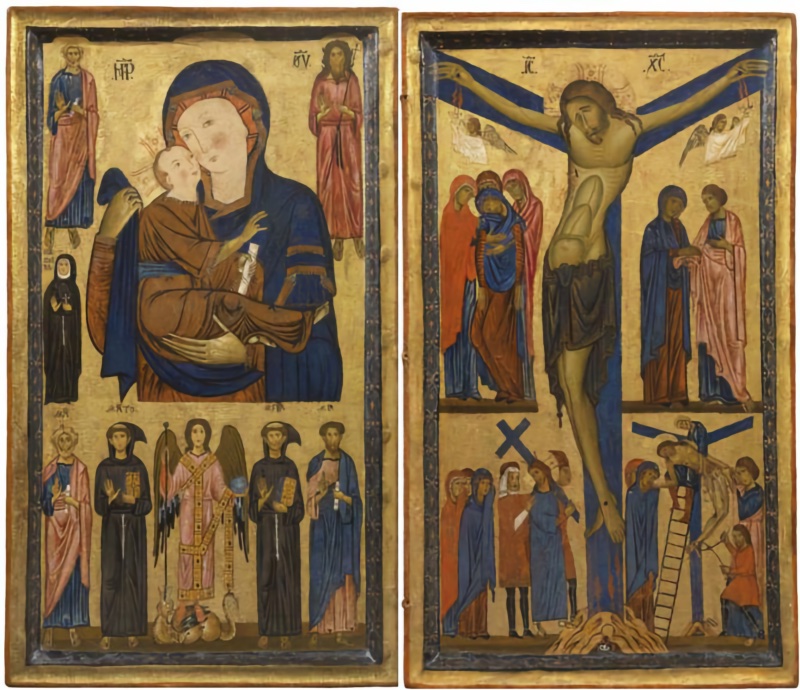
This is a devotional diptych consisting of two hinged panels, one depicting the Madonna and Child with saints, and the other depicting the Crucifixion accompanied by scenes from the Passion. The composition still bears a strong Byzantine influence, but the work already seeks a more vivid emotional and narrative intensity, particularly in the relationship between the main figures and in the smaller scenes at the bottom.
In the left panel, the Virgin appears in half-length, enormous in comparison to the figures on the sides and below, while in the right panel, Christ on the cross dominates the entire surface vertically; in both cases, the secondary figures are juxtaposed without a true unified space, according to a still archaic conception of composition. The painted frames, gilded backgrounds, and abbreviated inscriptions accentuate the sacred and iconic character of the whole, conceived not as a naturalistic narrative but as an image for meditation and prayer.
The panel of the Madonna depicts Mary in the Eleusa typology, that is, the “Affectionate Mother”: she inclines her face toward her Son, holds him close with her left arm, and seems to envelop him with her dark blue cloak, creating a gesture of protection that is both tender and solemn. The Child is not depicted as a realistic infant, but as a wise little boy dressed in ancient style; he sits almost sideways on his mother’s arm, holds a scroll, and raises his right hand in a gesture of blessing.
Around the central group appear isolated saints, arranged in separate registers and lacking any spatial connection to the Virgin: at the top, Saint Peter and Saint John the Baptist; in the middle, Saint Clare; and at the bottom, Saint Andrew, Saint Anthony of Padua, Saint Michael the Archangel with the dragon, Saint Francis, and Saint James the Greater. Visually, these figures function as witness-presences: they are aligned frontally, slender, calligraphic, with garments marked by sharp, dark folds that highlight their 13th-century linearism.
In the right panel, Christ is nailed to a Y-shaped cross, a rare and highly dramatic solution that accentuates the tension of the body, elongated and arched toward the left, in accordance with the iconography of the Christus patiens. The torso twists in an elegant yet painful curve, the head falls onto the shoulder, and the disproportion between the large central figure and the side figures makes the Crucifixion feel like the absolute focal point of the composition.
On either side of the cross, on a smaller scale, the mourners are gathered: on the left, the Pious Women with the Virgin Mary, who appears to be fainting; on the right, Mary and Saint John in silent conversation, while two angels above approach Christ to collect his blood. In the lower section, two episodes of the Passion appear—the Ascent to Calvary and the Descent from the Cross—which condense the narrative into small scenes of intense emotional energy, especially in the exaggerated curve of Christ’s body as it is taken down.
Bonaventura constructs the work with broad swaths of color, a gold background, and dark, impasto-like brushstrokes rather than soft shading, resulting in sharp, glossy, almost miniature-like figures. It is precisely this union of Byzantine solemnity and emotional tenderness that makes the diptych so significant: in the panel of the Madonna, it foreshadows a more intimate language, while in that of the Crucifixion, it pushes the pathos toward an emotional engagement typical of the 13th century.
Saint Francis Altarpiece
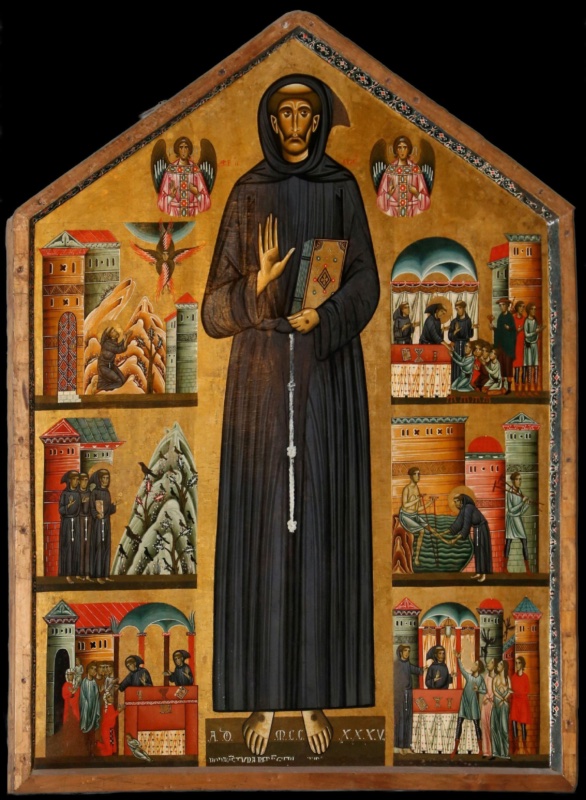
The central panel of the altarpiece depicting Saint Francis by Bonaventura Berlinghieri presents the saint standing solemnly, almost life-size, at the center of a cusp-shaped panel, set against a continuous gold background that eliminates any sense of spatial depth and places him within a strongly liturgical and transcendent dimension. His body is elongated, with typically Byzantine proportions; his face is narrow and severe, framed by a short beard and tonsure; his gaze is frontal and fixed on the viewer, following the model of the Eastern icon, which emphasizes the function of sacred presence rather than individual psychological rendering. He wears the Order’s brown habit, rendered with graphic simplicity by a few linear folds that descend vertically and accentuate the effect of an immobile column, cinched at the waist by a light-colored cord tied in three clearly visible knots, an explicit allusion to the vows of poverty, chastity, and obedience of the Franciscan Rule.
The saint’s posture is rigidly frontal, with no rotation of the torso or hint of a contrapposto, his feet seeming almost to brush the ground—more suspended than actually resting—indicating a body already spiritualized, distant from earthly existence. His right hand is raised in a gesture of blessing, with slender fingers standing out against the gold background and directly, almost didactically, revealing the stigmata, while his left hand holds a closed book, identifiable as the Gospel or the text of the Rule, sealing his conformity to Christ and the centrality of preaching in his mission. The stigmata are also depicted on the feet and on the hand holding the book, explicitly expressing the saint’s “alter Christus” nature: the other major theme is thus iconographically declared, namely his real participation in the Passion, rendered through simple dark marks yet in a position perfectly legible even from a distance.
In the upper register of the panel, at the level of Francis’s shoulders, two winged angels emerge from the gold background, symmetrically arranged on either side of the saint, their bodies light and leaning toward him, as if to frame his figure and emphasize his dignity as the protagonist of a new cult, in the same privileged position once reserved for Christ or the Virgin in icons. Their faces are also frontal, but slightly inclined in a gesture of veneration; their robes are set in more rhythmic folds than Francis’s rigid tunic, and their colored wings stand out against the gold background, creating a sort of angelic crown that reinforces the scene’s celestial character. This angelic inclusion, combined with the monumental scale of the central figure, lends the panel a solemn, hieratic air that visually translates, in a still-Byzantine style, the new mendicant cult and the saint’s recent canonization.
Arranged around this central core, in six open panels (three on each side), are the stories of Francis’s life and miracles, which do not interrupt the gold background but are grafted onto it as narrative episodes, creating a close dialogue between icon and narrative. The small scenes depict urban landscapes and schematic architecture, disproportionate to the figures, which appear tall and elongated, almost gigantic compared to the buildings, according to a hierarchy of scale that prioritizes the spiritual over the naturalistic. In each of these panels, Francis reappears smaller but recognizable, allowing the faithful to read his life as a sequence of exempla radiating from his glorified body in the main panel, within a narrative structure derived from historiated crucifixes but here entirely refocused on the person of the saint.
The pictorial surface of the panel is dominated by gold, applied in leaf and engraved with meticulous decorative motifs in the halos and margins, so as to shimmer in the light and transform the image into a cult object that physically responds to the altar’s illumination. The actual color is limited to a few intense and compact ranges—the brown of the habit, the reds and blues of the garments in the side panels, the pinkish flesh tones of the faces—applied in flat fields with minimal modulation, according to a tempera technique that prioritizes linear contour lines and the graphic definition of details. The result is a language that remains deeply Byzantine, yet animated by an unprecedented attention to the concreteness of the mendicant saint, to the legibility of his habit, cord, book, and stigmata, which anticipates the pedagogical and devotional function that the great Franciscan cycles of the 13th and early 14th centuries would bring to fruition.
Crucifixion with Mourners, Christ on the Road to Calvary and Deposition
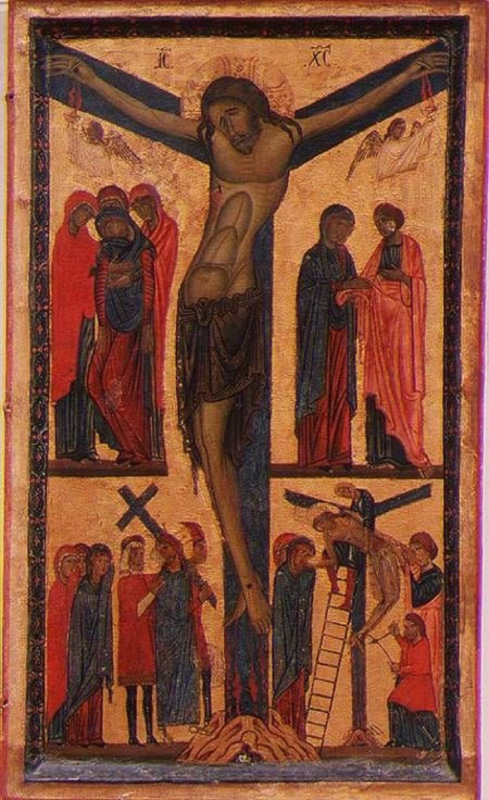
The panel depicts, at its center, a full-length figure of the crucified Christ, strongly elongated and sinuous, following the Byzantine model of the Christus patiens: the body is arched to the right, the pelvis is slightly rotated, the legs are crossed, and the feet are superimposed, while the loincloth is rendered with dense, linear folds that emphasize the body’s thinness. His arms extend diagonally along the crossbeam, with slender hands and tapered fingers, and his reclined head invites the viewer to compassionate meditation; against the gold background, two small angels reach toward the Savior’s body, accentuating the pathos of the scene. On either side of the upright, the golden background is stamped and defined by a narrow border, while a faint reddish halo surrounds Christ’s head, suggesting a cruciform nimbus barely etched into the gold leaf.
In the upper register, on either side of the cross, the mourners appear in half-length or full-length figures: on the left, a tight group of holy women with the Virgin clasping her face in her veil, in the Byzantine gesture of lamentation; on the right, Saint John the Evangelist standing, wrapped in a deep blue cloak that creates an alternating chromatic rhythm with the reds of the other figures. The proportions are deliberately minute, with heads large in relation to the bodies and marked, almost graphic contour lines that reveal the sensibility for miniaturism typical of Bonaventura Berlinghieri’s workshop. The faces are oval, the eyes elongated and slightly slanted, the mouths thin, with modeling reduced to a few touches of greenish and pinkish chiaroscuro derived from the Eastern iconographic tradition.
In the lower register, the field is divided into two parallel scenes of the Passion, arranged symmetrically on either side of the base of the cross, which serves as the narrative axis: on the left, Christ carrying the cross proceeds toward Calvary, surrounded by a small procession of soldiers and onlookers; the figure carrying the patibulum is depicted on a smaller scale but with a determined stride, while a soldier in a red tunic leads the group, creating a diagonal movement that animates the surface. On the right side, the Deposition unfolds: Jesus’ body is lowered from the cross with the aid of a tall, slender ladder; a man below stretches out his arms to receive him, and other figures witness the gesture with sorrowful expressions, composing a tightly framed, vertical scene. The two stories, though contained within distinct spaces, maintain a chromatic unity in their reds, blues, and dark greens, and the continuous narrative invites the viewer to interpret the panel as a meditative compendium of the events immediately connected to Christ’s death.
The gold background and the red outlines delimiting the individual narrative “windows” help unify the panel, which was intended to form the right panel of a diptych, paired with the Madonna and Child with Saints, now also in the Uffizi. The relatively modest size of the panel, the meticulous attention to detail in the garments and faces, and the alternating rhythm of full and empty spaces suggest a private or semi-private devotional function, perhaps intended for the personal meditation of a religious figure or for the chapel of a convent in Lucca, from which the complex originates. The work, dated to the mid-13th century and associated with the circle of Bonaventura Berlinghieri, exemplifies the phase in which the Byzantine style was adopted and simultaneously softened in a lyrical sense, with an intense emphasis on human suffering yet still within a strictly hierarchical and frontal composition.
Crucifix (Triumphant Christ)
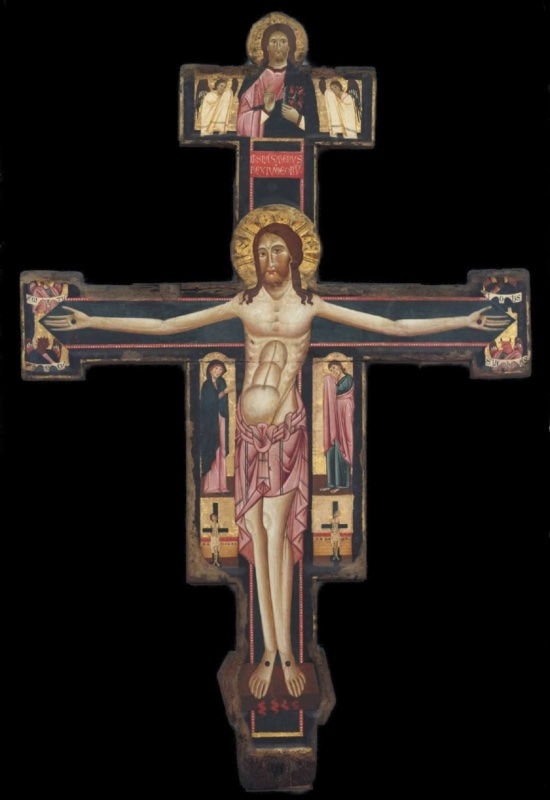
The painted crucifix attributed to the circle of Bonaventura Berlinghieri, now in the National Gallery of Ancient Art at Palazzo Barberini, is a large wooden cross painted in tempera that exemplifies in a paradigmatic way the model of the Christus triumphans of the Byzantine tradition, which was still very much alive in Tuscany and central Italy in the mid-13th century. The figure of Christ, of monumental size, is depicted alive, upright, and steadfast on the cross, with his body facing forward, slightly inclined, his eyes open and his gaze fixed, emphasizing the victorious and regal dimension of the Redeemer who dominates death and has not yet suffered its dramatic effects. The body is elongated according to strongly Byzantine canons, with modeling achieved more through the juxtaposition of chromatic planes than through true naturalistic chiaroscuro, and the loincloth is stylized in calligraphic folds that accentuate the figure’s hieratic abstraction.
Christ’s head, slightly tilted but not slumped, features sharp features, a long, straight nose, a forked beard, and hair arranged in regular locks, following an iconic type that directly references the Byzantine models widespread in Lucca and the Tyrrhenian area. The face does not express acute suffering, but a grave, almost solemn serenity that reaffirms the scene’s theological character: not the moment of human suffering, but the glorious manifestation of the crucified and already triumphant Savior. The hands, pierced by nails but open in an almost blessing gesture, extend the spatiality of the composition along the horizontal arm of the cross, creating a sort of symbolic embrace toward the viewer, while the feet, also nailed, are rendered with the customary linear schematism of the Lucca workshop.
The background is gilded, in accordance with the custom of painted crosses of the time, and constructs a completely abstract, liturgical space, where the earthly sky is replaced by a metaphysical light that envelops the sacred figure. The gilding, likely originally enriched with embossing and engravings that are now partially worn, serves as a neutral field that highlights the dark, sharp outline of the body, accentuating its almost iconic presence on the altar. The color scheme, based on a range of reds, deep blues, and enameled greens, reflects that “precious chromatic enamel” traditionally associated with the Berlinghieri tradition, with tonal transitions that are drier rather than soft, typical of Byzantine-influenced painting in the Tuscan region during the first half of the 13th century.
On the lateral ends of the cross, as in the contemporary crosses of Lucca and Fucecchio, half-length or full-length figures of the Virgin and St. John the Evangelist appear, placed on either side of the horizontal beam. Mary, veiled and wrapped in the maphorion, is depicted in a composed yet engaged pose, with a hand gesture pointing to her Son or emphasizing his sacrifice, while John displays the typical expression of restrained grief, with his head slightly bowed and his hands sometimes at his chest, in a codified yet effective gesture. These side figures, while remaining stylized, introduce a first, subtle note of narrative pathos that serves as a counterpoint to the solemn centrality of the triumphant Christ, foreshadowing the subsequent dramatic emphases that the Giunto and later Giotto traditions would develop in the type of Christus patiens.
At the top of the cross is painted the clipeus of the Blessing Christ or the Redeemer Christ within a circular medallion, seated or in half-length, often flanked by adoring angels. This element underscores the continuity between earthly sacrifice and heavenly glory, creating a vertical axis that leads the eye from the space of Golgotha to the vision of Christ in majesty, according to a unified theological program that the wooden surface translates into hierarchically ordered images. At the ends of the cross and along the shaft, small panels may appear depicting episodes from the Passion or the symbols of the four evangelists, which enrich the narrative and transform the cross into a sort of iconographic “summa” intended for liturgical contemplation.
From a stylistic point of view, the work displays all the characteristics of the Lucca workshop associated with Berlinghiero and his sons: strongly marked linearism, the use of color as precious enamel rather than for naturalistic rendering, elongated and frontal figures, slender faces with large, aligned eyes, and sharp, graphic outlines. The structure of the cross, with its slender proportions, lends the figure of Christ a decisive verticality, accentuated by the rhythm of the folds of the loincloth and the fall of the hair along the neck, so that the entire composition appears as a powerful sign within the church’s liturgical space. The anatomical rendering is merely suggested, almost abstract, and subordinate to the symbolic function: the body is not studied as a natural organism, but as a sacred surface upon which the painter traces the theological design of sacrifice and victory.
As for the dating, the cross in Palazzo Barberini is generally placed between 1250 and 1260, a period in which the Byzantine-influenced Lucca tradition was still strong, yet the precursors of the new sensibility that would lead to the overcoming of the Christus triumphans are already discernible in certain expressive details and in the greater articulation of the figurative narrative. The relationship with the crosses signed or attributed to Berlinghiero (Lucca and Fucecchio) and with the work of Bonaventura Berlinghieri allows us to interpret this work as the mature outcome of a long process of developing Constantinopolitan models transplanted to Tuscany, filtered through Western devotion and the demands of mendicant preaching. Thus, the Barberini Cross stands today not only as an important document of 13th-century painting but as a visual testimony to the still-unfinished transition from a purely theophanic conception of the image to a progressive focus on the human and pathetic dimension of the Passion.