Maestro dei Santi Cosma e Damiano
The Maestro dei Santi Cosma e Damiano, or Master of the Madonna of Saints Cosmas and Damian, remains an anonymous figure whose civil name, family background, and precise life dates are not recorded in surviving documents. Stylistic and archival evidence situate his activity between about 1240 and 1270, within the Pisan school and in close dependence on the maniera greca of Giunta Pisano and his circle. In the absence of direct biographical sources, scholars infer that he was likely born in the second quarter of the thirteenth century, probably in Pisa or its contado, because his earliest attributions are deeply rooted in Pisan workshop practice and iconography. No medieval text specifies a day, month, or even year of birth, and no record identifies his parents or kin, so any reconstruction of his early life necessarily rests on circumstantial argument rather than documentation.
Family background and historical significance
The painter entered modern art history only in the mid‑twentieth century, when Edward B. Garrison isolated a small, coherent group of panels around a Madonna in the Pisan church of Santi Cosma e Damiano and coined the notname “Master of Saints Cosmas and Damian” to designate their author. This act of naming, based on style rather than on archival discovery, effectively substituted an iconographic reference for a missing family name, and it continues to structure discussion of the artist’s identity. Later, Luciano Bellosi proposed to identify the Pisan master with a documented painter called Gilio di Pietro, active in Siena between 1247 and 1261, thus giving the anonymous hand a possible civic surname, patronymic, and death year. Even within this more optimistic hypothesis, however, the painter’s domestic milieu, marital status, and household composition remain unknown, since no notarial contracts, wills, or workshop records referring unequivocally to the Master have been found. The date and place of his birth must therefore be described as uncertain and hypothetical rather than established, with Pisa and its environs functioning as a plausible but not demonstrable point of origin. The anonymity of the Master of Saints Cosmas and Damian is thus emblematic of many thirteenth‑century Italian painters, whose artistic personality is sharply defined through style while their family identities are irrevocably lost.
The question of family can be re‑posed in institutional rather than genealogical terms by considering the artist’s probable integration into a workshop “family” in Pisa. The pronounced dependence of his style on Giunta Pisano, particularly in the handling of linear drapery folds, facial typologies, and chrysography, strongly suggests training in an atelier that had direct or indirect access to Giunta’s models and procedures. Within such a workshop, the anonymous painter would have been socialised into a hierarchy of masters, assistants, and apprentices that functioned as a surrogate kinship network, providing economic security and professional identity in lieu of documented blood ties.
If Bellosi’s identification with Gilio di Pietro is accepted, one might imagine an initial formation in a Pisan environment followed by a move to Siena, where Gilio is recorded as a painter from 1247, but this remains an inference rather than a documented trajectory. The suggestion that Massarello di Giglio, another painter active on Biccherna panels in Siena between 1291 and 1339, was Gilio’s son illustrates how modern scholars attempt to reconstruct artistic “families” by combining patronymics with stylistic affinities, yet such genealogies remain conjectural. For the Master of Saints Cosmas and Damian, therefore, the only securely traceable “family” is the stylistic one, comprising Giunta Pisano, the Master of San Martino (often linked with Ugolino di Tedice), and Cimabue as the most closely related peers or successors. This stylistic kinship is visible above all in the Madonnas attributed to the Master, which replicate and subtly modify formulae disseminated through Pisan painting in the mid‑thirteenth century. In this sense, the artist’s identity is embedded in a broader artistic lineage rather than anchored in private biographical detail. The lack of personal documentation invites a methodological reflection on the limits of biographical writing when only visual and liturgical evidence survive.
If the Master is indeed to be associated with Gilio di Pietro, the sparse archival notices concerning that painter offer a faint glimpse of an urban artisan embedded in Sienese civic life. Gilio appears in records between 1247 and 1261, the latter given as the year of his death, but the documents concern payments for a Biccherna cover and do not mention his wife, children, or parents, so they illuminate professional rather than domestic identity. The famous Biccherna tablet of 1258 depicting the camerlengo Frate Ugo of San Galgano, now in the Archivio di Stato in Siena, is the only work firmly tied to Gilio by a contemporary inscription and payment record, and Bellosi’s proposal to extend this small documentary nucleus to include the entire corpus of the Master of Saints Cosmas and Damian remains debated.
If the two figures are conflated, then the Master’s “family” would have included civic officials, monastic patrons, and fiscal scribes, since these were the agents who commissioned, used, and preserved the Biccherne. The painter’s social standing would then align with that of other mid‑thirteenth‑century Sienese artisans, occupying an intermediate position between manual labourers and the mercantile elite, yet clearly integrated into the bureaucratic and religious structures of the commune. Even so, the public nature of this documentation means that private aspects of the artist’s family life—domestic piety, inheritance strategies, or workshop succession—remain veiled. This situation underscores how the “family” of a medieval painter often has to be reconstructed through institutional rather than household ties, privileging the networks of patrons and corporate bodies that sustained artistic production. Consequently, in the case of the Master of Saints Cosmas and Damian, the term “family” is most securely applied to his professional and stylistic affiliations rather than to any demonstrable genealogical line.
One may also conceive of “family” in a devotional sense, insofar as the Master’s works were embedded in communities of worship that perceived themselves as spiritual households under the protection of particular saints and the Virgin. The Madonna panels attributed to him in Pisa and Siena were focal points for such communities, structuring ritual practice around images that mediated between divine and human kinship. In the Pisan church of Santi Cosma e Damiano, the Madonna known as the Madonna del Patrocinio, attributed to the Master and dated around 1260–1270, offered the faithful an image of the Virgin presenting her Child as intercessor, thereby enacting a maternal “family” relationship at the heart of the liturgy.
Similarly, the Madonna dei Mantellini, originally on the high altar of San Niccolò al Carmine in Siena and later transferred to the Pinacoteca Nazionale, became the centre of a devotional cult focused on newborn infants and their mothers, whose bodies were symbolically wrapped in mantellini—swaddling cloths—under the Virgin’s protection. In both cases, the image anchored a community that understood itself in familial terms, with the Virgin as mother, the Christ Child as divine offspring, and the faithful as adopted children or clients under their care. The Master’s panels thus helped to shape the “family romance” of urban religiosity, even as the artist’s own domestic circumstances remain unrecorded. This spiritual family, composed of friars, lay confraternity members, and urban households, arguably constituted the most enduring social framework within which his art functioned. Consequently, when speaking of the Master’s family, scholars are obliged to privilege these devotional and institutional bonds over biographical data that no longer survive.
From a strictly historical perspective, therefore, the Master of Saints Cosmas and Damian remains an anonymous thirteenth‑century Pisan‑Sienese painter whose family background cannot be reconstructed beyond conjecture, though his artistic “family” is clearly delineated by style and patronage. The date and place of his birth are not preserved in any known medieval document, and even if the identification with Gilio di Pietro is accepted, the entry for Gilio indicates only that he died in Siena in 1261, without specifying his birthplace or parentage. In the case of Gilio, the ellipsis that precedes the place of death in the biographical note underscores the absence of information about his early life, while the emphasis on his Biccherna commission highlights his integration into Sienese civic structures rather than into a traceable family line.
For the Master as such, no contracts, tax records, or guild rolls have yet emerged to supplement this skeletal archival framework. As a result, the biographical narrative must be grounded primarily in the analysis of surviving works, their liturgical settings, and the institutional patrons who commissioned them. This methodological constraint does not diminish the painter’s historical importance; rather, it situates him within a broader class of medieval artists whose anonymous yet distinctive hands shaped the visual culture of their age. The Master’s panels thus stand as the principal witnesses to a life that resists conventional biographical reconstruction, inviting an art‑historical portrait built from style, function, and patronage instead of from family chronicles or personal documents.
Patronage
The patrons of the Master of Saints Cosmas and Damian were predominantly ecclesiastical and communal institutions, reflecting the structure of artistic demand in mid‑thirteenth‑century Tuscany. Churches dedicated to saints with specific protective functions, such as Cosmas and Damian in Pisa, required altarpieces and devotional panels that visually articulated their patron saints’ mediating role between God and the local community. Communal offices, most notably the Sienese Biccherna, also commissioned painted book covers for their financial registers, thereby enlisting painters into the imagery of civic administration.
Mendicant orders and urban confraternities, meanwhile, promoted new forms of lay devotion that emphasised the Virgin’s intercessory role, fuelling a demand for Marian images in churches and, increasingly, in private spaces. The Master’s oeuvre, as reconstructed by Garrison and later scholars, fits neatly within this matrix: a Marian panel for a Pisan parish church, an iconic Madonna for a Carmelite church in Siena, a civic Biccherna cover, and several smaller Madonnas that may have served for private devotion. Although the names of individual lay donors are largely absent, the institutional identities of these patrons are legible in the iconography, inscriptions, and documented functions of the works. The painter’s career thus unfolded at the intersection of ecclesiastical, communal, and lay devotional patronage, rather than under the aegis of a single princely court or aristocratic clan. This patronage context shaped both the scale and the rhetorical strategies of his works, which were designed to serve corporate bodies more than individuated sitters.
The Pisan church of Santi Cosma e Damiano, which gave the Master his notname, appears to have been one of his principal patrons, at least in terms of the prestige and visibility of the commission associated with it. The Madonna col Bambino now known as the Madonna del Patrocinio, attributed to the Master and dated around 1260–1270, once presided over the liturgical life of this parish church, where it functioned as a visual guarantor of the saints’ protection. The Virgin is shown half‑length, holding the Child on her left arm and gesturing with her right hand in a manner that suggests intercession, a compositional choice consonant with the church’s dedication to Cosmas and Damian, patron saints of physicians and healing.
At the lower edge of the panel, a tiny kneeling donor figure, barely visible beside the Virgin’s mantle, hints at the presence of an individual or corporate patron, perhaps a confraternity or a guild associated with medical practice, though no written source confirms this association. The Pisan State catalogue describes the work as belonging to the Pisan cultural sphere, executed in tempera and gold on panel, and notes the elaborate chrysography on the Virgin’s garments, indicating a commission of some expense. As patron, the church of Santi Cosma e Damiano invested in an image that would articulate both local identity and supra‑local devotion, anchoring the community’s prayer in a recognisable Italo‑Byzantine type. Through this commission, the Master entered the visual economy of Pisan ecclesiastical life, his panel serving as a durable mediator between the parish and its heavenly protectors.
In Siena, the Carmelite church of San Niccolò al Carmine formed another crucial pole of patronage for the Master, whether under his notname or, in Bellosi’s reconstruction, under the civil name of Gilio di Pietro. The celebrated Madonna dei Mantellini, dated to around 1260–1270 and long associated with the Master of Saints Cosmas and Damian, was originally installed on the high altar of this church, where it became the focus of a cult particularly linked to the protection of infants and mothers. The painting presents a half‑length Virgin holding the Child, who presses his cheek affectionately against hers, while two diminutive angels hover in the upper corners, extending their covered hands towards the Christ Child in a gesture of reverent service.
Historical accounts emphasise that newborns were customarily swaddled in mantellini under the image, seeking the Virgin’s blessing, a ritual that effectively integrated the panel into the life‑cycle of Sienese families. The Carmelite community thus emerges as both patron and guardian of the work, commissioning an image in a deliberately archaic Italo‑Byzantine idiom even as Sienese painting was beginning to move in more innovative directions. According to Bellosi, the stylistic features of the Madonna dei Mantellini correspond closely to those of the Biccherna panel signed by Gilio, reinforcing the proposed identity of the two painters, although some scholars remain sceptical. Regardless of the attributional debate, the Carmelite church’s role as patron underscores how mendicant orders could shape local artistic production, favouring icons that visually condensed their spiritual programme. The Madonna dei Mantellini thereby stands as a privileged witness to the intersection of institutional patronage, Marian devotion, and conservative stylistic choice in mid‑thirteenth‑century Siena.
The Sienese Biccherna, the communal financial office responsible for managing and recording public revenues, forms a third major patron in the Master’s reconstructed career, though here the commission is conventionally associated with Gilio di Pietro rather than with the notname. In 1258, the Biccherna paid “Maestro Gilio di Pietro” five soldi for a painted cover for its accounting register, a panel depicting the camerlengo Frate Ugo, monk of San Galgano, holding an open book inscribed with the date “in anno Domini MCCLVIII mense Iulii.” This work, the earliest surviving Biccherna cover, is now preserved in the Archivio di Stato in Siena and constitutes the only piece securely tied to Gilio by contemporary documentation.
Bellosi’s close analysis of Frate Ugo’s face, particularly the red patch on the cheek dissolving into radiating striations, the sharply defined eyebrow, the white filaments descending alongside the eye, and the concentric white circles around the pupil, revealed striking stylistic parallels with faces in the Madonna dei Mantellini and other panels attributed to the Master of Saints Cosmas and Damian. On this basis, Bellosi argued that the same painter served both the Biccherna and the Carmelite church, thereby linking civic and ecclesiastical patronage in a single artistic personality. Not all scholars have accepted this conflation, but the comparison nonetheless illuminates how similar visual idioms circulated between administrative and devotional contexts in mid‑thirteenth‑century Siena. The Biccherna’s role as patron also underscores the extent to which communal institutions, no less than churches, invested in painted imagery as a means of representing their authority and piety. Whether or not the Biccherna painter is identical with the Master of Saints Cosmas and Damian, the commission attests to a network of artists capable of working across institutional boundaries.
Beyond these major ecclesiastical and civic patrons, several smaller panels attributed to the Master suggest commissions from private or semi‑private patrons, whose identities can only be inferred from the format and later provenance of the works. A Madonna col Bambino now in the Fogg Art Museum at Harvard University, attributed to the Master, probably functioned as a domestic or small‑scale chapel image, given its relatively modest dimensions and intimate half‑length format. Another Virgin and Child panel in the Galleria Regionale della Sicilia in Palermo, also assigned to the Master, may have been commissioned either by a religious institution in Sicily or by a patron connected to Pisan or Sienese mercantile networks operating in the Mediterranean.
The presence of the Master’s works in such geographically dispersed collections today reflects both the historical circulation of objects through trade, inheritance, and the art market, and the original multiplicity of his patronage base. A Virgin and Child in Cambridge, at the Fogg, and two Madonna with Child and Angels panels in the Museo Nazionale di San Matteo in Pisa, indicate that lay patrons sought images that repeated successful ecclesiastical types in more intimate formats. In these cases, the patrons were likely affluent urban households, confraternity members, or minor clerics who wished to import into domestic or subsidiary spaces the authoritative iconography of major church panels. The anonymity of these commissioners contrasts with the institutional visibility of the Pisan church, the Carmelite friars, and the Biccherna, yet their role in sustaining the Master’s production was no less significant. Through such dispersed commissions, the painter’s imagery penetrated multiple layers of urban society, from parish churches to administrative offices and private dwellings.
The ensemble of works currently attributed to the Master of Saints Cosmas and Damian thus points to a career shaped by a diverse but coherent set of patrons: Pisan and Sienese churches, a communal office, mendicant friars, and private devotees. While the absence of detailed contracts prevents a full reconstruction of the terms of commission, the surviving panels reveal patterns of iconographic continuity that must have responded to patrons’ expectations. The recurrence of half‑length Madonnas with the Child held on the left arm and the right hand extended in a protective or intercessory gesture suggests that patrons sought reliable, recognisable images rather than experimental compositions. The persistence of heavy chrysography, rigid frontality, and minimal spatial illusion in works executed well into the 1260s indicates that certain ecclesiastical patrons preferred conservatism to stylistic innovation, even as other contemporaries in Siena began to explore more volumetric and expressive modes. In this sense, the Master of Saints Cosmas and Damian can be seen as a painter who specialised in supplying a particular devotional “brand” of image to clients committed to an Italo‑Byzantine visual language. His patrons, in turn, played a decisive role in preserving that language at a moment of artistic transition. The interplay between patronal conservatism and nascent stylistic change gives the Master’s oeuvre its distinctive historical profile amid thirteenth‑century Tuscan painting.
Artistic style
In stylistic terms, the Master of Saints Cosmas and Damian is firmly rooted in the Pisan maniera greca, and more specifically in the orbit of Giunta Pisano, whose idiom he adopts with varying degrees of fidelity and roughness. His Madonnas display stern, elongated faces with high foreheads, arched eyebrows, and deeply set eyes encircled by concentric white lines, features closely related to Giunta’s crucifixes and to works by the Master of San Martino. The noses are long and straight, the mouths small and tightly closed, and the chins narrow, producing an ascetic, hieratic effect rather than a tender or naturalistic one.
Skin is modelled through a limited palette of ochres and pinks, with abrupt transitions from light to shadow rendered by parallel striations rather than by smooth gradations, a technique that can give the flesh a somewhat “striated” or corrugated appearance. Drapery is treated in a similarly linear fashion: heavy, dark mantles are enlivened by chrysographic highlights that trace schematic folds in gold, often forming radiating “strigil” patterns around knees and elbows, as noted by modern scholars in comparison with Giunta and Cimabue. The overall impression is one of rigidity and solemnity, with the figures occupying an abstract, gold ground that effaces any sense of real space or environment. Yet within these constraints, the Master demonstrates a consistent command of contour, proportion, and decorative detail, suggesting a painter thoroughly at ease within the Italo‑Byzantine canon. His style, though conservative, reveals an awareness of subtle variations in pose and gesture that allows for nuanced expressions of intercession, authority, and maternal care.
The Madonna del Patrocinio from Santi Cosma e Damiano in Pisa offers a paradigmatic instance of the Master’s compositional and stylistic habits. The panel shows the Virgin half‑length against a gold background, her dark blue mantle richly patterned with chrysography and edged with a gilded border adorned with small pendants at the shoulder. Beneath the mantle she wears a red tunic, also crisographed, and a red coif with blue stripes, details that mark her as both royal and modest, in keeping with Byzantine and Pisan Marian iconography. The Child, seated on her left arm, wears a red tunic and sandals, blessing with his right hand (with the little finger raised in a characteristic local variant) while holding a white rotulus in his left, a sign of his wisdom and prophetic authority.
The Virgin’s right hand extends in a gesture that simultaneously presents the Child to the viewer and intercedes on the viewer’s behalf, collapsing distance between heavenly and earthly spheres. At the lower right margin, a diminutive kneeling figure with joined hands suggests the donor, whose small scale underscores the asymmetry between human supplicant and exalted Mother and Child. The halos are elaborately punched into the gold leaf, integrating the figures into the shimmering sacred field that surrounds them. The composition is frontal and symmetrical, with little interest in spatial depth, yet the slightly inclined heads and delicately drawn features introduce a measure of affective resonance. In this work, the Master demonstrates a nuanced handling of a well‑established icon type, reaffirming its theological message through meticulous decorative detail and subtle inflections of pose.
The Madonna dei Mantellini extends and modifies this stylistic vocabulary, introducing a more intimate affective tone while retaining the Italo‑Byzantine framework. Here the Child leans his cheek against the Virgin’s, wrapping his arm around her neck in a tender embrace that art historians have linked to Eleousa (“Virgin of Tenderness”) prototypes, although the frontal orientation and compositional gravity still recall Hodegetria models. The Virgin’s right hand supports the Child but also seems to draw him towards her face, emphasising the maternal bond even as she remains hieratically composed. Two very small angels, placed at the upper corners, stretch out their hands towards the Child, their fingers covered by the edges of their mantles to avoid direct contact with the sacred flesh, a motif that underscores both reverence and service.
The scale discrepancy between the angels and the central figures heightens the sense of monumental presence in the Madonna and Child, while the angels’ oblique gazes introduce a subtle dynamism at the edges of the composition. Chrysography again articulates the folds of the Virgin’s mantle and tunic, but the modelling of the faces is somewhat softer than in the Pisan Madonna, with gentler transitions between highlights and shadows. Bellosi’s analysis of the facial features in this panel, especially the treatment of the cheeks, eyebrows, and eyes, formed a key part of his argument for linking the work to Gilio di Pietro and the Biccherna tablet. Stylistically, the Madonna dei Mantellini represents a slight shift towards greater emotional expressiveness within a still conservative iconographic and formal framework, reflecting the specific devotional expectations of the Carmelite patronage context.
The smaller Madonnas with Child and with Child and Angels in the Museo Nazionale di San Matteo in Pisa, as well as the panels in Palermo and Cambridge, manifest the Master’s capacity to adapt his idiom to different scales and settings without abandoning his characteristic formulas. In the San Matteo panels, the Virgin and Child are again rendered half‑length against a gold or greenish background, with two small angels flanking them or hovering above, their presence signalling celestial courtly attendance even in relatively modest works. The Pisan State catalogue notes that one of these panels, now somewhat cut down, originally formed part of a more elaborate ensemble and that the greenish ground and dense chrysography place it firmly within the mid‑thirteenth‑century Pisan context.
The Palermo Virgin and Child, by contrast, shows the Master’s idiom transplanted into a Sicilian or Mediterranean setting, perhaps through trade or commission; the panel maintains the same frontal, hieratic composition, but minor differences in colouring and decorative motifs hint at local tastes. The Cambridge panel in the Fogg Art Museum, also attributed to the Master, repeats the semi‑circular inner framing and gold striations of the Virgin’s mantle noted by scholars as characteristic of his work, and it shares with the Madonna dei Mantellini the motif of the Child pressing his cheek against the Virgin’s. These variations across the corpus reveal a painter who could modulate affect, scale, and decorative intensity while remaining within a recognisable stylistic envelope. Taken together, they define a coherent artistic personality despite the absence of a documented name.
Within the broader development of thirteenth‑century Tuscan painting, the Master of Saints Cosmas and Damian occupies a position that can be described as both conservative and mediating. His adherence to the Giuntesque maniera greca places him among those painters who maintained a strong Byzantine orientation at a time when other artists, especially in Siena and later in Florence, were beginning to explore more volumetric forms and narrative complexity. At the same time, subtle shifts in his treatment of faces, gestures, and the relationship between figures and angels suggest a receptive engagement with emerging trends, even if he did not fully abandon the iconic, frontal mode. The use of gently inclined heads, tender cheek‑to‑cheek contact, and more nuanced modelling in works like the Madonna dei Mantellini indicates an incipient concern for affective piety that would later be developed more fully by painters such as Duccio. Yet the Master never pushes these elements to the point of undermining the hieratic dignity of his subjects; his Madonnas remain firmly anchored in liturgical and iconic functions rather than in narrative or anecdotal contexts. Consequently, his style can be seen as a stabilising force that transmitted the authoritative Italo‑Byzantine idiom into settings where patrons and worshippers valued continuity over innovation. This balancing act between fidelity to tradition and discreet modulation of affect gives his work a distinctive place in the stylistic spectrum of his time.
Artistic influences
The dominant artistic influence on the Master of Saints Cosmas and Damian is unquestionably Giunta Pisano, the leading painter of early thirteenth‑century Pisa, whose crucifixes and panel paintings established a powerful local variant of Byzantine iconography. Giunta’s emphasis on elongated bodies, sharply demarcated planes of light and shadow, and intricate chrysographic patterns on garments provided a template that the Master both emulated and, at times, simplified. The treatment of Christ’s blessing hand in the Child figures, with the distinctive gesture and articulation of the fingers, recalls Giunta’s solutions on large crucifixes adapted to the scale of panel Madonnas.
Similarly, the facial types, stern, introverted, and slightly sorrowful even when representing the infant Christ, echo the affective intensity of Giunta’s crucified Christ, albeit modulated to fit the maternal context. The Master’s use of radiating “strigil” folds in drapery, especially around knees and elbows, reproduces Giunta’s compositional devices but often with less finesse, leading some scholars to describe his execution as “cruder” or more workshop‑like in comparison to his model. This relative roughness has been interpreted not as incompetence but as an indication that the Master operated within a workshop environment where patterns were replicated by multiple hands of varying skill levels. In any case, the Giuntesque imprint is so strong that it has served as a primary criterion for attributing works to the Master and for dating them to the mid‑thirteenth century.
Beyond Giunta, the broader Italo‑Byzantine tradition transmitted through Pisa’s maritime connections to the Eastern Mediterranean constitutes a second major influence on the Master’s style and iconography. The compositional schemes of frontal, half‑length Virgin and Child images, the use of gold grounds, and the emphasis on abstract, symbolic space rather than naturalistic setting all derive from Byzantine prototypes that entered Italy via icons, mosaics, and illuminated manuscripts. Pisa’s role as a major port city facilitated the importation of such objects, which were then copied and adapted by local painters in panel form. Details such as the Virgin’s maphorion, the Christ Child’s scroll, and the angels’ hand‑covering gesture in the Madonna dei Mantellini correspond to established Byzantine conventions that emphasise theological meanings over anecdotal narrative. The Master’s relatively strict adherence to these conventions, even when operating in Siena, suggests a continued allegiance to the prestige of Byzantine models. At the same time, the subtle softening of expression and the introduction of more intimate poses indicate a dialogue with local devotional sensibilities that were beginning to value emotional accessibility alongside doctrinal orthodoxy. Thus, Byzantine influence in his work is not static but dynamically reinterpreted within a Tuscan context.
The Sienese painting milieu of the mid‑thirteenth century provides a further layer of influence, particularly if the identification with Gilio di Pietro is accepted. Siena, often described as the “City of the Virgin,” cultivated a distinctive Marian iconography that combined Byzantine severity with increasing tenderness and narrative elaboration, as seen in works by artists such as Guido da Siena and Dietisalvi di Speme. The Madonna dei Mantellini, with its tender cheek‑to‑cheek contact between Mother and Child, can be situated within this emerging Sienese tendency towards greater affective engagement, even though its overall format remains iconic rather than narrative. Moreover, the city’s intense devotion to the Virgin as civic protectress likely encouraged painters to explore small but meaningful adjustments in pose and expression that would resonate with local expectations. The Master’s works thus seem to register the impact of Sienese Marian piety on a fundamentally Pisan stylistic base, producing hybrid images that speak both to the authority of Byzantine prototypes and to the specificity of Sienese devotional culture. This hybridity underscores the artist’s position at the intersection of two regional traditions rather than within a single, monolithic school.
Art historians have also suggested that the circulation of illuminated manuscripts and other small‑scale painted objects may have influenced the Master’s approach to detail, colour, and compositional framing. Members of religious orders, ecclesiastics, and wealthy lay patrons would have been familiar with miniatures in Byzantine and Western manuscripts—Bibles, Psalters, Gospel books, and liturgical codices—which often contained highly refined images of the Virgin and Child, saints, and narrative scenes. Although panel painters did not necessarily see these books routinely, the presence of monastic libraries and the exchange of gifts between East and West made such imagery part of the visual environment from which they could draw. The Master’s meticulous chrysography, his careful punching of halos, and the intricate decorative borders in some panels recall manuscript illumination techniques translated into larger scale. Furthermore, the compactness and frontal focus of his half‑length Madonnas parallel the “iconic” miniatures that often occupy single pages in manuscripts, suggesting a conceptual affinity between the two media. While direct borrowings cannot always be demonstrated, the shared visual vocabulary points to a common pool of motifs and compositional strategies circulating across different formats of sacred art.
The influence of the Master of Saints Cosmas and Damian on later painters is less immediately visible than his indebtedness to Giunta and Byzantine prototypes, yet his role within the transmission of stylistic patterns from Pisa to Siena has been emphasised by recent scholarship. The Pisan‑Sienese hybrid evident in works like the Madonna dei Mantellini exemplifies the close artistic relationship between the two cities around the middle of the thirteenth century, a relationship that laid the groundwork for the more distinct Sienese style that would emerge in the following decades. Panels attributed to the Master, with their combination of strict frontality and subtle affect, likely served as points of reference for younger painters who sought to balance Byzantine authority with local devotional expectations. In this respect, his oeuvre can be seen as a transitional node in the chain that leads from Giunta through anonymous workshop masters to figures such as Duccio and Cimabue. Even if his direct influence on specific later works cannot be firmly documented, the persistence of certain facial types, drapery patterns, and compositional schemes in subsequent Tuscan painting suggests that his solutions circulated widely in workshop practice. The Master’s artistic personality therefore occupies an intermediate but significant place in the genealogy of Italian panel painting, mediating between imported Byzantine models and the emerging Gothic sensibility.
Travels
The geographic distribution of works attributed to the Master of Saints Cosmas and Damian provides the primary evidence for reconstructing his travels, or at least his zones of activity, even though direct documentary references to his movements are lacking. The core of his oeuvre is associated with Pisa and Siena, indicating that he worked in both cities or that his works circulated between them through commissions and workshop networks. The Madonna del Patrocinio in the Pisan church of Santi Cosma e Damiano and the Madonna dei Mantellini in the Sienese church of San Niccolò al Carmine anchor his presence in these urban centres. If he is identified with Gilio di Pietro, then archival documentation confirms activity in Siena between 1247 and 1261, implying at least one significant relocation from a probable Pisan training ground to the Sienese environment. The distances involved, however, are relatively modest, and travel between Pisa and Siena along well‑established routes would have been a routine aspect of mercantile, ecclesiastical, and artistic life. The lack of references to other cities suggests that, unlike some later painters, the Master did not engage in extensive itinerant work across Italy, or at least that such travels have left no trace in the surviving record. Within this limited geographic frame, his movements likely followed the rhythms of commissions, liturgical needs, and workshop affiliations rather than personal wanderlust.
The appearance of his style in works now located beyond Tuscany, such as the Virgin and Child in Palermo and the Saint Mary Magdalen panel at Yale University Art Gallery, raises questions about whether the artist himself travelled or whether his works moved independently of him. The Palermo Virgin and Child, attributed to the Master and now in the Galleria Regionale della Sicilia, could have reached Sicily through commercial or ecclesiastical networks connecting Pisa and the island, perhaps as a commissioned work shipped to a patron or as a later acquisition. Similarly, the Saint Mary Magdalen panel, attributed to the Master and preserved at Yale, reflects the international dispersion of medieval Italian panels through the art market rather than necessarily documenting the painter’s original range of travel. There is no documentary evidence that the Master ever visited Sicily or regions beyond central Italy, and the stylistic homogeneity of his works argues more strongly for a stable workshop environment than for a highly itinerant career. Consequently, modern scholars tend to interpret the extra‑Tuscan location of some works as the result of later movements of objects rather than as indicators of the artist’s personal journeys. The Master’s geographic horizon thus appears to have been largely confined to the Pisan‑Sienese axis, even if his panels ultimately travelled far beyond it.
The concept of “travel” can also be applied metaphorically to the ways in which the Master’s stylistic language moved across media, institutions, and generations of artists. His Giuntesque idiom, initially formed in a Pisan crucifix tradition, “travelled” into Marian panels for parish churches, Carmelite sanctuaries, and private devotional settings, adapting itself to diverse liturgical and spatial contexts. Through workshop practice, apprentices and collaborators would have absorbed his formulas, thereby transmitting them to subsequent works even when the master himself was no longer present. The proposed identification with Gilio di Pietro and the associated Biccherna cover further illustrates how a panel painter’s repertoire could travel into the realm of civic administration, decorating financial registers that, in turn, circulated within and beyond the chancery. In this sense, the Master’s “travels” are best understood not as a series of documented itineraries but as the diffusion of a stylistic and iconographic vocabulary through time and across institutional boundaries. The eventual arrival of his panels in modern museums and collections constitutes a further stage in this journey, transforming liturgical images into objects of historical and aesthetic contemplation.
Death
The final question of the Master’s death can only be addressed through the lens of the debated identification with Gilio di Pietro, since no document mentions the notname itself in the Middle Ages. The entry for Gilio states that he died in Siena in 1261, marking the end of his documented activity and providing a terminus ante quem for any works that might plausibly be ascribed to him. If one accepts that Gilio and the Master of Saints Cosmas and Damian are the same person, then 1261 in Siena becomes the most probable year and place of death for the painter, though no source specifies the exact day or month. Importantly, none of the surviving documents, including payment records and the Biccherna register, mention the cause of his death, and medieval archives rarely recorded such details for artisans unless death occurred in extraordinary circumstances. In the absence of such information, any attempt to assign a cause of death—illness, accident, or violence—would be purely speculative and therefore methodologically unsound. From an art‑historical standpoint, it is more prudent to note that the documentary silence after 1261 coincides with a period of stylistic change in Sienese painting, suggesting that the Master’s Giuntesque idiom did not continue to evolve in later decades. The date and cause of his death must therefore be regarded as unknown, with 1261 in Siena representing only a plausible terminus based on the contested identification with Gilio di Pietro. This uncertainty is characteristic of many thirteenth‑century artists, whose lives can be glimpsed only intermittently through the scattered survival of documents and works.
Finally, it is important to situate the Master of Saints Cosmas and Damian within the broader historiographical “travels” of his name and oeuvre, which have evolved significantly since Garrison first defined the group in 1949. Subsequent scholarship, notably by Bellosi and more recent studies of thirteenth‑century Sienese painting, has refined the corpus of works, reattributed some panels, and deepened understanding of the artist’s place within Pisan‑Sienese artistic exchanges. The ongoing debate over his identification with Gilio di Pietro exemplifies the methodological tensions between stylistic connoisseurship and documentary evidence in reconstructing medieval artistic biographies. As new technical analyses, archival discoveries, and comparative studies emerge, the contours of the Master’s career may yet be further clarified, though it is unlikely that a full biographical narrative, with precise details of birth, family, and death, will ever be recovered. What remains securely accessible is a corpus of devotional images that articulate a distinctive conjunction of Byzantine severity, Pisan workshop discipline, and Sienese Marian piety. Through these works, the Master of Saints Cosmas and Damian continues to contribute to modern understanding of the devotional, institutional, and stylistic dynamics that shaped Italian painting in the third quarter of the thirteenth century.
Important works
Madonna and Child with Two Angels
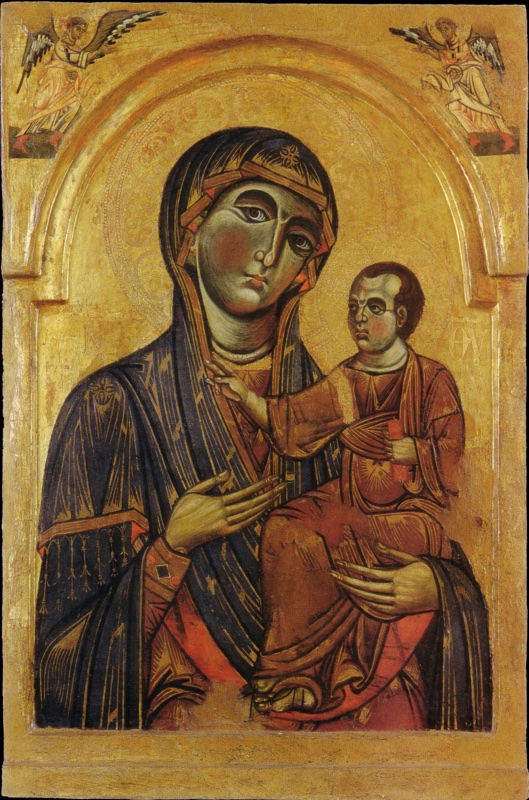
The work depicts the Virgin Mary seated on a throne with the Infant Jesus in her lap, flanked by two angels, in an iconography typical of the Byzantine-Pisan tradition of the 13th century. The Master of Saints Cosmas and Damian, an anonymous painter of the Pisan school active between 1240 and 1270, created this tempera on panel with a strong influence from Giunta Pisano, a master of the preceding generation, evident in the extensive gilding and stylized figures.
The Virgin Mary is seated on a curved throne, wearing a dark blue mantle adorned with natural folds and a red robe beneath, holding the Infant Christ on her right knee in the Odigitria pose, where she points to her son with her left hand while he blesses with his right. Two symmetrical angels, positioned in the upper corners of the arch, gaze toward the sacred couple, with outstretched wings and flowing robes, helping to create a pyramidal hierarchical balance that emphasizes divine centrality. The Child, chubby and blessing, wears a small red cloak and holds a scroll or blesses, a symbol of his future mission, while details such as the large eyes and round cheeks reflect the Byzantine Greek heritage adapted to local Pisan tastes.
This composition is not merely devotional but follows theological patterns: the enthroned Madonna represents the Theotokos (Mother of God), with angels as a heavenly retinue, a common motif in Pisan icons for altars or private devotions.
Executed in tempera on a wooden panel (85.4 x 56 cm), the work features a gold background stamped with dry-engraved geometric and floral motifs, typical of the technique used to simulate preciousness and divine light through metallic reflections. The figures are rendered with thin layers of color and concentric whites in the eyes (circles for the sclera), while the drapery displays stiff folds and linear breaks, appearing clumsily jointed compared to the later refinement of Cimabue. Gilding covers most of the surface, with the Gothic arch framed by small columns and arches, suggesting a celestial architecture that frames the sacredness. This technique, derived from Byzantine models imported via Pisa as a Crusader port, emphasizes frontality and symmetry to evoke eternity, with vivid colors (lapis lazuli blue, cinnabar red) symbolizing divine royalty.
The painting, dated around 1260 and housed at the National Museum of San Matteo in Pisa (inv. 1575), was attributed to the Master of Saints Cosmas and Damian by Garrison in 1949, after another work of the same name in the Pisan church of Saints Cosmas and Damian.
The artist, likely a workshop pupil of Giunta, worked during a transitional period toward the Gothic style, employing archaic features such as elongated proportions and emphatic gestures that foreshadow the more fluid style of Ugolino di Nerio or Cimabue. Possibly originating from Pisan devotional contexts, it attests to the vitality of panel painting in medieval Tuscany, influenced by Mediterranean exchanges.
This Madonna exemplifies the Pisan Giunta style: rigid yet expressive, with an emphasis on sacred hierarchy and gold as a symbol of eternal light, distinguishing itself from the more elegant Sienese trends. Compared to contemporary works such as the Madonna dei Mantellini by the same master (Siena, ca. 1260), here the angels add dynamism, foreshadowing the complex polyptychs of the late 13th century.
Madonna and Child with Two Angels
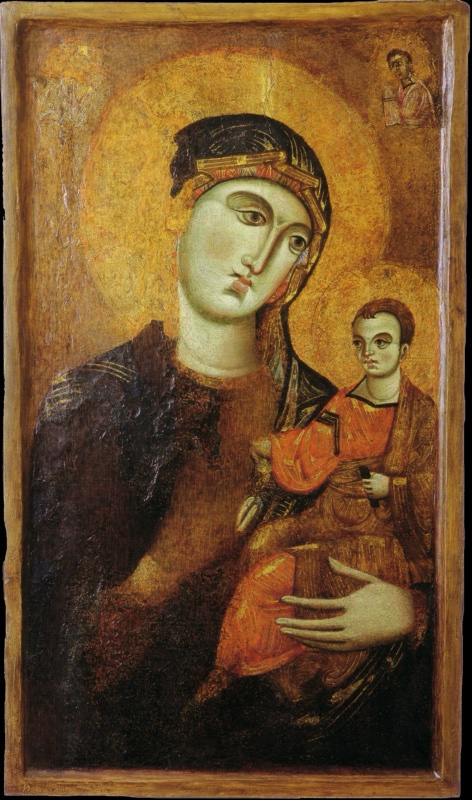
This image (inv. 1574, 87.6 x 50.2 cm), a variant of the Maestà odigitria, distinct from the previous one (inv. 1575, 85.4 x 56 cm), features a less curved throne and coarser details, confirming the master’s serial production in the Giunto workshop in Pisa.
The Virgin Mary sits on a simple throne, wearing a heavy dark blue mantle with vertical, jagged folds that fall stiffly, surmounted by a golden veil and a cruciform halo, while she points to her Son with her left hand in the Odigitria pose. The Infant Jesus, on her right knee, blesses with his right hand raised and holds a book or scroll, with plump limbs and his gaze directed toward his mother, surrounded by an elliptical halo. Two floating angels at the upper sides, with broad wings and red-yellow robes, adore the sacred pair, creating axial symmetry that guides the devout gaze toward the theological center. This composition reflects Pisan Byzantine models, emphasizing Marian royalty and the Christological mission, a common feature in portable icons for private worship or processions in 13th-century mercantile Pisa.
Tempera on stamped gold dominates, with an extensive golden background simulating divine radiance, while the pale figures are rendered through glazing and circular highlights in the eyes, typical of Giunto’s early phase. The drapery features rigid, linear folds, with cinnabar reds and ultramarine blues applied in opaque layers for symbolic contrast, and details such as dry-engraved gilded edges for a precious texture. Compared to inv. 1575, here the throne appears more angular and the gold less refined, suggesting a less polished workshop variant.
The gold leaf, hammered and scratched with floral motifs, evokes the Eucharistic liturgy, with visible abrasions revealing the underlying red ochre, common in Pisan works subjected to devotional wear.
Attributed to the Master (fl. 1240–1270), a disciple of Giunta Pisano, the work is cataloged as Madonna and Child with Two Angels (inv. 1574, ex no. 13), a twin of the eponymous work from the Pisan church (inv. 1575), both attributed to the same hand by Angelo Tartuferi in 1990. Documented at the Civic Museum of Pisa prior to its transfer to San Matteo, it bears witness to the diaspora of Pisan devotional altarpieces, with Sienese echoes in the Madonna dei Mantellini (78 x 49 cm, Siena). Within the Tuscan landscape, it marks the persistence of the Byzantine style in contrast to Florentine innovation, with “rough” features that delight historians for their workshop authenticity.
Comparison with Variants
| Appearance | Inv. 1574 (87.6 x 50.2 cm) | Inv. 1575 (85.4 x 56 cm) |
|---|---|---|
| Throne | Square, simple | Arched Gothic with small columns |
| Angels | Floating above, broad wings | In the upper arches |
| Proportions | More vertical, elongated Madonna | Wider, pyramidal emphasis |
| Gold details | Simple hallmarks | Complex floral motifs |
These differences reveal the master’s productive flexibility, adapted to different commissions, while the shared style links both to the Pisan Crusader legacy.
Madonna and Child
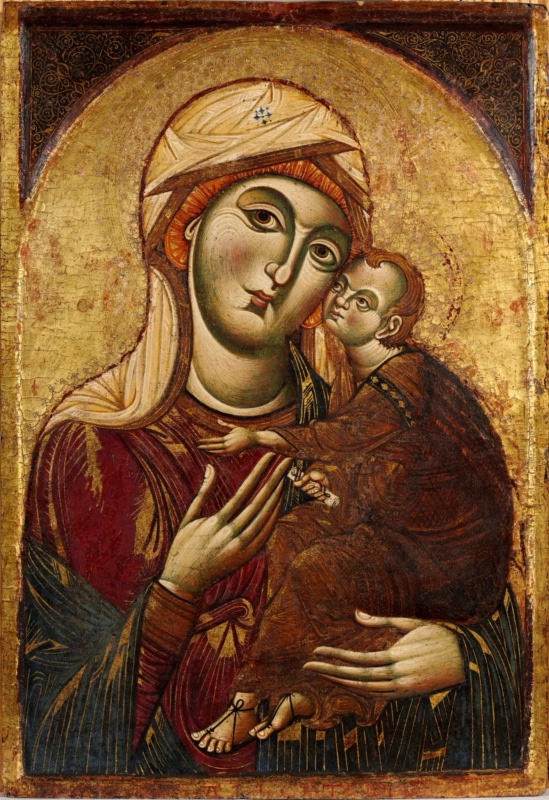
The work Madonna and Child (inv. 1926.41) by the Master of Saints Cosmas and Damian, dated to around 1260–1270, is a tempera on panel with gold leaf (64 x 44 cm) housed at the Fogg Art Museum in Cambridge, Massachusetts. This intimate composition of the Virgin of Tenderness (Panaghia Eleousa) exemplifies the master’s Pisan Giunto style, with Byzantine influences accentuated by the affectionate mother-child pose.
The Madonna is depicted in half-length within a large golden halo, with a transparent white veil on her head and a red-yellow mantle draped over her shoulders and arms, turning her face toward the Child with a tender expression and large eyes. Christ, positioned on her left arm, rests his cheek against his mother’s in a gesture of eleousa (mercy), with his right hand touching the Virgin’s chest and a cruciform halo, a symbol of his incarnate divinity. The absence of a throne or angels renders the scene more domestic and devotional, focused on the emotional bond as a path to mystical contemplation.
This eleousa variant, less hierarchical than the Pisan odigitria (e.g., inv. 1574/1575), derives from Paleologian icons imported to Pisa, emphasizing the Marian compassion dear to the emerging Franciscan spirituality. Executed in oil tempera on gold leaf stamped with star and floral motifs, the surface prioritizes sacred flatness, with pale figures highlighted by concentric whites in the eyes and glazes for psychological depth. The fluid yet rigid drapery, with wave-like folds and linear breaks, employs cinnabar reds and golds for symbolic contrast, while the halo is scratched to create luminous effects. Its small dimensions (64 x 44 cm) suggest portable use, perhaps as an altarpiece or private icon, and it is in good condition despite abrasions. Such “clumsy” techniques, scleral circles and radiating strigils, distinguish the master from more refined pupils such as Cimabue, preserving Byzantine archaism in a Pisan style.
The painting entered the Fogg in 1926 (inv. 1926.41), cataloged by Garrison (no. 170) as a work by the Master, active 1240–1270 in the circle of Giunta Pisano, and confirmed by scholars such as Burresi-Caleca (2005). Probably originating from Pisa or Siena (cf. Madonna dei Mantellini), it reflects the circulation of Tuscan devotional altarpieces to U.S. collections. The dating to 1260–1270 places the work in the master’s mature period, following the eponymous Pisan Madonna (ca. 1260). It bears witness to Pisan cultural export, with Sienese traits suggesting hypotheses such as Gilio di Pietro (Bellosi, 1998), a painter documented in Siena from 1249 to 1261.
Comparison with Pisan Works
| Appearance | Fogg (64 x 44 cm) | Pisa inv. 1574 (87.6 x 50.2 cm) | Pisa inv. 1575 (85.4 x 56 cm) |
|---|---|---|---|
| Iconography | Eleousa (tenderness) | Odigitria + 2 angels | Odigitria + 2 angels |
| Throne/Structure | Absent, half-bust | Square throne | Arched Gothic throne |
| Drapery | Fluid, affectionate | Rigid verticals | Jagged Gothic |
| Gold/Details | Simple star-shaped hallmarks | Complex floral hallmarks | Complex floral motifs |
These variations illustrate the workshop’s versatility, ranging from intimate to majestic, linking the master to the Byzantine-Gothic transition in Tuscany.
Our Lady of the Mantellini
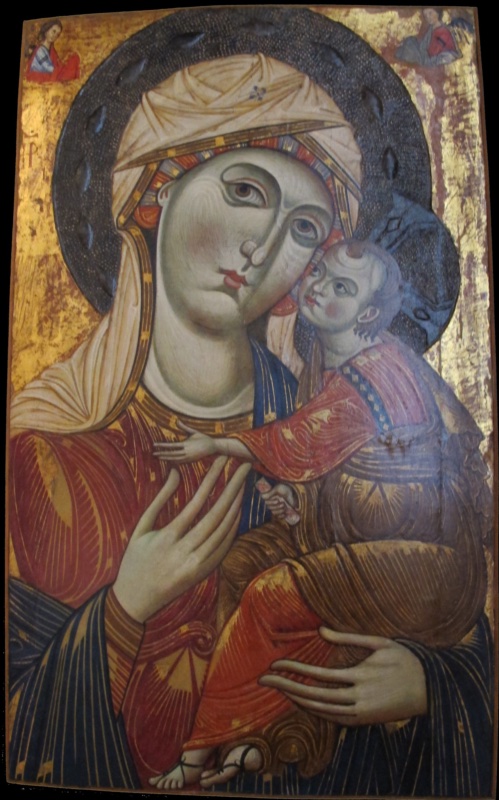
The Madonna dei Mantellini (c. 1260–1270), attributed to the Master of Saints Cosmas and Damian (or Gilio di Pietro), is a tempera on panel with gold leaf (78 x 49 cm) that was originally part of the high altar of the church of San Niccolò al Carmine in Siena, in Pian dei Mantellini. This Byzantine-style icon of the Virgin Eleousa, an object of Carmelite devotion for the “mantellini” (small cloaks) donated by mothers in gratitude for their children’s graces, represents the Sienese master’s crowning achievement.
The Virgin Mary is depicted in half-length within twin golden halos, with a starry veil on her head, a navy blue mantle adorned with red studs, and a red robe beneath, affectionately holding the Child to her right cheek in a pose of tenderness (eleousa). Christ, blessing with his right hand and holding a scroll in his left, rests his head against his mother, with plump limbs and a cruciferous halo, evoking maternal protection and divine mercy. Symbols such as the small heart or flower near his left foot add secular tenderness, while Marian inscriptions (e.g., “M” for Mary) adorn the halos.
This iconography, widespread among Carmelites for the emerging Carmelite cult, blends Pisan Byzantinism with more intimate Sienese accents, ideal for popular votive offerings.
Tempera on gold leaf stamped with stars and plant motifs, the work employs fine glazes for soft flesh tones and circular highlights in the eyes, with fluid, undulating drapery that softens the rigid, angular lines typical of Pisan paintings. Precious pigments (ultramarine, cinnabar) create chromatic vibrations, while scratches in the halos simulate divine rays; the state of preservation has been altered by restorations but remains authentic in the master’s “clumsy” detail. Vertical dimensions (78 x 49 cm) make it a devotional icon for a tabernacle.
This hybrid technique reflects the Pisan-Sienese workshops, with gold dominating to create a celestial aura and more natural folds that anticipate Coppo di Marcovaldo.
Created for the Carmelites of Siena (13th cent.), the work owes its name to the mantles hung as votive offerings; today it’s on display in the Siena National Art Gallery. Attributed to the Maestro from Brandi (1932), with a proposed identification as Gilio di Pietro (documented in Siena 1247–1261, Bellosi), it links Pisa and Siena through artistic exchanges. Dated 1260–1270, post-Pisan (e.g., Fogg, does Mantellini precede?), it marks the master’s expansion into Siena.
Popular devotion, with Carmelite festivals, made it a focal point of worship until its confiscation in the 19th century.
Comparison in the Corpus
| Appearance | Mantellini, Siena (78 x 49 cm) | Fogg (64 x 44 cm) | Pisa inv. 1574 |
|---|---|---|---|
| Iconography | Eleousa without throne | Eleousa half-length | Odigitria + angels |
| Drapery | Fluid (Sienese) | Rigid (Pisan) | Rigid vertical |
| Halos/Gold | Starry with inscriptions | Simple | Architectural |
| Context | Devotional Carmelite | Private | Ecclesiastical |
These variations demonstrate an evolution from rigid Byzantine to expressive Sienese styles, enriching the attribution of this transregional master.
Madonna and Child (Our Lady of the Patronage)
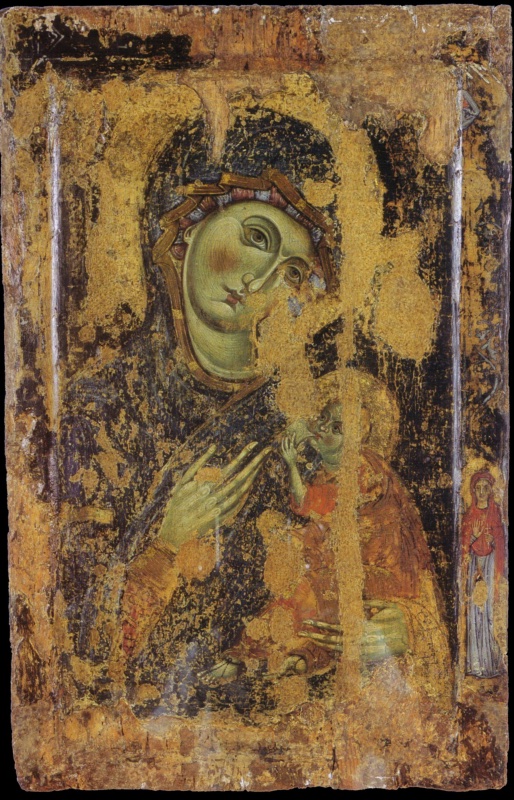
The image depicts the eponymous Madonna and Child (ca. 1260–1270), a tempera on panel with gold leaf by the Master of Saints Cosmas and Damian, originally housed in the church of the same name in Pisa and now in the National Museum of San Matteo (Pisa). Known as the Madonna del Latte or Our Lady of Patronage, this weathered icon bears witness to local devotion, its condition altered by abrasions and repainting that accentuate greenish tones.
The Virgin Mary is depicted in half-length within faded golden halos, wearing a heavy black-blue mantle and a fragmentary red robe, nursing the Child at her right breast in the glykophilousa pose (sweet kiss), while her left hand supports the Son’s head. Christ, chubby and blessing, turns his face toward the Marian milk—a Eucharistic symbol—with a small cruciferous halo and crossed legs in a judging gesture. Greek letters (MP ΘY) identify the Theotokos, while the absence of a throne emphasizes a protective intimacy, typical of ecclesiastical patronage.
This “milk” variant, rare in the master’s work compared to the odigitria, evokes theological themes of spiritual nourishment, widespread in post-iconoclastic Pisan aniconic contexts.
Tempera on oxidized and minimally stamped gold, with greenish discoloration from degradation (possibly arsenic-related or repainting), opaque glazes for depth, and eccentric highlights in the eyes. Rigid V-shaped drapery and linear strokes betray Giunto’s clumsiness, with faded cinnabar reds and cracked golds revealing wooden craquelures. Compact dimensions (75 x 49 cm) suggest a devotional ciborium panel or minor altarpiece.
The wear, visible in abrasions and craquelure, reflects centuries of tactile veneration, with modern restorations preserving the archaic authenticity of the Pisan master.
Named after the master (Garrison 1949, no. 104), the work was in the Church of Saints Cosmas and Damian in Pisa until 1945 (transferred to the San Matteo Museum); dated to the third quarter of the 13th century, it predates Sienese works such as the Madonna dei Mantellini.
Devotion to the “patronage” links the icon to an ex-voto for maternal protection, common in Crusader ports.
Comparison in the Corpus
| Appearance | Eponymous Pisa (75 x 49 cm) | Mantellini, Siena | Fogg |
|---|---|---|---|
| Iconography | Madonna del Latte | Eleousa | Eleousa |
| Condition | Worn, greenish | Well-preserved | Good |
| Drapery | Heavy, black | Fluid red | Stiff |
| Symbolism | Eucharistic nourishment | Carmelite tenderness | Intimacy |
This foundational altarpiece by the master highlights the Pisan core, from which more refined Sienese variants derive.