Maestro di San Martino
( 25% )
Identity and Origins
The Maestro di San Martino stands as one of the most singular and compelling personalities in the history of Tuscan painting of the second half of the thirteenth century, yet his very name is a convention of modern art history rather than a historical record, a convention arising from the circumstance that his most celebrated work was produced for the church of San Martino in Cinzica in Pisa. He is an anonymous painter in the strictest sense: no document of the period mentions him by the conventional name by which scholarship knows him, and his biography must be reconstructed through the patient triangulation of stylistic analysis, archival inference, and comparative iconography.
The most significant and broadly accepted scholarly hypothesis regarding his true identity was advanced by the distinguished Italian art historian Luciano Bellosi, who proposed to identify the Maestro di San Martino with Ugolino di Tedice, a Pisan painter attested in documents between 1251 and 1277. This identification rests on careful visual analysis, particularly on the striking physiognomic analogies between the sleeping figure of Joachim in the Madonna di San Martino panel and the suffering Christ in the signed Crucifix of the Hermitage in Saint Petersburg, both marked by a distinctive incised line running from the eye down the cheek.
The hypothesis, while not universally accepted, has been endorsed by a substantial portion of the critical community and has significantly advanced understanding of the painter’s place within the broader Pisan artistic milieu. If the identification holds, then Ugolino di Tedice was born in Pisa, presumably in the second quarter of the thirteenth century, the web gallery of art biography suggests activity from 1251, and his formation took place entirely within the rich, cosmopolitan culture of the city on the Arno.
Pisa, at the height of its maritime and commercial power in the mid-Duecento, was a crucible of artistic innovation, uniquely positioned at the crossroads of Byzantine, Romanesque, and nascent Gothic currents. The city’s ports received craftsmen, icons, illuminated codices, and luxury objects from Constantinople, the Crusader states, and the Norman south of Italy, and it was this culture of visual pluralism that fundamentally shaped the painter’s sensibility. His name, Ugolino di Tedice, situates him within the social fabric of the Pisan artisanal class, and the first element of his name links him to an older Pisan nomenclature rooted in the Germanic traditions of the Lombard period. The exact date of birth remains unrecorded, as is invariably the case for artists of this period and social station, but scholarly consensus places his formative years in the 1240s and 1250s, when the artistic revolution initiated by Giunta Pisano was at its most potent and generative phase.
Family and Artistic Dynasty
The Maestro di San Martino, if identified as Ugolino di Tedice, belonged to one of the most remarkable artistic families of thirteenth-century Pisa, a family whose collective importance in the history of Tuscan painting is comparable in scope and ambition to that of the Berlinghieri of Lucca, the other great dynasty of Duecento painters in north-western Tuscany. The Tedice family was constituted around a principle of artistic transmission from one generation to the next, a shared professional identity that defined not only the economic life of its members but also their social networks, their workshop practices, and their access to ecclesiastical patronage.
The head of the family’s previous generation was Tedice himself, a painter of the early Duecento whose works have not been securely identified but whose name appears in Pisan documents as evidence of artistic activity in the city. Ugolino’s elder brother, Enrico di Tedice, was himself a practitioner of panel painting in the Byzantine mode, and while his independent corpus is small, his presence in contemporary records confirms the family’s sustained engagement with the pictorial arts across the middle decades of the century.
Ugolino’s own contribution to the dynasty was amplified through his son, Ranieri di Ugolino, who continued the workshop tradition and entered the profession that his father and uncle had so vigorously shaped. This three-generational continuity, from Tedice through Enrico and Ugolino to Ranieri, represents an unusually well-documented instance of the hereditary transmission of craft knowledge in the context of medieval Pisan painting, a transmission that would have involved the sharing of cartoon designs, preparatory techniques, pigment recipes, and compositional conventions. Within the family workshop, Ugolino’s mastery appears to have been pre-eminent: his only signed work, the Crucifix in the Hermitage, demonstrates a command of painterly means that surpasses anything attributable to Enrico, and the breadth of the corpus assembled by later scholarship under the conventional name confirms a prolific and sustained career.
The family’s social standing in Pisa was that of the professional artisan class, neither aristocratic nor mendicant in its institutional affiliations, yet sufficiently embedded in the civic and ecclesiastical life of the city to receive commissions from its most important religious institutions. It is likely that the family workshop was located in the working districts of Pisa south of the Arno, in the area known as Kinzica, the very same neighbourhood that gave its name to the church for which Ugolino’s most famous panel was made.
The naming of that district after a legendary heroine of early medieval Pisan history suggests the pride that the inhabitants of the area took in their civic identity, and it is plausible that Ugolino’s family shared this pride, participating in the devotional life of San Martino in Cinzica as parishioners as well as producers of its most significant altarpiece. Scholarly opinion has consistently noted the way in which the Tedice family embodies a specifically Pisan form of artistic identity, one rooted in the city’s mercantile culture, its openness to Byzantine influence, and its tradition of craftsmen who were simultaneously practitioners of panel painting, mosaic, and possibly manuscript illumination. The identification of Ugolino with the Maestro di San Martino, if confirmed, would mean that a single family was responsible for transmitting and transforming the legacy of Giunta Pisano across three generations, a cultural labour of exceptional historical significance.
Patrons and Ecclesiastical Commissions
The reconstruction of the Maestro di San Martino’s patronage network depends on a combination of provenance evidence, iconographic analysis, and the institutional histories of the Pisan churches that housed his principal works, since no contracts, payment records, or dedicatory inscriptions survive to document his commissions directly. The primary patron institution for his most important surviving work was undoubtedly the church of San Martino in Cinzica, a Pisan parish church located in the Kinzica district south of the Arno, which gave its name both to the altarpiece and, conventionally, to the painter himself.
The church of San Martino in Cinzica was associated in the thirteenth century with a congregation of secular clergy affiliated with the canons of the Cathedral of Santa Maria, and it is this institutional connection to the Pisan cathedral chapter that most plausibly explains the commission of an altarpiece of such exceptional ambition and refinement. The centrality of the Virgin enthroned in the altarpiece reflects the Marian dedication of the cathedral with which the Kinzica clergy were connected, while the figure of Saint Martin sharing his cloak with the poor, which appears in the register below the Virgin’s throne, provided the titular saint’s image required for a church dedicated to his memory.
The cathedral of Pisa itself was one of the most powerful and wealthy institutions in the western Mediterranean during the thirteenth century, and its dependent clergy, including the canons and their affiliated congregations, disposed of the resources necessary to commission polyptychs of the scale and technical complexity of the Maestro’s surviving works. A second major commission came from the church of Sant’Anna in Pisa, which provided the provenance for the panel depicting Sant’Anna in trono con Maria bambina e due angeli, now in the Museo Nazionale di San Matteo, a work whose formal affinities with the Madonna di San Martino confirm its attribution to the same hand. The church of Sant’Anna, like San Martino in Cinzica, was an urban parish church of Pisa, and the commission of a panel representing Saint Anne enthroned with the infant Virgin speaks to the devotional culture of a congregation that associated itself with the veneration of Mary’s mother, a cult that gathered significant force in the course of the thirteenth century under the influence of mendicant preaching and apocryphal devotional literature.
Roberto Longhi, the scholar who did most to define the painter’s canonical corpus, attributed to him a small panel depicting a monk before Saint Francis, now in the Johnson Collection at the Philadelphia Museum of Art, which implies a Franciscan commission and thereby connects the Maestro to the thriving culture of mendicant patronage that shaped so much of Duecento art in central Italy. A further work attributed by Longhi is a Madonna col Bambino e angeli formerly in the Acton Collection in Florence, a panel that critics from Caleca onward have dated to approximately 1290 and that implies a patron from the circles of the Florentine or Tuscan nobility capable of acquiring a prestigious Pisan altarpiece for a private or semi-private devotional setting.
The church of San Biagio in Cisanello, a suburban parish of Pisa, provided the provenance for a Madonna with Child that some scholars, including Cuppini, have attributed to the Maestro, though Carli later expressed reservations about this attribution on stylistic grounds, noting the painting’s markedly archaic, Coppo-influenced character. The possible attribution of miniatures in a Pisan Exultet scroll (Exultet 3 of the Museo dell’Opera della Primaziale Pisana) to the same hand, proposed by Carli in 1958, would indicate that the painter also worked within the liturgical production of the Pisan Opera del Duomo, the administrative body responsible for the fabric and furnishings of the cathedral.
Painting Style
The pictorial style of the Maestro di San Martino is one of the most distinctive and technically sophisticated in the canon of Duecento Italian painting, combining a deep absorption of Byzantine formal vocabulary with a naturalizing sensibility that points toward the revolution associated with Cimabue and ultimately with Giotto. His most characteristic invention is the so-called strigilatura luminosa, a system of fine, strigil-like luminous strokes applied with the tip of the brush to drapery, landscape elements, and above all to the highlights of flesh, producing a shimmering, gold-tinted radiance across the surface of his panels that is entirely without direct precedent in the Pisan or central Italian tradition.
This technique derives in spirit from the filiform brushwork of Giunta Pisano, who used extremely fine threads of paint to articulate the chiaroscuro of flesh in his crucifixes, but it transforms Giunta’s expressive linearism into something altogether more decorative and luminous, replacing anatomical articulation with a kind of optical splendour that evokes the golden ground of the Byzantine icon without being reducible to it. The faces painted by the Maestro di San Martino reveal a studied melancholy and psychological depth that distinguish them from the more rigidly hieratic productions of contemporary Pisan and Lucchese painters; the Virgin’s face in the Madonna di San Martino is rendered without the heavy dark contours that characterize so much Byzantine-influenced Italian painting of the mid-century, instead bathed in a warm, modulated colorism that gives it a gentle, almost tragic expressivity.
In the narrative scenes that flank the central Virgin in the Madonna di San Martino, eleven episodes from the apocryphal lives of Saints Joachim and Anna, drawn from the Protoevangelium of James, the painter demonstrates a narrative vivacity and compositional inventiveness that are entirely exceptional for the period, comparable in their lively naturalism to the contemporary achievements of the Pisan sculptor Nicola Pisano. The relationship between the painter’s narrative idiom and Nicola Pisano’s pulpit reliefs for the Baptistery of Pisa (1260) is one of the most discussed questions in the scholarship of Duecento art, and most critics from Longhi onward have agreed that the Maestro di San Martino was aware of and responsive to the classical revival that Nicola’s sculpture embodied.
The drapery in the altarpiece panels falls in broad, softly modulated masses that recall the volumetric treatment of cloth in Nicola’s reliefs, and the figures in the narrative scenes move with a physical credibility and spatial awareness that marks a decisive departure from the flat, schematic figure-types of the Byzantine-derived tradition. The painter’s colour is rich and jewel-like, built up in thin, translucent layers over a gesso ground, with a preference for deep crimsons, muted azurites, and warm ochres that are characteristic of Pisan panel painting of the third quarter of the century. In the arrangement of his Madonnas, the Maestro shows direct awareness of Cimabue’s Maestà for San Francesco of Pisa (now in the Louvre), particularly in the treatment of the Christ Child, whose pose and proportions in the Madonna di San Martino echo those of the Louvre panel; this relationship implies that the two painters were working in the same city and were mutually aware of each other’s production, even if the chronological priority between the two works remains debated.
The painter’s gift for decorative elegance, expressed above all in the gold-tinged strigilature and in the elaborately tooled gold grounds, was not, however, matched by an equal capacity for iconographic or compositional innovation on the large scale, and this is perhaps why the Master, despite his considerable gifts, did not generate a school of followers comparable to that of Cimabue, remaining instead a singular and somewhat isolated figure in the history of the transition from Byzantine to Italo-Gothic painting. His technique for wood panel preparation, the construction of the support from vertically assembled wooden planks with a preparatory layer of gesso, follows the standard Pisan practice of the century and has been confirmed by technical examination of the altarpiece in San Matteo.
Artistic Influences
The formation of the Maestro di San Martino as a painter took place within the richly layered artistic environment of Pisa in the mid-thirteenth century, a city that was simultaneously the most cosmopolitan port of western Italy and the home of a series of decisive pictorial experiments that laid the foundation for what Roberto Longhi famously described as the epochal renewal of Italian painting.
The first and most pervasive influence on his style was that of Giunta Pisano, the dominant figure of Pisan painting in the first half of the Duecento, whose expressive crucifixes, including the signed example for San Francesco in Bologna and the processional cross of San Benedetto, established a new standard of psychological intensity within the Byzantine pictorial tradition. Giunta’s innovation consisted in stretching the expressive possibilities of Byzantine linearism to their limit, using fine filiform brushstrokes to articulate the pathos of the suffering Christ in a way that no previous Italian painter had achieved, and it was precisely this tradition of painterly expressivity that the Maestro di San Martino absorbed, re-elaborated, and transformed into his personal system of strigilature luminose.
A second major source of influence was the Byzantine neo-Hellenic current of the late twelfth and thirteenth centuries, accessible to the Pisan painter through both imported icons and illuminated manuscripts; scholars have specifically noted the analogies between the figural types of the Madonna di San Martino and those of the Vatican Greek manuscript cod. gr. 1158, which represents a particularly refined example of the Constantinopolitan neo-classical revival. The influence of Nicola Pisano’s sculptural classicism, already discussed in relation to the painter’s narrative style, constitutes a third formative current: the Baptistery pulpit of 1260, with its directly Roman-derived figure types and its volumetric, spatially credible compositions, offered the Pisan painters of the subsequent generation an entirely new model of how the human figure could be rendered with physical weight and emotional persuasion.
The scholarship of Longhi further posited an important connection between the Maestro di San Martino and the so-called Terzo Maestro di Anagni (Third Master of Anagni), the anonymous fresco painter responsible for the most innovative sections of the crypt cycle of San Magno beneath Anagni Cathedral; Longhi believed the two to be the same artist, a view that, if accepted, would place the Pisan panel painter’s earlier career within the fresco culture of Lazio and the political orbit of the mid-thirteenth-century papacy.
The argument rested above all on a perceived concordance in the treatment of light across painted surfaces: the strigilature luminose that constitute the Maestro di San Martino’s most distinctive technical signature appeared to Longhi as the panel-painting expression of the same fundamental sensibility toward luminous tonal modelling that Toesca had identified as the hallmark of the Third Master’s fresco style, the two techniques representing, in his view, distinct medium-specific solutions to the same underlying pictorial problem rather than independent inventions by independent personalities.
Both figures share, moreover, a formation whose most profound debt is to the most refined layer of the Byzantine neo-Hellenic tradition, a tradition accessible in the mid-Duecento through imported panel icons, illuminated manuscripts from Constantinople, and the networks of the papal court; scholars have observed that the specific figural analogues of both bodies of work, most notably the parallels with the Vatican Greek manuscript cod. gr. 1158, point toward a common cultural register of exceptional refinement rather than the generic Byzantinism of the regional mainstream. The further circumstance that Giunta Pisano was documented in Rome in 1239, during precisely the years when the Third Master is believed to have been executing the Aula Gotica at the Santi Quattro Coronati, offers a structural occasion for exactly the kind of encounter between the Roman fresco tradition and the Pisan panel-painting inheritance that the Longhi hypothesis requires, whether one interprets that encounter as a meeting of two phases of a single career or as the productive collision of two distinct but closely kindred pictorial intelligences.
The critical community has, on balance, declined to adopt the identification as a settled attribution: the social incompatibility between the tentative identification of the Third Master with Frater Romanus, a Benedictine friar embedded in the monastic culture of Lazio, and the identification of the Maestro di San Martino with Ugolino di Tedice, a lay craftsman from a dynastic Pisan workshop family, presents a biographical disjunction that no surviving evidence bridges; and the total absence of any work clearly transitional between the lime-based mural technique of Anagni and the tempera panel technique of the Pisan bottega means that the hypothesis must remain, at every crucial juncture, a visual deduction rather than a documentable fact.
The most productive reading of the relationship between the two anonymous masters is perhaps not biographical identity but documented stylistic kinship: the suggestion that both stand, however differently mediated, within the same current of pictorial neo-Hellenism that was the most advanced artistic resource available in the central Italian peninsula during the third and fourth decades of the thirteenth century, and that the encounter of Giunta Pisano and the Third Master in Rome provided the specific historical mechanism through which that common tradition was elaborated simultaneously in the fresco halls of the papal Patrimony and in the panel workshops of the Arno city. The fuller arguments for and against the personal identification are discussed in the dedicated entry for the Terzo Maestro di Anagni. The influence of the early Cimabue is also unmistakable in the Maestro’s mature works, particularly in the compositional structure of his Marian altarpieces and in the treatment of the Christ Child, and the relationship between the two painters, whether one preceded the other, or whether they developed in parallel, remains one of the central interpretative challenges in the study of late Duecento Pisan painting.
Travels and Geographic Horizons
The question of the Maestro di San Martino’s travels is inseparable from the larger question of artistic mobility in thirteenth-century Italy, a period in which journeys to Rome, the Byzantine east, and the Crusader states were not unusual for painters of ambition, and in which the great workshop traditions of Pisa, Lucca, Florence, and Siena were in constant, productive contact with one another.
Pisa’s position as the dominant maritime power of the western Mediterranean in the mid-Duecento meant that its citizens, including its craftsmen and painters, had access to sea routes that connected the Tyrrhenian coast to Constantinople, the Holy Land, Sicily, and North Africa, and it would be extraordinary if a painter as technically sophisticated as the Maestro had not been touched by the visual culture of at least some of these destinations. The hypothesis of Longhi, which identified the Maestro di San Martino with the Terzo Maestro di Anagni, implies a journey of considerable significance: Anagni, the town south of Rome where the crypt frescoes are located, was intimately connected with the papacy in the thirteenth century, it was the birthplace of Popes Innocent III, Gregory IX, Alexander IV, and Boniface VIII, and a commission there would have placed the painter in the heart of the most prestigious patronage network in central Italy.
Even without accepting this specific identification, it is clear from the stylistic evidence of the Madonna di San Martino panel that the painter had direct and detailed knowledge of the Florentine artistic production of the 1260s and 1270s, and in particular of Cimabue’s Pisan Maestà (now in the Louvre), which was executed for the church of San Francesco in Pisa before 1285; this familiarity with the Florentine master’s work presupposes at minimum a thorough immersion in the shared artistic conversations that circulated among the painters of Tuscany through the medium of workshop contact, traveling altarpieces, and perhaps the direct observation of works in progress. The attribution to the Maestro di San Martino of miniatures in the Pisan Exultet roll (Exultet 3) raises the additional possibility of a connection with the manuscript-producing workshops of the Opera del Duomo, which were in turn connected to the broader network of scriptoria and illumination ateliers that stretched across central Italy from Pisa to Rome, and through which Byzantine manuscripts continued to circulate and exert their influence well into the late thirteenth century.
Death
The date and cause of the Maestro di San Martino’s death are not recorded in any surviving document. If the identification with Ugolino di Tedice is accepted, the terminus post quem for his death is 1277, the last year in which documents attest to his activity, and the terminus ante quem is 1286, by which date he was certainly no longer alive, as confirmed by archival evidence relating to his family. No cause of death is recorded; given the documentary silence and the norms of mortality in thirteenth-century Italian cities, death from natural causes in late middle age, the painter would have been in his fifties or sixties at the time of his disappearance from the records, is the most plausible inference. The absence of any funerary inscription, posthumous tribute, or record of a workshop succession to the Maestro di San Martino himself underscores the historical obscurity in which this exceptional painter passed the final years of his life.
Principal Works
Madonna and Child
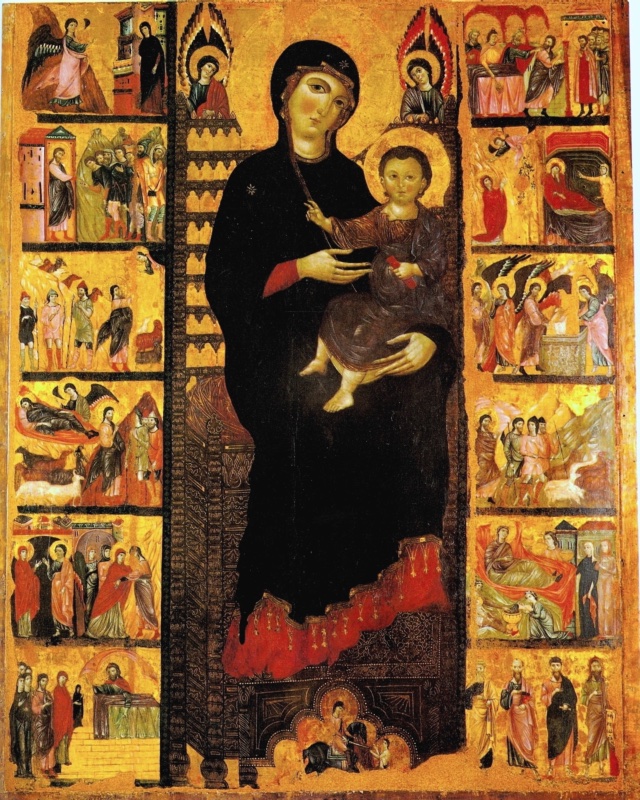
The Madonna di San Martino, the painter’s eponymous masterpiece and the work from which his conventional scholarly designation derives, is a large polyptych panel in tempera and gold on wood measuring approximately 162 by 125 centimetres, now conserved in the Museo Nazionale e Civico di San Matteo in Pisa. It was originally made for the church of San Martino in Cinzica, a parish church located in the Kinzica district of Pisa south of the Arno, and its iconographic programme reflects the dual dedication of that institution to the Virgin Mary and to Saint Martin of Tours. The central field of the panel presents the Virgin Mary enthroned in majesty (Maestà), holding the Christ Child on her left arm in the Byzantine Hodegetria mode, a compositional type that the painter inherited from Giunta Pisano and transformed through his characteristic strigilature luminose.
The Virgin’s face is rendered with remarkable psychological subtlety: her expression is one of gentle melancholy, the contours of her features softened by a warm, modulated colorism that departs from the rigid linearity of contemporary Byzantine-influenced painting and anticipates the humanizing tendencies of the late Duecento. The Christ Child, seated on the Virgin’s arm and turned slightly toward the viewer, shows direct knowledge of the figural type deployed by Cimabue in his Maestà for San Francesco in Pisa (now in the Louvre), a parallel noted by every major scholar since Venturi. Flanking the central image of the Virgin and arranged in two vertical registers on either side of the throne are eleven narrative panels depicting episodes from the apocryphal lives of Saints Joachim and Anna, drawn from the Protoevangelium of James, a text that circulated widely in medieval Europe as the primary source for the early life of the Virgin.
These narrative scenes include the Annunciation to Joachim, the Dream of Joachim, the Meeting at the Golden Gate, the Birth of the Virgin, and several episodes relating to the presentation of Mary in the Temple, each executed with a narrative vivacity and compositional intelligence that are wholly exceptional for Pisan painting of the mid-thirteenth century. In the lower register at the right of the altarpiece, four saints are depicted within a lateral compartment, providing the iconic figures required for the complete liturgical programme of the altarpiece. Below the Virgin’s throne, occupying a separate horizontal register, appears the episode of Saint Martin dividing his cloak with the poor man, the titular subject of the church, rendered in a compact, narrative idiom that links the altarpiece’s Marian programme to the hagiographic identity of its original ecclesiastical location. Stylistically, the work has been dated by various scholars to between the 1250s and the 1290s, with the majority of critical opinion in the late twentieth and early twenty-first centuries gravitating toward the 1260s–1270s as the most probable period of execution.
Saint Anne Enthroned with the Infant Mary and Two Angels
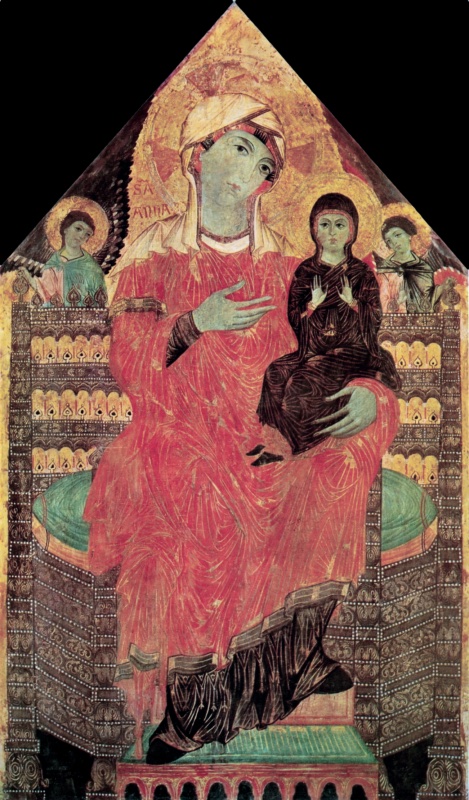
The panel depicting Sant’Anna in trono con Maria bambina e due angeli, now also in the Museo Nazionale di San Matteo in Pisa, was attributed to the Maestro di San Martino on the basis of its evident formal affinities with the eponymous altarpiece by Khovoshinsky and Salmi in 1912, and this attribution has been consistently maintained by subsequent scholarship. The work measures depicts Saint Anne, the mother of the Virgin, a figure of great importance to the Marian cult and to the devotional life of thirteenth-century Italy, seated on a throne of Byzantine type and holding the infant Mary on her lap. Two angels flank the throne, their figures rendered in the characteristic stylistic mode of the Maestro, with flowing drapery marked by the golden strigilature that distinguish his hand from those of his contemporaries.
The iconographic type of the enthroned Saint Anne with the infant Virgin has its roots in the Byzantine tradition of the enthroned Virgin with the Christ Child (Theotokos), and the Maestro’s adaptation of this schema for a representation of Mary’s earthly mother constitutes one of the earliest and most refined Italian examples of this devotional image. The work’s provenance from the church of Sant’Anna in Pisa indicates that it was commissioned for a congregation with a specific devotional investment in the cult of Saint Anne, a cult that grew in importance in central Italy in the second half of the Duecento under the influence of Franciscan and Dominican preaching. The panel is consistent in date with the Madonna di San Martino and is regarded by most scholars as a roughly contemporary work, produced within the same creative phase of the painter’s activity.
Crucifix
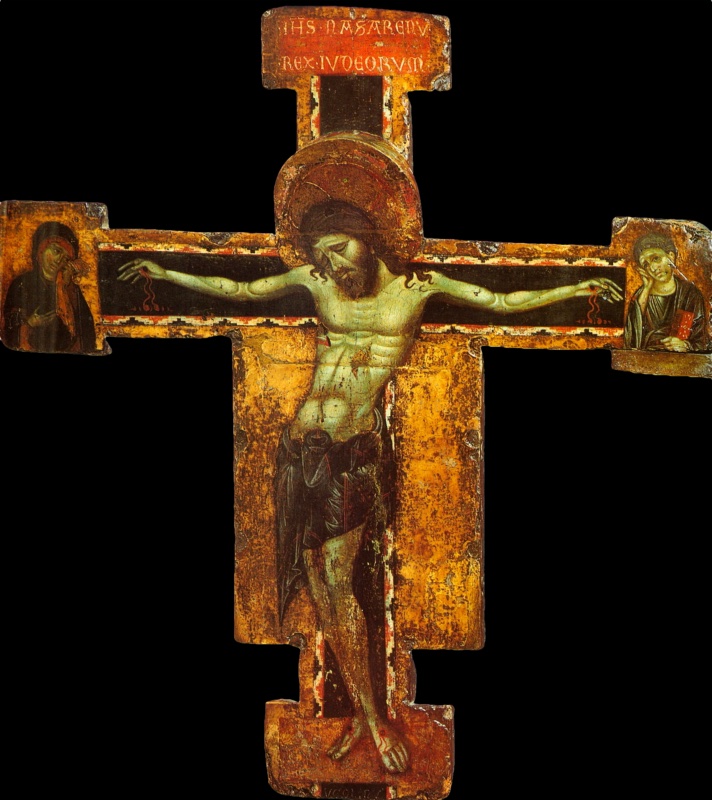
The painted Crucifix in the State Hermitage Museum in Saint Petersburg is the only work in the corpus of the Maestro di San Martino / Ugolino di Tedice that bears a signature, the inscription Ugolinus, and is therefore the keystone of the entire edifice of critical attribution and biographical reconstruction that scholars have built around this painter. The work is executed closely in the style of Giunta Pisano and demonstrates that the painter received his formation in direct contact with the greatest Pisan master of the previous generation, absorbing Giunta’s characteristic system of fine, expressive brushwork for the articulation of the suffering Christ’s body and drapery.
The figure of the crucified Christ is rendered in the Christus patiens mode, the dying, suffering Christ, that Giunta Pisano had introduced into Pisan and Italian painting in the 1230s and 1240s under the influence of the Franciscan theology of the Passion, replacing the older Christus triumphans of the Romanesque tradition. The veste di Giovanni dolente, the garment of the mourning John, visible on the lateral fields of the cross exhibits the luminous striped highlights that Bellosi identified as the Maestro’s characteristic strigilature luminose, providing one of the key formal bridges between this signed work and the unsigned panels in Pisa. The physiognomic analogy between the suffering Christ of the Hermitage Crucifix and the sleeping Joachim in the Madonna di San Martino, specifically a distinctive incised marking that descends from the eye along the cheek in both figures, constituted for Bellosi the strongest visual argument in favour of the identification of the Maestro di San Martino with Ugolino di Tedice.
Cristo Benedicente
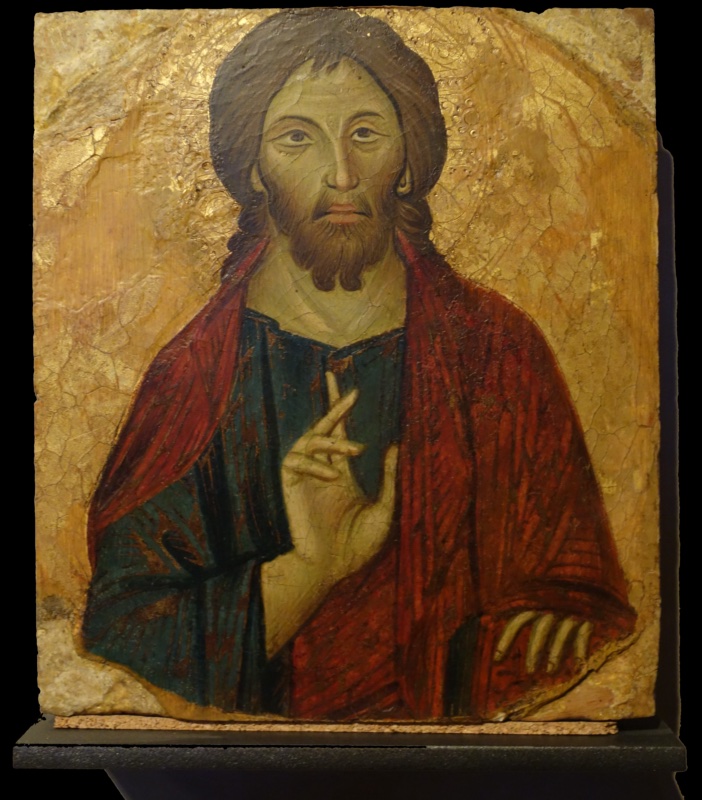
The small panel depicting the Cristo Benedicente, now in the Museo Nazionale di San Matteo in Pisa, was identified by Roberto Longhi as the upper portion of a dismembered crucifix, and its attribution to the Maestro di San Martino has been accepted by most subsequent critics as secure. The work depicts Christ in the act of benediction with his right hand, while his left hand is occupied by a book or scroll, and the figure is rendered against a gold ground in a frontal, iconic mode that reflects the hieratic conventions of the Byzantine pantocrator type.
Despite the conventionality of the iconographic schema, the face of Christ is animated by the same psychological depth and warm, modulated colorism that distinguishes the painter’s Marian images, and the drapery is marked by the fine luminous strigilature that are his hallmark. The work is modest in scale but notable for the quality of its execution, and it testifies to the range of formats and devotional functions for which the painter’s panels were produced in the context of thirteenth-century Pisan religious life.
Monk before Saint Francis
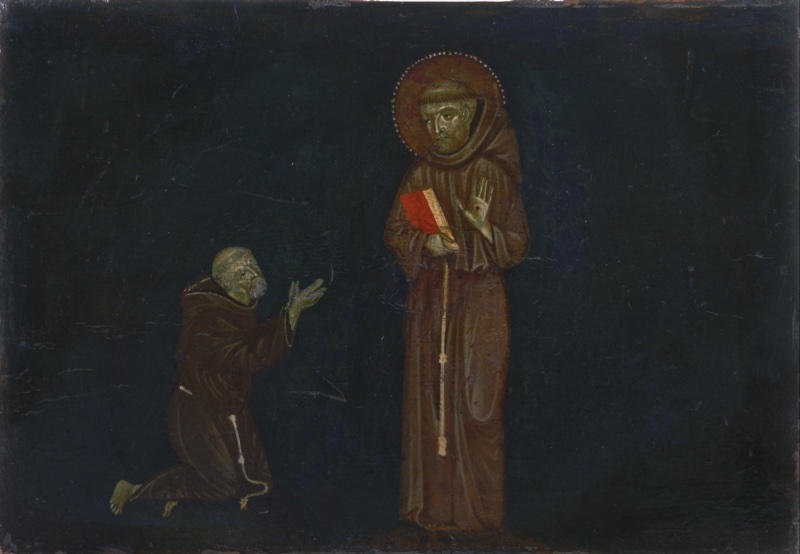
The small panel depicting a monk kneeling before Saint Francis, now in the Johnson Collection of the Philadelphia Museum of Art (attributed by the museum curator to a Master of Montelabate), was attributed to the Maestro di San Martino by Roberto Longhi, who identified it as a chronologically advanced work in the painter’s career. The subject of the panel, a devotee or friar in a posture of prayer before the founder of the Franciscan order, places it within the context of the extraordinary proliferation of Franciscan devotional imagery in thirteenth-century central Italy, a proliferation that was closely linked to the mendicant orders’ cultivation of new forms of affective piety.
Saint Francis is depicted in the hieratic, frontalized mode of the sacred image, his stigmata visible on hands and feet, while the kneeling monk is rendered with a touch of individualizing naturalism that suggests the work may have served as a votive altarpiece recording a specific act of devotion. The attribution to the Maestro di San Martino is supported by the characteristic treatment of drapery and by the warm, gold-suffused colorism of the flesh tones, though the small scale of the panel and its partial preservation make stylistic judgment more difficult than for the Pisan panels. The work’s present location in Philadelphia, far from its original context in central Italy, is the result of the dispersal of Duecento and Trecento panel paintings through the art market of the nineteenth and early twentieth centuries, when collectors and dealers associated with figures such as Wilhelm von Bode and Herbert Horne assembled the American collections that still constitute some of the richest repositories of early Italian painting outside Italy.