Maestro dell'Aula della Curia
The Maestro dell’Aula della Curia was an anonymous Italian mural painter active in Bergamo in the 13th century, and the name used for him is a modern scholarly convenience derived from the frescoed episcopal audience hall known as the Aula Picta. No source presently identified preserves his personal name, family lineage, birth date, birth place, death date, or cause of death, so any biography must be reconstructed from the fresco cycle itself, from the building’s function, and from later art-historical attribution.
Biographical status
Any biography of this master must begin with a methodological caution: he is not a documented individual in the ordinary archival sense, but an anonymous hand or workshop personality reconstructed through stylistic and contextual analysis. The very label Maestro dell’Aula della Curia indicates that the artist’s identity is tied to a site rather than to a recorded civil or ecclesiastical name. For that reason, the categories that usually structure an artist’s life, that is family, legal status, apprenticeship, marriage, inheritance, and burial, cannot be filled with verifiable personal data in the present state of evidence. What can be said with confidence is that the painter is associated with the frescoes in the Aula della Curia Vescovile beside Santa Maria Maggiore in Bergamo.
The question of birth must therefore be answered negatively rather than positively. No surviving source gives a date of birth for the master. No surviving source gives a place of birth either. The artist should consequently be described not by natal coordinates but by period and sphere of activity, namely as a painter working in Bergamo within the broad horizon of the Duecento. Even the chronology of the cycle is expressed cautiously in the public literature, since the diocesan presentation describes the Aula Picta as a space dating from the first half of the 13th century, whereas the later restoration dossier states that scholars estimate the anonymous frescoes more generally within the second half of the Duecento.
The problem of family is equally opaque. There is no evidence for parents, siblings, marriage, descendants, or dynastic workshop continuity. In the absence of such data, the historian must shift from genealogy to professional context and ask instead what kind of painter could execute a cycle so closely calibrated to episcopal authority, sacred narrative, and judicial symbolism. The answer suggested by the monument is that he was a competent fresco specialist capable of working within a highly charged ecclesiastical and civic setting. His “family,” in the only sense recoverable here, is the artistic family of anonymous Lombard mural painters whose names have been lost but whose hands survive in situ.
Death is as inaccessible as birth. No record gives a date of death. No record gives a place of death. No record gives a cause of death. The responsible academic formulation is therefore that the master’s death, like his birth, remains unknown because his historical individuality has not emerged from the documentation.
This absence of biography is not a defect of method but a characteristic condition of much medieval art history. In such cases, the monument becomes the archive. The Aula Picta preserves not the master’s legal name, but his artistic intelligence, his narrative organization, and his response to the ideological program of an episcopal court. What survives is less a private life than a public artistic function embedded in the institutional world of the bishop’s palace.
Patronage
The patronal environment of the Maestro dell’Aula della Curia is much clearer than his personal identity. The Aula Picta was the bishop of Bergamo’s audience hall in the medieval episcopal palace, a room situated between the Basilica of Santa Maria Maggiore, the Cappella Colleoni area, and the curial complex. The 2025 restoration presentation states that this was a place where the bishop exercised not only spiritual leadership but also judicial and political authority. In other words, the patron was not a private collector but the episcopal institution itself.
The room’s function explains the nature of the commission. According to the restoration account, the Aula Picta was a space in which documents concerning property and possessions were drafted and validated. It was also a place where justice was administered. The same source describes it as a setting for meetings, for dialogue among corporations, and for the settlement of conflicts among urban factions. The patronage of the cycle was therefore inseparable from governance, mediation, and the public performance of episcopal power.
This institutional patronage shaped the iconographic program in a fundamental way. The frescoes juxtapose scenes from the life of Christ with eschatological imagery and explicit allusions to justice. The program thus translated the bishop’s earthly authority into a visual language anchored in divine judgment and evangelical exemplarity. Rather than decorating a neutral room, the painter was serving a legal and political theater in which images instructed, admonished, and legitimized. Patronage here should be understood as ideological as well as financial.
A more specific patron has sometimes been proposed. Some paintings have been considered referable to the episcopate of Giovanni Tornielli1, bishop of Bergamo from 1211 to 1230, and that a praying bishop in the hall may represent him. This identification remains a hypothesis rather than an established fact. Even so, it is historically significant because it places the cycle within a concrete phase of episcopal self-representation. If Tornielli was indeed involved, the commission would belong to a moment when the bishop’s image, office, and jurisdiction were being programmatically visualized in the palace.
The patronal framework was also spatially sophisticated. The Aula connected the bishop’s residence with the adjacent sacred environment of Santa Maria Maggiore through architectural openings later altered or closed. The cycle therefore mediated between liturgical space and administrative space, between church ritual and curial action. This intermediate position helps explain why the commission combines saints, Christological narrative, apocalyptic signs, moral allegory, and images appropriate to judgment. The patron expected the decoration to speak simultaneously to devotion, memory, authority, and law.
Finally, the patrons seem to have valued the room as a long-term symbol of episcopal identity. The modern restoration project emphasizes the hall’s exceptional place within Lombard 13th-century art and its centrality within the new Museo Diocesano Adriano Bernareggi. That later esteem does not prove medieval patronal intention, but it confirms how thoroughly the room was conceived as a representative center of the bishop’s palace. The Maestro dell’Aula della Curia was therefore working for one of the highest institutional patrons available in medieval Bergamo.
Painting style
The painter’s style is monumental, narrative, and symbolically dense. The restoration dossier praises the cycle for the vividness of its color, the variety of its narrative invention, and the richness of its iconographic detail. These are not incidental qualities, because the same text insists on the close relation between the room’s function and the subjects represented. Style here is not merely formal appearance but a mode of intellectual organization that binds image to place. The master’s art is therefore best understood as a form of visual rhetoric adapted to episcopal jurisdiction.
His narrative language unfolds in registers across the walls. The hall is described as fully frescoed, with decoration organized in horizontal bands and divided by ornamental zones. Within this framework, the middle register carried a cycle from the life of Christ, although many sections are now fragmentary or damaged. The master evidently preferred extended narration rather than isolated devotional panels. That choice gave the room both pedagogical continuity and ceremonial gravity.
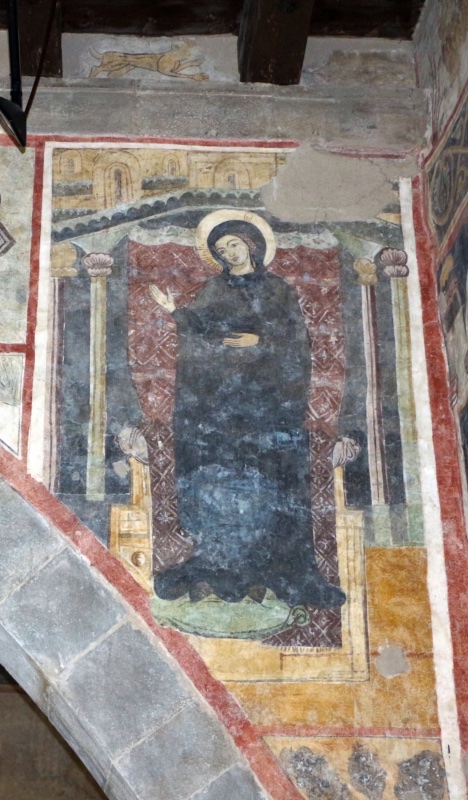
Among the best-preserved scenes, the Annunciation reveals a refined interest in staging: the angel and the Virgin were set on opposite sides of the arch and framed by architectural forms of arches, domes, and towers, while the words of salutation and response appeared on the vault of the arch itself. This arrangement transformed architectural structure into theological theater. The painter thus integrated built space and painted space in a way characteristic of sophisticated mural design. The scene also shows his ability to make doctrinal narrative legible in an environment traversed by viewers rather than contemplated from a fixed point.
The Nativity and infancy scenes show a comparable attention to narrative detail: the reclining Virgin wrapped in a decorated cover, the Christ Child in the manger between ox and ass, Joseph nearby, the angel announcing the event to the shepherds, and the scene of the Bath of the Child below. These details reveal a painter attentive to the expanded narrative cycles current in medieval Christological imagery. At the same time, the restoration note remarks that the Nativity carried allusions to the Last Supper and the Passion, which suggests a typological reading that linked Incarnation to Redemption. The master’s style therefore united storytelling with theological compression.
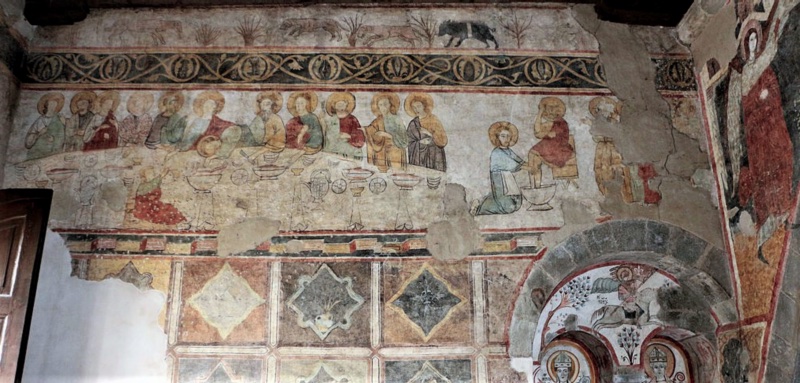
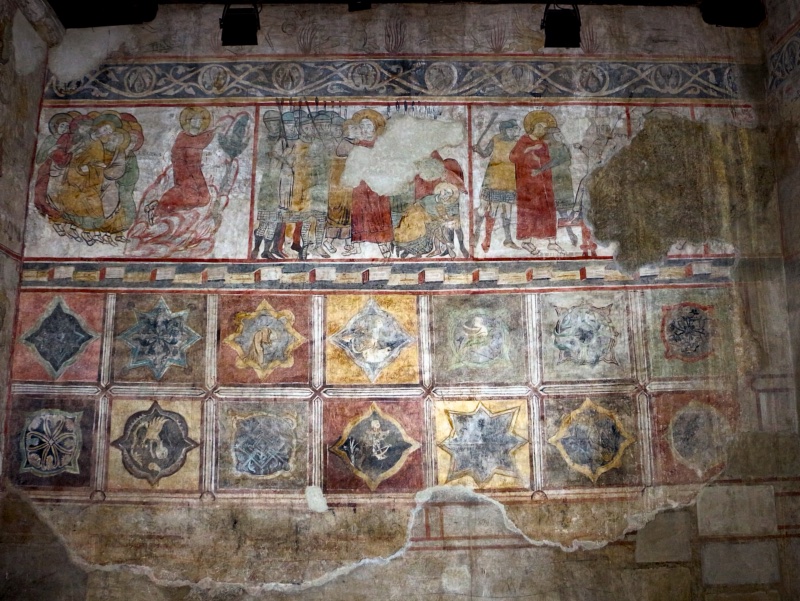
The Passion sequence confirms his aptitude for dramatic condensation. The surviving evidence includes Christ before Pilate, the denial of Peter, the hanging of Judas, the mocking of Christ, the Crucifixion, the Resurrection, and the descent into Limbo, although some of these are now only partially legible. Wikipedia also notes the Last Supper above the bifora, with Judas placed apart in front of the table and receiving bread from Christ. Such a compositional choice isolates betrayal through spatial separation. The painter’s dramatic instinct is thus ethical as well as narrative.
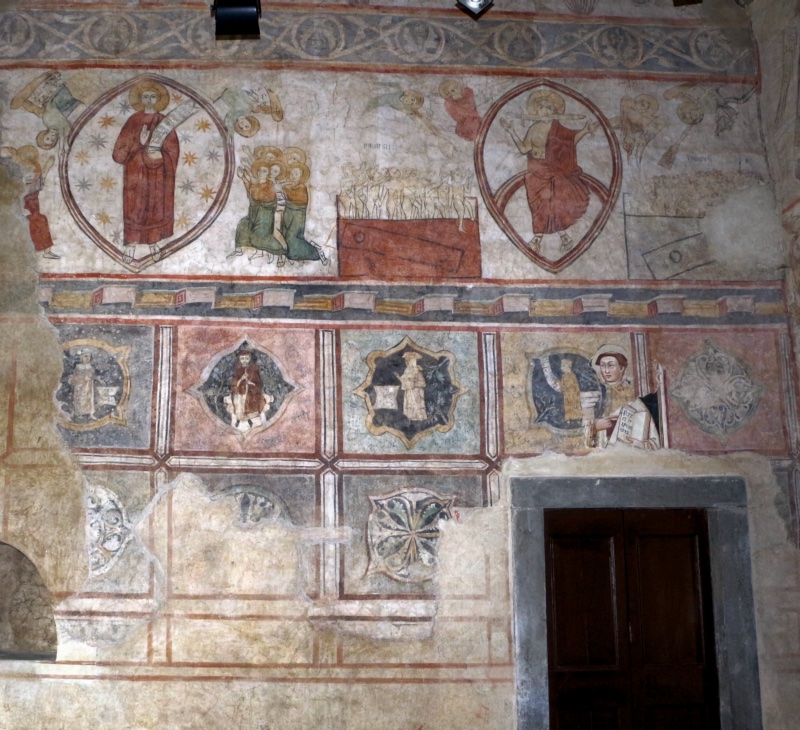
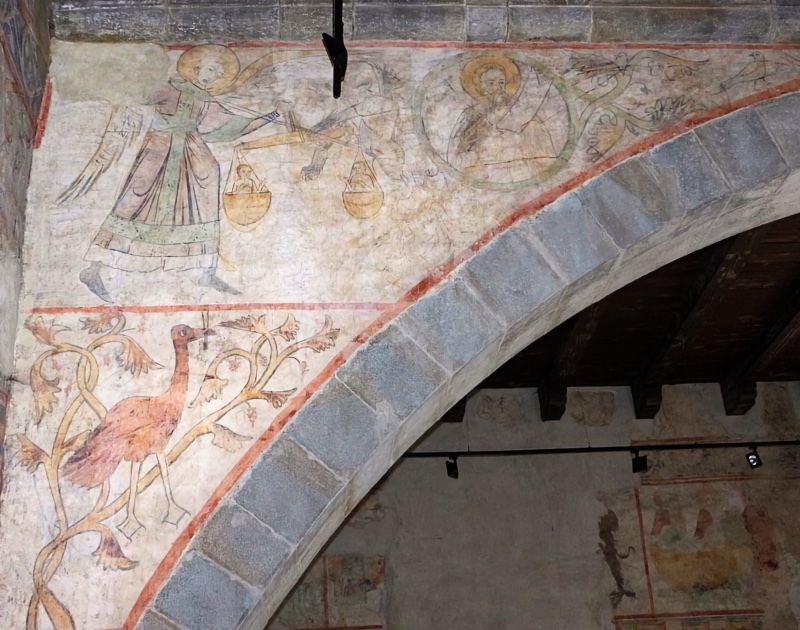
The eschatological imagery marks one of the most original aspects of the cycle. The restoration description mentions symmetrical figures of Christ in mandorla and of the Second Parousia, Christ with the sword issuing from his mouth as an instrument of justice, Saint Michael weighing souls, and the Phoenix as an emblem of resurrection and of Christ himself. These motifs move the viewer from sacred history to final judgment. In stylistic terms, the transition broadens the room’s visual register from episodic narration to cosmic adjudication. It is precisely this expansion that made the cycle appropriate for a judicial hall.
Equally revealing is the painter’s command of allegory. The Wheel of Fortune is described in remarkable detail, with the inscriptions “Regno,” “Regnavi,” “Sum sine regno,” and “Regnabo” distributed around the turning wheel. Beneath it appear two peacocks drinking from a chalice, interpreted in the restoration note as emblems of incorruptibility, immortality, and heavenly beatitude. The painter’s style here is didactic without being dry, because moral meaning is carried by memorable figuration rather than abstract text alone. He knew how to convert medieval moral philosophy into a public image of unstable worldly power measured against eternal life.
Finally, the decorative system broadens the expressive range of the cycle beyond strictly narrative scenes. The hall included a richly ornamented dado and a continuous frieze populated by domestic animals, wild beasts, monsters, anthropomorphic figures, and vegetal motifs. The restoration account explicitly links this population to the repertory of medieval bestiaries. Such imagery gave the room an encyclopedic and admonitory texture in which the marvelous, the monstrous, and the moral coexisted. The master’s style was therefore not narrowly devotional but expansively medieval in its appetite for symbolic abundance.
Influences and travels
Because the painter remains anonymous, artistic influence must be reconstructed from the surviving frescoes rather than from documents of apprenticeship. The most secure frame is that of Lombard 13th-century mural painting, since the restoration dossier explicitly calls the Aula Picta an important witness within the painting of the Lombard Duecento. The cycle’s symbolic language, its use of bestiary material, and its fusion of sacred narrative with moral allegory all point toward the broader medieval visual culture in which doctrinal, ethical, and political meanings were tightly interwoven. The imagery of saints Alexander, Narno, and Viatore also anchors the master in a specifically Bergamasque ecclesiastical memory. His influences were therefore both regional and trans-regional: regional in the cult of local founders, and wider in the common symbolic repertoire of medieval Christendom.
A particularly suggestive point of contact appears in the handling of the Last Supper: the scene in the Aula Picta reprises the same subject in the nearby basilica by the Maestro dell’Albero della Vita. Even if this notice cannot by itself establish direct dependence, it indicates that the painter worked within a local artistic environment in which motifs circulated across adjoining sacred spaces. The master was not creating in isolation, but within a network of visual exchange linking palace and basilica. His art should thus be read as part of a Bergamasque conversation about how Christological narrative could be adapted to different institutional settings.
On the matter of travel, however, the evidence falls silent. No source now available documents journeys by the painter to other Italian centers or beyond the Alps. No contract, payment, or chronicle records movement between courts, communes, monasteries, or episcopal residences. For that reason, any attempt to chart his itinerary would be speculative. The safest academic conclusion is that his secure activity is concentrated in Bergamo and that no verified travel history survives.
That said, the frescoes themselves testify to a painter who was visually informed, whether by direct travel or by the circulation of models, craftsmen, and motifs. The integration of Christological narrative, apocalyptic judgment, moral allegory, architectural framing, and bestiary ornament shows acquaintance with a wide medieval image-world. Yet the current evidence allows us to describe only cultural mobility, not bodily mobility. His “travels” are visible in the migration of forms and ideas across the wall, not in a documented itinerary across Europe. In this sense, the Maestro dell’Aula della Curia remains artistically connected and biographically immobile within the sources.
Works
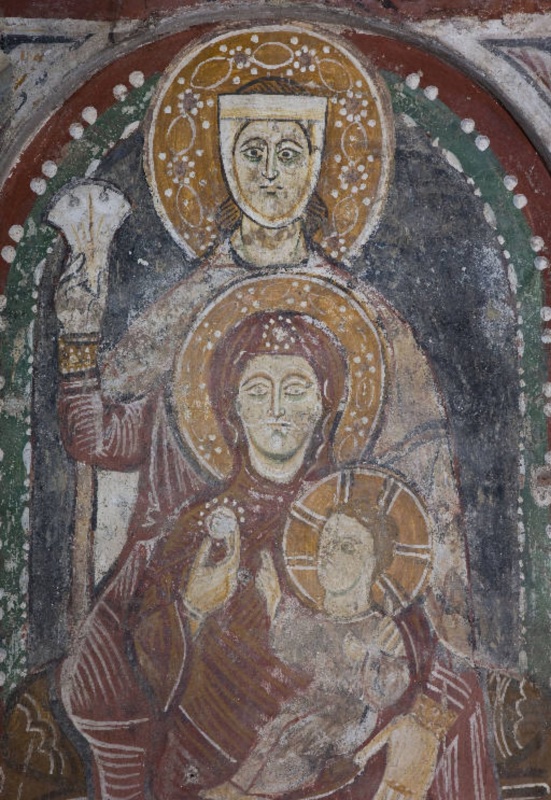
Aula Picta (detail 1)
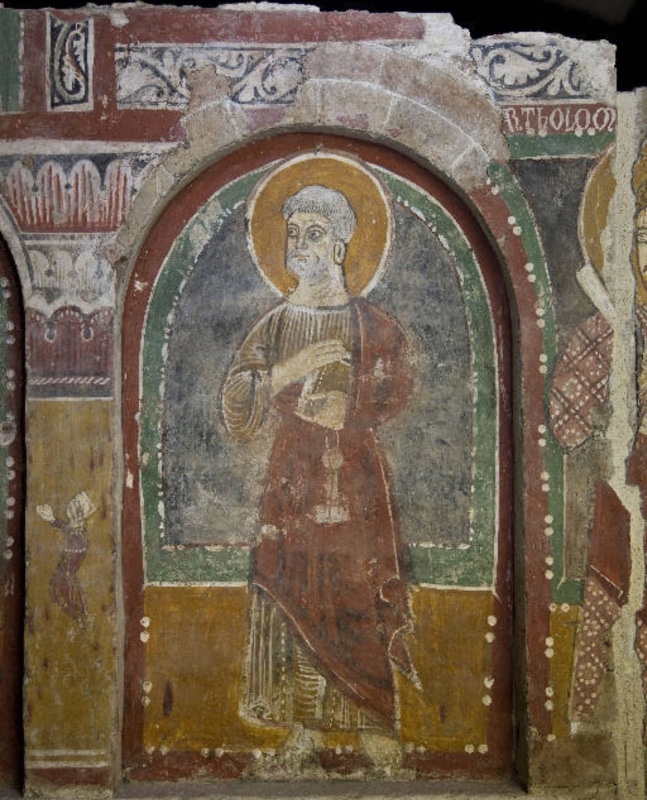
Aula Picta (detail 2)
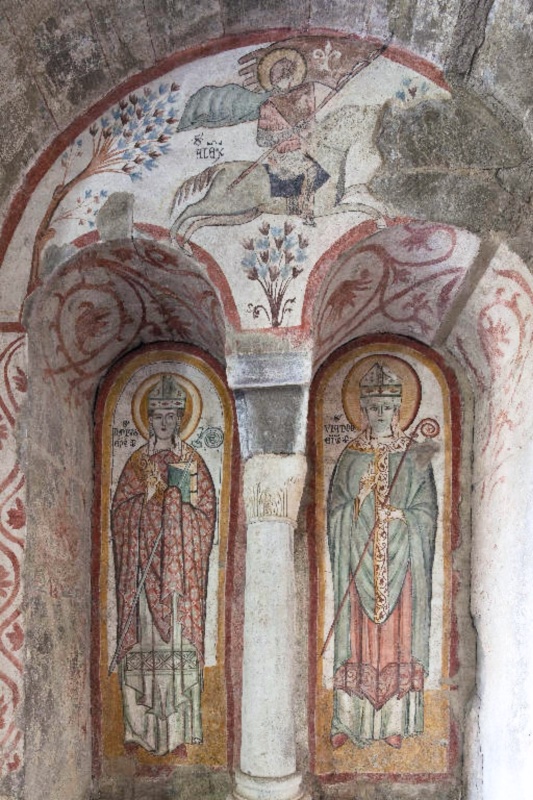
Aula Picta (Saint Alexander on horseback (lintel), Saints Narno and Viatore in pontifical vestments)
Aula Picta (The Annunciation)
Aula Picta (The Last Judgement)
Aula Picta (The Last Supper and the Washing of the Feet)
Aula Picta (Jesus in the Garden of Gethsemane, Jesus’ Arrest by the Soldiers, Jesus Before Pilate)
Aula Picta (detail 3)
The hall is first mentioned in 1225 as the camera nova alta episcopatus and was part of the expansion of the episcopal complex adjacent to Santa Maria Maggiore. The building dates from the late 12th to early 13th century and originally stood much taller than it does today—approximately 9.40 meters—before a later renovation divided it into two levels.
This transformation is key to understanding the space: the upper level has preserved the most significant part of the wall decoration, while the hall as a whole served as a link between the bishop’s ecclesiastical and administrative spaces. In the Middle Ages, in fact, the bishop of Bergamo exercised not only spiritual authority but also judicial and political functions, and the Aula Picta visually reflects precisely this dual nature.
From a spatial perspective, the most striking element is the large stone arch that spans the hall from east to west with a span of about ten meters. This arch is not merely structural; it organizes the perception of the space and punctuates the reading of the paintings, almost like a monumental threshold within the hall.
Another important element is the bricked-up mullioned window located on the north side of the arch, aligned with the façade of Santa Maria Maggiore. Originally, openings and passageways connected the palace and the basilica, and also helped illuminate the rear section of the church where the baptistery was located. For this reason, the hall should be understood not as an isolated room, but as a space of physical and ideological connection between worship, government, and representation.
The surviving decoration is organized in overlapping bands, following a highly sophisticated medieval logic. From the bottom, one can recognize a velarium, two registers of crustae with figurative and vegetal medallions, a Christological cycle, a branch of palmettes, and finally a zoomorphic frieze. This sequence creates an effect of progressive elevation: from the ornamental base, one ascends to the sacred narrative, reaching a higher zone that is more dynamic and symbolic, also populated by animals and motifs derived from the imagery of medieval bestiaries.
The Christological cycle ranges from the Annunciation to the Last Judgment, located on the west wall in a counter-façade position, that is, in the place traditionally reserved for eschatological themes. We also know that among the recognizable scenes are the Infancy of Christ on the north wall, the Last Supper, and the Washing of the Feet on the east wall.
The combined presence of the life of Jesus, visions of the end times, the Wheel of Fortune, and animal imagery shows that the program was not purely devotional, but also moral and political: it served as a reminder of man’s destiny, the fragility of power, and the divine judgment that transcends all earthly authority.
One of the most significant groups is the one in the filled-in mullioned window, where Saint Alexander on horseback and Saints Narno and Viatore are depicted in pontifical vestments. Kneeling before them is Giovanni da Scanzo2, bishop of Bergamo from 1295 to 1309, alongside the nimbated Lamb and a lost dedicatory inscription. This detail is fundamental, as it suggests a precise strategy of episcopal self-representation: the bishop places himself symbolically under the protection of the founding saints and the city’s patron saint, receiving from them a sort of ideal legitimization.
For this reason, the Aula Picta is often considered a prime example of 13th-century Lombard painting. Its originality lies not only in the quality of the frescoes but in the fact that here sacred images, civic memories, and symbols of episcopal governance coexist in the same space, making visible the medieval continuity between religious authority and public order.