Primo Maestro di Anagni
( 25% )
A Note on Anonymity and Historical Identity
The artist conventionally designated the Primo Maestro di Anagni, known also by the descriptive sobriquet Maestro delle Traslazioni, the Master of the Translations, belongs to that vast cohort of medieval painters whose identities have been entirely effaced by the passage of eight centuries. He is, in the most rigorous scholarly sense, a name fashioned from his works rather than from any contemporary document, signature, or biographical record; the appellation itself is a scholarly construction developed in the course of the twentieth century to provide critical coherence to a distinct pictorial personality whose hand can be identified across a substantial portion of the frescoed decoration of the crypt of Anagni Cathedral.
The Italian National Catalogue of Cultural Heritage lists his documented activity as falling approximately between 1231 and 1255, the period of the episcopate of Bishop Alberto of Anagni during which major campaigns of decoration were carried out in the crypt of San Magno. The art historian Miklós Boskovits, however, in his foundational 1979 study Gli affreschi del Duomo di Anagni: un capitolo di pittura romana, proposed on stylistic grounds a substantially earlier date for the Primo Maestro’s contribution, placing it within the episcopate of Bishop Pietro da Salerno, between approximately 1072 and 1104, the year of the first consecration of the cathedral. This chronological dispute, which remains unresolved in current scholarship, shapes every dimension of any attempt to reconstruct the biography of this exceptional artist, and must be borne in mind throughout any serious consideration of his life and career.
Family and Workshop Origins
The Primo Maestro di Anagni was born, in all likelihood, sometime in the latter decades of the eleventh century or, if the later conventional dating is accepted, in the final years of the twelfth century, though neither his birth year nor his place of origin can be established with any degree of documentary certainty. No baptismal record, no testamentary document, no contemporary chronicle mentions his name or origin, a circumstance that situates him firmly within the medieval tradition of artisanal anonymity, in which painters were considered craftsmen rather than the individualized intellectual authors that Renaissance humanism would later construct.
The question of his birthplace has been the subject of sustained scholarly conjecture, with most critics inclined to associate him with the Roman school of painting, on the basis of the formal and stylistic affinities his work exhibits with monumental fresco cycles produced in and around the city of Rome during the late Romanesque period. Some authorities have proposed a more southerly origin, pointing to the pronounced Byzantine flavour of certain figural passages in the Anagni cycle and connecting this quality with artistic currents flowing northward from Norman Sicily and the Campania region.
A third and more cautious scholarly position, endorsed by Miklós Boskovits and followed by subsequent researchers such as Maria Teresa Valeri, declines to assign a specific geographical origin, preferring instead to describe the Primo Maestro’s formation in terms of a fluid, mobile workshop culture that moved between Rome and the Lazio hinterland, absorbing influences from multiple regional centres without being firmly rooted in any single one. The Primo Maestro almost certainly worked within a family-based or guild-organized workshop structure, a system that was normative for monumental fresco painting in central Italy during this period, in which expertise was transmitted across generations and trained assistants, sometimes family members, sometimes apprentices bound by contractual agreement, collaborated on the execution of large-scale programmes.
The crypt at Anagni provides clear internal evidence for precisely this kind of collaborative production, since even among the passages attributed specifically to the Primo Maestro, scholars have identified variations of quality and handling that suggest the participation of assistants working under his compositional direction rather than by his own hand alone. The workshop of the Primo Maestro appears, from the evidence of the Anagni cycle, to have been a well-organized and technically proficient enterprise capable of managing a complex, multi-bay decorative programme simultaneously, dividing the pictorial surfaces into discrete campaigns that could be prosecuted by different hands while maintaining overall iconographic and stylistic coherence. His presumed family must have transmitted to him not only the technical knowledge of fresco preparation, pigment grinding, and the application of colour in the buon fresco and secco techniques, but also a visual vocabulary derived from earlier monumental painting in Lazio and Rome, a visual inheritance that is consistently perceptible in the formal solutions he adopted for figurative passages and ornamental borders alike.
The circumstance that his collaborators on the Anagni crypt, the Secondo Maestro, or Maestro Ornatista, and the Terzo Maestro, employed distinctly different stylistic approaches strongly suggests that the three workshops were independent units, each with its own formation and origins, brought together under a single ecclesiastical commission rather than constituting a single familial enterprise. It is entirely possible, as has been suggested in the scholarship, that the Primo Maestro was himself a trained member of an older generation active in the decorative campaigns of Roman and Lazian churches during the late eleventh and early twelfth century, transmitting to younger collaborators a Romanesque idiom that was already beginning to appear archaic relative to the more progressive stylistic solutions explored by the Terzo Maestro. Of his death, as of his birth, no date or cause can be stated with confidence; the Primo Maestro simply vanishes from the historical record once the Anagni commission was completed, as was the common fate of most artisans working in the pre-modern centuries, leaving behind no testament, no epitaph, and no named successor.
Ecclesiastical Patrons and the Political Context of Commission
The primary patron of the Primo Maestro di Anagni was almost certainly the episcopal institution of the Cathedral of Santa Maria Assunta at Anagni, whose successive occupants drove the long and complex building and decoration campaigns that produced one of the most remarkable ensembles of Romanesque painting to survive anywhere in Italy. The foundational commission for the construction of the crypt is attributed by medieval sources and modern scholarship alike to Bishop Pietro da Salerno, the Benedictine prelate who initiated the construction of the cathedral itself around 1072 and who died in 1105, leaving behind a building that was consecrated in its first form in 1104.
It was under Pietro da Salerno’s episcopate that the crypt was designed as a purpose-built shrine to house the relics of Saint Magnus, the third-century bishop and martyr of Trani whose bodily remains had been acquired by the diocese of Anagni following their dramatic rescue from Saracen profanation and sale at Veroli, precisely the narrative that the Primo Maestro would later commit to fresco with such compelling narrative verve. If Boskovits’s revised dating is accepted, placing the Primo Maestro’s frescoes within the period of Pietro da Salerno’s episcopate rather than the later campaign of Bishop Alberto, then the bishop himself becomes the direct and most proximate patron of the major apsidal and hagiographic frescoes that define the iconographic programme.
The alternative and more widely accepted chronology places the fresco commission under Bishop Alberto of Anagni, who was responsible for significant construction works in the crypt documented to 1231 and who apparently initiated an extensive decorative campaign that continued until approximately 1255, involving three distinct workshop teams. Bishop Alberto’s commission was furthermore embedded in a specific political and spiritual moment of exceptional intensity: Anagni was, in the thirteenth century, a city of extraordinary papal significance, having given birth to no fewer than four popes, Innocent III, Gregory IX1, Alexander IV, and Boniface VIII, and functioning as a frequent residence and administrative centre for the medieval papacy. Gregory IX, pope from 1227 to 1241 and himself born at Anagni, played a role that some scholars, following the analysis of N.H.J. Hungenholtz (1979), have interpreted as directly shaping the iconographic content of the crypt’s frescoes, particularly the apocalyptic imagery that may encode theological and polemical responses to the epochal conflict between the papacy and the Emperor Frederick II, which Gregory IX elevated to the level of an eschatological struggle.
The financial support for the cathedral’s decoration came not only from the bishops but also from prominent ecclesiastical and lay figures of the Anagni region: the Istituto dei Beni Culturali catalogue notes the involvement of Rainaldo of Anagni, chaplain to Pope Honorius III, in financing the Cosmatesque pavement that preceded the fresco campaign, a circumstance that illuminates the network of clerical patronage within which the Primo Maestro operated. The patronage environment of Anagni Cathedral was, in the broadest sense, papal patronage at one remove, since the cathedral benefited continually from the prestige, resources, and liturgical ambitions of a diocese that was intimately and constitutively linked to the Roman see.
The Primo Maestro therefore executed his work under the direct supervision of prelates who maintained connections to the highest levels of the Western Church, a circumstance that would have required him to produce an iconographic programme of doctrinal precision and theological coherence, navigating the exacting standards of a learned clerical audience. The choice of subject matter for the Primo Maestro’s vaults, encompassing the life and translations of Saint Magnus, the cosmological scheme of the Macrocosmo and Microcosmo, and the Hippocrates and Galen composition, bespeaks a patron of unusual intellectual formation, one familiar with the encyclopaedic ambitions of twelfth- and thirteenth-century Christian thought, which sought to encompass natural philosophy within the framework of sacred history. It is highly probable that the detailed iconographic programme was devised not by the painter himself but by a learned theological advisor, a cathedral canon, a bishop’s secretary, or a member of the monastic or mendicant intellectual community, who supplied the Primo Maestro with a textual or diagrammatic blueprint for the cycle, leaving to the artist the task of translating learned prescription into visual form.
Painting Style
The style of the Primo Maestro di Anagni is among the most compelling expressions of the late Romanesque tradition in central Italian painting, distinguished by a formal severity, chromatic intensity, and narrative directness that set it apart from both the more decorative approach of the Secondo Maestro and the more plastically advanced manner of the Terzo Maestro. His figural language rests on a fundamentally Byzantine schematic vocabulary: figures are conceived as hieratic presences whose corporeal weight is subordinated to expressive and symbolic function, their draperies rendered through a system of incised, calligraphic line rather than through the modulated tonal transitions that would become central to the more progressive Italian painting of the later thirteenth century.
The contours of his figures are notably sharp and emphatic, delineated in dark pigment against grounds of earth red, ochre, or blue, producing an effect of bold legibility appropriate to a subterranean space lit by oil lamps and candles whose flickering illumination would animate the strong contrasts of the painted surfaces. The colour palette employed by the Primo Maestro is at once vivid and restrained, building upon a foundation of mineral pigments, ochres, iron reds, lime white, azurite blue, and carbon black, that were standard to the buon fresco technique of the period, deployed with a directness and confidence that suggests mastery rather than experimentation.
Faces are treated with a degree of individuation that occasionally transcends the purely conventional: in the narrative passages devoted to the translation of Saint Magnus, individual figures within crowds and processions are differentiated through variations in physiognomy, gesture, and costume that imply sustained observation of a social reality rather than mere repetition of iconographic formula.
The narrative sequences attributed to the Primo Maestro are organized with a remarkable economy of means, each scene compressed into a clearly delimited pictorial field in which a minimal cast of figures performs a legible dramatic action, without the elaborately developed spatial recession or architectural framing that would characterize more experimental work of the period. The Primo Maestro’s compositional approach consistently privileges the frontal presentation of figures and the lateral juxtaposition of scenes, a preference that reflects both the constraints of the barrel-vaulted and cross-vaulted surfaces with which he worked and a deliberate rhetorical choice in favour of clarity and directness over sophistication.
Particularly noteworthy is the Primo Maestro’s handling of crowd scenes, most memorably in the episodes depicting the citizens of Anagni assembled to receive the body of their patron saint, where women, including what may be the earliest known group representation of female figures at a public event in the history of Italian painting, are included with an attention to social specificity that is remarkable for its period.
The cosmological vaults attributed to the Primo Maestro, above all the famous Macrocosmo and Microcosmo cycle in the second vault of the crypt, demonstrate a capacity for symbolic and abstract pictorial thinking that complements and enriches the more narrative mode of the hagiographic sequences, organizing concentric circular diagrams and allegorical personifications within architectural frameworks of impressive geometric rigour. The Primo Maestro’s work is fundamentally Romanesque in spirit and in formal constitution, rooted in a conception of the painted surface as a field of theological argument rather than a window onto an empirically observed world, and it is precisely this quality that led Giulio Giuliani and other observers to classify it firmly within the Romanesque period, prior to the stylistic threshold marked by the Gothic assimilation of naturalistic values.
Artistic Influences
The most fundamental artistic influence shaping the formation of the Primo Maestro di Anagni is the Roman school of monumental fresco painting as it had developed across the eleventh and early twelfth centuries, a tradition exemplified by the great cycles of San Clemente, Sant’Angelo in Formis, and numerous other Roman and Campanian churches that constitute the primary reference environment for his formal solutions. The Roman school itself was deeply indebted to Byzantine pictorial models, absorbed through the sustained presence in Rome and southern Italy of Greek-speaking artists, illuminated manuscripts, ivory carvings, and portable devotional objects that functioned as vehicles of transmission for Eastern Christian iconographic and formal conventions.
In the Primo Maestro’s work, this Byzantine inheritance is most clearly legible in the treatment of sacred figures, Christ, the Virgin, the apostolic and hagiographic presences, whose faces exhibit the characteristic Byzantine conventions of elongated noses, large almond-shaped eyes with heavy upper lids, dark shadows beneath the cheekbones, and the rigid frontal disposition that communicates divine impassibility and transcendence. The parallel tradition of Norman-Sicilian painting, which combined Byzantine figural schemas with Western Romanesque compositional habits and was disseminated throughout central Italy through the networks of mobility created by the Norman kingdom of Sicily and its cultural relations with the papacy, appears to have exerted a secondary but perceptible influence on certain aspects of the Primo Maestro’s chromatic and ornamental choices.
The illuminated manuscript tradition, which in central Italy during the eleventh and twelfth centuries produced a rich body of decorated bibles, lectionaries, and sacramentaries in the scriptoria of Monte Cassino, Farfa, Subiaco, and other major Benedictine houses, provided a further source of iconographic models that the Primo Maestro demonstrably drew upon for the cosmological representations in the Macrocosmo and Microcosmo vaults, whose diagrammatic structure is directly comparable to the circular schemata found in illustrated encyclopaedic manuscripts of the period. The classical tradition, mediated through late antique and early Christian ivories, sarcophagi, and mosaics still visible in Rome and its environs in the twelfth and thirteenth centuries, furnished the Primo Maestro with a repertoire of figure types, drapery conventions, and spatial motifs that he absorbed and transmuted through a thoroughly medieval sensibility, producing results in which classical echoes are perceptible but entirely subordinated to the dominant Romanesque-Byzantine idiom.
The Cosmati tradition of marble inlay decoration, which was flourishing in Lazio and Rome during the period when the Primo Maestro was active, the same Cosma di Jacopo di Lorenzo who executed the Cosmatesque pavement of Anagni Cathedral in 1224-1231, may have exerted an indirect influence on the ornamental vocabulary of the painted borders and frames in the crypt, where the interlocking geometric and floral motifs display a visual affinity with Cosmatesque design.
The hagiographic narrative model, with its emphasis on legible sequential storytelling, clear crowd psychology, and emotionally accessible dramatic action, reflects familiarity with the tradition of narrative fresco as practiced in central Italian churches since the late Carolingian period, a tradition in which the demands of lay devotion and liturgical commemoration shaped the visual rhetoric of saintly biography. Among the most specific and traceable influences on the Primo Maestro is the cycle of frescoes associated with the Terzo Maestro’s work at the Sacro Speco di Subiaco, attributed to Frater Romanus and dated to 1228, which belongs to a closely related regional tradition and provides a comparative framework for understanding the Primo Maestro’s formal language within its broader Lazian context. Taken together, these multiple streams of influence constitute the Primo Maestro as a figure representative of the extraordinary synthetic vitality of central Italian Romanesque painting in its mature phase, a painter capable of drawing upon a wide range of visual sources while maintaining a distinctive personal idiom recognizable across the full extent of the Anagni crypt.
Travels and Geographical Mobility
Any reconstruction of the travels of the Primo Maestro di Anagni must proceed, in the absence of biographical documentation, by inference from the visual evidence of his paintings and from what is known about the patterns of artistic mobility in central Italy during the Romanesque period, when workshop travel between patronage centres was not merely common but structurally necessary for painters working in monumental fresco, a medium that required them to follow commissions rather than waiting for clients to come to them.
The geographical horizon of the Primo Maestro’s visual formation, as discernible from the formal characteristics of his painting, strongly implies at minimum a thorough familiarity with Rome and the major religious centres of the Roman Campagna, suggesting periods of training or activity in the city that would have exposed him to the surviving cycles of early Christian and early medieval wall painting, above all the frescoes of San Clemente, Santo Stefano Rotondo, and the numerous apsidal compositions preserved in smaller Roman churches, that constituted the fundamental repertoire of the Roman fresco tradition.
The influence of Byzantine visual culture on the Primo Maestro’s figure style additionally implies either direct contact with Greek-speaking artists in Rome or Naples, or access to Byzantine portable objects, icons, ivory panels, illuminated manuscripts, that circulated within the church networks of the Lazio and Campania regions, where the cultural legacies of Byzantine Italy were still vigorous in the eleventh and twelfth centuries. The stylistic links between the Primo Maestro’s work at Anagni and the fresco tradition of Sant’Angelo in Formis near Capua, the great Benedictine foundation of Monte Cassino where Abbot Desiderio sponsored an influential cycle of Byzantine-inflected paintings in the late eleventh century, point toward a possible extension of the Primo Maestro’s sphere of experience southward into the Campanian region, where the synthesis of Western Romanesque and Eastern Byzantine models was pursued with particular intensity and sophistication.
The Anagni Cathedral commission itself would have represented a significant concentration of artistic resources in a relatively small hill town some sixty kilometres southeast of Rome, a circumstance that implies the bishop’s ability to attract external talent, painters trained and possibly resident in Rome, to the local building project, whether by the prestige of the papal connections of the Anagni diocese or by specific financial inducements. Some scholars have proposed that the Primo Maestro may have been familiar with manuscript illumination traditions practiced at the great Benedictine scriptoria of Subiaco and Monte Cassino, whose cosmological and encyclopaedic illustrated texts bear direct visual comparison with the Macrocosmo and Microcosmo programme at Anagni, and that this familiarity was acquired either through direct residence or through the consultation of manuscripts brought to the Anagni workshop as iconographic models.
The question of whether the Primo Maestro undertook any travel beyond the central Italian region remains entirely open: there is nothing in the stylistic character of his work that requires the hypothesis of direct contact with northern European Romanesque painting, though the visual affinities between the Anagni hagiographic cycle and the narrative fresco tradition of northern Italy and even Spain, noted by commentators who have been struck by the resemblance to San Isidoro de León, suggest that the shared conventions of the Romanesque tradition transcended political and geographical boundaries without necessarily implying the personal movement of individual painters. The mobility of illuminated manuscripts and of ecclesiastical delegations between Rome and the wider Christian world would have provided indirect routes of transmission for visual ideas that made themselves felt in the Primo Maestro’s workshop without requiring his own physical displacement beyond the Italian peninsula, and this mediated cosmopolitanism is in itself an important aspect of the cultural environment within which he worked.
Principal Works: Description, Patronage, and Current Location
The surviving body of work attributable to the Primo Maestro di Anagni is concentrated almost entirely in the Crypt of San Magno beneath the Cathedral of Santa Maria Assunta at Anagni (Frosinone, Lazio), a three-naved subterranean space covering approximately 540 square metres that is justifiably celebrated as one of the greatest ensembles of medieval painting in Italy and sometimes, with pardonable hyperbole, as the “Sistine Chapel of the Middle Ages”. The frescoes of the crypt were executed under the patronage of the episcopal see of Anagni, most probably Bishop Pietro da Salerno (c. 1072–1104) for the Primo Maestro’s contribution according to Boskovits, or Bishop Alberto (active 1231–1255) according to the older conventional dating, and have remained in their original architectural context, constituting one of the rare instances in which a complete medieval pictorial programme survives essentially intact, catalogued by the Italian Ministero della Cultura and accessible to the public under the care of the cathedral chapter.
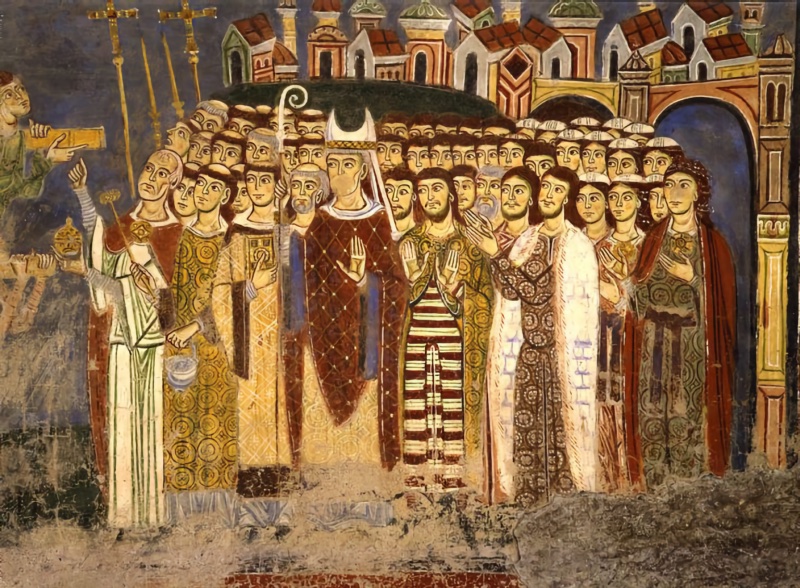
The central and dominant figure is Bishop Zaudria, prelate of Anagni, who presided over the solemn reception of the relics. He can be recognized by his double-spiked episcopal mitre, his cope richly decorated with concentric golden circles, and the crosier he holds in his left hand. His central position and larger size emphasize his liturgical and civil role. Immediately to his left are clerics with golden processional crosses and a thurifer with a censer, all engaged in the adventus ceremony.
The large procession behind the bishop includes clerics and lay people from Anagni of high rank, recognizable by their simpler garments compared to the liturgical vestments. The architectural backdrop—crenellated walls, towers, domed buildings, and a round arch on the right—represents the city of Anagni receiving the procession, constructed according to the Romanesque convention of the symbolic city.
The group of women on the right is one of the most extraordinary and controversial iconographic elements of this fresco. They are likely to be the women of the Christian community of Anagni, probably nuns or devout matrons. They wear long dresses and have their heads covered, arranged in orderly rows with gestures of prayer and devotion.
According to Romanesque art critics, this group represents one of the very first examples in medieval Italian painting in which women are depicted as a group, as a cohesive social entity, present at a public and civil-religious event: “in the history of Italian painting, this is perhaps the first case in which the fair sex, understood as a group, as an entity, as a social reality, is represented in the square, at a public event.” From an iconographic point of view, the women in the crypt of Anagni are also linked to the cult of local saints: Secondina (baptized by St. Magnus himself), and her companions Aurelia and Noemisia, whose relics were kept in the left apse of the same crypt. It cannot be ruled out that the painter intended them to represent the entire female community of Anagni welcoming its patron saint.
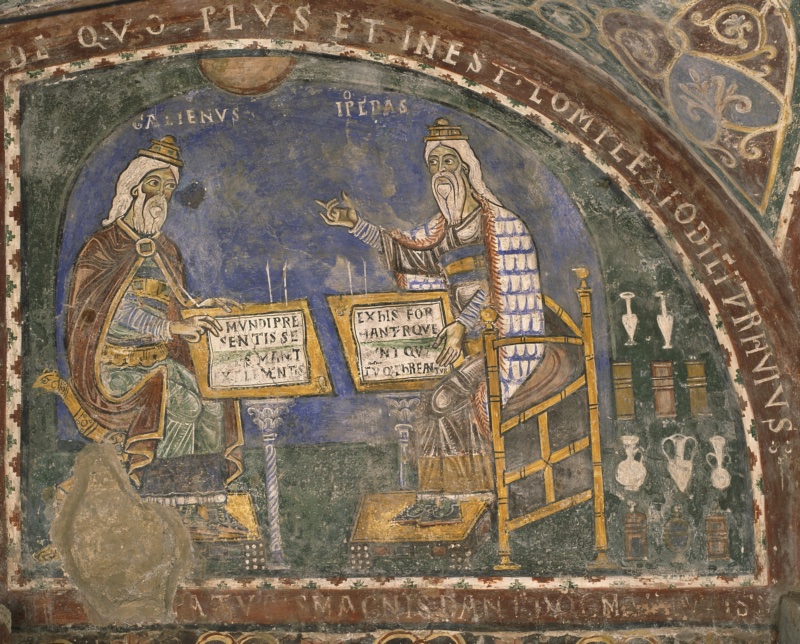
The scene is set against a dark blue background, inside a semicircular lunette bordered by inscriptions in Roman capital letters. The two figures are seated opposite each other in a symmetrical, conversational position, identified by the inscriptions above their heads: GALIENUS on the left, IPEDAS on the right—the latter being a medieval corruption of the Greek Hippokrates.
Galen (left) is depicted as an elderly man with a long white beard, wrapped in a heavy amber-brown cloak with a central clasp, and wearing a pointed headdress in the oriental tradition. He holds a tablet inscribed with both hands. Hippocrates (on the right) also appears bearded, wearing a blue and white striped robe reminiscent of scale armor, and a tall white turban-like headdress, typical of the iconography of the medieval physicus. He is seated on a gilded wooden chair with turned legs, and he too is holding a tablet. With his right hand, he points towards Galen in an oratorical, authoritatively didactic gesture.
At the center of the composition stands a small twisted column (Solomon’s column), an element that in medieval iconography often symbolizes the connection between profane and sacred knowledge. On the right-hand side, behind Hippocrates, there is a shelf with pharmaceutical vessels: amphorae, long-necked bottles, albarelli, and containers of various types, attributes of the medical profession and ancient pharmakeia.
At the top, in the semicircle of the arch, there is a long Latin inscription, and in the lower band, another epigraphic band completes the textual program of the painting.
The intellectual heart of the painting is contained in the tablets held by the two physicians. The texts, partially corrupted by pictorial degradation, together form a single proposition:
Mundi presentis series manet, ex his formantur quae sunt quaecumque chreantur (“The series/order of the present world remains; from these [four elements] all things that exist and all that has been created are formed.”)
This statement is a physical-cosmological principle: the multiplicity of visible natural forms is composed of a material substratum (the four elements) and an efficient cause that produces it.
The inscription that runs along the frame of the upper arch is: Materies rerum sunt quatuor elementa… de quo plus et inest complexio dicitur huius: aetas, vultus, humor mutantur tempore cuius (”The matter of things is [the composition of] four elements, the greater or lesser proportion of which in the [body] of each [determines]: age, appearance, and humors, which change with the passage of time.”)
This inscription directly expresses the theory of the four humors (blood, yellow bile, black bile, phlegm), the foundation of Hippocratic-Galenic medicine, applied to the cycle of human life.
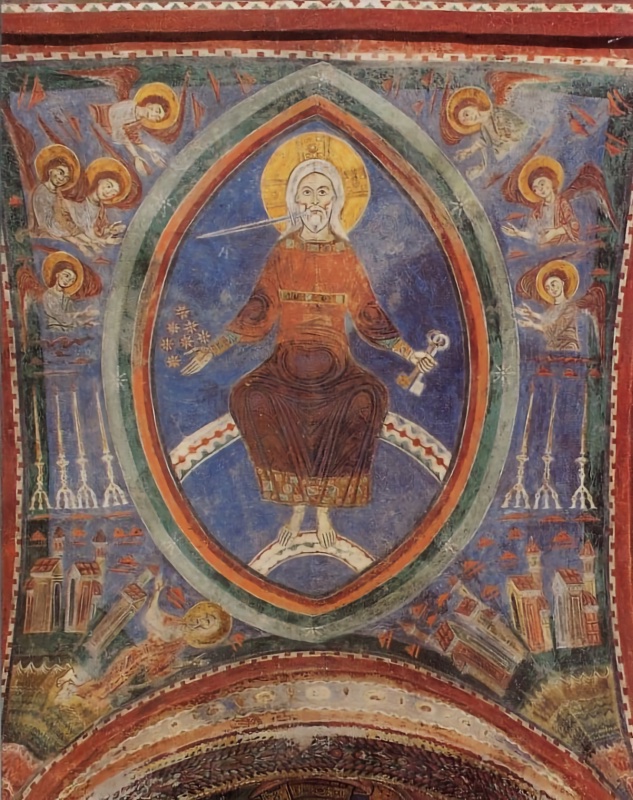
Christ is depicted inside a mandorla in the shape of a vesica piscis—the elongated ogival shape symbolizing divine light and the separation between the celestial and earthly worlds—set against a background of intense lapis lazuli blue, the most precious color in medieval painting, used here to evoke the celestial sky. The mandorla is framed by a double border, red-orange on the inside and green on the outside, which hierarchically marks the boundary between the sacred and the cosmic. Around it, on the same blue background, are symmetrically arranged seven golden candlesticks and angelic figures with golden halos, in precise correspondence with the text of the Apocalypse of John (Rev 1:12-16).
Christ is seated on a rainbow—barely visible beneath his feet—symbolizing the New Covenant between God and humanity after the flood, a motif that also echoes Ezekiel’s vision (Ezekiel 1:28). He wears a long red cassock (a priestly insignia) with a golden belt at chest height (a royal insignia), while his white hair and beard refer to divine eternity, according to John’s description: “His hair was white like white wool, like snow” (Rev 1:14).
A sharp double-edged sword emerges from Christ’s mouth, one of the most characteristic iconographic attributes of the Apocalyptic Christ, symbolizing sharp and infallible divine judgment. In his left hand he holds two keys, a reference to the keys of death and the infernal abyss (Rev. 1:18), while in his right hand he holds the seven stars, symbol of the seven angels of the Seven Churches of Asia to whom John addresses his prophetic letters.
The First Master of Anagni works in a language that combines the Byzantine tradition—visible in the hieratic frontality of the figure, the fixed gaze, and the rich colors—with a nascent sense of Romanesque volumetric solidity. The figures of the angels in the corners of the composition show dynamic poses with outstretched wings, in a movement that frames the scene and gives it dramatic tension. At the bottom, on either side of the rainbow, we can glimpse representations of stylized architectural cities, probably the Seven Churches of Asia, rendered with miniature towers and bell towers in red and ochre.