Jacopo Torriti
( 25% )
Family and Origins
Neither the date nor the place of Jacopo Torriti’s birth is recorded in any surviving document, and the same silence surrounds the circumstances of his death. Scholars have traditionally placed his birth in the middle decades of the thirteenth century, probably between 1240 and 1260, in order to accommodate both his presumed artistic formation and the chronology of his documented commissions. The question of his geographic origins has generated considerable debate over the centuries, most of it shaped less by evidence than by local scholarly enthusiasm. Giulio Mancini, writing in the early seventeenth century, proposed that the artist derived his surname from the Sienese town of Torrita di Siena, and this hypothesis, however unsupported by documentary foundation, sparked what the Treccani entry aptly characterizes as a persistently “campanilistico” tradition of Sienese erudition claiming the artist for their own cultural patrimony.
The hypothesis of Sienese origin was carried forward by Luigi de Angelis in his Notizie istorico-critiche di Fra Giacomo da Torrita (Siena, 1821), but it has never been confirmed by archival research and most modern specialists treat it with justifiable skepticism. Given that all of Torriti’s securely documented activity unfolds within the Roman artistic milieu, and that his training appears to have been conducted entirely within the cultural orbit of the papal city, a Roman or Central Italian origin has seemed more plausible to many scholars, though it too remains undemonstrated. The question of whether Torriti came from a family of artisans, from an ecclesiastical community, or from some other social stratum is entirely unknown.
The one possible clue to his personal identity survives in the apse mosaic of San Giovanni in Laterano, where a small kneeling figure wearing a Franciscan habit and bearing a compass and set square has been traditionally identified as a self-portrait of the artist. If that identification is correct, it would indicate that Torriti was a member of the Franciscan order, though the absence of the term frater before his name in the accompanying inscription has complicated this reading, leading some scholars to propose that he may have been a Franciscan tertiary rather than a professed friar.
Some researchers, including Valentino Pace (1996), have further argued that the tools depicted alongside the presumed self-portrait, the compass and set square, suggest that Torriti performed not merely the role of painter and mosaicist but also that of architect or magister parietarius, overseeing the structural design of the apse. No information whatsoever survives about any other members of his family, about a workshop lineage connecting him to a father or an uncle, or about any progeny or disciples who bore his name. The very absence of family data is itself historically significant, and speaks to the degree to which Torriti operated as an individual artist-craftsman whose identity was defined entirely by his professional signature rather than by dynastic continuity.
Patronage
The central figure in Jacopo Torriti’s career, and the patron without whose commission the artist might scarcely be known to history, was Pope Nicholas IV1, the first Franciscan to ascend to the throne of Saint Peter. Nicholas, who had previously served as Minister General of the Franciscan order, brought to the papacy a distinctive theological and aesthetic program oriented around the promotion of Marian devotion and the glorification of Rome’s ancient basilicas, and he found in Torriti an artist whose stylistic sensibility precisely matched his requirements. The pope’s documented confidence in Torriti’s abilities appears in two successive commissions of exceptional prestige: the apse mosaic of San Giovanni in Laterano, executed in 1291, and the even more ambitious apse and triumphal arch decorations of Santa Maria Maggiore, substantially completed by 1295 or 1296. Nicholas IV appears as a donor figure in both commissions, kneeling at the feet of the Virgin in the Lateran mosaic and similarly prostrate in the Santa Maria Maggiore composition, following a well-established papal tradition of self-representation as humble supplicant before the sacred. The pope’s decision to entrust Torriti with these commissions, rather than Pietro Cavallini, who was also active in Rome at the same time, reflects a specific artistic choice and perhaps a personal rapport facilitated by their shared Franciscan connections.
The second most important patron associated with Torriti’s career is Cardinal Giacomo Colonna2, a scion of the powerful Roman aristocratic family that exercised enormous cultural and political influence during the closing years of the thirteenth century. Colonna’s patronage role at Santa Maria Maggiore became determinant following the death of Nicholas IV in 1292, when the cardinal effectively assumed the role of supervising the completion of the mosaic program that the pope had initiated. The cardinal is represented kneeling on the right side of the central composition at Santa Maria Maggiore, directly opposite the kneeling Pope Nicholas, flanked by Saints John the Evangelist and John the Baptist, a deliberate visual equivalence between papal and aristocratic patronage that speaks to the delicate balance of power in late thirteenth-century Rome. The Colonna family’s interest in Torriti’s work was not merely devotional but also deeply political, since the decoration of Rome’s titular basilicas was understood as a direct assertion of Roman ecclesiastical primacy at a moment when the papacy was increasingly challenged by competing power centers. Torriti’s relationship with the Colonna patronage network was thus inseparable from the broader dynamics of curial politics.
A further dimension of Torriti’s patronal world was provided by Pope Boniface VIII3, who, shortly after his election, commissioned a mosaic panel to adorn the funerary monument that the celebrated sculptor Arnolfo di Cambio was constructing for him in the old basilica of Saint Peter’s in the Vatican. This collaboration between Torriti and Arnolfo di Cambio,the leading architectural sculptor of the age,is particularly instructive, since it indicates that Torriti was perceived at the highest levels of curial patronage as the natural choice for mosaic work when the most prestigious architectural monument of the decade was being planned. The Boniface mosaic, executed around 1295–96, depicted the pope being presented to the Virgin and Child by Saints Peter and Paul, and was signed by Torriti with the formula Iacobus Tor(r)iti pictor, confirming his active engagement with the Bonifacian court. The Franciscan order itself must be considered as a collective patron of Torriti’s work, since the hypothesis that he was a member or associate of the order implies that his acceptance of specific commissions was mediated by the institutional interests of the friars. Nicholas IV, as an ex-Franciscan General, used his papacy to promote the order’s visual presence in Rome’s most prestigious churches, and Torriti was the instrument through which this agenda was realized in mosaic. The unprecedented inclusion of Saints Francis and Anthony of Padua in the apse compositions of both the Lateran and Santa Maria Maggiore basilicas,churches that had previously reserved their monumental decoration for apostolic and papal figures,represents a direct expression of Franciscan patronal ambition translated into visual form by Torriti’s hand.
Painting Style
Jacopo Torriti occupies a position of fascinating ambiguity within the history of late medieval Italian art, straddling as he does the Byzantine tradition in which he was evidently trained and the new naturalistic currents that were transforming Italian painting in the final decades of the thirteenth century. His style is fundamentally rooted in the Roman pictorial tradition that had absorbed and adapted Byzantine formal conventions across several centuries, but it is never reducible to mere Byzantinism, and its most distinguished passages display a chromatic sensibility and a feeling for spatial depth that point unmistakably toward the proto-Gothic innovations of his contemporaries. The Treccani Enciclopedia dell’Arte Medievale characterizes his work as achieving “risultati personalissimi di grande eleganza formale ravvivata da un’espressività delle figure affatto cimabuesca,” while simultaneously softening the strong chiaroscural contrasts that characterize Cimabue’s manner through a quieter, more linear rhythm. This particular calibration of tradition and innovation is Torriti’s most distinctive contribution to the history of medieval painting, and it accounts both for the particular prestige he enjoyed with papal patrons and for the relative neglect he has suffered at the hands of later art historians who preferred the more dramatic novelties of Giotto.
The color palette employed by Torriti in his surviving mosaics is among the most refined of the period, characterized by delicate, silvery harmonies that recall the luminous tonalities of fifth-century Early Christian mosaics while simultaneously displaying a capacity for subtle chromatic gradation that belongs to Torriti’s own inventive sensibility. The Treccani entry notes the artist’s “straordinarie variazioni di colore volte a creare l’impressione di spazio e profondità,” observing that his coloristic technique is closely aligned with the refined practices of Byzantine painting while transforming them in the direction of greater pictorial illusionism. This commitment to creating spatial depth through chromatic means rather than through strict linear perspective is a hallmark of the Roman school at the end of the Duecento and distinguishes Torriti’s work from the more architectural spatial constructions that would characterize Giotto’s subsequent revolution. The treatment of drapery in Torriti’s mosaics combines Byzantine hieratic rigidity in the broadly schematic arrangement of folds with a naturalistic sensitivity to the weight and fall of fabric that occasionally approaches the plastic solidity associated with the sculptural current radiating from Arnolfo di Cambio’s workshop.
Torriti’s figures possess a distinctive formal dignity rooted in the conventions of Byzantine iconic representation, but they are animated by a gentle expressivity,particularly visible in the treatment of faces,that softens the geometric severity of the older tradition. The faces in the Santa Maria Maggiore apse, especially those of the angels surrounding the central throne, display a delicacy of modeling and a warmth of human presence that have led scholars to invoke comparisons with the contemporary workshop of Pietro Cavallini. The decorative vocabulary deployed in Torriti’s backgrounds, the elaborate acanthus scroll populated with birds, animals, and flowers in the lower zone of the Santa Maria Maggiore apse, draws on late antique ornamental traditions while simultaneously reflecting the naturalistic attention to flora and fauna that characterizes thirteenth-century manuscript illumination in both Italian and northern European workshops. The integration of purely ornamental registers with the main figurative program is handled with exceptional compositional intelligence: the organic vegetal scroll in the Santa Maria Maggiore apse has been understood as a deliberate evocation of the Garden of Paradise, harmonizing the theological content of the Coronation above with a vision of eschatological abundance below.
The architectural framing devices employed by Torriti, the elaborate throne structure in the Santa Maria Maggiore apse, the clipeus held by angels, the careful spatial calibration of the lower narrative register, reveal an artist who thought about the total iconographic program with the coherence of a theologian as much as the skill of a craftsman. The inscription at Santa Maria Maggiore, placed below the central sphere enclosing Christ and the Virgin, reads in part Maria virgo assumpta est ad ethereum thalamum in quo rex regum stellato sedet solio, directly linking the liturgical texts of the Marian feast of the Assumption to the visual program above and creating a multilayered unity of image, text, and ritual function characteristic of the most ambitious monumental programs of the age. The sun and moon placed beneath the step of the throne in the central clipeus, in a reversal of the cosmic hierarchy they normally occupy, constitute a subtle theological statement about the Virgin’s elevation above the natural order, a detail that reveals Torriti’s capacity to encode precise doctrinal content within apparently decorative choices.
Artistic Influences
The single most pervasive influence on Torriti’s artistic formation was the Roman tradition of late antique and Early Christian monumental painting and mosaic, which surrounded him in the basilicas and churches of the Eternal City and provided him with a continuously available repertoire of compositional models, iconographic types, and chromatic strategies. Pietro Toesca, one of the most important Italian art historians of the twentieth century, observed as early as 1927 that Torriti drew extensively upon the fifth-century mosaics visible in Rome’s ancient churches, particularly the triumphal arch mosaics of Santa Maria Maggiore itself, whose “pale delicate harmonies and silvery lights” he absorbed and reinterpreted. This relationship with the Early Christian past was not merely formal borrowing but reflected a broader papal cultural program that sought to present the renewed Rome of Nicholas IV as the legitimate heir to Constantinian grandeur, a continuity visibly enacted in Torriti’s deliberate reuse of the ancient fifth-century bust of Christ as the central icon of the San Giovanni in Laterano apse composition.
Byzantine painting constitutes the second major pole of Torriti’s artistic formation, and it is present in his work at every level, from the hieratic frontality of his principal figures to the specific conventions governing the rendering of drapery, facial types, and gold-ground backgrounds. The precise mechanism through which Torriti acquired his knowledge of Byzantine art remains uncertain, but scholars have proposed that the Franciscan order’s extensive contacts with the Christian communities of the Eastern Mediterranean, including the Crusader states and the Byzantine territories, may have provided important channels for the transmission of Byzantine artistic models to the Italian West. The influence of Cimabue is another critical factor in understanding Torriti’s style: the great Florentine painter was in Rome in 1272, and Italian Wikipedia records that Torriti had direct contact with him, subsequently working alongside him in the decoration of the Upper Basilica of San Francesco in Assisi. The Cimabuesque expressivity that Treccani’s medievale entry identifies in Torriti’s figures, particularly visible in the intense, slightly melancholic faces of some of the apostolic figures, points to this formative encounter, while Torriti’s lighter palette and more measured use of chiaroscuro distinguish his sensibility from Cimabue’s more dramatic intensity.
The influence of French Gothic art, transmitted to Rome in part through the architectural sculpture of Arnolfo di Cambio, represents a fourth key element in the synthesis Torriti achieved. Arnolfo had spent time at the court of Charles I of Anjou4 and had absorbed aspects of the elegant linearity and subtle naturalism of French Gothic figurative art, and his presence in Rome as the most important sculptor of the age meant that his new formal vocabulary was continuously available as a stimulus and a challenge for painters working in the same curial milieu. The refined linear rhythm that characterizes Torriti’s drapery and the slender, elongated proportions of some of his figures reflect an awareness of Gothic formal ideals that he integrated with his Byzantine and classical heritage to produce the distinctive idiom visible in the Santa Maria Maggiore mosaics. The frescoes at Assisi, which predate the Roman mosaics, reveal a slightly more archaic spatial sensibility, suggesting that Torriti’s engagement with Gothic innovation intensified during his Roman years rather than preceding them.
The classical sculptural tradition constitutes a fifth strand of Torriti’s formative inheritance that has received comparatively less systematic attention in the critical literature. Rome in the second half of the thirteenth century was saturated with the material remains of the ancient world: sarcophagi reliefs bearing narratives of mythological and funerary subjects, architectural friezes with processional figures, portrait busts and votive reliefs accumulated across the city’s churches and civic spaces in various states of reuse and reinscription. For an artist trained within this environment, the figures of the ancient sculptural tradition were not the remote academic models they would later become for Renaissance painters but an immediate visual reality embedded in the very fabric of the sacred spaces where he worked. The treatment of the apostles in the lower narrative zone of the Santa Maria Maggiore apse, their compact, serious dignity, the way they gather around the Dormitio bier with a gravity that recalls antique funerary reliefs, suggests that Torriti was attentive to these sculptural sources as models for the rendering of collective human emotion, even as the overarching decorative program remained firmly anchored in the Byzantine pictorial tradition. The formal vocabulary of the acanthus scroll similarly invites comparison not only with Early Christian mosaic precedents but with the Corinthian capitals, sarcophagus borders, and architectural ornament of antiquity that remained physically present in Rome’s church interiors and cemeteries.
The relationship between Torriti and his great Roman contemporary Pietro Cavallini requires particular attention, since the two artists were working simultaneously in Rome during precisely the years that produced Torriti’s most significant commissions, and the question of mutual influences between them has never been satisfactorily resolved. Cavallini, whose surviving mosaics in Santa Maria in Trastevere (c. 1291) and whose frescoes in Santa Cecilia in Trastevere (c. 1293) place him in direct chronological proximity to Torriti’s major works, pursued a parallel but distinct path toward the renewal of the Byzantine pictorial tradition: where Torriti’s renovation proceeded primarily through chromatic refinement and the elegant integration of classical ornamental elements, Cavallini’s broke more decisively with Byzantine conventions through a sculptural solidity of form and a more explicitly illusionistic treatment of three-dimensional space. Modern scholars including Valentino Pace have suggested that the two artists must have been aware of each other’s work, and that the delicacy of facial modeling noted in Torriti’s angels at Santa Maria Maggiore reflects a degree of responsiveness to the newer spatial idiom being developed in Cavallini’s workshop. Whether Torriti absorbed these lessons directly through personal contact, through the study of Cavallini’s completed works, or through their shared engagement with the same antique and Byzantine sources remains uncertain, but the proximity of their achievements argues against treating either artist in isolation from the other.
A further and distinctly underappreciated strand of Torriti’s formation is provided by the tradition of Italian manuscript illumination as it was practiced in Rome and central Italy during the decades of his artistic activity. The papal court maintained a continuous demand for elaborately illuminated liturgical books, missals, graduals, antiphonaries, decorated by professional miniaturists working in close proximity to the same curial patrons who commissioned monumental fresco and mosaic programs. The visual models developed by these illuminators for the articulation of narrative cycles, the ornamental framing of sacred figures, and the integration of vegetal decoration with theological imagery were continuously available to a mosaicist working within the same institutional milieu, and in several respects the intricate decorative borders of the Santa Maria Maggiore apse display a sensibility for small-scale pattern-making and the interweaving of figural and ornamental elements that is more naturally at home in the manuscript page than in the monumental tradition. The naturalistic fauna, the herons, peacocks, fish, and deer, distributed through the acanthus scroll of the lower zone show a specificity of observation comparable to the finest Italian illumination of the Duecento, and several zoological types find close parallels in the decorated margins of Roman liturgical manuscripts produced in the same decades. This connection between Torriti’s monumental work and the miniaturist tradition is not a matter of simple borrowing but of the underlying unity of the visual culture within which he was formed: the same trained eye that could render a seraph’s wing with mosaic tesserae calibrated to millimetric precision was equally conversant with the conventions of the small-scale decorative arts that surrounded him throughout his career.
Travels and Displacements
The reconstruction of Torriti’s movements across the Italian peninsula is necessarily speculative, given the near-total absence of biographical documentation, but the sequence of his commissions and the stylistic evidence of the surviving works allows scholars to sketch a tentative itinerary. The earliest phase of his career was certainly conducted in Rome, where he appears to have been formed as an artist in close contact with the ongoing renovation of the city’s ancient basilicas under a succession of reforming popes. A probable early commission in the Sancta Sanctorum chapel at the Lateran, the private oratory of the popes, has been proposed by Luciano Bellosi, who recognized the hand of a young Torriti in some of the fresco decorations of this highly restricted space, suggesting that his access to the innermost circles of papal patronage predated his documented commissions by some years.
The journey to Assisi represents the most significant displacement of Torriti’s career, bringing him into contact with one of the most artistically stimulating environments in late thirteenth-century Italy. The Upper Basilica of San Francesco had become, by the 1280s, the site of an extraordinarily ambitious decorative program drawing together artists from across the Italian peninsula and beyond, and the Web Gallery of Art records that the frescoes above the gallery in the nave of the Upper Church “show the unmistakable style of Jacopo Torriti,” executed before his return to Rome for the Lateran commission. The Sacred Architecture Institute confirms that it was precisely his success at Assisi, particularly the execution of the Deësis vault and the first scenes of the Genesis cycle, that prompted Nicholas IV to recall him to Rome for the more prestigious apse mosaics. At Assisi, Torriti would have encountered not only the work of Italian contemporaries but also the influence of the so-called Maestro Oltremontano, a northern European artist whose Gothicizing manner left traces in the decorative language of the transept frescoes, and whose impact may partly explain the Gothic elements that become more pronounced in Torriti’s subsequent Roman work.
The possibility of travel beyond Italy has been raised, if cautiously, in connection with the extraordinary quality of Torriti’s Byzantine knowledge. The Franciscan order’s missions to the Levant, to Constantinople, and to the Armenian Christian communities created regular channels of artistic exchange, and a friar-artist of Torriti’s skill and institutional connections would have been a natural candidate for inclusion in such embassies. Whether Torriti ever visited Constantinople or other centers of Byzantine culture directly remains entirely speculative, but the sophistication of his command of Byzantine pictorial conventions has consistently impressed scholars as exceeding what could plausibly be absorbed through the study of imported objects and the work of Greek-trained artists in Rome alone. Vasari, whose authority is now regarded with considerable critical reserve in matters concerning Torriti, further claimed that the artist was responsible for the mosaic decoration of the scarsella in the Baptistery of Florence, a commission dateable to between 1225 and 1228. However, some modern scholars reject this identification as stylistically untenable and chronologically problematic, but the fact that Vasari found it plausible reflects at minimum the tradition of associating Torriti with a range of Italian cities.
Death
The date and cause of Jacopo Torriti’s death are entirely unknown, as no contemporary document records either. The Treccani Dizionario Biografico states with careful precision that his last documented work is the mosaic for the funerary monument of Pope Boniface VIII, executed in collaboration with Arnolfo di Cambio around 1295–96, and suggests that his death may be placed “ipoteticamente intorno alla metà degli anni Novanta del Duecento”, that is, around the mid-1290s. Italian Wikipedia places his death at the beginning of the fourteenth century, and a more cautious estimate holds that he may have lived into the first years of the 1300s, though he had in any case ceased to be artistically active well before that date. The cause of death is entirely unknown. Given the complete silence of the sources after the Boniface monument, and the absence of any further signed or securely attributed work, it is most probable that Torriti died sometime between 1296 and 1305, likely in Rome.
Works
Apse decorations
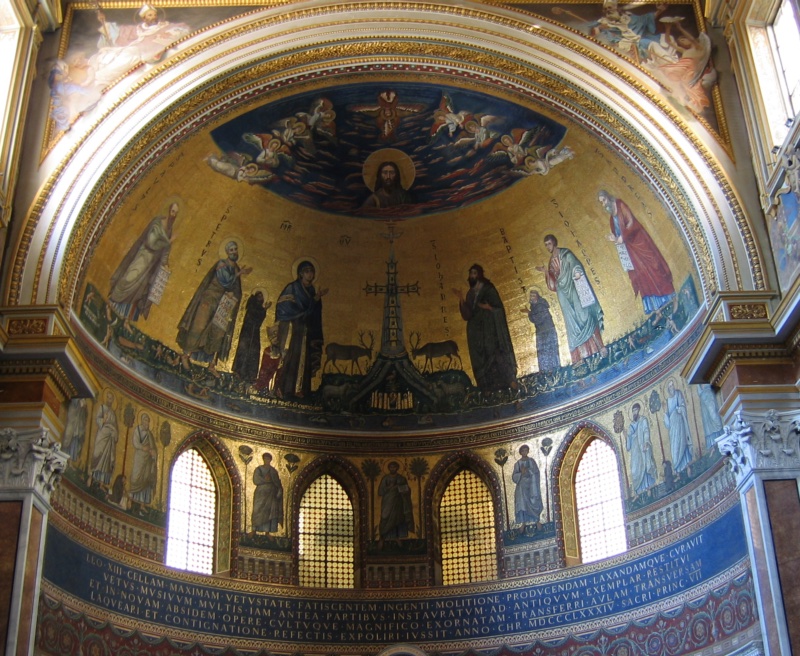
Pope Nicholas IV (r. 1288–1292) commissioned Jacopo Torriti to redesign the apse decoration of the Lateran Basilica, a project that both incorporated and transformed an earlier fifth-century mosaic. Torriti worked alongside Jacopo da Camerino, likely also a Franciscan friar, and commemorated the completion in a dedicatory inscription: IACOBUS TORRITI PICT(OR) H(OC) OP(US) FEC(IT) / ANNO D(OMI)NI M CC NONAGES(IMO) II. Both artists left a personal mark on the work itself, appearing as small figures dressed in Franciscan habit among the apostles depicted in the lower register.
At the center of the apse basin, a large gemmed cross commands the composition, flanked by the Virgin Mary and Saint John the Baptist, with the face of Christ rising above, an image that tradition holds appeared miraculously in the apse. The surrounding figures include Saints Peter, Paul, John the Evangelist, and Andrew. Prominently featured are Saint Francis of Assisi5 and Saint Anthony of Padua, Franciscan saints explicitly requested by the commissioning pope, whose own portrait appears as a small prostrate figure at the Virgin’s feet. The iconography consciously evokes early Christian art, deliberately recalling the fifth-century mosaics the new work was designed to replace.
The mosaic was executed in glass paste (enamel) and gilded tesserae — glass set with gold leaf — following the medieval Roman-Byzantine tradition. Torriti is notably identified in the inscription as incisor vitri, “glass cutter,” a title that underscores his technical command of cutting and setting tesserae. Nineteenth-century documents confirm that the golden background was composed of exceptionally high-quality gold tiles, while the original tesserae were small, dense, and tonally rich.
What visitors see today is not the mosaic as Torriti conceived it. When Pope Leo XIII ordered an enlargement of the choir, a project directed by architect Francesco Vespignani between 1876 and 1886, the medieval apse was demolished and the mosaic entirely dismantled and then reassembled within a new neo-Gothic structure. The nineteenth-century mosaicists preserved the original iconographic program and reused the gilded background tiles, but much of the original stylistic character and chromatic subtlety was inevitably lost in the process. Before dismantling, 1:1 scale casts were made by pressing dampened paper sheets directly onto the tiles; these invaluable impressions are now held in the Vatican Museums.
Because Vespignani’s neo-Gothic apse is structurally larger than its medieval predecessor, the mosaic was adapted to a surface different from the one for which Torriti designed it. Academic sources consistently describe the composition as occupying the full apse basin, but precise metric measurements remain undocumented — a gap that is, unfortunately, common for medieval mosaics that have undergone remounting.
Apse and Triumphal Arch
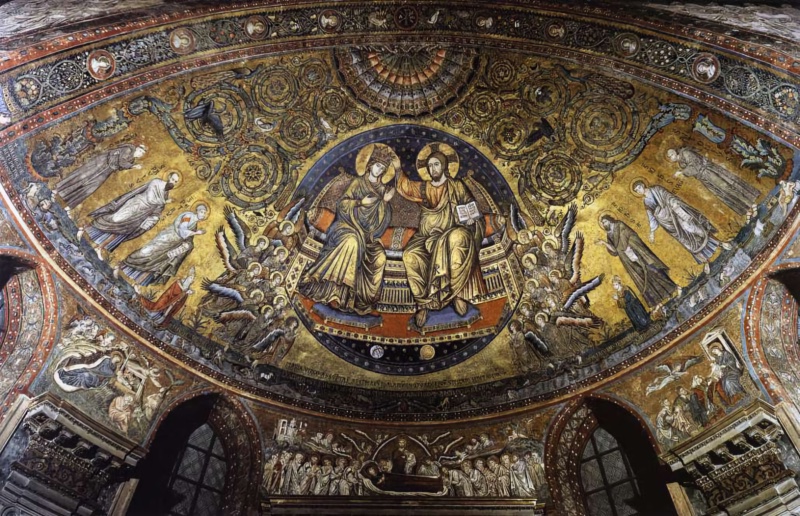
The most important surviving work by Jacopo Torriti, and one of the supreme achievements of late medieval mosaic art in Europe, is the vast decorative program he executed for the apse and triumphal arch of the Patriarchal Basilica of Santa Maria Maggiore in Rome, substantially completed by 1295 or 1296. The commission was initiated by Nicholas IV and completed under the patronage of Cardinal Giacomo Colonna following the pope’s death in 1292, and the two donors are represented kneeling within the composition on either side of the central throne, Nicholas on the left beneath Saints Peter, Paul, and Francis, and Giacomo Colonna on the right beneath Saints John the Baptist, John the Evangelist, and Anthony of Padua.
The central image of the apsidal calotte presents the Coronation of the Virgin: Christ and Mary are seated together on a single throne of exceptional dignity, enclosed within a star-studded celestial sphere in which the sun and moon are placed iconographically beneath the throne’s step, visually subordinated to the sacred protagonists. Christ reaches toward his mother with a gesture of crowning tenderness while the Virgin receives the act with composed, regal dignity, their relationship rendered with a warmth of human emotion that distinguishes Torriti’s vision from the more rigidly hierarchical formulations of earlier Byzantine-influenced art.
Eight angels and a six-winged seraph flank the central pair on each side, their forms elegant and elongated, their faces animated by an otherworldly calm that represents some of Torriti’s finest characterization. Below the central sphere runs a Latin inscription drawn from the Marian liturgy, Maria virgo assumpta est ad ethereum thalamum in quo rex regum stellato sedet solio, which binds the visual image to its liturgical and theological context. In the lower zone of the apse, five narrative scenes unfold in a continuous register: the Annunciation and the Nativity on the left, the Adoration of the Magi and the Presentation in the Temple on the right, and at the center, in the position of greatest visual and theological emphasis, the Dormitio Virginis, the Death of the Virgin, shown with the apostles gathered around Mary’s bier while Christ receives her soul in the form of a swaddled child.
The deliberate axial alignment of the Dormitio below with the Coronation above creates a powerful visual theology of the Marian mystery, linking death and heavenly glory in a programmatic unity that reflects both Franciscan mariological devotion and the ancient Roman liturgical tradition of the Assumption feast. The sprawling acanthus scroll populated with birds, fish, deer, and other animals that fills the decorative border between the figurative registers draws directly on late antique ornamental conventions visible in the fourth- and fifth-century mosaics of the same basilica, creating a deliberately retrospective evocation of Christian Rome’s golden age. The mosaic is still visible in situ in the apse of the Basilica of Santa Maria Maggiore, Rome, though a nineteenth-century restoration affected the lower narrative scenes.
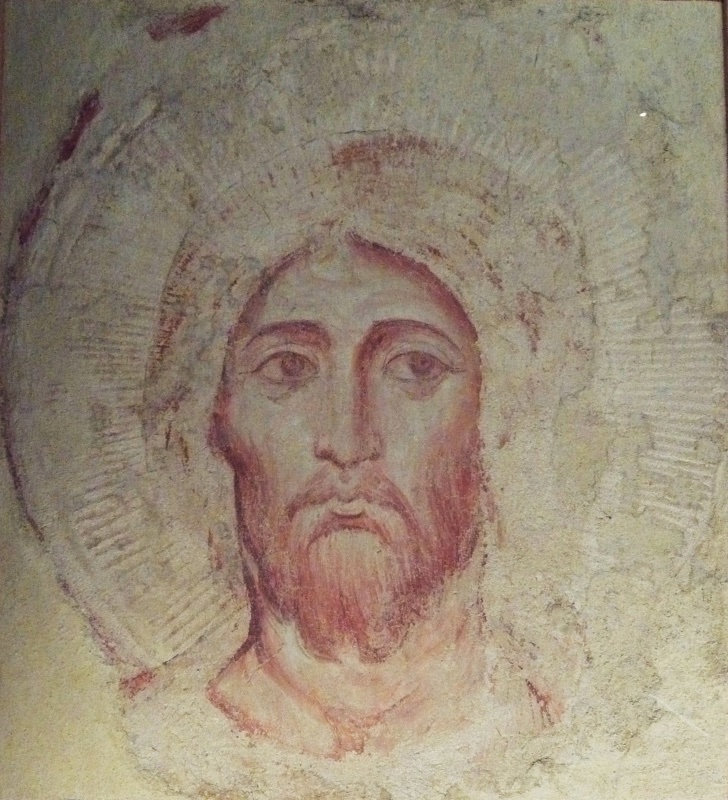
Sinopia del Cristo Pantocratore
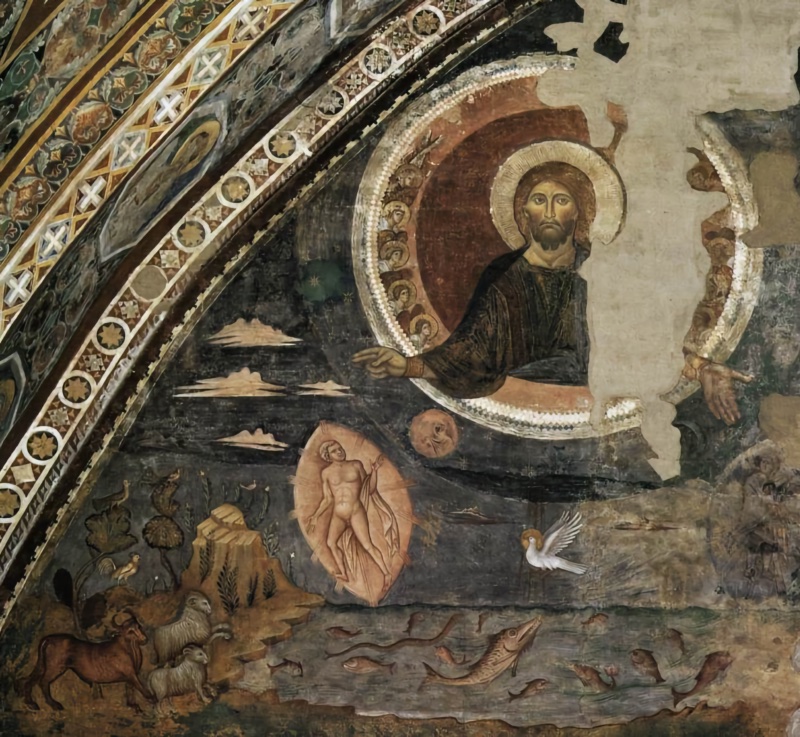
The Creation of the World
Construction of the Ark
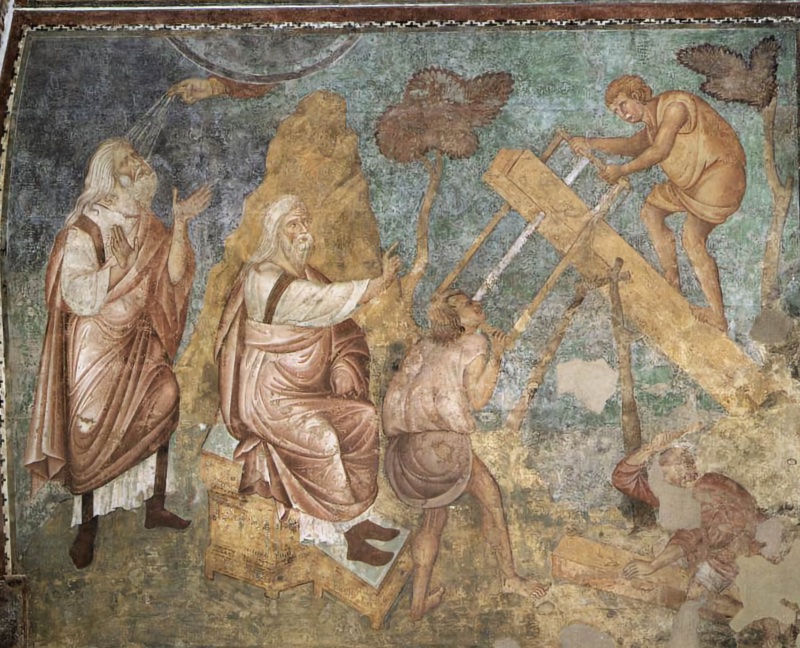
Among the works attributed to Torriti on the basis of stylistic analysis rather than documentary signature, the frescoes in the upper nave of the Basilica of San Francesco in Assisi represent the most debated and yet the most instructive body of evidence for understanding the artist’s formation. The vault of the second bay of the nave, the Volta degli Intercessori or Volta dei Santi, preserves four tondi within a decorative framework of angels, depicting Christ, the Virgin, John the Baptist, and Francis of Assisi as celestial intercessors, and this composition is among the passages most consistently assigned to Torriti by modern scholars. The frescoes in the clerestory zone of the north wall of the nave, depicting scenes from the Old Testament beginning with the Creation of the World, are also widely attributed to Torriti and his workshop, with the Creazione del Mondo (Creation of the World) and the Costruzione dell’Arca (Construction of the Ark, 1290) standing among the most stylistically coherent passages. A preparatory drawing, a sinopia, preserving the face of the Creator from the Creation scene survives in the Museo del Tesoro at Assisi and is considered one of the finest examples of Torriti’s draftsmanship, displaying a monumentality and expressive depth that directly prefigures the Christ figure in the Santa Maria Maggiore apse. The Assisi frescoes are visually more archaic in their spatial handling than the subsequent Roman mosaics, suggesting that Torriti’s encounter with the innovative currents circulating at Assisi, including the Gothicizing manner of the Maestro Oltremontano and the early activity of Giotto, stimulated a stylistic evolution that would come to full fruition in the Roman works. The frescoes remain in situ in the Upper Basilica of San Francesco, Assisi.
Head of the Madonna
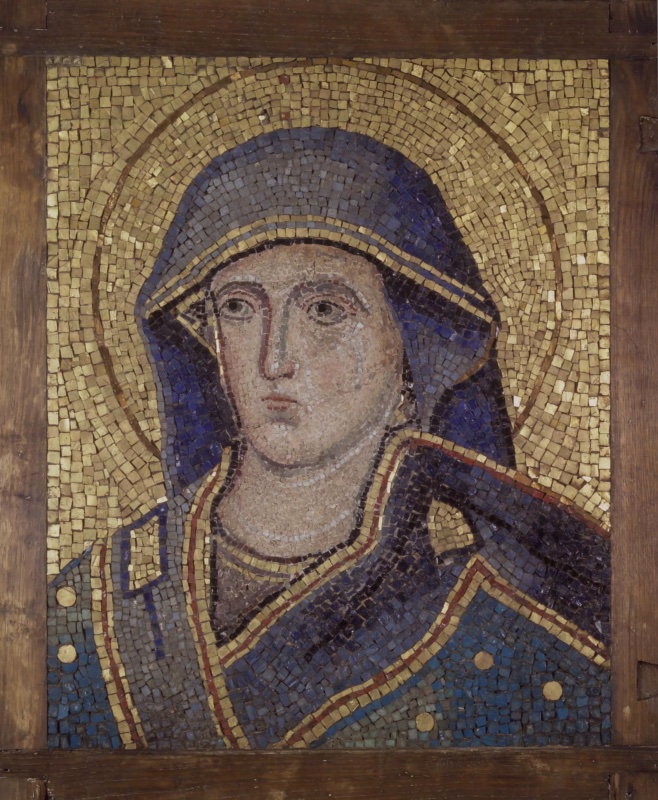
The third securely documented commission of Jacopo Torriti was the mosaic panel created for the funerary monument of Pope Boniface VIII, executed in collaboration with Arnolfo di Cambio and originally positioned against the inner façade wall of the ancient Constantinian basilica of Saint Peter’s in the Vatican. The monument, an elaborate Gothic tabernacle combining sculpture and mosaic in a synthesis characteristic of Arnolfo’s mature Roman work, presented in its upper mosaic zone a composition depicting Saints Peter and Paul presenting the kneeling Boniface VIII to the enthroned Virgin and Child, enclosed within a medallion and surmounted by an etimasia, the empty throne symbolizing the divine presence, a compositional format closely related to that employed by Torriti at the Lateran. The mosaic was signed with the formula Iacob[us] Tor(r)iti pictor, establishing beyond doubt Torriti’s personal involvement in its execution. The monument was destroyed in the seventeenth-century rebuilding of Saint Peter’s, but two fragments of the original mosaic survive: a portion of the Christ Child’s bust, now in the Pushkin Museum of Fine Arts in Moscow, and a fragment of the Virgin’s face, preserved in the Brooklyn Museum in New York. These fragments, though small, confirm the high quality of Torriti’s execution and display the same refined coloristic sensibility and delicate facial modeling visible in his surviving Roman works. The destruction of the monument represents one of the most significant losses in the history of medieval art in Rome.
Saint Lucia
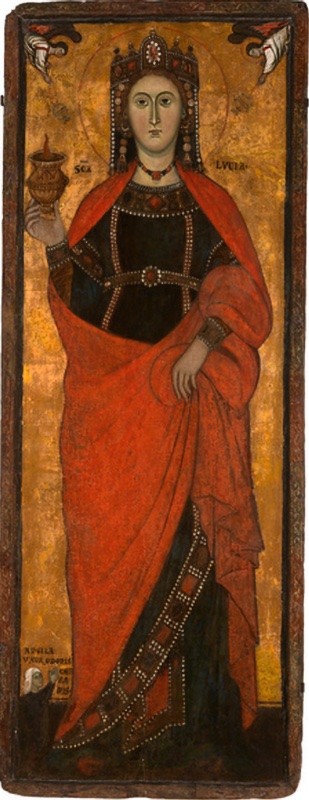
A panel painting depicting Saint Lucia, now housed in the Musée de Grenoble in France, has been attributed to Torriti or to his immediate workshop in the critical literature, constituting the only painting on panel associated with his name outside the Italian peninsula. The panel depicts the saint in frontal position against a gold ground, in a format closely related to the Byzantine iconic tradition, and displays the refined linear elegance and delicate colorism associated with the Roman school at the end of the thirteenth century. The attribution to Torriti himself remains debated, with some scholars preferring to assign it to a close collaborator or follower working within his stylistic orbit, while others, including those cited in the Treccani entry, include it among the works associated with the broader circle of artists active in Torriti’s environment. The painting is today exhibited in the permanent medieval collection of the Musée de Grenoble, France, where it constitutes a rare example of the portable painting tradition associated with the late thirteenth-century Roman school. An inscription reads as follows: INSC.H.G. : “SCA”; INSC.H.DR. : “LUCIA”; INSC.B.G. : “ANGILA / UXOR ODONIS / CER / RO / NIS”; INSC.R. : on a label : “Qesta imagine marca nella / Chiesola antica di Sa Lucia / in Selci done fece mir […] /coli nell tempo che fasachegiara / Roma dalli visigotti e attesta / in era, che sono anni quasi 400 / e da imagine la fece fare / Angela Cerrone” (“It is documented that this image was in the ancient church of Santa Lucia in Selci, where it performed many miracles at the time Rome was sacked by the Visigoths. It was there nearly 400 years ago and was commissioned by Angela Cerrone.”)