Gaddo Gaddi
( 25% )
Family and workshop
Gaddo di Zenobi, known in the literary tradition as Gaddo Gaddi, was born around the year 1260 in Florence, into a milieu of artisans and small property‑holders that would, within two generations, ascend into the city’s patriciate. His family name, already attested in civic records, suggests a lineage rooted in the urban fabric of late Duecento Florence rather than in the rural nobility, and this background conditioned both his social mobility and his artistic trajectory. Sources agree that he was trained as a painter and, more distinctively, as a mosaicist, a specialization that placed him at the intersection of craft, liturgy, and civic display.
The patronymic “di Zenobi” preserves the memory of his father, although almost nothing concrete is known about the elder Zenobi beyond the fact that he transmitted to his son a status sufficient to allow entry into the Florentine artistic guild system. Gaddo’s own marriage is undocumented, yet the existence of several sons, of whom only Taddeo became a painter, indicates that he presided over a sizeable household and workshop, a typical configuration for late medieval masters.
Through Taddeo and, later, Agnolo, the Gaddi family would control one of the most successful painting dynasties in fourteenth‑century Florence, making Gaddo retrospectively the “founder” of a lineage as much as an individual artist. Biographical dates remain approximate: Vasari gives 1239 and 1312 as birth and death, but modern scholarship prefers a birth around 1260 and a death between 1312 and roughly 1333, both in Florence. The cause of his death is nowhere recorded, and in the absence of documentary evidence it is reasonable to assume that he died of natural causes associated with advanced age rather than plague or violence, since no chronicler marks his passing as sudden or catastrophic. His burial in Santa Croce, as reported by Vasari, aligns him with other prominent Florentine families who chose that Franciscan church as a dynastic pantheon, and it underlines the social ascent achieved within his lifetime. Thus the sparse data that survive already situate Gaddo within a dense web of kinship, civic affiliation, and memory that condition any reconstruction of his life and oeuvre.
The internal dynamics of the Gaddi household can be glimpsed only obliquely through later narrative sources, which emphasize both the number of children and the differentiation of their careers. Vasari, who freely mixes anecdote and documentation, stresses that although Gaddo had several sons, only Taddeo applied himself to painting, learning first from his father and then from Giotto, while other male heirs presumably pursued mercantile or administrative activities that helped consolidate the family fortune.
Such a distribution of roles is fully consonant with late medieval Florentine practice, in which one son might inherit the workshop and its artistic capital while others managed investments or served in civic offices. Within this framework, Gaddo’s workshop would have functioned as both a training ground and a family enterprise, employing relatives, apprentices, and perhaps in‑laws connected through marriage alliances. Although the names of his wife and non‑artist sons are not preserved, the continuity of the surname in fiscal and notarial records into the fourteenth century suggests that the broader kin group remained deeply embedded in the social fabric of the city.
The mixture of artistic and mercantile pursuits that can be documented more fully for Taddeo and especially for Agnolo almost certainly has its origins in strategies already pursued by Gaddo’s generation. These strategies helped the family weather the economic and political fluctuations that characterized the decades around 1300, including factional strife and shifting regimes. In this light, the Gaddi “family” cannot be reduced to a simple genealogical line, but appears rather as an expanded network that leveraged marriage, profession, and patronage. Gaddo’s role at the head of this network is underscored by the way later descendants invoked him as a kind of founding ancestor, thereby stabilizing their own claims to prestige. The family, in other words, is as much a retrospective construction as an immediate social reality, and Gaddo stands at its narratively privileged origin point.
The intergenerational transmission of artistic skill within the Gaddi clan is particularly evident in the relationship between Gaddo and his son Taddeo, which later sources present in emblematic terms. Vasari recounts that Giotto himself held Taddeo at the baptismal font, an anecdote that, whether literally true or not, symbolically binds three generations of Florentine painters into a single genealogical and artistic line. Within this narrative, Gaddo appears as the first master who provides Taddeo with the “principles” of the art, while Giotto completes his training, thus joining domestic instruction and workshop apprenticeship into a single continuum. The story also implies that Gaddo already moved in the same social and professional circles as Giotto, cementing friendships that would later benefit his descendants.
Through Taddeo, and then through Agnolo, Gaddo’s stylistic legacy would be translated from the medium of monumental mosaic to the dominant Quattrocento medium of fresco, especially in major Florentine churches such as Santa Croce and the cathedral of Prato. The continuity of the family workshop, transmitted from father to son, ensured that patterns, cartoons, and iconographic schemes could be reused and adapted across decades, thus extending Gaddo’s influence well beyond his own lifetime. As a result, even if very few works can today be securely assigned to Gaddo’s own hand, his familial role as progenitor of a powerful artistic lineage is undeniable. The convergence of kinship, apprenticeship, and patronage in this family history offers an exemplary case of how artistic “schools” in Trecento Florence were often identical with biological lineages. In this sense, Gaddo’s identity as pater familias is inseparable from his identity as artist, since one dimension constantly reinforces the other in the sources and in later historiography.
The social identity of the Gaddi family, already emerging under Gaddo, becomes particularly visible in the financial and civic success enjoyed by his descendants, which contemporary and later authors explicitly link to the fortunes amassed through his artistic activity. The 1911 Encyclopaedia Britannica, condensing earlier research, notes that this artist laid the foundation of a very large fortune, which continued increasing, and placed his progeny in a highly distinguished worldly position, a statement that implies significant accumulation of capital already in the first generation. Given the scale of the mosaic commissions entrusted to him—for major cathedrals in Florence, Rome, Arezzo, and Pisa—it is plausible that Gaddo’s workshop commanded substantial fees, especially when materials such as gold‑ground glass tesserae and costly pigments were involved. Investments in urban property, dowries, and mercantile ventures by non‑artist sons then converted this artistic income into durable wealth, as would later be the case for many successful Florentine botteghe.
Membership in the appropriate guild, probably the Arte dei Medici e Speziali1, which encompassed painters, would have further integrated the family into the city’s corporate structures, giving access to commissions and political representation. By the mid‑Trecento, members of the Gaddi lineage held positions that demonstrate this ascent, and their artistic prominence reinforced their civic stature. In this upward trajectory, Gaddo appears as the crucial initiating figure whose professional choices opened new social possibilities for his heirs. The family, in turn, provided the institutional and economic framework that enabled him to accept large, technically and logistically demanding commissions across central Italy. The close interplay between artistic labor and family strategy thus emerges as a defining feature of his life.
The memory of Gaddo within his own family and within Florentine sacred spaces is crystallized in images and tombs that belong as much to dynastic self‑fashioning as to simple commemoration. Vasari records that Taddeo painted a portrait of his father in the Baroncelli Chapel in Santa Croce, including him in the scene of the Marriage of the Virgin, where Gaddo appears alongside Andrea Tafi, another foundational mosaicist. This painted presence, created a generation after his death, folds family history into the biblical narrative and situates the elder Gaddi within the very church that housed his burial.
The choice of Santa Croce, with its concentration of tombs and chapels belonging to leading Florentine lineages, again underscores the family’s desire to inscribe itself into the city’s symbolic geography. Within such a setting, the representation of Gaddo is not a neutral likeness but a carefully positioned sign of artistic ancestry, intended to legitimize Taddeo’s own authority by showing his descent from an already celebrated master. Through this image and the associated epitaphs, later viewers learned to see Gaddo not only as an individual artisan of the Duecento but as the original trunk from which an entire artistic family tree sprang. In this way, kinship, memory, and space collaborate to produce an enduring image of the artist, despite the fragility or loss of many of his works. The family biography thus continues to frame interpretations of his career and underscores how thoroughly his personal identity was absorbed into that of the Gaddi lineage.
Patronage
The network of patrons that supported Gaddo Gaddi’s career begins at home, with the Florentine cathedral fabric, whose wardens entrusted him with a key component of the Marian iconographic program on the west front of Santa Maria del Fiore. According to Vasari, the Opera del Duomo commissioned him to execute the mosaic lunette over the principal interior door of the cathedral, depicting the Coronation of the Virgin, a work that contemporary observers judged the most beautiful that had yet been seen in all Italy in that technique.
Later documentation and stylistic analysis confirm that the large mosaic now visible above the inner entrance, usually dated between about 1296 and 1310, can be plausibly attributed to Gaddo, even if workshop participation complicates any strict attribution. The patronage here was corporate rather than individual: the Opera, representing the commune and its clergy, sought an image that would culminate the Marian narrative initiated by Arnolfo di Cambio’s sculpted cycles on the external portals.
By commissioning a local master already versed in the “Greek manner” of mosaic, the wardens ensured stylistic continuity with existing decorative campaigns while also embracing new developments in figure design and narrative clarity. The prominence of the location, directly above the axis of procession, indicates the high level of trust placed in Gaddo’s abilities and his integration into the official artistic machinery of the city. In this context, he emerges as a civic artist as much as a religious one, serving the ideological needs of Florence as a Marian city under the protection of its cathedral’s titular.
Beyond Florence, Gaddo’s career was marked by significant papal patronage, particularly under Clement V2, who summoned him to Rome after the disastrous fire that damaged the Lateran complex in 1307. Vasari reports that in 1308 the pope called the Florentine master to complete mosaics in the Basilica of San Giovanni in Laterano that had been left unfinished by Jacopo Torriti, a leading Roman mosaicist of the previous generation. In addition to these restorative tasks, Gaddo is said to have executed mosaics in Old Saint Peter’s, both in the choir and on the façade, where he created a colossal figure of God the Father surrounded by other personages, forming an imposing doctrinal image visible to pilgrims approaching the church.
Although these works are now lost due to subsequent rebuilding, their mention in early sources attests to the confidence the papal curia placed in a Florentine artist to intervene in Rome’s most prestigious basilicas. The patronage here combined papal authority and the institutional needs of the chapter, both of which required artisans capable of handling large‑scale programs in a medium freighted with theological and ceremonial significance. By moving into this arena, Gaddo positioned himself as a cosmopolitan master whose reputation extended well beyond his native city. His Roman commissions also brought him into contact with a different circle of cardinals, curial officials, and Roman noble families, each of whom could act as intermediaries or secondary patrons. Thus the Lateran and Saint Peter’s projects represent not only artistic but also social and political capital for the Gaddi workshop.
Another crucial sphere of patronage was the Basilica of Santa Maria Maggiore in Rome, where Gaddo is with more certainty credited by modern scholarship with the mosaics in the loggia that narrate the legend of the church’s miraculous foundation. These thirteenth‑century mosaics, originally on the façade and later sheltered within the eighteenth‑century portico, depict in a sequence of panels the dream of Pope Liberius and the patrician John, the August snowfall on the Esquiline Hill, and the subsequent decision to build a basilica on the divinely indicated site. Crowe and Cavalcaselle, followed by later writers, remark that the stylistic character of these scenes—especially the handling of drapery, the solemn yet slightly softened faces, and the organization of narrative—bears a strong resemblance to frescoes they attribute to Gaddo in the Upper Church at Assisi, thereby reinforcing the attribution.
The patronage here likely involved both the papacy and aristocratic Roman families such as the Colonna, whose heraldic column appears in one of the mosaics and who played a prominent role in financing Marian monuments in the city. For Gaddo, participation in this program meant engagement with a highly sophisticated visual theology in which Mary’s role as intercessor and model of the Church was articulated through narrative cycles and symbolic references. The scale and visibility of the Santa Maria Maggiore mosaics ensured that his work would be seen by a broad international audience of pilgrims, thus amplifying his fame far beyond Tuscany. The patronage, therefore, was not merely remunerative but also reputational, inscribing his name—explicitly or implicitly—into the artistic identity of one of Rome’s major basilicas.
Within Tuscany, Gaddo’s patrons included powerful secular lords as well as ecclesiastical institutions, as demonstrated by his work for the Tarlati family in Arezzo. Vasari recounts that the Tarlati, lords of Pietramala and dominant figures in Arezzo’s political life, commissioned Gaddo to cover with mosaic the vault that roofed the central part of the old cathedral outside the city walls, probably including their family chapel. This vault, constructed of light “sponge‑stone,” eventually collapsed and was rebuilt in brick under Bishop Gentile of Urbino, so that none of the original decoration survives.
Nevertheless, the commission itself indicates that the Aretine elite recognized in the Florentine master someone capable of lending splendor and prestige to their sacred foundations. The combination of secular lordship and religious patronage fits a familiar pattern in which local magnates used churches as sites of memoria and self‑representation, and the choice of mosaic, an expensive and relatively rare medium, further heightened the distinctiveness of their chapel. Involving a Florentine artist also signaled cultural alignment with the dominant artistic center of the region, reinforcing political and social ties. For Gaddo, such commissions diversified his patronage base beyond purely ecclesiastical or civic clients, embedding his workshop in a broader aristocratic network. This network would later benefit his descendants, who continued to work for both urban and feudal patrons in Tuscany and beyond.
Royal patronage, though more elusive in terms of surviving objects, constitutes another dimension of Gaddo’s career as reported by Vasari. After returning to Florence from his travels, Gaddo is said to have produced small panels in mosaic, some of them executed with extraordinary delicacy using tesserae made from egg‑shells, a technique that required exceptional patience and precision. Two of these miniature mosaics, Vasari notes, were sent to King Robert of Anjou3, ruler of Naples, although their present whereabouts are unknown. The story suggests that either the Florentine commune or ecclesiastical authorities selected Gaddo to contribute to diplomatic gifts destined for the southern court, or that royal agents themselves sought out his work.
In either case, the episode attests to the circulation of his art within the broader Mediterranean network that connected Florence, Rome, and the Angevin kingdom. The royal recipient, famed for his patronage of theologians and artists, would have appreciated the combination of piety and technical refinement embodied in such objects. For Gaddo, the association with a crowned patron further burnished his prestige and confirmed the high esteem in which his mosaics were held among contemporary elites. Even if the physical works have vanished, their memory in textual sources contributes to the reconstruction of his patronage horizon.
Finally, closer to home, Gaddo also worked for Florentine mendicant orders and their lay patrons, especially within the ambit of Santa Maria Novella. Vasari mentions an altarpiece by Gaddo in the tramezzo of the Dominican church, specifically in the chapel of the Minerbetti family, although this panel has not survived and cannot be securely reconstructed. The commission would have involved both the religious community, which oversaw the theological and liturgical suitability of the image, and the lay family whose name attached to the chapel and whose members likely appeared as donors in the composition.
Such a project presupposes that Gaddo was capable not only of mosaic but also of panel painting at a high level, integrating the emerging aesthetics of Gothic panel altarpieces with more traditional Italo‑Byzantine formulas. In this environment, his status as a Florentine master with connections to Cimabue and Giotto would have been particularly valued, as the Dominicans sought images that were both doctrinally robust and visually compelling. For the Minerbetti, the presence of a work by Gaddo in their chapel aligned them with up‑to‑date artistic trends and with other leading families who endowed chapels in the same church. Thus his patronage network, ranging from papal basilicas to local confraternities, reveals a career that was both geographically wide and socially stratified.
Painting style
Contemporary and later writers consistently characterize Gaddo Gaddi as a practitioner of the so‑called maniera greca, that is, of the Italo‑Byzantine style that had dominated Tuscan painting and mosaic since the thirteenth century, but they also stress that he introduced greater “design” and judgment into this inherited vocabulary. Vasari, who compares him favorably to Andrea Tafi and earlier mosaicists, notes that he displayed “more design in his works, wrought after the Greek manner, than did the others before him,” an assessment that underscores his ability to refine an established idiom rather than to overturn it.
The figures in works attributed to him tend to preserve the hieratic frontality, linear drapery patterns, and gold‑ground splendor of Byzantine prototypes, yet their proportions are somewhat more measured and their gestures slightly more expressive than in earlier mosaics. This subtle shift toward increased naturalism, while still framed within a fundamentally iconic conception of the image, situates Gaddo within the same broad movement that would find its most radical expression in Giotto’s frescoes. In his hands, the “Greek manner” becomes less rigid, opening space for narrative clarity and psychological nuance without abandoning its theological gravitas. The Gothic label sometimes applied to him in modern reference works captures, albeit imprecisely, this transition, in which more elongated silhouettes and decorative patterning coexist with a nascent interest in spatial coherence. His style, therefore, is best understood as a sophisticated mediation between tradition and innovation in the specific medium of mosaic.
A close look at the Coronation of the Virgin mosaic over the inner portal of Florence Cathedral, historically attributed to Gaddo, makes visible several of these stylistic traits in a particularly concentrated form. The composition centers on Christ and Mary, seated on adjacent thrones and richly robed, with the Son raising his right hand in blessing while placing a crown upon the inclined head of his Mother, whose arms are crossed upon her breast in a gesture of humility. Around the central pair hover the winged symbols of the four Evangelists—the bull of Luke, the lion of Mark, the man of Matthew, and the eagle of John—thus anchoring the scene in the scriptural foundations of Mariology.
Flanking the principal figures, rows of slender, tubular angels rise in ordered tiers, while above, two mirrored seraphim, one red and one blue, complete the celestial hierarchy. The gold ground, constructed from glass tesserae backed with gold leaf, creates a luminous field that both isolates and unifies the figures, transforming the lunette into a theophanic vision framed by the stone architecture of the portal. In this work, Gaddo handles anatomy in a manner that is still conventional but noticeably less schematic than in earlier mosaics, and he articulates the folds of the garments with a rhythm that suggests volume without fully modeling it. The result is an image that remains iconically frontal yet invites viewers into a more intimate contemplation of the crowned Virgin, read in relation to the sculpted Marian cycle on the exterior of the façade. The mosaic thus exemplifies his capacity to adapt an inherited style to a complex programmatic context.
The mosaics in the loggia of Santa Maria Maggiore, likewise often attributed to Gaddo, reveal a somewhat different facet of his style, one more deeply engaged with sequential narrative. Here, instead of a single hieratic theophany, one finds a series of scenes recounting the dream of Pope Liberius and of the patrician John, the miraculous snowfall on the Esquiline Hill in August, and the subsequent determination to build a basilica on the indicated site. The figures, though still largely frontal and stylized, are arranged in more complex groupings, with interactions that convey the unfolding of events across space and time.
Architectural elements, such as palaces and the Roman landscape, are rendered schematically but serve to anchor the stories in a recognizable topography, a feature that anticipates later developments in Italian narrative painting. The color range, constrained by the properties of mosaic tesserae, is nonetheless handled with sufficient subtlety to differentiate characters, garments, and settings, and to guide the viewer’s eye across the sequence. In these panels, Gaddo demonstrates an ability to orchestrate multi‑scene cycles while maintaining clarity and legibility from a distance, a key requirement for façade decoration. Compared to the more static solemnity of the Florence Coronation, the Santa Maria Maggiore mosaics exhibit greater dynamism and variety of pose, albeit within the same overarching stylistic system. The combination of doctrinal symbolism and narrative verve confirms his standing as a mediator between Byzantine visual rhetoric and the emergent storytelling modes of the Trecento.
Although almost none of Gaddo’s panel paintings survive, textual references and stylistic attributions to related masters allow some cautious inferences regarding his approach to painted works. Vasari’s mention of an altarpiece in Santa Maria Novella and of other panels sent “into diverse parts of Tuscany” indicates that he translated his mosaic idiom into tempera on wood, likely preserving the gold ground, hieratic Virgin, and flanking saints typical of late Duecento Florentine production.
Modern scholarship has at times attempted to identify him with anonymous masters such as the Maestro della Maddalena, the Maestro della Santa Cecilia, the Maestro di Isacco, or, more recently and more plausibly, the Maestro del Trittico Horne, a painter who stands at the threshold of Giottesque innovations. If these identifications are accepted, they suggest a hand capable of integrating more volumetric figures and rudimentary spatial constructions into the older Byzantine framework, much as in his mosaics.
The painted works tentatively linked to him often display a certain sobriety in facial expression and a careful, if still formulaic, articulation of hands and drapery, characteristics that resonate with the qualities praised in his mosaics. While the absence of signed or securely documented panels limits definitive conclusions, the convergence of stylistic evidence points toward a master who maintained a coherent visual language across media. In both mosaic and painting, then, Gaddo’s style can be described as conservative yet refined, poised between the austerity of earlier Byzantine art and the nascent naturalism of Giotto’s generation.
Artistic proficiency
The technical aspects of Gaddo’s mosaic practice constitute an essential component of his artistic profile, since they undergird the visual effects noted by contemporary admirers. Working primarily with polychrome glass paste tesserae, often backed with gold or silver leaf for luminous backgrounds, he exploited the interplay of reflective surfaces and ambient light to create images that appeared to shimmer and shift as viewers moved through the space. The Coronation mosaic in Florence, for instance, combines densely packed gold ground with colored tesserae in the garments and faces, requiring careful modulation of hue and value to avoid visual flatness.
In smaller works, Vasari highlights Gaddo’s use of egg‑shell tesserae, painstakingly cut and set to produce delicate tonal gradations and textural effects that could not be achieved with thicker glass pieces. The precision required for such work bespeaks a high level of manual skill and a workshop trained to execute minute operations reliably. At a structural level, his large vault and façade mosaics demanded expertise in preparing damp‑proof renders, calculating curvature, and coordinating teams of assistants to lay tesserae before the mortar set, skills that position him within a longstanding tradition of technical knowledge transmitted among mosaicists. The combination of large‑scale architectural decoration and intimate miniature panels illustrates the breadth of his command over the medium. These technical competencies, though less visible to modern viewers than iconography or style, were crucial to his reputation among patrons and peers.
Over time, both contemporary and later reception of Gaddo’s work emphasized its exemplary status within the evolving history of Italian mosaic, thereby shaping his artistic legacy. Early testimonies, including those cited in encyclopedic entries, single out the Coronation of the Virgin in Florence as a benchmark of quality, praising its design and diligence in comparison with other mosaics then visible in Italy. The Catholic Answers encyclopedia, summarizing much of this tradition, lists among his notable works not only the “Madonna” at Santa Maria del Fiore but also a “majesty” at San Miniato al Monte and contributions to the great Majesty in the apse of Pisa Cathedral, thereby inscribing his name into a kind of canon of Tuscan monumental mosaics.
Such attributions, whether or not all of them are accepted by present‑day scholars, attest to the durable association between Gaddo and the highest achievements of the medium in central Italy. At the same time, modern art history has subjected these traditions to critical scrutiny, reassigning some works to other hands and questioning the very historical consistency of the figure constructed under the name “Gaddo Gaddi.” Yet even within this more skeptical framework, the stylistic profile attached to his name continues to serve as a useful category for describing a certain phase in the transition from Byzantine to Giottesque visuality. His style, whether understood as that of a single master or as a composite of several related artists, functions as a hinge between eras in the historiography of Italian art.
Artistic influence
The formative influences on Gaddo’s style begin with his close relationship to Cimabue, whom Vasari describes as both intimate friend and artistic interlocutor. This friendship, said to be based on “conformity of blood or of the goodness of their minds,” is portrayed as a model of collegial exchange in which the two artisans frequently discussed the “difficulties of the arts,” thereby clarifying and refining their mutual understanding. From Cimabue, Gaddo would have absorbed not only the conventions of the “Greek manner,” with its elongated figures and abstracted spaces, but also an emerging concern for greater plasticity and emotional expression in sacred images. The stylistic parallels between Cimabue’s panel Madonnas and the solemn but somewhat softened faces in mosaics attributed to Gaddo support this notion of shared exploration within a common idiom. In addition, proximity to Cimabue would have provided access to important commissions and to a network of patrons already familiar with large‑scale programs in major churches. The influence here is thus both aesthetic and institutional, involving taste, technique, and opportunity. Through this alliance, Gaddo was positioned to inherit and further develop one of the key strands of late thirteenth‑century Florentine art.
Another decisive influence on Gaddo’s formation was Andrea Tafi, an older Florentine mosaicist with whom he collaborated on the mosaics of the Baptistery of San Giovanni. Vasari relates that Gaddo was taken into partnership by Tafi to help finish the Baptistery mosaics, and that in this context he learned so much that he later executed by himself the Prophets in the square spaces beneath the windows, works that brought him considerable fame. This collaboration placed him within an established lineage of Florentine mosaic practice, stretching back to Coppo di Marcovaldo and other masters engaged in the monumental decoration of the Baptistery’s interior cupola.
From Tafi, Gaddo would have acquired detailed knowledge of the technical processes involved in large‑scale mosaic, including mortar preparation, scaffold management, and the ordering of complex iconographic programs across curved surfaces. At the same time, he appears to have surpassed his mentor in terms of compositional clarity and figure design, as suggested by Vasari’s contrast between their respective works. The Baptistery thus functioned as a veritable school where he transformed from apprentice‑collaborator into an autonomous master whose signature idiom refined the inherited vocabulary of Tuscan mosaic. The enduring prominence of the Baptistery mosaics in Florentine devotional life reinforced the impact of this formative experience on his subsequent career.
Gaddo’s extended sojourns in Rome brought him into direct contact with another powerful source of influence: the monumental apse mosaics of late antique and early medieval basilicas, as well as the more recent works of Jacopo Torriti and his contemporaries. The apse mosaic of Santa Maria Maggiore by Torriti, depicting the Coronation of the Virgin amid a celestial court, provided a particularly important model for Gaddo’s own treatment of the same subject in Florence, as modern scholars have emphasized. In both cases, the crowning of Mary articulates a complex ecclesiological theology in which the Virgin stands as figura of the Church, elevated to share Christ’s glory, and this doctrinal content is translated into visual form through hierarchical arrangement, symbolic motifs, and inscriptions.
The similarities between the Roman and Florentine Coronations suggest that Gaddo did not simply emulate Byzantine prototypes but engaged critically with contemporary Roman solutions to analogous iconographic problems. Moreover, his work at the Lateran and Saint Peter’s would have exposed him to a dense stratigraphy of earlier mosaics, sarcophagi, and frescoes, all of which contributed to a broadened visual repertoire. The Roman experience thus enriched his stylistic vocabulary with elements drawn from a longer and more varied tradition than that available in Florence alone. This cross‑fertilization between Tuscan and Roman idioms is a hallmark of his mature production.
The persistent references in sources to Gaddo’s adherence to the “Greek manner” also point to the enduring influence of Byzantine art, whether encountered directly or mediated through Italian workshops and imported icons. The rigid frontality, gold background, and standardized physiognomies of many of his figures testify to the strength of this inheritance, which remained authoritative for theological and liturgical reasons even as local artists began to experiment with greater naturalism. Mosaic, with its technical and material links to the Eastern Mediterranean, was particularly well suited to the preservation of such forms, since glass tesserae and schematic compositions had long been associated with imperial and ecclesiastical prestige. Gaddo’s choice to “sweeten” this manner—to soften outlines, to adjust proportions, to introduce more varied gestures—should be understood not as a rejection of Byzantine models but as a reworking of them within a shifting devotional and intellectual climate. The influence of Byzantium, then, acts as both constraint and resource, anchoring his work in a venerable tradition while offering a platform for measured innovation. His mosaics thus stand at a crossroads where Eastern and Western visual cultures intersect in a specifically Florentine synthesis.
In addition to artistic exemplars, theological and liturgical currents exerted a strong influence on Gaddo’s iconography, especially in his Marian programs. The choice of the Coronation of the Virgin as the culminating image in the Duomo’s west interior, for instance, reflects contemporary developments in Mariology that emphasized her exaltation as Queen of Heaven and her role as intercessor for the city of Florence. By placing this scene above the main door, the Opera del Duomo created a visual and symbolic nexus between the faithful entering or leaving the church and the celestial court presided over by Christ and Mary, a theology that Gaddo had to embody through compositional and iconographic decisions. Similarly, the narrative mosaics of Santa Maria Maggiore, focused on the miracle of the August snowfall and the foundation of the basilica, respond to a growing interest in localized Marian legends that tied specific sites to the Virgin’s protective intervention. The visual articulation of dreams, miracles, and votive responses required a flexible narrative capacity that could convey both doctrinal content and the particularity of Roman topography. In this sense, Gaddo’s influences include not only other artists but also preachers, theologians, and liturgists who shaped the stories and interpretations that his images were meant to embody. His work thus stands at the intersection of artistic and intellectual currents in late medieval Christianity.
Travels
Gaddo Gaddi’s artistic career unfolded across a geography that, while centered on Florence, extended in significant arcs toward Rome, Arezzo, and Pisa, each trajectory bearing on his development as an artist. His early formation and first documented successes belong to Florence, where the Baptistery and the emerging cathedral of Santa Maria del Fiore provided both training grounds and major commissions. The Baptistery, with its complex mosaic program, hosted his collaboration with Andrea Tafi and the subsequent execution of the Prophet figures in the spaces beneath the windows, an experience that grounded him firmly in the local mosaic tradition. The commission for the Coronation of the Virgin in the Duomo’s inner lunette, likely undertaken in the first decade of the fourteenth century, further consolidated his status as a leading Florentine master in the medium. Throughout this period, his movements between workshop and cathedral building site would have been frequent, but largely confined to the urban core and its immediate surroundings. Florence thus served as both artistic laboratory and social base from which later journeys would be launched. The city’s political and economic vitality provided the institutional framework that made such mobility possible.
The most significant extension of Gaddo’s geographical horizon was his journey to Rome, traditionally dated to 1308, when Clement V invited him to restore and complete mosaics in major papal basilicas. Travel from Florence to Rome followed established routes through the Tuscan and Umbrian hinterlands, and the journey itself would have exposed him to churches and monuments along the way, including, possibly, the sanctuary complex at Assisi, where some frescoes have been tentatively attributed to him. Once in Rome, he took up residence for a period sufficient to execute or oversee substantial work in San Giovanni in Laterano, Old Saint Peter’s, and Santa Maria Maggiore, moving between these sites in a city dense with earlier Christian and classical remains. The experience of working in Rome, with its different rhythms of patronage and its multi‑layered artistic heritage, inevitably broadened his stylistic and iconographic repertoire. At the same time, this sojourn forged ties between the Florentine workshop and the papal court, links that would echo in later commissions and in the prestige attached to the Gaddi name. The return journey to Florence, perhaps punctuated by further stops in central Italian towns, closed a loop of travel that was as intellectually transformative as it was professionally advantageous.
Gaddo’s travels also took him to secondary Tuscan centers such as Arezzo and Pisa, where specific commissions have been attributed to him in early sources. In Arezzo, his work on the mosaic vault of the old cathedral for the Tarlati family required him to adapt his skills to a different architectural and liturgical context, one marked by the ambitions of a local lordship seeking to rival Florentine models. The stay in Pisa, where he executed the mosaic in the niche over the Chapel of the Incoronata in the cathedral, depicting the Assumption of the Virgin, introduced him to a maritime city with its own rich tradition of monumental sculpture and mosaic. The Assumption image, with the Virgin ascending toward a waiting Christ who has a richly prepared throne, demanded an iconographic solution distinct from but complementary to the Coronation subject he had treated elsewhere. Working in Pisa also entailed collaboration or at least coexistence with other artists active in the cathedral complex, such as sculptors of the Pisano circle, further diversifying his artistic encounters. These regional journeys, though less glamorous than the Roman sojourn, contributed substantially to his experience of varied ecclesiastical spaces and patronage structures. They attest to a career that was truly itinerant within central Italy.
Finally, Gaddo’s movements, both documented and conjectured, suggest that he participated in the broader circulation of artists along the network of mendicant houses and episcopal sees in central Italy, a mobility that has significant implications for the diffusion of style. The possible attribution of certain St Francis scenes in the Upper Church at Assisi to him, based on stylistic affinities with the Santa Maria Maggiore mosaics, would, if accepted, imply at least one sojourn in that Umbrian pilgrimage center, perhaps en route to or from Rome. Even if this specific point remains debated, the general pattern of Tuscan masters traveling to work on prestigious mendicant sites is well established and offers a plausible framework within which to situate Gaddo’s movements. Such journeys facilitated the transmission of motifs, compositional schemes, and technical knowledge across regional boundaries, thereby contributing to the relative stylistic cohesion of central Italian art in this period. For Gaddo, whose primary medium required specialized skills, travel was almost a structural necessity, since major mosaic campaigns were confined to a relatively small number of important churches. His life and work thus exemplify the close link between artistic mobility and stylistic development in the decades around 1300.
Death
The question of Gaddo Gaddi’s death, like that of his birth, is surrounded by some chronological uncertainty, yet certain points can be stated with relative confidence. Vasari affirms that he lived seventy‑three years and died in 1312, being buried with honor in Santa Croce by his son Taddeo, a detail that, if accurate, locates his death firmly in Florence and associates it with a specific familial and ecclesiastical context. Other sources, including the 1911 Encyclopaedia Britannica entry, suggest that these dates may be slightly too early and propose that he could have died around 1333, though still in his native city. The documentary record remains silent on any dramatic circumstances surrounding his demise, and no chronicler links his death to epidemic disease, political violence, or exile, situations that are usually noted when they occur.
In the absence of contrary evidence, it is therefore reasonable to infer that he died of natural causes connected with advanced age, perhaps after a period of diminished activity during which his workshop increasingly passed into the hands of Taddeo. The contrast between the textual richness that surrounds some of his commissions and the paucity of information about his final days is itself telling, illustrating the fragmentary nature of medieval artistic biography. Yet the combination of approximate dates, place of burial, and familial commemoration allows a coherent, if incomplete, picture to emerge. Gaddo’s life thus appears as a trajectory that begins and ends in Florence, but arcs outward through Rome, Arezzo, and Pisa, leaving behind works and attributions that continue to shape the understanding of Duecento and early Trecento art.
Major works
Coronation of the Virgin among angels and the symbols of the Evangelists
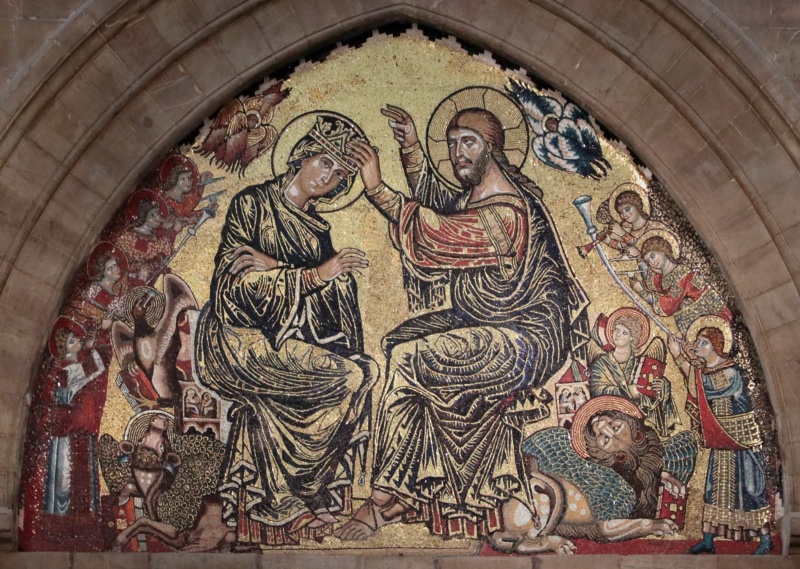
The mosaic is currently located on the counter-façade, in the large lunette above the cathedral’s main portal. Its original location may have been the façade of the ancient Basilica of Santa Reparata, the building that preceded the current cathedral. The work is executed in polychrome glass paste, silver, gold, and pigments, using the Byzantine-style mosaic technique that Gaddo Gaddi mastered with excellence, as evidenced by his work in the Basilica of Santa Maria Maggiore in Rome. The use of gold and silver lends the surface an iridescent luminosity, typical of the great medieval mosaic tradition.
At the center of the scene, on two separate thrones, sit Mary and Christ, both dressed in regal garments. The Virgin bends forward with her arms crossed in a gesture of humble submission, while the Son crowns her, simultaneously blessing her.
This compositional scheme—the double coronation and blessing in a single gesture—is iconographically significant because it unifies two distinct liturgical acts, emphasizing Mary’s heavenly kingship as Regina Coeli.
A particularly rare and notable iconographic element is the presence of the tetramorphs, that is, the four winged figures symbolizing the evangelists, arranged around the central thrones. These are the winged bull of Saint Luke, the lion of Saint Mark, the human figure of Saint Matthew, and the eagle of Saint John. As the Web Gallery of Art notes, the presence of the symbols of the Evangelists in this iconographic context of the Coronation is highly unusual, and it lends the work a theological character of exceptional depth, linking the glorification of the Virgin to the Gospel message in its entirety.
On either side of the thrones are two ranks of angelic musicians, angelic figures depicted playing wind instruments, evoking the heavenly music of Paradise. In the upper band of the composition appear two mirrored seraphim, one red and the other blue, in accordance with the iconographic tradition that distinguishes the angelic choirs by color and function. The rigorous symmetry of these elements reflects the cosmic order of the celestial hierarchy as theorized by Dionysius the Areopagite and disseminated in medieval theology.
The Coronation of Mary is a non-Gospel episode derived from the tradition of Christian faith and theology, and is chronologically situated after the moment of the Assumption into heaven. The mosaic fits into and completes the Marian cycle initiated by Arnolfo di Cambio in the outer lunettes of the ancient façade, with its sculpted stories of the Madonna. In this sense, Gaddo Gaddi’s work is not an isolated element but the narrative and theological culmination of a unified decorative program celebrating the life and glory of the Virgin, patroness of the cathedral itself. This integration of exterior sculpture and interior mosaic represents one of the earliest Florentine examples of a large-scale coordinated iconographic program, foreshadowing the grand decorative undertakings of the mature 14th century.
Madonna and Child with Saint John the Baptist, Saint Peter, and Two Angels
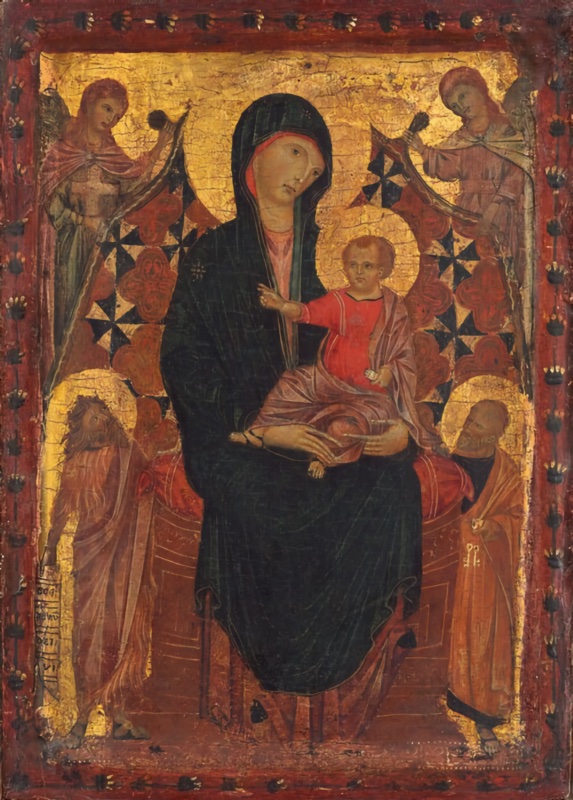
This small devotional panel, housed at the National Gallery of Art in Washington, is a valuable example of late 13th-century Florentine painting, created by an anonymous master whose identity—despite the traditional attribution to Gaddo Gaddi—remains uncertain according to the museum’s most recent studies. Its very small dimensions—the original painted surface measures 34.3 × 26 cm, with the added wooden strips bringing the total to 36 × 26 cm—clearly indicate that this is a work intended for the private devotion of a patron of modest means.
The Virgin is depicted seated on a throne, holding the Child on her left knee with both hands. The infant Christ faces the viewer, blessing with his right hand and holding a scroll of parchment in his left—an attribute that identifies him as the Logos, the Word made flesh. The composition follows the iconographic tradition of the Byzantine Hodegetria, “She Who Shows the Way,” though it reinterprets it: the Virgin does not point to her Son as in the Eastern prototype, but presents him directly to the viewer, giving priority to her affectionate maternal role over the more impersonal liturgical function.
There is also a subtle gestural reading: the Madonna seems to reposition her Son’s legs to conform them to the crossed posture typical of judges and sovereigns in the Middle Ages, symbolically anticipating his kingship. On either side of the throne stand the two figures of the titular saints. On the left, the almost wild vitality of Saint John the Baptist is rendered with immediacy and expressive liveliness, characterized by his distinctive fur garment. On the right, Saint Peter is partially hidden by the throne, in accordance with a convention widespread in Tuscany during the second half of the 13th century in which the Virgin’s seat is depicted as seen from the left rather than from the front. In the two upper corners of the panel are two winged angels, arranged symmetrically, holding the cloth of honor—the drape of honor—behind the Virgin’s throne, decorated with intertwined motifs of quatrefoils and octagons in a folk style.
The execution is rapid, almost sketchy: the artist employs a system of pictorial abbreviation for the mouths of the Virgin, Christ, and the figures on the sides, reducing them to mere dark lines at the corners. The folds of the Child’s robe exhibit an almost metallic angularity, a legacy of the Byzantine tradition that Cimabue had already begun to soften, and within whose formative orbit this anonymous master likely falls. Despite the speed of execution, the Virgin’s eyes convey a rare contemplative melancholy, evoking an awareness of her Son’s destiny. An iconographic element of considerable interest is the red-painted frame, carved directly from the wooden panel and left ungilded—a choice that reflects the patron’s financial modesty but also a sober and personal taste. The frame is adorned with a frieze of daisies linked in a chain, a motif that in medieval iconography could symbolize the blessed souls in paradise or the Incarnation of Christ, thus conferring on the frame itself a theological rather than merely decorative value.
The use of gilding is also restrained: the gold ground occupies a relatively small area, without extending to the frame elements. The work reflects the Florentine figurative culture of the late 13th century, during that transitional phase between rigid Greek-Byzantine formalism and the first naturalistic tendencies pioneered by Cimabue. The National Gallery of Art in Washington, in its most recent scholarly publications, catalogs the painting as the work of a “13th-century Tuscan Master”, without confirming the attribution to Gaddo Gaddi, father of Taddeo Gaddi. The comparison with the Hodegetria type is central to situating the work within the tradition: this iconography was introduced to the West through imports of Byzantine icons and the influence of Italo-Byzantine painters active in Tuscany between 1250 and 1300.
Madonna and Child with Two Angels
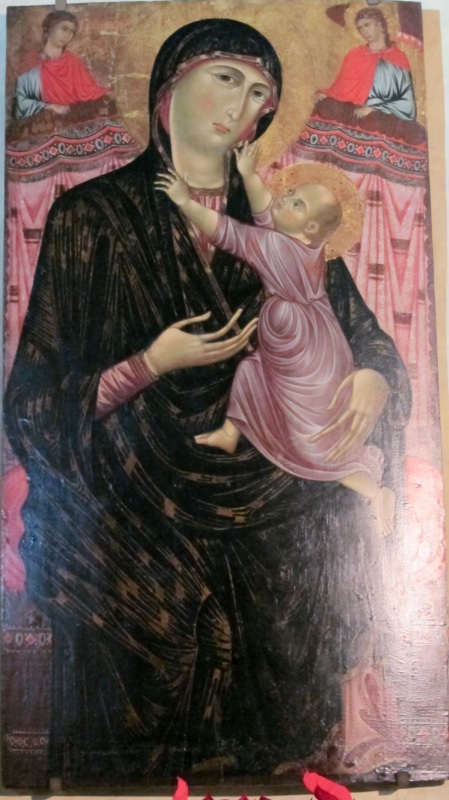
The painting immediately stands out for its large size and the fully monumental treatment of the Marian figure, which occupies almost the entire pictorial surface in a compositional approach typical of the Italo-Byzantine tradition of the late 13th century. The Virgin is seated facing forward, but her body turns slightly to the left, while her head is bowed downward with a melancholic and aware expression—a psychological gesture of profound intensity that foreshadows the dramatic awareness of her Son’s destiny.
The Madonna wears a cloak of an intense blue-black, almost raven-like, that envelops her entire figure with rigid, parallel folds creating a linear effect, markedly anti-Renaissance in their decorative abstraction. This drapery system—with light-colored lines running parallel across the abdomen and arms like golden filaments on oriental lacquer—is a direct derivation from the Byzantine-origin chrysography painting technique, in which drapery was rendered using fine lines of white lead or gold on dark backgrounds. Beneath the cloak, a powder-pink tunic with wrist decoration is glimpsed, possessing an unexpected chromatic softness that contrasts with the black of the outer cloak. The ensemble closely recalls the model of the Greek-Byzantine icons imported into Tuscany during the 13th century.
The Child is dressed in pink, in a soft robe whose drapery, though still formally rigid, reveals a search for volume already partially emancipated from purely linear schematism. Christ holds his Mother’s robe in his left hand and touches her chin with his right in a gesture of tenderness—the iconographic type known as Glykophilousa (“She Who Loves Tenderly”) or Madonna of Tenderness, widespread in the Italo-Byzantine area as an affective and human variation of the Hodegetria. The Child’s face has an adult and solemn expression, with a golden halo that still reflects the precious style of the Eastern iconographic tradition.
In the two upper corners of the composition, symmetrically positioned, are the two seated angels mentioned in the title of the work. Dressed in red and blue robes, they are depicted on a significantly smaller scale than the figure of the Virgin—a hierarchical convention typical of medieval art, in which the size of the figures expresses their ontological rank rather than their actual spatial placement. The angels seem to emerge from a pink cloth of honor—a fabric that stretches like a canopy behind the Virgin, edged with a rich ornamental decorative motif. This cloth of honor marks the sacred space of the throne and constitutes the sole environmental indicator of a scene unfolding in an abstract and timeless space.
From a stylistic point of view, the work belongs to that crucial moment when Florentine painting was still assimilating the Greek-Byzantine legacy while showing the first signs of moving beyond it.
As with many works from this period, the attribution to Gaddo Gaddi remains hypothetical. Critics have long wavered between the names of Gaddo, the Master of the Horne Triptych, and the Master of Santa Cecilia, in an attribution debate that reflects the difficulty of distinguishing artistic personalities at a time when Florence was influenced by multiple concurrent movements—those of Cimabue, Duccio, and Giotto. Federico Zeri and Miklós Boskovits have proposed that these figures overlap or coincide, identifying within the body of works attributable to this circle a stylistic coherence that could indeed point to a single leading Florentine workshop, active between the late 13th century and the first decade of the 14th century.
Christ Pantocrator
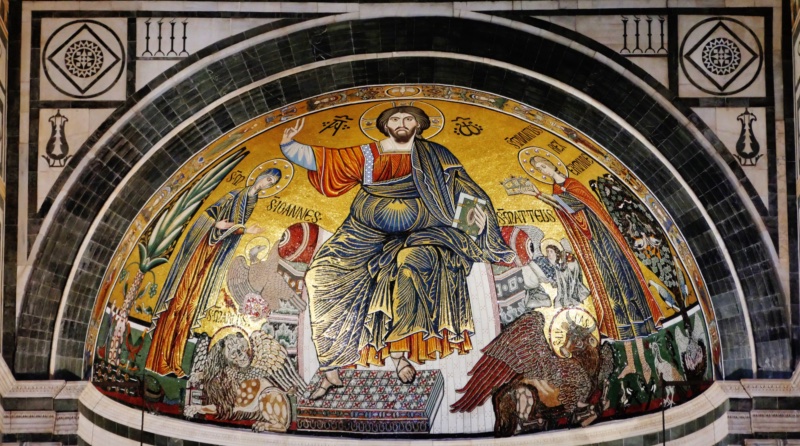
The large apse mosaic in the Basilica of San Miniato al Monte in Florence, dated 1297, is commonly associated with the name of Gaddo Gaddi (Florence, c. 1239–1312) in some of Vasari’s sources, but modern scholarship attributes it to an anonymous master, conventionally referred to as Master of San Miniato, who was likely trained in the workshop of the mosaicists of the Florentine Baptistery, pupils of Andrea Tafi. The attribution to Gaddo Gaddi remains problematic: Vasari, following his biographical tradition, assigns it to him, but documentary sources do not confirm his direct authorship.
At the center of the composition stands the Christ Pantocrator on the throne, in the typical solemn, majestic pose of Greco-Eastern origin. The figure of Christ is frontal, solemn, and occupies the vertical axis of the composition: with his right hand raised in the act of blessing according to the Greek-Byzantine rite (the fingers form the initials IC XC, Iesus Christus), while with his left he holds the Gospel, bound in green with a gold clasp, a symbol of the traditio legis. The background is entirely in gold tesserae, which creates an effect of supernatural light and abstracts the scene from any naturalistic spatial dimension.
To the left of Christ (the viewer’s right) stands the Virgin Mary, in an attitude of reverent adoration, richly draped, with a halo dotted with glass hemispheres. To the right of Christ (left of the viewer) is depicted Saint Miniato, haloed in the same manner, intent on offering the Redeemer the royal crown as the idealized King of Armenia. The names of the figures—as clearly visible in the image—are inscribed in Latin characters next to their respective figures: “S. IOANNES”, “S. MATTEUS”, and other references to the evangelists.
Arranged around Christ’s throne are the tetramorphic symbols of the four evangelists: the eagle for Saint John, the lion for Saint Mark, the angel/man for Saint Matthew, and the ox for Saint Luke. These symbols, distributed at the four corners of the composition, confer a cosmic and apocalyptic meaning on the scene, recalling Ezekiel’s Visio and the Apocalypse of John.
Within Christ’s halo is a cross whose arms are adorned with three hemispheres of glass silvered on the inside, evoking divine light. On either side of the halo stand the letters Alpha and Omega—the beginning and end of all things—in an elaborate calligraphic form, flanked by three dots symbolizing the Trinity. These elements are clearly recognizable in the image provided, visible on either side of Christ’s head. The entire space of the mosaic not occupied by the figures is filled with a symbolic garden whose vegetation alludes to Baptism and whose individual plants represent the baptized.
Among the rarest symbolic figures are: in the lower right, a male peacock with a long tail, a symbol of immortality; a phoenix spewing fire from its beak, a traditional symbol of resurrection; a pelican with outstretched wings that tears open its own throat to feed its young with its blood, a clear allusion to Christ’s redemptive sacrifice.
From a technical standpoint, the mosaic is distinguished by the use of tiny tesserae for rendering the faces—a typically Roman technique, reminiscent of Pompeian mosaics—in contrast to the large tesserae elements of the Ravenna mosaics in San Vitale. The style belongs to the tradition of the Roman masters rather than the Venetian one: the most compelling comparisons are with Filippo Rusuti (facade of Santa Maria Maggiore in Rome), Jacopo Torriti, and Pietro Cavallini, all active around 1297. The figures’ poses and garments recall the great Sicilian mosaic cycles: the Palatine Chapel in Palermo, Monreale, and Cefalù.
The mosaic has undergone numerous documented interventions over the centuries: in 1348 by a master named Zaccaria; in 1481 by Alesso Baldovinetti; by unknown artists after 1589; in 1860 by Antonio Gazzetta, a Venetian; and finally by the Opificio delle Pietre Dure in Florence in modern times. These restorations complicate the philological interpretation of the original mosaic surface, but do not alter its extraordinary overall iconographic coherence.
Stories of Saint John the Baptist
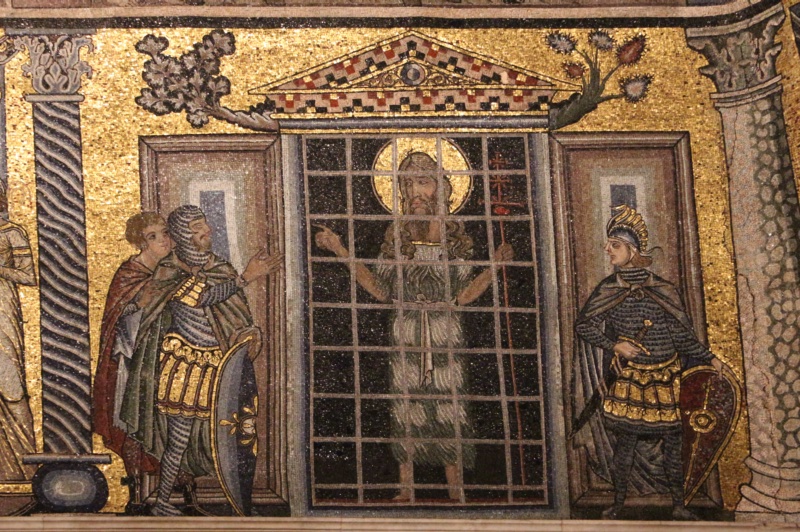
This panel belongs to the sixth and final register of the great mosaic cycle on the dome of the Baptistery of St. John in Florence, dated to between approximately 1280 and 1305, and corresponds to scene No. 9 of the narrative program: “St. John the Baptist in Prison”. The scene is part of the eastern segment of the vault, which also includes the Baptism of Christ and John’s rebuke of Herod. The execution of the sixth register is attributed to Tuscan workshops, possibly under the supervision of Deodato Orlandi and, according to Roberto Longhi, to the so-called Penultimate Master of the Baptistery, whom critics often associate with Gaddo Gaddi.
The panel is framed by an elegant architectural structure painted in mosaic that imitates a classical aedicule: two fluted columns with capitals rise on either side, supporting a triangular pediment decorated with polychrome geometric motifs in a red-white-and-black checkerboard pattern, in accordance with the canons of Florentine Gothic-Romanesque ornamental style.
At the center of the composition is an opening enclosed by a latticework grille—the prison cell—rendered with dark tiles on an almost black background, creating a striking chiaroscuro contrast against the dome’s overall golden backdrop. On either side of the small temple, elements of illusionistic architecture (openings and deep recesses) are visible, demonstrating an early sensitivity to the rendering of spatial depth, foreshadowing Giotto’s achievements. At the center of the panel, behind the prison bars, stands the solemn figure of Saint John the Baptist, recognizable by his golden halo and ascetic appearance: long, tousled hair and beard, a white garment made of camel’s hair (melote), an iconographic characteristic of the Baptist.
The saint’s hands are stretched outward through the bars in a gesture of dialogue or invocation toward the figures surrounding him. His facial expression is grave and composed, with his gaze directed toward the figures to his left. To the left of John the Baptist (the viewer’s right) stands a male figure in full military armor, with a plumed helmet and a circular shield resting on the ground—almost certainly a soldier or officer of Herod, tasked with guarding the prisoner. To the right of John the Baptist (left of the viewer) are two figures: an armored warrior pointing at the prisoner with his right hand, accompanied by a younger figure in a short tunic—probably Herod’s messengers or ministers. The armor is rendered in great detail: gilded plates, articulated vambraces, green and red military cloaks, in the style of warriors from late 13th-century iconography.
The figurative language of the panel is distinguished by its compositional complexity and a narrative liveliness that critics have described as “Baroque” in tendency compared to the severe solemnity of the upper registers. The figures are slender, with eloquent gestures and flowing drapery; the faces display an expressiveness reminiscent of the manner of Cimabue, to whose stylistic corpus the cartoons of this group are often compared. The mosaic technique employs polychrome glass paste and gold tesserae, with fine laying patterns in the faces and broader fields in the drapery.
The golden background is uniform, interrupted only by the dark prison bars and the architectural elements, which lend the composition an unusual sense of depth and narrative theatricality for the period.
The cycle of the Stories of John the Baptist is divided into fifteen scenes distributed across five segments, which are read counterclockwise starting from the northern segment. The prison scene constitutes the ninth episode and introduces the dramatic phase of the martyrdom, setting the stage for the subsequent scenes—the disciples’ mission to Christ, Salome’s dance, and the Beheading—which unfold across the next two segments. The Baptistery is dedicated to Saint John, the patron saint of Florence, and this mosaic cycle served as its most visible theological and devotional celebration for the faithful and the newly baptized.
Genesis: Creation of the World
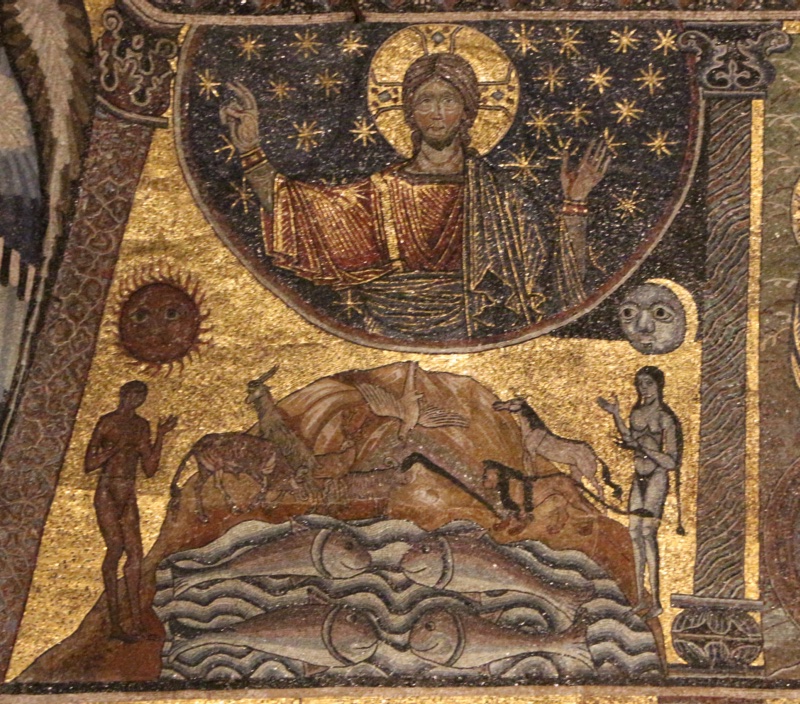
The panel belongs to the third register of the mosaic cycle on the dome of the Baptistery of San Giovanni in Florence, dated to between approximately 1270 and 1295, and is the first of the fifteen panels depicting the Stories of Genesis: “God Gives Life to Creation”. This band is the work of Tuscan artisans trained in the style of Coppo di Marcovaldo, with techniques increasingly aligned with Giotto’s formal revolution in Assisi. The attribution to the supervision of Gaddo Gaddi is traditionally supported by Vasarian historiography, although modern criticism attributes the execution to several anonymous masters.
At the top center stands the figure of the Creator, depicted not in the likeness of God the Father but in that of Christ, in accordance with medieval theology that identified the Logos—the divine Word—as the agent of Creation (John 1:3). Christ the Creator is depicted within a semicircular mandorla against a midnight blue background studded with six-pointed golden stars, in stark contrast to the surrounding gold background. His arms are outstretched in an imperious gesture of cosmic sovereignty, with his right hand raised in a blessing and his left hand extended. His robes are red and gold, his halo is cruciform, and his facial features—dark hair, short beard—echo the iconographic type of the Pantocrator of the Greco-Eastern tradition already encountered in the apse mosaic of San Miniato.
On either side of the celestial mandorla, suspended in the golden field, are depicted the Sun (to the left of the observer) and the Moon (to the right), the two great luminaries of the sky, corresponding to the fourth day of Creation (Gen 1:14–19). Both celestial bodies are anthropomorphic: the Sun has a radiant solar face, the Moon a pale and serene face with a meditative expression, in accordance with the late antique and medieval iconographic tradition of cosmological personifications. This duality—daylight and nightlight—is rendered with vibrant yellow tiles for the Sun and silvery-white ones for the Moon, creating an effective chromatic contrast.
In the lower half of the panel lies the primordial landscape of Creation: a rocky mountain ridge of ochre-bronze color emerges from the turbulent waters of the sea, rendered with stylized waves in concentric white and blue bands—a compositional motif directly derived from the early Christian mosaic tradition of Ravenna and Sicily. On the slopes of the mountain, animals can be glimpsed—probably cattle, goats, and deer—populating the dry land newly separated from the waters, corresponding to the creation of the land animals on the sixth day (Gen 1:24–25). The animal figures are rendered with a schematic yet lively naturalism, featuring coats of various colors. At the two outer edges of the panel stand, symmetrically, the nude figures of Adam (on the left) and Eve (on the right), newly created. Both are rendered with dark, slender bodies, in a classical style that reflects knowledge of ancient models, perhaps mediated through Roman cosmatus art or early Christian mosaics.
Adam stands with his arms at his sides, his face turned toward the Creator. Eve is in a mirror-image position, with a slight curve in her torso. The nudity of the first parents is not yet that of sin and shame—that will be the theme of the subsequent scenes—but the primordial nudity of paradisiacal innocence, according to Augustine’s theological interpretation, which was widely accepted in medieval culture.
The entire Genesis cycle in the Baptistery follows a precise theological logic: the story of Adam and Eve—creation, sin, expulsion—typologically foreshadows the necessity of Baptism as a cleansing from original sin, a sacrament that was administered in this very building to Florentine infants in the water of the central baptismal font. The scene of the Creation inaugurates this typological narrative, placing Christ-Logos at the apex as the beginning and end of the entire history of salvation, from the first day of the cosmos to the last day of Judgment depicted on the large opposite segment of the dome.
Genesis: the Temptation of Adam
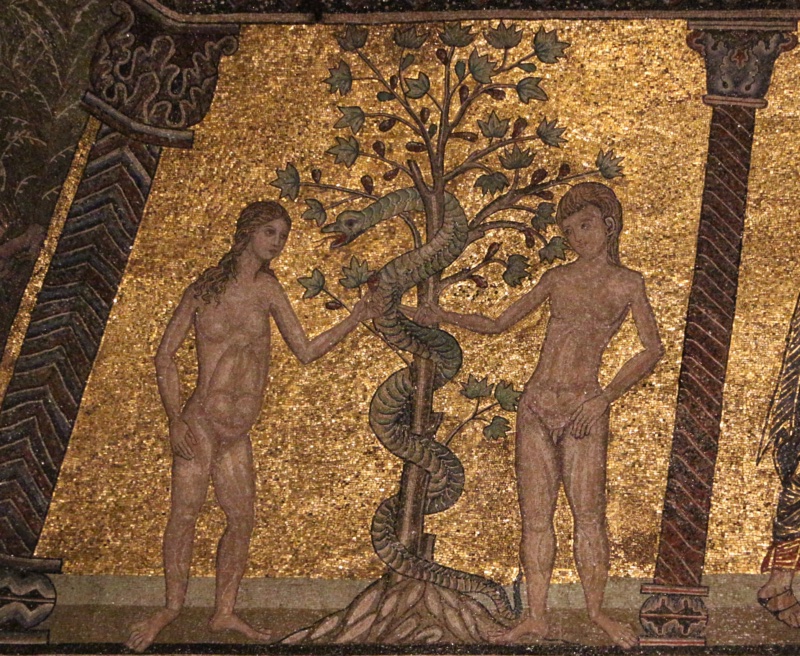
The scene depicted corresponds to the fourth panel of the mosaic cycle of the Stories of Genesis in the third register of the dome of the Baptistery of St. John in Florence, dated circa 1270–1295. It occupies the first position of the northeast segment, which also includes “God Questions the First Parents” and the “Expulsion from Eden”—the three episodes that narrate the sequence of sin, divine judgment, and exile. Like the other scenes from Genesis, it is attributed by Vasarian historiography to Gaddo Gaddi, while modern criticism attributes it to Tuscan artists associated with Cimabue’s circle who gradually adopted Giotto’s style.
At the center of the composition stands the great tree of the knowledge of good and evil, rendered with a mighty trunk and a thick, rounded canopy of green tiles in various shades. Winding around the trunk is the tempting serpent, depicted—according to a typically medieval iconographic tradition already documented in the mosaics of Monreale and Cefalù—with the sinuous body of a reptile but with a head with a human or quasi-human face, sometimes with hair, expressing the idea that the devil seduces by assuming deceptive forms. Hanging from the tree’s foliage are the forbidden fruits, clearly visible as round, dark elements. It is important to note that critics have pointed out that the tree’s foliage, Eve’s head, and the serpent’s head were redone during a later restoration, so these parts must be interpreted with philological caution.
On either side of the tree, Adam and Eve face each other, both naked, with slender, elegant bodies that recall the classical canon of the ancient nude—once again mediated through the sculptural art of French Gothic portals and the painting of Cimabue. Eve is depicted in the act of offering or receiving the forbidden fruit, with her arm extended toward the serpent or toward Adam, according to the narrative sequence of Gen 3:6. Adam is in a position of acceptance or indecision, his body slightly bent toward his companion, his face expressing an unease that foreshadows the shame to come.
The nudity of the two figures is not yet the modest nudity of the Expulsion—which in the next panel will show them covered with leaves—but that of the pre-Fall Eden, still devoid of bodily awareness. As in all the panels of the cycle, the background is entirely covered with golden tesserae, which lend the scene that meta-historical and timeless dimension characteristic of medieval sacred iconography. The figures stand out against this luminous background without any attempt to define a naturalistic space: the landscape is reduced to the central tree, the sole “natural” element, which serves as the compositional axis and as a theological symbol of moral choice. The architectural frame of the panel—twisted columns with capitals, an entablature decorated with geometric motifs—organizes the scene within the sequential narrative system of the vault, which can be read as a veritable illustrated Bible.
Within the iconographic scheme of the Baptistery, this scene plays a theologically central role: the sin of Adam and Eve is the primary cause for which the Sacrament of Baptism is necessary. The original contamination transmitted from generation to generation—the peccatum originatum of Augustinian theology—is visually depicted in this panel as a breaking point in the history of salvation, to which the Baptism administered in the pool below constitutes the redemptive response. The sequence Creation → Sin → Expulsion → Baptism thus constitutes the theological core of the entire building.
Genesis: God’s Rebuke
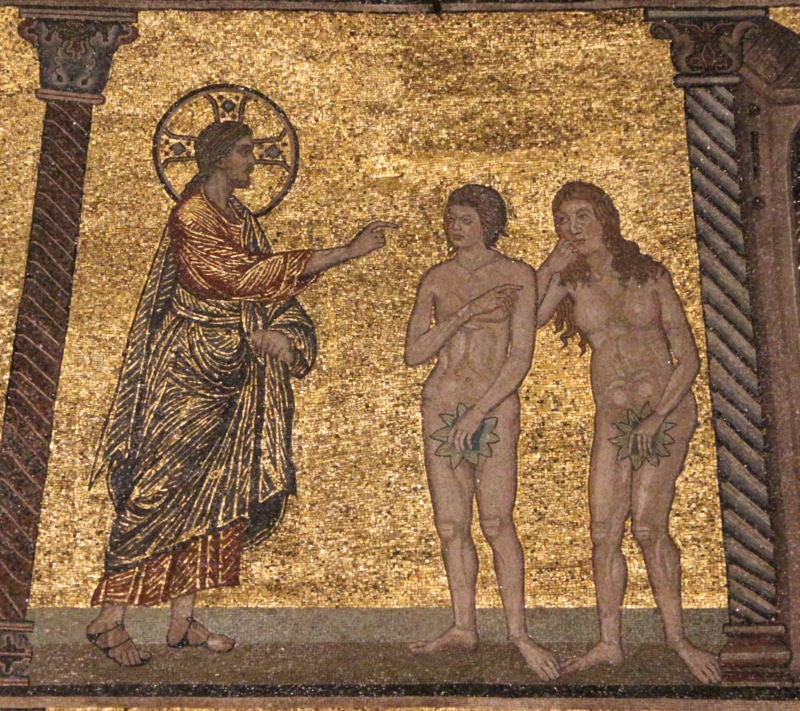
The scene of God’s Rebuke (God Questions the First Parents) is the fifth panel of the third register of the mosaic cycle depicting the Stories of Genesis on the dome of the Baptistery of St. John in Florence, dated circa 1270–1295. It is located in the northeast segment, at the center of the tripartite sequence comprising The Sin of the First Parents (no. 4), God’s Rebuke (no. 5), and The Expulsion from Eden (no. 6), which constitutes the narrative and theological core of the Fall of Man. Like the adjacent scenes, it is traditionally attributed, following Vasari, to the circle of Gaddo Gaddi and Tuscan artists working in the style of Coppo di Marcovaldo; the title assigned to the panel by the Cultural Heritage database and Wikimedia Sailko is “God’s Rebuke, attributed to Gaddo Gaddi, with restorations”, indicating that the current surface includes later alterations.
The subject is taken from Gen 3:9–19, the dramatic dialogue in which God calls out to Adam, who has hidden among the trees of Eden, questions him about the sin he has committed, then calls out to Eve and questions her as well, and finally condemns the serpent, the woman, and the man with the famous pronouncements: the woman shall bear children in pain, the man shall earn his bread by the sweat of his brow, and the serpent shall crawl on its belly. This episode represents the moment of judgment—the realization of sin and its divine punishment—which narratively interposes itself between the factum of sin (no. 4) and its executive consequence (the Expulsion, no. 6).
In the composition, the Dio-Cristo—still identified, according to Logos theology, with the likeness of Christ, as in the panel of the Creation—is depicted in a central position or slightly off-center to the left, standing or half-rising, with his right arm raised in an imperious gesture of accusation and interrogation toward the first parents. The divine figure is haloed and clad in regal robes; his body maintains the hieratic composure of the Greco-Oriental tradition, even when expressing a narrative action, avoiding any abandonment to the naturalistic gesture that would instead be characteristic of mature fourteenth-century art. The hand extended toward Adam and Eve constitutes the compositional pivot of the entire scene.
The figures of Adam and Eve appear for the first time in this cycle with their bodies partially covered by intertwined fig leaves—the perizomata of Gen 3:7, the leaf belts that the first parents sewed for themselves after becoming aware of their nakedness. This iconographic detail is of extraordinary significance: the original nakedness of innocence (present in the panel of the Creation) has been transformed into the nakedness of shame, and the vegetal covering of the body is the visual sign of that inner transformation. Adam points to the serpent or to Eve in a gesture of shifting blame (“the woman whom you put here with me—she gave me the fruit”, Gen 3:12); Eve leans her body downward or points to the serpent in turn (“the serpent deceived me”, Gen 3:13). The gestures of the two progenitors faithfully reproduce the sequence of the biblical text.
The panel explicitly bears the notation “with restorations” in its museum label, indicating that significant portions of the mosaic surface were redone at a later date than the original execution. Modern scholarship has identified interventions attributable to Alesso Baldovinetti (c. 1481), the same restorer who also worked on the mosaic at San Miniato al Monte, and to nineteenth-century craftsmen. This makes the stylistic interpretation of the scene particularly delicate: the criteria for attributing it to Gaddo Gaddi or his circle apply primarily to the parts that were not redone—namely, the architectural borders, the garments and drapery, and the overall compositional structure—while faces and complexions may reflect the sensibilities of later periods.
Within the Baptistery’s overall theological program, the Rebuke of God occupies the position of a dramatic hinge: it is the moment when sin is recognized, judged, and punished, transforming the human condition from one of paradisiacal innocence to one of hereditary guilt. For the faithful entering the building for baptism, this scene visually and immediately declared the necessity of the sacrament: if Adam and Eve, under divine rebuke, showed signs of shame and guilt, the baptismal washing in the water of the central basin promised the erasure of that very guilt and the symbolic return to original innocence.