Coppo di Marcovaldo
Coppo di Marcovaldo was born in Florence around 1225, most likely in the second or third decade of the thirteenth century, in the parish of San Lorenzo, a district in the heart of the Tuscan city that was already establishing itself as a significant artistic center. The exact date of his birth remains undocumented, as is common for artists of this period, though archival evidence places his active artistic career firmly within the third quarter of the thirteenth century.
His emergence as a painter occurred during a pivotal moment in Italian art history, when the rigid formalism of Romanesque tradition was gradually yielding to the more expressive possibilities of Byzantine-influenced painting. Florence during this period was experiencing significant political turmoil, divided between Guelph and Ghibelline factions, a conflict that would profoundly affect Coppo’s life and career. The artist’s death is believed to have occurred around 1276, though like his birth, the precise date and cause remain elusive in historical records.
The last documentary reference to Coppo dates from January 1276, relating to payment for a ceiling decoration he had executed above the choir of Pistoia Cathedral, indicating he was still actively working in the final year of his life. It is generally believed that Coppo spent his final days in Pistoia, where he had established a productive working relationship with the cathedral authorities and had been residing since at least 1265. His death around 1276 would have occurred when he was approximately fifty years old, having achieved considerable recognition as one of the foremost painters of the Florentine Duecento.
The absence of detailed records concerning his death reflects the limited documentation practices of the period, particularly for artists who had not yet achieved the legendary status that later Renaissance masters would enjoy. Nevertheless, Coppo di Marcovaldo stands as one of the first Florentine artists whose name and works are well documented, marking an important transition in the preservation of artistic identity.
Family Background and Lineage
The documentation concerning Coppo di Marcovaldo’s family background remains fragmentary, though the patronymic “di Marcovaldo” clearly indicates that his father bore the name Marcovaldo, a common practice in thirteenth-century Florentine nomenclature. The family appears to have been established in the San Lorenzo district of Florence, an area that housed numerous artisan families and was characterized by a vibrant commercial and artistic community. While specific details about Coppo’s parents, siblings, or extended family remain absent from surviving records, the fact that he was identified as a property owner in the San Lorenzo parish by 1265 suggests a family of respectable social standing.
The Marcovaldo family does not appear among the great noble houses of Florence, indicating that Coppo likely emerged from the artisan or merchant class that was increasingly gaining prominence in the communal society of thirteenth-century Tuscany. The profession of Coppo’s father Marcovaldo remains unknown, though the son’s adoption of the painter’s craft suggests possible familial connections to artistic or artisan trades. Evidence of property ownership in Florence demonstrates that the family possessed sufficient resources to maintain urban real estate, distinguishing them from the poorest classes of medieval society.
The family’s residence in San Lorenzo positioned them within one of Florence’s most dynamic neighborhoods, where proximity to the great Basilica of San Lorenzo would have provided exposure to significant religious art and architectural projects. No records survive indicating whether Coppo had brothers or sisters, though such siblings would have been typical for families of this period and social status. The establishment of the Marcovaldo family in Florence prior to Coppo’s birth suggests they were not recent immigrants but rather established Florentine citizens with roots in the urban community. This familial stability and urban identity would have been crucial for Coppo’s development as an artist and his integration into the professional networks that sustained artistic production in medieval Florence.
The most significant family relationship documented in Coppo’s life concerns his son Salerno di Coppo, who followed his father into the painting profession and collaborated with him on at least one major commission. Salerno’s emergence as a documented artist occurs in 1274, when he is mentioned alongside his father in connection with work for Pistoia Cathedral, specifically a large crucifix and associated panels. The collaborative nature of this commission reveals the workshop practice common in medieval artistic production, where fathers trained their sons in the craft and worked alongside them on major projects. An intriguing document from October 1274 provides a rare glimpse into the personal circumstances of this father-son partnership, recording that Salerno had been imprisoned for violating some unspecified law while working on the cathedral commission.
The cathedral authorities, recognizing the importance of completing the commissioned work, petitioned the civic officials for Salerno’s release, offering to post bail on his behalf. This intervention demonstrates both the value placed on the collaborative work of Coppo and Salerno and the extent to which the completion of the commission depended on the son’s participation. The fact that ecclesiastical and cathedral officials specifically requested Salerno’s release suggests he had already established a reputation for skill that made his contribution indispensable. The document implies that the bail money advanced by the cathedral patrons would be repaid from Salerno’s share of the commission fee, once the work was completed and payment received. This episode reveals the economic dependencies and practical constraints that governed artistic production in the thirteenth century, where even the incarceration of a single workshop member could jeopardize major projects. The successful completion of the Pistoia Crucifix, which remains in the cathedral to this day, testifies to Salerno’s release and the continuation of the father-son collaboration.
The collaboration between Coppo and Salerno on the 1274 Pistoia commission provides valuable insight into the structure of the family workshop and the transmission of artistic knowledge across generations. Medieval painting workshops typically functioned as family enterprises, where skills, techniques, and professional contacts passed from father to son through years of apprenticeship and collaborative practice. Salerno’s documented involvement in the Pistoia Crucifix suggests he had reached sufficient maturity and competence by 1274 to be considered a full collaborator rather than merely an apprentice assistant.
The specific division of labor on the crucifix has been the subject of considerable scholarly debate, with most art historians attributing the painted figure of Christ to Salerno while assigning the small narrative scenes of the Passion to Coppo himself. This distribution of tasks reflects a common workshop arrangement whereby the master painter executed the most technically demanding or compositionally complex elements while allowing the younger artist to demonstrate his skills on the principal figure. The distinct stylistic differences observable between the Christ figure and the Passion scenes support the interpretation of dual authorship, revealing Salerno’s developing personal style alongside his father’s more established manner.
Some scholars have suggested that the softer modeling and more sophisticated chromatic range evident in Christ’s figure demonstrate Salerno’s exposure to more recent artistic developments, possibly reflecting the emerging influence of Cimabue and younger Florentine painters. The fact that Coppo entrusted the central figure of the crucifix to his son indicates confidence in Salerno’s abilities and suggests a deliberate strategy of professional advancement for the younger artist. This father-son workshop collaboration exemplifies the mechanisms through which artistic innovation was transmitted and modified across generations in medieval Italy. Beyond the 1274 crucifix, no other documented collaborations between Coppo and Salerno survive, though it seems probable that they worked together on other projects that have been lost or remain unidentified.
The documentary references to Coppo’s property holdings in Florence provide evidence of his family’s economic circumstances and social position within the urban community. The October 1265 document mentioning Coppo’s house in the parish of San Lorenzo indicates that he maintained a residence in his native city even while working on commissions in Siena and Pistoia. Property ownership in medieval Florence conferred not only economic security but also civic status, as property holders enjoyed specific legal rights and social recognition. The fact that Coppo could maintain a household in Florence while pursuing commissions in other Tuscan cities suggests a level of prosperity that allowed for this geographical flexibility.
Whether Coppo was married and whether Salerno had siblings remain questions unanswered by surviving documentation, though a wife and possibly other children would be consistent with social norms for a man of Coppo’s age and status. The absence of references to other family members in the documents may simply reflect the routine nature of such relationships, which would only be mentioned in official records under specific legal or financial circumstances. Coppo’s ability to establish working relationships in multiple cities and to secure major ecclesiastical commissions indicates that his family enjoyed sufficient social capital to facilitate these professional connections.
The education and training required to become a successful painter of altarpieces and major religious works presupposes a family background that valued and could afford to support artistic apprenticeship. The professional success achieved by both Coppo and his son Salerno suggests a family culture that prized artistic skill and maintained the networks necessary for securing lucrative commissions. These economic and social circumstances position the Marcovaldo family firmly within the rising artisan class that was transforming the social and political landscape of thirteenth-century Florence.
The transmission of artistic practice from Coppo to his son Salerno represents a microcosm of the broader mechanisms through which artistic traditions were preserved and evolved in medieval Italy. While Salerno di Coppo never achieved the prominence of his father, his documented participation in the Pistoia Cathedral commission demonstrates that he acquired sufficient skill to contribute to major projects. The critical assessment of Salerno’s contribution to the 1274 crucifix reveals an artist capable of executing the central figure with technical competence, though perhaps lacking the expressive intensity and dramatic power characteristic of Coppo’s own work. After Coppo’s death around 1276, the fate of the family workshop and Salerno’s subsequent career remain obscure, with no further documents clearly identifying his independent artistic activity.
This absence might indicate that Salerno did not continue working as a painter after his father’s death, or alternatively that his works have not been identified or have been lost. The collaborative model represented by the Coppo-Salerno partnership would become increasingly common in subsequent generations, as family workshops became the dominant organizational structure for artistic production in Renaissance Italy. The investment of time and resources required to train Salerno in the complex techniques of panel painting, gilding, and tempera work represents a significant commitment to preserving family expertise and economic opportunity. The specific technical knowledge transmitted from father to son would have included not only painting skills but also the practical business knowledge necessary for negotiating contracts, acquiring materials, and managing client relationships. In this sense, the family workshop functioned as an integrated economic and artistic unit, combining creative practice with commercial enterprise. The Marcovaldo family’s contribution to Florentine painting, though concentrated in the third quarter of the thirteenth century, formed part of the foundation upon which the great achievements of later Florentine art would be built.
The professional networks that supported Coppo’s artistic career were likely facilitated by family connections and associations that extended beyond the immediate father-son relationship with Salerno. Medieval artists typically relied on extended kinship networks to secure commissions, acquire materials, and establish the credit relationships necessary for undertaking major projects. The fact that Coppo worked in multiple Tuscan cities—Florence, Siena, Pistoia, and possibly Orvieto—suggests a network of contacts that may have included family members established in these various locations. His documented presence in Siena as a prisoner of war in 1261 transformed into a productive artistic relationship with the Servite order, possibly facilitated by intermediaries who recognized his artistic abilities. The subsequent move to Pistoia by 1265 and the establishment of a long-term working relationship with the cathedral there may have been enabled by family or professional connections in that city.
The ability to maintain a residence in Florence while working primarily in Pistoia implies either family members managing the Florentine property or sufficient resources to maintain both establishments. The absence of documented conflicts or legal disputes involving Coppo (unlike his son Salerno’s imprisonment) suggests that the family enjoyed good standing within the communities where they worked. This social capital would have been crucial for securing the trust of ecclesiastical patrons who commissioned expensive altarpieces and decorative programs. The involvement of “prete Insalato di Iacopo” as an assistant to Coppo on the 1265 and 1269 Pistoia Cathedral chapel frescoes suggests that the workshop incorporated associates who were not family members. Such expanded workshop arrangements allowed for the completion of large-scale projects while potentially training additional artists who might later establish independent careers.
While specific details of Coppo’s domestic life remain undocumented, the economic evidence provided by payment records and property references allows for reasonable inferences about the family’s material circumstances. The documented payments for various commissions—32 lire for chapel frescoes in 1265, 30 soldi for gilding work, and the ongoing payments for the 1274-1276 ceiling decoration—indicate a steady income from artistic work. These fees, while substantial for the period, also reveal the protracted payment schedules typical of major ecclesiastical commissions, with the final payment for the 1274 work still outstanding in January 1276. Such delayed payments meant that artist families needed either independent resources or credit networks to sustain themselves during the execution of long-term projects.
The maintenance of a house in Florence while working primarily in Pistoia would have required careful financial management and suggests that Coppo’s earnings were sufficient to support multiple residences. The fact that cathedral authorities in Pistoia were willing to advance bail money for Salerno’s release indicates that the Marcovaldo family workshop was valued and trusted by their patrons. This financial relationship demonstrates a level of mutual dependency between artist and patron that characterized medieval artistic production. The property in the San Lorenzo parish would have served not only as a residence but potentially as a workshop space where materials were stored, panels prepared, and smaller works executed. The economic viability of maintaining such an establishment in one of Florence’s central districts indicates that painting was providing the Marcovaldo family with a comfortable, if not wealthy, existence. These material circumstances allowed for the training of Salerno and possibly other workshop members, requiring both space for instruction and the financial capacity to support apprentices during their learning period.
The nature of Coppo’s documented commissions reveals a pattern of engagement with religious institutions that may have been facilitated by family connections or affiliations. The major patrons documented in Coppo’s career—the Servite order in Siena, the cathedral chapter in Pistoia, and possibly Franciscan institutions in Florence—represent the principal types of ecclesiastical organizations that commissioned religious art in thirteenth-century Tuscany. The Servite connection is particularly significant, as the commission for the Madonna del Bordone in 1261 established a relationship with a relatively new religious order that was actively building its institutional presence in Siena. Whether this commission resulted purely from circumstantial factors—Coppo’s presence in Siena as a prisoner—or involved pre-existing connections between the Marcovaldo family and the Servite order remains unclear.
The subsequent work for Pistoia Cathedral beginning in 1265 suggests either that Coppo’s Sienese work had established his reputation, or that family networks facilitated his introduction to the cathedral authorities. The attribution to Coppo of the altarpiece depicting Saint Francis and twenty scenes from his life, currently in the Bardi Chapel of Santa Croce in Florence, would place him in connection with the Franciscan community of that great Florentine church. If this attribution is correct, it would suggest family ties or associations with the Franciscan order, one of the most influential religious movements of the thirteenth century. The capacity to work for different religious orders—Servites, Franciscans, and the secular cathedral clergy—indicates a flexibility and breadth of connections that served the family’s economic interests. These ecclesiastical relationships would have provided not only immediate commissions but also the potential for ongoing work and recommendations to other institutions. The trust placed in Coppo by these various religious patrons reflects both his artistic skill and the social legitimacy of his family within the Christian community of medieval Tuscany.
The preservation of Coppo’s name and artistic legacy across subsequent centuries depended partly on family memory and partly on the institutional memory of the religious communities that housed his works. Unlike many contemporary artists whose names were entirely forgotten, Coppo di Marcovaldo’s identity was preserved through the signed and dated Madonna del Bordone and through documentary references to his work in Pistoia. The signature on the Madonna del Bordone—”A.D.M.CC.LXI. COPP.D. FLORETIA MEPIX” (In the year 1261, Coppo of Florence painted me)—represents a rare assertion of artistic identity for this period.
This inscription, though hidden beneath an added frame from the seventeenth century until its rediscovery during restoration, ultimately allowed scholars to reconstruct Coppo’s career and attribute other works to his hand. The confusion that arose during the eighteenth century, when the Madonna del Bordone was incorrectly attributed to Dietisalvi di Speme, demonstrates how easily artistic memory could be lost when family traditions no longer maintained knowledge of authorship. Local Sienese historians in the nineteenth century, consulting seventeenth-century sources that still remembered the painting’s attribution to Coppo, were able to restore the correct identification.
This recovery of Coppo’s name and works represents a broader nineteenth-century scholarly project of reconstructing medieval and early Renaissance artistic history. The absence of family descendants maintaining traditions about Coppo’s work meant that modern knowledge of the artist depends entirely on archival documentation and stylistic analysis. The Marcovaldo family name, carried forward through Coppo and Salerno, survives primarily through these works of art rather than through any continuing family line. This transformation from family identity to historical artistic identity reflects the broader process through which medieval artists transitioned from anonymous craftsmen to recognized creative individuals worthy of biographical remembrance.
Patronage Networks and the Servite Commission
The patronage relationships that shaped Coppo di Marcovaldo’s career reflect the complex social, political, and religious dynamics of thirteenth-century Tuscany. The first documented commission, and the only work that survives with certain attribution, is the Madonna del Bordone painted for the Servite church of Santa Maria dei Servi in Siena in 1261. The circumstances surrounding this commission are exceptional, as Coppo executed the work while held prisoner in Siena following the Battle of Montaperti in September 1260, apparently using the painting as a form of ransom payment. This unusual arrangement reveals both the value placed on artistic skill in medieval society and the practical flexibility with which captives and captors could negotiate terms of release.
The Servite order, formally known as the Ordo Servorum Mariae (Order of Servants of Mary), had been founded in Florence in the 1230s and was experiencing rapid expansion during the mid-thirteenth century. Their church in Siena, for which Coppo painted the Madonna del Bordone, represented a significant institutional presence in a city where the cult of the Virgin Mary held particular importance. The subject matter of the painting, the enthroned Madonna and Child with flanking angels, perfectly suited Servite devotional emphasis on the Virgin, establishing a visual focus for liturgical celebration and popular veneration. The size of the panel, approximately 220 cm by 125 cm (roughly 7 feet by 4 feet), makes it one of the largest altarpieces of its date, demonstrating the Servites’ commitment to creating an impressive devotional image. The commissioning of such a major work from a prisoner of war suggests either that the Servites recognized Coppo’s existing reputation as a painter or that he successfully demonstrated his abilities after capture. The successful completion of the Madonna del Bordone in 1261 established a masterpiece that would influence Sienese painting for subsequent decades, making this commission pivotal both for Coppo’s career and for the broader development of Tuscan art.
Following his Sienese commission, Coppo established a sustained relationship with the cathedral of Saints Zeno and James (Santi Zeno e Jacopo) in Pistoia, where he worked intermittently from 1265 until at least 1276. The first documented payment, dated July 1265, compensated Coppo with 32 lire for frescoes on the west wall of the Chapel of Saint James within the cathedral. This was followed in 1269 by additional payment of 30 soldi for gilding work and for frescoes on the south wall of the same chapel, executed with the assistance of “prete Insalato di Iacopo,” a priest whose role as artistic collaborator is otherwise undocumented.
The Chapel of Saint James housed the cathedral’s most precious relic, the arm of Saint James the Greater, making it a site of pilgrimage and an appropriate location for prestigious artistic decoration. The involvement of cathedral authorities as patrons reflects the institutional structure of medieval ecclesiastical commissioning, where the chapter of canons administered the cathedral’s finances and determined expenditures for decoration and furnishing. The decision to employ Coppo for this important decorative program indicates that his reputation, enhanced by the Madonna del Bordone, had reached Pistoia and convinced the cathedral chapter of his suitability for this sacred commission. Unfortunately, the frescoes Coppo executed in the Chapel of Saint James have been lost, preventing direct assessment of his fresco technique and how it might have differed from his panel painting style. The fragmented nature of the payment records—with specific amounts for different walls and for gilding—reveals the piecemeal manner in which complex decorative programs were executed and compensated during this period. The fact that Coppo returned to work in Pistoia in 1269, four years after his initial commission, suggests that the cathedral authorities were satisfied with his work and maintained an ongoing professional relationship with the artist. This pattern of sustained patronage from a single institution provided economic stability and allowed Coppo to establish a workshop presence in Pistoia while maintaining connections to Florence.
The most extensively documented commission in Coppo’s career is the complex of works ordered by Pistoia Cathedral in 1274, which involved the collaboration of Coppo and his son Salerno. The documents specify that the commission included a large crucifix, two panel paintings depicting the Virgin Mary and Saint John, and a decorated ceiling or “solaio” above the choir. This multi-component commission demonstrates the cathedral chapter’s confidence in Coppo and their willingness to entrust him with a comprehensive decorative program involving several distinct works. The crucifix was intended to be placed on the tramezzo or rood screen, the architectural barrier separating the choir from the nave, a position of great liturgical and visual significance.
The panels of the Virgin and Saint John were to flank the crucifix, creating the traditional composition of the Crucifixion with mourners, a grouping that emphasized the emotional and theological dimensions of Christ’s sacrifice. The remarkable episode of Salerno’s imprisonment during the execution of this commission, and the cathedral authorities’ intervention to secure his release, reveals the extent to which the patrons had invested in the successful completion of these works. The willingness of the archpriest, canons, and lay administrators (operai) of the cathedral to post bail for Salerno demonstrates their practical commitment to the project and their recognition that the collaboration of both painters was necessary.
The condition that Salerno’s debt would be repaid from his earnings on the commission created a financial structure that bound the artist to complete the work while providing the cathedral with assurance of eventual cost recovery. This arrangement exemplifies the complex contractual and financial relationships that governed medieval artistic patronage, where legal obligations, personal trust, and institutional oversight intersected. The documents referring to these works as “opus magnum” (great work) reflect the patrons’ understanding of the commission’s significance and their expectations for quality and impact. The protracted payment schedule, with accounts still unsettled in January 1276, was typical of large commissions and required patrons and artists to maintain financial relationships over extended periods.
The relationship between Coppo and his ecclesiastical patrons reveals the balance of artistic authority and patron control that characterized religious commissioning in the thirteenth century. Unlike later Renaissance contracts that sometimes specified precise iconographic details, the documents relating to Coppo’s commissions generally describe only the subject matter and size of works, apparently leaving compositional and stylistic decisions to the artist. This delegation of artistic authority suggests that patrons valued the painter’s expertise and trusted his judgment in rendering appropriate devotional images. The choice to employ Coppo specifically, rather than another available painter, indicates that cathedral authorities and religious orders recognized distinct artistic qualities in his work that suited their institutional needs.
The dramatic intensity and monumental scale characteristic of Coppo’s style particularly suited the requirements of large public spaces where altarpieces and crucifixes needed to command attention and inspire devotion. The Byzantine-influenced modeling and emotional expressiveness of Coppo’s figures aligned with contemporary trends in religious art that emphasized the humanity and suffering of Christ and the compassionate intercession of the Virgin. Patrons commissioning works for specific chapels or altars had particular devotional or political motivations that influenced their choice of subject and artist. The Servite order’s emphasis on Marian devotion made the Madonna del Bordone an ideal expression of their spiritual charism, while the cathedral of Pistoia’s possession of the arm of Saint James necessitated appropriately dignified artistic decoration of the chapel housing this relic. The institutional memory of religious communities meant that successful commissions could lead to ongoing relationships, as demonstrated by Coppo’s repeated employment in Pistoia over more than a decade. These patronage relationships provided not only economic support but also the social framework within which artistic innovation could occur, as painters responded to patron expectations while developing new compositional and expressive possibilities.
Beyond the well-documented ecclesiastical commissions, Coppo’s career likely involved patronage relationships with civic authorities and private individuals, though these are less thoroughly documented. The attribution to Coppo of the altarpiece depicting Saint Michael and scenes from his legend, originally from the church of Sant’Angelo a Vico l’Abate near Florence and now in the museum of San Casciano in Val di Pesa, suggests patronage from a rural religious community. This work, if correctly attributed, would demonstrate Coppo’s involvement with smaller, less wealthy ecclesiastical institutions beyond the major urban churches and cathedrals. The Bardi Chapel altarpiece in Santa Croce, Florence, depicting Saint Francis and twenty scenes from his life, was possibly commissioned by the Tedaldi family before passing to the Bardi family’s patronage by 1595.
If this attribution to Coppo is accepted, it would represent an example of private family patronage of a major altarpiece, though still destined for a religious setting. Wealthy Florentine families frequently established chapels in the city’s great mendicant churches, using artistic patronage to display piety, commemorate ancestors, and assert social status. The choice of Saint Francis as subject matter reflected the enormous popularity of the Franciscan order and the cult of its founder, making such altarpieces both devotionally appropriate and socially prestigious. The inclusion of twenty narrative scenes from Francis’s life represents one of the most complete early pictorial biographies of the saint, suggesting a patron with significant resources and a detailed knowledge of Franciscan hagiography. The civic dimension of artistic patronage in thirteenth-century Tuscany is suggested by Coppo’s probable participation in the mosaic decoration of Florence’s Baptistery of San Giovanni, a project that engaged the city’s most important artistic talents. The Arte di Calimala, the guild of cloth merchants, financed much of the baptistery’s decoration and thus functioned as a collective civic patron, channeling merchant wealth into religious art that enhanced the city’s prestige. This form of corporate patronage differed from individual or institutional commissioning, involving committee decisions and representing the collective aspirations of Florence’s commercial elite.
The economic relationships between Coppo and his patrons provide insight into the material conditions of artistic production in thirteenth-century Italy. The documented payment of 32 lire for the 1265 Pistoia fresco work, while substantial, must be understood within the complex monetary and economic systems of medieval Tuscany. Such payments were rarely made in full upon completion but instead were disbursed in installments as work progressed, requiring artists to have sufficient capital or credit to purchase materials and sustain themselves during execution. The additional payment of 30 soldi for gilding work indicates that special decorative elements might be compensated separately from the basic painting, reflecting the higher cost of gold leaf and the specialized skill required to apply it. The protracted payment schedule for the 1274-1276 cathedral works, with accounts still unsettled more than a year after the commission began, illustrates the extended financial relationships that characterized major artistic projects.
Delays in payment might result from the patron institution’s own financial constraints, as cathedral treasuries depended on unpredictable revenues from donations, tithes, and agricultural properties. Artists needed to balance multiple concurrent or overlapping commissions to maintain steady income, which helps explain Coppo’s simultaneous connections to Pistoia and Florence. The value of artistic works in this period derived not only from the painter’s labor but significantly from the cost of materials—wooden panels, pigments, gold leaf, and other supplies represented substantial investments. Contracts sometimes specified whether the artist or patron would supply materials, a distinction that significantly affected the economics of the commission and the final payment to the artist. The arrangement whereby Salerno’s bail money would be repaid from his share of the commission fee reveals how artistic earnings could be assigned or pledged as security for debts, integrating artistic production into broader credit networks.
The pattern of Coppo’s documented commissions reveals how artistic reputation developed and circulated in medieval Italy, creating patronage opportunities across different cities and institutions. The Madonna del Bordone’s completion in 1261 apparently established Coppo’s credentials sufficiently to attract the attention of the Pistoia cathedral authorities by 1265. This suggests that news of artistic achievement traveled through networks connecting religious institutions, possibly carried by clergy who moved between cities or through the observations of travelers and pilgrims. The decision to employ a Florentine painter in Pistoia rather than utilizing local artistic talent indicates that cathedral authorities valued the distinctive qualities of Coppo’s style over considerations of local loyalty or convenience. This preference for imported artistic expertise would become increasingly common in subsequent centuries as patrons sought the prestige associated with employing renowned artists. The sustained relationship with Pistoia over more than a decade suggests that patrons who experienced satisfactory results from an initial commission developed loyalty to particular artists.
The attribution to Coppo of works in different Tuscan locations—Florence, Siena, Pistoia, Orvieto, San Gimignano, and Vico l’Abate—implies a reputation that extended throughout the region and attracted diverse patrons. Whether Coppo actively sought commissions through travel and self-promotion or whether his reputation attracted patrons who approached him remains unclear from the documentary evidence. The involvement of intermediaries—perhaps clergy, merchants, or other artists—in connecting painters with potential patrons was probably common, though such informal networks rarely generated the written records that would document them. The evolution from local painter to regionally recognized artist represented a significant professional achievement and required not only artistic skill but also the social competence to negotiate with diverse patrons and satisfy varying institutional requirements.
The specific demands and expectations of Coppo’s patrons influenced the development of his artistic style and the subjects he depicted. The Servite commission for a Madonna and Child reflected that order’s particular devotion to the Virgin Mary and required an image suitable for liturgical veneration and popular devotion. The monumental scale and frontal presentation of the Madonna del Bordone respond to these devotional requirements, creating an image that commands attention and invites prayerful contemplation. The cathedral commissions in Pistoia, involving both frescoes and panel paintings, required Coppo to work in different media and scales, potentially expanding his technical repertoire. The narrative scenes in attributed works like the Saint Francis altarpiece demanded different compositional skills than the single iconic images of Madonnas or crucifixes, requiring the artist to develop sequential storytelling techniques. Patron preferences for particular iconographic details—specific saints, narrative episodes, or symbolic elements—would have been communicated to the artist and incorporated into the final composition.
The increasing emphasis on emotional expressiveness in religious art during the thirteenth century aligned with evolving devotional practices that emphasized affective piety and personal identification with Christ’s suffering. Coppo’s characteristic dramatic intensity and powerful chiaroscuro modeling responded to these cultural shifts while also shaping patron expectations for how religious subjects should be depicted. The competitive environment among painters seeking prestigious commissions encouraged artistic innovation as painters developed distinctive styles that would attract patron attention. The success of particular works in generating additional commissions created a feedback loop whereby patrons sought to replicate the devotional or aesthetic effects they had observed in other institutions. This mechanism of artistic dissemination through patron networks helps explain the regional spread of stylistic influences and the gradual evolution of painting traditions across thirteenth-century Tuscany.
The fragmentary nature of surviving documentation means that many patronage relationships in Coppo’s career remain unknown or can only be inferred from attributed works. Contemporary seventeenth-century descriptions by Cesare Fioravanti and other local historians record several works by Coppo in Pistoia that have since been lost, including a large Madonna with narrative scenes around the central image that was located on the high altar of the cathedral. These lost works represent commissions that were significant enough to be remembered centuries later but which fell victim to changing tastes, natural deterioration, or deliberate replacement with more modern art. The frescoes Coppo executed in the Chapel of Saint James in Pistoia Cathedral, documented in the 1265 and 1269 payment records, have entirely disappeared, leaving no trace of what may have been extensive narrative or decorative programs. The panels of the Virgin Mary and Saint John that were supposed to flank the crucifix on the Pistoia Cathedral rood screen, mentioned in the 1274 documents, are also lost, preventing reconstruction of the complete ensemble.
The ceiling decoration or “solaio” painted above the cathedral choir, still being paid for in January 1276, presumably perished when the cathedral underwent later renovations. These losses mean that assessment of Coppo’s artistic achievement rests on a small number of surviving works that may not fully represent the range of his commissions or the breadth of his technical abilities. The apparent discrepancy between Coppo’s documented reputation in his own time and the modest corpus of surviving works highlights how much medieval artistic production has been lost to later centuries. Patronage relationships that produced works on paper, cloth, or other perishable supports have left no material trace, though such works may have been numerous and important in the artist’s own period. The bias toward survival of large panel paintings and significant architectural decorations means that smaller-scale patronage, perhaps from private individuals commissioning devotional images for domestic use, remains entirely invisible.
The structure of Coppo’s workshop and the organization of artistic labor were directly shaped by patronage relationships and the scale of commissions received. The documented collaboration with his son Salerno on the 1274 Pistoia commission demonstrates that significant projects required multiple hands working under the master’s supervision. The involvement of “prete Insalato di Iacopo” in the 1265-1269 fresco commissions suggests that Coppo’s workshop could incorporate assistants who were not family members when the scale of work demanded additional labor. Patronage of large-scale projects like the Baptistery mosaics in Florence would have necessitated workshops capable of employing numerous assistants and coordinating with specialized craftsmen who prepared the mosaic tesserae. The geographic distribution of Coppo’s commissions—with documented work in Florence, Siena, and Pistoia—raises questions about whether he maintained permanent workshop facilities in multiple locations or traveled with a mobile team of assistants.
The maintenance of property in Florence while working primarily in Pistoia suggests either separate workshop establishments or a flexible system whereby the artist maintained a base while executing commissions in various locations. Large commissions like altarpieces and fresco cycles required extended periods of on-site work, making temporary workshop arrangements in the patron’s city more practical than attempting to execute everything in the artist’s home base. The training of Salerno and presumably other workshop members represented an investment of time and knowledge that would only pay dividends if sufficient patronage could be secured to employ the expanded workshop capacity. The collaborative nature of medieval artistic production, with masters designing compositions and executing key elements while assistants prepared surfaces, applied backgrounds, and completed secondary details, allowed workshops to accept multiple concurrent commissions. This workshop system, shaped by the demands of patronage and the economics of artistic production, would reach its full development in the subsequent centuries but was already functioning in Coppo’s thirteenth-century practice.
Stylistic Foundations and Early Training
Coppo di Marcovaldo’s painting style represents a pivotal synthesis of Romanesque formal traditions, Byzantine aesthetic principles, and emerging proto-Renaissance naturalism that would profoundly influence subsequent generations of Tuscan painters. The foundations of his artistic formation remain undocumented, though scholars generally agree that he trained within the circle of Florentine painters active in the second quarter of the thirteenth century. Art historians have particularly noted connections between Coppo’s early works and the anonymous master responsible for the Crucifix number 434 in the Uffizi Gallery, suggesting that this unidentified painter may have been Coppo’s teacher or a significant influence on his development. This hypothetical master represented the Florentine reception of the painting tradition established by the Berlinghieri family, particularly Bonaventura Berlinghieri, whose signed Crucifix and Saint Francis altarpiece in Pescia (1235) exemplified the integration of Byzantine formal elements with Italian narrative sensibilities.
The Berlinghieri tradition emphasized careful linear definition of forms, controlled emotional expression, and a sophisticated understanding of how gold ground and colored surfaces could create hieratic, devotionally appropriate images. From these foundations, Coppo developed a more dramatically expressive approach that intensified the emotional content while maintaining the formal rigor of the Byzantine-Romanesque synthesis. The technical training Coppo received would have included the complex procedures for preparing wooden panels, applying gesso ground, transferring compositional designs, and the demanding tempera painting technique that required building up colors in careful layers. The use of gold leaf, a luxury material requiring specialized application skills, formed an essential component of altarpiece production and would have constituted a significant portion of Coppo’s technical education. The workshop practices of medieval painting—the collaborative nature of large projects, the division of labor between master and assistants, the standardization of certain iconographic formulae—shaped not only technical skills but also Coppo’s understanding of how artistic production functioned as a professional and economic enterprise.
The Madonna del Bordone of 1261, the only definitively documented work by Coppo, provides the clearest evidence of his mature stylistic approach and serves as the touchstone for attributing other works to his hand. The composition presents the enthroned Madonna holding the Christ Child, with six angels flanking the throne in three pairs arranged vertically along the sides of the panel. The monumental scale of the figures, which dominate the painted surface, creates an immediate sense of sacred presence and devotional focus appropriate to the work’s function as an altarpiece. Although the faces of the Madonna and Child were repainted by a Duccesque artist in the early fourteenth century, approximately fifty years after the original execution, X-ray photography has revealed aspects of Coppo’s original composition beneath the later intervention.
The angels flanking the throne, which remain in original condition, demonstrate Coppo’s characteristic approach to physiognomy, with strongly modeled faces, intense gazes, and expressions of concentrated devotion. The drapery treatment reveals one of the most distinctive aspects of Coppo’s style: the bulky, stiffly pleated cloth that creates powerful sculptural effects through pronounced folds and dramatic contrasts of light and shadow. This approach to drapery, which art historians have compared to Romanesque sculpture, particularly the carved figures on Gothic cathedral portals, creates a sense of weighty materiality that grounds the sacred figures in physical presence while maintaining their hieratic dignity.
The color palette, with its rich applications of expensive pigments including ultramarine blue derived from lapis lazuli and vermillion red, demonstrates the high quality of materials employed and the patron’s willingness to fund a truly magnificent devotional image. The gold ground, meticulously applied and burnished, creates a luminous otherworldly atmosphere that removes the sacred figures from mundane spatial reality and places them in the eternal realm of heaven. The architectural throne on which the Madonna sits combines Byzantine decorative elements with an attempt at spatial recession, revealing Coppo’s engagement with the problem of suggesting three-dimensional forms on a two-dimensional surface.
The most innovative and influential aspect of Coppo’s painting style is his use of dramatic chiaroscuro to model forms and create emotional intensity. The pronounced contrasts between light and shadow, applied through careful gradations of tempera paint, give Coppo’s figures an almost sculptural three-dimensionality that distinguishes his work from the flatter, more linear approach of many contemporary painters. This modeling technique, which art historians identify as derived from Byzantine painting traditions, was adapted by Coppo with particular intensity and expressive purpose. The faces in his works are constructed through systematic applications of lighter and darker pigments, creating highlights on protruding features like foreheads, noses, and cheekbones, while shadows accumulate in recessed areas around eyes, beneath noses, and under chins.
This approach creates physiognomies of remarkable power and individuality, moving beyond the generic facial types common in earlier medieval painting toward a more particularized, emotionally engaged representation. The emotional expressiveness achieved through Coppo’s chiaroscuro technique particularly suited the evolving devotional practices of the thirteenth century, which increasingly emphasized affective piety and personal spiritual engagement with sacred narratives. The suffering Christ in Coppo’s crucifixes, the compassionate Madonna in his altarpieces, and the witnessing figures in his narrative scenes all exhibit an emotional immediacy that invites viewer identification and devotional response. Some scholars have characterized this approach as reflecting an “extreme Balkan involution” of Byzantine neo-Hellenism, suggesting that Coppo was influenced by particularly dramatic examples of thirteenth-century Byzantine icon painting. Others have argued that Coppo’s style, while ultimately Byzantine in origin, had been naturalized in Tuscany through the intermediary of painters like Giunta Pisano, whose crucifixes demonstrated how Byzantine formal elements could be adapted to Italian devotional needs. The intensity of Coppo’s chiaroscuro and his emphasis on dramatic emotional expression would influence Florentine painting for subsequent decades, providing a model of how visual art could move viewers to spiritual contemplation and affective devotion.
Despite the powerful painterly effects of his chiaroscuro modeling, Coppo’s style maintained the strong linear definition characteristic of the Byzantine-Romanesque tradition from which he emerged. The edges of forms—the contours of bodies, the boundaries between colored areas, the delineation of architectural elements—are typically articulated with crisp linear precision that provides structural clarity to compositions. This linear scaffolding, often rendered in darker paint or even incised into the gesso ground before painting began, creates an organizational framework that controls the overall composition and guides the viewer’s eye through the painted surface.
The combination of sculptural chiaroscuro modeling within linear boundaries represents a characteristic tension in Coppo’s work, between the plasticity of three-dimensional form and the decorative clarity of two-dimensional pattern. In the narrative scenes attributed to Coppo, such as the Passion stories on the San Gimignano Crucifix or the scenes from Saint Francis’s life in the Bardi Chapel altarpiece, this linear definition becomes crucial for organizing complex multi-figure compositions. The architectural settings in these narratives are constructed through simplified geometric forms—buildings reduced to essential rectangular or triangular shapes, landscape elements indicated through conventionalized rocks or trees—that provide spatial context without distracting from the figural action.
The compositional arrangements typically employ symmetry or balanced asymmetry, with figures distributed across the pictorial field according to principles of hierarchical importance rather than naturalistic spatial recession. The largest, most important figures occupy central positions and are rendered at larger scale than secondary characters, a hierarchical approach to scale that prioritizes theological and narrative significance over optical naturalism. These compositional strategies, inherited from Byzantine and Romanesque traditions, were adapted by Coppo with particular attention to dramatic effect, ensuring that narrative scenes communicated their spiritual content with maximum clarity and emotional impact.
The technical execution of Coppo’s paintings reveals sophisticated understanding of tempera technique and the optical properties of pigmented surfaces. Tempera painting, which involves binding colored pigments with egg yolk, requires building up color through multiple thin layers, allowing each to dry before applying the next. This layering technique, when skillfully executed, creates luminous, durable surfaces with subtle chromatic variations and depth. Coppo’s color palette employed the full range of pigments available to thirteenth-century painters, including expensive imported materials like ultramarine blue and brilliant local earth pigments like ochres and siennas. The application of these colors demonstrates careful attention to decorative effect, with contrasting hues placed adjacently to create visual vibration and maintain viewer interest across large painted surfaces.
The drapery in Coppo’s works shows particularly sophisticated color handling, with base colors modified through lighter and darker variations to indicate folds, create volume, and suggest the play of light across textile surfaces. The distinctive striations of color visible in Coppo’s drapery painting—parallel bands of lighter and darker tones running along the direction of fabric folds—create a characteristic surface animation that became a recognizable feature of his style. This technique, applied with particular intensity in works like the Baptistery mosaics’ Inferno scene, where color is deployed in dramatic sweeps and contrasts, contributes to the emotional urgency and visual impact of the compositions. The gold grounds in Coppo’s panel paintings receive careful preparation and burnishing, creating mirror-like surfaces that reflect light and create an atmospheric luminosity around the sacred figures. The punch work and tooled decoration often applied to gold grounds—small repeated patterns created by pressing metal tools into the gilt surface—add textural variety and suggest precious materials like embroidered cloth or metalwork.
The Crucifix preserved in the Museo Civico of San Gimignano, widely attributed to Coppo and likely executed during his Sienese sojourn around 1260-1261, demonstrates his approach to the iconic crucifix format and narrative painting. The central figure of Christ, following the “Christus patiens” iconography that became increasingly common in the thirteenth century, presents the suffering Savior with body curved in agony, head tilted in death, and blood flowing from the wounds. This emotionally charged representation contrasts with earlier Romanesque crucifixes that showed Christ alive and triumphant on the cross, reflecting the shift toward affective piety and meditation on Christ’s suffering. The modeling of Christ’s body demonstrates Coppo’s characteristic powerful chiaroscuro, with pronounced shadows defining the musculature and creating a sense of three-dimensional physicality.
The terminal panels of the cross contain small narrative scenes from the Passion, including the Lamentation over the Dead Christ and the Entombment, rendered in Coppo’s compressed, dramatically intense style. These narrative vignettes, despite their small scale, exhibit the same emotional expressiveness and compositional clarity as Coppo’s larger works, with figures arranged to maximize narrative legibility and devotional impact. The relationship between the central iconic image of the crucified Christ and the surrounding narratives creates a devotional program that invites meditation on both the theological significance and the human suffering of the Passion. The formal qualities of the San Gimignano Crucifix—its dramatic emotional content, powerful modeling, and intense coloration—established it as a touchstone for attributing other works to Coppo and for understanding the distinctive characteristics of his style. The influence of this crucifix on subsequent Tuscan painting can be traced through numerous later works that adopted similar compositional structures and emotional approaches.
Coppo’s probable participation in the mosaic decoration of Florence’s Baptistery of San Giovanni represents his involvement with the most ambitious artistic project in thirteenth-century Florence. The Last Judgment mosaic decorating the western segments of the baptistery’s dome has been attributed, at least in part, to designs by Coppo, particularly the dramatic representation of Hell with its monstrous Satan devouring the damned. The attribution rests on stylistic comparisons between the mosaic figures and securely attributed works by Coppo, particularly the characteristic use of color striations, the powerful chiaroscuro effects, and the intense emotional expressiveness of the figures. The Hell scene presents a towering Satan seated on a flaming throne, with snakes emerging from his ears to devour additional damned souls, while his body generates various monsters that torment the condemned.
This visionary imagery, which may have influenced Dante Alighieri’s literary description of Hell in the Divine Comedy, demonstrates Coppo’s capacity for imaginative invention within the conventional theological framework of Last Judgment iconography. The technical challenges of mosaic work differed substantially from panel painting, requiring the design of compositions that would read legibly when translated into thousands of colored glass tesserae. The color effects achievable in mosaic, with their inherent luminosity and textural variation, demanded different design strategies than tempera painting, yet Coppo’s characteristic dramatic intensity and powerful modeling translate effectively into the mosaic medium. The scale of the Baptistery project, with its vast hemispherical dome requiring coordinated designs from multiple artists, represents a collective artistic enterprise that contrasts with the individual authorship of panel paintings. The attribution of specific portions of the mosaic to Coppo remains debated among scholars, with some arguing for his direct involvement in designing and perhaps executing the Hell scenes, while others suggest only general stylistic influence on the workshop responsible for the mosaics. Regardless of the precise extent of Coppo’s participation, the Baptistery mosaics demonstrate his engagement with the most ambitious public art project in contemporary Florence and his capacity to work at monumental scale. The influence of these mosaics on subsequent Florentine artistic culture was profound, establishing visual precedents for depicting Hell and the Last Judgment that would resonate through later medieval and Renaissance art.
Iconographic Innovation and Devotional Functions
Coppo’s stylistic approach served specific devotional and iconographic functions within the religious culture of thirteenth-century Tuscany. The painted crucifix, a form that Coppo helped develop and refine, functioned as a devotional focus for liturgical celebration and private prayer, requiring visual qualities that would inspire appropriate spiritual responses. The shift from the triumphant “Christus triumphans” iconography to the suffering “Christus patiens” that characterizes Coppo’s crucifixes reflected broader changes in medieval piety toward meditation on Christ’s humanity and passion. Coppo’s intensification of this emotional content through dramatic modeling and expressive physiognomy made his crucifixes particularly effective instruments of affective devotion.
The Madonna and Child images, whether enthroned in majesty or presented in more intimate compositions, served as intercessory images through which the faithful could appeal to the Virgin’s compassion. The hieratic, frontal presentations typical of Coppo’s Madonnas, derived from Byzantine icon traditions, created images that functioned as windows into sacred reality rather than representations of earthly scenes. The architectural elements, gold grounds, and formal symmetry of these compositions removed the figures from ordinary space and time, establishing their eternal, heavenly existence. The narrative scenes in attributed works demonstrate Coppo’s capacity to organize sequential storytelling for didactic purposes, teaching viewers about saints’ lives and biblical events through clear visual narration. The balance between decorative beauty and narrative clarity in these scenes reflects an understanding that religious art must both please the eye and instruct the mind. The durability and preciousness of the materials employed—expensive pigments, gold leaf, carefully prepared wooden panels—gave these works a physical permanence that reinforced their spiritual significance.
The technical aspects of Coppo’s painting reveal sophisticated understanding of materials and processes that contributed to the distinctive qualities of his style. The preparation of wooden panels, typically poplar in Tuscany, required careful selection of seasoned wood, joining of planks with wooden dowels, and application of fabric (usually linen) to create a smooth, stable painting surface. The gesso ground, composed of gypsum mixed with animal glue, was applied in multiple thin layers, each allowed to dry before the next application, creating a brilliant white surface that enhanced the luminosity of subsequent paint layers. The careful smoothing and polishing of the gesso provided the ideal surface for both painting and gilding, allowing for precise linear definition and smooth color transitions. The application of gold leaf, one of the most demanding and costly aspects of panel painting, required preparation of the gesso with a layer of bole, a fine red or yellow clay mixed with egg white.
This bole layer, applied in three or four successive coats and carefully smoothed, provided the slightly cushioned surface necessary for successful gilding. The gold leaf itself, beaten to incredible thinness and applied to dampened bole, required delicate handling and immediate burnishing with polished stone or animal tooth to achieve the characteristic mirror-like finish. The punch work and incised decorative patterns applied to gilt areas created textural variety and suggested precious metalwork or embroidered textiles. The tempera painting technique, binding pigments with egg yolk, allowed for precise control and fine detail while creating durable, mat-surface paint films. The systematic building up of colors from dark base tones through progressively lighter layers created the characteristic modeling effects and chromatic depth of Coppo’s paintings.
Coppo di Marcovaldo’s stylistic innovations exerted significant influence on the development of Florentine and Tuscan painting in the late thirteenth and early fourteenth centuries. The dramatic intensity and emotional expressiveness that characterize his work established a model for how religious subjects could engage viewers’ affective responses while maintaining devotional decorum. The powerful chiaroscuro modeling and sculptural conception of forms that distinguish Coppo’s style influenced numerous younger painters, including possibly Cimabue, who would develop these tendencies toward even greater monumentality and naturalism.
The stylistic relationship between Coppo and Cimabue has been extensively debated by art historians, with some scholars arguing for direct influence from the older to the younger master, while others suggest more complex patterns of mutual interaction and shared responses to Byzantine models. The emotional power of Coppo’s crucifixes established expectations for how the suffering Christ should be depicted, influencing subsequent painters who sought to create similarly moving devotional images. His approach to the Madonna and Child theme, combining Byzantine hieratic dignity with increasingly individualized physiognomy and emotional connection between mother and child, provided a foundation for later developments in Marian imagery. The influence on Sienese painting was particularly direct, as the Madonna del Bordone remained in Santa Maria dei Servi, where it could be studied by generations of local painters including Duccio di Buoninsegna and the Lorenzetti brothers. The technical sophistication of Coppo’s tempera painting and gilding techniques contributed to the establishment of high standards for panel painting craftsmanship that would characterize Tuscan production for subsequent centuries. The workshop model exemplified by Coppo’s collaboration with his son Salerno and other assistants anticipated the family-based botteghe that would dominate Renaissance artistic production.
The single most important source of artistic influence on Coppo di Marcovaldo was Byzantine painting, particularly the icon tradition that had developed in the Greek-speaking eastern Mediterranean over centuries of theological and artistic refinement. The Byzantine aesthetic, characterized by hieratic compositions, frontal presentations of sacred figures, gold grounds, and stylized but expressive physiognomies, provided the formal vocabulary within which Coppo and his contemporaries worked. The term “maniera greca” (Greek manner), used by later Italian writers to describe this Byzantine-influenced style, recognizes the eastern origins of these artistic conventions while acknowledging their thorough naturalization in Italian art.
The Fourth Crusade’s sack of Constantinople in 1204 had resulted in the dispersal of numerous Byzantine icons and religious objects to western Europe, particularly Italy, where they could be studied and imitated by local painters. Additionally, Byzantine artists fleeing political instability or seeking economic opportunities migrated to Italian cities, bringing their techniques and aesthetic principles with them. The specific aspects of Byzantine painting that most influenced Coppo include the use of gold backgrounds to create otherworldly settings removed from earthly space. The modeling technique employing graduated applications of lighter paint over darker base colors to create three-dimensional effects derived from Byzantine practice.
The frontal, symmetrical poses of sacred figures, designed to facilitate direct devotional engagement rather than narrative naturalism, followed Byzantine icon conventions. The particular physiognomic types—elongated faces, large eyes, long straight noses, small mouths—that characterize Coppo’s figures reveal close observation of Byzantine models. The decorative patterns in halos, the gold-striated drapery folds, and the architectural elements in thrones and narrative settings all demonstrate absorption of Byzantine decorative vocabulary. However, Coppo’s adaptation of these Byzantine elements was not mere imitation but rather creative transformation, intensifying the dramatic and emotional possibilities of the Byzantine formal language. The particular version of Byzantine style that influenced Coppo has been characterized by some scholars as reflecting “extreme Balkan involution,” suggesting influence from thirteenth-century Byzantine painting in the Balkans rather than earlier, more classical Byzantine traditions.
Beyond Byzantine sources, Coppo’s artistic formation was significantly shaped by the work of Giunta Pisano, the most important Italian painter of the generation immediately preceding Coppo’s maturity. Giunta, documented as working in Pisa, Assisi, and Bologna from the 1230s through the 1250s, had already achieved a sophisticated synthesis of Byzantine formal elements with Italian expressive sensibilities. His crucifixes, particularly the signed example of 1254 in San Domenico, Bologna, demonstrated how Byzantine modeling techniques and compositional structures could be adapted to create emotionally powerful images suited to Italian devotional practices. The relationship between Giunta’s work and Coppo’s style has been recognized by numerous scholars, who identify “Giuntismo” (the influence of Giunta) as a formative element in Coppo’s development.
The specific characteristics that connect Coppo to Giunta include the dramatic curvature of Christ’s body on the cross, the pronounced modeling of anatomy through chiaroscuro, and the intense emotional expressiveness of faces. The circular brushstrokes visible in some of Coppo’s works, used to model rounded forms like cheeks and shoulders, have been identified as a technique derived from Giunta’s practice. However, Coppo intensified the emotional drama and sculptural monumentality already present in Giunta’s work, developing a more powerful and individually distinctive style. The question of whether Coppo and Giunta had direct personal contact, perhaps through workshop training or collaborative projects, remains unresolved due to lack of documentary evidence. The suggestion that the two masters may have worked together around the middle of the thirteenth century is based on stylistic analysis and the chronological overlap of their careers. The influence of Giunta on Coppo’s formation represents the transmission of artistic knowledge through both direct observation of works and potentially through personal instruction or workshop association. This process of artistic influence, moving from Giunta through Coppo to younger painters like Cimabue, demonstrates the mechanisms through which Italian painting evolved across the thirteenth century.
The Berlinghieri family of Lucca, particularly Bonaventura Berlinghieri, constituted another significant artistic influence on Coppo’s development, though recent scholarship has somewhat reduced the emphasis on this Lucchese connection. Berlinghiero Berlinghieri, the family patriarch documented from the early thirteenth century, established a workshop tradition that his sons Bonaventura, Marco, and Barone continued. Bonaventura’s signed altarpiece of 1235 depicting Saint Francis and scenes from his life, preserved in the church of San Francesco in Pescia, represents one of the earliest and most important examples of Franciscan hagiographic painting. This work demonstrates the Berlinghieri workshop’s capacity to integrate Byzantine-derived formal elements with narrative clarity and devotional accessibility. The careful linear definition, the systematic organization of narrative scenes around a central iconic image, and the balanced color harmonies of Bonaventura’s work established standards for panel painting that influenced subsequent Tuscan painters.
The possible connection between Coppo and the Berlinghieri tradition may have been mediated through intermediate painters working in Florence, rather than through direct contact with the Lucchese workshop. The linear precision and compositional clarity evident in Coppo’s attributed narrative works suggest awareness of the Berlinghieri approach to organizing complex pictorial programs. However, Coppo’s more dramatic chiaroscuro and intense emotional expressiveness distinguish his work from the Berlinghieri family’s somewhat more restrained and decoratively oriented style. The diminished emphasis in recent scholarship on Lucchese influence in favor of greater attention to Giunta Pisano’s role reflects evolving understanding of the complex networks of artistic influence in thirteenth-century Tuscany. The transmission of artistic knowledge rarely followed simple linear patterns but rather involved multiple, overlapping sources and influences that painters synthesized according to their individual temperaments and the demands of specific commissions.
Coppo’s artistic development occurred within a competitive environment of contemporary Florentine painters, some of whom remain anonymous while others are documented by name. The “Maestro del Crocifisso number 434” of the Uffizi, an anonymous painter whose work shows close affinities with Coppo’s early style, may have been a senior workshop colleague or even Coppo’s teacher. The stylistic similarities between this master’s work and Coppo’s paintings suggest either direct training relationship or close observation and emulation. Margaritone d’Arezzo, a painter active in Arezzo and documented from 1262 through the 1290s, worked in a style that paralleled Coppo’s in some respects while maintaining distinct regional characteristics. The “Maestro di San Francesco,” the anonymous painter responsible for the fresco cycle in the upper church of San Francesco in Assisi, represents another contemporary whose work demonstrates alternative approaches to synthesizing Byzantine and Italian elements.
These various painters, working across Tuscany in the third quarter of the thirteenth century, collectively transformed Italian painting from its Romanesque heritage toward the innovations that would culminate in the early Renaissance. The relationships among these contemporaries probably involved both cooperation and competition, as painters observed each other’s innovations, adapted successful solutions, and sought to distinguish their own work to attract patrons. The question of Coppo’s relationship with the young Cimabue, who would become the dominant Florentine painter of the later thirteenth century, has generated extensive scholarly debate. Some scholars have suggested that Cimabue may have trained in Coppo’s workshop or at least studied his works closely, absorbing the dramatic intensity and monumental conception of forms that characterize both artists’ mature styles. Others have proposed more complex patterns of influence, suggesting that both painters responded independently to similar Byzantine sources while also observing and reacting to each other’s innovations. The temporal relationship of the Pistoia Crucifix executed by Coppo and Salerno in 1274-1276 to Cimabue’s dated works suggests that the two masters may have been aware of each other’s contemporary production and engaged in a kind of artistic dialogue through their works.
The mechanisms through which Coppo received artistic training and subsequently transmitted his knowledge to the next generation exemplify the workshop-based educational system that characterized medieval artistic production. Medieval painters typically learned their craft through apprenticeship, beginning in early adolescence to serve a master for a period of several years during which they would gradually acquire technical skills and artistic judgment. The apprentice’s progression involved initial tasks like preparing panels, grinding pigments, and maintaining workshop equipment, advancing to assisting in the actual painting process by applying gold leaf, filling in backgrounds, and eventually executing less important portions of compositions. The master’s role involved not only technical instruction but also introduction to the professional networks, business practices, and patron relationships necessary for independent artistic practice.
The fact that Coppo’s son Salerno became a painter strongly suggests that Coppo trained him personally, passing on the accumulated knowledge of techniques, compositional strategies, and professional practices. This father-to-son transmission represented the most common pattern of artistic education in medieval Italy, creating workshop dynasties that could span multiple generations. The incorporation of non-family members like “prete Insalato di Iacopo” into Coppo’s workshop demonstrates that the training system could extend beyond immediate family to include other apprentices or journeyman collaborators. The artistic knowledge transmitted through this system was largely practical and experiential rather than theoretical, focused on material techniques and compositional formulae rather than written principles or abstract theories. The absence of treatises or written instructions from this period means that artistic knowledge existed primarily in embodied workshop practices, passed through demonstration and supervised practice rather than text-based learning. The conservative nature of this transmission system, where established techniques and compositional types were carefully preserved and repeated, coexisted with gradual innovation as individual masters adapted traditional forms to new expressive purposes or patron requirements.
The circulation of artistic ideas and formal innovations across thirteenth-century Tuscany occurred through multiple mechanisms that shaped the development of regional painting traditions. The physical movement of finished works—altarpieces commissioned for churches in different cities, portable devotional panels carried by their owners, manuscript illuminations circulating among religious communities—allowed painters to study artistic solutions developed elsewhere. The travel of artists themselves, whether to execute commissions in distant locations or to study important works, facilitated direct transmission of techniques and stylistic approaches. The networks connecting religious orders across multiple cities created channels through which artistic preferences and devotional imagery could spread, as when the Servites in Siena commissioned Coppo to paint the Madonna del Bordone, possibly aware of his work in Florence.
The movement of patrons—nobility, merchants, clergy—among different cities exposed them to various artistic traditions and influenced their preferences when commissioning works in their home locations. The regional variations visible in thirteenth-century Tuscan painting—the distinctive characteristics of Florentine, Sienese, Pisan, and Lucchese production—reflect both the isolation created by political divisions and the cross-pollination enabled by these various forms of artistic exchange. Coppo’s documented work in Florence, Siena, and Pistoia, and his attributed works in other locations, demonstrate an artist whose career transcended regional boundaries and contributed to the circulation of artistic ideas across Tuscany. The influence of his Sienese Madonna del Bordone on subsequent Sienese painting illustrates how a single work could establish formal precedents that would shape an entire local tradition. The absorption of Byzantine influences occurred with different chronologies and intensities in various Tuscan cities, creating the regional variations within the broader “maniera greca” that characterized Italian painting of this period.
The artistic influences on Coppo di Marcovaldo must be understood within the broader intellectual and theological contexts of thirteenth-century religious culture. The development of new mendicant orders—the Franciscans and Dominicans in particular—created demands for religious art that would communicate effectively with diverse audiences while supporting new forms of preaching and devotional practice. The emphasis on affective piety promoted by Saint Francis and his followers encouraged artistic representations that would move viewers emotionally, creating sympathetic identification with Christ’s suffering and the Virgin’s compassion. The theological discussions of the period, particularly concerning the nature of Christ’s humanity and the role of images in devotional practice, shaped expectations for how sacred subjects should be depicted. The growing literacy and sophisticated religious education of urban populations created audiences capable of appreciating complex iconographic programs and subtle theological distinctions embodied in visual form.
The university culture developing in cities like Bologna and Padua, while not directly engaged with visual art production, contributed to an intellectual atmosphere that valued systematic organization of knowledge and authoritative sources, paralleling the careful compositional organization and authoritative presentation of sacred imagery. The translation and dissemination of theological and devotional texts, including collections of saints’ lives and meditation manuals, provided source material for narrative scenes and influenced how emotional responses to sacred subjects should be visualized. The influence of these intellectual and theological contexts on Coppo’s art would have been mediated through his patrons, the clergy who commissioned works and specified their subjects, and the devotional practices for which his paintings were intended. The emotional intensity and dramatic expressiveness characteristic of Coppo’s style align with the affective piety promoted by thirteenth-century spiritual writers and preachers, suggesting that his artistic choices responded to these broader cultural currents. The increasing individualization of devotional practice, with greater emphasis on personal prayer and meditation rather than exclusively communal liturgical worship, created demand for images that would facilitate individual spiritual engagement. Coppo’s paintings, with their powerful emotional content and hieratic presentation of sacred figures, served these devotional needs while maintaining the theological orthodoxy and formal dignity appropriate to church settings.
Coppo di Marcovaldo’s documented travels within Tuscany were shaped by both political circumstances and professional opportunities, beginning with the dramatic events of 1260 that brought him involuntarily to Siena. The Battle of Montaperti, fought on September 4, 1260, near Siena, represented a decisive engagement in the ongoing conflict between Florence and Siena, part of the larger struggle between Guelph and Ghibelline factions across Italy. Florence, aligned with the Guelph faction supporting papal authority, fielded a large army that included citizen militias drawn from the city’s various neighborhoods and professional guilds. Coppo, as a property-owning resident of the San Lorenzo parish, would have been obligated to serve in the Florentine forces, either as a combatant or in a supporting capacity. The battle resulted in catastrophic defeat for Florence, with thousands killed and many more taken prisoner by the victorious Sienese and their Ghibelline allies. Coppo’s capture in the battle or its immediate aftermath meant transportation to Siena as a prisoner of war, where he would have faced uncertain prospects of ransom or continued imprisonment.
The transformation of this military catastrophe into artistic opportunity occurred when Coppo proposed or was commissioned to paint the Madonna del Bordone for the Servite church, apparently using the completed work as full or partial payment of his ransom. This unusual arrangement reveals both the value placed on artistic skill and the practical flexibility with which medieval captivity could be negotiated. The execution of such a large and complex altarpiece while held prisoner would have required not only time but also access to materials—wooden panel, gesso, pigments, gold leaf—that the Servites must have provided. Whether Coppo had brought preliminary sketches or designs with him, or conceived the composition entirely during his captivity, remains unknown. The successful completion of the Madonna del Bordone by 1261, as documented by its inscription, indicates that Coppo’s imprisonment lasted at least several months to allow for the painting’s execution. His release and return to Florence presumably followed the work’s completion, though no documents record the specific terms or timing of his liberation.
Following his Sienese experience, Coppo appears to have established a more stable base of operations in Pistoia, where he is documented working repeatedly from 1265 until at least 1276. The first documented payment in July 1265 for frescoes and gilding work in Pistoia Cathedral indicates that Coppo had already successfully negotiated this commission and presumably traveled to Pistoia to execute it. The practical requirements of fresco painting—which must be executed on fresh wet plaster and cannot be interrupted without creating visible seams—would have necessitated Coppo’s continuous presence in Pistoia for the duration of the work. The fact that additional payments for the same chapel appear in 1269 suggests that the decorative program was executed in phases over several years, possibly as funds became available or as different walls and surfaces were prepared for painting. This pattern of recurring commissions from the same patron institution indicates that Coppo had established a productive professional relationship with the cathedral authorities and had likely taken up residence in Pistoia to facilitate this ongoing work.
The 1274-1276 commission for the crucifix, flanking panels, and ceiling decoration confirms Coppo’s continued presence in Pistoia and the cathedral’s ongoing confidence in his artistic abilities. The involvement of his son Salerno by 1274 suggests that the family workshop had relocated to Pistoia or maintained a significant operation there, even while retaining property in Florence. The practical advantages of establishing a workshop presence in a city where major ongoing commissions could be anticipated would have outweighed the inconveniences of distance from Coppo’s native Florence. Pistoia in the 1260s and 1270s was experiencing significant artistic activity, with various building and decoration projects creating opportunities for painters, sculptors, and other craftsmen. The city’s location on major routes connecting Florence, Lucca, and the Emilian cities made it a practical base for an artist whose reputation might attract commissions from multiple locations. The maintenance of property in Florence while working primarily in Pistoia suggests a pattern of periodic travel between the two cities, allowing Coppo to maintain connections with his native city while capitalizing on opportunities in Pistoia.
The presence of a major altarpiece attributed to Coppo in Orvieto, preserved in the Museo dell’Opera del Duomo, raises questions about whether he traveled to that Umbrian city or whether the work was executed elsewhere and transported. The painting, depicting the Madonna and Child enthroned (Maestà), measures approximately 238 by 135 centimeters, making it comparable in scale to the Sienese Madonna del Bordone. The dating of this work to around 1265 or 1270 places it chronologically during the period when Coppo was documented working in Pistoia. If Coppo did travel to Orvieto to execute this commission, it would indicate that his reputation had spread beyond Tuscany into Umbria and that he was willing to accept commissions requiring travel to more distant locations. Alternatively, the work might have been painted in Florence or Pistoia and then transported to Orvieto, a practice not uncommon for altarpieces though complicated by the size and fragility of large panels.
Orvieto in the 1260s was becoming increasingly important as a papal residence and was beginning the preliminary phases of planning its great cathedral, creating an environment where significant artistic patronage might be expected. The presence of the papal court and its associated ecclesiastical bureaucracy in Orvieto during this period brought wealth, cultural sophistication, and artistic ambitions to the city. Whether Coppo’s connection to Orvieto involved direct papal patronage, commissioning by the Servite order (which had a church there), or engagement by local cathedral authorities remains unclear. The attribution of the Orvieto Maestà to Coppo, while widely accepted, rests on stylistic analysis rather than documentary evidence, and some scholars have questioned whether it might be a workshop product rather than entirely autograph. Regardless of these uncertainties, the presence of this major work in Orvieto demonstrates the geographic range of Coppo’s influence and the circulation of his artistic manner beyond the Tuscan heartland of his documented activity.
Possible Travels for Artistic Training and Study
Beyond the documented travel necessitated by specific commissions, Coppo may have undertaken journeys for the purposes of artistic study and professional development, though such travels would rarely generate documentary traces. The strong Byzantine influence evident in his work might suggest direct exposure to Byzantine paintings or even travel to centers where Byzantine artistic production was concentrated. However, the abundance of Byzantine icons and panels in Italian churches by the mid-thirteenth century, particularly following the Fourth Crusade, meant that intensive study of Byzantine models was possible without leaving Tuscany. The relationship between Coppo’s style and the work of Giunta Pisano raises the possibility that Coppo traveled to Pisa, Bologna, or Assisi to study Giunta’s major works, though this remains entirely speculative. The apprenticeship period in a young artist’s development sometimes involved journeying to study with masters in different cities, a practice that would become more formalized in later centuries but may already have existed in Coppo’s time.
If Coppo did undertake such training travels, they would have occurred before the 1260 documentation of his capture at Montaperti, during the obscure period of his artistic formation. The attribution to Coppo of works in San Gimignano, Vico l’Abate, and other locations within the Florentine contado (countryside) might indicate travel to these smaller centers to execute commissions, though again the works could have been painted in Florence and transported. The practical challenges of thirteenth-century travel—poor roads, banditry, political instability, seasonal weather constraints—would have made journeys significant undertakings requiring substantial motivation. For an established master like Coppo, travel would most likely have been motivated by major commissions offering significant compensation rather than undertaken for purely educational or exploratory purposes. The pattern of documented and attributed works suggests that Coppo’s career was geographically concentrated within a relatively compact region of Tuscany and immediately adjacent Umbria, rather than ranging widely across the Italian peninsula.
Coppo’s documented mobility among Florence, Siena, Pistoia, and possibly Orvieto exemplifies the broader patterns of artistic travel characteristic of medieval Italian painters. Unlike later Renaissance masters who might be summoned across great distances to work for prestigious courts, thirteenth-century painters typically operated within regional networks, accepting commissions in nearby cities while maintaining a home base. The practical constraints of medieval artistic production—the weight and bulk of materials, the need for specialized equipment like scaffolding for fresco work, the requirements of tempera painting that demanded controlled conditions and extended working periods—made extended-distance commissions challenging.
However, the potential for superior compensation and enhanced reputation provided strong incentives for accepting commissions requiring travel. The ability to maintain economic viability while traveling depended partly on the payment structures of commissions, which ideally provided advances or periodic installments that could cover living expenses during extended stays away from home. The establishment of temporary workshops in cities where major commissions were being executed allowed artists to bring or recruit assistants and establish the working conditions necessary for complex projects. The social networks that facilitated artistic travel might include religious orders with houses in multiple cities, merchant families with commercial connections spanning regions, or simply the recommendations of satisfied patrons who shared information about capable artists with colleagues elsewhere.
The linguistic unity of Tuscany, where regional dialects were mutually intelligible, facilitated communication and reduced the practical challenges of working in different cities. The political fragmentation of Italy into independent city-states and feudal territories created some travel obstacles, as artists needed to navigate different jurisdictions, tolls, and potentially hostile political relationships between cities. Coppo’s ability to work in Siena after the city’s victory over Florence in 1260 indicates that artistic skill could sometimes transcend political hostilities, though his initial presence as a prisoner obviously complicated this dynamic.
The travels Coppo undertook, whether enforced by military circumstance or motivated by professional opportunity, functioned as mechanisms for artistic influence and the development of professional networks. His presence in Siena to execute the Madonna del Bordone not only established that work’s influence on subsequent Sienese painting but also allowed Coppo to study the artistic traditions of Siena, potentially influencing his own subsequent development. The exposure to Sienese artistic culture, including whatever works by local painters existed in the city’s churches by 1260, would have provided Coppo with alternative approaches to the Byzantine tradition and possibly influenced his color sensibilities or compositional strategies.
The long-term presence in Pistoia brought Coppo into contact with that city’s artistic community and allowed observation of works by other painters active in the cathedral and local churches. The possible commission in Orvieto, if it involved personal travel, would have exposed Coppo to the cosmopolitan artistic environment of a papal city, where artists from various regions might be encountered and diverse artistic traditions studied. These travels also established Coppo’s reputation beyond his native Florence, creating the professional renown that could attract additional distant commissions and enhance his bargaining position with local patrons. The circulation of information about artistic capabilities and availability among patron networks was facilitated by the travel of the artists themselves, who could demonstrate their skills through completed works in different locations. The ability to claim experience working for prestigious institutions in multiple cities enhanced an artist’s credentials and justified higher fees for subsequent commissions. The practical knowledge gained through travel—familiarity with different regional preferences in iconography, experience with varying patron expectations and contractual practices, exposure to different material supply networks—contributed to an artist’s professional competence and adaptability.
Despite the documented evidence of Coppo’s work in multiple cities, his geographic range remained relatively limited compared to the extensive travels that would characterize some later Renaissance artists. The concentration of his known activity within Tuscany and immediately adjacent Umbria reflects both the regional nature of artistic markets in the thirteenth century and the practical constraints limiting more extensive travel. The absence of evidence for work in major artistic centers outside Tuscany—Rome, Venice, Naples, or northern Italian cities—suggests that Coppo’s reputation, while substantial within his region, had not achieved the trans-regional or international recognition that might attract distant commissions. The maintenance of family responsibilities, including the training of his son Salerno and the management of property in Florence, would have created obligations that limited extended absences from his home region.
The economic structure of artistic commissions, with protracted payment schedules and the need to negotiate personally with patrons, favored geographic concentration rather than wide-ranging travels. The political circumstances of mid-thirteenth-century Italy, characterized by endemic warfare between city-states and the broader Guelph-Ghibelline conflict, created risks for travelers and might have discouraged journeys across hostile territories. The professional advantages of maintaining a stable workshop in a location with ongoing commissions outweighed the potential benefits of constant mobility in search of new patrons. The aging process itself, as Coppo moved from his thirties in the 1260s to approximately fifty by 1276, might have reduced his willingness or ability to undertake challenging travels in the final decade of his life. The pattern of Coppo’s travels thus reflects a balance between the opportunities created by regional mobility and the practical advantages of geographic stability, a balance typical of successful medieval artists who sought to maximize professional opportunities while maintaining sustainable workshop operations.
Principal works
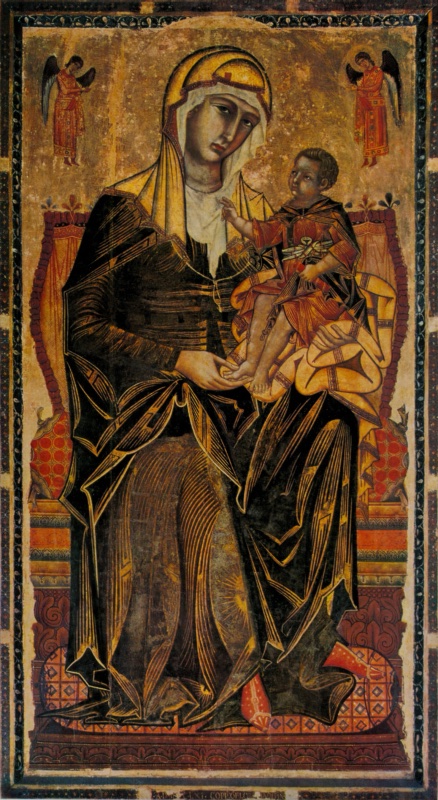
The Virgin Mary is depicted in Majesty on a raised throne, with the Infant Jesus in her lap, following the iconographic model of the Hodigitria (the Virgin pointing to her Son as the way). The Virgin, depicted in a frontal pose, occupies the center of the painting in an imposing dark blue robe, richly adorned with golden streaks created using the agèmina technique (modular scales filled with gold) that mimic the “golden web” so dear to Coppo and emphasize the volume of the drapery. Beneath the blue mantle stands out a wide red chlamys, also decorated with golden lines, which lends a strong sense of weight and solidity to the body, almost in contrast to the canonical Byzantine flatness.
The Child sits facing forward on his mother’s lap, with his legs slightly apart; according to some studies, this “bare-legged” or semi-open-legged pose is linked to an iconography that simultaneously evokes surrender and victory, in a Sienese political and devotional context. The Virgin’s left hand rests on her Son’s knees, while her right hand is raised in a gesture pointing the Child toward the viewer, in accordance with the icon’s traditional prophetic-sacramental function. The Child’s face displays intense expressiveness, with a direct and articulate gaze, far more complex than the canonical Byzantine fixity, even though many areas of the face and hands were reworked by a painter from Duccesque’s circle in the early decades of the 14th century.
The throne is a complex architectural structure, featuring a wooden framework with a leaf-like base (acanthus leaves) and a covering of fine fabrics, including cushions of a strongly “Orientalizing” style and a Moorish or Flemish tapestry with labyrinthine decorations on the backrest, which evokes the circulation of Islamic-Mediterranean textiles and patterns. This profusion of fabrics tends to soften the throne’s rigidity, yet the wooden structure remains clearly recognizable, almost sculpted, reaffirming the solidity of the spiritual power embodied by the Virgin. Behind the Virgin, above and behind the throne, two small angels stand out, arranged symmetrically as “guardians” or celestial ushers: their stern faces and very pronounced presence often lead them to be interpreted as elements of surveillance and control of the sacred, in line with the painting’s quasi-“protective” function as a votive icon.
The panel is painted in tempera and gold on wood, on a large-format wooden support, suggesting a setting intended for a high altar or a public worship image. The use of gold is particularly elaborate: the agèmina technique creates dense networks of golden streaks that follow the folds of the cloaks and accentuate the forms, simulating a sculptural and luminous effect, while the backgrounds were originally intended to be in worked gold, according to Byzantine tradition. The surface of the painting, however, bears the marks of extensive 14th-century repainting, especially on the faces, the hands, and the flesh tones of the Virgin and Child, executed by a painter associated with Duccio (probably Niccolò di Segna), who standardized the features according to the most modern Sienese canons, likely to align the icon with the devotional imagery of Duccio’s Maestà.
The date of 1261 is confirmed by an inscription at the lower margin, “A[NNO] D [OMINI] MCCLXI CO[P]P[US] D[E] FLORE[N]TIA ME PI[N]X[IT]”, which underscores both Coppo’s “foreign” status and his Sienese captivity following the Battle of Montaperti (1260), traditionally remembered as the reason for the ransom paid through the painting. In this context, the painting also takes on political significance: the Madonna, victorious and protective, becomes a symbol of Sienese superiority over their last Guelph adversaries, while the Florentine figure of Coppo is compelled to glorify the victorious rival. At the same time, its presence in a church of the Servants of Mary, near the southern entrance to the city and the Via Francigena, links the icon to an image of protection for pilgrims (the “bordone” as a staff for the journey), so much so that the panel was the object of profound veneration and specific devotion as the “Blessed Virgin Mary of the Seven Sorrows” in the modern era.
The “bare-legged” Child in the Madonna del Bordone is an iconographically highly charged motif: it is not a simple stylistic variation, but a sign that intersects Byzantine traditions, theological interpretations of the prototype of Simeon, and a Sienese and Servite devotional sensibility centered on the Passion and compassion. The choice of bare legs, or at least legs that are particularly visible beneath the light or folded robe, operates on three levels: a foreshadowing of the Passion, a remembrance of the rite of the Presentation, and a reference to the vulnerable physicality of Christ’s body.
The pose of the Child, with legs spread apart and partially bare, recalls in both the East and the West the iconography of the Child presented by Mary to Simeon (the “righteous” old man who recognizes the Savior in the Temple), a figure linked to the prophecy that the Messiah is a “sign of contradiction” and that Mary herself will be pierced by a sword. In many Byzantine icons, the Child is shown naked or semi-naked precisely in Simeon’s arms, to emphasize his status as an “offering” and a designated victim; Coppo, by placing the Child so high, on the Virgin’s lap, maintains this connection but shifts it from the Temple to the Majesty on the throne, transforming the private scene into a public theological statement.
The partial nudity of the Child is interpreted as a sign of continuity between the child on the Virgin’s lap and the naked Christ on the cross, so that the vulnerability of the Man-God’s body in passion can already be “read” in the infant’s body. Studies dedicated to this panel note that Coppo, in accordance with Servite traditions centered on the Mater Dolorosa and the Passion, sought to unite the Child with the colobium (Christ’s robe) or the sindone, that is, the cloth covering the body of the Crucified One in the Lamentatio or the Deposition, so as to make the child appear already “prepared” for death. The figure of the Child, though seated in a triumphal icon, thus carries a shadow of premonition of the Passion, which coincides with the charism of the Servants of Mary, founded on devotion to the “Mother of Sorrows” and to the Way of the Cross of the Son.
The emphasis on the legs and, more generally, on the physicality of the Child places this image within a broader tradition of medieval devotion that privileges the body of Christ as an object of contemplation and compassion. In monastic meditations and devotional texts, the foot of the Christ Child is often identified as a privileged site of symbolic contact (kiss, touch), as it evokes both the birth and the death of the Savior. In this sense, the presence of the “bare-legged” Child in the Servites’ panel responds to an expectation of tactile and compassionate devotion: the viewer is invited to see in the Child’s delicate body the flesh that will be pierced by nails, and in the tenderness of the contact with his mother the foreshadowing of his future sacrifice.
While the classical Sienese tradition tends to portray the Child as more “haloed” and incorporeal, as a mere symbol of royal power, in Coppo’s work the Child is rendered more “weighty,” with a body that can be sensed beneath the garments and with legs that escape the symbolic closure of the cloak. This detail is particularly significant because the Child in the Madonna del Bordone was repainted during Duccio’s time, yet the body’s structure with the legs apart remains essentially faithful to the original design, confirming that the partial nudity was an intentional element, not merely a product of modern interpretation. In other words, Coppo does not merely repeat the Byzantine model, but bends it toward a more dramatic and embodied reading, anticipating certain tensions that would reach full maturity in the following century, between Duccio and the devotional painters of compassion.
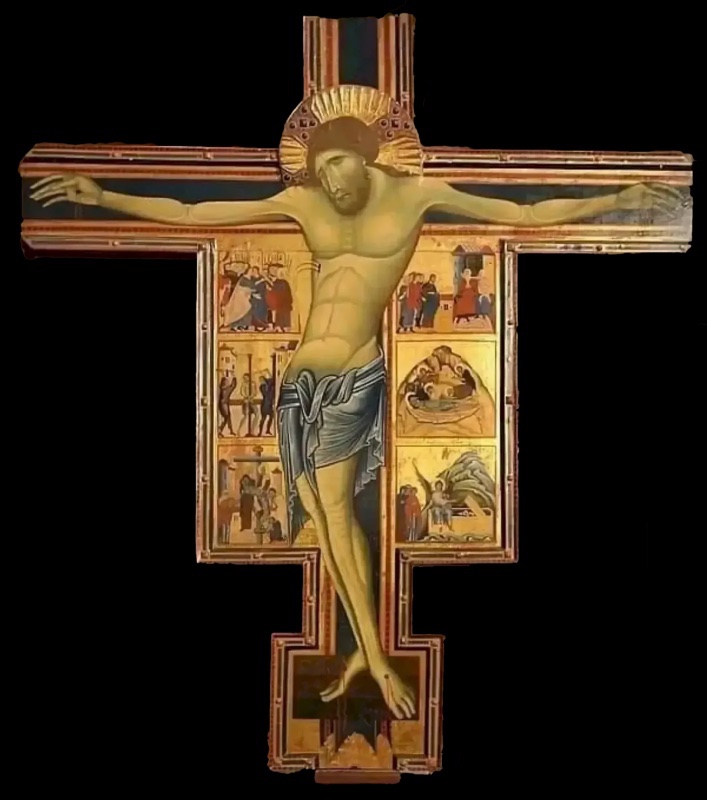
This is a carved wooden crucifix, painted in tempera on a gold-leaf ground, of imposing dimensions (280 x 245 cm), lacking the terminal compartments typical of many Gothic crucifixes: the upper cornice, the panels of the horizontal beam, and the lower shelf—which may originally have held the skull of Adam—are missing. The painting technique features a soft, nuanced application of paint, atypical of Coppo’s more calligraphic and hatched style, suggesting the involvement of his son Salerno or an evolution toward greater volumetric plasticity in the artist’s mature phase. The gold ground creates an effect of celestial luminosity, emphasizing the devotional character of the work intended for the cathedral choir.
At the center dominates the figure of the Christ patiens, suffering and realistic: the body is arched forward, the face tilted back with half-open eyes and a slightly parted mouth in an expression of intense pain, while from the five wounds (hands, feet, and side) copious blood gushes forth in stylized linear streams. On either side of Christ, at the foot of the cross, the Virgin Mary is symmetrically placed on the left, with her hands clasped in a gesture of supplication, and Saint John the Evangelist on the right, both wearing richly draped robes and relief halos that accentuate their monumentality. This composition reflects the transition from solemn Byzantine iconography to a more human pathos, a precursor to Cimabue’s innovations.
The extended side panels depict six episodes from the Passion of Christ, arranged in two registers on each side, using a narrative style that is simple yet expressive, typical of 13th-century panel painting. On the left: at the top, the Arrest of Jesus in Gethsemane, with Judas kissing him; in the center, the Flagellation, with Christ bound to a column among cruel tormentors; at the bottom, the Descent from the Cross, with figures lowering the lifeless body. On the right: at the top, Jesus before the priests (trial before Caiaphas); in the center, the Pietà, with Mary holding the dead Christ; at the bottom, the Holy Women at the tomb, a symbol of mourning and anticipation of the Resurrection. The scenes are populated by stylized figures, with emphatic gestures and vivid colors (reds, blues, greens), which prioritize emotional impact over rational perspective.
Commissioned in 1274 for the choir of Pistoia Cathedral, along with other lost works (a second crucifix, the Virgin, St. John, and St. Michael), this is among the few documented works by Coppo di Marcovaldo, a Florentine painter active between 1260 and 1276, influenced by the Byzantine tradition but open to plastic innovations. Compared to the more archaic Crucifix of San Gimignano (c. 1260), this work displays greater chromatic softness and a search for volume, foreshadowing Giotto’s naturalism and making it a pivotal point in the transition from linear Gothic to classical Tuscan Gothic. The work attests to Coppo’s activity in Pistoia following earlier commissions (frescoes destroyed in 1786), as confirmed by archival documents.
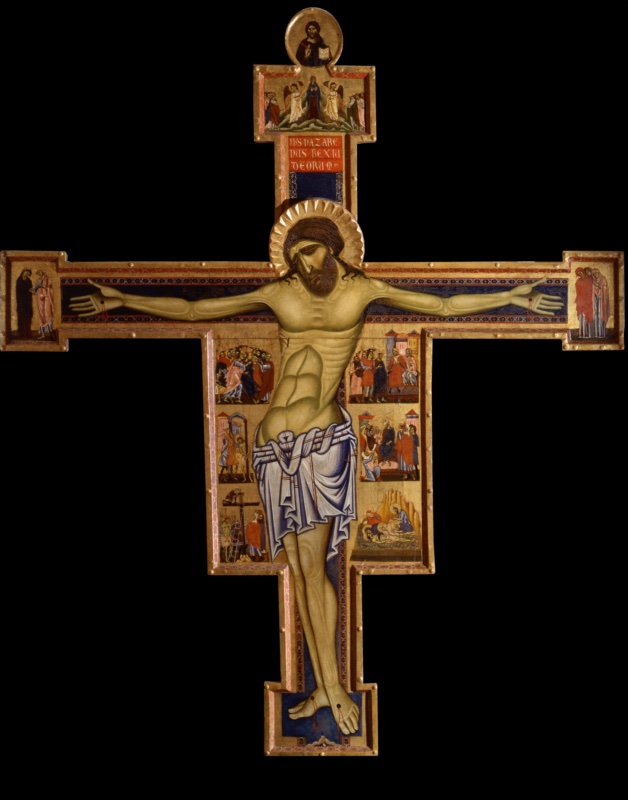
The cross not only features the body of Christ at its center but also constructs a true narrative in images centered on the Passion. At the side ends appear the sorrowful figures of the Virgin Mary with Saint John the Evangelist on one side, and the pious women on the other. In the upper frieze is the Ascension of Christ among angels, while above that appears Christ giving a blessing in the clipeus. Christ is depicted with the characteristics of the Christus patiens, that is, not as a triumphant sovereign, but as a suffering, human, and vulnerable body. His eyes are closed, his face tilted to the right, his body slightly arched, and his feet nailed separately, according to a formula that is still pre-Giottesque but already highly dramatic.
The wounds are rendered with emphasis, and the flowing blood accentuates the image’s emotional and devotional impact. One of the most interesting aspects is the presence of small scenes from the Passion along the arms of the cross, which transform the work into a sort of continuous narrative. One can discern episodes such as Judas’ betrayal, the trial before Pilate, the flagellation, the insults, and the crowning of thorns, up to the final moments of the Passion. This narrative structure reinforces the work’s meditative function, inviting the viewer to retrace Christ’s sacrifice step by step.
From a formal standpoint, the work still shows a strong dependence on the Italo-Byzantine style, with sharp outlines, limited plastic modulation, and a certain hieratic solemnity. However, Coppo also introduces a more human sense of pain and a livelier narrative arrangement, making the Crucifixion a decisive step toward a more modern sensibility in 13th-century Italian painting. The refinement of the ornamental details, such as the loincloth and the halo in relief, also contributes to the preciousness of the whole.
This crucifix is considered one of the most certain and celebrated works attributed to Coppo di Marcovaldo. Its importance lies not only in its artistic quality but also in its historical value: it bears witness to a moment when the large painted cross became simultaneously a liturgical image, an instrument of meditation, and a manifestation of a new expressive intensity. For this reason, the Crucifix of San Gimignano occupies a central place in the study of Italian painting prior to Cimabue and Giotto.
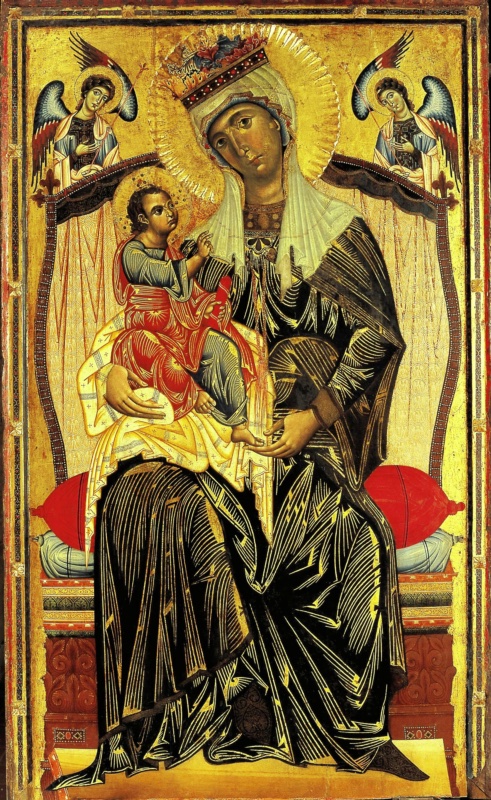
This work originally came from the Church of Santa Maria dei Servi in Orvieto, where it was venerated as an image of the Blessed Virgin Mary of the Seven Sorrows, and reflects the style of Coppo, a Florentine painter active in Florence, Siena, and other Tuscan cities, known for his eclecticism, which blends Byzantine influences with local expressive elements.
At the heart of the composition, the Virgin Mary sits majestically on a monumental throne, wearing a crown and a radiant halo, holding the blessing Christ Child in her lap; unusual for the time is the Child’s position on the left rather than the right, as in the artist’s better-known Sienese Maestà. The throne appears two-dimensional, articulated in overlapping frontal planes: a base decorated with classical-style plant motifs, two puffed cushions without any imprints of body weight, and a rounded backrest covered by a drape with lilies, which emphasizes the solemn frontality typical of medieval sacred painting. Both the faces of Mary and the Child were repainted in a later period, but X-rays reveal the original, more angular and dynamic forms.
The Virgin’s drapery is a distinctive element: geometric, abundant folds, illuminated by gold leaf applied with complex elegance, create a precious “web” that suggests volume without abandoning Byzantine flatness, revealing Coppo’s skill in balancing rigidity and naturalness. The Madonna’s hand, with long, tapered fingers, tenderly brushes her son’s little foot and wraps it in a light cloth, while her right knee rises slightly to support the Child’s weight—the sole realistic detail in an otherwise abstract iconography. The gold of the background and details, typical of the tempera-on-wood technique, amplifies the sacredness, with phytomorphic and floral decorations evoking a regal preciousness.
Painted around 1265–1270, the work is generally attributed to Coppo di Marcovaldo, although some critics suggest partial involvement by his son Salerno, due to greater expressiveness in the drapery and the restless movement of the Child’s legs compared to the Madonna del Bordone senese. This painting, an emblem of the Majesty as a devotional theme, bears witness to the transition toward an emerging Gothic style in Umbria and Tuscany, with an emphasis on emotional drama that foreshadows subsequent developments, while remaining rooted in the Byzantine Hodigitria tradition. Its history includes moves from the Chapel of the Servites to the high altar in the 18th century and recent restorations that have recovered original details.
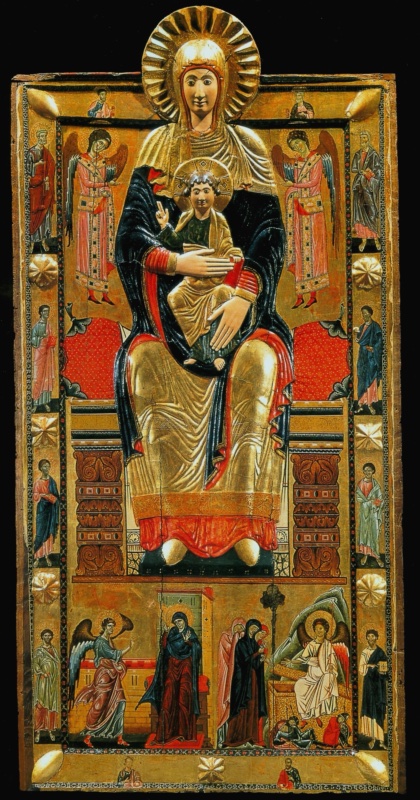
The work depicts the Madonna and Child in a solemn and dignified style typical of 13th-century Florentine painting influenced by the Byzantine tradition: the Virgin is seated on a throne, with the infant Christ in her lap offering a blessing, surrounded by devotional elements associated with her role as a reliquary, such as openings for relics in her crown or garments. Around the central figure, the frame is decorated with full-length figures of the apostles on the vertical sides and half-length figures on the horizontal ones, while the lower predella features two narrative scenes: the Annunciation and the Women at the Empty Tomb, symbolizing the beginning and conclusion of the Marian cycle. This narrative structure reflects medieval theology, in which the Virgin serves as a bridge between the Incarnation and the Resurrection, emphasizing her intercessory role; the stucco relief elements (bas-relief for the bodies, high relief for the heads) accentuate the three-dimensionality, breaking away from traditional Byzantine flatness to create a more sculptural and devotional effect.
Executed in tempera on a gold ground—with stamped gold to simulate precious fabrics and a celestial light effect—the work incorporates sculptural stucco elements for the main heads, creating a dialogue between painting and relief that anticipates Gothic developments. The decoration of the frame, originally reconstructed, reveals Byzantine motifs such as crucifixes with round dots and volutes, attested in the East between the 6th and 12th centuries, suggesting an artist trained on imported models but adapted to local Florentine taste. This hybrid technique not only enhances the sacredness but also responds to the secular or ecclesiastical patronage of 13th-century Florence, where painted reliquaries served as public devotional focal points, stimulating visual contemplation (visio) as a mystical path.
Although traditionally attributed to Coppo di Marcovaldo, modern studies contest this direct attribution, proposing it as the work of an anonymous Byzantinizing master, perhaps too early for the local school and a precursor to artists such as the Master of Vico l’Abate. The attribution to Coppo dates back to Douglas (1903), while Venturi (1907) viewed it as purely Byzantine; today it is interpreted as a syncretism between Florentine patronage and Eastern influences, which only began to influence masters such as Coppo himself in the 14th century. Located in the church of Santa Maria Maggiore, founded in the 10th century and associated with Marian devotions, the work bears witness to the post-communal religious fervor in Florence, where visual reliquaries united art, liturgy, and civic politics.
The work features two small holes, sealed with wax plugs, located at the stucco relief heads of the Virgin and Child: these provided access to internal cavities containing relics, discovered only during a modern restoration. Inside, small bags were found containing veils, strands of fabric, a fragment of wood identified as Lignum sanctae Crucis (Wood of the Holy Cross), and a tin plaque with a cartouche bearing the inscription Lignum sanctae Crucis nec non et / reliquiae sancti … (the saint’s name is illegible), datable to between 1125 and 1175 based on the Central Italian script. The silk of one of the pouches, of Eastern Mediterranean manufacture (11th–13th centuries), confirms the precious and Eastern origin of the relics, typical of 13th-century reliquaries that combined pictorial art with tactile devotion.
In the Middle Ages, painted reliquaries such as this served as portable thecae for sacred fragments, allowing the faithful of Santa Maria Maggiore—a Florentine Marian church dating from the 10th century—to physically venerate the holy matter through the image of the Theotokos (Mother of God), a bridge between the human and the divine. The memory of these relics was lost over time: with the post-Tridentine wax seals missing, by the sixteenth century the Carmelites were already unaware of their presence, perhaps due to their late arrival or a lack of documented local devotion. Iconographically Byzantine in style, with guardian apostles on the frame and Marian scenes in the predella (Annunciation and Mary at the Tomb), it emphasized the intercessory role of the Virgin Mary, where the reliquary amplified the visio et tactus effect for lay contemplation.
This hybrid structure (painting + stucco + relics) reflects post-communal Florentine patronage, where public altarpieces-reliquaries stimulated pilgrimages and miracles, visually educating the faithful on the Incarnation and Resurrection. Similar to other Italian reliquaries (e.g., Coppo’s Madonna del Bordone, though not a reliquary itself), it bears witness to a syncretism between the Byzantine East and the Latin West, where stamped gold and volumetric reliefs exalted the sacredness of the relics as life-giving contact relics. For an expert in illuminated manuscripts, parallels with contemporary illuminated Gospel books emerge in the material opulence, uniting the painted panel and the codified page into a single tactile-visual devotional system.
This Madonna represents a turning point in pre-Giottesque Italian painting: Byzantine rigor (frontal poses, hierarchical scales, abstract gold) is softened by volumetric reliefs and episodic narratives, paving the way for 14th-century Umbrian-Tuscan naturalism. The reliquary function—with compartments for sacred fragments—makes it not only an image but a tactile object of worship, where the faithful physically interact with the holy Matter; this reflects the visual culture of the 13th century, where medieval art aimed to “embody” the divine in the visible, educating the laity through accessible symbols such as guardian apostles and Easter scenes. As an enthusiast of illuminated manuscripts, you will notice parallels with contemporary Sienese illuminated codices, where gold and gilding simulate liturgical preciousness, uniting panel painting and manuscript pages in a devotional continuum.
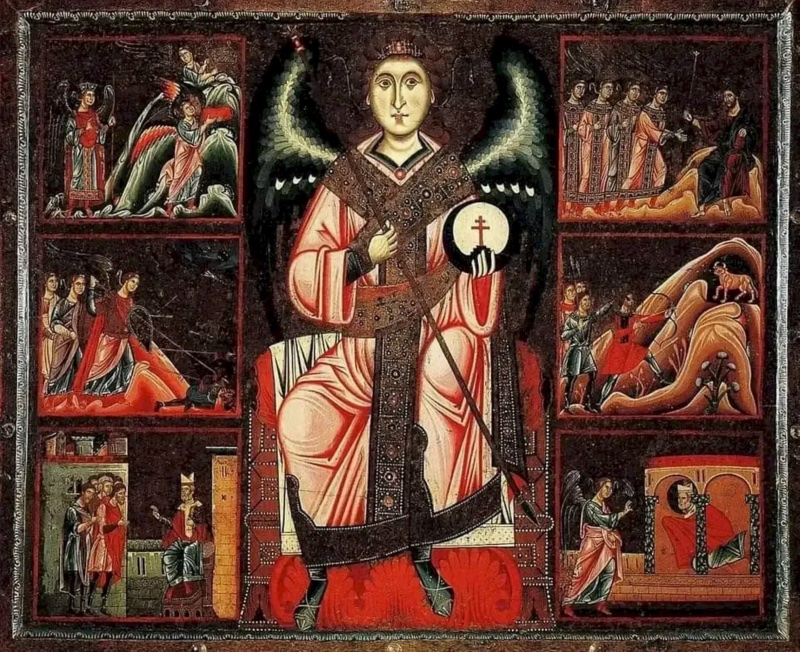
At the center of the panel stands the enthroned figure of the Archangel Michael, depicted in the Byzantine style as a heavenly dignitary with outstretched wings, dressed in imperial robes, holding a globe with a cross in his left hand and a spear in his right, symbols of his role as prince of the heavenly host. Surrounding him, six narrative panels arranged in two rows (three on each side) illustrate episodes from his legend, organized in an S-shaped sequence starting from the right side—a layout typical of Eastern iconography but with Western accents.
Michael sits on a jeweled throne, with stiff, geometric drapery that emphasizes his solemn majesty; his face, while retaining Byzantine rigidity, displays an innovative humanity in his gaze and expression, less abstract than in Eastern models. The background, originally in embossed silver (now blackened by oxidation), imitated gold through a transparent yellow varnish, creating an effect of celestial splendor that exalted the divine figure.
The six scenes, rich in narrative vitality, mark the transition from Byzantine art to pre-Giotto painting:
- First panel (right, top): God hands the staff to Michael, a symbol of his command over the angelic hosts.
- Second: Michael oversees the preparation of the Throne of the Last Judgment.
- Third: Battle against the devil, with dynamic figures and a sense of struggle.
- Fourth: The Miracle of the Bull at Siponto (490 AD), linked to the Archangel’s apparition.
- Fifth: Apparition to a bishop.
- Sixth (left, bottom): Pope Gregory the Great consecrates Castel Sant’Angelo in Rome after the Archangel’s vision.
These stories introduce Western elements such as expressive gestures, movement of the figures, and a rudimentary sense of space, with vivid colors and impasto brushstrokes with little shading, typical of Coppo.
The tempera on panel features gold and silver leaf gilding, with sharp outlines that define the volumes in a flat manner, without perspective, but with strong chromatic contrasts to create illusory depth. The work, among the oldest attributed to Coppo, shows later retouching, but technical analyses (such as X-rays) confirm its authenticity, highlighting the hatched brushwork and the textured impasto.
This altarpiece, originally from the church of Sant’Angelo a Vico l’Abate, is a milestone of pre-Cimabue Florentine painting, a bridge between Byzantine tradition and Italian Gothic renewal, bearing witness to Coppo’s activity as a public master in Florence, Siena, and Pistoia. It reflects the devotional context of 13th-century Tuscany, with an emphasis on eschatological and miraculous themes, and its arrival at the San Casciano Museum makes it a focal point for the study of local medieval art.
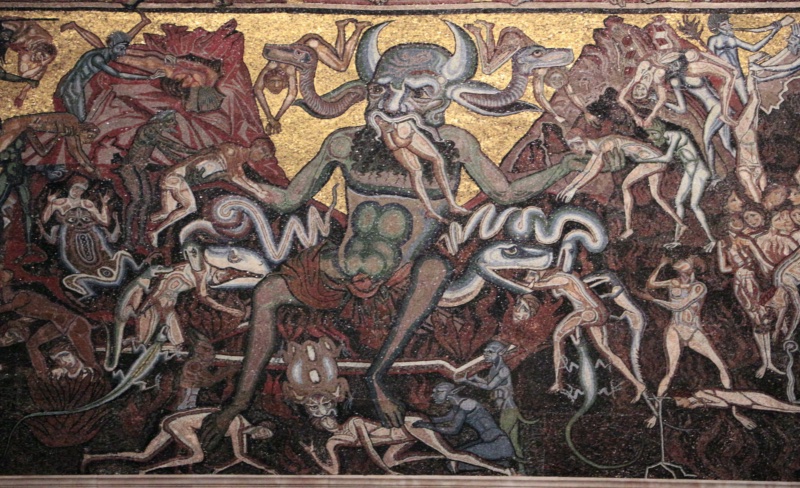
At the center stands a massive horned devil, identified as Lucifer, with a gaping maw devouring the damned in a chaotic whirlpool of twisted and mangled bodies. Aided by lesser demons, often painted in shades of blue or green, and by hybrid creatures such as toads and frogs—popular symbols of evil and demonic corruption—the devil inflicts cruel tortures: sinners are torn apart, pierced by pitchforks, immersed in pools of fire, or dragged into dark abysses. The scene is dense and layered, with figures crowded into overlapping planes that create an effect of illusory depth through the hierarchical scale: the principal demons are monstrous giants, while the human victims appear tiny and powerless, emphasizing the total defeat of the damned.
This iconography draws on Byzantine and apocalyptic models, but Coppo makes it unique through its folk-art realism and dramatic expressiveness, with naked bodies contorted in individual agony that foreshadow Dante’s descriptions of Hell in the Divine Comedy—not coincidentally, the mosaic was likely a source of inspiration for Dante Alighieri, who was baptized in the very same Baptistery.
The mosaic is executed with colored glass tesserae, set against a gold background to simulate the celestial and infernal immensity, with the overall size of the infernal scene spanning several square meters within the dome, which stands approximately 25 meters high. Coppo di Marcovaldo prepared the life-size cartoons, drawings on paper that were then transferred by Venetian and Tuscan mosaicists, ensuring anatomical precision and a compositional dynamism rare for the 13th century. The choice of colors—bright reds for the flames, greens and blues for the demons, blacks for the abyssal shadows—amplifies the visual impact, visible from the ground thanks to the elevated position and the natural light filtering through the small windows.
The work is part of the complete cycle of the Last Judgment, commissioned by the Opera di Santa Maria del Fiore around 1260, with contributions from other masters such as Jacopo di Meliore and artists from his circle, but the Inferno is distinctly Coppesque in its vigorous style and taste for grotesque detail. It reflects the eschatological theology of the 13th century, influenced by mendicant preaching (Franciscans and Dominicans) and the need for visual catechesis during a period of social and heretical instability in Florence.
Coppo was among the few medieval artists named in documents, celebrated for panel paintings such as the Maestà of Siena and for this mosaic masterpiece that marks the transition from linear Gothic to pre-Giottesque naturalism. Coppo’s Inferno is not mere spectacle: each torture corresponds to a deadly sin—lust, gluttony, wrath—symbolized by specific poses and attributes (for example, snakes strangling the avaricious), creating a moral encyclopedia for the faithful. The central figure of Satan, with three faces or multiple jaws in some interpretations, evokes an inverted Trinity, opposed to the overarching Christ the Judge, and the compositional chaos contrasts with the opposing paradisiacal order, teaching the duality of the afterlife.
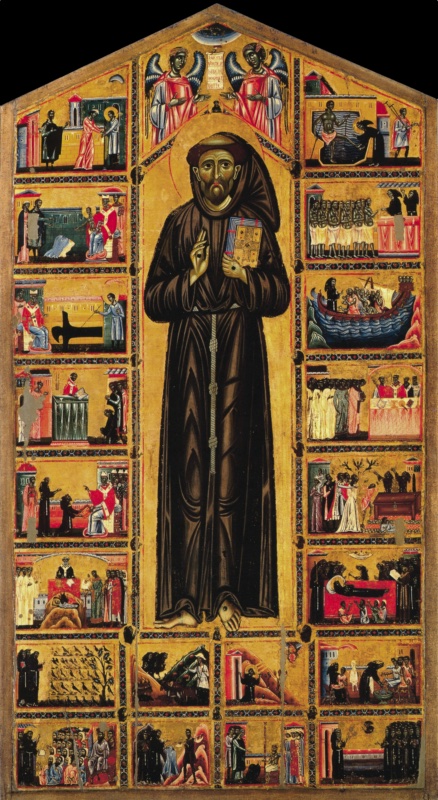
This altarpiece, known as the “Bardi Panel” because it has been housed since 1595 in the Bardi Chapel of the Basilica of Santa Croce in Florence (currently in the transept for restoration), features a hierarchical structure typical of the 13th century: the central figure of St. Francis dominates the space, flanked by two angels and a decorative frame featuring busts of Franciscan friars, perhaps evoking the local community. The twenty scenes are arranged in two lateral registers, in a proto-comic strip format that emphasizes didactic narration, foreshadowing Giotto’s narrative art in the same chapel. The Latin inscription on the upper rotule—“HU[N]C EXA/UDITE P(ER) / HIBENT[EM] / DOGMAT/A VITE”—exhorts the faithful to listen to the teachings of his life.
The lower scenes narrate key biographical episodes: Francis stripping off his clothes before his father Bernardone and the bishop of Assisi, choosing evangelical poverty by renouncing his shoes, and receiving approval of the Rule from Innocent III. The upper scenes depict posthumous miracles, such as his soul being carried to heaven by angels, the healing of the lame during his funeral, his canonization by Gregory IX, the saving of a ship from Ancona, and the cure of gout for Bartolomeo da Narni. Iconographic details such as the stigmata and the nail holes in the feet and hands emphasize his physical and spiritual holiness, while demons and possessed figures add expressive drama. Coppo employs the technique of tempera on a gold ground, with golden highlights that shape the drapery and lend plasticity to the figures, revealing an attention to bodily volume that was innovative for the time. The architecture and spaces are treated with less care, subordinated to the expressiveness of the gestures and faces, in a style that humanizes the sacred without abandoning Byzantine abstraction.
Initially attributed to the “Master of the Bardi Panel,” the work is now attributed to Coppo due to its strong plasticity, placing it between the canonization of Francis (1228) and 1266, with a precise dating to the years 1245–50 based on stylistic reasons.This image captures the entire altarpiece, highlighting the centrality of St. Francis and the symmetrical arrangement of the narrative scenes, with the characteristic gold background that amplifies the spiritual dimension.
The Tedaldi family, active in the 13th century as Franciscan patrons in Florence, is believed to have commissioned the work around 1245–1250 for an original altar in the church, perhaps in an area near the monastic community, before its relocation to the Bardi Chapel in 1595. This attribution is based on historical and iconographic analysis, considering the devotional fervor following the canonization of St. Francis (1228) and the role of wealthy laypeople in financing narrative altarpieces to promote the new Franciscan iconography. The absence of direct dedicatory inscriptions leaves room for debate, but the Tedaldi family emerges as the most credible hypothesis compared to other families such as the Bardi, who came into possession of the work centuries later.
At the time, families such as the Tedaldis invested in works of art to affirm their piety and ties to the Franciscan Order, which had been dominant at Santa Croce since its foundation (circa 1228), financing furnishings that would educate the faithful through didactic scenes. This type of patronage reflected a transition from ecclesiastical to secular patronage, with altarpieces like this one serving as a “story told through images” for a predominantly illiterate audience. The presence of friars’ busts in the inner frame suggests the involvement of the local community of Santa Croce, reinforcing the idea of a patron linked to the convent.
The work reflects the devotional fervor following canonization and predates official biographies such as that of Bonaventure. Coppo di Marcovaldo, the leading Florentine painter before Cimabue, likely created it with a collaborator, blending Sienese Gothic tradition and local influences into an expressive and volumetric style. Its importance lies in being one of the oldest altarpieces dedicated to St. Francis, second only to other early examples of his iconography.