Dagulf
( 25% )
Patrons and Their Roles in Dagulf’s Career
The professional life of Dagulf, as it can be discerned from documentary evidence, is inextricably linked to the powerful patrons who commissioned his work. His primary patron was Charlemagne1, the Emperor of the Carolingian Empire, whose political and military dominance shaped the cultural landscape of late 8th-century Europe. As a ruler who sought to unify a vast territory under a single Christian banner, Charlemagne acted as a supreme cultural arbiter, promoting learning and the arts through his extensive network of monasteries and scriptoria. The commission for the Psalter attributed to Dagulf originated with Charlemagne himself, who directed its creation as a diplomatic gift. This act demonstrates his direct involvement in high-level cultural projects, using art and scholarship as instruments of statecraft and religious authority. By ordering a luxury manuscript for the Pope of Rome, Charlemagne was reinforcing his self-image as the defender of the faith and the leader of Christendom. His role was thus that of a sovereign whose political power translated directly into cultural patronage, enabling artists like Dagulf to undertake prestigious projects. The directive for such a work would have required Dagulf to be part of the imperial entourage, likely based at one of the major royal centers where Charlemagne resided. The sheer scale and importance of the commission attest to Dagulf’s status as a master scribe, entrusted with representing the emperor’s vision. The collaboration between the Frankish monarchy and the Papacy was symbiotic, and this psalter stands as a physical manifestation of that relationship. Through this commission, Charlemagne not only provided for the creation of a masterpiece but also established the context within which Dagulf’s name would survive.
The second key figure in Dagulf’s documented career is Pope Hadrian I2, whose religious and ecclesiastical role was central to the psalter’s purpose and history. As the head of the Catholic Church, his position gave him ultimate spiritual authority, making him the appropriate recipient for a lavishly produced biblical text. The manuscript, made by order of Charlemagne, was explicitly intended as a gift for Pope Hadrian, underscoring the close ties between the two leaders and the integration of secular and religious power. The dedication verses included within the psalter itself frame the work within a sacred context, tracing the transmission of the Psalm text back to King David, thereby imbuing the artifact with theological significance.
Hadrian’s role was not merely that of a passive recipient; he actively engaged with the manuscript after its completion. The colophon reveals that Dagulf requested the Pope to sign the book, indicating a level of interaction and mutual respect between the scribe and the pontiff. Hadrian’s signature, placed at Dagulf’s behest, transformed the manuscript from a mere object of art into a document of historical record, bearing the mark of the highest religious authority of the age. This exchange highlights the collaborative nature of manuscript production, where the final piece was completed through the interaction of the patron, the artist, and the intended owner. The psalter thus served as a conduit for communication between the two principal powers of Christendom, the temporal ruler and the spiritual leader. Its creation and subsequent exchange were acts of profound religious and political symbolism, articulating a vision of a unified Christian empire under the joint protection of the Emperor and the Pope. The presence of both Charlemagne’s directive and Hadrian’s signature on the same manuscript provides a unique and invaluable documentary snapshot of this pivotal moment in medieval history.
The political role of Charlemagne extended far beyond individual commissions; he was the architect of a cultural revival known as the Carolingian Renaissance, a period characterized by a renewed interest in classical learning and a concerted effort to standardize religious texts and practices across his empire. This broader initiative created the environment in which skilled artisans like Dagulf could flourish. The establishment of centers of learning and scriptoria at major monastic foundations and imperial courts provided the infrastructure for large-scale manuscript production. These institutions drew upon centuries of prior book production traditions, including those from the Merovingian period, while also incorporating new ideas and techniques.
The development and dissemination of Caroline Minuscule, a clear and legible script designed for efficiency and uniformity, was a hallmark of this era and a testament to the administrative needs of a centralized empire. Dagulf’s work, particularly the Psalter, represents the zenith of this scriptural standardization effort. His meticulous copying of the text would have been carried out according to the principles of this new script, ensuring clarity and consistency. The resources of the past, including classical models and Insular art, were actively integrated into the Carolingian project, reflecting a sophisticated engagement with history and tradition. The psalter itself, with its combination of text and illumination, embodies this synthesis of scholarly rigor and artistic expression. It was not just a copy of a holy text but a statement of the cultural ambitions of the entire Carolingian enterprise. The political stability and administrative reach fostered by Charlemagne allowed for the long-distance movement of materials and the concentration of talent in specific centers, facilitating projects of immense complexity. The existence of the Dagulf Psalter is therefore a direct consequence of the political will and organizational capacity of Charlemagne’s reign.
Pope Hadrian I’s religious role was defined by his function as the Vicar of Christ and the supreme pontiff of the Roman Catholic Church. His acceptance of the psalter from Charlemagne was a significant ecclesiastical event, symbolizing the harmonious partnership between the two leading authorities of Western Christendom. This gesture reinforced the legitimacy of Charlemagne’s rule, which had been formally recognized by the Pope when he crowned him Emperor of the Romans in 800 CE. The manuscript, containing the Psalms—a foundational text for Christian liturgy and devotion—served as a tangible expression of this alliance. The theological framing provided by the dedicatory verses situates the work within the rich tradition of biblical exegesis and veneration. Hadrian’s signature on the manuscript adds another layer of religious authority, consecrating the object in the eyes of contemporaries and future generations.
The act of signing was a formal acknowledgment of receipt and a personal endorsement of the work’s value. In a world where literacy was limited, manuscripts like the Dagulf Psalter were powerful visual and symbolic tools that communicated messages of piety, orthodoxy, and divine sanction. They were central to the functioning of the Church, used in worship, teaching, and the preservation of doctrine. The collaboration between the Pope and the Emperor in the creation of this object illustrates how religious and political goals were often aligned during the early Middle Ages. The psalter thus became more than a book; it was a relic of a crucial moment in church-state relations, bearing witness to the intertwined destinies of St. Peter’s and the Frankish crown.
The patronage system of the Carolingian era, exemplified by the commissioning of the Dagulf Psalter, operated on a complex web of political loyalty, religious duty, and cultural ambition. Charlemagne’s decision to gift a manuscript to the Pope was not a simple personal favor but a carefully calculated diplomatic move designed to strengthen the bond between the Franks and the Romans. Such gifts were common currency in the political exchanges of the time, serving to cement alliances and affirm hierarchies of power. The creation of a luxury manuscript was a costly and labor-intensive process, requiring the employment of multiple specialists, including scribes, illuminators, and bookbinders.
This indicates that the project was supported by the immense resources of the imperial treasury. The involvement of a master scribe like Dagulf suggests that the work was intended to be of exceptional quality, befitting its destination and recipients. The scriptorium where Dagulf worked would have been a highly organized workshop, possibly attached to a major monastery or the imperial court itself. Manuscripts were often produced collaboratively, with different specialists working on various parts of the book, though figures like Dagulf, who signed his name, represent the pinnacle of the craft. The patron, whether a king, a pope, or a wealthy abbot, dictated the scope and purpose of the work, providing the funding and oversight necessary for its completion. In return, the patron received prestige and a lasting legacy, immortalized through the dedication of a beautiful book. The Dagulf Psalter remains a prime example of this system in action, where political strategy and religious devotion converged to produce a masterpiece of medieval art.
Beyond the immediate patrons of the psalter, the broader ecclesiastical and monastic networks of the Carolingian world were fundamental to the production of books. Monasteries were the primary centers of literacy and manuscript creation, housing libraries and scriptoria where monks dedicated their lives to copying and preserving texts. Figures like Baugulf, who became abbot of Fulda, were instrumental in fostering learning and acquiring property for their houses, creating the material conditions for such cultural activities.
Alcuin of York3, a leading scholar at Charlemagne’s court, played a crucial role in shaping the intellectual direction of the Carolingian Renaissance, advocating for educational reforms and the standardization of religious texts. While Dagulf is not mentioned in connection with these scholars, his work would have been influenced by their efforts. The monastic commitment to the careful transcription of scripture, such as the Psalms, provided the core subject matter for many illuminated manuscripts. The discipline and training found within these communities would have been the likely path for an artist-scribe of Dagulf’s caliber.
The political and religious roles of patrons often overlapped with their roles as founders or benefactors of these monastic institutions. A powerful noble might fund a monastery, appoint a learned abbot, and then commission works from that house, creating a cycle of patronage and production. The Dagulf Psalter, though originating from a high imperial command, fits within this larger framework of monastic scriptoria producing books for a wide range of lay and clerical patrons. The provenance of the manuscript, now residing in the Austrian National Library in Vienna (Codex 1861), brings it full circle to the heart of the ecclesiastical world that was both a producer and a consumer of such artifacts. The interplay between imperial power and monastic scholarship was the engine that drove the cultural flourishing of the period, and Dagulf’s work is a direct product of that dynamic.
Artistic Style and Technical Execution
While a definitive analysis of Dagulf’s personal painting style is impossible due to the lack of comparative works definitively attributed to him, the surviving evidence from the Dagulf Psalter allows for a detailed examination of the technical execution of his work. As the scribe responsible for the manuscript, Dagulf’s primary contribution was the meticulous transcription of the Latin Vulgate text of the Psalms. His skill as a calligrapher is evident in the flawless application of Caroline Minuscule, a script developed under Charlemagne’s patronage to replace the less legible scripts of the Merovingian period. This script is characterized by its even, rounded letterforms, clear separation of words, and consistent sizing, all of which contributed to greater readability and efficiency in book production.
The precision and uniformity of the script throughout the psalter suggest that Dagulf was a master of his craft, trained in a scriptorium that adhered to the highest standards of palaeography. The use of Caroline Minuscule on such a prestigious commission underscores the importance of textual clarity and elegance in Carolingian culture. Beyond the text itself, the manuscript features decorative elements that fall within the stylistic conventions of the period. These include ornamental initials and other decorative motifs that would have been executed by an illuminator, though the sources do not attribute these specific illustrations to Dagulf. The interplay between the precise, linear quality of the script and the more expressive, figurative elements of the miniatures is a hallmark of Carolingian manuscript art. The overall aesthetic reflects a conscious effort to create a harmonious and elegant object that was both functional for liturgical use and beautiful as a work of art. The choice of parchment, preparation of ink, and application of pigments would have followed established techniques of the time, resulting in a durable and visually striking manuscript.
The manuscript known as the Dagulf Psalter is described as a “lavishly illuminated” work, indicating a high degree of artistic investment in its creation. While the specific illuminator is unknown, the style of the miniatures and initials would reflect the dominant artistic trends of the late 8th century Carolingian court. These trends were a complex synthesis of earlier Merovingian, Insular, and revived classical influences. The figures depicted, if any, would likely exhibit a certain stiffness and frontal posture characteristic of early medieval art, but with an emerging interest in modeling and spatial arrangement derived from classical prototypes.
The use of color would have been rich and vibrant, employing expensive pigments like lapis lazuli for blues and minerals for other hues to convey a sense of opulence and sanctity. The gold leaf backgrounds common in contemporary manuscripts would have further enhanced the manuscript’s luxurious appearance, symbolizing the heavenly realm. The decorative initials that begin each psalm would have been elaborate, filled with intricate patterns and perhaps small narrative scenes related to the psalm’s content. This interplay between text and image was central to the meaning and function of the manuscript, guiding the reader’s meditation on the sacred words. The technical skill required to execute such detailed work points to a highly specialized artisan working in a well-resourced workshop. The collaboration between the scribe, who ensured the textual integrity, and the illuminator, who provided the visual splendor, was essential to the creation of such a masterpiece. The final product was a multi-sensory experience, combining the solemnity of the text with the visual awe inspired by its decoration. The manuscript’s style thus serves as a window into the artistic values of the Carolingian court, prioritizing clarity, beauty, and theological depth.
The production of a manuscript like the Dagulf Psalter involved a sophisticated division of labor within a scriptorium, the workshop where books were made. Although Dagulf is identified as the scribe, he would not have worked in isolation. Other specialists, including draftsmen, painters (illuminators), and binders, would have collaborated on the project. The illuminator would have prepared the designs, possibly on separate sheets of parchment, before transferring them to the main manuscript. The application of paint and gold leaf required a steady hand and a deep knowledge of materials and techniques. The scriptorium itself was often located within a monastery, providing a controlled environment conducive to study and work.
The organization of these workshops was critical to managing large-scale projects, ensuring that materials were available and that the workflow proceeded smoothly. The presence of multiple hands on a single manuscript is common, and distinguishing the contributions of each artisan is a major challenge for scholars. In the case of the Dagulf Psalter, the scribe has left his name, but the identity of the artist remains anonymous. This anonymity was typical for medieval artisans, whose work was often valued more for its service to God and the patron than for the individual creator. The focus was on the collective achievement of the workshop rather than the fame of a single artist. The collaborative nature of manuscript production meant that the final object represented a synthesis of different skills and talents, all directed toward a common goal. The success of the Dagulf Psalter speaks to the effective collaboration between the scribe Dagulf and the unnamed illuminator who brought the text to life with color and imagery.
The physical form and layout of the Dagulf Psalter reveal much about the standards of book production in the Carolingian era. The manuscript would have been written on animal skin parchment, which was prepared through a laborious process of soaking, scraping, and stretching. The pages were then ruled with a stylus to create guidelines for the scribe, ensuring straight lines and uniform letter size. The use of a ruling pen or a dry point would have been standard practice. The text layout, with its clear columns and ample margins, reflects a deliberate design aimed at enhancing legibility and creating a sense of order and harmony. This structured layout mirrors the broader Carolingian effort to impose order and clarity on knowledge and administration.
The inclusion of rubrics—text in red ink added after the initial writing, typically for chapter numbers or headings—would have further aided navigation and reading. The binding of the manuscript, though not original to the 8th century, would have been performed using high-quality materials, possibly wood boards covered in leather, to protect the precious pages inside. The size and format of the book would have been suitable for private devotional reading or for use in a choir stall, depending on its intended function. The entire process, from the sourcing of raw materials to the final binding, represented a significant investment of time, labor, and wealth. The survival of the Dagulf Psalter is remarkable, given the fragility of parchment and the potential for damage over centuries. Its preservation has allowed modern scholars to study its physical characteristics in detail, providing insights into the craftsmanship of its creators. The manuscript’s enduring physical presence is a testament to the care taken in its initial production and subsequent preservation.
The artistic output of the Carolingian period, including the work associated with Dagulf, was deeply embedded in a theological and liturgical context. Manuscripts were not merely objects of aesthetic pleasure but were tools for worship, education, and the dissemination of doctrine. The choice of the Psalms as the text for this particular commission is highly significant, as this book of the Bible was central to Christian liturgical life and personal prayer. The visual elements of the psalter would have been interpreted through a theological lens, with colors and images carrying symbolic meanings. For instance, gold represented divinity and eternity, while specific colors might correspond to the liturgical calendar. The very act of copying a sacred text was considered a pious and meditative activity, a form of prayer in itself. The scribe, by faithfully reproducing the word of God, participated in a holy task. The illuminator similarly contributed to this sacred purpose by creating images that helped explain and embellish the divine message. The manuscript was thus a physical embodiment of Christian faith, designed to inspire reverence and facilitate contemplation. The collaboration between the secular patron (Charlemagne) and the religious authority (Pope Hadrian) in the creation of this object reinforced its sacred character. It stood as a bridge between the earthly realms of politics and the heavenly realm of the divine. The manuscript’s journey from the imperial scriptorium to the papal library completes this symbolic circuit, returning it to the heart of the Church it was meant to honor. The artistic style, therefore, cannot be separated from its religious function; every line of script and every painted ornament served a higher spiritual purpose.
The concept of magnificence, or the display of grandeur and splendor, was a key consideration in the creation of luxury manuscripts like the Dagulf Psalter. Such works were designed to impress and awe, conveying the power, piety, and sophistication of their patrons. The lavish use of materials, including gold, silver, and expensive pigments, was a direct expression of this magnificence. The sheer beauty and craftsmanship of the book served as a reflection of the glory of God and the status of the person who commissioned it. The manuscript’s aesthetic qualities were not incidental but were integral to its meaning and function. In a society where few could read, the visual splendor of a book was a primary means of communicating its importance and value. The magnificence of the Dagulf Psalter would have been immediately apparent to anyone who beheld it, signaling its special status. This emphasis on magnificence continued a long tradition of elite book production seen in antiquity and the early Christian world. The Carolingians, in their desire to create a new Roman Empire in the West, looked to classical models of power and culture, and the production of magnificent books was a key component of this revival. The Dagulf Psalter stands as a prime example of this impulse, a physical manifestation of the Carolingian dream of a glorious Christian empire. The collaboration between the scribe Dagulf and the unnamed illuminator resulted in a work of extraordinary magnificence, a treasure fit for a Pope and a king. The enduring fascination with this manuscript today is a testament to the timeless power of such magnificently crafted objects to inspire wonder and admiration.
The artistic milieu of the late 8th century was characterized by a dynamic exchange of ideas and techniques between different regions and traditions. While Dagulf’s specific style remains elusive, his work would have been influenced by the prevailing artistic currents of the Carolingian court. This included a conscious effort to revive classical forms, as seen in the architectural and artistic programs at Aachen. It also incorporated elements from the Insular tradition of Anglo-Saxon England, which was renowned for its intricate knotwork and energetic zoomorphic designs. The fusion of these diverse influences created a distinctive Carolingian style that was both innovative and respectful of the past. The miniatures and initials in the Dagulf Psalter may show traces of these varied origins, blending classical portraiture with Insular decorative flair. The artists working in the Carolingian period were not isolated; they were part of a wider European network of artistic exchange. Traveling artists, such as those mentioned in connection with the abbey of St-Denis, moved between centers of production, carrying new ideas and techniques with them. The scriptorium where Dagulf worked was likely a hub of such activity, a place where different artistic traditions met and merged. The resulting style was syncretic, capable of expressing both the gravitas of classical antiquity and the spiritual fervor of the Christian present. This artistic hybridity is one of the defining features of the period and is embodied in the Dagulf Psalter. The manuscript is a palimpsest of styles, a visual record of the cultural dialogue that defined the Carolingian Renaissance. The work of the scribe Dagulf, alongside that of the illuminator, contributed to this rich artistic tapestry.
Scholarship
The study of Dagulf and his singular surviving manuscript has been a persistent concern of medievalists since the early modern period, when antiquarians and bibliophiles first began systematically cataloguing the holdings of European monastic libraries and court collections. Among the foundational figures in this scholarship was Jean Mabillon, the 17th-century Benedictine scholar whose groundbreaking work on medieval manuscripts (Diplomatica, 1681) established the intellectual framework for the critical analysis of ancient documents. While Mabillon did not study the Dagulf Psalter specifically, his methodological innovations—including the systematic analysis of script, ink composition, and material evidence—provided the critical apparatus that subsequent scholars would employ to interrogate medieval manuscripts. The development of paleography as a formal discipline in the 18th and 19th centuries meant that the Dagulf Psalter came under increasingly scrutiny, with scholars like Leopold Delisle and Jules Quicherat in France identifying and analyzing Caroline Minuscule manuscripts in Parisian collections. The manuscript in Vienna, catalogued under Codex Vindobonensis 1861, attracted attention from German and Austrian scholars particularly during the 19th century, when systematic catalogue projects aimed to comprehensively document the holdings of major European libraries. These early efforts established the basic biographical and diplomatic facts of the manuscript: its dating to ca. 793–795, its identification as a Carolingian court product, and its unique colophon documenting the roles of Charlemagne, Dagulf, and Pope Hadrian I.
The 20th century saw the emergence of more specialized paleographic and art-historical approaches to the Dagulf Psalter. Wilhelm Levison, a preeminent historian of Carolingian diplomacy and manuscript culture, made important contributions to understanding the manuscript’s place within the broader context of court scriptoria and imperial gifting practices. The work of E.A. Lowe, whose monumental Codices Latini Antiquiores (CLA) provided exhaustive descriptions of Latin manuscripts before the 9th century, established foundational paleographic data that influenced all subsequent study of Carolingian scripts. More specifically, scholars of Caroline Minuscule, including Berthold Bretholz and later paleographic specialists working in the decades after World War II, refined understandings of the script’s development and regional variations. The recognition that the Dagulf Psalter represented an exemplary and perhaps even archetypical instance of early Caroline Minuscule made it a touchstone for paleographic studies. Book historians and codicologists, particularly those working in the tradition of Swiss and German manuscript studies, provided detailed technical analyses of the manuscript’s construction, analyzing its gatherings, pricking and ruling patterns, and binding. These studies revealed the highly organized and standardized practices of Carolingian court scriptoria, offering insights into workshop organization and labor division. Scholars such as Franz Unterkircher, curator at the Austrian National Library and authority on Carolingian manuscripts, produced detailed catalog entries and monographic studies that systematized knowledge of the Dagulf Psalter’s physical characteristics and historical context.
The latter decades of the 20th century witnessed a broadening of interpretive frameworks applied to Dagulf’s work, reflecting wider developments in manuscript studies, diplomatic history, and the history of technology. Scholars approached the Dagulf Psalter not merely as a paleographic or codicological artifact but as a complex historical object at the intersection of politics, theology, and cultural production. Rosamond McKitterick’s influential studies of Carolingian literacy and manuscript culture positioned the Dagulf Psalter within a larger argument about the role of writing in imperial administration and religious reform. Her work emphasized the strategic deployment of manuscripts as instruments of political authority, reading the psalter as a physical embodiment of Charlemagne’s cultural and religious vision. Art historians like Herbert Kessler and others working on Carolingian illumination examined the relationship between the scribe’s precise text and the illuminator’s visual contribution, arguing that the manuscript represented a sophisticated synthesis of textual and visual modes of meaning-making. The growing interdisciplinary nature of manuscript studies meant that scholars trained in fields as diverse as art history, literature, paleography, diplomacy, and the history of technology all brought their specialized expertise to bear on the Dagulf Psalter. This convergence of perspectives enriched the scholarship, revealing dimensions of the manuscript that earlier, more narrowly paleographic studies had not fully appreciated.
Contemporary scholarship on Dagulf and the Dagulf Psalter continues to expand, particularly through the application of digital humanities tools and methodologies. High-resolution digital imaging of the Vienna manuscript has made detailed examination of pigment composition, layout patterns, and textual variants accessible to scholars worldwide, democratizing access to one of the most important artifacts of medieval Europe. Materials scientists and conservators have collaborated with art historians and paleographers to analyze the physical composition of inks, pigments, and parchment, providing concrete data about the resources and technical knowledge deployed in the manuscript’s creation. Furthermore, the Dagulf Psalter has become a focal point for broader historical investigations into Charlemagne’s cultural policies, the mechanics of diplomatic gift-giving in the early medieval world, and the role of luxury manuscripts in articulating imperial ideology. Scholars investigating the mechanisms of Carolingian scriptoria production have used the Dagulf Psalter as a case study, drawing on its relatively well-documented provenance and the explicit self-identification of its scribe to reconstruct workshop practices and labor organization. The manuscript has also attracted the attention of scholars working on the history of communication and the development of standardized writing systems, who recognize in Caroline Minuscule and its exemplification in the Dagulf Psalter a pivotal moment in the history of literacy and administrative efficiency. As scholarship on the Dagulf Psalter continues to evolve, it remains a central artifact for understanding not only the achievements of an individual craftsman but also the broader intellectual, political, and aesthetic ambitions of the Carolingian Renaissance.
Artistic Influences and the Carolingian Context
The artistic environment in which Dagulf worked was profoundly shaped by a deliberate and systematic effort to revive classical learning and aesthetics, a cornerstone of the Carolingian Renaissance. Charlemagne’s court attracted scholars and artists from across Europe, including figures like Alcuin of York, who championed a return to the texts and styles of ancient Rome and Greece. This intellectual movement sought to reform education, standardize religious texts, and create a visual language that was both elegant and authoritative. The development of Caroline Minuscule was a practical outcome of this drive for clarity and order, but the influence extended to the visual arts as well. Artists were encouraged to look beyond the insular and Merovingian traditions and draw inspiration from surviving classical models, such as those found in manuscripts of authors like Aratus, which featured astronomical diagrams based on ancient Greek science. The Dagulf Psalter, while primarily a religious text, would have been created with an awareness of these broader artistic trends. The aspiration was not simply to imitate the past but to absorb its principles of proportion, harmony, and naturalism. This classical revivalist impulse provided a new foundation for Carolingian art, elevating it from purely decorative functions to a medium capable of expressing complex intellectual and theological ideas. The result was a style that sought to balance spiritual meaning with humanistic ideals, a hallmark of the era’s cultural achievements. The patronage of Charlemagne created the necessary conditions for artists to experiment and innovate within this classical framework.
In addition to classical models, the artistic traditions of the Insular world—primarily from Ireland and Anglo-Saxon England—had a significant impact on Carolingian art. Insular manuscripts were known for their vibrant colors, intricate interlacing patterns, and dynamic, almost abstract representations of animals and figures. These elements were incorporated into the Carolingian style, adding a layer of energy and decorative richness to the more restrained classicism. The fusion of these two distinct traditions—the angular, pattern-based Insular style with the balanced, monumental classicism—created a unique and compelling aesthetic. Manuscripts produced in the Carolingian scriptoria often feature initials that combine classical letterforms with elaborate Insular-style knotwork and zoomorphic details. This synthesis demonstrates a sophisticated artistic dialogue, where different regional styles were not seen as rivals but as complementary sources of inspiration. The artists of the period, including the illuminator of the Dagulf Psalter, would have been familiar with both traditions, either through direct contact with Insular works or through artists who traveled between centers of production. The resulting hybrid style is a testament to the cosmopolitan nature of the Carolingian court and its openness to artistic innovation from across Europe. The Dagulf Psalter, as a product of this environment, likely contains such blended stylistic elements, reflecting the complex artistic heritage that shaped its creation.
The Merovingian period, which preceded the Carolingian dynasty, also provided a vital foundation for manuscript production. Carolingian artists and scribes did not start from a blank slate; they inherited a long-established tradition of bookmaking, complete with specific scripts, iconographic formulas, and workshop practices. Many of the techniques and styles developed during the Merovingian era were adapted and refined under Carolingian patronage. For example, the use of certain decorative motifs and the general structure of biblical manuscripts owed a debt to Merovingian predecessors. However, the Carolingian revival was also characterized by a critical re-evaluation of this heritage. While some older styles were discarded as illegible or overly ornate, others were selectively incorporated into the new, more classically-oriented aesthetic. The work of Dagulf, as a scribe, would have been directly influenced by the Merovingian tradition of palaeography, which he would have studied and then improved upon by adopting the clearer Caroline Minuscule. This continuity and transformation illustrate the way in which Carolingian culture positioned itself in relation to the past—not as a rupture, but as a renewal and improvement. The artists of the period saw themselves as building upon the achievements of their Merovingian forebears, correcting their perceived flaws, and advancing the art of bookmaking to a new level of excellence. The Dagulf Psalter sits at this intersection, embodying the culmination of centuries of book production, filtered through the reforming zeal of the Carolingian court.
Beyond these three major influences, the artistic milieu of the Dagulf Psalter was also shaped by Byzantine and late antique traditions. The Christian East, with its rich artistic heritage centered in Constantinople, provided models for imperial representation, religious iconography, and manuscript illumination. While direct artistic exchange with Byzantium was less frequent than with Insular Britain, the shared Christian faith and common pool of classical knowledge meant that artistic concepts and styles flowed between East and West. The depiction of imperial figures, the use of gold backgrounds, and the overall hierarchical composition of figures in Carolingian art show affinities with late antique and Byzantine precedents. The scribes and illuminators working in the Carolingian scriptoria would have been aware of these Eastern traditions, either through imported manuscripts or through theoretical writings. The goal of the Carolingian artists was not mere imitation but a creative synthesis, adapting foreign models to suit their own cultural and theological needs. The Dagulf Psalter, as a work commissioned by a Western emperor for a Western pope, represents a distinctly Western, Latin Christian interpretation of these broader artistic currents. Its style is Carolingian first and foremost, a unique blend of classical, Insular, and late antique elements tailored to the political and religious context of the Frankish kingdom. The manuscript is a product of its time, reflecting the interconnectedness of the medieval Christian world and the diverse sources of inspiration available to its artists.
The collaborative nature of manuscript production in the early Middle Ages meant that artistic influence was a fluid and interactive process. An artist like Dagulf would have been part of a community of craftsmen, constantly observing, learning from, and influencing one another. The scriptorium functioned as a center of artistic exchange, where different skills and styles were combined to create a single finished product. An illuminator might introduce a new decorative motif that would then be adopted by scribes in their design of initials. Similarly, a scribe might develop a new script that an illuminator would adapt for use in large, decorative letters. This constant feedback loop ensured that artistic styles evolved and spread throughout a region. The mobility of artists, who might travel between different monasteries and courts, also facilitated the diffusion of new techniques and ideas. The work of Dagulf and his contemporaries cannot be understood in isolation but must be seen as part of a vibrant and interconnected artistic ecosystem. The Dagulf Psalter, with its combination of text and image, is a perfect example of this collaborative process. The scribe and the illuminator, though their names are known only for the former, worked in concert to produce a work of art that was greater than the sum of its parts. Their respective skills and influences were fused to create a manuscript that was both a faithful copy of a sacred text and a stunning work of art. The influence of the workshop environment on the final product was profound, shaping every aspect of its style and execution.
Artistic influences during the Carolingian period were also mediated through theoretical texts and model books. Scholars like Alcuin were concerned with the proper transmission of knowledge, and this included the rules of grammar, rhetoric, and scriptural interpretation. These intellectual frameworks would have informed the artistic choices made in the scriptorium. For example, the selection of decorative elements might be guided by allegorical interpretations of the text. Model books, collections of exemplary drawings and designs, may have been used by illuminators to ensure a certain level of quality and consistency in their work. While no such model book for the Dagulf Psalter has survived, their existence is implied by the high standard of its execution. The influence of these theoretical and pedagogical traditions was subtle but pervasive, providing a set of guidelines and best practices that shaped the artistic output of the period. The scribe Dagulf, in his meticulous copying, was adhering to the rules of palaeography laid down by contemporary grammarians. The illuminator, in his compositions, was likely drawing upon a visual vocabulary that had been developed over centuries. This reliance on established models and theories distinguishes Carolingian art from purely intuitive or folk-based traditions. It was an art of learning and refinement, consciously striving for a high level of technical proficiency and intellectual coherence. The Dagulf Psalter is a testament to this learned approach to art, a product of a culture that valued both manual skill and scholarly knowledge.
The influence of the surrounding cultural and religious environment on the artistic style of the Dagulf Psalter is undeniable. The manuscript was created during a period of intense religious and political activity, culminating in Charlemagne’s coronation as Emperor in 800 CE. This event marked a turning point in medieval history and would have had a profound effect on the cultural mood. Art and literature of the period often dealt with themes of power, judgment, and divine order, as seen in subjects like the Judgement of Solomon. The Psalms, with their themes of praise, lament, and trust in God, were perfectly suited to express the hopes and anxieties of this momentous era. The artistic style of the manuscript would have been shaped by the theological debates and devotional practices of the time. For instance, the controversy surrounding the use of icons in the Byzantine Empire would have heightened the sensitivity of Western Christians to the role of images in worship. The style of the Dagulf Psalter, with its emphasis on the sacred text and its use of imagery to support, rather than replace, the word, reflects a particular theological stance on the use of art. The manuscript is a product of its specific historical moment, infused with the spirit of the Carolingian Renaissance. Its style is a visual summation of the diverse artistic influences of the period, all filtered through the lens of a specific political and religious context. The work of Dagulf and his collaborators captures the aspirations of an entire age, making it a priceless artifact of medieval culture.
Travels and Provenance of Dagulf’s Work
The reconstruction of Dagulf’s personal travels is impossible due to the complete absence of biographical records detailing his movements. Unlike later medieval artists who sometimes left accounts of their itineraries, Dagulf is known solely through the colophon of a single manuscript he produced. Therefore, any discussion of his “travels” must be inferred indirectly from the known locations associated with his work. The most certain location in Dagulf’s professional life is the site of the manuscript’s creation, which must be identified with the court of Charlemagne. During the late 8th century, Charlemagne’s court was not fixed in one capital but moved between several major residences, including Aachen, Ingelheim, and Frankfurt, as part of his efforts to govern his vast empire effectively. As a master scribe entrusted with a prestigious imperial commission, Dagulf would have been part of this mobile entourage of administrators, clergy, and artisans. His work on the psalter would have taken place in one or more of these royal centers, wherever the emperor happened to be residing at the time. This implies a degree of mobility, but it was the mobility of the imperial court, not a wandering artist seeking patronage. There is no documentary evidence to suggest that Dagulf traveled outside of this imperial orbit or to other centers of learning like the monasteries of Fulda or Tours. His entire known professional life appears to have been centered on the service of Charlemagne.
While Dagulf’s own travels are unknown, the circulation of manuscripts like his provides insight into the movement of artistic styles and techniques across Europe during the early Middle Ages. Books were among the most important vehicles for the transmission of culture, carrying not only texts but also artistic models and palaeographic conventions from one region to another. A manuscript produced in a major imperial center like Aachen would have contained the latest styles in script and illumination, which could then be studied and emulated by scribes and artists in distant monasteries. The development of Caroline Minuscule, for example, was driven by the need for standardized texts that could be easily copied and disseminated across the empire. The Dagulf Psalter, as a premier example of this script, would have served as a model for other scribes. The movement of books was facilitated by the extensive network of monasteries and pilgrim routes that crisscrossed Europe. A monk traveling to Rome on pilgrimage might bring back a copy of a popular saint’s life, introducing new literary and artistic forms to his home community. Although there is no evidence linking Dagulf to such travels, his work would have been part of this larger flow of cultural exchange. The artistic influences evident in Carolingian art, including classical, Insular, and late antique elements, were all products of this dynamic exchange. The manuscript itself, with its blend of styles, is a testament to this process of artistic osmosis.
The location of a manuscript was often indicative of its importance and the status of its patrons. The Dagulf Psalter’s residence in the Austrian National Library places it in the most prestigious library in Christendom, a repository for the most valuable books in the Western world. The existence of such a distinguished library was a hallmark of the Carolingian era, which saw a massive increase in book collecting and production. Monasteries and cathedrals competed to acquire fine manuscripts, viewing them as symbols of their piety and learning. The physical description of the manuscript, including its dimensions, number of pages, and condition, would have been recorded in the library’s inventories, contributing to the growing body of knowledge about books. The study of manuscript provenance, or the history of a book’s ownership and location, is a crucial tool for historians, allowing them to reconstruct the social and cultural networks of the past. The clear provenance of the Dagulf Psalter makes it an especially valuable object for such study. It connects the political world of the Frankish Empire with the religious world of the Papacy, illustrating the deep ties that bound them together. The manuscript’s journey is a microcosm of the broader cultural and political currents of the early Middle Ages.
The association of the Dagulf Psalter with specific individuals, namely Charlemagne and Pope Hadrian I, anchors its provenance in verifiable history. The colophon, which states that the book was made by order of Charlemagne for Pope Hadrian, provides a direct link to these two titanic figures of the period. This documentary evidence is far more reliable than the speculative reconstructions of an artist’s life. The manuscript’s journey can be traced from its imperial origin to its papal destination, a path dictated by the political and religious dynamics of the time. This contrasts sharply with many other early medieval manuscripts whose histories are murky and whose connections to specific patrons are uncertain.
In conclusion, while a biography of Dagulf’s personal life and travels is unattainable with the available evidence, the provenance of his sole surviving work provides a remarkably clear and detailed account of its history. This provenance is more informative than any hypothetical account of the artist’s movements, as it is grounded in solid documentary evidence. The journey of the psalter reflects the political geography of the Carolingian world, connecting the centers of Frankish power with the heart of the Christian Church. It stands as a physical testament to the symbiotic relationship between Charlemagne and Pope Hadrian I, a collaboration that produced one of the masterpieces of medieval art. The study of the manuscript’s history allows us to understand the context in which it was made and appreciated, offering a glimpse into the minds and motivations of its creators and patrons. Ultimately, the provenance of the Dagulf Psalter is the most important part of its biography, a durable record that ensures the work—and the memory of its creator—will endure.
Dagulf’s Major Works: A Discursive Analysis
The corpus of work attributable to Dagulf is singular and definitive: the manuscript known as the Dagulf Psalter. This single artifact constitutes the entirety of his known artistic output and is the only basis for any assessment of his professional skill and contribution to the arts of the Carolingian Renaissance. The manuscript is a lavishly decorated copy of the Book of Psalms, rendered in the Latin Vulgate translation that formed the bedrock of Western Christian liturgy. Its primary content is therefore the 150 psalms, traditionally attributed to King David, a fact noted in the dedicatory verses included within the manuscript itself. These verses frame the work’s content within a sacred lineage, emphasizing its theological significance. The psalms were not merely copied as a literary exercise but were intended for use in the daily office and other religious services, serving as a tool for public and private devotion. The meticulous care with which Dagulf transcribed the text reflects the reverence accorded to this particular biblical book. Every letter, every word, was treated with the utmost seriousness, as the faithful reproduction of God’s word was considered a holy act. The manuscript’s content, therefore, is inseparable from its function as a liturgical object, a vehicle for prayer and worship.
Dagulf’s Psalter, folio 25v
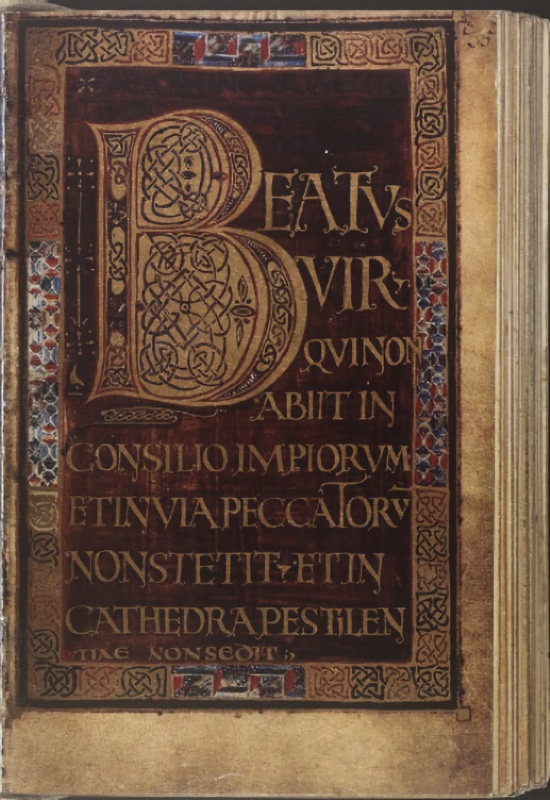
The physical form of the Dagulf Psalter is as significant as its textual content. Produced around the year 800 CE, it is a prime example of late 8th-century Carolingian manuscript production. The manuscript was written in Caroline Minuscule, a script developed under Charlemagne’s patronage to standardize Latin writing and improve legibility. Dagulf’s execution of this script is exemplary, demonstrating a mastery of calligraphy that made the text both easy to read and aesthetically pleasing. The pages are adorned with ornamental initials and other decorative elements, the work of an unknown illuminator who collaborated with the scribe. These decorations would have served to mark the beginning of new sections and to add visual splendor to the sacred text. The use of gold leaf and vibrant mineral pigments would have made the manuscript shimmer, enhancing its aura of majesty and holiness. The combination of precise, linear script and colorful, figurative illumination creates a harmonious and balanced whole. The entire manuscript, from the quality of the parchment to the elegance of the script and the richness of the decoration, testifies to the high status of its commission and the exceptional skill of its creators. It was designed not just to contain the words of God but to make those words beautiful and worthy of veneration.
Dagulf’s Psalter, folio 68r
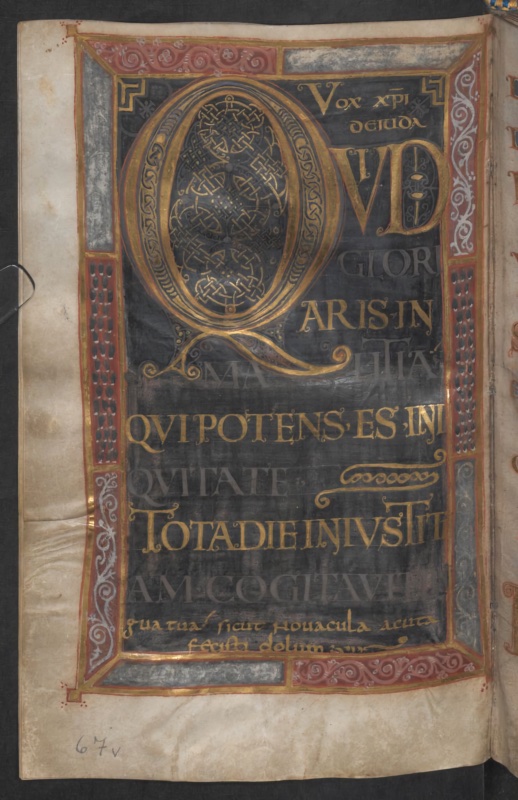
The patronage behind the Dagulf Psalter is clearly documented and of immense historical importance. The manuscript was made by order of Charlemagne, the Emperor of the Carolingian Empire, who was the supreme political and cultural patron of his age. This commission demonstrates Charlemagne’s direct involvement in cultural projects and his use of art as a tool of statecraft and religious policy. By directing the creation of such a magnificent book, he was asserting the cultural preeminence of his empire and his role as the protector of Christendom. The psalter was not intended for private use by the Emperor but was destined for a specific recipient: Pope Hadrian I. This act of gifting a luxury manuscript to the Pope was a powerful diplomatic gesture, reinforcing the close alliance between the Frankish monarchy and the Papacy. The relationship between Charlemagne and Pope Hadrian I was symbiotic; the Pope provided spiritual legitimacy for the Emperor’s rule, while the Emperor offered military and political protection to the Papal States. The Dagulf Psalter stands as a physical symbol of this relationship, a gift that articulated the unity of the two powers. The involvement of these two towering figures gives the manuscript an unparalleled historical weight, transforming it from a mere object into a document of state.
Dagulf’s Psalter, folio 109r
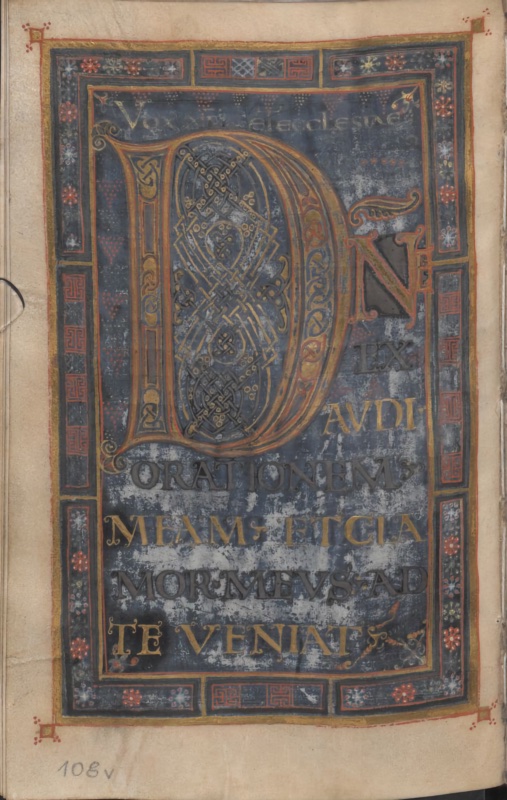
The final and most crucial element of the manuscript’s history is its connection to Pope Hadrian I. After receiving the psalter from Charlemagne, the Pope interacted with the finished work in a way that permanently linked him to it. According to the colophon, the scribe Dagulf requested that the Pope sign the manuscript. This request is a remarkable piece of documentary evidence, showing a direct, personal engagement between the creator and the patron. Pope Hadrian’s signature, placed at Dagulf’s request, served as a formal acknowledgment of receipt and a personal validation of the work’s quality and importance. This inscription transformed the manuscript from a simple book into a historical artifact, bearing the autograph of one of the most influential men of the age. The presence of both Charlemagne’s commissioning directive and Hadrian’s signature on the same leaves provides a unique and invaluable record of the manuscript’s creation and transfer. It captures a fleeting moment of collaboration between the two leaders, mediated through the work of a single, anonymous artist-scribe. This dual attribution gives the manuscript a kind of documentary triangulation, anchoring its history in the actions of two distinct and powerful individuals. The manuscript thus became a palimpsest of intentions, bearing the marks of the political will of the Emperor and the religious authority of the Pontiff.
In summary, the “major works” of Dagulf are encapsulated in a single, extraordinary manuscript. The Dagulf Psalter is a masterpiece of Carolingian book arts, notable for four key reasons: its impeccable script, its rich artistic decoration, its illustrious patrons, and its unique documentary evidence. The manuscript contains the complete text of the Psalms, transcribed with flawless precision in Caroline Minuscule by the scribe Dagulf. It was commissioned by Emperor Charlemagne as a diplomatic gift for Pope Hadrian I around the year 800 CE, making it a physical symbol of the alliance between the Frankish Empire and the Papacy. The manuscript’s history is uniquely documented by a colophon stating that Dagulf requested Pope Hadrian to sign the book, a personal touch that links the work directly to both of its primary patrons.