Godescalc
( 25% )
Godescalc was a Frankish scribe and illuminator active at the court of Charlemagne 1 during the late eighth century, specifically between 781 and 783. His name survives through a single major work, the Godescalc Evangelistary, which he signed in a dedication poem at the manuscript’s conclusion. In this dedication, Godescalc describes himself as ultimus famulus or the humble servant of Charlemagne, indicating his position within the royal household. The exact dates of his birth and death remain unknown, as do the specific locations where he was born or died, reflecting the general absence of biographical documentation for craftsmen of this era. No records survive concerning his family background, parentage, siblings, or descendants, which is characteristic of the documentation practices of the Carolingian period regarding artisans and scribes.
The social status implied by his self-description as “famulus” suggests he may have been of modest origins, possibly from the lower nobility or the educated clerical class. His literacy and advanced calligraphic skills indicate he received formal education, most likely in a monastic or cathedral school before entering royal service. The training required to produce such an elaborate manuscript suggests years of apprenticeship in both scribal arts and illumination techniques. His mastery of multiple scripts, including uncial characters and the new Carolingian minuscule, demonstrates sophisticated paleographic knowledge. The lack of any surviving personal correspondence, legal documents, or biographical accounts written by contemporaries means that Godescalc remains a shadowy figure known primarily through his artistic legacy.
Patronage and the Carolingian Court
Godescalc’s primary and only documented patron was Charlemagne himself, along with the king’s wife Hildegard2, who jointly commissioned the Godescalc Evangelistary on October 7, 781. The commission was issued to commemorate significant events in Charlemagne’s reign, specifically his journey to Italy, his meeting with Pope Adrian I 3, and the baptism of his son Pepin in Rome. This patronage placed Godescalc at the very center of Carolingian cultural and political power, working within the palace scriptorium at Aachen, Charlemagne’s imperial capital.
The Court School at Aachen, where the manuscript was produced, represented the most prestigious artistic workshop in the Carolingian Empire. Charlemagne’s patronage was part of his broader program of cultural renewal, known as the Carolingian Renaissance, which sought to revive classical learning and establish standardized forms of script and liturgy. The king’s educational reforms, guided by scholars such as Alcuin of York 4, created an environment where skilled scribes like Godescalc could flourish. The dedication poem within the manuscript reveals that Charlemagne was described as providus et sapiens, studiosus in arte librorum (provident and wise, devoted to the art of books), indicating the king’s personal interest in manuscript production. The lavish materials employed in the manuscript—purple parchment, gold and silver ink—demonstrate the substantial financial investment Charlemagne was willing to make in this project. Unlike manuscripts intended solely for private devotion or monastic use, the Godescalc Evangelistary was designed to be read publicly, serving Charlemagne’s vision of cultural renewal for his entire kingdom. Whether Godescalc produced other works for Charlemagne or received commissions from other members of the royal family remains undocumented in surviving sources.
The 781 Italian journey that occasioned the manuscript’s commission represented a pivotal moment in Charlemagne’s relationship with the papacy and his consolidation of power over the former Lombard territories. Charlemagne had conquered the Lombard kingdom in 774, assuming the title “King of the Lombards” and dramatically extending Frankish power into the Italian peninsula. His 781 journey was undertaken partly to reaffirm his authority over these newly acquired territories and partly to strengthen his alliance with Pope Adrian I, who had appealed to Charlemagne’s father Pepin the Short for protection against Lombard aggression in the 750s and had renewed this alliance with Charlemagne himself. The baptism of Charlemagne’s son Pepin by Pope Adrian I carried profound political significance beyond its religious dimensions, creating a spiritual kinship between the Carolingian dynasty and the papacy that reinforced their mutual dependence. By having the pope personally baptize his son, Charlemagne secured papal recognition of his dynasty’s legitimacy and his role as protector of the Roman Church. The Godescalc Evangelistary thus commemorated not merely a religious ceremony but a strategic alliance that would shape European politics for centuries, with Godescalc’s manuscript serving as a permanent memorial of this crucial diplomatic achievement.
Queen Hildegard’s role as co-commissioner of the manuscript deserves particular attention, as it reveals the active participation of Carolingian royal women in cultural patronage and religious devotion. Hildegard of Vinzgau (c. 758-783), Charlemagne’s third wife, whom he married in 771, came from a powerful Swabian aristocratic family with extensive landholdings and political connections. Her inclusion in the dedication alongside Charlemagne reflects both her personal piety and her political importance as the mother of legitimate male heirs, including the newly baptized Pepin (later Pepin of Italy) and the future Emperor Louis the Pious.
The timing of the commission in October 781, shortly after the Italian journey and baptism, suggests that Hildegard may have played an active role in conceiving the project as a thank offering for her son’s spiritual protection through papal baptism. Her death in April 783, just days before the manuscript’s completion, adds poignant dimension to the work—the finished Evangelistary became not only a commemoration of dynastic triumph but also a memorial to the queen who had commissioned it. The manuscript’s subsequent use in royal liturgical ceremonies would have repeatedly recalled Hildegard’s memory and reinforced her children’s claims to legitimate succession. The tradition of female royal patronage that Hildegard exemplified continued through later Carolingian queens and princesses, several of whom commissioned manuscripts from the Ada School, suggesting that women of the royal family maintained sustained relationships with the palace scriptorium.
The economic infrastructure supporting Godescalc’s work reveals the immense material resources that Charlemagne could command for his cultural program. The purple dye required for the manuscript’s 127 parchment pages represented extraordinary expense, as the finest purple—Tyrian purple derived from Mediterranean mollusks—cost more than its weight in gold during the early Middle Ages. Even if a less expensive vegetable-based purple dye was employed, the process of evenly dyeing such large quantities of prepared parchment required specialized expertise and substantial investment in materials.
The gold and silver used for the manuscript’s text necessitated access to precious metal supplies that only royal treasuries could provide in such quantities. Charlemagne’s control of gold sources through tribute, plunder from military campaigns (particularly against the Avars in the 790s, though this postdates the Evangelistary), and mining operations in the Frankish realm provided the material foundation for luxury manuscript production. The palace at Aachen itself represented a massive investment in infrastructure, with workshops, storage facilities for precious materials, and living quarters for the community of scholars, scribes, and craftsmen that Charlemagne assembled. The royal fisc—the complex system of estates, tolls, and revenues that supported the Carolingian court—generated the surplus wealth necessary to sustain such non-productive but culturally significant activities as manuscript illumination. The Godescalc Evangelistary thus embodied not merely aesthetic preferences but the economic power of the Carolingian state, converting material resources extracted from a vast territorial empire into cultural capital that legitimized royal authority.
The relationship between Godescalc and his royal patrons operated within complex frameworks of obligation, hierarchy, and gift exchange that structured Carolingian court society. Godescalc’s self-description as “ultimus famulus” (humble servant) in the dedication poem reflects the rhetorical conventions of courtly humility, but also reveals his dependent status within the royal household. As a member of the palace staff, Godescalc would have received maintenance—food, clothing, and accommodation—as well as possible landed estates or money payments for his services, though no records of his specific compensation survive. The patron-client relationship in Carolingian society operated through bonds of personal loyalty and mutual obligation, with the king providing protection and material support in exchange for service and fidelity.
For skilled craftsmen like Godescalc, royal patronage offered security, access to the finest materials, and opportunities to work on prestigious projects that transcended the capabilities of monastic or episcopal scriptoria. The collaborative nature of manuscript production meant that Godescalc worked within a community of specialists, possibly including other scribes like Dagulf, who produced the Dagulf Psalter for Hildegard between 783 and 795, suggesting continuity of personnel within the palace scriptorium. The workshop environment would have fostered technical exchange and stylistic consistency across multiple projects, with senior masters like Godescalc potentially training younger scribes and illuminators in the techniques and standards expected for royal commissions.
The public liturgical function of the Godescalc Evangelistary distinguished it from purely devotional manuscripts and integrated it into Charlemagne’s broader program of ecclesiastical standardization and reform. As a lectionary designed for public reading during Mass, the manuscript served practical liturgical needs while simultaneously making visible statements about royal piety, cultural sophistication, and political authority. When the Evangelistary was displayed during services at the palace chapel or in royal progresses throughout the realm, its golden words on purple pages would have proclaimed Charlemagne’s special relationship with the divine and his role as a Christian king in the tradition of Constantine and Justinian.
The manuscript’s iconographic program, particularly the Christ in Majesty miniature and the Fountain of Life image, conveyed theological messages about salvation, baptism, and divine kingship that reinforced the sacral character of Carolingian rulership. The standardization of liturgical texts represented a crucial element in Charlemagne’s strategy of creating religious uniformity throughout his territories, replacing diverse local traditions with Roman liturgical practices that he promoted through councils, capitularies, and the distribution of authoritative manuscripts. The Godescalc Evangelistary, created at the beginning of this reform process, served as a model for subsequent liturgical manuscripts produced throughout the empire, disseminating standardized texts and establishing aesthetic norms that provincial scriptoria would emulate in their own productions.
The commemoration of specific political events through manuscript patronage reveals how Carolingian rulers employed books as instruments of dynastic propaganda and historical memory. The Godescalc Evangelistary’s dedication explicitly links its creation to Charlemagne’s Italian journey, papal meeting, and son’s baptism, transforming these temporal events into permanent textual and visual monuments. This commemorative function parallels contemporary architectural projects such as Charlemagne’s palace complex at Aachen and the monastery of Lorsch, which similarly embodied royal power in material form. The manuscript’s subsequent liturgical use ensured repeated encounter with the narrative of Carolingian achievement embedded in its dedication poem, reinforcing dynastic legitimacy through ritual repetition.
The baptism of Pepin in Rome, memorialized in the manuscript, established a precedent for papal involvement in Carolingian succession that would culminate in Charlemagne’s own imperial coronation by Pope Leo III on Christmas Day 800—an event that retrospectively confirmed the significance of the 781 alliance commemorated in Godescalc’s work. The tradition of commissioning manuscripts to mark important political and religious events continued throughout the Carolingian period, with subsequent rulers emulating Charlemagne’s example by patronizing luxury books that documented their own achievements and piety. The Godescalc Evangelistary thus inaugurated a pattern of royal manuscript patronage that integrated artistic production into the structures of political legitimation and historical commemoration that sustained Carolingian dynastic power.
Artistic Style and Technical Characteristics
The illumination style of the Godescalc Evangelistary represents the earliest example of Carolingian illumination and established fundamental characteristics that would define the Ada School or Court School of Charlemagne. The manuscript features six full-page miniatures: portraits of the four Evangelists, Christ in Majesty, and the Fountain of Life, each executed with remarkable technical sophistication. Godescalc employed naturalistic techniques to create the appearance of three-dimensional volume in his figures, using elaborate shading with light and dark tones to achieve depth. This approach marked a significant departure from the flat, two-dimensional aesthetic that characterized Early Christian and Early Byzantine art of preceding centuries. The artist’s treatment of drapery shows an understanding of how fabric falls and drapes over the human form, creating convincing illusions of weight and substance. Facial features in the manuscript demonstrate careful attention to modeling, with rounded forms and carefully graduated tones that suggest the influence of late antique painting techniques. The use of gold and silver ink on purple-dyed parchment created a luxurious visual effect that reinforced the manuscript’s status as a royal commission. Godescalc wrote the main text in uncial characters, a formal script associated with prestigious manuscripts, while employing the new Carolingian minuscule for the dedication poem. The ornamental motifs, particularly the decorated initial letters, demonstrate the fusion of different artistic traditions that characterized Carolingian art. Godescalc’s technical mastery extended to the careful layout of text and image, creating harmonious page compositions that balanced visual and textual elements.
The artistic style and technical characteristics of the Godescalc Evangelistary can be further elucidated by examining the relationship between script and image, which is unusually intimate in this codex. The alternation of gold and silver lines of script against purple parchment transforms the written word itself into a visual ornament, collapsing the boundary between textual content and pictorial decoration. In this sense, the page functions simultaneously as a surface for reading and as a luminous field of abstract pattern, in which letters participate in the same play of line and color as borders and initials. The decision to reserve Carolingian minuscule for the dedicatory poem while employing uncial for the main text reflects a conscious hierarchy of scripts, where form signals function and liturgical prestige. The stark legibility of the new minuscule in the poem contrasts with the more monumental uncial of the lections, suggesting that clarity and elegance were both valued but deployed strategically in different textual registers. The visual rhythm created by the dense columns of script, framed by elaborate initials and ornamental bands, orders the viewer’s gaze in a controlled progression from border to text to miniature. Such orchestrated viewing corresponds with the manuscript’s liturgical use: the eye of the celebrant and congregation moves from image to word and back again, experiencing exegesis through design. The technical sophistication required to maintain consistent ink flow of metallic pigments over many folios further underscores the high level of workshop discipline and planning underlying this apparently effortless luminosity. In effect, the Evangelistary asserts that orthography, paleography, and illumination belong to a single visual theology in which script is itself an icon of the incarnate Word.
The full-page Evangelist portraits display a carefully calibrated negotiation between classicizing naturalism and hieratic frontality. Each Evangelist is seated on an architecturally elaborate throne or cushioned bench, placed within an abstracted space defined by attenuated architectural elements rather than a fully coherent perspectival setting. The volumetric modeling of the bodies—visible in the rounded knees, articulated shoulders, and gently indicated clavicles—betrays knowledge of late antique figural conventions, likely mediated through Italian or Italo-Byzantine exemplars. Yet these bodies are not fully relaxed; their poses remain taut, with angular elbows and sharply bent wrists that emphasize the act of writing as a decisive, almost visionary gesture. The draperies are constructed with broken, faceted folds that alternate between broad, flat color fields and sharply drawn highlights, revealing an interest in translating sculptural conventions into the painted medium. Facial types, though individualized, share large, deeply set eyes and small, tightly drawn mouths, features that direct attention toward the gaze and contemplative inwardness of the Evangelists. The stylus and codex or scroll held by each figure become secondary focal points, visually linking human agency to divine inscription. The overall effect is neither purely Byzantine nor purely classical but a Carolingian recalibration that tempers inherited hieratic formulas with a renewed concern for corporeal plausibility. In these images, naturalism does not aim at quotidian realism but at rendering intellectual and spiritual concentration legible through the body.
The Christ in Majesty miniature pushes this synthesis even further by juxtaposing a remarkably youthful and softly modeled Christ with an emphatically abstract setting. Christ is seated frontally, holding a closed book to his breast and raising his right hand in benediction, a pose rooted in long-standing iconographic traditions yet softened by subtle gradations of flesh tone and careful drawing of neck and chest. The bench on which he sits is less imposing than the elaborate thrones of the Evangelists, a reversal that paradoxically heightens his otherworldly authority by avoiding overtly imperial furniture. Around him, the background is articulated by flat, chromatic zones and attenuated architectural hints, producing an indeterminate, almost metaphysical space rather than a real environment. The inscription behind Christ, executed in gold against the purple ground, binds text and image into a unified field in which the spoken word of blessing and the written word of Scripture visually converge. The proportions of Christ’s body, especially the elongated torso, recall Italian and Eastern models where verticality signifies transcendence and detachment from earthly gravity. Yet the modeling of his face and hands is gentler and more rounded than in many contemporaneous Byzantine examples, signaling a Carolingian preference for moderated, humane divinity. Such stylistic decisions articulate a theology of kingship: Christ appears as a teacher and judge rather than as a militant emperor, in line with Charlemagne’s self-fashioning as Christian ruler under divine law. The miniature thereby serves not only as a devotional focus but also as an ideological image reinforcing the alliance between imperial and ecclesiastical authority.
The Fountain of Life miniature introduces a different but equally sophisticated visual language in which architecture and animal symbolism dominate the composition. At the center stands a circular aedicule crowned by a conical roof and cross, clearly evoking both the Anastasis Rotunda of the Holy Sepulcher and the Lateran baptistery as reconstructed in Carolingian visual memory. Water flows from the central basin into four channels, a direct reference to the four rivers of paradise and, by extension, to the four Gospels as sources of salvific grace. Around this architectural core gather peacocks, waterfowl, and other birds, whose placements are not arbitrary but carefully calibrated to articulate exegetical relationships: peacocks signify immortality, while the waterfowl are read in Eastern commentaries as apostles who look back toward Old Testament “cocks” foretelling Christ. The plants and birds are rendered with a liveliness and variation that contrasts with the more rigid architecture, staging a productive tension between the organic fecundity of paradise and the ordered structure of ecclesiastical space. Chromatically, the miniature exploits the contrast between cool greens and blues of water and foliage and the warmer, metallic glint of gold, creating a synesthetic sense of freshness and luminosity. The overall composition is rigorously symmetrical, yet small asymmetries in pose and orientation of the animals prevent the image from becoming static, suggesting a living cycle of praise and participation in divine life. Because the Fountain is placed facing text concerned with the Incarnation and eternal life, the miniature becomes a visual exegesis of the pericope, rather than a mere generic symbol. In this way, the technical handling of line, color, and spatial organization serves a precise theological program that invites meditative, multi-layered viewing.
Equally characteristic of the Evangelistary’s style are its initial pages and ornamental programs, which display a pronounced debt to Insular manuscript traditions. The incipit page for the Christmas Vigil, for example, features monumental gold initials that form a self-contained cosmos of interlace, spirals, and geometric motifs. These initials, set against the purple ground and surrounded by delicate frames, do not merely introduce the text but assert its sacred singularity by visually arresting the reader before the narrative begins. The interlace patterns, while indebted to Hiberno-Saxon prototypes, are tamed and regularized, indicating a Carolingian desire to domesticate the exuberant complexity of Insular ornament within a more geometric, classical order. The alternation of gold and silver lines of script on the facing page further enhances the sense that the text itself participates in the ornamental logic of the initials. In some places, painted frames of interlace and geometric designs enclose the text block, creating a visual equivalence between the page and an architectural façade or liturgical object such as an altar frontal. These frames, meticulously ruled and painted, demand exceptional precision of brushwork and an acute sense of modular proportion. They also serve a practical function: by clearly bounding the textual field, they facilitate reading in liturgical performance, guiding the eye of the lector along an ordered visual path. Thus, what might appear as purely decorative margins in fact contribute to the codex’s dual identity as both object of contemplation and instrument of proclamation.
Finally, the material choices of purple parchment and metallic inks, often discussed in terms of luxury, have to be understood as intrinsic components of the Evangelistary’s visual system rather than mere embellishments. Purple-dyed parchment aligned the manuscript with late antique imperial codices such as the Vienna Genesis, thereby inscribing Carolingian kingship into a Roman genealogy of sacred rulership. The costly process of producing such parchment—likely involving fine calf or lamb skins and expensive dyes such as orchil—meant that color here is already an index of political and theological ambition before any paint is applied. Gold and silver inks, whose physical longevity and resistance to corrosion were well known, became visual metaphors for the endurance of the divine word, an association made explicit in Godescalc’s own dedicatory poem on “golden words painted on purple pages.” When illuminated by candlelight or daylight in a liturgical setting, the metallic letters would shimmer and shift, producing a kinetic experience in which reading is interwoven with changing reflections. This shimmering quality creates a perceptual threshold between visibility and legibility, at times making the text difficult to decode but all the more numinous to behold. Silver, which has now tarnished dark, would originally have contributed a cooler, complementary luminosity to the warmer gleam of gold, constructing a chromatic hierarchy within the script itself. In combination, these materials assert that sacred text is not just heard and understood but also seen and venerated as a quasi-sacramental presence on the page. The artistic style and technical practice of the Godescalc Evangelistary are thus inseparable from its function as a royal, liturgical, and theological artifact, in which every visual decision carries doctrinal and political weight.
Artistic Influences and Cultural Synthesis
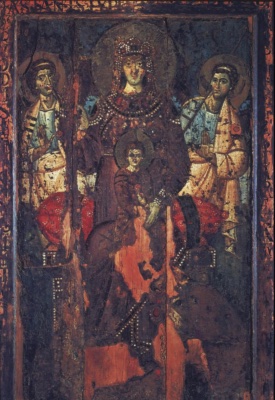
The artistic program of the Godescalc Evangelistary reveals a sophisticated synthesis of multiple cultural and artistic traditions, reflecting the cosmopolitan nature of Charlemagne’s court. Byzantine influence is particularly evident in the portraits of the Evangelists and Christ in Majesty, which appear to be based on Eastern models such as the mosaics of San Vitale in Ravenna. The Christ in Majesty miniature was probably influenced by the famous Acheropita image in the Lateran Basilica in Rome, which Charlemagne and his entourage would have seen during their Italian journey. The elongated proportions of Christ’s figure, particularly between the shoulders and hips, suggest knowledge of Italian iconographic traditions, possibly the icon of the Virgin as Queen of Heaven in Santa Maria in Trastevere.
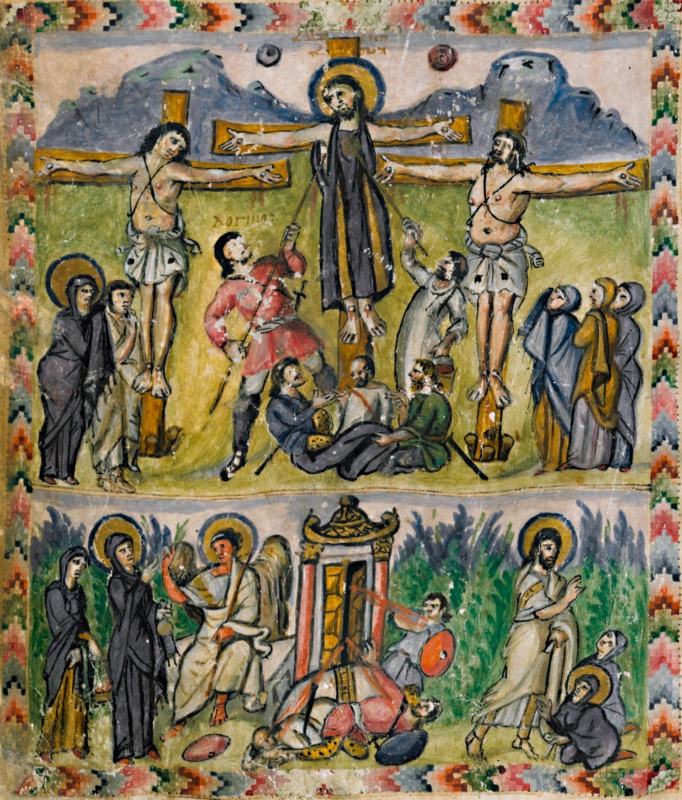
Insular Anglo-Saxon and Irish manuscript traditions influenced the ornamental aspects of the work, particularly the interlace patterns on the opening pages of each Gospel. The elaborate decorative borders and initial letters demonstrate familiarity with Hiberno-Saxon illumination techniques developed in monasteries of Ireland and Northumbria. Early Christian and late Classical Roman art provided models for the overall compositional approach, particularly in the architectural elements depicted in the Fountain of Life miniature. The Fountain of Life’s circular shrine with conical roof references both the Holy Sepulcher from the Rabula Gospels5 and the baptistery of the Lateran church in Rome.
Eastern theological iconography influenced the symbolic elements, including the peacocks representing immortality and the waterfowl symbolizing the apostles as “fishers of men”. The Egino Codex, an example of late Lombard luxury art obtained by Charlemagne in 774, may have influenced certain iconographic motifs, particularly the upward-gazing poses of the Evangelists indicating divine inspiration. Godescalc’s synthesis of these diverse traditions created a new Carolingian style that would influence manuscript production throughout the empire for generations.
The artistic influences at work in the Godescalc Evangelistary are best understood as a deliberate Carolingian reconfiguration of Roman, Byzantine, and Insular models within a consciously imperial program of renewal. Rather than passively inheriting late antique and early medieval motifs, the Court School at Charlemagne’s court selected and recombined visual languages that could articulate the ideology of a Christian empire. The late Classical legacy enters through the emphasis on volumetric bodies, articulated drapery, and architectonic framing devices that recall late antique luxury codices and monumental painting. This classicizing tendency is particularly visible in the Evangelist portraits, where seated figures in thoughtful poses evoke philosophers or rhetors from Roman visual culture.
Yet such classicism is never simply antiquarian; it is pressed into service as a means of representing inspired authors whose intellectual authority undergirds Carolingian law and worship. The early Christian heritage, transmitted through late antique Gospel books and purple codices such as the Vienna Genesis, provides models for the integration of text, color, and sacred figuration. In this context, the Evangelistary aligns itself with a prestigious continuum of imperial Christian books while simultaneously marking a new beginning. The manuscript thus functions as a hinge between the Roman and Carolingian worlds, visually negotiating continuity and innovation.
From the Rabula Gospels depicting the Crucifixion in the upper panel and the Resurrection in the lower panel
Byzantine influence, and more broadly Eastern Christian iconography, is particularly evident in the treatment of Christ and the Evangelists, whose compositional schemes echo famous mosaics and icons of the Mediterranean basin. Scholars have long observed formal parallels between the Godescalc Christ in Majesty and the mosaics of San Vitale at Ravenna, suggesting that direct or indirect acquaintance with such imagery informed the Carolingian rendering. The frontal presentation, hieratic pose, and schematized throne structures resonate with Byzantine imperial iconography, in which the enthroned Christ mirrors earthly basileis. At the same time, the softening of facial features and the more rounded modeling of limbs indicate a Carolingian desire to mediate between austere Eastern hieratism and a gentler, pastoral representation of divine authority. The use of purple grounds and metallic writing participates in a visual rhetoric of splendor that had been elaborated in Byzantine lectionaries and Gospel books, where material magnificence was itself a theological category. It is not coincidental that the Godescalc Evangelistary, a lectionary, draws upon precisely this Byzantine genre, reinterpreting it within Frankish liturgical reforms. The Court School thereby appropriates Byzantine aesthetic codes of holiness and transfers them into a western political and ecclesiological framework. This translatio of forms parallels Charlemagne’s broader appropriation of imperial titles and ceremonial forms from Byzantium and Rome.
Insular, especially Hiberno-Saxon, manuscript traditions provide another crucial stratum of influence, most visible in the ornamental apparatus of initials and decorative pages. The elaborate interlace, spirals, and densely packed geometric motifs that animate the opening pages of the Gospels unmistakably recall masterpieces such as the Lindisfarne Gospels and Book of Kells, though with notable modulation. Carolingian artists, including Godescalc, selectively tempered the almost overwhelming complexity of Insular ornament, regularizing its patterns and subordinating them to a more classical sense of symmetry and modular proportion.
This domestication of Insular energy reflects the political and intellectual integration of Anglo-Saxon scholarship into Charlemagne’s court, epitomized by the arrival of Alcuin of York as head of the palace school after the Italian journey of 780/781. Through Alcuin and other northern clerics, both script and ornament from the North acquired a new centrality within Frankish book culture. In the Evangelistary, Insular-derived initials introduce Roman and Byzantine-inflected pictorial programs, staging on the page the cultural convergence enacted in the court itself. Such fusion is not accidental decoration but an index of the multi-ethnic composition of the Carolingian elite and its educational institutions. Insular influence thus contributes to a visual vernacular of authority that is recognizably Christian yet distinctively Carolingian.
The Fountain of Life miniature offers a concentrated example of how these diverse influences were synthesized into a single, programmatic image. On one level, the motif is rooted in early Christian and patristic exegesis of Revelation and the Psalms, where the fons vitae or fons vivus is associated with baptismal regeneration and eucharistic life. Iconographically, the round, tholos-like structure with a conical roof supported by columns closely resembles the Lateran baptistery in Rome, long associated with the fountain of living waters. At the same time, the architectural framing and the clear articulation of the four streams correspond to late antique and Byzantine treatments of paradise imagery, in which rivers symbolize the evangelists and the diffusion of grace.
Travel and Cultural Encounters
The Godescalc Evangelistary itself explicitly anchors its origin in Charlemagne’s march to Italy, and this commemorative function provides an important framework for thinking about the artist’s cultural encounters, whether direct or mediated. The dedicatory poem recalls the king’s journey to Rome, his meeting with Pope Adrian I, and the baptism and coronation of his son Pepin at the Lateran, thereby inscribing the geography of central Italy into the manuscript’s textual memory. Even if Godescalc did not personally travel with the royal entourage, his work is shaped by detailed court knowledge of these events, which circulated through narrative, liturgy, and diplomatic correspondence. The very decision to create a purple, gold‑inked lectionary in response to an Italian journey suggests that Italy functioned at court as the privileged locus of Christian antiquity and ecclesiastical authority. Through the manuscript, the spaces of Rome—the Lateran, Old Saint Peter’s, and their associated rituals—are effectively translated into visual and textual form for continued use in the northern court. Thus, whether or not Godescalc ever set foot in Rome, his artistic imagination was clearly structured by a courtly discourse saturated with Italian topography and ceremonial. The codex becomes a portable extension of those locales, allowing the experience of the Italian pilgrimage to be ritually re-enacted in Aachen.
Beyond Rome, Ravenna looms large as an indirect point of encounter, mediated by Charlemagne’s documented interest in its late antique monuments. Sources record that Charlemagne later transported columns and marbles from Rome and Ravenna to build his palace chapel at Aachen, revealing an ongoing material dialogue between the new capital and Italian cities steeped in imperial history. The stylistic affinities between the Evangelistary’s figural style and the mosaics of San Vitale and other Ravenna churches suggest that model books, drawings, or vivid descriptions of those mosaics circulated within the court milieu in which Godescalc worked. Through such intermediaries, the artist could “travel” visually to Ravenna, assimilating Eastern Roman forms without leaving the north. The hybridization of Ravenna’s Byzantine‑Roman aesthetic with Insular and Frankish elements in the Evangelistary points to a court culture in which mobility of images compensated for the limited mobility of individuals. The court’s acquisition and reuse of Italian spolia in architecture mirrored a similar appropriation of Italian visual idioms in manuscripts, linking Godescalc’s work to wider patterns of Carolingian engagement with the Italian peninsula. In this sense, the artist’s “travels” are as much conceptual and iconographical as geographical.
Equally important for understanding Godescalc’s cultural horizons is the inward mobility that brought foreign clerics, artists, and objects to Aachen rather than sending court artisans constantly abroad. The recruitment of Alcuin of York and other Anglo‑Saxon scholars to Charlemagne’s circle created an environment where Insular books and practices of script and illumination were actively present within the palace school. Through daily exposure to such imported codices and to colleagues trained in distant scriptoria, Godescalc encountered the visual and intellectual worlds of Northumbria and Ireland without leaving the court. The fusion of Insular interlace with classical structure in the Evangelistary’s initials can thus be read as a trace of these internal migrations of people and manuscripts. More broadly, recent scholarship on mobility in the early medieval Mediterranean has emphasized the circulation of ideas and objects across space, even when individual artisans remained attached to particular workshops. The Court School epitomizes this phenomenon: it was less a static local atelier than a nodal point in a network of long-distance exchanges linking Francia to Rome, Ravenna, the Anglo‑Saxon world, and, by extension, Byzantium. Godescalc’s artistic language registers these entanglements, suggesting that his “cultural encounters” occurred primarily through the dense cosmopolitanism of the Carolingian court.
Finally, the Evangelistary encodes a distinctive experience of sacred geography that reflects the broader movement patterns of the Carolingian elite, for whom travel to Rome was both a political necessity and a spiritual ideal. Charlemagne’s repeated Italian campaigns and pilgrimages, culminating in the 781 visit that underlies the manuscript, reoriented Frankish aristocratic consciousness around a north–south axis linking Aachen to the apostolic shrines. The manuscript’s visual references to the Lateran baptistery, the Holy Sepulcher, and other loci sancti function as mnemonic anchors for this imagined topography, allowing users to traverse conceptually between court and holy places during liturgical reading. In this way, Godescalc’s work participates in a wider Carolingian effort to domesticate distant sacred spaces within the daily life of the realm through texts, images, and rituals. The codex becomes a vehicle of what might be termed “devotional travel,” enabling a form of interior pilgrimage structured by the sequential encounter with images and lections. For an artist embedded in such a culture, travel and cultural encounter are not episodic adventures but continuous processes of mediated engagement with distant centers of authority and sanctity, crystallized in the very fabric of the book.
The Godescalc Evangelistary: Content and Significance
The Godescalc Evangelistary, also known as the Godescalc Gospel Lectionary or Godescalc Sacramentary, is preserved in the Bibliothèque nationale de France in Paris under the shelf mark Nouvelles Acquisitions Latines 1203. The manuscript was commissioned on October 7, 781, and completed on April 30, 783, providing a remarkably precise dating for a medieval manuscript. The codex consists of 127 pages of parchment dyed purple, a color associated with imperial and royal authority since Roman times. The text is written in gold and silver ink, materials considered gifts from God in the medieval worldview and symbolic of eternal life. The manuscript functions as a lectionary, outlining prayer services and containing Gospel selections designed to be read at Mass throughout the liturgical year. Unlike many luxury manuscripts that were kept as treasures, this Evangelistary was intended for public reading, serving Charlemagne’s program of religious and educational reform. The six full-page miniatures represent the most elaborate decorative program: portraits of Matthew, Mark, Luke, and John, each depicted with their traditional symbols and shown with stylus and book, emphasizing the scholarly context of divine revelation. The Christ in Majesty miniature presents a youthful, beardless Christ holding a closed book and making a gesture of blessing, with golden words inscribed behind him that correspond to passages in the subsequent text. The Fountain of Life miniature depicts an elaborate architectural shrine topped with a cross, surrounded by symbolic animals including peacocks, waterfowl, and a hart (deer), each carrying specific theological meanings. The dedication poem, written in Carolingian minuscule, describes the manuscript’s golden letters painted on purple pages and explains the spiritual significance of these precious materials. This manuscript is recognized as the earliest known product of Charlemagne’s Court School scriptorium and initiated a revival of classical illumination techniques in northern Europe.