Rhabanus Maurus
Rhabanus Maurus Magnentius (c. 780–856) stands as one of the most significant scholars and artistic innovators of the Carolingian Renaissance, whose contributions to medieval manuscript illumination and pattern poetry profoundly influenced the development of text-image synthesis in European culture. Born in Mainz around 780 to a noble Frankish family, he became a Benedictine monk, theologian, encyclopedist, and eventually Archbishop of Mainz, earning the title Praeceptor Germaniae (Teacher of Germany) for his scholarly achievements. His artistic legacy centers primarily on his revolutionary work in manuscript illumination, particularly his masterpiece De laudibus sanctae crucis (In Praise of the Holy Cross), which represents the pinnacle of Carolingian carmina figurata—pattern poems that create visual images through the arrangement of text.
Rather than being a traditional painter, Rhabanus pioneered the integration of visual and textual elements in ways that would influence manuscript production throughout medieval Europe. His supervision of the Fulda scriptorium resulted in some of the most sophisticated illuminated manuscripts of the ninth century, combining theological scholarship with innovative artistic presentation. The complexity and beauty of his illuminated works demonstrate a unique artistic vision that transcended conventional boundaries between literature and visual art. His manuscripts feature intricate miniature paintings, geometric patterns formed by text, and sophisticated color schemes that reflect both theological symbolism and artistic refinement. The survival of approximately eighty manuscript copies of his major work from the ninth to twelfth centuries attests to its immense popularity and artistic influence throughout medieval Europe. His artistic contributions represent a synthesis of Carolingian scholarly tradition with innovative visual expression that would inspire manuscript illuminators for centuries. Modern scholars recognize Rhabanus Maurus as a pioneering figure who expanded the possibilities of medieval art through his integration of text, image, and symbolic meaning.
Family Background and Early Life
Rhabanus Maurus was born into the Frankish aristocracy around 780 in Mainz to parents named Waluran and Waltrat, members of the established nobility who provided him with the social connections necessary for his later ecclesiastical career. His aristocratic lineage afforded him access to education and religious training that would prove crucial to his development as both scholar and artist. The family’s noble status in Mainz, a significant cultural and political center of the Carolingian Empire, positioned young Rhabanus within the intellectual currents of the Carolingian Renaissance. His parents’ decision to dedicate him as a puer oblatus (child oblate) to the Benedictine monastery of Fulda around 790-791 reflected the aristocratic practice of providing religious education for younger sons.
This early introduction to monastic life at Fulda, one of the most important centers of learning in the Carolingian world, shaped his artistic and intellectual sensibilities. The monastery’s extensive library and scriptorium exposed him to the traditions of manuscript illumination and copying that would later influence his own artistic innovations. His family’s noble connections likely facilitated his later studies with Alcuin of York1 at Tours, as aristocratic networks were essential for accessing the highest levels of Carolingian education. The supportive family environment allowed him to pursue his scholarly and artistic interests without the economic constraints faced by those of lower social status. His aristocratic background also provided him with the cultural sophistication necessary to appreciate and create the complex symbolic systems that characterize his illuminated manuscripts. The family’s continued support throughout his career enabled him to focus on his scholarly and artistic pursuits rather than temporal concerns, contributing to his extraordinary productivity as both theologian and manuscript artist.
The Magnentius family’s influence extended beyond mere financial support, providing Rhabanus with access to the cultural and intellectual networks that defined Carolingian scholarship. Their noble status in the Rhineland region connected them to the broader Frankish aristocracy that patronized learning and artistic production during the Carolingian Renaissance. The family’s religious devotion, evidenced by their dedication of their son to monastic life, reflected the deep integration of spiritual and intellectual pursuits characteristic of Carolingian noble culture.
His parents’ choice of Fulda as his monastic home demonstrated their understanding of the monastery’s reputation for scholarly excellence and artistic innovation. The family’s connections to the imperial court may have influenced his later relationships with Carolingian rulers, including his dedication of works to Louis the Pious. Their aristocratic heritage provided him with the social confidence necessary to engage with the highest levels of ecclesiastical and secular authority throughout his career. The family’s commitment to his education extended to supporting his advanced studies at Tours, representing a significant investment in his intellectual development. His noble background also contributed to his appreciation for the aesthetic and symbolic dimensions of manuscript production, as aristocratic culture valued both intellectual and artistic refinement. The supportive family environment fostered his development of the sophisticated theological and artistic vision that would characterize his mature works. Their influence can be seen in his ability to navigate successfully between scholarly pursuits and administrative responsibilities throughout his career as abbot and archbishop.
Ecclesiastical Patrons and Supporters
Archbishop Otgar of Mainz2 served as one of Rhabanus Maurus’s most important ecclesiastical patrons, supporting his scholarly work and likely commissioning the Vienna manuscript of “De laudibus sanctae crucis” during his tenure as archbishop from 826 to 847. The relationship between Rhabanus and Otgar exemplifies the sophisticated patronage networks that supported Carolingian manuscript production and scholarly endeavors. Emperor Louis the Pious emerged as a crucial patron, receiving dedicated works from Rhabanus including figured poems that portrayed the emperor as Miles Christi (Soldier of Christ), demonstrating the intersection of imperial patronage with religious art.
The Carolingian court’s support enabled Rhabanus to pursue his innovative artistic projects, providing both financial resources and prestigious audiences for his illuminated manuscripts. Alcuin of York, his teacher at Tours, not only provided intellectual guidance but also connected him with the broader network of Carolingian scholars and patrons who would support his work throughout his career. The papal court recognized the value of his scholarly contributions, receiving dedicated copies of his works and affirming his status as a leading intellectual figure of his time. Abbot Ratger of Fulda provided crucial early support by sending him to study with Alcuin, demonstrating the monastery’s commitment to advanced education and artistic development. The successive abbots of Fulda after Ratger continued to support his scholarly and artistic activities, recognizing the prestige that his work brought to their institution. Bishop and monastic leaders throughout the Carolingian Empire sought copies of his illuminated manuscripts, creating a network of ecclesiastical patrons who supported and disseminated his artistic innovations. The consistent patronage he received from church hierarchy reflects both the quality of his artistic work and his successful navigation of ecclesiastical politics throughout his career.
The patronage network supporting Rhabanus extended beyond individual figures to include entire monastic communities that recognized the value of his illuminated manuscripts for their libraries and scriptoria. Various bishops throughout the Carolingian Empire commissioned copies of his works, contributing to the widespread distribution of his artistic innovations across medieval Europe. The imperial court’s continuing support, even after Louis the Pious3, demonstrates the sustained recognition of his contributions to both scholarship and artistic production. Monastic scriptoria from Saint Gall to Monte Cassino sought to acquire and copy his illuminated manuscripts, indicating the broad ecclesiastical interest in his artistic techniques.
The papal library’s collection of his works reflects the highest level of church recognition for both his theological scholarship and artistic innovation. Religious communities throughout Germany and France incorporated his artistic techniques into their own manuscript production, extending his influence through patronage networks. The Benedictine order’s broader support for his work contributed to the preservation and copying of his manuscripts across numerous monastic libraries. Church councils and synods provided forums where his works were discussed and promoted, facilitating their dissemination among ecclesiastical patrons. The consistent ecclesiastical support he received enabled him to maintain high production standards in his illuminated manuscripts, as patrons demanded excellence in both artistic and theological content. The network of church patrons also provided him with access to the finest materials and skilled artisans necessary for producing his sophisticated illuminated works.
Artistic Style and Innovation in Manuscript Illumination
Rhabanus Maurus developed a revolutionary artistic style centered on the creation of carmina figurata, pattern poems that integrated textual and visual elements in unprecedented ways within medieval manuscript illumination. His artistic approach combined Rustic Capitals and Uncial scripts within grid patterns that formed recognizable images including crosses, human figures, animals, and geometric shapes.
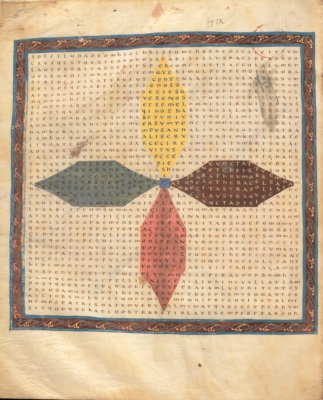
The sophisticated visual differentiation in his manuscripts employed caroline minuscule4 for prose explanations while utilizing multiple script styles within the figured poems themselves, creating complex layered meanings. His artistic technique involved the precise arrangement of letters to create visual patterns that functioned simultaneously as text to be read and images to be contemplated, requiring exceptional planning and execution skills. The integration of symbolic colors in his illuminated manuscripts followed theological principles, employing the four colors mentioned in Exodus—hyacinth, purple, linen, and scarlet—to convey spiritual meanings.
His artistic style demonstrated remarkable sophistication in the use of gold leaf and painted backgrounds, creating hierarchical visual effects that enhanced the manuscripts’ spiritual impact. The figural elements in his illuminations, including representations of Christ, angels, emperors, and the author himself, reflected careful attention to iconographic tradition while introducing innovative compositional arrangements. His artistic vision extended beyond decoration to create functional spiritual tools, as the process of deciphering his visual puzzles was intended to reveal and affirm mystical theological concepts. The high quality of painting in his manuscripts complemented the sophistication of his Latin poetry, demonstrating his mastery of both literary and visual artistic traditions. His development of the author portrait tradition, particularly his representation of himself kneeling in prayer before the cross, established an important precedent in medieval manuscript art.
The technical excellence of Rhabanus’s illuminated manuscripts reflected his deep understanding of both scriptorial traditions and innovative artistic possibilities within the medium. His artistic style incorporated complex symbolic systems where individual letters carried multiple meanings depending on their position within the overall visual composition. The sophisticated planning required for his carmina figurata demonstrates an artistic vision that could conceptualize entire pages as unified visual-textual compositions. His use of superimposed images over letter grids created multiple reading levels, allowing viewers to discover hidden poems and meanings through careful visual analysis.
The artistic refinement of his manuscripts extended to their physical production, with careful attention to parchment quality, ink preparation, and binding techniques that ensured long-term preservation. His innovative approach to page layout created dynamic relationships between text and image that influenced subsequent developments in medieval book design. The artistic coherence of his major works reflects a unified aesthetic vision that integrated theological content with sophisticated visual presentation. His mastery of different artistic media within manuscript production, from initial letters to full-page illuminations, demonstrates comprehensive understanding of the illuminator’s craft. The precision and consistency of his artistic output suggest the development of standardized production techniques that could be transmitted to other scribes and illuminators. His artistic legacy established new possibilities for combining intellectual content with visual expression that would influence medieval manuscript production for centuries.
Intellectual and Artistic Influences
Alcuin of York served as the primary intellectual and artistic influence on Rhabanus Maurus, providing him with advanced training in both scholarly methods and manuscript production techniques during his studies at Tours. The Carolingian Renaissance’s emphasis on the revival of classical learning profoundly shaped Rhabanus’s artistic vision, inspiring his integration of literary sophistication with visual innovation. The rich manuscript tradition at Fulda monastery exposed him to diverse artistic styles and techniques from across Europe, contributing to his development of the carmina figurata form. Byzantine iconographic traditions influenced his figural representations, particularly in his depictions of Christ, angels, and imperial figures within his illuminated manuscripts.
The classical tradition of pattern poetry, traced back to ancient Greek and Roman sources, provided foundational models for his innovative text-image combinations. Irish and Insular manuscript traditions, available through the international networks of Carolingian monasticism, contributed to his understanding of decorative possibilities within religious texts. The theological writings of the Church Fathers, particularly their symbolic interpretations of scriptural imagery, informed the complex iconographic programs of his illuminated works. Contemporary Carolingian court culture, with its emphasis on the integration of learning and artistic production, provided the intellectual framework for his innovative approach to manuscript illumination. The mathematical and geometric knowledge preserved in monastic schools influenced his precise planning of grid patterns and proportional relationships in his visual compositions. The influence of earlier medieval encyclopedists can be seen in his systematic approach to organizing knowledge through both textual and visual means in works like De universo5.
The artistic traditions of the Fulda scriptorium, established by earlier generations of monastic illuminators, provided Rhabanus with practical knowledge of manuscript production techniques and decorative styles. Classical rhetoric and its emphasis on the integration of form and content profoundly influenced his development of carmina figurata as a means of enhancing textual meaning through visual presentation. The influence of patristic theology, particularly its allegorical interpretation methods, shaped his approach to creating multiple layers of meaning within his illuminated compositions.
Contemporary developments in Carolingian minuscule script influenced his careful attention to letter forms and their potential for both textual and visual expression. The architectural and decorative programs of Carolingian churches provided models for his integration of symbolic imagery with religious function in his manuscript illuminations. The influence of contemporary liturgical practices can be seen in his emphasis on the cross as a central organizing principle for both textual and visual elements in his major works. Mathematical and astronomical knowledge, preserved and developed in Carolingian schools, influenced his sophisticated approach to geometric organization within his figured poems. The tradition of biblical commentary, particularly its emphasis on revealing hidden meanings in sacred texts, provided intellectual justification for his innovative text-image synthesis. Contemporary political symbolism, especially imperial iconography, influenced his representations of Carolingian rulers within his illuminated manuscripts. The influence of monastic meditation practices shaped his creation of visual-textual compositions designed to facilitate contemplative reading and spiritual insight.
Scholarly and Artistic Travels
Rhabanus Maurus’s formative journey to Tours around 802-803 for advanced study with Alcuin of York represented the most crucial travel experience of his career, exposing him to the highest levels of Carolingian scholarship and manuscript production techniques. This sojourn at Tours, one of the premier centers of the Carolingian Renaissance, provided him with access to extensive manuscript collections and sophisticated scriptorial practices that would profoundly influence his later artistic innovations.
His pilgrimage to Jerusalem around 817, undertaken between his ordination as priest and his appointment as abbot of Fulda, exposed him to Byzantine artistic traditions and Eastern Christian iconographic practices. The Jerusalem pilgrimage likely brought him into contact with different manuscript traditions and artistic techniques from the Eastern Mediterranean, broadening his understanding of visual-textual synthesis possibilities. His travels within the Carolingian Empire as abbot of Fulda required regular journeys to imperial courts and ecclesiastical councils, exposing him to diverse artistic traditions and patronage networks.
These administrative travels provided opportunities to examine manuscript collections in various monastic libraries, contributing to his comprehensive knowledge of contemporary illumination techniques. His appointment as Archbishop of Mainz in 847 necessitated travels throughout his archiepiscopal territory, bringing him into contact with different scriptorial traditions and regional artistic practices. Regular attendance at imperial assemblies and church synods required extensive travel, providing opportunities to network with other ecclesiastical leaders and to promote his illuminated manuscripts. His scholarly reputation attracted visits from students and scholars from across Europe, creating an informal international exchange of artistic and intellectual ideas at Fulda. The distribution of his manuscripts throughout Europe, while not requiring personal travel, reflected the international networks that facilitated the spread of his artistic innovations.
The intellectual networks established through his travels enabled Rhabanus to maintain correspondence with scholars and artists across Europe, facilitating the exchange of artistic techniques and iconographic innovations. His journey to Tours introduced him to the international community of scholars gathered around Alcuin, providing lasting connections that would support his later artistic and scholarly endeavors. The practical experience gained through travel exposed him to different regional approaches to manuscript production, contributing to the sophistication and variety evident in his own illuminated works.
His pilgrimage experience provided him with firsthand exposure to the religious art and architecture of different regions, enriching the iconographic repertoire evident in his later manuscript illuminations. The administrative responsibilities associated with his ecclesiastical positions required extensive travel for visitations, synods, and imperial business, creating opportunities for artistic exchange and influence. His travels facilitated the establishment of scriptorial networks that supported the production and distribution of his illuminated manuscripts throughout the Carolingian Empire.
The exposure to different cultural and artistic traditions through travel contributed to the synthetic quality of his artistic vision, combining diverse influences into innovative new forms. His scholarly reputation attracted international visitors to Fulda, creating opportunities for artistic exchange without requiring extensive personal travel. The political dimension of his travels as both abbot and archbishop provided access to imperial and aristocratic art collections, exposing him to the highest quality examples of contemporary artistic production. His travel experiences contributed to the development of his sophisticated understanding of the relationship between political power and artistic patronage, evident in his dedications to Carolingian rulers.
Death
Rhabanus Maurus died on February 4, 856, in Mainz, where he had served as archbishop for the final nine years of his life, leaving behind a legacy that fundamentally transformed the relationship between text and image in medieval manuscript production. His cause of death is not specifically recorded in historical sources, but he died peacefully at an advanced age after a career of extraordinary scholarly and artistic productivity that spanned more than five decades.
His artistic innovations in manuscript illumination, particularly his development of carmina figurata, influenced European book production for centuries and established new possibilities for combining intellectual content with visual expression. The recognition of his sanctity by the Catholic Church, with his feast day celebrated on February 4, reflects both his spiritual achievements and his contributions to Christian culture through his illuminated manuscripts.
His title as Praeceptor Germaniae (Teacher of Germany) acknowledges his role in transmitting both classical learning and artistic techniques that would shape medieval European civilization. The preservation of his works in major manuscript collections throughout Europe demonstrates the enduring recognition of his contributions to both scholarship and artistic innovation. His influence extended beyond his immediate historical period, inspiring later developments in manuscript illumination and establishing precedents for the integration of scholarly content with sophisticated visual presentation.
The survival of approximately eighty manuscript copies of his major work “De laudibus sanctae crucis” alone testifies to his lasting impact on medieval artistic culture. His death marked the end of an era in Carolingian scholarship, but his artistic innovations continued to influence manuscript production throughout the medieval period and into the Renaissance. Modern scholarship recognizes Rhabanus Maurus as a pivotal figure who expanded the possibilities of medieval art through his unique synthesis of textual and visual expression, establishing him as one of the most significant artist-scholars of the early medieval period.
Major Works and Their Contents
Rabanus (left), introduced by Alcuin, presents the illuminated codex to Otgar, Bishop of Mainz
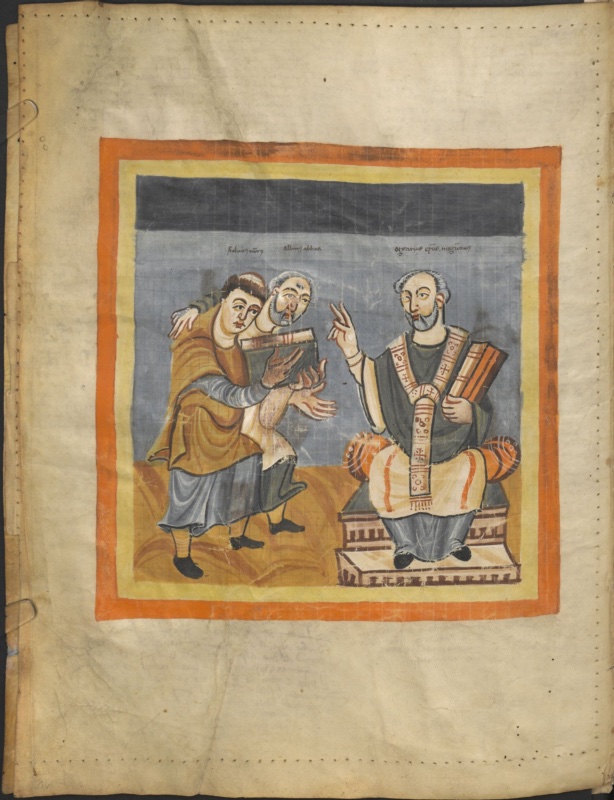
The De laudibus sanctae crucis (In Praise of the Holy Cross), completed around 813-814, stands as Rhabanus Maurus’s masterpiece and represents the pinnacle of Carolingian carmina figurata, containing twenty-eight figured poems that explore different aspects of Christian symbolism through innovative text-image synthesis. Each figured poem is arranged in a grid of letters that simultaneously forms readable text and creates visual images of crosses, human figures, animals, and geometric patterns, with the Vienna manuscript (created around 830-840) representing the finest surviving example of this sophisticated artistic achievement. The work opens with dedication miniatures showing Rhabanus and his teacher Alcuin presenting the book to Archbishop Otgar of Mainz, establishing the important patronage relationship that supported the manuscript’s production.
The figured poems employ multiple scripts including Rustic Capitals and Uncials to create hierarchical visual effects, with red uncial text often forming the most significant symbolic elements within each composition. The manuscript’s two frontispiece miniatures introduce the theological themes developed throughout the work, establishing the cross as the central organizing principle for both textual and visual elements. One of the most significant figured poems portrays Emperor Louis the Pious as Miles Christi (Soldier of Christ), demonstrating the sophisticated integration of imperial iconography with religious symbolism characteristic of Carolingian court art.
The final figured poem presents an author portrait showing Rhabanus himself kneeling in prayer before the cross, with text in red uncials outlined by his tonsured figure asking Christ to protect “Rabanus myself”. Each figured poem is accompanied by a prose explanation (declaratio figurae) that elucidates the symbolic meanings embedded in the visual-textual composition, providing readers with interpretive guidance. The work concludes with prose paraphrases of all the figured poems, creating multiple textual levels that enhance the reader’s understanding of the complex symbolic systems employed throughout. The survival of approximately eighty manuscript copies from the ninth through twelfth centuries attests to the work’s extraordinary popularity and influence on medieval manuscript production.
De Universo (The building of the Tower of Babel)
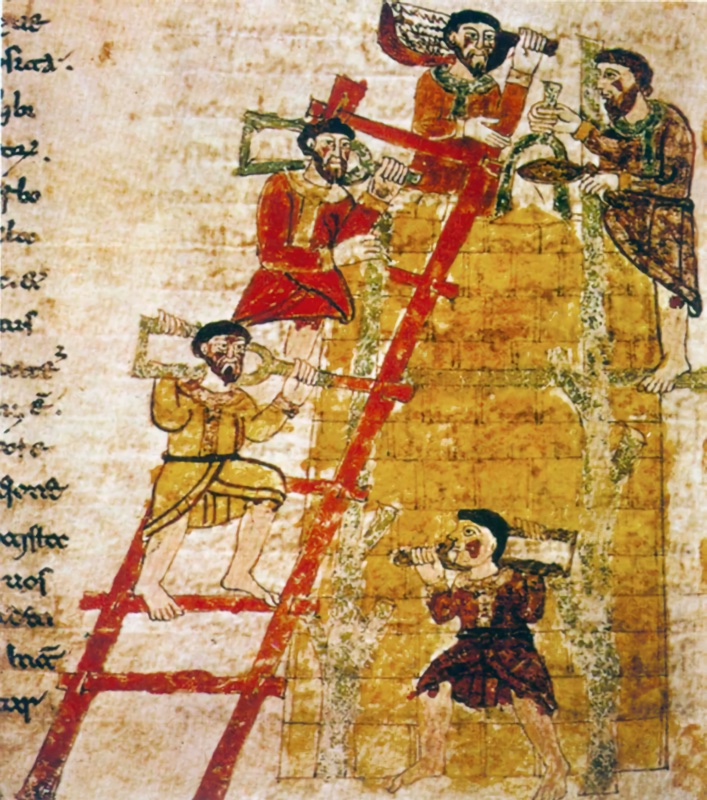
The De universo (originally titled De rerum naturis), an encyclopedic work completed during his tenure as abbot of Fulda, contains over 360 miniature illuminations that illustrate diverse aspects of medieval knowledge from theology to natural philosophy. This massive codex, measuring 35 by 49 centimeters and containing 530 pages written in Beneventan script, represents one of the most extensively illuminated encyclopedic works of the medieval period. The manuscript’s miniatures cover an extraordinary range of subjects including astronomical diagrams, botanical illustrations, zoological representations, architectural drawings, and human figures representing different social classes and occupations.
The Monte Cassino manuscript of De universo demonstrates the international influence of Rhabanus’s artistic innovations, as southern Italian scriptoria adapted his techniques to their own regional artistic traditions. The work’s systematic approach to illustrating encyclopedic knowledge reflects the Carolingian commitment to preserving and organizing classical learning through both textual and visual means. The miniatures employ sophisticated iconographic programs that integrate classical sources with Christian symbolism, creating educational tools that functioned both as reference works and objects of contemplation. The manuscript’s production required the collaboration of multiple scribes and illuminators, demonstrating the sophisticated scriptorial organization that Rhabanus established at Fulda.
The work’s influence extended throughout medieval Europe, with later encyclopedic manuscripts adopting similar approaches to the integration of text and image for educational purposes. The De universo represents the culmination of Rhabanus’s vision for combining scholarly content with sophisticated artistic presentation, creating manuscripts that served both practical and aesthetic functions. The work’s preservation in multiple manuscript traditions demonstrates the continuing recognition of its value as both artistic achievement and scholarly resource throughout the medieval period.