San Zanobi
Origins and Early Life
San Zanobi — known in Latin as Zenobius — stands as one of the most revered figures in Florentine religious history, venerated as the city’s first bishop, its patron saint, and its principal apostle. His life bridges the turbulent transition of late Roman antiquity from paganism to Christianity, making him not only a spiritual but also a historically significant figure of the fourth and early fifth centuries.
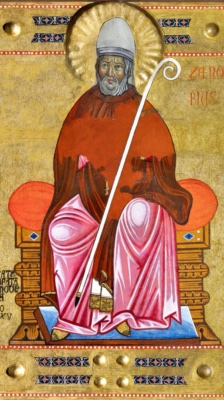
Zenobius was born around 337 AD in Florence, into a noble Florentine family of the gens Geronima, and was raised according to the pagan customs of his social class. His education was thorough, conducted under eminent masters, and included a deep engagement with philosophy — a discipline that, paradoxically, led him away from the polytheistic faith of his upbringing. Through rational inquiry, he came to perceive the contradictions of paganism and was drawn to the Christian gospel. He came under the formative influence of Bishop Theodore of Florence, who baptized him privately — an act that provoked a fierce reaction from his parents, who viewed it as an affront to their parental authority. With patience and eloquence, Zenobius defended both his own decision and the bishop, offering such a lucid exposition of the Christian faith that he ultimately succeeded in converting his father and mother as well.
Ecclesiastical Formation and Diplomatic Career
After his baptism, Zenobius embraced the clerical state with dedication and rose swiftly through the ecclesiastical hierarchy, eventually attaining the rank of archdeacon. His exceptional virtue and gifts as a preacher attracted the attention of Saint Ambrose of Milan, who became a key patron and advocate. At Ambrose’s recommendation, Pope Damasus I1 summoned Zenobius to Rome, where he was entrusted with significant diplomatic and theological missions. Among the most consequential of these was a legation to Constantinople in 381, undertaken to deliver the papal position on the Arian heresy2 — a mission that placed him at the very centre of one of the defining theological controversies of the age. During these years in Rome, Zenobius served as a close counsellor to Damasus and built a reputation as a man of both deep piety and formidable intellectual ability.
The Episcopate of Florence
Upon the death of Pope Damasus, Zenobius returned to Florence and resumed his pastoral work. When the sitting bishop of Florence died, Zenobius was elected to the see, an appointment received with great joy by the Florentine people. As bishop, he threw himself into the evangelisation of Florence and its surrounding territories, combating the persistent influence of Arianism — the heresy denying the full divinity of Christ — which he had already confronted diplomatically in Constantinople. He was assisted in his pastoral work by two deacons, Saint Eugene and Saint Crescentius, who are themselves venerated as saints in the Catholic tradition.
His episcopate was marked by admirable personal qualities: humility, austerity, charity, and an unfailing commitment to preaching. Ancient sources credit him with remarkable miracles, including the resurrection of five people from the dead, which contributed enormously to his popular veneration during his lifetime and long after.
Miracles During His Lifetime
The ancient accounts credit Zenobius with five resurrections of the dead during his lifetime, an extraordinary number that gave him an almost apostolic aura in the eyes of the Florentines. These miracles are documented in medieval chronicles and were immortalized in a celebrated cycle of paintings by Sandro Botticelli3 around 1500, now distributed among the National Gallery in London, the Metropolitan Museum of Art in New York, and the Gemäldegalerie in Dresden.
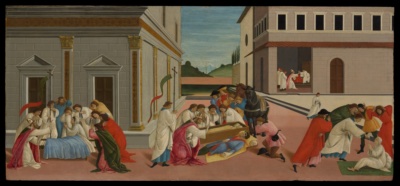
The first miracle involves a French noblewoman who, while on pilgrimage to Rome, entrusted her gravely ill son to the care of the Florentine diocese. On her return from Rome she found the boy dead and, wandering through the city in despair, she encountered Zenobius, who prayed over the child and restored him to life. This episode is commemorated by a bronze plaque on the façade of the Palazzo Visacci on Borgo degli Albizi, marking the very spot of the resurrection.
The second miracle recounted by Botticelli shows Zenobius encountering a funeral procession in the streets of Florence. A youth had died and was being carried to burial; Zenobius halted the cortège and raised the young man back to life before the astonished crowd.
In a third episode, a porter who had carried a casket of saints’ relics across the Apennine mountains died of exhaustion upon his arrival in Florence. Zenobius, assisted by the power of the relics themselves, restored him to life in the middle of the city square.
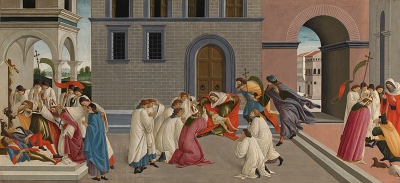
A fourth miracle, depicted in the London panel, concerns two young men who had treated their mother with contempt and had been cursed by her in anger. The curse manifested as a diabolical affliction, and Zenobius exorcised both men of their demons. The fifth and final miracle in Botticelli’s account — and among the most famous — depicts Zenobius restoring sight to a blind beggar outside the cathedral. The beggar had promised to convert to Christianity if his sight were restored; when Zenobius placed his fingers over the man’s eyelids and prayed, the miracle was granted and the man kept his vow.
A further miracle, separately documented, concerns a five-year-old boy who appeared to be dead after being struck by an ox. Zenobius revived him, an episode that led to his veneration in later centuries as a patron saint of injured children.
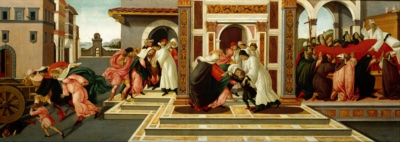
The Posthumous Miracle of the Elm
The most celebrated of all the miracles associated with San Zanobi occurred not during his life but after his death in 417 AD, during the translation of his remains. When his sarcophagus was being carried through what is now Piazza San Giovanni on its way to the Church of Santa Reparata, the coffin grazed the bare branches of an elm tree in the depths of winter. Instantly, the tree burst into full bloom, sprouting leaves and flowers in defiance of the season — a posthumous sign that the city interpreted as divine confirmation of the bishop’s sanctity.
The legend of the elm continued to grow in subsequent centuries. According to some accounts, the trunk of the tree was later used to craft a crucifix, now preserved in the Church of San Giovannino dei Cavalieri in Via San Gallo; others claim it was used as the panel for a painting of the saint’s life by the Maestro del Bigallo, though scientific analysis of that panel has revealed it to be poplar wood rather than elm.
Death and Commemoration
His biographer and eventual successor in the See of Florence, Saint Antoninus (Antonino Pierozzi), described him as dying in his ninetieth year, though the precise date of his death remains debated. Most historians accept 417 AD as the year of his death, on 25 May — the date on which his feast is celebrated — though Antoninus’s account, which mentions Pope Innocent I as reigning at the time, has led some scholars to propose 424 AD.
Artistic Representation
The cult of San Zanobi inspired a rich tradition of artistic representation, particularly from the fourteenth century onward. He is conventionally depicted holding a dead child or accompanied by a flowering elm tree, both referencing his miracles. Sandro Botticelli painted a celebrated cycle of four panels illustrating scenes from his life, now divided among the National Gallery in London, the Gemäldegalerie in Dresden, and the Metropolitan Museum of Art in New York.
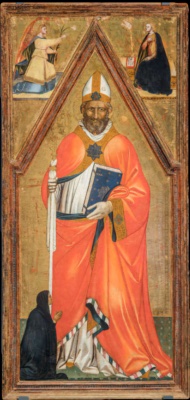
A particularly significant fourteenth-century image, attributed to Jacopo di Cione4 and now in the Museo dell’Opera del Duomo in Florence, presents him in a devotional panel as intercessor, placed between a praying donor and the scene of the Annunciation — a visual theology that eloquently expresses his role as mediator between the faithful and the divine.
The Fiorita di San Zanobi
Every year on 26 January, Florence celebrates the Fiorita di San Zanobi, an ancient ceremony reenacting the miracle of the blooming elm and honouring the city’s first and most beloved bishop.
Scholarship on Saint Zanobi
The iconographic and artistic traditions surrounding San Zanobi have attracted sustained attention from some of the most distinguished art historians of the twentieth century. Richard Offner, in his monumental Corpus of Florentine Painting, provided the foundational critical analysis of the Maestro del Bigallo’s panel depicting Saint Zanobi enthroned between his deacons — establishing the attribution, dating, and stylistic context that all subsequent scholarship has engaged. Osvald Sirén, working in the same early connoisseurial tradition, contributed to the classification of Duecento Florentine painting in which the Zanobi imagery plays a formative role. Edward B. Garrison’s Italian Romanesque Panel Painting: An Illustrated Index (1949) catalogued the earliest Florentine panel traditions within which devotional images of the saint circulated, mapping for the first time the full scope of the surviving material. Roberto Longhi, characteristically, reframed the question of Florentine Duecento painting — including the civic-religious commissions associated with Zanobi’s cult — within a broader interpretive argument about the origins of Italian pictorial naturalism, placing the saint’s iconographic tradition at the intersection of Byzantine legacy and proto-Giottesque innovation.
In the second half of the twentieth century and into the twenty-first, the scholarship grew more granular and more rigorously attributional. Miklós Boskovits brought his extraordinarily precise connoisseurship to bear on the early Florentine panel tradition, refining attributions within the corpus of Zanobi imagery and situating individual works within the complex workshop genealogies of Duecento and Trecento Florence.
Angelo Tartuferi, whose career at the Uffizi has made him one of the leading authorities on medieval Florentine painting, has published extensively on the pictorial culture within which the Zanobi cycles were produced, including catalogue entries and exhibition scholarship that directly address the saint’s iconographic programmes. Carlo Ludovico Ragghianti, whose methodological rigour and interest in the formal logic of Florentine civic art made him an important voice in the broader reassessment of medieval Tuscan painting, contributed to the interpretive framework within which the Botticelli panels and their Duecento antecedents are read. Antonino Caleca, bringing both archival sensitivity and a sustained engagement with Pisan and Florentine sacred topography, has addressed the role of bishop-saints in the construction of Tuscan civic identity — a perspective of direct relevance to understanding how the cult and image of San Zanobi functioned within the spiritual and visual culture of medieval Florence.