Saint John Gualbert
Giovanni Gualberto — known in the Latin and ecclesiastical tradition as John Gualbert — was an Italian Benedictine abbot, monastic reformer, and founder of the Vallombrosan Order, one of the most spiritually rigorous and historically significant religious congregations of medieval Italy. Born into Florentine nobility at the cusp of the eleventh century, he passed through a turbulent youth, a moment of radical conversion, and decades of unwavering ascetic dedication before dying in the odour of sanctity and being canonized more than a century after his death. His life stands as one of the defining narratives of the Gregorian Reform era: a man who turned from revenge to mercy, from privilege to poverty, and who ultimately reshaped the monastic landscape of Tuscany.
Origins and Noble Youth
Giovanni was born approximately around 985, some sources placing the date closer to 993, at the castle of Poggio Petroio, near Florence, into the Visdomini family — an ancient and powerful noble house of Tuscany. The Visdomini were among the most prominent lay lineages in Florence, wielding influence over both civic affairs and ecclesiastical appointments, and Giovanni grew up in the comfort and privilege such a background conferred. He had one sibling, an older brother named Ugo, to whom he was especially close, and a kinsman in Pietro Igneo, who would later play a dramatic role in the history of the Vallombrosan1 movement.
His upbringing was nominally Catholic — he was educated and raised within the faith — but in his adolescence and early manhood he showed little authentic religious feeling. He was instead, as his hagiographers record, devoted to “vain amusements and romantic intrigues,” living the idle life of a young Florentine nobleman: feasts, games, and the social theatre of the urban aristocracy. There was, at this stage of his life, nothing to distinguish him from hundreds of other well-born young men of his time and class.
The Murder of Ugo and the Vow of Vengeance
The first rupture in this comfortable existence came with the murder of his brother Ugo. The sources do not specify the precise circumstances in full detail, but it appears the killing was carried out by a member of a rival family or possibly a cousin — the kind of feud between noble factions that was endemic to medieval Florentine life. Giovanni, as was both expected and demanded by the customs of his class, swore to avenge his brother’s death, and set about finding and killing the man responsible. For a young Florentine nobleman, vengeance was not merely an emotional impulse but a social and familial obligation — a debt of honour that could not remain unpaid.
To grasp the force of this vow, it is necessary to situate it within the legal and social culture of eleventh-century Tuscany, where institutions of public justice were still uneven and heavily mediated by kinship networks. In practice, noble lineages frequently treated homicide as a matter to be settled through retaliatory violence, negotiated compensation, or clan-level settlement rather than through an impersonal civic tribunal. A man who failed to avenge a slain brother could be judged not as merciful, but as weak and dishonourable, thereby endangering the standing of his entire house in a competitive aristocratic environment. Giovanni’s oath of vengeance therefore reflected not only grief but conformity to a deeply embedded code of familial responsibility.
Hagiographic tradition, while shaped by later devotional aims, preserves this pre-conversion phase precisely to heighten the magnitude of Giovanni’s later transformation: the saint is first shown as fully inside the logic of feud before he breaks it. Medieval biographers thus present the murder of Ugo as a theological threshold as much as a biographical event, the point at which inherited aristocratic values of blood-honour and retribution stood in direct tension with the evangelical demands of forgiveness. In this narrative architecture, Giovanni’s pursuit of the killer is not incidental background but the necessary dramatic prelude to the Good Friday encounter that would redefine his life, vocation, and historical legacy.
The Act of Mercy on Good Friday
The confrontation, which became the defining episode of Giovanni’s entire life, took place on a Good Friday, the most solemn day of the Christian liturgical calendar. As Giovanni was riding through Florence with his armed followers, he encountered his brother’s killer in a narrow lane — possibly near the Porta San Miniato. He drew his sword and was prepared to carry out the killing when the man fell to his knees, extended his arms in the form of a cross, and begged for mercy in the name of Jesus Christ, reminding Giovanni that this was the very day on which the Saviour had died forgiving his own murderers.
The gesture struck Giovanni with sudden and overwhelming force. In that instant, he experienced what his biographers interpret as a vision or acute awareness of Christ on the Cross — a direct spiritual confrontation with the logic of Christian forgiveness that cut through every social and familial imperative he had been conditioned to obey. He threw down his sword, granted his brother’s murderer full forgiveness, and embraced him.
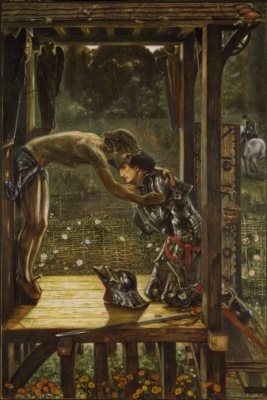
It was a moment the medieval Church would come to celebrate as among the most vivid illustrations of evangelical mercy in hagiographic literature, and it inspired Edward Burne-Jones centuries later to paint his famous work The Merciful Knight.
Entry into San Miniato al Monte
Immediately after this episode, Giovanni walked directly to the Benedictine church of San Miniato al Monte, the great hilltop abbey overlooking Florence, to pray. According to the hagiographic account, as he knelt before the crucifix, the carved figure of Christ bowed its head toward him in silent recognition of his act of mercy — a miracle that was regarded by contemporaries as divine confirmation of his conversion. Giovanni begged pardon of his sins, cut off his hair, and borrowed an old monastic habit, commencing his transformation from nobleman to monk on the very same day.
He presented himself as a novice and asked to be admitted to the Benedictine2 community of San Miniato. The abbot initially hesitated, fearing the reaction of Giovanni’s powerful and influential father. His father did in fact come searching for his son, but when Giovanni explained his reasons and demonstrated his complete resolution, the father relented, gave him his blessing, and counselled him simply to “do good.” Giovanni was formally received as a Benedictine monk. He threw himself into the life with extraordinary fervour: frequent fasting, severe penances, long nocturnal vigils, and a discipline of prayer that quickly distinguished him from his fellow monks.
Confrontation with Simony
The serenity of monastic life at San Miniato was not to last. Giovanni soon became aware that the monastery he had entered was itself tainted by the most corrosive form of ecclesiastical corruption then spreading through the Church: simony, the buying and selling of sacred offices, sacraments, and spiritual authority. Both the abbot Oberto and the Bishop of Florence, Pietro Mezzabarba3, were implicated. For Giovanni, who had embraced monastic life precisely as an escape from moral compromise, the discovery was devastating and intolerable.
Simony was not merely a local scandal. In the eleventh century it represented a systemic crisis of the entire Latin Church: as secular rulers and noble families appointed bishops and abbots for political reasons and extracted payment for the privilege, the sacred character of the clergy was degraded and the Benedictine ideal of holy poverty reduced to a fiction. Giovanni’s refusal to acquiesce to this corruption was not a quiet act of internal dissent — he openly opposed the simoniacal practices at San Miniato and, when he could not reform the situation from within, he left the monastery entirely rather than remain in an environment he considered spiritually poisoned.
Wandering and the Search for a Stricter Life
After departing San Miniato, Giovanni entered a period of wandering through the monasteries of Romagna, visiting several communities in search of a way of life sufficiently rigorous and pure to satisfy his conscience. He spent time at Camaldoli, the renowned hermit community founded by Romuald of Ravenna in the forests of the Casentino, whose extreme asceticism resonated with Giovanni’s own temperament. However, while he admired the eremitic ideal, he was temperamentally drawn to the cenobitic life — communal monasticism organised around a shared rule, liturgy, and fraternal charity — rather than the solitary life of the hermit.
This distinction mattered deeply. The eremitic model, exemplified by Camaldoli, privileged radical solitude and individual contemplation; the cenobitic model, rooted in the Rule of St. Benedict, insisted on the spiritual formation that comes from living and working in community with others. Giovanni wanted both austerity and community, both contemplation and active fraternal service — a combination that no existing community in Tuscany fully provided.
Foundation of Vallombrosa
Around 1036, Giovanni settled on a remote stretch of forested Apennine landscape east of Florence, a valley known then as Acquabella and later transformed by his presence into the famous Vallombrosa — “the shaded valley.” Here, together with a small group of like-minded companions equally unwilling to tolerate ecclesiastical corruption and equally committed to a strict interpretation of the Benedictine Rule, he founded a humble monastery devoted entirely to prayer, contemplative work, and care of the poor and sick.
The austerity of the early Vallombrosan community was formidable — so severe, in fact, that relatively few postulants could endure it. The founding years were therefore humble in scale, with only a small brotherhood gathered around Giovanni in the forested solitude of the mountain. In a characteristically original gesture, he had his monks plant forests of firs and pines rather than cultivating a traditional vegetable garden, shaping the dense and melancholy woodland landscape for which Vallombrosa has been famous ever since — and which inspired, among others, John Milton’s celebrated description of fallen angels strewn thick as autumnal leaves that strew the brooks in Vallombrosa.
Growth of the Order and Expansion
As Giovanni moderated the most extreme austerities of the original rule to make the community more accessible, the congregation at Vallombrosa began to grow rapidly and attract widespread attention. Many monks departed San Miniato al Monte and other Florentine monasteries to join the new foundation, drawn by the combination of genuine poverty, strict liturgical observance, and moral clarity that Giovanni embodied. Within his own lifetime, Giovanni founded or reformed a significant number of additional monasteries: at Passignano in Chianti, at Settimo near Florence, at Marradi, at Rozzuolo, and at San Salvi just outside Florence itself.
A Bull of Pope Urban II4 in 1090, issued not long after Giovanni’s death, took the whole congregation formally under the protection of the Holy See and enumerated fifteen monasteries besides the motherhouse at Vallombrosa, testament to how rapidly the order had expanded. The Vallombrosans were organized along strictly Benedictine lines, with the abbot of Vallombrosa exercising authority over the entire congregation as abbot-general — a structural innovation that would later influence the organization of other reformed Benedictine congregations, including Cluny’s sphere of influence in France.
The Campaign Against Simony and Pietro Igneo
Giovanni’s personal battle against simony did not end with his departure from San Miniato. He deployed monks across Tuscany, to Rome, and as far as Milan to preach against the corruption of the clergy and to support the reform program that was gradually coalescing around what historians call the Gregorian Reform movement. The most famous episode in the Vallombrosans’ anti-simoniacal campaign was the dramatic ordeal by fire of 1068, in which a monk named Pietro Igneo5 — a kinsman of Giovanni’s — walked unharmed through a blazing pyre to prove, in the theatre of public trial, the guilt of Bishop Pietro Mezzabarba of Florence on charges of simony.
Pietro Igneo’s feat sent a shockwave through the ecclesiastical world of Tuscany, vindicating Giovanni’s years of confrontation with the Florentine episcopate and greatly increasing the prestige and moral authority of Vallombrosa. The incident exemplified the Vallombrosans’ willingness to act publicly and dramatically in the service of Church reform, combining monastic contemplation with an almost prophetic readiness to challenge corrupt authority. Shortly before this event, the monastery of San Salvi had been burned and its monks ill-treated by the anti-reform faction, a sign of how violently contested the reform struggle had become.
Relations with the Papacy
Giovanni’s moral authority and his congregation’s commitment to reform earned him the admiration and friendship of successive popes during one of the most turbulent periods of medieval papal history. Pope Leo IX6, one of the great reforming popes of the eleventh century, personally traveled to Vallombrosa to visit the aged abbot — a gesture of remarkable personal esteem from the Bishop of Rome toward a monk who had never sought public recognition. Pope Stephen IX7 and Pope Alexander II8 both held Giovanni in the highest regard, while Pope Gregory VII9, the architect of the Gregorian Reform, praised him explicitly for “the pureness and meekness of his faith” and held him up as a living model of Christian goodness.
This relationship with the papacy was not merely one of mutual admiration. The Vallombrosans occupied a strategic position in the politics of Church reform, providing both spiritual legitimacy and organizational infrastructure to the reform movement in central Italy at a time when the papacy was locked in an existential struggle against simony and lay investiture.
Personal Holiness and Humility
Despite his enormous authority as founder and spiritual head of a rapidly growing congregation, Giovanni consistently refused all forms of personal ecclesiastical advancement. He declined ordination to the priesthood and refused even to receive the minor orders — a choice so unusual for an abbot of his standing that it drew widespread admiration and comment. His reasoning was rooted in a profound conviction that holiness resided in humility, labour, and service rather than in hierarchical rank or liturgical privilege.
He was universally celebrated for his compassion toward the poor and the sick. According to multiple hagiographic sources, he made the care of the destitute a central feature of the Vallombrosan mission, and he exercised an authority over those who sought his counsel that derived entirely from the visible integrity of his life rather than from any office or title. He was a devoted student of the Church Fathers and nourished his monastic spirituality particularly on the writings of Basil of Caesarea and the Rule of Benedict of Nursia, which he regarded as the most balanced and humane expression of the contemplative ideal.
Artistic Representation
The visual arts were drawn to Giovanni Gualberto’s story with particular frequency, finding in his life a wealth of dramatic and devotional subject matter.
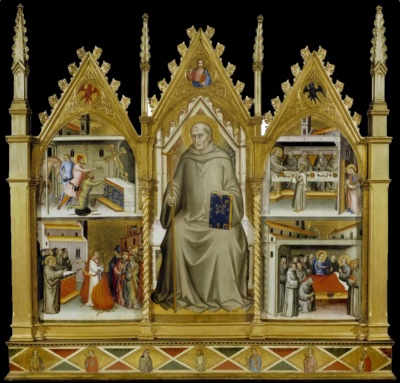
The most celebrated medieval treatment is a large polyptych by Giovanni del Biondo10, painted in 1370, which depicts Saint John Gualbert enthroned in majesty with scenes from his life rendered in the predella panels, originally visible in Saint Micheal monastery at San Salvi and now housed in the Museo dell’Opera di Santa Croce, Florence.
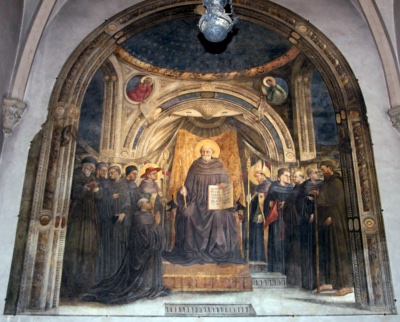
A later and more celebrated work is the altarpiece by Neri di Bicci11 painted in 1455 for Santa Trinita in Florence, showing the saint enthroned among companion saints in a gold-ground composition of great refinement.
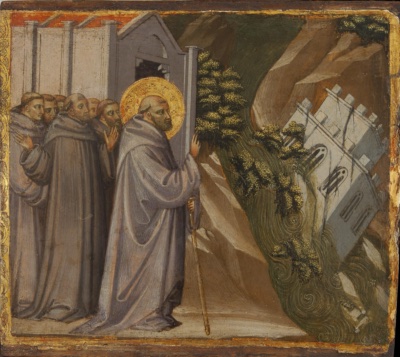
Bicci di Lorenzo12 contributed a predella panel depicting the Miracle of St. John Gualbert in 1434, originally part of a dismembered polyptych from Santa Trinità.
Death and Canonization
Giovanni Gualberto died on 12 July 1073 at the Abbey of Passignano in Chianti, one of the daughter houses he himself had founded. He was approximately 88 years of age — a remarkable lifespan for the medieval period — though some sources give a lower figure of 80. He had led the Vallombrosan congregation for approximately four decades, transforming it from a tiny hermitage in the Apennine forest into an organized monastic order with communities across Tuscany. Miracles were reported at his tomb almost immediately after his death, and his cult spread rapidly through central Italy.
He was formally canonized by Pope Celestine III13 on 24 October 1193, more than a century after his death — a reflection of both the enduring spiritual influence of the Vallombrosan tradition and the sometimes slow pace of canonical procedures in the medieval Church. His feast day was formally fixed on 12 July, the anniversary of his death, by Pope Clement VIII14 in 1595, when it was added to the General Roman Calendar. The feast was removed from the universal calendar in the liturgical reform of 1969, though it remains an Optional Memorial for the Benedictines.
Patronages and Legacy
Giovanni Gualberto was named patron saint of foresters and park rangers, a patronage rooted directly in his practice of having his monks plant forests of firs and pines at Vallombrosa as part of the Benedictine ideal of ora et labora — prayer and work — transforming barren hillsides into the verdant woodland that Milton later immortalized. Pope Pius XII15 formally designated him patron saint of the Italian Forest Corps (Corpo Forestale dello Stato) in 1951, and he was named patron of Brazilian forests in 1957.
The Vallombrosan Order he founded has survived without interruption to the present day. As of 2015, the congregation maintained nine houses with 73 monks and 43 priests, with the motherhouse still located at the ancient Abbey of Vallombrosa in the Apennines above Florence. The order counts among its most curious historical footnotes the fact that a young Galileo Galilei spent a period as a novice with the Vallombrosans in the 1570s before his father withdrew him and redirected him toward medicine and mathematics, setting in motion one of the most consequential scientific careers in human history. The monastery of Vallombrosa itself remains a site of active monastic life, a destination for pilgrims, and one of the most strikingly beautiful sacred landscapes in all of Tuscany.
The historical significance of Giovanni Gualberto’s life and reform can be fully appreciated only against the broader panorama of eleventh- and twelfth-century religious renewal that the American medievalist Giles Constable spent his career illuminating. In his landmark synthesis The Reformation of the Twelfth Century (1996), Constable argued that the explosion of new religious orders, hermit movements, and monastic experiments between roughly 1050 and 1150 constituted a coherent reforming impulse of the first magnitude — comparable in scope and seriousness to the Protestant Reformation five centuries later.
Within that framework, Giovanni Gualberto emerges not as an isolated charismatic figure but as one of the earliest and most consequential architects of the new monastic landscape: his insistence on absolute poverty, his militant campaign against simony, and his creation of a congregational structure that subordinated all daughter houses to Vallombrosa anticipated the organizational innovations that would later characterize Cluny and Cîteaux. Constable’s interpretive lens makes visible the degree to which Giovanni was simultaneously a local Tuscan reformer and a pan-European forerunner.
Constable’s editorial and scholarly work on Peter the Venerable — including his authoritative two-volume critical edition of Peter’s letters (Harvard University Press, 1967) and his co-edited volume Renaissance and Renewal in the Twelfth Century (1982) — also casts indirect but valuable light on the Vallombrosan tradition. Peter the Venerable, as abbot of Cluny from 1122 to 1156, presided over the most expansive Benedictine network in medieval Europe during precisely the decades when Vallombrosa was consolidating its identity and defending its independence from episcopal interference. Reading Constable’s meticulous reconstruction of the correspondence, theology, and monastic politics of Peter’s world, one gains a richer understanding of the intellectual and institutional environment within which the Vallombrosan congregation took its mature shape — the debates over poverty, manual labour, liturgical observance, and the proper relationship between monks and secular clergy that Giovanni had pioneered on Tuscan soil a full generation earlier.