Codex Aureus of Echternach
( 25% )
Introduction and scope
The Codex Aureus of Echternach — in Latin the Codex Aureus Epternacensis, in German Das Goldene Evangelienbuch von Echternach — is one of the supreme achievements of early medieval book art and among the treasures of the Germanisches Nationalmuseum (GNM) in Nuremberg, where the manuscript block is catalogued as Hs. 156142 and the jewelled front cover, stored and conserved separately, as KG 1138. It is a Gospel book written entirely in gold on calfskin parchment, produced in the Benedictine abbey of Echternach (in present-day Luxembourg) in the second quarter of the eleventh century, and bound in a treasure cover of gold, ivory, cloisonné enamel, gems and pearls that was made roughly half a century earlier in Trier.
This essay surveys the manuscript comprehensively: its codicology and physical description; its treasure binding and the debates surrounding it; its date, place and patronage; the Echternach scriptorium and its Insular ancestry; the iconographic programme; the manuscript’s art-historical significance; its provenance and modern history; the state of digitization and facsimile publication; and the historiographical debates that continue to attend it. Throughout, where sources disagree — over dating, over folio and image counts, over the ivory, over provenance details — the disagreement is reported rather than smoothed over, and points that cannot be verified against institutional catalogues are flagged as such.
One correction must be made at the outset, because it bears directly on how the manuscript is described. It is sometimes stated — and the framing of some popular accounts encourages the error — that the Codex Aureus of Echternach was presented by Emperor Henry III1 to his collegiate foundation of Saints Simon and Jude at Goslar around 1050. This is not correct. The Gospel book that Henry III gave to Goslar is a different Echternach manuscript, the Codex Caesareus Upsaliensis (the “Emperor’s Bible” or “Goslar Gospels”), today in Uppsala University Library (MS C 93). The Codex Aureus of Echternach itself appears to have remained at Echternach abbey from its creation until the French Revolutionary period. The two books are closely related members of the same Echternach group, and Henry’s admiration of the older golden Gospel book at Echternach is generally held to have prompted his commissions for Speyer and Goslar; but the Goslar presentation belongs to the Uppsala manuscript, not to the Nuremberg one. This distinction structures several sections below.
Physical description and codicology
The Codex Aureus is a large-format parchment Gospel book. The most widely cited dimensions are approximately 446 × 310 mm (the English-language reference literature typically gives 446 × 310 mm; German and Italian descriptions give 445 × 310 mm), and the manuscript comprises 136 folios (leaves) of calfskin parchment (vellum). The facsimile literature describes the collation as seventeen quaternions (gatherings of four bifolia, i.e. eight leaves each), which yields 136 leaves and is consistent with the stated folio count. The parchment is of high quality and unusually white, a deliberate choice that sets off both the gold script and the passages of imperial purple.
The manuscript’s defining feature — and the source of its name — is its chrysography: the entire text is written in gold ink. A chrysograph, a book whose text is executed in gold, is a rare and enormously costly undertaking, and the Codex Aureus is among the most complete realisations of the type: not a few display pages but the whole of the four Gospels, together with the standard prefatory apparatus, is laid down in gold. The prefatory matter includes three prefaces by Jerome2 and the letter of Eusebius to Carpianus (the standard prologue to the canon tables), as is usual in medieval Gospel books, plus the short verse tituli carried by angels on the display pages.
The script of the running text is a clear and disciplined Caroline (Carolingian) minuscule, the letters small, lively and precisely aligned; the facsimile commentary attributes the writing to at least two, and probably more, copyists whose hands can be distinguished. Headings, incipits and explicits are executed in display scripts — Roman square capitals (capitalis) with some uncial elements, and rustic capitals — and the book is furnished with gold interlace initials and versals in an uncial manner. The decorative apparatus is exceptionally dense. The GNM’s own account speaks of “over 60 pictorial and ornamental pages” and “over 500 initials.” The fuller breakdown given in the English reference literature and by the facsimile publisher runs: sixteen full-page miniatures; nine full-page initial pages; sixteen half-page initials; ten decorated canon-table pages; the evangelist portraits; the double “textile”/carpet pages; and 503 smaller initials in colours, gold and silver. Silver tones and imperial purple grounds heighten the effect of the gold.
As to state of preservation and material history, the manuscript block is in good condition and is today kept separately from its cover so that both can be conserved under appropriate conditions. The most important modern discovery about its physical state comes from the scientific study of its painting technique carried out by conservation scientists Doris Oltrogge and Robert Fuchs and published by the GNM in 2009 (Die Maltechnik des Codex Aureus aus Echternach: ein Meisterwerk im Wandel, 178 pp.). Their systematic examination of all the pictorial and ornamental pages established that reworkings appear “on about a third of the leaves” (Überarbeitungen auf etwa einem Drittel der Blätter) — and, crucially, that these overpaintings were most probably carried out already during the manuscript’s original production, for aesthetic reasons (“offenbar ästhetische Gründe,” above all colour), using “nearly all the pigments available in the eleventh century” (nahezu alle im 11. Jahrhundert verfügbaren Farbmittel). The book was thus a “work in transformation” (ein Meisterwerk im Wandel) even as it was being made, its first painted versions revised before completion; the study also recovered information about the original appearance of the overpainted first versions.
The treasure binding (Buchdeckel)
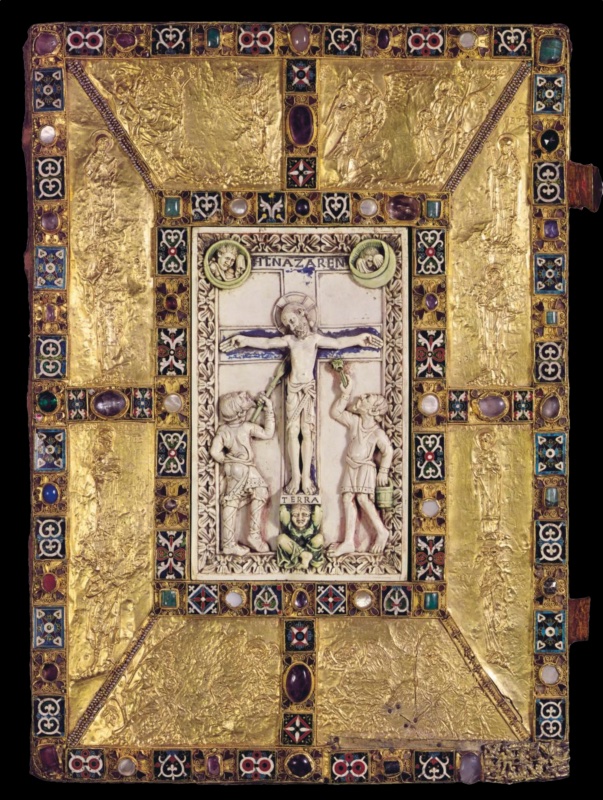
The front cover of the Codex Aureus is one of the most celebrated pieces of Ottonian goldsmith’s work to survive, and it is significantly older than the manuscript it now protects. The GNM dates the binding to “between 983 and 991, perhaps 985–987” (zwischen 983 und 991, vielleicht 985-987), and localises its manufacture to Trier, in one of the leading goldsmith workshops of the age — the workshop associated with Archbishop Egbert of Trier (in office 977–993), the great episcopal patron whose atelier produced the finest Trier metalwork and whose Gregory Master shaped Trier painting. The English reference literature frames the dating slightly differently but to the same effect: the cover “must date between Otto III’s royal coronation of 983 and Theophanu’s death in 991.” The GNM’s own object record grounds this dating on the inscription beside the boy ruler on the cover, who is titled “Otto III” — a title he received at his coronation as German king in 983, at the age of three — so that the cover must postdate 983 and, given the presence of his mother, predate her death in 991.
The cover was a gift (Stiftung) of the Empress Theophanu, the Byzantine princess who married Otto II and who governed as regent for her young son, together with Otto III. It is materially sumptuous. Mounted on an oak board, it centres on a carved ivory plaque of the Crucifixion; around this run bands of cloisonné enamel plaques (executed in the Zellenschmelz technique of soldered gold cells filled with coloured glass), alternating with plaques bearing cell-mosaic and filigree ornament; between and around these are set gold repoussé reliefs, large semi-precious and precious stones in gold filigree mounts, and rows of pearls. The facsimile description counts forty-eight larger gemstones in filigree settings, each accompanied by four smaller heart- or drop-shaped gems, with pearls at the corners. The spine and back cover are covered in silk. Thin gold bands set with small pearls run along the diagonals, subdividing the relief figures into compartments and forming an “X” that has been read as a Christogram — recalling the “X” traced in ash on the floor of a church at its consecration.
The ivory plaque at the centre depicts Christ on the Cross between the two soldiers of the Passion narrative: Longinus (who pierces Christ’s side with the lance) at the right and Stephaton (who offers the vinegar-soaked sponge) at the left, with the personification of Terra (Earth) crouching to support the suppedaneum (foot-support), and roundels of Sol and Luna in the upper corners; the titulus reads “(I)HC NAZARENV(S)” and the base of the suppedaneum is inscribed “TERRA.” The GNM condition report notes only sparse remains of colour — traces of purple on the figures’ legs and garments, on the body of Christ, on the relief ground and the frame, and gold on the edge of the cross, the suppedaneum, the ground and the foliate frame, with the cross blue and various subsidiary elements green, and the pupils blackened. Adolf Goldschmidt (1918) judged the surviving colour not to be original.
The surrounding gold repoussé reliefs form an iconographic programme keyed to Echternach. Along the top and bottom compartments are the symbols of the four evangelists paired with the four rivers of Paradise, signifying the spread of the Gospel to the four quarters of the earth. Along the long sides stand a series of figures, each labelled by inscription: the Virgin Mary and Saint Peter (the patrons of Echternach abbey) at the top of the sides; Echternach’s founder Saint Willibrord, and Saints Boniface and Ludger (Liudger), also early missionaries in Germany; and Saint Benedict, founder of the order — together with, at the lowest position on each side, the standing donor figures of King Otto III and the Empress Theophanu, presented as equals among the saints, an image of the close binding of ruling house and Church. These elongated, elegant repoussé figures contrast strongly in style with the forceful, slightly squat figures of the central ivory — a stylistic disjunction that has been much discussed (see §8).
The relationship of cover to codex, and the question for whom the cover was originally made, remains genuinely open. Because every figure on the cover has an Echternach connection, one natural reading is that it was made for Echternach from the first. But some scholars have argued that the cover (or the manuscript it originally clothed) was not made for Echternach at all — for example that Archbishop Egbert presented it to Otto III and Theophanu, perhaps as a reconciliation gift after he had initially supported Henry the Quarrelsome against the child Otto III in 983–984, and that the imperial family subsequently passed it to Echternach.
It has also been suggested that the cover was made for the Trier manuscript now in Paris known as the Sainte-Chapelle Gospels (BnF, lat. 8851), illustrated by the Gregory Master, whose style influenced the later miniatures of the present text. A specific and much-cited reconstruction was proposed by the historian Gunther Wolf, who argued that the cover was commissioned for Echternach — ordered from Egbert while Theophanu met him at Christmas 988 in Cologne — out of the empress’s gratitude for recovery from an illness that had struck her at Lake Constance in the late summer of 988, with her devotion to Willibrord (whose death in 739 was approaching its 250th anniversary) an additional motive. Wolf’s proposal is regarded in the literature as highly plausible but remains a hypothesis. What is not in doubt is that the cover was joined to the Echternach text after the fact: the sumptuous binding had waited, and was bound with the parchment leaves of the Echternach Gospels most probably not long after the consecration of the abbey’s new church buildings on 19 October 1031.
Date, place of production, and patronage
The manuscript (as distinct from its cover) was written and illuminated at Echternach. On its date the literature converges on the second quarter of the eleventh century but does not agree on a narrow bracket. The GNM dates the codex “around 1030” and elsewhere “around 1030/45”; the Bibliothèque nationale de Luxembourg dates it 1030–1045; the standard English-language summary gives “the approximate period 1030–1050”; Anja Grebe’s catalogue gives “around 1045”; some German booksellers, presumably echoing older scholarship, narrow it to “between 1039 and 1043.” Against this consensus stands a minority position associated with Peter Metz and followed by Peter Lasko, who preferred a date “between 1053 and 1056,” i.e. after Abbot Humbert’s death — a dating that, in the words of the reference literature, “do[es] not seem to have convinced later scholars.” The essay therefore treats c. 1030–1045/50 as the mainstream dating and flags the 1053–1056 proposal as a real but now largely rejected alternative.
The place of production is not in dispute: the scriptorium of Echternach abbey, then at the height of its powers. The person most often named as patron or director of the enterprise is Abbot Humbert of Echternach (abbot 1028–1051), under whose rule the Echternach school reached its zenith; the facsimile literature names him as the probable person who commissioned the book. It should be stressed that “patron” here most plausibly means the abbot who commanded and oversaw the work within the monastery, rather than an external imperial commissioner; unlike the Speyer and Goslar Gospels, the Codex Aureus is not documented as an imperial commission, and scholars do not agree on the book’s original intended beneficiary.
The imperial dimension enters through Henry III (king from 1039, emperor 1046–1056) and his mother, the Empress Gisela of Swabia (d. 1043), and — for the related Goslar book — his wife, the Empress Agnes of Poitou. It is widely held that Henry saw and admired the golden Gospel book at Echternach (i.e. the present Codex Aureus, then in use in the monastery), and that this admiration prompted him to commission from Echternach two further golden Gospel books: the Codex Aureus Escorialensis (the Speyer Gospels / Golden Gospels of Henry III), which he presented to Speyer Cathedral — the burial church of his Salian dynasty — around 1046, and the Codex Caesareus Upsaliensis, which he gave to his new collegiate church of Saints Simon and Jude at Goslar, the great imperial palace foundation, around 1050.
The Uppsala manuscript’s dedication miniature shows Henry III, robed in imperial purple, presenting the book to Saints Simon and Jude, while the facing page shows Henry and Agnes crowned by Christ; a frame carries the date MXLV (1045), which is generally read as symbolic rather than the actual year of production. The Goslar presentation, to repeat, belongs to the Uppsala book; the Codex Aureus of Echternach is the model and inspiration, not the gift. Henry’s elevation of the Echternach scriptorium to the status of an imperial scriptorium — a court atelier of the Salian dynasty — is the political context that made this remarkable clustering of golden Gospel books possible.
The Echternach scriptorium: history, Trier, the Insular inheritance, and the Golden Gospels group
Echternach abbey was founded in 698 by the Northumbrian monk Willibrord (c. 658–739), one of the Anglo-Saxon missionaries who evangelised the Continent; Willibrord had been consecrated in Rome by Pope Sergius and set out from an Irish base (Rath Melsigi, Co. Carlow), so that both Anglo-Saxon and Irish influences fed the abbey from the start. A scriptorium existed at Echternach no later than the eighth century, and its earliest products are written in a distinctive “mixed” style combining Caroline and Insular minuscule features (very pointed script; long narrow stems of “s” and “r”). The most famous witness to this Insular phase is the Echternach Gospels (Paris, Bibliothèque nationale de France, MS lat. 9389), a richly decorated Insular Gospel book of about 690, whose place of manufacture — Echternach, Northumbria (Lindisfarne), or Ireland — has been debated for a century; its script has been compared to the Durham Gospels, and its text to the Irish MacDurnan Gospels, while it was demonstrably at Echternach by the first half of the eighth century. This Insular Gospel book, brought to the abbey in its earliest years, made Echternach a principal centre for the diffusion of Hiberno-Saxon manuscript culture on the Continent, and it is the deep historical background against which the eleventh-century “golden” phase must be read: the same house that had preserved an Insular Gospel book of c. 690 produced, some 350 years later, one of the most lavish Ottonian-Salian Gospel books.
The decisive institutional turning point came in 973, when — at the request of the last lay abbot, Count Siegfried of Luxembourg — Emperor Otto I had the abbey repopulated with reform monks from Sankt Maximin in Trier, a key house of the Gorze (Lotharingian) monastic reform. This tied Echternach closely to Trier, and it was from Trier that the artistic models of the eleventh-century scriptorium came. The Echternach book painters of c. 1030–1046 drew heavily on the work of the Trier Master of the Registrum Gregorii (the Gregory Master), the anonymous illuminator active under Archbishop Egbert whose statuesque, classicising figures represent the height of Ottonian painting; they also drew on the Egbert Codex, on other Trier manuscripts, and on a mid-Byzantine pictorial source. It is important to note — because the “Reichenau question” is often raised for Ottonian manuscripts — that the Echternach golden Gospels do not belong to the much-discussed Reichenau group; their stylistic lineage runs through Trier and the Gregory Master, and ultimately through Late Antique and Byzantine models, not through the island monastery of Reichenau on Lake Constance. (The Reichenau attributions themselves remain contested for lack of documentary evidence, but that debate concerns a different family of manuscripts.)
The peak of the Echternach scriptorium, under Abbot Humbert and then his successor Regimbert (1051–1081), produced a group of large-format golden Gospel books that are the abbey’s chief claim to art-historical fame. Modern scholarship treats four large Gospel books as the core surviving group, together with the closely related Bremen Pericopes:
- The Codex Aureus of Echternach (Nuremberg, Germanisches Nationalmuseum, Hs. 156142; binding KG 1138), c. 1030–1045/50 — the subject of this essay.
- The Golden Gospels of Henry III / Codex Aureus Escorialensis (also “Speyer Gospels,” Codex Aureus Spirensis), c. 1043–1046, presented by Henry III to Speyer Cathedral, now Real Biblioteca del Monasterio de San Lorenzo de El Escorial, Cod. Vitrinas 17 — a very large book (c. 50 × 33–35 cm) with text in gold.
- The Codex Caesareus Upsaliensis (the “Emperor’s Bible” / “Goslar Gospels”), c. 1050, presented by Henry III to Saints Simon and Jude at Goslar, now Uppsala University Library, MS C 93 — the youngest of the group, carried off to Sweden during the Thirty Years’ War; the standard scholarly facsimile and commentary was published by Carl Nordenfalk in 1971.
A fourth, only partially preserved, large Echternach Gospel book now in the Bibliothèque nationale de France in Paris. On the evidence of the BnF’s own catalogue this is BnF, Nouvelles acquisitions latines 2196 (“Evangelia quatuor, pars”; the Évangiles de Luxeuil / “Luxeuil Gospels”), a fragmentary large-format manuscript (surviving as 50 leaves, c. 405 × 287 mm) datable to the second quarter/middle of the eleventh century, whose scribe the BnF describes as “very close to copyist B of the Codex Aureus preserved at Nuremberg (Germanisches Nationalmuseum, Hs. 156142),” and which the catalogue situates art-historically between the Nuremberg and Escorial books. (A caution: a second Echternach-related Gospel book, BnF, Latin 10438, the Évangiles de Saint-Sauveur de Metz, is a smaller-format book usually cited as a comparandum rather than as one of the four large books; the “fourth large, partially preserved” manuscript is NAL 2196.)
To these should be added the Pericopes (Gospel Lectionary) of Henry III in Bremen (Staats- und Universitätsbibliothek Bremen, msb 0021, older cited form “Ms. b. 21”), with thirty-eight full-page miniatures, produced c. 1039–1043; and the abbey’s own liturgical books, such as the Echternach Sacramentary and Gradual (Darmstadt, Universitäts- und Landesbibliothek, Hs. 1946), of c. 1030. The task’s reference to “Uppsala Gospels” and “Luxembourg fragments” is thus captured by the Codex Caesareus and by the Echternach material dispersed across libraries (much survives in the Bibliothèque nationale de Luxembourg, including an incomplete Bible, Ms. 15, and a giant Bible, Ms. 264). All of the large golden Gospels are stylistically dependent on the Trier Gregory-Master tradition transmitted at Echternach.
Iconographic programme and illumination
The decorative architecture of the Codex Aureus is exceptionally systematic, and its designer clearly intended the reader to approach the sacred text through a long, deliberate sequence of splendour. As one art historian observed, the planner of the book “was in no hurry to bring his reader to the text.” Each of the four Gospels is prefaced by the same ordered series of display openings: two pages summarising the Gospel; two pages imitating textiles (the “carpet” or “curtain” pages); four pages of narrative scenes arranged in three registers per page; a full-page evangelist portrait; two pages of decorative text; and finally a full-page initial that begins the Gospel proper. The book opens, before Matthew, with the Maiestas Domini (Christ in Majesty), the evangelist portraits and the ten canon-table pages that organise the Eusebian concordance of the Gospels within classicising architectural frames of arches and columns.
The textile pages are among the most extraordinary features of the manuscript, and the GNM singles them out as belonging “to the most unusual things to be found in book painting.” Executed in a highly accomplished technique, these double pages imitate, with near-trompe-l’œil fidelity, the patterns and material of Byzantine or Oriental woven silks. Their significance is twofold. Aesthetically, they demonstrate the painters’ virtuosity. Symbolically and politically, silk was the quintessential luxury import and the quintessential imperial gift — the kind of precious stuff exchanged at the highest diplomatic level since Charlemagne — so that painting silk into the Gospel book both signalled the book’s supreme value and evoked the imperial world of gift-exchange to which the Echternach golden Gospels belonged. The purple grounds elsewhere in the book (the imperial colour of Late Antique de-luxe codices) reinforce the same associations of majesty and sacrality; text on purple in gold explicitly recalls the imperial purple manuscripts of Late Antiquity.
The narrative cycle is the manuscript’s most historically significant pictorial feature. Laid out in three horizontal registers to a page (one, two, or sometimes three scenes per register), it presents the Life and Ministry of Christ across the pages preceding the four Gospels — and it does so as a continuous programme, distributing the life of Christ across the four prefatory sequences without concern for whether a given episode actually occurs in the Gospel it precedes. The pages before Matthew run from the Annunciation to the “Feast in the House of Levi”; those before Mark cover miracles from the Wedding at Cana to the Samaritan’s thanks after the Cleansing of the Ten Lepers; those before John cover the Passion, Ascension and Pentecost. The pages before Luke are the most remarkable: four full pages given over to four of the parables of Jesus — the Parable of the Workers in the Vineyard, the Parable of the Wicked Husbandmen (the wicked vinedressers), the Parable of the Great Banquet, and the Parable of the Rich Man and Lazarus (Dives and Lazarus). The inclusion of an extended parable cycle was, by the eleventh century, becoming unusual, and it is one of the manuscript’s distinctive contributions.
The parable pages reward close reading as narrative machines. The Dives and Lazarus page (folio 78r) tells the parable in three sequential registers: the top shows the sick beggar Lazarus dying at the rich man’s door; the middle shows Lazarus’s soul carried by angels into the bosom of Abraham; the bottom shows the rich man’s soul dragged to Hell and tormented. The colour scheme reinforces the moral reading — cooler blues for the redemptive scenes, red for the fires of Hell — so that the images function as a legible visual argument as well as a decorative sequence. On one accounting the narrative pages together comprise forty-eight framed images with about sixty individual scenes, an unusually large cycle for a medieval Gospel book.
The evangelist portraits and the Maiestas Domini descend, via the Trier Gregory Master, from Late Antique author-portrait and majesty types, though the Echternach painters translated these models into a more ornamental idiom; the incipit pages and full-page initials (“Liber” opening Matthew, “In principio” opening John, and so on) are constructed as architectures of gold interlace. Most of the miniatures are attributed to two principal hands — a “workshop master” and a presumed pupil — with a third, cruder painter contributing some of the narrative scenes; the compositions and underdrawings are thought to be largely the master’s, so that the changes of executant are not conspicuous. The overall style has been both praised and criticised. C. R. Dodwell’s verdict is characteristic: the Echternach style “produced some vigorous and cheerful patterns, as in the St Luke, but it could descend to fussiness, as in the Christ in Majesty, where the strength of the composition has been frittered away by the ornamental vagaries of the Echternach artist”; in the evangelist portraits, he complained, “the ornamental bands of the Sainte-Chapelle Gospels are degraded into decorative garrulity, and there is so little weight and structure under the draperies that they might be covering mere inanimate cushions.” This tension between narrative power and ornamental excess is itself a recurring theme of the manuscript’s critical reception.
The canon tables (ten decorated pages) present the Eusebian apparatus — the system of numbered concordances allowing a reader to find parallel passages across the four Gospels — within columned and arched frames of an antique architectural type, ornamented with geometric and acanthus borders. Their derivation from Late Antique models is one strand of the larger argument (see §6) that the Echternach programme reaches back, through its Trier and Byzantine intermediaries, to Early Christian and Late Antique picture sources.
Folios (2v-20v)
Maiestas Domini: Christ in Majesty with the symbols of the four Evangelists and the four major prophets
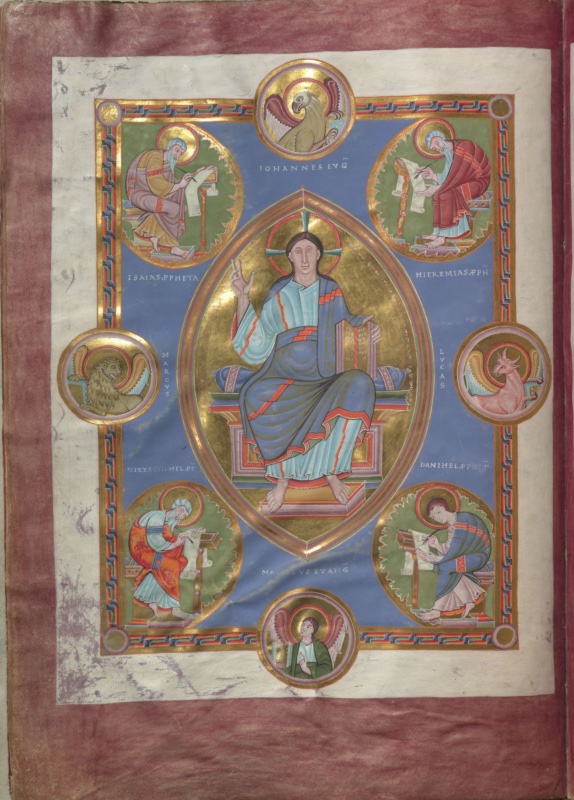
The folio is conceived as a full-page frontispiece of great chromatic ambition. The leaf is dyed a deep murex-toned purple across its outer margins, reserving a broad field of undyed parchment within which the painted panel is set — a deliberate evocation of late antique and Byzantine imperial codices, and a visual claim to the prestige of purple-and-gold bookmaking that the manuscript’s very designation (codex aureus) asserts.
The painted field is enclosed by a rigid rectangular frame composed of a gold band overlaid with a repeating wedge-and-step motif in dark blue and red, edged by fine red and green fillets. This pattern imitates cloisonné metalwork rather than any organic ornament, and its four corners are punctuated by gold discs that read as rivet-heads or setting-bosses, so that the frame presents itself as a jewelled plaque affixed to the page. Against the frame’s outer edge, four further roundels break the boundary and project into the reserved white margin — an elegant device by which the Evangelist symbols are made to transgress the enclosure of the composition, mediating between the sacred field and the space of the beholder.
At the centre, Christ is enthroned within a pointed mandorla, a vesica whose apex and base are drawn to sharp angles and whose interior is entirely gilded, framed by concentric bands of green, red and white. He is shown youthful and beardless, long-haired, with a cross-nimbus; the right hand is raised in benediction with the two-fingered Latin gesture, while the left steadies an open codex resting against the knee, its written lines rendered in fine brown script. He wears a pale blue-green tunic and a deeper blue-green mantle, both articulated by vermilion clavi and hem-bands, the drapery organised into the taut, calligraphic loops and nested V-folds characteristic of Echternach painting. He is seated on an architecturally conceived throne with a bolster cushion, his bare feet resting on a low suppedaneum. Around the inner edge of the mandorla runs a gold-on-gold inscription, legible only under raking light; it cannot be transcribed with confidence from a photographic reproduction and requires collation against the original or a high-resolution facsimile.
Beyond the mandorla the ground is a saturated lapis blue, entirely unmodulated, which throws the gold of the mandorla and the roundels into maximum relief.
The four prophets occupy the diagonal quadrants, each set within a large circular field of olive-green bounded by a jagged, flame-like gold edge that functions as a compressed aureole. All four are nimbed, barefoot, and seated on low benches with footstools, bent forward over sloping lecterns in the posture of the writing author. Each holds a stylus or pen and unrolls a scroll — a pointed distinction from the Evangelists, who elsewhere in the manuscript write in codices, and one that marks the prophetic word as anterior and unfulfilled. Isaiah, upper left, appears aged and grey-bearded in ochre and lilac; Jeremiah, upper right, is enveloped in a broad crimson mantle; Ezekiel, lower left, wears orange over pale blue; Daniel, lower right, youthful and beardless, is draped in blue over rose.
The four Evangelist symbols, by contrast, are compressed into smaller roundels on the axes, each winged, nimbed, and shown half-length holding or supporting a book: the eagle of John at the summit, the lion of Mark at the left, the ox of Luke at the right, and the angel of Matthew at the base. Their placement — John crowning the composition, Matthew beneath the feet of Christ — is not the canonical Gospel order but a hierarchical one, elevating the evangelist of the Logos to the vertical axis above the enthroned Word.
- Iconographic reading
The page constructs a fourfold-by-fourfold concordance. The tetramorph derives ultimately from the theophany of Ezekiel 1:4–14 and its Johannine recasting in Revelation 4:6–8, and its association with the four Evangelists is patristic commonplace by the Carolingian period. What distinguishes this composition is the deliberate pairing of that quartet with the four major prophets, so that the Old Covenant witnesses occupy the outer, diagonal positions and the New Covenant witnesses the cardinal ones. The arrangement stages an exegetical argument in purely spatial terms: prophecy encircles and prepares, the Gospel converges upon and confirms, and both radiate from the enthroned Christ who is the object of the one and the subject of the other. The prophets write turned inward, their gaze directed toward the mandorla; the symbols face outward. Revelation is thus shown moving from promise to fulfilment to proclamation along a single centrifugal axis.
Angels Displaying the Dedicatory Tabula, Framed by the Four Cardinal Virtues
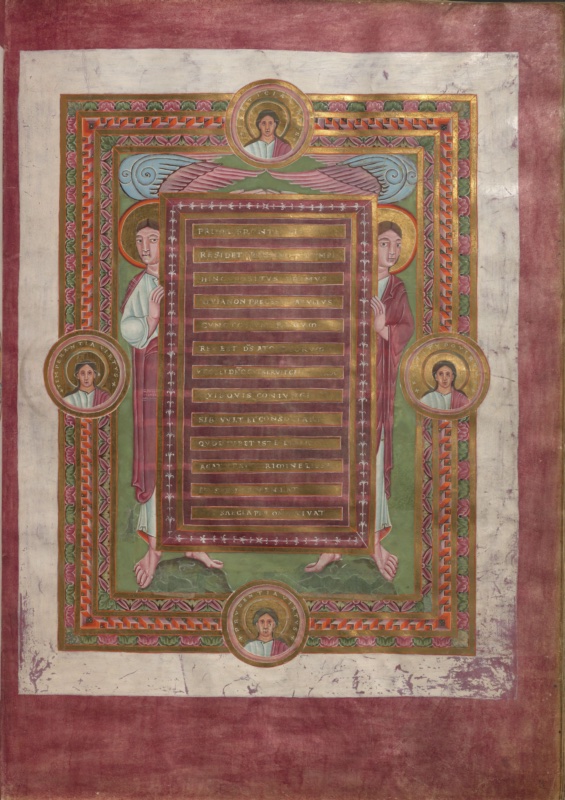
The folio forms the recto half of a purple opening, facing the Maiestas Domini of fol. 2v — of which the outer roundels are just visible at the left edge of the photograph. The two pages were plainly conceived as a single visual and textual unit: the enthroned Christ on the verso is the image to which the verses on the recto refer, and the reader encounters them simultaneously.
As on the facing leaf, the parchment is dyed a saturated purple across the outer margins, with a broad band of reserved white parchment isolating the painted field. The panel itself is enclosed within an unusually deep, multi-layered border. Reading from the outside inward, one passes through a band of pink and green foliate petals — a flattened, symmetrically splayed acanthus — then a gold band carrying the same wedge-and-step pattern in vermilion and dark blue found on fol. 2v, then a second foliate band, and finally a plain gold fillet. The repetition of the metalwork motif across the opening binds the two pages together, and its layering here produces the effect of a jewelled tabula set within a stepped architectural surround rather than a painted frame.
Four roundels are placed on the cardinal axes, each overlapping and breaking the outer border so as to project into the reserved margin — precisely the device used for the Evangelist symbols opposite. Each contains a half-length youthful figure, nimbed, in a pale tunic and rose mantle, and each is identified by a titulus in gold running around the circumference: IVSTITIA VIRTVS above, TEMPERANTIA VIRTVS at the left, FORTITVDO VIRTVS at the right, PRVDENTIA VIRTVS below. The four cardinal virtues thus occupy exactly the positions held by the four Evangelist symbols on the verso, establishing a structural rhyme across the opening.
Within this frame stand two large angels on a green ground broken by a low rocky outcrop, their bare feet emerging at the base of the composition. Both are haloed in burnished gold, and their wings — rendered in rose with pale blue coverts and tightly scrolled shoulder-volutes — spread upward and outward above the tablet, filling the upper register. Their gestures are restrained: each raises the inner hand beside the tablet in a gesture of presentation or acclamation rather than physical support. The left angel wears a white-green tunic with a rose mantle drawn across the body; the right is dressed in the reverse arrangement, deep rose over pale green. The two are near-mirror images, and their draperies fall in the same taut, calligraphically looped folds seen in the Christ opposite.
They present a rectangular tabula, itself doubly framed: an outer purple band bearing a delicate white foliate scroll, and within it fourteen horizontal ruled compartments of purple, each carrying a line of gold rustic capitals. The gold has oxidised and abraded unevenly, and in reproduction much of the text is legible only in part.
- The inscription
The verses are dedicatory or explanatory, glossing the image on the facing page and the purpose of the book. What can be made out with reasonable confidence, with lacunae marked, runs approximately:
PRIMA FRONTE LI[BRI] / RESIDET RE[X] […] / HINC POSITVS PRIMVS / QVIA NON PRECE[DIT] FAMVLVS / CVNCTORVM REGVM / REX EST D(EV)S ATQ(VE) […]ORVM / ET ILLI D(OMI)NO QVI SERVIT CELI[…] / QVISQVIS CONIVNGI / SIB(I) VVLT ET CONSOCIARI / QVOD IVBET ISTE LIBER / AGAT […] CRIMINE LIBER / H[…] PERVENIAT / SAECLA PER OM[NIA] VIVAT
The sense, so far as it can be recovered, appears to be: at the front of the book the King is enthroned, placed first because no servant goes before his lord; God is King of all kings; whoever wishes to be joined and made a companion to that Lord should do what this book commands, free of sin, and so attain [the heavenly reward] and live through all ages. The final line, SAECLA PER OMNIA VIVAT, is clear.
- Iconographic reading
The programme of the opening is unusually tightly argued. Christ enthroned on the verso is encircled by the prophets who foretold him and the Evangelists who proclaimed him; the recto answers with the moral consequence — the four cardinal virtues, the pagan-philosophical quartet absorbed into Christian ethics through Ambrose and Gregory, which frame the injunction that the reader should do what this book commands. Revelation on one side, conduct on the other. The angels are cast in their normal function as bearers and heralds of divine text, and the tabula they hold is deliberately made to look like an inscribed metal plaque, assimilating the dedicatory verses to the language of monumental epigraphy and of the treasure binding that encloses the codex.
The choice of the cardinal rather than the theological virtues is worth noting: it locates the book’s moral claim in the sphere of governance and right ordering, which suits a manuscript produced for and by imperial patronage.
Incipit Page to the Preface of St Jerome
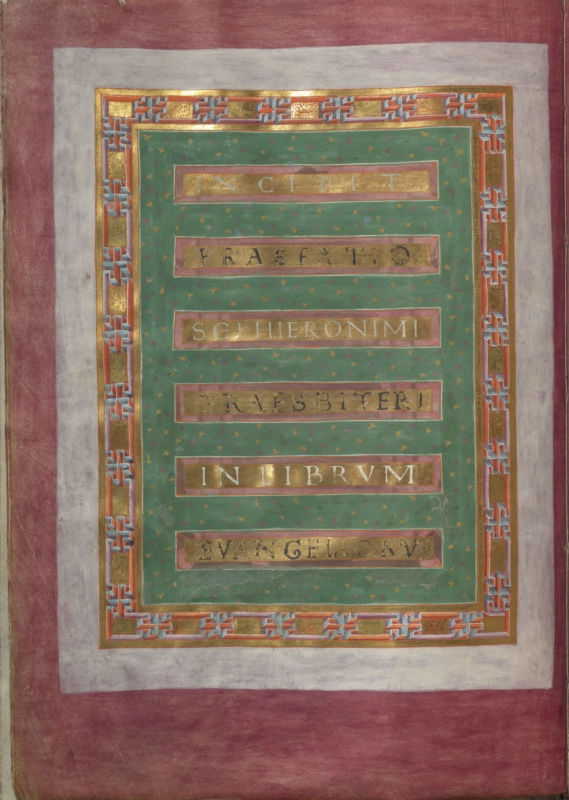
The folio marks the transition from the manuscript’s pictorial prologue to its text, and it does so with the full apparatus of the display page. The leaf is again purple-dyed, and here the dye extends across the whole outer field, with a band of reserved parchment — now a pale silvery-lilac rather than white — forming a second, inner margin around the painted panel. The effect is of a framed panel mounted on a coloured ground, and the reader arriving from the angels of fol. 3r encounters no pictorial figure at all: the page is given over entirely to written words made monumental.
The panel is enclosed by a broad ornamental border of interlocking fret, built from stepped and hooked units in vermilion, pale slate-blue and lilac, set against gold and articulated by fine white highlights along one edge of each element. The shading is systematic rather than decorative: each unit is lit consistently from the same side, so that the band reads as a genuinely three-dimensional lattice of overlapping ribbons or inlaid tesserae standing proud of the surface. At intervals along the border, small rectangular gold fields carry a faint incised or lightly drawn rinceau, now much worn. The motif is a variant of the classical meander, filtered through the cloisonné vocabulary that governs the frames of the preceding folios, and it makes the same claim: that the page is to be understood as an object of goldsmith’s work.
Within, the ground is a cool green — the same olive-toned green used for the prophets’ aureoles and the angels’ terrain — scattered with small trefoil sprigs alternately in orange and rose. These are placed with studied irregularity and serve to animate a field that would otherwise read as inert; the device belongs to the repertoire of late antique and Byzantine textile design, and its use here reinforces the sense that the inscription is displayed against a hanging cloth of honour.
Six horizontal bands are laid across this ground, each framed by a stepped moulding in rose and vermilion that gives the bar a shallow relief, as though each were a separate metal strip fixed to the panel. Each carries one line of the incipit in gold-ground display capitals:
INCIPIT / PRAEFATIO / S(AN)C(T)I HIERONIMI / PRAESBITERI / IN LIBRVM / EVANGELIORV(M)
The letters are square capitals of a deliberately antiquarian cast, generously spaced and reserved in white or silver against the burnished gold. Their condition varies markedly across the page: lines one, three and five remain crisp, while the gold of lines two, four and six has oxidised and darkened, so that the letterforms there survive largely as shadows. The final line ends with a horizontal stroke above the V marking the suspended -M, and PRAESBITERI preserves the parasitic S common in early medieval spellings of presbyter.
The text is the rubric announcing Jerome’s prefatory letter to Pope Damasus, conventionally cited by its opening words Novum opus, in which Jerome defends his revision of the Latin Gospels against the anticipated charge of tampering with scripture. Its inclusion is entirely standard in Latin Gospel books; what is not standard is the scale and expense of its presentation here.
The hierarchy of the opening sequence is instructive. Fol. 2v gives the theophany, fol. 3r the dedicatory verses held by angels, and fol. 3v the announcement of a mere preface — yet that announcement receives gold ground, dyed purple parchment, and a fully worked ornamental border. The logic is not one of textual importance but of threshold. This is the page at which the codex passes from image into script, and the makers have marked the passage with the same materials used for the Maiestas itself, so that the reader crosses from one register to the other without any diminution of splendour. Jerome’s name, occupying the central and most legible band, is accorded a monumentality closer to a dedicatory inscription in stone than to a scribal rubric.
The design also demonstrates the Echternach workshop’s characteristic strategy of treating the parchment page as an assemblage of distinct materials: dyed textile ground, metal strips, inlaid border, sprinkled fabric. Nothing on the page is presented as ink on skin.
Decorated Initial B opening Jerome’s Letter to Pope Damasus
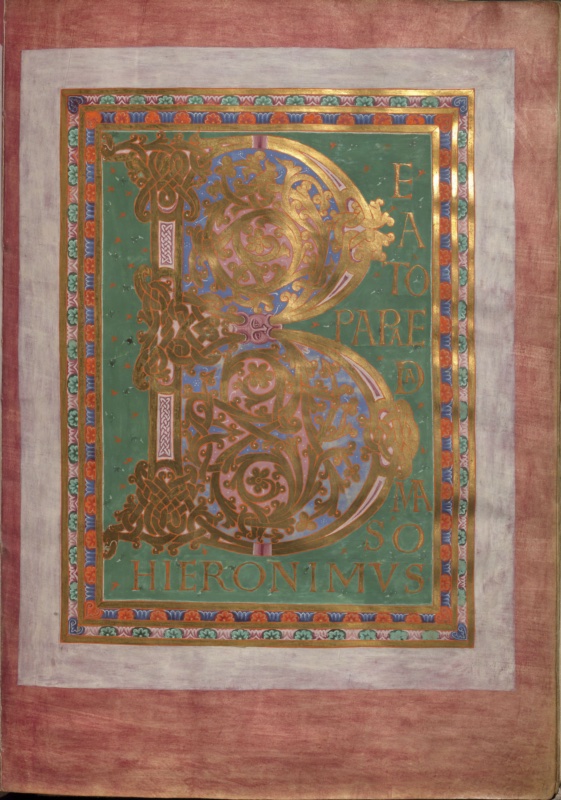
The folio is the answering half of the opening begun on fol. 3v, and the pairing is deliberate: the verso announced the preface in six horizontal bands of capitals, the recto delivers its first word in a single monumental letter. The reader passes from statement to enactment across the gutter.
The material scheme is continued exactly. The leaf is purple-dyed, though here the dye has taken more warmly, producing a rose-madder tonality; within it a broad band of pale lilac parchment is reserved, and the painted panel sits at the centre of this double surround. As on the preceding folio, the ground of the panel is the same cool green scattered with small orange trefoil sprigs, so that the two pages read unmistakably as a single unit of design.
The border, however, has been changed. In place of the illusionistic fret of fol. 3v, three concentric ornamental bands now enclose the field. The outermost carries a row of pale green rosettes on a rose ground, alternating with fine white detailing; the innermost repeats the motif in vermilion and blue, each blossom set against a lobed blue calyx. Between them runs a plain gold fillet edged in orange. The border is thus vegetal rather than architectonic, and its lightness has a clear compositional purpose: it yields precedence to the initial, where the metalwork frame of the previous page would have competed with it.
The initial B occupies almost the entire height of the panel and is the page’s whole argument. Its stem is a broad gold shaft, its bowls two great gold rings, and the whole is modelled in burnished gold with contour lines drawn in orange-red that describe the ribbon’s turnings and give the letter a rounded, metallic body. The two bowls are filled with dense foliate scrollwork — gold acanthus tendrils uncoiling from central rosettes against alternating grounds of rose and lapis blue — while the shaft is inset with two narrow panels of white interlace on a rose ground. At the head, foot, and mid-point of the letter the ornament changes register: there the gold resolves into knotted interlace terminating in zoomorphic heads, small beaked or snouted creatures whose jaws grip the adjoining strands. The bowls meet at a clasp-like rose boss, and the terminals flare into palmette flourishes.
The vocabulary is worth naming precisely. The bowls belong to the Carolingian and Ottonian tradition of gold acanthus rinceau; the interlace panels and the biting animal terminals belong to the Insular repertoire, transmitted to Echternach through its Anglo-Saxon foundation and the earlier Insular books held there. Their combination within one letter is characteristic of Echternach’s display initials, and it is a synthesis rather than a juxtaposition: the interlace is subordinated to the letter’s structure, disciplined into the joints and terminals, while the classicising foliage governs the open fields.
The remainder of the text is disposed around the initial with careful economy. In the right margin the continuation runs vertically in orange rustic capitals, broken into short stacked groups: E / A / TO / PAPAE / DA / MA / SO. Along the lower edge, in larger and more widely spaced capitals of the same orange, stands HIERONIMVS. The full reading is therefore B(eato) papae Damaso Hieronimus — “To the blessed Pope Damasus, Jerome” — the salutation of the letter Novum opus, in which Jerome justifies to his patron the revision of the Latin Gospels.
The page belongs to a well-defined Ottonian type in which the opening word of an important text is enlarged into a quasi-architectural object and the rest of the phrase reduced to a marginal armature around it. The hierarchy is unambiguous: gold and full ornament for the initial, plain orange for the words, with the addressee’s name and the author’s name given the two most legible positions. That Jerome’s name is set out along the base in the largest of the secondary capitals continues the emphasis already given it on fol. 3v, where it occupied the central band.
More broadly, the four folios examined so far form a graduated approach to the Gospel text. The Maiestas on 2v establishes the theological subject; the angels’ tabula on 3r states the book’s purpose and moral claim; 3v names the text about to begin; 4r begins it. The workshop maintains a constant material vocabulary — purple ground, green field, gold, sprinkled trefoils — while varying the border ornament from page to page, so that the sequence reads as continuous without becoming monotonous.
From Annunciation to Herod’s Court: The Infancy Cycle
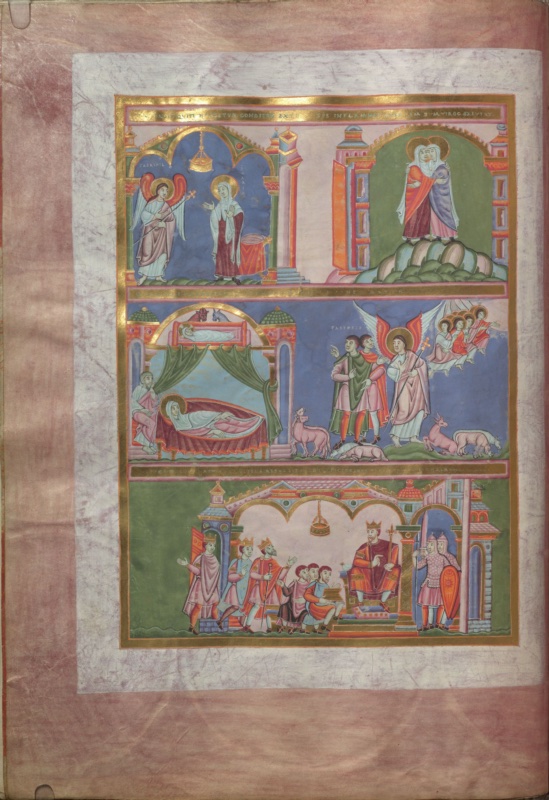
The folio presents a full-page narrative miniature articulated into three superimposed registers, each framed in burnished gold and separated by horizontal bands bearing tituli in gold rustic capitals against a coloured ground. The painted field is set within a broad margin of rose-stained parchment — an economical evocation of imperial purple that is characteristic of the manuscript’s luxury register — with an inner border of plain vellum functioning as a mount. The tituli are now partly abraded; legible fragments include references to the Creator issuing forth from the Virgin and to the Spirit’s inflaming presence, together with the salutation of the Virgin, but any full transcription should be established against the facsimile rather than from photographic reproduction.
- Upper register
Two Lucan episodes are juxtaposed under a continuous architectural canopy. At the left, beneath a triple arcade from which a lamp is suspended, the archangel Gabriel — identified by the inscription GABRIHEL — advances with a cross-staff towards the Virgin, labelled S(ANCTA) MARIA, who responds with the open-palmed gesture of acceptance. The basket of coloured wool at her feet invokes the apocryphal tradition, transmitted through the Protevangelium, of Mary’s spinning of the Temple veil, a motif that binds the Incarnation to the imagery of weaving. A columned aedicula divides this scene from the Visitation at the right, where Mary and Elizabeth embrace cheek to cheek upon a green mound flanked by towered city walls — a formula of Byzantine derivation transmitted to the Ottonian West through Italian and Greek intermediaries.
- Middle register
The Nativity occupies the left half. The Christ Child, tightly swaddled, lies in an elevated manger set beneath a domed arch, with the ox and the ass above him in adoration; below, the Virgin reclines on a mattress within a curtained architectural enclosure, while Joseph is seated at the extreme left in the pensive attitude — head supported on hand — that conventionally marks his exclusion from the mystery. The stacked disposition of manger and couch, rather than the coplanar arrangement of later Western practice, again betrays a Middle Byzantine compositional source. To the right unfolds the Annunciation to the Shepherds, captioned PASTORES: a haloed angel with cross-staff and outspread wings turns towards two shepherds who gesture in astonishment, while a compressed choir of angels crowds the upper right corner. The flock — sheep, goats and dogs rendered in the same pink-and-white palette as the human figures — animates the lower edge of the field.
- Lower register
The final scene stages the Magi before Herod (Matthew 2:1–8). Beneath a richly articulated palace façade with tiled roof, turrets and a suspended lamp, three crowned Magi approach from the left, preceded by a chamberlain and gesturing in colloquy. At the centre, three scribes and elders bend over open codices, consulting the prophetic texts at Herod’s command; the king himself sits enthroned at the right, sceptre in hand, in an attitude of authority undercut by the anxious animation of his gesture. A guard with spear and almond-shaped shield closes the composition. The crowned Magi and the kite shield are both features of interest for dating and for the manuscript’s relation to contemporary imperial imagery.
Stylistically the page exemplifies the mature Echternach manner: elongated figures with small heads and emphatic silhouettes, drapery articulated by parallel white highlights over saturated grounds of vermilion, rose, orange and viridian, and an architecture that functions less as space than as a system of narrative punctuation, dividing and framing episodes without pretending to spatial coherence.
Gifts, Dreams and Departures: The Magi Cycle
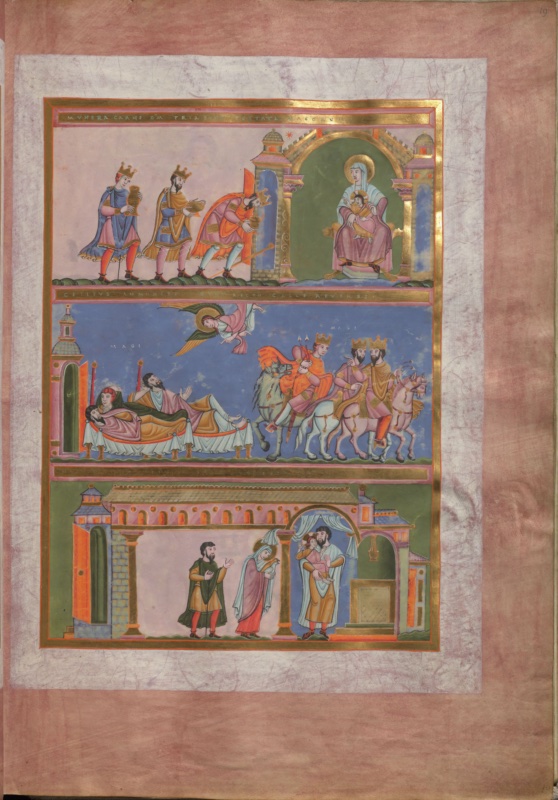
The recto continues the infancy cycle begun on the facing verso, retaining the same tripartite structure: three registers of unequal height enclosed within a gold fillet, separated by inscribed bands, and set against a broad field of rose-tinted parchment. The continuity of format across the opening confirms that the two folios were conceived as a single visual argument rather than as discrete pages.
- Upper register
The Adoration of the Magi. Three crowned kings advance from the left across a narrow green groundline, each bearing a vessel: the foremost holds a lidded flask, the second a shallow footed bowl, the third — represented in the deepest obeisance, his knees bent and torso inclined — a covered cup. Their differentiation is achieved through age (the leading figure beardless, the two behind bearded) and through the graduated intensity of their gesture, a device that converts the group into a sequence of increasing reverence. A gate tower surmounted by a star separates the approaching procession from the Virgin, who is enthroned at the right beneath a gilded arch against a green ground; she holds the Child frontally on her lap, her hand raised to steady him. The titulus above refers to the three gifts of the Magi as testimony to the Lord, though the opening word is abraded and should not be transcribed from reproduction.
- Middle register
Two moments of the Magi’s return are compressed into a continuous field of lapis blue. At the left, beneath a domed tower, the three kings lie asleep in a single wide bed, their heads aligned on a bolster, the foremost with eyes closed and hand raised in the gesture that conventionally signals a dream received; an angel descends steeply from above, wings extended, addressing them. At the right the same three ride out on horseback, turning and gesturing to one another in colloquy — a narrative device that renders visible the deliberation Matthew leaves implicit. The scene is doubly labelled MAGI, once for each moment, an unusually explicit acknowledgement of continuous narration. The titulus is here largely legible and states that, warned from heaven, they returned by a direct route; the substitution of a straight path for the Gospel’s another way is a point worth remarking, since it shifts the emphasis from evasion of Herod to providential guidance.
- Lower register
The final scene unfolds beneath an extended basilican façade with tiled roof, blind arcade and flanking towers. Three figures occupy the foreground: at the left a bearded man in a green mantle, staff in hand, turns back with an open-palmed gesture; at the centre the Virgin, veiled and slightly inclined, carries an object in her covered hands; and at the right, beneath a drawn curtain and beside a low altar-like block, a bearded man in blue and ochre holds the Christ Child against his shoulder, a second, smaller veiled head appearing immediately behind him. The reading of this register is not self-evident from the image alone. The curtained enclosure, the altar block and the transfer of the Child into the arms of an older bearded man point towards a Presentation in the Temple, with Simeon receiving the Child, Anna behind him, and Joseph at the left.
The page displays the same idiom as the verso: elongated, small-headed figures whose volumes are established by white striations over saturated grounds; horses rendered in improbable pinks and greys that function as chromatic accents rather than descriptions; and architecture used syntactically, to segment and punctuate rather than to situate. The Magi’s crowns, spurred boots and riding equipment reflect eleventh-century courtly usage and merit attention in any discussion of the manuscript’s imperial resonances.
From the Angel’s Command to the Jordan: Narrative Acceleration
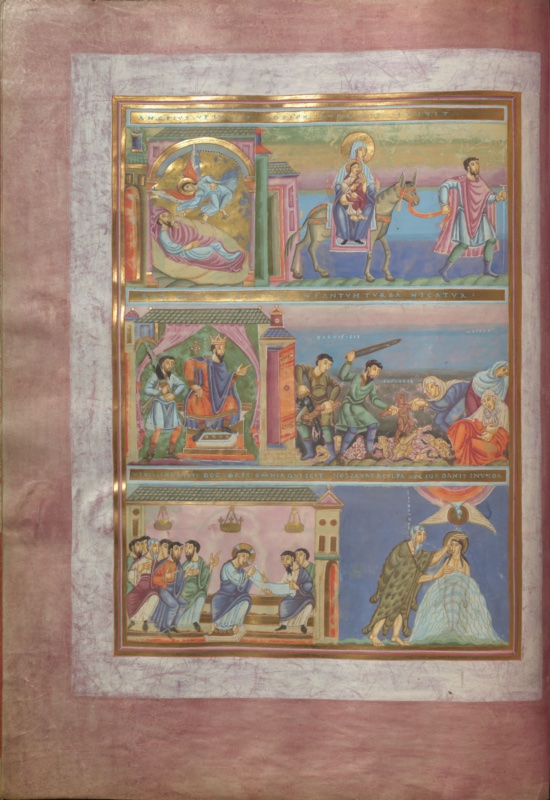
The verso maintains the tripartite scheme of the preceding pages but marks a decisive narrative turn: with its lowest register the cycle passes from the infancy proper to the threshold of Christ’s public ministry. Three registers of gold-framed fields are separated by inscribed bands in blue rustic capitals on burnished gold; here, exceptionally, the third band carries two hexametric lines rather than one, a redoubling that signals the compression of two independent episodes into a single register.
- Upper register
Two Matthaean episodes are set side by side without an intervening architectural partition, joined instead by a continuous green groundline. At the left, within a domed structure, Joseph lies asleep on a couch while an angel swoops down towards him against a ground of burnished gold — the only gold field in the miniature, and a deliberate marker of divine intervention, since both adjacent scenes are given landscape or coloured grounds. At the right unfolds the Flight into Egypt: the Virgin, haloed and veiled, is seated sidesaddle on a broad chair-like saddle, holding the Child frontally against her breast, while a bearded man in a rose mantle strides ahead, staff in hand, drawing the donkey’s rein and turning back towards the group. The banded ground of green, ochre and blue behind the group is one of the few concessions to landscape in the entire cycle. The titulus states that Joseph, as the angel commands, arose and departed.
- Middle register
The Massacre of the Innocents, introduced by a titulus announcing that the crowd of infants is put to death. At the left, beneath a tiled roof and a drawn curtain, Herod sits enthroned in orange and blue, sceptre in one hand, the other extended in the gesture of command; a guard with a sword stands behind him. The right two-thirds of the field are given over to the slaughter itself, articulated by three inscriptions — CARNIFICES for the executioners, INFANTES for the children, MATRES for the mothers. Two soldiers dominate the centre, one raising a broad sword above his head, the other seizing a child by the arm; beneath their feet the bodies of the slain are heaped along the lower edge in a dense frieze of pale limbs. At the extreme right two mothers respond in contrasting registers of grief: one bends forward with arms outstretched towards the child being torn away, the other sits collapsed and inward-turned, her own infant clutched to her. The distribution is rhetorically calculated — command at one end, consequence at the other, with the act of violence held at the centre.
- Lower register
Two scenes divided by a slender tower. At the left, Christ Among the Doctors: the young Christ, cross-nimbed and seated on a low dais, unrolls a scroll held jointly with a bearded elder to his right, while a bank of six doctors, tightly overlapped and gesticulating in dispute, occupies the left half beneath a tiled roof from which three lamps are suspended. At the right, the Baptism of Christ: John the Baptist, labelled S(ANCTVS) IOHANNES and clad in a spotted mantle evoking camel hair, lays his hand on the head of Christ, who stands immersed in the Jordan; the water rises about him in a piled, scalloped mass rather than lying flat, according to the Byzantine convention that renders the river as a heaped body. Above, the Dove descends within a medallion set against a segment of red sky. The two tituli read as a distich: the first observes that Christ, learning, listens to the doctors though he knows all things; the second that Christ washes us from guilt in the wave of the Jordan.
The page is the most rhetorically varied of the opening. The painter modulates ground colour semantically — gold for the angelic apparition, blue for the massacre, rose for the Temple — and permits himself, in the Innocents, a density of overlapping bodies unmatched elsewhere in the cycle. The figures retain the Echternach idiom of small heads, elongated proportions and white-striated drapery, but the emotional register of the mothers, and the compressed disputation of the doctors, indicate an artist working comfortably beyond the repertory of hieratic frontality.
Hic … hic: Temptation, Calling and Table
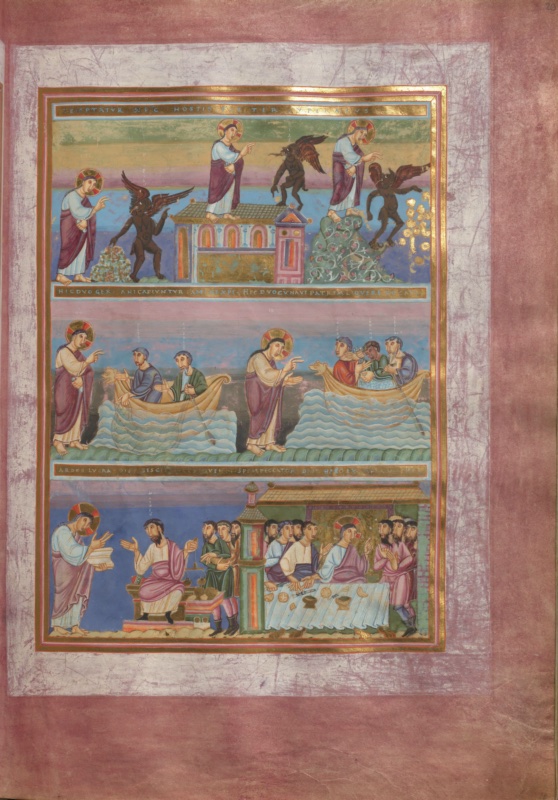
Description
With this folio the cycle has fully entered the public ministry. The tripartite scheme persists — three gold-framed registers divided by inscribed bands in blue capitals on burnished gold — but the narrative method shifts audibly: each register now accommodates two or three distinct moments, and the tituli have become explicitly deictic, marking off successive episodes with repeated hic. The page is, in effect, a diagram of continuous narration made articulate by its own captions.
- Upper register
The three Temptations (Matthew 4:1–11; Luke 4:1–13) are set out in sequence across a landscape of banded green, ochre and rose above, and lapis blue below. At the left, Christ, cross-nimbed and barefoot, raises his hand in refusal towards a winged, dark-bodied demon who presents a heap of stones; the demon is rendered in the Ottonian idiom of the tempter — nude, hirsute, taloned, with membranous wings and a bestial profile. At the centre, Christ stands upon the tiled roof of a low basilica-like structure, its arcaded façade and gilded flank denoting the pinnacle of the Temple, while the demon, now airborne beside him, gestures upward in the challenge to cast himself down. At the right, Christ dismisses the tempter with an outstretched hand; the demon recoils in flight above a flowering tree and a scattering of gold discs that represent the kingdoms of the world offered and refused. The titulus announces that Christ is tempted and the enemy thrice overcome — the numeral organising the register’s rhythm.
- Middle register
The calling of the first four disciples, disposed as two paired scenes over a continuous sea of scalloped blue-green waves. At the left Christ, standing on the shore, extends his hand towards Peter and Andrew, who work a net from a curved-prowed boat; at the right he repeats the gesture towards James and John, seated in a second boat with their father Zebedee, the four heads compressed into a single overlapping cluster. The figures carry name-inscriptions in fine capitals above their heads. The titulus glosses the doubling precisely: here two brothers are taken by love of Christ; here two, called, leave both boat and father. The verse thus performs the same paired structure as the image — an unusually close coordination of text and design.
- Lower register
Two Matthaean episodes joined by a slender tower. At the left, the calling of Matthew: the evangelist, labelled by inscription and seated at a table on which coins and a balance are set, turns with open hands towards Christ, who approaches from the left holding a codex; a queue of figures waits behind him, and the apparatus of the telonium — scales, stacked coin, low counter — is described with unusual particularity. At the right, the meal in Matthew’s house: Christ reclines with his disciples at a long white-draped table set with round loaves, fish and vessels, beneath a tiled roof and against a gilded ground, while figures crowd in at either end. The titulus is heavily abraded here; the fragments concerning gain, hope and the sinner are consistent with the standard exegesis of the passage — the tax-gatherer’s profit exchanged for the sinner’s hope — but the line should not be transcribed from reproduction.
The painter exploits ground colour as a structural device with growing confidence: the banded sky of the Temptations, the flat sea of the calling, the gold and blue alternation of the lowest register. The compression of figures into overlapping clusters — the disciples in the second boat, the crowd at the tax booth — is by now a settled mannerism, and the demons demonstrate that the workshop commanded a fully developed vocabulary for the grotesque alongside its hieratic repertory. The hic … hic construction of the second titulus is worth flagging as evidence that the verses were composed with the completed page design in view, rather than adapted to it.
Carne Domini voce: The Evangelist Portrait of Matthew
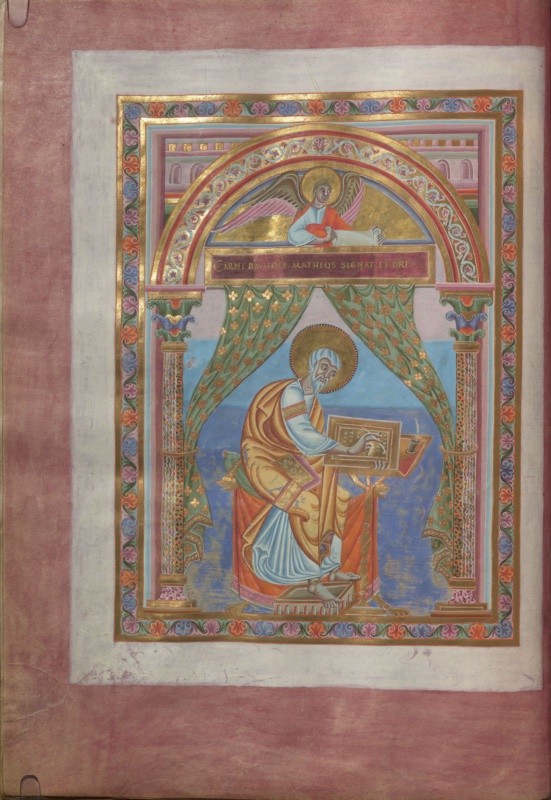
The folio marks a decisive change of register within the manuscript’s visual economy. The narrative sequence of the preceding pages, with its three-tiered fields and continuous hic … hic captioning, gives way here to a single hieratic composition: the author portrait of Matthew, prefacing his Gospel. The shift from narrative to iconic mode is emphatic and evidently programmatic — the reader passes from the story of Christ’s life to the person who authorises its telling.
The miniature is enclosed within a broad ornamental border of gilded acanthus and palmette scrolls, disposed in alternating pink, blue, green and vermilion lobes against a gold ground, and bounded inside and out by gold fillets. Within this outer frame stands an architectural aedicula: two slender columns with painted shafts — one speckled, one patterned in fine sprigs — rising from moulded bases to composite capitals in blue and green, supporting a broad round arch decorated with a vine scroll on gold. Beyond the arch a schematic architecture of arcaded walls and towers closes the upper corners, a vestigial evocation of the Late Antique city backdrop transmitted through Carolingian intermediaries.
In the tympanum, against a burnished gold ground, the winged man appears in half-length — the evangelist symbol of Matthew, here rendered not as a beast but as a haloed youth with pink-and-blue wings, holding an unfurled scroll extended horizontally along the base of the arch. The symbol occupies the position of celestial authority above, while the evangelist labours below: a vertical hierarchy of inspiration and execution that is standard in Ottonian author portraits but here articulated with unusual clarity by the intervening titulus band. That band, in gold capitals on a red ground, is among the best-preserved inscriptions in the codex and states that Matthew marks the flesh of the Lord by voice and by mouth — a compressed formulation of the traditional exegesis assigning to Matthew the human nature of Christ.
Beneath, Matthew is seated on a cushioned bench with an orange draped backrest, his feet resting on a low footstool. He is bearded and white-haired, his head covered by a close-fitting cap, and turns in three-quarter profile towards a lectern at the right on which an open codex lies; his right hand rests on the page, his left steadies the volume, and an inkhorn and pen are set on the desk’s edge. The drapery is the most accomplished passage on the folio: a heavy ochre-gold mantle falling in broad, deeply modelled folds over an under-tunic of pale blue and orange, articulated by gold striations and by the sharp angular breaks characteristic of the Echternach manner. Behind him, curtains of green patterned with gold rosettes are drawn back to either side and gathered at the columns, opening onto a ground divided into bands of blue and pale turquoise. Faint letters are visible on the open page, but they should not be read from reproduction.
The page belongs to the most conservative stratum of the manuscript’s imagery, deriving ultimately from Late Antique author portraits and mediated through Carolingian models of the kind available at Trier and Echternach. Its interest lies less in invention than in the calibration of luxury: the density of gold, the ornamental border, the architectural framing and the inscribed dedication together mark the opening of each Gospel as the codex’s principal ceremonial threshold. Read against fols. 18v–20r, it also clarifies the structural logic of the book — narrative prefaces massed together, each Gospel then introduced by its evangelist in isolated majesty.
Folios (49v-54v)
MARCUS: The Monogram Incipit Page
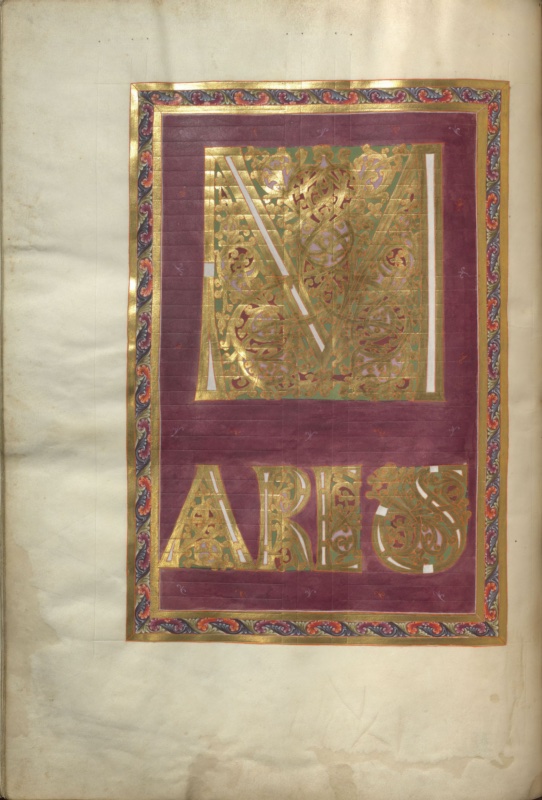
The folio belongs to a wholly different category of page from the narrative and iconic miniatures examined so far: it is a display page of pure letterforms, in which script itself becomes the sole ornamental subject. No figures, no architecture and no narrative content appear; the entire visual argument is carried by two lines of monumental gold capitals set against a field of purple.
A rectangular panel occupies the upper half of the writing area, framed by a broad band of acanthus scroll in vermilion, rose, blue-grey and green on a gold ground — the same ornamental vocabulary as the evangelist frontispieces, here deployed without architectural pretext. Within this border, a plain gold fillet encloses the purple field. The purple is applied in narrow horizontal strips whose seams remain visible across the surface, an artefact of technique that is characteristically Ottonian and worth noting: the ground is built up in bands rather than laid as a single wash. Small tendril motifs in pale grey and orange are scattered sparsely across the empty purple, functioning as lacunae-fillers rather than as structural ornament.
The composition is organised as a monogram above and a completing sequence below. The upper element is a large squared monogram set within a green-ground panel, in which the strokes of the letters are formed of broad gold bands filled with dense interlace and foliate scroll, reserved in red and pale lilac; the diagonal and vertical shafts are highlighted with white reserves that read as light striking the burnished surface. Beneath, separated by a wide expanse of bare purple, runs a second line of five letters — A R C U S — treated in the same manner, each letter serving as a compartment for its own independent interlace. Read together, monogram and line yield the name MARCUS, the initial M compressed into the monogrammatic square above and the remaining letters spelled out below.
The page therefore introduces the second Gospel. Whether it opens the Gospel text proper or the prefatory material — the Monarchian prologue to Mark begins with the evangelist’s name — cannot be determined from the image alone and must be checked against the codicological description; the position at fol. 49v, immediately preceding a page of continuous script visible at the gutter’s right edge, is consistent with either.
The page exemplifies the Ottonian conception of the incipit as ceremonial threshold. Gold on purple is deliberately imperial in association, evoking the codices purpurei of Late Antiquity and, through them, the visual language of chancery and court. The dissolution of the letterform into interlace — legible as script, yet requiring an effort of decipherment — belongs to a tradition ultimately Insular in origin but here regularised into a square, architectonic discipline entirely foreign to Insular practice. The generous emptiness of the purple field is itself a statement of luxury: parchment stained and gilded at this scale, then left largely bare, advertises expenditure as clearly as any figural miniature in the book.
Water into Wine, Leper into Whole: The Miracle Cycle
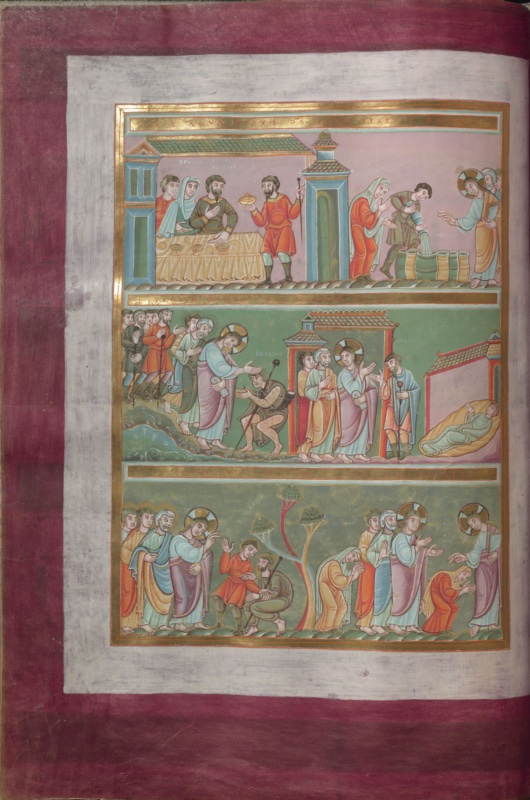
The folio returns to the narrative mode established in the opening quires, but with a marked change of palette and setting: where the infancy pages were built on lapis and rose, the miniature cycle of the miracles unfolds against grounds of mineral green and pale mauve, and the surrounding margin is stained a deep, saturated purple rather than the soft rose of the earlier folios. The tripartite structure persists — three registers separated by inscribed bands in red capitals on burnished gold — and each register again accommodates two or three episodes disposed in continuous narration, without dividing frames.
- Upper register
The Marriage at Cana (John 2:1–11). At the left, beneath a tiled roof supported on a slender façade, the wedding party is seated at a long table set with dishes: the bride and the architriclinus are identified by inscriptions above their heads, and the steward is shown in the act of tasting from a shallow footed bowl brought to him by a servant who strides forward with a staff. At the right, separated by a tower, the miracle itself: two servants pour from amphorae into a row of six large stone jars, ranged along the groundline and rendered in banded ochre and green, while Christ approaches from the extreme right with his disciples, hand extended in the gesture of command. The Virgin stands at the centre-right, turning back towards her son with raised hands — the intercessory gesture that the Johannine text implies but does not describe. The titulus refers to water becoming wine, though the opening and closing words are abraded.
- Middle register
Three healings compressed into a single green field. At the left, the Cleansing of the Leper: Christ, followed by a dense cluster of disciples and by a further group of staff-bearing figures at the extreme left edge, bends forward to touch a bearded man whose bare torso and limbs are covered with the red spots that conventionally signify leprosy, and who leans on a stick; he is labelled LEPROSUS. At the centre, before an arcaded building, the Healing of the Centurion’s Servant: Christ, again accompanied by disciples, turns towards a mantled figure with a staff — inscribed CENTURIO — who addresses him in the gesture of petition. At the right, the consequence of that exchange: the servant lies recumbent on a bed beneath a tiled roof, wrapped in an ochre coverlet, one hand raised. The juxtaposition of petition and result within a single unbroken field is a compact demonstration of the workshop’s continuous-narrative technique.
- Lower register
Two further episodes against a green ground animated by stylised trees with mushroom-like canopies and red trunks. At the left, a healing of the blind: Christ, at the head of a crowd of disciples, extends his hand towards two seated figures, one of whom holds a staff and inclines his head to receive the touch.
The two candidates episodes are:
The blind man of Bethsaida (Mark 8:22–26), in which the man is led to Christ by companions and Christ lays hands on his eyes twice. The presence of a second, actively intervening figure fits this account unusually well. Bartimaeus at Jericho (Mark 10:46–52), where the blind man sits by the wayside and is summoned; here, however, the Gospel specifies no touch, and the second figure would be harder to explain. The bending figure in orange looks like a companion leading and presenting the blind man, so the Bethsaida episode is the stronger reading. One further piece of evidence. The titulus of this register, though badly abraded, appears to open with a sequence beginning AC LV… or AC LU…. If that resolves to lucem or lumen, it would confirm the subject as the restoration of sight and effectively settle the identification.
The right-hand portion of the third register can be plausibly identified as the Canaanite Woman of Matthew 15:21–28, deployed in continuous narration across three moments.
Two textual elements occupy the field. The first, set in short lines between the tree and the disciples, appears to preserve a nominal formula of the type MVLIER CHANANEA, with the initial ligature of mulier largely effaced and the terminal -NA of the ethnonym surviving; a third line remains unresolved and should not be pressed. The second is a longer sequence disposed vertically, one letter to the line, in the narrow interval before the turning figure of Christ. Its format — a column rather than a label — indicates a phrase rather than a caption, and most plausibly carries one of Christ’s two utterances in the episode, or else a fragment of the register’s titulus displaced into the painted field for want of space in the band above. This last practice occurs elsewhere in the codex and would account for the anomalous disposition.
Read with these inscriptions, the composition resolves into a precise sequence:
At the left, a woman in an ochre mantle bows steeply, her hands extended not towards the disciples. This is the intercession of verse 23, in which the disciples approach and entreat him on her behalf — a moment that Ottonian cycles rarely isolate, and whose presence here indicates a painter working from the Matthaean text rather than from a generic healing formula.
At the centre, Christ opens both hands in a gesture of restraint or refusal, addressing the disciples rather than the woman. The gesture corresponds to verse 24, the declaration that he was sent only to the lost sheep of the house of Israel; the doubled open palm, distinct from the single extended hand of blessing used in the adjacent healings, is the painter’s means of distinguishing speech of refusal from act of cure.
At the right, Christ turns back against the direction of reading — the only figure on the folio to do so — and points downward with a single extended finger over a second woman, prostrate in red, her hands raised before her face. This is verse 28, the commendation of her faith and the granting of her request. The downward-pointing finger is the crucial detail: the daughter is absent from the composition because the healing occurs at a distance, and the gesture indicates the absent child rather than the woman before him.
The doubling of Christ within a single unbroken field is the workshop’s established marker of continuous narration, used identically for the Magi on fol. 19r and for the calling of the disciples on fol. 20r. What the Canaanite reading adds is a third moment rather than two, with the woman herself likewise doubled — approaching at the left, prostrate at the right — so that the register traces the full arc of petition, refusal and grant across a single green ground.
Chananea is Matthaean usage; Mark 7:26 gives Syrophoenissa. If the reading holds, this register draws on Matthew on a folio which, by its position after the Marcan incipit at fol. 49v, might be expected to follow Mark. Taken together with the Johannine Marriage at Cana in the uppermost register, this suggests that the miracle cycle is harmonised rather than tied to the Gospel it introduces — a structural point of some consequence for how the picture cycles of this codex relate to its text.
The page displays the mature Echternach manner in its most fluent narrative application: figures grouped into overlapping, wave-like masses whose contours carry the eye laterally across the register; drapery articulated by white and gold striations over green, ochre and vermilion; architecture reduced to signs of place rather than descriptions of space. Notable here is the painter’s willingness to let the ground colour carry from one episode to the next without interruption, so that the boundaries between miracles are marked only by a tree, a tower, or a shift in the direction of gesture.
Hic sanatus abiit: Six Miracles and Three Distichs
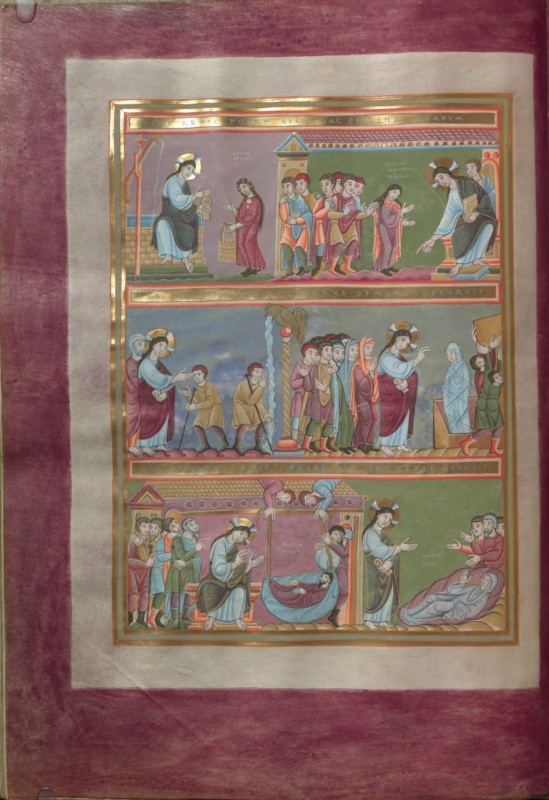
The folio continues the miracle cycle in the same tripartite format, but is exceptional within the sequence examined so far for the legibility of its tituli: all three bands survive in a state that permits confident reading, and the second and third are among the best-preserved verses in the codex. The page is correspondingly valuable as a control on the more abraded folios, since it shows the hic … hic captioning system operating at full strength.
- Upper register
Two Johannine episodes concerning women, joined by a tower. At the left, the Samaritan Woman at the Well: Christ sits on the low masonry kerb of a well surmounted by a windlass and pulley, holding a small vessel and extending his hand towards a woman in red who stands before him with a bucket, gesturing in reply. The inscription above her — MVLIER SAMARITANA, disposed in three short lines — identifies her explicitly. At the right, the Woman Taken in Adultery: a compact crowd of accusers in short tunics and hose presses forward from the left, pushing before them a woman in mauve who raises her hands; at the extreme right Christ, seated and holding a codex, bends sharply forward and points downward with a single extended finger, in the act of writing on the ground. Her inscription likewise survives in three lines. The titulus above states that Christ asked a drink of the one woman, and dispelled the guilt of the other — a distich that pairs the two episodes as complementary encounters with female petitioners.
- Middle register
At the left, the Healing of the Blind at Siloam: Christ, accompanied by a disciple, extends his hand towards a young man in ochre who leans on a staff; a second, near-identical figure walks away to the right, hand raised to his face, towards a tall column surmounted by a bird-form spout from which water falls in a broad blue stream — the pool of Siloam rendered as a fountain. The doubling of the man, before and after, is continuous narration in its clearest form on this page. At the right, the Raising of Lazarus: Christ, followed by a dense group of Jews and by two women, extends his hand towards a shrouded figure bound in cross-hatched wrappings who stands upright in an opened tomb-chest, while attendants at the extreme right lift the lid. The titulus is fully legible and names both subjects — the man born blind who receives sight, and Lazarus who rises from death.
- Lower register
At the left, the Healing of the Paralytic at Capernaum: beneath a tiled roof pierced open at the ridge, two men lower a third on a blue pallet by means of long poles, while a further pair look down from above; the recumbent man is labelled PARALYTICVS. Christ stands at the left before a group of onlookers, hands raised. At the right, the Healing of Peter’s Mother-in-Law: Christ, holding a codex, advances with hand extended towards a woman lying on a couch beneath a coverlet, her hand raised; the inscription SOCRVS PETRI is visible above her, and a group of men gesture from behind. The titulus glosses both: here the healed man departed, and here the crowd entreated on account of the fever.
The page confirms two things that the preceding folios could only suggest. First, that the cycle is harmonised rather than gospel-specific: the Samaritan woman, the adulteress, the blind man of Siloam and Lazarus are all Johannine, while the paralytic and Peter’s mother-in-law are synoptic, and all six stand together on a folio following the Marcan incipit. Second, that the tituli were composed in close coordination with the finished design, since each distich accounts for exactly the two episodes of its register and in the order in which they are painted. The nominal captions — MVLIER SAMARITANA, PARALYTICVS, SOCRVS PETRI — belong to the same system of category-labels observed elsewhere in the cycle, which lends retrospective support to reading the isolated inscriptions on fol. 52v as labels of the same kind.
Decem mundabat: Miracle, Caption and Continuous Narration
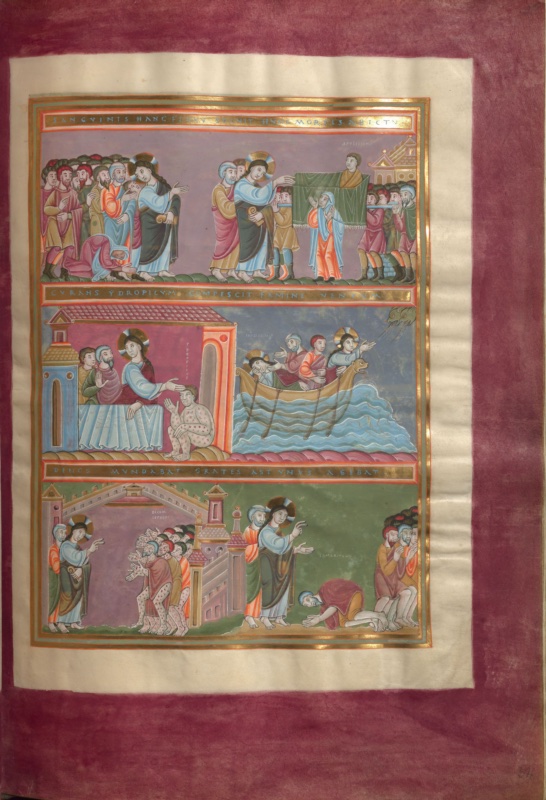
The recto continues the miracle cycle in the established tripartite format and, like fol. 53v, preserves its three tituli in near-complete legibility. The page is of particular interest because it contains, at the head of the first register, the very episode which I had earlier proposed — wrongly — for the third register of fol. 52v. Its appearance here, correctly captioned and unambiguously staged, supplies the decisive argument against that earlier reading and in favour of the Canaanite Woman.
- Upper register
Two miracles of raising and healing, set against a mauve ground and joined by a continuous green groundline. At the left, the Woman with the Issue of Blood: Christ turns back towards a woman who kneels low behind him and reaches for the hem of his mantle, while a dense crowd of onlookers presses in from the left. The Gospel’s essential gesture — the touch from behind, unseen — is here rendered with exactness, and the woman is shown once only, not twice. At the right, the Raising of the Widow’s Son at Nain: Christ, followed by disciples, extends both hands towards a bier draped in green and carried on poles by bearers at either end; a youth rises from it, labelled ADOLESCENS, while the widow stands beneath the bier in the posture of grief. A gate and city wall close the scene at the right. The titulus pairs the two: the flow of blood dried up in the one case, the assault of death repelled in the other.
- Middle register
At the left, the Healing of the Man with Dropsy: beneath a tiled roof, Christ reclines with two companions at a table draped in pale blue, extending his hand towards a naked man seated at the right whose body is covered with red spots and whose swollen abdomen identifies the condition; the inscription YDROPICVS runs vertically beside him. The setting at table corresponds to the Lucan account, in which the healing takes place in a Pharisee’s house on the sabbath. At the right, the Stilling of the Storm: a boat with a curved animal-headed prow rides a sea of scalloped waves, its rigging taut; Christ stands at the stern with hand raised in command towards a green wind-demon who blows from the upper right corner, while at the left of the boat a second Christ lies asleep, head propped on his hand, above the caption HIC DORMIT. The disciples between the two figures gesticulate in alarm. The doubling of Christ — sleeping and waking within a single hull — is continuous narration at its most compressed, and the caption exists precisely to make the device legible. The titulus states that, curing the dropsical man, he restrained the wind by his word.
- Lower register
The Ten Lepers (Luke 17:11–19), disposed as two moments. At the left, before an arcaded building, Christ with a disciple gestures towards a crowd of spotted, half-naked men who press forward with raised hands; the group is labelled DECEM LEPROSI. At the right, the sequel: Christ turns back with both hands open in the gesture of question, while a single figure — inscribed SAMARITANVS — prostrates himself full-length on the ground before him, and the remaining nine stand or crouch at the extreme right, already departing. The titulus glosses the moral with epigrammatic economy: he cleansed ten, but one alone gave thanks.
Three features deserve emphasis. First, the captioning system here operates at full strength and in two distinct modes: category-labels for persons (ADOLESCENS, YDROPICVS, DECEM LEPROSI, SAMARITANVS) and a deictic caption for narrative mechanics (HIC DORMIT), the latter functioning purely to signal that two figures of Christ constitute one moment’s sequel to another. Second, the cycle’s harmonising character is confirmed again: the dropsical man and the ten lepers are Lucan, Nain is Lucan, the storm synoptic, all on a folio within the Marcan section. Third, and most usefully for the reading of fol. 52v, the woman with the issue of blood appears here, in its proper Marcan-Matthaean form and with the woman shown once from behind. Since the picture cycle does not ordinarily duplicate episodes, its presence on this folio removes the principal support for identifying the fol. 52v group as the same subject, and correspondingly strengthens the Canaanite reading proposed there.
Fortior est omni: The Lion, the Pallium and the Authority of Mark
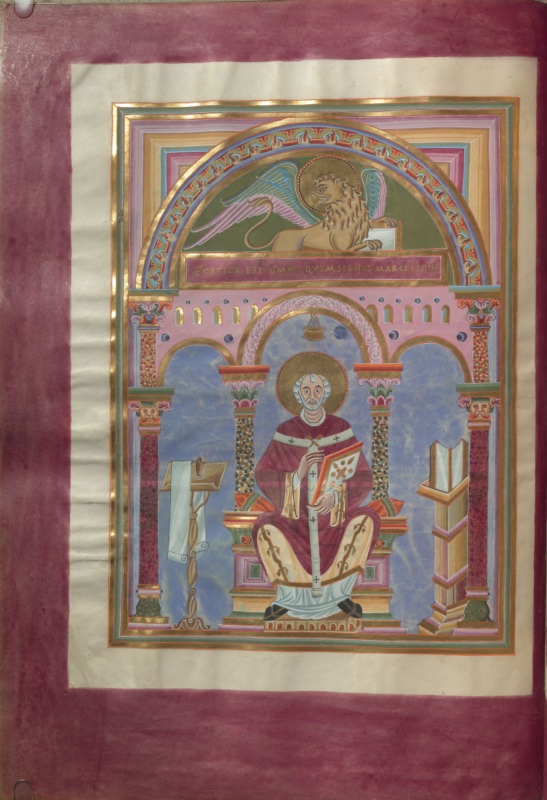
With this folio the narrative sequence of the miracle cycle closes and the codex returns to its iconic register: the author portrait of Mark, prefacing the second Gospel. The page repeats the structural formula established for Matthew at fol. 20v — symbol above, evangelist below, inscribed band between — but elaborates it considerably, and a comparison of the two pages is instructive for the workshop’s handling of variation within a fixed scheme.
The composition is enclosed by a stepped border of graduated bands in rose, blue, ochre and green, laid so as to suggest a receding moulding. Within it rises an aedicula of two orders. The outer order consists of two heavy columns with shafts of speckled porphyry-red, rising to composite capitals from which project human masks in green and rose — a grotesque motif absent from the Matthew page and one of the more striking inventions on the folio. These support a broad round arch decorated with a gold band of stylised acanthus tips against green. The inner order comprises two slighter columns with variegated shafts and gilded capitals, carrying an arch of pink scroll on gold, from which a lamp is suspended; beyond and above runs an arcaded wall in rose punctuated by gold apertures and blue discs.
In the tympanum, against a green ground, the winged lion of Mark advances to the right, haloed, its mane rendered in dense gold striations and its wings in overlapping bands of pink, blue and green. Its forepaws rest upon an open book or lectern at the right edge. The band beneath, in gold capitals on red, is fully legible and constitutes one of the most quotable inscriptions in the codex: it declares that he whom Mark designates by the lion is stronger than all — a formulation that reads the symbol not as an attribute of the evangelist but as a predicate of Christ, and thus stands within the standard exegetical tradition assigning to Mark the royal or resurrectional aspect.
Beneath, Mark is seated frontally on a broad architectural throne with a cushioned seat and stepped footstool, set against a lapis ground. He is bearded, white-haired and tonsured, and — this is the most significant departure from the Matthew portrait — he is vested as a bishop: a deep crimson chasuble over a pale alb, with a pallium bearing black crosses laid across the shoulders and falling in a vertical band to the hem. He holds an open codex on his knee with the left hand while the right steadies it. The vesting is not incidental. It reflects the tradition of Mark as first bishop of Alexandria, and its deployment here, in a manuscript produced for an imperial or high ecclesiastical patron, invites reading in relation to the codex’s own institutional setting.
To either side stand the instruments of the scriptorium: at the left a lectern draped with a white cloth and surmounted by an inkhorn, its shaft rendered as a twisted column; at the right a second desk supporting an open book, its boards splayed. The frontality of the figure, in contrast to Matthew’s three-quarter turn towards his desk, converts the author portrait from an image of composition into an image of authority.
The page confirms that the four evangelist frontispieces operate as a system of controlled variation rather than repetition: shared armature, individualised in symbol, inscription, posture and — here — ecclesiastical status. The episcopal vesting of Mark is the element most worth pursuing, since it locates the portrait within a specific hagiographic tradition rather than a generic one, and since its presence or absence in the Luke and John pages of the same codex would show whether the workshop was applying a considered programme or an occasional flourish.
Folios (76v-78v)
Mundi vinea: The Parable of the Labourers
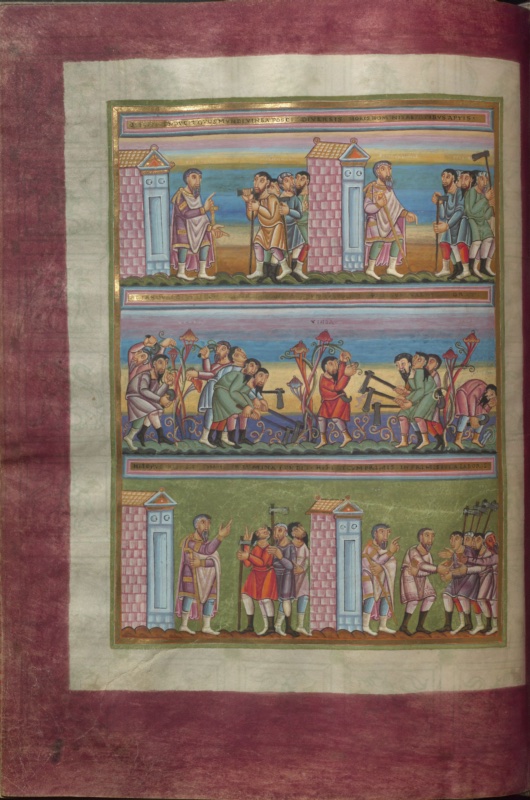
This folio departs from everything examined so far in the codex. The tripartite armature persists, but the subject is neither a Gospel narrative nor an author portrait: it is a parable, illustrated at length and with a degree of attention to agricultural labour that is exceptional in Ottonian book painting. The three registers are given over to the Parable of the Labourers in the Vineyard (Matthew 20:1–16), and the pictorial resources of the workshop — continuous narration, category-labels, sequential hiring — are here applied to a story that has no historical referent at all.
- Upper register
The successive hirings. Against a ground banded in blue, ochre and dun, the composition alternates between two building-blocks — pink masonry towers with blue gateways, functioning as markers of the marketplace — and groups of figures. At the left, the householder, labelled PATERFAMILIAS, in a purple mantle over a rose tunic and carrying a staff, gestures towards a group of labourers inscribed MERCENNARII, who advance with hoes and mattocks over their shoulders. At the right, the sequence repeats: a second PATERFAMILIAS addresses a second group of workers, bearing tools and identified by their own caption. The doubling of the householder is the workshop’s familiar device of continuous narration, here used not for two moments of a single scene but for two successive hours of hiring. The titulus, largely legible, speaks of the vineyard of the world requiring labourers at different hours, suited to the ages of men — an exegetical gloss, not a paraphrase, which already interprets the parable allegorically before the reader reaches the images.
- Middle register
The labour itself, and the most remarkable passage on the folio. Against a landscape of banded blue and gold, three groups of vine-dressers work among stylised vines rendered as slender red and green stalks with trefoil crowns; the word VINEA is repeated three times across the field, marking each section of the vineyard. The men dig with mattocks, prune with billhooks, carry tools over their shoulders, and stoop to the ground; one at the extreme right bends double under his labour. The implements are described with unusual specificity — long-hafted hoes, curved pruning knives, what appear to be two-pronged forks — and their rendering constitutes evidence of some value for eleventh-century agricultural practice, quite apart from the theological subject. The postures of stooping, digging and reaching are individuated rather than repeated, which is uncharacteristic of the workshop’s normal treatment of crowds.
- Lower register
The reckoning. Against a plain green ground, the compositional formula of the first register returns — towers, householder, groups — but the action is now payment rather than hiring. At the left, the householder gestures towards labourers who carry their tools and raise their hands in what reads as protest or expostulation. At the right, a second scene: the steward, holding a small object, distributes to a crowd of men who press forward with cupped hands, while a bundle of tools stands propped at the extreme right corner. The titulus refers to labour and to those who were first, and to the shedding of tears — the language of the parable’s final reversal, in which the last are made first.
Two observations seem worth pursuing. First, the presence of an extended parable cycle indicates that the codex’s picture programme extends well beyond the life of Christ into his teaching, and that the workshop possessed — or devised — compositional formulae for narrative material without fixed iconographic tradition. Second, the tituli here are openly exegetical rather than descriptive: they do not tell the reader what is shown but what it means, glossing the vineyard as the world and the hours as the ages of man. This is a different textual function from the hic … hic captions of the miracle folios, and the shift deserves comment in any account of how text and image cooperate in this manuscript.
Sepes, Turris, Torcular: The Wicked Husbandmen and the Annotated Vineyard
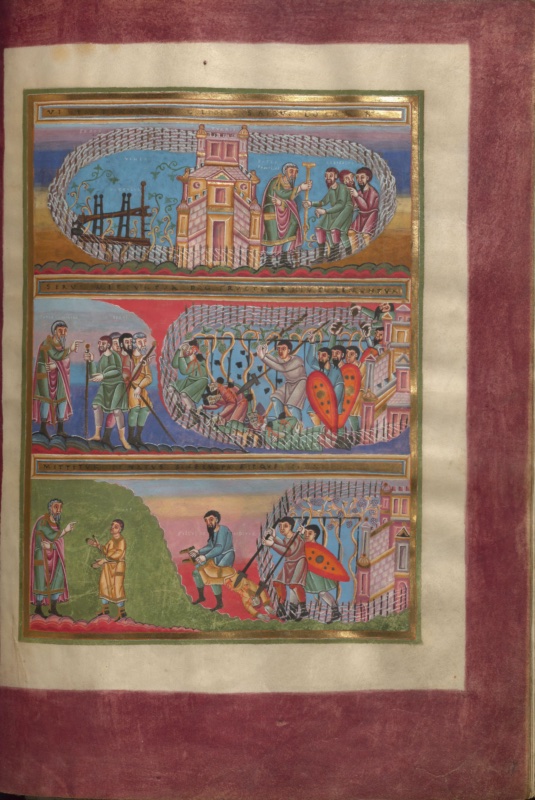
The recto continues the vineyard theme of the facing verso but turns to a different and darker parable: the Wicked Husbandmen (Matthew 21:33–41; Mark 12:1–9; Luke 20:9–16). The tripartite armature is retained, yet the page is compositionally the most inventive encountered so far in this survey, since the painter has abandoned the lateral frieze in favour of a great oval enclosure — the vineyard’s hedge — which dominates the upper two registers and organises the narrative from within rather than along a groundline.
- Upper register
The establishment of the vineyard, illustrating the parable’s opening clause with an almost inventorial literalism. A wide ellipse of woven wattle, labelled SEPES, encloses a blue field in which vines are indicated by trailing tendrils and the word VINEA. At the left stands a winepress, its heavy timber frame and screw rendered with mechanical precision and captioned TORCULAR; at the centre rises a tower of pink masonry with tiled roof and gilded stages, inscribed TVRRIS. At the right, within the same enclosure, the householder — PATERFAMILIAS, in a green mantle over rose — hands a staff or key to a group of three tenants labelled AGRICOLAE. Each element of the Gospel’s description (he planted a vineyard, set a hedge about it, dug a winepress, built a tower, let it out to husbandmen) is thus supplied with its own object and its own caption. The titulus names the vineyard and the letting-out.
- Middle register
The sending of the servants and their maltreatment. At the left, outside the enclosure, the householder — again labelled — despatches a file of four servants, inscribed SERVI, who carry staves. At the right, within a second oval hedge now set against a red ground, the violence: one servant crouches with hands to his face as stones fly about him; another, prostrate at the lower left, is struck with a cudgel; a third lies fallen among the vines; the tenants advance with clubs, staves and large almond-shaped shields with bossed centres, one of them hurling a stone from the top of a building at the upper right. The change of ground from blue to red between the two registers is unlikely to be accidental: the same enclosure, the same vines, but a field of blood. The titulus states that the servants are sent for the fruits and are struck down.
- Lower register
The sending and killing of the son. At the left, on a green ground outside the enclosure, the householder gestures towards a young man in ochre who stands before him with open hands — the son receiving his commission. At the right, within a third enclosure, now rendered as a paling fence of vertical stakes rather than woven wattle, the murder: a man in blue drags or holds down a fallen figure while two others advance with long spears, one carrying a red shield; the body lies at the base of the vines. A caption in the field appears to refer to the son being cast out. The titulus speaks of the son being sent, guiltless, and of what follows.
Three features distinguish this folio. First, the oval enclosure as compositional device is without parallel in the pages examined so far, and it converts the register from a strip into a container: the eye is led around the ellipse rather than across the field. Second, the captioning is at its densest here — SEPES, VINEA, TORCULAR, TVRRIS, PATERFAMILIAS, AGRICOLAE, SERVI — and functions as a gloss on the parable’s individual terms, each of which carried established allegorical value in patristic exegesis (the hedge as the Law, the tower as the Temple, the winepress as the altar or the martyrs’ blood). The picture is thus not merely illustrated but annotated for allegorical reading. Third, the contemporary military equipment — kite shields, spears, mail — places the violence in an eleventh-century present, a choice that deserves comment in relation to the codex’s imperial context.
Taken with fol. 76v, this recto confirms that the parable section of the manuscript is substantial and internally organised: two vineyard parables on facing pages, the one concerning reward and the other concerning rejection.
Adhuc locus: The Great Banquet, its Excuses and its Hell
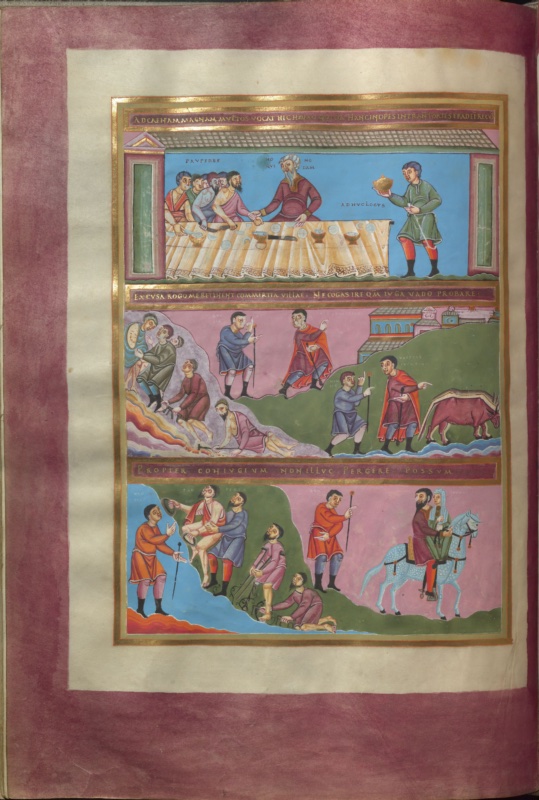
The verso presents the third of the four parables prefacing Luke: the Great Banquet (Luke 14:16–24). It is the most legible page of the parable cycle so far — all three tituli survive substantially intact in gold capitals on purple — and it is also the most complex in its narrative logic, since the painter has been obliged to represent not a sequence of events but a set of simultaneous refusals, each with its own spoken excuse.
The consequence is a page organised around direct speech. The three verse-bands are not descriptive but quotational: they give the words of the guests in the first person. The lowest band is the clearest of all, and reads unambiguously as an excuse offered on account of a marriage — the third of the Lucan refusals, spoken verbatim.
- Upper register
The banquet itself, against a lapis ground beneath a broad tiled roof carried on green-doored piers. At the centre, the host is enthroned frontally behind a long table draped in a heavy white cloth falling in vertical folds to a fringed hem; he is identified by an inscription disposed in two lines, HOMO QVIDAM — the parable’s opening phrase, homo quidam fecit cenam magnam, used here as a name. To his right a compressed row of guests is captioned PAVPERES, and their poverty is rendered with unusual candour: several are bare-legged or half-clothed, one appears infirm. The table before them carries dishes, cups and a knife.
At the right stands a servant in green, holding out a covered golden vessel, and beside him the inscription ADHVC LOCVS — the servant’s report that there is still room (Luke 14:22). The register therefore compresses the poor already seated and the announcement that the house is not yet full into a single field, so that the reader sees the command and its incompleteness at once. The titulus above states that a man called many to the great supper, and that the poor entered.
- Middle register
The first two refusals, disposed across a landscape of green and rose. The compositional device here is striking and, so far as I can see, unique in the cycle: at the left, a jagged, flame-edged field of grey-mauve and orange encloses a group of tormented figures — bodies contorted, one prostrate, one gripped and dragged. This is not a scene from the parable but its consequence, the fate of those who refuse: an infernal zone intruding into the narrative field, marked off by an irregular border rather than a frame.
To its right, the excuses proper. A servant with a staff addresses a man in red who gestures in refusal, above an inscription referring to the farm; further right, a second exchange takes place on a green hill before a walled city, where a servant confronts a man in red beside a pair of oxen, with an inscription that appears to name the calling and the yoke of oxen. The titulus gives both excuses in the first person: one begs to be excused because the business of the farm detains him, and the other asks not to be compelled, since he goes to prove his yoke of oxen.
- Lower register
The third refusal, and a second infernal zone. At the left, against a blue ground bounded below by a band of flame, a servant gestures towards a group of poor and crippled men, captioned PAVPERES — barefoot, one supporting himself on crutches, another crawling on his knees with hand-trestles. These are the halt and the blind of verse 21, and the painter has represented their disabilities with the same specificity he brought to the agricultural implements of fol. 76v.
At the right, a servant with staff turns towards a couple riding a single dappled horse: a bearded man and a veiled woman seated behind him, the woman’s presence supplying the whole content of the excuse. The titulus is complete and quotable: the speaker declares that on account of his marriage he cannot go there.
- Three observations
First, the first-person tituli mark a further shift in the text–image relation. On the miracle folios the verses were deictic (hic … hic); on fol. 76v they were exegetical (the vineyard of the world, the ages of man); here they are dramatic, giving the guests’ own words. The workshop, or whoever composed the verses, was evidently prepared to vary the register of the accompanying text according to the character of the subject.
Second, the interpolated infernal zones are the boldest invention on the page. They are not enclosed by frames but by ragged, flame-lipped contours that bite into the narrative field, so that damnation appears not as a separate scene but as an eruption within the same space as the refusals. The device converts a parable about discourtesy into one about judgement, and it does so purely by pictorial means, without any warrant in the Lucan text.
Third, this folio makes explicit what the Dives and Lazarus page on fol. 78r will confirm, and what has been noted of the codex generally: the painter uses colour semantically, blue for the favourable and red for the adverse. The pairing of blue banquet-ground against red-and-orange infernal ground on this single page is the clearest demonstration of the principle yet encountered.
Ob mortem Christi: The Ox, the Passion and the Portrait of Luke
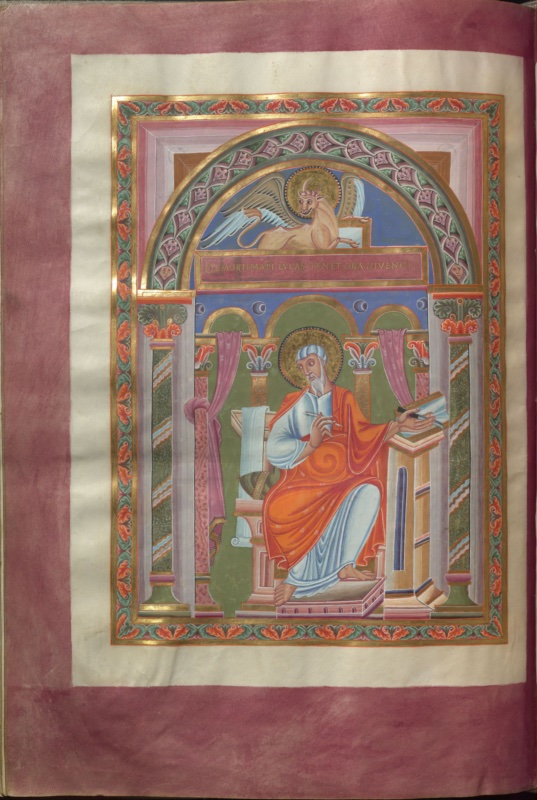
With this folio the parable cycle closes and the codex returns to its iconic register: the author portrait of Luke, prefacing the third Gospel. The page follows the armature established for Matthew (fol. 20v) and Mark (fol. 54v) — ornamental border, arched aedicula, symbol in the lunette, inscribed band, evangelist enthroned below — but it is the most chromatically confident of the three, and it introduces a motif in the arch that does not appear on the earlier pages.
The composition is enclosed by a broad border of gilded acanthus in vermilion and green against gold, bounded by fillets of gold and orange. Within it rises a stepped aedicula. The outer order consists of two columns with shafts of speckled green stone traversed by diagonal bands of pink and blue, rising to composite capitals of orange and green acanthus; these carry a broad round arch whose ornament is the folio’s most striking feature. Set within a scrolling vine on gold are small human heads, disposed at intervals along the whole span of the arch — frontal, wide-eyed faces emerging from the foliage. The motif recalls the grotesque mask-capitals of the Mark page but redeploys them as an inhabited scroll running across the entire arch, and it deserves attention as a possible link to the rinceaux habités of Late Antique and Carolingian ornament.
Behind, an inner order of slighter columns with variegated shafts and gilded capitals carries a green-ground arcade of three bays against lapis, with curtains of rose gathered and knotted at the shafts to either side.
- The lunette
Against a blue ground the winged ox of Luke advances to the right, haloed in gold, its wings rendered in overlapping bands of grey, blue and white, its forelegs resting on a book or lectern at the right edge. The band beneath, in gold capitals on a red ground, is fully legible and among the most quotable inscriptions in the codex: it states that Luke, on account of the death of Christ, holds the face of the calf. This is the standard exegesis of the ox as the sacrificial animal, and hence of Luke as the evangelist of the Passion — a reading that pairs neatly with the fortior est omni of the Mark page, where the lion was similarly construed as a predicate of Christ rather than an attribute of the evangelist.
- The evangelist
Luke is seated in three-quarter view on a stepped architectural throne, his feet on a low footstool. He is white-haired and bearded, his head bound in a close cap, and — unlike the frontal, episcopally vested Mark — he is shown in the act of writing: the right hand holds a quill, the left steadies an open codex propped on a lectern at the right, and a knife appears at the codex’s edge. Behind him at the left a second desk supports a scroll unrolling downward, with an inkhorn beneath.
The drapery is the finest passage on the page: a deep vermilion mantle articulated by a great spiral volute over the thigh, falling in broad folds across a pale blue tunic, the whole modelled in white and gold striations. It is presumably this quality that lies behind the observation, in the older critical literature, that the Echternach style produced some vigorous and cheerful patterns, as in the St Luke — the Luke portrait being singled out as the strongest of the evangelist pages even by a critic hostile to the workshop’s decorative tendencies.
Read against fols. 20v and 54v, the page confirms that the evangelist frontispieces constitute a system of controlled variation on a fixed armature: each shares frame, aedicula, lunette, titulus and throne, and each is individualised by symbol, inscription, posture and status. Matthew turns towards his desk in three-quarter composition; Mark sits frontally, vested with the pallium as bishop; Luke is caught mid-stroke, pen in hand, in the purest form of the author-at-work type. The three together suggest a designer thinking in terms of a set rather than repeating a formula — which accords with the view that the compositions and underdrawings throughout were the master’s, whatever the division of painting.
The oval enclosure
The cycle can now be delimited exactly. The Echternach picture programme places four parables, each occupying a full page, before the Gospel of Luke: the Workers in the Vineyard, the Wicked Husbandmen, the Great Banquet and the Rich Man and Lazarus. Only two of these involve a vineyard at all; the Banquet and Dives–Lazarus (fol. 78r, where the three registers show Lazarus dying at the rich man’s door, his soul carried to Abraham’s bosom, and the rich man’s soul dragged to hell) have nothing to enclose.
So the comparison reduces to the facing pair, and the result is sharper than I expected: the two vineyard folios treat the vineyard in opposite ways. On fol. 76v the vineyard is an open lateral field, with VINEA repeated three times across a landscape and no boundary of any kind. On fol. 77r it is enclosed three times over — twice in woven wattle, once in paling — and the enclosure is captioned SEPES.
The reason is almost certainly textual. Matthew 20:1–16 mentions no hedge. Matthew 21:33 and Mark 12:1 both do, together with the winepress and tower. The painter drew an enclosure on one page and not the other because one text names it and the other does not. This considerably strengthens the “annotated vineyard” reading: the composition is generated by the words of the parable, item by item.
It has to be taken into account that Luke 20:9, the version in the Gospel this cycle prefaces, gives only that a man planted a vineyard and let it to husbandmen — no hedge, no winepress, no tower. The painter therefore cannot be following Luke. This is a hard textual discriminator, not an impression: fol. 77r depends on Matthew 21:33 or Mark 12:1, on a page introducing Luke. It corroborates the harmonisation you have already observed on fols. 52v–54r, and here with unusual precision, since the evidence is the presence of three named objects rather than a general impression of gospel-mixing. The harmonising principle itself is established in the literature: the scenes cover the life and ministry of Jesus without concern for whether a particular scene is covered in the gospel it precedes.
Hedge, tower and winepress: named attributions
These are commonplaces, but they are traceable to specific texts, and the Catena aurea preserves the attributions cleanly.
- Sepes
Jerome, on Matthew 21:33, offers two readings: either the wall of the city, or the guardianship of angels. The Pseudo-Chrysostom3 of the Opus imperfectum gives instead the protection of the holy fathers, set as a wall round the people of Israel, and Origen God’s own providence, or elsewhere the letter of Scripture.
- Torcular
Jerome again: an altar; or those winepresses after which three Psalms are entitled — that is, the martyrs (the pro torcularibus of Pss. 8, 80, 83 Vulg.). Hilary reads the winepresses as the prophets, into whom the Holy Spirit flowed as new wine; Origen as the place of offerings.
- Turris
Jerome: the Temple, on the authority of Micah’s cloudy tower of the daughter of Sion. Hilary: the eminence of the Law, from which as from a watchtower the coming of Christ might be spied.
The citation I would actually use is Bede4, because he gives the set compactly in one place — the hedge is the wall of the city, the winefat is the altar, or those winefats by which three psalms receive their name — and because the Irish Pseudo-Jerome commentary transmitted alongside him supplies the complementary triad: the hedge is the guardianship of angels, the winefat the law, the tower the temple, and the husbandmen the priests.
Why did I choose Bede rather than Jerome? The reason is that the abbey was founded from Northumbria by Willibrord, and its library and script traditions retain that Insular inheritance. Bede is therefore the more probable text physically present in the house. I would put this as a plausibility argument, clearly marked as such, not as a demonstrated source relation.
Folios (110v-112v)
Regnator caeli fit uilis sessor aselli: Entry, Betrayal and Denial
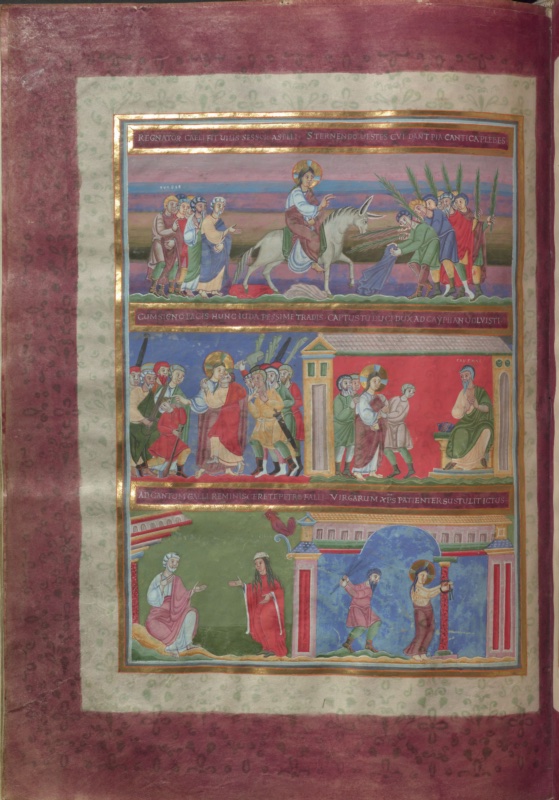
The folio opens the fourth and final narrative sequence of the codex, the four picture pages preceding John, which carry the story from the Passion to the Ascension and Pentecost. The tripartite armature is unchanged, but two things immediately distinguish the page from those examined earlier. First, the surrounding margin is stained purple and printed with a repeating green tendril motif — a patterned rather than plain ground, one of the “textile” pages for which the codex is known. Second, the three tituli are preserved in a state of legibility unmatched anywhere in the manuscript: all six hexameters can be read at reproduction scale, and they constitute the single most usable text on any folio we have looked at.
- Upper register
The Entry into Jerusalem, against a landscape banded in rose, blue and green. Christ, cross-nimbed and seated sideways, rides a white ass towards the right, hand raised in blessing. Behind him a compact group of four disciples, captioned TVRBAE, gestures forward. Before him, a man in green stoops to spread a garment across the path, while three figures beyond raise long palm fronds; a fourth extends a frond towards the ass’s mouth. Garments already lie on the ground beneath the animal’s hooves. The titulus is complete and elegantly antithetical: it observes that the ruler of heaven becomes the humble rider of an ass, and that the people, spreading their garments, offer him devout songs. The rhetorical structure — majesty set against lowliness in the first hemistich, the crowd’s response in the second — is characteristic of the whole page.
- Middle register
Two episodes divided by a building, and a marked change of ground: lapis at the left, vermilion at the right.
At the left, the Betrayal and Arrest. Judas, in red, embraces Christ and presses his face to his; soldiers crowd in on both sides with drawn swords, staves and lances raised in a bristling diagonal cluster at the upper right. A small figure crouches at the lower left. At the right, before a red field beneath a tiled roof, Christ Led before Caiaphas: two men grip him by the arms and propel him towards the right, where the high priest sits enthroned in green, inscribed CAYPHAS, tearing at his beard — the gesture of rending garments and hair with which the Gospel marks his condemnation.
The titulus is again complete, and its rhetorical mode is the most striking on the page: it addresses Judas directly in the second person, reproaching him for betraying Christ with the sign of peace, and stating that he wished the captive to be led to Caiaphas. This apostrophe is a further extension of the textual repertory already observed in this manuscript — deictic on the miracle folios, exegetical on the vineyard page, first-person quotation on the banquet page, and now direct address to a figure within the image.
- Lower register
Two episodes again, divided by a wall, against a green ground at the left and blue at the right.
At the left, the Denial of Peter. Peter sits at the extreme left, hand raised to his breast in the gesture of protestation or dismay; before him stands the maidservant in red, her hair loose, arm extended in accusation. Above the wall behind them perches a cock, rendered in deep red and set on the roofline — the crowing that completes the episode, given as a fixed attribute rather than a narrated moment. Small inscriptions above the two figures presumably name them.
At the right, the Flagellation. Christ, stripped to a loincloth and cross-nimbed, stands bound with his arms drawn back around a red column, while a single scourger in rose strides forward from the left, raising a bundle of rods. The isolation of the figure — one tormentor rather than the customary pair — concentrates the violence and leaves Christ almost frontal.
The titulus pairs the two with the same directness: at the cock’s crow Peter remembers his lapse, and Christ patiently endures the blows of the rods.
The page is valuable out of proportion to its subject matter because of its legibility. Six complete hexameters in sequence permit, for the first time in this survey, a proper assessment of the verse programme: its metre, its rhetorical variety, and its relation to the images. Three observations follow.
The verses are not descriptive glosses but compressed rhetorical exercises. Each hemistich carries one episode; each line pairs two; and the pairing is invariably pointed — humility against majesty in the first, peace against betrayal in the second, Peter’s remembering against Christ’s endurance in the third.
The apostrophe to Judas is the boldest device and, taken with the exegetical verses of fol. 76v and the quoted excuses of fol. 77v, establishes that whoever composed the tituli commanded a range of voices and deployed them deliberately. This is a poet at work, not a captioner.
Finally, the patterned purple margin distinguishes this page from the plain-margined narrative folios of the Matthew and Mark sequences, and its recurrence should be traced: if the John sequence is systematically given the ornamented ground, that is a structural signal about the codex’s hierarchy of sections.
Granum depositum: Rhetoric, Typology and the Climax of the Passion Cycle
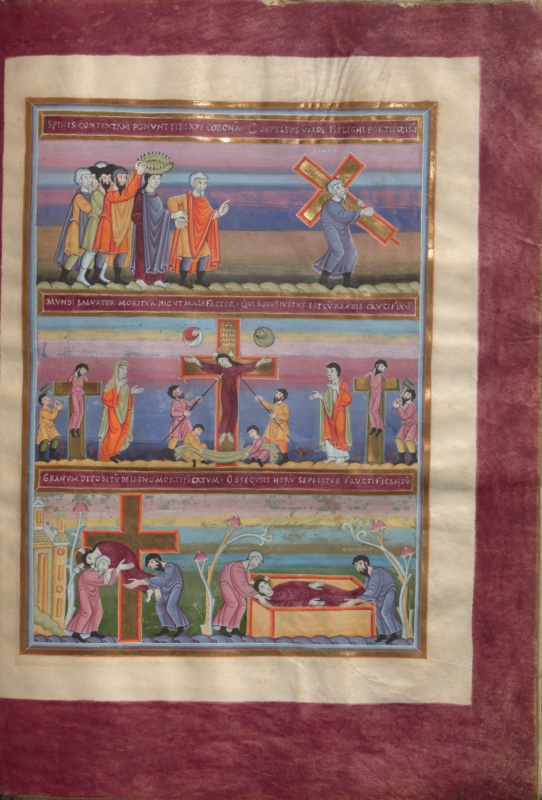
The recto continues the Passion sequence begun on the facing verso and carries it to its close: Crowning with Thorns, Carrying of the Cross, Crucifixion, Deposition and Entombment. It is, in every respect, the culminating page of the manuscript’s narrative programme. The three tituli are preserved in full and are the most theologically charged in the codex; the central register abandons the paired-episode structure used throughout the cycle in favour of a single unified composition occupying the whole field; and the older attribution literature assigns this page and those following to the workshop master himself, the Crowning with Thorns marking the point at which his hand takes over from the pupil.
- Upper register
Two episodes across a landscape banded in rose, blue and ochre. At the left, the Crowning with Thorns: Christ, in a deep blue-violet mantle, stands passive while a mocker in orange raises a green wreath of long spikes above his head; five further tormentors crowd behind and beside him, one gesturing derisively. At the right, separated by a wide expanse of empty ground, Simon of Cyrene — inscribed SYMON — bears the cross alone, shouldering the great gilded beam and stooping under its weight as he moves to the right. The isolation of this figure in the empty field is one of the most effective passages of composition in the codex.
The titulus is complete: the first hemistich addresses Christ directly, saying that they place upon him a crown woven of thorns; the second states that Simon, greatly compelled, carried it unwillingly. The second-person apostrophe continues the rhetorical mode established on fol. 110v, but the addressee has changed from Judas to Christ.
- Middle register
The Crucifixion, and the most ambitious composition on the folio. Christ hangs at the centre on a great gold-and-vermilion cross, wearing a long sleeveless purple tunic (colobium) rather than a loincloth — the archaising, Early Christian formula, which in an eleventh-century context is a deliberate choice rather than a default. The titulus on the cross-plaque gives the inscription of Pilate. Above, in the sky, appear the personified Sol and Luna as busts in coloured discs, each veiling the face.
Two soldiers flank the cross, one thrusting a lance towards Christ’s side, the other extending a reed; beneath them two smaller figures stoop to draw a cloth taut between them — the division of the garments, compressed into a single motif at the foot of the cross. To right and left, the two thieves are bound to lower T-shaped crosses, their legs being broken by executioners with mallets; the left-hand thief is captioned as the penitent, and beside him stands a mourning figure in orange and green. At the right, a further standing figure gestures towards the cross with open hands, and a second is inscribed beyond.
The titulus is the theological heart of the page: it declares that the Saviour of the world dies here as a malefactor, and asks why he who alone is just is crucified with criminals. The interrogative form is unique in the folios examined and marks the point at which the verse programme moves from narration to protest.
- Lower register
Two episodes joined by a stylised tree-line of slender stems with lobed pink crowns. At the left, the Deposition: Joseph of Arimathea supports the body while a second figure, inscribed NICHODEMVS, bends to draw the nails from the feet; the Virgin and a companion stand at the extreme left before a city gate, and the great gold cross rises empty at the centre. At the right, the Entombment: the two men, again captioned IOSEPH and NICHODEMVS, lower the shrouded body into an open sarcophagus of gold and vermilion.
The titulus here abandons narration entirely for typology: it speaks of the grain laid down from the wood and put to death, buried by their offices in order that it may bear fruit. The image is Johannine (John 12:24, the grain of wheat that must die to bear fruit), and its placement over the Entombment converts the burial into a sowing. This is the only titulus in the folios examined that offers a figural reading of the scene beneath it rather than describing or apostrophising it.
- Three points deserve emphasis.
The verse programme reaches its full range on this page. Across three lines it moves from direct address to Christ, to rhetorical question, to typological figure — and read together with fol. 110v, the six lines of which were deictic, apostrophic and narrative, the Passion sequence displays a deliberately escalating rhetoric. Whoever composed these verses was constructing a poem, not labelling pictures, and the granum depositum line is the strongest single piece of evidence for that claim.
The colobium and the personified Sol and Luna are archaising features of Early Christian and Carolingian derivation. Both belong to the repertory of the Trier tradition on which Echternach drew, and their presence here — on the page where the master’s hand is thought to begin — suggests a conscious reaching for authoritative models at the cycle’s climax.
Finally, the unified central register breaks the compositional rule that has governed every narrative folio in this survey. Elsewhere each register carries two or three episodes divided by towers, trees or shifts of ground. Here the Crucifixion occupies the entire width as a single event, with the subsidiary incidents (the lance, the reed, the garments, the thieves) subordinated within it rather than juxtaposed alongside. The break is not accidental: it is the pictorial equivalent of the interrogative titulus above it.
In primo fragmine panis: Modes of Recognition in the Resurrection Cycle
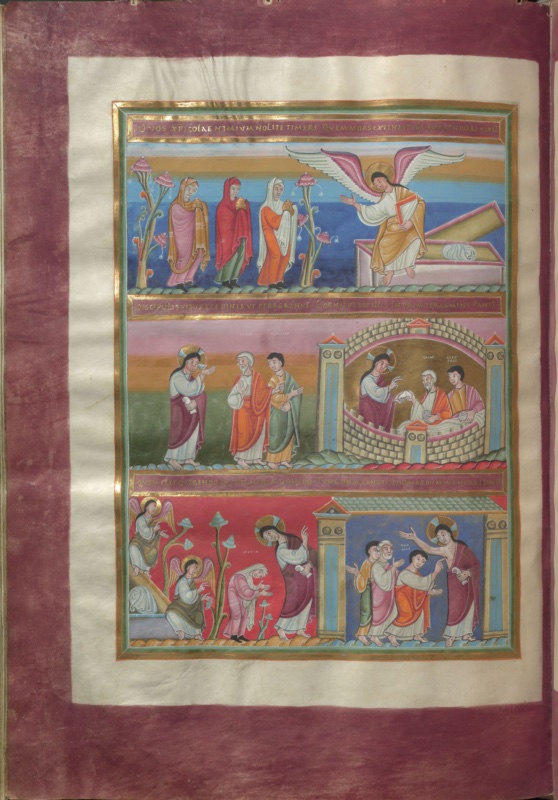
The verso turns from Passion to Resurrection, and the change of subject brings with it a marked change of pictorial temper. Where fol. 111r was dominated by mass, violence and the great architecture of the cross, this page is composed of encounters: five scenes of recognition, each turning on a gesture of the hand. The tripartite armature and the paired-episode structure return, and the three tituli are again preserved complete — with fols. 110v and 111r, this gives eighteen consecutive legible hexameters, a sufficient corpus for a proper study of the verse programme.
- Upper register
The Marys at the Sepulchre. At the left, three women advance in file across a ground banded in blue and ochre, each carrying a covered ointment jar; they are set among stylised trees with lobed pink crowns of the type already seen on fol. 111r. At the right, an angel in white and gold sits upon the open sarcophagus, one wing sweeping upward behind him, the other extended; he holds a red book and raises his hand towards the women. The tomb-chest stands open, its lid tilted aside, and within it lies the abandoned shroud, rendered as a pale crumpled mass.
The titulus is complete and addresses the reader directly in the vocative: it tells the worshippers of Christ not to fear overmuch, since he whom death extinguished lives again by rising. The apostrophe is here turned outward — not to Judas, as on fol. 110v, nor to Christ, as on fol. 111r, but to the beholder.
- Middle register
The Journey to Emmaus and the Supper at Emmaus, both from Luke 24. At the left, Christ walks ahead in the guise of a traveller, holding a scroll and turning back towards two disciples who follow with raised hands; they are captioned, one appearing to be named Cleophas. At the right, within a remarkable circular walled enclosure of coursed masonry with towered gateways, Christ sits at table with the two disciples and breaks bread; a further inscription marks the scene, and Christ’s hands are shown in the act of dividing. The enclosure is a striking compositional device: like the oval hedge of fol. 77r, it converts the register from a strip into a container, and it is worth noting as a second instance of the same formal instinct in the manuscript.
The titulus pairs the two moments exactly: he was seen by the two disciples as a stranger, and was known to them in the first breaking of the bread.
- Lower register
Two further recognitions, against grounds of vermilion and lapis. At the left, the Noli me tangere preceded by the angelic annunciation at the tomb: two angels are seated at either end of the opened sarcophagus, the shroud visible within, while at the centre Mary Magdalene — inscribed MARIA — stoops low with hands extended, and Christ stands before her at the right, one hand raised, the other holding a scroll. At the right, beneath a tiled roof and between columns, the Incredulity of Thomas: Christ draws back his mantle to bare his side and extends his arm, while Thomas, labelled THOMAS, reaches forward with pointed finger, three further apostles pressing behind him.
The titulus again pairs the episodes with an antithesis of the senses: whom Mary, weeping, sought and believed by seeing, Thomas then confessed as God by touching the wound.
- Three observations
The page is organised around a theology of recognition, and the tituli make this explicit rather than incidental. Emmaus turns on the breaking of bread, Magdalene on sight, Thomas on touch; the verses name each mode in turn. Read as a sequence, the three lines constitute a small treatise on the modes by which the risen Christ is known, and the ordering — hearing the angel, breaking bread, seeing, touching — is unlikely to be accidental.
The circular enclosure at Emmaus is formally the closest analogue in the codex to the oval hedge of fol. 77r, and its presence here bears directly on the question raised earlier. If the workshop possessed a general habit of enclosing scenes in circular or oval boundaries, then the sepes of fol. 77r is less an invention prompted by the text than an application of an existing formal preference — though the fact that it is captioned SEPES there, and unlabelled here, still tells in favour of the text-driven reading. The two instances should be compared directly.
Finally, the vocative address to the beholder in the first titulus completes the rhetorical range of the Passion–Resurrection verses: apostrophe to a figure within the narrative, apostrophe to Christ, interrogation, typology, and now direct address to the reader. This is a considered rhetorical programme, and the case for treating the verses as a poem in their own right — rather than as captions — now seems to me strong enough to state in print, provided the transcriptions are secure.
Quid statis suspicientes: Ascension, Pentecost and the Constitution of the Church
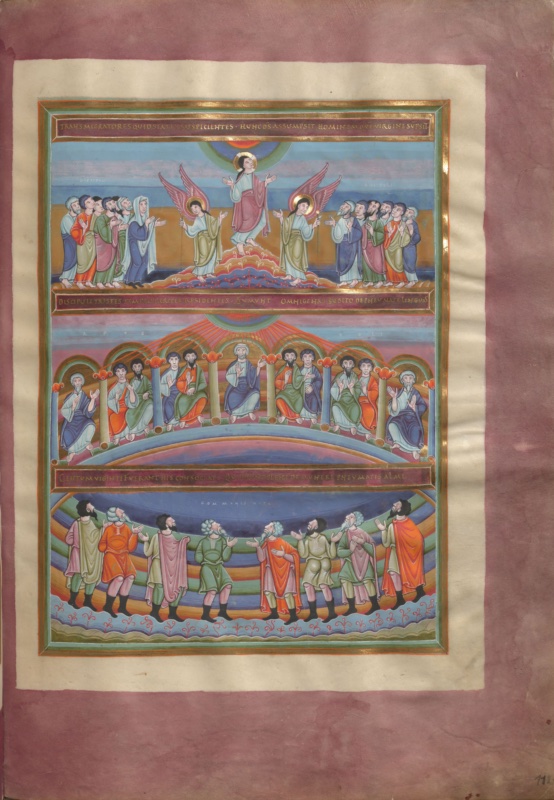
This is the last narrative page of the codex, closing the fourth picture sequence and with it the whole programme: Ascension, Pentecost, and the community of the hundred and twenty. The tripartite armature persists, but the page departs decisively from the method that has governed every preceding narrative folio. There are no paired episodes, no dividing towers or trees, no continuous narration. Each register carries one event only, presented frontally and symmetrically, and the three are bound together by a single ascending-descending axis of light. The cycle ends by abandoning narrative for hieratic display.
- Upper register
The Ascension. Christ rises at the centre with both arms raised in orant gesture, his head set against a disc of concentric green, orange and red — a mandorla reduced to a solar aureole — and his feet resting on a mound of stylised cloud in rose and vermilion. Two angels flank him, wings outspread, gesturing outward and downward towards the disciples ranged at either edge, both groups captioned DISCIPVLI. The composition is broadly symmetrical but not exactly so: the left-hand group comprises apostles together with the Virgin, veiled and set at its inner edge, while the right-hand group is composed of apostles alone. Their heads tilt upward in a rhythmic sequence of gazes.
The titulus is complete and opens with the angels’ words of Acts 1:11, addressed in the vocative to the beholders: it asks why they stand looking up, and states that God took up this man whom he assumed from the Virgin. The word placed in the vocative position is unusual and should be read carefully at magnification — it appears to designate the onlookers as pilgrims or exiles, which would be a striking gloss on the viri Galilaei of the biblical text.
- Middle register
Pentecost. The apostles are seated in a continuous arcade of gold and green, their columns crowned with flaring orange acanthus, in a broad arc that curves forward at the centre and recedes at the edges — a spatial device that gathers them into a hemicycle rather than a row. They are ten in number, neither the eleven of the period before Matthias’ election nor the canonical twelve; the same count recurs among the standing figures of the register below, which suggests that the painter treats a group of ten as a sign of an assembly rather than as an enumeration of it. From a disc of concentric colour at the top centre, rays of red and gold descend in a great fan, touching each head individually. The apostles raise their hands in a variety of responses; the group is captioned APOSTOLI, the word divided across the field. Beneath them sweeps a wide band of blue and rose, the seat of the assembly.53v
The titulus is again complete and unusually precise in its diction: the sorrowing disciples, sitting together in the temple, suddenly receive tongues of every kind from the Spirit. Two features are worth remark. The verse specifies the temple rather than the upper room, a detail with exegetical rather than narrative warrant. And it uses the Greek-derived pneuma rather than spiritus — a hellenising choice that recurs in the third titulus and that says something about the learning, or the pretensions, of the verse programme’s author.
- Lower register
The hundred and twenty. Eight men stand in a row against a ground of concentric bands in blue, green, ochre and rose — the same striated aureole that framed Christ’s head in the Ascension, here expanded to fill the entire field, so that the community is set within the light rather than beneath it. The number bears no relation to the hundred and twenty named in the titulus above, nor to the ten apostles of the register between: the row functions as a sign of an assembly rather than an enumeration of one, and the exact figure is left to the verse. They wear short tunics and mantles and are barefoot or stockinged; their gestures are varied, several conversing, several raising open hands. A caption at the top centre appears to designate their common life. Below runs a band of stylised blue water sprouting red tendrils.
The titulus states that a hundred and twenty were associated with them, and that they are filled by the gift of the kindly Spirit — the number from Acts 1:15, and again pneuma for the Spirit.
- Three observations, the first two of which bear on the codex as a whole
The abandonment of narrative structure on the final page is programmatic. Every earlier folio in this survey has divided its registers into episodes and marked the divisions architecturally; here the divisions vanish, the compositions become frontal and symmetrical, and the subject shifts from event to state. The cycle that began with the Annunciation ends not with an action but with a condition — the Church constituted, filled and gathered in light.
The striated aureole is the formal device that carries this argument. It appears first as a small disc behind Christ’s head, then as a fan of rays, then as the entire ground of the lowest register. The progression is legible as a diagram: the light that surrounds Christ descends upon the apostles and finally encloses the whole community. Whether this was consciously designed is not demonstrable from the image alone, but the sequence is too orderly to be accidental.
Finally, the tituli here confirm what the Passion pages suggested: the verse programme is the work of someone with real command of Latin verse and some Greek vocabulary, deploying vocative address, exegetical substitution (temple for upper room) and hellenising diction. Across fols. 110v–112r we now have twenty-four consecutive legible hexameters, and I would treat them as a single poem in four parts. That is a claim worth making, but only once the transcriptions are secure.
Est aquilae similis: The Eagle, the Closed Book and the Portrait of John
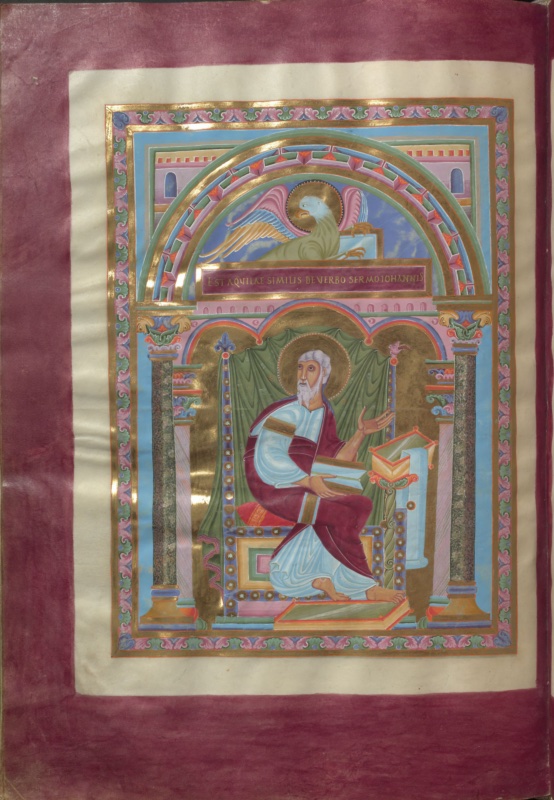
The last of the four evangelist frontispieces, prefacing John, and with it the close of the codex’s pictorial programme. The armature established for Matthew, Mark and Luke is retained in full — ornamental border, arched aedicula, symbol in the lunette, inscribed band, evangelist enthroned below — but the page differs from its three predecessors in one decisive respect, and the difference appears to be programmatic.
- Frame and architecture
A broad border of gilded acanthus in rose, green and blue on gold encloses the field. Within it rises an aedicula of two orders. The outer columns have shafts of speckled green stone rising to composite capitals of blue, green and gold acanthus, and carry a broad round arch banded in green, rose and gold and ornamented with a chevron of stylised palmettes. Beyond the arch, at either upper corner, appears a schematic city wall in rose and blue with battlements and arched openings — the vestigial Late Antique cityscape used, in varying form, across the series.
The inner order consists of a gilded arcade with a scalloped profile, springing from slender colonnettes; behind it a curtain of deep green falls in vertical folds, drawn across the whole width, and behind that a ground of burnished gold.
- The lunette
Against a blue ground the eagle of John crouches to the right, haloed, its beak open, its head and neck white and its body green, the wings rendered in overlapping bands of rose, blue and gold. Its talons rest upon an open book set on a lectern at the right edge. The band beneath, in gold capitals on red, is completely preserved and is the most quotable of the four inscriptions: it declares that John’s discourse concerning the Word is like the eagle. The formulation differs instructively from those of Mark and Luke. There the symbol was construed as a predicate of Christ — stronger than all, on account of the death of Christ. Here it is a predicate of the evangelist’s speech: it is the sermo that resembles the eagle, not the Lord. The shift is appropriate to the Johannine prologue and suggests that the four inscriptions were composed as a set, with the terms of comparison deliberately varied.
John is seated in three-quarter view on a broad throne with a jewelled and gilded back, a red cushion at the left, his feet resting on a low green footstool. He is white-haired and white-bearded, and wears a deep crimson mantle over a pale blue tunic, without the pallium that distinguishes the Mark portrait; of the four evangelists, Mark alone is vested as bishop. John holds an open book against his body with the left arm while the right hand is raised, palm open, in the gesture of speech; his head turns slightly upward and to the right, towards a small eagle perched on the finial of the lectern beside him. This second eagle, set at the evangelist’s own level and within his own space, repeats in miniature the symbol displayed monumentally in the lunette above, so that the attribute functions both as heraldic sign in the frame and as companion within the picture. The lectern at the right carries a further open book with splayed boards.
The drapery is the most restrained of the four: a deep crimson mantle over a pale blue tunic, the folds broad and quiet, articulated by gold bands at the shoulder and hem rather than by the white striations used elsewhere.
Read as the last term of a series, the page completes an argument that only becomes visible once all four are set side by side. The evangelist portraits are not four repetitions of a type but a graded sequence: Matthew composing, Mark enthroned in episcopal authority, Luke writing, John listening. The last is the most hieratic and the least occupied with the mechanics of the scriptorium, and its distinguishing gesture — the raised open hand, the upward glance, the closed book — belongs to inspiration rather than to work.
Together with the varied tituli — lion as strength, ox as sacrifice, eagle as the manner of Johannine speech — the four frontispieces demonstrate a designer working with a fixed armature and a considered set of variations within it, which is precisely what the narrative folios have shown at every point in this survey.
Art-historical significance
The Codex Aureus of Echternach occupies a pivotal place at the hinge between Ottonian and early Salian book art. Chronologically it sits at the very end of, or just after, the Ottonian dynasty (whose last ruler, Henry II, died in 1024), and it inaugurates the golden Gospels of the Salian imperial scriptorium at Echternach; it is thus routinely described as a major example of Ottonian illumination even though, strictly, it falls at or just beyond the dynasty’s end. Its importance is threefold.
First, in the sheer scale and coherence of its decoration it is one of the two or three most lavishly illuminated manuscripts of its era — the facsimile literature claims it carries more pictorial decoration than any other manuscript of the period except the Golden Gospels of Henry III — and its systematic prefatory architecture (summary, textile, narrative, portrait, incipit, initial) became a template for the later Echternach books. The narrative cycle in particular, with its Late Antique-derived register format, transmits an Early Christian mode of continuous pictorial narration into the eleventh century.
Second, the manuscript is a key document of the relationship between Ottonian-Salian art and its Late Antique and Byzantine models. The dependence of the Echternach painters on the Trier Gregory Master is decisive here: the Gregory Master’s own style, as the Italian scholarship emphasises, consisted precisely in an intense reworking of Late Antique and Byzantine figural sources, converting the spirit of classical composition into the pictorial conception of the tenth century — the so-called Ottonian renaissance. The Echternach golden Gospels inherit this classicism at one remove; the painted silks and purple grounds, and the parable and miracle cycles, all point back to Late Antique and Byzantine prototypes. The Byzantine dimension is doubly present: in the pictorial models the painters used, and in the person of the Empress Theophanu, the Byzantine princess whose donation the cover was, and whose presence in Ottonian art has itself been the subject of scholarship (Hiltrud Westermann-Angerhausen’s study of “traces of Theophanu” in Ottonian treasure art).
Third, the book is an instrument of imperial ideology and of the politics of the Ottonian-Salian Reichskirche (imperial church). Its very materials — gold script, purple grounds, painted imperial silks, a treasure cover displaying the imperial donors Otto III and Theophanu among the saints — proclaim the fusion of sacred and imperial authority. Its large format announces its function as an object of ecclesiastical and imperial representation. The programme on the cover, associating the ruling house directly with the abbey’s saints and with the four-fold diffusion of the Gospel, is a visual statement of the alliance of throne and altar on which the imperial church system rested. And the manuscript’s role as the admired model that prompted Henry III’s commissions for Speyer and Goslar makes it a node in the network by which the Salian dynasty used luxury Gospel books to bind its principal religious foundations to itself. In the broader literature on Ottonian book illumination — pre-eminently Henry Mayr-Harting’s Ottonian Book Illumination: An Historical Study (an expanded version of his 1987 Slade Lectures at Oxford) — such books are read exactly as showing “how religion and political ideology were intertwined in Ottonian culture from about 950 to 1050.”
Provenance and later history
For most of its life the Codex Aureus remained at Echternach. It was there that Henry III is thought to have seen it, and there it stayed through the later Middle Ages and the early modern period. The dispersal came with the French Revolutionary Wars. During the War of the First Coalition, Luxembourg was conquered and annexed by Revolutionary France (becoming part of the département des Forêts), and the abbey was suppressed in 1795/1796. The monks fled, carrying the manuscript and other portable treasures with them; the codex travelled by way of Mainz to Erfurt (the reference literature specifies the Benedictine house on the Petersberg at Erfurt).
The next stage is well documented but carries a persistent nominal confusion that must be flagged. In 1801 the manuscript was acquired by Duke Ernst II of Saxe-Gotha-Altenburg5 — this is the reading of the German scholarly literature (the Kahsnitz/Rücker commentary) and of the Gotha Research Library, which records that Duke Ernst II bought some fifty valuable medieval manuscripts from Echternach and Murbach through the enterprising French Benedictine Jean-Baptiste Maugérard (1735–1815). Some English-language and facsimile sources garble the ducal name as “Ernst II of Saxe-Coburg and Altenburg”; this appears to be an error, and the correct attribution is to the House of Saxe-Gotha-Altenburg. Through dynastic inheritance the manuscript passed into the collection of the House of Saxe-Coburg and Gotha (which after the First World War was placed in a foundation), and it remained there until after the Second World War.
The modern acquisition is the last major episode. The ducal house resolved to sell the manuscript for financial reasons — German accounts connect the sale to the loss of the family’s Gotha properties under Soviet occupation, forcing a distress sale. The then duke wished the book to stay in Germany, and its purchase was arranged jointly by the German federal government and the Länder, with Bavaria taking the lead, so that its new home would be the Germanisches Nationalmuseum in Nuremberg. German Wikipedia (echoing the museum’s acquisition account) gives the sale as 9 May 1955, by the House of Coburg-Gotha to the GNM, “for financial reasons,” at a price of 1.1 million Deutsche Mark; the price is reported variously, however (at least one German reference source gives 1.5 million DM), so the exact figure should be confirmed against the primary GNM acquisition record. The manuscript has remained in Nuremberg ever since, catalogued as Hs. 156142, with the treasure binding inventoried separately as KG 1138 and displayed in the museum’s permanent medieval galleries; the manuscript block and the cover are deliberately kept and conserved apart so that each can be preserved under optimal conditions.
Historiography and scholarly debate
The Codex Aureus has been studied continuously since the late nineteenth century, and the shape of the scholarship illuminates several enduring controversies.
- The nineteenth- and early twentieth-century foundations
The manuscript and its cover entered the art-historical literature with Wilhelm Vöge’s studies of the “German school” of painting around the turn of the first millennium (1891) and of a “German carver of the tenth century” (1899), and with Adolf Goldschmidt’s fundamental catalogue of Carolingian and Ottonian ivories (vol. 2, 1918), which classified the central Crucifixion plaque and judged its surviving colour to be non-original. Carl Nordenfalk’s early intervention — “Neue Dokumente zur Datierung des Echternacher Evangeliars in Gotha” (Zeitschrift für Kunstgeschichte 1, 1932) — signals how early the dating question was joined.
- The three principal specialists
Three scholars stand out as most closely associated with the study of this specific manuscript. Peter Metz produced the first monographic treatment, Das Goldene Evangelienbuch von Echternach im Germanischen Nationalmuseum zu Nürnberg (Munich: Prestel, 1956), issued in English as The Golden Gospels of Echternach (New York: Praeger, 1957), which remains the foundational full-length study in English and the basis of most later summaries. Rainer Kahsnitz directed the modern scholarly reappraisal: he was the editor of and principal commentator on the 1982 facsimile and its accompanying volume (with Ursula Mende and Elisabeth Rücker), Das Goldene Evangelienbuch von Echternach: Eine Prunkhandschrift des 11. Jahrhunderts, whose essays on the Trier–Echternach background, the binding, and the picture programme set the terms of current understanding. Carl Nordenfalk, finally, shaped the study of the whole Echternach golden-Gospels group and of its Trier sources: beyond his 1932 dating article, his work on the Master of the Registrum Gregorii (the Gregory Master) and his 1971 facsimile-commentary on the Codex Caesareus Upsaliensis provide the comparative frame within which the Codex Aureus is now placed. (Other important contributors — Karl Oettinger on the ivory carver, Gunther Wolf and Hiltrud Westermann-Angerhausen on the cover’s date and patronage, Peter Lasko and C. R. Dodwell and Henry Mayr-Harting in the general histories, and Anja Grebe in the 2007 GNM exhibition catalogue — are drawn on throughout this essay and listed in the bibliography, but the three specialists most directly identified with the manuscript itself are Metz, Kahsnitz and Nordenfalk.)
- The dating controversy
The central chronological debate concerns whether the manuscript belongs to c. 1030–1045/50 (the mainstream view, held by the GNM, the BnL, Grebe and most recent scholarship, and consistent with production under Abbot Humbert) or to 1053–1056 (the later dating preferred by Metz and followed by Lasko, which would place it after Humbert’s death). The later dating has not persuaded most subsequent scholars, but it remains part of the record and cautions against treating any single narrow date as settled.
A distinct debate surrounds the central ivory plaque. Its style differs markedly from the elongated repoussé figures around it, and its origin has been much discussed. Metz regarded the ivory as contemporary with the rest of the cover (i.e. c. 985–991); Lasko dated it, like the text in his view, to 1053–1056; John Beckwith attributed it and related pieces to a workshop “possibly at Trier in the last twenty years of the tenth century.” Most strikingly, Karl Oettinger’s 1960 study, “Der Elfenbeinschnitzer des Echternacher Codex Aureus und die Skulptur unter Heinrich III. (1039–56),” connected the ivory carver to sculpture of the reign of Henry III — implying a mid-eleventh-century date for the ivory and thus decoupling it from the late-tenth-century metalwork. The disagreement is unresolved and turns on stylistic judgement: whether the ivory is a late-tenth-century component of the original Trier cover or a later insertion.
The cover’s original destination. Whether the cover was made for Echternach from the outset, or for another Trier manuscript (e.g. the Sainte-Chapelle Gospels) and only later associated with Echternach, or presented by Egbert to the imperial family and thence to Echternach, remains contested; Wolf’s 988/Cologne hypothesis is influential but not proven. Scholars agree only that cover and text were united after the fact, most likely around or soon after 1031.
A longer-running art-historical question — how far the Echternach programme derives from Late Antique picture sources — is inseparable from the study of the Trier Gregory Master, whose classicism the Italian scholarship (Liana Castelfranchi Vegas; the Treccani encyclopaedias) analyses as a deep reworking of Late Antique and Byzantine sources. For the Codex Aureus specifically, the register-format narrative cycle and the canon-table and portrait types are the principal evidence adduced for a Late Antique pictorial ancestry mediated through Trier.
The 2009 Oltrogge–Fuchs study reoriented the debate toward materials and process, demonstrating that the manuscript was substantially overpainted during its own production and thereby complicating any simple account of “hands” and “campaigns.” This scientific work — non-invasive pigment and technique analysis of every decorated page — represents the current frontier of research on the manuscript and has refined understanding of both its palette and its genesis.
Facsimile editions and digitization
The principal scholarly facsimile is the two-volume edition produced in 1982 by the publishers Müller und Schindler (Stuttgart) with S. Fischer (Frankfurt am Main), also issued through Coron Verlag (Zürich), edited by Rainer Kahsnitz, with a commentary volume by Kahsnitz (with contributions by Ursula Mende and Elisabeth Rücker). It is one of the most elaborate facsimiles in the history of the genre: the leaves were individually trimmed to match the original, the gilding of both script and miniatures was applied by hand in genuine 23½-carat gold after the manner of medieval monastic workshops, the silk binding cloth was specially woven. The Princeton University Library catalogue records that the facsimile was published in a “facsimile edition of 850 copies… in three versions with the same book-blocks, but different bindings: the standard edition, the semi-deluxe and the luxury edition”; the luxury binding reproduces the original treasure cover, with a replica ivory Crucifixion, gems in filigree, and enamelled plaques. A later partial facsimile — Das Goldene Evangelienbuch von Echternach: Faksimile-Teilausgabe, comprising twelve leaves reproduced in 22-carat gilding, with a commentary by Johannes Pommeranz — was issued by Coron/Müller und Schindler in 2015.
The standard monograph remains Peter Metz’s The Golden Gospels of Echternach (1957; German original 1956). The modern GNM exhibition catalogue by Anja Grebe, Codex Aureus. Das Goldene Evangelienbuch von Echternach (Darmstadt: Primus Verlag / Wissenschaftliche Buchgesellschaft, 2007), accompanied the 2007–2008 exhibition and is the most accessible up-to-date treatment; the technical study by Doris Oltrogge and Robert Fuchs, Die Maltechnik des Codex Aureus aus Echternach: ein Meisterwerk im Wandel (Nuremberg: Verlag des Germanischen Nationalmuseums, 2009), is the essential source on materials and painting process. The manuscript is also catalogued in Hardo Hilg’s catalogue of the Latin medieval manuscripts of the GNM.
The manuscript is presented as a digital facsimile on the GNM’s own digital library (“Digitale Bibliothek”) under the shelfmark Hs. 156142, and the GNM’s library pages advertise a “Codex Aureus Epternacensis – digital” version; independent scholarly accounts confirm that the complete codex can be viewed there. (A caveat: because the GNM digital-library viewer is a JavaScript application, the precise technical specifications — total image count, viewer software, and whether a IIIF manifest is exposed for the manuscript block — could not be verified from the page’s static content and should be checked in a live browser.) The treasure binding is independently catalogued in the GNM Objektkatalog (KG 1138) and is available there with a IIIF (Presentation API v2) manifest comprising seven images of the cover, published under a Creative Commons BY-NC-ND 4.0 licence. The fragmentary related manuscript in Paris (BnF, NAL 2196) is digitised on Gallica.
Italian scholarship and exhibition treatments
Italian-language scholarship treats the Codex Aureus chiefly within general accounts of Ottonian art and illumination, and within the study of its Trier model, the Gregory Master. Liana Castelfranchi Vegas’s L’arte ottoniana intorno al Mille (Milan: Jaca Book, 2002; ISBN 978-88-16-40579-0) is the standard Italian synthesis of Ottonian art around the year 1000, emphasising the extraordinary vitality of the “minor arts” — illuminated codices, ivories and goldsmith’s work — as the era’s supreme achievement, and situating Echternach within that panorama alongside Reichenau, Trier, Cologne and the Lombard centres. The Treccani Enciclopedia dell’Arte Medievale treats the manuscript directly in its articles on “Miniatura” and on the “Maestro del Registrum Gregorii”: the former identifies the Codex Aureus Epternacensis (Nuremberg, Germanisches Nationalmuseum, 156142) as bearing the decisive imprint of the Gregory Master and locates the Echternach scriptorium’s peak in the 1030s–1040s under Abbot Humbert and the protection of Henry III; the latter analyses the Gregory Master’s style as an intense reworking of Late Antique and Byzantine figural sources, the fountainhead of the Echternach manner. The Italian illuminated-manuscript magazine Alumina – Pagine Miniate has also published on the codex. Italian Wikipedia and the Italian Catholic encyclopaedia Cathopedia carry descriptive entries consistent with the German and English scholarship (136 folios, 446 × 310 mm, gold text, Ottonian illumination, model for Henry III’s commissions).
Conclusion
The Codex Aureus of Echternach is, before anything else, an object that has to be disentangled from its more famous relative before it can be seen clearly. The correction made at the outset of this essay — that it was the Codex Caesareus Upsaliensis, not the Nuremberg manuscript, that Henry III gave to Goslar — is not a pedantic footnote but the precondition for an accurate account of the book: confusing the two collapses two distinct commissions, two distinct patrons and two distinct provenances into one, and obscures the more interesting fact that the Codex Aureus was the admired model rather than the imperial gift. Once that distinction is held firmly in place, the manuscript comes into focus as what it actually is: the work that stayed at Echternach, was produced within the monastery’s own scriptorium under its own abbot, and only afterward became, through Henry’s admiration, the inspiration for Speyer and Goslar rather than a member of their gift-giving circuit.
What is secure about the book is considerable. Its physical description — 136 folios of fine calfskin parchment, chrysography throughout the four Gospels and their prefatory apparatus, a decorative programme of sixteen full-page miniatures, nine full-page initials, ten canon-table pages and several hundred smaller initials — rests on codicological description and facsimile scholarship rather than on inference, and the 2009 Oltrogge–Fuchs technical study has placed the manuscript’s painting technique on an even firmer footing, establishing that roughly a third of its leaves were reworked during production itself, for aesthetic rather than corrective reasons. The treasure binding is equally well anchored: a Trier work of Egbert’s circle, a gift of the Empress Theophanu, datable on internal titular evidence to the narrow window between Otto III’s 983 coronation and Theophanu’s death in 991. That the cover is materially and chronologically independent of the text block it now protects, and was joined to it only after the Echternach church’s 1031 dedication, is one of the manuscript’s most instructive lessons: what looks like a single unified object is, on inspection, a composite of two separate commissions half a century apart.
Where the evidence loosens, this essay has tried to say so rather than to manufacture a false consensus. The date of the text itself is bracketed by most scholars to c. 1030–1045/50 and associated with Abbot Humbert, but Metz’s and Lasko’s alternative dating of 1053–1056 remains on the record even though it has not persuaded later scholarship. The origin and original destination of the cover — made for Echternach from the outset, made for the Sainte-Chapelle Gospels and only later transferred, or presented by Egbert to the imperial couple and passed on by them — is genuinely unresolved, and Gunther Wolf’s attractive 988/Cologne reconstruction, however often cited, remains a hypothesis rather than a documented fact. The stylistic disjunction between the ivory Crucifixion and the repoussé figures around it has likewise generated a spread of datings, from Metz’s contemporaneity with the rest of the cover to Oettinger’s proposal of a mid-eleventh-century carver working under Henry III, and no single reading commands the field.
The manuscript’s art-historical significance does not depend on those unresolved questions being settled. Its systematic prefatory architecture — summary pages, textile pages, narrative registers, evangelist portrait, incipit, initial, repeated before each Gospel — set a template that later Echternach books followed, and its narrative cycle, with the four full pages given to the parables before Luke, is an unusually extended pictorial meditation for a Gospel book of its period. Behind that programme stands the Trier Gregory Master, whose own classicising reworking of Late Antique and Byzantine sources the Echternach painters inherited at one remove, so that the book functions as a document of transmission as much as of invention: Late Antiquity to Trier, Trier to Echternach, and from Echternach outward again into the Speyer and Goslar commissions it helped to inspire.
The book’s institutional context matters as much as its images. It was made within a scriptorium that had been receiving Insular influence since Willibrord’s foundation of 698 and the arrival of the Echternach Gospels around 690, and that had been institutionally reoriented toward Trier by Otto I’s reform of 973; the golden Gospels of the eleventh century are the fruit of both inheritances at once, Insular interlace surviving in initials like the B on fol. 4r even as the figural programme looks to Trier and Byzantium. And it was made, more directly, as an instrument of the Ottonian-Salian Reichskirche: a book whose materials — gold script, purple grounds, painted imperial silks, a cover placing Otto III and Theophanu among the saints of Echternach — proclaim the fusion of throne and altar that the imperial church system depended on, and whose admired presence at Echternach helped bind Henry III’s dynasty to the abbey and to Speyer and Goslar in turn.
The manuscript’s later history is a reminder that survival is never guaranteed by splendour alone. It remained at Echternach through the medieval and early modern centuries, was carried off during the suppression of the abbey in 1795/1796 and the upheavals of the French Revolutionary Wars, passed through Maugérard’s hands to Duke Ernst II of Saxe-Gotha-Altenburg in 1801 — a transaction whose ducal attribution is still sometimes garbled in the English-language literature — and descended through the House of Saxe-Coburg and Gotha until financial pressure after the Second World War forced its sale to the Germanisches Nationalmuseum in 1955. That the manuscript block and its cover are today conserved separately, reunited only in display, is itself the continuation of a pattern set in 1031, when text and binding, made in different places at different times, were first brought together.
The historiography traced above shows a field still actively working rather than one that has reached settled conclusions. Vöge and Goldschmidt supplied the foundations at the turn of the twentieth century; Metz produced the first full monograph in 1956–1957; Kahsnitz’s 1982 facsimile and commentary, with Mende and Rücker, reset the terms of discussion for the binding and the picture programme; Nordenfalk’s work on the Gregory Master and on the related Codex Caesareus Upsaliensis supplied the comparative frame within which the Codex Aureus is now read. More recent contributions — Oettinger on the ivory carver, Wolf and Westermann-Angerhausen on the cover’s patronage, Grebe’s 2007 exhibition catalogue, and above all the Oltrogge–Fuchs material analysis of 2009 — have not closed the debate so much as redirected it, from connoisseurial argument over hands and dates toward the physical evidence of pigments and painting campaigns. The Italian scholarship, chiefly through Castelfranchi Vegas and the Treccani encyclopaedias, situates the manuscript within the wider panorama of Ottonian art and confirms, from outside the German- and English-language mainstream, the same essential judgment reached throughout this essay.
Taken as a whole, the Codex Aureus of Echternach rewards exactly the kind of close, source-by-source attention this essay has tried to give it, because so much of what is repeated about the manuscript in passing — its supposed presentation to Goslar, the uniform antiquity of its every part, a single settled date for its production — turns out, on inspection, to be either wrong or considerably more contested than it first appears. What survives that scrutiny is nonetheless remarkable: a book that unites two separate eleventh-century commissions, a Trier treasure cover and an Echternach text block, into the single most lavishly realised chrysograph of its era, standing at the hinge between the Ottonian and Salian ages and still, nearly a millennium later, the object against which every account of the Echternach golden Gospels group must be checked.