Spoleto Cathedral
( 25% )
Spoleto Cathedral (Cattedrale di Santa Maria Assunta) is the principal church of Spoleto and the core of a wider episcopal complex that includes the bishop’s palace, the Romanesque basilica of Sant’Eufemia, and the Diocesan Museum.
The present cathedral was begun in the second half of the twelfth century, after Frederick Barbarossa’s troops had devastated the city and destroyed the earlier cathedral dedicated to Saint Primianus. Built in Romanesque style over or near the pre‑existing church of Santa Maria in Vescovado, it was consecrated by Innocent III in 1198 and again solemnly dedicated under Honorius III in the early thirteenth century, marking the completion of the main construction campaign. The building occupies a terraced platform at the foot of Colle Sant’Elia, and the broad stair of via dell’Arringo frames its façade as a scenographic backdrop to the piazza below. From the outset, therefore, the cathedral was conceived not only as a liturgical focus but also as a civic landmark dominating the urban topography.
Architecturally, the church follows a Latin‑cross plan with nave, two aisles, and transept, reflecting a relatively conservative Romanesque scheme adapted to the steep terrain. The gabled façade in white and pink stone, completed around 1207, is articulated in three horizontal bands and punctuated by multiple rose windows, ogival niches, and a central mosaic, producing a dense but ordered decorative program. A square bell tower, constructed largely with spolia that incorporate early medieval and Roman inscriptions, stands alongside and signals continuity with the region’s antique past. Behind this medieval shell, however, the interior volume was “baroqued” in the seventeenth century, when Urban VIII and his nephew Cardinal Francesco Barberini promoted a comprehensive remodelling.
The cathedral is thus a palimpsest in which Romanesque masonry, Gothic modifications, Renaissance additions, and Baroque interventions coexist and remain legible. The Renaissance portico added between 1491 and 1504 by Ambrogio Barocci and collaborators introduces a classical loggia at the base of the façade, integrating pulpit balconies that overlook the piazza and frame the main entrance. Inside, Giuseppe Valadier’s late eighteenth‑century work on the high altar and side altars further refined the Baroque spatial sequence while preserving the medieval Cosmatesque pavement of the central nave. The wider complex, completed by the bishop’s palace with its “Appartamento del Cardinale,” the Diocesan Museum, and access to Sant’Eufemia, articulates the institutional life of the chapter and curia around the mother church.
Materials and techniques
The exterior of the cathedral is built primarily in squared blocks of white and pale pink stone quarried from the nearby Apennine foothills, whose subtle chromatic variation generates a refined chiaroscuro across the gabled façade. The ashlar is laid in regular horizontal courses, emphasizing stability and planar clarity rather than plastic depth, in line with central Italian Romanesque practice. Decorative elements such as cornices, blind arcades, and archivolts are carved in the same local stone, but their profiles and mouldings reveal careful chiselling and a vocabulary indebted to classical forms. The bell tower is constructed with heterogeneous blocks, many bearing re‑used inscriptions and reliefs, testifying to systematic spoliation from earlier Roman and early medieval monuments.
The celebrated façade mosaic of 1207, signed by the elusive Solsternus, employs traditional Byzantine mosaic technique adapted to an exposed architectural context. Christ enthroned in benediction between the Virgin and Saint John is rendered with glass tesserae, including gold‑backed pieces that still catch the Umbrian light when viewed at certain hours of the day. The iconographic formula of the Deesis derives from Constantinopolitan prototypes, but the inscription in which Solsternus proclaims himself “supremely modern in his art” suggests a self‑conscious experimentation with style and perhaps with materials. The mosaic’s survival on the upper façade indicates both the durability of its lime‑based bedding and periodic maintenance over eight centuries.
Inside, the pavement of the nave preserves an extensive Cosmatesque floor of stone, porphyry, and serpentine inlays, laid in complex geometric patterns that combine opus sectile and mosaic techniques. The Cosmati‑style craftsmen set disks and spolia fragments within grids of pale stone, creating a richly polychrome yet highly ordered visual field that articulates processional routes toward the presbytery. The side aisles, by contrast, received a later pavement of red and white lozenges installed in 1481 by Matteo Rosso Balsimelli of Settignano, indicating an ongoing dialogue between older Romanesque surfaces and Quattrocento taste. Recent restoration campaigns begun in 2021 have highlighted the technical complexity of these pavements, which incorporate re‑used fragments of liturgical furniture and employ delicate glass‑paste tesserae in certain zones.
The apse frescoes of Fra’ Filippo Lippi and his workshop represent a mature use of buon fresco technique in the later Quattrocento, though detailed technical analyses specific to Spoleto have been less widely published than for his Tuscan works. Documentary and stylistic evidence nevertheless confirm a traditional sequence of arriccio and intonaco layers, incised sinopie or underdrawing, and the application of mineral pigments in successive giornate following the curvature of the apse. In the semi‑dome and wall fields, Lippi’s assistants had to adapt large narrative scenes to a complex architectural surface, requiring careful planning of plaster joints and compositional divisions. The luminosity of the palette as it survives today suggests the use of high‑quality pigments comparable to those documented in contemporary central Italian mural cycles, although centuries of overpainting and cleaning have inevitably altered the original chromatic balance.
Beyond fresco and mosaic, the complex preserves significant works of metalwork, sculpture, and wood carving that demonstrate a wide range of materials and techniques. The painted cross signed by Alberto Sotio in 1187—now in a chapel off the right aisle—is executed in tempera on a wooden support, with gesso ground and gilding techniques characteristic of late Romanesque panel production in Umbria. A polychrome wooden Madonna of the fourteenth century shows the continued vitality of carved and painted sculpture as a medium for devotional images in the cathedral’s chapels. Liturgical silver and reliquaries preserved today in the Diocesan Museum and treasury employ casting, chasing, and filigree work, reflecting the skills of goldsmiths active in the diocesan territory from the thirteenth to the eighteenth century.
Artists and their background
The earliest named artist associated with the cathedral is Solsternus (or Solsterno), the mosaicist who signed the 1207 façade mosaic of Christ giving a blessing between the Virgin and Saint John. His inscription, in which he calls himself “doctor Solsternus, supremely modern in his art,” is unusual for its self‑assertive tone and has attracted considerable art‑historical commentary. While no other securely attributable works by him have been identified, stylistic comparisons suggest that he was deeply conversant with Byzantine mosaic language yet inclined to experiment with volumetric modelling and pattern. The façade thus records the presence in Spoleto of a highly ambitious and perhaps itinerant master operating at the intersection of Eastern and Western traditions in the early thirteenth century.
Another key Romanesque figure is Alberto Sotio, whose painted crucifix of 1187—originally from the church of SS Giovanni e Paolo and now housed in the cathedral complex—is widely regarded as one of the finest twelfth‑century painted crosses in Italy. Recent exhibitions such as “Spoleto sacra 1200” have underscored his role as the leading painter of the Spoleto area at the end of the twelfth century, active both in mural work and on panel. His robust, hieratic Christ types and refined linear ornament resonate with contemporary Umbrian and central Italian currents, while also showing a sophisticated engagement with Byzantine prototypes. In this way, Sotio provides a crucial context for understanding the cathedral’s painted and liturgical furnishings in the decades surrounding its Romanesque rebuilding.
The most celebrated name associated with Spoleto Cathedral is Fra’ Filippo Lippi, the Florentine Carmelite painter who spent his last years working on the apse frescoes of the Life of the Virgin. Commissioned around 1466, after Lippi had completed major cycles in Prato, the project occupied him until his death in Spoleto in 1469, by which time the Coronation of the Virgin in the semi‑dome appears to have been largely finished. His workshop, including Fra Diamante and probably his son Filippino, completed the remaining scenes—the Annunciation, the Dormition, and the Nativity—in the following months, bringing the program to completion in 1469. Lippi’s tomb, commissioned by Lorenzo de’ Medici and designed by Filippino, was installed in the right transept, ensuring that the artist’s body remained forever linked with his final and most ambitious fresco enterprise.
Other important painters left their mark in the cathedral’s chapels, bearing witness to changing artistic networks between Umbria, Rome, and Florence. Pinturicchio frescoed the Eroli Chapel in 1497, introducing the refined narrative style and ornamental vocabulary that made him one of the leading interpreters of Roman and Umbrian late Quattrocento painting. At the end of the sixteenth century Annibale Carracci painted an altarpiece of the Madonna and Child with Saints Francis and Dorothea, bringing Bolognese classicism and the emerging Baroque sensibility into dialogue with the older structures of the church. The presence of such works indicates that the chapter and bishops of Spoleto remained alert to contemporary artistic developments and willing to invest in prestigious commissions across several centuries.
The Diocesan Museum extends this artistic constellation by preserving works linked to the cathedral and its territory, including pieces by Filippino Lippi, Domenico Beccafumi, Cavalier d’Arpino, Sebastiano Conca, and sculptures by Bernini and Algardi. Bernini’s bronze portrait of Urban VIII, donated by the pope to Spoleto in 1644, not only commemorates his years as bishop but also visually seals his patronage of the radical interior reconstruction. These works embed the cathedral within a broader network of artistic patronage that reaches from local Romanesque workshops to the great Roman and Florentine studios of the Baroque age.
Religious art and church furnishings
The interior of Spoleto Cathedral houses a dense assemblage of liturgical furnishings and devotional images that embody its long history as the diocesan mother church. The high altar and side altars, reshaped by Valadier in the late eighteenth century, frame Lippi’s apse frescoes and integrate marble revetments, sculpted ornament, and tabernacles in a unified late Baroque idiom. Numerous chapels along the aisles and transept are equipped with altarpieces, reliquaries, and sculpted ensembles that reflect the devotions of local confraternities, noble families, and religious orders. These settings once formed part of a still richer Baroque apparatus documented, for example, in the Barberini visitation manuscript of 1610, which records altars, images, and furnishings subsequently removed or transformed.
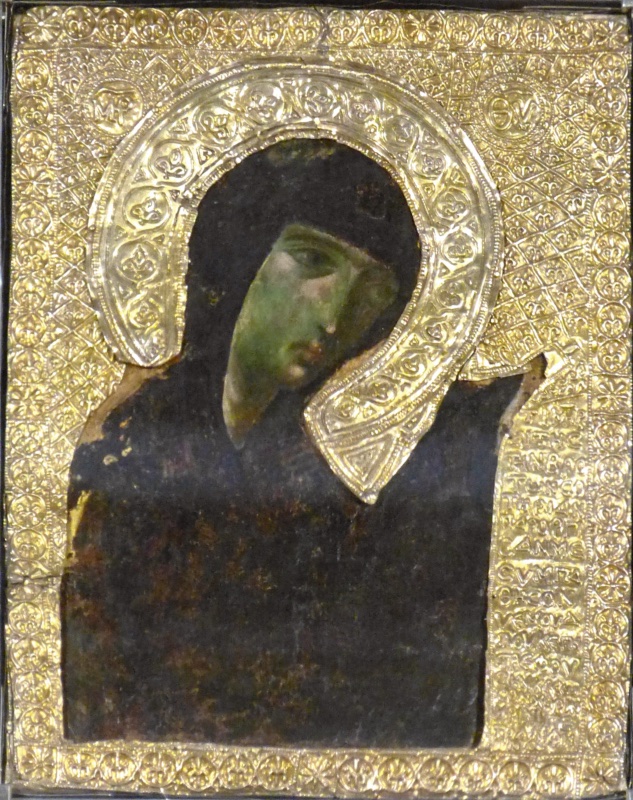
One of the most important objects preserved in the complex is the so‑called Holy Icon, a Byzantine painting of the Haghiosoritissa type dating to the eleventh or twelfth century and traditionally said to have been given by Barbarossa to the city in 1185 as a sign of peace. This Constantinopolitan image, now a centerpiece of exhibitions such as “Spoleto sacra 1200,” is mounted in a precious silver frame and attests both to the diplomatic role of sacred art and to the presence of high‑quality Eastern painting in the cathedral’s medieval treasury. In liturgical and devotional practice, such an icon would have functioned as a focus of Marian veneration closely tied to the cathedral’s dedication to the Assumption.
Equally notable is the chapel of relics, which houses the autograph letter of Saint Francis of Assisi1 to Brother Leo in a reliquary, making the cathedral one of the very few places in Italy to preserve a holograph by the saint. The precarious provenance of the document—lost and rediscovered between the seventeenth and nineteenth centuries—has been reconstructed through archival research, and its authenticity has been affirmed by papal and scholarly examination. As a manuscript relic, the letter bridges the domains of text, image, and object, participating both in the cult of relics and in the history of medieval writing. The chapel also contains other reliquaries and liturgical silver that structure the choreography of processions on major feasts.
The Alberto Sotio crucifix and other painted crosses linked to the cathedral encapsulate a specifically Romanesque form of monumental devotional image. The 1187 cross, with its elongated Christus triumphans and narrative terminals, once presided over liturgical space and played a central role in Holy Week rites, as suggested by comparative evidence assembled for the “Spoleto sacra 1200” exhibition. Later Gothic and Renaissance crucifixes, along with sculpted pietàs and tabernacles, demonstrate the persistence and transformation of such imagery across the later Middle Ages and early modern period. Through these objects, the cathedral interior offers a continuous visual catechism that complements the verbal preaching of the liturgy.
Illuminated manuscripts and pictorial arts
While the main body of the cathedral’s pictorial program is monumental, frescoes, panels, crosses, the complex is also closely tied to the history of book illumination and liturgical manuscripts in the Spoleto region. Recent research on Romanesque miniature in Umbria has identified a team of illuminators active in the late twelfth century on liturgical codices produced for churches within the diocese of Spoleto, whose style integrates Byzantine models with local figurative traditions. These codices, though now dispersed among various collections, attest to an active scribal and artistic milieu that must have served the cathedral chapter as well as dependent communities. The exhibition “Spoleto sacra 1200” explicitly foregrounded this dimension by bringing together illuminated books, including the monumental “Bibbia Atlantica” from the monastery of San Ponziano near Spoleto, dated around 1080, to illustrate the interplay between manuscript, panel painting, and fresco in the ecclesiastical culture of the twelfth and thirteenth centuries.
The Diocesan Museum, housed in the former episcopal apartment, does not function as a manuscript library in the strict sense, but it integrates the display of paintings, sculptures, liturgical vestments, and precious metalwork with documentation relating to the cathedral’s medieval visual culture. Within the narrative of “Spoleto sacra 1200,” manuscripts, sculpted reliefs, and panel paintings are shown together to reconstruct lost chapels and altars in the cathedral and its environs. This curatorial strategy underscores how book illumination and monumental painting shared iconographic models and workshop practices within a relatively small artistic ecosystem. The Visita Barberini manuscript of 1610, exhibited in this context, functions as an illustrated textual witness to the cathedral’s interior before the Barberini reconstruction, linking the written record to the surviving and reconstructed artworks.
The autograph letter of Francis to Leo, preserved in the relics chapel, offers another perspective on the cathedral’s relation to manuscript culture. Though not an illuminated codex, the small goatskin parchment exemplifies the materiality of medieval writing and has become an object of both devotional and scholarly attention. Its presence in Spoleto, alongside the memory of Benedictine and canonical scriptoria in the surrounding territory, reinforces the idea that the cathedral complex participated in a dense network of textual and visual production. More broadly, recent scholarship on Italian illumination has emphasized how ecclesiastical centers like Spoleto functioned as nodes where local and itinerant artists, patrons, and scribes interacted, an insight that aligns with the evidence assembled for the Spoleto exhibitions and studies on Umbrian miniatura.
External influences
From its foundation, Spoleto Cathedral has stood at the intersection of imperial, papal, and local powers, and its fabric records these shifting relationships. The very decision to rebuild after Barbarossa’s sack and to dedicate the new church to Santa Maria Assunta reflects an assertion of communal and episcopal resilience in the face of imperial violence. The gift of the Byzantine Holy Icon by Frederick I, traditionally dated to 1185, introduces a further layer of imperial presence, this time framed as reconciliation and patronage. The coexistence of such an imperial relic with a strongly papalist dedication history illustrates the complex political theology of central Italian cathedral building in the twelfth century.
Artistically, the cathedral’s Romanesque program participates in a wider constellation of Umbrian and central Italian churches—such as Assisi’s San Rufino or Orvieto’s cathedral—where Cosmatesque floors, spolia bell towers, and Deesis mosaics articulate a dialogue with both Rome and Byzantium. The façade mosaic’s iconography and technique point directly to Constantinopolitan models, yet its inscription and façade integration respond to local concerns about modernity and civic identity. Later, the arrival of Florentine artists like Lippi and, indirectly, Botticelli’s circle through Filippino, weaves Spoleto into Tuscan Renaissance networks focused on narrative clarity, perspective, and affective Marian devotion.
In the early modern period, the cathedral’s transformation under Urban VIII and the Barberini family manifests the influence of Roman Baroque architecture and ecclesiastical policy. The 1640s remodelling aligned the interior more closely with Counter‑Reformation norms, emphasizing axial processions, clear sightlines to the high altar, and integrated cycles of painting and sculpture. Bernini’s portrait of Urban VIII in the Diocesan Museum, explicitly linked to this campaign, materializes the connection between the small Umbrian see and the Roman papal court. Architects such as Giovanni Battista Mola and later Valadier imported Roman idioms of colored marbles, busts of donors, and choreographed altar ensembles into the Spoletan context.
The cathedral’s artistic life has also been shaped by broader devotional and pilgrimage currents centered on Franciscan spirituality. The presence of Francis’s letter to Leo, as well as imagery of Francis and Dominic in crosses and reliquaries associated with the wider Spoletan region, ties the complex to the history of mendicant reform and to the circulation of relics and images across central Italy. In the nineteenth and twentieth centuries, the building entered yet another network: that of art tourism, antiquarian scholarship, and, more recently, heritage management, as guidebooks, websites, and exhibitions have disseminated its image as a quintessential meeting point of medieval and Renaissance art.
Preservation and conservation
Modern conservation of Spoleto Cathedral has had to contend with the same stratification that makes the complex historically rich. The Barberini remodelling of the seventeenth century entailed the loss or dispersion of much medieval furnishing and imagery, a process now partly reconstructed through documents and surviving fragments assembled in the Diocesan Museum and in exhibitions like “Spoleto sacra 1200.” At the same time, that intervention secured the structural integrity of the nave and transept and established the spatial framework within which contemporary restorers must operate. The challenge today lies in balancing the legibility of earlier phases with respect for the early modern additions that have themselves acquired historical value.
Recent years have seen important conservation campaigns, particularly on the Cosmatesque pavement of the central nave. In 2021 a multi‑phase project, funded by the Italian culture ministry and executed by a specialist firm from Spoleto, began with the section between the ambo and the first row of pews and is proceeding in stages toward the entrance. The work involves detailed analysis of the medieval, Renaissance, and Barberini phases of the floor, cleaning of surfaces, removal of incoherent stuccoes, consolidation of loose tesserae, and the careful integration of lacunae with either recovered fragments or newly cut elements distinguishable on close inspection. These interventions highlight both the exceptional value and the fragility of a pavement that reuses fragments of liturgical stonework and incorporates glass‑paste tesserae not originally intended to be walked upon.
The frescoes of Lippi and his workshop, although not the focus of a single recent high‑profile campaign like the pavements, have been the object of ongoing monitoring, cleaning, and scholarly reassessment. Art‑historical studies have re‑examined the chronology of the cycle, the division of labor between Lippi, Fra Diamante, and Filippino, and the theological program of the scenes, contributing indirectly to conservation choices. Earlier restorations, especially in the nineteenth and twentieth centuries, introduced retouchings and surface coatings that current practice tends to mitigate or reverse where possible, seeking to recover the spatial clarity and chromatic subtlety of the original execution. Non‑invasive analytical techniques widely applied to comparable Italian wall paintings—such as optical microscopy, XRF, and reflectance spectroscopy—provide models and, in some cases, direct data for understanding the Spoleto cycle’s materials and deterioration.
The cathedral complex has also had to respond to seismic risk, given Umbria’s vulnerability to earthquakes. While Spoleto has not suffered devastation on the scale experienced by nearby Norcia in 2016, works of art from damaged churches in the region, including important sculptures and panels, have been transferred to secure storage and display facilities in Spoleto, reinforcing its role as a conservation hub. The Rocca Albornoz’s Museo Nazionale del Ducato and the Diocesan Museum together house displaced frescoes, panels, and reliquaries from the territory, some of which once had strong liturgical or devotional ties to the cathedral itself. This redistribution complicates the task of understanding the original ensemble but enhances the possibilities for comparative study and preventive conservation.
Finally, exhibitions such as “Spoleto sacra 1200,” organized for the 825th anniversary of the cathedral’s dedication, demonstrate how conservation, scholarship, and public outreach can converge. By bringing together sculptures, paintings, illuminated books, archival documents, and architectural fragments associated with the cathedral’s medieval renewal, the exhibition not only celebrated the monument but also advanced knowledge of its material history. The catalog and research generated around the show have clarified the chronology of the twelfth‑ and thirteenth‑century rebuilding, the nature of lost furnishings, and the network of workshops active in Spoleto and its diocese, providing a richer framework for future conservation decisions. In this sense, the preservation of Spoleto Cathedral today is inseparable from an ongoing historiographical project that continues to reinterpret the complex as new evidence and methods emerge.