Restoro d'Arezzo
( 25% )
Introduction: A Book Without a Biography
Few figures in the intellectual history of the Italian Duecento are at once so consequential and so nearly faceless as Restoro d’Arezzo. He is the author of what is universally acknowledged to be the earliest surviving scientific and cosmological treatise composed with original content in an Italian vernacular, La composizione del mondo colle sue cascioni (“The Composition of the World with its Causes”), whose completion the text itself dates to 1282.
And yet almost everything we would wish to know about the man who wrote it must be extracted, cautiously and often inconclusively, from the treatise’s own pages. There is no notarial dossier, no chronicle notice, no epitaph; the authoritative modern account—the entry by Michele Piciocco in the Dizionario Biografico degli Italiani, vol. 87 (Rome: Istituto della Enciclopedia Italiana, 2016)—opens by stating flatly that his date of birth is unknown and that the very few biographical notices available today derive exclusively from his single work. This is the fundamental condition of any honest account of Restoro: the historian is compelled to move continuously between what the text documents, what it renders probable, and what remains hypothesis or, worse, error repeated by inertia.
That epistemic discipline is not a pedantic scruple but the precondition for understanding why Restoro matters. For an audience concerned with Italian art of the seventh through fourteenth centuries, his treatise holds a singular attraction: buried within a vast Aristotelian cosmography is one of the most remarkable early medieval testimonies to the aesthetic appreciation of classical antiquity—his description of the ancient red-gloss pottery, the arretina vasa, unearthed in and around Arezzo, and of the “conoscitori,” the connoisseurs, who trembled and cried out at the sight of them. To reach that passage responsibly, however, one must first establish who Restoro demonstrably was, what his book actually is, in what language and tradition it survives, and from what learning it was fashioned. Only then does his celebrated encounter with the vases acquire its true weight as a document in the history of taste.
The Man and the Void: What Is Documented, What Is Probable, What Is Error
The securely documented facts of Restoro’s life can be counted on the fingers of one hand, and every one of them is an inference drawn from an internal statement of the Composizione. He was born in Arezzo: the text says so directly, “E stando noi e·lla città d’Arezzo, e·lla quale fummo nati” (“And we being in the city of Arezzo, in which we were born”). He was already of some maturity by 1239, for he describes the total solar eclipse of 3 June of that year as an experience lived at first hand, and lived, moreover, with the disposition of a scientist, since he reports the results of measurements he made on that occasion. From this the reference works reason that he cannot have been a young child in 1239 and therefore must have been born in the first decades of the thirteenth century; the Complete Dictionary of Scientific Biography records him, with explicit tentativeness, as “(Arezzo, Italy, possibly ca. 1210–1220; d. after 1282).” These are informed estimates, not records.
A second securely datable notice, though useless for reconstructing the biography, is his account of a comet that appeared in the east, which he places in September 1264 and says remained visible for sixty days; he links it to the political convulsions of the age—the election of Urban IV1, the defeat of Manfred by Charles of Anjou2, and the descent into Italy and defeat of Conradin. This is the Great Comet of 1264 (modern designation C/1264 N1), one of the brightest comets on record, first sighted in mid-July and visible until late September, whose apparition medieval chroniclers famously connected with Urban IV, who is said to have fallen ill on the day it appeared and to have died on 2 October 1264.
A third possible fixed point is an earthquake Restoro says he felt personally, which the mineralogical study by Annibale Mottana has tentatively identified with the seismic event of 30 April 1279. And the capstone is the explicit date of completion preserved in the treatise’s explicit: “Compiuto è questo libro sotto l’anni de Cristo mille doicento otanta e doi” (“This book was completed in the year of Christ one thousand two hundred and eighty-two”). Even here scholarly prudence intrudes: it has been noted that the date might conceivably record the completion of a copy rather than of the composition, though the overwhelming probability is that 1282 marks the finishing of the work itself.
On the most persistently repeated “fact” about Restoro—that he was a monk or friar—the current state of scholarship demands an active correction, precisely as an honest treatment requires. For much of the twentieth century it was taken as certain that Restoro was a religious; the entry in the Enciclopedia Dantesca (1973), for instance, states without hesitation that “R. fu monaco,” a monk, and grounds this on a passage in which the author appears to refer to writing “nel convento nostro,” in our convent. But the critical edition prepared by Alberto Morino demonstrated that this reading rests on a single, textually unreliable witness—the Chigi manuscript (Chig. M.VIII.169) of the Vatican Library—whose copyist arbitrarily introduced corrections and additions designed to bring Restoro’s thought into line with religious orthodoxy.
The phrase implying a convent was shown to be an inauthentic, tendentious innovation of that one codex and was accordingly expunged from the text of the most recent edition. The Dizionario Biografico degli Italiani therefore concludes that the idea Restoro was a friar is today held to be without foundation. With it falls a further, once-attractive hypothesis, according to which Restoro might be identified with an eponymous Dominican friar who, according to a notice reported by Vasari3 in the Vite, was said to have designed with a confrère the church of Santa Maria Novella in Florence. The medievalist reader should treat the “monk” label, still ubiquitous in popular and even encyclopedic accounts, as a corrected error rather than a datum.
What the text does establish with unusual clarity is that its author possessed a deep, practical command of the visual arts—a matter of the first importance for the art-historical reception of the work. Restoro states of himself that he knows how to “artificiare auro e argento, e desegnare e méttare colori” (“to work gold and silver, and to draw and lay on colours”). The treatise is studded with technical references so precise that they suggest professional experience: the mixing of light and dark primary colours to obtain a more nuanced, graduated hue; the procedure for drawing a body in correct proportion; the technique for making a mosaic. The figurative arts are moreover structurally embedded in his method, for he insists that the structure of the universe, otherwise imperceptible to human beings, can be grasped only through the artist’s skilled rendering in images, achieved through “similitudine” and “essemplo,” likeness and example.
This artistic self-portrait has generated a cluster of identification hypotheses, none of which can be confirmed with absolute certainty on the basis of the treatise alone, and all of which the art-historical reader should weigh as probabilities rather than proofs. Some scholars have proposed to identify the writer with a “Restaurus pictor” enrolled around 1280 in the lay confraternity of Santa Maria della Misericordia at Arezzo4, and with the “Restoro” who between roughly 1269 and 1283 worked with the Aretine painter Margarito on the Madonna and Child Enthroned on the high altar of the sanctuary of Santa Maria delle Vertighe near Monte San Savino. The cleaning of the panel in the early 1970s allowed Anna Maria Maetzke to read the inscription at its base rather than to reconstruct it, and it is on her reading that the collaboration rests:
Margaritus et Restaur[…]ecerunt hoc opus sub anno Domini MCCL[…]III m(en)se Augusti.
The second name, lost in a lacuna, has been convincingly restored as Restaurus, and the surviving letters of the date admit exactly three readings, 1269, 1274 or 1283.
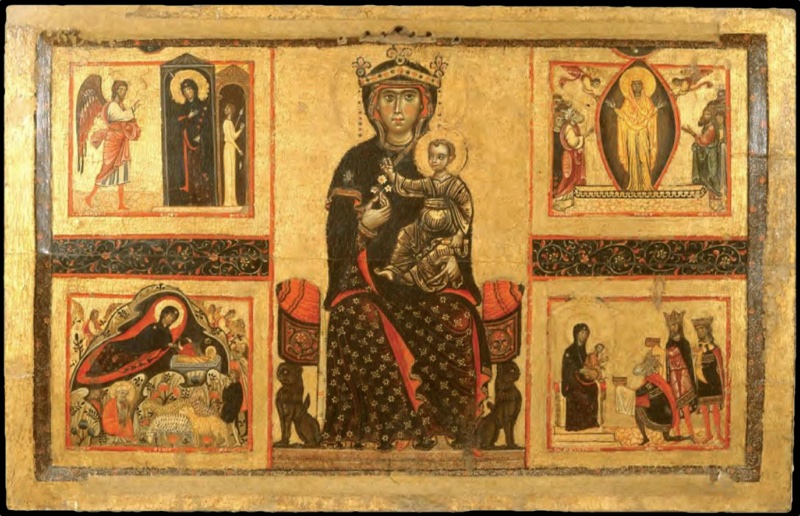
To this same figure the art-historical literature has variously attributed an Annunciation in the Museo Stibbert of Florence, a Nativity in the Fogg Art Museum at Harvard, and a group of manuscript illuminations in the Biblioteca Laurenziana datable roughly between 1275 and 1280. A more recent proposal has even reconstructed a “Restoro” bell-founder to whom are ascribed several series of bells from Arezzo, some bearing the inscription “Restaurus me fecit” and datable between 1261 and 1285—dates and places compatible with the author of the Composizione. The Dizionario Biografico degli Italiani judges, soberly, that on the strength of the scanty notices extractable from the treatise none of these identifications can be confirmed with absolute certainty. They remain, collectively, a strong indication that the author moved in the world of Aretine craftsmanship, and individually a set of attractive but unproven conjectures.
The Arezzo in which Restoro lived and wrote was a self-confident commune of central Tuscany, culturally ambitious and politically exposed. In February 1255 the city had solemnly ratified a corpus of university statutes regarded as among the oldest in Europe, evidence of a studium and of an intellectual milieu in which a work of learned cosmography could be conceived. Restoro’s lifetime spanned the great crises of the mid-century—Montaperti (1260)5, the fall of the Hohenstaufen, the Angevin ascendancy—and would close, though he did not live to record it in the treatise, with the catastrophe of Campaldino on 11 June 12896, where the Florentine Guelfs crushed the Aretines and secured for Florence the cultural hegemony of Tuscany. That battle, as we shall see, is not merely background; some scholarship has argued that it decisively shaped the fortunes of Restoro’s language.
The Book: Title, Architecture, Manuscript Tradition, and Editions
The full title Restoro gives his work, La composizione del mondo colle sue cascioni, is itself a précis of its intellectual program. The “composizione” is the structure or make-up of the universe; the “cascioni”—the Aretine phonetic form of cagioni, causes—are the reasons for that structure. The treatise sets out, in conformity with the two elements of its title, to describe both how the world is built and why it is built as it is, and since, as Restoro affirms, “en questo mondo non sia nulla cosa che non abia casione” (in this world there is nothing that does not have a cause), he pursues his aim by empirical reasoning rather than, in his own phrase, “per via de miraculo,” by way of miracle.
This apparent modernity, however, is framed by an unmistakably medieval finality: as the author declares at the opening and again at the close of the first book, knowledge of the world is functional to knowledge of God, who is the world’s maker. The end of Restoro’s science is, in the last analysis, theological, and the treatise closes by praising God as the sole artificer and governor of a world affirmed to be unique.
Structurally the Composizione is divided into two books.
The first, comprising twenty-four chapters, opens with a brief programmatic introduction affirming that the natural desire of man, as a perfect creature, is to know—Restoro will insist that it is a dreadful thing for the inhabitant of a house not to know how it is made—and then describes, in a strictly hierarchical order, the composition of the heavens, of the Earth, of the rational soul and of the human being, and finally of time.
The second book, far more heterogeneous, is subdivided into eight distinzioni or particule, each composed of a variable number of chapters:
- the first treats the heaven and the zodiac;
- the second, the planets;
- the third, the four elements of water, earth, air, and fire;
- the fourth, the motions of heavens and planets;
- the fifth, at length, the Earth and its movements under planetary influence, its orography, its waters, the genesis and corruption of mountains, and climatic variety;
- the sixth, the mixture of the elements and the generation and characteristics of plants, animals, and minerals;
- the seventh, the layers of the atmosphere, meteorological phenomena, and celestial bodies; and
- the eighth—the amplest, with twenty-four chapters, evidently mirroring the twenty-four chapters of the first book—a miscellany embracing the movements of the terrestrial globe, the motive “intelligences” of heaven and Earth, spiritual substances, the ancient vases, the days and weeks, the influence of the heavens on human and natural operations, and a long series of quaestiones on why the stars shine, why Venus seems to shine with its own light, why the sky appears blue, on love, and on whether there might be other worlds besides this one.
It should be noted that popular summaries frequently and loosely describe the treatise as an “encyclopedia in eight books”; strictly, it is a work in two books, the second of which is articulated into eight distinzioni, and the careful reader should prefer the latter description.
The manuscript tradition is narrow and, in one respect, extraordinary. The treatise is transmitted by five codices. One of them, the Aretine manuscript 2164 of the Biblioteca Riccardiana in Florence, is contemporary with Restoro himself. The catalogue formula is terse—”Membr.; mm 312x225; cc. II, 64, II’“—but it tells us a good deal: a parchment codex of sixty-four leaves, preceded and followed by two guard leaves, and measuring 312 by 225 millimetres.
This is not a pocket copy but a large, well-proportioned book, in the material and on the scale reserved for works of learning. Its script and dialectal fidelity have led to the proposal that it is the author’s autograph, or at the very least a copy exceptionally close to the original; the case for autography has been argued in the philological literature, though Morino, in the 1976 critical edition, had already identified a series of errors common to the entire tradition, the Riccardiano included, which complicates any claim that it stands entirely above the transmission.
The explicit bearing the date 1282 is found in this Riccardiano codex (colophon at c. 64v). Against the antiquity and authority of the Riccardiano stands the already-mentioned Chigi manuscript of the Vatican, whose copyist’s orthodox interpolations produced the spurious “convent” reading and thereby, for generations, a false biography. The remaining witnesses that transmit the work are, tellingly, exclusively Florentine—a fact of real significance for the history of the text’s diffusion and language.
The publication history is quickly told and important to state accurately, since it is often muddled.
The editio princeps was produced by Enrico Narducci, who published La composizione del mondo di Ristoro d’Arezzo, testo italiano del 1282 at Rome in 1859 (with a Milanese issue in 1864); it was this nineteenth-century editor who memorably christened Restoro the “Humboldt” of the thirteenth century. Narducci’s edition, however, was based on a corrupt mid-fifteenth-century codex and has long been recognized as textually poor; the Complete Dictionary of Scientific Biography bluntly called it “very poor.”
A partial edition of the first book from the Riccardiano was produced in 1888. The decisive scholarly event was the critical edition prepared by Alberto Morino and published by the Accademia della Crusca in Florence in 1976, La composizione del mondo colle sue cascioni, which for the first time established a reliable text on proper philological foundations. Morino subsequently issued a commented reading edition (Parma, 1997) and a further revised edition with new paragraph numbering (2006–2007), the latter with La Finestra editrice.
It is Morino’s paragraph system—citations such as I.15.3 or II.8.4—that has become the scholarly standard, and it is his text that any responsible modern quotation of Restoro should follow. The remarkable circumstance, underlined by the Accademia della Crusca, is that despite the treatise’s acknowledged importance for the culture of the Tuscan Origins, and despite its status as the most significant surviving monument of thirteenth-century Aretine, the work was so long neglected that until Morino’s intervention the only complete edition available remained Narducci’s flawed princeps of 1859.
The World Composed in Arezzo: Folio 1r of Biblioteca Riccardiana MS 2164 and the Oldest Witness of Restoro d’Arezzo’s Composizione del mondo
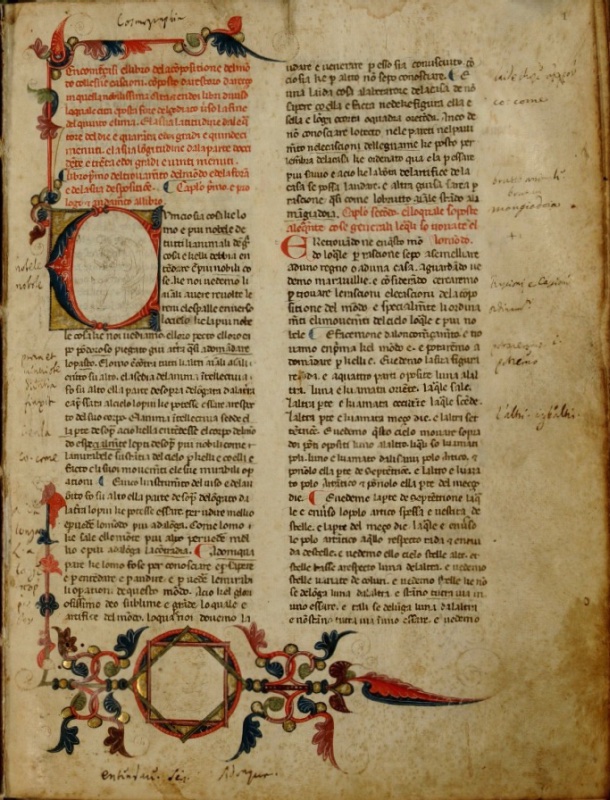
Florence, Biblioteca Riccardiana, MS Ricc. 2164 is the oldest and most reliable of the five known codices of Restoro d’Arezzo’s La composizione del mondo colle sue cascioni, the treatise the author dates to 1282 in its explicit (“Compiuto è questo libro sotto l’anni de Cristo mille doicento otanta e doi”). The volume is membranaceous (parchment), measures 312 × 225 mm, and collates as ff. II + 64 + II’.
Narducci’s editio princeps of 1859 ordered the tradition by age — (1) Riccardiano 2164; (2) Barberini XLVI.52, Rome; (3) Chigiano M.VIII.169, Rome; (4) Magliabechiano Cl. XI, palchetto 7, n. 136 (ex-Strozziano 491); (5) Riccardiano 2229, which preserves only twenty chapters of Book I — and it is telling that the Riccardiano 2164 is the sole Aretine witness while the others are Florentine, a distribution that scholars link to the cultural eclipse of Arezzo after the Guelf victory at Campaldino in 1289.
The codex belonged to the Riccardi family library, where it is recorded in the Inventario e stima della Libreria Riccardi (Florence, 1810, p. 15, under a number Narducci reads as “2104,” a misprint for 2164). Because the manuscript is contemporary with the author and preserves his Aretine vernacular most faithfully, it has been proposed as Restoro’s own autograph; this hypothesis was argued by Aldo Rossi (“Tre possibili autografi,” 1999, pp. 261–276) and anticipated by Alberto Morino. Yet the same Morino, in his 1976 critical edition (pp. XXXV–XXXVIII), identified “una serie di errori comuni a tutta la tradizione, ms. Riccardiano compreso” — a set of errors shared by the entire textual tradition, the Riccardiano among them — which tells against strict autography. The autograph claim is therefore best presented as an attractive but unconfirmed possibility rather than an established fact.
The page is ruled in two columns and written in a small Gothic textualis in brown ink, with rubrics in red and paragraph marks (pieds de mouche) alternating in red and blue. The head of the left column carries the red incipit, whose wording is preserved through the codicological description embedded in Narducci’s 1859 edition; it runs, in normalized form,
“Incomincia el libro della compositione del mondo colle sue cascioni, composto da Restoro d’Arezzo in quella nobilissima città… la quale città è posta fuori del zodiaco, verso la fine del quinto clima; e la sua latitudine dallo equatore del die è quarantadue gradi e quindici minuti, e la sua longitudine dalla parte d’occidente è trentadue gradi”
The transcriptions vary in detail, one nineteenth-century reading giving the longitude instead as 31° 20′.
The rubric then announces “Libro primo… Capitolo primo et prologo.” The gesture is arresting: the author locates his own city within a Ptolemaic–Alfraganian cosmographic grid — at the end of the fifth clima, at a latitude of roughly 42°15′ and a longitude reckoned “from the west” — so that a civic act of pride is folded into a scientific coordinate system. The language is the Duecento Aretine vernacular, and the work is, in the words of the Dictionary of Scientific Biography, “in the vernacular and… thus the oldest surviving scientific text in Italian.” The prologue itself opens not with a formulaic invocation but on the Aristotelian topos of man as the noblest of the animals — erect, his head raised toward the heavens while the beasts bend theirs “giù a terra, quasi a domandare lo pasto” — a creature whose defining nature is the desire to know.
The prologue is introduced by a large decorated initial in blue and red with foliate terminals set on a burnished gold ground; its interior appears to hold only a faint preparatory underdrawing of a figure, suggesting that the letter was planned as historiated but left unfinished. A penwork-and-painted foliate border — red, blue, green, with gold highlights — runs down the left margin and across the foot of the page, and in the lower margin a gilded geometric emblem, a circle enclosing two interlaced squares that form an eight-pointed star (octagram) flanked by acanthus scrolls, invites a cosmological reading well suited to a treatise on the “composition of the world”.
The second column opens chapter 2 (on general matters of the world) with a red rubric and a red initial “E.” The whole decorative apparatus belongs to the Aretine milieu of the late Duecento. Its authorship is genuinely debated, because Restoro repeatedly advertises his own artistic competence — he claims to know how to “disegnare e arteficiare oro e argento, e disegnare e méttare colori” — and has been identified with a documented Aretine painter who worked alongside Margarito d’Arezzo; on this basis the manuscript’s illumination has been tentatively associated with that workshop and even, more boldly, with Restoro himself (a line pursued through the studies of Maria Monica Donato, Antonino Caleca and Ada Labriola). Every such attribution, and above all the romantic idea that the author illuminated his own book, must be labeled hypothesis, not documented fact.
The margins of fol. 1r are crowded with later annotations in a cursive hand — “notabile,” “nobile,” and further notes in the right and lower margins — the fingerprints of early modern readers; the eighteenth-century philologist Anton Maria Salvini is recorded as having left postille in this codex. In the upper margin a later hand has written “Cosmographia,” a learned reclassification that translates the vernacular title into the idiom of humanist science, while the foliation “1” stands at the top right. These interventions register the manuscript’s long afterlife as an object of study.
The reception of Restoro’s cosmology was itself considerable: his theses were contested by Dante in the Quaestio de aqua et terra, delivered before the clergy at Verona in January 1320, and his treatise was later abridged and rendered into Latin by Paul of Venice (Paulus Venetus, c. 1369–1429) in his De compositione mundi, described as an abbreviated Latin version of the 1282 text. For historians of art and of science alike, folio 1r is therefore an exceptional document: the opening leaf of the earliest and best witness of the first original scientific prose in an Italian vernacular, produced in the very city and decade of its composition, and — should the autograph hypothesis ever be confirmed — a rare surviving trace of the hand of a documented painter-scientist of the Duecento.
Signs, Houses and the Supreme Master: Folio 15v of Biblioteca Riccardiana MS 2164 and the Passage from the Zodiac to the Planets in Restoro d’Arezzo’s Composizione del mondo
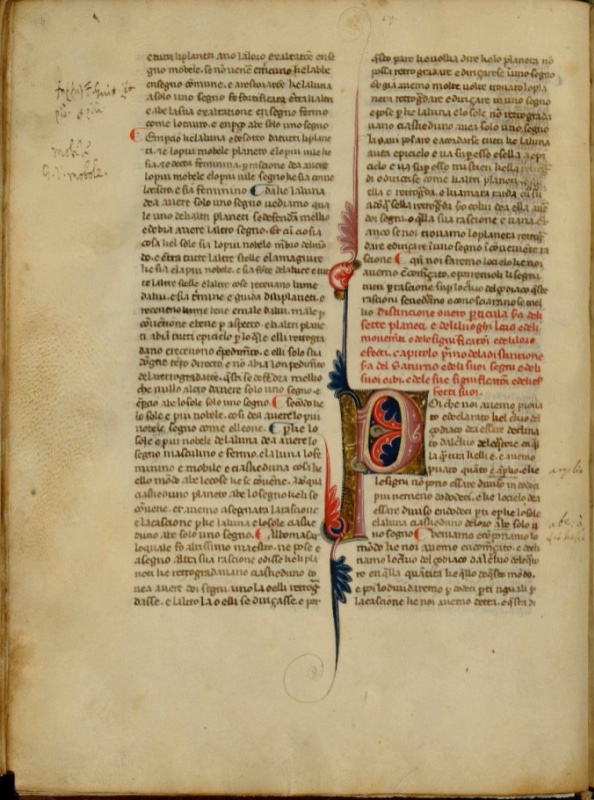
Folio 15v of Florence, Biblioteca Riccardiana, MS Ricc. 2164 captures one of the structural hinges of the treatise. The page ends a discussion of the zodiac and the distribution of its signs among the planets, and opens the section devoted to the seven planets themselves. It keeps the layout established on the opening leaf: two columns of small Gothic textualis in brown ink, red rubrics, and paragraph marks alternating in red and blue. The decoration is concentrated at the point where the argument changes subject, so the eye is guided to the start of a new unit of knowledge. In this way the page visually reflects the ordered, hierarchical structure Restoro gives to his account of the cosmos.
The left column and the upper part of the right column set out the astrological doctrine of planetary domiciles. The text distinguishes the qualities of the signs, which may be “mobile,” “fermo” (fixed) or “comune,” masculine or feminine. It assigns the Sun and the Moon a single sign each. The Sun, being “più nobile” than the Moon, receives the more noble sign, “com’è el leone,” which is masculine and fixed, while the Moon takes a feminine and movable one.
The traditional scheme goes back to Ptolemy’s Tetrabiblos, but Restoro characteristically searches for its cascione, its cause. As the page appears to argue, the other planets each receive two signs because of their retrograde motion, “uno là o’ elli retrogradasse e l’altro là o’ elli dirizzasse.” The two luminaries, which never retrograde, need only one. The allotment is attributed to the “altissimo maestro,” the supreme master who ordered the heavens. This is a revealing phrase from an author who elsewhere conceives God as the world’s artefice and who presents himself as a practitioner of the arts. The right column continues with references to epicycles and to retrogradation, the kinematic vocabulary Restoro drew from the Arabic-Latin astronomy of al-Farghānī.
In the lower half of the right column, a long red rubric announces the new section on the seven planets. It covers their places, movements, significations and effects, and introduces its first chapter, on Saturn, with “his signs, his circles, his significations and his effects.” Below the rubric opens the most conspicuous ornament of the page: a large initial P (“Poi che noi avemo provato e dechiarato…”). Its bowl, filled with blue and red foliate scrolls, is set on a burnished gold ground. From the letter a slender painted bar, sprouting red and blue acanthus leaves, runs up and down the intercolumnar space almost the full height of the page, ending in light pen flourishes. Unlike the opening initial on fol. 1r, whose interior holds only an underdrawing, this letter is fully completed. It is purely ornamental rather than historiated. Its style is consistent with late-Duecento Tuscan book decoration, but, as with the rest of the codex, any attribution to a specific Aretine workshop, or to Restoro himself, remains hypothetical.
The margins again bear witness to the book’s later readers. Cursive annotations in the left margin appear to pick up key terms of the text, such as “mobile” and “nobile,” and marginal notes on the right, partly cropped by the binding, seem to refer to zodiacal signs. These are the traces of early modern users working through the astrological system, possibly including the philologist Anton Maria Salvini, whose postille are recorded in this manuscript. The page thus unites three layers of history. The first is a thirteenth-century rationalisation of inherited astrological doctrine in the Aretine vernacular. The second is a decorative program that marks the transition from the zodiac to the planets. The third is a long afterlife of study. For the historian of medieval science, the page shows Restoro’s method at work: he does not merely repeat an authority but seeks its cause. For the art historian, it shows how contemporary book decoration articulated and dignified the architecture of an encyclopedic text.
Language: The First Scientific Prose in the Italian Vernacular
Restoro’s most incontrovertible claim to historical primacy is linguistic. La composizione del mondo is the first scientific treatise with original content written in an Italian vernacular—specifically in the Aretine dialect—at a moment when Latin remained, and would long remain, the language of learning. Prose in the vernacular existed by 1282, but chiefly for notarial, administrative, or narrative purposes; the deliberate deployment of a Tuscan vernacular for a sustained work of natural philosophy was without precedent. Restoro was himself acutely conscious of this novelty. In one of the most striking rhetorical gestures of the treatise, he stages a prosopopoeia in which the book itself speaks, declaring that Italy “for its nobility engendered me, a book, that I might narrate and tell the composition of the world with its causes, and new things, which were not found written by anyone else”—”cose nòve, le quali non se trovavano scritte per altrui.” The author knew he was doing something that had not been done.
The linguistic interest of the work is not merely a matter of priority but of the very fabric of scientific Italian. To write of the cosmos in the vernacular, Restoro had to forge or naturalize a technical lexicon, importing and adapting terms that necessarily departed from the base Aretine of everyday speech. Treccani’s Enciclopedia dell’Italiano observes that in his vernacular scientific encyclopedia Restoro introduces words such as gibosità, siccità, equatore, latitudine, cartillagine, and orizzonte—a vocabulary shaped in confrontation with scientific Latin.
His prose thus stands at the headwaters of Italian scientific language, and it is on precisely this ground that it has attracted the attention of historians of the language, who have analyzed the conceptual nuclei and syntactic structures by which Restoro attempted to bend a young vernacular to the demands of systematic exposition—a task complicated, as students of early Italian prose have noted, less by lexicon than by the syntax of logical subordination.
Here belongs one of the most arresting counterfactuals in the historiography of the Italian language, formulated in a study published in the Atti e memorie of the Accademia Petrarca of Arezzo in the late 1970s under the resonant title “Un monumento della civiltà aretina.” The argument holds that “the Italian language would today be founded on the Aretine” of Restoro, had it not been for the outcome of the Battle of Campaldino, where on 11 June 1289 the Florentine Guelfs defeated the Aretines and thereby assured Florence the cultural hegemony of Tuscany—shaping, at the same stroke, the diffusion of Restoro’s treatise.
The paradox is deliberately provocative and should be presented as such: it is a historian’s thought-experiment, not a demonstrable proposition. But it captures something real. It is surely no accident, as the Dizionario Biografico observes, that with the sole exception of the Aretine Riccardiano codex, every other manuscript transmitting the work is Florentine; the language survived, so to speak, in Florentine dress, its Aretine origin preserved in a single precious witness while the ascendant Florentine of Dante went on to become standard Italian.
Sources and Learning: Between the Book and the Eye
Restoro’s cosmos is, in its intellectual scaffolding, thoroughly of its time: geocentric, built on the Aristotelian model with the corrections of Ptolemy. But those Ptolemaic corrections reach him already filtered through Arabic-Latin astronomy, and it is this transmission that defines his learning. The single most cited authority in the Composizione is the ninth-century astronomer al-Farghānī—Alfraganus7—whose Liber de aggregationibus stellarum Restoro not only draws upon but incorporates directly, going so far as to include a translation of the ninth chapter of the Liber in the version of Gerard of Cremona, the great twelfth-century Toledan translator.
Through al-Farghānī’s book Restoro cites the astronomer known to him as “Jovanni filiolo de l’Almasore” and confutes the opinions of Avicenna and Averroes. The other named authorities defining his cultural horizon are Aristotle himself—his De caelo et mundo and his Meteorologica, the latter perhaps mediated by the commentary of Averroes—together with the astrologer Abū Ma’shar (Albumasar), a ninth-century Jewish astrologer named Zael (Sahl ibn Bishr), Isidore of Seville, and, through Isidore, the fifth-century Christian poet Caelius Sedulius. He also names, in strongly laudatory terms, an otherwise elusive figure called “Artifio,” of whom only scanty and contradictory traces survive.
Two features of Restoro’s handling of his sources deserve emphasis, since together they define the peculiar character of his mind. The first is that he made, in the practice of his book, no distinction between astronomy and astrology; the two are, for him as for most of his contemporaries, one and the same science, and the importance of the celestial bodies lies precisely in their governing influence upon the terrestrial world. The second is that Restoro tends to minimize his debts, preferring to refer generically to unnamed “savi,” wise men, rather than to acknowledge his precise sources. This habit has made much of the labor of his commentators a work of source-identification—the classic study of his “accredited citations” appeared in Studi medievali in 1912–1913—and it accounts for the perennial scholarly disagreement over how much of the Composizione is compilation and how much is the author’s own.
For it is the interweaving of book-learning with personal observation that has always fascinated Restoro’s readers and divided their judgment. Unexpectedly, amid the compiled Aristotelian and Arabic material, first-hand observation erupts—most often on geological and natural-historical matters, and sometimes on facts, as the mineralogical scholarship has stressed, never before described by any Greek, Latin, or Arabic authority.
Opinions on his place in the history of science remain, as the Complete Dictionary of Scientific Biography frankly acknowledges, divided: some see a mere medieval compiler dominated by Aristotelian and Scholastic conceptions, others a keen observer who anticipates the Renaissance. The most balanced verdict is that he was in every way a child of his time who was also a scholar of unusual intelligence and observational acuity—one whose contact with sensory reality, however sharp in the particular, tended to be episodic, so that a realistic rendering of details coexisted with an unrealistic conception of the whole.
The Causal Cosmos: Astronomy, Geology, Meteorology, and the Method of the “cascioni”
The governing image of Restoro’s universe is the relation of heaven to earth as of a seal to wax. The celestial bodies impress form and nobility upon terrestrial matter as a seal impresses its device upon wax that, in itself base and formless, is ennobled by receiving the impression—”quasi in modo che ‘l suggello imprieme… nella cera.” This simile, at once a piece of natural philosophy and, tellingly, a metaphor drawn from the craftsman’s workshop, organizes his entire astrology-astronomy: the stars are causes, the earth their recipient. It is characteristic of Restoro that his deepest cosmological principle is expressed through an artisanal image.
Within this framework he assembles the whole of the celestial and terrestrial phenomena known to his age, and it is here that his method of the “cascioni”—the relentless search for causes—produces both his most conventional and his most surprising pages. His account of the total solar eclipse of 1239 is justly celebrated; the nineteenth-century astronomer Angelo Secchi singled it out, in his Le Soleil (1875), as the most ancient eclipse for which a detailed description of the corona was then extant, and it remains among the most precise accounts of a solar eclipse before the eighteenth century.
Restoro records that the sky was clear and cloudless when the air began to turn yellow, that he watched the body of the sun covered little by little until it was obscured and night fell, that he saw Mercury near the sun and all the stars became visible; that the animals and birds grew frightened and wild beasts could be taken with ease; and that the sun remained covered for the length of time a man might walk two hundred and fifty paces, while the air and the earth began to grow cold. The passage is a small masterpiece of scientific observation embedded in a medieval treatise.
On the origin of mountains Restoro offers the theory for which he is best remembered by historians of geology, and which requires careful statement. He held that dry land was raised above the sea by the attraction of the stars—an astrological cause consonant with his seal-and-wax cosmology—but he did not stop there; he also recognized a range of other, we would say more genuinely geological, agencies: erosion by water, the throwing up of sand and gravel by the waves, the deposition of sediment by subsequent floods, earthquakes, calcareous deposits from certain waters, and the activities of man. His notion that the elevation of mountains is caused in part by the stars’ pull has been connected by later writers to a comparable idea in Dante’s Divine Comedy, though such connections should be advanced with caution. Following Empedocles, he maintained that the Earth had a molten interior and that volcanoes erupted through the rise of molten rock to the surface—a striking anticipation, however arrived at, of a modern understanding.
Most remarkable of all, and most frequently cited in the history of paleontology, is his treatment of fossils. Traveling, as the Complete Dictionary of Scientific Biography reconstructs it, through the marine Pliocene terrains around Arezzo and Siena, Restoro recognized the organic nature of the fossil remains he found and the great variety of their shapes, and explained their presence high in the hills by the universal Deluge. His own words survive: near the top of a very high mountain, he reports, he and his companions dug up quantities of shells of the kind “which painters use to hold their colours”—the simile is, once again, that of a craftsman—found mixed with sand and with round river-worn stones, “and this is a sign that that mountain was made by the Deluge.” The diluvial explanation is, of course, the conventional medieval one, shared with a long line of Christian writers before and after him; what is not conventional is the acuity with which he registered the organic origin and morphological variety of the remains. In the same spirit he observed the calcareous encrusting power of certain hydrothermal springs and emanations of natural gas.
Bound up with these observations is one of the most philosophically interesting passages in the whole treatise, a meditation on change over time. If a man were to return to his region after less than a thousand years, Restoro writes, he would not recognize the places he had known: he would find the mountains worn down and altered, and likewise the valleys, streams, rivers, springs, cities, hamlets, and villages, and even the language; where he had left a city he would find woods, and the reverse; where a mountain had stood there would now be a valley, and the reverse; and he would find his region everywhere so deeply changed that it would never seem to him he had been there before.
The Complete Dictionary of Scientific Biography, while admiring the passage, rightly notes that Restoro erred in placing natural and human transformations on the same footing and in imagining so brief a span for such changes; but the vision of a mutable earth and a mutable human geography, in which even language decays and shifts, is arresting in a thirteenth-century author—and the inclusion of language among the things time transforms is a poignant detail from a man who was himself writing in a vernacular soon to be eclipsed.
It is essential, in describing all this, to resist the temptation to modernize Restoro. His refusal to explain natural phenomena “per via de miraculo” echoes a current of twelfth- and thirteenth-century naturalism; but his causes remain astrological, his cosmos remains geocentric and finite, and his science remains, avowedly, a road to God. The originality lies not in a proto-scientific worldview—he had none—but in the temperament of observation and in the vernacular medium through which that temperament found expression.
The Vases of Arezzo: An Early Medieval Testimony to the Aesthetic Appreciation of Antiquity
It is in the eighth distinzione of the second book, in the chapter traditionally titled “De le vasa antiche” (II.8.4 in Morino’s numbering), that Restoro d’Arezzo makes his most original and, for the historian of art and of taste, his most precious contribution. The territory of Arezzo was, and remains, exceptionally rich in the fine red-gloss tableware of Roman antiquity—the arretina vasa or terra sigillata, the coral-red pottery, often decorated in relief, whose production began in the workshops of Roman Arretium around 40 BCE and continued into the early imperial centuries, and which was exported across the empire.
These vessels surfaced frequently from the Aretine soil, and Restoro, alone among medieval writers, stopped to look at them with the eye of a man who both knew how such things were made and understood what he was seeing. His notice is, so far as the archaeological literature is aware, the first known post-classical mention of the Aretine wares—the beginning of a line of appreciation that would run through Vasari and Pietro Aretino in the sixteenth century to the travelers of the Grand Tour and the founding of the local archaeological collections.
The passage deserves quotation, for its texture cannot be conveyed by paraphrase. Of the vases, Restoro writes—in the text established by Alberto Morino’s edition—that they are “mirabilia per la loro nobiltà,” marvels for their nobility, and that certain wise men made mention of them in their books, such as Isidore and Sedulius and others; that they were made “de terra collata, sutilissima come cera, e de forma perfetta in ogni variazione”—of a fine strained clay, as subtle as wax, and of perfect form in every variation.
Upon these vases, he continues, were designed and sculpted “tutte le generazione de li animali che se puono pensare, in ogne atto”—all the kinds of animals that can be imagined, in every posture—so marvelously and so perfectly rendered that “passaro denanti a l’operazione de la natura,” they surpassed the work of nature itself; and they were made in two colours, blue and red, but more red, colours lucent and most subtle, “non avendo corpo,” without body, so perfect that, remaining under the earth, the earth could neither corrupt nor spoil them.
Then comes the passage that has justly become famous, and which the recovery of the primary text now allows us to give in full. Restoro reports that a fragment of this ware came into his own hands, on which were sculpted things so natural and so subtle that the connoisseurs, when they saw them, out of the greatest delight were transfixed and cried out aloud, went out of themselves and became almost stupefied “che li conoscitori, quando le vedeano, per lo grandissimo diletto raitieno e vociferavano ad alto, e uscieno de sé e deventavano quasi stupidi”—while the “non conoscenti,” those without knowledge, wanted to smash them and throw them away.
And in a further sentence Restoro records that men brought the fragments to the connoisseurs and other knowledgeable persons, who held them “en modo de cose santuarie,” like sacred relics, marveling that human nature could rise so high in subtlety and in the artifice and form and colour and high sculpting of those vases, “e diciano quelli artifici fuoro divini o quelle vasa descésaro de cielo, non potendo sapere”—and they said that those craftsmen had been divine, or that those vases had descended from heaven, being unable to comprehend how such things had been made. (The reader should be aware that the wording varies slightly across editions and manuscript witnesses—for example between Morino’s critical text and the older Narducci reading—but the sense of both sentences is stable.)
The art-historical significance of this passage can scarcely be overstated, and it has been read most searchingly by Maria Monica Donato in her study “Un ‘savio depentore’ fra ‘scienza de le stelle’ e ‘sutilità’ dell’antico,” published in the Annali della Scuola Normale Superiore di Pisa. Several things are happening at once.
First, Restoro records, at a date around 1282, a genuine aesthetic response to classical antiquity—not the moralized or allegorized antiquity of much medieval reception, nor the mere reuse of spolia, but a direct, almost physiological delight in the artistic quality of ancient objects, admired for the naturalism of their figured decoration and the technical perfection of their manufacture.
Second, and crucially, he testifies to the existence of a circle of “conoscitori,” connoisseurs capable of appreciating that quality, whom he sharply and even contemptuously distinguishes from the “non conoscenti,” the mass of the unknowing who would destroy what they cannot value. Art, in Restoro’s conception, is thereby defined as a noble activity addressed to an elect circle of the knowing—a notion of astonishing novelty for the thirteenth century, and one that Donato and others have identified as anticipating the future emancipation and revaluation of the figurative arts that would come to fruition only with the humanists and, later, with Vasari’s Arezzo.
Third, in calling the ancient makers “divini” and imagining that their vases “descésaro de cielo,” Restoro reaches, in the vernacular of 1282, for a language of the divine artist and of art surpassing nature that we are accustomed to associate with the aesthetic vocabulary of the Renaissance.
Donato’s contribution extends the point beyond the vases. She argued, convincingly enough to have entered the museological literature, that the same “savio depentore” gave in the Composizione del mondo the first description of the Roman sarcophagus carved with the combat of Dionysus and the Amazons—a work of the second century AD, found near the cathedral of Cortona and now in that city’s Museo Diocesano—the very marble that would later be admired by Donatello and by Brunelleschi, who is said to have traveled expressly to Cortona to see it on his friend’s advice.
If Donato is right, Restoro is not merely the first medieval connoisseur of the Aretine wares but the first recorded describer of one of the most celebrated antique reliefs of central Italy, well over a century before the humanists made such marbles objects of systematic study. The claim belongs, properly, to the category of well-argued scholarly hypothesis rather than of documented certainty, and should be presented to a specialist audience as such; but it has been found persuasive by serious students of the material.
These pages on the vases and the sarcophagus do not stand alone in the treatise; they are the most vivid expression of a sensibility that pervades the whole. We have already seen that Restoro describes with professional precision the mixing of colours, the drawing of a body in proportion, and the making of a mosaic, and that he grounds his very method of exposition in the artist’s power to render the invisible structure of the cosmos through likeness and example. His governing cosmological simile—the seal impressing the wax—is an artisan’s image; his fossils are compared to the shells “which painters use to hold their colours.”
Nature itself he conceives, in the manner of his age, as the supreme artificer’s work, so that the ancient vases can be praised precisely for having “surpassed the work of nature,” and God can be lauded at the treatise’s close as the sole “artefice” of the world. There is, running through the Composizione, a continuous analogy between divine making, natural making, and human craft, and it is this analogy that makes Restoro so unexpectedly rich a source for the history of ideas about art. He is a natural philosopher who thinks like a craftsman, and a craftsman who has read his Alfraganus.
Restoro in the Culture of Duecento Arezzo and Tuscany
To situate Restoro in his milieu is to be reminded both of how much and how little we can responsibly say. His Arezzo was, in the second half of the thirteenth century, a notable center of vernacular culture. It was the native city of Guittone d’Arezzo (c. 1235–1294)8, the most influential Tuscan poet of the generation before the stilnovisti, who expanded the vernacular lyric to treat ethical and political matter, invented poetic forms, and—after his conversion and entry into the Order of the Blessed Virgin Mary as “Fra Guittone”—became a founder of vernacular religious poetry.
Guittone and Restoro were contemporaries and fellow Aretines, both of them engaged, in their very different registers, in the ambitious project of making the vernacular carry weights it had not carried before: Guittone the weight of moral and civic argument in verse, Restoro the weight of natural philosophy in prose. It is legitimate and illuminating to set them side by side as the two faces of Duecento Aretine literary ambition. It would not, however, be legitimate to assert a personal connection or mutual influence between them; the sources do not document one, and the honest historian must be content with the parallel rather than manufacturing a relationship.
The same discipline governs the question of Restoro and the visual arts of his city. That he was bound up with Aretine artistic practice is, as we have seen, the strong probability supported by his own testimony and by the identification hypotheses surrounding “Restaurus pictor,” the collaboration with Margarito on the Santa Maria delle Vertighe altarpiece, and the illuminations attributed to him. Margarito d’Arezzo—the painter Vasari would later miscall “Margaritone”—was the dominant Aretine painter of the period, active from around 1250 to 1290, whose signed Madonnas and images of Saint Francis9 were much in demand throughout Tuscany, and with whom the documentary and art-historical record links a “Restoro” as collaborator and fellow miniaturist.
Here a genuine, if not incontrovertible, connection to contemporaneous Aretine art can be affirmed on the strength of the Vertighe inscription as Maetzke re-read it and of the scholarship built upon it. The prudent formulation is that the author of the Composizione very probably belonged to the same Aretine workshop culture that produced Margarito’s panels and the illuminated liturgical codices of the cathedral chapter, and may himself have had a hand in some of them—but that the attribution of specific surviving works to him remains hypothetical.
The most tantalizing of all the contextual questions is Restoro’s relation to Dante, and it must be handled with particular care, because it is here that speculation has been least restrained. Two distinct issues should be separated.
The first is whether Dante knew Restoro’s work: this has never been definitely proved, though it has been regarded by competent authorities as highly probable, given the diffusion of the treatise in Florentine manuscripts and the affinities of certain cosmological and geological notions.
The second is a matter of documented intellectual disagreement: in the Quaestio de aqua et terra, the scientific disputation read at Verona in January 1320, Dante advanced, against a position on the relative heights of land and water that Restoro among others had maintained, the thesis that the emerged lands stand higher than the waters. That Dante engaged, whether directly or through the common stock of the tradition, with the kind of cosmographical questions Restoro had treated in the vernacular a generation earlier is clear; that he read the Composizione itself is likely but unproven; and any stronger claim of direct dependence should be marked, unambiguously, as conjecture.
Fortune, Reception, and Historiographical Significance
The afterlife of La composizione del mondo is a study in eclipse and rediscovery. In the centuries immediately following its composition the work did circulate, but modestly and, as we have seen, almost entirely in Florentine copies. The most concrete trace of its reception is the De compositione mundi of the Augustinian philosopher Paul of Venice (c. 1369–1429), which is in large part an abridged Latin translation of Restoro’s treatise—a striking testimony that a vernacular work of 1282 was still worth rendering back into Latin more than a century later, and evidence that Restoro’s synthesis retained authority into the early fifteenth century. It has also been asserted, in the reference literature, that Leon Battista Alberti and Leonardo da Vinci were familiar with Restoro’s work; this claim, frequently repeated, should be treated with reserve, since it is more often stated than demonstrated, and the specialist reader is entitled to regard the supposed Albertian and Leonardian knowledge of the Composizione as an attractive but insufficiently documented tradition rather than an established fact.
The modern rediscovery of Restoro belongs to the nineteenth century and to the antiquarian and philological energies of the Risorgimento. It was Enrico Narducci’s edition of 1859 that first made the complete text broadly available and fixed the image of Restoro as a precocious scientific mind—the “Humboldt of the thirteenth century.” From that base grew a scattered but persistent tradition of scholarship: source-studies in the early twentieth century, geographical and geological readings in the mid-century that emphasized his observational acumen, linguistic analyses of his scientific prose, and—decisively—the philological reconstruction of the text by Alberto Morino from 1976 onward, which at last gave scholarship a reliable foundation and, in the process, dismantled the false “monk” biography.
In the closing decades of the twentieth century the art-historical dimension came into focus through the work of Maria Monica Donato on the vases, the antique, and the artistic self-consciousness of the “savio depentore,” while the natural-scientific dimension received its fullest modern treatment in Annibale Mottana’s exhaustive 1999 study of the mineralogical objects and concepts in the Composizione, published in the Rendiconti of the Accademia dei Lincei, which patiently sorted Restoro’s compiled material from what may be his original contributions and reconstructed the chronology of his life from internal evidence such as the 1279 earthquake.
What, then, is the historiographical significance of Restoro d’Arezzo, stated without exaggeration? On the history of science and of the language, his primacy is secure and twofold: he wrote the earliest surviving scientific treatise with original content in an Italian vernacular, and in doing so he began the construction of an Italian scientific lexicon and prose. On the history of taste and of the idea of antiquity, his significance is subtler but, for the art-historical audience, more thrilling: in the chapter on the ancient vases he offers one of the earliest and most vivid European testimonies to a purely aesthetic appreciation of classical artifacts, to the existence of a community of connoisseurs, and to a conception of the ancient artist as “divine”—a set of attitudes that the standard narrative reserves for the Renaissance, and which Restoro articulates, in Aretine prose, two centuries early. He is not a solitary genius who broke free of his age; he is a learned, observant, craft-trained Aretine who, working within a wholly medieval cosmology and a wholly medieval theology, happened to look at the objects and the world around him with an intensity, and to write about them in a tongue, that neither had quite been used before. That combination is his monument.
It is fitting to end where the honest account began, with the discipline of uncertainty. We do not know when Restoro was born or when he died; we do not know his order, if he had one, and now believe he had none; we cannot securely attach his name to a single surviving painting or bell or bowl. What we possess is the book, and the mind legible within it: a mind at once compilatory and observant, devout and curious, at home among the Arabic astronomers and among the potters of his own hills. For the student of medieval Italian art, the enduring gift of La composizione del mondo colle sue cascioni is the moment when a thirteenth-century Aretine, holding a broken fragment of coral-red Roman ware, watched the connoisseurs go out of themselves with delight and set down, in the first scientific prose of the Italian vernacular, that they had thought the makers divine, and the vases fallen from heaven.
Conclusion
Restoro d’Arezzo is the rarest kind of historical subject: an author who survives entirely inside his own book. Every question this essay has had to consider—whether he was a friar, whether he painted, whether he cast bells, whether Dante read him—has been argued from a single treatise that was never written to answer any of them, and the answers have accordingly been extracted sideways, from an aside about a convent, a boast about gold and colours, a name on an altarpiece at Monte San Savino. That circularity is not a defect in the scholarship but the permanent condition of the subject, and it explains why the bibliography on Restoro has so often oscillated between overclaiming and silence. The discipline the Composizione demands of its readers is the one Restoro himself professed: to ask of every assertion what its cascione is, and to stop where the cause cannot be shown.
Held to that standard, the secure biography is very short. He was born in Arezzo, and says so. He was old enough in June 1239 to observe a total eclipse of the sun and to measure it. He watched the comet of 1264 and read it politically, as his contemporaries did. He very probably felt the earthquake of 1279. He finished his book in 1282, and a large Aretine parchment codex written in his own generation preserves the colophon that says so. Everything else—the dates of birth and death offered even by the reference works, the workshop, the panels, the bells, the illuminations of the Riccardiano—belongs to a graduated scale of probability that the honest account is obliged to keep visible rather than to flatten into narrative. The strongest of these probabilities, that the author was a practising artist, rests on his own testimony and is very strong indeed; the weakest, the attribution of specific surviving objects, remains conjecture.
The case of the “monk” is worth carrying away from this essay as more than a corrected detail, because it shows how a biography can be manufactured by a manuscript. For the better part of a century Restoro was a religious on the authority of three words in the Chigi codex, whose copyist was quietly rewriting his author into orthodoxy; the Enciclopedia Dantesca still reported the fact without hesitation in 1973. Alberto Morino’s critical edition removed the phrase and the friar with it, and the Dizionario Biografico now records the tradition as groundless. What was corrected was not an error of interpretation but an error of text, and the episode is a reminder that editions are not neutral instruments of access: for a work transmitted by five witnesses, the difference between Narducci’s princeps and Morino’s text is the difference between two different authors.
On the history of the Italian language his primacy is the one claim in this essay that requires no hedging. La composizione del mondo is the first scientific treatise with original content written in an Italian vernacular, and Restoro knew it, staging a prosopopoeia in which the book announces that it will tell “cose nòve, le quali non se trovavano scritte per altrui.” The achievement was not simply one of priority but of construction: he had to naturalize equatore, latitudine, orizzonte, gibosità and their like, and, harder still, to bend a young vernacular to the syntax of sustained logical subordination. The Aretine counterfactual attached to Campaldino should remain what it is, a historian’s thought-experiment; but the distribution of the manuscripts is not a thought-experiment, and a text preserved in one Aretine and four Florentine copies is a fair emblem of what the battle of 1289 settled. There is a private irony here that the essay has noted and that deserves repeating: among the things Restoro listed as worn away by time, alongside mountains, rivers and cities, was language.
His cosmology, by contrast, licenses no claim of anticipation, and the temptation to grant him one should be refused. The universe of the Composizione is geocentric, finite, and governed by the stars as a seal governs wax; astrology and astronomy are one science; the whole enterprise is avowedly a road to the God who is its maker. Within that entirely medieval frame, however, something unusual keeps breaking through: the corona of 1239 described with an accuracy unmatched before the eighteenth century, the molten interior of the earth, the shells dug from a hilltop and recognised as the remains of living things, the vision of a countryside so altered in under a thousand years that a returning traveller would not know it. What distinguishes Restoro is not a system but a temperament—an appetite for looking that his compiled authorities did not supply and could not accommodate—and the vernacular was the medium in which that temperament could be set down.
The thread that binds the treatise together, and the one most likely to interest the historian of art, is artisanal. Restoro thinks in the images of the workshop. His supreme cosmological principle is a seal pressed into wax. His fossils are the shells painters use to hold their colours. He explains how to mix a light and a dark pigment for a graduated hue, how to set out a body in proportion, how to make a mosaic. He grounds his very method in the claim that the structure of the universe, invisible in itself, becomes intelligible only through the artist’s rendering of it in similitudine and essemplo. And he closes by praising God as the sole artefice of the world. Divine making, natural making and human craft form a continuous analogy across the book, which is why a work of Aristotelian cosmography turns out to be one of the richest thirteenth-century sources for ideas about art.
That analogy is what makes the chapter on the vases possible, and the chapter on the vases is why this treatise belongs in an art-historical library. Holding a fragment of Aretine red-gloss ware, Restoro recorded not an allegory, not a moral, not a reused spolium, but delight: connoisseurs transfixed and crying out, going out of themselves, holding the sherds “en modo de cose santuarie,” and concluding that the makers had been divine or the vessels fallen from heaven. Three things in that report are genuinely startling for 1282—the purely aesthetic response to an ancient artefact, the division of humanity into conoscitori and non conoscenti with art addressed to the first, and the vocabulary of the divine artist and of art surpassing nature. Maria Monica Donato’s reading of the “savio depentore,” and her proposal that he also gave the first description of the Cortona sarcophagus, extend the point as far as the evidence can reasonably be made to carry it; the sarcophagus identification remains a well-argued hypothesis and should be presented as one. What the passage establishes is not that the Renaissance began in Arezzo, but that the language in which the Renaissance would praise ancient art was available, in a craftsman’s vernacular, two centuries before the humanists claimed it.
It is right to end with the object rather than the argument. The book that carries all of this is a codex of sixty-four parchment leaves, 312 by 225 millimetres, written in two columns of small Gothic textualis in the decade of its composition and in the dialect of the city it describes—a city its opening rubric fixes at the end of the fifth clima, at a latitude of some forty-two degrees and fifteen minutes, as though Arezzo were one more coordinate in the machinery of the heavens. On its first leaf a large initial stands on burnished gold with its interior never painted, holding only the ghost of a figure the illuminator drew and did not finish. Nothing in this essay can tell us whose hand made that drawing, and the most attractive answer, that it was the author’s own, is precisely the one the evidence refuses to confirm. What survives is the book: a large, unhurried, carefully made Aretine volume, in a language that lost, containing the first sustained attempt in any Italian vernacular to say how the world is put together and why.