Michele di Baldovino
( 25% )
Michele di Baldovino, known in the scholarly literature under the conventional appellation Maestro della Croce di San Pierino, was one of the most accomplished panel painters active in the Pisan cultural orbit during the second half of the thirteenth century. The recovery of his personal name from fragmentary inscriptional evidence preserved on a signed painted cross, now in the collection of the Cleveland Museum of Art, constitutes one of the most significant documentary discoveries in the study of Duecento Tuscan painting, allowing modern art historians to anchor an otherwise anonymous artistic personality to a traceable identity. His surviving works, distributed across Pisa, the Valdera, and the Volterrano, testify to the extraordinary cultural vitality of the Pisan republic at the height of its commercial and maritime power.
Birth, Origins, and Chronology
The precise date and place of Michele di Baldovino’s birth remain unattested in any surviving documentary record, as is the case for the majority of painters active in the Italian Duecento. On the basis of the chronological range established for his surviving works, spanning approximately from the 1230s to the 1270s, it may be cautiously inferred that the artist was born around the first or second decade of the thirteenth century, most probably in Pisa or its immediate environs. The Fondazione Zeri catalog records his activity as belonging to the “seconda metà del sec. XIII,” while the Cleveland cross is dated to approximately 1230–1240, suggesting a career of notable duration. His conventional name, Maestro della Croce di San Pierino, derives from the great painted cross preserved in the church of San Pietro in Vinculis, locally known as San Pierino, in Pisa, which represents his most celebrated surviving work. The attribution of this name to a specific historical person named Michele di Baldovino was established definitively in the early 1990s by the scholars Antonino Caleca and Mariagiulia Burresi, who identified the partially legible signature on the Cleveland cross as reading “micHAEL Quondam baldoVINI me pinxIT”, that is, “Michael, son of the late Baldovino, painted me”.
Family
The sole surviving indication of Michele di Baldovino’s family origin derives from the partially preserved inscription on the Cleveland cross, which records his name in the formula michael quondam baldovini me pinxit, a standard medieval Latin construction in which quondam (“formerly” or “the late”) indicates that his father, Baldovino, had already died at the time the work was executed. The use of quondam in this patronymic context was a conventional legal and documentary practice in medieval Italian cities, employed to distinguish individuals by reference to their late fathers when the paternal head of the household had passed away, and its appearance here places Michele firmly within the tradition of artisan families who took professional identity from the lineage of their craft.
The name Baldovino is of Germanic origin, common in Tuscany from the Lombard period onwards, and frequently attested in Pisan notarial records of the twelfth and thirteenth centuries, suggesting that Michele’s family was likely of long-established Pisan stock, perhaps with roots in the artisan or merchant classes that formed the backbone of the republic’s civic life. The absence of any surviving documentary record relating to his mother, siblings, or descendants is entirely typical for painters of this period, whose family circumstances are almost universally irrecoverable from the fragmentary archival evidence that survives; notarial records, guild registers, and church documents from thirteenth-century Pisa have suffered significant losses over the centuries, further constraining our knowledge of individual artists’ social milieu.
Medieval Pisan painters operated within a social and professional context that was closely bound to family networks, apprenticeship traditions, and workshop dynasties, and it is entirely plausible that Michele received his initial artistic formation within a family environment in which painting was already practiced, though no evidence survives to confirm the existence of an artisan tradition within the Baldovino household specifically. The formula of self-identification adopted in the Cleveland cross inscription, naming himself by his father’s name rather than by any workshop designation or guild affiliation, suggests that Michele regarded his personal and family identity as a source of professional distinction, an attitude that is consistent with the growing individualism of thirteenth-century Italian artisan culture, in which signed works become increasingly common and personal reputation begins to emerge as a marketable quality.
It is worth noting that the tradition of panel painting in Pisa was not a hereditary craft confined to specific dynasties in the manner of certain other medieval trades, but rather a relatively open professional field in which talented individuals could rise to prominence through skill and patronage, regardless of their precise family origins. The social rank of Michele’s family was almost certainly that of the middling artisan class, neither among the great merchant families who dominated Pisan civic life, nor among the landless poor, a position consistent with the type of ecclesiastical patronage his works attest and the geographical range of his documented activity across Pisa, the Valdera, and the Volterrano. Pisa in the thirteenth century was a city of extraordinary demographic and cultural complexity, hosting substantial communities of Greek, Arab, and Eastern Christian merchants and craftsmen whose presence created an unusually rich environment for the exchange of artistic ideas, and Michele’s family, wherever precisely it stood in the social hierarchy, would have been embedded in this multicultural urban fabric. The fact that Michele bore a Christian name, the Latin Michael, is consistent with the Pisan habit of naming children after the archangel Michael, one of the most venerated intercessors in the medieval Christian tradition, whose cult was strongly represented in the Pisan religious landscape, suggesting that the family maintained conventional Catholic devotional practices characteristic of the city’s artisan and merchant classes.
Patronage
The patronage network within which Michele di Baldovino operated was shaped primarily by the religious institutions of Pisa and its subject territories, reflecting the dominant role of the Church as the principal commissioner of visual art in Duecento Italy. The church of San Pietro in Vinculis, San Pierino, in Pisa, which gives the artist his conventional historiographical name, was almost certainly the primary patron for the great painted cross that is Michele’s most celebrated surviving work in situ, a commission that would have required the authorization and financing of the church’s chapter or of a private donor of sufficient means to underwrite a monumental panel painting of approximately 280 by 215 centimeters.
The Fondazione Zeri catalog dates this cross to the third quarter of the thirteenth century, placing the commission firmly within the period of Pisa’s greatest commercial prosperity, when the republic’s trade networks extended from the eastern Mediterranean to the Atlantic, generating the surplus wealth that funded the remarkable efflorescence of religious art that characterizes this period. The church of Sant’Andrea in Chinseca, another Pisan institution for which Michele executed a painted cross, represents a further node in his patronage network within the city, indicating that his reputation extended across multiple parishes and that he was regarded as a reliable and capable provider of sacred imagery for ecclesiastical contexts.
The attribution of a dossale depicting Saint Nicholas and scenes from his life, now associated with the Peccioli area in the Valdera, to Michele di Baldovino or his workshop suggests that his clientele extended beyond urban Pisa into the rural territories of the Volterrano diocese, where local churches and collegiate institutions required devotional images for the instruction and edification of their congregations. The figure of Saint Nicholas, principal subject of the Peccioli dossale, was among the most widely venerated saints in the medieval Mediterranean world, whose cult was particularly strong in mercantile port cities like Pisa, where his role as patron of sailors and merchants made him an especially appropriate focus of devotional patronage.
The Ubertini family, who held episcopal seats in both Volterra and Arezzo during the latter part of the thirteenth century, exercised considerable influence over the artistic patronage of the territories between these two cities and Pisa, and scholars have proposed that their network may have been a conduit through which Michele’s work reached the Volterrano. The commission of painted crosses for rural churches like that of Santi Ippolito e Cassiano at Riglione, in the immediate environs of Pisa, illustrates the hierarchical structure of medieval ecclesiastical patronage, in which artists of established reputation were called upon not only for prestigious urban commissions but also for more modest works destined for smaller parish communities.
The Cleveland cross, originally associated with the church of Santa Bona or San Martino in Pisa, represents a commission of exceptional ambition, given the scale and iconographic complexity of the work, and suggests that Michele had by the time of its execution, around 1230 to 1240, already established himself as a painter of sufficient standing to be entrusted with a major devotional image for one of Pisa’s religious houses. The patronage of Franciscan and Benedictine communities in the Pisan contado may also be inferred from the devotional content and iconographic programs of Michele’s surviving works, which are consistently oriented toward the pastoral and didactic aims that characterized the commissioning policies of the mendicant orders in this period, particularly their emphasis on emotionally communicative images of the crucified Christ intended to foster affective devotion among the laity.
Painting Style
Michele di Baldovino’s painting style is characterized by a refined synthesis of Byzantine formal conventions with the emergent linear expressionism of the Pisan Romanesque school, resulting in works of considerable visual authority that occupy an important position in the development of Duecento Italian panel painting. The painted crosses that constitute the core of his attributed corpus are executed in tempera on panel, following the technical practice standard in thirteenth-century Tuscany, and display a command of large-format composition that is rarely achieved among his contemporaries outside the immediate circle of Giunta Pisano.
The central figure of the crucified Christ in Michele’s crosses is rendered in the iconographic mode of the Christus patiens, the suffering, dead Christ with closed eyes and a body marked by the physical reality of death, a type that had become dominant in Pisan painting by the mid-thirteenth century under the influence of the mendicant orders’ emphasis on meditative devotion and compassionate identification with Christ’s suffering. Edward B. Garrison, in his foundational 1949 index of Italian Romanesque panel painting, described Michele as a “Giuntesque master strongly influenced by contemporary impressionism, particularly the master of the Castellare crucifix,” situating him within the broader tradition of Pisan painting initiated and dominated by Giunta Pisano during the first half of the century.
The treatment of Christ’s body in Michele’s crosses shows a particular sensitivity to the modeling of flesh through delicate gradations of color, moving from warm ochre tones in the highlighted areas to cooler, more shadowed hues in the torso and limbs, a technique that reflects the Byzantine convention of proplasmos, the application of a dark ground tone over which lighter colors are progressively built, adapted to the specifically Pisan formal vocabulary. The tabelloni, the lateral panels that flank the arms of the cross and the suppedaneum below Christ’s feet, serve as narrative fields in which Michele develops sequences of scenes drawn from the Passion cycle, the Resurrection appearances, and the lives of saints, demonstrating his capacity to organize complex multi-scene programs within the formal constraints of the cross-shaped support. In the cross at San Pierino, the lateral panels include representations of the Madonna, Saint John the Evangelist, the Denial of Saint Peter, and the Ascension of Christ, a selection that reflects the standard Pisan iconographic program for devotional crosses while introducing specific narrative details, such as the dramatic confrontation of the Denial scene, that speak to Michele’s personal engagement with the expressive potential of his subjects.
The facial types employed by Michele are among the most consistent and recognizable elements of his personal style, characterized by elongated features, high cheekbones, large almond-shaped eyes with heavy lids, and a characteristic treatment of the hair and beard that recalls the formal conventions of Byzantine icon painting while showing a distinctly Pisan inflection in the handling of paint. The color palette across his surviving works is remarkably consistent, relying on a restricted range of blues, reds, and greens set against gold grounds that function simultaneously as abstract theological signifiers of divine light and as formal devices for the unification of compositional space across the complex, shaped support of the cross panel. The decorative vocabulary of Michele’s gold grounds and haloes is executed with considerable refinement, employing incised patterns, punched motifs, and tooled geometric designs that attest to a mastery of the technical resources of the goldsmith’s tradition as applied to the panel painter’s craft, a cross-disciplinary competence typical of the most accomplished Pisan workshops of the Duecento.
The treatment of drapery in Michele’s surviving works reveals a consistent formal approach in which garments are organized through a system of sharp-edged, calligraphic folds that follow the contours of the body with a degree of rhythmic regularity characteristic of the mature Byzantine manner, yet inflected by a distinctly Pisan tendency toward taut, energized line that anticipates the more dramatic drapery solutions of the late Duecento. The Virgin and Saint John, as represented in the tabelloni of the San Pierino cross, wear robes whose deep blue and red tones are articulated through a network of fine white highlights applied with a thin, confident brush, creating a shimmering surface that suggests the influence of the Byzantine technique of chrysography, the use of fine gold or white lines to render the play of light on fabric, without literally reproducing it.
The narrative scenes that populate the lateral panels of Michele’s crosses demonstrate a compositional economy that reflects the spatial constraints of the format, in which figures must be clearly readable despite their small scale; Michele responds to this challenge by reducing each narrative to its essential gestural and physiognomic elements, achieving a remarkable clarity of storytelling within severely limited pictorial fields. The landscape and architectural settings in these narrative scenes are purely schematic, limited to the minimum elements necessary to identify a location, a rocky hillside, a simplified architectural frame, consistent with the anti-illusionistic priorities of Byzantine-derived narrative painting, in which setting functions as symbol rather than environment. The technical execution of Michele’s panels shows evidence of careful preparation, including the application of a gesso ground over the wooden support, the incision of preparatory outlines visible in raking-light photography, and the systematic application of gold leaf over a bole ground before the application of painted pigments, a sequence of operations consistent with the best workshop practice documented in Cennino Cennini’s later Libro dell’Arte and attested in technical studies of Duecento Pisan panels.
Artistic Influences
The single most pervasive influence on Michele di Baldovino’s pictorial formation was the Byzantine artistic tradition, which penetrated Pisan culture through multiple channels simultaneously available to any painter active in the city during the first half of the thirteenth century. Pisa’s role as a major Mediterranean port, with established commercial and diplomatic relationships stretching from Constantinople to the Crusader states of the Levant, meant that the city was exposed to Byzantine art through the direct presence of Eastern Christian craftsmen, through the importation of icons and liturgical objects, and through the participation of Pisan merchants and clergy in the cultural life of the Byzantine Empire.
The great painted crucifix known as Crocifisso n. 20, now in the Museo Nazionale di San Matteo in Pisa and dated to approximately 1230, is traditionally attributed to a Byzantine master active in the city and represents one of the earliest Western examples of the Christus patiens type on a shaped cross panel; this work almost certainly exercised a formative influence on every Pisan painter of the succeeding generation, including Michele di Baldovino, who adopted and developed the same iconographic type across his entire surviving corpus. The influence of Giunta Pisano, the dominant figure of Pisan panel painting in the mid-thirteenth century and the most consequential mediator of Byzantine formal conventions for the subsequent development of Italian painting, is fundamental to any understanding of Michele’s artistic formation.
Giunta, active in Pisa from approximately 1229 to 1254, developed from his Byzantine sources a powerfully expressive idiom for the representation of the crucified Christ that amplified the emotional and devotional impact of the Christus patiens type through more emphatic torsion of the body, more dramatic color contrasts, and a more insistent linear energy in the treatment of the figure’s outline. Michele’s debt to Giunta is evident in his adoption of the general compositional formula of the shaped cross panel, in his treatment of Christ’s body as an instrument of pathos and compassionate identification, and in the formal vocabulary of his facial types and drapery conventions, which consistently echo Giunta’s solutions while maintaining a distinct personal character.
Edward B. Garrison explicitly situated Michele within what he termed the “Giuntesque” tradition of Pisan painting, acknowledging both the depth of this stylistic debt and the degree to which Michele nonetheless constituted an independent artistic personality whose work cannot simply be reduced to derivation from the dominant master. The influence of Marche painting traditions, which scholars following the analysis of the Castelfiorentino Master have identified as a secondary current in the artistic environment of the Volterrano, provides a further layer of complexity in Michele’s formation, suggesting that he was not simply a product of the Pisan urban workshop milieu but was also exposed to the artistic practices of the Adriatic school, perhaps through works in transit along the commercial and pilgrimage routes that connected Pisa to central and eastern Italy.
The connections between the Giunta school of Pisa and Marche influences in the Volterra area, whether direct or mediated through Arezzo, a city closely tied to Volterra in the late thirteenth century through the Ubertini family’s simultaneous episcopal presence in both dioceses, suggests that Michele’s formal vocabulary was continuously enriched by exposure to a range of artistic traditions beyond those immediately available in Pisa itself. The illuminated manuscripts produced in Pisan and central Italian scriptoria during the early and mid-thirteenth century also constitute a plausible source of influence for Michele’s formal vocabulary, particularly in the treatment of narrative scenes, where the compressed, symbol-laden space of his tabellone compositions recalls the miniature painting conventions developed in manuscript illumination for the organization of multiple narrative episodes within severely constrained pictorial fields. The broader context of Italian Romanesque panel painting, as surveyed by Garrison and subsequently refined by Luciano Bellosi, Antonino Caleca, and Mariagiulia Burresi, establishes that Michele belongs to a transitional moment in which the Byzantine inheritance was not passively received but actively reworked in the direction of greater emotional directness and narrative intelligibility, a trajectory that would eventually culminate in the revolutionary innovations of Cimabue and Giotto.
Travels
The geographical distribution of Michele di Baldovino’s surviving and attributed works provides the most reliable evidence available for reconstructing the pattern of his professional movements, in the absence of documentary evidence in the form of contracts, payment records, or notarial instruments that might directly attest his itineraries. Within the city of Pisa itself, the presence of his works in multiple ecclesiastical settings, San Pietro in Vinculis, Sant’Andrea in Chinseca, and Santi Ippolito e Cassiano at Riglione, demonstrates a sustained engagement with the urban and peri-urban religious landscape of the Pisan republic over a period of several decades, suggesting that his primary professional base remained the city throughout his career, even as he accepted commissions from institutions outside its walls.
The attribution of the Dossale di San Nicola and related works to the Peccioli area in the Valdera implies that Michele undertook journeys into the Pisan contado to deliver and potentially execute works for rural ecclesiastical patrons, a pattern of professional mobility entirely consistent with the practice of Duecento panel painters, who were typically responsible for transporting finished works to their destinations and supervising their installation in the required liturgical setting. The connections proposed by recent scholarship between Michele’s circle and the artistic traditions of the Marche, transmitted through the Arezzo-Volterra corridor under the influence of the Ubertini bishops, raise the possibility that Michele, or members of his workshop, may have traveled along the major overland routes connecting Pisa to central Italy, stopping at Volterra, Arezzo, and possibly further east, in the course of commercial or professional journeys that would have exposed him to the artistic practices of the Adriatic school.
Pisa’s position as the principal Tyrrhenian port for the pilgrimage routes to Rome and the Holy Land meant that Michele would have had access, without necessarily traveling himself, to artistic objects and practitioners from an exceptionally wide geographic range; painted icons, illuminated manuscripts, carved ivories, and enameled metalwork objects from Byzantium, the Crusader states, and the workshop traditions of southern France and the Iberian Peninsula circulated through Pisa as both commercial commodities and devotional gifts, providing the city’s artists with a rich and varied repertoire of formal models.
The professional culture of Duecento Pisan painting also maintained relationships with the workshops of Lucca and Florence, two cities whose artistic traditions developed in close dialogue with Pisa throughout the thirteenth century, and it is plausible that Michele participated in the informal exchange of techniques, models, and personnel that characterized relations between the major Tuscan centers, though the precise nature and extent of such contacts remain a matter of scholarly inference rather than documented fact.
The Franciscan and Augustinian establishments that proliferated throughout the Pisan contado in the mid-thirteenth century, following the rapid expansion of the mendicant orders in the decades after the death of Francis of Assisi1 in 1226, represented a network of potential patrons distributed across a wide geographic area, and the cultivation of this network by ambitious painters would have necessitated a degree of physical mobility that is consistent with the distribution of Michele’s attributed works across the Pisan, Volterrano, and Valdarnese territories. The Cleveland cross itself, which left Pisa at some point before its acquisition by an American collection, raises questions about the mechanisms by which major Duecento panel paintings moved between Italy and the broader art market, and its presence in Cleveland today serves as a reminder that the original context and location of Michele’s works has in many cases been irrevocably disrupted by the dispersals of the nineteenth and twentieth centuries.
Death
The date and cause of Michele di Baldovino’s death are entirely unknown, as no documentary record of his passing survives from any Pisan archive or ecclesiastical source. On the basis of the established chronology of his works, with the San Pierino cross and the Sant’Andrea in Chinseca cross both dated to the third quarter of the thirteenth century, it may be inferred that he was active until approximately the 1270s and that his death occurred sometime in the final decades of the century, perhaps between 1275 and 1290, a period of considerable political and military turbulence for Pisa, culminating in the catastrophic naval defeat at the Battle of Meloria in 1284, which permanently curtailed the republic’s maritime power and may have severely disrupted the patronage environment that had sustained his career. Like the vast majority of Duecento painters, Michele di Baldovino belongs to that large category of medieval artists whose biographical circumstances, including the most fundamental facts of birth, marriage, family, and death, remain irretrievably lost to historical inquiry, preserved only through the silent testimony of the works they left behind.
Most Important Works
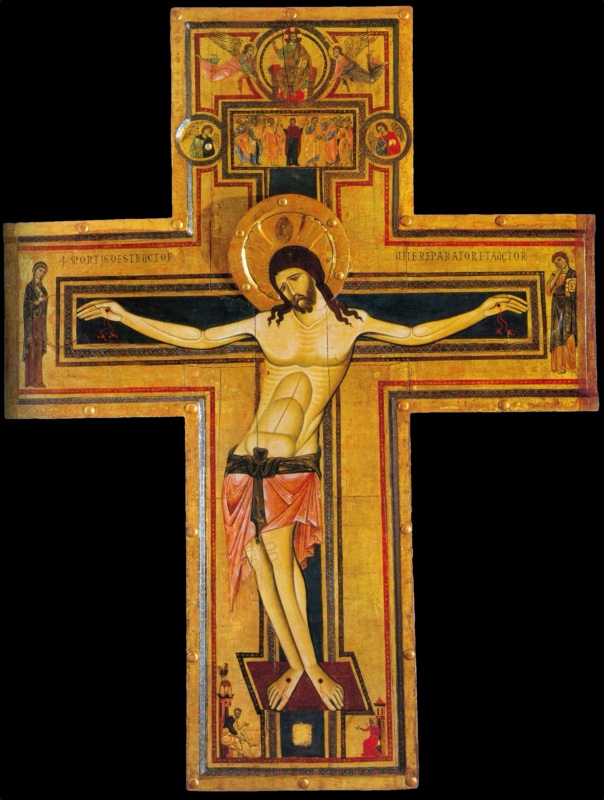
The painted cross preserved in the choir of the church of San Pietro in Vinculis in Pisa is the work from which Michele di Baldovino derives his conventional historiographical designation, and it remains the indispensable reference point for any critical assessment of his art. Dated to the third quarter of the thirteenth century, the cross is a large-format panel work of impressive physical presence, executed in tempera and gold on a shaped wooden support following the croce sagomata format that had become standard in Pisan devotional practice under the influence of Giunta Pisano’s innovations.
The central field of the cross presents the dead Christ in the Christus patiens mode, his body rendered with particular attention to the modeling of the torso and the expressive tension of the limbs, which sag under the weight of death in the manner codified by Giunta but inflected by Michele’s own formal sensibility toward a somewhat more restrained, hieratically contained pathos. The lateral tabelloni are occupied by representations of the sorrowing Virgin at the right and Saint John the Evangelist at the left, figures whose elongated proportions and meditative, downcast expressions create a devotional atmosphere of quiet grief consonant with the pastoral aims of the commission.
The upper and lower terminals of the vertical beam contain additional narrative scenes, including the Ascension of Christ above and the Denial of Saint Peter below, expanding the cross’s iconographic program to encompass both the redemptive event of the Passion itself and the subsequent history of the apostolic community. The background is uniformly gilded, creating a luminous ground that transforms the cross into a devotional object of intense visual authority, capable of focusing the attention and stimulating the affective engagement of worshippers across the spatial distance of the choir.
The cross was commissioned for the church’s liturgical use, almost certainly by the chapter of San Pietro in Vinculis or by a wealthy individual donor seeking the spiritual benefits associated with the endowment of a major devotional image in one of Pisa’s urban parishes. Conservation work carried out in the twentieth century has revealed the excellent state of preservation of the paint surface beneath later additions and varnish layers, confirming the high quality of the original execution and the durability of the technical methods employed by the painter. The cross remains in situ in the church of San Pietro in Vinculis, today commonly known as San Pierino, in the historic center of Pisa, one of the relatively rare instances in which a major Duecento panel painting has survived in its original ecclesiastical setting.
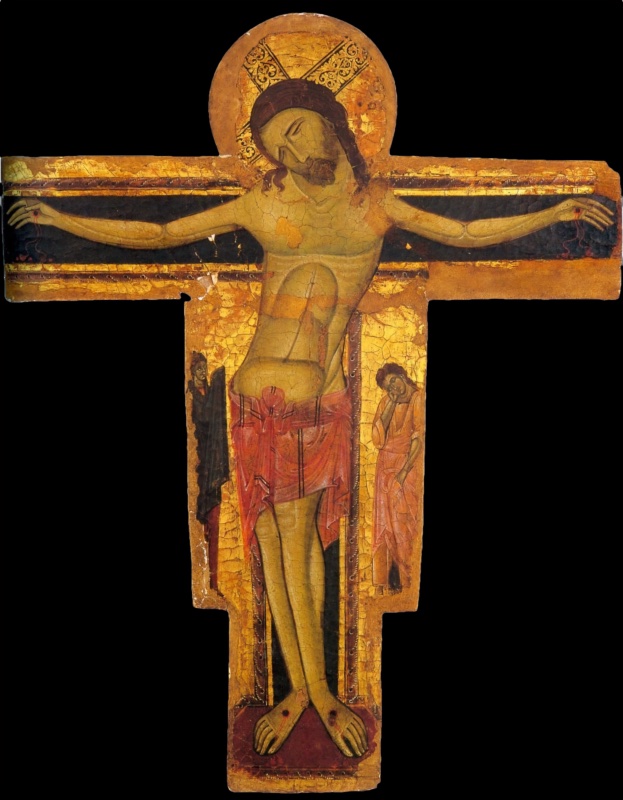
The painted cross in the church of Sant’Andrea in Chinseca in Pisa represents a further documented presence of Michele di Baldovino’s work within the urban fabric of the Pisan republic, attesting to the breadth of his ecclesiastical clientele within the city. Dated to the second half of the thirteenth century, this cross shares the fundamental compositional structure of the San Pierino work, the shaped cross support, the Christus patiens central figure, the lateral half-figures of the mourning Virgin and Saint John, while exhibiting slight variations in the treatment of individual motifs that reflect the ongoing development of Michele’s formal language across his career.
The church of Sant’Andrea in Chinseca, a modest Pisan parish dedicated to the apostle Andrew, patron saint of the city, was a fitting recipient for a painted cross of this quality, and the commission suggests that Michele’s reputation extended across the parish network of Pisa to institutions of varied size and prestige. The figure of Christ displays the characteristic Michele features, the elongated body, the precisely delineated rib cage, the slightly turned head with closed eyes, rendered with the controlled painterly economy that distinguishes the master’s hand from workshop production.
The color disposition of the cross follows Michele’s standard palette, with Christ’s flesh modeled in warm ochres against the cool white of the loincloth, set against the unmodulated gold ground that unifies the devotional field of the panel. The lateral figures maintain the emotional restraint characteristic of Michele’s approach to the Passion narrative, conveying grief through the slight inclination of the figures toward the central axis of the cross rather than through exaggerated gestural emphasis.
The tabelloni of this cross may originally have carried narrative scenes as well, though the current state of the work does not permit a complete reconstruction of its original iconographic program. The commission of this cross for Sant’Andrea in Chinseca demonstrates the degree to which Michele’s workshop was embedded in the system of parish patronage that sustained the production of devotional images in Duecento Pisa. The cross has remained in the church of Sant’Andrea in Chinseca in Pisa, preserved as an example of Pisan Romanesque panel painting of the second half of the thirteenth century.
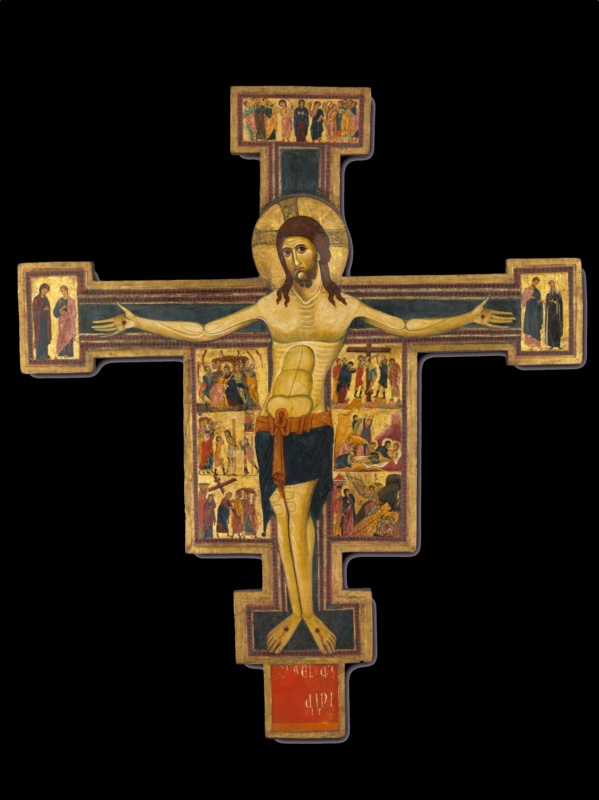
The painted cross now in the collection of the Cleveland Museum of Art, dated to approximately 1230–1240, is the document of paramount importance for the reconstruction of Michele di Baldovino’s biography, as it bears the partial signature that has allowed modern scholars to identify the master by his personal name. The cross is one of the earliest attributed works by Michele, predating the two Pisan crosses preserved in situ by some two to four decades, and it therefore provides critical evidence for the reconstruction of the artist’s early formal vocabulary, before the full maturation of his personal style in the third quarter of the century.
The inscription, partially preserved and laboriously reconstructed by Antonino Caleca and Mariagiulia Burresi, reads “micHAEL Quondam baldoVINI me pinxIT”, establishing beyond reasonable doubt the painter’s identification as Michele, son of the late Baldovino, one of the very rare instances in which a Duecento Pisan panel painter can be attached to a personal name recovered from the works themselves rather than from archival documentation. The central composition of the Cleveland cross follows the Christus patiens formula, presenting the dead Christ on the shaped cross with the body displaying the characteristic Pisan conventions, the sagging torso, the slightly bent knees, the head inclined to one side, but in a treatment that is somewhat stiffer and more archaizing than the later Pisan crosses, consistent with an earlier phase of the artist’s development.
The tabelloni and terminals of the Cleveland cross are populated with scenes of the Passion cycle, rendered in the compressed, symbolic pictorial language of mid-Byzantine narrative painting, with figures distributed against schematic landscape and architectural settings that function as identifying markers rather than illusionistic environments. The cross was originally associated with a Pisan ecclesiastical institution, possibly the church of Santa Bona or San Martino, and at some point entered the European art market before its acquisition by the Cleveland Museum of Art, where it is displayed as part of the museum’s collection of medieval Italian panel painting.
The technical analysis of the Cleveland cross, facilitated by its presence in a major American research institution with advanced conservation facilities, has contributed significantly to the scholarly understanding of Pisan Duecento painting technique, providing data on ground preparation, pigment application, and gold leaf technique that can be correlated with the in situ Pisan works. The cross’s departure from Pisa represents a loss to the coherence of the city’s medieval artistic heritage, though its presence in Cleveland has ensured its excellent conservation and its accessibility to an international scholarly community. This work remains the cornerstone of the attribution of the entire corpus of works to Michele di Baldovino, and its continued study through technical and art historical analysis provides the basis for any further expansion of the catalogue.
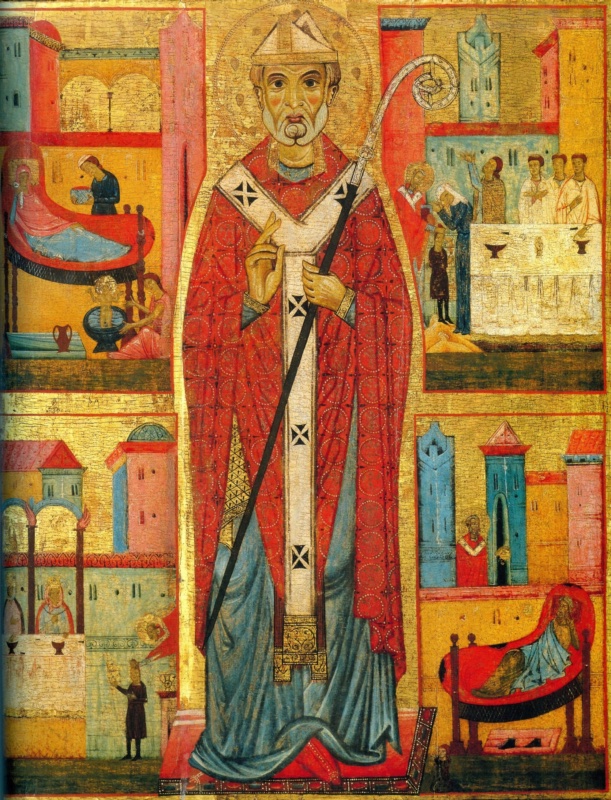
The dossale representing Saint Nicholas accompanied by scenes from his life, associated with the Peccioli area in the Valdera and attributed to Michele di Baldovino or his immediate workshop, constitutes the most significant evidence for the extension of the master’s activity beyond the urban boundaries of Pisa into the rural diocesan territories of the Pisan contado.
The work takes the form of a retable, a devotional image designed to be placed behind or above an altar, with a central representation of Saint Nicholas in frontal hieratic pose flanked by narrative scenes arranged in registers on either side, a format typical of Tuscan altar painting in the second half of the thirteenth century. Saint Nicholas is depicted as a venerable bishop in full liturgical vestments, miter, cope, and crozier, his right hand raised in blessing and his left holding the book of the Gospels, with his characteristic attribute of three golden balls or bags visible in the lower field, referring to the legend of his miraculous provision of dowries for three impoverished sisters.
The flanking narrative scenes illustrate episodes from the saint’s legendary biography, including his miraculous gifts, his resurrection of the murdered children, and his intervention to save the innocent from execution, drawn from the widely circulated hagiographic tradition codified in the Legenda aurea. The figures in the narrative registers display Michele’s characteristic formal vocabulary, the elongated proportions, the hieratic facial types, the calligraphic drapery folds, adapted to the smaller scale and more intimate devotional register appropriate for a parish or collegiate altar retable.
The cult of Saint Nicholas was particularly strong in Pisa and its dependent territories, where the saint’s role as protector of sailors and merchants made him a natural focus for the devotional patronage of the commercial classes who dominated civic and economic life in the Pisan republic. The commission of this dossale for a church in the Valdera reflects the institutional framework of the Pisan diocese, within which the bishop and chapter of Pisa exercised spiritual and administrative authority over a network of rural parishes and collegiate churches whose artistic needs were supplied by the painters and sculptors active in the capital.
The attribution of this work to Michele or his immediate circle has been a matter of scholarly discussion, with some researchers proposing a close workshop associate rather than the master himself as the principal executant, though the formal language is sufficiently consistent with the documented works to sustain the attribution within the broader context of Michele’s oeuvre. The current location of this work places it within the heritage of the Valdera area in the province of Pisa, preserved as an example of the Duecento panel painting tradition that flourished in the Pisan contado under the patronage of local ecclesiastical institutions.
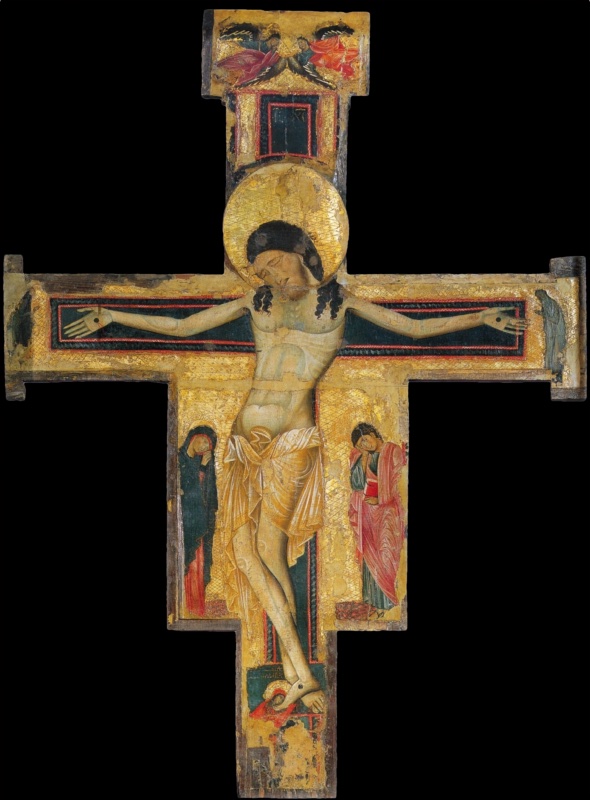
The painted cross in the church of Santi Ippolito e Cassiano at Riglione, a village in the immediate environs of Pisa, extends the geographic range of Michele di Baldovino’s attributed corpus to the peri-urban context of the Pisan countryside and demonstrates the capacity of even relatively modest rural communities to commission works from one of the republic’s most accomplished panel painters.
Dated to the second half of the thirteenth century, the Riglione cross belongs to the same mature phase of Michele’s activity as the San Pierino and Sant’Andrea in Chinseca works, and it shares their fundamental formal characteristics while adapting the scale and complexity of the iconographic program to the more limited spatial and financial resources of a rural parish setting. The cross presents the Christus patiens in the manner characteristic of Michele’s mature works, with the body of Christ modeled in the warm-to-cool tonal gradations of the Pisan school and set against a gold ground that establishes the image’s devotional authority within the modest interior of the village church.
The lateral figures of the Virgin and Saint John occupy the terminal panels of the cross arms, rendered with the meditative quietude that characterizes Michele’s approach to the mourning figures throughout his career. The dedication of the church to Saints Hippolytus and Cassianus, two early Christian martyrs whose cults were celebrated on August 13th, indicates the antiquity of the community’s religious life and the continuity of its devotional traditions from the early Christian period into the Duecento, providing a fitting context for the commission of a painted cross as the focal image of the sanctuary.
The presence of a high-quality panel painting by Michele or his workshop in so modest a setting as the church of Riglione speaks to the accessibility of professional panel painting to a wide range of ecclesiastical patrons in thirteenth-century Pisa, facilitated by the proximity of the village to the city and the established commercial networks through which artistic commissions were organized and fulfilled. The cross at Riglione thus represents not only an individual artistic achievement but also a social and economic phenomenon, the democratization of devotional image-making in the Pisan republic at the height of its prosperity, that is inseparable from the broader history of Duecento Italian culture. The work is preserved in the church of Santi Ippolito e Cassiano at Riglione, where it continues to testify to the extraordinary density of high-quality medieval panel painting that once characterized the religious landscape of the Pisan territory.