Enrico di Tedice
( 25% )
Enrico di Tedice was a mid‑thirteenth‑century Pisan painter, documented in 1254 and best known for the signed painted cross in the church of San Martino and for a small cluster of stylistically related works in Pisa, Florence, and the lower Arno valley. His exact birth and death dates, the precise place of his birth, and the cause of his death are all unknown, but the concentration of documents and works around Pisa makes it highly probable that he was born in or near that city in the early decades of the thirteenth century and died sometime after the mid‑century, likely of natural causes, as no record of a violent or unusual death survives.
Family and workshop
Enrico di Tedice was an Italian painter active in Pisa around the middle of the thirteenth century, belonging to a family workshop of painters whose importance in the local milieu has often been compared to that of the Berlinghieri clan. No documentary evidence preserves his exact date of birth, but scholars generally infer that he must have been born in the early decades of the thirteenth century, probably in Pisa or its immediate contado, since all archival references and securely attributable works cluster around that city.
The only secure document naming him is a charter of 1254 issued by the archbishop of Pisa, in which Enrico appears as a witness, already bearing the professional status that implies his recognition as a mature painter. From this single record, art historians deduce that Enrico belonged to the urban middle strata of artisans who were sufficiently integrated into ecclesiastical and civic affairs to be called upon in legal transactions. The thirteenth‑century Pisan painting milieu was strongly dynastic, and Enrico’s surname “di Tedice” suggests descent from an ancestor called Tedice, though that figure remains undocumented in surviving records.
Osvald Sirén in the early twentieth century hypothesised the existence of a “Maestro Tedice”, imagining him as Enrico’s father and as a painter active in the first years of the century, but subsequent scholarship has emphasised the purely conjectural nature of this reconstruction and the absence of archival support. Despite the lack of explicit contracts or guild matriculations, the concentration of works in Pisan churches and the stylistic coherence across related panels indicate that Enrico was embedded in a stable family bottega that passed skills and models across generations.
This workshop structure would have provided a framework in which younger relatives could train under senior masters, sharing patterns and cartoons while gradually differentiating their individual hands within a recognisable house style. The memory of such a workshop is fossilised in the attributional nomenclature of modern scholarship, which for a time preferred to speak of anonymous “masters” such as the Master of the Castellare Crucifix before restoring Enrico’s historical name. Thus even the sparse documentary record, when read in conjunction with stylistic groupings, permits the reconstruction of Enrico di Tedice as the central figure of a multi‑generational family of Pisan painters rather than as an isolated individual.
A crucial element in reconstructing Enrico’s family is the documented presence of his younger brother, the painter Ugolino di Tedice, who appears in Pisan records in 1273 and 1277 and who is generally accepted as the author of a painted cross now in the Hermitage at Saint Petersburg. The Hermitage cross bears the signature of an “Ugolinus”, and its stylistic dependence on Giunta Pisano’s manner, combined with the documentary references to a painter Ugolino di Tedice in Pisa, has led scholars to equate the two figures and to see Ugolino as continuing the family workshop into the third quarter of the century. Ugolino’s cross, with its more forceful realism and intensified pathos, has often been contrasted with Enrico’s slightly more archaic idiom, thereby suggesting how the bottega negotiated the tension between inherited models and newer trends coming from Assisi and elsewhere.
Enrico and Ugolino together form the core of a dynastic sequence, with the elder brother’s signed and attributed works providing a stylistic anchor against which the younger brother’s oeuvre can be measured. The brothers’ collaboration, though not documented in written contracts, is implied by the shared stock of facial types, ornamental formulas, and compositional schemes found in works attributed to their circle. Through this lens, the bottega appears as an extended household in which work, kinship, and devotional practice were closely intertwined, with family members participating in the production of liturgical images for the city’s churches and confraternities. Such a family‑based structure parallels that of other Pisan painting dynasties, notably the Berlinghieri, whose multigenerational activity similarly shaped the city’s artistic profile in the Duecento.
The Tedice workshop, however, seems to have cultivated a somewhat rougher and more expressionistic idiom, which later critics sometimes judged “popolaresco” but which must have resonated with local devotional sensibilities. Even though individual biographies remain shadowy, the interplay of signatures, documents, and stylistic analysis allows Enrico and Ugolino to be envisaged as brothers sharing a workshop space, materials, and clients. Within that family setting, Enrico appears as the senior figure whose signed crucifix in San Martino defined the workshop’s public identity, while Ugolino’s later cross and other derivatives show the persistence and adaptation of that legacy.
The dynastic chain extends beyond the two brothers to a documented nephew, Ranieri di Ugolino, who is named as a painter at the end of the century and to whom a painted cross in the Museo Nazionale di San Matteo in Pisa is attributed. Dated around 1290, this cross reveals the enduring impact of Giuntesque forms within the family workshop while also showing an incipient reception of Cimabue’s lessons, thus attesting to the capacity of the Tedice circle to absorb and reinterpret new models. Ranieri’s position as Ugolino’s son and Enrico’s nephew underscores the multi‑generational continuity of the bottega and suggests that workshop knowledge, including iconographic patterns and technical recipes, was carefully transmitted as a family patrimony.
The evolution from Enrico through Ugolino to Ranieri can be read as a gradual negotiation between fidelity to inherited formulas and the need to respond to changing expectations of patrons more attuned to heightened naturalism and pathos. The persistence of the family name “di Tedice” in documents across several decades indicates that the workshop’s social presence in Pisa was both durable and recognisable. Although little is known about the domestic arrangements of the household, it is reasonable to suppose that apprentices from outside the family also worked alongside kin, thereby enlarging the stylistic circle identified by modern scholars around the Master of the Castellare Crucifix.
This combination of kin‑based leadership and a broader pool of collaborators reflects a characteristic form of artistic organisation in central Italian cities before the full institutionalisation of guild systems. In such a context, the Tedice family’s artistic identity would have functioned as a brand, attracting commissions on the basis of recognisable stylistic features and established devotional efficacy. The interplay of signatures and anonymous works attributed to the family’s orbit shows that the name “Enrico di Tedice” came to stand, not only for a single master, but also for a set of workshop practices and visual solutions. This expanded notion of authorship is essential for understanding the complexity of the “family” category in thirteenth‑century Pisan painting, where biological, social, and stylistic ties were inextricably intertwined.
The question of Enrico’s lifetime and death must be approached with the same cautious methodology applied to his family relations, since the documentary record provides only one secure terminus. His appearance as a witness in 1254 confirms that he was alive and professionally active at that date, while the stylistic dating of his signed cross in San Martino and of related works places his activity broadly between about 1240 and 1260. No later archival reference is known, and no inscription records his death, so the terminus post quem for his demise is that 1254 document, with art historians generally assuming that he continued to work, perhaps with diminishing intensity, into the later 1250s or early 1260s.
The absence of any extraordinary note in chronicles or episcopal registers makes it likely that his death followed the unremarkable pattern of most artisans, occurring in the natural course of ageing or ordinary illness rather than as the result of public catastrophe. The failure of sources to preserve the exact date and cause of his death is not exceptional in the Pisan context, where even artists of greater fame, such as Giunta Pisano, are often known only through scattered notices and stylistic inferences. Enrico’s burial place is likewise unknown, though the family’s strong connections with Pisan parish churches make interment in a local cemetery, perhaps attached to a church for which the workshop had produced images, a plausible conjecture.
In biographical narratives this lacuna has occasionally been filled by speculative reconstructions, but recent scholarship insists on drawing a clear line between documented fact and plausible but unverifiable hypotheses. Consequently, modern accounts prefer to define Enrico’s life span in purely functional terms, situating him as an artist active in Pisa around the middle of the thirteenth century rather than assigning specific birth and death years. This methodological restraint has the further advantage of keeping attention focused on his surviving works and their stylistic and devotional significance, rather than on anecdotally embroidered but poorly grounded life stories. In this sense, the uncertainty surrounding his death mirrors the fragmentary state of knowledge about his early years, reinforcing the impression of a figure glimpsed principally through the lens of his pictures and their reception in the Pisan environment.
Modern historians have also reconsidered the construction of Enrico’s family in the historiography of Tuscan painting, recognising how earlier scholars projected modern notions of individuality and authorship onto what was in reality a more collective and fluid workshop structure. The early tendency to separate a Master of the Castellare Crucifix from Enrico, and then to conflate that master with a hypothetical father figure, illustrates the oscillation between anonymity and personalised authorship that has long haunted the study of Duecento painting. As archival research has progressed and technical examinations of panels and crosses have been undertaken, it has become increasingly clear that multiple hands collaborated within single works, making any strict division of labour along modern lines of personal style problematic.
Within this collaborative framework, Enrico’s name provides a focal point around which a family of works and of artists can be organised, but it does not exhaust the creative agency present in the bottega. The very fact that his brother and nephew continued to sign works while drawing heavily on his formulas demonstrates that the family conceived of artistic identity as both shared and differentiated. Such a conception resonates with the broader culture of thirteenth‑century Pisa, where civic identity, family honour, and professional reputation were closely intertwined in a complex web of reciprocal obligations and public visibility. By tracing the careers of Enrico, Ugolino, and Ranieri, scholars reconstruct not only a genealogical sequence but also a set of workshop practices that defined a recognisable “Tedice” idiom over several decades. The resulting picture is one of continuity and adaptation, in which the family’s capacity to negotiate the pressures of new stylistic currents and changing devotional needs proved crucial to its longevity. In this way, the story of Enrico’s family embodies many of the structural features of artistic life in the Duecento, illustrating how workshops functioned as both economic units and bearers of visual tradition. For the historian of medieval art, the Tedice clan thus offers a valuable case study in the intersection of kinship, style, and patronage in a major Tuscan maritime republic.
Patrons and social environment
The profile of Enrico di Tedice’s patrons must be reconstructed largely from the original locations and iconographic programmes of the works associated with his name, since no contracts or dedicatory inscriptions explicitly recording commissioners have come down to us. The only work securely signed by him, the painted cross now in the church of San Martino in Pisa, evidently served as a major liturgical image for a Pisan parish in the mid‑thirteenth century, implying a commission either from the parish clergy or from a lay confraternity attached to the church. The cross’s sophisticated narrative apparatus, with numerous Passion scenes flanking the central Christus figure, presupposes a patronage milieu attuned to contemporary currents of affective devotion, likely influenced by mendicant preaching and the spread of Passion‑focused piety.
In such a setting, the choice of Enrico as painter suggests a reputation for providing images that combined traditional Byzantine iconographic schemes with a heightened expressive charge capable of engaging viewers emotionally. The repainting history and documented restorations of the San Martino cross further indicate that later generations continued to value and maintain this image, reinforcing the idea that the original commissioners invested it with significant spiritual and institutional capital. Comparable patterns can be traced in the case of the so‑called Croce di Castellare, originally from the oratory of Castellare near Vicopisano, which, although not signed, has been connected to Enrico’s hand or workshop phase by several scholars. The oratory context implies a local devotional community, perhaps a rural confraternity or a small ecclesiastical foundation, seeking a powerful crucifix for processional or altar use. The decision to adopt a relatively elaborate painted cross, rather than a simpler sculpted crucifix or panel, points to patrons with sufficient resources to commission a substantial piece from a recognised urban workshop. In both the urban parish of San Martino and the more modest setting of Castellare, the shared recourse to Enrico or his circle underscores the appeal of his idiom across differing social strata within the wider Pisan territory.
Other works attributed to Enrico illuminate the spectrum of his patrons beyond strictly parochial contexts, particularly when one considers panels now housed in museums but originally made for ecclesiastical interiors. The Madonna col Bambino, due angeli e storie della Passione, now in the Museo Nazionale del Bargello in Florence, is a case in point, presenting a central Hodegetria‑type Virgin flanked by narrative scenes that would have structured a viewer’s meditation on Christ’s suffering.
Although its original location remains uncertain, its format and iconography suggest a commission for an altar, perhaps in a chapel dedicated to the Virgin or to a Passion‑related confraternity, and its high quality implies demanding patrons likely connected with an urban ecclesiastical institution. The presence of such a work in Florence today has occasionally prompted speculation about direct Florentine patronage, but the possibility that it originated in the Pisan orbit and later entered Tuscan collections through the dynamics of art trade or ecclesiastical reorganisation cannot be excluded.
In any case, the sophisticated integration of Marian and Christological themes shows that Enrico’s patrons were sensitive to complex theological and devotional programmes rather than merely desiring iconic images in isolation. The same can be said of the small panel of the Deposizione di Cristo dalla croce, now in the Museo Nazionale di San Matteo in Pisa, whose compositional and stylistic features led Carlo Ludovico Ragghianti and others to attribute it to Enrico’s hand. Originally part of a larger crucifix ensemble, this fragment would have formed part of a Passion cycle intended for concentrated contemplation, probably commissioned by clergy or laity eager to align themselves with contemporary currents of penitential spirituality. Such patrons, even if not named, emerge as theologically literate actors who harnessed Enrico’s visual language to channel and articulate their religious aspirations.
The fresco Madonna col Bambino e due angeli, removed from its original wall context and now housed in the Museo Nazionale di San Matteo, further complicates the picture of Enrico’s patronage network by bringing mural painting into the equation. Attributed to Enrico on stylistic grounds and dated to the mid‑thirteenth century, this image once adorned a sacred interior, probably a Pisan church such as San Michele in Borgo, from which several thirteenth‑century Marian images have been detached and transferred to the museum. The commissioning body in this instance was almost certainly institutional—a monastic community, a collegiate chapter, or a parish clergy—given the integration of the fresco into the architectural fabric and the prominence of the Marian cult in urban Pisan churches.
The choice of a mural rather than a portable panel indicates a desire for a stable, enduring embodiment of the Virgin’s protective presence, suitable for processions, votive offerings, and the daily rhythm of the liturgy. In agreeing to such commissions, Enrico’s workshop adapted its repertoire of facial types, draperies, and ornamental motifs to the specific challenges of fresco technique, while preserving the recognisable hallmarks of its style. That patrons were willing to entrust major wall surfaces to the Tedice bottega shows that its reputation extended beyond the production of wooden crosses and portable panels into more encompassing decorative schemes. The survival of these fresco fragments, despite later rebuildings and Baroque overlays, testifies to a durable local attachment to the images and thus indirectly to the prestige of the workshop that produced them. In this way, mural and panel commissions together suggest that Enrico’s patrons ranged from parish priests and rural confraternities to more prominent ecclesiastical institutions at the heart of Pisan religious life.
One of the most intriguing indications of Enrico’s reach is the Madonna col Bambino long venerated in the Pieve di San Verano at Peccioli and known locally as the “Madonna delle Grazie”. The panel is described in local documentation as an example of Tuscan Duecento painting of the first half of the thirteenth century and is attributed in the museum’s display tradition to Enrico di Tedice, even though the suggested date sits somewhat awkwardly with the chronology derived from his 1254 documentation. This discrepancy has led some scholars to question either the dating or the attribution, but the very existence of such a work in the lower Arno valley suggests that patrons beyond Pisa proper sought images in the Tedice idiom.
The Peccioli panel’s long‑standing reputation as a miracle‑working image, as implied by its devotional epithet “delle Grazie”, hints at a lay and ecclesiastical patronage that over time became intertwined in the communal management of the cult. Even if Enrico’s hand is not unanimously accepted, the picture of a rural or small‑town community investing in a sophisticated Marian icon that shares features with Pisan production tallies well with what is known of the circulation of workshops and models in the region. In such contexts, local elites—priests, notaries, and prosperous peasants—could collectively sponsor a high‑quality image whose prestige derived in part from its association, real or perceived, with a renowned urban workshop. This dynamic illustrates how Enrico’s clientele likely extended along the riverine and road networks connecting Pisa to its hinterland, broadening the reach of his family’s artistic language. The Peccioli example thus points to a form of patronage in which local identity and supra‑local artistic prestige were mutually reinforcing. Even if precise names and contract clauses elude us, the socio‑religious profile of such patrons can be sketched through the residues of cult practice and museum attribution.
In addition to institutional and communal patrons, it is probable that individual donors, both clerical and lay, played a role in commissioning some of the works associated with Enrico, though their presence must be inferred rather than documented. In several panels attributed to his circle, such as the Bargello Madonna with Passion stories, the narrative space is sufficiently ample to have accommodated donor figures, whether kneeling at the Virgin’s feet or integrated into the margins of the Passion scenes, and the absence or loss of such figures today may be due to damage, repainting, or cropping.
Medieval viewers frequently sought to inscribe themselves, literally and figuratively, into the visual economy of salvation by sponsoring images that linked their own persons or families with Christ and the saints, and there is no reason to think that Enrico’s patrons were exceptions to this pattern. Wealthy merchants engaged in Mediterranean trade, members of Pisan noble lineages, and officials of ecclesiastical institutions all likely intersected with the Tedice workshop as commissioners and intermediaries. The lack of explicit heraldry on surviving works may reflect either the modest social rank of many patrons or the dominance of collective over individual forms of representation in certain devotional contexts.
Even when not visibly depicted, however, individual donors would have been present in the prayers, anniversaries, and liturgical commemorations associated with the images they funded, weaving Enrico’s creations into the fabric of familial memory. From this perspective, the workshop’s activity can be understood as mediating between the invisible economy of intercession and the tangible economy of money, materials, and labour. The social history of Enrico’s patronage therefore encompasses both the institutional frameworks of parishes, oratories, and convents, and the more intimate networks of kinship and friendship that underpinned individual acts of giving. By situating the painter within these overlapping fields of patronage, one gains a richer appreciation of how his images functioned as nodal points in the religious and social life of Duecento Pisa.
The geographical distribution of works tied to Enrico and his circle—concentrated in Pisa itself, but extending to nearby centres such as Vicopisano and Peccioli—also helps to delineate the radius within which his patrons moved. The Croce di Castellare, originally associated with an oratory near Vicopisano, indicates the presence of Pisan artistic models in satellite communities linked to the city by economic and ecclesiastical ties. That an image so closely connected stylistically to Enrico’s signed San Martino cross should appear in a more rural setting demonstrates how patrons in the contado sought to align themselves with metropolitan devotional fashions, perhaps as a way of asserting their own status or loyalty. At the same time, the lack of known commissions from more distant Tuscan cities, such as Lucca or Siena, suggests that Enrico’s patronage base, while not strictly parochial, remained largely within the orbit of Pisan influence.
This pattern corresponds with what is known of mid‑thirteenth‑century artistic networks, in which workshops often served a primary city and its hinterland rather than engaging in extensive inter‑urban competition. The resulting image is of a painter whose patrons were diverse in type—ranging from urban clergy to rural confraternities—but relatively circumscribed in geographic reach. Within that sphere, however, the variety of commissions, from processional crosses to altarpieces and frescoes, indicates that Enrico and his family adapted flexibly to the differing liturgical and spatial needs articulated by patrons. Consequently, the patronage of Enrico di Tedice appears less as a matter of occasional large‑scale prestige commissions and more as a dense web of medium‑sized projects that collectively shaped the devotional landscape of Pisa and its environs.
Painting style
The stylistic profile of Enrico di Tedice has been defined above all through the analysis of his signed painted cross in San Martino, which occupies a pivotal position in the evolution of Tuscan crucifix imagery from the triumphal to the suffering Christ. This work participates in the broader Tuscan transition between the idealised Christus triumphans and the more naturalistic Christus patiens, yet it does so in a manner that retains a largely upright and frontal posture, echoing the earlier type while inflecting it with intensified facial pathos. The elongated, slightly rigid body of Christ stands against a gilded ground, recalling Byzantine models, but the contorted features of the face and the slight inclination of the head introduce a sense of psychological drama that departs from the serene hieraticism of older prototypes.
Around the central figure, small narrative scenes from the Passion are disposed in framed compartments, their compact compositions filled with energetically drawn, almost caricatural figures whose gestures are emphatic to the point of the grotesque. Critics have described Enrico’s handling of these subsidiary scenes as “compendiaria”, meaning that he rapidly sketches forms with summary brushwork, privileging rhythmic outlines and strong highlights over detailed modelling. This approach produces a vivacious, sometimes rough effect, in which the immediacy of gesture and expression takes precedence over anatomical precision. The result is a crucifix that oscillates between solemn frontality and almost popular expressiveness, embodying a stylistic ambivalence that characterises much of Pisan painting in the mid‑Duecento. It is this tension between inherited Byzantine decorum and emergent Gothic sensibility that gives Enrico’s style its particular historical interest.
In terms of colour and surface, Enrico’s works display a consistent reliance on rich gilding, both for backgrounds and as a means of articulating draperies through fine striated highlights. The perizoma of Christ in the San Martino cross is particularly noteworthy for its golden linear decorations, which resemble the woven patterns of luxurious Byzantine textiles and have been interpreted as a direct borrowing from Constantinopolitan prototypes. These golden strokes, applied over darker pigment, create a shimmering effect that enlivens the surface and underscores the sacredness of the figure, even as the body itself is rendered in relatively flat, schematic tones.
The Virgin and Saint John at the extremities of the cross, as well as the minor characters in the Passion scenes, are treated with similar attention to ornamental detail, their garments defined less by volumetric modelling than by the interplay of colour blocks and golden filigree. Such a treatment situates Enrico firmly within the Pisan tradition of “gold‑screen” painting, in which the splendour of the heavenly realm is conveyed through the lavish deployment of gold leaf and tooling. Yet within this shimmering field, facial features and hands are often outlined with dark, assertive strokes that exaggerate eyes, noses, and fingers, lending the figures a somewhat mask‑like aspect. This combination of ornamental luxuriance and graphic harshness contributes to an overall effect that modern observers have alternately judged as naïve, expressive, or “popular”. While such labels are inevitably coloured by later aesthetic preferences, they nonetheless capture the peculiar intensity of Enrico’s pictorial language.
The draughtsmanship of Enrico has sometimes been contrasted unfavourably with that of his slightly younger contemporary Cimabue, especially in terms of anatomical articulation and spatial coherence, yet this comparison risks imposing later standards on a painter operating within a different set of priorities. In Enrico’s panels and crosses, bodies are constructed from relatively simple, tubular forms, with limited foreshortening and a preference for frontal or three‑quarter views that maintain the legibility of the sacred figures in a liturgical setting. The spatial settings of the Passion stories are minimally indicated, usually by a schematic architectural backdrop or a bare strip of ground, keeping attention focused on the gestural interplay of the protagonists. Such economy of setting is well suited to the didactic function of these scenes, which were likely intended to be read in sequence by devotees moving in front of the image or listening to sermons that referenced the depicted episodes.
The absence of sophisticated perspectival construction does not therefore signal a lack of skill so much as a functional adaptation to the narrative and devotional aims of the commission. Even where Enrico experiments with more complex groupings, as in the crowded Deposition fragment now at San Matteo, the overriding concern remains the rhythmic arrangement of bodies around the central motif of Christ’s lifeless form. Figures press against one another, their hands and faces overlapping in a dense pattern that conveys emotional compression rather than realistic spatial recession. Such compositional strategies align with a broader tendency in Duecento Tuscan painting to use crowding and overlapping as visual metaphors for spiritual intensity.
Another salient aspect of Enrico’s style is the treatment of faces, which often display a striking, almost mask‑like expressiveness that borders on the caricatural. In the narrative scenes of the San Martino cross, soldiers, tormentors, and bystanders are endowed with exaggeratedly grimacing features, with wide eyes, flared nostrils, and gaping mouths that communicate aggression, astonishment, or grief in immediately legible terms. The saints and holy figures, by contrast, tend to have more controlled and solemn expressions, though even they are not exempt from a certain hardening of features that gives them a severe, sometimes ascetic appearance. Valerio Ascani and other scholars have highlighted how such facce a mascherone contribute to a kind of vernacular drama, bringing the Gospel narrative into the emotional register of ordinary viewers. This expressive emphasis has led some to draw analogies with the more “expressionistic” tendencies observed in certain Byzantine provincial centres, such as Cappadocia or Serbia, where fresco cycles likewise display strongly marked faces and agitated gestures. However, Ascani and others caution that these parallels need not imply direct influence, since similar features can already be found in earlier Pisan works, notably the Croce di San Sepolcro now in the Museo Nazionale di San Matteo. Whatever their precise genealogy, Enrico’s heads and hands operate as primary vehicles of affect, concentrating spiritual drama into a few emphatic forms. In this sense, his style sacrifices subtle gradations of mood in favour of a clear polarisation between the righteous and the wicked, the suffering and the impassive, which would have served pedagogical purposes in a world where many viewers were illiterate.
The range of formats in which Enrico worked—painted crosses, narrative panels, frescoes, and perhaps small Marian icons—also reveals his capacity to adapt core stylistic features to varied supports and scales. In the Bargello Madonna, for example, the central enthroned Virgin and Child are rendered with greater composure and formality than the surrounding Passion scenes, yet the same compendiary brushwork and golden highlights link the two zones into a coherent whole. The angels flanking the throne adopt a pose with covered hands that recalls Byzantine Hodegetria icons, but their faces and wings bear the unmistakable imprint of the Tedice workshop’s dynamic line. Similarly, in the fresco Madonna with Child and two angels from San Matteo, the more limited tonal range and different behaviour of pigments on plaster do not prevent Enrico from deploying his characteristic elongation of figures and pointed chins. Across these different media, one perceives a consistent concern to maintain clarity of contour and legibility of sacred hierarchies, while allowing for a certain freedom in the rendering of secondary elements and backgrounds. This versatility suggests that Enrico’s workshop possessed a flexible repertory of cartoons and patterns that could be scaled up or down according to the demands of particular commissions, without sacrificing the recognisability of the house style. It also implies an ability to calibrate degrees of finish and detail to the expected viewing distance and lighting conditions of the work’s intended location.
The reception history of Enrico’s style has been marked by a certain ambivalence, with earlier critics sometimes dismissing him as one of the roughest imitators of Giunta Pisano, while more recent scholarship has emphasised the originality of his expressive idiom. The proximity of his San Martino cross to Giunta’s innovations in representing the suffering Christ has undoubtedly encouraged comparisons that tend to highlight Enrico’s relative lack of refinement. Yet such a perspective risks overlooking the ways in which his roughness may have been a deliberate aesthetic choice aimed at amplifying emotional engagement rather than at achieving courtly elegance. The very features that early twentieth‑century historians found objectionable—schematic bodies, mask‑like faces, compendiary drapery—can today be read as indicators of a vigorous local tradition responsive to the demands of popular devotion. Enrico’s style thus occupies a distinctive niche in the broader panorama of Duecento painting, standing somewhat apart from the more polished developments associated with Florentine or Sienese centres while nonetheless participating in the same overarching shift towards increased pathos and narrative complexity. This re‑evaluation underscores the importance of situating stylistic judgments within the specific liturgical and social contexts for which works were produced, rather than measuring all artists against a single teleological standard of progress towards naturalism.
Artistic influences
The primary artistic influence on Enrico di Tedice, as recognised by virtually all scholars, is the work of Giunta Pisano, whose crucifixes were decisive in transforming the Western image of the crucified Christ in the thirteenth century. Enrico’s San Martino cross, with its transitionally posed Christus figure and its intense facial expression, bears clear traces of Giunta’s path‑breaking treatments, even if it retains a more rigid bodily schema. The very decision to focus his major signed work on a large painted crucifix places Enrico directly within Giunta’s wake, aligning his workshop with the most current developments in crucifix imagery emanating from Pisa and Assisi.
Specific features, such as the articulation of ribs under the skin, the twist of the torso, and the rendering of the loincloth, show how Enrico absorbed and reinterpreted Giuntesque motifs. At the same time, differences in the treatment of hands, in the angularity of drapery folds, and in the general graphic hardness of line suggest that he was not merely copying but adapting these models to the preferences of his own clientele and to his workshop’s established routines. This dynamic of influence and differentiation is further evident when one considers the crucifix by Ugolino di Tedice at the Hermitage, which comes closer to Giunta’s more advanced naturalism and thereby marks a continuation and deepening of the family’s engagement with Giuntesque forms. Thus, Giunta’s impact on Enrico and his circle should be seen less as a matter of passive dependence than as an ongoing dialogue within a shared Pisan visual language.
Beyond the immediate sphere of Giunta’s workshop, Enrico’s art also displays strong connections to Byzantine models, both in iconography and in ornamental vocabulary. The gilded backgrounds, the hierarchical scaling of figures, and the use of the Hodegetria type for the Virgin in the Bargello panel all attest to a sustained engagement with Eastern Christian prototypes, likely mediated through imported icons and the activity of Byzantine or Italo‑Byzantine painters in Pisa and Tuscany.
Scholars such as Longhi, Garrison, and Carli have drawn attention to the Eastern flavour of Enrico’s draperies, particularly the gold‑striated textiles and the stiff, almost metallic folds that structure garments around the body. Some have gone further, suggesting affinities with the expressionistic trends of certain Byzantine provincial schools in regions such as Serbia or Cappadocia, where fresco cycles exhibit similarly agitated gestures and emphatic facial features. However, Ascani cautions that the traits invoked in these comparisons can already be observed in earlier Pisan works, notably the Croce di San Sepolcro, and therefore need not imply direct contact with those distant centres. In any case, the Byzantine dimension of Enrico’s style reflects Pisa’s position as a Mediterranean port and its long‑standing commercial and cultural links with the Eastern Mediterranean, even if the precise channels of transmission remain opaque. Within this matrix, the Tedice workshop emerges as a local interpreter of broader Byzantine forms of sacred representation.
The influence of local Pisan precedents is particularly evident in Enrico’s adoption and adaptation of compositional and iconographic schemes already present in the Croce di San Sepolcro and related works. Ascani notes that Enrico directly reprises the overall silhouette of the earlier cross, as well as the disposition of Passion stories in small scenes along the cross’s terminals, in his San Martino crucifix. The sequence of episodes—ranging from the Cattura to the Flagellazione, Derisione, Salita al Calvario, Crocifissione, Deposizione, Sepoltura, and the Marie al Sepolcro—follows an established narrative itinerary that viewers in Pisa would have recognised from prior images.
What Enrico adds is a greater emphasis on gestural drama and facial expressiveness, inflecting the older scheme with a heightened affective charge that aligns it more closely with the spiritual climate of the mid‑Duecento. Such a reworking suggests that he was simultaneously respectful of local visual tradition and responsive to evolving devotional expectations. In this sense, the Croce di San Sepolcro functions as a proximate source that mediates between broader Byzantine influences and Enrico’s own interventions. The interplay of continuity and innovation within this local lineage of crosses underscores the complexity of influence in medieval artistic production, where artists, workshops, and patrons together negotiated the balance between fidelity to tradition and the desire for novelty.
Later developments in Tuscan painting, particularly in Siena and Florence, may also have exerted a more indirect influence on the Tedice workshop through the circulation of portable panels and the movements of painters and patrons. Studies of Sienese thirteenth‑century painting have pointed out similarities between certain Madonna panels and Enrico’s Virgin and Child images, especially in the treatment of the throne and in the pose of the Child blessing while holding a scroll.
These parallels suggest that Enrico’s workshop was not entirely insulated from stylistic currents beyond Pisa, even if direct documentary evidence of contacts with Sienese or Florentine painters is lacking. Conversely, it is possible that elements of the Tedice idiom contributed, in however modest a way, to the broader Tuscan repertoire, given the mobility of artworks and the permeability of regional boundaries. The presence of Enrico‑related works in Florentine collections, such as the Bargello, further indicates that his paintings were deemed worthy of preservation and display in contexts that celebrated the prehistory of Tuscan art. This retrospective canonisation, though driven by modern curatorial agendas, reflects a recognition of Enrico as part of the wider narrative of the Gothic transition in central Italy.
Finally, one must consider the internal influence exerted by Enrico on his own workshop and on the broader circle of artists grouped under labels such as the Master of the Castellare Crucifix. The stylistic traits crystallised in his San Martino cross—elongated bodies, mask‑like faces, compendiary draperies—became points of reference for collaborators and successors who adapted them to new compositional and iconographic contexts.
In this sense, Enrico functions not only as a receiver of influences from Giunta, Byzantium, and local Pisan precedents, but also as a transmitter and transformer whose own solutions entered the visual vocabulary of other artists. The Croce di Castellare, the Deposition fragment, and related works bear witness to this internal diffusion, exhibiting variations on his formulas that range from close imitation to freer re‑invention. Over time, such internal workshop influences can be as significant as more glamorous external ones in shaping the visual character of a regional school. For the historian, tracing these lines of influence within the Tedice circle thus offers a nuanced view of how style evolves through incremental, often collaborative, acts of borrowing and revision.
Travels and geographical horizon
No document explicitly records travels undertaken by Enrico di Tedice, and the known or attributed works associated with his name are concentrated within a relatively narrow Tuscan radius centred on Pisa. This distribution strongly suggests that his professional life unfolded primarily within the Pisan urban fabric and its immediate hinterland along the Arno valley, rather than involving extensive journeys to distant courts or cities. The presence of works or workshop productions at sites such as Vicopisano and Peccioli can be explained readily by the ordinary circulation of commissions between a major city and its dependent rural communities, without positing long‑distance travel on the part of the master himself. In the mid‑thirteenth‑century Tuscan context, such a pattern would be entirely typical for a workshop whose main clientele consisted of parish churches, oratories, and local confraternities rather than princely patrons. Even if Enrico or his assistants occasionally journeyed to neighbouring centres for the purposes of installing works, negotiating commissions, or working in situ on frescoes, these movements would have taken place within a relatively circumscribed geographical sphere.
At the same time, the strong Byzantine component in Enrico’s style, together with Pisa’s role as a Mediterranean maritime power, has led some scholars to muse about the possibility of travel or direct contact with Eastern Christian artworks beyond Tuscany. Pisa’s commercial and military engagements with the Eastern Mediterranean meant that icons, textiles, and other luxury objects arrived in the city, whether as trade goods, diplomatic gifts, or spoils of war, and these could have served as models without requiring the physical presence of local painters in Constantinople or the Levant. While it cannot be ruled out that Enrico or members of his family workshop participated in voyages connected to mercantile or crusading enterprises, there is no concrete evidence to support such a hypothesis in his specific case. The safer conclusion is that the “travel” that mattered most for his artistic formation was the movement of images rather than of persons, with imported works and Italo‑Byzantine colleagues functioning as conduits of foreign styles. In this sense, Enrico’s workshop was situated at a crossroads of visual cultures without necessarily engaging in long‑distance itinerancy.
Within Tuscany itself, the later presence of Enrico‑related works in Florentine collections has sometimes been interpreted as evidence of his mobility, but the chronology of these transfers generally points to post‑medieval movements rather than to original commissions outside the Pisan orbit. The Bargello Madonna and other panels by or attributed to Enrico reached Florence through collection history and museum formation, not as indications that he had worked for Florentine patrons in his lifetime. Similarly, the relocation of objects from Pisan churches to the Museo Nazionale di San Matteo reflects nineteenth‑ and twentieth‑century heritage policies rather than medieval patterns of artistic circulation. Thus, while Enrico’s works have “travelled” considerably in the centuries since their creation, their current locations cannot be read straightforwardly as traces of his own movements. For reconstructing his thirteenth‑century geography, one must therefore prioritise the original provenances documented or inferred by scholars such as Ascani and others.
The absence of evidence for extensive travel should not, however, be equated with provincial isolation, since Pisa itself was a cosmopolitan environment where artists could encounter a wide range of visual stimuli without leaving the city. The cathedral complex, mendicant churches, and private chapels housed works by local and foreign masters, including Giunta, Italo‑Byzantine painters, and, later, sculptors and mosaicists linked to broader Italian and Mediterranean networks. Enrico’s movements within this urban topography—between parish churches like San Martino, major ecclesiastical centres, and the bottega’s workshop premises—would have exposed him to a rich visual ecology that shaped his practice. When viewed from this perspective, the question of travel becomes less about spectacular journeys and more about the continual, quotidian circulation of the painter and his works within a densely interconnected local environment.
Major works and iconography
Painted Cross (Pisa)
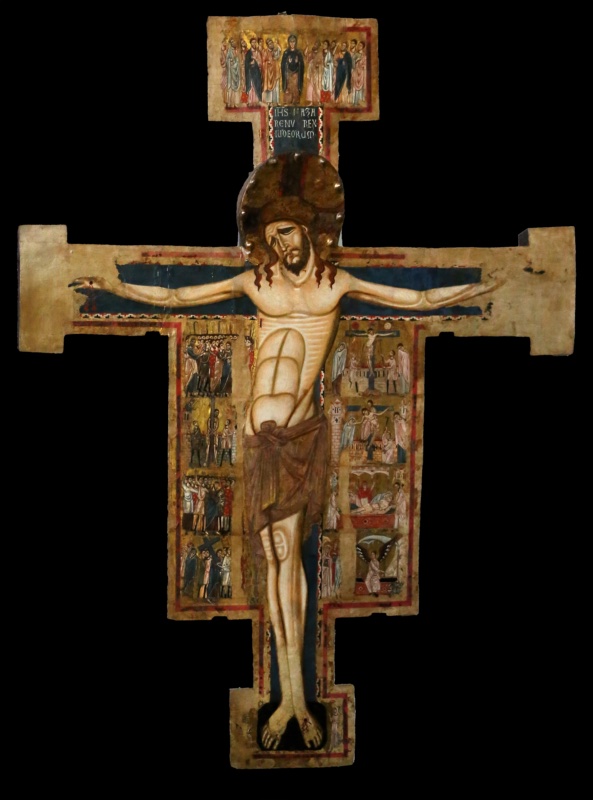
TThe work is a shaped cross mounted on a wooden frame, constructed from several joined planks and reinforced on the back with horizontal crossbars. The shape features elongated cross arms, a rectangular upper panel, and a narrow lower extension, following the model of monumental Tuscan crucifixes in the Giuntesca tradition. The surface is entirely prepared with plaster and glue, gilded with gold leaf, and then painted in tempera, with extensive use of decorative punching and engraving in the halos and inner frames. The continuous gold background creates an abstract and luminous field that highlights the figures and the small side scenes, emphasizing the image’s liturgical and devotional function.
At the center stands the Christ patiens, already dead on the cross, with his eyes closed and his head reclined on his right shoulder, in accordance with the new pathos introduced in Pisa by Giunta Pisano but interpreted here with a drier, more linear style. The body is arched in an elegant curve, with the right hip strongly protruding and the chest rendered with marked, almost graphic ribbing that emphasizes anatomical tension rather than a naturalistic rendering of the nude. The long loincloth, tied at the hip, falls in jagged folds illuminated by light highlights, while the slightly bent legs cross and the feet are fastened to the cross by a single nail, a solution that accentuates the image of pain and refers directly to Giunta’s models. The skin has an ivory tone, marked by greenish and brown shadows in the anatomical recesses, where a more advanced chiaroscuro technique emerges compared to Byzantine rigidity, a sign of alignment with mid-13th-century artistic trends.
In the upper panel, within a gilded frame adorned with geometric motifs, Enrico painted a clipeus depicting the Enthroned Redeemer or the Blessing Christ surrounded by angels, while above ran the titulus crucis bearing the Latin inscription Ihesus Nazarenus rex Iudeorum, now partially missing. The ends of the arms likely held the two full-length figures of the Mourners—the Virgin on the left and St. John the Evangelist on the right—of which only fragmentary traces remain, though still discernible in the inclined posture and the gesture of grief in their hands. The area of the vertical upright around the body of the Crucified Christ is divided into a dense sequence of narrative panels depicting episodes from the Passion and Resurrection: one can recognize the Kiss of Judas, the Flagellation, Christ Mocked, the Ascent to Calvary, the Crucifixion, the Deposition, the Entombment, the Women at the Tomb, Peter’s Denial, and the Ascension. These small scenes, set against gold backgrounds and schematic architectural elements, condense the drama of Easter into a vertical composition, transforming the cross into a true visual compendium of the history of salvation intended for the meditation of the faithful.
Enrico di Tedice’s style in this cross shows a close connection to the Pisan tradition inaugurated by Giunta, but filtered through a more narrative and descriptive sensibility. The drawing is energetic, with sharp contours and pronounced triangulations in the folds of the garments and beards, while the modeling is achieved through softer color transitions, especially in the face of Christ and in the small figures of the side stories. The rendering of the faces, with elongated eyes and slender noses, still reveals a Byzantine-inspired vocabulary, but the emphasis on the movement of the bodies, the expressions of pain, and the intertwining of gestures introduces a more direct emotional dimension. The strong narrative structure, with a compact series of small panels populated by minute yet lively figures, brings the work closer to contemporary illuminated manuscript cycles and attests to the painter’s familiarity with models of book culture and with the emerging taste for continuous narrative on panel.
The cross, now located in the nave of San Martino, was likely intended for a prominent position within the church, perhaps suspended near the presbytery, to mark the liturgical space and guide the devotion of the faithful throughout the ecclesiastical year. The concentration of episodes from the Passion around the body of the dead Christ transformed the image into a privileged medium for meditation on redemptive death, in keeping with the Franciscan and devotional spirituality of the 13th century. The balance between Byzantine solemnity and dramatic intensity, typical of the Pisan school, makes this crucifix an important milestone in the evolution in Pisa from the styles of Giunta to the more mature achievements of Cimabue and the late-century masters, and it is one of Enrico di Tedice’s recognized masterpieces.
Painted Cross (Vicopisano)
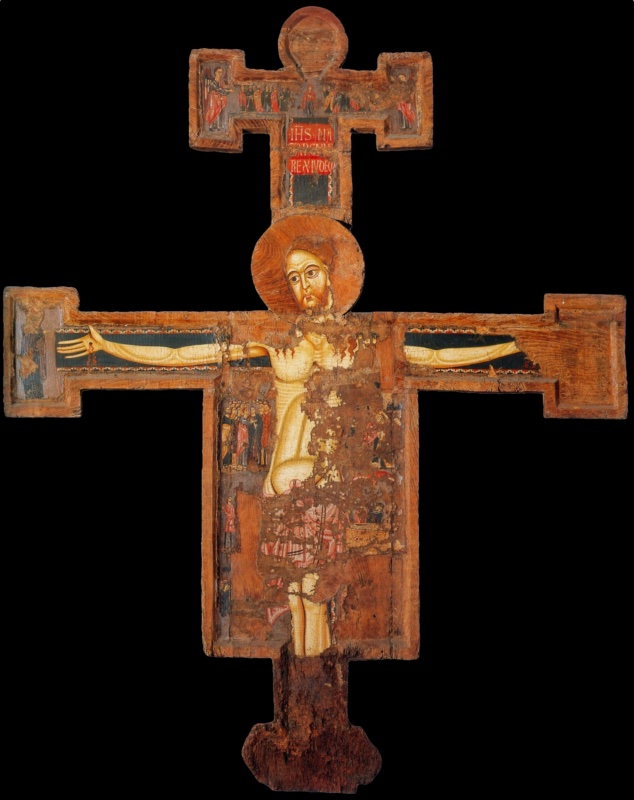
The support consists of wooden planks joined together to form the typical “T-shaped” silhouette of 13th-century crucifixes: a vertical body with a barely visible base, protruding horizontal arms, and an upper cornice culminating in a circular clipeus. The surface is prepared with plaster and animal glue and painted in tempera, a protein-based binder (egg or animal glue) that allows for light, dry tones, particularly suited to the crisp lines of the Pisan school. Originally, the cross must have been extensively gilded and adorned with geometric or phytomorphic ornamental motifs, now preserved only in fragments along the edges. Its function was liturgical and processional: although not monumental in size, its dimensions allowed for its use in celebrations and rogation processions, as well as its placement on an altar as a focal point of devotion.
The support consists of wooden planks joined to form the typical “tau” shape of 13th-century crucifixes: a vertical body with a barely suggested pedestal, protruding horizontal arms, and an upper cornice culminating in a circular clipeus. The surface is prepared with plaster and animal glue and painted in tempera, a protein-based binder (egg or animal glue) that allows for light, dry tones, particularly suited to the crisp linework of the Pisan school. Originally, the cross must have been extensively gilded and adorned with geometric or phytomorphic ornamental motifs, now preserved only in fragments along the edges. Its function was liturgical and processional: although not monumental in size, its dimensions allowed for its use in celebrations and rogation processions, as well as its placement on an altar as a focal point of devotion.
Christ’s head is inscribed within a large circular clipeus, an element that lends the figure an almost iconic aura and evokes the Byzantine tradition still very strong in the Tyrrhenian area. Within the clipeus, now heavily eroded, Christ was likely depicted with a cruciform nimbus and probably a crown of thorns, in keeping with the already Gothic sensibility toward suffering; the head, slightly tilted, signaled the transition to the dead Christ and the dramatic pathos introduced by Giunta. Immediately above, in the rectangular cymatium, the tablet of the titulus crucis is recognizable, bearing the customary inscription IHS NAZARENUS REX IUDEORUM arranged in multiple lines, painted in red on a dark background. On either side of the cornice, within small panels, figures can be glimpsed seated on thrones or standing, perhaps adoring angels or a small Maiestas Domini, following a pattern well attested in Pisan crucifixes of the time.
The horizontal arms feature two figurative panels at their ends, now heavily worn, which originally depicted the Sorrowing Virgin on the left and St. John the Evangelist on the right. Of the Virgin, the silhouette of the dark mantle and the gesture of the hand raised to the face, as a sign of grief—a motif taken directly from the Giunto tradition—are still discernible; of John, parts of the light-colored robe and the outline of the book, alluding to his Gospel, remain. The relationship between the large figure of the Crucified Christ and the small side panels is balanced in such a way as to focus attention on the center, leaving to the mourners the narrative and emotional role of guiding the faithful’s gaze. The color scheme, though fragmentary, suggests a palette of intense blues and reds, enlivened by touches of white lead on the folds to define the volume of the garments.
In the lower section of the vertical panel, small episodes of the Passion are still legible, especially on the left side, organized in overlapping registers within panels: likely a sequence that included the ascent to Calvary, the descent from the cross, and the entombment, following the customary “compartmentalized” narrative of mid-13th-century Pisan crucifixes. The figures are minute, with broad and somewhat rigid gestures, oval faces, large almond-shaped eyes, and thin noses: features we find in works signed or attributed to Enrico di Tedice, such as the Deposition known today through the fragment of the panel of a large cross. The space is rendered in a purely symbolic manner, without perspective depth, but the tightly packed arrangement of the figures creates an almost narrative rhythm that contrasts with the solemn immobility of the large Christ. Beneath the feet of the Crucified Christ, in the area of the pedestal now severely damaged, the customary rocky Golgotha with Adam’s skull must have appeared, a further reference to the salvific significance of Christ’s death.
The cross of San Giovanni alla Vena follows in the tradition of the Pisan Giunto school, yet it stands apart due to certain stylistic features that have led critics to attribute it to Enrico di Tedice: the dry, almost graphic drawing; the luminous modeling of the flesh with sharp chiaroscuro transitions; the treatment of the loincloth with rigid folds cut by flashes of light; and the particular emphasis on the twisting of the body. These elements, together with the rendering of the minute faces and the still strongly Byzantine use of color, allow the work to be dated to around the mid-13th century, during an advanced but not yet fully Gothic phase of Pisan painting. From a devotional perspective, the crucifix belongs to that generation of images that transform the Crucified Christ from a triumphant symbol into a poignant and deeply human figure, intended to evoke in the faithful a painful identification with and meditation on the Passion. The strong centrality of Christ’s body, contrasted with the small size of the narrative panels, makes this work an eloquent testament to the role that the large painted crucifix assumed in the liturgy and in lay and confraternal piety of 13th-century Tuscany.
Madonna and Child, Two Angels, and Scenes from the Passion
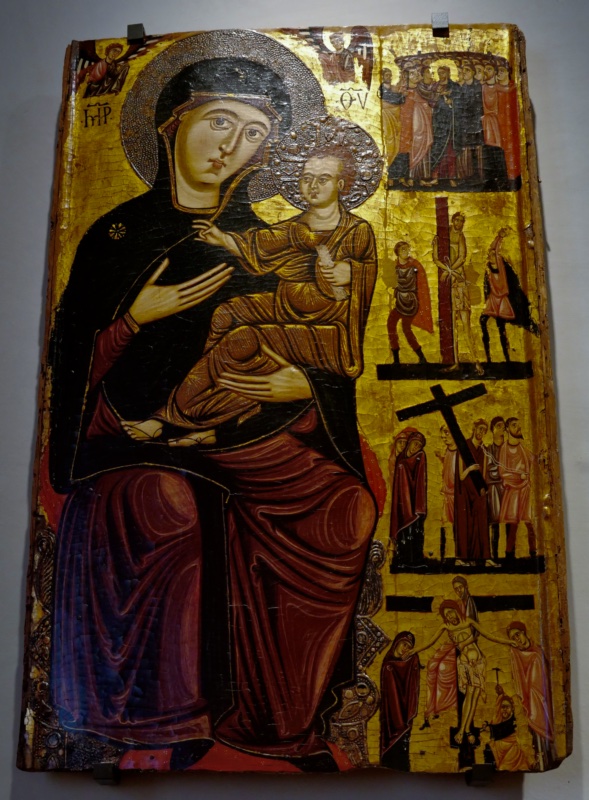
In the center, Mary sits on a monumental throne, draped in a dark blue cloak edged in red that falls around her body in the rigid, solemn poses typical of the Pisan Byzantine style. The Child, blessing with his right hand, rests on his mother’s left knee, while she solemnly points to him, emphasizing his theological role as Savior. Two angels on either side, in symmetrical positions, watch over the sacred pair: the one on the right in reverence, the one on the left perhaps in adoration, with golden robes and stylized wings that accentuate the sacredness of the image.
Below and on either side of the throne, four episodes from the Passion of Christ unfold, arranged in narrative panels to reinforce the link between the Nativity and Redemption, a common theme in medieval devotion. From right to left (or top to bottom): the Kiss of Judas, the Flagellation, the Carrying of the Cross, and the Lamentation over the Dead Christ, featuring stylized figures with dramatic gestures and vivid colors against a punched-gold background. These scenes, rendered with an emerging Gothic linearity, reflect influences from Lucca and Pisa, showcasing Enrico’s mastery in condensing complex narratives into small spaces.
The surface is dominated by shaped and punched gold, which creates effects of divine light and illusory depth, while the tempera defines sharp contours and saturated colors (reds, blues, greens), typical of 13th-century Italian panel painting. The Greek inscriptions MP ΘY (Mother of God) on the sides of the Virgin’s halo and IC XC on the Child confirm the Byzantine iconographic origin, adapted to local tastes with greater narrative emphasis. The attached image corresponds faithfully to this description, showing the hierarchical composition and details of the Passion scenes.
Enrico di Tedice, known for his crucifixes and altarpieces (such as the one at San Giovanni alla Vena in Pisa), represents the transition from rigid Byzantinism to narrative Gothic in Tuscany, influenced by the schools of Lucca and Siena. This work, likely intended for an altar or private devotion, exemplifies how the Enthroned Madonna became a vehicle for contemplating the Passion, stimulating popular piety in the 13th century. Its preservation at the Bargello makes it a key reference point for the study of pre-Giottesque painting.
Deposition from the Cross
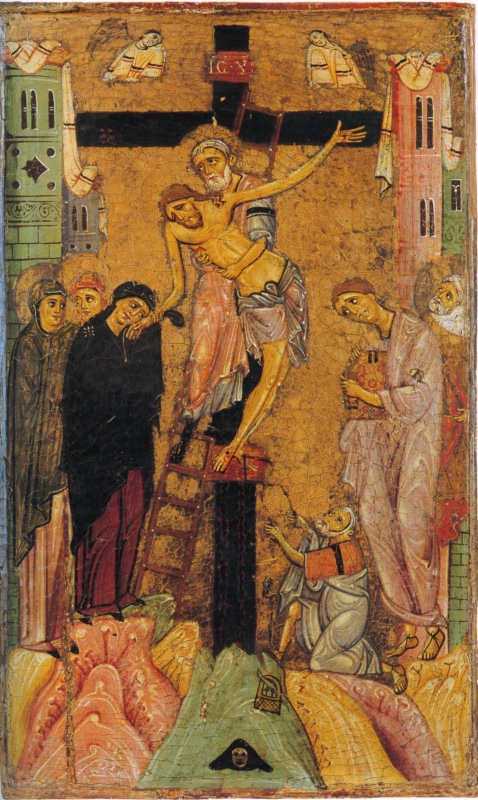
At the center of the composition, the lifeless body of Christ dominates, having been taken down from the cross in a moment of intense emotional pathos, typical of the theme of the Deposition within the context of the Passion. Christ is depicted as Christus patiens, with his head reclined on his right shoulder, his eyes closed, and his body slightly bent, expressing suffering and death through a pale complexion and realistic anatomical details such as the wounds on his feet (pierced by a single nail, echoing the crosses of Giunta Pisano) and rivulets of blood flowing from his hands and side. On either side, mourning figures—including the Virgin Mary, St. John the Evangelist, and likely Mary of Cleophas or other Marys at the foot of the cross—surround the body, with expressive gestures of grief: hands raised in despair, faces contorted with pain, arranged in a symmetrical rhythm that guides the gaze toward the Savior. This composition derives from the Byzantine tradition as interpreted by the Pisan school, emphasizing the human drama of Christ’s sacrifice.
The surface is covered with a punched gold ground, which creates a celestial aura and reflects light to accentuate the sacredness of the scene, while the tempera renders volumes with delicate shadows and fluid folds in the drapery, as in Christ’s loincloth and the figures’ robes. Enrico di Tedice, active in the second half of the 13th century, adopts a style inherited from Giunta Pisano but with more naturalistic accents: the anatomies are rendered with subtle chiaroscuro, the oval and melancholic faces show incipient Gothic influences, and the elongated proportions lend a sense of monumentality despite the panel’s small size.
Restoration work has likely revealed details such as the tempera mixture on parchment applied to the panel, a technique common in Pisan painted crosses.
This work is part of the rich collection of painted crosses at the Museum of San Matteo, the largest in the world, where Enrico di Tedice emerges as an innovative follower of the local school, a bridge between the 12th-century Christus triumphans and the dramatic expressiveness of the late 13th century. The panel reflects the iconographic evolution in Pisa, from the triumphant Christ to the suffering Christ, responding to lay devotion and liturgical processions; its attribution is based on stylistic affinities with other signed or workshop panels, such as crosses from San Martino in Kinzica or San Benedetto. For a direct analysis, a visit to the museum reveals the brilliance of the gold and the fineness of the details, which are lost in digital reproductions.
Madonna and Child with Two Angels
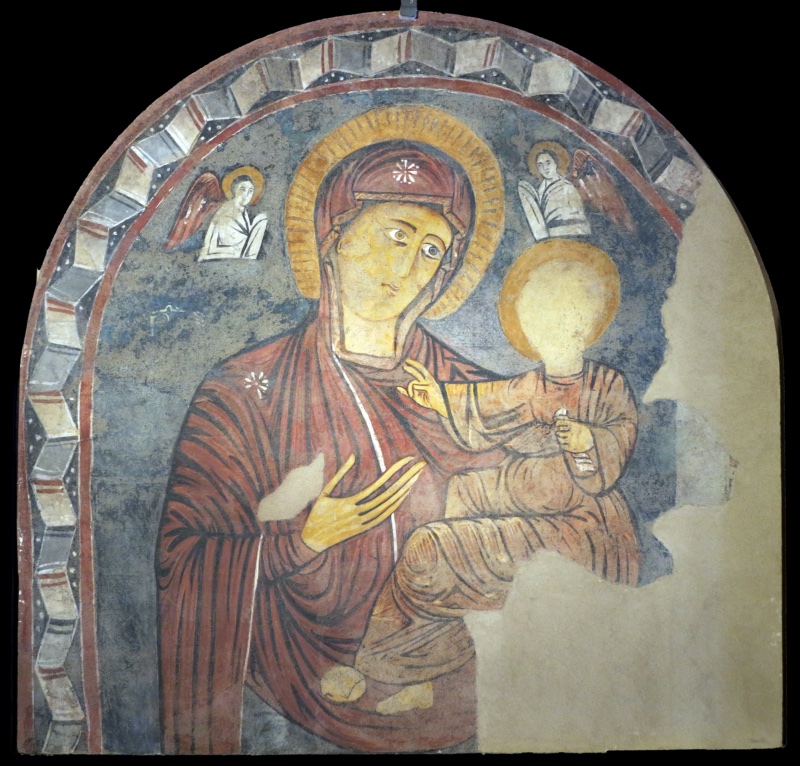
The work depicts the Virgin Mary seated on a throne, in a frontal and solemn pose, holding the blessing Child Jesus in her lap, surrounded by two angels on either side who accentuate the regal solemnity of the scene. This compositional structure, typical of the Madonna in Majesty, emphasizes the divine centrality of the mother-son pair, with the Virgin occupying the visual focal point and the two symmetrical angels serving as a heavenly retinue, evoking the Byzantine Eleusa adapted to the Italian context. The figures are stylized in rigid, symmetrical poses, with slow gestures and wide eyes that gaze directly at the viewer, creating an effect of sacred presence and timelessness that invites devotional contemplation.
The dimensions of the fresco suggest a likely wall-mounted origin, detached and transferred to the museum, and its attribution to Enrico di Tedice—a Pisan painter active in the second half of the 13th century—is based on stylistic comparisons with other works such as the Madonna di San Michele in Borgo in the same museum.
Executed as a detached fresco, the work features a gold background typical of the Italo-Byzantine tradition, symbolizing divine light and isolating the figures from the earthly world, while the drapery of the garments falls in geometric, rigid folds, accentuating volume through sharp shadows and intense hues of blue, red, and white. Enrico di Tedice employs a flat yet effective modeling, with light skin tones and idealized features that reflect the Pisan courtly aesthetic, influenced by models from Ravenna and Lucca, but with greater attention to naturalism in the children’s faces and the delicate hands of the Child. This technique, which prioritizes narrative clarity over illusionistic effects, responds to the devotional context of 13th-century Pisan churches, where frescoes were intended to communicate theological truths even to illiterate worshippers.
The dating to around 1250 places the work during the artist’s mature period, at a time of transition toward more Gothic forms, visible in the angels’ slightly curved wings and the ornamental details of the throne. Enrico di Tedice emerges as a key figure in the pre-Cimabue Pisan school of painting, a bridge between Byzantine abstraction and nascent Giottesque innovation, working in a vibrant environment like Pisa, a maritime crossroads of Eastern influences. This fresco, likely originally from a local church such as Santa Maria Maddalena or a similar setting, attests to the role of the Madonna and Child as a central Marian icon in 13th-century Pisan worship, linked to confraternities and popular devotions. Its preservation at the Museum of San Matteo, which houses Pisa’s medieval heritage, makes it a key reference point for studying the evolution of sacred iconography in Tuscany, highlighting how artists such as Tedice contributed to spreading a solemn yet accessible visual language.
Madonna and Child
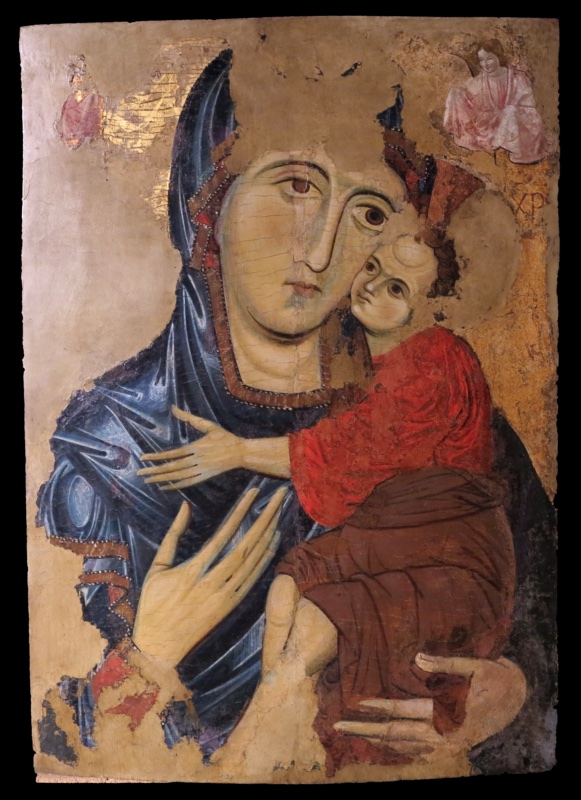
The work depicts the Madonna and Child, a classic motif in 13th-century Italian medieval painting, attributed to Enrico di Tedice, a Pisan painter active in the second half of the 13th century. Created around 1250 using tempera on wood, it comes from the church of San Michele in Borgo in Pisa and is now housed in the National Museum of San Matteo. The attached image faithfully corresponds to this famous Madonna, showing evident signs of wear and residual gilding that accentuate its archaic appearance.
The central scene is dominated by the figure of the Virgin Mary seated on a throne, holding the Christ Child on her lap in an Eleusa pose, typical of Byzantine iconography where the Mother presents the Son to the faithful with a blessing gesture. The Child, blessing with his right hand while holding a sacred book in his left, turns his gaze toward the Mother, creating an affectionate intimacy that foreshadows theological themes of redemption. In the background, two angels floating on either side of the Virgin add a celestial element, symmetrical and clad in flowing robes that frame the composition.
This Enthroned Madonna reflects the Byzantine influence on 13th-century Pisan painting, with the Virgin as Hodegetria (she who shows the way) guiding the faithful toward Christ. The implied throne and the gilding of the background evoke a divine space, while the robes, rich in stiff folds and decorated borders, emphasize royal majesty. The blessing Christ symbolizes his dual divine and human nature, a central theme in Pisan Marian devotion of the time.
Enrico di Tedice employs tempera on panel with a punched gold ground, a standard technique of the Italian Gothic period that creates a luminous and sacred effect through the use of gold leaf. The figures display stylized features—large, elongated eyes, fine noses, and thin beards typical of the Greek-Byzantine style—with geometric, rigid drapery that accentuates the solemn frontal pose. The large, expressive hands, with long fingers, convey grace and blessing, while the colors—deep blue for the Virgin’s mantle, red for the Child’s garments—vibrate against the gold, despite the visible gaps in the image.
The work shows evident signs of age-related damage: abrasions on the gilding, cracks, and flaking paint, especially at the edges of the mantle and on the angel’s wings, with the Virgin’s face partially restored. The surface appears dull in some areas, but the main features remain legible, likely indicating detachments or transfers from its original location in the church. These imperfections, visible in the attached image, do not compromise its stylistic recognizability.
Originating from the church of San Michele in Borgo, founded in the 11th century and modified in the 13th century, the work was part of the Pisan devotional furnishings, reflecting the vitality of the local painting school influenced by Byzantium and masters such as Giunta Pisano. Enrico di Tedice, documented in 1254, represents a bridge between the Romanesque and Gothic periods, with similar works at the Museum of San Matteo attesting to his activity. Now at the National Museum of San Matteo, it contributes to the study of pre-Giottesque Tuscan painting.