Maestro di Vico l'Abate
Historiographical Identity
The designation Maestro di Vico l’Abate belongs to the category of nomina ficta — critical conventions by which art historians assign a working identity to anonymous painters of the medieval period whose personal records have not survived, grouping their works under a name derived from the most distinctive or best-documented panel attributed to them. The name, which may be translated as “Master of Vico l’Abate,” was proposed and employed by scholars including Richard Offner, Luigi Coletti, Robert Oertel, Roberto Longhi, and Edward B. Garrison in the mid-twentieth century as an alternative to attributing the principal work in question, the dossale of San Michele Arcangelo from the church of Sant’Angelo at Vico l’Abate, to Coppo di Marcovaldo. The scholarly divergence was not merely nomenclatural but reflected a deeper disagreement about the stylistic identity and chronological placement of a body of work at the threshold of Byzantine-derived Florentine painting and early Tuscan individualism. Carlo Ludovico Ragghianti, one of the most authoritative voices in this critical debate, recognized in the Maestro di Vico l’Abate il più colto e squisito artista di questo periodo — a judgment that signals the exceptional artistic refinement behind this anonymous hand.
No documents survive recording the personal name, date or place of birth, family lineage, or precise dates of activity of this painter. Art historical convention, based on stylistic analysis and the dating of the principal attributed works, places his activity firmly around the middle of the thirteenth century, approximately between 1240 and 1270. The Fondazione Zeri catalographic database and the Italian Ministry of Cultural Heritage both record his biographical data simply as “sec. XIII” — the thirteenth century — reflecting the total absence of documentary evidence for his personal history. Similarly, no cause or date of death can be established; the convention of an anonymous master necessarily forecloses any certainty on this matter, and the name itself was constructed solely to provide scholarly coherence to a group of works sharing distinctive pictorial traits.
Family and Social Context
The absolute anonymity that characterizes the Maestro di Vico l’Abate means that no family records, genealogical documents, or archival notices have yet been identified bearing his personal name. This silence is not exceptional in the context of Tuscan painting around the mid-Duecento: the guild system, notarial culture, and ecclesiastical patronage networks of thirteenth-century Florence and its surrounding contado rarely generated documentary traces for painters of even considerable local prominence unless they were engaged in civic or notarial transactions. We know from the example of Coppo di Marcovaldo — the painter most frequently compared with, or confused for, the Maestro di Vico l’Abate — that documentary evidence for Florentine painters of this generation was sparse, largely incidental, and tied to military or contractual records rather than to deliberate artistic biography. The Libro di Montaperti (1260) names Coppo di Marcovaldo as a Florentine soldier, and it is precisely this kind of accidental archival survival that the Maestro di Vico l’Abate entirely lacks.
Within the social framework of mid-thirteenth-century Tuscany, the painter almost certainly belonged to the artisan class: highly skilled craftsmen who operated within organized workshop structures, often trained within family botteghe before apprenticing to established masters or joining the workshops of cathedral-building campaigns. The Lucchese painters of the Berlinghieri dynasty, Berlinghiero and his sons Barone, Marco, and Bonaventura, provide the closest social analogy: a family-based workshop tradition in which stylistic transmission occurred through kinship as well as formal apprenticeship. The attribution of some works in the Maestro di Vico l’Abate’s corpus to “Berlinghieri Barone” in the Fondazione Zeri catalogue reflects the persistent scholarly difficulty in separating the workshop traditions of Lucca from those of early Florentine painting, and implicitly suggests that this master may have trained within or adjacent to such a family-based bottega. In the Florentine context of the 1240s and 1250s, many painters active in the contado churches south of the Arno — in the territory of the Chianti and the Val di Pesa — were likely trained in city workshops before receiving commissions from rural ecclesiastical patrons.
The Berlinghieri influence that Ragghianti detected in the Maestro di Vico l’Abate’s formation was not merely stylistic but probably social and professional: the Lucchese tradition represented the most prestigious and technically sophisticated lineage of Italo-Byzantine panel painting in Tuscany during the first half of the Duecento, and any painter seeking access to the commissions generated by the Florentine church and its dependent rural parishes would have been obliged to absorb its conventions. The close relationship the Maestro di Vico l’Abate bears to the Maestro del Bigallo, another anonymous Florentine painter active around the same decades, further indicates the overlapping social world of workshop training and ecclesiastical patronage in which this master operated. The Maestro del Bigallo’s activity was connected to the confraternal institution of the Misericordia di Firenze, which administered the Bigallo oratory on the edge of the Florentine piazza del Duomo, suggesting the social proximity between professional painters and the city’s great charitable and religious institutions.
It is reasonable to suppose, given the social conventions of the period, that the Maestro di Vico l’Abate may have maintained a modest workshop somewhere in the Florentine orbit — perhaps not within the city itself but in one of the larger burghs of the contado — employing assistants or pupils whose hands may be distinguishable in some of the attributed works. The attribution of the Madonna con Bambino at the Monastero di S. Maria to this master, tentatively proposed by Ragghianti and accepted with reservations by subsequent scholarship, implies a workshop with sufficient range to serve both urban and rural ecclesiastical clients. The critical judgment that multiple hands were at work in the dossale now in San Casciano — a common feature of large-scale panel paintings of this period — is consistent with a bottega organization in which the master designed the principal figures while assistants executed subsidiary narrative scenes.[
Within the guild structure emerging in mid-Duecento Tuscany, painters were gradually being differentiated from other craftsmen as a distinct professional class, although the Arte dei Medici e Speziali, to which painters would eventually be formally affiliated in Florence, only acquired its definitive statutes later in the century. The Maestro di Vico l’Abate thus worked at a transitional moment in the social history of artistic production: a moment when the identity of the painter as a distinct artisan was taking shape, yet before the emergence of the guild documentation, contract records, and named workshop accounts that would, from the later Duecento onwards, begin to generate the biographical record of individual artists. This historical circumstance accounts both for the richness of his artistic legacy and the complete obscurity of his personal history, making him representative of an entire generation of highly skilled Tuscan painters whose names have been irrecoverably lost.
Patronage Networks
The most important patron context for the Maestro di Vico l’Abate is provided by the church of Sant’Angelo at Vico l’Abate, a small Romanesque ecclesiastical complex in the contado of Florence, administratively dependent on the Badia Fiorentina and lying within the territory of present-day San Casciano in Val di Pesa. The church’s connection to the Badia Fiorentina — one of the most ancient and prestigious Benedictine abbeys of Florence, founded in 978 by Willa, mother of Margrave Ugo of Tuscany1 — situates the commission for the dossale of San Michele within a monastic patronage network of considerable social and spiritual authority. Benedictine institutions in the Chianti and Val di Pesa during the thirteenth century were significant patrons of panel painting, maintaining decorated interiors as expressions of institutional identity, devotional practice, and territorial prestige in a landscape contested between rival Florentine and Sienese spheres of influence.
The titular dedication of the church to the Archangel Michael established the iconographic imperative for the principal commission: the large dossale depicting Saint Michael enthroned, surrounded by narrative episodes from the Archangel’s legendary life, was the focal devotional image of the church’s altar, commanding the visual and spiritual attention of both the monastic community and the lay population of the village. The Florentine diocese, to which Sant’Angelo a Vico l’Abate belonged according to the late-thirteenth-century records of the ecclesiastical tithes (elenchi delle decime), exercised ultimate ecclesiastical authority over the parish and would have been involved in approving major artistic commissions, even when the initiative and funding came from the dependent Benedictine community. The economic resources available to the Badia Fiorentina were substantial: as a royal foundation enjoying imperial and papal protection, it commanded significant revenues from its landholdings in the Chianti and was in a position to commission work from painters of genuine distinction rather than merely local craftsmen.
The patronage relationship between the Maestro di Vico l’Abate and his ecclesiastical clients conformed to the prevailing model of the period, in which the religious community acted as a collective patron, commissioning works through the authority of the abbot or prior and funding them from the common resources of the house, supplemented in some cases by donations from lay benefactors associated with the monastery. The commission for the Madonna con Bambino at the Monastero di S. Maria, attributed to this master by Ragghianti, suggests that his reputation extended beyond the immediate circle of the Sant’Angelo community and was known to other Florentine monastic houses seeking painters of comparable quality. The exceptional quality Ragghianti attributed to the Madonna dei Miracoli — calling it eccezionalmente impressionante — implies that the local monastic patrons recognized and valued his superior refinement, selecting him over less distinguished craftsmen available in the region.
The relationship of the Maestro di Vico l’Abate to the Maestro del Bigallo and to the patronage networks of Florentine confraternities is a secondary but significant dimension of his professional context. The Misericordia di Firenze and analogous confraternal organizations were among the most active patrons of devotional images in mid-Duecento Florence, commissioning painted panels for the oratories and tabernacles they maintained throughout the city and its surrounding territory. While no commission from a confraternal institution has been definitively assigned to the Maestro di Vico l’Abate, his stylistic proximity to the Maestro del Bigallo suggests that he circulated within the same patronage milieu and may have competed for or collaborated on commissions from these organizations.
The relationship between the Maestro di Vico l’Abate and the patronage world associated with the cult of Saint Francis1 represents another dimension worth considering, given his stylistic proximity to the Maestro del San Francesco Bardi. The Franciscan order, which established its major Florentine church at Santa Croce from the 1220s onwards, generated substantial demand for devotional images celebrating the life and miracles of Francis of Assisi, and the workshop tradition associated with the Maestro del San Francesco Bardi reflects a sustained and sophisticated response to this demand. The Maestro di Vico l’Abate’s acquaintance with this tradition — noted specifically by Ragghianti in relation to the Madonna di Rosano — indicates that he was not a purely monastic painter but maintained awareness of and contact with the iconographic innovations developing in the Franciscan orbit.
The rural churches of the Val di Pesa and Chianti contado constituted a dispersed but economically significant patronage landscape during the mid-Duecento, a period when the consolidation of Florentine territorial power over the surrounding countryside was accompanied by a sustained program of ecclesiastical building, decoration, and furnishing. These rural parishes, though modest in scale, were often supported by the revenues of prominent Florentine families who held rights of patronage (ius patronatus) over local churches, and such lay patrons could bring considerable resources to bear on the furnishing of their proprietary chapels and altars. The Maestro di Vico l’Abate’s activity in this territory thus situates him not merely within a monastic economy of patronage but within a broader nexus of ecclesiastical, civic, and seigneurial investment in sacred art that characterizes Tuscan culture in the decades preceding Cimabue’s transformative innovations.
Painting Style
The painting style of the Maestro di Vico l’Abate represents one of the most sophisticated expressions of Italo-Byzantine panel painting in Tuscany during the middle decades of the thirteenth century — a moment when the conventions inherited from Byzantine icon painting were being actively reinterpreted within a distinctly Italian aesthetic sensibility. His formation, as identified by Ragghianti, was essentially Lucchese and Berlinghieresque in its foundations: that is, he absorbed the technical and iconographic conventions developed in Lucca by Berlinghiero Berlinghieri and his workshop, which constituted the most advanced transmission point of Byzantine pictorial tradition into central Italian panel painting during the first half of the Duecento. This Lucchese inheritance is evident in the precise calibration of gold ground treatments, the elongated and hieratic proportions of his figures, the intricate patterning of drapery rendered through the Byzantine technique of chrysography — the use of fine gold lines to articulate the folds and highlights of garments — and the solemn, symmetrical organization of figural compositions around a dominant central axis.
Within the principal attributed work, the dossale of San Michele Arcangelo in trono e Storie di san Michele Arcangelo, the stylistic characteristics are most fully observable. The central figure of the Archangel Michael is depicted enthroned, wearing long robes in the Eastern liturgical manner, his posture and facial type derived from Byzantine models of the Comnenian and early Palaeologan tradition, yet interpreted with a freedom and psychological intensity that goes beyond mere imitation. The throne itself is rendered with careful attention to decorative richness — a complex architectural structure evoking Byzantine imperial iconography — while the Archangel’s hands hold the globus cruciger and a cross-staff with a precision that reflects careful study of Byzantine prototypes without slavish dependence on them. The surrounding narrative scenes, depicting episodes from the legendary history of the Archangel Michael — including his apparition to the Bishop of Avranches, his assistance in the preparation of a celestial throne, and Christ’s commission to Michael with a flowering rod — are organized in a series of lateral and upper registers that frame the central image, creating a unified devotional field that combines hieratic majesty with narrative accessibility.
The relationship between the central icon and the surrounding narrative scenes is handled with a compositional sophistication that distinguishes the Maestro di Vico l’Abate from his more pedestrian contemporaries. While many Florentine dossali of the period treat the narrative registers as secondary addenda to a dominant central image, this master integrates them into a coherent visual program in which the episodes are selected and composed to illuminate the spiritual significance of the central figure, creating a theological meditation on Michael’s role as celestial warrior, divine messenger, and psychopomp. The figures in the narrative scenes demonstrate a quality of linear energy and expressive concentration that, while still thoroughly Byzantinizing in its formal vocabulary, suggests an artist with genuine powers of invention rather than a competent workshop copyist. The use of a warm, resonant gold ground — achieved through careful preparation of the panel surface with bolo armeno and multiple layers of gold leaf — creates the luminous atmosphere characteristic of the most refined Duecento panel painting, in which the sacred figures appear not in earthly space but in an eternal, immaterial light.
In the Madonna con Bambino attributed to him — the panel now at the Monastero di S. Maria described as the “Madonna dei Miracoli” — the stylistic personality of the Maestro di Vico l’Abate is expressed in a more intimate register. The Virgin is depicted half-length (imago clipeata) with the right hand raised in a gesture of benediction, a type derived from Byzantine Hodeghetria icons but substantially reworked in the direction of greater corporeal solidity and emotional immediacy. The aureoles are rendered in yellow, and the faces and garments in warm brown tones that Ragghianti singled out as characteristic of this master’s chromatic sensibility — a palette that, compared with the cooler, more silvery tones of Coppo di Marcovaldo, reveals a distinct temperament and perhaps a distinct training context. The quality of the execution in this panel was so exceptional that Ragghianti described it as “eccezionalmente impressionante,” a judgment that has been widely endorsed in subsequent scholarship.
The relationship between the Maestro di Vico l’Abate’s style and that of the Maestro del Bigallo is one of the most instructive in the complex web of stylistic adjacencies that characterizes Florentine painting of this period. Both masters share the Berlinghieresque substratum, yet their individual responses to that common inheritance differ in significant ways: the Maestro del Bigallo tends toward a harder, more schematic rendering of drapery and a somewhat more rigid treatment of facial types, while the Maestro di Vico l’Abate introduces a greater subtlety in the modulation of surface textures and a more animated quality in the disposition of secondary figures. This comparative refinement is what underlies Ragghianti’s assessment of the Maestro di Vico l’Abate as the “most cultivated and exquisite” artist of his generation — a judgment that places him above both the Maestro del Bigallo and the Maestro del San Francesco Bardi in terms of formal elegance and intellectual sophistication.
The Maestro di Vico l’Abate’s treatment of the Majestas type — whether applied to the enthroned Archangel of the Sant’Angelo dossale or to the Virgin of the Madonna dei Miracoli — reveals a consistent approach to the problem of representing divine authority in pictorial form. In each case, the central sacred figure occupies an elevated, symmetrical position within the panel, surrounded by indicators of celestial rank — throne, halo, liturgical vestments, symbolic attributes — while the spatial setting is reduced to the most schematic essentials, avoiding all illusion of earthly place in favor of the timeless, placeless domain of sacred image. This approach reflects the theological aesthetics of medieval Christian art, in which the icon does not represent an event occurring in time and space but manifests a spiritual reality that transcends both — yet the Maestro di Vico l’Abate inflects this theology with a warmth and immediacy that prevents his figures from becoming purely abstract symbols.
The technical execution of the attributed works reveals a master with thorough command of the panel-painting craft as it was practiced in mid-Duecento Tuscany. Panels were prepared with multiple layers of gesso sottile and gesso grosso applied over a linen ground (tela) glued to the wooden support — typically poplar (pioppo) in the Florentine area — creating a smooth, luminous surface capable of supporting the finest detail in the application of pigments mixed with egg tempera. The gold grounds were prepared with particular care, and the tooling of the gold surface — the creation of punched or incised decorative patterns in the halo and background — is executed with the precision and variety that characterize a master accustomed to the highest level of craft.
Artistic Influences
The foundational artistic influence on the Maestro di Vico l’Abate was the Lucchese Berlinghieri tradition, which constituted the primary channel through which Byzantine pictorial conventions were transmitted into Tuscan panel painting during the first half of the Duecento. Berlinghiero Berlinghieri and his son Bonaventura — documented in Lucca between the 1220s and 1270s — had developed a distinctive synthesis of Byzantine icon painting and Italian craftsmanship that achieved a remarkable degree of formal refinement, as evidenced by Bonaventura’s signed St. Francis altarpiece at Pescia (1235), the earliest dated Italian panel painting bearing a painter’s signature. The characteristics of this tradition — the elongated proportions, the precise delineation of features with a fine, expressive line, the elaborate patterning of drapery through chrysography, the warm chromatic scale with browns, ochres, and vermilions playing against gold grounds — are clearly identifiable in the Maestro di Vico l’Abate’s works, confirming his formation within or close to this lineage.
A second formative influence was the Florentine Byzantine current associated with the mosaicists of the Baptistery of San Giovanni, who were active in the decoration of the great cupola from the 1220s onwards. Fra Jacopo, who signed the mosaic work in 1225, and his associates introduced into the Florentine pictorial environment a monumental, hieratic version of Byzantine figure style that deeply influenced the subsequent generation of Florentine panel painters. The mosaic workshop’s direct knowledge of Byzantine art — whether through imported objects, direct travel to Constantinople or Norman Sicily, or through the mediation of trained Greek craftsmen — gave Florentine painters of the mid-Duecento access to a richer and more varied range of Byzantine pictorial models than they could have acquired through the Lucchese tradition alone.
The influence of Coppo di Marcovaldo — or, more precisely, the stylistic world represented by works grouped under his name — is the most complex and contested dimension of the Maestro di Vico l’Abate’s artistic environment. The attribution of the Sant’Angelo dossale to Coppo by some scholars and to the Maestro di Vico l’Abate by others is not simply a disagreement about authorship but reflects the deep stylistic affinity between the two artistic personalities: both operate within the same Florentine Byzantine tradition, both employ the same technical resources, and both demonstrate a comparable level of formal ambition. If one accepts the distinction between the two as real rather than artificial — as Offner, Longhi, and Ragghianti did — then the relationship between them must be understood as that of approximate contemporaries working in the same tradition, each pushing it in slightly different directions: Coppo towards greater monumental severity, the Maestro di Vico l’Abate towards greater decorative refinement and chromatic warmth.
The Maestro del San Francesco Bardi represents a third major point of comparison and probable influence. The Bardi Master, active between approximately 1240 and 1270, produced the large panel of San Francesco for the Bardi Chapel at Santa Croce and a related group of works that combine Lucchese-Berlinghieresque foundations with a specifically Florentine monumentality and a sophisticated command of narrative illustration. Ragghianti’s identification of the Maestro di Vico l’Abate’s proximity to the Bardi Master in the Madonna di Rosano suggests a shared awareness of the narrative innovations being developed in the Franciscan orbit, where the demand for illustrated hagiographic panels stimulated the creation of sophisticated storytelling conventions. The Bardi Master’s achievement in organizing twenty narrative episodes around a central iconic figure of Francis — a compositional formula closely analogous to the structure of the Sant’Angelo dossale — may have provided a direct model for the Maestro di Vico l’Abate’s own handling of the narrative-iconic complex.
Byzantine art itself — transmitted not only through Lucchese and Florentine channels but potentially through direct contact with Byzantine works available in Tuscany — constitutes the deepest stratum of influence on the Maestro di Vico l’Abate’s pictorial sensibility. The Byzantine models most relevant to his work are those of the Middle Byzantine period (roughly 867–1204), particularly the Comnenian style of the twelfth century, which had achieved a remarkable synthesis of hieratic solemnity and linear elegance that remained the dominant model for Italo-Byzantine painting well into the Duecento. The specific iconographic types employed by the Maestro di Vico l’Abate — the enthroned Archangel with globus cruciger, the half-length Virgin with blessing gesture, the throne type with decorative architectural details — all have precise parallels in Byzantine icon painting and mosaic, confirming a thorough acquaintance with this tradition, whether through direct study of imported objects or through the mediation of the Tuscan workshops that had absorbed it.
Travels and Geographic Range
The geographic range implied by the attributions made to the Maestro di Vico l’Abate extends across the Florentine contado and into adjacent areas of Tuscany, suggesting a painter who did not confine his activity to a single locality but moved through the network of ecclesiastical institutions that constituted his patronage base. The primary locus of his known activity is the Val di Pesa — the valley of the Pesa river south of Florence, running through the heart of the Chianti contado — where both the principal attributed work (the Sant’Angelo dossale) and the Lorenzetti Madonna connected to the same church are located. This territory, lying between Florence and Siena, was during the mid-Duecento a zone of intense cultural interaction between the two cities’ artistic traditions, and a painter active here would have been exposed to both Florentine and Sienese pictorial currents — a circumstance that may help to explain the particular refinement that Ragghianti attributed to this master.
The attribution of the Madonna dei Miracoli at the Monastero di S. Maria to the Maestro di Vico l’Abate extends his presumed geographic range beyond the Val di Pesa, indicating that his works — or his workshop’s activity — reached monastic communities in other parts of the Florentine contado. Travel between ecclesiastical institutions was a normal feature of the professional life of Duecento painters: commissions from rural monasteries and parish churches typically required the painter to transport materials to the site, or to execute at least portions of the work in situ, particularly in the case of fresco decorations — though the Maestro di Vico l’Abate’s known corpus is entirely in panel painting, suggesting a primarily workshop-based production practice. The logistical infrastructure for this kind of professional mobility was provided by the road network of the Florentine contado, which, while rudimentary by modern standards, connected the major ecclesiastical sites along the Val d’Arno, the Val di Pesa, and the Chianti with sufficient regularity to sustain the movement of craftsmen and their materials.
The Lucchese component of the Maestro di Vico l’Abate’s formation raises the question of whether he undertook a formative period of travel or training in Lucca itself — the city that, in the first decades of the Duecento, represented the most sophisticated center of panel painting in Tuscany. If, as Ragghianti’s stylistic analysis implies, the master absorbed the Berlinghieresque tradition at close range rather than merely through secondary transmission, it is plausible — though unverifiable — that he spent time in the Lucchese workshop environment before establishing himself in the Florentine contado. Bonaventura Berlinghieri, the most accomplished of Berlinghiero’s sons, was documented as active in Lucca from the 1220s to the 1270s, and the period of his greatest productivity coincides with the probable years of formation of a painter active around 1250–1270.
The broader cultural geography of the Maestro di Vico l’Abate’s professional world extended to the exchange between Florentine and Sienese artistic traditions that animated Tuscan painting throughout the Duecento. San Casciano in Val di Pesa — the modern administrative center of the territory in which Vico l’Abate was located — lies almost exactly on the medieval boundary between the Florentine and Sienese spheres of ecclesiastical and political influence, and the church of Sant’Angelo was administratively part of the Florentine diocese while being geographically embedded in a landscape where Sienese artists were also active. The subsequent commission of the Madonna of Vico l’Abate from Ambrogio Lorenzetti in 1319 — indicating that the church continued to attract painters of the highest distinction — confirms that the ecclesiastical community at Vico l’Abate maintained connections with the Sienese as well as the Florentine artistic world. The Maestro di Vico l’Abate’s position at the intersection of these two traditions may have contributed to the particular quality of cultural refinement that set him apart from his purely Florentine contemporaries.
Principal Attributed Works
St Michael Archangel and stories from his legend
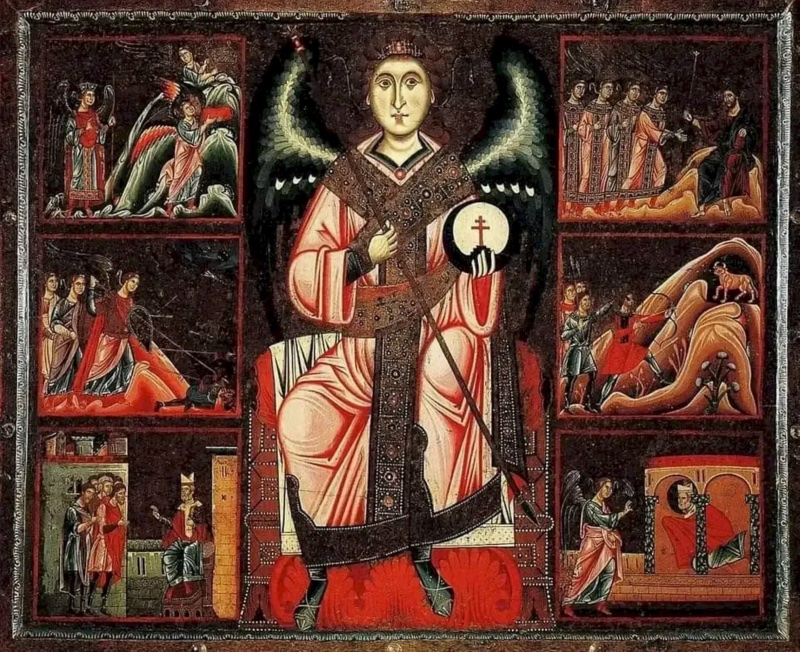
Dossale con San Michele Arcangelo in trono e Storie di san Michele Arcangelo is the eponymous work from which the master derives his scholarly name, and remains the most important and extensively discussed panel attributed to him. Dated to approximately 1255–1265 by the Fondazione Zeri and to the years around 1250–1260 by other authorities, the panel is executed in tempera on wood and measures 96 by 122 centimetres. It was originally placed on the altar of the church of Sant’Angelo a Vico l’Abate, functioning as the principal devotional image of a church dedicated to the Archangel Michael and connected to the Badia Fiorentina.
In 1829, the panel was removed from the altar and transferred to the sacristy of the church; it subsequently underwent restoration in 1937 by Gaetano Lo Vullo and again in 1976 by Lo Vullo and Ornella Casazza, who completed the work after Lo Vullo’s death. The central field depicts the Archangel Michael enthroned in full Byzantine ceremonial costume — a long tunic in the Eastern rite, imperial vestments, and a halo of gold — holding the globus crucifer in his left hand and a processional cross in his right, his gaze directed with solemn fixity toward the viewer in the classic manner of the Byzantine Pantokrator type transposed to an angelic subject. The throne is an elaborate construction evoking Byzantine palace architecture, with cushions, decorative stonework, and a footrest, all rendered with meticulous attention to ornamental detail that reflects the painter’s thorough acquaintance with Byzantine luxury arts.
Surrounding the central image is a series of narrative compartments depicting episodes from the legendary life of Saint Michael, drawn from the Legenda Aurea and earlier hagiographic sources: the Archangel’s apparition to the Bishop of Avranches instructing him to build the sanctuary at Mont-Saint-Michel; Christ’s commission to Michael with a flowering rod symbolizing his celestial authority; Michael’s assistance in the preparation of a heavenly throne; and other scenes from the Archangel’s role as celestial warrior and divine messenger. These narrative scenes are composed with a compression and clarity characteristic of the best Duecento panel painting, each figure precisely delineated against the gold ground, the actions conveyed through gesture and facial expression rather than through the elaborate spatial staging that would characterize later Trecento narrative. The work is presently housed in the Museo Giuliano Ghelli at San Casciano in Val di Pesa, having been transferred there as part of the broader consolidation of the sacred art patrimony of the Val di Pesa churches.
Madonna con Bambino (Madonna dei Miracoli)
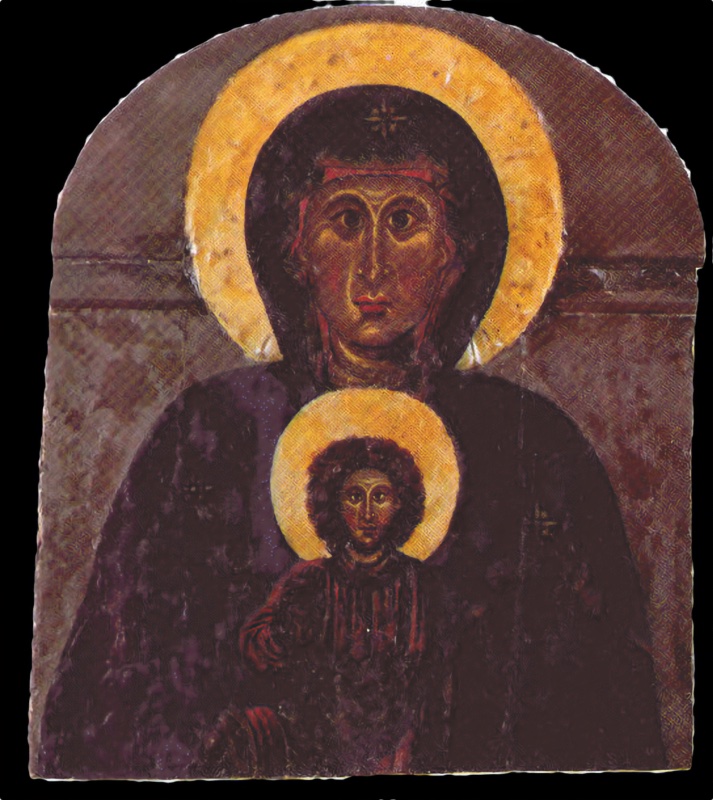
Madonna con Bambino (Madonna dei Miracoli), attributed to the Maestro di Vico l’Abate by Carlo Ludovico Ragghianti in 1972 and accepted with reservations by subsequent scholarship, is preserved at the Monastero di S. Maria and measures 80 by 67 centimetres. The work is executed in tempera on panel and dated by Ragghianti to the middle decades of the thirteenth century, approximately between 1240 and 1260. The Virgin is depicted in a half-length imago clipeata format, turned slightly toward the viewer in a posture that retains the frontal solemnity of the Byzantine Hodeghetria type while introducing a subtle warmth in the relationship between mother and child. The Child, seated on the Virgin’s left arm, is rendered in the Byzantine Emmanuele type — a small adult figure in long robes, holding a scroll, his right hand raised in the gesture of blessing — yet the painter inflects this type with a tenderness that looks forward to the more humanized depictions of the Virgin and Child that would characterize Tuscan painting from Cimabue onwards. Ragghianti’s description of the work as “eccezionalmente impressionante” reflects both its outstanding quality of execution and its significance as an attribution that extends our understanding of the master’s range and influence beyond the confines of the Val di Pesa. The aureoles are rendered in yellow, and the warm brown tones of the faces and garments, applied with exceptional precision in the egg tempera medium, convey the characteristic chromatic sensibility that distinguishes this master from his more strictly Byzantinizing contemporaries.
A third group of works associated with the Maestro di Vico l’Abate through the Fondazione Zeri and Italian national heritage catalogues includes further panels attributed tentatively to his hand or closely related workshop, among them works previously assigned to Berlinghieri Barone, to an anonymous personality close to Coppo di Marcovaldo, or to the Maestro del Bigallo. These attributions, contested in varying degrees by different scholars, reflect the methodological difficulty inherent in working with anonymous masters of the Duecento: when the only evidence is stylistic and the surviving documented comparanda are themselves attributed anonymously, every attribution carries an irreducible margin of uncertainty. The critical history of the Maestro di Vico l’Abate thus embodies one of the most fundamental challenges in the art history of medieval Italy: the reconstruction of individual artistic personalities from the material evidence of surviving works, in the absence of the documentary record that would allow us to anchor that evidence to named persons, dated commissions, and recorded social contexts. It is a challenge that, in the case of this master, scholarship has met with remarkable ingenuity and critical rigor, constructing from the silent evidence of paint and gold a portrait of one of the most accomplished and least-known painters of the Florentine Duecento.