Maestro della Maddalena
( 25% )
The artist known as the Maestro della Maddalena, equally referenced in scholarship as the Magdalen Master or the Master of the Magdalen, stands as one of the most consequential and yet enigmatically anonymous figures in the history of Florentine Duecento painting. His conventional designation, standardized in modern art-historical literature following the foundational work of the Swedish scholar Osvald Sirén in 1922, derives directly from a large altarpiece panel depicting a standing figure of Saint Mary Magdalen flanked by eight narrative scenes from her life, today preserved in the Galleria dell’Accademia in Florence. As is customary with Italian medieval maestri of this period whose given names have not survived in any documentary record, the artist is known exclusively through his surviving production, which the Uffizi, custodian of his Saint Luke the Evangelist, dates approximately to the years 1250–1300.
His activity is generally delimited by specialists to the last quarter of the thirteenth century, spanning the years circa 1265 to 1290, a period of intense artistic ferment in Florence that would culminate in the emergence of Cimabue and ultimately prepare the ground for the revolutionary achievement of Giotto. Far from being a peripheral craftsman, the Maestro della Maddalena was, according to the Treccani Enciclopedia dell’Arte Medievale, the head of one of the most important and productive workshops in Florence during the second half of the Duecento. His influence on subsequent generations of Florentine painters was considerable: the distinguished critic Miklós Boskovits has identified the painter Grifo di Tancredi as having received his training in this master’s studio, demonstrating the direct transmission of his workshop’s methods and visual language.
Family and Workshop Origins
The complete absence of documentary evidence pertaining to the Maestro della Maddalena’s family, birth, and personal life is a circumstance entirely characteristic of anonymous medieval craftsmen operating in thirteenth-century Italy, a period in which the institutional identity of the workshop frequently overshadowed, or entirely occluded, the biographical particulars of its directing master. The Uffizi records propose the approximate chronological span of Florence, circa 1250–1300, as the frame of his existence, a formulation that gestures at the probability that the artist was born around the mid-century, in a city undergoing dramatic political, economic, and cultural transformation.
The social world from which a painter of his prominence would have emerged in mid-thirteenth-century Florence was that of the artisan guild system, which regulated artistic practice through the Arte dei Medici e Speziali1, the physicians’ and apothecaries’ guild, to which painters belonged, since the grinding and trade of pigments placed them within the same commercial and corporative framework as those dealing in medicinal substances. In the urban fabric of Duecento Florence, such a craftsman’s family would have been embedded in a neighbourhood workshop economy, in which sons typically learned their father’s trade through direct apprenticeship and the transmission of formulaic models was as much a familial as a professional inheritance.
The economic precariousness of a painter’s existence in this period meant that the workshop was simultaneously a domestic and commercial enterprise: the artist’s household would have been organised around the rhythms of production, the sourcing of expensive pigments such as ultramarine and vermilion, and the maintenance of panel supports, gesso grounds, and goldsmiths’ tools. Given that the Maestro della Maddalena appears to have directed a substantial atelier, it is probable that this workshop included not only paid garzoni and apprentices but also members of the master’s own family circle, following the common Duecento practice in which family labour constituted a structurally indispensable component of artistic production. The Treccani encyclopedia confirms that the workshop under the Maestro’s direction was responsible for a broad and coherent body of works in which the intervention of collaborators is perceptible, particularly in panels of secondary quality, while the central and most demanding pictorial passages were reserved for the master’s own hand.
The training of Grifo di Tancredi within this workshop underlines the institutional seriousness of the enterprise: Grifo himself would go on to become a significant figure in late Duecento Florentine painting, suggesting that the pedagogical environment of the Maestro’s studio was one of genuine artistic rigour. No documentation survives to identify the master’s father, mother, or siblings, nor is there any notarial act, guild registration, or testamentary document that might illuminate his personal estate or familial alliances, a situation that is regrettable but not uncommon for painters active before the diffusion of more systematic civic record-keeping in the fourteenth century. What the surviving works themselves betray, however, is the formation of an artist who absorbed a deeply coherent set of pictorial traditions from a workshop environment, whether that of a family bottega or of an established Florentine atelier, and who possessed sufficient intellectual and creative ambition to transform those inherited conventions into a genuinely distinctive pictorial language.
The domestic circumstances of a Florentine painter of the Maestro’s generation would have been shaped by the extraordinary political instability of the city during the decades between approximately 1250 and 1290, years marked by the fierce conflict between the Guelph2 and Ghibelline3 factions that resulted in the repeated expulsion of entire social groups and the forcible restructuring of Florentine civic life. The Maestro’s apparent continuity of production in Florence, his works betray no obvious rupture suggesting displacement or extended exile, suggests that his family, whatever its social composition, was either politically neutral or sufficiently adaptable to survive the turbulence of the age without catastrophic consequences for the workshop.
The guild framework within which painters operated offered a degree of institutional protection and social continuity that transcended the volatility of civic politics, providing craftsmen with professional identity and corporate solidarity irrespective of the shifting fortunes of political factions. The workshop would have functioned as a training institution for the next generation: the master’s obligation to transmit his technical knowledge to pupils, boys typically beginning their apprenticeship between the ages of nine and twelve, was both a professional and, in many cases, a familial duty. In the broader context of medieval Florentine artistic culture, the family workshop was also an instrument of social mobility: a highly regarded master whose panels were sought by the city’s most important religious institutions could establish a family reputation that translated into modest but stable prosperity.
The evidence of the Maestro’s surviving corpus, encompassing works preserved as far afield as New York, Paris, New Haven, and Cambridge, implies a master who commanded considerable professional respect and whose products were sufficiently prized to be collected and preserved across several centuries. The spatial organisation of the workshop would have been concentrated in a single large room, probably on the ground floor of the family’s urban dwelling, where panels were prepared, gessoed, and painted in a shared environment in which master and assistants worked in close proximity. The consumption of expensive materials such as gold leaf, lapis lazuli, and lead white, all amply documented in the Maestro’s panels, presupposes an economic infrastructure capable of sustaining recurrent and substantial material costs, suggesting that either the workshop itself generated sufficient income from commissions or that the master benefited from advance payments and material provisions from his patrons.
The workshop’s position at the apex of Florentine panel painting in the last quarter of the Duecento was not achieved in isolation: it reflected the cumulative investment of a professional community, including pigment merchants, carpenters who prepared the wooden panel supports, and gilders who prepared the gold ground, all of whose contributions were essential to the production of the luxurious objects that bear the Maestro’s name today. In the absence of documentary record, the workshop itself, visible in the consistency of its technical practices, its compositional formulas, and its distinctive facial types, constitutes the most eloquent surviving testimony to the organised labour and collective intelligence that sustained the Maestro della Maddalena’s remarkable artistic career.
The question of whether the Maestro himself had biological descendants who continued his workshop traditions after his death is one that scholarship has not been able to resolve, given the complete absence of relevant archival material. The existence of a sizeable and internally differentiated corpus, in which several hands of varying quality have been identified, does suggest a workshop of some longevity and institutional depth, capable of sustaining production even during periods when the master may have been absorbed in major commissions. The attribution of Grifo di Tancredi’s formation to the Maestro’s studio raises the possibility that the transmission of the workshop’s methods proceeded through formal pedagogical relationships rather than blood kinship, a pattern increasingly common in the major urban workshops of later medieval Italy.
The social prestige enjoyed by the Maestro’s bottega in the final decades of the century is implicit in the range and ambition of its patrons: from the Franciscan order to the Servants of Mary, from likely Angevin courtly connections to wealthy lay donors whose kneeling figures appear at the base of altarpieces, the workshop served a clientele that spanned the full range of Florentine devotional culture. It is worth emphasising that in Duecento Florence, the distinction between a family workshop and a professional one was frequently blurred: the same spatial and social unit that constituted the family household also organised the labour, managed the accounts, and cultivated the relationships with patrons upon which the enterprise depended.
For the Maestro della Maddalena, the workshop represented the convergence of personal vocation, professional identity, and economic survival, a nexus of relationships that, however invisible to subsequent historiography, was the living engine behind the production of some of the most beautiful religious images in thirteenth-century Italy. The anonymity that obscures the master’s personal name has, paradoxically, made the workshop itself more visible: deprived of the biographical personality that documentary evidence might have provided, scholars have been forced to read the works themselves with unusual attentiveness, reconstructing from brushstroke, pigment choice, and compositional formula the collective intelligence of an atelier whose cultural significance is not diminished by its resistance to biographical recuperation.
The lasting impact of the Maestro’s formation of Grifo di Tancredi, whose own surviving works demonstrate the direct absorption of the workshop’s methods, confirms that the educational dimension of the studio was taken seriously and that the transmission of artistic knowledge was understood as a professional and cultural responsibility. In this sense, whether or not the Maestro had biological children, he was undoubtedly a kind of artistic father, the originating figure of a workshop tradition that shaped the development of Florentine painting in the crucial transitional decades between the Byzantine inheritance and the new visual culture inaugurated by Cimabue and Giotto. The family, broadly conceived to encompass the social organism of the workshop itself, remains the invisible but structurally essential foundation upon which the Maestro della Maddalena’s achievement was built.
Patronage Networks and Commissions
The reconstruction of the Maestro della Maddalena’s patronage network, undertaken by successive generations of art historians since Sirén’s initial attributions in 1922, reveals an artist whose services were sought by an exceptionally diverse range of commissioning bodies, spanning the major mendicant and conventual religious orders, lay confraternities, urban parish churches, and almost certainly members of the powerful secular elite that governed and administered late Duecento Florence.
The foundational document of this patronage history is the eponymous altarpiece itself, the Maddalena penitente e otto storie della sua vita today in the Galleria dell’Accademia in Florence, whose original commissioning institution has been the subject of sustained scholarly debate. For much of the twentieth century, scholarship assumed that the panel was created for a Franciscan4 or Dominican5 mendicant establishment, given the prominent role of the mendicant orders in promoting the cult of Mary Magdalen and sponsoring large narrative hagiographic panels of this type in central Italy.
The thesis defended by Kristen Nicole LaTulipe at the University of Alabama at Birmingham in 2014 represents the most significant recent contribution to this question, arguing with considerable documentary and iconographic force that the panel was originally commissioned for the Florentine convertite house of Santa Maria Maddalena6, an institution founded approximately in 1257 for the housing and reformation of repentant prostitutes. This interpretation fundamentally reframes the panel’s devotional function: rather than an image designed to inspire mendicant piety in a male conventual community, it was conceived as a mirror of identity for a female audience of convertite women, whose own experience of sin, penitence, and redemption was reflected in the Magdalen’s narrative trajectory as depicted in the eight flanking scenes.
The political context surrounding the commission of the Accademia panel further enriches our understanding of the Maestro’s patronage environment in the late 1270s and early 1280s. LaTulipe’s research emphasises the crucial role of the Angevin court in Florence during this period: Charles I of Anjou7 served as chief administrator of justice in the city, and in 1279 his son’s discovery of what were believed to be the relics of Mary Magdalen in Provence at Saint-Maximin-la-Sainte-Baume dramatically intensified the saint’s cultic prestige throughout the Angevin sphere of influence.
The rapid dissemination of Magdalen devotion from Provence to Naples and from Naples to Florence through the mediating agency of the ruling House of Anjou constitutes, in LaTulipe’s argument, a strong contextual vector for the commission of a major Magdalen panel in Florence at precisely this historical moment. The Angevin dynasty was a known and enthusiastic patron of Magdalen imagery and institutions elsewhere in their dominions, and their administrative presence in Florence would have created channels through which their aesthetic and devotional preferences could influence local patronage decisions. Whether the Maestro himself had direct contact with Angevin officials or whether the commission was mediated through the convertite community remains uncertain, but the confluence of the saint’s relics’ rediscovery, the Angevin political presence, and the creation of the panel in approximately 1280 is sufficiently suggestive to carry significant evidential weight.
Beyond the Accademia panel, the Maestro’s connection to the Florentine Servites, the Order of the Servants of Mary, whose mother church was the Santissima Annunziata in Florence, is documented by the provenance of at least two works. The Saint Luke the Evangelist now in the Uffizi Gallery came from the convent of the Santissima Annunziata, and eighteenth-century sources record the same provenance for the Accademia Magdalen panel, suggesting that the Maestro maintained a sustained working relationship with the Servite community. The Order of the Servants of Mary8 was founded in Florence in 1233 by seven Florentine merchants who had renounced their commercial activities to pursue a life of communal religious observance, and by the second half of the century their establishment at the Santissima Annunziata had become one of the most prestigious religious institutions in the city. That the Maestro should have produced works for this community aligns with the pattern of his broader patronage: he served institutions whose piety was characterised by intense devotion to the Virgin and to intercessory saints, a devotional sensibility perfectly served by his particular strengths as a painter of tender, hieratic Madonnas and vivid hagiographic narratives.
The altarpiece of the Virgin Enthroned between Saints Andrew and James with a Donor and Six Scenes now in the Musée des Arts Décoratifs in Paris represents the Maestro’s most complex surviving exercise in patron-directed iconography, in that it incorporates within its compositional programme the kneeling figure of a male donor, an extraordinary rarity in Duecento panel painting, whose specific identity unfortunately remains unestablished. The presence of this donor figure within the panel’s sacred space is a formal device that simultaneously serves the patron’s need for perpetual intercessory commemoration and confirms the social weight of the commission: only a patron of considerable means and social standing would have been in a position to negotiate the inclusion of a devotional portrait within a large public altarpiece. The choice of Saints Andrew and James as the flanking figures is itself potentially revealing: Saint Andrew was widely venerated throughout the Florentine civic world, while Saint James’s prominence in this period reflects both the ongoing importance of the pilgrimage route to Santiago de Compostela and the saint’s particular significance within the Angevin devotional world following the Provençal discoveries of the 1270s.
The dossal of the Virgin and Child Enthroned between Saints Leonard and Peter with Six Scenes from the Life of Saint Peter, now in the Yale University Art Gallery in New Haven, Connecticut, was almost certainly commissioned by a church or confraternity with a specific devotion to these two saints, and its narrative scenes from Saint Peter’s life imply a Petrine dedication that may be associated with a Florentine parish or urban oratory.
The tabernacle showing the Virgin and Child Enthroned with Saints Peter and Paul in the Metropolitan Museum of Art in New York represents a more intimate form of patronage, the private devotional object or small altar tabernacle intended for chapel or domestic use, and its survival in New York suggests a later history of collection and dispersal that speaks to the enduring prestige attached to works from the Maestro’s hand.
The involvement of the Maestro della Maddalena in the pictorial decoration of the Florence Baptistery, the most prestigious ecclesiastical building in the city and the symbol par excellence of Florentine civic and Christian identity, remains one of the most debated questions in the scholarship of late Duecento Florentine art. The hypothesis, advanced by Richter as early as 1930 and supported by several subsequent scholars, rests on the stylistic correspondence between the lively narrative manner, the attention to architectural detail, and the degree of formal innovation visible in certain sections of the Baptistery mosaics and the pictorial language of the Maestro’s documented panels.
The geographic spread of the Maestro’s commissions within and immediately beyond Florence is itself indicative of the reach of his workshop’s reputation: works attributed to his hand are preserved in Rovezzano (then a village near Florence), in Poppi in the Casentino (province of Arezzo), at San Donato in Torri near Compiobbi in the Florentine contado, and in Arezzo itself. This distribution pattern implies that religious institutions in the Florentine hinterland, as well as in the minor urban centres of Tuscany’s eastern valleys, looked to Florence as the primary source of high-quality devotional panel painting, and specifically to workshops of the calibre of the Maestro’s bottega.
The patrons of these provincial commissions, whether rural parish churches, small conventual communities, or local confraternities, would have been motivated by the prestige of a Florentine master’s work and by the quality of the pictorial language that his panels offered, which was appreciably more sophisticated than what could be obtained from local craftsmen. In each of these contexts, the Maestro’s role was not merely technical but devotional and social: his panels served as focal points for communal worship, individual intercession, and collective religious identity, fulfilling the fundamental liturgical and devotional functions for which medieval altarpieces were designed. The cumulative evidence of this patronage history reveals an artist who was genuinely central to the religious and artistic life of Florence and its surrounding territory in the last quarter of the thirteenth century, and whose workshop constituted a major institutional node in the network of production and distribution through which devotional images reached their audiences.
Painting Style
The pictorial style of the Maestro della Maddalena occupies a position of singular transitional importance in the history of Florentine Duecento painting, situated precisely at the threshold between the rigorous Byzantine formalism exemplified by his predecessors and the more naturalistic, emotionally expressive approach that would characterise the art of Cimabue and, ultimately, of Giotto. The Galleria dell’Accademia in Florence, custodian of the eponymous altarpiece, describes him as an artist capable of evolving from a still Byzantine-inflected idiom toward solutions updated on the lesson of Cimabue, his contemporary, and praises his remarkable narrative disposition and vivid expressive freshness, which manifest themselves above all in the small hagiographic scenes flanking the central figure.
This twin capacity, for hieratic grandeur in the central image and for lively narrative vivacity in the accessory scenes, is perhaps the most distinctive formal characteristic of the Maestro’s mature production, and it sets him apart from his Florentine contemporaries who tended to operate more consistently within a single formal register. The Treccani encyclopedia’s critical characterisation notes, with scholarly objectivity, that the master’s narrative vivacity and attention to detail serve to compensate for a certain formal disharmony in his figural types and the systematic repetition of physiognomic formulae, round eyes in lean, dry faces, high foreheads treated as a sign of intellectual dignity, and a generalised schema for the rendering of hands and drapery that, once established, was applied with characteristic consistency across the entire corpus. The colors of the Maestro’s panels are notably rich and intense, possessing an almost enamel-like quality, a chromatic richness described by the Treccani as “ricchi e intensi, quasi smaltati”, that connects his work to the broader tradition of Florentine panel painting as practised by Coppo di Marcovaldo and Meliore, and that can also be linked stylistically to the chromatic programmes visible in the Florentine Baptistery mosaics.
The drapery convention employed by the Maestro is one of the most immediately recognisable features of his hand, consisting of garments traversed by elongated, rigid highlights that follow the folds of the fabric in parallel, calligraphic lines rather than modelling the cloth in response to an underlying bodily form. This system of drapery, characterised by the Treccani as “solcate nel panneggio da lumeggiature allungate e rigide”, represents a Gothicising inflection of the Byzantine linear tradition, in which the gold or white highlights on clothing serve a primarily decorative and symbolic function rather than a naturalistic one.
The compositional organisation of the Maestro’s altarpieces follows a highly distinctive and readily identifiable schema: the central devotional image, typically a large standing or enthroned figure of the Virgin or of a saint, is crowned by a cuspidal tympanum, a triangular or pointed termination at the top of the panel that frames the sacred image like a Gothic arch and lends a distinctly architectural quality to the picture field. The Treccani scholars have noted that this cuspidal tympanum element may derive from the influence of Sienese painting, and specifically from the work of Guido da Siena, whose altarpiece formats provided a formal model that the Florentine workshop adapted and made its own. The flanking narrative scenes that accompany the central figure in the major vita panels, most elaborately in the Accademia Magdalen and the Yale dossal, are framed by thin architectural divisions and populated with small figures that inhabit schematic architectural settings consisting of simplified towers, arcaded loggias, and tiled floors rendered in summary perspective.
The figural typology of the Maestro’s central sacred figures is dominated by a distinctive formula for the Virgin’s face: a narrow, elongated oval with a high forehead, small lips, and eyes of a distinctive rounded form that several scholars have noted as a kind of personal signature recurring with remarkable consistency across works attributed to the master. This physiognomic formula, rooted in the Byzantine tradition of icon painting but subtly inflected by the local Florentine taste for greater plasticity, allows for a degree of emotional presence that transcends the purely schematic: the Madonna in the Accademia Triptych, the Virgin of Rovezzano, and the fragmental Madonna in the Metropolitan Museum all share a quality of concentrated, inward gravity that constitutes the Maestro’s most moving contribution to devotional painting.
In the figure of the Christ Child, the Maestro consistently employs the Byzantine formula of the Eleusa type, the Christ child who reaches toward the Virgin’s cheek in a gesture of tender human intimacy, modified in the later works by a slightly more relaxed and plastically convincing rendering of the child’s body that reflects the growing influence of Cimabue’s more naturalistic approach.
The gold grounds of the Maestro’s panels function not merely as decorative convention but as a sacred space coordinate: the flat, luminous gold that surrounds his figures creates a field of celestial light from which the holy presences emerge, transforming the physical surface of the panel into a theophanic threshold between the earthly and the divine. The use of gold extends to the highlighting of drapery with chrysography, fine gold lines that follow the ridges and folds of garments, a technique inherited from the Byzantine manuscript tradition that adds to the panels’ extraordinary material richness and connects them to the contemporary production of illuminated codices.
The narrative scenes flanking the central figures in the Maestro’s major altarpieces reveal an aspect of his artistic personality that is quite distinct from his more constrained central figures: in these small lateral compartments, the painter gives free rein to a lively and sometimes humorous visual intelligence, populating his compositions with gesticulating figures, expressive faces, and incidents of daily or miraculous life rendered with a directness and immediacy that seems to anticipate the narrative energy of early Trecento painting.
The eight scenes from Mary Magdalen’s life in the Accademia panel, covering episodes from the Feast at Simon’s house, the Noli me tangere, the Ascent to Heaven, and the Last Communion, demonstrate the master’s skill in constructing legible and emotionally engaging narrative sequences within very limited pictorial spaces, using compositional simplification and expressive gesture as the primary vehicles of meaning. The architectural settings in these scenes, though highly schematic by any naturalistic standard, perform the important function of establishing spatial zones within which the narrative action unfolds: slender towers and arcaded facades mark indoor and outdoor settings, while the figures’ scale in relation to these architectural props creates a visual shorthand for the hierarchical importance of the protagonists.
In the six scenes from Saint Peter’s life in the Yale dossal, a similar narrative economy is employed, demonstrating that the Maestro’s small-scale narrative manner was a systematic and deliberately cultivated aspect of his artistic method rather than an incidental feature of a single work. The use of inscription, in Gothic rather than Byzantine letterforms, within the central panels of the major altarpieces constitutes a further distinctive element of the Maestro’s visual language: these inscriptions, typically running along the edges of scrolls or books held by the central figures, address the viewer directly in language that is theologically deliberate and devotionally purposive.
The technical infrastructure of the Maestro’s panels reflects a high level of craft competence and adherence to the best workshop practices of his time. The wooden panel supports are prepared with multiple layers of gesso, a mixture of chalk or gypsum and animal glue, whose smoothness provides the ideal surface for the application of both gold leaf and pigments in the tempera technique. The gold ground is laid over the gessoed surface in thin sheets of beaten gold leaf, burnished to a reflective brilliance that captures and transforms the flickering candlelight of the ecclesiastical settings for which these panels were designed, creating the luminous effect of divine radiance that Byzantine and Duecento painters understood as the visual expression of heavenly light.
The pigments employed, lapis lazuli for the deep blues of the Virgin’s mantle, vermilion for robes, lead white for the brightest highlights, and malachite or verdigris for green passages, are consistent with the palette of the best Florentine workshops of the third quarter of the thirteenth century and confirm the Maestro’s access to the finest and most expensive coloristic materials available. The application of color in the Maestro’s panels follows the Byzantine method of modelling from dark to light: the deepest shadows are painted first in a saturated, relatively dark tone, and successive layers of lighter pigment are built up toward the highlights, with the final illuminations of lead white or gold creating the sharp, calligraphic accents that define the Maestro’s distinctive surface appearance.
The question of internal chronological development within the Maestro’s corpus, the possibility of distinguishing early, mature, and late phases in his artistic evolution, is one that scholarship has addressed with varying degrees of confidence. The Museo Thyssen-Bornemisza catalogue proposes a broad tripartite chronological sequence: an early phase characterised by works still closely tied to the Byzantine-Florentine tradition of Coppo di Marcovaldo; a middle phase in which the workshop’s characteristic formal vocabulary crystallises; and a late phase represented by the Saint Luke the Evangelist in the Uffizi and the Accademia Mary Magdalen, in which the influence of Cimabue becomes more pronounced.
The Uffizi itself, in its catalogue entry for the Saint Luke, confirms that the panel represents a mature work of the master, characterised by the slender, triangulated format with cuspidal termination and by a degree of plasticity and formal refinement that distinguishes it from the more rigidly Byzantine works of the earlier career. In this late phase, the Maestro’s handling of the face, still recognisably his own in its formulaic consistency, acquires a slightly greater sense of plastic depth, and the drapery folds, while retaining their characteristic rigidity of highlight, show a marginal loosening that may reflect the painter’s awareness of the innovations being introduced into Florentine painting by Cimabue in the 1280s.
The formal development visible across the corpus thus traces a coherent trajectory from the hieratic rigidity of Byzantine convention toward a more nuanced, emotionally present pictorial language, without however achieving the radical break with tradition that characterises the work of Cimabue and the younger generation: the Maestro della Maddalena remains, in the deepest sense, a transitional figure, one who expanded the possibilities of Florentine Duecento painting without fundamentally transforming its premises.
The balance between conservative formal fidelity and selective formal innovation that characterises the Maestro’s output is perhaps best understood as a professionally deliberate strategy rather than a simple mark of temperamental limitation. In a devotional culture that valued continuity with received visual tradition, in which the efficacy of a sacred image was understood to derive in part from its conformity with an established iconographic type, the workshop’s characteristic repetition of physiognomic formulae, compositional schemata, and coloristic conventions served a specific devotional purpose, signalling to the viewer the image’s conformity with an approved and recognisable devotional type. The Maestro’s innovations, his vivid narrative scenes, his dramatically expressive Gothic highlights, his architectural compositional framing, were thus incorporated within a conservative formal framework that guaranteed the image’s devotional legibility to its audience, producing a synthesis of innovation and tradition that was precisely calibrated to the needs and expectations of the late Duecento Florentine religious environment.
Artistic Influences
The most immediate and pervasive formative influence on the Maestro della Maddalena’s pictorial language was that of Coppo di Marcovaldo, the major Florentine painter of the generation immediately preceding his own, whose work established the dominant visual paradigm for Florentine panel painting in the middle decades of the thirteenth century. Coppo di Marcovaldo, born in Florence between approximately 1225 and 1230, and documented in activity until the 1270s, was the artist responsible for establishing the distinctive Florentine version of the Byzantine Maiestas Virginis type: the frontal, enthroned Virgin of monumental scale, her garments modelled in a rigorous linear pattern of chrysographic highlights, the Christ Child blessing on her lap, the whole image framed by the hieratic symmetry of Byzantine icon painting but rendered in the larger, more public format appropriate to altarpiece production.
Sirén’s foundational 1922 study, which first reconstructed the Maestro’s corpus, explicitly emphasised the apparent influence of Coppo di Marcovaldo as the defining characteristic of the early attributions, noting that the three Virgin and Child panels then assembled under the Maestro’s name in Berlin, Rovezzano, and Arezzo all shared with Coppo’s documented work a common formal vocabulary of frontal monumentality, chrysographic drapery, and iconic gravity. The Treccani encyclopedia confirms this assessment, noting that the colours of the Accademia Magdalen, rich, intense, almost enamel-like, have that characteristic tonality of Florentine painting that refers back to the panel work of Coppo di Marcovaldo and his generation.
Alongside Coppo, the painter known as Meliore di Jacopo, documented in Florence in 1271 and represented by a signed altarpiece now in the Uffizi, constitutes the second major formative reference point for the Maestro’s early stylistic formation. Meliore’s work, slightly more refined in its treatment of the figure than Coppo’s and somewhat more attentive to the decorative organisation of surface pattern, represents a parallel strand of Florentine panel painting in which the Byzantine inheritance is processed through a sensibility acutely attuned to the decorative possibilities of color and linear rhythm.
G. M. Richter’s important 1930 article in the Burlington Magazine, titled Megliore di Jacopo and the Magdalen Master, addressed directly the relationship between the two painters, arguing for a close association between the Maestro’s formal habits and those of Meliore’s documented oeuvre and suggesting that their respective workshops may have been in direct commercial and artistic contact. The Treccani’s own formulation is explicit on this point, stating that the Maestro’s surviving works reflect the modes of Coppo di Marcovaldo, Meliore, and Cimabue simultaneously, a remarkable summary that positions the Maestro as the meeting point of the three principal currents of Florentine panel painting in the Duecento.
The influence of Cimabue, the great Florentine master who was transforming the inherited Byzantine conventions into a new visual language of greater naturalism and emotional expressiveness during the very years of the Maestro della Maddalena’s mature activity, is particularly visible in the later phase of the corpus, notably in the Saint Luke the Evangelist in the Uffizi. Cimabue’s impact on Florentine painting in the 1270s and 1280s was seismic: his willingness to push the inherited Byzantine formulae toward greater plasticity, to introduce a sense of three-dimensional weight into drapery modelling, and to invest his Madonna types with a degree of psychological interiority that exceeded anything in the preceding tradition, constituted an artistic revolution that no painter working in Florence during this period could have failed to register.
The Galleria dell’Accademia’s catalogue entry for the eponymous Magdalen panel describes the Maestro as an artist capable of evolving “da un linguaggio di marca ancora bizantineggiante, come quello di Coppo di Marcovaldo, a soluzioni aggiornate sulla lezione di Cimabue”, articulating the precise arc of formal development that defines his career. The specific features of Cimabue’s influence that are most legible in the Maestro’s later work include a slightly greater softening of the facial modelling, a marginal increase in the plasticity of drapery, and a more flexible handling of compositional space in the central figures, all of which suggest sustained observation of the revolutionary panels that Cimabue was producing for the major Florentine churches in the 1280s.
The Byzantine tradition, transmitted to the Maestro not only through the mediation of Coppo and Meliore but also through the direct presence of Byzantine icons, ivory carvings, and manuscript illuminations in the Florentine ecclesiastical and commercial environment, constitutes the deepest and most structurally persistent layer of his pictorial formation. The Byzantine pictorial system, with its gold grounds signifying divine light, its frontal iconic figures, its symbolic rather than naturalistic rendering of space and anatomy, and its sophisticated coloristic language of layered tempera, was not merely a stylistic starting point for the Maestro but a profound epistemological framework for understanding what a sacred image was, how it functioned devotionally, and what obligations it placed on its maker.
The specific Byzantine model most directly relevant to the Maestro’s production was the type of the large, narrative vita icon, the icon in which a central image of a saint is surrounded by smaller scenes from the saint’s life, a type common in Eastern Mediterranean painting and transmitted to Italy through the commercial and ecclesiastical networks connecting Venice and the Adriatic coast with Constantinople. The structural organisation of the Accademia Magdalen panel, with its dominant central figure flanked by eight narrative compartments, derives directly from this Byzantine vita icon format, demonstrating that the Maestro’s engagement with the Eastern tradition was not merely stylistic but extended to the deep structural logic of how narrative and devotional functions could be combined within a single pictorial field.
The possible influence of Sienese painting, specifically of Guido da Siena, the major Sienese painter of the second half of the Duecento, has been noted by the Treccani in connection with the Maestro’s distinctive use of the cuspidal tympanum as the crowning element of his central figures. Guido da Siena’s altarpieces, several of which survive in Siena and in the surrounding territory, employ a similarly pointed or rounded upper termination that frames the sacred image with quasi-architectural definiteness, and the possible derivation of this element from Sienese practice suggests a degree of cross-fertilisation between the two major schools of Tuscan panel painting that has not always been adequately emphasised in the scholarship.
Florence and Siena, despite their fierce political rivalry, were connected by active trade and pilgrimage routes, and the movement of panels, craftsmen, and pictorial models between the two cities was a normal feature of artistic life in the Duecento: it is entirely plausible that the Maestro della Maddalena would have been aware of the most important altarpieces being produced in Siena and would have incorporated aspects of their formal vocabulary into his own workshop’s developing language. The broader context of Gothic innovation, the progressive infiltration of northern European formal ideas through the medium of French ivory carving, manuscript illumination, and architectural sculpture, also played a role in the Maestro’s stylistic formation, visible above all in the elongated, rhythmically patterned drapery highlights that Gothicise his Byzantine inheritance and link his work to the international artistic culture of the late thirteenth century.
Travels and Geographic Scope
The question of the Maestro della Maddalena’s travels, understood in terms of both the geographic range of his commissions and any journeys he may have made beyond Florence in the course of his professional activities, must be approached with the caution appropriate to an artist of whom no direct biographical documentation survives. The geographic distribution of works attributed to his hand or to his workshop provides the most direct evidence of the physical reach of the bottega’s activities: panels securely or plausibly attributed to the Maestro are preserved not only in Florence and its immediate environs but in Rovezzano, Compiobbi, Poppi in the Casentino valley, and Arezzo, suggesting a regular pattern of work in the Florentine contado and in the broader Arno valley and its tributaries extending toward the Apennine passes.
The Madonna painted for the church of San Michele at Rovezzano, a village then lying just outside the walls of Florence, would have required at most a short journey from the city workshop, and may represent a commission executed in the bottega and transported to its destination. The altarpiece now in the church of San Fedele at Poppi, in the mountainous Casentino valley some fifty kilometres east of Florence, represents a more ambitious provincial commission: Poppi was the chief town of the Guidi counts’ territory, and the presence there of a work attributable to one of Florence’s leading workshops in the 1280s testifies to the cultural aspirations of the minor territorial lords who governed the Casentino and who sought to adorn their local churches with images of a quality associated with the Florentine urban milieu.
Whether the Maestro made a journey to Rome, the most important destination for any thirteenth-century Italian painter seeking exposure to the most advanced pictorial ideas of the age, cannot be demonstrated on the basis of surviving evidence, but the possibility is not to be dismissed. The pontificate of Nicholas III (1277–1280) and the subsequent pontificate of Nicholas IV (1288–1292) were periods of intense artistic patronage in Rome, during which Cimabue himself visited the city and made contact with the Roman school of Pietro Cavallini, absorbing influences that would prove transformative for Florentine painting.
If the Maestro’s stylistic evolution in the late phase of his career reflects an awareness of Cimabue’s innovations, and if Cimabue’s innovations were themselves partly stimulated by exposure to Roman and Cosmati pictorial and mosaic practice, then it is possible, though not demonstrable, that the Maestro, like his more famous contemporary, may have made the journey to Rome that was virtually de rigueur for ambitious Italian painters of the later Duecento. The possibility of contact with Pisa and its artistic milieu deserves consideration as well: Pisan painting in the second half of the thirteenth century, represented above all by the work of Giunta Pisano and his successors, constituted an important parallel tradition that engaged with the Byzantine inheritance in ways both similar to and different from the Florentine approach, and the geographical proximity of Pisa to Florence made artistic exchange between the two centres a natural and ongoing phenomenon.
The hypothesis that the Maestro’s workshop may have contributed designs to the mosaic programme of the Florence Baptistery implies, if accepted, a form of professional mobility that did not require physical travel but did demand sustained engagement with a monumental architectural enterprise at the heart of the city. Working on the Baptistery mosaics would have placed the Maestro in direct contact with the techniques of large-scale mosaic composition, a medium he did not practice directly, as a panel painter, but whose visual language clearly left traces in the chromatic saturation and formal clarity of his painted panels.
The physical act of transporting large altarpiece panels from the Florence workshop to provincial destinations, to Poppi, to Arezzo, to Rovezzano, would itself have constituted a form of professional travel, requiring the master or his assistants to oversee the safe conveyance of fragile, valuable objects over unpaved roads and through terrain that could be treacherous in poor weather. Medieval altarpieces were typically transported in protective coverings of cloth and basketwork, and their installation in the destination church frequently required the physical presence of the workshop: the panel would need to be positioned on the altar or in the designated retablo frame, any finishing touches applied to the gilding or paint layers that may have been damaged in transit would need to be made on site, and the practical requirements of the installation, the securing of the panel, the provision of lighting, the arrangement of the liturgical surroundings, would need to be coordinated with the commissioning institution. For a workshop as productive and geographically dispersed as the Maestro della Maddalena’s, these logistical obligations would have constituted a regular and significant aspect of the professional routine, requiring a degree of physical mobility and practical organisation that is easy to underestimate when viewing the finished objects in the museum or gallery.
Death and Historical Legacy
The date and cause of the Maestro della Maddalena’s death are, like the circumstances of his birth and family, entirely unrecorded in any surviving document. The Uffizi’s approximate chronological designation, Florence, circa 1250–1300, suggests that the artist’s active life fell entirely within the second half of the thirteenth century, and the apparent cessation of attributable works around 1290 provides the latest plausible boundary for his activity. No source of the period records his passing; no funerary inscription or testamentary document commemorates his name; and his identity dissolves, as it had emerged, in the anonymity of a cultural moment that had not yet developed the biographical consciousness that would lead subsequent generations of Florentine citizens to record and celebrate the lives of their artists.
Penitent Magdalen with 8 scenes from her life
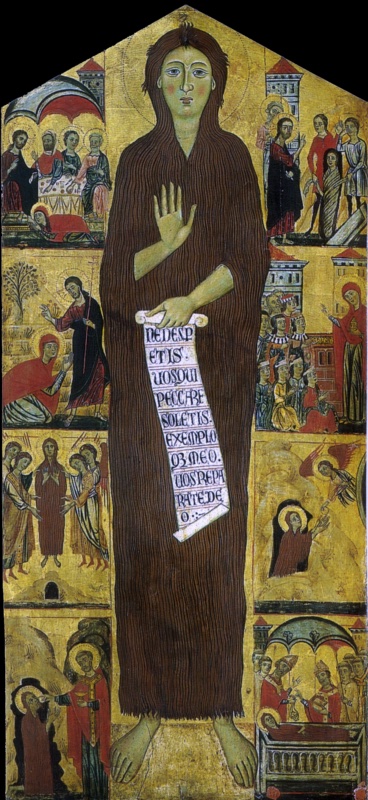
Saint Mary Magdalene the Penitent and Eight Scenes from Her Life is a cusp-topped panel (with a pointed top) painted in tempera and gold on wood, dating from around 1280–1285, and housed in the Galleria dell’Accademia in Florence (Inv. 1890 no. 8466).
At the center stands the monumental figure of Mary Magdalene, clothed only in her very long dark brown hair, which envelops her entire body like a natural cloak—a traditional iconographic attribute of the hermit saint derived from the Provençal hagiographic tradition.
In her left hand she holds a scroll with a Latin inscription addressed directly to the faithful: “Pedespe[tis] uos qui peccabe/soletis exemplo meo / dos repentate de[o]” — an invitation to do penance and follow her example as a redeemed sinner. The background is entirely gilded, in accordance with the Byzantine-style tradition still alive in Florentine painting of the late 13th century.
The panel’s original liturgical function was likely to be displayed on the jubé of a church, the partition wall separating the nave for the laity from the presbytery reserved for the clergy. Mary Magdalene, the converted sinner, thus directed her message of redemption directly to the community of the faithful.
The eight scenes from the life of Mary Magdalene
The eight vignettes are arranged in four panels on each side, four to the right and four to the left of the central figure, read from top to bottom. The sequence, as reconstructed by the Galleria dell’Accademia, is as follows:
-
The Washing of the Feet (top right) This is the Gospel moment in which Mary Magdalene, having entered the house of Simon the Pharisee, prostrates herself at Christ’s feet, wets them with her tears, dries them with her hair, and anoints them with perfumed ointment (Luke 7:36–50). This scene establishes the theme of conversion and repentance that runs throughout the panel.
-
The Raising of Lazarus (second panel on the right) It depicts the miracle performed by Christ in Bethany: the raising of Lazarus, the brother of Mary and Martha. Mary Magdalene is present as a witness to the miracle, underscoring her special bond with Jesus.
-
Noli me tangere (third panel on the right) This is the scene of the risen Christ’s appearance to Mary Magdalene in the garden of the tomb (John 20:11–18). Christ, recognized by the saint, tells her not to touch him (“Noli me tangere”). It is the culminating moment of her role as the first witness of the Resurrection.
-
Preaching in Marseille (fourth panel on the right) According to Provençal hagiographic legend, after Christ’s death, Mary Magdalene arrived by ship on the coast of Provence and evangelized Marseille by preaching before the crowd and the city’s prince. The scene depicts the saint in the act of preaching, with listeners listening.
-
The Saint’s Ecstasy (top left) According to Jacopo da Varagine’s Golden Legend, Mary Magdalene spent the last thirty years of her life in solitary penance in a cave in Provence (Sainte-Baume). Every day, at the hour of the canonical prayers, she was lifted up to heaven by angels in mystical ecstasy, nourished by their celestial music.
-
Mary Magdalene Nourished by an Angel (second panel on the left) Complementing the previous scene, this depicts the episode in which the saint, deprived of earthly sustenance during her hermitic life, receives food directly from an angel. This episode is also drawn from the Golden Legend.
-
The Saint Receiving Communion from Bishop Maximin (third panel on the left) Magdalene, sensing the end of her earthly life approaching, is led by angels to the church in Aix-en-Provence, where Bishop Maximin—one of her traveling companions from the Holy Land—administers Communion to her. The scene takes place before the altar and has a strongly liturgical character.
-
The Saint’s Funeral (bottom left) The final scene depicts the death and funeral of Mary Magdalene, presided over by Bishop Maximin himself. Critics have noted that this episode seems to evoke the extraordinary historical event of 1279–1280, when Charles of Anjou oversaw the discovery and transfer of the saint’s relics to the church of Saint-Maximin in Provence.
This reference has helped date the panel to the ninth decade of the 13th century.
A comparison with contemporary works reveals how the Master of Mary Magdalene moves with great awareness between tradition and innovation. The central figure of Mary Magdalene, frontal and hieratic, still reflects the solemnity of Byzantine icons; the narrative scenes, on the other hand, display a compositional freedom and a rendering of architectural space that anticipate Cimabue’s explorations and foreshadow Giotto’s achievements. The dating to 1280–1285 places this panel at a crucial moment in the history of Florentine art, just a few years after the creation of Cimabue’s Maestà for Santa Trinità.
Saint Luke the Evangelist
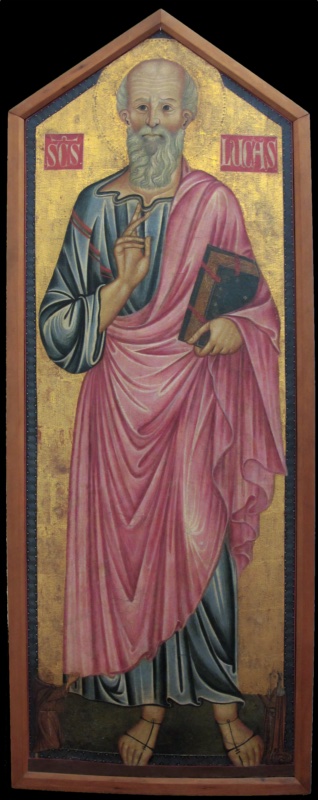
The Saint Luke the Evangelist in the Uffizi is one of the most refined works by the Master of the Magdalene and stands out from the panel in the Accademia for its monumental composition and the exceptional quality of the drapery.
The painting is a cusp-shaped panel with a triangular top, measuring 132 × 50 cm, executed in tempera and gold on wood and dated to around 1275–1290.
The vertical and slender form, with the cusp reminiscent of 13th-century altar panels, lends the figure of the saint a solemn yet elegant presence. The background is entirely gilded in the Byzantine tradition. The panel came from the convent of the Santissima Annunziata in Florence, belonging to the Servants of Mary, although its original destination is not entirely certain.
At the center of the composition, in a frontal, full-length pose, is depicted Saint Luke the Evangelist, identified by the inscription painted on either side of the halo: S(AN)C(TU)S LUCAS.
He is portrayed as an elderly man, with snow-white hair and beard and a receding hairline—a conventional attribute reserved for scholars and philosophers in the medieval iconographic tradition, which underscores his nature as an intellectual inspired by the Holy Spirit.
In his left hand he holds a bound book—with a dark cover decorated with gold studs—alluding to his Gospel, of which he was the author. With his right hand, raised to chest height, he performs the sign of blessing in the name of Christ, with his fingers arranged according to the traditional liturgical formula.
Although depicted facing forward, the saint’s gaze is slightly turned to the left, a posture that could indicate the panel’s original orientation relative to a side altar in a church, toward which the saint was turned.
Saint Luke’s attire is of great refinement.
He wears a light blue-gray tunic underneath, over which is draped a large carmine-pink pallium that falls in soft, rhythmic folds over his body. Narrow red stripes, known as angusticlavi—a decoration typical of Roman and Byzantine clothing, a sign of distinction and rank—are visible on the shoulder of the tunic. The rendering of the drapery, with its ripples never rigidly schematic but animated by a naturalistic sense, has been noted by critics as one of the work’s highest-quality elements, bringing it close to the mature painting of Cimabue.
At the bottom, at the feet of the figure of Saint Luke, are depicted two small figures of praying devotees—a friar and a nun—depicted in very small proportions compared to the saint, in accordance with the customary medieval hierarchical principle whereby sacred figures are larger in scale than the faithful. The two figures wear thehabit of the Franciscan Order. This detail has fueled debate regarding the panel’s original destination: although it came from the convent of the Servants of Mary, the presence of Franciscan donors suggests that the work may have been originally commissioned for a Franciscan church or institution, and only later transferred to the Santissima Annunziata.
Compared to the Penitent Magdalene in the Accademia (1280–1285), the Saint Luke is generally considered a slightly later and stylistically more mature work.
Critical analysis pioneered by Osvald Sirén (1922) identified this panel as the culmination of an evolutionary process in which the painter gradually moved beyond the rigidity of the Greek Mannerist tradition to approach the monumentality of Cimabue. The painting was rediscovered in 1935, when it was unearthed beneath an 18th- or 19th-century overpainting that had completely obscured it.
Madonna and Child Enthroned with Saints Andrew and James, a Donor, and Six Stories
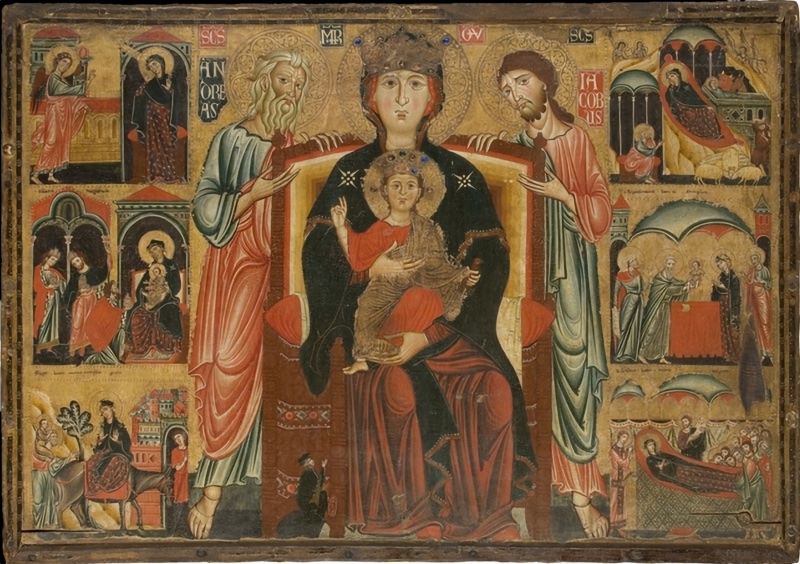
The Paris panel is considered by many scholars—including Osvald Sirén, Hautecoeur, Toesca, and Offner—to be the most beautiful and significant work in the entire oeuvre of the Master of the Magdalene. Its full title in the Zeri catalog is: Madonna and Child Enthroned between Saint Andrew, Saint James, and a Donor, the Annunciation, the Nativity of Jesus, the Adoration of the Magi, the Presentation of Jesus in the Temple, the Flight into Egypt, and the Dormition of the Virgin.
The work is a paliotto—that is, a horizontal altar panel intended to cover the front of the altar—in tempera and gold on fir panel, measuring 93 × 133 cm.
The composition is divided into three parts: a large central figure (the Madonna Enthroned) is flanked by two full-length saints, while six narrative panels are distributed three on each side, arranged in overlapping registers and read from top to bottom. The Latin inscriptions identify the main figures: S(ANCTU)S AN/DRE/AS (on the left), M(ATE)R D(OMI)NI (in the center, at the top of the Virgin’s halo), and S(ANCTU)S IA/CO/BUS (on the right).
In the center of the panel, Mary sits on a solemn throne with a gilded backrest and red cushion, wearing a blue-black maphorion decorated with golden stars on her shoulder and forehead, in accordance with Byzantine iconographic tradition. The stars are the ancient symbol of the perpetual virginity of the Mother of God. On her lap she holds the Bambino Gesù, dressed in a red tunic, who makes the sign of blessing with his right hand and holds the scroll of Scripture with his left.
To the left of the Madonna stands Saint Andrew the Apostle, with a white beard and white hair. The saint, elderly and solemn, is identified not only by the inscription but also by his conventional features. His scarlet red cloak falls in broad, rhythmic folds over the blue robe beneath. To the right stands Saint James the Greater (Jacobus), also an apostle and brother of John, with a younger appearance.
He holds the Gospel book in his hand, and his cloak is a bluish-green-gray. At the bottom center, at the foot of the Madonna’s throne, kneels a donor depicted in very small proportions—in accordance with the customary medieval principle of dimensional hierarchy—shown in profile in an act of prayer with his hands clasped. His dark robe and secular attire identify him as the patron of the work, whose identity, unfortunately, is unknown.
The side panels depict episodes from the lives of Christ and the Virgin Mary, arranged in two columns of three panels each, to be read from top to bottom and symmetrically placed on either side of the central figure.
-
Annunciation (upper left panel) The angel Gabriel appears to Mary to announce her divine motherhood (Luke 1:26–38). Mary, standing or seated, receives the message with a gesture of surprise and acceptance. The setting is architectural, with stylized arches evoking a domestic interior.
-
Nativity of Jesus (middle left panel) The birth of Christ is depicted according to the Italo-Byzantine iconographic scheme: Mary lies on a red couch, the Child is laid in the cradle and adored by his mother, with the ox and the donkey present according to tradition. Joseph sits pensively in a corner. In the upper part of the scene, one or two angels bring the announcement to the shepherds.
-
Adoration of the Magi (lower left panel) The three Magi—depicted in procession in their Eastern robes and holding gifts—approach the Virgin and Child on the throne. The eldest Magi is typically shown already kneeling in the act of presenting his gift. The scene also features the Flight into Egypt, or it could be two scenes in a single panel in the iconographic interpretation of the painting.
-
Presentation in the Temple (upper right panel) On the fortieth day after the birth, Mary and Joseph present the infant Jesus to the priest Simeon in the Temple of Jerusalem (Luke 2:22–40). Simeon, an elderly man, receives the Child in his arms and recites the famous Nunc dimittis. The altar or the Temple column serves as an architectural backdrop to the scene.
-
Flight into Egypt (middle right panel) Mary, holding the Child in her arms, is depicted riding a donkey led by Joseph, who walks ahead. Behind them, one can glimpse the city of Jerusalem left behind, or alternatively the buildings of the Temple.
-
Dormition of the Virgin (Dormitio Virginis) (lower right panel) This is the scene of the Virgin’s death, a theme dear to 13th-century medieval devotion. Mary lies on a funeral bed, surrounded by the mourning apostles. Christ appears at the center, receiving his Mother’s soul in the form of a child wrapped in swaddling clothes. The scene draws on the Greco-Oriental iconography of the Koimesis (Dormition of the Virgin).
The Paris panel represents the pinnacle of the Master of the Magdalene’s output, likely predating the large panel in the Accademia in Florence by a short time. Critics have noted an extraordinary balance between the Byzantine-influenced iconographic tradition—visible in the solemn frontal pose of the Madonna and the use of a gold background—and a new narrative sensibility in the side scenes, where the figures display gestural communication and a compositional liveliness that bring the artist closer to Cimabue and the nascent Florentine pictorial revolution. The work is cataloged as inv. PE 76 at the Musée des Arts Décoratifs in Paris, where it arrived from the Parisian collection of E. Peyre between 1886 and 1904.
Madonna and Child Enthroned (Triptych)
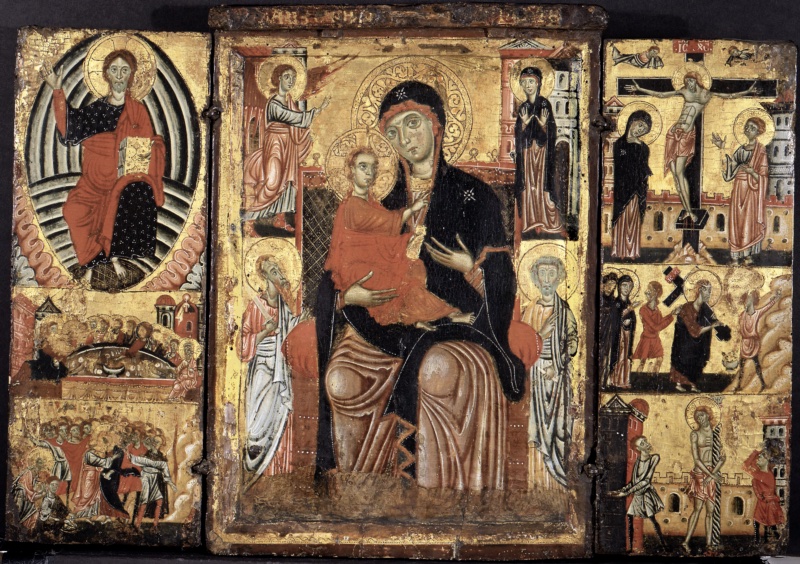
The triptych in the Metropolitan Museum of Art, executed in tempera and gold on panel, measuring 40.6 by 56.6 centimetres, represents the Maestro’s most complete surviving exploration of the triptych format, a compositional type that allowed for the juxtaposition of a central devotional image with flanking sacred figures within a single, architecturally organised field.
The central panel presents the Madonna and Child in the hieratic frontal disposition typical of the Maestro’s Marian imagery, while the scenes from the Life of This triptych is one of the masterpieces of the Master of the Magdalene, an anonymous Florentine painter active between approximately 1265 and 1295, considered one of the most representative artists of Tuscan painting in the second half of the 13th century.
His style is characterized by a lively narrative quality in the secondary scenes, a strong Byzantine influence in the main compositional structure, and a gradual shift toward the style of Cimabue in his more mature works. The triptych is housed at the Metropolitan Museum of Art in New York, inventory number 41.100.8.
The main scene depicts the Madonna Enthroned with the Infant Jesus, the devotional heart of the entire work. The Virgin is seated in a frontal and majestic pose on a monumental throne, with a dark mantle—typical of the maphorion of the Byzantine tradition—enveloping the figure, lending it solemnity and a solemn detachment. The Child, held on his mother’s lap, is depicted in a blessing gesture, dressed in a reddish tunic, with an already adult and aware face according to the convention of the Christus Puer Sapientiae.
On either side of the central throne, in the lower section of the central panel, appear Saints Peter and Paul, recognizable by their traditional attributes (the keys for Peter, the book and the sword for Paul). The upper section of the central panel depicts the Annunciation: the Archangel Gabriel on the left and the Virgin Mary on the right, separated by a golden space.
The left wing is divided into three overlapping narrative registers, to be read from top to bottom. At the top stands Christ in Glory (Christ in Majesty), depicted within a Cosmatesque mandorla on a golden background, seated as the Pantocrator with an open book and a blessing gesture, surrounded by reddish seraphim. The middle register depicts the Last Supper (Cenacolo), with Christ and the apostles gathered around the table in a crowded and dense composition, rendered in the painter’s characteristic linear stylization. The lower section of the left wing depicts the Betrayal of Christ (Kiss of Judas): the scene shows Judas embracing Jesus in Gethsemane, with armed soldiers behind them, in a frantic and gestural narrative.
The right panel is devoted entirely to episodes from the Passion and should be read—according to the Metropolitan Museum’s instructions—from right to left, that is, from bottom to top. In the lower section is the Flagellation of Christ, with Jesus tied to a column while soldiers beat him; the scene is compressed into the confined space of the panel in a manner typical of 15th-century narrative miniatures. At the center of the right wing is depicted the Way of the Cross (Ascent to Calvary): Christ carries the cross, escorted by soldiers toward the place of execution, with figures gesturing around him in a relentless movement. At the top of the right panel is the Crucifixion: Christ on the cross with the Sorrowful Virgin and Saint John the Evangelist at his feet, with the Greek inscription IC XC (an abbreviation of Iesus Christus) visible at the top, in accordance with the iconographic tradition of Byzantine origin.
The Master of the Magdalene headed one of the most important workshops active in Florence during the second half of the 13th century. His artistic language moves from a strong Greek-Byzantine tradition—evident in the Madonna’s solemn frontal pose, the gold background, and the stylization of the drapery—toward more dynamic and narrative solutions that foreshadow Giotto’s revolution.
The workshop was acutely aware of the local tradition and produced both large-scale works (such as the eponymous panel depicting Mary Magdalene at the Accademia in Florence, 180 x 91 cm) and small-scale works for private devotional use, such as this portable triptych. The use of gold leaf ground, tempera on panel, and the portable triptych structure reflect the work’s function as a private devotional object, intended for personal use or small chapels—a typical secular or monastic commission of the late 13th century.
Madonna and Child (fragment)
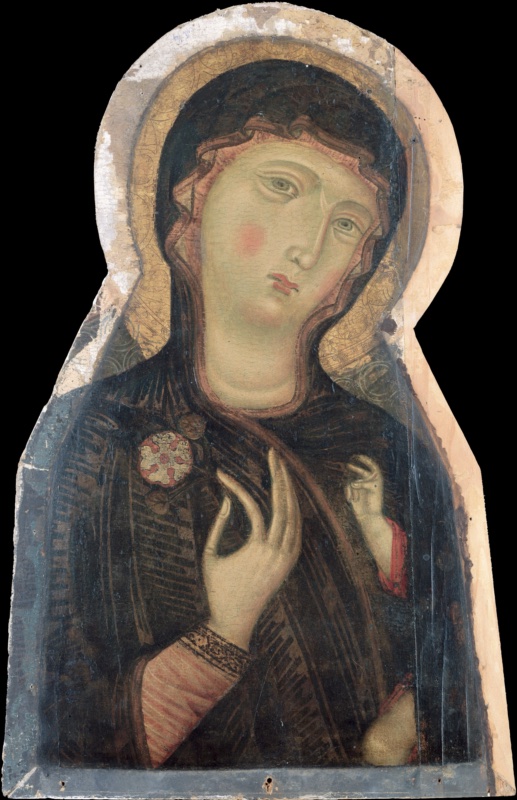
This panel at the Metropolitan Museum (inv. 64.189.1) is actually a fragment of a larger composition: it is the head of the Virgin Mary cut out from a larger Madonna and Child, a work by the Master of the Magdalene dated around 1280.
As the Metropolitan itself notes, it was not uncommon in the Middle Ages to isolate the Virgin’s head from a venerated image in order to incorporate it into another work as an autonomous devotional focal point—a practice that attests to how powerful the cult of the Virgin’s face was in both private and public piety during the 13th century.
The dominant figure is the face of the Virgin, rendered as a bust with a monumental presence despite its modest size. The arched upper contour—visible in the image—is the characteristic profile of the top of the Virgin’s head with the golden nimbus surrounding it, from which emerge the dark maphorion (the dark brownish-black mantle typical of Marian iconography of Byzantine descent) and the light hair visible on either side of the face.
Her gaze is slightly oblique, directed downward and to the left—a pose that, in medieval iconographic language, evokes the Theotokos in Contemplation, the Mother of God aware of her Son’s tragic destiny. The Metropolitan Museum explicitly notes that the fragment still reveals the Child’s blessing hand and his knee, elements that confirm the original composition: a half-figure Madonna and Child, where Christ sat on the Virgin’s left arm according to the Hodegetria scheme—“She Who Shows the Way”—typical of 13th-century Italo-Byzantine iconography.
These remnants of the Child’s figure are visible in the lower right part of the panel, almost suggesting the lost presence of the original subject.
The Virgin’s face clearly reveals a stylistic dependence on Cimabue, of whom the Master of the Magdalene was a close follower. The modeling of the face shows cheeks slightly flushed with pink, arched and thin eyebrows, eyes of a glassy green-gray hue with a peculiar contemplative fixity, and thin, parted lips—all elements attributable to Cimabue’s proto-naturalism, which was progressively dissolving the rigidity of Greek-Byzantine iconography toward a greater expressive humanity. The maphorion is adorned with a decorative clasp or rosette on the chest, a motif common in Florentine Madonnas of the period that recalls examples of sacred goldsmithing and the icons brought to Florence through trade with Byzantium. The drapery is rendered with parallel incised lines that recall the technique of Chrysography—Byzantine gold highlights—here reinterpreted using the linear tempera technique.
The practice of cutting out the face of the Madonna from a larger panel belongs to a devotional tradition widespread in the central and late Middle Ages, linked to the cult of acheropite images (not made by human hands) and the veneration of icons as visual relics. The fact that this fragment has survived in this form suggests that the Virgin’s head was separated from the original body of the composition during the medieval or post-medieval period, likely to be placed in a processional frame or a private altar, before entering the Metropolitan’s collection as a gift from Irma N. Straus in 1964.
Enthroned Madonna with Child and Angels
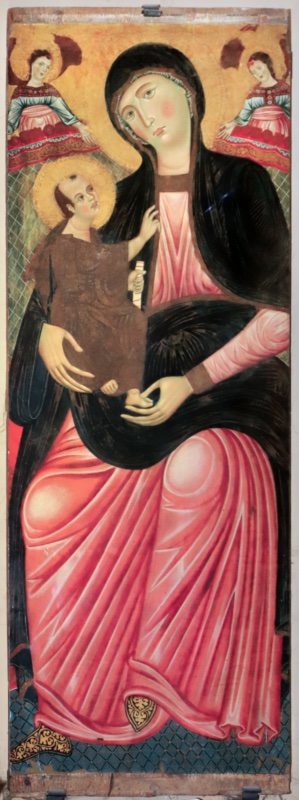
The Enthroned Madonna and Child with Angels preserved in the Abbazia di San Fedele at Poppi, in the Casentino valley of the province of Arezzo, is one of the most geographically remote surviving works attributable to the Maestro’s workshop and one of the most revealing for the understanding of the provincial reach of his atelier’s reputation and production.
The Abbazia di San Fedele itself is an institution of considerable antiquity and ecclesiastical importance: originally constructed in 1185 by the Abbot Ridolfo, the church and its monastic complex became from 1262 the residence of the Vallombrosan monks who transferred from the nearby establishment at Strumi, bringing with them the intellectual and devotional culture of the reform branch of Benedictine monasticism to which the Vallombrosans belonged. The commission of an altarpiece by one of Florence’s leading workshops for the high altar or a principal chapel of the Abbazia di San Fedele reflects the cultural ambition of this monastic community and their capacity to direct financial resources toward the acquisition of quality devotional images from the urban centre of Florentine artistic production.
The panel, life-sized in its central figure, as the Mondi Medievali description confirms, presents the Virgin seated upon a throne whose elaborately carved backrest is visible above her shoulders, a compositional element that reinforces the regal dignity of the enthroned Theotokos and connects the image to the long tradition of the Maiestas Virginis in Florentine and central Italian panel painting. In the figure of the Christ Child, the Maestro has employed a posture of unusual lateral orientation: the Child turns his face in profile to the right while extending his right arm in the gesture of solemn benediction and holding in his left hand the rolled scroll of the Law, a traditional symbol of his identity as the fulfilment of the Old Testament covenant, an iconographic configuration that gives the figure a dynamic, turning quality somewhat at variance with the strict frontality of the more rigidly Byzantine works.
The Virgin’s face, as described by the Mondi Medievali source, already carries the shadow of foreknowledge: her expression, though formally composed within the Maestro’s characteristic physiognomic formula, conveys a quality of preemptive grief that transforms the image from a simple celebration of the Incarnation into a meditation on the sacrificial destiny of the Child she holds, a theological deepening consistent with the Maestro’s mature manner. Two flanking angels, reduced in scale relative to the central figures in the Byzantine manner that reserves monumental size for sacred hierarchy, extend their arms forward in a presentation gesture, directing the worshipper’s attention toward the Madonna and Child as the focal point of devotional address and implicitly mediating between the earthly viewer and the divine presences they attend.
The panel was originally situated in the right transept of the church, where it remained until the second half of the twentieth century, flanked by two sixteenth-century canvases, a juxtaposition that encapsulates, in physical form, the historical depth of the Abbazia’s decorative programme. The Mondi Medievali commentary notes that the work’s attribution to the Maestro della Maddalena is supported by its stylistic affinity with the broader corpus, the characteristic drapery treatment, the distinctive physiognomic formula of the Madonna’s face, and the compositional organisation of the throne, and confirms the workshop’s contribution to the artistic culture of the Florentine hinterland beyond the city walls.
Last Supper (fragment)
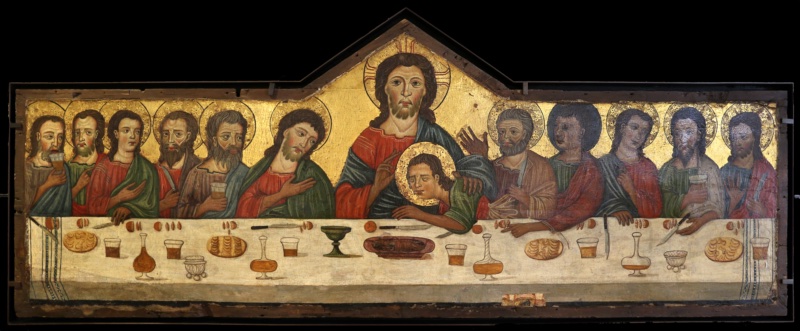
Among the lesser-known works in the Maestro’s corpus, the fragment of a Last Supper formerly located in Chambéry and later in Avignon at the Musée du Petit Palais deserves particular mention as evidence of the Maestro’s capacity to operate within the demanding conventions of monumental narrative painting, beyond the altarpiece format that constitutes the bulk of his surviving production.
The Treccani bibliography records this fragment, associated with a major narrative scene from the Passion cycle, as one of the works considered in connection with the hypothesis of the Maestro’s participation in the Florentine Baptistery mosaic programme: if he was indeed capable of designing and executing large-scale narrative compositions of this kind for a panel context, it strengthens the plausibility of his contribution to monumental mosaic cartoons as well.
The fragment’s journey from its original Florentine context to Chambéry and ultimately to Avignon traces the complex dispersal routes through which Italian medieval objects moved across Europe in the early modern and modern periods, often following the itineraries of religious communities, diplomatic collections, and later the commercial art market.