Maestro bizantino del Crocifisso di Pisa
The painter conventionally designated as the Byzantine Master of the Crucifix of Pisa remains one of the most elusive figures in the history of European art, his anonymity rendering him a ghostly presence in the annals of medieval Tuscan painting. Active in Pisa during the first half of the thirteenth century, most scholars placing his productive career between 1200 and 1230, this artist has bequeathed to posterity only scattered documentary shadows and the single monumental work that bears his historical identification. The fundamental absence of patronymic designation, familial genealogy, or biographical notation in surviving archival records suggests an artisan operating within a workshop culture still largely defined by the anonymous commissions characteristic of earlier medieval practice, a period when individual artistic identity was subordinated to the communal enterprise of religious image-making.
The Pisan artistic community of this epoch, though increasingly urbanized and commercially sophisticated, had not yet evolved the sophisticated systems of written attestation, guild regulation, and artistic fame that would crystallize in the early fourteenth century, as exemplified by Giunta Pisano’s signed crucifixes and Cimabue’s documented commissions. What we can reasonably infer regarding familial background, social standing, and workshop formation derives necessarily from inference: the sophisticated technical competence evidenced in the Crucifix No. 20 strongly suggests apprenticeship within an established Pisan workshop, probably one associated with monastic houses, cathedral production, or ecclesiastical confraternities that sustained the production of liturgical and devotional objects.
The Byzantine Master’s very anonymity, paradoxically, testifies to his integration within the normative structures of early medieval artistic life, wherein the craftsman’s identity was absorbed into the larger devotional mission of the religious community. Such makers worked not for personal glory or contractual recognition but as instrumental agents in the production of sacred objects deemed efficacious within the spiritual economy of the Church. His social position, judging from the scale, materials, and destination of his principal work, was probably that of an established master capable of commanding significant material resources, gold leaf, ultramarine pigment, premium panel wood, and the authority to execute commissions from major ecclesiastical institutions. The very fact that he was employed to produce a monumental shaped wooden cross, executed in expensive tempera and gold, indicates a painter of recognized reputation, trusted with a prestigious commission requiring technical mastery and theological sophistication. Yet the preservation of no written contract, no inventory reference, no witness signature in notarial documents, and no recorded apprenticeship of his name marks him as a liminal figure, poised between the concluding era of anonymous medieval craft and the emerging world of Renaissance artistic individuality.
The absence of genealogical information cannot be construed as indicating low social status or marginal workshop position; rather, it reflects the imperfect documentary apparatus of early thirteenth-century Pisa and the custom of workshop anonymity that still prevailed in paint production even as the broader Mediterranean world experienced unprecedented commercial and cultural dynamism. The archival vacuum surrounding his origins is not unique but rather symptomatic: few painting masters of this precise generation and locale are securely documented by birth records, marriage contracts, or property transactions, with the signal exception of Giunta Pisano, whose own biographical details come to us fragmentarily and only through extraordinary circumstance. The Byzantine Master occupied, then, a position of professional competence and ecclesiastical patronage, but one still operating according to the conventions of anonymous medieval craft rather than the incipient personality cult that would elevate artists like Giunta to the status of recognizable historical agents. His family connections, his training lineage, his workshop associates, and the domestic circumstances of his life remain forever sealed within the silence of the surviving record. What we inherit is not his lineage but his artistic legacy, a single transcendent work that stands as evidence of his mastery and his profound engagement with the iconographic and theological revolutions transforming Italian religious art in the early thirteenth century.
The Ecclesiastical Patrons and Devotional Context of Pisan Painting
The patrons who commissioned monumental painted crucifixes in Pisa during the early thirteenth century, the period of the Byzantine Master’s documented activity, were exclusively ecclesiastical institutions, reflecting the overwhelming concentration of artistic patronage within the structures of organized Christianity during the High Middle Ages. Primary among these patrons were the great monastic houses that had flourished in the Pisan hinterland since the eleventh century, above all the Benedictine communities whose houses, such as those at Calci, Rosano, and the numerous monasteries scattered throughout Tuscany, constituted major landholders and religious centers maintaining substantial scriptoria and decorative workshops.
The mendicant orders, the Franciscans and Dominicans, founded respectively by Saint Francis of Assisi and Saint Dominic de Guzmán in the opening decade of the thirteenth century, emerged as revolutionary new patrons of religious art, transforming not merely the subject matter of devotional painting but its underlying theological assumptions and emotional registers. These orders, having taken vows of poverty and established themselves as urban preachers engaged with the spiritual needs of rapidly expanding city populations, required new forms of visual religiosity distinct from the monastic tradition of the cloister. Unlike the Benedictines, whose artistic patronage served the needs of an enclosed, liturgically elaborate community, the mendicants promoted visual imagery calculated to move and persuade the lay faithful, exploiting painting’s power to generate emotional identification with the suffering Christ and the saints. The cathedral chapters themselves, particularly that of Pisa Cathedral, maintained artistic workshops and commissioned major works for both the cathedral proper and the subsidiary structures of the Baptistery and the Leaning Tower complex. Archbishop Federico Visconti, whose tenure as Pisan primate extended from 1253 to 1277, emerges from the surviving sermon manuscripts as a conscientious pastor devoted to the pastoral infrastructure of his large archdiocese and actively supportive of mendicant initiatives, evidence that even the highest ecclesiastical authorities recognized the effectiveness of mendicant-inflected devotional art in addressing the spiritual formation of urban laity.
The historical moment of the Byzantine Master’s activity coincides precisely with the institutional consolidation of the mendicant presence in Italian cities and the revolutionary reorientation of ecclesiastical art toward the affective piety promoted by these new orders. While the direct patronage relationship between the anonymous master and any specific mendicant house cannot be documented in surviving records, the iconographic evidence of his major work, the emphatic embrace of the Christus patiens imagery discussed below, demonstrates intimate engagement with the devotional priorities that animated mendicant theology and pastoral practice.
The confraternities, lay religious associations organized around specific churches or charismatic saints, increasingly emerged as secondary patrons of devotional panels, particularly crucifixes intended for the private devotion of confraternity members or for display in confraternal chapels attached to mendicant churches. The fragmentary documentary record preserves evidence that by the later thirteenth century, artistic commissions increasingly passed to specific named masters, as demonstrated by Giunta Pisano’s documented works for San Francesco at Assisi (1236), Santa Maria degli Angeli at Assisi, San Domenico at Bologna, and the church of San Ranierino at Pisa. The Byzantine Master, active a generation earlier, probably operated within this emergent patronage system, receiving commissions from cathedral authorities, monastic houses, and possibly confraternal organizations dedicated to promoting the spiritual devotion of the Pisan faithful. The specific theological orientation of his principal surviving work, its profound engagement with the iconography of suffering, its monumentality calculated to dominate ecclesiastical interiors, its deployment of precious materials to signal sacred efficacy, all point to a master actively involved in the pastoral revolution initiated by mendicant theology, even if documentary evidence fails to establish explicit contractual relationships.
The economic dimensions of such patronage structures cannot be overlooked: the production of monumental painted crucifixes required substantial investment of capital in materials (precious gold leaf, imported ultramarine pigment, properly prepared wooden panels), considerable expenditure of skilled labor across multiple artisanal specialties (carpentry, panel preparation, tempera mixing, gilding), and the devotion of months or even years to a single commission. Only wealthy ecclesiastical institutions, cathedral chapters, major monasteries, powerful confraternities backed by urban merchant families, could afford such expenditure. The Byzantine Master’s clients, in all probability, were not modest parish churches or rural monasteries but the major religious foundations of the Pisan ecclesiastical hierarchy.
The cathedral chapter itself, controlling significant revenues from landed estates and urban property, frequently patronized monumental religious art. The great Benedictine houses maintained by this period substantial endowments that permitted both liturgical elaboration and artistic investment. The nascent Franciscan and Dominican priories, though founded under vows of poverty, rapidly accumulated property and patronage networks through donations of wealthy penitents and urban families seeking salvation through association with the mendicant mission. The confraternities, increasingly popular among the urban merchant class during the thirteenth century, pooled resources for the commissioning of devotional images intended to support their ritual observances and private prayer practices. The Byzantine Master thus operated within a patronage ecology dominated by these major ecclesiastical structures, his professional expertise deployed in service to the spiritual mission of institutions that wielded substantial economic power within the Pisan city-state. His anonymity notwithstanding, he was almost certainly a master craftsman of considerable reputation, trusted with prestigious and costly commissions that embodied the theological and devotional priorities of major ecclesiastical patrons.
The broader context of Pisan ecclesiastical life during this period reveals a city actively engaged in religious renovation and reform. The Fourth Crusade of 1204, which culminated in the Latin conquest of Constantinople, initiated the massive influx of Byzantine artistic objects and refugees into Italian cities, with Venice serving as primary conduit but Pisa, as a competing Adriatic maritime power, also receiving substantial quantities of Byzantine treasures, reliquaries, and sacred objects. These material imports were accompanied by the arrival of Byzantine refugees, monks, clerics, artisans, and intellectuals, seeking asylum in the Latin West.
The presence of Byzantine expertise, both in material form and in the person of immigrant craftsmen, would have substantially influenced the artistic production of Pisan workshops. Pisan merchants maintained extensive trading networks throughout the Mediterranean, establishing colonies in Acre, Alexandria, and other Levantine ports; these commercial networks facilitated the circulation of religious images, portable icons, and artistic exemplars that exposed Pisan artists to current Eastern Orthodox iconographic practices. The documentary records of patronage, though sparse, consistently point toward major ecclesiastical institutions as the primary commissioners of monumental painted works, and the Byzantine Master’s engagement with advanced iconographic forms and technically sophisticated execution presupposes patronal support from precisely such institutions. His role, then, was as an instrumentality through which the theological vision of his patrons, a vision increasingly shaped by mendicant spirituality and Eastern Orthodox aesthetic tradition, received material articulation in tempera and gold.
The Christus Patiens Iconography and Painting Style
The Byzantine Master of the Crucifix of Pisa is remembered primarily as the maker of Crucifix No. 20, preserved in the Museo Nazionale di San Matteo at Pisa, a monumental wooden panel measuring 297 centimeters in height and 234 centimeters in width, executed on a shaped wooden cross (sagomata) in tempera and gold leaf, and datable to the opening years of the thirteenth century, though some scholarship places it closer to 1230. The work’s profound historical significance derives not from technological innovation or stylistic virtuosity, though both are evident, but rather from its pioneering deployment within Italian art of the iconographic motif of the Christus patiens, the suffering, dying Christ depicted with closed eyes, contorted musculature, and expressive features registering agony and abandonment.
This represents a revolutionary departure from the preceding Christus triumphans iconography that had dominated Western crucifixion imagery since the Carolingian period, wherein Christ appears erect, eyes open, sometimes even crowned with a jeweled diadem, his body rigid and idealized, his expression serene or imperious, signifying triumph over death, eternal kingship, and the victory of resurrection. The Christus patiens embodies, by contrast, the vulnerable, suffering humanity of Christ, his mortal body wracked by pain, his features twisted by the agony of crucifixion, his death presented as an authentic, catastrophic event rather than a triumphant conclusion to a redemptive narrative. This stylistic and iconographic transformation, emerging within Byzantine art of the Palaeologan period (after 1261) and gradually permeating thirteenth-century Latin Christendom, accompanied and embodied a fundamental shift in medieval spirituality: the rise of affective piety focused on sympathetic identification with Christ’s suffering, promoted with particular intensity by mendicant theologians like Bonaventure and Francis of Assisi, who urged the faithful to contemplate the physical anguish of the Passion as a path to spiritual transformation and mystical union with the divine.
The Byzantine Master’s rendering of the suffering Christ displays the characteristic formal features of Christus patiens imagery: Christ’s body, viewed in frontal position against the vertical arm of the cross, exhibits pronounced muscularity and anatomical articulation rendered through subtle modeling of light and shadow, conveying weight, materiality, and the strain of suspension beneath his own body weight. The chest is slightly hollowed, the ribs visible beneath the surface, the abdomen slightly distended, all details registering the physical reality of crucifixion as a process of asphyxiation and systemic collapse. Christ’s face, though suffering severe abrasion and overpainting in subsequent centuries, originally displayed the closed eyes and downturned mouth characteristic of the Christus patiens type; surviving photographs and technical analysis confirm that the eyes were painted shut, the expression one of pain and resignation rather than lordly composure.
The loincloth (perizoma), draped around the hips, displays the elaborate gold striations and sophisticated folds characteristic of Byzantine textile representation, these linear patterns conveying the texture and weight of richly worked fabric without recourse to illusionistic foreshortening or spatial recession. The cross itself, following Pisan tradition, incorporates narrative scenes in the extremities (the four arms of the cross) depicting the Passion narrative, the Arrest of Christ, the Flagellation, the Mocking, the Ascent to Calvary, the Crucifixion proper, the Deposition from the Cross, the Entombment, and the discovery of the Resurrection at the empty tomb. These narrative elements, executed in miniature scale and arranged in schematic compositions frontal in orientation and hierarchical rather than perspectival in spatial arrangement, serve a didactic function, enabling the lay viewer to comprehend the narrative of Christ’s redemptive suffering while maintaining visual focus on the suffering body at the work’s center. The backgrounds, executed in luminous burnished gold, create a dematerialized heavenly realm divorcing these events from historical time and spatial contingency, affirming their eternal, transcendent significance within the economy of Christian salvation.
The technical execution displays sophisticated command of the tempera medium and the complex apparatus of medieval panel painting. The preparation of the panel involved standard medieval procedures: a wooden base (likely of poplar or chestnut), covered with a ground of gesso (a mixture of plaster, animal glue, and sometimes lead white) built up in multiple layers to create an absorbent but structurally sound foundation for pigment application. The gold leaf, applied after the gesso preparation and before tempera painting, was laid down using the traditional medieval technique of gilding over burnishing clay (bole), a red iron oxide-based clay that served both as an adhesive medium and, through its red tonality showing through at panel edges and in areas of wear, as a warm underlay imparting richness to the translucent gold. The gold was meticulously burnished (polished) with smooth tools, probably of dog-tooth or animal bone, creating a reflective, mirror-like surface that caught candlelight and created an ethereal, heavenly luminosity, an effect that would have been profoundly moving to medieval viewers in dimly lit churches.
The tempera pigments, comprising the actual painted image of Christ and the narrative scenes, were formulated from mineral and organic pigments ground to fine powder and mixed with a tempering medium, likely egg yolk or egg white mixed with gum arabic or other binding substances, creating a paint of remarkable permanence and brilliant color intensity. The palette includes the characteristic colors of medieval Tuscan panel painting: ultramarine blue (from lapis lazuli, one of the most expensive pigments in medieval commerce, imported via Venice from Central Asian sources), azurite (a more economical alternative to ultramarine for areas of lesser importance), vermilion (mercuric sulfide, brilliant red), lead white, and various ochres (earth pigments of iron oxide) for flesh tones and secondary colors. The application of paint displays considerable sophistication: fine linear details were executed with narrow brushes, broader areas of color laid in with fuller brushwork, subtle modeling achieved through layering of increasingly lighter tones (a technique called scumbling) to suggest the three-dimensional volume of the human form without recourse to illusionistic perspective.
The stylistic vocabulary of the work reflects profound engagement with Byzantine artistic traditions, yet filtered through Pisan artistic sensibilities and responsive to the new devotional demands of early thirteenth-century mendicant spirituality. The frontal pose of Christ, the formal symmetry of the composition, the stylized rendering of the perizoma, and the gold-ground background all derive directly from Byzantine icon tradition; indeed, the cross itself may be understood as a monumental elaboration of the icon tradition, scaled to dominate ecclesiastical interiors and adapted to the narrative requirements of Passion illustration. Yet the Byzantine Master departs from strictest Byzantine conservatism in his attention to anatomical particularity and expressive emotion: his Christ is not the utterly transcendent, spiritualized figure of pure Byzantine tradition but rather a body authentically suffering, registering through contorted musculature and closed eyes the existential reality of death. This represents a subtle but profound reorientation of Byzantine tradition toward the affective piety promoted by mendicant theology, a synthesis of Eastern Orthodox formal aesthetics with Western devotional priorities. The narrative scenes in the extremities, while executed in the compressed, non-perspectival spatial arrangements of Byzantine tradition, display an emotional intensity and interest in human gesture and expression that anticipates Giunta Pisano’s revolutionary humanization of the Passion narrative in the later thirteenth century. The Byzantine Master’s painting style thus occupies a pivotal position in the evolution of Italian art: retaining the formal authority and transcendent spirituality of Byzantine tradition, yet beginning the process of incorporating the emotional immediacy and human particularity that would characterize fourteenth-century Italian painting.
Artistic Influences: Byzantine Tradition and the Fourth Crusade Impact
The artistic formation and stylistic vocabulary of the Byzantine Master of the Crucifix of Pisa must be understood within the context of the massive cultural and artistic disruption occasioned by the Fourth Crusade of 1204 and its aftermath. The Latin conquest of Constantinople in 1204, culminating in the establishment of the so-called Latin Empire (1204–1261), triggered an unprecedented and irreversible diaspora of Byzantine artistic objects, textiles, manuscripts, icons, and sacred reliquaries into the Latin West, fundamentally transforming the available iconographic and formal repertoire available to Western artists. Venice, as the primary maritime and commercial power that orchestrated the Fourth Crusade and the Latin conquest, received the lion’s share of Byzantine treasures, with the Basilica of San Marco becoming, in effect, a repository of Byzantine sacred objects whose aesthetic influence would pervade Venetian artistic tradition for centuries. Pisa, however, as Venice’s principal commercial rival in Mediterranean trade and as a significant Mediterranean naval power maintaining independent merchant colonies in Levantine ports, also benefited substantially from this influx of Byzantine material culture. The presence of portable Byzantine icons, carved ivory plaques, illuminated manuscripts, and other luxury objects within Pisan churches and private collections would have exposed local artisans to contemporary Byzantine aesthetic forms and iconographic conventions. The testimony of Pisan merchants and pilgrims to Constantinople, combined with the direct presence of Byzantine artistic objects within the city, created an environment saturated with Byzantine aesthetic models.
The specific mechanism of Byzantine artistic transmission to Western medieval artisans operated through multiple channels, each contributing distinct elements of influence. The most direct mechanism involved the actual presence of Byzantine artistic objects within Western workshops: an imported icon, a portable mosaic panel, an illuminated Byzantine manuscript, or a carved ivory devotional object could serve as a model for direct imitation or source of compositional borrowing. The Hodegetria Virgin, the iconographic type showing the Virgin in profile, holding the Christ Child and directing the viewer’s attention toward the divine infant, appears in numerous Italian paintings of the thirteenth century, demonstrating the circulation and popularity of this specific Byzantine type throughout the peninsula. The archaeological and documentary evidence suggests that such Byzantine objects were highly valued and carefully preserved, serving as visual exemplars within artists’ workshops and as objects of devotional veneration in their own right.
A second mechanism involved the use of model drawings and iconographic guides, what scholars term exempla in Latin medieval terminology. The production and circulation of sketch-like designs preserving iconographic information, drawn on parchment, papyrus, or preparatory materials, enabled the transmission of compositional forms and iconographic details without requiring the presence of the original work. A famous example, the Oxford manuscript (Magdalen College ms. Gr. 3), a twelfth-century copy of John Chrysostom’s commentary on Genesis, contains over one hundred marginal drawings executed by a Byzantine artist or artists experimenting with various figure types and compositions, demonstrating both the existence of Byzantine practice of exploratory drawing and the potential circulation of such sketches among Mediterranean artisans. The Pisan painters, actively engaged in Mediterranean trade networks and likely employing apprentices trained in international workshop traditions, would have had access to such model drawings, either through direct importation of Byzantine exemplars or through second-hand circulation via intermediate artistic centers like Venice or Sicily.
A third mechanism involved the immigration of Byzantine artisans themselves to Western cities, bringing their technical expertise and aesthetic conventions directly into local workshop practice. Though documentary evidence for the presence of Greek painters in Pisan workshops remains elusive, the substantial immigration of Byzantine refugees following the Latin conquest of Constantinople and the subsequent recovery of Constantinople by the Palaeologan dynasty in 1261 is well-documented in other Italian cities. Such immigrant artisans, whether or not present in Pisa specifically, would have established workshop traditions in major Mediterranean centers that subsequent generations of Latin artists could encounter, either directly or through the mediation of artists trained by Greek masters. The very designation “Byzantine Master” applied by modern scholars to the anonymous creator of Crucifix No. 20 implies recognition by contemporaries and modern art historians alike of his profound stylistic affiliation with Byzantine traditions, whether through direct apprenticeship to a Greek master, intensive exposure to imported Byzantine objects and model drawings, or simply the absorption through the visual environment of Pisa’s cosmopolitan merchant culture of Byzantine aesthetic conventions. The style of the work represents not mechanical copying of Byzantine models but rather the sophisticated integration of Byzantine formal vocabulary and iconographic conventions into an artistic practice responsive to the distinct devotional needs of Italian mendicant communities.
Giunta Pisano, the major documented painter who represents the next generation of Pisan artistic development, explicitly built upon the foundations laid by the Byzantine Master and the tradition of Christus patiens innovation within which his predecessor worked. The archival records indicate that Giunta was active between 1229 and 1254, meaning his career overlapped with the final productive years of the Byzantine Master; the stylistic evolution evident in comparing the Byzantine Master’s monumental cross with Giunta’s documented works demonstrates not rupture but continuous development, with Giunta retaining the fundamental iconographic commitment to Christus patiens while advancing the articulation of human emotion, anatomical accuracy, and spatial suggestion. The influence of Giunta’s own tradition, traceable through his documented works at Assisi, Bologna, and Pisa, extended to the next generation of Pisan painters including Enrico di Tedice, active mid-century, and Ugolino di Tedice, documented in the 1270s, establishing a Pisan workshop dynasty that preserved and developed the Christus patiens tradition throughout the latter thirteenth century. This continuity demonstrates that the Byzantine Master’s pioneering engagement with Eastern Orthodox iconography and emotional expressivity was not isolated artistic experiment but rather the opening of a sustained artistic trajectory, developed and refined by successors who built upon the foundations of his monumental vision. The influence extended beyond Pisa: Coppo di Marcovaldo, active in Florence and Siena in the mid-thirteenth century, embraced similar devotional priorities and incorporated Byzantine formal elements, demonstrating that the artistic revolution inaugurated by the Byzantine Master and crystallized in the practice of Giunta Pisano represented a widespread reorientation of Tuscan painting toward Byzantine aesthetics and mendicant devotional priorities.
Artistic Travels and Geographic Circulation
The documentary record preserves no explicit evidence of the Byzantine Master’s travels or geographic movements, a silence characteristic of the anonymity that shrouds his entire biographical profile. Yet the very presence of an artist working in Pisa during the early to mid-thirteenth century, producing works of Byzantine stylistic affiliation and iconographic sophistication at the precise historical moment when Byzantine artistic objects were flooding into Italian Mediterranean ports via Venetian commerce and crusader networks, implies a figure embedded within the cosmopolitan, commercially integrated world of Mediterranean artistic exchange. The economic and cultural infrastructure through which the Byzantine Master would have circulated, were he inclined to travel for artistic training or patronage, consisted of the trading networks maintained by Pisan merchant families, the pilgrimage routes through which clergy, monks, and layfolk traversed the Mediterranean en route to Jerusalem and other holy sites, and the ecclesiastical networks linking cathedral chapters, monastic houses, and episcopal courts across the Italian peninsula and beyond. That the Byzantine Master remained fixed in Pisa, the evidence for this conclusion rests only on his identification with the production of a single work from a single location, may reflect either limited geographic mobility or, more likely, the simple fact that surviving documentation and artistic production happen to preserve evidence only of Pisan activity, while any works he may have produced in other locations have been lost, reattributed, or absorbed into anonymous workshop traditions elsewhere.
A reasonable historical inference, grounded in what we know of contemporary artistic training and career patterns, would posit that the Byzantine Master’s technical formation involved exposure to multiple artistic centers and training traditions. The sophistication of his technical command, the skilled preparation of panels, the mastery of tempera pigmentation and application, the complex apparatus of gold-leaf gilding, the conceptually demanding integration of narrative and iconic elements, presupposes an extended apprenticeship under established masters, almost certainly beginning in childhood and extending through the standard medieval seven-year term of artisanal training. Such training might have taken place in Pisa itself, within cathedral workshops or established monastic scriptoria, where the production of liturgical manuscripts and ecclesiastical decorative programs provided the institutional infrastructure for artistic training. Alternatively or additionally, given the significant artistic circulation evident throughout the Mediterranean in this period, the Byzantine Master’s apprenticeship might have included travel to other Italian centers, Venice, where Byzantine influence was already dominant and direct Greek artistic presence was documented, or Sicily, where Norman and Hohenstaufen patronage had fostered sustained engagement with Byzantine aesthetic traditions, or even Jerusalem and the Levantine Crusader states, where Western and Eastern Christian artistic traditions mingled within the unique cultural conditions of the Crusader kingdoms. The presence, in multiple Italian artistic centers of the thirteenth century, of stylistically similar works deploying Christus patiens iconography and Byzantine formal vocabulary suggests, not necessarily that a single master traveled between centers, but rather that artistic knowledge circulated through the mechanisms of exemplar dissemination, apprentice training networks, and the migration of finished works between locations. The Byzantine Master, whether sedentary in Pisa or mobile across Mediterranean artistic networks, participated in this circulation of forms and ideas, absorbing Byzantine models and transmitting them through his artistic practice to successors and contemporaries.
The surviving evidence permits no reconstruction of itinerary or specific travel chronology, and speculation beyond what the archival and art historical record sustains risks transforming inference into fabrication. What can reasonably be concluded is that the Byzantine Master, like all thirteenth-century Italian painters of any pretension to significant patronage and technical accomplishment, inhabited a professional world of considerable geographic extent and cosmopolitan cultural orientation. The artistic training that produced his sophisticated technical mastery, the access to expensive materials and refined conceptual frameworks that his work demonstrates, and the patronage relationships that presumably sustained his professional practice all presuppose engagement with the broader artistic and ecclesiastical networks of Mediterranean Christianity. Whether this engagement took the form of actual physical travel, the study of imported artistic models and exemplars, or the informal transmission of knowledge through apprenticeship lineages remains undocumentable; what is certain is that his artistic formation was constituted in dialogue with the major artistic traditions of his era, particularly the Byzantine tradition that would dominate his stylistic vocabulary and iconographic commitments.
Works
The Crucifix of Pisa
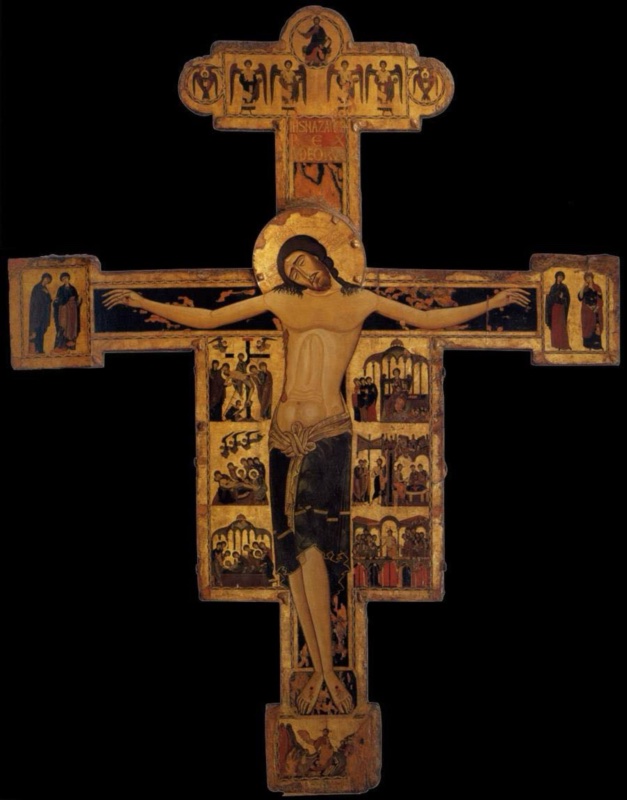
This crucifix is one of the oldest and most important Western depictions of the Christus patiens, that is, Christ in agony or dead on the cross, and marks a turning point in Pisan and Italian devotional iconography.
At the center of the cross stands the figure of the naked Christ, wearing only a loincloth around his hips, in a highly dramatic pose: his head tilted to his right shoulder, his eyes closed, his body bent, and his limbs tense, with evident signs of suffering. The wounds on his hands, feet, and right side are marked by thin rivulets of blood, which accentuate the physical and psychological portrayal of the Christus patiens, veining the body with red and contrasting with the luminous display of gold on the cross. This approach, closer to the Byzantine tradition of the Christus patiens than to the triumphant Christ still prevalent in Italy, helps create an atmosphere of intense piety, suited to the work’s liturgical and devotional function.
The cross is richly decorated with gilded backgrounds and geometric and vegetal rounds, which link the cross’s architectural structure to sacred iconography, in a typically Byzantine stylistic language, yet already integrated into a Pisan pictorial context. The cimasa (the upper part) often features Chrysostom or the enthroned Risen Christ, flanked by angels or seraphim, introducing the eschatological dimension of victory over death, while the lower face or foot of the cross may depict the Descent into Limbo, representing the liberation of the souls of the righteous after Christ’s death. In this way, the cross serves as a visual compendium of the Passion, Death, and Resurrection, structuring the sacred narrative along the arms and margins of the wooden cross.
The work is executed in tempera and gold on parchment glued to a shaped wooden panel, a highly refined technique requiring excellent preparation of the support and precise bonding of the skin to the surface, typical of the miniature painting tradition and of Pisan painted crosses. The style reveals a strong Byzantine background (sharp lines, simplified forms, frontal composition, use of symbolic color), but with a new emphasis on the dramatic rendering of the suffering body, foreshadowing certain developments in early 13th-century Italian art, such as those associated with Giunta Pisano and the beginnings of “Morello-French” painting.
Cross No. 20 is considered one of the earliest examples of a Christ patiens on a painted cross in the Western world and represents a fundamental piece in understanding the reception of Byzantine iconography in Pisa, especially following the intensified exchanges with the East during the Fourth Crusade and Pisa’s commercial expansion. Housed in the Museum of San Matteo, the cross is often displayed alongside other painted Pisan crosses (including those by the Master of the Holy Sepulcher Cross and Berlinghiero), highlighting the evolution from the rigid, crowned Christus triumphans to a sorrowful, introspective Christ, paving the way for subsequent devotional and figurative reforms.