Giovanni d'Apparecchiato
( 25% )
Giovanni d’Apparecchiato, known by the alternative designation il Nuccaro (or Nuccolo and Nuchulus in variant documentation), emerged from the merchant republic of Lucca in the late thirteenth century, where his family apparently maintained sufficient means to support the apprenticeship of a son in the prestigious craft of panel and fresco painting. The precise etymology of his surname remains contested among scholars, with “Apparecchiato” possibly deriving from a locality within Luccan territory, though no definitive genealogical records have survived to establish his parentage or collateral family members with certainty.
The alternative sobriquet il Nuccaro suggests a regional origin or family occupation, though contemporary documentary sources offer no clarification regarding this nomenclature. The absence of patronymic information in the archival materials indicates that Giovanni either represented a cadet branch of a Luccan family of minor significance or that his family had recently ascended to artisanal status through commerce or craft specialization. His birthplace of Lucca positioned him within a Tuscan cultural milieu that had, since the twelfth century, maintained the most vibrant and sophisticated school of painting in Italy, a legacy that would inform his artistic formation. The transition from Luccan domicile to Pisan workshop, documented by 1299, suggests either apprenticeship completed in his native city or a deliberate relocation to access the more prominent artistic opportunities emerging from Pisa’s renewed prominence following ecclesiastical and civic patronage initiatives.
The fact that Giovanni succeeded in establishing himself sufficiently to undertake documented commissions within a decade of first appearance in the archival records, indicates either precocious talent recognized early or a family connection within the Pisan artistic establishment that facilitated his rapid integration into elite workshop circles. No marriage records, property holdings, or subsequent family formations are documented in surviving sources, a lacuna that precludes any understanding of his domestic circumstances, social standing, or the transmission of his technical knowledge to subsequent generations.
The social positioning of the Apparecchiato family within Lucca’s hierarchical civic structure remains speculative in the absence of documentary confirmation, though the economic resources required to sustain a son through prolonged artistic apprenticeship, a period typically spanning seven to eleven years during which the apprentice contributed labor but generated no independent income, suggests a family positioned minimally within the prosperous artisanal stratum or possibly among the minor mercantile families whose commercial activities in silk production, banking intermediation, or regional commodity trade had elevated them above subsistence agriculture and manual labor.
Lucca’s economic foundation rested upon silk manufacturing and banking operations that connected the city to trans-Alpine trade networks extending into Flanders, the Champagne fairs, and the commercial centers of the Rhineland; families participating in these economic structures accumulated sufficient capital to invest in the prolonged education of sons destined for professional rather than manual occupations. The alternative hypothesis, that the Apparecchiato family belonged to the urban poor or landless peasantry recently migrated to Lucca, appears incompatible with the documented trajectory of Giovanni’s career, as access to elite workshop training and subsequent integration into prestigious collaborative partnerships required social credentials, financial resources, and familial networks that the urban dispossessed could rarely command. The preservation of Giovanni’s surname across multiple archival documents, despite the absence of patronymic specification, indicates that “Apparecchiato” functioned as a recognized family designation rather than a descriptive sobriquet invented by scribes or record-keepers, suggesting at minimum that the family possessed sufficient social visibility within Luccan society to warrant consistent nominal identification across administrative contexts.
The migration pattern from Lucca to Pisa documented in Giovanni’s career trajectory reflects broader demographic and economic forces operative throughout late medieval Tuscany, wherein ambitious artisans, merchants, and professionals circulated among the region’s competing urban centers in pursuit of patronage opportunities, guild membership advantages, and escape from the factional violence and political instability that periodically disrupted civic life. Lucca’s political history during the late thirteenth century encompassed recurring conflicts between Guelph1 and Ghibelline2 factions, struggles for communal independence against imperial and papal interference, and the economic competition with neighboring Pisa for control of maritime trade routes and territorial jurisdiction over disputed border regions.
These political disruptions generated waves of emigration as families aligned with defeated factions sought refuge in rival cities or relocated to access more stable economic environments; Giovanni’s appearance in Pisa by 1299 may reflect either opportunistic pursuit of artistic advancement or politically motivated relocation necessitated by his family’s factional allegiances. The absence of documentation regarding any return to Lucca, maintenance of property interests in his native city, or ongoing commercial relationships with Luccan institutions suggests either complete integration into Pisan civic life or a definitive rupture with family origins that precluded sustained connection to his birthplace. The historical record preserves no evidence of siblings, cousins, or extended family members who might have maintained the Apparecchiato name in either Lucca or Pisa, raising the possibility that Giovanni represented the terminal member of his family line or that collateral relatives pursued occupations and social trajectories that left no documentary trace accessible to modern scholarship.
The question of Giovanni’s social integration into Pisan society extends beyond mere professional acceptance within artistic guilds to encompass the broader networks of marriage alliance, property acquisition, civic responsibility, and religious patronage that defined full membership in medieval urban communities. The complete absence of marriage documentation, no betrothal contracts, no dowry agreements, no offspring mentioned in testamentary bequests or guild succession records, suggests either that Giovanni remained unmarried throughout his documented career (a circumstance unusual but not unprecedented among medieval artisans whose economic resources proved insufficient to sustain household formation) or that any marriage occurred outside the jurisdictional boundaries of institutions whose records have survived to the present.
The failure to appear in property tax assessments (estimi) or real estate transactions preserved in notarial registers indicates either that Giovanni rented workshop and residential space rather than acquiring permanent holdings or that such documentation has been lost through the catastrophic destruction of archival materials that has characterized Pisan record-keeping across subsequent centuries. The absence from civic office-holding records and military conscription lists suggests that Giovanni either maintained status as a resident foreigner rather than achieving full Pisan citizenship or that his professional obligations exempted him from the civic and military service requirements that distinguished enfranchised citizens from mere inhabitants. This documentary silence regarding Giovanni’s social existence beyond his professional artistic identity paradoxically both obscures and illuminates his historical position: it confirms his existence as an accomplished artisan whose technical skill warranted major institutional commissions, while simultaneously revealing the precariousness of social memory for medieval individuals whose lives generated documentary traces exclusively through professional rather than familial, political, or testamentary activity.
Early Training and Artistic Formation
The mechanisms of Giovanni d’Apparecchiato’s apprenticeship remain obscured by the fragmentary nature of medieval documentation, though the guild structures and workshop hierarchies that governed Tuscan painting at the turn of the fourteenth century may be cautiously extrapolated from evidence pertaining to his contemporaries and documented collaborators. The workshop system prevalent in late medieval Italy operated hierarchically, with apprentices beginning their training, typically between ages ten and fourteen, under the supervision of a magistro or master craftsman who controlled technical instruction, material procurement, and the gradual delegation of tasks commensurate with the apprentice’s advancing competence. Giovanni’s earliest documented appearance in 1299 working alongside Vincino da Pistoia on a fresco commission at the Palazzo dell’Opera suggests that by that date he had attained sufficient technical mastery and professional reputation to be entrusted with a high-visibility commission adjacent to Pisa Cathedral, one of Christendom’s most prestigious ecclesiastical centers.
The precise location of his formation remains conjectural; scholarship has proposed either continuation within Luccan workshop traditions or acceleration of training upon arrival in Pisa, where the Cathedral Opera (building administration) maintained permanent workshop facilities and cultivated relationships with accomplished practitioners. The historical record’s silence regarding his instructors contrasts sharply with documented apprenticeships of other fourteenth-century artists, a circumstance that may reflect either the loss of guild matriculation records or Giovanni’s emergence from an informal familial transmission of craft knowledge rather than through formal guild enrollment.
The assumption that he possessed sufficient standing by his late twenties or early thirties to receive collaborative commissions from one of Italy’s most important sculptural and artistic centers, indicates mastery of both fresco and panel techniques, architectural knowledge, compositional sophistication, and the social acumen necessary to negotiate contracts and manage workshop logistics. The stylistic evidence preserved in the fragmentary Palazzo dell’Opera fresco demonstrates technical competence in surface preparation, pigment application, and spatial articulation consistent with training in the emerging Gothic naturalism that distinguished progressive Pisan workshops. His rapid advancement from undocumented apprentice to master-level practitioner entrusted with major commissions reflects both personal talent and access to the most advanced technical instruction available within the Tuscan artistic sphere during this critical transitional period in painting’s stylistic evolution.
The technical curriculum of late medieval painting apprenticeship encompassed far more than mere instruction in brushwork and pigment mixing; it constituted a comprehensive education in material science, architectural geometry, theological iconography, and the commercial practices essential to workshop management and contractual negotiation. The initial years of apprenticeship were devoted to menial but pedagogically essential tasks: grinding pigments in mortar and pestle to achieve the micron-scale particle size required for stable paint films, preparing wooden panels through laborious sequences of gesso application and surface polishing, stretching and priming canvas supports, and maintaining the workshop’s inventory of brushes (fashioned from animal hair secured in quills), palettes, and specialized tools for incising preparatory drawings (sinopia) into fresh plaster surfaces.
The apprentice learned to distinguish dozens of pigment varieties by their mineral origins, grinding characteristics, and chemical behaviors, ultramarine extracted from Afghan lapis lazuli commanded prices equivalent to gold and required special binding techniques, while toxic compounds like white lead, orpiment (arsenic sulfide), and verdigris (copper acetate) demanded careful handling to prevent absorption through skin contact or inhalation of powder during grinding operations. The preparation of painting media represented another specialized technical domain: egg tempera required precise understanding of yolk-to-water ratios and the addition of preservatives (typically wine or vinegar) to prevent bacterial decomposition during extended projects, while oil-based media, still experimental and little-employed in early fourteenth-century Tuscany, demanded knowledge of drying oils (linseed, walnut) and their modification through heating or addition of metallic driers.
The selection and preparation of wooden supports involved consultation with carpenters regarding wood species (poplar preferred in Tuscany for its dimensional stability and fine grain), timber seasoning to eliminate moisture that would cause warping, and the joinery techniques required to construct large altarpiece panels from multiple planks without creating structural vulnerabilities at glue joints. This technical foundation, typically acquired over three to five years of repetitive practice under a master’s supervision, established the material competence prerequisite to advancement toward more complex artistic responsibilities.
The progression from apprentice to journeyman status involved demonstration of competence in fundamental pictorial skills: the accurate rendering of drapery folds according to conventional formulas that encoded fabric weight and body posture beneath garments, the representation of architectural elements in sufficient spatial coherence to suggest recession and volumetric enclosure, and the replication of stock figure types (saints identifiable through conventional attributes, angels distinguished by wing configurations and postures, narrative protagonists arranged according to hierarchical scale and compositional priority) that constituted the iconographic vocabulary of late medieval devotional painting.
The journeyman’s responsibilities expanded to encompass significant portions of large-scale commissions executed under the master’s supervisory direction: the painting of background landscapes, secondary figures, decorative borders, and architectural settings, while the master reserved for himself the execution of principal figures’ faces and hands, those elements wherein artistic personality and emotional expressiveness were concentrated and wherein technical deficiency would most compromise the work’s devotional efficacy and commercial value. Giovanni’s documented capability by 1299 to undertake collaborative work with Vincino da Pistoia implies that he had transcended journeyman status and achieved master-level competence, a threshold typically marked by production of a “masterpiece” (a demonstration work submitted to guild authorities to verify technical capability) and payment of guild enrollment fees that granted legal authority to operate an independent workshop, train apprentices, and contract directly with patrons.
The absence of documentary evidence regarding Giovanni’s masterpiece or guild enrollment, a lacuna characteristic of fragmentary Pisan archives, prevents determination of the specific date or circumstances of his elevation to master status, though the collaborative commissions of 1299-1301 constitute de facto evidence of professional standing. The social and economic implications of master status extended beyond mere technical recognition: it conferred membership in a corporate body that regulated competition, established quality standards, mediated disputes between practitioners and patrons, and provided mutual aid networks that supported members during illness, widowhood, or commercial failure, integrating the individual artisan into structures of collective identity and economic security essential to professional survival in competitive urban markets.
The intellectual dimension of artistic training, though less systematically organized than the technical curriculum and varying considerably according to individual masters’ erudition and pedagogical inclinations, encompassed exposure to the theological and narrative traditions that informed Christian iconography and the development of visual literacy enabling painters to translate textual sources into pictorial compositions comprehensible to illiterate viewers. The painter required familiarity with biblical narratives (both canonical scriptures and apocryphal elaborations), hagiographic traditions that supplied the life stories and miraculous episodes associated with individual saints, and liturgical cycles that determined which subjects were appropriate for particular ecclesiastical contexts and feast days.
This knowledge was typically acquired through oral instruction within the workshop environment, through consultation with ecclesiastical advisors during contract negotiation, and through direct observation of existing artistic precedents in churches, monasteries, and civic buildings, a process of visual quotation and incremental innovation wherein each generation modified inherited compositional formulae while maintaining sufficient iconographic legibility to ensure viewers’ comprehension. The more sophisticated workshops maintained small reference libraries of devotional texts, pattern books (collections of figure drawings and compositional schemes available for replication and adaptation), and occasionally manuscripts containing technical recipes for pigment preparation and specialized techniques transmitted across generations.
Giovanni’s apparent ease in navigating the complex iconographic requirements of the Santa Chiara altarpiece, with its intricate theological program linking the Pentecost narrative to the hospital’s institutional identity and its hierarchical disposition of figures across multiple compartments, suggests either thorough instruction in theological matters or access to learned advisors who could translate ecclesiastical requirements into visual specifications. The capacity for compositional invention, as distinguished from mere replication of conventional formulas, represented the highest level of artistic training and separated truly accomplished masters from competent but unimaginative practitioners; it required spatial imagination capable of orchestrating multiple figures within coherent architectural or landscape settings, understanding of narrative clarity that enabled viewers to comprehend sequential episodes and hierarchical relationships, and sensitivity to emotional registers that distinguished tender maternal imagery from terrifying apocalyptic visions or solemn hieratic presentations of divine majesty. Whether Giovanni possessed such inventive capacity or represented rather a skilled executant working from designs supplied by more conceptually sophisticated collaborators remains indeterminate given the loss of works definitively attributable to his independent authorship.
The workshop as social and economic institution functioned simultaneously as production facility, commercial enterprise, pedagogical environment, and surrogate family for apprentices who often resided with the master and participated in household activities beyond their artistic labor. The daily rhythm of workshop life followed seasonal and liturgical patterns: summer’s extended daylight hours permitted longer working days, while winter’s abbreviated illumination restricted painting to morning hours when natural light through workshop windows provided sufficient illumination for color discrimination and detailed brushwork.
Artificial lighting from candles or oil lamps proved inadequate for painting due to its warm color temperature that distorted pigment values and its insufficient intensity for detailed work, confining nocturnal hours to preparatory tasks like panel construction, pigment grinding, and administrative activities. The workshop’s economic model typically combined commissioned works contracted with specific patrons against negotiated prices and delivery dates, speculative production of small devotional panels, processional banners, and painted chests (cassoni) intended for sale through intermediaries or direct retail from the workshop, and occasional participation in corporate commissions where multiple workshops divided labor on ambitious projects exceeding any single master’s capacity.
Giovanni’s apparent specialization in fresco and large-scale panel painting suggests orientation toward institutional patronage and collaborative projects rather than the retail market for modest domestic devotional objects, a specialization that required different social networks and commercial strategies than those employed by workshops focused on small-scale production. The collaborative partnerships documented for Giovanni, working alongside Vincino da Pistoia in 1299 and with Cimabue in 1301, illuminate workshop practices wherein masters of comparable or related specializations pooled expertise and labor for projects requiring either technical capabilities beyond a single practitioner’s scope or reputational credentials that enhanced patron confidence and justified premium pricing.
Such partnerships operated according to contractual agreements (typically unrecorded in surviving documentation) that specified division of labor, allocation of revenue, responsibility for material costs, and procedures for resolving disputes, creating temporary workshop formations that dissolved upon project completion while potentially establishing professional relationships that generated subsequent collaborative opportunities. The ephemeral and project-specific nature of such collaborations, combined with the fragmentary survival of contractual documentation, renders the actual operation of medieval artistic partnerships largely opaque to modern historical reconstruction, leaving scholars dependent upon inference from the few documented cases and from comparative evidence regarding guild regulations and commercial customs that governed artisanal collaboration more broadly.
Patronage Networks and Institutional Commissions
The emergence of Giovanni d’Apparecchiato’s documented works corresponds precisely with the period when the Ospedale Nuovo di Pisa3 (commonly designated the Hospital of Santa Chiara) was consolidating its institutional importance and asserting its artistic ambitions through commissioning projects designed to enhance its prestige within Pisa’s competitive ecclesiastical and civic landscape. Frate Enrico, rector (magister) of the hospital from 1287 until 1319, functioned as the principal architect of an ambitious artistic and political agenda that leveraged the institution’s recent papal protection, originally granted by Pope Alexander IV to commute an ecclesiastical censure imposed upon Pisa in 1241, to advance the hospital’s status relative to the city’s cathedral and established monastic communities.
On 1 November 1301, Frate Enrico commissioned an altarpiece from the collaborative partnership of Giovanni d’Apparecchiato and the renowned Florentine master Cimabue, a transaction documented in the hospital’s financial records and representing a deliberate invocation of artistic authority through the engagement of one of Italy’s most celebrated living painters. The contract, refined through discussion on 5 November 1301, specified the creation of a complex polyptych altarpiece with predella, multiple compartments separated by architectural elements, and an elaborate hierarchical scheme of gilded and silvered surfaces, with pure gold reserved for principal figures and gilded silver for secondary and decorative elements.
This commission represented an extraordinary investment of 105 Pisan lire, with initial payment of forty lire advanced upon contract signature and the remainder due upon completion within one year, a financial commitment indicating the hospital’s confidence in the two artists’ ability to deliver a work of exceptional material and artistic quality. Frate Enrico’s strategic deployment of artistic patronage extended beyond mere decoration; the altarpiece program, designated for the high altar dedicated to the Holy Spirit, echoed the hospital’s Pentecost foundation date and amplified liturgical significance through iconographic selection of the Virgin Mary, apostles, and angels, precisely those figures whose presence at Pentecost rendered them symbolically central to the institutional narrative of divine protection and spiritual mission.
The relationship between patron and artist operated within a framework of mutual obligation; the hospital assumed financial responsibility for material costs and installation, while the painters bore responsibility for all artistic execution and structural security, a division of labor typical of period contractual arrangements. Giovanni’s selection as collaborative partner to Cimabue itself testifies to his professional standing, as the Florentine master would scarcely accept partnership with a minor or untested artisan for such a visible institutional commission. That Frate Enrico explicitly referenced the 1301 polyptych when commissioning a similar work four years later from the Senese painter Vanni di Bindo (called Piastra) for another Santa Chiara altar underscores the first altarpiece’s status as a recognized exemplar worthy of emulation, even as historical irony dictates that no image of Giovanni and Cimabue’s creation survives to justify the admiration it apparently commanded among contemporaries.
The institutional context of the Ospedale Nuovo di Pisa with its foundation, governance structure, and position within the city’s complex web of charitable, ecclesiastical, and political institutions, provides essential background for understanding the motivations and constraints that shaped Frate Enrico’s patronage strategy and Giovanni’s participation in this prestigious commission. The hospital was formally established in 1257 through the consolidation of several smaller charitable foundations, receiving its Pentecost dedication in recognition of the Holy Spirit’s role as divine comforter and healer, a theological association that directly aligned the institution’s medical mission with its spiritual identity.
The organizational model followed Augustinian principles, with a community of canonici (canons regular) responsible for maintaining liturgical services while lay administrators oversaw the practical operations of patient care, property management, and financial administration. The hospital’s physical complex, situated in the densely populated quarter adjacent to the Arno River and the commercial district, encompassed not only the church of Santa Chiara but also dormitories for patients, residences for the religious community, administrative offices, storage facilities for grain and supplies distributed to the poor, and gardens providing medicinal herbs essential to therapeutic practice.
The institution’s economic foundation derived from diverse sources: endowments of agricultural properties whose rents generated annual income, donations from wealthy families seeking spiritual merit through charitable giving, testamentary bequests wherein dying individuals assigned portions of their estates to pious causes, and direct payments from patients whose families possessed sufficient resources to compensate for medical treatment. This economic complexity required sophisticated administrative capabilities, and the rector’s role encompassed not merely religious leadership but also management of extensive properties, negotiation with civic authorities regarding tax obligations and jurisdictional privileges, representation of the hospital’s interests in legal disputes, and cultivation of relationships with potential benefactors whose continued generosity ensured institutional survival and growth.
The papal protection obtained in the mid-thirteenth century conferred juridical advantages, exemption from certain episcopal oversight, authorization to collect alms throughout Pisan territory, and protection against encroachment by rival institutions, that enhanced the hospital’s competitive position within the ecclesiastical economy but also generated resentment among cathedral canons and monastic communities who perceived the hospital as usurping prerogatives and resources traditionally monopolized by older establishments. Frate Enrico’s tenure coincided with a period of institutional expansion when the hospital acquired additional properties, expanded its physical facilities, and asserted claims to prominence within Pisa’s charitable landscape, ambitions that required visual and material expressions of legitimacy and authority of which the commissioned altarpieces constituted essential components.
The strategic dimension of Frate Enrico’s patronage program reveals sophisticated understanding of how artistic commissions functioned as instruments of institutional advancement, markers of social prestige, and mechanisms for establishing relationships with powerful figures whose support proved essential to the hospital’s long-term security. The selection of Cimabue, internationally recognized master whose reputation extended beyond Tuscany to Rome, France, and the Holy Roman Empire, represented deliberate invocation of artistic celebrity calculated to enhance the hospital’s prestige through association with an artist whose work in Assisi, Rome, and Florence had established him as the preeminent painter of his generation.
That Frate Enrico proved willing to commit extraordinary financial resources to secure Cimabue’s participation indicates recognition that artistic quality and reputational association justified premium expenditure beyond what competent but less celebrated local practitioners might have commanded. The simultaneous engagement of Giovanni d’Apparecchiato, a younger Pisan-based master whose recent work at the Palazzo dell’Opera had demonstrated technical competence and established his professional credentials, suggests a calculated partnership wherein Cimabue’s reputation provided prestige and Giovanni’s local knowledge facilitated practical execution, a division of labor that balanced competing considerations of artistic quality, logistical efficiency, and cost management.
The altarpiece’s iconographic program, with its emphasis on Pentecost-related imagery and its alignment with the hospital’s dedication and institutional identity, demonstrates ecclesiastical advisors’ involvement in translating theological requirements into visual specifications, a collaborative process wherein patron, artists, and clerical consultants negotiated the complex relationship between doctrinal orthodoxy, institutional messaging, and artistic convention. The temporal dimension of the commission, contract negotiation in early November with completion expected within one year, reflects typical seasonal patterns wherein major projects commenced after harvest when patrons possessed liquid capital from agricultural revenues and when winter’s approach permitted extended periods of indoor workshop activity without competing demands from agricultural labor or military campaigns.
The payment structure, with substantial advance followed by installments keyed to project milestones, distributed financial risk between patron and artists while providing working capital necessary for purchasing expensive materials (gold, lapis lazuli, imported pigments) whose acquisition required advance payment to merchants and which represented the most significant cost component of altarpiece production. Frate Enrico’s subsequent commissioning activity, the 1305 altarpiece from Vanni di Bindo and other documented artistic projects throughout his three-decade tenure, establishes a pattern of sustained investment in visual culture as institutional strategy, suggesting that the rector viewed artistic patronage not as episodic expenditure but as systematic program for advancing the hospital’s position within Pisa’s competitive institutional landscape.
The Cathedral Opera’s parallel patronage of Giovanni d’Apparecchiato, documented through the 1299 fresco commission executed collaboratively with Vincino da Pistoia, illuminates the competitive dynamics among Pisan ecclesiastical institutions and the mechanisms whereby talented painters circulated among multiple patrons within the same urban environment. The Opera del Duomo, as the cathedral’s building administration, commanded resources vastly exceeding those available to the hospital: it collected designated taxes levied on Pisan citizens, received offerings deposited by pilgrims visiting the cathedral’s prestigious relics, administered agricultural properties donated to support cathedral maintenance, and benefited from testamentary bequests directed specifically toward the Primatial church’s glorification.
This economic superiority enabled the Opera to maintain permanent workshop facilities staffed by specialized craftsmen (stonemasons, carpenters, metalworkers, painters) whose ongoing employment on successive projects created institutional continuity and accumulated technical expertise unavailable to smaller institutions dependent on episodic commissions contracted with external practitioners. The Opera’s artistic ambitions extended beyond mere maintenance to encompass ambitious expansion projects, the cathedral’s façade sculptures by Giovanni Pisano, the apse mosaic program initiated under Cimabue’s direction, the Camposanto frescoes that would occupy successive generations of painters, that established Pisa’s cathedral complex as one of Christendom’s premier artistic showcases and attracted talented practitioners from throughout Italy seeking opportunities to contribute to projects whose prestige enhanced individual reputations.
Giovanni’s documented work for the Opera in 1299 therefore represented entry into an elite circle of artists trusted with significant commissions at one of Italy’s most important ecclesiastical centers, a credential that subsequently facilitated his engagement by other institutional patrons including the hospital. The competitive relationship between cathedral and hospital manifested not through direct confrontation but through parallel assertions of cultural sophistication and theological authority expressed through commissioned artworks whose quality, scale, and iconographic complexity signaled institutional vitality and divine favor.
The cathedral’s inherent advantages of greater wealth, ancient prestige, and architectural magnificence meant that smaller institutions like the hospital could compete only through strategic deployment of limited resources, selective engagement of prestigious artists, and cultivation of distinctive institutional identities that differentiated them within the crowded marketplace of ecclesiastical charitable institutions competing for donors’ support and testamentary bequests. Frate Enrico’s success in navigating this competitive environment, maintaining the hospital’s financial viability while simultaneously funding ambitious artistic projects, indicates administrative acumen and sophisticated understanding of how material investments in visual splendor generated returns through enhanced reputation, increased donations, and expanded institutional influence.
The broader network of ecclesiastical patronage within turn-of-the-fourteenth-century Pisa encompassed not only the cathedral and hospital but also established monastic communities (Benedictine, Franciscan, Dominican foundations), parish churches scattered throughout the city’s neighborhoods, confraternities (lay religious associations dedicated to specific devotional practices or charitable activities), and wealthy individual donors whose private chapels within larger churches required devotional images and whose domestic oratories demanded portable altarpieces and devotional panels.
This complex patronage ecology created sustained demand for artistic services that supported multiple workshops employing dozens of painters, apprentices, and auxiliary craftsmen, while simultaneously generating competition among practitioners seeking commissions from prestigious patrons whose association enhanced artistic reputations and facilitated subsequent commercial success. The mechanisms of patronage allocation operated through multiple channels: institutional patrons typically solicited proposals from known practitioners or relied upon recommendations from trusted advisors familiar with artists’ reputations and recent work; wealthier individual patrons might tour workshops to examine existing productions or commission preliminary drawings enabling evaluation of compositional sophistication before committing to expensive contracts; guild regulations theoretically prevented unfair competition and established quality standards but in practice proved difficult to enforce when prestigious foreign masters like Cimabue operated outside local guild jurisdiction and when patrons’ preferences for specific artistic styles or individual practitioners superseded guild members’ claims to preferential access to local commissions.
Giovanni’s documented success in securing commissions from both the Cathedral Opera and the hospital indicates successful navigation of this complex patronage ecology, cultivation of relationships with decision-makers who controlled commissioning authority, and demonstration of technical and artistic capabilities sufficient to warrant trust with high-visibility projects whose successful completion enhanced institutional prestige while artistic failures would have generated criticism reflecting poorly on both artist and patron. The absence of documentation regarding rejected proposals, failed commissions, or disputes between Giovanni and his patrons, a silence that may reflect either consistently successful performance or simply the fragmentary survival of administrative records, prevents determination of whether his career trajectory represented uninterrupted advancement or whether setbacks and disappointments punctuated periods of professional success. What remains indisputable is that between 1299 and 1301, Giovanni achieved access to Pisa’s most prestigious institutional patrons, partnered with Italy’s most celebrated master painter, and participated in commissions whose scale and complexity marked him as a significant participant in the artistic culture of one of medieval Italy’s most important urban centers.
The 1301 Santa Chiara Altarpiece: Commission, Design, and Lost Masterpiece
The commission contract for the Santa Chiara altarpiece, preserved in the Archivio di Stato di Pisa and edited by Giovanni Fontana (1878) and Lucia Bellosi (1998), constitutes the earliest known documentary evidence for a polyptych altarpiece with predella and represents the rarest form of historical testimony: a medieval ekphrasis rendered in the precise language of legal obligation rather than romantic commemoration. The document specifies the creation of a singular panel (“tabulam unam”) composed of multiple compartments, a terminological paradox reflecting medieval perception of composite altarpieces as unified liturgical objects rather than modern fragmented assemblages, a conceptual distinction essential to understanding both the artistic intention and the contemporary reception of such works.
The altarpiece was to incorporate colonnellis, term designating either vertical buttresses positioned at the lateral extremities of the structure or colonettes separating individual compartments and creating successive arcades in the manner of the architectural fantasy of Gothic liturgical furnishings. Similarly, the contract invokes tabernaculis, a term that scholars interpret variously as free-standing niches or cusped Gothic gables surmounting the main register of figures, with further complication arising from uncertainty whether a separate upper register was architecturally distinct or whether cusped profiles crowned the individual compartments without creating a spatially separated register.
The predula (predella), specified as integral to the altarpiece design, constituted the lower narrative register intended to accommodate secondary iconographic content, perhaps scenes from the life of the Virgin or apostolic narratives suitable to the hospital’s spiritual concerns, though the contract offers no specificity regarding predella imagery. The contract specifies only that the principal figural elements, narrative histories of “divine majesty of the blessed Virgin Mary, apostles, angels and other figures”, be executed in “pure and good gold, “ while “silver dorato” (gilded silver) was reserved for the “small columns in the tabernacles” and peripheral decorative elements, a material hierarchy that rendered the polychromatic and metallic surface composition as a sophisticated visual expression of theological priority.
Central to the polyptych’s iconographic program stood a painted cross in gilded silver, positioned (presumably) in a cusped upper register above the principal compositional field, evoking simultaneously the eschatological symbolism of the Passion and the pneumatic theology of the Holy Spirit descent commemorated at Pentecost. The exact dimensions remain partially specified: width was to match the altar’s extent, while height was determined by the discretion of Frate Enrico, the papal rector overseeing the commission, indicating that artistic questions regarding proportional relationships remained subject to patron determination during the preliminary planning phase. Giovanni and Cimabue were jointly responsible for all material costs and installation labor, committing themselves to secure mounting that would endure the structural stresses of liturgical use, repeated processional handling, and the mechanical vulnerabilities inherent in compartmentalized panel construction.
The architectural vocabulary embedded within the contract’s specifications, particularly the terminology designating structural and decorative components, demands careful philological scrutiny to reconstruct the altarpiece’s probable configuration and to situate this commission within the broader developmental trajectory of early fourteenth-century polyptych design. The term “colonnellis” (diminutive form of columnae, columns) appears in contemporaneous documents describing both freestanding architectural supports and the painted or carved colonettes that divided compartmentalized altarpiece structures into discrete visual units, creating rhythmic articulation analogous to the bay divisions of Gothic architectural facades.
Comparative analysis of surviving early Trecento polyptychs from Siena, Florence, and Pisa suggests that such colonettes typically consisted of actual three-dimensional elements, carved wooden cylinders with painted or gilded surfaces, occasionally enhanced with applied metalwork or inlaid decorative elements, rather than merely painted illusions of architectural supports, a distinction reflecting medieval preference for material authenticity wherein representational depth derived from actual spatial projection rather than purely optical illusion.
The contract’s reference to colonettes positioned “in tabernaculis” (within or associated with the tabernacles) implies a hierarchical architectural framework wherein larger structural elements (perhaps functioning as lateral boundaries or as divisions between major compartments) were distinguished from smaller decorative colonettes that articulated secondary subdivisions or embellished individual figure niches. The “tabernaculis” themselves, cusped Gothic gables or three-dimensional canopies, would have crowned the principal register, their pointed arches and elaborate tracery creating upward-directed visual momentum while simultaneously framing individual sacred figures within discrete architectural sanctuaries that emphasized their hieratic isolation and devotional accessibility.
The structural logic of such micro-architectural ensembles derived from contemporary church facades and liturgical furnishings wherein sacred imagery occupied clearly demarcated spatial zones separated by architectural articulation, a formal language that translated the hierarchical organization of celestial realms into visually comprehensible architectural metaphors. The contract’s silence regarding specific numbers of compartments, the exact disposition of figures across registers, or the iconographic content of individual panels reflects either the existence of preliminary drawings or models (now lost) that specified such details visually rather than textually, or alternatively indicates that certain compositional decisions remained negotiable during execution, subject to ongoing consultation between patron and artists as the work progressed.
The predella’s function and iconographic potential within the overall altarpiece program warrants sustained attention, as this lower narrative register represented a significant innovation in early Trecento altarpiece design and provided opportunities for extended narrative development beyond the static hieratic presentation of principal figures in the main register. The predella, positioned at approximately eye level for standing viewers and therefore optimally placed for detailed visual examination, traditionally accommodated sequential narrative scenes drawn from the lives of saints, Marian cycles, Christological episodes, or hagiographic traditions relevant to the altar’s dedication and the institution’s spiritual identity.
The Santa Chiara altarpiece predella might plausibly have depicted scenes from the Pentecost narrative itself, the descent of the Holy Spirit upon the assembled apostles, the gift of tongues enabling multilingual preaching, the conversion of diverse peoples, thereby amplifying the hospital’s dedication while providing devotional focus for viewers contemplating the mysteries of divine grace and spiritual healing. Alternative iconographic programs might have drawn upon Marian traditions particularly relevant to hospital contexts: the Seven Sorrows of the Virgin (emphasizing compassionate suffering appropriate to an institution dedicated to caring for the sick and dying), scenes from the infancy of Christ (the Nativity, Presentation in the Temple, Flight into Egypt), or episodes demonstrating Mary’s intercessory power in healing miracles and divine protection. The predella format enabled painters to demonstrate narrative sophistication and compositional inventiveness within the constraints of horizontally elongated pictorial fields, requiring careful orchestration of multiple figures, architectural settings, and landscape elements to create legible sequential storytelling that viewers could follow from left to right.
The technical challenges of predella painting, working at reduced scale, maintaining sufficient detail to ensure legibility, coordinating chromatic relationships across multiple scenes while preserving overall compositional unity, demanded considerable skill and constituted a test of artistic capability wherein master painters demonstrated versatility extending beyond the formulaic replication of iconic figure types. That the contract allocated predella execution to the collaborative partnership of Giovanni and Cimabue without specifying division of labor suggests either joint responsibility for all components or an understanding that predella work might be allocated to the junior partner while principal figures remained the senior master’s prerogative, a division of labor consistent with hierarchical workshop practice but impossible to verify given the work’s disappearance.
The temporal dimension of the commission, contract negotiation on 1 November and refinement on 5 November 1301, with completion expected within one year, illuminates both the practical logistics of major altarpiece production and the seasonal rhythms that governed artistic labor in medieval Tuscany. The November commencement date, occurring after harvest when agricultural revenues provided patrons with liquid capital and when approaching winter weather restricted outdoor agricultural labor, represented optimal timing for initiating major artistic projects requiring extended indoor workshop activity. The one-year completion deadline, unusually generous by standards of smaller devotional panels but remarkably ambitious for a major polyptych with predella, implied expectation of dedicated workshop focus and suggested that both Giovanni and Cimabue would prioritize this commission over competing obligations during the execution period.
The production timeline can be reconstructed speculatively through extrapolation from documented evidence regarding comparable projects: initial months would be devoted to carpentry (panel construction, joinery, structural reinforcement), preparation of painting surfaces (multiple layers of gesso applied, dried, and polished to mirror-smooth finish), and preparation of preliminary drawings (cartoni) specifying figure positions, drapery configurations, and architectural elements. The central months would encompass the actual painting, proceeding hierarchically from background architectural elements and decorative borders through secondary figures and drapery, culminating in the execution of faces and hands, those elements requiring greatest delicacy and wherein artistic personality found fullest expression.
The final phase involved application of precious metallics (gold leaf burnished to brilliant reflectivity, gilded silver surfaces achieving luminous but subtly different tonal quality), installation of carved colonettes and three-dimensional architectural elements, and final coordination of the altarpiece’s integration with the altar structure and liturgical space. The vulnerability inherent in such complex production schedules, dependence upon favorable weather preventing workshop flooding or excessive humidity that compromised gesso adhesion, availability of expensive imported materials subject to disruption of Mediterranean trade routes, maintenance of workshop personnel’s health during winter months when epidemic diseases spread rapidly through crowded urban environments, meant that delays and complications represented constant threats requiring contingency planning and flexible adjustment of work rhythms. The documented absence of final payment records or artistic receipts confirming completion suggests that the one-year timeline proved unachievable, whether due to commercial interruption (Cimabue’s death in January 1302 occurred merely two months after the contractual deadline), technical complications requiring extended revision, or patron dissatisfaction necessitating renegotiation of terms.
The liturgical and devotional functions anticipated for the completed altarpiece extended beyond mere aesthetic enhancement to encompass multiple interlocking purposes: focusing congregational attention during Mass, providing devotional images for private prayer by hospital residents and staff, manifesting divine presence through splendid material richness, and asserting the hospital’s institutional legitimacy through visual demonstration of theological orthodoxy and cultural sophistication. The altarpiece’s position on the high altar, the most sacred location within the church, directly above the site where the Eucharist was consecrated and Christ’s body made sacramentally present, invested the painted images with heightened theological significance as mediators between earthly and heavenly realms.
The hierarchical disposition of figures across multiple registers replicated celestial hierarchies wherein the Virgin Mary, apostles, and angels occupied positions corresponding to their theological significance, creating visual theology that educated illiterate viewers in doctrinal matters while simultaneously providing contemplative focus for learned clerics capable of decoding complex iconographic allusions. The altarpiece functioned as performative object rather than merely decorative artwork: during Mass, the celebrant priest stood directly before it while performing the consecration, his gestures and liturgical formulae establishing dynamic relationships between the painted sacred figures and the real sacramental presence on the altar; during processions marking feast days or institutional commemorations, the altarpiece served as destination or starting point for ritual movements that activated the church’s spatial organization; during private devotions, individual viewers approaching the altar for personal prayer encountered the painted figures as spiritual intercessors whose depicted gazes and gestures directed supplication toward divine mercy.
The material richness specified in the contract, pure gold, gilded silver, expensive ultramarine pigment, served not merely aesthetic but theological functions, as precious materials traditionally symbolized spiritual value and their deployment in sacred imagery represented appropriate allocation of worldly wealth toward divine glorification. The optical effects generated by metallic surfaces, gold’s warm reflectivity responding to flickering candlelight during nocturnal liturgies, silver’s cooler luminescence creating subtle chromatic modulation, transformed the altarpiece into dynamic presence whose appearance shifted according to lighting conditions and viewing angles, generating quasi-animate quality that enhanced devotional engagement. This multifunctional integration of aesthetic, liturgical, devotional, and institutional purposes distinguished major altarpieces from minor devotional panels and justified the extraordinary financial investments patrons committed to their production.
The question of the altarpiece’s fate, whether completed and subsequently destroyed, left incomplete upon Cimabue’s death, or lost through some other mechanism, constitutes one of the most frustrating lacunae in the documentary record and generates multiple competing hypotheses among modern scholars attempting to reconstruct the work’s history. The absence of final payment records might indicate non-completion, as patrons typically withheld final installments until satisfactory delivery and installation; however, medieval administrative records are sufficiently fragmentary that negative evidence (absence of documentation) cannot definitively prove negative facts (non-occurrence of events).
The possibility of completion followed by catastrophic loss finds support in the documented history of Pisan ecclesiastical institutions, wherein fires, floods, architectural renovations, and wartime destructions destroyed countless artworks whose existence is known only through archival references. The hospital of Santa Chiara underwent multiple architectural transformations across subsequent centuries, expansions, renovations, secularizations following the suppression of religious houses, any of which might have resulted in altarpiece removal, dismantling, or destruction; additionally, changes in liturgical practice and aesthetic preferences often motivated replacement of older altarpieces with works reflecting contemporary artistic styles, consigning earlier productions to storage where they deteriorated or were recycled for their valuable materials (gold leaf stripped and melted down, wooden panels repurposed for other uses).
The hypothesis of interrupted execution following Cimabue’s death in January 1302 possesses considerable plausibility: the contract’s November 1301 date implies expected completion by November 1302, but Cimabue’s death merely two months after contract signing would have eliminated the senior partner whose reputation had justified the commission’s prestige; Giovanni, despite demonstrated competence, may have lacked sufficient standing to complete the project independently or may have faced contractual complications regarding payment and execution obligations following his partner’s death. Alternative scenarios include patron dissatisfaction with preliminary work leading to commission cancellation, commercial disputes between artists and patron resulting in project abandonment, or wartime disruptions affecting Pisa during the early fourteenth century that diverted institutional resources away from artistic patronage toward defensive expenditures or reconstruction after military defeats. Each hypothesis finds partial support in fragmentary evidence while remaining vulnerable to contrary considerations, leaving the altarpiece’s fate irretrievably uncertain and transforming it into one of Italian art history’s most significant documented but materially absent works.
The scholarly significance of the Santa Chiara commission transcends the individual careers of Giovanni d’Apparecchiato and Cimabue to illuminate broader patterns in early Trecento altarpiece development, patronage strategies, and the documentary evidence available for reconstructing medieval artistic practice. As the earliest known contractual documentation for a polyptych with predella, the 1301 contract establishes a terminus ante quem for the emergence of this distinctive altarpiece format and suggests that compartmentalized structures with narrative lower registers represented established rather than experimental forms by the turn of the fourteenth century.
The contract’s detailed specification of materials, architectural components, and financial arrangements provides invaluable evidence regarding workshop economics, patron expectations, and the technical vocabulary employed by practitioners and patrons when negotiating complex commissions. The collaborative partnership documented between artists of dramatically different standing and reputation illuminates workshop practices wherein hierarchical distinctions coexisted with genuine cooperation, and wherein practical considerations (logistics, local knowledge, workload distribution) influenced partnership formation as significantly as purely artistic factors. The commission’s institutional rather than private patronage context, hospital rather than merchant family or noble house, demonstrates the significance of ecclesiastical charitable foundations as artistic patrons and suggests that such institutions pursued deliberate strategies of cultural investment as mechanisms for institutional advancement.
The work’s disappearance, while historically tragic, paradoxically enhances its scholarly value by raising methodological questions regarding the relationship between documentary and material evidence: how should historians evaluate artistic achievement and historical significance when written records document prestigious commissions whose material reality has vanished? To what extent can contractual specifications enable hypothetical reconstructions of lost works, and what are the epistemological limits of such reconstructive enterprises? The Santa Chiara altarpiece thus functions as exemplary case study for interrogating the evidentiary foundations of art historical knowledge and the methodological challenges posed by the fragmentary survival of medieval artistic production, wherein the vast majority of documented commissions have disappeared entirely while a tiny fraction of materially surviving works lack any contextualizing documentation.
The partnership of Giovanni d’Apparecchiato and Cimabue represents a remarkable historical coincidence, the documented collaboration of two masters separated by considerable difference in age, reputation, and artistic sophistication, whose surviving record enables rare examination of how late medieval Italian workshops negotiated division of labor among partners of unequal standing and experience. Cimabue (born circa 1240), already an established master painter with decades of professional accomplishment, had completed the Maestà panel for the Franciscan church of Pisa and received the prestigious commission to design the mosaic program for Pisa Cathedral’s apse, a project requiring technical mastery of tessellated composition and architectural coordination with the cathedral’s building administration. Giovanni, approximately two decades Cimabue’s junior, appears in documented records for the first time in 1299, suggesting that he had recently achieved master status or was sufficiently accomplished to attract major commissions despite lack of prior archival visibility.
The precise terms governing their collaborative arrangement remain implicit rather than explicit in the surviving contract; medieval legal documents typically omitted such details, leaving scholars to infer from contextual evidence how individual artistic contributions were negotiated, allocated, and executed. One hypothesis proposes that Cimabue provided overall compositional design and directed workshop operations while Giovanni executed significant portions of the painting itself, a division of labor consistent with master-workshop practice wherein the magister orchestrated the project but did not necessarily execute all figural elements personally.
An alternative interpretation emphasizes genuine partnership, with both artists contributing substantially to design decisions and execution, a collaborative mode especially plausible given Giovanni’s demonstrated capability to undertake major commissions independently, as evidenced by his 1299 fresco work and his subsequent documented activities. The political and economic rationale for partnership is apparent: engagement of Cimabue’s formidable reputation enhanced the hospital’s prestige and gave assurance of artistic quality to the papal patrons whose protection Frate Enrico cultivated, while Giovanni’s youth and local connections facilitated workshop logistics and subsequent alterations or modifications that might arise during the extended execution period. That no documentary evidence indicates the contract’s completion, no payment record survives for final settlement, no artistic receipt of the finished work appears in hospital accounts, suggests either the altarpiece’s non-execution or the catastrophic loss of administrative records covering 1302 forward. The irony that this presumptively important work vanished utterly from material existence while Cimabue’s documented mosaic work on the cathedral continued toward completion, albeit under the direction of succeeding masters Francesco da Pisa and Vincino da Pistoia, implies either commercial interruption following Cimabue’s death in January 1302 or artistic failure requiring the whole undertaking to be abandoned and ultimately forgotten.
Collaborative Work with Vincino da Pistoia and the Palazzo dell’Opera Fresco
In 1299, prior to his documented association with Cimabue, Giovanni d’Apparecchiato undertook a fresco commission at the Palazzo dell’Opera della Primaziale Pisana in partnership with Vincino da Pistoia (also identified as Vincino di Vanni), a painter whose career became thoroughly intertwined with the Cathedral Opera’s artistic initiatives throughout the opening decades of the fourteenth century. The commission, recorded in accounts of the Opera del Duomo (cathedral building administration), required the two painters to execute a fresco in the Deputation room, a chamber whose public visibility adjacent to the Piazza dei Miracoli and the Cathedral’s eastern elevation made it an important showcase for administrative sophistication and artistic patronage.
The subject matter of this fresco remains incompletely documented; archival references identify only that it constituted a major decorative program within an important civic and ecclesiastical venue, with dimensions and complexity sufficient to warrant the engagement of two accomplished masters rather than a single painter working with assistants. The collaborative partnership with Vincino, whose name appears in succeeding documents as a continuator of projects initiated by superior masters, suggests that Giovanni held the more senior role or that the two artists worked in genuinely cooperative fashion, a question that the laconic medieval documentation leaves unresolved.
The fact that Vincino subsequently emerged as the principal executor of the Cathedral’s apse mosaic, completing after Cimabue’s death what that master had initiated, implies significant technical sophistication and administrative confidence; his association with Giovanni in 1299 suggests that the Luccan painter possessed comparable capability and standing within the Cathedral’s workshop hierarchy. Additional documentary evidence records that Giovanni and Vincino, or possibly Vincino with an unnamed associate, executed another work in 1299 described as a Madonna with Child between Saint John the Baptist and Saint John the Evangelist, possibly for the Palazzo dell’Opera itself, though the precise identification of this work with a surviving fresco remains uncertain.
The stylistic character of the surviving fresco at the Palazzo dell’Opera demonstrates technical competence in fresco secco technique (painting on dried plaster), architectural framing elements suggesting influence from contemporary sculptural and architectural design, and compositional interest in creating spatial complexity through recession and overlapping figures within the constraints of a wall-mounted surface. The documented destruction or dispersal of most Pisan frescoes through centuries of redecoration, fire damage, and deliberate overpainting renders the surviving fragmentary evidence of this work particularly precious as testimony to the material and stylistic capacities of Giovanni and his collaborative partners. The partnership between Giovanni and Vincino illuminates the operating procedures of Pisan workshop culture at the turn of the fourteenth century, in which masters of comparable or related abilities worked flexibly on projects of varying scale and complexity, sharing expertise and dividing labor according to the specific requirements of individual commissions rather than according to rigid hierarchical protocols.
The institutional context of the Palazzo dell’Opera, its function as administrative headquarters for the Cathedral’s extensive building operations and as public venue for displaying the Opera’s authority and cultural sophistication, provides essential background for understanding the commission’s significance and the expectations governing the collaborative work between Giovanni and Vincino. The Opera del Duomo, established in the twelfth century to manage the cathedral’s construction, maintenance, and artistic embellishment, had evolved by the late thirteenth century into one of Pisa’s most powerful institutions, commanding resources, personnel, and technical expertise that enabled it to function as quasi-independent entity within the city’s ecclesiastical structure.
The Opera’s revenues derived from multiple sources: designated taxes (gabelle) levied specifically for cathedral maintenance, rents from agricultural properties donated by pious benefactors, offerings deposited by pilgrims visiting the cathedral’s relics and miraculous images, and testamentary bequests from wealthy citizens seeking to secure prayers for their souls through association with the city’s most prestigious religious institution. These substantial resources enabled the Opera to maintain permanent workshop facilities (laboreria) housing specialized craftsmen, master masons coordinating stonework and structural repairs, carpenters fabricating liturgical furnishings and architectural elements, metalworkers producing liturgical vessels and architectural hardware, and painters responsible for fresco decoration and panel painting throughout the cathedral complex. The Deputation room (sala dei Deputati), wherein Giovanni and Vincino executed their collaborative fresco, functioned as meeting chamber for the cathedral’s governing board (the operai or deputies) responsible for financial administration, contract negotiation with artists and suppliers, resolution of jurisdictional disputes, and strategic planning for the cathedral’s ongoing expansion and embellishment.
The room’s dual function, as internal administrative space and as semi-public venue where the Opera received important visitors, negotiated major contracts, and displayed institutional authority through architectural and artistic splendor, rendered its decoration particularly significant as visual expression of the Opera’s cultural sophistication and administrative legitimacy. The decision to commission accomplished masters rather than employ workshop painters permanently attached to the Opera indicates recognition that this particular decorative program required exceptional quality and that the Opera’s prestige demanded association with painters whose recent successes and growing reputations enhanced the institution’s own standing within Pisa’s competitive artistic landscape.
The fresco technique employed by Giovanni and Vincino, identified in archival references as fresco secco rather than true buon fresco, merits detailed consideration as indicator of technical choices governed by practical constraints, aesthetic preferences, and the specific requirements of the commission. True fresco (buon fresco or fresco buono) required pigments to be applied to freshly laid wet plaster (intonaco), creating chemical bonds between paint and plaster as the latter carbonated, a technique offering exceptional durability but imposing strict temporal constraints wherein each day’s painting (giornata) had to be completed before the plaster dried sufficiently to prevent pigment absorption.
Fresco secco, by contrast, involved painting on dried plaster surfaces using pigments bound in organic media (typically tempera with egg yolk or casein with milk proteins), a technique offering greater flexibility in execution timeline, enabling correction of errors without destroying underlying plaster layers, and permitting use of pigments incompatible with the alkaline conditions of wet plaster (including some organic dyes and certain metallic compounds). The tradeoffs inherent in this technical choice favored flexibility and chromatic range over long-term durability: fresco secco surfaces proved more vulnerable to moisture damage, pigment delamination, and surface abrasion than true fresco, factors that likely contributed to the fragmented survival of the Palazzo dell’Opera decoration.
The choice of fresco secco technique may have reflected several practical considerations: the decorative program’s location on previously existing walls whose surfaces required preparation and consolidation rather than fresh plaster application; the Opera’s preference for maintaining flexibility in execution schedule without the rigid temporal constraints imposed by wet plaster that had to be painted immediately; or the specific iconographic and decorative requirements demanding pigments or surface treatments incompatible with buon fresco technique.
That both Giovanni and Vincino employed this technique indicates either collaborative decision or adherence to specifications established by the Opera’s administrators during contract negotiation. The fragmented survival of the fresco, with significant areas of pigment loss revealing underlying plaster and architectural substrate, provides modern conservation specialists with valuable evidence regarding preparation techniques, pigment selection, and surface treatments employed by turn-of-the-fourteenth-century Pisan painters, evidence that compensates partially for the work’s aesthetic deterioration.
The iconographic program of the Deputation room fresco, though incompletely documented in surviving sources, can be cautiously reconstructed through comparison with contemporaneous decorative programs in analogous institutional contexts and through analysis of the surviving fragmentary evidence. Administrative chambers within ecclesiastical institutions typically featured decorative programs that balanced devotional imagery affirming divine oversight of institutional activities with heraldic and emblematic elements celebrating institutional identity and commemorating significant benefactors or administrators.
Common iconographic elements included: representations of patron saints whose protection extended over the institution and its territories; scenes from sacred history relevant to the cathedral’s dedication or demonstrating divine approval of righteous administration; allegorical figures personifying virtues (Justice, Prudence, Fortitude, Temperance) appropriate to administrative responsibilities; and architectural frameworks creating fictive spatial divisions that organized wall surfaces into distinct visual zones. The surviving fragmentary evidence from the Palazzo dell’Opera fresco suggests compositional interest in architectural illusion, with painted colonettes, arches, and architectural moldings creating framework divisions analogous to the micro-architectural compartmentalization characteristic of contemporary altarpiece design.
The presence of overlapping figures and spatial recession indicates narrative or devotional content rather than purely decorative patterning, though the specific identities of depicted figures and the particular narrative episodes remain irrecoverable from surviving evidence. The contemporary parallel commission for a Madonna with Child flanked by two Saint Johns, if correctly attributable to Giovanni and Vincino’s collaborative work in 1299, suggests that Marian devotion figured prominently within the Opera’s iconographic priorities, a preference consistent with the cathedral’s dedication to the Virgin Mary and the widespread late medieval emphasis on Marian intercession as mechanism for securing divine favor and institutional protection. The choice to engage two masters rather than a single painter with assistants implies compositional complexity and spatial extent requiring division of labor, suggesting either an extensive decorative program covering multiple walls or a single large-scale composition whose execution demanded parallel workshop operations to complete within acceptable timeframes.
The relationship between Giovanni and Vincino, whether hierarchically structured with one artist holding supervisory authority or genuinely collaborative with both contributing equivalently to design decisions and execution, remains ambiguous in the documentary record but can be explored through inference from their respective career trajectories and from comparative evidence regarding workshop partnerships in contemporary Pisan artistic practice.
Giovanni’s designation as senior partner finds circumstantial support in his subsequent selection as collaborative partner to Cimabue for the prestigious Santa Chiara commission in 1301, an engagement suggesting that by that date Giovanni had achieved recognition sufficient to warrant partnership with Italy’s most celebrated living painter; conversely, Vincino’s later emergence as continuator of major projects (completing Cimabue’s cathedral mosaic program) indicates that he possessed technical sophistication and administrative confidence extending beyond subordinate executant status.
The most plausible interpretation posits genuine collaborative partnership wherein both artists contributed substantially to execution while possibly dividing responsibilities according to specialized capabilities: one master might have assumed primary responsibility for architectural elements and decorative borders while the other concentrated on figural composition and narrative content; alternatively, the two artists might have worked in parallel on different sections of an extensive decorative program whose spatial extent exceeded what a single painter could accomplish within the Opera’s preferred timeline. The lack of subsequent documented collaborations between Giovanni and Vincino, in contrast to the multiple partnerships documented among other Pisan painters throughout their careers, suggests that their 1299 association represented project-specific convenience rather than ongoing professional alliance, a temporary pooling of expertise and labor dissolved upon project completion without generating sustained workshop relationship. This pattern of ephemeral collaborative partnerships reflects broader characteristics of late medieval artistic practice wherein flexible labor arrangements adapted to varying project requirements and wherein personal workshop loyalty proved less significant than successful completion of individual commissions that enhanced both participants’ reputations and facilitated subsequent independent opportunities.
The survival and conservation history of the Palazzo dell’Opera fresco in its physical condition, documentation by successive generations of scholars, and the interventions undertaken to stabilize and preserve its fragmentary remains, illuminates broader patterns in the material fate of medieval mural decoration and raises methodological questions regarding the relationship between surviving physical evidence and historical interpretation. The fresco’s location within an administrative building continuously occupied across subsequent centuries subjected it to repeated modifications, renovations, and functional adaptations that prioritized institutional needs over preservation of historical artistic decoration: walls were repeatedly whitewashed or overpainted to accommodate changing aesthetic preferences, structural modifications created openings or partitions that destroyed sections of the original composition, and routine maintenance activities (cleaning, replastering, repairs following water damage or structural settling) incrementally degraded painted surfaces through abrasion, chemical interaction with cleaning agents, and moisture infiltration.
The nineteenth-century antiquarian movement that generated systematic documentation of medieval artistic patrimony throughout Italy, exemplified by scholars like Giovanni Fontana whose archival research recovered documentary evidence for the Santa Chiara altarpiece, extended to architectural surveys and artistic inventories that identified and recorded surviving fresco fragments before further deterioration rendered them illegible. These early photographic and drawn records, though executed according to nineteenth-century scholarly conventions that sometimes privileged romantic reconstruction over strict empirical documentation, preserve visual evidence of compositional elements and surface conditions subsequently lost to continued deterioration.
Twentieth-century conservation interventions attempted to stabilize surviving pigment layers through consolidation with synthetic resins, remove overpainting to expose original surfaces, and arrest ongoing deterioration through environmental controls and protective barriers, though these interventions themselves sometimes generated unintended consequences (discoloration from early synthetic consolidants, surface alteration from aggressive cleaning, introduction of salts from incompatible conservation materials). The fragmentary and compromised condition of the surviving fresco precludes confident attribution of specific passages to Giovanni versus Vincino through stylistic analysis alone, rendering historical interpretation dependent primarily upon external documentary evidence rather than connoisseurial examination of brushwork, compositional strategies, or technical procedures, a methodological limitation characteristic of medieval collaborative works wherein individual artistic hands remain distinguishable only through archival documentation of division of labor.
Influences and Artistic Context: The Giottesque Moment and Pisan Innovation
The artistic culture of Pisa at the turn of the fourteenth century occupied a paradoxical position within Italian art historical chronology: simultaneously one of the most culturally conservative regions (retaining Byzantine conventions of representation longer than Florence) and one of the most experimentally forward-looking, with workshop practices and patronage initiatives that encouraged sculptural and painterly innovation of remarkable sophistication. The physical presence of the Cathedral and Camposanto complex created a permanent marketplace for artistic talent, attracting accomplished painters and sculptors from throughout central Italy and creating a competitive environment wherein innovation became a mechanism for distinguishing one workshop’s reputation from another’s.
Giovanni d’Apparecchiato would have been familiar with the revolutionary sculptural innovations of Nicola Pisano (pulpit of 1255-1260, incorporating direct inspiration from classical antiquity) and his son Giovanni Pisano (pulpit of 1302-1310, and designs for the Camposanto façade), sculptural precedents that established Pisa as the preeminent center for the recovery of classical formal languages and the integration of classicizing elements within Christian iconographic frameworks. The brief documented visit of Giotto to Pisa, recorded in sources though not specifically datable, would have exposed the local painting community to the revolutionary spatial and volumetric innovations that defined Giottesque painting, establishing an intellectual conversation between progressive Pisan workshops and the innovations emerging from Florence that would reverberate throughout Italian art for centuries.
Giovanni’s alignment with masters like Cimabue and Vincino indicates affiliation with the progressive rather than conservative faction within Pisan painting, those committed to incremental naturalism and emotional intensity in figural representation rather than the continued replication of Byzantine formal hierarchies. The cathedral’s monumental form, its architectural complexity, and its integration of painting and sculpture into unified programs would have educated Giovanni in the principles of ambitious multi-media artistic collaboration and the coordination of diverse technical specialists toward unified aesthetic and spiritual goals.
The hospital’s patronage of ambitious altarpieces with predella and architectural compartmentalization suggests awareness of artistic developments elsewhere in Tuscany, particularly the innovative polyptych programs being commissioned in Siena under the direction of masters such as Duccio, whose Maestà for the Palazzo dei Nove (1302) established new standards for the scale and complexity of altarpiece design. Giovanni’s exposure to the working methods and artistic ambitions of Cimabue, demonstrated in the 1301 contract, provided direct pedagogical encounter with a master of international standing whose own practice synthesized Byzantine monumentality with emerging Gothic dramaticism, a synthesis that likely influenced Giovanni’s subsequent artistic formation and the repertoire of representational strategies he would employ in independent works.
The sculptural tradition represented by Nicola and Giovanni Pisano, father and son whose pulpits for Pisa Cathedral and the Baptistery established revolutionary precedents for the integration of classical forms within medieval Christian contexts, merits sustained attention as formative influence upon the visual culture that shaped Giovanni d’Apparecchiato’s artistic sensibility and provided models for spatial complexity, volumetric figuration, and dramatic narrative that transcended the conventions of Byzantine pictorial tradition. Nicola Pisano’s Baptistery pulpit (1255-1260), commissioned during the period of Pisa’s greatest commercial prosperity and imperial political ambitions, represented conscious appropriation of Roman sarcophagus reliefs and classical statuary fragments preserved in the Camposanto and scattered throughout the city’s ancient ruins, translating sculptural precedents into Christian iconographic programs that maintained theological orthodoxy while asserting cultural continuity with the classical past.
The pulpit’s hexagonal structure, its densely populated narrative reliefs depicting scenes from Christ’s infancy and Passion, and its supporting figures derived from Herculean and classical personifications established formal vocabularies that challenged Byzantine hierarchical rigidity through emphasis on naturalistic figural volume, spatial recession achieved through overlapping relief planes, and psychological engagement among depicted figures interacting within shared narrative spaces. Giovanni Pisano’s cathedral pulpit (1302-1310), executed during the period immediately following Giovanni d’Apparecchiato’s documented activity, extended his father’s classicizing innovations toward more dramatic Gothic expressiveness: figures twisted in serpentine contrapposto, drapery carved with virtuosic undercutting that created deep shadows and enhanced three-dimensional projection, and compositional strategies that dissolved the architectural framework’s rigid compartmentalization in favor of narrative continuity flowing across adjacent panels.
These sculptural innovations established visual precedents that painters could translate into two-dimensional compositions through analogous strategies: overlapping figures to suggest spatial recession, dramatic drapery configurations encoding emotional states and body postures beneath garments, architectural settings functioning as stages for narrative action rather than as neutral backgrounds, and psychological interactions among figures creating emotional resonance that engaged viewers’ devotional responses. Giovanni d’Apparecchiato’s documented interest in architectural illusion and spatial complexity within the Palazzo dell’Opera fresco suggests awareness of these sculptural precedents and recognition that painting could achieve comparable spatial and emotional effects through different technical means, linear perspective replacing physical relief projection, tonal modeling substituting for carved shadows, and chromatic relationships generating optical depth analogous to sculpture’s actual three-dimensionality.
The Byzantine artistic tradition, transmitted to Pisa through maritime commercial networks connecting the city to Constantinople, the Greek islands, and Eastern Mediterranean ports, provided foundational formal languages and iconographic conventions that dominated Italian painting until the late thirteenth century and continued to influence progressive masters even as they developed innovative departures from Byzantine hieratic conventions. Pisan merchants maintained substantial commercial colonies in Constantinople and maintained regular trade relationships that facilitated importation of Byzantine icons, manuscripts, and luxury textiles whose sophisticated visual programs educated Italian artists in compositional strategies, figural types, and theological iconographies developed across centuries of Byzantine artistic practice.
The “maniera greca” (Greek manner) identified by contemporary sources designated the Byzantine formal vocabulary that characterized Italian painting throughout the Duecento: hieratic frontality of sacred figures presenting themselves to viewers’ devotional gaze rather than interacting within narrative spaces, gold backgrounds eliminating terrestrial space in favor of transcendent celestial realms, elongated proportions and stylized drapery patterns encoding spiritual rather than physical reality, and strict iconographic conventions ensuring theological correctness and cross-regional legibility. Cimabue’s generation of painters, those active during the final decades of the thirteenth century, inherited this Byzantine foundation but increasingly inflected it toward greater emotional intensity, monumental scale, and psychological engagement: figures retained hieratic dignity but acquired enhanced volumetric presence through more sophisticated tonal modeling, gold backgrounds persisted but were increasingly articulated through architectural frameworks suggesting spatial recession, and compositional strategies incorporated overlapping and spatial layering previously foreign to strict Byzantine conventions.
Giovanni d’Apparecchiato’s partnership with Cimabue positioned him to observe directly this master’s synthesis of Byzantine monumentality with emerging Gothic naturalism, a transitional position wherein respect for established iconographic conventions coexisted with innovative formal experimentation. The tension between conservative adherence to Byzantine hierarchies and progressive exploration of naturalistic representation characterized Pisan painting throughout the period 1280-1310, creating intellectual ferment wherein painters negotiated between competing claims of tradition and innovation, theological orthodoxy and artistic experimentation, and regional Tuscan developments versus broader trans-Alpine Gothic influences penetrating Italy through manuscript circulation and the mobility of artists working for papal and royal courts.
The Sienese artistic tradition, represented most monumentally by Duccio di Buoninsegna whose Maestà altarpiece for Siena Cathedral (1308-1311) constituted the most ambitious panel painting undertaken in Italy to that date, provided alternative models for synthesizing Byzantine formal dignity with Gothic decorative richness and narrative sophistication that differed substantially from the Florentine trajectory exemplified by Giotto’s revolutionary spatial innovations. Duccio’s practice maintained closer fidelity to Byzantine conventions than Giotto’s radical departures: gold backgrounds persisted even as architectural elements suggested spatial contexts, elongated proportions and stylized drapery preserved hieratic dignity even as psychological interactions among figures generated narrative engagement, and surface decoration through elaborate architectural frameworks and precious material embellishment remained central to aesthetic conception.
The Maestà’s complex structure, with its main panel depicting the Virgin enthroned among angels and saints, its predella presenting scenes from Christ’s infancy, and its reverse decorated with multiple Passion narrative scenes, established the polyptych with predella as canonical altarpiece format and demonstrated how extensive narrative cycles could be integrated within architectural frameworks that maintained hierarchical distinctions between principal devotional images and subsidiary narrative content. That Giovanni d’Apparecchiato’s documented Santa Chiara commission (1301) preceded Duccio’s Maestà by seven years suggests that Pisan institutional patrons participated actively in developments toward complex compartmentalized altarpieces rather than merely imitating Sienese precedents, though the precise chronological relationships and potential mutual influences among Tuscan centers remain contested by scholars.
The emphasis on architectural compartmentalization specified in the Santa Chiara contract, with its colonettes, tabernacles, and predella, indicates awareness of formal strategies that would receive their fullest expression in Duccio’s mature work but were already circulating among Tuscan workshops through preliminary drawings, verbal descriptions by travelers, and the mobility of artists working in multiple cities. Giovanni’s exposure to these competing formal languages, Giottesque spatial revolution, Ducciesque Gothic refinement, Cimabuesque Byzantine monumentality, positioned him within the richest period of artistic experimentation in Italian painting, though his premature disappearance from documentation prevents determination of which trajectory he might have pursued had his career extended into the 1310s and beyond.
The trans-Alpine Gothic tradition transmitted to Italy through imported manuscripts, ivory carvings, metalwork, and the activity of French and German artists working for papal courts at Avignon and Rome, introduced formal vocabularies and aesthetic preferences that increasingly influenced Italian painting during the late thirteenth and early fourteenth centuries, creating international artistic languages that transcended regional traditions. The Gothic emphasis on linear elegance, elaborate drapery patterns creating decorative surface rhythms, delicate figure proportions emphasizing spiritual grace over physical monumentality, and architectural frameworks employing pointed arches, cusped gables, and elaborate tracery found receptive audiences among Italian patrons seeking to demonstrate cultural sophistication and connections to trans-Alpine aristocratic courts.
Manuscript illumination, particularly the luxury prayer books and devotional manuscripts produced in Parisian workshops and circulated among Italian ecclesiastical and noble patrons, provided models for delicate figural characterization, elaborate architectural settings miniaturized to jewel-like scale, and decorative borders integrating naturalistic floral and faunal motifs with abstract geometric patterns. These Gothic formal vocabularies influenced Italian painters’ approaches to architectural representation, drapery configuration, and decorative elaboration: the colonettes and tabernacles specified in the Santa Chiara contract reflect Gothic micro-architectural conventions derived ultimately from French cathedral facades and liturgical furnishings, while the emphasis on surface enrichment through precious materials and elaborate compartmentalization echoes Gothic aesthetic priorities valuing material splendor and decorative complexity.
The circulation of artists themselves, Italian painters working in France, French illuminators active at the papal court, and the international community assembled for major projects like the Basilica of Saint Francis at Assisi, created opportunities for direct transmission of technical knowledge and stylistic preferences across regional boundaries. Giovanni d’Apparecchiato’s documented work at the Palazzo dell’Opera, with its architectural framing elements and spatial complexity, suggests awareness of these trans-Alpine influences even as his association with Cimabue positioned him within fundamentally Italian artistic traditions. The negotiation between Italian monumental traditions and northern Gothic decorative refinement characterized much Tuscan painting during this transitional period, generating hybrid formal languages that synthesized competing aesthetic values into new configurations that would dominate Italian art throughout the fourteenth century.
The role of artistic theory and intellectual discourse, the emergence of written commentary regarding painting’s purposes, techniques, and relationship to other visual arts, provides essential context for understanding how practitioners like Giovanni d’Apparecchiato conceptualized their work within broader philosophical and theological frameworks that invested artistic production with significance extending beyond mere craft competence. The thirteenth century witnessed increasing literary attention to artistic matters, exemplified by Dante Alighieri’s references to Cimabue and Giotto in the Purgatorio, XI, vv. 94-99 (written circa 1308-1314, thus slightly postdating Giovanni’s documented activity), suggesting that educated audiences recognized stylistic differences among painters and understood artistic innovation as historically significant development rather than merely technical variation.
Theoretical discussions regarding painting’s relationship to sculpture, its capacity to represent sacred subjects worthily, and its effectiveness as devotional and pedagogical instrument appeared in theological treatises, preaching manuals, and devotional guides that articulated clerical perspectives on images’ proper functions within Christian practice. The Franciscan emphasis on poverty and simplicity generated debates regarding appropriate levels of artistic elaboration in ecclesiastical contexts, with some voices advocating material austerity while others defended splendid decoration as appropriate expression of divine glory and as effective mechanism for engaging lay devotion.
These intellectual currents influenced patronage decisions, contractual specifications regarding materials and iconographic content, and artists’ own understanding of their activities’ spiritual significance. Giovanni’s engagement by the hospital, an institution dedicated to healing and charitable service, positioned his work within theological frameworks linking visual beauty to spiritual health, material splendor to divine presence, and artistic quality to institutional legitimacy. That patrons like Frate Enrico committed substantial resources to artistic commissions despite competing demands for charitable expenditure indicates judgment that visual culture served essential institutional functions rather than representing frivolous luxury, a perspective supported by theological arguments regarding images’ pedagogical effectiveness and their capacity to direct viewers’ attention toward transcendent spiritual realities. The intellectual context within which Giovanni operated thus invested his technical activities with broader significance: he functioned not merely as skilled craftsman executing patron specifications but as participant in theological and cultural discourses regarding representation’s proper forms, devotion’s visual dimensions, and institutional identity’s material expressions.
Professional Status and Guild Relationships
Giovanni d’Apparecchiato achieved the status of magister (master craftsman) apparently by his early thirties or before, a progression typical of successful medieval artisans whose exceptional talent or family connections provided accelerated advancement through the competitive hierarchical structures that governed craft production in late medieval Italian cities. The guild system that regulated painting, sculpture, and related arts in Pisa operated according to principles that required formal apprenticeship of seven to eleven years, followed by a probationary period as journeyman, before elevation to master status contingent upon demonstration of technical capability and acceptance by established masters within the professional community.
Giovanni’s engagement as collaborative partner to Cimabue suggests he had already achieved sufficient standing that the Florentine master, accustomed to authoritative control of major projects, would accept partnership with an equal or near-equal rather than merely as a workshop assistant or subordinate; such arrangements implied mutual respect and presumably contractual division of labor and revenue. The absence of guild enrollment records from surviving Pisan sources, a lacuna characteristic of medieval Italian documentation, prevents confirmation of Giovanni’s formal affiliation with the painters’ guild or determination of the specific date of his elevation to master status; however, the documented commissions of 1299-1301 virtually certainly required guild membership and standing sufficient to contract legally and to access the patronage networks controlled by major institutions.
No documentation identifies Giovanni as holder of civic office, as political or military responsibilities on behalf of the city, or as involvement in the factional politics that dominated Pisan governance; his professional identity appears to have remained purely artistic without extension into the political responsibilities that distinguished some of his more celebrated contemporaries. His association with major institutions (Cathedral, Hospital) and his collaborative partnerships with accomplished masters (Cimabue, Vincino) indicate integration into the elite stratum of Pisan artistic culture wherein reputation, economic resources, and social influence provided access to the patronage networks essential for professional advancement and financial security.
The payment structures documented in the Santa Chiara contract, 105 Pisan lire with substantial advance, indicates significant resources and the patron’s confidence in contractual performance sufficient to commit major capital investment; by comparison, the documented wages of skilled laborers and minor artists of the period, the financial commitment to Giovanni and Cimabue represented an extraordinary investment in artistic excellence. Whether Giovanni maintained a permanent workshop with apprentices and assistants remains undocumented, though the scale of his documented commissions and the requirements for simultaneous management of multiple projects suggest he must have directed at least some workshop activity and overseen the work of subordinate craftsmen.
The institutional structures regulating artistic production in late medieval Pisa, guild organizations, workshop regulations, contractual practices, and the legal frameworks governing relationships among masters, journeymen, apprentices, and patrons, operated within complex networks of customary law, civic statute, and ecclesiastical oversight that shaped the material conditions of artistic practice and determined the boundaries of professional autonomy and economic security. The Pisan painters’ guild (Arte dei Dipintori), one of several specialized craft guilds subordinate to the major merchant and banking guilds that dominated civic governance, functioned simultaneously as professional association protecting members’ economic interests, regulatory body enforcing quality standards and ethical business practices, mutual aid society providing assistance to members experiencing illness or financial distress, and devotional confraternity maintaining a collective altar and sponsoring masses for deceased members’ souls. Guild membership required demonstration of technical competence through submission of a masterwork (capolavoro) evaluated by senior guild members, payment of enrollment fees that could be substantial, provision of guarantors attesting to the applicant’s moral character and financial solvency, and commitment to observe guild regulations regarding competitive practices, quality standards, and mutual obligations among members.
The guild’s regulatory authority extended to multiple dimensions of artistic practice: it established minimum quality standards for materials (prohibiting adulteration of precious pigments with cheaper substitutes, requiring proper preparation of painting surfaces, mandating use of appropriate binding media); it regulated competitive practices (preventing undercutting of established price structures, discouraging direct solicitation of other masters’ clients, requiring that disputes be arbitrated through guild mechanisms rather than civic courts); it protected members’ monopoly over specified types of work (opposing encroachment by artists from other guilds or by foreign craftsmen seeking to practice without proper authorization); and it coordinated collective action regarding taxation, regulation, and jurisdictional conflicts with other guilds or civic authorities. Giovanni’s documented activity presumes guild membership and conformity to these regulatory frameworks, though the specific terms of his enrollment and his standing within the guild hierarchy remain undocumented.
The guild’s role extended beyond economic regulation to encompass social dimensions that structured artists’ daily lives: collective participation in religious processions and civic ceremonies affirmed guild identity and demonstrated members’ integration within broader urban communities; mandatory attendance at guild meetings and assemblies created venues for professional networking and information exchange regarding available commissions, material suppliers, and technical innovations; and mutual aid provisions (financial assistance during illness, support for widows and orphans of deceased members, collective funeral ceremonies) embedded individual artistic practice within structures of reciprocal obligation and social solidarity. The guild’s devotional activities, maintaining collective altars dedicated to patron saints (typically Saint Luke, legendary first painter of the Virgin Mary’s portrait), sponsoring annual feast-day celebrations combining religious observance with professional sociability, and commissioning artworks for guild chapels, created opportunities for members to demonstrate piety while simultaneously advertising technical capabilities to potential patrons who attended these ceremonies and observed the commissioned works.
The economic dimensions of Giovanni d’Apparecchiato’s professional practice, his income sources, material expenditures, investment strategies, and position within Pisa’s broader economic hierarchies, remain largely irrecoverable from surviving documentation but can be partially reconstructed through comparative evidence from contemporaneous artists and through analysis of the payment structures specified in surviving contracts. The Santa Chiara commission’s documented payment of 105 Pisan lire (divided between Giovanni and Cimabue, though precise proportions remain unspecified) represented substantial income by contemporary standards: for comparison, skilled construction workers in early fourteenth-century Pisa earned approximately 6-8 soldi per day (240 soldi equaling one lira), implying that the altarpiece commission represented roughly 2,600-3,500 days’ wages for skilled laborers, or approximately eight to twelve years’ income at consistent daily employment rates.
This comparison, while imperfect (skilled artisans commanded higher daily rates than construction workers, and painters’ income derived from intermittent project-based payments rather than consistent daily wages), nevertheless indicates the substantial financial rewards available through elite institutional patronage and explains why painters competed intensively for such commissions. The advance payment specified in the Santa Chiara contract, 36 lire, provided immediately upon contract execution, served multiple functions: it provided working capital for purchasing expensive materials (gold leaf, ultramarine pigment derived from lapis lazuli imported from Afghanistan, quality wood panels), it committed the patron financially and reduced risk of contract abandonment, and it demonstrated institutional confidence in the contracted artists’ capacity to complete the work satisfactorily.
Material costs consumed substantial proportions of total project budgets: gold leaf for background gilding and ornamental elements required significant expenditure, with prices fluctuating according to gold’s market value and the specific thickness and quality standards demanded by patrons; ultramarine pigment, derived from crushed lapis lazuli and valued for its intense blue coloration and symbolic associations with celestial transcendence, ranked among the most expensive pigments available (often specified explicitly in contracts and sometimes provided directly by patrons to prevent substitution with cheaper azurite); quality wood panels required careful selection and preparation, with poplar preferred for its fine grain and dimensional stability; and binding media, varnishes, and auxiliary materials (brushes, grinding stones, preparatory grounds) represented ongoing workshop expenses. Beyond material costs, painters incurred expenses for workshop rent or property ownership, tools and equipment maintenance, living expenses during project execution, and potentially wages for apprentices or workshop assistants whose labor contributed to project completion.
The proportion of total project payment retained as profit after material and labor costs varied substantially according to project specifications, materials required, and the division of responsibilities between artist and patron (some contracts specified that patrons would provide expensive materials directly, others assigned this responsibility to artists with consequent adjustment to total payment). Giovanni’s capacity to accept major commissions requiring substantial material investment presumes either accumulated capital from previous work, access to credit networks enabling purchase of materials against expected future payment, or contractual arrangements whereby patrons provided materials directly or authorized partial payments timed to coincide with material purchase requirements. The financial rewards available through elite patronage, while substantial, came with significant risks: project abandonment due to patron death or institutional financial crisis could leave artists with unrecoverable material investments; disputes regarding quality, completion timelines, or iconographic specifications could delay final payments or trigger arbitration proceedings with uncertain outcomes; and the intermittent character of major commissions required careful financial management to sustain workshop operations and household expenses during intervals between projects.
The legal frameworks governing relationships between artists and patrons, contractual practices, dispute resolution mechanisms, and the enforcement of obligations, structured artistic production within elaborate systems of written agreements, customary expectations, and institutional oversight that attempted to balance patrons’ demands for quality and timely completion against artists’ interests in fair compensation, creative autonomy, and protection from arbitrary contract modifications. The Santa Chiara contract of 1301, whose survival in archival sources provides unique insight into these legal relationships, exemplifies the detailed specifications characteristic of major institutional commissions: precise description of dimensions, materials, iconographic content, and decorative elements; specification of quality standards for materials and execution; establishment of payment schedule with advance, interim, and final payments contingent upon completion milestones; designation of arbitrators responsible for evaluating compliance with contractual terms and resolving disputes; and penalties for non-compliance by either party (typically financial forfeitures or mandatory completion at artist’s expense).
These contractual elaborations reflected institutional patrons’ determination to secure predictable outcomes and protect their substantial financial investments against incompetent execution, material substitution, or project abandonment; conversely, they provided artists with legal protection against arbitrary payment refusal, mid-project specification changes that increased costs without corresponding payment adjustments, or unreasonable quality demands exceeding prevailing technical standards. The involvement of legal professionals in contract drafting and notarial authentication created formal records admissible in civic and ecclesiastical courts, transforming artistic commissions from informal personal arrangements into legally enforceable obligations embedded within broader judicial systems.
Dispute resolution mechanisms typically specified multi-stage processes: initial arbitration by mutually agreed experts (often senior guild members or recognized artistic authorities) who evaluated technical questions regarding quality and contractual compliance; escalation to guild tribunals if initial arbitration failed to resolve disputes; and final recourse to civic or ecclesiastical courts if guild mediation proved unsuccessful. These elaborate procedural frameworks reflected the high financial stakes involved in major commissions and the potential for disputes arising from divergent expectations, technical complications, or changed circumstances during extended project execution. The Santa Chiara contract’s specification that master Cimabue and master Giovanni would execute the work jointly created shared liability and mutual accountability, a contractual structure that protected patrons (ensuring completion even if one artist proved unable to fulfill obligations) while potentially creating coordination challenges and requiring clear division of responsibilities to prevent disputes between the collaborative partners themselves.
The legal recognition of painters as professionals capable of entering binding contracts, owning property, and invoking judicial protection distinguished them from common laborers and craftsmen whose legal standing remained more ambiguous; this professional status derived partly from guild membership and partly from the specialized knowledge and technical expertise that institutional and elite patrons acknowledged as valuable intellectual property deserving contractual protection and fair compensation. The evolution of contractual practices during the late thirteenth and early fourteenth centuries, increasing specificity of technical requirements, more elaborate quality standards, explicit designation of master artists responsible for personal execution versus workshop assistants’ contributions, reflected broader cultural shifts wherein artistic quality became consciously valued and wherein patrons sought to secure not merely competent execution but distinctive aesthetic excellence associated with recognized masters whose signatures and reputations enhanced commissioned works’ devotional effectiveness and institutional prestige.
The social dimensions of Giovanni d’Apparecchiato’s professional identity, his position within Pisan urban society, his relationships with patrons and fellow craftsmen, and his integration within networks of family, neighborhood, and institutional affiliation, situated artistic practice within broader structures of social hierarchy, civic identity, and cultural production that extended beyond the purely economic and technical aspects of painting. Painters occupied ambiguous positions within medieval social hierarchies: as manual laborers working with their hands they belonged theoretically to the lower artisan classes beneath merchants, lawyers, physicians, and rentier landowners; yet as creators of works requiring specialized knowledge, intellectual discernment, and aesthetic judgment they claimed professional status analogous to the liberal arts practitioners who enjoyed higher social esteem. This status ambiguity generated ongoing debates regarding painters’ proper position within civic hierarchies and their eligibility for honors, offices, and social recognition typically reserved for members of major guilds and established families. Giovanni’s documented partnerships with celebrated masters like Cimabue and his engagement by prestigious institutional patrons (Cathedral, Hospital) positioned him within the elite stratum of Pisan artistic society wherein professional reputation conferred social standing that transcended purely economic considerations.
The collaborative nature of his documented work, consistently working alongside partners rather than as independent sole practitioner, suggests integration within professional networks characterized by mutual obligation, shared reputation, and collaborative problem-solving rather than cutthroat competitive individualism. These collaborative relationships extended beyond immediate project partners to encompass broader networks of material suppliers (gold-beaters providing gold leaf, apothecaries supplying pigments and binding oils, timber merchants providing quality wood panels, stone-cutters preparing marble elements for altarpiece frames), specialized craftsmen contributing to complex projects (carpenters constructing altarpiece structures, gilders applying gold leaf, glaziers producing painted glass, sculptors carving architectural elements), and administrative intermediaries facilitating relationships with institutional patrons (friars and clergy articulating devotional requirements, building administrators managing financial transactions, legal notaries drafting and authenticating contracts).
Giovanni’s professional success depended not merely upon technical competence but upon cultivation of these extensive social networks that provided access to materials, commissions, collaborative partners, and the reputational enhancement essential for sustained career advancement. The residential patterns of medieval Pisan artists, whether they clustered in particular neighborhoods near workshops and material suppliers, integrated within parish communities defined by local churches and neighborhood associations, or resided in dispersed locations reflecting individual economic circumstances and family connections, shaped daily social interactions and determined the informal networks through which professional information, technical knowledge, and stylistic innovations circulated beyond formal guild structures. No documentation specifies Giovanni’s residential location, household composition, or integration within particular neighborhood communities, though the requirement that guild members maintain stable residence and demonstrate civic responsibility implies some degree of urban integration and participation in the devotional, social, and occasional military obligations that structured medieval urban citizenship.
The relationship between artistic identity and civic identity, the question whether painters like Giovanni d’Apparecchiato understood themselves primarily as artists pursuing aesthetic and technical excellence, as craftsmen executing commissions within established conventions, or as citizens whose professional activities served broader civic, religious, and social purposes, remains historically elusive but can be explored through analysis of the documented language painters employed to describe their work, the values patrons articulated when commissioning artworks, and the broader cultural frameworks within which artistic production acquired meaning and significance. Medieval sources rarely preserve artists’ personal reflections regarding their creative processes, aesthetic values, or understanding of their social roles, a documentary silence reflecting both the practical, commission-driven character of artistic production and the broader medieval cultural pattern wherein individual subjectivity and personal expression received less literary attention than in subsequent historical periods.
The contractual language documented in the Santa Chiara commission, with its emphasis on material quality, iconographic accuracy, and timely completion rather than on aesthetic innovation or personal artistic vision, suggests that patrons evaluated artists primarily according to technical competence and reliable performance rather than according to romantic conceptions of artistic genius or creative originality. Nevertheless, the documented practice of naming specific masters in contracts (Cimabue, Giovanni d’Apparecchiato) rather than simply contracting with “a painter” or “the painters’ guild” indicates recognition that individual artists possessed distinctive capabilities, reputations, and stylistic characteristics that patrons valued and sought to secure through named contractual obligations.
This naming practice implies that by the turn of the fourteenth century, artistic identity had begun to emerge as individually significant rather than entirely subsumed within collective guild identity or generic craft designation. The posthumous silence surrounding Giovanni, the absence of biographical commemoration, artistic hagiography, or even mention in later chronicles, suggests that whatever artistic identity he cultivated during his lifetime failed to generate the kind of enduring reputation that characterized the period’s most celebrated practitioners. Whether this historical erasure reflects genuine artistic mediocrity, premature death preventing establishment of lasting workshop lineage and mature stylistic development, or merely archival accident whereby documentary evidence failed to survive remains an unresolvable historical question. The documented fact of Giovanni’s professional success during his brief archival visibility, prestigious commissions, partnership with celebrated masters, substantial financial compensation, indicates that contemporary evaluation recognized significant capability and professional standing; yet the subsequent historical silence demonstrates the fragility of artistic reputation in periods when survival of physical works and continuous documentary preservation determined whether individual practitioners entered historical memory or disappeared into archival oblivion despite documented contemporary prominence.
The material culture of artistic production, the tools, equipment, workshop spaces, and physical infrastructure supporting painting practice, constituted essential though rarely documented foundations of artistic production that shaped technical possibilities, aesthetic preferences, and the practical organization of creative labor. Painters’ workshops (botteghe) functioned simultaneously as production facilities, commercial establishments displaying finished works and attracting potential clients, educational institutions training apprentices in technical skills and aesthetic conventions, and social spaces wherein professional communities gathered for technical consultation and informal networking.
Workshop organization varied substantially according to masters’ economic resources, project scale, and personal preferences: some maintained modest spaces barely sufficient for individual work, while successful masters overseeing complex commissions maintained substantial facilities accommodating multiple simultaneous projects, storage for expensive materials and completed works, and living quarters integrated within or adjacent to workshop spaces. The physical equipment required for panel painting and fresco execution included: grinding stones and mullers for preparing pigments from raw materials, mixing vessels for preparing paint media and binding compounds, brushes of varying sizes and stiffnesses constructed from animal hair bound to wooden handles, palette knives for mixing pigments and applying preparatory grounds, scaffolding and ladders enabling access to upper wall surfaces during fresco execution, sketching materials (charcoal, metalpoint styluses, preparatory drawings on parchment or paper), and specialized tools for gilding (burnishers for polishing applied gold leaf, tools for incising decorative patterns into gilded surfaces, adhesive mixtures for attaching gold to prepared grounds). Material storage required secure, climate-controlled spaces protecting expensive pigments and gold from moisture damage, preventing degradation of binding media, and securing valuable materials against theft.
The workshop’s public-facing areas, display spaces where finished works could be shown to potential clients and where initial consultations regarding new commissions occurred, required sufficient scale and accessibility to accommodate visiting patrons while maintaining separation from production areas where technical secrets and unfinished work remained concealed from outside view. The integration of living quarters within workshop complexes enabled masters to supervise apprentices continuously, protect valuable materials and works in progress, and maintain flexible working schedules unconstrained by separation between domestic and productive spaces.
Giovanni d’Apparecchiato’s workshop facilities, if he maintained such permanent infrastructure, remain entirely undocumented; the collaborative character of his known works raises the possibility that he operated without substantial independent workshop, instead working within collaborators’ facilities or utilizing temporary spaces provided by institutional patrons for specific project durations. The substantial material investments required for panel painting and fresco execution, expensive pigments, gold leaf, quality wood panels, represented significant financial commitments that presupposed either accumulated capital, access to credit, or contractual advance payments enabling material purchase; Giovanni’s capacity to accept major commissions implies sufficient economic standing to sustain these material investments, whether through personal resources or through credit relationships enabling deferred payment to material suppliers pending project completion and patron payment.
The Question of Artistic Influence and Didactic Legacy
The historical problem posed by Giovanni d’Apparecchiato extends beyond the customary scholarly frustration with medieval documentation’s silences to encompass the broader question of artistic transmission and the mechanisms by which stylistic innovations propagated through generations and across regional boundaries in the absence of surviving signed or documented works. The fact that no painting or fresco can be definitively attributed to Giovanni with certainty, no documented work survives intact, no panel bears his signature, no artist’s biography subsequently invokes his name as a formative influence, renders him historically nearly invisible despite documentary evidence of his professional prominence and access to major commissions. The lost altarpiece for Santa Chiara, had it survived, might have illuminated his technical innovations and artistic preferences regarding the compartmentalization and predella organization that early polyptych design required; its disappearance, whether through destruction, dispersal, or undocumented relocation, represents an immeasurable loss to the historical understanding of early fourteenth-century Pisan painting.
The surviving fresco at the Palazzo dell’Opera, attributable to Giovanni in collaboration with Vincino through archival evidence, cannot be definitively distinguished from Vincino’s contributions through stylistic analysis alone, a limitation characteristic of collaborative works wherein partner-artists’ individual hands remain historically recoverable only through external documentation. The collaborative context of Giovanni’s known works, always working alongside named partners of standing (Cimabue, Vincino), creates the possibility that his role may have been secondary, that the innovations and stylistic character attributed to the collaborative projects may derive substantially from his more celebrated partners’ initiatives; conversely, Giovanni’s consistent selection as partner suggests genuine artistic capability and recognized innovation rather than incidental participation.
The absence of any documented evidence that subsequent painters invoked Giovanni’s work, apprenticed with him, or acknowledged him as stylistic or technical influence suggests either that his innovations proved historically marginal, that they were absorbed and transformed so thoroughly by successors that their origin point became unrecognizable, or that Giovanni’s professional success did not extend to the establishment of a workshop lineage or identifiable school of followers. The period immediately following Giovanni’s documented activity (1299-1301) witnessed revolutionary artistic developments in both Florence (Giotto’s innovations at the Arena Chapel beginning 1305) and Siena (Duccio’s revolutionary synthesis of Byzantine and Gothic conventions in the Maestà), developments that may have rendered the artistic approaches Giovanni represented, compromise between Gothic detail and Byzantine monumentality, suddenly archaic and theoretically obsolete. His youth compared to Cimabue and his chronological proximity to the revolutionary changes associated with Giotto imply that Giovanni occupied an unstable transitional position: trained in late Gothic compartmentalization and Byzantine monumentality, but coming of professional age precisely when those formal languages were being displaced by Giottesque spatial revolution.
The workshop transmission model, the primary mechanism through which technical knowledge, stylistic conventions, and professional practices circulated within medieval artistic communities, operated through prolonged apprenticeship relationships wherein young practitioners acquired skills through observation, imitation, and graduated participation in masters’ projects rather than through systematic theoretical instruction or formalized pedagogical curricula. Apprenticeships typically commenced during adolescence (ages twelve to fifteen) and extended seven to eleven years, during which apprentices lived within masters’ households, performed menial workshop tasks (grinding pigments, preparing painting surfaces, cleaning tools, maintaining workshop facilities), gradually advanced to more skilled activities (applying preparatory grounds, executing decorative borders and secondary figures, assisting with technical procedures requiring multiple hands), and eventually achieved sufficient competence to execute independent sections of collaborative projects under masters’ supervision.
This extended immersion within workshop practice transmitted not merely technical procedures but broader aesthetic sensibilities, compositional strategies, and professional values that constituted the master’s distinctive artistic identity and perpetuated recognizable stylistic lineages across generations. The absence of any documented apprentices or workshop successors associated with Giovanni d’Apparecchiato suggests either that his career terminated before he established teaching relationships, that documentation of such relationships failed to survive, or that his workshop practices did not generate the kind of identifiable stylistic school that characterized more influential masters. The collaborative character of Giovanni’s documented projects, working alongside Cimabue and Vincino rather than directing independent workshops with subordinate assistants, raises the possibility that he functioned primarily as skilled executant participating in others’ projects rather than as workshop master directing pupils’ education and establishing autonomous artistic lineages.
This pattern, if accurately reflecting Giovanni’s actual practice rather than merely documentary accident, would explain the absence of subsequent followers and the historical invisibility that obscures his artistic legacy despite documented contemporary professional success. The question whether Giovanni possessed pedagogical inclinations or capabilities, whether he conceptualized his artistic knowledge as transmissible wisdom worthy of systematic instruction or regarded it as personal competence valuable primarily for securing commissions and executing projects, remains entirely speculative in the absence of evidence regarding teaching relationships, apprentice contracts, or testimonials from younger practitioners acknowledging his formative influence. The broader pattern of artistic transmission in late medieval Tuscany witnessed proliferation of identifiable workshop lineages descending from celebrated masters (Giotto’s numerous documented pupils establishing independent practices throughout Italy, Duccio’s workshop generating successive generations of Sienese painters maintaining his stylistic conventions), against which Giovanni’s apparent failure to establish comparable lineage appears anomalous and demands explanation beyond simple archival accident.
Death and Historical Legacy
The precise circumstances, date, and cause of Giovanni d’Apparecchiato’s death remain entirely undocumented in surviving historical sources, a silence that extends even to his obituary or any mention in guild necrology or institutional records that might have preserved ephemeral references to his passing. The absence of recorded death information contrasts sharply with the documentation available for Cimabue, whose death in Pisa on 24 January 1302 is explicitly recorded in contemporary sources, and suggests either that Giovanni survived into an era when documentation became even more fragmentary than at the turn of the fourteenth century, that he relocated to a location where he is unknown to modern scholars, or that he achieved less historical prominence than his documented commissions might suggest.
The possibility that Giovanni died shortly after his documented activity in 1301, a circumstance that might explain the apparent incompletion of the Santa Chiara altarpiece and the abrupt termination of his archival visibility, remains speculative but cannot be excluded; medieval life expectancy was low, epidemics recurrent, and occupational hazards including exposure to toxic pigment dusts and caustic plaster additives created significant health risks for craftsmen. The absence of any subsequent commissions, partnerships, or mentions in archival documents beyond 1301 indicates either that the known works represented the conclusion of his career or that his later activity occurred in locations and contexts that remain historically inaccessible to modern research.
No direct evidence indicates whether Giovanni established a workshop, trained apprentices, or transmitted his technical knowledge and stylistic innovations to younger practitioners; the absence of documented followers or identified artistic school suggests that his professional influence, if exerted, did not result in the formation of identifiable lineage of students and successors comparable to those established by more celebrated contemporaries. His name does not appear in theoretical treatises, in the biographies of artists compiled by later historians, or in any secondary sources beyond those deriving directly from the original archival documentation; this historical erasure suggests that contemporaneous evaluation of his accomplishments did not result in the kind of posthumous memorial or reputation enhancement that characterized the more celebrated masters with whom he worked.
The historical irony is profound: Giovanni d’Apparecchiato, documented as collaborative partner to the internationally celebrated Cimabue and as recipient of one of the most prestigious institutional commissions of his era, disappeared from historical memory so completely that modern scholarship has reconstructed his biography almost entirely from fragmentary archival materials rather than from any continuous textual tradition or visual evidence of artistic achievement. His legacy, such as it can be identified, resides entirely in the documentary evidence of his professional prominence and in his participation in the artistic networks and patronage structures that characterized Pisan painting at the critical transitional moment between Byzantine and Gothic formal systems; whether his individual artistic voice contributed substantially to the historical developments of the period or merely represented competent execution of contemporary conventions remains an unanswerable historical question.
The hypothesis of premature death, sudden termination of Giovanni’s career through epidemic disease, accident, or occupational illness, merits systematic examination as potential explanation for the abrupt cessation of documentary visibility and the apparent incompletion or problematic execution of the Santa Chiara altarpiece whose ambitious specifications may have exceeded what could be accomplished within the contracted timeline given the disruptions occasioned by Cimabue’s death in January 1302.
The chronological proximity between the altarpiece commission (November 1301) and Cimabue’s documented death (24 January 1302) creates a compressed timeline of merely two to three months during which the collaborative partners might have initiated work before the senior master’s demise disrupted execution and left Giovanni responsible for completing an ambitious project originally conceived as collaborative enterprise. The contractual specification of one-year completion deadline implies that the altarpiece should have been finished by November 1302; the absence of any documentation regarding its completion, installation, or subsequent history generates suspicion that the project encountered difficulties, whether through Giovanni’s incapacity following Cimabue’s death, through the younger painter’s own death or departure from Pisa, or through patron dissatisfaction and contract abandonment, that prevented successful conclusion.
The occupational health hazards confronting medieval painters created substantial mortality risks: chronic exposure to toxic pigments (lead white causing neurological damage and organ failure, arsenic-based pigments generating systemic poisoning, mercury compounds in vermilion and cinnabar producing tremors and cognitive impairment), inhalation of dust particles during pigment grinding generating respiratory diseases, and absorption of organic solvents and binding media through skin contact and vapor inhalation contributing to liver damage and immune system compromise. These cumulative toxic exposures, combined with the physically demanding character of fresco execution (extended periods working on scaffolding in uncomfortable positions, exposure to damp plaster releasing caustic alkaline vapors, repetitive strain injuries from sustained precise hand movements), generated chronic health problems that could culminate in premature death even among practitioners who survived individual acute poisoning episodes.
The broader demographic context of early fourteenth-century Italy witnessed periodic epidemic outbreaks (dysentery, typhus, pneumonic infections) that produced elevated mortality particularly in densely populated urban centers like Pisa where inadequate sanitation, contaminated water supplies, and crowded living conditions facilitated disease transmission. Giovanni’s apparent disappearance from the documentary record after 1301, occurring during the same period that claimed Cimabue, might reflect casualties from a localized epidemic affecting Pisa’s artistic community, though the absence of chronicles documenting such an outbreak prevents confirmation. The alternative hypothesis, that Giovanni relocated to another city or region following Cimabue’s death, seeking opportunities elsewhere as the Pisan market became more competitive or as personal circumstances dictated migration, cannot be excluded but seems less probable given the substantial professional capital he had accumulated through prestigious Pisan commissions and the typically sedentary character of medieval artistic careers once practitioners had established reputations in particular urban centers.
The posthumous memory mechanisms, the social and institutional practices through which medieval communities preserved (or failed to preserve) knowledge of deceased practitioners’ achievements and transmitted their names to subsequent generations, operated through channels largely unavailable to or ineffective for Giovanni d’Apparecchiato given his apparent lack of documented pupils, absence of surviving attributed works, and exclusion from the biographical and chronicle traditions that maintained collective memory of celebrated masters. Guild necrology records, maintained by painters’ guilds to commemorate deceased members and organize collective prayers for their souls, might theoretically have preserved Giovanni’s death date and provided information regarding his workshop, family, and professional standing; the loss or non-survival of Pisan guild records from this period eliminates this potential source and contributes to the documentary void surrounding his death.
Testamentary documentation, wills disposing of property, designating heirs, and specifying funeral arrangements and pious bequests, constituted another mechanism through which individuals’ social networks, family relationships, and economic standing entered the historical record; the absence of any surviving testament attributable to Giovanni suggests either that he died intestate (common among younger individuals who had not yet accumulated substantial property or established families), that his testament was lost or destroyed, or that he died in circumstances (sudden epidemic, accident) preventing preparation of formal testamentary dispositions. Institutional commemorative practices, wherein patrons who had commissioned major works preserved memory of the artists who executed them through inscriptions, chronicles, or subsequent references in institutional records, potentially could have maintained Giovanni’s name in connection with the Santa Chiara altarpiece; the apparent absence of such commemorative documentation suggests either that the altarpiece was never completed or installed, that it failed to achieve the kind of admired status that generated commemorative attention, or that whatever initial documentation existed was subsequently lost during institutional reorganizations, suppressions, or archival destructions that periodically decimated medieval institutional records.
The biographical and chronicle traditions that emerged during the fourteenth and fifteenth centuries, exemplified most monumentally by Giorgio Vasari’s Lives of the Most Excellent Painters, Sculptors, and Architects (1550, revised 1568) but preceded by earlier treatments like Filippo Villani’s De origine civitatis Florentiae et de eiusdem famosis civibus (c. 1400) and Lorenzo Ghiberti’s Commentarii (c. 1447-1455), established canonical narratives privileging certain masters as exemplary figures while marginalizing or entirely excluding others whose achievements seemed historically insignificant or whose documentation proved insufficiently abundant to support sustained biographical treatment.
Giovanni’s exclusion from these emerging biographical traditions reflects the combined effects of his brief documented career, absence of surviving attributed works, and lack of documented pupils who might have transmitted his name through workshop lineages connecting him to later celebrated practitioners. The retrospective construction of artistic genealogies, wherein art historical scholarship traced stylistic developments through teacher-pupil relationships and identified innovative masters as founders of schools and movements, systematically disadvantaged practitioners like Giovanni whose careers terminated before establishing such pedagogical lineages and whose individual contributions remained irrecoverable from collaborative works wherein specific hands proved indistinguishable.
Major Works
Madonna with Child between Saint John the Baptist and Saint John the Evangelist
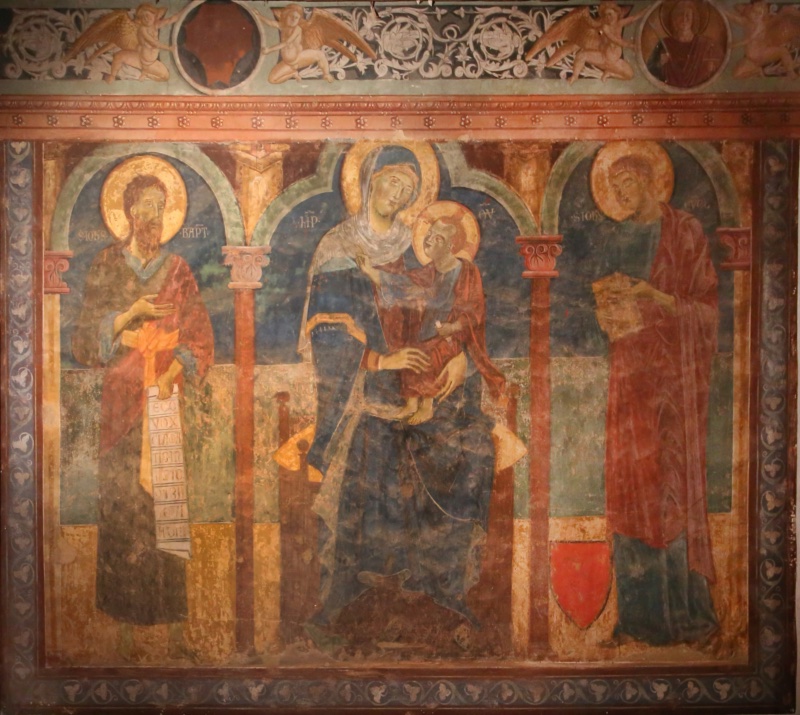
This is a large frontal religious painting in which the Virgin, seated on a throne, holds the Infant Jesus on her lap, set within a symmetrical composition featuring the two saints John, who, positioned on either side, reinforce the theological centrality of the Virgin and the Child. The composition retains a “medieval” structure (throne, halos, codified gestures), yet displays bursts of greater expressive and spatial vitality that place the work at the crossroads between Byzantine tradition and Giotto’s early style.
The fresco depicts the Madonna seated on a throne with the Bambino in her lap, placed at the center of the composition, between St. John the Baptist on the left and St. John the Evangelist on the right. The Virgin is ideally placed on a high architectural throne with a canopy, which amplifies the centrality of the sacred group and evokes the solemnity of Pisan liturgical worship. The two saints—John the Baptist with his characteristic fur cloak and the Gospel scroll or the gesture pointing to the Savior, and John the Evangelist in the role of theologian-apostle—complete the typology of the Madonna with Saints, which serves as an image of authority and public devotion.
The style is still strongly iconic, with clean lines, generally flat flesh tones, and a strong emphasis on the throne’s architecture, but in the folds of the drapery and the rendering of the figures, a certain attention to volume emerges, positioning Giovanni d’Apparecchiato as a link between the Byzantine tradition and the nascent naturalism of the subsequent Florentine and Pisan generations. The Deputation Hall, located in the Palazzo dell’Opera, served as an administrative and ceremonial space, so the fresco also takes on a symbolic-institutional value, linking the spiritual power of the Virgin and the saints to the management of the construction site of the Primaziale.